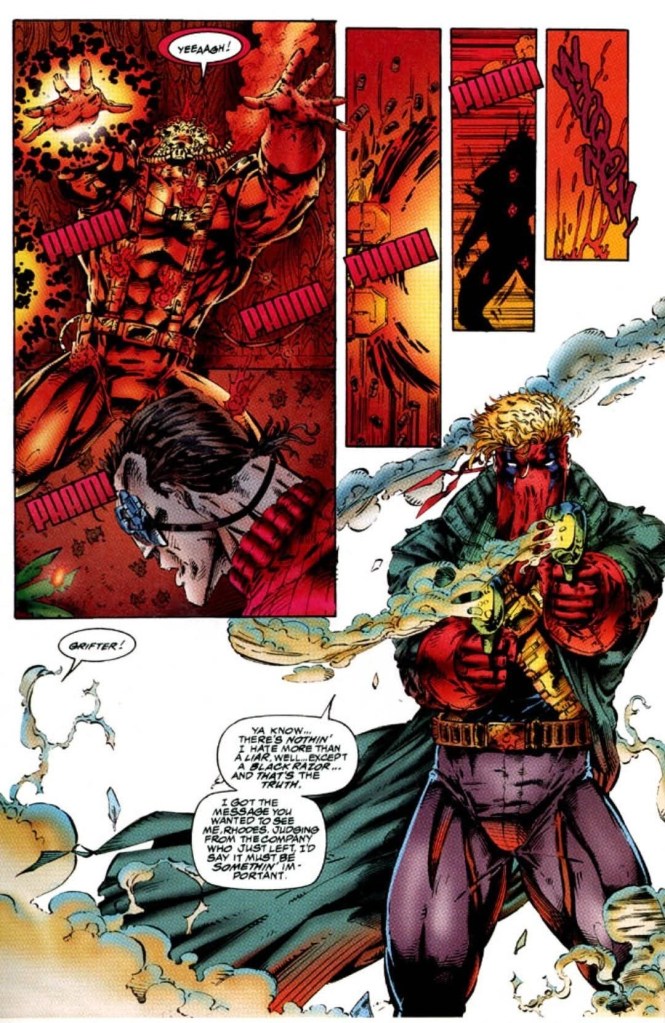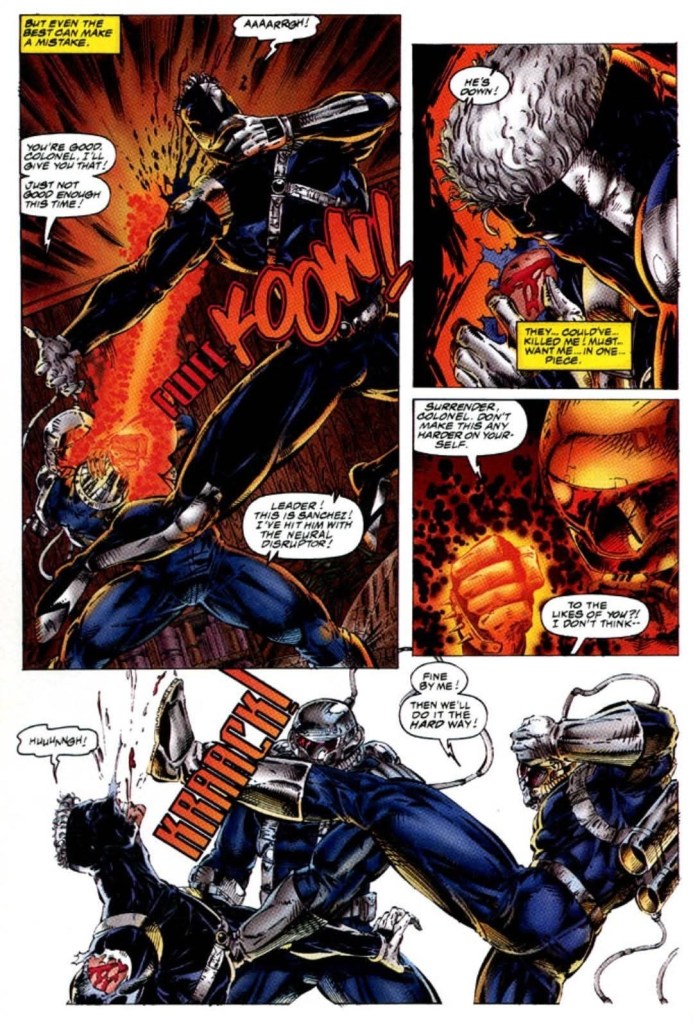
A Look Back at Elven #3 (1995)

Welcome back, superhero fans, 1990s arts and culture enthusiasts, Ultraverse fans and comic book collectors! Today we go back to the mid-1990s to examine one of the many tales of the Ultraverse through the Elven mini-series.

Having read the first two issues (click here and here), I can say that there is indeed progressive development of the personality of Elvia and her fantasy inspired identity as Elven. At the same time, the fantasy elements of the Ultraverse itself were portrayed in lively fashion. Clearly, Elven’s own corner of the Ultraverse has been established and there is some excitement to find out what would happen next and how it could affect others within the UV.

With those details laid down, here is a look back at Elven #3, published by Malibu Comics in 1995 with a story written by Len Strazewski and illustrated by Aaron Lopresti (Sludge).

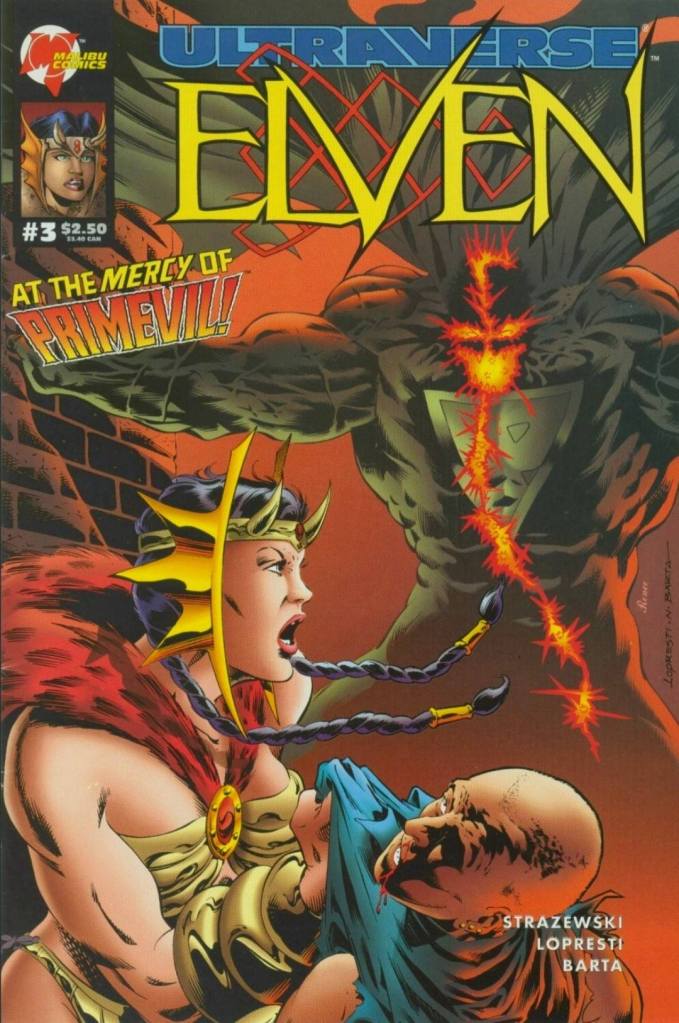
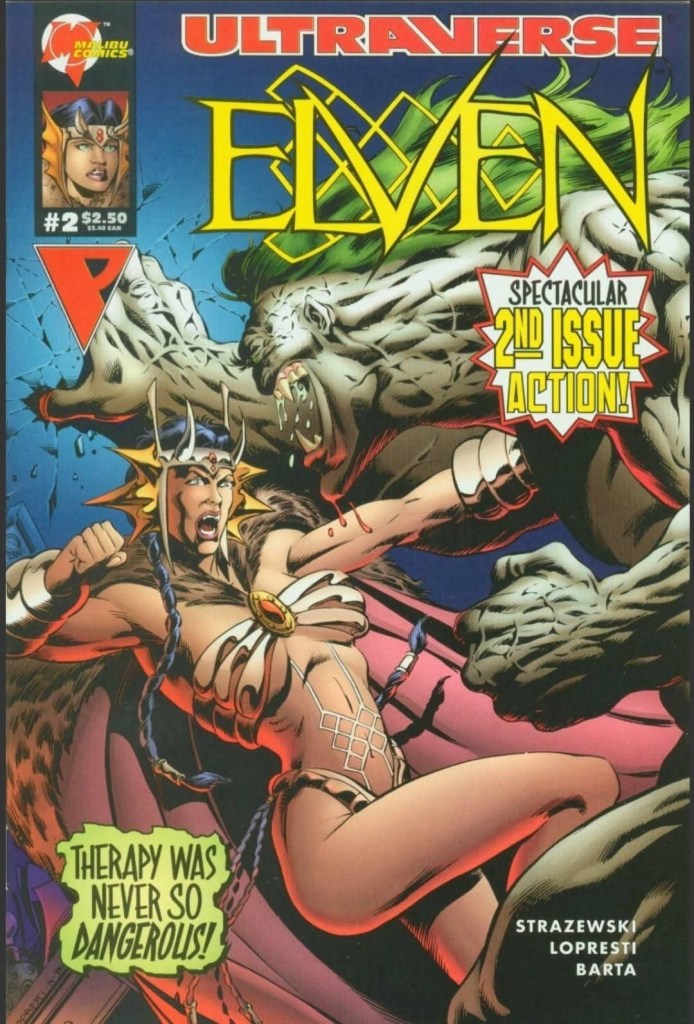
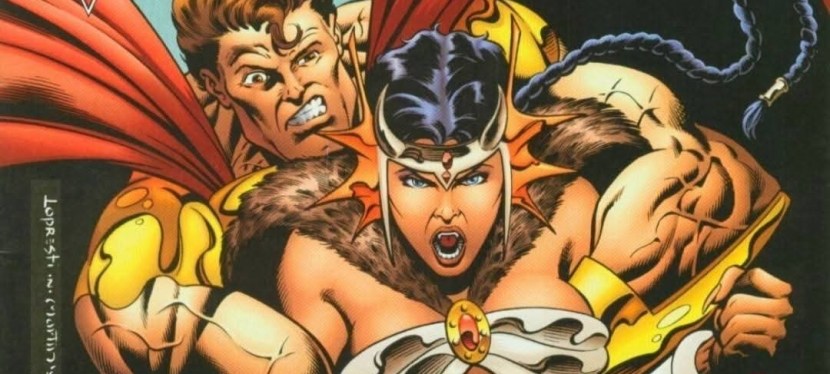
The cover.

Early story

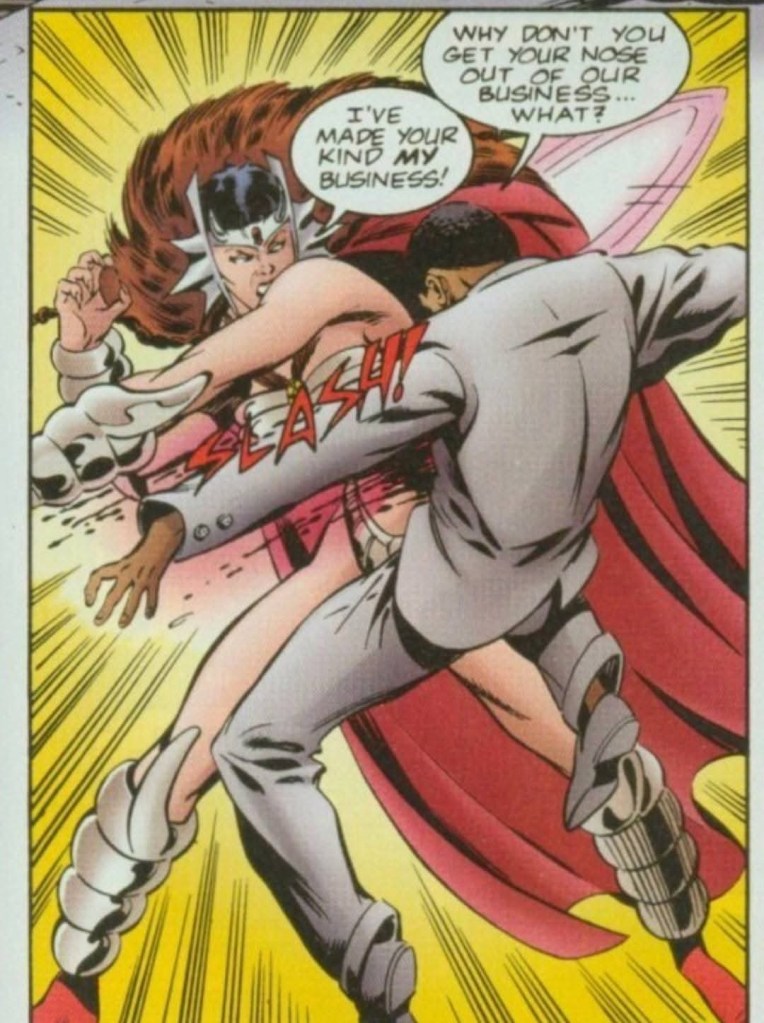
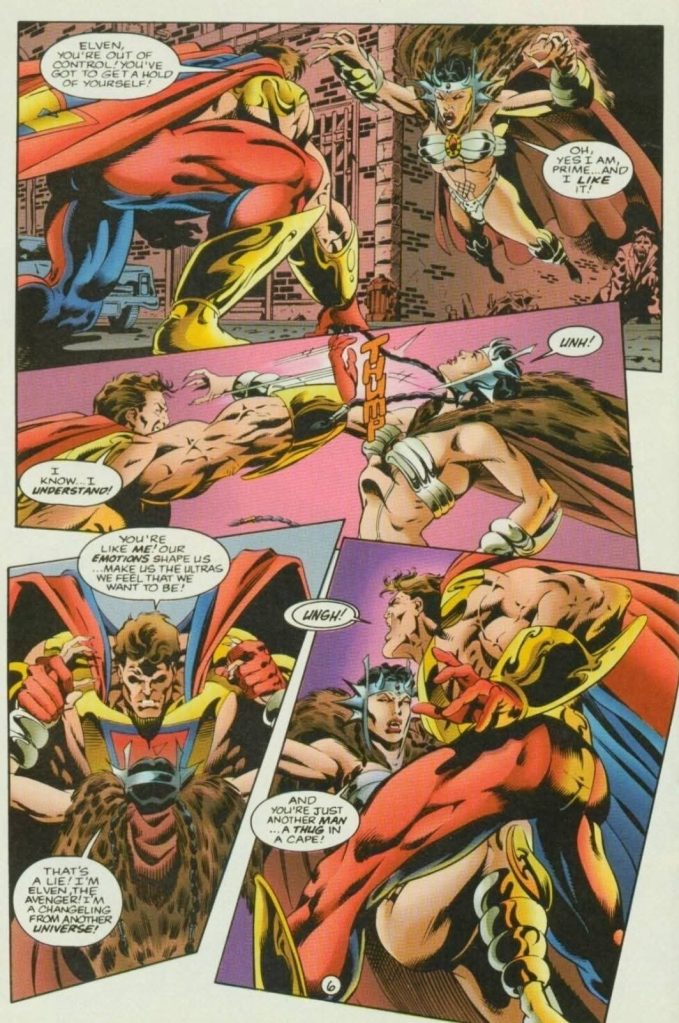
The story begins on top of the building with Elven and Prime meeting again. Tensions are high as Elven accuses him of lying. By this time, she learned a lot of details about her origin from the demon she fought with which convinced her that Prime lied to her about their genetic connections with each other (note: Doctor Vincent Gross was involved as he wanted to create ultras).

Elven rejects the science as she is strong convinced she is of magical origin from a mystical world and happens to be trapped on Earth. As Prime tries to put sense into her, Elven strikes him with a blast of energy to push him back. The blast turned to be of biological energy instead of magic.

As Elven reveals that she learned crucial information from the demon she fought with, Prime realizes it is none other than the one enemy he fought with some time ago

Quality

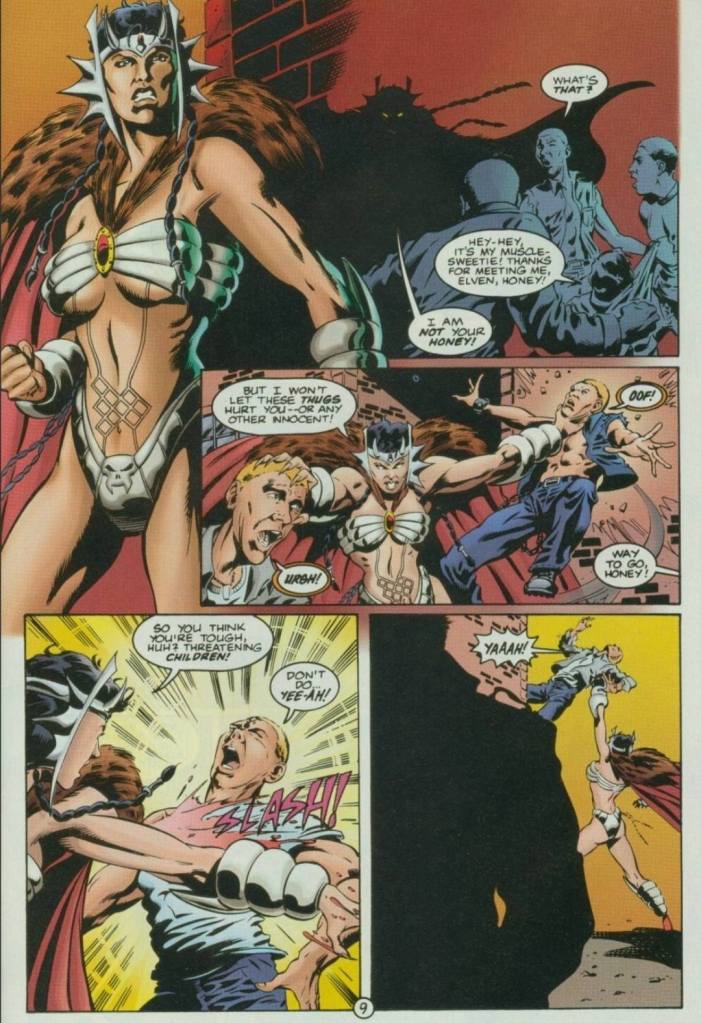
Once again, Elven impulsively uses violence on individuals to help Bruno.

Following the events of issue #2, Elven here remains confused and even lost as she has a lot of trouble figuring out the facts. Of course, being a fanatic of fantasy and Elfquest, Elven clings on to the belief that the fantasy realm is real and that she is of magical origin (which conflicts with the biology and science of her abilities and physical transformation). This is evident in the early part of the comic book when she has a tense reunion with Prime who did his best to explain details and help her understand.

When it comes to the very conflict of the story itself, the stakes were raised when Strazewski has Prime-Evil and elements of unethical science present during the later stage. Apart from abducting Elven, Prime-Evil has his own agenda pursuing Mantra (who in turn has an evil version called Necro Mantra) and a lot of arrogance within. Literally, Prime-Evil’s presence added intrigue to the plot and only made Elven’s struggle to realize the truth of her origin – both the scientific and fantasy aspects – even more complicated.

Bruno, who was a significant and surprising factor behind the conflict in issue #2, gets his nice share of the spotlight. Without spoiling the plot, I can say that he is a lot more than what he seems and has more to add to the conflict.

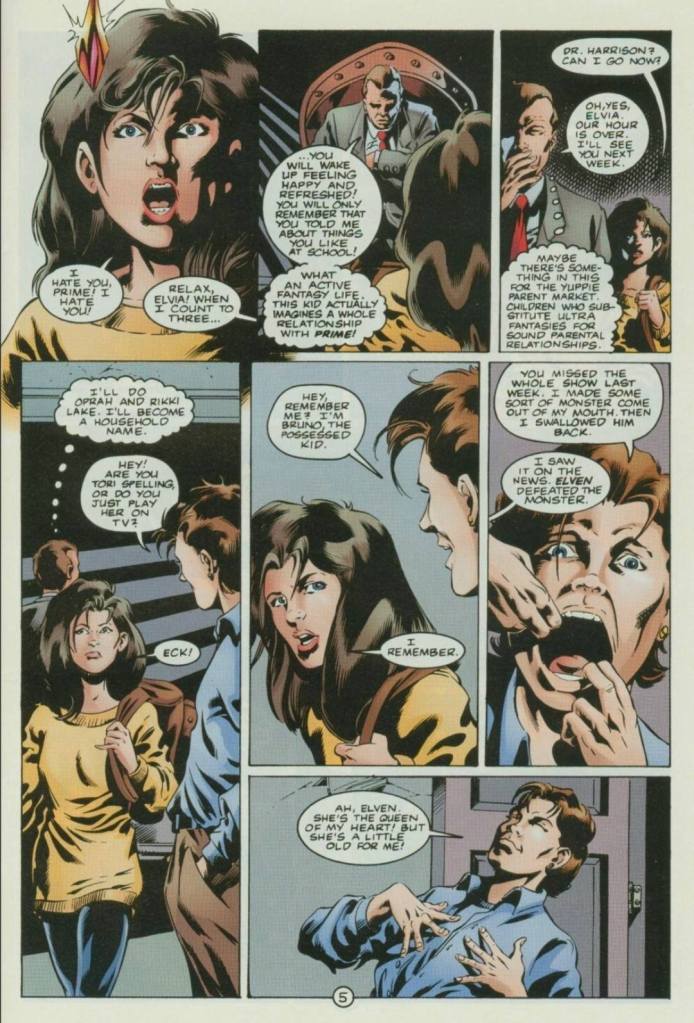
Considering the intensity of the conflict in issue #2, I find it very weird that Bruno and Elvia were not even reported to the local authorities for questioning and accountability. Perhaps the psychiatrist did not bother to do what is right since he was so fascinated with the fantastic conflict and unexplained moments that happened in his office (note: his own office assistant even became naked suddenly), and he has ambitions to become America’s next big name with his knowledge.

Conclusion

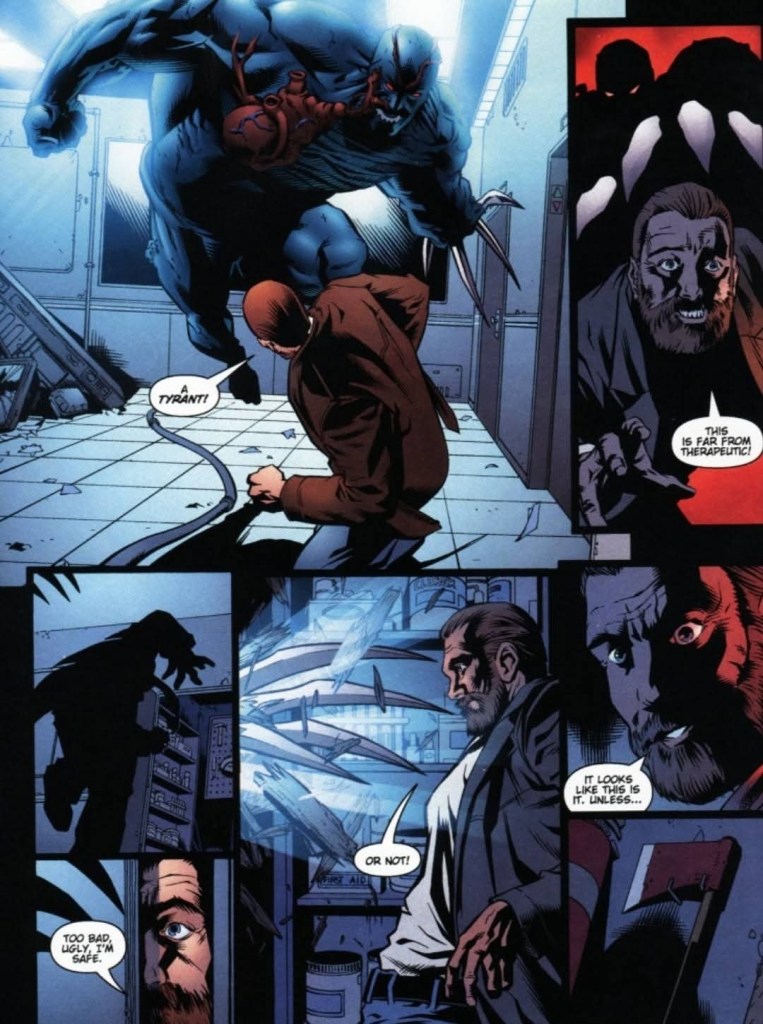
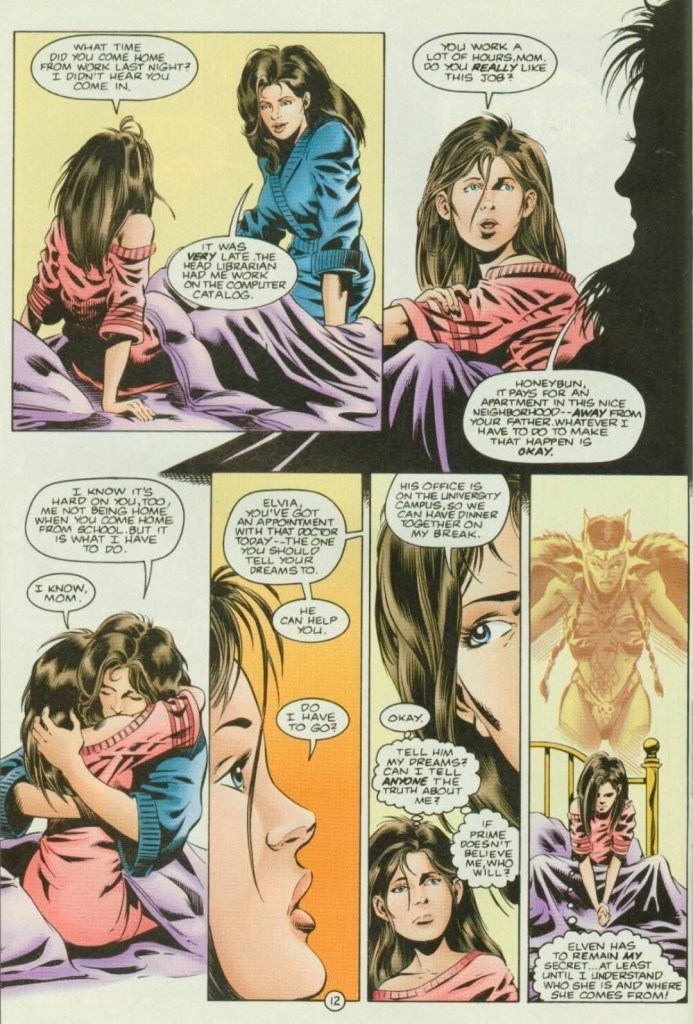
Elvia with Bruno and their psychiatrist.

At this particular stage of the mini-series, Elven #3 (1995) had an even more intriguing story to tell while gradually moving forward with Elven’s quest for the truth of her origin and her own purpose. The Strazewski-Lopresti duo did fine work in this comic book for the most part and ultimately the story convinced me to look forward to the next issue. I can say that the ending of this comic book is more suspenseful than that of issue #2.

Overall, Elven #3 (1995) is recommended.

+++++

Thank you for reading. If you find this article engaging, please click the like button below and also please consider sharing this article to others. If you are looking for a copywriter to create content for your special project or business, check out my services and my portfolio. If you want to support my website, please consider making a donation. Feel free to contact me with a private message. Also please feel free to visit my Facebook page Author Carlo Carrasco and follow me on Twitter at  @HavenorFantasy as well as on Tumblr at https://carlocarrasco.tumblr.com/ and on Instagram at https://www.instagram.com/authorcarlocarrasco/.
A Look Back at Elven #2 (1995)

Welcome back, superhero fans, 1990s arts and culture enthusiasts, Ultraverse fans and comic book collectors! Today we go back to the mid-1990s to examine one of the many tales of the Ultraverse through the Elven mini-series.

When I grabbed a copy of Elven #1, I did not expect much entertainment and surprise. But as I started reading it and witnessed Elven’s interactions with Prime, the narrative became even more engaging to read. In addition, Len Strazewski’s writing clearly defined the personality of fantasy fanatic and confused girl Elvia Swanson and established Elven as a twisted female parallel to Prime. Along the way, Aaron Lopresti’s art showed a lot of details, emotions and dynamism (on the action).

With those details laid down, here is a look back at Elven #2, published by Malibu Comics in 1995 with a story written by Len Strazewski and illustrated by Aaron Lopresti (Sludge).

The cover.

Early story

The story begins inside the office of a psychiatrist where Elven encounters a demon which just came out of the teenage boy Bruno. As the two fight each other violently, the psychiatrist watches them obsessively and writes down the notable details for a potential advancement in his career. Bruno, who carried the demon in him some time prior, watches the fight from a distance marveling at Elven while also observing how chaotic the demon is.

Elven fights the demon hard while maintaining a mindset of pride and even being superior. The demon reveals his link with Boneyard (for reference, click here) confirming he came from a distant world.

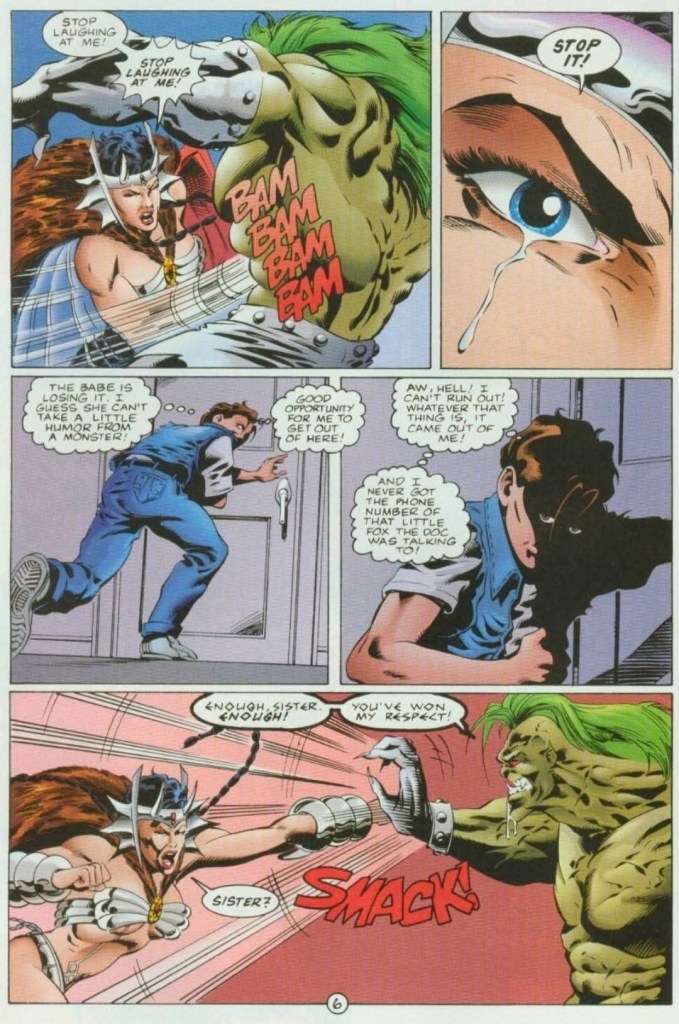
After getting hit by Elven’s elf-fire, the demon begins to laugh at her. Elven gets triggered and starts hitting the demon more…

Quality

By giving in to her impulses, Elven commits a very violent move on a man. This also shows her inability to restrain herself.

While issue #1 established Elvia Swenson personality and her super-powered, fantasy inspired Elven identity who has a genetic connection with Prime, this comic book emphasizes the deeper fantasy aspects of the Ultraverse while expanding the lore within Elven’s part of the shared comic book universe.

Similar to Prime (Kevin Green in disguise), Elven gets triggered emotionally which is the result of the youth and obvious lack of maturity of Elvia. That being said, the moments of Elven getting more violent and shedding a few tears after getting laughed at by the demon deserve any reader’s attention.

Len Strazewski’s writing is pretty rich here and he pulled of some clever moves with the narrative. As the battle between Elven and the demon intensified, there were signs that the conflict would turn into an even bigger and more destructive battle. Instead, there were these deep revelations that happened (note: for relevance, you will have to read Prime #5 which I reviewed some time ago) and even the arrogant boy Bruno has his own share of what has been going on. Even the psychiatrist turned out to be a pretty significant bystander during the battle which suggests a build-up for a sub-plot.

As such, Strazewski wrote the story to be very intriguing and the plot threads are not limited to Elven and the demon. The way I see it, something is being built up and to grasp the relevance, you will have to read some issues of the Prime and Mantra comic book series.

If there is any weakness in the storytelling, it is the fact that the psychiatrist and his office assistant very easily forgot the moments of Bruno turning evil during the late part of issue #1. The way they reacted in this comic book after the end of the battle between Elven and the demon, they did not make any moves to hold Bruno accountable nor did they question Elven’s way of handling matters (which includes the eventual ruining of the office).

Conclusion

After getting triggered (being laughed at by the demon), Elven acted move violently and impulsively.

While there were a few weak spots in certain parts of the story, Elven #2 (1995) is another solid read from the Strazewski-Lopresti duo. Elven got developed even more through conflict with the demon, and her own search for the truth about her origin. Aside from that, the fantasy elements implemented in the story expanded the lore of the Ultraverse in a very unique way. Ultimately, I am looking forward to reading the next chapter of this mini-series.

Overall, Elven #2 (1995) is recommended.

+++++

Thank you for reading. If you find this article engaging, please click the like button below and also please consider sharing this article to others. If you are looking for a copywriter to create content for your special project or business, check out my services and my portfolio. If you want to support my website, please consider making a donation. Feel free to contact me with a private message. Also please feel free to visit my Facebook page Author Carlo Carrasco and follow me on Twitter at  @HavenorFantasy as well as on Tumblr at https://carlocarrasco.tumblr.com/ and on Instagram at https://www.instagram.com/authorcarlocarrasco/.
Retro Gaming Ads Blast – Part 39 (RPG Special)

Welcome back readers, fellow geeks and electronic gaming fans!

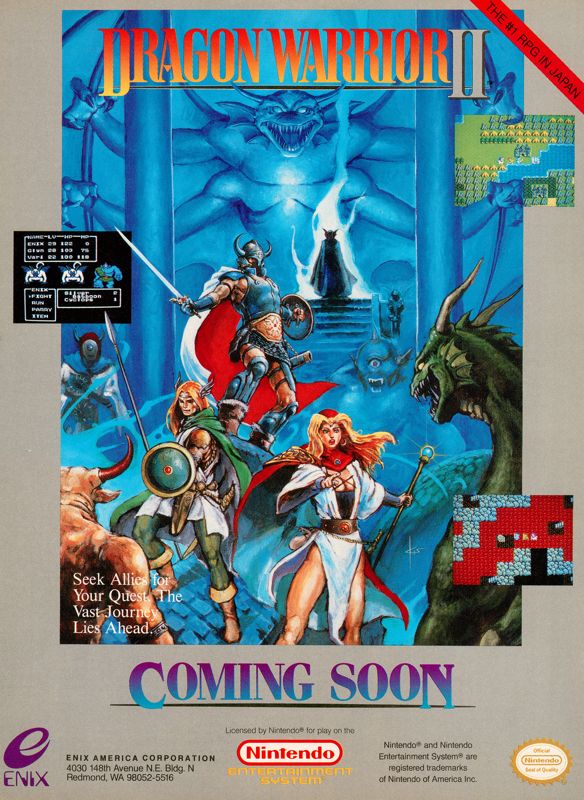
In this edition of the Retro Gaming Ads Blast (RGAB) series, we will take a look at another batch of retro gaming print ads from the 1980s to the 1990s, particularly on role-playing games (RPGs) from the East and the West. This is the RPG Special!

For the newcomers reading this, Retro Gaming Ads Blast (RGAB) looks back at the many print ads of games (console, arcade, computer and handheld) that were published in comic books, magazines, flyers, posters and newspapers long before smartphones, social media, the worldwide web and streaming became popular. To put things in perspective, people back in the 1980s to the 1990s were more trusting of print media for information and images about electronic games and related products.

With those details laid down, here is the newest batch of retro gaming print ads for you to see and enjoy…

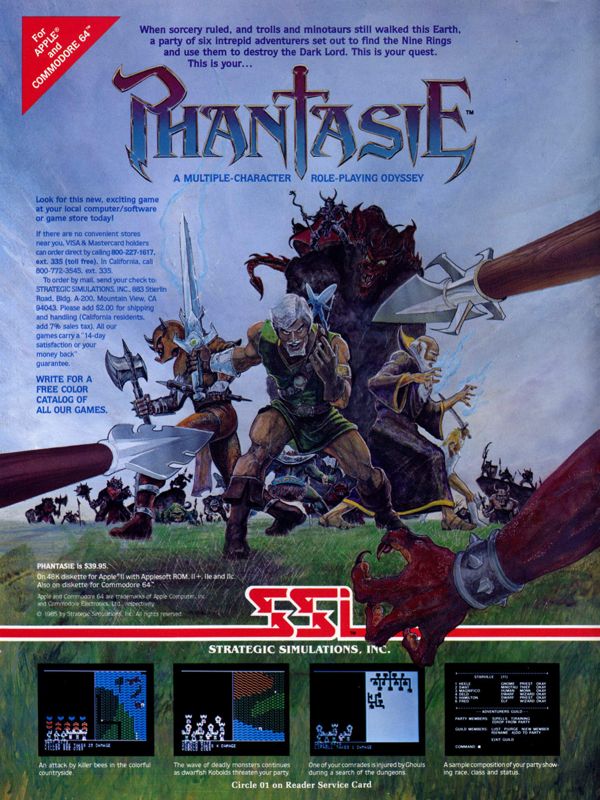
1. Phantasie North American and Japanese Print Ads

The North American print ad.
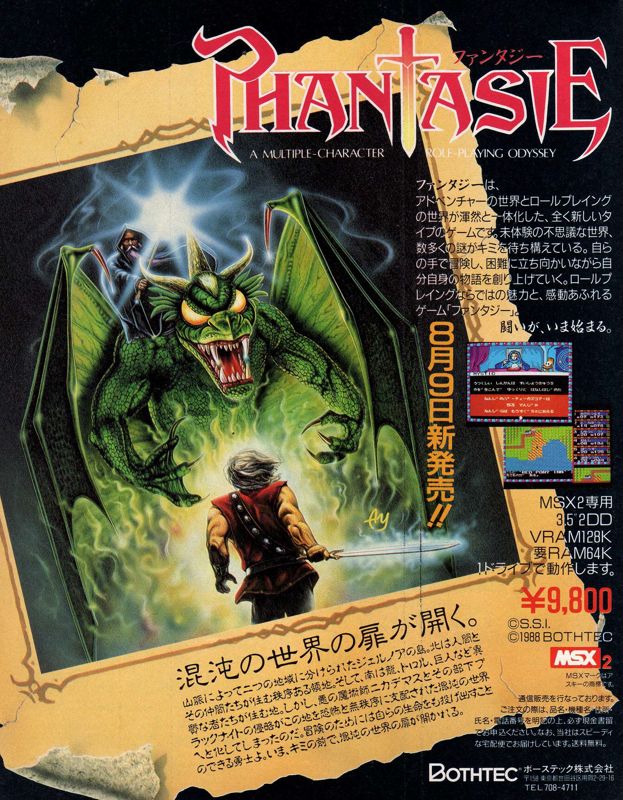
The Japanese print ad.

Released by Strategic Simulations in the mid-1980s, Phantasie was a fantasy role-playing game that became a huge commercial success paving the way for not only ports on other computer systems of the time but also sequels later. The ad they came up with for the North American market had strong fantasy vibes and the screenshots gave readers the impression that it looked playable or user friendly. For the Japanese market, Phantasie was ported to the MSX system and they came up with an ad using radically different art work that had a horror vibe.

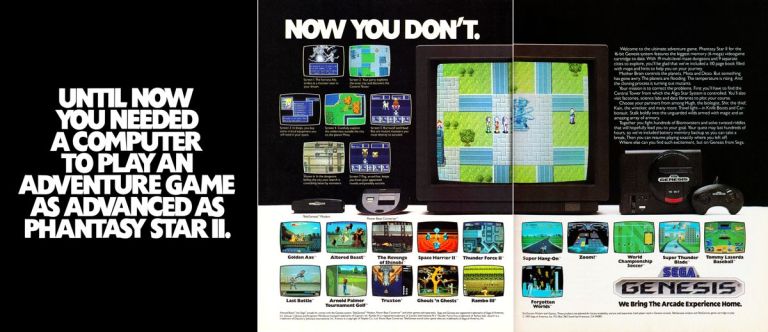
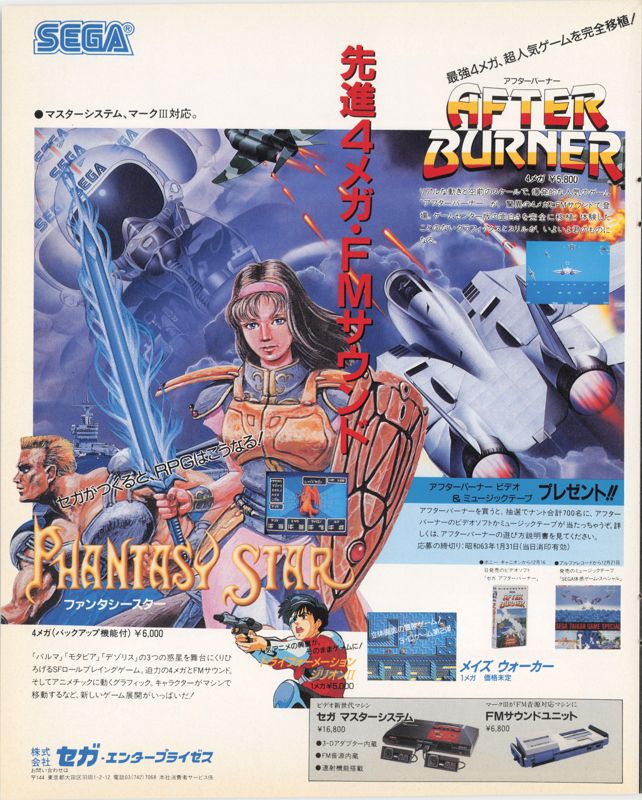
2. Phantasy Star Japanese Print Ad

Phantasy Star in the Japanese print ad sharing the spotlight with After Burner.

In the 1980s, role-playing games started gaining popularity with Japanese console gamers and there were game developers who were inspired by established RPGs from the West. Enix released two Dragon Quest games and each of them sold a lot of copies on Nintendo’s Family Computer (Famicom). At the time, Sega already had the Master System (called the SG-1000 and its variants with revisions) in the console market and they were way behind Nintendo on hardware sales. Knowing there is a market for console RPGs, Sega went on to make their exclusive RPG Phantasy Star. In 1987, a print ad was released showing Phantasy Star sharing the spotlight with Sega’s blockbuster game After Burner in the background. While the ad felt a bit disorienting to see, the game achieved much-needed success for Sega which in turn brought the game to the Master System in America in 1988. The game sold more and eventually led to sequels in the years that followed.

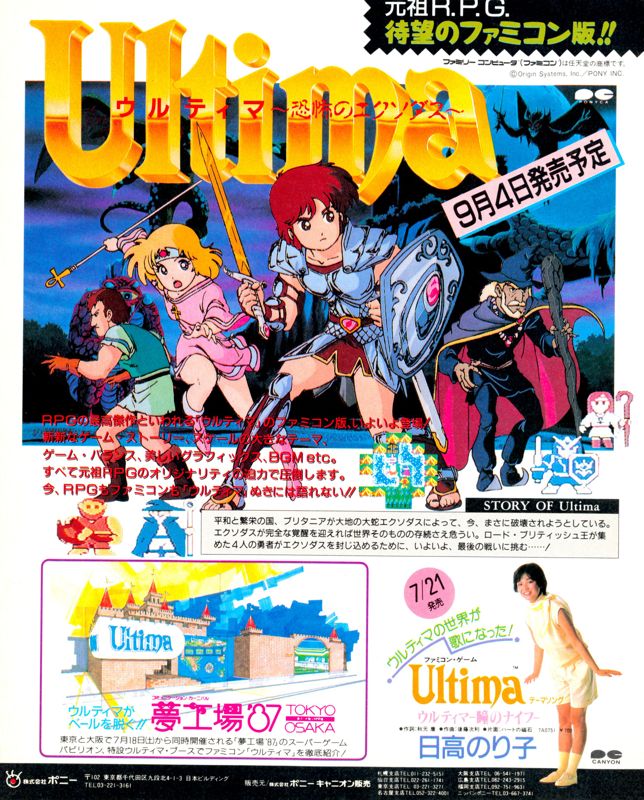
3. Ultima III Japanese Print Ad

Remember the old days when anime or comic book-style artwork was used to promote games in the Japanese print media?

Released in Japan under the title Ultima: Kyoufu no Exodus, Ultima III: Exodus was a breakthrough for the series as the Famicom version marked the first console release for Japanese gamers (note: the game was also offered for MSX and other computer systems in the country). The anime-style artwork used for the print ad is the same virtually the same with the front cover of Famicom version. Very notably, the art on the covers of the PC-88 and PC-98 versions were different. 

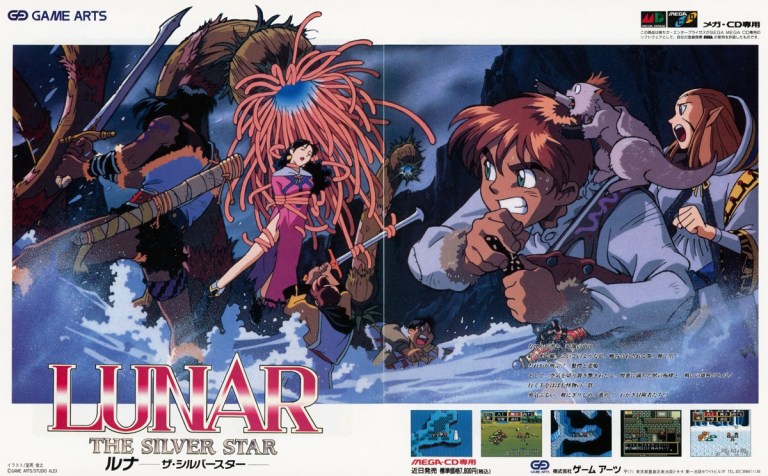
4. Lunar: The Silver Star Japanese Print Ad

Game Arts’ Lunar: The Silver Star as advertized in Japanese magazines.

By the 1990s, console RPGs were very popular as franchises like Dragon Quest and Final Fantasy each released sequels that sold a lot of copies. The company Game Arts decided to make a role-playing game which can tell stories better using animation with voiceovers and music while being very playable and enjoyable. They came up with Lunar: The Silver Star and released it on the Mega-CD add-on (connected with the Mega Drive console of Sega) in 1992. As such, it was not surprising to see the print ad having anime-style artwork as the game itself had several minutes of anime cutscenes complete with audio. As most Japanese role-playing games (JRPGs) did not have playable anime cutscenes for storytelling, Lunar: The Silver Star really stood out. Sometime later, the small American company Working Designs would handle the game’s English version and start a healthy business relationship with Game Arts.

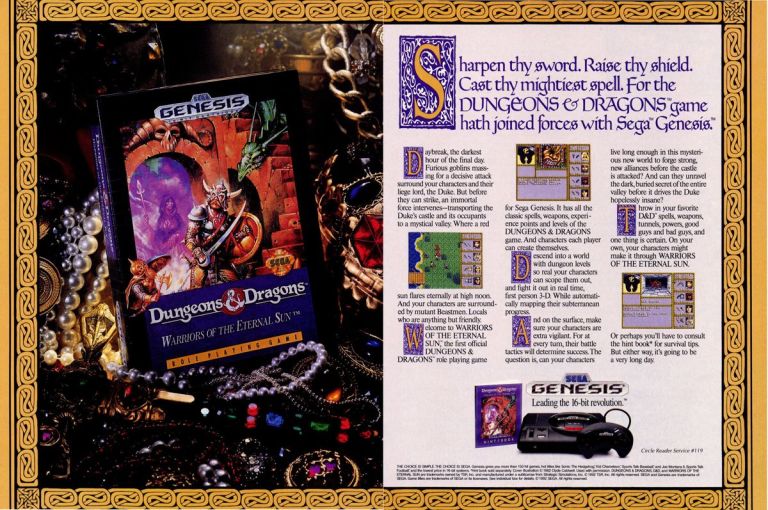
5. Dungeons & Dragons: Warriors of the Eternal Sun North American Print Ad

A print ad that strongly appealed to both Sega Genesis gamers as well as fans of Dungeons & Dragons.

By the year 1992, the fantasy games franchise Dungeons & Dragons was wildly popular as players around the world kept enjoying the tabletop RPG modules (using dice, pen paper) as well as many computer and video games already available. Sega acquired a D&D license and eventually released Dungeons & Dragons: Warriors of the Eternal Sun exclusively on their Genesis console in 1992. To promote it, Sega produced a 2-page print ad that had one half showing the game’s box placed with jewelry while using the other half to show the screenshots, descriptive text and other details. The way it was presented, the print ad was cleverly structured to attract the attention of Sega Genesis gamers as well as Dungeons & Dragons fans. The game ended up as the first and only official D&D product for the console.

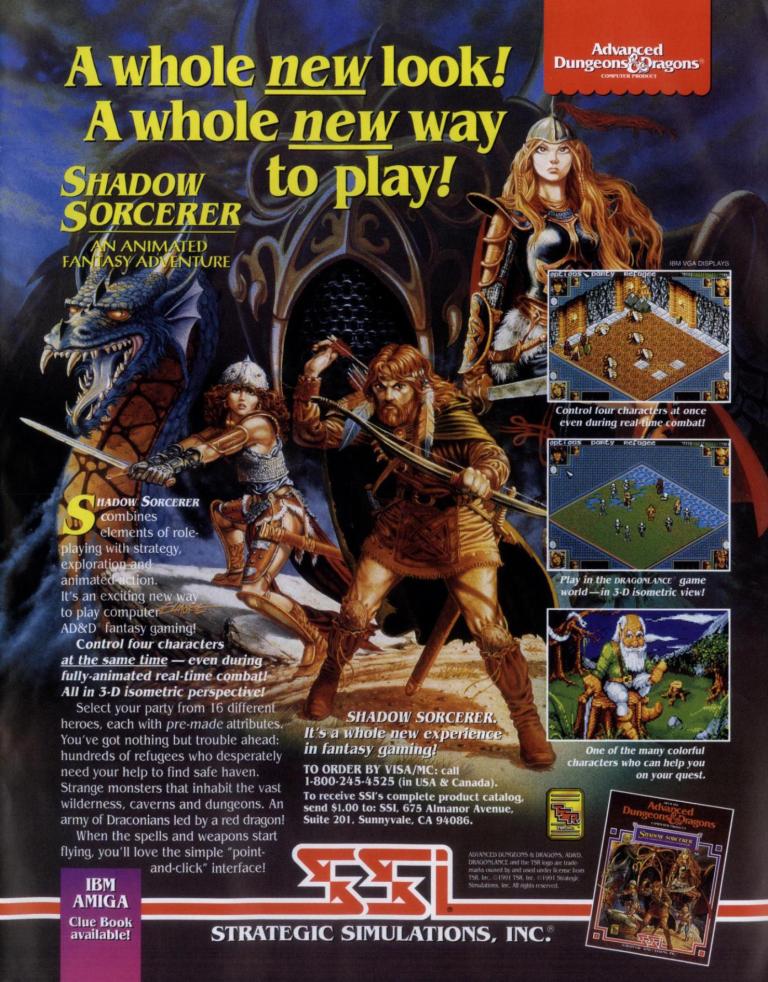
6. Shadow Sorcerer North American Print Ad

This is one of many Dungeons & Dragons computer games released. The use of painted art for marketing was done many times.

In the history of the Dungeons & Dragons franchise and electronic gaming, it was on computers where the more ambitious and more intricate licensed games were played by many fans. In 1991, the Advanced Dungeons & Dragons (AD&D) electronic game Shadow Sorcerer was released on MS-DOS PC, Amiga and the Atari ST. The painted artwork used on the print ad was virtually the same as that on the box covers of the MS-DOS and Amiga versions. I can only guess that the ad markers must have paid a lot of money on the painted art and decided to use it for both marketing and packaging since it looked so detailed.

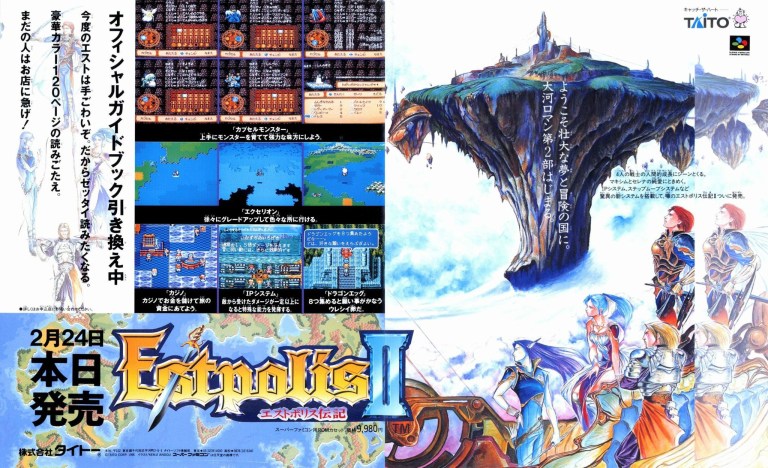
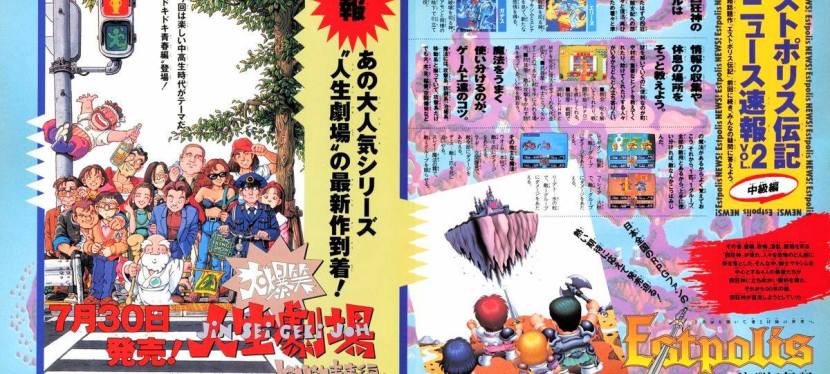
7. Estopolis Denki Japanese Print Ad

The 2-page Japanese print ad of Estopolis Denki.

In 1993, a brand-new Japanese developer called Neverland was established and its first project was the fantasy role-playing game Estopolis Denki for the Super Family Computer (Super Famicom). That same year, publisher Taito released the game and they promoted it with a 2-page print ad that featured a whimsical looking hand-drawn art work on one half and utilized the other half with details, screenshots and part of the art that was used on the game’s Super Famicom box cover. While Japanese game sales are not available, it seems Estopolis Denki sold enough to convince the publisher to release the game in North America as Lufia & The Fortress of Doom.

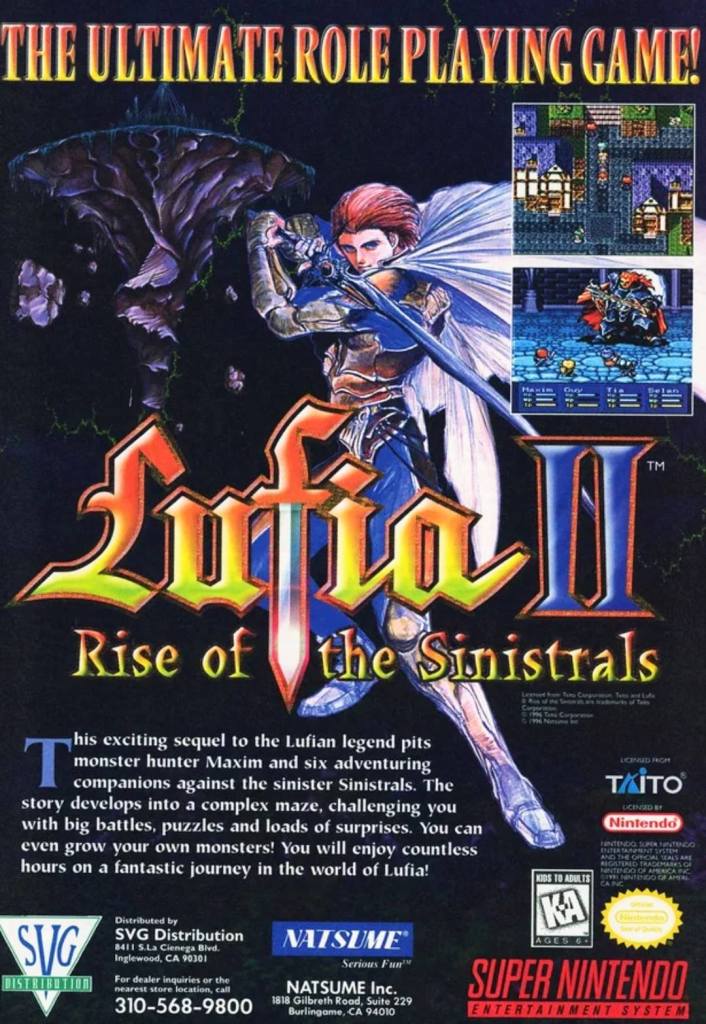
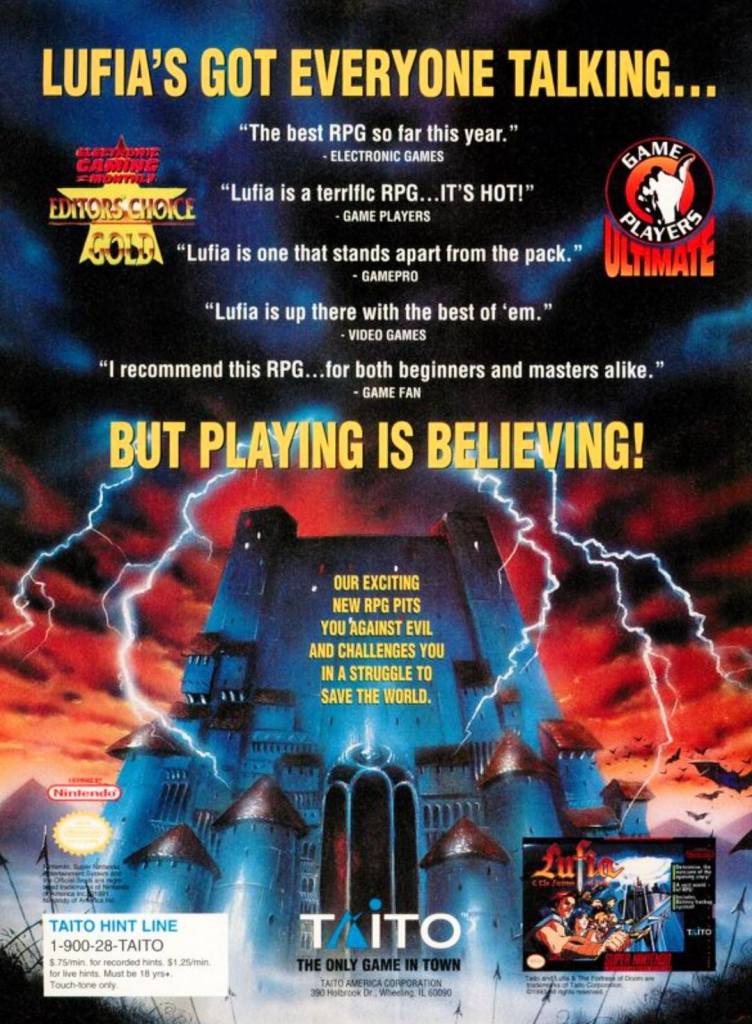
8. Lufia & The Fortress of Doom North American Print Ad

If you were able to play Lufia & The Fortress of Doom on the SNES, were you able to see this ad in a comic book or in a magazine?

Upon release in America in late 1993, Taito scored gold as Lufia & The Fortress of Doom on the Super Nintendo Entertainment System (SNES or Super NES) became a critical and commercial success. In fact, it literally gained steam during the early months of availability and ended up as the top-selling SNES game in America for the month of February of 1994. Take note that at this particular point of time, RPGs on game consoles in America were not yet in high demand as gamers’ tastes were different. When it comes to the marketing, Taito came up with a single-page print ad showing fantasy artwork, the game’s box cover and the published quotes from game critics who gave the game positive reviews. This is smart marketing on the part of Taito.

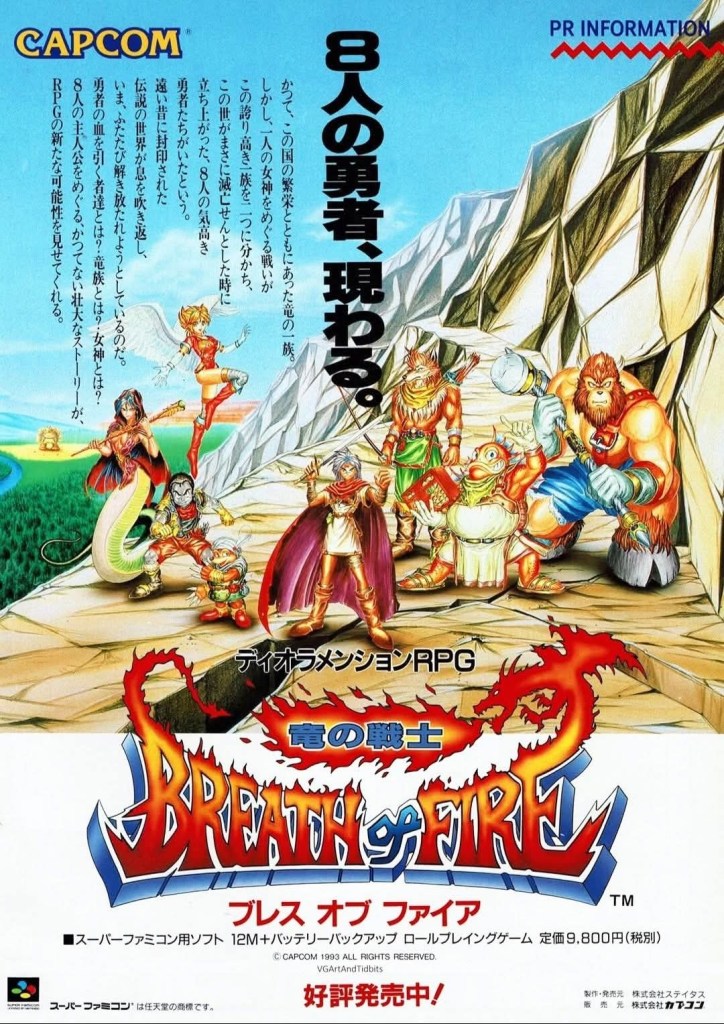
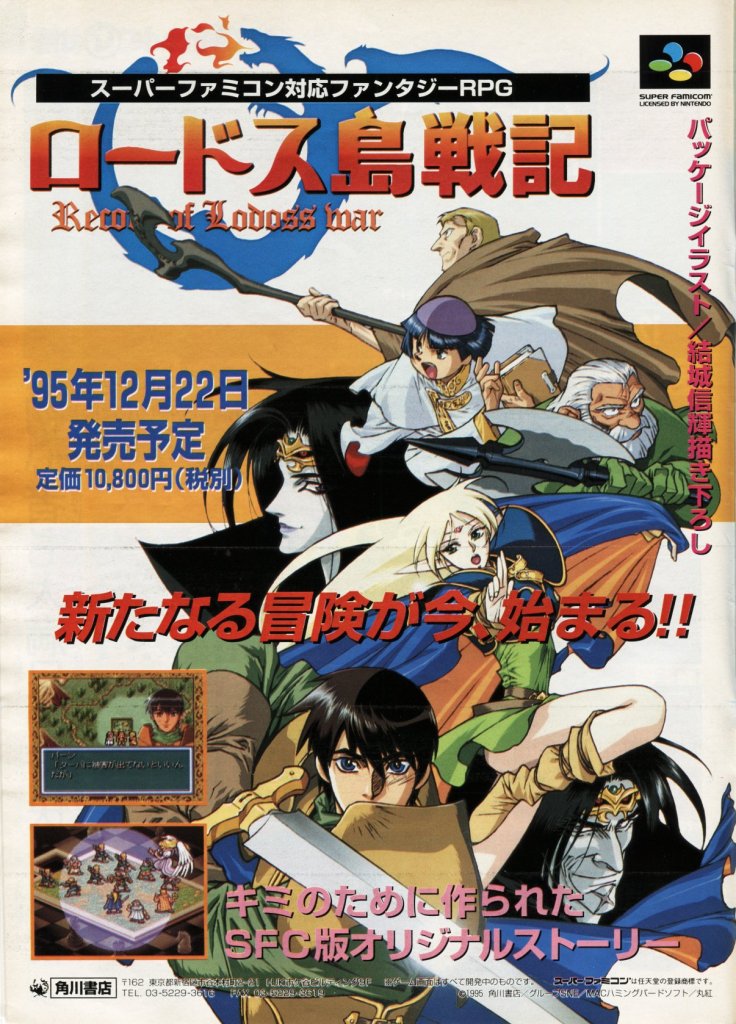
9. Record of Lodoss War Japanese Print Ad

The Japanese print ad of Record of Lodoss War for Super Famicom.

Have you ever heard of the Record of Lodoss War fantasy franchise? That one started as a series of fantasy novels by Ryo Mizuno who previously worked on an RPG project. Record of Lodoss War was eventually adapted into comics, anime and video games. One of those games was released on the Super Famicom in December 1995 published by Kadokawa Shoten which in turn made the one-page print ad for the Japanese market. Using established art from the anime OVA (original video animation) series was a strategic move by the publisher as millions of Japanese people viewed it. Unsurprisingly, the art on the ad is almost the same as the one displayed on the game box cover.

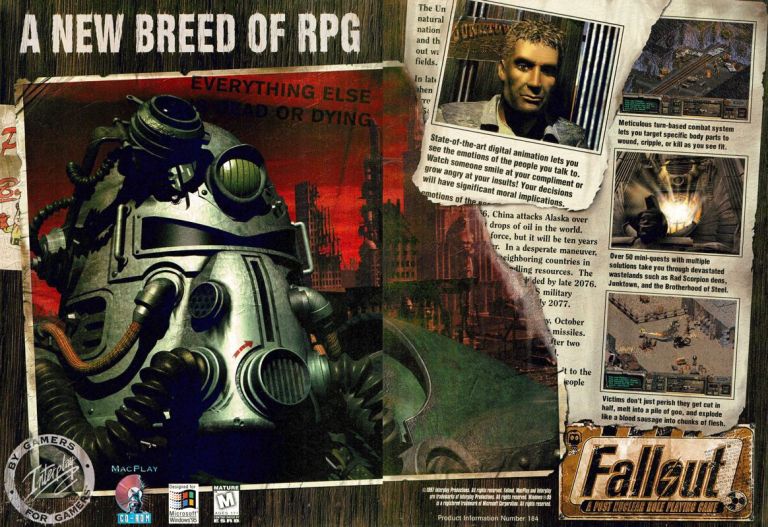
10. Fallout North American Print Ad

A gritty looking print ad of the original Fallout PC game.

In my gaming life, I played Fallout 3, Fallout 4 and Fallout: New Vegas on Xbox consoles. When the first-ever Fallout game was released in 1997, I did not notice it as I was more into console gaming than PC gaming. The above print ad appeared is several PC gaming magazines and it clearly shows what it offered which gamers eventually ended up enjoying a lot. The mechanical helmet – protection for the user during battles and from radiation in the nuclear wasteland – on the left side of the ad became a key symbol of the Fallout franchise as further games also featured mechanical helmets. Fallout was highly acclaimed for featuring open-ended gameplay and its immersive post-apocalyptic setting. It sold enough copies to convince publisher Interplay to proceed with a sequel and the rest was history.

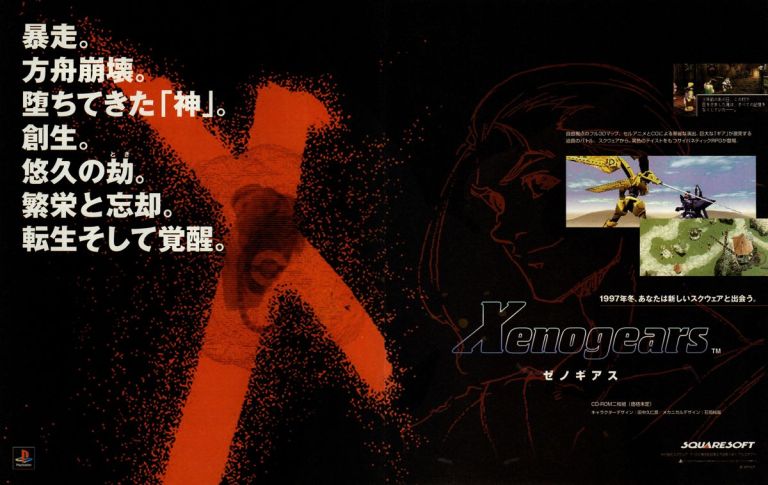
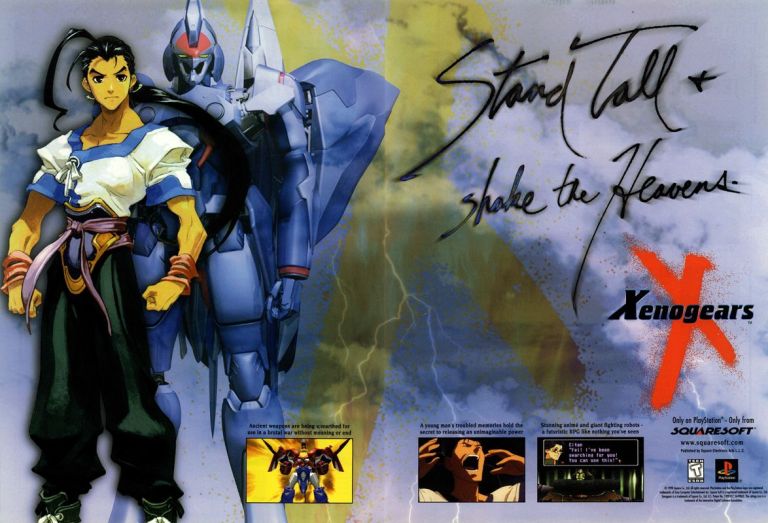
11. Xenogears Japanese and North American Print Ad

Japanese advertisement of Xenogears.
This North American print ad of Xenogears clearly showed the main character, a robot, the sci-fi setting and the visual style of the game.

Xenogears was a sci-fi JRPG I played on the PlayStation in 1998 but I was unable to finish it. Before it was released in America, there was speculation that Squaresoft would not be able to produce an English version for international release due to its religious content. The game was highly challenging to translate into English due to religious themes and psychological elements. Regardless, the game achieved successes commercially and critically in both Japan and America. Xenogears has since been considered by many as a classic JRPG and to play it today is pretty challenging as an existing PlayStation One, PlayStation 3 or PlayStation Vita is required as well as the physical PlayStation disc itself (note: digital copy of Xenogears for PS Vita). Square Enix – which previously remastered Chrono Cross and several Final Fantasy games for modern gaming platforms – has yet to remaster Xenogears for those with modern game consoles, mobile devices and the PC.

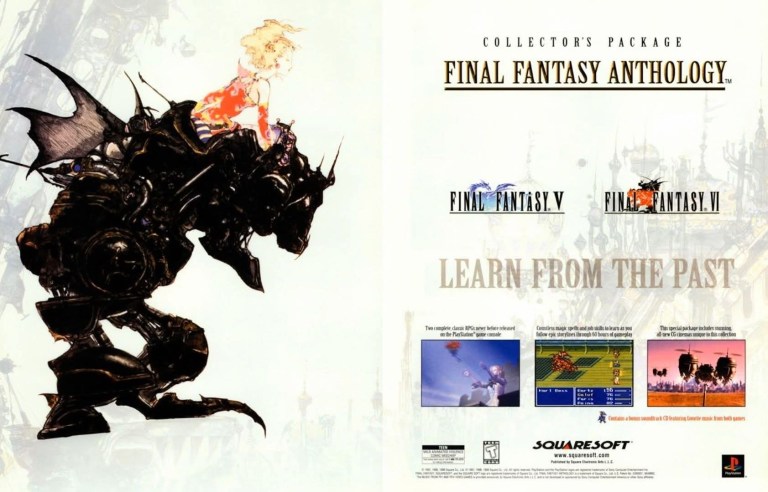
12. Final Fantasy Anthology Print Ad

I remember seeing this 2-page print ad in many gaming magazines I read.

By the year 1999, Squaresoft established itself as the best role-playing game company as they achieved critical and commercial success with Final Fantasy VII in 1997, Brave Fencer Musashi, Parasite Eve and Xenogears in 1998. For 1999, Squaresoft decided to bring ports Final Fantasy V and Final Fantasy VI – both games were released in cartridge format on Super Famicom/Super NES some years prior – to their fans who owned PlayStation consoles by releasing the collection called Final Fantasy Anthology. For the North American market, Squaresoft aggressively promoted the 2-game collection with the above 2-page print ad on several video game publications. One half featured exquisite artwork by Yoshitaka Amano and the other half showed the screenshots, descriptions and details. Clearly the ad was made with Final Fantasy fans in mind and it was also clever with the use of nostalgia.

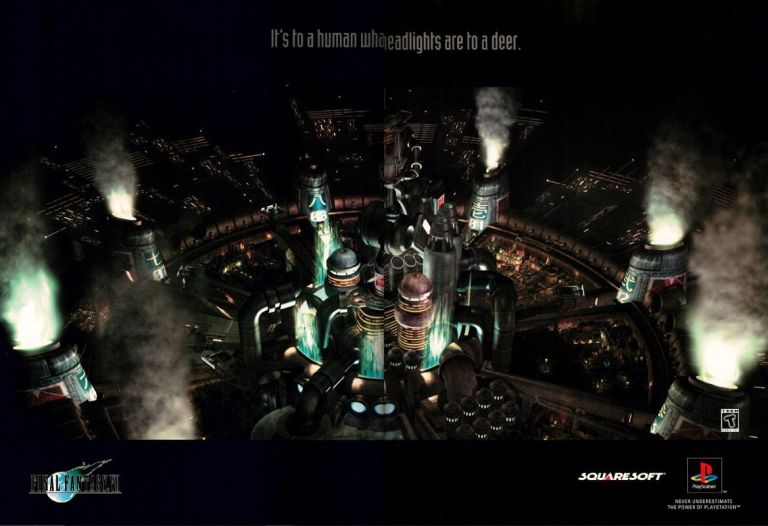
13. Final Fantasy VII North American Print Ad

While it did not show any of the characters, this 2-page print ad of Final Fantasy VII appeared in many gaming magazines and ultimately made the public aware of the game which went on to sell millions.

There is no denying that Final Fantasy VII is the most defining Japanese RPG of the 1990s. Given its huge pre-release promotions, the critical acclaim and the tremendous sales achieved in North America and Europe, the game arguably made the JRPG sub-genre more popular among gamers and game publishers while also making the original PlayStation console the must-have machine for video gaming. The above print ad is one of several released through print media and even though it did not show any characters, the image of a futuristic looking city caught the attention of not just gamers but also others who loved entertainment.

+++++

Thank you for reading. If you find this article engaging, please click the like button below, share this article to others and also please consider making a donation to support my publishing. If you are looking for a copywriter to create content for your special project or business, check out my services and my portfolio. Feel free to contact me with a private message. Also please feel free to visit my Facebook page Author Carlo Carrasco and follow me on Twitter at  @HavenorFantasy as well as on Tumblr at https://carlocarrasco.tumblr.com/ and on Instagram at https://www.instagram.com/authorcarlocarrasco

A Look Back at Elven #1 (1995)

Welcome back, superhero fans, 1990s arts and culture enthusiasts, Ultraverse fans and comic book collectors! Today we go back to the mid-1990s to examine one of the many tales of the Ultraverse.

For the newcomers to the Ultraverse, Prime is one of its most definitive heroes and his true identity is the teenager Kevin Green who can transform into an overly muscular caped adult superhero. The Prime monthly series of comic books ran for two years and the title character appeared in many other Ultraverse comic books.

Considering the prominence of Prime, it is not surprising that Malibu Comics proceeded to create comic books featuring a female counterpart to Prime. That counterpart is called Elven who appeared in a few early issues of the Ultraverse Premiere series and eventually Prime interacted with her.

With those details laid down, here is a look back at Elven #1, published by Malibu Comics in 1995 with a story written by Len Strazewski and illustrated by Aaron Lopresti (Sludge).

The cover.

Early story

The story begins deep within a city when a beautiful blonde woman got hurt by a very angry man named Billy. With the lady down on the floor, the man raises his metallic weapon intending to strike her not realizing that someone is emerging from behind. He turns and sees a scantily clad caped woman who immediately hits him hard. The caped woman is Elven who believes she is helping the blonde woman.

To Elven’s surprise, the blonde woman tells her to stop and not hurt the man who was violent towards her. The man hits Elven on the face with his weapon but ended up getting hit hard again in retaliation. Elven then uses an optic blast at the wall as she tells the blonde woman to leave.

With the violent man down and hurt, Elven decides to kill him but is prevented by Prime from behind. After telling Prime that she told him not to interfere with her, she hits him with an energy blast…

Quality

Elvia with her hard-working mother. The lack of a loving father affected Elvia deeply.

Being written by Prime co-creator and series co-author Len Strazewski, this Ultraverse tale about Elven is very good and there is a lot of depth in the plot. You will meet Elven and the true human behind her named Elvia Swenson, a teenage girl who has a painful past, has an obsession with fantasy tales, and was created through the very same secret government fertility research program as Kevin Green/Prime. Elven’s disturbing look (with elvish features) reflects Elvia’s fantasy obsession and personally belief of using violence against men. She and Prime are genetically related due to the top secret project.

This comic book examines Elvia whose life lacks direction and her abusive father really impacted her negatively. With her mother’s love and guidance remaining in her life, Elvia is literally in a quest to find purpose, happiness and friendship. Unfortunately, the young guy Bruno is in the neighborhood and he is actually a demon. Bruno’s presence literally raised the stakes of the story which justifies Elvia’s transformation into Elven for the eventually good-versus-evil conflict. All throughout, there is tension and drama which got balanced with superhero spectacle. The way Elven is portrayed here makes her comparable with the arrogant, man-bashing, rabid feminists of modern society.

When it comes to Prime himself, this comic book features a really mature portrayal of him. I am talking about the early part of the story when Prime did his best to calm Elven down, restrain her and convince her to think first as a way to prevent her recklessness. Long-time Ultraverse readers should now that Prime is actually teenager Kevin Green inside all that muscle and he often has an awkward or a tense way of communicating with others (note: imagine the teenager pretending to think and act like an adult). That said, Prime here really interacts maturely and his attempt to put a lot of sense into the impulsive Elven is very believable. This is clever writing by Strazewski and it is one of the more notable portrayals of Prime.  

When it comes to the visual side, artist Aaron Lopresti’s style worked smoothly in this comic book. I have seen his works in the Sludge series and he really excels with facial expressions, spectacle and the monsters looking very creepy. Strangely enough, Lopresti’s take on Elven is noticeable smaller and less muscular when compared to how the character appeared in Elven #0 and Ultraverse Premiere drawn by Greg Luzniak.

Conclusion

Prime struggles to calm the impulsive and reckless Elven down. Without Prime’s intervention, Elven definitely would have committed murder against a man who harmed a woman moments earlier.

Elven #1 (1995) is clearly a very solid read and easily one of the best spin-off comic books of the Ultraverse. Strazewski and Lopresti crafted a tale that was intense and dramatic while successfully defining Elven and her true identity as the teenage Elvia. Considering her painful background and current situation, Elvia is sympathetic although things got twisted when she becomes Elven which brings out her violent side, her recklessness and distorted view about helping women by using violence. That being said, Elven at this stage in the Ultraverse is not really a likable lead character and that only makes her more unique when compared to Prime. Will Elven become as terrible as the evil ones? There is more to discover as this comic book is part of the limited series.

The specific portrayals of Elvia and Elven is very tricky to write down and Strazewski succeeded in making it work. Ultimately, this comic book added strong fantasy elements within the Ultraverse.

Overall, Elven #1 (1995) is recommended.

+++++

Thank you for reading. If you find this article engaging, please click the like button below and also please consider sharing this article to others. If you are looking for a copywriter to create content for your special project or business, check out my services and my portfolio. If you want to support my website, please consider making a donation. Feel free to contact me with a private message. Also please feel free to visit my Facebook page Author Carlo Carrasco and follow me on Twitter at  @HavenorFantasy as well as on Tumblr at https://carlocarrasco.tumblr.com/ and on Instagram at https://www.instagram.com/authorcarlocarrasco/.
A Look Back at Prime #20 (1995)

Welcome back, superhero fans, 1990s arts and culture enthusiasts, Ultraverse fans and comic book collectors! Today we revisit the Ultraverse to take a look at one of the many tales of Prime from the monthly series that first launched in 1993.

In recent times, I’ve been reading and reviewing Prime comic books I missed out before. For my most recent Prime retro reviews, click here, here and here. For the newcomers reading this, Prime is one of the most definitive heroes of the entire Ultraverse and his true identity is the teenager Kevin Green. Prime is also one of three major Ultraverse figures in the team UltraForce.

With those details laid down, here is a look back at Prime #20, published by Malibu Comics in 1995 with a story written by Len Strazewski and Gerard Jones, and illustrated by Greg Luzniak.

The cover.

Early story

The story begins with a man and a woman on bed. They just made love with each other. As the woman goes to the bathroom to fix herself, the man tells her she will be perfect in a new project and they will be together all the time even though he is already married. He tells her that will be a real ultra-heroine and already a lot of things are being prepared for her such. She will also have a new partner and already they found a way to get him to Washington.

Feeling terrible, the woman lowers herself on the bathroom floor, pulls a piece of hardware very hard, and an explosion suddenly happens.

In New York City, Kevin and his mother attend an opera. Kevin still has trouble adjusting to life in New York and misses his friends and the community of Canoga Park. He still has feelings for Kelly but remains confused as he still struggles with managing his personal life being himself and being Prime…

Quality

Kevin and Kelly talking to each other via a long distance call.

I really enjoyed this issue of Prime mainly because the writing done by Len Strazewski and Gerard Jones is really rich with depth. To make things clear, this is another Prime tale made to emphasize the title hero’s personality particularly with his personal life as Kevin Green who at this stage has turned into a really confused teenager. Not only is Kevin so far away from Kelly, he has not seen his father for a long time already, his mother has been working and is about to move to Washington for a new job, and public perception towards Prime has been tense.

As the cover already confirmed, the deadly villain Rafferty is indeed here although the traditional good-versus-evil conflict is not a major part of the story. Rafferty previously encountered Freex and The Strangers (click here, here and here) and it was only right to set him up for conflict with Prime.

When it comes to the art, I enjoyed Greg Luzniak’s style on Prime and the other characters. Luzniak is really good with the dynamic approach on visualizing superhero spectacle and acts. The way he shows facial expressions resulted in a wide range of looks and emotions.

Conclusion

Kevin in New York with his mother. His father has been away for a long time at this point in the series.

The character-driven approach done by the Strazewski-Jones duo made Prime #20 (1995) a very solid read. The story has a firm structure designed to open opportunities to emphasize Kevin Green’s development which in turn reflects his struggle with the changes of his life. This comic book also explores Kelly’s speculation that Prime and Kevin are one and the same, and the creators pulled off the right moves to add weight to that. By the time I reached the ending, I am convinced to go on to the next issue.

Overall, Prime #14 (1994) is highly recommended.

+++++

Thank you for reading. If you find this article engaging, please click the like button below and also please consider sharing this article to others. If you are looking for a copywriter to create content for your special project or business, check out my services and my portfolio. If you want to support my website, please consider making a donation. Feel free to contact me with a private message. Also please feel free to visit my Facebook page Author Carlo Carrasco and follow me on Twitter at  @HavenorFantasy as well as on Tumblr at https://carlocarrasco.tumblr.com/ and on Instagram at https://www.instagram.com/authorcarlocarrasco/

A Look Back at Prime #14 (1994)

Welcome back, superhero fans, 1990s arts and culture enthusiasts, Ultraverse fans and comic book collectors! Today we revisit the Ultraverse to take a look at one of the many tales of Prime from the monthly series that first launched in 1993.

In recent times, I’ve been reading and reviewing Prime comic books I missed out before. For my most recent Prime retro reviews, click here and here. For the newcomers reading this, Prime is one of the most definitive heroes of the entire Ultraverse and his true identity is the teenager Kevin Green.

With those details laid down, here is a look back at Prime #14, published by Malibu Comics in 1994 with a story written by Len Strazewski and Gerard Jones, and illustrated by the Darick Robertson with ink work done by Barbara Kaalberg.

The cover.

Early story

The story begins with Prime flying and deeply thinking about the group of powered social outcasts…Freex. Prime, who recently spent time with Freex and helped them fight monsters (click here and here). He wished to help them more but does not want to be like them. He wants to show the whole world that it cannot push him around only because of his youth.

Moments later, Prime arrives at Venice Beach in California to meet members and agents of the media…

Quality

This should remind you to always behave yourself in front of any family member of your friend. Prime ends up being disrespectful to Kelly’s mother due to Kevin’s lack of maturity.

As a long-time Ultraverse comic book reader, there is a lot to like in this tale of Prime. For one thing, it is a pure character-driven story with a strong emphasis on how Kevin Green’s personal views develop, why he keeps on struggling to understand society and why his way (in the form of Prime) of interacting with ordinary people remains awkward.

There is so much stuff here, it can be challenging to realize the main themes of the story written by Jones and Strazewski. To make things clear, at this point in the Ultraverse, worldly authorities are very aware of the Ultras who seem to want to help people with problems but they are compelled to use force to confront them as those super powered beings are capable of making their own rules, violate laws with impunity and cause trouble in societies.

Prime is already in the middle of a troubled American society and the government as well as secret societies have other Ultras to deal with. Being a teenager himself, Kevin Green is able to relate with members of Freex who have no families to return to and are always on the run being chased by the authorities and being hated by the world. Along the way, Prime is acting impulsively with the adults and members of the media since Kevin himself lacks maturity and has yet to fully understand society and its norms. Kevin also forgets how to behave properly as he fails to control his emotional impulse.  

When it comes to the art, Darick Robertson did a really fine job visualizing Prime and in most pages of the comic book, he uses dynamism to make the reading experience look very lively. He also did a good job with the facial expressions.

Conclusion

Prime recalls the time he spent with Freex.

It is very clear that the writing in Prime #14 (1994) done by the Jones-Strazewski duo is rich and deeply layered. Being a self-declared fighter and supporter of young people in this issue puts Prime into deeper trouble as he does not realize yet the consequence of the moves he made. The creative team really excelled in dramatizing Kevin Green – in the physical form of Prime – being impulsive and immature to adults while acting as a helpful adult to teenagers he meets. This story also sheds light on broken families which will instantly remind readers about poverty, vices and long-lasting negativity in unchecked parts of American society. That being said, this Prime story is a great read and its social commentary remains very relevant. This is also a great development of Prime’s personality.

Overall, Prime #14 (1994) is highly recommended.

+++++

Thank you for reading. If you find this article engaging, please click the like button below and also please consider sharing this article to others. If you are looking for a copywriter to create content for your special project or business, check out my services and my portfolio. If you want to support my website, please consider making a donation. Feel free to contact me with a private message. Also please feel free to visit my Facebook page Author Carlo Carrasco and follow me on Twitter at  @HavenorFantasy as well as on Tumblr at https://carlocarrasco.tumblr.com/ and on Instagram at https://www.instagram.com/authorcarlocarrasco/.
A Look Back at X-Men #7 (1992)

Welcome back, superhero enthusiasts, 1990s culture enthusiasts, X-Men fans and comic book collectors! Today we revisit the Marvel Comics universe to examine one of the many tales of the X-Men monthly series.  

Since issue #5, Omega Red was introduced and the creative team of the series inserted flashbacks showing Wolverine, Sabretooth and Maverick as paramilitary teammates from several years prior. It was also revealed that Wolverine and Omega Red encountered each other before, and their present day encounter resulted in the capture of the Canadian mutant. Wolverine managed to escape only to be recaptured by Sabretooth. Logan’s teammates were also captured by the same sinister group that has Omega Red.

With those details laid down, here is a look back at X-Men #7, published by Marvel Comics in 1992 with a story plotted and drawn by Jim Lee, scripted by Scott Lobdell and inked by Art Thibert.

The cover.

Early story

The story begins with Wolverine heavily restrained and his healing factor has been pushed to its limits. In the presence of Matsu’o Tsurayaba, Psylocke and others, Omega Red presses Wolverine for information about the carbonadium synthesizer. Matsu’o advises the Russian to not let the Canadian mutant bait him, and he shares the realization that it is impossible to mass produce his healing factor.

Matsu’o tells Omega Red that his only chance for survival rests in completing the process that was started thirty years prior. The Russian replied saying that he realizes he is dependent upon synthesizing the only metal capable of negating his death factor.

Not wanting to top, Omega Red says that he would rather pry the information from Wolverine’s brain by hand…

Quality

Psylocke in action versus Matsu’o and Omega Red.

To begin with, this is the conclusion to the storyline that started with issue #5. It is a cleverly paced story that had a good amount of build-up followed by big pay-offs with Jim Lee’s dynamic touch with the visuals.

Wolverine is once again vulnerable and Matsu’o’s gang already has the advantage. Matsu’o is determined to discover information about the C-Synthesizer no matter the cost (note: at the expense of Wolverine’s life). Omega Red’s death factor is much more emphasized in this issue and the goals behind the operations of the gang is made clearer here.  As the story moved on, there were these clever twists that were entertaining to see leading to the chain of action-packed sequences. Without spoiling the plot, I can say that the creative team came up with a very solid conclusion in this short storyline and Maverick’s own presence has been justified as well.

As with the previous issue, scenes of Mojoworld were inserted giving readers updates about Dazzler and Longshot. Very clearly, this was the build-up leading into the 10th issue of the comic book series.

For those who enjoy visual spectacle, there is a lot to enjoy from Jim Lee here. As always, Lee draws action dynamically and made sure they are exciting to look at. Particularly, I found Lee’s carefully chosen action moments – particularly Sabretooth’s strike on Maverick and Wolverine’s strike against Omega Red – really impactful to look at.

Conclusion

Wolverine in a very vulnerable and painful state.

X-Men #7 (1992) is a very enjoyable read. It is a great conclusion to its 3-part storyline that started in issue #5 and by the time I read the end, Omega Red was clearly established as a very formidable foe of the X-Men even though he was a new addition to the lore. The writing of this comic book is very solid and the same thing can be said about the structure of the plot. Considering the time of its release, this comic book was clearly part of Jim Lee’s way of modernizing the X-Men.

Overall, X-Men #7 (1992) is highly recommended.

+++++

Thank you for reading. If you find this article engaging, please click the like button below and also please consider sharing this article to others. If you are looking for a copywriter to create content for your special project or business, check out my services and my portfolio. If you want to support my website, please consider making a donation. Feel free to contact me with a private message. Also please feel free to visit my Facebook page Author Carlo Carrasco and follow me on Twitter at  @HavenorFantasy as well as on Tumblr at https://carlocarrasco.tumblr.com/ and on Instagram at https://www.instagram.com/authorcarlocarrasco/

A Look Back at X-Men Adventures Season II #6 (1994)

Welcome back, superhero enthusiasts, 1990s culture enthusiasts, X-Men fans and comic book collectors! Today we revisit the 2nd series of X-Men Adventures which was the literary adaptation of the popular X-Men animated series of the 1990s.  

First introduced in 1990s comics published by Marvel, Gambit (Remy LeBeau) quickly emerged as one of the most popular members of the X-Men. He always looked cool, his power to charge cards (and other objects) into dangerous weapons, and his combat styling were really fascinating to see. He also has a personality that is very unique and mysterious at the same time. Eventually Gambit got his own spotlight in one of the episodes of the animated series.

With those details laid down, here is a look back at X-Men Adventures Season II #6, published by Marvel Comics in 1994 with a story written by Ralph Macchio and drawn by John Hebert.

The cover.

Early story

The story begins with Gambit flying away from X-Men headquarters using a mini-aircraft. He is clearly on the pursuit for something. Rogue tells Wolverine and Jean Grey that their teammate received a message from New Orleans and he has to help a certain sibling who is in trouble. While speeding through the air, Gambit remembers what happened several years prior when he was part of the thieves guild. He remembered the moment Bobby became the chosen one among the thieves…

Quality

Wolverine, Rogue and Jean Grey fall down and encounter the thieves.

Anyone who followed the stories of Gambit in the X-Men comic books should be aware that there is a lot more to the past of the character than meets the eye. This comic book is a dramatization – which the animated series did – of Gambit’s involvement with a guild of thieves in Louisiana and what happens when the threads and personalities from his past return.

Upon returning to Louisiana, Gambit learns that the feud between the thieves and assassins has turned violent. Complicating matters further is an exchange the assassins want involving Bobby, the sacred tithe the thieves have and Gambit himself.

As expected, Gambit’s personality develops deeply as the story went on. The changes in him manifest when he encounters key characters from his past (example: Bella Donna) and how unfortunate events from the prior years impact him in the present. In short, this is a portrayal of Gambit that is clearly the most intriguing yet in the animated series.

Visually, John Hebert performed a good job visualizing the characters. While the X-Men are recognizable as before, Hebert’s art style gave the other characters a unique look that is gritty and sometimes creepy to see. I should mention that Hebert’s visual interpretation of Rogue reaction’s about Bella Donna described as Gambit’s woman is a great touch.

Conclusion

Young Gambit/Remy as a thief in Louisiana.

X-Men Adventures Season II #6 (1994) is a good read and it will delight X-Men fans who are avid followers of Gambit. This one has a nice mix of twists, action, suspense and the theme about the so-called ghosts from the past coming back to haunt some. To see more of Gambit and his Louisiana legacy, you have to read the official X-Men comic books (example: the X-Men/Ghost Rider crossover tale during the time of Jim Lee) plus the Gambit mini-series of the early 1990s. Consider this X-Men Adventures comic book a creative appetizer that happens to be fun to read.

Overall, X-Men Adventures Season II #6 (1994) is recommended.

+++++

Thank you for reading. If you find this article engaging, please click the like button below and also please consider sharing this article to others. If you are looking for a copywriter to create content for your special project or business, check out my services and my portfolio. If you want to support my website, please consider making a donation. Feel free to contact me with a private message. Also please feel free to visit my Facebook page Author Carlo Carrasco and follow me on Twitter at  @HavenorFantasy as well as on Tumblr at https://carlocarrasco.tumblr.com/ and on Instagram at https://www.instagram.com/authorcarlocarrasco/.
Retro Gaming Ads Blast – Part 38

Welcome back readers, fellow geeks and electronic gaming fans!

In this edition of the Retro Gaming Ads Blast (RGAB) series, we will take a look at another batch of retro gaming print ads – including arcade flyers – from the 1980s to the 1990s.
For the newcomers reading this, Retro Gaming Ads Blast (RGAB) looks back at the many print ads of games (console, arcade, computer and handheld) that were published in comic books, magazines, flyers, posters and newspapers long before smartphones, social media, the worldwide web and streaming became popular. To put things in perspective, people back in the 1980s to the 1990s were more trusting of print media for information and images about electronic games and related products.

With those details laid down, here is the newest batch of retro gaming print ads for you to see and enjoy…

1. Starflight Sega Genesis Print Ad

Sometimes the very detailed artwork made gamers imagine Starflight as a sci-fi movie waiting to happen.

By the time it was released on the Sega Genesis in 1991, Starflight was already popular as it was released on varied computer systems and entertained a lot of gamers several years prior. To promote the Sega Genesis version, a 2-page print ad of Starflight was made with a grand-looking artwork of space, spaceships and planets dominating the space. The ad makers managed to utilize the remaining space below the artwork to show selected images, the descriptive text and the game’s box cover to make it clear to gamers that Starflight on Genesis is real and made to be playable. The artwork itself remains a powerful grabber of attention even to this day.

2. Defender Japanese Arcade Flyer

The front.
The rear.

Defender is one of my favorites among the many games of Midway. In recent times, I’ve been playing the arcade version of Defender on my Xbox Series X using the Midway Arcade Origins digital copy I purchased online. As Defender became a massive hit in America, it was released in Japanese arcades with Taito handling the distribution. The arcade flyer Taito came up with used hand-drawn art for the background on the front along with pictures of the arcade cabinet and the arcade cocktail table versions of the game. While the rear of the flyer looks very simplistic, the front remains attractive to look at.

3. Castlevania III: Dracula’s Curse Print Ad

Some people found the artwork looking creepy or even terrifying.

By the year 1990, the Nintendo Entertainment System (NES) was present in several millions of households all over America and there were lots of great games available. Among the NES gamers were fans of the Castlevania game series and Konami went on to release Castlevania III: Dracula’s Curse in America. As part of the company’s aggressive promotion, a single-page ad featuring a detailed looking artwork of a gamer getting immersed with the game’s fantasy elements (look at the creepy looking characters, monsters and the game’s hero present) was done. While the artwork was a strong attention grabber, what stood out was the sweepstakes form for gamers to cut out, fill it with their information and mail it for the chance to win a trip to the hometown of Dracula. Do you personally know anyone who won in the sweepstakes?

4. Double Dragon Games Print Ad

Print ad made with Double Dragon fans in mind.

When it comes to the console and handheld presence of the Double Dragon games franchise, it was on Nintendo hardware – specifically the NES and the Game Boy – where gamers and the fans could find them. Acclaim Entertainment knew how popular Double Dragon games were with Nintendo gamers and they aggressively marketed Double Dragon III: The Sacred Stones and Double Dragon II with a single-page print ad that had great looking painted artwork. Very clearly, this early 1990s ad was made to connect strongly with Double Dragon fans and its presentation still looks very solid even with today’s standards.

5. Konami 3-in-1 Game Boy Games Print Ad

The excitement of sports is clearly shown in this old ad.

From the mid-1980s to the early 1990s, Konami published a lot of games on Nintendo’s wildly popular platform the NES and among them were classics like Contra, Castlevania and Metal Gear. Konami’s support also made it to Nintendo’s Game Boy handheld device (first released in 1989) which itself sold strongly and became the leading platform for portable gaming. As such, Konami made a 2-page print ad promoting NFL Football, Blades of Steel and Double Dribble: 5 on 5 for Game Boy. Cleverly, the ad makers used fancy artworks on the left (reflecting the different sports) side while using the space on the right side for descriptive text, screenshots and game box covers. This fine looking ad has a strong appeal towards Game Boy users and sports enthusiasts.

6. Tengen 6-in-1 Print Ad

This old print ad is a delight for those who owned a Sega Genesis.

Back in the 1980s, Atari formed the company Tengen to not only develop games but also publish game for computers and game consoles. During that decade, Tengen published games on the NES but they had trouble working within the strict licensing terms of Nintendo. The two companies would later get into court battles over a series of events within the gaming business. Eventually, Tengen started doing business with Sega and published games on the Genesis console. As part of their aggressive publishing of games on Sega’s console, Tengen came up with this 2-page print ad promoting six different games emphasizing that the fun arcade experiences are coming to gamers’ homes.

7. Dig Dug Print Ad

Are you aware of the business relationship and trust between Atari and Namco?

When Atari opened its branch in Japan – called Atari Japan – in the 1970s, they established a partnership with Namco to distribute arcade games there. As they experienced trouble penetrating the Japanese market, Atari eventually sold Atari Japan to Namco which paved the way for their Japanese partner to get into video games. Just a few years later, Namco developed its own original arcade game Dig Dug which became a massive hit in Japan. As a licensing deal was already in effect, Atari distributed Dig Dug in American arcades which the above magazine print ad clearly shows.

8. Sega Genesis Over SNES Print Ad

Sega directly attacked Nintendo by emphasizing the larger quantity of games and varied game experiences that can only be found on the Genesis back then.

By the time Nintendo released the Super Nintendo Entertainment System (SNES) in 1991, the Sega Genesis console has been in the video game market for a few years already. In America, Tom Kalinske led Sega and his approach to marketing and resonating with gamers was essentially aggressive. The aggressive approach includes naming their competition and showing why Sega is superior. Given the lead time they had on the North American market, Sega came up with this print ad showing their Genesis consoles having a lot more games than the SNES. Competitive console gaming was very different back then.

9. Atari Jaguar Print Ad

Did you spend $159.99 on an Atari Jaguar console back in the 1990s?

In the 1990s, Atari attempted a comeback in console gaming with the Atari Jaguar console. Early on, their marketing emphasized the so-called 64-bit capabilities of the Jaguar to convince gamers theirs is the most powerful console on the market. Sadly, the console failed to achieve strong sales and a huge price cut was executed. To attract customers, Atari came up with this 2-page print ad to inform them of the cheaper $159.99 price while reminding them of the “most mind-blowing, head-exploding games” they can have with the Jaguar. Obviously this ad campaign failed as the Atari Jaguar never achieved commercial success.

10. Side Pocket Print Ad

The Side Pocket print ad with a subtle touch of sexiness.

After its original release in the arcades in 1986, Side Pocket was ported by Data East to many consoles and handheld devices in the 1990s. When it comes to promoting the Sega Genesis version, Data East came up with this print ad showing a lady in a sexy dress in the background (head hidden) which instantly created a sexy aesthetic. The large text displayed emphasized the game of billiards supported by the screenshots shown. The screenshot at the upper-left corner shows artwork of a pretty lady smiling at the viewer which added to the sexy aesthetic of the ad.  

+++++

Thank you for reading. If you find this article engaging, please click the like button below, share this article to others and also please consider making a donation to support my publishing. If you are looking for a copywriter to create content for your special project or business, check out my services and my portfolio. Feel free to contact me with a private message. Also please feel free to visit my Facebook page Author Carlo Carrasco and follow me on Twitter at  @HavenorFantasy as well as on Tumblr at https://carlocarrasco.tumblr.com/ and on Instagram at https://www.instagram.com/authorcarlocarrasco

A Look Back at Prime #10 (1994)

Welcome back, superhero fans, 1990s arts and culture enthusiasts, Ultraverse fans and comic book collectors! Today we revisit the Ultraverse to take a look at one of the many tales of Prime from the monthly series that first launched in 1993.

Within the Ultraverse is a hero that was notably absent in the many UV comic books I reviewed, and Malibu Comics even published a regular series of the character. That character is Firearm who goes by the civilian identity as Alec Swan. Swan, who has no super powers, is a British private investigator who was formerly a member of an elite cover bureau in his home country. He has been working as a PI in California and he has encountered several super-powered people in the Ultraverse. In this comic book review, he gets involved with Prime.

With those details laid down, here is a look back at Prime #10, published by Malibu Comics in 1994 with a story written by Len Strazewski and Gerard Jones, and illustrated by the late Norm Breyfogle.

The cover.

Early story

The story begins Prime crashing into a secret facility where Colonel Samuels and his crew have been working in. Prime angrily accuses the colonel for lying to him and pushing him close to killing the people in the nuclear plant and almost getting him killed in a nuclear blast.

Samuels immediately pulls a switch to electrocute Prime (note: through the collar Samuel placed on Kevin Green’s neck) with a massive amount of energy which knocks him out. A short time later, Prime finds himself restrained in front of the colonel, guards and scientists. Samuels reveals to him that the secret society Aladdin has been stepping up efforts to control ultras (super-powered beings) since the incident on the moon (Break-Thru) happened, and they want him out of business.

What Colonel Samuels and staff do not realize is that Firearm is discreetly watching them and listening in the shadows…

Quality

The guards got fooled.

To begin with, I can say that the Strazewski-Jones-Breyfogle team literally turned things upside-down to tell a Prime story while smoothly integrating Firearm into the narrative. This is the first-ever encounter between Prime and Firearm (who at this point of the story met Kevin Green’s father)

Without spoiling the plot, I can say that this tale is heavy with the action which is justified by the presence of Firearm. Prime himself is in a more vulnerable state as Colonel Samuels has clever advantages over him. The result is a story packed with action and has some suspense and intrigue mixed in. The reading experience flowed smoothly and there never was any boring moment in any scene.

Firearm’s presence here opened some opportunities for the creative team to develop Kevin Green’s personality and what they came up with was executed efficiently and with depth. As for Colonel Samuels, his wickedness reached a boiling point in this tale and the creative team came up with something that caught me off-guard. I promise you, what happened to Samuels here is worth discovering and it will compel you to examine or anticipate the consequences of the action he took.

Conclusion

Somehow, Colonel Samuels and his staff failed to notice Firearm’s presence.

While the previous issue was a return to form for the regular series, Prime #10 (1994) was a pleasing crossover tale that successfully showcased action, suspense, intrigue and new dimensions of Kevin Green’s personal growth. This first-ever encounter between Prime and Firearm was executed solidly and the reading experience in general was engaging from start to finish. The way I see it, this old Ultraverse comic book will please fans of both Firearm and Prime.

Overall, Prime #10 (1994) is highly recommended.

+++++

Thank you for reading. If you find this article engaging, please click the like button below and also please consider sharing this article to others. If you are looking for a copywriter to create content for your special project or business, check out my services and my portfolio. If you want to support my website, please consider making a donation. Feel free to contact me with a private message. Also please feel free to visit my Facebook page Author Carlo Carrasco and follow me on Twitter at  @HavenorFantasy as well as on Tumblr at https://carlocarrasco.tumblr.com/ and on Instagram at https://www.instagram.com/authorcarlocarrasco/.