Disclaimer: This is my original work with details sourced from reading the comic book and doing personal research. Anyone who wants to use this article, in part or in whole, needs to secure first my permission and agree to cite me as the source and author. Let it be known that any unauthorized use of this article will constrain the author to pursue the remedies under R.A. No. 8293, the Revised Penal Code, and/or all applicable legal actions under the laws of the Philippines.
Welcome back, superhero enthusiasts, 1990s culture enthusiasts, X-Men fans and comic book collectors! Today we revisit the Marvel Comics shared universe to examine one of the many tales of the X-Men 2099 monthly series.
After the first seven issues of the series, it is clear that the futuristic mutants under Xi’an have tough challenges to not only survive in the dangerous and unpredictable wasteland of 2099’s America but also help their leader fulfill the ultimate goal of protecting mutants from the evil corporations in accordance to the dream of Professor X (Charles Xavier). Unlike the X-Men of the 20th century, the team of 2099 does not have vast resources nor do they have a permanent place for living and development. Xi’an himself is still struggling with the elements from his past as a violent criminal.
With those details laid down, here is a look back at X-Men 2099 #8, published by Marvel Comics in 1994 with a story written by John Francis Moore and drawn by Ron Lim.
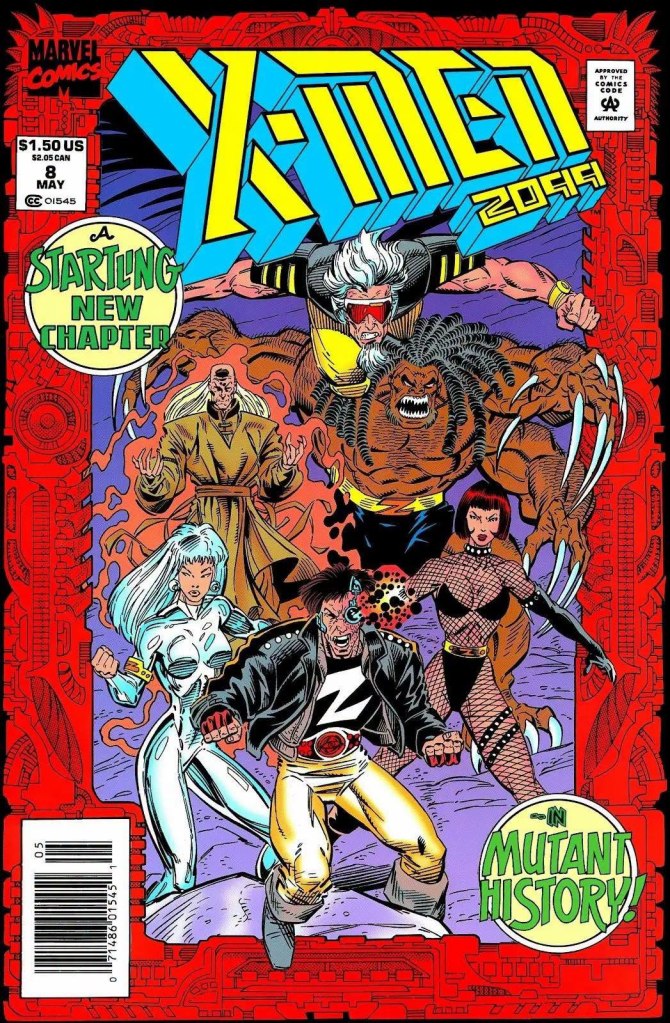
The cover.
Early story
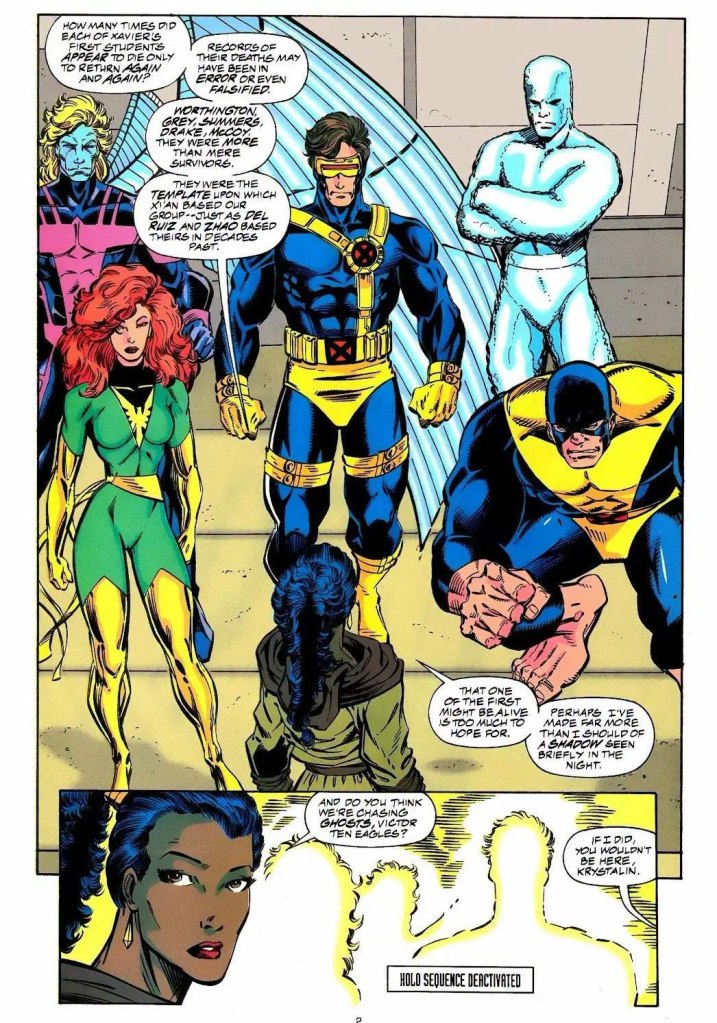
The story begins with Krystalin examining Archangel with amazement. Moments later, she sees Cyclops, Iceman, Beast and Jean Grey (in her Phoenix form). She wondered how many times did each of Professor X’s first students appear to die only to return again and again. She recalls that the records of their deaths may have been in error or even falsified. She also remembers the succeeding X-Men teams of Del Ruiz and Zhao.
It turns out the original X-Men members she saw were holograms as Victor Ten Eagles (who was a fellow outlaw with Xi’an in the old days) reveals that he opened his studio to few people and never to strangers. He allowed Krystalin in because he owes Xi’an a blood debt from their time together with the Lawless. As they talk, he explains to her his personal interest in the X-Men and the legacy.
Over at Iron Horse in Arizona, Hurricane talks with two trackers who were tied up. Meanstreak uses his super speed to dismantle the trackers’ suits of armor and examine the technologies within. He finds one Tetsuo Mark 6 signal beacon that was used to monitor armor in the field. He tells Hurricane she can use it as an advance warning the next time trackers are sent after her.
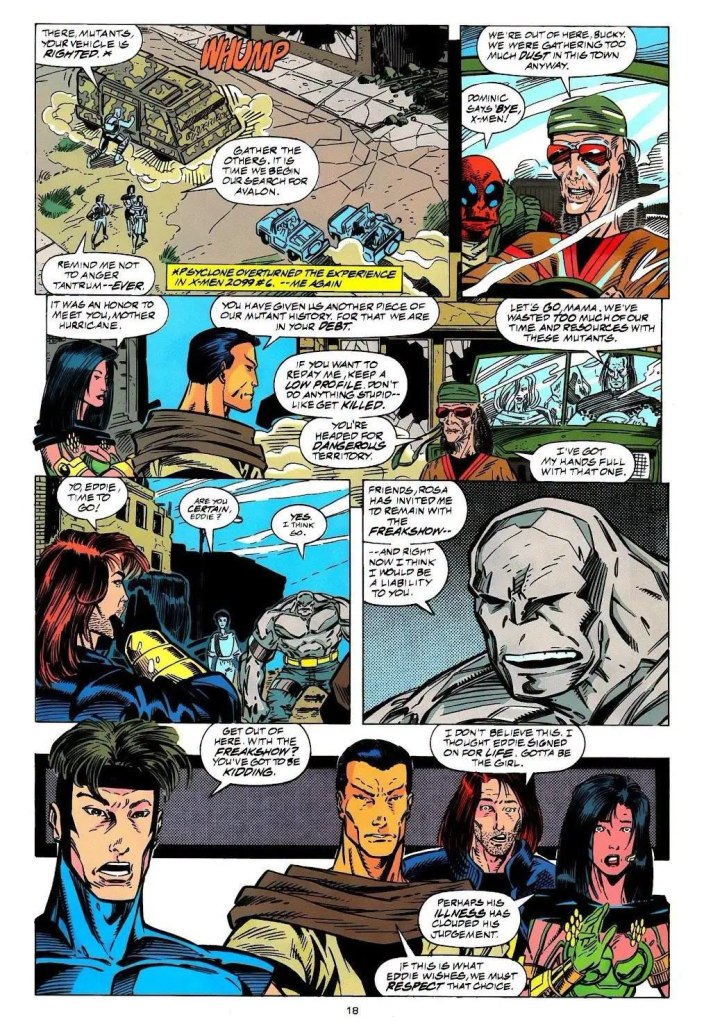
Hurricane tells the X-Men that she and the Freakshow never stay too long in one place. Moments later, the infected Metalhead tells Skullfire that he is trapped in his current metal form and could not change back…
Quality
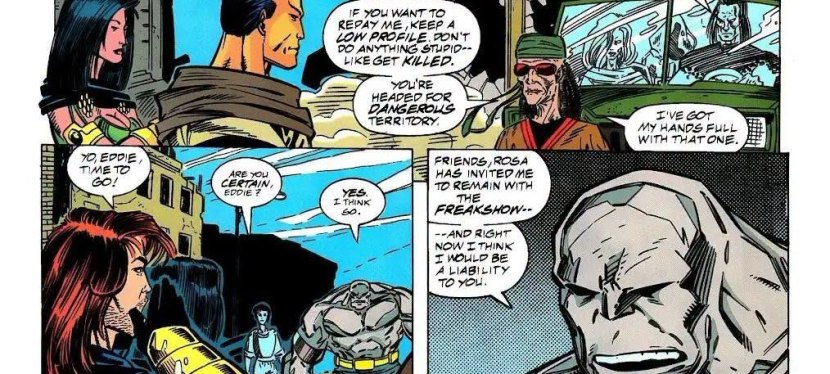
As the Freakshow is about to leave, Metalhead surprises his fellow X-Men.
To make things clear, this X-Men 2099 comic book is very engaging to read as it is filled with a lot of details that further expanded the lore of the 2099 universe concerning mutants and legacy of the X-Men in the 21st century. As such, I really enjoyed learning about the “future history” of the X-Men, how mutants struggled to survive in a corporation-controlled America, and why the wasteland became the 21st century’s very own Old West where danger and uncertainty are constant.
If have an obsession about the 2099 universe, there is a lot to discover and enjoy here. Xi’an’s pursuit for knowledge about the mutant underground and Hurricane’s involvement is compelling to read and what was revealed is worth discovering. Meanwhile, Krystalin and Ten Eagles’ exploration of facilities as they search for answers reminds me a lot about a notable part of the story in Beneath the Planet of the Apes.
Conclusion
The closest thing to a crossover with the original X-Men.
X-Men 2099 #8 (1994) is a compelling read and it is one of the stronger references about the 2099 universe and the legacy of the X-Men from the time of Xavier to that of Zhao. The details revealed here are fine pay-offs to what was built up in the previous issues, and they connect well with the existence of Xi’an’s X-Men. This comic book will really help you understand the place of mutants in the 21st century and in my experience, the learning is enjoyable.
Overall, X-Men 2099 #8 (1994) is highly recommended.
Disclaimer: This is my original work with details sourced from reading the comic book and doing personal research. Anyone who wants to use this article, in part or in whole, needs to secure first my permission and agree to cite me as the source and author. Let it be known that any unauthorized use of this article will constrain the author to pursue the remedies under R.A. No. 8293, the Revised Penal Code, and/or all applicable legal actions under the laws of the Philippines.
Welcome back, superhero enthusiasts, 1990s culture enthusiasts, X-Men fans and comic book collectors! Today we revisit the Marvel Comics shared universe to examine one of the many tales of the X-Men 2099 monthly series.
In late-1993, Marvel Comics published the Fall of the Hammer crossover storyline highlighting the major figures of Marvel 2099 and the X-Men members involved were only Skullfire, Krystalin, Bloodhawk and Meanstreak. As told in Ravage 2099 #15, the said X-Men members made it to Valhalla with Ravage. After the events of Fall of the Hammer, the four X-Men members survived and eventually started traveling all the way back West in America to rejoin the rest of the team.
With those details laid down, here is a look back at X-Men 2099 #6, published by Marvel Comics in 1994 with a story written by John Francis Moore and drawn by Ron Lim.
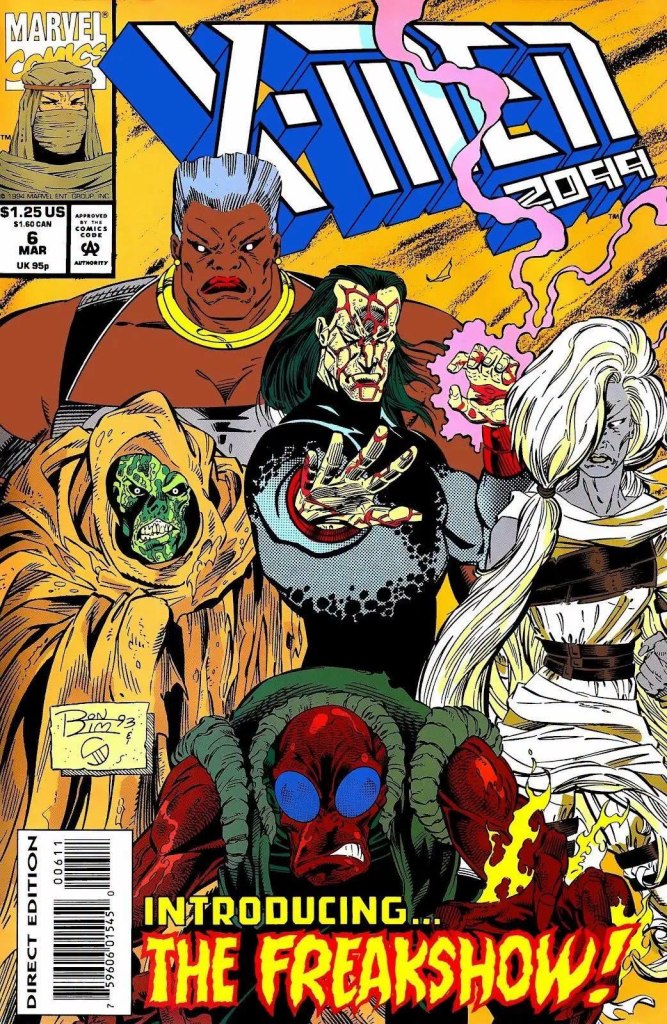
The cover.
Early story
The story begins in Arizona when two fully armed personnel wearing suits of armor search for a monster-like mutant who tries to hide. The mutant is named Dominic and he eventually got corned by the two armored figures. As he is about to get shot, one of the armored guys got pushed by force somehow. The next moment, a gang of mutants called the Freakshow appears.
In the southern part of Nevada, Skullfire, Bloodhawk, Krystalin and Meanstreak travel in an aircraft going back to Xi’an and the rest of their teammates. As Bloodhawk jumps of after saying goodbye, Skullfire jumps off as well in a suicidal manner. He eventually grabs Bloodhawk by the ankle. Back at the aircraft, Krystalin and Meanstreak shared their respective observations about Skullfire’s sudden change of personality since the psychic vampire Luna messed with him…
Quality
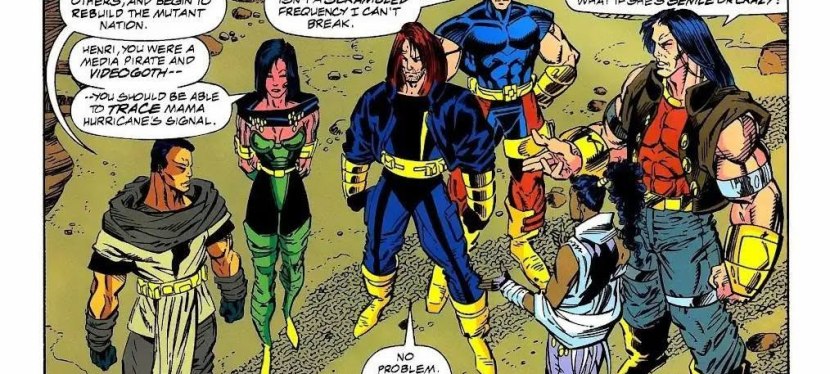
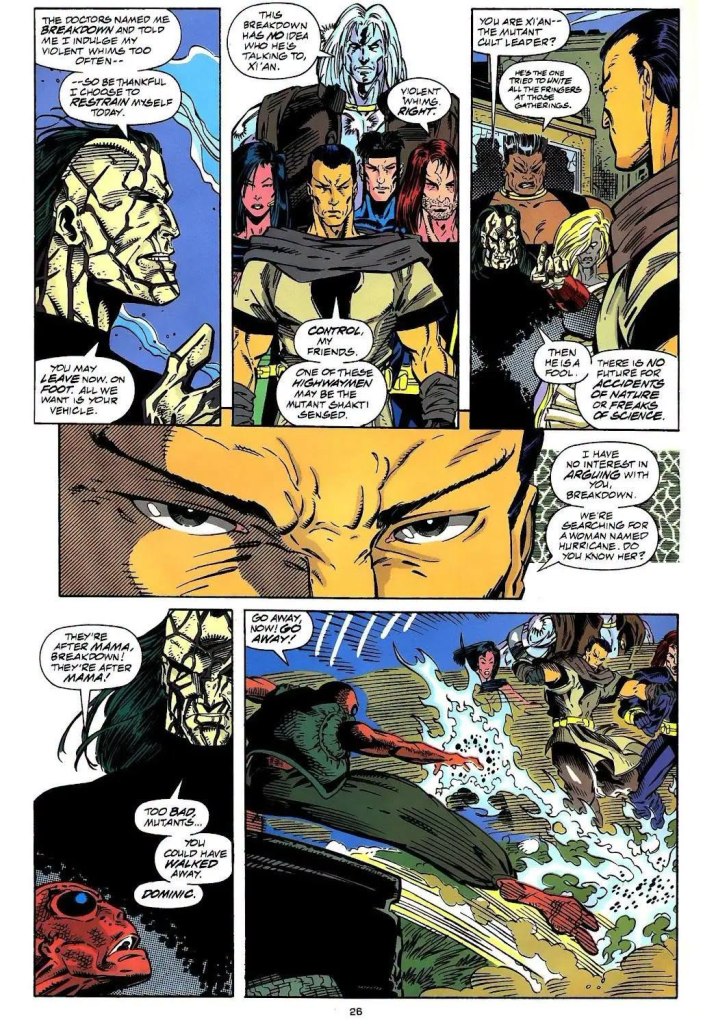
As the X-Men search for Hurricane, the Freakshow stands in their way.
The script of this comic book was finely crafted by John Francis Moore and it is amazing how efficient he got the X-Men team back (after Skullfire, Krystalin, Meanstreak returned) on track while ensuring a good amount of depth as reflected in the dynamics between the team members as the story went on. The storytelling felt natural and really believable.
Along the way, this comic book shed light on team leader Xi’an and the threads of the past that came back to haunt to him. This instantly added a new layer of development on Xi’an which established an element of uncertainty on the future of the X-Men under him (and his personal struggles). That said, Xi’an does not have the rock-solid stability of Professor X (Charles Xavier) which will remind readers how different the X-Men of 2099 are from the classic X-Men.
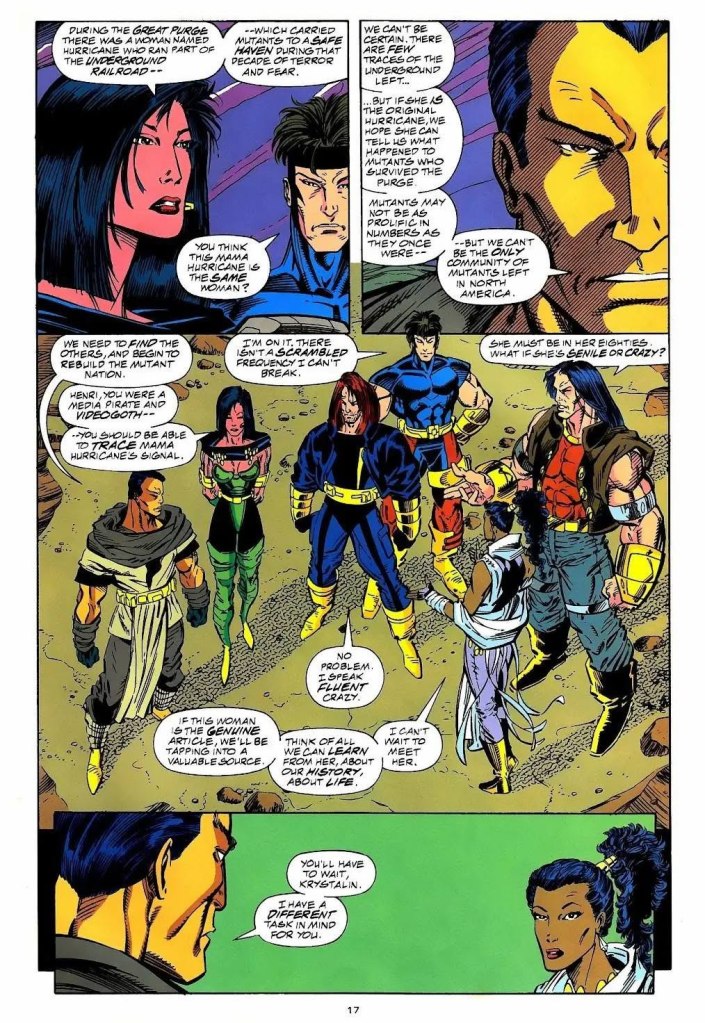
The X-Men are on the search for a mutant called Hurricane who has been active on resisting the corporations’ control on the nation and has long emphasized liberty and self-control on personal living. Historically, Hurricane led a part of the Underground Railroad which carried mutants to safe haven during a time of terror and fear. That said, X-Men’s search has a heavy purpose and the challenges they faced here is gripping and intriguing to follow. I should also state that Ron Lim’s delivery of dynamic action is really good to look at.
Conclusion
I really enjoyed the dynamics of the interactions between the members of the X-Men in this comic book. There is richness in John Francis Moore’s script here.
X-Men 2099 #6 (1994) is both a solid follow-up to the events of the Fall of the Hammer storyline and also a fine portrayal of how the team works under Xi’an’s leadership. More notably, it pushed the narrative of the series forward and gave us readers an in-depth exploration of the isolated places of America’s southwestern region in 2099 which is a sharp contrast to that era’s New York City dominated by Alchemax. More notably, this comic book implemented renewed focus on the state of mutants who have been living in fear, danger and uncertainty in America of 2099 which connects directly with the purpose of the X-Men as a team.
Disclaimer: This is my original work with details sourced from reading the comic book and doing personal research. Anyone who wants to use this article, in part or in whole, needs to secure first my permission and agree to cite me as the source and author. Let it be known that any unauthorized use of this article will constrain the author to pursue the remedies under R.A. No. 8293, the Revised Penal Code, and/or all applicable legal actions under the laws of the Philippines.
Welcome back, superhero enthusiasts, 1990s culture enthusiasts, X-Men fans and comic book collectors! Today we revisit the Marvel Comics shared universe to examine one of the many tales of the X-Men 2099 monthly series.
If there is anything notable about the futuristic X-Men, it is the separation of the team members that started really early in the monthly series. Meanstreak left the team to pursue something personal. A few members of the team – including Meanstreak – got involved in the Fall of the Hammer crossover storyline (click here, here and here), Metalhead got infected and decides to leave the team to stay with another group, and their leader Xi’an lost his way.
With those details laid down, here is a look back at X-Men 2099 #11, published by Marvel Comics in 1994 with a story written by John Francis Moore and drawn by Ron Lim.
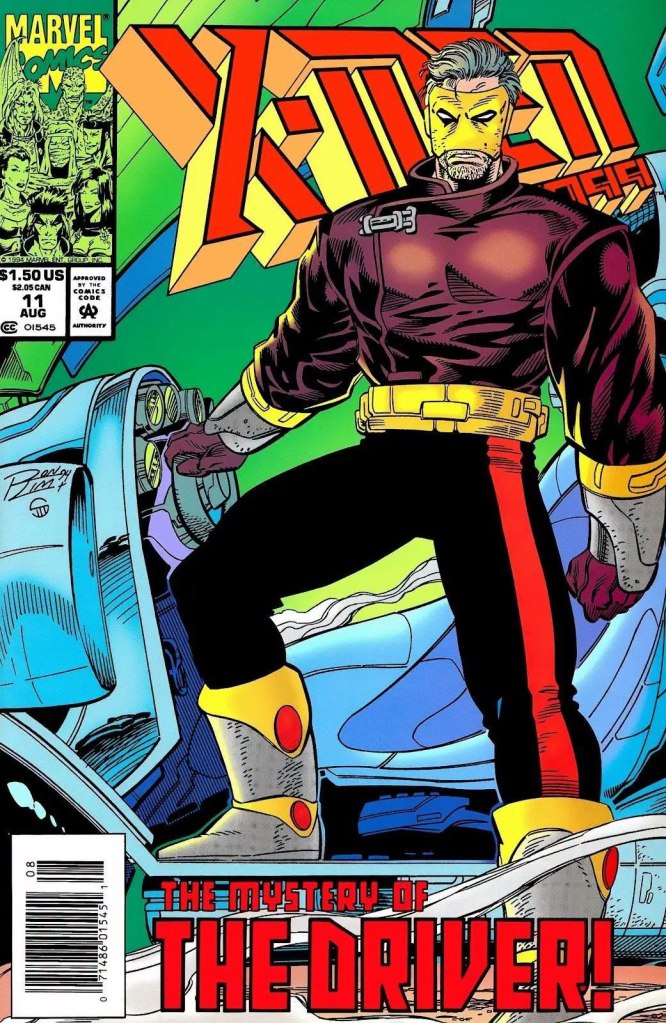
The cover.
Early story
The story begins with Tim Fitzgerald/Skullfire and Luna enjoying their time together outdoors. Tim, whose personality has changed into becoming radical and wild, tells her that he has not forgotten the anguish she put him in through the darkroom which made him relive the death of his beloved Reiko from some time ago.
As the tension between Tim and Luna intensifies, Xi’an tells him that they have to go to El Paso in Texas. It was Luna’s first time to meet Xi’an. The former leader of the X-Men states that they are closing in on the Driver…
Quality
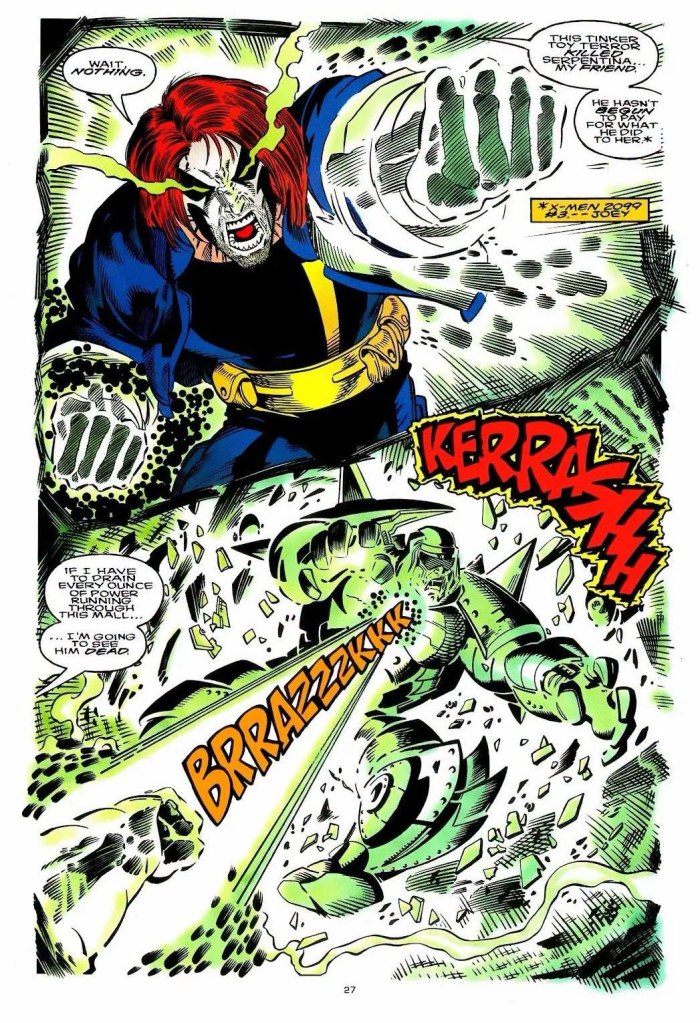
Skullfire blasts Junkpile, the one responsible for the death of Sepertina (see X-Men 2099 #3).
Given the way the members of the X-Men got separated, the Moore-Lim duo succeeded in telling an intriguing story without even having a clear enemy for them to encounter. This is a tale about a drastically changed Xi’an (now arrogant and with an agenda of his own) develops into someone becoming more undesirable and dangerous with the passage of time. Similarly, Tim here is turning more unhinged and dangerous as he gradually turns into Skullfire (personally and visually) and Luna here is ironically the one keeping him stable.
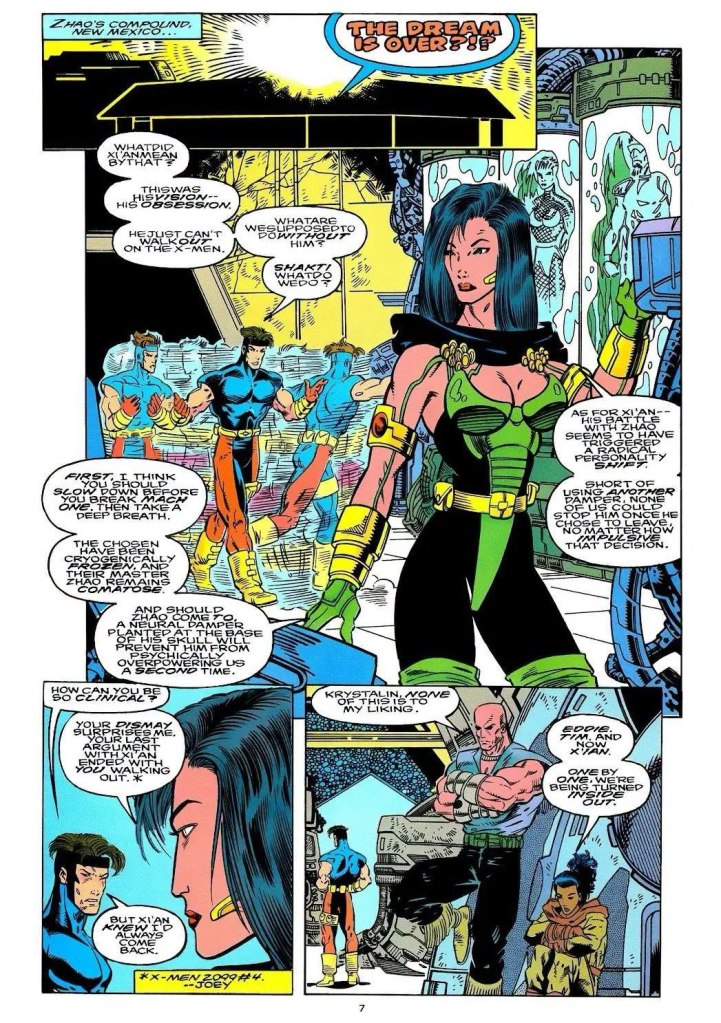
On the other side, the remaining X-Men are still together but with a huge cloud of doubt over them. At this stage, Shakti/Cerebra – who was the faithful second-in-command when Xi’an still led the team – is taking more responsibilities as she gradually becomes the team leader. The writing done by John Francis Moore is rich when Shakti sticks strongly to principles during her interaction with Meanstreak who himself has turned uncertain about their status as a team. That said, there are certain traits of Xi’an visible in Shakti. Along the way, a few friends of the X-Men went away which added to the uncertainty that hounded them.
With regards to the reveal of the Driver on the cover of this comic book, the tale indeed reveals him and a new story thread about him was gradually built up. The Driver is Xi’an’s target and his act of helping one of the X-Men’s friends added to the suspense over what could happen next.
Conclusion
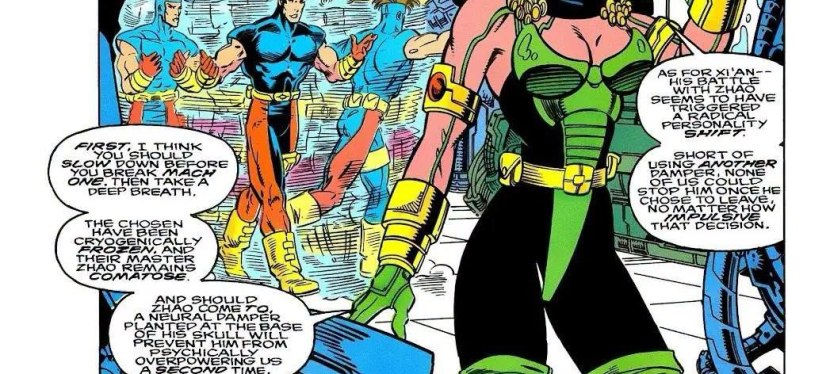
As the new leader of the X-Men, Shakti remains very principled. Her talk with Meanstreak in this scene is meaningful.
X-Men 2099 #11 (1994) is a very character-driven story from start to finish and the good news is that it is engaging and entertaining to read. The lack of a good-versus-evil conflict never hurt the story at all as Moore and Lim went deep to develop Tim, Xi’an and others while building up the pending encounter with the Driver. Not only that, having Tim and Xi’an more radicalized reflect the atmosphere of uncertainty and danger in the region (with lots of wilderness throughout and far away from the metropolis dominated by Alchemax) within America of 2099. It is a good read and I enjoyed the character development done by the creative duo.
Disclaimer: This is my original work with details sourced from reading the comic book and doing personal research. Anyone who wants to use this article, in part or in whole, needs to secure first my permission and agree to cite me as the source and author. Let it be known that any unauthorized use of this article will constrain the author to pursue the remedies under R.A. No. 8293, the Revised Penal Code, and/or all applicable legal actions under the laws of the Philippines.
Welcome back, superhero enthusiasts, 1990s culture enthusiasts, X-Men fans and comic book collectors! Today we revisit the Marvel Comics shared universe to examine one of the many tales of the X-Men 2099 monthly series.
Way back in 1993, I had a fun reading X-Men 2099 #1 as soon as it was released in the local comic book specialty store here in the Philippines. Back then, I was already into the 30th anniversary celebration of the X-Men while also reading more comic books about Marvel’s science fiction 2099 franchise of comic books. I love the way X-Men 2099 #1 ended as it was a powerful way of building up the tension and excitement that comes with waiting another 30 days for issue #2 to come out.
With those details laid down, here is a look back at X-Men 2099 #2, published by Marvel Comics in 1993 with a story written by John Francis Moore and drawn by Ron Lim.
The cover.
Early story
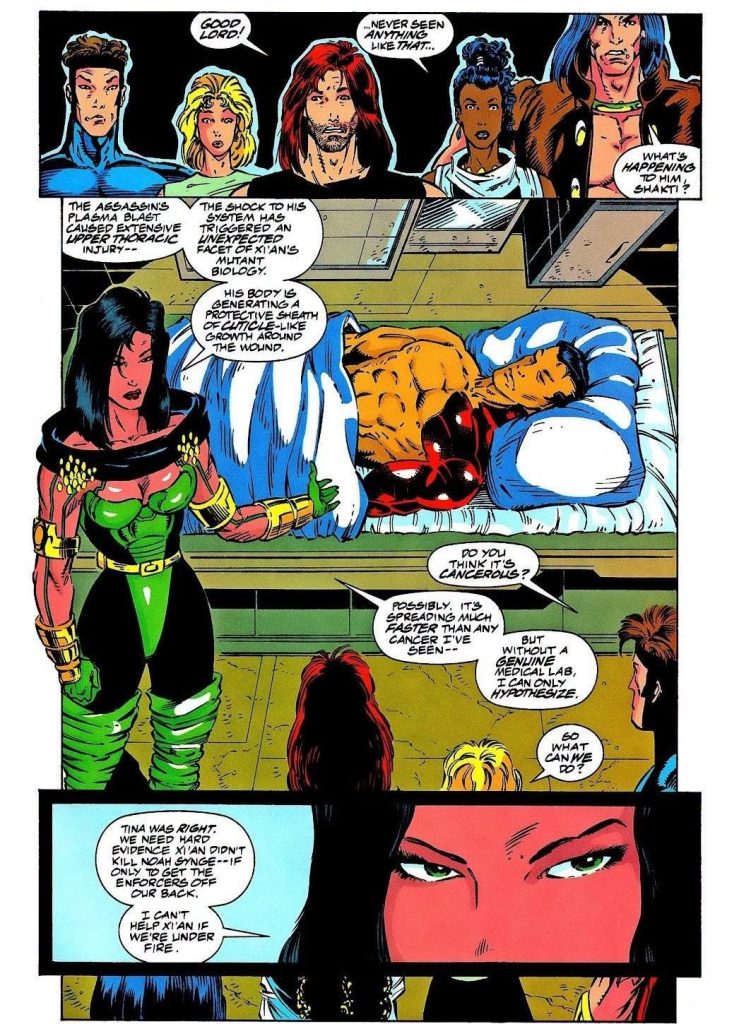
The story begins with the X-Men desperately trying to escape as the arcology has been invaded by enforcers (also referred to as the Greater Nevada Syndicate) of the Synge casino. Their leader Xi’an is in critical condition after getting shot during an assassination attempt that happened moments earlier. The X-Men are inside their van speeding away and Meanstreak (Henri Huang) uses his super speed to run ahead of them to quickly check what awaits them all. During the ride, Krystalin learned of the news that Noah Synge has died and Xi’an has been blamed for murder. Cerebra confirmed that Xi’an expressed hatred towards Synge.
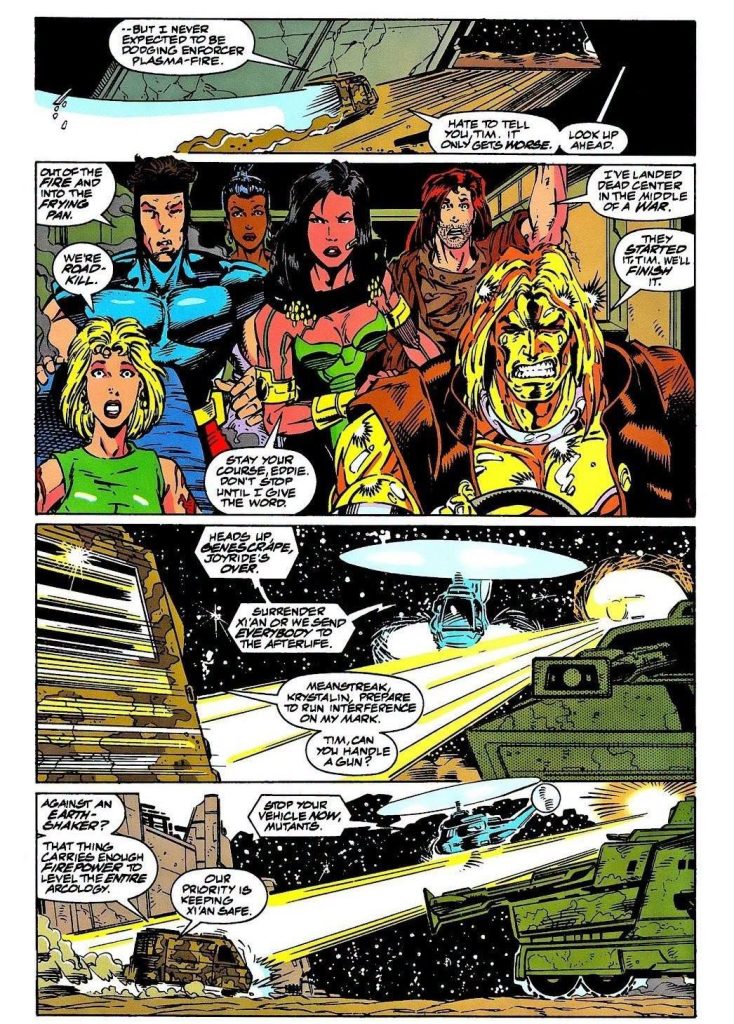
When the van finally reaches the outdoor area, the X-Men find themselves facing a large tank and a helicopter of the syndicate which anticipated their arrival. The syndicate tells them to surrender Xi’an…
Quality
Cerebra shows their leader Xi’an with a biological cocoon forming over his body. Pay attention to the details.
As a follow-up to the impressive first issue, this one remains a very good read after all these decades. It is clear to me that John Francis Moore had carefully planned an engaging tale of the futuristic X-Men with Tim Fitzgerald (who will later be called Skullfire) as the symbolic reflection of the readers who get to discover more about the team, the situation they are in and why they exist in the first place.
As expected, the creative stuff that started in issue #1 progressed naturally as the story went on in this comic book. The X-Men of 2099 got away to find safety and get themselves organized as their leader remains in critical condition. Along the way, the syndicate itself gets adjusted as it has the son and daughter of Noah Synge taking over their evil empire suddenly. The syndicate is responsible for seven deaths, the wounding of nineteen people and the capture of over forty people as a result of their sudden invasion of the arcology and their attempt to assassinate Xi’an in retaliation of the death of Noah Synge. This was the creative duo’s way of telling readers who the bad guys are and why the X-Men are at a great disadvantage.
What I find engaging here is how the Moore-Lim duo emphasized Xi’an’s significance through flashbacks and background details (which further revealed more of the founding of the futuristic X-Men). This creative gamble worked wonders and clearly more than made up for the lack of dialogue and interactions from the X-Men’s leader. At the same time, the narrative has this flavor of conspiracy when the Synge empire was emphasized.
Conclusion
The futuristic X-Men encounter strong opposition from the syndicate.
X-Men 2099 #2 (1993) is clearly a very good read. As a follow-up to the very solid issue #1, it added to the build-up emphasizing the futuristic X-Men a lot more while still having enough room to develop the Synge empire and its syndicate. Along the way there were some nice pay-offs to certain build-ups in issue #1 and there was a fine balance between action scenes and the plot/character development scenes. That said, this comic book is a solid bridge between issue #1 and the conclusion in issue #3.
Overall, X-Men 2099 #2 (1993) is highly recommended.
Welcome back my readers, YouTube viewers and all others who followed this series of articles focused on YouTube videos worth watching.
Have you been searching for something fun or interesting to watch on YouTube? Do you feel bored right now and you crave for something to see on the world’s most popular online video destination?
I recommend you check out the following videos I found.
#1 You, Me and the Movies React to Cloak & Dagger (1984) – As some of you readers might know already, I enjoyed the 1984 movie Cloak & Dagger (starring Henry Thomas) and I also liked playing the arcade game that appeared in it as a fictional Atari 5200 game. When it comes to retro gaming, the film strongly resonates with gamers who were old enough to have seen it and played games related with Atari on console and arcades in the 1980s. As such, it is not surprising to see that there are pretty few movie reaction videos of Cloak & Dagger on YouTube. To my personal delight, You, Me and the Movies posted a reaction video of the film and it is entertaining to watch!
#2 Minty Comedic Arts’ Exclusive Interview with Superboy TV star Gerard Christopher – If you were old enough to have seen the live-action Superboy series on TV a long time ago, you would remember that actor Gerard Christopher replaced John Newton as the star. Recently, Minty Comedic Arts posted his exclusive interview with Christopher (who played Superboy in over 70 episodes) and it is not just fun to watch but also surprising and insightful. At the same time, there is a lot to learn and discover from what Gerard Christopher revealed. That said, I encourage you to watch the video below.
#3 Yakisoba in Aichi Prefecture, Japan – I enjoy the taste of Yakisoba which is Japanese noodle stir-fried dish and it is often available in Japanese restaurants in the land of the rising sun as well in other parts of the world. In Aichi Prefecture, there is a family-owned restaurant that specializes in yakisoba. The dedicated cooking, careful processes and sound business management the food joint achieved resulted in a loyal customer base. There is a lot to learn and enjoy from the video below.
#4 Street Fighter II Is Unfair to Gamers? – Here is something that must be seen. Remember how intensely popular Street Fighter II and its updated versions were back in the 1990s? The original arcade game of Street Fighter II revolutionized fighting games and turned it into a wildly popular genre for both gamers and game companies. Still, there is something about the artificial intelligence (AI) in Street Fighter II that makes it “cheat” which resulted in a lot of frustrating experiences for those who played it. Did Capcom’s game developers deliberately set something up? Watch and learn from the video below.
#5 The Death of Criticism with Spider-Man: Brand New Day – Let me ask you this…if the so-called professional movie critics and online influencers unanimously give high praise to a big-budget movie designed to make a lot of money, do you let the critical acclaim influence you into watching it and adjusting your personal standards on judging new movies? In his recent video, Ranting for Vengeance shared a warning about the death of criticism over Spider-Man: Brand New Day which opened with massive commercial success backed with acclaim from the media and a variety of personalities online. By today’s standards, there are many millions of people who got oriented with Spider-Man without ever reading the classic comic books, and there are those who use Spider-Man movies as their main references. What is telling, however, is how some people lowered their standards on judging new movies as a whole. To learn more, watch Ranting with Vengeance’s video below and pay attention to the details.
#6 Assorted Casino (1995) Reaction Videos – I missed out on Martin Scorsese’s 1995 film Casino during its theatrical run and I saw it on home video some years later. Loosely based on real-life events that happened in Las Vegas, the movie was very good with its presentation and the stylized approach on explaining the details regarding casinos and related businesses controlled by criminals. As such, it is not surprising that a lot of movie reaction videos of it were posted on YouTube and I found the most entertaining ones among them for you all to enjoy.
#7 Game Developers Who Went Woke And Ruined The Gaming Industry – I have been playing video games since I was a little boy. This current console gaming generation has been very disappointing and I can say that it is very disgusting that state of gaming deteriorated a lot over the past several years as many game developers hired Leftist activists (the woke, transgendered, social justice warriors, LGBTQ extremists, rabid feminists, racist minority members and other undesirable people) and let them make new video games that reflected their ugly agenda. Very recently, the very woke Halo Studios got away with ruining Halo with the release of Halo: Campaign Evolved. The wokeness of gaming started many years ago and its disease grew a lot through the years. As such, the woke and Leftists working in video games clearly do not care about making video games fun and they do not care about gamers in general. To understand the wokeness and the Satanic Left’s agenda through gaming, watch the video below.
#8 Tempura Onigiri and More in Japan – Recently in Japan, a new form of onigiri with tempura was released and it is gaining popularity with customers. Not only that, newer types of onigiri were being offered to customers as a result of unpredictable market forces, experimentation and the changing tastes of the customers. There is a lot to discover in the Nippon TV, and it just make you crave for onigiri.
Welcome back readers, fellow geeks and electronic gaming fans!
In this edition of the Retro Gaming Ads Blast (RGAB) series, we will take a look at another batch of retro gaming print ads from the 1980s to the 1990s.
For the newcomers reading this, Retro Gaming Ads Blast (RGAB) looks back at the many print ads of games (console, arcade, computer and handheld) that were published in comic books, magazines, flyers, posters and newspapers long before smartphones, social media, the worldwide web and streaming became popular. To put things in perspective, people back in the 1980s to the 1990s were more trusting of print media for information and images about electronic games and related products.
With those details laid down, here is the newest batch of retro gaming print ads for you to see and enjoy…
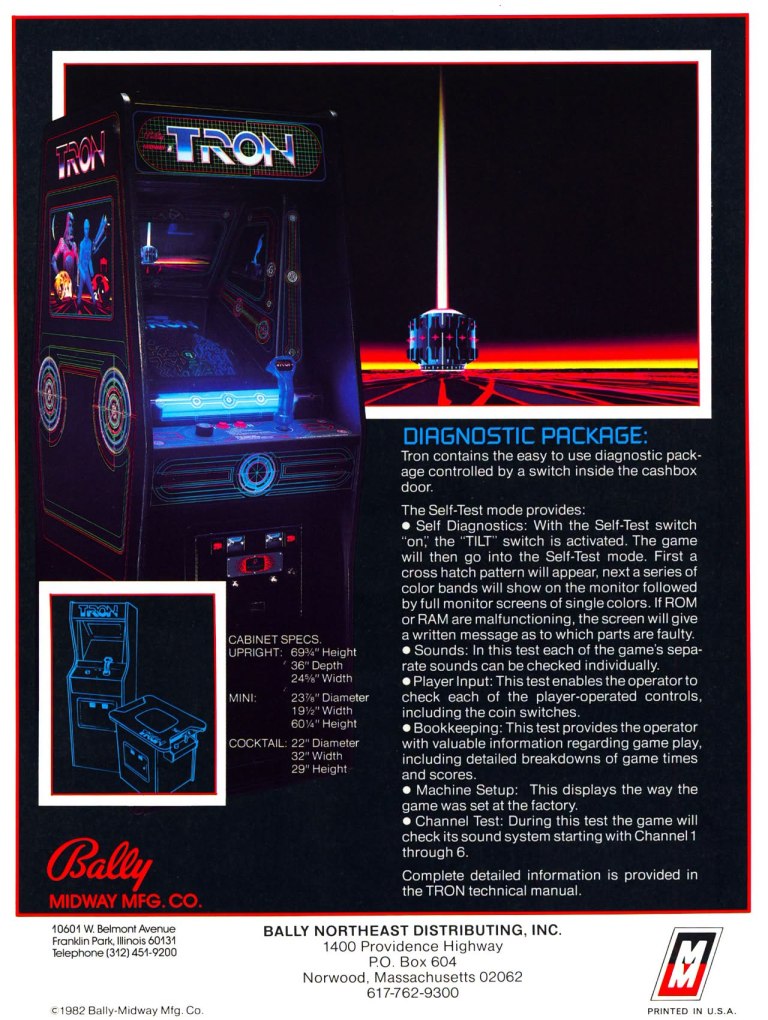
1. Tron Arcade Flyer
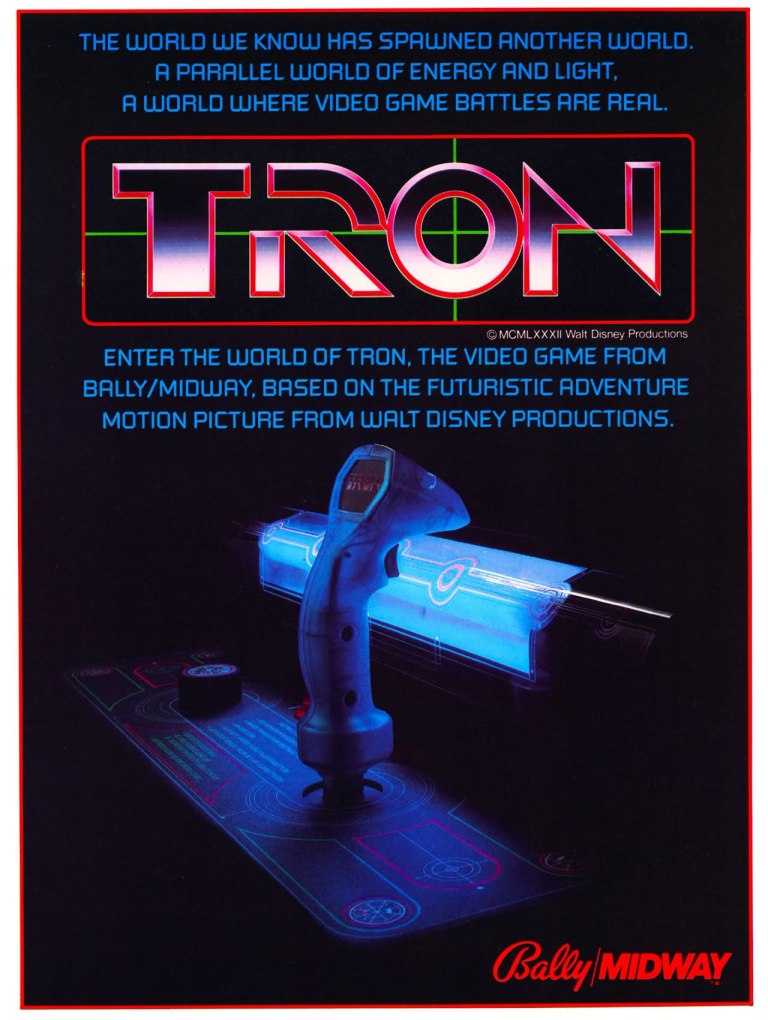
The front.
The rear. The details were clearly written for arcade operators.
Remember how dazzling the 1982 movie Tron was when you first saw it? That film had groundbreaking computer-generated graphics and the filmmakers worked very hard to tell a story covering both the real and digital worlds. Along the way, the movie had strong video game vibes which resonated with gamers at a time when arcade gaming was wildly popular in America. Believe it or not, an official arcade game of Tron was released the same year as the movie and it was a massive success. The arcade flyer perfectly captured the vibe and look from the movie and the machine itself had a control stick the same with what was shown to viewers. This old flyer is still great to look at.
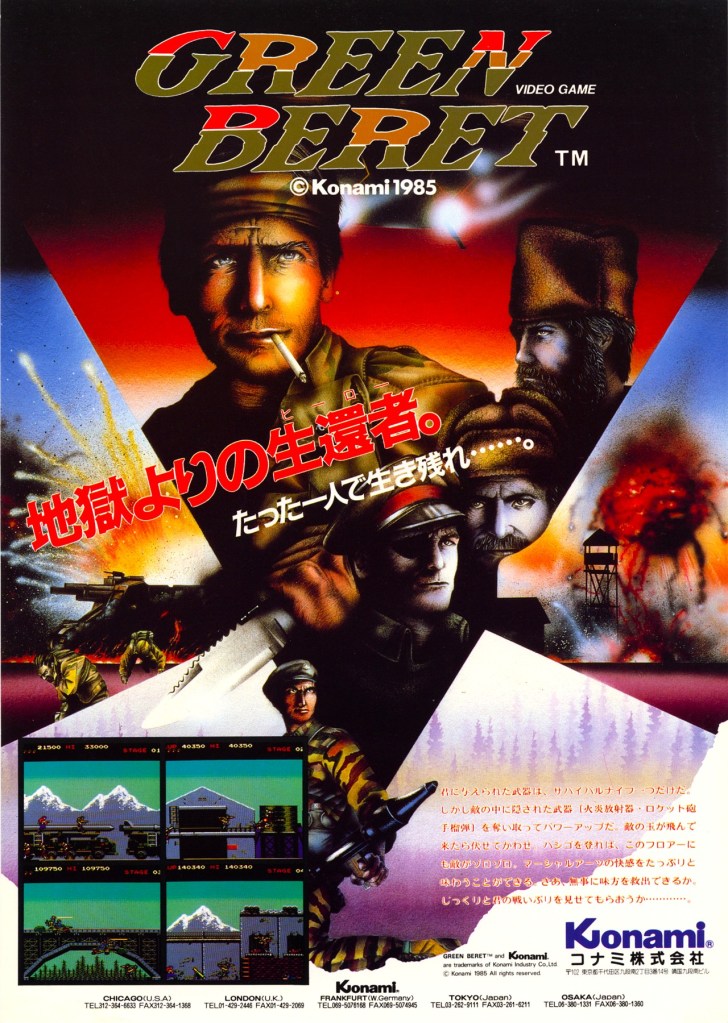
2. Green Beret Japanese Arcade Flyer
This is a very stylish flyer.
Konami was a highly prolific game publisher in the 1980s and it had lots of games that became huge blockbusters. During the decade, their game developers were strongly influenced by both Hollywood action movies and the Cold War. In 1985, Konami released the militaristic game Green Beret in Japanese arcades and to promote it, they created an arcade flyer featuring a very stylish artwork highlighting military images of soldiers (including a guy smoking) and warfare. This ad still looks great and it was not surprising it helped the game achieve huge commercial success. Green Beret was released in America as Rush’n Attack.
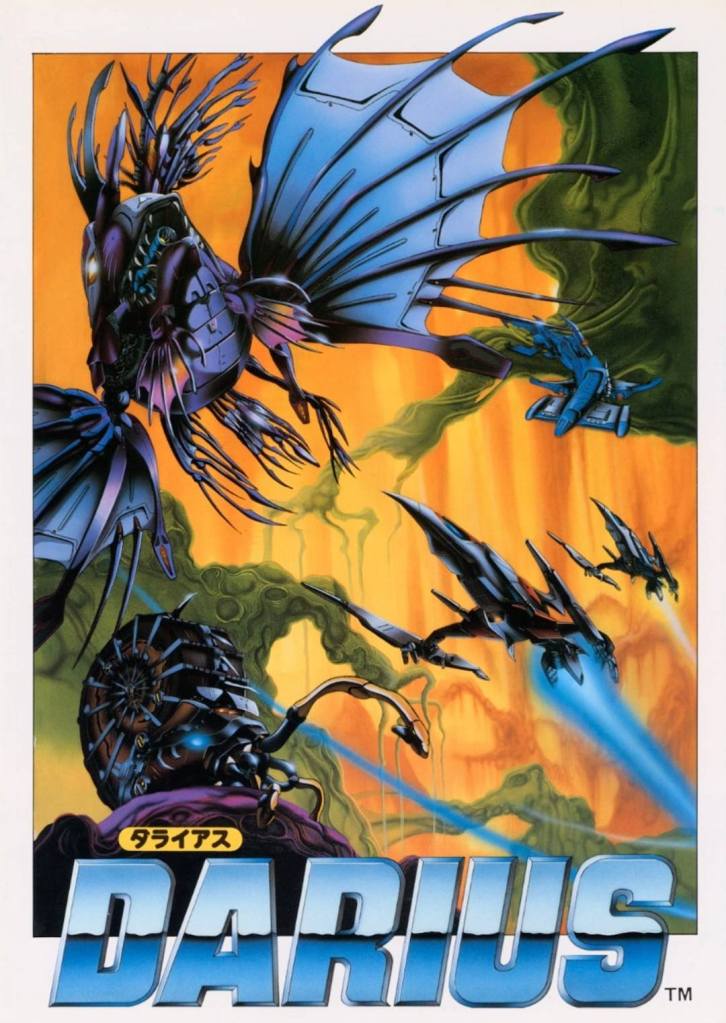
3. Darius Japanese And North American Arcade Flyers
The Japanese flyer.
The North American flyer.
Released in arcades worldwide in 1987, Darius is a 2D side-scrolling shooter game from Taito which had a science fiction concept of the starship Silver Hawk (piloted by players) which sets on a mission to destroy an evil empire before it could destroy the world called Darius. The game was successful, most notably in Japan and it eventually led to sequels being released later. What I find intriguing is how the arcade game was promoted in Japan and in North America. The Japanese arcade flyer had this intriguing artwork that reflected a blend of sci-fi with a touch of horror. The North American flyer had a strong sci-fi touch with a male and female model wearing costumes (that made them look futuristic) standing beside the Darius machine. Which flyer looks more appealing to you?
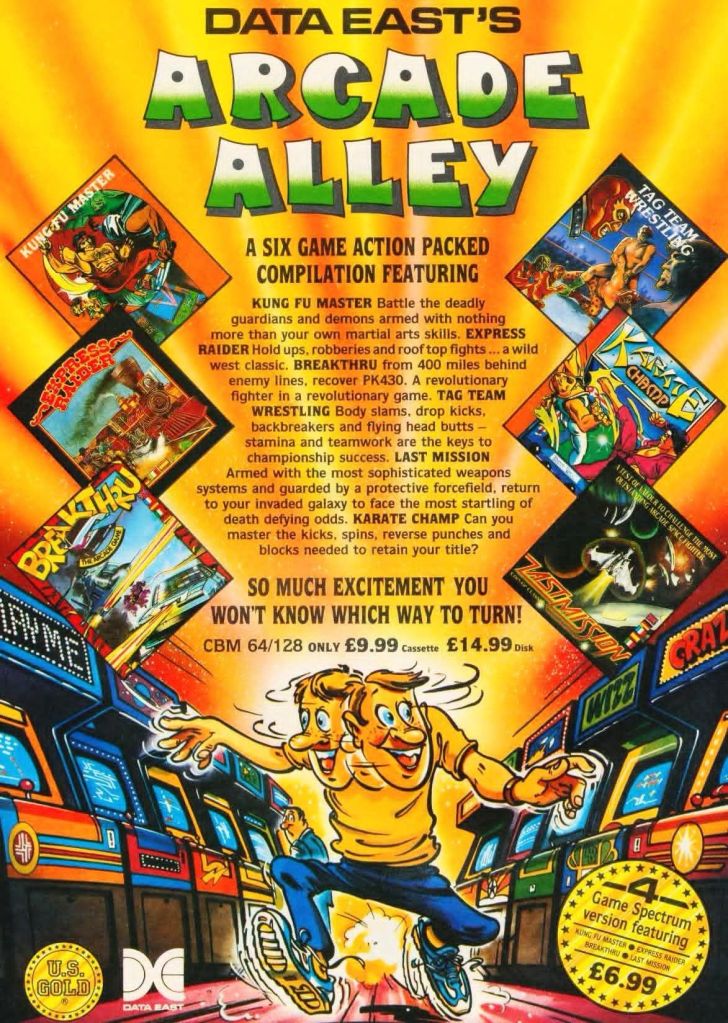
4. Data East’s Arcade Alley Print Ad
Fun and excitement emphasized in this print ad.
There is nothing like porting arcade hits to computer systems for gamers to enjoy. In 1988 there in Europe, U.S. Gold released Data East’s Arcade Alley for computer systems and it included ports of popular Data East games like Kung Fu Master, Express Raider, Breakthru, Tag Team Wrestling, Last Mission and Karate Champ. U.S. Gold’s print ad showed a guy in the middle of a video arcade looking on both sides to pick which game to play which strongly emphasized the essence of the game collection (offered in cassettes and disk). This old ad is still amusing to look at.
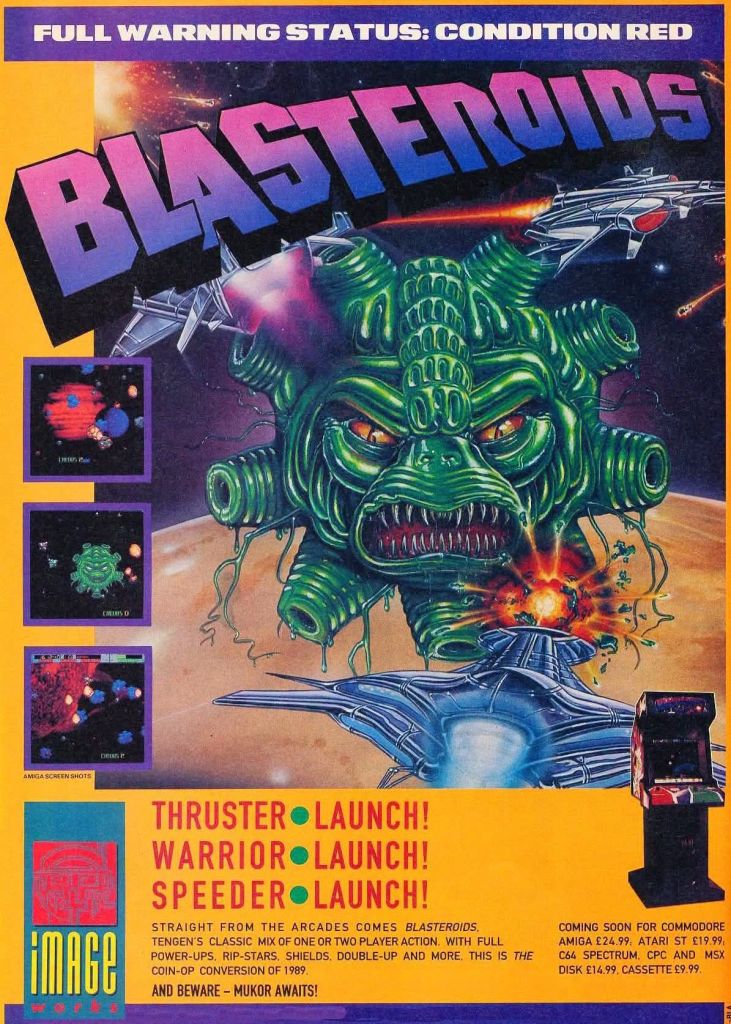
5. Blasteroids European Print Ad
Blasteroids for the Europeans.
Blasteroids, the third entry in Atari’s popular Asteroids games series, was released in European arcades by Image Works and eventually landed on computer systems there. For Europe, the ad makers came up with artwork showing a creepy, green space monster surrounded by a few spaceships to emphasize the game’s concept. The said monster eventually appeared on the game covers of the computer ports of Blasteroids later. This ad shows creative adjustments taken to promote games in different parts of the world.
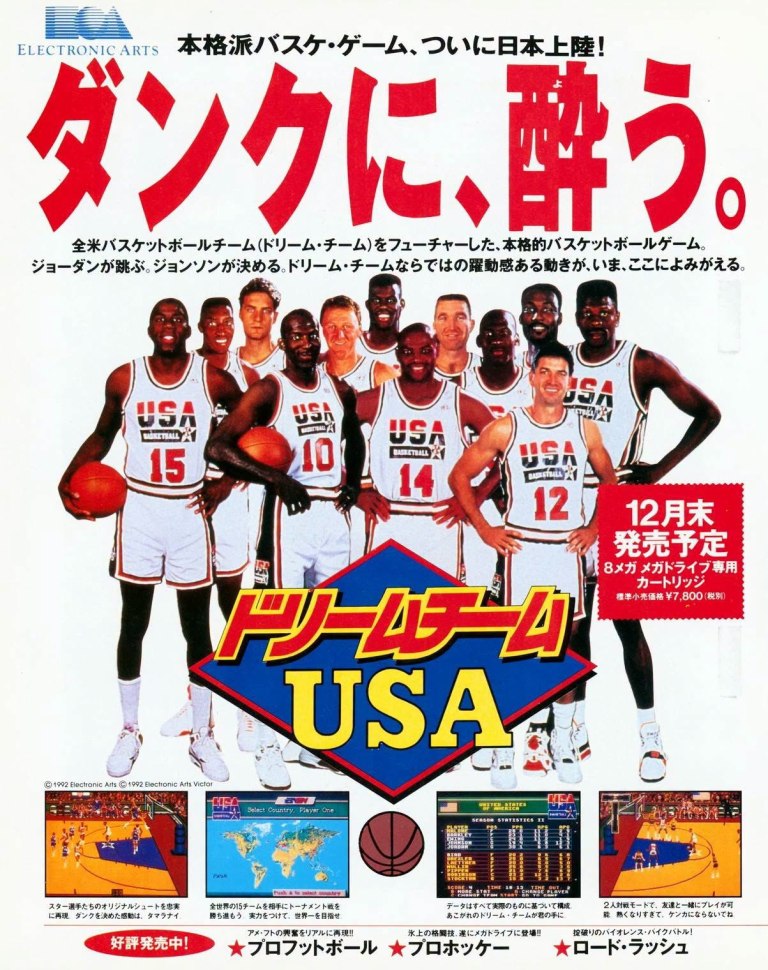
6. Dream Team USA Japanese Print Ad
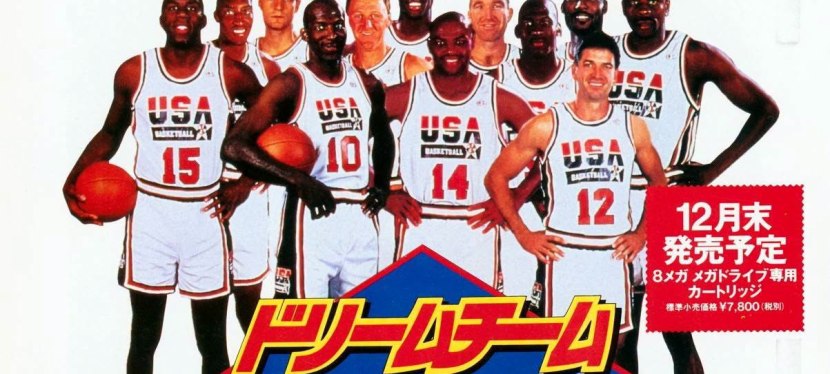
The legends of the NBA in the Japanese version of EA’s Team USA Basketball. Retitling the game as Dream Team USA made more sense because “Dream Team” was a much more popular reference than “Team USA Basketball”.
Remember how wildly popular the Dream Team (Team USA in Olympic basketball) was in 1992? With NBA legends Larry Bird, Michael Jordan, Magic Johnson, Charles Barkley, Karl Malone, John Stockton and more representing America in the basketball tournament of the Olympic Summer Games in Barcelona, Spain, the Dream Team (a media-led reference for the team) was easily the main attraction not only for basketball fans worldwide but also those who craved for excitement in international sports events. That said, Electronic Arts secured the license to make an official video game about the Dream Team and actually released the game Team USA Basketball within 1992 for the Sega Genesis. As basketball is popular also in Japan, EA released the game there titled as Dream Team USA and came up with a Japanese print ad to seriously capture gamers’ attention. This ad is still effective in delighting both basketball and video game enthusiasts.
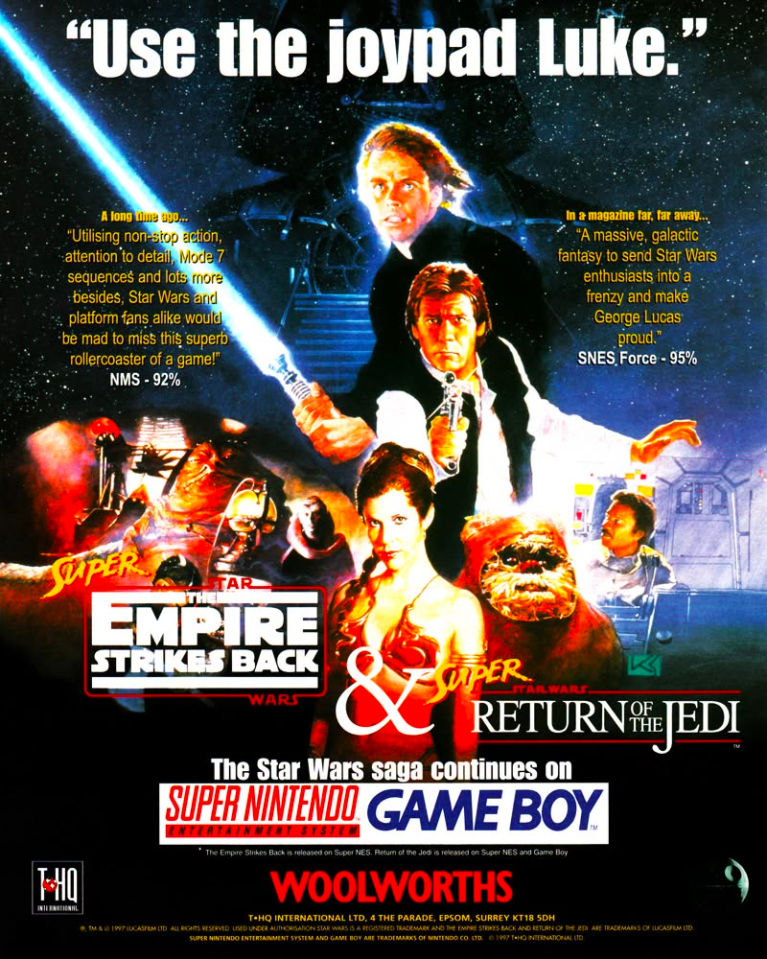
7. Super Star Wars: The Empire Strikes Back And Return Of The Jedi Print Ad
No screenshots of games used. Just the official images from the posters of the two movies.
Back in the 1990s, there was a resurgence of the original Star Wars trilogy across different forms of media. Apart from the VHS re-releases of Star Wars, The Empire Strikes Back and Return of the Jedi, there was a slew of video games of Star Wars released during the decade and the fans had new stuff to entertain themselves with. Along the way, the company THQ secured the rights to Super Star Wars: The Empire Strikes Back and Super Star Wars: Return of the Jedi for re-release to coincide with the 1997 “Special Edition” theatrical releases of their respective movies. THQ’s print ad simply used official images of Return of the Jedi and inserted a tiny bit of The Empire Strikes Back, and they did not show any screenshots that could have been helpful for Super Nintendo Entertainment System (SNES) and Game Boy users. Still, it was smart for THQ to print two excerpts of game reviews to sell the games.
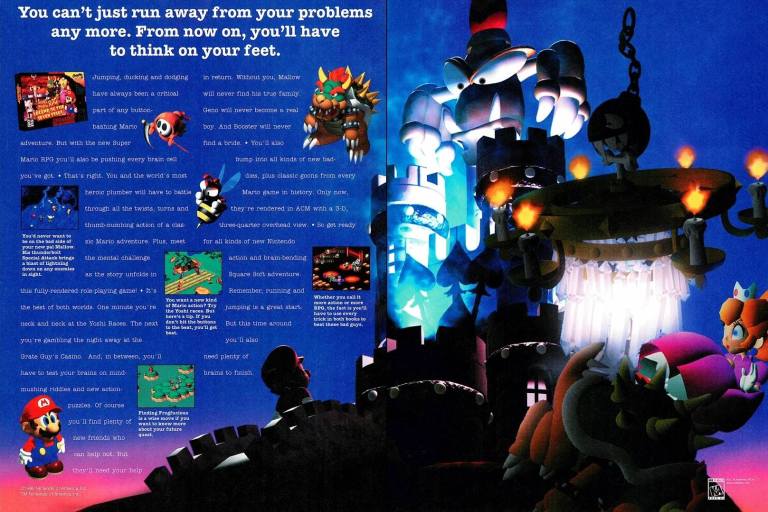
8. Super Mario RPG North American Print Ad
A mesmerizing ad for the acclaimed Super Mario RPG.
Remember back in the 1990s when Nintendo and role-playing game giant SquareSoft had a very healthy business relationship that proved successful? Before their eventual breakup (related to Square signing with Sony for PlayStation development), the two companies joined forces to make a fully featured role-playing game for the SNES featuring Super Mario and related characters…Super Mario RPG: Legend of the Seven Stars. To promote the game, Nintendo (the publisher) created a mesmerizing 2-page print ad highlighting their characters while emphasizing the role-playing and fantasy aspects of the game. At the time of its release, Super Mario was often identified with platform games and the Super Mario RPG print ad was a serious attempt to lure fans into RPGs which the SNES was already rich with. This ad, which I first saw in gaming magazines in 1996, still looks great.
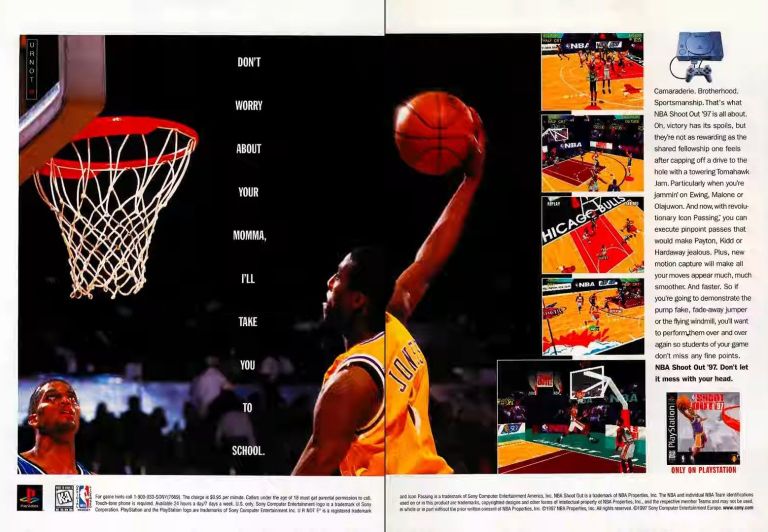
9. NBA Shootout ’97 Print Ad
Did you play this on PlayStation in 1997?
If there is anything I miss about 1990s console gaming, it is the fact that there were a lot of NBA-licensed video games that were offered to players with different tastes in basketball gaming. Sony had its own exclusive NBA games series called NBA Shootout and they were pretty aggressive selling its own basketball games along with the PlayStation going up against the likes of Electronic Arts (NBA Live), Sega and others. This is reflected in this 2-page print ad of NBA Shootout ’97 which was a PlayStation-exclusive release. They featured a photograph of Lakers’ Eddie Jones about to dunk and showed screenshots as well as the descriptive text written with excitement. Since it first started, NBA Shootout was basketball in full 3D polygonal graphics backed with motion-captured moves and dunks that players could enjoy only PlayStation. This ad is a reminder that Sony used to make official NBA games and there is a lack of variety and players’ choice of NBA gaming in today’s world.
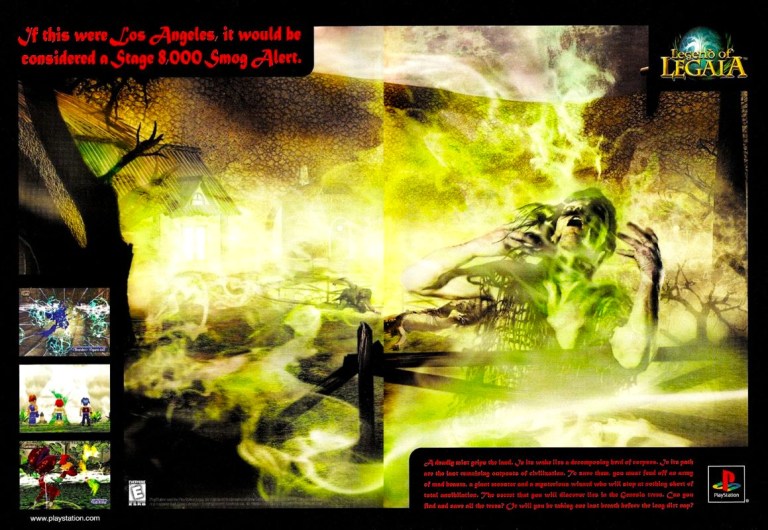
10. Legend of Legaia North American Print Ad
Perhaps someone at Sony Computer Entertainment America (SCEA) thought Legend of Legaia was a horror video game.
There was a time when Sony produced Japanese RPGs (JRPGs) exclusive for PlayStation consoles. One of them was Legend of Legaia which had a combat system that emphasized martial arts and it had an interesting fantasy concept. For its 1999 North American release, Sony came up with a very bizarre 2-page print ad that had digital artwork with a very strong horror vibe and the visual designs within the three screenshots shown were clearly not related with it. How this ad was made remains unclear. This is easily one of the most misguided gaming ads of the 1990s.
Welcome back my readers, YouTube viewers and all others who followed this series of articles focused on YouTube videos worth watching.
Have you been searching for something fun or interesting to watch on YouTube? Do you feel bored right now and you crave for something to see on the world’s most popular online video destination?
I recommend you check out the following videos I found.
#1 Heaven’s Gate Revisited – What is there to be said about the 1980 historical epic Heaven’s Gate apart from the facts that it failed spectacularly and brought down United Artists a lot? To its credit, it has a grand look that required a massive amount of money to be spent and the sheer depth of authenticity implemented under the direction of Michael Cimino (The Deer Hunter) is eye-catching. The film also had fine performances by Kris Kristofferson, Jeff Bridges, Christopher Walken and Isabelle Huppert. Historically, the massive failure of the movie impacted Hollywood as a whole and movie studios rarely grant the final cut privilege to movie directors. That said, there is a lot more to learn about Heaven’s Gate and I encourage you all to watch the video below.
#2 Moments That Destroyed Political Careers – Imagine yourself working so hard to get elected into public office in America followed by efforts to solidify the trust of voters who helped you win. With huge expectations, there obviously is pressure on you (the elected official) to serve them and fulfill your promises. Then one day, you committed a blunder or a very embarrassing moment that eventually leads you into a painful downfall. In America, there are Democrats and Republics who saw their political careers get destroyed because of the moments gone wrong. Watch and learn from the video below.
#3 History Of Sega And Its Impact On Video Gaming – Remember long ago when Sega was a highly prolific and innovative maker of games for arcades and consoles? Remember seeing consoles and add-ons with Sega branded on them? Decades ago, Sega was a gaming titan and it was a powerful competitor with Nintendo during the so-called 16-bit wars of the 1990s. Today, Sega is still operating but it is a shadow of what it used to be. To find out what happened, watch the very informative video game documentary below. It also has interviews with Tom Kalinske and other important video game personalities.
#4 Totally Whatever Reacts To Deep Impact – Back in 1998, I encountered some people who claimed to have cried while watching Deep Impact inside the movie theaters. When I saw it in the cinema, I saw a few other moviegoers near me having tears flowing from their eyes. Indeed, Deep Impact was made to move viewers emotionally with its themes of family, strained ties, and the struggle to remain intact before a massive tragedy happens. That said, you must see how the movie impacts the YouTubers in the video below.
#5 Tuna In Japan – Whenever I visited Japan, I always made the effort to enjoy a meal with tuna on it. I enjoy eating sashimi (specifically raw tuna), sushi and cooked meals that have tuna in different forms in them. If you love eating tuna and if you plan to visit Japan soon, watch the video below. Learn the details.
#6 Child’s Play 3 Reaction/Review Videos – Believe it or not, the 1991 movie Child’s Play 3 was released less than a year after Child’s Play 2. The movie followed the character Andy Barclay again, only this time he was portrayed as a troubled teenager who enters a military school. Unsurprisingly, the evil Chucky was revived and pursued Andy once more. Having seen Child’s Play and Child’s Play 3 on home video just months apart from each other, the viewing experience was unique given each film’s differences in terms of casts and settings. When Child’s Play 3 came to an end, there was this feeling among many moviegoers that the film series concluded solidly. To see what kind of reactions the 1991 movie attracted from YouTubers, watch the videos below.
#7 The Legend Of The Lone Ranger’s Failure Explained – As a young boy, I saw The Legend of the Lone Ranger on home video and enjoyed it. Back then, I was completely unaware about the controversy regarding past Lone Ranger actor Clayton Moore who was legally barred from appearing in public wearing the trademark black mask. That controversy alone hounded the movie and was arguably the single biggest factor behind its failure. By the way, the film’s star Klinton Spilsbury was dubbed over as the Long Ranger and he never acted again. To learn more, watch the video below.
#8 Minty Comedic Arts Examines Tales From The Crypt – When you hear the title Tales From The Crypt, do you think about the about the horror anthology TV series or the original comic book series published by EC Comics in the 1950s? I myself read several reprints of EC Comics – including Tales From The Crypt – and saw some episodes of the TV series. That said, both the TV series and the comic books delivered a very unique kind of entertainment that is sadly missing today. In his video, Minty Comedic Arts revealed a lot of interesting details about the TV series as well as EC Comics. I encourage you to watch his video now.
#9 The Unification Church Exposed – When former Japanese Prime Minister Shinzo Abe was assassinated in 2022, the killer Tetsuya Yamagami committed the act not because of politics but because of the perceived connections the politician had with the controversial Unification Church which he blames for financial ruining his family and his own life. The killer’s own mother was a member of the Unification Church and because she donated so much money to it, her own family ended up lacking money for survival, education and other needs. The murder investigation eventually unraveled decades of allegations about financial exploitation, shattered families and the immense influence the said church had on its members from Japan to South Korea and the United States. There are a lot of very intriguing details in Dark Asia with Megan’s video below and I encourage you all to watch it.
Welcome back my readers, YouTube viewers and all others who followed this series of articles focused on YouTube videos worth watching.
Have you been searching for something fun or interesting to watch on YouTube? Do you feel bored right now and you crave for something to see on the world’s most popular online video destination?
I recommend you check out the following videos I found.
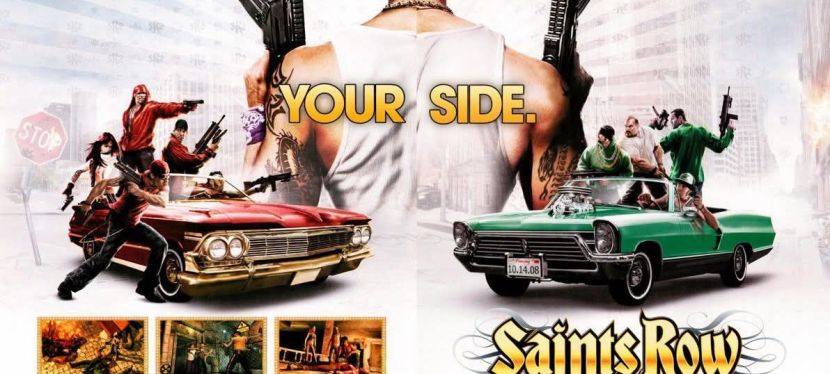
#1 Saints Row 2 Revisited – Having played the original Saints Row on my Xbox 360 console in 2006, I wished for a sequel to happen as I enjoyed the game a lot. Saints Row 2 was released in 2008 but it was in 2010 when I played it as it was locally sold to me with a really low price, and I enjoyed the game a lot. As a direct sequel, Saints Row 2 took place in the fictional city of Stilwater (the main setting of the first game) which has been expanded and modified a lot by Volition to not only reflect the passage of time but also offer gamers a bigger environment to explore and enjoy. Among fans of the Saints Row series, it has been argued that Saints Row 2 is the best to play and I myself enjoyed replaying it the most. There is a lot of inspiration behind the game and you can learn all about it by watching the informative video below. Saints Row 2 was made by Volition long before it turned woke and ruined the franchise with Saints Row (2022).
#2 EOM Reacts To Weird Science – If you have seen the 1985 sci-fi teen comedy film Weird Science, did you notice any connects between it and the 1950s sci-fi comic book series published by EC Comics? Did you recognize Bill Paxton, Anthony Michael Hall and Robert Downey Jr. when they were so young making the movie? By today’s standards, Weird Science is very unique when it comes to teen comedy, science fiction and sexiness in cinema. To find out more about it, watch EOM Reacts’ video below.
#3 The Last Time The Future Felt New – Remember the many technological and creative breakthroughs that happened in the late 1990s? As the world slowly crawled to the year 2000, there were these changes that came with technology and turned out to be futuristic in different ways and in different forms to many people. To understand what I am saying, I encourage you all to watch the video below. Enjoy the discoveries and retrospective.
#4 A Look At Chichibu in Japan – Here is something for you who intend to visit Japan soon. In Saitama Prefecture is the place called Chichibu is emerging as one of the nation’s most astonishing tourist destinations. It has rich natural beauty, retro streets and lots of hidden gems that are attracting visitors right now. To learn more about Chichibu, watch the informative video of Nippon TV below.
#5 Reaction Videos Of Live Free Or Die Hard – What do you get when you have the famous action here John McClane (played by Bruce Willis) who is not versed with technology and has to deal with a cyber terrorist who is messing with the entire United States? You get the 2007 movie Live Free or Die Hard (AKA Die Hard 4.0) which was huge box office success and made the Die Hard film franchise relevant in the 21st century and proved that moviegoers love watching Bruce Willis as John McClane. Considering its reputation, it is not surprising that the movie got featured in many reaction videos on YouTube. For your entertainment, watch the selected reaction videos below.
#6 Satoru Iwata Remembered – It has been over a decade since Satoru Iwata died. He is still remembered for rising from working as a video game programmer to reaching the top of Nintendo’s hierarchy by becoming its president and chief executive officer (CEO). Under his leadership, Nintendo achieved strong growth and it stood its ground in the console wars over many years. Considering the frustrating state of modern-day video gaming, Iwata’s wisdom and business savvy are missed. No matter what the trends of gaming and business were, Iwata maintained strong insight about the gaming industry and really stuck to principles. Watch and learn from the video below.
#7 Double Dragon Revisited – I have been playing video games since I was very young. While me and my friends played Double Dragon on the Nintendo Entertainment System (NES) and on personal computer (PC), I never had the chance to play the game’s original arcade version. By the time I started playing more games in the arcades, Double Dragon was long gone. In the mid-1990s, a Double Dragon live-action movie was released and it only reminded me that Double Dragon grew a lot as a game franchise. That said, now is a good time to examine the very first Double Dragon game, who made it and what led to its creation. Watch the video below.
#8 Ranting For Vengeance Slams New Ghost In The Shell – Anyone among you a long-time fan of the manga and the 1990s anime film of Ghost in the Shell? There is a new TV series of it titled as The Ghost in the Shell released recently and Ranting For Vengeance slammed it in a recent video he posted on YouTube. He also has reasons and explanations supporting his stand against it. Watch his video below now!
#9 Woke Disease In Video Gaming – Over the past several years, wokeness in video games intensified a lot and ruined gaming a lot. There are woke nuts, social justice warriors (SJWS), feminists, Islamists and LGBTQ activists working as game developers and many of the games they worked on were laced with identity politics and other elements reflecting their beliefs and political agenda. The are also Leftists among video game journalists who work in tandem with woke game developers, and these propagandists distort public perception of video games as we know it. That said, you must guard your minds whenever you read video game news articles, reviews and opinion pieces. Watch and learn from the video below.
#10 Leftists Love Violence – Let’s be very clear here. Today’s Democrats and their allies are so twisted, they have grown heartless to people who are simply do not share their beliefs and values. Today’s Leftists are so Satanic, they celebrated political violence a lot. Watch and learn from the video below.
Welcome back my readers, YouTube viewers and all others who followed this series of articles focused on YouTube videos worth watching.
Have you been searching for something fun or interesting to watch on YouTube? Do you feel bored right now and you crave for something to see on the world’s most popular online video destination?
I recommend you check out the following videos I found.
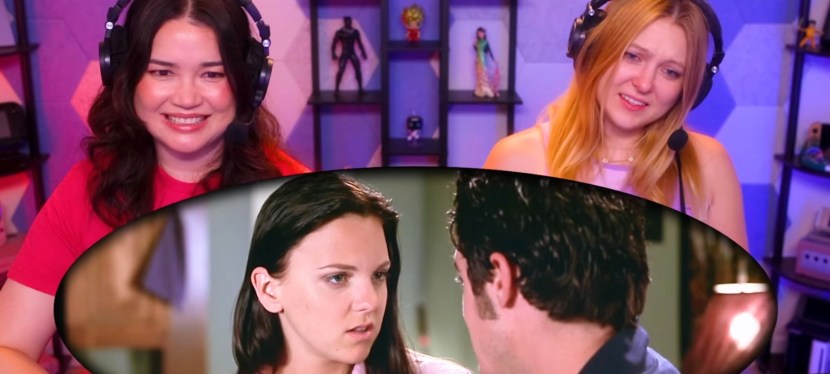
#1 Varied Scary Movie 3 Reaction Videos – After enjoying Scary Movie (2000), I eventually saw Scary Movie 2 in a California cinema and it was disappointing due to its rushed and uninspired presentation. More than two years later, I saw Scary Movie 3 in a packed cinema here in the Philippines. Directed by David Zucker – part of the famous Zucker-Abrahams-Zucker (ZAZ) – Scary Movie 3 does not quite match the fun and quality of the original film of 2000 but it was still a huge improvement over Scary Movie 2. Not only that, the 2003 film had Anna Faris back as Cindy Campbell while the legendary comedian Leslie Nielsen was a notable addition. To see how much of an impact Scary Movie 3 has with YouTubers, watch and selected video reactions below.
#2 A Korean Comic Café – If you are visiting South Korea and if you want to spend time in a place that allows privacy, access to digital entertainment, comic books and a variety of food and drinks during the day, try visiting a comic café. Watch and learn from the video below.
#3 Ranting For Vengeance Looks At Great Comics That Actually Suck – What do you think makes a comic book great? Could it be because of the creators’ work, the storytelling style, real-world events that inspired the creative process, or the reputation of the creators who made it? In his video from 2025, Ranting for Vengeance examines that comics that were perceived to be great but sucked. Watch his video and pay close attention to the details and his explanations.
#4 Ashleigh Burton Reacts To Weird Science – If you have read comic books of Weird Science, could you see their connection with the 1985 science fiction teen comedy film Weird Science? Directed by the late John Hughes, Weird Science follows two nerdy social outcast high school students who have had enough of being humiliated by others and enduring disappointing lives. Together, the two plan to make the perfect dream woman come true using a computer while hacking a government computer system. As it is loosely based on the Weird Science series of EC Comics, the film was a notable product of its time and it remains a memorable part of 1980s Hollywood cinema. To see if it has any entertainment impact, watch Ashleigh Burton’s reaction video now.
#5 Sega’s F355 Challenge Revisited – During a visit to Gameworx inside Festival Mall in 1999, I saw the arcade game F355 Challenge from Sega. After marveling at its graphics during the first several minutes, I bought arcade tokens to play it. To my surprise, F355 Challenge was a racing simulation as it was designed with in-depth driving realism in mind. Yu Suzuki (Virtua Fighter) was the man who produced and directed the game, and in my opinion F355 Challenge has to be played in its original arcade form while the Sega Dreamcast port is the alternative. To see what F355 Challenge has to offer gamers, watch the video below.
#6 Penalties On Littering At Shibuya – Shibuya is one of the most lively urban spots in Japan. Located in Tokyo, is a special ward where visitors can enjoy the immense commercial joints and it is now the premiere hub for youth culture. Sadly, as Japan is attracting tens of millions of foreign tourists each year, littering at Shibuya has gone up tremendously. Fortunately, the local authorities are taking action again littering and those who littered will be penalized when they are caught. Learn from the Nippon TV video below.
#7 GoodBadFlicks Reviews The Bees – Way back in the late-1980s, the 1978 horror movie The Bees was shown on local TV and it drew a large audience. I cannot forget the time when a classmate of mine got so scared watching it. The Bees is a Mexican production that had the late John Saxon in a major role. To see the quality and production details of The Bees, watch the video of GoodBadFlicks below.
#8 Steakhouse In Tokyo – If you are touring Tokyo right now, there is this particular place that serves customers with really delicious and satisfying steaks. This video shows very enticing meals and I would love to visit once I return to Japan someday. Enjoy the video!
Welcome back my readers, YouTube viewers and all others who followed this series of articles focused on YouTube videos worth watching.
Have you been searching for something fun or interesting to watch on YouTube? Do you feel bored right now and you crave for something to see on the world’s most popular online video destination?
I recommend you check out the following videos I found.
#1 CinePals React To Scary Movie (2000) – In my honest opinion, Scary Movie (2000) is still the best film parody Hollywood has released in the 21st century. The film is loaded with jokes, pop culture references and fine acts by Anna Faris, Marlon Wayans and Shannon Elizabeth to name a few. In relation to the 2026 movie Scary Movie, the original film was featured in new reaction videos from YouTubers and I enjoyed watching CinePals’ reaction video of it. I encourage you to watch it now.
#2 Xbox Sports Network (XSN) Revisited – When Microsoft entered the competitive video game console industry with the original Xbox in 2001, they really invested a lot of money to make first-party games as they could not yet form strong business relationships with game companies that had been doing business with PlayStation and Nintendo. Along the way, Team Xbox established its very own lineup of exclusive, first-party sports video games with licenses of professional sports leagues or associations. That was the Xbox Sports Network (XSN or XSN Sports) and it had Xbox-exclusive games of the NBA, NFL, NHL and alternative sports. Sadly, XSN lasted only a few years and you can learn much more by watching the retrospective videos below.
#3 Ranting For Vengeance Exposes Racist And Woke Agenda Behind Matt Reeves’ Batman – If you actually enjoyed Matt Reeves’ The Batman in 2022, did you even notice the wickedness of wokeness behind it all? Matt Reeves is still pushing with the woke agenda on the cinematic Batman which is very unfortunate. To learn more, I urge you to watch the video of Ranting For Vengeance who explains a lot of things in great details. At the same time, be aware that there are lots of woke nuts, modern-day Commies, socialists and reckless social justice warriors (SJWs) who are operating as fake fans obsessed with hijacking established entertainment to turn it all into their own. Ranting For Vengeance has a huge wake-up call for Batman fans, comic readers and superhero fans in general.
#4 Retro Alleyway In Tokyo – I have been to Tokyo in Japan a long time ago. Sadly, I was unable to visit the retro alleyway district where there are lots of small shops and food joints to visit. Such a place keeps on attracting both locals and foreign tourists as there is so much to discover and experience there. Watch and learn from the in-depth video of Nippon TV below.
#5 Einhänder Revisited – Released on PlayStation in the late 1990s, Einhänder was an ambitious 3D polygonal side-scrolling shooter game that created a lot buzz and won the admiration of many as a lot of gamers enjoyed it. Einhänder was arguably a serious attempt by SquareSoft – already famous for role-playing games (RPGs) – to offer gamers something new, engaging and cinematic in the genre of 2D side-scrolling shooters. Behind the scenes, SquareSoft had Tatsuo Fujii as the game director and his experience working on Gradius II and Xexex with Konami was evident in Einhänder’s design. To learn more about the history of the game, watch the video below.
#6 CineBinge And You, Me And The Movies React To Child’s Play 2 – In 1991, my friends and I saw Child’s Play 2 and Child’s Play 3 on home video. Having seen both films, most of us enjoyed Child’s Play 2 over its follow-up. A classmate of mine who saw all three Child’s Play movies pointed to Child’s Play 2 as the very best and the most replayable one. Still, one has to wonder if Child’s Play 2 aged well after more than three decades. To see if the old movie has any impact on YouTubers, watch the reaction videos of CineBinge and You, Me and the Movies below.
#7 Jodi Huisentruit Still Missing – Since late-June of 1995, American television news anchor Jodi Huisentruit has been missing. No matter how much time and effort were invested to solve the case, her disappearance was never solved. In 2001, she was declared legally dead. There were theories about how she disappeared but no breakthroughs happened. The website FindJodi.com is dedicated to solving the mystery and remains active. As such, now is the ideal time to revisit Jodi Huisentruit’s disappearance and learn the crucial details by watching the videos below. Do you personally know someone who went missing without a trace?
#8 Ashleigh Burton Reacts To Steven Spielberg’s Hook – Way back in 1991, Steven Spielberg’s movie Hook was heavily promoted here in the Philippines complete with trailers and print ads. While the film was released in North American theaters during the Christmas season, it opened in Philippine cinemas on February 8, 1992. Hook is a cinematic take on the classic Peter Pan story but with the concept of Peter being a grown man and a father of two children. The film was not universally admired by the movie critics but it still made over $300 million worldwide. Behind it all, Spielberg described himself being a victim of the Peter Pan syndrome and he worked on making Hook with a lot of heart. To find out if Hook has any real emotional impact, watch Ashleigh Burton’s reaction video below.