I believe that every nation has to reward its armed forces in return for the extensive services they rendered for the citizens and the government throughout the year. Just today, I learned via a Newsmax news report that US President Donald Trump announced that every active-duty member of the United States Armed Forces will receive a Christmas bonus worth $1,776 – called the Warrior Dividend – and already the checks are on their way to them (1.45 million service members).
Before proceeding with the news and details, let me remind you all that Christmas is all about Lord Jesus, and never about the character called Santa Claus. Lord Jesus is our Savior and the Hope of ALL nations! Wherever you are, celebrate Christmas with your family remembering Lord Jesus and living on with His peace. All the praise, honor and thanks to the Lord!
To put things in perspective, posted below is an excerpt from the news report of Newsmax. Some parts in boldface…
President Donald Trump announced Wednesday night that every active-duty member of the U.S. armed forces will receive a $1,776 Christmas bonus, unveiling what he called the “Warrior Dividend” during a nationally televised prime-time address from the White House.
Trump said the one-time payment would go to roughly 1.45 million service members and is already being distributed, with checks scheduled to arrive before Christmas. The amount, Trump said, was deliberately chosen to honor America’s founding in 1776. That’s just ahead of the nation’s 250th anniversary, to be celebrate (throughout) the coming year.
“I am also proud to announce that 1,450,000 military service members will receive a special — we call Warrior Dividend — before Christmas, a Warrior Dividend in honor of our nation’s founding in 1776,” Trump said during the address, which was carried live by Newsmax from the White House Diplomatic Room.
“We are sending every soldier $1,776. The checks are already on the way,” Trump said. “Nobody deserves it more than our military. And I say congratulations to everybody.”
The Warrior Dividend emerged as a highlight of Trump’s year-end prime-time address, which the White House framed as a review of economic gains and fiscal changes achieved during his second term and promised gains in the (coming) years of the president’s second term. The speech focused heavily on revenue growth, job creation, and what Trump described as a reshaping of federal finances.
Trump tied the military bonus directly to increased government revenue generated through tariffs and recent legislation, arguing that stronger trade enforcement and changes in economic policy produced results that exceeded projections.
“We made a lot more money than anybody thought because of tariffs, and the bill helped us along,” Trump said.
The president cast the dividend as both a tangible reward and a symbolic gesture, presenting it as recognition of service members’ sacrifices while reinforcing claims of economic revival. Trump said the payment reflects an administration that prioritizes military families and uses economic strength to deliver direct benefits rather than expanding federal debt.
The prime-time address marked Trump’s final nationally televised speech of the year and served as a capstone to a broader messaging effort focused on economic performance. Trump used the speech to highlight tariff revenue, domestic manufacturing investment, and wage growth, arguing that those factors allowed the administration to deliver what he described as meaningful, immediate relief.
Let me end this piece by asking you readers: What is your reaction to this development? Do you find the Warrior Dividend a nice bonus for the active members of the United States Armed Forces? Are you looking forward to the 250th Independence Day of the America? What are your current feelings or opinions about the US Armed Forces right now?
Welcome back my readers, YouTube viewers and all others who followed this series of articles focused on YouTube videos worth watching. Have you been searching for something fun or interesting to watch on YouTube? Do you feel bored right now and you crave for something to see on the world’s most popular online video destination?
I recommend you check out the following videos I found.
#1 Demolition Man Revisited – Way back in 1993, I completely missed out on Demolition Man in the local cinemas. The first time I saw it was on a rented laserdisc in 1995 and the film (starring Sylvester Stallone and Wesley Snipes) turned out to be entertaining in a unique way. By today’s standards, Demolition Man is considered by many as a film ahead of its time as it accidentally predicted self-driving cars, video conferencing, heavy dependence on computers for solutions and more. As such, it is not surprising that a lot of retrospective and reaction videos of Demolition Man have filled YouTube. Posted below are the more entertaining videos to watch about the 1993 movie.
#2 Soy Milk Becomes More Popular In Japan – Soy milk is a dairy-free, plant-based drink made from water and ground soybeans. In recent times, soy milk has gotten tremendously more popular in Japan. Not only is it being consumed by the Japanese in its beverage form, soy milk also made its way into food items and snacks. There is a lot to learn about soy milk’s popularity in Japan in the video below.
#3 Resident Evil Illustrated Tales – Believe it or not, there was a time when comic books and illustrated tales about the Resident Evil games were published from the late 1990s to the early 2000s. Back then, WildStorm (WildCATs, StormWatch, Wetworks) was licensed to make comic adaptations of Resident Evil starting with the Resident Evil: The Official Comic Magazine (published through Image Comics, 1998-1999) which featured varied short stories that expanded the lore but not necessarily counted as canon with the games. YouTube ScorePN posted a video showcasing the Resident Evil illustrated tales so you don’t have to go to all the trouble of finding the comic books and magazines. Watch and enjoy the video below.
#4 Zaxxon Revisited – In the early 1980s, Sega made a huge splash in the arcades and game consoles with Zaxxon which is now considered a classic by many gamers. I only played it on the personal computer back in the 1980s. While my enjoyment of the game was very limited because of the not-so-friendly keyboard controls, I found Zaxxon an intriguing experience due to its isometric visual design and the illusion of 3D space that came with it. Sometimes I wished that Zaxxon would get remastered for the current console generation. That said, it’s now a good time to look back at the game in the two retrospective videos below.
#5 Ashleigh Burton Reacts To Lethal Weapon – Among all the Lethal Weapon movies released by Hollywood, the first film from 1987 is still the best in my view. Apart from having a strong script, the directing by Richard Donner got fine performances from Mel Gibson and Danny Glover, and the spectacle was executed with a lot of power while never feeling outlandish. That said, it is fun to replay the movie from time to time. To see how it impacts YouTuber Ashleigh Burton, watch her reaction video below.
Welcome back my readers, YouTube viewers and all others who followed this series of articles focused on YouTube videos worth watching. Have you been searching for something fun or interesting to watch on YouTube? Do you feel bored right now and you crave for something to see on the world’s most popular online video destination?
I recommend you check out the following videos I found.
#1 Setting The Record Straight About Cleveland’s 1986 Balloonfest – If there is anything unfortunate about the Internet and 21st century culture, it would be falsehoods and distorted information overwhelming the truth about past events. When it comes to Cleveland’s Balloonfest ’86, the event was a spectacle in which the organizers, its volunteers and strategic partners overcame lots of challenges along the way. The vibe and turnout overall in 1986 was generally positive. Today, there are simply too many liars and peddlers of misinformation (note: climate change activists, woke minds and people pretending to be experts) who posted online dishonest retrospective videos and opinions about Balloonfest ’86. That said, key members of the organizing committee and participants of the event got together to set the record straight in a YouTube video of Cleveland.com, and they have the facts to refute the accusations and falsehoods. Watch and learn from the video below.
#2 Tourists Causing Trouble In Japan – As I said some time ago, if you are entering Japan as a tourist, you better behave yourself and follow the rules. Massive tourism has been happening in Japan for some time now which is clearly adding to their economy and to discovering what the Japanese have to offer to the world. Unfortunately, there are foreign tourists who misbehaved and violated local laws to do gimmicks for social media (note: a selfish motive), disturbing the peace, adding to the pollution and even flying drones in restricted areas. Watch and learn from the video below.
#3 Remembering John McCain’s Bad Legacy – It has been years since former US presidential candidate and US Senator John McCain passed away. During his decades-long service in the US Senate, he was called by the corrupted mainstream news media a maverick for his willingness to work with Democrats on pieces of legislation. What many people do not know is the truth (backed with facts) that McCain’s legacy has been pretty bad as he not only betrayed the Republican Party but also the voters. When McCain was the Republican nominee for US President in 2008, his campaign was really doomed and Republicans got embarrassed. There is a lot more to discover about McCain in the MAGAmark video below.
#4 Congo Video Game – In 1995, the adventure movie Congo was released in cinemas and it managed to achieve better-than-expected commercial success despite being hit with negative reviews. The movie was based on a novel by the late Michael Crichton. As part of the film’s business strategy, a video game of it was released on Sega Saturn titled Congo The Movie: The Lost City of Zinj. I never played the game and there is a lot to learn about it in Sega Lord X’s video below.
#5 The Running Man Revisited – Remember the 1987 sci-fi action movie The Running Man starring Arnold Schwarzenegger? That film was not a faithful adaptation of the novel written by Stephen King (who used a different name) but it delivered bouts of fun for moviegoers. That said, there are lots of interesting details about the film, its source material, the process of adapting the story for film, and how it entertained people. Enjoy the selected retrospective and reaction videos below.
#6 You, Me and the Movies React To Frankenstein (1931) – Several decades ago, Universal Pictures released its cinematic adaptation of a 1927 play which itself is an adaptation of Mary Shelley’s Frankenstein novel. Simply titled Frankenstein, the 1931 movie went on to become a long-lasting part of American pop culture and is often regarded as a Hollywood. You, Me and the Movies’ Frankenstein reaction video is a must-see.
#7 Ashleigh Burton Reacts To Young Frankenstein – If you want to see good old comedy that is effectively funny, you can’t go wrong with Mel Brooks. When it comes to making fun out of a particular horror icon or property, Brooks’ Young Frankenstein is a parody worth considering. Ashleigh Burton’s reaction video is fun to watch.
Welcome back my readers, YouTube viewers and all others who followed this series of articles focused on YouTube videos worth watching. Have you been searching for something fun or interesting to watch on YouTube? Do you feel bored right now and you crave for something to see on the world’s most popular online video destination?
I recommend you check out the following videos I found.
#1 GoodBadFlicks Examines Cheersploitation Movies – Recently YouTuber GoodBadFlicks posted a video examining a certain sub-genre of film involving cheerleaders…Cheersploitation. Before the explosion of raunchy comedy movies in the 1980s, there were sex comedy films involving cheerleaders released in the 1970s. GoodBadFlicks’ video features five movies of the Cheersploitation sub-genre which you should see.
#2 The Odd City In Skyrim – Like many gamers, I bought and played Skyrim (Xbox 360 version specifically) on launch day in 2011, and it was easily the most immersive role-playing game of the 7th console generation. There is one particular city that always felt odd to me which is Markarth. Recently I saw this particular video on YouTube that explains in detail why Markarth stood out so differently from all other cities and towns of Skyrim, and there definitely is something dark behind its legacy which makes exploring it a very intriguing experience for gamers. This is a reminder about Todd Howard’s team taking creative risks that worked and it is an experience you won’t get in Starfield. Watch the video below.
#3 Japanese Food In Ibaraki Prefecture – Ibaraki Prefecture is located in the Kanto region of Honshu in Japan. Even as Ibaraki Prefecture is part of the Greater Tokyo Area, its local food joints offer certain meals that are not available in Tokyo itself. Recently, Nippon TV visited the place and examined why locals travel there to try out the standout food. Watch and learn from the video below.
#4 You, Me And The Movies React To Spawn (1997) – 1997 was not exactly a fun year for superhero enthusiasts when it comes to movies. The movie star-heavy Batman & Robin was terrible and it remains as one of the worst superhero movies ever. Also in 1997, a live-action movie of Spawn was released and even though it took itself seriously (note: creator Todd McFarlane had creative input on the film and his own company was part of the production), it gathered mixed reaction from the fans and very negative feedback from film critics. Recently, You, Me and the Movies posted a reaction video about Spawn which strangely was more entertaining than the movie itself.
#5 Butch Cassidy And The Sundance Kid Reaction Videos – If you have seen a lot of buddy cop movies from Hollywood, have you seen a Western buddy film? Once such film was 1969’s Butch Cassidy and the Sundance Kid which starred the late Robert Redford and the late Paul Newman. The movie was critically acclaimed and it was for preservation in the United States National Film Registry by the Library of Congress as being “culturally, historically, or aesthetically significant” 34 years after its release. As such, it is not surprising that the film became a subject of many YouTube reaction videos and posted below are a few I selected for your enjoyment.
#6 Jennifer Lopez And The Scammers In Music – A few decades ago, Milli Vanilli was exposed as a scam and the public backlash was so intense, the fans destroyed the music records they previously bought. For the newcomers reading this, Milli Vanilli was a duo of Fab Morvan and Rob Pilatus who danced and NEVER used their voices in their songs (note: it was all done by others in secret under German music producer Frank Farian). Back in those times, it was normal for music fans and consumers to expect genuine vocal performances from musical artists. As time passed, standards have changed and the musical scam of Milli Vanilli suddenly became the new normal in modern entertainment as more singers today were exposed to be frauds and pretenders (lip-syncing behind vocals produced by others). Watch and learn from the video below.
Welcome back readers, fellow geeks and electronic gaming fans!
In this edition of the Retro Gaming Ads Blast (RGAB) series, we will take a look at another batch of retro gaming print ads – including arcade flyers – from the 1970s to the 1990s.
For the newcomers reading this, Retro Gaming Ads Blast (RGAB) looks back at the many print ads of games (console, arcade, computer and handheld) that were published in comic books, magazines, flyers, posters and newspapers long before smartphones, social media, the worldwide web and streaming became popular. To put things in perspective, people back in the 1970s and 1990s were more trusting of print media for information and images about electronic games and related products.
With those details laid down, here is the newest batch of retro gaming print ads for you to see and enjoy…
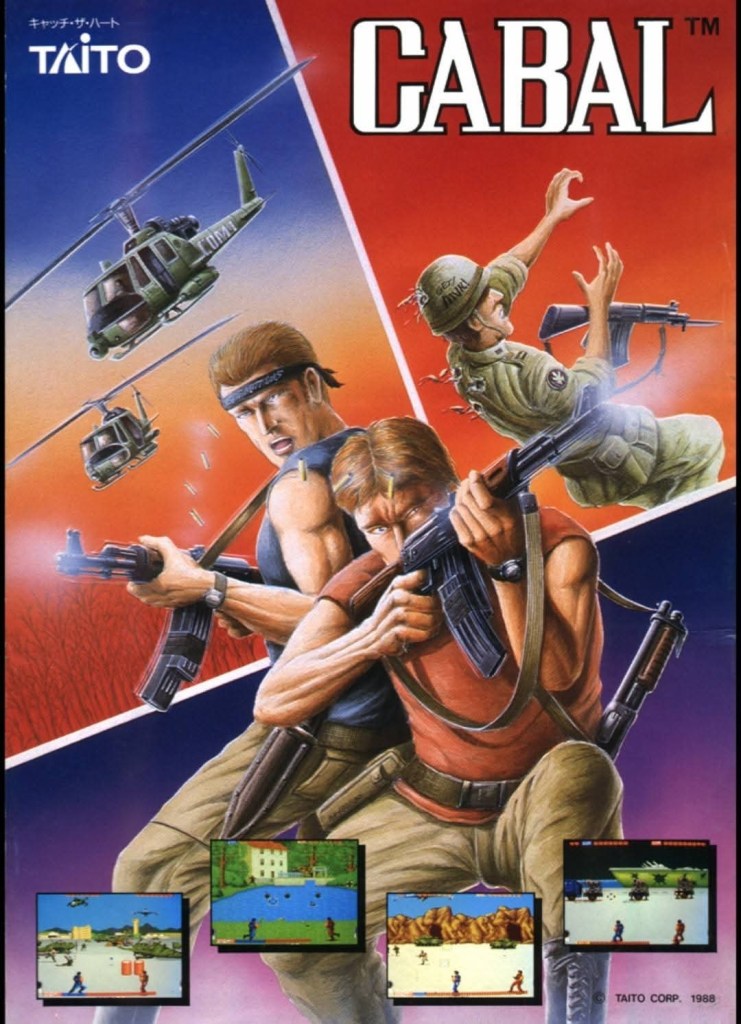
1. Cabal Japanese arcade flyer/poster
Can you feel the action and intensity here?
When it was first released in video arcades in Japan in late 1988, Cabal was another game inspired by military action movies of Hollywood which explains the art work done for the arcade flyer and poster shown above. The Vietnam War was still fresh in people’s minds and the concept of having one or two players firing their weapons against enemy soldiers resonated with gamers who saw Hollywood’s military action flicks. That said, it is not surprising that Cabal became a huge hit in Japan before getting released in arcades around the world.
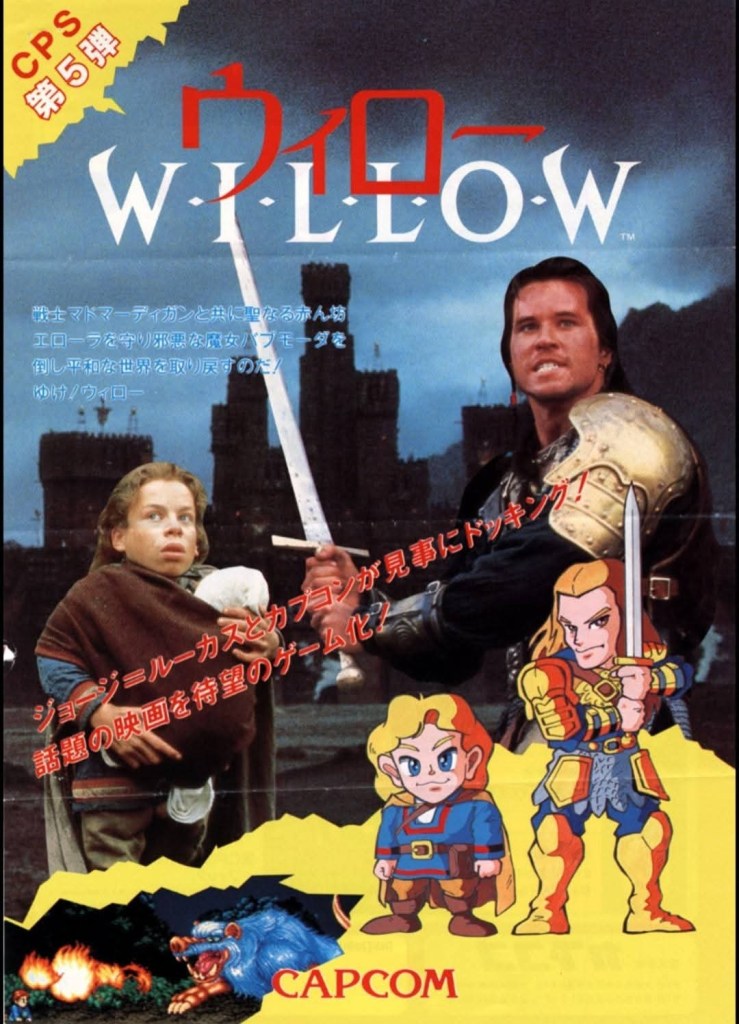
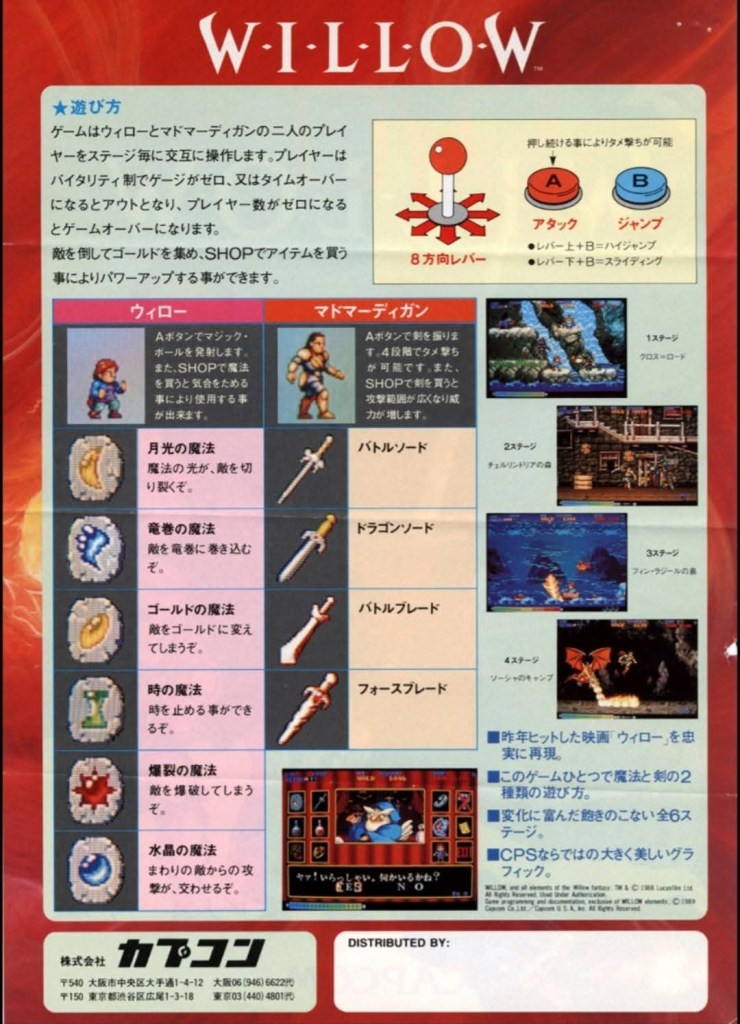
2. Willows Japanese arcade flyer
The front.
The rear.
Remember the 1988 high fantasy adventure film Willow? That film was produced by George Lucas and was a bold new production of Lucasfilm shifting away from Star Wars. Believe it or not, an official arcade game adaptation of Willow was made by Capcom and they promoted it by having images of Val Kilmer and Warwick Davis on the front of the arcade flyer (opposite the illustrated versions of their characters). The game, which was a side-scrolling platform game with run-and-gun elements, went on to be an arcade hit in Japan and eventually pleased gamers worldwide.
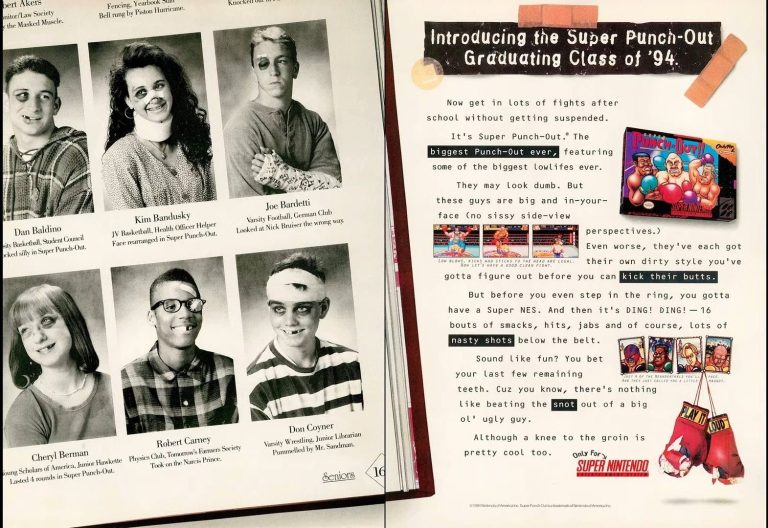
3. Super Punch-Out!! North American print ad
This is funny to look at.
Historically, Nintendo’s Punch-Out!! series started in the arcade in 1984 and the first game was the result of the company’s effort to make a new game using arcade cabinets with two screens. The 2nd game – Mike Tyson’s Punch-Out!! – became a huge critical and commercial hit (over 2 million copies sold in 1988) on console and it made great business sense for Nintendo for release another Punch-Out!! for its console gamers to enjoy in the comfort of home. In 1994, Super Punch-Out!! was released on the Super Nintendo Entertainment System (SNES) in America and to promote it, the company came up with a hilarious 2-page ad that showed fictional high school graduates with boxing-related injuries. The imagery creatively connected with the words “biggest Punch-Out ever” and “Graduating Class of ‘94”.
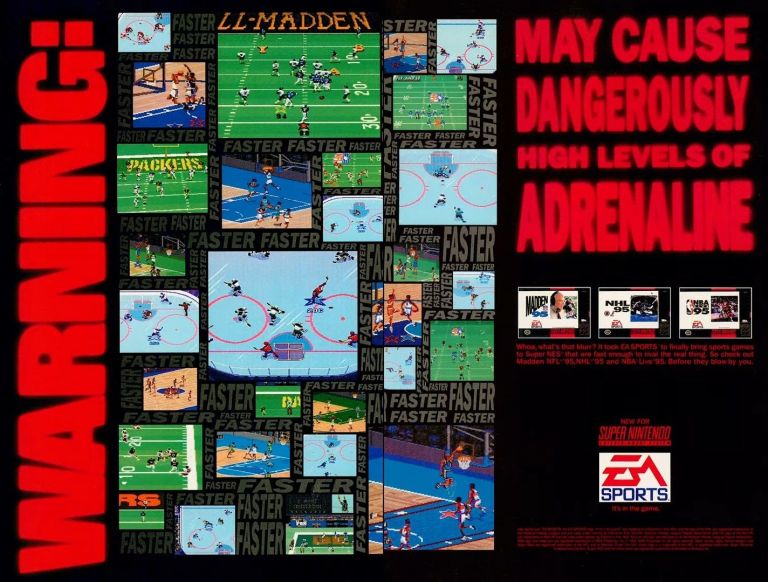
4. EA Sports 3-in-1 SNES games print ad
EA Sports games on the SNES.
In 1994, Electronic Arts (EA) released their sports games NBA Live 95, NHL 95 and Madden NFL 95 for consoles at the time. Even though the Sega Genesis sold better than Super Nintendo Entertainment System (SNES) in America at the time, EA went on to aggressively market their 3 sports video games on Nintendo’s console using a 3-in-1 games print ad. In retrospect, the SNES for the most part had better graphics and sounds than the Genesis which is reflected clearly on EA Sports games of the time. This print ad still looks fun and exciting.
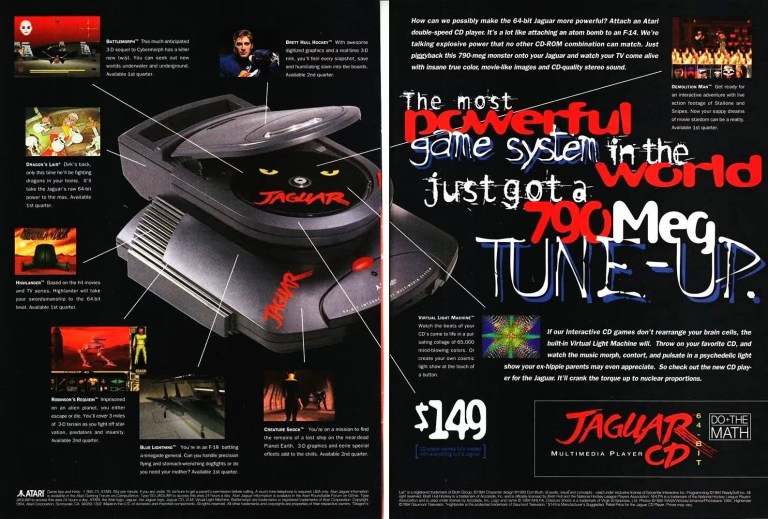
5. Atari Jaguar CD print ad
Were you able to play any game on the Atari Jaguar with the CD add-on included?
Apart from the obvious advances of technology that impacted video games, the 1990s is also known for the rise of CD-ROM as a medium for gaming. In an effort to boost sales of the Atari Jaguar console (launched in America in 1993 for around $250) and capitalize on the trust of the fans and console owners, Atari launched a CD-ROM add-on device for about $150 in 1995. To promote it, the company went aggressive with the 2-page ad showing the add-on fully connected on top of the main console, showing off some games and posting a text description emphasizing hardware power and the advantages that come with the CD technology. Even in the captured image, the Atari Jaguar CD still resembled a toilet. This is an aggressive ad campaign that failed as less than 20,000 Atari Jaguar CD units were sold by the time it was discontinued in 1996.
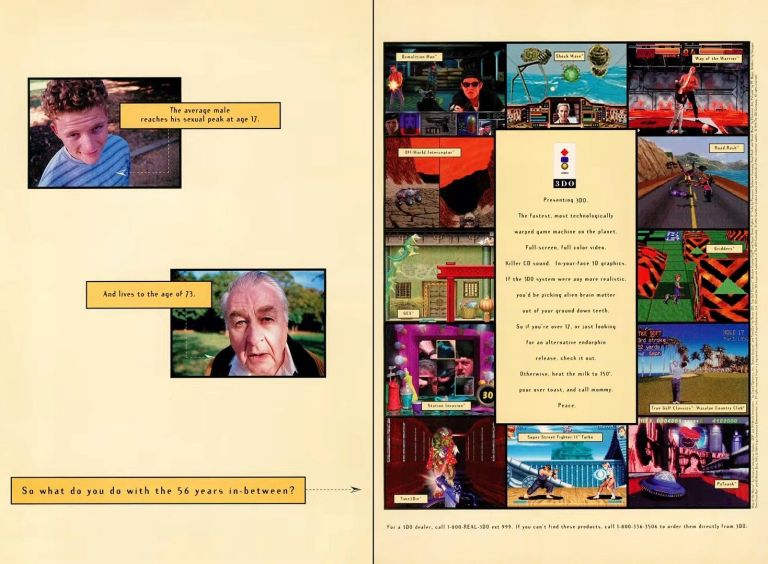
6. 3DO print ad
While it lacks intensity, this 3DO ad emphasized the games.
Without showing any hardware, the 3DO Company came up with this 2-page print ad that had a slightly adulterated tone (look at the left page) and aggressively marketed the 3DO console games available at the time. Games like Demolition Man, Shock Wave, Road Rash and Super Street Fighter II Turbo were the standout titles which clearly showed the company made the effort to emphasize gaming more than multimedia features. This 1990s ad tackled the generations with a touch of humor.
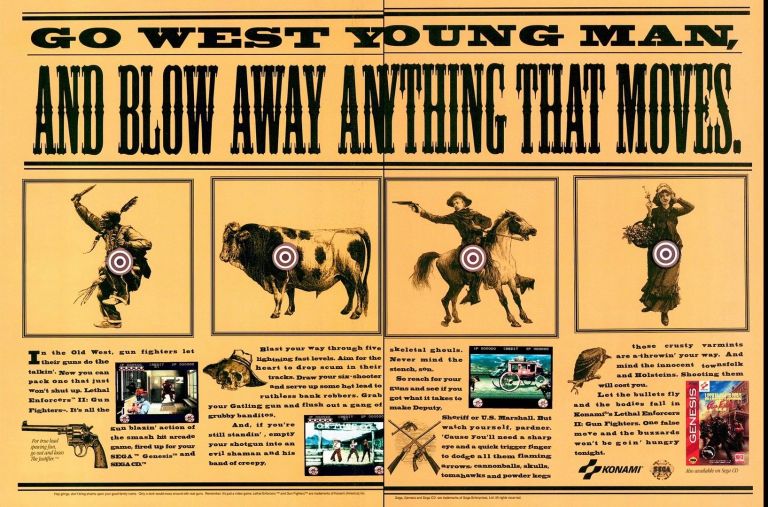
7. Lethal Enforcers II: Gun Fighters Sega Genesis print ad
This is a fun ad to look at.
When Lethal Enforcers II: Gun Fighters was released in the arcades in 1994, it became a commercial success for Konami which went on to announce it would port the game to consoles of Nintendo and Sega at the time. While the port for the Super Nintendo Entertainment System (SNES) was never released, Lethal Enforcers II: Gun Fighters made its way to the Sega Genesis and Sega CD. The print ad of the Sega Genesis version (Sega CD mentioned in small text) had an inspired design emphasizing the Old West, shooting and the conflict between cowboys and Indians. The screenshots gave people the clear idea that Old West was the setting (versus modern day in the previous game). This is still fun to look at.
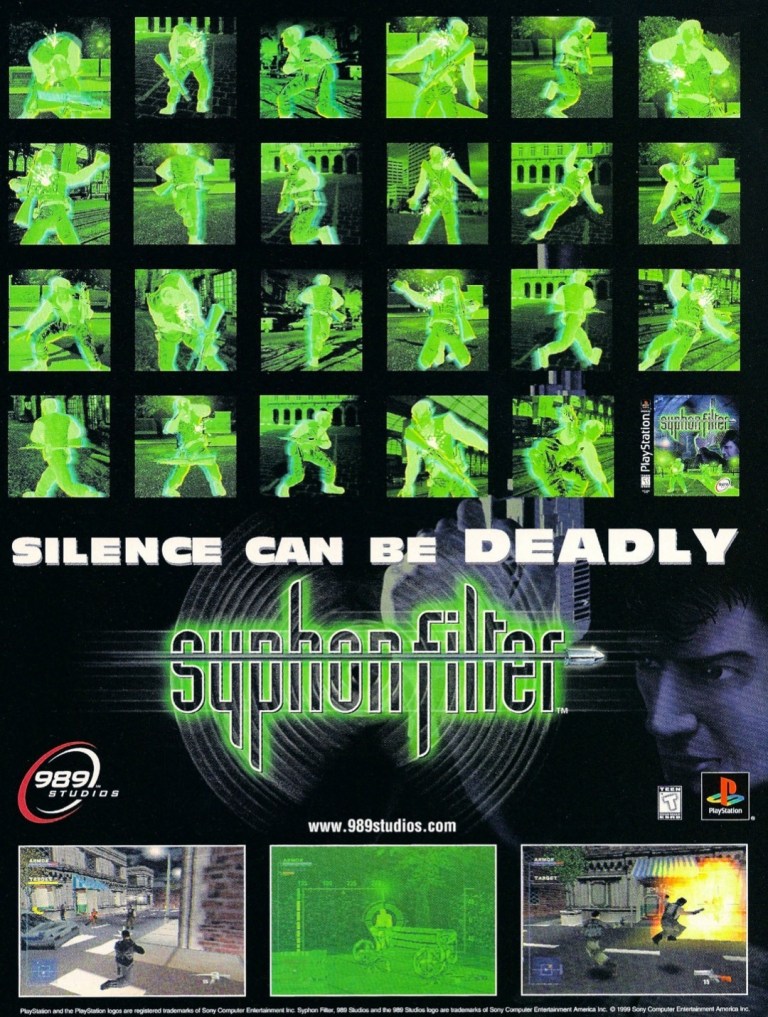
8. Syphon Filter
Syphon Filter went on to become a surprise hit game in 1999.
In 1999, Sony’s 989 Studios released Syphon Filter exclusively on the PlayStation console. This single-page print ad showed a few screenshots on the bottom and several action snippets with a night vision touch ultimately emphasizing the stealth aspect within the gameplay. The marketing proved to be effective as the game sold a lot at retail and went on to establish a new game franchise exclusive to PlayStation consoles.
9. Parasite Eve II Japanese print ad
Were you a big fan of Aya Brea and the Parasite Eve franchise in the late 1990s?
Following the critical and commercial success of Parasite Eve in 1998, SquareSoft proceeded with Parasite Eve II and the production (note: initially for a spin-off game before becoming a sequel) did not even involve the main creators of the first game. Instead the company had a different team of developers – including those who previously worked on Resident Evil games for Capcom – in Osaka to make the sequel. This explains why Parasite Eve II had stronger survival horror gameplay resembling a Resident Evil game. As major changes were made during the production, it was decided that Aya Brea would become the main protagonist and already the character was already popular with gamers. That being said, the marketing of Parasite Eve II for the Japanese market heavily featured Aya Brea with subtle sexiness, beauty and action in mind. The marketing intensified leading to its eventual December 16, 1999 release in Japan.
Welcome back my readers, YouTube viewers and all others who followed this series of articles focused on YouTube videos worth watching. Have you been searching for something fun or interesting to watch on YouTube? Do you feel bored right now and you crave for something to see on the world’s most popular online video destination?
I recommend you check out the following videos I found.
#1 Ashleigh Burton Reacts To Full Metal Jacket – A few months ago, my YouTube series post included several reaction videos of Stanley Kubrick’s Full Metal Jacket. Recently Ashleigh Burton posted her own Full Metal Jacket reaction video and I can say that it is very enjoyable to watch as the YouTuber (who is a jolly person) had her own bouts of laugh-out-loud moments reacting to it. Watch Ashleigh Burton’s video below.
#2 Ghost in the Shell’s Relevance Analyzed – I was still in college the first time I saw the 1995 anime feature film Ghost in the Shell on home video. While I enjoyed the action and the high-quality visuals (2D animation mixed with computer-generated graphics), I was unable to grasp the story and its many philosophical messages within. To really enjoy it and understand Masamune Shirow’s concepts, watching Ghost in the Shell should be done with patience and the right mindset. Fortunately, a YouTuber took the time to replay the anime feature film and paid close attention to the many details within. Indeed, Ghost in the Shell is more relevant than ever today as it tackled hacking, cybersecurity, identity and artificial intelligence early on. To find out more, watch the video below.
#3 Yakisoba In Japan – You like Yakisoba? Yakisoba is a Japanese noodle stir-fried dish and it first appeared in food stalls in Japan about a century ago. There are lots of places in Japan that offer yakisoba to customers and there are also variants of it depending on where you find it. In the city of Kobe (the same city that got ravaged by a massive earthquake in the mid-1990s) is a Yakisoba shop that serves a lot of customers each day. That means something must be really good with the yakisoba. Watch and learn from the video below.
#4 Do You Trust James Gunn? – I never bothered to watch James Gunn’s Superman movie this year. In fact, when it was announced that Gunn and his partner would start a whole new line of DC Comics superhero movie projects under the Warner Bros. banner a few years ago, I was never excited nor interested. I saw Gunn’s work in Guardians of the Galaxy (he wrote and directed it) and the 2004 Dawn of the Dead remake (he wrote it) and neither film was worth replaying. I’m not saying Gunn is a bad filmmaker, I just don’t find his work compelling enough and box office numbers don’t change a thing. He also directed The Suicide Squad which ended up as a commercial disappointment. When it comes to cinematic superhero works, there are reasons why long-time superhero fans and comic book readers don’t trust Gunn which you can learn from the videos below.
#5 Austria Pushes Back Against Mass Migration – Right from the top, Austria made decisive moves to push back against the flow of mass migration and made it clear they want to preserve their culture and prioritize their citizens. It has been over ten years since Germany – under Angela Merkel – committed a huge blunder by opening its borders to so many people from the Middle East and Africa which affected other European nations negatively. It is obvious that the high amount of so-called refugees already in Europe collectively have no desire to assimilate with the culture and norms of the nations they entered, and they want more social benefits and more money at the expense of the citizens. Austria itself had enough and you can find out how they pushed back against mass migration by watching the video below.
Welcome back my readers, YouTube viewers and all others who followed this series of articles focused on YouTube videos worth watching. Have you been searching for something fun or interesting to watch on YouTube? Do you feel bored right now and you crave for something to see on the world’s most popular online video destination?
I recommend you check out the following videos I found.
#1 The Matrix Revisited – What else is there to say about The Matrix? There are some who claimed it is the greatest science fiction movie ever made. Some described it as more relevant than ever due to the wide public use of artificial intelligence (AI) today. In my experience, I saw a special re-screening of The Matrix at the old cinema of Festival Mall in December 1999 and it was entertaining but I never became a fan of its entertainment franchise. Regardless, the film continues to entertain and surprise YouTubers and you can see how by watching the selected videos below.
#2 The Horror Aspect Of Halo: Combat Evolved – It has been 24 years since Halo: Combat Evolved launched along with the original Xbox console. I played and finished the classic sci-fi first-person shooting game on rented Xbox consoles before and it remains a highly significant gaming experience to me. Original game developer Bungie did not just create a great sci-fi game but also designed it to be immersive, captivating and atmospheric. Within the atmosphere in the game is the subtle but effective use of horror elements which added to the mystery. How does the horror function in the classic game? Watch and learn from the video below.
#3 Meat & Rice Meals In Japan – Here is another food-related video in Japan. This is for those who crave for delicious meals composed of nice amounts of meat and rice The food joint in the video below not only serves the mentioned meals, it is able to cook many kinds of fried rice as well! Watch and enjoy the video below.
#4 Most Notable Episodes Of The Real Ghostbusters – As a young boy in the 1980s, I saw the classic movie Ghostbusters in 1984 and a few years later, I started watching episodes of The Real Ghostbusters animated TV series on home video and eventually on local TV. For the newcomers reading this, The Real Ghostbusters was the sequel and spin-off to the 1984 film and it had a specific title (using “Real”) as a result of a dispute with Filmation which had the Ghost Busters franchise. I lost count as to how many episodes of the animated series I saw but there were a few notable ones I still remember and Minty Comedic Arts’ recent video contained them. Watch the video below.
#5 UAE Rejects Radical Islam And The Islamists! – Islamists are an extreme and evil bunch. They cause trouble wherever they are and they are driven to overwhelm others, to bring down societies and become the one discriminating dominant force. Islamists have already infiltrated many European nations by means of mass migration (including entry as asylum seekers or refugees needing the host nation’s humanitarian assistance) and teaming up with the Satanic Leftists (to form a new Islamo-Leftist mob overseas). In the Middle East, the United Arab Emirates (UAE) knows how destructive radical Islam really is and they made clear that they not only reject Islamists but also remove them. Watch and learn from the video below.
#6 Japan Tightens Business Manager Visa Policy! – Recently, I blogged about Japan’s reformed policy on the business manager visa in response to the fraud and violations committed by foreigners – notably the Chinese nationals – who carried it. The requirements were drastically changed, new applicants must have at least a few years real experience of business practice, and the hiring of at least one full-time employee (who is Japanese or a permanent resident) must be done. As many of the abusers of the business manager visa were Chinese nationals, I found a video focused on the topic and what the affected Chinese holders of the visa in Japan think about the reforms done by the Japanese. Watch the video below.
Welcome back readers, fellow geeks and electronic gaming fans!
In this edition of the Retro Gaming Ads Blast (RGAB) series, we will take a look at another batch of retro gaming print ads – including arcade flyers – from the 1970s to the 1990s.
For the newcomers reading this, Retro Gaming Ads Blast (RGAB) looks back at the many print ads of games (console, arcade, computer and handheld) that were published in comic books, magazines, flyers, posters and newspapers long before smartphones, social media, the worldwide web and streaming became popular. To put things in perspective, people back in the 1980s and 1990s were more trusting of print media for information and images about electronic games and related products.
With those details laid down, here is the newest batch of retro gaming print ads for you to see and enjoy…
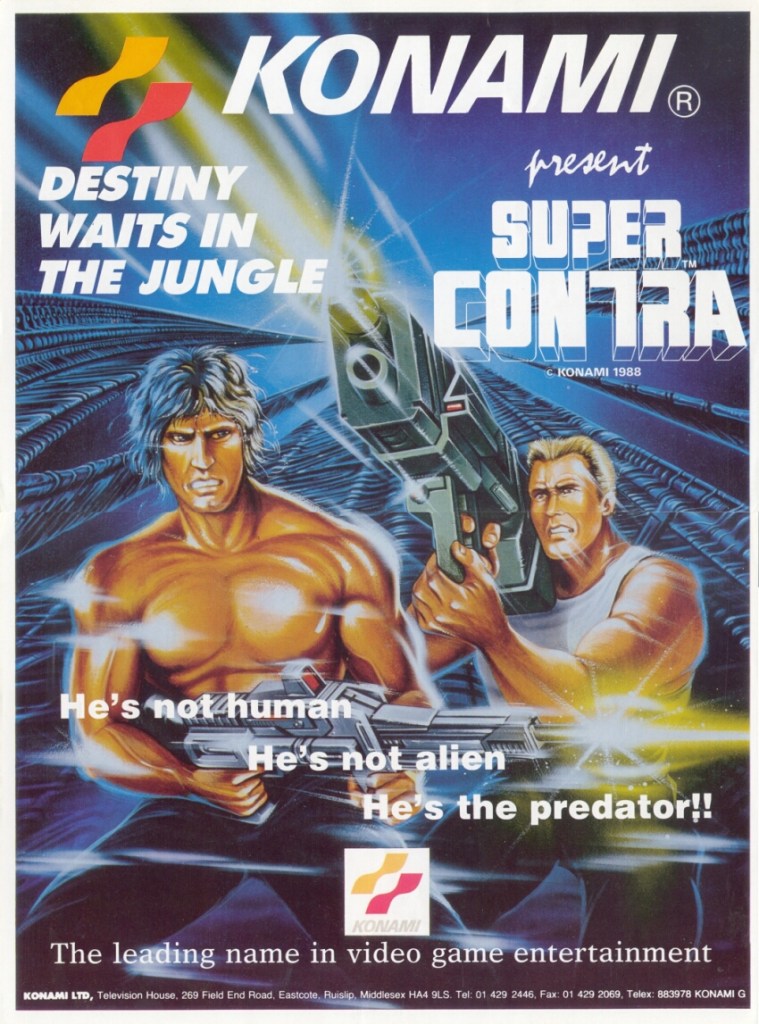
1. Super Contra North American arcade flyer
Have you seen many Hollywood action movies of the 1980s? Does this arcade flyer remind you of something?
After Konami struck gold with Contra in 1987, it was inevitable that sequels and spin-offs will be made. In 1988, they released the follow-up Super Contra in the arcades and to promote it in America, the company came up with artwork that easily gave gamers the impression they are seeing Sylvester Stallone as a fantasized Rambo and another armed guy who might remind them of Arnold Schwarzenegger’s character in Commando or Dutch in Predator. To capitalize on the movie references even more, the American arcade flyer had the line “He’s not human. He’s not alien. He’s the predator!!” As it was the 1980s, this creative approach to promotion was not surprising as Konami and its game makers were influenced by Hollywood movies.
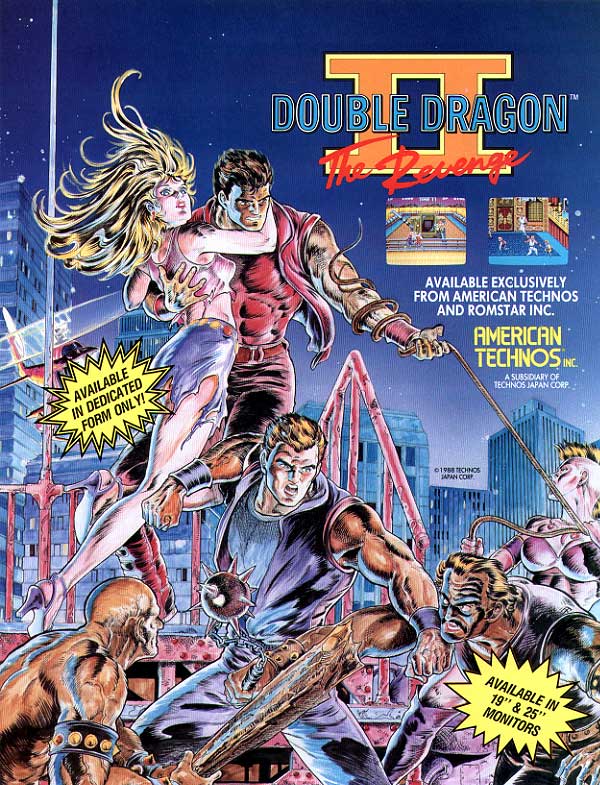
2. Double Dragon II: The Revenge North American arcade flyer
The artwork used in this arcade flyer remains intriguing to look at.
I never played Double Dragon II: The Revenge in the arcade, but I played it on the Nintendo Entertainment System (NES). That being said, I was surprised to see how this old North American arcade flyer has the same hand-drawn artwork used on the cover of the NES version. Take note that the arcade game was released in 1988 while the NES port was released in early 1990. I can only guess that Technos decided to use the same artwork not only for convenience but to have a definitive image emphasizing Double Dragon II to gamers wherever they are.
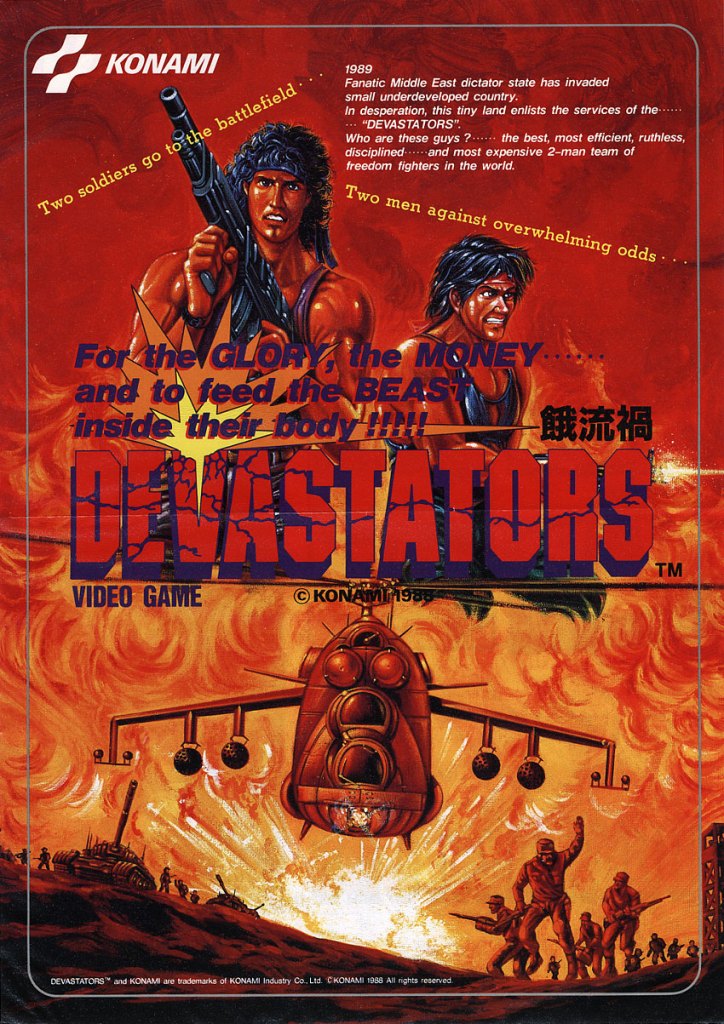
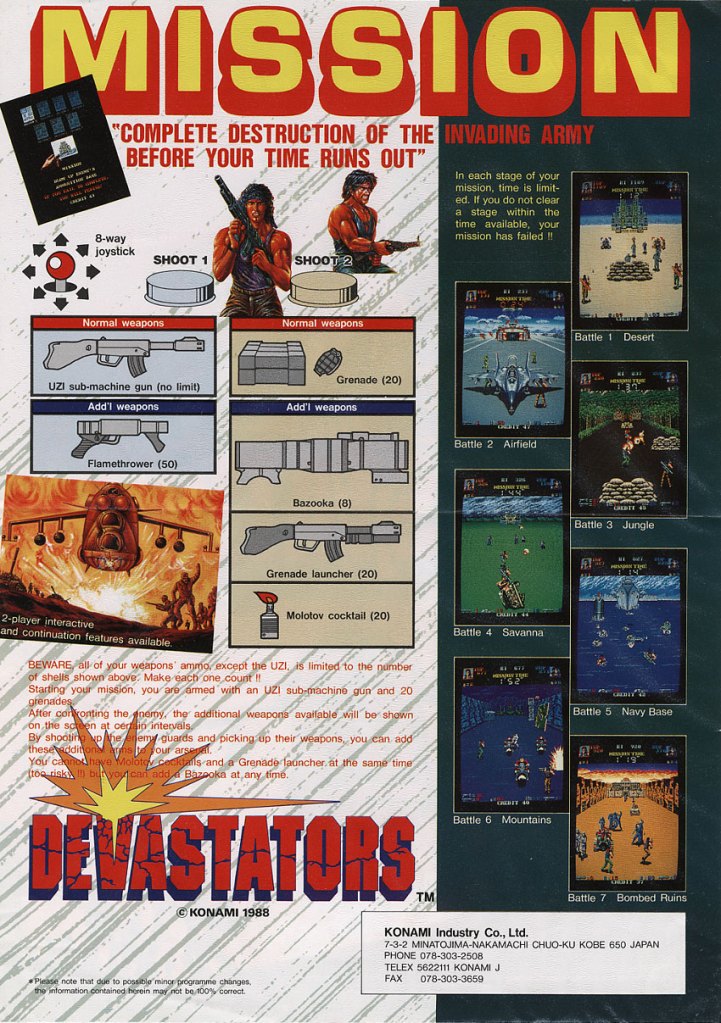
3. Devastators North American arcade flyer
The front.
The rear.
Devastators is another Konami arcade game that had a strong war theme and it was influenced by Hollywood action films of the 1980s. This particular arcade flyer for the North American market is almost identical with the Japanese arcade flyer as both have the same artwork on the front and almost the same visual layout on the rear. The most obvious difference is the use of English text for the North American flyer.
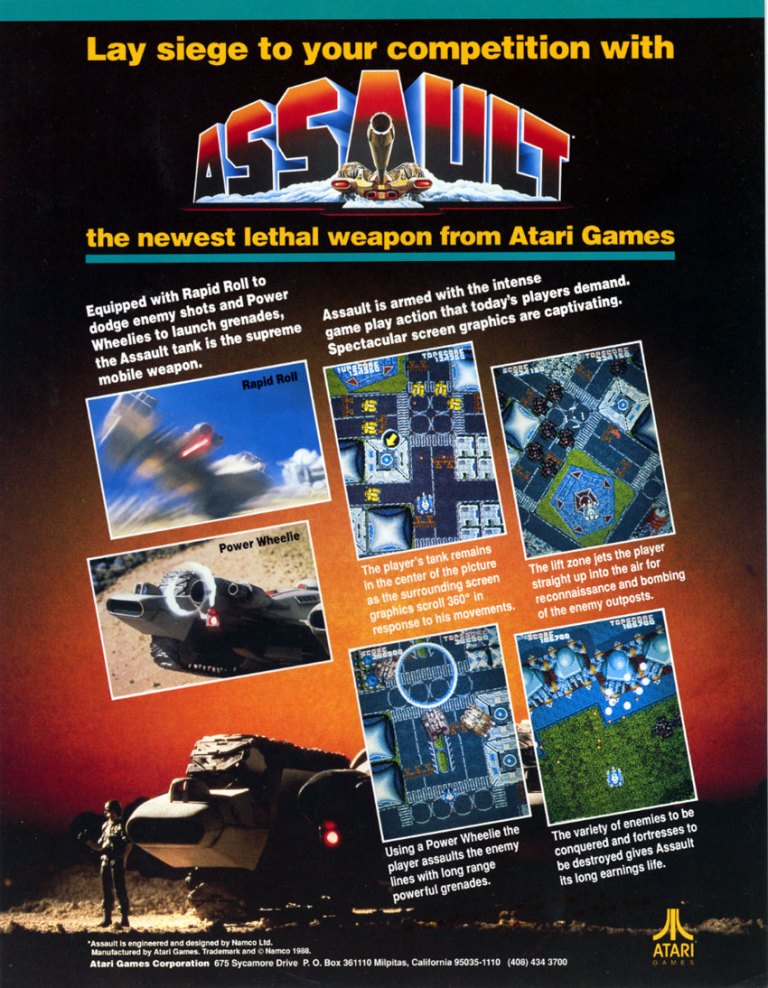
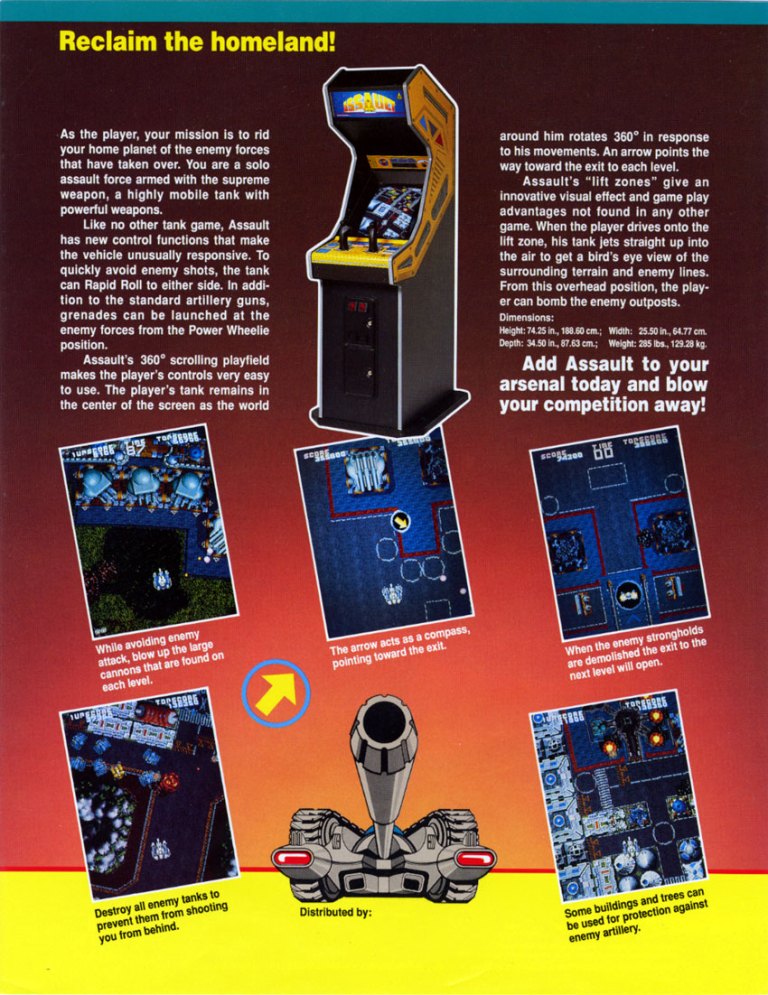
4. Assault North American arcade flyer
The front.
The rear.
Released in American arcades by Atari, Assault is a multi-directional shooter that had a twin-stick control layout (similar with the classic Battlezone) and players experienced intense battles as well as immersive visual effects such as sprite scaling and environment rotation of up to 360 degrees. To promote the game (this originated in Japan by Namco), Atari came up with this arcade flyer that had selected screenshots and descriptive text on both the front and the rear (which showed the arcade cabinet). Assault was a hit with gamers at the arcades and it was not released on consoles until 2009.
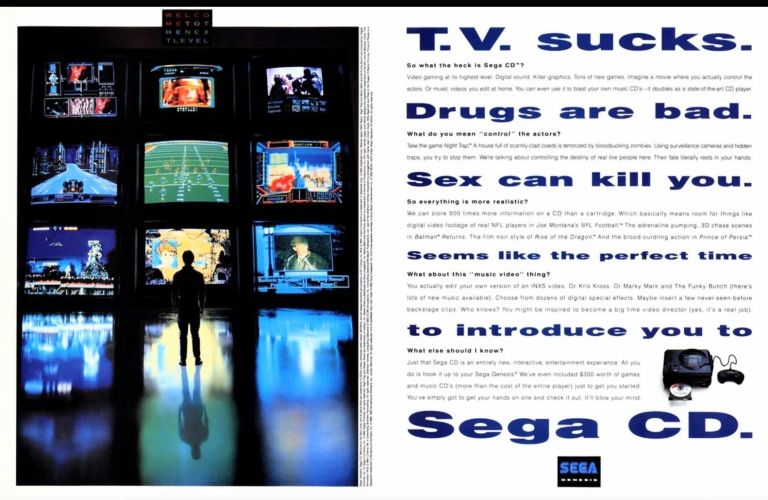
5. Sega CD print ad
Having a socially relevant message can be catchy but it leaves little room for excitement.
As the Sega Genesis console became a huge commercial success in North America, Sega itself became ambitious about what CD-ROM technology would do for video games. Sega in Japan tasked its Consumer Products Research and Development Labs to create a CD-ROM add-on which resulted in the Sega CD (Mega-CD in other parts of the world) which launched in America in 1992. To promote the add-on towards existing Genesis console owners as well as potential new customers, Sega of America came up with the above 2-page print ad that had a social message on the right and an image of a man standing in front of large monitors (showing Sega CD game footage) on the left. While it looked like an odd way of promoting video game hardware, it still remains catchy to see.
6. Panasonic 3DO print ad
Panasonic knows how to promote entertainment hardware for people’s homes.
Still in the field of CD-ROM gaming, Panasonic had competitive presence in video gaming when its Panasonic FZ-1 R.E.A.L. 3DO Interactive Multiplayer (with technology licensed by The 3DO Company) was launched in America in 1993. If you look at the print ad closely, you will notice that the descriptive text emphasized the multimedia entertainment aspect more than video gaming. The dominating artwork used does not come from a particular video game as it was made to emphasize home entertainment in general. It’s not surprising that the Panasonic 3DO and other 3DO machines from other manufacturers failed commercially.
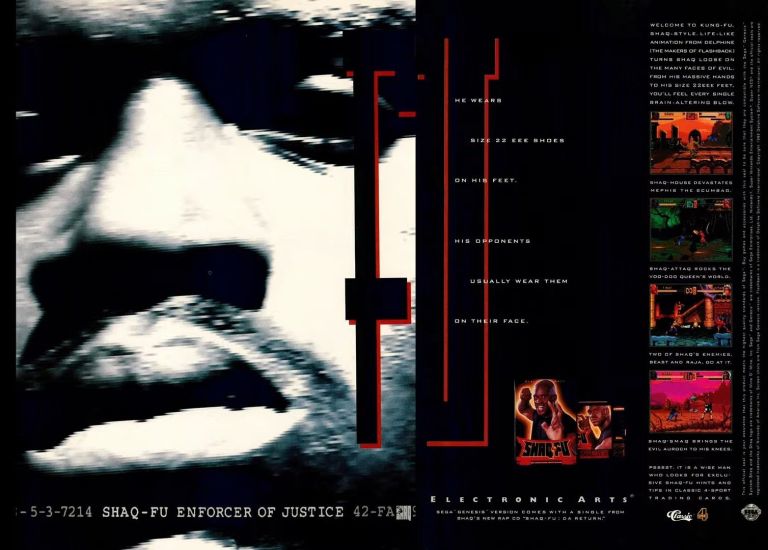
7. Shaq Fu print ad
The close-up of Shaquille O’Neal’s face on the left made him looked less recognizable.
Yes, it is true! There was indeed a video game endorsed by Shaquille O’Neal and it was not a basketball game. Shaq Fu is a 1994 2D fighting game with adventure elements and a story in which gamers play O’Neal as martial artist (note: O’Neal himself participated in the game’s production). To promote the game, Electronic Arts came up with a 2-page print ad that had a very odd black-and-white close-up image of O’Neal’s face on the left leaving small screenshots and hard-to-read text on the right (even though there was some vacant space remaining. I remember seeing this ad while reading a video game magazine and the ad ended up looking more like a promotion of O’Neal (already an NBA superstar) than the game itself. By today’s standards, this print ad is an example of a marketing misfire.
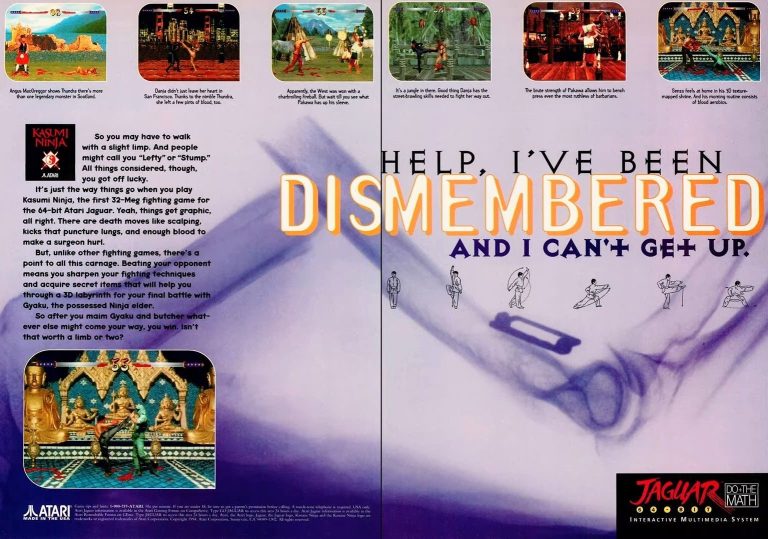
8. Kasumi Ninja print ad
Do you even remember seeing this print ad in magazines?
Remember the 1990s video game trends of digitized human images and disturbingly violent 2D fighting games sparked by Mortal Kombat? The Atari Jaguar-exclusive game Kasumi Ninja was made to capitalize on those trends and it failed badly. Apart from the low sales of the Jaguar console, Atari as publisher came up with the above 2-page print ad that was not appealing to gamers’ eyes and it had almost no excitement overall. This is another marketing misfire.
9. Parasite Eve North American and Japanese print ads
Following the successful release of Final Fantasy VII, this ad excited PlayStation gamers and JRPG enthusiasts for Parasite Eve’s 1998 release in America.
A stronger horror presentation in this print ad for the Japanese market. There were already a lot of people in Japan who enjoyed horror.
Starting in the mid-1990s, Squaresoft (now Square Enix) really became aggressive with video game creativity and experimentation as they launched several new projects that eventually got released on PlayStation in the late 1990s until 2000. One of those daring new projects was Parasite Eve which was a role-playing game (RPG) that had visual elements – particularly pre-rendered backgrounds – and a style of exploration that reminded gamers of Resident Evil. The game was a sequel to the Japanese science fiction horror novel of the same name and it involved the creativity of Final Fantasy creator Hironobu Sakaguchi (credited as producer). To promote the game, the 2-page North American print ad had protagonist Aya Brea on the right and the enemy on the left with a cryptic line placed strategically between them. The North American ad clearly stated that the game is a cinematic RPG. By comparison, the Japanese print ad of Parasite Eve has a strong horror vibe which is not surprising because of the novel’s horror elements and the fact that Squaresoft was capitalizing on the popularity of horror-related entertainment in Japan. By today’s standards, Parasite Eve is truly a product of the late-1990s and it has a dedicated fanbase.
To get straight into what happened, watch the selected videos below. Pay close attention to the details.
To put things in perspective about the many surviving hostages who made it back home to Israel after spending over two years in captivity in Gaza, posted below is an excerpt from The Jerusalem Post news report. Some parts in boldface…
All 20 of the living Israeli hostages held by Hamas have returned to Israeli territory, the IDF announced. The remaining live hostages held by Hamas were all in IDF custody as of 11:42 a.m.
The first seven hostages to be released were named as: Matan Angrest, Alon Ohel, Eitan Mor, Gali and Ziv Berman, Omri Miran, and Guy Gilboa-Dalal. The second round of returned hostages, which are the other 13, included: Bar Abraham Kupershtein, Evyatar David, Yosef-Chaim Ohana, Segev Kalfon, Avinatan Or, Elkana Bohbot, Maxim Herkin, Nimrod Cohen, Matan Zangauker, Eitan Horn, Rom Braslavski, Ariel Cunio, and David Cunio.
The released hostages have undergone a medical assessment and are en route to hospitals and will reunite with their families, the military added.
Despite earlier IDF estimates that the hostages would be returned in three rounds, in the end it took only two rounds, with Hamas seeming to want to have all hostages over to Israeli custody before US President Donald Trump was soon expected to speak to the Israeli Knesset.
The three expected locations for the transfers were Gaza City, central Gaza, and Khan Yunis in southern Gaza.
Earlier Monday at 9:10 a.m., the IDF had already received seven out of the 20 remaining live hostages back from Hamas via the International Red Cross (ICRC). By 8:10 a.m., the ICRC had already received those hostages from Hamas.
Late Sunday night, the IDF had said that if the live hostages were stable, they would move from Red Cross custody to IDF special forces custody, then to the Reim base, and then to the three hospitals: Shiba, Ichalov, and Beilinson.However, if a live hostage was in immediate medical danger, a helicopter would be sent to rush them to Soroka Medical Center or to Barzilai Medical Center.
All of the first round hostages were stable enough medically that they did not require an emergency evacuation.
The IDF expects that some deceased hostages will be returned on Monday, but has no set numbers about how many, and is prepared for that part of the process to be drawn out over multiple days or longer. The deceased hostages will be transferred to Israel in coordination with further Red Cross-supervised exchanges, under the same verification and transfer protocols. Part of the process will also involve identifying the remains with specific hostages.
According to the IDF, Hamas is bound to assist a joint mechanism associated with the Trump ceasefire to help locate other deceased hostages, where finding them may be less of an exact science.
The ICRC will also transfer around 2,000 Palestinian security prisoners held in Israeli prisons to the Gaza Strip, West Bank, and locations outside of Israel, such as Qatar and Turkey.
Praise and thank the Lord for the return of the 20 surviving hostages! Spending a little over two years as captives of the Palestinian terrorist group Hamas in Gaza surely has been painful and torturous for them. Their respective families had to deal with the long waits and uncertainties during the two years. The surviving hostages are now starting to get their lives back on track and figure out how they will fit back in with local society. The release of the hostages was made possible by the new peace deal for Gaza (and the Middle East) brokered by Trump. What has happened today is undeniably history unfolding and there is still a lot of developments yet to happen.
Of course, we should not forget about the other hostages who died in captivity in Gaza. For sure, the return of bodies of dead hostages will be sorrowful for the affected families and their local communities. That being said, I urge the faithful reading this to pray to the Lord to comfort and heal the families whose loved ones died in captivity in Gaza.
Moving on, Trump addressed the Knesset during his visit in Israel. He expressed how good it is to say that the hostages are back and that the painful nightmare left behind by the October 7, 2023, terrorist attacks committed by Hamas (supported by terrorist state Iran) is over.
To put things in perspective and to find out what Trump exactly said, posted below is an excerpt from the news report of The Jerusalem Post. Some parts in boldface…
US President Donald Trump arrived at the Knesset on Monday morning, giving a speech at the plenum.
A trumpet fanfare sounded in the Knesset upon his entrance to the building and he entered the plenum to additional fanfare and wide applause.
“We’re in a nice place,” Trump’s speech began. We are “giving thanks to the Abrahamic God,” he added.
“The hostages are back! It feels so good to say it,” Trump said.
Netanyahu is “not easy to work with, but that’s what makes him great,” Trump affirmed.
“Like the USA right now, it will be the golden age for Israel,” the president commented.
Trump commented that “a lot of people said we were wasting our time” with regards to a ceasefire agreement, but thanks to several “great American patriots, we achieved this,” Trump commented, highlighting the work of US envoy Steve Witkoff for the part that he played.
Trump also thanked “someone who loves Israel so much, my daughter converted,” referring to his son-in-law Jared Kushner, and also thanked US Secretary of State Marco Rubio, noting that the two were political rivals, particularly during the Republican party primaries before Trump’s 2016 election victory.
Trump said that countries working together toward peace under the Gaza agreement represents an “incredible triumph for Israel and the world.”
He said Israel “has won all that can be won by force of arms.”
He added that it was time to translate what he described as “victories against terrorists” into peace and prosperity for the Middle East.
Trump then said my “personality is all about stopping wars.”
“As you mentioned, Bibi before, peace through strength…We have a lot of weapons, and we’ve given a lot of them to Israel frankly…Bibi would call me sometimes, can you get me this weapon that weapon, some of them I had never even heard of,” Trump said.
“Never forget and never again,” Trump declared regarding Hamas’s October 7, 2023 massacre, as the plenum stood for a standing ovation.
The “cruelty of October 7 struck the heart of humanity. The US mourned alongside Israel,” Trump affirmed.
“Because of us, the long and painful nightmare is finally over,” he said.
Trump also praised Israel for its airstrikes against Iran in June’s Operation Rising Lion, and the part the US played in striking Iranian nuclear facilities in Operation Midnight Hammer.
“We stopped the number one state sponsor of terror in obtaining the world’s most dangerous weapons,” he said.
“Assuming we made the same deal we have today, there would be a dark could over the deal,” he added.
“We took a big cloud off the Middle East and off of Israel,” Trump said to a round of applause.
“They took a big hit,” Trump said about Iran. “You know it would be great if we could make a peace deal” with them, he said.
“The dagger of Hezbollah, long aimed at Israel’s throat, has been shattered,” Trump commented, adding that he is supporting the Lebanese president in disarming the terror organization.
“People are dancing in countries in the street that would never have danced in the street,” due to the deal, Trump said, adding that the entire region has endorsed the plan that Hamas will be demilitarized.
“Peace is not just a dream, it’s a reality that we can build upon piece by piece,” the president said.
Everybody that has tried antisemitic policies has become irrelevant, and those who have reached across to Israel have become important, Trump said referring to the Abraham Accords, signalling his intention for other countries to join the agreement. “Now you have peace…people who really like Israel,” he said.
“They did nothing with the document,” he said, referring to countries who have not yet join the normalization agreement with Israel.
“This little dot, look at what you’ve done it’s incredible,” he said, receiving another standing ovation.
“The world wanted peace and Israel wanted peace, everybody did, and what a victory it’s been. The timing of this is brilliant,” Trump said as he thanked Netanyahu for “having the courage to end the war” when he did.
“After tremendous pain and hardship, now is the time to build the country up, instead of tearing it downI intend to be a partner is this,” Trump said.
“It’s my firm hope and dream that the Abraham Accords will turn out to be everything that we thought they would. Trump said that even after the war, the countries within the accords have remained. I hope all the countries we’re seeking, join quickly, no games,” Trump commented.
When Iran signed the nuclear deal it was a disaster for everyone,” Trump spoke on the past.
“That was the beginning of a very bad time, and by the way, I terminated the Iran nuclear deal,” Trump added.
Iran “wants to make a deal,” Trump said. Neither US or Israel bear Iran any hostility, the president claimed.
“We are ready when you are, and it’s going to be the best decision that Iran ever made,” Trump said.
“The state of Israel is strong and it will live and thrive forever,” he said, praising Israel as a key US ally.
Trump also spoke on the things he has done for Israel, remarking on how he is the best ally Israel has ever had.
Still there in the Knesset, Trump and Israeli Prime Minister Benjamin Netanyahu met with the mourning families, the abducted and the wounded Israel Defense Forces (IDF) personnel. You can see it by clicking here.
Thank the Lord for US President Trump, Prime Minister Netanyahu, the Israeli President Isaac Herzog, the armed forces of Israel and the entire Jewish State for the breakthroughs that happened this year. Israel defeated Iran during the 12-Day War which involved America’s massive bombing on the Iranian nuclear facilities. Hamas terrorists lost a lot of ground in Gaza and were down to their final stronghold being cornered by the IDF.
The Trump-brokered peace deal is working as I write this and having been to Israel myself (some of my Israel 2023 tour blog posts can be read by clicking here, here, here, here and here) I truly believe that the Middle East will change for the better with Israel as God’s chosen state. There will be challenges, the Trump-brokered peace deal has to keep developing, Middle East nations will have to adjust before joining the Abraham Accords and the terrorist leadership of Iran has yet to vanish. Whatever happens, hang on to your faith in the Lord and live on with His Word (the Holy Bible). Do not let the worldly pawns of Satan and chaos of the world dominate you. Simply stay strong with the Lord and keep on supporting Israel and Trump’s current term as US President.
To everyone reading this, I encourage you to accept the truth that Israel is the land God designated specifically for the Jewish people (read Genesis 35:10-12) and His command must be followed without hesitation. If you want to be blessed further by the Lord, do so by loving and blessing the Jewish people (Genesis 12:1-3). I did my part when I was in Israel. Also, let me remind you all that the ties between the Jews and Christians are truly biblical!
I encourage you all to pray to the Lord God in support of Israel, to love and bless the Jewish people, and pray for the peace of Jerusalem.
After officially having their brand new Iron Beam fully operational for defense, the next step of military technology for Israel is having their aircraft armed with laser, according to a news article by The Jerusalem Post. We are talking about aerial lasers here and the corporation Elbit has serious plans for the Jewish state.
It should be noted that the Israeli Air Force (IAF) intends to execute a major overhaul of their fleet of F-16’s. Several F-16 units were used by Israel in the 12-Day War with terrorist state Iran months ago.
To put things in perspective, posted below is the excerpt from The Jerusalem Post news article. Some parts in boldface…
As the Defense Ministry and Rafael announce new developments regarding Israel’s ground-based laser defense systems, Elbit continues its long path toward the next stage in laser military technology – lasers on aircraft.
Experts in the field have stated that this is a much longer-term challenge, one that is expected to take years, possibly even five to 10.
However, Elbit chief technology officer for electro-optic systems Oded Ben David told The Jerusalem Post that air-based lasers have distinct advantages over ground-based ones.
He explained that dealing with turbulence and other atmospheric challenges is far easier when striking a target from above than when attempting to ascend from the ground to shoot down an aerial threat.
Aerial lasers are also the holy grail of lasers in that they can be used more effectively and suddenly on both defense and offense, as opposed to ground-based lasers, which must adjust the direction and goal of their firing much more slowly.
Next, he pointed out that Israir, El Al, and other Israeli aircraft have had a weaker form of laser defense – direct infrared countermeasures – for many years, such that the idea of an air-based laser has already been achieved.
Yet, he explained that these lasers work very differently from those that Elbit plans to develop, which will be able to strike aerial threats at much greater distances and which will have much more powerful laser beams.
In addition, the existing air defenses protect against aerial threats approaching the aircraft directly, whereas the purpose of future air-based lasers will be to shoot down threats that are in a completely different area, nowhere near the aircraft carrying the lasers.
Lasers will be fully Israeli-made – Elbit Systems President and CEO Bezhalel Machlis stressed that the laser will be fully Israeli-made, arguing, “It will transform the country’s defense array.”
“The company is dedicated to developing high-energy laser systems for military applications, first and foremost an airborne laser with the potential to bring a strategic change to air defense capabilities,” he said.
Thank the Lord for this significant development on the part of Israel. I can imagine having power lasers on Israeli aircraft – specifically within military operations – will prove crucial both offensively and defensively. The commercial aircraft of Israel could really use enhanced defenses with laser. The concept of aircraft armed with laser – previously presented in science fiction and pop culture – will eventually turn real with Elbit and Israel. It is a just a matter of time.
I encourage you all to pray to the Lord God in support of Israel, to love and bless the Jewish people, and pray for the peace of Jerusalem.















 Author Carlo Carrasco