Welcome back, my readers, YouTube viewers and all others who followed this series of articles focused on YouTube videos worth watching. Have you been searching for something fun or interesting to watch on YouTube? Do you feel bored right now and you crave for something to see on the world’s most popular online video destination?
I recommend you check out the following topics and the related videos I found.
#1Antonio P. Antonio story featured by Dark Asia with Megan – I previous made a blog post about this (click here). Even before this blog and website of mine started, I had been following the crime story of the late Antonio P. Antonio (APA) who was killed by his own son in 2013. The son even stayed overseas for years before getting caught and brought back home to be tried in court. Eventually, justice was served for the victim’s family and I should say that YouTuber Dark Asia with Megan did a really good job explaining and emphasizing the details in an episode launched on YouTube on September 25, 2024. This is a must-see video for anyone who is interested in true crime stories as well as events related to the famous BF Homes subdivision in the Philippines.
#2 New cars are spying on drivers and violating privacy – Be very careful with what you wish for when it comes to buying a brand new car with the latest in technology. There is this disturbing trend growing in which drivers/owners of cars equipped with highly advanced technologies ended up getting violated by car companies who collected not only their personal data but also other types of information about them such as immigration status, race, facial expressions, weight, health and even genetic information. This is because the highly computerized cars can spy on drivers by capturing videos of them, recording sound, monitoring their use of car apps, and collecting data from smartphones or computers that got connected to the car’s system. Watch the videos below and pay close attention to the details.
#3 In-depth look at the elimination of Hezbollah’s top leader Nasrallah – I previously blogged about the elimination of Hezbollah leader and murderer Hassan Nasrallah and it contained relevant videos about the topic. For a new and in-depth look about his elimination and what lies ahead for Israel and the rest of the world, watch the TBN Israel and CBN News videos below. Pay close attention to details.
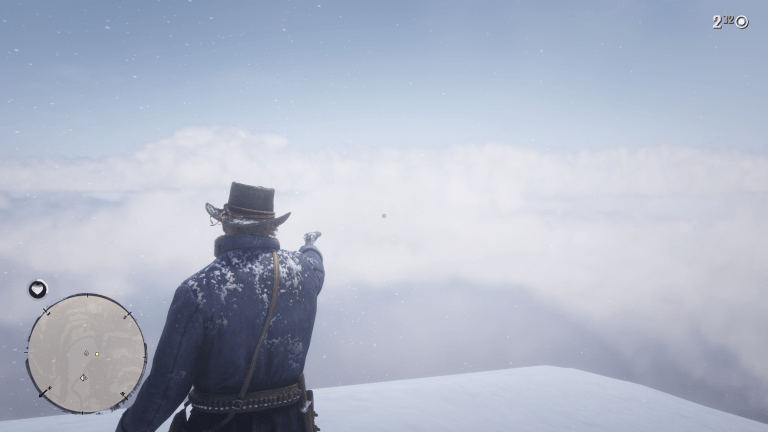
#4 Hunting legendary animals in Red Dead Redemption II – In the blockbuster video game Red Dead Redemption II, hunting is a huge and engaging part of the game. The game developers set up opportunities to find and hunt what they refer to as legendary animals. There is a variety of rewards that come with hunting the said animals and to find out where they are located, watch this video by Reptac.
#5 Last Action Hero videos – While it is a known fact that the movie Last Action Hero (starring Arnold Schwarzenegger) was a huge commercial and critical disappointment in 1993, there are still lots of people who enjoyed watching it and even do research about it. That being said, it is not surprising that there are lots of YouTubers out there who made videos about it and you can watch a variety of videos I selected for your viewing.
6. How terrorist leader Hassan Nasrallah got eliminated
Going back to the eliminated Hezbollah leader and murderer Hassan Nasrallah, posted below is a video that explains (to the best of the YouTuber’s ability) what happened and how the powerful strike happened there in Lebanon.
7. Multiculturalism is truly bad
We live in a very twisted world. It is so twisted, illegal aliens are violating the sovereignty and cultures of nations. Like diversity, inclusion and wokeness, multiculturalism is a disease and it is destructive. Watch and learn from PragerU’s video below.
Welcome back readers, fellow geeks and electronic gaming fans!
In this edition of the Retro Gaming Ads Blast (RGAB) series, we will take a look at another batch of retro gaming print ads – including arcade flyers – from the 1980s and 1990s.
For the newcomers reading this, Retro Gaming Ads Blast (RGAB) looks back at the many print ads of games (console, arcade, computer and handheld) that were published in comic books, magazines, flyers, posters and newspapers long before smartphones, social media, the worldwide web and streaming became popular. To put things in perspective, people back in the 1980s and 1990s were more trusting of print media for information and images about electronic games and related products.
With those details laid down, here is the newest batch of retro gaming print ads for you to see and enjoy…
1. Vendetta UK and North American arcade flyers
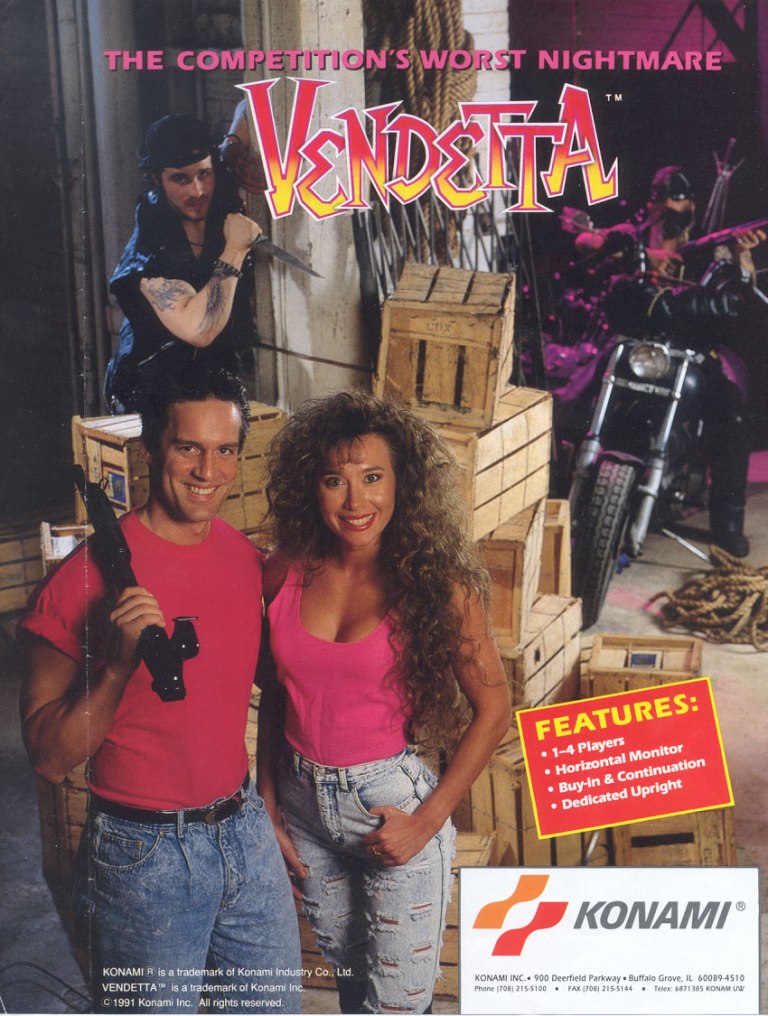
Vendetta arcade flyer for North America
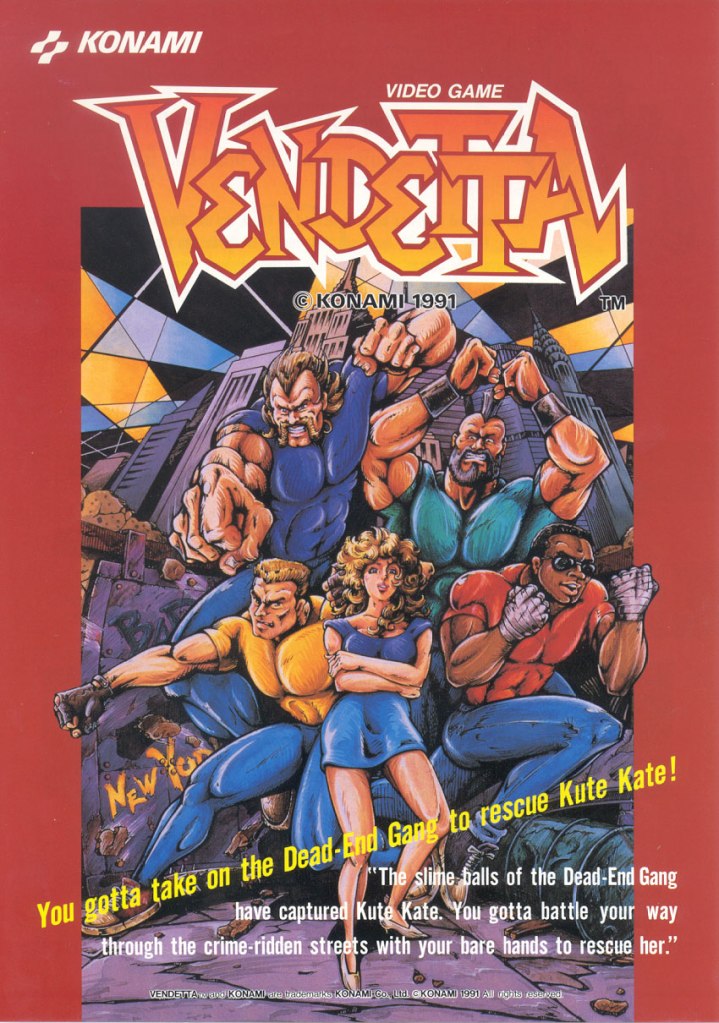
Vendetta arcade flyer for the UK.
In 1991, Konami released the 2D side-scrolling beat-them-up game Vendetta in arcades around the world achieving commercial success. While it is hard to tell if the promotions helped the game commercially, there is no doubt that the arcade flyers for the North American and United Kingdom (UK) markets were indeed very eye-catching.
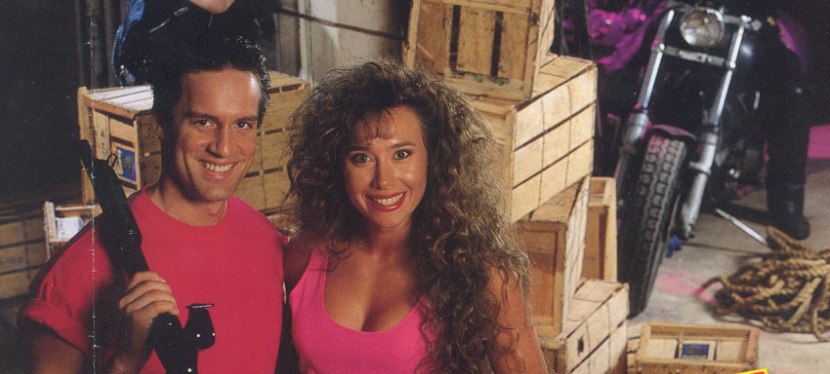
The North American Vendetta arcade flyer had a photographic approach showing models playing characters supposedly representing the Cobras gang and the Dead End gang. The display of wooden boxes and the rope was done to symbolize the rough city environments of the game. On the other hand, the UK arcade flyer has illustrated artwork that captured the look of the Cobras gang from the game.
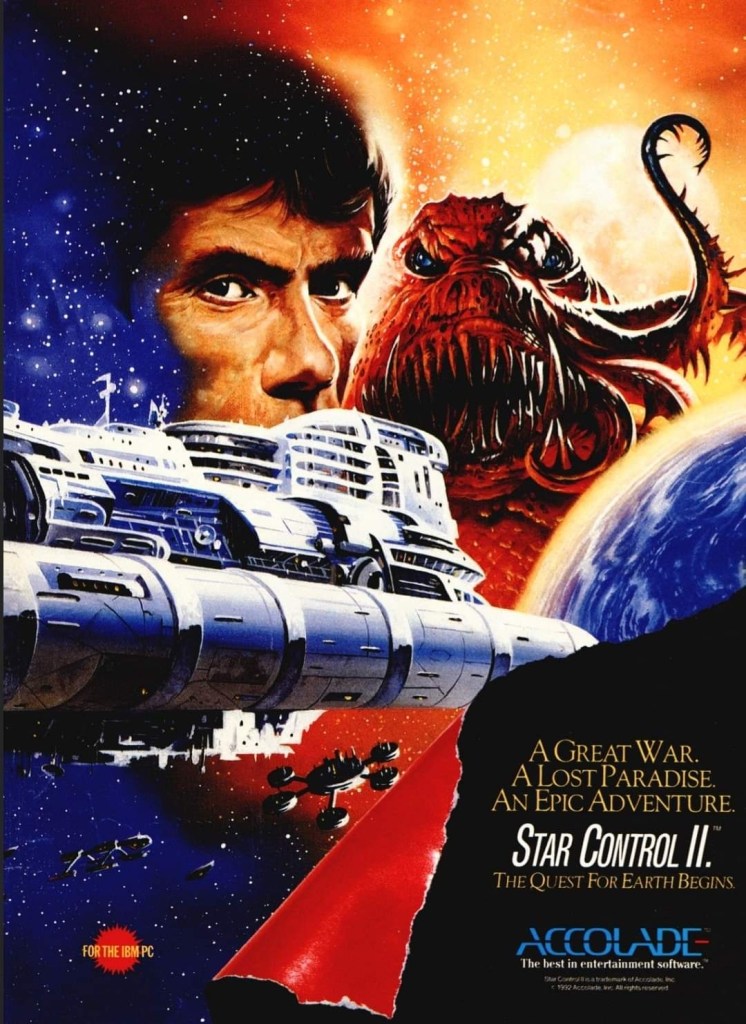
2. Star Control II: The Ur-Quan Masters print ad
This ad has great art that strongly emphasizes its science fiction concept.
This print ad of Star Control II: The Ur-Quan Masters (PC version) really caught my attention when I read gaming magazines in the early 1990s. The painted artwork showing a human and a hideous alien in the background with a planet, space ships and space stations filling the rest of the space was very captivating to look at. So captivating, it enticed me to search for the game but our PC at home had really low specs. Strangely enough, I played another version of Star Control II on a rented 3DO Interactive Multiplayer console in 1995. For the newcomers reading this, the game was critically acclaimed and was declared as one of the very best PC games ever made. Enjoy looking at the print ad above.
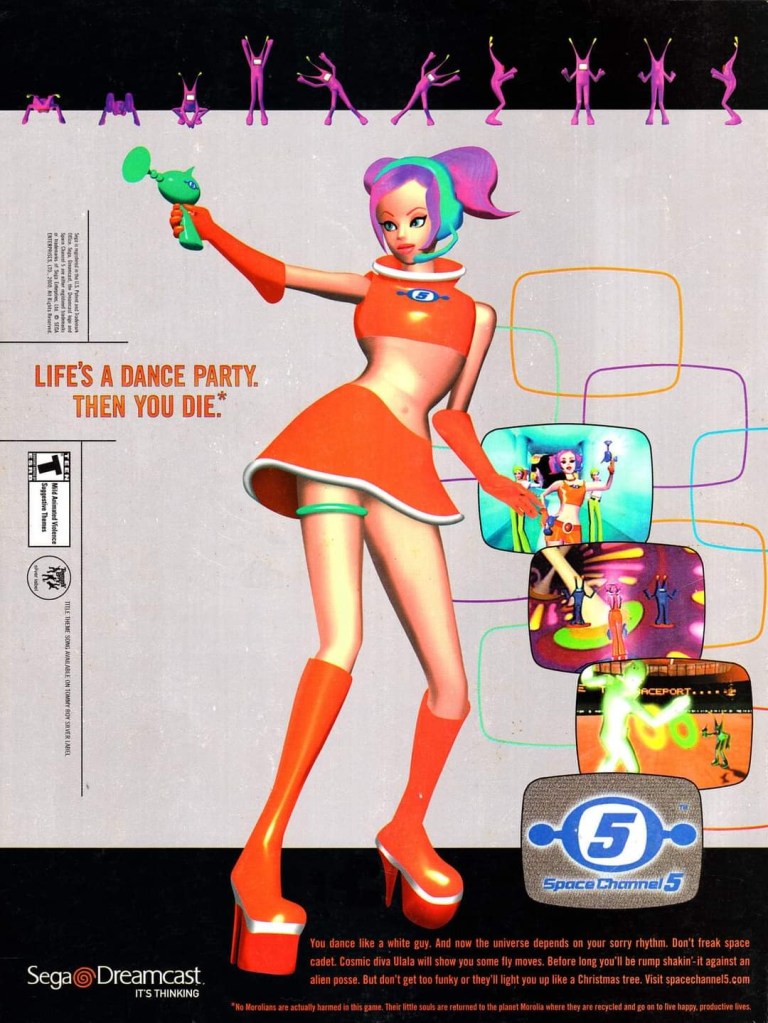
3. Space Channel 5 print ad
The visual style and character designs are the result of the game designer’s research that includes interviews with lots of young girls over their interests and tastes in video games.
When Sega launched their Dreamcast console in Japan in late-1998, their financial health was already in a very bad state and the future looked grim. Even as they faced tremendous odds, Sega still went on to aggressively sell Dreamcast consoles with exclusive games and Space Channel 5 was one of them.
First released in Japan in 1999, Space Channel 5 was a musical, puzzle-oriented game that was the result of Tetsuya Mizuguchi’s work backed with research he did that included interviewing young girls to find out what their tastes in gaming are. The print ad showing the highly stylized protagonist Ulala and a few screenshots really caught the attention of gamers and kept the Dreamcast in their minds. While the game did not achieve commercial success as a Dreamcast-exclusive, Sega went on to release a version of Space Channel 5 on the PlayStation 2 console, plus sequels.
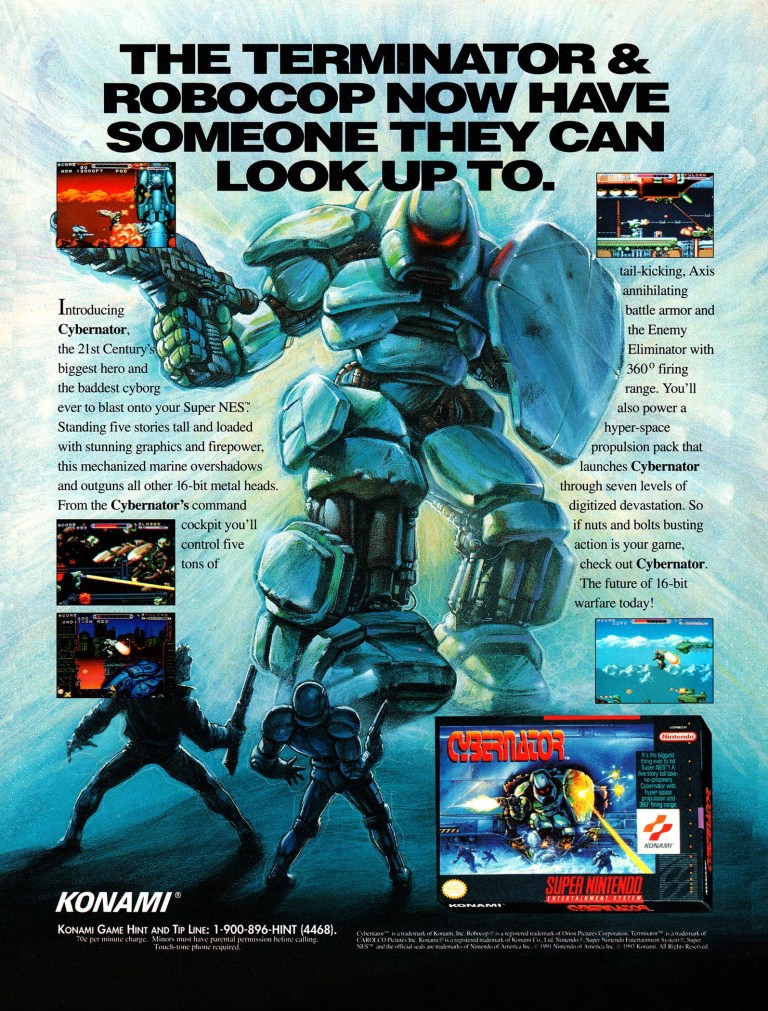
4. Cybernator print ad
The mention of Terminator and RoboCop rivaled the artwork when it comes to grabbing people’s attention.
I remember seeing the print ad of Konami’s Cybernator (Japanese title: Assault Suits Valken) in several comic books I read back in 1992. I never got to play it but the print ad’s artwork was memorable as I was fond of robots in anime, movies and video games back then. What was arguably the most memorable aspect of the print ad was the line that mentioned RoboCop and the Terminator in a comedic way. This is a creative way to market the game.
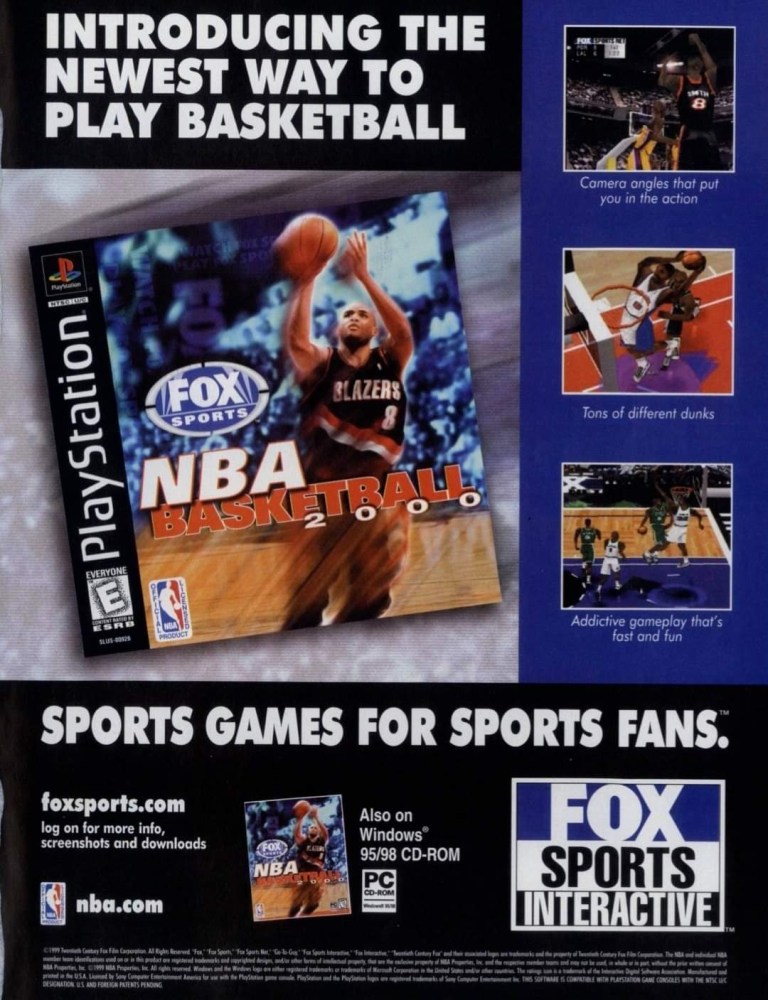
5. NBA Basketball 2000 print ad
There were a lot more NBA video games back in the 1990s.
NBA Basketball 2000 was one of those basketball videos games of the 1990s that was not published by EA Sports nor published by the other established game publishers like Sega, PlayStation and Konami. In fact, the one thing on the ad that caught my attention was Fox Sports Interactive which published some sports videos games during the decade. The print ad also served as a reminder that there were a lot more NBA video games for gamers to choose from during the 1990s.
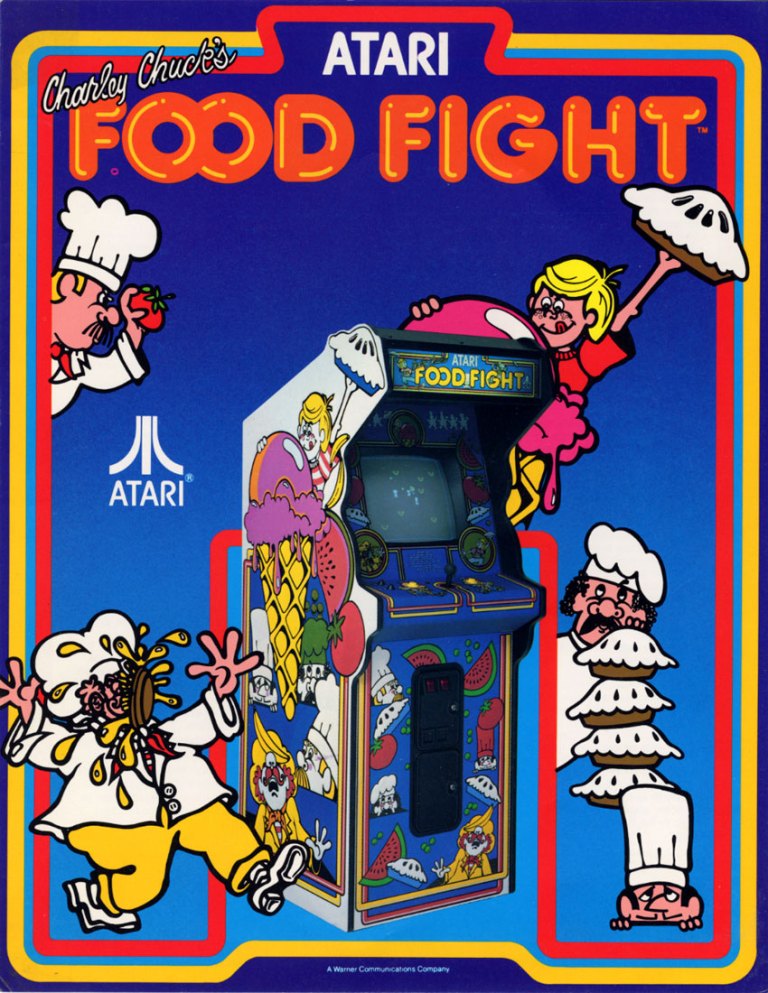
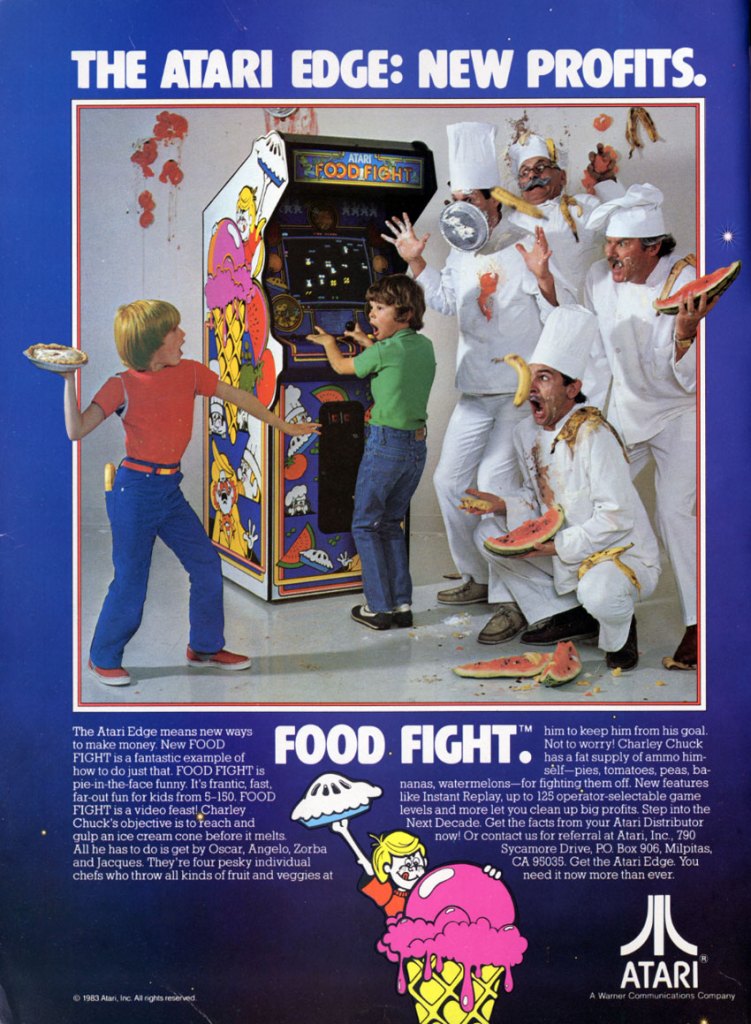
6. Food Fight arcade flyers
Food Fighter arcade flyer with illustrated artworks.
Food Fight arcade flyer with a photographic touch and actors.
I never got to play the 1980s game Food Fight in the arcades nor did I ever had the opportunity to play it on Atari consoles and Xbox 360. Released in 1983 in the arcades by Atari, Food Fight was designed to allow players to control a character moving through a 2D field to consume an ice cream on a cone (placed on the opposite end of the field) before it melts while avoiding the chefs who are out to chase and block the player.
The arcade flyer with illustrated artwork on the characters interacting with the arcade machine is really amusing to look at. Equally amusing is the other arcade flyer that had a photographic approach showing two kids (one playing the arcade machine and the other about to throw a pie) and four chefs. Considering the nice visual concepts Atari came up with for the arcade flyers, Food Fight actually never became a commercial hit selling only a few thousand arcade units.
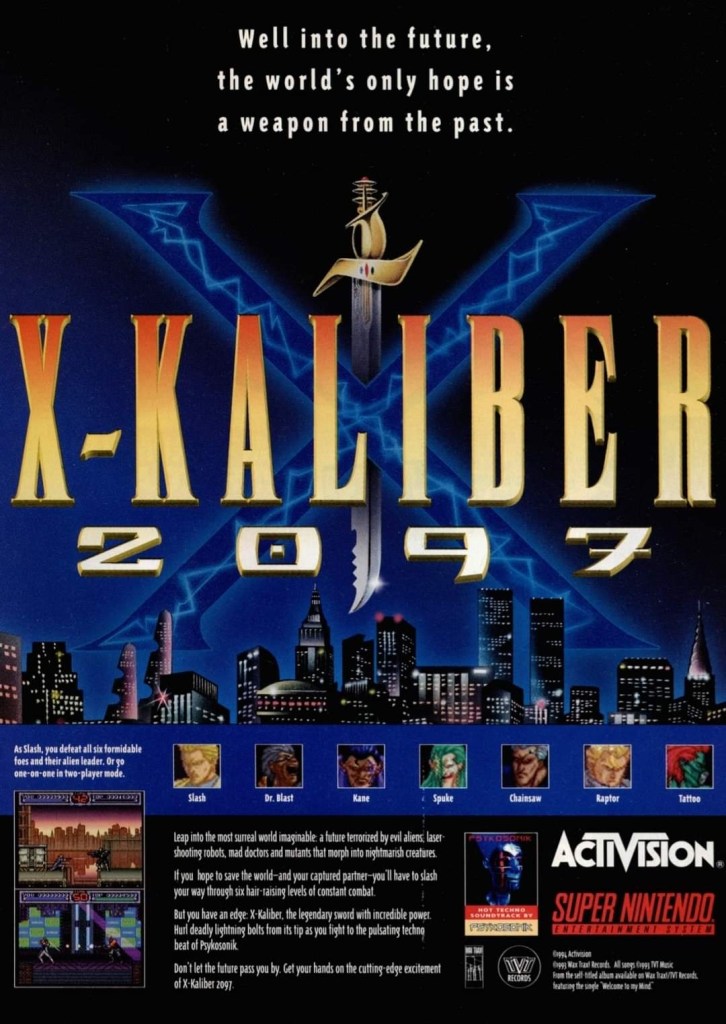
7. X-Kaliber 2097 print ad
This print ad from the 1990s had a nice visual style.
The Super Nintendo Entertainment System (SNES) had plenty of 2D side-scrolling adventure games and among them was X-Kaliber 2097 released by Activision (now a Microsoft-owned company and integral part of Xbox) in America in 1994. The game had a really interesting story concept about a chaotic far future society plagued by overwhelming crime and violence. The print ad showed a mild taste about the game’s concept and gameplay, but it was more effective when it comes to showing the formidable foes that await the playable protagonist Slash. This print appeared in several comic books I read and was eye-catching.
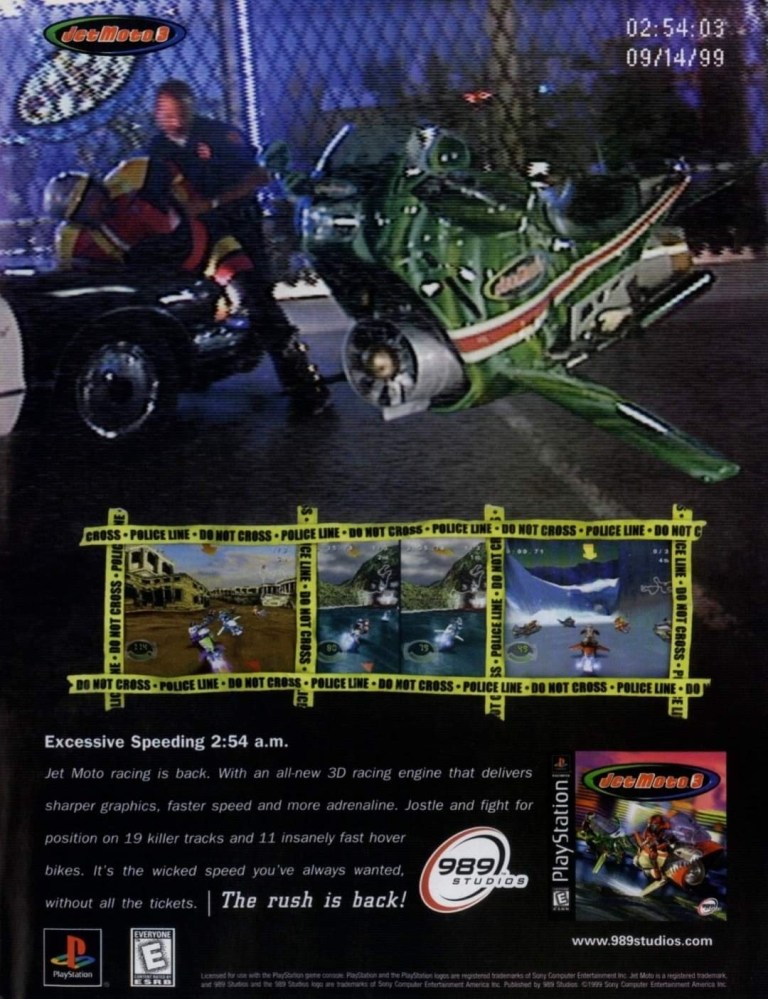
8. Jet Moto 3 print ad
When was the last time the police caught you for over-speeding?
This print ad for Jet Moto 3 had a clever concept of showing a police officer apprehending a jet biker for over-speeding. The visual presentation was done in photo-realistic fashion to make the sci-fi aspect of the video game look real. The ad made me interested enough to do some research of Jet Moto 3 a few months before finally buying it for my PlayStation console.
9. Wipeout 3 print ad
Were you fond of futuristic racing and techno music back in 1999?
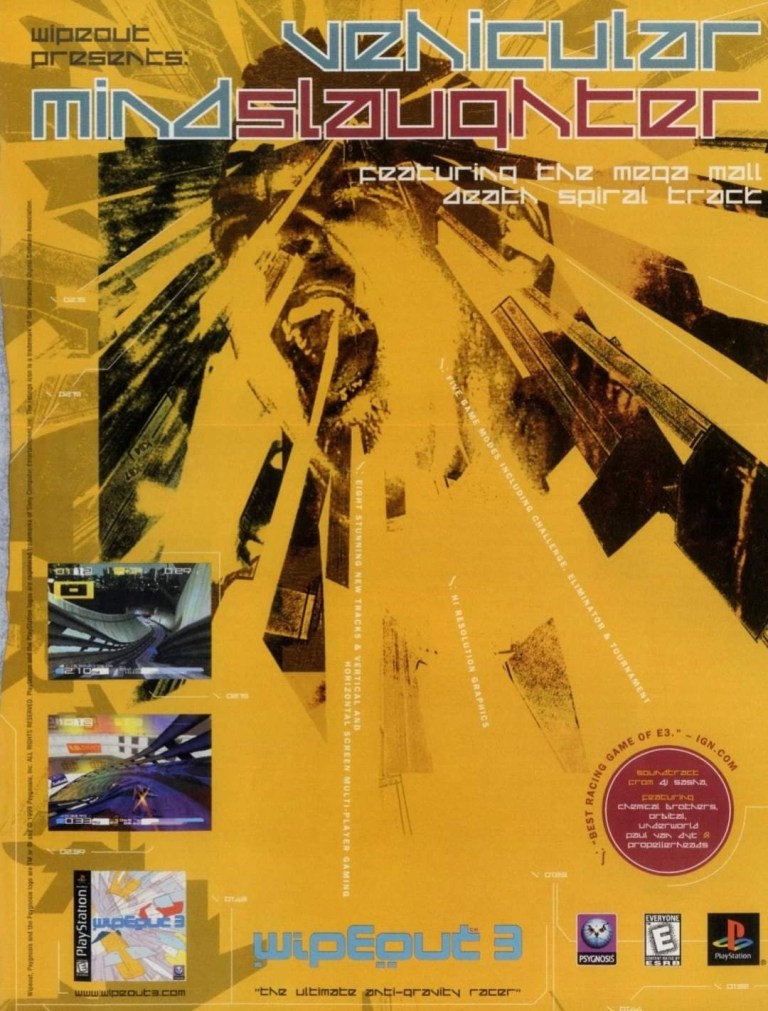
Released in 1999, Wipeout 3 was one of those video games that showcased what the PlayStation (originally launched in Japan in 1994) could do in terms of visual fidelity, special effects and frame rates. The print ad, which had a radical visual concept emphasizing intensity and energy, had style listing down vertically the technical details of the game which required a close look in order to be read. With only two screenshots displayed, the ad makers smartly included the E3 acclaim of “Best Racing Game of E3” as well as the names of artists behind the game soundtrack on the lower-right corner. This print ad was cool and intriguing to look at.
10. Breath of Fire II print ad
This was a good effort to lure American gamers to buy and play Breath of Fire II.
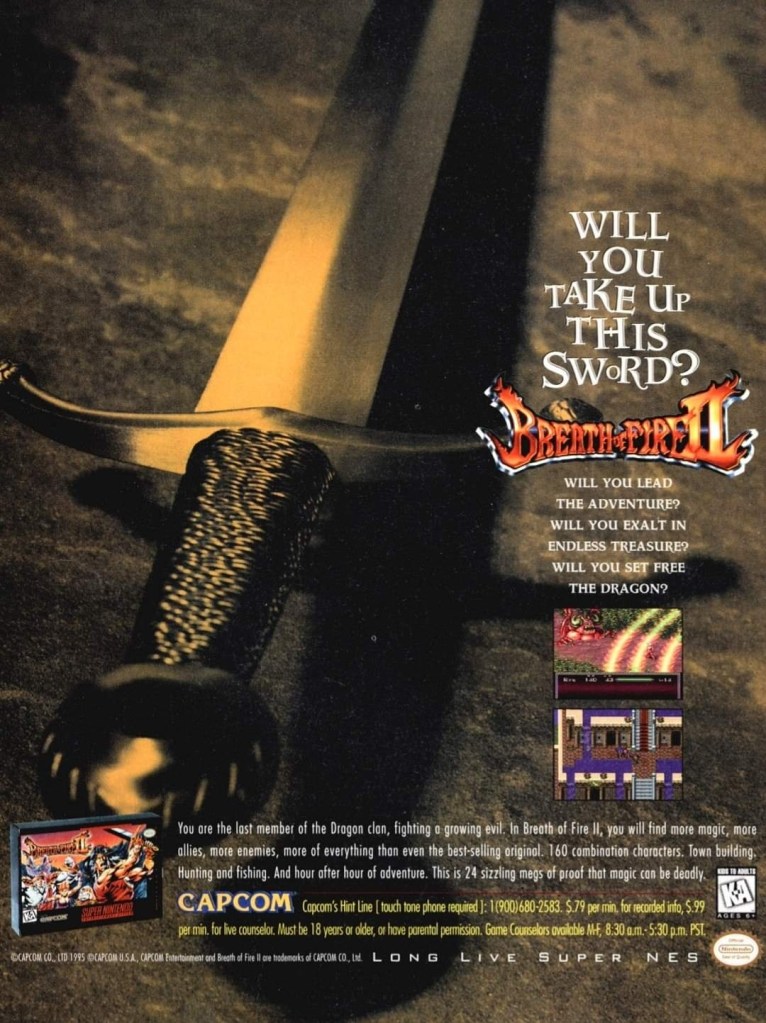
When Breath of Fire II was released on the SNES in America in late 1995, Japanese role-playing games (JRPGs) were not yet wildly popular among American gamers. To grab the attention of gamers, Capcom and the ad makers came up with the eye-catching image of a sword and posted key questions to emphasize the fantasy aspect of Breath of Fire II. While the game received mixed reviews upon its North American release, Nintendo Power listed it as 171st best game in its Top 200 Games chart published in 2006.
In case you missed the official Xbox presentation of the 2024 Tokyo Game Show (click here to watch), Square Enix formally announced that Final Fantasy Pixel Remaster has officially been released for Xbox Series X and Xbox Series S plus Windows PC. Watch the announcement video below.
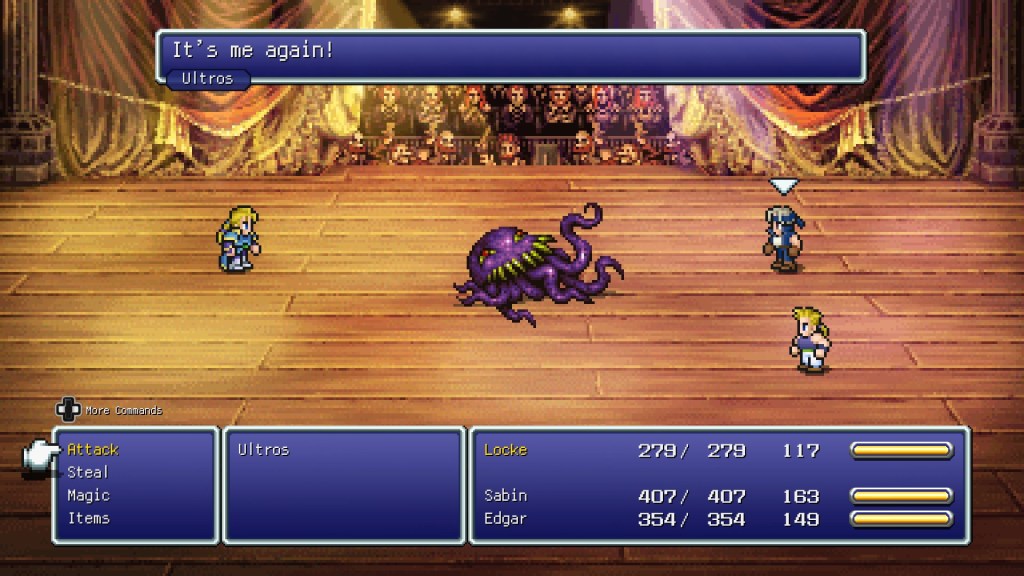
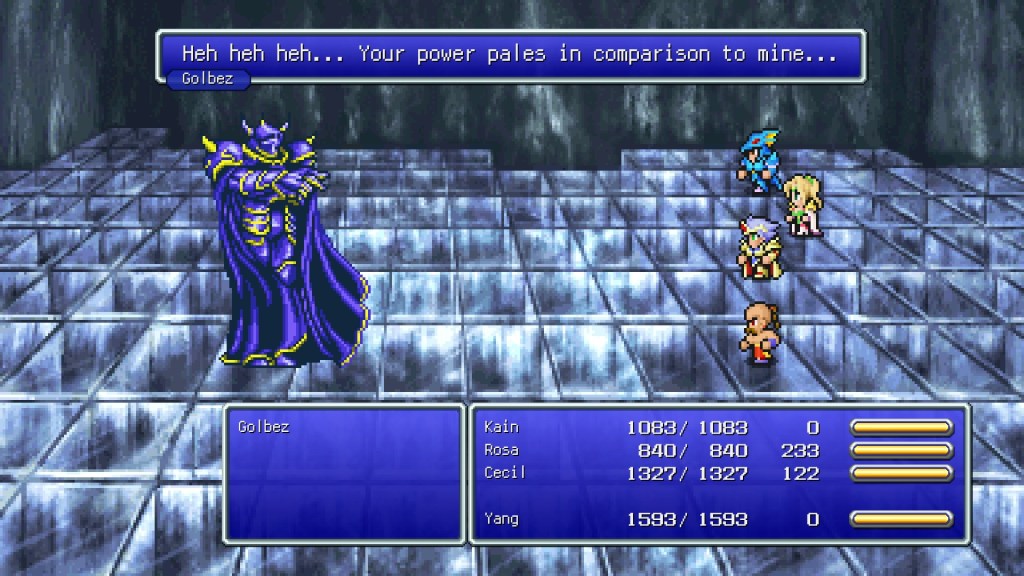
This is what Final Fantasy IV looks like in remastered form.
Each classic Final Fantasy game has its 2D pixel graphics and artworks updated with high-definition gaming in mind, and their soundtracks have been re-arranged. In what is a clear attempt by Square Enix to enhance the gameplay experience and user-friendliness, there were tweaks made to the user interface. Also added were extra stuff such as bestiary, illustration gallery and music player.
The Xbox and Windows PC releases of Final Fantasy Pixel Remaster is indeed a move towards the right direction by Square Enix and it is clearly the result of that company’s renewal of ties with Team Xbox. Final Fantasy Pixel Remaster was launched on other platforms previously and the Xbox ecosystem ended up being the last to have it for millions of gamers to enjoy.
For the Xbox gamers who are Final Fantasy fans as well as those who are fond of classic Japanese role-playing games (JRPGs) and those who simply love retro gaming, Final Fantasy Pixel Remaster is a very welcome addition that should not be missed. It is available now for digital purchase as a bundle but gamers are free to choose to buy the games individually based on their current taste or based on how much they could afford right now. It is clear that buying the bundle of six Final Fantasy classic games is still the best value for money.
Welcome back, my readers, YouTube viewers and all others who followed this series of articles focused on YouTube videos worth watching. Have you been searching for something fun or interesting to watch on YouTube? Do you feel bored right now and you crave for something to see on the world’s most popular online video destination?
I recommend you check out the following topics and the related videos I found.
#1The disappointing 9th console generation – If you are a long-time gamer who owns a PlayStation 5 (PS5) and/or an Xbox Series X or Xbox Series S console, you might have noticed how disappointing the 9th console generation (started in late 2020) has been when compared to the previous four generations.
Apart from the fact that the COVID-19 pandemic deeply altered the games industry on the sides of gamers and game developers, the 9th console generation has seen lots of unfulfilled promises from the console makers, Xbox Game Pass (XGP) changing for the worse, great gaming experiences not being realized, consumers getting screwed, the lack of focus towards the fans, woke garbage involved in game productions and a lot more. To understand what is going on in the 9th console generation, I urge you to watch the selected videos below.
#2 Illegal immigration in America is the new slave trade – More than ten million people illegally entered the United States through the US-Mexico border since 2021, resulting in rising crime, increased taxpayers’ money spending on illegal aliens, and more hardship for America’s own citizens. That’s not all. There are cartels taking advantage of the open border in the south that kept thousands of people – including children – flowing into America and those illegal aliens themselves are forced to repay the debts to the cartels. These should remind you how bad immigration became in America under Joe Biden and Kamala Harris (border czar who loves criminals and terrorists). This PrageU video is a must-watch.
#3 Retro gaming reported by KTLA 5 – It is not every day you get see retro gaming reported on mainstream news outlets. In America, KTLA 5 made a video news report about the resurgence of retro gaming and it’s not limited to gamers buying collected editions of decades-old games for their modern game consoles. In fact, the video game store in KTLA 5’s report is selling old games in physical copies as well as old game consoles at affordable rates. Watch the video below.
#4 The history and American origin of the Lawson convenience store enterprise – Here in the Philippines, the convenience store chain Lawson has been gradually growing and becoming more competitive with the likes of 7-Eleven and Uncle John’s. Not only that, Lawson is gaining a following of customers who keep on returning because of the variety of food and beverage items offered plus convenient ways of doing financial transactions. While it is common knowledge that Lawson is from Japan and is a Japanese enterprise, not too many people are aware of its American origin. To learn about the history of Lawson, watch the video below.
#5 Israel’s intensified campaign against Hezbollah – After the recent attacks against several members of the Iranian-sponsored terrorist group Hezbollah through their pagers, Israel’s military campaign against the terrorists intensified. This happened even as Hezbollah kept on firing at Israel (in response to the pagers attacks) and even hitting Nazareth which itself has many Arabs and Muslims in its local population. Don’t let the pro-terrorist, pro-Islamist mainstream news media fool you with their persistent lying. Watch the videos from credible news sources below to realize the truth. Lastly, keep praying to the Lord to support Israel and bring down the forces of evil.
6. Kamala Harris’ dishonesty and pathetic acting about border security explained
In recent times, the Communist Vice President of the United States Kamala Harris visited the US-Mexico border to check on the situation there as illegal immigration added so much to crime. The problem here is that Kamala was simply acting to be responsible and working, and it is not a secret that the Democrats hired Communist Hollywood people to stage it behind the scenes. Sky News Australia’s video below is a must-see and remember that Democrats always love illegal aliens, criminals, abortion and terrorists. Kamala herself publicly declared her support for illegal aliens and defended them.
Welcome back, my readers, YouTube viewers and all others who followed this series of articles focused on YouTube videos worth watching. Have you been searching for something fun or interesting to watch on YouTube? Do you feel bored right now and you crave for something to see on the world’s most popular online video destination?
I recommend you check out the following topics and the related videos I found.
#1Minty Comedic Arts’ trivia video about V: The Original Miniseries, V: The Final Battle and V TV series – If you are a fan of the V sci-fi entertainment franchise that made big waves on television in the 1980s, then you must watch Minty Comedic Arts’ video which covers V: The Original Miniseries (1983), V: The Final Battle (1984) and the creative mess that was the V TV series. The video also includes the 2009 V TV series which makes it a complete package for all V fans. If you are a long-time V fan, now is a good time to test your knowledge by watching the video below.
#2 Moneymaking locations in Red Dead Redemption 2 – If you have been struggling to make big money in the realm of the 2018 blockbuster video game Red Dead Redemption 2, then this video by YouTuber MrBossFTW must be seen. In RDR2 there are indeed places where you can find gold bars, sets of Dollar bills and other valuables that can sell in-game. There are indeed challenges to find the riches but they are worth doing.
#3 Hezbollah terrorists and allies hit hard by as their communication devices blew up – Recently several Hezbollah terrorists and some allies got hit hard because the pagers used turned out to be bombs which blew up and crippled their communication network. The initial attack even injured the Iranian ambassador to Lebanon himself got injured because he was also using the same pager that Hezbollah uses. The high-tech attacks not only happened in Lebanon but also in Syria where some Hezbollah terrorists were present. Unsurprisingly, the Islamic terrorists blamed Israel. Watch and learn from the videos below.
#4 Wokeness of Dragon Age: The Veilgard exposed – I really don’t like when the woke activists working in entertainment deform video games, movies and comic books as they turned them into vehicles promoting their pathetic agenda. Simply put, whatever the Satanic Left touches, they ruin it. The same can be said about the upcoming video game Dragon Age: The Veilgard. Already it can be seen that there is indeed a lot of woke stuff in the new game and YouTuber Ryan Kinel – RK Outpost posted a video explaining what was found and why the gamers heavily rejected the new Dragon Age game. Watch and learn from the video below.
#5 Kamala Harris’ dishonesty and lying – There is no doubt that the Democrats in American nominated a very dishonest candidate for US President with Kamala Harris. Harris is truly a Communist and she will do anything bad to gain power. That being said, her lying is clear and the corrupted mainstream news media just let her get away with poisoning people’s minds. Watch and learn from the videos below.
#6 PS5 Pro reactions – In recent times, Sony unveiled the PlayStation 5 Pro (PS5 Pro) which is the upgraded version of the PS5. Apart from the flawed console presentation by Sony, PS5 Pro is overpriced at $699 for America and it does not even have an optical drive and no vertical stand is included. For your reference, posted below are selected videos about the reactions and analysis of the PS5 Pro. Things are not really looking good for the upgraded PS5.
Welcome back readers, fellow geeks and electronic gaming fans!
In this edition of the Retro Gaming Ads Blast (RGAB) series, we will take a look at another batch of retro gaming print ads – including arcade flyers – specifically about fighting games that were released in the 1990s. The said decade marked the time when Street Fighter II became a massive hit in the video arcades (and on game consoles) which sparked a wave of new fighting games from business competitors. In that same decade, 3D polygonal fighting games were also released which added greater choices of fighting games at the arcades and on game consoles that players could choose from.
For the newcomers reading this, Retro Gaming Ads Blast (RGAB) looks back at the many print ads of games (console, arcade, computer and handheld) that were published in comic books, magazines, flyers, posters and newspapers long before smartphones, social media, the worldwide web and streaming became popular. To put things in perspective, people back in the 1980s and 1990s were more trusting of print media for information and images about electronic games and related products.
With those details laid down, here is the newest batch of retro gaming print ads for you to see and enjoy…
1. Dead or Alive Japanese arcade flyer
Dead or Alive was the start of new success that impacted the direction of Tecmo in the gaming industry.
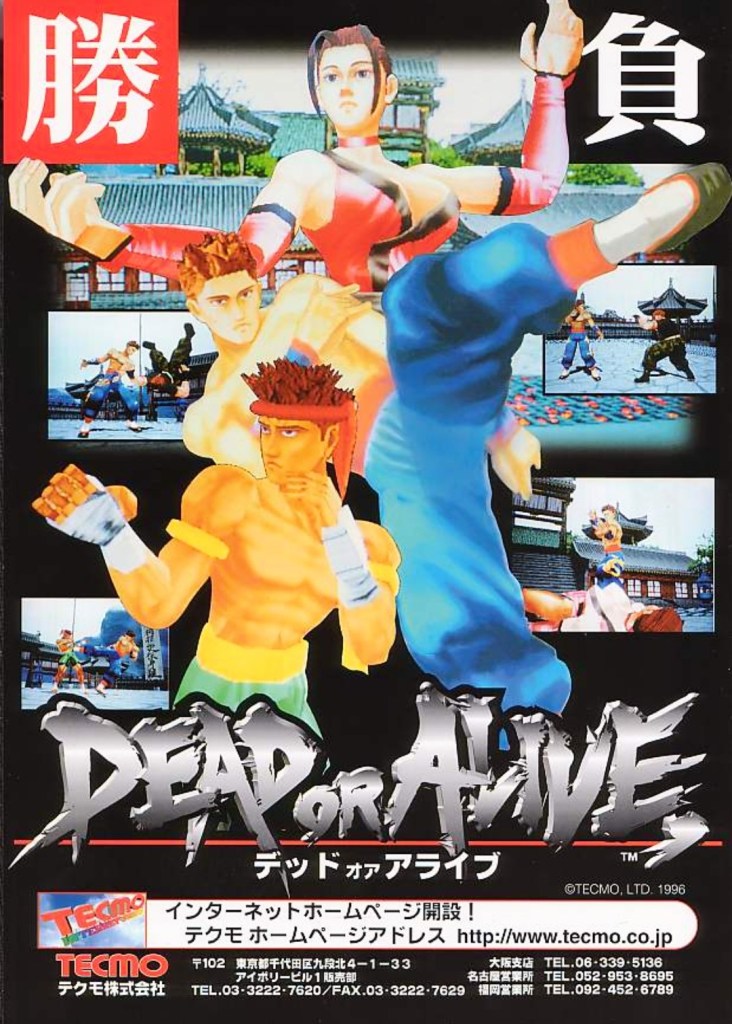
The above arcade flyer of Dead or Alive gave Japanese arcade operators and gamers a taste of what to expect with the game. While the screenshots showed some resemblance with what gamers saw in Virtua Fighter 2, the character designs Tecmo and its developers came up with were unique.
Before Dead or Alive was released in Japanese arcades in 1996, company Tecmo was in financial trouble and they asked Tomonobu Itagaki to make a fighting game similar to Sega’s polygonal blockbuster Virtua Fighter. A breakthrough for Tecmo happened when Sega announced they were licensing their Model 2 arcade to third-party companies which paved the way for Itagaki’s team to make Dead or Alive with it. The game became a big hit and it paved the way for Tecmo to release it on Sega Saturn and PlayStation, and the sequels that followed years later.
2. North American Soulcalibur Dreamcast version print ad
Namco came up with a creative approach to emphasize heart-and-soul promoting their game and the Dreamcast.
On September 9, 1999, Sega launched their Dreamcast console in America. With a gap of around ten months between the Japanese launch (November 1998) and the American launch, Sega had time to prepare Dreamcast’s release to American gamers with a huge lineup of games (both Sega’s games and from other publishers). Fortunately for Sega, they had Namco (their rival on arcade games) supporting their console.
Behind the scenes, Namco’s developers worked hard to not only port their arcade hit Soulcalibur to the Dreamcast, but to enhance the graphics using the console’s more advanced technology. The visual enhancements include rendering all of the games stages (and backgrounds) into full 3D polygonal environments. Namco also implemented different game modes and added even more content to ensure satisfaction to Dreamcast gamers.
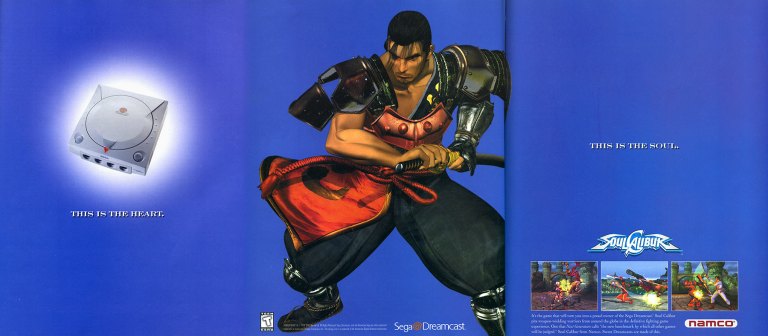
The above 3-page print ad of Soulcalibur on Dreamcast was undeniably strategic and captivating to look at. The ad described the console as the heart, showed Soulcalibur character Mitsurugi (one of the game’s most popular characters) in the middle and then described the game (with 3 screenshots of game rendered with Dreamcast graphics) as the soul. It was a strong way to promote both the game and the console. In the years that followed, Soulcalibur grew into a popular fighting game franchise and the Dreamcast version will always be remembered as the crucial turning point.
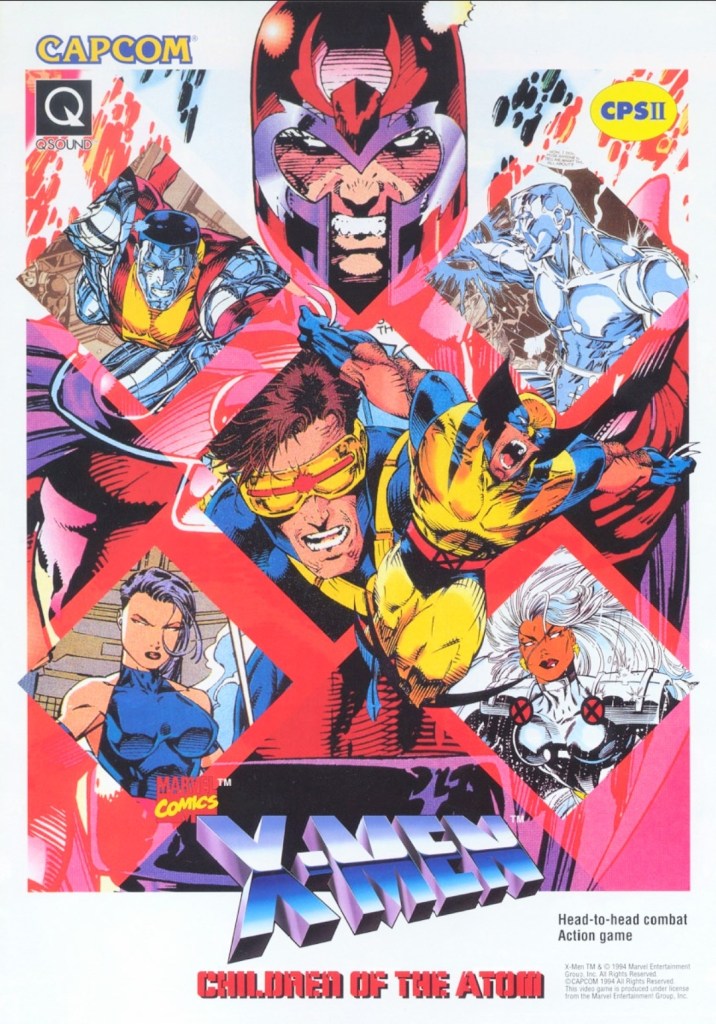
3. X-Men: Children of the Atom arcade flyer
Anyone who read lots of X-Men comic books in the 1990s should be able to tell which character was drawn by which artist.
When Capcom first released X-Men: Children of the Atom in the arcades in the mid-1990s, I was surprised because I did not anticipate the day would come when the company behind Street Fighter II would actually make a 2D fighting game showcasing the Marvel’s mutants. Even more intriguing was the X-Men art Capcom used for the arcade flyer to promote the game. I recognize Jim Lee’s artworks of Magneto, Cyclops and Colossus. The art of Wolverine shown was drawn by Andy Kubert. It was a wise move for Capcom (with Marvel as a business partner) to use established X-Men comic book artworks instead of having their internal illustrator draw the characters. That being said, this arcade flyer still looks great and captivating to look at.
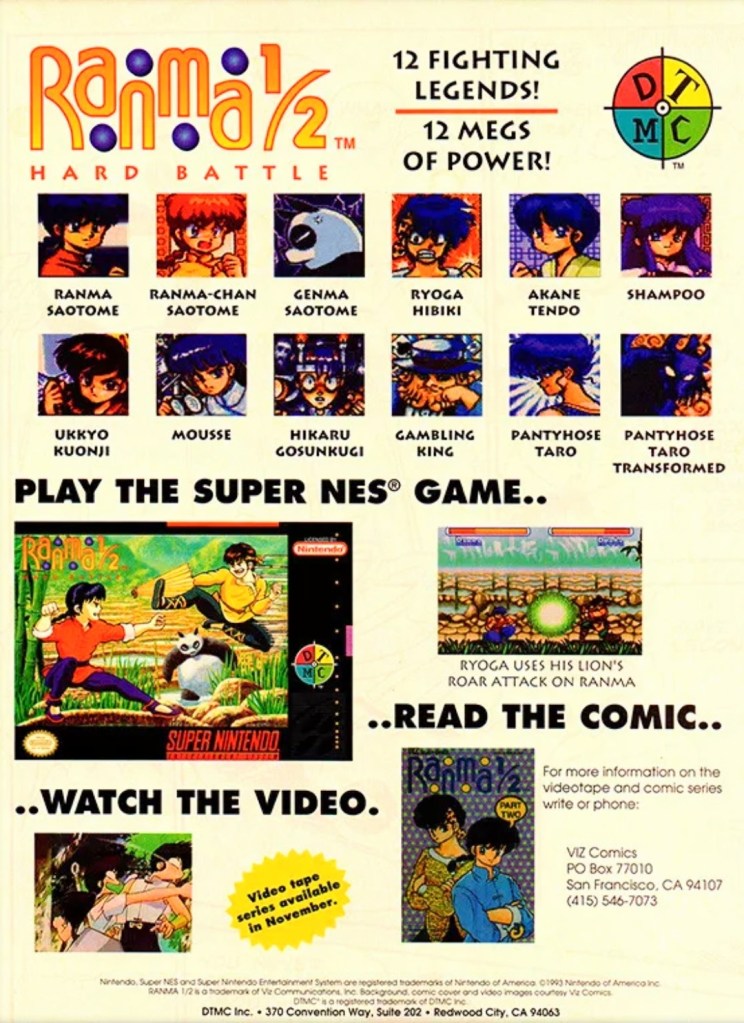
4. North American Ranma ½: Hard Battle print ad
A print ad promoting the game while saving some space to promote the anime and comic books.
By 1993, Street Fighter II and its upgraded follow-ups were wildly popular both in the arcades and on game consoles around the world. At the same time, there were many other 2D fighting games released to compete with and cash-in on Street Fighter II’s success. Believe it or not, the established anime franchise Ranma ½ saw a video game adaptation in the form of a 2D fighting game – Ranma ½: Hard Battle.
The North American print ad above published by DTMC (in cooperation with Viz Communications) promoted the game (one screenshot, the SNES game box and images of the characters as they appeared in the game) as well as Ranma ½ on anime videos and comic books. The way it was presented, the print ad promoted Ranma ½: Hard Battle without much heart nor passion.
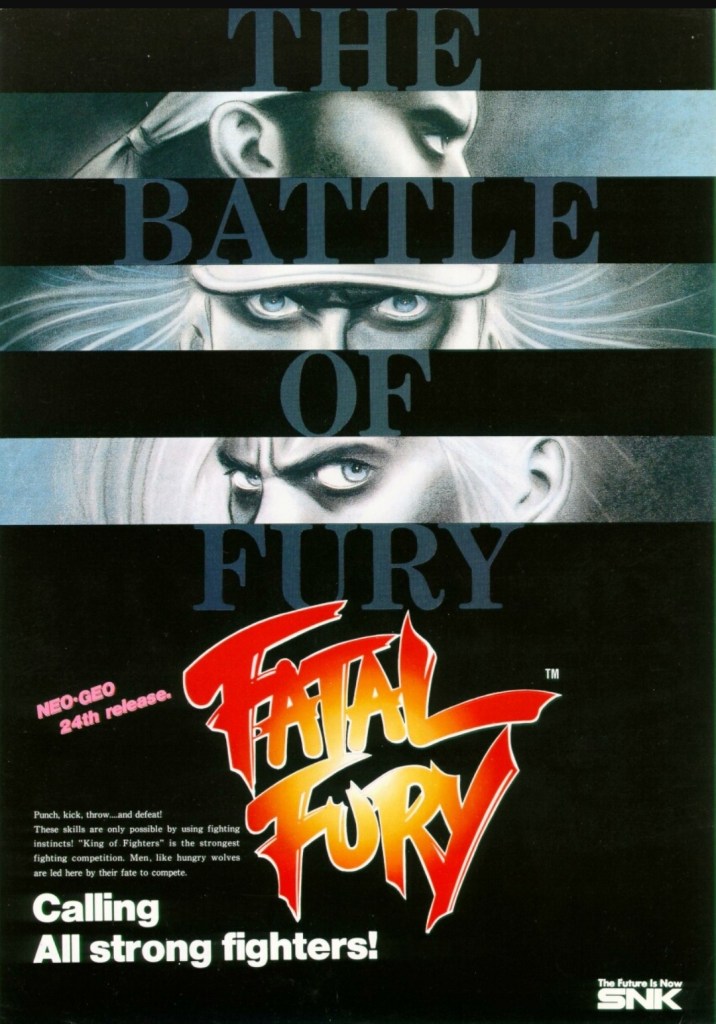
5. Fatal Fury: King of Fighters arcade flyer
An intriguing visual presentation on the front.
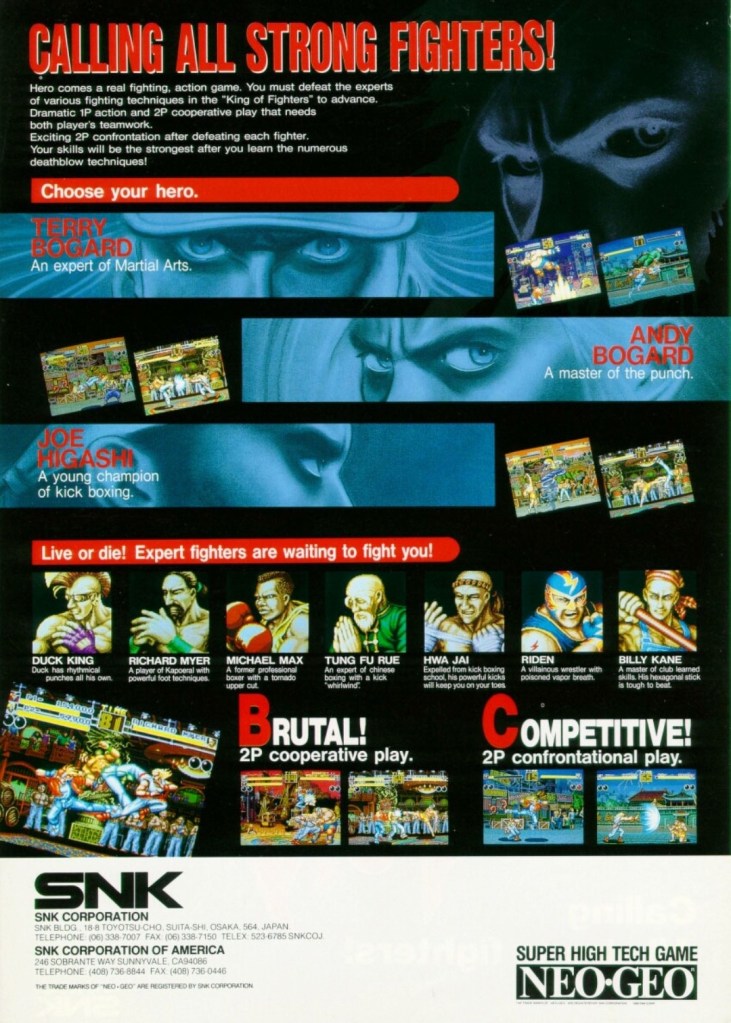
You get to know the characters and what the game features are.
There is no doubt that Fatal Fury: King of Fighters is the most significant game that SNK made. Apart from being the company’s first fighting game for the Neo Geo system, it established the fictional “king of fighters” tournament that became the core concept for The King of Fighters series of games in the years that followed. Fatal Fury itself is notable for being designed by Takashi Nishiyama, a former Capcom employee who created the original Street Fighter game. What Nishiyama could not do with Street Fighter, he accomplished while making SNK’s fighting game. Compared with the combo-oriented approach of Street Fighter II, Fatal Fury was designed to emphasize the timing of special moves, confrontational play, cooperative play and the 3D-like spacing between characters (background row and foreground row in each stage) while telling a story in a solid way.
The above arcade flyer of Fatal Fury has this unique looking artwork on the front showing stylized rectangular shots of the major characters Terry Bogard, Andy Bogard and Joe Higashi. On the other side of the flyer are the details that emphasized the creative concept of the game, who the characters are and what they could expect with regards to gameplay features. This flyer is still captivating to look at and it could entice you to try playing the original Fatal Fury game before trying out the sequels and spin-offs.
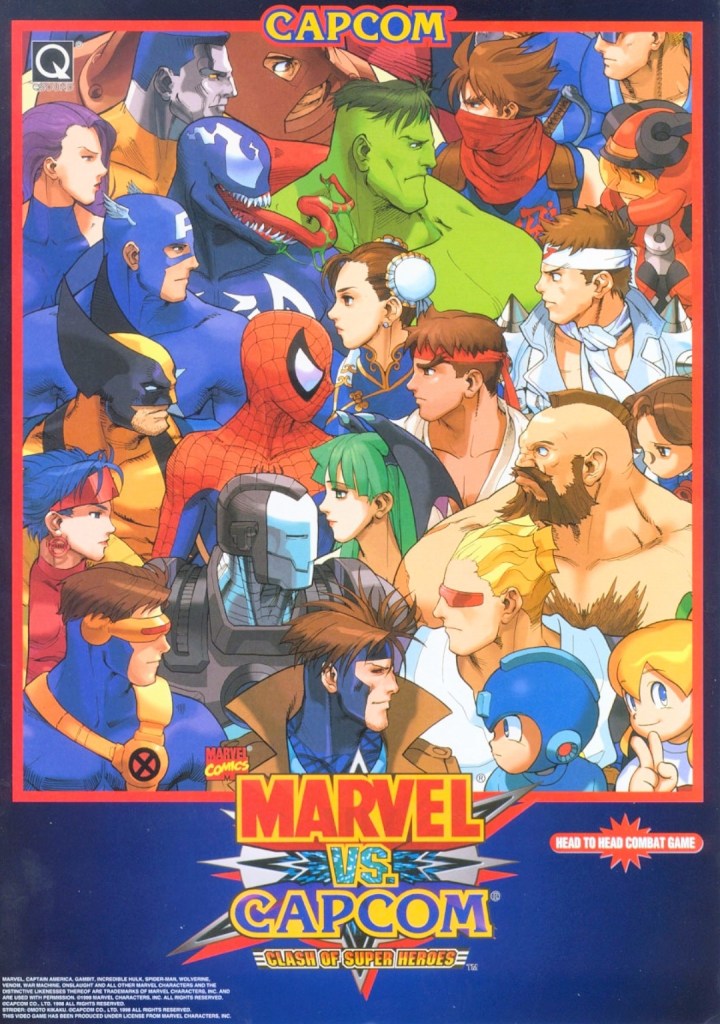
6. Marvel vs. Capcom: Clash of Super Heroes arcade flyer
This is NOT a comic book crossover.
If there is anything that truly emphasizes the essence of a fictional crossover in terms of visuals, it’s the art that Capcom and Marvel agreed to for Marvel vs. Capcom: Clash of Superheroes which is evident on the front of the above arcade flyer. By looking at how the Marvel characters were drawn, it looks like someone at Capcom illustrated the artwork as the Capcom characters still maintained that particular art style seen in the artworks of the Japanese company’s other games like Street Fighter, Darkstalkers, Mega Man and Strider. Regardless, the artwork still is amusing to look at.
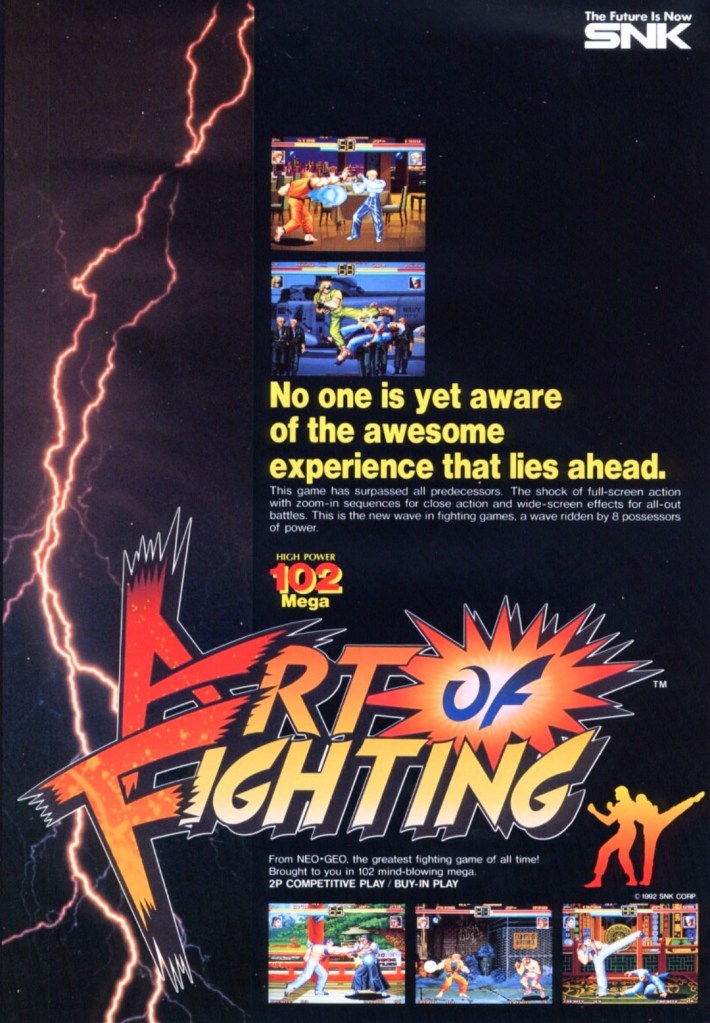
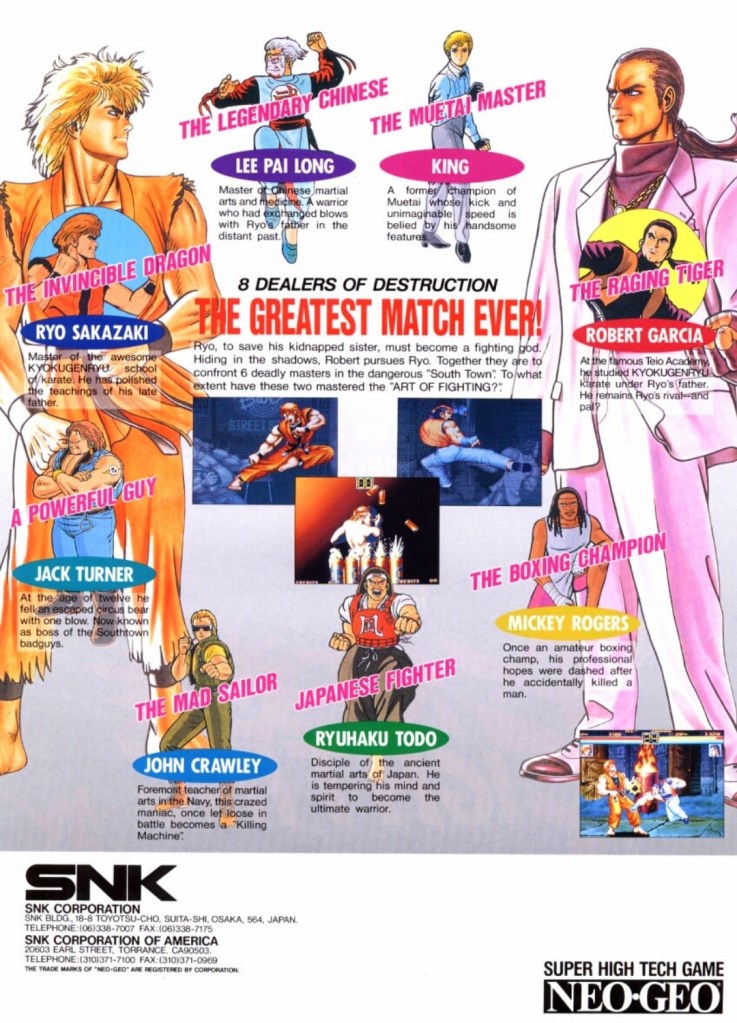
7. Art of Fighting arcade flyer
The front of the flyer.
The cast of characters showcased on the other side of the flyer.
Following the success of Fatal Fury, SNK went on to release Art of Fighting in arcades in 1992 and it became successful enough for the company to make sequels. With regards to the realm of fantasy, Art of Fighting was part of the same fictional universe as Fatal Fury and The King of Fighters, and there were times when its own characters appeared in other SNK games.
Art of Fighting’s arcade flyer had an energetic visual concept on the front with a rectangular lightning portion on the left balanced with five screenshots of the game itself. Once you get to the other side of the flyer, you will see really nice art of the characters with Ryo Sakazaki and Robert Garcia as the most dominating figures. Sakazaki and Garcia are the major characters of the Art of Fighting series. This flyer confidently introduced the characters and succeeded in making them look interesting.
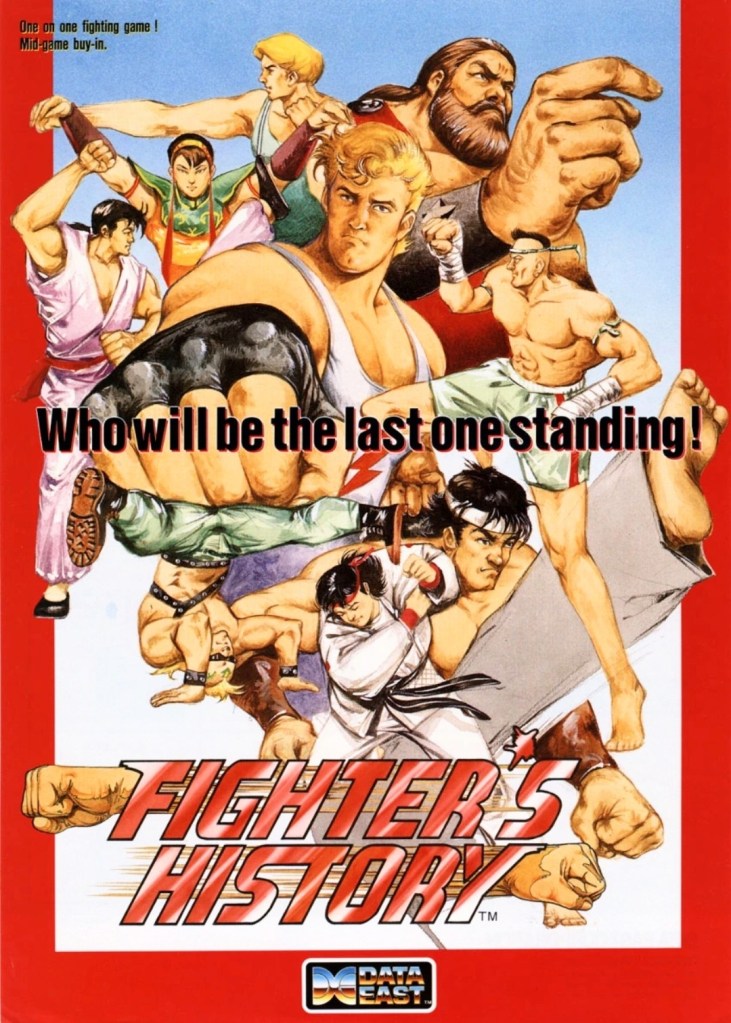
8. Fighter’s History arcade flyer and print ad
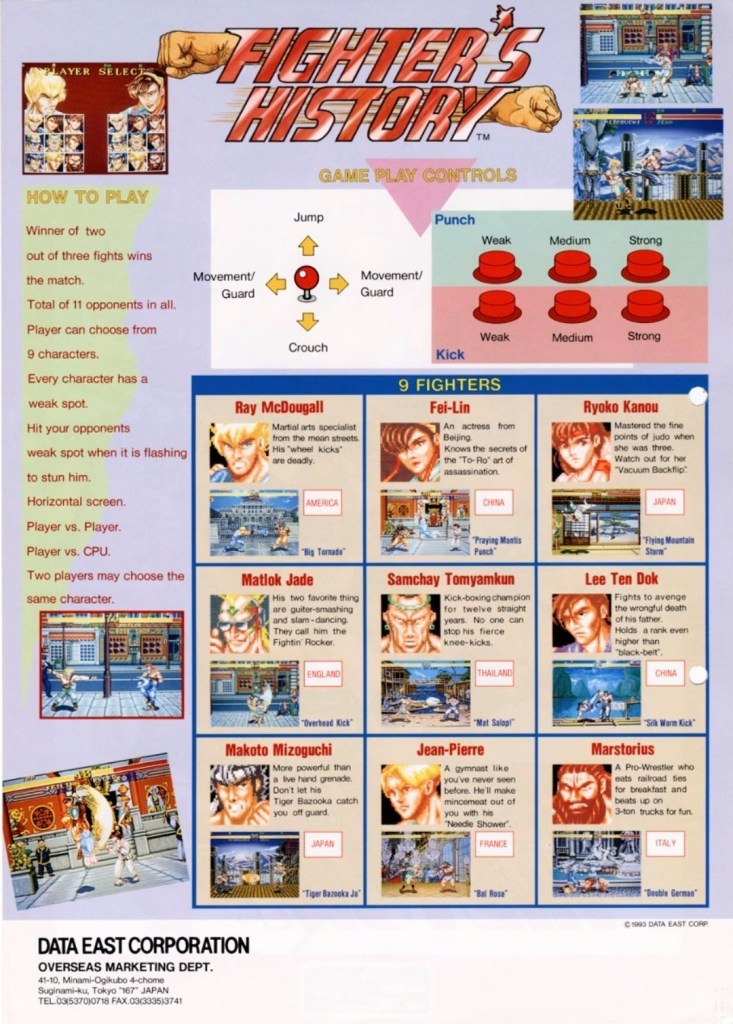
Great looking front artwork showing the game’s characters, posing and some action.
If you look closely at the controls, you will see the six-button layout and functions which are the same with those used in Street Fighter II.
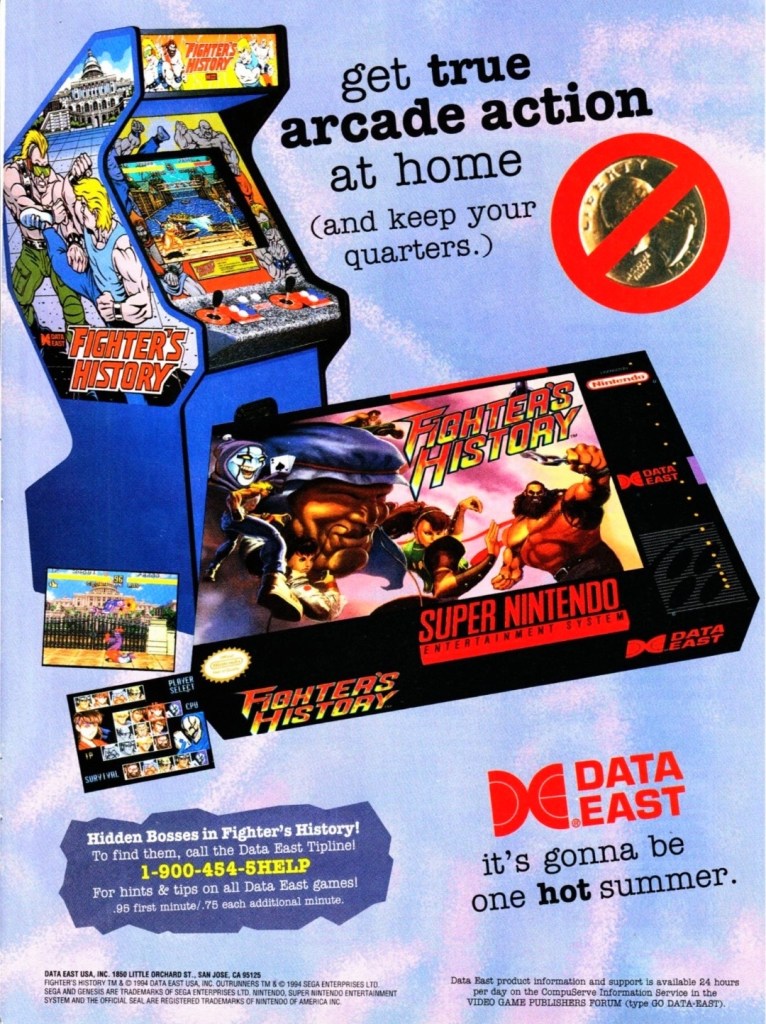
Data East offered two ways for gamers to enjoy Fighter’s History – pay a high price for the SNES version or gamers can go play the game in the arcade by dropping a few coins.
In 1993, Data East released their fighting game Fighter’s History in the arcades around the world. Along the way, the company released their arcade flyer which had a very captivating art work on the front featuring their characters and some action. The other side of the flyer showed the technical details on how to play, how the control works and who the characters are. Fighter’s History was nicely received in the arcades and the success led Data East into porting the game for the Super Nintendo Entertainment System (SNES). If you look at the print ad above, you can see how clever Data East was promoting the SNES version of the game while keeping an image of the arcade machine which serves like a subtle reminder that the same game is still available in video arcades.
Shortly after the release of Fighter’s History in the arcades, there were gamers who noticed that it had certain visual and gameplay elements that made it so familiar with what Street Fighter II had. When Capcom became aware of the similarities, they sued Data East claiming that Fighter’s History was too similar to their game and that copyright infringement was committed. Capcom lost the case ultimately and Data East went on to release two more Fighter’s History games.
9. Virtua Fighter 3 arcade flyer
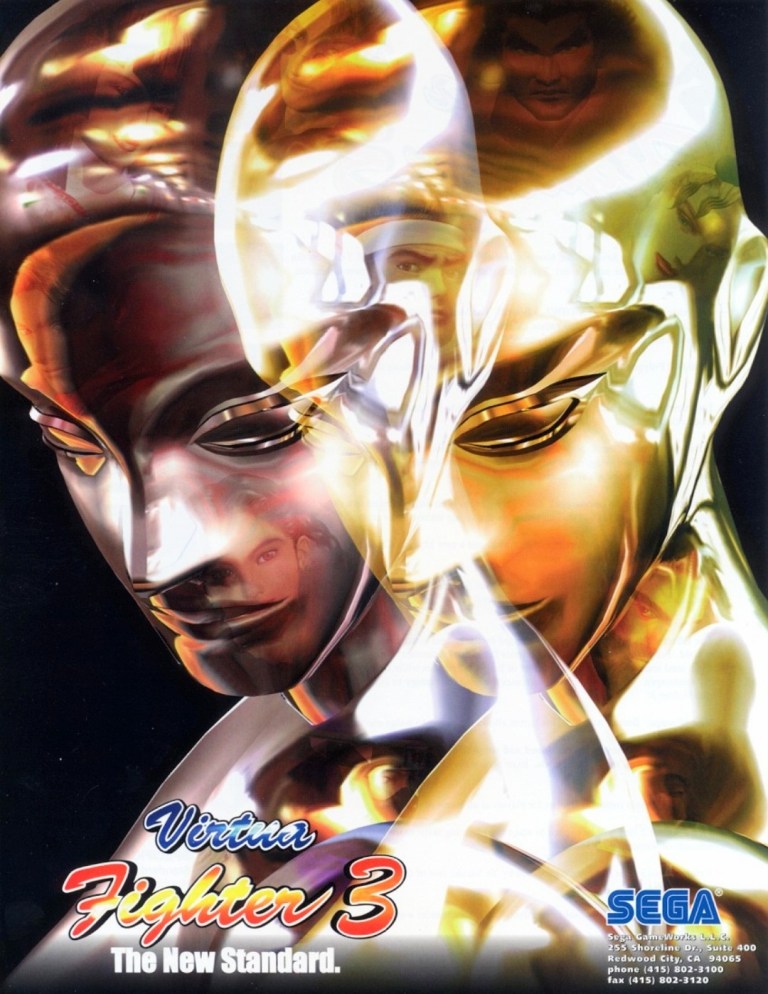
Virtua Fighter 3 truly raised the standards for arcade game graphics back in 1996.
When it comes to gaming innovation and standing out among the rest, Sega did exactly those when they released Virtua Fighter 3 in arcades in 1996 and it had the best-looking and really mind-blowing graphics at the time. Developed by AM2 (led by Yu Suzuki) on the very expensive Model 3 arcade hardware, Virtua Fighter 3 broke new ground on graphics as it moved over 1 million polygons per second, had highly detailed visuals on the characters and surroundings, realistic reflection effects, detailed shining, parallel lighting and high-specular Gouraud shading to name some. Even the characters’ eyes followed the opponent’s position.
The Virtua Fighter 3 arcade flyer showcased their reflective, metallic character Dural who in turn was part of the graphical showcase (emphasizing reflections, smooth animation and liquid metal effects) when the game was previewed in the 1996 AOU event in Japan. The words “The New Standard” written on the lower-left corner of the front of the flyer was justified and truthful.
10. Teenage Mutant Ninja Turtles: Tournament Fighters print ad
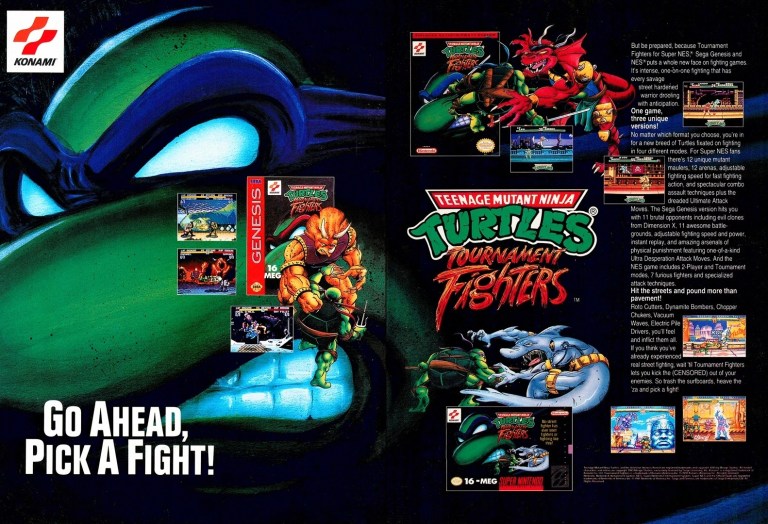
This print ad had a nice visual presentation and was easily recognizable to the many TMNT fans.
In 1989, the Teenage Mutant Ninja Turtles (TMNT) franchise made quite a splash on video games which is not surprising as the multimedia franchise was already a popular in the West. More video game adaptation of TMNT were released in the early 1990s providing fans and gamers a lot of fun gameplay at the arcades (click here) and on consoles. Konami had the video game rights of TMNT and in a clear response to the sudden popularity of fighting games, they released Teenage Mutant Ninja Turtles: Tournament Fighters on the most popular game consoles of the time achieving varying levels of success critically and commercially (note: the SNES version stood out as the best). This print ad of the fighting game was effective in visually promoting the three console versions and the displayed text contained enough information to lure the attention of both fans and gamers.
Let’s be honest here. There are changes regarding Xbox Game Pass (XGP) that are disadvantageous to both Xbox fans and the gamers who subscribe for the best value in gaming. In fact, the said subscriber service is getting is getting worse as reported by Windows Central Gaming. You heard about the Standard tier of XGP? Are you aware that certain first-party games are not even part of the services below the Ultimate tier of XGP?
To put things in perspective, posted below is the excerpt from Windows Central Gaming’s news report. Some parts in boldface…
Xbox Game Pass has long been the key differentiator for Microsoft’s gaming business, offering an alternative subscription-based store against Steam on PC, and offering heaps of value on console against PlayStation with its day-one games pledge. That covenant has been undone now, though.
Now, only users on the $19.99 Xbox Game Pass Ultimate tier will get day one games on console, with PC users retaining them at $11.99. The big change is to the basic “Console” tier, which has now essentially been removed for new users. The new Standard tier will start at $14.99 for new customers, and will include the Xbox Live Gold (Game Pass Core) multiplayer paywall specifically for premium games like Call of Duty Black Ops 6. Crucially, though, it won’t actually include Call of Duty Black Ops 6.
Previously, Xbox Game Pass’ promise was to offer day-one Microsoft-owned titles into the service. Games like Starfield, Forza Horizon 5, Flight Simulator, and many other heavy hitters dropped straight into Xbox Game Pass Console, PC Game Pass, and Ultimate, granting the service far better value on paper than competing options. Xbox Game Pass Standard no longer guarantees day-one access to Xbox games, meaning the hotly anticipated Call of Duty Black Ops 6 will be available only to PC Game Pass users, and Xbox Game Pass Ultimate subscribers. Despite paying more than PC Game Pass users, Xbox Game Pass “Standard” members will not get access to said games.
To compound matters, it was discovered recently (via Forbes) that Xbox Game Pass Standard has removed access to a wide variety of games that are currently active on the deprecated Xbox Game Pass “Console” tier, which is only available for users who maintain a subscription. If you swap out your subscription to gain access to Xbox Live Gold, which isn’t available on Xbox Game Pass “Console,” then you’ll lose access to a huge list of titles.
I hope understand what was reported. Specifically for those who own Xbox consoles, the three Xbox Game Pass services available for your choosing are Core at $9.99/month, Standard for $14.99/month and Ultimate for $19.99/month (note: only $1 will be charged for the first 14 days before the regular rate gets implemented).
It is clear that Microsoft is trying to lure gamers to take the most expensive XGP service – Ultimate. This can be disadvantageous to not only Xbox fans but the many millions of gamers out there who have yet to discover and subscribe to Xbox Game Pass.
As for those who have been XGP subscribers since at least a year ago, they are still enjoying the access to the above-mentioned heavy hitters while paying the same old monthly rate as before. If they stop subscribing now, they will lose their privileges and if they decide to return to the service with the same experience as before, they will have to subscribe to XGP Ultimate at $19.99 a month for the Day One access as well as the access to premium games.
Indeed, Xbox Game Pass is changing for the worse. In fact, it could be the first sign of things to come. I’m talking about the future of gaming under Microsoft that could mean the end of Xbox as we know it and Team Xbox becoming a multiplatform game publisher. Microsoft’s love and care for Xbox fans is fading away, and what they’re doing could turn off potential new gamers related to the changing demographics of the world.
This screenshot from Red Dead Redemption II should remind you that Microsoft is aiming at the wrong direction with regards to its video gaming strategy. Imagine being part of Team Xbox receiving orders from Microsoft’s top management that don’t make much sense with regards to gaming and the interests of the players.
If you plan to subscribe to Xbox Game Pass at all, start doing your research carefully before deciding to subscribe. Click https://www.xbox.com/en-US/xbox-game-pass
If you are an Xbox fan who is fond of Japanese role-playing games (JRPGs), then I encourage you to buy Grandia HD Collection which is available for Xbox online. I am saying this because recently I enjoyed replaying the classic JRPG Grandia on my Xbox Series X a lot and I finished it once again (my 2nd time overall including my 1999 completion of the game on PlayStation). This is not a game review of Grandia but a commentary of replaying it from start to finish.
Feena and Justin are very memorable protagonists. The writers of Game Arts really did their jobs developing and defining the personalities of the characters.
For the newcomers reading this, Grandia HD Collection contains Grandia and the sequel Grandia II. Grandia was originally released on the Sega Saturn in Japan in 1997 and was ported to PlayStation shortly after. It was on the PlayStation when Grandia was translated and dubbed into English and released to gamers in the West. Grandia II was released originally on the Dreamcast console in both Japan and America in 2000. Eventually the sequel was ported to the PlayStation 2 and Windows PC in 2002.
Going back to the original Grandia, the game has visuals that were remastered and made clearer to look at while still maintaining the vibrant colors of its late-1990s version. It took me a little over fifty hours to complete on my Xbox Series X and I can say that the entire replay experience was indeed a lot of fun to do. I’m so happy and satisfied with finishing Grandia, I already got my money’s worth with the entire Grandia HD Collection. I’m currently playing Grandia II and so far I’ve been enjoying it.
Game Arts was exceptional with their work on the graphics and art style.
Without spoiling the story, I can say that Grandia was written and made to emphasize the wonders and risks of adventuring while managing to dramatize a tale of epic fantasy proportions. Along the way, the game has a memorable cast of characters – Justin and Feena are clearly the leads – and the creative team of Game Arts really ensured that their personalities got developed (as the story moved on) and became worth caring for.
The gameplay is also fun to go through once again. There is a satisfying room for exploration whenever I visited a new location and the battle system is still top-notch in terms of mechanics, presentation and functionality. I should say that the battles are not too stressful to do and that means it is more doable to do some grinding to make your characters stronger and their abilities better.
After finally defeating the main villain and completing the last conflict, it was really nice to see the story’s ending (told with a labor of love by the game developers) as well as the follow-up cut-scene that played after the end credits rolled (read: post-credits ending). It’s like 1999 all over again but with much better visuals and the benefits of playing the game on Xbox Series X connected to our 4K TV. This is both retro gaming and fantasy role-playing of great quality and deep enjoyment!
By finishing Grandia and enjoying it a lot, I already got my money’s worth with Grandia HD Collection.
There is no doubt that Grandia is the best gaming experience I’ve had on Xbox this year. That being said, I encourage you fellow Xbox gamers as well as those who love JRPGs to seriously consider buying Grandia HD Collection while it is still available.
Welcome back readers, fellow geeks and electronic gaming fans!
In this edition of the Retro Gaming Ads Blast (RGAB) series, we will take a look at another batch of retro gaming print ads – including arcade flyers – from the 1980s and 1990s.
For the newcomers reading this, Retro Gaming Ads Blast (RGAB) looks back at the many print ads of games (console, arcade, computer and handheld) that were published in comic books, magazines, flyers, posters and newspapers long before smartphones, social media, the worldwide web and streaming became popular. To put things in perspective, people back in the 1980s and 1990s were more trusting of print media for information and images about electronic games and related products.
With those details laid down, here is the newest batch of retro gaming print ads for you to see and enjoy…
1. Sega Dreamcast launch print ads
This cryptic Sega Dreamcast American launch print ad has an image that emphasized that gamers are being watched.
This one has an image emphasizing emotions, impulse and excitement.
By the time Sega launched their Dreamcast console in Japan in late 1998, the company was already bleeding from back-to-back years of financial losses. The Dreamcast was their big bet to regain the trust of consumers and business partners, to sell a lot of consoles and games, and somehow survive.
For the North American Dreamcast launch, Sega of America organized an intriguing series of ads emphasizing the September 9, 1999 launch date in very stylized and cryptic ways. As seen in the two selected ads above, the Dreamcast name was not even mentioned but the console’s trademark swirl was present. Anyone who was obsessed with video games – even if one was not a Sega fan – could tell that the print ads made clear that the Dreamcast was going to launch in America. Ultimately, Sega sold roughly $98 million worth of Dreamcast consoles, games and peripherals in the first 24 hours in America.
2. Point Blank 2 print ad
This ad appeared in comic books and magazines.
When Namco released the first Point Blank game, it was commercial successful in both arcades and on the PlayStation console in different parts of the world. To keep on succeeding, Namco made the sequel Point Blank 2 and their confidence in it was made clear with the above PlayStation version print ad that promised it to be multiplayer-oriented and ensure enough content to give players sufficient bouts of fun whichever game mode they pick. The ad’s image of the lady with a gun (Namco’s Guncon peripheral) and the animal trophies were done with humor in mind.
3. Pac-Man arcade flyers
This ad showed that arcade operators can choose which type of machine of Pac-Man they could order.
Midway issued this flyer when Pac-Man was already successful.
In 1980, Namco released Pac-Man in Japanese arcades and it became a big hit in a short span of time. This prompted them to bring the game overseas, especially in America which already had a growing arcade market. In November that year, Namco brought Pac-Man and their other arcade game Rally-X game to a tradeshow and only got mild attention from attendees and distributors. After being turned down by Atari, Namco signed a contract with Midway to distribute Pac-Man and Rally-X in America, and they were formally released the following month.
Upon release, Pac-Man became a strong attraction in American arcades with weekly sales surpassing $8 million per week. When it comes to the presentation, Midway’s arcade flyers above gave arcade operators and gamers a clear view that Pac-Man is fun and available in three physical units (emphasized in the first flyer) and that it made a positive commercial impact (emphasized in the 2nd flyer). Ultimately, Midway went on to sell over 100,000 Pac-Man arcade units resulting in a massive gross of over $1 billion in quarters (coins of twenty-five cents in American currency).
4. Silent Hill print ad
A clear atmosphere of psychological horror in this ad.
Made by a certain team within Konami, Silent Hill on PlayStation turned out to be a surprising and intriguing hit game in 1999. It was a polygonal survival horror game that drew a few comparisons with Capcom’s Resident Evil but ultimately stood out with its gameplay features and psychological horror concept.
The people at Konami must have anticipated that gamers in America would be attracted by the game so they came up with the creepy print ad above which promoted the game with a clear touch of psychological horror. If you look closely, the 2nd screenshot (in the middle) even showed blood in digital form. This Silent Hill print ad was clearly aimed at adult gamers and PlayStation gamers who craved for more horror gaming.
5. Tomorrow Never Dies game print ad
The use of the image of Pierce Brosnan as James Bond in this print ad was the right move to inform readers that the 1997 movie’s video game was coming out.
To really capture the attention of James Bond fans and gamers, MGM Interactive and Electronic Arts (the co-publishers of the game) came up with a Tomorrow Never Dies game print ad showcasing Pierce Brosnan as the iconic Agent 007 in a dominant fashion leaving a minor space for the text description, two screenshots and other details displayed. While some people might look at the ad as an act of desperation to sell the long-delayed game, I find it eye-catching and engaging to look at. It also was a lively reminder back then that Brosnan was James Bond of the 1990s.
6. Wipeout 64 print ad
This is still cool and sleek to look at.
Wipeout, the series best known for its very futuristic portrayal of high-speed anti-gravity racing, showcase of dynamic visuals and the use electronic dance music, made its way to the Nintendo 64 console with Wipeout 64. This 1998 release was significant because at that time developer Psygnosis was already owned by Sony and most Wipeout games of the decade were released on PlayStation. Wipeout 64 was released before the PlayStation-exclusive Wipeout 3 came out.
The above print ad had this very sleek display of two anti-gravity racers moving at high speed and on the side are five screenshots showing what the game looked like on the N64. If you look very closely, one of them shows the 4-player split-screen mode identified with the Nintendo 64’s capabilities. Overall, the Wipeout 64 print ad captured the vibe of the Wipeout series and remains very cool to look at.
7. Ehrgeiz print ad
You want a 3D polygonal fighting game that has Final Fantasy 7 characters in it? Ehrgeiz was the answer.
In 1999, the landscape of gaming really changed. More gamers played 3D polygonal fighting games over the 2D fighting games, and demand for Final Fantasy and Japanese role-playing games (JRPGs) were in high demand in the West arguably because of the massive commercial success of Final Fantasy VII on PlayStation. That being said, Squaresoft released their own 3D polygonal fighting game that had Final Fantasy VII characters in it – Ehrgeiz.
After achieving success in the arcades, Squaresoft brought Ehrgeiz to PlayStation in America in 1999. Unsurprisingly, the print ad had Final Fantasy VII protagonist Cloud and his signature sword in a prominent position which was obviously done to attract the millions of FFVII for potential sales. The screenshots on the ad were presented not for showing off but to give readers a clear view of what kind of gaming experiences they could expect. Ehrgeiz on console even had a standalone RPG mode.
8. Driver print ad
The art used for the muscle car and the police car was a tribute to the car chases of movies from long ago.
Even before it was released on PlayStation and PC in 1999, publisher GT Interactive knew they had something big for gamers to engage with. That game was Driver and developer Reflections Interactive made it with a lot of inspiration taken from cinematic car chases. This particular ad emphasized car chases, the exploration of four real-life cities in digital form, and engaging in a variety of missions. As it successfully delivered what it promised, Driver went on to become a big commercial success on PlayStation and PC, and spawned sequels in the years that followed.
9. Eidos Interactive games print ad
From the time when Eidos Interactive was at the top of its game and Lara Croft was its most popular character.
By the end of the 1990s, Eidos Interactive became a major game publisher which is the result of the massive success they achieved with the Tomb Raider games which collective sold many millions of copies worldwide.
Along the way, they acquired developer Crystal Dynamics which was already a prolific team with many games released and new projects in development. Under Eidos’ banner, Crystal Dynamics went on to release Gex 3: Deep Cover Gecko and Legacy of Kain: Soul Reaver in 1999. That being said, this print ad shows the ambitious offers Eidos Interactive had with the Tomb Raider, Gex and Legacy of Kain franchises. It is a reflection about success and confidence about the future of video games.
In case you missed the news, Team Xbox recently had a presence during Gamescom in Germany and they made several announcements and previews of upcoming video games there.
During the first day of Gamescom, Team Xbox announced at last the release date of the much-awaited Indiana Jones and The Great Circle which is December 9, 2024 (for Xbox Series X|S, Windows PC and Xbox Game Pass). At the same time, they committed a blunder that the MachineGames-developed first-person adventure game is coming to Sony’s PlayStation 5 (PS5) console sometime in 2025. That’s right, the Indiana Jones video game is no longer an Xbox-exclusive game. Watch the Gamescom trailer of the game below from start to finish…
As I mentioned earlier, Team Xbox committed a blunder by announcing a PS5 version of Indiana Jones and The Great Circle during Gamescom. It is a blunder in the sense that Team Xbox (which owns and controls Bethesda) could have delayed the PS5 version announcement and maximize efforts to sell as many copies of the game on Xbox and PC, sell as many Xbox consoles as possible, and convince many gamers out there to subscribe to Xbox Game Pass and PC Game Pass to play it.
Team Xbox could have waited until January or February 2025 to announce the Indiana Jones game for PS5. Instead, they shot themselves on the foot by blowing away the first-move advantage.
To put things in perspective, Microsoft/Xbox/Bethesda do not OWN the intellectual property of Indiana Jones which belongs to Disney-owned Lucasfilm. Considering the big financial problems Disney has as a corporation (note: the streaming service Disney+ continues to lose money since it first launched), I can speculate that they pushed Team Xbox and Bethesda to not only make a PS5 version of Indiana Jones and The Great Circle but also announce it very early to maximize sales potential and public awareness. Disney itself has a lot to benefit from collecting royalties if the game sells a lot on the two game consoles.
Going back to Xbox, we have to face the reality that we are witnessing the beginning of the end of Xbox as we know it. It is highly anticipated that in the near future, Xbox-exclusive games will no longer happen and the games of Xbox properties (examples: Halo, Forza Motorsport and Fable) will be released on Nintendo and PlayStation consoles. The Xbox brand itself will fade away and be replaced with something like “Microsoft Gaming” once Microsoft goes all-in as a multiplatform game publisher. It is also obvious that Microsoft wants a huge return for the combined $76 billion it spent on acquiring Bethesda and Activision.
I am still looking forward to playing the Indiana Jones game on my Xbox Series X console, but I can say that this latest development as well as the recent Game Pass adjustments brought my excitement down a bit.