What to watch on YouTube right now – Part 123

Welcome back my readers, YouTube viewers and all others who followed this series of articles focused on YouTube videos worth watching. Have you been searching for something fun or interesting to watch on YouTube? Do you feel bored right now and you crave for something to see on the world’s most popular online video destination?

I recommend you check out the following videos I found.

#1 Dawn Of The Dead Remake Revisited – Back in 2004, I saw the Dawn of the Dead remake inside a cinema located inside a shopping mall here in the Philippines. The Zack Snyder-directed film only inspired me to look for the 1978 original version of Dawn of the Dead directed by the late George Romero. The only thing the two films have in common is the concept of desperate people taking refuge inside a shopping mall during a zombie apocalypse. Zack Snyder’s film was more about violent action with horror elements blended with it. As Snyder went on to direct high-profile DC Comics superhero movies and produced other such projects of Warner Bros., it was natural for film buffs to gravitate to 2004’s Dawn of Dead which was his directorial debut. To learn more about the said remake and see the cinematic elements that formed the style of Snyder, watch the videos below.

#2 Premium Sushi, Hearty Tempura And Wagyu Beef For Breakfast In Japan –If you were traveling overseas, how hungry do you get when you start the day? Would you go for a simple and affordable breakfast or would you want something special in the morning? In Tokyo, there are these food joints that offer customers a luxurious breakfast with Wagyu beef, special tempura and premium sushi to name some. Already, local and foreign tourists are flocking to such food joints for the premium breakfast experience and you can learn more from the Nippon TV videos below.

#3 The Different Versions Of Final Fantasy VI – Among all the many Final Fantasy games released since 1987, Final Fantasy VI is still my favorite of them all. I first played the classic Japanese role-playing game (JRPG) on Super Nintendo Entertainment System (SNES) in 1994 which was titled “Final Fantasy III”, and it has a great epic story, a huge cast of playable characters, lots of unique gameplay features and great game design. Through the decades, Final Fantasy VI was ported to many consoles, mobile devices and even on personal computer. You might be wondering which version of Final Fantasy VI is the best in terms of visual quality, which one is the most available and which one is the most updated version. That said, you can find out by watching the video below.

#4 Castlevania II: Simon’s Quest Revisited – When Castlevania II: Simon’s Quest was first released on the Nintendo Entertainment System (NES) in 1987, many fans who enjoyed the first game were alienated by how different the sequel felt, looked and played. It still was horror-themed 2D adventure game with Simon Belmont as the playable protagonist again but the creative team of Konami implemented role-playing elements and open-world exploration into the gameplay. Major game design changes aside, Castlevania II still has a lot more than meets the eye and you can find out by watching the video below. Surely it will challenge what you know about Simon Belmont and the Castlevania lore.

#5 Why Feminists Support Islam – Let’s be very clear here. Islam is a truly ugly religion and it is incompatible not only with Western democracy and values, but also with several other cultures around the world. The strange thing is that modern-day feminists actually support Islam even though the ugly religion itself goes against women’s rights, against personal liberty and against freedom as we know it. In the video below, Ayaan Hirsi Ali explains in detail why mainstream feminists today support Islam, why feminism today is very twisted and why feminists even aligned themselves with Islamic terrorists.

+++++

Thank you for reading. If you find this article engaging, please click the like button below, share this article to others and also please consider making a donation to support my publishing. If you are looking for a copywriter to create content for your special project or business, check out my services and my portfolio. Feel free to contact me with a private message. Also please feel free to visit my Facebook page Author Carlo Carrasco and follow me on Twitter at  @HavenorFantasy as well as on Tumblr at https://carlocarrasco.tumblr.com/ and on Instagram athttps://www.instagram.com/authorcarlocarrasco

Retro Gaming Ads Blast – Part 39 (RPG Special)

Welcome back readers, fellow geeks and electronic gaming fans!

In this edition of the Retro Gaming Ads Blast (RGAB) series, we will take a look at another batch of retro gaming print ads from the 1980s to the 1990s, particularly on role-playing games (RPGs) from the East and the West. This is the RPG Special!

For the newcomers reading this, Retro Gaming Ads Blast (RGAB) looks back at the many print ads of games (console, arcade, computer and handheld) that were published in comic books, magazines, flyers, posters and newspapers long before smartphones, social media, the worldwide web and streaming became popular. To put things in perspective, people back in the 1980s to the 1990s were more trusting of print media for information and images about electronic games and related products.

With those details laid down, here is the newest batch of retro gaming print ads for you to see and enjoy…

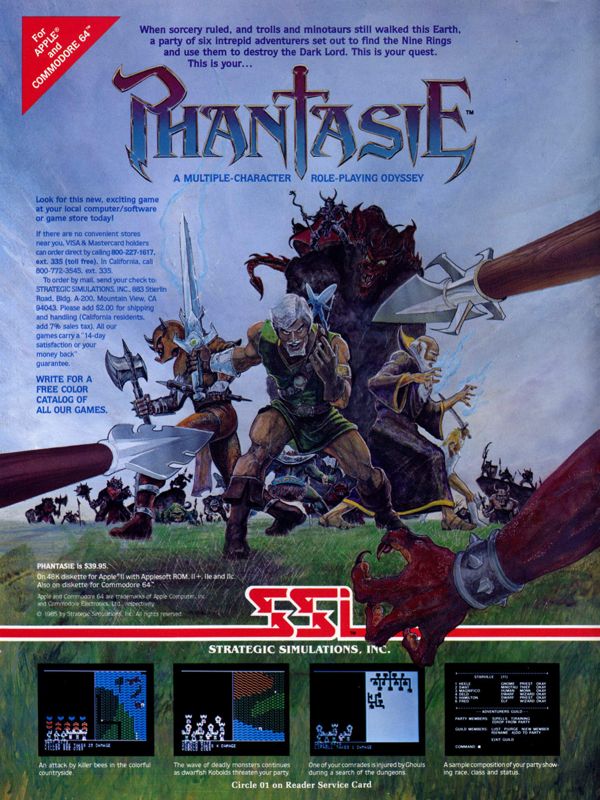
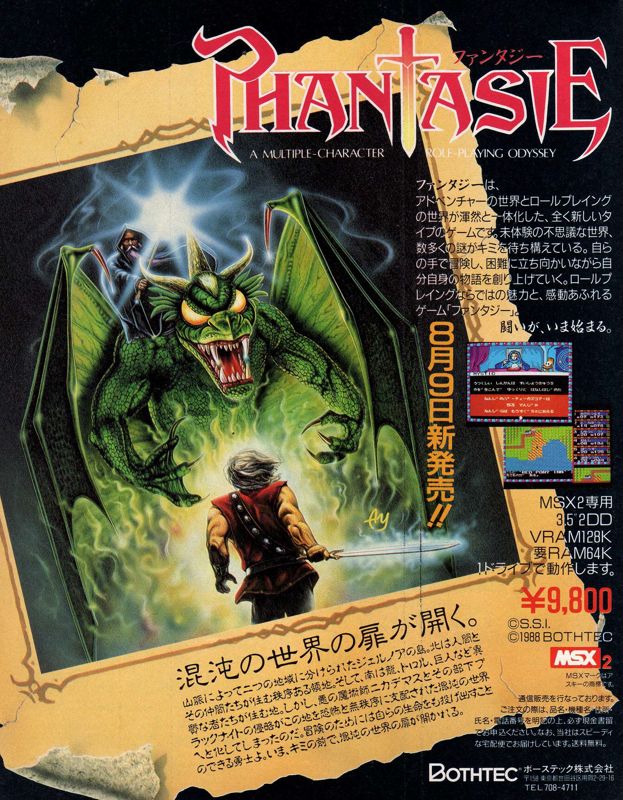
1. Phantasie North American and Japanese Print Ads

The North American print ad.
The Japanese print ad.

Released by Strategic Simulations in the mid-1980s, Phantasie was a fantasy role-playing game that became a huge commercial success paving the way for not only ports on other computer systems of the time but also sequels later. The ad they came up with for the North American market had strong fantasy vibes and the screenshots gave readers the impression that it looked playable or user friendly. For the Japanese market, Phantasie was ported to the MSX system and they came up with an ad using radically different art work that had a horror vibe.

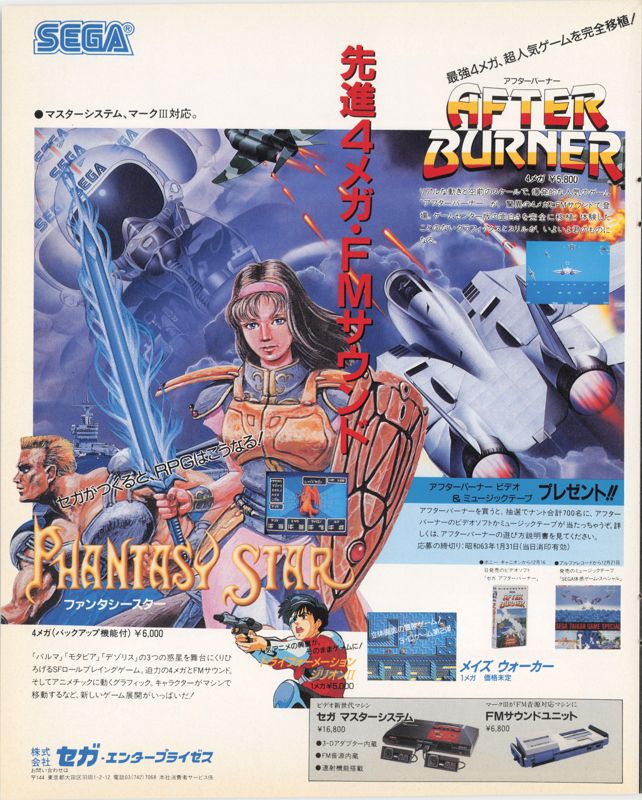
2. Phantasy Star Japanese Print Ad

Phantasy Star in the Japanese print ad sharing the spotlight with After Burner.

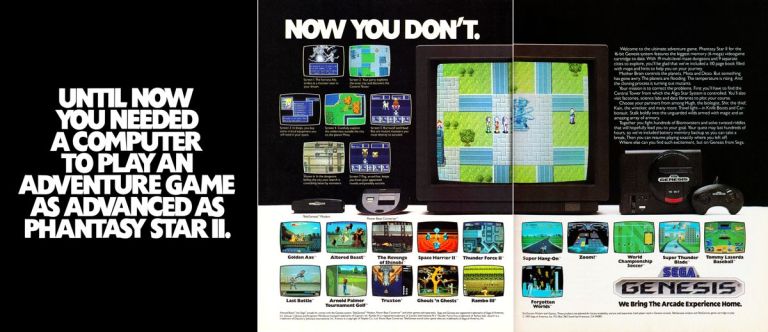
In the 1980s, role-playing games started gaining popularity with Japanese console gamers and there were game developers who were inspired by established RPGs from the West. Enix released two Dragon Quest games and each of them sold a lot of copies on Nintendo’s Family Computer (Famicom). At the time, Sega already had the Master System (called the SG-1000 and its variants with revisions) in the console market and they were way behind Nintendo on hardware sales. Knowing there is a market for console RPGs, Sega went on to make their exclusive RPG Phantasy Star. In 1987, a print ad was released showing Phantasy Star sharing the spotlight with Sega’s blockbuster game After Burner in the background. While the ad felt a bit disorienting to see, the game achieved much-needed success for Sega which in turn brought the game to the Master System in America in 1988. The game sold more and eventually led to sequels in the years that followed.

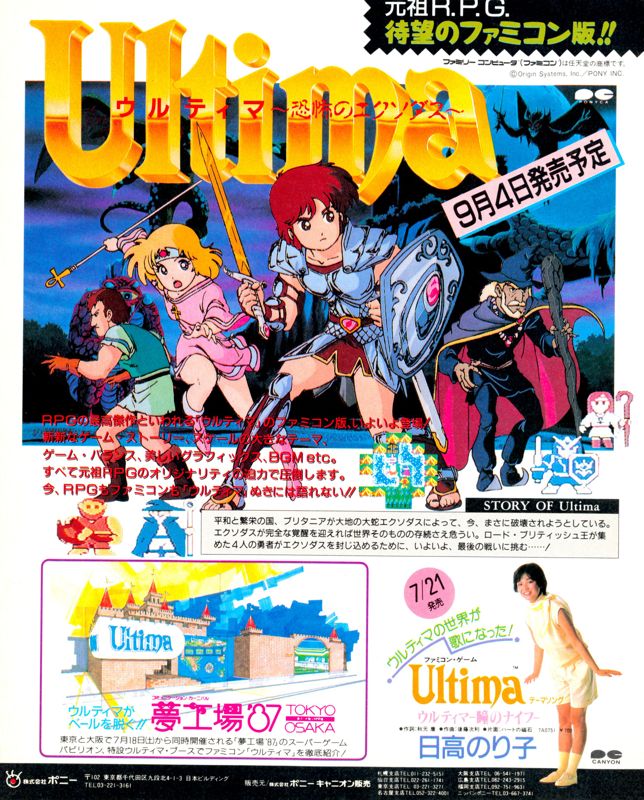
3. Ultima III Japanese Print Ad

Remember the old days when anime or comic book-style artwork was used to promote games in the Japanese print media?

Released in Japan under the title Ultima: Kyoufu no Exodus, Ultima III: Exodus was a breakthrough for the series as the Famicom version marked the first console release for Japanese gamers (note: the game was also offered for MSX and other computer systems in the country). The anime-style artwork used for the print ad is the same virtually the same with the front cover of Famicom version. Very notably, the art on the covers of the PC-88 and PC-98 versions were different. 

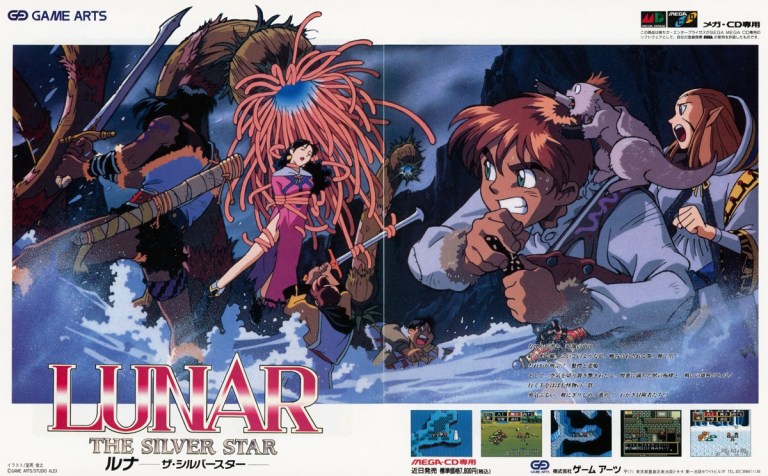
4. Lunar: The Silver Star Japanese Print Ad

Game Arts’ Lunar: The Silver Star as advertized in Japanese magazines.

By the 1990s, console RPGs were very popular as franchises like Dragon Quest and Final Fantasy each released sequels that sold a lot of copies. The company Game Arts decided to make a role-playing game which can tell stories better using animation with voiceovers and music while being very playable and enjoyable. They came up with Lunar: The Silver Star and released it on the Mega-CD add-on (connected with the Mega Drive console of Sega) in 1992. As such, it was not surprising to see the print ad having anime-style artwork as the game itself had several minutes of anime cutscenes complete with audio. As most Japanese role-playing games (JRPGs) did not have playable anime cutscenes for storytelling, Lunar: The Silver Star really stood out. Sometime later, the small American company Working Designs would handle the game’s English version and start a healthy business relationship with Game Arts.

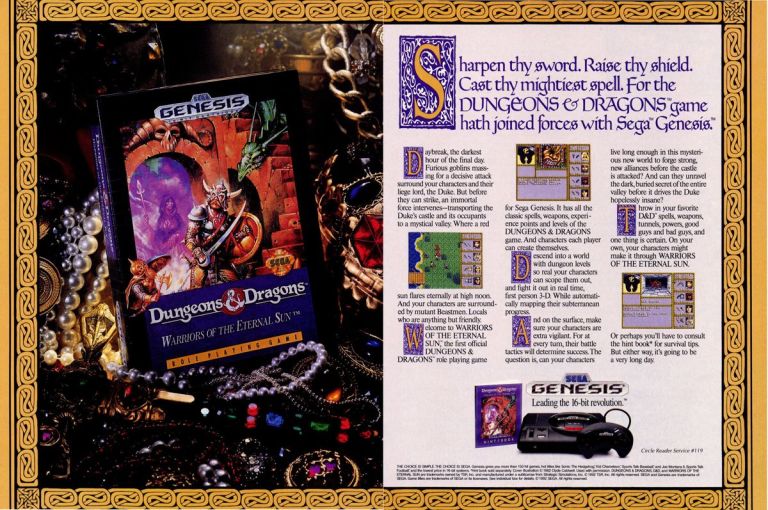
5. Dungeons & Dragons: Warriors of the Eternal Sun North American Print Ad

A print ad that strongly appealed to both Sega Genesis gamers as well as fans of Dungeons & Dragons.

By the year 1992, the fantasy games franchise Dungeons & Dragons was wildly popular as players around the world kept enjoying the tabletop RPG modules (using dice, pen paper) as well as many computer and video games already available. Sega acquired a D&D license and eventually released Dungeons & Dragons: Warriors of the Eternal Sun exclusively on their Genesis console in 1992. To promote it, Sega produced a 2-page print ad that had one half showing the game’s box placed with jewelry while using the other half to show the screenshots, descriptive text and other details. The way it was presented, the print ad was cleverly structured to attract the attention of Sega Genesis gamers as well as Dungeons & Dragons fans. The game ended up as the first and only official D&D product for the console.

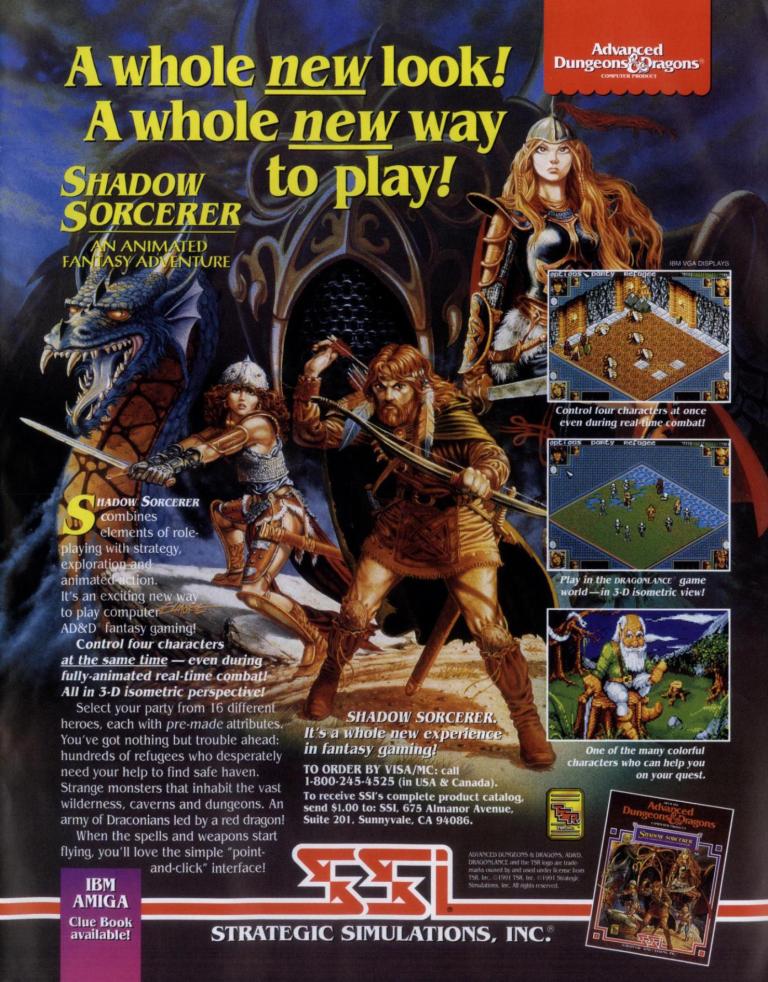
6. Shadow Sorcerer North American Print Ad

This is one of many Dungeons & Dragons computer games released. The use of painted art for marketing was done many times.

In the history of the Dungeons & Dragons franchise and electronic gaming, it was on computers where the more ambitious and more intricate licensed games were played by many fans. In 1991, the Advanced Dungeons & Dragons (AD&D) electronic game Shadow Sorcerer was released on MS-DOS PC, Amiga and the Atari ST. The painted artwork used on the print ad was virtually the same as that on the box covers of the MS-DOS and Amiga versions. I can only guess that the ad markers must have paid a lot of money on the painted art and decided to use it for both marketing and packaging since it looked so detailed.

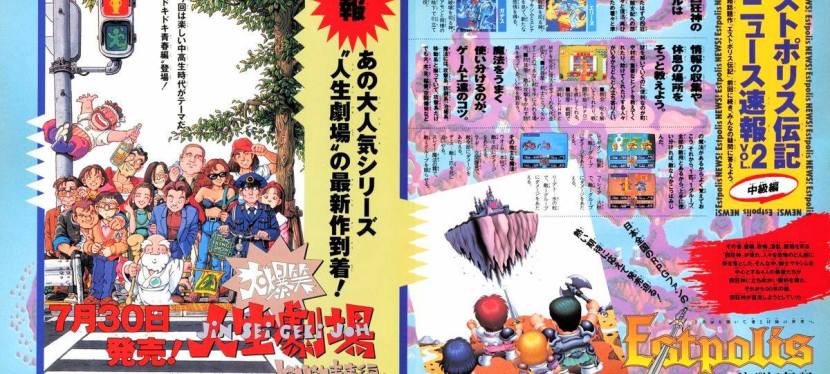
7. Estopolis Denki Japanese Print Ad

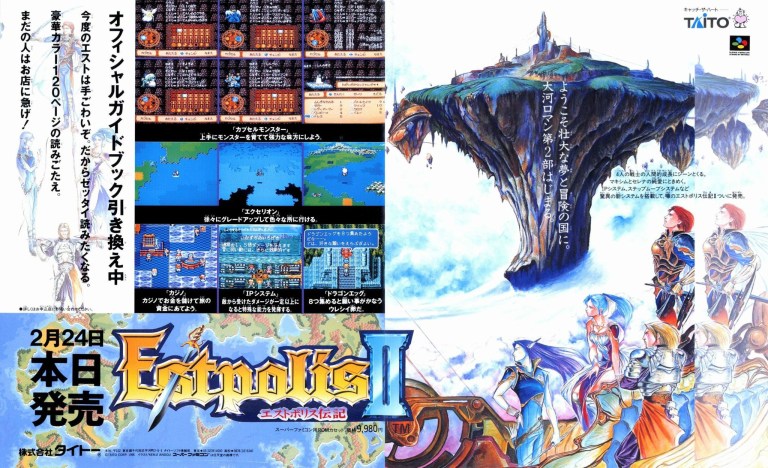
The 2-page Japanese print ad of Estopolis Denki.

In 1993, a brand-new Japanese developer called Neverland was established and its first project was the fantasy role-playing game Estopolis Denki for the Super Family Computer (Super Famicom). That same year, publisher Taito released the game and they promoted it with a 2-page print ad that featured a whimsical looking hand-drawn art work on one half and utilized the other half with details, screenshots and part of the art that was used on the game’s Super Famicom box cover. While Japanese game sales are not available, it seems Estopolis Denki sold enough to convince the publisher to release the game in North America as Lufia & The Fortress of Doom.

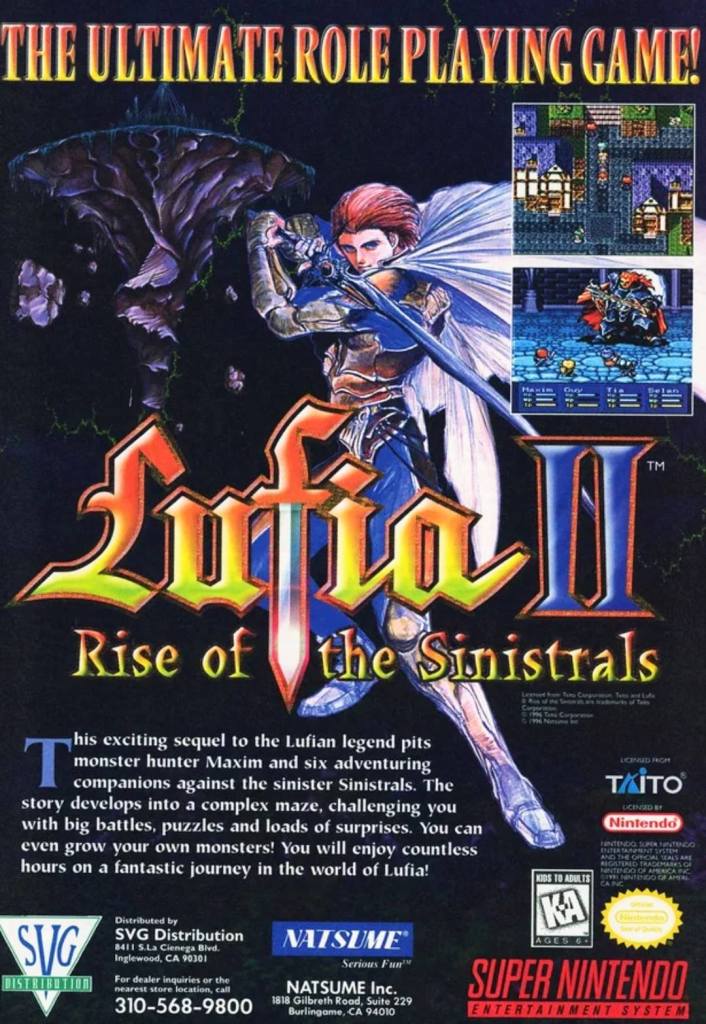
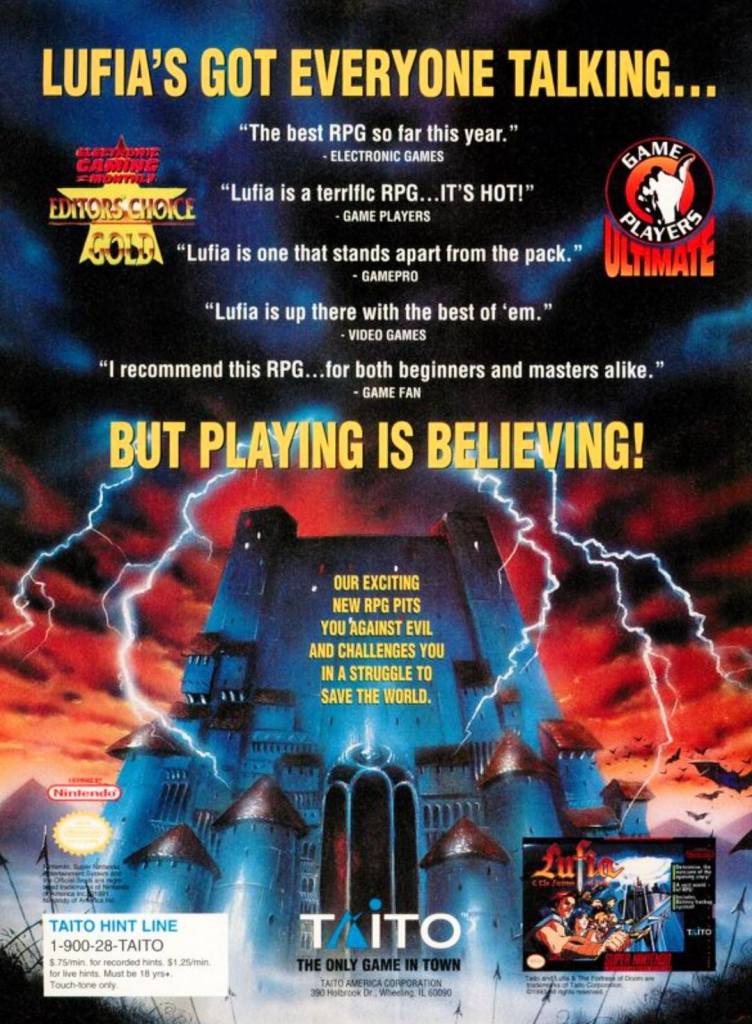
8. Lufia & The Fortress of Doom North American Print Ad

If you were able to play Lufia & The Fortress of Doom on the SNES, were you able to see this ad in a comic book or in a magazine?

Upon release in America in late 1993, Taito scored gold as Lufia & The Fortress of Doom on the Super Nintendo Entertainment System (SNES or Super NES) became a critical and commercial success. In fact, it literally gained steam during the early months of availability and ended up as the top-selling SNES game in America for the month of February of 1994. Take note that at this particular point of time, RPGs on game consoles in America were not yet in high demand as gamers’ tastes were different. When it comes to the marketing, Taito came up with a single-page print ad showing fantasy artwork, the game’s box cover and the published quotes from game critics who gave the game positive reviews. This is smart marketing on the part of Taito.

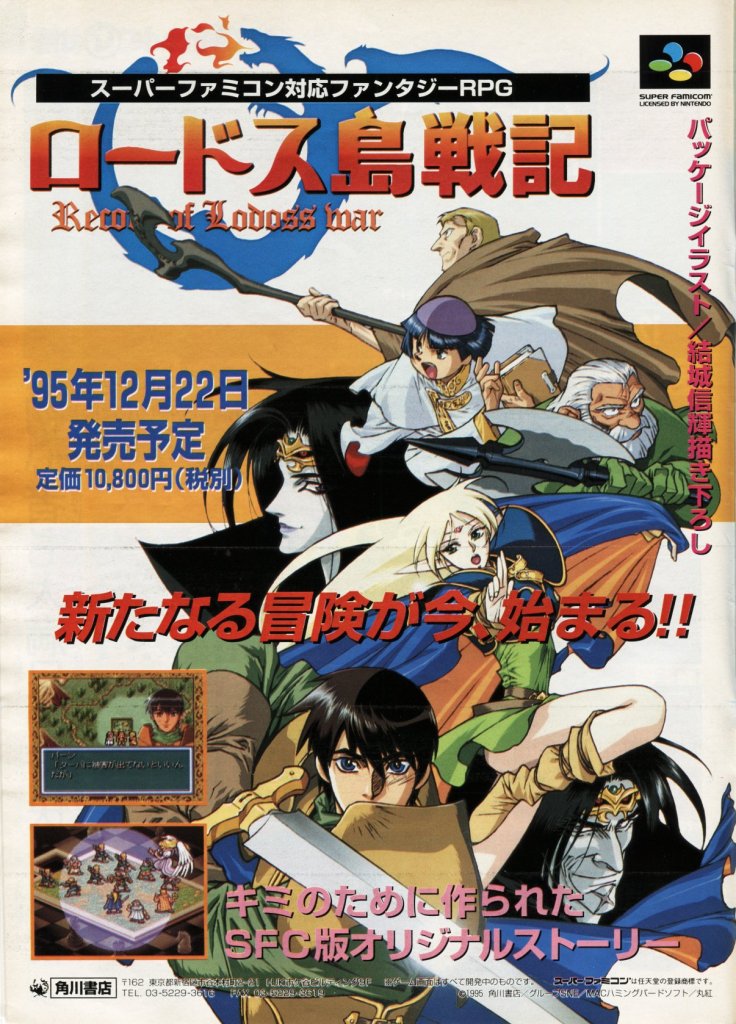
9. Record of Lodoss War Japanese Print Ad

The Japanese print ad of Record of Lodoss War for Super Famicom.

Have you ever heard of the Record of Lodoss War fantasy franchise? That one started as a series of fantasy novels by Ryo Mizuno who previously worked on an RPG project. Record of Lodoss War was eventually adapted into comics, anime and video games. One of those games was released on the Super Famicom in December 1995 published by Kadokawa Shoten which in turn made the one-page print ad for the Japanese market. Using established art from the anime OVA (original video animation) series was a strategic move by the publisher as millions of Japanese people viewed it. Unsurprisingly, the art on the ad is almost the same as the one displayed on the game box cover.

10. Fallout North American Print Ad

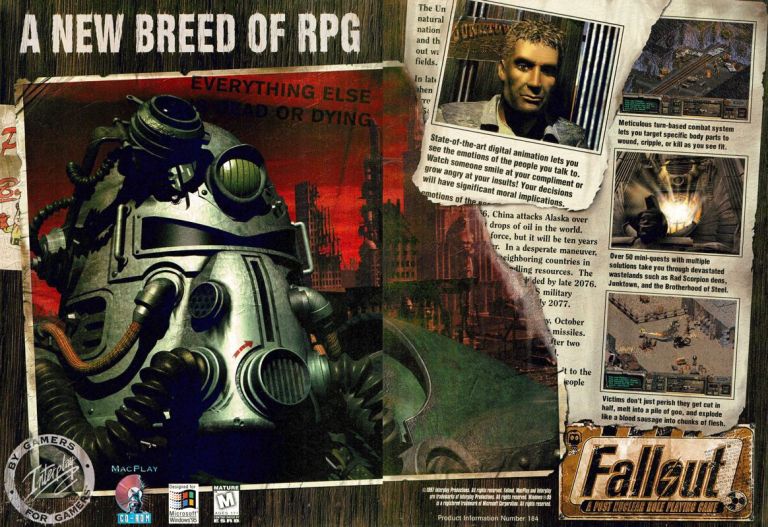
A gritty looking print ad of the original Fallout PC game.

In my gaming life, I played Fallout 3, Fallout 4 and Fallout: New Vegas on Xbox consoles. When the first-ever Fallout game was released in 1997, I did not notice it as I was more into console gaming than PC gaming. The above print ad appeared is several PC gaming magazines and it clearly shows what it offered which gamers eventually ended up enjoying a lot. The mechanical helmet – protection for the user during battles and from radiation in the nuclear wasteland – on the left side of the ad became a key symbol of the Fallout franchise as further games also featured mechanical helmets. Fallout was highly acclaimed for featuring open-ended gameplay and its immersive post-apocalyptic setting. It sold enough copies to convince publisher Interplay to proceed with a sequel and the rest was history.

11. Xenogears Japanese and North American Print Ad

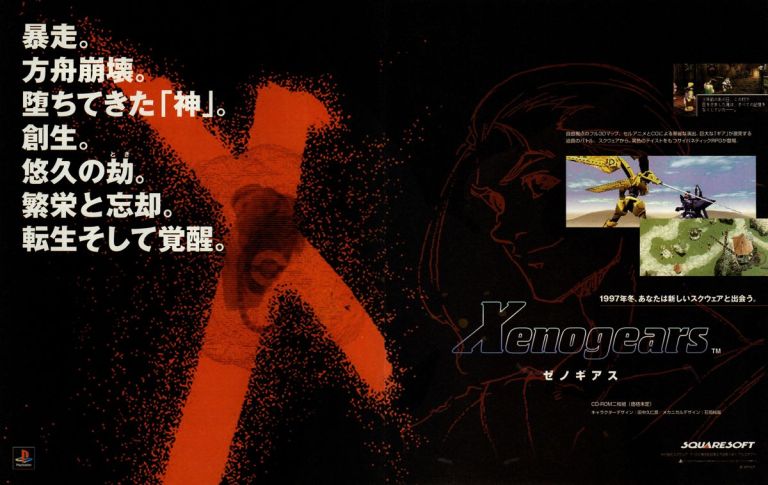
Japanese advertisement of Xenogears.
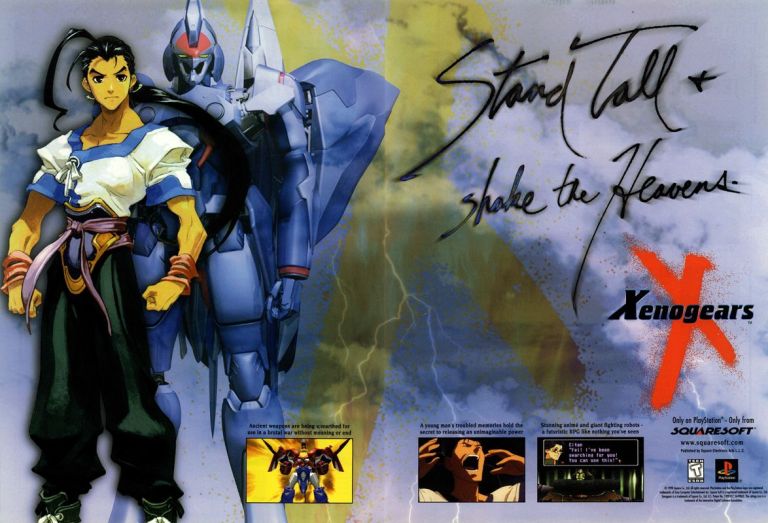
This North American print ad of Xenogears clearly showed the main character, a robot, the sci-fi setting and the visual style of the game.

Xenogears was a sci-fi JRPG I played on the PlayStation in 1998 but I was unable to finish it. Before it was released in America, there was speculation that Squaresoft would not be able to produce an English version for international release due to its religious content. The game was highly challenging to translate into English due to religious themes and psychological elements. Regardless, the game achieved successes commercially and critically in both Japan and America. Xenogears has since been considered by many as a classic JRPG and to play it today is pretty challenging as an existing PlayStation One, PlayStation 3 or PlayStation Vita is required as well as the physical PlayStation disc itself (note: digital copy of Xenogears for PS Vita). Square Enix – which previously remastered Chrono Cross and several Final Fantasy games for modern gaming platforms – has yet to remaster Xenogears for those with modern game consoles, mobile devices and the PC.

12. Final Fantasy Anthology Print Ad

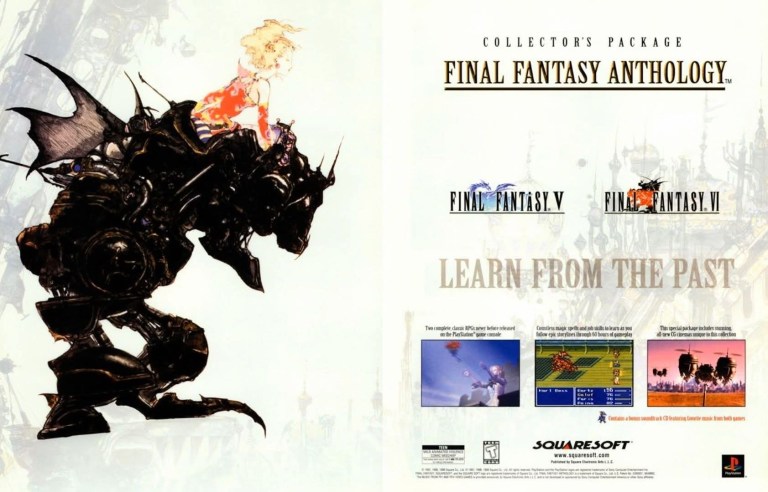
I remember seeing this 2-page print ad in many gaming magazines I read.

By the year 1999, Squaresoft established itself as the best role-playing game company as they achieved critical and commercial success with Final Fantasy VII in 1997, Brave Fencer Musashi, Parasite Eve and Xenogears in 1998. For 1999, Squaresoft decided to bring ports Final Fantasy V and Final Fantasy VI – both games were released in cartridge format on Super Famicom/Super NES some years prior – to their fans who owned PlayStation consoles by releasing the collection called Final Fantasy Anthology. For the North American market, Squaresoft aggressively promoted the 2-game collection with the above 2-page print ad on several video game publications. One half featured exquisite artwork by Yoshitaka Amano and the other half showed the screenshots, descriptions and details. Clearly the ad was made with Final Fantasy fans in mind and it was also clever with the use of nostalgia.

13. Final Fantasy VII North American Print Ad

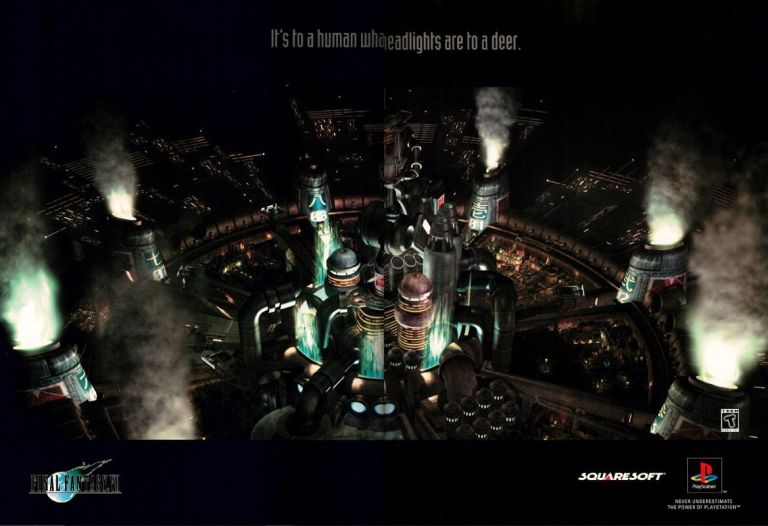
While it did not show any of the characters, this 2-page print ad of Final Fantasy VII appeared in many gaming magazines and ultimately made the public aware of the game which went on to sell millions.

There is no denying that Final Fantasy VII is the most defining Japanese RPG of the 1990s. Given its huge pre-release promotions, the critical acclaim and the tremendous sales achieved in North America and Europe, the game arguably made the JRPG sub-genre more popular among gamers and game publishers while also making the original PlayStation console the must-have machine for video gaming. The above print ad is one of several released through print media and even though it did not show any characters, the image of a futuristic looking city caught the attention of not just gamers but also others who loved entertainment.

+++++

Thank you for reading. If you find this article engaging, please click the like button below, share this article to others and also please consider making a donation to support my publishing. If you are looking for a copywriter to create content for your special project or business, check out my services and my portfolio. Feel free to contact me with a private message. Also please feel free to visit my Facebook page Author Carlo Carrasco and follow me on Twitter at  @HavenorFantasy as well as on Tumblr at https://carlocarrasco.tumblr.com/ and on Instagram at https://www.instagram.com/authorcarlocarrasco

What to watch on YouTube right now – Part 120

Welcome back my readers, YouTube viewers and all others who followed this series of articles focused on YouTube videos worth watching. Have you been searching for something fun or interesting to watch on YouTube? Do you feel bored right now and you crave for something to see on the world’s most popular online video destination?

I recommend you check out the following videos I found.

#1 Tremors Revisited – The first time I ever saw the 1990 monster adventure movie Tremors was on home video. The movie turned out to be more thrilling and more enjoyable than I expected, and eventually I replayed it a number of times on cable TV and DVD in the years after. There is already a 4K Blu-ray of Tremors that I have yet to acquire. For me, Tremors is still a significant movie to watch again and its concept of having huge monsters that travel underground is still engaging to see. As the 1990 became a massive success AFTER its not-so-hot theatrical run (note: it achieved massive success on home video sales/rentals, cable TV and the like), Tremor is now a popular part of American pop culture and it is not surprising to see many retrospective YouTube videos about it. Posted below for your enjoyment are videos I selected.

#2 Luxury Food In Japan Sold At Bargain Rates  –In Japan, there a certain types of food that are often sold at high prices in relation to their quality, availability and other socio-economic factors. Wagyu beef, for example, is a premium meat that recently has been in high demand in Japan as the very high number of foreign tourists are buying and consuming it there. Still, there are times when premium food items are temporarily sold with low prices that locals can take advantage of. Watch and learn from the Nippon TV video below.

#3 How MIT Students Used Math to Win Millions of Dollars From Casinos – When you visit a casino, you often see people placing their bets in different games of gambling. Among the most popular forms of gambling is the card game which often requires discipline, precision and luck to win. Believe it or not, there were students from the Massachusetts Institute of Technology (MIT) who were trained to win in card games with an emphasis on mathematics, discipline and teamwork. Decades ago, these students played in many casinos and won tens of millions of Dollars over a period of years before law enforcement and technology ended their streak. Watch and learn what happened in the video below.

#4 The Rise Of Solo Dining In South Korea – Have you been in South Korea over the past twelve months? Due to the rise of single-person households in the country, solo dining became a new trend there and there seems to be no sign of it slowing down. Watch the video below to discover what solo dining is and what created it.

#5 Final Fantasy IV Revisited Final Fantasy IV is the first-ever Final Fantasy game I ever played as well as one of the very first Japanese role-playing games (JRPGs) I played. The story had solid structure, the characters were memorable, the gameplay was challenging yet fun, and the fantasy settings were special. Released in America as “Final Fantasy II” on the Super Nintendo Entertainment System (SNES), the game succeeded commercially and critically, and it paved the way for the greater acceptance of JRPGs on consoles in the West. To learn more about Final Fantasy IV and why it is significant, watch the video below.

#6 Ranting For Vengeance Slams New Lara Croft – Recently a new live-action version of the video game icon Lara Croft was revealed with actress Sophie Turner playing her. This early, long-time fans of Croft and the Tomb Raider video game franchise in general rejected the newest live-action version. Ranting for Vengeance posted his own video reacting to Sophie Turner’s Lara Croft, explaining the legacy of the Tomb Raider franchise, and standing up for the long-time fans. His video is indeed critical but you have to watch it entirely to fully understand his reaction and logic. The video will also remind you that there is a woke mob out there and they are becoming the FAKE FANS of established entertainment franchises and icons.

#7 Silent Hill Movie Revisited – Just seven years after the release of the original Silent Hill video game, a live-action movie was released with the same title. While the early Silent Hill video games were critical and commercial hits, the effort to make an official film adaptation did not start immediately. In fact, Christophe Gans sent to Konami a video interview of himself (talking about Silent Hill) with Japanese subtitles which eventually convinced the publisher to award him the film rights. The Silent Hill movie did not gather much appreciation from film critics but it still succeeded in entertaining many moviegoers with its unique approach to horror and suspense. To see and feel the impact of the Silent Hill film and discover its production history, watch the videos below.

+++++

Thank you for reading. If you find this article engaging, please click the like button below, share this article to others and also please consider making a donation to support my publishing. If you are looking for a copywriter to create content for your special project or business, check out my services and my portfolio. Feel free to contact me with a private message. Also please feel free to visit my Facebook page Author Carlo Carrasco and follow me on Twitter at  @HavenorFantasy as well as on Tumblr at https://carlocarrasco.tumblr.com/ and on Instagram athttps://www.instagram.com/authorcarlocarrasco

Retro Gaming Ads Blast – Part 38

Welcome back readers, fellow geeks and electronic gaming fans!

In this edition of the Retro Gaming Ads Blast (RGAB) series, we will take a look at another batch of retro gaming print ads – including arcade flyers – from the 1980s to the 1990s.

For the newcomers reading this, Retro Gaming Ads Blast (RGAB) looks back at the many print ads of games (console, arcade, computer and handheld) that were published in comic books, magazines, flyers, posters and newspapers long before smartphones, social media, the worldwide web and streaming became popular. To put things in perspective, people back in the 1980s to the 1990s were more trusting of print media for information and images about electronic games and related products.

With those details laid down, here is the newest batch of retro gaming print ads for you to see and enjoy…

1. Starflight Sega Genesis Print Ad

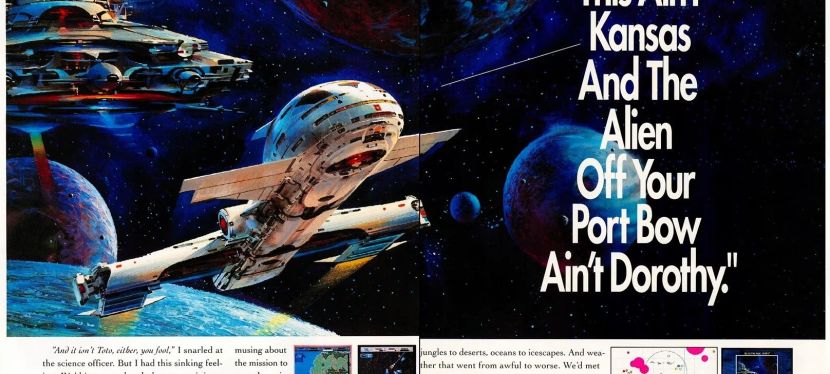
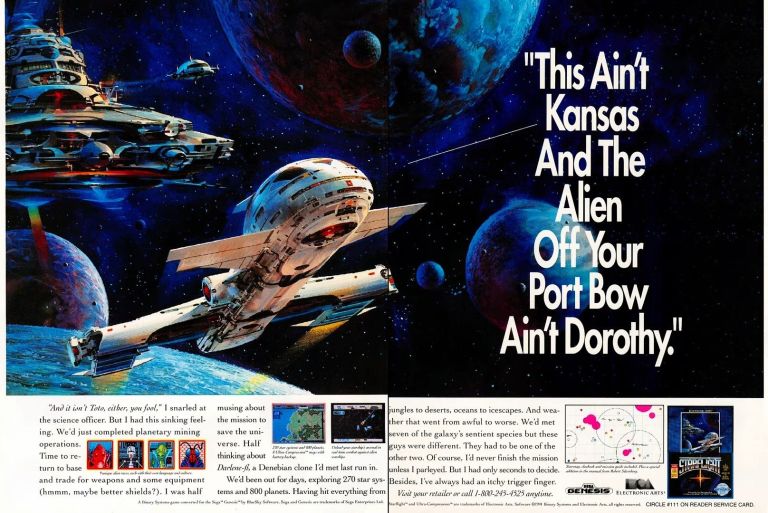
Sometimes the very detailed artwork made gamers imagine Starflight as a sci-fi movie waiting to happen.

By the time it was released on the Sega Genesis in 1991, Starflight was already popular as it was released on varied computer systems and entertained a lot of gamers several years prior. To promote the Sega Genesis version, a 2-page print ad of Starflight was made with a grand-looking artwork of space, spaceships and planets dominating the space. The ad makers managed to utilize the remaining space below the artwork to show selected images, the descriptive text and the game’s box cover to make it clear to gamers that Starflight on Genesis is real and made to be playable. The artwork itself remains a powerful grabber of attention even to this day.

2. Defender Japanese Arcade Flyer

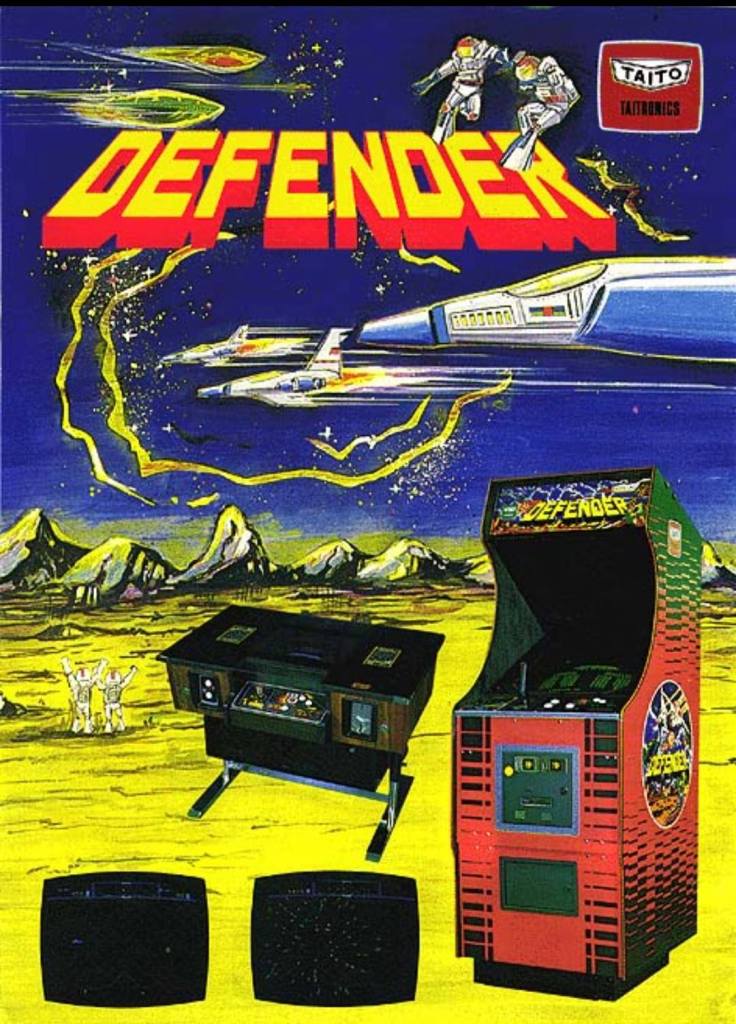
The front.
The rear.

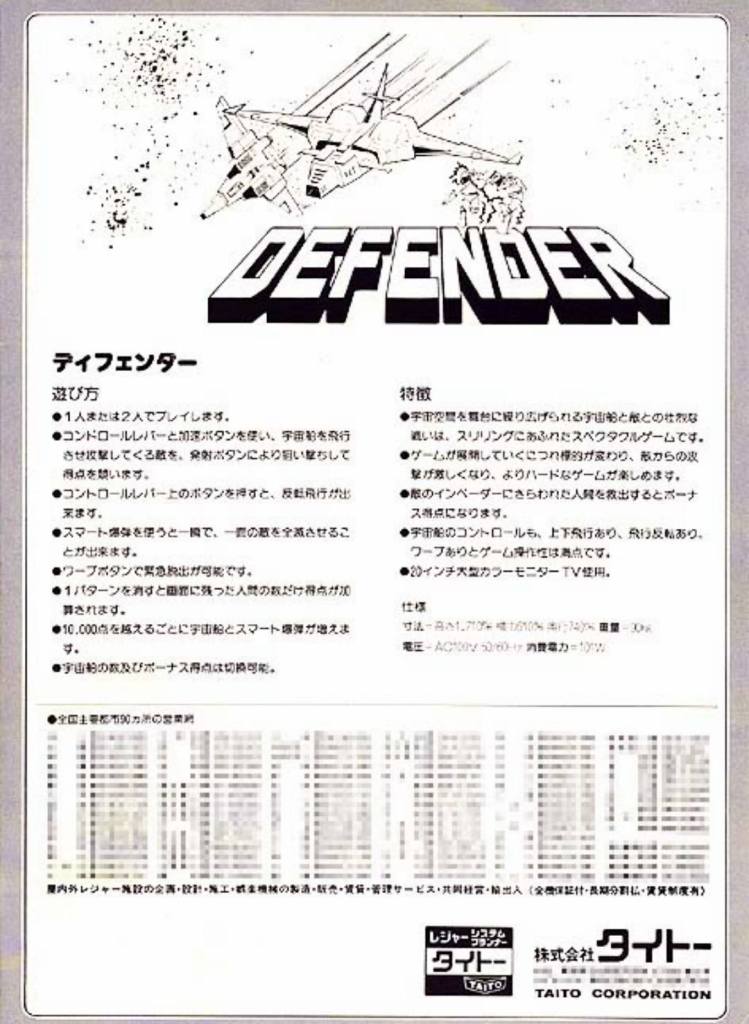
Defender is one of my favorites among the many games of Midway. In recent times, I’ve been playing the arcade version of Defender on my Xbox Series X using the Midway Arcade Origins digital copy I purchased online. As Defender became a massive hit in America, it was released in Japanese arcades with Taito handling the distribution. The arcade flyer Taito came up with used hand-drawn art for the background on the front along with pictures of the arcade cabinet and the arcade cocktail table versions of the game. While the rear of the flyer looks very simplistic, the front remains attractive to look at.

3. Castlevania III: Dracula’s Curse Print Ad

Some people found the artwork looking creepy or even terrifying.

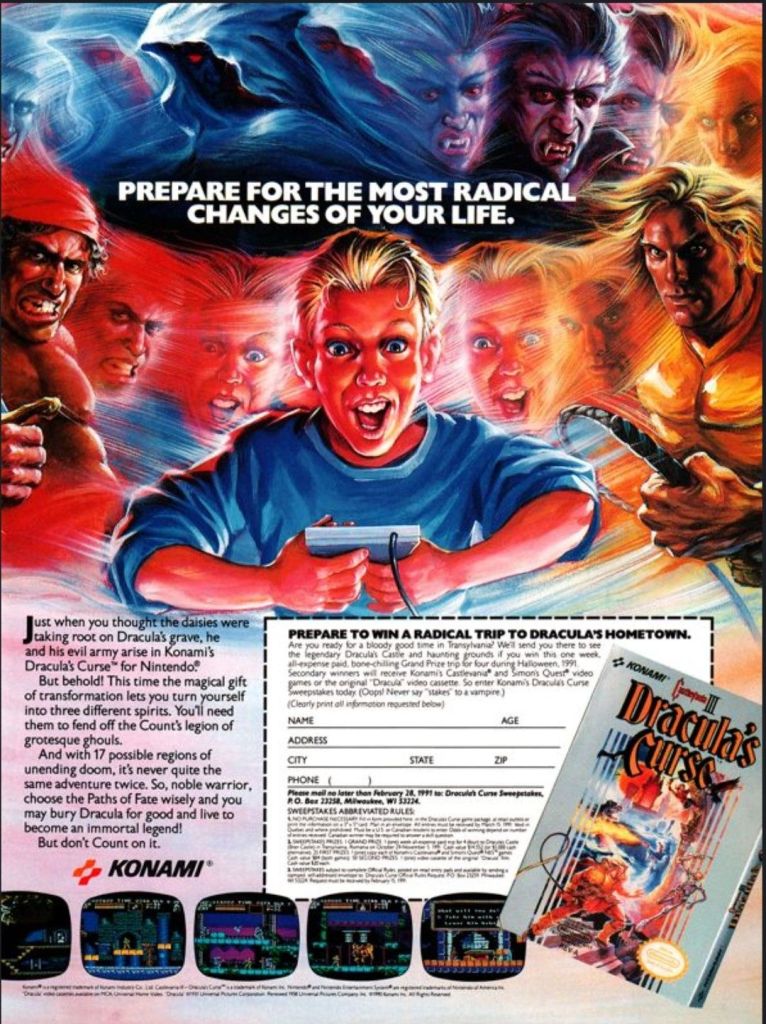
By the year 1990, the Nintendo Entertainment System (NES) was present in several millions of households all over America and there were lots of great games available. Among the NES gamers were fans of the Castlevania game series and Konami went on to release Castlevania III: Dracula’s Curse in America. As part of the company’s aggressive promotion, a single-page ad featuring a detailed looking artwork of a gamer getting immersed with the game’s fantasy elements (look at the creepy looking characters, monsters and the game’s hero present) was done. While the artwork was a strong attention grabber, what stood out was the sweepstakes form for gamers to cut out, fill it with their information and mail it for the chance to win a trip to the hometown of Dracula. Do you personally know anyone who won in the sweepstakes?

4. Double Dragon Games Print Ad

Print ad made with Double Dragon fans in mind.

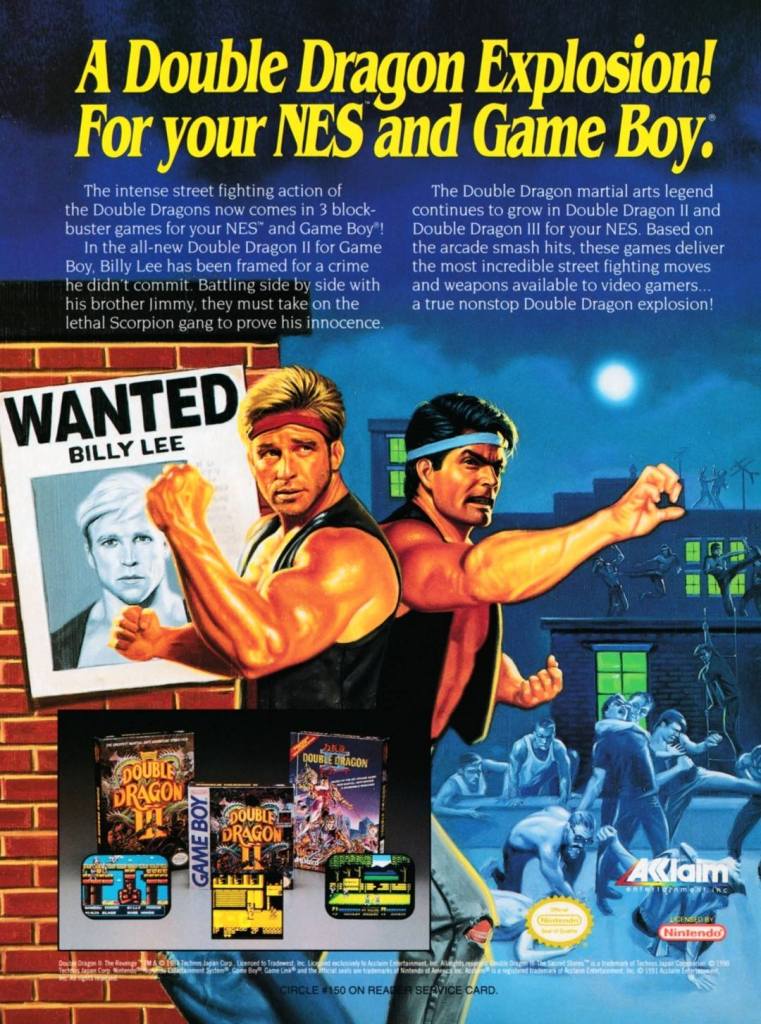
When it comes to the console and handheld presence of the Double Dragon games franchise, it was on Nintendo hardware – specifically the NES and the Game Boy – where gamers and the fans could find them. Acclaim Entertainment knew how popular Double Dragon games were with Nintendo gamers and they aggressively marketed Double Dragon III: The Sacred Stones and Double Dragon II with a single-page print ad that had great looking painted artwork. Very clearly, this early 1990s ad was made to connect strongly with Double Dragon fans and its presentation still looks very solid even with today’s standards.

5. Konami 3-in-1 Game Boy Games Print Ad

The excitement of sports is clearly shown in this old ad.

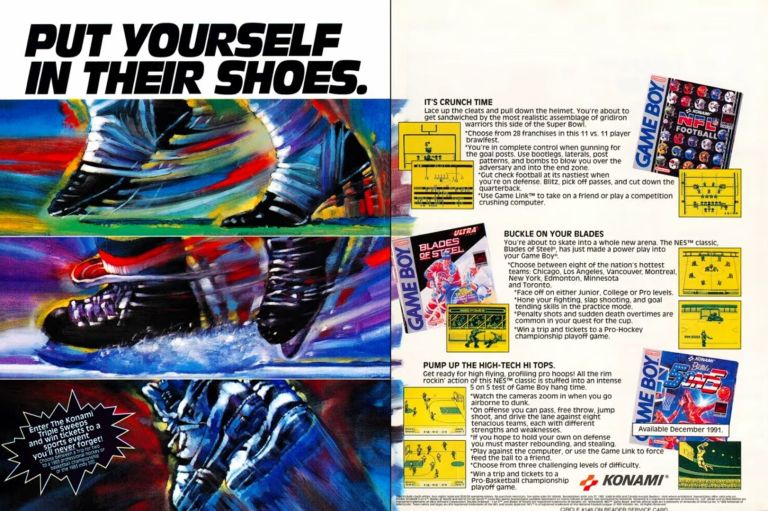
From the mid-1980s to the early 1990s, Konami published a lot of games on Nintendo’s wildly popular platform the NES and among them were classics like Contra, Castlevania and Metal Gear. Konami’s support also made it to Nintendo’s Game Boy handheld device (first released in 1989) which itself sold strongly and became the leading platform for portable gaming. As such, Konami made a 2-page print ad promoting NFL Football, Blades of Steel and Double Dribble: 5 on 5 for Game Boy. Cleverly, the ad makers used fancy artworks on the left (reflecting the different sports) side while using the space on the right side for descriptive text, screenshots and game box covers. This fine looking ad has a strong appeal towards Game Boy users and sports enthusiasts.

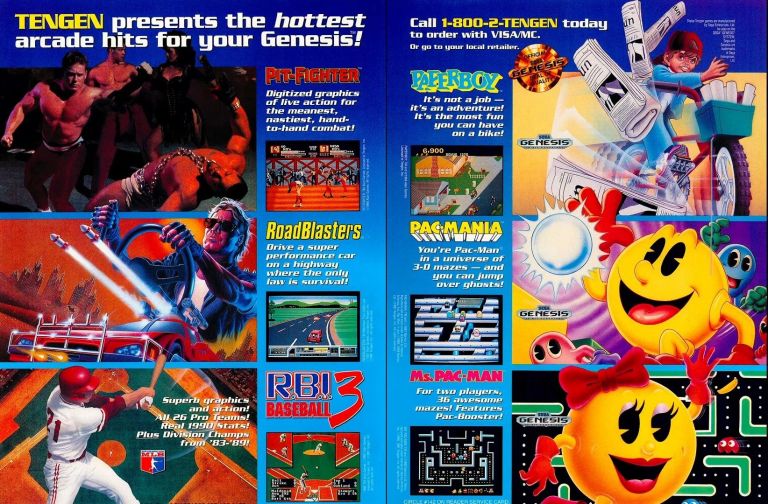
6. Tengen 6-in-1 Print Ad

This old print ad is a delight for those who owned a Sega Genesis.

Back in the 1980s, Atari formed the company Tengen to not only develop games but also publish game for computers and game consoles. During that decade, Tengen published games on the NES but they had trouble working within the strict licensing terms of Nintendo. The two companies would later get into court battles over a series of events within the gaming business. Eventually, Tengen started doing business with Sega and published games on the Genesis console. As part of their aggressive publishing of games on Sega’s console, Tengen came up with this 2-page print ad promoting six different games emphasizing that the fun arcade experiences are coming to gamers’ homes.

7. Dig Dug Print Ad

Are you aware of the business relationship and trust between Atari and Namco?

When Atari opened its branch in Japan – called Atari Japan – in the 1970s, they established a partnership with Namco to distribute arcade games there. As they experienced trouble penetrating the Japanese market, Atari eventually sold Atari Japan to Namco which paved the way for their Japanese partner to get into video games. Just a few years later, Namco developed its own original arcade game Dig Dug which became a massive hit in Japan. As a licensing deal was already in effect, Atari distributed Dig Dug in American arcades which the above magazine print ad clearly shows.

8. Sega Genesis Over SNES Print Ad

Sega directly attacked Nintendo by emphasizing the larger quantity of games and varied game experiences that can only be found on the Genesis back then.

By the time Nintendo released the Super Nintendo Entertainment System (SNES) in 1991, the Sega Genesis console has been in the video game market for a few years already. In America, Tom Kalinske led Sega and his approach to marketing and resonating with gamers was essentially aggressive. The aggressive approach includes naming their competition and showing why Sega is superior. Given the lead time they had on the North American market, Sega came up with this print ad showing their Genesis consoles having a lot more games than the SNES. Competitive console gaming was very different back then.

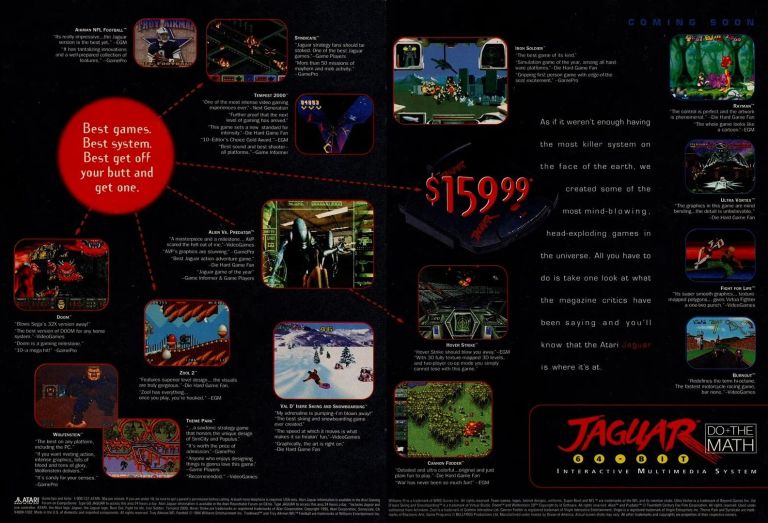
9. Atari Jaguar Print Ad

Did you spend $159.99 on an Atari Jaguar console back in the 1990s?

In the 1990s, Atari attempted a comeback in console gaming with the Atari Jaguar console. Early on, their marketing emphasized the so-called 64-bit capabilities of the Jaguar to convince gamers theirs is the most powerful console on the market. Sadly, the console failed to achieve strong sales and a huge price cut was executed. To attract customers, Atari came up with this 2-page print ad to inform them of the cheaper $159.99 price while reminding them of the “most mind-blowing, head-exploding games” they can have with the Jaguar. Obviously this ad campaign failed as the Atari Jaguar never achieved commercial success.

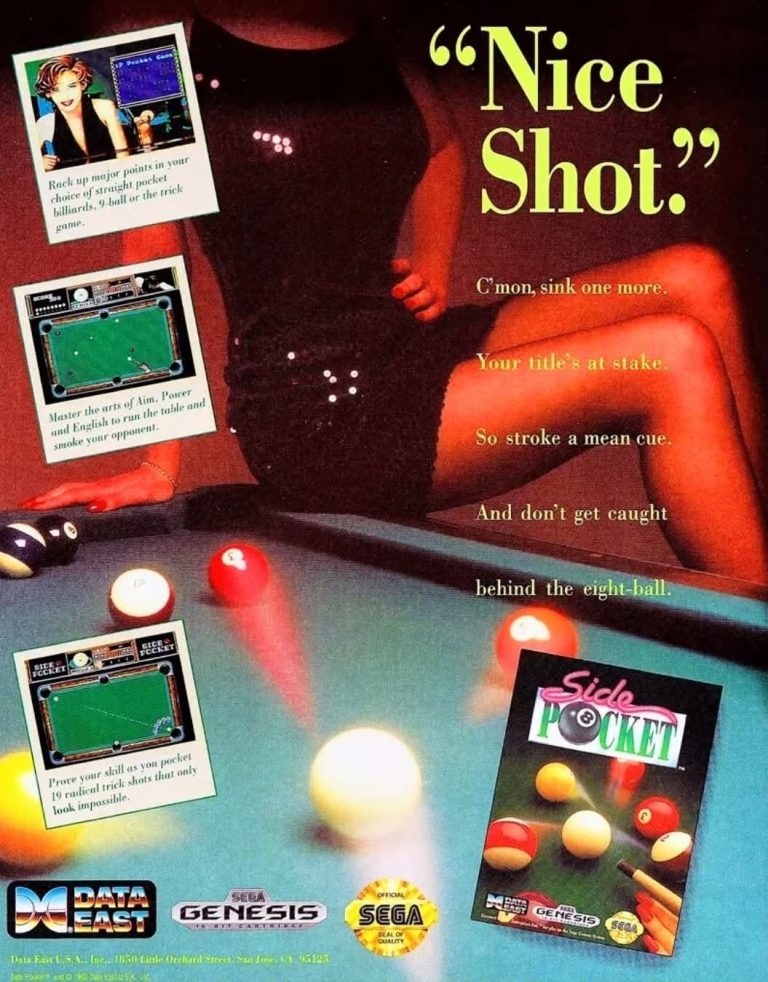
10. Side Pocket Print Ad

The Side Pocket print ad with a subtle touch of sexiness.

After its original release in the arcades in 1986, Side Pocket was ported by Data East to many consoles and handheld devices in the 1990s. When it comes to promoting the Sega Genesis version, Data East came up with this print ad showing a lady in a sexy dress in the background (head hidden) which instantly created a sexy aesthetic. The large text displayed emphasized the game of billiards supported by the screenshots shown. The screenshot at the upper-left corner shows artwork of a pretty lady smiling at the viewer which added to the sexy aesthetic of the ad.  

+++++

Thank you for reading. If you find this article engaging, please click the like button below, share this article to others and also please consider making a donation to support my publishing. If you are looking for a copywriter to create content for your special project or business, check out my services and my portfolio. Feel free to contact me with a private message. Also please feel free to visit my Facebook page Author Carlo Carrasco and follow me on Twitter at  @HavenorFantasy as well as on Tumblr at https://carlocarrasco.tumblr.com/ and on Instagram at https://www.instagram.com/authorcarlocarrasco
Retro Gaming Ads Blast – Part 37

Welcome back readers, fellow geeks and electronic gaming fans!

In this edition of the Retro Gaming Ads Blast (RGAB) series, we will take a look at another batch of retro gaming print ads – including arcade flyers – from the 1970s to the 1990s.

For the newcomers reading this, Retro Gaming Ads Blast (RGAB) looks back at the many print ads of games (console, arcade, computer and handheld) that were published in comic books, magazines, flyers, posters and newspapers long before smartphones, social media, the worldwide web and streaming became popular. To put things in perspective, people back in the 1970s and 1990s were more trusting of print media for information and images about electronic games and related products.

With those details laid down, here is the newest batch of retro gaming print ads for you to see and enjoy…

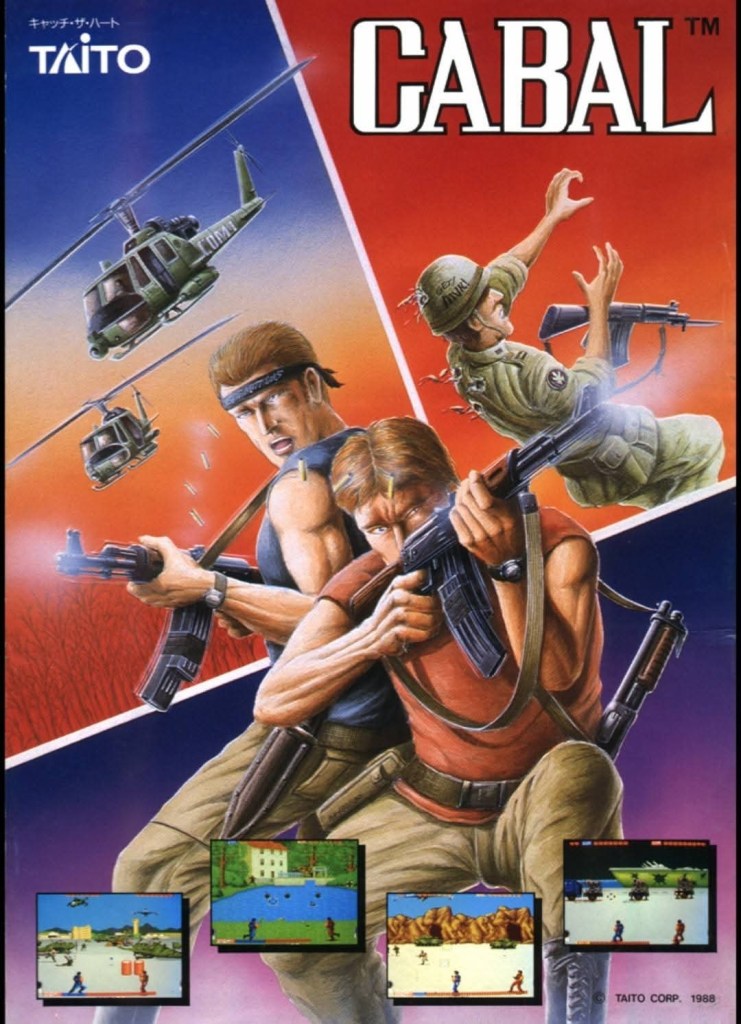
1. Cabal Japanese arcade flyer/poster

Can you feel the action and intensity here?

When it was first released in video arcades in Japan in late 1988, Cabal was another game inspired by military action movies of Hollywood which explains the art work done for the arcade flyer and poster shown above. The Vietnam War was still fresh in people’s minds and the concept of having one or two players firing their weapons against enemy soldiers resonated with gamers who saw Hollywood’s military action flicks. That said, it is not surprising that Cabal became a huge hit in Japan before getting released in arcades around the world.

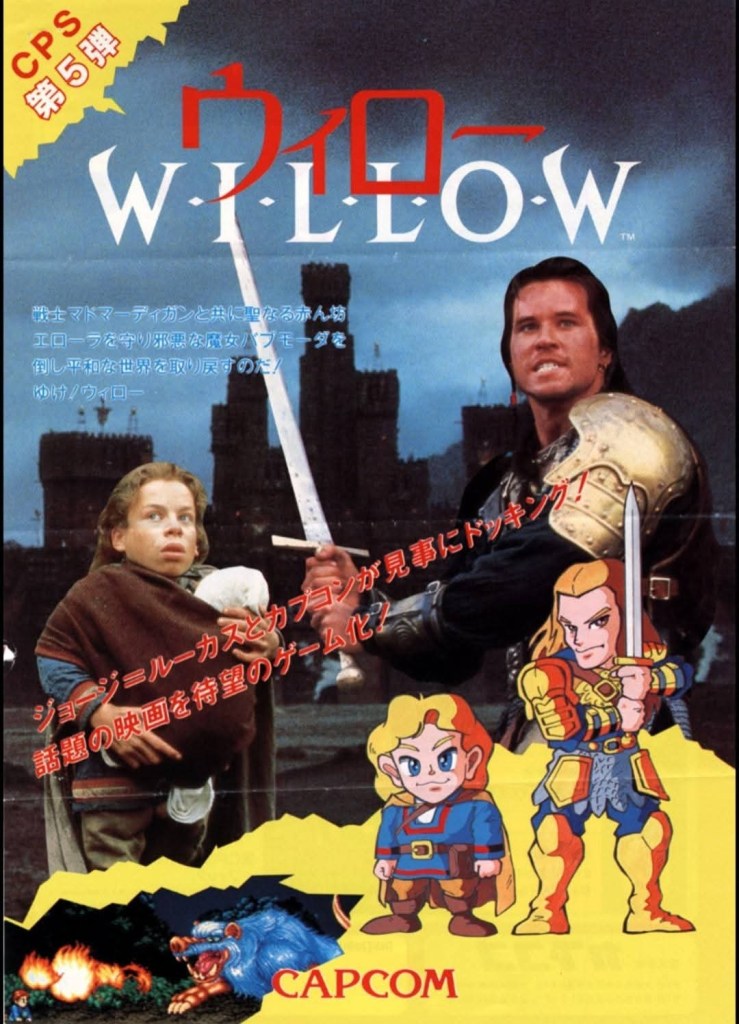
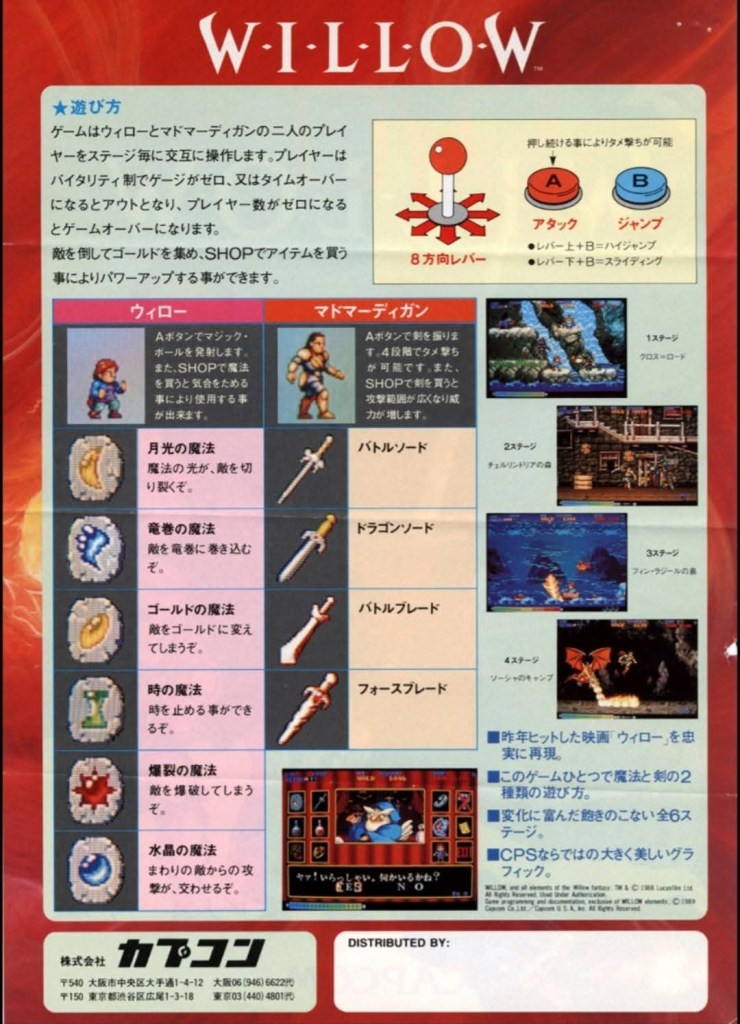
2. Willows Japanese arcade flyer

The front.
The rear.

Remember the 1988 high fantasy adventure film Willow? That film was produced by George Lucas and was a bold new production of Lucasfilm shifting away from Star Wars. Believe it or not, an official arcade game adaptation of Willow was made by Capcom and they promoted it by having images of Val Kilmer and Warwick Davis on the front of the arcade flyer (opposite the illustrated versions of their characters). The game, which was a side-scrolling platform game with run-and-gun elements, went on to be an arcade hit in Japan and eventually pleased gamers worldwide.

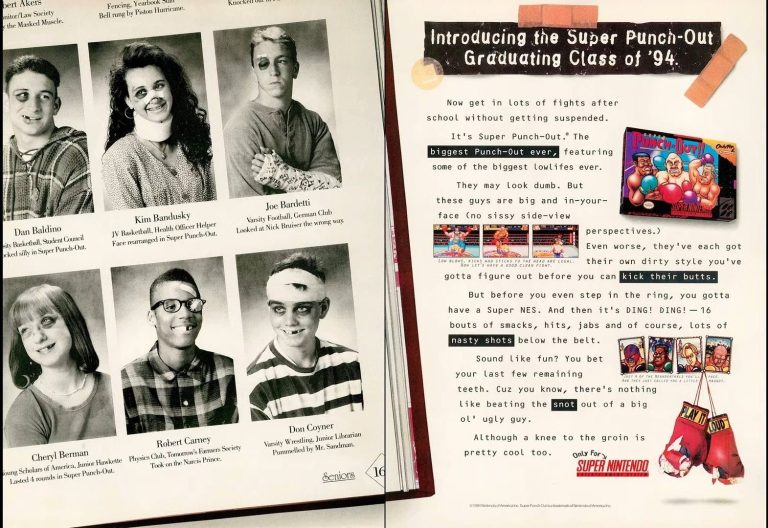
3. Super Punch-Out!! North American print ad

This is funny to look at.

Historically, Nintendo’s Punch-Out!! series started in the arcade in 1984 and the first game was the result of the company’s effort to make a new game using arcade cabinets with two screens. The 2nd game – Mike Tyson’s Punch-Out!! – became a huge critical and commercial hit (over 2 million copies sold in 1988) on console and it made great business sense for Nintendo for release another Punch-Out!! for its console gamers to enjoy in the comfort of home. In 1994, Super Punch-Out!! was released on the Super Nintendo Entertainment System (SNES) in America and to promote it, the company came up with a hilarious 2-page ad that showed fictional high school graduates with boxing-related injuries. The imagery creatively connected with the words “biggest Punch-Out ever” and “Graduating Class of ‘94”.

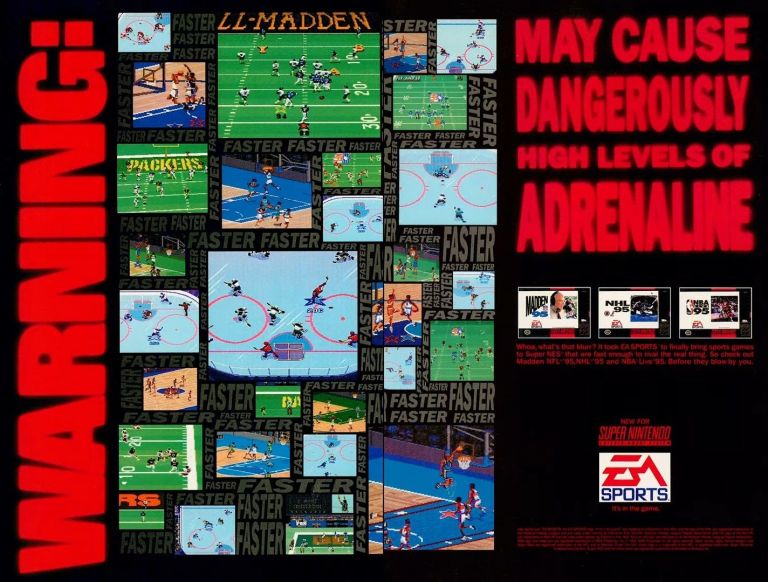
4. EA Sports 3-in-1 SNES games print ad

EA Sports games on the SNES.

In 1994, Electronic Arts (EA) released their sports games NBA Live 95, NHL 95 and Madden NFL 95 for consoles at the time. Even though the Sega Genesis sold better than Super Nintendo Entertainment System (SNES) in America at the time, EA went on to aggressively market their 3 sports video games on Nintendo’s console using a 3-in-1 games print ad. In retrospect, the SNES for the most part had better graphics and sounds than the Genesis which is reflected clearly on EA Sports games of the time. This print ad still looks fun and exciting.  

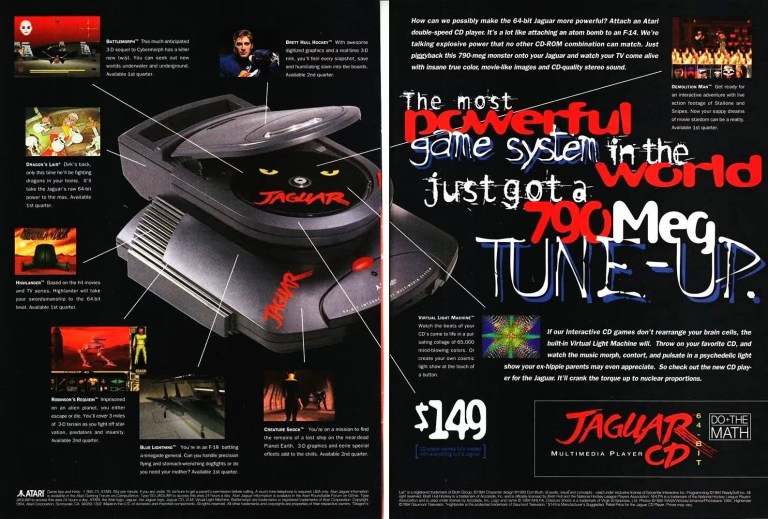
5. Atari Jaguar CD print ad

Were you able to play any game on the Atari Jaguar with the CD add-on included?

Apart from the obvious advances of technology that impacted video games, the 1990s is also known for the rise of CD-ROM as a medium for gaming. In an effort to boost sales of the Atari Jaguar console (launched in America in 1993 for around $250) and capitalize on the trust of the fans and console owners, Atari launched a CD-ROM add-on device for about $150 in 1995. To promote it, the company went aggressive with the 2-page ad showing the add-on fully connected on top of the main console, showing off some games and posting a text description emphasizing hardware power and the advantages that come with the CD technology. Even in the captured image, the Atari Jaguar CD still resembled a toilet. This is an aggressive ad campaign that failed as less than 20,000 Atari Jaguar CD units were sold by the time it was discontinued in 1996.

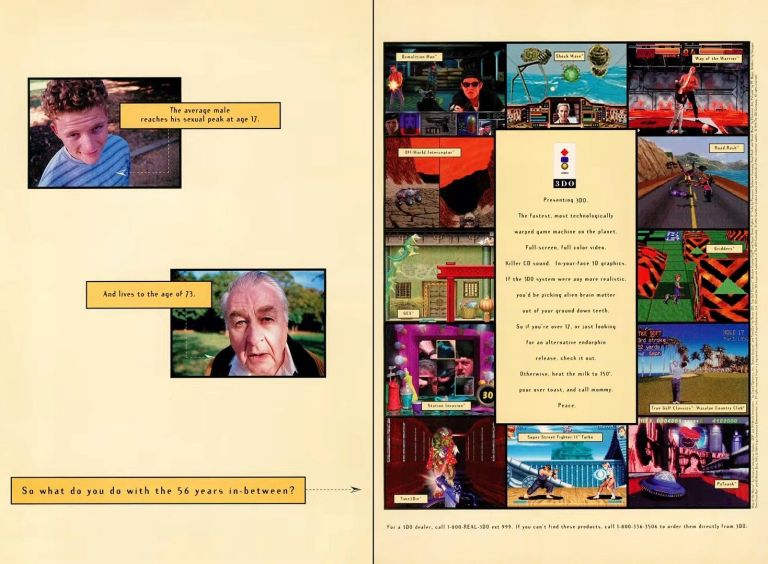
6. 3DO print ad

While it lacks intensity, this 3DO ad emphasized the games.

Without showing any hardware, the 3DO Company came up with this 2-page print ad that had a slightly adulterated tone (look at the left page) and aggressively marketed the 3DO console games available at the time. Games like Demolition Man, Shock Wave, Road Rash and Super Street Fighter II Turbo were the standout titles which clearly showed the company made the effort to emphasize gaming more than multimedia features. This 1990s ad tackled the generations with a touch of humor.

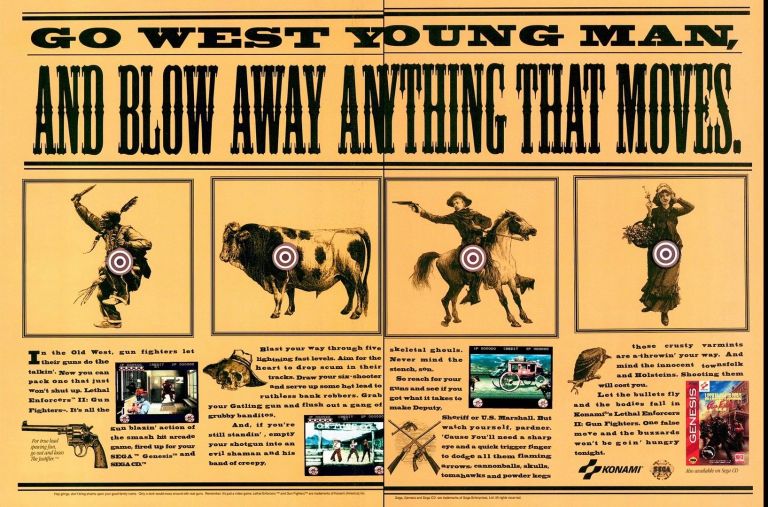
7. Lethal Enforcers II: Gun Fighters Sega Genesis print ad

This is a fun ad to look at.

When Lethal Enforcers II: Gun Fighters was released in the arcades in 1994, it became a commercial success for Konami which went on to announce it would port the game to consoles of Nintendo and Sega at the time. While the port for the Super Nintendo Entertainment System (SNES) was never released, Lethal Enforcers II: Gun Fighters made its way to the Sega Genesis and Sega CD. The print ad of the Sega Genesis version (Sega CD mentioned in small text) had an inspired design emphasizing the Old West, shooting and the conflict between cowboys and Indians. The screenshots gave people the clear idea that Old West was the setting (versus modern day in the previous game). This is still fun to look at.

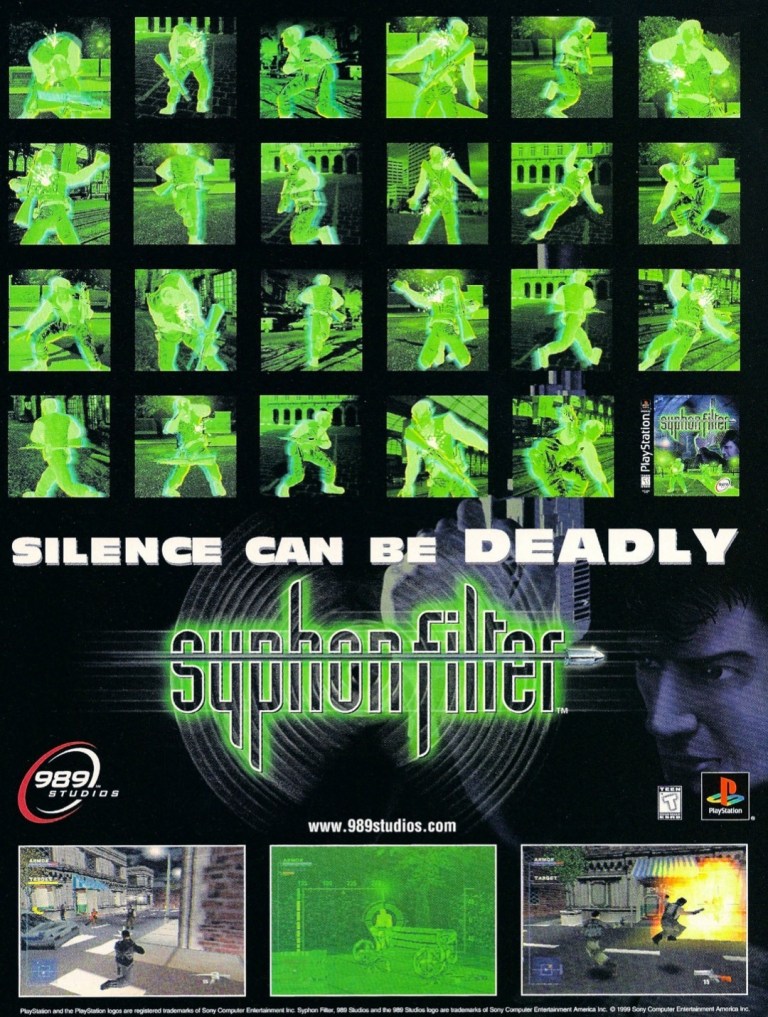
8. Syphon Filter

Syphon Filter went on to become a surprise hit game in 1999.

In 1999, Sony’s 989 Studios released Syphon Filter exclusively on the PlayStation console. This single-page print ad showed a few screenshots on the bottom and several action snippets with a night vision touch ultimately emphasizing the stealth aspect within the gameplay. The marketing proved to be effective as the game sold a lot at retail and went on to establish a new game franchise exclusive to PlayStation consoles.

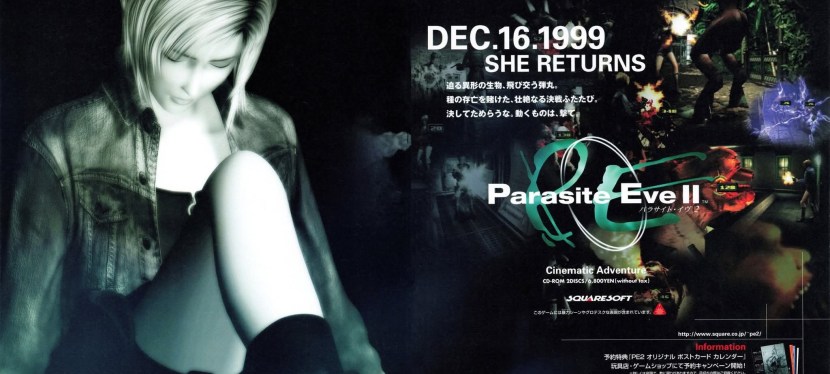
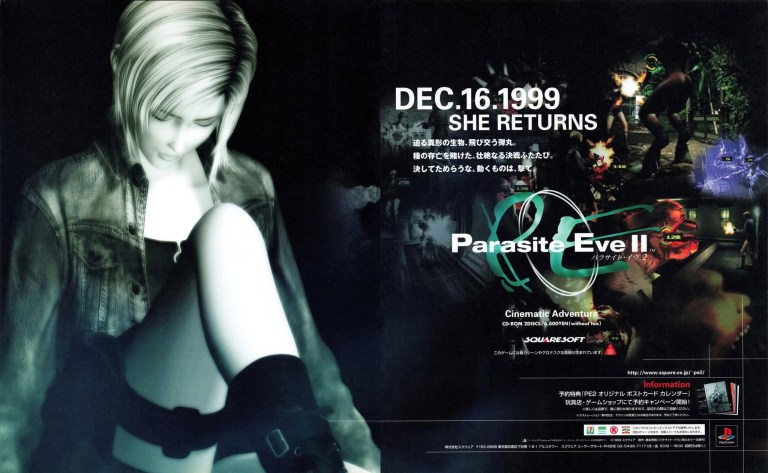
9. Parasite Eve II Japanese print ad

Were you a big fan of Aya Brea and the Parasite Eve franchise in the late 1990s?

Following the critical and commercial success of Parasite Eve in 1998, SquareSoft proceeded with Parasite Eve II and the production (note: initially for a spin-off game before becoming a sequel) did not even involve the main creators of the first game. Instead the company had a different team of developers – including those who previously worked on Resident Evil games for Capcom – in Osaka to make the sequel. This explains why Parasite Eve II had stronger survival horror gameplay resembling a Resident Evil game. As major changes were made during the production, it was decided that Aya Brea would become the main protagonist and already the character was already popular with gamers. That being said, the marketing of Parasite Eve II for the Japanese market heavily featured Aya Brea with subtle sexiness, beauty and action in mind. The marketing intensified leading to its eventual December 16, 1999 release in Japan.

+++++

Thank you for reading. If you find this article engaging, please click the like button below, share this article to others and also please consider making a donation to support my publishing. If you are looking for a copywriter to create content for your special project or business, check out my services and my portfolio. Feel free to contact me with a private message. Also please feel free to visit my Facebook page Author Carlo Carrasco and follow me on Twitter at  @HavenorFantasy as well as on Tumblr at https://carlocarrasco.tumblr.com/ and on Instagram at https://www.instagram.com/authorcarlocarrasco
Retro Gaming Ads Blast – Part 36

Welcome back readers, fellow geeks and electronic gaming fans!

In this edition of the Retro Gaming Ads Blast (RGAB) series, we will take a look at another batch of retro gaming print ads – including arcade flyers – from the 1970s to the 1990s.

For the newcomers reading this, Retro Gaming Ads Blast (RGAB) looks back at the many print ads of games (console, arcade, computer and handheld) that were published in comic books, magazines, flyers, posters and newspapers long before smartphones, social media, the worldwide web and streaming became popular. To put things in perspective, people back in the 1980s and 1990s were more trusting of print media for information and images about electronic games and related products.

With those details laid down, here is the newest batch of retro gaming print ads for you to see and enjoy…

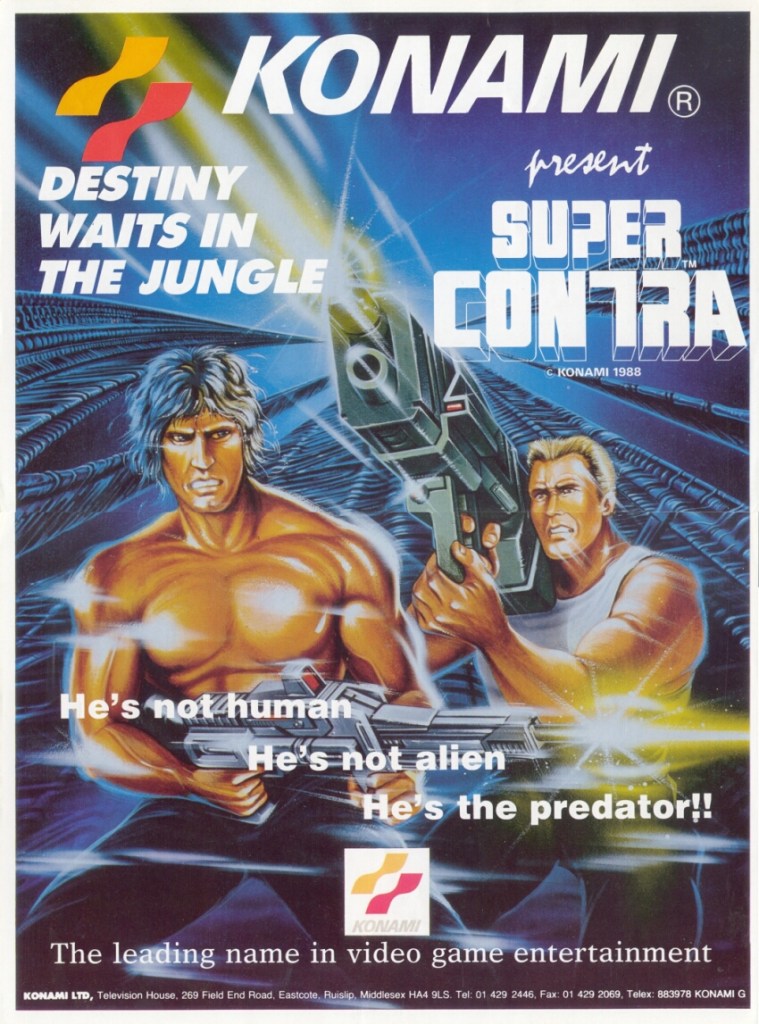
1. Super Contra North American arcade flyer

Have you seen many Hollywood action movies of the 1980s? Does this arcade flyer remind you of something?

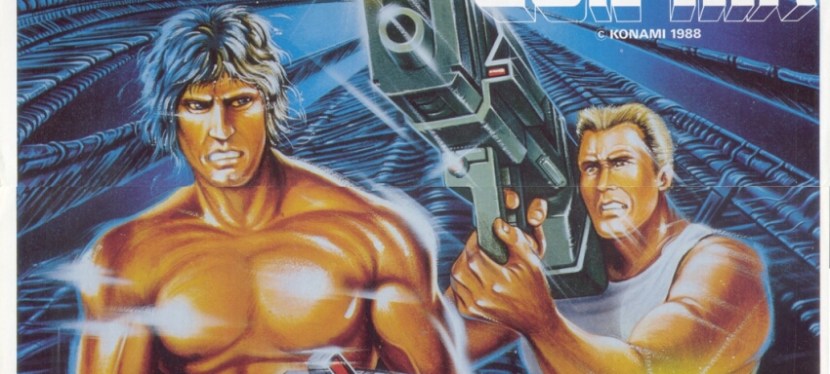
After Konami struck gold with Contra in 1987, it was inevitable that sequels and spin-offs will be made. In 1988, they released the follow-up Super Contra in the arcades and to promote it in America, the company came up with artwork that easily gave gamers the impression they are seeing Sylvester Stallone as a fantasized Rambo and another armed guy who might remind them of Arnold Schwarzenegger’s character in Commando or Dutch in Predator. To capitalize on the movie references even more, the American arcade flyer had the line “He’s not human. He’s not alien. He’s the predator!!” As it was the 1980s, this creative approach to promotion was not surprising as Konami and its game makers were influenced by Hollywood movies.

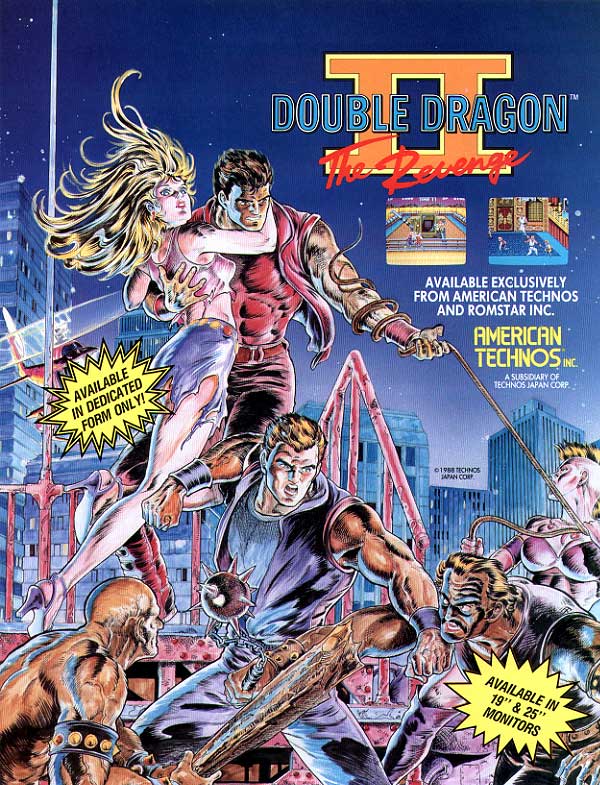
2. Double Dragon II: The Revenge North American arcade flyer

The artwork used in this arcade flyer remains intriguing to look at.

I never played Double Dragon II: The Revenge in the arcade, but I played it on the Nintendo Entertainment System (NES). That being said, I was surprised to see how this old North American arcade flyer has the same hand-drawn artwork used on the cover of the NES version. Take note that the arcade game was released in 1988 while the NES port was released in early 1990. I can only guess that Technos decided to use the same artwork not only for convenience but to have a definitive image emphasizing Double Dragon II to gamers wherever they are.

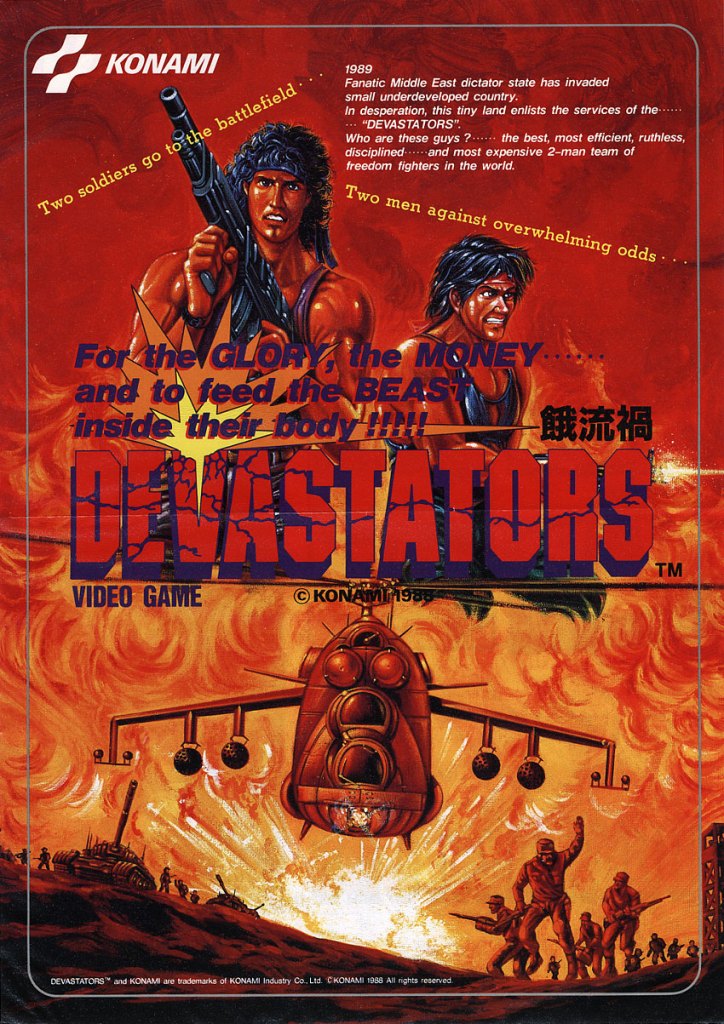
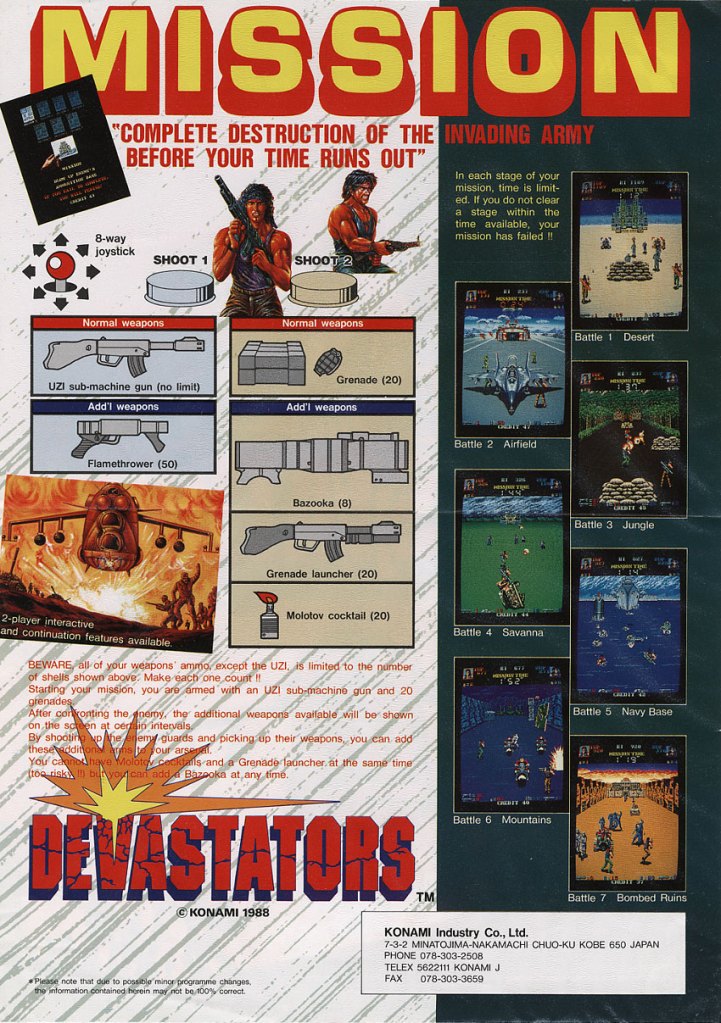
3. Devastators North American arcade flyer

The front.
The rear.

Devastators is another Konami arcade game that had a strong war theme and it was influenced by Hollywood action films of the 1980s. This particular arcade flyer for the North American market is almost identical with the Japanese arcade flyer as both have the same artwork on the front and almost the same visual layout on the rear. The most obvious difference is the use of English text for the North American flyer.

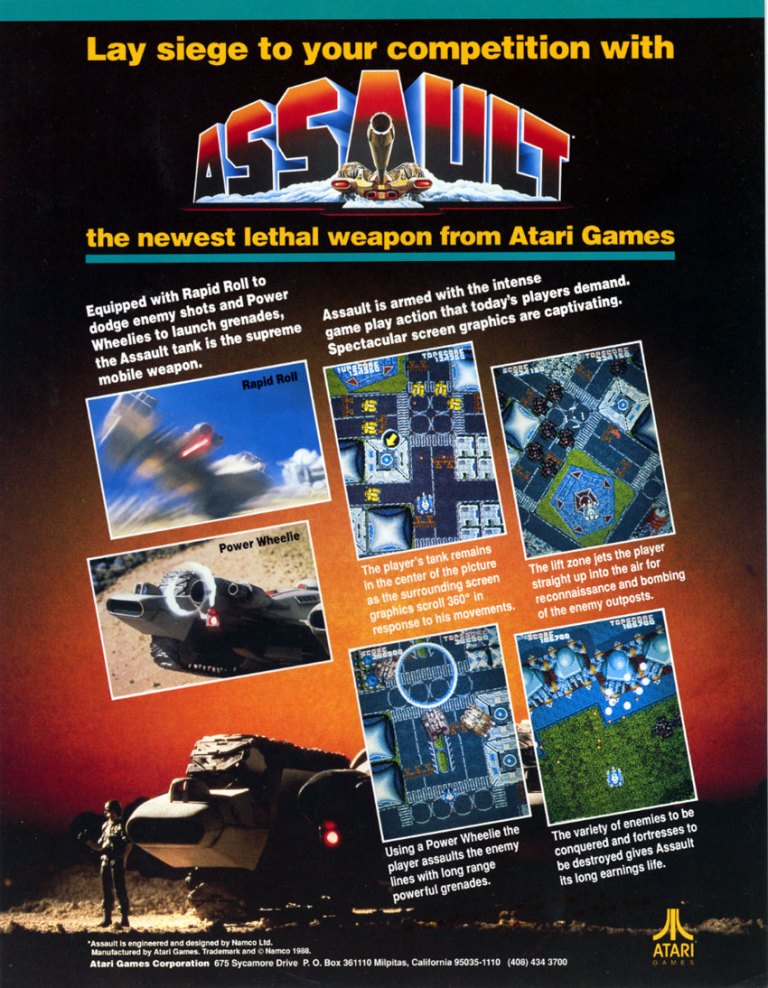
4. Assault North American arcade flyer

The front.
The rear.

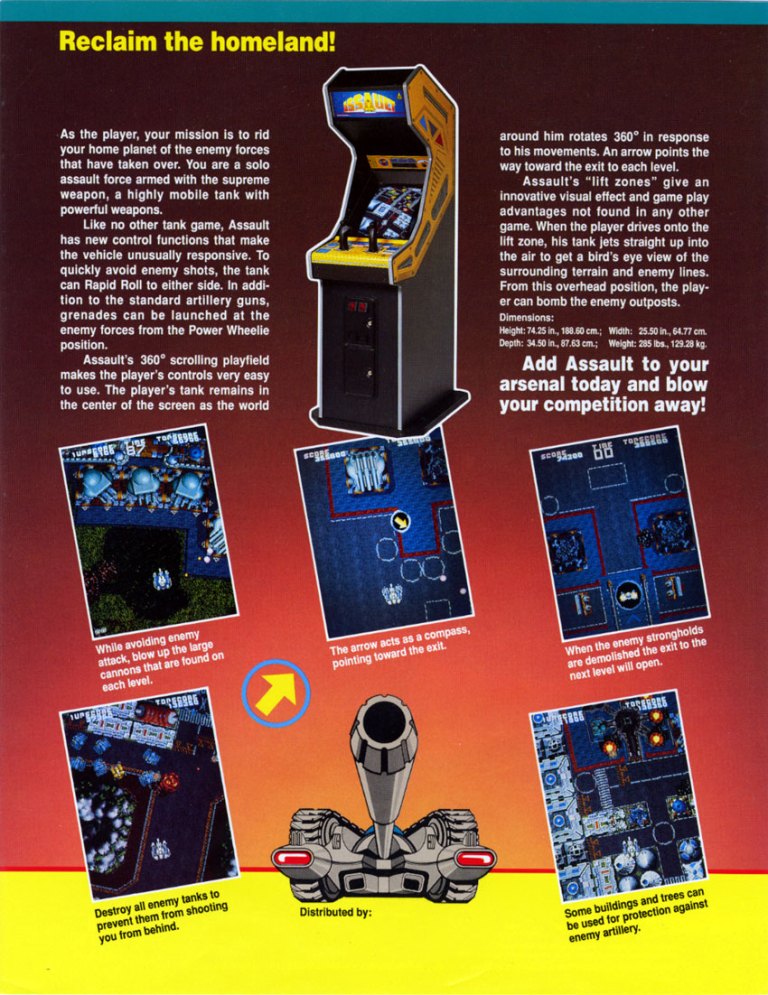
Released in American arcades by Atari, Assault is a multi-directional shooter that had a twin-stick control layout (similar with the classic Battlezone) and players experienced intense battles as well as immersive visual effects such as sprite scaling and environment rotation of up to 360 degrees. To promote the game (this originated in Japan by Namco), Atari came up with this arcade flyer that had selected screenshots and descriptive text on both the front and the rear (which showed the arcade cabinet). Assault was a hit with gamers at the arcades and it was not released on consoles until 2009.

5. Sega CD print ad

Having a socially relevant message can be catchy but it leaves little room for excitement.

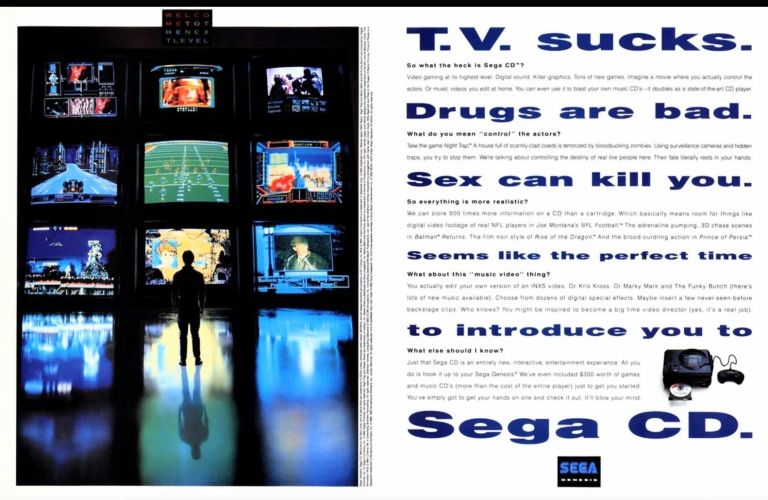
As the Sega Genesis console became a huge commercial success in North America, Sega itself became ambitious about what CD-ROM technology would do for video games. Sega in Japan tasked its Consumer Products Research and Development Labs to create a CD-ROM add-on which resulted in the Sega CD (Mega-CD in other parts of the world) which launched in America in 1992. To promote the add-on towards existing Genesis console owners as well as potential new customers, Sega of America came up with the above 2-page print ad that had a social message on the right and an image of a man standing in front of large monitors (showing Sega CD game footage) on the left. While it looked like an odd way of promoting video game hardware, it still remains catchy to see.

6. Panasonic 3DO print ad

Panasonic knows how to promote entertainment hardware for people’s homes.

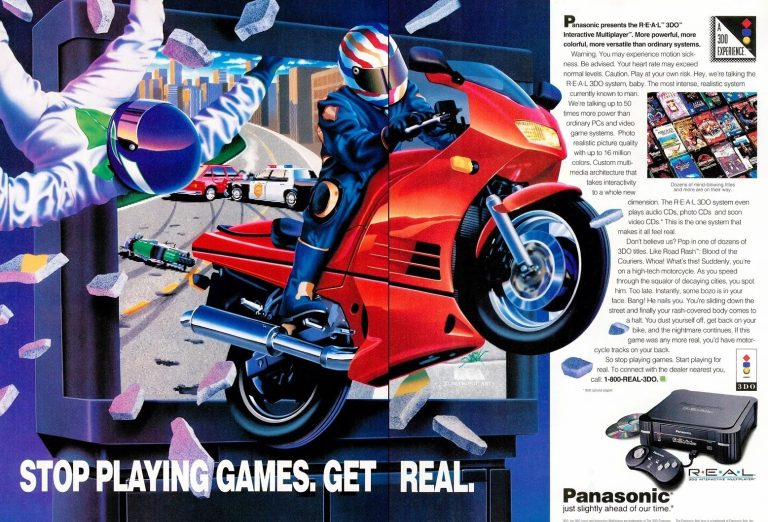
Still in the field of CD-ROM gaming, Panasonic had competitive presence in video gaming when its Panasonic FZ-1 R.E.A.L. 3DO Interactive Multiplayer (with technology licensed by The 3DO Company) was launched in America in 1993. If you look at the print ad closely, you will notice that the descriptive text emphasized the multimedia entertainment aspect more than video gaming. The dominating artwork used does not come from a particular video game as it was made to emphasize home entertainment in general. It’s not surprising that the Panasonic 3DO and other 3DO machines from other manufacturers failed commercially.

7. Shaq Fu print ad

The close-up of Shaquille O’Neal’s face on the left made him looked less recognizable.

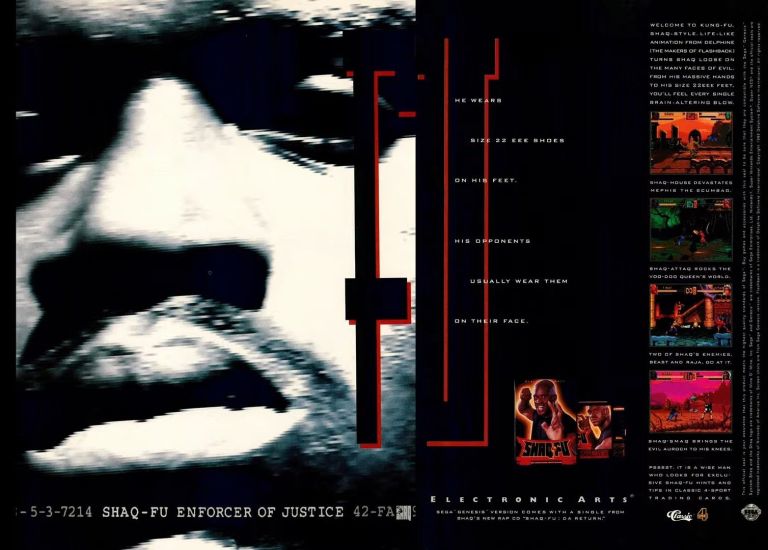
Yes, it is true! There was indeed a video game endorsed by Shaquille O’Neal and it was not a basketball game. Shaq Fu is a 1994 2D fighting game with adventure elements and a story in which gamers play O’Neal as martial artist (note: O’Neal himself participated in the game’s production). To promote the game, Electronic Arts came up with a 2-page print ad that had a very odd black-and-white close-up image of O’Neal’s face on the left leaving small screenshots and hard-to-read text on the right (even though there was some vacant space remaining. I remember seeing this ad while reading a video game magazine and the ad ended up looking more like a promotion of O’Neal (already an NBA superstar) than the game itself. By today’s standards, this print ad is an example of a marketing misfire.

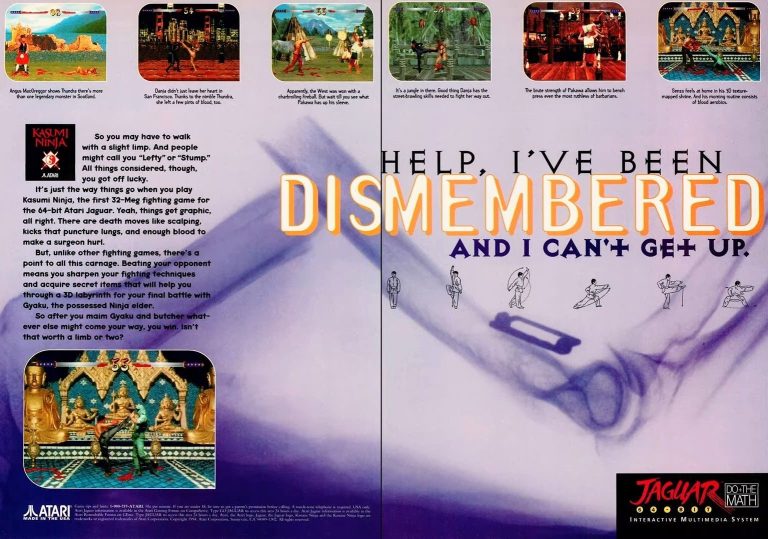
8. Kasumi Ninja print ad

Do you even remember seeing this print ad in magazines?

Remember the 1990s video game trends of digitized human images and disturbingly violent 2D fighting games sparked by Mortal Kombat? The Atari Jaguar-exclusive game Kasumi Ninja was made to capitalize on those trends and it failed badly. Apart from the low sales of the Jaguar console, Atari as publisher came up with the above 2-page print ad that was not appealing to gamers’ eyes and it had almost no excitement overall. This is another marketing misfire.

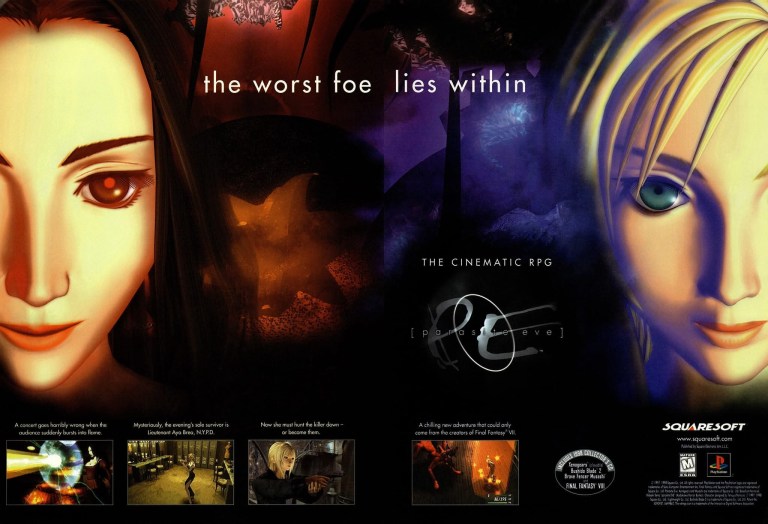
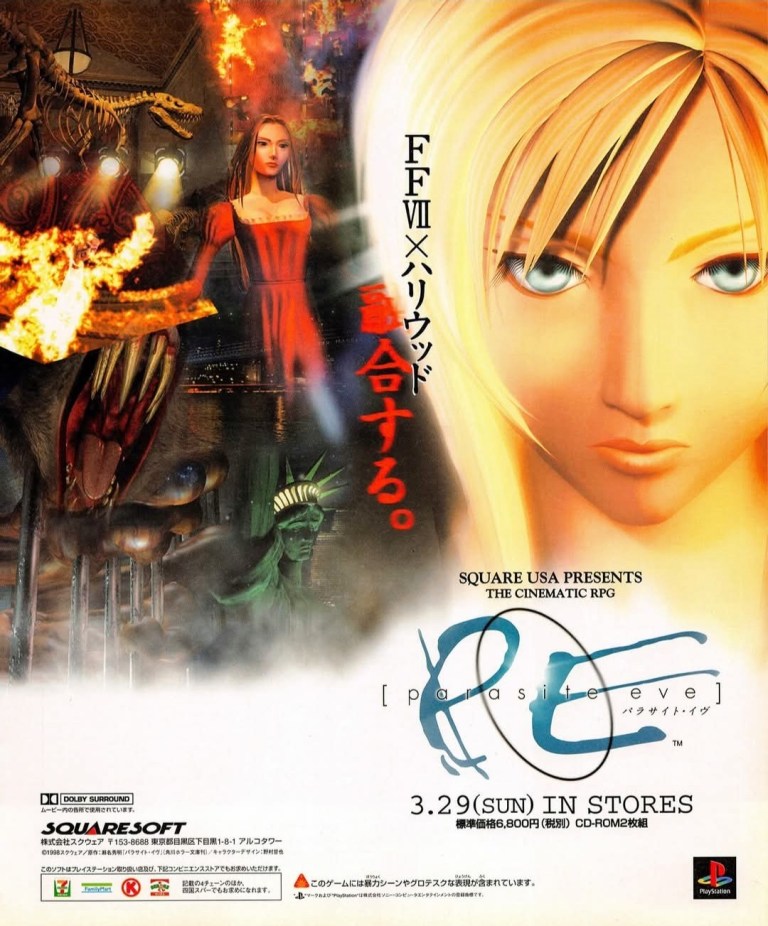
9. Parasite Eve North American and Japanese print ads

Following the successful release of Final Fantasy VII, this ad excited PlayStation gamers and JRPG enthusiasts for Parasite Eve’s 1998 release in America.
A stronger horror presentation in this print ad for the Japanese market. There were already a lot of people in Japan who enjoyed horror.

Starting in the mid-1990s, Squaresoft (now Square Enix) really became aggressive with video game creativity and experimentation as they launched several new projects that eventually got released on PlayStation in the late 1990s until 2000. One of those daring new projects was Parasite Eve which was a role-playing game (RPG) that had visual elements – particularly pre-rendered backgrounds – and a style of exploration that reminded gamers of Resident Evil. The game was a sequel to the Japanese science fiction horror novel of the same name and it involved the creativity of Final Fantasy creator Hironobu Sakaguchi (credited as producer). To promote the game, the 2-page North American print ad had protagonist Aya Brea on the right and the enemy on the left with a cryptic line placed strategically between them. The North American ad clearly stated that the game is a cinematic RPG. By comparison, the Japanese print ad of Parasite Eve has a strong horror vibe which is not surprising because of the novel’s horror elements and the fact that Squaresoft was capitalizing on the popularity of horror-related entertainment in Japan. By today’s standards, Parasite Eve is truly a product of the late-1990s and it has a dedicated fanbase.

+++++

Thank you for reading. If you find this article engaging, please click the like button below, share this article to others and also please consider making a donation to support my publishing. If you are looking for a copywriter to create content for your special project or business, check out my services and my portfolio. Feel free to contact me with a private message. Also please feel free to visit my Facebook page Author Carlo Carrasco and follow me on Twitter at  @HavenorFantasy as well as on Tumblr at https://carlocarrasco.tumblr.com/ and on Instagram at https://www.instagram.com/authorcarlocarrasco
What to watch on YouTube right now – Part 102

Welcome back my readers, YouTube viewers and all others who followed this series of articles focused on YouTube videos worth watching. Have you been searching for something fun or interesting to watch on YouTube? Do you feel bored right now and you crave for something to see on the world’s most popular online video destination?

I recommend you check out the following videos I found.

#1 CinePals react to Predator 2 – I saw Predator 2 a number of times since the 1990s. I even reviewed the first issue of its 2-part comic book adaptation. Predator 2 was essentially a police story with science fiction elements mixed in and it was a worthy sequel. That being said, I saw a lot of Predator 2 reaction videos on YouTube and in my view, the reaction video by CinePals is the most entertaining one yet. Watch the video below.

#2 How AMD overtook Intel – Do you own a personal computer that has an AMD chip inside it? Mine does not but our Xbox Series X console has. In the world of business, the rivalry between AMD and Intel on CPUs has lasted for decades. While Intel led the industry for a very long time, it has gradually lost market share to AMD over the past several years. The company behind Ryzen and Athlon CPUs bounced back significantly under the leadership of Lisa Su and their alliance with TSMC was a great gamble that paid off well. Watch and learn from the video below.

#3 Do You Like Japanese Pork Cutlet? – When was the last time you had a pork cutlet for a meal? In Japan, their pork cutlet called Tonkatsu is popular and there are lots of food joints that offer it to customers. Tonkatsu is composed of a breaded, deep-fried pork cutlet, and historically it started during the Meiji era in the late 20th century. I recently discovered a YouTube video about one particular Japanese food joint that offer Tonkatsu that look large. Watch and enjoy the video below.

#4 Clash of the Titans (1981) Reaction Videos by Rhetorical Thrill and You, Me and The Movies  – As a very young boy, I was fortunate enough to have seen the fantasy film Clash of the Titans inside the movie theater. The 1981 film was also the final work of stop-motion visual effects legend Ray Harryhausen and it had Burgess Meredith (the same actor who played Rocky’s trainer in the first 3 Rocky movies) in a key supporting role. I found two entertaining movie reaction videos of Clash of the Titans (1981) from You, Me and the Movies and Rhetorical Thrill. I encourage you to watch their respective videos below.

#5 Get To Know IMAX Better  – You may have seen some movies inside an IMAX theater but are you aware of what IMAX really is apart from the experience of seeing a movie on a very large screen? IMAX is a brand, a special film format, a series of large cameras, a chain of special cinemas and an enterprise to say the least. Among the Hollywood directors, Christopher Nolan is the most prominent one who uses IMAX cameras in films like Dunkirk, Interstellar, Oppenheimer and his two last Batman movies. You can learn more about what makes IMAX different from the rest by watching the video below.

#6 Ashleigh Burton Reacts to Iron Eagle – What is there to say about the movie Iron Eagle? A movie about fighter planes and American military culture, the film was released the same year as the more famous Top Gun. I only saw the film on home video but in 1986, I had friends who were raving about Iron Eagle. That said, you should watch Ashleigh Burton’s reaction video about the old movie.

#7 A Look At Silent Hill 2 – Back in 2001, I still remember there was a lot of pre-release hype for the video game Silent Hill 2. Released on the PlayStation 2 and the original Xbox console (Silent Hill 2: Restless Dreams), the game went on to achieve big commercial and critical success. To this day, a lot of gamers called Silent Hill 2 as the most definitive game of the entire Silent Hill game franchise. To know more about the history and production of Silent Hill 2, watch the video below.

+++++

Thank you for reading. If you find this article engaging, please click the like button below, share this article to others and also please consider making a donation to support my publishing. If you are looking for a copywriter to create content for your special project or business, check out my services and my portfolio. Feel free to contact me with a private message. Also please feel free to visit my Facebook page Author Carlo Carrasco and follow me on Twitter at  @HavenorFantasy as well as on Tumblr at https://carlocarrasco.tumblr.com/ and on Instagram athttps://www.instagram.com/authorcarlocarrasco
What to watch on YouTube right now – Part 101

Welcome back my readers, YouTube viewers and all others who followed this series of articles focused on YouTube videos worth watching. Have you been searching for something fun or interesting to watch on YouTube? Do you feel bored right now and you crave for something to see on the world’s most popular online video destination?

I recommend you check out the following videos I found.

#1 Rhetorical Thrill’s First Blood Reaction Video – I have seen a lot of movie reaction videos of First Blood on YouTube, and almost all of them were by YouTubers who really never saw the said Rambo movie before. For the newcomers reading this, First Blood was released in 1982 starring Sylvester Stallone at a time when the Vietnam War was still fresh in the minds of many Americans. The film was a crucial success for the production company Carolco and its theme music from Jerry Goldsmith made waves in pop culture easily reminding people about Rambo. Recently I took time out to watch Rhetorical Thrill’s First Blood reaction video which is entertaining to see as her reactions were really catchy. As First Blood is a classic among American action films and films related to the Vietnam War, I encourage you all to watch it entirely first if you have not seen it. Otherwise, enjoy Rhetorical Thrill’s reaction video below.  

#2 Silent Hill (1999) Retrospective – I played Silent Hill a lot on PlayStation in 1999. I got far into the game’s story and through the many settings and challenges, but ultimately I never finished it. It was not just unique horror-themed video game. Silent Hill was very atmospheric and its approach on storytelling contributed a lot video gaming as a whole. If you want to discover who were the people responsible for Silent Hill and what the game had to offer, watch the two retrospective videos below.

#3 AI: Artificial Intelligence Revisited – AI (artificial intelligence) is wildly popular with people today for various purposes. Long before AI became a popular digital tool, the themes about artificial intelligence in general was explored by Steven Spielberg in a movie project that previously involved Stanley Kubrick (who died in 1999). That film was AI: Artificial Intelligence directed by Spielberg and released in 2001. I saw the movie on home video but it never engaged me. Of course, that did not stop AI: Artificial Intelligence from being featured in retrospective videos, review videos and movie reactions. To see what Spielberg’s movie is about, watch the selected videos below.

#4 Ashleigh Burton Reacts To The Land Before Time – What can be said about the 1988 animated movie The Land Before Time? It was directed by American animation legend Don Bluth and it involved Steven Spielberg and George Lucas as executive producers. More notably, the movie was about a group of young, talking dinosaurs who go on a series of unexpected events and adventuring which touched a lot of moviegoers back in 1988. That being said, Ashleigh Burton’s reaction video is a must-see.

#5 Ramen In Osaka  – It has been almost thirty years since my first and only visit to Osaka in Japan. I had a fun few days of touring Osaka and there was a series of new discoveries I enjoyed there. I just could not remember eating ramen there. As such, I found a video about a certain ramen shop that has been serving customers with delicious meals for at least forty years now. You can learn about how ramen is prepared and what it takes to make delicious ramen that will keep customers coming back for more.

#6 You, Me and the Movies React To Pee-wee’s Big Adventure – What was the directorial debut of Tim Burton? It was in Pee-wee’s Big Adventure, a comedy adventure film starring the late Paul Reubens and released in 1984. Some fans of the film called it a classic of the comedy genre and one of the funniest Hollywood comedies of the 1980s. The film keeps on making viewers laugh or smile, and you can see why by watching the reaction video of You, Me and the Movies below.

#7 The Assassination of Charlie Kirk Exposes The Evil Of The Leftists – I have said it before and will say it again…the Left is so evil and so twisted, it is truly Satanic. I am referring to the woke, the Islamo-Leftists, the liberals, the socialists, the Communists and the more. To put things in perspective, a lot has happened since the assassination of Charlie Kirk who was an American patriot, a true family man, an ally of Israel and a faithful follower of Lord Jesus. His assassination drew cheers and celebration among the Leftists which exposed further the burning evil deep within them. The Leftists are so pathetic, they and their mainstream news media partners-in-crime are LYING to the people about the assassin Tyler Robinson and about the victim Kirk. Even Bethesda – the game publisher behind The Elder Scrolls video game franchise – shamelessly mocked Kirk via social media before deleting its Tweet. Watch and learn from the videos below.

+++++

Thank you for reading. If you find this article engaging, please click the like button below, share this article to others and also please consider making a donation to support my publishing. If you are looking for a copywriter to create content for your special project or business, check out my services and my portfolio. Feel free to contact me with a private message. Also please feel free to visit my Facebook page Author Carlo Carrasco and follow me on Twitter at  @HavenorFantasy as well as on Tumblr at https://carlocarrasco.tumblr.com/ and on Instagram athttps://www.instagram.com/authorcarlocarrasco
What to watch on YouTube right now – Part 100

Welcome back my readers, YouTube viewers and all others who followed this series of articles focused on YouTube videos worth watching. Have you been searching for something fun or interesting to watch on YouTube? Do you feel bored right now and you crave for something to see on the world’s most popular online video destination?

I recommend you check out the following videos I found.

#1 Christine Grace Smith Reacts To A Video About Society Impacted When No Men Are Working – There is something new and engaging to learn about society whenever Christine Grace Smith posts a new video. Recently, she shared her own reaction to a video that explores what would happen to society if men stopped working. This is something that the woke and rabid modern-day feminists do not want you to see. I urge you all to watch her video now.

#2 Metal Gear Games Revisited – In connection with the recent release of Metal Gear Solid Δ: Snake Eater, it was not surprising that a lot of YouTube videos revisiting past Metal Gear games got published by different YouTubers. Some of those videos I found were entertaining to watch while others were reflective or even intriguing. For the newcomers reading this. The Metal Gear game franchise of Konami started in the late 1980s under Hideo Kojima when he was very young. That being said, I urge you all to take a look at the selected Metal Gear-related videos I shared below.

#3 How Alan Moore And Watchmen Spread The Wokeness Disease In Comics – YouTuber Ranting for Vengeance is back, and this time he strikes hard at author Alan Moore not personally but for sowing the seeds of wokeness in superhero comics with Watchmen as the turning point. By today’s standards, wokeness is the unfortunate new normal in superhero comics and it is a fact that Alan Moore is an anarchist and a Leftist as well. Watch and learn from the video below.

#4 Robin Hood: Men in Tights Revisited – Long ago, there were several comedy films made by Mel Brooks which delivered bouts of humor to moviegoers and raked in varying amounts in ticket sales. In the 1990s, he directed Robin Hood: Men in Tights which my friends enjoyed watching inside the movie theater. While the film is not a classic by any means – not even within the comedy genre – it still managed to entertain YouTubers through their reaction videos. Watch the selected reaction videos below.

#5 The Traditional Types of Food of Japan  – While you may have enjoy varied types of food of Japan served through the many Japanese restaurants around the world, are you aware that there certain meals or delicacies of the nation that were simply not made available through those places? That being said, it would be enlightening – and even tasty – for you to visit Japan and try out the more traditional types of food the nation has to offer. Indeed, there are the 100-year food declared in Japan and you can learn more about them by watching the video below.

+++++

Thank you for reading. If you find this article engaging, please click the like button below, share this article to others and also please consider making a donation to support my publishing. If you are looking for a copywriter to create content for your special project or business, check out my services and my portfolio. Feel free to contact me with a private message. Also please feel free to visit my Facebook page Author Carlo Carrasco and follow me on Twitter at  @HavenorFantasy as well as on Tumblr at https://carlocarrasco.tumblr.com/ and on Instagram athttps://www.instagram.com/authorcarlocarrasco
What to watch on YouTube right now – Part 98

Welcome back my readers, YouTube viewers and all others who followed this series of articles focused on YouTube videos worth watching. Have you been searching for something fun or interesting to watch on YouTube? Do you feel bored right now and you crave for something to see on the world’s most popular online video destination?

I recommend you check out the following videos I found.

#1 The Fly Revisited – In 1986, The Fly was released in cinemas and it impacted the science fiction genre, the horror genre and pop culture with body horror presentation under the direction of David Cronenberg. The film, which was a remake of the 1958 original, established Geena Davis and Jeff Goldblum as cinematic artists. The movie even became an allegory about AIDS and how people care about those who are living with diseases. That being said, it is not surprising that The Fly became the subject of many YouTube videos in the form of retro reviews, reaction videos and trivia videos. To enjoy The Fly, watch the selected videos below…

#2 Steve Ditko Remembered – Are you familiar with the late illustrator Steve Ditko? He was the co-creator of Spider-Man and he illustrated the first 38 issues of The Amazing Spider-Man comic book series. Unlike the other Spider-Man co-creator Stan Lee (who went on to be famous and celebrated a lot), Ditko had a low-key profile and did not want to be interviewed. If you want to learn more about the late illustrator, watch the video below.

#3 Pro-Palestine Activist Riddhi Patel Bashes City Officials And Threatens Them With Violence – I have seen a lot of Islamo-Leftist activists and zealots. Most of the time, they hate Israel and took sides with Palestinians and the Islamic terrorists. Also many of them activists are so extreme, they became entitled, arrogant and disrespectful to higher authorities. In the Communist state of California, the pro-Palestine activist Riddhi Patel spoke to city officials of Bakersfield and went as far as threatening them with violence. She even misused the name of Jesus. In her own words, Patel said “We’ll murder you.” To find out more, watch the video from SaharTV below.

#4 Wood-Fired Rice Balls Served By Store in Japan – Have you eaten any freshly cooked onigiri (Japanese rice ball) lately? I live here in the Philippines and because onigiri is not a common food, my only options are to buy them from the convenience store or from a foreign food vendor. In Japan, onigiri is widely available and customers can avail of them freshly cooked. There is this store in Japan that sells onigiri which are prepared with rice (cooked by wood fire) and fresh ingredients. Watch and learn from the video below.

#5 Meet The Programmer Behind The Classic Game Centipede  – While I never had the chance to play the classic Atari game Centipede in the arcades in the 1980s, I played the Atari 2600 port a lot and enjoy it. Because I have a copy of the Atari 50 collection on my Xbox Series X, I am able to play the Centipede arcade version in the comfort of home. For the newcomers reading this, Centipede is a tremendous success in the arcades ending up as one of the Top 4 arcade games of 1982 in America. It was also ported to many consoles and home computers years later. Recently, I found a YouTube video featuring Dona Bailey, one of the programmers behind Centipede.

+++++

Thank you for reading. If you find this article engaging, please click the like button below, share this article to others and also please consider making a donation to support my publishing. If you are looking for a copywriter to create content for your special project or business, check out my services and my portfolio. Feel free to contact me with a private message. Also please feel free to visit my Facebook page Author Carlo Carrasco and follow me on Twitter at  @HavenorFantasy as well as on Tumblr at https://carlocarrasco.tumblr.com/ and on Instagram athttps://www.instagram.com/authorcarlocarrasco