Finally, the P18 billion GCash deal was sealed by Ayala Corp. and Mistubishi Corporation resulting in equal ownership of AC Ventures Holding Corp. which itself has a stake in the e-wallet giant’s operator, according to a Daily Tribune business news report. Take note, however, that the big deal is still subject to approval by regulators. The deal between the two corporations was previously disclosed last October.
To put things in perspective, posted below is an excerpt from the report of the Daily Tribune. Some parts in boldface…
Ayala Corp. (AC) and Japan’s Mitsubishi Corp. (MC) have finalized a P18.4-billion agreement that will give them equal ownership of AC Ventures Holding Corp. (ACV), which holds a stake in GCash operator Mynt.
In a disclosure to the stock exchange on Wednesday, Ayala said it formally signed an investment agreement with Mitsubishi last 31 March for the subscription to 18,033,946 common and redeemable preferred shares of ACV.
AC noted that the agreement amends a previous disclosure from 18 October 2024, which outlined a binding term sheet between the two firms. The proceeds of the transaction will be used to redeem AC’s redeemable preferred shares in ACV and cover related costs.
The deal, however, remains subject to regulatory approvals, including amendments to ACV’s articles of incorporation by the Securities and Exchange Commission and clearance from the Philippine Competition Commission.
Ayala President and CEO Cezar Consing previously said that the tie-up with Mitsubishi “can add meaningful value to Mynt, which will allow Mynt to deliver significant value to its over 94 million registered users.”
Ayala announced plans to bring in a strategic investor in August last year to strengthen GCash, which saw a surge in popularity during the pandemic. The conglomerate invested P22.4 billion in Mynt, increasing its stake in Globe Telecom, Inc.’s fintech arm.
Let me end this post by asking you readers: What is your reaction to this recent development? Do you think improvements with GCash will be realized under the Ayala-Mistubishi deal? Do you think the sealed deal will eventually get approved by the regulators? If you are a GCash user, what kind of improvements do you hope to see?
Welcome back my readers, YouTube viewers and all others who followed this series of articles focused on YouTube videos worth watching. Have you been searching for something fun or interesting to watch on YouTube? Do you feel bored right now and you crave for something to see on the world’s most popular online video destination?
I recommend you check out the following topics and the related videos I found.
#1 Popcorn in Bed reacts to The French Connection – The tribute to the late Gene Hackman continues. This time, however, it is the turn of Popcorn in Bed to do so by means of posting a reaction video of the classic film The French Connection. Hackman won the Academy Award for Best Actor as a result of playing Popeye Doyle in the film. If you have not seen The French Connection yet, watch it entirely first. Otherwise, watch Popcorn in Bed’s video.
#2 JFK Assassination records released – Recently the government of the United States officially released tens of thousands of pages of varied documents related to the 1963 assassination of US President John F. Kennedy. Unsurprisingly, the media and legal analysts are highlighting the records released and it is expected that new revelations could alter both public perception and historical recording of the tragedy of November 22, 1963. This development is one of the fulfilled promises of US President Donald Trump whose administration includes JFK’s nephew Robert Kennedy, Jr. Watch and learn from the selected videos below.
#3 Ashleigh Burton reacts to Unforgiven – When was the last time you saw Clint Eastwood in a Western? Eastwood’s last Western was 1992’s Unforgiven which he directed and won big in the Academy Awards in 1993. The movie also had the late Gene Hackman, Morgan Freeman and the late Richard Harris. Recently, Asheligh Burton posted her reaction video of the movie and it is entertaining. The late Hackman won the Academy Award for Best Supporting Actor in Eastwood’s movie. Given its high importance, Unforgiven has to been seen first before you (who have not seen it yet) watch the reaction video below.
#4 PatmanQC examines RoboCop versus The Terminator video games – Way back in 1992, I was excited to learn about the comic book crossover mini-series of RoboCop versus The Terminator (read my retro reviews by clicking here, here, here and here). In 1993, my excitement got reignited when the video games featuring the two sci-fi icons in another crossover got released. Unfortunately, I never got to play any of those games. In retrospect, the Terminator-RoboCop crossovers became important pieces of pop culture regardless of entertainment format, and if you want to learn about the history of the video games, watch PatmanQC’s in-depth RoboCop versus The Terminator video below.
#5 Assassin’s Creed Shadows controversies and the criticism against it – By the time you are reading this, Ubisoft’s highly controversial and condemned big-budget video game Assassin’s Creed Shadows is already available, and I have no intention to play it. I already played some games of the long-running Assassin’s Creed series but ultimately I never became a fan of it. For the newcomers reading this, Assassin’s Creed Shadows has been controversial and criticized for some time now due to a variety of reasons such as the game developers’ lack of respect towards the Japanese, the false portrayal of Yasuke as a Samurai (note: the historical Yasuke NEVER became a Samurai), insertions of wokeness (the result of DEI in Ubisoft) and more.
I really don’t like it when Leftist activists working in game companies insert their delusions and toxic values into video games which has been going on for many years now. The Assassin’s Creed Shadows controversies clearly rocked Ubisoft and brought down its credibility a lot. Video games are supposed to be fun, not interactive pieces of Leftist, woke and LGBTQ propaganda. To learn more and find out why, watch the videos below.
Welcome back readers, fellow geeks and electronic gaming fans!
In this edition of the Retro Gaming Ads Blast (RGAB) series, we will take a look at another batch of retro gaming print ads – including arcade flyers – from the 1980s and 1990s.
For the newcomers reading this, Retro Gaming Ads Blast (RGAB) looks back at the many print ads of games (console, arcade, computer and handheld) that were published in comic books, magazines, flyers, posters and newspapers long before smartphones, social media, the worldwide web and streaming became popular. To put things in perspective, people back in the 1980s and 1990s were more trusting of print media for information and images about electronic games and related products.
With those details laid down, here is the newest batch of retro gaming print ads for you to see and enjoy…
1. Japanese Macross video games print ads
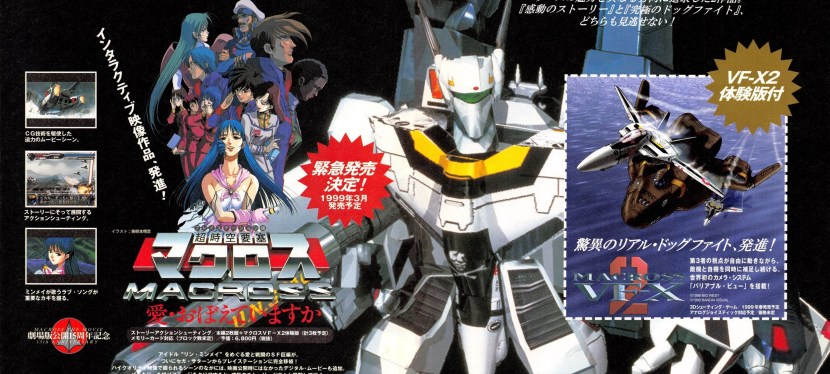
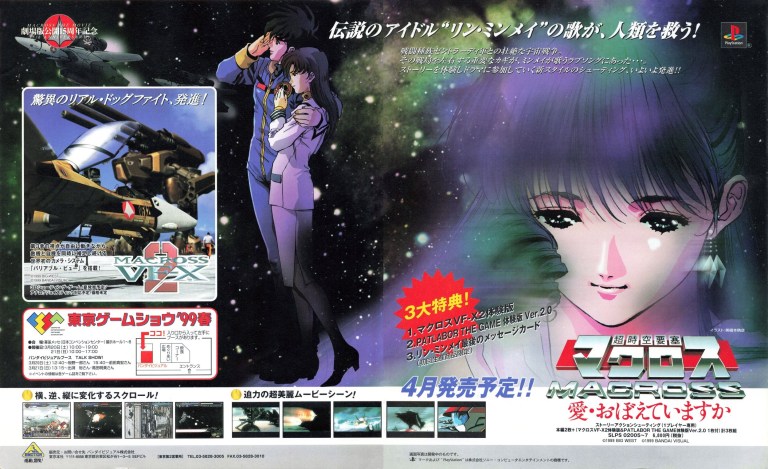
This 2-page ad had Minmay, Misa and Hikaru.
Computer-generated image of the Skull Leader Battroid was used here.
Looking at the history of Macross video games released only in Japan, there were these notable games that catered to the fans with different tastes during the period of 1997 to 1999. The two Japanese print ads here promoted the PlayStation version of The Super Dimension Fortress Macross: Do You Remember Love? (read my retro review by clicking here) and Macross: VF-X2 (only on PlayStation). 1997 marked the 15th anniversary of the entire Macross franchise and game publisher Bandai Visual kept the excitement for fans on high gear by aggressively promoting the two advertised games for their respective releases in 1999. These two print ads still resonate with long-time fans as each were clearly made to emphasize the games (with details, screenshots and original artworks) while using the right images of the Macross franchise for relevance.
2. Star Raiders print ad
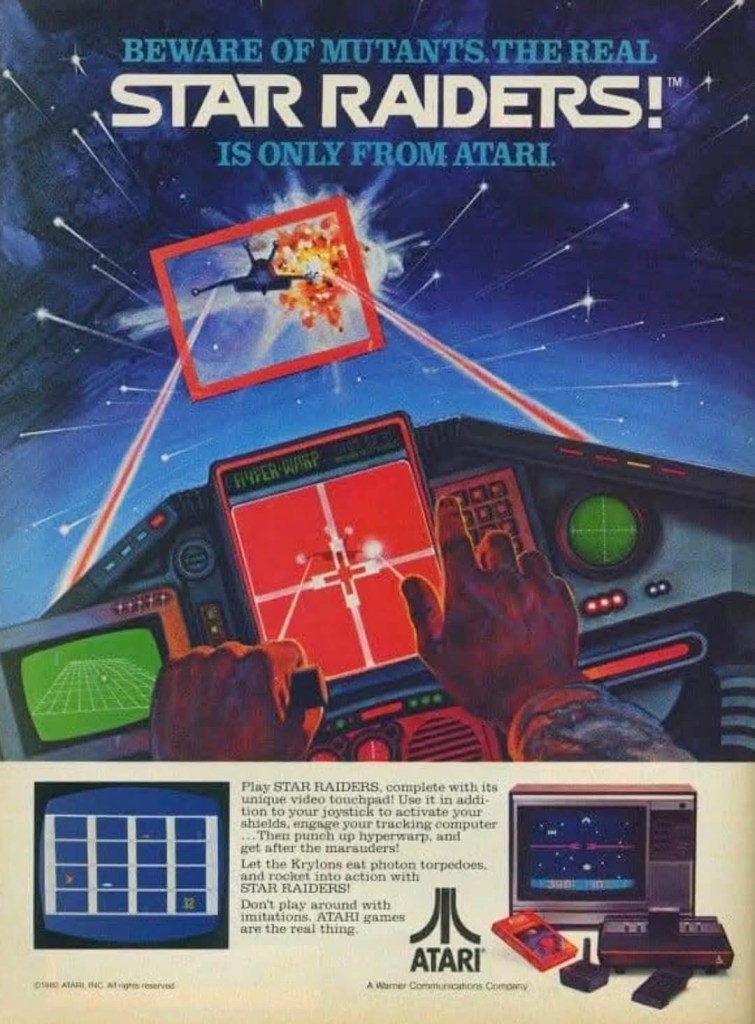
This Star Raiders print ad made me interested enough to play the game on Atari 2600.
I remember the old days of play Star Raiders on the Atari 2600 back in the early 1980s. Strangely enough, I don’t remember seeing this old print ad. Regardless, I really like the way the ad makers used hand-drawn art work to dominate the space while leaving enough space for text description, a screenshot and the picture of the Atari console with the TV set. In my view, this old ad is both amusing and attention-grabbing.
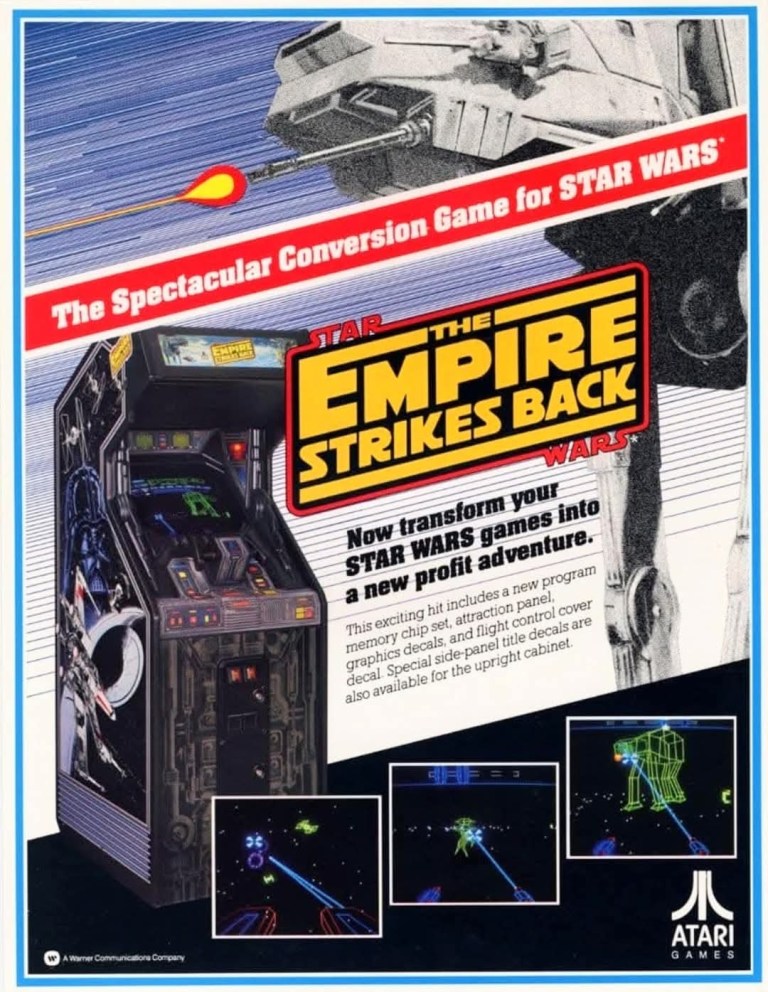
3. The Empire Strikes Back arcade flyer
This is still a great looking arcade flyer.
Here is a Star Wars game I never played but managed to play it on a home computer. Released by Atari in 1985, The Empire Strikes Back (full title: Star Wars: The Empire Strikes Back) arcade game was the follow-up to the very popular Star Wars arcade game. Like its predecessor, it used vector graphics and certain sounds from the 1980 film for immersion. This arcade flyer is well designed showing three selected screenshots, a picture of the arcade cabinet and a portion of the AT-AT walker from the movie. The flyer truly showed gamers and arcade operators what they would get by selecting The Empire Strikes Back.
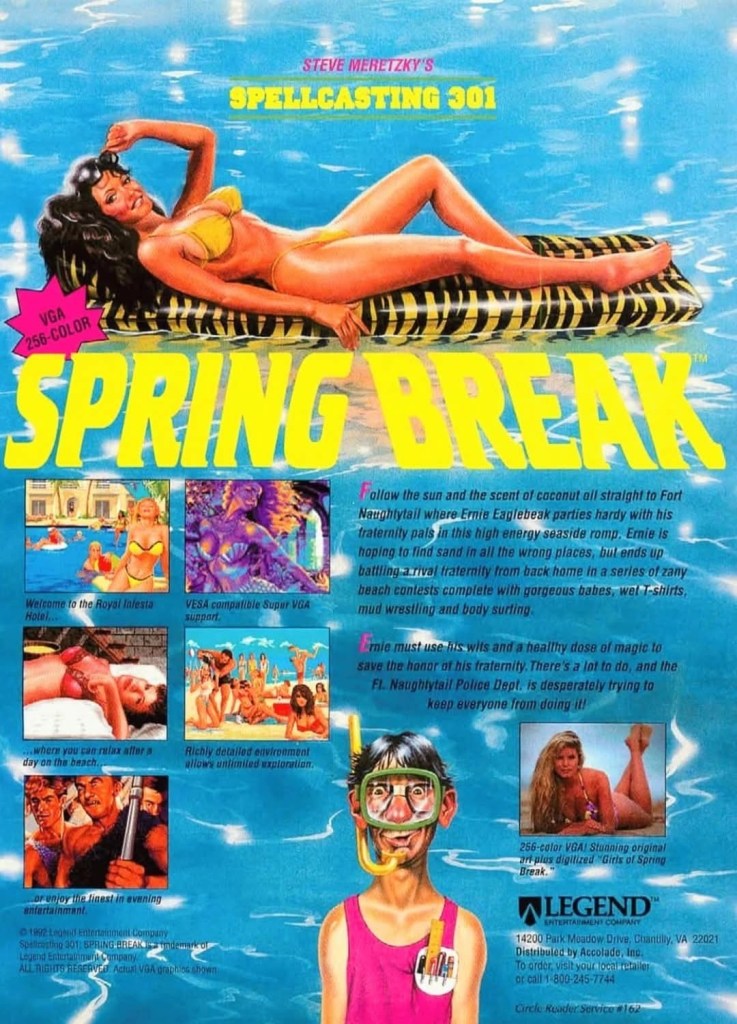
4. Steve Meretzky’s Spellcasting 301: Spring Break print ad
Clearly the promoted game is for adult players only.
In the realm of computer gaming, there were certain games that catered to the more mature players. One example is Steve Meretzky’s Spellcasting 301: Spring Break which was released on for personal computers running on DOS (Disk Operating System) in 1992. This print ad clearly shows the adulterated nature of the game emphasizing sexy women with a paradise setting. This is the kind of print ad that you only in computer gaming magazines which had predominantly adult readers.
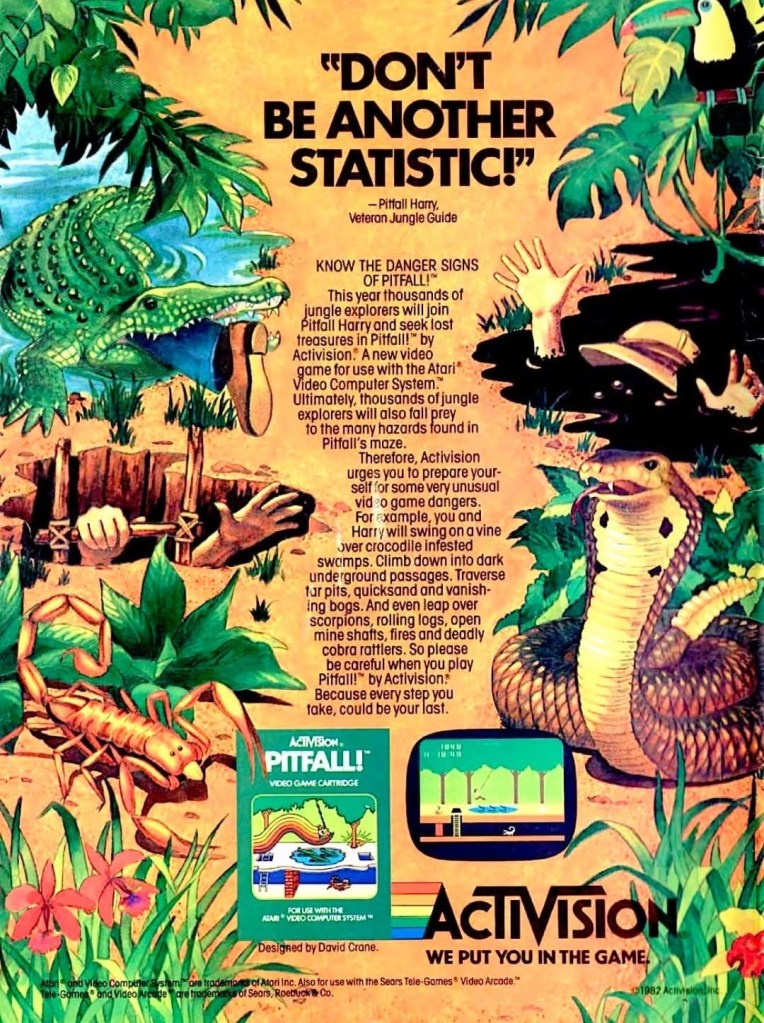
5. Pitfall! print ad
Still a great looking print ad.
Back in 1982, 2D adventuring on the Atari 2600 reached new heights when Pitfall! was released. The game garnered wide praise for its gameplay and graphics, and because it was so enjoyable, it sold millions of copies and its success spread across other platforms. A key factor to its commercial success and strong identity with the Atari 2600 was this colorful print ad. The ad makers daringly used original artwork to emphasize the jungle, wilderness and adventure concept while leaving some space left to show a screenshot and the Atari 2600 game cover. Pitfall! is a video game classic.
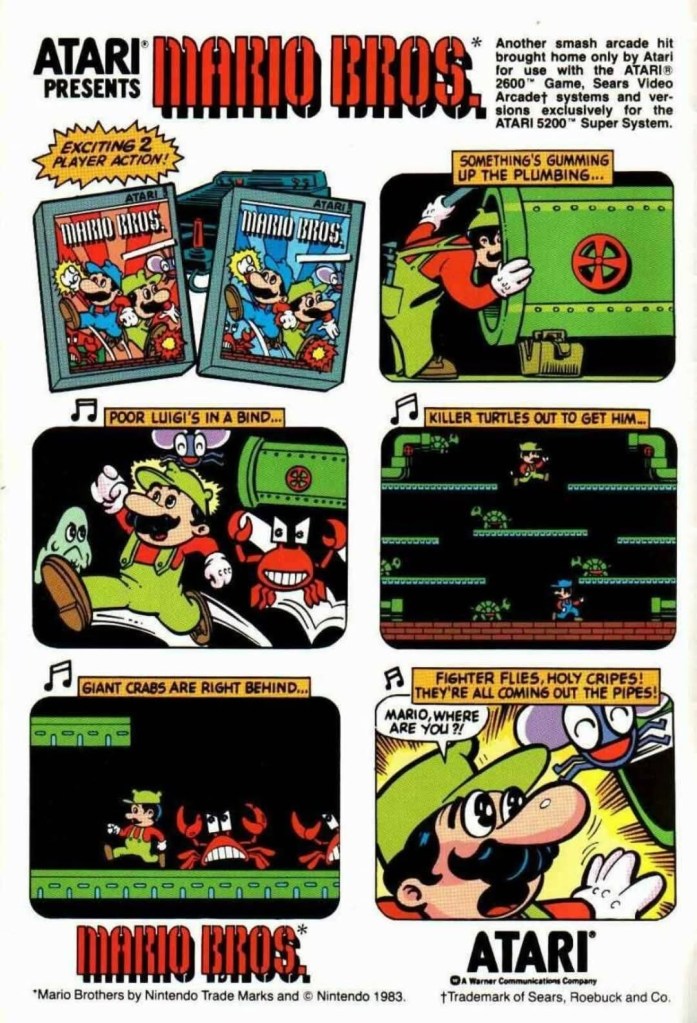
6. Mario Bros. print ad
I saw this comic-style print ad while reading a comic book.
A few years before Nintendo skyrocketed with the massive success of Super Mario Bros., there was Mario Bros. on the Atari 2600 and Atari 5200. Published by Atari on their consoles, Mario Bros. was already a hit in the arcades. To capitalize on the popularity of the game, Atari came up with this comic-style print ad to capture people’s attention with the hope that the Atari 2600 and Atari 5200 ports will sell a lot. I first saw this ad while reading a comic book and it remains entertaining to see.
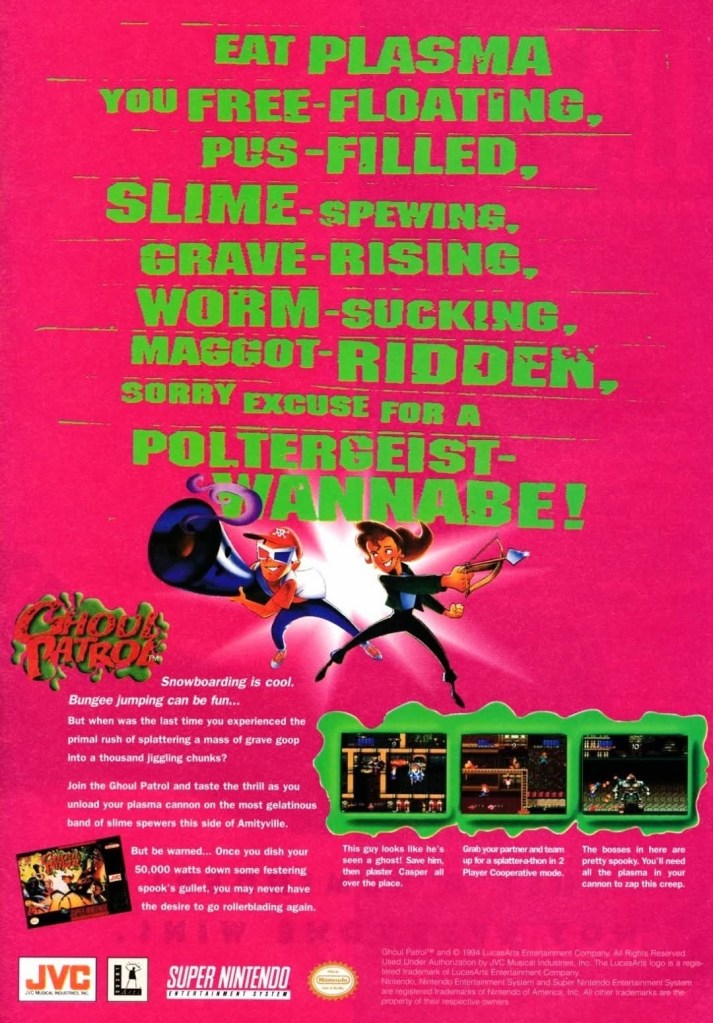
7. Ghoul Patrol print ad
Too bad the screenshots, the game box cover and white descriptive text were too small to look at.
Released in 1994 on the Super Nintendo Entertainment System (SNES), Ghoul Patrol is the accidental sequel to Zombies Ate My Neighbors. This was because the game did not start as a sequel but rather as an unrelated project that used the same gameplay engine of its predecessor. Since Zombies Ate My Neighbors already had a dedicated fanbase, a decision to turn the game into a sequel followed. Ghoul Patrol’s print ad took a different creative approach on its presentation by trying to look cool and catchy with a dominating pink background and slightly adulterated descriptions in green leaving little space left for screenshots and the white descriptive text. The print ad of Zombies Ate My Neighbors remains more engaging and more eye-catching than this one.
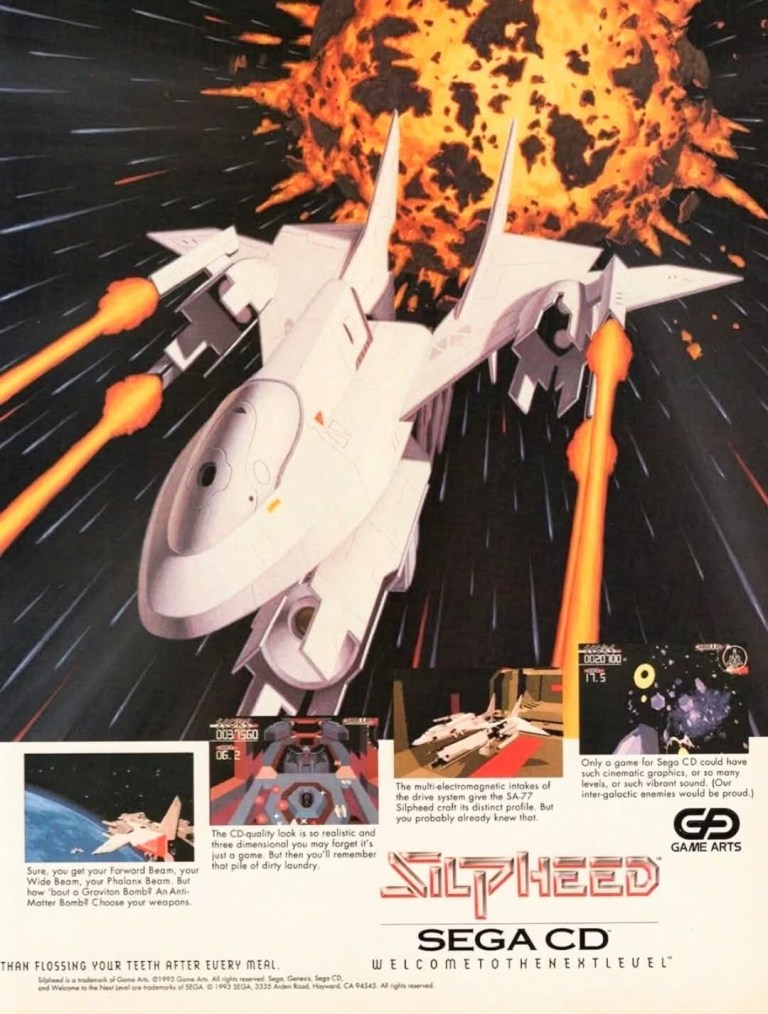
8. Silpheed print ad
This ad caught my attention and even made me interested on the Sega CD.
Released in 1993, Silpheed on Sega CD was a remake of the original game of 1986. Like its predecessor, the Sega CD had 3D effects but used pre-rendered computer animation for a background that actually was full motion video. The print ad of this game had this fantastic looking computer-generated artwork and displayed four screenshots that looked really exciting back in 1993. If you look closely at the captions, the ad emphasized the CD-quality look and the cinematic graphics the game had. This old ad has aged well.
Koshidaka Holdings, a leisure services firm based in Japan, will be investing P2.5 billion in the Philippines and plans to launch its first store this year, according to a Philippine News Agency (PNA) news article. This development is related with the Department of Trade and Industry’s (DTI) recent meetings with corporations in Japan. Kodaka Holdings has more than six hundred outlets in Japan and the Philippines is a key part of its planned expansion in Southeast Asia.
To put things in perspective, posted below is an excerpt from the PNA news article. Some parts in boldface…
Japanese leisure services firm Koshidaka Holdings Co. Ltd. will be investing PHP2.5 billion in the country, with its first store set to open this year, Department of Trade and Industry (DTI) Secretary Ma. Cristina Roque said.
In a virtual briefing Tuesday, Roque said Koshidaka is aggressive on its plans to expand in the country to bring its karaoke business and onsen-style (hot spring) spas as well as opening women’s fitness studios in Philippine malls.
The Japanese firm is scouting for 30 locations to establish its business here before growing to 100 sites nationwide.
Koshidaka is one of the 13 firms and business organizations that Roque met during her recent visit in Tokyo as a follow-through of the agency’s investment missions in Japan.
These firms include Nidec Corp., Ibiden Co., Ltd., Etoile Kaito & Co., Inc, Adastria Co., Ltd., Sumitomo, Fujifilm Holdings Corp., Chodai Co., Ltd. Taiheiyo Cement Corp., Fast Retailing, JR East, and Koshidaka Holdings Co., Ltd as well Keizai Doyukai and Keidanren.
“We also check on their plans, what their plans are in our country for expansion and also for growth,” Roque said.
Earlier, Koshidaka announced that it would establish a Philippine subsidiary to offer a new style of karaoke entertainment.
Koshidaka said its expansion in the Philippines is a key initiative in its Southeast Asia growth strategy, with the country’s large market and economic development.
“Aside from the entertainment, they also want to open a gym that’s really just focused on women all over the country, and they also want to focus on creating Japanese onsen in the malls or in different areas that are of interest to them,” Roque said.
“So they’re actually coming first quarter this year to really explore the different locations where they can open.”
Let me end this post by asking you readers: What is your reaction to this recent development? Do you find Koshidaka Holdings’ karaoke and onsen-style spas interesting? Have you tried any of Koshidaka Holdings’ businesses in Japan before?
Welcome back my readers, YouTube viewers and all others who followed this series of articles focused on YouTube videos worth watching. Have you been searching for something fun or interesting to watch on YouTube? Do you feel bored right now and you crave for something to see on the world’s most popular online video destination?
I recommend you check out the following topics and the related videos I found.
#1 VKunia reacts to The Terminator – The first time I ever saw The Terminator was on home video way back in the mid-1980s. I could not forget how the film blended elements of action, detective story, film noir, horror and science fiction together smoothly. Recently I viewed VKunia’s own reaction video about the 1984 movie and it was entertaining to watch as she felt its impact. I encourage you to watch her reaction video.
#2 Oblivion tested across multiple Xbox game consoles – Recently, I started replaying the 2006 fantasy role-playing game (RPG) The Elder Scrolls IV: Oblivion on my Xbox Series X console via Xbox Game Pass (XGP). But before doing that, I saw YouTuber Ramnexus’ video of Oblivion which he tested on Xbox 360 up to the more modern Xbox consoles. His video is loaded in-depth technical analysis and explanations which I really enjoyed watching.
#3 You, Me and the Movies react to Furiosa: A Mad Max Saga – If there was anything odd about Furiosa: A Mad Max Saga, it was the fact that it was actually made and released so long after Mad Max: Fury Road’s impact faded away. Directed by George Miller, the 2024 movie starring Anya Taylor-Joy was actually entertaining given its status as a spin-off and prequel, but I never felt any urge to replay it. If you want to discover what the movie is about without having to spend too much of your precious time, I encourage you to watch the reaction video by You, Me and the Movies below.
#4The struggle of ramen restaurants in Japan – If you have been traveling overseas over the past five years, where you able to visit Japan and eat inside a ramen restaurant? Ramen restaurants there have been struggling with unfavorable economic factors and there is a growing number of them closing down. Watch and learn from the video below.
#5 Oliver Harper examines The Terminator video games – Believe it or not, there were several video games based on The Terminator that got released in the early 1990s. I myself never got to play any of them but thanks to the Internet and YouTubers who had the resources, several videos about the Terminator games have been uploaded on YouTube in the forms of longplays, retro reviews, reactions and more. Oliver Harper’s own video conveniently examines all the Terminator games and it is a fascinating retro gaming viewing experience.
#6 Basic Instinct trivia by Minty Comedic Arts – Remember how controversial Basic Instinct was when it was first released in cinemas in 1992? It was controversial for its intense approach on violence and sexuality under the direction of Paul Verhoeven, and also for the notorious short scene of Sharon Stone crossing her legs. Not only that, mobs of homosexuals protested the film and some of them even harassed people who bought tickets to see it. Recently, Minty Comedic Arts posted a trivia video about Basic Instinct which you should see.
#7 Avalanche examined by GoodBadFlicks – In the history of cinema, the 1970s was the decade that saw a slew of disaster movies from Hollywood studios. It was typical for a Hollywood disaster flick to have a large cast of actors playing different characters who are struggling with the disaster. In 1978, Avalanche was released and it was produced by low budget movie king Roger Corman. As the film was not successful, it became forgotten until GoodBadFlicks made a video about it. It’s a must-see for anyone who loves disaster films and the 1970s.
#8 Ashleigh Burton reacts to X-Men: First Class – Back in 2011, I saw X-Men: First Class inside one of the old and original cinemas of Festival Mall here in the Philippines. The film was entertaining and cleverly done but back then, I did not find the new actors who played Charles Xavier, Magneto and Mystique convincing (note: they proved themselves worthy of their roles in X-Men: Days of Future Past in 2014). At the same time, the movie was a soft reboot and a prequel together. Some people really enjoyed while others not so much. Regardless, I encourage you to watch Ashleigh Burton’s X-Men: First Class reaction video below.
For the newcomers reading this, Suikoden I & II HD Remaster: Gate Rune and Dunan Unification Wars was released on March 6 and it contains Suikoden and Suikoden II (Japanese title: Genso Suikoden II). This is a cause for a celebration not only for fans of the Suikoden game franchise (created by the late Yoshitaka Murayama during his time at Konami) and JRPG enthusiasts but also for people who love retro gaming.
With Suikoden I & II HD Remaster: Gate Rune and Dunan Unification Wars now available on multiple platforms, gamers – both the veterans as well as the younger players – now have the golden opportunities to play the first two Suikoden games.
Suikoden on Xbox
A lot of characters got their share of the spotlight in short scenes like this in Suikoden.
As mentioned earlier, Suikoden is my most played game on my Xbox Series X since March 6. The release of Suikoden games on Xbox platforms is highly significant given the fact that the franchise has often been identified with PlayStation for so long. What many gamers do not know is the fact that Suikoden was also released on the Sega Saturn and Windows PC in Japan in the late-1990s.
As history showed, most Suikoden RPGs released by Konami from 1995 to 2006 mainly on the original PlayStation console (the first two games) and PlayStation 2 (the third, fourth and fifth games). Spin-off games were released on PlayStation, PS2, Game Boy Advance and Nintendo DS. That being said, there were absolutely no Suikoden games on the original Xbox console and Xbox 360.
The release of Suikoden I & II HD Remaster: Gate Rune and Dunan Unification Wars on Xbox Series X, Xbox Series S and the aging Xbox One is indeed a game-changer. There are lots of Xbox gamers who are fond of Japanese RPGs and there are also Suikoden fans who happen to own Xbox consoles. The Xbox ecosystem itself now has lots of role-playing games (RPGs) released in this current console generation and there are lots of Xbox players who love RPGs. As such, Konami made the right move bringing the Suikoden franchise to Xbox consoles.
Playing the first Suikoden again but in shinier form
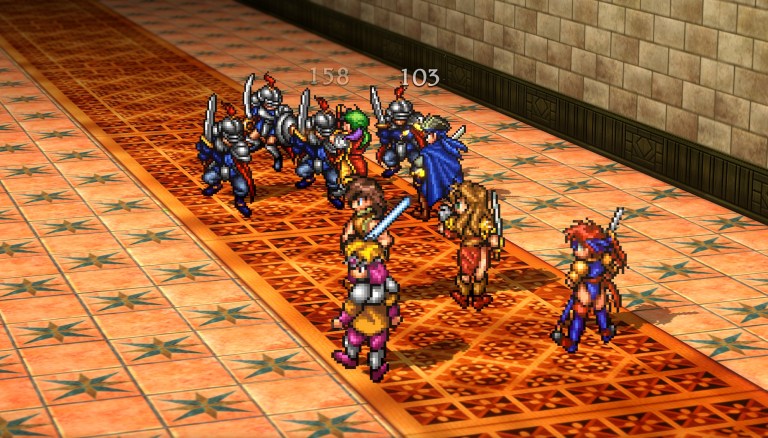
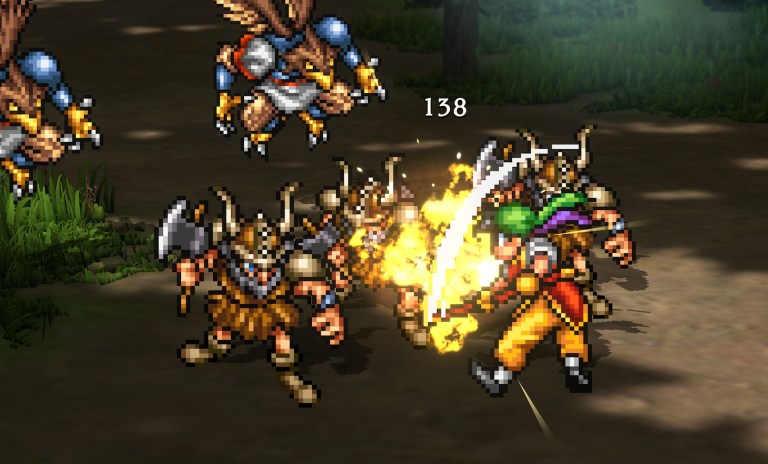
The group battle in the game. The remastered work includes presentation in high-definition and a variety of visual enhancements. The frame rate is also stable.
Since the launch of Suikoden I & II HD Remaster: Gate Rune and Dunan Unification Wars, I have been playing the first Suikoden game a lot on my Xbox Series X. It has been a fun-filled nostalgic gaming experience on my part and I can also say that Konami – for the most part – did a good job remastering the game with high-definition visuals in mind.
Visually, this is the best the first Suikoden RPG ever looked! The in-game character sprites and creatures/monsters sprites from before have been preserved and because everything is in high-definition, the said sprites look larger and you can see the detailed pixels within them. When it comes to the visual effects to emphasize in-game magic and other spectacles, the new effects implemented resulted in a lot of pleasing eye candy.
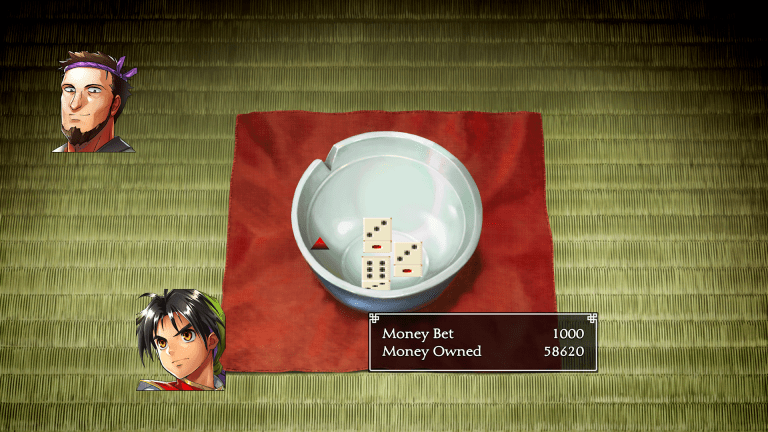
Mini-games like this one added fun and variety to the game. If you keep winning in this one, you can make a lot of in-game money.
The occasional close-ups during group battles like this added to the spectacle of playing. The enhanced visuals also made this look better.
When it comes to the character portraits, they have been redrawn from scratch by Junko Kawano and each artwork per character looked clearer and more detailed than before. Some long-time Suikoden fans might find the new character portraits looking too clean and might make them miss the older artworks.
Suikoden’s story is about the Scarlet Moon Empire, political developments, corruption that goes beyond politics, and how they all affect the people. The playable protagonist is the son of the imperial general Teo McDohl, and through him you will witness political intrigue and unexpected twists that will compel you to stick closer with your family friends to escape the empire and form a new army of rebels by recruiting members across the land.
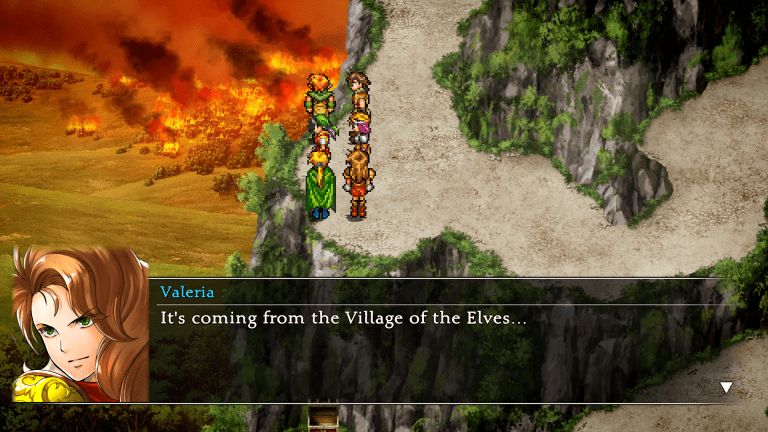
Even in subtle forms, the enhanced visuals made dramatic scenes like this look more lively.
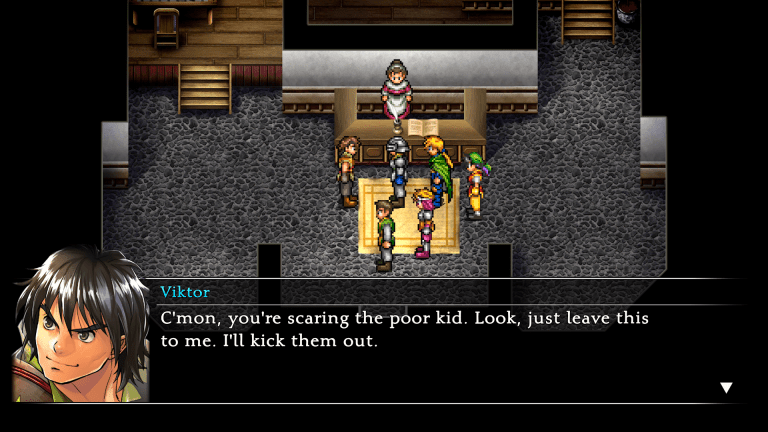
While the storytelling is satisfactory at best, there is a wide variety of characters who collectively added colors to the narrative. This is due to the many types of personalities that the important characters have. Take for example Matthiu who is the calm and calculating strategist, Viktor is the brave and brash rebel, and Gremio is very dedicated to protecting the protagonist no matter what happens. Along the way, character development is truly limited which is not surprising because a lot of characters shared the spotlight.
In terms of game design and gameplay features, Suikoden has aged well. The battle systems – solo battle, group battle, army battle – are still functional, efficient and fun to do. While some grinding (leveling-up) is needed, it is not stressful to do because the auto-battle options make the group battles flow smoothly, especially when your characters (up to six) are collectively strong enough to overwhelm the enemies.
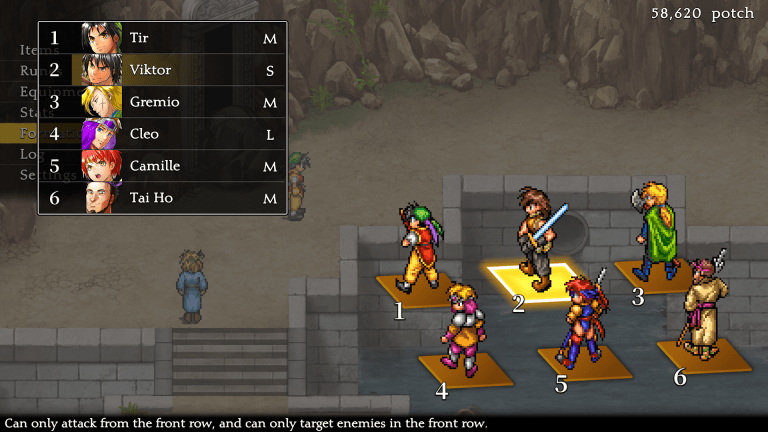
This is the formation of the members of your party. Those with short-range attacks should be placed on the front row but they need strong defense values to keep on fighting. Characters with long-range attacks are ideally placed in the back row.
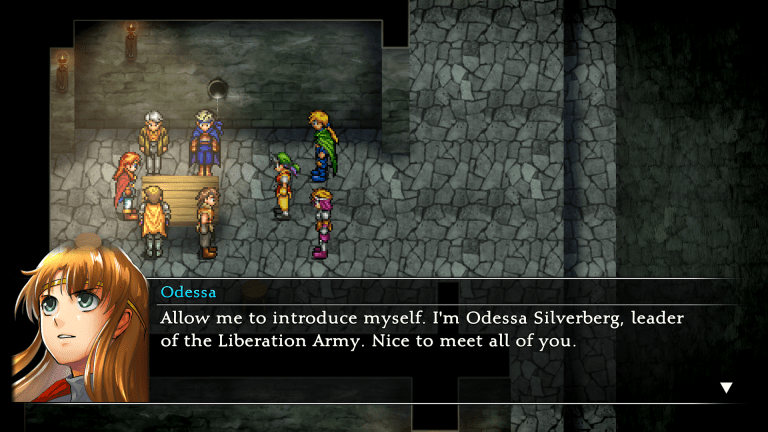
Meet Odessa.
The gameplay is just as fun to do as before. I really like the fact that up to six characters can be part of my party/group as I went adventuring and focused on story scenes. The solo and army battles are understandably few but the payoff (in return to the build-up leading to them) was worth it. I should state that the unite attacks (limited to specific characters who are present in the party) are fun to watch and the creators’ approach on presenting the battle animations and spectacle are great to see.
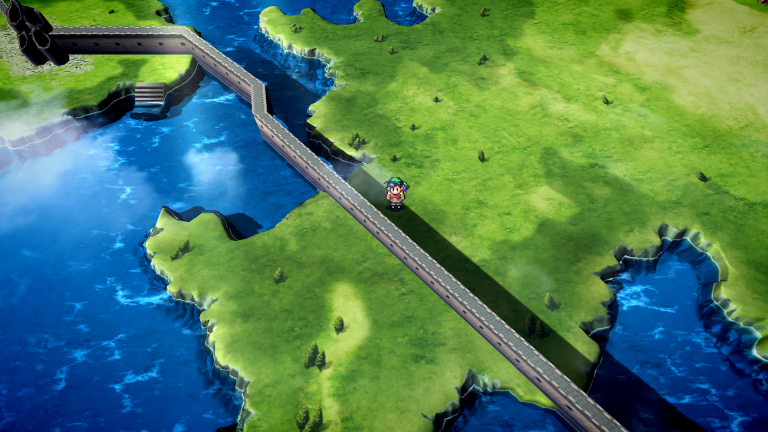
A great, long border wall in the game.
While the gameplay is clearly fun, Konami’s remaster team did not fix one old problem the game had since the start – limited spacing of items per character. Each character has his/her/its own pieces of clothing to wear, specifically for the body, head and two accessories. The game counts those clothing items as part of the overall item spacing per character. Once you have the four items for a character to wear, the remaining spaces for carrying other items (examples: medicine, ore, anti-toxin) become severely limited for the character.
Along the way, there is the constant need for you to purchase stronger pieces of clothing to increase the defense value of the newest character who joined your army. That being said, you must earn a lot of money, take time to out purchase items, and equip them on new characters while dealing with limited storage per character. The item management problem is the one thing that prevented the gameplay from achieving perfection.
My long-time experience with the Suikoden franchise
Viktor is the brash and brave fighter who becomes part of the Liberation Army. He is an important supporting character which you will easily realize.
In my personal gaming history, I played and finished the original game on PlayStation way back in 1996. While I really enjoyed the game and its unique gameplay features, I never replayed it as my taste on PlayStation gaming kept changing in 1997. When Wild ARMs and Final Fantasy VII landed on PlayStation, I forgot about Suikoden until its sequel was released in English in 1999.
Fortunately, Suikoden II was so much bigger and better than its predecessor and it remains the most defining game of the entire Suikoden franchise (read my retro review by clicking here). That being said, I will start playing the remastered Suikoden II on my Xbox Series X soon.
Having played the remastered first game on my Xbox console, I can say that it was a fun-filled trip on my end. At the same time, I remembered scenes and several small character moments in between that I have forgotten long ago. Although a lot of characters were presented, following the narrative was still easy to do since it was light compared to what Suikoden II told.
Conclusion
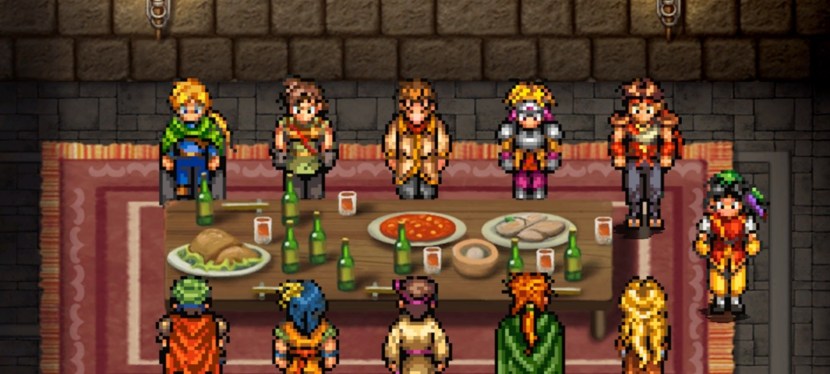
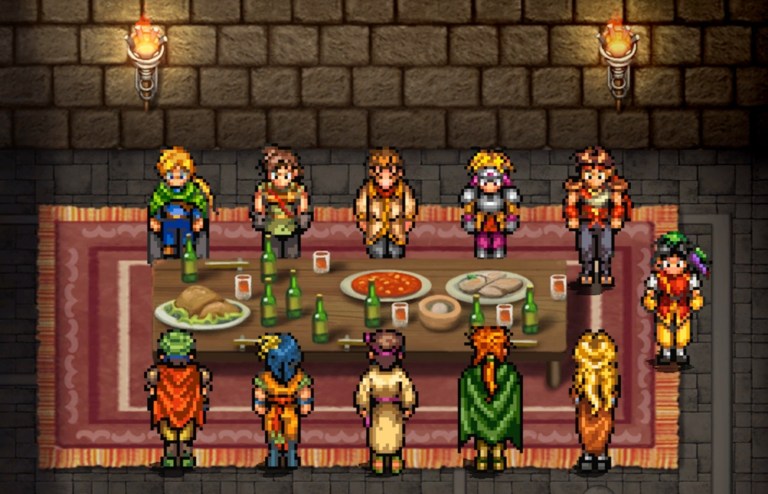
A shot of a feast within the army of rebels with their leader Tir McDohl. The young McDohl is the playable protagonist.
With the first Suikoden alone, I can say I got really good value and enjoyment with my purchase of the digital copy of Suikoden I & II HD Remaster: Gate Rune and Dunan Unification Wars for my Xbox Series X. This is a fine example about retro gaming literally saving the day when Team Xbox failed to deliver the promised great fun with their own games.
With the Corporate Recovery and Tax Incentives for Enterprises to Maximize Opportunities for Reinvigorating the Economy (CREATE MORE) Act already in effect, more than P23 billion in new investments was pledged by Japanese companies in connection with it, according to a Philippine News Agency (PNA) news article.
To put things in perspective, posted below is an excerpt from the news article of the PNA. Some parts in boldface…
Department of Trade and Industry (DTI) Secretary Ma. Cristina Roque said Wednesday the Corporate Recovery and Tax Incentives for Enterprises to Maximize Opportunities for Reinvigorating the Economy (CREATE MORE) law has attracted Japanese companies to invest in the country.
Roque and Special Assistant to the President for Economic Affairs and Investments Secretary Frederick Go visited Japan from March 3 to 4 to meet Japanese companies and business groups.
The DTI said during the visit, four companies pledged PHP23.5 billion worth of investments.
“Representing both the government and private sectors, those we engaged with expressed excitement and enthusiasm about collaborating with us, inspired by the positive developments they’ve heard about our country—our robust economic fundamentals and reformed policies and regulations,” Roque said.
“Specifically, what caught their attention was the recently enacted CREATE MORE law, which offers enhanced tax incentives, simplified processes, and greater opportunities for businesses to thrive in the Philippines,” she added.
Among Japanese companies that the Philippine government officials met include Ibiden Co., Ltd., Nidec Corp. and Sumitomo Corp.
The Philippine Trade and Investment Center (PTIC)-Tokyo told the Philippine News Agency that two of these companies are eyeing fresh investments in the country, while one of them is updating its three-year investment pledge.
DTI said Ibiden expressed its prospect for expanding its advanced substrate technologies operations, while Nidec eyes to expand its manufacturing footprint here.
On the other hand, Sumitomo renewed its commitment to collaborate with the Marcos administration’s infrastructure and clean energy goals.
Sumitomo’s project in the Philippines include the Metro Manila Subway Project, the MRT Line 3 maintenance contract, and the First Philippine Industrial Park.
Roque also had meetings with Fast Retailing Co. Ltd., the firm behind clothing brand Uniqlo, as well as the Japan Association of Corporate Executives (Keizai Doyukai) and the Japan Business Federation (Keidanren).
Let me end this post by asking you readers: What is your reaction to this recent development? Do you think the new investments pledged by Japanese companies in connection with CREATE MORE will influence many other foreign companies to invest in the Philippines this year?
For more South Metro Manila community news and developments, come back here soon. Also say NO to fake news, NO to irresponsible journalism, NO to misinformation, NO to plagiarists, NO to reckless publishers and NO to sinister propaganda when it comes to news and developments. For South Metro Manila community developments, member engagement, commerce and other relevant updates, join the growing South Metro Manila Facebook group at https://www.facebook.com/groups/342183059992673
Welcome back my readers, YouTube viewers and all others who followed this series of articles focused on YouTube videos worth watching. Have you been searching for something fun or interesting to watch on YouTube? Do you feel bored right now and you crave for something to see on the world’s most popular online video destination?
I recommend you check out the following topics and the related videos I found.
#1 Ashleigh Burton and VKunia’s reaction videos featuring Captain America: The First Avenger – Way back in 2011, I saw Captain America: The First Avenger in the local cinema and it was an enjoyable viewing experience. Among all the Marvel Cinema Universe (MCU) movies released to date, it remained the most unique superhero movie as it had a strong World War II aesthetic and really brought much of Captain America’s literary concepts to life. I recently saw the respective reaction videos of YouTubers Ashleigh Burton and VKunia and they were enjoyable to watch. If you have not seen the movie, watch it first. Otherwise, enjoy the videos below.
#2 The wickedness of Qatar and its agenda against Israel and the West explained – When it comes to waging war against Israel and Western civilization as we know it, Qatar is much more subtle when executing its sinister agenda. While terrorist state Iran openly expresses its hatred towards Israel and the West, and arms many Middle East terrorists groups, Qatar uses the terrorist news network Al Jazeera, lies through the diplomatic arena and clearly sided with the Palestinian terrorists. Watch this explanatory and analytical video.
#3 Trump Gaza plan makes sense – Since it was first announced, the ambitious plan of US President Donald Trump for America to take over the Gaza Strip has been making a lot of waves internationally. Of course, the political activists who hate Israel and support Palestinian terrorists just won’t relent with their distorted views and they preferred more people to become misled to support their so-called pro-Palestine movement. That being said, if you want to truly understand the truth and the details carefully, watch the videos below.
#4The significance of Capernaum – It has been two years since I visited Israel on a Holy Land pilgrimage tour with my local church. Capernaum is the ancient site that Lord Jesus Himself chose to base His ministry after leaving Nazareth. In addition to being Jesus’ chosen city, Capernaum is also where many significant events happened as recorded in the Holy Bible. Having visited Capernaum myself, it is indeed a very holy site and you can learn more about it by watching the videos below from Hananya Naftali and HolyLandSite. I pray that these videos will inspire you to visit Israel to deepen your faith in Lord Jesus. Grab the Bible as well.
#5 There was a superhero-themed restaurant by Marvel – Long before the Marvel Cinematic Universe (MCU) rocked the world with many blockbuster movies, Marvel Entertainment Group (in partnership with Planet Hollywood and Universal Studios Hollywood) actually launched a superhero-themed restaurant that eventually failed. Launched in the late 1990s, the restaurant Marvel Mania was located near Universal Hollywood Studios. The failed business has long been forgotten. Fortunately, someone managed to record videos inside Marvel Mania long ago and uploaded footage on YouTube. The video below by Panels to Pixel is a must-see!
#6 PatmanQC examines classic game Xevious – During the golden age of arcades, the 2D sci-fi shooter Xevious was released and became very successful both commercially and critically. The only version of Xevious I played was on the Nintendo Family Computer (Famicom) and it turned out many other local gamers played it in their respective homes. There is a lot more to the history and conception of Xevious and you can find out more from PatmanQC’s videos below.
#7 Rob Liefeld’s Captain America artwork explained – Going back to Captain America, it’s time to take a closer look at a certain artwork of the icon done by Rob Liefeld (Youngblood, X-Force, The New Mutants) a long time ago. A lot of people hated it and called it exaggerated and totally unbelievable. There is an explanation for Liefeld’s Captain America artwork and you can watch and learn from the video of YouTuber Panels to Pixels below. Trust me, it is worth your time.
Welcome back my readers, YouTube viewers and all others who followed this series of articles focused on YouTube videos worth watching. Have you been searching for something fun or interesting to watch on YouTube? Do you feel bored right now and you crave for something to see on the world’s most popular online video destination?
I recommend you check out the following topics and the related videos I found.
#1 Revisiting the Ultraverse – When it comes to 1990s comics, the short-lived Ultraverse is the one franchise that defined the decade the most as it had lots of engaging concepts, solid stories and captivating characters to follow such as Prime, Mantra, Harcase, Prototype, The Strangers, The Solution and more! Behind the scenes, publisher Malibu Comics had a great creative team who brainstormed and developed the Ultraverse a lot prior to its 1993 launch. To learn more about the Ultraverse, watch the following videos below.
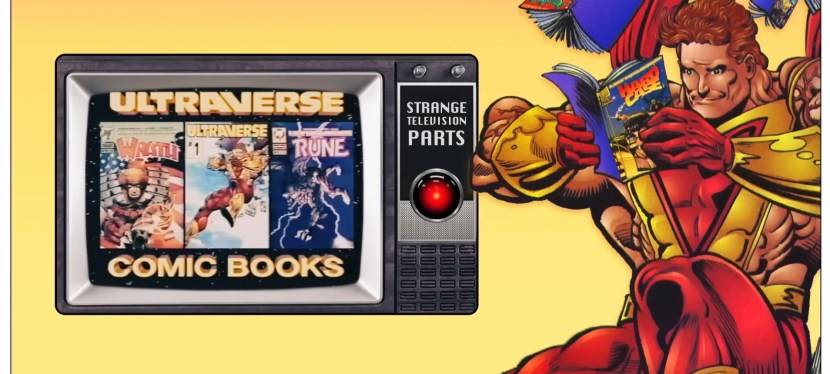
#2The 1993 debate between Peter David and Todd McFarlane – Way back in 1993, I learned bits of information about a certain debate between the prolific writer Peter David (The Incredible Hulk, Spider-Man 2099) and Todd McFarlane (Spider-Man and Spawn) through word-of-mouth and comics-related print media. Of course, Internet access here in the Philippines was not yet available back then but there was local awareness about the David-McFarlane verbal battle. Fortunately for us, an actual video of the entire debate was uploaded to YouTube and the YouTuber Strange Brain Parts posted an analytical video about it. The videos are now available for your viewing pleasure.
#3 Lefties Losing It (Trump, Richard Gere, Taylor Swift booed and more) – In this recent episode of Lefties Losing It hosted by Rita Panahi, you will see how demented the current congressional Democrats have gotten, US President Donald Trump being cheered and how Taylor Swift was booed during the recent NFL Super Bowl, Richard Gere failing to accept reality and much more. Seriously, a lot of Leftists are still bitter over Trump’s return as President and they prefer to move on with their distorted view of reality. Wokeness truly is living wrongly. Watch and enjoy the video below.
#4 VKunia reacts to Poltergeist (1982) – A lot of people find 1982’s Poltergeist (directed by Tobe Hooper and produced by Steven Spielberg) a scary viewing experience. It has been the subject of many documentaries or reaction or retro reviews on YouTube. YouTuber VKunia posted her own reaction video of it and you can how it affects her in the video below.
#5 PatmanQC explains the history of The House of the Dead – The House of the Dead is a horror-themed series of video games that Sega first launched in 1996. During that year, there were The House of the Dead machines that suddenly appeared in local arcades here in the Philippines. Due to its horror theme and high level of violence, it caused some disturbance to concerned parents whose children saw or even played it. Regardless, the newer The House of the Dead games made its way to the local arcades as the years passed by. If you want to know who created the said Sega franchise and what were the inspirations for each game, watch the in-depth video by PatmanQC now.
#6 Dawn of the Dead reaction videos – To make things clear, I was never a fan of Zack Snyder’s Dawn of the Dead remake. I saw it in the local cinema back in 2004 at a time when the new movies released were not so interesting. Even with modest expectations, I was not so entertained by it. Still the movie is popular with YouTubers who posted their own reactions to it. Watch and learn from the selected videos below.
Welcome back readers, fellow geeks and electronic gaming fans!
In this edition of the Retro Gaming Ads Blast (RGAB) series, we will take a look at another batch of retro gaming print ads – including arcade flyers – from the 1980s and to the year 2000.
For the newcomers reading this, Retro Gaming Ads Blast (RGAB) looks back at the many print ads of games (console, arcade, computer and handheld) that were published in comic books, magazines, flyers, posters and newspapers long before smartphones, social media, the worldwide web and streaming became popular. To put things in perspective, people back in the 1980s and 1990s were more trusting of print media for information and images about electronic games and related products.
With those details laid down, here is the newest batch of retro gaming print ads for you to see and enjoy…
1. Tutankham print ad
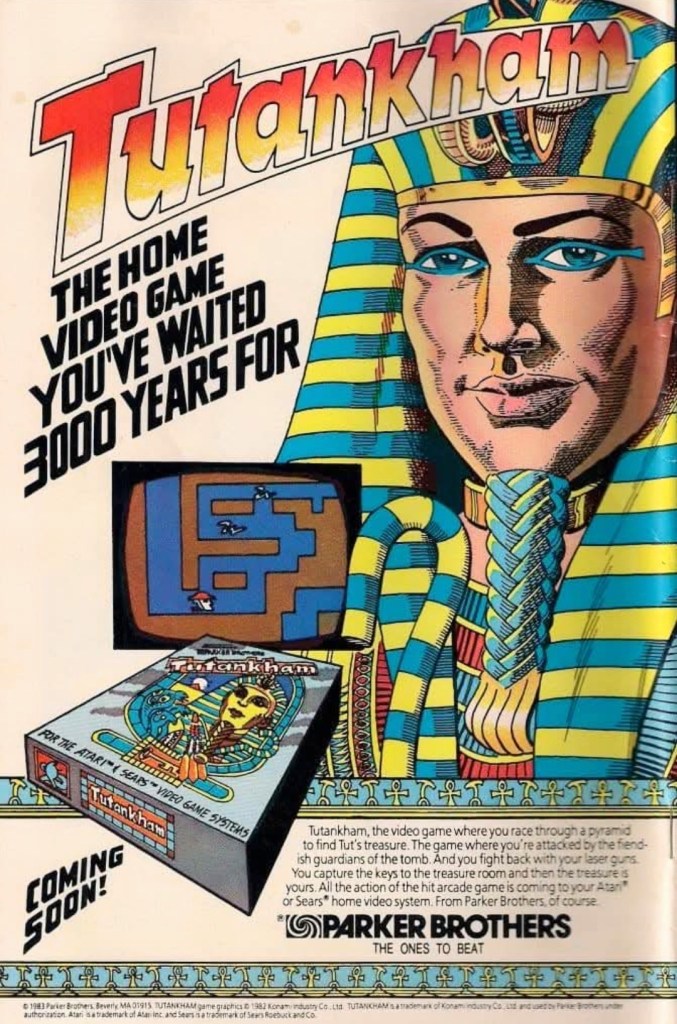
This print ad appeared in several comic books in 1983.
First released in the arcades in 1982, Tutankham is a 2D adventure game that had a mix of shooting, maze exploration and puzzle-solving with Egyptian settings and concepts. It made its way to the Atari 2600 published by Parker Brother, and it was this specific version I played. This game print ad appeared in comic books I read in 1983, and the people who made it implemented a hand-drawn art of the Egyptian pharaoh Tutankhamun dominating the space to emphasize the Egyptian setting. In fact, this ad made me think more of Egypt and left little to give me an idea of the game design.
2. Star Trek arcade flyer
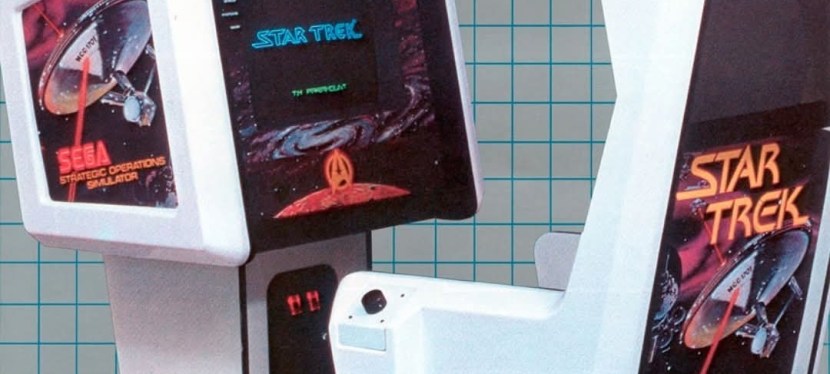
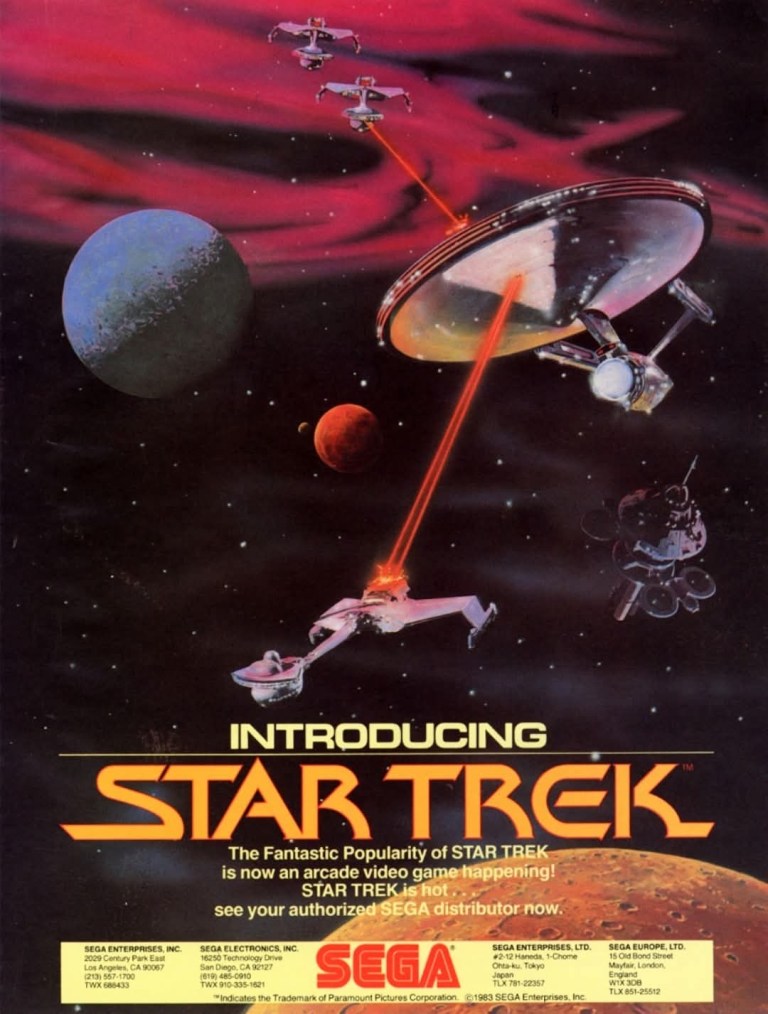
The clever use of classic Star Trek imagery was used in this initial flyer by Sega.
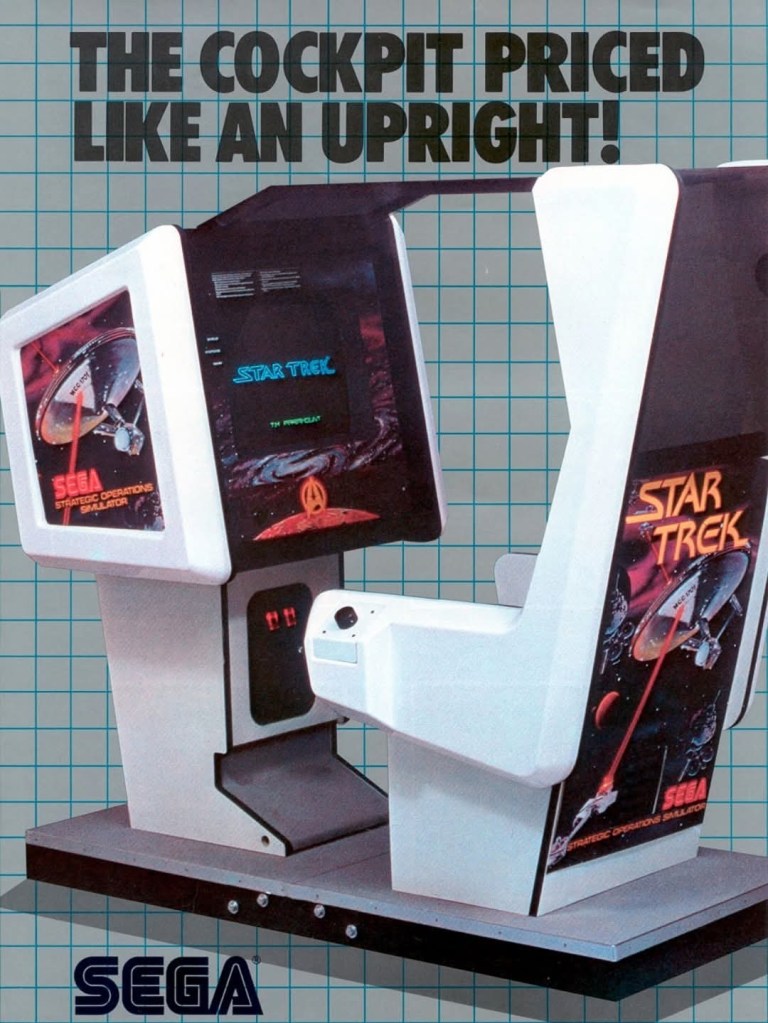
Back in the 1980s, a futuristic design for an arcade machine like this one was mind-blowing.
I never played the Star Trek arcade game (full title: Star Trek: Strategic Operations Simulator) Sega released in 1983. I only saw its graphics and gameplay during an episode of Starcade. With its game design and visual presentation, Star Trek was a very ambitious arcade project for its time and Sega really went in to promote it. The initial arcade flyer (first one above) was meant to grab the attention of both gamers and arcade operators. The next arcade flyer (2nd one above) showed the ambitious design of the arcade machine made with player immersion in mind.
3. Battlezone arcade flyer
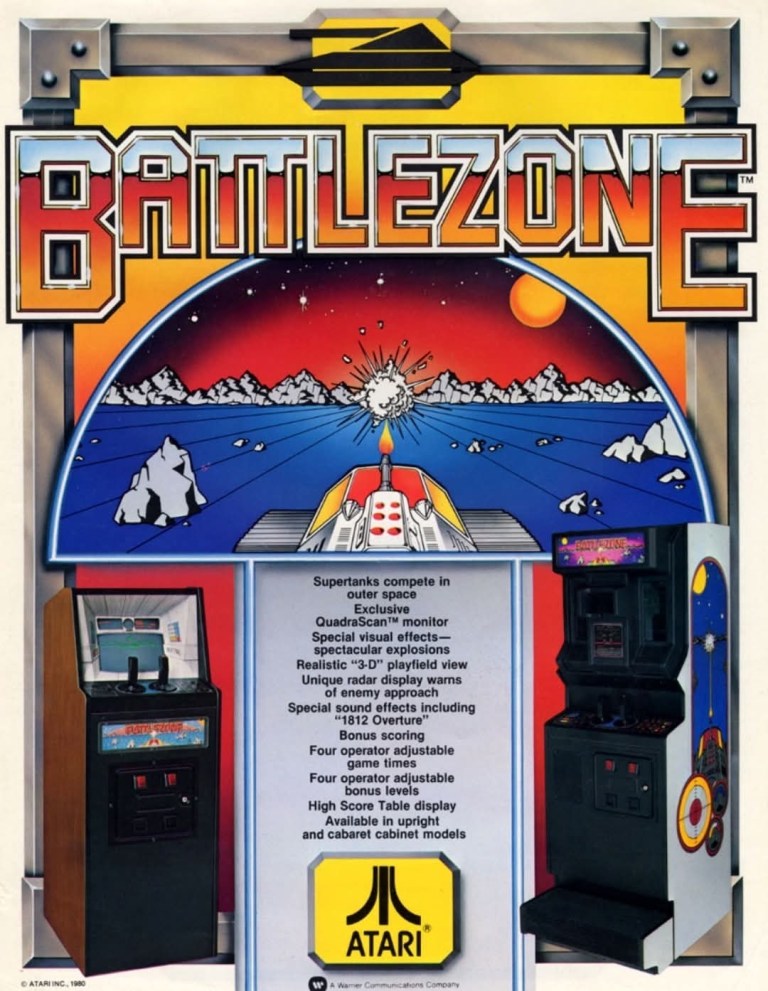
While the hand-drawn artwork was too detailed for the arcade game’s graphics, it still emphasized strongly the concept of the game.
In the history of video games, Battlezone was a groundbreaking game both visually and with game design. It was designed to give gamers an immersive experience of driving a tank with 3D graphics, fun gameplay and a first-person view. Its own history is worth researching. Atari knew it had to heavily promote their ambitious game and the arcade flyer above featured nice hand-drawn artwork while also showing the two types of Battlezone machines that arcade operators can choose from. Battlezone went on to become a highly influential arcade game.
4. Chrono Cross North American print ad
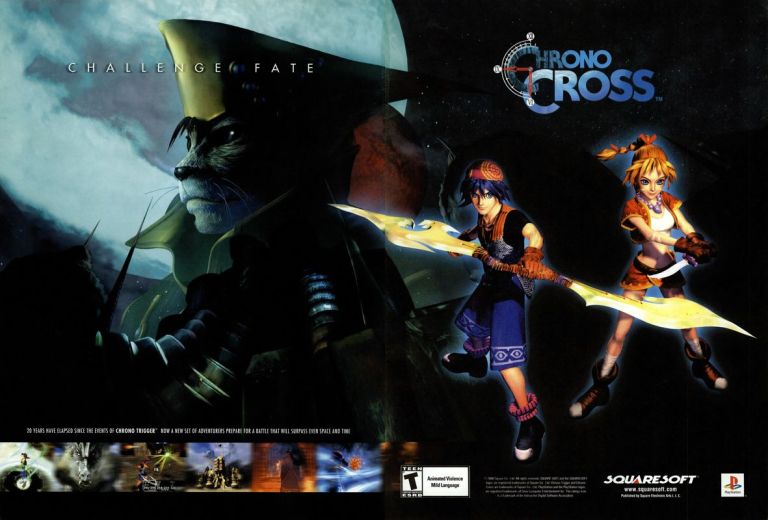
Arguably, this print ad was aimed at RPG enthusiasts, Chrono Trigger fans and gamers looking for something adventurous to play.
First released on PlayStation in Japan, Chrono Cross made its way to the said console in America just a few months before the PlayStation 2 launched there. While there was a risk that came with releasing the ambitious follow-up to the classic Chrono Trigger so late in the PlayStation’s life, Squaresoft (now Square Enix) still went on to aggressively promote Chrono Cross in America. This 2-page print ad that appeared in many gaming magazines remains captivating to look at. As typical of the time, 3D polygonal models and the epic-looking art were used in dominating fashion leaving the small space (lower-left corner) to display a few gameplay screenshots and other 3D art. Still it a fun game to play and this should remind you that Chrono Cross was recently remastered for modern consoles.
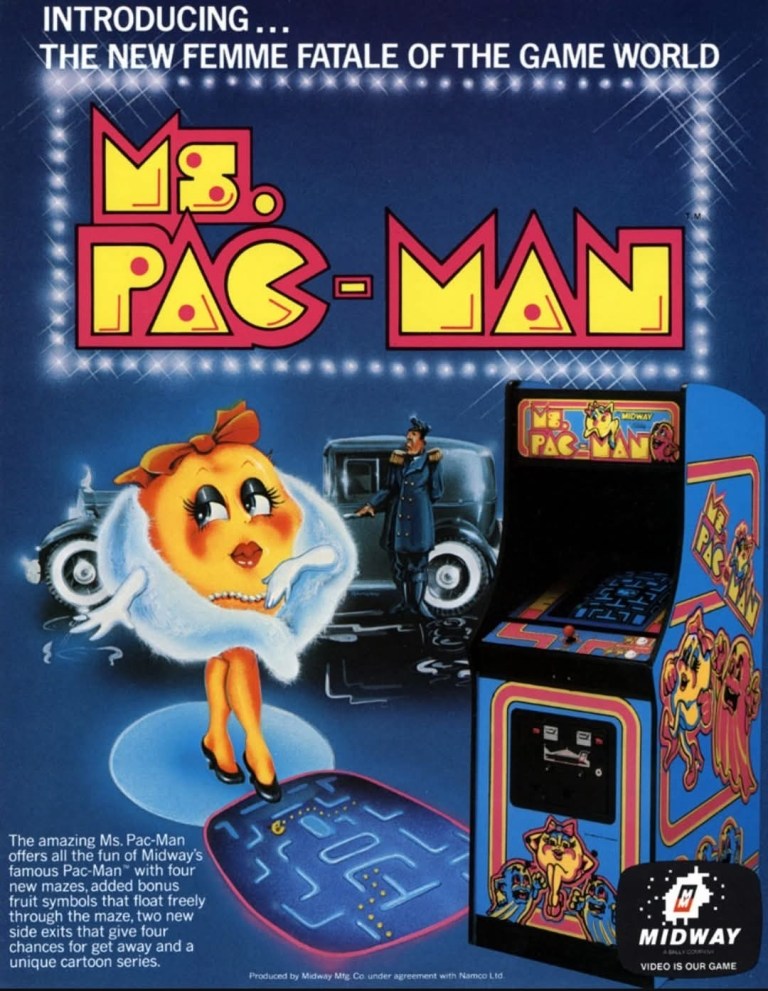
5. Ms. Pac-Man arcade flyer
The wife of Pac-Man and the machine.
Given the fact that Pac-Man was so massively successful, it was not surprising that a sequel had to be made and released on as many arcades as possible. Ms. Pac-Man was the sequel and it was released in arcades in 1982 eventually achieving huge commercial and critical success. To promote the game, Midway’s ad makers came up with an ad showing unique art of Pac-Man’s wife looking glamorous (with a driver and a vehicle in the background) and a photograph of the arcade machine on the right. This also was one of the early arcade flyers to use the words “femme fatale”.
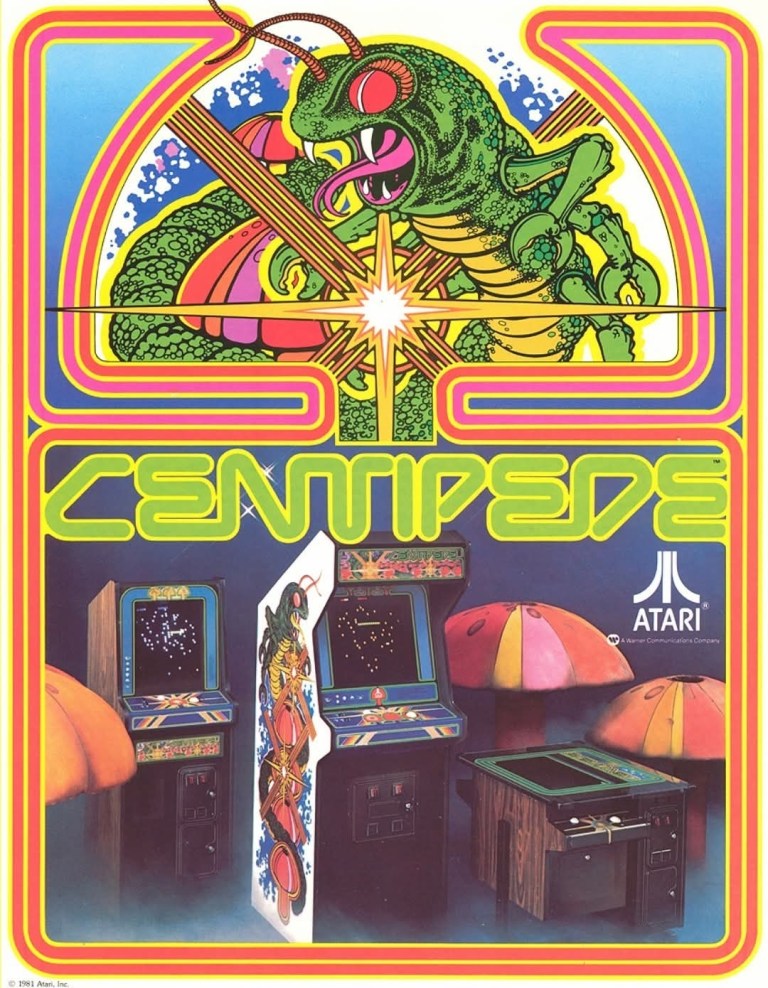
6. Centipede arcade flyer
Three machines of Centipede for arcade operators to choose from.
Centipede is another arcade classic from Atari. Released in 1981, a lot of players enjoyed the game’s simplistic and yet addicting design of shooting an incoming centipede and its remaining portions that move down the field. Similar to the Battlezone arcade flyer, this game’s flyer had nice art of a centipede on the top and images arcade machines. Even by today’s standards, this flyer remains eye-catching.
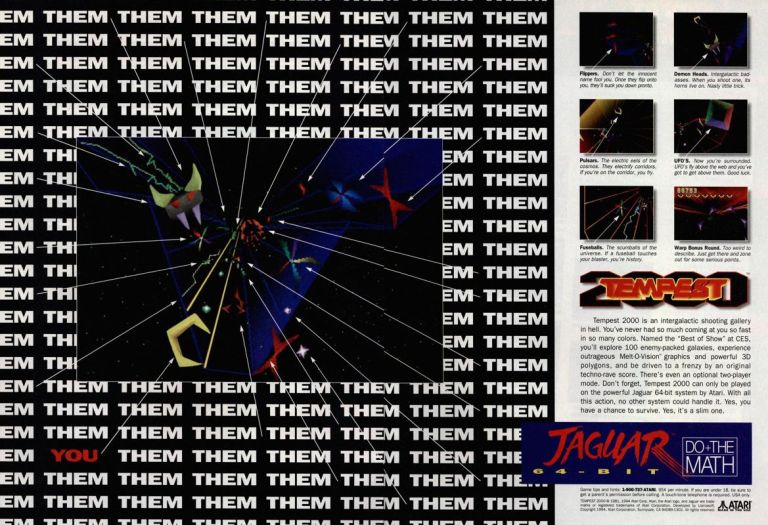
7. Tempest 2000 print ad
This 2-page print ad of Tempest 2000 is still captivating to look at.
Back in the 1990s, Atari went on to release their Jaguar console which was promoted as a 64-bit machine. At a gaming convention, the company met with prospective game developers over Jaguar projects and one of the developers volunteered to do Tempest (a memorable Atari arcade game). This resulted in the development of Tempest 2000 which was a remake of the classic.
As a Jaguar-exclusive game, Atari came up with an eye-catching 2-page ad showing off the 3D visual presentation (6 gameplay screenshots and one original artwork) while boasting in the text description that Tempest 2000 was named the “Best of Show” at the Consumer Electronics Show (CES). The game was released in 1994 attracting mostly positive reviews from game critics and was one of the best-selling Jaguar games (note: Tempest 2000 can now be played in the Atari 50 collection). With the Atari legacy and presentation combined, this print ad remains captivating to look at.
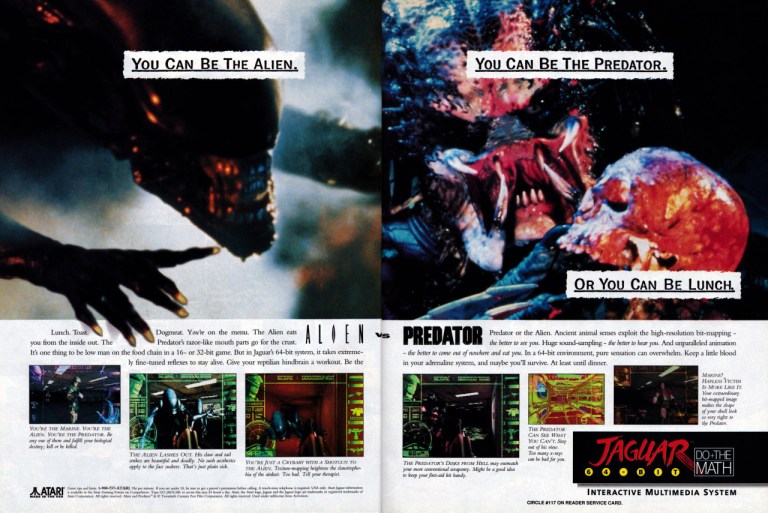
8. Alien vs Predator print ad
Arguably the most defining and most entertaining game on the Atari Jaguar.
If there is any game that truly defined enjoyment and the technological features of the Atari Jaguar, it is the 1994 first-person shooter Alien vs Predator. At the time of its release, it was one of the most immersive games of the Alien vs. Predator crossover franchise and it allowed players to experience what fighting the Predator or the Xenomorph was like. The game also allowed gamers to play as a Colonial Marine (human soldier).
To sell the game, Atari came up with a 2-page ad highlighting the Aliens on one page and the Predator on the other. As the Predator was shown with a grotesque human skull, the use of photographs (most likely sourced from the movies) strongly emphasize the game was aimed at the mature audience among gamers. Six screenshots of gameplay were displayed by the ad makers who were clearly aware of the high popularity of first-person shooting games. Alien vs Predator was a critical and commercial success, and its print ad is arguably the most memorable one of any Atari Jaguar game ever made.







 Author Carlo Carrasco