Retro Gaming Ads Blast – Part 5

Welcome back readers, fellow geeks and electronic gaming fans!

In this edition of the Retro Gaming Ads Blast (RGAB) series, we will examine print ads from the 1980s and the 1990s that caught my attention and I will explain why they are worth look back at.

For the newcomers reading this, Retro Gaming Ads Blast (RGAB) looks back at the many print ads of games (console, arcade, computer and handheld) that were published in comic books, magazines, flyers and newspapers long before smartphones, social media, the worldwide web and streaming became popular. To put things in perspective, people back in the 1980s and 1990s were more trusting of print media for information and images about electronic games.

With those details laid down, here is the newest batch of retro gaming print ads for you to see and enjoy…

1. Star Wars: Rebel Assault print ad

This print ad was strong enough to capture Star Wars fans’ attention and make them interested with the Sega CD.

If there is anything notable about the Sega CD (Mega CD in other parts of the world) platform, it is the fact that the machine was an add-on to be connected with the Sega Genesis (Sega Mega Drive elsewhere) console. That being said, LucasArts included the Sega CD as one of several platforms for the multiplatform release of their 1993 game Star Wars: Rebel Assault. The above print ad caught my attention with its use of 9 screenshots (emphasizing a wide look at the game’s Star Wars concept) and text description (emphasizing multi-media features connected with gameplay), and for a time it made me interested in the Sega CD. Looking back at the game’s marketing, Star Wars: Rebel Assault was designed to not only give gamers sessions of play to enjoy but also opportunities to immerse themselves deeper into the realm of Star Wars. The game even had selected video clips from the original Star Wars trilogy movies.

2.  Cloak & Dagger print ad

This print ad could have used at least two screenshots from the arcade game…

In 1984, there was a movie titled Cloak & Dagger (read my retro movie review by clicking here) which was not only the 4th cinematic adaptation of the short story “The Boy Cried Murder” (written by Cornell Woolrich) but also had the real-life electronic game Cloak & Dagger as a crucial plot element. To make things clear, there was a Cloak & Dagger game released in the arcades (as emphasized in the above print ad) from Atari. Behind the scenes, the filmmakers and Atari worked together which explains the video game tie-in with the movie. While the above arcade conversion kit print ad does not show screenshots of gameplay, the four images of the playable protagonist Agent X shown were from the game’s short transition sequences (moving from one level to another) which were also displayed in the 1984 movie. Those images were enough to remind me about the movie I enjoyed.

More on the Atari connection, the movie had a cleverly presented short scene showing the young protagonist Davey (played by Henry Thomas) playing Cloak & Dagger on his Atari 5200 console with spliced gameplay footage of the arcade version shown within cuts. In real life, however, Atari never released a version of Cloak & Dagger for any console nor computer in the 1980s. Today, you can play the game on the Atari 50 collection on consoles.

3. BurgerTime print ad

This BurgerTime print ad was entertaining to look at and easily reminded viewers about food and the popular game coming home.

Back in 1982, BurgerTime (Japanese title: Hamburger) was released in the video arcades and turned out to be a big hit in both Japan and America. Seeking to capitalize on the game’s success, Mattel Electronics acquired the rights of the game from Data East and went on to release versions of it for the Intellivision, Atari 2600, Apple II and the IBM personal computer. Mattel went on to market the game for consoles and computers by coming up with a print ad (the one above) that had comic book-style hand drawn art of the playable protagonist chef Peter Pepper running away from walking versions (anthropomorphic figures) a hotdog, an egg, and a pickle. The ad showed a single screenshot which was sufficient enough to show readers the concept of the game clearly. In my experience, I never got to play BurgerTime in the arcades but I first learned about its existence thanks to the eye-catching print ad above which appeared in comic books I read. In addition, the print ad also does an effective job to remind readers about food.

4. SOS print ad

This print ad made me interested in the game as I was already aware of the historical sinking of the Titanic, and I already saw the disaster film The Poseidon Adventure.

Moving back to the 1990s, I saw the above print ad of the video game SOS for the Super Nintendo Entertainment System (SNES) while reading a comic book. The nice artwork caught my attention as it easily reminded me of the disaster movie The Poseidon Adventure (1972) as well as the real-life tragedy of the Titanic. Then I saw the screenshots on the print ad and they made me interested on the game which I later played on a rent-by-the-hour game joint. Looking back at the text description of the print ad, it did not describe what the technical and graphical features of SOS were. That being said, I was surprised to experience the game’s use of the SNES Mode 7 effects which enabled the scaling and rotating of the in-game environment which affected gameplay in many ways. Read my retro review of SOS by clicking here.

5. Star Trek: The Next Generation – Future’s Past print ad

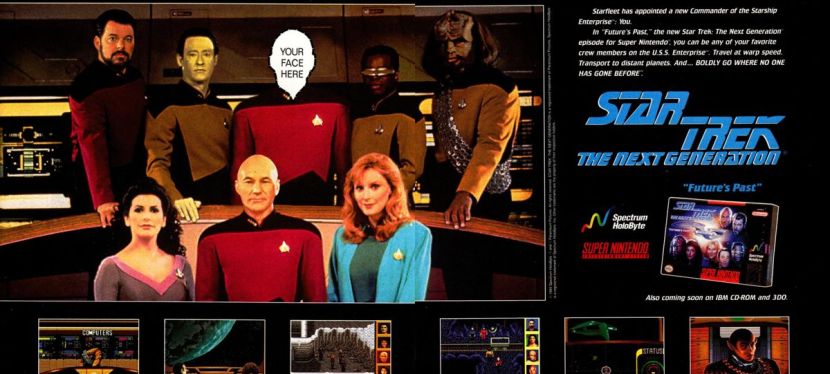
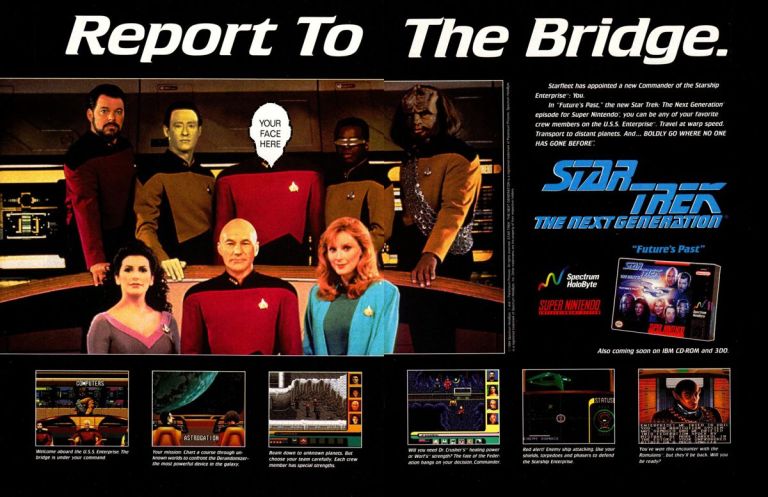
This 2-page print ad was strong enough to invite readers to literally join the Star Trek: TNG crew and go where no man has gone before. By the way, when was the last time you saw Marina Sirtis or Gates McFadden on a video game ad?

Long before wokeness ruined Star Trek in this modern age, the sci-fi franchise reached a tremendous high in popularity and projects in the 1990s as that decade had Star Trek: The Next Generation (most of its TV seasons and three movies were released within the decade), Star Trek: Deep Space Nine and Star Trek: Voyager that kept fans entertained.

Considering its high popularity, it was not surprising that a video game adaptation of Star Trek: TNG was released in 1994 titled Star Trek: The Next Generation – Future’s Past (the version for Super Nintendo Entertainment System) and I saw the above print ad while reading a gaming magazine. Using a slightly altered version of the TNG group photo, the print ad emphasized its concept that the player will be able to lead the crew of the Starship Enterprise and take part in a series of missions in different parts of space with the likes of Captain Picard, Commander Riker, Data, Worf, Dr. Crusher, Deanna Troi and La Forge. While I was never a Star Trek fan, the above print ad caught my attention with its concept, the group photo and the screenshots gave me an idea of what the game has to offer. It should be noted that Star Trek: The Next Generation – Future’s Past was released between the end of Star Trek: TNG’s final season and the theatrical release of Star Trek: Generations.

6. Super Castlevania IV print ad

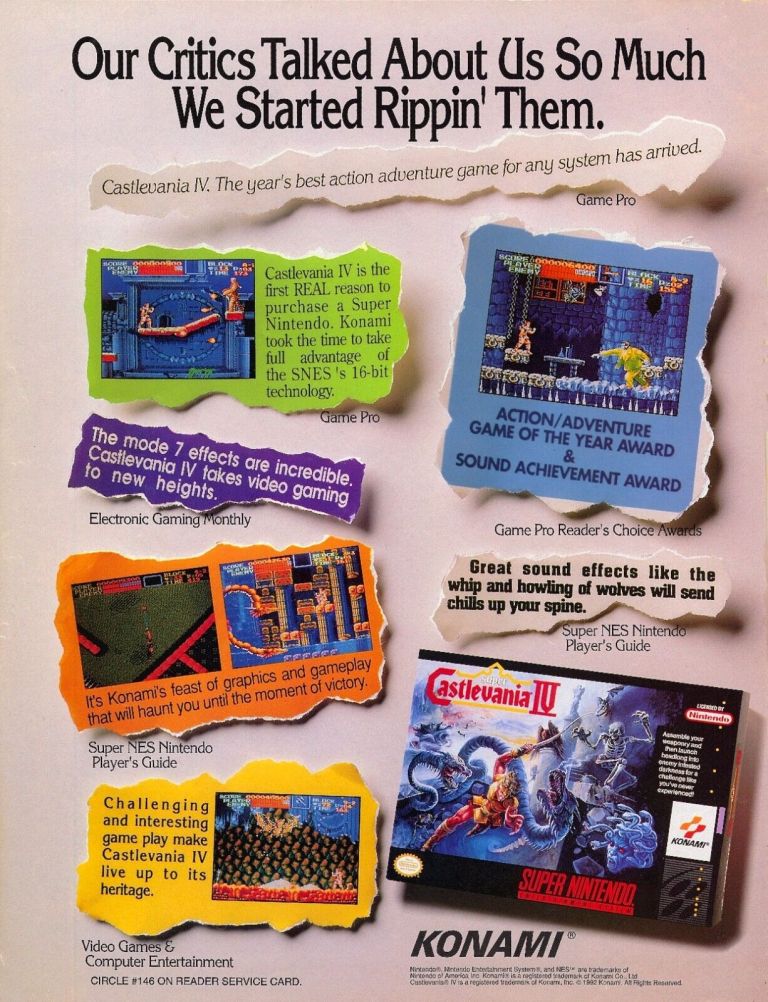
This was one of the most eye-catching print ads I’ve seen about a Konami video game.

The jump in technology from one console generation to the next can be beneficial for gamers if game developers harnessed the advantages of new technologies to make new games that turned out to be more engaging and more enjoyable. Such was the case with Super Castlevania IV for the Super Nintendo Entertainment System (SNES) in 1991. The above print showed Konami highlighting the positive feedback their game received from different gaming media outlets and used screenshots to give gamers and long-time Castlevania fans exciting stuff to see. I got to play the game on the mini SNES console and I can say that in terms of visuals, controls and gameplay, Super Castlevania IV truly lived up to its title and it remains fun to play to this day.

+++++

Thank you for reading. If you find this article engaging, please click the like button below, share this article to others and also please consider making a donation to support my publishing. If you are looking for a copywriter to create content for your special project or business, check out my services and my portfolio. Feel free to contact me with a private message. Also please feel free to visit my Facebook page Author Carlo Carrasco and follow me on Twitter at  @HavenorFantasy as well as on Tumblr at https://carlocarrasco.tumblr.com/ and on Instagram at https://www.instagram.com/authorcarlocarrasco

Eiyuden Chronicle and Suikoden creator Yoshitaka Murayama passed away

Once the anticipated Japanese role-playing game (Japanese RPG) Eiyuden Chronicle: Hundred Heroes finally comes out on April 23, 2024, the absence of the main creator will be felt by many players as the Japan-based Rabbit & Bear Studio announced very recently that its head Yoshitaka Murayama passed away on February 6. For the newcomers reading this, Murayama is also the creator of the Suikoden RPG series of Konami where he used to work at. For my previous blog posts of Eiyuden Chronicle: Hundred Heroes, click here, here, here and here).

To put things in perspective, posted below is the excerpt from the official announcement by Rabbit & Bear Studios. Some parts in boldface…

So there you have it. The developer behind Eiyuden Chronicle: Hundred Heroes made it clear that they will not give up with fulfilling the dream of the late Murayama and there is no stopping the launch of the game (which was supposed to have been released in 2023).

More on the previous works of the late Murayama, I played Suikoden and Suikoden II (read my retro review by clicking here) on the PlayStation console in the 1990s and I had enjoyable times with them. For me, Suikoden II was the not only the best Suikoden RPG of the 1990s but also one of the best RPGs on any platform during the decade. It’s just too bad that the 1999 North American launch of Suikoden II was overshadowed by another company’s JRPG on PlayStation that same year. Considering the many Japanese RPGs that were released on PlayStation in 1999, Suikoden II was the most enjoyable one I played.

Even during his days as a young man working for Konami in the 1990s, Murayama had a very unique vision for digital role-playing and adventuring, as well as fantasy storytelling.

“Eiyuden Chronicle is really (an) evolution of my many design experiences. The many games I’ve made have helped create the foundation for this title. Since I draw my experience from previous games I’ve worked on, of course you will see a little bit of those elements in Eiyuden Chronicle,” Murayama said in response to a question that mentioned Eiyuden Chronicle and Suikoden titles.

With Murayama gone, the spotlight on the April 2024 launch of Eiyuden Chronicle: Hundred Heroes will be more crucial than before. I myself will be playing the RPG on my Xbox Series X console as soon as it launches. To get yourselves oriented with the said JRPG, watch the videos below (the last one shows Murayama and his fellow creators as special guests at an event in Taipei)…

Watch out for Eiyuden Chronicle: Hundred Heroes on Xbox Series X, Xbox Series S, Xbox One and Windows PC plus Xbox Game Pass (XGP) on April 23, 2024. For more about the JRPG, visit https://www.xbox.com/en-US/games/eiyuden-chronicle

+++++

Thank you for reading. If you find this article engaging, please click the like button below, share this article to others and also please consider making a donation to support my publishing. If you are looking for a copywriter to create content for your special project or business, check out my services and my portfolio. Feel free to contact me with a private message. Also please feel free to visit my Facebook page Author Carlo Carrasco and follow me on Twitter at  @HavenorFantasy as well as on Tumblr at https://carlocarrasco.tumblr.com/ and on Instagram athttps://www.instagram.com/authorcarlocarrasco

Retro Gaming Ads Blast – Part 2

Welcome back readers, fellow geeks and electronic gaming fans!

In this edition of the Retro Gaming Ads Blast (RGAB) series, we will examine print ads from the 1980s and 1990s that caught my attention and I will explain why these are worth look back at.

For the newcomers reading this, Retro Gaming Ads Blast (RGAB) looks back at the many print ads of games (console, arcade, computer and handheld) that were published in comic books, magazines, flyers and newspapers long before smartphones, social media, the worldwide web and streaming became popular. Back in the old days, many gamers trusted the print media a lot for information and images about games.

With those details laid down, here is the latest batch of retro gaming print ads for you to see and enjoy…

1. Popeye multiplatform print ad

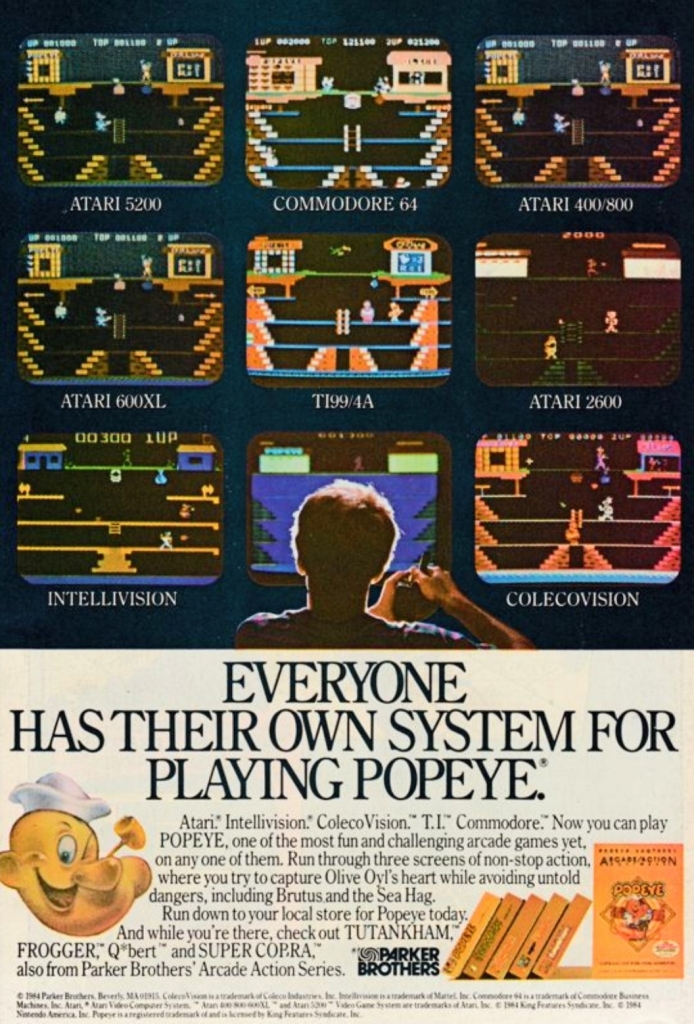
A fine example of promoting the Popeye video game on multiple platforms visually.

During the early 1980s, an arcade game based on Popeye was released and it became a hit with gamers who lined up and inserted coins to play. That game, which had three stages, was eventually ported by Parker Brothers to multiple platforms of Atari, ColecoVision, Intellivision, T.I. and Commodore.

The print ad you see above is a classic display of how one particular game appeared as a multiplatform release. The screenshots showed different versions of the Popeye game on multiple Atari platforms plus the others. See how different the game looks on each platform? The level of visual details and elements varied from one another as each machine had different specs that Parker Brothers had to adjust to. This is a fine example of promoting one game for different machines for those who love video games.  

2.  Kool-Aid Man Video Game print ad

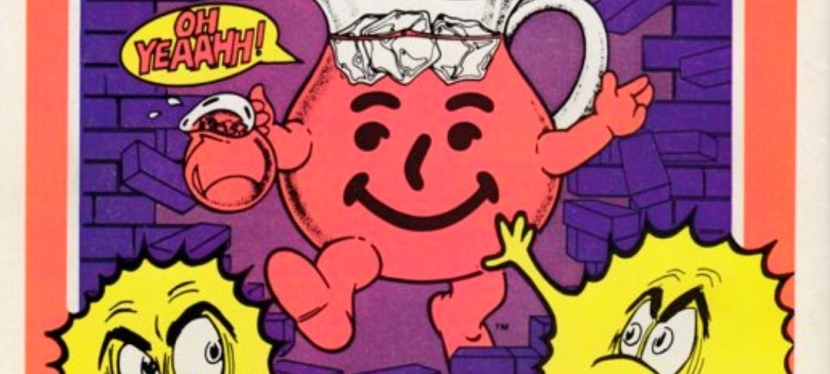
I never got to play this Kool-Aid Man video game.

Remember Kool-Aid? For the newcomers reading this, Kool-Aid was a very popular product line of flavored juice drinks sold in powdered form. I myself used to mix Kool-Aid with ice-cold water and enjoyed drinking it. In 1954, a promotion of Kool-Aid with a touch of entertainment happened by highlighting the character Kool-Aid Man (famously known as the walking and talking pitcher filled with Kool-Aid juice). In later years, the Kool-Aid Man was often shown breaking through walls saying the line “Oh yeah!”.

The Kool-Aid Man gained tremendous attention as a pop culture figure in the 1980s when a new series of advertisements and promotions happened branching into video games and even comic books. The above print ad was a clever move to promote Kool-Aid as a drink as well as a video game for the Intellivision and the Atari 2600 consoles. Even if you were not too fond of video games in the 1980s, the Kool-Aid game ad would still make you think about the drink. Clever and entertaining!  

3. Zombies Ate My Neighbors game print ad

I saw the 2-page ad many times in comic books and video game magazines.

Going into the 1990s, Konami’s print ad of the video game Zombies Ate My Neighbors (for Super Nintendo Entertainment System and Sega Genesis) appeared a lot in the comic books I read when I was much younger. Having seen lots of horror movies – including zombie flicks – the ad easily caught my attention not because of the screenshots but because of the visual style used. For one thing, there was this 1950s America-inspired imagery on the photo of the scared woman with three zombies slowly approaching her. As for the game itself, there were plenty of small-sized screenshots that had lots of interesting details and pixel art (note: 3D polygons in video games were not yet common back then) which gave me a clear idea that it was a humor and horror-laced 2D adventure. Not only that, the text descriptions combined with the fake quotes added zest into the presentation. After having examined all the details carefully, I really felt like Zombies Ate My Neighbors would be a fun-filled game to play on the SNES.

4. Lunar: The Silver Star print ad

With anime artwork used, it was easy to have the impression that the original Lunar game was based on an existing anime series or movie.

In the early 1990s, Game Arts developed and released the Japanese role-playing game (JRPG) Lunar: The Silver Star on the Mega CD platform in Japan which in some ways was also a technological breakthrough – the game came with full motion video (for short videos), animated images, and CD-quality sound (that really made the soundtrack lively to listen to). After achieving critical and commercial success in Japan, the game was picked-up by Working Designs to be localized and released in the North American market for the Sega CD (the American counterpart of the Mega CD) platform. In promoting the game for American Sega CD owners as well as American gamers in general, a print ad highlighting anime images with five screenshots and only a few words was published on both comic books and magazines.

Even though Lunar: The Silver Star’s core concept was never described in the ad, the anime imagery was still eye-catching and the chosen screenshots gave viewers a preview of the gameplay and the animated images. That being said, it was no surprise that gamers who happened to be a bit interested in anime noticed the print ad. At the same time, the ad gave some gamers the impression that Lunar was a game based on an existing anime franchise. This approach on game advertising was daring and it happened at a time when Japanese RPGs had a limited audience among gamers in North America.

5. Lunar: Silver Star Story Complete print ad

In the 2nd half of the 1990s, a remake of Lunar: The Silver Star was released in Japan titled Lunar: Silver Star Story for Sega Saturn (1996), Sony PlayStation (1998) and Windows PC (1998). While it still maintained the 2D visuals for presentation, gameplay and exploration, the remake had smooth anime sequences, new artworks, better sound effects and music. Working Designs pounced on the opportunity to localize the game in America for PlayStation and released it in 1999 with the title Lunar: Silver Star Story Complete. Not only did Working Designs work hard on localizing the game (the English dubbing and singing of the game’s songs were meticulously done), they released it with a very lavish packaging with the dedicated fans and collectors in mind.

By looking at the above print ad that magazines published, Working Designs highlighted the positive feedback quotes from EGM, Gamers’ Republic, PSM and Official U.S. PlayStation Magazine to convince gamers Lunar: Silver Star Story Complete is a great game. While the screenshots showed what kind of eye candy gamers could expect, Working Designs made sure that they would know that the lavish package includes 4 discs (2 game discs, 1 music CD and 1 CD that had video documentary of the making of Lunar), a full-color map in the form of a cloth, and a hardbound art book and instruction manual.

Considering the dynamism of the Lunar: Silver Star Story Complete print ad and the game’s packaging, I can only speculate that Working Designs had to do it aggressively because the gaming landscape changed dramatically as 3D polygonal graphics became the standard while lots of other Japanese RPGs from different publishers were released in 1999 (including the sequels Suikoden II and Final Fantasy VIII) and many of them had more elaborate game designs and visual presentations. Eventually market forces and unfortunate business events led Working Designs to closing down permanently in 2005.

6. Star Wars: Jedi Arena print ad

Remember when Luke Skywalker tested his lightsaber skills with the floating Seeker in the 1977 movie?

Back in the early 1980s, Parker Brothers was very active releasing games on the Atari 2600 console which my family had. At that same time, Star Wars was very popular (and without the wokeness and identity politics garbage of Kathleen Kennedy and woke Disney) and any new game based on the sci-fi franchise was something to be excited for. In the above print ad of Star Wars: Jedi Arena, an artwork showing the iconic her Luke Skywalker testing his lightsaber skills with the floating Seeker ball was displayed and located between Luke’s legs is a monitor showing the screenshot of the game. Looking at the text description, Parker Brothers creatively focused on the aspect of the Jedi way of using the lightsaber interacting with the Seeker ball. Having played the game myself, I can say the ad was creative and pretty much captured the core concept of the game.  

+++++

Thank you for reading. If you find this article engaging, please click the like button below, share this article to others and also please consider making a donation to support my publishing. If you are looking for a copywriter to create content for your special project or business, check out my services and my portfolio. Feel free to contact me with a private message. Also please feel free to visit my Facebook page Author Carlo Carrasco and follow me on Twitter at  @HavenorFantasy as well as on Tumblr at https://carlocarrasco.tumblr.com/ and on Instagram at https://www.instagram.com/authorcarlocarrasco

Retro Gaming Ads Blast

Welcome back readers, fellow geeks and electronic gaming fans!

Today I am launching a brand-new series of articles titled Retro Gaming Ads Blast (RGAB) which will explore the many print ads and promotions of video games, computer games, arcade games and handheld games that were published through the decades.

For the newcomers reading this, print ads of games were widely popular and heavily relied on by gamers/players long before smartphones, social media, the worldwide web and online videos even started. Back in the old days, print media was the most common method for companies to market their games while also helping hardware (machines which played the games) reach potential buyers. Such ads appeared in magazines, comic books and newspapers. Not only that, there were several print ads of games that were made to look creative, compelling and even intriguing.

With those details laid down, here is the first batch of retro gaming print ads for you to see and enjoy…

1. Parker Brothers’ Spider-Man-led print ad

Does this ad look amusing?

Remember Parker Brothers? That was a company that started way back in 1883 founded with a strong focus on the enjoyment of games in the form of board games, cards and toys. In the late 1970s, Parker Brothers started making electronic versions of their popular board games and engaged in the video game development and publishing. They also went on to make home ports of popular arcade games in the early 1980 for several gaming platforms.

Parker Brothers was very active with making games for the Atari 2600 console which became the dominant machine for home gaming in North America in 1982. In the above print ad, their marketing heavily emphasize the Spider-Man video game for Atari 2600 and added two others games they also published – Tutankham and Amidar – which was a clever move to market multiple games. The ad’s focus on Spider-Man was amusing and even without showing a single screenshot of the game, it was enough to entice people to watch out for it. Be aware that the Spider-Man game’s development was done by Laura Nikolich who was hired by Parker Brothers at a job fair. Nikolich had full creative control on making the game and had no contact whatsoever with Marvel Comics.

2. Advanced Dungeons & Dragons: Cloudy Mountain print ad

An ad like this was strong enough to motivate gamers’ imagination and interest.

Back in 1982, Advanced Dungeons & Dragons: Cloudy Mountain was released on the Intellivision game console and I was fortunate enough to watch my next-door neighbor play it repeatedly. The above print ad – which simply referred to the game as Advanced Dungeons & Dragons – only had a few words which directly pointed to the main objective of the game…the golden crown. While only one screenshot of the game was displayed, the advertisers heavily relied on hand-drawn, comic book-style fantasy art work to sell the game.

For those who were born long after the 1980s, let me share with you that ads like these were really impressive for their time. It was common for advertisers to use art works (even though they may not accurately reflect the gameplay or game design) and post at least one screenshot to catch the viewer’s attention with the hope that it would even encourage him/her to anticipate the game. It should be noted that ads like these were strong enough to make gamers’ imagination or curiosity grow stronger.  

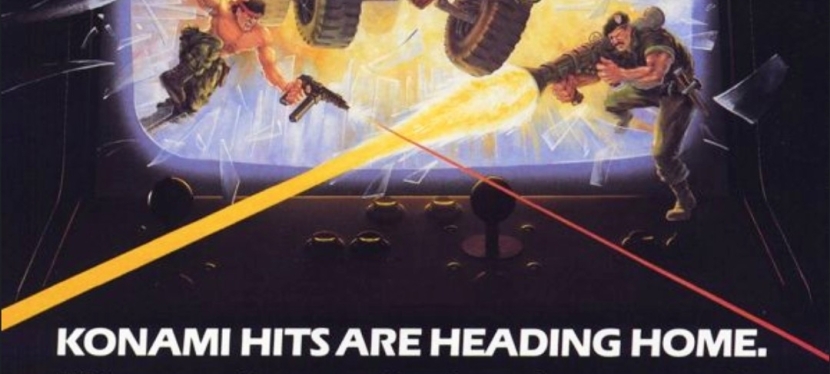
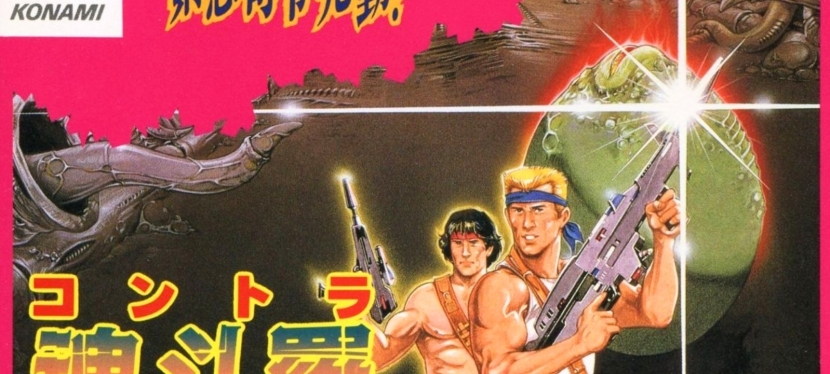
3. Konami’s collective military video games advertising

Print ad of four games for IBM, Amiga and Commodore.
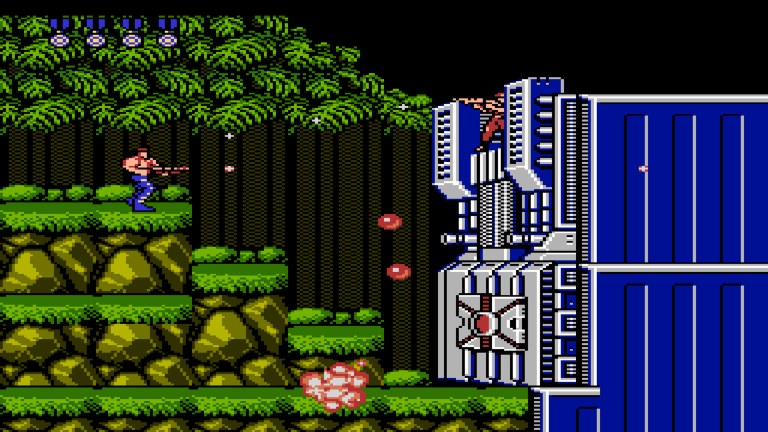
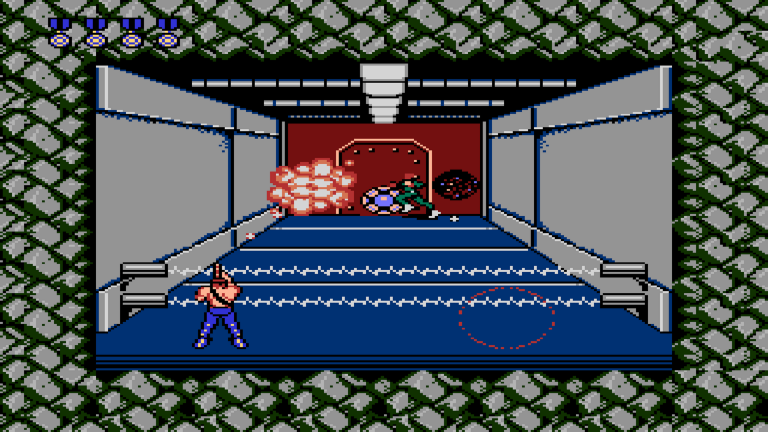
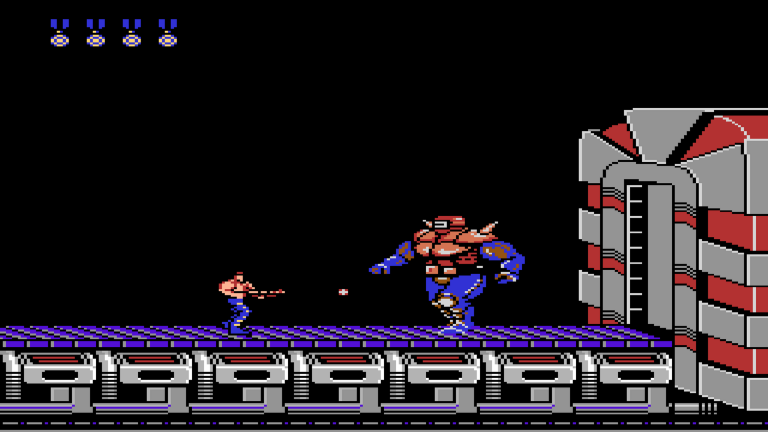
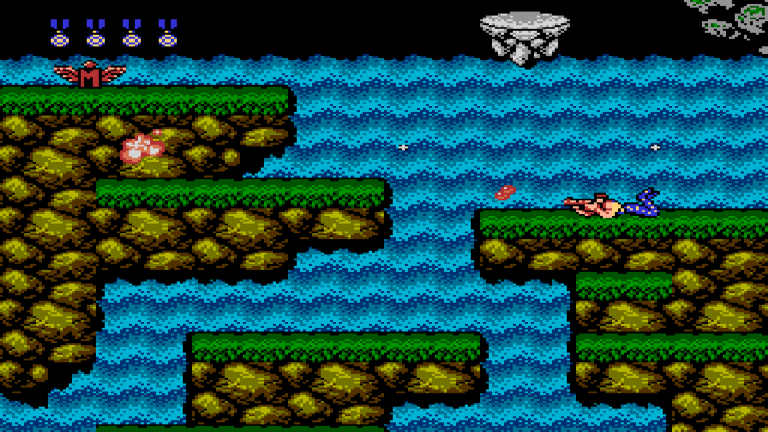
Print ad of Jackal and Contra for the NES.

Konami, the Japanese company that has long been known for Metal Gear, Suikoden and the controversial sacking of famous game designer Hideo Kojima, was aggressive in the gaming business in the 1980s and arguably the aggressiveness was reflected in their publishing of several games that emphasized militarism during the late stages of the Cold War. In short, they made the military look cool and their activities fun to do in digital form.

While Konami has always been identified with console gaming, they actually released Rush’n Attack, Contra, Jackal and Boot Camp on IBM, Amiga and Commodore computers (as seen in the first print ad above) which were popular in the 1980s. The said ad also have a very amusing visual concept emphasizing the excitement and fun of military action games coming to gamers at home for their computers.

The 2nd print ad above – Jackal and Contra for the Nintendo Entertainment System (NES) – was very intriguing to see. It was very clear back in the 1980s that the NES always had a wholesome audience (note: a lot of buyers were parents who wanted to entertain their kids at home) and that includes a lot of very young players. To see the collective ad of Jackal and Contra (for the NES platform) having battle-hardened men in military gear holding guns was openly aggressive to perceive and instantly reminded people about the Cold War (and the menace of Communists, socialists, Marxists and terrorists) and the cultural impact of the mega blockbuster film Rambo: First Blood Part II. This is the kind of ad that would drive today’s woke-minded people crazy and even cause them to panic and pretend to be victims of militarism and patriotism. If you look at the ad closely, you will realize there is simply no room for the garbage of political correctness and wokeness.

Lastly, I myself had played Contra and Jackal with my friends on the Nintendo Family Computer (the Japanese counterpart of the NES) and both military games were a lot of fun to play from start to finish!

4. Batman Returns SNES game ad

This print ad appeared in some comic books I read in the early 1990s.

Way back in 1992, Batman Returns (the sequel to the mega blockbuster Batman movie of 1989) was released in cinemas with intense marketing and merchandising reflecting Warner Bros. intention to replicate the commercial success they had in 1989. Along the way, there were several video game adaptations of Batman Returns that were released on different platforms. Among those many video games was the Super Nintendo Entertainment System (SNES) game of Batman Returns which was developed and published by Konami in 1993 the form of a side-scrolling beat-them-up game.

The above ad was visually appealing with hand-drawn, comic book-style art dominating the spaces while leaving room for some screenshots and a written description of the game. Having seen this ad on multiple comic books I read back then, I can say that the ad was entertaining to see and was effective in making me interested in the game. I played Batman Returns on the SNES but never got to finish it. Oh yes, the game’s audio were really good and there were also digitized images from the movie for the in-game narrative.

5. Flashy Sonic the Hedgehog Japanese print ad

A dazzling approach by Sega on selling Sonic the Hedgehog.

1991 will always be remembered as the year of Sonic who eventually became not only Sega’s most defining mascot but also a video game industry icon. That same year, Sega released Sonic the Hedgehog on the Sega Genesis (referred to as Sega Megadrive in other parts of the world) console and it became a massive success with consumers and the game critics.

In the above Japanese print ad, a very captivating display of light and energy rays dominated the space leaving a minority share left for Sega’s console, screenshots and even a UFO Catcher arcade machine picture. While I could not understand the Japanese text, it seems to me that the flashy visual concept of the ad reflected Sega’s high ambitions with Sonic. How many gamers in Japan bought a copy of Sonic the Hedgehog because of this ad remains undetermined.

6. Japanese Super Star Wars print ad

A long time ago in a galaxy far, far away…

Before Nintendo released its 16-bit game console (referred to as Super Nintendo Entertainment System in America, and Super Famicom in Japan), there were lots of Star Wars video games released on varied platforms and the arcade.

With Nintendo’s 16-bit gaming platform realized, lots of game designers and business partners saw opportunities to make new games with gameplay concepts and designs using the technological advantages of the time. For LucasArts and its partners, taking Star Wars gaming into the next level was inevitable and they made it all come true in 1992’s Super Star Wars video game.

Published in Japan by JVC Musical Industries for the Super Famicom, Super Star Wars was a major leap forward in game design, visuals, sound and enjoyment. Apart from the 2D side-scrolling run-and-gun gameplay, gamers were deeply immersed into Star Wars’ universe with the Mode 7 landspeeder and X-Wing fighter sequences, as well as the first-person trench run sequence.

The Japanese print ad above cleverly presented screenshots from the game while using official imagery from the Star Wars movie poster of 1977 (look at how young Harrison Ford, Mark Hammill and the late Carrie Fisher were back then). The ad is a fine example of combining the greatness of the classic George Lucas-directed film with the highly enjoyable design of Super Star Wars. Lastly, these should remind you that there was a time when Star Wars was not yet tainted by wokeness and the garbage values of the Satanic Leftists (read: woke Disney).   

+++++

Thank you for reading. If you find this article engaging, please click the like button below, share this article to others and also please consider making a donation to support my publishing. If you are looking for a copywriter to create content for your special project or business, check out my services and my portfolio. Feel free to contact me with a private message. Also please feel free to visit my Facebook page Author Carlo Carrasco and follow me on Twitter at  @HavenorFantasy as well as on Tumblr at https://carlocarrasco.tumblr.com/ and on Instagram at https://www.instagram.com/authorcarlocarrasco
Gameplay trailer of Eiyuden Chronicle: Hundred Heroes is a must-see!

Welcome back, fellow gamers, geeks, Japanese role-playing games (JRPGs) enthusiasts and fantasy lovers! As many of you are already aware, the much-awaited JRPG Eiyuden Chronicle: Hundred Heroes is set for release on April 23, 2024 on Xbox Series X, Xbox Series S, Xbox One, Windows PC and the Xbox Game Pass (XGP) subscription service.

Having enjoyed the 1990s JRPGs Suikoden and Suikoden II, I really am eager to play Eiyuden Chronicle: Hundred Heroes on my Xbox Series X as that new game’s developers include Suikoden creator Yoshitaka Murayama and other talents who also worked on the Suikoden series. Having played so many Japanese RPGs for decades, I can clearly say that there is no JRPG that has the fun and clever mix of gameplay and features of the early Suikoden games Murayama worked on and we can experience the creator’s RPG magic in Eiyuden Chronicle: Hundred Heroes.

Recently, game publisher 505 Games published a new 6-minute gameplay trailer of Eiyuden Chronicle: Hundred Heroes designed to orient gamers what they can expect in terms of characters, story, gameplay and other features. Watch the gameplay trailer below…

As you can see in the above trailer, Eiyuden Chronicle: Hundred Heroes has a lot in common with Suikoden and Suikoden II in terms of gameplay, art style and variety. There will be group battles, large-scale army battles, fantasy world exploration, mini-games, headquarters expansion, character recruitment (which build up your army and affect the expansion of your headquarters) and more. Eiyuden Chronicle: Hundred Heroes is looking very much like a Suikoden game but just without the name (and without Konami).

This one strongly reminds me of the cooking contest in Suikoden II.
A high-stakes meeting about to take place within the game.
Some of the many characters you can recruit throughout Eiyuden Chronicle: Hundred Heroes.

If Eiyuden Chronicle: Hundred Heroes can achieve tremendous commercial success, it just might spark a revival of the heavy use of pixel art in role-playing games (RPGs) and influence the way other game developers implement mini-games and features (common with the early Suikoden RPGs) into their RPGs.

Watch out for Eiyuden Chronicle: Hundred Heroes on Xbox Series X, Xbox Series S, Xbox One and Windows PC plus Xbox Game Pass on April 23, 2024. For more about the JRPG, visit https://www.xbox.com/en-US/games/eiyuden-chronicle

+++++

Thank you for reading. If you find this article engaging, please click the like button below, share this article to others and also please consider making a donation to support my publishing. If you are looking for a copywriter to create content for your special project or business, check out my services and my portfolio. Feel free to contact me with a private message. Also please feel free to visit my Facebook page Author Carlo Carrasco and follow me on Twitter at  @HavenorFantasy as well as on Tumblr at https://carlocarrasco.tumblr.com/ and on Instagram athttps://www.instagram.com/authorcarlocarrasco

Eiyuden Chronicle: Hundred Heroes set for release on April 23, 2024 on Xbox Series X, Xbox Series S, Xbox One, Windows PC and Xbox Game Pass (XGP)

Finally! It was announced that the anticipated Japanese role-playing game (JRPG) Eiyuden Chronicle: Hundred Heroes will officially be released on Xbox Series X, Xbox Series S, Xbox One, Windows PC and Xbox Game Pass (XGP) on April 23, 2024.

To put things in perspective, posted below is an excerpt from the official announcement via the Eiyuden Chronicle website. Some parts in boldface…

For the newcomers reading this, Eiyuden Chronicle: Hundred Heroes is an independently produced JRPG that involved key creators from the Suikoden game franchise which was previously announced for a vague 2023 release. The game developers needed more time to ensure a high quality RPG which explained the delay into 2024. This new JRPG is the 2nd Eiyuden Chronicle title to be released on Xbox. The first one was Eiyuden Chronicle: Rising.

A battle within the game.

Eiyuden Chronicle: Hundred Heroes is a JRPG that I’ve been anticipating for more than two years now. I enjoyed the first two Suikoden RPGs on PlayStation 1 (note: read my Suikoden II retro review) and the upcoming game is very clearly inspired by them. Ironically, the remastered Suikoden and Suikoden II look like they won’t be released this year as Konami itself announced that more time is needed to ensure quality performance.

As I myself am pretty busy enjoying Bethesda’s sci-fi RPG Starfield on my Xbox Series X console, it seems to me that Eiyuden Chronicle: Hundred Heroes’ April 2024 release schedule feels just right. The more I play Starfield, the more I discovered more quests and activities which really deepened the fun. There is no telling how long I’ll keep on playing the sci-fi RPG. Apart from Starfield, Forza Motorsport (2023) is the other big-time Xbox-exclusive game to play starting October 10.  

Apart from completion and polishing, the publisher of Eiyuden Chronicle: Hundred Heroes will have the major challenge of marketing the game to get JRPG fans and other gamers to buy it. The said game is bound for release on Xbox Game Pass which itself also has hundreds of video games – including RPGs – available for subscribers to play. It will take a solid effort to make Eiyuden Chronicle: Hundred Heroes stand out in XGP.

Watch out for Eiyuden Chronicle: Hundred Heroes on Xbox Series X, Xbox Series S, Xbox One and Windows PC plus Xbox Game Pass on April 23, 2024. For more about the JRPG, visit https://www.xbox.com/en-US/games/eiyuden-chronicle

+++++

Thank you for reading. If you find this article engaging, please click the like button below, share this article to others and also please consider making a donation to support my publishing. If you are looking for a copywriter to create content for your special project or business, check out my services and my portfolio. Feel free to contact me with a private message. Also please feel free to visit my Facebook page Author Carlo Carrasco and follow me on Twitter at  @HavenorFantasy as well as on Tumblr at https://carlocarrasco.tumblr.com/ and on Instagram athttps://www.instagram.com/authorcarlocarrasco

Konami admits 2023 release of Suikoden I&II HD Remaster Gate Rune and Dunan Unification Wars is uncertain as more time is needed to ensure quality performance

I played the original Suikoden on PlayStation way back in 1996 and I would love replay it on my Xbox Series X console.
Suikoden II is one of the best Japanese RPGs not made by Square Enix that I have ever played. This I really look forward to replaying on my Xbox Series X.

Eiyuden Chronicle: Hundred Heroes is the JRPG to anticipate on Xbox Game Pass in 2023

I will get straight to the point here – Eiyuden Chronicle: Hundred Heroes is my most wanted Japanese role-playing game (JRPG) of this current console generation and it is one of the main reasons why I subscribed to Xbox Game Pass (XGP) as soon as I bought my Xbox Series X console late last year. While a release date was not yet announced as of this writing, I am looking forward to this upcoming JRPG on my Xbox Series X sometime in 2023. Check out the official Xbox listing of Eiyuden Chronicle: Hundred Heroes by clicking here.

During the recent Tokyo Game Show (TGS), publisher 505 Games and Rabbit & Bear Studios executives – including studio head Yoshitaka Murayama (the Suikoden series creator) and Junko Kawano (who worked on Suikoden and Suikoden IV) – had their own presentation and made announcements. During the TGS, the newest trailer of Eiyuden Chronicle: Hundred Heroes was unveiled and it sure looks really good even though the footage shown was from pre-alpha build. Watch the newest trailer below…

As I mentioned earlier, no release date was announced during the TGS which I found baffling since that event drew a lot of viewers and gamers’ attention worldwide. Could it be possible that Konami’s surprise announcement of Suikoden I&II HD Remaster Gate Rune and Dunan Unification Wars coming to multiple platforms (including Xbox) in 2023 might have something to do with the lack of a firm release date for Eiyuden Chronicle: Hundred Heroes? At least in my view, developer Rabbit & Bear is still working on finishing their JRPG.

Perhaps publisher 505 Games is doing a wait-and-see approach about the many video games expected to fill the market in 2023 with anticipated heavy hitters like Starfield, Forza Motorsport (2023) and Redfall to name a few. 505 Games will have to select soon a firm 2023 release date for Eiyuden Chronicle: Hundred Heroes based on market competition and the development status of the game.

Exploration in the game will be a mix of 2D sprites, polygonal environments and some artistic backgrounds.
The battles in Eiyuden Chronicle: Hundred Heroes have that dynamic touch and multiple playable characters can fill your party and engage the enemies.

For the newcomers reading this, Eiyuden Chronicle: Hundred Heroes is a turn-based fantasy JRPG which has a design and style similar to what was seen in the first two Suikoden video games. As seen in the above trailer, the upcoming JRPG has the combined talents of game creators such as Yoshitaka Murayama, Junko Kawano and Junichi Murakami (Castlevania: Aria of Sorrow) plus musicians Motoi Sakuraba (Star Ocean series, Tales of series) and Michiko Naruke (Wild Arms series).   

Eiyuden Chronicle: Hundred Heroes has a story set in one corner of Allraan, a tapestry of nations with diverse cultures and values. On Xbox.com, 505 Games released the first set of character profiles introducing: Nowa, Seign, Marisa, Lian and Garr. Their respective descriptions are as follows…

NowaWhen the League of Nations recruits warriors to assist in a joint expedition with the Galdean Empire, our protagonist answers the call and leaves his remote village to test his skills. On the mission, he finds an ancient rune-lens, unaware that the discovery will spark a war between the League and the Empire. After the conflict begins, he joins a unit in the League’s border guard. The protagonist is the “leap before you look” type. He doesn’t always weigh the pros and cons before springing to action, and while his constant need to involve himself in other people’s problems sometimes creates headaches for his companions, they like him for it and know his heart is in the right place. After all, if they ever got into trouble, he’d be the first person there.

SeignThe second-born son to House Kesling, a powerful imperial family. His older brother died on the battlefield. Seign is exceptionally gifted; after achieving outstanding grades at military academy, he was placed in command of a company of his peers and sent on the expedition to find the ancient rune-lens. During the mission, he meets the protagonist. The two warm to each other as they overcome adversity, and they learn of one another’s ambitions. Seign’s strategic mind allows him to analyze things from a broad perspective and make sound decisions. People often confuse his clear mind for a cold heart, but he is guided by strong ideals and a deep passion to fulfill them. After his brother’s death during a border rebellion, Seign began to think long and hard about what it means to fight.

Marisa – A young member of the Guardians, a clan that hallows and protects the forest. Since Marisa was very little her family has instilled their ways and traditions in her. She has a warm, affable smile — except on the battlefield, where she wears the countenance of a warrior.

Although the Guardians live as one with the forest, they have respect for the outside world’s culture and technology, and they are not against integrating the parts of it that make sense to them. Marisa is particularly forward-thinking in this regard and loves new things — especially cute things.

Lian – After the Empire’s forces invade league lands, Lian is infuriated and runs away from home without even the slightest semblance of a plan. She decides the first thing to do is hoof it to the biggest town she can find, and luckily that’s where she meets the protagonist and his companions. Lian was born in a dojo, and her father wasted no time in teaching her. She was doing roundhouse kicks before she even learned to walk properly.

Garr– A veteran beastman warrior. He and his clan make their living as mercenaries, and their vast experience and sheer brutality put them in high demand. War is all Garr has known, and to him life is one battlefield after the other until you die.

To date, Rabbit & Bear Studios already released the side-scrolling spin-off game Eiyuden Chronicle: Rising and has been working hard to complete Hundred Heroes. The shared game design elements between the early Suikoden games and Eiyuden Chronicle: Hundred Heroes such has having over 100 playable characters, a story of war, in-depth world exploration, heavy use of 2D sprites for the characters along with their acts during battles, and dynamic group battles are not surprising given Murayama’s history of leading the development of the Suikoden JRPG franchise (until the 3rd game) during his time with Konami. Murayama also is a proven fantasy storyteller with the Suikoden games. Personally, I really loved playing Suikoden II which in my opinion is not only the best of the Suikoden game franchise but also one of the very best JRPGs of the 1990s that I have ever played as well as one of the best JRPGs that was not made by Square Enix.

Now this is one very dazzling moment shown during the latest Eiyuden Chronicle: Hundred Heroes trailer.
Seign and Nowa going head to head with each other in this captured moment from the latest trailer.

Knowing that Murayama, Kawano and other notable Japanese creators are working together in making Eiyuden Chronicle: Hundred Heroes, I have reasons to be confident about it. On my end, my taste on video games has changed a lot over the past fifteen years and that goes the same with my interest in JRPGs. Along the way, I really miss the fun I had with the first two Suikoden games as they had gameplay elements that were not only uniquely fun but also aged well. For me, Eiyuden Chronicle: Hundred Heroes could become the most delightful surprise among JRPGs in this current console generation. It is my most-wanted JRPG of this console generation and I believe it will fit in nicely with the Xbox ecosystem which is already becoming an ideal haven for fantasy RPGs and RPG fans in general.

Watch out for Eiyuden Chronicle: Hundred Heroes on Xbox Series X, Xbox Series S, Xbox One, Windows PC and Xbox Game Pass in 2023.

+++++

Thank you for reading. If you find this article engaging, please click the like button below, share this article to others and also please consider making a donation to support my publishing. If you are looking for a copywriter to create content for your special project or business, check out my services and my portfolio. Feel free to contact me with a private message. Also please feel free to visit my Facebook page Author Carlo Carrasco and follow me on Twitter at  @HavenorFantasy as well as on Tumblr at https://carlocarrasco.tumblr.com/ and on Instagram athttps://www.instagram.com/authorcarlocarrasco

Remastered versions of Suikoden and Suikoden II are coming to Xbox in 2023!

During the recent Tokyo Game Show (TGS), Team Xbox had its livestream event which was a mix of surprises and game reveals. Xbox chief Phil Spencer and Xbox CVP Sarah Bond spent time emphasizing their gaming business as well as their commitment with the game creators and gamers in Japan.

While the sudden release of the remastered version of the hit Japanese role-playing game (JRPG) Ni no Kuni on Xbox platforms and Xbox Game Pass (XGP) was indeed surprising, there was another major surprise pulled off by Konami that includes Xbox for a release some time in 2023 – Suikoden I&II HD Remaster Gate Rune and Dunan Unification Wars. Watch the official English-language trailer below…

To put things in perspective, posted below is an excerpt from the official press release from Konami’s website. Some parts in boldface…

Announced during Tokyo Games Show 2022, KONAMI confirmed several fundamental improvements and quality-of-life features in the upcoming remaster collection:

Graphical Improvements

Pixel sprites and environment art enhanced with new screen effects including lighting, clouds, and shadow animations Flickering flames, smoldering smoke, the movement of leaves and insects, all add up to a lively in-game atmosphere!

The effects and direction have been redesigned, bringing memorable scenes back to life in more beautiful ways!

New Character Drawings

All character portraits have been updated in HD. Junko Kawano, who designed the characters for the original version of Suikoden released in 1995, has newly re-drawn all the character portraits for Suikoden I HD Remaster Gate Rune War.

Sound Improvements

Field Sound – A large number of environmental sounds not found in the original version, such as the sound of running water in the river, wind, insects, and running footsteps, have been added. You can enjoy an immersive experience like never before!

Battle Sound – All sound effects are now in HD. In addition to the impact of the 3D effects, the realistic sound greatly enhances the dynamism of the battles!

Game System Improvements

Many new features have been added, such as dialogue log, auto-battle, double-speed battles, etc.

Footage of the remastered Suikoden JRPG from Konami’s official trailer.
The 2D sprites look the same but they do look sharper in HD. Even the background elements look sharper.
World exploration in Suikoden is no longer the flat 2D map it used to be.

As I have played Suikoden and Suikoden II on the original PlayStation console in the 1990s, the announcement of Suikoden I&II HD Remaster Gate Rune and Dunan Unification Wars is big dream come true for me personally. I always wanted to replay Suikoden and Suikoden II without the hassle of having to spend a lot of money to buy a PlayStation or a Nintendo console. In my experience, Suikoden II is the peak of excellence of its own franchise as the creative team listened to the fans and learned from their shortcomings on making the first game which resulted in very rich gameplay, several fun features and compelling story. Suikoden II also remains a great example of using 2D sprites aided with 3D camera movements and some polygonal effects. Read my retro review of Suikoden II at https://carlocarrasco.com/2021/07/15/a-look-back-at-suikoden-ii-1999/

The lighting in this particular part of Suikoden II was enhanced to be dramatic looking.
Battle sequence from Suikoden II as shown in Konami’s trailer.
This touching scene from Suikoden II looks better than ever.

That being said, Suikoden I&II HD Remaster Gate Rune and Dunan Unification Wars coming to Xbox (note: Xbox One was officially listed as the Xbox console) is a big bonus not just for Xbox gamers who enjoy JRPGs but also for long-time gamers who loved the early Suikoden games who have not been spending much time with console gaming. As seen in the official press release from Konami as well as in the revealed footage in the official announcement trailer, there were several enhancements to make Suikoden and Suikoden II more presentable in today’s age of high-definition gaming. While the 2D sprites and in-game art works of the two classic JRPGs look the same (note: with some minor adjustments), I noticed the improvements on sound effects, the in-game lighting, some adjustments on textures, the higher resolution resulting in sharper images, and the redrawn character portraits (in the first game specifically).

Suikoden I&II HD Remaster Gate Rune and Dunan Unification Wars coming to Xbox is looking like a great addition on the Xbox ecosystem’s growing global appeal as the haven for fantasy RPGs gamers and also for gamers who like other types of role-playing games! For Konami, selling the two classic JRPGs on Xbox could mean bigger sales than what they achieved on PlayStation decades ago. Remember that 2023 will see the eventual release of Eiyuden Chronicle: Hundred Heroes and the Xbox-eclusive Starfield. Right now, Konami is still at work on enhancing the remastered Suikoden and Suikoden II and they will have to decide which date in 2023 should mark the release. Personally, I can hardly wait to play Suikoden I&II HD Remaster Gate Rune and Dunan Unification Wars on my Xbox Series X console. Watch out for Konami’s announcement of the official 2023 release date. Also, here is hoping Konami will do a good job remastering the two classic JRPGs and that the promises they made in their press release will be fulfilled.

For the newcomers reading this, the Suikoden game franchise’s core concept has been based on the motif of the Chinese classic novel Water Margin and the creative team back then (led by a very young Yoshitaka Murayama who is now leading Rabbit & Bear studios making Eiyuden Chronicle: Hundred Heroes) created role-playing games that had engaging fantasy stories, feature-rich gameplay and a wide lineup of characters who collectively contribute to the game endings. The first Suikoden RPG of the mid-1990s follows a protagonist whose father is one of the empire’s five generals, as he gathers his 108 Stars of Destiny and friends to fight against the oppressive rule of the Empire in ruin. Suikoden II happens three years after the first game’s story, further evolving the game systems unique to Suikoden, such as Rune magic, the 108 Stars of Destiny, home base management, and Army Battles, which were well received in the previous game. Three childhood friends, including the protagonist, are tossed about by a great whirlpool of destiny.

Historically speaking, the Suikoden video game franchise has been strongly identified with PlayStation platforms. Suikoden and Suikoden II were released on the first PlayStation console while Suikoden III, Suikoden IV and Suikoden V were released on PlayStation 2. There were also some versions of Suikoden games that got released on Sega Saturn, Windows PC and Nintendo platforms. That being said, the inclusion of Xbox One as a platform for the upcoming Suikoden I&II HD Remaster Gate Rune and Dunan Unification Wars is very notable, even exceptional.

Watch out for Suikoden I&II HD Remaster Gate Rune and Dunan Unification Wars on Xbox in 2023. Also, I encourage you all to follow the official Suikoden Twitter account.

+++++

Thank you for reading. If you find this article engaging, please click the like button below, share this article to others and also please consider making a donation to support my publishing. If you are looking for a copywriter to create content for your special project or business, check out my services and my portfolio. Feel free to contact me with a private message. Also please feel free to visit my Facebook page Author Carlo Carrasco and follow me on Twitter at  @HavenorFantasy as well as on Tumblr at https://carlocarrasco.tumblr.com/ and on Instagram athttps://www.instagram.com/authorcarlocarrasco
A Look Back at Suikoden II (1999)

Disclaimer: This is my original work with details sourced from playing Suikoden II (English version, released in 1999) and doing personal research. Anyone who wants to use this article, in part or in whole, needs to secure first my permission and agree to cite me as the source and author. Let it be known that any unauthorized use of this article will constrain the author to pursue the remedies under R.A. No. 8293, the Revised Penal Code, and/or all applicable legal actions under the laws of the Philippines.

Even though I have not played that many Japanese role-playing games (JRPGs) on consoles over the past several years, I am really excited about the upcoming RPGs that will be released on Xbox Series X and the future JRPGs I am looking forward to are Eiyuden Chronicle: Hundred Heroes and Eiyuden Chronicle: Rising developed by Rabbit & Bear Studios (led by Yoshitaka Murayama).

Who is Yoshitaka Murayama? He created the memorable Suikoden (AKA Genso Suikoden) RPG franchise during his time with Konami, specifically the first three games. I myself played and finished Suikoden on the original PlayStation in 1996 and it was a lot of fun thanks to the combined efforts of Murayama (who did the scenarios and game direction) and his teammates such as Junko Kawano (who did the design), Miki Higashino (who did the music along with four other teammates) and some others.

Then in 1999, the sequel to Suikoden was released and I can never forget the day I bought it at a local game store and rushed home with a lot of excitement to start playing it on our then aging PlayStation console.

So you must be wondering…how did I find the sequel? Was it an improvement over its predecessor? Did Murayama and the key creators do better than what they did in the first game? You can all find out in this look back at Suikoden II, published by Konami for the PlayStation (PS1).

The cover of the North American version of Suikoden II.

Early story

The story begins with two youngsters – Riou (your character whose name can be modified) and Jowy – who are close friends since childhood now serving the Highland Army as members of their youth brigade. They spend time in a military camp in the forest as a peace treaty between two great forces is pending (note: Highland has been in conflict with the City-State of Jowston).

As some soldiers expressed desires to go home once the peace has been finalized, Riou and Jowy are ordered by their commanding officer Rowd to go back to their tent and sleep. However, a surprise attack happened which alerted them. As soon as the two close friends left their tent, they are shocked to see parts of the camp burning. Their officer Rowd informed them that their enemy is responsible for the attack and deliberately broke the peace agreement. Riou and Jowy are told to take the mountain path to the east and save themselves before it is too late.

Fearing that they might get ambushed in the woods, Jowy tells Riou that they should return to camp. Upon returning, they quietly witness the unexpected presence of Highland prince Luca Blight who gets briefed by Rowd. As it turns out, the attack on their camp was not committed by the opposing forces but rather it was all a self-inflicted operation by Highland. Rowd’s instruction to some of their selected soldiers to head east was a set-up. What happened was all part of a plan by Highland to escalate the conflict by blaming their losses on Jowston. Luca Blight expressed clearly that a peace treaty with Jowston and its states was not needed, and he strongly believes in the power of Highland to conquer them all.

Jowy and Riou (upper-right corner) quietly witness the conversation between prince Luca Bright and the captain.

After learning the shocking details, Riou and Jowy decide to leave for the cliff to the north as a way of escape. At the cliff, Rowd catches up to the two. Fortunately, Riou and Jowy were successful in defeating Rowd’s soldiers and pave the way for their escape. Before fleeing, they marked a rock and promised to return to that same place if ever they get separated.

Riou and Jowy jumped off the cliff and get separated. Some time later, Riou wakes up and finds himself in the presence of three men. One of them identifies himself as Viktor, the leader of an army of mercenaries and an ally of Jowston. Another member of the mercenary army in blue arrives and he is Flik.

Being powerless, Riou marches with them to the headquarters of the mercenary army…

Quality

Luca Blight (with sword) is a lot more than just being evil as the game’s main antagonist.

Having played Suikoden a lot in 1996, I got familiar with the game design, the varied battle systems and other features that made it a solid RPG on its own. As for Suikoden II, I can clearly say that Murayama and his creative team built up on their foundation (in the first game), expanded the fantasy concept dramatically and ultimately made an extensive series of improvements and additions over each and every aspect of the sequel!

I’ll start first with the storytelling and writing. Compared to its predecessor, I found Suikoden II to be deeper and it took great advantage of the fact that the plot took place just years after first game and by this time the established world, the cities, tribes and geopolitical concept have been developed so much – backed with solid writing – they all become a lot more believable. In the middle of the great conflict are the three main characters Riou, Jowy and Nanami whose exploits and portrayals are pretty rich and lively to follow. It’s kinda like following the love triangle of Hikaru, Misa and Minmay through the war in the classic Super Dimension Fortress Macross anime TV series, except that you – the player – get heavily involved as Rious by making decisions that affect yourself and others, leading missions, building up a community (and force) of over 100 members, and overcoming challenges related to the conflict between Highland and Jowston.

The great news here is that the Riou-Jowy-Nanami emotional arc was written to be dramatic, engaging, intriguing and sentimental which ultimately will make you feel for them just as you make your way through the many events and twists of the war story. Beyond these three key characters, it should be noted that the scenarios are excellently executed and really showed how lively the fantasy world of Suikoden II really is. I’m talking about the portrayal of the many, many supporting characters and the interactions you have with them as the plot moves forward. Remember how lively your troops were in welcoming you back after winning your first army battle? Such a scenario was well directed and scripted, and the supporting characters you recruited really had their moments of participation which make sense within the narrative. I also should mention that the opposition figure of the game – Luca Blight – is still a powerful and complex villain in JRPGs even by today’s standards. Luca Blight is not evil for the sake of being evil, but if you pay close attention to the details about his background as the game’s story goes on, you will realize he is quite a complex character whose evil made sense within the narrative. Very clearly, the writing and storytelling done by Yoshitaka Muraya is not only greater than in the first game, but also very inspired.

Viktor, who also appeared in the first game, continues to be an important supporting character in this sequel! He is one of several characters from Suikoden who returned.

On the gameplay and design, Suikoden II’s exploration of the world, towns and locations uses good old 2D graphics. The big difference here is that the 2D visual elements are more varied in terms of detailed sprites for non-playable characters (NPCs) and interactive characters, and visually the sprites as well as the art used for the in-game environments looked more polished (clearer, smoother and less pixelated). The controls are responsive enough for my taste, and it is also nice that my character moves faster while exploring. More on exploring, I do confirm that there are indeed more locations to visit (including those that are part of the quests related to finding the 100+ characters) and the art made for the locations are more varied as well.

More on the gameplay, two types of battle systems from the first game are back but with refinements. First to talk about is the party battle system in which players get to control a group of up to six members who face off with enemies by group, or a single powerful boss-type enemy. During the party battle, you get to pick options as to what type of action each member of your party will do – Attack, Magic (note: this involve Runes), Item or Flee (note: if your party is much stronger than the opposition, Bribe or Let Go options will appear).

The party battle system is a lot of fun and not too stressful.

The way the battles are designed, as in the first game, is smooth, very visually appealing (thanks to the dynamic camera and fine level of detail of the sprites and animation) and fun to watch. Adding further depth to the party battles are the combined attacks involving at least two characters. Take for example Flik and Viktor doing the cross-attack, or Riou and Nanami performing a series of combo attack moves in strong coordination with each other. These combined attacks are not only fun to perform and see, but also encourages you to experiment by mixing up characters (specifically combatants) and paying attention as to which characters they can do combined attacks with. This alone will encourage you to complete the 108 characters of your force.

The use of Runes has been improved a lot in this game as the combatants now have three slots to equip Runes (note: these slots gradually open up as characters’ levels go up). Runes are essential to use magic spells in battles and the improvement of the Runes – plus the Run Affinity system – add more variety in the battles.

The 2D sprites are very visually appealing, especially when you watch the characters perform varied forms of action during the party battle.

Compared to other Japanese RPGs, the party battles here are much less stressful even though a random encounter system is used. There is also the option for automated attacks, which spares you from having to choose options for each member of your party to perform when fighting the enemies. Granted, I went through lots of random encounter battles and some challenges, but ultimately the stress level and tedium were very low. Doing party battles is fun overall.

The 2nd battle system inherited from the first game is the duel. Duels happen the least throughout the game but each time they happen, they can be quite engaging to do. As the one-on-one battle between your character and an opponent begins, you will see them in a 3D realm with the dynamic camera capturing the action. Your options are mainly Attack, Wild Attack and Defend, and before you can pick an option, you must pay attention first to the clues (note: taunts) from your opponent which can help you anticipate his/her/its next move. While the visuals are clearly improved, the duel is pretty much the same as in the first game.

Duels happen in a 3D environment with the characters still presented as 2D sprites that are not only highly detailed but also are smoothly animated.
Like in the party battles, duel sequences also have a dynamic camera system complete with zoom during the action.

The 3rd battle system – army battles – is clearly the most revised part of the game as it is radically different from the army battles of the previous game. This time the army battles involves the heavy use of a tactical map (where you move units in a grid-like system). Your units – composed of mainly characters you recruited, including the non-combatants – can be moved on the map to counter an enemy unit. Then a short, animated battle sequence will commence and based on the statistics of each unit, the winner and loser of the sequence will be determined. Take note that in events of defeat, recruits can die permanently. As such, it is important to pay attention to not only the statistics but also the types of troops you have such as archers, healers, knights, and foot troops. When controlling units on the map, your options are Attack, Wait and Rune. It is also very entertaining to see how the characters react (with dialogue, no less) to the battles. Overall, the army battle system here is clearly much deeper and more strategic than what was used in the first Suikoden.

The army battles in this game are more tactical than what was presented in the first Suikoden. This is also the main map used for such battles.

Battles aside, there are also lots of things to do related to exploration. For one thing, there are these fun-filled mini-games the game creators set up such as fishing (note: not as boring as it may sound), the whack-a-mole game, rope climbing, Chinchirorin (dice game in a bowl) and, the most exciting and deepest of them all, the cooking contest game. When you fully invest your time into each of these mini-games, you will not feel relieved from the stress of battles and exploration, but also have a lot of fun free of stress. I enjoyed these a lot myself.

If you enjoyed building up your fortress in the first game, you will experience that here also! Building up your stronghold is related to your recruiting of people and some of them have certain talents that will establish key parts of your place like a store, a Rune shop, aa tavern, a restaurant, an armor shop and even a detective agency to name some! It may take an effort to have all possible establishments get realized in the game but I promise you, they are all worth it and you will feel thankful that you got to recruit lots of people. The other reward of building up your fortress is the establishment of a thriving community of people!

Your party members can take a bath and even use the collected artifacts as decorations. This is one of the many side activities you can do at your stronghold.
The cooking contest mini-game is easily the best in the game! This alone will encourage you to keep searching for recipes during your adventures!

With regards to continuity with the first Suikoden game, the game developers implemented certain content (locations, dialogue, story and characters) that get unlocked by having your preserved Suikoden saved game content successfully loaded with Suikoden II running on PS1. I’m talking about being able to meet and even recruit Suikoden hero Tir McDohl, plus meeting even more characters from the first game. Very clearly, this is a clever presentation of fan service done by Murayama and his creative team who paid attention to the feedback of the first Suikoden.

The music done by Miki Higashino and Keiko Fukami are very varied and many of them reflect the places you get to visit, the emotional scenes you witness and the epic moments that happen. The great news here is that each and every tune in the game was made and performed with special care. This game’s soundtrack really stands out high among Japanese RPGs of the 1990s and even by today’s standards, it still is a great soundtrack to listen to.

If there are any flaws in this great game, it is the English translation itself as there were typographical errors, mistranslations and even NPCs with lines of dialogue that made absolutely no sense. Clearly there was a rushed job with the translation.

Conclusion

The political aspect of the game’s story is simple and never overwhelming.

I really love Suikoden II and very clearly, it is a major improvement over its predecessor (which itself was a solidly good RPG). Suikoden II is a labor of love done by Murayama and his creative team and the result is a true epic RPG that has so much enjoyable stuff and high replay value for gamers. Its quality is still great and by today’s standards, Suikoden II is indeed a classic RPG that gamers should play even though Konami itself does not care to make it more accessible in this modern age of gaming.

Given the legacy of Suikoden II and the fact that Konami showed no signs of reviving the Suikoden RPG franchise, now is the time to look forward to Eiyuden Chronicle: Hundred Heroes which Murayama and his team are developing for release in 2023 for Xbox consoles, Xbox Game Pass and other platforms. Eiyuden Chronicle: Hundred Heroes clearly has strong Suikoden vibes and the distinct combination of 2D sprites with 3D polygonal environments, plus its party battle system strong resembles that of Suikoden and Suikoden II!

Overall, Suikoden II is highly recommended!

Now if only Konami would change its ways to make Suikoden II more accessible (go way beyond the PlayStation online store and ecosystem) to gamers by releasing it digitally through Xbox LIVE, Steam, Xbox Game Pass and other online stores or ecosystems. Paying hundreds of dollars for a legitimate hard copy of the game is simply too much.

There is nothing like building up your stronghold and seeing your recruits become part of its development as well as your campaigns.

+++++

Thank you for reading. If you find this article engaging, please click the like button below and also please consider sharing this article to others. If you are looking for a copywriter to create content for your special project or business, check out my services and my portfolio. Feel free to contact me as well. Also please feel free to visit my Facebook page Author Carlo Carrasco and follow me at HavenorFantasy@twitter.com