Disclaimer: This is my original work with details sourced from reading the comic book and doing personal research. Anyone who wants to use this article, in part or in whole, needs to secure first my permission and agree to cite me as the source and author. Let it be known that any unauthorized use of this article will constrain the author to pursue the remedies under R.A. No. 8293, the Revised Penal Code, and/or all applicable legal actions under the laws of the Philippines.
Welcome back superhero enthusiasts, 1990s arts and culture enthusiasts, movie fans and comic book collectors! Today we go back to the year 1990 to take a look at the official comic book adaptation of the movie Predator 2 (1990).
For the newcomers reading this, Predator 2 is the sequel to the 1987 movie directed by John McTiernan (Die Hard) and starring Arnold Schwarzenegger. As the movie became a huge commercial success, it started a chain of events that led to the rise of the Predator entertainment franchise covering merchandising, comic books and video games to name a few. Of course, the development of a cinematic sequel happened and both the movie studio and filmmakers took their time to make it. Predator 2 was directed by Stephen Hopkins and it starred Danny Glover, Gary Busey and Bill Paxton.
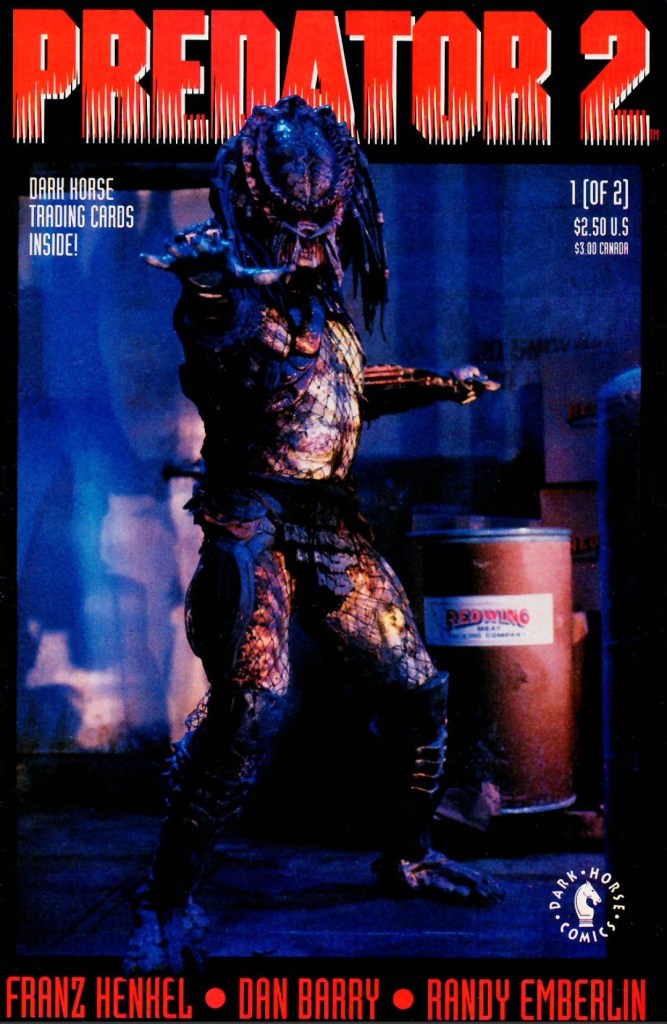
With those details laid down, here is a look back at Predator 2 #1, published in 1990 by Dark Horse Comics with a story written by Frank Henkel (based on the screenplay by Jim Thomas and John Thomas) and drawn by Dan Barry. Mark Verheiden (writer of 1989’s Predator #1) was acknowledged with special thanks. This comic book is the first of a 2-part comic book adaptation of the movie.
The cover.
Early story
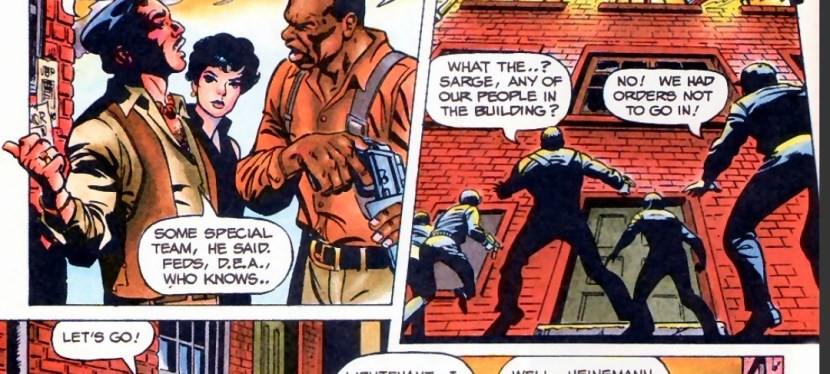
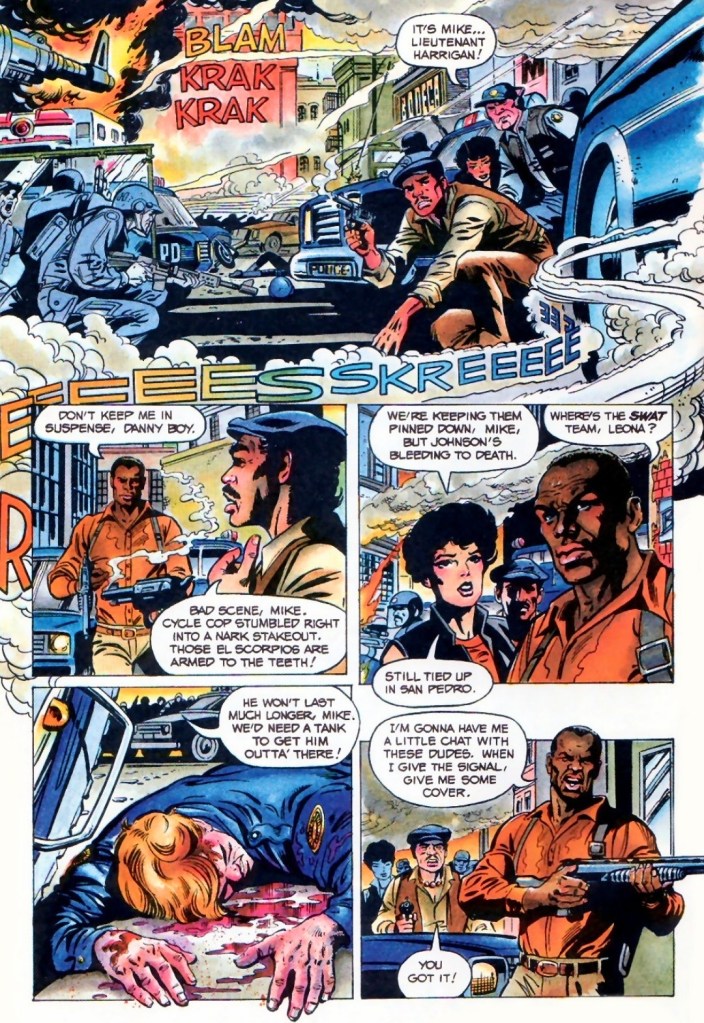
The story begins during a very hot day in 1997 Los Angeles. Police office Mike Harrigan rushes to the site of a major shootout between heavily armed gangs (Colombians and Jamaicans). The police managed to corner a gang to a building that was occupied by the foreigners. Knowing that a fellow cop is slowly bleeding to death and the SWAT (Special Weapons and Tactics) team are still stuck in traffic, Harrigan decides to take action against the armed gangsters with the support of his teammates and some police personnel.
After managing to get close to the gangsters by the building using his car, Harrigan manages to shoot them all and pave the way for his teammates to get closer. Harrigan does not realize that a camouflaged Predator is watching him from above.
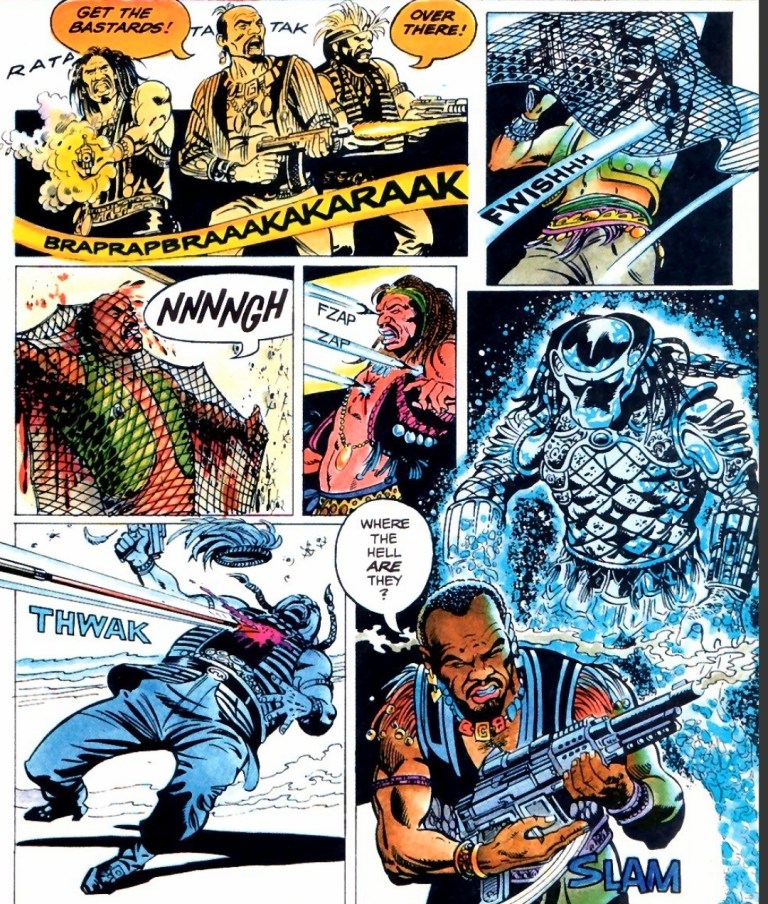
At one of the higher floors of the building, the rest of the foreign gangsters prepare themselves for the arrival of the cops by gathering guns and ammunition. Suddenly, the camouflaged Predator crashes in on them…
Quality
The Predator here is quite aggressive and even arrogant enough to suddenly fight the Jamaican gang alone.
I am surprised how entertaining this first chapter of the 2-part comic book adaptation of Predator 2 turned out to be. While the accuracy is understandably less than 100% with regards to translation from cinema to literature, this comic book’s narrative is quite faithful to the events of the movie (from the start until the King Willie scene) and the film’s vibe was strongly captured. In fact much of the dialogue spoken in the film were mostly recaptured here, and the same can be said about the way the characters were portrayed.
For brevity and the maximizing of the pages made available, creative liberties or shortcuts were taken by the creators. This means that the presentation of details was carefully done to keep readers properly informed while managing to keep the fun factor and level of intrigue strong. Indeed, writer Frank Henkel did a very good job keeping things together to make the reading experience fun and engaging.
If there is anything that this comic book exceeds the movie on, it is the graphic violence. Artist Dan Barry really ramped up the bloody scenes and gore (examples: Mike Harrigan’s killing of two foreign gangsters with a shotgun, and the scene when Harrigan and his team were stunned by the sight of the many ruined dead bodies of gangsters who were just eliminated by the Predator before they arrived) as he used his own style to make the action scenes as intense as the ones filmed by Stephen Hopkins and crew. It was obvious he saw the movie.
Barry also had his own style on visualizing the characters without the authority to use the likeness of any actor from the film. Mike Harrigan looks nothing like Danny Glover while Peter Keyes does not resemble Gary Busey. Barry’s visual take on the Predator itself has a really distinctive look when compared to how other artists drew Predators.
Barry did not aim to achieve photo realism at all with the characters (who appear with a slightly cartoonish aesthetic), the locations and action scenes but I don’t find anything problematic with his work here. In fact, I enjoyed his way of translating the movie’s visual presentation into literary format.
Conclusion
Mike Harrigan, Danny and Leona make their moves.
Predator 2 #1 (1990) is a very enjoyable read. It strongly captured the vibe of the movie complete with the dialogue and the way the characters were presented. Very clearly, the Henkel-Barry duo did really fine work in this comic book adaptation and I am convinced to move on to issue #2.
Overall, Predator #2 (1990) is highly recommended!
In recent times, the returning US President Donald Trump and President Ferdinand “Bongbong” Marcos, Jr., talked with each other on the phone and discussed the US-Philippines alliance, according to a Philippine News Agency (PNA) news article.
To put things in perspective, posted below is an excerpt from the PNA news article. Some parts in boldface…
President Ferdinand R. Marcos Jr. spoke to United States (US) President-elect Donald Trump over the phone on Tuesday morning, where they discussed the longstanding alliance between their two countries.
In a media interview during his visit to typhoon-hit communities in the province of Catanduanes, Marcos said he expressed to Trump the Philippines’ openness to further deepen relations with its oldest and strongest military ally.
“I expressed to him our continuing desire to strengthen that relationship between our two countries, which is a relationship that is as deep as can possibly be because it has been for a very long time,” he said.
The President said he also expressed his intention to meet with Trump as soon as possible. He added that he told Trump that Filipinos in the US voted “overwhelmingly” in his favor.
Trump is set for his second term as US president after winning the recently held elections.
According to Marcos, it is his mother, Imelda Marcos, who is a close friend of Trump.
“Ang kaibigan niya talaga mother ko. Kilalang-kilala niya ang mother ko. Kinukumusta niya, ‘How’s Imelda?’ Sabi ko binabati ka nga (It is really my mother who is his friend. He knows my mother very well. He asked how she is, ‘How’s Imelda?’ I said she is extending her congratulations),” he said.
Although he said they did not talk about the fears of a mass deportation of undocumented immigrants in the US after Trump’s win, Marcos assured that the government is already working on it to assist affected Filipinos.
“We didn’t talk about that. It was just a congratulatory call. But, of course, our ambassador is already working on that,” he said.
Nonetheless, Marcos said his conversation with Trump was “very productive.”
Let me end this post by asking you readers: What is your reaction to this recent development? Are you concerned that once Trump takes office again as US President on January 20, 2025, a lot of Filipinos illegally staying in America will get deported along with millions of other illegal aliens? Are you concerned that the dynamics of trade between the United States and the Philippines will be changed drastically? Do you think America under Trump will increase military support for the Philippines facing the bullying presence of China?
Disclaimer: This is my original work with details sourced from reading the comic book and doing personal research. Anyone who wants to use this article, in part or in whole, needs to secure first my permission and agree to cite me as the source and author. Let it be known that any unauthorized use of this article will constrain the author to pursue the remedies under R.A. No. 8293, the Revised Penal Code, and/or all applicable legal actions under the laws of the Philippines.
Welcome back science fiction enthusiasts, 1980s arts and culture enthusiasts, movie fans and comic book collectors! Today we go back to the year 1989 to take a look at a significant event of the Predator entertainment franchise – the comic book launch of Predator.
For the newcomers reading this, Predator started as a sci-fi action movie in 1987 directed by John McTiernan (Die Hard) and starring Arnold Schwarzenegger, Carl Weathers, and Jesse Ventura to name some. The writers and creators were Jim Thomas and John Thomas. As the movie became a huge commercial success, it led to the start of its own multi-media entertainment franchise covering video games, toys, novels and comic books. It also led to the release of more movies including a crossover film with the Alien franchise.
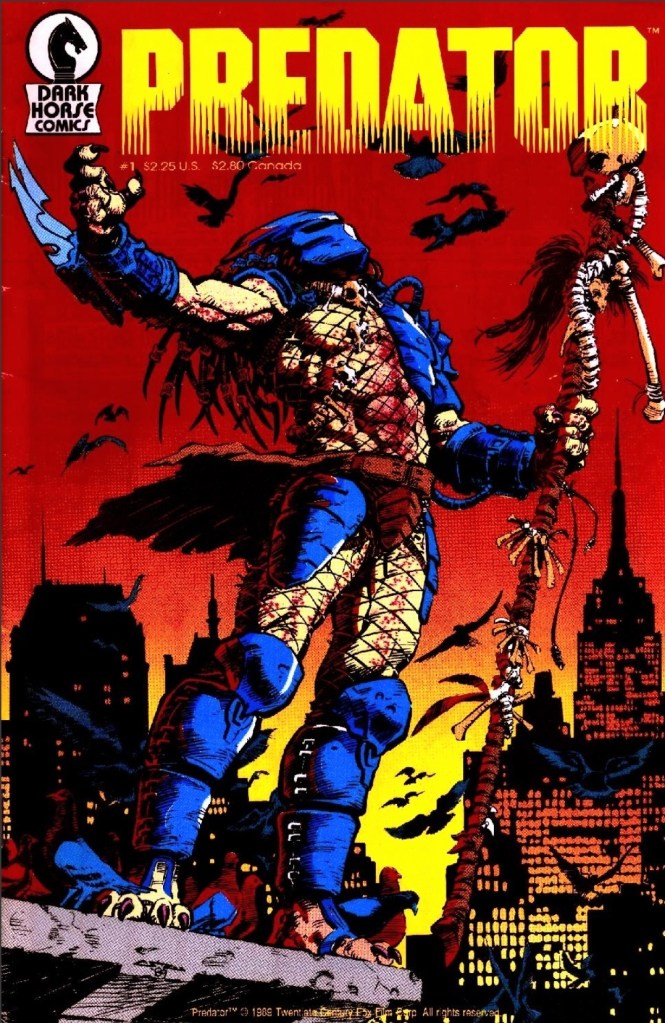
With those details laid down, here is a look back at Predator #1, published in 1989 by Dark Horse Comics with a story written by Mark Verheiden and drawn by Chris Warner. The is the first chapter of a 4-issue mini-series and it would later be referred to as Predator: Concrete Jungle.
The cover.
Early story
The story begins during a very hot summer day in 1991 New York City. A man killed his own wife using a shotgun which eventually leads to the arrival of cops, medics and his arrest. The two detectives Errol Rasche and John Schaefer (brother of Dutch) have been working together in the local war against crime and they have a tendency to do things that violate their superiors’ orders.
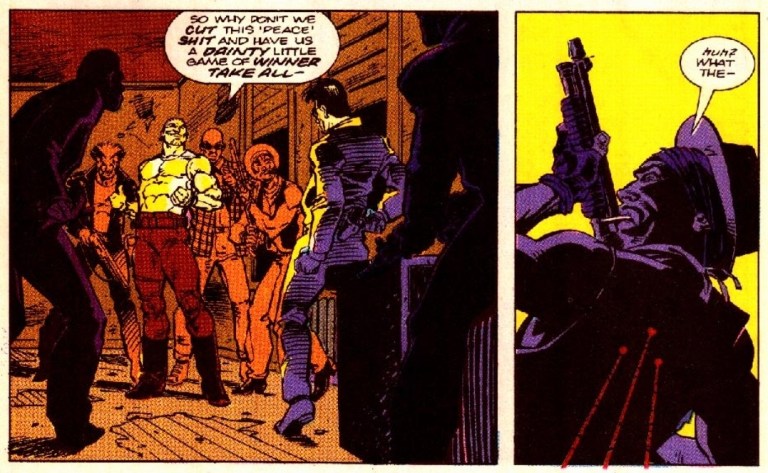
In one of the rundown buildings of New York, a secret meeting between two gangs got terribly disrupted by a Predator who attacked from the outside. Chaos and destruction followed.
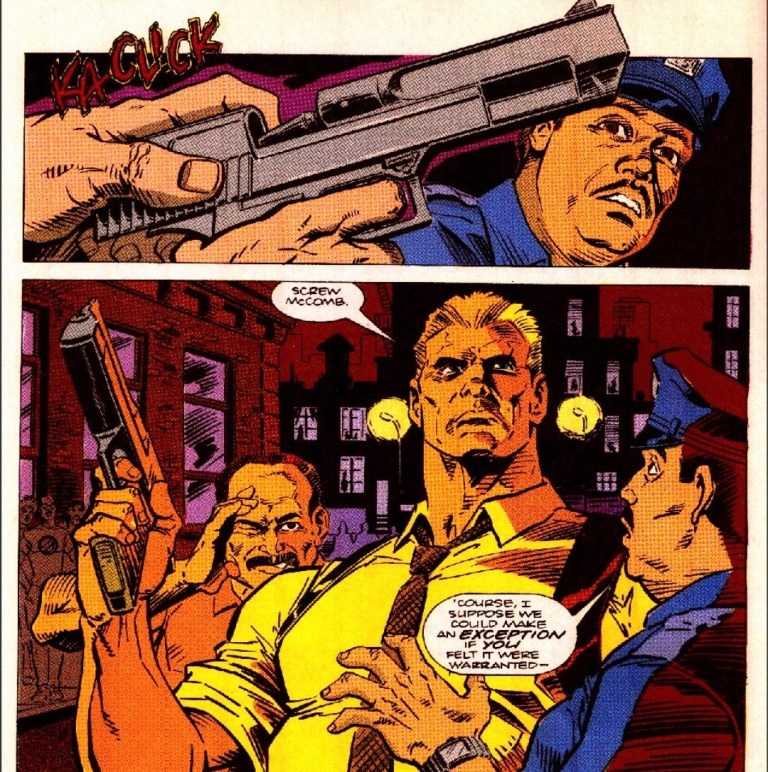
Shortly after, Rasche and Schaefer arrive outside the same building which has been surrounded and isolated by the local police. When a man suddenly fell out of the building and crashed on top of a police car, the two detectives decide to enter willfully violating the order to stay out.
Once they enter the room where the secret gang meeting was held, Rasche and Schaefer are shocked to see many skinned and dead bodies inside. Schaefer is convinced that what happened was not the result of a gang war…
Quality
A gang meeting about to be disrupted by the unseen Predator.
This comic book – written as a not-too-obvious sequel to the 1987 movie – is absolutely very intriguing to read from start to finish. Mark Verheiden clearly wrote a crime story that happens to involve the species of deadly hunters from outer space. In fact, this comic book has very notable elements that also made it into the core concept of the 1990 movie Predator 2.
Story is set within a massive city that happens to be suffering from a heat wave – check! There is rampant crime and conflicts between gangs – check! The Predator causes huge disruptions on the criminals – check! The detectives willingly violate protocol to solve cases – check! One of the detectives is gradually getting closer to retiring and his pension – check. It’s almost as if this comic book was a huge influence on the people who made Predator 2.
Going back to the story, this is a strong tale of crime and urban war told through the exploits of detectives Schaefer and Rasche who have worked many years together, they treat each other like brothers (similar to Predator 2’s Mike Harrigan and Danny Archuleta).
With their record of disobeying orders, Schaefer and Rasche simply involve themselves in cases believing they have the right know the details on the spot and to solve problems their way even though their superiors don’t need them. This is the anti-authoritarian portrayal of law enforcers that easily reminded me of certain TV shows and movies of the 1980s.
All throughout, the story by Verheiden is nicely structured, has lots of engaging details to follow and carefully blends sci-fi elements with detective storytelling. Verheiden clearly knows how to build up tension, keep the narrative progressing and use action or spectacle with precise timing.
When it comes to the visuals, Chris Warner’s style is very good. His approach on drawing the characters made them look exquisite and visceral at the same time. In fact, there were some shots of people in this comic book which reminded me of Todd McFarlane’s way of drawing people during his early works in comics. Lastly, I should say that Warner’s approach on hard action and his way of drawing of the Predator must be seen.
Conclusion
Rasche and Schaefer defy orders. Schaefer (holding the gun) is the brother of Arnold Schwarzenegger’s character in the Predator movie of 1987.
I really enjoyed reading Predator #1 (1989). This is indeed really fine work by the Verheiden-Warner team and as far as building up the lore of the Predator goes, they clearly succeeded and their contributions here strongly influenced the creation of Predator 2 which opened in cinemas in late 1990. This comic book has the visceral touch and violence that make it comparable with both the 1987 and 1990 movies.
Overall, Predator #1 (1989) is highly recommended!
The City Government of Muntinlupa has new additions to its growing list of achievements as it won two awards at the Digital Democracy Awards, according to a Manila Bulletin news report.
To put things in perspective, posted below is an excerpt from the Manila Bulletin news report. Some parts in boldface…
The Muntinlupa City government won at the first Digital Democracy Awards organized by the Makati Business Club (MBC) and sponsored by USAID Philippines and Konrad-Adenauer-Stiftung Philippines.
US Ambassador to the Philippines MaryKay Carlson, MBC Chairman Edgar Chua, and Department Of Information And Communications Technology Usec. Jocelle Batapa-Sigue presented the Digital Democracy Champion award to 14 city local government units for their exceptional implementation of Digital Democracy initiatives.
Muntinlupa is one of the 14 winners and it also received the Data Stewardship Award for its “responsible handling of citizen data and dedication to advancing smart city initiatives.”
The 14 LGUs that won and recognized as Digital Democracy Champions “for their dedication to advancing citizen participation and transparency in governance” are: 1. Cagayan de Oro City 2. Victorias City 3. Himamaylan City 4. Iligan City 5. Quezon City 6. Isabela City, Basilan 7. Masbate City 8. Tagbilaran City 9. Batangas City 10. Muntinlupa City 11. Naga City 12. San Fernando City, La Union 13. Tagum City 14. Zamboanga City
According to MBC, the awardees in key categories are:
People’s Participation Award: Quezon City for their “Usapang QC” initiative, which bridged communication gaps and engaged over 430,000 residents.
Citizen-Led Policy Award: Naga City for translating citizen feedback into impactful policies, exemplifying the power of participatory governance.
Leadership Award: Batangas City Mayor Beverley Rose Dimacuha, for her exceptional vision and hands-on leadership in advancing digital initiatives.
Outstanding Public Communication Award: Tagbilaran City for their innovative and creative communication strategies, including social media campaigns and community engagement efforts.
Data Stewardship Award: Muntinlupa City for their responsible handling of citizen data and dedication to advancing smart city initiatives.
Let me end this post by asking you readers: What is your reaction to this recent development? If you are a resident of Muntinlupa City, are you very happy to see the city get recognized again with new awards?
For more South Metro Manila community news and developments, come back here soon. Also say NO to fake news, NO to irresponsible journalism, NO to misinformation, NO to plagiarists, NO to reckless publishers and NO to sinister propaganda when it comes to news and developments. For South Metro Manila community developments, member engagement, commerce and other relevant updates, join the growing South Metro Manila Facebook group at https://www.facebook.com/groups/342183059992673
Welcome back, my readers, YouTube viewers and all others who followed this series of articles focused on YouTube videos worth watching. Have you been searching for something fun or interesting to watch on YouTube? Do you feel bored right now and you crave for something to see on the world’s most popular online video destination?
I recommend you check out the following topics and the related videos I found.
#1Ashleigh Burton’s Logan reaction video – Finally, after posting several X-Men-related reaction videos on her YouTube channel, YouTuber Ashleigh Burton posted her reaction to the great movieLogan. As it is a great film, you must watch it entirely first. If you have seen it already, then I urge you to watch Burton’s reaction video below.
#2 Woke Hollywood continues to freak out over Donald Trump’s comeback as US President – Remember all those many Hollywood elitists who went all out to fool Americans to vote for Commie Kamala Harris for US President? A lot of them plus Hollywood media are still freaking out over Harris’ loss to Donald Trump (who pulled off the greatest American comeback ever). Watch the videos from Midnight’s Edge and RK Outpost below. Pay close attention to the details.
#3 1990s explanatory video about the Fighter’s History – Street Fighter II case – Back in the 1990s, Capcom USA sued Data East over the video game Fighter’s History for infringing on Street Fighter II. As part of its efforts defending Fighter’s History, Data East released to the media an explanatory video (lawsuit exhibit video) which was recently posted on YouTube for millions of people to watch for the first time ever. Watch it now.
#4 Examining Final Exam – Have you ever seen the 1981 movie Final Exam? It was a low-budget, independently made slasher horror movie that looks inspired by Halloween (1978), Friday The 13th (1980) and even National Lampoon’s Animal House (1978). While it is a fact that the movie faded away into obscurity for decades, it suddenly gained attention among film buffs arguably because of its 2023 release on 4K Blu-ray format. Apart from that, Final Exam has a very interesting story of production and execution, and you can learn more about it in the two videos below.
#5 Spotlight on Predator 2 – While it is clear that the 1990 sci-fi action movie Predator 2 does not match the greatness of its predecessor, it still aged well and clearly succeeded in expanding the lore of the Predator entertainment franchise. It also established very creatively the link between Predator and the Alien film franchise. That being said, it is not surprising that the movie became the subject of several YouTubers’ retro movie review videos and movie reaction videos. Before you watch the selected videos below, I encourage you to watch the film first in case you have not seen it. Otherwise, enjoy the selected videos below.
#6 Halo 2 remembered – Twenty years ago this month, Microsoft launched Halo 2 on the original Xbox console with massive hype and success. I could never forget the excitement leading towards its launch followed by the fun I had playing the single-player campaign. The only problem I had with Halo 2 was the abrupt ending. Regardless, Halo 2 is still memorable and if you feel nostalgic about it, watch the video below. Remember, this is a look back at the time when Team Xbox invested a lot not only on Halo 2 but also on making Xbox fans happy with exclusive content.
Welcome back readers, fellow geeks and electronic gaming fans!
In this edition of the Retro Gaming Ads Blast (RGAB) series, we will take a look at another batch of retro gaming print ads – including arcade flyers – from the 1980s and 1990s.
For the newcomers reading this, Retro Gaming Ads Blast (RGAB) looks back at the many print ads of games (console, arcade, computer and handheld) that were published in comic books, magazines, flyers, posters and newspapers long before smartphones, social media, the worldwide web and streaming became popular. To put things in perspective, people back in the 1980s and 1990s were more trusting of print media for information and images about electronic games and related products.
With those details laid down, here is the newest batch of retro gaming print ads for you to see and enjoy…
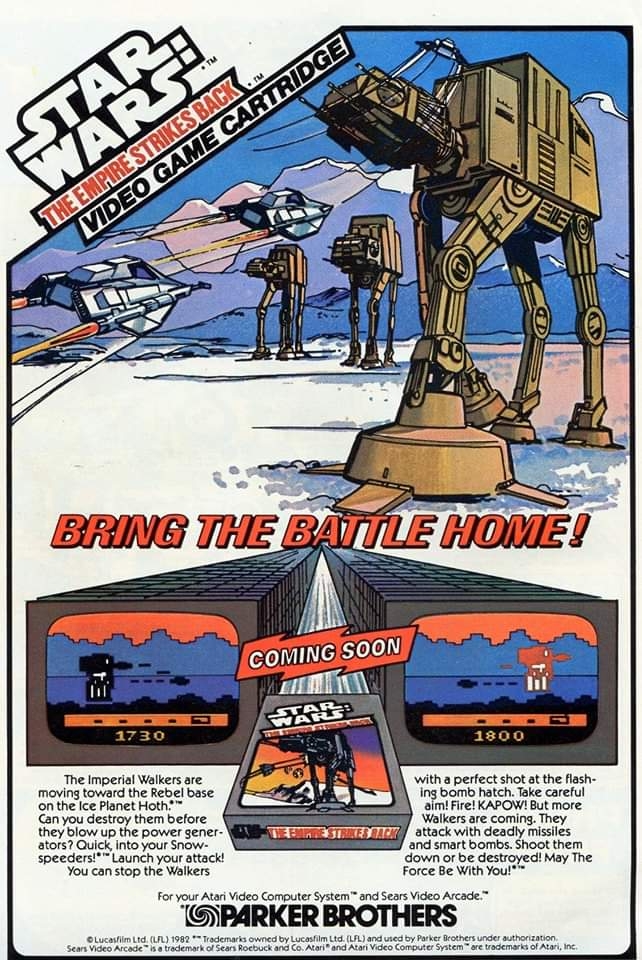
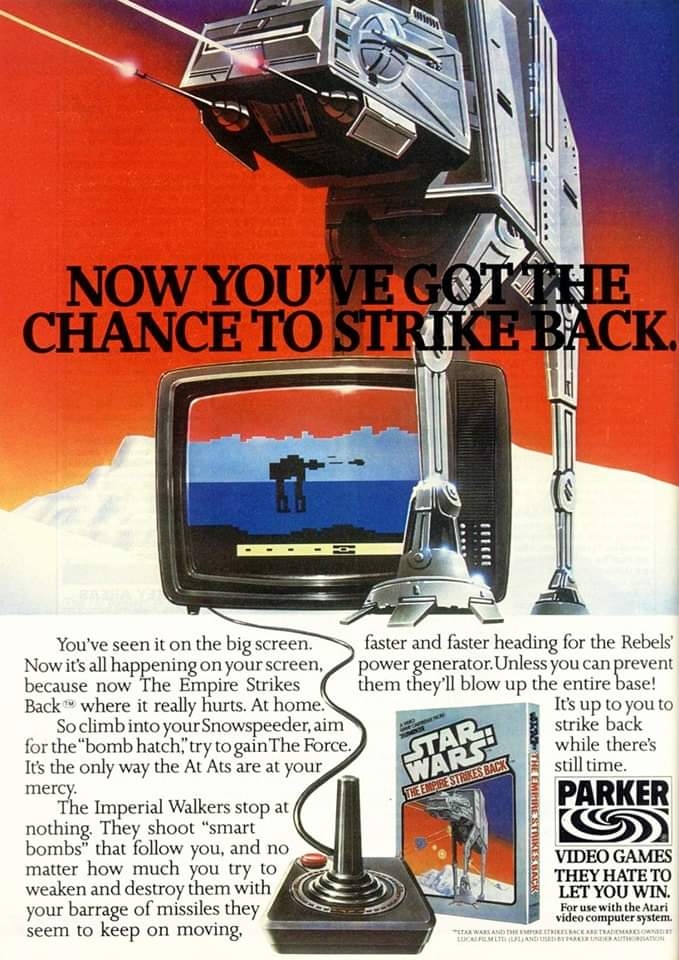
1. Star Wars: The Empire Strikes Back Atari print ads
I could not forget the first time I saw this print ad while reading a comic book.
This ad showed the Atari 2600 controller.
Even during its early years under George Lucas, the Star Wars entertainment franchise made its way into video games due to its massive popularity and Parker Brothers really made moves to cash in. This resulted in the Atari 2600 video game adaptation (1982) of The Empire Strikes Back which focused mainly on the memorable Hoth battles between Rebel fighters and the Empire’s AT-AT walkers. Parker Brothers came up with two print ads and each had a different visual concept: one had nicely drawn art along with two screenshots shown while the other had painted art of the AT-AT while showing the Atari joystick. These old print ads still look great and exciting.
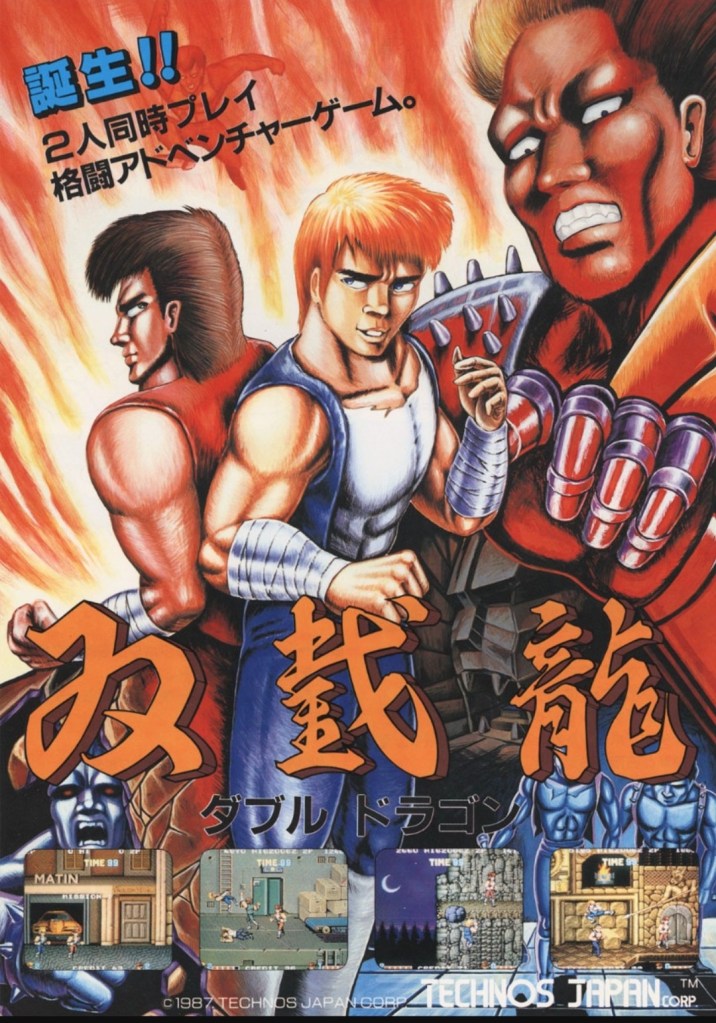
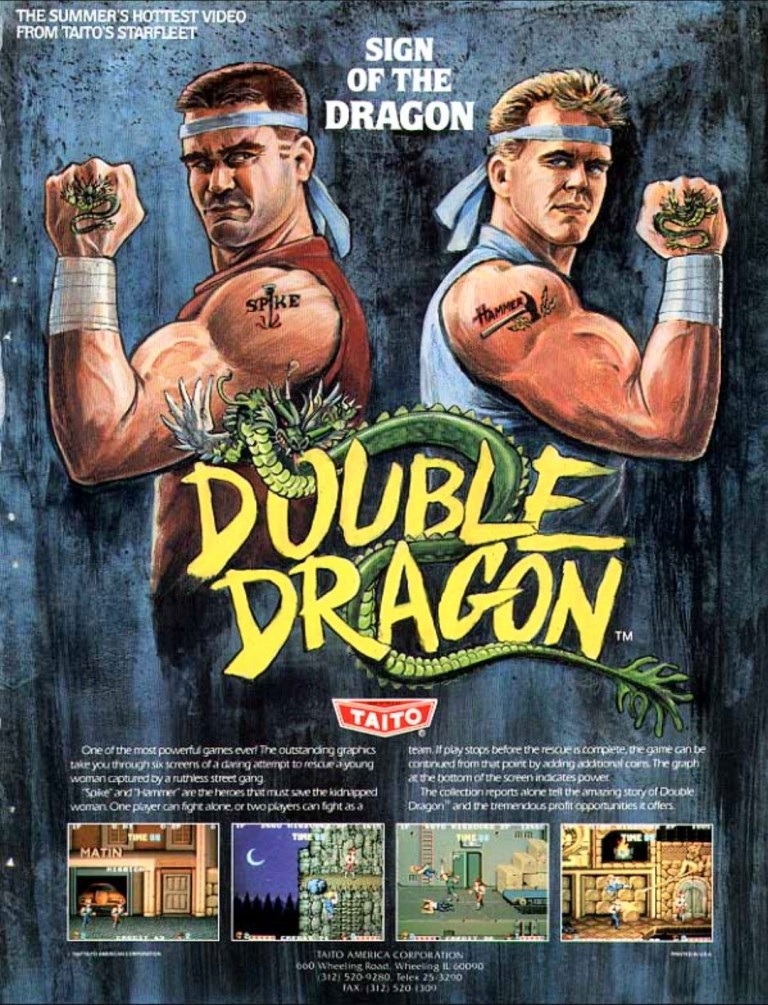
2. Double Dragon Japanese and North American arcade flyers
If you read manga (Japanese comics) in Japan, then the art style of this arcade flyer should look familiar to you.
The character designs seem inspired by 1980s Hollywood action cinema.
Released in 1987, Double Dragon became a huge hit in the arcades of Japan, America and Europe resulting in financial gains for developer Technōs Japan and publisher Taito. What I find intriguing was the fact that the Double Dragon arcade flyers for Japan and North America had drastically different art styles used to promote it. The Japanese flyer had art style that is more common with manga while the North American had artwork that seemed inspired by Hollywood action movies (as well as the rise of martial arts films in America during the 1980s). The American flyer even had the two characters identified as Hammer and Spike and they both looked American. This is a classic example of using different approaches to promote a game in each market.
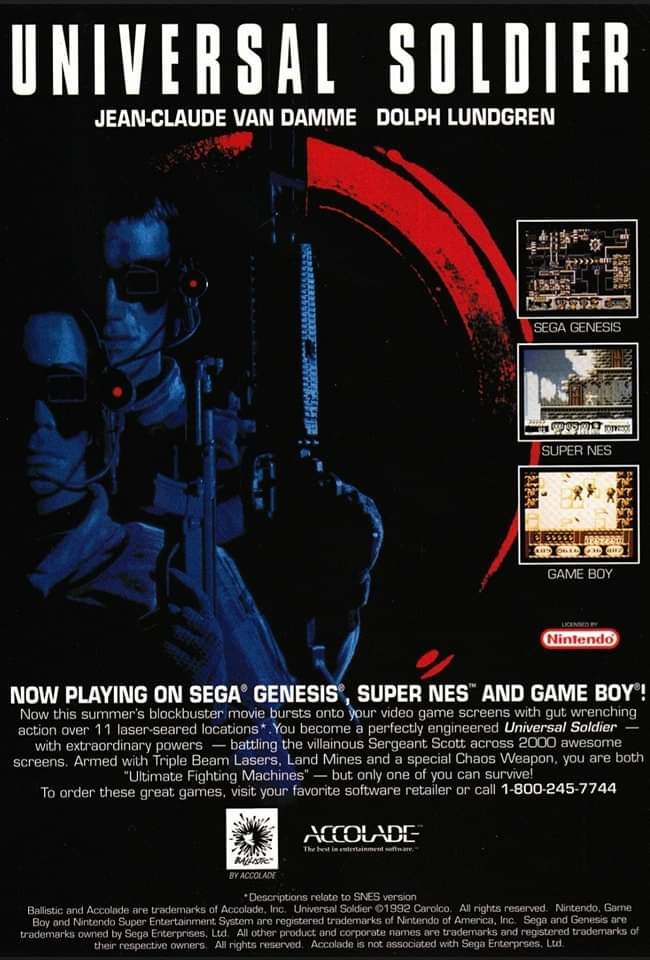
3. Universal Soldier print ad
The people who made this print ad made sure to use the names of the stars to help sell the game.
Even though its worldwide ticket sales did not reach $100 million, the 1992 movie Universal Soldier still caught a lot of attention from moviegoers simply because it had Jean-Claude Van Damme and Dolph Lundgren as the stars. Unsurprisingly, the movie had a video game adaptation and because publisher Accolade wanted to cash-in on the film’s hype, they made some deceptive moves by rebranding one of its games (already development) as a tie-in. Advertised as an official adaptation, Universal Soldier was actually a rushed conversion of Turrican II: The Final Fight. This print ad – which even showed the stars’ names – is a reminder of the deception Accolade pulled off.
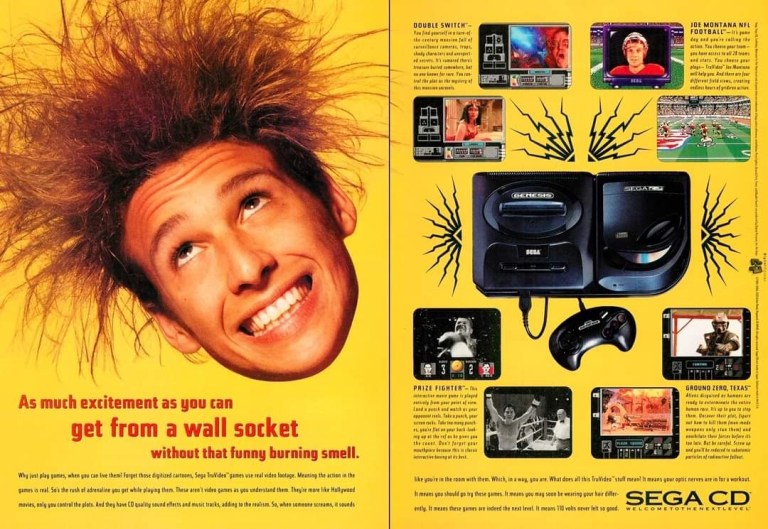
4. Sega CD print ad
Do you find this Sega CD print ad hilarious?
When Sega was making waves with its Sega Genesis (Sega Mega Drive in Japan), the company was quick to react to the growing use of the compact disc (CD) format as a useful storage medium for video games. The Sega CD (Mega CD in Japan) was released as an add-on device to work with the Genesis console and Sega’s American team came up with a series of promotions. This print ad is just one of the promotions and ad makers came up with a “crazed” or “electrified” gamer dominating one page while showing the Genesis, the Sega CD and screenshots of games (running on CD) on the other page. By today’s standards, the Sega CD print ad is funny and catchy to look at.
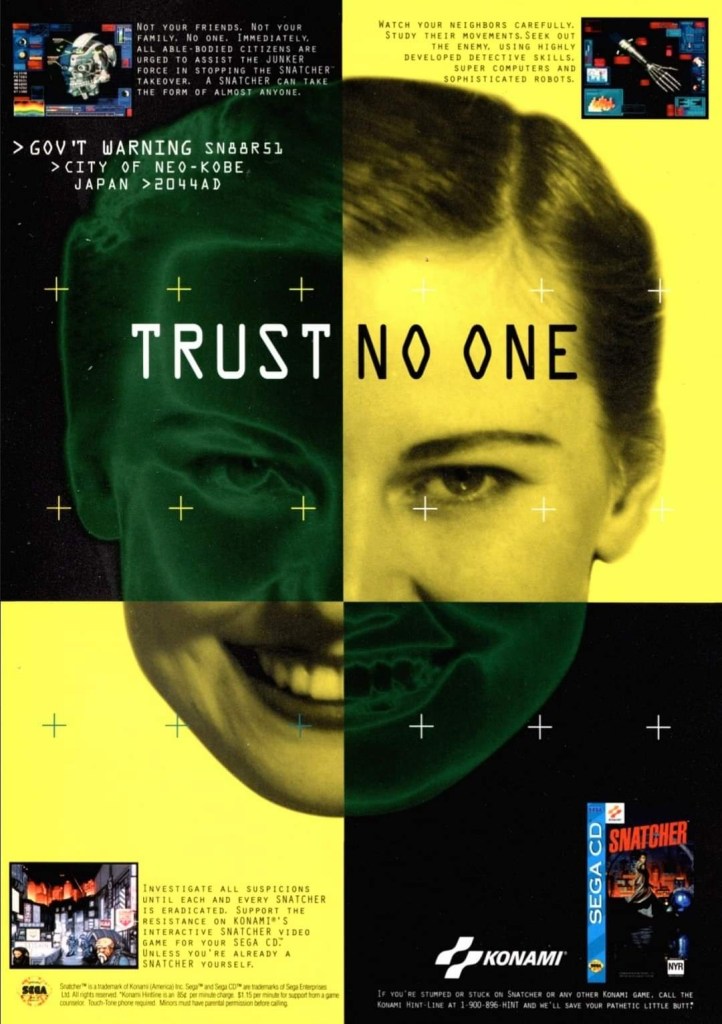
5. Snatcher for Sega CD print ad
I find this Snatch print ad looking odd. The ad makers could have done more to focus on the game itself.
First released in Japan in 1988, Snatcher was a cyberpunk visual adventure game that was one of the early works of the famous Hideo Kojima (Metal Gear series). Due to its design and approach on visuals to tell a story, it was not surprising that a Sega CD version of it got released in 1994. To promote the game to the growing number of North American Sega CD gamers at the time, Konami came up with this rather unusual print ad showing the face of a smiling lady dominating the space leaving little room to show the screenshots and the game’s cover. The visual concept is engaging but it takes effort to notice it was promoting the Sega CD version of the video game. This old ad would have worked better had the ad makers increased the sizes of the screenshots and the game cover.
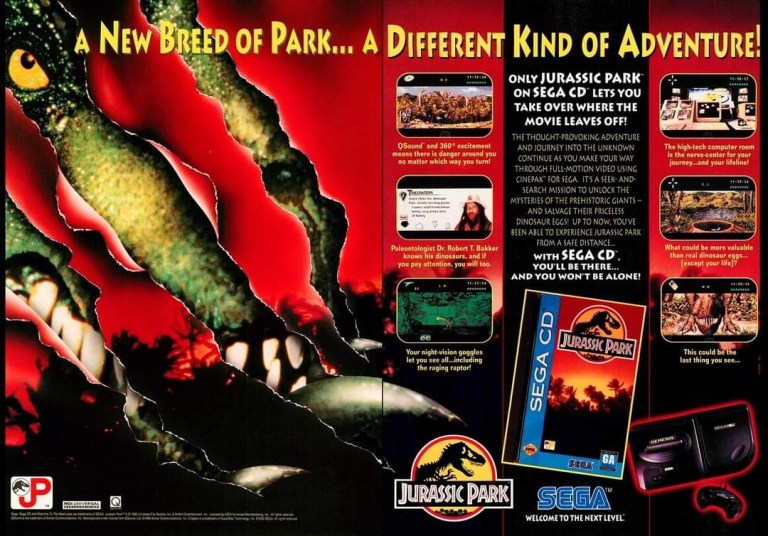
6. Jurassic Park for Sega CD print ad
Does the T. Rex look scary to you?
As part of its drive to add more games to the Sega CD add-on and help it sell more units, Sega acquired the Jurassic Park license and went on to produce an adaptation utilizing the technological features of the Sega CD. To aggressively promote the game, Sega came up with this print ad that had a Tyrannosaurs Rex (looking through spaces) on one page and then several screenshots plus text descriptions on the other. For a click-and-point Jurassic Park game, this ad was really exciting and intriguing to look at.
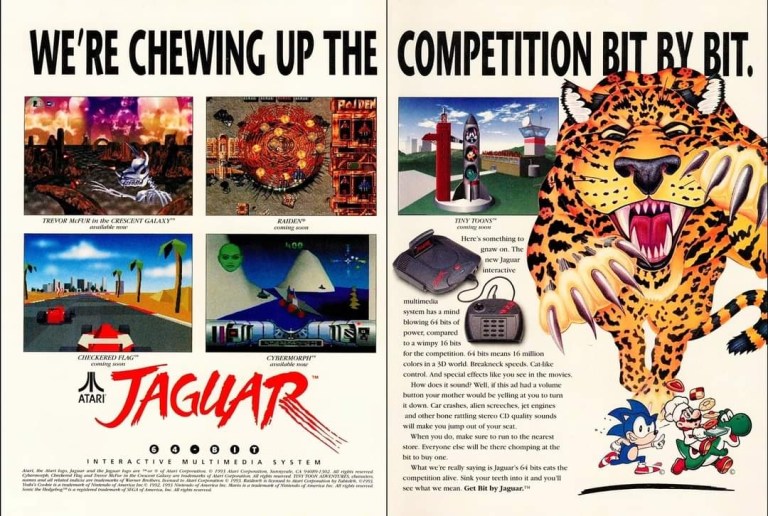
7. Atari Jaguar print ad
This was indeed an eye-catching ad.
In the early 1990s, Atari made an aggressive move to compete in the arena of video game consoles which they used to dominate from the late 1970s until 1983. This time around, they came up with the Jaguar console which had some pretty advanced technologies for the time. As part of their North American marketing campaign, Atari unleashed an ad showing game screenshots on the first page and huge artwork of a jaguar coming after Sonic, Mario and Yoshi (mascots of Sega and Nintendo respectively) symbolizing that the Atari Jaguar had more power and better technology than the Genesis and the Super Nintendo Entertainment System (SNS). While it was engaging to look at early on, this print ad is now an embarrassment as the Jaguar console failed terribly. Lastly, the marketing of the Jaguar as a 64-bit machine was never real.
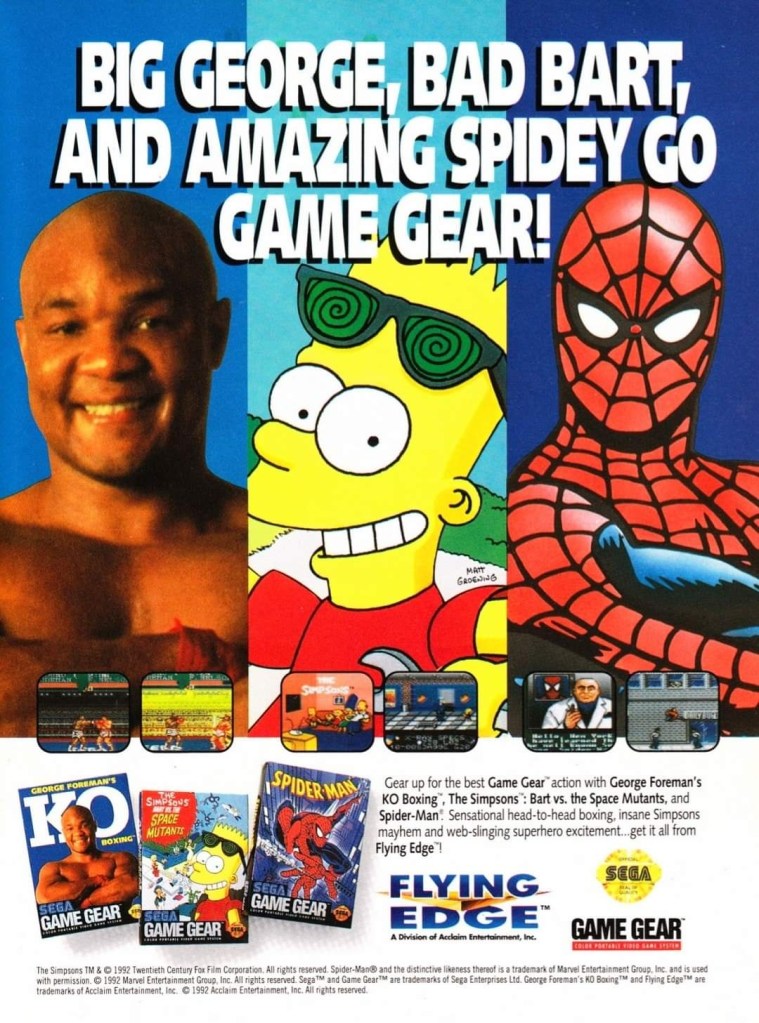
8. George Foreman, The Simpsons and Spider-Man Game Gear print ad
This ad appeared in a lot of comic books in the 1990s.
In the early 1990s, Sega released the Game Gear handheld gaming device which instantly placed them in competition with Nintendo’s Game Boy. Through its Flying Edge label, Acclaim Entertainment promoted George Foreman’s KO Boxing, The Simpsons: Bart vs. the Space Mutants, and Spider-Man for the Game Gear hoping to sell well. This 3-game print ad highlighted the popular figures who had a lot of space for attracting attention. The ad maker managed to insert two screenshots per game, the game covers and a text description to inform consumers what they were being offered. A good ad to look at.
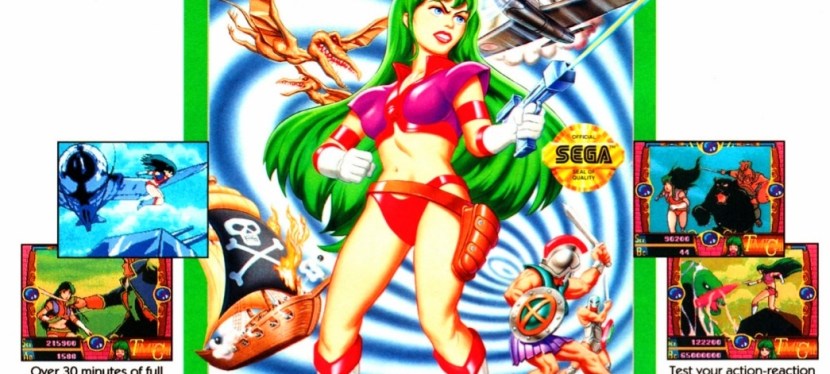
9. Time Gal for Sega CD print ad
The presentation here looks nice but Time Gal herself looked like she was drawn by a different artist.
Originally released in the arcades in Japan in 1985, Time Gal made its way to the Sega CD add-on in the early 1990s. It was a highly unusual video game as it was an interactive movie (with lots of anime footage) made with the use of Laserdisc technology for its arcade version. It played lots of anime scenes and players must choose the on-screen options to execute the character’s next action in order to progress. For the Sega CD version for North America, this print was made to capture the attention of consumers using the protagonist’s sex appeal on the cover art with four screenshots placed on the sides to show what to expect. I noticed that Time Gal on the cover art looked different from how she appeared in the anime sequences. At least the ad makers tried hard to sell the game.
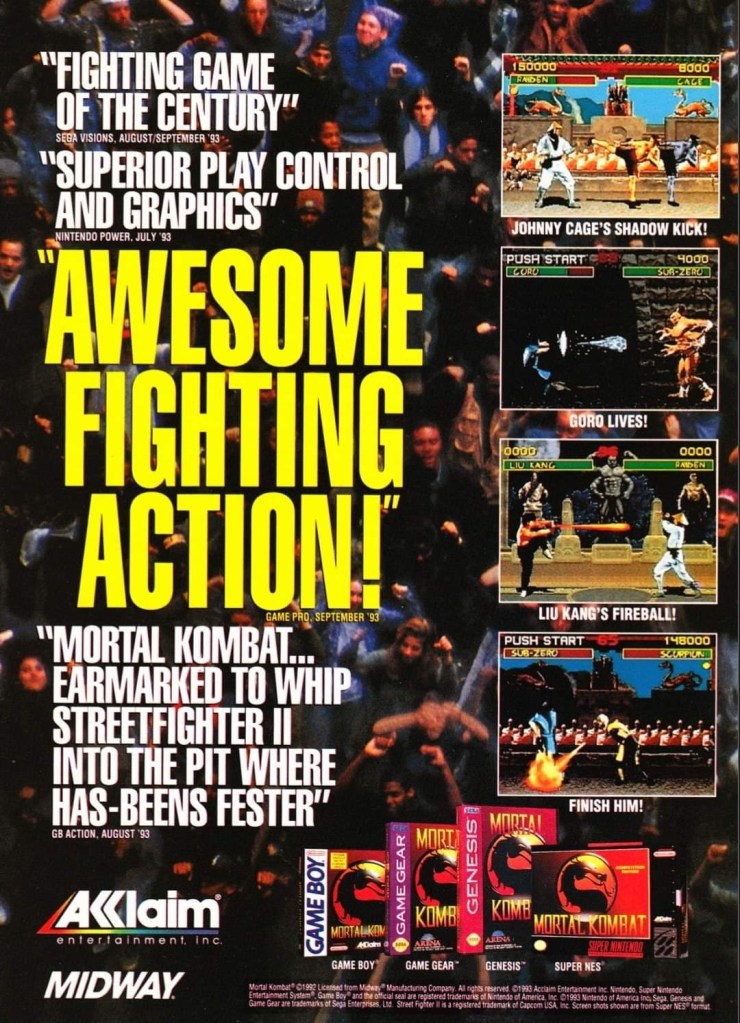
10. Mortal Kombat print ad
Still an effective ad to promote a blockbuster game and make people informed it was coming to multiple platforms.
Considering how successful it was in the arcades, the 1993 release of Mortal Kombat for game consoles and handhelds was unsurprisingly highly anticipated and publisher acclaim came up with this single-page ad. The presentation involved the use of a photographic background of many spectators (to emphasize excitement and popularity), media quotes and screenshots to effectively promote the game.
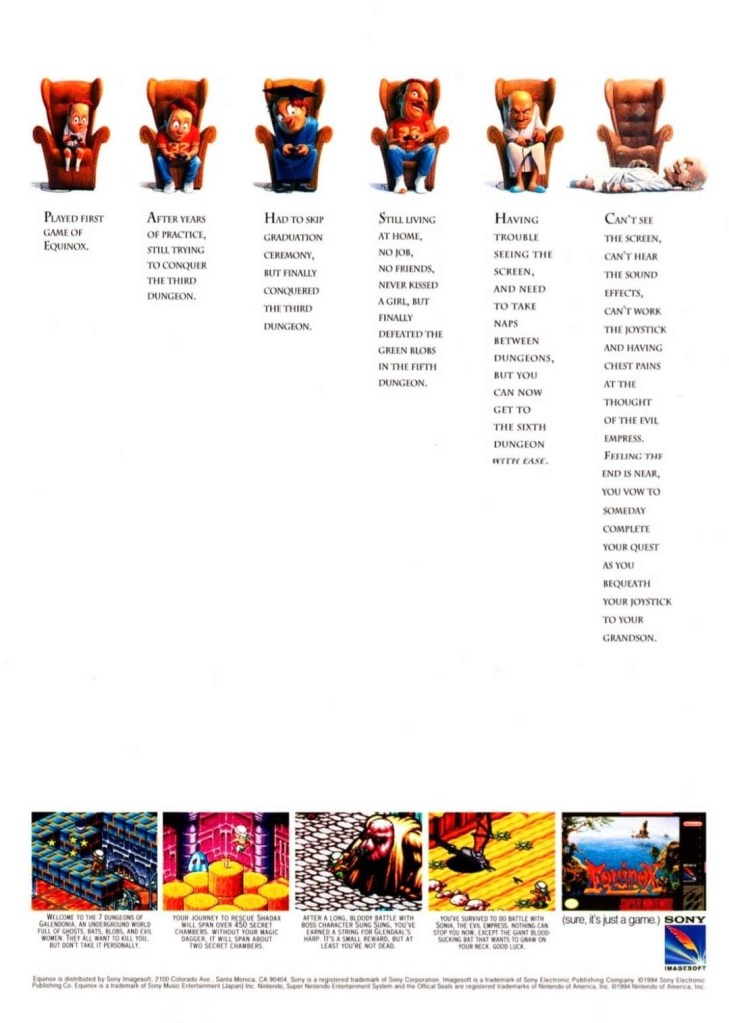
11. Equinox print ad
Take a close look. Tell me if you find it funny.
I never played Equinox but I heard the loud buzz about its design as a 3D isometric game that had elements of exploration, platform play and puzzle solving. The people responsible for this print ad emphasized the concept that the game is so addicting to play, players will still play it as they get older. This ad has a subtle yet effective approach with humor.
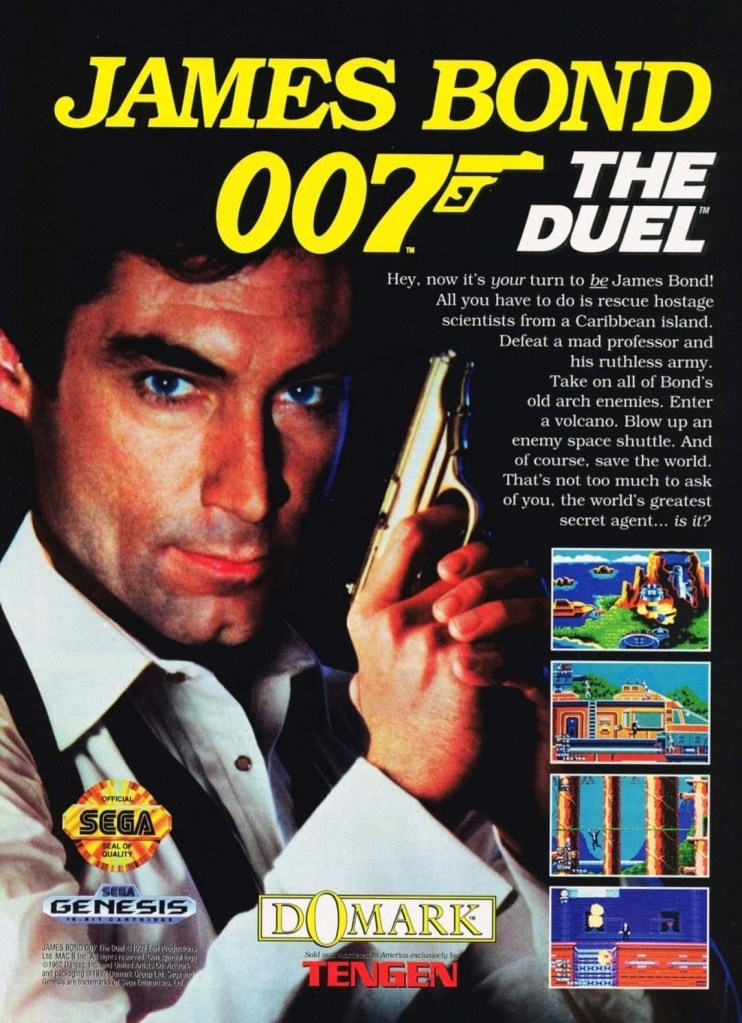
12. James Bond 007: The Duel print ad
Timothy Dalton’s image as James Bond was sourced from Licence to Kill for this game’s ad.
Here is another decades-old James Bond video game print ad I found. Released a few years after Licence to Kill, James Bond 007: The Duel was notable not for its gameplay nor game design but for the fact that it used the image of Timothy Dalton as 007 for its print ad and the opening scenes in the game itself. Dalton’s Bond image here was never new nor originally taken for the game as it came directly from Licence to Kill’s publicity library. Each time I saw this ad, I was only reminded of the 1989 movie which I still enjoy watching.
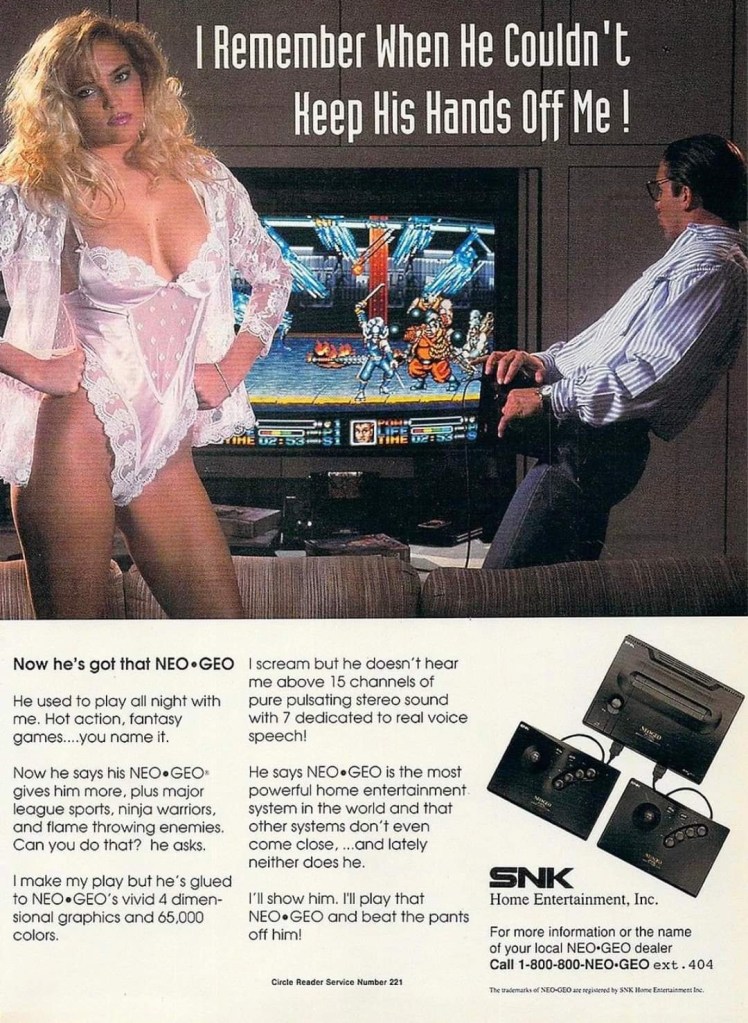
13. Neo Geo AES console print ad
Do you find this ad both sexy and funny?
Decades ago, SNK made a huge splash in the arcades with lots of really fun games released with their Neo Geo (stylized as NEO GEO) hardware. In 1990, they released the cartridge-based Neo Geo AES console in Japan and America and it carried the same technology as the arcade hardware. To promote the console in North America (note: the Neo Geo console and its games were very expensive), SNK came up with this catchy and funny print ad showing a sexy woman feeling annoyed that her man spends more time with Neo Geo gaming than with her. This was a clever way of emphasizing the arcade-perfect experience in the comfort of home, and it was funny to look at.
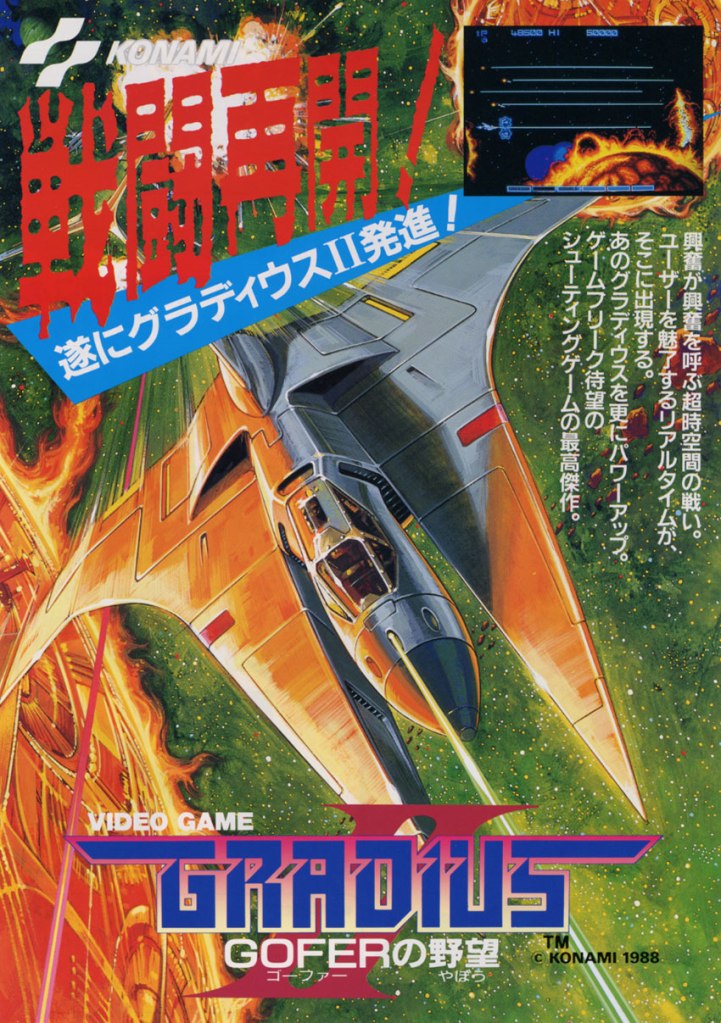
14. Gradius II Japanese arcade flyer
Great looking painted art was used for this 1988 arcade game.
Since the original Gradius was a big hit in arcades in Japan in 1985, it was not surprising that Konami released Gradius II three years later. With regards to the use of painted art, the artist showed the game’s spaceship in a dominating position emphasizing high-speed travel and excitement. The image, which also looks more colorful, is a complete reversal of the painted art used in the flyer of the previous which showed the rear of the spaceship as it moves towards a larger spaceship (the opposition). This arcade flyer art still looks great as it has a timeless charm.
It has been over a week since Donald Trump pulled off the greatest American comeback ever when he got elected again as President of the United States and he also won the popular vote. He already promised that once he takes office, the US Government will make serious moves to solve the illegal immigration crisis and that includes mass deportation.
That being said, Filipinos who are illegally staying in the United States have been advised not to wait to be deported and they better act fast before it is too late, according to a GMA Network news report.
To put things in perspective, posted below is an excerpt from the GMA news report. Some parts in boldface…
Philippine Ambassador to the United States Jose Manuel “Babes” Romualdez on Friday advised Filipinos illegally staying in the US not to wait to be deported following the victory of President-elect Donald Trump.
In an online forum hosted by the Foreign Correspondents Association of the Philippines (FOCAP), Romualdez stressed that Trump has “won on the basis that he will deport all immigrants in the United States.”
While there is a smaller number of Filipinos illegally staying in the US at around 250,000-300,000 compared to other countries, Romualdez said those who are still in America without “any kind of status” should voluntarily return to the Philippines or start working on their documents.
“My advice to many of our fellowmen who actually are still here but cannot get any kind of status. My advice is for them not to wait to be deported,” he said.
“Because I can see that the administration of President Trump is really going to be very strict with the immigration policy that he intends to put in place because that is the promise he made to the American public,” he stressed.
Once deported, Romualdez said there is 99% (chance) that they cannot come back to the US.
“You can never come back to the United States. At least, if you leave, there is always the opportunity or a chance that you’ll be able to file,” he said.
Filipinos who are illegally staying in the US could seek help through the attaché from the Department of Migrant Workers at the Philippine Embassy in Washington, Romualdez said.
However, he clarified that the “only assistance” that they can provide is “to give them advice.”
“If they have a potential roadblock to be able to stay in the United States legally, then we tell them to get the right person to help you– a lawyer or whoever it is– and start the process. But if there is none, it’s clear that there’s only one way so that you will have a chance to be able to apply legally but do not allow yourselves to be deported,” he said.
He warned that Filipinos cannot continue to hide from authorities because the exchange of information among US agencies is much easier today.
In his victory speech, Trump reiterated that he would close borders in the US and would impose stricter laws against illegal aliens.
“We gonna have to seal up those borders, we are gonna have to let people come into our country. We want people to come back in, but they have to come in legally… We are gonna start by putting America first,” he said.
Data gathered by the GMA Integrated News Research showed that there are 4,640,313 Filipinos in the US as of last year, according to the latest figures by the US Census Bureau.
For the newcomers reading this, I am not an American citizen and I am based here in the Philippines. I should also state that I personally oppose illegal immigration and I believe that US President-elect Trump (who will formally take office again on January 20, 2025) will do what Americans voted him for and that means securing the border, going after illegal aliens and deporting a lot of them. It is an undeniable fact that illegal immigration adds to crime as well as the rising costs of housing and government spending. Illegal aliens are consuming taxpayers’ funds which is very unfair to the Americans.
Let me end this post by asking you readers: What is your reaction to this recent development? Do you think all Filipinos illegally staying in America should surrender themselves and come back home before it is too late? Are there Democrats or any Leftist in your local community who continues to promote illegal immigration, criminal and terrorists? Did the Democrats brainwash a member of your local community into believing that illegal immigrants are refugees?
The 2025 edition of the prestigious FIVB Men’s Volleyball World Championship is all set to be hosted exclusively by the Philippines from September 12 to 28, 2025.
The event will have the top 32 men’s volleyball teams of the world competing for the championship title. Games will be staged at the Smart Araneta Coliseum in Quezon City and at the SM Mall of Asia Arena in Pasay City. Schedules of the games will be announced soon.
The 32 teams are divided into eight pools which are arranged in the following order: Pool A: Philippines, Iran, Egypt, Tunisia; Pool B: Poland, Netherlands, Qatar, Romania; Pool C: France, Argentina, Finland, Korea; Pool D: USA, Cuba, Portugal, Colombia; Pool E: Slovenia, Germany, Bulgaria, Chile; Pool F: Italy, Ukraine, Belgium, Algeria; Pool G: Japan, Canada, Türkiye, Libya; and Pool H: Brazil, Serbia, Czechia, China.
The Philippines is the exclusive host of the 2025 FIVB Men’s Volleyball World Championship. It is recalled that previous editions of the event were each co-hosted by multiple nations – Italy and Bulgaria in 2018, and Poland and Slovenia in 2018.
For the 2025 edition, the Philippines emerged as the successful bidder and the final decision was made following a rigorous evaluation process where the FIVB and Volleyball World found the Philippine bid to be particularly strong; with its emphasis on ensuring a continued growth of the event and the country’s commitment to the development of volleyball globally.
FIVB President Dr Ary S. Graça F° stated that their organization is confident that the Philippines “will host an extraordinary World Championship that will leave a lasting legacy.”
Meanwhile, Volleyball World CEO Finn Taylor stated that the Philippines “is well-positioned to deliver an exceptional championship that will showcase the best of the sport.”
Welcome back, my readers, YouTube viewers and all others who followed this series of articles focused on YouTube videos worth watching. Have you been searching for something fun or interesting to watch on YouTube? Do you feel bored right now and you crave for something to see on the world’s most popular online video destination?
I recommend you check out the following topics and the related videos I found.
#1A look at Donald Trump’s amazing comeback as US President – I already blogged about the amazing comeback of Donald Trump who won the 2024 US Presidential Election decisively. While that blog post had lots of videos about the victory, I added some more below for your enlightenment.
#2 The engineering of the F-117 Nighthawk – Do you still remember the F-117 Nighthawk? It was the sophisticated stealth fighter America used against Iraq during the Gulf War in 1991. I personally could not forget the first time I ever saw it on TV (news broadcast of the 1991 war) as a teenager. The F-117 is no longer in use but its engineering and the history of its development should be seen in the video below. Watch and learn!
#3 Dragon Age: The Veilguard’s wokeness – It is a sad fact that very similar with Communist-filled Hollywood (Commiewood), wokeness and identity politics are ruining video games. Recently, EA released Dragon Age: The Veilguard which was the first new Dragon Age game they released in ten long years. The big problem here is that woke activists at BioWare inserted their poison into the game. Watch RK Outpost’s videos below.
#4 The blunders of Kamala Harris, her allies and the Democrats – Kamala Harris, who has been US Vice President for almost four years now, lost the US Presidential Election to Donald Trump convincingly. She led a campaign that was dishonest, pretentious and even turned to hatred by comparing Trump with Adolf Hitler. No matter Kamala did, she and her woke allies failed miserably to connect with voters. Instead of discussing policies and plans to serve the people in the near future, Kamala emphasized identity politics and vibes. Is it any wonder why she lost and why are the Democrats so unpopular? Watch the selected videos to find out why and how she lost.
#5 Kamala Harris supporters freaking out – Losing an election is always painful and embarrassing. So much so, there were supporters of Kamala Harris who could do nothing but record/stream themselves freaking out. Some supporters working in the media or in government just keep on spreading their distorted views and lies to as many people as possible. They also had trouble containing their emotions. I can only wonder if the Democrats themselves care to calm down their devastated supporters. Watch and learn from these videos.
In what is obviously the greatest political comeback in the history of the United States, Donald Trump (Republican) once again won the Office of US President after crushing the woke Kamala Harris (Democrats) in the 2024 US Presidential election!
Trump (US President from 2017 to 2021), whose running mate is US Senator JD Vance, won 286 out of 538 electoral votes as of this writing, according to the official results. 270 electoral votes are required to win the Presidency. As of now, the election results of Michigan and Arizona have yet to be finalized but Trump is leading in both of them.
When it comes to the popular vote, Trump won 70,900,447 votes while Harris got 66,434,997 votes as of this writing. These results proved many polls wrong as they predicted Harris would win more votes nationally than Trump.
For the newcomers reading this, the election of the US President and Vice President are not determined by popular vote nationwide. Rather it is through the Electoral College that determines the winner of the US Presidential Election. By January 20, 2025, Trump and Vance will formally take office as President and Vice President of the United States.
For insight, watch the selected YouTube videos below.
Below are the different YouTube livestreams that covered the elections.
To say that Donald Trump’s delayed re-election is significant is an understatement. He almost lost his life when someone tried to assassinate him. Before that happened, the Democrats and their allies abused government power to attack him and the Trump family. Questionable cases were filed against him in court. And then the Satanic Leftist mainstream news media became the Democrats’ attack dogs against him. Of course, Trump fought back hard and won this year’s Presidential Election decisively! Now that he won again, Trump as the incoming 47th President will tackle a lot of problems that affected America both domestically and overseas.
American families have been suffering from effects of rapid inflation and the reckless economic policies of Joe Biden and Kamala Harris. American society is gradually being dismantled by the LGBTQ and transgender movements, Critical Race Theory extremists, Islamo-Leftists, illegal aliens and the woke mobs which are clearly connected with the Democrats. The cost of living in America has skyrocketed so much, there are individuals who had to work with two jobs just to make ends meet. The Biden-Harris economic plans and post-pandemic measures made life a lot worse for Americans and their families. Meanwhile, illegal immigrants have added a lot to criminal cases around the country.
Once in office, Trump will eventually reposition America to push back hard against terrorist state Iran, Russia and China. I should mention that the Republicans won back control of the US Senate and eventually they will retain the majority in the US House of Representatives which will be helpful for Trump to fulfill his agenda for the people. I anticipate that the first batch of new pieces of legislation in 2025 will be written with the economy, inflation, and illegal immigration in mind.
If there is anything spiritually significant about Trump’s 2024 Presidential victory, I share with you the bible verse below…
“No weapon formed against you shall prosper,
And every tongue which rises against you in judgment
The victories of Trump-Vance and the Republicans this year formed a powerful push back against the Satanic Left, corrupted people, illegal immigration and other wicked forces. The American people have spoken through voting and the 2024 elections will be remembered for a very long time. The people wanted Trump back and they clearly want to join him to make America great again.
Let me end this piece by asking you readers: How did you react when you first learned about the re-election of Donald Trump? Did you let the Leftist mainstream news media fool you into believing Kamala Harris is best for America? Do you think life in America improved a lot under the Biden-Harris administration?