Welcome back my readers, YouTube viewers and all others who followed this series of articles focused on YouTube videos worth watching. Have you been searching for something fun or interesting to watch on YouTube? Do you feel bored right now and you crave for something to see on the world’s most popular online video destination?
I recommend you check out the following videos I found.
#1 Ashleigh Burton reacts to Octopussy – As a young boy, I first saw the 1983 James Bond movie Octopussy on home video. Starring Roger Moore, the movie has Agent 007 on another wild adventure facing off with a Soviet Union general and the exiled Afghan prince. With a notable part of the film shot on location in India, Octopussy’s action and stunt scenes looked exotic and sometimes comical. That being said, I enjoyed watch Ashleigh Burton’s reaction video and it is easily the most entertaining Octopussy reaction video on YouTube to date. Watch her video now.
#2 Trump crushes the European Union and wins big for America – After executing the greatest comeback ever, US President Donald Trump’s winning streak of achievements continued as he scored big for the Americans by crushing the corrupted European Union (EU). Not only did American win over the EU on trade, Trump slammed Europe’s approach on migration as well as their renewable energy policies in front of the president of the European Commission Ursula von der Leyen. Watch the two videos below and pay close attention to the details.
#3 Slope’s Game Room examines Theme Park – While I played a lot of video games and computer games through the decades, I never had the chance to play the 1994 game Theme Park. Developed by Bullfrog Productions, Theme Park is a simulation game in which players get to construct an amusement park and manage it with the goal of attracting visitors, making profit and expanding globally. The game was a major hit among critics and gamers. To find out more about who made Theme Park and what inspired the developers to make it, watch Slope Game Room’s in-depth video below.
#4 Popcorn in Bed reacts to Jaws 2 – Recently the Canadian YouTuber Popcorn in Bed posted her reaction video of Jaws 2. A sequel to Steven Spielberg’s classic Jaws, the 1978 movie had Roy Scheider as the star again but he and director Jeannot Szwarc had conflicts behind the scenes and the production was troublesome. Having seen all Jaws movies, I can say that Jaws 2 had a lot of creative elements common with slasher horror movies. That being said, the way this movie drew reactions from Popcorn in Bed is a must-see.
#5 Japan’s authorities react to troublesome foreigners and tourists from overseas – There is no denying that Japan is a great place to visit and explore. As a young man, I toured Japan twice (in 1996 and 1997) and I can say that the travel experience is tremendous. In today’s age of social media and people having their own smartphones, Japan continues to attract even more visitors from around the world and the sad thing is that there are troublesome or disrespectful foreigners who arrived as well. Now the authorities are making adjustments in reaction. Watch and learn from the video of Asian Route below. Also, remember to respect the rules and the locals in every country you visit.
Welcome back readers, fellow geeks and electronic gaming fans!
In this edition of the Retro Gaming Ads Blast (RGAB) series, we will take a look at another batch of retro gaming print ads – including arcade flyers – from the 1980s and 1990s.
For the newcomers reading this, Retro Gaming Ads Blast (RGAB) looks back at the many print ads of games (console, arcade, computer and handheld) that were published in comic books, magazines, flyers, posters and newspapers long before smartphones, social media, the worldwide web and streaming became popular. To put things in perspective, people back in the 1980s and 1990s were more trusting of print media for information and images about electronic games and related products.
With those details laid down, here is the newest batch of retro gaming print ads for you to see and enjoy…
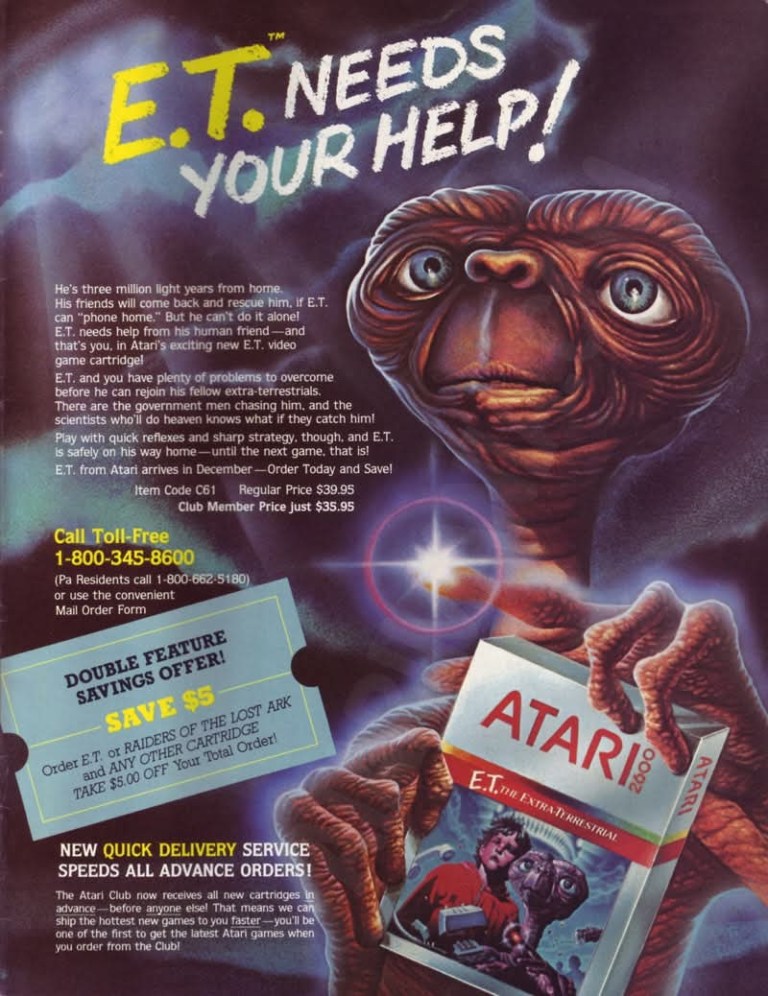
1. E.T. the Extra-Terrestrial Atari 2600 print ad
If you have seen Steven Spielberg’s 1982 movie, were you able to play the Atari 2600 video game? I did!
Atari invested a lot on its video game based on Steven Spielberg’s E.T. the Extra-Terrestrial as the film was a massive box office success. In addition to their Atari 2600 video game print ad showing E.T. with Elliot, they ran another print ad with a concept of the sci-fi character needing people’s help. They came up with original artwork showing E.T. holding a box of the Atari 2600 E.T. video game, then posted details about how to acquire a copy of the game (with prices for regular customers and club members) and posted a toll-free 1-800 phone number. They also offered a $5 discount for those who order the E.T. or Raider of the Lost Ark video game and another cartridge. This old ad had commerce written all over it.
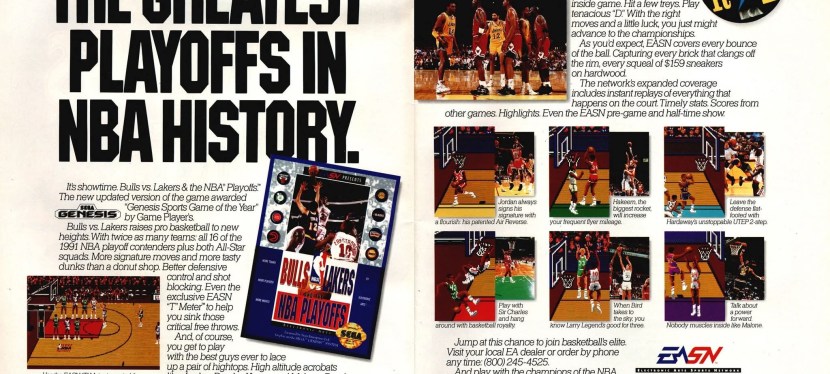
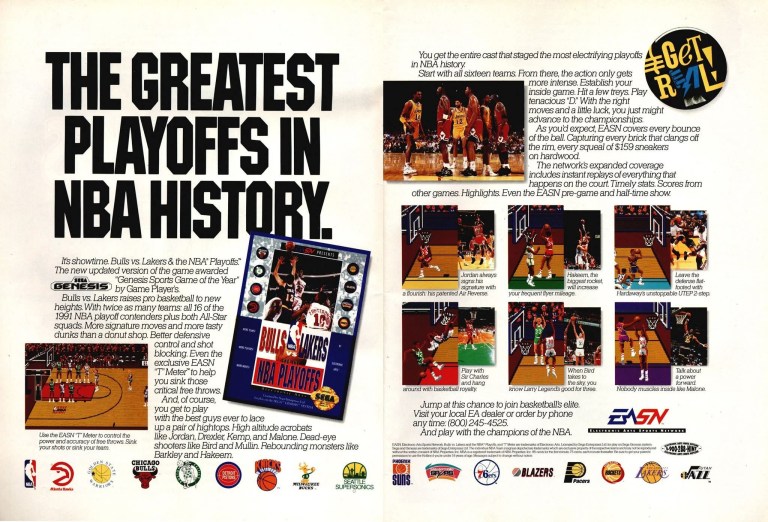
2. Bulls vs. Lakers and the NBA Playoffs Sega Genesis print ad
Before NBA Live, there was this old NBA video games series by Electronic Arts.
Based on the 1990-91 NBA season and the NBA finals match-up between the Chicago Bulls and the Los Angeles Lakers, Bulls vs. Lakers and the NBA Playoffs was Electronic Arts’ exciting game for the Sega Genesis which already had lots of sports-loving gamers. They made a 2-page print ad that was cleverly designed to make both gamers and NBA fans excited. It is not an accident that the ad showed comparative images (in-game footage and real-life basketball photos) of NBA superstars like Larry Bird, Michael Jordan, Karl Malone and Charles Barkley on the right. With the strong visual presentation, emphasis on popular NBA players and other details posted, this old ad is still fun and exciting to look at.
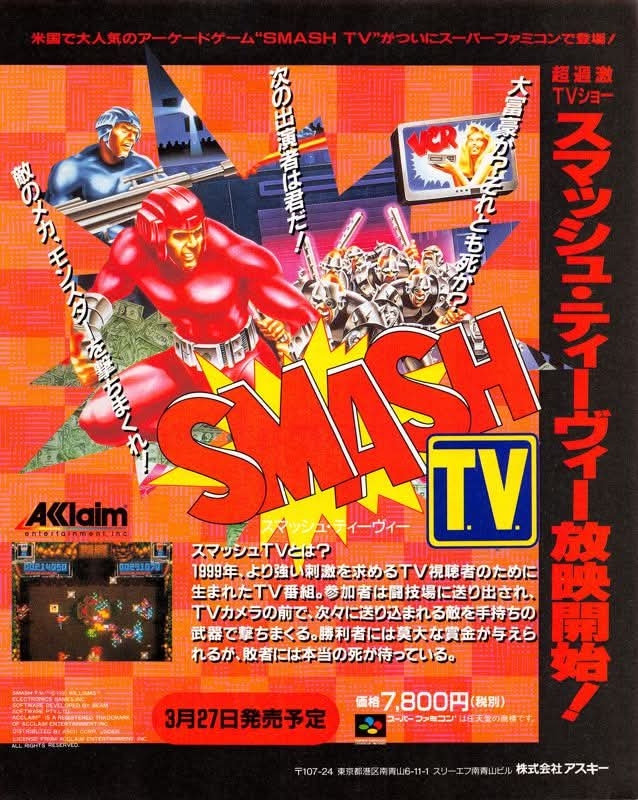
3. Japanese Smash T.V. print ad
The Japanese print ad of Smash T.V.
Yes, it is true! The console port of the arcade classic Smash T.V. was released on the Super Family Computer (Super Famicom) in Japan back in the 1990s. While I cannot understand the Japanese text shown on the ad above, it still looks exciting as the official artwork plus a screenshot of the game were displayed. The revealed retail price of 7,800 Yen is alone eye-catching as there were many games in Japan launched below that price in the next console generation. I can only wonder how many gamers in Japan bought and enjoyed Smash T.V.
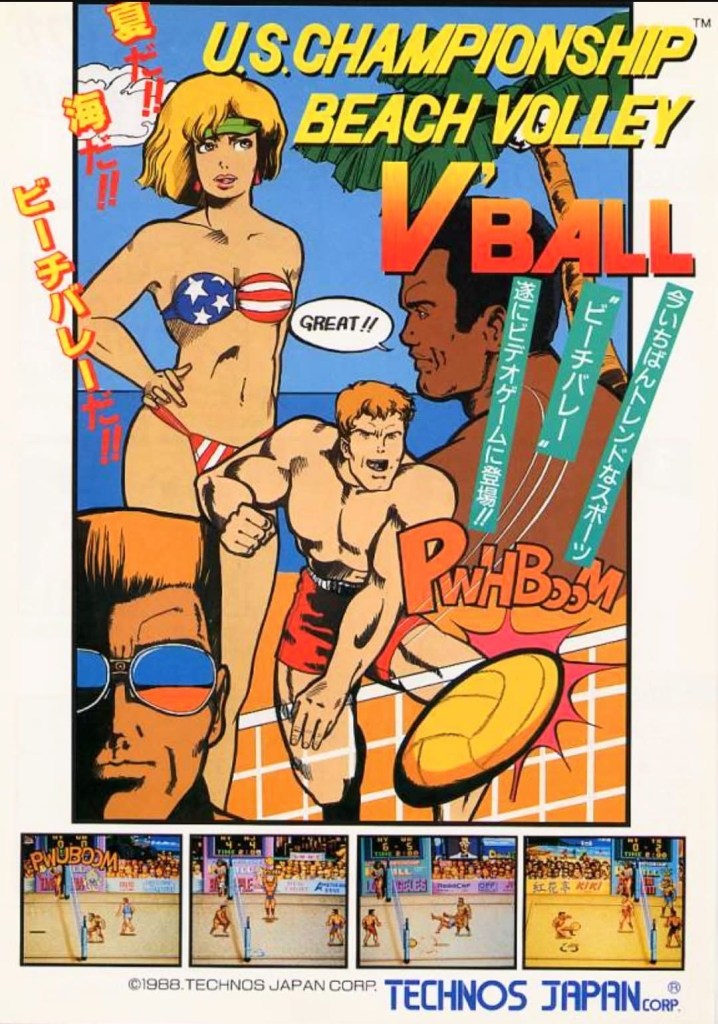
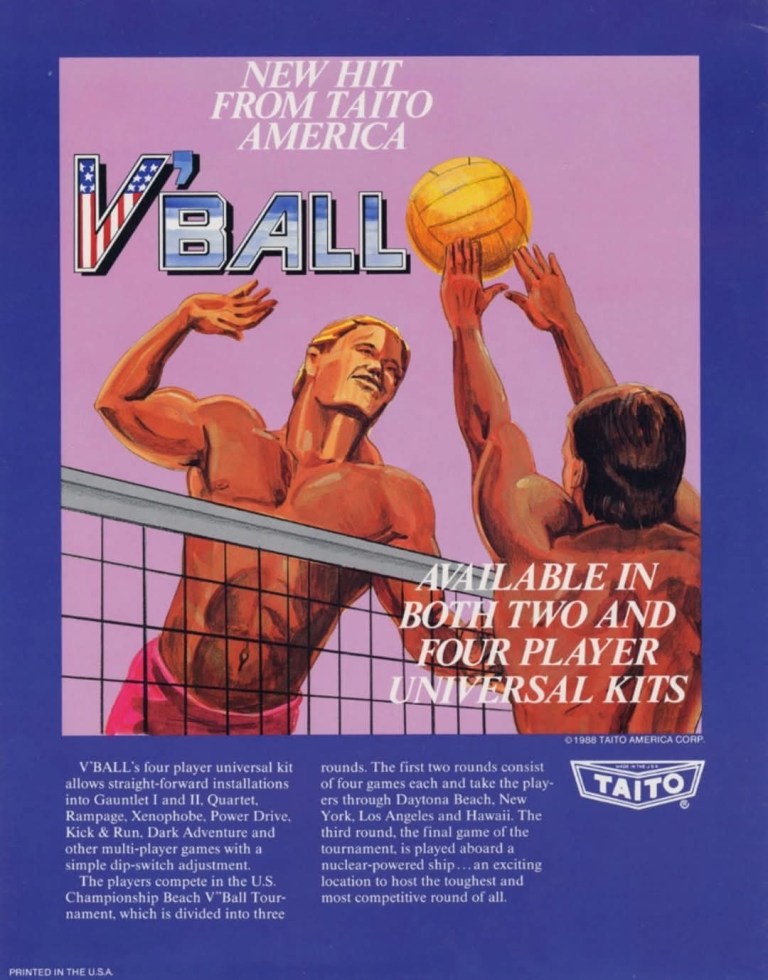
4. U.S. Championship V’Ball arcade flyers
The very colorful and striking arcade flyer for the Japanese market.
The American arcade flyer.
In 1988, Technos – the company behind the Double Dragon video games – released U.S. Championship V’Ball in video arcades in Japan and in America. The way it was promoted in Japan, Technos came up with an arcade flyer that had a comic-inspired hand-drawn artwork that easily gave viewers a strong American beach volleyball vibe. For the American arcade market, Taito (licensed by Technos) used different artwork showing two men in action. If you ask me, the Japanese arcade flyer is more dynamic to look at. Regardless of art style and presentation, both arcade flyers emphasized beach volleyball to gamers clearly.
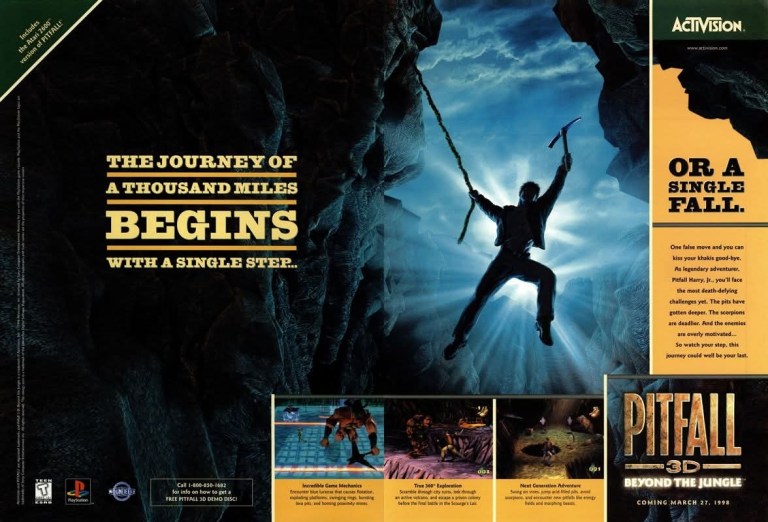
5. Pitfall 3D: Beyond the Jungle print ad
The 2-page print ad of Pitfall 3D: Beyond the Jungle.
When Activision decide to make a new Pitfall video game with polygonal graphics and with 3D platform gameplay, it was not surprising at all as this was the trend that defined 1990s gaming. In 1998, Pitfall 3D: Beyond the Jungle was released for the PlayStation and it received a divisive reception from the critics. If you look closely at the print ad, the words “Next Generation Adventure” was written in the lower-right part and it was clear the game’s quality did not justify them.
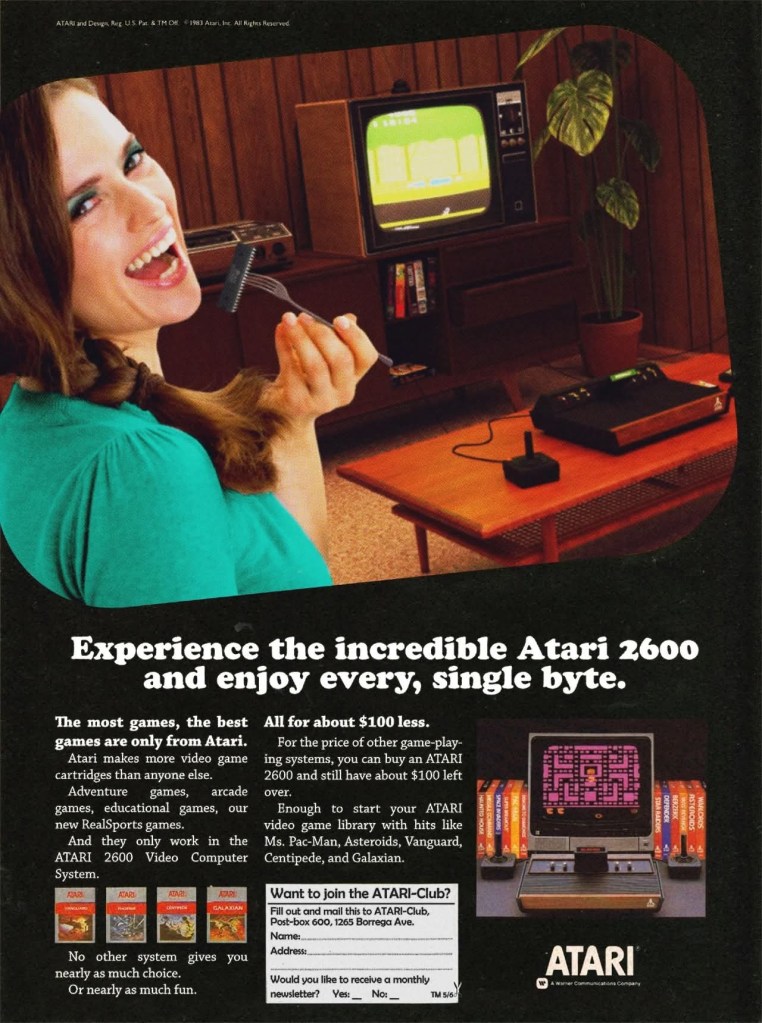
6. Atari 2600 and games print ads
Our household had an Atari 2600 console and many games.
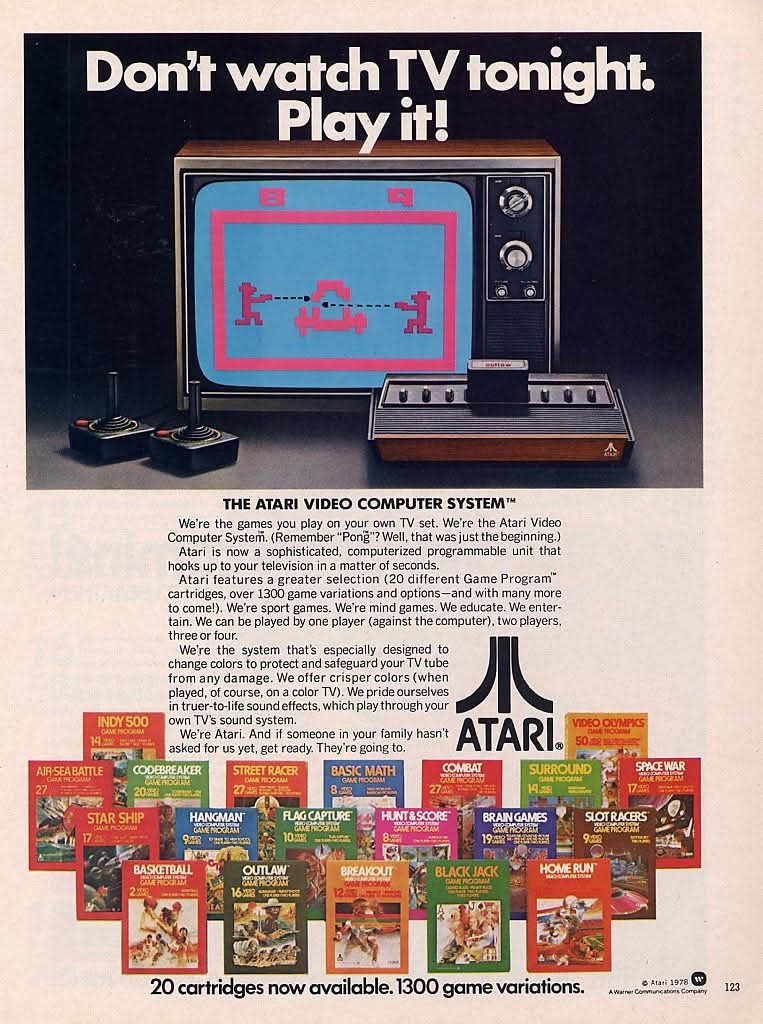
Atari’s promotion of its console, the games and interactive entertainment with the TV.
For a number of years decades ago, Atari dominated the video game console market in America with the Atari 2600 sold in the millions. While Atari today is no longer the video game giant it used to be, there is no denying the fact that they really changed the way people enjoyed the use of their television sets in American homes by offering them lots of video games for the Atari 2600 console. By looking at the above print ads, you can see that the company was not only aggressive with their marketing but also made interactive electronic entertainment more acceptable to countless families.
7. Burning Rangers North American print ad
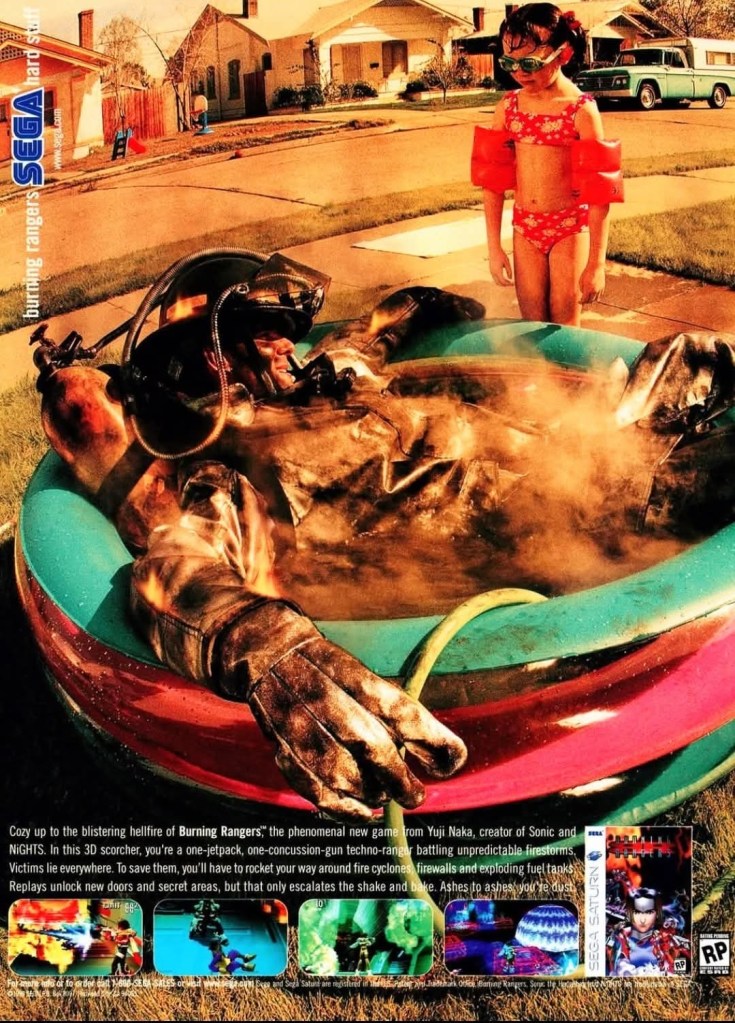
I remember this ad from video game magazines I read in 1998.
Released in 1998 for the Sega Saturn, Burning Rangers was a high-quality exclusive game. To promote it in America, Sega came up with the print ad showing a few screenshots and a dominating image of a fire fighter cooling down on a kid’s personal pool. The image emphasized the element of fire in the game even though it lacked the more sci-fi elements used on the characters and setting. It should be noted that by 1998, the Sega Saturn was no longer in high demand in America as gamers overwhelmingly chose PlayStation and Nintendo 64 (N64) consoles and games. In retrospect, this was one of Sega’s final hard marketing moves done with a Saturn game.
Welcome back my readers, YouTube viewers and all others who followed this series of articles focused on YouTube videos worth watching. Have you been searching for something fun or interesting to watch on YouTube? Do you feel bored right now and you crave for something to see on the world’s most popular online video destination?
I recommend you check out the following videos I found.
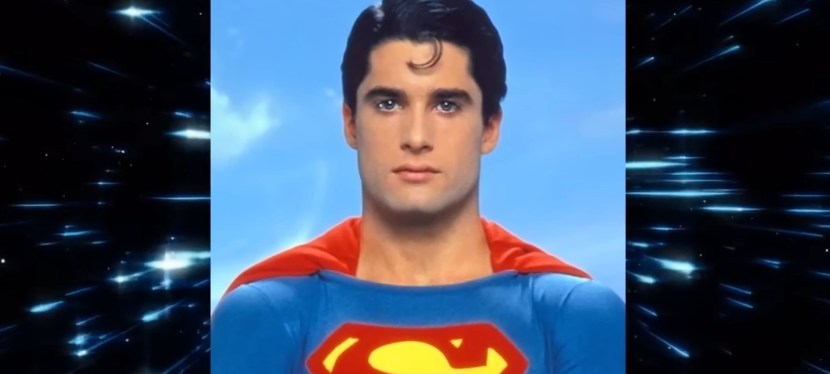
#1 Superboy star John Newton featured in Minty Comedic Arts’ video – It has been almost forty years since the Superboy TV series first launched with John Newton (formerly John Haymes Newton) as the titular role. It was an entertaining TV show and it easily attracted a lot of Superman fans, DC Comics readers and those who read the Superboy comic books. Recently, John Newton was featured in a special video by Minty Comedic Arts which was the result of information mentioned in Minty’s standalone Superboy trivia video. Newton saw the Superboy video and reached out to Minty Comedic Arts. Minty – who admitted he has a weakness on interviewing/communicating with people – agreed to feature Newton in a documentary style video instead of an online interview. That being said, Newton recorded his minutes-long part and said a lot of intriguing and interesting information about his one-season work as Superboy. That being said, I urge you all to watch Minty’s special video below.
#2 Barack Obama exposed over Russia collusion hoax – It took more than eight years but Tulsi Gabbard did her patriotic duty by declassifying high-level files and messages exposing Barack Obama for treason over his responsibility behind the Russia collusion hoax (designed to undermine Donald Trump who defeated Hillary Clinton for US President in 2016) and he involved America’s intelligence community. What Obama did was not just a corrupted act as US President but a clear violation against the will of the American people who chose Trump over Clinton. This tragedy only showed how corrupted, wicked and arrogant Democrats really are. To understand all the details, what happened behind the scenes back in late-2016 and what the documents showed, watch the selected videos below.
#3 Jeff Daniels and Kamala Harris are the modern Dumb and Dumber – Do you still remember actor Jeff Daniels? He appeared in 1990s films like Arachnophobia, Speed and Dumb and Dumber. In an interview, he expressed his feelings for the defeated and incompetent Commie Democrat Kamala Harris and he still could not get over the results of the 2024 US Presidential Election won by Donald Trump! Daniels foolishly compared Harris to Abraham Lincoln. Watch the video below and observe who is dumb and dumber.
#4 A look at an Osaka diner – It has been almost thirty years since my one and only visit to Osaka in Japan. As I was browsing YouTube videos to watch, I spotted a video about a certain Osaka diner which has great looking visuals, a strong presentation, and the Japanese dialogue translated into English presented in subtitles. More importantly, the video will give viewers an in-depth look as to how diner is operated and how the food gets prepared before opening. It could be helpful for those inspiring to open a new restaurant. Watch it now!
#5 Reaction videos of Invasion of the Body Snatchers (1956) – Have you been watching any 1950s movies as of late? If you did, was there any particular film from that decade that scared you or made you feel stressed while watching? The 1956 film Invasion of the Body Snatchers is one such film and people who discovered it and saw it recently often state they found it suspenseful and even scary. I found three reaction videos about the film on YouTube and they are entertaining to watch.
Welcome back my readers, YouTube viewers and all others who followed this series of articles focused on YouTube videos worth watching. Have you been searching for something fun or interesting to watch on YouTube? Do you feel bored right now and you crave for something to see on the world’s most popular online video destination?
I recommend you check out the following videos I found.
#1 The tragic story of singer Phyllis Hyman – More than thirty years ago, the world lost a very talented singer when Phyllis Hyman died and investigators determined that she took her own life by overdosing on sleeping pills and vodka. Beyond the pieces of evidence found, there were a lot of factors in real life that led to death such as Phyllis Hyman’s struggles with bipolar disorder, depression, music industry complexities and more. For the newcomers reading this Hyman recorded several albums from 1970s to the early 1990s. She was the artist behind the songs Somewhere in My Lifetime, You Know How to Love Me, Old Friend and even the rejected song for the 1983 unofficial James Bond movie Never Say Never Again. If you are interested to learn more about the late Phyllis Hyman and discover her contributions in music and how her life was, watch the video below.
#2 How frozen pizzas are made in great numbers – Do you enjoy eating pizza that was previously frozen? I personally don’t like frozen pizzas because their texture and taste are not as good as those of pizza baked in the oven. Even so, frozen pizza still has a huge industry overseas and millions of them are being made and distributed to groceries and other retailers. In case you are wondering how is the frozen pizza prepared, automation is the answer and you can learn about it from the video below.
#3 Movie with strong summer vibes – If you were watching a new movie during the summer season or if you saw a movie with a summer setting, does it deliver to you the summer vibe at all? Certain movies from long ago did exactly that and you can see what movies are those by watching the video below.
#4 John Carpenter’s The Thing revisited – The first time I ever saw John Carpenter’s 1982 film The Thing was on cable TV in the mid-1990s. Then in 2011, a prequel film with the same title was released but it only made me interested in the original. While John Carpenter’s film did not have much of an impact on me (note: I admire Kurt Russell’s performance and the impressive practical effects), it did with YouTubers through their respective reaction videos. Watch the selected videos below (note: I added Minty Comedic Arts’ video for those who enjoy trivia).
#5 Michael Jordan’s 1997 flu game heroics remembered – Remember way back in the 1997 NBA Final when Michael Jordan played in Game 5 at Utah feeling sick? Before the game started, something terrible happened to him the previous night and the Chicago Bulls badly needed him as the series was tied at 2-2. Worse, the fifth game was held at the Delta Center and it was always filled with the very loud fans of the Utah Jazz. How did Jordan overcome his sickness to pull off basketball heroics? Watch the retrospective video below.
Welcome back my readers, YouTube viewers and all others who followed this series of articles focused on YouTube videos worth watching. Have you been searching for something fun or interesting to watch on YouTube? Do you feel bored right now and you crave for something to see on the world’s most popular online video destination?
I recommend you check out the following videos I found.
#1 How to catch a shark and prepare it for consumption – If you are fond of fishing, have you ever tried catching a shark and then preparing it for cooking and eating? You can learn a lot from the video of Darcizzle Offshore which showed how a blacktip shark was caught. That being said, let me ask you – when was the last time you had shark for a meal? Watch the video below.
#2 Arcade games that never got ported – Through the decades, I visited the local arcades and played a lot of games. Along the way, there were times when I simply watched other games being played by others. Being an avid gamer, I noticed that there were several games of the arcade that never got ported on to consoles nor home computers nor the mobile devices. I recently stumbled on this video by Just Jamie which is entertaining to watch.
#3 Female bodybuilders and fitness influencers who died this year – With your current knowledge about health, do you often think that being healthy and being very muscular are always related with one another? Did you believe having a bulked up body means you are healthy? Believe it or not, there are already some female bodybuilders who did recently and certain details behind their deaths might shock you. Watch and learn from the video below.
#4 You, Me and the Movies posted another Friday The 13th (1980) reaction video – In July of 2021, YouTuber You, Me and the Movies posted its reaction video of 1980’s Friday The 13th. Recently, You, Me and the Movies posted another reaction video of the same movie but “Mrs. Movies” has been replaced by her sister Berly. I encourage to watch the video below.
#5 Fig Newtons remembered – Back in the 1980s, I saw an eye-catching print ad of the snack Fig Newtons while reading a superhero comic book here in the Philippines. Some years later, I managed to eat Fig Newtons imported from the United States and it was delicious to eat. If anyone of you likes snacks in general or if you really loved eating Fig Newtons before, posted below for your viewing pleasure and learning is a video about the history of Fig Newtons.
#6 SwordQuest contests and prizes remembered – Back in the 1980s, Atari released on their Atari 2600 console a fantasy-themed series of video games called SwordQuest. Not only did they release three SwordQuest games (click here, here and here), the company even organized contests (about the games) that had luxurious prizes made of real gold and jewels for champions. To take a close look at the events that happened – complete with archive video footage and pictures – watch the video by Save Data below.
#7 Ashleigh Burton reacts to Moonraker – If you are less than thirty years-old and you started watching James Bond movies in the 21st century, were you able to watch the movie that had Agent 007 go to outer space? 1979’s Moonraker is the one and only James Bond movie (starring the late Roger Moore) that featured space travel and even laser battles in space. Moonraker was also the first James Bond movie to surpass the $200 million mark in global ticket sales. For some people, Moonraker aged badly but for some it still is entertaining to watch. To find out more about Moonraker, watch Ashleigh Burton’s reaction video below.
#8 The international box office weakness of James Gunn’s Superman explained – No matter what Warner Bros. did and no matter the overseas promotional tours done by the filmmakers and stars of James Gunn’s Superman, the movie ended up as a box office disappointment outside of America grossing only $95 million during its first international weekend. In fact, the new Superman movies could not take down Jurassic World: Rebirth in certain countries during the weekend of July 11-13, 2025. As America generated the majority of its ticket sales, the movie has lesser chances of making $1 billion worldwide and I would not be surprised to see it gross less than 2013’s Man of Steel ($670 million worldwide). To learn why James Gunn’s Superman is already a commercial disappointment with moviegoers outside of America, watch the videos below.
Welcome back readers, fellow geeks, nostalgia buffs and electronic gaming fans!
In this edition of the Retro Gaming Ads Blast (RGAB) series, we will take a look at another batch of retro gaming print ads – including arcade flyers – from the 1980s and 1990s.
For the newcomers reading this, Retro Gaming Ads Blast (RGAB) looks back at the many print ads of games (console, arcade, computer and handheld) that were published in comic books, magazines, flyers, posters and newspapers long before smartphones, social media, the worldwide web and streaming became popular. To put things in perspective, people back in the 1980s and 1990s were more trusting of print media for information and images about electronic games and related products.
With those details laid down, here is the newest batch of retro gaming print ads for you to see and enjoy…
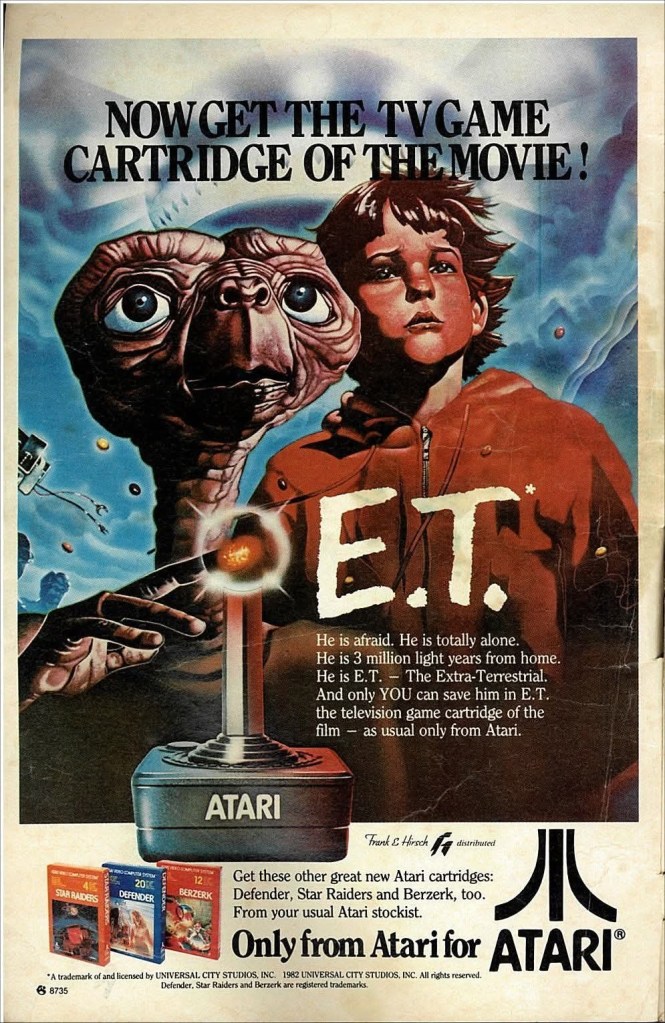
1. E.T. the Extra-Terrestrial Atari 2600 print ad
I saw the movie and played the Atari 2600 game.
Way back in 1982, Steven Spielberg’s small production E.T. the Extra-Terrestrial touched countless moviegoers and became a massive hit around the world. Along the way, an official video game adaptation for the Atari 2600 console was made by Atari anticipating big success coming. The above print ad appeared in many comic books I read and the artwork easily caught my attention since I saw the movie. Apart from the fact that the artist’s take on the boy Elliot did not resemble actor Henry Thomas, no screenshot of the game was shown which is very odd because Atari made the adaptation their biggest offering to consumers. As typical of the times, Atari inserted a few other games below for conveniently promoting them along with E.T. and the Atari 2600. Given the massive failure of the game, this print ad is a sad reminder from gaming’s past.
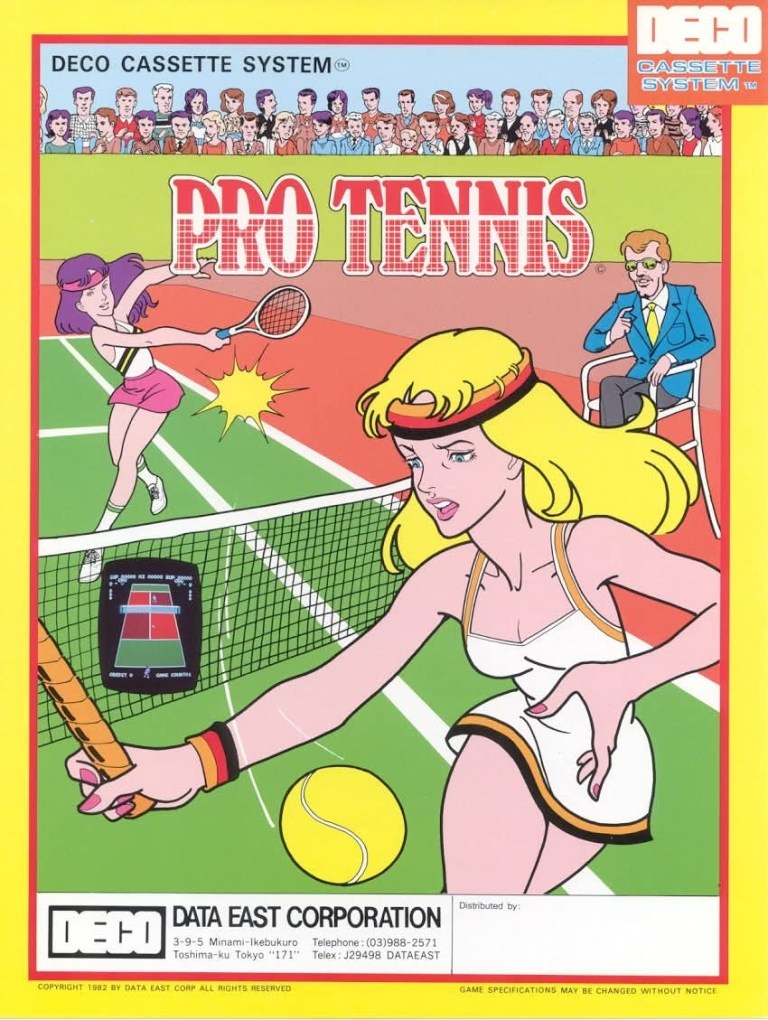
2. Pro Tennis arcade flyer
The artwork has a comic book look.
Still in 1982, Data East released Pro Tennis in the arcades. This arcade flyer has a pretty neat hand-drawn artwork that looked like it came from a comic book, and the ad makers managed to insert one screenshot to make it clear to both players and arcade operators what to expect. This is still a nice flyer to look at.
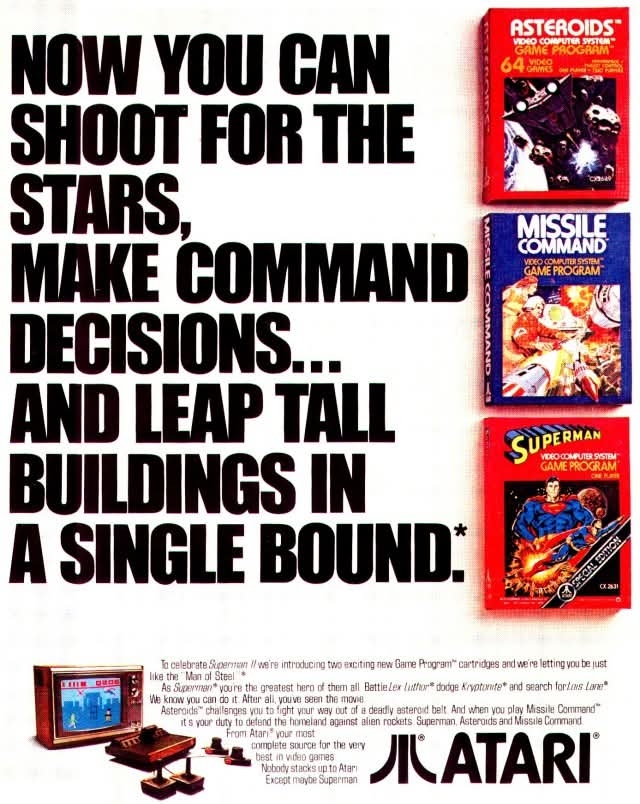
3. 3-in-1 Atari 2600 print ad
I was able to play Missile Command, Asteroids and Superman on Atari 2600 a long time ago.
In the old days, we had an Atari 2600 console in our household and it lasted around 5 years for electronic entertainment. Atari was known for aggressively marketing its consoles and video games, and the above print ad was their creative way of promoting 3 games – Superman and the classics Missile Command and Asteroids – together. The biggest feature of the print ad was the large-sized text description that strongly reflected what each game was about. This is a memorable ad!
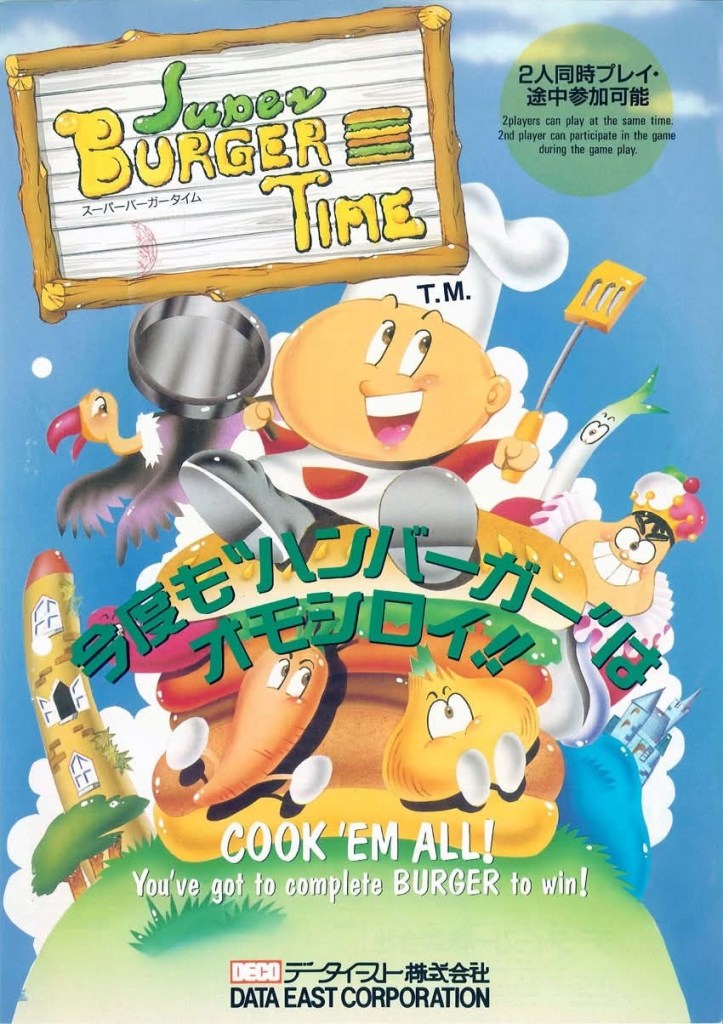
4. Super BurgerTime Japanese arcade flyer
The front.
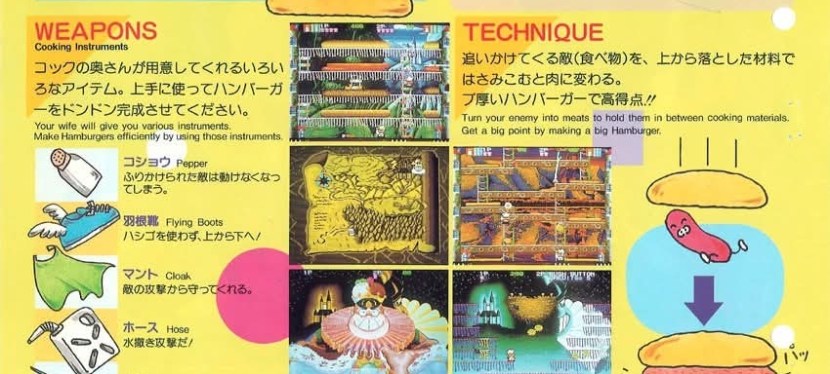
The rear.
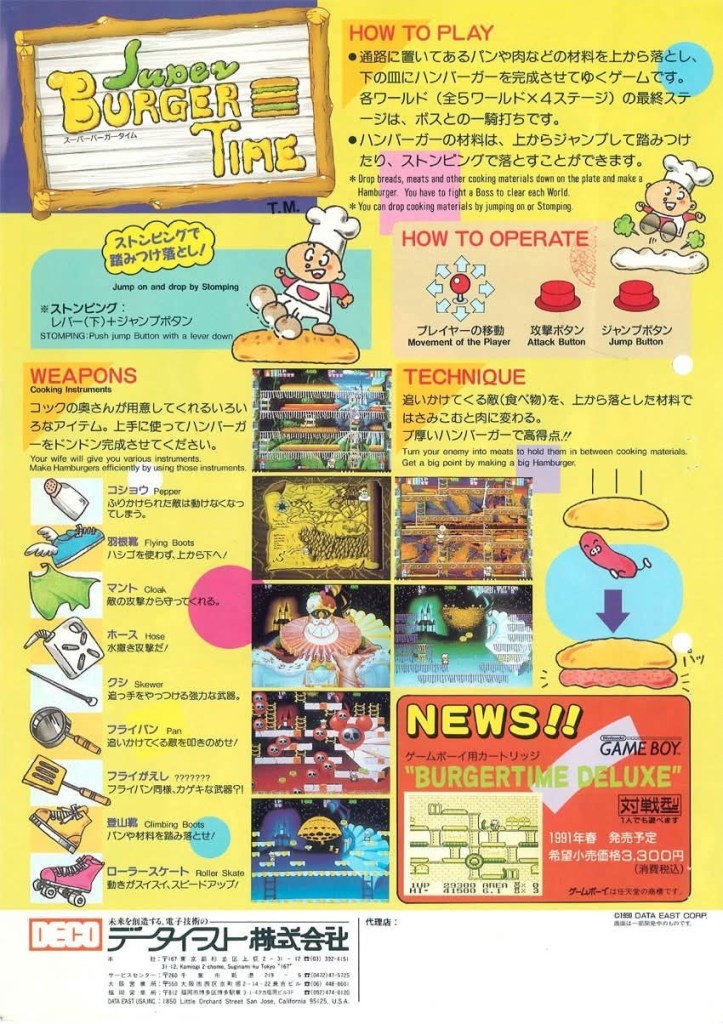
Remember the arcade classic BurgerTime? The sequel Super BurgerTime was released in Japanese arcades in late-1990 and the arcade flyer the producers came up with had a very cartoony art style. The rear of the flyer was filled with lots of details, instructions and screenshots to really have arcade operators and players informed. The producer even inserted a new portion promoting BurgerTime Deluxe on Nintendo Game Boy.
5. A Nightmare on Elm Street NES print ad
If you were able to play this game on the NES, did you have nightmares?
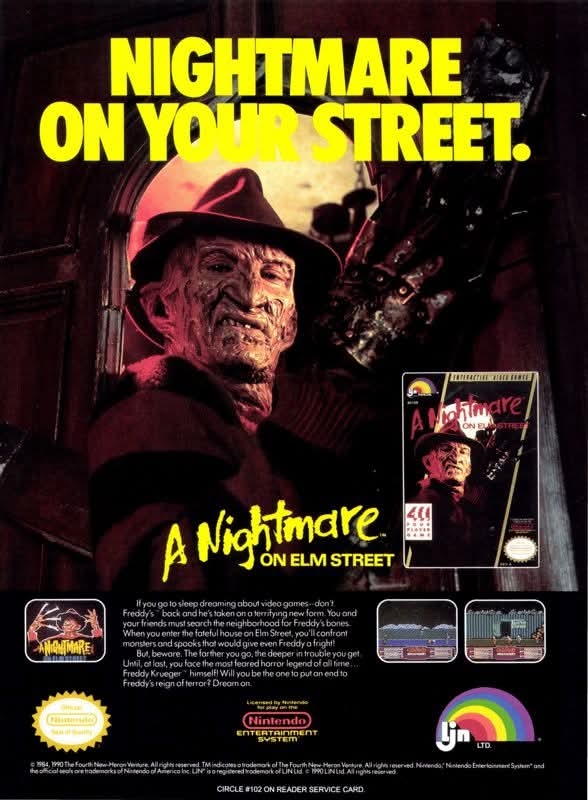
By the end of the 1980s, there were already five movies of the A Nightmare on Elm Street franchise that got released in cinemas and a dedicated following of fans was present. Eventually, an official video game adaptation was released on Nintendo Entertainment System (NES) in 1990 which was surprising since the movies were all rated R and the console itself was popular with young gamers (kids to teenagers). To promote the game, the notorious publisher LJN came up with a print ad that prominently showed series antagonist Freddy Krueger (played by Robert Englund), a few screenshots, the text description and the game box cover. Look back at this old print ad is strange because it shows Freddy Krueger TWICE which means the ad makers could not come up with any original artworks nor a different background for the antagonist.
6. NBA Showdown print ad
While this ad did not mention Michael Jordan, he was still included in the video game.
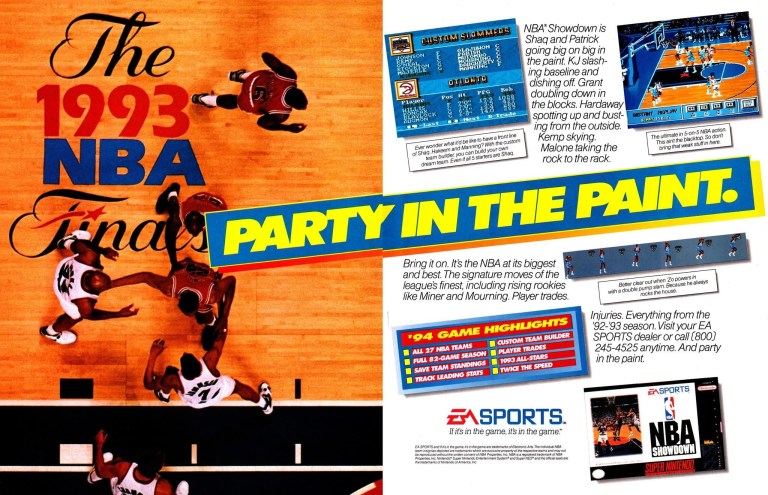
By 1993, EA Sports (Electronic Arts’ sports brand) arguably established itself as the leader of NBA-licensed video games. At the time, console gamers can expect each new NBA game from the publisher to have full rosters and statistics of players based on the season and playoffs that passed. NBA Showdown, which reflected the 1992-93 season, was promoted with this 2-page print ad that had a rectangular image taken during the 1993 NBA Finals (Chicago Bulls and Phoenix Suns) placed on the left, screenshots and text description on the right. The ad made references to Shaquille O’Neal, Patrick Ewing, Tim Hardaway and other NBA players to excite gamers. This ad is still good to look at.
7. Super Smash T.V. Sega Genesis print ad
Were you able to play the Sega Genesis version?
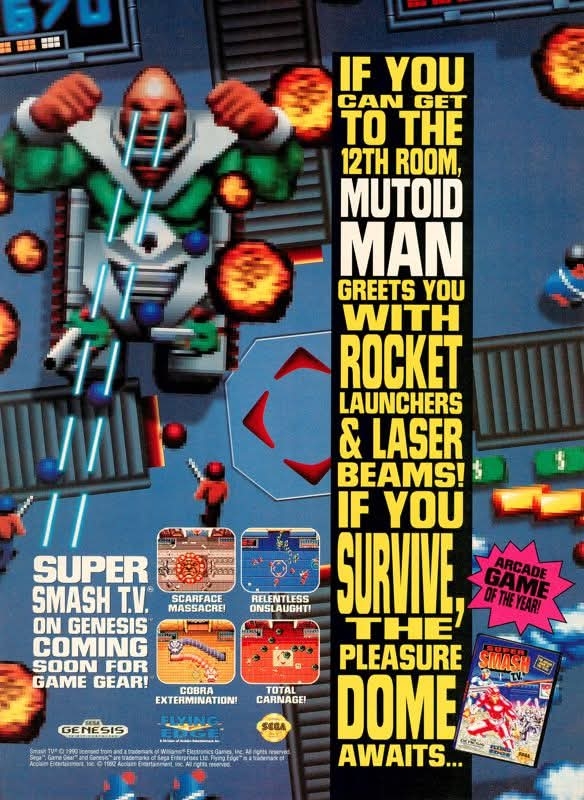
In 1991, the arcade classic Smash T.V. was ported to the Sega Genesis console under the title Super Smash T.V. and this print ad had a rectangular layout showing a zoomed-in capture of game footage with the huge enemy Mutoid Man. The stylized line (in rectangular layout) strongly reflected what gamers could expect in the game. The ad maker also inserted the confirmation that a Game Gear version was coming. This ad is a unique way of promoting both the Genesis and Game Gear versions of Smash T.V.
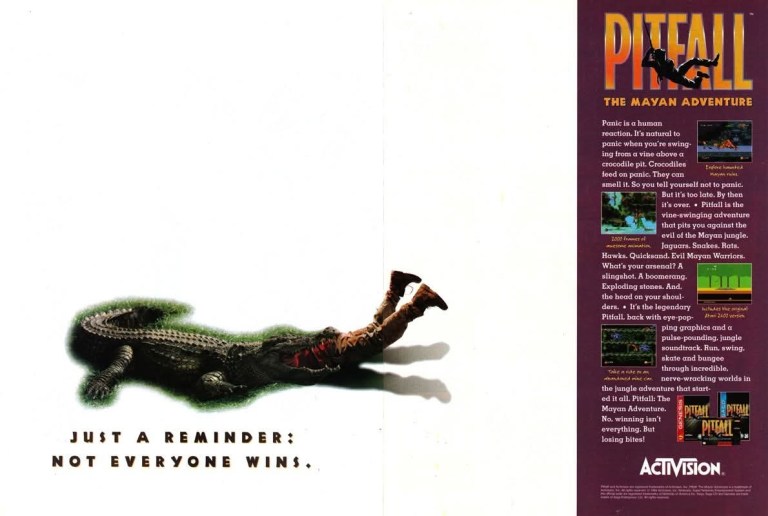
8. Pitfall: The Mayan Adventure print ad
This print ad is still eye-catching and entertaining to look at.
In the mid-1990s, Activision went big with the comeback of the Pitfall! game series by releasing Pitfall: The Mayan Adventure on multiple consoles. This two-page print ad had a touch of dark comedy by using a prominent image of a crocodile swallowing a person while avoiding blood and gore. With the little space remaining, the ad makers crammed in the text description and screenshots plus the game’s package covers. Notably, the text description maintained its tone and focused on describing the game properly. The marketing campaigns of Activision was effective as Pitfall: The Mayan Adventure went on to sell in the millions.
Welcome back readers, fellow geeks and electronic gaming fans!
In this edition of the Retro Gaming Ads Blast (RGAB) series, we will take a look at another batch of retro gaming print ads – including arcade flyers – from the 1980s and 1990s.
For the newcomers reading this, Retro Gaming Ads Blast (RGAB) looks back at the many print ads of games (console, arcade, computer and handheld) that were published in comic books, magazines, flyers, posters and newspapers long before smartphones, social media, the worldwide web and streaming became popular. To put things in perspective, people back in the 1980s and 1990s were more trusting of print media for information and images about electronic games and related products.
With those details laid down, here is the newest batch of retro gaming print ads for you to see and enjoy…
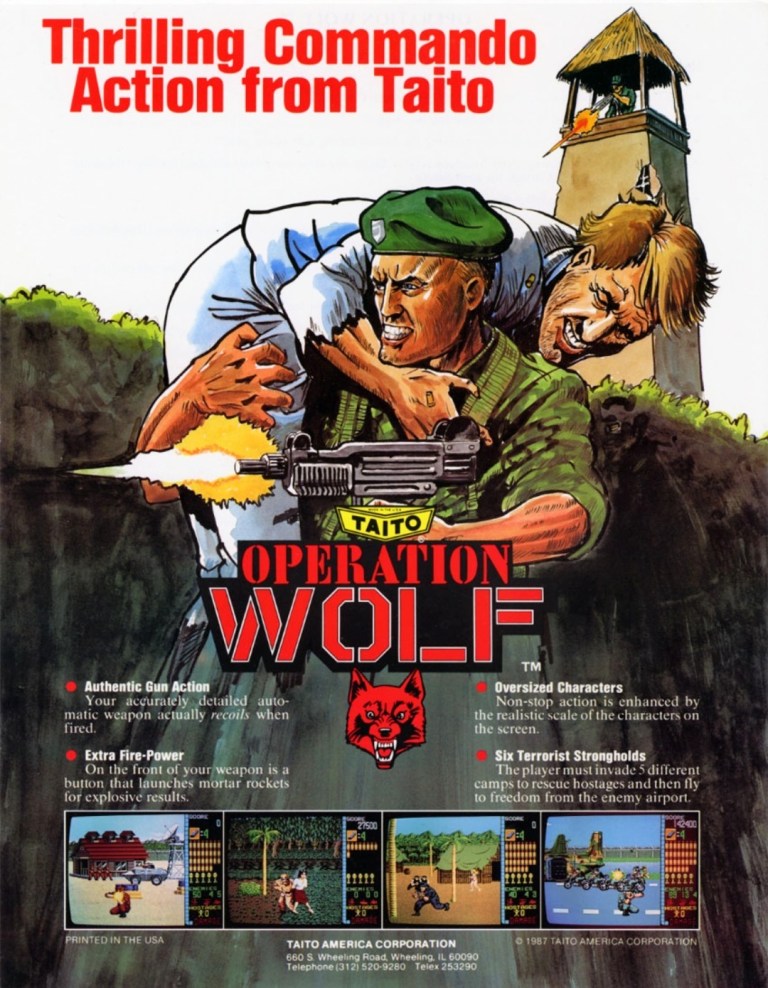
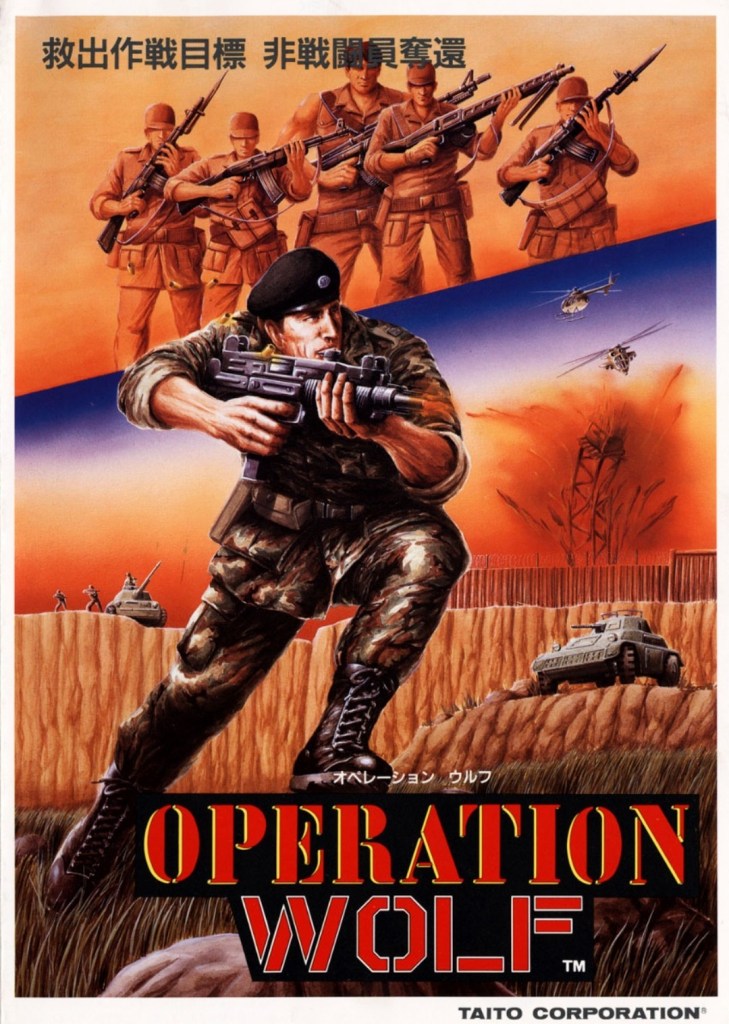
1. Operation Wolf American and Japanese arcade flyers
Operation Wolf for American arcades.
Operation Wolf for Japan.
In the late 1980s, Taito achieved massive success in arcades around the world with Operation Wolf. Released during the late stage of the Cold War and with many militaristic action movies already released by Hollywood, Operation Wolf attracted a lot of money from countless players as well as praise from game critics. For the American market, Taito came up with a colorful yet gritty looking arcade flyer that had nice hand-drawn artwork and enough details and screenshots to give readers a useful look at what to expect. The Japanese arcade flyer meanwhile has an even grittier looking original artwork that strongly emphasized war, guns and action. In retrospect, I look both arcade flyers a lot.
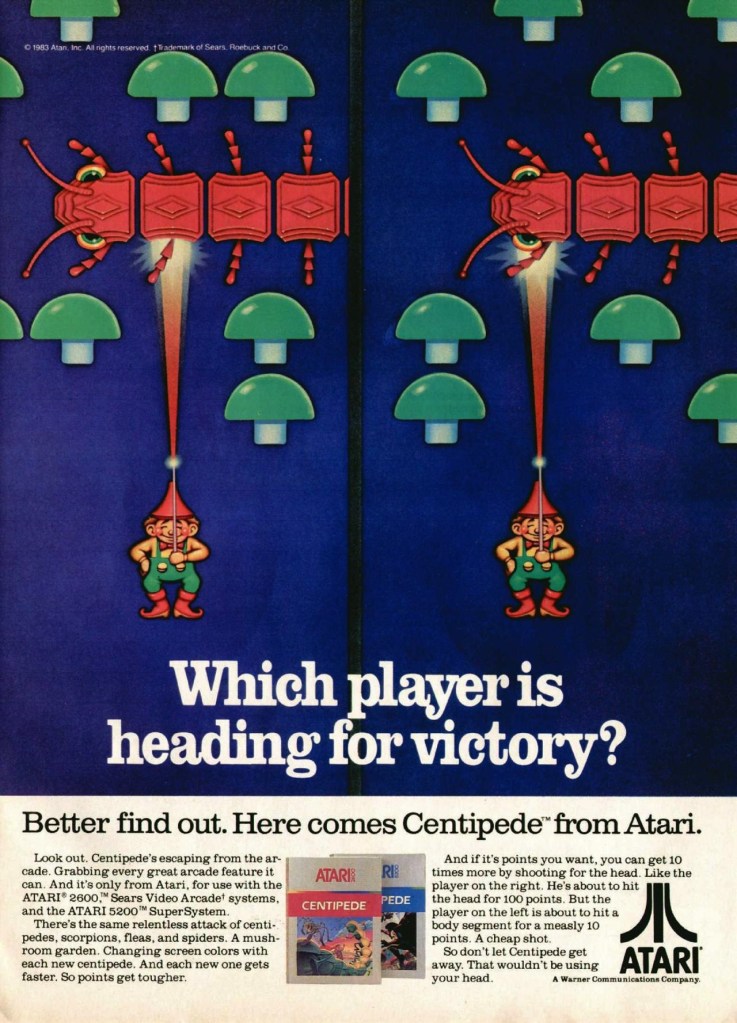
2. Centipede Atari 2600 and Atari 5200 print ad
I played Centipede a lot on Atari 2600.
While I completely missed out on the arcade version of Centipede, I managed to play its Atari 2600 version a lot. Ultimately, the simple game design and unique challenges resulted in lots of fun-filled bouts in my experience. To promote the game’s versions on Atari 2600 and Atari 5200, the game giant came up with this particular print ad that had two near-identical artworks that reflect the concept of Centipede. The ad also has some catchy expressions in the text description. This old ad is still fun to look at.
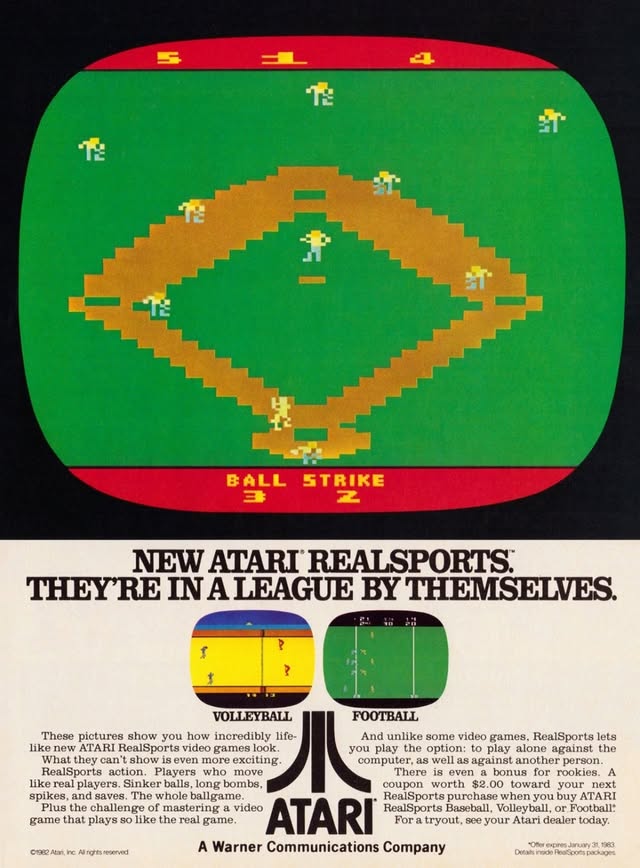
3. Atari RealSports print ad
Long before EA sports video games, there was this.
Way back in 1982, Atari launched its RealSports line of sports video games mainly to revitalize sports gaming for their consoles. In fact, RealSports was the result of a critical and aggressive ad campaign by competitor Intellivision which had its Sports Network series of games. In this RealSports print ad, a large image of Atari’s baseball game was used probably to emphasize the scope of the field. The ad had screenshots of the volleyball and football games, while the text description reflected Atari’s aggressive response to Intellivision. This ad is an early example of competition between rival game console makers focused on sports gaming.
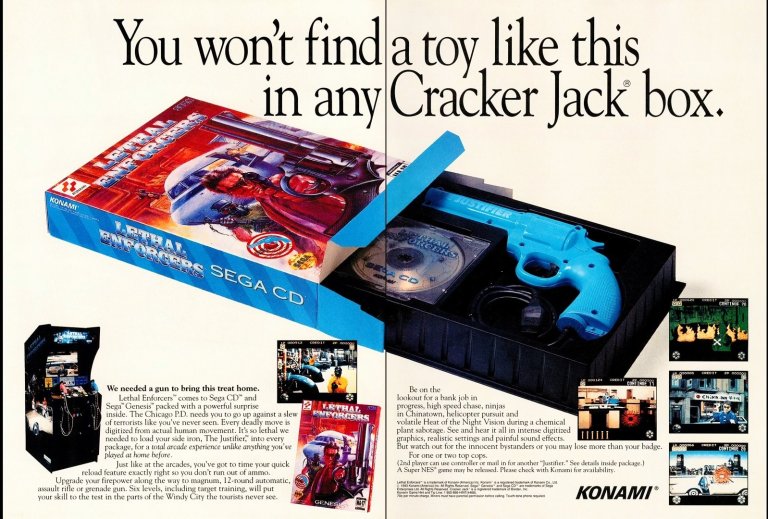
4. Lethal Enforcers Sega CD print ad
When was the last time you bought a video game with a hard copy and a peripheral bundled together?
Porting light gun games from the arcade to the console is very difficult and tricky to do. This is what Konami did in the early 1990s when they released a version of the arcade hit Lethal Enforcers on the Sega CD console and the package had a light gun with the game on disc. To promote the Sega CD version, Konami came up with a 2-page print ad with the catchy line “You won’t find a toy like this in any Cracker Jack box.” In addition, their ad had a few paragraphs of descriptive text to not only excite gamers but also gently inform them that Lethal Enforcers was also available on the Sega Genesis (note: this console is required for the Sega CD add-on to work) and the Super Nintendo Entertainment System (SNES). Overall, this old ad has a strong visual approach and a clever marketing strategy.
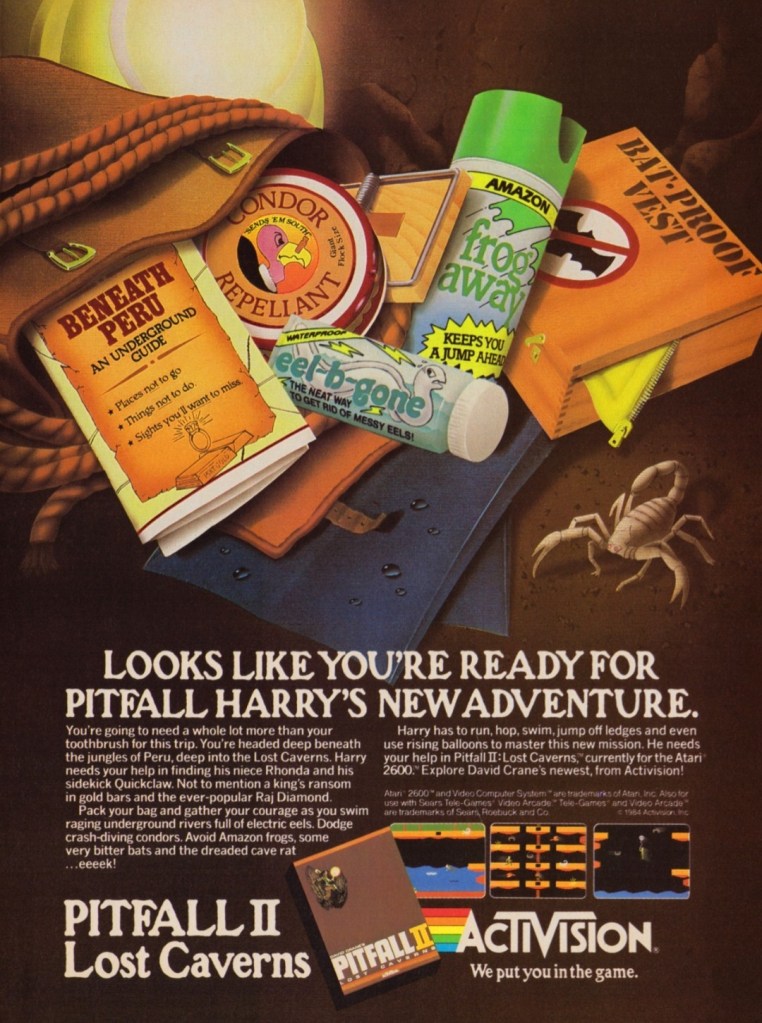
5. Pitfall II: Lost Caverns Atari 2600 print ad
A very stylish layout to promote the game.
In 1982, Activision struck gold with the huge success of Pitfall! which became an influential model of designing platform games. Of course, the publisher (now owned by Microsoft) did not stop there as they went on to make the sequel Pitfall II: Lost Caverns to not only keep the success going but also to exceed the standard they set with the first game. Activision came up with a print ad that not only told gamers of Pitfall Harry’s next adventure but also express humor visually. In line with Activision’s policy of crediting its creators (note: Atari was notorious for refusing to credit its game makers during this era), game designer David Crane was acknowledged in the ad.
6. Team USA Basketball print ad
See your favorite NBA player from the 1990s?
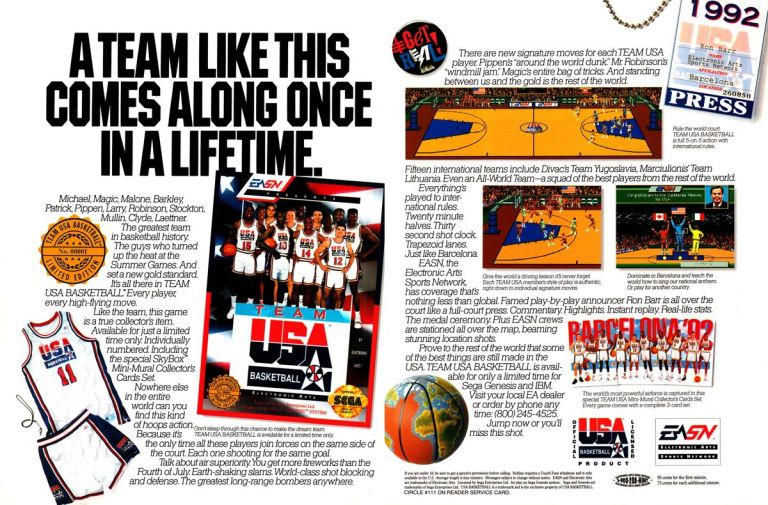
In 1992, a lot of people were obsessed with the Dream Team Olympic basketball squad of the United States as its roster had NBA legends like Larry Bird, Magic Johnson, Michael Jordan, Karl Malone, Charles Barkley and David Robinson to name a few. In fact, the Dream Team became the most popular attraction among all teams in any sport of any country that participated in the summer Olympics in Barcelona. Knowing how popular the squad really was, Electronic Arts (EA) made the video game Team USA Basketball and released it on the Sega Genesis which was already a popular console for sports video games. EA came up with this eye-catching 2-page print ad that strongly emphasized the Dream Team, international basketball gaming, and the company’s tested design on 2D basketball video games. In retrospect, this print ad is still amusing and exciting to look at.
7. Jungle Hunt Atari 2600 and Atari 5200 print ad
Do you fine the parallel artworks amusing or disturbing?
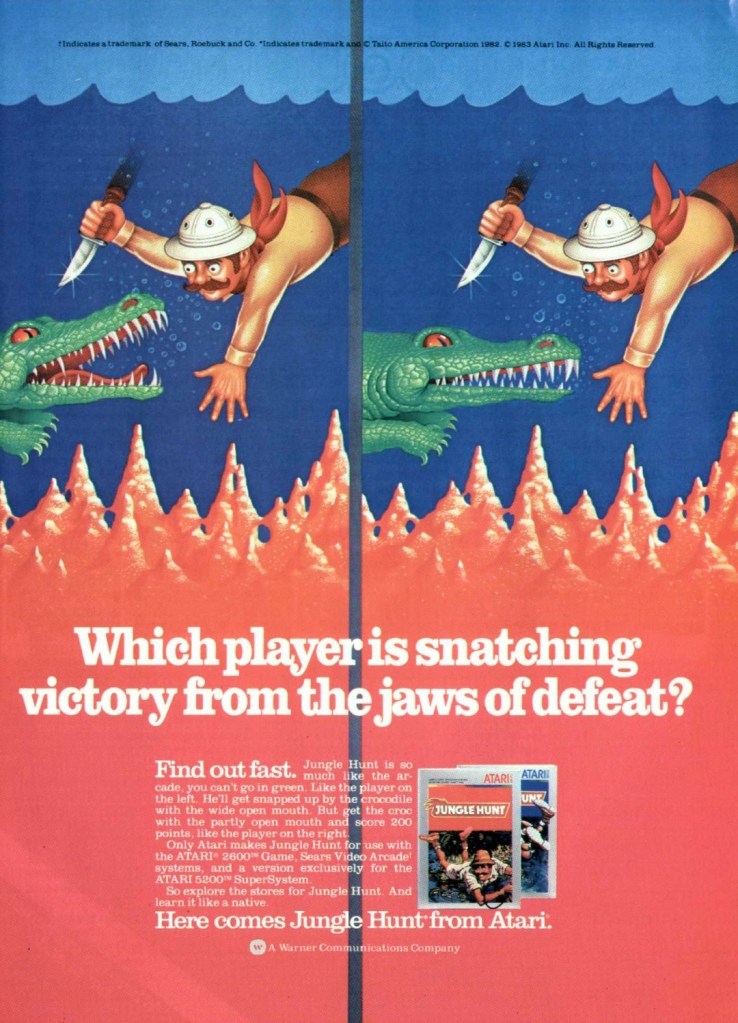
Following the huge success of Jungle Hunt (previously titled as Jungle King), Atari saw potential Dollar signs and made a deal with Taito to publish ports under their own brand for the Atari 2600, Atari 5200 and 8-bit computers. As with the Atari console ads of Pitfall II: Lost Caverns and Phoenix, Atari came up with a print ad that featured two parallel artworks that look similar with each other as they promoted Jungle Hunt for Atari 2600 and Atari 5200. To their credit, the artworks used were detailed and eye-catching, and the descriptive line of words displayed carried a possible reference to 1975’s Jaws.
8. GameShark print ad
A James Bond-inspired way of promoting GameShark.
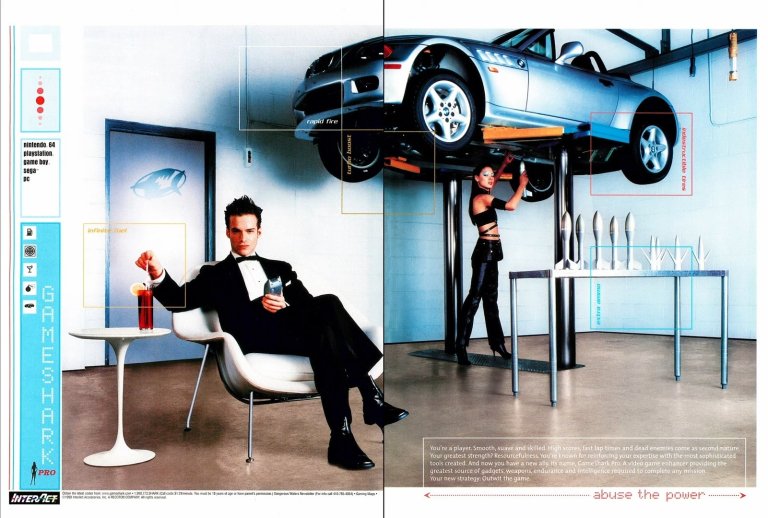
Remember GameShark? For the newcomers reading this, GameShark is the brand of a line of products released on different video game consoles and personal computers (Windows specifically) that gamers use to cheat in video games. GameShark was popular at a time when not too many people had access to the Internet nor did gamers had the means to search for cheats online, and codes were needed to enable cheating. GameShark became so popular, more ambitious and stylish print ads were realized such as this James Bond-inspired 2-page ad. On face value, this ad looked like it was a promoting a particular game but ultimately it was about promoting GameShark with style, cool and some sexiness.
Welcome back my readers, YouTube viewers and all others who followed this series of articles focused on YouTube videos worth watching. Have you been searching for something fun or interesting to watch on YouTube? Do you feel bored right now and you crave for something to see on the world’s most popular online video destination?
I recommend you check out the following videos I found.
#1 Star Wars: The Phantom Menace revisited – Remember way back in 1999 when Star Wars: Episode I – The Phantom Menace was released with a massive amount of hype and anticipation? I first saw that George Lucas-directed movie at the cinema in Festival Mall which was full of people. As the years passed by, The Phantom Menace did not age well as it had serious pacing issues, lots of childish elements (mainly because of a certain very annoying character) and it ended up inferior compared with its sequels Attack of the Clones and Revenge of the Sith. But let’s be honest here…while The Phantom Menace is indeed the weakest film of the Star Wars Prequel Trilogy, is it truly terrible and unwatchable? Now is a good time to revisit the 1999 movie through retrospective videos posted below.
#2 You, Me and the Movies react to Cape Fear (1991) – In recent times, YouTuber You, Me and the Movies posted their reaction video of the 1991 version of Cape Fear starring Robert De Niro and Nick Nolte. For the newcomers reading this, Cape Fear of 1991 is pretty hard core with its violence and, more notably, it carries elements that would terrify both viewers and their respective families. It is the kind of movie that will make you think about your family and how to protect them from cunning and violent criminals. Watch and learn how the movie impacts You, Me and the Movies.
#3 PatmanQC examines the history of Operation Wolf – Now for some retro gaming fun! I remember back in the late 1980s, Operation Wolf was popular in arcades here in the Philippines. As that game was released during the late stages of the Cold War, it was not surprising that it was both socially relevant and enjoyable for gamers. If you are wondering who created the game and what inspired them to produce Operation Wolf, watch the in-depth video by PatmanQC below.
#4 King’s Quest revisited – Still with retro gaming, I want to share with you all that in the late 1980s, I was fortunate to have played King’s Quest on PC (DOS specifically) which was an intriguing and challenging gaming experience for me. I never finished the adventure game from Sierra On-Line but I enjoyed its game design, its groundbreaking visuals and its fantasy world. I recently saw Space Quest Historian’s retrospective on King’s Quest and it had a nice mix of comedy and attention to details. Watch it now.
#5 Pedro Pascal’s wokeness exposed and explained – I really hate it when entertainment gets poisoned by the woke mob from the movie studios down to the performers and creators. I also despise the trend in which woke forces in Communist-filled Hollywood (Commiewood) make movies and shows that promote their Satanic Leftist agenda, and then the woke stars propagate their toxic beliefs in multiple ways. Recently Ranting for Vengeance posted new videos exposing the woke toxicity of actor Pedro Pascal and explaining in detail what happened. I can say this early you should stay away from Pascal’s projects such as the new woke Fantastic Four movie. As for Warner Bros., I don’t like James Gunn’s Superman. Watch and learn from the video below.
Welcome back my readers, YouTube viewers and all others who followed this series of articles focused on YouTube videos worth watching. Have you been searching for something fun or interesting to watch on YouTube? Do you feel bored right now and you crave for something to see on the world’s most popular online video destination?
I recommend you check out the following videos I found.
#1 Popcorn in Bed reacts to Cold Mountain – Were you fortunate enough to watch Cold Mountain in 2003? It is an American Civil War movie that has a very notable cast that includes Jude Law, Nicole Kidman, Renée Zellweger, Philip Seymour Hoffman, Natalie Portman and Donald Sutherland. Not too many people in online movie-focused communities or social media groups talk about the movie. Strangely, there are very few movie reaction videos of Cold Mountain on YouTube. This past March, Popcorn in Bed posted a reaction video about the film and how it impacts her emotionally make it a must-see.
#2 PatmanQC examines the history of Pitfall! – While I was fortunate enough to play lots of video games on the Atari 2600 decades ago, I never played Pitfall! That game produced by Activision was a massive hit on the said console and how the game and its company started is fascinating to discover. In case you did not notice, Pitfall! grew into a game franchise and it was one of the early video games to have merchandising. Discover more about it in PatmanQC’s in-depth video below.
#3 You, Me and the Movies react to A Nightmare on Elm Street (1984) – The 1980s is the so-called golden age of slasher horror movies. One particular slasher horror flick of 1984 focused on the concepts of nightmares, the bogeyman and the fear of dying while sleeping. You can discover more by watching the reaction video of You, Me and the Movies below. Observe how it draws reactions from them.
#4 Slope’s Game Room examines Smash T.V. – Here is more nostalgic fun for those of you who love retro gaming. Slope’s Game Room’s retrospective video of the arcade classic Smash T.V. is a lot of fun to watch and the YouTuber really paid close attention to the details for viewers to learn. When was the last time you played Smash T.V.?
#5 Ashleigh Burton reacts to Alien Resurrection – Way back in late-1997, I saw Alien Resurrection inside the movie theater here in the Philippines carrying some excitement in me. After the movie ended, I left the cinema feeling numb. That being said, you have to see how Alien Resurrection drew reactions from Ashleigh Burton and perhaps you could relate with her perception of the movie.
#6 Scottie Pippen, the Chicago Bulls and Jerry Krause – Remember back in the 1990s when the Michael Jordan, Scottie Pippen and the Chicago Bulls won six NBA championships? Behind the scenes, Scottie Pippen’s years with the Bulls (led by Jerry Krause) were actually filled with frustrations and his salary was tiny when compared to other NBA superstars of the era. To find out what happened and what were the factors behind it all, watch the two videos of Secret Base below.
#7 Minty Comedic Arts presents Cool World trivia – Recently, YouTuber Minty Comedic Arts posted a new trivia video about the 1992 live-action/animated hybrid movie Cool World. Directed by Ralph Bakshi and starring Brad Pitt and Kim Basinger, Cool World had an original concept that was eventually altered into its final cinematic form. There are lots of intriguing details to discover and I urge you all to watch Minty Comedic Arts’ video below.
Welcome back readers, fellow geeks and electronic gaming fans!
In this edition of the Retro Gaming Ads Blast (RGAB) series, we will take a look at another batch of retro gaming print ads – including arcade flyers – from the 1980s and 1990s but with focus on Star Wars games that were released during the era of George Lucas. This is the Star Wars Special of RGAB.
For the newcomers reading this, Retro Gaming Ads Blast (RGAB) looks back at the many print ads of games (console, arcade, computer and handheld) that were published in comic books, magazines, flyers, posters and newspapers long before smartphones, social media, the worldwide web and streaming became popular. To put things in perspective, people back in the 1980s and 1990s were more trusting of print media for information and images about electronic games and related products.
With those details laid down, here is the newest batch of retro gaming print ads for you to see and enjoy…
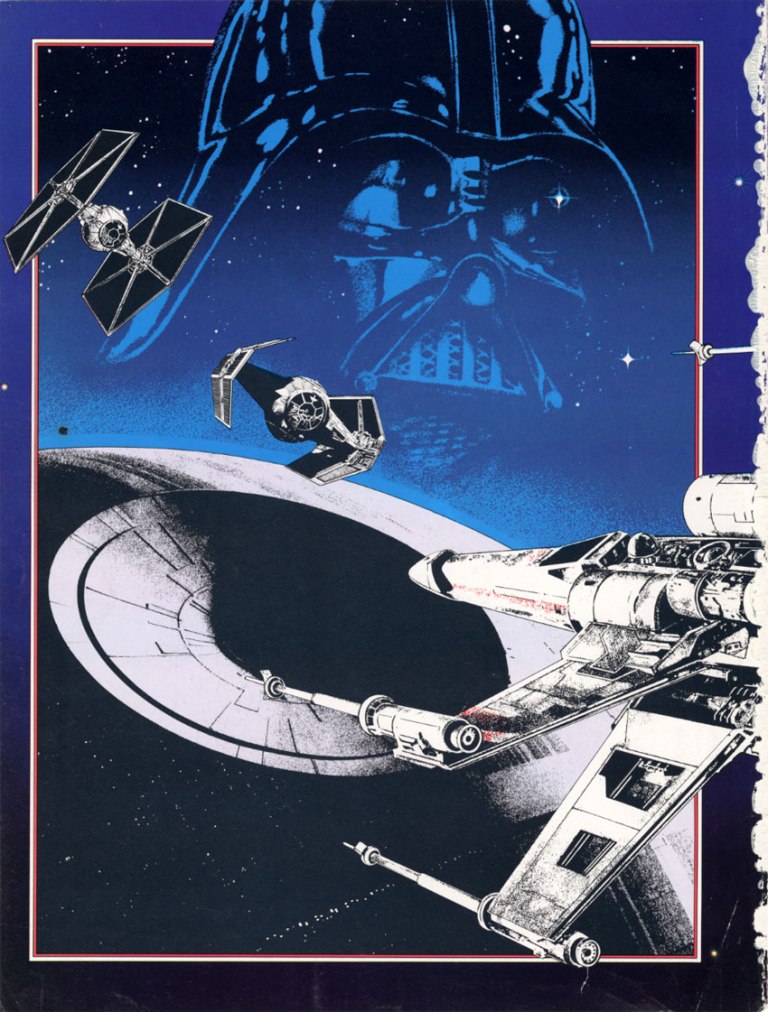
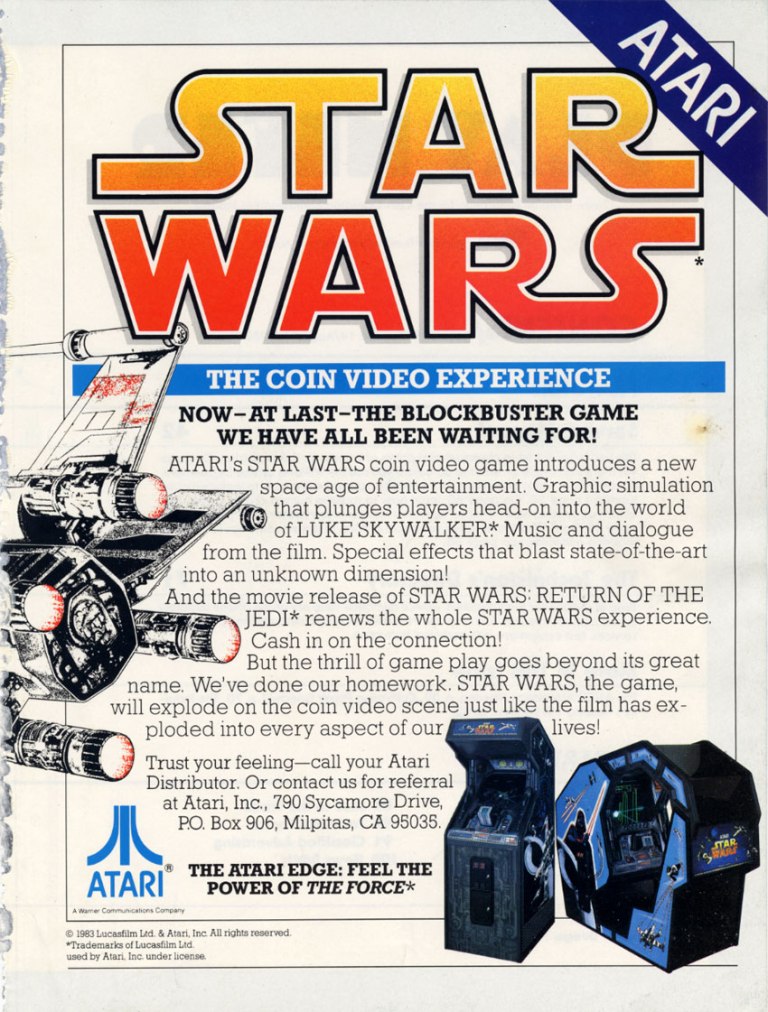
1. 1983 Star Wars arcade game flyer
The front of the flyer.
The rear of the flyer.
Just weeks before the Star Wars movie Return of the Jedi was released in cinemas in 1983, Atari released the Star Wars arcade game which became a tremendous hit around the world. Both Star Wars fans and gamers of the time loved the game as it provided a very immersive and fun-filled arcade experience. The print ad Atari released has a nice artwork on the front (showing a portion of the Death Star, two TIE Fighters, a Rebel X-Wing Fighter and Darth Vader’s image) and the text description plus the pictures of two arcade machines on the back. While no screenshots were shown, the print ad still had strong visual impact to catch the attention of players and arcade operators. This arcade flyer still looks great!
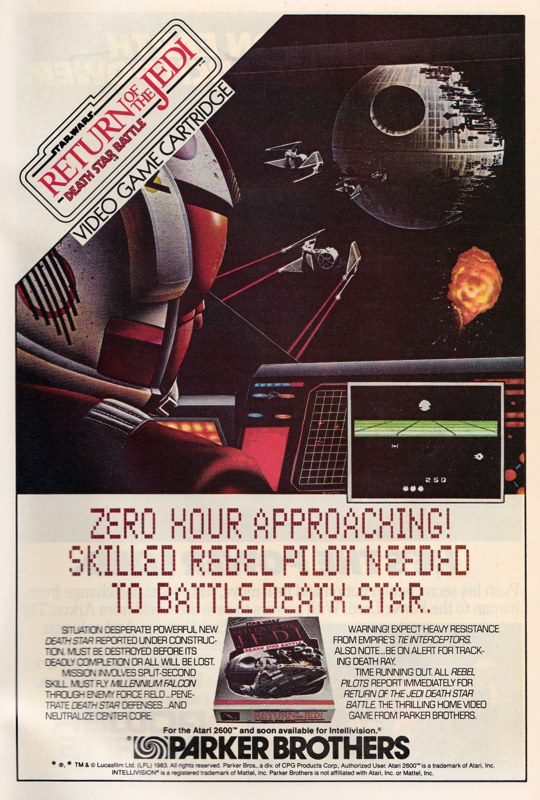
2. Star Wars: Return of the Jedi – Death Star Battle Atari 2600 print ad
Parker Brothers really stood out among publishers of games on the Atari 2600 and they even had the Star Wars license.
Considering the massive success that Star Wars and The Empire Strikes Back had in cinemas, merchandising and other entertainment media, it was not surprising that games based on Return of the Jedi were produced. For the Atari 2600, Parker Brothers produced Star Wars: Return of the Jedi – Death Star Battle which my friends and I played a lot in 1983. The print ad Parker Brothers came up with has a very eye-catching design showing a Rebel pilot flying a space ship (supposedly the Millennium Falcon which is the only playable ship in the game) towards the Death Star. The visual design is a stroke of genius because it appeals strongly to Star Wars fans while highlighting a major battle in the film which influenced the core concept of the game. This is a classic Star Wars game ad.
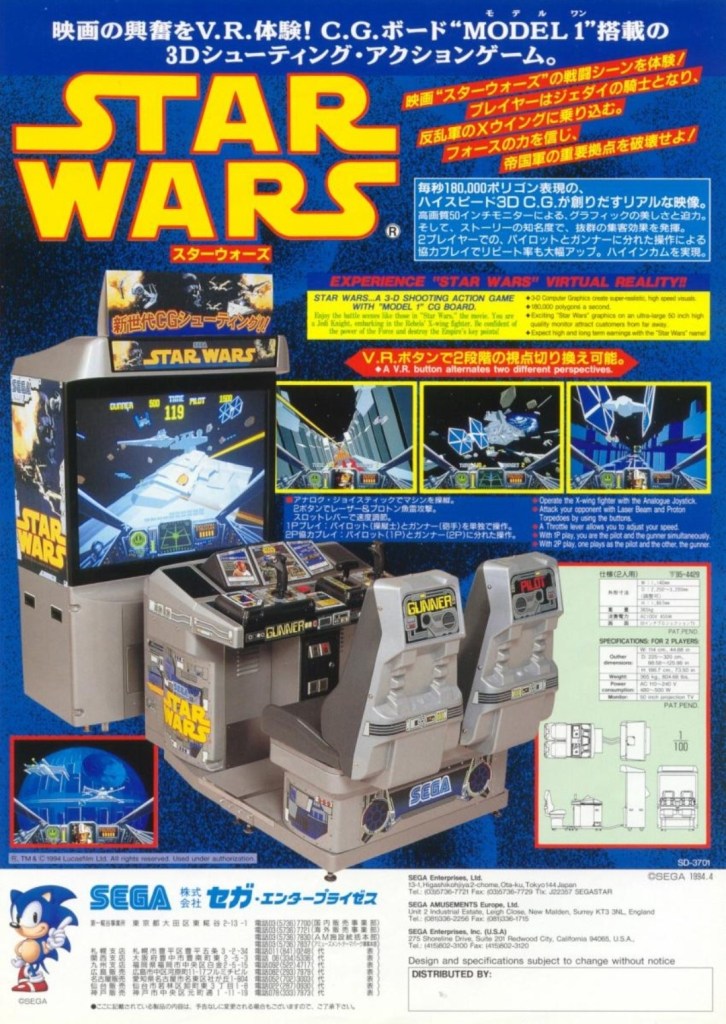
3. Star Wars Arcade Japanese market flyer
This arcade game was one of the first fully polygonal Star Wars games released.
In the 1990s, Sega acquired the license to produce Star Wars games for the arcades and they had the hardware for polygonal graphics. In 1993, the released Star Wars Arcade which is a space shooter that offered gamers the freedom to fly their Rebel space ship in 3D space with environments and huge space ships rendered in polygons. As you can see in the arcade flyer for the Japanese market, Sega went hard with their presentation showing 3 carefully selected screenshots (amazing for the time) and a picture of the arcade machine which had an elaborate control set-up, seats and decorations. As Star Wars Arcade was released more than a year before the polygonal game consoles Sega Saturn and Sony PlayStation hit the market, this arcade flyer was mind-blowing to gamers who were on the verge of playing video games with polygonal visuals.
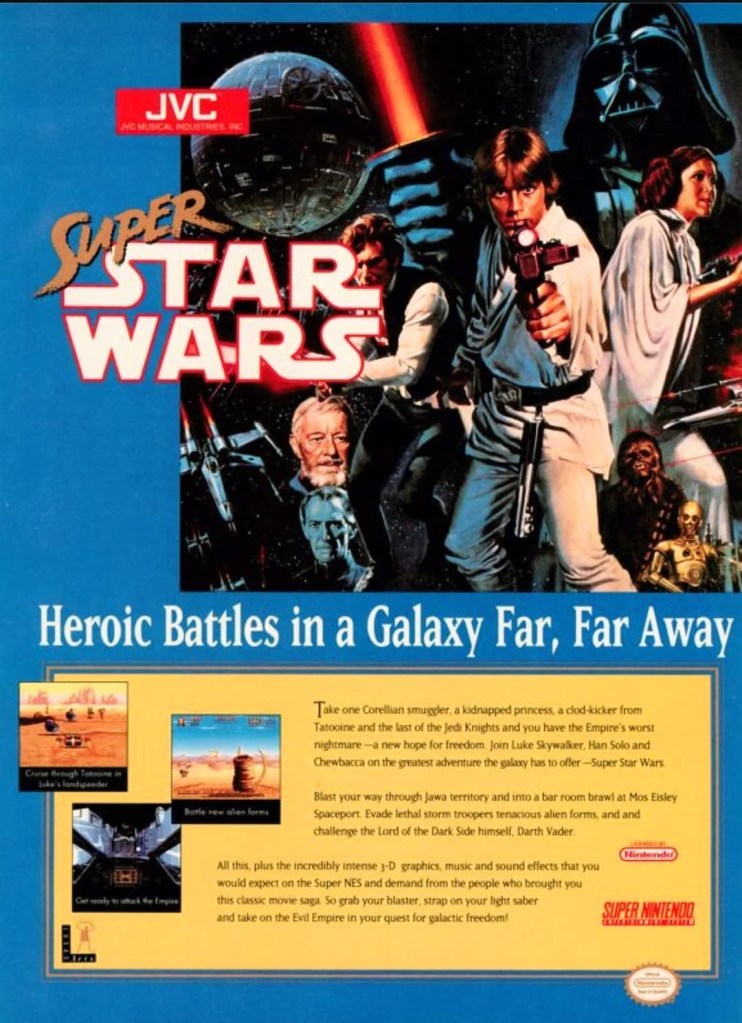
4. Super Star Wars print ad
Yes, JVC was involved with the Super Star Wars trilogy starting with this one.
In 1992, Star Wars fans who enjoyed playing 2D side-scrolling games saw their dream of the next great Star Wars console experience come true when Super Star Wars was released on the Super Nintendo Entertainment System (SNES). With the SNES technology, more detailed visuals and improved audio brought the Star Wars universe to life and the addition of 3D-like playable sequences (made possible by Mode 7 effects) made Super Star Wars a very unique console experience. The print ad only showed three screenshots and three paragraphs of descriptive text but the use of images from the 1977 movie poster added a lot of punch to the visual presentation. This ad is both eye-catching to gamers and long-time Star Wars fans.
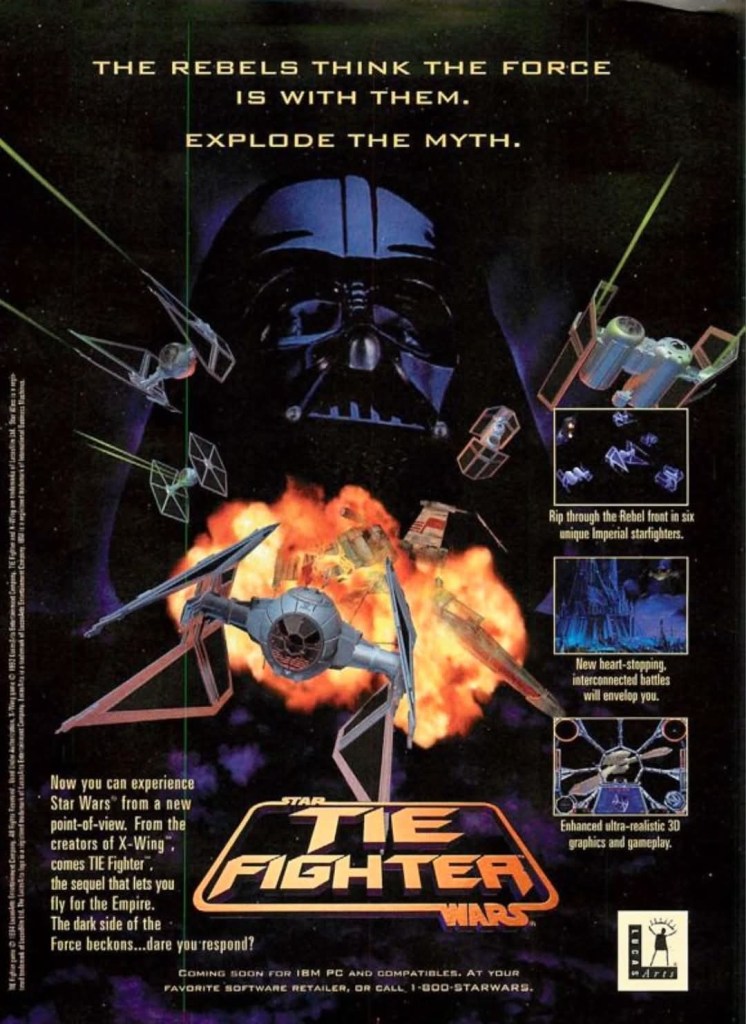
5. Star Wars: TIE Fighter print ad
This game offered gamers the opportunities to be with the dark side.
In 1994, LucasArts released Star Wars: TIE Fighter which offered gamers the opportunity to play an Imperial pilot serving Darth Vader on missions set between The Empire Strikes Back and Return of the Jedi. This print ad has a sharp visual design enhanced by Darth Vader’s iconic look in the background. The selected screenshots shown were good to look at but the artwork used to present the TIE Fighters really stood out. This solid looking print ad does come with a bit of disturbance as the Galactic Empire in Star Wars lore are evil.
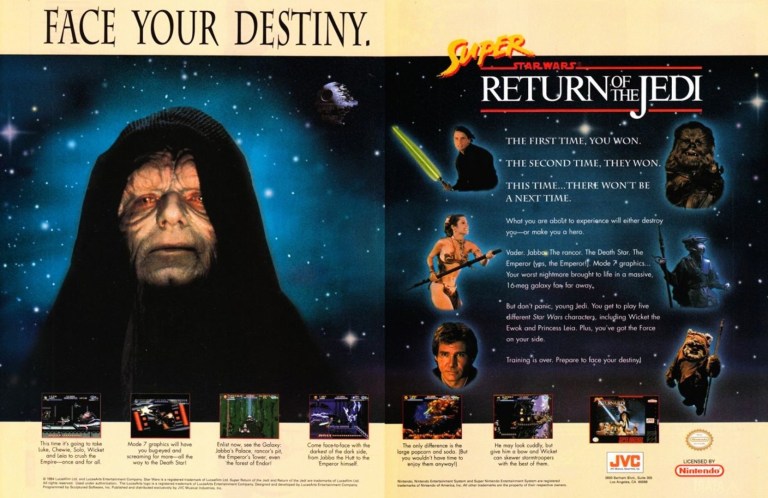
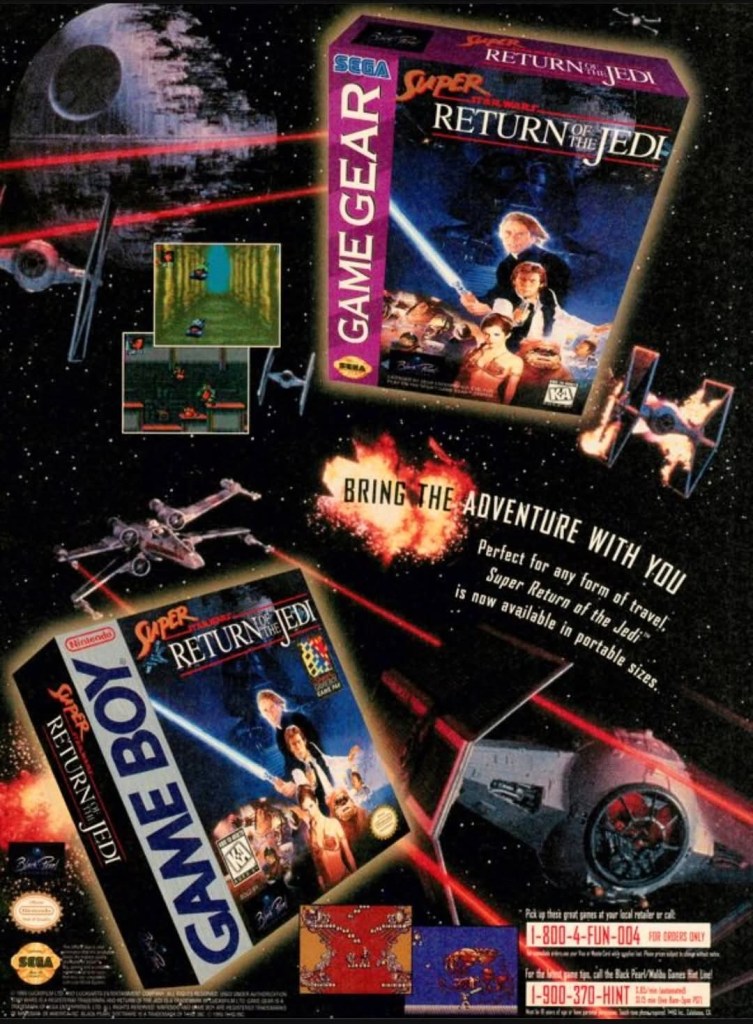
6. Super Star Wars: Return of the Jedi print ads
Nothing like seeing Harrison Ford, Carrie Fisher and Mark Hamill as the Star Wars icons on a video game ad.
I never played the portable editions of Super Star Wars: Return of the Jedi. Have you?
As far as gaming on the SNES was concerned, the Super Star Wars trilogy of games really kept fans and casual gamers busy. By the time Super Star Wars: Return of the Jedi was released in 1994 on the SNES, there was already immense speculation about the Star Wars prequel trilogy and George Lucas himself started writing them that same year. The 2-page print ad of the game on SNES had a creepy photo of Emperor Palpatine on one side, the other characters on the other side, and six selected screenshots displayed on the lower part. The way the print ad was design reflects that the game is the end of the trilogy like the 1983 film itself. Super Star Wars: Return of the Jedi was also released on Game Gear and Game Boy and the ad makers made the right decision to use the Death Star and space battle image as the background so that the portable games would stand out.
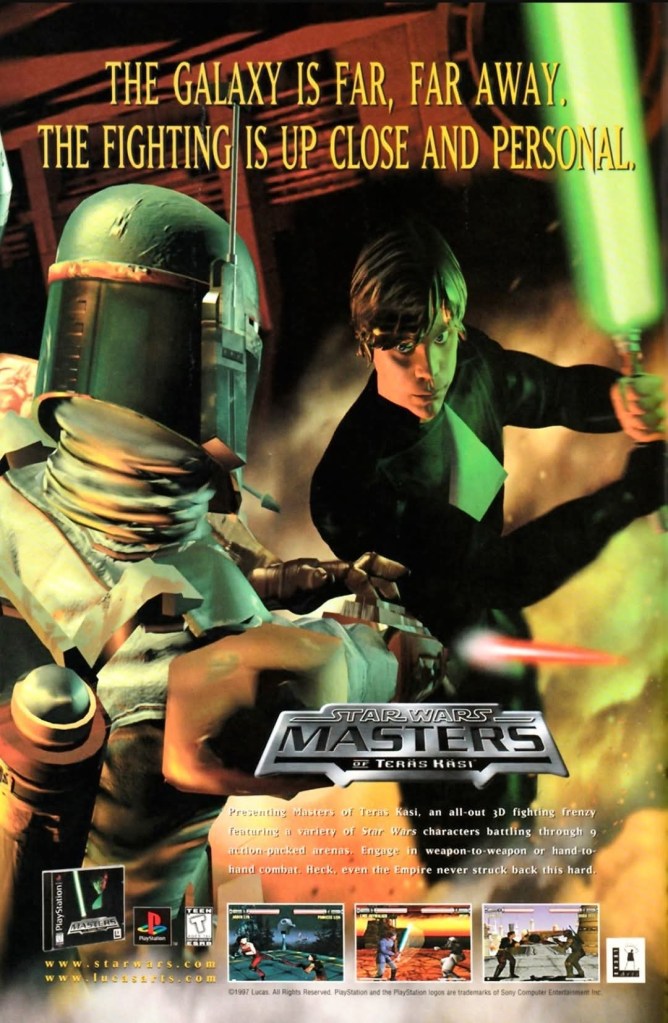
7. Star Wars: Masters of Teräs Käsi print ad
I wonder if George Lucas ever regretted approving this Star Wars fighting game. It was so rough and unpolished with its quality.
If there is any sub-par Star Wars game released in the 1990s, it is none other than Star Wars: Masters of Teräs Käsi on the PlayStation. The 1997 game was LucasArts’ attempt to cash in on the booming fighting games genre and they took a huge risk of making it entirely polygonal. Instead of using photographs or hand-drawn art, the ad makers used a fully rendered 3D polygonal models of Luke Skywalker and Boba Fett which was alienating to look at. In fact, those polygonal models looked very different from the in-game polygonal models of Skywalker and Boba Fett presented during gameplay. This print ad is a sad reminder about an ill-conceived concept for Star Wars that materialized into an actual product.
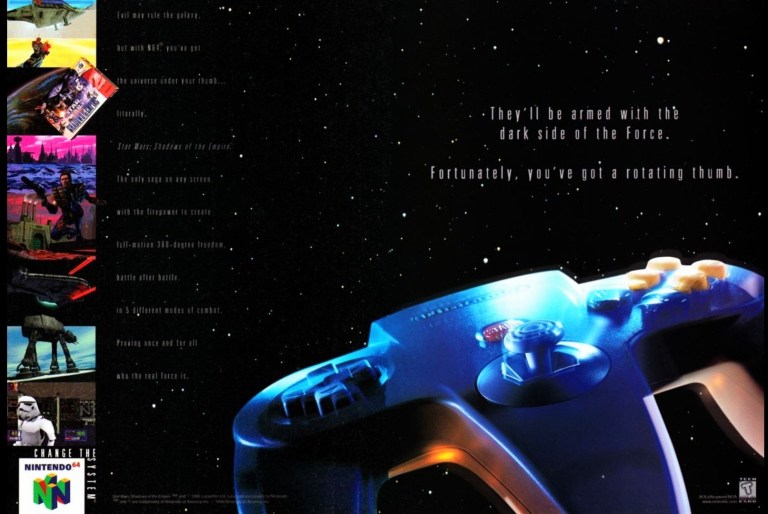
8. Star Wars: Shadows of the Empire print ad
If you have read the novel, were you able to play this video game?
LucasArts and Nintendo teamed up with something ambitious – a video game adaptation of Star Wars: Shadows of the Empire that was released exclusively to the Nintendo 64 (N64). Released in late 1996, Star Wars: Shadows of the Empire was part of the multimedia entertainment project of the same name and it is the result of LucasArts’ decision to be an early adopter of the N64 for business-related reasons. The 2-page print ad shown here has a dark, star-filled background which captivating screenshots on the left and the N64 controller standing out. This print ad strongly expresses that gamers would need the N64 in order to play Star Wars: Shadows of the Empire in the comfort of home.
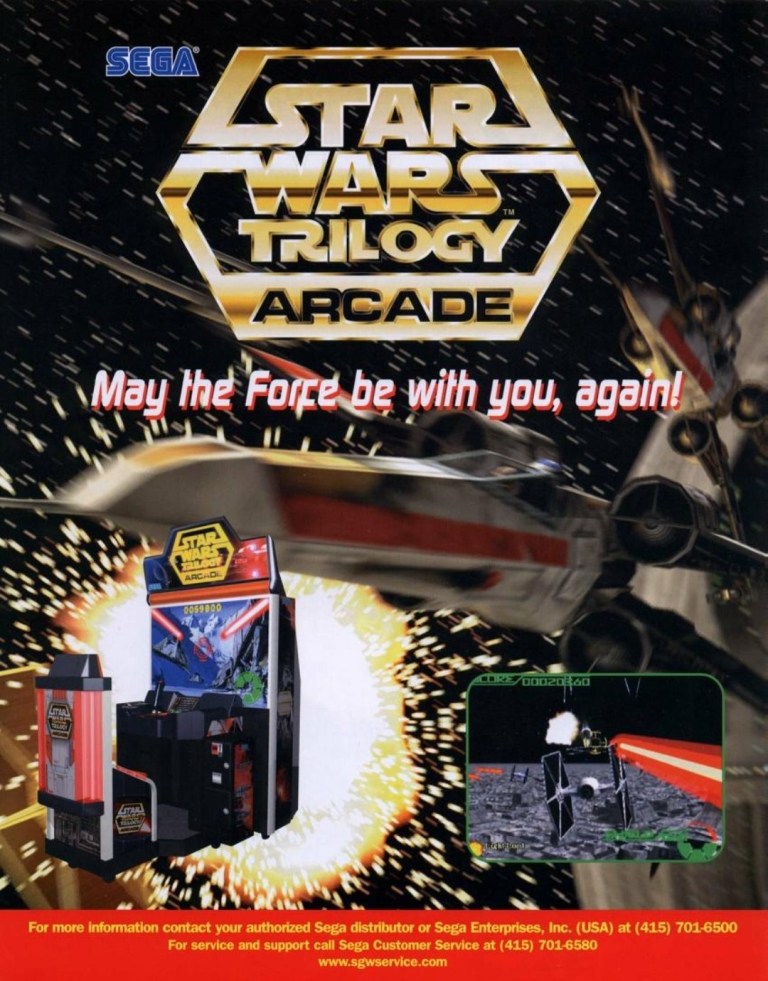
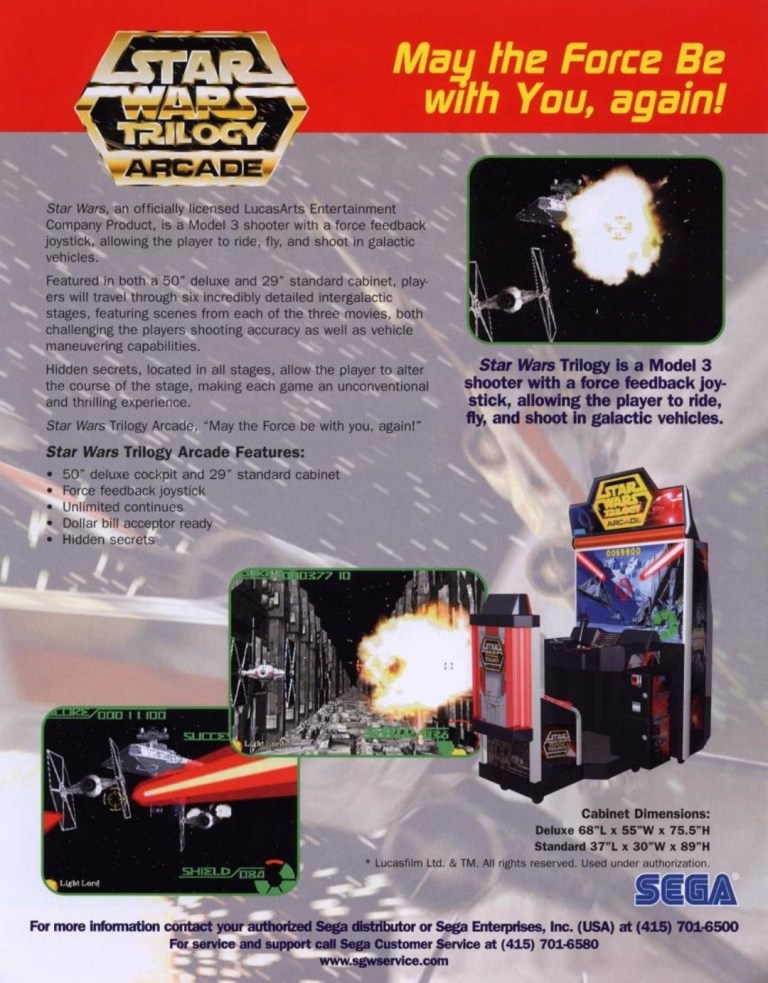
9. Star Wars Trilogy arcade flyer
The front.
The other side.
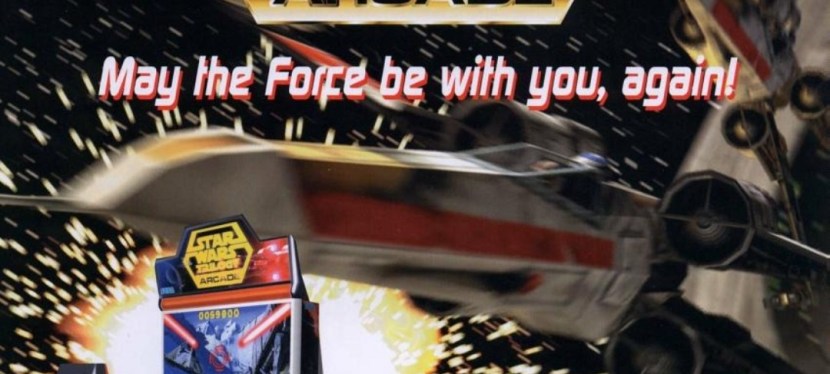
Before the Star Wars Prequel trilogy started with The Phantom Menace, Sega came out strongly by releasing Star Wars Trilogy Arcade in arcades around the world. Released in 1998, the game was arguably Sega’s most ambitious Star Wars-licensed game ever as it was made with the powerful Model 3 hardware, it came with unique controls and the game was designed as a polygonal rail shooter focused on key segments from the original trilogy of films. Sega wisely used dynamic artwork for the front of the flyer giving viewers the impression that the X-Wing fighter was approaching them closely. At the rear, three screenshots only showed space battles which was a wise decision by Sega to keep the surprise intact for gamers until they play the game. Having played this in the arcade myself, I can assure you that Star Wars Trilogy Arcade has more varied types of gameplay and challenges. It’s a lot more than flying and shooting in space, and it has a lot of stuff that Star Wars fans will love.







 Author Carlo Carrasco