What to watch on YouTube right now – Part 31

Welcome back, my readers, YouTube viewers and all others who followed this series of articles focused on YouTube videos worth watching. Have you been searching for something fun or interesting to watch on YouTube? Do you feel bored right now and you crave for something to see on the world’s most popular online video destination?

I recommend you check out the following topics and the related videos I found.

#1 HolyLandSite’s comprehensive videos about the Temple Mount in Jerusalem, Israel  – I love Israel and I will always stand with it in accordance to my uncompromising faith in the Lord and His Word (the Holy Bible). During the one and only day-off of the Israel 2023 pilgrimage tour I joined, I visited the Temple Mount in the Old City of Jerusalem and it is truly one of the most significant places to visit in the entire world. The Dome of the Rock (the Muslim shrine) occupies the space where the two Jewish temples used to be and inside it is the Foundation Stone (preserved layer of mountain top rock) which is the spot where Abraham almost sacrificed Isaac before God sent the angel to intervene. Be aware that during the time of Lord Jesus, the 2nd Jewish temple was established.

HolyLandSite produced the most in-depth and most informative videos about the Temple Mount and I encourage you to watch them now.

#2 The #10 billion Apple Car disaster – You ever heard of the Apple Car? Such a project from the very same company behind iPhone actually existed and it ended up as a disaster worth an estimated $10 billion. What happened behind the scenes at Apple? Did the technology giant really believe it could make a positive impact on the automobile industry? You can find out more by watching ColdFusion’s video below.

#3 Venom: Lethal Protector revisited and explained  – I should mention first that I am not a fan of the Marvel Comics super villain Venom. For the newcomers reading this, Venom emerged in the late 1980s as Spider-Man’s deadliest enemy and went on to become a murderer who somehow helped Marvel Comics sell a lot of comic books. Because comic book fans wanted more of him so much, Marvel went on to publish the Venom: Lethal Protector limited series in the early 1990s and it led to even more comic books showcasing him as an anti-hero (specifically a killer helping the powerless people). If you are interested to learn about the Venom: Lethal Protector limited series without having to go through all the trouble of finding the comic books, watch the video below. Better save your money.

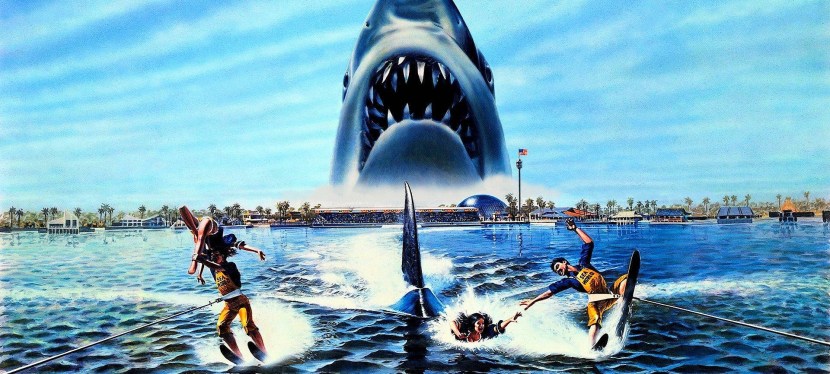
#4 You, Me and the Movies’ reaction videos of the first three Jaws movies – YouTube channel You, Me and the Movies recently posted their movie reaction videos of Steven Spielberg’s Jaws (1975), Jaws 2 (1978) and Jaws 3-D (1983). Having seen all three movies before, I enjoyed these reaction videos. The first movie from 1975 is a true cinematic classic directed by a very young Spielberg and if you have not seen it, I encourage you to watch it entirely first before seeing the related reaction video. I cannot say the same about Jaws 2 and Jaws 3-D (AKA Jaws 3). Once you are ready, enjoy the videos below.

#5 Retrospective videos of Suikoden and Suikoden II – Recently, Konami announced that it will finally be releasing the anticipated collection Suikoden I&II HD Remaster Gate Rune and Dunan Unification Wars on March 6, 2025 for varied game consoles plus Steam. The said collection was supposed to have been released in 2023 but a delay happened and Konami was very silent until recently. Now that fans of the first two Suikoden games have something to look forward to in 2025, here are some retrospective videos that will help you understand what the games are and why they are still popular among Japanese RPG (JRPG) enthusiasts.

#6 The wickedness and wokeness of Rachel Zegler exposed  – Actress Rachel Zegler is not worth trusting as she went ballistic while promoting the new Snow White movie from woke Disney. Not only did she go against the legacy of the classic Snow White animated movie, she sided with the pro-Palestine movement and their terrorists. While her tweet could encourage pro-Palestine believers to watch the new Snow White, it is a fact that there already a movement of people who hate Israel telling people to boycott the said movie simply because it has Israeli actress (and Wonder Woman star) Gal Gadot. By being woke and reckless, Zegler is only turning off people from watching the new Snow White and if the movie fails, it will cost Disney a lot of money. Watch and learn from the selected videos below.

#7 Popcorn in Bed reacts to King Kong (1933) and Godzilla (1954) – I really enjoy watching the movie reaction videos of Popcorn in Bed (PIB) and recently she posted new videos about two very significant movies…the original King Kong of 1933 and the original Godzilla (Gojira) film of 1954. As the two mentioned movies are cinematic classics, I encourage you to watch them first before watching Popcorn in Bed’s reaction videos. To those who saw classics already, watch the reaction videos below.

+++++

Thank you for reading. If you find this article engaging, please click the like button below, share this article to others and also please consider making a donation to support my publishing. If you are looking for a copywriter to create content for your special project or business, check out my services and my portfolio. Feel free to contact me with a private message. Also please feel free to visit my Facebook page Author Carlo Carrasco and follow me on Twitter at  @HavenorFantasy as well as on Tumblr at https://carlocarrasco.tumblr.com/ and on Instagram athttps://www.instagram.com/authorcarlocarrasco

Are you nostalgic about Jaws 3-D (AKA Jaws 3) right now?

Way back in 1983, I had my first-ever 3D viewing experience inside the movie theater here in the Philippines. I saw the movie Jaws 3-D (AKA Jaws 3) on the big-screen using disposable 3D glasses and the theater was packed with lots of moviegoers who screamed from time to time.

If you are not familiar with movie history, Jaws 3-D was the 3rd movie of the Jaws movie franchise which itself started with the classic 1975 movie directed by Steven Spielberg. While the 1978 sequel Jaws 2 did not come close to matching the commercial success of its predecessor, it still managed to gross over $200 million worldwide and arguably influenced Hollywood movie studios to invest in making sequels to achieve summer box office success. Jaws 2 also propelled the rise of movie-related merchandising which paved the way for deals between movie studios and business entities.

When the 2nd Jaws sequel was proposed, producers David Brown and Richard Zanuck had the concept of spoof titled Jaws 3, People 0. National Lampoon writers were even commissioned to make the script. The Jaws 3 comedy project was shot down by Universal Pictures as a result of Steven Spielberg’s threat that he would never work with them again if they approved it.

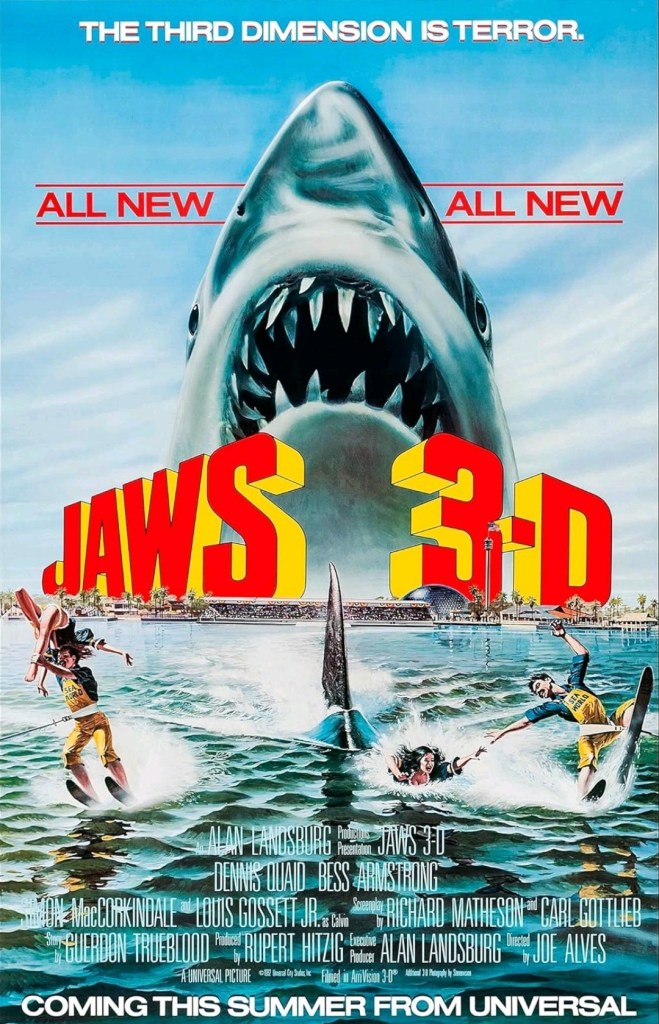
Along the way, there were technological breakthroughs for cinematic 3D viewing which led to the short revival of showing movies in 3D in movie theaters. The Jaws 3 project was turned into a 3D-focused cinematic experience with a concept about an aquatic amusement park that falls into chaos as a result of a large great white shark that infiltrated it. Prolific production designer Joe Alves was hired as director and the cast includes Dennis Quaid, Bess Armstrong, Louis Gossett, Jr., Lea Thompson and Simon MacCorkindale. Even SeaWorld got involved and allowed the filmmakers to use their brand.

The movie poster.

Jaws 3-D was released in cinemas on July 22, 1983 and had a franchise-best opening weekend with $13.4 million. Its global box office gross was around $88 million.

When I first saw Jaws 3-D inside the movie theater, I was a young boy and simply enjoyed it for what it was. I occasionally replayed the movie through the years on cable TV and home video, and I eventually realized that the film was indeed very flawed and clearly inferior to its predecessors with regards to quality and storytelling. Jaws 3-D was simply made to give moviegoers a thrill ride inside the cinema with 3D viewing in mind as the moviegoers followed the 3D viewing revival trend of the early 1980s. When it was released on cable TV and home video, the movie was re-titled as Jaws 3 to reflect the lack of 3D effects.  

Even though it was inferior to the first two Jaws movies, Jaws 3-D remains a popular movie subject to explore and there are several videos on YouTube that reflect that. If you are interested in Jaws 3-D but you don’t want to spend precious time and money watching it entirely, then you should watch the movie reaction video by You, Me and the Movies below.

If you want to learn more about how the movie was made, how it all started and what kind of technologies were used to make the 3D effects happen, watch the two retrospective videos below from Oliver Harper and Layton Eversaul.

If you are into movie trivia, then Minty Comedic Arts’ video below is recommended.

By the way, you must have heard that Jaws 3-D is now available in 4K Blu-ray format. Before you make the decision to purchase it, be aware that Universal used artificial intelligence (AI) to make it. Depending on how you want your movies to appear in 4K resolution, the results could turn you off. Watch the videos below from Jeff Rauseo and MidLevelMedia.

Let me end this piece by asking you readers: Have you ever seen Jaws 3-D? If you did, were you able to watch it inside the cinema or at home? Did the movie inspire you to watch movies in 3D? Do you think that the current 4K Blu-ray of Jaws 3-D is not worth purchasing?

You may answer in the comments below. If you prefer to answer privately, you may do so by sending me a direct message online.

+++++

Thank you for reading. If you find this article engaging, please click the like button below, share this article to others and also please consider making a donation to support my publishing. If you are looking for a copywriter to create content for your special project or business, check out my services and my portfolio. Feel free to contact me with a private message. Also please feel free to visit my Facebook page Author Carlo Carrasco and follow me on Twitter at  @HavenorFantasy as well as on Tumblr at https://carlocarrasco.tumblr.com/ and on Instagram athttps://www.instagram.com/authorcarlocarrasco

What to watch on YouTube right now – Part 30

Welcome back, my readers, YouTube viewers and all others who followed this series of articles focused on YouTube videos worth watching. Have you been searching for something fun or interesting to watch on YouTube? Do you feel bored right now and you crave for something to see on the world’s most popular online video destination?

I recommend you check out the following topics and the related videos I found.

#1 Dance Away behind-the-scenes video  – Way back in 1994, I saw the Japanese anime feature film Project A-ko (1986) on Laserdisc format (dubbed in Japanese with English subtitles). As I viewed it, I noticed there were three English language songs that played in the background and the one I enjoyed most was the song Dance Away which was performed by Annie Livingstone (with supporting vocals by Samantha Newark and the late Valerie Stevenson). Project A-ko’s behind-the-scenes information revealed the three singers working together on Dance Away which you can watch in the video below. These singers have beautiful voices and were really talented to watch.

#2 AI and automation are taking over grocery stores and drive-thru lanes  – In America, inflation spiked so much under the Biden administration which contributed a lot to higher prices of food and the suffering of consumers who need food. That being said, the food industry has invested a lot on artificial intelligence (AI) and automation so that they can lower labors costs and somehow improve sales to keep the businesses alive. In fact, technology is becoming much more integrated in places where people buy food and that also means making orders not in front of a human worker but in front of a computer (example: a touch-screen monitor where you choose what to order). Watch and learn from the video below.

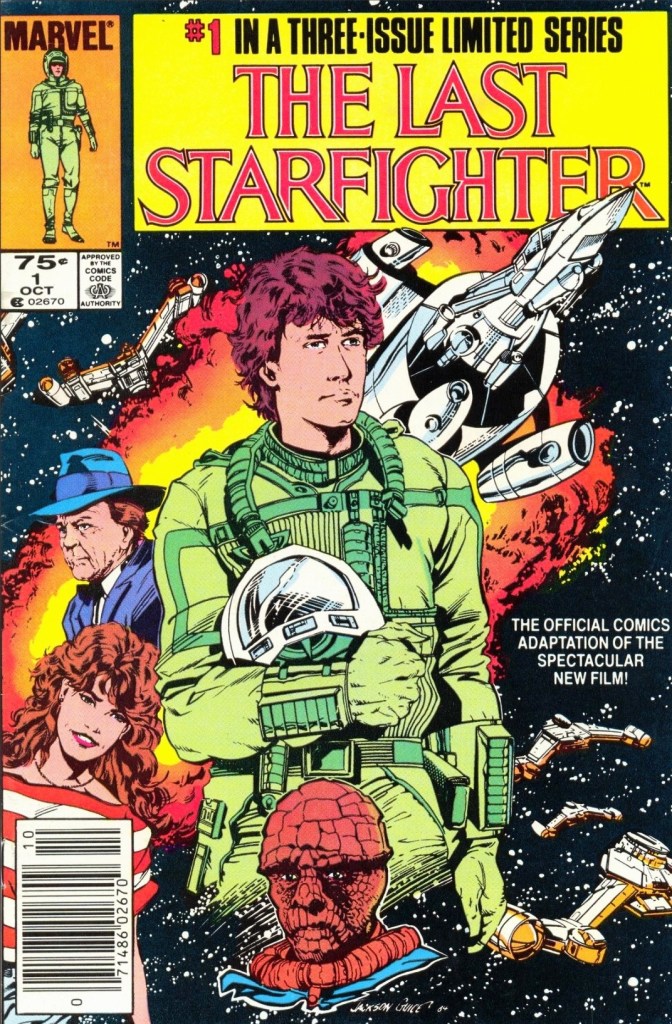
#3 Assorted videos about The Last Starfighter – Released way back in 1984, The Last Starfighter was a memorable movie that carefully blended science fiction concepts, adventure, fine performances and video game elements together. It was also one of the early movies Hollywood made that extensively used computer-generated imagery (CGI) which defied the era’s standard of using practical and optical effects. Now available on 4K Blu-ray format, The Last Starfighter is a popular subject of varied YouTube videos and I selected some for your enjoyment below. However, if you have not seen The Last Starfighter yet, I urge you watch it first before seeing any of the movie reaction videos featuring it. You make the decision.

#4 HolyLandSite’s Capernaum to Bethsaida walking tour video – I love Israel and I will always stand with it. For the newcomers reading this, Israel is where the Holy Land is and it has always been the land that the Lord God designated to the Jewish people. Recently HolyLandSite released another video showcasing a walking tour in the Galilee region specifically from Capernaum to Bethsaida. If you have not read the Holy Bible extensively, Lord Jesus spent a great deal of his ministry in Galilee. I myself had been to the Galilee region and many times during the pilgrimage tour there and in other parts of Israel, I witnessed the Holy Bible come to life on-location. Watch the video below.

#5 More people in Iran coming to Lord Jesus– It is not a fantasy to say that the current regime of Iran (in power since 1979) made their nation a terrorist state. Iran is truly sponsoring terrorist groups in the Middle East and they have Hamas, Hezbollah and other terrorists doing their work to destroy Israel. While the Iranian regime is clearly evil and murderous (note: their leaders declared in their own language death towards America, Israel and England), there are many Iranians who do not follow their government. In fact, there are Iranians who even left Islam behind to come to Jesus whom they accepted as their Lord and savior. Be aware that the Iranian government had harmed their fellow Iranians many times and this includes human rights violations. That being said, the people in Iran who desired Lord Jesus and freedom from their oppressive government need our prayers of support. Watch and learn from the video below.

#6 Rocky II (1978) reaction/review videos – If you have been watching movies for decades and if you have been following the career of Sylvester Stallone, then you would be already aware of the significance of the 1976 film Rocky. Considering its success, Rocky spawned several sequels and a few spin-off movies through the decades. Going back to the late 1970s, Sylvester Stallone came up with the effort to make the sequel Rocky II (1979) which itself became featured in several movie reaction/review videos and retrospectives. Watch the videos I selected for you all below.

+++++

Thank you for reading. If you find this article engaging, please click the like button below, share this article to others and also please consider making a donation to support my publishing. If you are looking for a copywriter to create content for your special project or business, check out my services and my portfolio. Feel free to contact me with a private message. Also please feel free to visit my Facebook page Author Carlo Carrasco and follow me on Twitter at  @HavenorFantasy as well as on Tumblr at https://carlocarrasco.tumblr.com/ and on Instagram athttps://www.instagram.com/authorcarlocarrasco

Retro Gaming Ads Blast – Part 16

Welcome back readers, fellow geeks and electronic gaming fans!

In this edition of the Retro Gaming Ads Blast (RGAB) series, we will take a look at another batch of retro gaming print ads – including arcade flyers – from the 1980s and 1990s.

For the newcomers reading this, Retro Gaming Ads Blast (RGAB) looks back at the many print ads of games (console, arcade, computer and handheld) that were published in comic books, magazines, flyers and newspapers long before smartphones, social media, the worldwide web and streaming became popular. To put things in perspective, people back in the 1980s and 1990s were more trusting of print media for information and images about electronic games and related products.

With those details laid down, here is the newest batch of retro gaming print ads for you to see and enjoy…

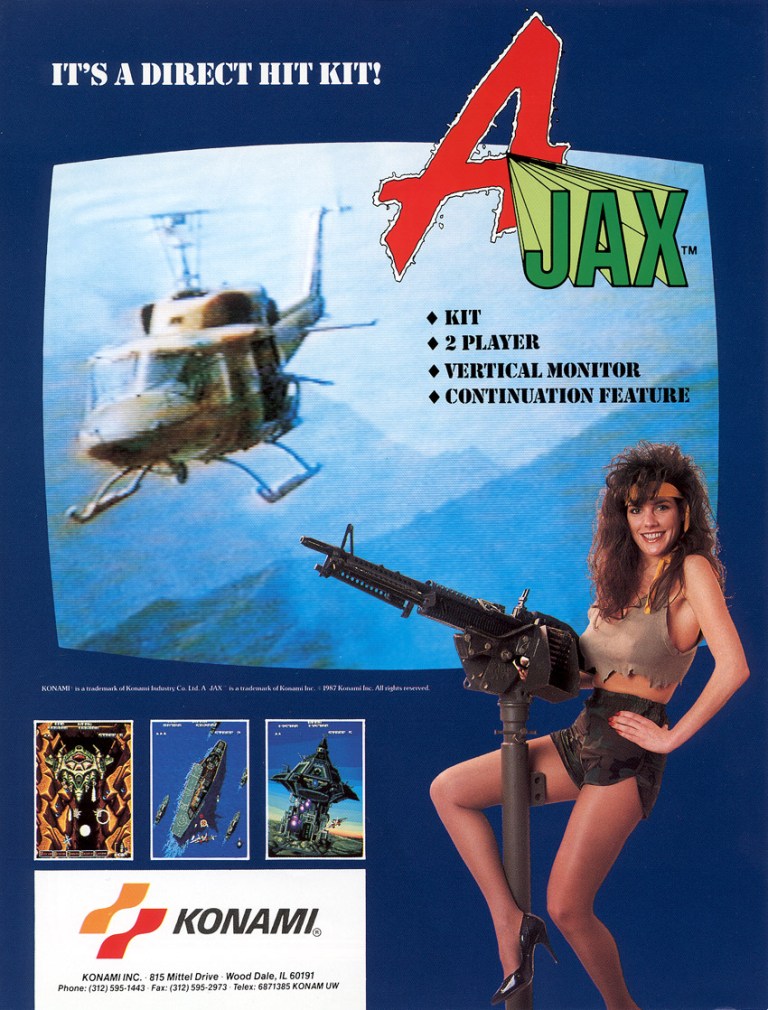
1. A-Jax North American arcade flyer

Another one of Konami’s arcade flyers showing a pretty fashion model with a touch of militarism.

A-Jax (also referred to as Ajax) is another one of the many military themed games Konami released for the arcades in the 1980s. It was a 2D vertically scrolling shooter in which players use aircrafts to shoot enemies both in the air and on the ground. The game was a hit in Japanese arcades and Konami came up with the North American arcade flyer showing three screenshots, an archive footage shot of a military helicopter and a sexy lady (with a light military look) with a machine gun. The style of presentation was similar in style with the North American arcade flyers of Contra and M.I.A.: Missing in Action.

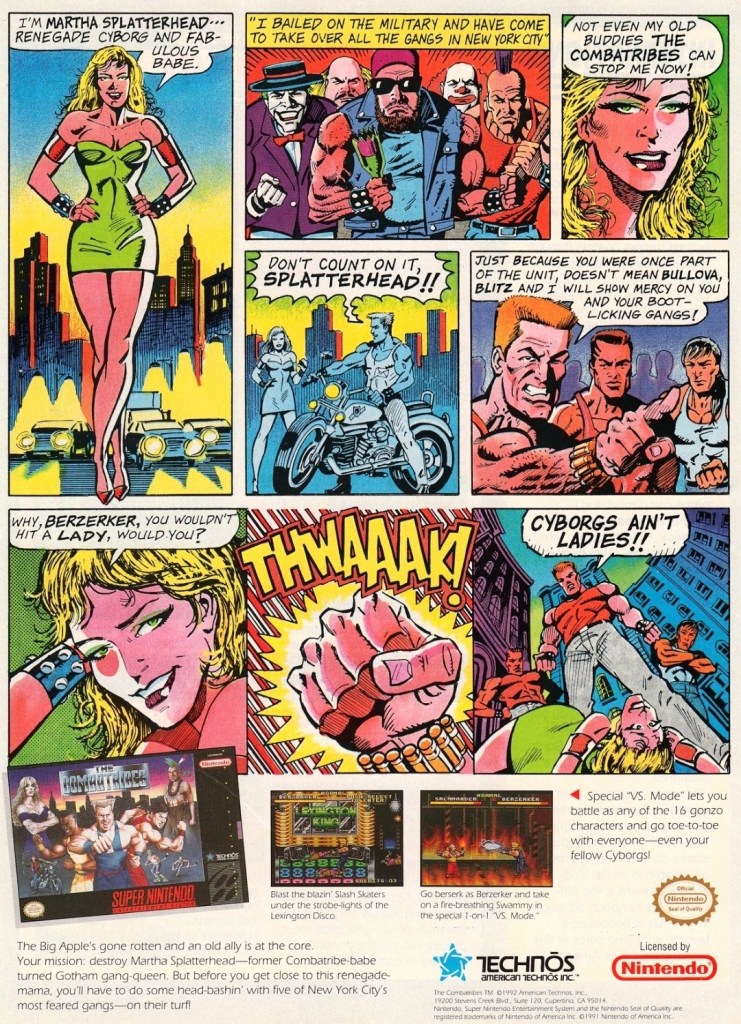
2. The Combatribes print ad

The short comic book approach was used to emphasize the setting and concept of the video game.

Technos, the Japanese company behind the wildly popular Double Dragon games franchise, proved to be successful with the arcade release of The Combatribes. In an attempt to keep the wave of success moving, Technos released The Combatribes on the Super Nintendo Entertainment System (SNES) in 1992 and someone involved with the North American marketing came up with the idea of creating a comic book-style presentation for the print ad. Creatively speaking, the comic book approach was done to emphasize the story and visual concepts of the game, and entice readers to play it. By today’s standards of video game marketing, this print ad’s approach is both unusual and notable.

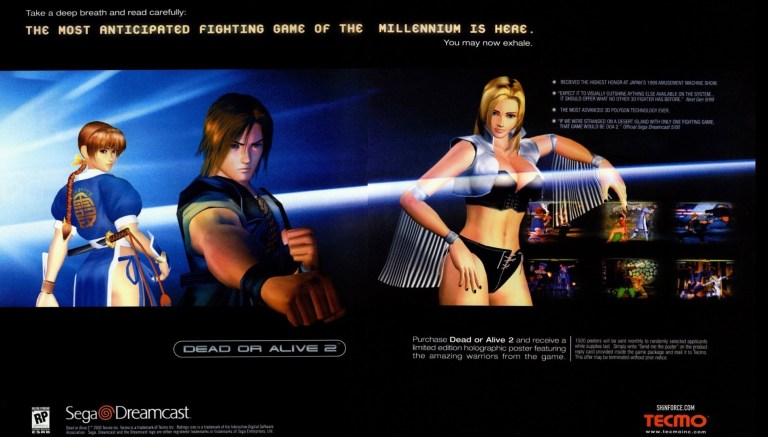
3. Dead or Alive 2 Dreamcast port print ad

This was a wide print ad that appeared on magazines and it sure was eye-catching. It was an effective way to promote the game and inform people of the Sega Dreamcast’s presence in the market.

When Dead or Alive 2 was released in the arcades in 1999, a lot of gamers were astounded by it as developer Team Ninja (led by Tomonobu Itagaki) made it much bigger and a lot better than its 1996 predecessor. Team Ninja really went all out making the sequel utilizing Sega’s NAOMI arcade technology, inviting martial artists to do motion-capture, and having a very ambitious game design. Since the game was developed with the NAOMI hardware, porting the game for the Sega Dreamcast was reportedly convenient and smooth for the developers who went on to add more gameplay features and modes. Publisher Tecmo came up with this wide print ad (promoting the Dreamcast release) showcasing three characters, six screenshots and text descriptions emphasizing the universal acclaim the game received. The promotional approach was simple yet effective.  

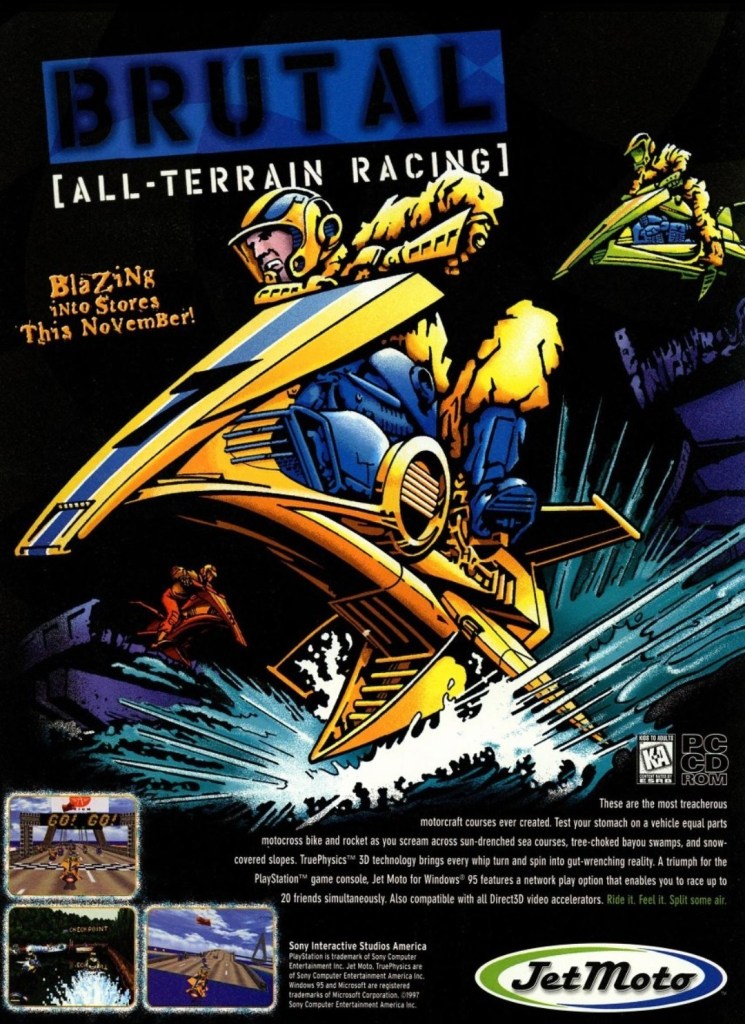
4. Jet Moto (PC version) print ad

From PlayStation to PC.

In November 1996, the futuristic all-terrain hoverbikes racing game Jet Moto was released on the PlayStation which went on to sell well and attract mostly positive reviews. Sony Computer Entertainment eventually released a version of the game for the personal computer (PC) in November 1997. As seen in the above print ad, the network play option and compatibility with Direct3D video accelerators were emphasized as such features resonated with the interests of PC gamers of the era. This print ad showed how willing Sony was to release PlayStation hits on PC back then.

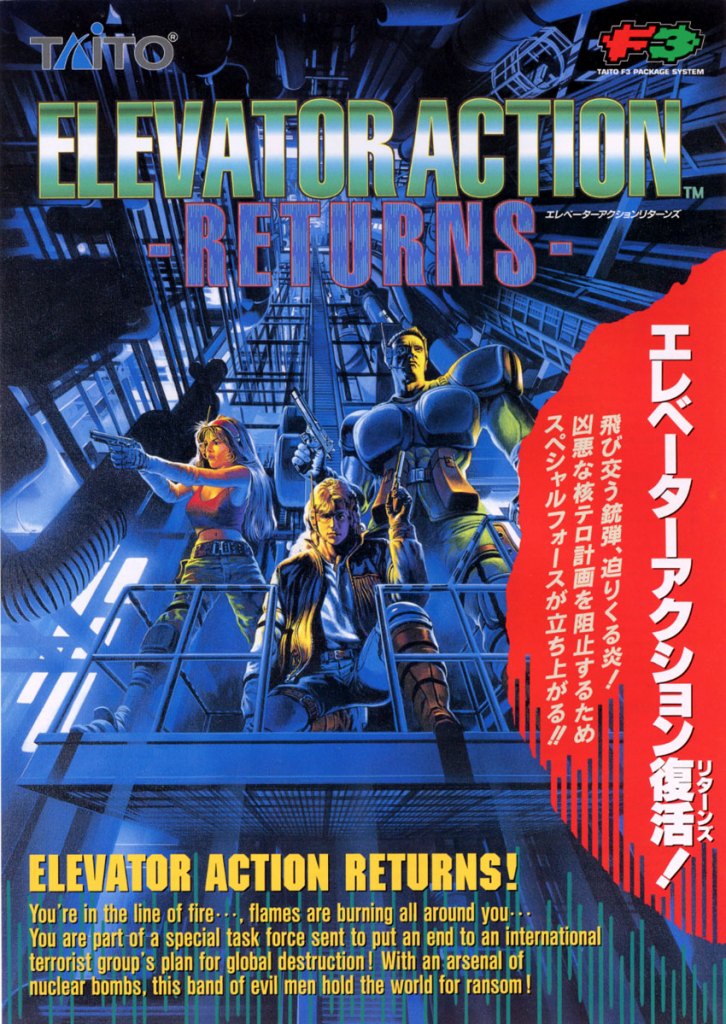
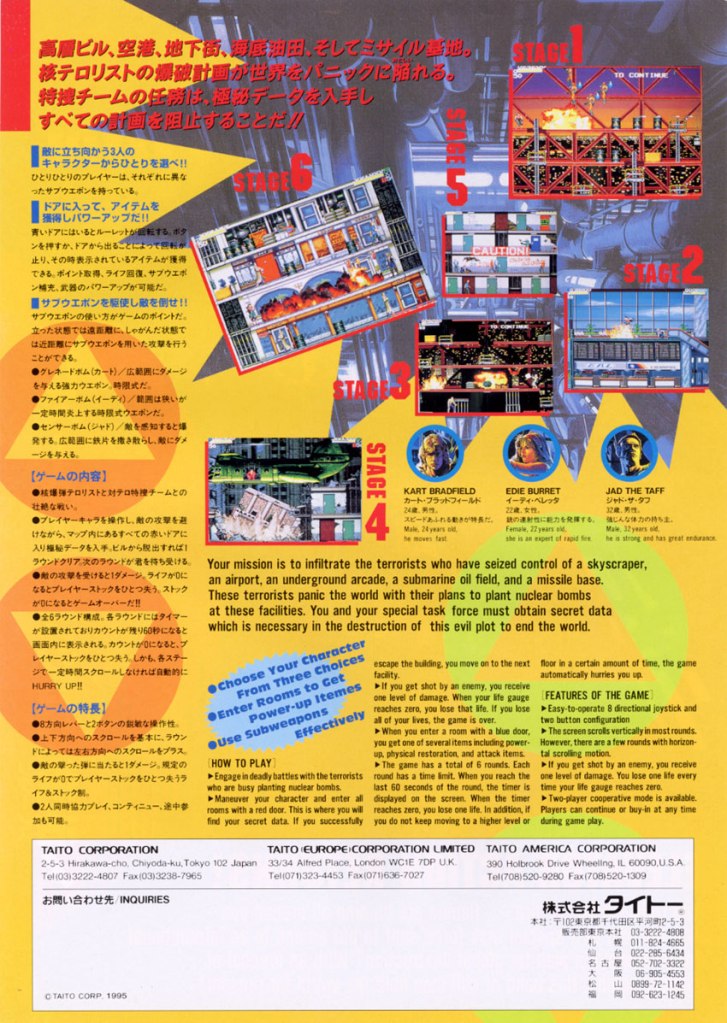
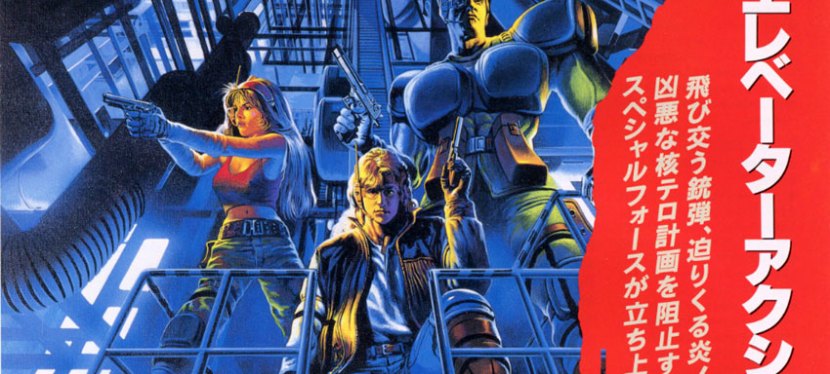
5. Elevator Action Returns Japanese arcade flyer

Great looking art on the front.
The rear of the flyer.

When Taito released Elevator Action Returns (also titled as Elevator Action II in other nations) in the arcades in 1994, it became a hit as gamers enjoyed its action-packed gameplay, ambitious 2D visual presentation and varied level designs that clearly went beyond its 1983 predecessor. The front of the Japanese arcade flyer has really nice art showing the three playable protagonists on an elevator on their way to do their mission. The back of the flyer shows screenshots (which emphasized the varied level designs), text descriptions explaining how the game played (English version printed), and what the features are. Another text description confirmed that terrorists are the antagonists that players will be dealing with which was reflective of the rise of Islamic terrorism in the 1990s. Oh yes, if you look closely you will the word “item” misspelled as “items”.

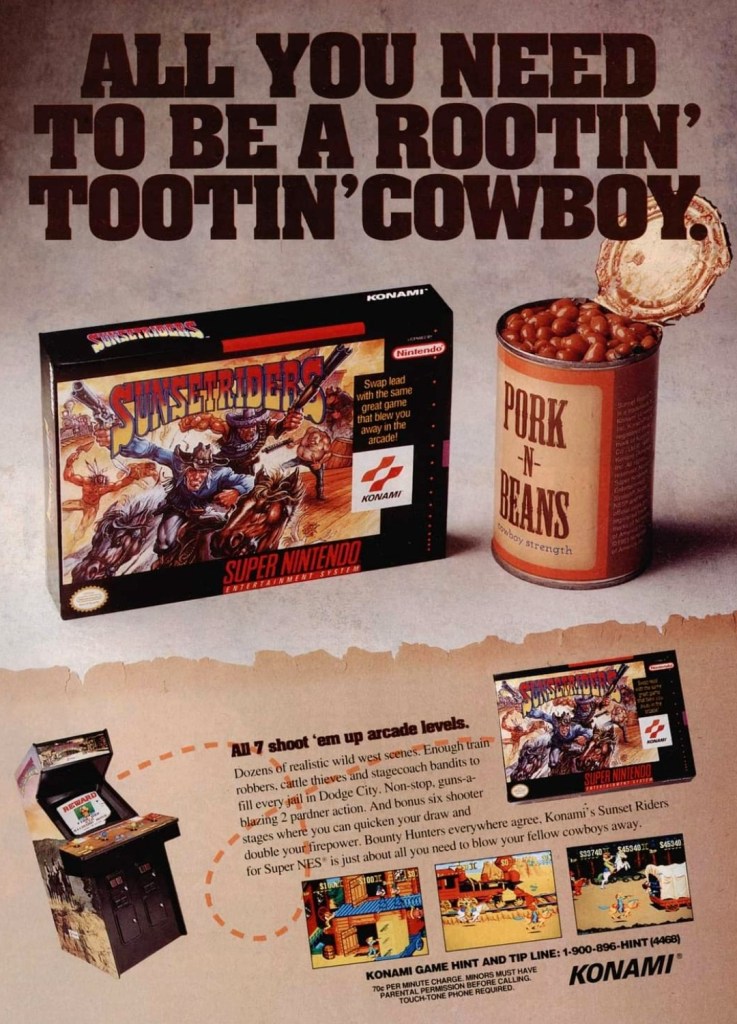
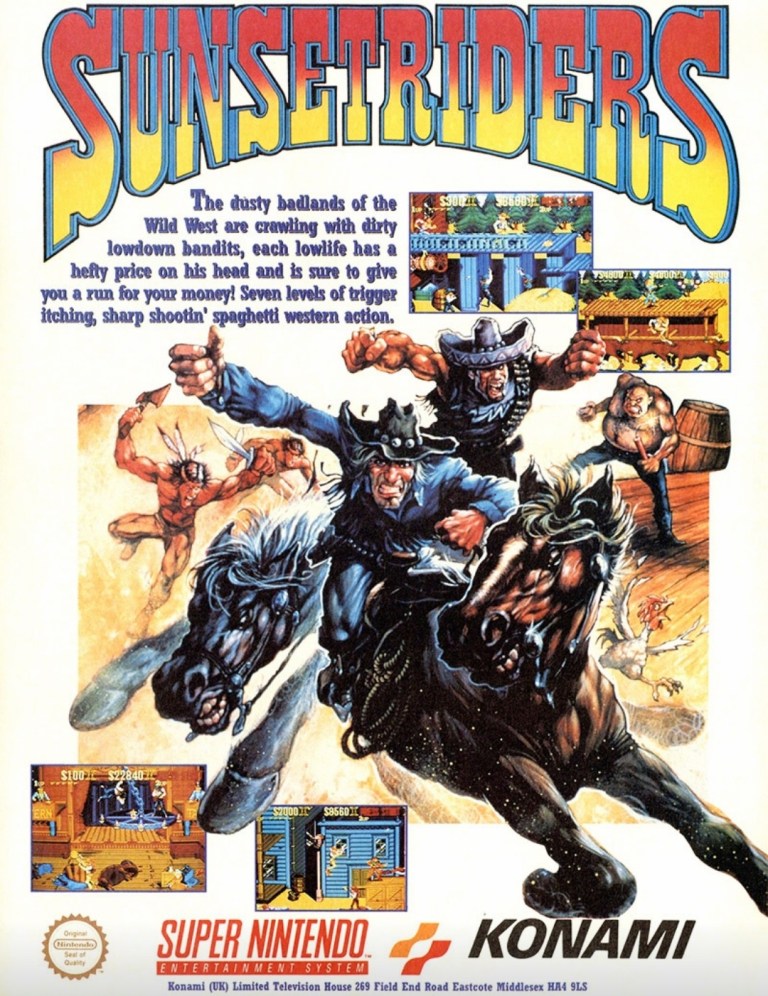
6. Sunset Riders print ads

The Sunset Riders arcade machine, the SNES version, screenshots and a can of pork-and-beans on this ad.
This print ad appeared in some comic books I read long ago.

After enjoying a lot of success in the arcades with their 1991 game Sunset Riders, Konami went on to release ports of it to the Sega Genesis in 1992 and the Super Nintendo Entertainment System (SNES) in 1993. With regards to conversions and procedural/artistic changes between the arcade and console ports, the SNES version had few changes implemented compared to the one released on the Genesis. As seen in one of the print ads of Sunset Riders on SNES, it came with 7 arcade levels, 2-player mode and additional shooter stages. What the print ads did not reveal were notable replacements of specific characters in key parts of the game such as the dynamite-tossing female bandits getting replaced by male bandits, North American Indian villains getting replaced with outlaws, etc.  

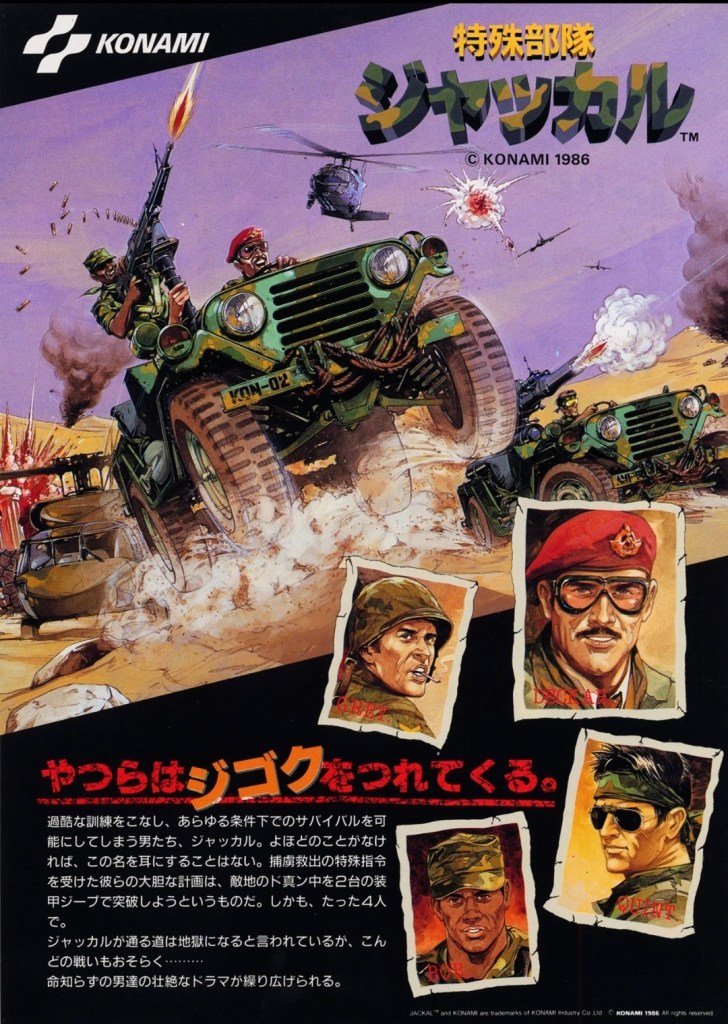
7. Jackal Japanese arcade flyer

Whoever was the artist Konami hired truly delivered great-looking art!

Konami’s military themed game Jackal (Japanese title: Tokushu Butai Jackal) debuted in Japanese arcades in October 1986 and became a hit. The Japanese market arcade flyer had great looking artwork on the front that strongly emphasized the very concept of the game (players move military jeeps to shoot at enemies as they move into enemy territory). One of the characters (the one wearing the red beret) somewhat resembles the late Sean Connery which only shows that someone within Konami’s development team took inspiration from movies. This arcade flyer’s front still looks great.

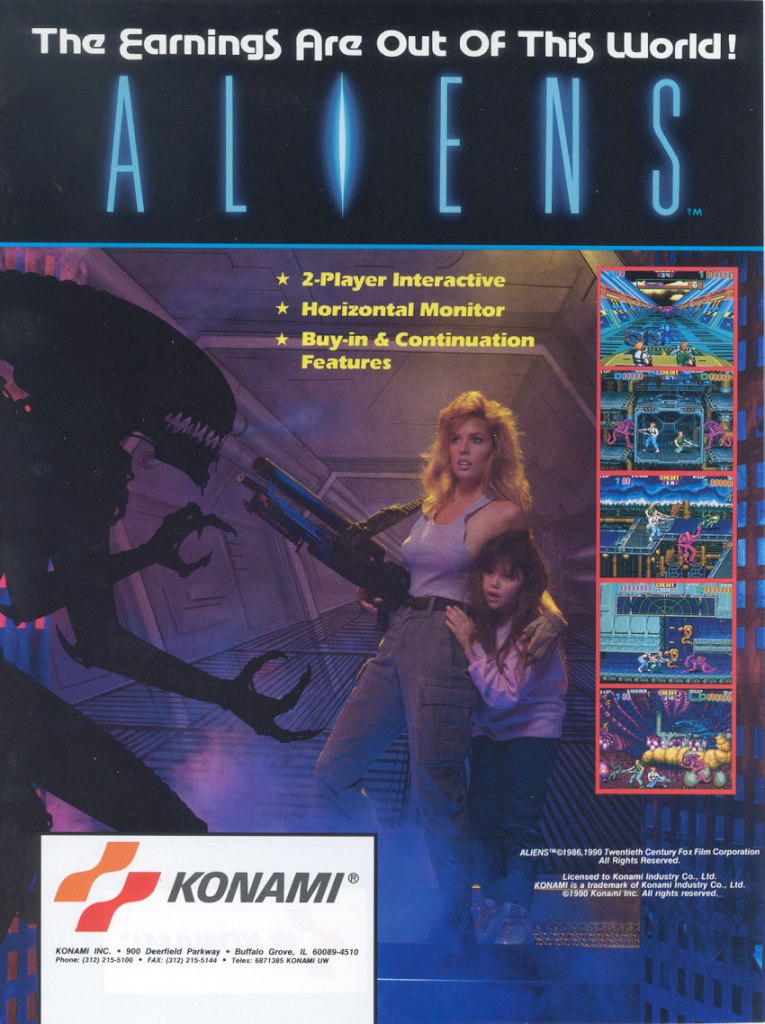
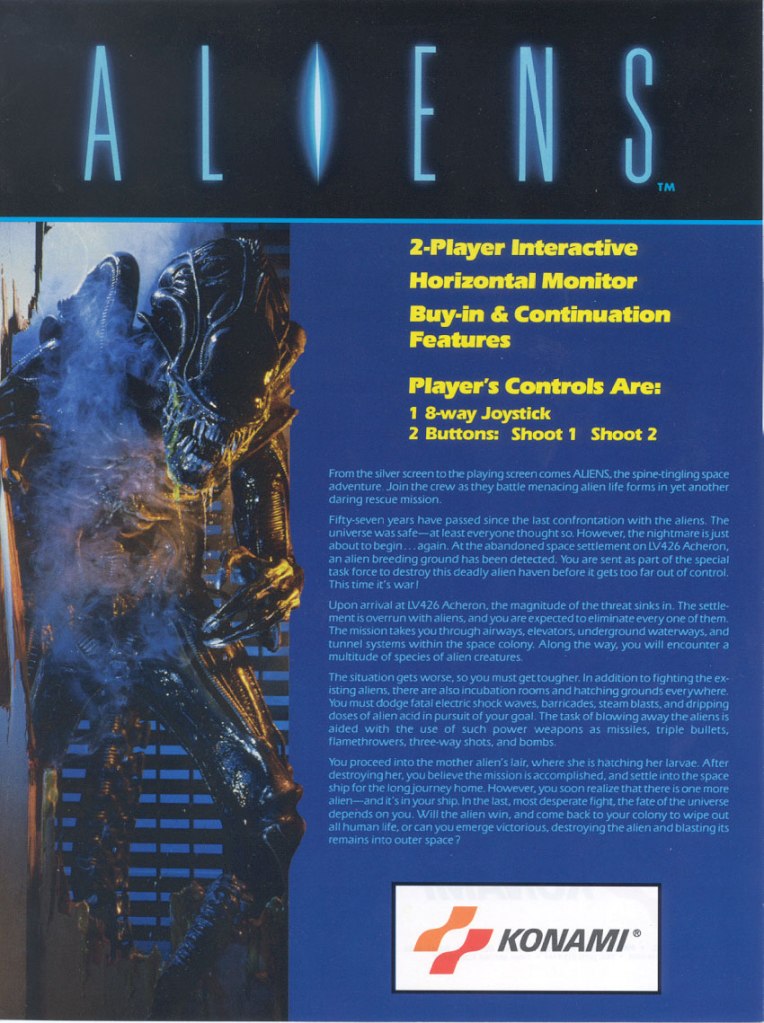
8. Aliens North American arcade flyer

A good amount of effort was done to truly capture Aliens’ concept using hired models (as Ripley and Newt), a Xenomorph physical model and a suitable background.
The key details presented on the rear of the flyer. The Xenomorph’s presence adds tension.

In 1990, Konami released their ambitious arcade game Aliens which was loosely based on the 1986 movie that starred Sigourney Weaver and was directed by James Cameron. As Konami’s Aliens license was only temporary and the movie was so highly regarded, the Japanese company’s marketing team really had to exert extra effort to truly capture the film’s sci-fi horror concept in order to make a strong presentation towards arcade operators and their paying customers (the gamers).

Apart from showing screenshots on the front, the creative team hired a blonde model as Ellen Ripley holding a gun and a young girl as the character Newt, and have them pose convincingly in front of a Xenomorph model (darkened in the foreground). On the back of the flyer, the team heavily revealed the details using the text description to emphasize the gaming experience and story concept. The technical details, meanwhile, were presented in simplistic, easy-to-follow fashion. Aliens was a smash hit in the arcades and there are long-time gamers who regard it as one of the best game adaptations of the 1986 movie. This arcade flyer is a strong reminder that the featured game was never ever ported to any game console nor to any personal computer.

+++++

Thank you for reading. If you find this article engaging, please click the like button below, share this article to others and also please consider making a donation to support my publishing. If you are looking for a copywriter to create content for your special project or business, check out my services and my portfolio. Feel free to contact me with a private message. Also please feel free to visit my Facebook page Author Carlo Carrasco and follow me on Twitter at  @HavenorFantasy as well as on Tumblr at https://carlocarrasco.tumblr.com/ and on Instagram at https://www.instagram.com/authorcarlocarrasco

A Look Back at What If #19 (1980)

Welcome back superhero enthusiasts, 1980s arts and culture enthusiasts, Marvel Comics fans and comic book collectors! Today we go back to the year 1980 to examine an alternate story of the Marvel Comics shared universe chronicled through the What If monthly series.

Spider-Man is clearly Marvel Comics’ greatest icon. He is the one Marvel superhero who is easily recognized around the world through the many comic books published, the animated TV shows and the big-budget Hollywood movies released. Given Spider-Man’s real-life fame as a pop culture and American icon, one has to wonder what would it be like had the webslinger decided to have a career in showbiz instead of fighting bad guys. How can Spidey realize that with great power comes great responsibility if he is so focused on being an entertainer?

With those details laid down, here is a look back at What If #19, published in 1980 by Marvel Comics with a story written by Peter Gillis and drawn by Pat Broderick.

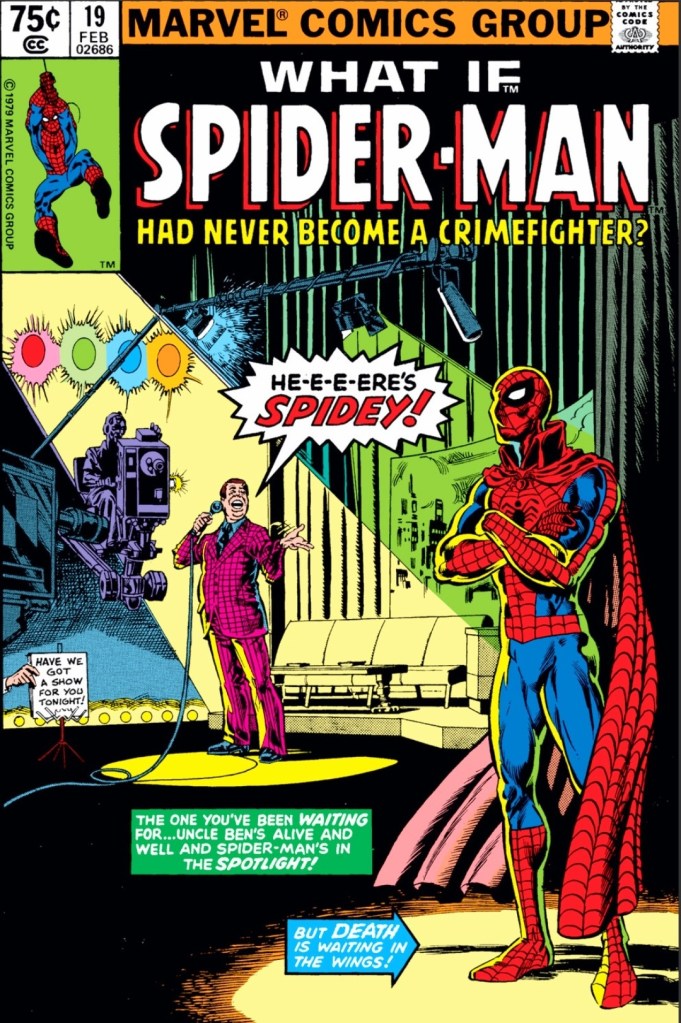
The cover.

Early story

The story begins far into Spider-Man’s past when he started as an entertainer. Spider-Man sees a police man chasing a thief down the hallway (note: this was a key moment in the life of Peter Parker who went to become a crime fighter as Spider-Man). Instead of letting the thief get away, Spidey uses his web to stop him which enabled the police officer to apprehend him.

The next day, the Daily Globe published a front page story showing Spider-Man (described as a TV star) stopped the crook which established him as a heroic entertainer. The story bothered J. Jonah Jameson (The Daily Bugle) so much not only because the rival newspaper reported it but also because he perceived it as a glorification of so-called superheroes.

Elsewhere, Spider-Man and a famous film producer talk about making a movie about him that can really entertain a lot of people…

Quality

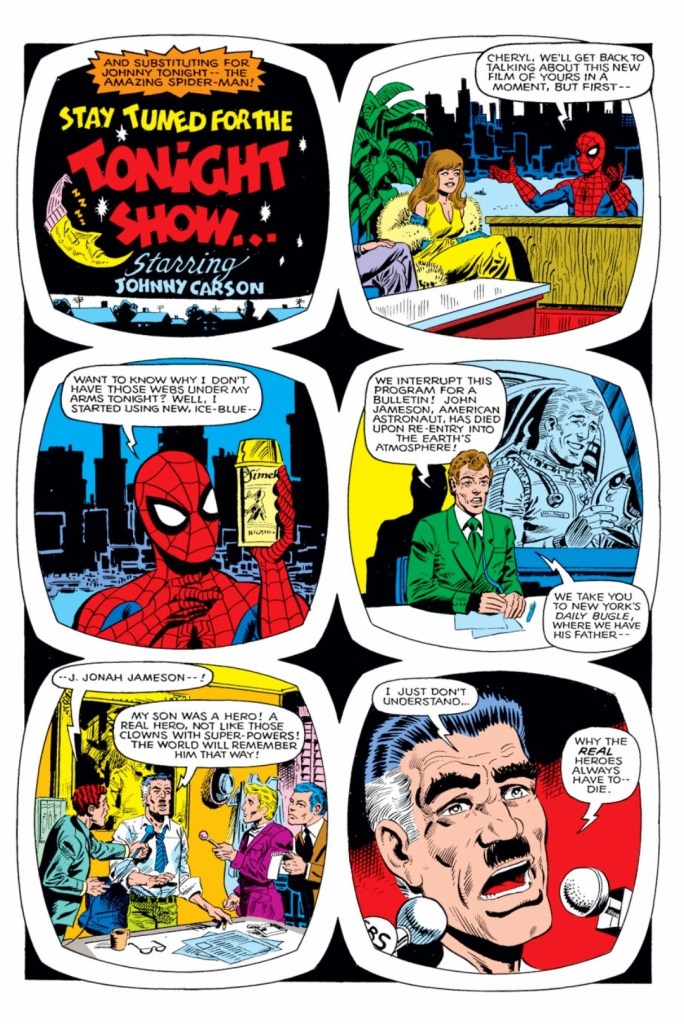
As Spider-Man makes waves on television as an entertainer and endorser, J. Jonah Jameson tells the media the difference between real heroes and the costumed ones with super powers.

Considering the history of Spider-Man, it is both difficult and risky to come up with a new reality that diverged from the key moment of the icon’s past (letting a crook get away from the chasing cop) resulting in a completely new version of him – Spider-Man as an entertainer. The good news here is that Peter Gillis’ script is solid and its scenes were nicely arranged to make this new version of the icon believable.

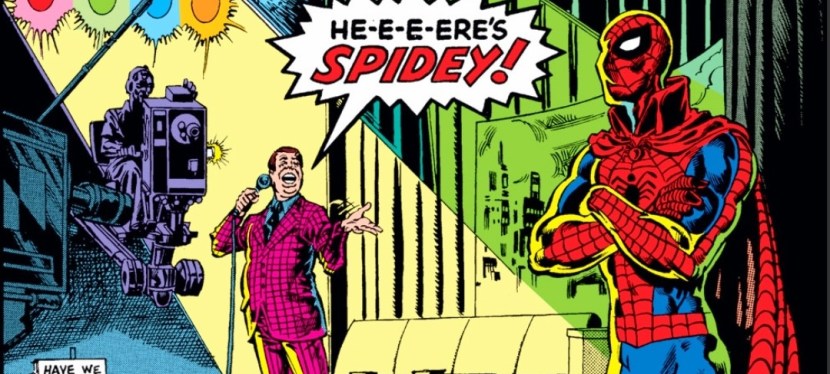
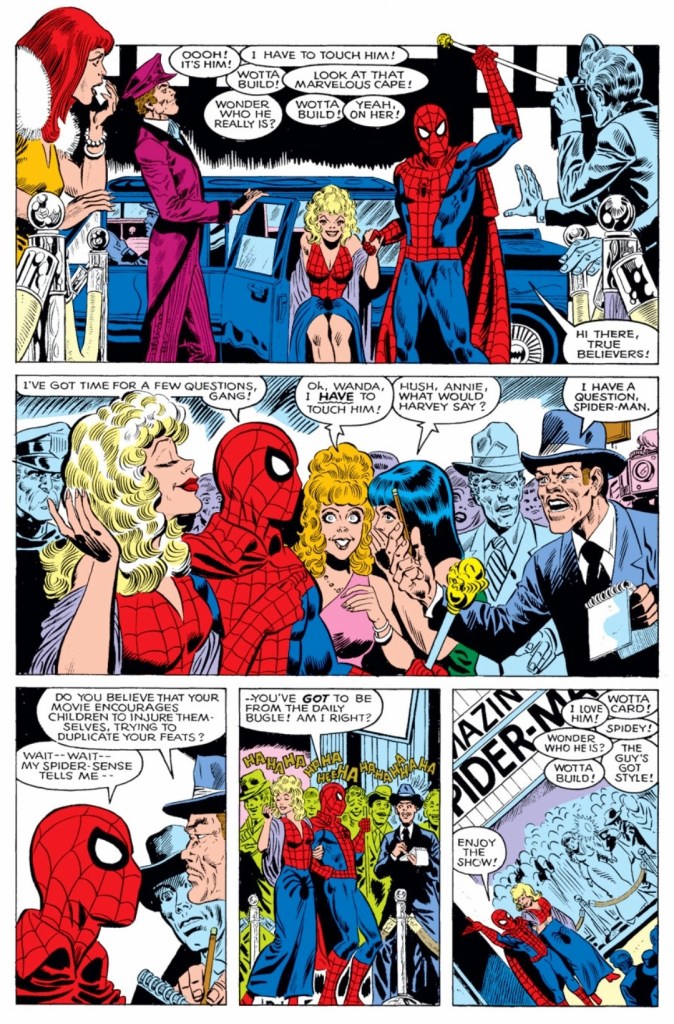
As shown on the cover of this comic book, the tale shows Spider-Man as a celebrity who found success and wealth in showbiz. Along the way, the classic Peter Parker gradually transforms into a new version who is not only focused on entertaining people but also engaging in publicity wars without ever becoming journalist. Since Marvel’s most famous icon does not fight crime, you will see him as an entertainment entrepreneur, a fighter through publicity, and as someone who enjoys the high life that most Americans don’t have.

In relation to the concept of the story, J. Jonah Jameson and Daredevil became the next important players to Spider-Man. Jameson is the rival of the webslinger but not necessarily the villain. Through Jameson, you will not only witness how he misuses his power at The Daily Bugle but also his interactions with criminal elements as he searches for ways to deal with Spidey. When it comes to Daredevil’s role, I encourage you to read the comic book to find out.

The story by Gillis moved at a medium-to-fast pace and for each build-up done, pay-offs were satisfying to read. When it comes to the scope of the story, this alternate reality is actually captivating to follow from start to finish.

Conclusion

Can you just imagine how different superhero comics would have been in real life had Marvel actually depicted Spider-Man as a showbiz figure?

What If #19 (1980) is a very solid and captivating comic book to read. The creative duo of Peter Gillis and Pat Broderick succeeded in selling the concept of what would happen had Spider-Man became an entertainer instead of fighting evil figures that hound society. Apart from showing a drastically different version of Spidey, the story will compel you to think about the relevance of superheroes in society, why becoming a major player in showbiz is chaotic, and how could Peter Parker be responsible with the power (related to showbiz) he has without combating evil.   

Overall, What If #19 (1980) is recommended.

+++++

Thank you for reading. If you find this article engaging, please click the like button below, share this article to others and also please consider making a donation to support my publishing. If you are looking for a copywriter to create content for your special project or business, check out my services and my portfolio. Feel free to contact me with a private message. Also please feel free to visit my Facebook page Author Carlo Carrasco and follow me on Twitter at  @HavenorFantasy as well as on Tumblr at https://carlocarrasco.tumblr.com/ and on Instagram at https://www.instagram.com/authorcarlocarrasco
Retro Gaming Ads Blast – Part 15

Welcome back readers, fellow geeks and electronic gaming fans!

In this edition of the Retro Gaming Ads Blast (RGAB) series, we will take a look at another batch of retro gaming print ads – including arcade flyers – from the 1980s and 1990s.

For the newcomers reading this, Retro Gaming Ads Blast (RGAB) looks back at the many print ads of games (console, arcade, computer and handheld) that were published in comic books, magazines, flyers and newspapers long before smartphones, social media, the worldwide web and streaming became popular. To put things in perspective, people back in the 1980s and 1990s were more trusting of print media for information and images about electronic games and related products.

With those details laid down, here is the newest batch of retro gaming print ads for you to see and enjoy…

1. X-COM: UFO Defense print ad

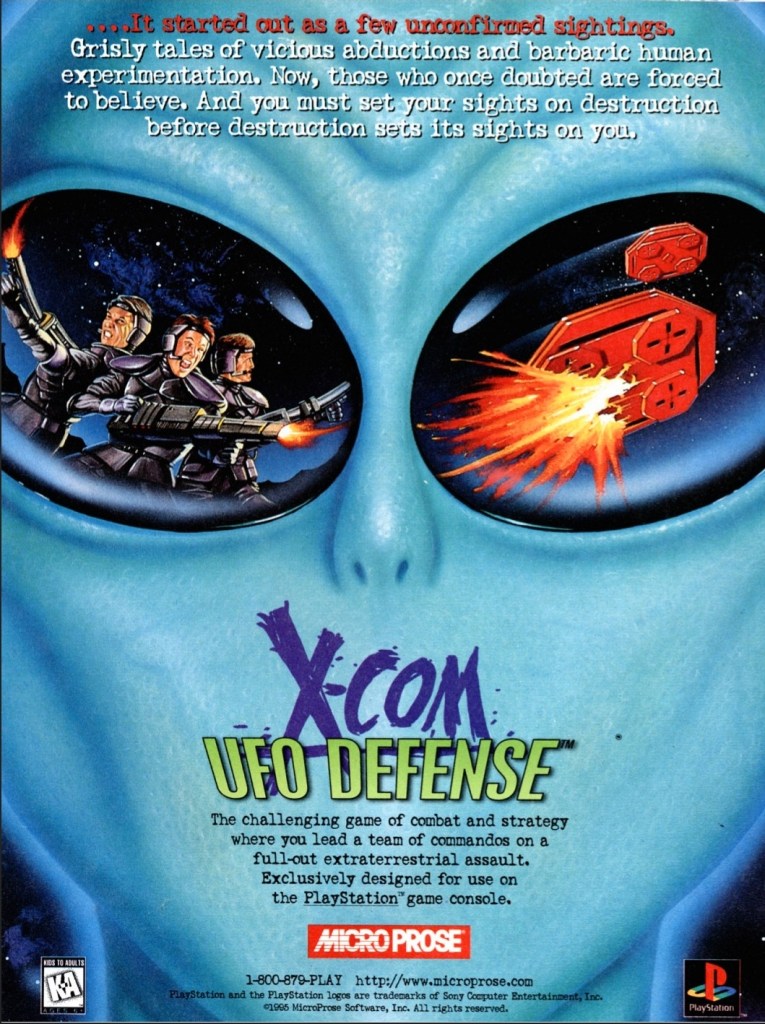
While there were no screenshots of the game for PlayStation, the art here was enough to catch your attention.

Back in 1994, X-COM: UFO Defense (original European title: UFO: Enemy Unknown) became an unexpected hit with PC gamers as it gathered lots of positive reviews from the critics and sold a lot on the PC DOS (disk operating system) format. In an obvious attempt to continue the commercial success, a port of the game was released for the PlayStation console in 1995. Publisher MicroProse and its marketing partners came up with this eye-catching print ad to promote the PlayStation version. While no screenshots were shown, the artwork used turned out to be effective in catching attention while emphasizing the sci-fi concept of the game.

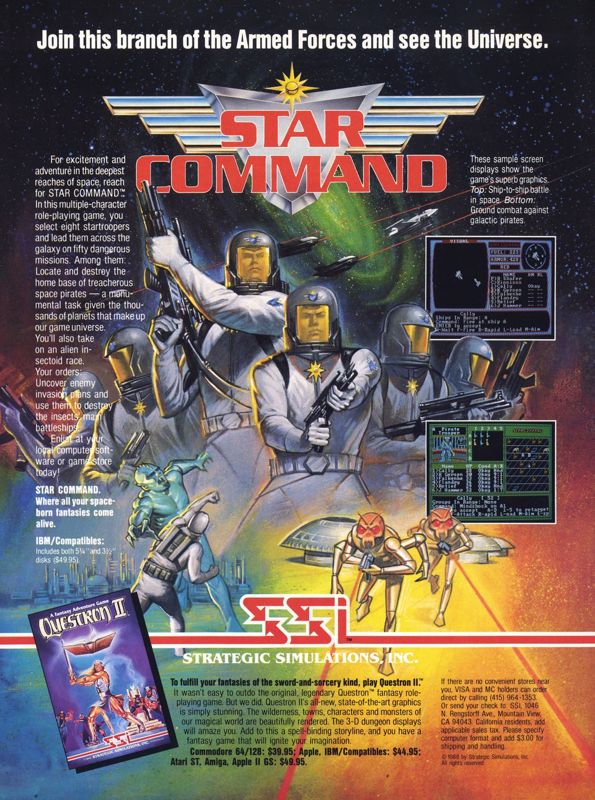
2. Star Command print ad

Long before Starfield, there was Star Command.

Way back in 1988, I first saw my friends play the sci-fi role-playing game (sci-fi RPG) Star Command on the PC DOS format. A short time later, I played the game on our home computer and finished the single-player campaign. This print ad, which has lots of descriptive text, has a strong visual presentation that entices players to play the game and discover the vast amount of content (space travel, missions, battles, encounters with aliens) that the game developers prepared. For its time, the Star Command print ad was captivating to look at.  

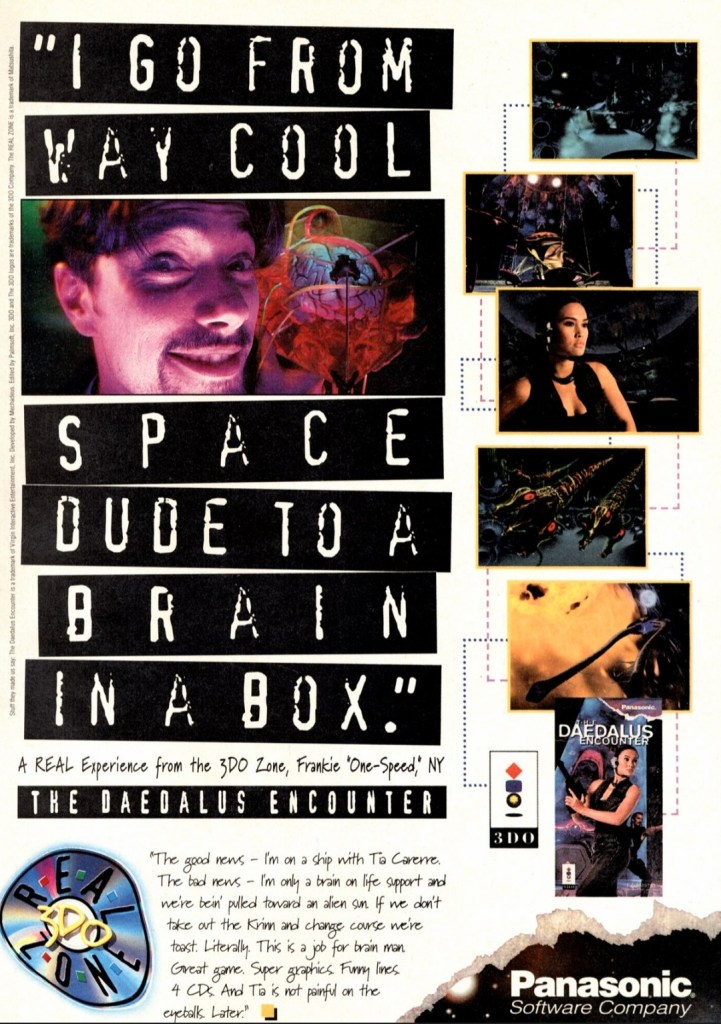
3. The Daedalus Encounter print ad

This print ad was an attempt to catch the attention of both gamers and people who want to watch live-action spectacle.

Released on PC, Macintosh and the 3DO game console in 1995, The Daedalus Encounter was a sci-fi video game that worked as an interactive movie (with puzzles) starring Tia Carrere. To promote the 3DO version, publisher Panasonic came up with an ad that emphasized the sci-fi concept and the cinematic experience (including a few stills of cutscenes) leaving little room about how the game plays. Take note that this game was released at a time when the CD-ROM format started gaining popularity as a reliable optic media format which opened opportunities for game companies to include full-motion videos.

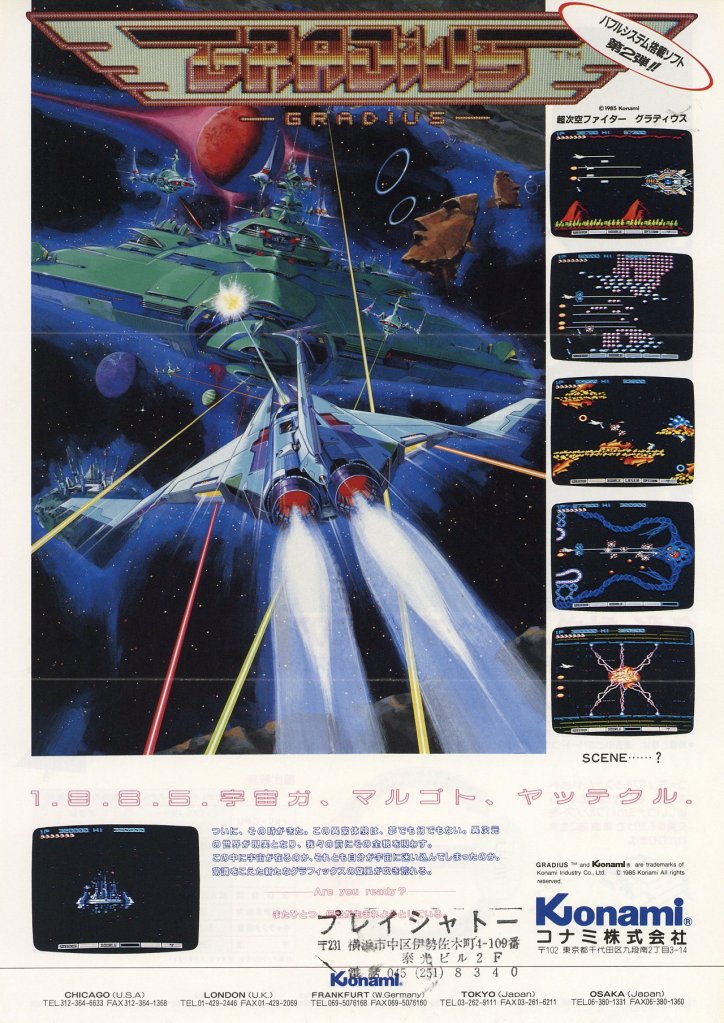
4. Gradius Japanese arcade flyer

The original Gradius has always been fun to play and the enjoyment also made it on game consoles as more games were released.

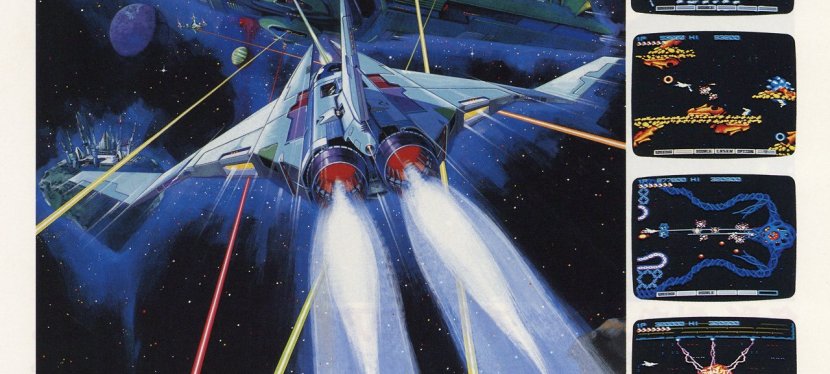
Still on the realm of sci-fi, Konami launched their 2D side-scrolling shooter Gradius in the arcades in Japan in 1985. The arcade flyer here used a huge amount of space for the game’s official artwork which is very captivating to look at as it clearly emphasized the sci-fi concept. On the side are five screenshots that tell gamers what to expect when playing. The promotions paid off nicely for Konami as Gradius became an instant hit in Japanese arcades and eventually found strong commercial success in the arcades in Europe and America. By today’s standards, this game is a classic and the Gradius game franchise has produced several sequels and spin-offs released on multiple platforms.

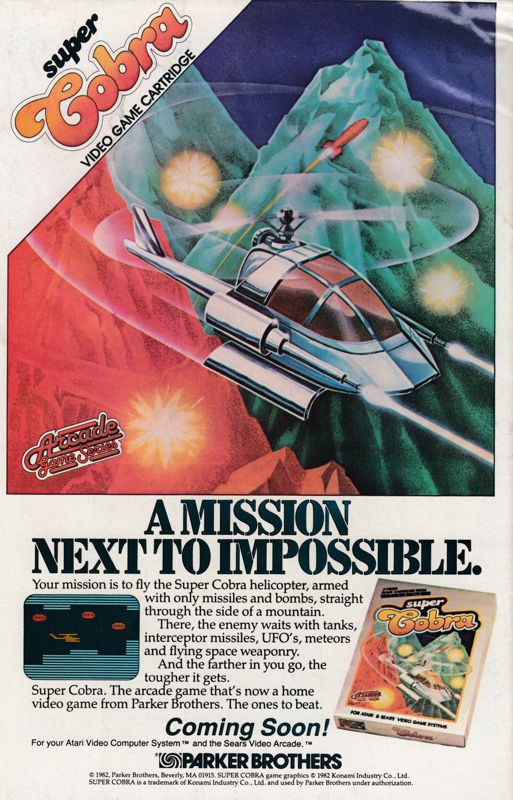
5. Super Cobra print ad

This ad I saw while reading comic books long ago. The game itself was fun.

Here is a game I played on the Atari 2600 over forty years ago. Super Cobra was a 2D side-scrolling game in which players control an armed helicopter that has to move from left to right, attacking enemies, and avoiding enemy projectiles while maintaining the fuel supply. This ad, which appeared on some comic books I read, utilized the game art that was used on the box cover although the single screenshot displayed looks exaggerated when compared to what I saw and played.

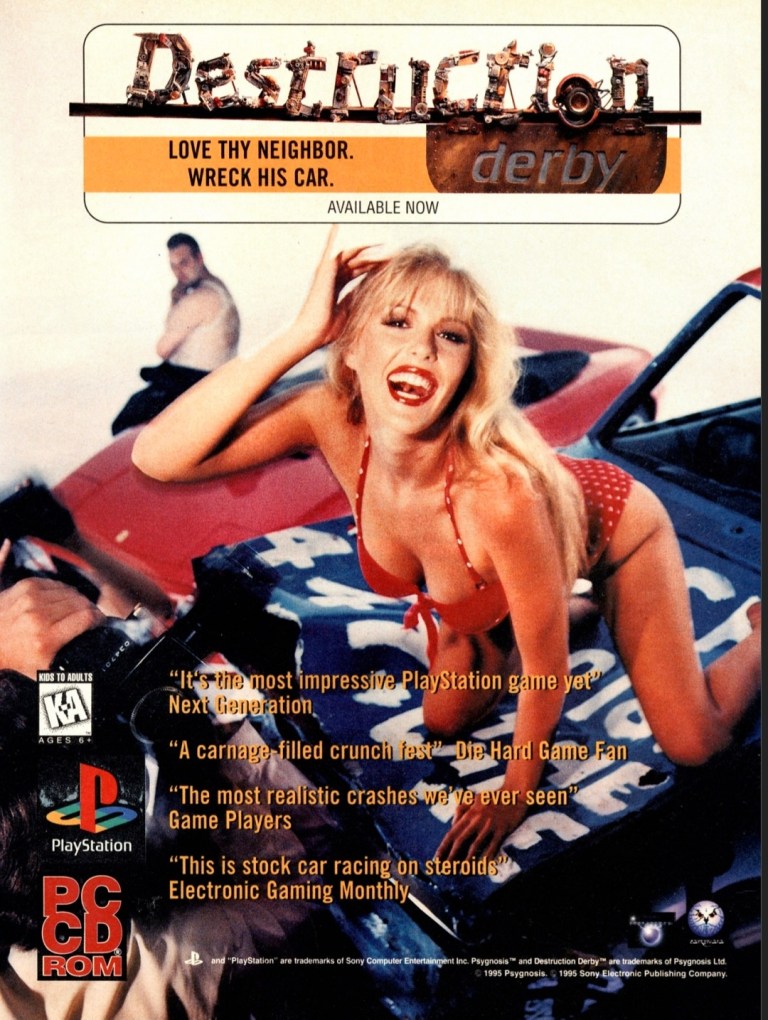
6. Destruction Derby print ad

The Destruction Derby print ad that had no screenshots of the game.

In 1995, Sony launched the PlayStation console in America and in Europe. In Europe, publisher Psygnosis promoted their ambitious game Destruction Derby (a 3D polygonal racing game that emphasized vehicular damage) for both PlayStation and the PC that same year. As this Destruction Derby print ad did not show any screenshots, Psygnosis and their marketing team or partner decided to pounce on positive gaming media quotes and the sexy model to promote their game. Their marketing move paid off nicely as over a million copies of Destruction Derby were sold by August 1996.

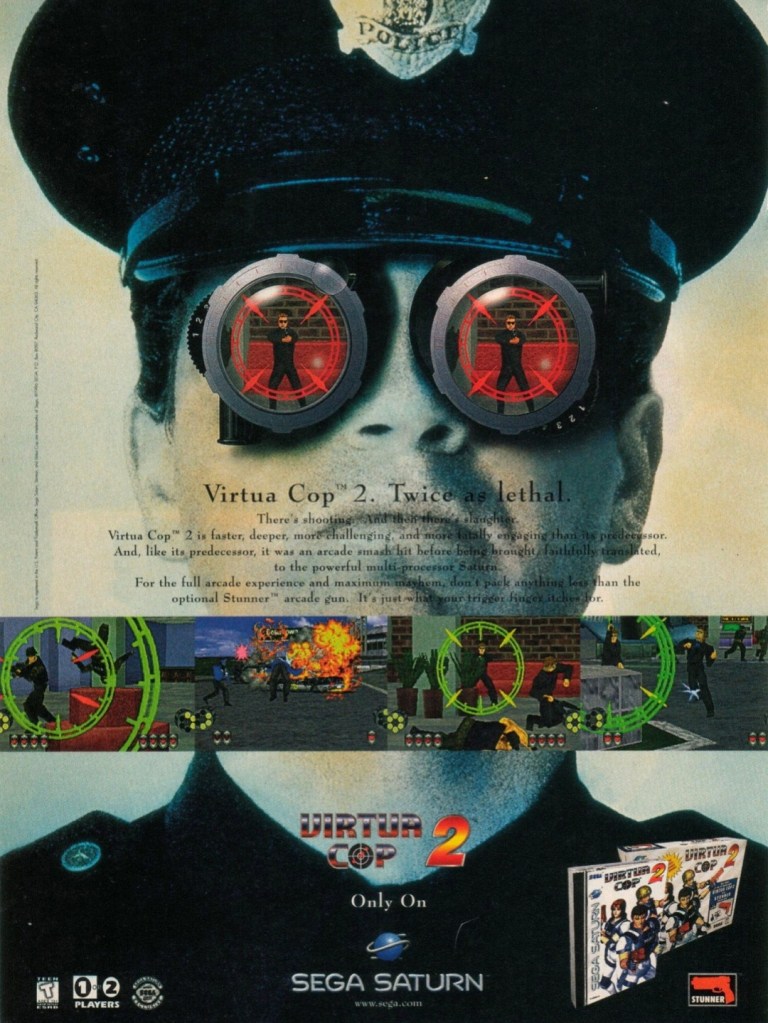
7. Virtua Cop 2 print ad

A lot of people found this Virtua Cop 2 print ad looking very weird.

When Sega of Japan forced its American division to launch the Sega Saturn console in the United States in 1995 without any pre-release marketing, it resulted in a series of disappointments that include low sales, too few games launched and strained ties with their business partners. In 1996, Sega started to become more aggressive to sell more Saturn units and more 1st party exclusive games such as Virtua Cop 2 (for the Saturn) which itself was a big hit arcade hit. As the company clearly aimed to make the console version of Virtua Cop 2 a hit, they approved this print ad which had a very intriguing visual concept showing video game images reflected on the glasses on the police man. As Virtua Cop 2 required a light-gun peripheral to be played accurately like in the arcade, this print ad utilized very little space for the Sega Saturn Stunner.

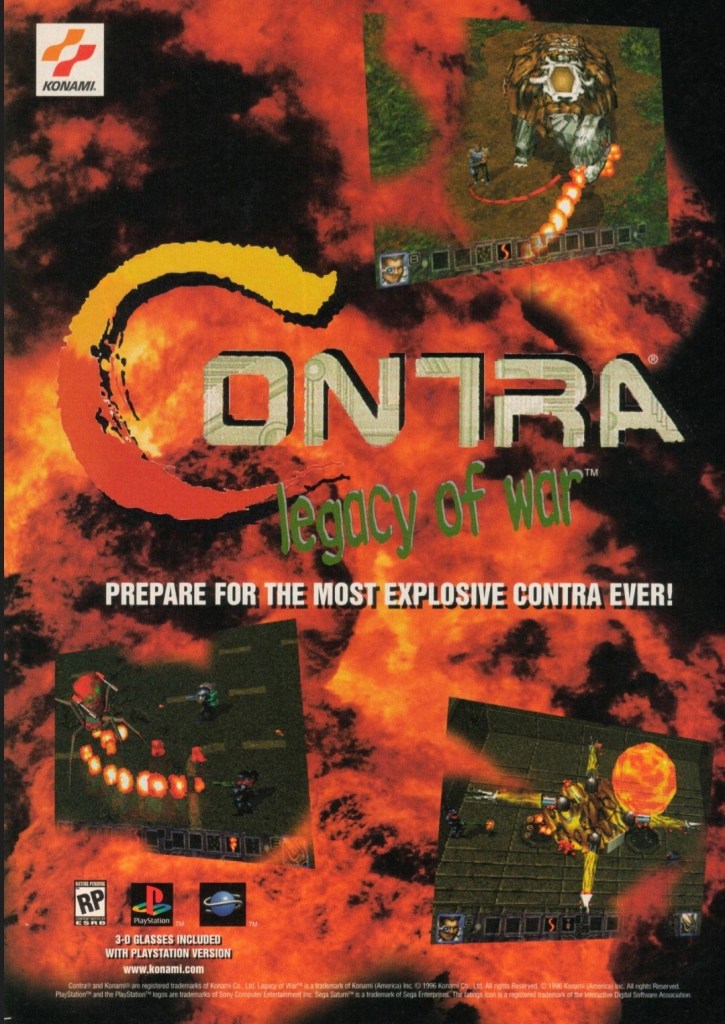
8. Contra: Legacy of War print ad

The print ad of Contra: Legacy of War.

When I first heard that a brand new game of Contra would be released on the still-new PlayStation and Sega Saturn in the mid-1990s, I was excited as I always enjoyed the original game I played on the Family Computer. This print ad of Contra: Legacy of War brought my excitement way down as it showed that the game no longer utilized the 2D side-scrolling design and came up with a design that emphasized 3-dimensional environments and polygons. The change in design was too alienating for me as all the previous Contra games had the 2D side-scrolling format as the main designs (leaving little room for the occasional sprite-scaling 3D sequences in some games). I finally played Contra: Legacy of War on PlayStation on November 1996 and it was a huge letdown!

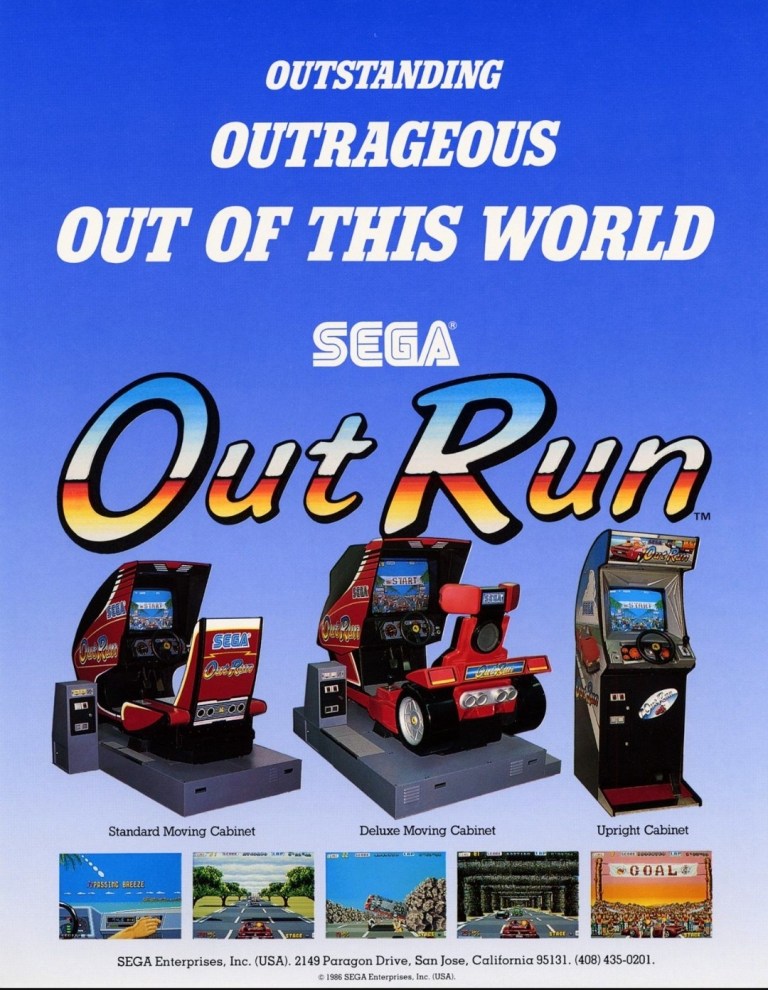
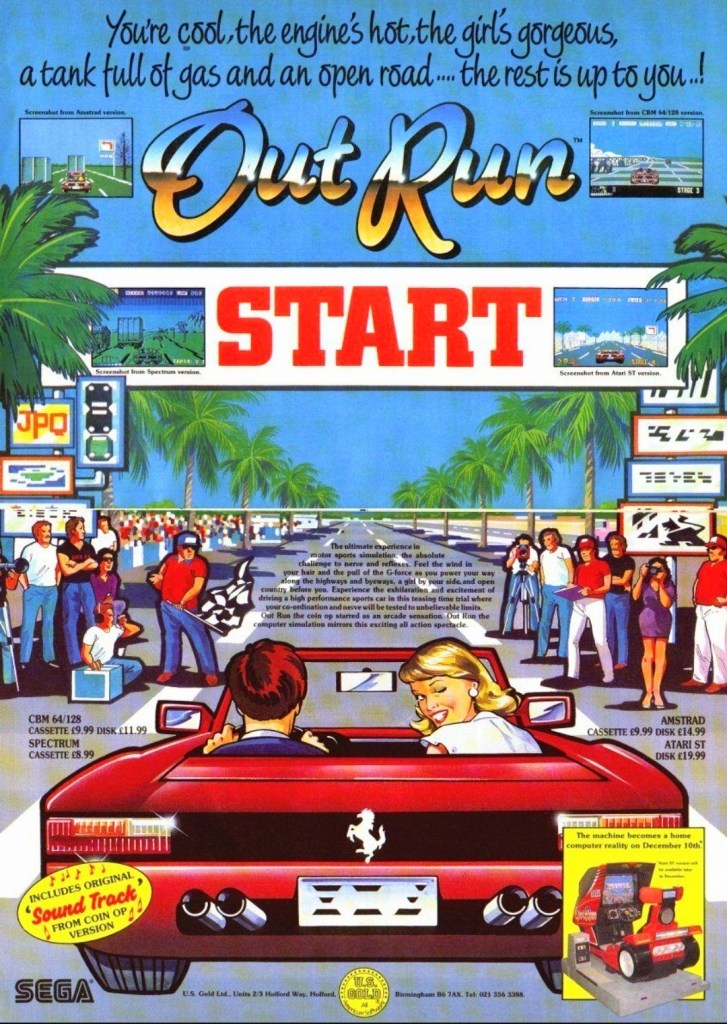
9. Out Run arcade flyers

Sega Out Run arcade machines in different forms.
This Out Run flyer really has nice art.

In the history of arcade games, Sega’s Out Run was a massive success not only in Japan but also in America and Europe. Designed by Yu Suzuki (Virtua Fighter, Shenmue), Out Run was a pseudo-3D driving game in which players get to drive a Ferrari Testarossa convertible (which is always visible to the player) from one scenic destination to the next avoiding traffic as much as possible. This was indeed a labor of love on the part of Yu Suzuki who himself spent time in Europe to gain inspiration on designing the game. As Out Run was a hit, Sega made different types of machines of the game that arcade operators can choose from depending on how much space their respective arcades have left and how the local players prefer to play it. It should be noted that in one of the flyers above, the original sound track was promoted as well.

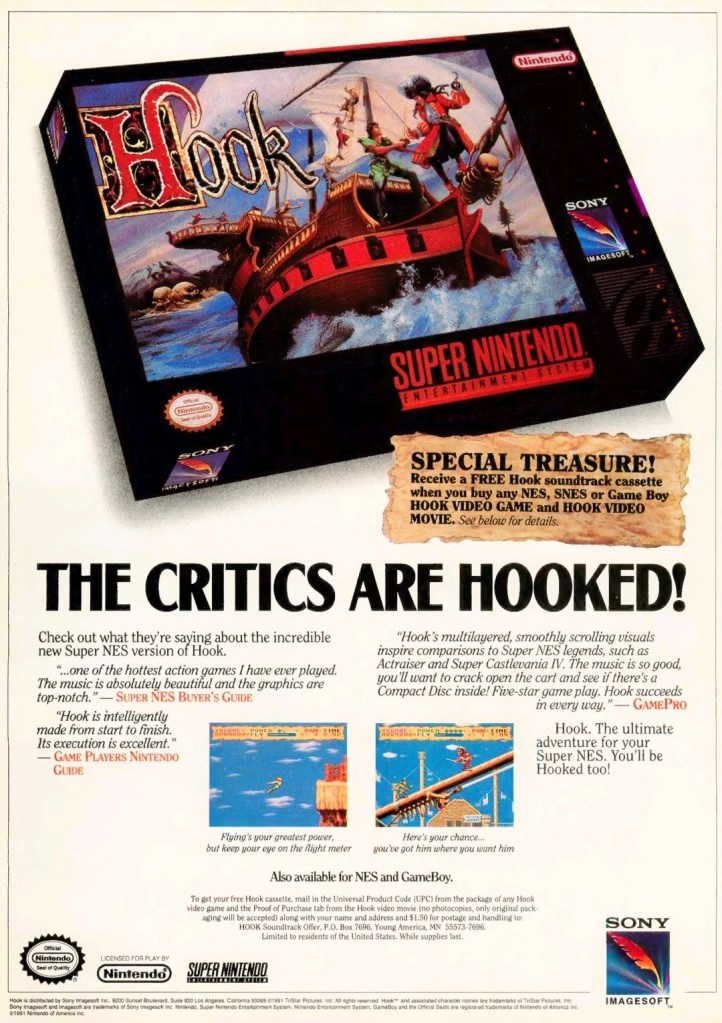
10. Hook SNES version print ad

If you look closely at the SNES box front cover art, you will notice that Peter Pan and Captain Hook looking nothing like the actors who portrayed them in Steven Spielberg’s movie.

In late-1991, Steven Spielberg’s movie Hook was released in cinemas and revived public interest in the fairy tale of Peter Pan. Typical of the entertainment business of the time, video games based on the movie were released on different platforms in 1992 and among them was a version on the Super Nintendo Entertainment System (SNES). Apart from showing the game’s box, the print ad of Hook on SNES cleverly included positive quotes from GamePro, Game Players Nintendo Guide and the Super NES Buyer’s Guide to convince readers that the game is worth their time.

+++++

Thank you for reading. If you find this article engaging, please click the like button below, share this article to others and also please consider making a donation to support my publishing. If you are looking for a copywriter to create content for your special project or business, check out my services and my portfolio. Feel free to contact me with a private message. Also please feel free to visit my Facebook page Author Carlo Carrasco and follow me on Twitter at  @HavenorFantasy as well as on Tumblr at https://carlocarrasco.tumblr.com/ and on Instagram at https://www.instagram.com/authorcarlocarrasco

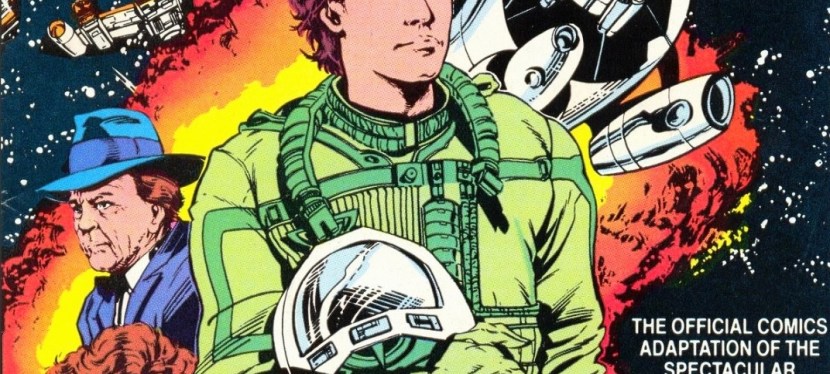
A Look Back at Spectacular Spider-Man #87 (1984)

Welcome back superhero enthusiasts, 1980s arts and culture enthusiasts, Marvel Comics fans and comic book collectors! Today we go back to the year 1984 to examine a small part of the Marvel Comics shared universe through a tale of the Spectacular Spider-Man monthly series.

For this particular review, we will explore a major development in the life of the iconic Spider-Man that was told outside of the Amazing Spider-Man series.  

With those details laid down, here is a look back at Spectacular Spider-Man #87, published in 1984 by Marvel Comics with a story written by Bill Mantlo and drawn by Al Milgrom.

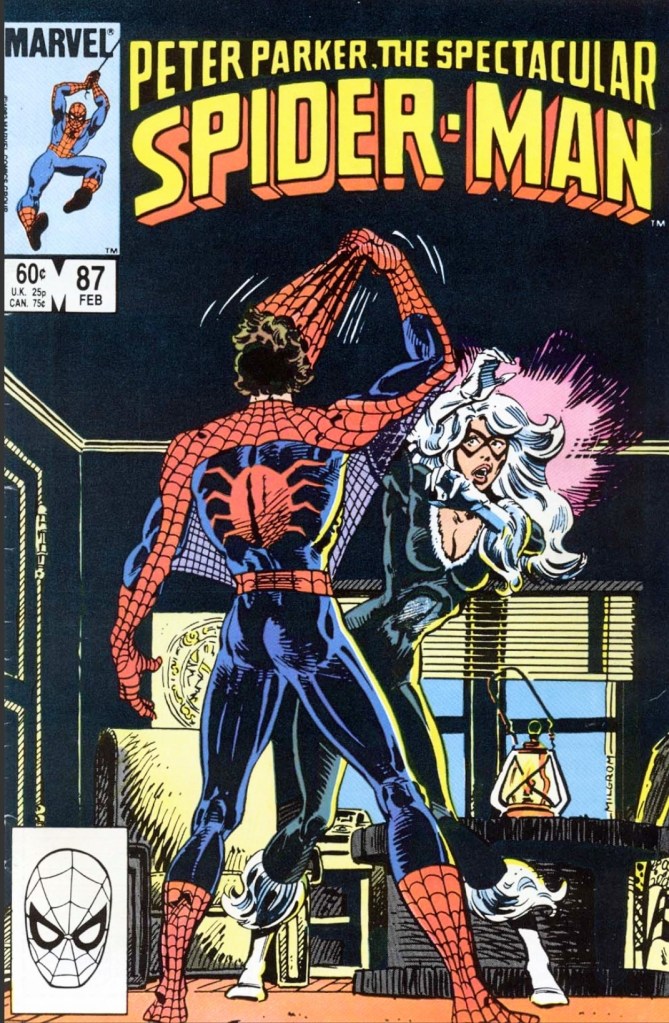
The cover.

Early story

The story begins in New York City as Spider-Man and Black Cat (his romantic partner at the time) spend quality time together. Spider-Man tells her that it is time him to show her where he lives. Together, they swing across the city and even played along a few times.

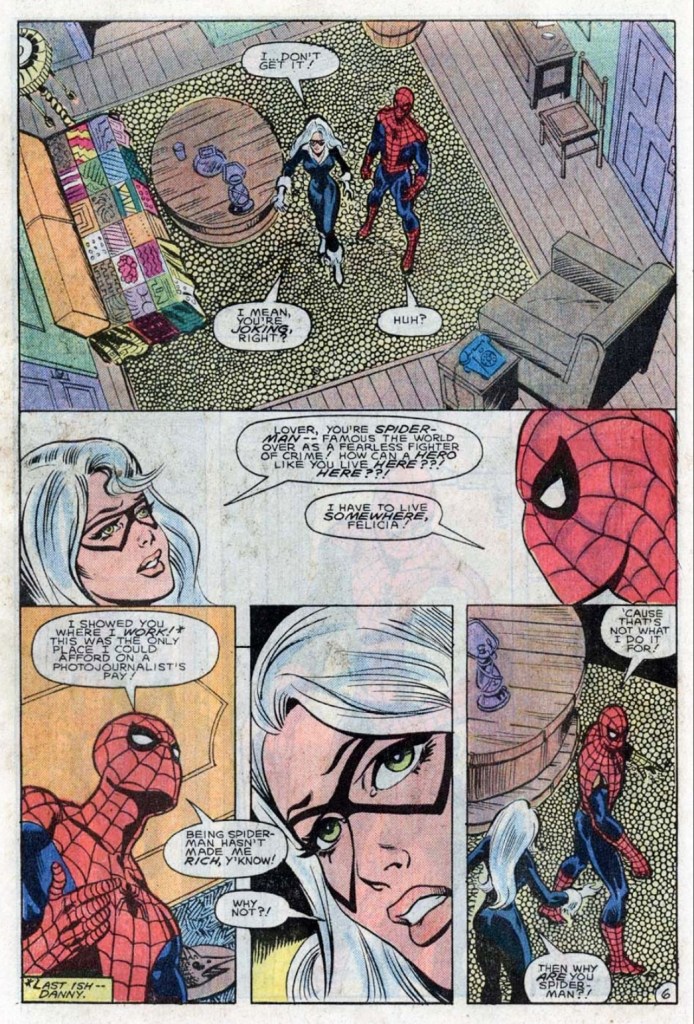
They finally arrive at the rooftop of the building where Peter Parker (Spider-Man) lives and enter via the skylight. Black Cat is shocked to see how cheap the quality of the apartment is and asks him how can a famous hero like him live in such a place.

Spider-Man begins explaining that as a civilian he works as a photo journalist and he did not become a hero to be prosperous. As he keeps on revealing threads of his past, he slowly makes his move to reveal his secret identity to Black Cat…

Quality

The relationship of Spider-Man and Black Cat develops even more.

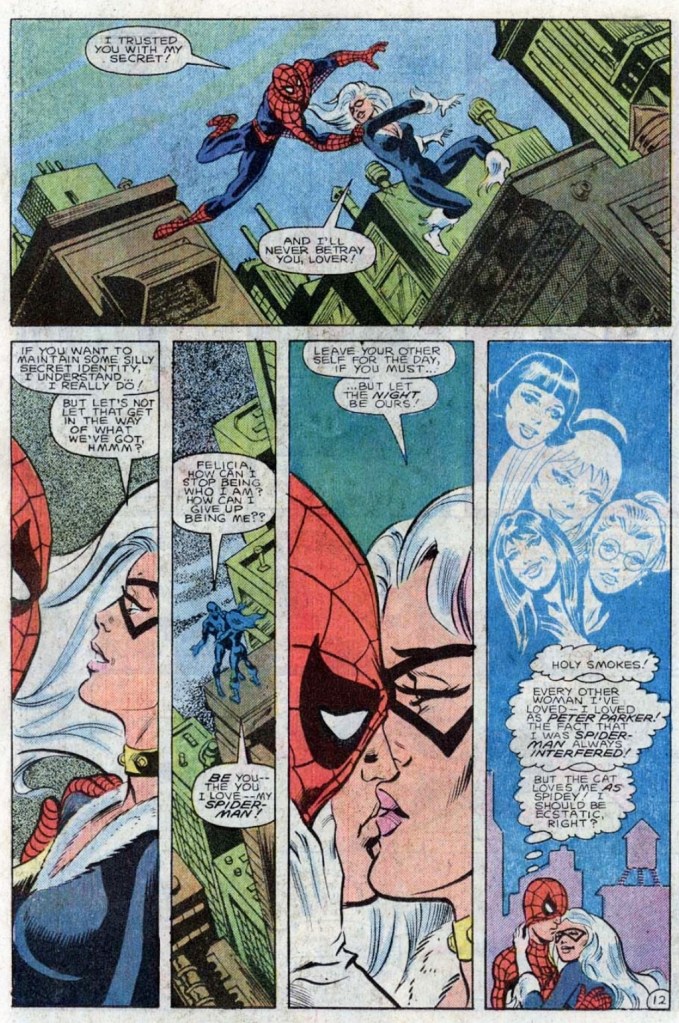
As the cover art revealed, this tale authored by Bill Mantlo is about Spider-Man revealing his secret identity to Black Cat who was his romantic partner at this point in Marvel Comics shared universe history. The revelation served as a key turning point in the life of the iconic webslinger as well as Peter Parker’s personal handling of his interactions with the women he loved. Mantlo’s writing of the dialogue between Spidey and Black Cat is really rich and there is also this sentimental touch with how the writer handled the hero’s emotions, especially with regards to the lady’s loving him more as the costumed hero than the civilian he is. I should also state that the impact of knowing Spider-Man’s true identity has subtle emotional effects on the part of Black Cat which must be seen.

While the cover showed what happened, this comic book is still worth reading because the creative duo of Mantlo and Milgrom carefully crafted scenes that gradually led to the big revelation backed with flashbacks of Peter Parker’s private life (as portrayed in Amazing Fantasy #15) and the build-up from his past romances with Black Cat. The pacing is very good and the pay-off to the build-up was worth every moment.

The conflict with the city thugs that took place near the end of the tale served as an additive to the new development of Black Cat and Spidey’s relationship.

Conclusion

Black Cat’s first-ever visit at Spider-Man residence.

Spectacular Spider-Man #87 (1984) is a very worthy read and the creators made daring moves to move the romantic link between Spider-Man and Black Cat forward while adding variety into Peter Parker’s personality. This is a character-driven story that must be read from start to finish.

Overall, Spectacular Spider-Man #87 (1984) is highly recommended.

+++++

Thank you for reading. If you find this article engaging, please click the like button below, share this article to others and also please consider making a donation to support my publishing. If you are looking for a copywriter to create content for your special project or business, check out my services and my portfolio. Feel free to contact me with a private message. Also please feel free to visit my Facebook page Author Carlo Carrasco and follow me on Twitter at  @HavenorFantasy as well as on Tumblr at https://carlocarrasco.tumblr.com/ and on Instagram at https://www.instagram.com/authorcarlocarrasco
What to watch on YouTube right now – Part 28

Welcome back, my readers, YouTube viewers and all others who followed this series of articles focused on YouTube videos worth watching. Have you been searching for something fun or interesting to watch on YouTube? Do you feel bored right now and you crave for something to see on the world’s most popular online video destination?

I recommend you check out the following topics and the related videos I found.

#1 Mosab Hassan Yousef: My Father Founded Hamas video  – In America, there are lots of young people who are protesting in public supporting Palestinian terrorists while condemning Israel. These pro-Palestine have shown ignorance about the facts and none of them knows exactly what Palestinian culture is like when compared to Mosab Hassan Yousef (son of a founder of Palestinian terrorist group Hamas).

In an interview with PragerU, Yousef talks comprehensively about his past with the Palestinians (Arabs who adopted the Palestinian identity which only started in the 20th century), the time he was active as a Hamas member, his relationship with his father who founded Hamas, and why he left the terrorist group to cooperate with Israel and migrated overseas. Yousef confirms that Hamas is pure evil and the Palestinian culture has hatred and violence deeply rooted within. Watch this video now.

#2 Jaws 3 4K Blu-ray has footage that involved the use of AI  – I am a collector movies on physical media. I don’t just buy any movies on Blu-ray and 4K Blu-ray format because I am selective with regards to quality, enjoyment and replay value. When it comes to new releases on 4K Blu-ray format, I cannot ignore the observations pointing out that the footage of Jaws 3 (AKA Jaws 3D) on 4K Blu-ray involved the use of AI (artificial intelligence) which resulted in bad visual results. It seems that more people in Hollywood are getting obsessed with remastering old movies using AI, removing the film grain and other digital methods that ruin the visuals. For insight, watch the videos below.

#3 Michael Jordan’s “The Shot” of 1989 – When it comes to those game-winning basketball shots, Michael Jordan had lots of those during his years with the Chicago Bulls. Before he won his first NBA championship, Jordan successfully scored the winning jump shot over Craig Ehlo to beat the Cleveland Cavaliers 101-100 in the 5th game of the 1989 NBA playoffs’ first round. That shot became iconic and there is a lot more behind the scenes that preceded. Watch the selected video below.  

#4 Virtua Fighter 3 retrospective video – When Sega released Virtua Arcade 3 in the arcades in 1996, it was the best-looking 3D polygonal fighting game at the time and it often drew players leaving them really satisfied. Virtua Fighter 3 was the product of the most cutting edge arcade technology of the time (with the Model 3 arcade hardware) as well as the hard-work and in-depth craftmanship by developer AM2 led by the legendary designer Yu Suzuki. To know more about Virtua Fighter 3, watch the video below.

#5 Popcorn in Bed’s James Bond reaction videos – On August 2023, YouTuber Popcorn in Bed started posting reaction videos of James Bond movies. With the exception of the films of Daniel Craig and George Lazenby as Agent 007, Popcorn in Bed posted two selected movie reaction per James Bond actor (example: 2 Bond films of Sean Connery, 2 Bond films of Roger Moore). To give you a taste of what Popcorn in Bed did, watch the selected videos below. To watch more, click here.

+++++

Thank you for reading. If you find this article engaging, please click the like button below, share this article to others and also please consider making a donation to support my publishing. If you are looking for a copywriter to create content for your special project or business, check out my services and my portfolio. Feel free to contact me with a private message. Also please feel free to visit my Facebook page Author Carlo Carrasco and follow me on Twitter at  @HavenorFantasy as well as on Tumblr at https://carlocarrasco.tumblr.com/ and on Instagram athttps://www.instagram.com/authorcarlocarrasco

Retro Gaming Ads Blast – Part 14

Welcome back readers, fellow geeks and electronic gaming fans!

In this edition of the Retro Gaming Ads Blast (RGAB) series, we will take a look at another batch of retro gaming print ads – including arcade flyers – from the 1980s and 1990s.

For the newcomers reading this, Retro Gaming Ads Blast (RGAB) looks back at the many print ads of games (console, arcade, computer and handheld) that were published in comic books, magazines, flyers and newspapers long before smartphones, social media, the worldwide web and streaming became popular. To put things in perspective, people back in the 1980s and 1990s were more trusting of print media for information and images about electronic games and related products.

With those details laid down, here is the newest batch of retro gaming print ads for you to see and enjoy…

1. Lufia & The Fortress of Doom for Sega Genesis print ad

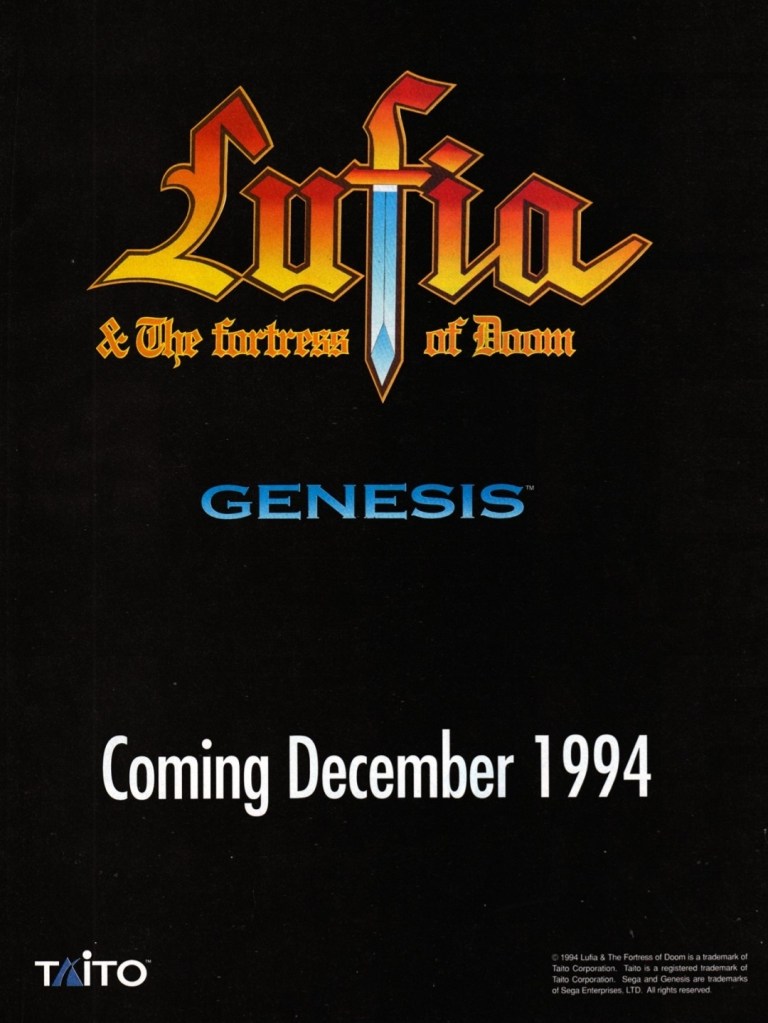
Considering the eventual scrapping of the Sega Genesis port of Lufia & The Fortress of Doom, this old print ad might as well serve like a tomb stone.

I want to start with this mostly black print ad about the Japanese role-playing game (JRPG) Lufia & The Fortress of Doom coming to the Sega Genesis console. This game was released on the Super Nintendo Entertainment System (SNES) in America and on the Super Famicom in Japan in 1993 and achieved commercial success for the Japan-based publisher Taito. In an attempt to keep on building up the success, a port of the game for the Sega Genesis (Sega Megadrive in other countries) was announced but ultimately it got canceled. It should be noted that Taito’s American division close down in 1995 and the sequel  Lufia II: Rise of the Sinistrals was released in America by a different publisher. That being said, this particular print ad is a sad reminder of a broken promise for Sega Genesis gamers as well as Lufia and JRPG fans who wanted to play the 1993 RPG on a different console.

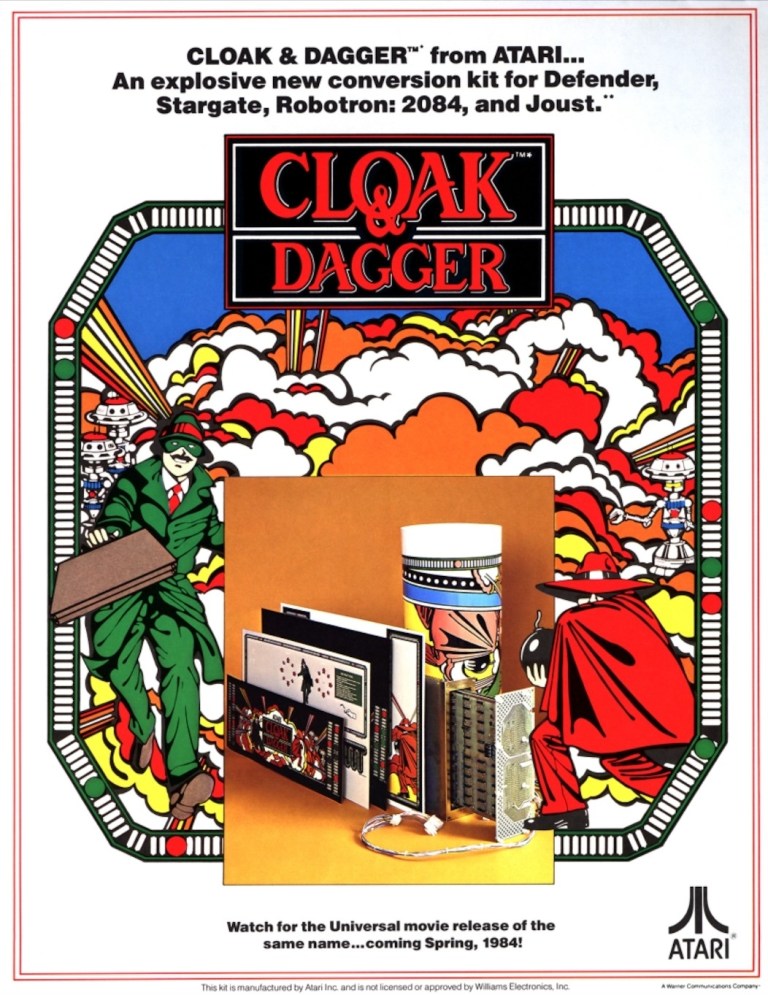
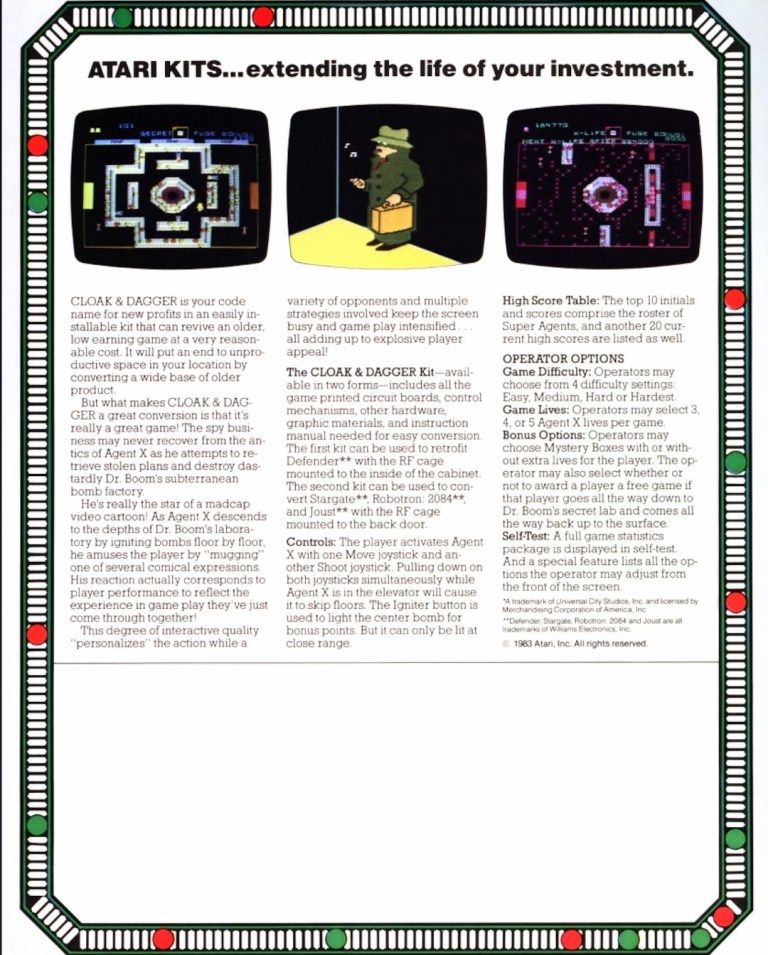
2. Cloak & Dagger arcade flyer

The front of the arcade flyer. There is even a mention of the Cloak & Dagger movie.
Details of the game explained with arcade operators in mind. I find it odd that there is a vacant amount of blank space on this side of the flyer.

Cloak & Dagger, the Atari arcade game that appeared in the 1984 movie of the same name (read my retro movie review by clicking here), has always been an arcade conversion kit as this arcade flyer showed. For the newcomers reading this, an arcade conversion kit allows the arcade operator to replace an old game without having to buy a brand-new arcade machine. Very cleverly, Atari targeted arcade machines of Robotron: 2084, Defender, Stargate and Joust (all were from the competitor Williams Electronics) with Cloak & Dagger. The Cloak & Dagger flyer’s front shows a picture of the pieces of hardware (for insertion into the arcade cabinet plus some physical adjustments) plus decorations for the exterior of the arcade cabinet. The other side of the flyer contains the technical details that make it convenient for arcade operators to understand on how to convert the older games (limited to the above-mentioned Williams games).

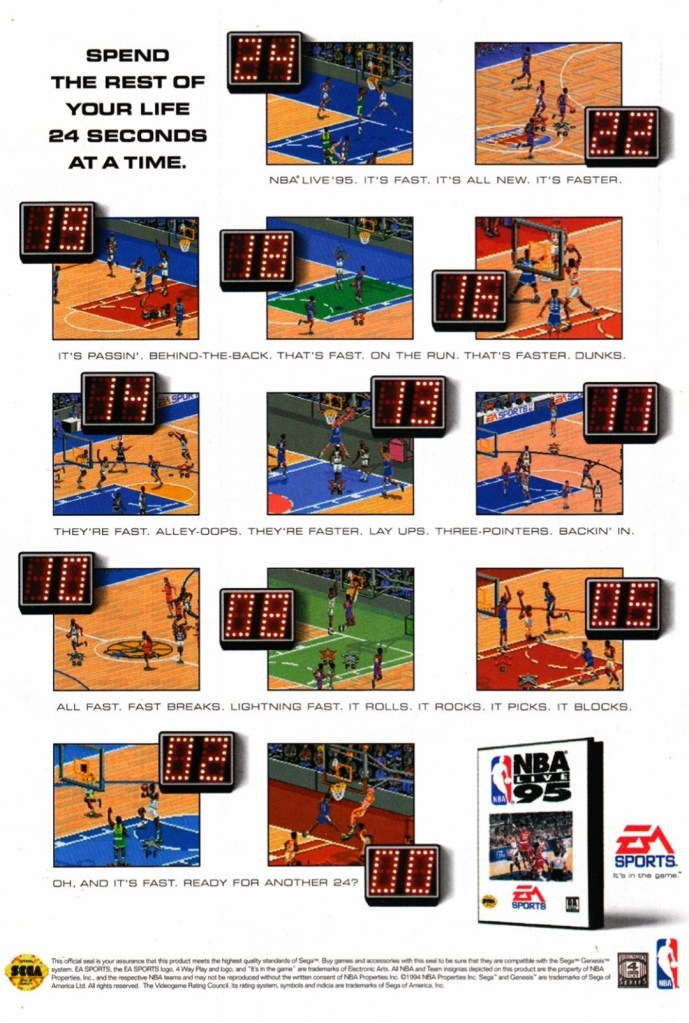
3. NBA Live 95 for Sega Genesis print ad

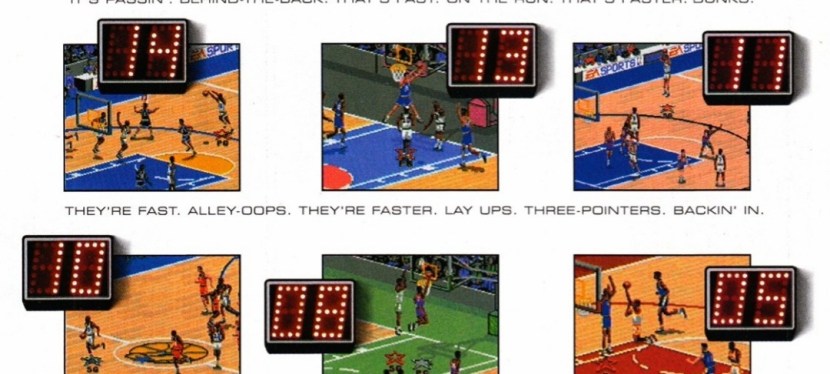
This print ad is still exciting to look at, especially when you are still passionate with basketball.

Back in late 1994, Electronic Arts (EA) revamped their NBA-licensed basketball game franchise with NBA Live 95 which came with a major game redesign that includes the isometric on-court perspective, T-meter for free throw shooting and more. NBA Live 95 was also the first entry of the NBA Live franchise and brand which lasted for decades. This print ad of the Sega Genesis version of NBA Live 95 has the clever display of several screenshots along with pics of the shot clock emphasizing suspense. The basketball action images themselves are not only eye-catching but strong enough to get gamers excited. This is still a solid print ad to look at.

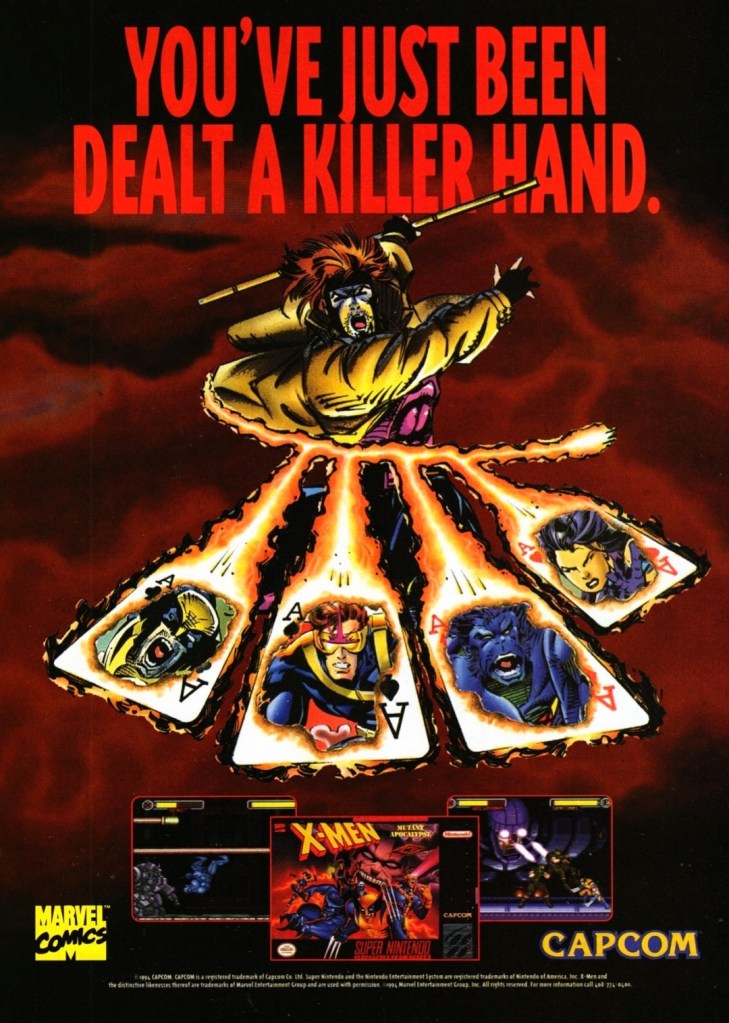
4. X-Men: Mutant Apocalypse print ad

An X-Men game by Capcom.

If there is anything significant about X-Men: Mutant Apocalypse, it is the fact that it was Capcom’s first-ever X-Men-based production that was also released a month before their own hit arcade game X-Men: Children of the Atom came out. Setting aside Capcom’s involvement, this game contains notable elements from the comic books that strongly resonated with dedicated X-Men fans. Apart from the two screenshots and the game box cover, this print ad has X-Men artwork by Andy Kubert who already was the regular artist of the X-Men monthly series.

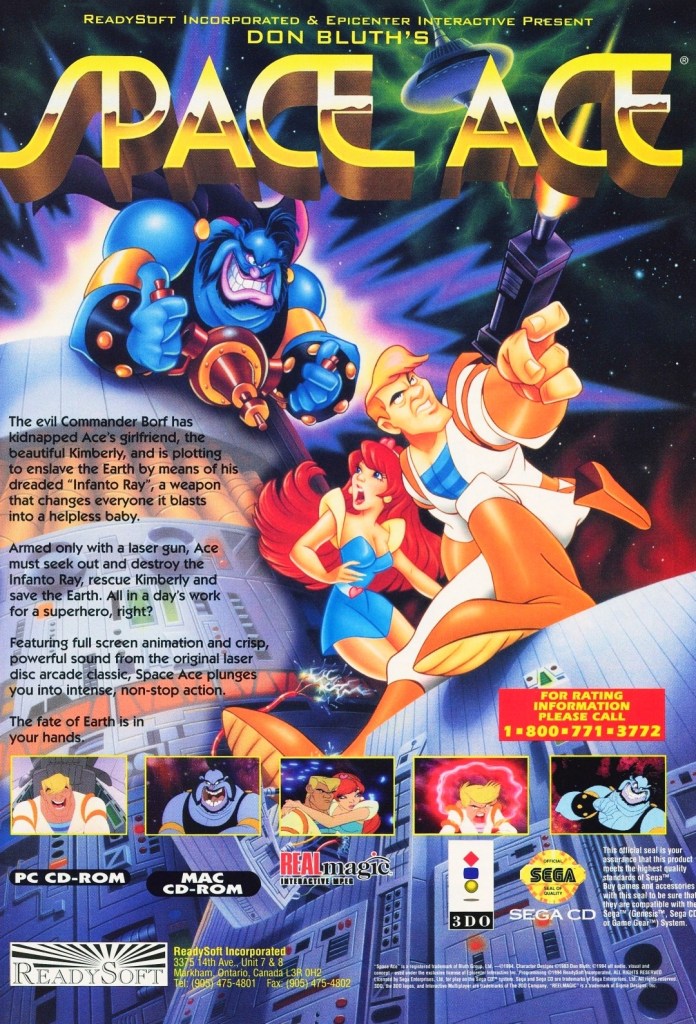
5. Space Ace multi-platform print ad

Anyone who is a fan of Don Bluth’s works in animation should be able to recognize the art style of this ad.

First released in the mid-1980s, Space Ace was a LaserDisc video game that was designed and produced by the legendary animator Don Bluth (An American Tail, The Land Before Time, Anastasia). After achieving success in the arcades, new versions of Space Ace were subsequently released on many other platforms, including the consoles and computers that used disc drives in the mid-1990s which this print ad emphasized. By looking at the lower part of the print ad, you will see Sega CD, 3DO, Macintosh and PC as targeted platforms. The most notable visual feature of the ad was, unsurprisingly, official art of Space Ace.

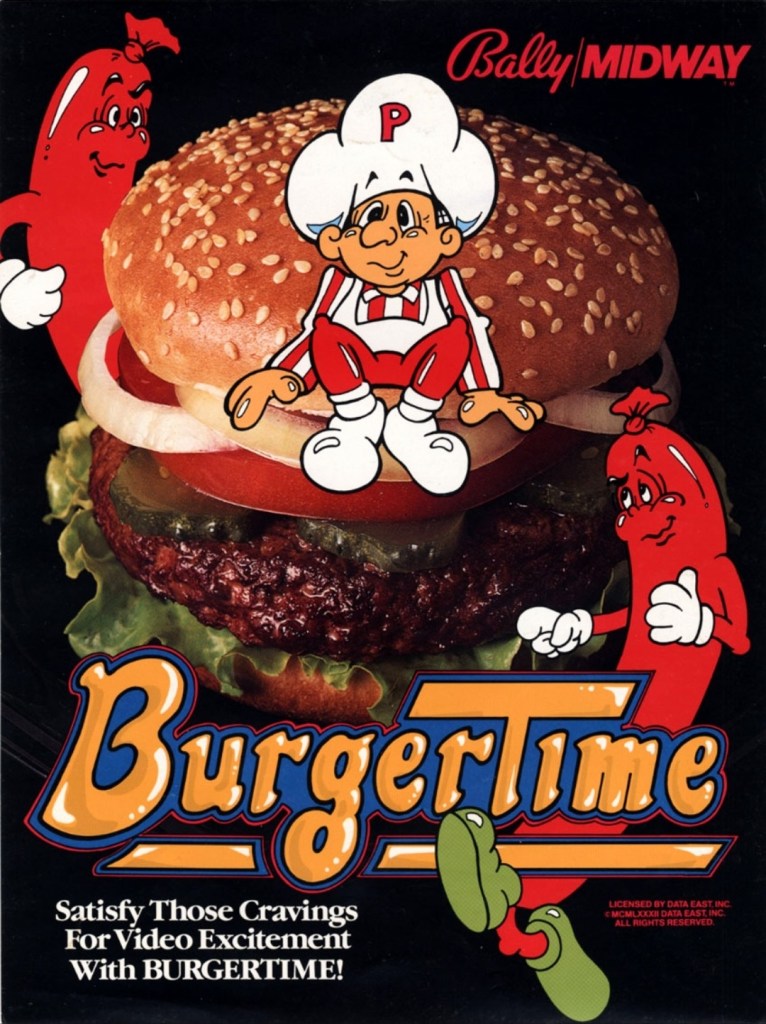
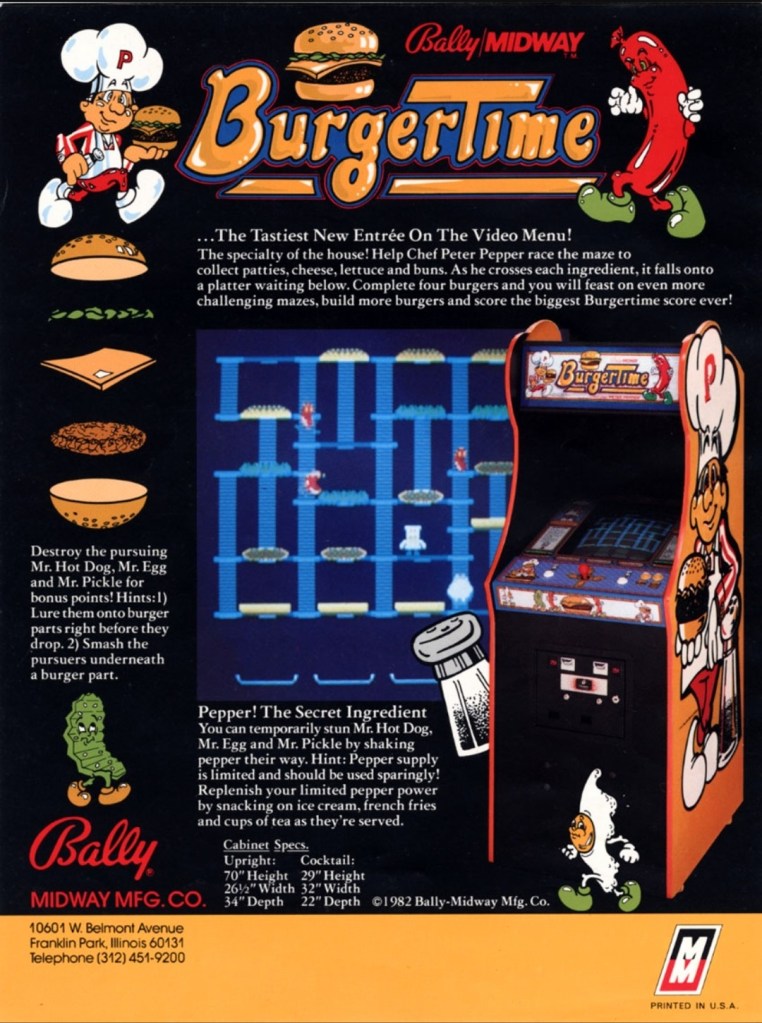
6. BurgerTime arcade flyer

The front of this flyer could make you crave for burgers.
The technical and creative details on the rear of the flyer.

Bally/Midway came up with this arcade flyer of BurgerTime which itself went on to become a beloved classic game. The front showed a very enticing looking hamburger that looked like it could fill a person’s belly and tingle his or her taste buds. Then they showed the hand-drawn in-game characters looking like they really are interacting with the hamburger. The back of the flyer shows details that emphasize what the game is about, why it could be a fun arcade addition and what the specs are. This is an engaging arcade flyer.  

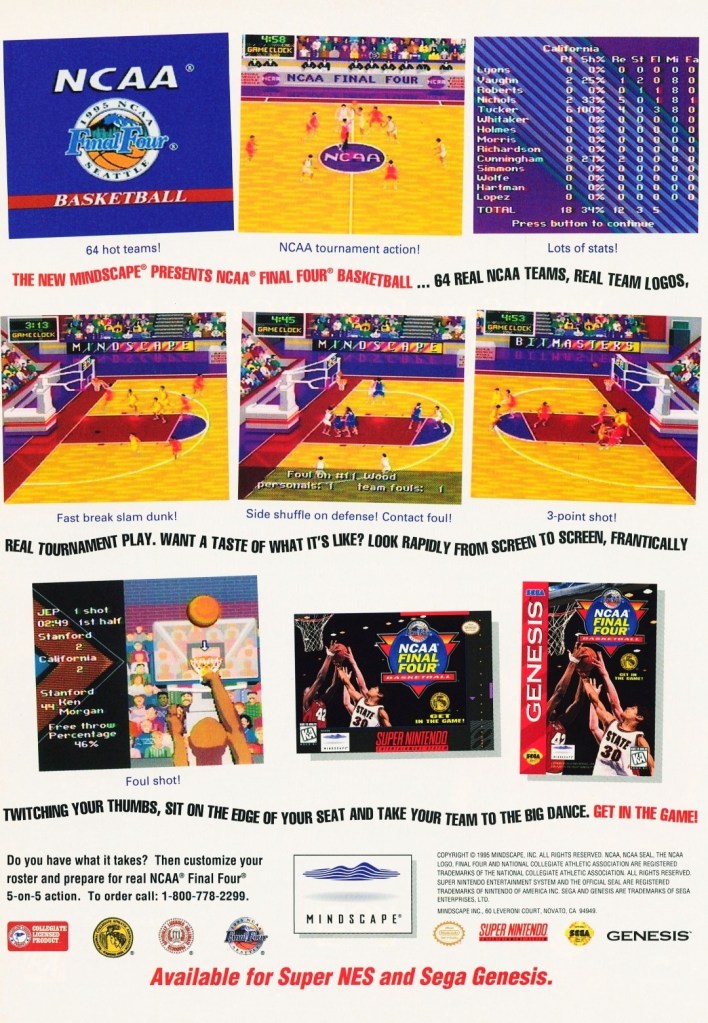
7. NCAA Final Four Basketball print ad

Do you know anyone who played this college basketball video game?

If there is anything notable about video gaming in the 1990s that is missing today, that would be the presence of multiple basketball video games released by different game publishers. Along the way, there were some college basketball video games such as NCAA Final Four Basketball developed by Bitmasters and published by Mindscape. This print ad had enough screenshots to show what the game looked like and how it played. The ad also mentioned that the game had 64 real NCAA teams and logos as well. This 1994 video game did not have a strong reception from game critics although it received a very high rating by GamePro magazine. NCAA Final Four Basketball has long been forgotten.

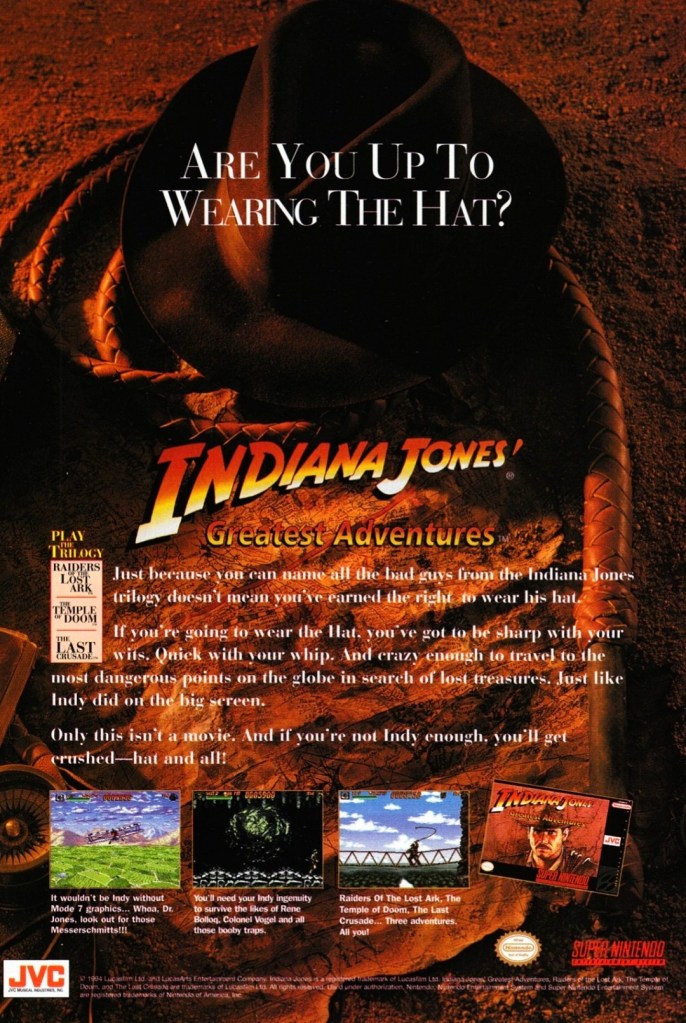
8. Indiana Jones’ Greatest Adventures print ad

An eye-catching print ad from a more memorable time when the Indiana Jones franchise was still under the full control of George Lucas and his enterprise.

Indiana Jones’ Greatest Adventures was an ambitious 2D side-scrolling adventure game that also served as an adaptation of the first three Indiana Jones movies (1981-1989) of Steven Spielberg and George Lucas. Like the Super Star Wars trilogy of games that preceded, this one was a challenging and lengthy game filled with lots of action. This print ad only showed Indy’s whip and hat but the screenshots, the text description and the game box cover (which has a young Harrison Ford as the iconic Jones) were more than enough to convince viewers that this was an Indiana Jones game.

+++++

Thank you for reading. If you find this article engaging, please click the like button below, share this article to others and also please consider making a donation to support my publishing. If you are looking for a copywriter to create content for your special project or business, check out my services and my portfolio. Feel free to contact me with a private message. Also please feel free to visit my Facebook page Author Carlo Carrasco and follow me on Twitter at  @HavenorFantasy as well as on Tumblr at https://carlocarrasco.tumblr.com/ and on Instagram at https://www.instagram.com/authorcarlocarrasco
A Look Back at Amazing Spider-Man #320 (1989)

Welcome back superhero enthusiasts, 1980s arts and culture enthusiasts, Marvel Comics fans and comic book collectors! Today we go back to the year 1985 to examine a small part of the Marvel Comics shared universe through a tale of the Amazing Spider-Man monthly series.

For this particular review, we will explore the first chapter of The Assassin Nation Plot storyline that took place within the Amazing Spider-Man series.  

With those details laid down, here is a look back at Amazing Spider-Man #320, published in 1989 by Marvel Comics with a story written by David Michelinie and drawn by Todd McFarlane.

The cover.

Early story

The story begins inside Empire State University where Peter Parker – working as an assistant in the science lab – takes advantage of the free time and resources to create web fluid using a new formula. He notices that the acetylene torch does not even leave a smudge on the new web he made.

To his surprise, his boss doctor Evan Sloan catches him doing an interesting experiment. Parker comes up with a convincing excuse for the experiment which spares him from getting into trouble. After promising doctor Sloan he will get on the neutron project first thing in the morning of Thursday, Parker leaves, secretly changes into Spider-Man and equipped his brand new web. He then leaves the university and moves deep into the city…

Quality

Peter Parker and Mary Jane having a discussion.

I really like the story David Micheline came up with as the start of The Assassin Nation Plot storyline. This is clearly not your typical good-versus-evil superhero tale starring the webslinger. Instead, there are layers of secrecy, suspense and intrigue that involves a powerful private organization, private armies and diplomats.

Instead of facing off with super villains, Spider-Man finds himself in the middle of something very big brewing behind the scenes, and that puts him in deep danger. That being said, Michelinie’s approach on building up the details of the plot moved very smoothly and the payoff for each buildup was executed on a timely manner. The buildup of details was never boring nor too slow to absorb, and Todd McFarlane excelled with visualizing the plot while still delivering dynamic superhero action.

I should mention that the character Paladin has a strong presence in the story and there were moments when he outweighed Spider-Man in terms of importance.

Conclusion

Spider-Man and Paladin targeted by armed guards.

Amazing Spider-Man #320 (1989) is indeed a very solid story to read and a powerful start of The Assassin Nation Plot storyline. With the way the core concept was presented, this comic book symbolically showed that there are high stakes and other matters that are clearly too overwhelming for Spider-Man to deal with. The story is nicely paced and the creative team knew when and how to execute worthy payoffs for each buildup. By the time I reached the end of the comic book, I became convinced to read the next chapter of this storyline.

Overall, Amazing Spider-Man #320 (1989) is highly recommended.

+++++

Thank you for reading. If you find this article engaging, please click the like button below, share this article to others and also please consider making a donation to support my publishing. If you are looking for a copywriter to create content for your special project or business, check out my services and my portfolio. Feel free to contact me with a private message. Also please feel free to visit my Facebook page Author Carlo Carrasco and follow me on Twitter at  @HavenorFantasy as well as on Tumblr at https://carlocarrasco.tumblr.com/ and on Instagram at https://www.instagram.com/authorcarlocarrasco