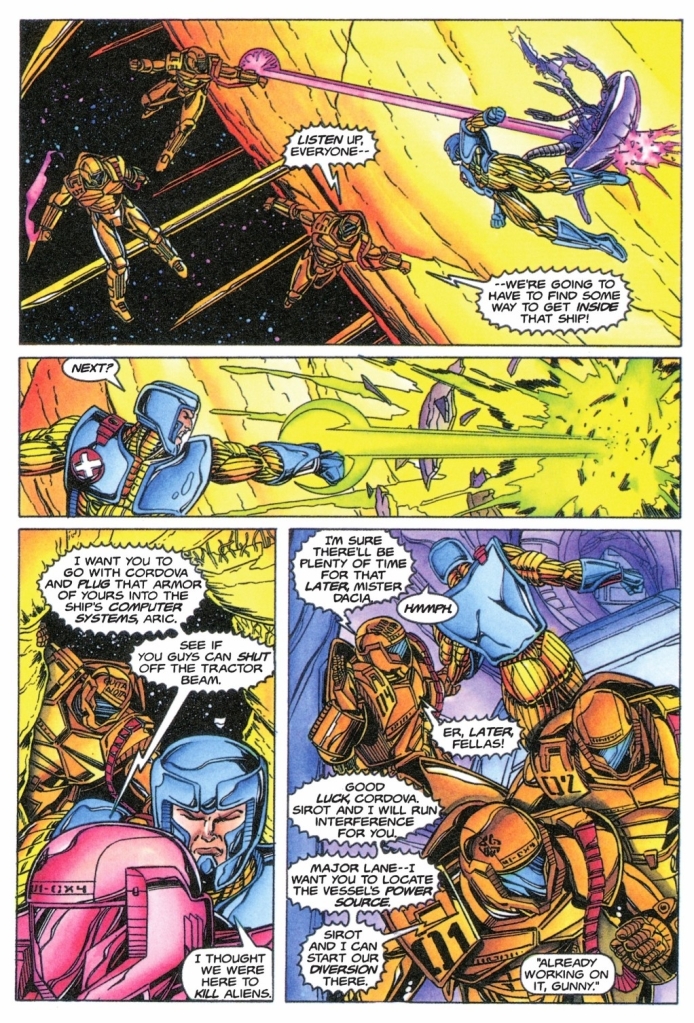
A Look Back at The Man of Steel #1 (1986)

Welcome back superhero enthusiasts, 1980s culture enthusiasts and comic book collectors! Today we go back to the late 1980s to explore a part of the DC Comics shared universe through a tale of the iconic Superman.

After DC Comics published the maxi-series Crisis on Infinite Earths, the publisher rebooted their entire comic book universe and that meant reintroducing their superheroes, villains and supporting characters with a touch of 1980s modernization. To reboot and modernize Superman, John Byrne was hired and he was granted a lot of creative freedom for production.

With those details laid down, here is a look back at The Man of Steel #1, published in 1986 by DC Comics with a story written and illustrated by John Byrne with ink work by Dick Giordano.
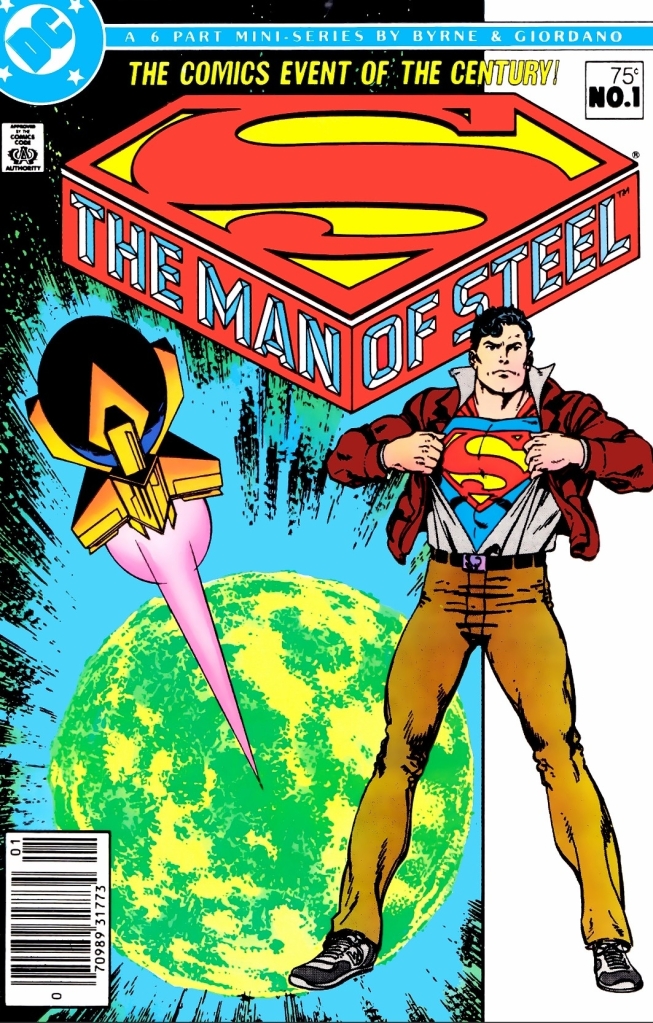
The cover.

Early story

The story begins sometime in the past in Krypton (Superman’s home world), a world about to meet its doom. Jor-El (Superman’s father) arrives home feeling deeply troubled and he wastes no time to execute an important plan he prepared. He examines his unborn Kal-El inside the birthing matrix which turned to have been removed by one of the servants from the gestation chambers of the planet. Lara confronts her husband over what was committed and asked him why he endangers the life of their unborn child.

Jor-El tells her that he plans for their son to be spared from the pending doom of Krypton (a chain reaction from the planet’s core caused vast pressures to build within the crust, fusing native elements into a new metal – Kryptonite) by sending him far away deep into space with planet Earth as the final destination. Jor-El has done extensive research of Earth and is convinced that their son will not only survive there but also become a supreme being among the inhabitants…

Quality
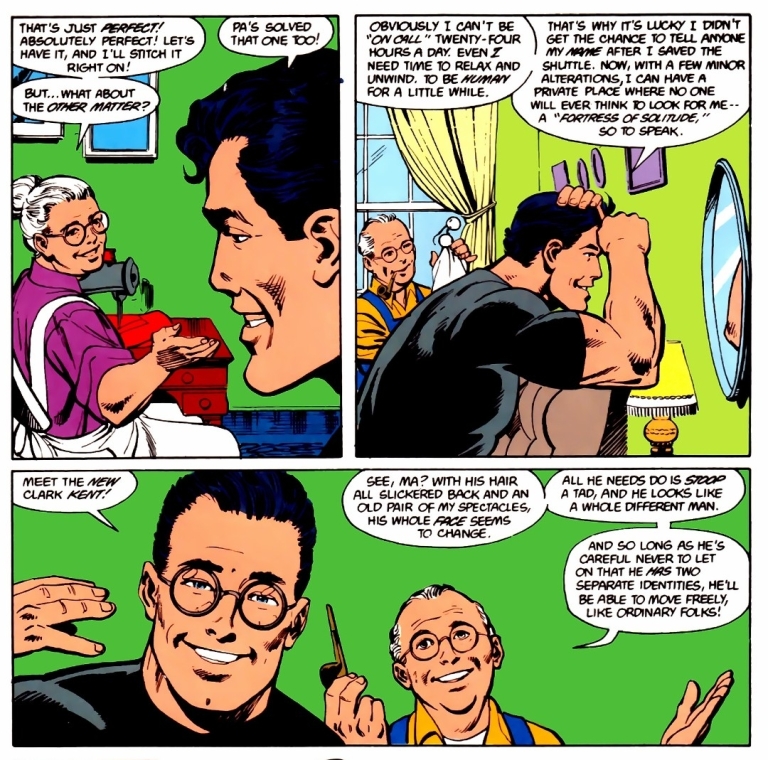
Clark’s earthly parents were indeed involved in his development becoming Superman.

There is no doubt that this John Byrne-led comic book remains great to read and highly significant with anything about Superman. Instead of telling one single extensive story, Byrne created a series of connected short tales that dramatized the icon’s post-Crisis origin and how the Krypton-born American Clark Kent became Superman for the first time ever.

While the prologue set in Krypton was quite heavy with expository dialogue, each subsequent short story was carefully structured and moved at a medium pace gradually emphasizing Clark Kent’s transformation into the Man of Steel. Along the way, there were lots of story details not only about the titular character but also about the Kent couple (Clark’s adoptive parents), what they went through, what secrets had to be kept and more. Very symbolically, this is a tale about an alien human being from space who grew up with traditional American culture and US heartland values while being raised by very loving American parents who previously could not produce children of their own. Through Clark, you will see that he is a blessing for Jonathan and Martha Kent and it is up to the couple to sow good values in him which are essential to his becoming not only a super being among mortals but also his emergence as a hero.

Conclusion

The origin of the post-Crisis Superman is great to read!

The Man of Steel #1 (1986) is indeed a great, character-focused comic book that emphasized the origin and debut of the post-Crisis Superman. John Byrne modernized Superman while still maintaining the classic superhero elements from the icon’s past versions as well as the American identity and ways (none of those woke and internationalist nonsense). This is also the optimistic Superman that is very inspirational which the recent DC cinematic universe (referred to as “DCEU”) of Warner Bros. terribly lacked. This illustrated literature work is also a major cornerstone of the post-Crisis era of DC Comics and John Byrne’s take on Superman is very defining and iconic.

If you are the kind of reader who views Superman widely through pop culture, you will notice specific elements from this comic book that made it into other forms of entertainment media such as Man of Steel (2013), the Christopher Reeve Superman movies, the animated movies, the Lois & Clark: The New Adventures of Superman TV series (starring Dean Cain as the Man of Steel) and more. Those multimedia productions showed how influential this comic book became as a major reference for other creators.

Overall, The Man of Steel #1 (1986) is highly recommended!

+++++

Thank you for reading. If you find this article engaging, please click the like button below, share this article to others and also please consider making a donation to support my publishing. If you are looking for a copywriter to create content for your special project or business, check out my services and my portfolio. Feel free to contact me with a private message. Also please feel free to visit my Facebook page Author Carlo Carrasco and follow me on Twitter at  @HavenorFantasy as well as on Tumblr at https://carlocarrasco.tumblr.com/ and on Instagram at https://www.instagram.com/authorcarlocarrasco

Better than Streaming: Do you have American Pop (1981) Blu-ray in your collection?

Welcome back, fellow geeks, Blu-ray collectors and movie buffs! Decades ago, animator and director Ralph Bakshi made significant contributions to the art of hand-drawn animation with features that made it to cinemas such as The Lord of the Rings (1978), Wizards (1977), and Fire and Ice (1983) to name a few.

Along the way, Bakshi became identified with rotoscoping which is a technique that involves drawing or painting over an element in live-action footage frame by frame (as to create a matte or a realistic animation).

Speaking of Bakshi’s past work as well as rotoscoped animation, Sony Pictures recently released the film American Pop (1981) on Blu-ray disc format and I am happy to say that I now have a copy of it for my Blu-ray collection. This is also my first-ever Blu-ray of a Bakshi-directed animated movie.

A close look at the cover of my Blu-ray copy of American Pop.

To begin with, posted below are the specs from the Blu-ray.com page…

Video

Codec: MPEG-4 AVC

Resolution: 1080p

Aspect ratio: 1.85:1

Original aspect ratio: 1.85:1

Audio

English: DTS-HD Master Audio 2.0 (48kHz, 24-bit)

Subtitles –English SDH

Discs -Blu-ray Disc, Single Disc (1 BD-25)

Playback – Blu-ray: Region A

In my personal experience, the first time I ever saw American Pop was not in the cinema but on TV here in the Philippines way back in 1993. Back then, I found the film’s combination of music with mostly rotoscoped animated scenes (there were also some live-action shots, archived footage and some very unique pieces of art shown). I was not able to replay Bakshi’s movie until recently.

So after more than thirty long years, I finally got to replay American Pop on Blu-ray and I can say I enjoyed it even more. To see the rotoscoped animation and varied music play in front of me in high-definition is an even more immersive viewing experience than the previous time I saw this film. Another advantage of high definition is being able to see tiny visual details that I was unable to spot long ago. Oh yes, the fine artworks used on the backgrounds in specific parts of the movie now look a lot more engaging to look at.

A look at the rear of American Pop Blu-ray.

What I regret to say here is that American Pop Blu-ray absolutely has no special features included. Not even a movie trailer! I can only guess that Sony Pictures did not bother to exert efforts to conduct new interviews with Ralph Bakshi and the cast members, nor did they even try to secure any media features or previews of the movie before its theatrical release. It’s not clear if Sony will someday come up with a collector’s edition Blu-ray of this 1981 Bakshi film.

In case you are interested or if you have made up your mind, you can order a copy of American Pop Blu-ray by clicking https://www.amazon.com/American-Pop-Blu-Ray-Ralph-Bakshi/dp/B0CBXJW38F/ref=sr_1_1?crid=2HXMAKQ7ZRPF8&keywords=american+pop+blu+ray&qid=1704790730&sprefix=American+Pop%2Caps%2C498&sr=8-1

For the dedicated Ralph Bakshi fans as well as enthusiastic film buffs and collectors of movies on physical media, American Pop Blu-ray is recommended as the film itself is more than enough to outweigh the lack of special features. American Pop is more lively than ever to watch and listen as it is now in high-definition.

If you wish to join a group of movie enthusiasts and talk about cinema, visit the Movie Fans Worldwide Facebook group at https://www.facebook.com/groups/322857711779576

+++++

Thank you for reading. If you find this article engaging, please click the like button below, share this article to others and also please consider making a donation to support my publishing. If you are looking for a copywriter to create content for your special project or business, check out my services and my portfolio. Feel free to contact me with a private message. Also please feel free to visit my Facebook page Author Carlo Carrasco and follow me on Twitter at  @HavenorFantasy as well as on Tumblr at https://carlocarrasco.tumblr.com/ and on Instagram at https://www.instagram.com/authorcarlocarrasco

A Look Back at Turok: Dinosaur Hunter #2 (1993)

Welcome back superhero enthusiasts, 1990s culture enthusiasts and comic book collectors! Today we go back to the early 1990s and explore a part of the Valiant Comics shared universe through a tale of the Turok: Dinosaur Hunter series.

While issue #1 turned out to be entertaining enough, the Indian protagonist Turok was not too engaging. The story worked primarily due to the combined creative works of David Michelinie and Bart Sears.

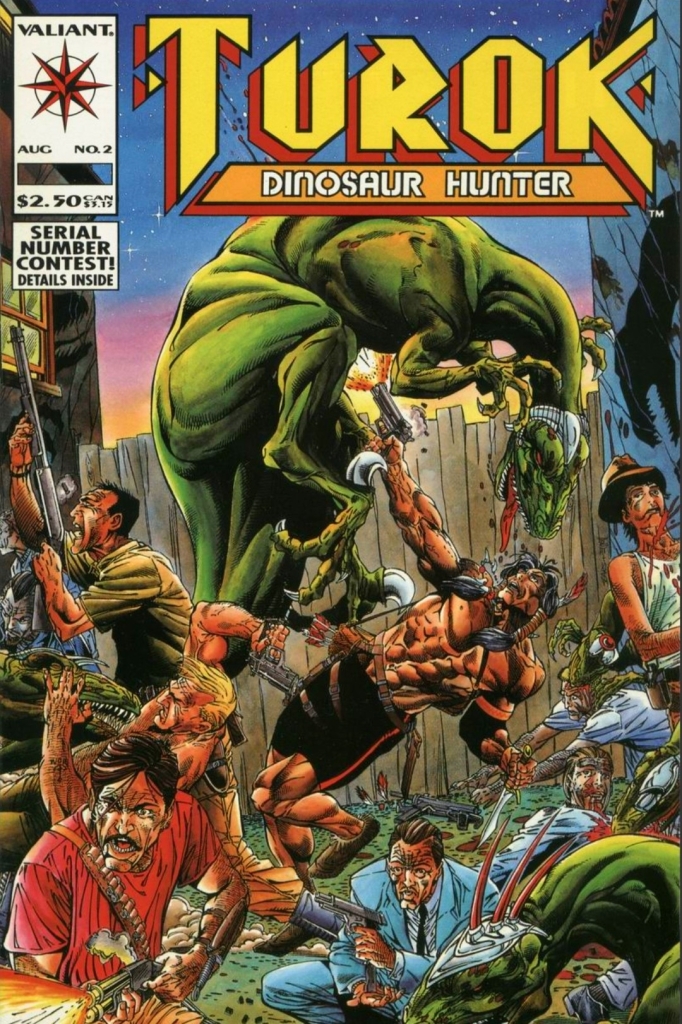
With those details laid down, here is a look back at Turok: Dinosaur Hunter #2, published in 1993 by Valiant Comics with a story written by David Michelinie and drawn by Bart Sears.

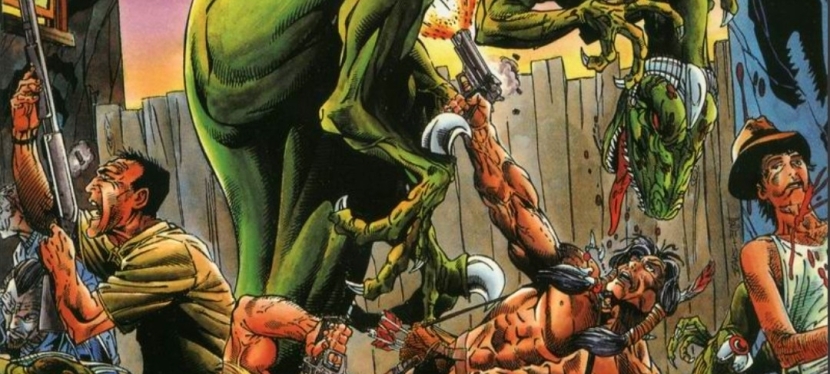
The cover.

Early story

The story begins in Colombia in 1987. Set some time after he left the village of Serita (a Colombian lady he connected with), Turok finds himself in the middle of a fight with multiple intelligent dinosaurs that serve his rival and target Mon-ark. Turok recently started using locally produced poison for his arrows as part of his unrelenting hunt for dinosaurs.

Meanwhile in another part of Colombia, the drug lord Comacho holds a private meeting and express his frustration over the decimation of his drug shipments. It turns out, the couriers were slaughtered and eaten by the dinosaurs. Upon learning of the presence of an Indian who makes it his business to hunt dinosaurs, Comacho gives an order to find him…

Quality

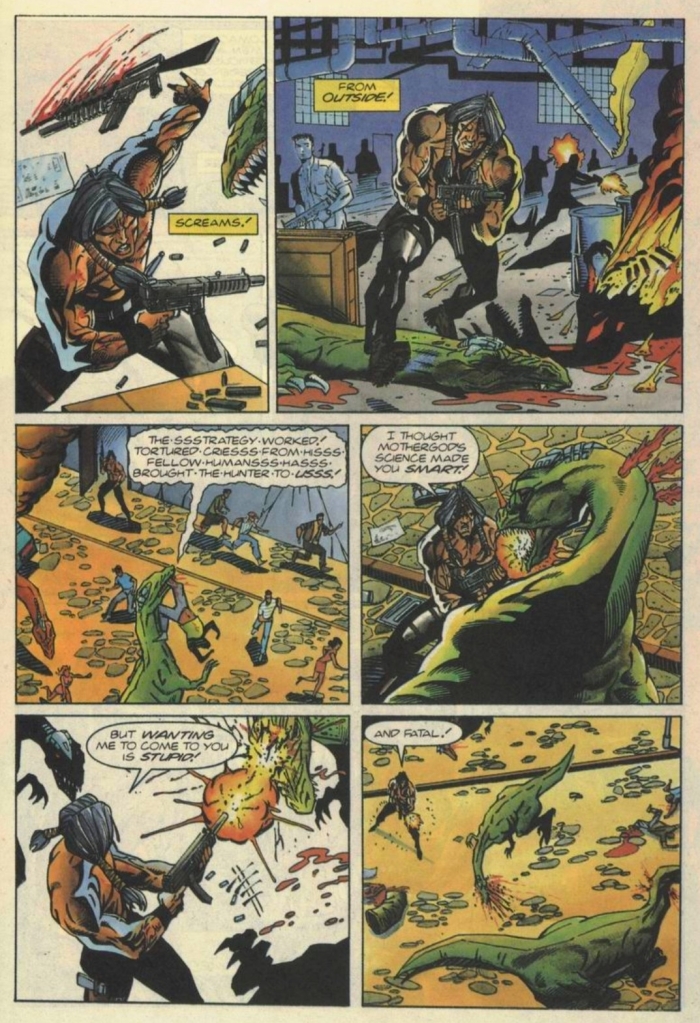
You will see Turok in a lot of action scenes fighting these intelligent and savage dinosaurs.

As the follow-up to the 1st issue, this is a story about Turok really hunting dinosaurs as part of his effort to get to Mon-ark (the leader of a pack of dinosaurs present in Colombia) in relation to what happened during the Unity storyline. In addition, you will get to see the protagonist get involved the Colombia drug lord who really needs him as the dinosaurs tremendously disrupted the shipment of illegal substances. As a newcomer in this particular time and place within the shared universe of Valiant Comics, Turok here does not care much about the reputation of Comacho as he is obsessed with hunting dinosaurs.

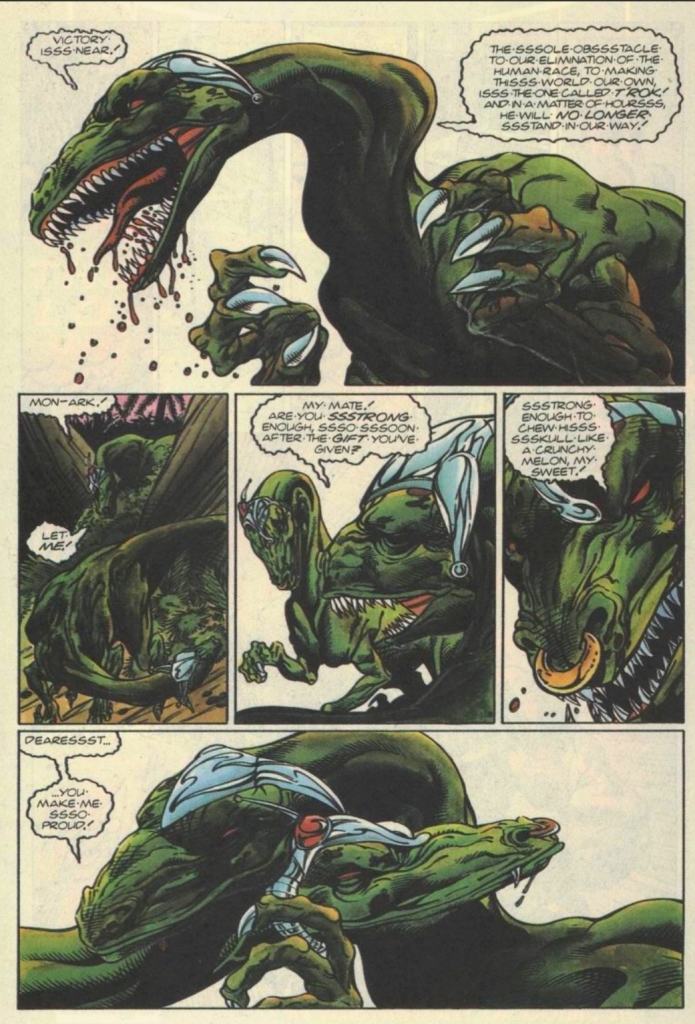
Speaking of the dinosaurs (who were granted human-like intelligence by the Mothergod), you will get to see Mon-ark have his own share of the spotlight and see him being a leader of his fellow dinosaurs. The showcase of his ruthlessness was expectedly done here to symbolize the element of evil in a violent way.

The plot by Michelinie is nicely structured and the narrative moved in a smooth enough pace leading to an obvious new direction.

Like in the previous issue, Bart Sears drew the art but with the involvement of Bernard Chang. For the most part, I recognized Sears’ work and there were some subtle visual differences here and there. The good news here is that if you enjoyed the gritty look as well as the uncompromised approach to violence in issue #1, then you will find those here as well.

Conclusion

A look at the intelligence and interaction between these two evil dinosaurs in love. There’s no homosexuality here nor anything related to transgender or the disease called wokeness.

Turok: Dinosaur Hunter #2 (1993) is entertaining and compelling enough to read. It further explores Turok’s story as a man lost in time who simply would not run away from the dinosaurs as he is obsessed with eliminating Mon-ark. The tale, however, involves a Colombian drug lord as well as his private army which adds depth to the narrative as well as Turok’s place within Valiant’s shared universe of the time. Lastly, this one nicely sets up a big conflict between the Indian and his dinosaur rival.

Overall, Turok: Dinosaur Hunter #2 (1993) is recommended.

+++++

Thank you for reading. If you find this article engaging, please click the like button below, share this article to others and also please consider making a donation to support my publishing. If you are looking for a copywriter to create content for your special project or business, check out my services and my portfolio. Feel free to contact me with a private message. Also please feel free to visit my Facebook page Author Carlo Carrasco and follow me on Twitter at  @HavenorFantasy as well as on Tumblr at https://carlocarrasco.tumblr.com/ and on Instagram at https://www.instagram.com/authorcarlocarrasco
A Look Back at Detective Comics #575 (1987)

Welcome back superhero enthusiasts, 1980s culture enthusiasts and comic book collectors! Today we go back to the late 1980s to explore a part of the DC Comics shared universe through a tale of the iconic Batman.

After DC Comics published the maxi-series Crisis on Infinite Earths, the publisher rebooted their entire comic book universe and that meant reintroducing their superheroes, villains and supporting characters with a touch of 1980s modernization. Frank Miller led the reintroduction of Batman as a new crime fighter in the Batman: Year One storyline in 1987. Also that same year, DC Comics went on to publish a sequel storyline through four issues of the Detective Comics series. That sequel was titled Batman: Year Two.

With those details laid down, here is a look back at Detective Comics #575, published in 1987 by DC Comics with a story written by Mike W. Barr (the same guy who did Mantra for Malibu Comics) and drawn by Alan Davis. This is the first chapter of the Batman: Year Two storyline.

The cover.

Early story

The story begins in Gotham City where the newly appointed police commissioner Gordon participates in a TV talk show. The talk show host is aggressive towards Gordon cutting him off verbally and pointing out that Batman – who is working with the police fighting crime – is no better than the Reaper, a costumed vigilante who caused trouble and killed many people on Gotham’s streets twenty years prior. Gordon emphasizes that Batman works with the city police and he operates strictly on his own.

As the TV talk show goes on, a group of armed thugs carrying varied items enter an apartment that is dark. Outside the Bat Signal (coming from the machine Gordon recently got) flashes, and soon Batman himself appears inside the apartment and cleverly took the gang down. He leaves the place going to do other things.

The next day, Rachel Caspian is pleasantly surprised to see her father arrive earlier than expected…

Quality

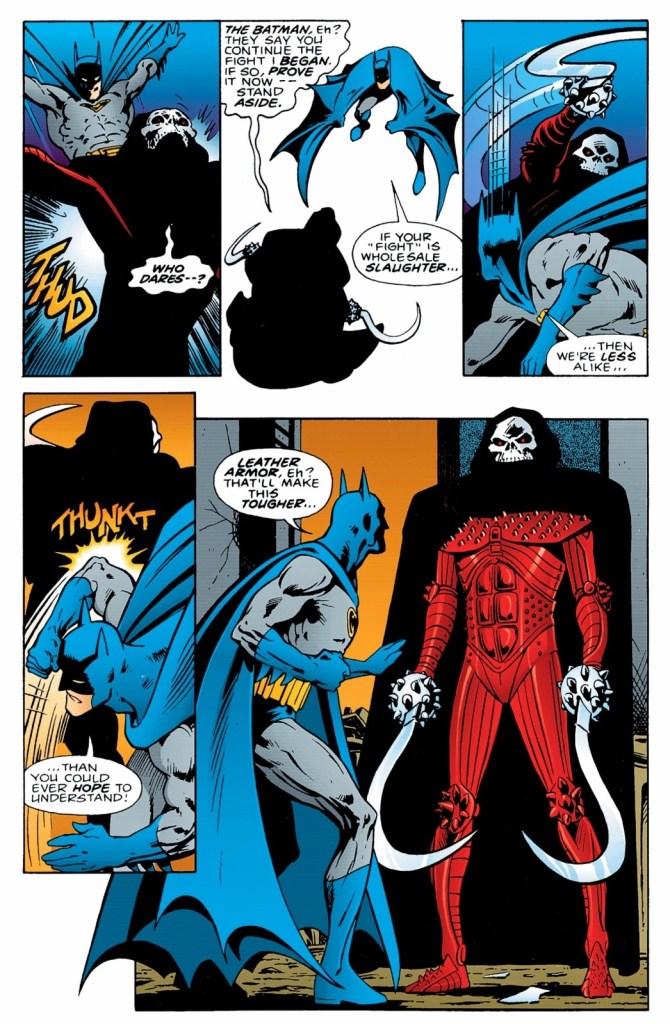
Batman strikes first in his encounter with the Reaper.

Set during the 2nd year of Batman engaging in crime-fighting in coordination with the Gotham City police force, this comic book dramatically portrays the city having a long-running disease and legacy of crime. The references to Gotham’s embarrassing past of being filled with thugs and wicked activities literally paved the way for the return of a masked vigilante who fights criminals with uncompromising violence (including killings). That vigilante’s legacy affects the way the public perceives Batman and why they have trouble seeing the differences between them. The writing and build-up here are very solid.

When it comes to portrayals, you will get to see a younger Bruce Wayne who is clearly pushing himself hard between engaging in business matters and secretly fighting crooks. This is a Batman who is only gaining more experience in the war against crime and he clearly is not the very tactical and very resourceful hero he would become. In his fight against the Reaper, you will really see Batman struggle hard and make really flawed moves that cost him a lot.

The introduction of the Reaper, who became the definitive vigilante of Gotham City long before Batman even started, is very engaging. This vigilante is also very intimidating to see and he clearly overshadows the Caped Crusader both visually and in action.

Conclusion

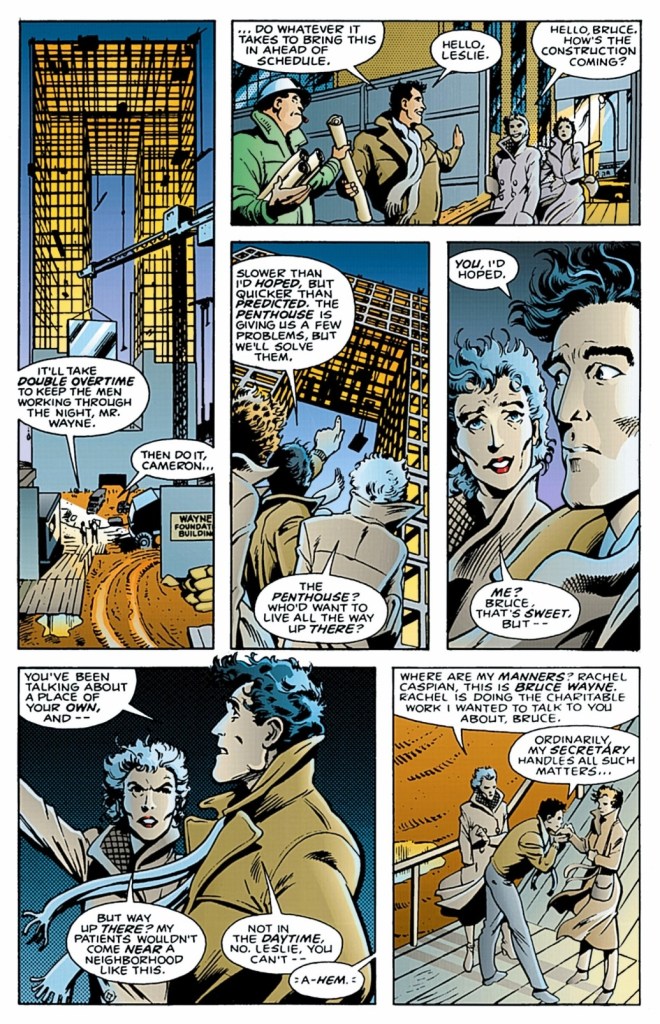
Bruce Wayne attending to business on-site.

As the first chapter of the Batman: Year Two storyline, Detective Comics #575 (1987) is a very solid tale to read. The narrative moved at a medium pace and there were these balanced pay-offs to the build-up (that took place in the first half). The Reaper’s reputation as Gotham’s past blood-thirsty vigilante literally dwarfed that of Batman (the modern vigilante). I should also state that Mike W. Barr symbolized the common traits and differences between Batman and the Reaper which alone are worth reading.

Overall, Detective Comics #575 (1987) is recommended.

+++++

Thank you for reading. If you find this article engaging, please click the like button below, share this article to others and also please consider making a donation to support my publishing. If you are looking for a copywriter to create content for your special project or business, check out my services and my portfolio. Feel free to contact me with a private message. Also please feel free to visit my Facebook page Author Carlo Carrasco and follow me on Twitter at  @HavenorFantasy as well as on Tumblr at https://carlocarrasco.tumblr.com/ and on Instagram at https://www.instagram.com/authorcarlocarrasco
Sea of Stars is an enjoyable RPG and you should play it on Xbox now!

Welcome back, fellow gamers, geeks, role-playing games (RPGs) enthusiasts and fantasy lovers!

In recent times, I completed my first playthrough of Starfield on my Xbox Series X and it lasted me over 220 hours of fun, discoveries and intriguing moments. Having played it so long, I will replay Starfield with a new playthrough only after Bethesda implements the next series of patches/updates (to refine the game) and release the planned downloadable content (DLC).

That being said, I finally started playing the inspired Japanese-style role-playing game (RPG) Sea of Stars on my Xbox Series X. Having played some hours of it, I can say that I am really enjoying Sea of Stars and I intend to finish it. Oh yes, Sea of Stars is available on Xbox Game Pass (XGP) right now!

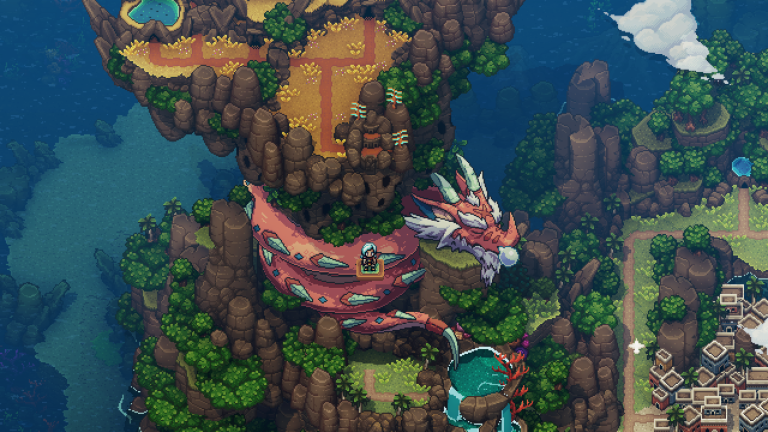
This is one of many great looking scenes composed of really fine 2D art style and pixel artistry in Sea of Stars.

Developed by Sabotage Studio, Sea of Stars is a turn-based RPG with a strong retro feel that will remind you of past Japanese RPGs (JRPGs) like Chrono Trigger and Secret of Mana. The game follows the exploits of two Children of the Solstice who combine the powers of the sun and moon to perform Eclipse Magic, the only force capable of fending off the monstrous creations of the evil alchemist known as The Fleshmancer. Along the way, the two Children of Solstice start a quest joined by their friend and together they travel to different places encountering different inhabitants and engage in situations that only they can solve.

Having played Chrono Trigger, Secret of Mana, Final Fantasy IV, Final Fantasy VI and a lot of JRPGs from the so-called 16-bit era of console gaming, I can say that Sea of Stars is a very inspired game that has lots of elements common with the mentioned games (plus more) with regards to art style, gameplay, quests, music, character development and visual presentation. To put it short, the guys at Sabotage Studio took a lot of inspiration from the classic JRPGs to make something fun for this current console generation. I am having a lot of fun with the game which itself is available for Xbox Game Pass (XGP) subscribers to avail.

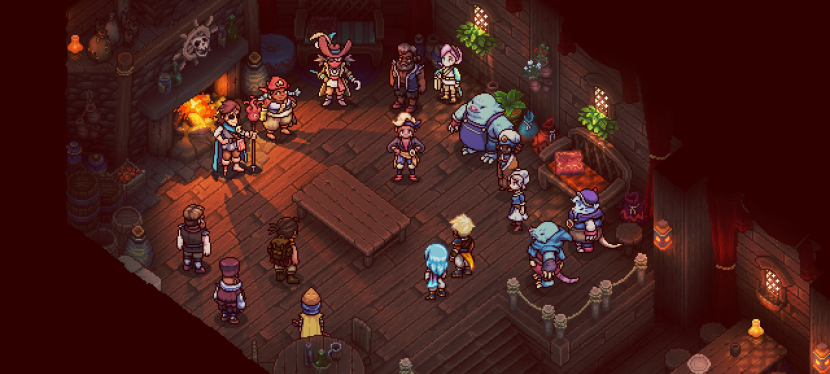
An important meeting about to happen in the game.
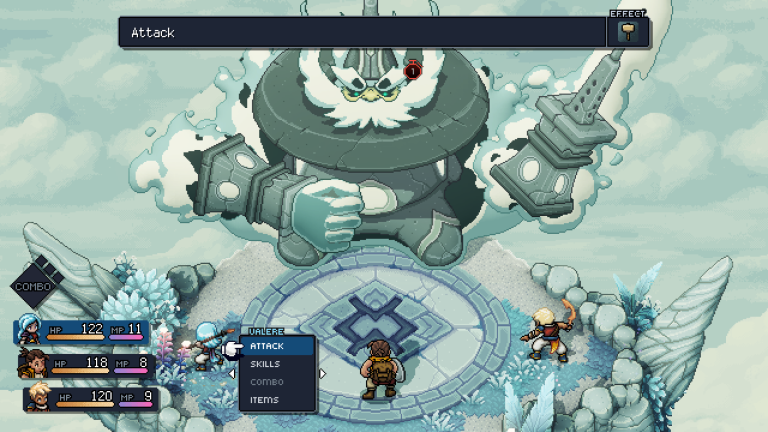
A boss battle early in the game.
This is just a part of the world map of Sea of Stars.

In my experience and recollections from the past, Sea of Stars has visual style that is best compared with Chrono Trigger. Sabotage Studio really created a lot of nice looking 2D artworks and highly detailed sprites that made the new game look lively. With regards to the storytelling , character development and character expressions, the game has a wholesome tone that never felt childish. The tone as well as the humor made Sea of Stars comparable with several Japanese RPGs from the 16-bit age of consoles.

You will encounter really interesting characters who will join your party as the game progresses.

Sea of Stars is really fun to play and it is a great change of pace and style for me as I finished my Starfield playthrough which lasted more than 220 hours. This Sabotage Studio game will help ease my wait for the expected 2024 RPGs such as Eiyuden Chronicle: Hundred Heroes and the Xbox-exclusive Avowed. As much as I hope to see past JRPGs like Xenogears, Breath of Fire and Lunar get remastered and released for Xbox consoles (and XGP), I know such possibilities remain uncertain and Sabotage Studio’s game easily fills the void. If you are looking for a Japanese-style RPG that is fun, nostalgic and visually pleasing, you can’t go wrong with Sea of Stars. Go for the game on Xbox Series X, Xbox Series S, Xbox One, Windows PC and Xbox Game Pass now!

+++++

Thank you for reading. If you find this article engaging, please click the like button below, share this article to others and also please consider making a donation to support my publishing. If you are looking for a copywriter to create content for your special project or business, check out my services and my portfolio. Feel free to contact me with a private message. Also please feel free to visit my Facebook page Author Carlo Carrasco and follow me on Twitter at  @HavenorFantasy as well as on Tumblr at https://carlocarrasco.tumblr.com/ and on Instagram athttps://www.instagram.com/authorcarlocarrasco

A Look Back at Turok: Dinosaur Hunter #1 (1993)

Welcome back superhero enthusiasts, 1990s culture enthusiasts and comic book collectors! Today we go back to the early 1990s and explore a part of the Valiant Comics shared universe through a tale of a very notable illustrated literature character named Turok.

I say very notable because Turok, an Indian (North American native), started in comics in the 1950s published by Western Publishing through its licensee Dell Comics. The comic book series Turok: Son of Stone started from 1956 until the early 1980s. In 1989, Valiant Comics was established by former Marvel Comics editor-in-chief Jim Shooter and business partner Steven Massarsky which was the result of a failed 1988 attempt to purchase Marvel Entertainment. In 1991, Valiant published Magnus: Robot Fighter and Solar: Man of the Atom as its early titles which is notable because both characters were licensed properties from Gold Key Comics (which itself was involved in the original Turok series).

Then in 1992, a newer version of Turok was introduced by Valiant Comics in the 12th issue of Magnus: Robot Fighter and subsequently the character (along with established side-kick Andar) became involved in the Unity storyline which was Valiant’s first major crossover comics event. By the time Unity ended, the road was cleared for Valiant to further emphasize Turok for the modern comic book readers of the time.

With those details laid down, here is a look back at Turok: Dinosaur Hunter #1, published in 1993 by Valiant Comics with a story written by David Michelinie and drawn by Bart Sears.

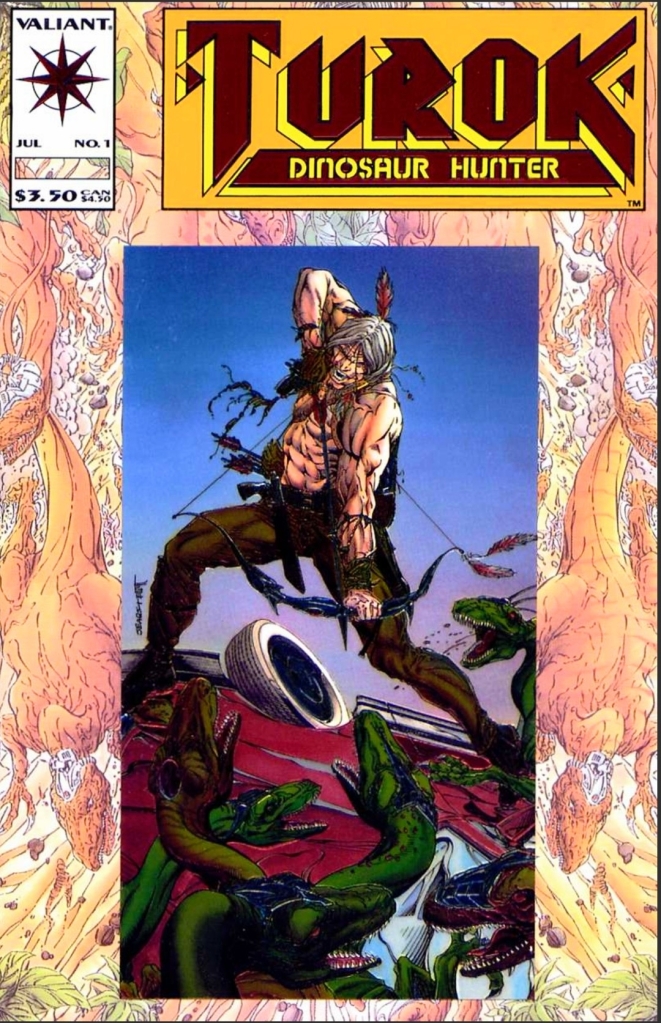
The cover.

Early story

The story begins in Colombia (note: written as Columbia in the comic book) in South America in the year 1987. Deep in the forest, Turok performs a ritual believing that his spirit is getting cleansed and purified. He remembers the times when he and Andar discovered a land – filled with dinosaurs and other animals they never encountered previously – where time no longer held much meaning.

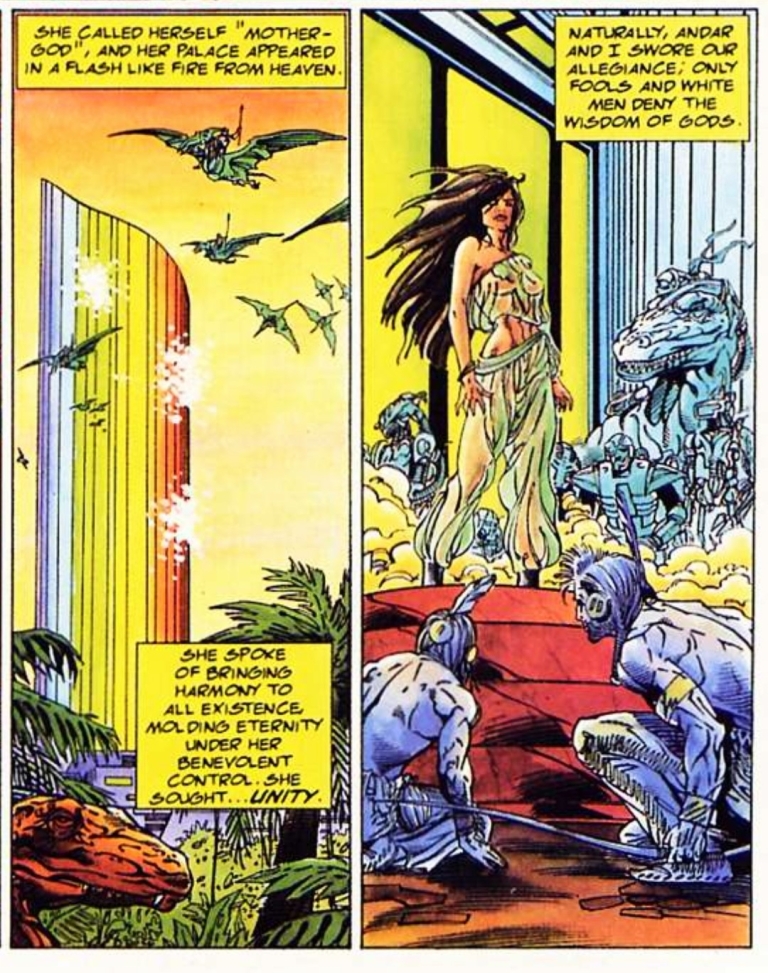
He and Andar got involved in an armed conflict with invaders who arrived with advanced technologies. The robot fighter Magnus then got involved and helped Turok and their side turn the tide of battle. Eventually a stunning phenomenon happened as a woman who called herself Mothergod appeared. Turok and Andar foolishly submitted themselves to her and soon, they started operating in her service with violence against those who opposed her.

After encountering Archer and Armstrong, Turok realized the error of his devotion to Mothergod and eventually joined forces with Rai, X-O Manowar and others who waged battle against her.

Back in the present, an intelligent, cybernetically enhance dinosaur attacks Turok…

Quality

Very intense violence drawn by Bart Sears which reflected the high intensity of Turok’s fight with the dinosaurs.

To get straight to the point here, when it comes to emphasizing a new version of Turok for comic book readers in the early 1990s, the creative team was quite successful in achieving that goal. By the time I reached the end of this comic book, Turok’s place within the huge shared universe of Valiant got established solidly and the Michelinie-Sears duo dramatized the Indian’s struggle (being lost in time and far away from where he belongs) in South America in the late 1980s.

Being lost in time and having to deal with deadly, intelligent dinosaurs brought not only the warrior within Turok but also the determine survivor in him as well. There is a good amount of character emphasis of Turok which served as an effective balance to all the spectacle (read: uncompromised bloody violence) the creative duo prepared. Instead of using thought balloons, you will read Turok’s thoughts through narration boxes all throughout which made an effective and interesting reading experience.

Considering his great skills in hunting and fighting, Turok is not really a super protagonist. He is as vulnerable as any other person and you will get to see him suffer and become so helpless, he has no choice but to avail of assistance from South American villagers who lived by the land but are themselves very vulnerable to the savagery of the intelligent dinosaurs. The symbolism regarding vulnerability as well as the ramifications of the Unity crossover on this tale is very strong. This is indeed very solid writing by Michelinie.

As for the art, Sears’ work here is very unique and his style on drawing people, monsters and locations made this comic book a visual standout among 1993 comic books. When it comes to the graphic violence, it is clear to me that Sears enjoyed the creative freedom he got and he really emphasized his imagination as to how gruesome violence caused by dinosaurs on human beings would be. That being said, there are lots of violent action scenes and images of physical damage (damage on the flesh specifically) that remain visually disturbing to this day.

Conclusion

Very foolishly, Turok and Andar submitted themselves to a walking, evil idol. This should remind you that idolatry is both foolish and unholy.

Turok: Dinosaur Hunter #1 (1993) works nice as modern portrayal of Turok and it succeeds in establishing his place within Valiant’s comic book universe thanks primarily to the Michelinie-Sears duo. Turok himself is not exactly an interesting protagonist to me but I can say it is the creators’ way of portraying him that makes the plot and the comic book work as an entertainment piece. I also liked the way Turok was emphasized as a character who got lost not only in time but also dimensionally lost as he has to live within a whole new world while focusing on survival as well as his desire to kill his rival Mon-Ark (the intelligent dinosaur). If you know your American pop culture history, you will realize that this comic book incidentally paved the way for the Turok video games (starting with 1997’s Turok: Dinosaur Hunter of Nintendo 64) that happened years later.

Overall, Turok: Dinosaur Hunter #1 (1993) is recommended.

+++++

Thank you for reading. If you find this article engaging, please click the like button below, share this article to others and also please consider making a donation to support my publishing. If you are looking for a copywriter to create content for your special project or business, check out my services and my portfolio. Feel free to contact me with a private message. Also please feel free to visit my Facebook page Author Carlo Carrasco and follow me on Twitter at  @HavenorFantasy as well as on Tumblr at https://carlocarrasco.tumblr.com/ and on Instagram at https://www.instagram.com/authorcarlocarrasco
What to watch on YouTube right now – Part 12

Have you been searching for something fun or interesting to watch on YouTube? Do you feel bored right now and you crave for something to see on the world’s most popular online video destination?

I recommend you check out the following topics and the related videos I found.

#1 The 6-minute explanatory gameplay trailer of Eiyuden Chronicle: Hundred Heroes – Eiyuden Chronicle: Hundred Heroes, the upcoming Japanese role-playing game (Japanese RPG) set for a global release on April 23, 2024, was in the spotlight recently as publisher 505 Games released a 6-minute trailer that showcases and explain to gamers what to expect in terms of game play and features. What long-time gamers enjoyed so much about Suikoden and Suikoden II can find them also in Eiyuden Chronicle: Hundred Heroes. Watch the whole trailer below…

#2 Lord Jesus lived as a Jewish man and NEVER was a Palestinian – There is so much chaos in this world and you can see that through the Palestinians (a displaced people whose leaders have long engaged in terrorism and hatred against Israel and the Jewish people) and their brainwashed supporters (the pro-Palestine freaks). In many parts of the world, a lot of pro-Palestinian believers (activists who are often rowdy, arrogant, violent and ignorant at the same time) kept shouting the big lie that Lord Jesus was a Palestinian (an overblown fantasy that spreads wickedness and deception). To push back against the lies of the pawns of the enemy (Satan), watch Israeli YouTuber Oren explain in detail the truth that Lord Jesus truly lived as a Jewish man, was born into an existing Jewish society and had Jewish people as His believers/followers (the early Christians).

#3 2023 Batman Returns reaction videos and more – For some time now, I’ve been watching varied movie reaction videos from YouTubers Ashleigh Burton, TBR Schmitt, Jen Murray and EOM Reacts. What I found very surprising was the fact that each of them published reaction videos of the 1992 superhero movie Batman Returns this year, and three of those videos were just weeks apart from each other. I posted those Batman Returns reaction videos below and I added two more related videos that should orient you about the movie.

#4 Get to know the Temple Mount in Jerusalem, Israel – This past February, I visited Israel on a pilgrimage tour. It was indeed the greatest overseas travel experience in my entire life as it was blessed and anointed by the Lord who answered my prayers to visit Israel to deepen my faith in Him. I also visited the Temple Mount in Jerusalem which is one of the most significant places to visit in the entire world. That being said, I posted below the Christian Broadcast Network’s Temple Mount special video and my personal video of my first-ever moments at the holy site.

#5 Pro-Palestine believer exposed as a LIAR! – The people who support the wicked causes of the Palestinians are clearly ignorant, misled, pretentious and dishonest. A lot of pro-Palestine people have posted videos on varied networks to spread lies and misinformation regarding history, and some of them are very young people (Generation Z) who clearly do NOT know all the details, who were fed lies by their Islamo-Leftists superiors and they are clearly not intelligent. The Palestinians are truly a displaced people and they were NEVER the indigenous people of the land of Israel! Watch the video below and enjoy.

+++++

Thank you for reading. If you find this article engaging, please click the like button below, share this article to others and also please consider making a donation to support my publishing. If you are looking for a copywriter to create content for your special project or business, check out my services and my portfolio. Feel free to contact me with a private message. Also please feel free to visit my Facebook page Author Carlo Carrasco and follow me on Twitter at  @HavenorFantasy as well as on Tumblr at https://carlocarrasco.tumblr.com/ and on Instagram athttps://www.instagram.com/authorcarlocarrasco

A Look Back at Spider-Man #1 (1990)

Welcome back superhero enthusiasts, 1990s culture enthusiasts and comic book collectors! Today we go back to the early 1990s and explore a part of the Marvel Comics shared universe through a tale of the Spider-Man monthly series.

Back in the late 1980s, Todd McFarlane proved to be a highly talented artist who helped Marvel sell a lot of issues of the Amazing Spider-Man series. McFarlane was also highly involved with the creation of Venom which not only became Spider-Man’s deadliest foe but also an icon of Marvel’s. In the year 1990, a brand new monthly series of Spider-Man was launched and it had Todd McFarlane writing and illustrating the tales.

With those details laid down, here is a look back at Spider-Man #1, published in 1990 by Marvel Comics with a story written and drawn by Todd McFarlane. This marks the beginning of the Torment storyline.

The cover.

Early story

The story begins in New York City where countless people walk to their respective destinations not realizing that the local hero Spider-Man was swinging above them. In a dirty alley, Spider-Man prevents an armed thug from harming a woman and leaves him hanging covered with a lot of web.

Elsewhere in the city, a sinister figure conducts a ritual, prays to evil forces and begins using magic.

In yet another location, a hideous creature emerges from the water. It’s the Lizard…

Quality

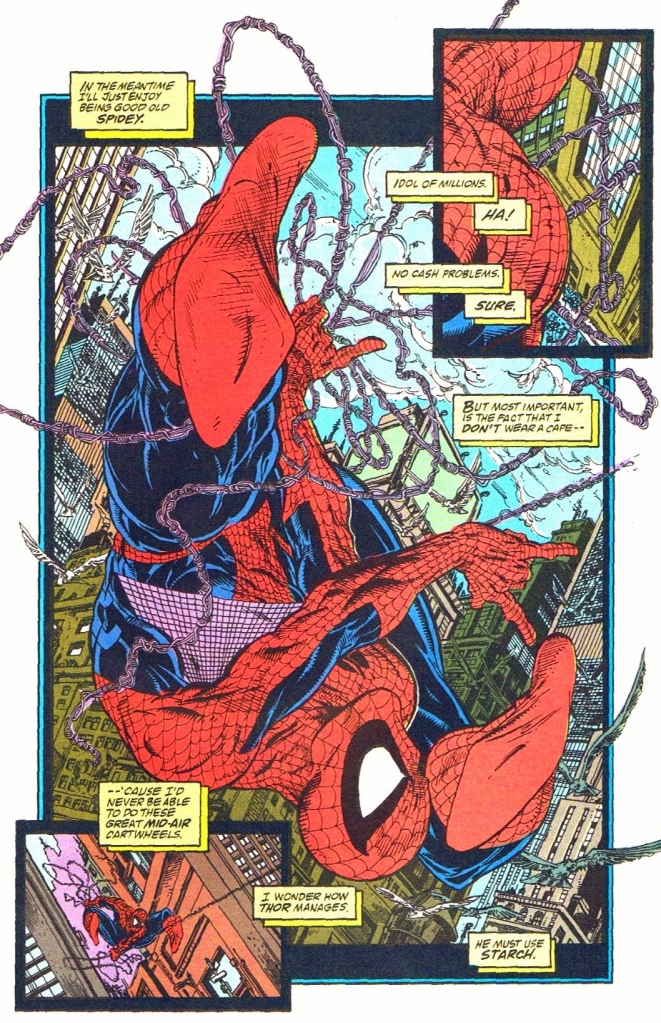
This page is an example of Todd McFarlane creating a travel sequence that allowed him to draw something great. It’s a classic example of moving back into the comfort zone.

To make things very clear here, this comic book is pretty shallow and hollow mainly due to its storytelling as this was the writing of a very young Todd McFarlane. There is no denying that his art here is great to look at from start to finish. In fact, this was one of McFarlane’s finest visual works ever with Marvel.

But if you look beyond the great visuals, the writing is very weak all throughout the issue. At best, this comic book is a grand-looking yet shallow set-up for the conflict of the Torment storyline complete with shared emphasis on the iconic web-slinger, the Lizard (looking more menacing than before) and Calypso (the one behind the magic and rituals).

In fairness to McFarlane, he added his own touch on emphasizing the personalities of Peter Parker and wife Mary Jane simultaneously as a couple. If you were used to seeing in-depth character development and witty dialogue about the two major characters as portrayed in the Amazing Spider-Man, Web of Spider-Man and Spectacular Spider-Man series of 1990, you won’t find them in this comic book. Under McFarlane’s writing, Spider-Man in this issue showed signs of sarcasm and cockiness in the first scene, and with Mary Jane he (as Peter Parker) expressed himself philosophically. To say the least, the portrayal of Spider-Man here is noticeably different under McFarlane.

The Lizard, a long-time rival of Spider-Man’s, was presented to be very violent and murderous in this issue. This was clearly McFarlane’s approach on emphasizing the force of opposition that awaits the iconic web-slinger and he obviously went for a more adulterated approach with the visuals. That being said, the violent content in this comic book is very unique and clearly stood out from the rest of the Spider-Man-related comics published by Marvel in 1990. Lastly, I should say that McFarlane’s visual take on the Lizard is the best I have seen.  

Going back to the visuals, McFarlane implemented strong elements of horror, darkness and grittiness which went along well with the adulterated approach to violence.  These mixed elements, as they turned out in reality, became part of McFarlane’s future works past Spider-Man.

Conclusion

McFarlane’s vicious and horrifying approach on visualizing the Lizard can’t be ignored. This Lizard makes the cinematic Lizard of the 2012 movie The Amazing Spider-Man look cartoony.

Spider-Man #1 (1990) is a very mixed bag when it comes to literary enjoyment. It clearly has great artwork by McFarlane whose adulterated approach on expression and spectacle made it very unique. The writing by McFarlane (who was very young at the time of production) is clearly the big letdown although his own approach on portraying Spider-Man, MJ and the Lizard are very notable. Take note that this was Todd McFarlane starting with writing while doing the art (his true strength), and at this point in comic book history his talent on telling compelling stories would not be realized until a few years later (particularly with Spawn and Image Comics). Notably, his use of visual horror and darkness predates his work in Spawn which makes his Spider-Man take very distinct. Ultimately, this comic book served as a build-up for things to come in the Torment storyline. Don’t expect too much when acquiring this comic book.

Overall, Spider-Man #1 (1990) is satisfactory.

+++++

Thank you for reading. If you find this article engaging, please click the like button below, share this article to others and also please consider making a donation to support my publishing. If you are looking for a copywriter to create content for your special project or business, check out my services and my portfolio. Feel free to contact me with a private message. Also please feel free to visit my Facebook page Author Carlo Carrasco and follow me on Twitter at  @HavenorFantasy as well as on Tumblr at https://carlocarrasco.tumblr.com/ and on Instagram at https://www.instagram.com/authorcarlocarrasco
A Look Back at Armorines #6 (1994)

Welcome back superhero enthusiasts, 1990s culture enthusiasts and comic book collectors! Today we go back to the early 1990s and explore a part of the Valiant Comics shared universe through the Armorines monthly series.

During the said decade, Valiant Comics was notable for having crossovers that some readers found to be tightly executed in relation to continuity. The armored U.S. Marines (Armorines) and the powerful individual X-O Manowar have the spider aliens as a common enemy.

With those details laid down, here is a look back at Armorines #6, published in 1994 by Valiant Comics with a story written by Jorge Gonzalez and drawn by Jim Calafiore.

The cover.

Early story

The story begins in space when the spider aliens (located inside a huge space ship) are organizing themselves to get back to their home world.

Meanwhile above the Earth, X-O Manowar significantly helps the Armorines with repairing their space shuttle. It turns out that they have been spending a long time in space and the crew has gotten exhausted after the big battle with the spider aliens. Going back home was their next objective.

Just as the crew prepares to return to Earth, the same huge space ship of the spider aliens suddenly approaches them…

Quality

The spider aliens.

Set after the crossover tale about the humans’ battle with the spider aliens in space, this tale served as a creative extension of those events utilizing space travel and sci-fi action concepts. The Armorines once again fight the spider aliens and X-O Manowar (a major Valiant character) gets heavily involved as he has a personal grudge against them. Without spoiling the plot, I can say that themes of freeing yourself from the enemy and getting back home are evident.

There is plenty of action to enjoy here and the sci-fi settings (including the interiors of the spider aliens ship) are nicely presented. I also like the fact that the tension gradually built-up as the story went on. Still, at this particular stage of this series, I could not help but feel that the Armorines have been in conflict with the spider aliens for too long.

Conclusion

There is a lot of sci-fi action to enjoy here.

Armorines #6 (1994) is a pretty good read but I was getting tired of seeing the Armorines remaining in conflict with the spider aliens. What added strong value to the comic book was the heavy involvement (and crossover) of X-O Manowar and his interactions with the Armorines was well executed. To be clear, the story was not conclusive and at this stage, I still am interested to see what would happen next. Here is hoping that the Armorines conflict with the spider aliens will improve somehow.  

Overall, Armorines #6 (1994) is recommended.

+++++

Thank you for reading. If you find this article engaging, please click the like button below, share this article to others and also please consider making a donation to support my publishing. If you are looking for a copywriter to create content for your special project or business, check out my services and my portfolio. Feel free to contact me with a private message. Also please feel free to visit my Facebook page Author Carlo Carrasco and follow me on Twitter at  @HavenorFantasy as well as on Tumblr at https://carlocarrasco.tumblr.com/ and on Instagram at https://www.instagram.com/authorcarlocarrasco
A Look Back at G.I. Joe: A Real American Hero #23 (1984)

Welcome back superhero enthusiasts, 1980s culture enthusiasts and comic book collectors! Today we go back to the mid-1980s to explore Marvel Comics’ extensive publishing of a comic book series based on the wildly popular military-themed franchise of toys – G.I. Joe: A Real American Hero.

Whenever a war between good and evil happens, it is only desirable for people siding with the good guys to score a major breakthrough against the evil ones. Breakthroughs include annihilating the enemy entirely or compelling them to surrender unconditionally, or capturing one of their most powerful leaders alive.

With those details laid down, here is a look back at G.I. Joe: A Real American Hero #23 published in 1984 by Marvel Comics with the main story written by Larry Hama and drawn by Mike Vosburg.

The cover.

Early story

The story begins near the Italian border of Switzerland. GI Joe member Snow Job sits high up on a cliff and monitors an institute from long distance. He carefully sees the Baroness (wearing a white garment) and reports to Duke about it. Duke, who is seated close to Roadblock in public, tells him to maintain passive surveillance as their team is anticipating that the Baroness will lead them to Cobra Commander.

Moments later, Roadblock notices a man across the street coming out from one of the buildings. The man turns out to be Major Bludd, a mercenary working for Cobra. Duke then sends a message to Cover Girl and Clutch (both of them riding a car elsewhere) to follow Major Bludd…

Quality

Cover Girl and Clutch chase the vehicle that has Major Bludd and Baroness.

I really like this story. While this is clearly not the bombastic, gun-blazing conflict between G.I. Joe and Cobra, this tale has stronger elements of espionage, suspense and intrigue nicely mixed together. The story moved at a medium pace and there were suitable pay-offs to the build-up that occurred throughout.

While the cover of this comic book is indeed a spoiler, it is within the details of the script and its story structure that justified the capture of one of Cobra’s most notorious figures. How G.I. Joe pulled it off and what obstacles they went through were nicely portrayed by the Hama-Vosburg team.

Not only that, the comic book also shed light on the character moments and story developments told through the side of Cobra which are quite intriguing to read.

Conclusion

Cobra Commander making his way through in the American town of Springfield which is their front.

G.I. Joe: A Real American Hero #23 (1984) is another fun and engaging tale Larry Hama crafted. The creative team succeeded in justifying the capture of Cobra Commander (as seen in the cover) while giving readers some new insights about the characters and how they do their duties. By the time I reached the end of this comic book, I was satisfied and convinced to look forward to what would happen next.

Overall, G.I. Joe: A Real American Hero #23 (1984) is recommended.

+++++

Thank you for reading. If you find this article engaging, please click the like button below, share this article to others and also please consider making a donation to support my publishing. If you are looking for a copywriter to create content for your special project or business, check out my services and my portfolio. Feel free to contact me with a private message. Also please feel free to visit my Facebook page Author Carlo Carrasco and follow me on Twitter at  @HavenorFantasy as well as on Tumblr at https://carlocarrasco.tumblr.com/ and on Instagram at https://www.instagram.com/authorcarlocarrasco