Welcome back my readers, YouTube viewers and all others who followed this series of articles focused on YouTube videos worth watching. Have you been searching for something fun or interesting to watch on YouTube? Do you feel bored right now and you crave for something to see on the world’s most popular online video destination?
I recommend you check out the following videos I found.
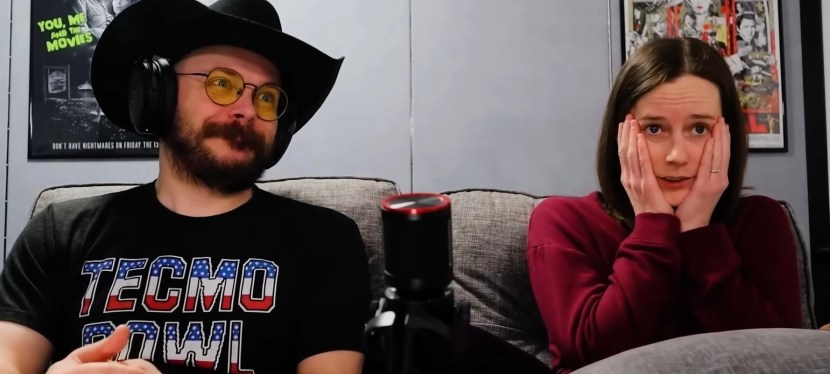
#1 2002 Resident Evil Movie Revisited – Almost a quarter-century ago, the first-ever live-action Resident Evil movie was released in cinemas directed by Paul W.S. Anderson and starring Milla Jovovich. Believe it or not, the 2002 movie was realized after the original film project involving zombie movie legend George Romero – who even directed the Japanese market TV commercial of Resident Evil 2/Bio Hazard 2 – got scrapped. Having played many RE games, I saw the movie in the local cinema upon release and went home feeling numb and alienated. Even though the film was never an adaptation of the games (note: no RE character from the games appeared in the movie) and it had its own concepts, there are still some people who enjoyed it or endured the moments of suspense and horror. To learn how it impacts viewers, watch the reaction videos below.
#2 Ranting For Vengeance Slams Spider-Man: Brand New Day And The Modern Culture Behind It –The first trailer of the upcoming movie Spider-Man: Brand New Day drew a lot views from around the world but YouTuber Ranting For Vengeance was not fooled by it. In his recent video, he slammed the new movie and explained in detail the woke elements or so-called modern culture behind it. He also stressed that the real good stories of Spider-Man are in the comic books from long ago and the only good Spider-Man films are those directed by Sam Raimi. To learn more, watch Ranting for Vengeance’s video below.
#3 The Negative Effects Of Sports Betting Exposed – As technology evolved, making bets on sports events – right down to specific achievements or action – has gotten more convenient to do and has turned normal in society. However, there are indeed negative effects and regrets that come with it. Watch and learn from the 700 Club video below.
#4 Remember America’s Lunch Counters? – Decades ago in the United States, lunch counters were popular as they provided customers not only a place to enjoy their meals but also become a part of a “counter community” where they interact with the cook (or assistant) on the other side, and chat with fellow customers on the side. Lunch counters have disappeared in most parts of America and there are some young people who never knew they existed. Here is a nostalgic look back at America’s lunch counters.
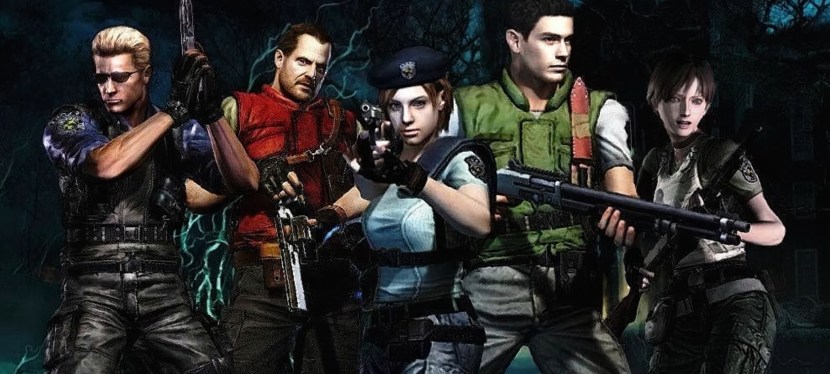
#5 Cancelled Creatures Of Resident Evil Games – The Resident Evil games franchise turned 30 this year. Not only did Capcom release a lot of RE video games through the decades and had several characters which resonated with gamers, a lot of monsters/creatures were also featured on top of the zombie hordes. Like movies or TV shows, the RE video games had content that never made it in versions that were commercially released and among them are many creatures or monsters that were either conceptualized or even produced. To find out what those cancelled creatures are, watch ScorePN’s number below.
#6 Customers Attracted By Kappabashi Kitchen Town – Have you heard of Kappabashi Kitchen Town? It’s a place in Tokyo, Japan, which has been attracting different types of customers as it has a nice variety of products for sale. There are locals who need something for their cooking needs or for their business operations. Unsurprisingly, foreigners are also attracted to the place. To find out more about Kappabashi Kitchen Town, watch the Nippon TV video below.
#7 Starman Retrospective – I saw the 1984 science fiction film Starman a number of times through the decades. Directed by John Carpenter and starring Jeff Bridges, Starman is about an unlikely relationship between a recently widowed woman and an alien being who cloned the human body of her later husband. Starman is a fine film and its production history is also fascinating to explore. To find out more about Starman, watch the videos below from Represent This.
Welcome back my readers, YouTube viewers and all others who followed this series of articles focused on YouTube videos worth watching. Have you been searching for something fun or interesting to watch on YouTube? Do you feel bored right now and you crave for something to see on the world’s most popular online video destination?
I recommend you check out the following videos I found.
#1 Resident Evil Bonanza (1996 Original and 2002 Remake) – Thirty years ago this month, the original Resident Evil video game was released on PlayStation and it impacted console gaming by moving towards an adulterated direction with zombie horror and mad science as core elements. The 1996 game led Capcom to making Resident Evil sequels and spin-offs in the years that followed. Then in 2002, an ambitious remake of Resident Evil was released on the Nintendo GameCube and it became the definitive version RE creator Shinji Mikami and his team came up with. To explore Resident Evil in its original version and the remake, watch the videos below.
#2 Living In Las Vegas –For decades, Las Vegas in Nevada has always been known as a major tourist destination with lots of hotels, casinos and other entertainment joints clustered together. There is also the perception that a lively city like it means there are lots of job opportunities and business or investment options to pursue there. What most people do not realize is that Las Vegas is not exactly the ideal city to move into and live in due to many factors that can be challenging and stressful to deal with. To discover why, watch the videos below.
#3 Popcorn In Bed Reacts To Logan’s Run – It has always been argued that science fiction movies released before Star Wars were not too exciting to watch. One of them was Logan’s Run which continues to have a divisive reception among movie buffs both young and old. There are some who liked its concept and execution, while others dismissed it for being corny or even being symbolic about the sexual revolution of the 1960s and 1970s. If you want to discover the film without spending money on it, watch Popcorn in Bed’s reaction video below. Observe how the movie impacts her.
#4 The History Of Atari Arcade Games – I was fortunate enough to have played games in video arcades in the 1980s. In the old days, Atari was a major arcade industry player apart from being big on console gaming. Atari was also responsible in bringing its arcade games to Japan (with Namco as its partner) and also brought some of Namco’s games into American arcades. If you love Atari, arcade games and retro gaming in general, watch the video documentaries below.
#5 Ranting For Vengeance Demolishes Woke Nuts’ Take On Resident Evil’s Chris Redfield – Going back to Resident Evil, it is not surprising that the mob of woke zealots, LGBTQ activists and other Leftists keep on creeping in on existing entertainment franchises to deform them and make it fit their wicked ideology. Recently there were woke nuts online who targeted the Resident Evil icon Chris Redfield and perceive him as gay. Ranting For Vengeance posted a video to demolish the woke mob’s take on Redfield and he explains in detail why the iconic hero has always been straight since the very beginning. Watch the video below and share it with all Resident Evil fans out there.
#6 Forgotten Video Games Based On Movies – Remember back in the old days when there were a lot of video games based on movies released? Back then, there was money to be made on licensing and merchandising. As a gamer and movie buff since youth, there definitely was excitement whenever I learned a game about a film I enjoyed was made available. Of course, there were games that turned out fun and others ended up being disappointing or even very poor in quality. Check out the video below about the forgotten movie-based games.
#7 How Hollywood Killed The Oscars – Avoiding the Academy Awards (AKA Oscars) is absolutely fine. It no longer celebrates the best of filmmaking and it has been overwhelmed by woke activists, Satanic Leftists, modern day Commies and the like. Communist Hollywood (Commiewood) has been using the Academy Awards to amplify its wicked agenda for a long time now. The old glory and the celebration of the best of filmmaking are truly gone. Watch the video below.
#8 National Security Council Secretary Ali Larijani And Basij Commander Of Iran Eliminated By Israel – I recently blogged about the eliminations of two high-ranking officials of the Islamic terrorist regime of Iran as the conflict in the Middle East went on. It was Israel which successfully killed Ali Larijani and a Basij commander and it was the most significant achievement since the elimination of the demon Ali Khamenei. Right now, it is not clear who is really leading the remaining wicked regime and Iran’s military has been decimated by America and Israel. Keep in mind that the military operations against Iran is all about bringing down the Islamic terrorist regime and liberating the oppressed Iranians so they can take their country back after 47 years. For insight about what happened, watch the videos below.
#9 The Revival Of A Japanese Sake Brewery – It is always depressing to see your own business get destroyed because of a natural disaster. In Japan, a certain brewery that produced sake got ruined when a huge earthquake struck. Since then, the owner started hard efforts to revive the business. To discover what happened, watch the Nippon TV video below.
Welcome back my readers, YouTube viewers and all others who followed this series of articles focused on YouTube videos worth watching. Have you been searching for something fun or interesting to watch on YouTube? Do you feel bored right now and you crave for something to see on the world’s most popular online video destination?
I recommend you check out the following videos I found.
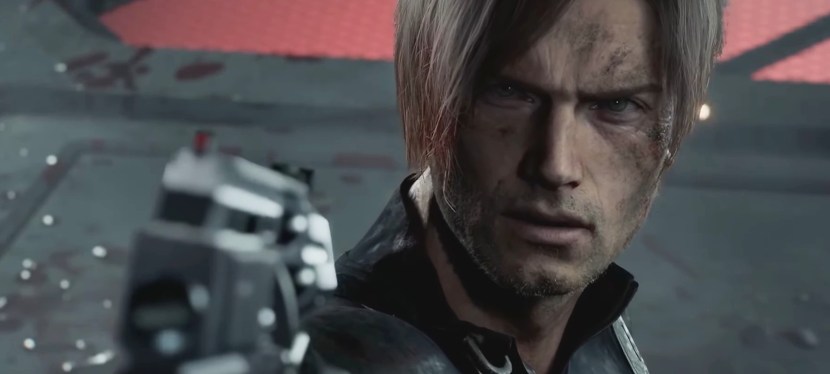
#1 Leon Kennedy Is Gaming’s Significant Action Hero – Have you guys played Resident Evil: Requiem? I have not played it but the most notable buzz I heard about it was it emerged as a commercial success, and Leon Kennedy’s significance as a video game action hero is stronger than ever. Having played Resident Evil 2 of 1998 and 2019, plus Resident Evil 6, I can say that Leon Kennedy is a video game icon by today’s standards. In my view, the fictional hero is comparable with Clint Eastwood’s Dirty Harry. To learn more about the significance of Leon Kennedy and the quality of Resident Evil: Requiem, watch the video of Ranting for Vengeance below.
#2 Resident Evil of 1996 Revisited – Thirty years ago this month, Capcom released Resident Evil on PlayStation (followed by the Windows PC and Sega Saturn versions) and it became a big hit with gamers and critics. Since then, the Resident Evil games grew into a popular multimedia entertainment franchise and it is easily one of the most significant game franchises of all time. The 1996 original game was a successful experiment and it had a lot of content that added to its replay value. Times like these, it is important to revisit the first-ever Resident Evil game and I found a very comprehensive video about it which you can watch below.
#3 Fast Food In 1980s America – When I first visited the United States of America in 1989, me and my relatives had lots of fast food stops as we moved from one state to another by car. We had a nice variety of meals from food joints like Carl’s Jr., Burger King, McDonald’s, and Taco Bell to name some. I also had fast food stops when I revisited America in 1997, 2001, 2008 and 2011 but those experiences never matched the food stop experiences I had in 1989. To see what fast food in America was like in the 1980s, watch the video below.
#4 How Las Vegas Joints Scam Customers Without Breaking Laws – When I visited Las Vegas in 2011, I did not enjoy it that much because almost everything around me was too expensive. We stayed at a hotel along the famous Las Vegas strip which meant we were literally trapped by high rates here and there. As it turns out, the businesses there have been scamming customers and tourists without necessarily violating laws. How did they do it and what can you do to avoid such scams? Watch and learn from the video below.
#5 You, Me And The Movies React To The Godfather Trilogy – What is there to say about The Godfather movies of 1972, 1974 and 1990? Directed by Francis Ford Coppola, those movies were the most definitive cinematic portrayals of the mafia as well as the struggles of an Italian-American family. Al Pacino will forever be remembered as Michael Corleone while the late Robert Duvall was very memorable playing the great lawyer Tom Hagen. A few years ago, You, Me and the Movies took the effort to watch and react to The Godfather, The Godfather Part II and The Godfather Part III. I like how each movie – even with the third being the weakest and most disappointing one – drew their reactions. Watch and enjoy their reaction videos below.
#6 Ashleigh Burton Reacts To Annie – I never saw the 1982 musical film Annie in the cinema. As a young boy back then, I do remember the strong marketing and promotion of the movie prior to its release. A short time after its theatrical run, there were people in our local community singing “Tomorrow, Tomorrow, I Love You, Tomorrow, You’re Always A Day Away” and citing lines from the movie. Historically, Annie was not exactly a gigantic hit and it was made with a very large budget of $35 million. If you want to discover what Annie is about, I encourage you all to watch Ashleigh Burton’s entertaining reaction video below.
#7 Affordable Japanese Cruises – Have you thought about visiting Japan and spending time in a cruise ship? Considering the economic developments and trends of recent years, it seems cruises there are becoming more affordable and the great deals are only increasing. Watch and learn from the Nippon TV video below.
#8 The Ticking Structural Disaster Of San Francisco – Do you often spend time in San Francisco? Deep within the city is the high-end Millennium Tower and it is already a ticking disaster that could cause massive damage and deaths. This is because Millennium Tower has been leaning and sinking for many years now, and there is no solid way to solve its problem. If you intend to work and/or live in San Francisco, better stay away from Millennium Tower!
Welcome back my readers, YouTube viewers and all others who followed this series of articles focused on YouTube videos worth watching. Have you been searching for something fun or interesting to watch on YouTube? Do you feel bored right now and you crave for something to see on the world’s most popular online video destination?
I recommend you check out the following videos I found.
#1 A Notable, Dark Scene In The Godfather – Early this year, the lost world the legendary actor Robert Duvall who passed away at age 95. He truly was one of the greatest actors ever not only in Hollywood but in global cinema. I best remember Duvall as Tom Hagen in The Godfather and it just so happens that the film has a very notable deleted scene and if you read the novel focused on Jack Woltz, you will realize the darkness behind it. For your viewing, posted below is a video focused on Tom Hagen and Jack Woltz, and the deleted scene itself.
#2 The History Of Raccoon City And The Resident Evil Events –This year marks the 30th anniversary of the best-selling Resident Evil game franchise. Having played the first three Resident Evil games on PlayStation, Raccoon City was the hot spot of misadventures, zombie outbreaks, and criminal science. As more RE games got released, Capcom expanded the lore with background tales, audio recordings, artworks and more. If you want to dive deeply into the fictional history of Raccoon City and why its legacy is tied with the Umbrella corporation, go watch the video below.
#3 The Wholesome Hotel In Las Vegas – The first time I ever visited Las Vegas was in 1989. I was only 13-years-old back then and our family stayed in Circus Circus Hotel and Casino. Even though the hotel had gambling joints within, I still noticed how family-friendly the place was as it had an indoor circus venue, circus games, makeshift museums and a video arcade (where I played many classic arcade games). If there were any significant changes that happened through the decades, it would be the presence of an indoor amusement park with rides which reflects the hotel’s focus on attracting families and tourists who have limited budgets. Here’s another close look at Circus Circus in Las Vegas.
#4 Rushed And Incomplete RPGs – If there is any way to quickly describe a role-playing game (RPG) in video game format, it would be the fact that it was made to be lengthy and have a lot of content created for it. Like what happened in movies, productions of RPGs face similar problems with regards to lacking time and/or money which in turn would force the game makers to cut down their designs just to complete it. In the history of video games, the first PlayStation console was rich with RPGs in the late 1990s. Some of them turned out to be rushed and incomplete. To find out which ones, watch the retro gaming video below.
#5 Looking For “Luxury” Buffets In Japan? – With the Japanese Yen hovering about 150 per one American Dollar, a lot of foreigners find Japan a more affordable place to explore and experience. In certain places, tourists can find buffets that they consider “luxurious”. But what exactly makes a food joint luxurious and what would a traveler hope or want to eat there? Watch and learn from the Nippon TV video below.
#6 Eraser Revisited – Almost 30 years ago, the action movie Eraser (starring Arnold Schwarzenegger) was released in cinemas and I had a fun time watching it. When it comes to action film roles of Schwarzenegger, the US Marshal John Kruger was very unique to watch. It should be noted that James Cromwell had another schemer-type of role in the film. To discover more about the 1996 movie, watch the videos below.
Welcome back my readers, YouTube viewers and all others who followed this series of articles focused on YouTube videos worth watching. Have you been searching for something fun or interesting to watch on YouTube? Do you feel bored right now and you crave for something to see on the world’s most popular online video destination?
I recommend you check out the following videos I found.
#1 Dead Rising Revisited – I can hardly believe that it will be twenty years since I first play Dead Rising on a rented Xbox 360 console. Released by Capcom in August 2006, Dead Rising is a zombie apocalypse adventure game developed by a Japanese team with Keiji Inafune (Mega Man) as producer. As its story was mainly set in a shopping mall, the game was easily compared with the Dawn of the Dead movies. When I first played it, I was hooked as the gameplay was pretty playable and the in-game action was entertainingly exaggerated. That said, now is a good time to revisit Dead Rising with the video below.
#2 The Binions In Las Vegas –I have toured Las Vegas twice in my life. Still, I never actually visited Binion’s Gambling Hall and Hotel which is located in Downtown Las Vegas on the Fremont Street Experience. Historically, it is know as the place where the World Series of Poker started and it had a unique gambling atmosphere with classic table games and low-limit slots. However, if you look even deeper into the history of the Binions place and the family that originally owned, there is something darker and intriguing to discover. Watch and learn from the video below.
#3 Night Of The Living Dead (1968) Revisited – What is there to say about the original Night of the Living Dead movie from 1968? The George Romero-directed zombie apocalypse movie has long been declared as the most definitive zombie horror movie and was considered as the turning point in horror film-making. As such, it is not surprising to see the movie (in public domain since the beginning) featured in multiple movie reaction videos and retrospective videos on YouTube. For your curiosity and enjoyment, watch the videos below.
#4 Notable Places Beneath Tokyo Tower – The last time I toured Japan was way back in 1997. During that same trip, I visited Tokyo Tower and enjoyed a fine view of the city several feet above ground. As our city tour moved on a somewhat tight schedule, I was not able to fully explore Tokyo Tower. That said, Nippon TV posted recently a video about the places to shop, visit and dine beneath the famous tower. Watch and learn from the video below.
#5 Street Fighter Alpha 2 SNES Version Examined – Back in 1996, I was an avid arcade gamer and Street Fighter Alpha 2 was my favorite among the many 2D fighting games available in local arcades. In late-1996, copies of Street Fighter Alpha 2 running on the Super Nintendo Entertainment System (SNES) were displayed in game stores which caught my attention because I never expected the console to be capable of processing the game and making it playable (note: Street Fighter Alpha games of the time were prominently released on PlayStation and Sega Saturn). To examine closely the quality of the SNES port of Street Fighter Alpha 2, watch the video below.
#6 Democrats’ Chuck Schumer Proved Himself Pathetic – Do you have a high-ranking representative or leader in government who does NOT care about you and the nation at all? The Democrats of America today are a bunch of unhinged, twisted, wicked and unpatriotic people who do not really care about the American people. One of them is the Democrats’ leader in the US Senate Chuck Schumer who prioritized the rainbow pride flag over America. Watch the video below.
Welcome back readers, fellow geeks and electronic gaming fans!
In this edition of the Retro Gaming Ads Blast (RGAB) series, we will take a look at another batch of retro gaming print ads from the 1980s to the 1990s focused mainly on role-playing games (RPGs) from the East and the West. This is the RPG Special!
For the newcomers reading this, Retro Gaming Ads Blast (RGAB) looks back at the many print ads of games (console, arcade, computer and handheld) that were published in comic books, magazines, flyers, posters and newspapers long before smartphones, social media, the worldwide web and streaming became popular. To put things in perspective, people back in the 1980s to the 1990s were more trusting of print media for information and images about electronic games and related products.
With those details laid down, here is the newest batch of retro gaming print ads for you to see and enjoy…
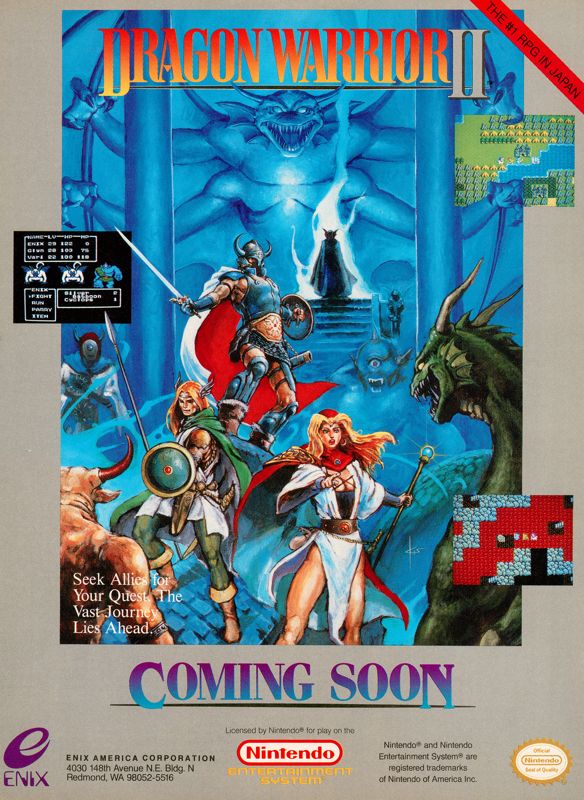
1. Dragon Warrior II Print Ad
The art style used made this one looked similar with Dungeons & Dragons.
When Dragon Quest was released in America titled as Dragon Warrior, its sales there came nowhere close to what it sold in Japan. The game, however, sold enough copies to convince Enix to bring the sequel Dragon Warrior II (Japanese title: Dragon Quest II) to the Nintendo Entertainment System (NES) in America and they came up with an ad that had obvious Western-style artwork to emphasize the fantasy elements. By comparison, the Japanese version of the game used the distinct art of Akira Toriyama (Dragon Ball Z). Back in those days, there was this belief that Toriyama’s art style would not be effective in promoting the game in America.
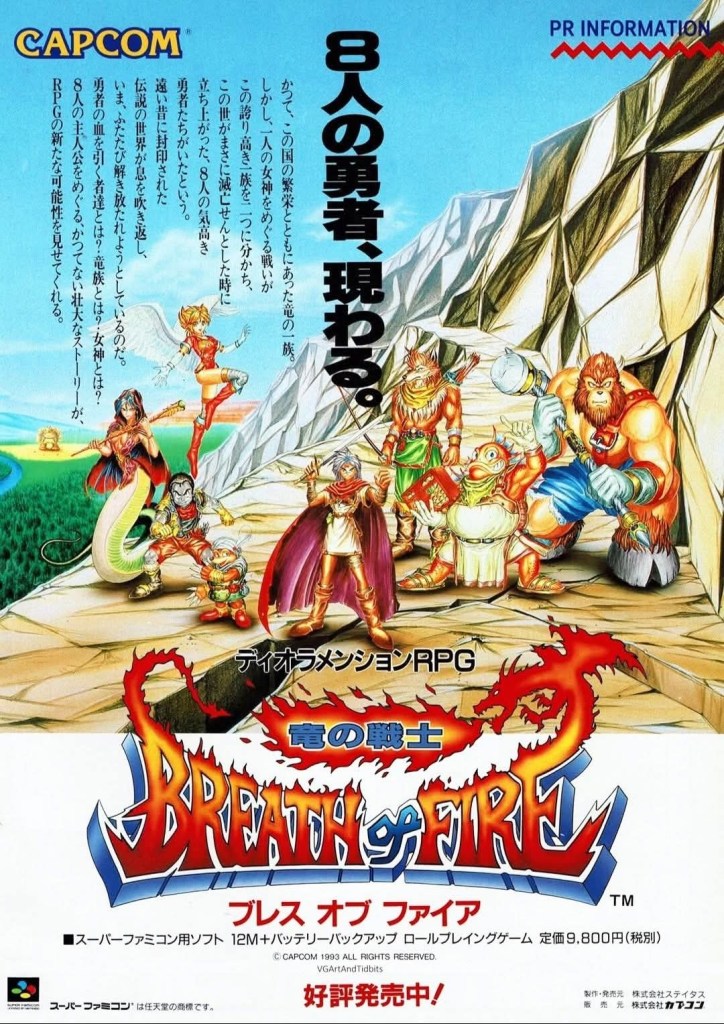
2. Breath Of Fire Japanese Print Ad
This is how Breath of Fire looked like in Japanese print media.
In 1993, Capcom officially broke into the Japanese role-playing game (JRPG) genre with Breath of Fire on the Super Family Computer (Super Famicom). The print ad they came up with for the Japanese market showed several characters – including Ryu and Nina who would later become recurring characters as sequels were released – with designs that had elements of anime and manga styles blended which contrasted the gritty and realistic approach of Western fantasy art. The ad made it clear to readers that new adventures in a fantastic world await them. The game achieved enough commercial success in Japan which convinced Capcom to make a sequel (plus more in the years that followed).
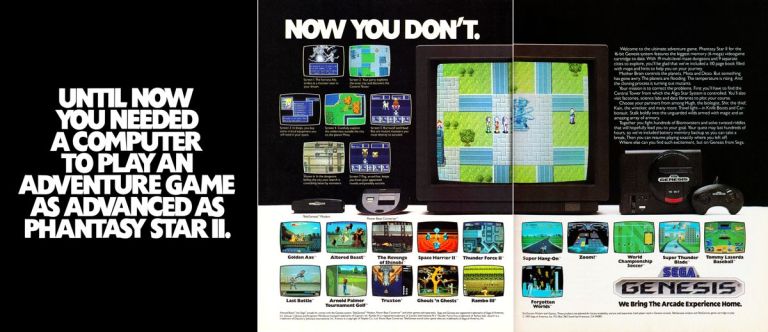
3. Phantasy Star II North American Print Ad
The 3-page ad showcasing Phantasy Star II and many other games.
After selling a good amount of copies of the original Phantasy Star worldwide on the Sega Master System, Sega knew they were on to something. They confidently produced the sequel Phantasy Star II for their brand-new Sega Genesis console in 1989 and aggressively promoted it in America with a daring 3-page print ad. If you look closely, majority of two of the pages were used to promote Phantasy Star II with screenshots (including a big one with a TV), the text description and the console. The spaces below allowed Sega to promote their many other games in convenient fashion. The result is huge success for Sega as more than 1.6 million copies of Phantasy Star II were sold worldwide. Sega would go on to make even more Phantasy Star games.
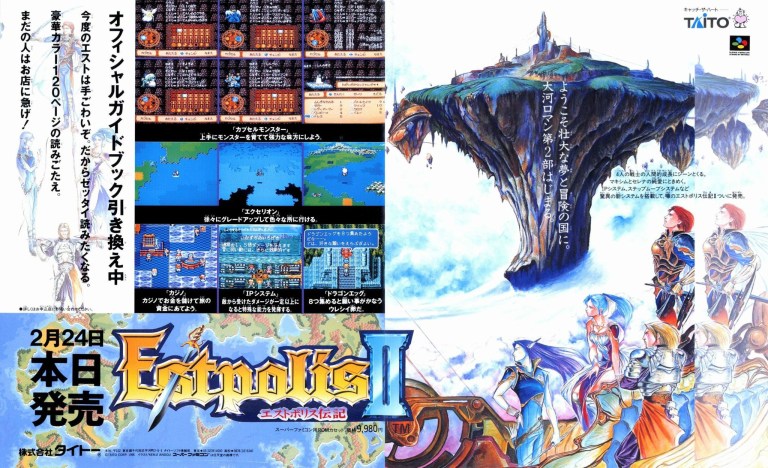
4. Estopolis Denki II Japanese Print Ad
Estopolis Denki II print ad in Japan.
When Estopolis Denki was released on the Super Famicom in Japan, sold enough copies to justify not only bringing the game to Western markets as Lufia & The Fortress of Doom but also the production of a follow-up titled Estopolis Denki II. To promote it, Taito made a Japanese print ad that had a captivating art style (with the characters looking more realistic and a floating land that had a gritty touch), some screenshots and the promise of fantastic adventures. While the game’s title sounded like a sequel, its story was actually set in the past. Estopolis Denki II would be released in the West as Lufia II: Rise of the Sinistrals.
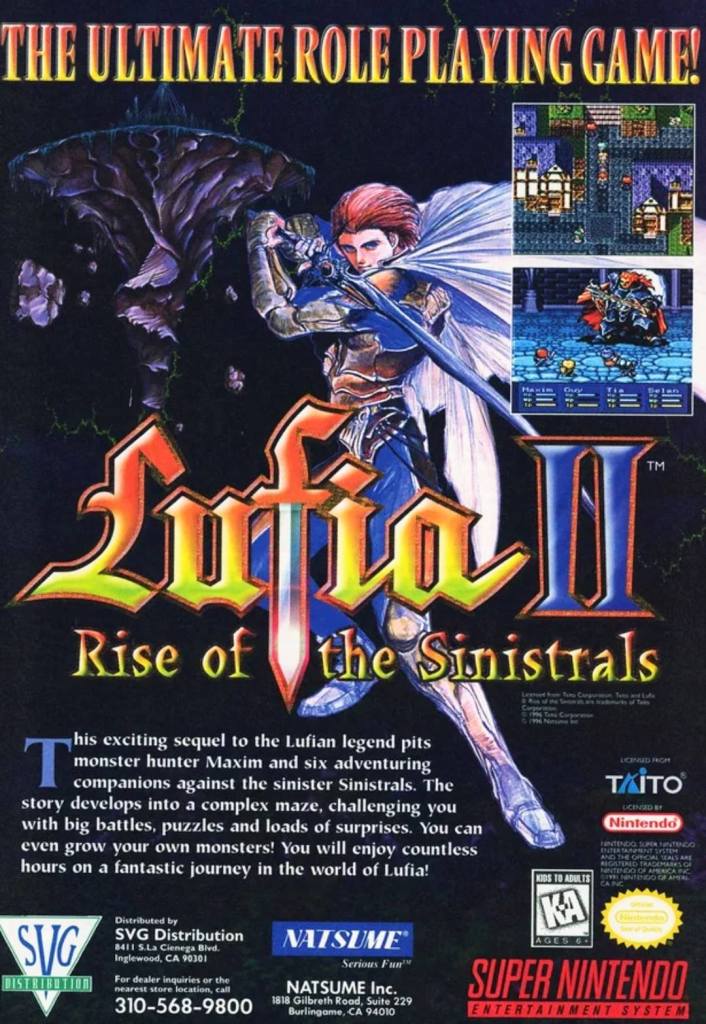
5. Lufia II: Rise of the Sinistrals North American Print Ad
Clearly Natsume did not have any game critics quotes to use to promote Lufia II.
When the first Lufia RPG was released in America on the Super Nintendo Entertainment System (SNES), it became a commercial hit finishing as the top SNES game in the February 1994 sales chart. The sequel Lufia II: Rise of the Sinistrals was published by Natsume in America in 1996 and they daringly called it “The Ultimate Role Playing Game!” in its print ad utilizing the official artwork of a major character, two screenshots and descriptive text giving readers an idea on what to expect. This ad strongly relied on the visual elements while the first game’s American print ad (made by Taito) emphasized the critical acclaim received.
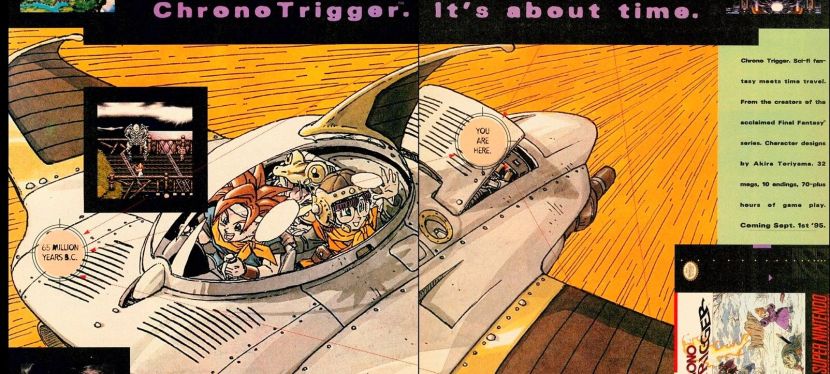
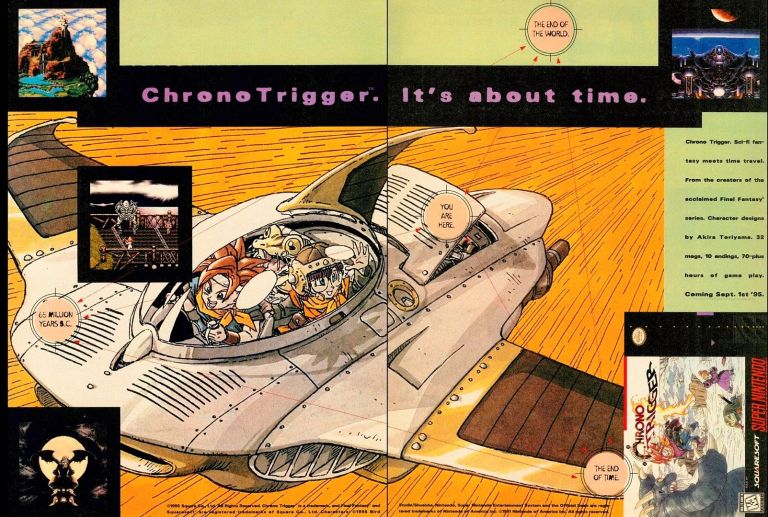
6. Chrono Trigger North American Print Ad
A lot of Dragon Ball Z fans recognized the art style of Akira Toriyama here.
Chrono Trigger, the JRPG that had the dream team creators of Hironobu Sakaguchi (Final Fantasy creator), Yuji Horii (Dragon Quest creator) and Akira Toriyama (Dragon Ball Z creator) behind the production, was easily the most ambitious game SquareSoft released in 1995. As part of the marketing strategy for the North American market, Square came up with a 2-page ad that had Toriyama’s art as the dominant image while using the remaining space for screenshots, the description and the SNES box cover placed strategically. Such a creative visual design was eye-catching and even memorable. Chrono Trigger became a huge commercial and critical hit in the West and it has long been regarded as a classic JRPG.
7. Secret of Evermore North American Print Ad
The creepy red images overshadowed the promotion of Secret of Evermore in America. Some readers might have been scared away by this ad.
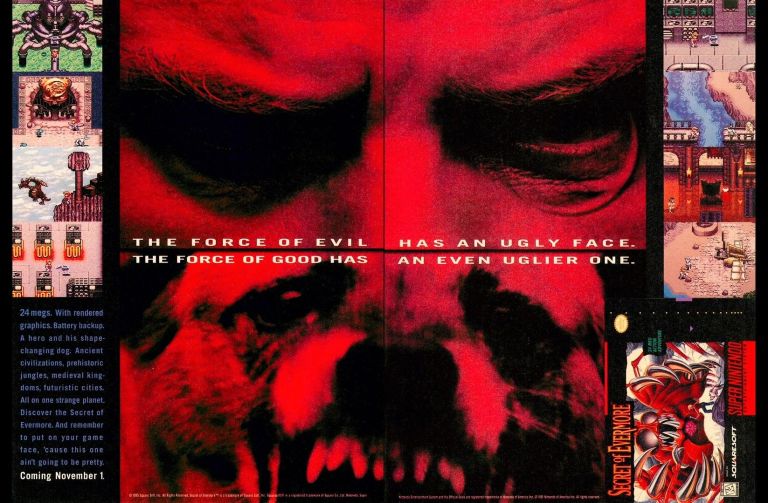
Still in 1995, Square released Secret of Evermore for the SNES. Unlike most of Square’s RPGs, Secret of Evermore was developed by an American team in Washington state which explains why the game has a very distinct tone and strongly Western art style (note: the gameplay was patterned after that of Secret of Mana). To promote the game, Square came up with a very odd-looking 2-page print ad that had two dominating red images – eyes of a man on top and the front of a dog below) that felt like a forced approach to emphasize the game’s concept of the hero (a teenager boy) and his loyal dog (a very capable fighter). They used the remaining space for screenshots (which made gamers believe it was a sequel to Secret of Mana), the game box cover and a not so helpful text description. In my view, this print ad was a marketing misfire and Square could have produced hand-drawn art of the hero and his dog instead of the creepy red pictures.
8. Star Ocean: The Second Story North American Print Ad
A really odd-looking print ad.
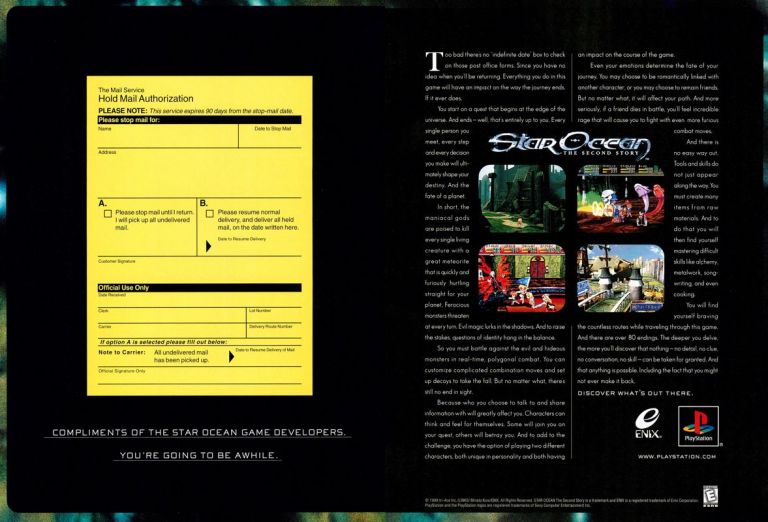
The Star Ocean JRPG franchise of Enix had its first game released in Japan only. That first game on Super Famicom sold a lot of copies which led to the production of the sequel Star Ocean: The Second Story. By the late 1990s, Enix itself had a partnership with developer tri-Ace on the Star Ocean games. Somewhere along the way, Sony Computer Entertainment America (SCEA) secured the publishing rights of Star Ocean: The Second Story for not only America but also in other parts of the world. For the American market, Sony came up with a very odd-looking 2-page print ad that had a mail service form on the left. The form emphasized the concept of being away for a long time (reflecting the science fiction and extensive fantasy adventuring of the game itself) which incidentally was the eye-catcher of the ad. The other half of the page showing the game’s title, screenshots and detailed text description got overshadowed. This is another marketing misfire.
9. The Legend of Dragoon North American Print Ad
The movie poster-inspired print ad is memorable to look at.
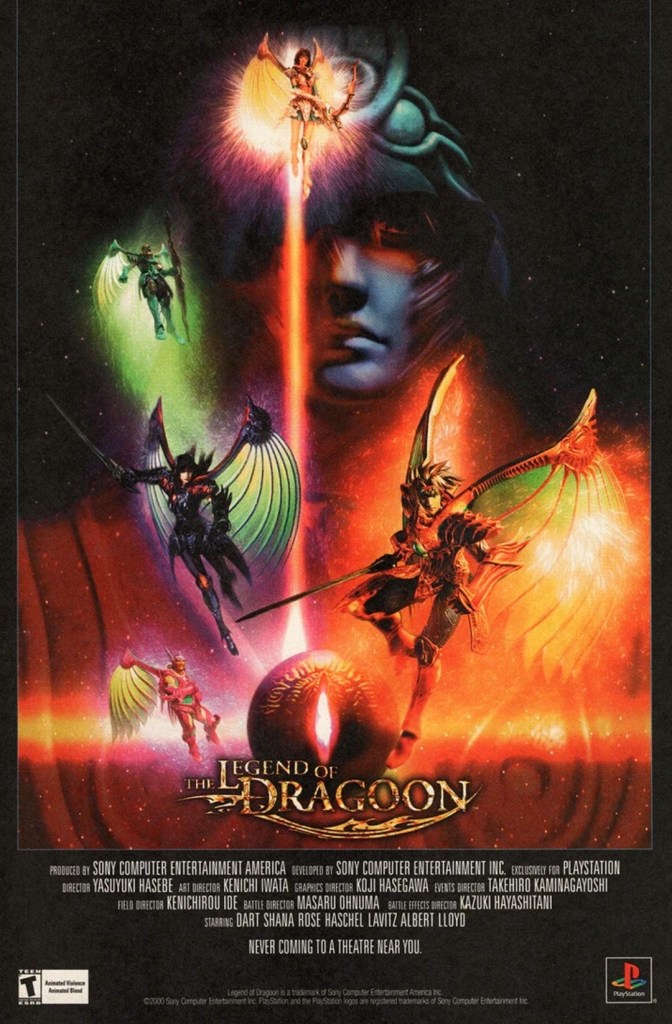
Given how success Sony was with selling PlayStation consoles worldwide and how massively successful the Final Fantasy RPG franchise of SquareSoft was, it was not surprising that they decided to make their very own big-budget and exclusive JRPG with the intention to succeed and possibly establish a franchise. The result was the PlayStation-exclusive game The Legend of Dragoon which was made with a budget of $16 million and lasted three years in development. The game was released in Japan in late-1999 and sold at least 280,000 copies (note: majority of that in its first week of sales). In preparation for the June 2000 launch in America, Sony produced a print ad that had a very strong movie poster vibe showing what looked like painted art of the characters with vivid colors in the background and the title on the lower part. If you look closely, the credits were deliberately stylized over the way movie posters showed credits. While the game was not the massive hit Sony hoped for, it went on to become a million-seller and a great majority of its sales were from America. By today’s standards, the movie poster-like ad used to promote The Legend of Dragoon is memorable and an inspired piece of marketing work.
Welcome back my readers, YouTube viewers and all others who followed this series of articles focused on YouTube videos worth watching. Have you been searching for something fun or interesting to watch on YouTube? Do you feel bored right now and you crave for something to see on the world’s most popular online video destination?
I recommend you check out the following videos I found.
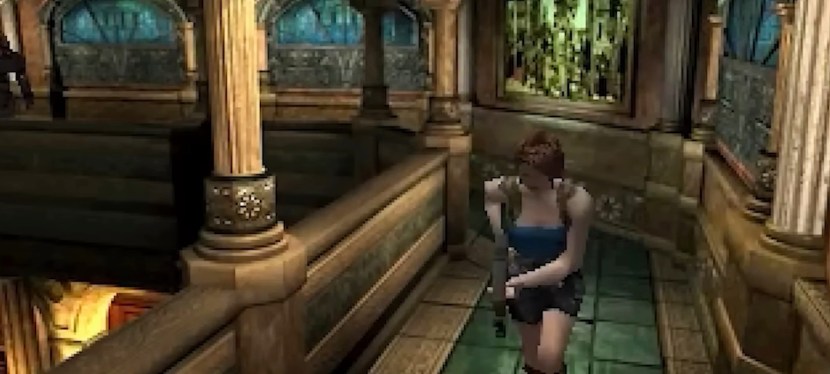
#1 Resident Evil 3: Nemesis Revisited – Looking back in the years 1998 and 1999, the Resident Evil franchise of games became wildly popular and was even considered by some as Capcom’s most important franchise. The huge success of Resident Evil 2 convinced Capcom to approve a line of several Resident Evil-related projects for release on different platforms. One of those projects was Resident Evil 3: Nemesis which was actually a side-story game released in late-1999 and eventually sold in the millions for the company. The reception from the fans was mixed…some fans felt it was a worthy follow-up to RE2 while others felt it was unsatisfying. To understand how RE3 came to be, which content got cut and what exactly happened behind the scenes, watch the retrospective video below.
#2 The Many Scams And Rip-offs In Las Vegas –Las Vegas can be a fun place to visit if only you have enough money, you know where to go and if you have the knowledge to prevent yourself from getting scammed or paying for the wrong things. Every day, a lot of people got fooled into paying questionable products/fees/services and getting cheated by different types of people in Las Vegas. To protect yourself and do the right things before visiting Las Vegas, watch and learn from the video below.
#3 Escape From New York Revisited – What can there be said about the 1981 movie Escape From New York? On face value, it looks like an action movie with a terrifying portrayal of New York City but it was something else. Director John Carpenter wrote the film as his reaction to the Watergate scandal, and their team hired Kurt Russell to play Snake Plissken. Even though it was never a massive blockbuster film, Escape From New York has some socially relevant themes and entertained people in different ways which explains why it has become the subject of many YouTube videos. Posted below for you are selected reaction videos plus one trivia video of the movie.
#4 The Hidden Villages Of Japan – When it comes to exploring Japan, there are a lot of places to visit way outside of the metropolitan areas. Nippon TV recently posted a video about Japanese villages that have been hidden in the mountains of the central part of the country. These places have been well preserved and the same can be said about their culture and traditions. There is also the famous “Samurai Road” that is scenic and should interest people who enjoy traveling along mountain trails. Watch and enjoy the video below.
#5 A Look Back At Stardust Of Las Vegas – The first time I visited Las Vegas was in 1989, and I saw the Stardust Resort and Casino while riding the car. I never had the chance visit Stardust but I noticed its appearances on TV and movies. Opened in 1958 and closed in 2006, Stardust was indeed a lively establishment of the Las Vegas trip having attracted lots of tourists and gamblers. Its legacy, however, is not very pretty as there were lots of criminal elements and scandals that happened behind the scenes. To learn about the history of Stardust, watch the video below.
Welcome back my readers, YouTube viewers and all others who followed this series of articles focused on YouTube videos worth watching. Have you been searching for something fun or interesting to watch on YouTube? Do you feel bored right now and you crave for something to see on the world’s most popular online video destination?
I recommend you check out the following videos I found.
#1 Tremors Revisited And Explained – By today’s standards, Tremors is a classic among monster movies (AKA creature features) Hollywood released. With the way it was written and presented, Tremors is always fun to watch again. I have seen it many times and yet it is worth repeating from start to finish. Behind the scenes, there were a lot of stuff, adjustments and unexpected developments that happened during production. If you wish to see such stuff, watch and learn from the Tremors videos of Represent This below.
#2 A Look At Excalibur In Las Vegas –I never had the opportunity to visit Excalibur in Las Vegas. During its first several years of operation, Excalibur welcomed countless tourists with its fantasy-themed atmosphere, designs, facilities and entertainment. Imagine having a meal while watching two knights riding horses and performing a joust in front of you. Imagine seeing members of the hotel staff wearing fantasy costumes. Like Circus Circus Hotel and Casino, Excalibur was a fine hotel that catered to families while still having casinos for gamblers. To learn more about what Excalibur was and what made it stand out among the hotels of Las Vegas, watch the video below.
#3 Meals At The Expressway In Japan – How often do you stop for a meal when traveling along a major highway? In many parts of the world, highways or expressways have clusters of gas stations, convenience stores, groceries and restaurants for travelers who need some relief from the stress of long travel. For many travelers, traveling far while being hungry can be a problem. In recent times, Nippon TV posted a video about meals and food items that travelers can find along expressways and the variety is interesting to see. Watch and learn from the video below.
#4 Cleopatra Movie Revisited – Way back in 1963, the movie Cleopatra starring Elizabeth Taylor and Richard Burton was released. The historical epic was made at a staggering cost of $44 million which was almost three times more expensive than 1959’s Ben-Hur. Behind the scenes, 20th Century Fox was in very deep financial trouble and many hard business risks were taken to make Cleopatra. Elizabeth Taylor, who signed a record-setting $1 million contract for the film, had health problems that added to the delay of the production. The film even lost its original movie director. To learn more about the history and the behind-the-scenes intrigue of Cleopatra, watch the video below.
#5 Innerspace Revisited – Innerspace (stylized as InnerSpace) from 1987 is a fun movie to watch and it has fine performances from Dennis Quaid, Meg Ryan and Martin Short. That said, it is not surprising to see Innerspace featured in reaction videos and retrospective videos by YouTubers. For your enjoyment, watch the videos below.
#6 Breath Of Fire Retrospective – When Breath of Fire was first released in 1993, it was a surprising Japanese role-playing game (JRPG) as it had a somewhat fresh concept and it was released by Capcom (already famous for fighting games). The first game was successful enough to convince Capcom to make sequels (released on other game consoles as technology evolved) achieving varying degrees of critical and commercial success. Going back to the original game, some wondered what made it notable and how the game came to be. To find out the history of Breath of Fire and what its story was about, watch the video below.
Welcome back my readers, YouTube viewers and all others who followed this series of articles focused on YouTube videos worth watching. Have you been searching for something fun or interesting to watch on YouTube? Do you feel bored right now and you crave for something to see on the world’s most popular online video destination?
I recommend you check out the following videos I found.
#1 Dawn Of The Dead Remake Revisited – Back in 2004, I saw the Dawn of the Dead remake inside a cinema located inside a shopping mall here in the Philippines. The Zack Snyder-directed film only inspired me to look for the 1978 original version of Dawn of the Dead directed by the late George Romero. The only thing the two films have in common is the concept of desperate people taking refuge inside a shopping mall during a zombie apocalypse. Zack Snyder’s film was more about violent action with horror elements blended with it. As Snyder went on to direct high-profile DC Comics superhero movies and produced other such projects of Warner Bros., it was natural for film buffs to gravitate to 2004’s Dawn of Dead which was his directorial debut. To learn more about the said remake and see the cinematic elements that formed the style of Snyder, watch the videos below.
#2 Premium Sushi, Hearty Tempura And Wagyu Beef For Breakfast In Japan –If you were traveling overseas, how hungry do you get when you start the day? Would you go for a simple and affordable breakfast or would you want something special in the morning? In Tokyo, there are these food joints that offer customers a luxurious breakfast with Wagyu beef, special tempura and premium sushi to name some. Already, local and foreign tourists are flocking to such food joints for the premium breakfast experience and you can learn more from the Nippon TV videos below.
#3 The Different Versions Of Final Fantasy VI – Among all the many Final Fantasy games released since 1987, Final Fantasy VI is still my favorite of them all. I first played the classic Japanese role-playing game (JRPG) on Super Nintendo Entertainment System (SNES) in 1994 which was titled “Final Fantasy III”, and it has a great epic story, a huge cast of playable characters, lots of unique gameplay features and great game design. Through the decades, Final Fantasy VI was ported to many consoles, mobile devices and even on personal computer. You might be wondering which version of Final Fantasy VI is the best in terms of visual quality, which one is the most available and which one is the most updated version. That said, you can find out by watching the video below.
#4 Castlevania II: Simon’s Quest Revisited – When Castlevania II: Simon’s Quest was first released on the Nintendo Entertainment System (NES) in 1987, many fans who enjoyed the first game were alienated by how different the sequel felt, looked and played. It still was horror-themed 2D adventure game with Simon Belmont as the playable protagonist again but the creative team of Konami implemented role-playing elements and open-world exploration into the gameplay. Major game design changes aside, Castlevania II still has a lot more than meets the eye and you can find out by watching the video below. Surely it will challenge what you know about Simon Belmont and the Castlevania lore.
#5 Why Feminists Support Islam – Let’s be very clear here. Islam is a truly ugly religion and it is incompatible not only with Western democracy and values, but also with several other cultures around the world. The strange thing is that modern-day feminists actually support Islam even though the ugly religion itself goes against women’s rights, against personal liberty and against freedom as we know it. In the video below, Ayaan Hirsi Ali explains in detail why mainstream feminists today support Islam, why feminism today is very twisted and why feminists even aligned themselves with Islamic terrorists.
Welcome back my readers, YouTube viewers and all others who followed this series of articles focused on YouTube videos worth watching. Have you been searching for something fun or interesting to watch on YouTube? Do you feel bored right now and you crave for something to see on the world’s most popular online video destination?
I recommend you check out the following videos I found.
#1 Timecop Revisited – I am not a fan of Jean-Claude Van Damme but his 1994 movie Timecop managed to entertain me when I first saw it on home video. After watching it, I learned that it was based on the Timecop literary property and stories published by Dark Horse Comics. Directed by Peter Hyams, Timecop ended up as one of the better movies of JCVD and it even has its own fanbase. If you want to discover more about the cinematic Timecop, watch the videos posted below.
#2 Inhumanoids Revisited –I remember seeing some episodes of the animated TV series Inhumanoids on local TV and I can say it was easily the most bizarre and even shocking thing to watch. Inhumanoid has a very dark and even cynical tone, and it had gruesome scenes which were really disturbing to see. Behind the scenes, Inhumanoids was animated by Japan-based Toei and involved Hasbro, Sunbro and even Marvel Productions. To find out what made Inhumanoids so disturbing, watch the video below and pay attention to the details.
#3 Luxurious Breakfast Spots In Tokyo – Have you ever thought about having a luxurious breakfast while traveling overseas? In Tokyo, Japan’s most famous city, there are indeed places where visitors can have breakfast with the premium experience. These luxurious places have something unique to offer to customers who have more than enough money to spend for the morning meal. Watch and learn from the Nippon TV video below.
#4 Remember The Rotoscoped Lord Of The Rings – Decades before Peter Jackson and his team rocked the world of moviegoers with memorable Lord of the Rings film trilogy, an animated LOTR was actually made. I am talking about the 1978 rotoscoped animated film The Lord of The Rings directed by Ralph Bakshi which I first saw on home video after seeing Peter Jackson’s LOTR. I found the 1978 LOTR a really unique animated viewing experience and it definitely involved a lot of production work without any use of computers. To find out more about the animated LOTR film, watch the video below.
#5 You, Me and The Movies React To Can’t Hardly Wait – When Can’t Hardly Wait was shown in cinemas in 1998, it faded away as not enough moviegoers were attracted watch it. However, the movie did not fade into obscurity and it actually got new fans as it was discovered on home video, cable TV, pay-per-view and streaming. More importantly, the movie itself was pretty funny the cast led by Jennifer Love Hewitt delivered fine performances as teenagers. Slowly but surely, new retrospective videos about Can’t Hardly Wait are emerging on YouTube and the most entertaining video is the reaction by You, Me and The Movies which I encourage you to watch right now.
#6 Square Enix In The 2000s – Back in the 1990s, Squaresoft and Enix were separate Japanese gaming companies that released a lot of Japanese role-playing games (KRPGs) which entertained many millions of gamers. Square was famous for the best-selling Final Fantasy games while Enix had the wildly popular Dragon Quest franchise. In the 2000s, a series of changes happened in the video game industry and the two companies merged into Square Enix. Since then, a lot of Final Fantasy and Dragon Quest games with evolved designs and styles of presentation were released under a single publisher. There is a lot more to discover what happened behind the scenes as documented in the in-depth video below from Gaming Broductions.



 Author Carlo Carrasco