Welcome back, my readers, YouTube viewers and all others who followed this series of articles focused on YouTube videos worth watching. Have you been searching for something fun or interesting to watch on YouTube? Do you feel bored right now and you crave for something to see on the world’s most popular online video destination?
I recommend you check out the following topics and the related videos I found.
#1Popcorn in Bed’s Logan reaction video – I saw Logan three times in different cinemas – the first viewing on IMAX – here in the Philippines in 2017. The movie is still great to watch as it carries the R-rated vibe of 1980s Hollywood action cinema and it remains Hugh Jackman’s greatest performance as Wolverine. Unsurprisingly, Logan is the subject of several YouTubers’ movie reaction videos and in recent times Popcorn in Bed released its own reaction video which I really enjoyed watching. If you have not seen Logan, I urge you to watch it first before seeing any reaction videos. Otherwise, Popcorn in Bed’s video is posted below for your enjoyment.
#2 Sega Lord X’s Retro Awful video – I’ve been having retro gaming fun on my Xbox Series X this year with Grandia, Grandia II, Contra, Gradius, and Elevator Action Returns to name some. I am also enjoying the Atari 50 Collection Xbox copy as well. When it comes to old games that are not fun or are simply terrible, Sega Lord X published a video about which games from the past to avoid. Watch the video and pay close attention to the games shown.
#3 Chuck E. Cheese documentary – Have you ever heard of Chuck E. Cheese? It started as a restaurant that had a clever blend of entertainment (arcade games, amusement rides and musical shoes) with dining that attracted families. It also became known as a fun-filled place to have wholesome parties at. Although I have visited the United States many times, I never got to visit a single Chuck E. Cheese branch nor was there ever an opportunity for me to try the food they cooked.
Chuck E. Cheese (original name: Chuck E. Cheese’s Pizza Time Theater) was established in the late 1970s by Nolan Bushnell, the same man who founded Atari. The restaurant chain went through several developments and changes as each decade passed by. The most comprehensive video about Chuck E. Cheese that I found is from YouTuber Bright Sun Films and you can watch it below.
#4 Angry Video Game Nerd’s (AVGN) 3DO console video – If you are into video games for a long time, then you might at least have heard of the failed 3DO (formally called the 3DO Interactive Multiplayer) game console which was notable for its multimedia approach with gaming. The console was also known for not having a strong lineup of video games and for launching with a very high price. As a part of retro gaming culture, the 3DO is the subject of many retrospective videos by YouTubers. The one retrospective 3DO video that I found entertaining to watch is that of the Angry Video Game Nerd (AVGN) which you can watch below. Be warned of brash humor and foul language.
#5 Minty Comedic Arts’ “The Version You’ve Never Seen” videos – YouTuber Minty Comedic Arts is great with making entertainment trivia videos and he has attracted a lot of viewers from around the world. Apart from trivia videos, he is also good with “The Version You’ve Never Seen” videos which provide viewers a captivating new look at movies that could change the way they perceive them. Since there are many, I selected three for your viewing pleasure. To see more of these kinds of videos, visit Minty Comedic Arts’ YouTube channel.
#6 ESPN’s “Nobody came closer to ending the Bulls’ dynasty than Reggie Miller’s Pacers” video – When I look back at the 1998 NBA Playoffs, I could never forget the Eastern Conference Finals between the Indiana Pacers and the eventual repeat champions Chicago Bulls. Both teams played hard, there were a few games that concluded with a high level of suspense, and the series went to a full seven games. Apart from seeing Michael Jordan and Reggie Miller doing their on-court heroics, it was a unique experience to see NBA legend Larry Bird coaching the Pacers (note: Bird led the Boston Celtics to NBA Playoff victories over the Chicago Bulls when Jordan was much younger). To see a detailed and engaging retrospective about the Bulls-Pacers series of 1998, watch the video below.
#7 Ashleigh Burton’s Citizen Kane movie reaction video –Citizen Kane is one of the most revered American movies ever made. Starring and directed by the late Orson Welles, the movie dramatized the story of fictional media tycoon Charles Foster Kane while showcasing many creative filmmaking techniques that influenced other filmmakers through the decades. Citizen Kane was one of the very first Blu-ray discs I ordered through Amazon and I occasionally replay it. Among the many movie reaction videos of Citizen Kane posted on YouTube, Ashleigh Burton’s own reaction should be seen. Before you watch Ashleigh Burton’s video below, I encourage you to watch the classic movie first.
Welcome back, fellow geeks, Blu-ray collectors and movie buffs!
Decades ago, I saw on home video Cloak & Dagger (1984) which turned out to be an entertaining film to watch as I was already playing games on Atari 2600 and the arcades. After replaying by chance on cable TV years later, I finally bought myself the 4K Blu-ray and it sure was fun to watch it all over again. Check out my retro movie review of it by clicking here.
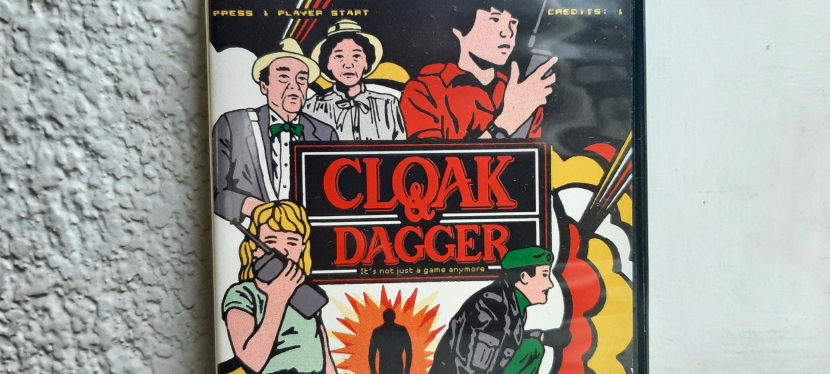
The front of my copy of Cloak & Dagger (1984) 4K Blu-ray.
The rear with the details that can be read.
For the newcomers reading this, Cloak & Dagger (1984) is a movie that involved then video game giant Atari in the creative process. The movie’s plot is not based on Atari’s arcade game of the same name (previously titled as Agent X).
Cloak & Dagger (1984) its own original plot of espionage about a young boy Davey (played by Henry Thomas, the star of Steven Spielberg’s E.T.: The Extra-Terrestrial) who witnesses a murder and receives an Atari 5200 cartridge of the game Cloak & Dagger that contains something very important. This in turn makes him a target of armed henchmen who won’t stop until they get him. Due to his reputation of being too playful and living with his wild imagination as a spy, people don’t believe Davey’s claim of witnessing a murder. This film happens to be inspired by the short story “The Boy Cried Murder” written by Cornell Woolrich.
Cloak & Dagger in arcade form. Atari released it in the form of an arcade conversion kit aimed at arcade machines of certain games of its competitors.
The Cloak & Dagger arcade game can be played on your game console with the Atari 50 collection software (over 100 games). This screenshot I captured while playing it on my Xbox Series X console running Atari 50.
A few weeks ago, my copy of the Cloak & Dagger 4K Blu-ray arrived and it came with two discs: One 4K Blu-ray disc which contained the movie in native 4K (scanned in UHD from the 35mm film) resolution of 3840 x 2160p. The other disc has the same movie in HD (1920 x 1080p) plus the extra stuff which can provide viewers and Cloak & Dagger fans a good amount of important content which will help them learn what the video game elements in the film are, what inspired its creative process and why the film is very unique by today’s standards. There is also an informative new interview with Henry Thomas.
Since then, I saw Cloak & Dagger in 4K twice on my Xbox Series X and its 1080p version on a standalone Blu-ray disc player. Cloak & Dagger in 4K looks better than ever as the picture quality is better, images look sharper and clearer, the colors are vibrant, the small visual details (which were not visible in lower resolution before) are more noticeable now, and film grain structure has been preserved intact!
The two discs. The one on the right is Cloak & Dagger in 4K.
As for the story itself, I still find it engaging and enjoyable to watch from start to finish. Cloak & Dagger is clearly a production of its time as it carries clear Cold War references – the Soviet Union and Iran are the evil forces told in very subtle fashion – as well as video game elements and brands (note: ColecoVision even appeared in this Atari-influenced movie) that dominated America’s console gaming market long before PlayStation, Nintendo and Xbox arrived. For a movie aimed at parents and children, this one has really intense violence as it involves shooting and even some elements of terrorism.
Ultimately, I got a lot of enjoyment from my Cloak & Dagger (1984) 4K Blu-ray and I highly recommend it to Cloak & Dagger fans, gamers, physical media collectors and anyone who loves watching movies in the comfort of home. Cloak & Dagger (1984) is a very unique and fun movie that Hollywood does not make anymore. You really should see it.
In case you are interested or if you have made up your mind, you can order a copy of Cloak & Dagger (1984) 4K Blu-ray by clicking here.
Disclaimer: This is my original work with details sourced from my personal experiences and observations during the Israel pilgrimage tour I joined and what happened during my free time. Anyone who wants to use this article, in part or in whole, needs to secure first my permission and agree to cite me as the source and author. Let it be known that any unauthorized use of this article will constrain the author to pursue the remedies under R.A. No. 8293, the Revised Penal Code, and/or all applicable legal actions under the laws of the Philippines.
Welcome back, readers and fellow followers of the Lord! This is the 8th chapter of my ongoing series of articles about the holy nation of Israel with recollections about the experiences and discoveries I had during the pilgrimage tour I joined with my local church (hosted by strategic partner Behold Israel). To see my previous Israel tour articles, click here, here, here, here, here, here and here.
Before moving on, may I request to you readers to pray to the Lord in support for the nation of Israel as it has been at war with the Palestinian terrorist group Hamas (which committed the October 7, 2023 terrorist attacks) in the Gaza Strip, as well as with Hezbollah in the north. Prayers are also needed for the hostages (taken by Hamas) and for the Israel Defense Forces (IDF) which has been working so hard and long. Israel’s economy and people also need prayers of support. I will always stand with Israel and my faith in the Lord remains uncompromising!
In this latest edition of my Israel 2023 series, I share with you my observations about what happened during our group’s one and only rest day. Instead of just resting at our nice hotel in Jerusalem, I decided to take advantage of the day to visit the Temple Mount for the first time ever, return to the Western Wall/Jewish Quarter/Upper Room, and visiting King David’s Tomb to name some.
Having revisited the Upper Room as well as King David’s Tomb (located just below), I took the rare opportunity of visiting the grave of the late Oskar Schindler which is located inside a Catholic cemetery just a few hundred meters away by foot. Look at the Google Map screenshot below…
This should give you an idea as to how close the Upper Room and King David’s Tomb sites in Israel are to the cemetery that has Schindler’s grave.
Who is Oskar Schindler?
For the newcomers reading this, Oskar Schindler was a German industrialist and a member of the Nazi Party who is best known for saving more than one thousand Jews during the Holocaust by having them employed in his business of enamelware and ammunition (across different locations in Europe). His costly efforts of saving the Jews from certain death during World War II became his most defining legacy to world initially chronicled in the novel Schindler’s Ark (later retitled as Schindler’s List) written by Thomas Keneally, and most famously dramatized in cinematic form in Steven Spielberg’s Schindler’s List (1993) with Liam Neeson portraying him. I myself saw Schindler’s List in the cinema here in the Philippines on April 2, 1994, and it was the most engaging movie theater experience I ever had.
The real-life Oskar Schindler (1908-1974).(photo source – Yad Vashem)
The cinematic Oskar Schindler portrayed by Liam Neeson in the Steven Spielberg-directed film Schindler’s List. (photo source – IMDB.com)
Schindler was born in 1908 in Zwittau, Austria-Hungary (now referred to as the Czech Republic). After the end of the Austro-Hungarian Empire, he became a citizen of the Czechoslovak Republic. He married Emilie Pelzl in 1928 and went on to work in different occupations ranging from farm machinery to selling government property. He also served in his republic’s army and eventually made his way into the German Armed Forces specifically through its military foreign intelligence office. In 1939, Schindler joined the Nazi Party and eventually arrived in Poland (after the German invasion) and established himself as a businessman. It was in Poland where he established the enamelware business and hired Jewish people as his workers.
A lot happened to Schindler and his wife after the end of World War II. He faced danger of being arrested as a war criminal. Schindler and his wife endured lots of difficulties moving back to Germany. In the years that followed, Schindler had a series of failed business ventures and declared bankruptcy in the early 1960s. Thanks to his Jewish friends from the war, he survived on donations sent by the Schindlerjuden (the people he saved during the Holocaust).
Schindler visited Israel for the first time ever in 1961 and was welcomed warmly. A tree was planted in his honor at the Avenue of the Righteous at Yad Vashem in 1962 (note: his wife Emilie got recognized as among the Righteous Among the Nations in 1993).
Before dying in 1974, he lived partly in Israel and partly in Germany. Schindler was buried in Jerusalem in Mount Zion and his grave has been visited many times by Jews and other people from around the world.
How I made it to Schindler’s grave
Having prayed to the Lord for a meaningful and blessed day-off, I got ready for the places to visit in ancient Jerusalem and that includes a precise study of maps and where the significant sites are located.
As mentioned above, coming from the Temple Mount, the Western Wall and the Jewish Quarter, I exited through Zion Gate of the old city of Jerusalem heading towards the Upper Room (the traditional site of the Last Supper that involved our Lord Savior Jesus) for a return visit (note: my first time there was with our tour group with a guide) and for my first-ever visit at the King David’s Tomb site (on the ground floor level so nearby).
That being said, it was easy to find the nearby cemetery (note: there was one other cemetery nearby) for Schindler’s grave coming from King David’s Tomb by foot. After walking down a short road leading to a major road outside and crossing it, I found the entrance of the cemetery which even had a small sign that says “To Oskar Schindler’s grave.”
The cemetery gate with a sign confirming that Schindler’s grave is inside.
My time at Schindler’s grave
So I entered the cemetery all alone, walked further and climbed down some steps until I reached the very area of Schindler’s grave which was actually located by a cemented walkway. Posted below is the shot I took before approaching the grave.
A wide shot of the lower area of the cemetery where Schindler’s grave is located (in the distance).
Finally, I made my first-ever approach to the grave of the one German businessman who saved the lives of many Jews and I captured it all by video as you can see below along with the pictures I took right there. Schindler’s grave was full of stones placed in thanks to him, remembrance of him and in honor for him. I noticed one particular stone even has a “Thank you!”
The grave of Oskar Schindler with lots of stones placed on it by visitors and by those who remember him for saving over a thousand Jewish people during the Holocaust.
A diagonal shot of the grave with a good amount of sunlight captured during the moment.
This is me taking a picture of myself near Oskar Schindler’s grave.
Visible on the grave was the German inscription which in English means “The unforgettable lifesaver of 1200 persecuted Jews.”
Being right there at the grave brought me strong memories about the final sequence of the movie Schindler’s List which was presented in color. That scene turned out very powerful to watch as a line of people – including the Jewish survivors who encountered Schindler during the war plus the actors who played many of them – took turns placing stones at this very grave. The late Leopold “Poldek” Pfefferberg himself was present in the scene at the grave which is very significant because he personally encountered Schindler and was crucial with both the publishing of Schindler’s Ark and the filming of Schindler’s List. Pfefferberg was an advisor to Spielberg.
Holocaust survivor Poldek Pfefferberg with Oskar Schindler in the 1960s. (photo source – United States Holocaust Memorial Museum)
This is my 4K Blu-ray copy of Schindler’s List. This is the best and most definitive way to watch it at the comfort of home. So much better than streaming.
The placing of stones or pebbles on a grave has an important part in the Jewish ways. The Jewish Virtual Library describes it as follows (some parts in boldface):
As opposed to the common practice of burying loved ones with flowers and placing flowers by the tombstone, Jewish tradition instead puts an emphasis on placing stones on graves.
Jewish authorities likely objected to the flower ritual because of its proximity to pagan customs.
The origin of the stone custom is uncertain, though it may relate to ancient times when a pile of stones was used as a marker. The most common explanation is that placing stones is a symbolic act that indicates someone has come to visit and the deceased has not been forgotten.
A superstitious rationale for stones is that they keep the soul down, based on a belief that souls continue to dwell for a while in the graves in which they are placed.
A more common theme, however, is that stones last for eternity – as opposed to the short life span of flowers. Like the memory our loved ones, stones will never die.
As Oskar Schindler was German, the placing of stones at his grave is notably exceptional and if you wish to feel the impact of the colored scene near the end of Schindler’s List, you will have to endure the film first from the beginning. After all, the Spielberg-directed movie gradually shows how the German businessman got connected with the Jewish people as his laborers, and the turning point of him deciding to save them from death by sacrificing so much (read: lots of money spent and use of influence with German officials) and taking huge risks along the way was powerful to watch.
Even though I’m not Jewish and not a survivor of World War II, I still placed a stone on Oskar Schindler’s grave to thank him for saving many Jews long ago. As a person faith, my love for Israel and the Jewish people remains uncompromising in relation to my unwavering faith in the Lord and His Word.
Significant lessons about loving, blessing and helping the Jewish people
Having been to the Holocaust museum at Yad Vashem prior to the rest day, I learned there that Oskar Schindler was one of many others who took risks to save Jews during the Holocaust. The Schindler Jews of more than one thousand survivors have since multiplied into thousands more people through the decades.
The Holocaust and the October 7, 2023 terrorist attacks should remind each of us faithful ones that we cannot simply ignore the tragedies and do nothing. People of the Jewish State need our help and praying for them is a solid way to start. Ask the Lord for signs on how to help Israelites in additional ways. Do not rush and wait for Him to send you a command or a clear message on what to do next. Right now, Israel is fighting the enemy inside Gaza while defending itself from the other enemy on the north.
Around the world, there are millions of young protesters and activists who were brainwashed into supporting the terrorists while attacking Israel so blindly. Indeed, the world is chaotic and all the people who attack Israel while empowering the terrorists are doing the dirty works for Satan. It is also not surprising to encounter a pro-Palestine believer or an anti-Semitic person who openly rejects the Word of God or even mock Lord Jesus. The people – the brainwashed activists and terrorists specifically – who wish to destroy Israel in this modern age are becoming more like the Nazi Germans who were led by Adolf Hitler (who dreamed of wiping out all Jewish people). These unfortunate events should compel you to stand up for Israel and the Jewish people as you live on with unwavering faith in the Lord and His Word.
You might be wondering what are the biblical lessons to learn with regards to loving, blessing and helping the Jewish people. We can start by acknowledging the sovereignty, authority and the holiness of the Lord God and remember always that Lord Jesus is the Anointed Mediator. Read the following holy scriptures below…
“Therefore, give the people of Israel this message from the Sovereign Lord: I am bringing you back, but not because you deserve it. I am doing it to protect my holy name, on which you brought shame while you were scattered among the nations. I will show how holy my great name is—the name on which you brought shame among the nations. And when I reveal my holiness through you before their very eyes, says the Sovereign Lord, then the nations will know that I am the Lord. For I will gather you up from all the nations and bring you home again to your land.
“Then I will sprinkle clean water on you, and you will be clean. Your filth will be washed away, and you will no longer worship idols. And I will give you a new heart, and I will put a new spirit in you. I will take out your stony, stubborn heart and give you a tender, responsive heart. And I will put my Spirit in you so that you will follow my decrees and be careful to obey my regulations.
“And you will live in Israel, the land I gave your ancestors long ago. You will be my people, and I will be your God. I will cleanse you of your filthy behavior. I will give you good crops of grain, and I will send no more famines on the land. I will give you great harvests from your fruit trees and fields, and never again will the surrounding nations be able to scoff at your land for its famines. Then you will remember your past sins and despise yourselves for all the detestable things you did. But remember, says the Sovereign Lord, I am not doing this because you deserve it. O my people of Israel, you should be utterly ashamed of all you have done!
“This is what the Sovereign Lord says: When I cleanse you from your sins, I will repopulate your cities, and the ruins will be rebuilt.
Ezekiel 36:22-33 (NLT)
Behold, the days are coming, says the Lord, that the plowman shall overtake the reaper, and the treader of grapes him who sows the seed; and the mountains shall drop sweet wine and all the hills shall melt [that is, everything heretofore barren and unfruitful shall overflow with spiritual blessing].
And I will bring back the exiles of My people Israel, and they shall build the waste cities and inhabit them; and they shall plant vineyards and drink the wine from them; they shall also make gardens and eat the fruit of them.
And I will plant them upon their land, and they shall no more be torn up out of their land which I gave them, says the Lord your God.
Amos 9:13-15 (AMPC)
For God is not unrighteous to forget or overlook your labor and the love which you have shown for His name’s sake in ministering to the needs of the saints (His own consecrated people), as you still do.
Hebrews 6:10 (AMPC)
For there [is only] one God, and [only] one Mediator between God and men, the Man Christ Jesus,
1 Timothy 2:5 (AMPC)
They answered, “Believe in the Lord Jesus and you will be saved—you and all your family.”
Acts 16:31 (TPT)
My beloved friends, if you see a believer who is overtaken with a fault, the one who is in the Spirit should seek to restore him in the Spirit of gentleness. But keep watch over your own heart so that you won’t be tempted to exalt yourself over him. Love empowers us to fulfill the law of the Anointed One as we carry each other’s troubles.
Galatians 6:1-2 (TPT)
For God did not appoint us to wrath, but to obtain salvation through our Lord Jesus Christ, who died for us, that whether we wake or sleep, we should live together with Him.
Therefore comfort each other and edify one another, just as you also are doing.
1 Thessalonians 5:9-11 (NKJV)
The Son of Man will send out His angels, and they will gather out of His kingdom all things that offend, and those who practice lawlessness, and will cast them into the furnace of fire. There will be wailing and gnashing of teeth. Then the righteous will shine forth as the sun in the kingdom of their Father. He who has ears to hear, let him hear!
Matthew 13:41-43 (NKJV)
“I am a true sprouting vine, and the farmer who tends the vine is my Father. He cares for the branches connected to me by lifting and propping up the fruitless branches and pruning every fruitful branch to yield a greater harvest. The words I have spoken over you have already cleansed you. So you must remain in life-union with me, for I remain in life-union with you. For as a branch severed from the vine will not bear fruit, so your life will be fruitless unless you live your life intimately joined to mine.
“I am the sprouting vine and you’re my branches. As you live in union with me as your source, fruitfulness will stream from within you—but when you live separated from me you are powerless. 6If a person is separated from me, he is discarded; such branches are gathered up and thrown into the fire to be burned. But if you live in life-union with me and if my words live powerfully within you—then you can ask whatever you desire and it will be done. When your lives bear abundant fruit, you demonstrate that you are my mature disciples who glorify my Father!
John 15:1-8 (TPT)
Also, never forget that Israel is the land that God the Heavenly Father designated for the Jewish people and He always has great plans for them. Read the scriptures below…
Now the Lord had said to Abram:
“Get out of your country,
From your family
And from your father’s house,
To a land that I will show you.
I will make you a great nation;
I will bless you
And make your name great;
And you shall be a blessing.
I will bless those who bless you,
And I will curse him who curses you;
And in you all the families of the earth shall be blessed.”
Genesis 12:1-3 (NKJV)
Then God said to Abraham, “As for Sarai your wife, you shall not call her name Sarai, but Sarah shall be her name. And I will bless her and also give you a son by her; then I will bless her, and she shall be a mother of nations; kings of peoples shall be from her.”
Then Abraham fell on his face and laughed, and said in his heart, “Shall a child be born to a man who is one hundred years old? And shall Sarah, who is ninety years old, bear a child?” And Abraham said to God, “Oh, that Ishmael might live before You!”
Then God said: “No, Sarah your wife shall bear you a son, and you shall call his name Isaac; I will establish My covenant with him for an everlasting covenant, and with his descendants after him.
And as for Ishmael, I have heard you. Behold, I have blessed him, and will make him fruitful, and will multiply him exceedingly. He shall beget twelve princes, and I will make him a great nation. But My covenant I will establish with Isaac, whom Sarah shall bear to you at this set time next year.” Then He finished talking with him, and God went up from Abraham.
Genesis 17:15-22 (NKJV)
Again God said to him, Your name is Jacob [supplanter]; you shall not be called Jacob any longer, but Israel shall be your name. So He called him Israel [contender with God].
And God said to him, I am God Almighty. Be fruitful and multiply; a nation and a company of nations shall come from you and kings shall be born of your stock;
The land which I gave Abraham and Isaac I will give to you, and to your descendants after you I will give the land.
Genesis 35:10-12 (AMPC)
Now therefore, if you will obey My voice in truth and keep My covenant, then you shall be My own peculiar possession and treasure from among and above all peoples; for all the earth is Mine.
And you shall be to Me a kingdom of priests, a holy nation [consecrated, set apart to the worship of God]. These are the words you shall speak to the Israelites.
Exodus 19:5-6 (AMPC)
Say therefore to the people of Israel, ‘I am the Lord, and I will bring you out from under the burdens of the Egyptians, and I will deliver you from slavery to them, and I will redeem you with an outstretched arm and with great acts of judgment. I will take you to be my people, and I will be your God, and you shall know that I am the Lord your God, who has brought you out from under the burdens of the Egyptians. I will bring you into the land that I swore to give to Abraham, to Isaac, and to Jacob. I will give it to you for a possession. I am the Lord.’”
Exodus 6:6-8 (ESV)
“Yet hear now, O Jacob My servant, And Israel whom I have chosen.
Thus says the Lord who made you And formed you from the womb, who will help you: ‘Fear not, O Jacob My servant; And you, Jeshurun, whom I have chosen.
For I will pour water on him who is thirsty, And floods on the dry ground; I will pour My Spirit on your descendants, And My blessing on your offspring;
They will spring up among the grass Like willows by the watercourses.’
One will say, ‘I am the Lord’s’; Another will call himself by the name of Jacob; Another will write with his hand, ‘The Lord’s,’ And name himself by the name of Israel.
Isaiah 44:1-5 (NKJV)
Conclusion
During my final moments at the cemetery, I carefully touched Schindler’s grave and went on marching all the way to Mahane Yehuda Market in the city.
I am very thankful to the Lord for the significant visits and favors He blessed me with during the rest day in Jerusalem. The visit to Schindler’s grave was a worthy conclusion to the time I spent visiting the sites inside and outside of the walls of the old city of Jerusalem during the cold morning. After Schindler’s grave, I marched all the way to Mahane Yehuda market (with a coffee break at Tmol Shilshom on the way).
I cannot say that Schindler’s grave is a holy site to visit, but it still carries great historical significance in relation to the saving of Jews during the Holocaust. To those of you who get to visit the grave, do not be surprised to see the many stones placed on it. Finally, be mindful that when you visit the Upper Room or King David’s Tomb site just outside of Zion Gate, the cemetery that has Schindler’s grave is only a few hundred meters away by walking. Ask your tour guide about the location and what time the cemetery opens in the morning.
While Oskar Schindler remains a controversial person of history as his legacy continues to be debated between varied people with specific beliefs and reasons (note: there are people who admired him as well as others who condemned him), his efforts (aided by his wife Emilie and his Jewish assistant Itzhak Stern) on protecting the Jewish workers from certain death during World War II should always be remembered.
It should be noted that Schindler’s List has been criticized for having fictionalized scenes, deliberate omissions of historical facts and its portrayal of Oskar as a hero whose personality developed over time. In reality, wife Emilie Schindler was much more involved with her husband on rescuing the Jews which is a significant fact that Spielberg’s movie ignored.
Emilie and Oskar Schindler in Argentina after the end of World War II. Emilie was much more involved with her husband on sparing over a thousand Jewish people from certain death during the Holocaust. (photo credit: Yad Vashem)
The German businessman’s legacy is clearly connected with the 1993 film which itself made tremendous impact by making people aware of the Holocaust and the six million Jews who got killed. The said impact, in my view, is much bigger than the many Academy Awards the movie won! Spielberg’s movie marked the beginning of my learning about the Holocaust and back in 1994, I was not even aware of the biblical significance of Israel and the Jewish people. In my old life of rituals, traditions and idolatrous religion, no person of religion ever taught me to love and bless Israel, nor did anyone religious tell me about God’s covenant with the Jewish people. Reading the Bible back then was only occasional.
In the year I got born again, I gradually learned about the significance of Israel, the Jewish people and the biblical ties between Jews and Christians as I immersed myself with God’s Word. Studying the Holy Bible and living by His Word helped me understand God’s covenant with Abraham whose rightful heirs have always been Isaac (his son) and Jacob (his grandson who later got renamed Israel). Just months after getting born again, I prayed to the Lord a lot for His plan for me related with Israel as I wanted to deepen my faith in Him by visiting the Holy Land and witness the Bible come to life. The 2023 Israel pilgrimage tour I joined with my local church was the Lord’s anointed answer and blessing to me. It is also the greatest and most significant foreign trip I ever had.
Israel is a great and holy place to visit! Visit Israel with the Holy Bible! Pray to the Lord wholeheartedly and reveal to Him your heart’s desire to visit Israel to deepen your faith in Him. Always be the fearless and aggressive church of Lord Jesus! Follow the light of Lord Jesus, keep on praying for the peace of Jerusalem and live on with unwavering faith in Him!
Watch out for more Israel 2023 travel articles here. There is more to come!
Disclaimer: This is my original work with details sourced from reading the comic book and doing personal research. Anyone who wants to use this article, in part or in whole, needs to secure first my permission and agree to cite me as the source and author. Let it be known that any unauthorized use of this article will constrain the author to pursue the remedies under R.A. No. 8293, the Revised Penal Code, and/or all applicable legal actions under the laws of the Philippines.
Welcome back superhero enthusiasts, 1990s arts and culture enthusiasts, Marvel Comics fans and comic book collectors! Today we go back to the mid-1990s to explore the adaptation of the second season of the X-Men animated series in the form of the X-Men Adventures comic book series.
Before getting to the new retro comic book review, I should state that even though streaming is the norm for millions of people who love entertainment, it would be nice if the classic X-Men: The Animated Series (X-Men TAS) would someday get released on Blu-ray disc format. Even though many X-Men fans are streaming, there are still those who prefer collecting physical releases of what they enjoy. Really, watching entertainment with Blu-ray or 4K Blu-ray format is much better than streaming.
With those details laid down, here is a look back at X-Men Adventures Season II #3, published in 1994 by Marvel with a story written by Ralph Macchio and drawn by John Hebert.
The cover.
Early story
The story begins at the border of Kenya and Tanganyika where Mount Kilimanjaro rests. Something destructive emerges at the top of the mountain causing great disturbance on the people below. At a village, two black persons could not help but notice a demonic figure coming down at them. One of them gets possessed by it.
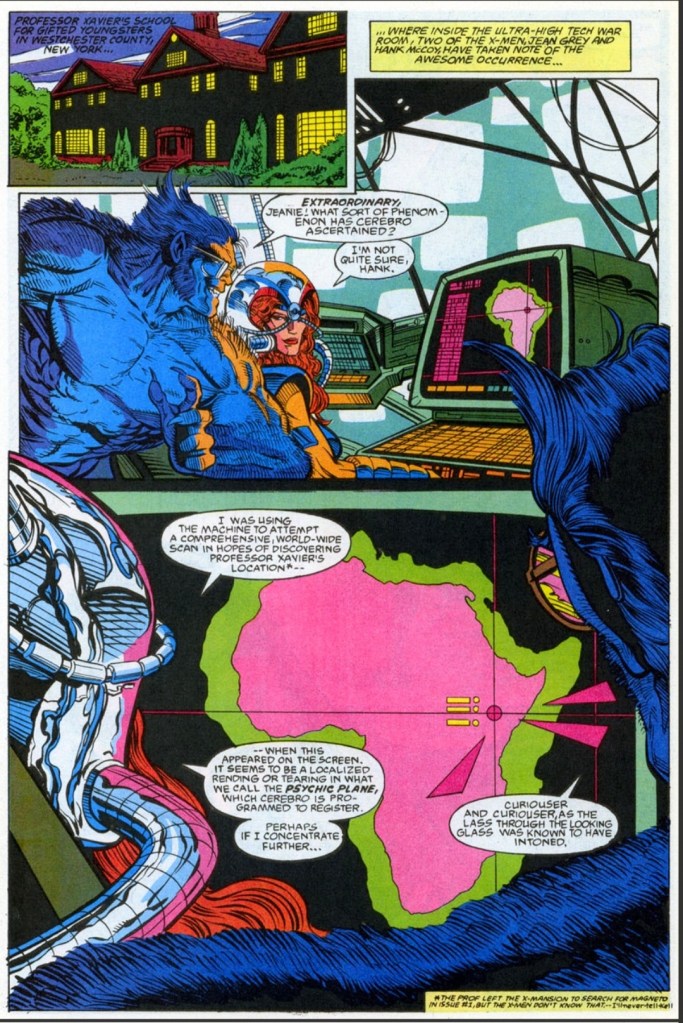
Meanwhile at their headquarters in Westchester County, New York, Jean Grey uses Cerebro to comprehensively scan the world to find Professor X’s location. What Jean detected was a psychic plane which catches Beast’s attention.
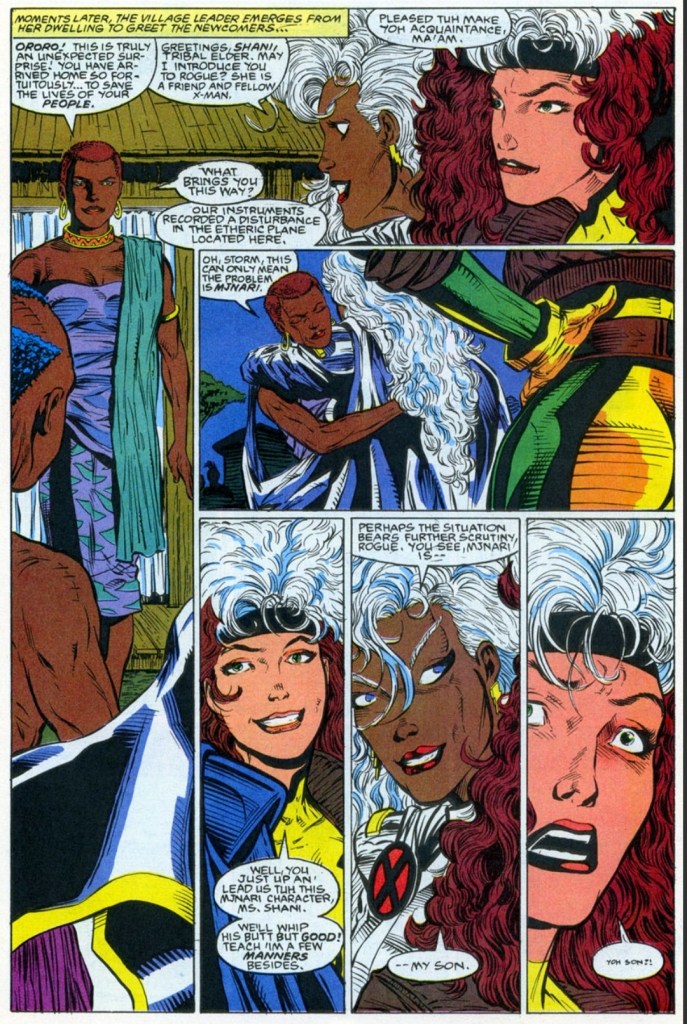
Shortly after, Rogue arrives with Storm who just returned from a hospital. As Jean updates them both, Storm realizes that the location of the psychic plane is in Africa…
Quality
Rogue in Africa with Storm.
The first thing I should confirm here is that there is a nice jump in the visual quality – in terms of style and detail specifically – thanks to illustrator John Hebert. Hebert’s work here is a nice relief compared to the rushed works of Andrew Wildman in the previous two issues, and he knows when to use the dynamic moments of spectacle and how to balance it with the calm moments. Hebert’s take on Wolverine is really good.
Regarding the story, I like the way the search for Charles Xavier – which was a sub-plot in the previous issues – unfolded while also opening the opportunity to develop Storm as she returns to Africa. In fact, this tale reveals some really engaging details from Storm’s past as well as her personal connection with a certain tribe of black people. These mentioned elements added nicely to the tension of a particular conflict that followed.
In fact, the Storm-centered story was nicely executed by the creative team and there were revelations that were gripping. Along the way, Rogue got a nice share of the spotlight and was a suitable supporting character even though the comic book had new characters.
Conclusion
Using Cerebro has big advantages.
X-Men Adventures Season II #3 (1994) is a good read and it also has a nice change of geographic setting as it mainly focused on Africa and Storm’s reconnection with her people. Storm is clearly the main character here and this is a solid pay-off as she only had a tiny part in the previous issue. This is a tale – with themes of family, culture and the responsibility that comes with having special talents or power – that should interest dedicated fans of Storm.
Overall, X-Men Adventures Season II #3 (1994) is recommended.
Welcome back, fellow geeks, Blu-ray collectors and movie buffs! Decades ago, animator and director Ralph Bakshi made significant contributions to the art of hand-drawn animation with features that made it to cinemas such as The Lord of the Rings (1978), Wizards (1977), and Fire and Ice (1983) to name a few.
Along the way, Bakshi became identified with rotoscoping which is a technique that involves drawing or painting over an element in live-action footage frame by frame (as to create a matte or a realistic animation).
Speaking of Bakshi’s past work as well as rotoscoped animation, Sony Pictures recently released the film American Pop (1981) on Blu-ray disc format and I am happy to say that I now have a copy of it for my Blu-ray collection. This is also my first-ever Blu-ray of a Bakshi-directed animated movie.
A close look at the cover of my Blu-ray copy of American Pop.
To begin with, posted below are the specs from the Blu-ray.com page…
Video
Codec: MPEG-4 AVC
Resolution: 1080p
Aspect ratio: 1.85:1
Original aspect ratio: 1.85:1
Audio
English: DTS-HD Master Audio 2.0 (48kHz, 24-bit)
Subtitles –English SDH
Discs -Blu-ray Disc, Single Disc (1 BD-25)
Playback – Blu-ray: Region A
In my personal experience, the first time I ever saw American Pop was not in the cinema but on TV here in the Philippines way back in 1993. Back then, I found the film’s combination of music with mostly rotoscoped animated scenes (there were also some live-action shots, archived footage and some very unique pieces of art shown). I was not able to replay Bakshi’s movie until recently.
So after more than thirty long years, I finally got to replay American Pop on Blu-ray and I can say I enjoyed it even more. To see the rotoscoped animation and varied music play in front of me in high-definition is an even more immersive viewing experience than the previous time I saw this film. Another advantage of high definition is being able to see tiny visual details that I was unable to spot long ago. Oh yes, the fine artworks used on the backgrounds in specific parts of the movie now look a lot more engaging to look at.
A look at the rear of American Pop Blu-ray.
What I regret to say here is that American Pop Blu-ray absolutely has no special features included. Not even a movie trailer! I can only guess that Sony Pictures did not bother to exert efforts to conduct new interviews with Ralph Bakshi and the cast members, nor did they even try to secure any media features or previews of the movie before its theatrical release. It’s not clear if Sony will someday come up with a collector’s edition Blu-ray of this 1981 Bakshi film.
For the dedicated Ralph Bakshi fans as well as enthusiastic film buffs and collectors of movies on physical media, American Pop Blu-ray is recommended as the film itself is more than enough to outweigh the lack of special features. American Pop is more lively than ever to watch and listen as it is now in high-definition.
Welcome back, fellow geeks, Blu-ray collectors and movie buffs! Way back in 1954, the original Godzilla movie (Japanese title: Gojira) made its debut in theaters in Japan. Not only did it make a huge impact with moviegoers, it paved the way for more Godzilla movies (which compelled Hollywood players to join in), imitators and made a solid contribution to global pop culture.
Of course, the original Godzilla film was decades before I was even born and as a boy, I got to watch on home video “Godzilla 1985” which was a Westernized version of The Return of Godzilla (1984). Then in 1998, I saw Roland Emmerich’s twisted version of Japan’s giant monster.
Going back to the original film from 1954, an American version of it was released in 1956 under the title Godzilla: King of the Monsters which was a recut version that had actor Raymond Burr in it as an American journalist witnessing events. That American version, which I saw partially by chance on cable TV, only made me want to see the 1954 original Godzilla movie intact.
That being said, I acquired a copy of the Godzilla (1954) Blu-ray fromCriterion Collection and I can say I am really enjoying it. It definitely is a very good addition to my collection of Blu-ray movies.
The cover of the Godzilla (1954) Blu-ray release from Criterion Collection.
To begin with, posted below are the specs from the Blu-ray.com page…
Video
Codec: MPEG-4 AVC (24.01 Mbps)
Resolution: 1080p
Aspect ratio: 1.37:1
Original aspect ratio: 1.37:1
Audio
Japanese: LPCM Mono (48kHz, 24-bit)
English: LPCM Mono (48kHz, 24-bit)
Subtitles – English, English SDH
Discs -Blu-ray Disc, Single Disc (1 BD-50)
Playback – Blu-ray: Region A
The back of the Criterion Collection Godzilla (1954) Blu-ray. Pay close attention to the details because you will get a lot of stuff to enjoy with this one added into your Blu-ray movie collection.
I really enjoyed the 1954 movie directed by Ishiro Honda and I can talk more about it in detail in a future retro movie review. Going back to Criterion’s Godzilla (1954) Blu-ray, I can say that the company did a great job not only with the restoration and audio, they also loaded the disc with a whole lot of content that will appeal strongly with dedicated Godzilla fans as well as the newcomers who wish to learn more about Japan’s giant monster, its legacy and place in global pop culture. The disc also has a restored copy of Godzilla: King of the Monsters (1956) but I strongly recommend you watch the 1954 film first and foremost.
The extra stuff in the disc contains a lot of content for you to enjoy. There are interviews with certain cast and crew members, an illustrated audio essay about the tragic Lucky Dragon No. 5 vessel, an audio commentary by David Kalat, and more.
When it comes to the physical aspect of Criterion’s Godzilla (1954) Blu-ray, the packaging is both nicely done and inspired. I just love it whenever I opened the set to get to the disc, an image of Godzilla folds and forms in shape for your viewing pleasure. The set also has a booklet that contains really interesting information. Very clearly, this is so much better than streaming!
I really like this excellent packaging by Criterion Collection. Very clearly better than streaming!
For the dedicated Godzilla fans as well as enthusiastic film buffs and collectors of movies on physical media, Criterion’s Godzilla (1954) Blu-ray is highly recommended! This is currently the best way to enjoy the classic movie in the comfort of your home!
Disclaimer: This is my original work with details sourced from watching the film and doing personal research. Anyone who wants to use this article, in part or in whole, needs to secure first my permission and agree to cite me as the source and author. Let it be known that any unauthorized use of this article will constrain the author to pursue the remedies under R.A. No. 8293, the Revised Penal Code, and/or all applicable legal actions under the laws of the Philippines.
With those details laid down, here is a look back at The Blob, a sci-fi horror movie released in 1958 starring Steve McQueen and Aneta Corsaut, written by Kay Linaker and Theodore Simonson, and directed by Irvin S. Yeaworth, Jr. (Irvin Yeaworth for short). This was a low-budget local-level production by Valley Forge Films, Fairview Productions and Tonylyn Productions.
The Blob movie poster.
Early story
The story begins somewhere within a small town in Pennsylvania. During one evening, teenagers Steve Andrews and Jane Martin spend a romantic time together in a car only to be disturbed when a meteorite from outer space crashes nearby. This easily sparks Steve’s curiosity as he decides to drive to find the spot of the crash taking Jane with him.
Meanwhile, an old man who happened to be living near the spot of the crash went out of his home and finds the meteorite first. Out of curiosity, he pokes the meteorite with a stick which slowly causes it to break open revealing a gelatinous substance (the blob) inside. He uses the stick on the substance, lifts it up and examines it closely. Against gravity, the substance suddenly moves up the stick and wraps itself on the old man’s hand causing him to become desperate to remove it. He failed.
As Steve drives down the road, the old man with the blob suddenly crosses down their path. The old man tells Steve to take him to a doctor…
Quality
Steve McQueen (3rd from left) as teenager Steve Andrews with Earl Rowe (2nd from right) as Lt. Dave and other over-aged actors playing teenagers.
I can say that I really like this old movie which has always been an independent, low budget production that made a solid contribution to the sci-fi genre and pop culture in general.
To begin, this film has a simple plot about an alien creature in the form of a gelatinous blob from outer space which attached itself into an old man’s hand, grew a lot when the man made it to the doctor, and then started consuming people which made it grow so big, life in the town got disrupted and people found themselves in danger. Unsurprisingly, the blob itself does not dominate the narrative considering the limitations the filmmakers had on making special effects work plus they focused more on the characters to move the plot forward. Rest assured, however, that the production team went all out with their limited resources on making the monster look menacing in the final fifteen minutes. I should state that the special effects team did a convincing job with the way they made the blob move to specific directions.
Given the simple plot, it is not surprising to see the narrative focusing more on the characters particularly with teenagers Steve and Jane (both played by obviously over-aged actors Steve McQueen and Aneta Corseaut). The story clearly follows the two mentioned teenagers who have the best knowledge about the blob and what happened, and it just so happens that they are always at a disadvantage when asked by adults to prove things.
With a monster that large within the local community, you know that something must be done before it causes further damage and kills more people. The blob was portrayed to be unrelenting in consuming and killing people which causes it to grow even bigger and with no limits determined. The blob does not care at all about the pain and anguish of its victims which parallels the evil of Communism/Marxism/socialism/anti-Semitism in real life.
Jane (Aneta Corseaut) and Steve (Steve McQueen) with the local doctor (Stephen Chase) early in the film.
The interactions between teenagers (note: Steve McQueen and Aneta Corseaut are not the only over-aged looking actors playing youth) and the mature authorities (local police, parents, educator and house keeper to name some) dramatized a gap in which the youth lacked credibility while the adults remain difficult to convince. Very notably the backward car race early in the film symbolically reflects the Hollywood film trend of the 1950s in which American teenagers are portrayed to be troublesome and living without real purposes.
Going back to the protagonists Steve and Jane, the screenplay was designed to highlight what good teenagers can do when a crisis strikes the local community and why the adults should get over their doubts about the youth.
Given the structure of the script, there are a lot of talk scenes throughout and the progress of the blob growing as a menace within the plot helped break the monotony. While he is clearly too old to play a teenager, Steve McQueen here remains convincing as a youth who strives to achieve something worthy even as he lacks maturity. The same can be said about Aneta Corseaut whose character was designed to help Steve move forward apart from having romance with him. When her character feels troubled, Steve comes in to support her in return. If you ignore their mature looks and focus on the dialogue, you will find convincing lines of youth within Steve and Jane. The same can be said about the other teenagers.
Considering the low budget and the limitations of technology at the time, the man-made practical effects in this movie are still good.
I can say out loud that watching movies inside the cinema is always better than streaming. The best way to enjoy a movie at home, on the other hand, is with physical media like Blu-ray and 4K Blu-ray.
While McQueen and Corseaut performed well, there were some moments of stiff acting and lifeless delivery of lines of dialogue scattered throughout.
Those of you who are so used to fast-paced films with thrills and jump scares, you should temper your expectations as this movie moved at a slow-to-medium pace with very little horror elements and very little violence. As this was a low-budget local-level production, certain shots had to be made with very obvious creative shortcuts. Even though this movie was filmed on several locations in Pennsylvania, the filmmakers failed to establish a true sense of geography and this means no scenic shots.
Going back to the blob itself, its jello appearance may not look menacing at first and there were times when the lack of scale (note: they did not have equipment to achieved the depth-of-field visual effect) was noticeable. What I liked here is the way the blob was portrayed – unrelenting and totally immune to the emotions and concerns of people it encounters. The blob here somewhat reminds me of the T-800 in The Terminator (1984) in the sense that it simply would not stop to attack people, consume them and then keep on growing into one very large mass which causes a crisis on the small town community.
In case you are wondering, there were accidents that happened during the memorable scene of moviegoers running out of the cinema in the film. The tripping of some people were purely accidental.
When it grabs someone and starts to consume the victim physically, the blob does not care about the pain it causes on its prey. While it is clear that the movie’s script was written during the early stages of the Cold War, it is possible that the blob served as a symbol of Communism infiltrating America, endangering people and taking their lives (and liberties) away. That being said, the rampant Leftist influence and social violence in the minds of millions of Americans today makes this film socially relevant and the blob’s threat has gotten even more symbolic. Lastly, I should state that composer Ralph Carmichael managed to come up with music to emphasize the threat of the blob.
Conclusion
In my honest opinion The Blob (1958) is still a good movie to watch and it deserves its place in film history as well as in the sci-fi genre of movies in general. While it had its shortcomings, this low-budget local-level production managed to be a worthy viewing experience and set the foundation for its movie franchise (note: a sequel was made in 1972 and the memorable remake of 1988 followed). To say the least, this movie paved the way for Frank Darabont and Chuck Russell to produce the 1988 remake that was very intense and a lot of fun to watch.
The Blob (1958) in Blu-ray disc format from The Criterion Collection. This is the best way to enjoy the movie at home.
The blob itself went on to inspire creative imitations (referred to as blobs or ooze) and new monsters in other forms of entertainment (note: the blob appears as one of the monsters in the 1982 Intellivision game Advanced Dungeons & Dragons: Cloudy Mountain). Steve McQueen himself went on to become one of Hollywood’s elite stars in the decades that followed and this film should interest both die-hard fans and any film buff who wants to learn more about him.
Welcome back, fellow geeks, Blu-ray collectors and movie buffs! Back in the late 1980s, I saw the 1988 version of The Blob – let’s refer to it as The Blob (1988) – on home video and it turned out to be a fine mix of thrills, scares and science fiction concepts that ultimately became fun to watch. Being young at a time when Internet connection and online research were not yet available, I was not even aware that The Blob (1988) was a remake of the 1958 original Blob movie that starred Steve McQueen.
If you who love the late 1980s Blob movie and if you have been looking to add something to your home entertainment collection of Blu-ray and 4K Blu-ray movies, be aware that the Collector’s Edition 4K Blu-ray of The Blob (1988) is now available in the market and you can order it online right now and have it delivered to your home. The new release by Shout Factory! is loaded with features and it has native 4K visuals.
The Blob (1988) 4K Blu-ray cover.
To put things in perspective, posted below are the technical specs from The Blob (1988) 4K Blu-ray page at Blu-ray.com. The said website highly recommended it in its review.
Video Codec: HEVC / H.265 (84.99 Mbps) Resolution: Native 4K (2160p) HDR: HDR10 Aspect ratio: 1.85:1 Original aspect ratio: 1.85:1
Discs – 4K Ultra HD, Blu-ray Disc, Two-disc set (1 BD-100, 1 BD-50)
Packaging – Slipcover in original pressing, Reversible cover
Playback – 4K Blu-ray: Region free, 2K Blu-ray: Region A
Having seen both the 1958 and 1988 versions of The Blob, I can say to the newcomers and movie buffs reading this that you can’t go wrong with either version. I enjoyed both movies and I can say that each film has distinctive attractions for viewing. The Blob of 1958 is more sci-fi and has very little horror elements.
However, if you want thrills, the 1980s culture, stronger horror elements, stronger sci-fi elements, the creative approach done by director Chuck Russell and Frank Darabont on reimagining The Blob‘s concept, and the great-looking practical effects (note: the blob effects were made with physical stuff and a lot of man-made work without computers), then The Blob (1988) is the definitive choice. Take note I mentioned thrills as the movie has some fast-paced scenes that happen from time to time as you watch it. Considering its use of sci-fi concepts mixed with action, The Blob (1988) really stood out among the many horror movies released by Hollywood throughout the 1980s. I should also state that the remake has Kevin Dillon, Shawnee Smith, Jeffrey DeMunn, Joe Seneca, Candy Clark and Donovan Leitch Jr. in its cast.
As a 4K Blu-ray collector, I plan to acquire a copy of The Blob (1988) 4K Blu-ray in due time. I was already aware of the Blu-ray release from 2019 but I waited for the 4K version to be made.
If you want the best enjoyment possible from watching The Blob (1988) Collector’s Edition 4K Blu-ray, I highly recommend you avoid watching movie reaction videos and the spoileriffic retro movie reviews posted by YouTubers.
Welcome back, fellow geeks, Blu-ray collectors and movie buffs from around the world! If you are an enthusiast of giant monster movies and if you have gotten tired with what Hollywood has been releasing, there is a brand new Godzilla (Gojira in Japanese) movie from Japan’s Toho which will be released in cinemas before the year ends…Godzilla Minus One (Japanese title: Gojira Mainasu Wan).
The official movie poster for the Japanese market.
To get started about this new Japanese Godzilla movie, I encourage you to watch the official trailer (English subtitles included) below…
The way the details and visuals were presented in the movie trailer, the filmmakers showed Godzilla as a terrifying giant whose presence brings certain death and destruction to those near it. The trailer made Godzilla looking like it intends to kill people. What I find interesting about the core concept of this upcoming movie is that the iconic monster wreaks havoc in Japan a short time after the end of World War II. This emphasizes that Japan is economically weak and struggling to recover from the tremendous losses suffered from the said war. Also spotted were efforts by the filmmakers to replicate the look of post-WWII Japan.
If you know your world history, you should be aware of the facts that America dropped atomic bombs in Hiroshima and Nagasaki in August 1945 which compelled Japan (then a major military force with the Axis powers) to surrender unconditionally. Putting that historical context into the realm of fantasy by Toho, Godzilla Minus One shows what would happen had the giant monster invaded Japan while it was still in a very weakened state.
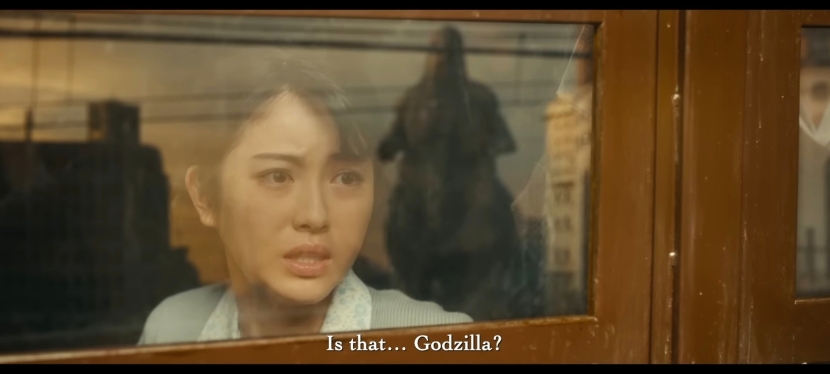
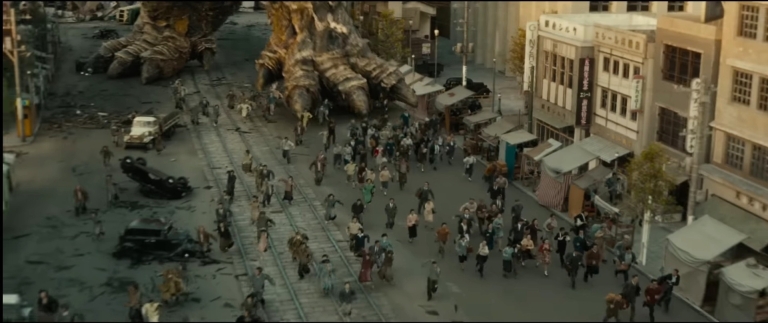
This is a terrifying image of people running away from Godzilla whose steps were causing destruction.
Considering the post-World War II background, it is not yet clear to me if this movie will serve as a prequel to the original Gojira movie of 1954. What is clear is that the filmmakers are daringly making something new with Japan’s icon and their creative approach looks radically different from Toho’s previous Godzilla release in 2016 (note: read my retro review of Shin Godzilla).
Considering the many Godzilla movies released – including those from Hollywood studios – being original with telling a story about the monster is indeed very hard to do. That being said, I am interested to see how the post-World War II setting, the new story and characters, and the giant monster itself will be executed on-screen. If the trailer indicates anything, it looks like Godzilla Minus One could turn out as a dramatic disaster movie (than a monster movie) and could come close to what the 1954 original movie presented.
As of this writing, there are not too many international markets for cinematic releases listed in Godzilla Minus One‘s IMDB page. Being based here in the Philippines, I can only hope that the Japan-made movie will be released in local cinemas which could be a bit tricky given the fact that Shin Godzilla had a limited release here in 2016. I really want to watch this upcoming movie in the local cinema, especially IMAX, but that would depend on how the distribution here in the Philippines will be executed. At the same time, watching a Japanese-made Godzilla movie would be a nice break from the MonsterVerse Godzilla that has been around for years now. Honestly, I’m getting tired of Hollywood’s current version of Japan’s icon.
A very menacing Gojira image from Toho promoting Godzilla Minus One. If you look very closely, you can see some of the giant monster’s teeth red with blood.
If Godzilla Minus One does not get screened locally for some reason, its potential Blu-ray (and possibly 4K Blu-ray) release in the future would be the next option to watch it. Regardless, watch out for this new movie in cinemas in a few months’ time.
Disclaimer: This is my original work with details sourced from watching the movie Cloak & Dagger (1984) and doing personal research. Anyone who wants to use this article, in part or in whole, needs to secure first my permission and agree to cite me as the source and author. Let it be known that any unauthorized use of this article will constrain the author to pursue the remedies under R.A. No. 8293, the Revised Penal Code, and/or all applicable legal actions under the laws of the Philippines.
Welcome back my readers, fellow movie buffs and 20th century pop culture enthusiasts! Decades ago, I got to watch the movie Cloak & Dagger when it was first released on home video. As time passed by, I got to replay it on cable TV and DVD. I have yet to see its 4K Blu-ray disc version (note: you can order it here) Starring Henry Thomas (the star of Steven Spielberg’s E.T.: The Extra-Terrestrial) and Dabney Coleman, Cloak & Dagger was one of those American movies that did not succeed in movie theaters but found its audience on home video, cable TV and free TV.
The 1984 movie was released at a time when video games gradually made its way into motion pictures in varied ways just before Nintendo started reshaping video gaming. Back then, I was very young and already got into playing games on console and at the arcade which helped me relate with the video game elements of Cloak & Dagger. In case you are wondering, the filmmakers and Atari, Inc. itself collaborated together. There may be some among you who never saw this 1980s flick and some of you may be wondering what is significant about Cloak & Dagger and why is it the topic of this retro movie review.
With those details laid down, here is a look back at Cloak & Dagger (1984) directed by Richard Franklin and written by Tom Holland and Nancy Dowd inspired by the short story “The Boy Cried Murder” written by Cornell Woolrich. This movie is the 4th cinematic adaptation of the said short story.
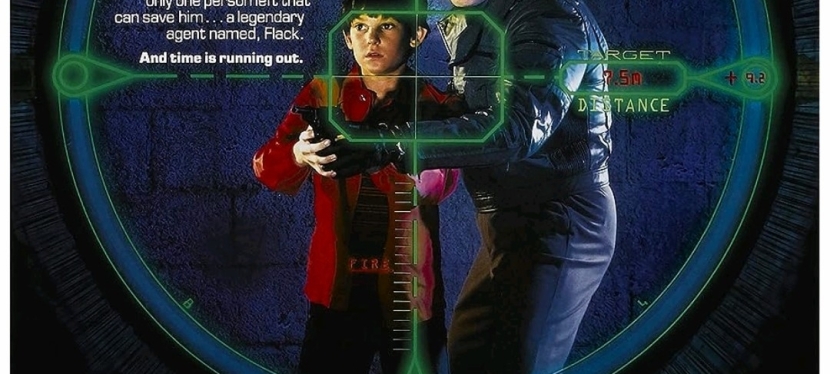
The movie poster of Cloak & Dagger (1984)
Early story
The story begins with Jack Flack (Dabney Coleman) overcoming Soviet guards to enter a place to retrieve top secret documents from incoming people. It turns out that Jack Flack is nothing more than a fictional character imagined by a young boy named Davey (Henry Thomas) who keeps on immersing himself with flights of fantasies, loves playing games and believes that real life is filled with enough opportunities and places to play. In the presence of game store owner Morris (William Forsythe) and his little blonde neighbor Kim (Christina Nigra), Davey boasts a lot about Jack Flack as if he was a real-life hero and even talks to him as his imaginary companion that no one else could see nor hear. Inspired by the said character and the world of espionage he always imagined, the boy carries with him a black water pistol for a “gun” and a softball for a “grenade”.
Morris then sends Davey and Kim out to do a real assignment – an errand to travel within the city going to a certain company and retrieve something for him. Afterwards, the two commuted and entered a building which Davey does with his fantasy of espionage and infiltration burning in his mind. Leaving Kim on the ground floor, he climbs up the stairs until he reaches a certain window and sees something sinister going on in the next level as reflected on one of the windows outside.
Suddenly a door opens near him and a wounded man slowly hands him an Atari 5200 cartridge titled Cloak & Dagger, tells him to bring it to the FBI, and mentions “one million three hundred twenty nine.”
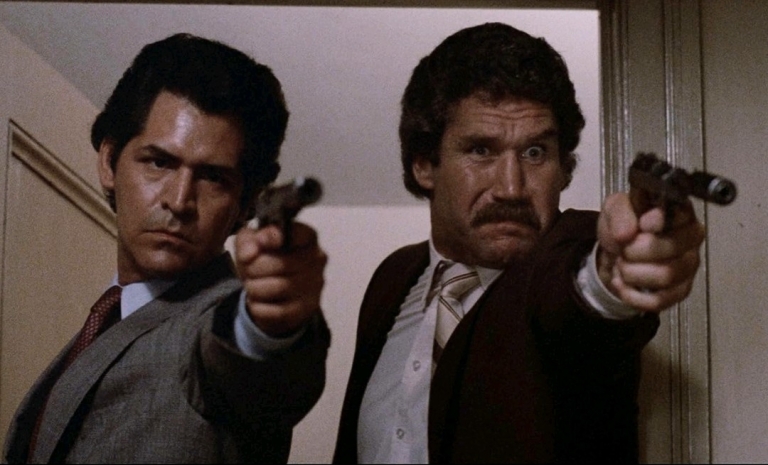
The door near them suddenly opens with two armed men emerging. Right in the presence of Davey, they opened fire at the wounded man who fell down to his death. Davey just became the witness of an actual murder and becomes the target of the two gunmen…
Quality
Henry Thomas and Christina Nigra as Davey and Kim respectively.
To get to straight to the point, I can declare that this movie is very clearly a spy thriller designed to engage both children and adults. It took the key concept of the short story “The Boy Cried Murder” and implemented it into its very own tale that happens to be set during Ronald Reagan’s America (the 1980s) with elements of video games, espionage and even murder mixed together.
The story told through Davey was crafted to be entertaining while keeping viewers in suspense as to how the overly imaginative young boy would deal with real-life danger and consequences as he became the target of murderous men who would not stop at all. Davey is clearly in danger for much of the movie and you will get to sympathize with him and wish he should stop being obsessed with fantasy so he could overcome the trials that were happening. This is, indeed, a well structure and nicely directed work by Richard Franklin who seem to be inspired by past works of Alfred Hitchcock (note: Franklin directed the sequel to Hitchcock’s classic Psycho).
As mentioned earlier, this movie was made to engage both children and adults. Cloak & Dagger is not exactly a wholesome viewing experience as its presentation has always been quite intense because of on-screen violence that was executed carfully. There are guns, shooting and even killing in this flick which proved to be integral to the overall presentation and clearly added to the thrill factor. You will get to see getting Davey shot at by the armed henchmen (Eloy Casados and Tim Rossovich) who clearly do not give a damn of shooting a minor as they are so focused on their mission. Looking at the henchmen in this film, I can imagine them as traitorous Americans conspiring with their nation’s foreign enemies such as the Soviets, the Iranians and the Palestinians. Along the way, there is the clear villain named Rice (Michael Murphy) who has this subtle touch of evil as well as a good amount of sleaziness in him. While the violence is intense, it does not necessarily push this film into rated R territory.
Michael Murphy as the sleazy villain who is willing to kill Davey even though he is a minor.
The two henchmen about to commit murder in the presence of Davey. There is evil visible in their faces.
Henry Thomas really shines as the protagonist here. While Davey here shares a few elements with E.T.’s Elliot – struggling to move forward with the absence of one parent and adjusting his life with what he perceives to be the best ways possible – he truly dramatizes how weird and wild he could be living his life with a very loose grip on reality. For him, local society in San Antonio, Texas, provides him a huge playground for his spy game and he sure distracts people as he walks by them talking to his imaginary friend Jack Flack. Still, there are key parts of the story in which Henry Thomas convincingly dramatizes Davey who feels lonely inside as he misses his late mother and is unable to spend quality time with his father. Thomas also acted with intensity in the scene in which he makes a trade with the villain and also during his last face-off with him in the 2nd half of the film. Henry Thomas really was a good youth actor and his performance here is often overshadowed by his role in Spielberg’s E.T.
Dabney Coleman on the other hand plays both Jack Flack and Davey’s father Hal. Coleman is quite versatile playing different characters here. As Jack Flack, he fits in excellently into Davey’s uncontrolled belief of espionage as he gives him advise which were taken seriously leading into danger. Of course, advising Davey does not really mean the fictional spy cares for him on a personal level and you will eventually Flack’s true value before the film ends. Flack’s final moments could inspire you to re-examine the true meaning of heroism. As Hal, Coleman convincingly plays the father who has been so busy working in the Air Force as an air traffic controller, he has been unable to spend quality time with his son and the recent death of his wife really took its toll on their family. Compared to Jack Flack, Hal is indeed caring towards his son but his hectic work schedule prevents him from bonding closely with him. Coleman delivered a fine performance during the scene when Hal explains to Davey what real-world heroism is and that not all heroes just shoot bad guys. There definitely are helpful values on parenting within Hal.
Henry Thomas and Dabney Coleman are really convincing as son and father.
Thomas and Coleman artistically have really fine chemistry together as the father and son (Hal and Davey) and as the wannabe adventurer spending lots of time with his action hero (Davey and Jack Flack). Considering Davey’s obsession with fantasy and the attention he pays so much to Jack Flack, he was practically living with idolatry and foolishness. If you observe closely, Davey is very lively with Flack and not so lively with his father.
Even though this movie is fictional, it still dramatizes that parenting will never be easy. That being said, this should inspire parents and also incoming parents to prepare themselves on nurturing their children and ensure they help them understand the differences between reality and fantasy.
Video game elements
Screenshot from the Cloak & Dagger arcade game. This game can be played nowadays through Antstream Arcade on Xbox consoles.
To make things very clear, Cloak & Dagger (1984) is not an adaptation of the electronic game that was released the same year. Rather it has the Cloak & Dagger game as a key plot element in the form of an Atari 5200 game cartridge (referred to as a “tape”) which the movie dramatizes to be real.
As a kid, I got to play arcade and console games a lot. As such, seeing Davey play the Cloak & Dagger game on his Atari 5200 as well as gameplay footage was a very entertaining viewing experience for me the first time I ever saw this movie. It was a scene I personally related with.
In real life, however, the Cloak & Dagger game from Atari, Inc. was released only in the arcades as the efforts to create a port for the Atari 5200 never got fulfilled. That being said, it was through very clever film editing that video footage of the arcade version were inserted into the scene in which Davey played the Cloak & Dagger cartridge on his console in the presence of his father. To clarify things, the Atari 5200 was a commercial failure in real life and it seems that making a console version of the arcade game did not make business sense to Atari, Inc. at all.
If you want to play the Cloak & Dagger arcade game in your home right now, you will need an Xbox console and Antstream Arcade ($30 for 1-year subscription, $80 for lifetime pass). Cloak & Dagger is just one of over a thousand games available through Antstream Arcade and you can learn more by clicking here and here.
Conclusion
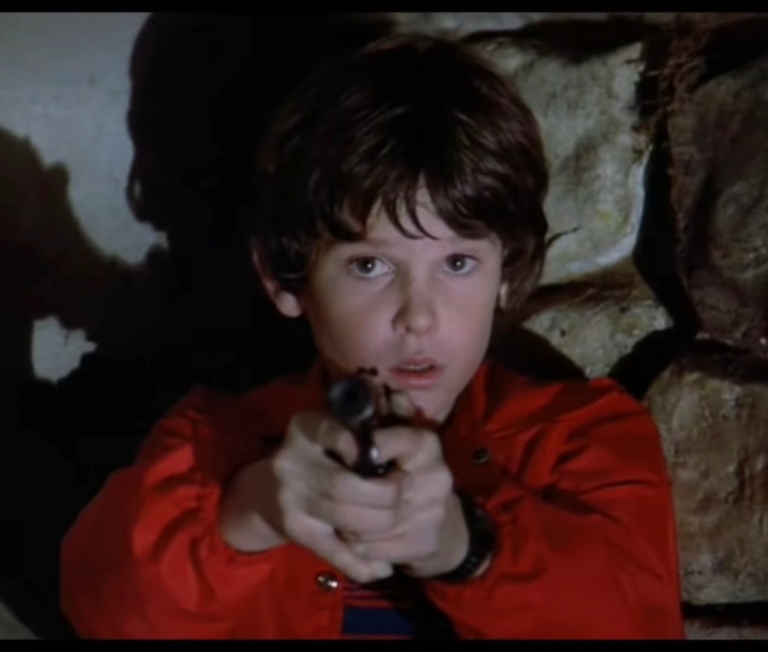
Henry Thomas as an armed Davey.
I have seen Cloak & Dagger (1984) many times throughout my life from childhood and to adulthood. I can clearly say that this 1980s movie is still really good to watch as its appeal to both children and adults remains strong and intact. It is a medium-paced spy thriller that not only follows a young boy who witnesses and murder and gets into danger (note: even his neighbor gets involved) but also dramatizes (in entertaining ways) how dangerous situations can get when you are living with uncontrolled personal fantasy and interacting with a heroic friend who does not really exist. Considering the time this movie was released, I am delighted to tell you cautious readers that there definitely is no wokeness nor were there any traces of political correctness that got in the way of its presentation. Going back to the parenting aspect of this film, it is made clear that children need their parents for moral support and there is absolutely no way that games, fictional heroes and geek culture could ever be good alternatives. Like the adults, children should never lose their grip on reality and should be taught that uncontrolled fantasy can lead to real-life danger. Very clearly, director Richard Franklin and the crew did a fine job telling a solid story and emphasizing the main characters while also providing suspense, action and thrills.
Considering all the mixed elements it has, Cloak & Dagger (1984) can be engaging towards parents, their children, fans of espionage and people who love video games. Finally, I should state that the City of San Antonio in the Lone Star State of Texas is indeed a great location for filmmaking and viewing.


































 Author Carlo Carrasco