Disclaimer: This is my original work with details sourced from reading the comic book and doing personal research. Anyone who wants to use this article, in part or in whole, needs to secure first my permission and agree to cite me as the source and author. Let it be known that any unauthorized use of this article will constrain the author to pursue the remedies under R.A. No. 8293, the Revised Penal Code, and/or all applicable legal actions under the laws of the Philippines.
Welcome back superhero enthusiasts, 1990s arts and culture enthusiasts, Marvel Comics fans and comic book collectors! Today we go back to the mid-1990s to explore the adaptation of the second season of the famous X-Men: The Animated Series (X-Men TAS) in the form of the X-Men Adventures comic book series.
Before getting to the new retro comic book review, I should state that it is indeed very challenging to implement the concepts of time travel and timeline conflicts into the narrative of an established X-Men universe. As far as the X-Men TAS narrative goes, Bishop and Cable are mutants who each came from different points in the future and in different ways they each made impact with the present day X-Men as portrayed in the comics (the literary X-Men specifically).
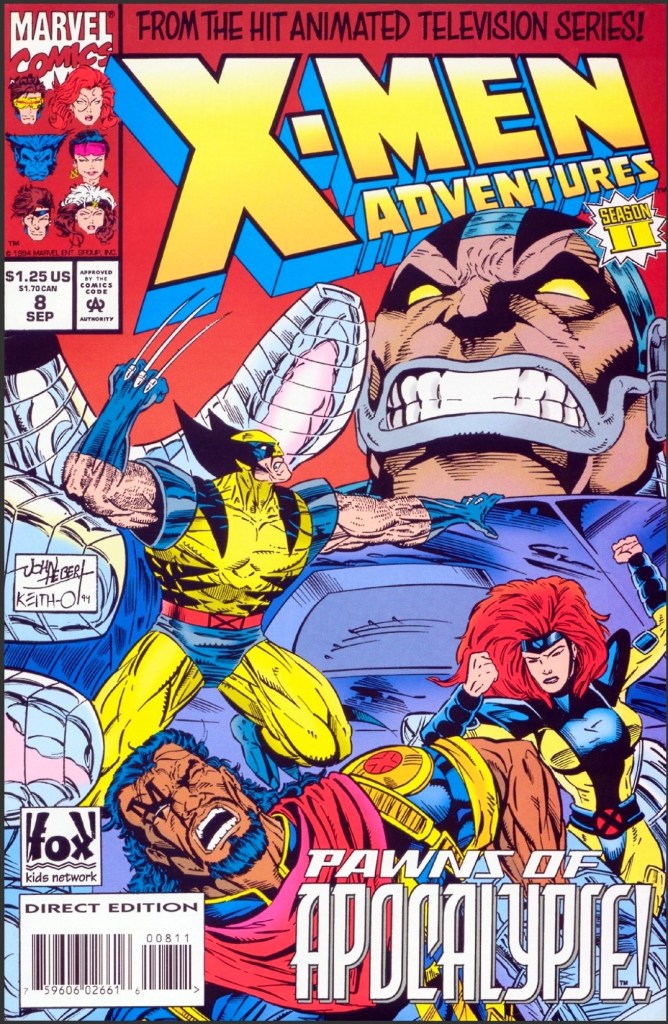
With those details laid down, here is a look back at X-Men Adventures Season II #8, published in 1994 by Marvel with a story written by Ralph Macchio and drawn by John Hebert. The is the 2nd chapter of the Time Fugitives storyline.
The cover.
Early story
The story begins on Earth in the far future of 3999 AD. Cable, who has been leading the fight against Apocalypse, is receiving information from his cube-shaped computer which informs him that a temporal storm has wreaked havoc with the time stream and their present is reconfiguring in response to the existence of a new past. Once realignment gets completed, everyone in the current timeline will cease to exist. Cable then learns that Bishop (who returned to the X-Men in the previous issue) is the primary chronal component of the time readjustment.
Meanwhile in the present day inside Xavier’s mansion, the X-Men listen to Bishop who explains that mutants will be blamed for the plague that a certain virus will precipitate and that the fear of the virus will make things much worse for many people. He states that the virus was not brought into being by mutants.
Beast then shares that his investigation of a viral-ridden cell sample was convincing and discovered that the virus was genetically engineered. He reveals that once the little germs spread to the mutant population and combine with mutant DNA, it could turn out incredibly deadly…
Quality
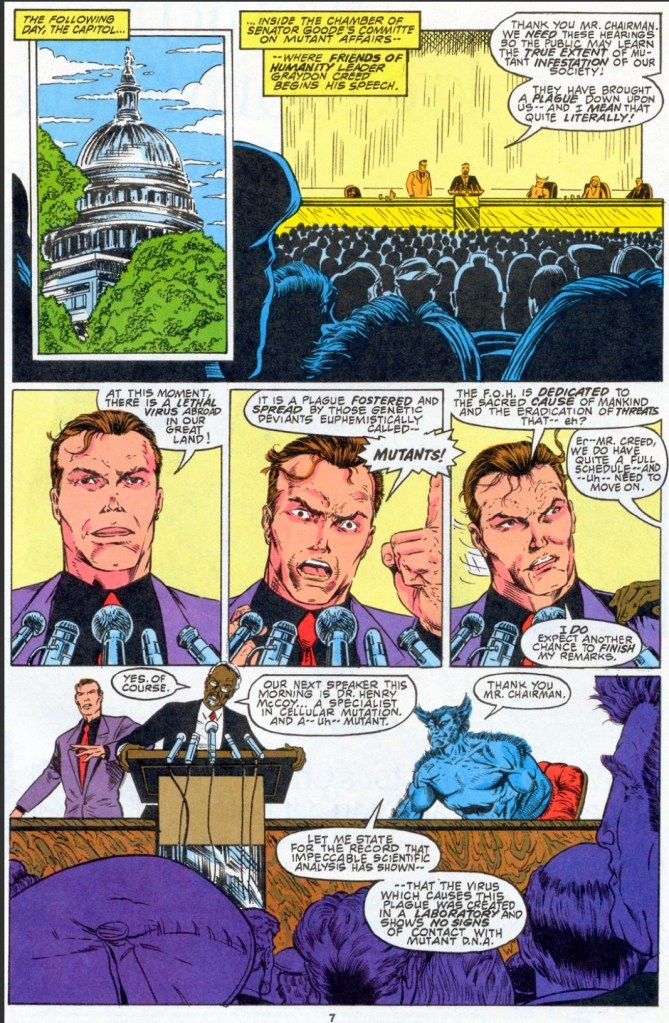
Conflict brewing in front of a huge audience.
To be straight to the point, what the creative team started in issue #7 got strongly concluded here. With the animated episode’s teleplay being the primary reference, writer Ralph Macchio successfully crafted a script that raised the stakes of the 2-part Time Fugitives story while tying closely the gaps with regards to the time travel and timeline conflicts concepts. Without spoiling the plot, I can say that one development that took place in the present day clearly set off the stage for another futuristic mutant to not only get involved but also make a huge impact on the narrative.
As with the previous issue, this story has elements of xenophobia as well as fear of viruses and potential massive infections which added a good layer of depth to the plot. Macchio’s writing is very strong and no matter how intense the tale got as more details got presented, it still remained very readable and efficient to follow. Also, I should say that Apocalypse’s presence turned out very powerful and it should inspire readers to search for comic books of the supervillain’s conflict with the X-Men and X-Factor for insight.
John Hebert returned on the visual department and his art style really works well with both the sci-fi concept of the story and the presentation of the X-Men plus Bishop and Cable. I really admire Hebert’s stylized take on Wolverine, Cable and Bishop as he made each them look even grittier than before. There is also this creepy vibe with the way Hebert drew some of the X-Men members’ faces. Herbert is also very good with visualizing sci-fi elements such as energy forms, futuristic machines, techno-virus forms on the skin, and more. His presentation of dynamic superhero action is great to look at. This is clearly one of the best looking issues of Season II of the X-Men Adventures series.
Conclusion
Bishop explains things to the X-Men and Beast confirms key details.
X-Men Adventures Season II #8 (1994) is a rock-solid comic book in terms of quality and impact. It concluded the 2-part story with a powerful resolution, it tied the loose ends in a very timely fashion and I really enjoyed the way how the X-Men were dramatized as Bishop and Cable got involved with them in their present day setting. So far, this is the most satisfying and more impactful issue of Season II I have read in this series.
Overall, X-Men Adventures Season II #8 (1994) is highly recommended.
In light of an April Fool’s Day promo that convinced a person to really take the challenge physically, the Department of Trade and Industry (DTI) reminded businesses that they should secure permits from them in order to do any marketing stunts, according to a Philippine News Agency (PNA) news article.
To put things in perspective, posted below is an excerpt from the PNA news article. Some parts in boldface…
Following the recent online uproar over takoyaki store’s marketing stunt on April Fool’s Day, the Department of Trade and Industry (DTI) reminded businesses to secure permits from the agency first before conducting such activity.
In an interview with Bagong Pilipinas Ngayon on Thursday, DTI Assistant Secretary Amanda Nograles said a marketing stunt falls under the definition of sales promotion because its purpose is to increase customers and sales, as well as to promote the brand.
“Under the regulations, DTI has the authority over that. They have to secure a permit (for sales promotion),” Nograles said in mixed English and Filipino.
To recall, takoyaki store “Taragis” posted on Facebook on April Fool’s Day a dare to tattoo Taragis’ logo on one’s forehead, and whoever will do it will receive a PHP100,000 prize.
A person commented on a photo of him with the store’s logo on his forehead and asking the business owner, Carl Quion, where to claim his prize.
Taragis’ Facebook page made another post that the establishment does not have any responsibility on what happened because the post had a disclaimer.
The event caused uproar online, and on April 6, the business owner admitted that it was all a marketing stunt and the person who tattooed the business logo on his forehead was an accomplice.
“The establishment admitted that it’s a marketing gimmick to lure (customers), promote the establishment, (so) it appears to be promotional in that sense,” Nograles said.
“If they don’t have the promo permit from DTI, they can be held responsible for the violation of conducting (the) promotion without securing first the sales of promo permit,” she added.
Nograles said the DTI has a team monitoring establishments on their conduct of sales promotion both onsite and online.
Let me end this piece by asking you readers: What is your reaction to this recent development? Do you think that all businesses here in the Philippines that intend to organize marketing stunts should contact the DTI first before executing such moves? Do you think that more Filipinos should understand that April Fool’s Day itself always comes with clever forms of deception and temptation?
Recently the administration of Philippine President Ferdinand “Bongbong” Marcos, Jr., and top officials of the Ultra Safe Nuclear Corp. (USNC) met in Washington, D.C., and discussed the progress of the company’s nuclear energy investment plan in the country, according to a Philippine News Agency (PNA) news article.
To put things in perspective, posted below is an excerpt from the PNA news article. Some parts in boldface…
President Ferdinand R. Marcos Jr. on Friday (Manila time) hailed the developments in the planned nuclear energy investment of Washington-based Ultra Safe Nuclear Corp. (USNC) in the Philippines.
Marcos met with USNC’s top executives, led by its chief executive officer Francesco Venmeri, in the United States (US) to discuss the progress in the firm’s commitment to bring a reliable and clean energy source to the Philippines.
“We are delighted to share the progress of our ongoing collaboration with Ultra Safe Nuclear Corp. since our inaugural meeting in 2023. Their investment in Micro Modular Reactors (MMRs) promises a reliable and clean energy solution for the country,” Marcos said in a Facebook post after his meeting with USNC officials.
“This initiative ensures greater energy security, reduced reliance on fossil fuels, and holds the promise of substantial economic gains for the Filipino people.”
During the meeting with USNC executives, Energy Secretary Rafael Lotilla briefed Marcos about the ongoing legislative measures in Congress that would provide the legal framework for the company’s planned investment and operation in the Philippines.
Lotilla told Marcos that the regulatory framework has been passed by the House of Representatives.
On Nov. 22, 2023, the House approved House Bill 9293, or the “Philippine National Nuclear Energy Safety Act, ” and last March 4, it also approved HB 9876 or the “Philippine Nuclear Liability Act.”
Marcos expressed hope that the bill gets passed in the Senate so that the necessary legal requirements could be completed soon to commence the project.
“You’re done already in the House. Okay. So, the elements that need to be there, the provisions that need to be (included), we can do in the Senate and then there’s one of course, is the bicam down the road. So, that would be the process from the government side,” the President said during the meeting.
“We spoke about this before. We’re going to go ahead with the program, with (the) project.”
Marcos’ meeting with USNC officials is a follow-up of their initial meeting in the US in May 2023, followed by the signing of the memorandum of understanding (MOU) on nuclear cooperation in Nov. 2023, and the firm’s participation in the US Presidential Trade and Investment Mission to the Philippines in March 2024.
The USNC is a global leader and vertical integrator of nuclear technologies and services. Its major initiatives include the MMR, Fully Ceramic Micro-encapsulated (FCM) nuclear fuel, and nuclear power and propulsion technologies for space exploration.
The MMR is a fourth-generation nuclear energy system that delivers safe, zero-carbon, cost-effective electricity and heat to utilities, industry, and remote communities.
This will be USNC’s first investment in the country and it partnered with Meralco for an MMR study.
Let me end this piece by asking you readers: What is your reaction to this recent development? Do you feel confident that safe and secure nuclear energy in the Philippines will be realized before the decade ends? Are people in your local community knowledgeable about the potential benefits of nuclear energy?
Recently the New Life Community Care Foundation International, Inc. (NLCOM) – the compassion arm of New Life Philippines located inside Alabang Hills Village in Muntinlupa City – announced through social media that it has provided assistance and relief to fire victims in the cities of Las Piñas and Parañaque.
To put things in perspective, posted below is an excerpt from the April 15, 2024 social media post of NLCOM. Some parts in boldface…
On March 13, we visited four evacuation centers in Las Pinas in response to fire incidents. In addition to providing seven weeks of consecutive feeding for victims of the Pilar fire, we revisited the San Isidro – Manuyo Dos Evacuation Center.
We also extended assistance to those affected by the recent fire disaster on April 11 in Greenhills, Barangay San Dionisio, Paranaque, where approximately 180 individuals were affected. We were met with hopeful eyes and grateful smiles as they shared stories of how high school students donated their lunch boxes to the community.
We are grateful for your support and invite you to partner with us in aiding our fellow Filipinos who have been displaced.
For the newcomers reading this, I previously blogged about NLCOM back in 2020 which you can read by clicking here and my most recent blog can viewed by clicking here, here, here and here. As mentioned earlier, NLCOM has a history of providing relief to disaster victims and helping them rebuild their lives and communities as they recover.
NLCOM is committed to organizing activities from disaster preparedness trainings, relief goods distribution, mobile kitchen feeding operations, Psychological First Aid to kids and adults traumatized by a disaster, and rebuilding of damaged houses. To get to know NLCOM better, I recommend you watch their official YouTube video below…
If you have decided to help people through NLCOM, be aware that New Life’s compassion arm is accepting donations. You may send your monetary donations to:
For more information about NLCOM, visit https://nlcom.org.ph/ or visit their office at 2 Don Manolo Boulevard, Alabang Hills Village, Barangay Cupang, Muntinlupa City, Metro Manila, Philippines. Contact them at landline 88091542 extension 426.
In ending post, let me share with you a few holy scriptures that should remind you that God is our source, our provider and the blessedness of giving is absolutely true.
The one who blesses others is abundantly blessed;
those who help others are helped.
Proverbs 11:25 (MSG)
He who has pity on the poor lends to the Lord, and that which he has given He will repay to him.
Proverbs 19:17 (AMPC)
Let nothing be done through selfish ambition or conceit, but in lowliness of mind let each esteem others better than himself. Let each of you look out not only for his own interests, but also for the interests of others.
For more South Metro Manila community news and developments, come back here soon. Also say NO to fake news, NO to irresponsible journalism, NO to misinformation, NO to plagiarists, NO to reckless publishers and NO to sinister propaganda when it comes to news and developments. For South Metro Manila community developments, member engagements, commerce and other relevant updates, join the growing South Metro Manila Facebook group at https://www.facebook.com/groups/342183059992673
Disclaimer: This is my original work with details sourced from reading the comic book and doing personal research. Anyone who wants to use this article, in part or in whole, needs to secure first my permission and agree to cite me as the source and author. Let it be known that any unauthorized use of this article will constrain the author to pursue the remedies under R.A. No. 8293, the Revised Penal Code, and/or all applicable legal actions under the laws of the Philippines.
Welcome back superhero enthusiasts, 1990s arts and culture enthusiasts, Marvel Comics fans and comic book collectors! Today we go back to the year 1993 and examine a small part of the Marvel Comics universe through a tale of the Amazing Spider-Man monthly series.
In early 1993, the supervillain and murderer Venom was in very high demand among Marvel readers and comic collectors. The Venom: Lethal Protector mini-series launched with issue #1 selling a lot of copies and it portrayed Spider-Man’s greatest enemy as a very twisted and violent makeshift hero who dedicated himself to protecting what he (Eddie Brock specifically) to innocent people. As Venom was one of the few supervillains who knew Spider-Man’s true identity, the creative team behind the Amazing Spider-Man series decided to raise the stakes temporarily by having him encounter Peter Parker’s parents (the ones that appeared in Amazing Spider-Man #365).
With those details laid down, here is a look back at Amazing Spider-Man #374, published in 1993 by Marvel Comics with a story written by David Michelinie and drawn by Mark Bagley.
The cover.
Early story
The story begins inside the bunker beneath the grounds of the deserted Brooklyn amusement park. As Eddie Brock struggles to lift a very heavy piece of equipment, the symbiote forms over his body helping him lift it up above the head. Venom is obsessed with killing Spider-Man and Eddie Brock remains totally bitter over the webslinger’s responsibility on destroying his career. Eddie sees a page of the Daily Bugle on the wall and it contains a news photo of Peter Parker with his mother and father.
At New York’s famous Central Park, Peter, wife Mary Jane and his parents enjoy quality time skating on ice. Aunt May is standing on a wooden platform watching them…
Quality
Lots of intense action scenes in this comic book for fans and readers to be entertained with. The action scenes are not mindless as they serve as reflections of Venom’s powerful quest for revenge.
To begin with, I can say that this tale by David Michelinie is a very intense and dramatic read and it added a new layer of depth into the enduring rivalry between Spider-Man and Venom. At this point in Marvel Comics’ shared universe history, the two icons have encountered each other so many times, the time was right for Michelinie to raise the stakes and have the elderly Parkers (note: Aunt May excluded) as the new targets of Venom (already made obvious on the cover which in turn added tremendous stress on the part of Spider-Man and his wife.
For the newcomers reading this, Eddie Brock’s journalistic career was destroyed over the Sin-Eater story as a result of Spider-Man’s public revelation of Stanley Carter as the said figure (note: Brock’s Sin-Eater article series was based on interviews with Emil Gregg who actually turned out to be a delusional neighbor of Carter’s).
As Brock’s life went way downhill with his reputation destroyed, his hatred of Spider-Man grew and so did his quest for revenge. That being said, what happened in this particular comic book was a very reflective extension of what happened years prior. Anyone who has basic knowledge of the origin of Venom and early appearances of Brock in comics will be able to understand the intensified rivalry in this tale.
Apart from the great story, this comic book has lots of superhero spectacle for readers to enjoy. That being said, the smashing action of the fight between Spider-Man and Venom was clearly made to be more violent which suitably reflected the supervillain’s lust for revenge. Spidey, meanwhile, had no choice but to avoid causing any more damage or harm as Venom goes after him in public surrounded with lots of bystanders. Along the way, you will see a key moment of the insanity of Venom which served as a useful pause of the fight. Finally, when it comes to the art, this comic book has some of the finest artworks I have seen from Mark Bagley.
Conclusion
At the time of this comic book’s publication, Venom was one of the few supervillains who knew Spider-Man and Peter Parker are one and the same person. The inclusion of Peter’s parents only added to the raising of the stakes.
Amazing Spider-Man #374 (1993) is undeniably a great read complete with intense action scenes, lots of intrigue and, most notably, a rock solid development of the Spider-Man-Venom rivalry. This is the kind of story that will compel long-time Spider-Man fans to revisit Venom’s origin as well as Spider-Man’s involvement with the Sin-Eater. At the same time, this tale will help readers understand the insanity and murderous mind of Venom that took place not only in the Venom: Lethal Protector mini-series in also other mini-series about the symbiotic killer that Marvel published throughout the 1990s.
Recently in the City of Las Piñas, the City Government formally turned over vehicles for the transportation and benefit of Persons With Disabilities (PWDs) during a ceremony at City Hall, according to the City Government’s social media post.
To put things in perspective, posted below is an excerpt from the City Government’s social media post. Some parts in boldface…
The City Local Government of Las Piñas, led by Vice Mayor April Aguilar, conducted its weekly flag-raising ceremony this Monday, which included a significant initiative for the community’s disabled members. The ceremony featured the turnover of specially equipped vehicles intended for the transportation of Persons With Disabilities (PWDs).
Vice Mayor Aguilar, overseeing the event, emphasized the local government’s commitment to inclusivity and mobility for all citizens. She highlighted that the new vehicles would help PWDs access various services more easily and participate more actively in community life.
The event, attended by city officials and local leaders, underscores the administration’s efforts to enhance the quality of life for all residents, particularly those facing mobility challenges.
Let me end this piece by asking you readers: If you are a resident of Las Piñas City, what is your reaction to this development? Are you delighted with the turnover of vehicles for the local PWDs? Are there many members of your local community who identify as PWD?
For more South Metro Manila community news and developments, come back here soon. Also say NO to fake news, NO to irresponsible journalism, NO to misinformation, NO to plagiarists, NO to reckless publishers and NO to sinister propaganda when it comes to news and developments. For South Metro Manila community developments, member engagements, commerce and other relevant updates, join the growing South Metro Manila Facebook group at https://www.facebook.com/groups/342183059992673
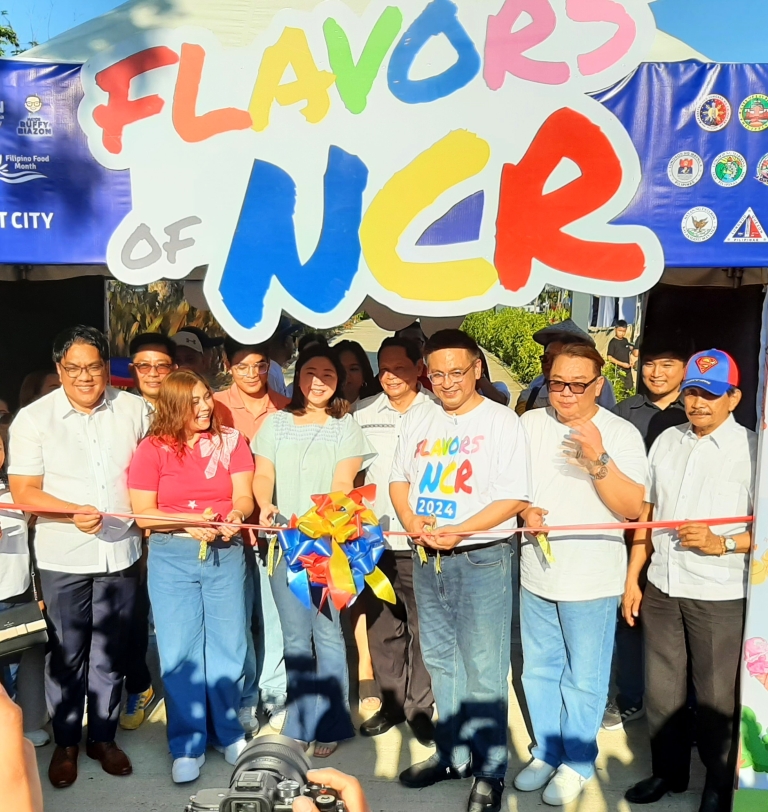
Recently Muntinlupa City hosted the 2024 edition of the Flavors of NCR food festival at the Filinvest City Central Park in Alabang and I personally witnessed the formal opening ceremony which involved many high-level officials and special guests. A lot of people visited the food festival on April 19 and 20 which added to the credibility of Filinvest City Central Park as a suitable open-air venue for special events.
For the newcomers reading this, Flavors of NCR is a special event presented by the Association of Tourism Officers – NCR which collaborated with the City Government of Muntinlupa for this year’s event. It is a showcase of unique cuisine found in the sixteen cities and one municipality of the National Capital Region (NCR). The local government units (LGUs) that participated include: Caloocan, Las Piñas, Makati, Malabon, Mandaluyong, Manila, Marikina, Muntinlupa, Navotas, Parañaque, Pasay, Pasig, Quezon City, San Juan, Taguig, Valenzuela, and the Municipality of Pateros.
Event launch
The ribbon cutting led by high officials that include Taguig City Mayor Lani Cayetano (3rd from left), Muntinlupa Mayor Ruffy Biazon (3rd from right) and Department of Tourism-NCR Regional Director Sharlene Zabala-Batin (2nd from left) to name a few.
The opening ceremony of Flavors of NCR 2024 was attended by Muntinlupa City Mayor Ruffy Biazon, Taguig City Mayor Lani Cayetano, Department of Tourism-NCR Regional Director Sharlene Zabala-Batin, Association of Tourism Officers-NCR headed by Manila City Tourism chief Charlie Dungo, and Pasay City chief of staff Peter Eric Pardo. Also present were Muntinlupa Vice Mayor Temy Simundac and Muntinlupa City Council Raul Corro.
“We are delighted to host the Flavors of NCR,” Mayor Biazon stated during his welcome remarks to all the guests. “(We acknowledge) the presence of other cities here so that their products will be showcased and we are proud to have you here.”
Biazon stressed that hosting the Flavors of NCR opens up opportunities for Metro Manila’s LGUs and their respective food-and-beverage stakeholders access to the Calabarzon region composed of Cavite, Laguna, Batangas, Rizal and Quezon with a collective population of over sixteen million people.
It should be noted that the Alabang area of Muntinlupa is a popular destination for Calabarzon residents as well as those from nearby cities who enjoy shopping and recreational activities during the weekend. That being said, Flavors of NCR fits nicely with the weekend vibe at Filinvest City.
After the formal ribbon-cutting was done, Flavors of NCR 2024 officially opened and a lot of people and photographers followed Biazon and the guests visit the different food booths of each city.
Each LGU and their best
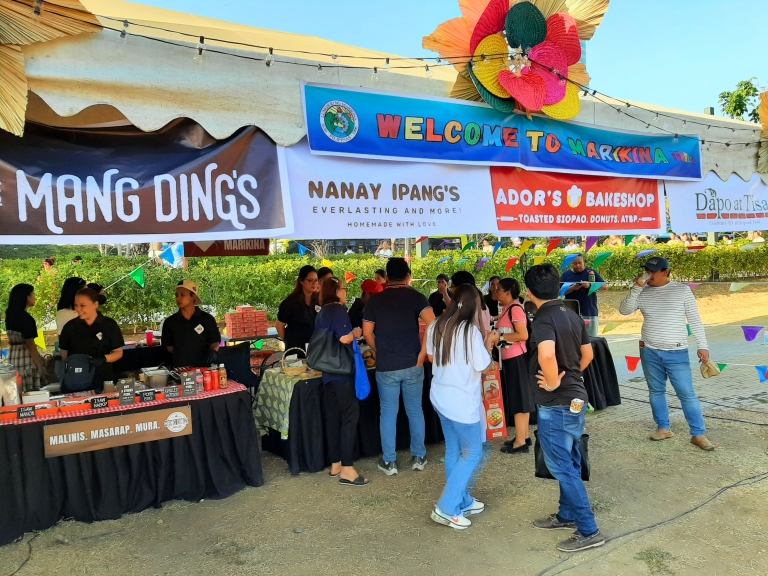
I visited and explored the designated areas (also referred to as “booths”) of each LGU during the food festival. Each area had a different style of interiors and layouts of food, drinks and other products being offered to visitors. There were also chairs and tables present for those who need to seat down and eat. Check out my raw YouTube videos plus pictures below…
Native delicacies on display for sale at the Las Piñas City booth.
Burger patties being cooked at the Mandaluyong City area.
Delicious halo-halo from Aling Consuelo Halo-Halo sa Ugbo. This was sold at P100 each.
Marikina City had four sellers that attracted customers during the food festival.
Drinks, dessert and other stuff offered to customers at the Las Piñas City booth.
As expected, the variety of food and drinks were really great. Offered to customers were chicken, beef, pork, siomai, barbeque, puto, bibingka, pansit, siopao, fried chicken, roasted pig, pastries, cakes, halo-halo and ice cream to name some. There were also non-food products being sold such as bags and accessories in some booths.
The Muntinlupa City area.
Sea food and other food items being sold at the Parañaque City booth.
Fried chicken being prepared for customers.
The best of Muntinlupa City offered to customers.
Food and bags for sale inside the booth of Malabon City.
It was really nice to see these small businesses represent their locality and offered their best products to visitors at Filinvest City Central Park. Adding zest to the food festival were some performances by different bands from the cities of NCR. There also was a modern dance activity that drew in lots of visitors which added to the customers at the food festival.
Conclusion
The 2024 edition of Flavors of NCR at Filinvest City Central Park was indeed a nice showcase of what each LGU had to offer for those who love food and drinks. In addition, this festival really emphasized unity between the local governments of NCR and it also promoted local tourism. The festival also attracted some residents of Filinvest City’s residential towers (plus others from Ayala Alabang, Palms Pointe Village and other residential communities) and some employees (who worked at offices near the park) whose shifts ended.
In the perspective of tourism, this event really boosted Filinvest City Central Park’s status as a venue for special events or activities. To date, the said park continues to be an attraction for visitors and already it has been used by organizers of sports events and musical events.
This was taken during Saturday night.
The successful staging of Flavors of NCR could inspire food festival organizers to have their events held within Filinvest City in the future.
Let me end this post by asking you readers: Were you able to attend Flavors of NCR at the central park in Filinvest City? If you did, how was your experience? Do you wish to see another food festival to be held at Filinvest City Central Park soon?
For more South Metro Manila community news and developments, come back here soon. Also say NO to fake news, NO to irresponsible journalism, NO to misinformation, NO to plagiarists, NO to reckless publishers and NO to sinister propaganda when it comes to news and developments. For South Metro Manila community developments, member engagements, commerce and other relevant updates, join the growing South Metro Manila Facebook group at https://www.facebook.com/groups/342183059992673
The data released by the Bangko Sentral ng Pilipinas (BSP) confirmed that foreign direct investments (FDI) net inflow went up by almost ninety percent in February 2024, according to a Philippine News Agency (PNA) news article. In terms of Dollar amount, the estimate was over $900 million.
To put things in perspective, posted below is an excerpt from the PNA news article. Some parts in boldface…
Foreign direct investments (FDI) net inflow went up by 89.9 percent in February this year.
Data released by the Bangko Sentral ng Pilipinas (BSP) on Wednesday showed that FDI net inflows during the month amounted to USD907 million, up from the USD478 million recorded in January 2023.
FDIs include investment by a non-resident direct investor in a resident enterprise, whose equity capital in the latter is at least 10 percent, and investment made by a non-resident subsidiary or associate in its resident direct investor.
The BSP said an FDI can be in the form of equity capital, reinvestment of earnings, and borrowings.
“The increase in FDI was supported mainly by the 173.2 percent expansion in non-residents’ net investments in debt instruments to USD820 million from USD300 million in January 2023,” said the BSP.
Reinvestment of earnings also increased by 16.4 percent to USD99 million from USD85 million. The BSP said top sources of FDIs during the month include Japan and the United States.
Let me end this piece by asking you readers: What is your reaction to this recent development? Do you think there is enough momentum for FDI net inflow to exceed the $1 billion mark by the first few months of 2025? Do you think the government is doing a good job attracting foreign investments?
For more South Metro Manila community news and developments, come back here soon. Also say NO to fake news, NO to irresponsible journalism, NO to misinformation, NO to plagiarists, NO to reckless publishers and NO to sinister propaganda when it comes to news and developments. For South Metro Manila community developments, member engagements, commerce and other relevant updates, join the growing South Metro Manila Facebook group at https://www.facebook.com/groups/342183059992673
Recently the Philippine Statistics Authority (PSA) confirmed that the unemployment rate of the nation fell down to 3.5% in February 2024, according to a Philippine News Agency (PNA) news article.
To put things in perspective, posted below is an excerpt from the PNA news article. Some parts in boldface…
Unemployment rate fell to 3.5 percent in February this year from 4.5 percent in January, the Philippine Statistics Authority (PSA) reported on Thursday.
In a briefing, National Statistician Dennis Mapa said based on the time series, the unemployment rate during the month was the second lowest on record since the 3.1 percent in December 2023. Unemployment rate in February last year was 4.8 percent.
Mapa said the number of unemployed Filipinos went down to 1.80 million from 2.47 million and 2.15 million unemployed persons in February 2023 and January 2024.
The Labor Force Participation Rate (LFPR), meanwhile, was at 64.8 percent or about 50.75 million Filipinos aged 15 years and above who were either employed or unemployed.
This is lower than the 66.6 percent LFPR seen in February last year with young people (-669,000) and women (-404,000) withdrawing from the labor force.
“The needs of vulnerable groups, including women, youth, older people, and those with disabilities, remain our priority to encourage workforce participation. We will improve access to quality childcare, finance, and entrepreneurship opportunities to support women’s entry and retention in the labor market,” National Economic and Development Authority (NEDA) Secretary Arsenio Balisacan said in a separate statement.
Balisacan said the government will revisit the existing policy governing alternative work modes, such as the Telecommuting Act, and adapt it to the evolving work landscape to address the growing preference for remote work.
“The government will explore enhancing the potential of part-time work to help promote lifelong learning. A framework for part-time work and similar set-ups can allow workers to retool or upskill without leaving the workforce,” Balisacan said.
The country’s employment rate, meanwhile, went up to 96.5 percent in February from 95.5 percent in January and 95.2 percent in February this year.
The number of employed persons was registered at 48.95 million, higher than the recorded number of employed persons in February 2023 at 48.80 million and in January 2024 at 45.94 million.
Major industries with the largest increase in employment include construction (470,000), transportation and storage (444,000), administrative and support service activities (344,000), manufacturing (313,000), and accommodation and food service activities (210,000).
Underemployed persons – or those who expressed the desire to have additional hours of work in their current job or to have an additional job or to have a new job with longer hours of work – reached 6.08 million, down from last year’s 6.29 million.
The NEDA said the Marcos administration will continue to prioritize people-centered policies and attract job-creating investments to support the continued improvement of the Philippine labor market and enable Filipinos to earn higher wages from better jobs.
Let me end this piece by asking you readers: What is your reaction to this recent development? Do you think the nation’s economy and employers still have enough momentum to move forward and create more new jobs over the next twelve months?
Welcome back readers, fellow geeks and electronic gaming fans!
In this edition of the Retro Gaming Ads Blast (RGAB) series, we will examine print ads of Sega from the 1990s which was a notable period of time when they went from being a prominent video game company into a desperate, struggling entity by the end of the decade. All the Sega ads in this edition are promotions of their own video games that were exclusive to their consoles during the 1990s.
For the newcomers reading this, Retro Gaming Ads Blast (RGAB) looks back at the many print ads of games (console, arcade, computer and handheld) that were published in comic books, magazines, flyers and newspapers long before smartphones, social media, the worldwide web and streaming became popular. To put things in perspective, people back in the 1980s and 1990s were more trusting of print media for information and images about electronic games and related hardware.
With those details laid down, here is the newest batch of retro gaming print ads for you to see and enjoy…
1. Phantasy Star IV print ad
This was the last single-player Phantasy Star game released. There is no sign of Sega revisiting the franchise for another single-player experience.
Long before the emergence of online console gaming that involved a high number of players, Sega released Phantasy Star IV for the Genesis console in America in 1994 which was praised by gamers and critics. This one also turned out to be the last single-player role-playing game (RPG) of the Phantasy Star series as Sega eventually turned it into a series of online RPGs since the year 2000.
This print ad is significant because a lot of gamers today are not aware that Phantasy Star started as a series of single-player RPGs the same year Final Fantasy debuted in Japan. Anyone interested to play Phantasy Star IV on a modern console should buy the Sega Genesis Classics collection.
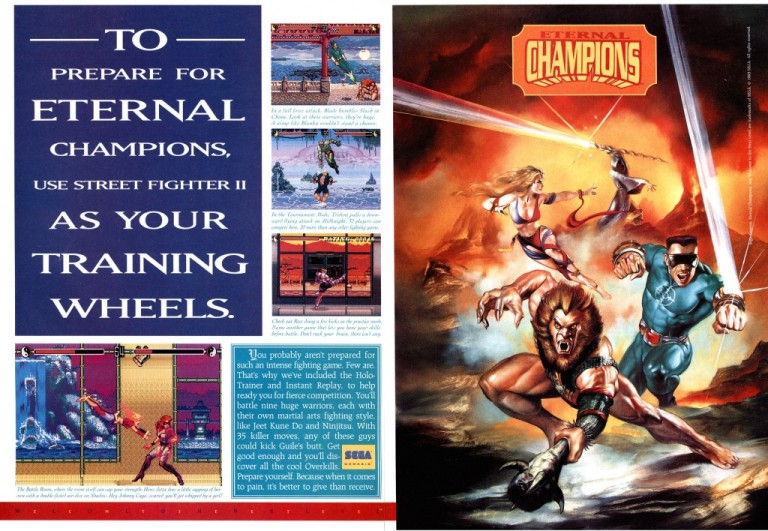
2. Eternal Champions print ad
This 2-page print ad appeared in many comic books and some magazines that I read long ago.
Back in the 1990s, the fighting game genre became wildly popular with gamers at the arcades and on consoles at home. Capcom literally sparked a wild fire with the Street Fighter II game and its upgraded editions, and other companies went on to make their own 2D fighting games to cash in. Sega was one of them and they released their own 2D fighting game Eternal Champions for the Sega Genesis console.
Unsurprisingly, the game was marketed aggressively and this 2-page print ad really stood out as it had the great looking painted art on the right, screenshots and details of the game, and most notably made a sarcastic reference to Street Fighter II. Eternal Champions sold enough copies, it led to the release of the sequel Eternal Champions: Challenge from the Dark Side and two spin-off games. I can only guess that referencing Street Fighter II was helpful in achieving commercial success.
3. Streets of Rage 3 print ad
This ad caught my attention easily when I saw it in comic books I read.
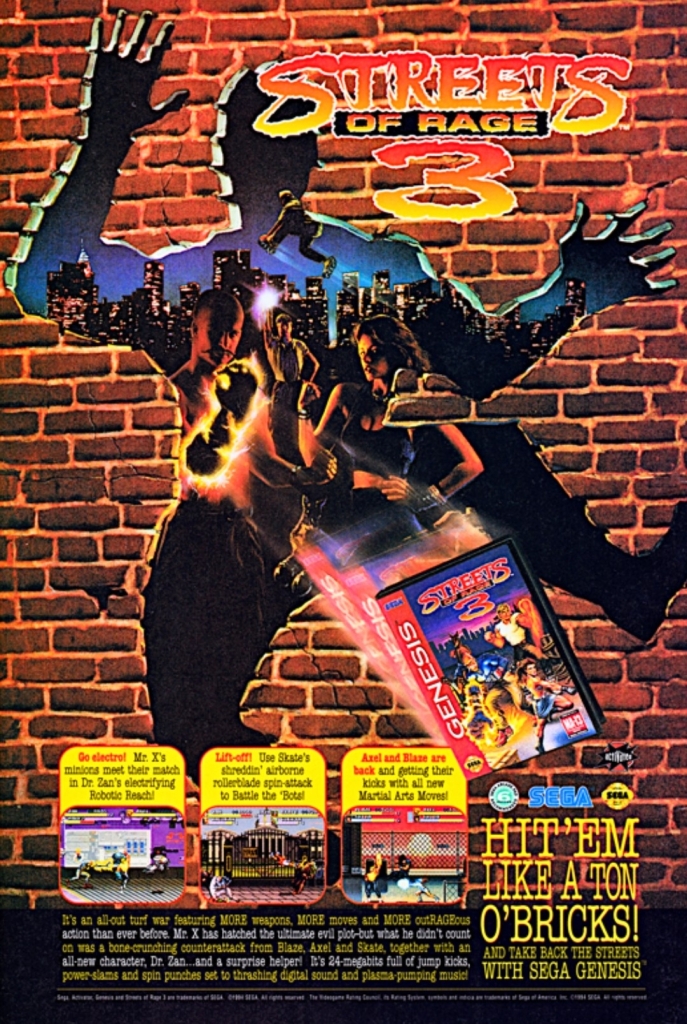
Streets of Rage (Japanese title: Bare Knuckle) was one of the most defining game franchises Sega came up with and it started on the Sega Genesis console. It was a series of side-scrolling, 2D beat-them-up games that ensured action and excitement for gamers. As the first two games were critically and commercially successful, Sega was confident in aggressively marketing Streets of Rage 3 and the print ad seen had a very attention-grabbing artwork.
The artistic style emphasized power and intensity as it shows a damaged wall with the shape of a human body (symbolizing that someone was thrown through it) and then there were images of people on the other side. The game went on to attract mostly positive reviews although it paled in comparison to its predecessors in terms of sales.
4. Shining Force II print ad
The first time I saw this ad, it made me interested to buy a Sega Genesis console to play it.
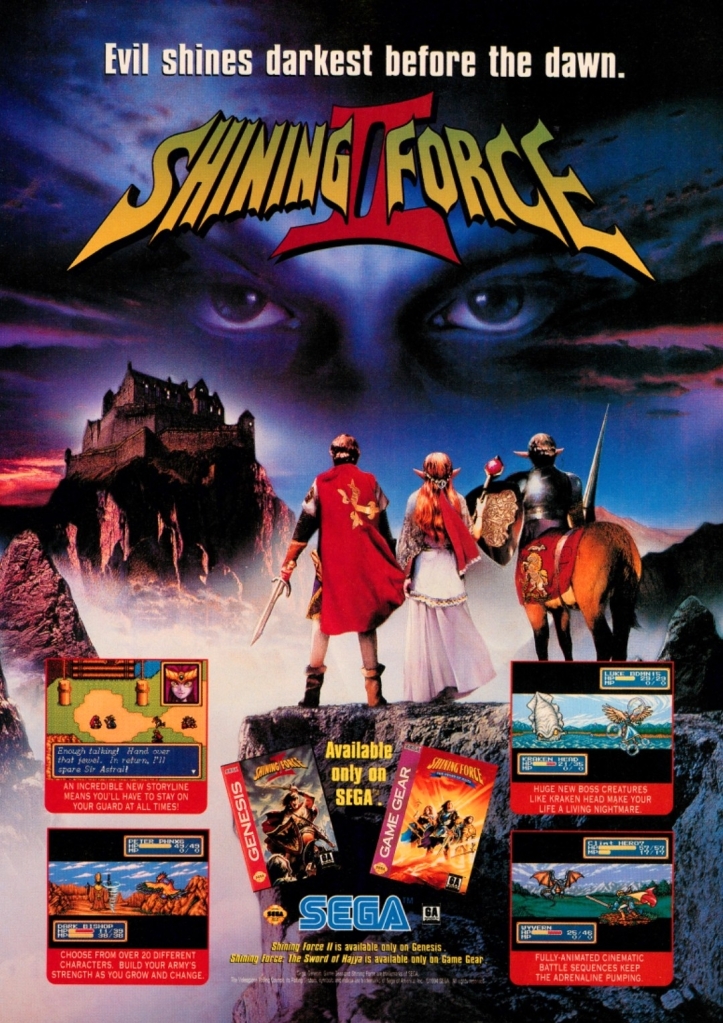
As Sega was so prolific with making and releasing games across different genres, they had their own tactical role-playing game series with Shining Force and the first game released on the Sega Genesis was a critical and commercial success. That being said, the company was confident with releasing Shining Force II on the same console more than a year later achieving critical and commercial success.
The North American print ad of the game had a visual presentation that closely captured the foreground-background style (characters facing the distance) used in-game, and the advertising team use photographic imagery to achieve a fantasy look. Very cleverly, Sega inserted the Sega Game Gear title Shining Force Shining Force: The Sword of Hajya into the ad. This print ad made me interested in acquiring a Sega Genesis for Shining Force II.
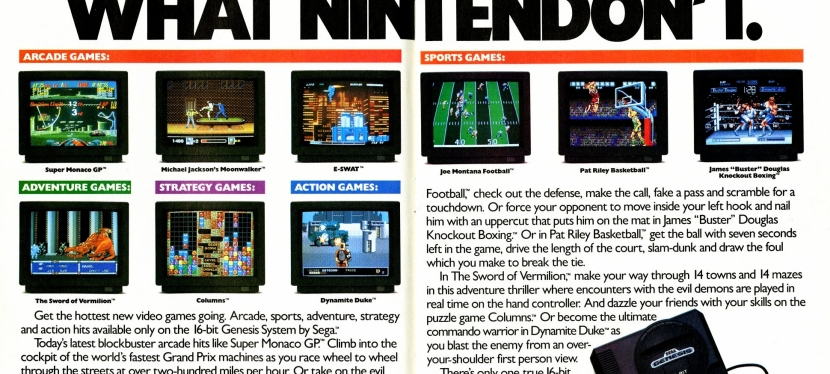
5. Genesis does what Nintendon’t print ad
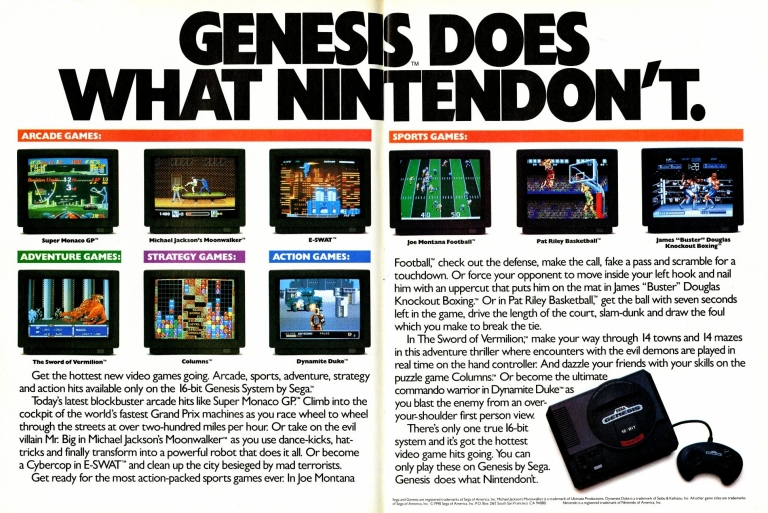
With the famous line heavily emphasized, this print ad showed how bullish Sega really was in competing with Nintendo.
Now this print ad of Sega’s has the most definitive and best-known advertising line in the so-called 16-bit console generation: Genesis does what Nintendon’t. This was Sega’s aggressive marketing push to convince gamers to buy the Genesis console to play games and experience thrills of fun that they would not find on a Nintendo console at the time. Genesis was launched in America in 1989 with “16-bit” emphasized a lot, and the technological rival Super Nintendo Entertainment System (SNES) was released in the same market more than two years later.
The 2-year advantage helped Sega establish the Genesis as the next-gen machine for gaming at home and there were years in the 1990s when Sega’s console outsold Nintendo’s in America during the so-called 16-bit war. The Genesis also had lots of exclusive games plus strong software support from third-parties. While the SNES would eventually outsell the Genesis in other parts of the world, it was in America where Sega proved to be very competitive and successful.
6. Knuckles’ Chaotix print ad
Sega was aggressive with marketing this game for the 32X.
In late 1994, Sega released in America and in Japan the 32X which was an add-on device for the Sega Genesis designed enhance its power while serving as a transition (a warm-up) into the so-called 32-bit era of console gaming. The 32X was the result of corporate decisions involving the American and Japanese executives of the company.
To keep 32X customers happy and boost hardware sales, Sega adjusted the development of Knuckles’ Chaotix (a Sonic spin-off) from being a Sonic project 32-bit console Sega Saturn into a standalone game for the add-on device. Even though Sega knew the game’s development was rushed, they went on to strongly promote the game and the print ad shown here was quite eye-catching.
The image of a fist with a ring showing the character Knuckles (a character from the Sonic games) emphasizes power and the colors used seem to express intensity. Then there were the selected screenshots shown without descriptive text. Although Sega tried hard, Knuckles’ Chaotix (launched in 1995) received mixed-to-positive reviews and sadly sold poorly. Unsurprisingly, the sales of the 32X dropped further and by then a lot of consumers knew that the Sega Saturn (the true successor to the Genesis) was all set to launch in America and Europe within 1995.
7. Sonic 3D Blast for Sega Saturn print ad
Too bad Sega and its teams failed to make the true Saturn Sonic game.
Back in the 1980s and 1990s, having a high-quality, console-exclusive game featuring a company mascot was crucial to sell game consoles while keeping dedicated fans happy. Like what Nintendo did with their icon Mario, Sega achieved great commercial success with the three Sonic the Hedgehog games they released exclusively on the Sega Genesis console and this naturally created expectations they would make new Sonic games on the Saturn console. Unfortunately, Sega and its teams failed to complete development of the Saturn-exclusive game Sonic X-treme and the company cancelled it which sent shockwaves through the games industry news.
With the 1996 holiday shopping season too crucial to ignore, Sega commissioned a Saturn version of the game Sonic 3D Blast which was originally made for the Genesis console. Sonic 3D Blast on the Saturn took seven weeks to make and there were some graphical enhancements implemented. While Sonic 3D Blast’s Genesis version attracted a positive reception from critics (and sold 700,000 copies), the reception for the Saturn version was mixed. This print ad of Sonic 3D Blast on Sega Saturn is a reminder of the company’s failed attempt to take their icon to the next-generation. They never replicated the big success they had with Sonic on the Genesis.
8. Die Hard Arcade print ad
Each time I saw this print ad, it easily reminded me of the classic action film of 1988.
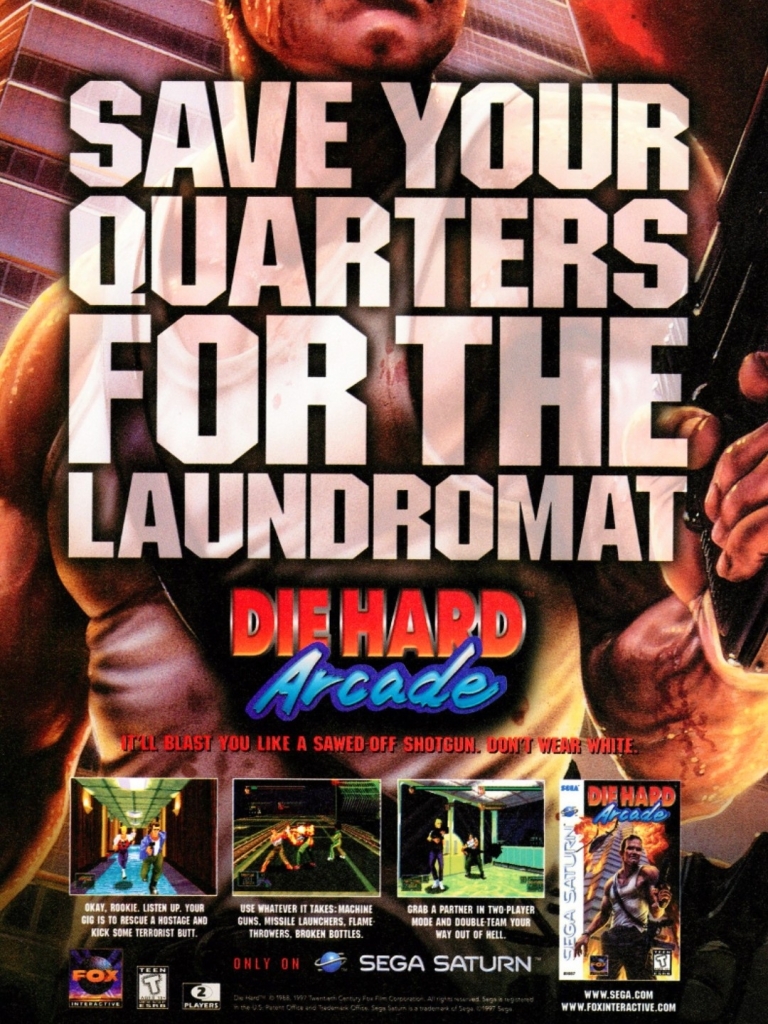
Like many other movie franchises, Die Hard has many video game adaptations released through the decades. In 1997, Sega released Die Hard Arcade (Japanese title: Dynamite Deka) on the Sega Saturn and the game critics praised it for its fun gameplay as well as its flawless conversion of the arcade version (released in 1996). To say the least, the development history of Die Hard Arcade is not as straightforward as many would think. To get the details and explanations of the development of the game, click here.
As for the print ad itself, this one cleverly used official game art as the background with imagery which instantly reminded me of what I saw in the classic 1988 movie that starred Bruce Willis. This ad made me interested to buy a Sega Saturn or find a place to rent it to play the game.
9. Shenmue Japanese print ad
Simplistic with presentation and yet engaging to look at. The Dreamcast-exclusive Shenmue sold over a million copies in Japan alone.
When Shenmue was released exclusively on the Sega Dreamcast in Japan on December 29, 1999, it turned out to be a very mind-blowing experience for many gamers due to its ambitious game design, the intense attention to detail implemented, very high production values, in-depth exploration and very immersive gameplay.
It was the open-world game released at a time when “open-world” was not even a standard gaming term. Often called the masterpiece of the legendary game designer Yu Suzuki, Shenmue sold over 1.2 million copies in Japan and went on to be released worldwide in the months that followed. Sadly, the game failed to make a profit due to its very high budget of $70 million (which Suzuki himself said in English during an interview) and the fact that the number of Dreamcast units already sold to gamers was not massively high.
The Japanese print ad of Shenmue had a simplistic looking visual concept and yet it was engaging to look at because the way the characters appeared was how they appeared in the game during gameplay which was astounding. Take note that back in the 1990s, it was common for video game marketing materials to show human characters in high detail but in reality the polygonal models of those characters appeared looking blocky and much less detailed during gameplay.



















 Author Carlo Carrasco