A Look Back at X-Men Adventures Season II #8 (1994)

Welcome back superhero enthusiasts, 1990s arts and culture enthusiasts, Marvel Comics fans and comic book collectors! Today we go back to the mid-1990s to explore the adaptation of the second season of the famous X-Men: The Animated Series (X-Men TAS) in the form of the X-Men Adventures comic book series.

Before getting to the new retro comic book review, I should state that it is indeed very challenging to implement the concepts of time travel and timeline conflicts into the narrative of an established X-Men universe. As far as the X-Men TAS narrative goes, Bishop and Cable are mutants who each came from different points in the future and in different ways they each made impact with the present day X-Men as portrayed in the comics (the literary X-Men specifically).

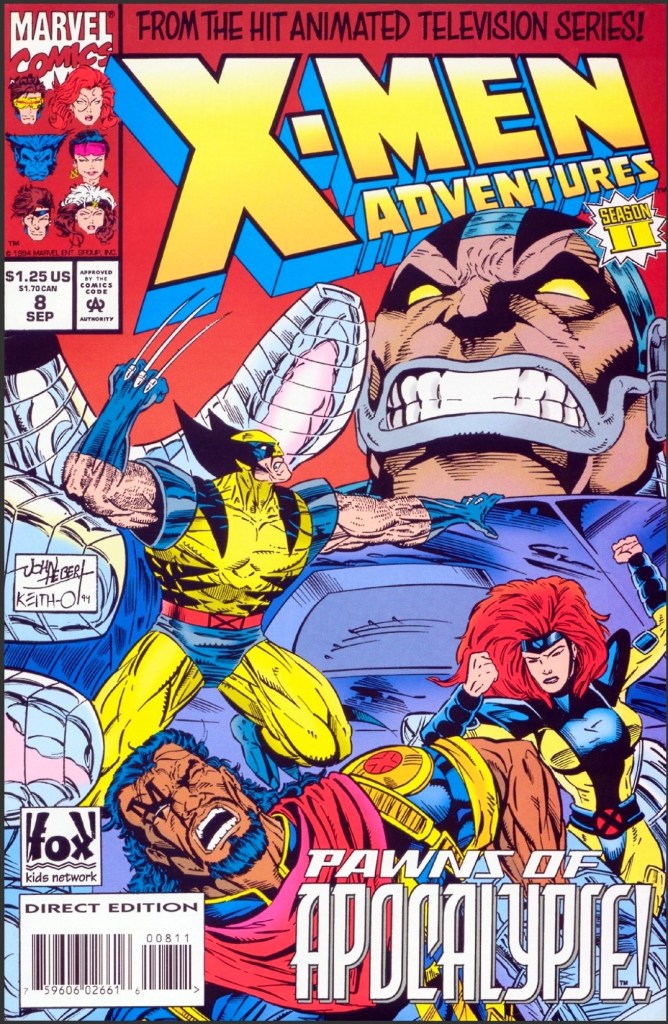
With those details laid down, here is a look back at X-Men Adventures Season II , published in 1994 by Marvel with a story written by Ralph Macchio and drawn by John Hebert. The is the 2nd chapter of the Time Fugitives storyline.

The cover.

Early story

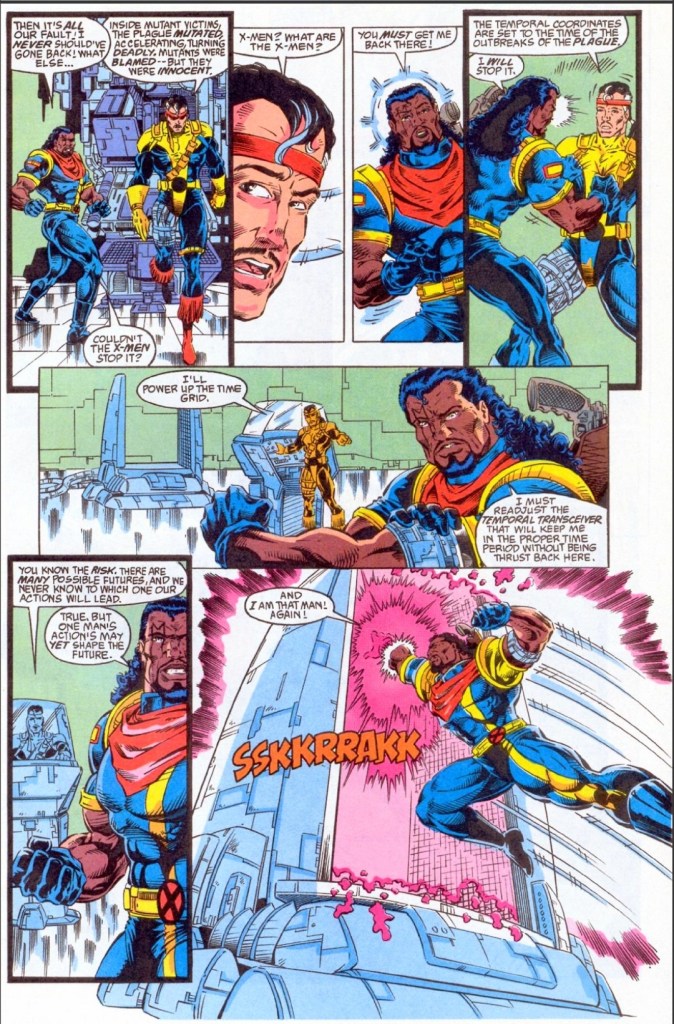
The story begins on Earth in the far future of 3999 AD. Cable, who has been leading the fight against Apocalypse, is receiving information from his cube-shaped computer which informs him that a temporal storm has wreaked havoc with the time stream and their present is reconfiguring in response to the existence of a new past. Once realignment gets completed, everyone in the current timeline will cease to exist. Cable then learns that Bishop (who returned to the X-Men in the previous issue) is the primary chronal component of the time readjustment.

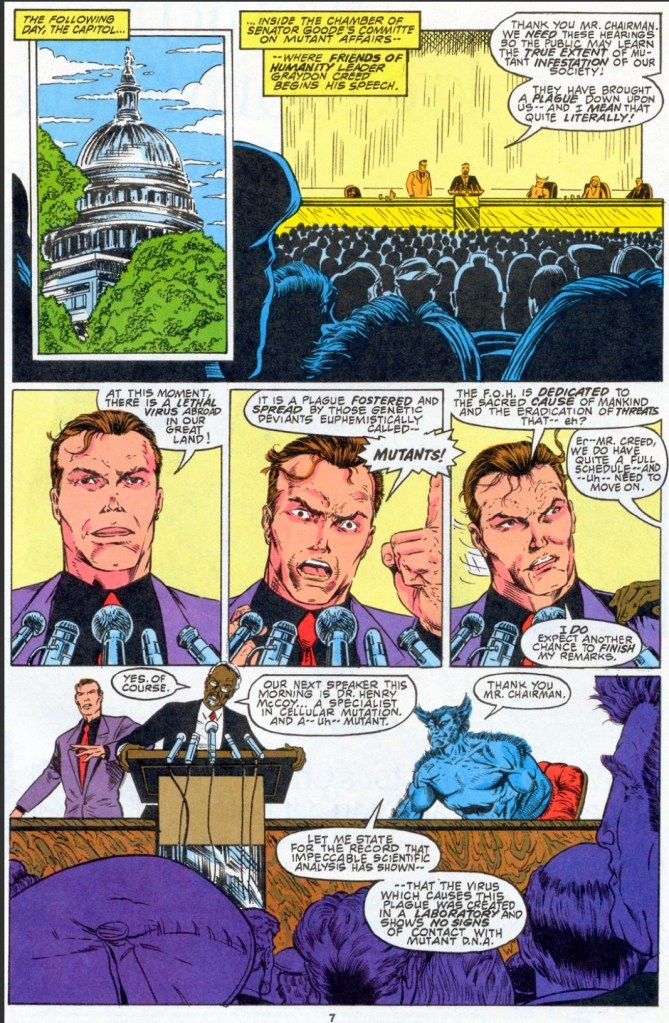
Meanwhile in the present day inside Xavier’s mansion, the X-Men listen to Bishop who explains that mutants will be blamed for the plague that a certain virus will precipitate and that the fear of the virus will make things much worse for many people. He states that the virus was not brought into being by mutants.

Beast then shares that his investigation of a viral-ridden cell sample was convincing and discovered that the virus was genetically engineered. He reveals that once the little germs spread to the mutant population and combine with mutant DNA, it could turn out incredibly deadly…

Quality

Conflict brewing in front of a huge audience.

To be straight to the point, what the creative team started in issue got strongly concluded here. With the animated episode’s teleplay being the primary reference, writer Ralph Macchio successfully crafted a script that raised the stakes of the 2-part Time Fugitives story while tying closely the gaps with regards to the time travel and timeline conflicts concepts. Without spoiling the plot, I can say that one development that took place in the present day clearly set off the stage for another futuristic mutant to not only get involved but also make a huge impact on the narrative.

As with the previous issue, this story has elements of xenophobia as well as fear of viruses and potential massive infections which added a good layer of depth to the plot. Macchio’s writing is very strong and no matter how intense the tale got as more details got presented, it still remained very readable and efficient to follow. Also, I should say that Apocalypse’s presence turned out very powerful and it should inspire readers to search for comic books of the supervillain’s conflict with the X-Men and X-Factor for insight.

John Hebert returned on the visual department and his art style really works well with both the sci-fi concept of the story and the presentation of the X-Men plus Bishop and Cable. I really admire Hebert’s stylized take on Wolverine, Cable and Bishop as he made each them look even grittier than before. There is also this creepy vibe with the way Hebert drew some of the X-Men members’ faces. Herbert is also very good with visualizing sci-fi elements such as energy forms, futuristic machines, techno-virus forms on the skin, and more. His presentation of dynamic superhero action is great to look at. This is clearly one of the best looking issues of Season II of the X-Men Adventures series.

Conclusion

Bishop explains things to the X-Men and Beast confirms key details.

X-Men Adventures Season II (1994) is a rock-solid comic book in terms of quality and impact. It concluded the 2-part story with a powerful resolution, it tied the loose ends in a very timely fashion and I really enjoyed the way how the X-Men were dramatized as Bishop and Cable got involved with them in their present day setting. So far, this is the most satisfying and more impactful issue of Season II I have read in this series.  

Overall, X-Men Adventures Season II (1994) is highly recommended.

+++++

Thank you for reading. If you find this article engaging, please click the like button below, share this article to others and also please consider making a donation to support my publishing. If you are looking for a copywriter to create content for your special project or business, check out my services and my portfolio. Feel free to contact me with a private message. Also please feel free to visit my Facebook page Author Carlo Carrasco and follow me on Twitter at  @HavenorFantasy as well as on Tumblr at https://carlocarrasco.tumblr.com/ and on Instagram at https://www.instagram.com/authorcarlocarrasco
A Look Back at X-Men Adventures Season II #7 (1994)

Welcome back superhero enthusiasts, 1990s arts and culture enthusiasts, Marvel Comics fans and comic book collectors! Today we go back to the mid-1990s to explore the adaptation of the second season of the X-Men animated series in the form of the X-Men Adventures comic book series.

Before getting to the new retro comic book review, I should state that decades ago, the use of future timelines was implemented on the X-Men comics. I’m talking about the possible future where Cable and Stryfe came from, another possible future where Phoenix/Rachel Summers came from, and the more established future of the classic Days of Future Past storyline. Time travel and possible future timelines are the themes in the next X-Men Adventures comic book I reviewed recently.

With those details laid down, here is a look back at X-Men Adventures Season II , published in 1994 by Marvel with a story written by Ralph Macchio and drawn by Scott Rosema.

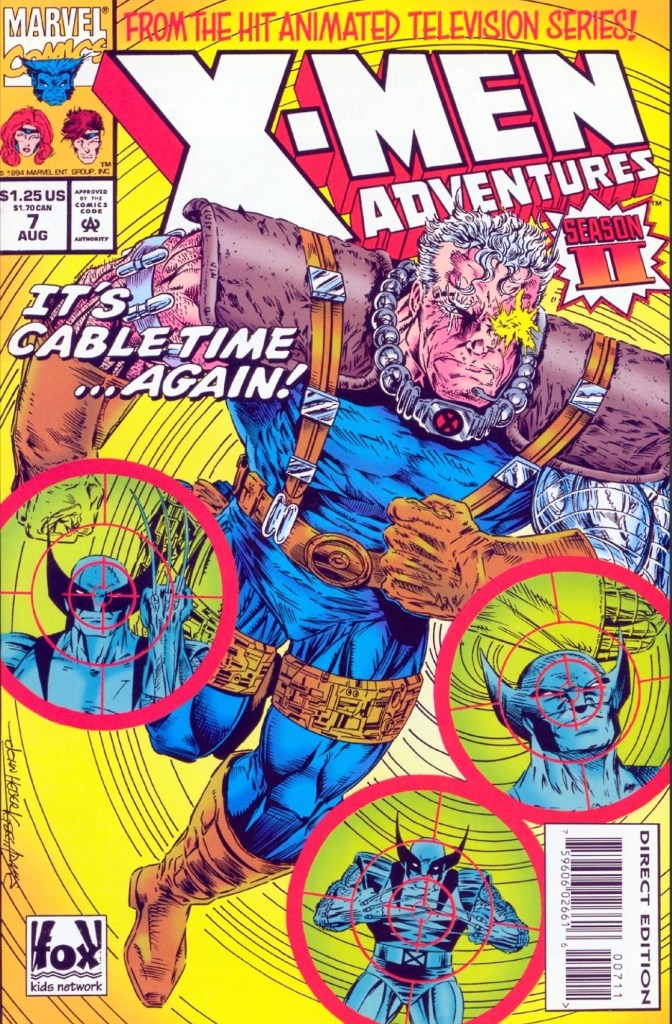
The cover.

Early story

The story begins on Earth in the far future of 3999 AD. Cable, who is fighting for the rebels, battles the deadly forces of the powers that be. It turns out, he and his teammates have been struggling a lot and their team suffered several deaths already. Even though they are very tired and heavily outnumbered, Cable refuses to give up and bravely calls for a frontal assault against their enemies.

Suddenly, Apocalypse appears on the battlefield and commands his robotic troops to destroy Cable and his fellow rebels. To Apocalypse’s surprise, a temporal storm appears and Cable notices it appearing so close to them. One of his teammates got caught by the storm which pushes Cable away. After receiving computer updates, Cable decides to get away from the robotic troops.

Meanwhile in another time period and place, Bishop returns from his mission (his interactions with the X-Men of the 20th century – click here and here) only to discover from Forge that nothing has changed and the plague still rages on…

Quality

The X-Men have a new problem to deal with.

Having read X-Men Adventures and of season 1, I found this particular tale (clearly a sequel to Bishop’s interaction with the X-Men after traveling through time) relatable and enjoyable. There is a strong science fiction vibe here and the time travel aspect added a lot to the build-up of tension.

Bishop here is almost the protagonist as the story showed an altered future in which Forge has no memory of the X-Men and only made a reference to a plague that has lasted for a long time. This compels Bishop to go back to the 20th century again hoping to meet the X-Men and somehow prevent the plague from bringing down society.

The impact of the mysterious virus is tremendous as so many people got infected and authorities suspect mutants to be the carriers. At this stage, the social aspects inserted by the creators really started to grow stronger within the narrative and you will see the X-Men struggling with not only the increased scrutiny on mutants but also with the manipulative tactics of anti-mutant activists who can’t help but see golden opportunities to wipe out mutants in a more clever fashion.

The dialogue here is noticeably gripping to read and the dramatization worked accordingly. There is also a good amount of superhero spectacle to enjoy here even though the X-Men have no super villains to fight with.

Conclusion

Forge has no memory of the X-Men.

X-Men Adventures Season II (1994) looks like a repeat or even a remake of what happened in X-Men Adventures (Season I) but its concept turned out to be not only unique with strong social commentary and sci-fi elements, but also became really engaging thanks to the fine execution by the creative team. On the aspect of social relevance, this comic book will remind you about the internment of Japanese Americans in America (1942-1946) and the COVID-19 restrictions and the quarantine on communities imposed by governments that disrupted people’s lives. As this comic book marks the first part of the Time Fugitives, I can say that I enjoyed it and I’m looking forward to the next chapter.

Overall, X-Men Adventures Season II (1994) is recommended.

+++++

Thank you for reading. If you find this article engaging, please click the like button below, share this article to others and also please consider making a donation to support my publishing. If you are looking for a copywriter to create content for your special project or business, check out my services and my portfolio. Feel free to contact me with a private message. Also please feel free to visit my Facebook page Author Carlo Carrasco and follow me on Twitter at  @HavenorFantasy as well as on Tumblr at https://carlocarrasco.tumblr.com/ and on Instagram at https://www.instagram.com/authorcarlocarrasco
A Look Back at WildC.A.T.S: Covert Action Teams #8 (1994)

Disclaimer: This is my original work with details sourced from reading the comic book and doing personal research. Anyone who wants to use this article, in part or in whole, needs to secure first my permission and agree to cite me as the source and author. Let it be known that any unauthorized use of this article will constrain the author to pursue the remedies under R.A. No. 8293, the Revised Penal Code, and/or all applicable legal actions under the laws of the Philippines.

Welcome back superhero enthusiasts, 1990s culture enthusiasts and comic book collectors! Today we continue revisiting Jim Lee’s flagship title under the Image Comics label – WildC.A.T.S: Covert Action Teams!

In my previous retro review of WildC.A.T.S #7, that story marked the 3rd chapter of the 4-part Killer Instinct crossover storyline which brought Jim Lee’s team together with Marc Silvestri’s Cyber Force. That storyline ended in a Cyber Force comic book which leads to the questions – what is next for WildC.A.T.S? Will there be a new and fresh storyline set up for them?

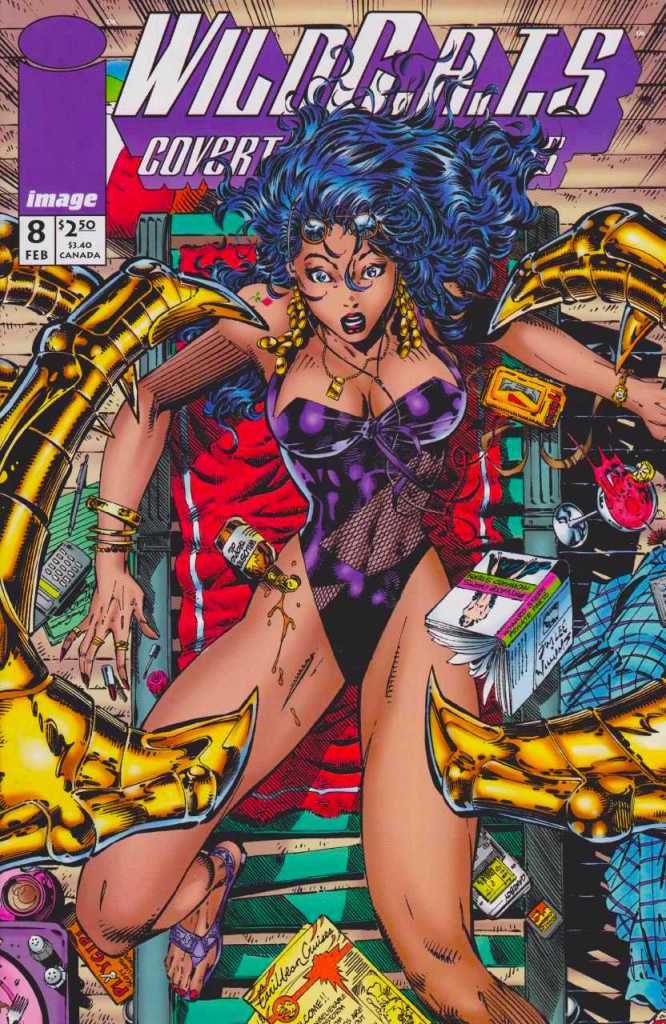
With those details laid down, here is a look back WildC.A.T.S: Covert Action Teams , published by Image Comics in 1994 with a story written by Brandon Choi and Jim Lee. Lee did the art along with Richard Bennett and Scott Williams.

The cover.

Early story

The story begins inside a large bar within New York City where Cole Cash/Grifter and Zealot (both of them in civilian clothes) spend time together playing pool. There are men nearby staring at them. While Grifter tries to unwind and have fun with the game, Zealot still sticks to her warrior mindset even though they are no longer in a battle field. Suddenly, one man arrogantly pours beer on Grifter’s head while another man touches Zealot’s hair.

The two WildC.A.T.S members struck the two violators and subsequently made short physical work of the other men who tried to hurt them. After that, Zealot and Grifter talk outside. The latter receives an urgent message which compels him to leave Zealot behind and do something important…

Quality

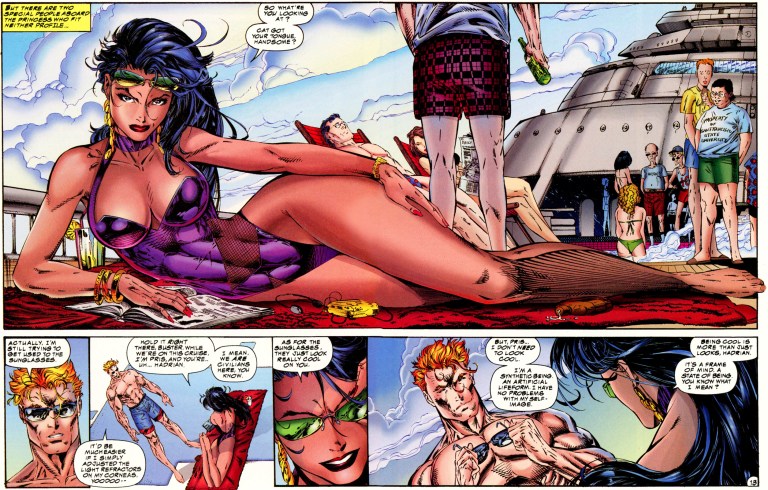
Spartan and Voodoo on holiday in their civilian forms.

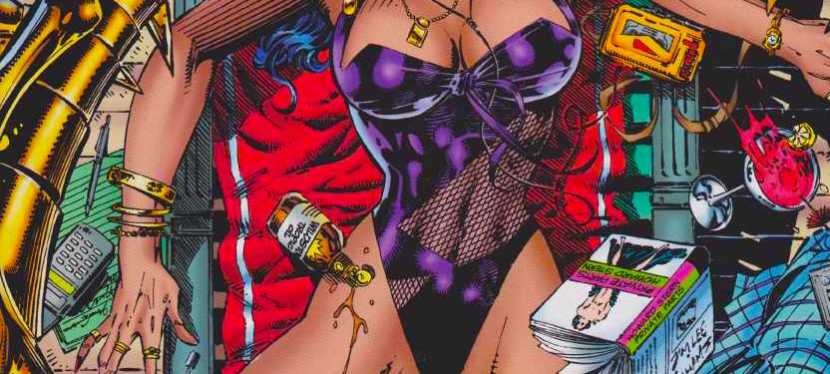
I’ll be straight to the point here. If you enjoyed Jim Lee’s previous work on Marvel’s X-Men that include bombastic action, misadventures, team members appearing in swimwear and character moments, you will find that in this story which is really a transitional tale of the team taking a break from action only to find themselves facing new danger. That being said, the concept and structure of the plot in this comic book is pretty simple and it does succeed in setting up WildC.A.T.S for another misadventure while cleverly emphasizing the Kherubim-Daemonite concept of the WildStorm universe back then.

As expected, Jim Lee’s artwork here is really great to look at and he sure always finds ways to make the dialogue scenes look interesting. What stands out to me the most in this comic book are the character moments which more than made up for the lightness of the plot. While the romantic interactions between Spartan and Voodoo is interesting, the interactions between Zealot and Grifter (referred to as Brother Grifter) really gave me additional insight on their respective personalities and, more notably, their feelings for each other.

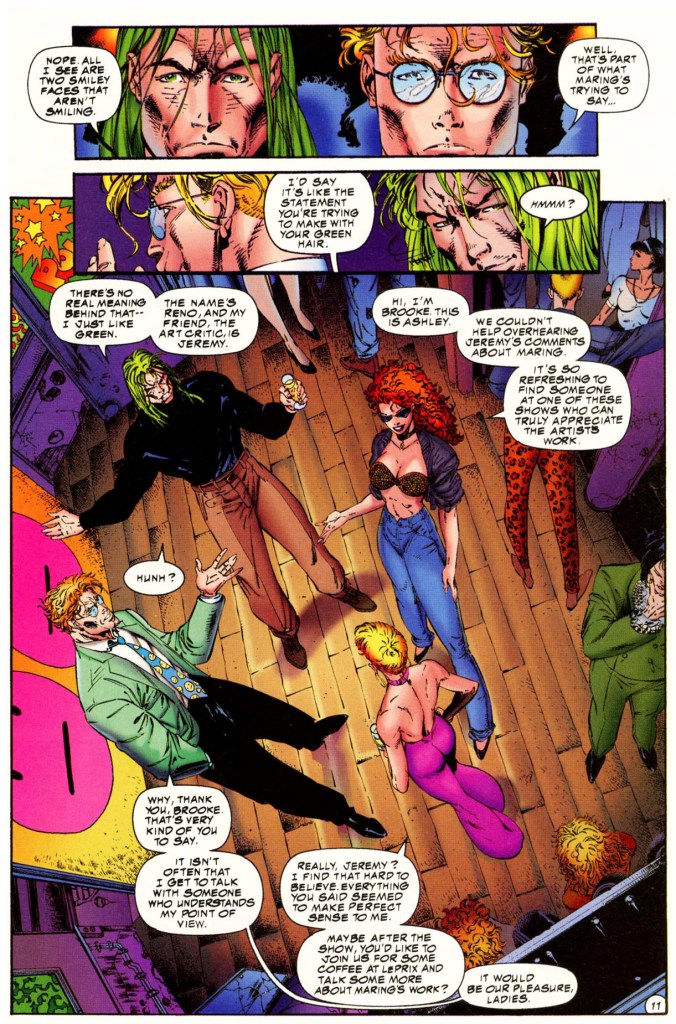
More on character moments, you will see Maul and Warblade in their respective civilian identities as Reno and Jeremy. If you only see those two as violent action performers based on the previous issues of WildC.A.T.S, you will be surprised with the way Brandon Choi and Jim Lee presented them in this story.  

Conclusion

Can you recognize Maul and Warblade?

While its story was pretty light, WildC.A.T.S: Covert Action Teams (1994) still manages to entertain me mainly due to the character moments that the creators came up with. In many ways, this comic book showed how human the team members are which is a nice change from all the action-focused stuff they were so busy with in the previous issues. Along the way, you will see a few creative gimmicks Jim Lee inserted visually, including the unofficial cameo appearance of two pretty notable members of X-Men (note: they just got married). Meanwhile, those who love Pris/Voodoo will find some extra entertainment here as this comic book has an additional short story about her past (set after WildC.A.T.S Trilogy ) which was written by Peter Seagle and drawn by Travis Charest (who would later replace Jim Lee as illustrator of this comic book series).

If you are seriously planning to buy an existing hard copy of WildC.A.T.S: Covert Action Teams (1994), be aware that as of this writing, MileHighComics.com shows that the near-mint copy of the regular edition costs $40 while the near-mint copy of the newsstand edition costs $120.

Overall, WildC.A.T.S: Covert Action Teams (1994) is recommended.

+++++

Thank you for reading. If you find this article engaging, please click the like button below and also please consider sharing this article to others. If you are looking for a copywriter to create content for your special project or business, check out my services and my portfolio. Feel free to contact me with a private message. Also please feel free to visit my Facebook page Author Carlo Carrasco and follow me on Twitter at  @HavenorFantasy as well as on Tumblr at https://carlocarrasco.tumblr.com/