During her European visit, Japanese Prime Minister Takaichi Sanae hailed the deal between the United States and the Islamic terrorist regime of Iran to end the fighting while paving the way for international oil tankers to safely pass through the Strait of Hormuz, according to a news report by Kyodo News. Japan also remained consistent in its opposition to Iran’s nuclear weapons ambition.
To put things in perspective, posted below is the excerpt from the Kyodo News report. Some parts in boldface…
Japanese Prime Minister Sanae Takaichi on Monday hailed a U.S.-Iranian deal aimed at ending their monthslong war as a “big step” to de-escalating the conflict that has brought uncertainty to the global economy and roiled her resource-poor country.
Takaichi, who stopped by Italy before attending the Group of Seven summit in France, also told reporters Japan will take part in a joint statement issued by four European nations that welcomed the development and touched on minesweeping operations toward achieving the reopening of the Strait of Hormuz.
“We have been asked to participate…and we will,” the prime minister said about the statement by the leaders of Britain, France, Germany and Italy, after U.S. President Donald Trump said a deal with Iran has been reached that will lead to the reopening of the key energy artery, which has been effectively closed amid the conflict.
Takaichi noted it is important that the contents of the memorandum of understanding, which Trump said will be signed Friday, are “steadily implemented” as well as the “free and safe navigation” of vessels through the strait.
Japan, which has traditionally maintained amicable ties with Iran, has been making “proactive diplomatic efforts” based on the position that “what matters most is de-escalation of the situation,” she also said.
The joint statement by the European nations vowed support for the implementation of the U.S.-Iran deal “rapidly and comprehensively,” while noting that “the urgent re-opening of the Strait of Hormuz with unconditional and unrestricted freedom of navigation is essential.”
“We are committed to playing our part to achieve this — in accordance with our respective constitutional requirements — including through a strictly defensive and independent mission to reassure commercial shipping and conduct mine clearance operations,” it said.
With discussions between the United States and Iran over Tehran’s nuclear development to start after the signing of the deal, the statement also said the European countries are “prepared to lift relevant sanctions in response to clear, verifiable steps by Iran” toward scrapping its program.
Takaichi reiterated Japan’s position of opposing Iran’s development of nuclear weapons, citing her country’s experience of being the only country to have suffered atomic bombing in the final stage of World War II.
In Tokyo, Chief Cabinet Secretary Minoru Kihara said at a press conference that the memorandum, if implemented properly, would “help reduce risks to both the Japanese and global economies by ensuring free and safe navigation” through the strait.
Let me end this piece by asking you readers: What is your reaction to this development? Are you convinced that US-Iran deal will ensure complete nuclear disarmament of the Islamic terrorist regime of Iran? Do you think the reopening of the Strait of Hormuz will pave the way for significant oil price reductions? Once revealed publicly, do you think the final details of the US-Iran deal will satisfy Japan and the European nations?
The steel industry of the United States will receive a much-needed boost as Japanese steel giant Nippon Steel Corp. will invest up to $2.5 billion in the Pennsylvania-based Mon Valley Works over the next three years, according to a news article by Jiji Press.
To put things in perspective, posted below is the excerpt from the Jiji Press news article. Some parts in boldface…
Nippon Steel Corp. plans to invest up to 2.5 billion dollars in United States Steel Corp.’s Mon Valley Works in Pennsylvania over the next three years, the U.S. steelmaker said Monday.
“The total investment may range from approximately 2 billion to 2.5 billion dollars, more than double the original commitment” of the Japanese steelmaker, which acquired U.S. Steel last year, the Pittsburgh-based company said.
The investment includes construction of a new hot strip mill, set to replace an 87-year-old facility to produce high-value steel products such as those used in automobiles, U.S. Steel said.
The U.S. steelmaker said that the investment would generate 1.7 billion dollars in economic impact and create up to 6,381 jobs in Pennsylvania over three years.
The investment will deliver “lasting benefits to Pennsylvania workers, businesses, and communities,” U.S. Steel said.
Let me end this piece by asking you readers: What is your reaction to this development? Do you think this major investment pledge by the Japanese steel giant will be economically beneficial to the steel workers, small businesses and local communities in the state of Pennsylvania? Do you think more Japanese investment in America will lift up the nation’s economy as long as the ties between US President Donald Trump and Japanese Prime Minister Takaichi Sanae remain strong?
Welcome back my readers, YouTube viewers and all others who followed this series of articles focused on YouTube videos worth watching.
Have you been searching for something fun or interesting to watch on YouTube? Do you feel bored right now and you crave for something to see on the world’s most popular online video destination?
I recommend you check out the following videos I found.
#1 Reaction Videos Of Scary Movie 3 – After enjoying the original Scary Movie of 2000, I saw its 2001 sequel and left the cinema disappointed. Two years later, I saw Scary Movie 3 and it was an indeed an improvement over Scary Movie 2. What is very notable about Scary Movie 3 is the fact that the Wayans Brothers were no longer involved and it was directed by David Zucker of ZAZ (Zucker-Abrahams-Zucker). Scary Movie 3 is popular with YouTubers and already there are several reaction videos about it posted online. For your enjoyment, I posted below the reaction videos I found entertaining.
#2 Ranting For Vengeance Debunks Zealots Who Believe Anime Is Leftist – If you were fortunate enough to watch multiple anime productions dating back to the 1960s, you would be aware about the collective mindset of the creators, what the anime trends were and what the messages came with what was shown through the decades. Still, there are some zealots on social media who have this foolish belief that all anime is woke and leftist in nature. That said, Ranting for Vengeance recently posted another video debunking those zealots and his explanations have strong details. Watch his video now.
#3 The Enduring Story Behind Super Mario Bros. 2 – Back in the mid-1980s, Super Mario Bros. became a massive commercial success for Nintendo and it went on to make an impact not only on gamers but also on pop culture. Shigeru Miyamoto and his team worked hard to make Super Mario Bros. 2 which was released on the Family Disk System in Japan. Strangely, the Super Mario Bros. 2 released on the Nintendo Entertainment System (NES) in America was not the same game the Japanese gamers enjoyed. Confused? There is a lot of details in GTV Japan’s video below and they are all worth discovering. Go watch it and pay attention to the details closely.
#4 Wagyu For Breakfast In Japan – When was the last time you had Wagyu for a meal? Was there ever a time you experienced a luxurious breakfast while traveling overseas? Japan is where you can find them and you can discover where exactly they are and what other types of food is offered to customers in the Nippon TV video below. Watch, learn and enjoy!
#5 The Worst NBA Arenas – Considering how many teams there are in the National Basketball Association (NBA) representing different cities, America clearly has a lot of venues where the basketball games can be held at. Some stadiums have modern designs that can accommodate not only lots of people but also the high-spending spectators (those who can afford luxuries) while providing everyone convenience and comfort for game viewing. Meanwhile, there are places that are sub-par or even undesirable for watching basketball games. The video below explores and explains what the worst NBA arenas are.
#6 No Chances For A Remake Of Xenogears? – When it comes to Japanese role-playing games (JRPGs) that were released on the PlayStation console in 1998, the one game I want to play again is Square Enix’s Xenogears. I played it on the PlayStation but I never got to finish it. While Square Enix managed to remaster Chrono Cross and released it on different platforms in recent years, the company has been very quiet about any remake or remastering of Xenogears. Apart from the fact that many of the people who worked on Xenogears under Square’s umbrella have left the company, there are other possible factors as to why remaking Xenogears is complicated in ways that have yet to be revealed to the public. To find out why, watch the in-depth video below.
#7 Ashleigh Burton Reacts To What Lies Beneath – In late-2000, I saw What Lies Beneath on a Friday night inside a packed cinema at Festival Mall. The film, starring Michelle Pfeiffer and Harrison Ford as a couple, really made moviegoers around me stressed and scared. There were even some bouts of screaming as the movie unleashed its scary moments. Recently, I watched Ashleigh Burton’s reaction video of the movie and it is a must-see!
#8 Rhetorical Thrill Reacts To Dragonslayer – When it was released in the early 1980s, Dragonslayer was one of many fantasy movies that got released. On its own, Dragonslayer was dark, gritty, violent and even gruesome to see. The Walt Disney Company and Paramount Pictures banded together to co-produce the film and eventually it ended up as a commercial failure. Even though it failed, Dragonslayer managed to gain a following and people who want to watch dark and violent fantasy movies are attracted to it. To see how it impacts Rhetorical Thrill, go watch her reaction video below. It’s a must-see.
Japan and the United States have formally confirmed their partnership on the Genesis Mission project and together they will invest heavily on it and cooperate closely over the next several years, according to a news report by NHK World. That said, Japan is officially the first international partner on the ambitious project.
Officially launched by US President Donald Trump in late-2025, Genesis Mission unites the US Department of Energy (DOE) National Labs, industry, academia, and more to harness AI for breakthroughs in energy dominance, discovery science, and national security.
To put things in perspective, posted below is an excerpt from the NHK World report. Some parts in boldface…
Japan will join a US national project called “Genesis Mission,” which is aimed at accelerating scientific research and technological innovation by using artificial intelligence and supercomputers.
Japan will be the project’s first international partner.
The US and Japanese governments will each invest 500 million dollars in the project over five years.
US President Donald Trump’s administration launched the project last November.
Delegates from the US Department of Energy, Japanese ministries of education, science and technology as well as Economy, Trade and Industry signed the statement of intent at the DOE in Washington on Thursday.
DOE Under Secretary for Science and Genesis Mission Lead Dario Gil said it is a “defining moment” for the next era of science.
Under the partnership, US national laboratories and leading Japanese research institutions, including Riken and the National Institute for Materials Science, will boost research collaborations to advance breakthroughs in areas such as quantum information science, fusion energy and biotechnology.
The move is also aimed at strengthening the two partners’ global competitiveness in science and technology with China in mind.
The US and Japanese governments also plan to discuss how to ensure the protection of crucial databases and intellectual property.
The vice-minister for policy coordination of the Japanese education, science and technology ministry, Kakita Yasuyoshi, said Japan has abundant quality data resources obtained through research and development.
Let me end this piece by asking you readers: What is your reaction to this development? Do you think the US-Japan partnership will boost the chances of breakthroughs within the Genesis Mission?
Thank you for reading. If you find this article engaging, please click the like button below, share this article to others and also please consider making a donation to support my publishing. If you are looking for a copywriter to create content for your special project or business, check out my services and my portfolio. Feel free to contact me with a private message. Also please feel free to visit my Facebook page Author Carlo Carrasco and follow me on Twitter at @CarloCarrascoPH as well as on Tumblr at https://carlocarrasco.tumblr.com/and on Instagram athttps://www.instagram.com/authorcarlocarrasco
Recently members of Japan’s parliament approved an immigration control law revision that effectively raised fees for foreigners applying for residence status while also paving the way for the introduction of the online pre-entry screening covering those coming from abroad, according to a news report by Kyodo News.
To put things in perspective, posted below is an excerpt from the Kyodo News report. Some parts in boldface…
Japan’s parliament on Friday passed an immigration control law revision to raise the maximum fee for residence status applications by foreigners and introduce an online pre-entry travel authorization system for overseas arrivals.
Once the fee changes are implemented later this fiscal year, the upper limit will be set at 100,000 yen ($630) for visa renewals and 300,000 yen for permanent residency applications, marking a sharp increase from the existing threshold of 10,000 yen.
The fees are currently 6,000 yen for changing residence status or extending the period of stay and 10,000 yen for permanent residency. The new fees will be formally set by a Cabinet order after soliciting public comments.
The government, which has cited rising costs for the revision, has said it will ease the payment burden on humanitarian grounds and for those facing financial difficulties, but lawmakers have pointed out during parliamentary deliberations that the criteria for such considerations remain unclear.
The Immigration Services Agency plans to formulate guidelines setting forth specific requirements and other details.
The latest revision also includes the establishment of the Japan Electronic System for Travel Authorization, with an eye on implementation in fiscal 2028.
The system, aimed at preventing terrorism and illegal employment, targets 74 countries and regions whose citizens qualify for visa-free entry for short stays.
Travelers will be required to provide information online, such as their name, purpose of visit, and destination, several days prior to departure, which will be cross-checked against criminal records and other databases.
If there is a suspicion of illegal overstaying, travelers will be denied boarding on planes or ships.
Let me end this piece by asking you readers: What is your reaction to this development? Do you think the newly approved measures will help Japan control immigration better while also enhancing the security of its citizens? Do you think the raised fees will discourage Third World foreigners from migrating to Japan?
Thank you for reading. If you find this article engaging, please click the like button below, share this article to others and also please consider making a donation to support my publishing. If you are looking for a copywriter to create content for your special project or business, check out my services and my portfolio. Feel free to contact me with a private message. Also please feel free to visit my Facebook page Author Carlo Carrasco and follow me on Twitter at @CarloCarrascoPH as well as on Tumblr at https://carlocarrasco.tumblr.com/and on Instagram athttps://www.instagram.com/authorcarlocarrasco
Welcome back my readers, YouTube viewers and all others who followed this series of articles focused on YouTube videos worth watching.
Have you been searching for something fun or interesting to watch on YouTube? Do you feel bored right now and you crave for something to see on the world’s most popular online video destination?
I recommend you check out the following videos I found.
#1 Retro Videos Of Scary Movie (2000) – Some of you might be aware that a brand new Scary Movie (2026) is coming out very soon. Although it’s nice to see Anna Faris and the Wayans brothers in the trailer of the new movie, I am not very motivated to see it. That said, I am more nostalgic about the original Scary Movie of 2000 and that film is significant as there are many retrospective videos about it in YouTube. As such, I posted below the selected videos of Scary Movie (2000) for your enjoyment.
#2 How Tekken 3 Was Made Possible On PlayStation – When I first played Tekken 3 in the arcades in 1997, I was already an avid fan of Tekken 2 which I played a lot on the PlayStation console. Back then, I wondered how Namco would be able to port Tekken 3 on PlayStation are the arcade version had much more powerful hardware. A year later, Tekken 3 was released on PlayStation and I played it a lot. The more I played it, the more impressed I was with how the game looked and felt on PlayStation. Not only that, Tekken 3 on PlayStation had features that the original arcade version did not offer. To find out how Namco made the “impossible port” of Tekken 3 using the PlayStation’s aging hardware, watch the video below.
#3 1990s NBA Plays That Are Still Great To Watch – Remember how exciting NBA basketball action was back in the 1990s? It was during the 1990s when the NBA became a global phenomenon, when the NBA had such super stars like Michael Jordan, Reggie Miller, Charles Barkley, Shaquille O’Neal and others who made great basketball plays. Back in those days, the Internet was slowly emerging and there obviously was no social media to amplify the great NBA moments. Posted below is a video that looks back at sixty great NBA plays that would have rocked the world had social media existed much earlier.
#4 Lunch At Ginza – Have you ever been to Ginza when you visited Japan? For the newcomers reading this, Ginza is the premier upscale district in Tokyo famous for shopping, fine dining and entertainment. Believe it or not, there are places in Ginza where visitors can have lunch at affordable rates and be satisfied. Watch and learn from the Nippon TV video below.
#5 You, Me And The Movies React To Resident Evil: Degeneration – When the computer-generated movie Resident Evil: Degeneration was released in 2008, it created a lot of buzz for the dedicated fans of the Resident Evil video games, particularly those who followed the iconic characters Leon Kennedy and Claire Redfield (the Resident Evil 2 characters). The limited theatrical releases did not stop the movie from achieving good box office numbers and it went on to sell a lot on DVD and Blu-ray later. But has the movie aged well and does anyone here enjoy it more than the live-action Resident Evil movies of Milla Jovovich? Watch the reaction video below and observe how it impacts You, Me and the Movies.
#6 Shoplifting Rampage By Hijabi Muslim Goes Very Wrong – Did you notice any woman wearing a hijab who engaged in theft lately? Overseas, someone committed shoplifting and things went very wrong. If you manage a store or if you care much about preventing the crime of theft from happening, you better watch the video below and pay close attention to the details. Do not let the Islamists manipulate you and never let them terrorize you.
#7 Origin of The Jackal – You ever heard of The Jackal in comic books? The Jackal is one of Spider-Man’s super villains and he is involved in one of the most tragic events of the icon’s life and also in the sagas about clones. Veteran creator J.M. DeMatteis called the Jackal as “a terrific villain.” To get to know more about the Jackal, watch the video below.
#8 Rhetorical Thrill Reacts To Toy Soldiers – Remember back in the 1990s when there was a slew of action or adventure films with terrorists as the antagonists? This was the so-called “Die Hard effect” in reference to the 1988 classic action film that starred Bruce Willis. In 1991, the movie Toy Soldiers was released and it was about an all-male boarding school that got occupied by terrorists, and only a group of rebellious students can achieve a breakthrough. Recently, Rhetorical Thrill posted her reaction video about Toy Soldiers and it is entertaining to watch.
Following the big meeting between Japanese Prime Minister Takaichi Sanae and Philippines president Ferdinand “Bongbong” Marcos in Tokyo, the two nations confirmed they will work together on developing the Luzon Economic Corridor (LEC) into an economic hub described as “world-class”, according to a news article by the Philippine News Agency (PNA).
To put things in perspective, posted below is an excerpt from the PNA news article. Some parts in boldface…
The Philippines and Japan have reaffirmed their commitment to transform the Luzon Economic Corridor (LEC) into a “world-class economic hub,” recognizing its strategic role in strengthening regional economic architecture and global supply chain resilience.
In a joint statement following a summit meeting in Tokyo, Japan on Thursday, President Ferdinand R. Marcos Jr. and Japanese Prime Minister Sanae Takaichi pledged to deepen cooperation on high-impact infrastructure and economic initiatives under the LEC framework.
Priority areas include rail and port modernization, clean energy, semiconductor supply chains, digital connectivity, agribusiness, and civilian port upgrades.
“They also reaffirmed their strong commitment to transforming the LEC into a world-class economic hub that strengthens global supply chains, accelerates economic development, and delivers mutual economic prosperity,” the joint statement read.
The LEC is a trilateral initiative involving the Philippines, Japan, and the United States (US) aimed at enhancing connectivity and economic growth across Luzon, particularly along the Subic-Clark-Manila-Batangas corridor.
The Philippines and Japan acknowledged the importance of trilateral cooperation with the US and coordination with like-minded partners such as Australia and India in upholding a “free and open” international order based on the rule of law.
The two leaders emphasized that strengthening infrastructure connectivity and resilience through Japan’s Official Development Assistance (ODA) is vital not only to the Philippines’ economic growth but also to regional stability.
Japan reaffirmed its support for “high-quality, resilient, and sustainable infrastructure development” to help advance the Philippines’ economic and social transformation.
The two countries also agreed to deepen cooperation in economic security, including efforts to strengthen resilient and diversified supply chains in critical minerals, renewable energy, automotive manufacturing, and advanced technologies such as artificial intelligence (AI).
They likewise committed to enhancing collaboration on digital infrastructure, including undersea cables and 5G Open RAN technologies, while promoting secure and trustworthy AI ecosystems through the Japan-ASEAN Co-creation Initiative for AI.
On trade and investment, both sides stressed the importance of full implementation of existing agreements such as the Philippines-Japan Economic Partnership Agreement, the ASEAN-Japan Comprehensive Economic Partnership, and the Regional Comprehensive Economic Partnership.
Let me end this piece by asking you readers: What is your reaction to this development? Do you think Japan’s involvement in the Luzon Economic Corridor will be beneficial to the Philippines economically? What do you think Japan can gain from developing the Luzon Economic Corridor?
Thank you for reading. If you find this article engaging, please click the like button below, share this article to others and also please consider making a donation to support my publishing. If you are looking for a copywriter to create content for your special project or business, check out my services and my portfolio. Feel free to contact me with a private message. Also please feel free to visit my Facebook page Author Carlo Carrasco and follow me on Twitter at @CarloCarrascoPH as well as on Tumblr at https://carlocarrasco.tumblr.com/and on Instagram athttps://www.instagram.com/authorcarlocarrasco
Following the recent meeting between Japanese Defense Minister Shinjiro Koizumi and Philippines Defense Secretary Gibo Teodoro in Singapore, the two nations will soon discuss the export of Japanese-produced surface-to-ship missiles to the Philippines which itself has been harassed a lot by Communist China at sea, according to a news article by the Philippine News Agency (PNA).
To put things in perspective, posted below is an excerpt from the PNA article. Some parts in boldface…
Japanese Defense Minister Shinjiro Koizumi and Philippine Defense Secretary Gilberto Teodoro affirmed Sunday that talks will be launched on the export of surface-to-ship missiles from Japan to the Southeast Asian nation.
Koizumi revealed this in talks with reporters after holding a meeting with the Philippine defense chief in Singapore earlier in the day.
Type-88 surface-to-ship guided missiles of Japan’s Ground Self-Defense Force (SDF) are expected to be a candidate.
The Philippine side is believed to have shown an interest in procuring the missiles as the Japanese Self-Defense Forces used them in the Balikatan multilateral exercises conducted in Manila between April and May.
The SDF, which had taken part in the annual exercises organized by the United States and the Philippines as an observer since 2012, joined the drills on a full scale for the first time this year following the entry into force of the Japan-Philippine reciprocal access agreement in September 2025.
The possible procurement of Type-88 missiles is expected to help reinforce the deterrent and response capabilities of the Philippines, which is in confrontation with China in the South China Sea.
Koizumi also said he and Teodoro broadly agreed that Abukuma-class destroyers of Japan’s Maritime SDF will be transferred to the Philippines as soon as they are decommissioned.
Let me end this post by asking you readers: What is your reaction to this recent development? Do you think it is inevitable the Philippines will proceed to acquire Type 88 surface-to-ship missile systems from Japan within the year?
Thank you for reading. If you find this article engaging, please click the like button below, share this article to others and also please consider making a donation to support my publishing. If you are looking for a copywriter to create content for your special project or business, check out my services and my portfolio. Feel free to contact me with a private message. Also please feel free to visit my Facebook page Author Carlo Carrasco and follow me on Twitter at @CarloCarrascoPH as well as on Tumblr at https://carlocarrasco.tumblr.com/and on Instagram athttps://www.instagram.com/authorcarlocarrasco
The Philippines’ capability to defend itself will be enhanced soon as Japan committed to transfer crucial military equipment to them as part of the defense cooperation, according to a news article by the Philippine News Agency (PNA).
To put things in perspective, posted below is an excerpt from the news article of the PNA. Some parts in boldface…
Japan has pledged to beef up its defense cooperation with the Philippines through the provision of military equipment and technology aimed at enhancing the Philippine forces’ capabilities.
The commitment was made after a summit meeting between President Ferdinand R. Marcos Jr. and Japanese Prime Minister Sanae Takaichi in Tokyo, Japan on Thursday.
In a joint statement, the two nations committed to step up collaboration to facilitate the transfer of defense equipment, including destroyers, TC-90 aircraft and radar systems.
This was in accordance with the two nations’ Agreement concerning the Transfer of Defense Equipment and Technology and the Official Security Assistance (OSA), a collaborative effort to enhance defense capabilities and strengthen security cooperation.
Takaichi reaffirmed Tokyo’s commitment to contributing to the capacity building of the Armed Forces of the Philippines (AFP), especially in the maritime area.
The two leaders vowed to advance cooperation in defense sector to support the development of mutually beneficial industrial capabilities, enhance supply chain resilience, and contribute to interoperability and long-term defense readiness.
The Philippines welcomed Japan’s newly revised Three Principles on Transfer of Defense Equipment and Technology and its implementation guidelines, acknowledging that such efforts contribute to regional peace and stability.
Marcos and Takaichi recognized that the closer cooperation between their defense authorities in recent years has laid “a robust foundation for their bilateral partnership.”
They agreed to the early convening of the next Philippines-Japan ‘2+2′ (Foreign and Defense Ministerial Meeting) to strengthen strategic coordination and ensure effective high-level policy discussions.
Maritime cooperation – Both leaders also stressed the need to advance maritime cooperation, considering that the Philippines and Japan are “neighbors connected by the sea.”
They acknowledged that enhancing maritime cooperation, underpinned by respect for international law, promotes peace, stability, and mutual trust.
Marcos also expressed gratitude to Japan over its continued support in enhancing Philippine Coast Guard’s capabilities through the provision of patrol ships.
The two leaders vowed to promote mutual exchanges between the maritime law enforcement agencies through joint training and capacity-building activities aimed at ensuring maritime safety and upholding the rule of law in the Indo-Pacific.
Let me end this post by asking you readers: What is your reaction to this recent development? Do you think the Philippines will be better in defending itself once it receives military equipment from Japan?
Thank you for reading. If you find this article engaging, please click the like button below, share this article to others and also please consider making a donation to support my publishing. If you are looking for a copywriter to create content for your special project or business, check out my services and my portfolio. Feel free to contact me with a private message. Also please feel free to visit my Facebook page Author Carlo Carrasco and follow me on Twitter at @CarloCarrascoPH as well as on Tumblr at https://carlocarrasco.tumblr.com/and on Instagram athttps://www.instagram.com/authorcarlocarrasco
Welcome back readers, fellow geeks and electronic gaming fans!
In this edition of the Retro Gaming Ads Blast (RGAB) series, we will take a look at another batch of retro gaming print ads from the 1980s to the 1990s.
For the newcomers reading this, Retro Gaming Ads Blast (RGAB) looks back at the many print ads of games (console, arcade, computer and handheld) that were published in comic books, magazines, flyers, posters and newspapers long before smartphones, social media, the worldwide web and streaming became popular. To put things in perspective, people back in the 1980s to the 1990s were more trusting of print media for information and images about electronic games and related products.
With those details laid down, here is the newest batch of retro gaming print ads for you to see and enjoy…
1. Taito’s 4-in-1 Print Ad
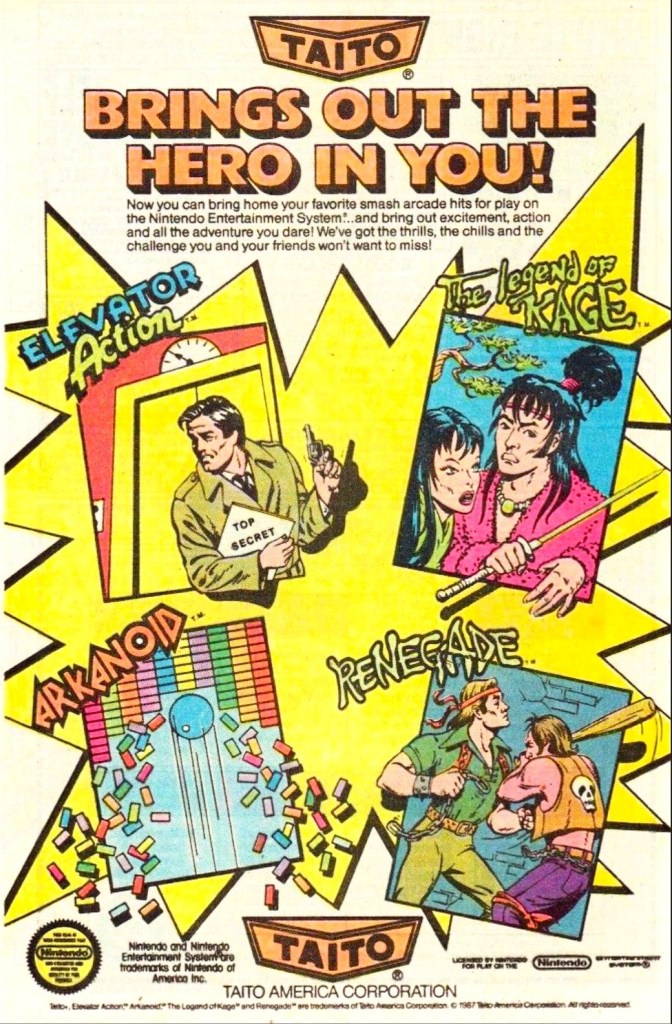
I remember seeing this ad in some comic books I read back in the 1980s.
There is nothing like taking the clever approach of promoting multiple video games using only one single print ad in the size of a single page. Taito did exactly that in the 1980s when it promoted Elevator Action, The Legend of Kage, Arkanoid and Renegade for the Nintendo Entertainment System (NES) promising excitement as the mentioned games were making the jump from arcade to console. What is very notable in Taito’s single-page print ad was that it did not show any screenshots of the games. Instead, they used hand-drawn artwork to emphasize each game’s theme or setting, and leave it up to the viewers’ imagination as to how those games would look like on NES. This old ad is intriguing and amusing at the same time.
2. Chase H.Q. II: Special Criminal Investigation Print Ad
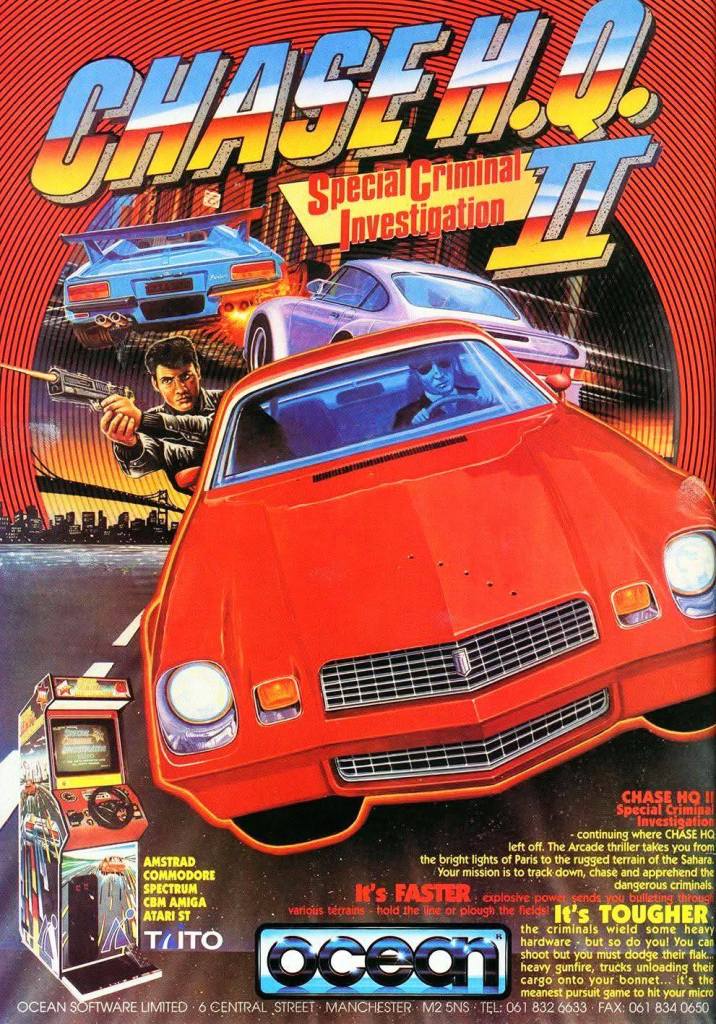
Cars and high-speed action emphasized in this ad.
Following the huge success of the original Chase H.Q. on both arcade and consoles in the late-1980s, the sequel Special Crime Investigation was released in the arcades in 1989 and ported to game consoles and computers in the early 1990s under the title Chase H.Q. II: Special Criminal Investigation. To promote Chase H.Q. II: Special Criminal Investigation for home computers, game publisher Ocean came up with a colorful print ad showcasing a few cars, a city background and elements of gun-related action presented in nice art. The ad has an image of the original arcade machine to remind gamers that they are playing the sequel to Chase H.Q.
3. Dancing Eyes Japanese Arcade Flyer
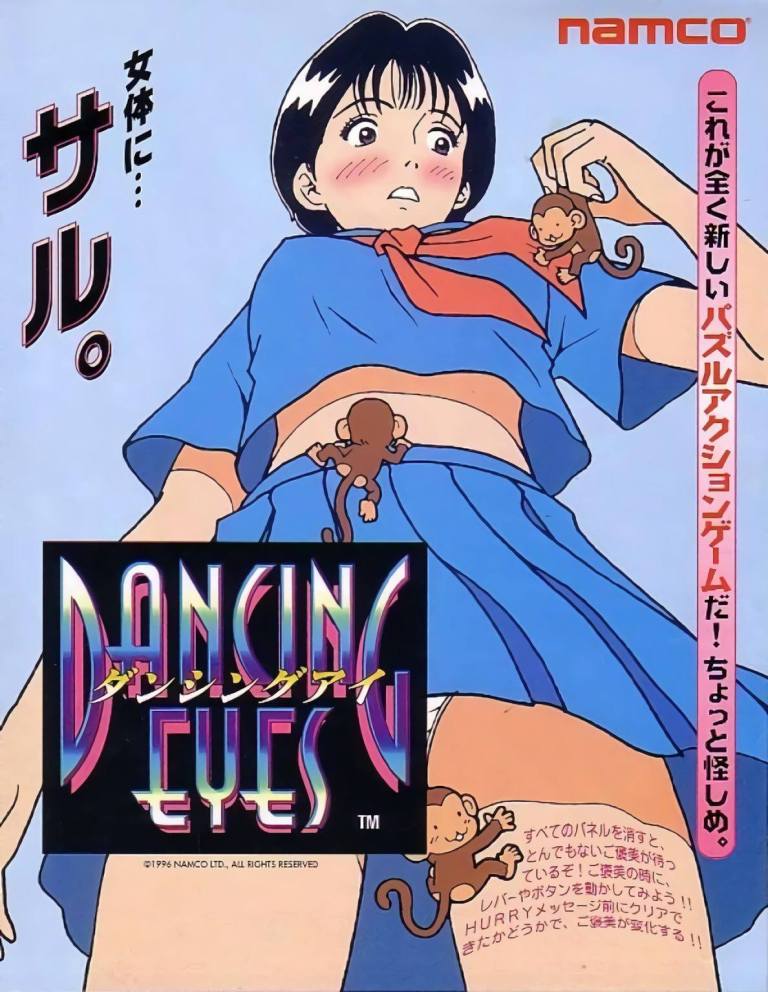
The front.
The rear.
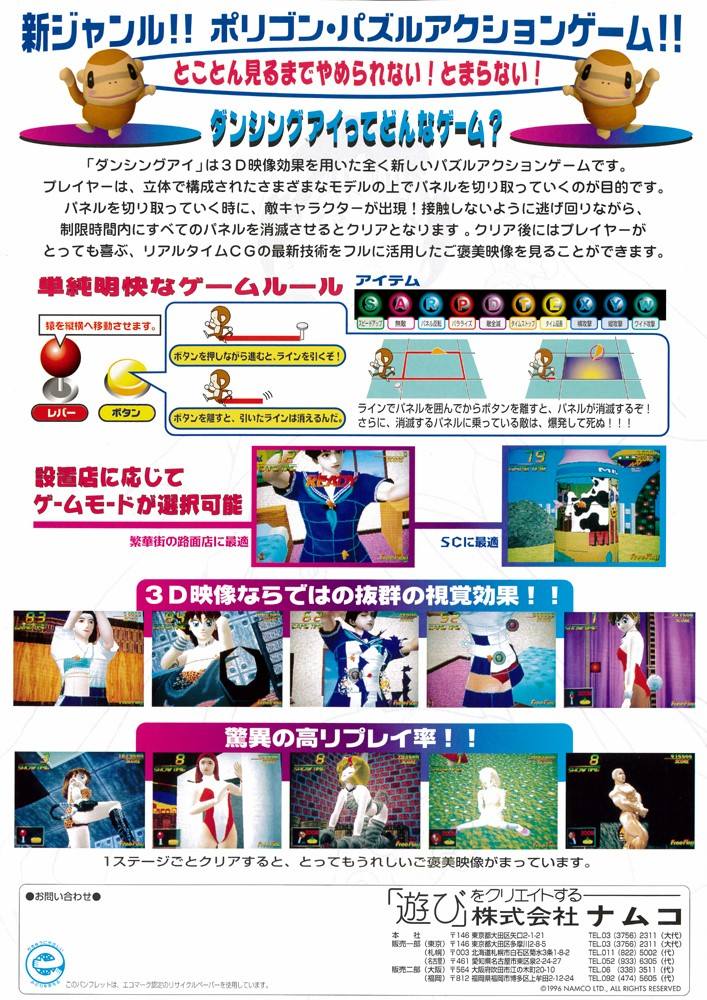
Released by Namco in Japan in 1996, Dancing Eyes is a puzzle arcade game that became notorious due to its overtly sexual nature. With the way it was designed, players control a small monkey called Urusu-San and crawl along a 3D grid mapped over characters (mostly ladies) or various objects. If the 3D grid is mapped over a young lady, any tile of the grid destroyed by the player exposes the lady’s underwear or skin. Such sexuality is reflected in the arcade flyer of Dancing Eyes which has a suggestive hand-drawn art on the front while the game’s mechanics are explained in the rear. Even the rear of the flyer shows sexual nature of the game with screenshots. While the game was officially released only in Japan, Dancing Eyes actually was made available for gamers to play at the arcade of X-Site amusement center inside Festival Mall in Alabang during the early 2000s and it attracted a lot of guys. I bet Namco did not know about that.
4. Sega Saturn North American Print Ad
This print ad always caught people’s attention.
When the Sega launched the Saturn console in America roughly four months ahead of schedule in 1995, the company suffered as the sales were disappointing, ties with business partners were strained and the available Saturn games were very few. By the fourth quarter of that year, more games became available for the Saturn and this gave Sega the opportunity to aggressively market the console as the one that gamers should get for their enjoyment. To promote the Saturn, Sega came up with a two-page print ad that had a dominant image of a naked woman whose private parts were cleverly covered by screenshots of the available games. Since most gamers were predominantly male from teenagers to adults, it made sense for Sega to come up with an eye-catching sexy ad to promote their console and the video games (including those from other companies). This old ad is considered by the woke and rabid feminists as very offensive today.
5. Blockbuster Video Print Ad
If you won the grand prize and wanted a lot of entertainment, you would not want to leave your home.
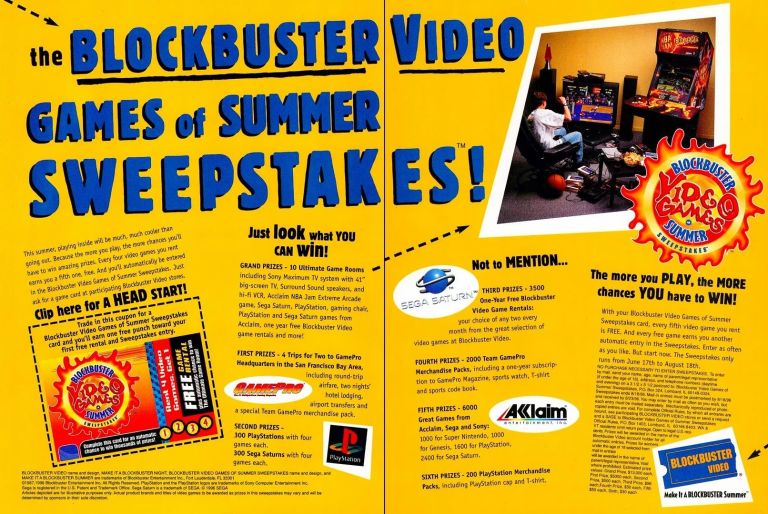
Back in the late 20th century, Blockbuster Video was the dominant retailer that offered customers movies in home video format for sale and for rent. Along the way, the company offered video game rentals and attracted millions of gamers around the nation. Given the tremendous growth of video gaming in America in the 1990s, Blockbuster got itself more involved by launching the Games of Summer Sweepstakes in 1996. Utilizing print ads, the sweepstakes offered the Ultimate Game Rooms – composed of a 41-inch big-screen TV, Surround Sound speakers, hi-fi VCR, NBA Jame Extreme arcade game, the Sega Saturn, the PlayStation, a gaming chair, Acclaim games for Saturn and PlayStation, and a 1-year free Blockbuster Video game rentals privilege – as the grand prizes. Do you know anyone who won in Blockbuster’s sweepstakes?
6. Independence Day (ID4) Print Ad
A nice looking ad for a game that was actually mediocre.
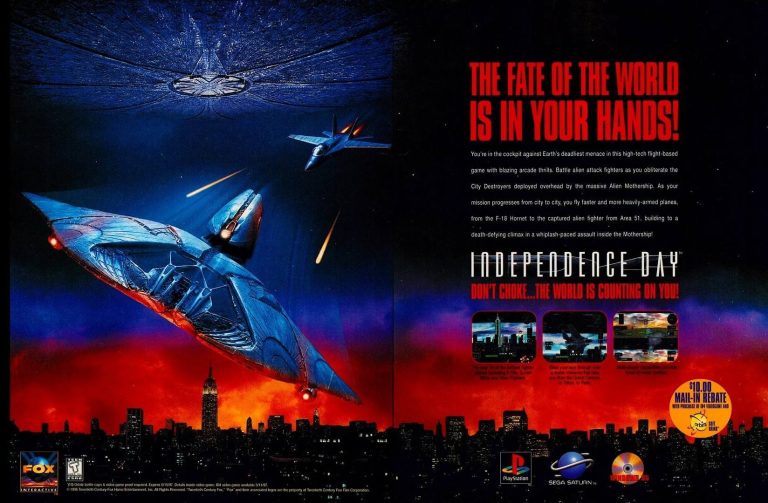
Remember how big a blockbuster Independence Day (ID4) was in cinemas in 1996? The film grossed over $800 million worldwide and it revived the disaster movie genre using modern filmmaking techniques and the latest technologies of the decade. Given the massive success of the movie, it was not surprising that an official video game adaptation was released in 1997. To promote the game, Fox Interactive (the video game company of the movie studio behind the film) came up with a 2-page print ad using official artwork from the movie showcasing the alien spaceship being attacked by a military fighter plane. The ad showed only 3 screenshots and the descriptive text was written to make gamers feel like they have the role to lead Earth’s fight against the aliens. While the art looks good, it can only go so far to hide the mediocrity of the game itself.
7. GoldenEye 007 Print Ad
Bond, James Bond.
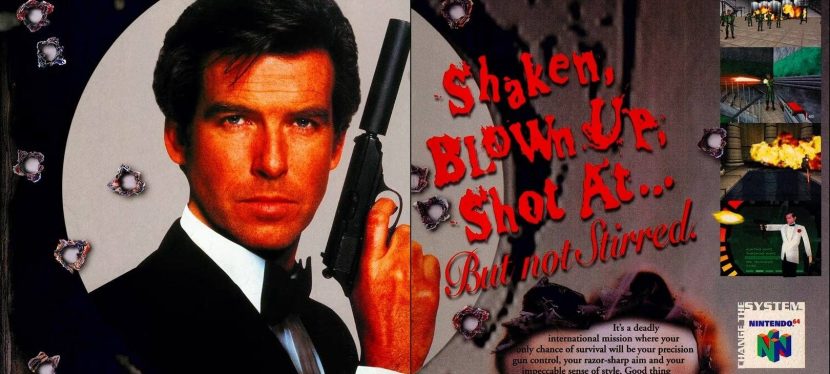
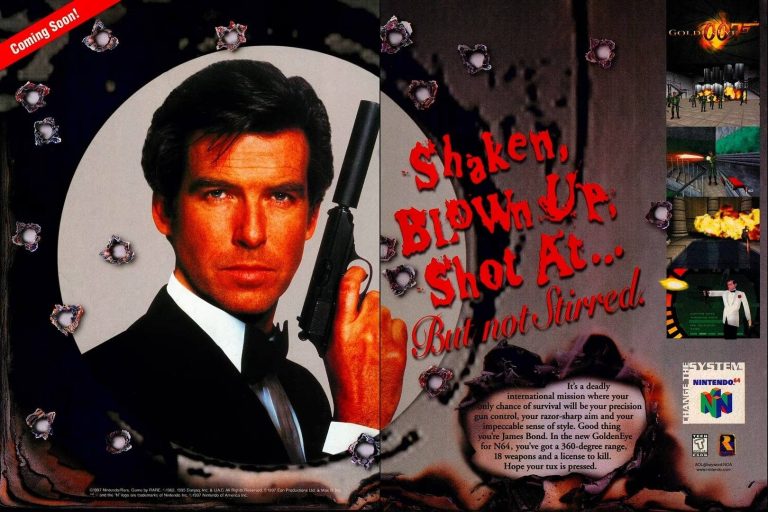
When GoldenEye achieved both critical and financial success in movies, it revived the James Bond movie franchise big-time and Pierce Brosnan was easily accepted by the public as the newest Agent 007. Several months before the movie was even released, an official video game adaptation started development. After much revisions and hard adjustments, the project evolved into a first-person shooting game for the Nintendo 64 console titled GoldenEye 007. To promote the game, Nintendo came up with a 2-page print ad that cleverly showed Brosnan as James Bond on the left and displayed the screenshots and other details on the right. This ad was easily eye-catching and it made lots of gamers excited. As history showed, GoldenEye 007 got released in 1997 and became a huge critical and commercial success while also proving that first-person shooters on game consoles can be a lot of fun.
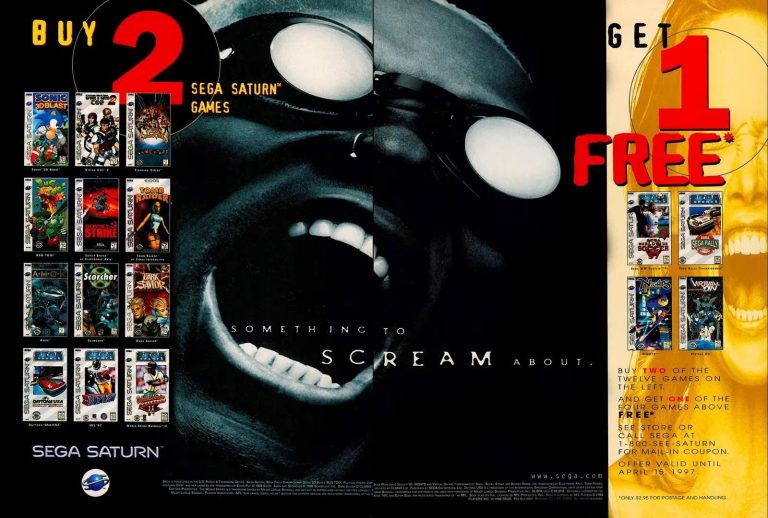
8. North American Sega Saturn Games Promo Print Ad
There definitely was something fun offered to gamers. Who could go wrong with titles like Tomb Raider, Nights into Dreams, Virtual On and Virtua Cop 2?
As mentioned earlier, the Sega Saturn had a bad launch in America in 1995 which caused a lot of problems for the company. In 1996, Sega of America went on the offensive to really capture gamers’ attention by launching their Saturn games promo. The message of this 2-page print ad was very clear…Sega offered one free first-party game (limited to four specific games including Nights into Dreams) to those who bought two games (from a lineup of twelve specific titles). It should be noted that the Christmas season of 1996 was the most successful sales period of the Sega Saturn in America as gamers really responded to the promo. Even though some called this promo an act of desperation, nothing changes the fact that Sega succeeded during the most critical sales season of 1996.