It has been months since I finished my first playthrough of Starfield on my Xbox Series X. I really enjoyed the massive sci-fi role-playing game (developed by Bethesda Game Studios) but I should say that there were technical glitches and some creative shortcomings that got in the way. While it is indeed a really good game, I have not replayed it ever since.
In fact, I have been waiting for the developers to keep on patching and refining Starfieldas much as possible, plus I have been anticipating the release of the promised expansion Shattered Space.
During the recent 2024 Xbox Games Showcase (also referred to as Xbox Showcase), Bethesda and Team Xbox released the official trailer of Starfield: Shattered Space and also went the extra mile announcing new stuff for Starfield players to check out. Watch the trailer as well as the June 2024 video below…
The home planet of House Va’ruun remains a mystery to the vast majority of the citizens of the Settled Systems. The religious zealots that make up this clandestine faction are known only by their dangerous reputation. When a distress signal originating from a derelict star station leads you on a path to Va’ruun’kai, you’ll begin to uncover the secrets surrounding the followers of the Great Serpent. Explore a new location, take on new enemies and experience the story of House Va’ruun when Shattered Space launches later this year.
A lot of mystery await gamers in the Shattered Space expansion for Starfield.
I can say that the concept of exploring the home world of House Va’ruun is not only intriguing but clearly the next creative step for Starfield. House Va’ruun’s troops and agents are indeed formidable foes to fight and I have been eager to find out more of them in the game. I can only hope that apart from refining the game, Todd Howard and his team will come up with a rock-solid story, more engaging gameplay experiences and maybe a few new characters to introduce as they focus on House Va’ruun.
Don’t forget that there is a huge fanbase of Starfield gamers who are literally hungry for more content that is no less fun and captivating. Perhaps the Shattered Space expansion will reinvigorate both fans and new gamers’ interest in Starfield.
If there is anything lacking with the Shattered Space part of the 2024 Xbox Games Showcase, it is the lack of a firm release date. For me, “coming in 2024” is unsatisfying and uncertain. It should be noted that other games at the showcase had no firm release dates. Perhaps Bethesda and Team Xbox will release Starfield: Shattered Space during the first or second week of September 2024 (note: Starfield itself was released on September 6, 2023).
Watch out for Starfield: Shattered Space on Xbox Series X, Xbox Series S, and Windows PC.
Welcome back, fellow geeks, Blu-ray collectors and movie buffs!
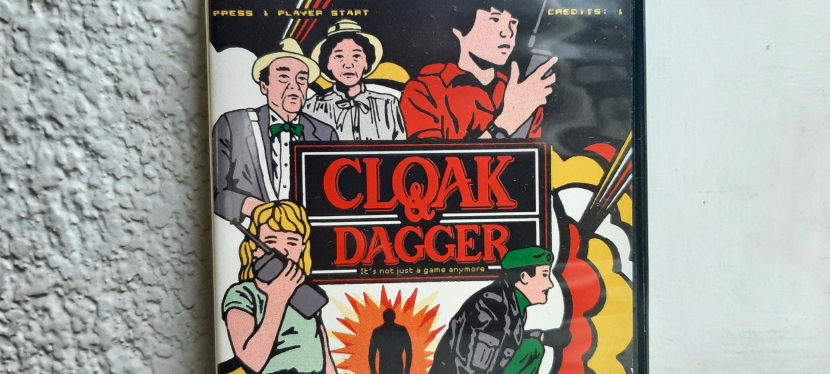
Decades ago, I saw on home video Cloak & Dagger (1984) which turned out to be an entertaining film to watch as I was already playing games on Atari 2600 and the arcades. After replaying by chance on cable TV years later, I finally bought myself the 4K Blu-ray and it sure was fun to watch it all over again. Check out my retro movie review of it by clicking here.
The front of my copy of Cloak & Dagger (1984) 4K Blu-ray.
The rear with the details that can be read.
For the newcomers reading this, Cloak & Dagger (1984) is a movie that involved then video game giant Atari in the creative process. The movie’s plot is not based on Atari’s arcade game of the same name (previously titled as Agent X).
Cloak & Dagger (1984) its own original plot of espionage about a young boy Davey (played by Henry Thomas, the star of Steven Spielberg’s E.T.: The Extra-Terrestrial) who witnesses a murder and receives an Atari 5200 cartridge of the game Cloak & Dagger that contains something very important. This in turn makes him a target of armed henchmen who won’t stop until they get him. Due to his reputation of being too playful and living with his wild imagination as a spy, people don’t believe Davey’s claim of witnessing a murder. This film happens to be inspired by the short story “The Boy Cried Murder” written by Cornell Woolrich.
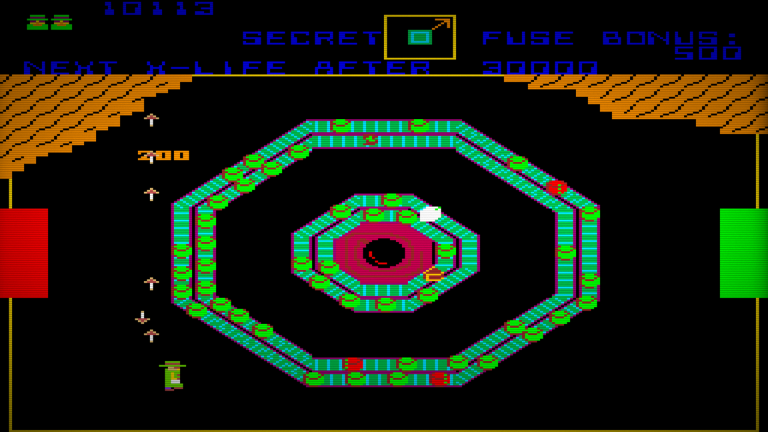
Cloak & Dagger in arcade form. Atari released it in the form of an arcade conversion kit aimed at arcade machines of certain games of its competitors.
The Cloak & Dagger arcade game can be played on your game console with the Atari 50 collection software (over 100 games). This screenshot I captured while playing it on my Xbox Series X console running Atari 50.
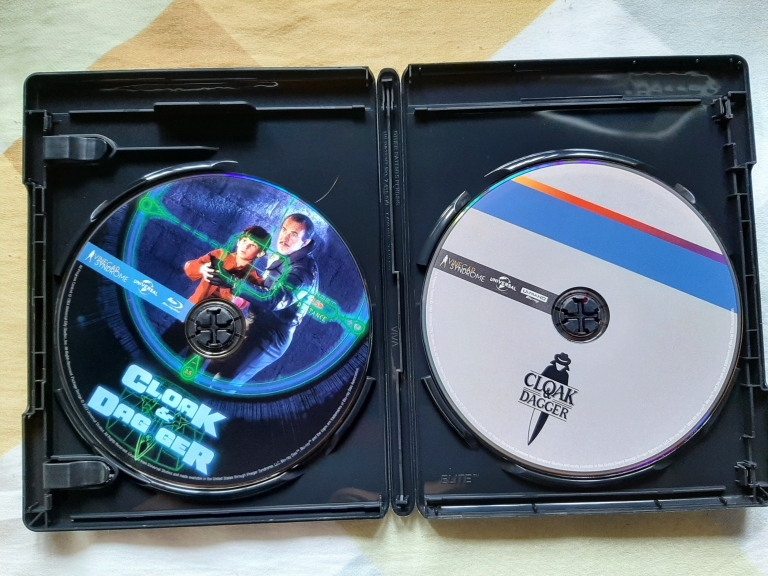
A few weeks ago, my copy of the Cloak & Dagger 4K Blu-ray arrived and it came with two discs: One 4K Blu-ray disc which contained the movie in native 4K (scanned in UHD from the 35mm film) resolution of 3840 x 2160p. The other disc has the same movie in HD (1920 x 1080p) plus the extra stuff which can provide viewers and Cloak & Dagger fans a good amount of important content which will help them learn what the video game elements in the film are, what inspired its creative process and why the film is very unique by today’s standards. There is also an informative new interview with Henry Thomas.
Since then, I saw Cloak & Dagger in 4K twice on my Xbox Series X and its 1080p version on a standalone Blu-ray disc player. Cloak & Dagger in 4K looks better than ever as the picture quality is better, images look sharper and clearer, the colors are vibrant, the small visual details (which were not visible in lower resolution before) are more noticeable now, and film grain structure has been preserved intact!
The two discs. The one on the right is Cloak & Dagger in 4K.
As for the story itself, I still find it engaging and enjoyable to watch from start to finish. Cloak & Dagger is clearly a production of its time as it carries clear Cold War references – the Soviet Union and Iran are the evil forces told in very subtle fashion – as well as video game elements and brands (note: ColecoVision even appeared in this Atari-influenced movie) that dominated America’s console gaming market long before PlayStation, Nintendo and Xbox arrived. For a movie aimed at parents and children, this one has really intense violence as it involves shooting and even some elements of terrorism.
Ultimately, I got a lot of enjoyment from my Cloak & Dagger (1984) 4K Blu-ray and I highly recommend it to Cloak & Dagger fans, gamers, physical media collectors and anyone who loves watching movies in the comfort of home. Cloak & Dagger (1984) is a very unique and fun movie that Hollywood does not make anymore. You really should see it.
In case you are interested or if you have made up your mind, you can order a copy of Cloak & Dagger (1984) 4K Blu-ray by clicking here.
Welcome back readers, fellow geeks and electronic gaming fans!
In this edition of the Retro Gaming Ads Blast (RGAB) series, we will take a look at another batch of retro gaming print ads from the 1980s and 1990s. In addition, there will be a few flyers of arcade games as well as promotional posters of a notable console game that was released only in Japan.
For the newcomers reading this, Retro Gaming Ads Blast (RGAB) looks back at the many print ads of games (console, arcade, computer and handheld) that were published in comic books, magazines, flyers and newspapers long before smartphones, social media, the worldwide web and streaming became popular. To put things in perspective, people back in the 1980s and 1990s were more trusting of print media for information and images about electronic games and related products.
With those details laid down, here is the newest batch of retro gaming print ads for you to see and enjoy…
1. M.I.A.: Missing in Action arcade flyer
This is an effective way of catching the attention of both players and arcade operators. I can imagine the woke, the SJWs and rabid feminists getting easily offended by this.
Konami was a very prominent producer of games back in the 1980s. Not only did the company produce high-quality and enjoyable military-themed games on consoles and computers, Konami also made its presence felt in the highly competitive sector of arcade games. In 1989, they released the arcade conversion kit of M.I.A.: Missing in Action and this flyer is the best know promotion of it. M.I.A.: Missing in Action is the follow-up to Konami’s hit game Rush’n Attack.
Visually, the flyer’s display of four screenshots combined with a dominating photographic image of prisoners of war (POWs) getting delightfully released by an attractive female Rambo-type rescuer were designed to catch the attention of young adult and adult gamers. The text descriptions (note: there were more details on the back of the flyer), however, were geared towards arcade operators who were looking for new games to acquire without the hassle of having to buy an entire arcade cabinet. That being said, this flyer was a clever way to appeal to arcade operators and the people who love playing arcade games.
2. Fonz arcade flyer
Simplistic yet effective to look at. If you are an arcade operator, this flyer conveniently has key information displayed.
Believe it or not, Sega was already active in arcade games way back in the 1970s. In this particular flyer, Sega’s arcade game Fonz (also called Moto-Cross, Man T.T.) offered players the unique experience of driving a digital vehicle using actual handlebars on the machine that were meant to create an immersive and realistic feel. If you look closely, the flyer has lots of details written with arcade operators and players in mind.
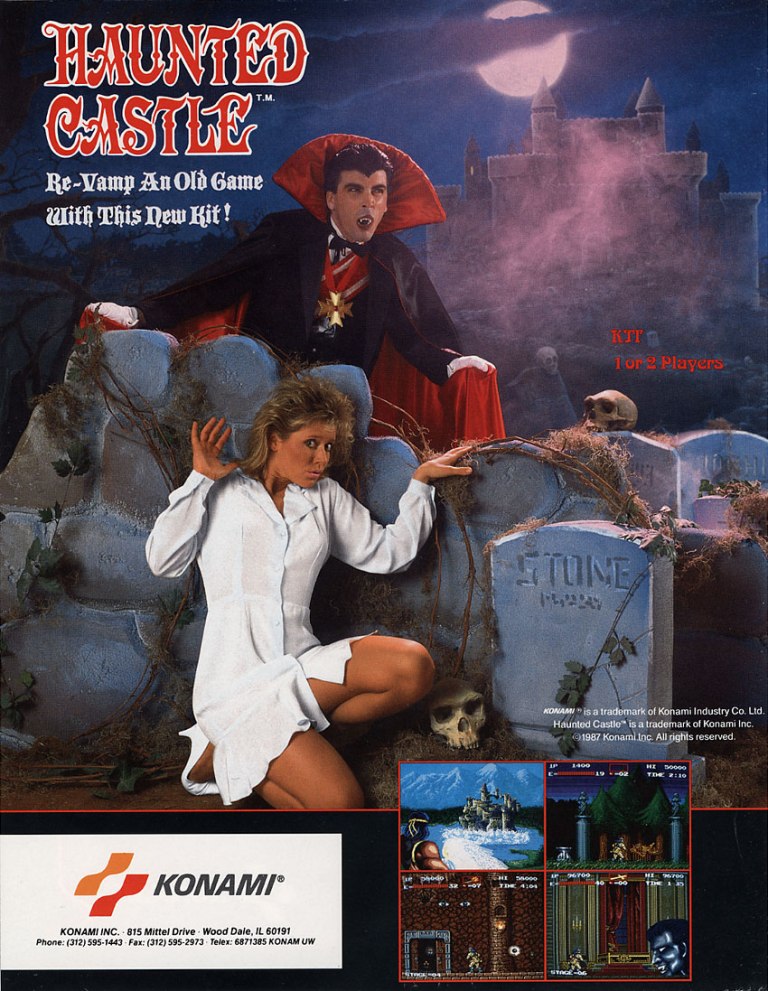
3. Haunted Castle arcade flyer
Indeed, this game is part of the Castlevania game franchise. It was one of the first Castlevania games released for arcades.
Arguably, Konami is best known for the Castlevania game series which covered handheld gaming devices, personal computers, video game consoles and even arcades. Haunted Castle (Japanese title: Akumajō Dracula) is the 2nd arcade game of the Castlevania franchise and it is not a port of any console game. Like the arcade flyer of M.I.A.: Missing in Action, this one was crafted to lure the attention (and money) of arcade operators looking for conversion kits to replace their old games. The visual presentation is eye-catching and even though the Castlevania brand was nowhere to be seen, Castlevania fans could tell this this arcade offering was part of their favorite game franchise.
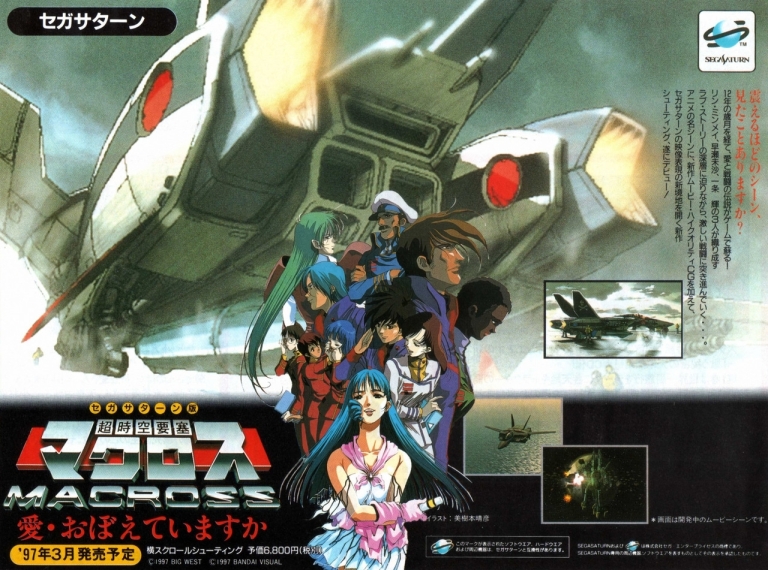
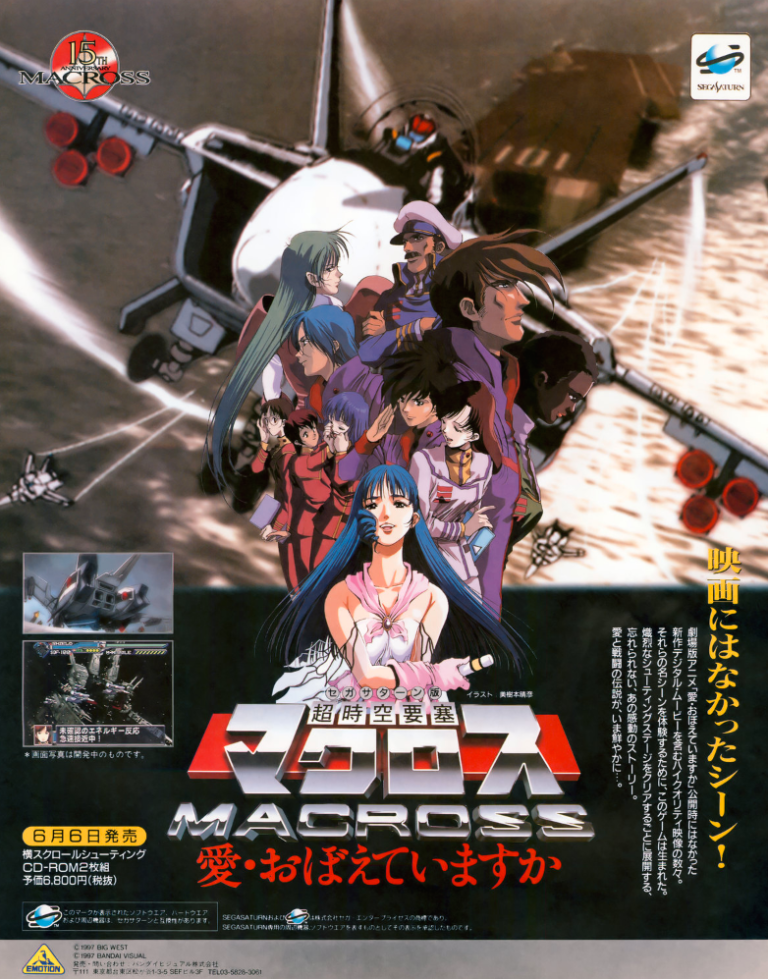
4. The Super Dimension Fortress Macross: Do You Remember Love? flyer and poster
The poster promoting the release of the game for Sega Saturn in Japan.
The flyer promoting the Sega Saturn game’s 1997 release as well as the 15th anniversary of Macross.
In 1997, the 15th anniversary of the Macross multimedia franchise was celebrated in Japan and among the highlights was the release of The Super Dimension Fortress Macross: Do You Remember Love? on the Sega Saturn. To promote the game and the franchise itself, lots of flyers and posters were released in Japan. If you look at the illustrated images on the promotional materials closely, you will realize that they are not from the original 1982-83 Macross anime TV series but rather from the The Super Dimension Fortress Macross: Do You Remember Love? animated movie of 1984 (read my retro movie review by clicking here).
While it might be baffling to some as to why the original anime TV series was not used as the source material for the 15th anniversary celebration through gaming, the 1984 anime feature film was actually more adaptable for a video game project (read my retro review by clicking here). It is so obvious, you just have to ask yourselves this question – how can the game developers compress the entire concepts of the 36-episode Macross anime series into one game while ensuring fun gameplay? Regardless, the game was a lot of fun to play and I enjoyed playing the PlayStation version in 1999.
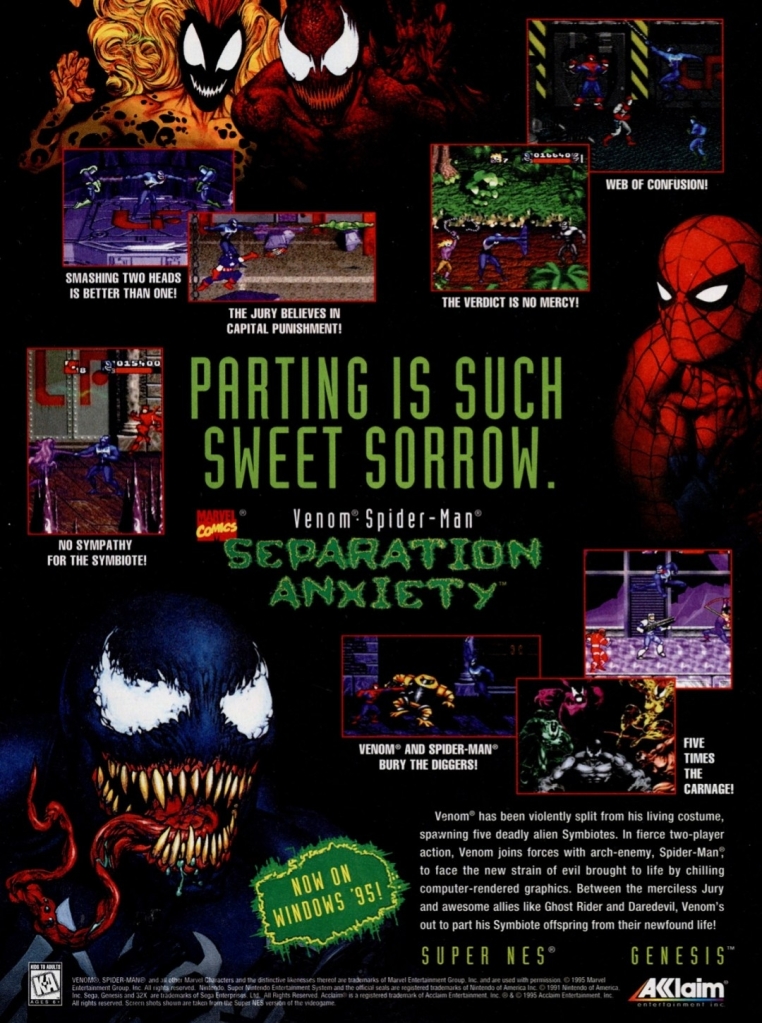
5. Venom/Spider-Man: Separation Anxiety print ad
A clear effort to sell the game to gamers as well as fans of Spider-Man and Venom.
In 1994, Acclaim released Spider-Man and Venom: Maximum Carnage (based on the 1993 comic book storyline Maximum Carnage) on Super Nintendo Entertainment System (SNES) and Sega Genesis ultimately becoming popular with comic book fans and gamers who enjoyed sidescrolling beat-them-up games.
Subsequently, Acclaim and develop Software Creations reunited to release the sequel Venom/Spider-Man: Separation Anxiety a year later on the two leading 16-bit consoles as well as on personal computer (PC). If there is anything notable about this eye-catching print ad, it is the fact that its visual presentation (with graphics on-par with the previous year’s game) cleverly hides the fact that it did not have much new to offer gamers with regards to gameplay and story cutscenes (which the previous game prominently had). Eventually, this game attracted weaker reviews from game critics and has since been forgotten.
6. Tecmo Super Bowl SNES print ad
From the time when Tecmo was still a strong producer of sports video games.
In 1991, Tecmo Super Bowl was released on the aging Nintendo Entertainment System (NES) and because its game design greatly entertained gamers, it became a tremendous commercial success. Not even the very high launch price of $54.99 stopped it from selling a lot.
To keep the commercial success and public interest going, Tecmo announced a new version of the game for the more powerful SNES console with the simple title of Tecmo Super Bowl. If you look closely at the print ad, you will notice that gameplay screenshots were not used at all. Instead, they showed images of the nicely illustrated art works they prepared as eye candy for the game with the intention of making it look cinematic. This is very curious because gameplay itself was the main selling factor of the NES version of Tecmo Super Bowl. I can only guess that Tecmo was not ready to show gameplay images by the time this print ad was made.
7. X-Men 2: Clone Wars print ad
The art used is too alienating for promoting this game.
During the age of the 16-bit consoles, there was a variety of X-Men video games released and produced by different companies. In 1993, an X-Men game published by Sega was released exclusively on the Genesis console which turned out to be fun for gamers and received mostly positive reviews from the critics. Sega went on to publish the sequel X-Men 2: Clone Wars and this print ad caught my attention because of how exaggerated the characters looked. It’s so strange, it’s as if the artist took visual reference from a somewhat blocky 3D polygonal portrait then tried to make them look hand-drawn. I wonder if anyone from Sega regretted this.
Welcome back, my readers, YouTube viewers and all others who followed this series of articles focused on YouTube videos worth watching. Have you been searching for something fun or interesting to watch on YouTube? Do you feel bored right now and you crave for something to see on the world’s most popular online video destination?
I recommend you check out the following topics and the related videos I found.
#1The miraculous rescue of hostages – In case you missed the news, the Israel Defense Forces (IDF) successfully rescued four Israeli hostages, fought with the Palestinian terrorists and brought the hostages home safely. This not some high-risk operation turned lucky. This operation was a blessing from the Lord God whose covenant with the Jewish people has always been true and standing to this day. All the praise, honor, thanks and glory to Him! Ignore the lies of the Islamo-Leftist mainstream news media and focus on the truth by watching the selected videos below…
#2 European Union (EU) elections resulted in the fall of the Satanic Left – Very recently, a series of elections took place in Europe which determined the composition of the European Union (EU) parliament. European voters who have grown sick and tired of the policies of the Satanic Left (examples: mass migration, taking care of illegal aliens at taxpayers’ expense, fascist climate change policies, government corruption) made their choices by electing more conservative and more nationalistic/patriotic candidates. In Italy, Prime Minister Giorgia Meloni saw her party gain power while the President of France had no choice but to dissolve French parliament (National Assembly) and call for a snap election. Watch and learn more from the videos below…
#3 Documentary of the Houston Rockets’ amazing 1995 NBA championship defense – Never underestimate the heart of a sports champion. That is the moral lesson behind the unbelievable successful NBA championship defense the Houston Rockets achieved in 1995. For the newcomers reading this, the Rockets won the title in 1994 but ended up ranking only 6th place on the Western Conference the following season. This meant that the Rockets had no home court advantage through the NBA Playoffs of 1995. How they defied expectations and overcame tough obstacles to win a 2nd straight NBA championship must be seen in the selected NBA documentary video. Enjoy!
#4 A very deep look back at Lost Odyssey – Lost Odyssey is not just a very notable video game released only on Xbox 360 many years ago. It was arguably the most defining, traditional Japanese role-playing game (JRPG) that can be best described as a Final Fantasy game without the name. To be clear, Lost Odyssey involved the combined talents of Japanese greats Hironobu Sakaguchi (Final Fantasy creator), Takehiko Inoue (famous manga artist) and Nobuo Uematsu (musician always know for Final Fantasy), and it was an ambitious JRPG that also happened to be an Xbox-exclusive game. If you wish to know more about Lost Odyssey, what it has in common with Final Fantasy games and why it remains a very notable game, watch the documentary below…
#5 PatmanQC’s Ring King retrospective – Retro gaming YouTuber PatmanQC published recently his retrospective video about the 1980s game Ring King (also titled as King of Boxer) which is fun and informative to watch.
#6 You, Me and the Movies’ The Blob (1958) reaction – Recently the 1958 version of The Blob was featured by You, Me and the Movies in a movie reaction video which is entertaining to watch.
#7 RK Outpost examines woke Star Wars – It is no secret that under the umbrella of the woke Disney company and the Lucasfilm leadership of Kathleen Kennedy, the established entertainment franchises of Star Wars and Indiana Jones got ruined. Sad to say, Star Wars continues to be made with extreme wokeness and rabid feminism, reaching the point of completely ruining the sci-fi franchise as we know it. Watch and learn from RK Outpost’s videos below…
#8 The evil of Palestinian terrorist group Hamas – It cannot be denied that Palestinian terrorist group Hamas is pure evil. So pure is their evil, they want nothing less than committing complete genocide against Israel and its people. To his day, pro-Palestine zealots cannot even tell the difference between good and evil, and right and wrong. For the Palestinians and its brainwashed supporters (all supported secretly by terrorist state Iran), terrorism, violence and murder are the only ways to achieve what they want. Watch and learn from the videos below…
#9 2024 Xbox Games Showcase videos – Following the lackluster Sony State of Play and Summer Game Fest, Team Xbox and its partners came out blazing with the 2024 Xbox Games Showcase recently. In my view, it was a big improvement over last year’s showcase (which itself was quite good) and there were highlights that should not be ignored. Posted below are selected videos for your viewing pleasure.
Wow! That was a powerful presentation of 1st party video games at the 2024 Xbox Games Showcase (also referred to as Xbox Showcase) that happened in America very recently. Not only was it better and more exciting than the Xbox showcase of 2023, it made this year’s State of Play and Summer Game Fest look even more lackluster and more unsatisfying. Already there are PlayStation 5 (PS5) fans who begged Sony to do better with their showcase of games because this year’s Xbox showcase – which is also the first of the new age of Microsoft-owned Activision-Blizzard-King – energetic and exciting.
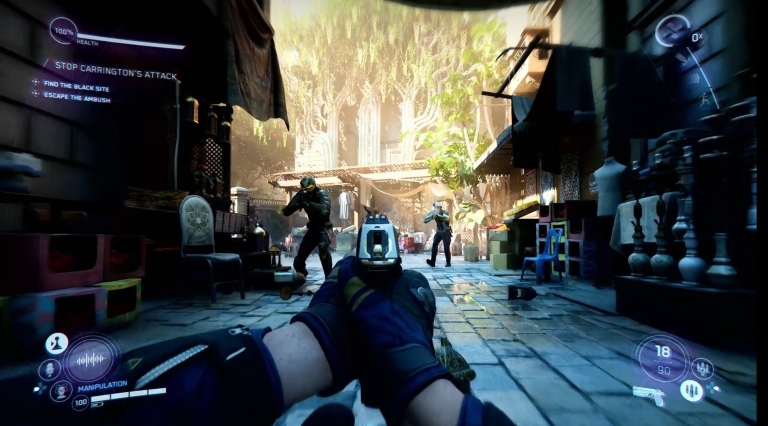
For this post, I will be focusing on one of highlights of the Xbox showcase…the first-ever reveal of gameplay and features of the Perfect Dark reboot (for my previous posts, click here and here). For starters, watch the gameplay showcase video below…
Wow! The Perfect Dark presentation exceeded my expectations on gameplay and it looks like The Initiative (Xbox game studio) and Crystal Dynamics (the studio responsible for many Tomb Raider games over the past several years) really got their creative forces combined to make something unique.
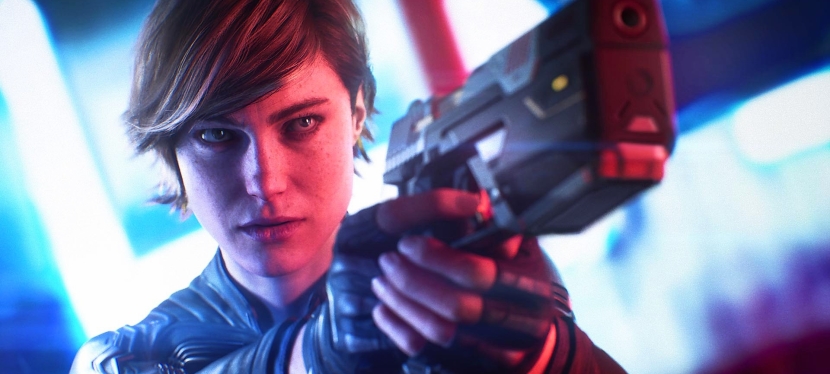
Like the previous games that preceded it, the new Perfect Dark utilizes a first-person viewpoint for immersive gameplay and it has a new version of Joanna Dark introduced featuring the likeness of model Elissa Bibaud. Strangely enough, the new agent Dark does not look too attractive. Perhaps more new images of her will be unveiled someday.
The new Joanna Dark featuring the likeness of model Elissa Bibaud.
Elissa Bibaud’s picture from her Instagram.
The Initiative and Crystal Dynamics must have brainstormed a lot and worked long to modernize the gameplay for this new game (officially the 4th Perfect Dark game for consoles played at home). What was shown during the video presentation were moments when Joanna Dark used gadgets to do thermal scanning, extract data wirelessly, generate voice-prints and create deepfake audio. Not only that, Joanna is capable of climbing wall pipes, sliding on surfaces and doing wall-running.
Without spoiling the concept of the video too much, I can say that Joanna Dark is already an agent who goes to Garden City in Cairo to find the wanted criminal Daniel Carrington and discover what he has been scheming. With all the details made available by the video and the Xbox Wire piece, Perfect Dark is really a first-person adventure that allows players to figure out what to achieve as they work their way through in missions. This is not just an action-packed first-person shooter.
Perfect Dark is a first-person adventure game laced with sci-fi and espionage elements. Players will be offered opportunities to overcome obstacles in creative ways such as using gadgets to infiltrate places.
Considering what was shown, I can only hope that the game developers will be able to create wide and vertical maps that will allow players to explore a lot more as they take on missions. By today’s standards, linear level designs just won’t cut it anymore. I know for a fact that making an open-world environment will take too much time and effort to complete Perfect Dark, so having wide and vertical maps will be good enough to offer players exploration opportunities.
Strangely enough, the video presentation does not specify which Xbox consoles Perfect Dark will be released for. What was confirmed is that the upcoming game will launch on day one on the Game Pass service which means it will eventually be released on Xbox Series X, Xbox Series S and Windows PC. That being said, Xbox Series X and Xbox Series S owners who are subscribing to Xbox Game Pass (XGP) and Windows PC gamers subscribed already to PC Game Pass will be able to play the new Perfect Dark on launch day someday. I doubt a version of the game will be released for the aging Xbox One consoles.
In this game, you can accomplish your mission objectives by using stealth or by engaging with the enemies directly with guns and other high-tech weapons.
Welcome back Xbox fans, geeks and gamers! As I posted before, I enjoyed playing Senua’s Saga: Hellblade II on my Xbox Series X and eventually I managed finish it. It was indeed a short game (less than ten hours was my play time) and to my surprise, the levels were really linear (which made exploration very limited) and the puzzle-oriented challenges were less challenging compared to Hellblade: Senua’s Sacrifice.
What really impressed the most about Senua’s Saga: Hellblade II were the visuals which had high levels of photo-realism, really detailed facial expressions and astounding cinematic look. Developer Ninja Theory proved itself to be great in using Unreal Engine 5 (UE5) technology and fusing their artistry and all motion-captured performances onto their work.
Apart from solid game designers, Ninja Theory has great digital artists, technicians and very talented performers.
It would be a big shame for Microsoft to close down Ninja Theory. Such a move will destroy the credibility of Xbox.
While I enjoyed Senua’s Saga: Hellblade II and I can say it was worth the long wait, I don’t find the game replay-worthy at all. I don’t feel like wanting to repeat an entire playthrough with it right now. Perhaps in the next six months, I just might consider playing it all over again.
That being said, I really want Ninja Theory to prosper and keep on making more great games that will keep gamers entertained. I think it is also time for the Xbox studio to pause from the Senua franchise of games and start making something new that is also enjoyable to play.
What I’d like to see Ninja Theory make under the Xbox banner is a new action-adventure game that is less cinematic but more focused on large environments, platforming, deep exploration and having a new approach to action.
To understand what I’m saying, check out Ninja Theory’s past works on Heavenly Sword and Enslaved: Odyssey to the West. Watch the videos below…
Of course, there are other genres that Ninja Theory could daringly work on such as role-playing games (RPGs) much in the style of BioWare’s works specifically like Star Wars: Knights of the Old Republic (Star Wars KOTOR) and Jade Empire. They can also add their cinematic approach when making RPGs.
When it comes to zombie-oriented video games, the team behind the Senua games could make a Dead Rising-like game featuring open-world environments, varied missions and objectives, and emphasis on shooting and explosions with regards to action.
Another genre that I think Ninja Theory can challenge themselves with is turn-based tactics gaming. I believe that the Xbox first-party lineup of games is sorely lacking in this type of game. While XCOM already cornered the sci-fi realm of turn-based tactics, perhaps Ninja Theory could do a fantasy oriented game that plays well and carry the team’s cinematic touch.
The way things are right now, it remains to be seen what Ninja Theory could make next under Team Xbox and Microsoft. There is that thing called Project: Mara but there are no details as to what kind of game will turn out from that. I really want Ninja Theory to keep on making more fun-oriented games which would also feature their artistic approach that would really stand out.
Whether you like it or not, the future looks uncertain for Ninja Theory when it comes to what kind of games they will make next, and what creative direction they will take under the banners of Xbox and Microsoft.
Here is hoping Microsoft would not commit the error of closing down the team behind Senua games. I am watching your moves, Team Xbox and Microsoft.
Welcome back, my readers, YouTube viewers and all others who followed this series of articles focused on YouTube videos worth watching. Have you been searching for something fun or interesting to watch on YouTube? Do you feel bored right now and you crave for something to see on the world’s most popular online video destination?
I recommend you check out the following topics and the related videos I found.
#1The fall of Humza Yousaf and vindication of author J.K. Rowling – In case you missed the news, Humza Yousaf (born in Scotland to Pakistani immigrants) stepped down as First Minister of Scotland as he faced imminent votes of no confidence in himself and in his government. This vindicated Harry Potter author J.K. Rowling who opposed Scotland’s new hate crime laws (which extends to people who identified as transgendered and yet ignored biological women) and pointed out Humza Yousaf’s contempt for women. For more details, watch the video below.
#2 PatmanQC’s video documentary of P.O.W.: Prisoners of War – P.O.W.: Prisoners of Wars was one of those classic arcade games that I never got to play. It was made by SNK which is the same company behind the popular fighting game franchises King of Fighters, Fatal Fury and Art of Fighting. P.O.W.: Prisoners of War was a Cold War-inspired side-scrolling beat-them-up game that achieved big success in Japan. In PatmanQC’s video, you will learn a lot about SNK’s arcade game, what elements of real life inspired it, what other arcade games influenced the game designers to create it, and more.
#3 The significance of Rik Smits in the NBA – When it comes to the NBA, one has to take a look at the contributions of retired player Rik Smits (the Dunking Dutchman). Smits’ name may not have the big attraction of other centers of his era such as Hakeem Olajuwon, Shaquille O’Neal, Patrick Ewing and Robert Parish, but still he was a really solid center as well as a huge factor behind the rise of the Indiana Pacers in the 1990s. By the time he retired, the Pacers made it to the NBA Finals of 2000. Watch these selected videos of Rik Smits. You will learn a lot and be entertained with Smits’ basketball action!
#4 X-Men: The Last Stand movie reaction videos – For a movie declared as an inferior or disappointing follow-up to 2003’s X2: X-Men United, X-Men: The Last Stand still became a popular film subject in several movie reaction videos on YouTube. Just type the keywords on YouTube’ search engine and you will find a lot of movie reaction videos of the Brett Ratner-directed superhero movie. For your entertainment, the most enjoyable movie reaction videos have been posted below.
#5 You, Me and the Movies’ reaction video of Clash of the Titans (1981) – As a young boy, I saw Clash of the Titans (1981) and it was an entertaining ride of its time. This was one of those many fantasy movies that were released in the 1980s and it was the final work of stop-motion visual effects legend Ray Harryhausen. Recently, You, Men and the Movies published their reaction video of it which is entertaining and you can watch it below.
#6 PatmanQC’s Super Pac-Man retrospective video – I first learned about Super Pac-Man way back in the 1980s by seeing it on TV but I never got to play it in the arcades. In recent times, I downloaded Pac-Man Museum+ through Xbox Game Pass (XGP) and finally got to play Super Pac-Man on my Xbox Series X. I had fun playing it as I adjusted with the gameplay which had notable differences compared to the original Pac-Man arcade game. To learn more about Super Pac-Man, watch PatmanQC’s retrospective video below.
#7 Extensive look back at Sega Saturn games – YouTuber Sega Lord X recently published this extensive video looking back at the Sega Saturn and its games. This is a must-see video because the Sega Saturn had numerous games and many of them were actually fun to play. Ignore those articles that called the Saturn a bad console and just focus on the games by watching the video below.
#8 FilmComicsExplained’s video about how to survive Deep Impact – In relation to my previous post highlighting the movie reaction video of Deep Impact (by YouTuber Popcorn in Bed), posted below is FilmComicsExplained’s video is focused on survival within the context of the 1998 film. There are some sensible and notable points of discussion made which should encourage people to replay Deep Impact and even question the way governments deal with disaster management on a massive scale. You will possibly think twice about depending on the government for your survival. Watch the video below now.
Welcome back readers, fellow geeks and electronic gaming fans!
In this edition of the Retro Gaming Ads Blast (RGAB) series, we will take a look at another batch of retro gaming print ads from the 1980s and 1990s.
For the newcomers reading this, Retro Gaming Ads Blast (RGAB) looks back at the many print ads of games (console, arcade, computer and handheld) that were published in comic books, magazines, flyers and newspapers long before smartphones, social media, the worldwide web and streaming became popular. To put things in perspective, people back in the 1980s and 1990s were more trusting of print media for information and images about electronic games and related products.
With those details laid down, here is the newest batch of retro gaming print ads for you to see and enjoy…
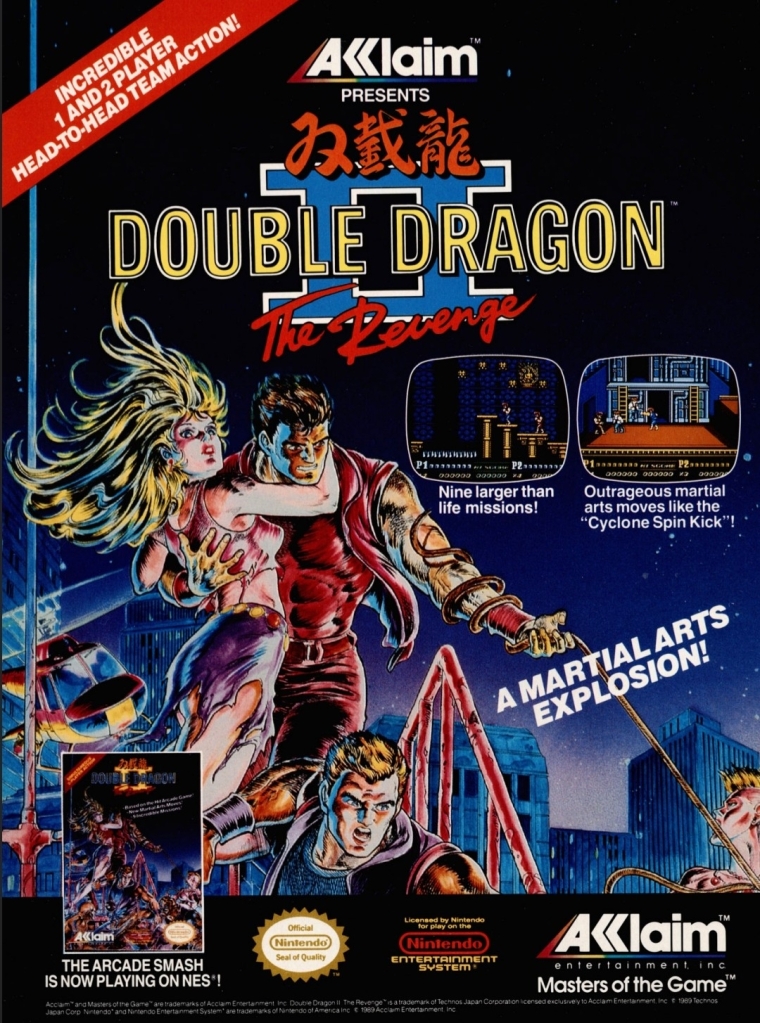
1. Double Dragon II: The Revenge print ad
Nice looking art used to promote the game.
The beat-them-up sub-genre of gaming was already popular in the 1980s and one of the most defining game franchises of this type of game was the Double Dragon series which proved to be popular with Nintendo Entertainment System (NES in America) and Family Computer (Famicom in Japan) gamers. As the first game was a very big hit on Nintendo’s consoles, the sequel Double Dragon II: The Revenge was promoted in America with strong confidence on the part of publisher Acclaim that it would become another massive hit. This print ad had a very nice looking comic books-style art that not only captured the concept of the game but also visualized the heroes Billy and Jimmy with enough details to focus on. I can say this was an eye-catching ad.
2. X-Men: Children of the Atom print ad
Great looking ad but the line “100% direct conversion” is not true at all.
Developed by Capcom in cooperation with Marvel, X-Men: Children of the Atom was a huge hit in the video arcades and it was not surprising that it got released on the Sega Saturn by Acclaim. Acclaim organized an aggressive promotional campaign by pouncing on the fans’ love and knowledge of the X-Men and the high fun factor of Capcom’s game. What this print ad got wrong, however, was the line “100% direct conversion of the #1 arcade smash!” which was wrong and misleading. In reality, the Sega Saturn version of the game had about one-third of the animation frames cut due to the console’s smaller RAM capacity.
As the years passed by, the Sega Saturn became the more suitable console for home ports of Capcom’s further 2D fighting games as Sony’s PlayStation had even more severe limitations and a graphics processor that was not suitable for 2D graphics. By the end of 2000, Capcom’s 2D fighting games on PlayStation all were inferior to the Sega Saturn versions.
3. Sky Shark NES print ad
This is an effective looking ad.
Released in Japan as Flying Shark, Sky Shark was released on multiple platforms in 1988 and there was an NES version of it which this particular print ad promoted. The American branch of Taito wisely used positive quotes from media outlets to promote the game while coming up with an engaging text description and displayed NES screenshots. And then there was that very engaging painted cover art that gave this print ad a lot of punch. An effective ad overall.
4. Conflict print ad
This is a very captivating artwork for advertising.
There is no denying the fact that the Cold War was a strong influence on arcade games and video games. Titles like Contra, Jackal, Metal Gear, Operation Wolf, Cabal and Rush’n Attack were militaristic games that entertained millions of gamers from the young adults to the little children. In 1990, Vic Tokai released the game Conflict on the NES which had a military theme but an unusual game design composed of digital maps with hexagons in which gamers will play with strategy to win battles. That being said, this print ad’s visual concept was very captivating yet also misleading. If you see how the game is played, you will know what I mean.
5. College Slam print ad
Were you ever interested in college basketball video games?
This is one of the more eye-catching print ads I’ve seen due to the artist’s illustration of a basketball with a mouth biting the basketball rim which dominates the space. For the newcomers reading this, College Slam was a basketball video game that was actually a repacked version of the popular NBA Jam with focus on NCAA basketball players. With the biting basketball at the center, it was easily an attraction and the screenshots implemented were larger than usual which easily gave gamers a clear look at what the game looked like. While this print ad is eye-catching, it did not help sell College Slam and there never was a follow-up.
6. Tecmo Super Baseball print ad
From the time when Tecmo was prolific with video games about sports.
Long before it started the Dead or Alive game franchise, Tecmo was once heavily invested in making sports video games. Tecmo Super Baseball was their first American pro baseball video game released for Super Nintendo Entertainment System (SNES) and Sega Genesis, and it was notable that the publisher secured only the Major League Baseball Players Association (MLBPA) which resulted in the game featuring real-life players but the teams had no names and no logos. Regardless, this print ad showed how aggressive Tecmo was in trying to attract consumers’ attention by showing ten screenshots with short text descriptions each. The ad’s write-up boasted realism as well as the promise of gaming quality.
7. The Punisher print ad
Marvel’s vigilante firing at someone.
In the early 1990s, Capcom and Marvel Comics started their partnership resulting in the releasing of the arcade game The Punisher. Developed by Capcom, the said arcade game became a big hit with gamers as it featured fun gameplay, multiple enemies appearing on screen simultaneously and other fun elements. Unsurprisingly, the game was ported (note: Sculptured Software was the lead developer) to the Sega Genesis with significant downgrades in terms of graphics, sound, enemy variety and other related elements due to technical limitations. That being said, this print ad used detailed art of the Punisher (with Col. Fury in the background) in a clever way to promote the Sega Genesis version while keeping their attention away from the obvious visual downgrades of the two screenshots displayed. The Punisher on Genesis was poorly received.
8. Stargate print ad
If you did not enjoy the movie, were you able to play the video game adaptation on Sega Genesis or Super NES?
Remember the sci-fi movie Stargate (1994)? The film was a surprise box office hit and eventually video game adaptations of it were made for the SNES, Sega Genesis, Game Gear and the GameBoy. This particular print ad, however, showed screenshots of the SNES and Genesis versions which is made obvious with the side-scrolling adventure plus 3D flying sequence (one screenshot showed it). Combined with images sourced from the movie poster plus an insert of the movie in home video format (lower-right corner), this print ad was obviously an aggressive way to promote the film with the post-theatrical business in mind. In case you are wondering, the cinematic Stargate is not related at all with the early 1980s video game (a follow-up to the classic game Defender) of the same name.
9. Aerobiz Supersonic print ad
For a simulation game released on consoles, Aerobiz Supersonic is pretty deep and a lot of fun to play.
The airline simulation game Aerobiz Supersonic is a highly addictive and surprisingly fun game that I enjoyed playing on the SNES (read my retro review by clicking here) and strangely enough I first learned about not through its print ad but by reading a preview published by Electronic Gaming Monthly (EGM) magazine. As for this print ad made by Koei’s American team, this is really odd to look at due to the ad makers’ choice of showing a not-so-attractive flight meal. In contrast to that, the ad makers did a good job describing the game creatively and showed three screenshots that were strategically selected in my view. Having played the game many times, I can say that this print ad is very truthful.
Welcome back Xbox fans, geeks and gamers! It has been over a month since Eiyuden Chronicle: Hundred Heroes was launched on multiple platforms worldwide and like many other gamers who are currently subscribed to Xbox Game Pass (XGP), I downloaded it and played it a lot although there were a some technical setbacks that happened along the way.
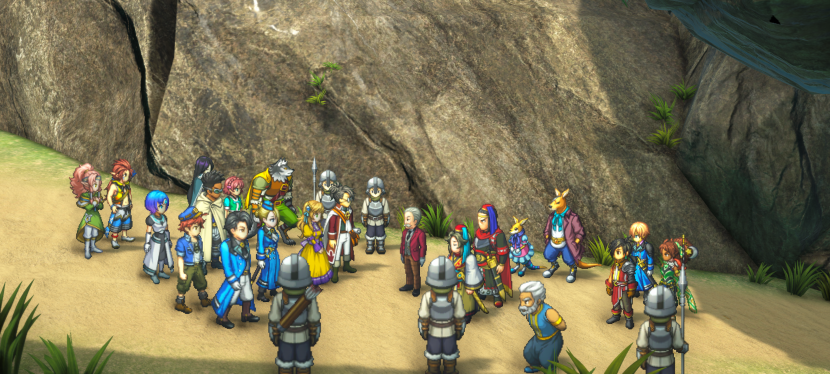
For the newcomers reading this, Eiyuden Chronicle: Hundred Heroes is a brand new and stylized turn-based Japanese role-playing game (JRPG) developed by Rabbit & Bear studio which was led by the late Yoshitaka Murayama and involved the talents of notable creators who collectively worked on Konami’s Suikoden RPG series.
In-game world exploration is done with a 3D polygonal environment and your character is a 2D sprite.
A battle against a very large monster.
Eiyuden Chronicle: Hundred Heroes is a fantasy role-playing game that has a lot in common with the first two Suikoden RPGs in terms of fantasy concepts, gameplay, game design, mini-games, and the recruiting of many characters. Having finished Suikoden and Suikoden II on the PlayStation myself, I can clearly say that this new JRPG is technically a Suikoden game without the name.
As of this writing, I played Eiyuden Chronicle: Hundred Heroes for over 80 hours on my Xbox Series X console. While I am at the point of moving the story forward leading the army (led by the playable protagonist Nowa) in the struggle against the empire led by Dux Aldric (who reminds me a lot of Suikoden II’s Luca Blight), I have decided to focus first on side quests, resource collecting, the mini-games and recruiting more characters. This RPG was designed to allow players to have sufficient freedom to take on side activities on the side and explore the world for recruits and resources.
The cooking contest functions very much look those in Suikoden II.
Somehow General Elektra reminds me of Valeria in the first two Suikoden games.
While this is not a game review, I can say that I am enjoying Eiyuden Chronicle: Hundred Heroes with the way it was designed, how the story was written (lots of intrigue related to the in-game geopolitics which are balanced with fantasy quests), how the characters were presented and the assorted variety of gameplay content. It has been almost three years since this game (along with Rising) was first announced for Xbox Game Pass (click here and here) and considering the fun I had already, I can say the wait was worth it. The mini-games are, for the most part, fun to do and you can watch the short video clips from my progress in the game.
There were some technical setbacks along the way. Eiyuden Chronicle: Hundred Heroes did not run properly on my Xbox Series X resulting in the game crashing and even sudden console shutdowns. I got these console readings of “overheating” and “insufficient ventilation” with the game and these incidents happened only with it. As such, I had to open my Xbox, cleaned up the interior and removed as much dust as I could. Since then, the game developers patched the game but still it pushed my Xbox so hard, game crashing and sudden shutdowns still occurred from time to time. I also noticed there are certain locations within the game that resulted in the sudden acceleration of the Xbox Series X internal fan. Very clearly Rabbit & Bear’s technical support team still has a lot of work to do to meet customer satisfaction.
Each time you successfully recruit a new character, you will see this quick and flashy visual presentation.
Along the way, I observed that other games such as Resident Evil 4 remake, Shadow of the Tomb Raider, Assassin’s Creed: Valhalla, and the most recent release Senua’s Saga: Hellblade II respectively pushed my Xbox Series X to perform hard (with the internal fan run fast) but there were no game crashes and no sudden shutdowns at all. Only Eiyuden Chronicle: Hundred Heroes resulted in “overheating” and “insufficient ventilation” readings and disruptions.
Considering the hassles, I managed to get the fun and discoveries with Eiyuden Chronicle: Hundred Heroes on my Xbox. Here is hoping that the game developer will soon release another patch for Xbox Series X to make the game run well while consuming less power somehow. Given the fantastic presentation of the game, technical disruptions on Xbox Series X should not have happened at all.
There is so much to explore and discover in this game!
So what are you waiting for? If you are already a subscriber to Xbox Game Pass, you can download Eiyuden Chronicle: Hundred Heroes on your Xbox Series X, Xbox Series S, or the aging Xbox One. If you have extra money and want to support Rabbit & Bear studio, buying the digital copy of the game is the recommended option. For more information about the Suikoden-inspired JRPG, visit https://www.xbox.com/en-US/games/eiyuden-chronicle
Welcome back, my readers, YouTube viewers and all others who followed this series of articles focused on YouTube videos worth watching. Have you been searching for something fun or interesting to watch on YouTube? Do you feel bored right now and you crave for something to see on the world’s most popular online video destination?
I recommend you check out the following topics and the related videos I found.
#1NHK World’s Game Planet Documentary – If you are very passionate about video games and you want to see gaming through the views of the Japanese and the Chinese, then you should see NHK World’s documentary here. This video documentary is also a must-see for those who love playing the Street Fighter video games. Lots of creative talents from Capcom and Tencent interviewed.
#2 Square Enix decides to drop PlayStation exclusivity and go multiplatform with their business – It was indeed bound to happen and I was not surprised about it. In case you missed the news, Square Enix announced it will drop PlayStation exclusivity in favor of going aggressive with a multiplatform strategy. This is because there was a massive 70% profit drop on the part of Square Enix and sales of the PlayStation 5-exclusive Final Fantasy VII Rebirth were undeniably disappointing. To understand the details better, posted below is one analytical video and one critical video.
#3 Nick Anderson’s notorious 4 missed free throws and disrespect towards Michael Jordan – If you are long-time basketball fan, you would at least be aware of significant events during the NBA Playoffs and the Finals in 1995. I am talking about Nick Anderson who is still remembered as the guy who missed four free throws as his team (Orlando Magic) was already leading by three points ahead of the Houston Rockets (defending champions) during Game 1 of the 1995 NBA Finals. As history recorded, the Houston Rockets swept the Magic 4-0 to win their 2nd straight NBA championship. Going back to Anderson, he is also the same guy who disrespected Michael Jordan during the Eastern Conference semifinals. Posted below are three videos for you to watch.
#4 Reggie Miller’s 8 points in 8.9 seconds – Still with the 1995 NBA Playoffs, here is a look back at the miraculous achievement of Reggie Miller scoring eight points in less than nine seconds during a game against the New York Knicks at the Madison Square Garden. For the newcomers reading this, the playoff rivalry between the Knicks and Indiana Pacers started in 1994 and by the time their rematch in 1995 was realized, collective fan anticipation was already high. There was no better way to raise the stakes in the rematch than Miller’s unexpected 8 points in 8.9 seconds. Watch the video below.
#5 Popcorn in Bed’s reaction video of Deep Impact – In 1998 here in the Philippines, I saw the sci-fi film Deep Impact in a cinema during its first week of release. It was entertaining to watch given the sci-fi spectacle, the concept and, of course, the wide cast of actors that includes the legendary Robert Duvall in a really solid supporting role. What is most notable about Deep Impact is the fact that it was made to spark emotion from viewers and that is most inevitable in the movie reaction video by Popcorn in Bed. With the current number of Deep Impact reaction videos available on YouTube as of this writing, the best one is viewable right below…
#6 HolyLandSite’s video of the tour of the Oaks of Mamre in Israel– Recently HolyLandSite released their newest Holy Land video focused on the Oaks of Mamre in Israel which is the historical and biblical site where the Abrahamic Covenant was given. Oaks of Mamre is filled with evidence that it is indeed the very place where Abraham met God. God’s covenant has always been with the Jewish people (read Genesis 17:15-21 in the Holy Bible). This video also has biblical lessons for those who follow Lord Jesus and the Word of God. May this also remind you that the ties between Jews and Christians are biblical.
#7 Retrospective video about Konami’s X-Men arcade game – Just a few years before Capcom and Marvel Comics teamed up for the production of arcade games featuring superheroes and the publisher’s own characters, Konami literally rocked the arcades with a lot of fun with the X-Men arcade game of 1992. Using the established character designs from the 1989 cartoon X-Men: Pryde of the X-Men, the arcade game allowed players to choose one of six superheroes to play as (listed were Cyclops, Wolverine, Dazzler, Storm, Colossus and Nightcrawler) and engage in side-scrolling beat-them-up action fighting the many minions of Magneto. The X-Men arcade game was undeniably successful and impacted the way people enjoyed multiplayer sessions in the arcades. You can learn more from this in-depth retro gaming video by PatmanQC.
#8 FilmComicsExplained’s Demolition Man video analysis – When I first saw Demolition Man (1993), I perceived it as a Sylvester Stallone action movie laced with futuristic science fiction (sci-fi) concepts. I noticed the film’s portrayal of what future society could become and what futuristic technologies could be used by people. By today’s standards, Demolition Man is perceived to be prophetic with its presentation and the video by FilmComicsExplained takes an in-depth look into it. It is a must-see!
#9 The death of wicked Iran’s president – Since 1979, Iran became wicked and its government has officially been sponsoring terrorists and terrorism activities in the Middle East for far too long. In case you missed the news, the president of Iran died in a helicopter crash recently and there were other fatalities with him. The president of Iran not only publicly called for the destruction of Israel, he is also responsible for harming minorities and political opponents, hurting protesters in Iran and more. There are reasons why the dead president has been called the Butcher of Tehran. For a clear view and analysis over the death of the president of Iran, watch the selected videos below. Do not trust Islamo-Leftist mainstream news media as they support terrorism.



















 Author Carlo Carrasco