A Look Back at The Night Man #8 (1994)

Disclaimer: This is my original work with details sourced from reading the comic book and doing personal research. Anyone who wants to use this article, in part or in whole, needs to secure first my permission and agree to cite me as the source and author. Let it be known that any unauthorized use of this article will constrain the author to pursue the remedies under R.A. No. 8293, the Revised Penal Code, and/or all applicable legal actions under the laws of the Philippines.

Welcome back superhero enthusiasts, 1990s culture enthusiasts and comic book collectors! Today we go back to the mid-1990s which was a pretty wild time for comic collectors. To be more specific, this newest retro comic book review revisits the Ultraverse through The Night Man monthly series.

In my previous retro review, Night Man encountered a new, murderous villain who could change into a werewolf. The mentioned villain named Nik Apocaloff is a lot more than being able to become a monster…he has a notable family background, is highly education and is connected with powerful figures like J.D. Hunt. That makes him a formidable antagonist versus Night Man and his civilian identity as Johnny Domino. Apocaloff proved to be such a powerful villain, he became the center of attention of Night Man during one of his radio broadcasts.

With those details laid down, here is a look back The Night Man #8, published in 1994 by Malibu Comics with a story written by Steve Englehart and drawn by Kyle Hotz.  
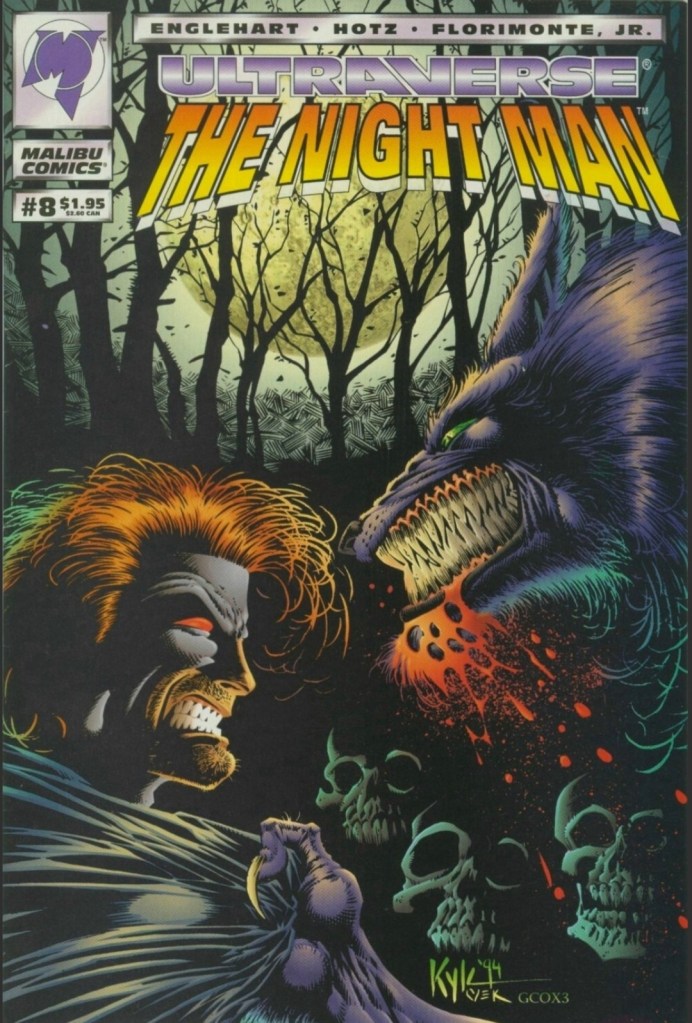
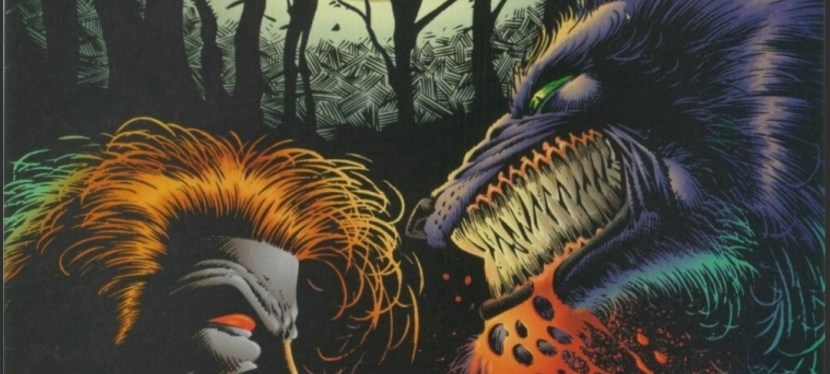
The cover.

Early story

The story begins somewhere inside one of the many rooms of city hall. An intense meeting goes on with the mayor present and what happened recently involving both the Night Man and the werewolf made an impact on the matters of discussion.

In an apartment somewhere in the city, Apocaloff is in his monster form and he just murdered a lady and consumed a lot of her flesh. Suddenly the door is knocked by someone who knew the victim. This causes Apocaloff to leave through the window and climb the steps to the rooftop. There, he changes back into his human form.

Elsewhere, Lt. Carleton Briggs arrives back in his office where Sergeant Dade is waiting. After a s short chat, they hug and kiss each other. The Night Man suddenly enters through the window…

Quality
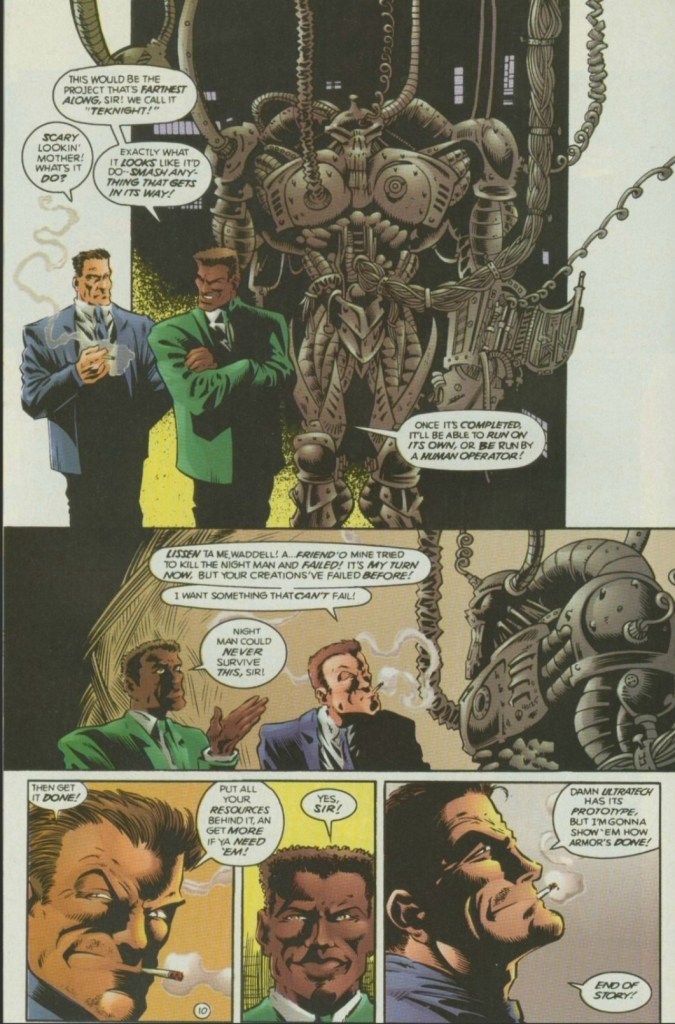
J.D. Hunt and the Teknight project.

Wow! This is one very compelling tale of the Night Man. To get straight to the point, the highlight of this comic book is the rematch between the title character and Apocaloff. To be clear, the rematch was not handled with brainless action in mind but rather with a lot of strategy combined with a medium-paced approach on progression which brought back a lot of vibes from Night Man’s encounters with the members of TNTNT a few issues back. Storywise, the stakes behind the rematch are much higher as the Night Man makes a solid pitch to the local police in the fight against crime (which made me think about the key elements of Batman comic books)  while the tycoon J.D. Hunt (whom Apocaloff interacted with previously) just gave his approval for the Teknight project.

When it comes to character development, Apocaloff’s strong adherence to the past (Russian legacy, old world sensibilities, connections with California’s history) are emphasized some more. For his part, Night Man’s intelligence and approach to vigilantism got developed even more.  

Conclusion
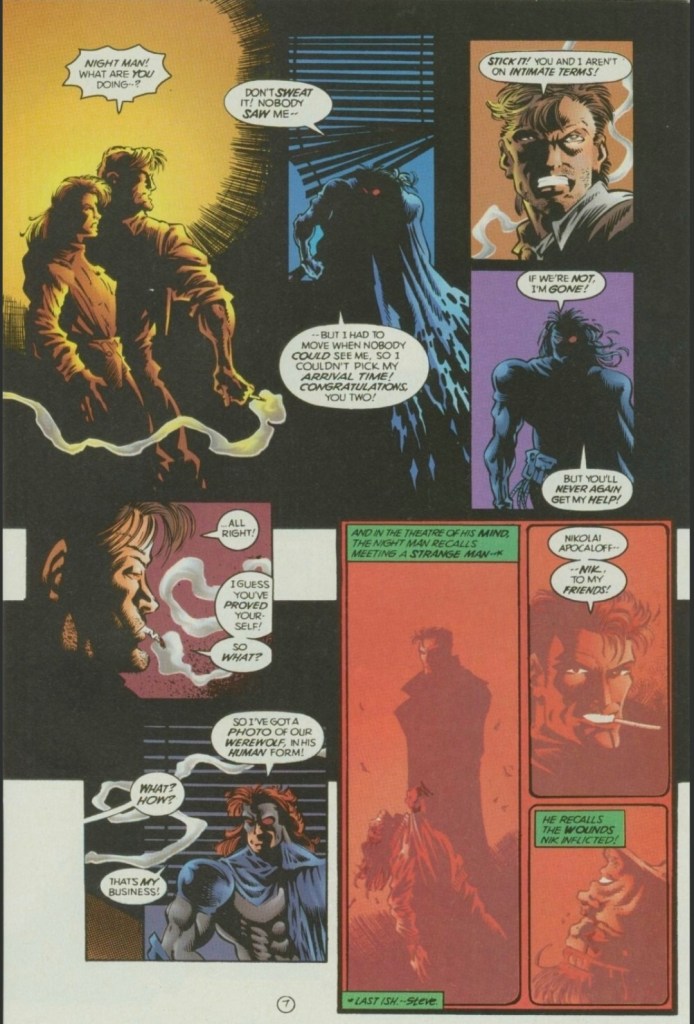
Night Man comes to the police with evidence about Apocaloff.

The Night Man #8 (1994) is another solid comic book of the Ultraverse. The story was told with an overall medium pace and the payoffs for each build-up were indeed satisfying. Considering the presence of the police in the story, this particular Night Man issue has the strongest similarities with DC Comics’ Batman. More importantly, this issue succeeded in developing both the titular hero and his most elaborate villain. It seems to me that Night Man and Apocaloff were made to clash with each other beyond this issue and the previous one.

Overall, The Night Man #8 (1994) is recommended.

+++++

Thank you for reading. If you find this article engaging, please click the like button below and also please consider sharing this article to others. If you are looking for a copywriter to create content for your special project or business, check out my services and my portfolio. Feel free to contact me with a private message. Also please feel free to visit my Facebook page Author Carlo Carrasco and follow me on Twitter at  @HavenorFantasy as well as on Tumblr at https://carlocarrasco.tumblr.com/ and on Instagram at https://www.instagram.com/authorcarlocarrasco/

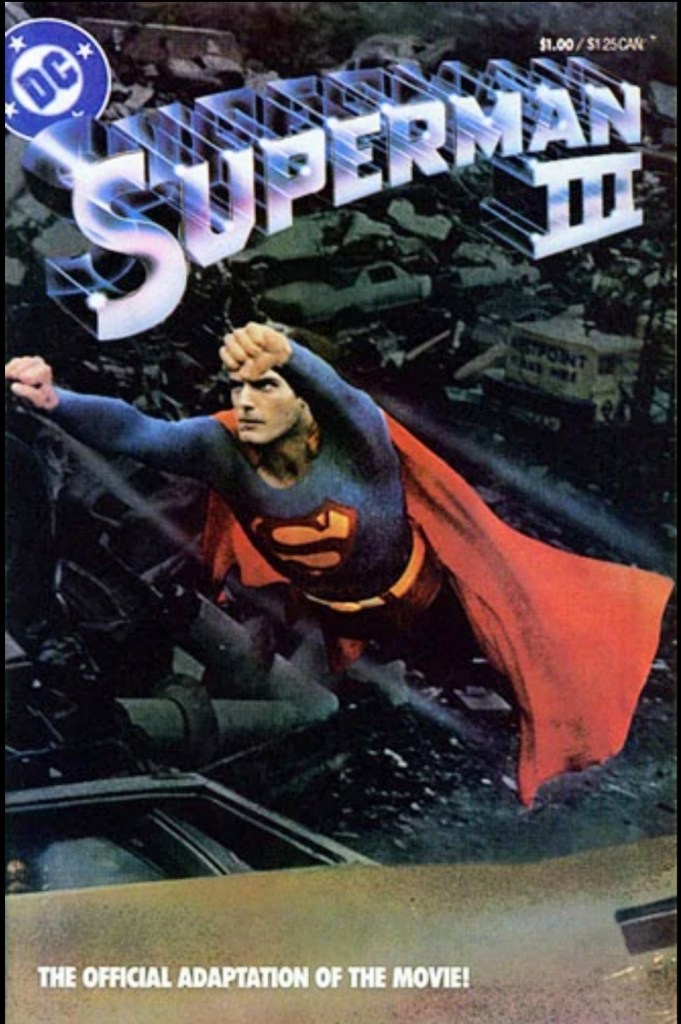
A Look Back at Superman III comic book adaptation (1983)

Disclaimer: This is my original work with details sourced from reading the comic book and doing personal research. Anyone who wants to use this article, in part or in whole, needs to secure first my permission and agree to cite me as the source and author. Let it be known that any unauthorized use of this article will constrain the author to pursue the remedies under R.A. No. 8293, the Revised Penal Code, and/or all applicable legal actions under the laws of the Philippines.

Welcome back superhero enthusiasts, 1980s culture enthusiasts and comic book collectors! Today we go back to the year 1983 which saw the theatrical release of Superman III that featured the late Christopher Reeve as the cinematic Man of Steel.

The 1980s was a very different time with regards to Hollywood’s handling of superhero movies. The concept of a shared cinematic universe was decades away from realization. Warner Bros. back then relied on the Salkind family to produce Superman movies and the first flick in 1978 proved to be a major hit for both viewers and critics while also establishing Christopher Reeve as the definitive live-action Superman for countless people. Unsurprisingly, a sequel was released in the early 1980s which continued box office success for the stakeholders and only led to the approval of another sequel.

Along the way, the late Richard Pryor (a major comedian already) appeared on TV and talked about Superman II which eventually led to him getting hired for Superman III. The movie was released in 1983 making a little over $80 million worldwide while also getting a noticeably weaker reception from critics. More notably, Richard Pryor had a huge chunk of the film’s spotlight as Gus Gorman while the overshadowed Christopher Reeve managed to stretch his cinematic art on playing Clark Kent and Superman (note: there is also the memorable Clark versus Superman battle). Superman III very clearly had a lot more comedy in its presentation. As part of the movie’s marketing, an official comic book adaptation by DC Comics was published.

With those details laid down, here is a look back at the Superman III comic book adaptation,  published by DC Comics in 1983 with a story written by Cary Bates and art made by the late Curt Swan and Sal Amendola.

The cover.

Early story

The story begins inside the unemployment bureau of Metropolis. There, August “Gus” Gorman was told after 36 weeks of chronic unemployment, he is no longer eligible for financial assistance (read: welfare) from the city. As he was about to light his cigarette, he noticed computer job ad on the match. Gorman proceeds to the Archibald Data Processing School where he gets enrolled with several others. In front of others, Gorman does something on a computer which impressed the instructor a lot.

Over at the Daily Planet, Clark Kent/Superman, Lois Lane and Jimmy Olsen meet with Perry White at his office. Kent will be returning home to Smallville and make a news story out of it. White gives Kent his approval and then tells Lois she deserves a vacation.

Hours later, Kent and Jimmy Olsen ride the bus together going to Smallville but their ride stops as a result of a huge fire damaging a large chemical plant. A police officer reveals to Olsen that the scientists inside are worried about the plant and its stuff getting destroyed by the fire.

Kent carefully leaves the bus and discreetly changes into Superman to help solve the problem. Olsen, meanwhile, sneaks past the authorities to get to the burning chemical plant.

Over at Webcoe Industries, company head Ross Webster and his sister Vera learn that more than $85,000 worth of company funds was stolen by someone within. Just outside the office, Gus Gorman enters his fancy looking sports car which Webster, Vera and Lorelei notice. Webster asked how could one of their computer technicians afford such a vehicle worth $75,000…    

Quality

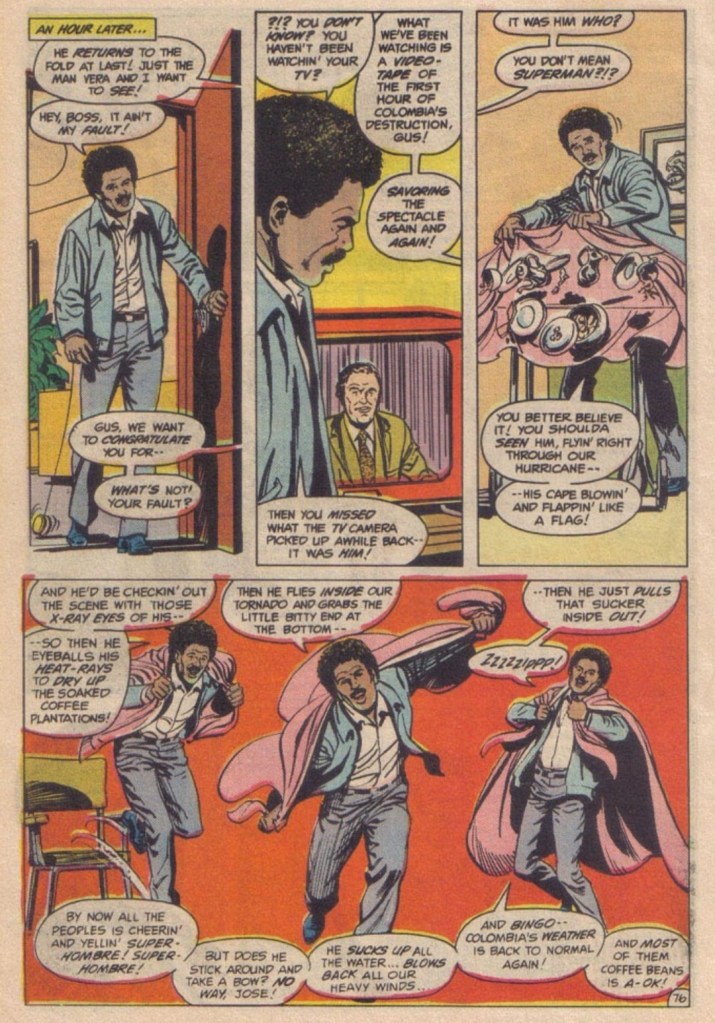
This is a creative way the comic book team used to dramatize Gus Gorman scene revealing and acting the bad news to his boss Ross Webster whose plans were thwarted by Superman.

While it is understandable that not all scenes and not all character moments from the movie  made it on print media, this comic book still managed to capture the film’s essence for the most part. The creative team pulled off their own interpretations of the events and made something entertaining and engaging even though they had to deal with the major challenge of summarizing the movie’s plot and establishing a workable comic book narrative.

I should state that the comic team creatively avoided making in-depth references about liquor and smoking which were obvious in the movie. You will not see Superman drinking liquor at a bar nor will you see Gus Gorman referring to tar listed on a cigarette pack. I suppose this was done to ensure the comic book would be released widely and be acceptable to very young readers and the parents watching them.

The battle between evil Superman and Clark Kent is best viewed in the movie. This one is a shorter and less detailed version of it.

When it comes to establishing the clear lead among all the characters featured, Superman fans should be delighted to know that the Man of Steel is indeed more prominent than Gus Gorman. Take note that in the movie, Richard Pryor’s Gus Gorman overshadowed Christopher Reeve’s Superman/Clark.

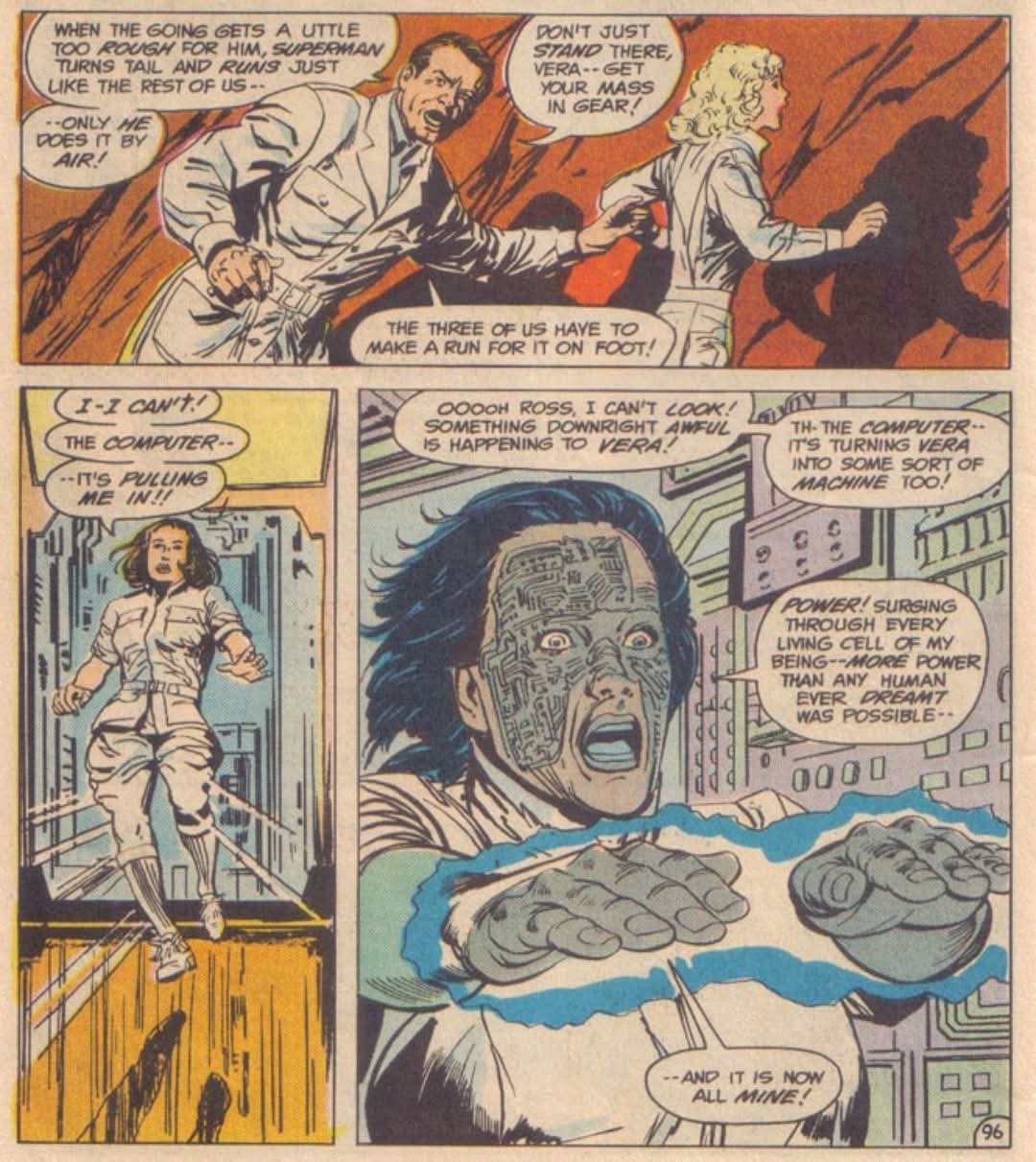
Remember the frightening sequence of Vera getting captured and turned into a cybernetic figure by the Super Computer? This is what it looks like in comic book format.

The art done by Curt Swan and Sal Amendola is decent and it seems to me that their time on visualizing Cary Bates’ script was indeed limited. That being said, it was not surprising to me that, with the exception of Ross Webster in one specific image, none of the characters resembled their cinematic counterparts. Clark Kent/Superman never resembled Christopher Reeve, and Gus Gorman looks nothing like Richard Pryor. Clearly, the artists’ focus was visualizing the narrative which they succeeded.  

Conclusion

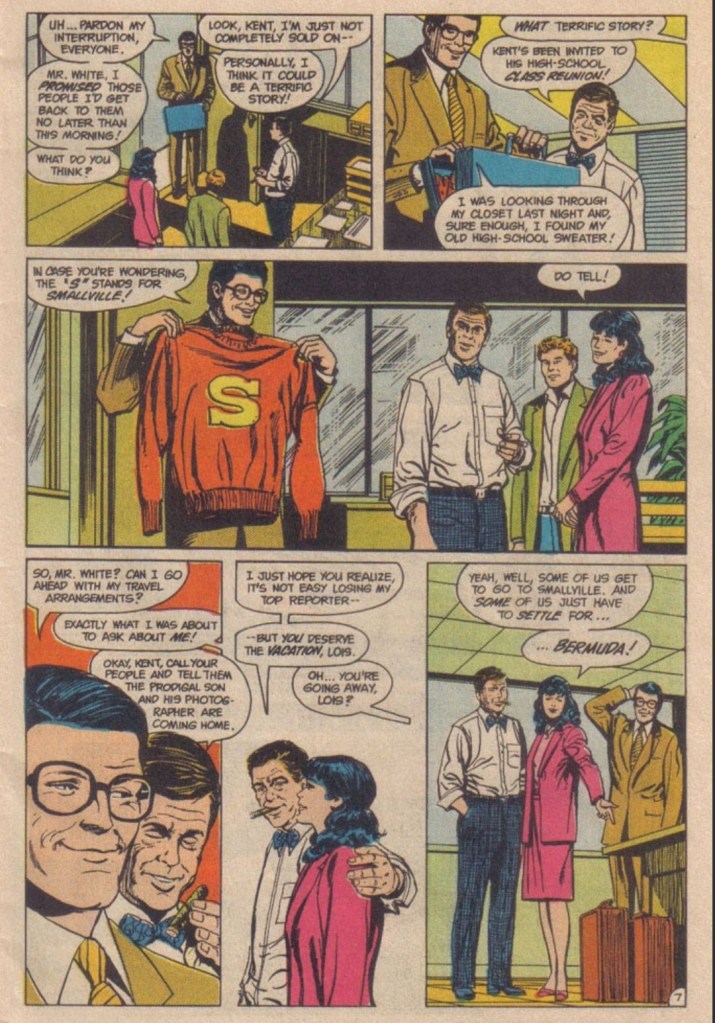
Clark Kent, Lois Lane, Jimmy Olsen and Perry White in the Daily Planet.
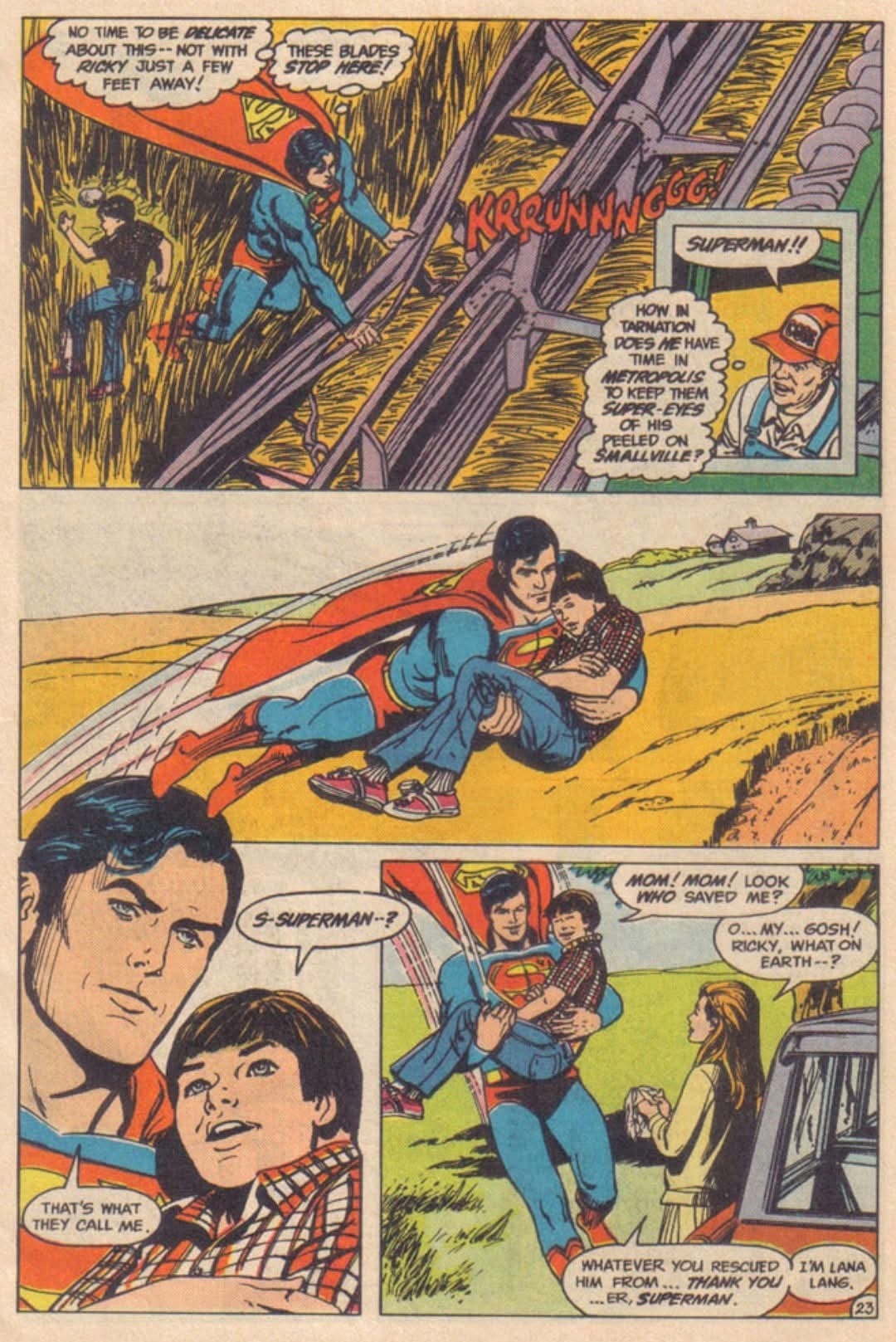
Superman saving Lana Lang’s son from certain death.

Having seen the Christopher Reeve/Richard Pryor movie in the cinema and on cable TV since 1983, I can say that Superman III (1983) is a decent adaptation. It’s not 100% faithful but it is still a worthy read as it will give you the movie’s concept and entertainment values in literary form. If you really want to full essence of film along with the cinematic moments (note: the Superman-Clark battle is the cinematic highlight) all intact, then your obvious choice is to watch the movie. If you are turned off by the movie’s wacky comedy, then the comic book adaptation will deliver to you the more serious approach on telling Superman III’s story. Let me repeat that Superman is more prominent than Gus Gorman in this comic book.

Overall, Superman III (1983) is satisfactory.

+++++

Thank you for reading. If you find this article engaging, please click the like button below and also please consider sharing this article to others. If you are looking for a copywriter to create content for your special project or business, check out my services and my portfolio. Feel free to contact me with a private message. Also please feel free to visit my Facebook page Author Carlo Carrasco and follow me on Twitter at  @HavenorFantasy as well as on Tumblr at https://carlocarrasco.tumblr.com/ and on Instagram at https://www.instagram.com/authorcarlocarrasco/

A Look Back at Harbinger #1 (1992)

Disclaimer: This is my original work with details sourced from reading the comic book and doing personal research. Anyone who wants to use this article, in part or in whole, needs to secure first my permission and agree to cite me as the source and author. Let it be known that any unauthorized use of this article will constrain the author to pursue the remedies under R.A. No. 8293, the Revised Penal Code, and/or all applicable legal actions under the laws of the Philippines.

Welcome back superhero enthusiasts, 1990s culture enthusiasts and comic book collectors! Today we go back to the early 1990s and explore a part of the Valiant Comics shared universe through the Harbinger monthly series.

For the newcomers reading this, Harbinger was created by former Marvel editor-in-chief and Valiant founder Jim Shooter (note: read my retro reviews of his works here, here, here, here and here) and artist David Lapham. Harbinger follows a few teenagers with unique abilities or powers who got involved with the Harbinger Foundation, an organization established by Toyo Harada who dreams to change the world as people know it.

With those details laid down, here is a look back at Harbinger #1, published in 1992 by Valiant Comics with a story written by Jim Shooter and drawn by David Lapham.

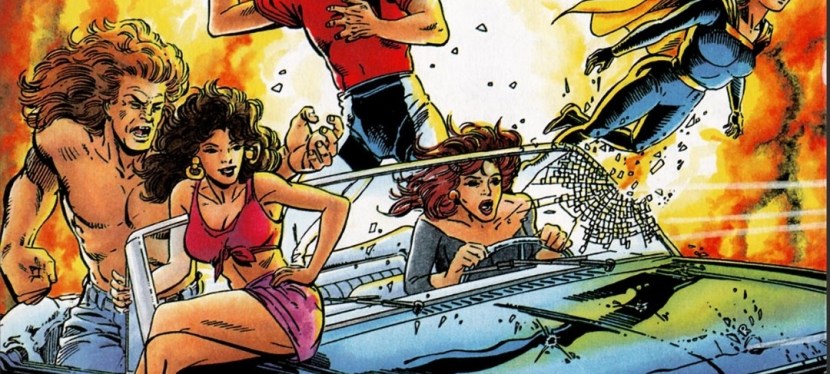
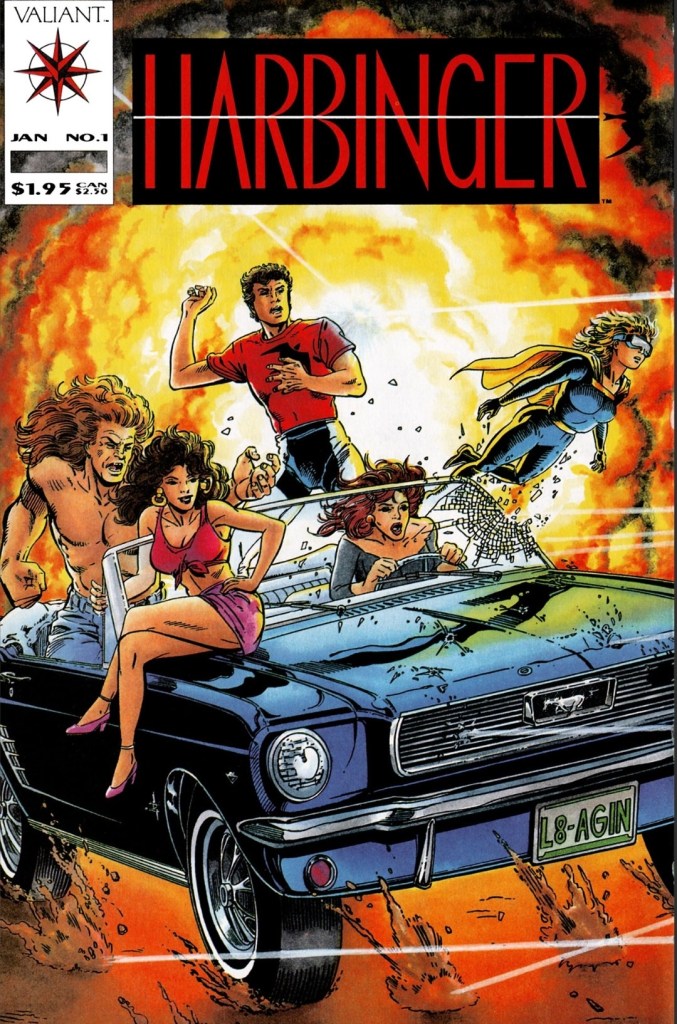
The cover.

Early story

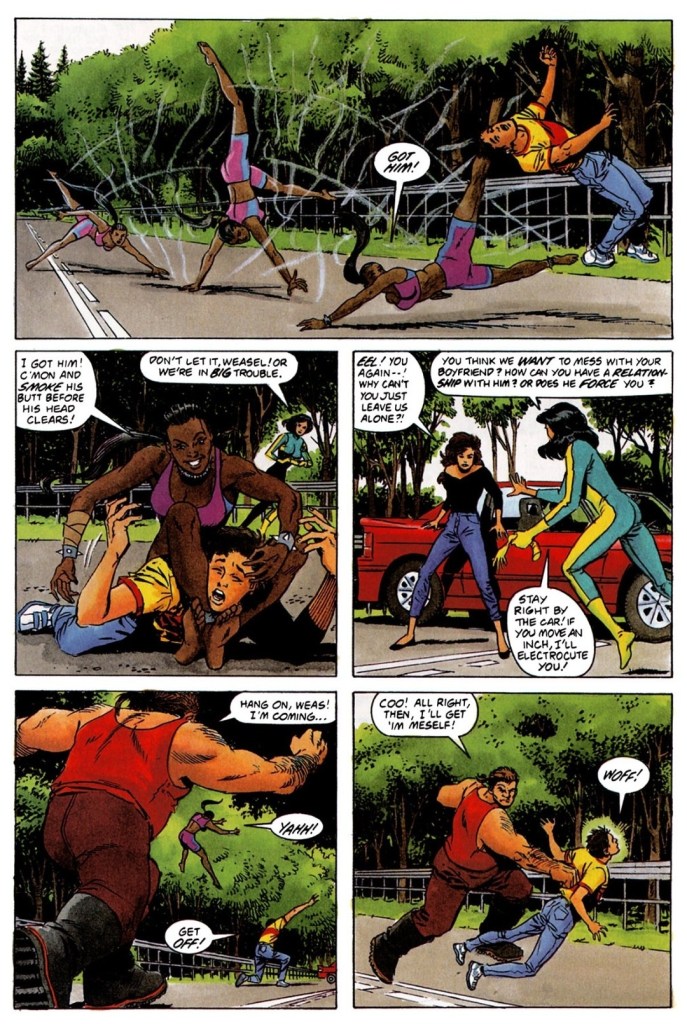
The story begins at 2:35 PM of June 2, 1991. Pete and his companion Kris are riding a car floating high above the road being followed by a helicopter. After Pete manages to communicate with the helicopter’s operators, they even settle down by landing on a road with no traffic. As Pete and the helicopter people begin talking, three people – Weasel, Eel and Lump – quickly rushed in to subdue Pete and Kris. After Pete manages to free himself from Weasel and Lump, he uses his power to lift up the car Kris drove (note: Kris is no longer in the car) and uses it as a weapon to hit Lump.

Just as Kris hits Eel on the stomach, Pete notices that the gasoline was leaking out of the car which Eel ignites with her electricity causing a huge explosion. Pete and Kris managed to survive the blast and together they fly off to a motel to rest and reorganize themselves.

The next morning, they have a meal together and Kris examines a newspaper. She notices another one of the Harbinger Foundation’s print ads reaching out to people who find themselves different or notice strange things around them. The two fugitives realize that the said foundation somehow made involved youth become dangerous. Remembering that people write and send letters to the Harbinger Foundation, Pete comes up with the idea of intercepting letters…

Quality

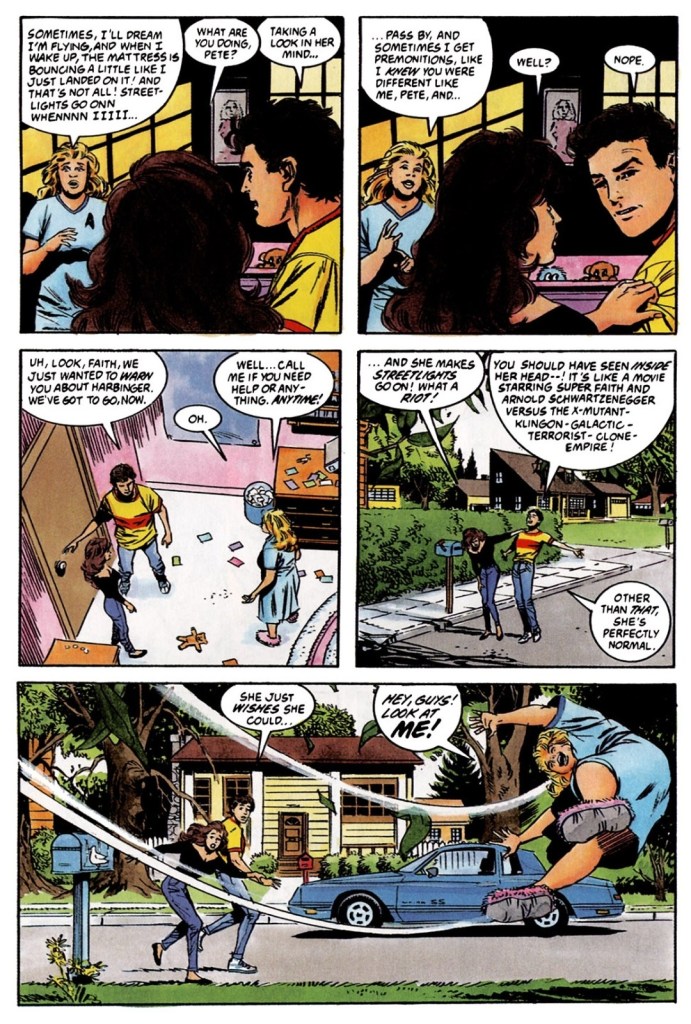
Pete, Kris and Faith.

This is one very engaging story to read. While story concepts about super-powered teenagers being desperate and struggling to realize their purpose while facing evil is not new, this comic book has a concept that remains unique even by today’s standards. Instead of seeing a group of powered teenage outcasts escaping society’s authorities or taking refuge in the home of a caring person, this comic book follows teenagers who are being targeted by a powerful organization as one of them – Pete – personally got involved with them before.

The story written by Jim Shooter is deliberately paced at a moderate level which allows readers to be able to absorb the details before moving from one chapter to the next. Along the way, Kris and Pete get to meet other powered characters like Faith, Flamingo and John. In between the introductions of the three mentioned characters, Shooter’s script managed to set up enough space for character development and interactions between the characters which have been executed to be believable. Even key elements of youth such as insecurity, fear, angst and the false sense of maturity are portrayed along the way. I should state that Shooter dramatized these characters like they were real people.

As for the Harbinger Foundation itself, it complete lacks visibility and its exposure was limited to the print ad and mentions. Still, the foundation is a clear and present danger to Pete and his companions as it has powered youth members who are dedicated to it and they also have heavily armed personnel working for them.

If you are fond of superhero spectacle, I can say that the action scenes were executed in accordance to the narrative. The spectacle of this comic book was clearly made to emphasize the plot elements and not serve as eye candy. That being said, this is a unique way of enjoying superhero spectacle.

Conclusion

The Harbinger Foundation’s pawns Weasel, Eel and Lump take on Pete and Kris.

Harbinges #1 (1992) is a pretty engaging comic book of Valiant and at the same time it is also one of the more unique portrayals of powered teenagers who are living with tremendous odds tilted at them. The tone of the story really felt grounded in reality (the early 1990s specifically) and the character moments, action and incidents were all executed in a believable fashion.

Overall, Harbinger #1 (1992) is highly recommended!

+++++

Thank you for reading. If you find this article engaging, please click the like button below and also please consider sharing this article to others. If you are looking for a copywriter to create content for your special project or business, check out my services and my portfolio. Feel free to contact me with a private message. Also please feel free to visit my Facebook page Author Carlo Carrasco and follow me on Twitter at  @HavenorFantasy as well as on Tumblr at https://carlocarrasco.tumblr.com/ and on Instagram at https://www.instagram.com/authorcarlocarrasco/

A Look Back at Ultraverse Year One (1994)

Disclaimer: This is my original work with details sourced from reading the comic book and doing personal research. Anyone who wants to use this article, in part or in whole, needs to secure first my permission and agree to cite me as the source and author. Let it be known that any unauthorized use of this article will constrain the author to pursue the remedies under R.A. No. 8293, the Revised Penal Code, and/or all applicable legal actions under the laws of the Philippines.

Welcome back superhero enthusiasts, 1990s culture enthusiasts and comic book collectors! Today we go back to the mid-1990s which was a pretty wild time for comic collectors. To be more specific, this newest retro review revisits the Ultraverse through a comic-like publication in the form of a guide meant for UV fans and comic collectors.

The subject at hand is Ultraverse Year One which, as written on the edge of the front cover, was designed to be the “complete guide to the Ultraverse’s first year.” It is a reference guide for those who seriously want to discover each and every Ultraverse comic book that was published during its first year. In my experience as a comic collector, the Ultraverse launch in 1993 was very memorable even though my financial limitations prevented me from acquiring each and every launch comic book and subsequent releases of the time. How useful is this complete UV guide? We can go on and find out.

With those details laid down, here is a look back at Ultraverse Year One, published in 1994 by Malibu Comics.

The cover.

Quality

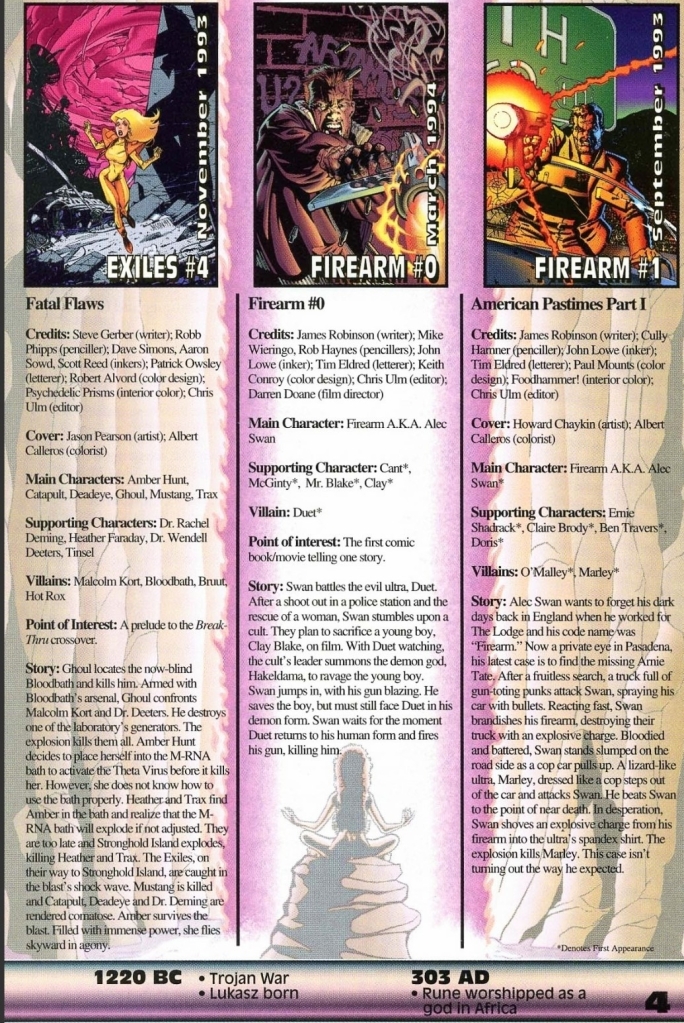
I can say without a doubt that this publication is indeed a complete guide to each and every Ultraverse comic book released during its first year from 1993 to 1994 specifically. You want to know exactly how many issues of Mantra, Prime, Hardcase, The Solution, Prototype, The Strangers and others were published in the first year? This one has it all listed! You want to know which UV comic book involved the talents of Steve Gerber, Norm Breyfogle, Rick Hoberg, Len Strazewski, Aaron Lopresti, George Perez, James Hudnall, Gerard Jones, Steve Englehart, Tom Mason, Terry Dodson, James Robinson, Howard Chaykin, Mike W. Barr and many others under the Malibu Comics banner? This guide has it all listed! What months were Exiles #1, Sludge #1, Firearm #0, Break-Thru #1 and Mantra #1 were published? The answers to each are included. The same can also be said when it comes to which characters appeared in each comic book.

This is what each page typically looks like with details of the Ultraverse timeline on the lower part.
The timeline reveals that the male warrior Lukasz, who would later end up in woman’s body as Mantra/Eden Blake, was born in 1220 BC.

Very clearly, the Malibu Comics people worked hard to collect the essential types of information, organized them and put them all into print media form for readers and collectors to use when it comes to searching just about everything about the Ultraverse’s first year. Things did not just stop there, however.

What I found amusing to look at in each page of this Ultraverse guide are details of the shared universe’s timeline posted on the lowest part. The said timeline – which is limited to text and numbers – reveal interesting details such as what year was Lukasz (AKA Mantra) born, when did Rune begin, when was the Choice corporation established, what year did the island of Yrial’s people move up to the clouds, what years were infants injected by Wetware Mary and more. These details are actually quite encouraging to make readers discover or re-read Ultraverse comic books to see how they are dramatized on paper.

Conclusion

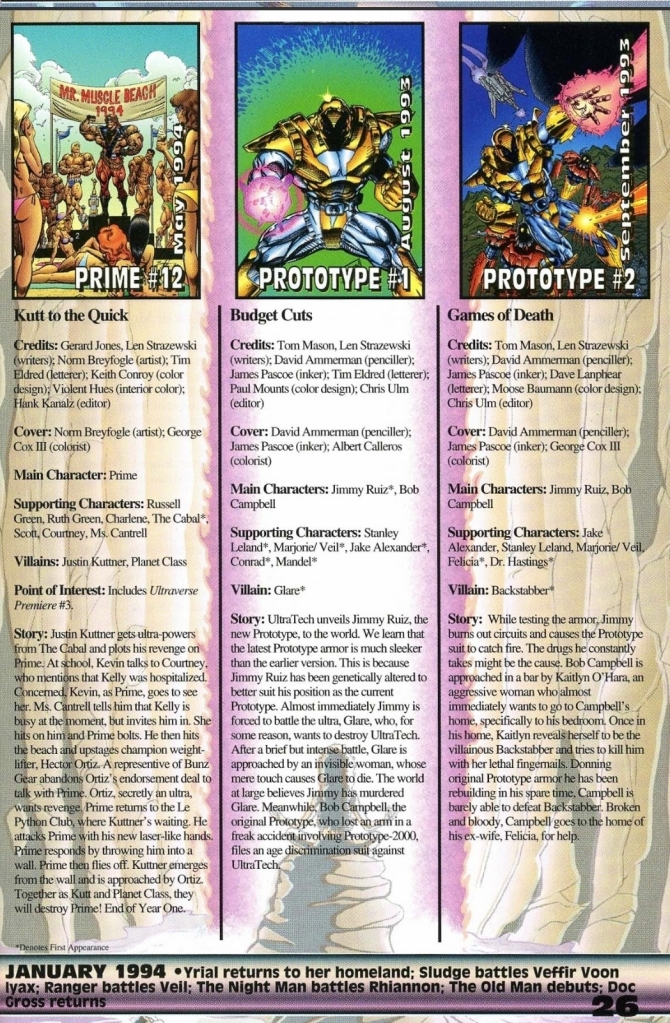
As you can see in the details above, Len Strazewski was involved in both the Prime and Prototype comic book series.

Ultraverse Year One (1994) is a pretty detailed guide that will not only help readers track down each and every UV comic book of the mentioned time period, but also help them spot the precise comic books that has characters included as well as the published works of varied comic book creators. If you are really determined to track down and buy all the Year One UV comic books, this guide is a must-have. If there are any weaknesses to mention, it would be the fact that each comic book’s entire plot got summarized in full which are actually spoilers.

Overall, Ultraverse Year One (1994) is recommended.

+++++

Thank you for reading. If you find this article engaging, please click the like button below and also please consider sharing this article to others. If you are looking for a copywriter to create content for your special project or business, check out my services and my portfolio. Feel free to contact me with a private message. Also please feel free to visit my Facebook page Author Carlo Carrasco and follow me on Twitter at  @HavenorFantasy as well as on Tumblr at https://carlocarrasco.tumblr.com/ and on Instagram at https://www.instagram.com/authorcarlocarrasco/

A Look Back at Exiles #2 (1993)

Disclaimer: This is my original work with details sourced from reading the comic book and doing personal research. Anyone who wants to use this article, in part or in whole, needs to secure first my permission and agree to cite me as the source and author. Let it be known that any unauthorized use of this article will constrain the author to pursue the remedies under R.A. No. 8293, the Revised Penal Code, and/or all applicable legal actions under the laws of the Philippines.

Welcome back superhero enthusiasts, 1990s culture enthusiasts and comic book collectors! Today we go back to the mid-1990s which was a really wild time for comic collectors. To be more specific, this newest retro comic book review revisits Ultraverse through the very short series titled Exiles.

It has been years since I reviewed Exiles #1 (1993). Since after, I reviewed a lot of Ultraverse comic books and went through notable storylines such as the Atalon Saga in UltraForce, the Hostile Takeover in Prototype, The Solution, The Night Man and Solitaire, and more. That being said, it was just right that I returned to Exiles for retro reviewing.

With those details laid down, here is a look back Exiles #2, published in 1993 by Malibu Comics with a story written by Steve Gerber and drawn by Robb Phipps.

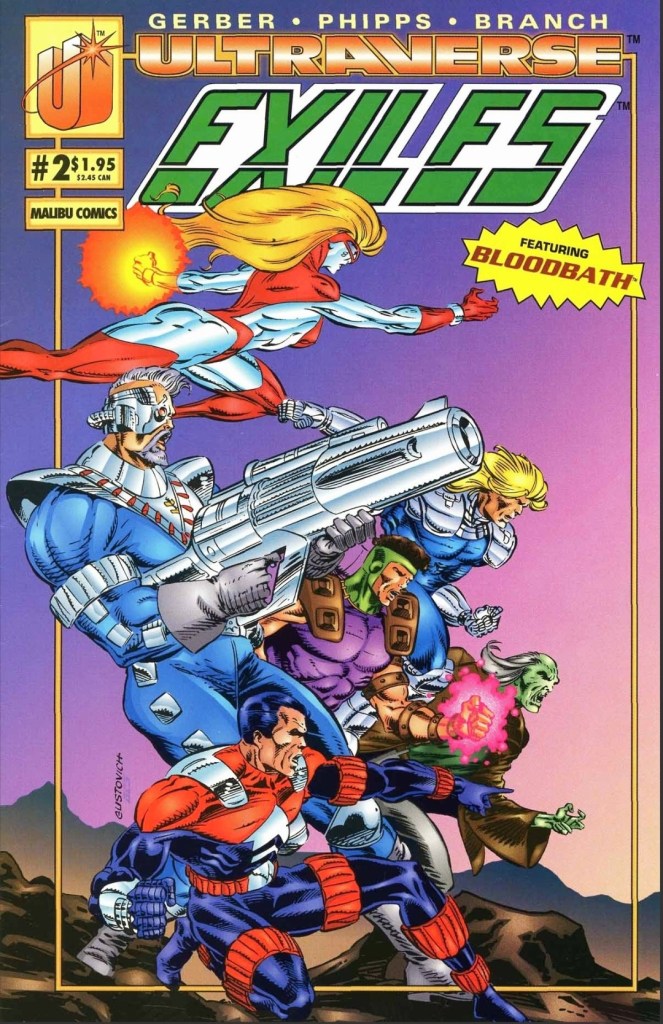
The cover.

Early story

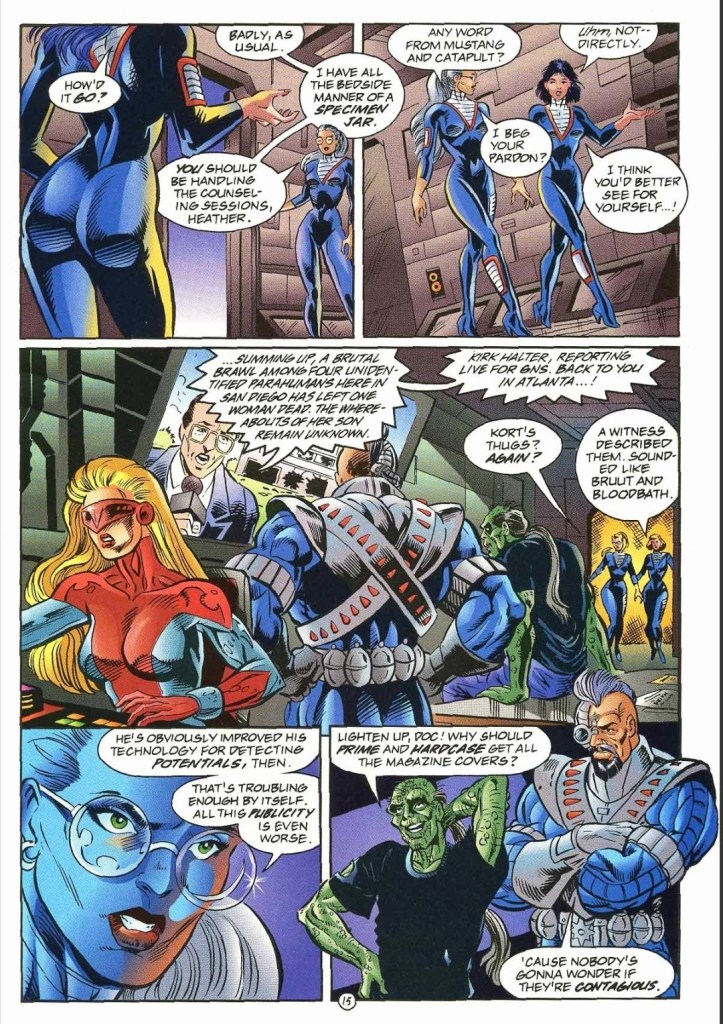
The story begins with Exiles members Catapult and Mustang staring at two bodies (a large man and a lady) on the floor. It turns out their mission was a failure as Timmy Halloran (the young guy they tried to save) went missing while his mother just died.

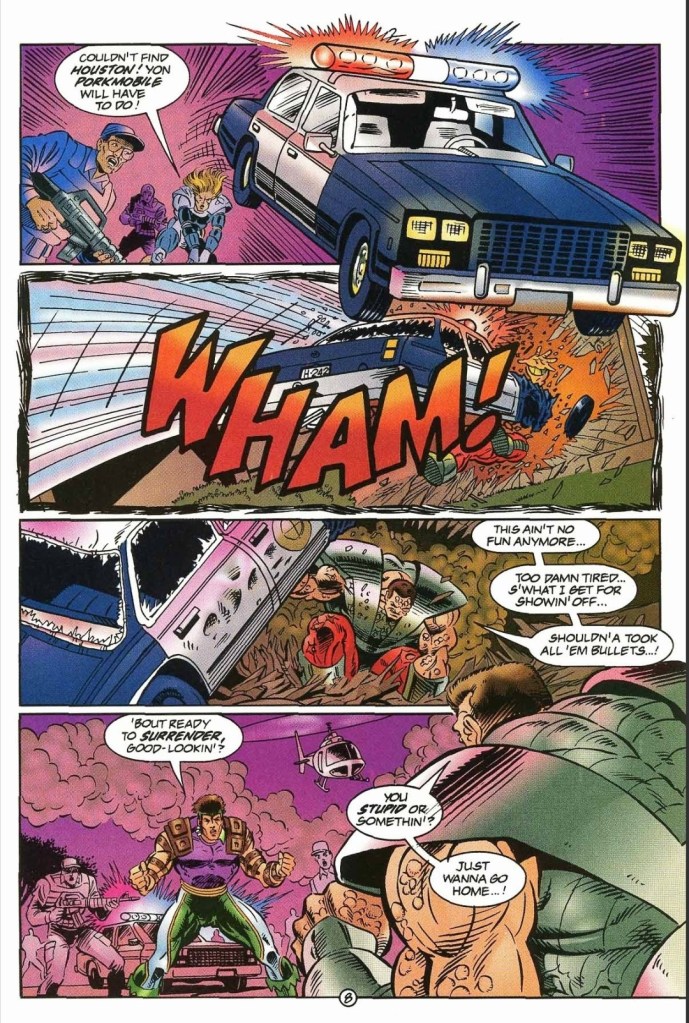
As soon as the two step out of the house feeling bad about their failure, they suddenly find themselves confronted by several police officers. Police cars and a helicopter have surrounded the place. Just as Catapult and Mustang turned themselves in, the large man named Bruut suddenly regains consciousness and attacks the police.

The police officers respond by firing several bullets at Bruut which slowed him down. After noticing that Bruut was only regaining his strength, the two Exile members made their moves before the large man strikes the police…

Quality

Inside the headquarters of Exiles. Ghoul’s mentioning of Prime and Hardcase seems to foreshadow his eventual part in UltraForce.

As expected, the storytelling in this comic book really progressed and paid off some of the build-up that happened in issue #1. Here, the conflict between the Exiles and the enhanced forces of business tycoon Victor Kort got clearly defined and what they have in common other than having enhanced beings is their pursuit of individuals who carry within their bodies the Theta virus which unlocks unexpected powers or capabilities. Such developments could impact the people and the world around them when left unguarded or deliberately developed with assistance of guidance.

Amber, who was a key figure in issue #1, appears much less in this comic book but her purpose with the Exiles gets more elaborated. The lack of spotlight on Amber is not surprising as the creators had to emphasize the conflict between the titular team and Kort’s forces while also introducing Timmy Halloran as a new Theta-carrying individual.

There is a good amount of superhero spectacle here and along the way, the dialogue is good and got witty as well. By the time I reached the end, I found myself anticipating what would come next in issue #3.

Conclusion

The two Exiles members take on Bruut right in the presence of police officers.

Exiles #2 (1993) is a worthy follow-up to its predecessor and the creators succeeded in making the conflict more engaging while cleverly releasing new details that defined what is at stake and what could follow. In retrospect, Amber Hunt later became a key figure in the 2-part Break-Thru crossover storyline (which was memorably drawn by the late George Perez) and the story here defined how much impact super beings can have on societies filled with mostly people who don’t have super powers or special talents. The conflict between the Exiles and Kort’s forces not only got emphasized a lot, their respective agendas and resources are also well defined.

Overall, Exiles #2 (1993) is recommended.

+++++

Thank you for reading. If you find this article engaging, please click the like button below and also please consider sharing this article to others. If you are looking for a copywriter to create content for your special project or business, check out my services and my portfolio. Feel free to contact me with a private message. Also please feel free to visit my Facebook page Author Carlo Carrasco and follow me on Twitter at  @HavenorFantasy as well as on Tumblr at https://carlocarrasco.tumblr.com/ and on Instagram at https://www.instagram.com/authorcarlocarrasco/

A Look Back at Sludge #10 (1994)

Disclaimer: This is my original work with details sourced from reading the comic book and doing personal research. Anyone who wants to use this article, in part or in whole, needs to secure first my permission and agree to cite me as the source and author. Let it be known that any unauthorized use of this article will constrain the author to pursue the remedies under R.A. No. 8293, the Revised Penal Code, and/or all applicable legal actions under the laws of the Philippines.

Welcome back, superhero fans, 1990s arts and culture enthusiasts and comic book collectors! Today we revisit the Ultraverse of Malibu Comics and examine one of its many stories told through an issue of the Sludge comic book series.

In my previous retro review, the “Street Wars” storyline came to a solid and even shocking end which ultimately left Sludge free and yet desperate and unfulfilled. At this stage, Sludge is clearly a very lost soul and this opens another opportunity for readers to follow him and see where he will go next.

With those details laid down, here is a look back at Sludge #10, published by Malibu Comics in 1994 with a story written by Steve Gerber and drawn by Robb Phipps.

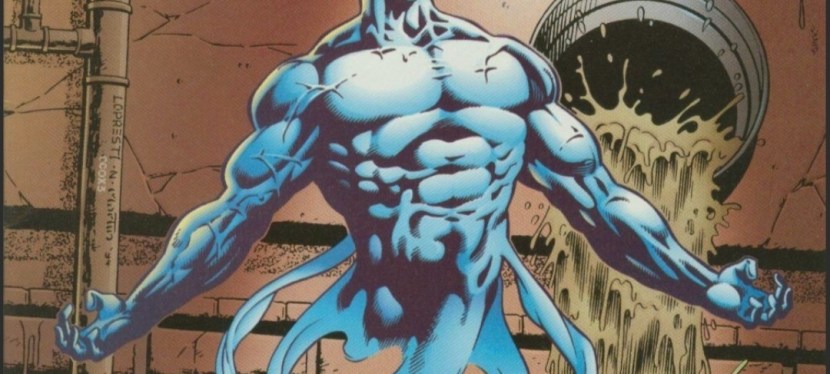
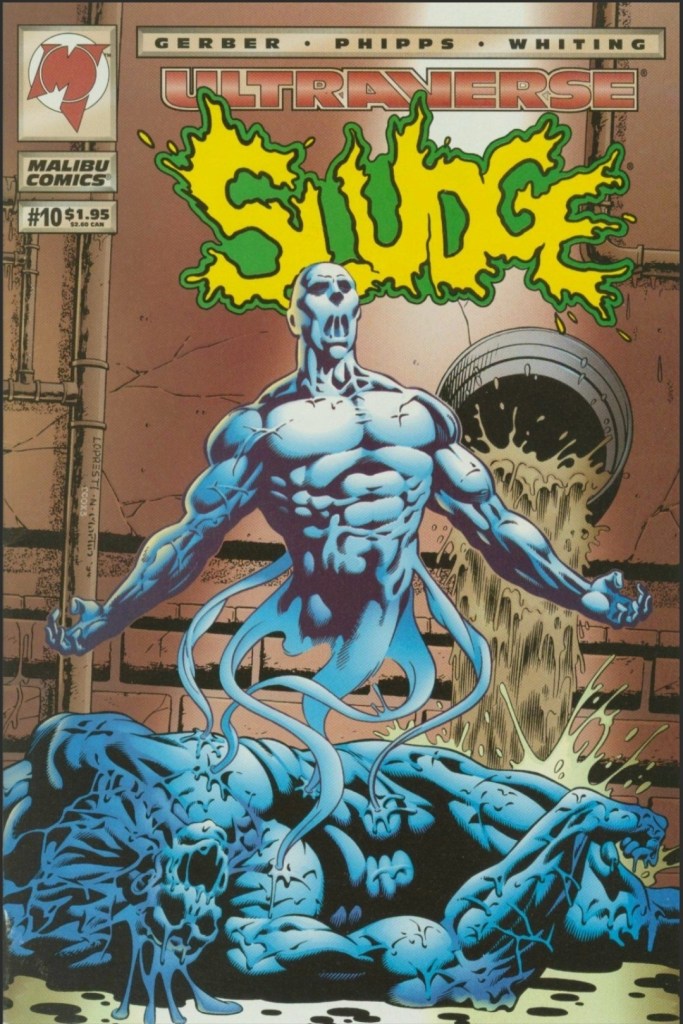
The cover.

Early story

The story begins with Sludge once again alone in the sewers. This time, he holds large quantities of the illegal substance Zuke which he believes will help him achieve something he desires in relation to his existence. Life has been very hard for him since he became a slimy creature.

Then he remembers when the mercenary Bloodstorm was forced fed with Zuke. Afterwards, he consumes the large Zuke containers expecting them to fix him. Nothing happened. No instant results whatsoever which frustrates him. Sludge then walks into the darkness.

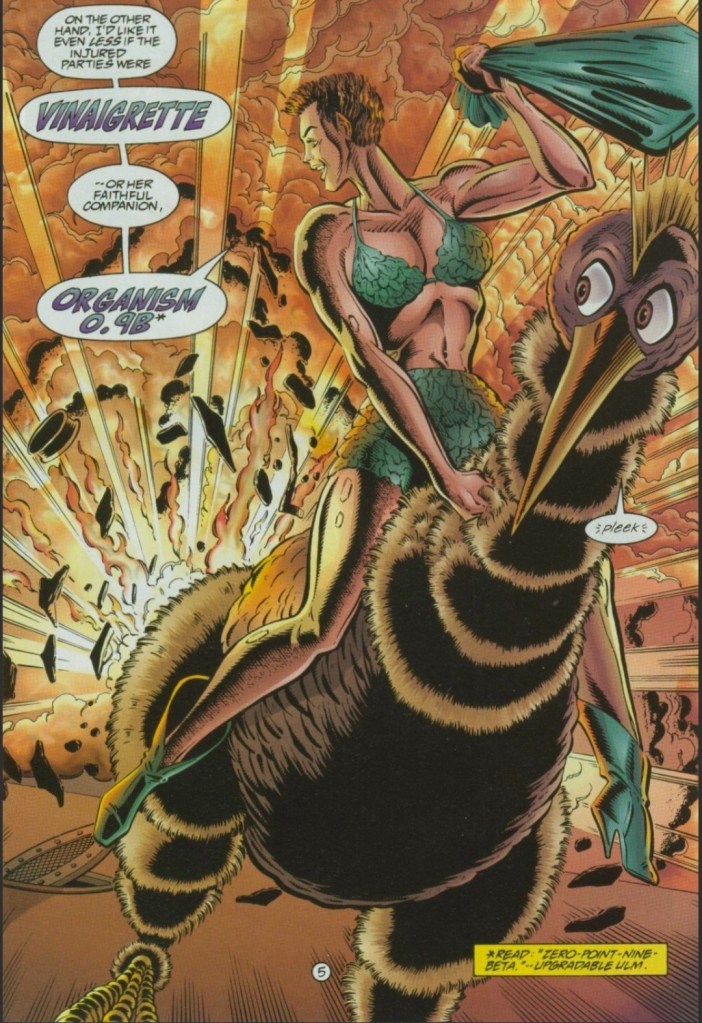
On the city street, police officers in cars chase an unusual target…a lady riding a large bird of unknown species. After causing her pursuers to crash and explode, the lady rider reveals herself to be Vinaigrette.

Just as Vinaigrette and her speedy bird move into an alley, Sludge sees them…

Quality

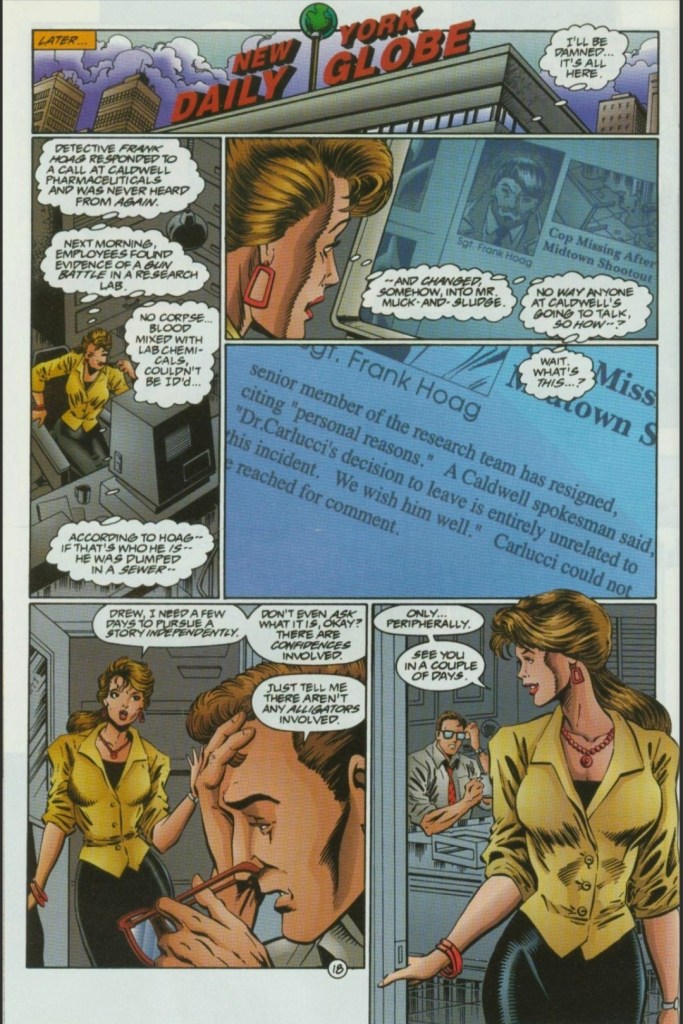
Investigative journalism being done.

When it comes to the story, I can say that the Sludge series really made a serious turn towards a different direction here. Without spoiling the rest of the plot, I can say that very significant changes await readers, so much so their usual expectations towards Sludge become unnecessary. Are you so used to seeing Sludge think or talk inconsistently? Be ready for something really new about him, something that makes him more human moving a bit closer to his past life as a civilian.

Moreover, with the gang war aspect of New York already out of the narrative, this comic book not only follows Sludge more significantly, its story is also more character-driven than before. What Steve Gerber wrote here is very nicely structured and it is also clear he also adjusted his portrayal of the titular character to give readers something fresh and yet familiar to follow.

So what kind of story does this comic book present other than being a more character-driven piece? Definitely it’s not a monster story nor a superhero tale but something more of a misadventure mixed with elements of detective story plus a bit of investigative journalism (mainly due to the series’ notable lady journalist).

Conclusion

A lady and her speedy ride.

In my view, Sludge #10 (1994) is a successful attempt by the creative team to emphasize Sludge’s exploits and personality even more while taking a new direction without ever feeling alienating. I should state that after reading back-to-back issues about the New York gang war which had the titular character caught in the middle, this comic book’s character-driven approach with Sludge is literally like a breath of fresh air. Not only will you see even more of Sludge, you will also enjoy the creators’ attempt on exploring his past life while showing lots of significant new things in connection to the changes he goes through. The story is nicely paced, the storytelling is creatively stylized and there are nice pay-offs for each build-up.

Overall, Sludge #10 (1994) is highly recommended.

+++++

Thank you for reading. If you find this article engaging, please click the like button below and also please consider sharing this article to others. If you are looking for a copywriter to create content for your special project or business, check out my services and my portfolio. Feel free to contact me with a private message. Also please feel free to visit my Facebook page Author Carlo Carrasco and follow me on Twitter at  @HavenorFantasy as well as on Tumblr at https://carlocarrasco.tumblr.com/ and on Instagram at https://www.instagram.com/authorcarlocarrasco/
A Look Back at Wolverine #75 (1993)

Disclaimer: This is my original work with details sourced from reading the comic book and doing personal research. Anyone who wants to use this article, in part or in whole, needs to secure first my permission and agree to cite me as the source and author. Let it be known that any unauthorized use of this article will constrain the author to pursue the remedies under R.A. No. 8293, the Revised Penal Code, and/or all applicable legal actions under the laws of the Philippines.

Welcome back, superhero enthusiasts, comic collectors, 1990s culture enthusiasts and fans of the X-Men! We go back to the year 1993 when the 30th anniversary of the X-Men was celebrated with the 6-part Fatal Attractions storyline. Already I reviewed Uncanny X-Men #304 (Part 3) which was not worthy of the X-Men’s 30th anniversary celebration. X-Men #25 (Part 4) meanwhile was not only great but also shocking and had a years-long impact on X-Men comics.

So now the focus is on the 5th chapter of the Fatal Attractions storyline handled by the Larry Hama-Adam Kubert team on the Wolverine monthly series of the time. With those details laid down, here is a look back at Wolverine #75, published by Marvel Comics in 1993 with a story written by Larry Hama and drawn by Adam Kubert.

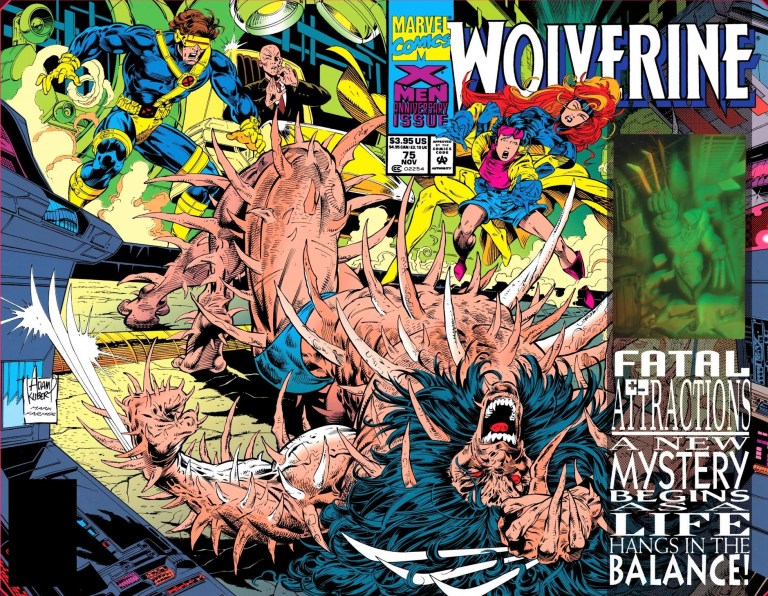
The cover.

Early story

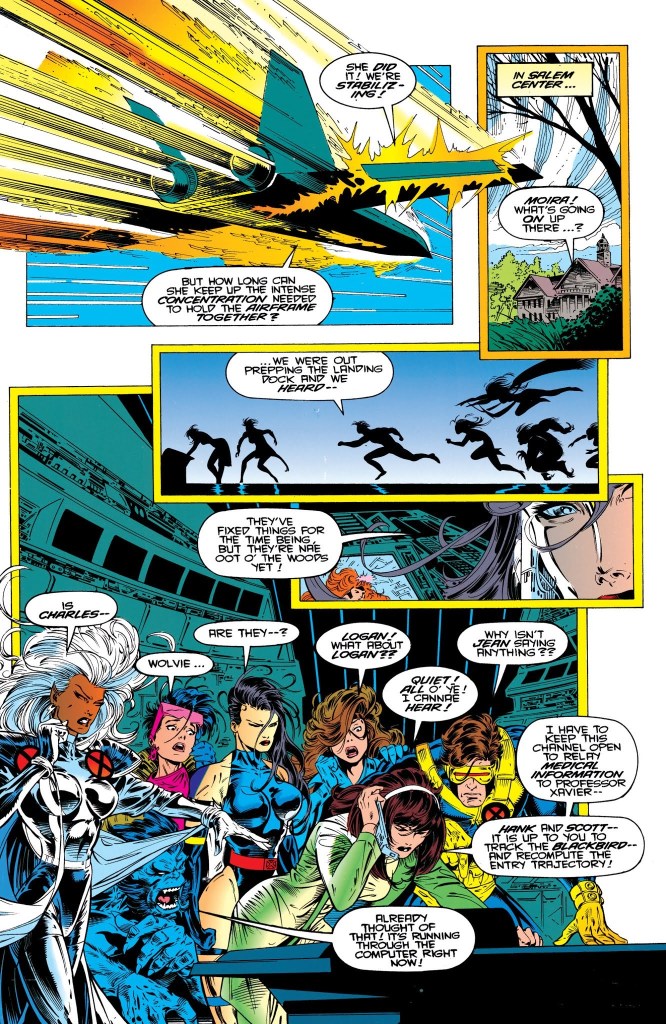
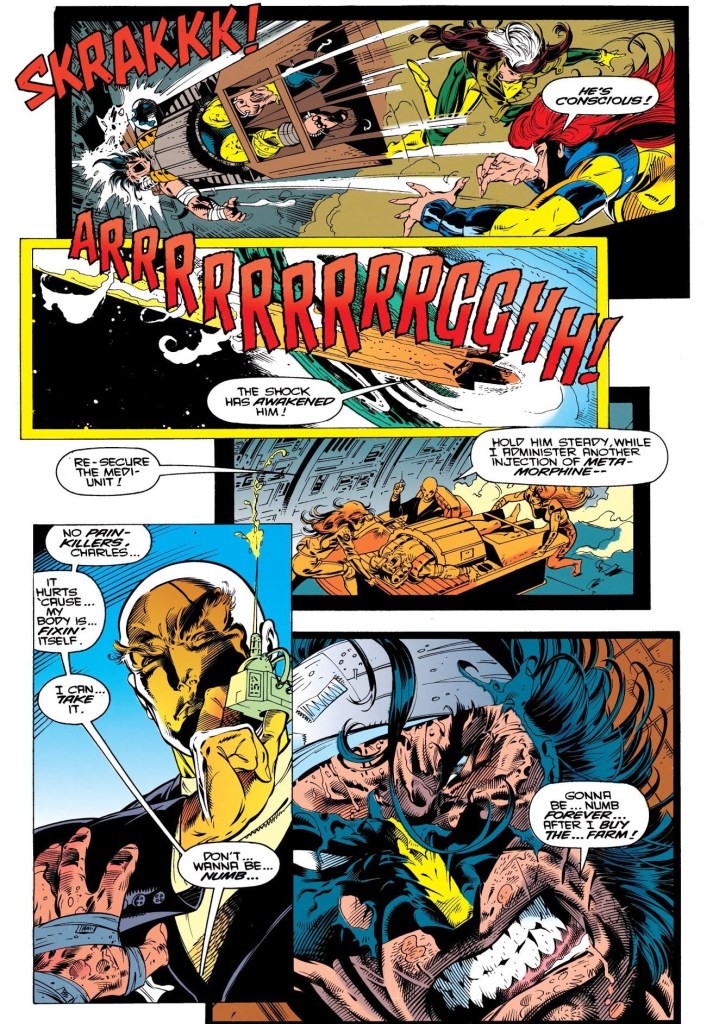
The story begins in outer space. Carrying Charles Xavier, Wolverine, Gambit, Jean Grey, Rogue and Quicksilver (who participated in the dangerous mission in X-Men #25), the X-Men’s jet (piloted by Bishop) struggles mechanically as it was not designed for space travel. Worse, Wolverine is under very serious condition and the medical unit has been operating in full capacity dealing with his intense trauma.

In an attempt to alleviate Wolverine’s psychic trauma, Charles Xavier and Jean Grey enter his mind and discover that there is a world full of pain and horror. They see visions of a restrained Wolverine (from his Weapon X days) being attacked by Sabretooth and Lady Deathstrike. Xavier explains that they are at the epicenter of Logan’s most suppressed cataclysmic memories which were clearly triggered by the physical damage Magneto inflicted on him (see X-Men #25).

As the X-Men’s jet attempts to enter Earth’s atmosphere, its exteriors heat up dramatically shaking everyone inside. This complicates the situation on stabilizing Wolverine…

Quality

The other X-Men team members at their headquarters expressing worry and concern about the situation of their teammates struggling to come back home from space.

To be clear, this story continues the events of Fatal Attractions but with a bit more focus on Wolverine (compared to the earlier chapters of the storyline that is). There is no real battle between good and evil at all. It’s really all about Wolverine struggling to survive just as his teammates struggle to arrive home.

Before the stories of this comic book and X-Men #25 happened, Wolverine has often been portrayed to be very tough, brave and a walking machine of violence which has been reflected in other X-Men stories told in video games and movies. In this very comic book, Wolverine has been presented to coming close to death. This means Logan, at this particular stage of the history of the literary X-Men, was at his most vulnerable state. In my experience, this was both alienating and shocking to see.

With regards to the writing, Larry Hama did an excellent job with pacing the story from start to finish. Right from the beginning, the story pulls you into the X-Men’s tough situation and as each page gets turned, the tension as well as the suspense builds up until the execution of the climax. Along the way, the comic book not only portrays Wolverine struggling on the edge, it also works to make you care more or be more concerned towards him. Oh yes, the shocking moment near the end of this comic book remains very powerful and you who read this retro review should read Wolverine #75 and see it for yourselves.

Conclusion

Wolverine at his most vulnerable state.

By today’s standards, Wolverine #75 (1993) is still a very great comic book to read. In fact, I can say it is not only one of most defining chapters of the Fatal Attractions storyline as well as one of the most significant X-Men comic books of the 1990s, it is indeed a true illustrated literature classic ever published by Marvel Comics. In retrospect, this comic book marks a major turning point in the life of Wolverine who is still one of the most iconic characters in all of superhero literature. All of these were achieved thanks to the creative team of Larry Hama and Adam Kubert (whose are here was great and stylized at the same time). Hama succeeded in writing the continuation of the Fatal Attractions storyline while balancing all of the exposition and still putting Wolverine in the center. That itself is a very great work of writing.

If you are seriously planning to buy an existing hard copy of Wolverine #75 (1993), be aware that as of this writing, MileHighComics.com shows that the near-mint copy of the regular edition costs $60 while the near-mint copies of the signed-and-numbered edition and the newsstand edition cost $300 and $180 respectively.

Overall, Wolverine #75 (1993) is highly recommended!

+++++

Thank you for reading. If you find this article engaging, please click the like button below and also please consider sharing this article to others. If you are looking for a copywriter to create content for your special project or business, check out my services and my portfolio. Feel free to contact me as well. Also please feel free to visit my Facebook page Author Carlo Carrasco and follow me at HavenorFantasy@twitter.com

A Look Back at X-Men Adventures #7 (1993)

Disclaimer: This is my original work with details sourced from reading the comic book and doing personal research. Anyone who wants to use this article, in part or in whole, needs to secure first my permission and agree to cite me as the source and author. Let it be known that any unauthorized use of this article will constrain the author to pursue the remedies under R.A. No. 8293, the Revised Penal Code, and/or all applicable legal actions under the laws of the Philippines.

Welcome back, X-Men fans, superhero enthusiasts, 1990s culture enthusiasts and comic book collectors! Today, we take a look at the topic of slavery and its connection with the mutants within the universe of Marvel. To be more specific, slavery was emphasized in one of the episodes of the popular X-Men animated series which itself had a monthly series of comic book adaptations – X-Men Adventures!

With those details laid down, here is a look back at X-Men Adventures #7, published by Marvel Comics in 1993 with a story written by Ralph Macchio and drawn by Chris Batista.

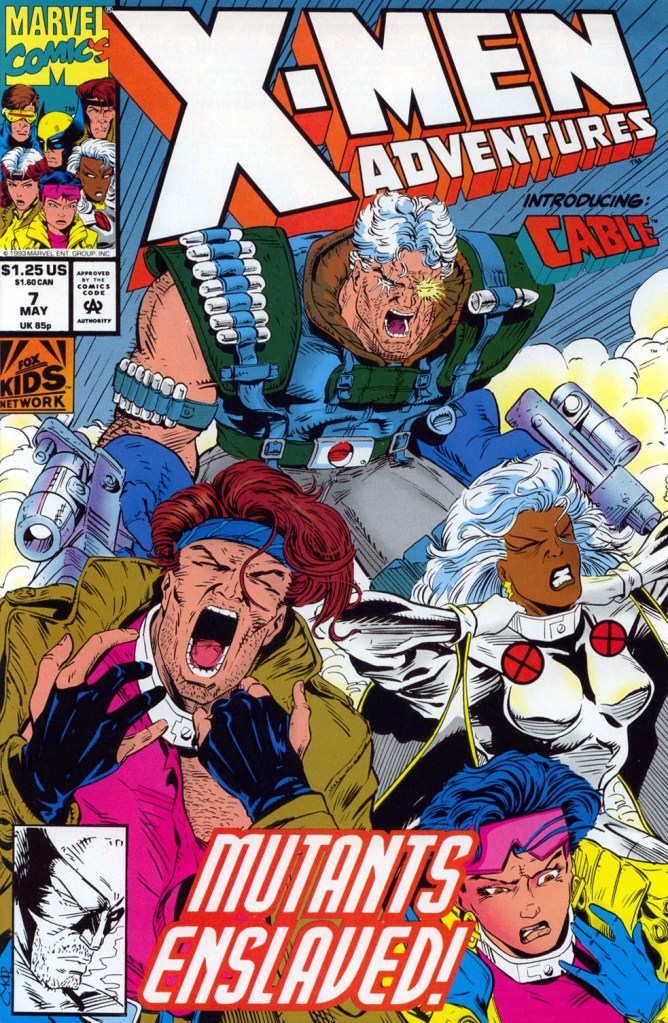
The cover.

Early story

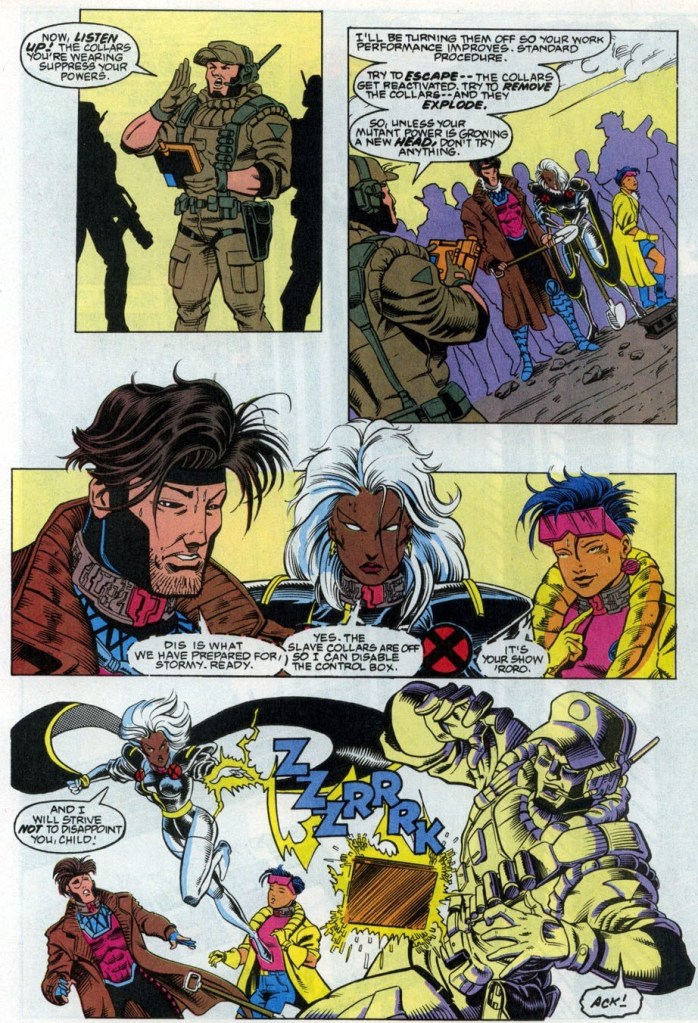
The story begins in Genosha, an island nation where mutants are designated as slaves constantly monitored by armed personnel of the state. X-Men team members Gambit, Storm and Jubilee are forced to do hard labor as they have been rendered powerless (with high-tech collars on their necks). Along with many other mutants, they are working on a key infrastructure project of the state.

As soon as the local authorities deactivated the collars of the slaves, Storm immediately attempts to escape by flying. Immediately, the collar on her neck got reactivated which neutralized her powers and caused her to fall down to the water below. As soon as she climbs up on a rock to rest, a cable wraps itself on her right leg. Suddenly, a huge Sentinel rises above the water and pulls her…

Quality

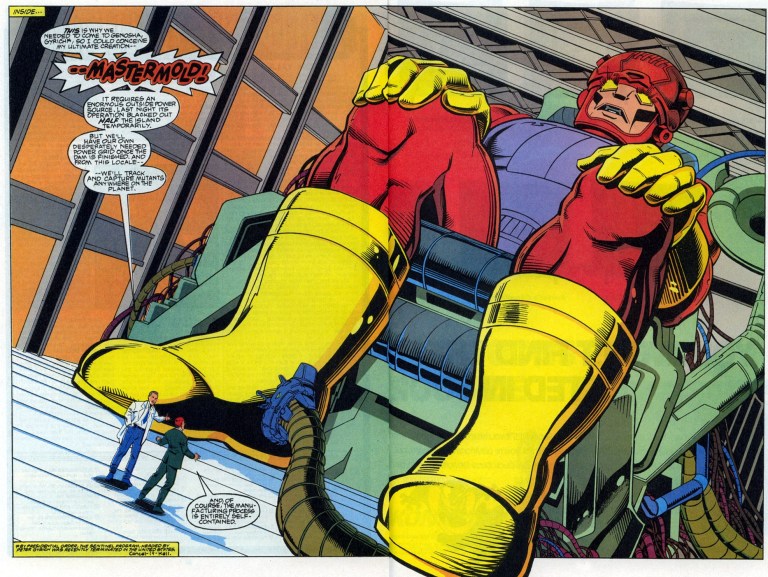
The money shot!

Like the TV episode it was based on, this comic book does a decent job of portraying slavery and oppression with mutants in mind while avoiding the very sensitive topic of racism. To see Gambit, Storm and Jubilee portrayed as much more vulnerable characters is a nice change from their usual portrayals. While the story has a strong slavery theme, it also sheds light on the ongoing, secretive development of the Sentinels program which clearly emphasizes the growing danger that await not only the X-Men (the prime target of Trask and his team) but mutants in general.

When it comes to the art, Chris Batista did a nice job drawing not only the characters (all recognizable) but also their surroundings, the Sentinels and the framing of action scenes.

Conclusion

Gambit, Storm and Jubilee as slaves on Genosha.

I personally find X-Men Adventures #7 (1993) somewhat fun and slightly engaging to read. As this is an adaptation of the X-Men animated series episode about Genosha and mutant slavery, it clearly has a strong wholesome approach to its presentation. That being said, its depth is actually limited as it presented its themes with younger readers and new X-Men readers in mind. Unsurprisingly, the action is limited and was portrayed to avoid violence. If you want a more serious and grittier portrayal of Genosha and mutant slavery, you should read Uncanny X-Men #235 to #238, and the X-tinction Agenda storyline.

If you are seriously planning to buy an existing hard copy of X-Men Adventures #7 (1993) be aware that as of this writing, MileHighComics.com shows that the near-mint copy of the regular edition costs $30, while the near-mint copies of the newsstand edition and the Greek edition cost $90 and $200 respectively.

Overall, X-Men Adventures #7 (1993) is satisfactory.

+++++

Thank you for reading. If you find this article engaging, please click the like button below and also please consider sharing this article to others. If you are looking for a copywriter to create content for your special project or business, check out my services and my portfolio. Feel free to contact me as well. Also please feel free to visit my Facebook page Author Carlo Carrasco and follow me at HavenorFantasy@twitter.com

A Look Back at Star Wars: Shadows of the Empire #1 (1996)

Disclaimer: This is my original work with details sourced from reading the comic book and doing personal research. Anyone who wants to use this article, in part or in whole, needs to secure first my permission and agree to cite me as the source and author. Let it be known that any unauthorized use of this article will constrain the author to pursue the remedies under R.A. No. 8293, the Revised Penal Code, and/or all applicable legal actions under the laws of the Philippines.

Way back in the mid-1990s, something special happened for Star Wars fans. A brand-new story involving Star Wars icons Luke Skywalker, Darth Vader and others would be told set between The Empire Strikes Back and Return of the Jedi. That story was called Shadows of the Empire and it was released as a special event in the form of a novel (written by Steve Perry), a video game on Nintendo 64 and PC, comic books, a soundtrack, posters, model kits, toys and action figures. What was missing here was a live-action movie.   

To put things in perspective, the Shadows of the Empire multi-media event was done by Lucasfilm (note: when creator George Lucas was still in control) with its many business partners to reinvigorate the Star Wars franchise ahead of the planned special editions of the original Star Wars movie trilogy. From a business point-of-view, it made sense to release something new for fans to enjoy and more notably it was the chance for Lucasfilm and its creators to explore what happened between The Empire Strikes Back and Return of the Jedi.

A limited comic book series was released in 1996 and it involved the novel’s author as a story consultant. Back in those days, my comic book interest faded temporarily and even though I was still into Star Wars, I did not bother to buy and read the Shadows of the Empire comic books. The video game caught my attention a lot more back then. Fortunately, I found copies of the comic books and had the time to read them recently.

With those details laid down, here is a look back at Star Wars: Shadows of the Empire #1, published by Dark Horse Comics in 1996 with a story written by John Wagner and drawn by Kilian Plunkett.

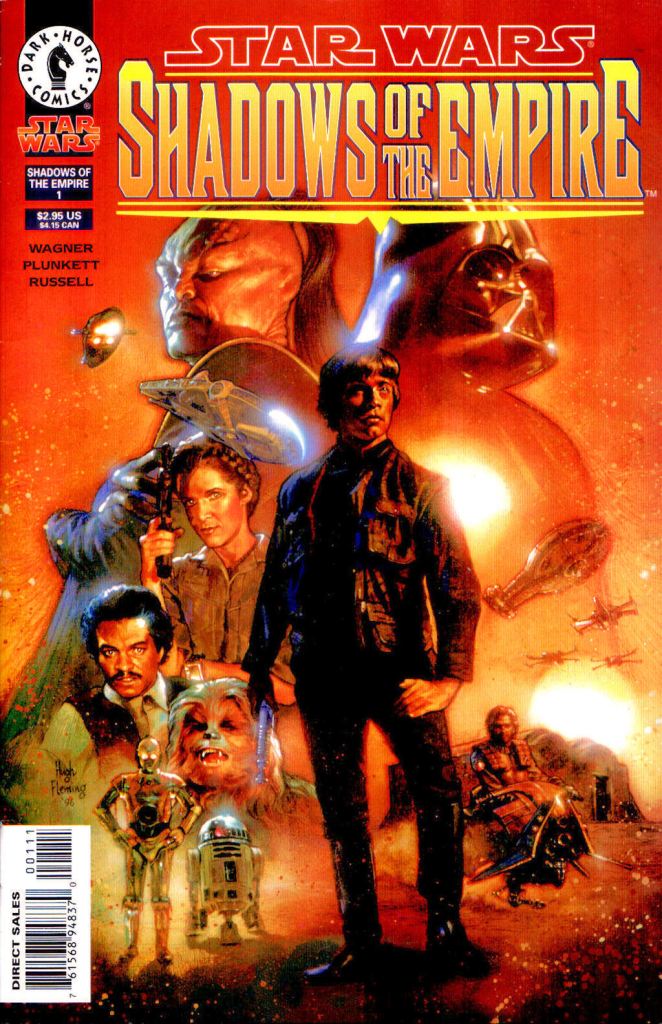
The cover.

Early story

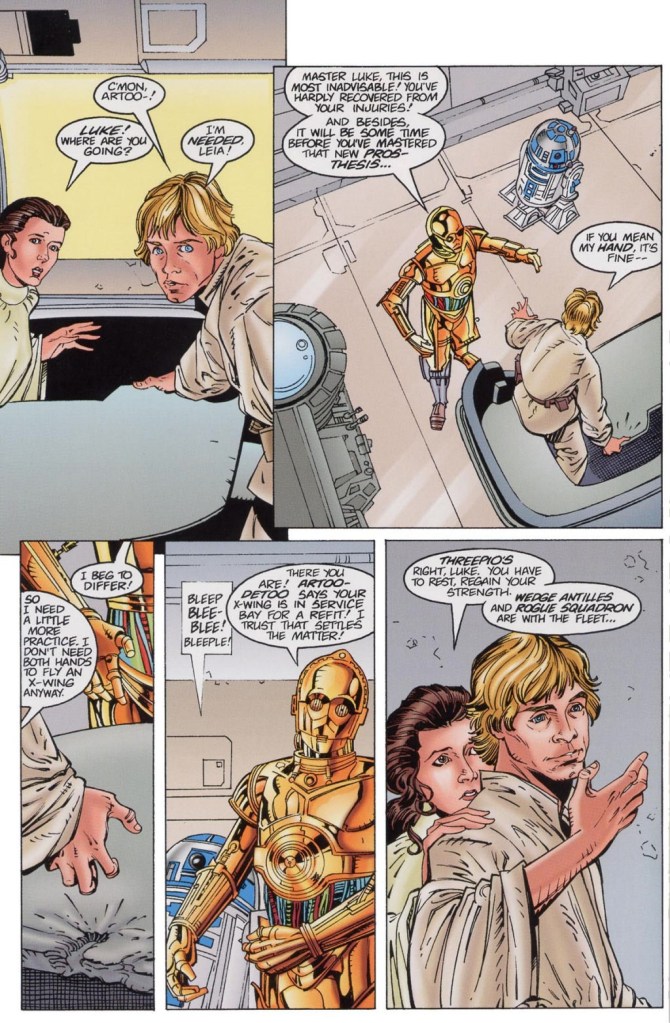
The story begins with a group of Rebel spaceships traveling together in the depth of space. Luke, who now has a mechanical hand and has been recovering from the terrible ordeal he went through at Cloud City, is with Princess Leia, C3PO and R2D2 in the medical frigate. The Rebels detect the presence of an approaching ship which they suspect to be hostile.

Luke suddenly decides to take action but is halted when he realizes that his X-wing fighter is still being refitted. In space, Wedge and the Rogue Squadron fly towards the Imperial Strike Cruiser which then releases some Tie Fighters. The personnel inside the Strike Cruiser tried to inform Darth Vader the location of the Rebel fleet…

Quality

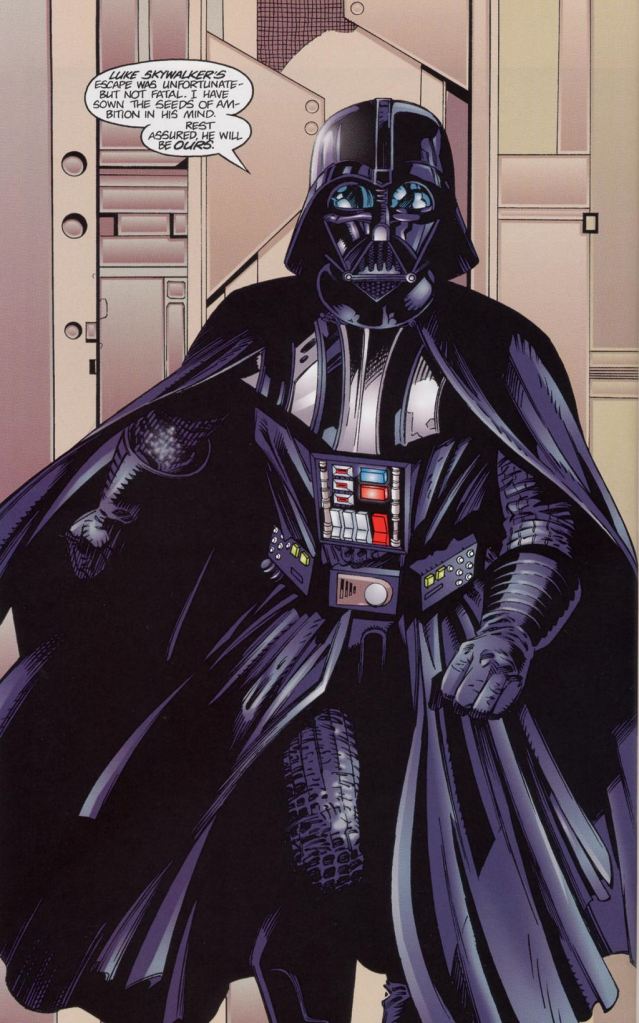
Darth Vader!

The first thing I want to mention is that the writing done by John Wagner is solid. That being said, the story itself felt like a natural continuation of The Empire Strikes Back especially when the comic book’s narrative is focused on Luke and the Rebels. The way the recovering Luke, Leia and the two droids were presented following the end of the 1980 movie was believable, and there was that nice touch of characterization when Luke has not yet adjusted with his mechanical hand.

The story then moves into new territory when the narrative shifts on the Imperial side, especially when Emperor Palpatine gives Darth Vader a new order that has nothing to do with pursuing Luke and the weakened Rebels, but more to do with the construction of the Empire’s new weapon. This is also where the new character Xizor comes in and his presence alone confirms something that the movies did not…the Empire is in business with crime syndicates with regards to major projects.

Space ship battles look great in this comic book.

When it comes to characterization, I like the way Darth Vader handled himself when communicating with Emperor Palpatine who viewed Luke’s escape from Bespin a failure on his part. Compared with his private communication with the Emperor in the 1980 movie, Vader bravely questions him about doing business with Xizor backed with his knowledge of the prince and the ties with Black Sun. Vader, who has been part of the Empire for a long time, knew well how risky it is for them to get involved with criminals especially when military cargo is involved.

As for the visuals, Kilian Plunkett does a decent job drawing the characters. While his take makes Luke recognizable and faltered a bit on capturing Leia’s look, his illustrations on Darth Vader, the Emperor and Xizor were really good. Where Plunkett exceled visually are the locations and surroundings, the machines and the space battles (some pages were drawn really dynamically).

Conclusion

This shows how Luke has not fully adjusted with his mechanical hand.

To put it clearly, Star Wars: Shadows of the Empire #1 (1996) has three narratives (the other is about Boba Fett carrying the frozen Han Solo) to build-up on and for a debut issue of a limited series, this one has strength in its execution complete with a good amount of creative stuff that will resonate with long-time Star Wars fans (and also those who love the original Star Wars movie trilogy). It succeeds in telling what happened shortly after the end of The Empire Strikes Back as well as establishing a new sub-plot with Xizor involved. By the time I finished this comic book, I was convinced to look forward to the next issue.

If you are seriously planning to buy an existing hard copy of Star Wars: Shadows of the Empire #1 (1996), be aware that as of this writing, MileHighComics.com shows that the near-mint copy of the regular edition costs $48 while the near-mint copy of the newsstand edition costs $144.

Overall, Star Wars: Shadows of the Empire #1 (1996) is recommended.

+++++

Thank you for reading. If you find this article engaging, please click the like button below and also please consider sharing this article to others. If you are looking for a copywriter to create content for your special project or business, check out my services and my portfolio. Feel free to contact me as well. Also please feel free to visit my Facebook page Author Carlo Carrasco and follow me at HavenorFantasy@twitter.com

A Look Back at Superman Annual #10 (1984)

Disclaimer: This is my original work with details sourced from reading the comic book and doing personal research. Anyone who wants to use this article, in part or in whole, needs to secure first my permission and agree to cite me as the source and author. Let it be known that any unauthorized use of this article will constrain the author to pursue the remedies under R.A. No. 8293, the Revised Penal Code, and/or all applicable legal actions under the laws of the Philippines.

Before DC Comics ended their original superhero multiverse with Crisis on Infinite Earths (1985-1986) to restart all over again, there were a whole lot of stories about Superman ranging from the dramatic stuff, the epic tales and right down to the most outlandish tales.

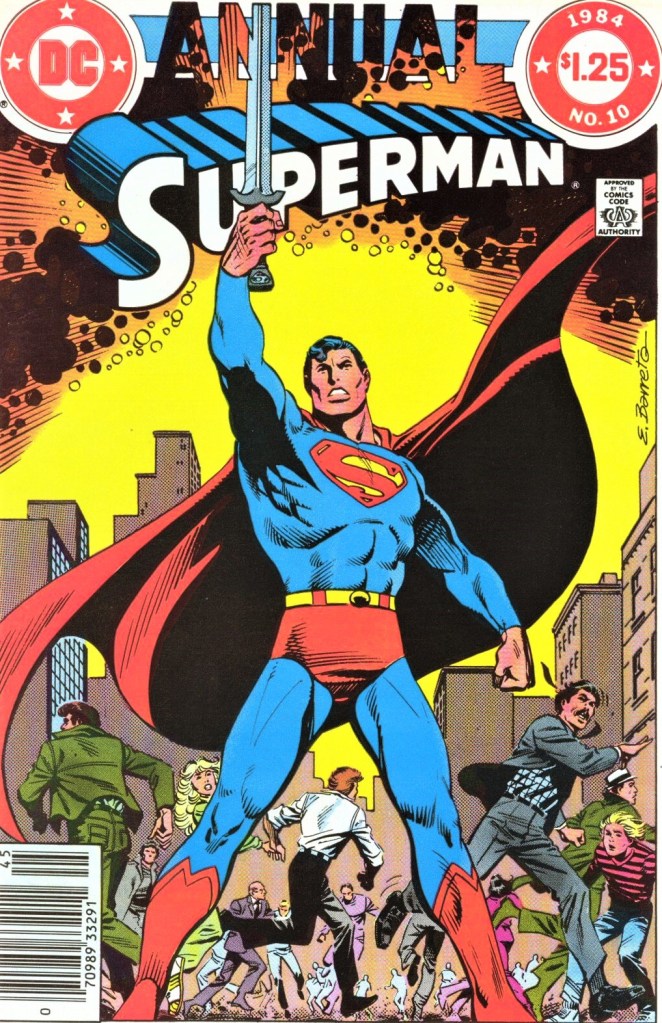
As a kid, I was fortunate enough to buy myself a copy of a 1984 Superman comic book, the cover of which really intrigued and caught my interest. It was a Superman annual comic book with a $1.25 cover price which was somewhat high at the time. Its cover showed the Man of Steel himself carrying a sword pointed up.

That image made me wonder: Why would Superman have to use a sword when he is so powerful and capable without weapons? Where did that sword come from? Who made it in the first place? Is the sword so special to Superman?

With those details laid down, here is a look back at Superman Annual #10, published by DC Comics in 1984 with a story written by Elliot Maggin and drawn by classic Superman artist Curt Swan.

The cover.

Early story

The story begins in a space where a group of diverse people composed of aliens and humans are gathered together watching a live video feed Superman on a large monitor above their heads. As it turns out, the Man of Steel is in space working to prevent meteoroids from entering the planet below him. He then speeds off into space heading back to Earth.

Along time ago deep in the galaxy, a big bang effect took place creating several new fragments in the vacuum of space and among them is a long, rough object that resembles a sword. As an unknown amount of time passed, the long object gradually turns into a smooth looking sword complete with a sharp blade and a letter “S” on one end that is the same as the one Superman carries. It is referred to as the sword of Superman!

In Metropolis, Clark Kent is passed by his officemate Jimmy Olsen who mentioned that he is rushing to interview the billionaire industrialist Oswald Mandias. Two days have passed and Jimmy Olsen remained missing. As his boss Perry White heads on to the office, Clark remains and changes into Superman when the coast got clear.

As the Man of Steel flies off into the city, a Galaxy Broadcasting live report on TV shows Lana Lang reporting from the Kennedy Space Center where the new space shuttle Magellan is about to make its first-ever commercial flight to launch a mysterious new communications satellite owned by Mandias Industries…

Quality

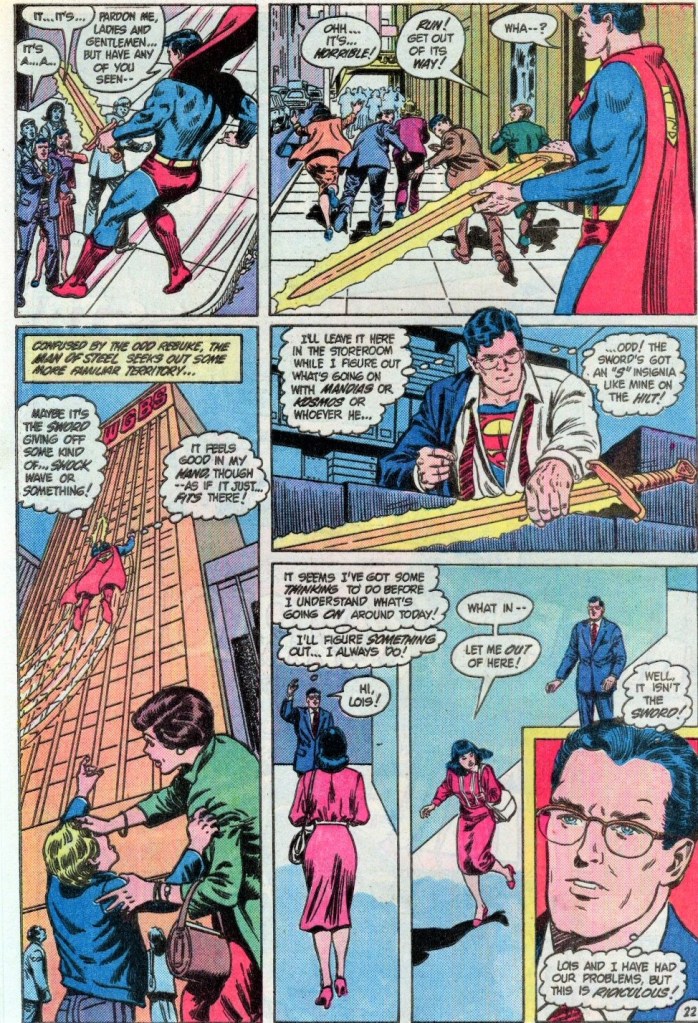
Clark Kent/Superman being a complete stranger to others added a lot to the story.
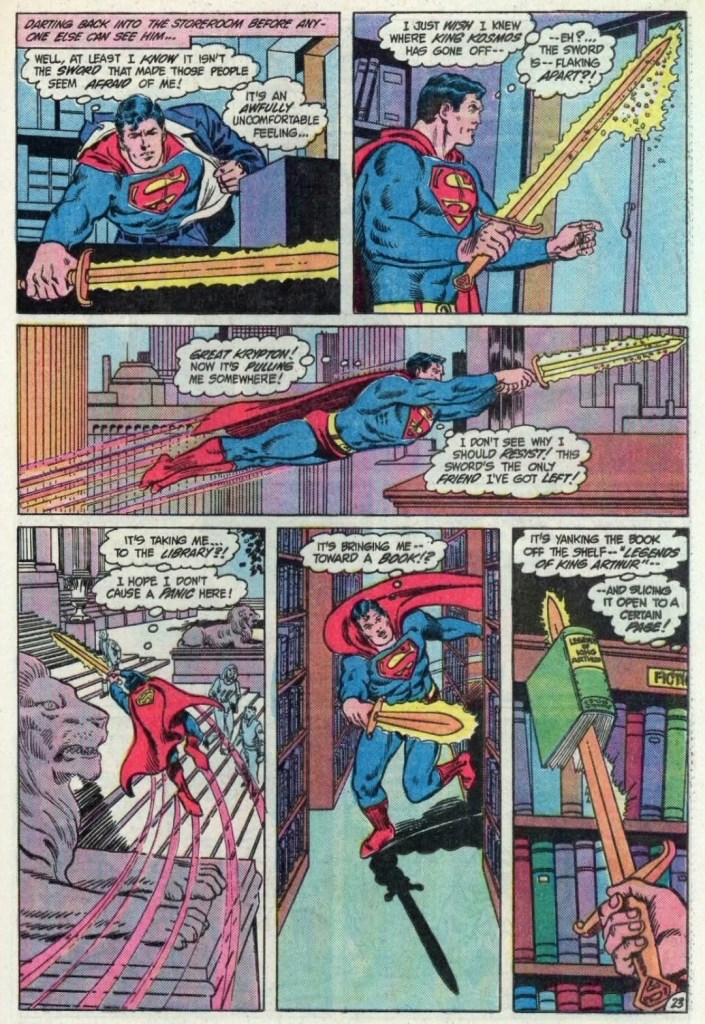
The sword led Superman to a book about the legend of King Arthur inside the city library.

Being an annual, I can say that the Sword of Superman story was well-written and nicely visualized by the creators which made it fun and engaging to read. It is a Superman story that further adds to his being an essential hero of the original DC Comics multiverse and a key factor here is the somewhat outlandish concept that the sword that he gained was an original material of the universe from the big bang and even had connections to the unseen omnipotent force.

This story is not a simple, straightforward tale about Superman gaining a weapon required to defeat the supervillain King Kosmos. In fact, the sword opens up events that made the Man of Steel reevaluate himself, his situation and the people around him. King Kosmos, who is a time-travelling villain from the future (first appearance in DC Comics Presents Annual #2), served not just merely as the opposition but also adds a good amount of complexity within the reality of the story. For one thing, it is very intriguing and also refreshing to see people of Metropolis (even Clark’s friend Jimmy Olsen) failing to recognize Superman and perceive him with fear. This is a one-of-a-kind story of Superman that must be read, even though it is not really an epic tale.

All throughout, there is a fine balance between spectacle and intrigue. If you pay close attention to the dialogue and details, you will understand the story better and enjoy the comic book more eventually.

Conclusion

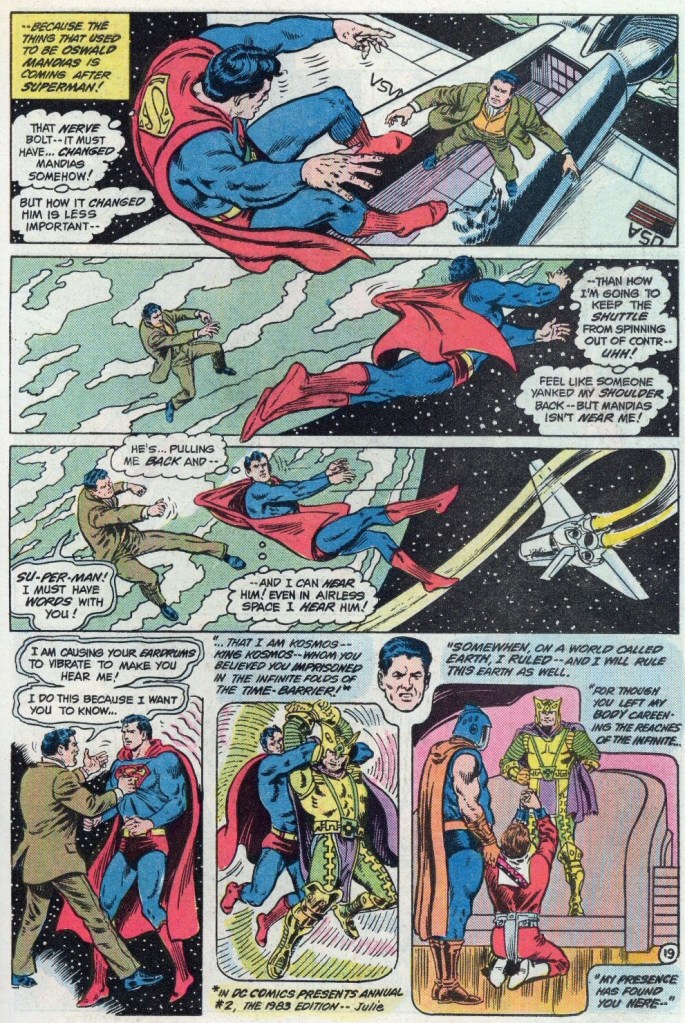
The return of King Kosmos!

I personally enjoyed reading Superman Annual #10 (1984) the first time back in 1984. The fact here is that after re-reading it recently, I do confirm that it is still an enjoyable comic book to read, and I am not even a Superman fan anymore. That is quite something! This is indeed a really good piece of Superman history from the pre-Crisis era. It also touches on themes about omnipotence, how ordinary people react to people who wield great power, and being whole with the entire universe.

If you are seriously planning to buy an existing hard copy of Superman Annual #10 (1984), be aware that as of this writing, MileHighComics.com shows that the near-mint copy of the regular edition costs $35 while the near-mint copy of the newsstand edition costs $70.

Overall, Superman Annual #10 (1984) is recommended.

+++++

Thank you for reading. If you find this article engaging, please click the like button below and also please consider sharing this article to others. If you are looking for a copywriter to create content for your special project or business, check out my services and my portfolio. Feel free to contact me as well. Also please feel free to visit my Facebook page Author Carlo Carrasco and follow me at HavenorFantasy@twitter.com