Finally, an old wish of mine came true as GungHo Online Entertainment America, Inc. (GOEA) officially announced that the Grandia HD Collection – which contains the classic Japanese role-playing game Grandia and its sequel Grandia II – will be released on Xbox consoles on March 26, 2024. For the newcomers reading this, the said collection of the two Grandia RPGs was previously released for the Nintendo Switch and on PC in 2019. Grandia HD Collection has been listed on the Xbox store.
This surprise development is definitely much more exciting and better than Team Xbox’s releasing four Xbox-original games on PlayStation and Nintendo consoles. For your excitement and enlightenment, watch the latest Grandia HD Collection announcement and trailer below…
To understand what the collection contains, posted below is an excerpt from the official announcement by GOEA. Some parts in boldface…
The GRANDIA HD Collection features two genre-defining role-playing games: GRANDIA and GRANDIA II. These games send players on epic adventures with protagonists Justin and Ryudo, respectively, to explore the worlds of GRANDIA and protect them from the forces of evil.
Two Nostalgic Stories: Fans can follow both iconic journeys in the world of GRANDIA with various upgrades once more. Discover what lies beyond the End of the World with the young adventurer Justin in GRANDIA and, eons later, protect the world from eternal darkness with mercenary Ryudo in GRANDIA II.
Modernized Visuals: This version of GRANDIA and GRANDIA II includes enhanced UI, sprites, and texture art that brings the iconic look of the retro classics to contemporary standards, including widescreen support and visually enhanced original cinematics.
A battle from Grandia.
This is what a battle looks like in Grandia II which had fully polygonal graphics.
Classic Old-School Combat: The GRANDIA series features classic RPG combat, with physical attacks and elemental spells in a battle system that combines real-time and turn-based mechanics. The addition of Hard Mode gives players a memorable challenge as they explore the world of GRANDIA II.
Language Support: The GRANDIA HD Collection includes Japanese and English audio options, as well as language support for English, French, German, Japanese, Korean, and Chinese (simplified and traditional).
I am really delighted that Grandia HD Collection is coming to Xbox (note: made for the Xbox One console which is fully compatible with Xbox Series X and Xbox Series S consoles) as I played and enjoyed the original Grandia game on PlayStation way back in 1999.
I do remember Grandia having a very imaginative fantasy world with a story cleverly structured to take players from one location to another to visit new places, meet new characters or tribes of people, and engage in quests. Playing that game was a whole lot of fun because developer Game Arts (the same team behind the Lunar RPGs) crafted a battle system that is highly playable and addicting. As I played Grandia, I saw the playable characters really develop not just with their personalities but also their battle and magic abilities.
Not only that, the music written by Noriyuki Iwadare was great to listen as I played. I also love the artistic approach applied on Grandia which had 2D sprites for the characters and monsters, nicely textured 3D polygonal environments, and very imaginative artworks (including those in animated cutscenes).
Grandia had characters and monsters in 2D sprite forms, as well as detailed textures on the 3D polygonal environment.
Of course, the many quests gradually built-up the tension of the main plot which turned out to be a grand event. Game Arts knew how to execute handsome pay-offs in relation to the build-up that preceded them. That being said, Grandia’s conclusion was really memorable to see.
If there is anything I hope to see within the Grandia HD Collection, it would be improvements on the English translation and the voice acting of the characters because the PlayStation version of Grandia that I played was lackluster with those mentioned elements. Clearly Sony Computer Entertainment (the publisher of Grandia on PlayStation) did not aim high with quality for the game’s American release.
As for Grandia II, I never got to play it as I never had a Sega Dreamcast nor a PlayStation 2 (PS2) console. I do remember some Dreamcast gamers expressing fondness and high enjoyment of the game and there were even a few who enjoyed it more than its predecessor. That being said, Grandia II’s inclusion in the Grandia HD Collection is an added incentive for me to purchase the collection for my Xbox Series X.
A mini-game in Grandia II. The sequel went all-in with 3D polygons which made it a big showcase of art and graphics on the Sega Dreamcast. The PlayStation 2 version of this game reportedly had inferior graphics.
Welcome back readers, fellow geeks and retro gaming fans!
In this edition of the Retro Gaming Ads Blast (RGAB) series, we will examine print ads from the 1990s that caught my attention and I will explain why they are worth look back at. In retrospect, the 1990s was a decade of serious changes in the world of electronic gaming as the industry saw the shift of graphics from 2D sprites and flat backgrounds to 3D polygons, the shift from cartridges to CDs for software distribution, and more.
For the newcomers reading this, Retro Gaming Ads Blast (RGAB) looks back at the many print ads of games (console, arcade, computer and handheld) that were published in comic books, magazines, flyers and newspapers long before smartphones, social media, the worldwide web and streaming became popular. To put things in perspective, people back in the 1980s and 1990s were more trusting of print media for game details and images.
With those details laid down, here is the newest batch of retro gaming print ads for you to see and enjoy…
1. Castlevania: Bloodlines print ad
Creepy looking but not horrific. The simplistic approach turned out to be effective on making Sega Genesis gamers excited for this Castlevania release.
During the early stage of the so-called 16-bit console wars, Konami’s Castelvania series made the huge next-generation leap with Super Castlevania IV on the Super Nintendo Entertainment System (SNES) which gave gamers loads of fun challenges along with technological improvements that added to the gameplay. Being a prolific multiplatform game maker, Konami knew it could not abandon its fans who own the 16-bit console of Sega and this led them to making a unique Castlevania experience with the Sega Genesis in mind – Castlevania: Bloodlines.
The above print ad of Castlevania: Bloodlines was very eye-catching as it showed a photographic presentation of the grave of the Belmont family (note: Simon Belmont is arguably the most known hero of the series) backed with a detailed text description as well as screenshots that showed exactly what Castlevania fans expected with gameplay and presentation. While the visual style of the ad had a subtle approach to horror, it succeeded in informing the public that another fun-filled Castlevania experience was coming. The game went on to be a hit among gamers and critics.
2. The Granstream Saga print ad
THQ really tried hard to sell The Granstream Saga in North America at a time when a lot more Japanese RPGs started coming into the market.
Back in the late 1990s, there was a slew of Japanese role-playing games (JRPGs) that got released on the PlayStation console in North America arguably because of the massive sales success of Final Fantasy VII in 1997. In 1998, THQ (note: then a newcomer in video gaming) made the daring move to release The Granstream Saga in North America and it was part of the company’s plan of releasing more RPGs. With regards to the 1998 print ad, THQ marketing team wisely emphasized the fact that the game launched at #1 in Japan (published by Sony) although, strangely, the rest of the short descriptive text did not emphasize the fact that the game was one of the first fully polygonal RPGs ever released. The ad had one image of an animated cut scene while there were two gameplay images. When I first saw the print ad, I became interested with The Granstream Saga as I was fond of both RPGs and anime. I never got to play it due to a lack of time and money back then.
3. NBA Action 98 print ad
Do you find this print ad funny or disturbing or both?
The first time I saw Sega’s print ad of NBA Action 98 (a polygonal NBA basketball video game for the Sega Saturn), it caught my attention quickly mainly because of the concept of the imagery showing a really tall guy leaving the place after getting stretched to be tall (as emphasized by an adult operating a machine to stretch another kid’s body to get taller) as a kid from outside looks on. While it looked hilarious at first, the photographic imagery also had an unintentional dark tone as the adult operating the machine looked like he was torturing the kid. This print ad was really eye-catching in a rather disturbing fashion to me, so much so I did not have any interest left to check out the advertised game. The small size of the screenshots and the hard-to-read descriptive text did not help at all. In my view, this was a marketing misfire by Sega.
4. Flashback: The Quest for Identity print ad
This was indeed an eye-catching print ad.
Back in the 1990s, the CD-ROM was cutting edge technology in the world of computing and CDs (compact discs) helped game companies have their game content as well as multimedia files (example: full motion videos or animated scenes) released together conveniently. In the middle of the decade, a version of the game Flashback: The Quest for Identity (note: a game with computer-generated animation scenes previously released on PC) was released in cartridge format for the Sega Genesis as well as the Super Nintendo Entertainment System (SNES). This was a big deal back in the days of the so-called 16-bit console war and the above print ad clearly emphasized it with the description “The First CD-ROM Game in a Cartridge!” The advertisers also assured consumers that the in-game 24 frames-per-second frame rate, the Hollywood-inspired high-quality visuals and related gameplay elements were intact for consoles. When I saw this particular ad, I became convinced to buy the game for my SNES (read my retro review by clicking here). To see how Flashback looks like on Sega Genesis, watch this.
5. Albert Odyssey: Legend of Eldean print ad
To make things clear, Albert Odyssey: Legend of Eldean is not based on any anime property. It was the 3rd game of its series and the first and only one to be released in English.
There is no denying the fact that Working Designs (closed since 2005) contributed a lot to console gaming by localizing and releasing several Japanese role-playing games (JRPGs) in America at a time when such games were not yet popular. Apart from the Lunar RPGs and Dragon Force, the company brought Albert Odyssey: Legend of Eldean to the Sega Saturn console in America and they had a very eye-catching print ad promoting it. Like their ads for Lunar RPGs, the Albert Odyssey: Legend of Eldean print ad had a dominating anime-style artwork that highlighted the fantasy concept and characters, plus screenshots and in-game animated (note: not anime but detailed pixel artworks) sequences that were meant to attract RPG enthusiasts and gamers looking for the next-generation console gaming experiences. It should be noted that Albert Odyssey: Legend of Eldean was actually the 3rd game of its franchise that started in Japan, and it was the first and only Albert Odyssey game to ever be released in English. To this day, Albert Odyssey: Legend of Eldean still has not been re-released nor remastered for other consoles and original Sega Saturn copies of the game are very expensive to acquire. That being said, this particular print ad is a lively reminder of Albert Odyssey’s only Western release.
6. Resident Evil 3: Nemesis print ad
Capcom efficiently showed the new monster Nemesis, screenshots of the game and the return of Jill Valentine in this 1999 print ad.
After the release of the best-selling and acclaimed Resident Evil 2, Capcom approved the production of several Resident Evil projects that include sequels and spin-offs. Along the way, Sony announced in 1999 that the PlayStation 2 console will come out in 2000 and this had an impact on Capcom’s RE projects as many of them were being developed for the aging PlayStation (PS1) console. Before the PS2 announcement, Capcom had a PS1 RE game project with its story set on a cruise ship. That project was abandoned following the PS2 announcement and because Capcom did not want to leave its fans to wait too long for another Resident Evil adventure on PS1, they reviewed their list of proposed spin-off games and went ahead making Resident Evil 3: Nemesis (Japanese title: Biohazard 3: Last Escape) for a late 1999 release while the PS1 console was still in good demand.
In the above 1999 print ad, Resident Evil 3: Nemesis was shown with 3 screenshots assuring RE fans that the game has the tried-and-tested design of polygonal characters/monsters moving within pre-rendered environments, the action, the horror and adventure elements of the previous games. More notably, the new monster Nemesis had the biggest image and he rightfully became the main antagonist until the very end.
Lastly, the RE3 print ad featured the return of Jill Valentine (one of the protagonists of the first Resident Evil) and this time she had a clear sexualized look wearing a tube top and a mini-skirt. As I mentioned in my RE3 retro game review, I believe that the sexualized look of Jill was done by the game developers who were most likely influenced by the sexy appeal and iconography of the character Lara Croft from the Tomb Raider series of games. Like Lara Croft, Jill is sexy and capable of fighting with guns and other weapons. Whatever the intention of Capcom and the development behind the game, the print ad (which even had wrongful details about the timing of the story) clearly worked on getting RE fans and gamers’ attention as Resident Evil 3: Nemesis sold more than 3 million copies on PS1.
Disclaimer: This is my original work with details sourced from reading the comic book and doing personal research. Anyone who wants to use this article, in part or in whole, needs to secure first my permission and agree to cite me as the source and author. Let it be known that any unauthorized use of this article will constrain the author to pursue the remedies under R.A. No. 8293, the Revised Penal Code, and/or all applicable legal actions under the laws of the Philippines.
Welcome back superhero enthusiasts, 1990s arts and culture enthusiasts, Marvel Comics fans and comic book collectors! Today we go back to the mid-1990s to explore the adaptation of the start of the second season of the X-Men animated series in the form of the X-Men Adventures comic book series.
Before getting to the retro comic book review, I want to address the recent controversy and criticism of the new animated series X-Men ’97, a continuation of the popular 1990s series that turned out to be woke by featuring the so-called non-binary presentation of people. In my view, this is not surprising given the fact that the very woke Disney company has owned Marvel Entertainment for many years now and its wokeness has infected the animated X-Men franchise along with the most recent movies and shows of the Marvel Cinematic Universe (MCU). Wokeness and Leftist beliefs continue to ruin entertainment and established properties as we know it. It’s the culture of Communist-filled Hollywood (Commiewood).
So how do you reject X-Men wokeness apart from avoiding X-Men ’97? You simply go back to the X-Men animated series of the 1990s as well as the comic books that adapted the stories.
With those details laid down, here is a look back at X-Men Adventures Season II #1, published in 1994 by Marvel Comics with a story written by Ralph Macchio and drawn by Andrew Wildman.
The cover.
Early story
The story begins with the cosmic being the Watcher carefully examining the flow of events on Earth and what has changed for the X-Men since then. Robert Kelly, who previously had an anti-mutant agenda when he was a U.S. Senator, has since been elected as the President of the United States and openly pushes for a policy of conciliation with mutants. His action sparks social unrest.
Meanwhile inside a small church far away from the nation’s capital, the wedding of Jean Grey and Scott Summers pushes through with several members of the X-Men in attendance. Very notable was the absence of Wolverine who turned out to be inside the Danger Room (deep within Charles Xavier’s estate) fighting a giant-sized version of Cyclops…
Quality
The X-Men are troubled by the anti-mutant wave happening in public.
As the opening issue of the second volume of the X-Men Adventures comic book series, this comic book carefully sets up the tone and the plot of a series of future challenges for the X-Men which is clearly reflected on the front cover with Mister Sinister displayed prominently. The story mainly highlights X-Men’s new struggle with the wave of anti-mutant rage in the public while dealing with the absence of their leader Cyclops (on honeymoon with his new wife Jean) while leaving space for potential sub-plots such as the attraction between Jean and Wolverine, the moves of the anti-mutant radicals and, most notable of all, the secretive return of Morph (thought to have died in issue #2 of the first season).
As expected, build-up is the main approach taken by the creators on telling the story and there were some bouts of superhero spectacle (action) that spiced up the reading experience for me. Considering what has been happening in different parts of the world in recent years, the sub-plot of the rabid anti-mutant activists using tactics to destroy the X-Men’s credibility with violence and misinformation magnified through the news networks is very socially relevant.
What the rabid anti-mutant people committed in this comic book reminds me of the October 7, 2023 attacks on Israel organized by the Palestinian terrorist group Hamas in which violence, destruction and selective images of terror spread through news networks and social media were done. Similarities aside, the wave of evil is clear here and the intent of the anti-mutant believers and Palestinian terrorists obviously expresses intentions of genocide against another particular group of people.
When it comes to weaknesses of this comic book, I cannot help but find Andrew Wildman’s art looking very rushed. There is a lack of precision and detail of his art here when compared directly to his works in the first volume of X-Men Adventures.
Conclusion
The anti-mutant radicals in this comic book have a lot in common with Palestinian terrorists, the pro-Palestine activists, the Black Lives Matter activists and other members of woke mobs. Violence, arrogance, rage and misinformation are their values.
X-Men Adventures Season II #1 (1994) incidentally works well as an adaptation of the animated series, as a standalone comic book as well as being a socially relevant tale in today’s age of social media. While the concept of evil remains in X-Men lore, what was told here shows different layers of it. The X-Men themselves also looked fragile and the return of Morph is a key part of the story clearly designed with future events in mind. Finally, this comic book is a lively reminder of the era when X-Men stories were made for the fans, not the woke mob.
Overall, X-Men Adventures Season II #1 (1994) is recommended.
Wow. That was a wild ride. For several days, Xbox fans were disturbed by persistent rumors and so-called news reports that Microsoft will end its Xbox console business and go all-in with releasing multiple games (including Xbox-exclusives) on platforms outside of the Xbox ecosystem (meaning consoles like PlayStation 5 and Nintendo Switch). A lot felt that Microsoft would go the way Sega did when it quit the console business and became a multiplatform publisher.
And then there were nonsensical and wild social media posts like the one below…
Fortunately, Team Xbox had its Business Update podcast on February 15, 2024 with top executives like Phil Spencer, Sarah Bond and Matt Booty answering key questions and made notable clarifications about the future of Xbox. Watch the podcast of Team Xbox below…
Xbox fans can rest assured that contrary to rush of “Xbox to end and spread its games to other consoles” news and rumors by content creators, vloggers, bloggers and the so-called journalists, Team Xbox went straight to the point that the Xbox console business will remain, there will still be Xbox-exclusive games, Xbox Game Pass service will remain within the Xbox ecosystem (you should stop dreaming about Game Pass on Nintendo and Sony consoles), Activision Blizzard games are about to be released for XGP subscribers to enjoy, and there are simply four Xbox games that will be released on platforms outside of the Xbox ecosystem.
While a lot of people speculate that Hi-fi Rush, Sea of Thieves, Pentiment and Grounded will be the Xbox games that will be released on PlayStation and Nintendo consoles, no titles have been confirmed and no specific non-Xbox platform was revealed. That being said, Starfield, Forza Motorsport (2023), Senua’s Saga: Hellblade II, Avowed, Indiana Jones and the Great Circle are still Xbox-exclusive.
“So we made the decision that we’re going to take four games to the other consoles. Just four games, not a change to our kind of fundamental exclusive strategy. We’re making these decisions for some specific reasons. We make every decision, really, with the long-term health of Xbox in mind,” Xbox chief Phil Spencer said. “And long-term health of Xbox means growing a platform, our games performing, building the best platform for creators, reaching as many players as we can.”
The way I look at Spencer’s words, it seems Team Xbox has been looking for ways to not only build up the Xbox ecosystem but also reach out to millions of players who own non-Xbox consoles by releasing a limited number of Xbox-original games that could sell and bring in much-needed revenue. The fact is the cost of making games, marketing them, distributing them and other business expenses just keep going up. As to why a heavily structured single-player game like Starfield is not coming to PlayStation 5, it seems to me that porting that massive game will be labor intensive, very time consuming and expensive to do. This means that other Xbox-original games like Sea of Thieves (obviously made with multiplayer in mind) and Pentiment (a simpler production) make more sensible and more doable releases on PS5 and Nintendo Switch. That is, if Sony and Nintendo themselves will accept such games into their respective platforms (read: protection of their first party games and their own game studios).
As Spencer himself said, they seriously took feedback from the Xbox community. I’m glad that their team listens because there are a lot of long-time Xbox fans and physical product owners that they cannot just abandon. I myself sent tweets to Team Xbox (click here, here, here, here and here) reminding them of their legacy of investing big on Xbox-exclusive games through the console generations. I even reached out to other Xbox fans online to make themselves heard by Team Xbox.
A lot of gamers bought the Xbox Series X or Xbox Series S for Xbox-exclusive games and the big value of XGP’s service. In my view, Team Xbox itself is convinced that Xbox-exclusive games – especially the big-budget productions – are essential on maintaining fan loyalty as well as standing out in the highly competitive market of video games. In connection with having multiple Xbox game studios to produce exclusive games, I want to see Team Xbox remain competitive with Sony and Nintendo on console hardware, games and quality of gaming services. I want to see Phil Spencer and his team secure even more deals with the independent game developers on making more exclusive games. It would also be nice to see Xbox get into joint productions with the publishers in Japan like Square Enix, Capcom and From Software.
I just finished Final Fantasy IX (digital copy) on my Xbox Series X console. It was my 2nd time to complete the game. I previously completed it on PlayStation way back in 2000.
As for this year, Xbox fans should watch out for exclusives coming out such as Senua’s Saga: Hellblade II on May 21 plus Avowed and Indiana Jones and the Great Circle later. Don’t forget the announced Xbox showcase this June.
Welcome back readers, fellow geeks and electronic gaming fans!
In this edition of the Retro Gaming Ads Blast (RGAB) series, we will examine print ads from the 1980s and 1990s that caught my attention and I will explain why these are worth look back at.
For the newcomers reading this, Retro Gaming Ads Blast (RGAB) looks back at the many print ads of games (console, arcade, computer and handheld) that were published in comic books, magazines, flyers and newspapers long before smartphones, social media, the worldwide web and streaming became popular. Back in the old days, many gamers trusted the print media a lot for information and images about games.
With those details laid down, here is the latest batch of retro gaming print ads for you to see and enjoy…
1. Popeye multiplatform print ad
A fine example of promoting the Popeye video game on multiple platforms visually.
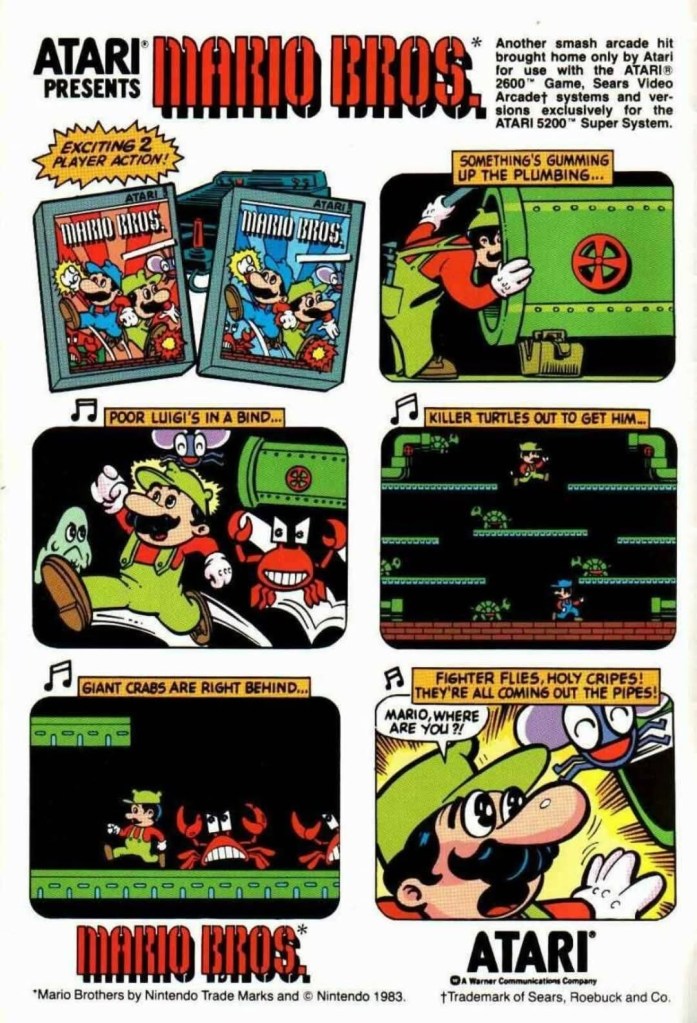
During the early 1980s, an arcade game based on Popeye was released and it became a hit with gamers who lined up and inserted coins to play. That game, which had three stages, was eventually ported by Parker Brothers to multiple platforms of Atari, ColecoVision, Intellivision, T.I. and Commodore.
The print ad you see above is a classic display of how one particular game appeared as a multiplatform release. The screenshots showed different versions of the Popeye game on multiple Atari platforms plus the others. See how different the game looks on each platform? The level of visual details and elements varied from one another as each machine had different specs that Parker Brothers had to adjust to. This is a fine example of promoting one game for different machines for those who love video games.
2. Kool-Aid Man Video Game print ad
I never got to play this Kool-Aid Man video game.
Remember Kool-Aid? For the newcomers reading this, Kool-Aid was a very popular product line of flavored juice drinks sold in powdered form. I myself used to mix Kool-Aid with ice-cold water and enjoyed drinking it. In 1954, a promotion of Kool-Aid with a touch of entertainment happened by highlighting the character Kool-Aid Man (famously known as the walking and talking pitcher filled with Kool-Aid juice). In later years, the Kool-Aid Man was often shown breaking through walls saying the line “Oh yeah!”.
The Kool-Aid Man gained tremendous attention as a pop culture figure in the 1980s when a new series of advertisements and promotions happened branching into video games and even comic books. The above print ad was a clever move to promote Kool-Aid as a drink as well as a video game for the Intellivision and the Atari 2600 consoles. Even if you were not too fond of video games in the 1980s, the Kool-Aid game ad would still make you think about the drink. Clever and entertaining!
3. Zombies Ate My Neighbors game print ad
I saw the 2-page ad many times in comic books and video game magazines.
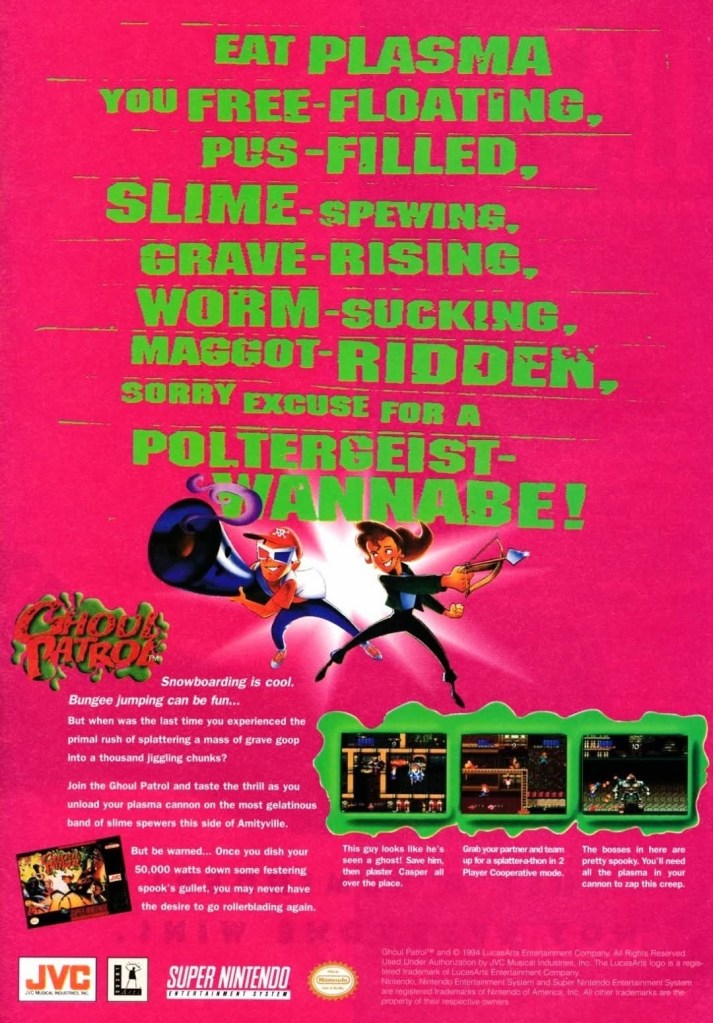
Going into the 1990s, Konami’s print ad of the video game Zombies Ate My Neighbors (for Super Nintendo Entertainment System and Sega Genesis) appeared a lot in the comic books I read when I was much younger. Having seen lots of horror movies – including zombie flicks – the ad easily caught my attention not because of the screenshots but because of the visual style used. For one thing, there was this 1950s America-inspired imagery on the photo of the scared woman with three zombies slowly approaching her. As for the game itself, there were plenty of small-sized screenshots that had lots of interesting details and pixel art (note: 3D polygons in video games were not yet common back then) which gave me a clear idea that it was a humor and horror-laced 2D adventure. Not only that, the text descriptions combined with the fake quotes added zest into the presentation. After having examined all the details carefully, I really felt like Zombies Ate My Neighbors would be a fun-filled game to play on the SNES.
4. Lunar: The Silver Star print ad
With anime artwork used, it was easy to have the impression that the original Lunar game was based on an existing anime series or movie.
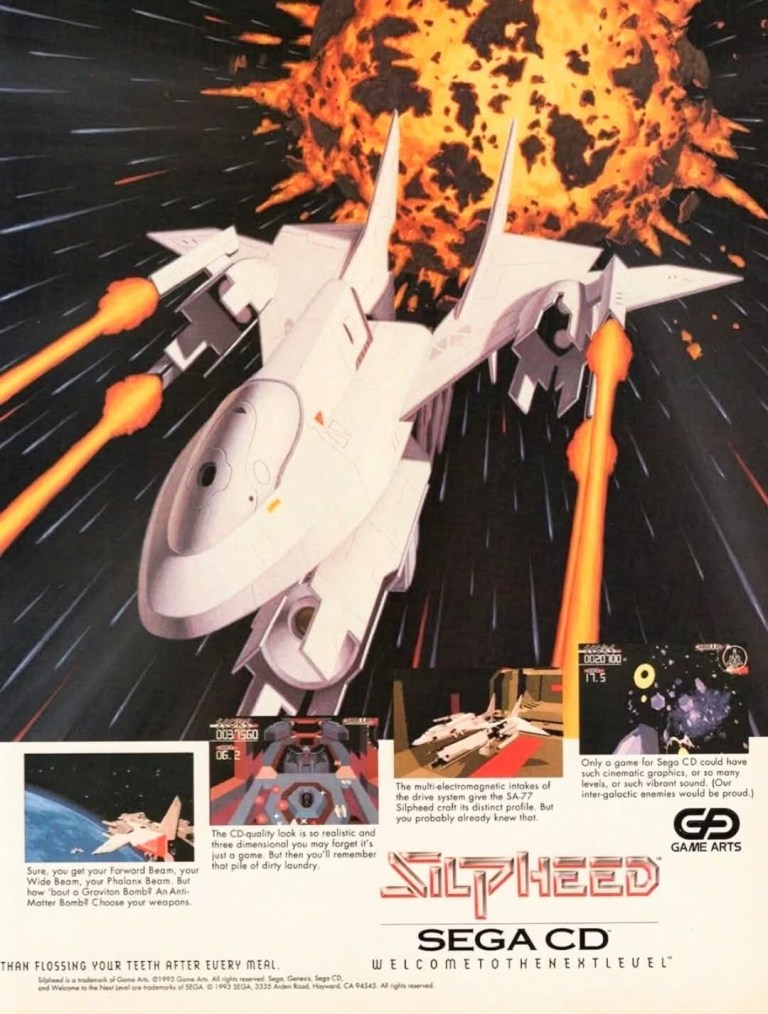
In the early 1990s, Game Arts developed and released the Japanese role-playing game (JRPG) Lunar: The Silver Star on the Mega CD platform in Japan which in some ways was also a technological breakthrough – the game came with full motion video (for short videos), animated images, and CD-quality sound (that really made the soundtrack lively to listen to). After achieving critical and commercial success in Japan, the game was picked-up by Working Designs to be localized and released in the North American market for the Sega CD (the American counterpart of the Mega CD) platform. In promoting the game for American Sega CD owners as well as American gamers in general, a print ad highlighting anime images with five screenshots and only a few words was published on both comic books and magazines.
Even though Lunar: The Silver Star’s core concept was never described in the ad, the anime imagery was still eye-catching and the chosen screenshots gave viewers a preview of the gameplay and the animated images. That being said, it was no surprise that gamers who happened to be a bit interested in anime noticed the print ad. At the same time, the ad gave some gamers the impression that Lunar was a game based on an existing anime franchise. This approach on game advertising was daring and it happened at a time when Japanese RPGs had a limited audience among gamers in North America.
5. Lunar: Silver Star Story Complete print ad
In the 2nd half of the 1990s, a remake of Lunar: The Silver Star was released in Japan titled Lunar: Silver Star Story for Sega Saturn (1996), Sony PlayStation (1998) and Windows PC (1998). While it still maintained the 2D visuals for presentation, gameplay and exploration, the remake had smooth anime sequences, new artworks, better sound effects and music. Working Designs pounced on the opportunity to localize the game in America for PlayStation and released it in 1999 with the title Lunar: Silver Star Story Complete. Not only did Working Designs work hard on localizing the game (the English dubbing and singing of the game’s songs were meticulously done), they released it with a very lavish packaging with the dedicated fans and collectors in mind.
By looking at the above print ad that magazines published, Working Designs highlighted the positive feedback quotes from EGM, Gamers’ Republic, PSM and Official U.S. PlayStation Magazine to convince gamers Lunar: Silver Star Story Complete is a great game. While the screenshots showed what kind of eye candy gamers could expect, Working Designs made sure that they would know that the lavish package includes 4 discs (2 game discs, 1 music CD and 1 CD that had video documentary of the making of Lunar), a full-color map in the form of a cloth, and a hardbound art book and instruction manual.
Considering the dynamism of the Lunar: Silver Star Story Complete print ad and the game’s packaging, I can only speculate that Working Designs had to do it aggressively because the gaming landscape changed dramatically as 3D polygonal graphics became the standard while lots of other Japanese RPGs from different publishers were released in 1999 (including the sequels Suikoden II and Final Fantasy VIII) and many of them had more elaborate game designs and visual presentations. Eventually market forces and unfortunate business events led Working Designs to closing down permanently in 2005.
6. Star Wars: Jedi Arena print ad
Remember when Luke Skywalker tested his lightsaber skills with the floating Seeker in the 1977 movie?
Back in the early 1980s, Parker Brothers was very active releasing games on the Atari 2600 console which my family had. At that same time, Star Wars was very popular (and without the wokeness and identity politics garbage of Kathleen Kennedy and woke Disney) and any new game based on the sci-fi franchise was something to be excited for. In the above print ad of Star Wars: Jedi Arena, an artwork showing the iconic her Luke Skywalker testing his lightsaber skills with the floating Seeker ball was displayed and located between Luke’s legs is a monitor showing the screenshot of the game. Looking at the text description, Parker Brothers creatively focused on the aspect of the Jedi way of using the lightsaber interacting with the Seeker ball. Having played the game myself, I can say the ad was creative and pretty much captured the core concept of the game.
Disclaimer: This is my original work with details sourced from watching the film and doing personal research. Anyone who wants to use this article, in part or in whole, needs to secure first my permission and agree to cite me as the source and author. Let it be known that any unauthorized use of this article will constrain the author to pursue the remedies under R.A. No. 8293, the Revised Penal Code, and/or all applicable legal actions under the laws of the Philippines.
Welcome back, movie buffs, science fiction fans and geeks! When it comes to making remakes or reimagined versions of established movies from previous decades, the 1980s was indeed a special time to watch them. In 1986, The Fly (directed by David Cronenberg) was released and it made a tremendous impact on moviegoers in ways that the original 1958 movie did not.
Remember when The Blob was first released in 1958? That classic film (read my retro review by clicking here) went on to have a forgettable sequel released in the 1970s but got remade big time with a new version in 1988 simply titled The Blob.
The story begins in the town of Arborville where many locals attend an exciting football game. High school player Paul (Donovan Leitch, Jr.) asks cheerleader Meg (Shawnee Smith) to a date. Elsewhere, the troubled guy Briann Flagg (Kevin Dillon) fails with his attempted stunt as a result of his flawed motorcycle which was witnessed by an elderly vagabond. Flagg goes back to town and encounters the local sheriff (Jeffrey DeMunn) who warns him about trouble.
That evening at the outskirts of town, a meteorite crashes within the forest which the elderly vagabond pursues. With strong curiosity in his mind, the old man uses a stick on a sizable body of slime mold substance (the blob itself) that came out of the crashed meteor. Suddenly, the substance moves and sticks to the elderly vagabond’s hand causing him great pain.
A short time later in the forest, Brian Flagg got surprised by the sudden appearance of the vagabond who desperately tries cutting off his own hand. The blob, which Brian saw for the first time ever, attaches itself even more on the old man causing him to run away until he gets hit by a car (with Meg and Paul inside)…
Quality
The blob in this movie looks more menacing as it has a tumor look and the special effect work remains excellent to look at. You should also see the blob move and what it sounds like.
This late-1980s remake of The Blob is not only more engaging and more entertaining than its 1958 predecessor…it is easily on of the best sci-fi horror movies of the 1980s thanks to a very talented creative team led by Chuck Russell.
To begin with, Russell and Darabont (this is the same great director behind The Shawshank Redemption), crafted a very solid screenplay that used key story elements from the 1958 classic while successfully updating everything else with 1980s America (or Ronald Reagan’s America) in mind. For this version, the three leading teenagers played by Shawnee Smith, Kevin Dillon and Donovan Leitch, Jr. were relatable and clearly worth following.
(From left to right) Shawnee Smith, Kevin Dillon and Candy Clark in an early encounter with the blob.
While the 1958 movie emphasized American teenagers being disadvantaged as local adults don’t take them seriously (even though the youth knew the problem and intend to solve it), this remake moved away from the generational gap as it strongly focused more on the crisis of a fast-growing blob that simply won’t stop killing people and destroying things. In other words, this is a crisis-focused monster story that is more violent, more horrific, more action-packed and more graphic than its predecessor.
I should also state that Russell and his team established a solid structure for storytelling and the narrative flowed on a medium-to-fast pace. As this movie has more spectacle in terms of action, monster moments and the like, the creative team carefully balanced the fun stuff with the dramatic and exposition scenes smoothly.
If you see people wearing protective suits arriving in your community and implementing a lockdown, you know a crisis is in effect.
The cast here is solid! Shawnee Smith’s Meg is the sweet, young good-natured high school girl who is willing to not only survive but also take part in solving the crisis situation not for herself but for her family and the entire Arborville community. Meg has some common elements with that of the character Sarah Connor from The Terminator and Terminator 2: Judgment Day. I also love the fact that there is NO WOKENESS and NO RABID FEMINIST VALUES in Meg. Kevin Dillon’s Brian – the troubled youth – is clearly the 2nd lead and he does a good job dramatizing how his character changes from a guy of uncertainty into an actual doer whose efforts proved to be valuable. There definitely is a non-romantic chemistry between Meg and Brian as the crisis situation really brought out solid transformations from them respectively.
The supporting cast is really good too. Candy Clark’s Fran is the relatable community diner owner/manager who contributed nicely to the plot as well as the early showdown of the blob. Jeffrey DeMunn’s sheriff is the local law enforcer who has to deal with the local situations while tackling the challenges of his leadership post. Paul McCrane here plays a local cop who is tough but not necessarily abusive, and this is the same guy who played a very vicious bad guy in 1987’s RoboCop! Joe Seneca is the government scientist who has charisma and deception carefully blended together which added to the plot. You will even see Erika Eleniak in a very small and yet notable appearance that happens to involve the blob. This film has a really interesting cast and I encourage you to research the names mentioned here.
This remake is loaded with action scenes, stunts and incredible visual effects!
On the technical side of things, I really like the cinematography done by Mark Irwin as the visuals captured looked really detailed and clear even during the dark or night-time scenes. The music by Michael Hoenig was pretty good too and his tunes ranged nicely from creepy to sentimental and energetic which reflected the scenes. As for the design of the blob, Lyle Conway deserves the credit for making it very monstrous. As for the physical environment of the movie, the state of Louisiana turned out to be a great location and the real-life Louisiana town Abbeville added strongly to the small town concept of the story.
As mentioned earlier, this version has a lot more spectacle to enjoy. For one thing, there is a good amount of hard action, gunfire and stunts which really added to the excitement (on top of the suspense and horror scenes already implemented). Rest assured, you will not get bored at all when watching this.
Shawnee Smith is the protagonist in this movie and her performance is very memorable.
The highlight of the spectacle is the very blob itself which looks so much like a tumor (instead of the jello form in the 1958 version) and the credit goes to the visual effects, sound effects and the animation team behind it all. Compared to its counterpart in the 1958 film, the blob here is very monstrous and horrifying to watch and the way it got animated is excellent. Apart from being unrelenting, this blob is deadlier and even intelligent. Not only does the blob devour the living which adds to its tremendous growth of size and mass, it also has the ability to extend tentacles which added more to the danger. Thanks to the sound effects, the blob is believably animalistic.
Through the blob’s on-screen presence, you can see the hard work implemented by the special effects crew when showing the monster entirely move and devour people, when showing its flexibility on adjusting its size (or its parts) when entering new places through tight spots, and most notably, how the blob alters the flesh of the victims it touches which resulted in very horrifying visuals. The special effects team really excelled with the use of practical effects (read: no computer-generated images) on presenting the titular monster. This is indeed a special effects extravaganza that a lot of people are missing out on.
Conclusion
The Blob (1988) looks and sounds better than ever in 4K Blu-ray format. I highly recommend this version as it is so much better than streaming.
There is no doubt in my mind that The Blob (1988) is a great sci-fi horror film that has a more menacing monster complete with sufficient action, great visual effects and a pretty solid cast! This is indeed a great example of a how a remake of an established film from the past should be done and this also includes raising the stakes within the story, modernizing past cinematic elements and ensuring high entertainment value. What director Russell, his team and the cast collectively achieved is indeed a creative success and this is the kind of film that Commie-filled Hollywood (Commiewood) today does not want to make.
As a companion piece to The Blob (1958), this remake has the good stuff that people who love horror, science fiction, action and monsters will enjoy.
Of all the many movies I have seen, The Blob (1988) stands out as one of the best remakes ever made as well as one of the best mixed-genre movies of its decade as well as of all time. That being said, today is a great time to watch this movie with better-than-ever visuals and sounds through its 4K Blu-ray release (pictured above) which is now available (you can order it online now). There is also a lot of features and extra stuff with the 4K Blu-ray. Make no mistake, The Blob (1988) is great to watch and its replay value is pretty high.
Disclaimer: This is my original work with details sourced from reading the comic book and doing personal research. Anyone who wants to use this article, in part or in whole, needs to secure first my permission and agree to cite me as the source and author. Let it be known that any unauthorized use of this article will constrain the author to pursue the remedies under R.A. No. 8293, the Revised Penal Code, and/or all applicable legal actions under the laws of the Philippines.
Welcome back superhero enthusiasts, 1980s culture enthusiasts and comic book collectors! Today we go back to the late 1980s to explore a part of the DC Comics shared universe through a tale of the iconic Superman.
After DC Comics published the maxi-series Crisis on Infinite Earths, the publisher rebooted their entire comic book universe and that meant reintroducing their superheroes, villains and supporting characters with a touch of 1980s modernization. To reboot and modernize Superman, John Byrne was hired and he was granted a lot of creative freedom for production.
With those details laid down, here is a look back at The Man of Steel #1, published in 1986 by DC Comics with a story written and illustrated by John Byrne with ink work by Dick Giordano.
The cover.
Early story
The story begins sometime in the past in Krypton (Superman’s home world), a world about to meet its doom. Jor-El (Superman’s father) arrives home feeling deeply troubled and he wastes no time to execute an important plan he prepared. He examines his unborn Kal-El inside the birthing matrix which turned to have been removed by one of the servants from the gestation chambers of the planet. Lara confronts her husband over what was committed and asked him why he endangers the life of their unborn child.
Jor-El tells her that he plans for their son to be spared from the pending doom of Krypton (a chain reaction from the planet’s core caused vast pressures to build within the crust, fusing native elements into a new metal – Kryptonite) by sending him far away deep into space with planet Earth as the final destination. Jor-El has done extensive research of Earth and is convinced that their son will not only survive there but also become a supreme being among the inhabitants…
Quality
Clark’s earthly parents were indeed involved in his development becoming Superman.
There is no doubt that this John Byrne-led comic book remains great to read and highly significant with anything about Superman. Instead of telling one single extensive story, Byrne created a series of connected short tales that dramatized the icon’s post-Crisis origin and how the Krypton-born American Clark Kent became Superman for the first time ever.
While the prologue set in Krypton was quite heavy with expository dialogue, each subsequent short story was carefully structured and moved at a medium pace gradually emphasizing Clark Kent’s transformation into the Man of Steel. Along the way, there were lots of story details not only about the titular character but also about the Kent couple (Clark’s adoptive parents), what they went through, what secrets had to be kept and more. Very symbolically, this is a tale about an alien human being from space who grew up with traditional American culture and US heartland values while being raised by very loving American parents who previously could not produce children of their own. Through Clark, you will see that he is a blessing for Jonathan and Martha Kent and it is up to the couple to sow good values in him which are essential to his becoming not only a super being among mortals but also his emergence as a hero.
Conclusion
The origin of the post-Crisis Superman is great to read!
The Man of Steel #1 (1986) is indeed a great, character-focused comic book that emphasized the origin and debut of the post-Crisis Superman. John Byrne modernized Superman while still maintaining the classic superhero elements from the icon’s past versions as well as the American identity and ways (none of those woke and internationalist nonsense). This is also the optimistic Superman that is very inspirational which the recent DC cinematic universe (referred to as “DCEU”) of Warner Bros. terribly lacked. This illustrated literature work is also a major cornerstone of the post-Crisis era of DC Comics and John Byrne’s take on Superman is very defining and iconic.
If you are the kind of reader who views Superman widely through pop culture, you will notice specific elements from this comic book that made it into other forms of entertainment media such as Man of Steel (2013), the Christopher ReeveSuperman movies, the animated movies, the Lois & Clark: The New Adventures of Superman TV series (starring Dean Cain as the Man of Steel) and more. Those multimedia productions showed how influential this comic book became as a major reference for other creators.
Overall, The Man of Steel #1 (1986) is highly recommended!
Welcome back, fellow geeks, Blu-ray collectors and movie buffs! Decades ago, animator and director Ralph Bakshi made significant contributions to the art of hand-drawn animation with features that made it to cinemas such as The Lord of the Rings (1978), Wizards (1977), and Fire and Ice (1983) to name a few.
Along the way, Bakshi became identified with rotoscoping which is a technique that involves drawing or painting over an element in live-action footage frame by frame (as to create a matte or a realistic animation).
Speaking of Bakshi’s past work as well as rotoscoped animation, Sony Pictures recently released the film American Pop (1981) on Blu-ray disc format and I am happy to say that I now have a copy of it for my Blu-ray collection. This is also my first-ever Blu-ray of a Bakshi-directed animated movie.
A close look at the cover of my Blu-ray copy of American Pop.
To begin with, posted below are the specs from the Blu-ray.com page…
Video
Codec: MPEG-4 AVC
Resolution: 1080p
Aspect ratio: 1.85:1
Original aspect ratio: 1.85:1
Audio
English: DTS-HD Master Audio 2.0 (48kHz, 24-bit)
Subtitles –English SDH
Discs -Blu-ray Disc, Single Disc (1 BD-25)
Playback – Blu-ray: Region A
In my personal experience, the first time I ever saw American Pop was not in the cinema but on TV here in the Philippines way back in 1993. Back then, I found the film’s combination of music with mostly rotoscoped animated scenes (there were also some live-action shots, archived footage and some very unique pieces of art shown). I was not able to replay Bakshi’s movie until recently.
So after more than thirty long years, I finally got to replay American Pop on Blu-ray and I can say I enjoyed it even more. To see the rotoscoped animation and varied music play in front of me in high-definition is an even more immersive viewing experience than the previous time I saw this film. Another advantage of high definition is being able to see tiny visual details that I was unable to spot long ago. Oh yes, the fine artworks used on the backgrounds in specific parts of the movie now look a lot more engaging to look at.
A look at the rear of American Pop Blu-ray.
What I regret to say here is that American Pop Blu-ray absolutely has no special features included. Not even a movie trailer! I can only guess that Sony Pictures did not bother to exert efforts to conduct new interviews with Ralph Bakshi and the cast members, nor did they even try to secure any media features or previews of the movie before its theatrical release. It’s not clear if Sony will someday come up with a collector’s edition Blu-ray of this 1981 Bakshi film.
For the dedicated Ralph Bakshi fans as well as enthusiastic film buffs and collectors of movies on physical media, American Pop Blu-ray is recommended as the film itself is more than enough to outweigh the lack of special features. American Pop is more lively than ever to watch and listen as it is now in high-definition.
Have you been searching for something fun or interesting to watch on YouTube? Do you feel bored right now and you crave for something to see on the world’s most popular online video destination?
I recommend you check out the following topics and the related videos I found.
#1The precise differences between Christianity and Islam, Lord Jesus and Muhammad, and the Holy Bible and the Quran explained – The YouTube channel HolyLandSite is a favorite of mine as it has published a lot of very credible and detailed explanatory videos about the Holy Land in Israel, Christianity, the Jews and how everything is connected with the Holy Bible (the Word of God). In the recent video they published recently, the precise differences between Christianity and Islam, between Lord Jesus and Muhammad, and between the Holy Bible and the Quran are explained in detail by Pastor Todd. I strongly recommend watching the video below…
#2 The deep hatred of the Palestinians towards Israel explained – There is no doubt that hatred, violence and murder are core values that the Palestinians have been oriented with while living under very evil leaders (murderer/terrorist Yasser Arafat is just one of them). To date, there are very few Palestinians who overcame their evil orientation and pushed back against their evil leaders to become good people. In the video below, YouTuber Oren explains in detail why so many Palestinians grew up with hate and live by hate towards Israel and its people. Lastly, I should state once again that the Palestinians are a displaced people, are NOT natives of the land of Israel and they caused trouble when they occupied Jordan and Kuwait.
#3 Remembering the past video game company Working Designs – It has been almost twenty years since American game company Working Designs closed down and ended their business. For the newcomers reading this, Working Designs is best known for localizing several video games from different Japanese companies for the North American market and among their best known releases were Lunar: The Silver Star Story, Lunar: Eternal Blue, Dragon Force and Magic Knight Rayearth. Their business history is very interesting to examine and for your viewing pleasure, posted below is one video about Working Designs’ legacy and another video about their games released across different platforms.
#4 Man of Steel video reviews, analysis, trivia and reaction videos – The cinematic universe of DC Comics superheroes that started in 2013’s Man of Steel is officially over and the newest film Aquaman and the Lost Kingdom won’t match its predecessor’s massive commercial success. Unofficially referred to as the DCEU (DC Extended Universe), the past cinematic universe of Warner Bros. had a very inconsistent record of commercial and critical results. That being said, it is high time to go all the way back to the very beginning with Man of Steel (starring Henry Cavill as Superman) through a series of varied videos I found for you to watch.
#5 DeepStar Six videos – Believe it or not, way back in 1989 there was not one, not two, but three movies that had underwater settings. One of them was DeepStar Six which was directed by original Friday The 13th movie director Sean S. Cunningham and, for some reason, was released in cinemas here in the Philippines with the title “Alien from the Deep.” While it grossed less than Leviathan and was made for a fraction of the budget of James Cameron’s The Abyss, DeepStar Six still has a long-lasting following and different kinds of videos about it were made. You can watch what I found below…
The Bureau of Immigration (BI) announced recently that they prevented two sex offenders from the United States from entering the country in separate times at the Ninoy Aquino International Airport (NAIA), according to a Manila Bulletin news report. Both foreigners were respectively convicted of varied offences in the past.
To put things in perspective, posted below is an excerpt from the Manila Bulletin news report. Some parts in boldface…
Two convicted American sex offenders have been barred from entering the Philippines when they arrived at the Ninoy Aquino International Airport (NAIA) separately on Dec. 27 and Jan. 1.
The Bureau of Immigration (BI) identified them as Paul Neal Coltharp, 46, and Zachary Tyler Thompson, 39.
“Both aliens have been immediately excluded and flown back to their port of origin and their names have been included in the BI’s blacklist of undesirable aliens,” the bureau said.
As registered sex offenders (RSOs), the bureau explained “both Thompson and Coltharp are excludable aliens under the Immigration Act which forbids the entry of aliens convicted of crimes involving moral turpitude.”
It said that Thompson, who arrived from Los Angeles, had been “convicted in 2013 and 2015 for possessing obscene materials depicting a minor in sexual conduct and for annoying or molesting a child under 18 years of age.”
Let me end this piece by asking you readers: What is your reaction to this recent development? Do you think there still will be more registered sex offenders from overseas who will do what they can to visit the Philippines? Do you think the BI has what it takes to prevent undesirable aliens from entering as well as preventing the rise of sex tourism?