Cloak & Dagger Is Fun And Challenging To Play On My Xbox Series X

Welcome back Xbox fans, geeks, retro gaming fans and other gamers!

If you are disappointed with modern console gaming and if you don’t like what the game makers are doing, retro gaming will restore the fun and help you forget about the disappointment.

When I was a very young boy, I saw Cloak & Dagger on home video. The movie – starring Henry Thomas and Dabney Coleman – was a thriller laced with Cold War elements, espionage and video gaming. In fact, the video game giant of the time – Atari – was involved in the movie production and their arcade game Cloak & Dagger appeared in the form of a fictional Atari 5200 game. Each time I saw the gameplay footage while watching the movie (read my retro review by clicking here), I was thrilled and always wanted to play it.

Finally, in 2024, I was able to play Cloak & Dagger on my Xbox Series X after purchasing the physical copy of Atari 50: The Anniversary Celebration. Since then, I’ve been replaying Cloak & Dagger a lot in the comfort home and it sure is challenging and fun.

To be clear, this is not a retro game review of Cloak & Dagger. Rather, it is a nostalgic close look at the Atari video game that happened to be featured in the 1984 movie which in turn was released on 4K Blu-ray in 2022. Combine that with the Atari 50 release also in 2022, the Cloak & Dagger game made a comeback in the retro gaming radars of many while also becoming available to play with on modern consoles and Windows PC.

Game design and gameplay
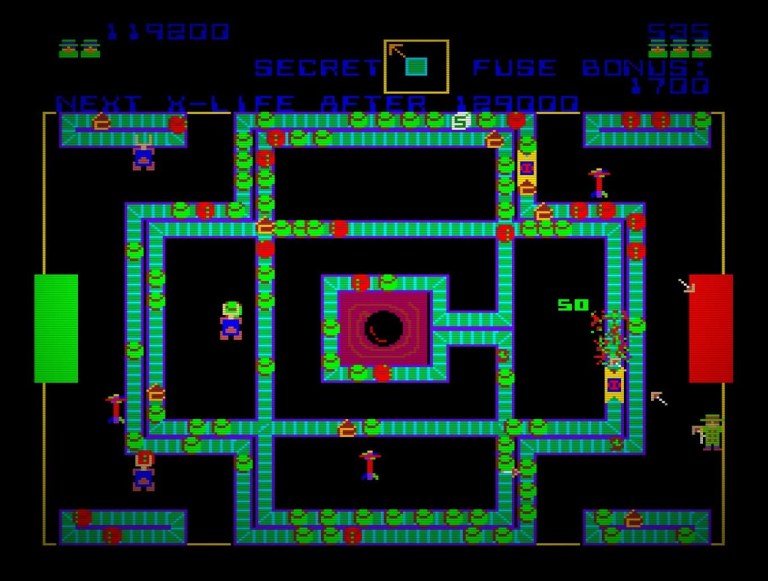
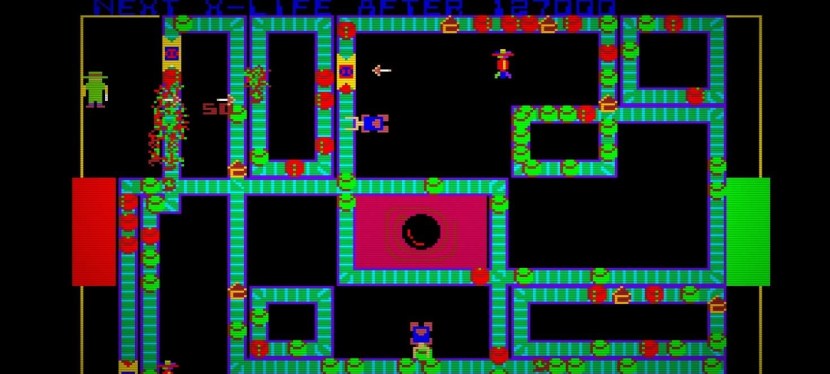
In the arcade game, you play Agent X (the 2D sprite colored green and wearing the hat) and you will encounter challenges from enemies (often robot guards which can fire shots at you), conveyor belts that can impact your movement and the possibility of the giant bomb exploding.

Developed by Atari for the arcade, Cloak & Dagger is a 2D multi-directional shooter in which you play Agent X (who appears wearing a hat, a mask and a coat) whose mission is to infiltrate the massive base of an enemy that goes very deep underground (33 levels/floors).

Each level the player enters require surviving obstacles and defeating (or avoiding) the enemies (robot guards are the most common opposition while the crawling eye occasionally appears) and then move to the other side of the level in order to get into another elevator to keep on descending. The ultimate goal is to reach the final level below to recover top secret plans from Dr. Boom (the main villain and the one responsible for stealing the said plans), destroy his underground bomb factory (which explains the existence of oversized bombs and many explosives on conveyor belts) and get out.

As registering high scores was the trend of video gaming back then, players will be rewarded with shooting at the enemies (example: robot guards are worth 50 points each when asleep or 200 points when awake, while the main villain Dr. Boom is worth 50,000 points) as well as interacting with in-game items such as the unarmed explosives (10 points when shot but worth 100 when collected), armed explosives (50 points each when destroyed) and mystery boxes (worth 200 to 1,800 points plus random effects on the player such as extra life, improved speed and even extra life). For every 30,000 points scored, the player will be granted an extra life. In many levels are gigantic bombs that players can ignite using the Fuse button for extra points. 
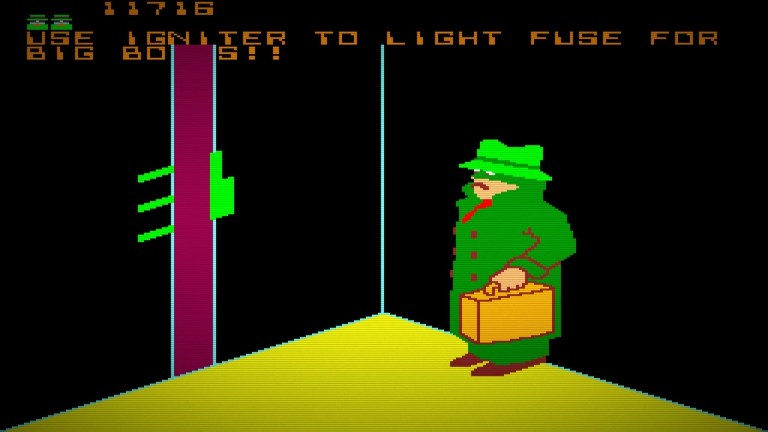
Between levels, you will see an animated Agent X during the short rides in the elevator.
The game is very challenging because so much is going on around you. The robot guards will always fire shots at you while the conveyor belts often move items and explosives (both the armed and unarmed). You can ride a converyor belt to move around but make sure you do not touch the armed explosives (red containers) as they will kill you upon contact.

Other items players can collect are the extra boxes (resulting in extra life) and the secret maps (which partially reveal safe paths through each fourth level).

When it comes to the controls, Cloak & Dagger has a dual joystick (twin sticks) setup similar to Robotron 2084 and Smash T.V. (read my retrospective look at it by clicking here). One joystick allows players to move Agent X around while the other allows shooting projectiles (using Agent X’s weapon) at any direction. The fuse action (for igniting the oversized bombs in the enemy lair) is done by simply pressing a button. As I am playing this game on Xbox Series X, the game’s controls functioned well on the Xbox controller. Both precision and response of the game are sharp with the Xbox controller.

When it comes to the enjoyment and overall value of Cloak & Dagger, I can say that it is indeed more challenging and more chaotic when compared to the more notable twin stick games Robotron 2084 and Smash T.V. For one thing, each level has different layouts complete with obstacles or hazards plus enemies that will certainly challenge players. Many levels have conveyor belts moving unarmed explosives, armed explosives (which you must avoid touching because you will die upon direct contact) and items around which form obstacles when it comes to shooting robot guards on the other side (note: you can use the obstacles defensively when the robot guards fire at you).
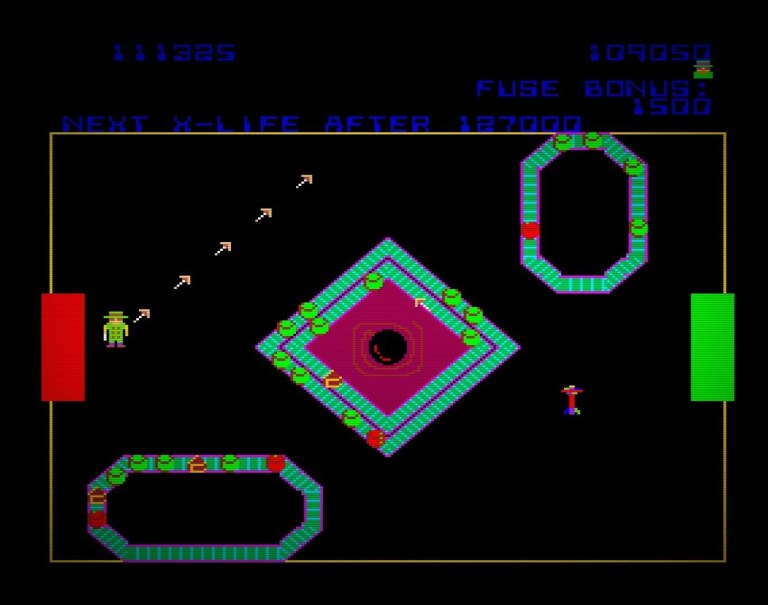
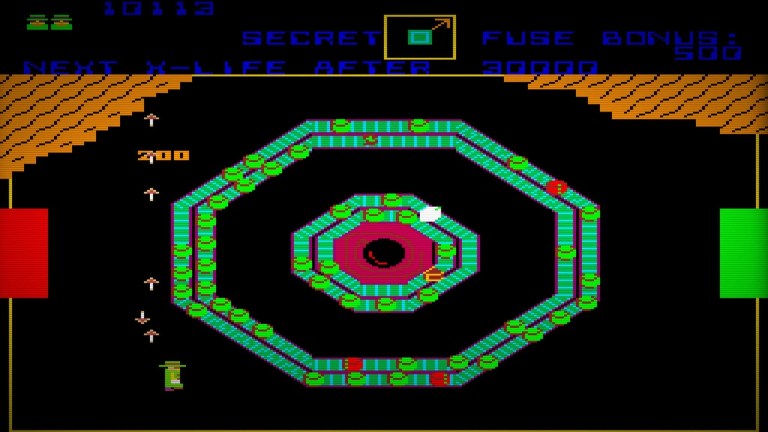
From time to time, you will enter a somewhat sparse looking level like this which actually has mines hidden. The locations of the mines do get revealed in specific moments but only for a few seconds. That being said, it is always best to be able to collect maps that appear on conveyor belts.

Apart from the robot guards and the crawling eye, there are also forklifts which don’t attack you but their solid exterior will deflect any projectile you fire at them and send them back to your direction.

To be clear, you are not required to destroy all the robot guards (or the huge crawling eye enemies) in each level. You can simply try to avoid obstacles and enemies to make it to the next elevator to keep on descending although doing so means scoring much lesser points. Picking up items will add points and randomly alter your character’s capabilities (by picking up mystery boxes).

Adding pressure to you on each level is the giant bomb located in the middle which you can ignite using the fuse action. Once ignited, you only have a few seconds left to make it to the next elevator as the giant bomb will explode and spread fire throughout the whole level. Igniting the said thing will grant you a lot of points provided you survive and made it to the elevator going down.
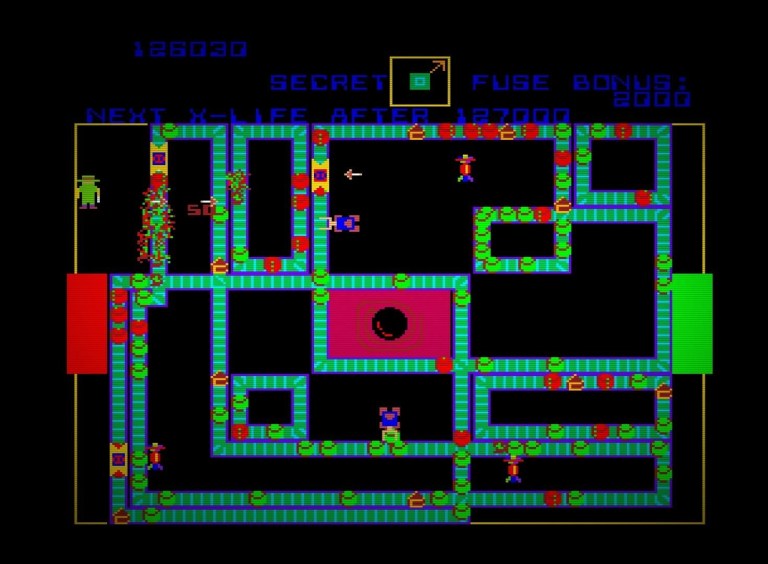
To be able to play the Cloak & Dagger arcade game on your console or on PC, purchase a copy of the Atari 50 collection.

Cloak & Dagger is indeed a fun game but the opposition, the obstacles, time limit (indicated by the giant bomb) and chaotic turn of events make it more challenging than Midway’s two notable twin stick shooters. The game would have been more forgiving and more playable if only it did not have the one-hit-death embedded on it. Considering the challenges each level has and the many levels players have to go through, it would have made more sense to have Agent X have a life bar/health meter/shield and be able to absorb some enemy projectiles (before dying).

Of course, the game was never designed to be like that and the one-hit-death is also found in Robotron 2084 and Smash T.V. That being said, if you played Cloak & Dagger with a high level of success and completed everything without losing all your lives, then you would be a great achiever.

Pop culture significance

It has been reported that Cloak & Dagger – which was released as an arcade kit for machines that ran Robotron 2084, Joust, Defender and Stargate – did not have a big presence in the arcades in America. The 1984 movie dramatically increased public awareness of it.

Print ad of the arcade game.

When Cloak & Dagger was still in game development (created and led by Russell Dawe) under the title “Agent X”, Atari and certain movie producers became aware of each other’s projects and decided to work together. The deal made business sense as Atari could benefit from reaching a mainstream audience through the cinemas while the movie producers joined in the 1980s Hollywood trend of movies that featured powerful computers, software and artificial intelligence as seen in WarGames (1983), Superman III (1983), and The Terminator (1984).

Much to the credit of the filmmakers, the presence of the game actually added good value to the plot. The film’s concept of the Cloak & Dagger game becoming a very wanted object (plot device actually) resulting in chases, intense action scenes and suspense turned out to be very believable as well. It should be noted that director Richard Franklin took inspiration from Alfred Hitchcock which gave the film a unique touch on the suspense and shock scenes. Check out the movie clip below…

When it comes to the Cloak & Dagger game appearing within the movie of 1984, you will see how the filmmakers and Atari cleverly created the illusion of the game operating on the Atari 5200 console by showing not only video game footage, but also having Henry Thomas acting like he’s playing it using the Atari 5200 controller (which has an analog joystick and buttons on one side). When I was a young boy watching the movie, I found the game footage very entertaining and wanted to play it.
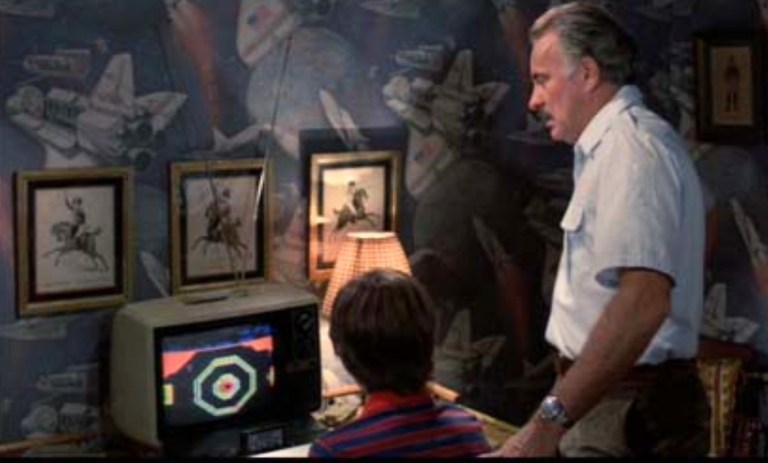
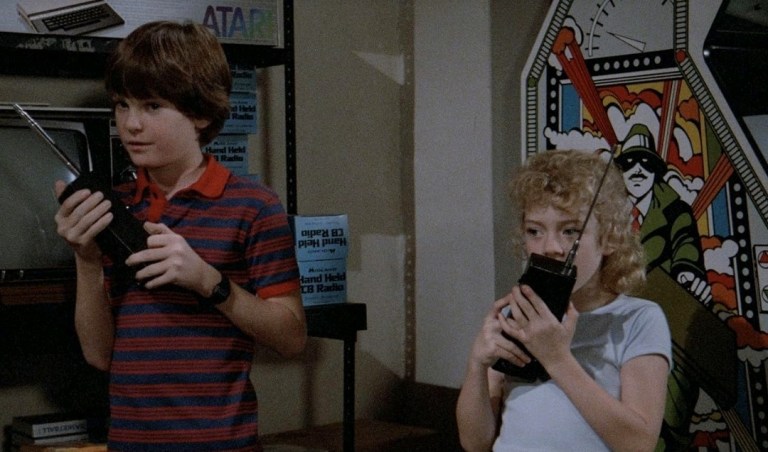
Cloak & Dagger portrayed as running on Atari 5200 in this scene with Henry Thomas and Dabney Coleman. (photo source – AtariProtos.com)
A Cloak & Dagger arcade cabinet seen in the background (right side). (photo source – IMDB.com)

If you are an Xbox gamer who intends to play Cloak & Dagger now, buy the Atari 50 collection in digital format by clicking https://www.xbox.com/en-US/games/store/atari-50-the-anniversary-celebration/9N3TFDSQ531T

+++++

Thank you for reading. If you find this article engaging, please click the like button below, share this article to others and also please consider making a donation to support my publishing. If you are looking for a copywriter to create content for your special project or business, check out my services and my portfolio. Feel free to contact me with a private message. Also please feel free to visit my Facebook page Author Carlo Carrasco and follow me on Twitter at  @HavenorFantasy as well as on Tumblr at https://carlocarrasco.tumblr.com/ and on Instagram athttps://www.instagram.com/authorcarlocarrasco
A Look Back at Independence Day #0 (1996)

Welcome back science fiction enthusiasts, 1990s arts and culture enthusiasts, Marvel Comics fans and comic book collectors! Today we go back to the year 1996 to take a close look at one of the licensed comic books Marvel Comics published which was part of the release of the movie Independence Day (also referred to as ID4).

Back in 1996, there was a considerable amount of hype and anticipation for Independence Day’s release in cinemas not just in America but also in other parts of the world. Following the success they achieved together in Stargate (1994), producer Dean Devlin and director Roland Emmerich teamed up again to make Independence Day which was back then the most modern cinematic portrayal of aliens invading Earth causing the people to fight back. The film creatively was also a disaster movie of its own backed with science fiction concepts and the latest special effects of the era. Independence Day went on to gross almost $820 million worldwide and I myself saw it in a fully packed cinema here in the Philippines.

As I saw the movie, I noticed details about events that took place sometime in the past and they were presented not as flashbacks but only as spoken words. There is that verbal reference about Jeff Goldblum’s character punching Bill Pullman’s character some time before the latter became US President. There are also spoken words about Randy Quaid’s character being previously abducted by aliens. As part of the marketing and publicity of the movie, Marvel Comics was licensed to publish not only a 2-part comic book adaptation but also a prequel comic book.

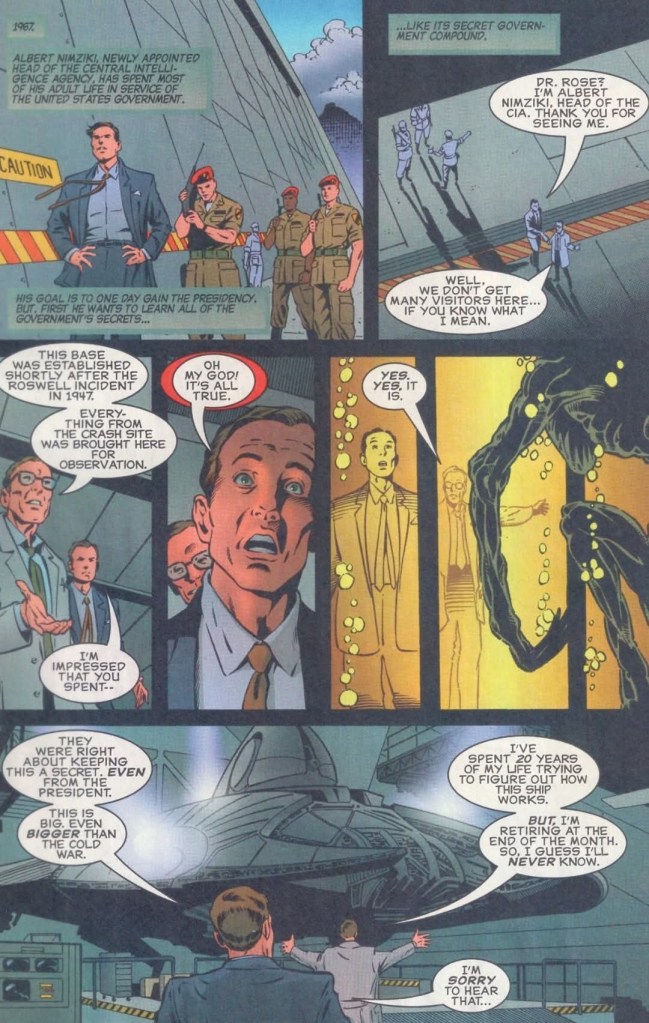
With those details laid down, here is a look back at Independence Day #0, published in 1996 by Marvel Comics with a story written by Phil Crain (based on ideas by Dean Devlin and Roland Emmerih) and drawn by Terry Pallot, Steve Erwin, Rod Whigham and Gabriel Gecko.

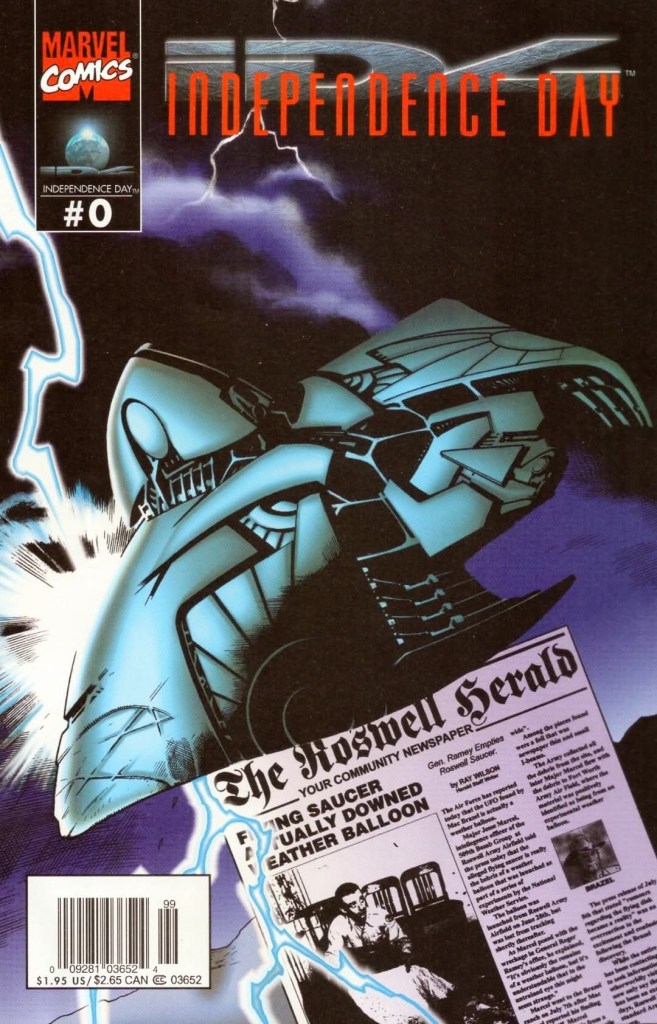
The cover.

Early story

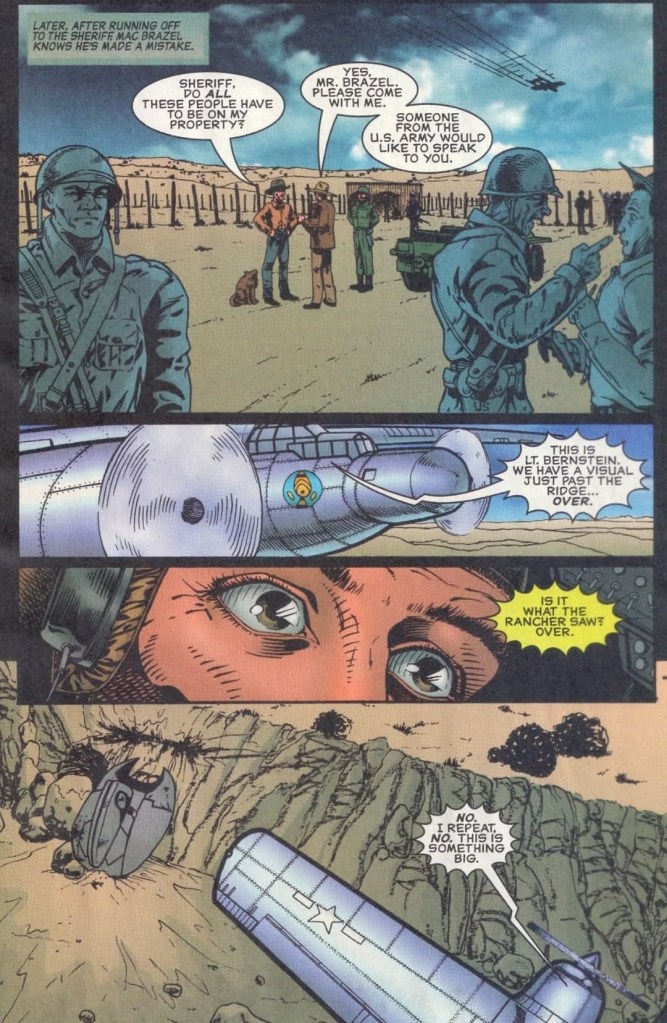
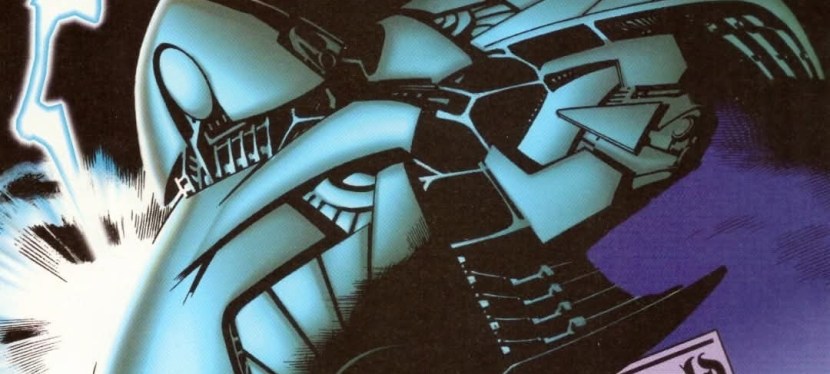
The story begins on July 4, 1947 in Roswell, New Mexico. A thunderstorm took place in the evening compelling residents to stay inside their respective homes. As the storm went on, an unidentified flying object (UFO) of alien origin got struck by thunder causing it to crash on the field of someone’s property with a huge impact that disturbed local residents. The alien ship opens and one of its passengers (alien) ventures out into the stormy night. Injured and still in shock, the passenger slowly moves away from the ship.

The next evening, the property owner arrives and finds several pieces of debris of the crashed ship scattered on the field. He notices the metal are lighter than anything he touched, and he could see the writings were not man-made. The property owner informed the local sheriff of what he found which led to the American army sending troops to the field. The American military plane flies over them and finds the crashed alien ship.  

Quality

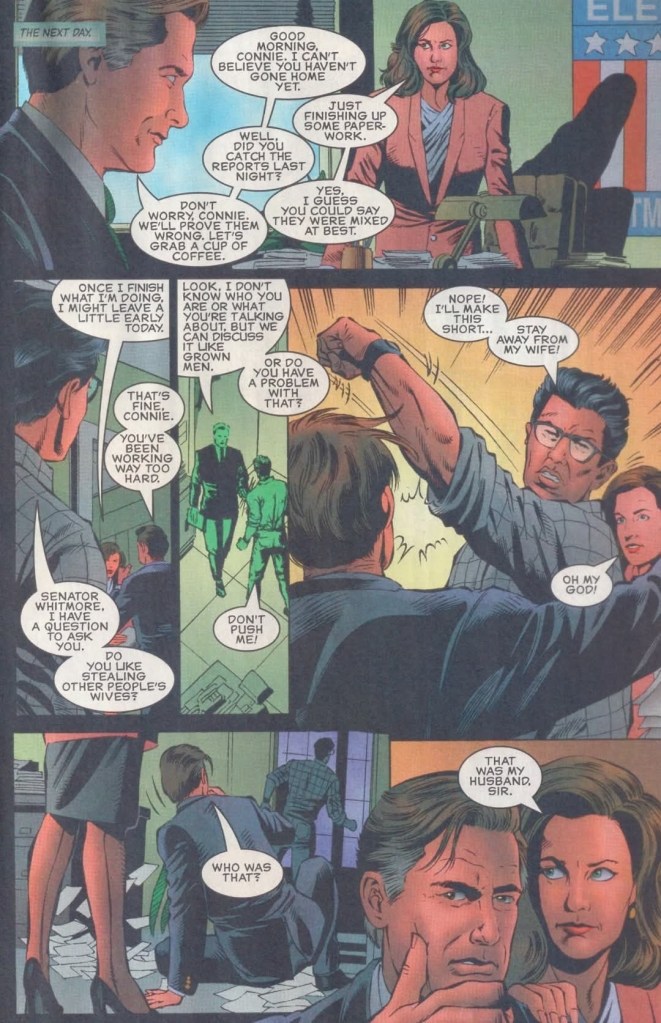
When Whitmore was still a US Senator and candidate for US President, he got punched by David Levinson who thought that he was having an affair with his wife Constance “Connie” Spano. This later led to the “You punched the President,” line in the movie.

As described above, this prequel comic book visually dramatizes the past events that were only mentioned in the movie particularly with regards to the Roswell UFO incident as well as Area 51 and how the government handled findings about aliens from outer space. In fact, the story here was scripted to move from one significant event to the next through the decades, and the good news here is that the exposition is not too heavy (when compared to Jurassic Park comic books of 1993) and the pacing moved at a medium pace. The result is a reading experience that is intriguing and entertaining.

The creators really went all in with their fictional portrayal of the movie’s aliens being involved in Roswell and Area 51, and the notable thing is that they really took the presentation seriously. It’s as if they were trying to tell a factual story which smoothly connects with the movie.

When it comes to the characters from the movie, you will find them in this comic book depending on the stage of the narrative and the time setting. While the characters of Pullman, Goldblum, Robert Loggia, Will Smith, Brent Spiner, James Rebhorn, Viveca A. Fox and Margaret Colin are dramatized in the 1990s scenes, you will see the younger versions of a few of them set in the 1960s scenes. The abduction scene of Randy Quaid’s character is set in the 1980s.

The Area 51 scene set in the 1960s.

As for the script written by Phil Crain, the narrative of this comic book surprisingly has a more serious and dramatic tone when compared to what was expressed in the movie. There were even a few horror elements and no comedic stuff at all. Again, this should not be surprising because this comic book was meant to dramatize past events to not only connect with the movie’s core concept but also show why certain characters acted the way they did in the film.

As this comic book involved multiple artists, it should not be a surprise that the result is of varying quality from one scene to another. In fairness, the illustrator (or illustrators) who drew the Area 51 scenes and the crashed alien ship did a good job with the details. As for the characters, pilot Steven Hiller resembled Will Smith enough, and the same can be said about Thomas Whitmore somewhat looking like Bill Pullman, David Levinson looking somewhat like Jeff Goldblum, and General Grey slightly looking like Robert Loggia. Meanwhile, Constance Pano resembled Margaret Colin more while the 1990s Dr. Okun resembled Brent Spiner in a few shots.

Conclusion

The creators went all-in to make the 1947 Roswell UFO incident a history of Independence Day.

To get straight to the point, Independence Day #0 (1996) succeeded with its main objective of establishing visually the past and emphasizing developments connecting with the blockbuster movie of 1996. It was made with a strong appeal to fans of Independence Day as well as people who simply are fond of UFOs and conspiracy theories regarding Roswell and Area 51. People who are not too interested in the movie and UFOs might not be impressed with this comic book. In my view, this prequel comic book has good enough qualities that make it worth reading and its serious narrative is both surprising and enjoyable. Ultimately, it is a worthy companion piece to the movie.

Overall, Independence Day #0 (1996) is recommended.

+++++

Thank you for reading. If you find this article engaging, please click the like button below, share this article to others and also please consider making a donation to support my publishing. If you are looking for a copywriter to create content for your special project or business, check out my services and my portfolio. Feel free to contact me with a private message. Also please feel free to visit my Facebook page Author Carlo Carrasco and follow me on Twitter at  @HavenorFantasy as well as on Tumblr at https://carlocarrasco.tumblr.com/ and on Instagram at https://www.instagram.com/authorcarlocarrasco
Retro Gaming Ads Blast – Part 14

Welcome back readers, fellow geeks and electronic gaming fans!

In this edition of the Retro Gaming Ads Blast (RGAB) series, we will take a look at another batch of retro gaming print ads – including arcade flyers – from the 1980s and 1990s.

For the newcomers reading this, Retro Gaming Ads Blast (RGAB) looks back at the many print ads of games (console, arcade, computer and handheld) that were published in comic books, magazines, flyers and newspapers long before smartphones, social media, the worldwide web and streaming became popular. To put things in perspective, people back in the 1980s and 1990s were more trusting of print media for information and images about electronic games and related products.

With those details laid down, here is the newest batch of retro gaming print ads for you to see and enjoy…

1. Lufia & The Fortress of Doom for Sega Genesis print ad

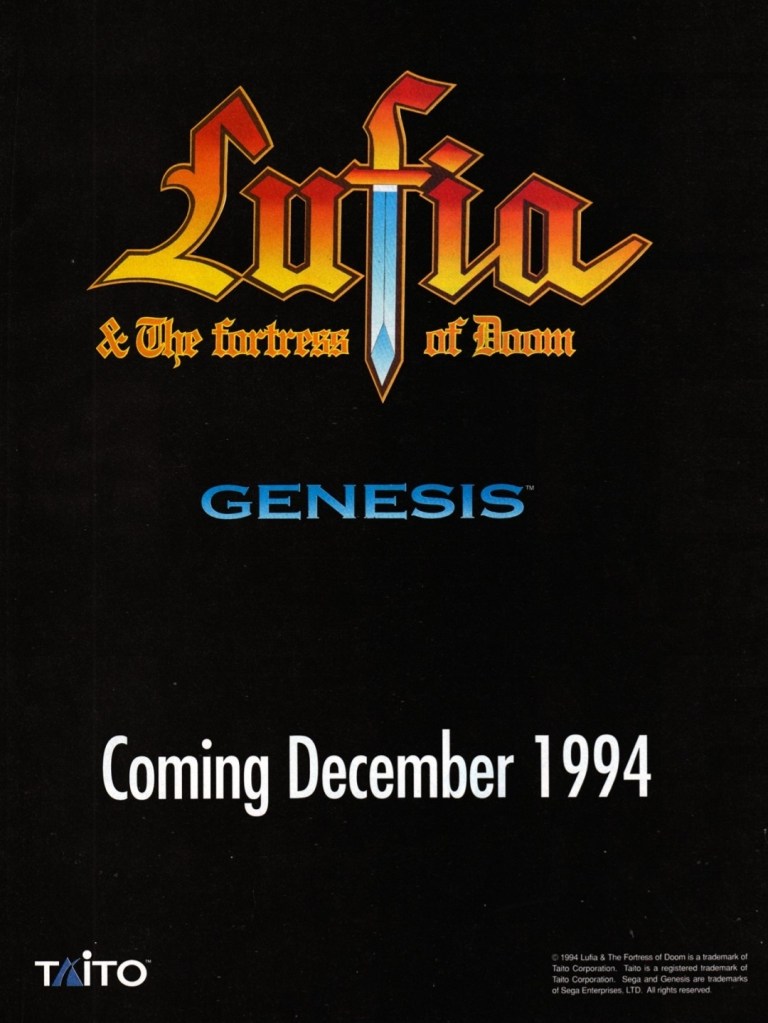
Considering the eventual scrapping of the Sega Genesis port of Lufia & The Fortress of Doom, this old print ad might as well serve like a tomb stone.

I want to start with this mostly black print ad about the Japanese role-playing game (JRPG) Lufia & The Fortress of Doom coming to the Sega Genesis console. This game was released on the Super Nintendo Entertainment System (SNES) in America and on the Super Famicom in Japan in 1993 and achieved commercial success for the Japan-based publisher Taito. In an attempt to keep on building up the success, a port of the game for the Sega Genesis (Sega Megadrive in other countries) was announced but ultimately it got canceled. It should be noted that Taito’s American division close down in 1995 and the sequel  Lufia II: Rise of the Sinistrals was released in America by a different publisher. That being said, this particular print ad is a sad reminder of a broken promise for Sega Genesis gamers as well as Lufia and JRPG fans who wanted to play the 1993 RPG on a different console.

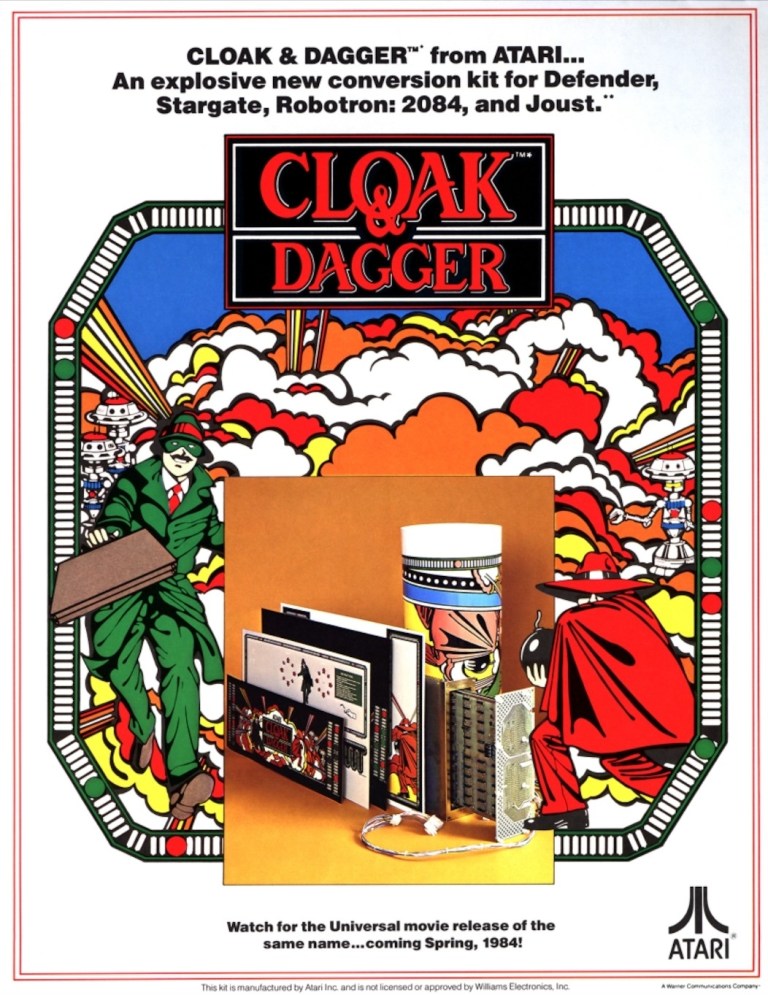
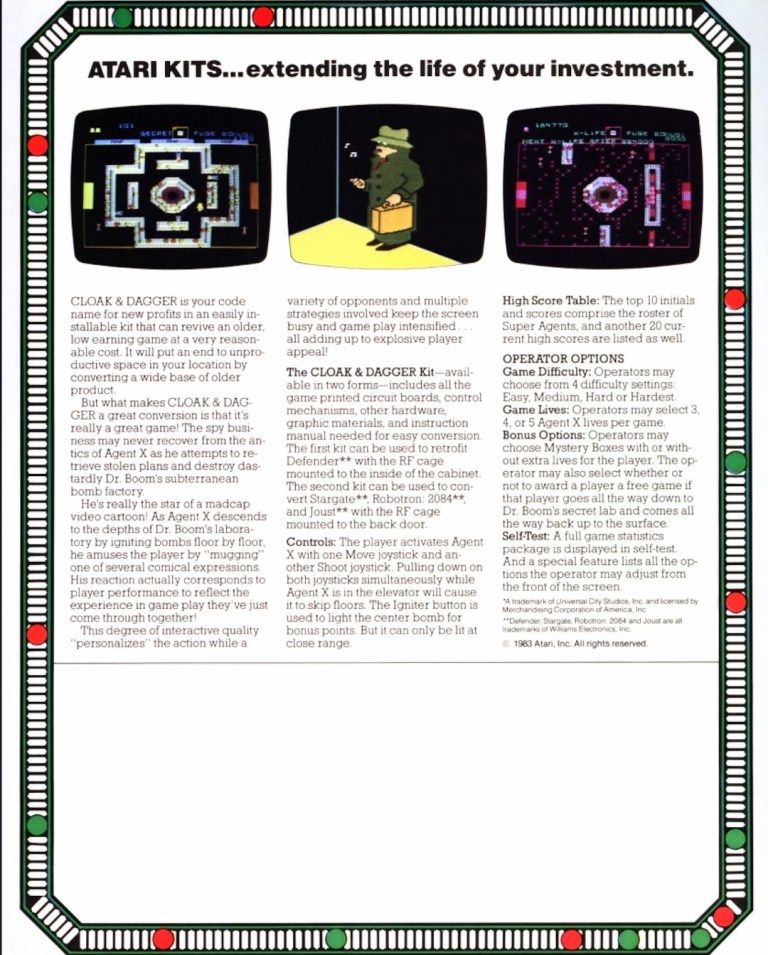
2. Cloak & Dagger arcade flyer

The front of the arcade flyer. There is even a mention of the Cloak & Dagger movie.
Details of the game explained with arcade operators in mind. I find it odd that there is a vacant amount of blank space on this side of the flyer.

Cloak & Dagger, the Atari arcade game that appeared in the 1984 movie of the same name (read my retro movie review by clicking here), has always been an arcade conversion kit as this arcade flyer showed. For the newcomers reading this, an arcade conversion kit allows the arcade operator to replace an old game without having to buy a brand-new arcade machine. Very cleverly, Atari targeted arcade machines of Robotron: 2084, Defender, Stargate and Joust (all were from the competitor Williams Electronics) with Cloak & Dagger. The Cloak & Dagger flyer’s front shows a picture of the pieces of hardware (for insertion into the arcade cabinet plus some physical adjustments) plus decorations for the exterior of the arcade cabinet. The other side of the flyer contains the technical details that make it convenient for arcade operators to understand on how to convert the older games (limited to the above-mentioned Williams games).

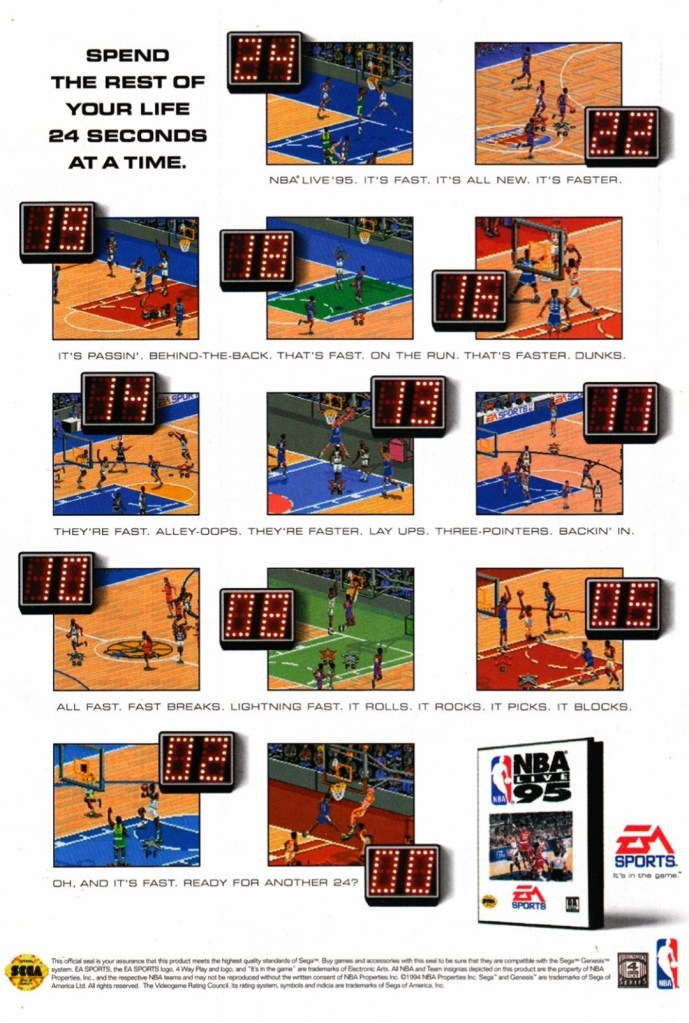
3. NBA Live 95 for Sega Genesis print ad

This print ad is still exciting to look at, especially when you are still passionate with basketball.

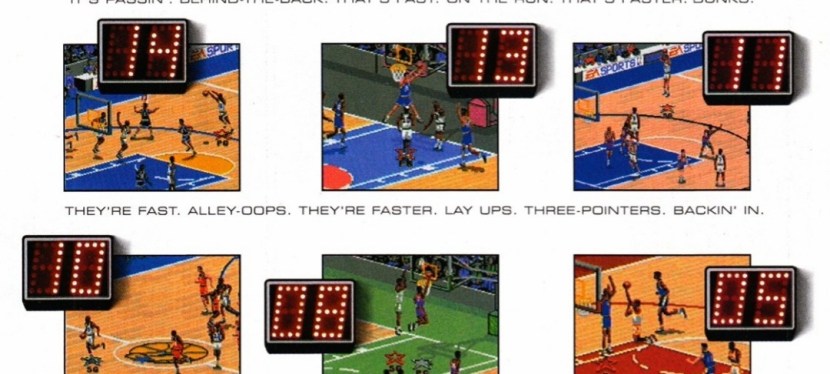
Back in late 1994, Electronic Arts (EA) revamped their NBA-licensed basketball game franchise with NBA Live 95 which came with a major game redesign that includes the isometric on-court perspective, T-meter for free throw shooting and more. NBA Live 95 was also the first entry of the NBA Live franchise and brand which lasted for decades. This print ad of the Sega Genesis version of NBA Live 95 has the clever display of several screenshots along with pics of the shot clock emphasizing suspense. The basketball action images themselves are not only eye-catching but strong enough to get gamers excited. This is still a solid print ad to look at.

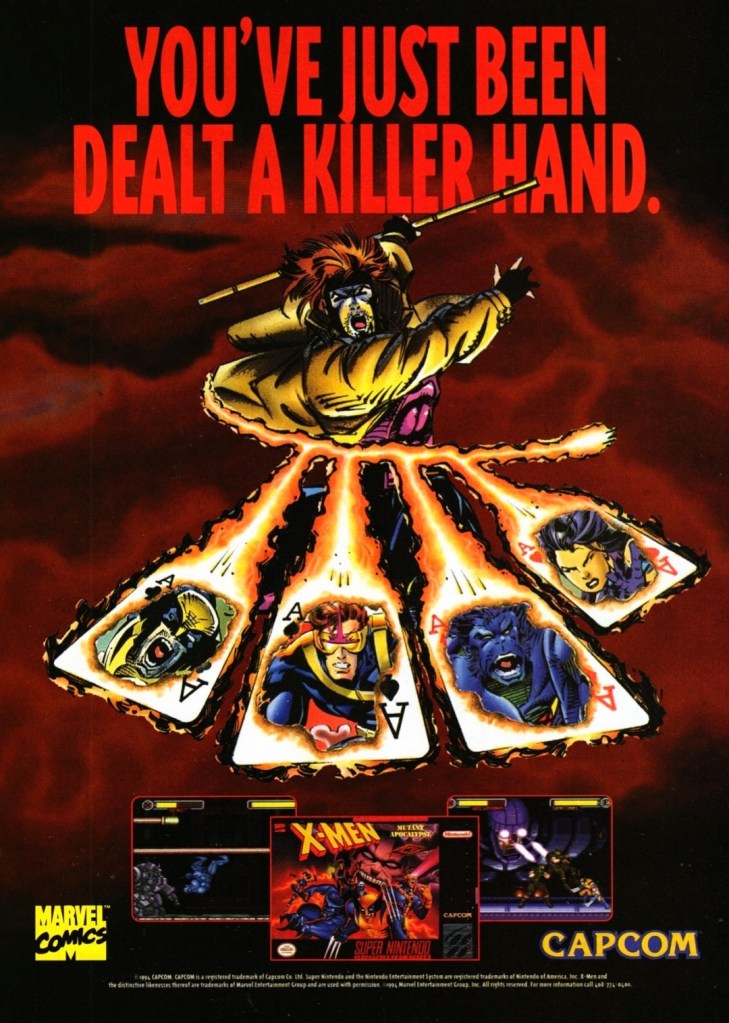
4. X-Men: Mutant Apocalypse print ad

An X-Men game by Capcom.

If there is anything significant about X-Men: Mutant Apocalypse, it is the fact that it was Capcom’s first-ever X-Men-based production that was also released a month before their own hit arcade game X-Men: Children of the Atom came out. Setting aside Capcom’s involvement, this game contains notable elements from the comic books that strongly resonated with dedicated X-Men fans. Apart from the two screenshots and the game box cover, this print ad has X-Men artwork by Andy Kubert who already was the regular artist of the X-Men monthly series.

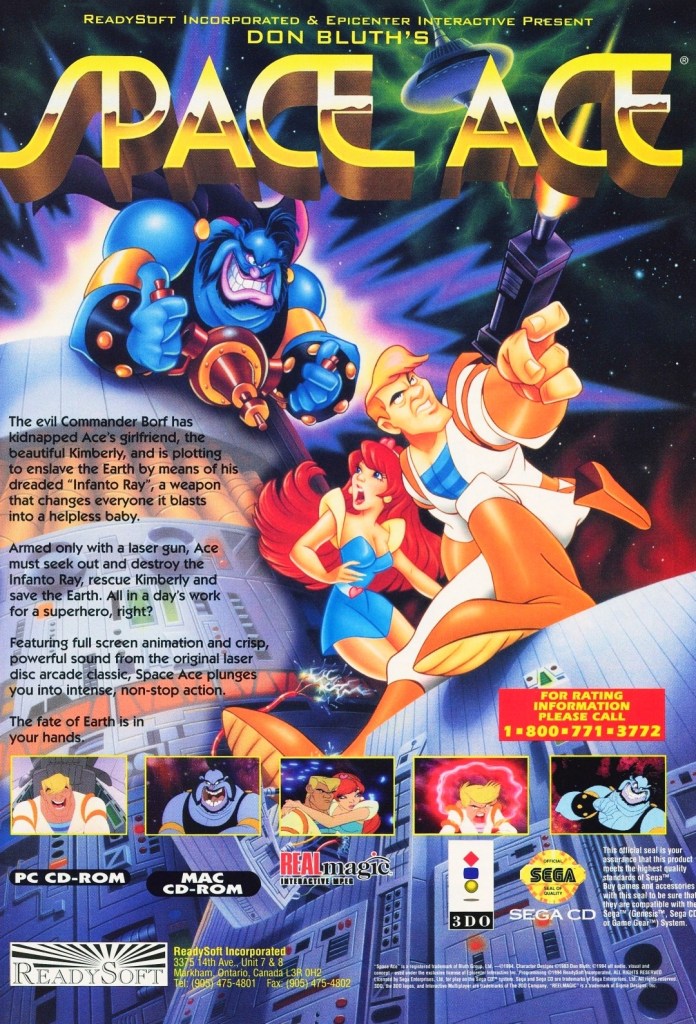
5. Space Ace multi-platform print ad

Anyone who is a fan of Don Bluth’s works in animation should be able to recognize the art style of this ad.

First released in the mid-1980s, Space Ace was a LaserDisc video game that was designed and produced by the legendary animator Don Bluth (An American Tail, The Land Before Time, Anastasia). After achieving success in the arcades, new versions of Space Ace were subsequently released on many other platforms, including the consoles and computers that used disc drives in the mid-1990s which this print ad emphasized. By looking at the lower part of the print ad, you will see Sega CD, 3DO, Macintosh and PC as targeted platforms. The most notable visual feature of the ad was, unsurprisingly, official art of Space Ace.

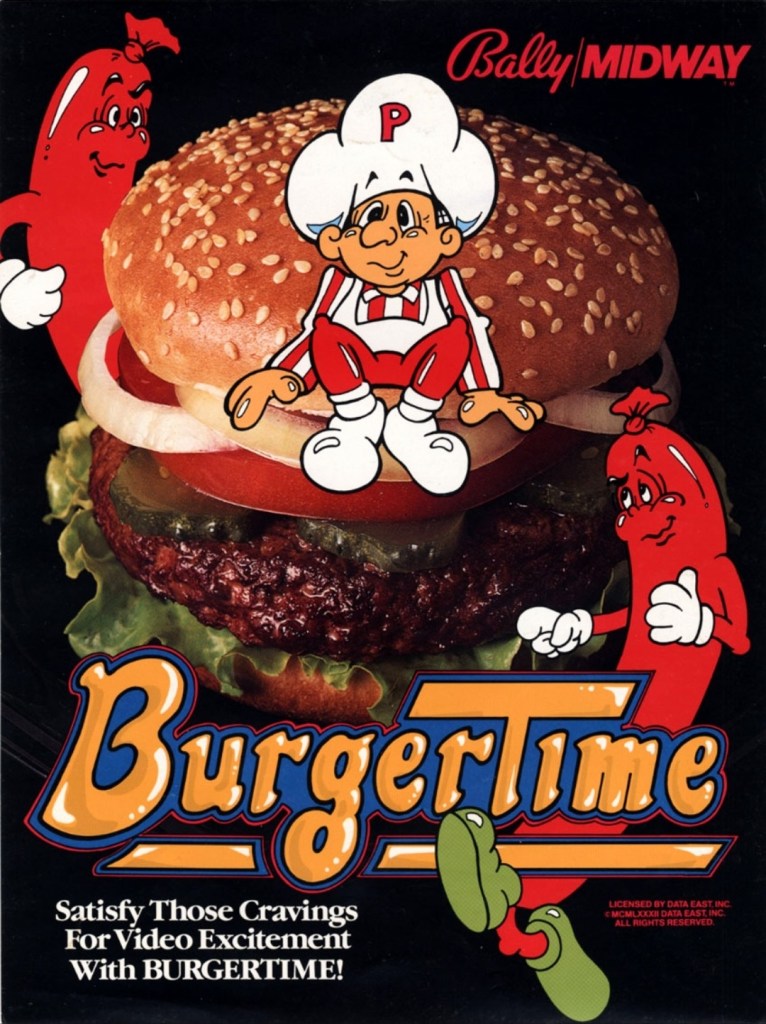
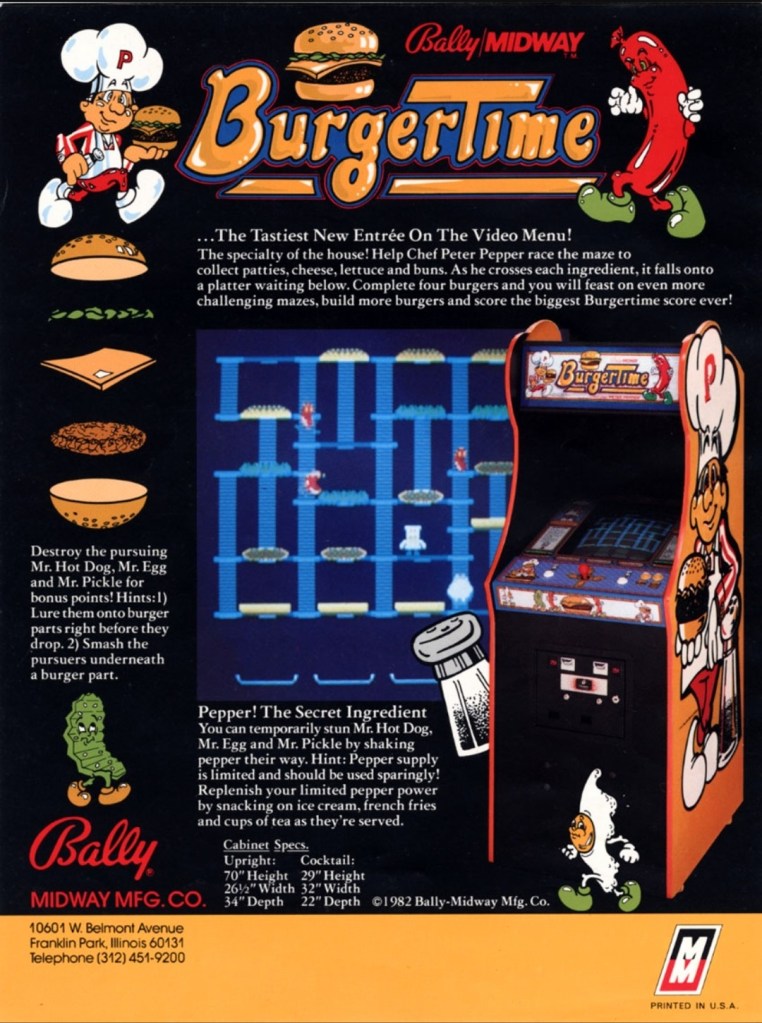
6. BurgerTime arcade flyer

The front of this flyer could make you crave for burgers.
The technical and creative details on the rear of the flyer.

Bally/Midway came up with this arcade flyer of BurgerTime which itself went on to become a beloved classic game. The front showed a very enticing looking hamburger that looked like it could fill a person’s belly and tingle his or her taste buds. Then they showed the hand-drawn in-game characters looking like they really are interacting with the hamburger. The back of the flyer shows details that emphasize what the game is about, why it could be a fun arcade addition and what the specs are. This is an engaging arcade flyer.  

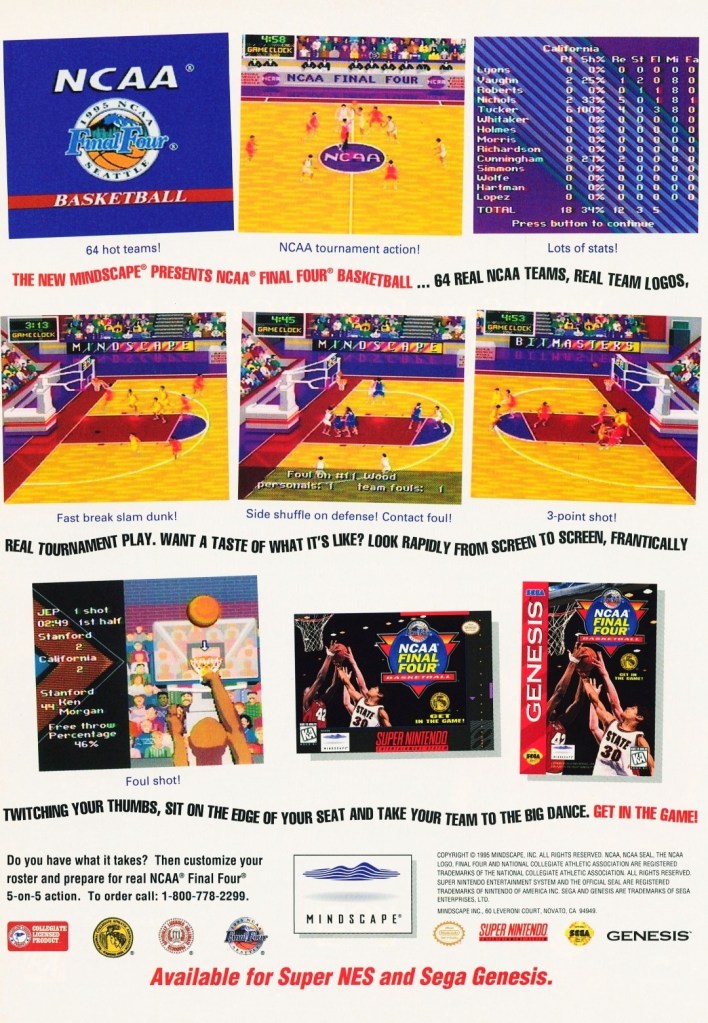
7. NCAA Final Four Basketball print ad

Do you know anyone who played this college basketball video game?

If there is anything notable about video gaming in the 1990s that is missing today, that would be the presence of multiple basketball video games released by different game publishers. Along the way, there were some college basketball video games such as NCAA Final Four Basketball developed by Bitmasters and published by Mindscape. This print ad had enough screenshots to show what the game looked like and how it played. The ad also mentioned that the game had 64 real NCAA teams and logos as well. This 1994 video game did not have a strong reception from game critics although it received a very high rating by GamePro magazine. NCAA Final Four Basketball has long been forgotten.

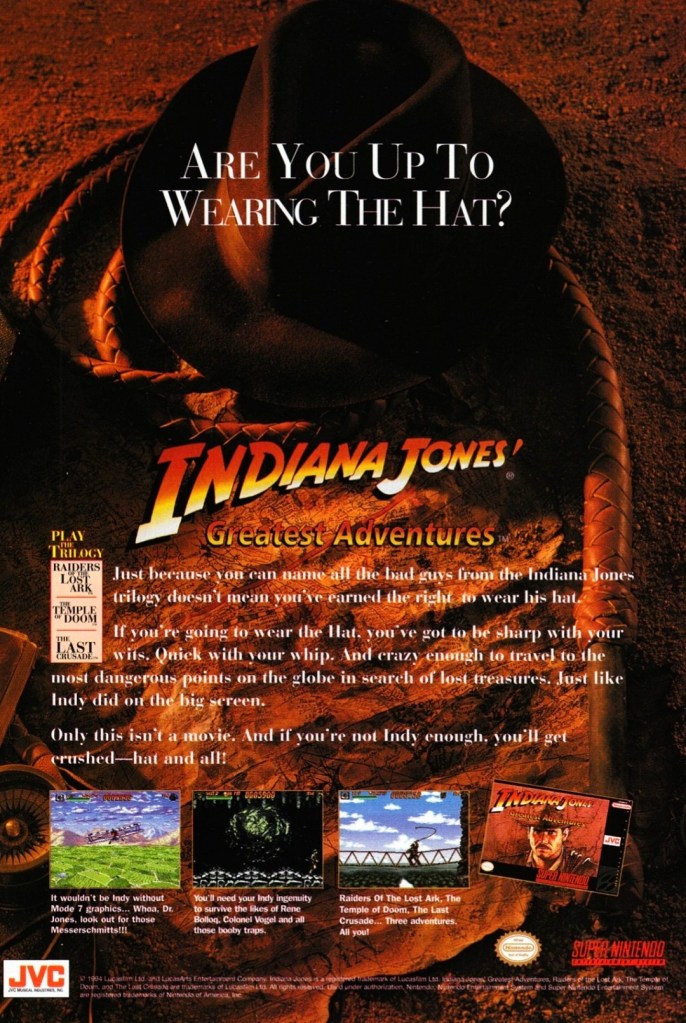
8. Indiana Jones’ Greatest Adventures print ad

An eye-catching print ad from a more memorable time when the Indiana Jones franchise was still under the full control of George Lucas and his enterprise.

Indiana Jones’ Greatest Adventures was an ambitious 2D side-scrolling adventure game that also served as an adaptation of the first three Indiana Jones movies (1981-1989) of Steven Spielberg and George Lucas. Like the Super Star Wars trilogy of games that preceded, this one was a challenging and lengthy game filled with lots of action. This print ad only showed Indy’s whip and hat but the screenshots, the text description and the game box cover (which has a young Harrison Ford as the iconic Jones) were more than enough to convince viewers that this was an Indiana Jones game.

+++++

Thank you for reading. If you find this article engaging, please click the like button below, share this article to others and also please consider making a donation to support my publishing. If you are looking for a copywriter to create content for your special project or business, check out my services and my portfolio. Feel free to contact me with a private message. Also please feel free to visit my Facebook page Author Carlo Carrasco and follow me on Twitter at  @HavenorFantasy as well as on Tumblr at https://carlocarrasco.tumblr.com/ and on Instagram at https://www.instagram.com/authorcarlocarrasco
Retro Gaming Ads Blast – Part 10

Welcome back readers, fellow geeks and electronic gaming fans!

In this edition of the Retro Gaming Ads Blast (RGAB) series, we will take a look at another batch of retro gaming print ads from the 1980s and 1990s.

For the newcomers reading this, Retro Gaming Ads Blast (RGAB) looks back at the many print ads of games (console, arcade, computer and handheld) that were published in comic books, magazines, flyers and newspapers long before smartphones, social media, the worldwide web and streaming became popular. To put things in perspective, people back in the 1980s and 1990s were more trusting of print media for information and images about electronic games and related products.

With those details laid down, here is the newest batch of retro gaming print ads for you to see and enjoy…

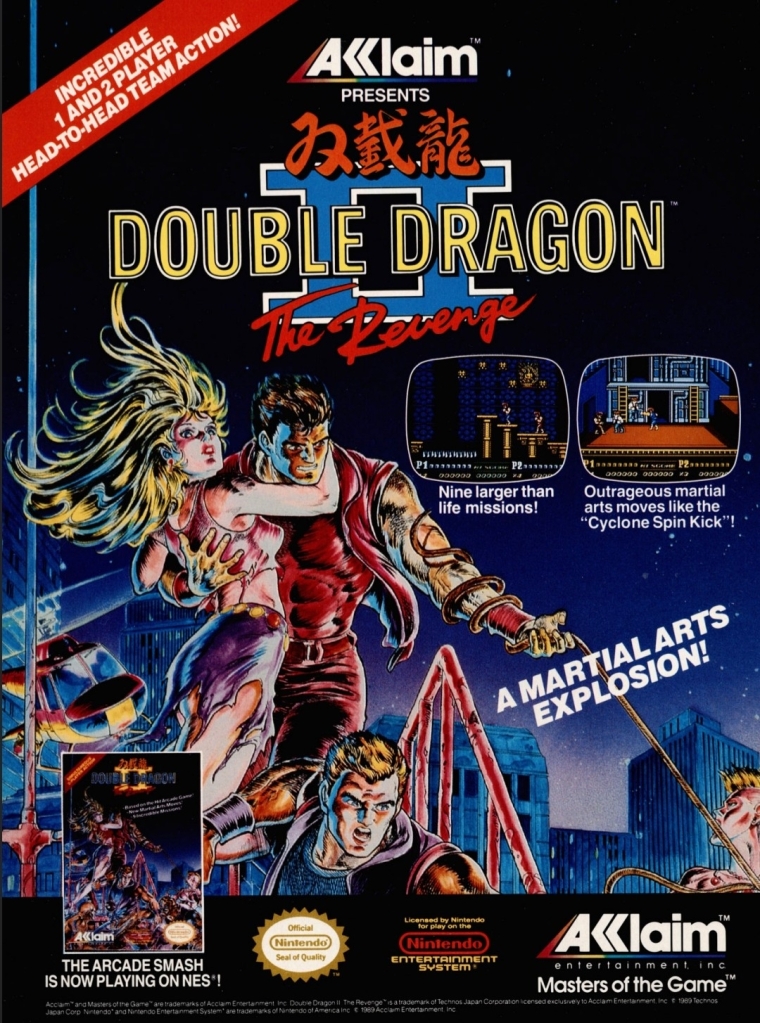
1. Double Dragon II: The Revenge print ad

Nice looking art used to promote the game.

The beat-them-up sub-genre of gaming was already popular in the 1980s and one of the most defining game franchises of this type of game was the Double Dragon series which proved to be popular with Nintendo Entertainment System (NES in America) and Family Computer (Famicom in Japan) gamers. As the first game was a very big hit on Nintendo’s consoles, the sequel Double Dragon II: The Revenge was promoted in America with strong confidence on the part of publisher Acclaim that it would become another massive hit. This print ad had a very nice looking comic books-style art that not only captured the concept of the game but also visualized the heroes Billy and Jimmy with enough details to focus on. I can say this was an eye-catching ad.

2. X-Men: Children of the Atom print ad

Great looking ad but the line “100% direct conversion” is not true at all.

Developed by Capcom in cooperation with Marvel, X-Men: Children of the Atom was a huge hit in the video arcades and it was not surprising that it got released on the Sega Saturn by Acclaim. Acclaim organized an aggressive promotional campaign by pouncing on the fans’ love and knowledge of the X-Men and the high fun factor of Capcom’s game. What this print ad got wrong, however, was the line “100% direct conversion of the arcade smash!” which was wrong and misleading. In reality, the Sega Saturn version of the game had about one-third of the animation frames cut due to the console’s smaller RAM capacity.

As the years passed by, the Sega Saturn became the more suitable console for home ports of Capcom’s further 2D fighting games as Sony’s PlayStation had even more severe limitations and a graphics processor that was not suitable for 2D graphics. By the end of 2000, Capcom’s 2D fighting games on PlayStation all were inferior to the Sega Saturn versions.

3. Sky Shark NES print ad

This is an effective looking ad.

Released in Japan as Flying Shark, Sky Shark was released on multiple platforms in 1988 and there was an NES version of it which this particular print ad promoted. The American branch of Taito wisely used positive quotes from media outlets to promote the game while coming up with an engaging text description and displayed NES screenshots. And then there was that very engaging painted cover art that gave this print ad a lot of punch. An effective ad overall.

4. Conflict print ad

This is a very captivating artwork for advertising.

There is no denying the fact that the Cold War was a strong influence on arcade games and video games. Titles like Contra, Jackal, Metal Gear, Operation Wolf, Cabal and Rush’n Attack were militaristic games that entertained millions of gamers from the young adults to the little children. In 1990, Vic Tokai released the game Conflict on the NES which had a military theme but an unusual game design composed of digital maps with hexagons in which gamers will play with strategy to win battles. That being said, this print ad’s visual concept was very captivating yet also misleading. If you see how the game is played, you will know what I mean.

5. College Slam print ad

Were you ever interested in college basketball video games?

This is one of the more eye-catching print ads I’ve seen due to the artist’s illustration of a basketball with a mouth biting the basketball rim which dominates the space. For the newcomers reading this, College Slam was a basketball video game that was actually a repacked version of the popular NBA Jam with focus on NCAA basketball players. With the biting basketball at the center, it was easily an attraction and the screenshots implemented were larger than usual which easily gave gamers a clear look at what the game looked like. While this print ad is eye-catching, it did not help sell College Slam and there never was a follow-up.

6. Tecmo Super Baseball print ad

From the time when Tecmo was prolific with video games about sports.

Long before it started the Dead or Alive game franchise, Tecmo was once heavily invested in making sports video games. Tecmo Super Baseball was their first American pro baseball video game released for Super Nintendo Entertainment System (SNES) and Sega Genesis, and it was notable that the publisher secured only the Major League Baseball Players Association (MLBPA) which resulted in the game featuring real-life players but the teams had no names and no logos. Regardless, this print ad showed how aggressive Tecmo was in trying to attract consumers’ attention by showing ten screenshots with short text descriptions each. The ad’s write-up boasted realism as well as the promise of gaming quality.

7. The Punisher print ad

Marvel’s vigilante firing at someone.

In the early 1990s, Capcom and Marvel Comics started their partnership resulting in the releasing of the arcade game The Punisher. Developed by Capcom, the said arcade game became a big hit with gamers as it featured fun gameplay, multiple enemies appearing on screen simultaneously and other fun elements. Unsurprisingly, the game was ported (note: Sculptured Software was the lead developer) to the Sega Genesis with significant downgrades in terms of graphics, sound, enemy variety and other related elements due to technical limitations. That being said, this print ad used detailed art of the Punisher (with Col. Fury in the background) in a clever way to promote the Sega Genesis version while keeping their attention away from the obvious visual downgrades of the two screenshots displayed. The Punisher on Genesis was poorly received.

8. Stargate print ad

If you did not enjoy the movie, were you able to play the video game adaptation on Sega Genesis or Super NES?

Remember the sci-fi movie Stargate (1994)? The film was a surprise box office hit and eventually video game adaptations of it were made for the SNES, Sega Genesis, Game Gear and the GameBoy. This particular print ad, however, showed screenshots of the SNES and Genesis versions which is made obvious with the side-scrolling adventure plus 3D flying sequence (one screenshot showed it). Combined with images sourced from the movie poster plus an insert of the movie in home video format (lower-right corner), this print ad was obviously an aggressive way to promote the film with the post-theatrical business in mind. In case you are wondering, the cinematic Stargate is not related at all with the early 1980s video game (a follow-up to the classic game Defender) of the same name.  

9. Aerobiz Supersonic print ad

For a simulation game released on consoles, Aerobiz Supersonic is pretty deep and a lot of fun to play.

The airline simulation game Aerobiz Supersonic is a highly addictive and surprisingly fun game that I enjoyed playing on the SNES (read my retro review by clicking here) and strangely enough I first learned about not through its print ad but by reading a preview published by Electronic Gaming Monthly (EGM) magazine. As for this print ad made by Koei’s American team, this is really odd to look at due to the ad makers’ choice of showing a not-so-attractive flight meal. In contrast to that, the ad makers did a good job describing the game creatively and showed three screenshots that were strategically selected in my view. Having played the game many times, I can say that this print ad is very truthful.

+++++

Thank you for reading. If you find this article engaging, please click the like button below, share this article to others and also please consider making a donation to support my publishing. If you are looking for a copywriter to create content for your special project or business, check out my services and my portfolio. Feel free to contact me with a private message. Also please feel free to visit my Facebook page Author Carlo Carrasco and follow me on Twitter at  @HavenorFantasy as well as on Tumblr at https://carlocarrasco.tumblr.com/ and on Instagram at https://www.instagram.com/authorcarlocarrasco
What to watch on YouTube right now – Part 18

Welcome back, my readers, YouTube viewers and all others who followed this series of articles focused on YouTube videos worth watching. Have you been searching for something fun or interesting to watch on YouTube? Do you feel bored right now and you crave for something to see on the world’s most popular online video destination?

I recommend you check out the following topics and the related videos I found.

X-Men (2000) movie reaction videos plus trivia and retrospective – When it comes to superheroes, I am fan of the X-Men and most of the engaging stories I read were comic books written by Chris Claremont who is also responsible with defining many key characters. The first-ever live-action X-Men movie was released in 2000 and I saw it on opening day here in the Philippines inside a cinema of Festival Mall and it was not even half-full. Today, a brand new live-action X-Men movie under Marvel Studios has yet to be released and now is a good time to look back at the first movie through the varied movie reaction videos, trivia video and retrospective video below…

Flavors of NCR 2024 videos – If you love food and enjoy food bazaars or food festivals, then you should read my article about the 2024 edition of Flavors of NCR which I attended recently. Flavors of NCR is an annual food festival supported by the local governments of the National Capital Region (NCR) here in the Philippines which gives visitors opportunities to try the food and beverage products offered by different small businesses from each local government. This year’s Flavors of NCR was hosted by Muntinlupa City and Filinvest City Central Park was the venue. Watch and enjoy my videos below…

The Leftists love terrorism, murder, destruction and genocide – On more serious matters, the Islamo-Leftist believers (people who hate Israel and support Iran, the Palestinian terrorists and other evil forces of the world) have turned more chaotic with their protesting and they don’t even care about the safety and concerns of the public. Here are the facts: Leftists/socialists/Marxists/Communists/liberals are consumed by evil and they took sides with the terrorists not realizing they are supporting evil forces. It is also a fact that many pro-Palestine believers don’t even have full knowledge of what they are campaigning for and their ignorance was exposed! Many pro-Palestine believers want to commit genocide against the Jewish people even as they blatantly blame Israel for genocide (a big lie). Observe the evil, the ignorance and recklessness of the people who hate Israel in the videos below. They are clearly very lost people who constantly fail to realize the evil of their ways.

Wicked Iran failed to destroy Israel and got hit strategically – Iran is the heart of evil in this world we live in. Iran – which has a very wicked and unholy regime since 1979 – is Satan’s tool for spreading death, chaos and genocide through the form of terrorism. Iran’s massive attack on Israel turned out a major failure as their missiles (plus some from their terrorist proxies) were deflected by a rate of 99% by Israel’s defenses and assistance from its allies (including Saudi Arabia). Iran was humiliated not only because of the failed massive attack (which cost them many billions of Dollars) on Israel but also because a new coalition of Western and Arab nation was formed to defend Israel.

Shortly after that, Iran suffered from a strategic attack which was not even massive in terms of explosives but was more than enough to rattle Iranian systems. The attack on Iran happened the same day their supreme leader turned 85 and their evil regime got very humiliated. Watch and learn from the videos below…

The Jessica Alfaro Story (1995) full movie – Here in the Philippines, the Vizconde Massacre case is one of the most controversial and most sensationalized cases ever. This is about the 1991 tragedy of three family members – mother, adult daughter and little daughter – who were found dead with multiple stab wounds in their home in BF Homes, Parañaque. In 1995, Jessica Alfaro emerged as the so-called star witness claiming she knew the suspects, was at the Vizconde home when the murders happened, and pointed to several suspects who happened to be members of prominent families. Conviction of the suspects happened in January 2000 followed by further legal disputes through the following years. In December 2010, seven of the nine accused were acquitted as a result of the Supreme Court reversing the earlier judgment of the lower court and the Court of Appeals.

Going back to 1995, believe it or not, a live-action movie dramatizing the life and times of Jessica Alfaro was actually released shortly after the star witness first emerged. The movie was The Jessica Alfaro Story (1995) which starred Alice Dixson which you can watch entirely (note: Tagalog language and several minutes of the film was muted on YouTube due to use of copyrighted music) below.

Take note that due to legal reasons, the Vizconde name was not used in the film which resulted in the use of an alternative name (examples: Vizconde massacre is called Ilagan massacre, Carmella Vizconde is referred to as Lorraine Ilagan), and do not expect to hear Hubert Webb’s name in the film. This goes the same with the other real-life suspects. The Vizconde Massacre case officially started in 1995 and the 2010 Supreme Court decision made The Jessica Alfaro Story’s overall value questionable by today’s standards. However, the movie should still appeal to people who love Alice Dixson, as well as film buffs who are interested to see how Filipino filmmakers dramatize reality and controversial cases.

Elevator Action retrospective – Decades ago, I enjoyed playing Elevator Action games on console and at the local arcade. Specifically, I played the original Elevator Action game on the Family Computer (Nintendo Entertainment System in America) as a young boy. A decade later, I played the sequel Elevator Action Returns which was very fun and immersive arcade game! To learn more about the history of Elevator Action, watch the video of PatmanQC below…

Stargate reaction videos – Before Independence Day (1996) and the atrocious Hollywood Godzilla (1998) were released, the creative duo of producer Dean Devlin and director Roland Emmerich made Stargate (1994). This is the very movie that served as the foundation of the eventual Stargate SG-1 TV series which itself was a sequel. To learn more about the Stargate movie, watch the selected reaction videos below…

+++++

Thank you for reading. If you find this article engaging, please click the like button below, share this article to others and also please consider making a donation to support my publishing. If you are looking for a copywriter to create content for your special project or business, check out my services and my portfolio. Feel free to contact me with a private message. Also please feel free to visit my Facebook page Author Carlo Carrasco and follow me on Twitter at  @HavenorFantasy as well as on Tumblr at https://carlocarrasco.tumblr.com/ and on Instagram athttps://www.instagram.com/authorcarlocarrasco