Welcome back my readers, YouTube viewers and all others who followed this series of articles focused on YouTube videos worth watching.
Have you been searching for something fun or interesting to watch on YouTube? Do you feel bored right now and you crave for something to see on the world’s most popular online video destination?
I recommend you check out the following videos I found.
#1 Reaction Videos of The Transformers: The Movie – I can hardly believe it has been forty years since The Transformers: The Movie was first released. Following its disappointing theatrical run, the animated feature film became highly pursued by Transformers fans as soon as it was released on home video, and me and my friends enjoyed it a lot. It’s theatrical disappointment never stopped it from becoming a classic for Transformers fans and its importance in pop culture has been established solidly. By today’s standards, The Transformers: The Movie is a showcase of not only high-quality animation and a great lineup of characters, it also has the fine vocal performances of entertainment legends Orson Welles, Peter Cullen (who died recently), Leonard Nimoy, Scatman Crothers, Robert Stack, and Frank Welker. That said, it is not surprising that the 1986 animated film is featured in many movie reaction videos and I found the most entertaining ones for you to enjoy.
#2 Summer Bargains in Japan – Are there a lot of bargains offered by your local grocery or department stores during the summer season? In Japan, as captured by Nippon TV, a grocery store organized “all-you-can-stuff” events that offered customers the golden opportunities to accumulate as many fresh vegetables (sourced from the summer produce of local farms) as they can for a fixed rate per attempt. Watching this Nippon TV video is entertaining and informative. I encourage you all to watch it from start to finish.
#3 1978 Interview Clip of Ingrid Bergman – If you have seen the classic movie Casablanca, you would remember the radiant beauty of Ingrid Bergman and her on-screen romance with Humphrey Bogart’s character. A few years before she passed away, Bergman was interviewed on TV and I posted below a short video excerpt for you to see. Not only will you learn from Bergman a notable revelation about her co-star’s presence behind the scenes of Casablanca’s production, you will see how intellectual and insightful she was. Go watch the video below.
#4 The Indiana Jones Game Konami Was Never Allowed to Make – Time for retro gaming! Back in the 1980s, Konami was a very prolific producer of video games for both arcades and consoles. In 1987, Konami released Arumana no Kiseki for the Nintendo Family Computer (Famicom) disk system. What struck me when I first played the game was the many creative elements it shared with the 1984 film Indiana Jones and the Temple of Doom. The playable action hero was designed with close resemblance to Indiana Jones (complete with the fedora). The game even had locations that looked like they were ripped off from the 1984 movie. To learn more about Arumana no Kiseki, who created it and why it had lots of Indiana Jones-related elements in it, watch the video below.
#5 Roger Moore Technically Played James Bond in The Cannonball Run – Released in 1981, The Cannonball Run was an all-star comedy film with an emphasis on racing and stunts. It was heavily inspired by a real-life illegal cross-country motor race that happened in America in the 1970s and the movie had the very popular celebrities of the time like Burt Reynolds, Dom DeLuise, Farrah Fawcett and Roger Moore. Moore, who was already famous as the cinematic James Bond, technically played Agent 007 in The Cannonball Run. If you are curious and you want to know more, go watch Calvin Dyson’s retrospective of the movie and Moore’s presence.
#6 Jerusalem Walk Video – During the day-off of the Israel pilgrimage tour I joined in 2023, I took the rare opportunity to explore the city of Jerusalem on foot. I started the day at the Old City of Jerusalem where I visited the Temple Mount, the Western Wall and other holy sites before marching all the way to the modern part of Jerusalem going as far as the famous Mahane Yehuda market. This Jerusalem walk video brings back memories to me and if you love world travel, I encourage you to watch it.
JAPAN won six of nine gold medals at stake in the 2026 NTT Asia Triathlon Para Championships in the Subic Bay Freeport Zone yesterday.
The event was converted to duathlon (2.5km run-20km bike-5km run) after prolonged heavy rains made the water conditions in Subic Bay unsafe for athletes.
Keiichi Sato clocked 1:01:08 to prevail over compatriot Takumi Ando (1:03:56) and Uzbekistan’s Bakhtiyor Murtazayev (1:05:01) in the men’s PTS5 (mild impairment) category race that started and ended at Waterfront Road.
“My weak point is swimming. I like running and biking so this is advantage for me,” said the 47-year-old Sato, who hails from Nagoya which will host the 20th Asian Games.
“I plan to join more tournaments to qualify for the 2028 Los Angeles Paralympics, that is my goal,” added Sato, who placed 11th at the 2016 Rio Paralympics.
Group shot of all the medalists of the 2026 NTT Asia Triathlon Para Championships in the Subic Bay Freeport Zone. Japan won six of the 9 gold medals. (Photo source – Triathlon Philippines, photo credit – Pet Salvador)
Meanwhile, Filipino Alex Silverio delivered a bronze medal in the men’s PTS4 (moderate impairments). He clocked 1:08:36 behind Japan’s Hideki Uda (1:01:21) and Keiya Kaneko (1:06:41).
The other Japanese gold medalists in the tournament organized by Triathlon Philippines in cooperation with Subic Bay Metropolitan Authority (SBMA) were Yukako Hata (women’s PTS2), Masaki Fujita (men’s PTS3), Hideki Uda (men’s PTS4), Ryota Kashiki (men’s PT Visually Impaired) and Shiori Funamizu (women’s PT Wheelchair).
Uzbekistan’s Rustamjan Satiboldiyev (men’s PTS2) and Shokhsanam Sobirjonova (women’s PTS5) and Kyrgysztan’s Guinaz Zhuzbaeva (women’s PT Visually Impaired) also topped their respective categories in the competition sponsored by NTT, Philippine Sports Commission, Pinay in Action, Gatorade, Terrace Hotel, Western Guaranty Corp., Raceya, ENGINE 8 and CM Timing of Jay Cheng.
Toyohiro Akiyama, the first-ever Japanese person to go to space, has passed away at age 84, according to a news report by Kyodo News. Akiyama’s achievement of space travel happened on December 2, 1990, and he will always be remembered for it. He was also a journalist.
To put things in perspective, posted below is the entire news report of Kyodo News. Some parts in boldface…
Toyohiro Akiyama, the first Japanese to fly into space and a former journalist, has died, a relative said Tuesday. He was 84.
The Tokyo native became an astronaut through an internal screening process at Tokyo Broadcasting System Television Inc., staying at the Mir space station in December 1990 and becoming known for his first words in space, “Am I on air?”
After joining the broadcasting company in 1966, he covered politics and international affairs before serving as head of the company’s Washington bureau. He applied to become an astronaut after he became an editor at the international affairs department.
Let me end this piece by asking you readers: What is your reaction to this development? Do you think of Japan a lot when it comes to space travel? Have you seen archive footage of Akiyama’s pioneering travel to space?
Thank you for reading. If you find this article engaging, please click the like button below, share this article to others and also please consider making a donation to support my publishing. If you are looking for a copywriter to create content for your special project or business, check out my services and my portfolio. Feel free to contact me with a private message. Also please feel free to visit my Facebook page Author Carlo Carrasco and follow me on Twitter at @CarloCarrascoPH as well as on Tumblr at https://carlocarrasco.tumblr.com/and on Instagram athttps://www.instagram.com/authorcarlocarrasco
The Ministry of Agriculture in Japan is advancing procedures that could lead to the full lifting of the import ban on fresh potatoes from the United States as a crucial briefing will happen this month, according to a news article by Jiji Press.
To put things in perspective, posted below is the entire news article of Jiji Press. Some parts in boldface…
Japan is advancing procedures that could lead to the full lifting of its ban on imports of fresh potatoes from the United States, even as concerns persist about quarantine issues and the impact on Japanese farmers’ livelihoods.
Last Friday, the agriculture ministry announced that it would hold a briefing this month on pests and diseases identified as possibly posing a threat to domestic agriculture if they arrive in the country on potatoes. It plans to then begin considering specific quarantine measures before making a final decision on whether to allow imports.
While lifting the import ban could take several years, many are wary about allowing potatoes from the United States, one of the world’s biggest producers.
“We will approach the discussions with resolve,” agriculture minister Norikazu Suzuki told a press conference Friday.
Japan in principle bans imports of fresh potatoes to prevent pest infestations. However, an exemption to the ban was granted in 2006 for U.S. potatoes used to make potato chips.
Let me end this piece by asking you readers: What is your reaction to this development? Do you think chances are good that Japan will lift the ban on the importation of fresh potatoes from the United States? Do you think having more American fresh potatoes in the Japan market will seriously disrupt the livelihoods of Japanese farmers? Do you think Japan’s farmers have what it takes to significantly boost potato production by hundreds of thousands in metric tons per year in the short term?
Thank you for reading. If you find this article engaging, please click the like button below, share this article to others and also please consider making a donation to support my publishing. If you are looking for a copywriter to create content for your special project or business, check out my services and my portfolio. Feel free to contact me with a private message. Also please feel free to visit my Facebook page Author Carlo Carrasco and follow me on Twitter at @CarloCarrascoPH as well as on Tumblr at https://carlocarrasco.tumblr.com/and on Instagram at https://www.instagram.com/authorcarlocarrasco
For the first time in eleven years, the number of children born in Japan grew at last with a 0.8 rise covering the first half of 2026, according to a news article by Kyodo News. 342,068 children were born in the January-June 2026 period and the figure includes births to foreign nationals.
To put things in perspective, posted below is an excerpt from the news article of Kyodo News. Some parts in boldface…
The number of children born in Japan in the first six months of 2026 rose 0.8 percent from a year earlier to 342,068, marking the first increase for the January-June period in 11 years, health ministry data showed Friday.
The figure, which includes births to foreign nationals, marks an increase of 2,788 from the same period in 2025, according to data released by the Ministry of Health, Labor and Welfare.
Japan has seen births declining since 1973, when 2.09 million babies were born in the middle of the country’s second baby boom.
The recent rise in births comes as the number of marriages recovered in 2024 and 2025, a key factor influencing births.
The number of marriages in 2025, including those involving foreign nationals, rose 1.1 percent from the previous year to about 505,000, marking the second straight annual increase. In the first half of 2026, the number of couples tying the knot rose 0.2 percent from a year earlier to 238,979.
Still, some projections suggest births will remain on a long-term downward trend due to Japan’s shrinking population of people of childbearing age and an increase in those delaying or choosing not to marry.
Births increased in 26 prefectures, with Tokyo posting the largest increase of 2,278, followed by Aichi at 517 and Fukuoka at 438. Among the remaining 21 prefectures that saw declines, Ishikawa Prefecture recorded the largest decrease, at 360.
In the six-month period from January, the number of deaths fell 6.9 percent to 778,982, resulting in a natural population decline of 436,914.
The number of births in 2025 fell to 705,000, marking a record low for the 10th consecutive year, prompting calls to expand support for those who wish to marry and have children.
Let me end this piece by asking you readers: What is your reaction to this development? Do you think there is still hope for another increase in the number of children born in Japan in the near future? Do you think the government and the private sector can work together on solving the population decline of Japan without depending on immigrants?
Thank you for reading. If you find this article engaging, please click the like button below, share this article to others and also please consider making a donation to support my publishing. If you are looking for a copywriter to create content for your special project or business, check out my services and my portfolio. Feel free to contact me with a private message. Also please feel free to visit my Facebook page Author Carlo Carrasco and follow me on Twitter at @CarloCarrascoPH as well as on Tumblr at https://carlocarrasco.tumblr.com/and on Instagram athttps://www.instagram.com/authorcarlocarrasco
In due time, space will be the new frontier of engaging in business and the transportation of people, cargo and the different forms of hardware. That said, the United States and Japan are moving towards that new frontier as they signed the memorandum of cooperation on space transportation business, according to news report by Kyodo News.
To put things in perspective, posted below is the entire news report of Kyodo News. Some parts in boldface…
Japan and the United States have agreed to further enhance cooperation in the space transportation business by standardizing part of the review procedures when Japanese firms launch rockets from U.S. sites and vice versa, Japan’s Cabinet Office said Tuesday.
Japan’s National Space Policy Secretariat and the U.S. Federal Aviation Administration signed a memorandum of cooperationon Monday, also aimed at streamlining regulations and intensifying information sharing.
“We would like to build a system adaptable to space business, which is widely expanding in a variety of forms,” said Takatsugu Ryuzaki, director general of the secretariat in charge of the country’s space development and utilization, after the signing.
With several spaceport projects underway in Japan, including in Kochi and Oita prefectures, the two sides will discuss guidelines for space business operators setting out specific requirements for spaceports.
In addition to rocket launches, the two security allies are considering connecting Japanese and U.S. cities via suborbital flights at an altitude of around 100 kilometers.
Let me end this piece by asking you readers: What is your reaction to this development? Do you think this new agreement by Japan and America will lead to breakthroughs of space transportation business within your lifetime? Do you think other nations will follow the standards of America and Japan on space business? Does your country have any existing spaceports?
Thank you for reading. If you find this article engaging, please click the like button below, share this article to others and also please consider making a donation to support my publishing. If you are looking for a copywriter to create content for your special project or business, check out my services and my portfolio. Feel free to contact me with a private message. Also please feel free to visit my Facebook page Author Carlo Carrasco and follow me on Twitter at @CarloCarrascoPH as well as on Tumblr at https://carlocarrasco.tumblr.com/and on Instagram athttps://www.instagram.com/authorcarlocarrasco
Welcome back readers, fellow geeks and electronic gaming fans!
In this edition of the Retro Gaming Ads Blast (RGAB) series, we will take a look at another batch of retro gaming print ads from the 1980s to the early 2000s.
For the newcomers reading this, Retro Gaming Ads Blast (RGAB) looks back at the many print ads of games (console, arcade, computer and handheld) that were published in comic books, magazines, flyers, posters and newspapers long before smartphones, social media, the worldwide web and streaming became popular. To put things in perspective, people back in the 1980s to the 1990s were more trusting of print media for information and images about electronic games and related products.
With those details laid down, here is the newest batch of retro gaming print ads for you to see and enjoy…
1. Frogger Print Ad
Do you find this old ad humorous?
When Frogger was first released in video arcades in 1981, it easily attracted countless gamers offering them bouts of fun and the video game critics were very impressed with it. Considering its massive arcade success, it was unsurprisingly ported to the game consoles and home computers of the time. Parker Brothers secured the license for cartridge versions and the company produced Frogger ports for not just the Atari 2600 but also the Atari 7800. This print ad they came up with had a deliberate cartoony artwork (with a touch of humor) and an artist created a hand-drawn illustration intentionally made to resemble a screenshot from the game. I saw this ad a number of times when I read comic books in 1982.
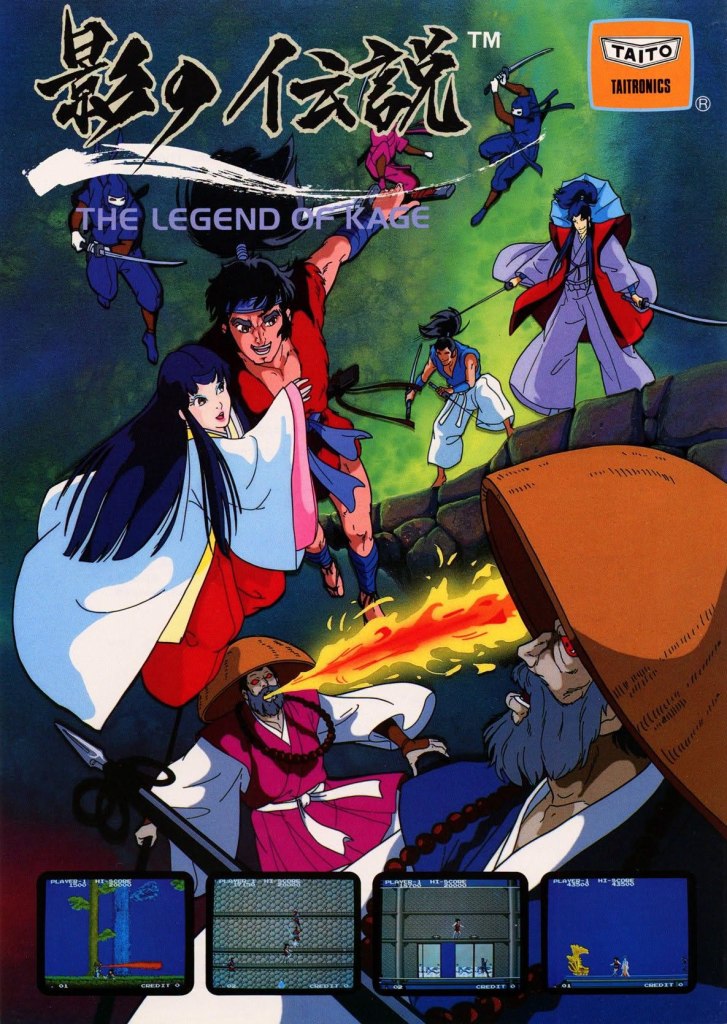
2. The Legend of Kage Japanese Arcade Flyer
Action and excitement in ancient Japan!
In my life, I never had the opportunity to play the original arcade version of The Legend of Kage and ended up playing only the Nintendo Family Computer (Famicom) port. Behind the scenes, Taito itself came close to preventing The Legend of Kage from being released in the arcades. The company placed it in a certain game show where it received praise by many which prompted Taito to give it a full arcade release. To promote the game, the Japanese arcade flyer had lively hand-drawn artwork that perfectly reflected what the game is about, who the playable hero is and what ancient Japanese setting was used. Fortunately for Taito, The Legend of Kage became a huge commercial hit and this led to the production of ports for different consoles and computers.
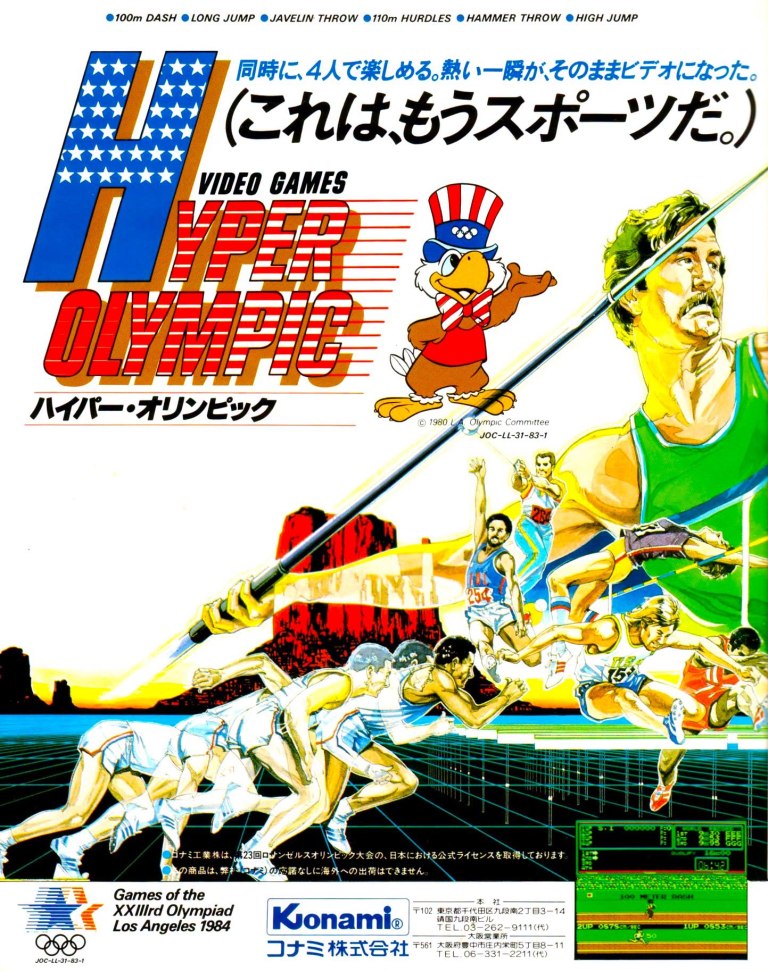
3. Hyper Olympic Japanese Arcade Flyer
Arguably the best track and field game ever made for the arcades.
In 1983, Konami released their summer Olympics-inspired arcade game Hyper Olympic (titled Track & Field in other parts of the world) which offered players the opportunities to compete in a series of events with emphasis on pressing the buttons as quickly as possible. The arcade flyer Konami came up with featured fine-looking hand-drawn artwork showing athletes competing in track and field events (with the types of events displayed at the top-most part of the flyer) while showing just one screenshot (lower right) and displaying the officially 1984 Los Angeles Olympics logo (lower left). In my view, this old arcade flyer does a good job promoting both the arcade game as well as the 1984 Olympics itself. Too bad nobody makes this kind of arcade flyer anymore.
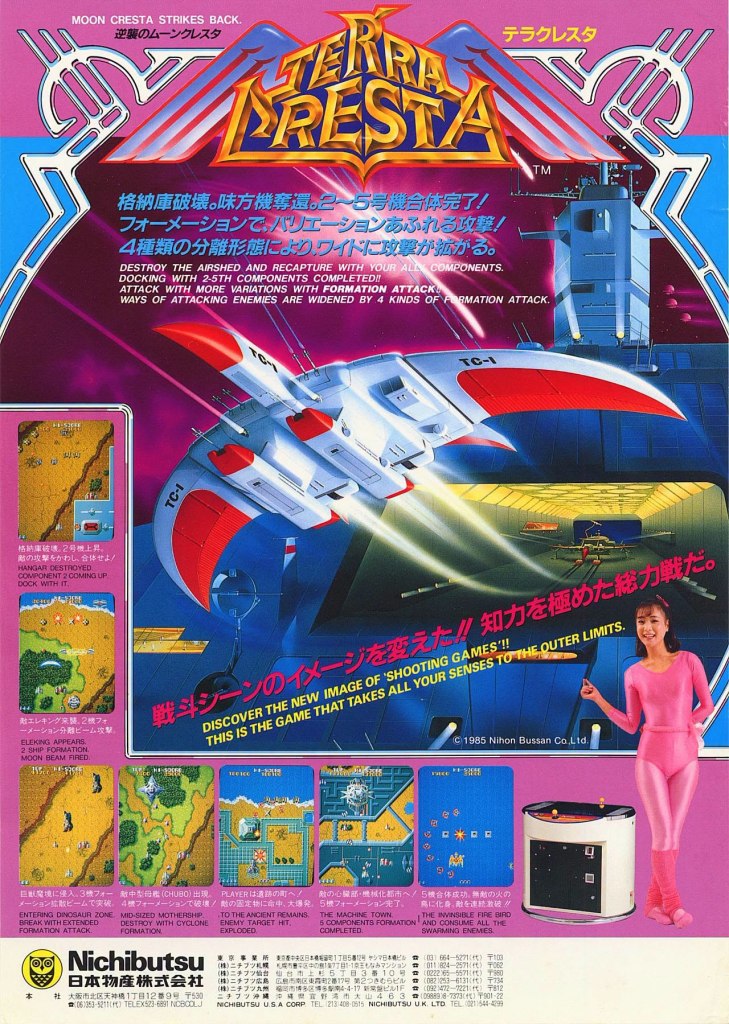
4. Terra Cresta Japanese Arcade Flyer
Did you ever play Terra Cresta in the arcades in Japan?
Nichibutsu, which produced a lot of arcade games that were released only in Japan, released Terra Cresta in Japanese arcades in 1985. It turns out Terra Cresta is a sequel to their 1980 game Moon Cresta which itself was their first big arcade hit game. Nichibutsu literally loaded the front of Terra Cresta’s arcade flyer with lots of visuals and details. As you can see, seven screenshots of the game were displayed (each with descriptive text), a fancy looking artwork that emphasized the science fiction setting, some English descriptive text, the cocktail table arcade machine and a pretty Japanese lady wearing an aerobics outfit with legwarmers (popular in the 1980s). This flyer truly has a strong 1980s flavor.
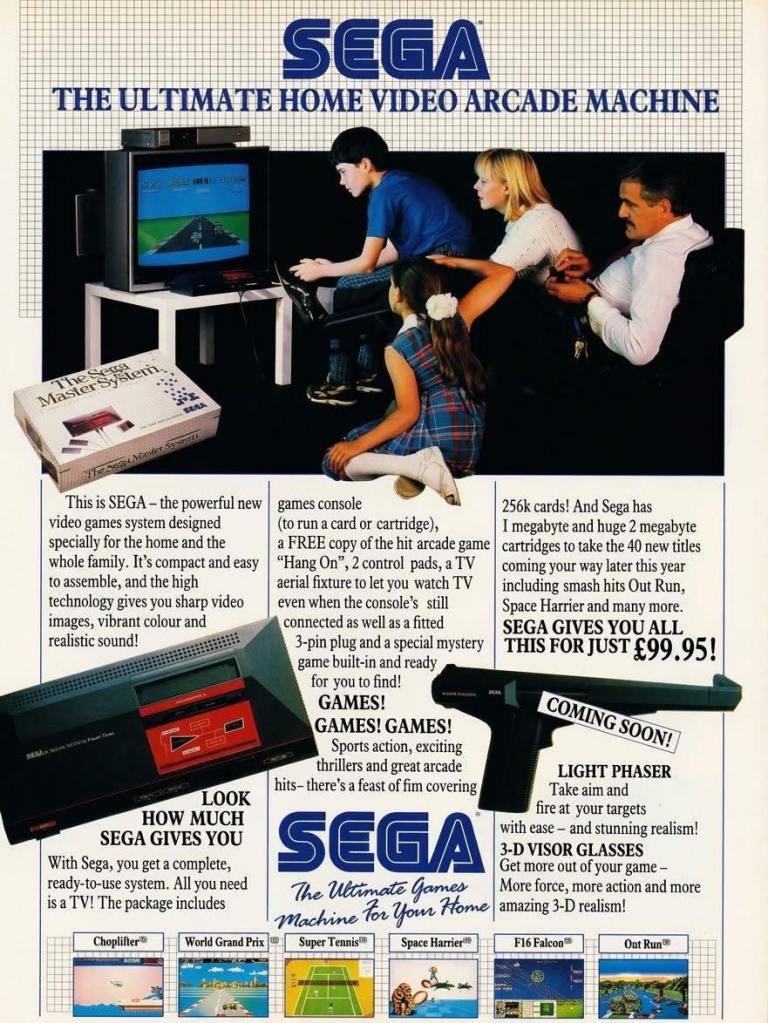
5. Sega Master System European Print Ad
From the early days of Sega’s console business.
After many years doing arcade games, Sega made the bold decision to start competing in console gaming with the release of the SG-1000 in 1983 in Japan. Even though Nintendo was a very tough competitor with the best-selling Famicom, Sega did not give up and proceeded to launch their console in America and Europe referred to as the Master System. In a serious attempt to gain customers specifically in England, Sega made a print ad showcasing a family sitting in front of a TV set with the young boy playing a racing game on a Master System. Looking at how the descriptive text was presented, it was clear that Sega emphasized bringing the arcade game experience into the comfort of home while also promising that a lot more new games will be released in the near future. This is an eye-catching ad and also a fine example of aggressive marketing by Sega.
6. Ken Griffey Jr.’s Winning Run North American Print Ad
What was the best baseball video game you ever played?
Following the commercial success of the 1994 Super Nintendo Entertainment System (SNES) game Ken Griffey Jr. Presents Major League Baseball, Nintendo got Ken Griffey Jr. again as endorser and proceeded with the follow-up Ken Griffey Jr.’s Winning Run. With the highly talented Rare (Donkey Kong Country) chosen as game developer, Nintendo was highly confident with the baseball sequel and the 2-page print ad reflected that. The Ken Griffey Jr.’s Winning Run ad had a striking image of a broken baseball bat on one side while the game’s details, two screenshots and the creative description dominated the other side. While I am not so interested in baseball, I can say that this old print ad is indeed attention-grabbing.
7. 2Xtreme North American Print Ad
From the time when the X Games were wildly popular.
Remember how popular the X Games (Extreme Games) were back in the 1990s? Early in the life of the PlayStation console, Sony released ESPN Extreme Games which sold over a million copies worldwide. As expected, a follow-up titled 2Xtreme was approved for a 1996 release. Sony came up with a 2-page ad that had an upside-down X Games participant with roller blades dominating most of the space and six screenshots were displayed. The descriptive text in the lower part of the ad was deliberately written to be hip and cool.
8. Macross Plus Japanese Arcade Flyer
The front.
The rear.
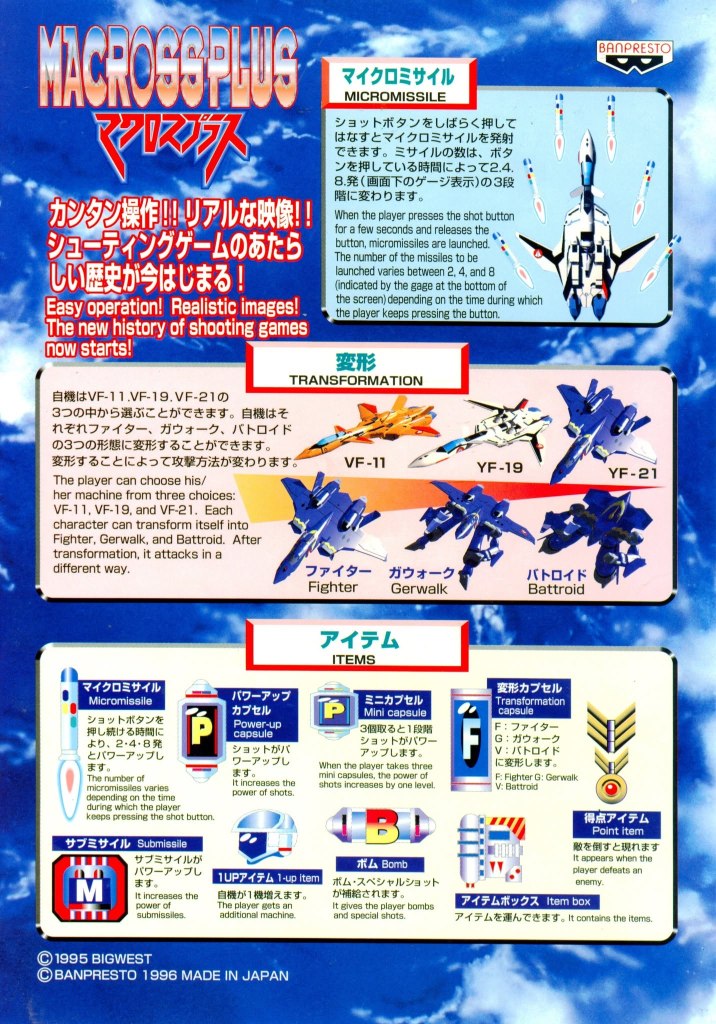
Based on the mid-1990s anime OAV, the Macross Plus video game from Banpresto was designed as a vertical-scrolling 2D shooter that captures the feel and intensity of the anime’s spectacle. The front of the Japan-only arcade flyer showcased the YF-19 Excalibur, the YF-21 Sturmvogel and the VF-11 Thunderbolt (plus the basic arcade controls on the lower-left) which were all rendered in 3D polygons to delight Macross fans and gamers who are interested in new 2D shooting experiences. The rear of the flyer showed additional details and it even includes English text descriptions. Strangely, no screenshots of the game were displayed. Being a long-time Macross fan, I can say this old arcade flyer is still engaging to look at.
9. Macross VF-X2 North American Print Ad
An impressive looking print ad for a Macross video game that never got released in North America.
In the late 1990s, Bandai prepared to launch Macross VF-X2 (the sequel to 1997’s Macross Digital Mission VF-X) on the PlayStation console in North America. This was a very intriguing move because Bandai never brought the mentioned 1997 Macross game outside of Japan. Shortly after the official announcement of a North American release, Macross VF-X2 got featured in video game magazines, an English demo of the game (first mission only) was distributed through Official U.S. PlayStation Magazine, and Bandai came up with the 2-page print ad you see here. Unfortunately, Macross VF-X2’s North American release got cancelled because of copyright issues and legal obstacles (note: Harmony Gold held the Western rights to Robotech and actively blocked the release of genuine Macross products in America). As such, this impressive looking Macross VF-X2 print ad for North America ended up as a promotion for nothing!
10. Star Wars: Racer Arcade Japanese Print Ad/Poster
This is one of the many video games based on Star Wars: The Phantom Menace.
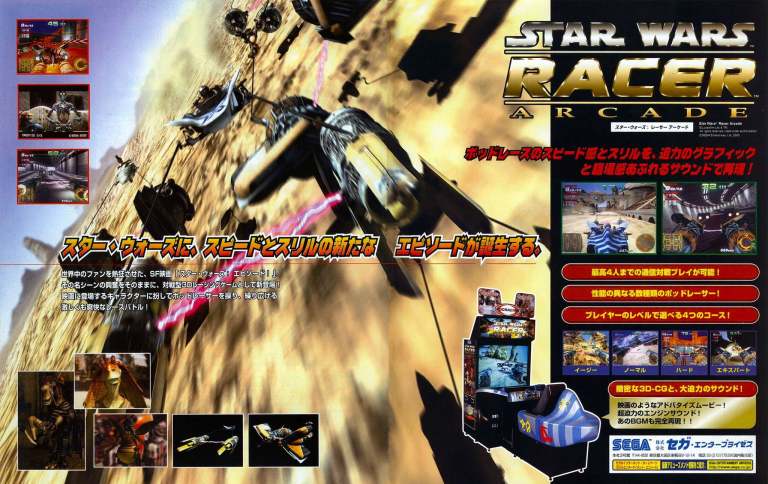
In 1999, Star Wars Episode I: The Phantom Menace was a massive box office hit in theaters around the world and it marked a new era of Star Wars movies with digital effects available. Similar with 1993’s Jurassic Park, George Lucas’ movie also had a huge lineup of merchandise, action figures and video games. The pod racing from the movie became the basis for Star Wars: Racer Arcade which was released in Japan on June 2000, and then in America a month later. To help arcade operators attract gamers and Star Wars fans, a print ad and poster were released featuring a very dynamic image of pod racing from the game dominating the background, a few screenshots displayed and some computer-generated of characters and vehicles. At the lower right part of the ad/poster is the image of the arcade machine which has a huge screen, a seat and control panel. The descriptive Japanese text was written to excite both fans and gamers. Did you play this Sega-produced Star Wars game in the arcades?
11. Konami Wai Wai World Japanese Print Ad
Can you spot Simon Belmont, Mikey Walsh and King Kong in this Japan-only print ad of Konami Wai Wai World?
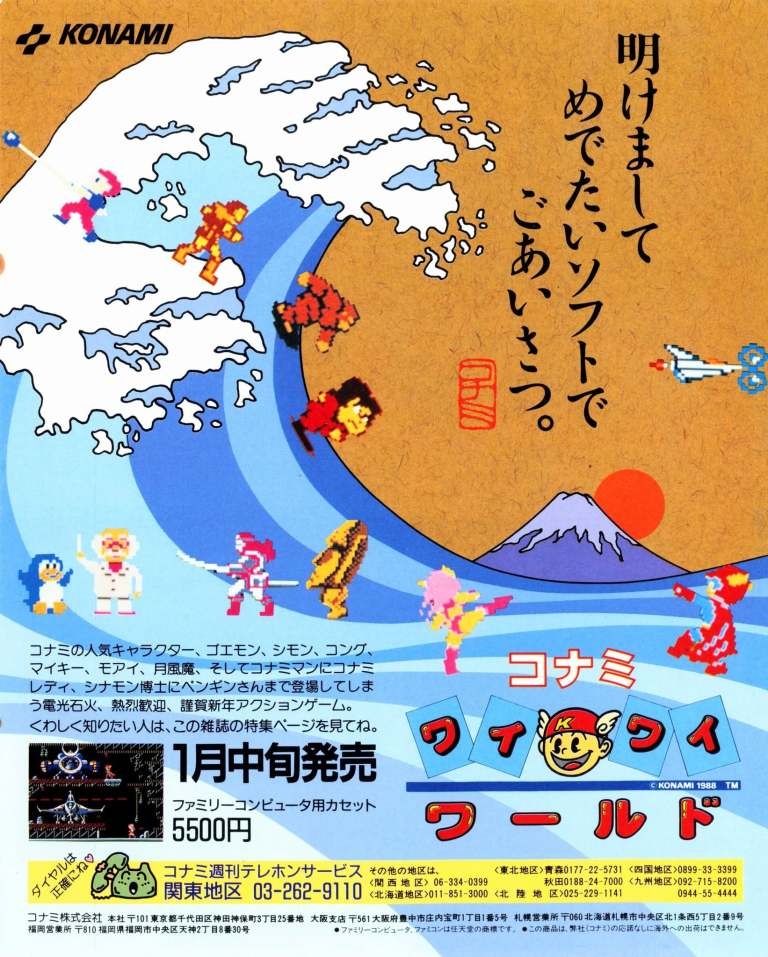
Going back to the late-1980s, Konami released a 2D adventure game on the Famicom that was very ambitious as it featured side-scrolling treks, vertical-scrolling shooting sequences and, most notably, a cast of characters that emphasized crossovers between intellectual properties of gaming. I am talking about Konami Wai Wai World (sometimes called Konami World for short) which had characters, settings and elements of Konami’s own properties like Gradius, Castlevania and Twin Bee. Not only that, King Kong of King Kong 2: Ikari no Megaton Punch and Mikey Walsh of The Goonies were also featured which is astonishing because they represent entertainment intellectual properties that were licensed to Konami for video game adaptation. That said, the emphasis of crossovers and excitement was shown in the form of 2D character sprites in this Japanese print ad of Konami Wai Wai World. This is the kind of game that Konami itself will never be able to make again and to do a remake or an enhanced re-release of Konami Wai Wai World will require overcoming all the legal obstacles in the way.
Recently in Japan, police officers arrested two men from the nation of Chile over the theft of four luxury wristwatches from a store in Tokyo, according to a news report by NHK World. One of the suspects admitted that he and his partner planned to sell the stolen watches and bring the money back with them to Chile.
To put things in perspective, posted below is an excerpt from the news report of NHK World. Some parts in boldface…
Japanese police have arrested two Chilean men on suspicion of stealing four luxury wristwatches from a shop in Tokyo’s Nakano Ward earlier this week. The stolen items are worth about 200 million yen, or roughly 1.25 million dollars.
Police arrested the men after they were found at a private lodging facility in the western city of Osaka on Thursday. The suspects are 23 and 33 years old, respectively.
Police say investigators found a watch of the same brand as one of the stolen items in the men’s belongings.
Police quote the 23-year-old suspect as saying the two stole only one watch. They also say the 33-year-old suspect admitted to the allegations, and told investigators that the pair planned to sell the watches and take the money back to their home country.
Police say they are investigating where the suspects traveled to after they arrived in Japan on August 21, and what led them to commit the crime.
The theft occurred at a watch retailer in the Nakano Broadway commercial facility on Tuesday. A display case was broken with a hammer. Two perpetrators were in the shop for only around 10 seconds before fleeing the scene.
For additional insight, watch the related Nippon TV news video below.
Let me end this piece by asking you readers: What is your reaction to this development? Do you think the two Chilean suspects are guilty of the crime beyond reasonable doubt? Do you think the investigators will be able to find more details behind the theft and how the suspects traveled all the way to Osaka after committing the theft in Tokyo? If you were in Japan during the past few years, have you ever witnessed foreigners committing violence or theft there?
Thank you for reading. If you find this article engaging, please click the like button below, share this article to others and also please consider making a donation to support my publishing. If you are looking for a copywriter to create content for your special project or business, check out my services and my portfolio. Feel free to contact me with a private message. Also please feel free to visit my Facebook page Author Carlo Carrasco and follow me on Twitter at @CarloCarrascoPH as well as on Tumblr at https://carlocarrasco.tumblr.com/and on Instagram athttps://www.instagram.com/authorcarlocarrasco
As it enjoys the many benefits of the ongoing tourism boom, Vietnam now has the opportunity to truly build itself up economically by means of long-term investments and creating new jobs. That said, the tourism industry of the nation has shifted focus from attracting visitors to higher spending, longer stays and other economic opportunities, according to a news report by VnExpress.
To put things in perspective, posted below is an excerpt from the news report of VnExpress. Some parts in boldface…
Vietnam is shifting tourism growth from attracting more visitors to generating greater value from each trip, with a focus on higher spending, longer stays, green development, technology application and cultural experiences.
Thecountry aims to welcome 45-50 million international visitors and 160 million domestic tourists by 2030, Do Cam Tho, head of the Planning and Finance Division at the Vietnam National Authority of Tourism (VNAT) under the Ministry of Culture, Sports and Tourism, said at HORECFEX Vietnam 2026, a major hospitality and tourism forum.
She said 2026-27 would be a pivotal period in shifting tourism development from expansion in scale to deeper value creation.
Vietnam welcomed 21.2 million international visitors and 137 million domestic tourists in 2025, with total tourism revenue estimated at around VND1 quadrillion ($38.1 billion).
In thefirst seven months of 2026, the country received nearly 13.92 million foreign tourists, up 13.8% year on year, whiledomestic visitors numbered about 98 million, withtourism revenue of 675 trillion VND.
International visitors currently spend an average of US$1,200-1,400 per trip in Vietnam, while domestic tourists about 2.4-2.6 million VND (US$92-99).
About 70% of foreign visitors come from China, the Republic of Korea, Japan and Taiwan (China), while markets with higher spending power, including the Middle East, Northern Europe, North America and Australia, still account for relatively small shares.
Tourism is receiving greater attention as Vietnam seeks to achieve rapid national development and make tourism a spearhead economic sector, Tho was quoted by Tuoi Tre (Youth) newspaper as saying.
Under the proposed approach, Vietnam targets total tourism revenue of $80-90 billion by 2030. The country is expected to have about 1.5 million accommodation rooms and tourism is projected to create around 5.8 million direct and indirect jobs.
Among three development scenarios for 2030, the most ambitious targets annual international visitor growth of 15-18%. Achieving it will require institutional reforms, development of the night-time economy, diversification of high-end markets and measures to increase visitor spending.
VNAT said Vietnam will continue to consolidate Northeast Asian and ASEAN markets while expanding into Europe, North America, Australia and other markets with high spending capacity and longer stays.
India, the Gulf Cooperation Council (GCC) countries, Russia and Muslim markets have been identified as areas with significant growth potential.
For domestic tourism, the focus will shift from boosting visitor numbers to encouraging higher spending, with an emphasis on two- to three-day weekend getaways, high-end Meetings, Incentives, Conferences and Exhibitions (MICE) tourism, family vacations and night-time tourism.
Let me end this piece by asking you readers: What is your reaction to this development? Do you think Vietnam’s tourism industry players are fully prepared to make the most of the economic benefits that come with surging foreign and domestic tourism? Do you think new investments related with the tourism boom will be made soon in Vietnam? How many millions of new jobs do you think will be created in Vietnam as a result of the tourism boom?
Thank you for reading. If you find this article engaging, please click the like button below, share this article to others and also please consider making a donation to support my publishing. If you are looking for a copywriter to create content for your special project or business, check out my services and my portfolio. Feel free to contact me with a private message. Also please feel free to visit my Facebook page Author Carlo Carrasco and follow me on Twitter at @CarloCarrascoPH as well as on Tumblr at https://carlocarrasco.tumblr.com/and on Instagram athttps://www.instagram.com/authorcarlocarrasco
As Japan is in the middle of reforming its immigration system and the permanent residency requirements for foreigners, a 72-year-old man from South Korea was arrested by the local authorities for overstaying in the country for a few decades already, according to a VnExpress news report. The suspect admitted he overstayed and supported himself with different jobs locally and how exactly he entered Japan will surprise you.
To put things in perspective, posted below is an excerpt from the news report of VnExpress. Some parts in boldface…
A 72-year-old South Korean man has been arrested in Japan for allegedly overstaying his tourist visa for more than 26 years, police said.
Shizuoka Prefectural Police announced on Aug. 26 that the man had entered Japan illegally and continued to live in Yaizu City, Shizuoka Prefecture.
Police said they received a tip about the man in June and subsequently arrested him.
He originally entered Japan in September 1993 on a 15-day tourist visa, using his brother’s passport because he hoped to find better-paid work in the country, as reported by ANNnewsCH.
The man is believed to have remained in Japan since his arrival 26 years ago.
Because visa overstaying was not a criminal offense in Japan until February 2000, when a revised immigration law took effect, police arrested him on suspicion of overstaying from that point onward, according to the Japan Times.
The suspect has admitted to the allegation, telling investigators that he supported himself by working various day jobs.
Let me end this piece by asking you readers: What is your reaction to this development? Do you think the person who informed the local police about the overstaying foreigner should be rewarded? Does this news make you feel concerned about the potential presence of illegal aliens in your local community? Do you think Japan has what it takes to find all of the overstaying foreigners, apprehend them and eventually deport them? If ever the suspect gets deported, do you think he could adjust to life in his native South Korea?
Thank you for reading. If you find this article engaging, please click the like button below, share this article to others and also please consider making a donation to support my publishing. If you are looking for a copywriter to create content for your special project or business, check out my services and my portfolio. Feel free to contact me with a private message. Also please feel free to visit my Facebook page Author Carlo Carrasco and follow me on Twitter at @CarloCarrascoPH as well as on Tumblr at https://carlocarrasco.tumblr.com/and on Instagram athttps://www.instagram.com/authorcarlocarrasco