Cloak & Dagger Is Fun And Challenging To Play On My Xbox Series X

Welcome back Xbox fans, geeks, retro gaming fans and other gamers!

If you are disappointed with modern console gaming and if you don’t like what the game makers are doing, retro gaming will restore the fun and help you forget about the disappointment.

When I was a very young boy, I saw Cloak & Dagger on home video. The movie – starring Henry Thomas and Dabney Coleman – was a thriller laced with Cold War elements, espionage and video gaming. In fact, the video game giant of the time – Atari – was involved in the movie production and their arcade game Cloak & Dagger appeared in the form of a fictional Atari 5200 game. Each time I saw the gameplay footage while watching the movie (read my retro review by clicking here), I was thrilled and always wanted to play it.

Finally, in 2024, I was able to play Cloak & Dagger on my Xbox Series X after purchasing the physical copy of Atari 50: The Anniversary Celebration. Since then, I’ve been replaying Cloak & Dagger a lot in the comfort home and it sure is challenging and fun.

To be clear, this is not a retro game review of Cloak & Dagger. Rather, it is a nostalgic close look at the Atari video game that happened to be featured in the 1984 movie which in turn was released on 4K Blu-ray in 2022. Combine that with the Atari 50 release also in 2022, the Cloak & Dagger game made a comeback in the retro gaming radars of many while also becoming available to play with on modern consoles and Windows PC.

Game design and gameplay

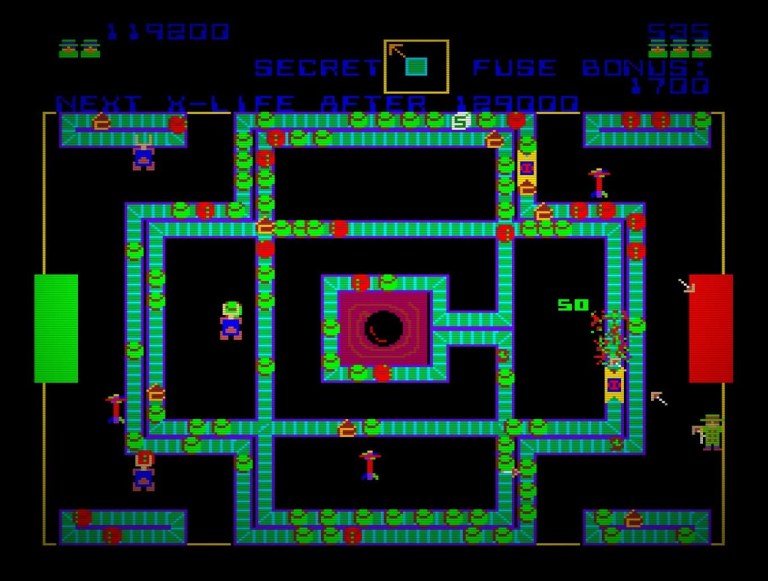
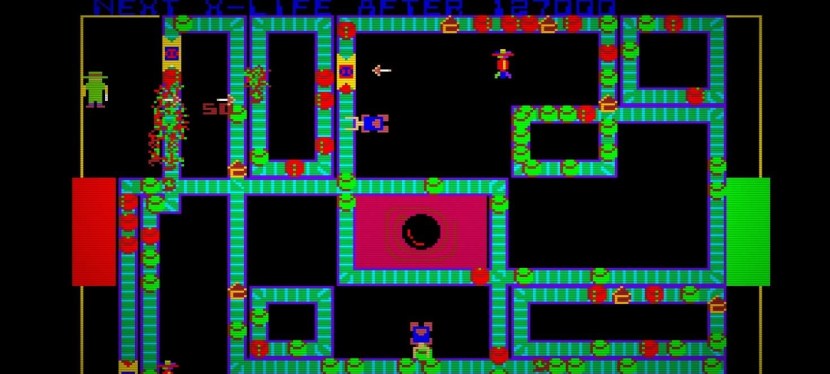
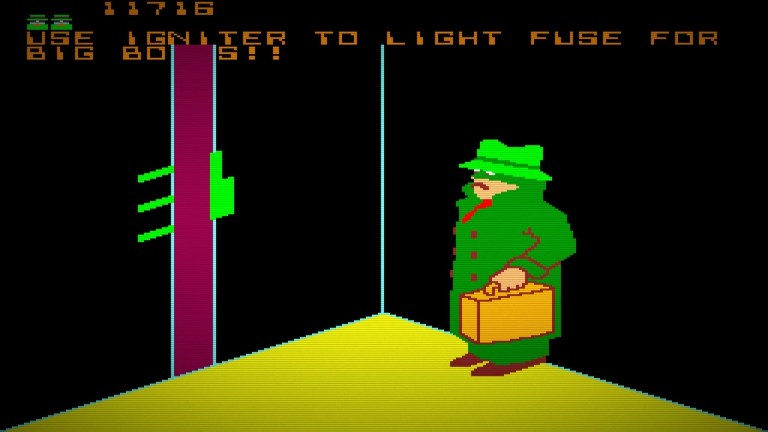
In the arcade game, you play Agent X (the 2D sprite colored green and wearing the hat) and you will encounter challenges from enemies (often robot guards which can fire shots at you), conveyor belts that can impact your movement and the possibility of the giant bomb exploding.

Developed by Atari for the arcade, Cloak & Dagger is a 2D multi-directional shooter in which you play Agent X (who appears wearing a hat, a mask and a coat) whose mission is to infiltrate the massive base of an enemy that goes very deep underground (33 levels/floors).

Each level the player enters require surviving obstacles and defeating (or avoiding) the enemies (robot guards are the most common opposition while the crawling eye occasionally appears) and then move to the other side of the level in order to get into another elevator to keep on descending. The ultimate goal is to reach the final level below to recover top secret plans from Dr. Boom (the main villain and the one responsible for stealing the said plans), destroy his underground bomb factory (which explains the existence of oversized bombs and many explosives on conveyor belts) and get out.

As registering high scores was the trend of video gaming back then, players will be rewarded with shooting at the enemies (example: robot guards are worth 50 points each when asleep or 200 points when awake, while the main villain Dr. Boom is worth 50,000 points) as well as interacting with in-game items such as the unarmed explosives (10 points when shot but worth 100 when collected), armed explosives (50 points each when destroyed) and mystery boxes (worth 200 to 1,800 points plus random effects on the player such as extra life, improved speed and even extra life). For every 30,000 points scored, the player will be granted an extra life. In many levels are gigantic bombs that players can ignite using the Fuse button for extra points. 

Between levels, you will see an animated Agent X during the short rides in the elevator.
The game is very challenging because so much is going on around you. The robot guards will always fire shots at you while the conveyor belts often move items and explosives (both the armed and unarmed). You can ride a converyor belt to move around but make sure you do not touch the armed explosives (red containers) as they will kill you upon contact.

Other items players can collect are the extra boxes (resulting in extra life) and the secret maps (which partially reveal safe paths through each fourth level).

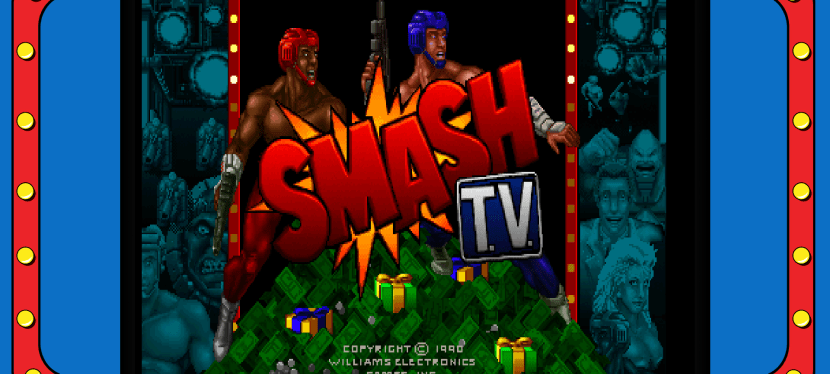
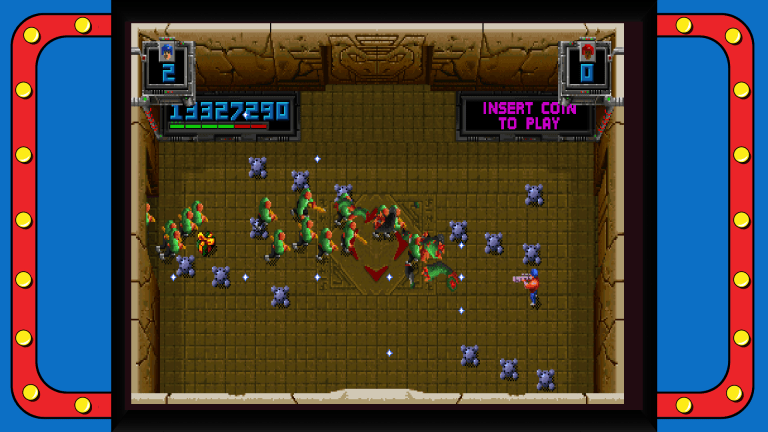
When it comes to the controls, Cloak & Dagger has a dual joystick (twin sticks) setup similar to Robotron 2084 and Smash T.V. (read my retrospective look at it by clicking here). One joystick allows players to move Agent X around while the other allows shooting projectiles (using Agent X’s weapon) at any direction. The fuse action (for igniting the oversized bombs in the enemy lair) is done by simply pressing a button. As I am playing this game on Xbox Series X, the game’s controls functioned well on the Xbox controller. Both precision and response of the game are sharp with the Xbox controller.

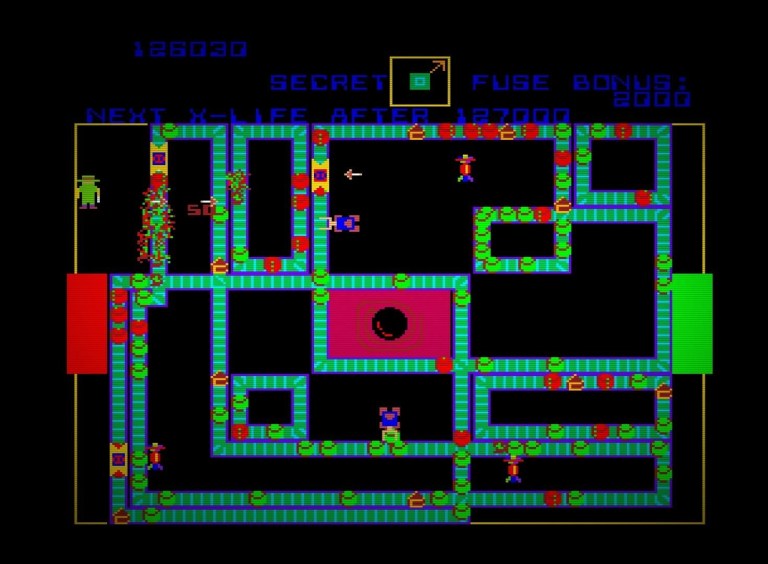
When it comes to the enjoyment and overall value of Cloak & Dagger, I can say that it is indeed more challenging and more chaotic when compared to the more notable twin stick games Robotron 2084 and Smash T.V. For one thing, each level has different layouts complete with obstacles or hazards plus enemies that will certainly challenge players. Many levels have conveyor belts moving unarmed explosives, armed explosives (which you must avoid touching because you will die upon direct contact) and items around which form obstacles when it comes to shooting robot guards on the other side (note: you can use the obstacles defensively when the robot guards fire at you).

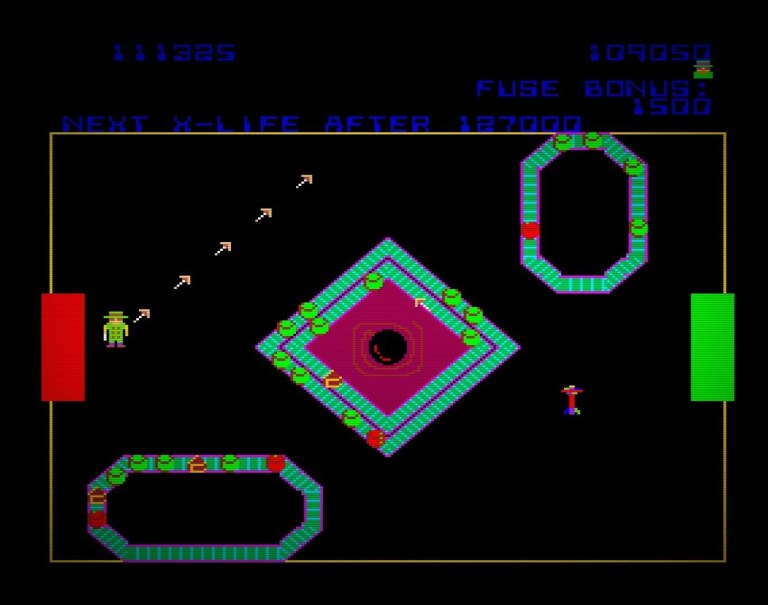
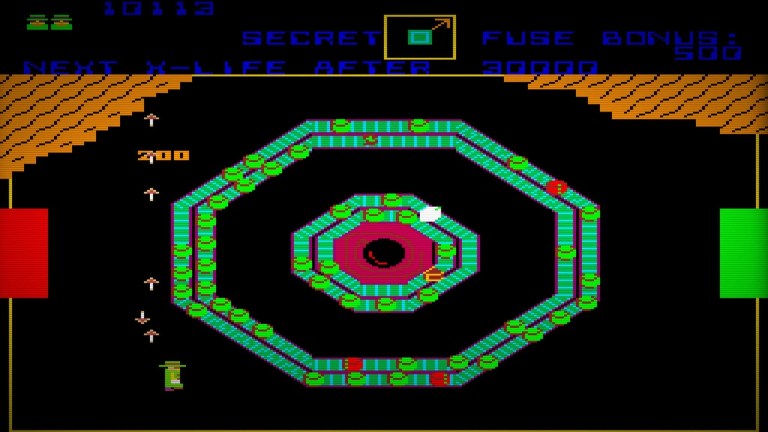
From time to time, you will enter a somewhat sparse looking level like this which actually has mines hidden. The locations of the mines do get revealed in specific moments but only for a few seconds. That being said, it is always best to be able to collect maps that appear on conveyor belts.

Apart from the robot guards and the crawling eye, there are also forklifts which don’t attack you but their solid exterior will deflect any projectile you fire at them and send them back to your direction.

To be clear, you are not required to destroy all the robot guards (or the huge crawling eye enemies) in each level. You can simply try to avoid obstacles and enemies to make it to the next elevator to keep on descending although doing so means scoring much lesser points. Picking up items will add points and randomly alter your character’s capabilities (by picking up mystery boxes).

Adding pressure to you on each level is the giant bomb located in the middle which you can ignite using the fuse action. Once ignited, you only have a few seconds left to make it to the next elevator as the giant bomb will explode and spread fire throughout the whole level. Igniting the said thing will grant you a lot of points provided you survive and made it to the elevator going down.

To be able to play the Cloak & Dagger arcade game on your console or on PC, purchase a copy of the Atari 50 collection.

Cloak & Dagger is indeed a fun game but the opposition, the obstacles, time limit (indicated by the giant bomb) and chaotic turn of events make it more challenging than Midway’s two notable twin stick shooters. The game would have been more forgiving and more playable if only it did not have the one-hit-death embedded on it. Considering the challenges each level has and the many levels players have to go through, it would have made more sense to have Agent X have a life bar/health meter/shield and be able to absorb some enemy projectiles (before dying).

Of course, the game was never designed to be like that and the one-hit-death is also found in Robotron 2084 and Smash T.V. That being said, if you played Cloak & Dagger with a high level of success and completed everything without losing all your lives, then you would be a great achiever.

Pop culture significance

It has been reported that Cloak & Dagger – which was released as an arcade kit for machines that ran Robotron 2084, Joust, Defender and Stargate – did not have a big presence in the arcades in America. The 1984 movie dramatically increased public awareness of it.

Print ad of the arcade game.

When Cloak & Dagger was still in game development (created and led by Russell Dawe) under the title “Agent X”, Atari and certain movie producers became aware of each other’s projects and decided to work together. The deal made business sense as Atari could benefit from reaching a mainstream audience through the cinemas while the movie producers joined in the 1980s Hollywood trend of movies that featured powerful computers, software and artificial intelligence as seen in WarGames (1983), Superman III (1983), and The Terminator (1984).

Much to the credit of the filmmakers, the presence of the game actually added good value to the plot. The film’s concept of the Cloak & Dagger game becoming a very wanted object (plot device actually) resulting in chases, intense action scenes and suspense turned out to be very believable as well. It should be noted that director Richard Franklin took inspiration from Alfred Hitchcock which gave the film a unique touch on the suspense and shock scenes. Check out the movie clip below…

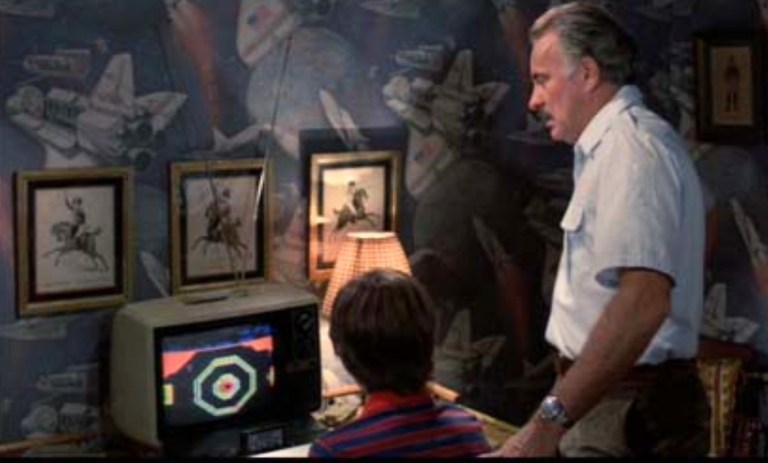
When it comes to the Cloak & Dagger game appearing within the movie of 1984, you will see how the filmmakers and Atari cleverly created the illusion of the game operating on the Atari 5200 console by showing not only video game footage, but also having Henry Thomas acting like he’s playing it using the Atari 5200 controller (which has an analog joystick and buttons on one side). When I was a young boy watching the movie, I found the game footage very entertaining and wanted to play it.

Cloak & Dagger portrayed as running on Atari 5200 in this scene with Henry Thomas and Dabney Coleman. (photo source – AtariProtos.com)
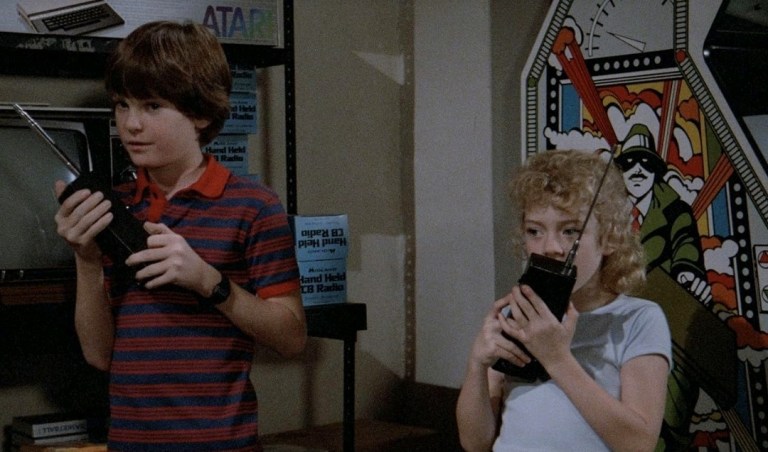
A Cloak & Dagger arcade cabinet seen in the background (right side). (photo source – IMDB.com)

If you are an Xbox gamer who intends to play Cloak & Dagger now, buy the Atari 50 collection in digital format by clicking https://www.xbox.com/en-US/games/store/atari-50-the-anniversary-celebration/9N3TFDSQ531T

+++++

Thank you for reading. If you find this article engaging, please click the like button below, share this article to others and also please consider making a donation to support my publishing. If you are looking for a copywriter to create content for your special project or business, check out my services and my portfolio. Feel free to contact me with a private message. Also please feel free to visit my Facebook page Author Carlo Carrasco and follow me on Twitter at  @HavenorFantasy as well as on Tumblr at https://carlocarrasco.tumblr.com/ and on Instagram athttps://www.instagram.com/authorcarlocarrasco

I am having a lot of fun with Smash T.V. on my Xbox Series X

Welcome back Xbox fans, geeks, retro gaming enthusiasts and other gamers!

I finally did it! I finally played the arcade version of the classic game Smash T.V. as I recently purchased Midway Arcade Origins (Xbox 360) on the Xbox store. Thanks to backward compatibility, Midway Arcade Origins operated smoothly on my Xbox Series X and it comes with more than thirty arcade games owned or published by Midway Games from the early 1980s to the early 1990s.

My history of playing Smash T.V. is awkward. The very first time I played the game was not in the arcade but with the Smash T.V. port released on the Super Nintendo Entertainment System (SNES).

The classic game debuted in arcades in 1990 and during that precise point of time, I rarely visited arcades here in the Philippines. I started visiting arcades more starting in 1992 as the fighting game craze started luring new gamers driven by the popularity of Street Fighter II. To the best of my memory, I saw very few arcade machines of Smash T.V. and never got to play the game. In fact, there were very few arcade machines that had the dual joystick control set-up which was exactly required to play Smash T.V.

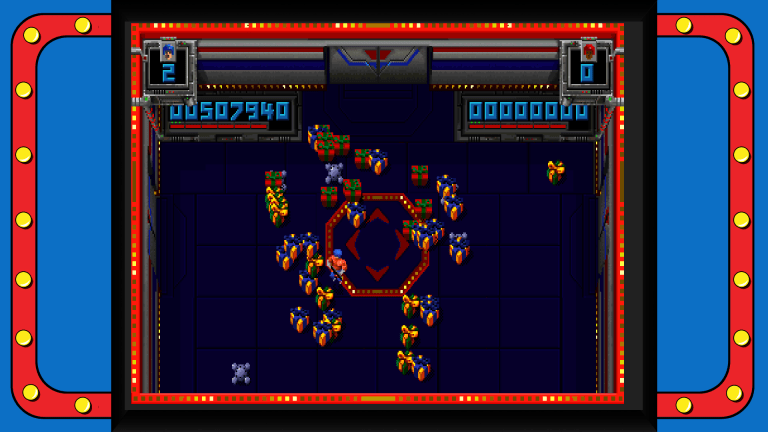
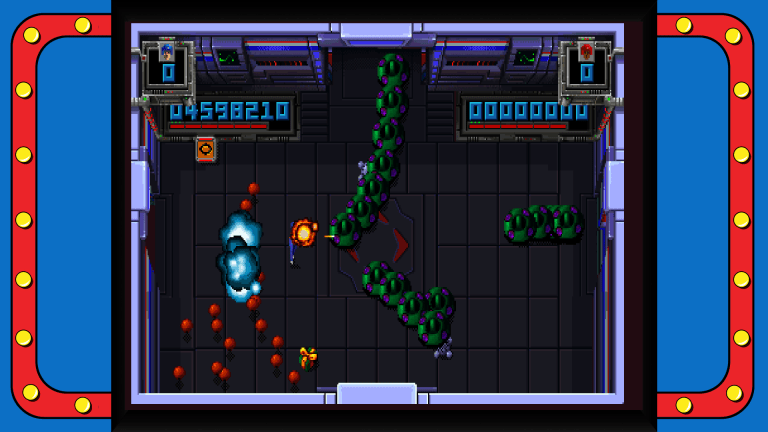
The 2D sprite activity and action can get pretty wild and intense on-screen during battle. Expect lots of waves of enemies coming in before you proceed to the next room.

To make things clear, arcade games were already popular here in the Philippines and there were lots of local arcades particularly in shopping malls. As for playing Smash T.V. on the SNES, it was fun but the SNES control pad was not ideal for the immense in-game shooting.

Going back to Midway Arcade Origins, I played Defender first and had some bouts of fun with it. After that, I went back to the main selection and scrolled through the many other games offered until I saw Smash T.V. and selected it. As soon as I started playing, I was immediately engaged as the fun kept growing as I played.

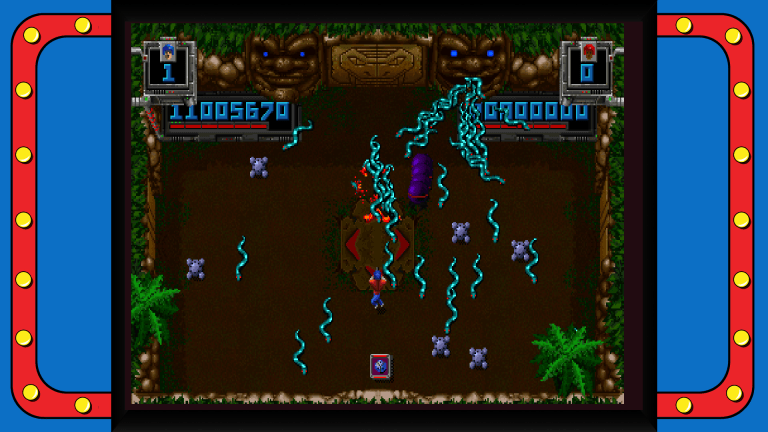
Apart from dealing with dangerous enemies, you will also encounter in-game hazards such as this room releasing snakes a lot.

Firstly, the game made fine use of the two analog sticks of the Xbox controller which was the closest thing to matching the dual joysticks set-up of the original arcade game. The left analog stick was for movement while the right analog stick allowed me to shoot in different directions. The severe limitations on shooting on the controller of the SNES were completely gone, and as I played the game more on Xbox, I found myself moving around enemies and obstacles while being able to fire at directions where shooting was needed.

Secondly, Smash T.V. on Midway Arcade Origins is the genuine arcade experience from the controls to the functionality, gameplay, the visual design and 2D sprites that dominated the screen. For those who don’t have the original arcade machine, this is the closest thing to enjoying the arcade fun of Smash T.V. in the comfort of home. I can also say that the game ran smoothly on my Xbox Series X and not a single case of slowdown nor any cases of visual distortions ever happened!

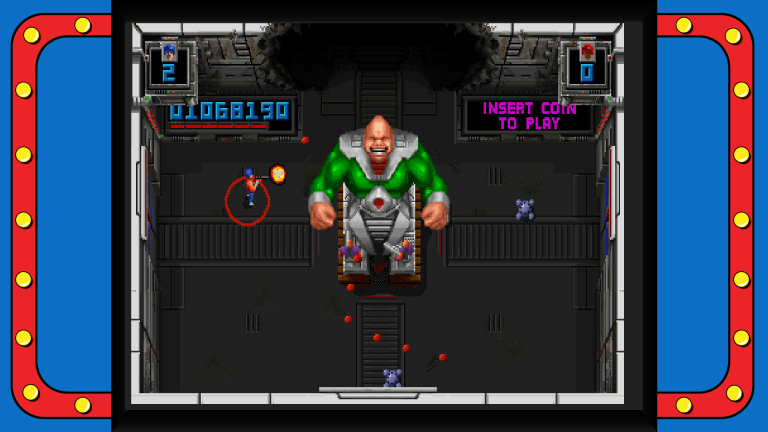
To really defeat an end-of-level boss like this one, you need to use whatever special weapons or power-ups that appeared during battle. Be mindful of the enemy’s powerful defense and attacks.
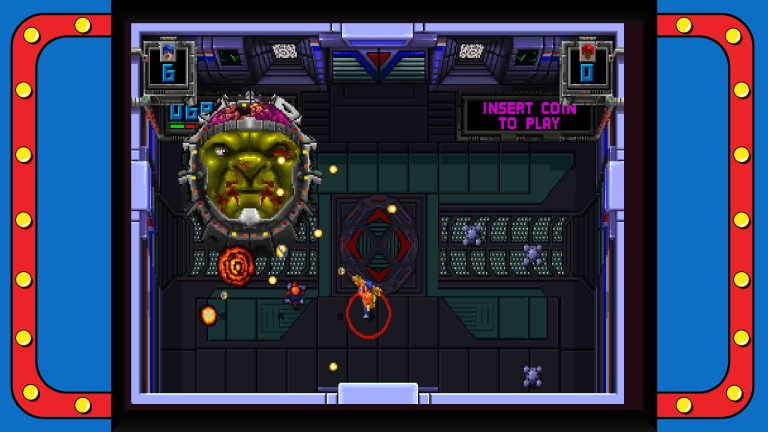
This face particular end-of-level boss deteriorates further as I kept on attacking him with special weapons.

More on the gameplay, it is undeniably challenging as many enemies enter and their different abilities to attack you ensures lots of intense moments of action and struggle to survive. The on-screen action is often intense and still the gameplay did not grow tiresome to me. More on the combat, there are always huge and powerful enemies (end-of-level boss) at the conclusion of each level and defeating them will push you to use special weapons as soon as they pop up.

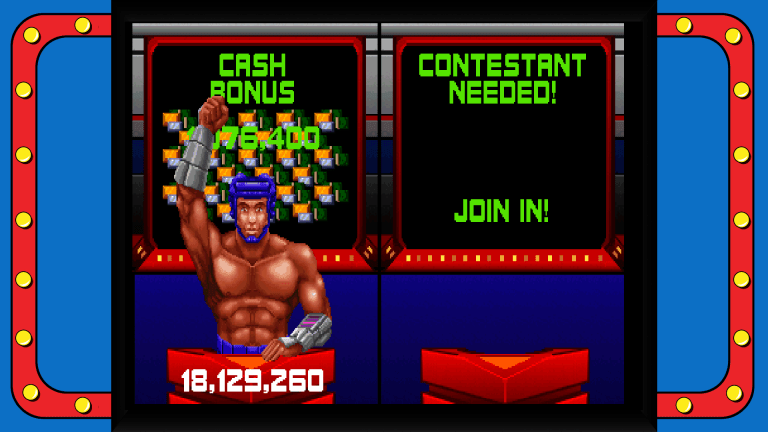
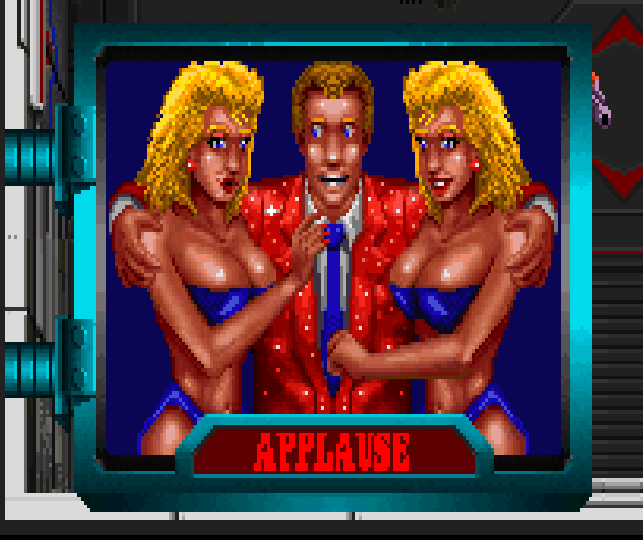
Lastly, there is also the prize aspect of the game (which has a dystopian TV concept inspired by the 1987 film The Running Man starring Arnold Schwarzenegger) which allows you to collect prizes (in cash or prize items) while playing. The prizes can add a lot to your score and even your potential entry into the online leaderboards (see below).

There is nothing like collecting prizes in the game! It is as thrilling as the action.
Between the levels are the bonus segments in which the value of the prizes you collected will be added to your overall score (technically in-game money earned).

Thirdly, I really like the online leaderboards and score attack mode that came with Midway Arcade Origins. For Smash T.V., the score attack challenge is to score as many points as you could using only one turn (which comes with the initial six in-game lives). Score attack does not allow any continues (that is for free play mode) and this was enough to make me focus on my skills, moves and timing when it comes to fighting waves of several enemies that entered the in-game arenas.

I was able to make my presence felt online as the servers for the leaderboards are still functioning and recording in-real time the scores achieved.

Every time you encounter new enemies, you have to observe how they move, attack and behave.

Smash T.V. is a classic not only because of its immense fun gameplay, entertainment impact and timeless game design, but also because it was a creative wonder from significant game creators such as Eugene Jarvis (Defender, Robotron 2084), John Tobias (Mortal Kombat) and Mark Turmell to name a few. The game borrowed elements from The Running Man and the creators made their own concept that mixed well with the game design they came up with. The result is a highly playable, challenging and ultimately enjoyable video game. To learn more about the creation and history of Smash T.V., watch the in-depth videos of PatmanQC and Slope’s Game Room below.

“Big money! Big prizes! I love it!”

Smash T.V. is a lot of fun and its gameplay never gets old. It is currently my favorite of all the games in Midway Arcade Origins and it is an excellent addition to my retro gaming experience on my Xbox Series X.

If you are an Xbox fan who is interested in retro gaming and if you have already decided to play Smash T.V., buy Midway Arcade Origins by clicking https://www.xbox.com/en-US/games/store/midway-arcade-origins/bs97kvxlt9lk

+++++

Thank you for reading. If you find this article engaging, please click the like button below, share this article to others and also please consider making a donation to support my publishing. If you are looking for a copywriter to create content for your special project or business, check out my services and my portfolio. Feel free to contact me with a private message. Also please feel free to visit my Facebook page Author Carlo Carrasco and follow me on Twitter at  @HavenorFantasy as well as on Tumblr at https://carlocarrasco.tumblr.com/ and on Instagram athttps://www.instagram.com/authorcarlocarrasco

Retro Gaming Ads Blast – Part 29

Welcome back readers, fellow geeks and electronic gaming fans!

In this edition of the Retro Gaming Ads Blast (RGAB) series, we will take a look at another batch of retro gaming print ads – including arcade flyers – from the 1980s and 1990s.

For the newcomers reading this, Retro Gaming Ads Blast (RGAB) looks back at the many print ads of games (console, arcade, computer and handheld) that were published in comic books, magazines, flyers, posters and newspapers long before smartphones, social media, the worldwide web and streaming became popular. To put things in perspective, people back in the 1980s and 1990s were more trusting of print media for information and images about electronic games and related products.

With those details laid down, here is the newest batch of retro gaming print ads for you to see and enjoy…

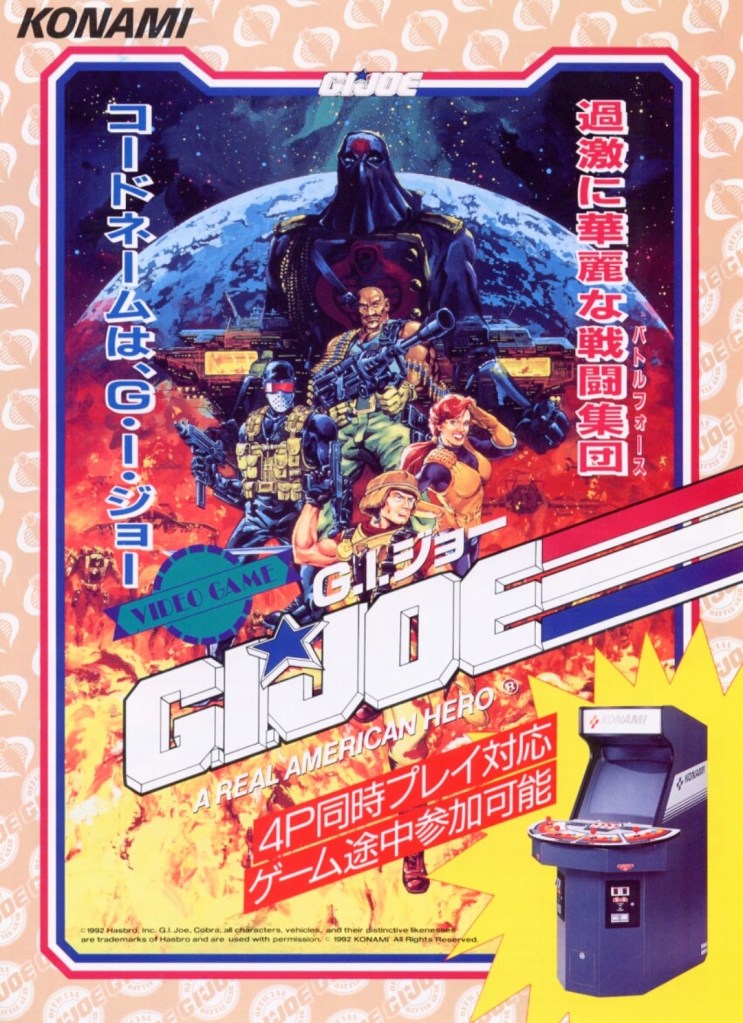
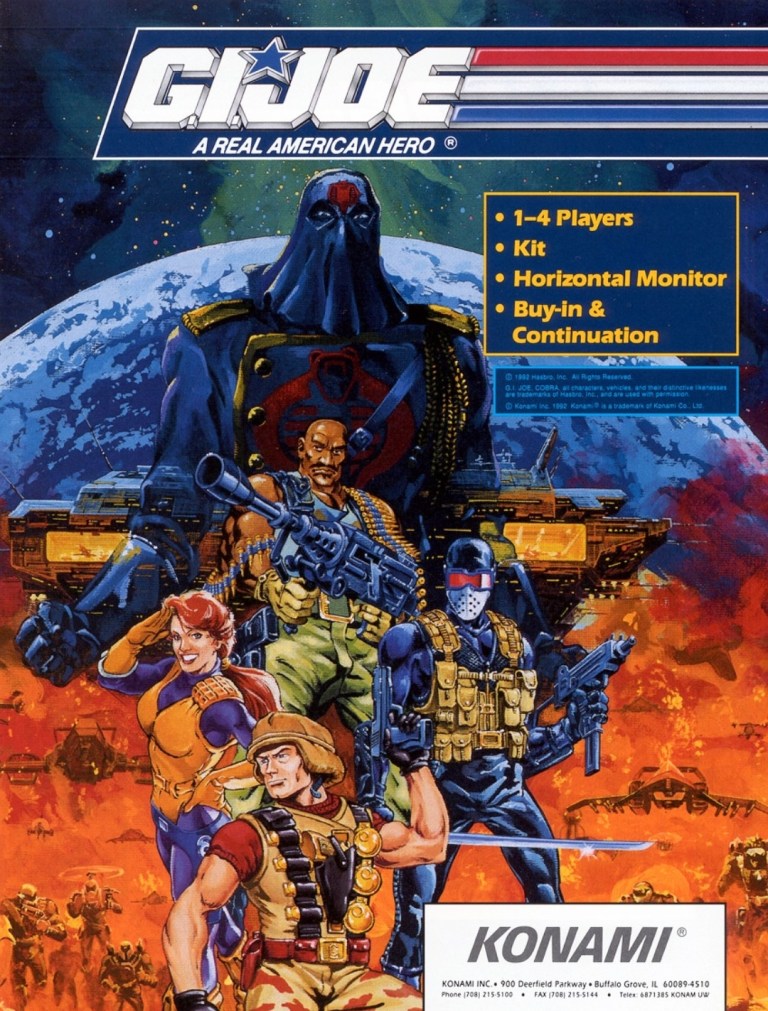
1. G.I. Joe: A Real American Hero arcade flyers

G.I. Joe: A Real American Hero arcade flyer for the Japanese market.
The North American arcade flyer of G.I. Joe.

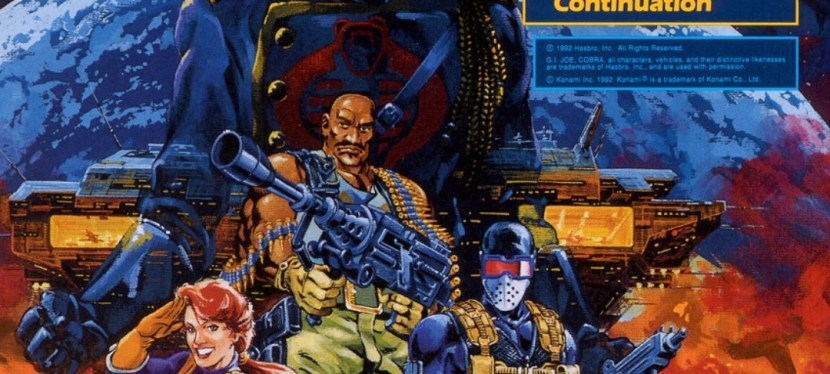
Back in the 1980s, my friends and I saw lots of episodes of G.I. Joe: A Real American Hero on TV and there were lets of toys of it available. I also read some comic books of G.I. Joe. While there were G.I. Joe video games, I never got to play its early 1990s arcade game from Konami. By comparing the two arcade flyers of G.I. Joe: A Real American Hero, the American flyer excels visually showing the characters with a powerful war-themed background. The Japanese flyer had smaller space for the same artwork and displayed the arcade cabinet (take note of the controls laid out to accommodate up to four players). Between the two, I prefer the American arcade flyer.

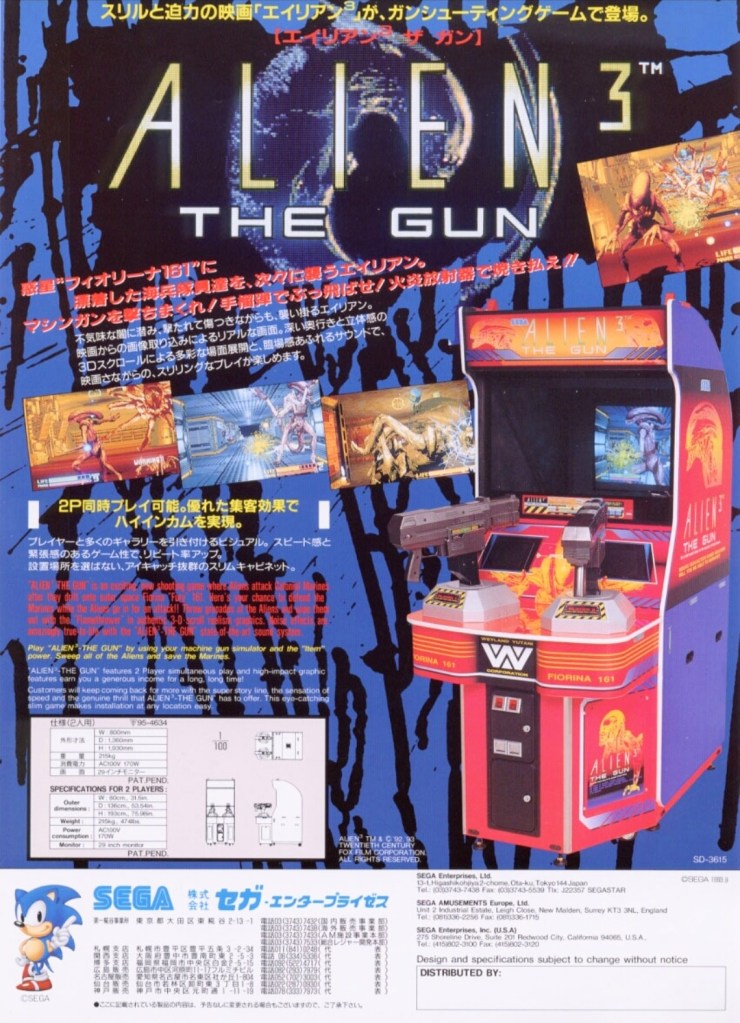
2. Alien 3 Japanese arcade flyer

With this arcade flyer, Sega clearly showed arcade operators what to expect when ordering machines of Alien 3: The Gun.

Watching Alien 3 inside the cinema in 1992 was one of the worst moviegoing experiences I ever had. By the time video games based on the movie were released, I was surprised to see how action-packed and entertaining they looked. The one Alien 3 game that captivated me was Sega’s Alien 3: The Gun in the arcades as its design and concept contradicted the essence of the film. The Japanese arcade flyer has this aggressive approach on laying down the details, displaying the arcade machine and displaying carefully selected screenshots to excite both gamers and arcade operators. This arcade flyer still looks good today.  

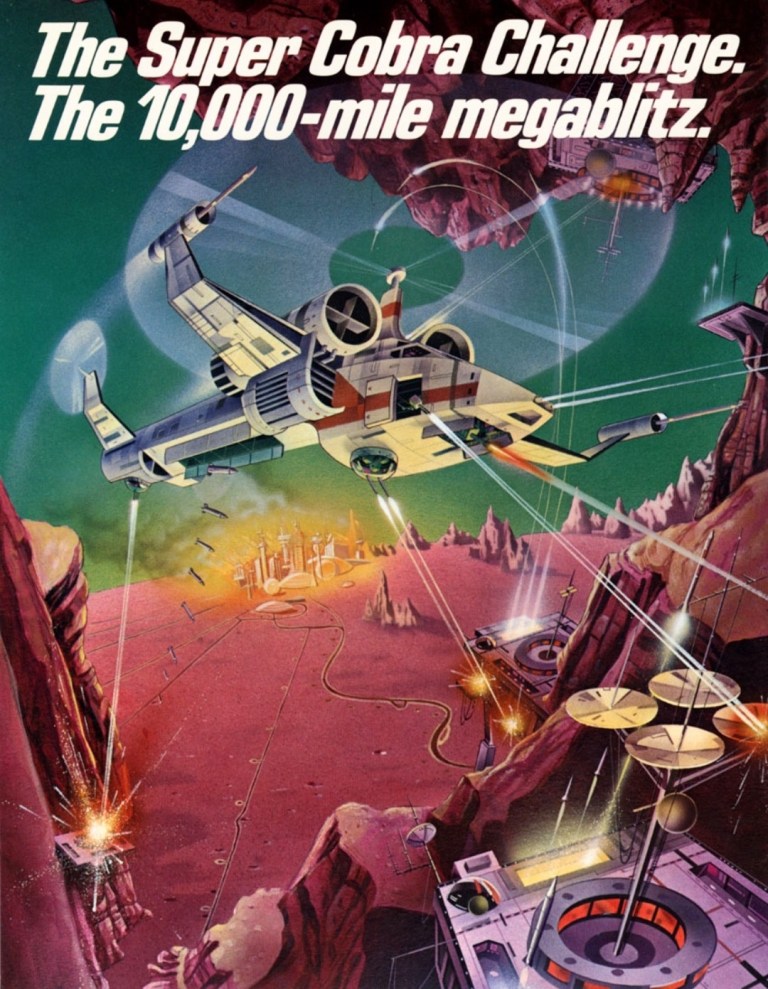
3. Super Cobra arcade flyer

A great artwork emphasizing the concept of Super Cobra.

First released in Japanese and America arcades in 1981, Super Cobra is a 2D side-scrolling shooter in which players pilot an armed helicopter through tight caverns while facing enemies capable of firing. The American arcade flyer has great artwork that almost perfectly captures the essence of the game. This is another old arcade flyer that has aged well.

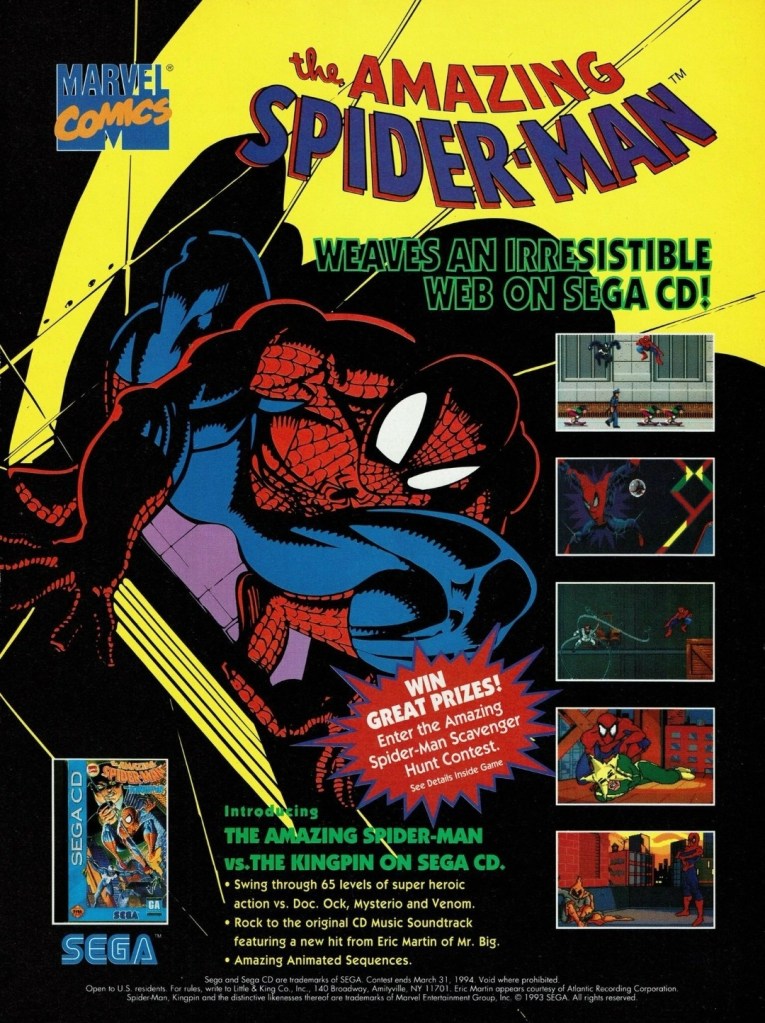
4. The Amazing Spider-Man vs. The Kingpin print ad

Back in 1993, animated sequences included in video games were still new and even exciting.

Moving forward to the year 1993, gamers in America who owned a Sega Genesis console were being motivated by Sega to upgrade their gaming experience with the Sega CD add-on. Along the way, Sega really ramped up efforts to have more games supporting the Sega CD and one of them was The Amazing Spider-Man vs. The Kingpin. The Amazing Spider-Man vs. The Kingpin on Sega CD was actually an updated version of the original 1991 game and Sega’s team included several improvements to take advantage of the CD-ROM technology of the add-on. This print ad showed Sega’s hard work on selling the game.

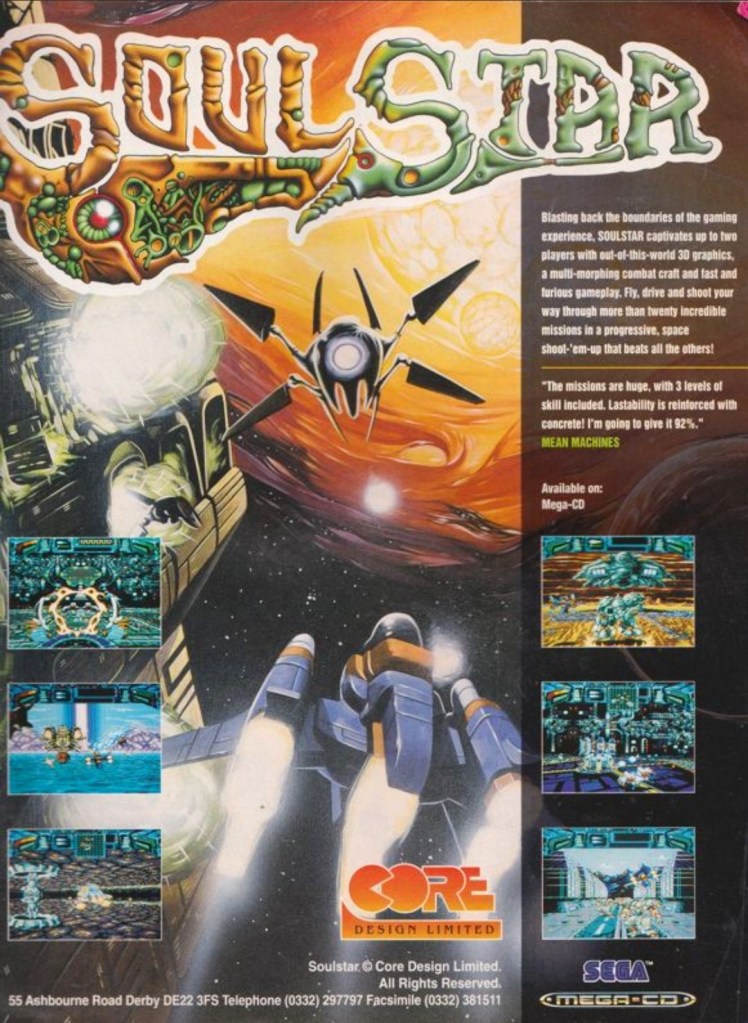
5. Soulstar print ad

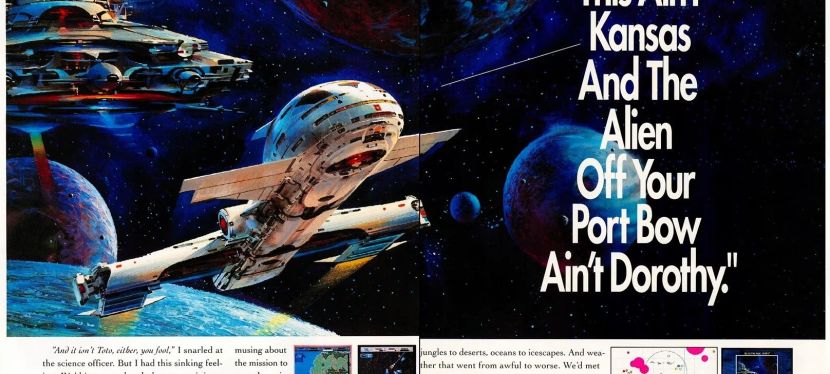
The artwork of this print ad has very strong sci-fi vibes.

Released in 1994 for the Sega CD (Mega CD in other markets), Soulstar was sci-fi 3rd-person shooter that delivered amazing visuals, fun gameplay and an immersive experience of space travel to gamers. This European market print ad is a very effective way to promote the game using carefully selected screenshots, amazing artwork and a cleverly written text description. Still a fine print ad to look at.

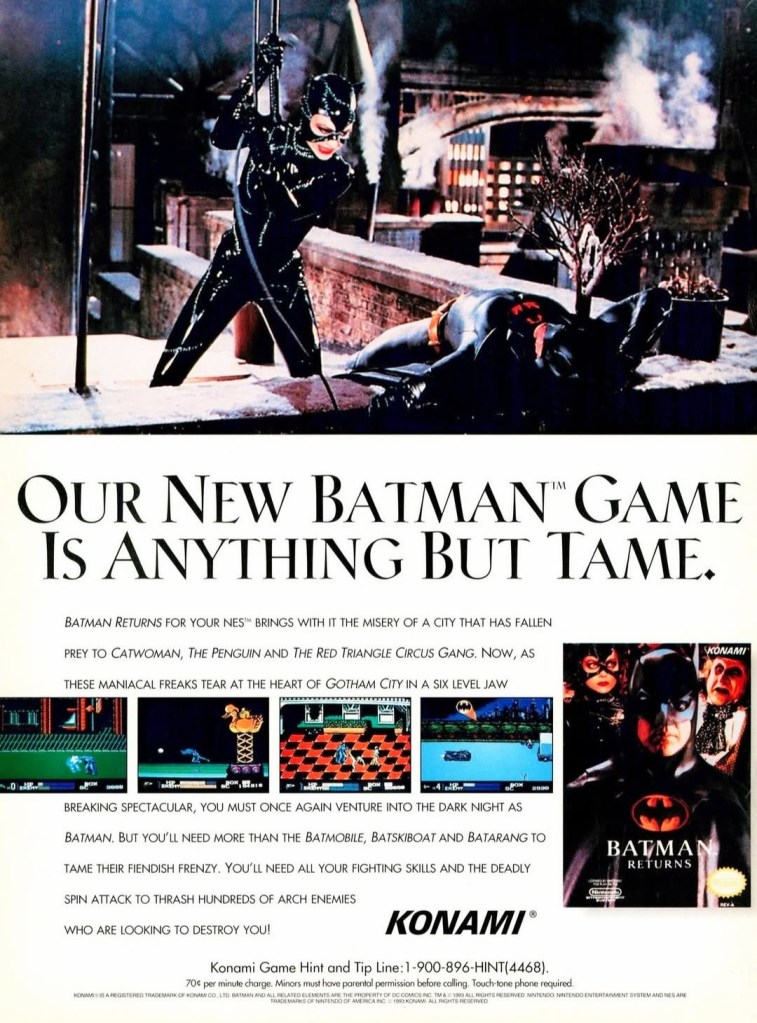
6. Batman Returns print ad

This print ad effectively promoted both the game and the movie. In retrospect, the line “Our new Batman game is anything but tame” turned out to be true as lot of parents who brought their kids to the cinemas for Batman Returns were turned off by the adulterated elements.

In 1992, Batman Returns played in a lot of cinemas but its very dark tone and adulterated elements prevented it from matching the huge box office success of its 1989 predecessor. Regardless, a lot of licensed video games based on the movie were released and in early 1993, Konami released a Batman Returns video game on the aging Nintendo Entertainment System (NES). This print ad used a photograph from the filming of an scene that actually had Michelle Pfeiffer as Catwoman, dominating over the iconic Batman. Also displayed were screenshots, the game’s box cover (showing Pfeiffer, Michael Keaton and Danny DeVito as their respective characters) and the text description. Even if you did not like the movie, this old print ad is a solid way of promoting both the game and the movie. The line “Our new Batman game is anything but tame” strangely turned out very true.

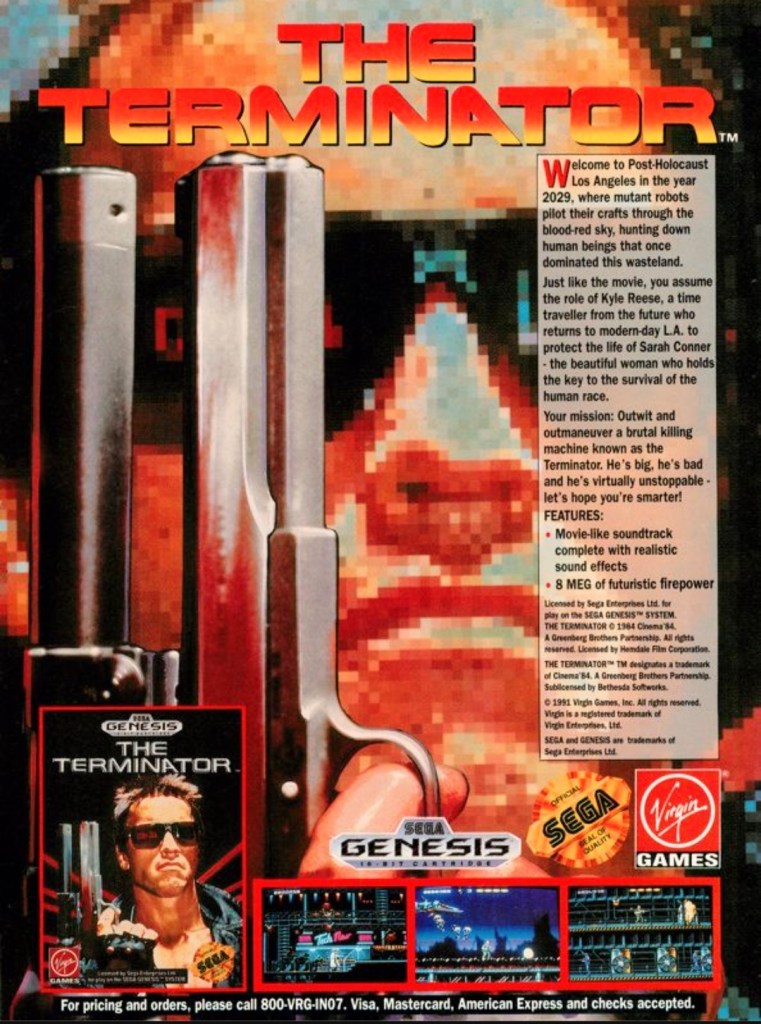
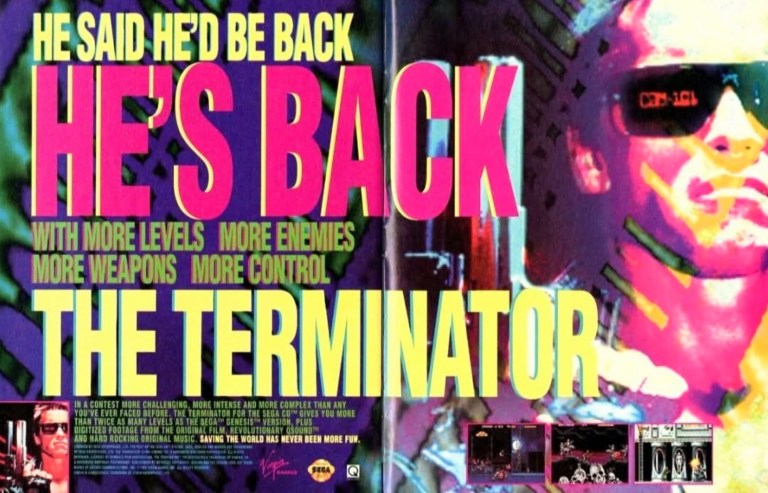
7. The Terminator games print ads

The Terminator for Sega Genesis.
The Terminator for Sega CD.

Released in cinemas in 1984, The Terminator was a surprise hit as well as a career-booster for Arnold Schwarzenegger and James Cameron. What is very notable is the fact that several video game adaptations of The Terminator were released on consoles in the early 1990s. I can only guess this was done to capitalize on the resurgence of the Terminator franchise in connection with Terminator 2: Judgement Day’s much-anticipated release in cinemas. The Sega Genesis version print ad features a digitized close-up of Schwarzenegger’s Terminator while the 2-page Sega CD version print ad used a lot of the space for large text (with an incomplete shot of Schwarzenegger’s Terminator on the edge of the 2nd page) emphasizing “He’s Back” and “The Terminator” while leaving little space for text descriptions and screenshots. Between the two, I find the Sega Genesis ad more effective with its promotion of the game.

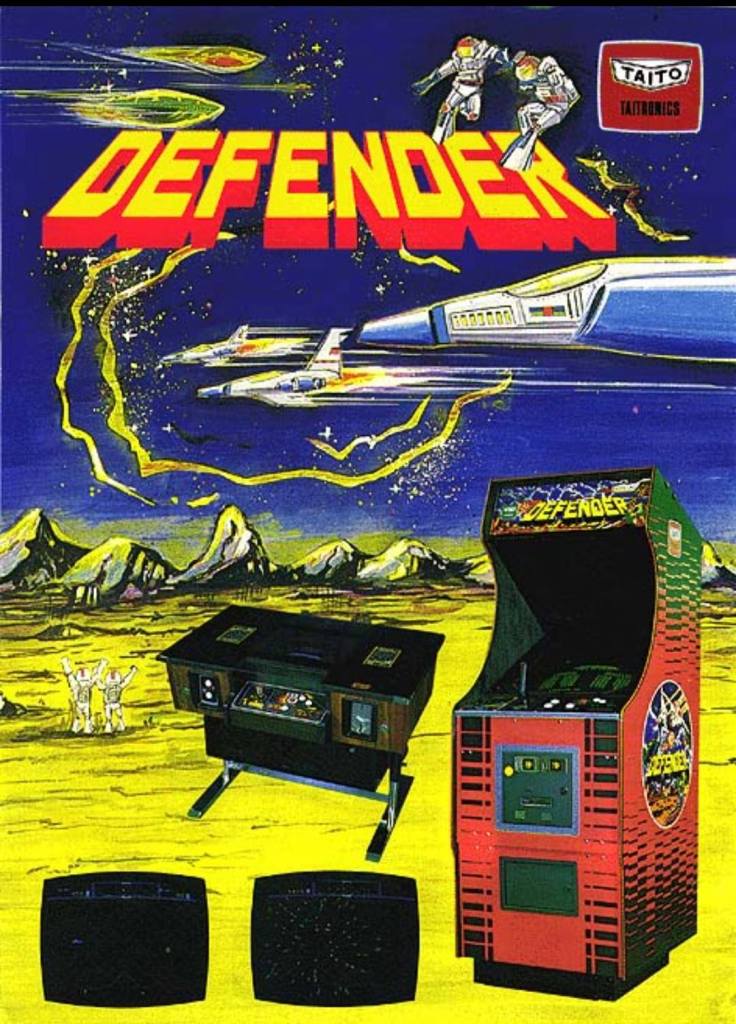
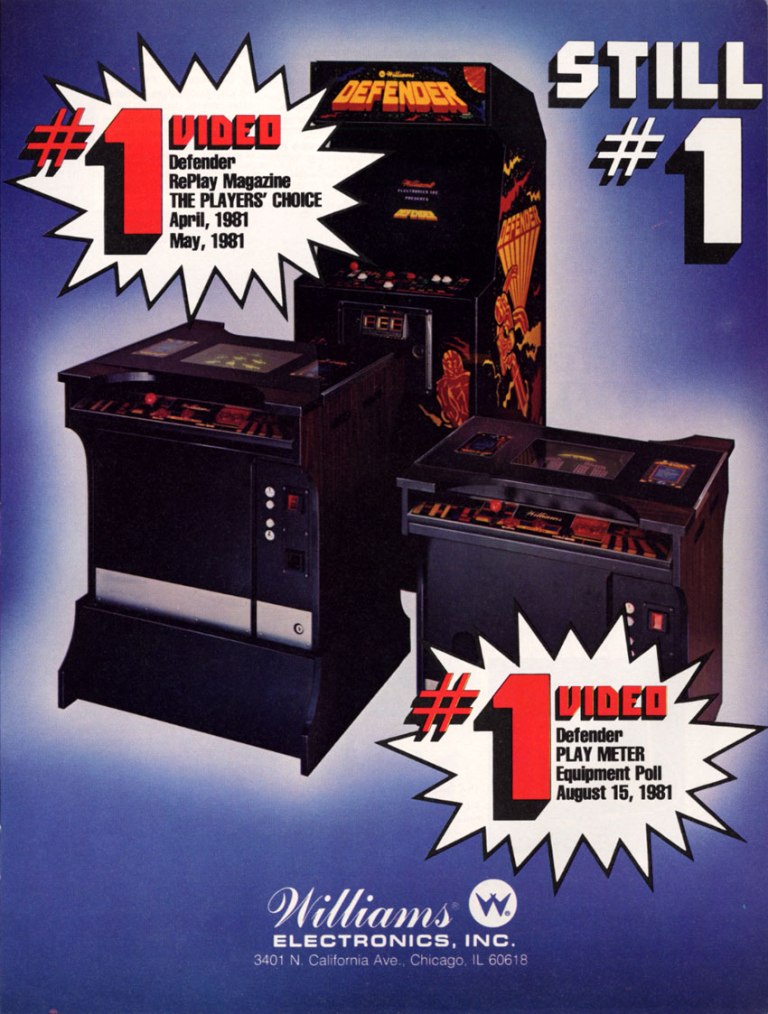
8. Defender arcade flyer

More choices of a very successful game for arcade operators also means more ways for players to play it.

Even though it had a soft start in the early 1980s, the classic game Defender went on to become a massive commercial success in the arcades. Being a major attraction in America’s video game industry, Williams unsurprisingly went on to release this particular arcade flyer to sell to operators different types of Defender arcade machines that could fit into their respective joints while providing gamers choices on how to play the game. Some players preferred to stand in-front of a tall arcade cabinet while others prefer to play the game looking down on the screen. This flyer is an example as to how a company can keep their biggest success moving on while offering business clients more choices.  

+++++

Thank you for reading. If you find this article engaging, please click the like button below, share this article to others and also please consider making a donation to support my publishing. If you are looking for a copywriter to create content for your special project or business, check out my services and my portfolio. Feel free to contact me with a private message. Also please feel free to visit my Facebook page Author Carlo Carrasco and follow me on Twitter at  @HavenorFantasy as well as on Tumblr at https://carlocarrasco.tumblr.com/ and on Instagram at https://www.instagram.com/authorcarlocarrasco
Retro Gaming Ads Blast – Part 25

Welcome back readers, fellow geeks and electronic gaming fans!

In this edition of the Retro Gaming Ads Blast (RGAB) series, we will take a look at another batch of retro gaming print ads – including arcade flyers – from the 1980s and 1990s.

For the newcomers reading this, Retro Gaming Ads Blast (RGAB) looks back at the many print ads of games (console, arcade, computer and handheld) that were published in comic books, magazines, flyers, posters and newspapers long before smartphones, social media, the worldwide web and streaming became popular. To put things in perspective, people back in the 1980s and 1990s were more trusting of print media for information and images about electronic games and related products.

With those details laid down, here is the newest batch of retro gaming print ads for you to see and enjoy…

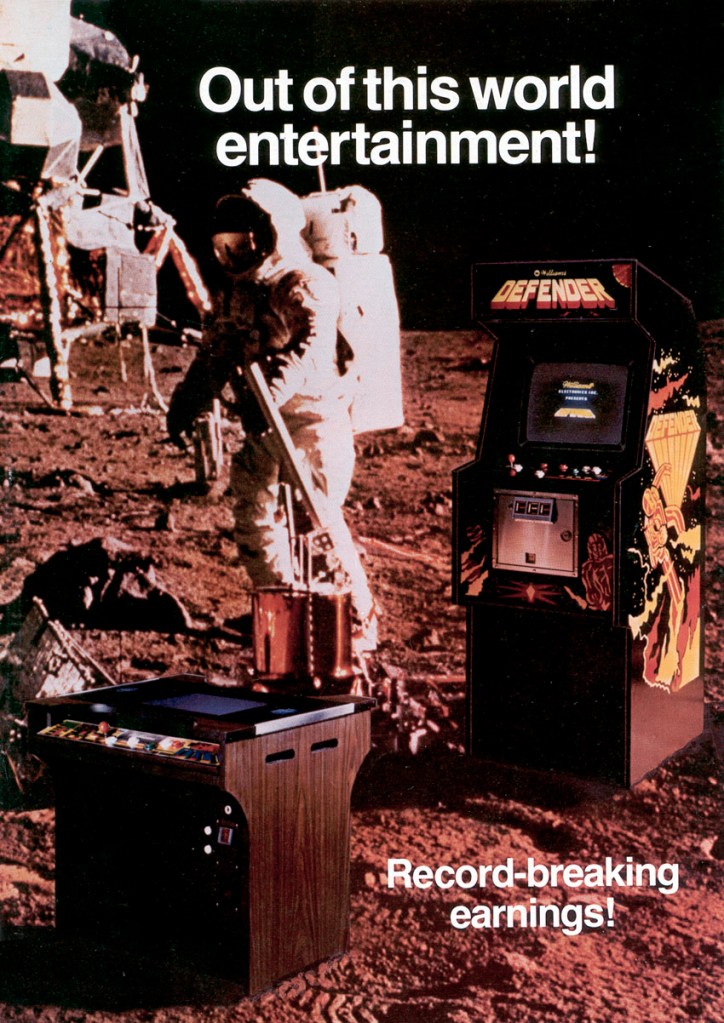
1. Defender arcade flyer

Perhaps Atari did not have enough original artwork of Defender to be used in this arcade flyer. So they ended up using footage of an astronaut on the moon.

Very long ago, I played the classic game Defender a lot on the Atari 2600. Strangely enough, I never played its arcade version as my visits to arcades were quite limited as I was so young back then. When it comes to the arcade flyer of Defender, I find the use of stock footage of an astronaut on the moon as the artistic backdrop baffling because the game’s concept was all about fighting back alien invaders and protecting the citizens. Ironically, the image blended well with the photos of two arcade machines showcased.

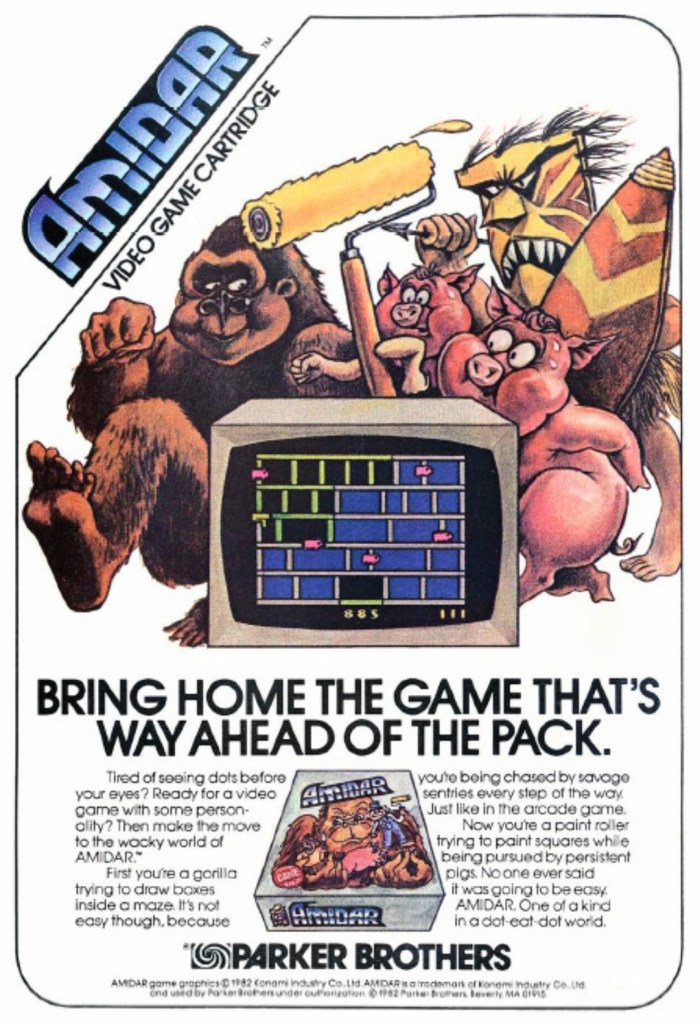
2. Amidar Atari 2600 print ad

Does this ad make you think about King Kong or animals?

When I was a young boy, I saw this Parker Brothers print ad of Amidar appear in many superhero comic books I read. I never played the game on the Atari 2600 nor in the arcades. Each time I saw this ad, I always wondered how the game played and what its creative concept was all about. The constant showing of a giant gorilla on the game box cover reminded me of King Kong.

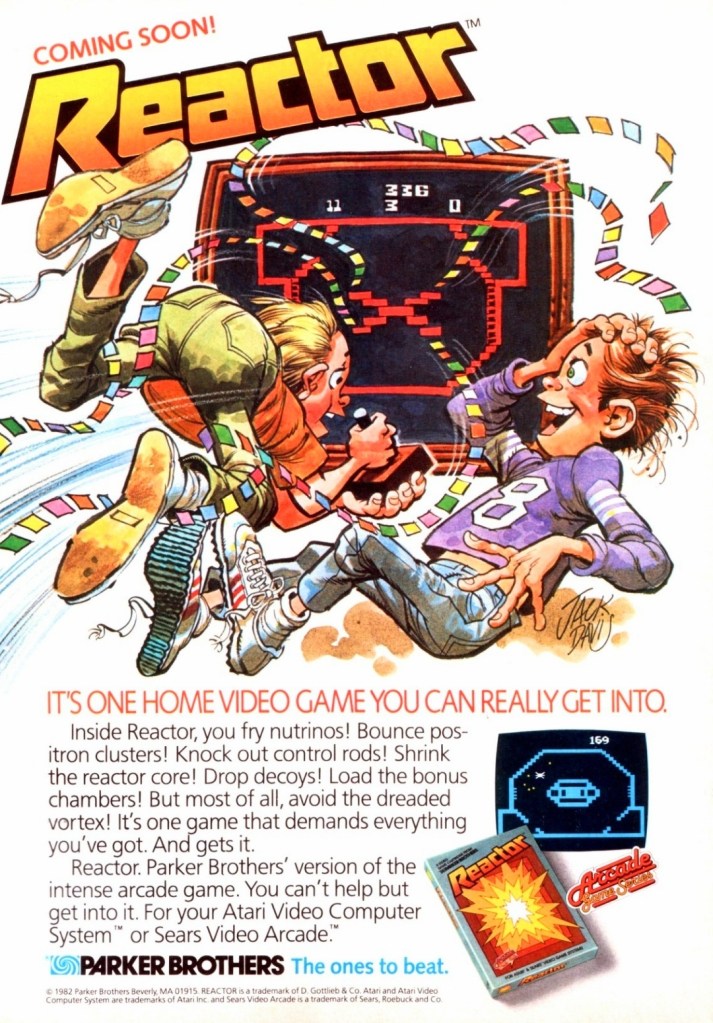
3. Reactor Atari 2600 print ad

Parker Brothers made this ad imagining gamers getting very engaged with reactor once they start playing it.

Reactor was one of those video games that was somewhat influenced by the subject of nuclear technology, particularly about the nuclear reactors. This is another game I never played on console nor in the arcades. This Reactor print ad by Parker Brothers for the Atari 2600 has a visual style and creative concept that I still find fascinating to look at.

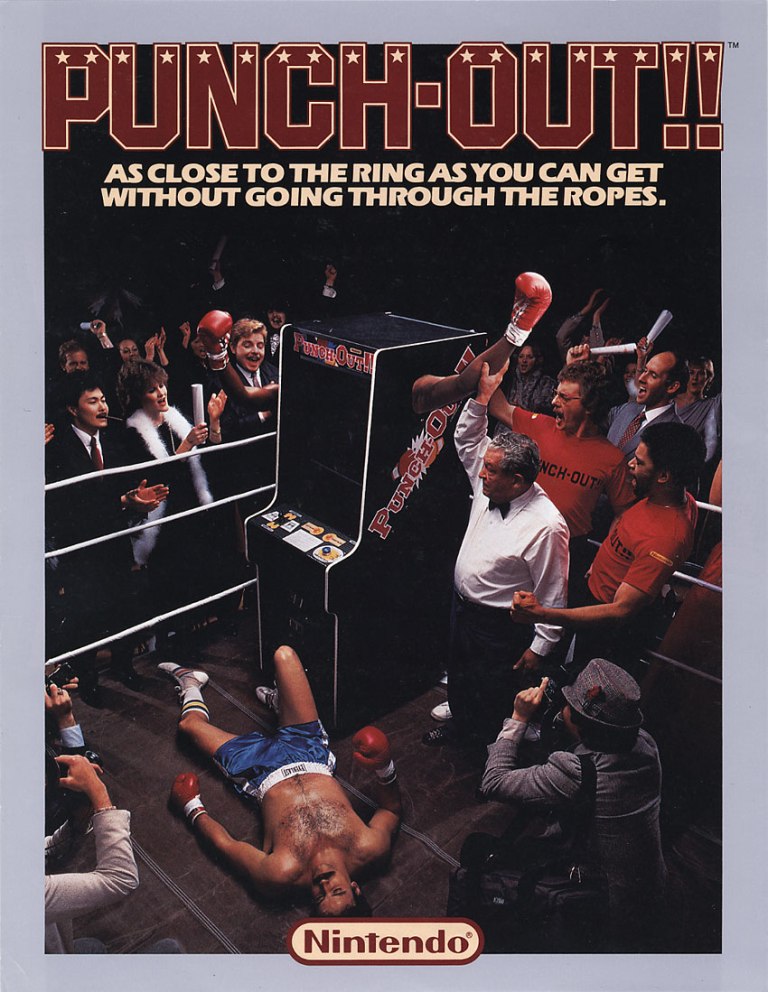
4. Punch-Out!! arcade flyer

This was years before Nintendo hired Mike Tyson to endorse the console version of Punch-Out!!

In 1984, Nintendo released the original Punch-Out!! game in the arcades and literally punched its way through to the top of American arcades that year while also scoring big in other arcades around the world. While the game proved to be very playable and a lot of fun, it could be argued that the intriguing image Nintendo used for the North American arcade flyer – a boxer down after literally getting beaten by the Punch-Out!! machine – made an impact on both gamers and arcade operators.

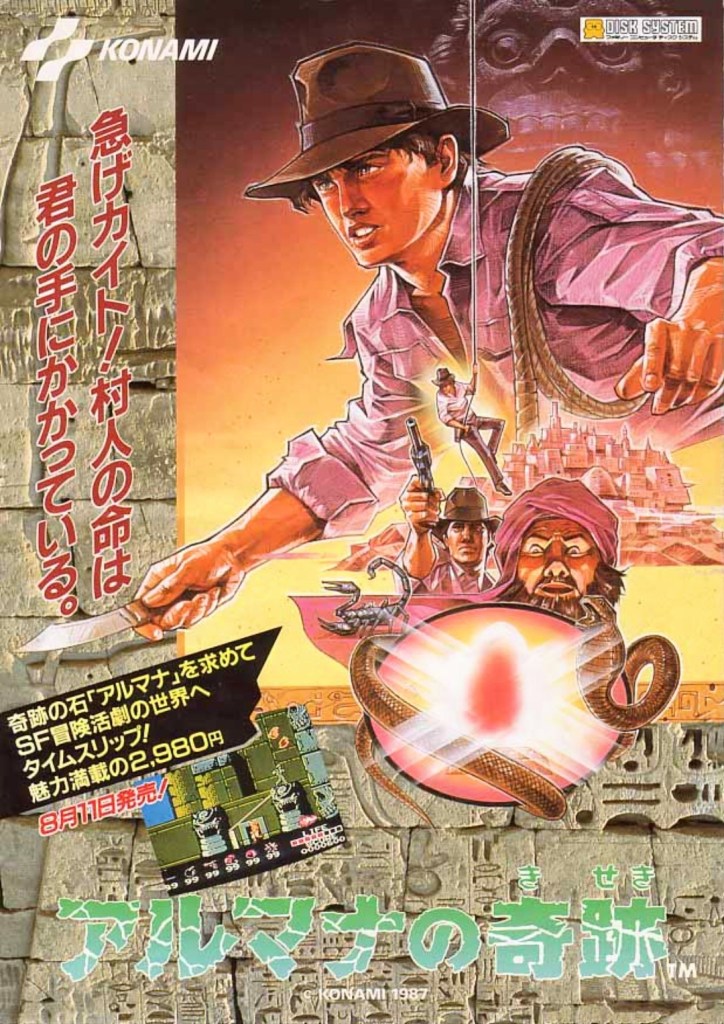
5. Arumana no Kiseki flyer

Is the famous Indiana Jones theme music playing inside your mind right now as you look at this art?

Released in 1987 on the Disk System of the Nintendo Family Computer (Famicom) in Japan, Arumana no Kiseki was one of the many 2D adventure games Konami released that entertained gamers. When compared to Castlevania – strongly influenced by American horror movies – this game was very influenced by the Indiana Jones movies of Steven Spielberg which is very evident in this promotional flyer.

In fact, some gamers who could not read the Japanese title actually thought this was an official Indiana Jones video game because the artwork was so suggestive. Having played and finished the game myself, I can say that Arumana no Kiseki was simply an Indiana Jones-inspired adventure game that had its own creative concept and unique settings and characters.

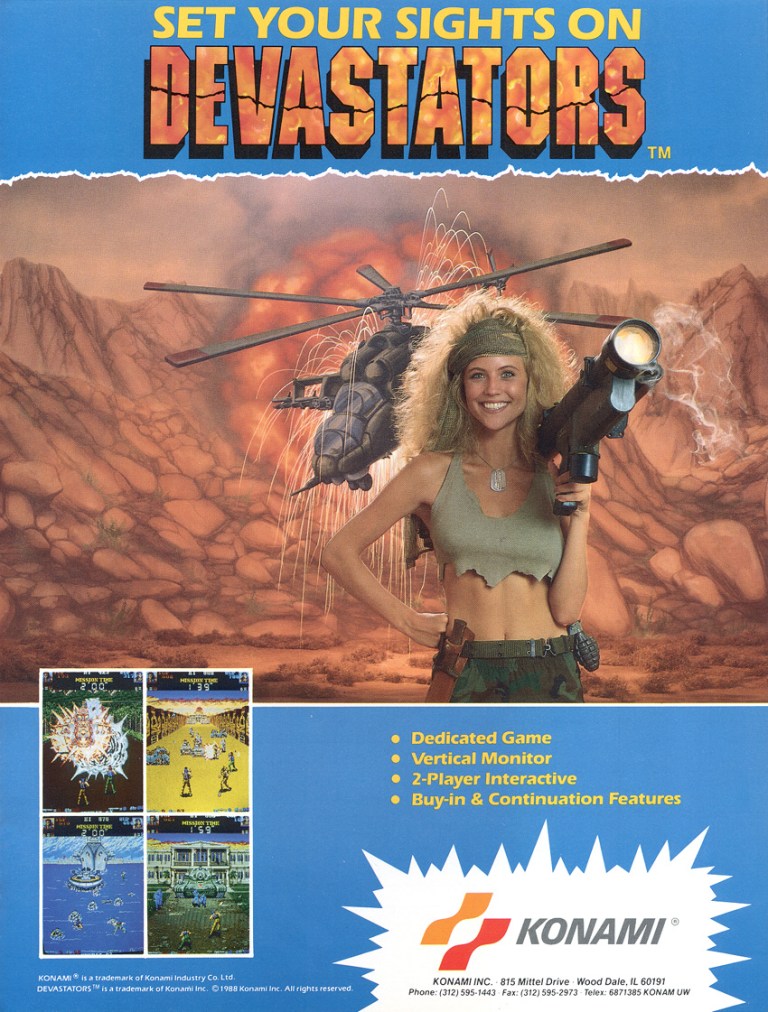
6. Devastators arcade flyer

The 1980s female Rambo smiling towards you.

By looking at the track record of Konami closely, you will notice that many of their games in the 1980s were influenced by Hollywood movies and they hired pretty or sexy models for their arcade flyers. This arcade flyer of Devastators is no exception and you can clearly see the Rambo-inspired lady smiling while carrying a weapon. Devastators itself had strong Rambo vibes for its concept.

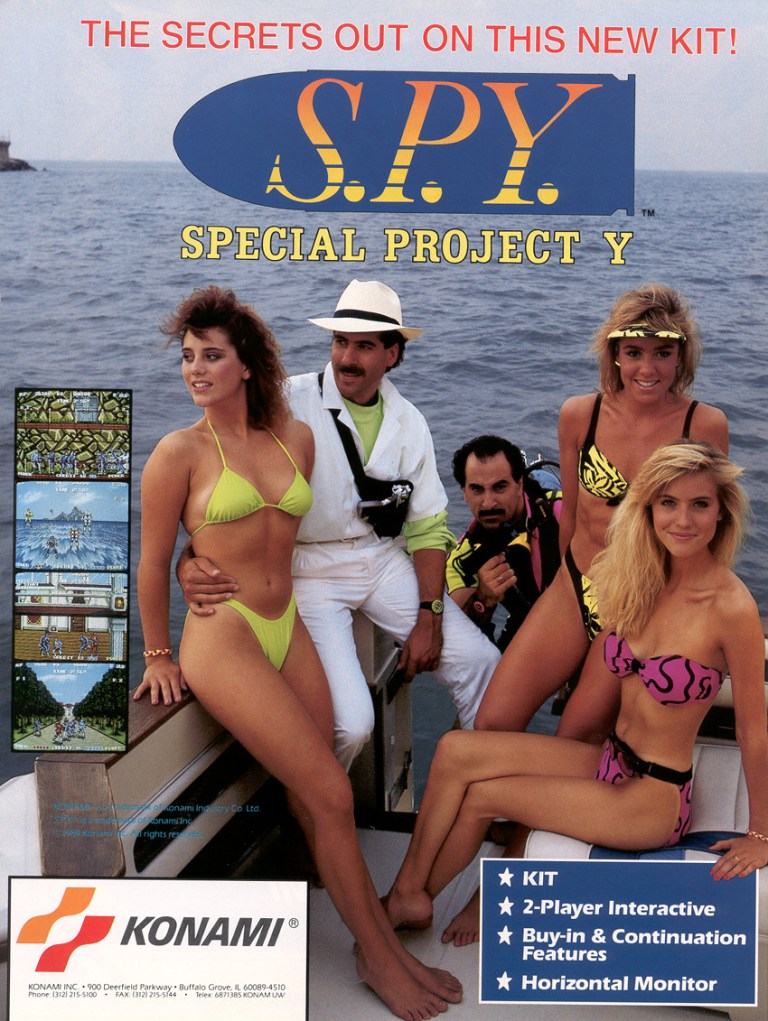
7. S.P.Y. Special Project Y arcade flyer

Somehow the picture of this flyer reminds me of Miami Vice.

Still with Konami, S.P.Y. Special Project Y is 1989 arcade game that featured action sequences in which players fight against countless enemies in order to progress with the minimal story. This game had certain spy movie elements and to promote it, Konami came up with this arcade flyer showcasing three sexy women wearing swimwear accompanied by two men who looked more like operators or schemers. Can you imagine yourself as an arcade operator looking at this flyer trying to decide to buy the game?

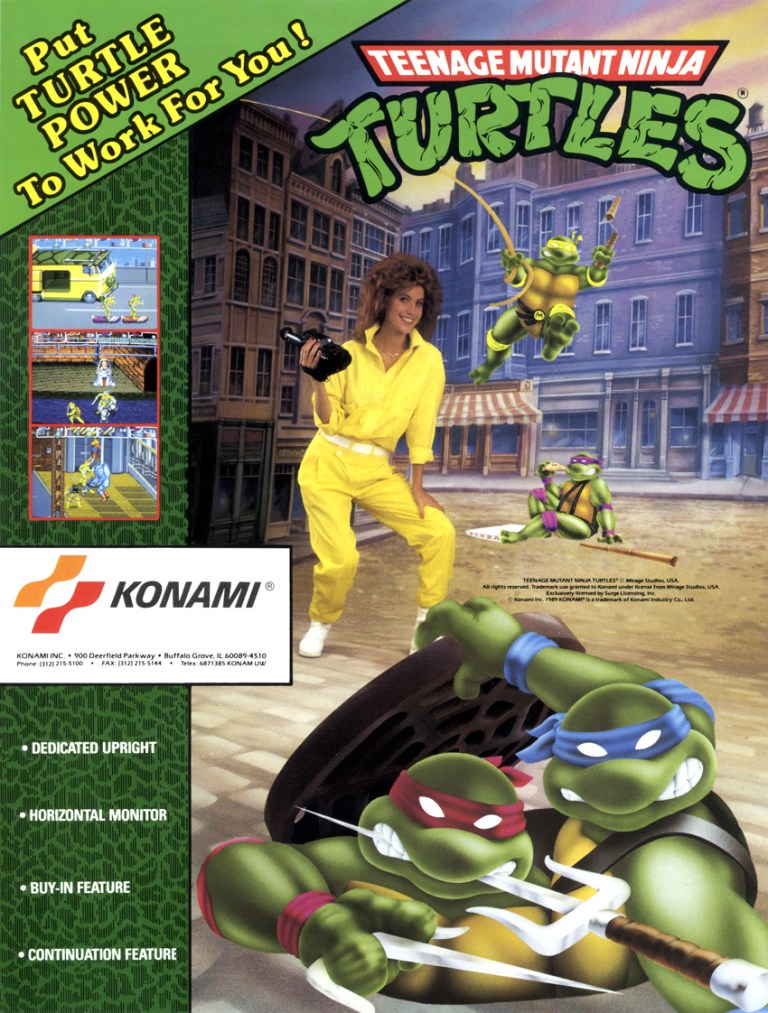
8. Teenage Mutant Ninja Turtles arcade flyer/poster

This arcade flyer is still great and exciting to look at, even if your not a TMNT fan.

Now this is one of the most definitive arcade games Konami ever made. Released in late 1989, Teenage Mutant Ninja Turtles became a massive arcade hit in North America constantly attracting lots of fans and casual gamers to play at each machine. The demand was so great, Konami had no choice but to hire a company to manufacture more machines. When it comes to promoting the game, Konami cleverly used a mix of artworks for the TMNT characters and fantasy environment while having a hired model playing April O’Neil blending in smoothly.

Having seen the 1980s animated series myself, I can say that the ad makers struck gold when it came to making a promotional image that Teenage Mutant Ninja Turtle fans can easily recognize and go to the arcade to play the game.

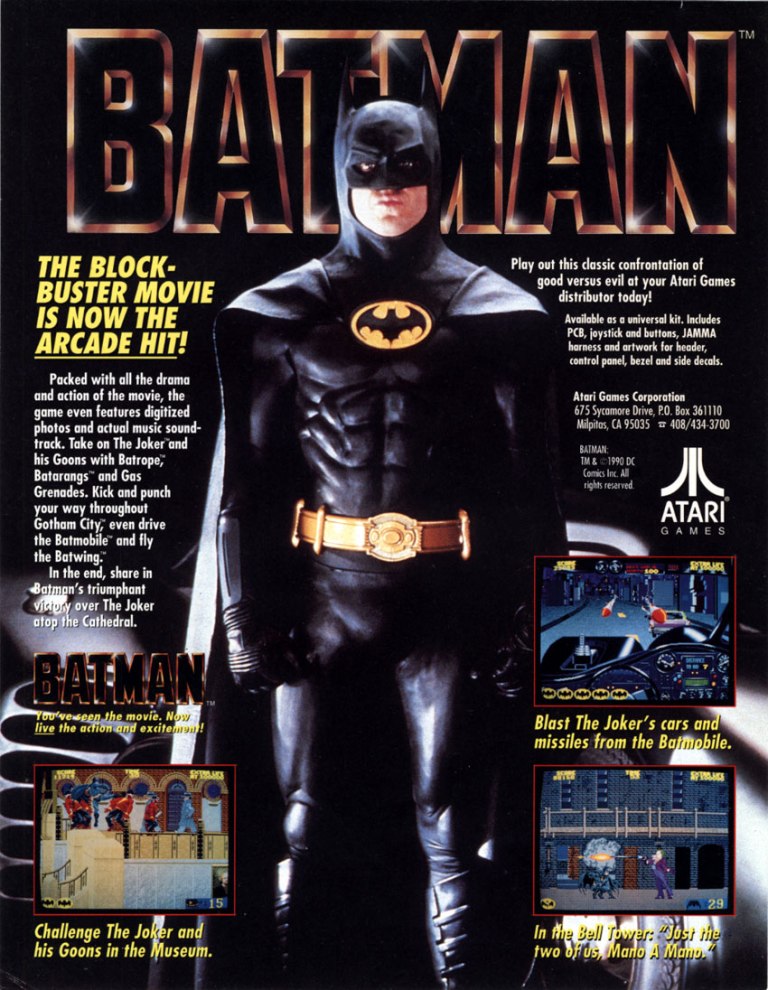
9. Batman arcade flyer

If you saw the 1989 movie, did you play this in the arcade?

The live-action Batman movie of 1989 was simply inescapable as there was so much hype, merchandising and promos connected with it. When it came to video games, it was not surprising that a lot of companies talked with Warner Bros. and eventually Atari made the official arcade game based on the movie (for insight on the production, watch PatmanQC’s video by clicking here). This early-1990s arcade flyer had a simplistic approach showing a few screenshots and descriptive text while having the live-action Batman (note: Michael Keaton in costume) dominating in the middle. Simplistic yet effective in telling gamers and arcade operators what to expect.

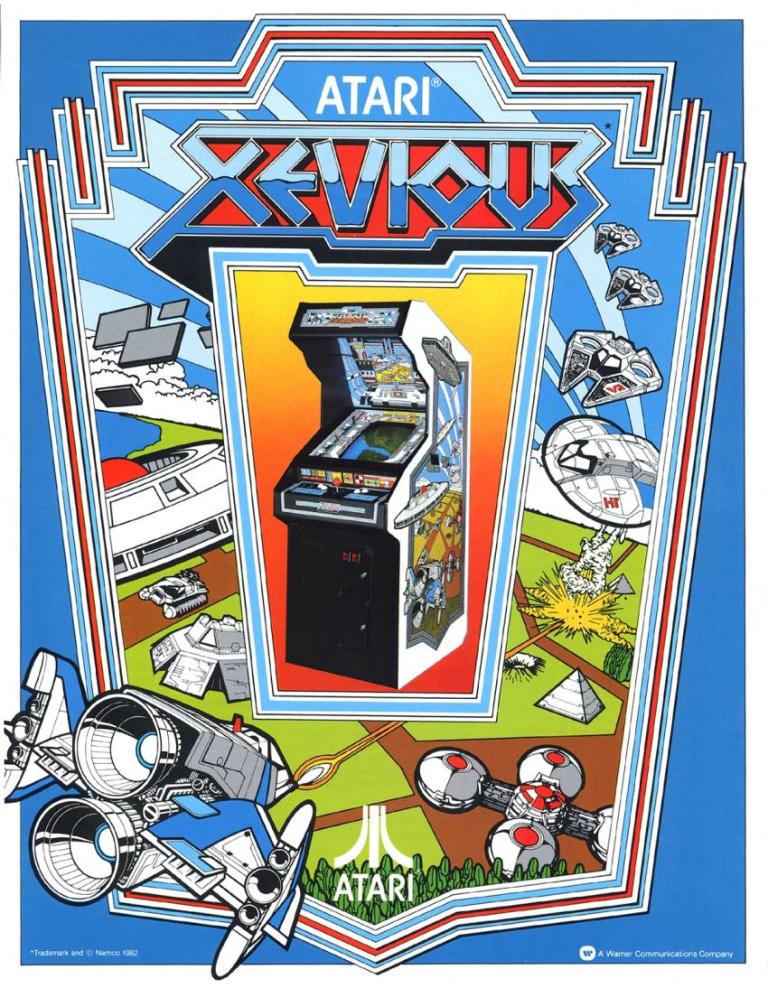
10. Xevious arcade flyer

This arcade flyer is exciting and creative to focus on.

Xevious is a long-running series of video games owned by Namco. Since the early 1980s, several Xevious video games were released on arcades, consoles and mobile devices. Believe it or not, the original Xevious game was published by Atari for North American arcades and the company came up with this dynamic looking flyer to promote it. The arcade flyer really looks dynamic due to the hand-drawn art surrounding the photo of the machine. Even by today standards, this flyer still looks modern and energetic.

11. Robin Hood: Prince of Thieves print ads

Tell me if this ad makes you want to play the game.
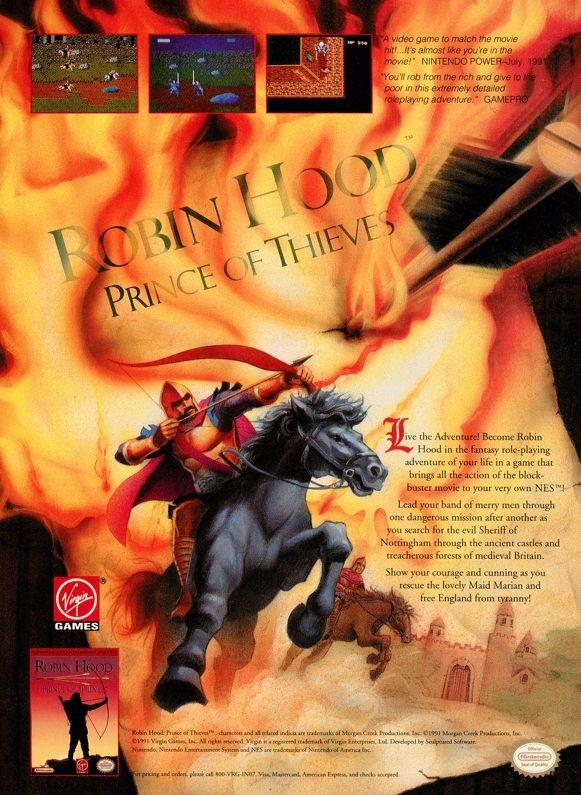
Original artwork here was meant to immerse viewers into the fantasy setting of the game based on the movie.

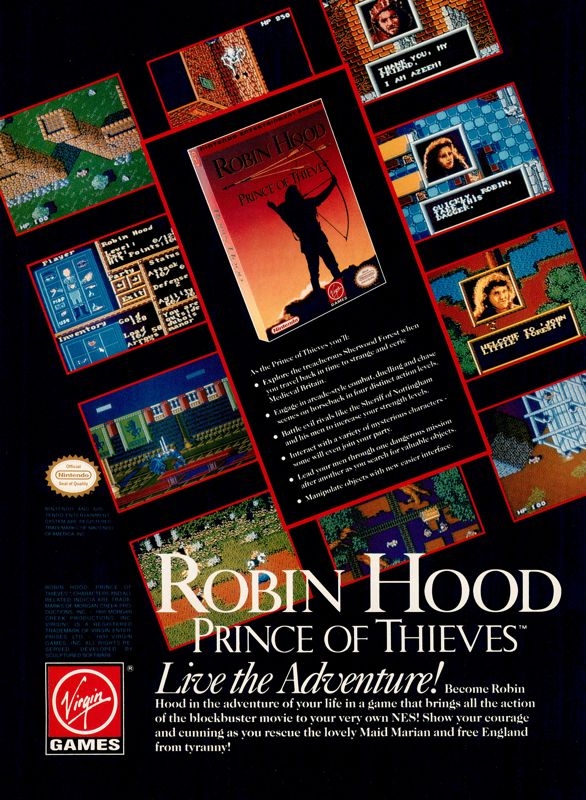
If you saw the 1991 movie Robin Hood: Prince of Thieves, were you able to play the video game adaptation? Robin Hood: Prince of Thieves on the Nintendo Entertainment System (NES) was notable for being specially featured in the Nintendo Power magazine and its game design was truly ambitious at the time. To promote the game and take advantage of the movie’s popularity, Virgin Games came out with two print ads targeting movie fans and NES gamers.

The first print ad above had lots of selected screenshots surrounding the game’s box and crammed the descriptive text. The 2nd print ad had original artwork to emphasize the fictional setting and used only three screenshots. Looking at both print ads, it was clear that the ad makers had no permission to use the likeness of Kevin Costner as Robin Hood. The same with other actors and their characters. Regardless, the ads still reminded me enough of the movie while keeping me informed about the video game.

+++++

Thank you for reading. If you find this article engaging, please click the like button below, share this article to others and also please consider making a donation to support my publishing. If you are looking for a copywriter to create content for your special project or business, check out my services and my portfolio. Feel free to contact me with a private message. Also please feel free to visit my Facebook page Author Carlo Carrasco and follow me on Twitter at  @HavenorFantasy as well as on Tumblr at https://carlocarrasco.tumblr.com/ and on Instagram at https://www.instagram.com/authorcarlocarrasco
Retro Gaming Ads Blast – Part 14

Welcome back readers, fellow geeks and electronic gaming fans!

In this edition of the Retro Gaming Ads Blast (RGAB) series, we will take a look at another batch of retro gaming print ads – including arcade flyers – from the 1980s and 1990s.

For the newcomers reading this, Retro Gaming Ads Blast (RGAB) looks back at the many print ads of games (console, arcade, computer and handheld) that were published in comic books, magazines, flyers and newspapers long before smartphones, social media, the worldwide web and streaming became popular. To put things in perspective, people back in the 1980s and 1990s were more trusting of print media for information and images about electronic games and related products.

With those details laid down, here is the newest batch of retro gaming print ads for you to see and enjoy…

1. Lufia & The Fortress of Doom for Sega Genesis print ad

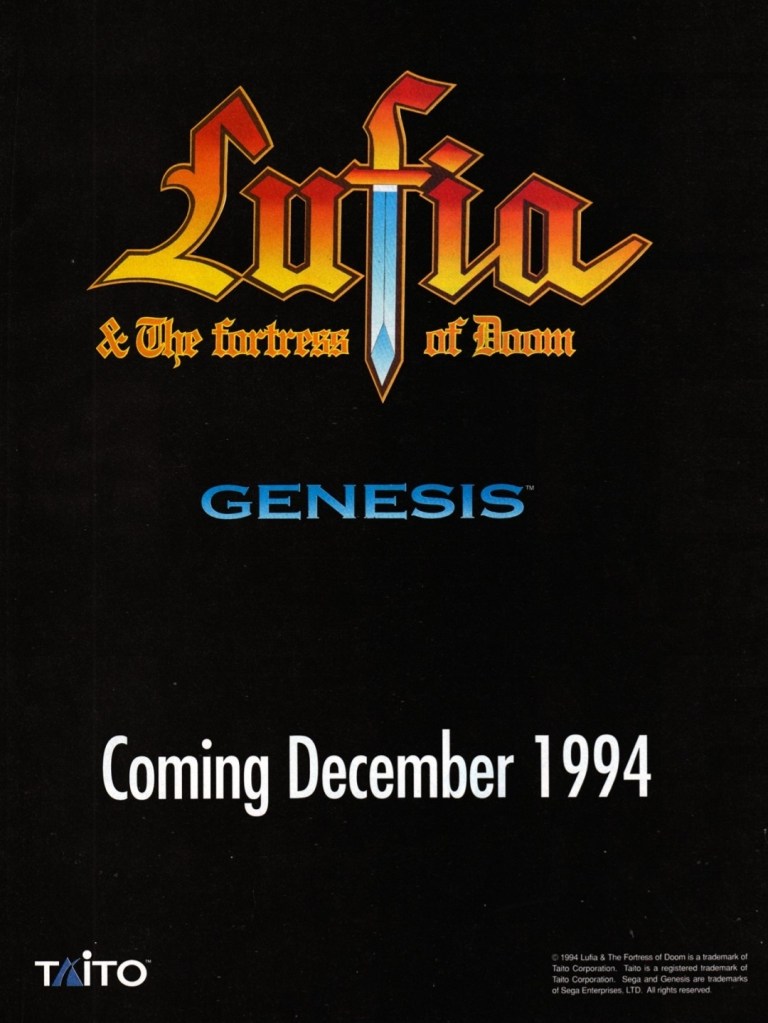
Considering the eventual scrapping of the Sega Genesis port of Lufia & The Fortress of Doom, this old print ad might as well serve like a tomb stone.

I want to start with this mostly black print ad about the Japanese role-playing game (JRPG) Lufia & The Fortress of Doom coming to the Sega Genesis console. This game was released on the Super Nintendo Entertainment System (SNES) in America and on the Super Famicom in Japan in 1993 and achieved commercial success for the Japan-based publisher Taito. In an attempt to keep on building up the success, a port of the game for the Sega Genesis (Sega Megadrive in other countries) was announced but ultimately it got canceled. It should be noted that Taito’s American division close down in 1995 and the sequel  Lufia II: Rise of the Sinistrals was released in America by a different publisher. That being said, this particular print ad is a sad reminder of a broken promise for Sega Genesis gamers as well as Lufia and JRPG fans who wanted to play the 1993 RPG on a different console.

2. Cloak & Dagger arcade flyer

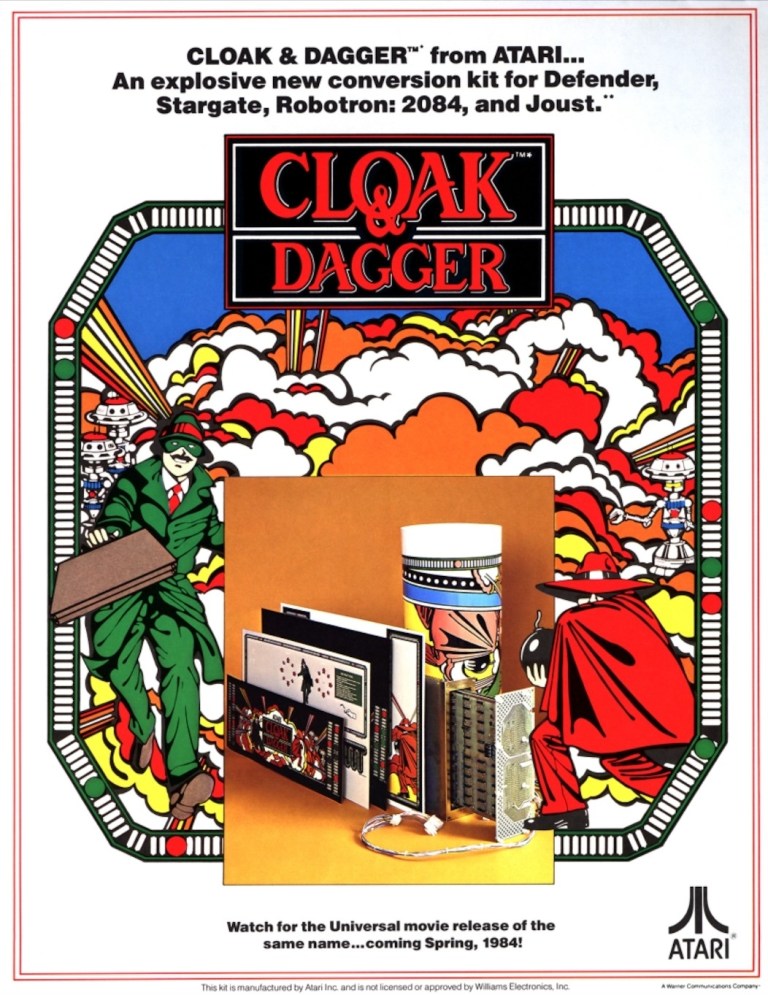
The front of the arcade flyer. There is even a mention of the Cloak & Dagger movie.
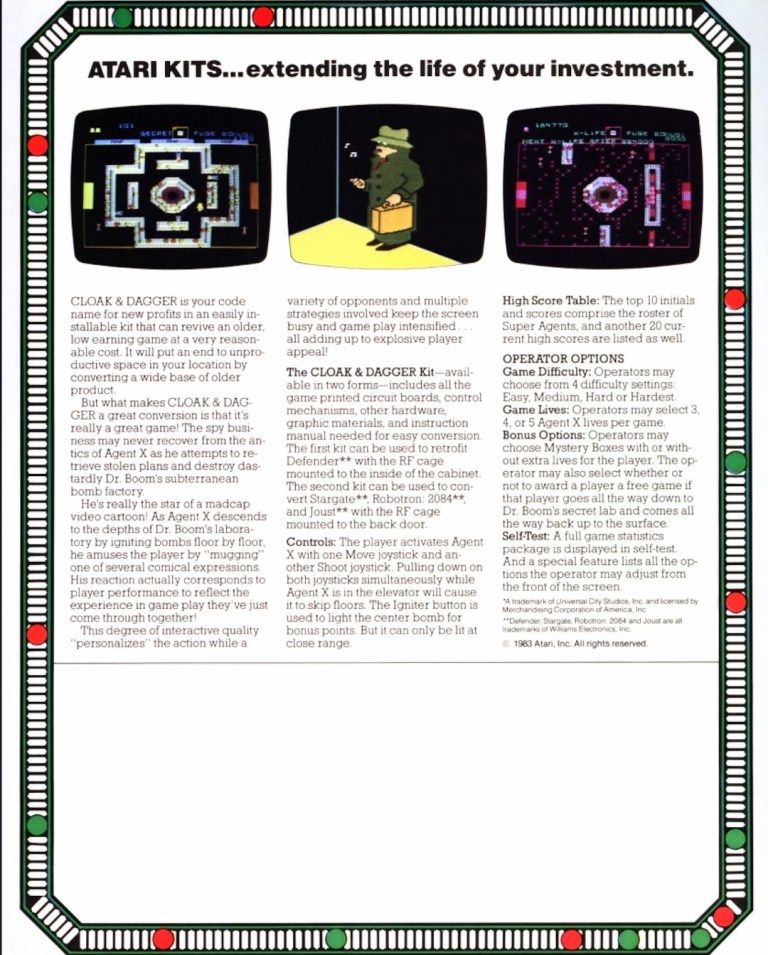
Details of the game explained with arcade operators in mind. I find it odd that there is a vacant amount of blank space on this side of the flyer.

Cloak & Dagger, the Atari arcade game that appeared in the 1984 movie of the same name (read my retro movie review by clicking here), has always been an arcade conversion kit as this arcade flyer showed. For the newcomers reading this, an arcade conversion kit allows the arcade operator to replace an old game without having to buy a brand-new arcade machine. Very cleverly, Atari targeted arcade machines of Robotron: 2084, Defender, Stargate and Joust (all were from the competitor Williams Electronics) with Cloak & Dagger. The Cloak & Dagger flyer’s front shows a picture of the pieces of hardware (for insertion into the arcade cabinet plus some physical adjustments) plus decorations for the exterior of the arcade cabinet. The other side of the flyer contains the technical details that make it convenient for arcade operators to understand on how to convert the older games (limited to the above-mentioned Williams games).

3. NBA Live 95 for Sega Genesis print ad

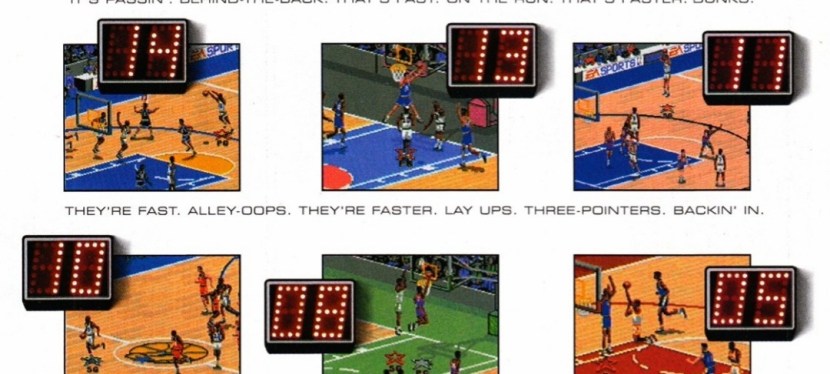
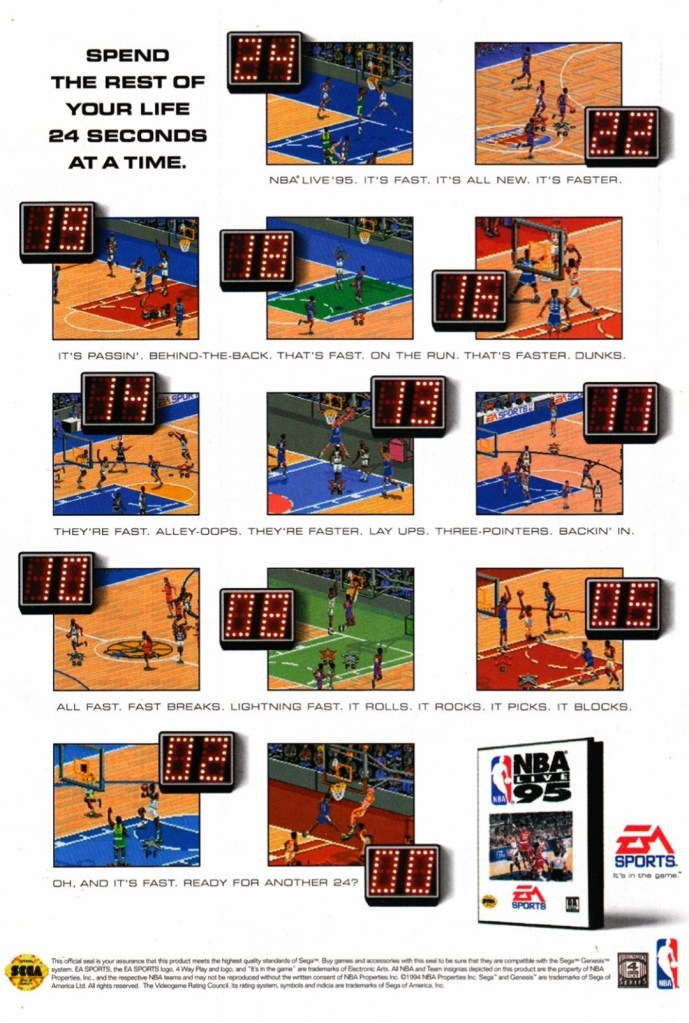
This print ad is still exciting to look at, especially when you are still passionate with basketball.

Back in late 1994, Electronic Arts (EA) revamped their NBA-licensed basketball game franchise with NBA Live 95 which came with a major game redesign that includes the isometric on-court perspective, T-meter for free throw shooting and more. NBA Live 95 was also the first entry of the NBA Live franchise and brand which lasted for decades. This print ad of the Sega Genesis version of NBA Live 95 has the clever display of several screenshots along with pics of the shot clock emphasizing suspense. The basketball action images themselves are not only eye-catching but strong enough to get gamers excited. This is still a solid print ad to look at.

4. X-Men: Mutant Apocalypse print ad

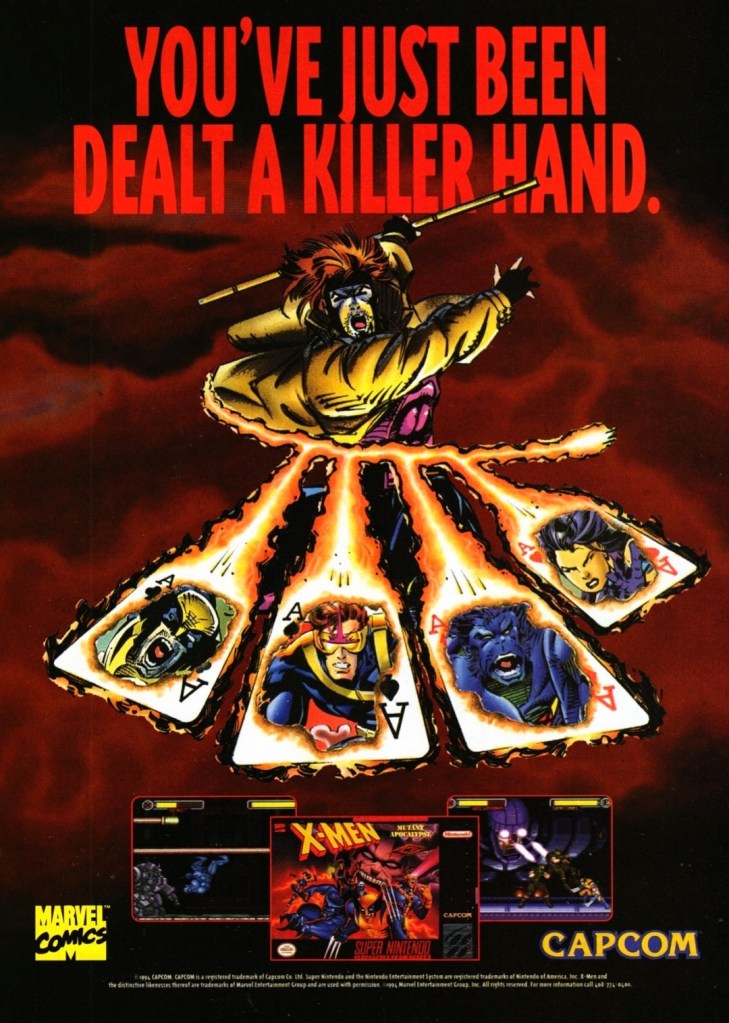
An X-Men game by Capcom.

If there is anything significant about X-Men: Mutant Apocalypse, it is the fact that it was Capcom’s first-ever X-Men-based production that was also released a month before their own hit arcade game X-Men: Children of the Atom came out. Setting aside Capcom’s involvement, this game contains notable elements from the comic books that strongly resonated with dedicated X-Men fans. Apart from the two screenshots and the game box cover, this print ad has X-Men artwork by Andy Kubert who already was the regular artist of the X-Men monthly series.

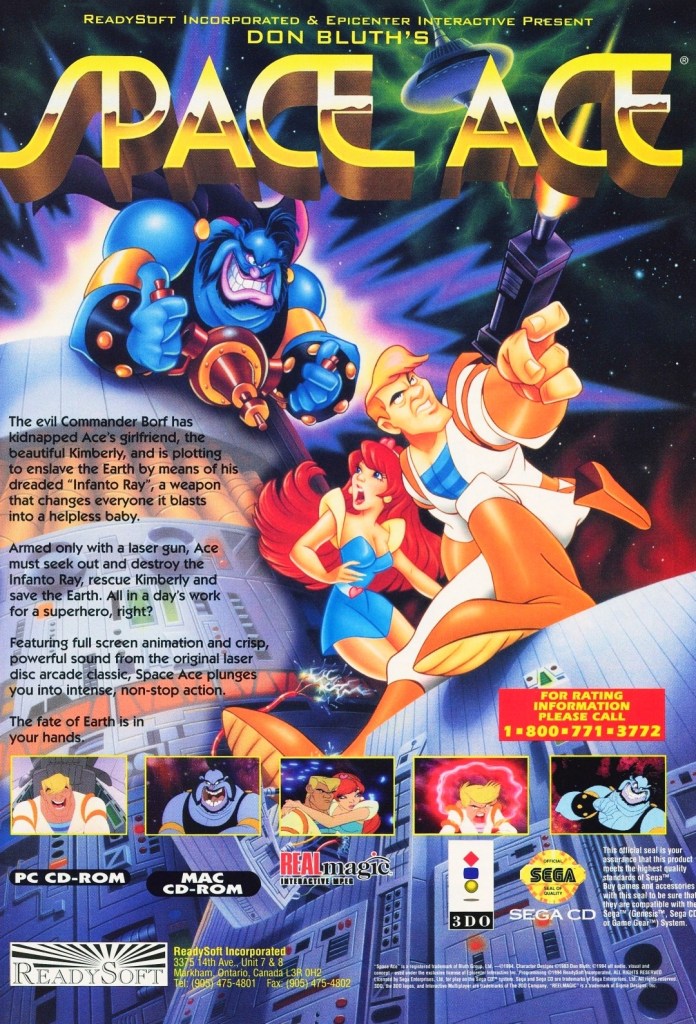
5. Space Ace multi-platform print ad

Anyone who is a fan of Don Bluth’s works in animation should be able to recognize the art style of this ad.

First released in the mid-1980s, Space Ace was a LaserDisc video game that was designed and produced by the legendary animator Don Bluth (An American Tail, The Land Before Time, Anastasia). After achieving success in the arcades, new versions of Space Ace were subsequently released on many other platforms, including the consoles and computers that used disc drives in the mid-1990s which this print ad emphasized. By looking at the lower part of the print ad, you will see Sega CD, 3DO, Macintosh and PC as targeted platforms. The most notable visual feature of the ad was, unsurprisingly, official art of Space Ace.

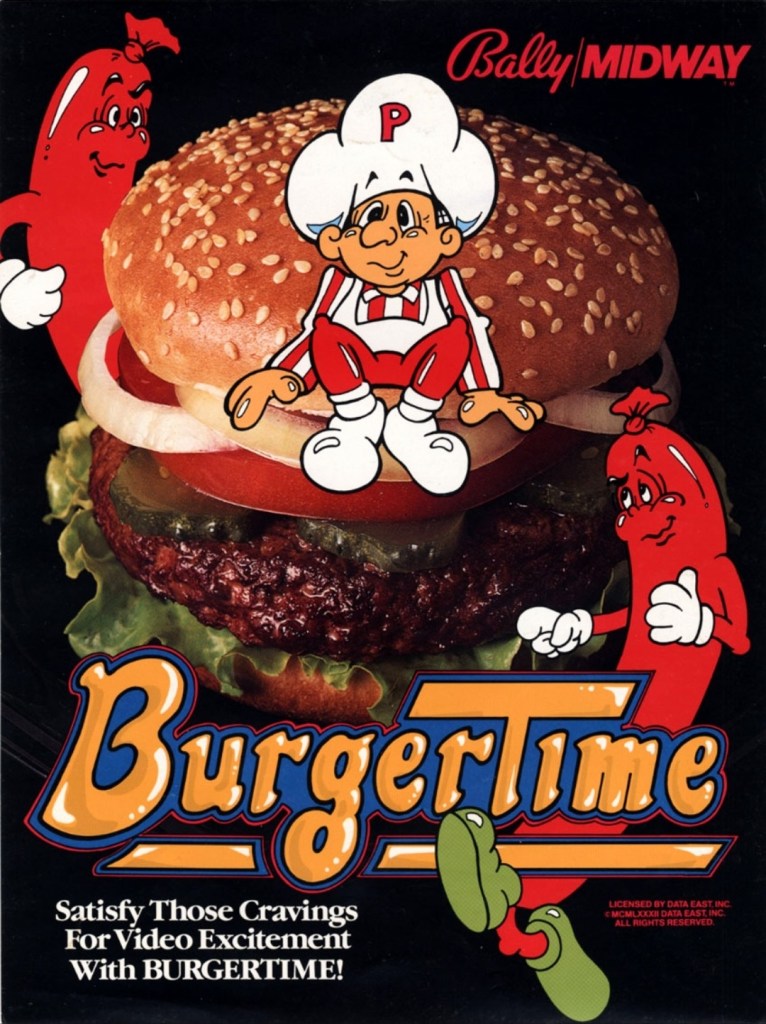
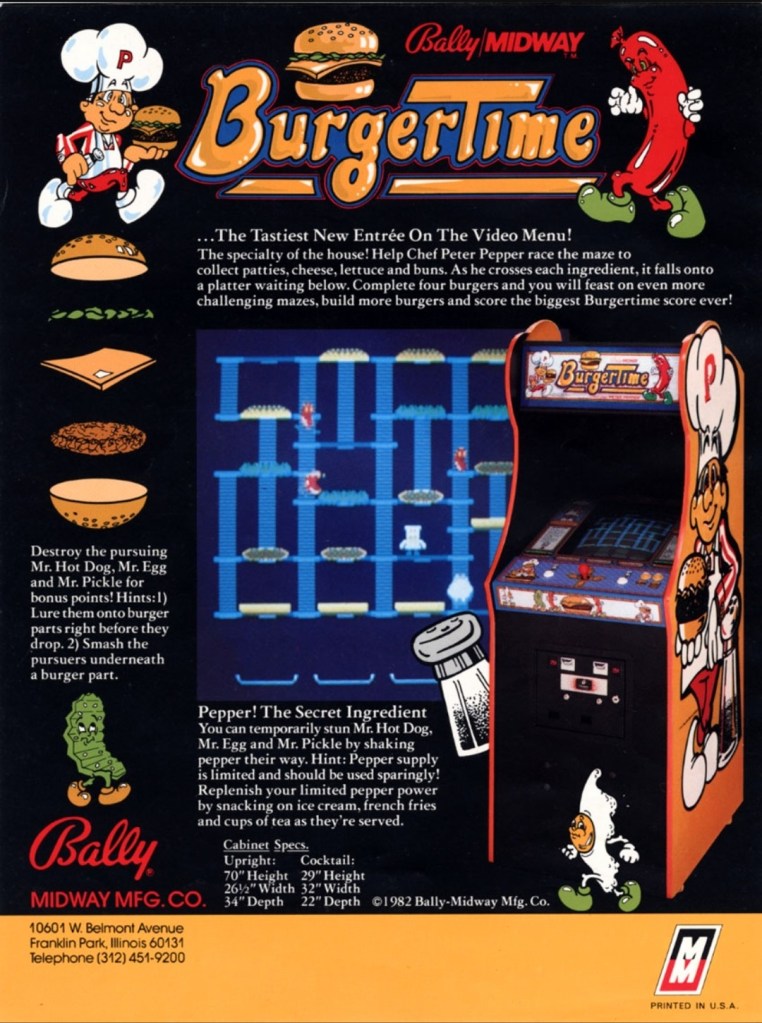
6. BurgerTime arcade flyer

The front of this flyer could make you crave for burgers.
The technical and creative details on the rear of the flyer.

Bally/Midway came up with this arcade flyer of BurgerTime which itself went on to become a beloved classic game. The front showed a very enticing looking hamburger that looked like it could fill a person’s belly and tingle his or her taste buds. Then they showed the hand-drawn in-game characters looking like they really are interacting with the hamburger. The back of the flyer shows details that emphasize what the game is about, why it could be a fun arcade addition and what the specs are. This is an engaging arcade flyer.  

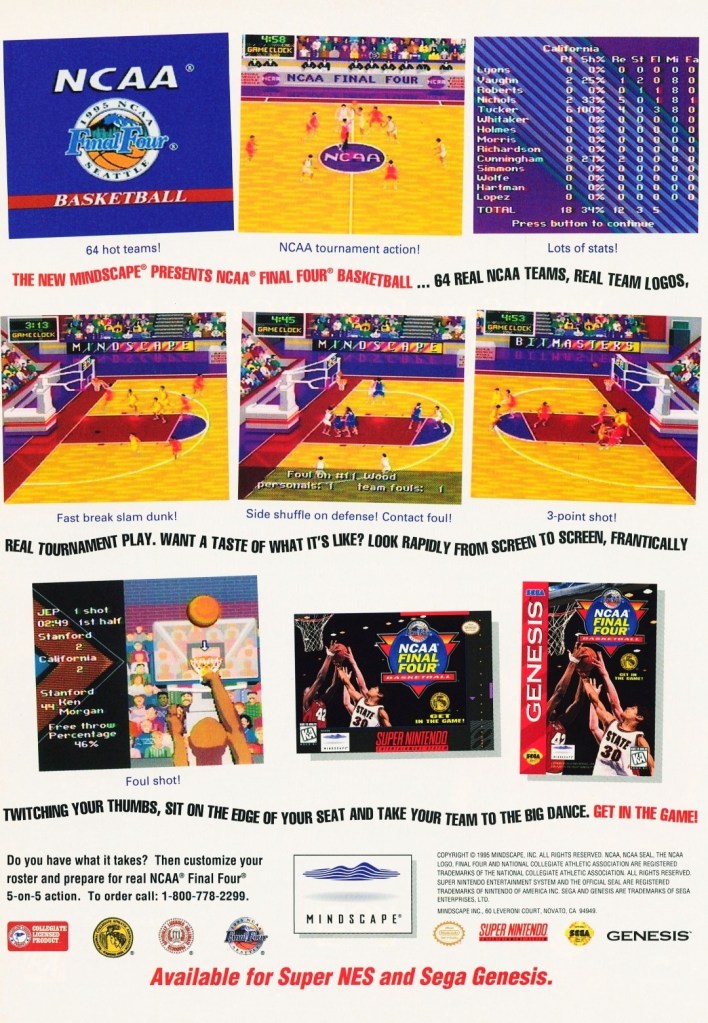
7. NCAA Final Four Basketball print ad

Do you know anyone who played this college basketball video game?

If there is anything notable about video gaming in the 1990s that is missing today, that would be the presence of multiple basketball video games released by different game publishers. Along the way, there were some college basketball video games such as NCAA Final Four Basketball developed by Bitmasters and published by Mindscape. This print ad had enough screenshots to show what the game looked like and how it played. The ad also mentioned that the game had 64 real NCAA teams and logos as well. This 1994 video game did not have a strong reception from game critics although it received a very high rating by GamePro magazine. NCAA Final Four Basketball has long been forgotten.

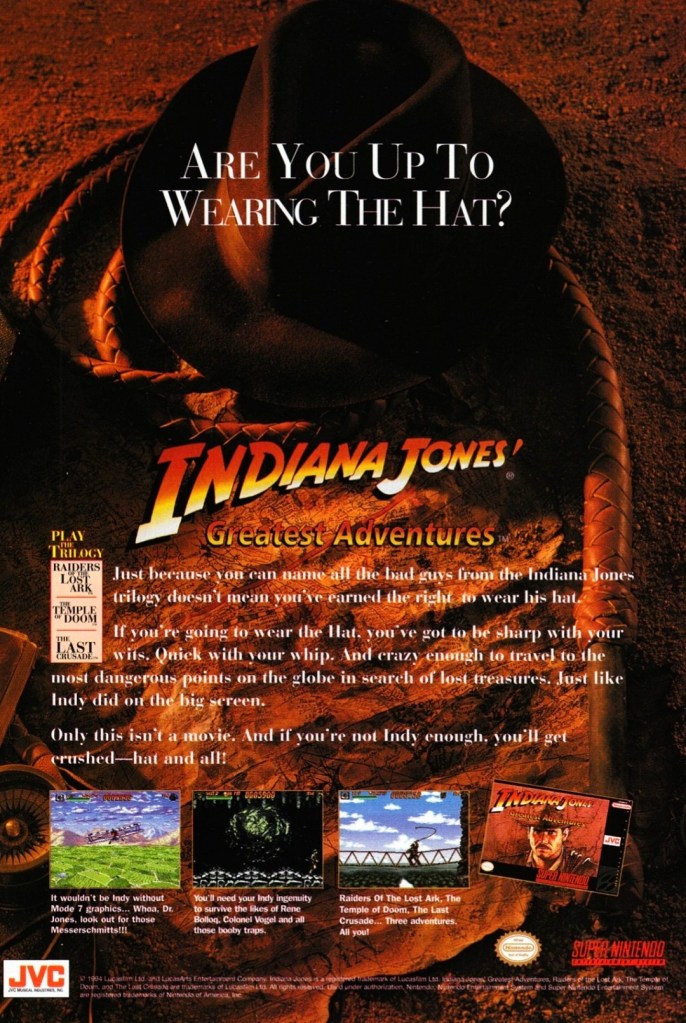
8. Indiana Jones’ Greatest Adventures print ad

An eye-catching print ad from a more memorable time when the Indiana Jones franchise was still under the full control of George Lucas and his enterprise.

Indiana Jones’ Greatest Adventures was an ambitious 2D side-scrolling adventure game that also served as an adaptation of the first three Indiana Jones movies (1981-1989) of Steven Spielberg and George Lucas. Like the Super Star Wars trilogy of games that preceded, this one was a challenging and lengthy game filled with lots of action. This print ad only showed Indy’s whip and hat but the screenshots, the text description and the game box cover (which has a young Harrison Ford as the iconic Jones) were more than enough to convince viewers that this was an Indiana Jones game.

+++++

Thank you for reading. If you find this article engaging, please click the like button below, share this article to others and also please consider making a donation to support my publishing. If you are looking for a copywriter to create content for your special project or business, check out my services and my portfolio. Feel free to contact me with a private message. Also please feel free to visit my Facebook page Author Carlo Carrasco and follow me on Twitter at  @HavenorFantasy as well as on Tumblr at https://carlocarrasco.tumblr.com/ and on Instagram at https://www.instagram.com/authorcarlocarrasco