Welcome back, my readers, YouTube viewers and all others who followed this series of articles focused on YouTube videos worth watching. Have you been searching for something fun or interesting to watch on YouTube? Do you feel bored right now and you crave for something to see on the world’s most popular online video destination?
I recommend you check out the following topics and the related videos I found.
#1Google in legal trouble in America – Did you notice how overwhelming power Google really is in business as well as in your daily lives? Are you aware that Google made multi-billion Dollar deals with its competitors to ensure its dominance on search, online advertising and other forms of business? Google is now in legal trouble with the Department of Justice (DOJ) in America and ColdFusion’s video below is a must-watch!
#2 Games to look forward to while subscribing to Xbox Game Pass – In recent times, there were changes on Xbox Game Pass (XGP) implemented by Microsoft which I did not like (click here and here to learn the details). If you own an Xbox and you still have not yet subscribed to XGP, you should decide first based on how much you can afford to pay the new rates (note: there are different tiers to subscribe to in Game Pass), what kind of games you really like and how much time you can spare for playing in the comfort of your home. If you are into adventure gaming, then the video by YouTuber Skycaptin 5 below is a must-watch for your reference. Take note that one of the games shown has yet to be released and a few of the games may require the Ultimate tier of XGP.
#3 A look back at Amazing Spider-Man movies of Sony Pictures – Do you have any fond memories of the two movies that had actor Andrew Garfield as the cinematic Spider-Man? I saw The Amazing Spider-Man (2012) and The Amazing Spider-Man 2 (2014) in the cinemas and I can say that they never thrilled me nor satisfied me as much as the first two Spider-Man flicks of Tobey Maguire. Those movies directed by Marc Webb were not terrible actually but flawed works. Whether you loved or felt disappointed with the two Amazing Spider-Man movies, I urge you to watch the analytical video by YouTuber Owen Likes Comics below.
#4 25 years of the American launch of the Sega Dreamcast – It has been over twenty-five years since Sega launched the Dreamcast console in America. In gaming history, the date of September 9, 1999 is still remembered as the time when Sega really made a very serious effort to re-establish trust with American gamers and they made record-setting numbers in the first 24 hours. As such, it was no surprise that “25 years” or “25th anniversary” videos about the Dreamcast suddenly appeared on YouTube and posted below are videos I selected for your viewing.
#5 You, Me and the Movies’ video reaction of Clash of the Titans (1981) – Whenever I search YouTube for movie reaction videos about the 1981 film Clash of the Titans, not too many pop out for some reason. If you are interested to see the film but don’t have the time or money to watch it in full, then the reaction video by You, Me and the Movies should entertain you.
#6 The fall of Circuit City explained – Way back in 2001, I visited a branch of Circuit City in California. I visited because I was curious and also interested in video games and also movies on DVD format. What I found was a variety of consumer electronic products and the presence of TV units with built-in DVD drives caught my attention. It was my one and only Circuit City visit and many years later, their brand re-emerged when there were these widespread news reports about its bankruptcy and liquidation. If you want to learn about the rise and fall of Circuit City, watch the video below.
#7 GoodBadFlicks’ comprehensive video about The Blob (1988) –The Blob remake of 1988 has always been very entertaining to watch. Not only does it have a really solid story to tell, it has a fine blend of spectacle with well-crafted action/stunt scenes and top-notch practical effects. On 4K Blu-ray, the movie looks better than ever and it is worth purchasing. When it comes to the making of The Blob (1988), the best video to watch online is the one from YouTuber GoodBadFlicks which is posted below for your viewing pleasure.
Welcome back readers, fellow geeks and electronic gaming fans!
In this edition of the Retro Gaming Ads Blast (RGAB) series, we will take a look at another batch of retro gaming print ads from the 1980s and 1990s.
For the newcomers reading this, Retro Gaming Ads Blast (RGAB) looks back at the many print ads of games (console, arcade, computer and handheld) that were published in comic books, magazines, flyers and newspapers long before smartphones, social media, the worldwide web and streaming became popular. To put things in perspective, people back in the 1980s and 1990s were more trusting of print media for information and images about electronic games and related hardware.
With those details laid down, here is the newest batch of retro gaming print ads for you to see and enjoy…
1. Enemy Zero print ad
I should say Sega did a solid job by making this intriguing and eye-catching print ad for Enemy Zero.
The first time I saw this print ad of Enemy Zero in the late 1990s, I was intrigued by its visual concept and it got me interested to learning more about the game. Enemy Zero was a sci-fi video game developed by Warp and released as a console-exclusive on the Sega Saturn. Since I never owned a Saturn, I never got to play the game but I was inspired to learn more about Warp (which developed the hit game D). As it turns out, Enemy Zero started as a project for PlayStation but because of Sony’s failure to fulfill the pre-orders of D on PlayStation (100,000 copies ordered but less than 30,000 copies printed by Sony), Warp’s head Kenji Eno decided to make Enemy Zero exclusive to the Sega Saturn. Enemy Zero was published by Sega worldwide while Warp published it in Japan, and the game sold between 500,000 to 700,000 copies (based on Eno’s claim).
2. Bionic Commando print ad
For the American market, Capcom showed what the game box and front cover art would look like, then added the details and two screenshots for readers to examine.
Back in the late 1980s, I played Bionic Commando and managed to finish it after enduring lots of challenges along the way. It was a very unique adventure game as it used a highly unusual method of moving from one platform to the next by means of a futuristic grappling gun. This particular print ad showcased what the game’s actual box looked like (with cover artwork made for North America) and used two screenshots from the game. This ad hardly captures the excitement and intensity that awaited gamers and yet it manages to give people a clear look at the grappling concept. While the North American version of the game has certain content altered, it still had the same gory ending (and Adolf Hitler as the main villain) as the Japanese version.
3. RoboCop print ad
This served as an extension of the impact of the very violent 1987 movie.
RoboCop made huge impact on moviegoers as well as people who love science fiction and the R-rated action films Hollywood studios released in the 1980s. That being said, it was not surprising that a video game of RoboCop was released on the Nintendo Entertainment System (Family Computer in Japan) by Data East and the print ad they came up with cleverly used imagery from the movie poster and the screenshots showed exactly what RoboCop fans expected to see such as the enemy robot ED-209 and thugs. This game strongly reflects the business trend of the 1980s when companies made merchandise and adaptations of R-rated blockbuster films to sell to kids and teenagers.
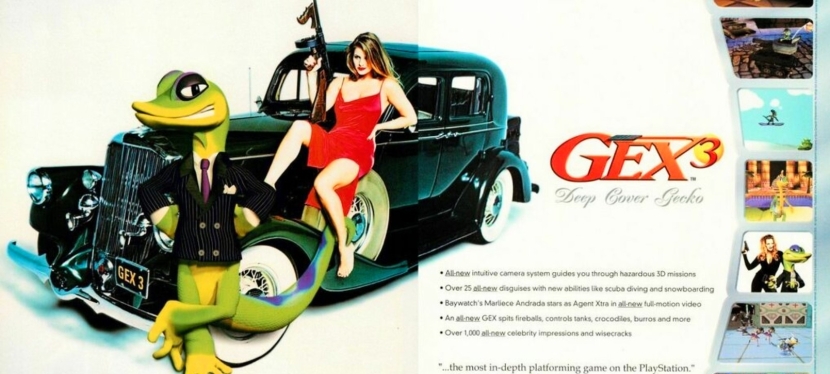
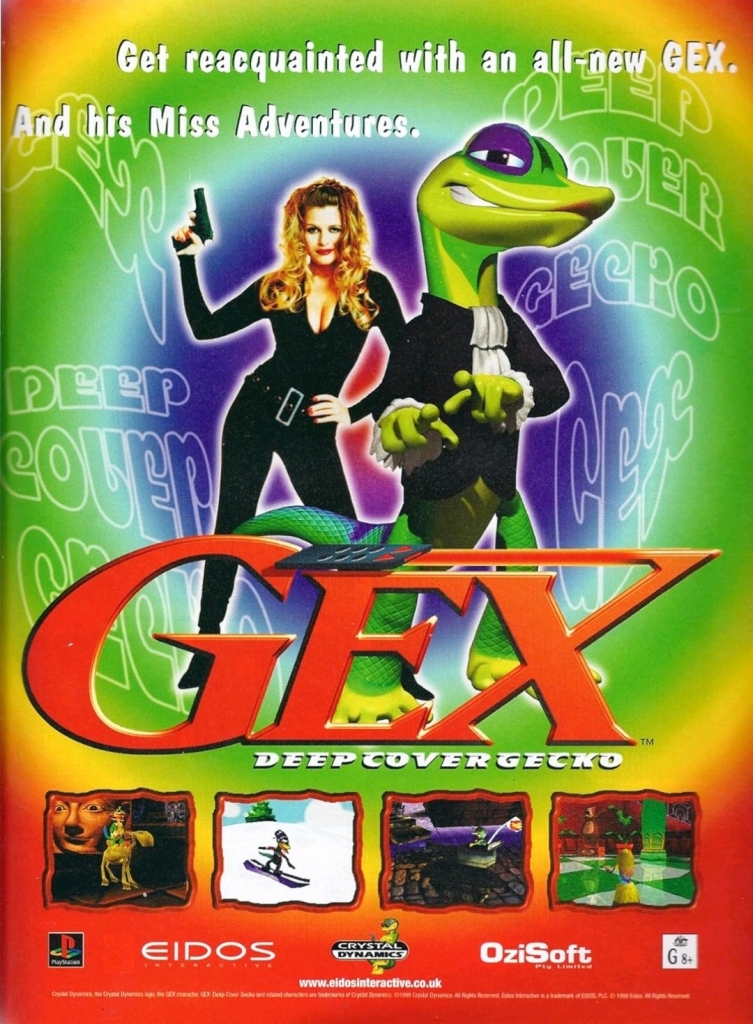
4. Gex 3: Deep Cover Gecko print ads
This print ad for Europe had a James Bond vibe.
March 1998 Playmate of the Month on the hood of the car looking at Gex.
The 2-page print ad of Gex 3: Deep Cover Gecko.
In 1999, Eidos Interactive – the company behind the wildly popular Tomb Raider games of the decade – became aggressive marketing Gex 3: Deep Cover Gecko for PlayStation and Nintendo 64. They were so aggressive, they featured actress and Playboy’s Playmate of the Month (March 1998) Marliece Andrada alongside their star character Gex in the marketing which was not limited to America. For the newcomers reading this, a multimedia approach was implemented on the narrative of the game’s PlayStation version which explains why it has full-motion video sequences featuring Andrada as the character Agent Xtra. As seen in these print ads, Eidos Interactive had Andrada looking pretty and sexy to really sell the game.
5. Barkley Shut Up and Jam! print ad
Anyone here a Charles Barkley fan?
I remember the many types of basketball video games that were released on game consoles back in the 1990s. While there were NBA video games that had in-depth rosters of players with seasonal gaming in mind, there were other basketball-related video games that were not about the said league but featured an NBA star. In this print ad, publisher Accolade prominently featured NBA star Charles Barkley to promote the game Barkley Shut Up and Jam!, posted some words emphasizing sports intensity, and showed one screenshot to assure gamers that this is a basketball game. While the critical reception was mixed, the game must have sold enough to convince Accolade to release a sequel two years later with Barkley still the endorser.
6. The Death and Return of Superman print ad
This print ad clearly aimed for the fans of the comic books as well as gamers looking for an action-packed game to play.
Now this is one very eye-catching print ad that appeared in comic books and magazines in the 1990s. Anyone who knows comics would recognize the grey fist (with sharp bones protruding on the knuckles) belonging to Doomsday who killed Superman in Superman #75 (1993), and the bloody presentation on the famous S was very aggressive for its time. The game itself was an adaptation of the two storylines (published in 1992 and 1993 respectively) that saw Superman’s death, his return and the appearances of new Supermen. While sales figures are not available, The Death and Return of Superman eventually attracted mixed reviews from the critics.
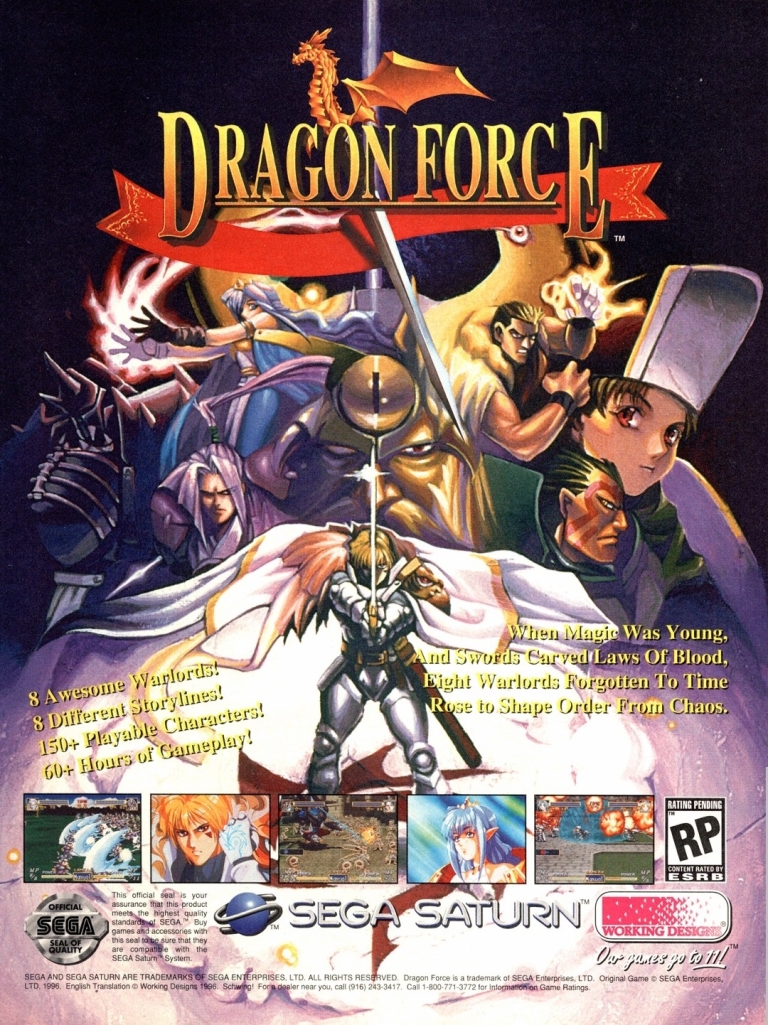
7. Dragon Force print ad
This was printed in magazines at a time when Working Designs had a strong business relationship with Sega.
While the Sega Saturn was undeniably a huge commercial disappointment in North America, the console still had some great games that was widely praised by game critics and heavily bought by gamers. One of those outstanding games on the console was Dragon Force (developed by Sega and J-Force in Japan, localized in America by Working Designs) which received great critical acclaim and achieved commercial success both in Japan and in America. The popular magazine Electronic Gaming Monthly named Dragon Force as the Saturn Game of the Year as well as Strategy Game of the Year in 1996. As a Working Designs release, this print ad has an ambitious fantasy concept visually emphasized, detailed lines of descriptions and screenshots that strongly appealed to the gamers, anime enthusiasts and those who love fantasy. This ad is also a sad reminder that the business relationship between Sega and Working Designs went downhill afterwards (read: Bernie Stolar) and the sequel Dragon Force II was never released outside of Japan.
Welcome back readers, fellow geeks and electronic gaming fans!
In this edition of the Retro Gaming Ads Blast (RGAB) series, we will examine print ads of Sega from the 1990s which was a notable period of time when they went from being a prominent video game company into a desperate, struggling entity by the end of the decade. All the Sega ads in this edition are promotions of their own video games that were exclusive to their consoles during the 1990s.
For the newcomers reading this, Retro Gaming Ads Blast (RGAB) looks back at the many print ads of games (console, arcade, computer and handheld) that were published in comic books, magazines, flyers and newspapers long before smartphones, social media, the worldwide web and streaming became popular. To put things in perspective, people back in the 1980s and 1990s were more trusting of print media for information and images about electronic games and related hardware.
With those details laid down, here is the newest batch of retro gaming print ads for you to see and enjoy…
1. Phantasy Star IV print ad
This was the last single-player Phantasy Star game released. There is no sign of Sega revisiting the franchise for another single-player experience.
Long before the emergence of online console gaming that involved a high number of players, Sega released Phantasy Star IV for the Genesis console in America in 1994 which was praised by gamers and critics. This one also turned out to be the last single-player role-playing game (RPG) of the Phantasy Star series as Sega eventually turned it into a series of online RPGs since the year 2000.
This print ad is significant because a lot of gamers today are not aware that Phantasy Star started as a series of single-player RPGs the same year Final Fantasy debuted in Japan. Anyone interested to play Phantasy Star IV on a modern console should buy the Sega Genesis Classics collection.
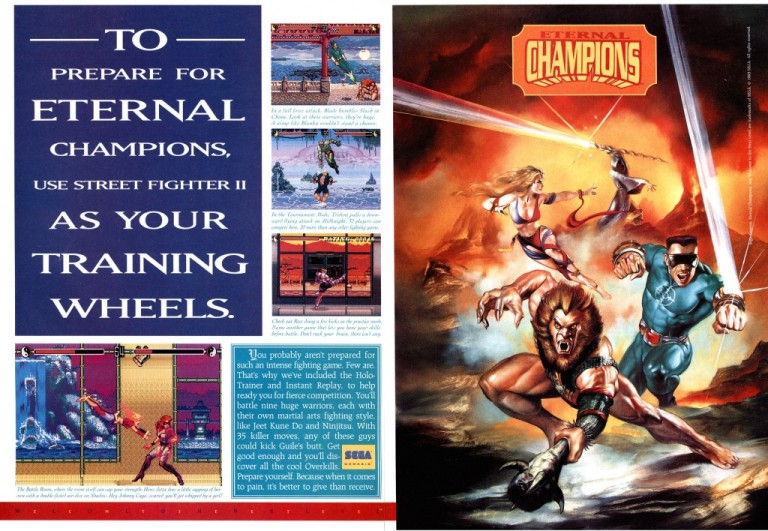
2. Eternal Champions print ad
This 2-page print ad appeared in many comic books and some magazines that I read long ago.
Back in the 1990s, the fighting game genre became wildly popular with gamers at the arcades and on consoles at home. Capcom literally sparked a wild fire with the Street Fighter II game and its upgraded editions, and other companies went on to make their own 2D fighting games to cash in. Sega was one of them and they released their own 2D fighting game Eternal Champions for the Sega Genesis console.
Unsurprisingly, the game was marketed aggressively and this 2-page print ad really stood out as it had the great looking painted art on the right, screenshots and details of the game, and most notably made a sarcastic reference to Street Fighter II. Eternal Champions sold enough copies, it led to the release of the sequel Eternal Champions: Challenge from the Dark Side and two spin-off games. I can only guess that referencing Street Fighter II was helpful in achieving commercial success.
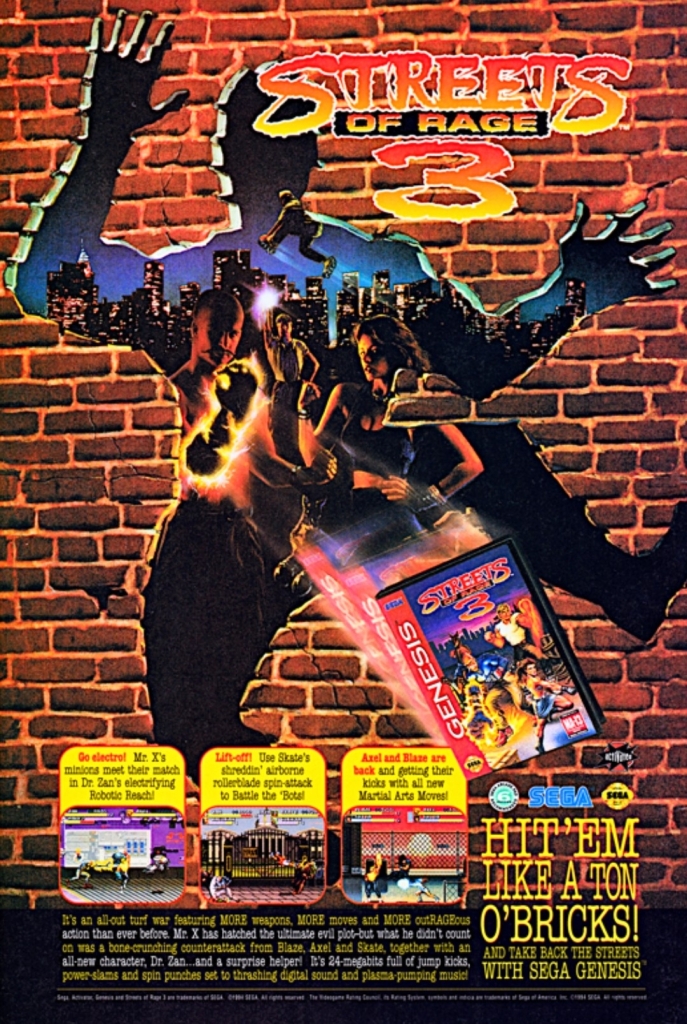
3. Streets of Rage 3 print ad
This ad caught my attention easily when I saw it in comic books I read.
Streets of Rage (Japanese title: Bare Knuckle) was one of the most defining game franchises Sega came up with and it started on the Sega Genesis console. It was a series of side-scrolling, 2D beat-them-up games that ensured action and excitement for gamers. As the first two games were critically and commercially successful, Sega was confident in aggressively marketing Streets of Rage 3 and the print ad seen had a very attention-grabbing artwork.
The artistic style emphasized power and intensity as it shows a damaged wall with the shape of a human body (symbolizing that someone was thrown through it) and then there were images of people on the other side. The game went on to attract mostly positive reviews although it paled in comparison to its predecessors in terms of sales.
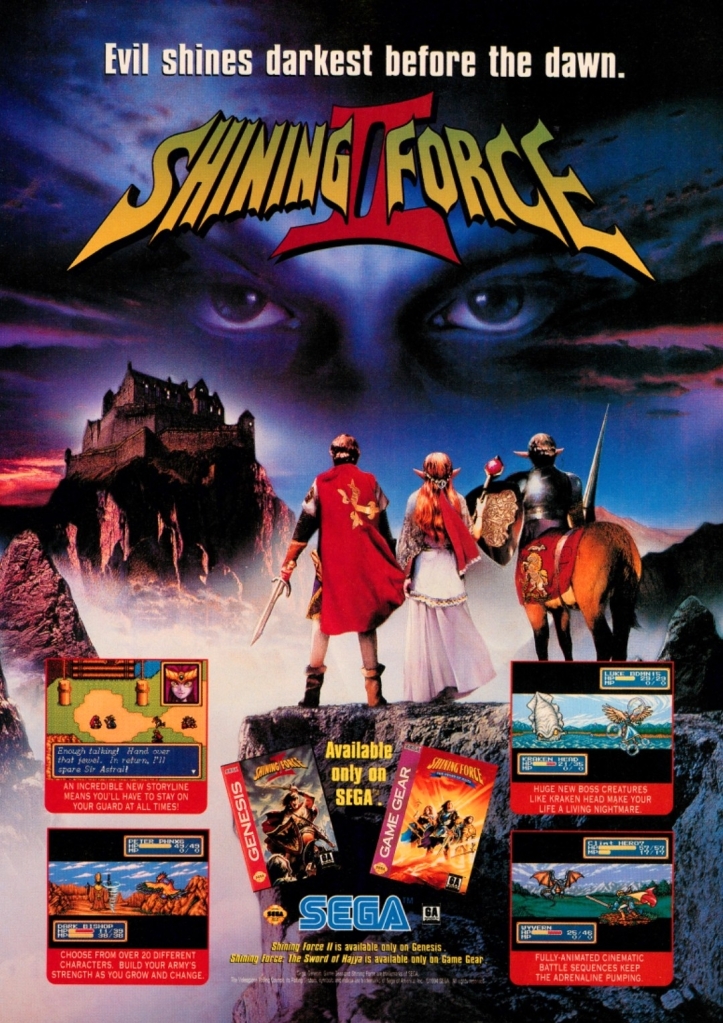
4. Shining Force II print ad
The first time I saw this ad, it made me interested to buy a Sega Genesis console to play it.
As Sega was so prolific with making and releasing games across different genres, they had their own tactical role-playing game series with Shining Force and the first game released on the Sega Genesis was a critical and commercial success. That being said, the company was confident with releasing Shining Force II on the same console more than a year later achieving critical and commercial success.
The North American print ad of the game had a visual presentation that closely captured the foreground-background style (characters facing the distance) used in-game, and the advertising team use photographic imagery to achieve a fantasy look. Very cleverly, Sega inserted the Sega Game Gear title Shining Force Shining Force: The Sword of Hajya into the ad. This print ad made me interested in acquiring a Sega Genesis for Shining Force II.
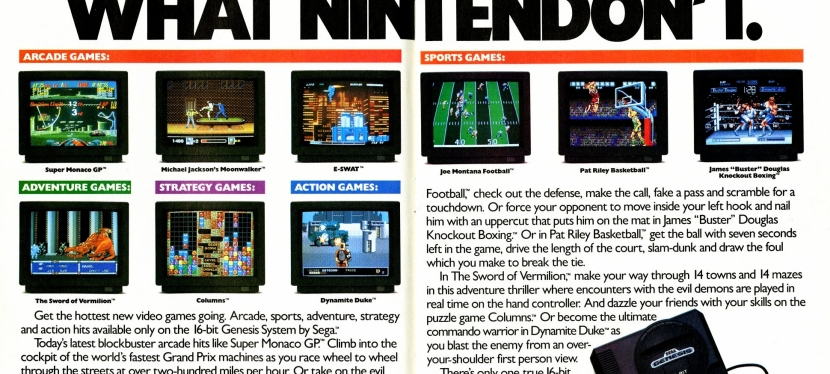
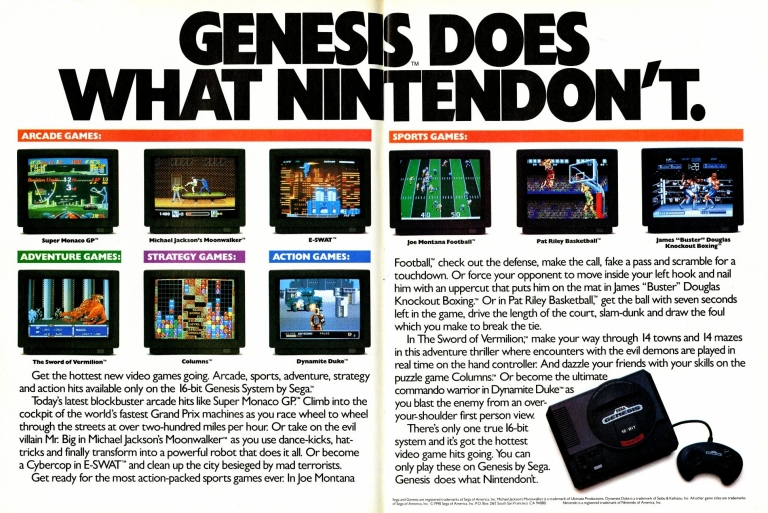
5. Genesis does what Nintendon’t print ad
With the famous line heavily emphasized, this print ad showed how bullish Sega really was in competing with Nintendo.
Now this print ad of Sega’s has the most definitive and best-known advertising line in the so-called 16-bit console generation: Genesis does what Nintendon’t. This was Sega’s aggressive marketing push to convince gamers to buy the Genesis console to play games and experience thrills of fun that they would not find on a Nintendo console at the time. Genesis was launched in America in 1989 with “16-bit” emphasized a lot, and the technological rival Super Nintendo Entertainment System (SNES) was released in the same market more than two years later.
The 2-year advantage helped Sega establish the Genesis as the next-gen machine for gaming at home and there were years in the 1990s when Sega’s console outsold Nintendo’s in America during the so-called 16-bit war. The Genesis also had lots of exclusive games plus strong software support from third-parties. While the SNES would eventually outsell the Genesis in other parts of the world, it was in America where Sega proved to be very competitive and successful.
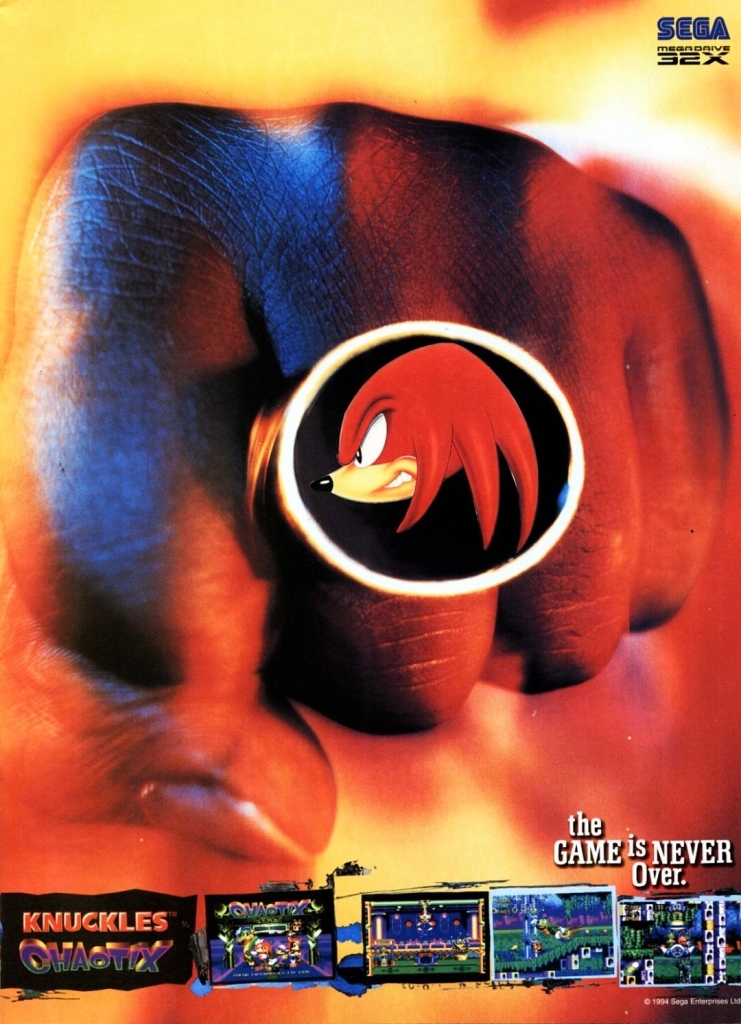
6. Knuckles’ Chaotix print ad
Sega was aggressive with marketing this game for the 32X.
In late 1994, Sega released in America and in Japan the 32X which was an add-on device for the Sega Genesis designed enhance its power while serving as a transition (a warm-up) into the so-called 32-bit era of console gaming. The 32X was the result of corporate decisions involving the American and Japanese executives of the company.
To keep 32X customers happy and boost hardware sales, Sega adjusted the development of Knuckles’ Chaotix (a Sonic spin-off) from being a Sonic project 32-bit console Sega Saturn into a standalone game for the add-on device. Even though Sega knew the game’s development was rushed, they went on to strongly promote the game and the print ad shown here was quite eye-catching.
The image of a fist with a ring showing the character Knuckles (a character from the Sonic games) emphasizes power and the colors used seem to express intensity. Then there were the selected screenshots shown without descriptive text. Although Sega tried hard, Knuckles’ Chaotix (launched in 1995) received mixed-to-positive reviews and sadly sold poorly. Unsurprisingly, the sales of the 32X dropped further and by then a lot of consumers knew that the Sega Saturn (the true successor to the Genesis) was all set to launch in America and Europe within 1995.
7. Sonic 3D Blast for Sega Saturn print ad
Too bad Sega and its teams failed to make the true Saturn Sonic game.
Back in the 1980s and 1990s, having a high-quality, console-exclusive game featuring a company mascot was crucial to sell game consoles while keeping dedicated fans happy. Like what Nintendo did with their icon Mario, Sega achieved great commercial success with the three Sonic the Hedgehog games they released exclusively on the Sega Genesis console and this naturally created expectations they would make new Sonic games on the Saturn console. Unfortunately, Sega and its teams failed to complete development of the Saturn-exclusive game Sonic X-treme and the company cancelled it which sent shockwaves through the games industry news.
With the 1996 holiday shopping season too crucial to ignore, Sega commissioned a Saturn version of the game Sonic 3D Blast which was originally made for the Genesis console. Sonic 3D Blast on the Saturn took seven weeks to make and there were some graphical enhancements implemented. While Sonic 3D Blast’s Genesis version attracted a positive reception from critics (and sold 700,000 copies), the reception for the Saturn version was mixed. This print ad of Sonic 3D Blast on Sega Saturn is a reminder of the company’s failed attempt to take their icon to the next-generation. They never replicated the big success they had with Sonic on the Genesis.
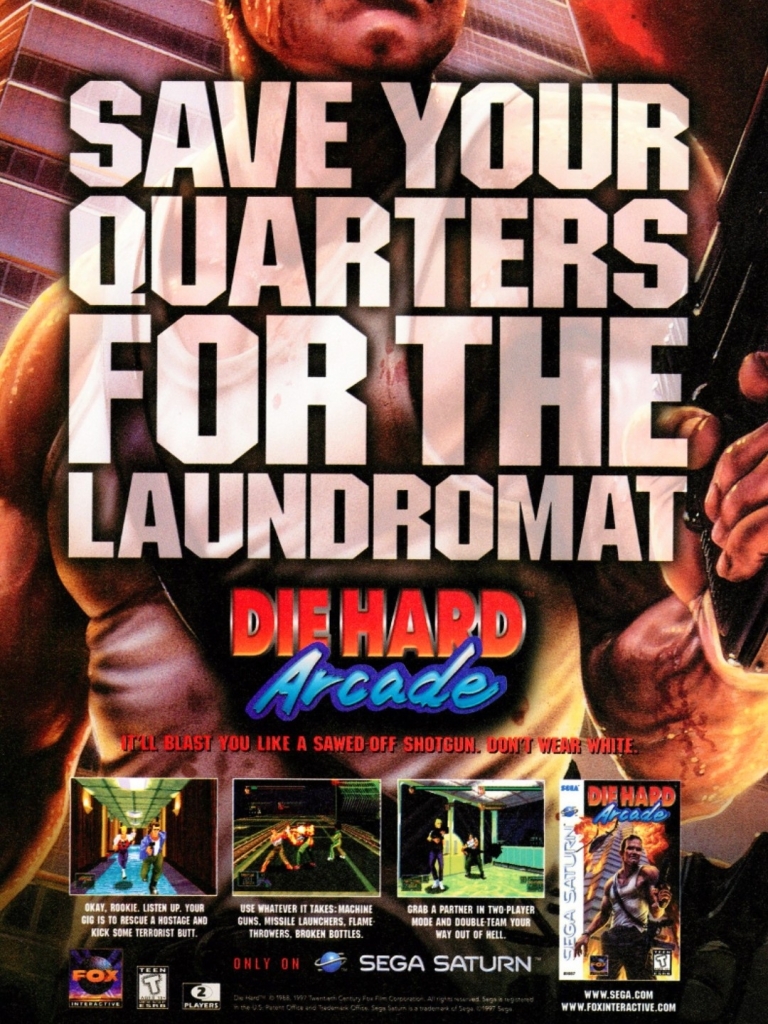
8. Die Hard Arcade print ad
Each time I saw this print ad, it easily reminded me of the classic action film of 1988.
Like many other movie franchises, Die Hard has many video game adaptations released through the decades. In 1997, Sega released Die Hard Arcade (Japanese title: Dynamite Deka) on the Sega Saturn and the game critics praised it for its fun gameplay as well as its flawless conversion of the arcade version (released in 1996). To say the least, the development history of Die Hard Arcade is not as straightforward as many would think. To get the details and explanations of the development of the game, click here.
As for the print ad itself, this one cleverly used official game art as the background with imagery which instantly reminded me of what I saw in the classic 1988 movie that starred Bruce Willis. This ad made me interested to buy a Sega Saturn or find a place to rent it to play the game.
9. Shenmue Japanese print ad
Simplistic with presentation and yet engaging to look at. The Dreamcast-exclusive Shenmue sold over a million copies in Japan alone.
When Shenmue was released exclusively on the Sega Dreamcast in Japan on December 29, 1999, it turned out to be a very mind-blowing experience for many gamers due to its ambitious game design, the intense attention to detail implemented, very high production values, in-depth exploration and very immersive gameplay.
It was the open-world game released at a time when “open-world” was not even a standard gaming term. Often called the masterpiece of the legendary game designer Yu Suzuki, Shenmue sold over 1.2 million copies in Japan and went on to be released worldwide in the months that followed. Sadly, the game failed to make a profit due to its very high budget of $70 million (which Suzuki himself said in English during an interview) and the fact that the number of Dreamcast units already sold to gamers was not massively high.
The Japanese print ad of Shenmue had a simplistic looking visual concept and yet it was engaging to look at because the way the characters appeared was how they appeared in the game during gameplay which was astounding. Take note that back in the 1990s, it was common for video game marketing materials to show human characters in high detail but in reality the polygonal models of those characters appeared looking blocky and much less detailed during gameplay.
Welcome back readers, fellow geeks and electronic gaming fans!
In this edition of the Retro Gaming Ads Blast (RGAB) series, we will examine print ads from the 1980s and the 1990s that caught my attention and I will explain why they are worth look back at.
For the newcomers reading this, Retro Gaming Ads Blast (RGAB) looks back at the many print ads of games (console, arcade, computer and handheld) that were published in comic books, magazines, flyers and newspapers long before smartphones, social media, the worldwide web and streaming became popular. To put things in perspective, people back in the 1980s and 1990s were more trusting of print media for information and images about electronic games.
With those details laid down, here is the newest batch of retro gaming print ads for you to see and enjoy…
1. Star Wars: Rebel Assault print ad
This print ad was strong enough to capture Star Wars fans’ attention and make them interested with the Sega CD.
If there is anything notable about the Sega CD (Mega CD in other parts of the world) platform, it is the fact that the machine was an add-on to be connected with the Sega Genesis (Sega Mega Drive elsewhere) console. That being said, LucasArts included the Sega CD as one of several platforms for the multiplatform release of their 1993 game Star Wars: Rebel Assault. The above print ad caught my attention with its use of 9 screenshots (emphasizing a wide look at the game’s Star Wars concept) and text description (emphasizing multi-media features connected with gameplay), and for a time it made me interested in the Sega CD. Looking back at the game’s marketing, Star Wars: Rebel Assault was designed to not only give gamers sessions of play to enjoy but also opportunities to immerse themselves deeper into the realm of Star Wars. The game even had selected video clips from the original Star Wars trilogy movies.
2. Cloak & Dagger print ad
This print ad could have used at least two screenshots from the arcade game…
In 1984, there was a movie titled Cloak & Dagger (read my retro movie review by clicking here) which was not only the 4th cinematic adaptation of the short story “The Boy Cried Murder” (written by Cornell Woolrich) but also had the real-life electronic game Cloak & Dagger as a crucial plot element. To make things clear, there was a Cloak & Dagger game released in the arcades (as emphasized in the above print ad) from Atari. Behind the scenes, the filmmakers and Atari worked together which explains the video game tie-in with the movie. While the above arcade conversion kit print ad does not show screenshots of gameplay, the four images of the playable protagonist Agent X shown were from the game’s short transition sequences (moving from one level to another) which were also displayed in the 1984 movie. Those images were enough to remind me about the movie I enjoyed.
More on the Atari connection, the movie had a cleverly presented short scene showing the young protagonist Davey (played by Henry Thomas) playing Cloak & Dagger on his Atari 5200 console with spliced gameplay footage of the arcade version shown within cuts. In real life, however, Atari never released a version of Cloak & Dagger for any console nor computer in the 1980s. Today, you can play the game on the Atari 50 collection on consoles.
3. BurgerTime print ad
This BurgerTime print ad was entertaining to look at and easily reminded viewers about food and the popular game coming home.
Back in 1982, BurgerTime (Japanese title: Hamburger) was released in the video arcades and turned out to be a big hit in both Japan and America. Seeking to capitalize on the game’s success, Mattel Electronics acquired the rights of the game from Data East and went on to release versions of it for the Intellivision, Atari 2600, Apple II and the IBM personal computer. Mattel went on to market the game for consoles and computers by coming up with a print ad (the one above) that had comic book-style hand drawn art of the playable protagonist chef Peter Pepper running away from walking versions (anthropomorphic figures) a hotdog, an egg, and a pickle. The ad showed a single screenshot which was sufficient enough to show readers the concept of the game clearly. In my experience, I never got to play BurgerTime in the arcades but I first learned about its existence thanks to the eye-catching print ad above which appeared in comic books I read. In addition, the print ad also does an effective job to remind readers about food.
4. SOS print ad
This print ad made me interested in the game as I was already aware of the historical sinking of the Titanic, and I already saw the disaster film The Poseidon Adventure.
Moving back to the 1990s, I saw the above print ad of the video game SOS for the Super Nintendo Entertainment System (SNES) while reading a comic book. The nice artwork caught my attention as it easily reminded me of the disaster movie The Poseidon Adventure (1972) as well as the real-life tragedy of the Titanic. Then I saw the screenshots on the print ad and they made me interested on the game which I later played on a rent-by-the-hour game joint. Looking back at the text description of the print ad, it did not describe what the technical and graphical features of SOS were. That being said, I was surprised to experience the game’s use of the SNES Mode 7 effects which enabled the scaling and rotating of the in-game environment which affected gameplay in many ways. Read my retro review of SOS by clicking here.
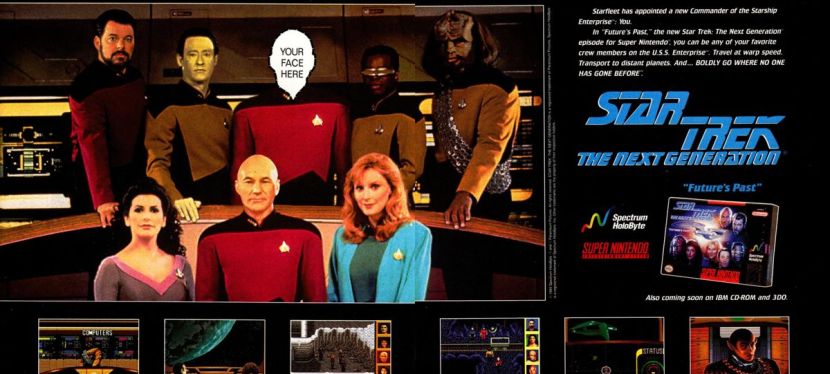
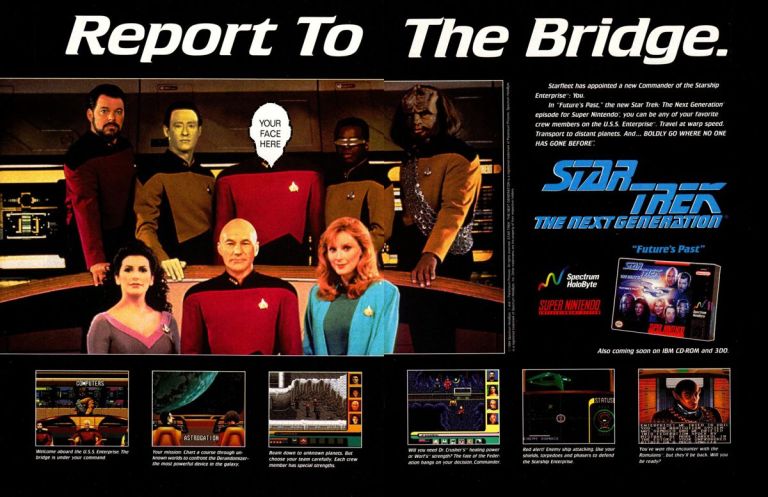
5. Star Trek: The Next Generation – Future’s Past print ad
This 2-page print ad was strong enough to invite readers to literally join the Star Trek: TNG crew and go where no man has gone before. By the way, when was the last time you saw Marina Sirtis or Gates McFadden on a video game ad?
Long before wokeness ruined Star Trek in this modern age, the sci-fi franchise reached a tremendous high in popularity and projects in the 1990s as that decade had Star Trek: The Next Generation (most of its TV seasons and three movies were released within the decade), Star Trek: Deep Space Nine and Star Trek: Voyager that kept fans entertained.
Considering its high popularity, it was not surprising that a video game adaptation of Star Trek: TNG was released in 1994 titled Star Trek: The Next Generation – Future’s Past (the version for Super Nintendo Entertainment System) and I saw the above print ad while reading a gaming magazine. Using a slightly altered version of the TNG group photo, the print ad emphasized its concept that the player will be able to lead the crew of the Starship Enterprise and take part in a series of missions in different parts of space with the likes of Captain Picard, Commander Riker, Data, Worf, Dr. Crusher, Deanna Troi and La Forge. While I was never a Star Trek fan, the above print ad caught my attention with its concept, the group photo and the screenshots gave me an idea of what the game has to offer. It should be noted that Star Trek: The Next Generation – Future’s Past was released between the end of Star Trek: TNG’s final season and the theatrical release of Star Trek: Generations.
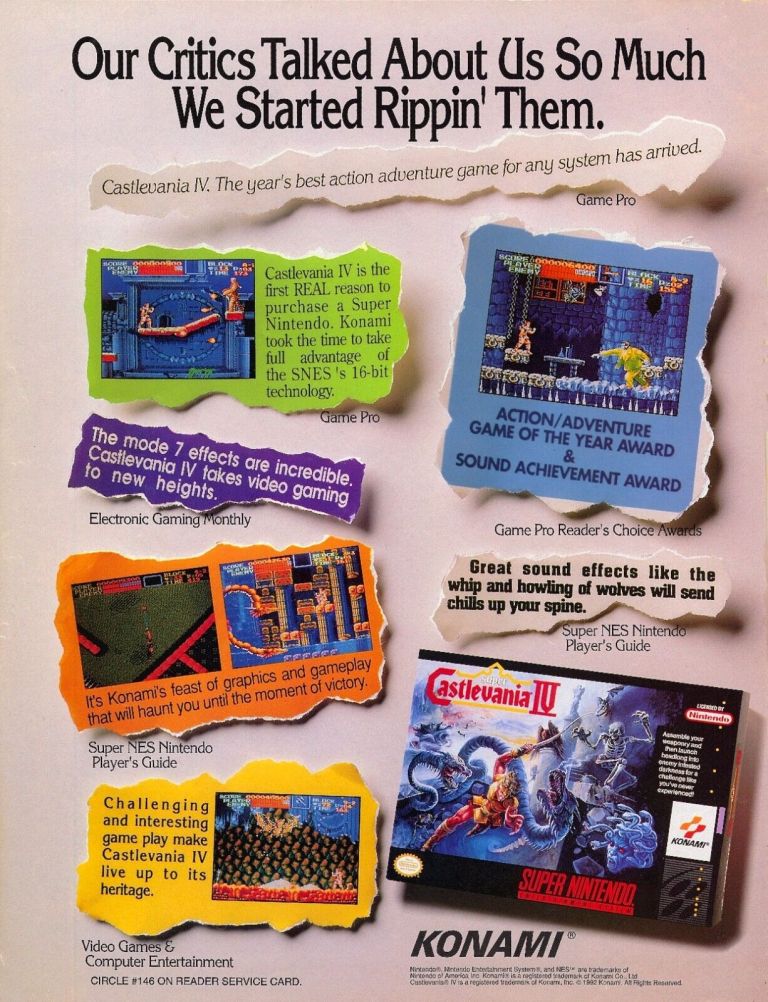
6. Super Castlevania IV print ad
This was one of the most eye-catching print ads I’ve seen about a Konami video game.
The jump in technology from one console generation to the next can be beneficial for gamers if game developers harnessed the advantages of new technologies to make new games that turned out to be more engaging and more enjoyable. Such was the case with Super Castlevania IV for the Super Nintendo Entertainment System (SNES) in 1991. The above print showed Konami highlighting the positive feedback their game received from different gaming media outlets and used screenshots to give gamers and long-time Castlevania fans exciting stuff to see. I got to play the game on the mini SNES console and I can say that in terms of visuals, controls and gameplay, Super Castlevania IV truly lived up to its title and it remains fun to play to this day.
With their combined might, Team Xbox, Bethesda and their strategic partners successfully pulled off a great Xbox Games Showcase 2023 and Starfield Directdouble feature! Great in the sense that they collectively premiered a wide variety of games including several Xbox-exclusive titles (both the announced and the brand new ones) that gamers can look forward to on Xbox Series X, Xbox Series S, Windows PC and via cloud gaming. What was shown was clearly a lot of fun to watch and there several bouts of surprises that I experienced along the way.
To be clear, 27 games were showcased. 21 games are coming to Game Pass (Xbox Game Pass and/or PC Game Pass). 13 of the games were from Xbox game studios. There were also several 3rd party games from different publishers including Capcom, SEGA, Atlus and Ubisoft.
1st Party Games from Xbox Game Studios matter a lot – The Xbox Games Showcase 2023 started with the reveal of the new Xbox-exclusive Fable role-playing game (RPG) from Playground Games which utilized in-game graphics for a cinematic style of presentation emphasizing the British approach on fantasy, comedic tone and style of play the game franchise is known for. There were a few moments of action shown but it is hard to determine if those will indeed be implemented in gameplay form. As I anticipated, Fable was shown without a release date nor an estimated year for release. All we can do now is wait for the developers to complete and polish it.
Also shown early during the showcase was the much-needed update on Avowed, the first-person fantasy RPG from RPG specialists Obsidian Entertainment (The Outer Worlds, Fallout: New Vegas). Compared to Fable, Avowed has progressed so much with its development, actual gameplay footage was shown with some storytelling cutscenes included. Set in the world of Eora (the same setting as established in the Pillars of Eternity series), gamers will play the envoy of Aedyr who is tasked to investigate rumors of a spreading plague with a secret that threatens to destroy everything. While it looks inspired by Bethesda’s Skyrim, Avowed clearly has its own flavor and style to its first-person battles and movement. This game is set for release sometime in 2024 exclusively on Xbox Series X, Xbox Series S and Windows PC with Xbox Game Pass inclusion. I am really looking forward to this game.
Still in the realm of fantasy but with a different approach on game design, Senua’s Saga: Hellblade II was shown during the showcase with an appearance by Melina Juergens (Senua) preceding it. Compared to the previous pre-release showing of the game, the newest video focuses more on the aspect of Psychosis and how Senua deals with it. Based on what was shown so far, it seems to me that the game has progressed far enough with its development and the it could be in the polishing stage right now. The Xbox-exclusive Senua’s Saga: Hellblade II handled by Ninja Theory will be released sometime in 2024.
Next are three Xbox-exclusive games that really surprised me during the showcase: Clockwork Revolution from InXile, South of Midnight from Compulsion Games and Towerborne from Stoic Studio. I was surprised in the sense that there were no pre-showcase insider reports and the rumor mills did not have anything to anticipate what the above mentioned games would be.
Clockwork Revolution is time-traveling first-person game with a strong steampunk flavor and game design that emphasizes role-playing reactivity. Its visual style reminds me of BioShock Infinite. South of Midnight is a new third-person action-adventure set in a magic realist version of the American South. Towerborne, the product of the partnership between Team Xbox and developer Stoic Studio, is a new adventure game that promises a brand-new take on action RPGs and it will be released sometime in 2024.
At long last, developer Turn 10 announced that Forza Motorsport (2023) will be released worldwide on October 10, 2023 and it will come with more than 500 cars, 20 completely rebuilt international race tracks with multiple layouts and the promised full dynamic time-of-day with weather, living crowds and interactive tracks. For this year, the car customization and tune-ups of Forza Motorsport (2023) was emphasized more. I will definitely play this upcoming racing game on my Xbox Series X this October.
The juggernaut of all Xbox-exclusive games – Starfield – was so huge and detailed, a standalone showcase of it was efficiently done by Todd Howard and his teammates at Bethesda. I will be writing a separate post for Starfield soon but I want to remind you all that the game will be released on September 6, 2023 and it will have a ton of gameplay features! Check out the latest Starfield trailer below plus those from other Xbox exclusives such as Sea of Thieves: The Legend of Monkey Island and Microsoft Flight Simulator 2024.
The 3rd party games at the showcase that got my attention – When it comes to games from other game publishers, Japanese RPGs (JRPGs) in the form of Persona 3 Reload (early 2024), Persona 5 Tactica (scheduled for November 17, 2023) and Metaphor: ReFantazio (2024) from Atlus and SEGA made quite a splash during the showcase in relation to the curious absence of the Xbox Game Pass-bound JRPG Eiyuden Chronicle: Hundred Heroes. It seems to me that Team Xbox made serious efforts to reach out to its Japanese partners to secure more JRPGs which will strengthen the Xbox ecosystem as the premiere place for RPGs. With that being said, Team Xbox pulled off the right moves and the Persona games franchise has a dedicated following worldwide.
While my dream scenario of Capcom unveiling a big-budget remake of Dino Crisis at the showcase did not come true at all, the Japanese publisher actually made it and went on to unveil the game Kunitsu-Gami: Path of the Goddess. The game has a fantasy setting with strong Japanese aesthetics and action-adventure gameplay. It is will have a Day 1 launch on Xbox Game Pass as well.
Dungeons of Hinterberg looks really fascinating with its game design and play style complete with having a very unique artistic approach for its visuals. It will be released in 2024 with Xbox Game Pass included. Also coming to XGP but within 2023 is Jusant, the new game from French developer Don’t Nod that emphasizes exploration by means of climbing and puzzle solving.
Conclusion – I can say it out loud that the Xbox Games Showcase 2023 – Starfield Direct double feature is not only great on its own but it is also a notable improvement over the previous Xbox showcases of the past two years. The Xbox-exclusives are indeed coming in the 2023-2024 period, and that includes having Starfield and Forza Motorsport (2023) scheduled for release in September-October this year. 2024 at this stage is looking great as well not only with the Xbox-exclusives but also with the 3rd party games. Xbox Game Pass subscribers also have new games to look forward to in the near future.
As game development can be tricky, unpredictable and complicated, delays of game releases are always possible. As such, we gamers can only hope that the game developers won’t encounter anymore problems with their respective games so that they will be completed, polished and get released as planned.
In ending this piece, posted below is the entire Xbox Games Showcase 2023 – Starfield Direct video from the YouTube channel of Xbox. I highly recommend watching it all in 4K. Enjoy!
Not only that, those who want to watch the streams in 4K resolution at 60FPS should head on to YouTube.com/Xbox and YouTube.com/Bethesda. There will also be multi-language support in the forms of subtitles.
What to expect? Based on the recent tweets by Xbox Games Marketing executive Aaron Greenberg, the Xbox Games Showcase and Starfield Direct will combine for roughly two hours non-stop games and it will all be about games. There won’t be any movie trailers to disrupt the double feature. Look at the tweets below…
Already, it has been confirmed that there will be no CGI-trailers about Team Xbox’s games at the two showcases. Personally, I prefer to see gameplay footage showing how the upcoming games function and how they could turn out fun. When it comes to showing story cutscenes, using gameplay graphics is more preferrable to me.
What video games to expect from Team Xbox? While it is inevitable to me that they will show the promised 2023 exclusives Forza Motorsport (2023) and Bethesda’s highly anticipated Starfield, I can only speculate that Phil Spencer and his team will give fans big updates (note: to be showcased visually, not just mere announcements) about other Xbox-exclusives such as Senua’s Saga: Hellblade II (read my article), the new Fable role-playing game (RPG), the fantasy RPG Avowed from Obsidian Entertainment (read my last article of Avowed), and possibly State of Decay 3 from Undead Labs. While it is possible that the troubled Xbox-exclusives Everwild and the Perfect Dark reboot could also be shown, I’m not confident about them. I also do not expect anything to be shown about Hideo Kojima’s Xbox project nor the other exclusive game Contraband.
I am anticipating that a final release date for Forza Motorsport (2023) will be announced, and the same should happen with Senua’s Saga: Hellblade II (possibly late-2023 or early 2024). Avowed, if its development has progressed a lot since the first announcement, could be announced for 2024 and it should help satiate gamers’ demand for the epic open-world fantasy RPG experience of the Elder Scrolls game franchise. In my view, the Elder Scrolls VI is still years away from getting released. As for Fable, it could be shown but without a release date.
Starfield will have its very own showcase immediately after that of Xbox. That being said, I am anticipating a very in-depth gameplay demonstration of the game, some more bits about its story and core concept, and hopefully there will be options for gamers to play the game in 30FPS and 60FPS with varying resolutions. I personally want to play Starfield on my Xbox Series X console in 60FPS. I hope they will show more space battles which I think will add more variety to the gameplay as a whole. We will find out soon from Bethesda and Todd Howard on Starfield Direct.
When it comes to the Gears of War franchise, I’m not really anticipating a new Gears sequel. What would be more doable, in my opinion, is Team Xbox revealing a Gears Tactics sequel which should delight fans of the 2020 game as well as gamers who love playing turn-based tactics games. For me, the time is right to announce a new Gears Tactics game!
In my view, the time is right for a Gears Tactics sequel to be unveiled while gamers worldwide endure the long wait for the next Gears of War game.
As for games from other companies that could be part of the Xbox Games Showcase, I am anticipating an appearance and updates about Eiyuden Chronicle: Hundred Heroes in terms of new gameplay and hopefully a final release date within 2023 (note: this Japanese RPG will also launch on Xbox Game Pass). Very recently, Japan-based developer Rabbit & Bear Studios posted updates about the game on social media which just might mean there will be a possible appearance on the showcase. Take note that Eiyuden Chronicle: Hundred Heroes’ inclusion on Xbox Game Pass is significant and this weekend’s online event is the best opportunity to promote it and make both XGP subscribers and JRPG fans excited.
There is the possibility that Konami could show Suikoden I&II HD Remaster Gate Rune and Dunan Unification Wars and announce a firm release date for 2023. The showcase is also a great opportunity for Konami to promote the classic games to a worldwide audience and finally start executing their marketing plans that should excite Suikoden fans as well as gamers who love JRPGs.
When it comes to dream scenarios (note: the unlikely) that could really make waves if they ever happen at the Xbox showcase, that would be Capcom showing a big-budget remake ofDino Crisis (comparable to what they did with Resident Evil 2, 3 and 4) as well as announcing remastered versions of Breath of Fire RPGs for release on modern consoles plus Xbox Game Pass. I understand Capcom has its very own games showcase scheduled for the next day but the Xbox showcase is still a great opportunity to make waves with gamers worldwide. More wild scenarios? That would SEGA announcing the next Virtua Fighter game or a fully remastered Shining Force III (with all three chapters together), 2K Games revealing XCOM 3 (note: it’s been seven years since XCOM 2) plus Square Enix actually announcing a remastered version of Xenogears (note: this year marks the 25th anniversary of the game).
At this stage, we can only wait and see what will happen next. Team Xbox should show more games related to the latest Xbox Game Studios Publishing developments and other deals they made with developers – both the big and the smaller independent ones – so far. Not only that, there has to be something new and ready to be revealed from Team Xbox’s game studios such as Compulsion Games, inXile Entertainment and others. The excitement and suspense are building up!
Watch out for the games, the exciting stuff and big announcements at the Xbox Games Showcase and Starfield Direct Double Feature this weekend!
In concluding this article, posted below for your enjoyment are Xbox-related videos.
Anyone who owns an Xbox console or a Windows PC who loves Japanese role-playing games (JRPGs) should be delighted to know that the popular Persona game franchise will have three of its established games released for Xbox One, Xbox Series X, Xbox Series S and Windows PC with availability through Xbox Game Pass (XGP) soon as confirmed in the recent Xbox-Bethesda games showcase! For clarity, Persona 5 Royal is slated for an October 21, 2022 release.
For starters, watch the official video below…
To understand the Persona games better, posted below is an excerpt from the official article published at Xbox.com written by SEGA Communications Manager Stacy Lee. Some parts in boldface…
Cheers to 25 years of Persona! In this very special anniversary year, we are bringing the worldwide hits Persona 5 Royal, Persona 4 Golden, and Persona 3 Portable to Xbox One, Xbox Series X|S, Windows PC, and with Xbox Game Pass. Starting this fall, fans will get to experience this beloved RPG series.
To kick things off, on October 21, don the mask of Joker and join the Phantom Thieves of Hearts when Persona 5 Royal arrives with Xbox Game Pass, Xbox Series X|S, Xbox One, and Windows PC. We’ll have more to share on the release of Persona 4 Golden and Persona 3 Portable so be sure to stay tuned here to Xbox Wire.
For those who missed out on these games originally, or are excited to play Persona on Xbox and Windows PC, the 25th Anniversary is a great time to join in the celebration. Here’s a quick refresher on each game:
Persona 3 Portable – If I say there’s an hour “hidden” between one day and the next… would you believe me? This unknown time is the “Dark Hour.” Unfamiliar stillness swallows the city, people turn into eerie coffins, and otherworldly monsters called Shadows swarm. One night, the protagonist is attacked by these Shadows. When all hope seems lost, the power of the heart, their Persona, is awakened.
Persona 4 Golden – They say your soulmate will appear if you stare into a television set on a rainy night… This strange rumor slowly spreads through the rural town of Inaba, the protagonist’s new home, just as a chain of mysterious murders begin. As the protagonist and his teammates chase after the truth, they find themselves opening the door to another world.
Persona 5 Royal – Forced to transfer to a high school in Tokyo, the protagonist has a strange dream. “You truly are a prisoner of fate. In the near future, ruin awaits you.” With the goal of “rehabilitation” looming overhead, he must save others from distorted desires by donning the mask of a Phantom Thief.
In my personal experience, the one and only Persona video game I ever played was Revelations: Persona on the original Sony PlayStation way back in 1996. I never finished that game but I spent many hours playing it and that includes the loading times and the not-so-efficient pacing of the gameplay.
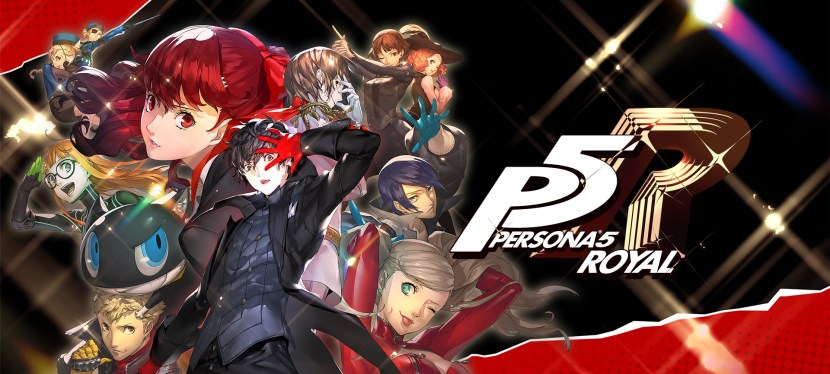
Image from Persona 5 Royal.
The upcoming release of the recent Persona RPGs on Xbox and Windows PC with access through Xbox Game Pass (XGP) should help the franchise reach even more gamers worldwide. As far as Japanese gaming goes on Xbox right now, I enjoyed finishing Eiyuden Chronicle: Rising on my Xbox Series X and I’m looking forward to the Suikoden-inspired Eiyuden Chronicle: Hundred Heroes RPG which will be released sometime next year. Square Enix has Star Ocean: The Divine Force and The Diofeld Chronicle coming to Xbox this year but no release dates have been announced as of this writing. Most recently, Square Enix announced that Crisis Core: Final Fantasy VII Reunion will be released on Xbox consoles although no release date has been announced.
Combined with those mentioned Japanese games or JRPGs to be exact, the addition of Persona games is indeed a welcome addition to the Xbox ecosystem which has lots of gamers craving for such games. It’s nice to see that Team Xbox head Phil Spencer has been working hard negotiating with Japanese game companies and makers to release their games into the Xbox ecosystem. In fact, during the Xbox-Bethesda showcase, a special Xbox project with Hideo Kojima’s company was confirmed to be real and there was also the announcement of an Xbox release of Wo Long: Fallen Dynasty developed by Team Ninja.
Let me end this piece by ask you readers: Are you happy that the Persona game franchise is coming to Xbox with the mentioned three games? Do you think that more Japanese RPGs and other kinds of games made by Japanese game developers will continue to be released on Xbox? What other past JRPGs do you want to see released on Xbox and Xbox Game Pass? Do you think that all the JRPGs already announced coming to Xbox and mix in with Western RPGs (examples: Starfield, Fable reboot, The Outer Worlds 2 and Avowed to name a few) will result a wide variety of games for those who love playing role-playing games? Do you see Xbox as the definitive ecosystem for RPGs right now?
To put things in perspective, posted below is the excerpt of the Xbox.com announcement written by SEGA Europe Junior PR Manager Joseph Knoop. Some parts in boldface…
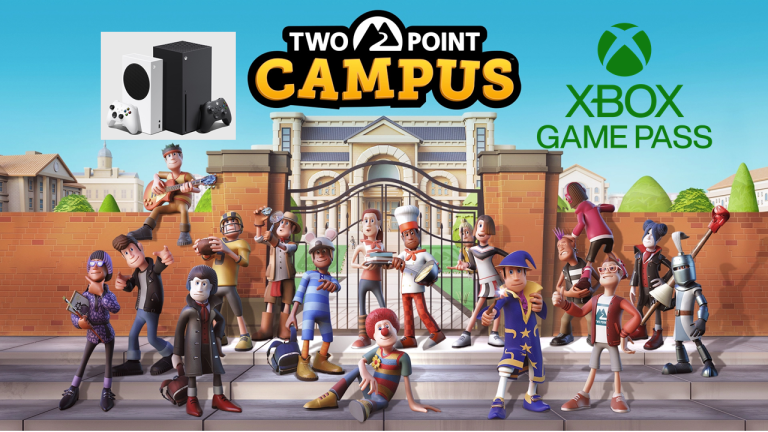
Watch out for Two Point Campus on Xbox consoles and Windows PC via Xbox Game Pass this August.
Like a freshman dreading their 8 a.m. class, Two Point Campus needs just a little more time. Two Point Campus’ release date has been pushed back from May 17 to August 9. As always, we appreciate the patience of our wonderful community and all your support throughout development.
In better news, you can check out the first hands-on media impressions of Two Point Campus at some of your favorite gaming outlets today. We’re excited to hear what everyone thinks of the game thus far and what you’re anticipating most. While the decision has been made to delay the release of Two Point Campus by a few months, the vision for the game has remained the same.
Two Point Campus lets you build the university of your dreams (or nightmares, we don’t judge), shepherd students from freshman year to graduation, and let them run wild with outlandish classes like Knight School, fossil-digging archaeology, or even baking giant pizzas in Gastronomy and much more. In Two Point Hospital, players couldn’t spend much time with patients, considering they either healed up and went on their merry way or, you know, died. Two Point Campus lets you really dig into each student’s life, and guide them on their social and academic journey. You can offer them a wealth of life-enriching experiences, be it clubs, social events, or more Cheesy Gubbins vending machines.
You’ll do it all on a campus designed by your very own hand, down to the very last desk and tree, offering way more customization than ever before. Maybe you’ll build a jousting arena for your gallant Knight School students and a tower to practice dragon-slaying from – or maybe you want something a little more cutting edge, and your campus will be a haven for budding mad scientists and building giant robots.
If that all sounds like a good time to you, you can pre-order Two Point Campus now and get some exclusive in-game items for both Two Point Campus and Two Point Hospital.
To order Two Point Campus online, click here. For the Two Point Collection Early Adopter Bonus, click here.
In closing this piece, posted below are Xbox-related videos for your viewing pleasure.
To begin with, watch this official trailer of Two Point Campus.
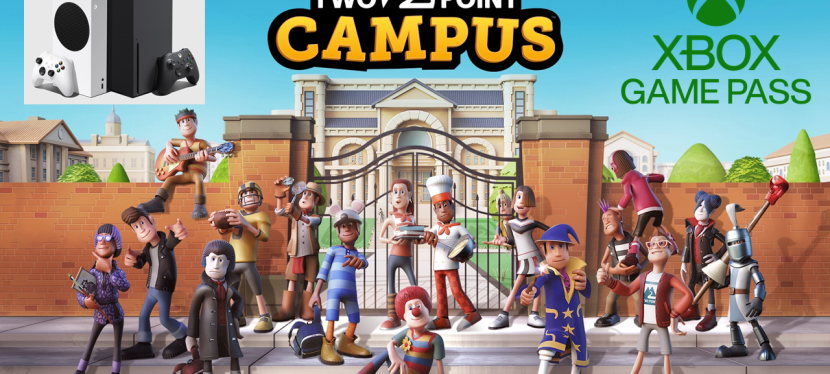
Developed by Two Point Studios, Two Point Campus has a school setting and players will be challenge to establish and manage a university campus complete with setting up its many parts (like classrooms and laboratories to name a few), hiring a staff of good quality educators, and managing how the students will behave in and around campus. As it is a piece of fantasy, the game has a cartoony vibe on its art and expressions.
To put things in perspective, posted below is the excerpt from the official announcement on Xbox.com written by Two Point Studios Creative Director Gary Carr.
Build your university and manage everything within it.
In Two Point Hospital there is very little time to really get to know your little people, because patients come in for their treatment, you cure them (or they die…oops) and then they leave your hospital. In Two Point Campus this process is very different. Your students will be with you for much longer during their campus experience, giving you the chance to help them on their academic journey to success, or in some cases failure. You’ll have to figure out what’s going on. Are they happy? Are they enjoying their courses? Are they making enough friends? You’ll need to take the time to get to know them, nurture them and pull them through this process. Each student has their own unique character traits, so you’ll have to cater to all their needs to develop them into well-rounded individuals who will do the legacy of your university proud.
We just really want you to care more about your little people, so in Two Point Campus we’re giving you the tools to create an incredible university experience for your students. Keep them entertained with extracurricular activities, such as socials, gigs, clubs and even ‘CheeseBall’ – the highly entertaining sports activity in Two Point Campus. However, too much of the fun stuff will result in students falling asleep during class, which impacts their grades and eventually your overall Campus prestige. It’s the perfect balancing act, to on one hand give your students the adventure of a lifetime, and on the other hand, run a successful Campus environment.
The students in classroom.
Anyone that’s familiar with Two Point Hospital will know that we like to give our games a humorous twist. That’s no different in Two Point Campus. Rather than the typical academic fare, students in Two Point County will experience some very unusual courses. They can learn how to cook giant pizzas in the Gastronomy course or attend Robotics and get into the techy stuff where they build huge robots. We really enjoyed brainstorming about all the different courses in Two Point Campus. It usually starts by thinking of theme or a pun, and from there we think of how we can build it into a course. We love thinking of big and absurd machines or items that the students interact with during their courses, so players are wondering “what on earth going on there??”
Like Two Point Hospital, Two Point Campus is a charming, accessible, and deep management sim, but for the first time, you will be able to build your Campus from the ground up, from the buildings to the grounds they sit in. You can design stylish dormitories for your students, lay down ornamental pathways or pimp up your Campus with super cool items, such as Cheesy Gubbins vending machines. One of the things we enjoyed most at Two Point Studios when Two Point Hospital launched, was watching people play our game and get super creative with the design of their rooms and hospitals. In Two Point Campus we take this a step further, where players can go all out and design absolute masterpieces, or total trash if they wish… However, there will still be plenty of options for people who don’t like that total freedom when it comes to building. We’re keen to cater to all the different playstyles.
The above description really sounds interesting. I wonder if the game will allow players to fire socialists/Communists/Marxists among the university’s educators to prevent the radicalization of students which has been going on for a long time in North America in real life. If I were to establish the campus of my dreams, there definitely will be no Leftism and no elements of the Satanic Left. The focus will be strictly on education, no political ideologies. No socialism, no Marxism and no Communism at all!
Coming soon to Xbox consoles and Xbox Game Pass!
As mentioned earlier, if you are convinced to buy yourself a copy of Two Point Campus for your Xbox console or Windows PC ahead of time, you can do it online and you will get some bonus items in return. However, if you are already subscribing via Xbox Game Pass or PC Game Pass, you only need to wait for the May 17, 2022 launch to download it and play it without extra charge. I myself am an XGP subscriber and I will be playing Two Point Campus on my Xbox Series X this May, and only then I’ll find out how good the game will turn out.
In closing this piece, posted below are Xbox-related videos plus a Two Point Campus video for your viewing pleasure.
+++++
Thank you for reading. If you find this article engaging, please click the like button below and also please consider sharing this article to others. If you are looking for a copywriter to create content for your special project or business, check out my services and my portfolio. Feel free to contact me with a private message. Also please feel free to visit my Facebook page Author Carlo Carrasco and follow me on Twitter at @HavenorFantasy as well as on Tumblr at https://carlocarrasco.tumblr.com/
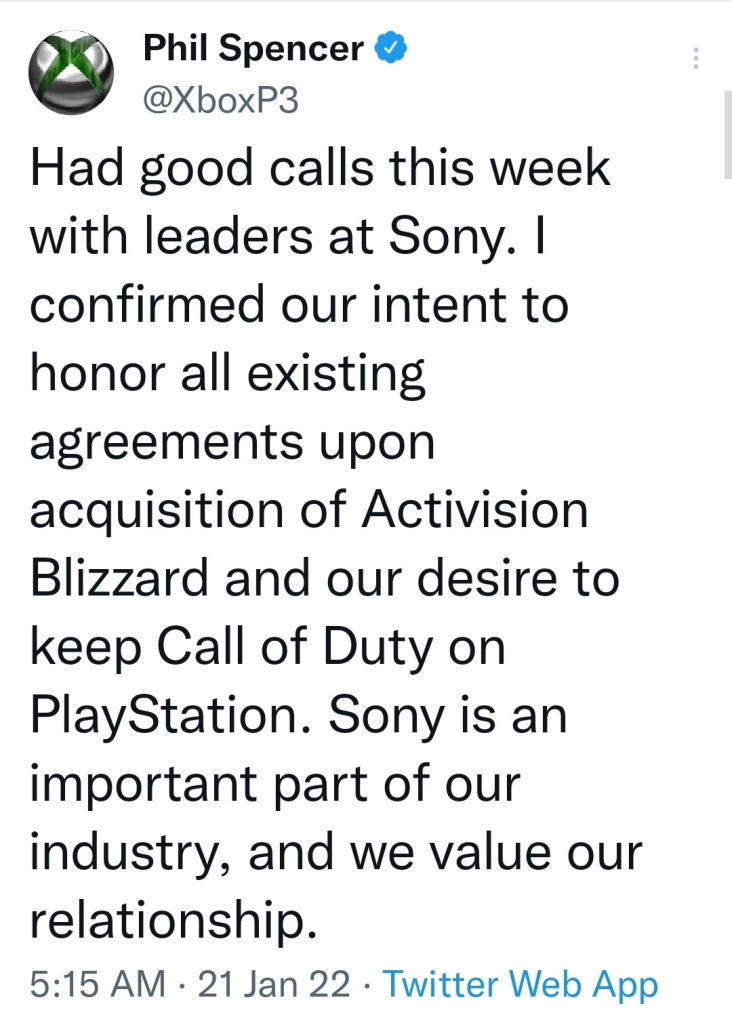
Take note of Spencer’s words “existing agreements” and “our desire to keep Call of Duty on PlayStation.” Existing agreements most likely refer to what Activision Blizzard made with Sony which I believe are years-long deals on games with regards to platform releases, marketing, post-release downloadable content, etc. Of course, such agreements can last long but NOT FOREVER. The business benefit for PlayStation from Activision Blizzard will someday come to an end.
As for Microsoft’s desire for keeping Call of Duty on PlayStation, that clearly means that the corporation of Xbox is technically in-charge of not just the COD franchise but on the decision making, marketing and releasing its games on specific platforms. Sony and its PlayStation team are not in the driver’s seat here anymore. Whatever deals Activision signed with PlayStation before the acquisition will expire and they certainly will not be renewed once Microsoft and its Xbox team takes over. In due time, future COD games as well as other upcoming games and new intellectual properties of Activision Blizzard will become Xbox-exclusive in accordance to what Spencer declared before…
“We have games that exist on other platforms, and we’re going to support those games on the platforms they’re on. There are communities of players. We love those communities and will continue to invest in them. And even in the future, there might be things that have either contractual things, or legacy on different platforms, that we’ll go do. But if you’re an Xbox customer, the thing I want you to know is this is about delivering great exclusive games for you that ship on platforms where Game Pass exists, and that’s our goal, that’s why we are doing this,”
This brings me to my next point – Sony as a global business entity is way behind Microsoft, Apple, Google and Amazon when it comes to establishing ecosystems that result tremendous business growth and reaching billions of customers worldwide respectively. The decades-old console-focused approach by Sony with PlayStation was indeed successful but not great enough to help it grow big time. Not even their Hollywood business nor Spider-Man could lift them up greatly. The weird thing was that Sony in previous decades had established an old ecosystem before PlayStation began.
To put things in perspective, posted below is a long excerpt from a recent Nikkei Asia article. Some parts in boldface…
The 10% drop in Sony’s stock price this week following Microsoft’s announcement that it will buy game content developer Activision Blizzard shows the market has belatedly awakened to an existential flaw in Sony’s kingdom. It lacks an ecosystem.
In terrifying contrast, Microsoft is a formidable ecosystem whose component elements, such as devices, operating system, browser, search engine, applications, content, cloud memory, work hand in glove to suck in captive users and never let them go. The ecosystem effect is all too familiar to owners of PCs that run on the Windows OS, which maddeningly redirects users to Microsoft’s Edge browser and Bing search engine against their will.
It is no accident that five of the world’s seven largest companies by market capitalization — Apple, Microsoft, Alphabet/Google, Amazon and Meta/Facebook — are ecosystems. Every consumer decision to buy a device, be it a PC, smartphone, Kindle reader, or game console, entails a surrender to an interconnected ecosystem. Promiscuity among ecosystems is possible but, by design, not easy. The ecosystems are at war and want to make you their captive.
Ironically, Sony was early to recognize the strategic significance of the ecosystem effect. Its decision to acquire CBS Records and Columbia Pictures in the late 1980s was inspired by the notion that controlling entertainment content could somehow push device sales, such as Betamax VCRs and Sony Walkman.
What Sony overlooked was that it would be self-defeating to make its controlled content exclusively available on Sony devices. Very few consumers would buy a Walkman just because it was the only way to listen to Michael Jackson. And Sony’s refusal to license Michael Jackson to non-Sony device users would perversely shut down third-party royalty revenue from the controlled content. Sony saw, but misunderstood and misapplied, the ecosystem effect between devices and content.
Sony’s next, more costly, wrong turn was its failure to anticipate and keep up with the morphing of portable audio devices like the Walkman launched in 1979 and iPod in 2001 into the iPhone debuted in 2007. The iPhone integrated, in a single handheld device, all of the functions formerly provided by the multiple discrete products in Sony’s consumer electronics lineup: phone, TV, camera, video and audio player and recorder, clock, calculator, and so on.
Sony’s stock price plunged from 30,000 yen ($260) per share in 2000 to 1,668 yen in 2009. Sony and the entire Japanese consumer electronics industry are still in disarray from the iPhone paradigm shift.
Unlike Sony, Apple founder Steve Jobs was a master at creating and orchestrating an ecosystem. In particular, he understood when to link content exclusively to a device and, just as important, when not to. Even now, Apple’s iOS is available only on Apple devices, unlike Microsoft’s device-agnostic Windows OS.Initially, Apple’s iTunes music store platform was available only on Apple’s own devices. Then, in October 2003, “the day that hell froze over,” Jobs made the strategic decision to make iTunes compatible with and freely downloadable by non-Apple devices.
The result was not only to massively increase the audience and revenues of the iTunes platform. Non-Apple device users discovered how great iTunes was and that it worked even better on an iPod, leading to a surge in new iPod owners conveniently prepped for the coming transfiguration of the iPod into the iPhone.
The same interplay between devices and content is at the center of intense competition in the $180 billion global PC gaming industry. Dedicated gamers have a choice among three game-specific consoles — Microsoft’s Xbox, Sony’s PlayStation and Nintendo’s Switch.
The choice of device, in turn, entails a menu of device-specific exclusive content. Xbox and PlayStation each offer about 2,000 titles, but the bestselling 200-300 games for each tend to be exclusive to one or the other. A gamer’s choice of console implies a decision about preferred content.
But the relationship between game devices and content is evolving rapidly, tracking changes elsewhere in the internet universe. Games today can be played on any device, PCs and smartphones, not just a dedicated game console.
Gaming is now mobile. Game content is increasingly being streamed, just like Netflix and Amazon Prime. You can play games on YouTube. And an Xbox can be used as a PC to surf the Internet and do your homework.
The immediate threat to Sony posed by Microsoft’s acquisition of Activision Blizzard is that Microsoft will make the content it is acquiring — global blockbusters like Call of Duty and World of Warcraft — exclusive to Xbox users and invite defections from PlayStation users who want to keep playing their favorite games.
But this is just one element of the multifaceted ecosystem effects Microsoft can deploy to squeeze Sony. Sony should be nervous, for example, that it has no cloud or streaming capability of its own and relies on Microsoft’s own Azure platform to deliver streaming content to Sony users.
Sony’s game and network services segment now accounts for 30% of its revenues. It is hard to see how Sony can compete in the long-term in a narrow game-specific segment without credibly competing with the likes of Microsoft, Alphabet/Google and Amazon across the board in all segments of the device-content spectrum.
From a financial point of view, Sony is not only behind the tech giants with ecosystems. Sony simply does not have the major financial muscle needed to pull off massive acquisitions of game publishers (massive meaning more than $5 billion per each acquisition) that each have lots of game developers, intellectual properties and technologies. The Japanese giant does have a business ecosystem but it’s too small and too narrow compared to its Western competitors. This also means Sony reaches much less customers worldwide.
In a possible response to Xbox-Activision-Blizzard deal, Sony can try to acquire its fellow Japanese gaming entities like Capcom, SEGA or Square Enix and integrate the entity(s) into PlayStation, but that will require not just a whole bunch of money but also willingness to not just make big offers the other party cannot turn down, but also the willingness to overcome all the legal obstacles, solve all the complications, absorb all the employees, fund future projects already in development, etc. If the PlayStation team is willing on building up its very own exclusive properties, they could expand the work forces as well as the projects of their very own game studios.
The Xbox-Activision-Blizzard deal is very hard to match not just because of the financial value and organizational weights involved, but also because the said deal covers consoles, Windows PC, mobile devices, cloud gaming, browser gaming and much more. The PlayStation ecosystem is still console-focused and so far team PlayStation released only a few of its games on PC. Is Sony even working to improve PlayStation Now? Are the PlayStation executives realizing that their 3rd party marketing deals won’t lift up their corporation and consumer base anymore? Has it occurred to the PlayStation executives that future games of the Crash Bandicoot and Spyro The Dragon franchises (both of which are permanently identified with Sony’s gaming brand due to exclusive games released on the first PlayStation console) will be released only on Xbox platforms?
As mentioned in the Nikkei Asia article above, business ecosystems are not perfect and they have their flaws that affect customers in bad ways. As such, the ecosystem powers and organizers should do their work to be more user-friendly and be more consumer-oriented. Still, the ecosystem approach to business has proven to be very effective with regards to reaching the widest number of consumers worldwide as well as driving business growth to new heights, not to mention generating economic benefits for business partners involved (example: credit card companies whose users buy on Amazon, Xbox network, Google, etc.) No amount of sales of Final Fantasy games and Street Fighter games exclusive to PlayStation consoles will ever match that.
As for the console fanboys who still hate Xbox, they should learn to stop living with fantasy and wake up to reality. Time to grow up.
In ending this piece, posted below are videos related to Xbox and the Activision Blizzard deal…
+++++
Thank you for reading. If you find this article engaging, please click the like button below and also please consider sharing this article to others. If you are looking for a copywriter to create content for your special project or business, check out my services and my portfolio. Feel free to contact me with a private message. Also please feel free to visit my Facebook page Author Carlo Carrasco and follow me on Twitter at @HavenorFantasy as well as on Tumblr at https://carlocarrasco.tumblr.com/



















 Author Carlo Carrasco