Before I start this, I should state that I completely missed out on the original Psychonauts video game as I did not own an original Xbox console nor a PlayStation 2 console back in 2005. I learned about that old game through online articles and video game magazines of the time. By the time I bought my Xbox 360 in 2006, I have forgotten about Psychonauts.
A few years ago, the brand of Psychonauts returned with online buzz as Microsoft acquired Double Fine and established it as an Xbox game studio. During Team Xbox’s E3 2019 conference, Double Fine founder Tim Schafer made an appearance and delivered his remarks. Schafer went on to clarify that their studio’s culture and independence won’t be affected under Xbox Game Studios. The sequel Psychonauts 2, which was first announced in 2015, was first revealed visually with a trailer in late 2018.
In recent times, Psychonauts 2 gained a lot of buzz not simply because its August 25, 2021 release (for Microsoft Windows, MacOS, Linux, PlayStation 4 with compatibility with PlayStation 5, Xbox One and Xbox Series X/S plus the Xbox Game Pass subscription service) date is nearing but rather some members of the gaming media got to play it. For you enjoyment, check out these most recent videos of Psychonauts 2.
So what exactly is Psychonauts 2 about other than being a sequel? Based on what has been shown so far, it is a 3rd person-view platform game with elements of action, adventuring, exploration puzzle solving and cinematic storytelling.
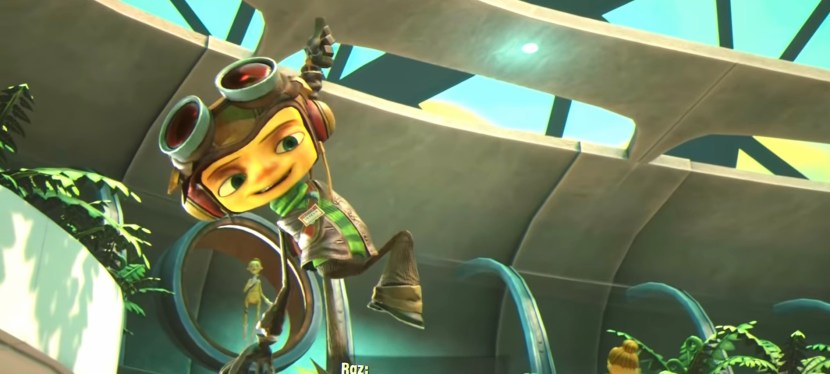
Players will get to play as Razputin “Raz” Aquato who could leap through the air, run around, do acrobatic moves and, most notably, use psychic abilities (which includes levitation, telekinesis and pyrokinesis). As the game progresses, players will explore cleverly designed levels and meet with several NPCs (non-playable characters), and learn new details related to the plot.
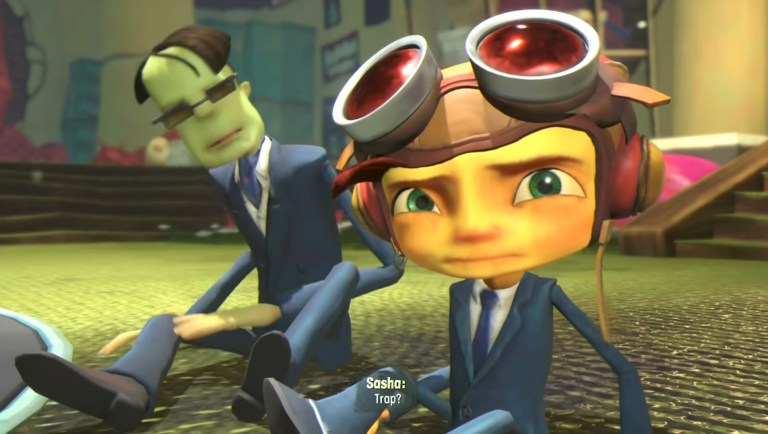
The one on the foreground is Raz.
At its official page at Xbox.com, this upcoming game has been described as follows: Psychonauts 2 serves up danger, excitement and laughs in equal measure as players guide Raz on a journey through the minds of friends and foes on a quest to defeat a murderous psychic villain.
Other than being a game meant for fun, Psychonauts 2 touches on themes of mental health, respect and empathy. On the mental health issue, check out the excerpt from the Washington Post’s Psychonauts 2 article quoting Tim Schafer below…
For the second game, Schafer said he made sure each level has a unique setting, reflective of a character’s mental state, a specific art style and an additional gameplay challenge such as having to move through relative gravity or bubbles. Double Fine enlisted mental health experts to review the game, and to suggest ways to improve the game.
“They’re just small changes, sometimes to language [to make it less] stigmatizing, or depictions of characters, often just very simple changes can make the game less harmful to more people. More inclusive and more people able to enjoy the game because you’re more sensitive to what people are going through,” Schafer said.
Best on Xbox Series consoles?
Recently, data regarding resolution and frame rates plus HDR support and VRR support of the game per platform was published. GamesRadar.com noticed that Psychonauts 2 performs better on Xbox Series S than on PS5 as Sony’s new console runs the game via backward compatibility with the PS4 version.
Xbox Series X console owners looking forward to the new game can expect the following technical details of Psychonauts 2 – 3840 x 2160 resolution at 60FPS and the 1440p/120Hz mode is also available. Those who own last-generation Xbox consoles can expect the game to run at 1920 x 1080 resolution at 30FPS on the basic Xbox One, and 3840 x 1080 at 30FPS on Xbox One X.
Conclusion
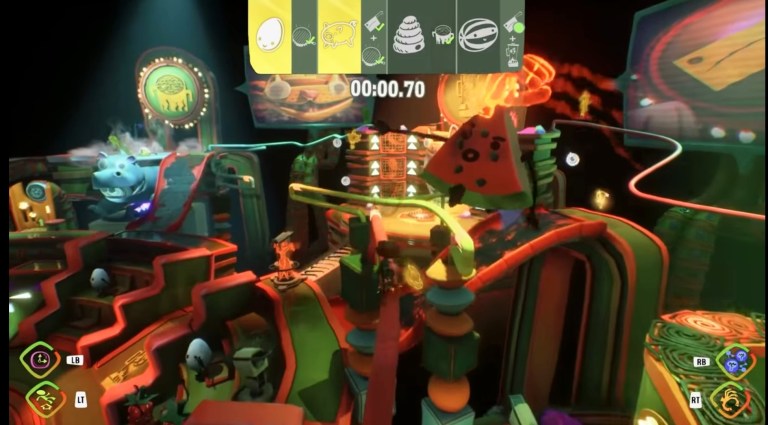
The in-game environments look enticing for exploration!
The way I see it, it would be best to buy and play Psychonauts 2 on Xbox Series X to enjoy the game at its best technical performance and most lively presentation made possible with the best gaming console hardware available. Of course, the gamers and Psychonauts franchise fans who don’t have an Xbox can avail of the new game on other platforms. What is clear is that Psychonauts 2 looks very promising and we will soon find out how much of an impact it will make on gamers and game critics. Remember, this is a labor of love of Tim Schafer and his team, and at the same time it is exceptional that a sequel was made at all! Watch out for Psychonauts 2 on August 25, 2021.
In ending this piece, here are some Psychonauts 2 and Xbox-related videos for your enjoyment!
+++++
Thank you for reading. If you find this article engaging, please click the like button below and also please consider sharing this article to others. If you are looking for a copywriter to create content for your special project or business, check out my services and my portfolio. Feel free to contact me as well. Also please feel free to visit my Facebook page Author Carlo Carrasco and follow me at HavenorFantasy@twitter.com
Disclaimer: This is my original work with details sourced from playing Suikoden II (English version, released in 1999) and doing personal research. Anyone who wants to use this article, in part or in whole, needs to secure first my permission and agree to cite me as the source and author. Let it be known that any unauthorized use of this article will constrain the author to pursue the remedies under R.A. No. 8293, the Revised Penal Code, and/or all applicable legal actions under the laws of the Philippines.
Who is Yoshitaka Murayama? He created the memorable Suikoden (AKA Genso Suikoden) RPG franchise during his time with Konami, specifically the first three games. I myself played and finished Suikoden on the original PlayStation in 1996 and it was a lot of fun thanks to the combined efforts of Murayama (who did the scenarios and game direction) and his teammates such as Junko Kawano (who did the design), Miki Higashino (who did the music along with four other teammates) and some others.
Then in 1999, the sequel to Suikoden was released and I can never forget the day I bought it at a local game store and rushed home with a lot of excitement to start playing it on our then aging PlayStation console.
So you must be wondering…how did I find the sequel? Was it an improvement over its predecessor? Did Murayama and the key creators do better than what they did in the first game? You can all find out in this look back at Suikoden II, published by Konami for the PlayStation (PS1).
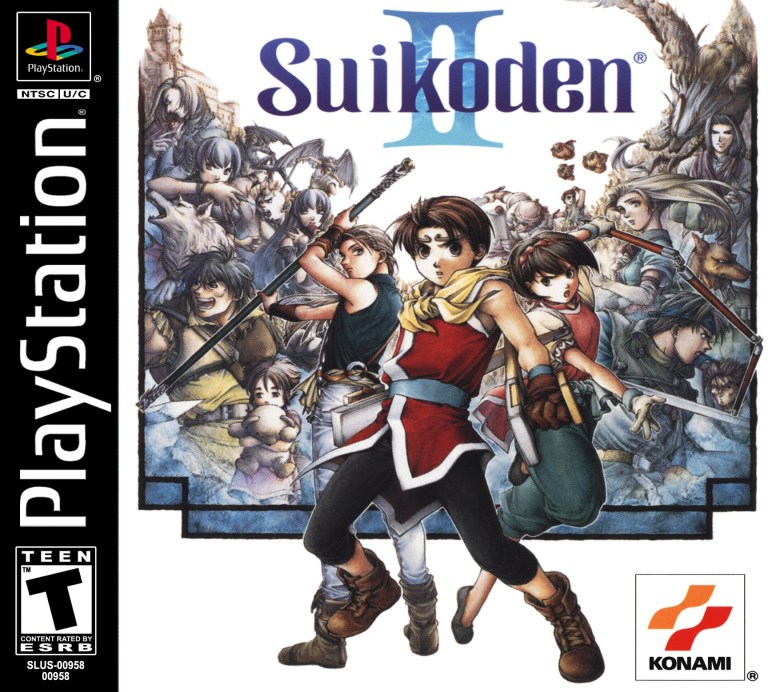
The cover of the North American version of Suikoden II.
Early story
The story begins with two youngsters – Riou (your character whose name can be modified) and Jowy – who are close friends since childhood now serving the Highland Army as members of their youth brigade. They spend time in a military camp in the forest as a peace treaty between two great forces is pending (note: Highland has been in conflict with the City-State of Jowston).
As some soldiers expressed desires to go home once the peace has been finalized, Riou and Jowy are ordered by their commanding officer Rowd to go back to their tent and sleep. However, a surprise attack happened which alerted them. As soon as the two close friends left their tent, they are shocked to see parts of the camp burning. Their officer Rowd informed them that their enemy is responsible for the attack and deliberately broke the peace agreement. Riou and Jowy are told to take the mountain path to the east and save themselves before it is too late.
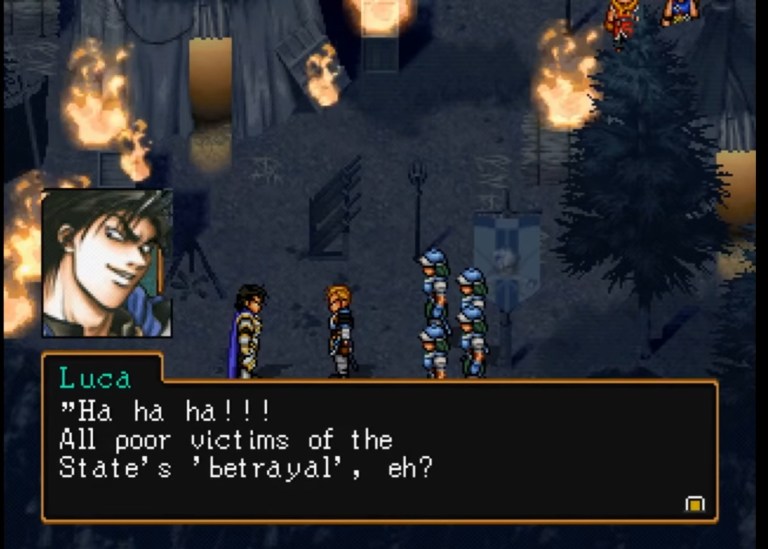
Fearing that they might get ambushed in the woods, Jowy tells Riou that they should return to camp. Upon returning, they quietly witness the unexpected presence of Highland prince Luca Blight who gets briefed by Rowd. As it turns out, the attack on their camp was not committed by the opposing forces but rather it was all a self-inflicted operation by Highland. Rowd’s instruction to some of their selected soldiers to head east was a set-up. What happened was all part of a plan by Highland to escalate the conflict by blaming their losses on Jowston. Luca Blight expressed clearly that a peace treaty with Jowston and its states was not needed, and he strongly believes in the power of Highland to conquer them all.
Jowy and Riou (upper-right corner) quietly witness the conversation between prince Luca Bright and the captain.
After learning the shocking details, Riou and Jowy decide to leave for the cliff to the north as a way of escape. At the cliff, Rowd catches up to the two. Fortunately, Riou and Jowy were successful in defeating Rowd’s soldiers and pave the way for their escape. Before fleeing, they marked a rock and promised to return to that same place if ever they get separated.
Riou and Jowy jumped off the cliff and get separated. Some time later, Riou wakes up and finds himself in the presence of three men. One of them identifies himself as Viktor, the leader of an army of mercenaries and an ally of Jowston. Another member of the mercenary army in blue arrives and he is Flik.
Being powerless, Riou marches with them to the headquarters of the mercenary army…
Quality
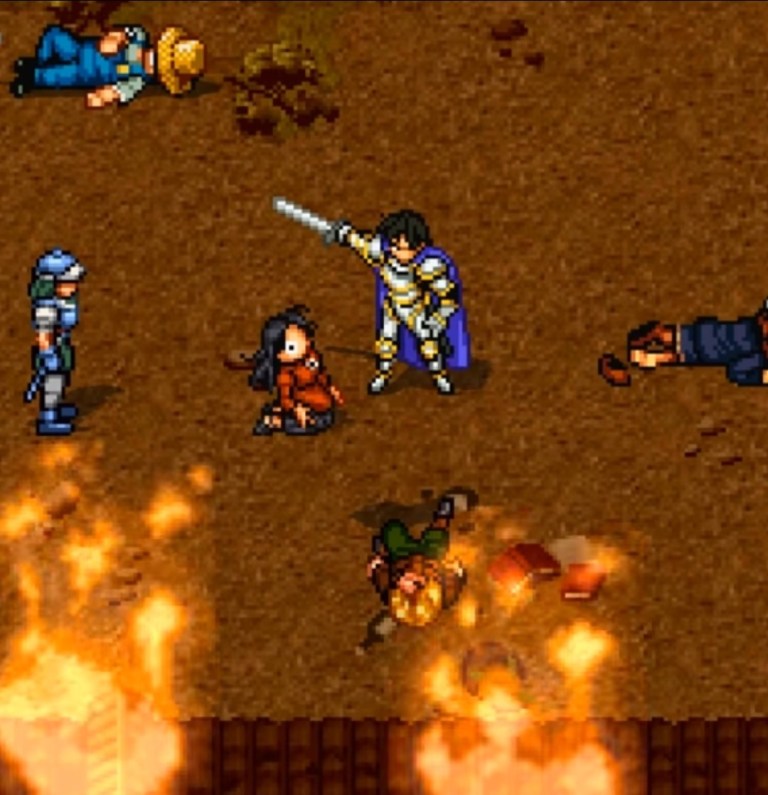
Luca Blight (with sword) is a lot more than just being evil as the game’s main antagonist.
Having played Suikoden a lot in 1996, I got familiar with the game design, the varied battle systems and other features that made it a solid RPG on its own. As for Suikoden II, I can clearly say that Murayama and his creative team built up on their foundation (in the first game), expanded the fantasy concept dramatically and ultimately made an extensive series of improvements and additions over each and every aspect of the sequel!
I’ll start first with the storytelling and writing. Compared to its predecessor, I found Suikoden II to be deeper and it took great advantage of the fact that the plot took place just years after first game and by this time the established world, the cities, tribes and geopolitical concept have been developed so much – backed with solid writing – they all become a lot more believable. In the middle of the great conflict are the three main characters Riou, Jowy and Nanami whose exploits and portrayals are pretty rich and lively to follow. It’s kinda like following the love triangle of Hikaru, Misa and Minmay through the war in the classic Super Dimension Fortress Macross anime TV series, except that you – the player – get heavily involved as Rious by making decisions that affect yourself and others, leading missions, building up a community (and force) of over 100 members, and overcoming challenges related to the conflict between Highland and Jowston.
The great news here is that the Riou-Jowy-Nanami emotional arc was written to be dramatic, engaging, intriguing and sentimental which ultimately will make you feel for them just as you make your way through the many events and twists of the war story. Beyond these three key characters, it should be noted that the scenarios are excellently executed and really showed how lively the fantasy world of Suikoden II really is. I’m talking about the portrayal of the many, many supporting characters and the interactions you have with them as the plot moves forward. Remember how lively your troops were in welcoming you back after winning your first army battle? Such a scenario was well directed and scripted, and the supporting characters you recruited really had their moments of participation which make sense within the narrative. I also should mention that the opposition figure of the game – Luca Blight – is still a powerful and complex villain in JRPGs even by today’s standards. Luca Blight is not evil for the sake of being evil, but if you pay close attention to the details about his background as the game’s story goes on, you will realize he is quite a complex character whose evil made sense within the narrative. Very clearly, the writing and storytelling done by Yoshitaka Muraya is not only greater than in the first game, but also very inspired.
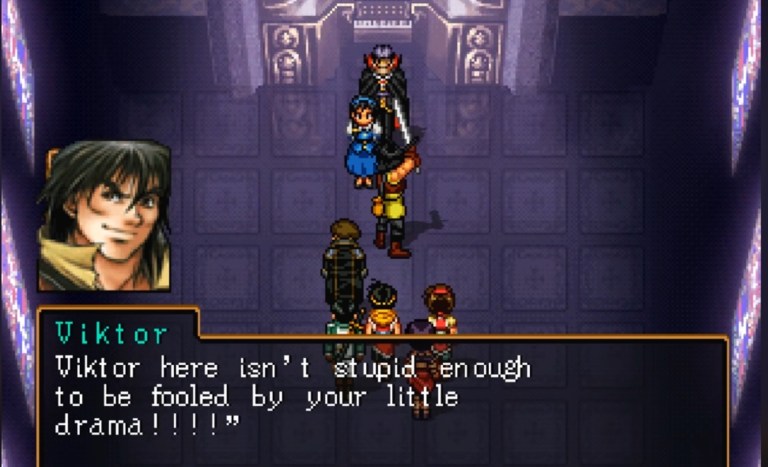
Viktor, who also appeared in the first game, continues to be an important supporting character in this sequel! He is one of several characters from Suikoden who returned.
On the gameplay and design, Suikoden II’s exploration of the world, towns and locations uses good old 2D graphics. The big difference here is that the 2D visual elements are more varied in terms of detailed sprites for non-playable characters (NPCs) and interactive characters, and visually the sprites as well as the art used for the in-game environments looked more polished (clearer, smoother and less pixelated). The controls are responsive enough for my taste, and it is also nice that my character moves faster while exploring. More on exploring, I do confirm that there are indeed more locations to visit (including those that are part of the quests related to finding the 100+ characters) and the art made for the locations are more varied as well.
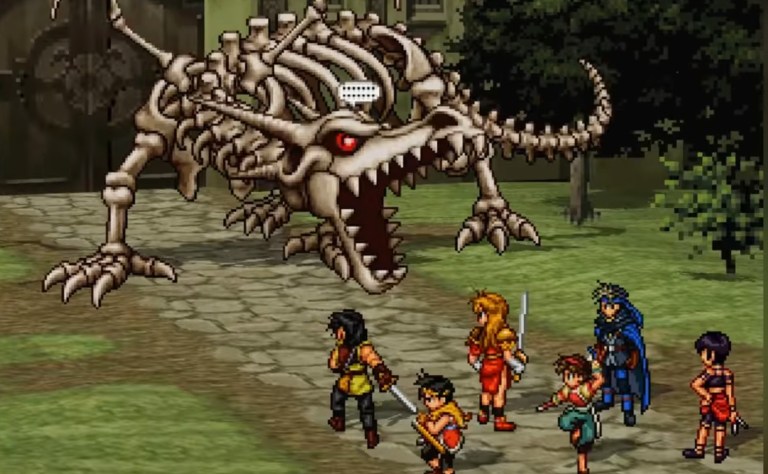
More on the gameplay, two types of battle systems from the first game are back but with refinements. First to talk about is the party battle system in which players get to control a group of up to six members who face off with enemies by group, or a single powerful boss-type enemy. During the party battle, you get to pick options as to what type of action each member of your party will do – Attack, Magic (note: this involve Runes), Item or Flee (note: if your party is much stronger than the opposition, Bribe or Let Go options will appear).
The party battle system is a lot of fun and not too stressful.
The way the battles are designed, as in the first game, is smooth, very visually appealing (thanks to the dynamic camera and fine level of detail of the sprites and animation) and fun to watch. Adding further depth to the party battles are the combined attacks involving at least two characters. Take for example Flik and Viktor doing the cross-attack, or Riou and Nanami performing a series of combo attack moves in strong coordination with each other. These combined attacks are not only fun to perform and see, but also encourages you to experiment by mixing up characters (specifically combatants) and paying attention as to which characters they can do combined attacks with. This alone will encourage you to complete the 108 characters of your force.
The use of Runes has been improved a lot in this game as the combatants now have three slots to equip Runes (note: these slots gradually open up as characters’ levels go up). Runes are essential to use magic spells in battles and the improvement of the Runes – plus the Run Affinity system – add more variety in the battles.
The 2D sprites are very visually appealing, especially when you watch the characters perform varied forms of action during the party battle.
Compared to other Japanese RPGs, the party battles here are much less stressful even though a random encounter system is used. There is also the option for automated attacks, which spares you from having to choose options for each member of your party to perform when fighting the enemies. Granted, I went through lots of random encounter battles and some challenges, but ultimately the stress level and tedium were very low. Doing party battles is fun overall.
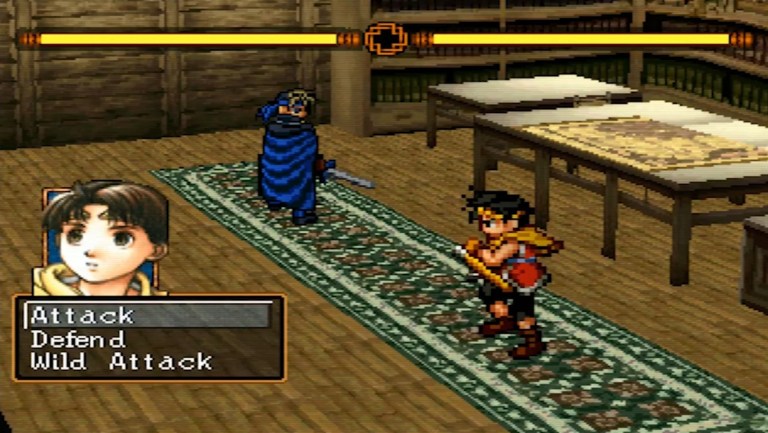
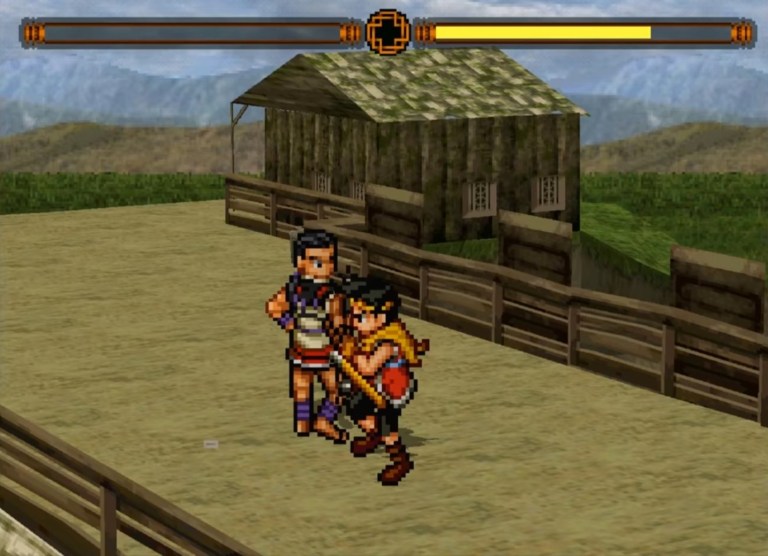
The 2nd battle system inherited from the first game is the duel. Duels happen the least throughout the game but each time they happen, they can be quite engaging to do. As the one-on-one battle between your character and an opponent begins, you will see them in a 3D realm with the dynamic camera capturing the action. Your options are mainly Attack, Wild Attack and Defend, and before you can pick an option, you must pay attention first to the clues (note: taunts) from your opponent which can help you anticipate his/her/its next move. While the visuals are clearly improved, the duel is pretty much the same as in the first game.
Duels happen in a 3D environment with the characters still presented as 2D sprites that are not only highly detailed but also are smoothly animated.
Like in the party battles, duel sequences also have a dynamic camera system complete with zoom during the action.
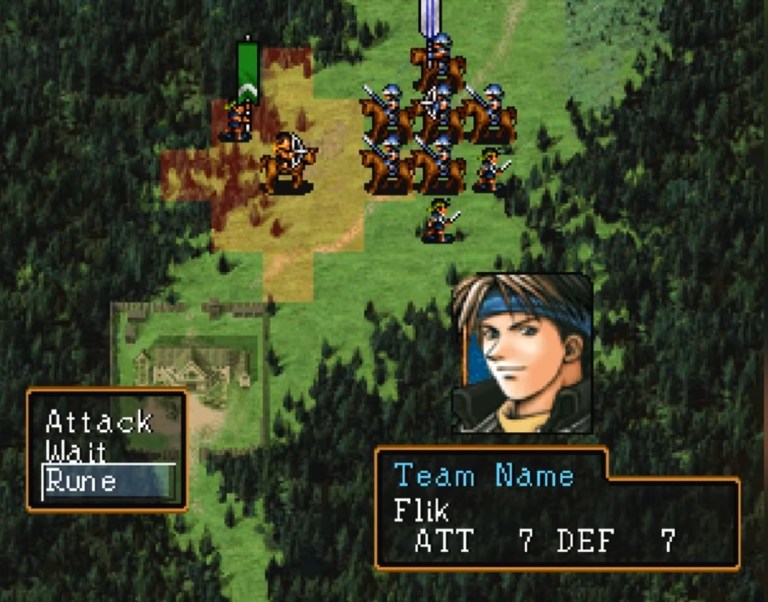
The 3rd battle system – army battles – is clearly the most revised part of the game as it is radically different from the army battles of the previous game. This time the army battles involves the heavy use of a tactical map (where you move units in a grid-like system). Your units – composed of mainly characters you recruited, including the non-combatants – can be moved on the map to counter an enemy unit. Then a short, animated battle sequence will commence and based on the statistics of each unit, the winner and loser of the sequence will be determined. Take note that in events of defeat, recruits can die permanently. As such, it is important to pay attention to not only the statistics but also the types of troops you have such as archers, healers, knights, and foot troops. When controlling units on the map, your options are Attack, Wait and Rune. It is also very entertaining to see how the characters react (with dialogue, no less) to the battles. Overall, the army battle system here is clearly much deeper and more strategic than what was used in the first Suikoden.
The army battles in this game are more tactical than what was presented in the first Suikoden. This is also the main map used for such battles.
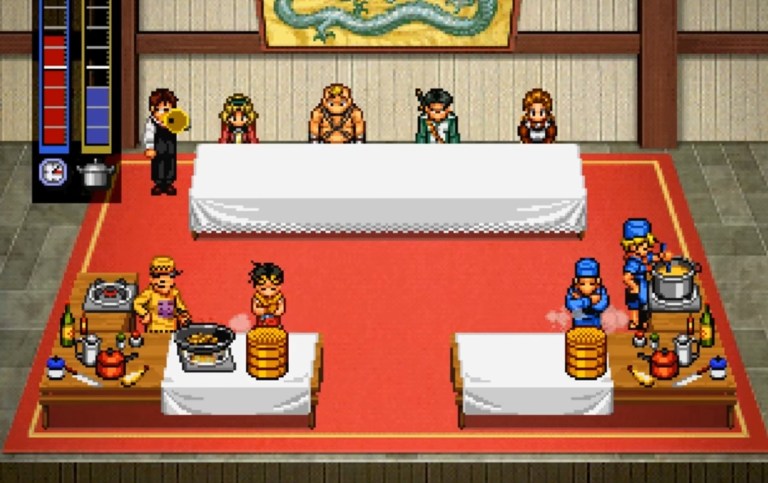
Battles aside, there are also lots of things to do related to exploration. For one thing, there are these fun-filled mini-games the game creators set up such as fishing (note: not as boring as it may sound), the whack-a-mole game, rope climbing, Chinchirorin (dice game in a bowl) and, the most exciting and deepest of them all, the cooking contest game. When you fully invest your time into each of these mini-games, you will not feel relieved from the stress of battles and exploration, but also have a lot of fun free of stress. I enjoyed these a lot myself.
If you enjoyed building up your fortress in the first game, you will experience that here also! Building up your stronghold is related to your recruiting of people and some of them have certain talents that will establish key parts of your place like a store, a Rune shop, aa tavern, a restaurant, an armor shop and even a detective agency to name some! It may take an effort to have all possible establishments get realized in the game but I promise you, they are all worth it and you will feel thankful that you got to recruit lots of people. The other reward of building up your fortress is the establishment of a thriving community of people!
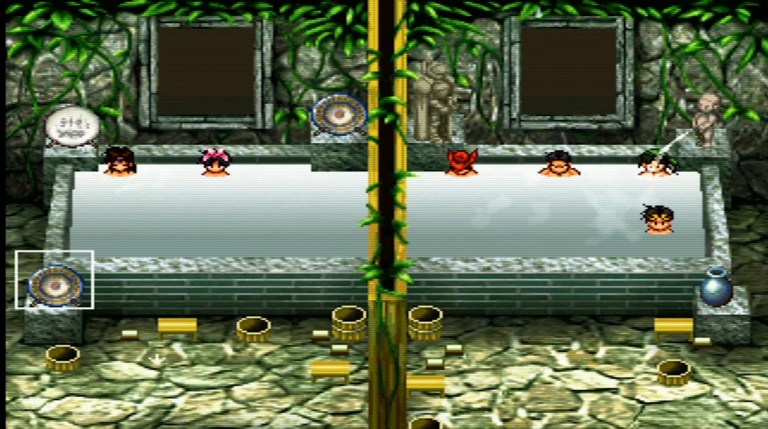
Your party members can take a bath and even use the collected artifacts as decorations. This is one of the many side activities you can do at your stronghold.
The cooking contest mini-game is easily the best in the game!This alone will encourage you to keep searching for recipes during your adventures!
With regards to continuity with the first Suikoden game, the game developers implemented certain content (locations, dialogue, story and characters) that get unlocked by having your preserved Suikoden saved game content successfully loaded with Suikoden II running on PS1. I’m talking about being able to meet and even recruit Suikoden hero Tir McDohl, plus meeting even more characters from the first game. Very clearly, this is a clever presentation of fan service done by Murayama and his creative team who paid attention to the feedback of the first Suikoden.
The music done by Miki Higashino and Keiko Fukami are very varied and many of them reflect the places you get to visit, the emotional scenes you witness and the epic moments that happen. The great news here is that each and every tune in the game was made and performed with special care. This game’s soundtrack really stands out high among Japanese RPGs of the 1990s and even by today’s standards, it still is a great soundtrack to listen to.
If there are any flaws in this great game, it is the English translation itself as there were typographical errors, mistranslations and even NPCs with lines of dialogue that made absolutely no sense. Clearly there was a rushed job with the translation.
Conclusion
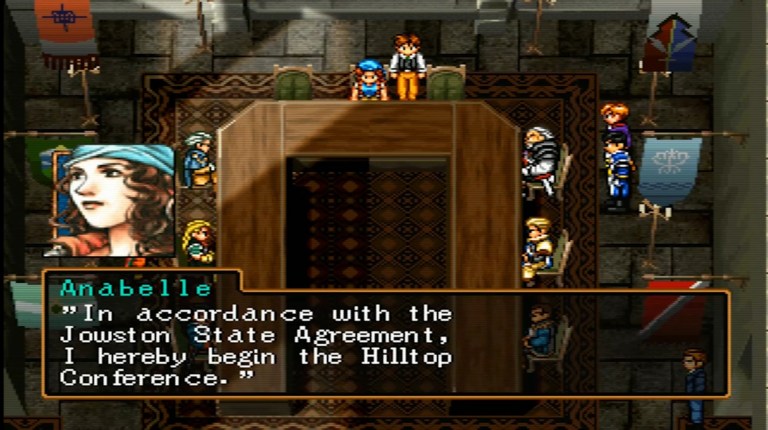
The political aspect of the game’s story is simple and never overwhelming.
I really love Suikoden II and very clearly, it is a major improvement over its predecessor (which itself was a solidly good RPG). Suikoden II is a labor of love done by Murayama and his creative team and the result is a true epic RPG that has so much enjoyable stuff and high replay value for gamers. Its quality is still great and by today’s standards, Suikoden II is indeed a classic RPG that gamers should play even though Konami itself does not care to make it more accessible in this modern age of gaming.
Given the legacy of Suikoden II and the fact that Konami showed no signs of reviving the Suikoden RPG franchise, now is the time to look forward to Eiyuden Chronicle: Hundred Heroes which Murayama and his team are developing for release in 2023 for Xbox consoles, Xbox Game Pass and other platforms. Eiyuden Chronicle: Hundred Heroes clearly has strong Suikoden vibes and the distinct combination of 2D sprites with 3D polygonal environments, plus its party battle system strong resembles that of Suikoden and Suikoden II!
Overall, Suikoden II is highly recommended!
Now if only Konami would change its ways to make Suikoden II more accessible (go way beyond the PlayStation online store and ecosystem) to gamers by releasing it digitally through Xbox LIVE, Steam, Xbox Game Pass and other online stores or ecosystems. Paying hundreds of dollars for a legitimate hard copy of the game is simply too much.
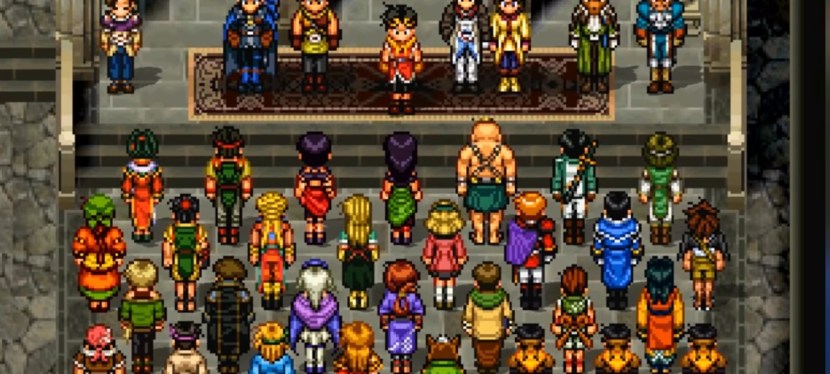
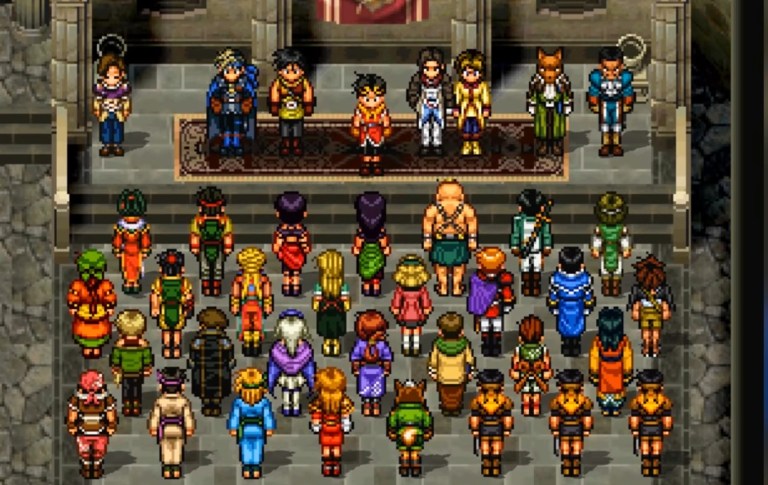
There is nothing like building up your stronghold and seeing your recruits become part of its development as well as your campaigns.
+++++
Thank you for reading. If you find this article engaging, please click the like button below and also please consider sharing this article to others. If you are looking for a copywriter to create content for your special project or business, check out my services and my portfolio. Feel free to contact me as well. Also please feel free to visit my Facebook page Author Carlo Carrasco and follow me at HavenorFantasy@twitter.com
Are you fond of 1990s Hollywood movies? Do you love Michael Jordan during his reign in the NBA? Have you ever seen the famous Bill Murray act with Jordan and Larry Bird? Have you always been a fan of Bugs Bunny, Daffy Duck and the rest of the Looney Tunes gang?
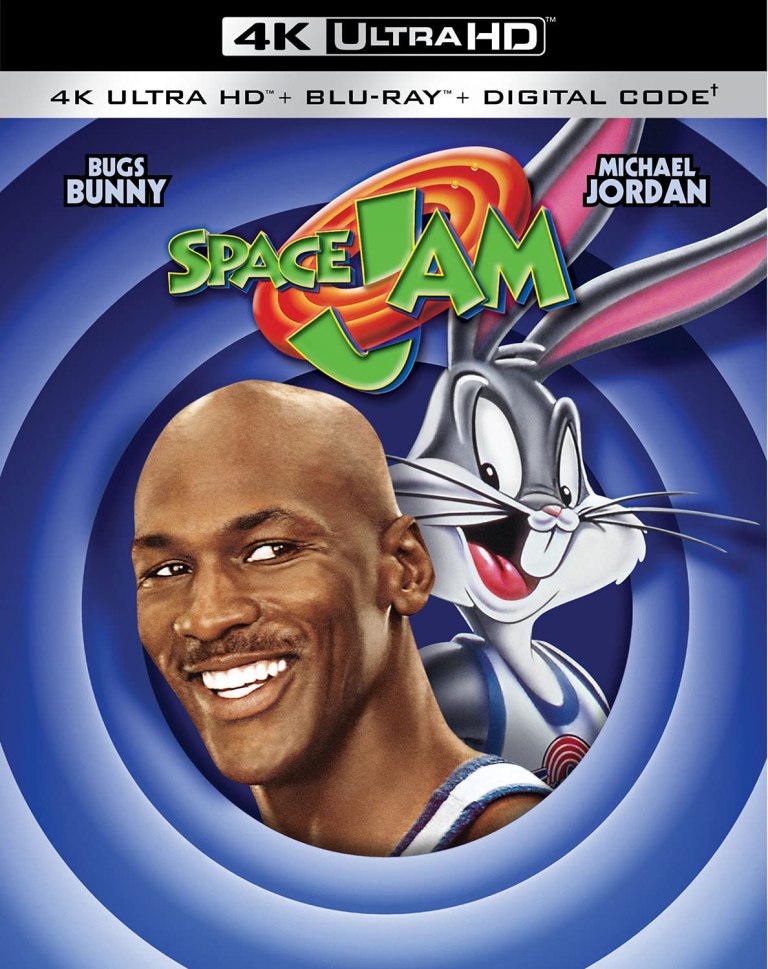
Here is the news that could be big to you in relation to the above questions – the 1996 hit live-action/animated comedy movie Space Jam is now available on 4K Blu-ray (with digital copy and Blu-ray disc included) and you can order it now at Amazon!
Space Jam 4K Blu-ray combo.
Here are the details on what comes with Space Jam 4K Blu-ray sourced from Blu-ray.com…
Video Codec: HEVC / H.265 Resolution: Native 4K (2160p) HDR: HDR10 Aspect ratio: 1.85:1 Original aspect ratio: 1.85:1
Audio
English: Dolby Atmos English: Dolby TrueHD 7.1 French: Dolby Digital 5.1 Spanish: Dolby Digital 5.1 German: Dolby Digital 5.1 Italian: Dolby Digital 5.1 Danish: Dolby Digital 5.1 Swedish: Dolby Digital 5.1 Norwegian: Dolby Digital 5.1 Finnish: Dolby Digital 5.1
Subtitles
English SDH, French, German, Italian, Spanish, Danish, Dutch, Finnish, Norwegian, Swedish
Discs 4K Ultra HD Blu-ray Disc Two-disc set (1 BD-100, 1 BD-50)
Extra stuff – Commentary with Bugs Bunny, Daffy Duck and director Joe Pytka. Jammin’ with Bug Bunny and Michael Jordan featurette. Two music videos and the theatrical trailer.
For those who are not very aware about the legacy of Space Jam, it was a special project of Warner Bros.’ animation group and not only did it star Michael Jordan (who led the Chicago Bulls to its 4th NBA title in mid-1996), it involved big names like Ivan Reitman (Ghostbusters) as producer, comedy icon Bill Murray in a key supporting role and a whole lot of great voice talents such as Billy West (Bugs Bunny and Elmer Fudd), Dee Bradley Baker (Daffy Duck), and Frank Welker (best known for Transformers’ Megatron) to name a few.
Adding further zest to the cast lots of NBA personalities such as Hall of Famer Larry Bird, Mugsy Bogues, Charles Barkley, Shawn Bradley, Patrick Ewing and Larry Johnson, plus cameo appearances of Danny Ainge, Horace Grant, Steve Kerr and A.C. Green to name a few.
Personally, I never saw Space Jam in the movie theater but I got to watch it in the airplane going to the United States in April 1997. I was not able to focus fully on its story as watching it on a small screen behind the passenger seat in front of me was never a comfortable experience. Still, the movie caught my attention when I saw Larry Bird (my favorite basketball player of all-time) act with Jordan and with the iconic Bill Murray. Of course, the quality of animation done by Warner Bros.’ creative teams was pretty good for its time. I should state that Elmer Fudd scoring a basket in basketball uniform was fun to watch.
Going back to the above specs and details about Space Jam 4K Blu-ray, it’s really nice to know that the visuals have been confirmed to be native 4K. Personally, I am interested to see how the 1996 mixed live-action/animation film would look like on the screen of our 4K smart TV at home.
In the official Blu-ray.com review for Space Jam 4K Blu-ray, the visuals were partially described as: Advertised as a new HDR-enhanced 4K master, Space Jam arrives on the format with a mostly pleasing 2160p transfer that corrects a few of the 2011 Blu-ray’s visual shortcomings but back-pedals elsewhere. For starters, it’s worth noting that portions of this film have always looked soft and very light on grain, such as Jordan’s arrival and stay in WB world, including the climactic basketball game; this was a necessary style choice to ensure that live-action elements didn’t stick too far out against the more smoothly-rendered animation. Other built-in source “defects” (for lack of a better word) include a bit of aliasing on specific CG backgrounds, such as a few sharp angles and edges on Moron Mountain and the baseline and free-throw paint on animated basketball courts; it’s easily spotted on screenshot #4, but again hardly distracting in-motion.
Space Jam 4K Blu-ray combo is now available and it should appeal to NBA fans, Looney Tunes fans and just about anyone who feels nostalgic about the 1990s. Take note that when Space Jam was released in cinemas in late 1996, Michael Jordan was on his way to a second three-peat of NBA championships and the movie was clearly part of the legacy of his basketball greatness which defined the NBA in the 1990s (note: Jordan and the Chicago Bulls won the NBA championship titles in 1991, 1992, 1993, 1996, 1997 and 1998). Space Jam was made at a time when Hollywood not yet dominated by the Satanic Left, those whiny socialists, the naked Communists and all those liberals who love to use movies as pieces to spread their poisonous propaganda. In short, Space Jam of 1996 was simply made to entertain without any political garbage.
Thank you for reading. If you find this article engaging, please click the like button below and also please consider sharing this article to others. If you are looking for a copywriter to create content for your special project or business, check out my services and my portfolio. Feel free to contact me as well. Also please feel free to visit my Facebook page Author Carlo Carrasco and follow me at HavenorFantasy@twitter.com
If you are looking for a great looking and fun-filled racing game this year, the one to go for is definitely Forza Horizon 5 coming out on November 9, 2021 on Xbox Series X, Xbox Series S, Xbox One, Windows PC and on Xbox Game Pass (XGP)!
Very notable for having an excessive amount of time to itself during the Xbox-Bethesda games showcase, Forza Horizon 5 is the newest entry in the best-selling game franchise developed by Playground Games. For the newcomers reading this, the Forza Horizon game franchise that started in 2012 is known for its open-world approach to racing which is more focused on street racing action and stunts (in contrast to the realism focus of the Forza Motorsport series of simulation racing games). The fictional Horizon Festival is an essential part of the core concept of the Forza Horizon series. Creatively, the said festival moves from one country to another as seen in each game of the series – Colorado in Forza Horizon, Southern France and North Italy in Forza Horizon 2, Australia in Forza Horizon 3, and Scotland and England in Forza Horizon 4.
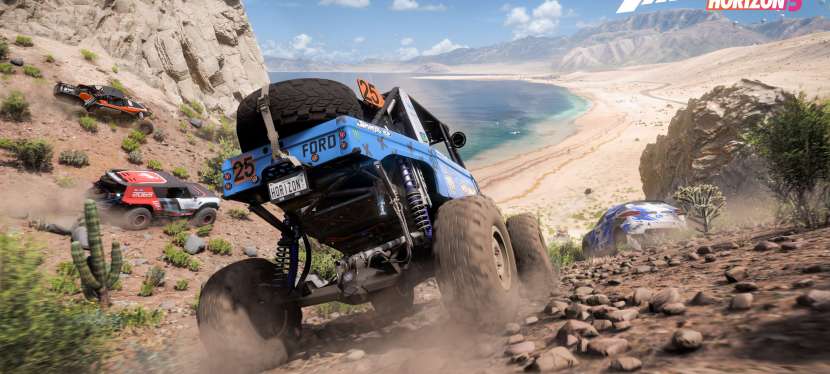
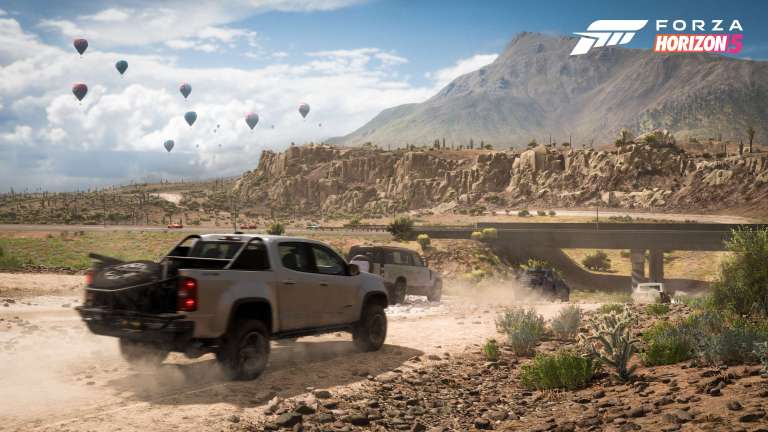
This year, Forza Horizon 5 is set in Mexico which looks stunning as the game was not only made with the most modern Xbox technologies but also the experts of Playground Games really proved what they could do both artistically and technically. The result is a highly photo-realistic game (note: ray-tracing available in Forzavista mode), high frame rates (60FPS performance mode included), super smooth gameplay and a whole lot more!
For greater perspective, watch this demo video that was part of the Xbox-Bethesda games showcase…
As seen in the above video, Forza Horizon 5 is more than racing and exploring the diverse locations of Mexico…it was made to be a whole lot of fun to play. The expedition looks really adventurous while the Pinata Park and Events Lab emphasize creative fun racing! This is racing game design that must be experienced!
Experience a deep and rewarding campaign, where you’ll meet new characters and determine the outcome of their Horizon Story missions. You’ll take on expeditions across the map, battling the elements in hundreds of the world’s greatest cars.
In multiplayer, experience the most social and connected experience we’ve ever created. The Horizon Open takes the best parts of the traditional Forza Horizon online competitive experience and smashes them all together. Seamlessly jump into Races, Drift challenges, Eliminator sessions, and more. Horizon Tour is your chance to meet up like you would at a car meet and race co-op against Drivatars on circuits all over the map, forming up as a convoy as you hop from one race to the next. From there, you can head to the Horizon Arcade, where you quickly and seamlessly take on some truly wild challenges and minigames with other players.
Next, our creator community can hit up the EventLab. Imagine the Blueprint Builder you’re familiar with in modes like Super7 and Blueprint races, but blown way out with a powerful new toolset that includes custom races, challenges, stunts, entirely new game modes and so much more that you control, down to the rules of the game itself.
After that, it’s time for Gift Drops, like a personalized Barn Find Blueprint. Tune a car, paint it, then leave it hidden for others to find somewhere on the map. It’s a whole new way to share your prized cars with friends or others online.The social aspect of Forza Horizon 5 is huge, with systems like Kudos that allow you to reward other players for positive acts and encourage clean, friendly driving, as well as the Forza LINK system, which enhances your ability to join up with other players by recognizing the things you like to do and finding other players to do similar things with.
Wow! Not only are the experts of Playground Games making Forza Horizon 5 fun and engaging, they are also working hard on making it the most accessible game socially speaking. This is a major Xbox-exclusive game to watch out for this November. Not only will Forza Horizon 5 stand out well among the many, many games on Xbox Game Pass, it will stand out among all racing games for this year and even into 2022!
In ending this piece, here are some Xbox-related videos for your enjoyment!
+++++
Thank you for reading. If you find this article engaging, please click the like button below and also please consider sharing this article to others. If you are looking for a copywriter to create content for your special project or business, check out my services and my portfolio. Feel free to contact me as well. Also please feel free to visit my Facebook page Author Carlo Carrasco and follow me at HavenorFantasy@twitter.com
Disclaimer: This is my original work with details sourced from reading the comic book and doing personal research. Anyone who wants to use this article, in part or in whole, needs to secure first my permission and agree to cite me as the source and author. Let it be known that any unauthorized use of this article will constrain the author to pursue the remedies under R.A. No. 8293, the Revised Penal Code, and/or all applicable legal actions under the laws of the Philippines.
Welcome back, superhero enthusiasts, comic book collectors, 1990s culture enthusiasts and fans of Marvel Comics! This is the continuation of a look back at the Marvel 2099 crossover storyline The Fall of The Hammer which started in Spider-Man 2099 #16 followed next in Ravage 2099 #15. The 3rd chapter of the said crossover filled the fifth issue of the X-Men 2099 monthly series.
For the newcomers reading this, a few of the X-Men of the far future were officially involved in this 5-part crossover storyline that was meant to celebrate the Marvel 2099 franchise back in the 1990s. This was the reason why Skullfire, Meanstreak, Krystalin and Bloodhawk were separated from their team leader Xi’an and the remaining teammates. Last time around, three of the mentioned X-Men got involved with Ravage and eventually reached the floating city of Valhalla together only to get separated.
With those details laid down, here is a look back at X-Men 2099 #5, published in 1993 (cover dated 1994) by Marvel Comics with a story written by John Francis Moore and drawn by Ron Lim.
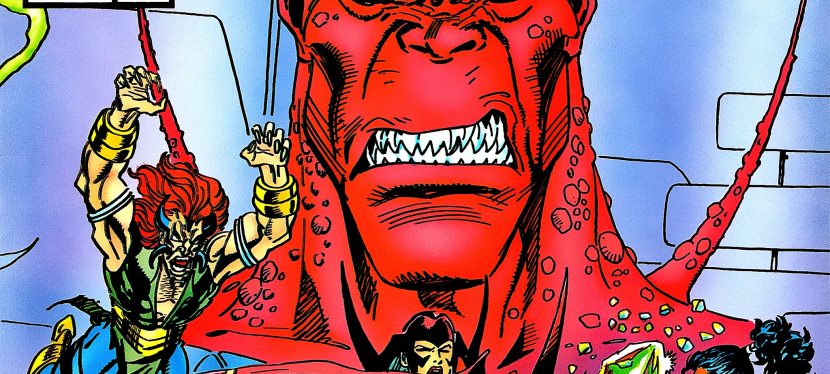
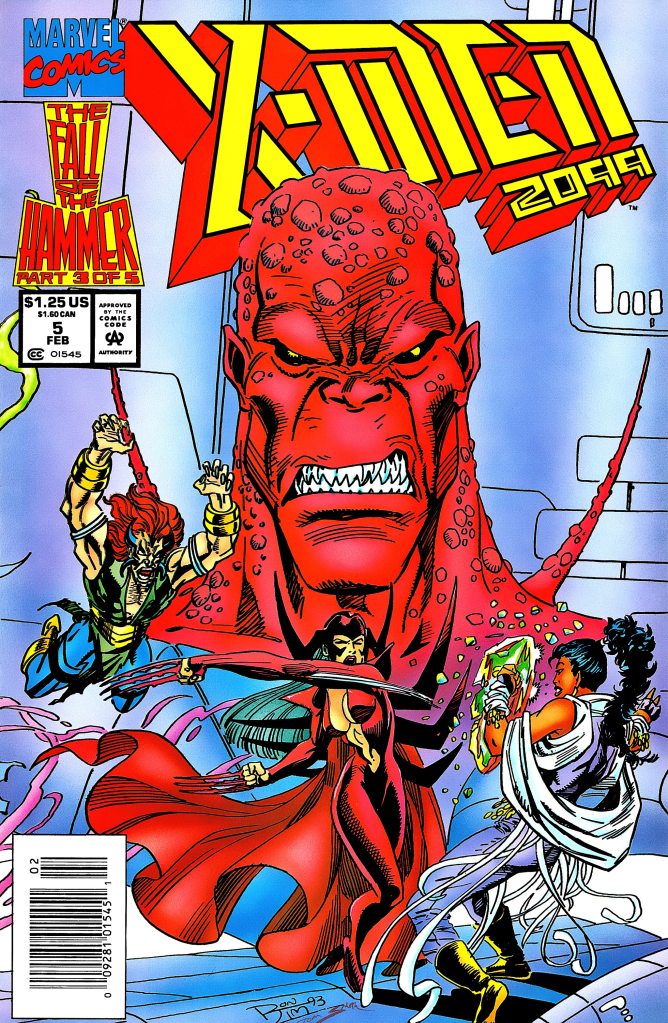
The cover.
Early story
The story begins in New York City where a vehicle moves at high speed until it hits a wall and stops. Out comes Tim Fitzgerald/Skullfire who moves away and spots Valhalla above him. In the floating city, Krystalin, Meanstreak and Bloodhawk are in confrontation with a powerful enemy called Heimdall who tells them to bow to him and swear allegiance.
Bloodhawk attacks Heimdall only to get pushed back. Krystalin fires crystal bits at him but to no success. Thinking that he’s too fast for Heimdall, Meanstreak tries a sneak attack from the side only to be hit hard, lose control and crashes to a wall. As the X-Men’s fastest member is down, a shadowy figure approaches him nearby…
Quality
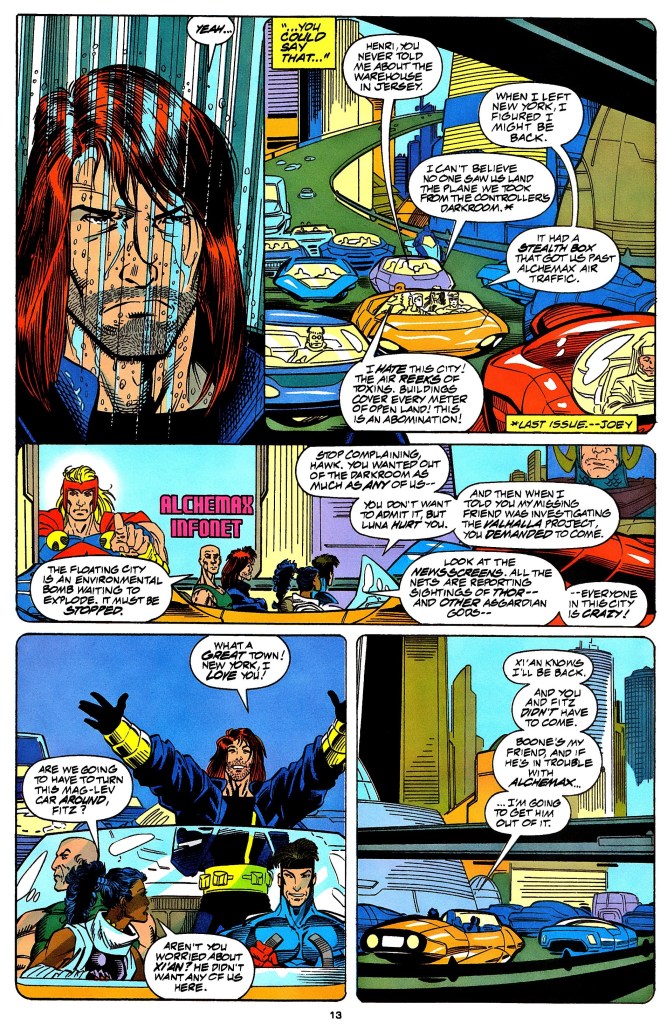
This quick flashback explains how the four X-Men 2099 members went to New York.
As an X-Men 2099 tale, this one felt like a catch-up for Skullfire who was absent in the first two parts of The Fall of the Hammer storyline even though it was confirmed in X-Men 2099 #4 that he joined his teammates and help Meanstreak find his friend Jordan. That being said, there is a good amount of scenes focused on Skullfire as he makes his way up to Valhalla. There is also a quick flashback showing that indeed he was with his teammates as they arrived in New York only to get separated (which explains why only Krystalin, Bloodhawk and Meanstreak approached Ravage). More importantly, the flashback also contains additional details that explain what the X-Men discovered before arriving at Valhalla and why they decided to approach Ravage.
As the 3rd chapter of The Fall of The Hammer storyline, this comic book barely moved the present-day narrative forward mainly due to having to use a few but precious pages to tell the short flashback to explain the X-Men’s involvement. Still, key revelations related to what happened behind-the-scenes added a lot of depth to the narrative and this properly sets the stage of for the remaining chapters. The 2099 major figures like Spider-Man, Punisher, Doom and Ravage all appeared here but very sparsely.
Conclusion
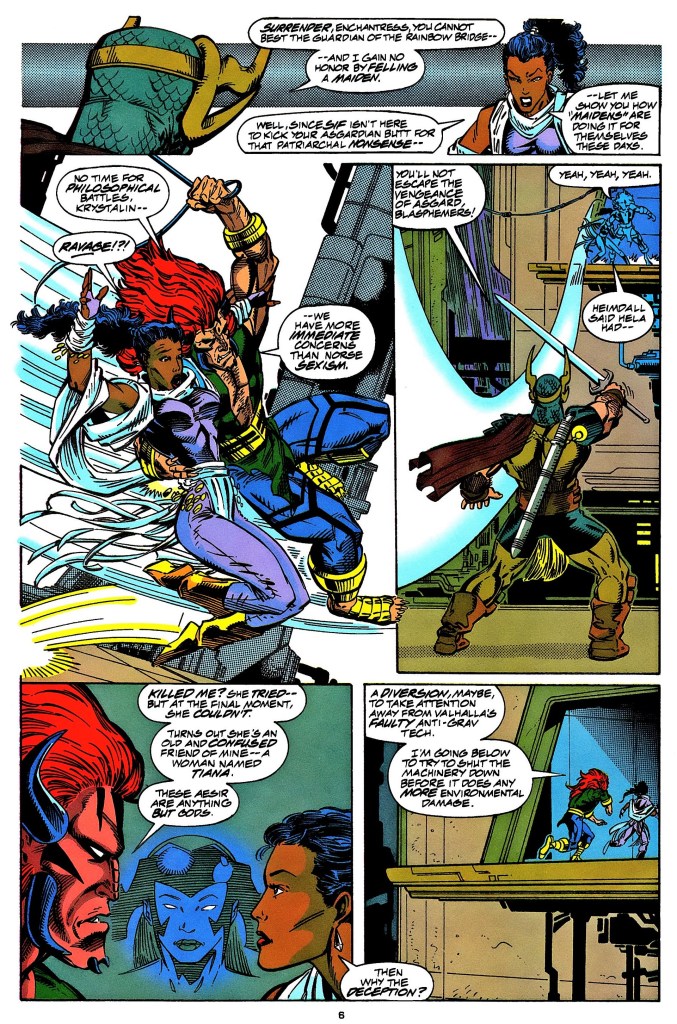
Ravage 2099 helps Krystalin.
X-Men 2099 #5 (1994) pushed the narrative of the crossover a few notches forward but the revelations written saved it from being a throw-away story. For fans of X-Men 2099, there is a lot to like here and Skullfire’s late entry into the crossover will delight them. The writing was good enough and by the end of the story, the explanations were satisfying and the ending suggested that the stakes would be raised for the final two chapters of the crossover. Those who missed the presence of Thor 2099 should be happy to see him here, even though it was clear that he was being conserved for the last two chapters.
If you are seriously planning to buy an existing hard copy of X-Men 2099 #5 (1994), be aware that as of this writing, MileHighComics.com shows that the near-mint copy of the regular edition costs $6 while the near-mint copy of the newsstand edition costs $18.
Overall, X-Men 2099 #5 (1994) is recommended.
+++++
Thank you for reading. If you find this article engaging, please click the like button below and also please consider sharing this article to others. If you are looking for a copywriter to create content for your special project or business, check out my services and my portfolio. Feel free to contact me as well. Also please feel free to visit my Facebook page Author Carlo Carrasco and follow me at HavenorFantasy@twitter.com
Disclaimer: This is my original work with details sourced from reading the comic book and doing personal research. Anyone who wants to use this article, in part or in whole, needs to secure first my permission and agree to cite me as the source and author. Let it be known that any unauthorized use of this article will constrain the author to pursue the remedies under R.A. No. 8293, the Revised Penal Code, and/or all applicable legal actions under the laws of the Philippines.
Wow! What a journey it has been! Back in the 1990s, I could never forget the first time I read The Strangers #1 which was so captivating, I decided to follow its monthly series and it was easily my favorite superhero team of the Ultraverse. It was also my first time to see the collaboration of Steve Englehart and Rick Hoberg leading the creativity which, as the many months and issues went on, resulted a series that was never boring and often satisfying and fun to read. I should state that the literary team of strangers composed of Atom Bob, Grenade, Lady Killer, Yrial, Spectral, Zip-Zap and Electrocute was memorable. Truly Malibu Comics had very talented creators for the Ultraverse which eventually lasted just a few years (read: Marvel Comics acquired Malibu Comics).
This brings me to my next point…this retro comic book review is about the last issue of The Strangers monthly series ever published. As I love the Ultraverse, it is sorrowful to see the end of an enjoyable monthly series. In recent times, I reviewed the final issue of the Prototype monthly series (which itself was fun overall) which ended in a rather unsatisfying manner. Prototype’s final issue was not even written by the original creators of the series!
How will this final issue of The Strangers series turn out? We can all find out in this look back at The Strangers #24, published in 1995 by Malibu Comics with a story written by Steve Englehart and drawn by Rick Hoberg with inkwork done by Barbara Kaalberg.
The cover.
Early story
The story begins with Teknight, Spectral, Grenade, Lady Killer, Yrial, Zip-Zap and Electrocute back together (note: Lady Killer and Yrial went somewhere far in the previous issue). They talked about Electrocute’s codition, Atom Bob being in a comatose state at the Clinique de Parsival, and the dangerous encounter with Taboo.
Meanwhile inside a passenger jet flying above the North Atlantic, a man expresses his passion and fondness of the Strangers to the passenger sitting to his left. The said passenger wants to learn more about the team.
The following night at Union City in California, the same passenger knocks on the window of a van with a man and a lady kissing passionately inside. As the man comes out of the van feeling very annoyed, the passenger introduces himself to him as Taboo. A new team of TNTNT is being formed…
Quality
Pay close attention to the details on the words of Lady Killer.
To start with, I confirm that the usual high quality of writing and art by the Englehart-Hoberg duo is evident in this comic book. Not a single part of it looks rushed to me. The plot is very well structured and the visuals are great to see!
While the story is not as conclusive as I hoped it would be, it is still a lot of fun to read. For one thing, it’s nice to see the Strangers together again (note: Teknight has been with the team for some time already) and it was entertaining to see them face worthy opposition in the form of a new team of their rival TNTNT (with an obsessed Taboo as the new addition). The Strangers-TNTNT battle was not an all-out brawl but the match-ups were nicely done complete with really fun action scenes. I should state that not only did Rick Hoberg frame the action scenes greatly, he pushed his imagination up a few notches with regards to adding a lot of flair to the battle between Teknight and Taboo.
As mentioned earlier, this comic book was unfortunately the last of the series and clearly it was not written to be the end (note: the comic book ended with the anticipation of the celebration of the Jumpstart). There was a part in which Lady Killer told her teammates about using the funds they made from licensing to build for themselves their own headquarters and Grenade even mentioned having a room for Atom Bob in anticipation of a return. There was also a sub-plot about J.D. Hunt and his very rebellious son who clearly wants to do more while he exists. More on the battle between the Strangers and TNTNT, it’s clearly not decisive and in my own view, a rematch was needed.
Conclusion
The updated TNTNT.
As the final issue of its monthly series, The Strangers #24 (1995) is pretty entertaining on its own. It was definitely not a conclusive story and in fact, art was made for what could have been the 25th, the 26th and 27th issues of The Strangers (see the A Fond Farewell excerpt below). It’s too bad those conceptualized issues did not materialize because there was a lot of good and enjoyable stuff to read in this comic book. This only shows that Steve Englehart and Rick Hoberg still had more great and new stuff to tell through The Strangers.
If you are seriously planning to buy an existing hard copy of The Strangers #24 (1995), be aware that as of this writing, MileHighComics.com shows that the near-mint copy of the comic book costs $50.
Rick Hoberg’s farewell message plus art for what would have been The Strangers #25, #26 and #27.
Overall, The Strangers #24 (1995) is highly recommended!
+++++
Thank you for reading. If you find this article engaging, please click the like button below and also please consider sharing this article to others. If you are looking for a copywriter to create content for your special project or business, check out my services and my portfolio. Feel free to contact me as well. Also please feel free to visit my Facebook page Author Carlo Carrasco and follow me at HavenorFantasy@twitter.com
Disclaimer: This is my original work with details sourced from reading the comic book and doing personal research. Anyone who wants to use this article, in part or in whole, needs to secure first my permission and agree to cite me as the source and author. Let it be known that any unauthorized use of this article will constrain the author to pursue the remedies under R.A. No. 8293, the Revised Penal Code, and/or all applicable legal actions under the laws of the Philippines.
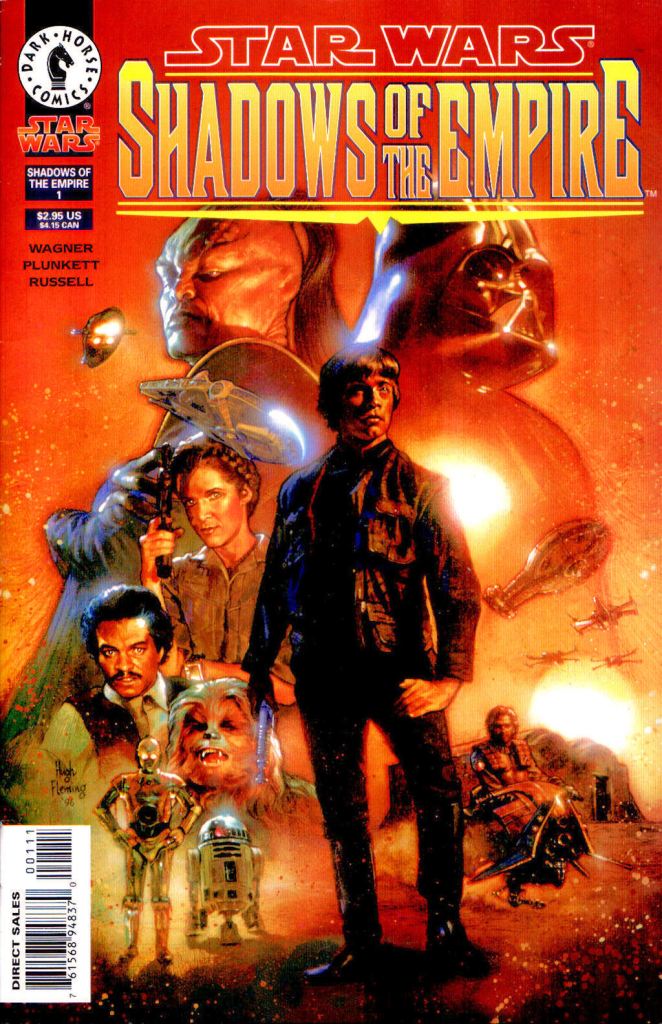
Way back in the mid-1990s, something special happened for Star Wars fans. A brand-new story involving Star Wars icons Luke Skywalker, Darth Vader and others would be told set between The Empire Strikes Back and Return of the Jedi. That story was called Shadows of the Empire and it was released as a special event in the form of a novel (written by Steve Perry), a video game on Nintendo 64 and PC, comic books, a soundtrack, posters, model kits, toys and action figures. What was missing here was a live-action movie.
To put things in perspective, the Shadows of the Empire multi-media event was done by Lucasfilm (note: when creator George Lucas was still in control) with its many business partners to reinvigorate the Star Wars franchise ahead of the planned special editions of the original Star Wars movie trilogy. From a business point-of-view, it made sense to release something new for fans to enjoy and more notably it was the chance for Lucasfilm and its creators to explore what happened between The Empire Strikes Back and Return of the Jedi.
A limited comic book series was released in 1996 and it involved the novel’s author as a story consultant. Back in those days, my comic book interest faded temporarily and even though I was still into Star Wars, I did not bother to buy and read the Shadows of the Empire comic books. The video game caught my attention a lot more back then. Fortunately, I found copies of the comic books and had the time to read them recently.
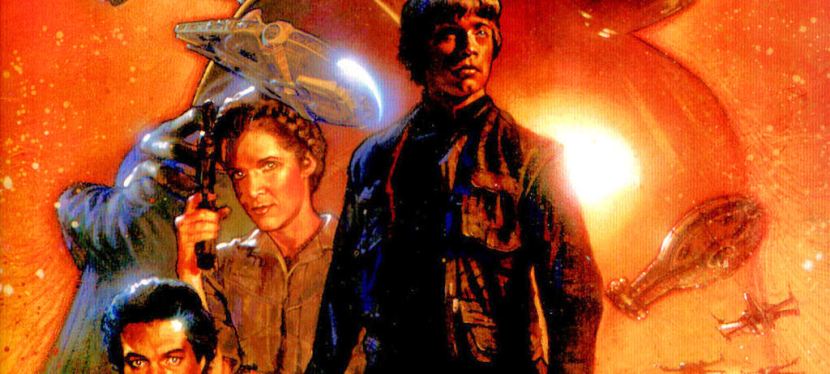
With those details laid down, here is a look back at Star Wars: Shadows of the Empire #1, published by Dark Horse Comics in 1996 with a story written by John Wagner and drawn by Kilian Plunkett.
The cover.
Early story
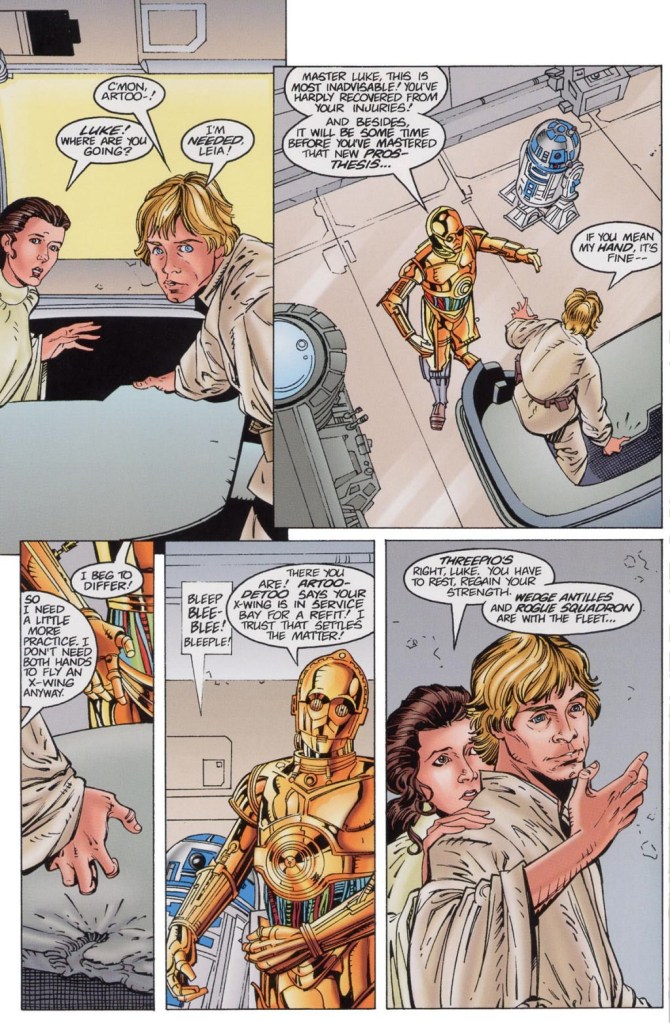
The story begins with a group of Rebel spaceships traveling together in the depth of space. Luke, who now has a mechanical hand and has been recovering from the terrible ordeal he went through at Cloud City, is with Princess Leia, C3PO and R2D2 in the medical frigate. The Rebels detect the presence of an approaching ship which they suspect to be hostile.
Luke suddenly decides to take action but is halted when he realizes that his X-wing fighter is still being refitted. In space, Wedge and the Rogue Squadron fly towards the Imperial Strike Cruiser which then releases some Tie Fighters. The personnel inside the Strike Cruiser tried to inform Darth Vader the location of the Rebel fleet…
Quality
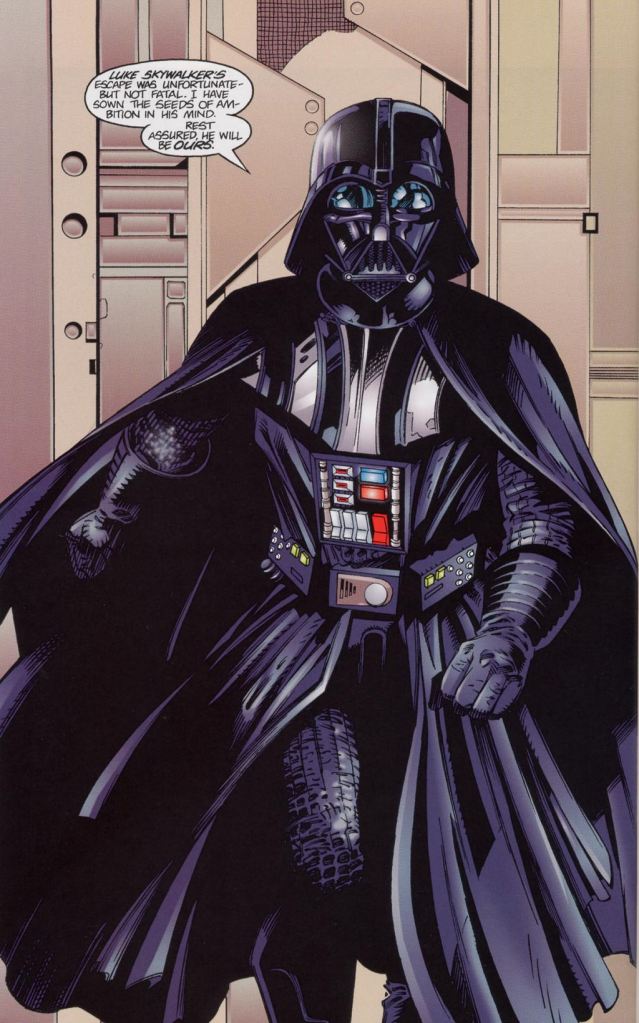
Darth Vader!
The first thing I want to mention is that the writing done by John Wagner is solid. That being said, the story itself felt like a natural continuation of The Empire Strikes Back especially when the comic book’s narrative is focused on Luke and the Rebels. The way the recovering Luke, Leia and the two droids were presented following the end of the 1980 movie was believable, and there was that nice touch of characterization when Luke has not yet adjusted with his mechanical hand.
The story then moves into new territory when the narrative shifts on the Imperial side, especially when Emperor Palpatine gives Darth Vader a new order that has nothing to do with pursuing Luke and the weakened Rebels, but more to do with the construction of the Empire’s new weapon. This is also where the new character Xizor comes in and his presence alone confirms something that the movies did not…the Empire is in business with crime syndicates with regards to major projects.
Space ship battles look great in this comic book.
When it comes to characterization, I like the way Darth Vader handled himself when communicating with Emperor Palpatine who viewed Luke’s escape from Bespin a failure on his part. Compared with his private communication with the Emperor in the 1980 movie, Vader bravely questions him about doing business with Xizor backed with his knowledge of the prince and the ties with Black Sun. Vader, who has been part of the Empire for a long time, knew well how risky it is for them to get involved with criminals especially when military cargo is involved.
As for the visuals, Kilian Plunkett does a decent job drawing the characters. While his take makes Luke recognizable and faltered a bit on capturing Leia’s look, his illustrations on Darth Vader, the Emperor and Xizor were really good. Where Plunkett exceled visually are the locations and surroundings, the machines and the space battles (some pages were drawn really dynamically).
Conclusion
This shows how Luke has not fully adjusted with his mechanical hand.
To put it clearly, Star Wars: Shadows of the Empire #1 (1996) has three narratives (the other is about Boba Fett carrying the frozen Han Solo) to build-up on and for a debut issue of a limited series, this one has strength in its execution complete with a good amount of creative stuff that will resonate with long-time Star Wars fans (and also those who love the original Star Wars movie trilogy). It succeeds in telling what happened shortly after the end of The Empire Strikes Back as well as establishing a new sub-plot with Xizor involved. By the time I finished this comic book, I was convinced to look forward to the next issue.
If you are seriously planning to buy an existing hard copy of Star Wars: Shadows of the Empire #1 (1996), be aware that as of this writing, MileHighComics.com shows that the near-mint copy of the regular edition costs $48 while the near-mint copy of the newsstand edition costs $144.
Overall, Star Wars: Shadows of the Empire #1 (1996) is recommended.
+++++
Thank you for reading. If you find this article engaging, please click the like button below and also please consider sharing this article to others. If you are looking for a copywriter to create content for your special project or business, check out my services and my portfolio. Feel free to contact me as well. Also please feel free to visit my Facebook page Author Carlo Carrasco and follow me at HavenorFantasy@twitter.com
Disclaimer: This is my original work with details sourced from reading the comic book and doing personal research. Anyone who wants to use this article, in part or in whole, needs to secure first my permission and agree to cite me as the source and author. Let it be known that any unauthorized use of this article will constrain the author to pursue the remedies under R.A. No. 8293, the Revised Penal Code, and/or all applicable legal actions under the laws of the Philippines.
Welcome back, superhero fans, comic book collectors, fans of 1990s arts and culture, and fans of Malibu Comics! Today we return to the Ultraverse for another tale of The Night Man, specifically from one of the early issues of its monthly series that launched in 1993.
For the newcomers reading this, Night Man is a solo hero within the Ultraverse who is a musician by day and a crime fighter by night. He was involved in a major accident with a certain cable car in San Francisco that got hit by a bolt of energy from the sky (as told in The Strangers #1). His life was never the same.
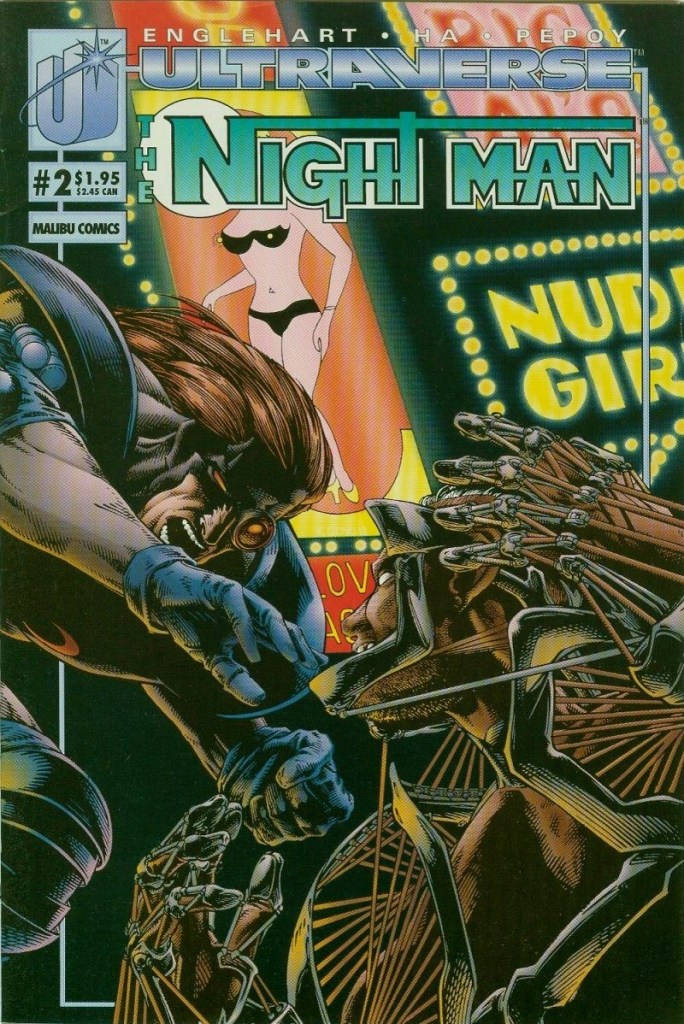
With those details laid down, here is a look back at The Night Man #2, published in 1993 by Malibu Comics with a story written by Steve Englehart and drawn by Gene Ha.
The cover.
Early story
The story begins with Johnny Domingo (Night Man) failing to sleep during the night. The operation he had recently kept him awake and his mind is just racing. He could not even properly play his saxophone.
He dresses again as the Night Man, takes his motorcycle out of his place and then he speeds away. Shortly after, he senses another person’s thoughts…those of a man wearing a trench coat messing with a young boy. Night Man decides to jump in, intervene and save the boy but to his surprise, the man easily hit him moving him back and making him fall on the road.
Unwilling to give up, Night Man goes back to him and strikes back with a kick to the head. During their conflict, Night Man pulls the man’s trench coat revealing a rather shocking form for a body that looked inhuman. This shocks the costumed vigilante giving the man time to pull down scaffoldings in an attempt to hurt him and the boy…
Quality
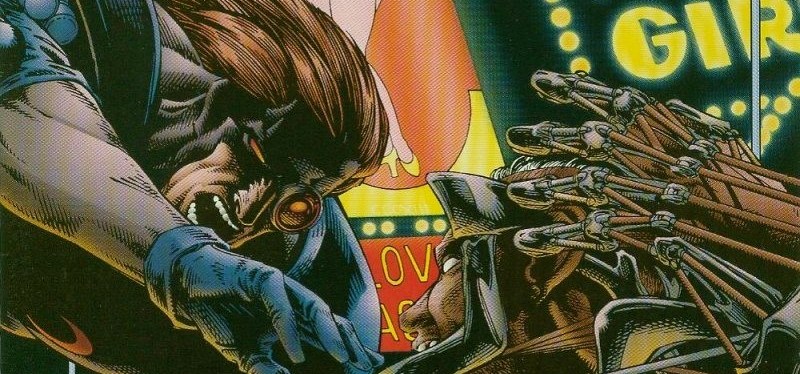
Night Man and Mangle fight!
Focusing on the plot, while the first issue showed Night Man beginning as a vigilante and self-made detective, this comic book shows him struggling to do what he believes to be good (by means of saving another person’s life) and having to face both rejection and skepticism from people. Of course, Night Man himself is flawed with his execution and the way he presents himself to others (note: including doing the radical thing of climbing a tall building just to talk to someone powerful). It does not help that he is restless which clearly impacts his perception even though he has the will to be helpful and make local society a bit safer from dangerous people.
Back to the story, the introduction of a new villain named Mangle is quite intriguing and it seems very fitting that Night Man’s reaction to seeing him in his inhuman form would reflect the same shocked reaction on the part of the reader. Mangle is very distinct from the many other villains of the Ultraverse and he is indeed a powerful adversary to Night Man.
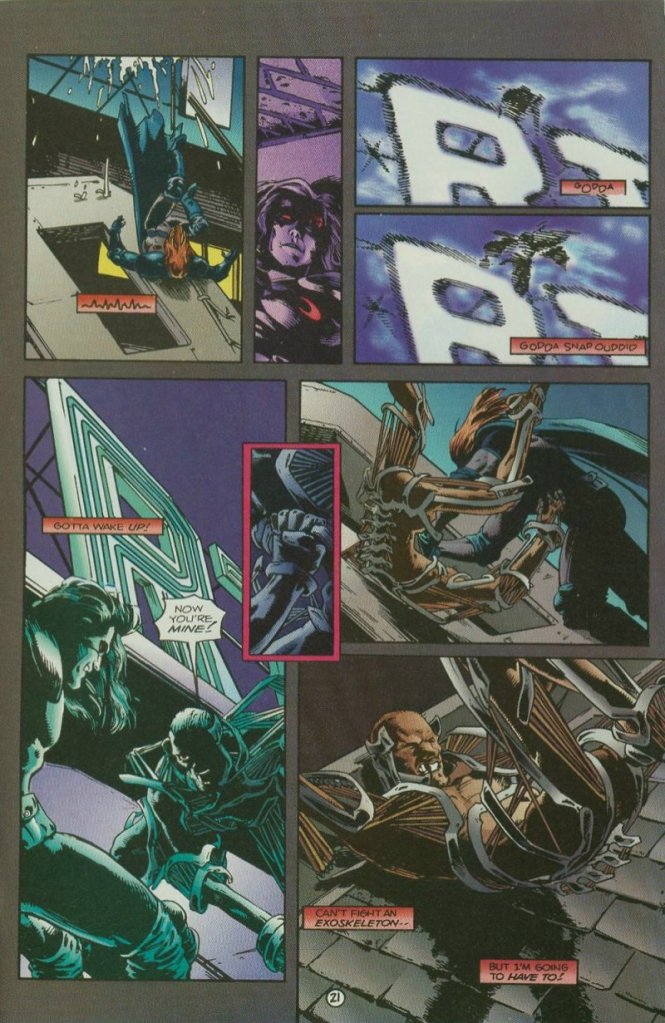
When it comes to the visuals, Gene Ha’s art style is excellent. He has this distinct, gritty style on drawing people as well as their facial expressions. His art on Mangle made the villain look really scary and intimidating. Gene Ha also proved to be good with framing the action scenes while keeping enough creative space for the dialogue or narration to come in for readers to follow.
Conclusion
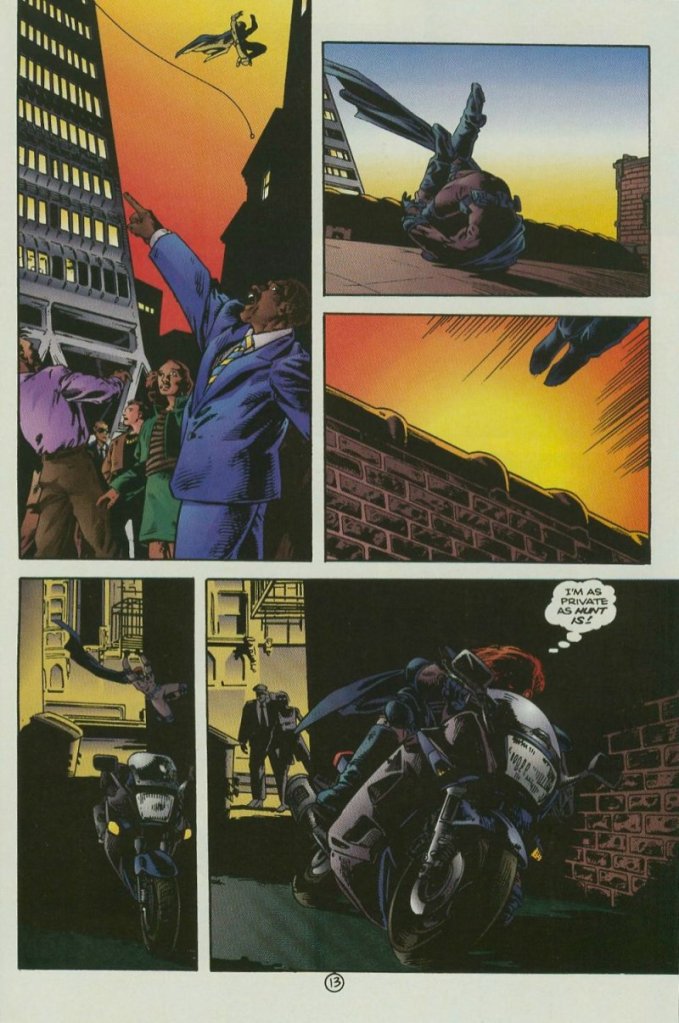
Nothing like coming all the way down from a very tall building to move on.
The Night Man #2 (1993) is pretty compelling and as it is free from the baggage that came with building up the vigilante in issue #1, this one has a more cohesive story and shows more of the him doing his best to be helpful. The story is good enough to keep me interested for the next issue. I should also state that if readers love seeing a hero struggle in helping others, then there is a lot to like in this story.
If you are seriously planning to buy an existing hard copy of The Night Man #2 (1993), be aware that as of this writing, MileHighComics.com shows that the near-mint copy of the comic book costs $14.
Overall, The Night Man #2 (1993) is recommended.
+++++
Thank you for reading. If you find this article engaging, please click the like button below and also please consider sharing this article to others. If you are looking for a copywriter to create content for your special project or business, check out my services and my portfolio. Feel free to contact me as well. Also please feel free to visit my Facebook page Author Carlo Carrasco and follow me at HavenorFantasy@twitter.com
Disclaimer: This is my original work with details sourced from reading the comic book and doing personal research. Anyone who wants to use this article, in part or in whole, needs to secure first my permission and agree to cite me as the source and author. Let it be known that any unauthorized use of this article will constrain the author to pursue the remedies under R.A. No. 8293, the Revised Penal Code, and/or all applicable legal actions under the laws of the Philippines.
Welcome back, superhero enthusiasts, comic book collectors and Wonder Woman fans! Last time around, the Challenge of the Gods storyline concluded and it really had a lot of twists and profound surprises that really shook the foundation of the post-Crisis Wonder Woman monthly series that was spearheaded by George Perez and Len Win. The Challenge of the Gods started strongly in issue #10 and as each issue was released, the narrative got more intriguing and ultimately served its purpose on defining Wonder Woman as the ever-willing and pure Queen of Superheroes. Along the way, there was significant development of Queen Hippolyte who has been struggling between ruling her fellow Amazons and being a mother to Diana/Wonder Woman.
As the Challenge of the Gods was full of elements of fantasy and Greek mythology, it can be quite challenging for any comic book creator to start the next chapter of the Wonder Woman monthly series’ narrative without reusing the mentioned elements.
In the case of the next Wonder Woman comic book for review here, I can say that the creators literally brought Wonder Woman into the realm of realism and intrigue. With those details laid down, here is a look back at Wonder Woman #15, published by DC Comics in 1988 with a story written by George Perez and Len Wein. Perez illustrated the comic book.
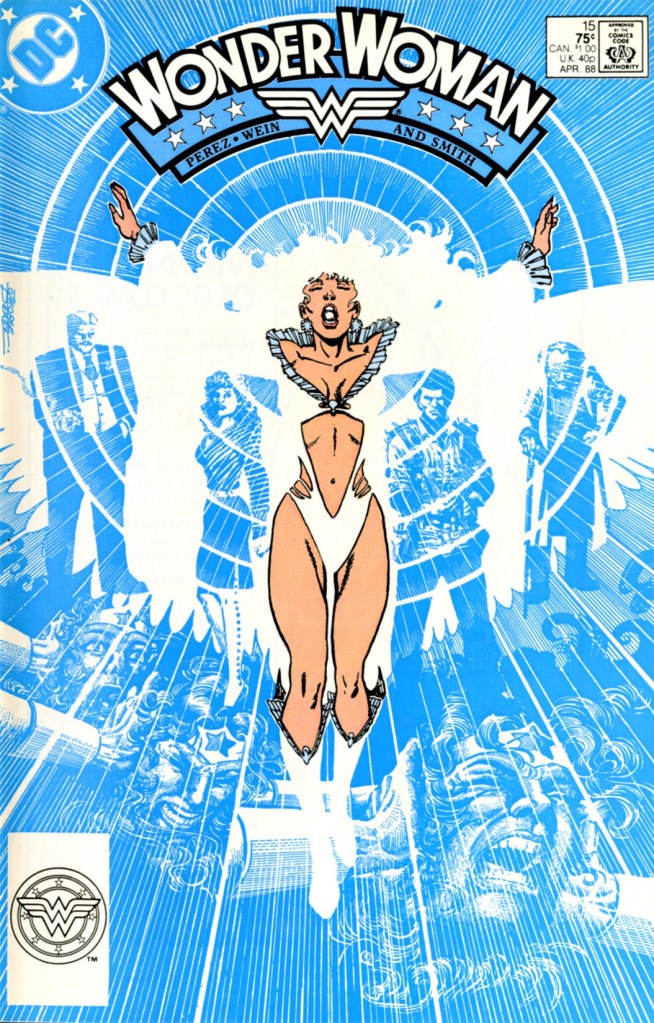
The cover.
Early story
The story begins with Wonder Woman having a very vivid dream about a certain great hero. After waking up from it, she feels that trying to keep up with all the events of the world must be taking its toll on her. She expressed that she is ill-prepared to deal with new sensations.
“In this world, man and woman long for these feelings. They cherish them. I’ve read how they have even died for them,” Diana said. “And that truly frightens me.”
While Diana is staying at the Kapatelis residence, it turns out Julia (mother of Vanessa) is overseas. She wishes that Julia is with her to discuss what she has been feeling.
Meanwhile at the Ogawa headquarters in Boston, an armed man is using one of the company’s computers to acquire classified information about a subject referred to as Valerie Beaudry. A security guard arrives and decides to investigate as he realizes that his fellow guard was missing (knocked unconscious already). The infiltrator makes short work of him and leaves the building with the acquired information…
Quality
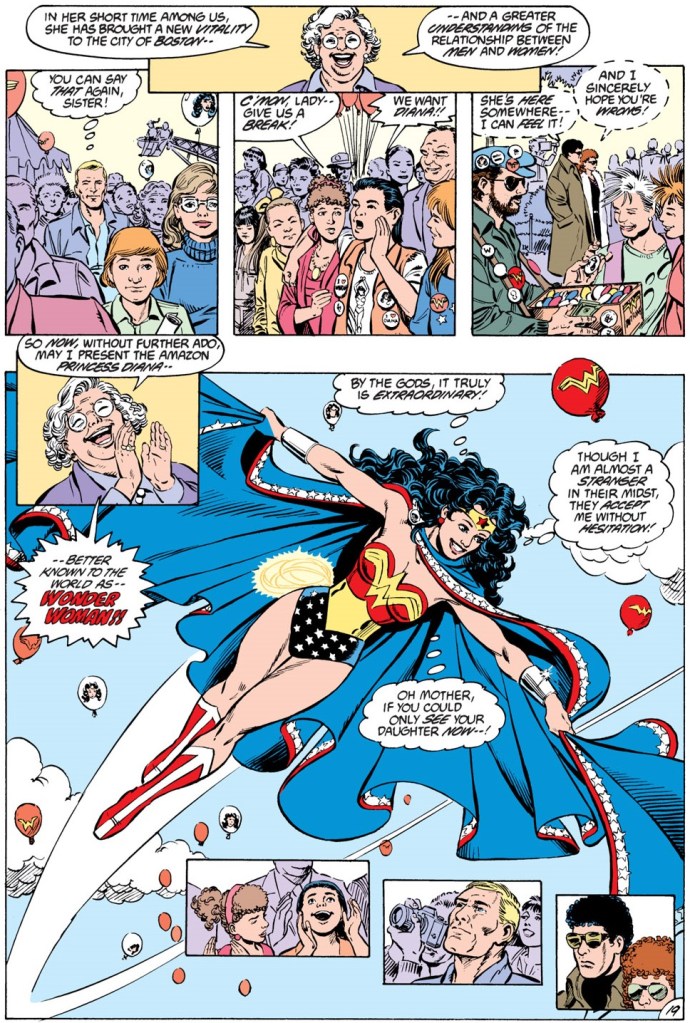
Wonder Woman appears at a major public event.
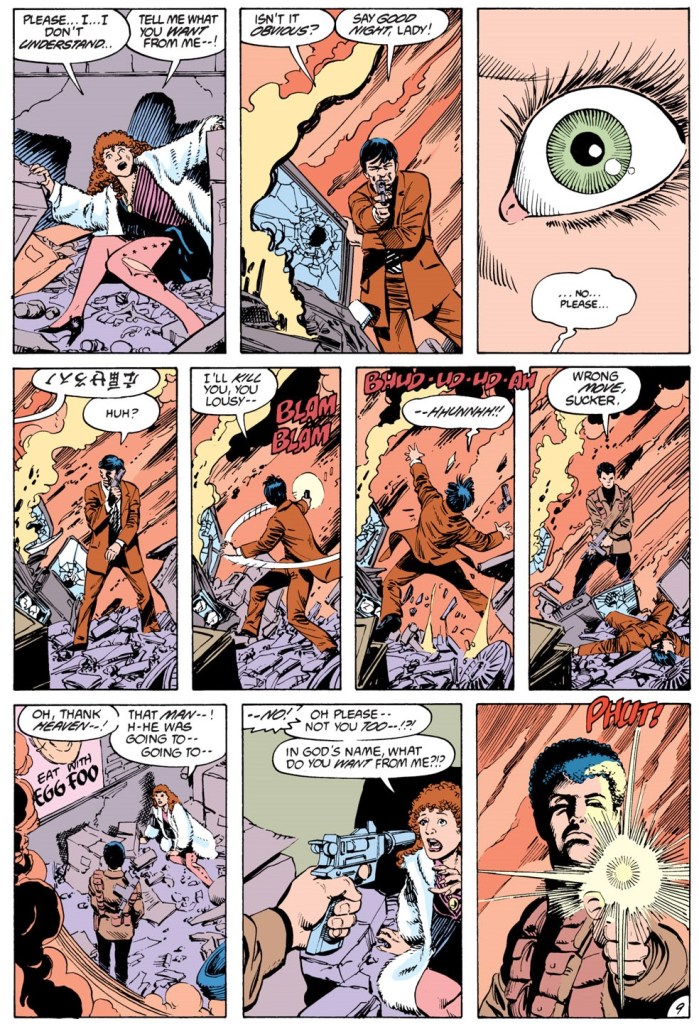
I can start with the sudden change of tone for the storytelling. Gone are the fantasy and mythology elements of the Challenges of the Gods storyline and fully implemented in this comic book are the elements of intrigue, suspense, assassination and even sci-fi. The story itself is more grounded with reality as far as the post-Crisis DC Comics universe goes and because it is well written, the sudden change of tone and style never felt jarring to me.
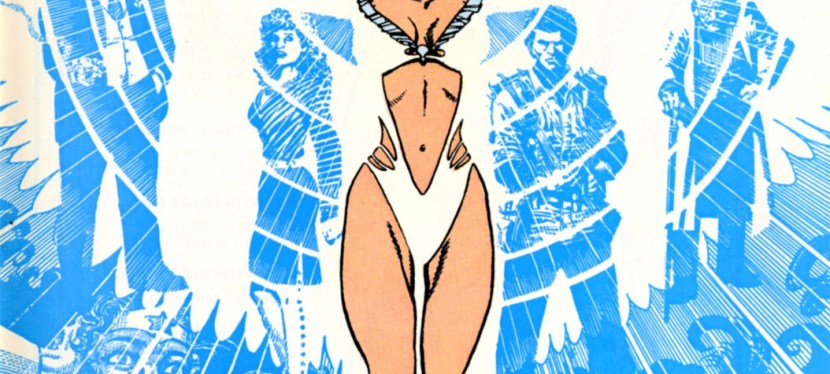
While the 9th issue of this monthly series introduced a modern Cheetah, this comic book introduced the modern Silver Swan in the form of Valerie Beaudry (who appears on the cover). The good news here is that the creators took their time in gradually building-up details about Valerie and how she became Silver Swan. By the time Silver Swan appears in the presence of Wonder Woman, her personal details and traits have been developed in a satisfying way. Unlike Wonder Woman #9, Silver Swan’s appearance in this comic book stretches on into the next issue.
Along the way, more new characters were introduced and the most notable ones are connected with Valerie Beaudry. Maxine Sterenbuch, who eerily resembles Wonder Woman’s teenage pal Vanessa but in adult form, has a close connection with Valerie over a period of many years. There was also Henry Cobb Armbruster, a tycoon who wield tremendous power and has been hiring assassins to do his bidding.
Going back to Wonder Woman herself, this issue explores more of her struggle with not only learning more about man’s world and its many divisions, but also the feelings she starts having as she connects more with other people – most notably with one of DC’s biggest icons. To have Julie Kapatelis absent left the creators room to have Diana not only bond more with daughter Vanessa but also strive more on analyzing what she learns in man’s world. The scene in which Wonder Woman notices a huge printed image of her is a vivid reminder about how negative and foolish idolatry is on people.
Conclusion
Intriguing action scene.
Even though it has no fantasy and mythology elements, Wonder Woman #15 (1988) is still a great comic book to read and it succeeds in progressing Diana’s discovery and learning of man’s world. Its introduction of the post-Crisis Silver Swan is memorable and her build-up (specifically her background story) is pretty engaging.
If you are seriously planning to buy an existing hard copy of Wonder Woman #15 (1988), be aware that as of this writing, MileHighComics.com shows that the near-mint copy of the regular edition costs $35 while the near-mint copy of the newsstand edition costs $70.
Overall, Wonder Woman #15 (1988) is highly recommended!
+++++
Thank you for reading. If you find this article engaging, please click the like button below and also please consider sharing this article to others. If you are looking for a copywriter to create content for your special project or business, check out my services and my portfolio. Feel free to contact me as well. Also please feel free to visit my Facebook page Author Carlo Carrasco and follow me at HavenorFantasy@twitter.com
Disclaimer: This is my original work with details sourced from reading the comic book and doing personal research. Anyone who wants to use this article, in part or in whole, needs to secure first my permission and agree to cite me as the source and author. Let it be known that any unauthorized use of this article will constrain the author to pursue the remedies under R.A. No. 8293, the Revised Penal Code, and/or all applicable legal actions under the laws of the Philippines.
Welcome back, superhero enthusiasts, comic book collectors and fans of the Ultraverse! Today we will revisit the Ultraverse following the team of misfits called Freex. In my past Freex review, we saw the first appearance of Contrary who went on to become one of the more intriguing members of the superhero team UltraForce. As seen in the UltraForce monthly series, Contrary proved to be very intelligent, very resourceful and has what it takes to manipulate the behaviors and direction of even the likes of Hardcase (the team leader), Prototype and Prime.
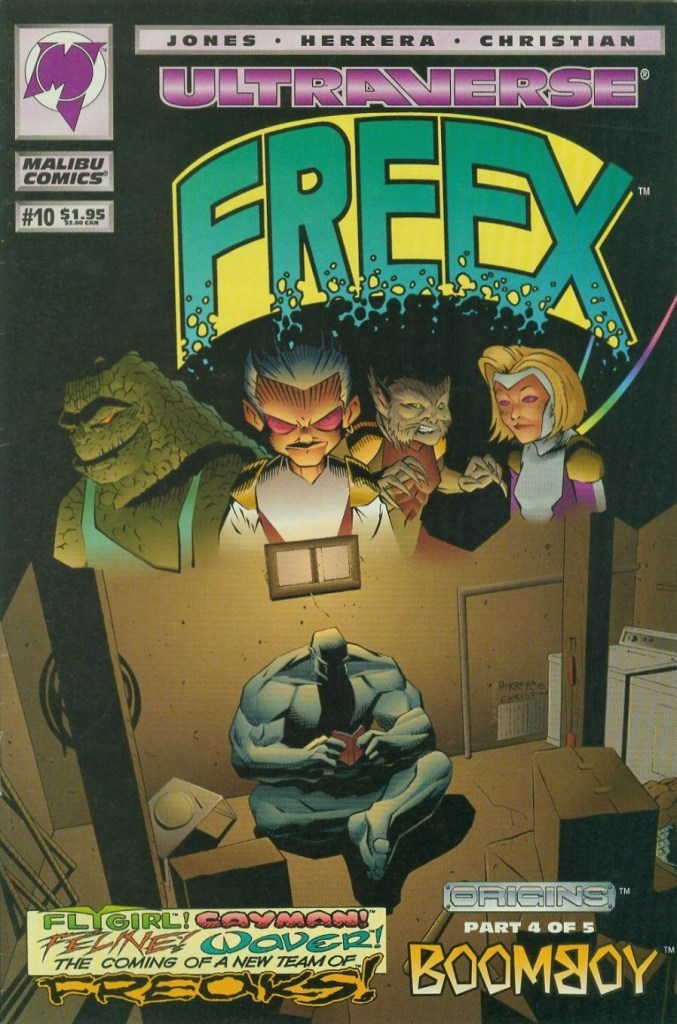
Of course, before the events of UltraForce happened, many of Contrary’s traits and operations were first explored in the Freex monthly series. To learn more about her, here is a look back at Freex #10, published in 1994 by Malibu Comics with a story written by Gerard Jones and drawn by Ben Herrera.
The cover.
Early story
The story begins inside a secret facility. Ray/Boom Boy of Freex has just been abducted and is restrained in the presence of Contrary who is just seating near him looking sexy and comfortable. Knowing that Boom Boy has no chance to escape and fight back, she releases him and mentions that she has other students who will fight for her.
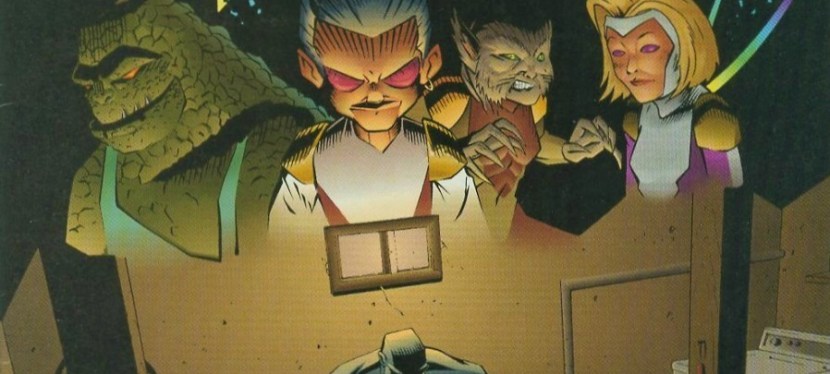
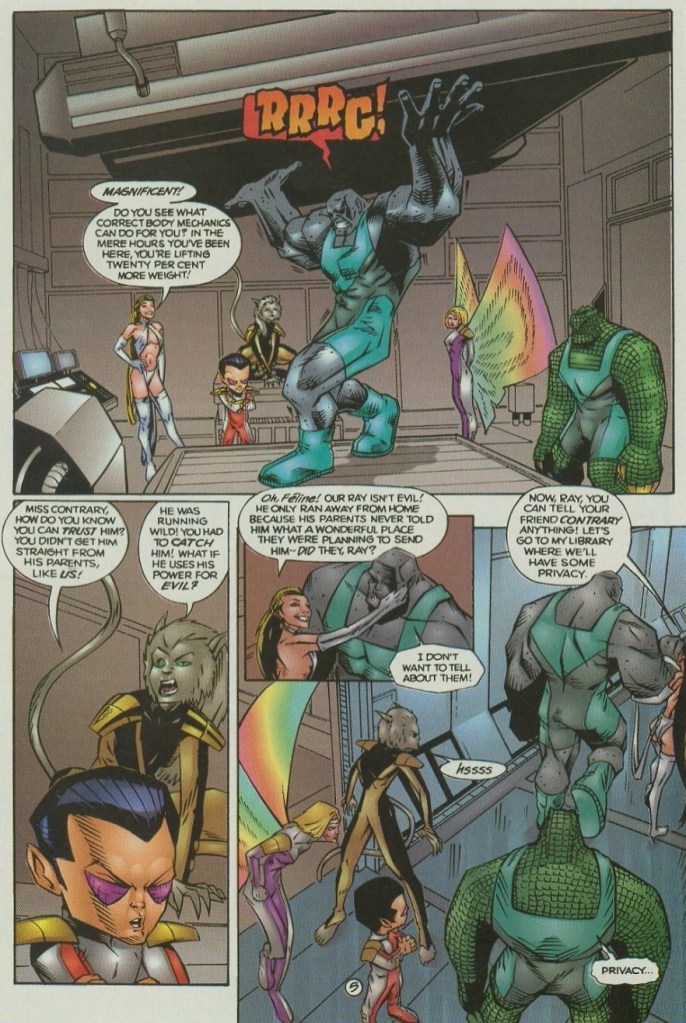
Slowly, Contrary leads him into another place of the facility telling him that he’s not locked up (like a prisoner) but rather he is home (implying there is a place for him at the facility). She introduces him to her Academy for the New Elite with her students engaging in a training session against drones and obstacles. Her students are Feline, Waver, Flygirl and Cayman.
Meanwhile, members of the Freex are still homeless and are trying to figure out how to find Boom Boy…
Quality
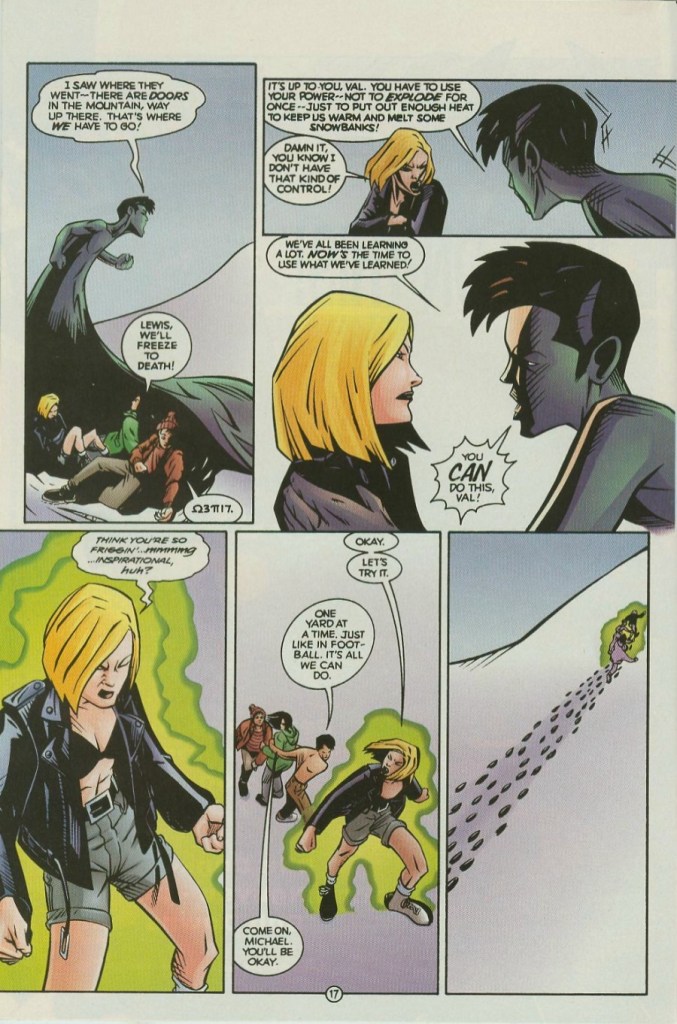
The Freex, without Boom Boy, struggling.
I want to start with the writing. This issue was clearly less about Freex and more of Boom Boy (note: his personal origin emphasized) and Contrary and her academy of people with powers and special abilities. Creatively, this story has strong X-Men vibes in it which I personally enjoyed. I do confirm that the writing is strong on storytelling, characterization and dialogue.
While the previous issue introduced her briefly, Contrary is heavily emphasized in this issue. Apart from being resourceful and highly intelligent, she is also erotic with her appearance (so much of her skin exposed always) and at the same time she is well portrayed as a mentor to her students complete with traits of motherly care to them. In comparison with what I’ve seen in X-Men comic books, Contrary is like a combination of Charles Xavier and Emma Frost with some traces of Moira MacTaggert. I should also state that Contrary has a keen perception on finding outstanding or special individuals that she can help develop in more ways than one.
Going back to Boom Boy, this comic book really redefined him not only as a questionable member of Freex but also as an Ultraverse character in general. By reading this story, you will not only relate with Boom Boy but also experience the challenge he is having on whether to decide to be with his old pals or join Contrary’s academy (which itself is inspired by Xavier’s School of Gifted Children in X-Men comics) to really leave his past behind and move forward personally.
While this comic book is heavy with characterization and exposition, there is still a good amount of superhero to enjoy here. The good news is that artist Ben Herrera showed a lot of creative stuff with the spectacle.
Conclusion
This scene has very strong X-Men vibes.
Freex #10 (1994) is a great Ultraverse comic book! I really found this particular issue to be very engaging from start to finish. As a story about the Freex themselves, this one saw their story as desperate nomads move forward a lot. Still the standouts of the story are Boom Boy and Contrary. If you have not read any issues of UltraForce yet, I highly recommend reading this so you can get to know Contrary better as she is one of the core UF members.
If you are seriously planning to buy an existing hard copy of Freex #10 (1994), be aware that as of this writing, MileHighComics.com shows that the near-mint copy of the comic book costs $11.
Overall, Freex #10 (1994) is highly recommended!
+++++
Thank you for reading. If you find this article engaging, please click the like button below and also please consider sharing this article to others. If you are looking for a copywriter to create content for your special project or business, check out my services and my portfolio. Feel free to contact me as well. Also please feel free to visit my Facebook page Author Carlo Carrasco and follow me at HavenorFantasy@twitter.com








 Author Carlo Carrasco