Retro Gaming Ads Blast – Part 22

Welcome back readers, fellow geeks and electronic gaming fans!

In this edition of the Retro Gaming Ads Blast (RGAB) series, we will take a look at another batch of retro gaming print ads – including arcade flyers – from the 1980s and 1990s.

For the newcomers reading this, Retro Gaming Ads Blast (RGAB) looks back at the many print ads of games (console, arcade, computer and handheld) that were published in comic books, magazines, flyers, posters and newspapers long before smartphones, social media, the worldwide web and streaming became popular. To put things in perspective, people back in the 1980s and 1990s were more trusting of print media for information and images about electronic games and related products.

With those details laid down, here is the newest batch of retro gaming print ads for you to see and enjoy…

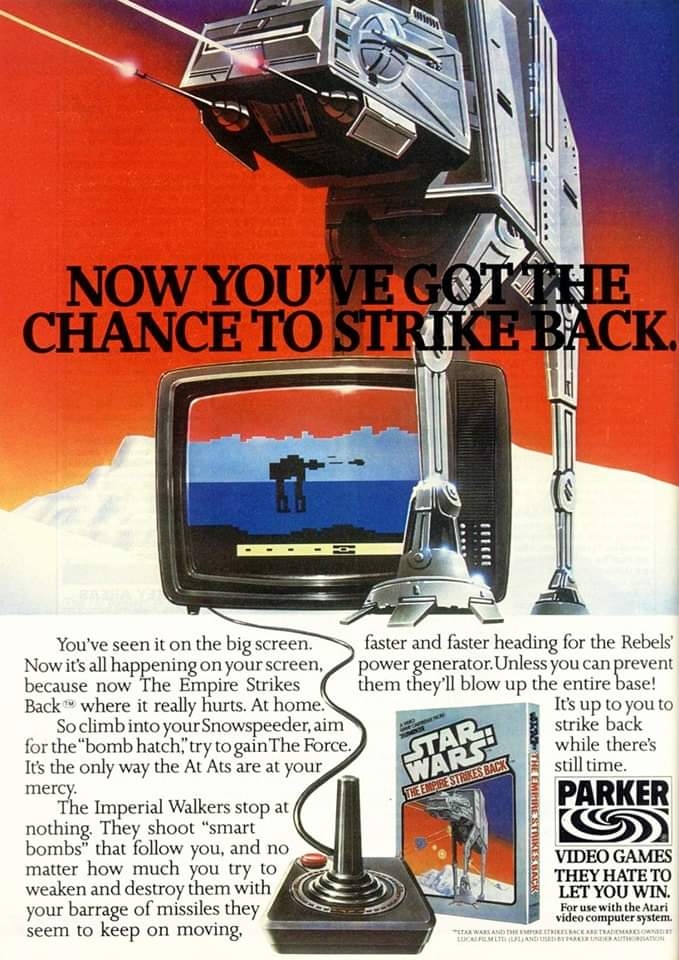
1. Star Wars: The Empire Strikes Back Atari print ads
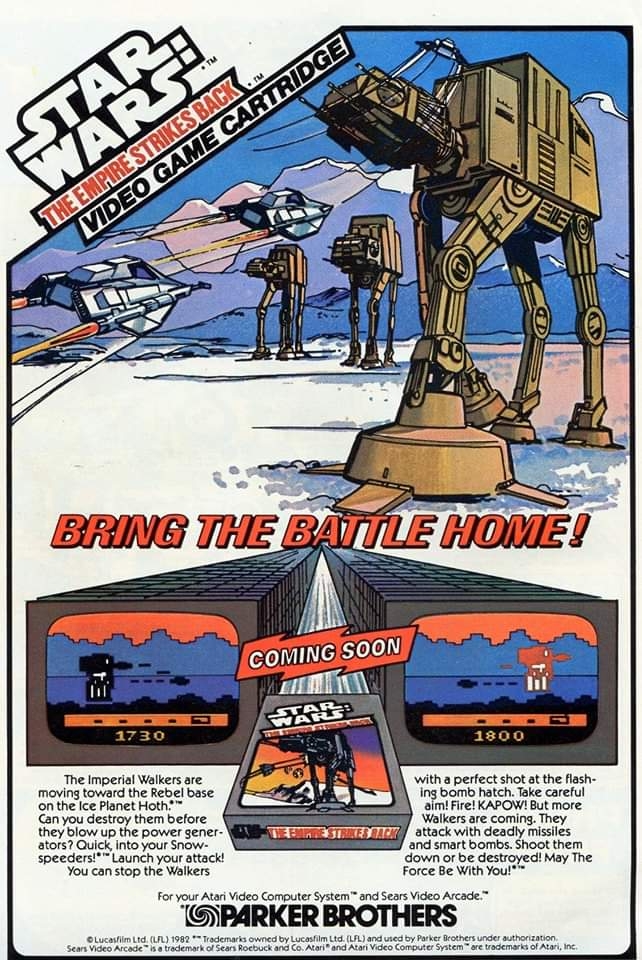
I could not forget the first time I saw this print ad while reading a comic book.
This ad showed the Atari 2600 controller.

Even during its early years under George Lucas, the Star Wars entertainment franchise made its way into video games due to its massive popularity and Parker Brothers really made moves to cash in. This resulted in the Atari 2600 video game adaptation (1982) of The Empire Strikes Back which focused mainly on the memorable Hoth battles between Rebel fighters and the Empire’s AT-AT walkers. Parker Brothers came up with two print ads and each had a different visual concept: one had nicely drawn art along with two screenshots shown while the other had painted art of the AT-AT while showing the Atari joystick. These old print ads still look great and exciting.

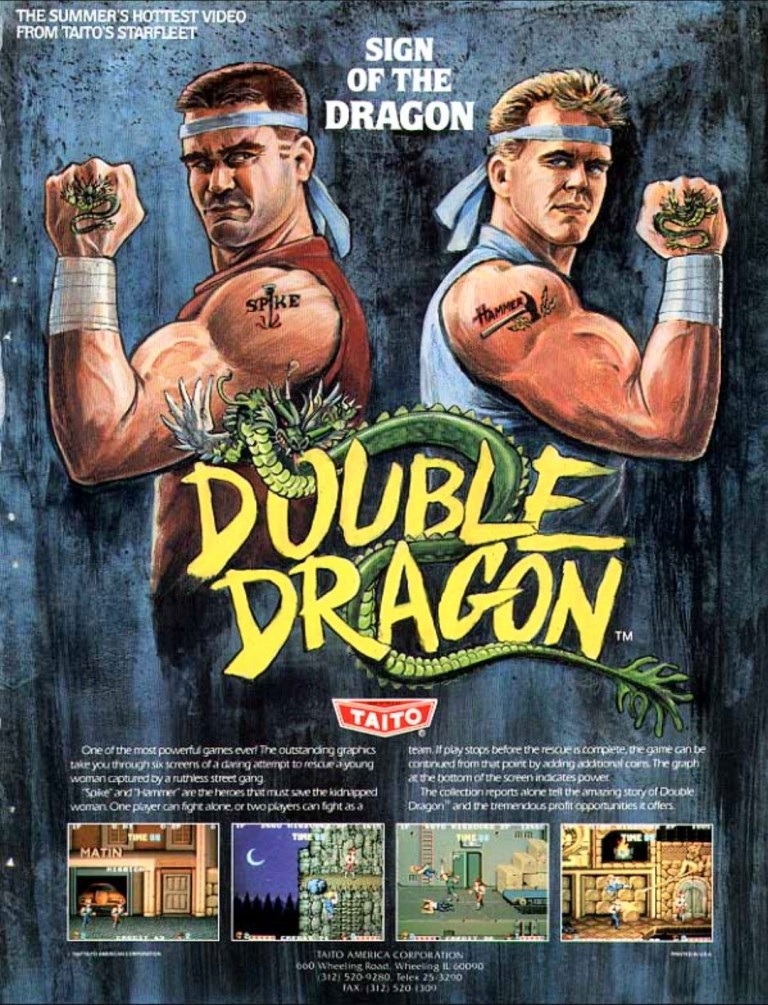
2. Double Dragon Japanese and North American arcade flyers
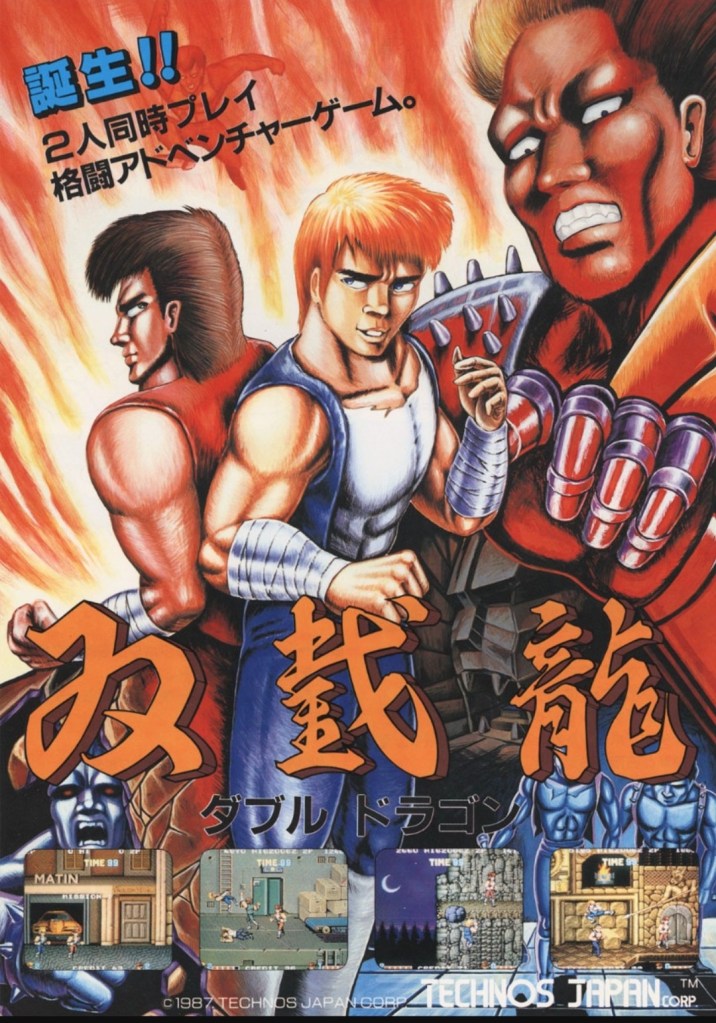
If you read manga (Japanese comics) in Japan, then the art style of this arcade flyer should look familiar to you.
The character designs seem inspired by 1980s Hollywood action cinema.

Released in 1987, Double Dragon became a huge hit in the arcades of Japan, America and Europe resulting in financial gains for developer Technōs Japan and publisher Taito. What I find intriguing was the fact that the Double Dragon arcade flyers for Japan and North America had drastically different art styles used to promote it. The Japanese flyer had art style that is more common with manga while the North American had artwork that seemed inspired by Hollywood action movies (as well as the rise of martial arts films in America during the 1980s). The American flyer even had the two characters identified as Hammer and Spike and they both looked American. This is a classic example of using different approaches to promote a game in each market.

3. Universal Soldier print ad
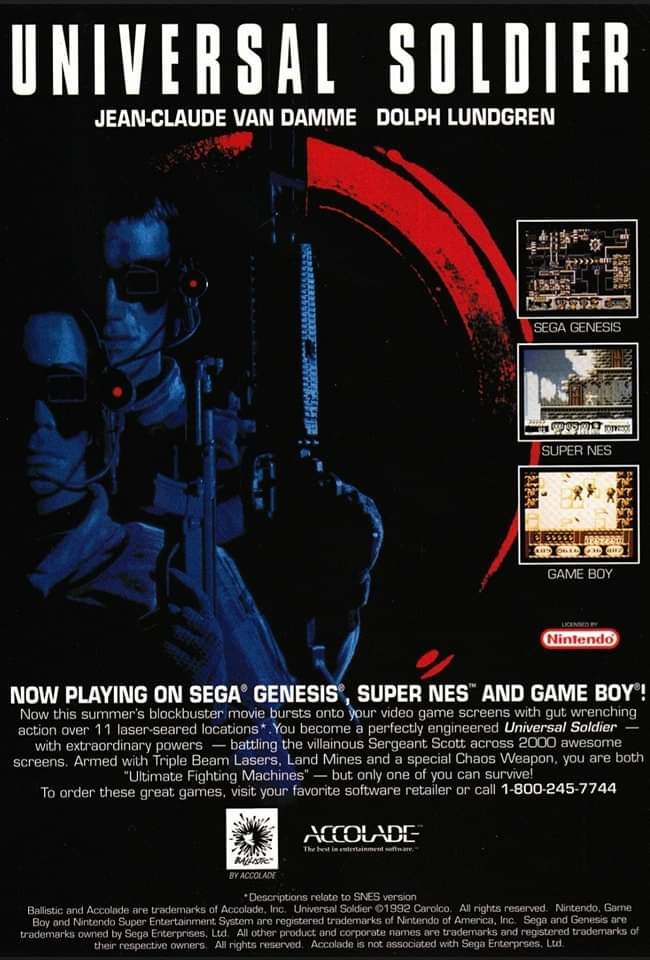
The people who made this print ad made sure to use the names of the stars to help sell the game.

Even though its worldwide ticket sales did not reach $100 million, the 1992 movie Universal Soldier still caught a lot of attention from moviegoers simply because it had Jean-Claude Van Damme and Dolph Lundgren as the stars. Unsurprisingly, the movie had a video game adaptation and because publisher Accolade wanted to cash-in on the film’s hype, they made some deceptive moves by rebranding one of its games (already development) as a tie-in. Advertised as an official adaptation, Universal Soldier was actually a rushed conversion of Turrican II: The Final Fight. This print ad – which even showed the stars’ names – is a reminder of the deception Accolade pulled off.

4. Sega CD print ad
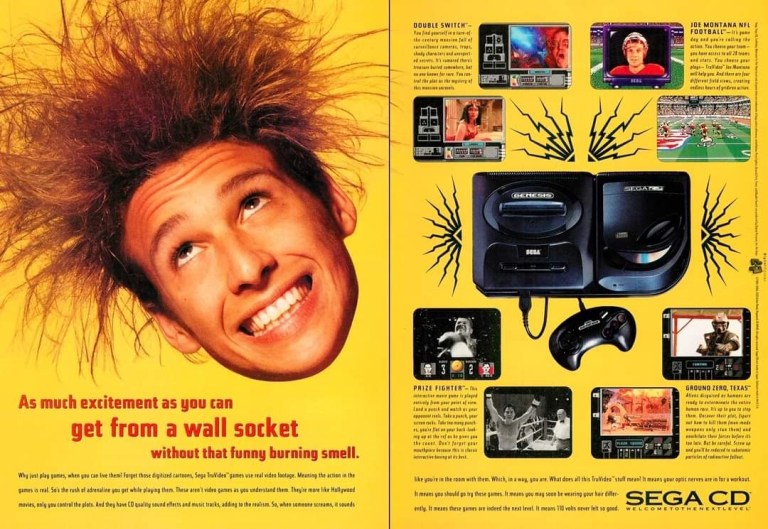
Do you find this Sega CD print ad hilarious?

When Sega was making waves with its Sega Genesis (Sega Mega Drive in Japan), the company was quick to react to the growing use of the compact disc (CD) format as a useful storage medium for video games. The Sega CD (Mega CD in Japan) was released as an add-on device to work with the Genesis console and Sega’s American team came up with a series of promotions. This print ad is just one of the promotions and ad makers came up with a “crazed” or “electrified” gamer dominating one page while showing the Genesis, the Sega CD and screenshots of games (running on CD) on the other page. By today’s standards, the Sega CD print ad is funny and catchy to look at.

5. Snatcher for Sega CD print ad
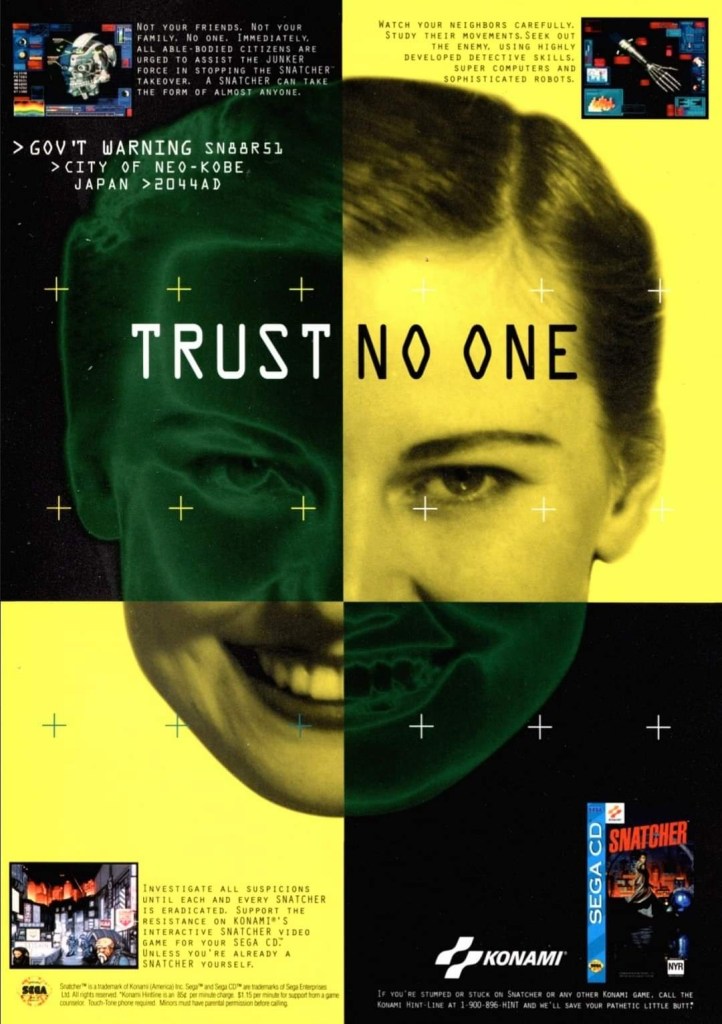
I find this Snatch print ad looking odd. The ad makers could have done more to focus on the game itself.

First released in Japan in 1988, Snatcher was a cyberpunk visual adventure game that was one of the early works of the famous Hideo Kojima (Metal Gear series). Due to its design and approach on visuals to tell a story, it was not surprising that a Sega CD version of it got released in 1994. To promote the game to the growing number of North American Sega CD gamers at the time, Konami came up with this rather unusual print ad showing the face of a smiling lady dominating the space leaving little room to show the screenshots and the game’s cover. The visual concept is engaging but it takes effort to notice it was promoting the Sega CD version of the video game. This old ad would have worked better had the ad makers increased the sizes of the screenshots and the game cover.

6. Jurassic Park for Sega CD print ad
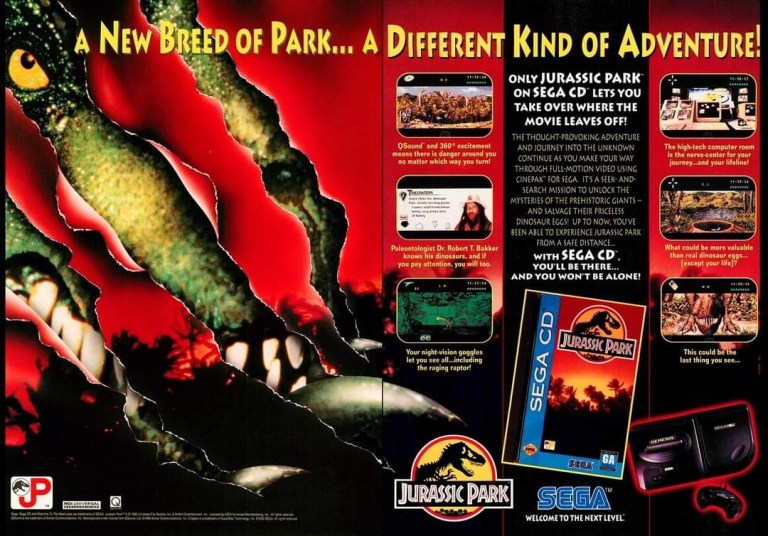
Does the T. Rex look scary to you?

As part of its drive to add more games to the Sega CD add-on and help it sell more units, Sega acquired the Jurassic Park license and went on to produce an adaptation utilizing the technological features of the Sega CD. To aggressively promote the game, Sega came up with this print ad that had a Tyrannosaurs Rex (looking through spaces) on one page and then several screenshots plus text descriptions on the other. For a click-and-point Jurassic Park game, this ad was really exciting and intriguing to look at.  

7. Atari Jaguar print ad
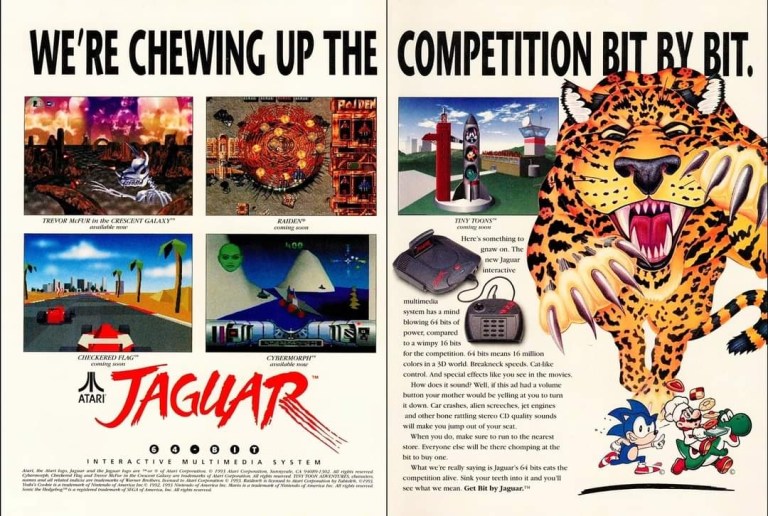
This was indeed an eye-catching ad.

In the early 1990s, Atari made an aggressive move to compete in the arena of video game consoles which they used to dominate from the late 1970s until 1983. This time around, they came up with the Jaguar console which had some pretty advanced technologies for the time. As part of their North American marketing campaign, Atari unleashed an ad showing game screenshots on the first page and huge artwork of a jaguar coming after Sonic, Mario and Yoshi (mascots of Sega and Nintendo respectively) symbolizing that the Atari Jaguar had more power and better technology than the Genesis and the Super Nintendo Entertainment System (SNS). While it was engaging to look at early on, this print ad is now an embarrassment as the Jaguar console failed terribly. Lastly, the marketing of the Jaguar as a 64-bit machine was never real.

8. George Foreman, The Simpsons and Spider-Man Game Gear print ad
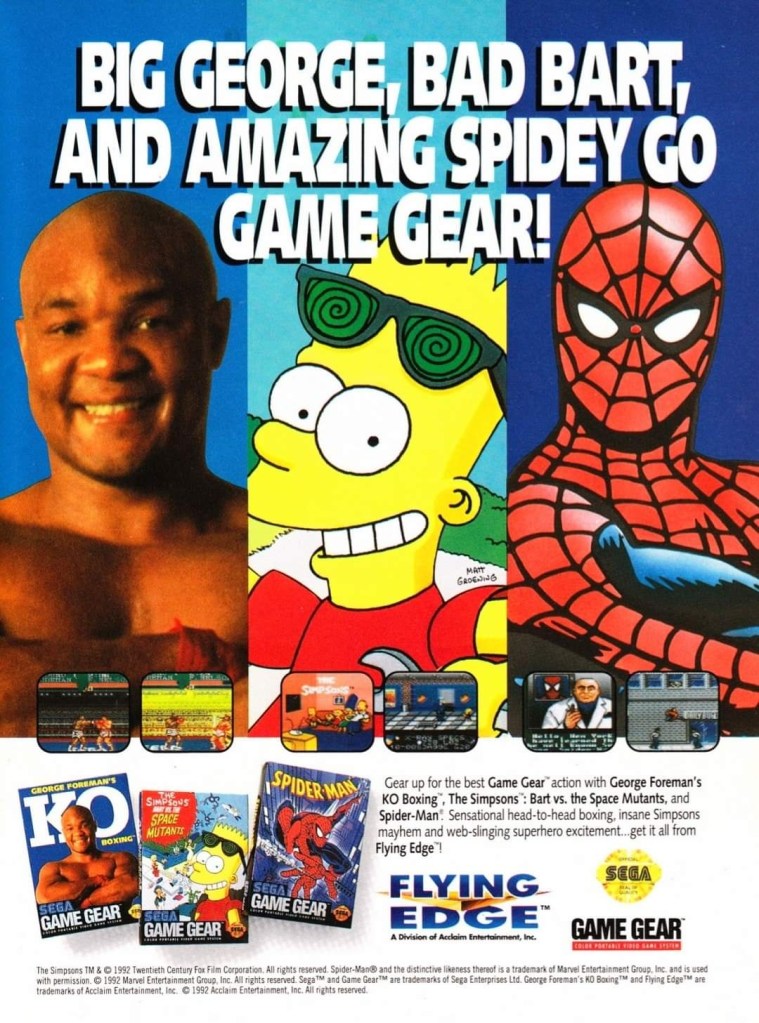
This ad appeared in a lot of comic books in the 1990s.

In the early 1990s, Sega released the Game Gear handheld gaming device which instantly placed them in competition with Nintendo’s Game Boy. Through its Flying Edge label, Acclaim Entertainment promoted George Foreman’s KO Boxing, The Simpsons: Bart vs. the Space Mutants, and Spider-Man for the Game Gear hoping to sell well. This 3-game print ad highlighted the popular figures who had a lot of space for attracting attention. The ad maker managed to insert two screenshots per game, the game covers and a text description to inform consumers what they were being offered. A good ad to look at.   

9. Time Gal for Sega CD print ad

The presentation here looks nice but Time Gal herself looked like she was drawn by a different artist.

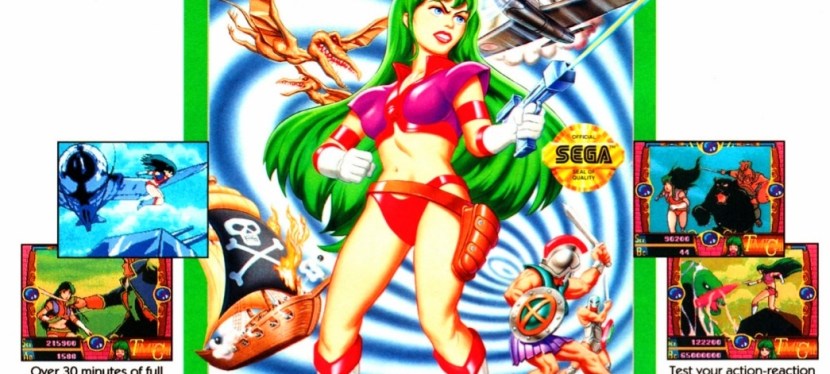
Originally released in the arcades in Japan in 1985, Time Gal made its way to the Sega CD add-on in the early 1990s. It was a highly unusual video game as it was an interactive movie (with lots of anime footage) made with the use of Laserdisc technology for its arcade version. It played lots of anime scenes and players must choose the on-screen options to execute the character’s next action in order to progress. For the Sega CD version for North America, this print was made to capture the attention of consumers using the protagonist’s sex appeal on the cover art with four screenshots placed on the sides to show what to expect. I noticed that Time Gal on the cover art looked different from how she appeared in the anime sequences. At least the ad makers tried hard to sell the game.

10. Mortal Kombat print ad
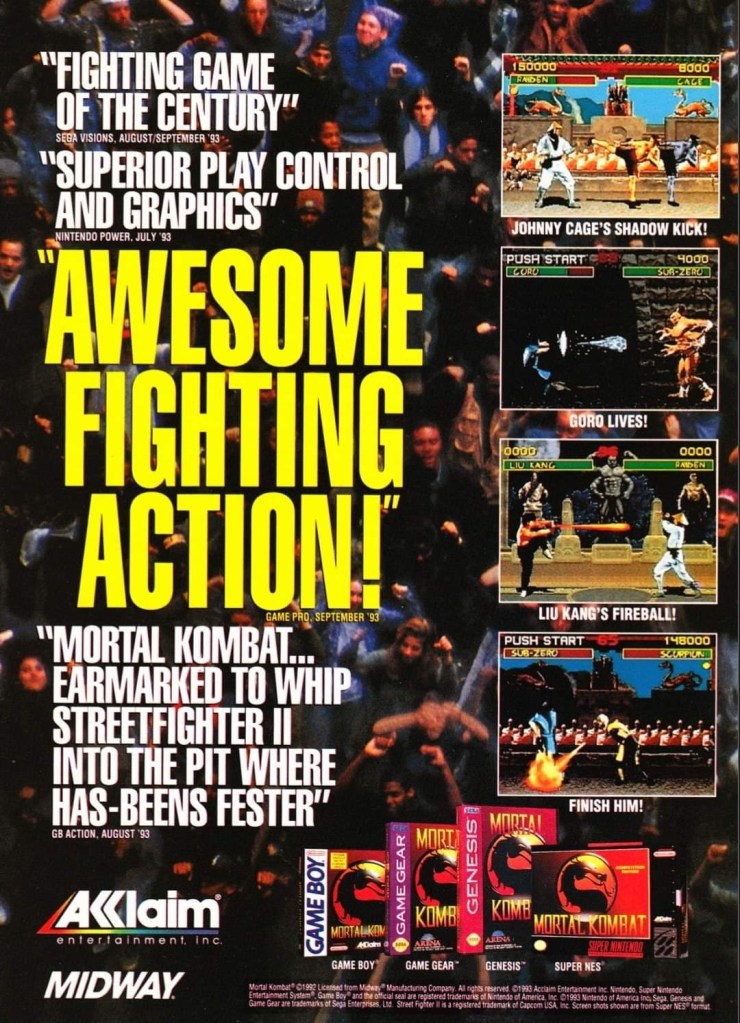
Still an effective ad to promote a blockbuster game and make people informed it was coming to multiple platforms.

Considering how successful it was in the arcades, the 1993 release of Mortal Kombat for game consoles and handhelds was unsurprisingly highly anticipated and publisher acclaim came up with this single-page ad. The presentation involved the use of a photographic background of many spectators (to emphasize excitement and popularity), media quotes and screenshots to effectively promote the game.

11. Equinox print ad
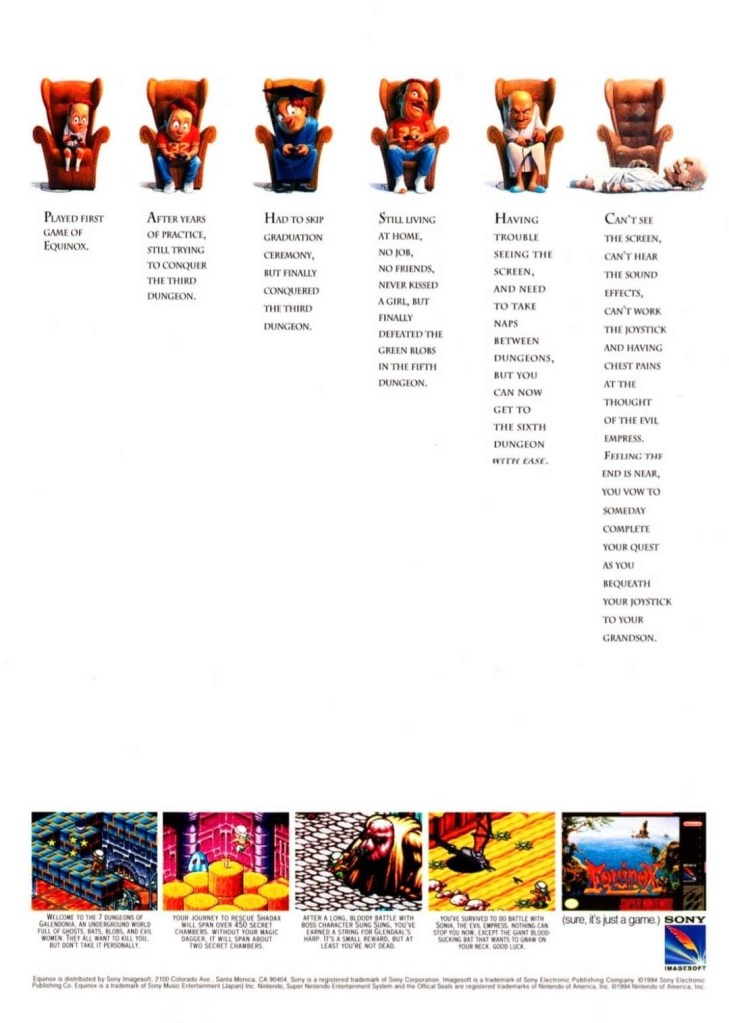
Take a close look. Tell me if you find it funny.

I never played Equinox but I heard the loud buzz about its design as a 3D isometric game that had elements of exploration, platform play and puzzle solving. The people responsible for this print ad emphasized the concept that the game is so addicting to play, players will still play it as they get older. This ad has a subtle yet effective approach with humor.

12. James Bond 007: The Duel print ad
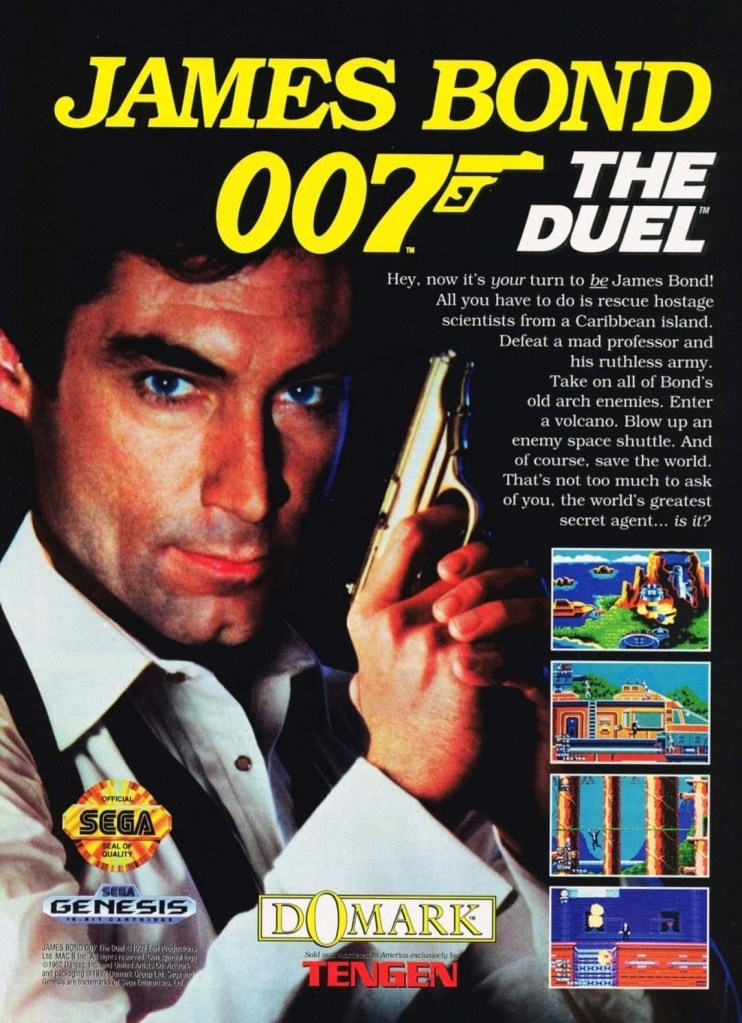
Timothy Dalton’s image as James Bond was sourced from Licence to Kill for this game’s ad.

Here is another decades-old James Bond video game print ad I found. Released a few years after Licence to Kill, James Bond 007: The Duel was notable not for its gameplay nor game design but for the fact that it used the image of Timothy Dalton as 007 for its print ad and the opening scenes in the game itself. Dalton’s Bond image here was never new nor originally taken for the game as it came directly from Licence to Kill’s publicity library. Each time I saw this ad, I was only reminded of the 1989 movie which I still enjoy watching.

13. Neo Geo AES console print ad
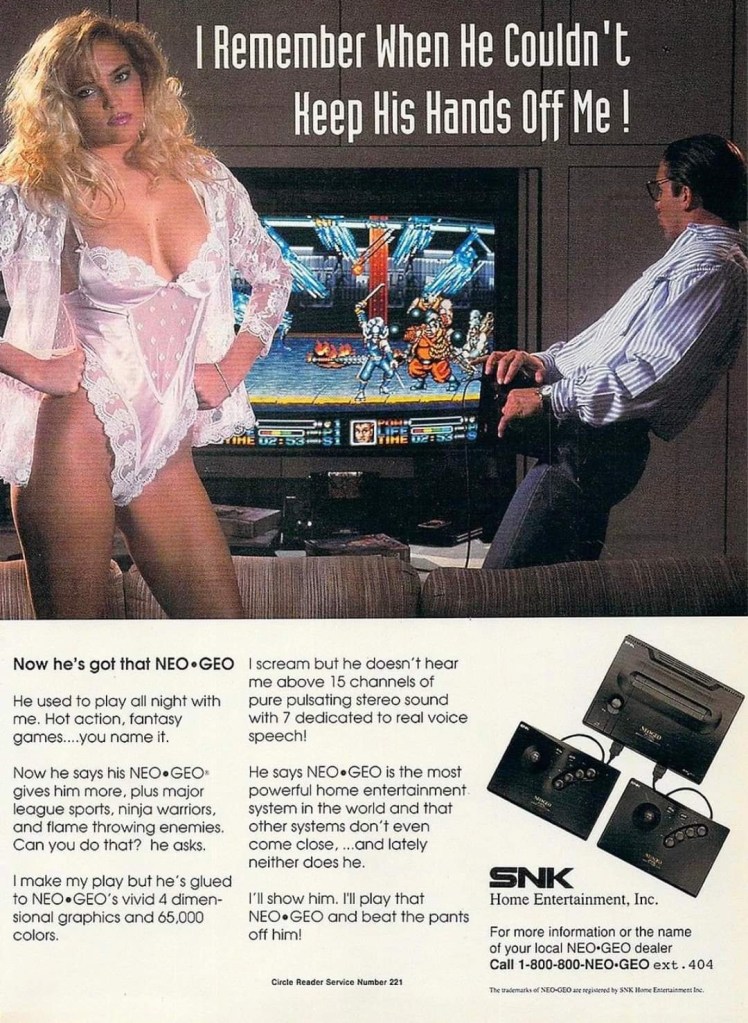
Do you find this ad both sexy and funny?

Decades ago, SNK made a huge splash in the arcades with lots of really fun games released with their Neo Geo (stylized as NEO GEO) hardware. In 1990, they released the cartridge-based Neo Geo AES console in Japan and America and it carried the same technology as the arcade hardware. To promote the console in North America (note: the Neo Geo console and its games were very expensive), SNK came up with this catchy and funny print ad showing a sexy woman feeling annoyed that her man spends more time with Neo Geo gaming than with her. This was a clever way of emphasizing the arcade-perfect experience in the comfort of home, and it was funny to look at.

14. Gradius II Japanese arcade flyer
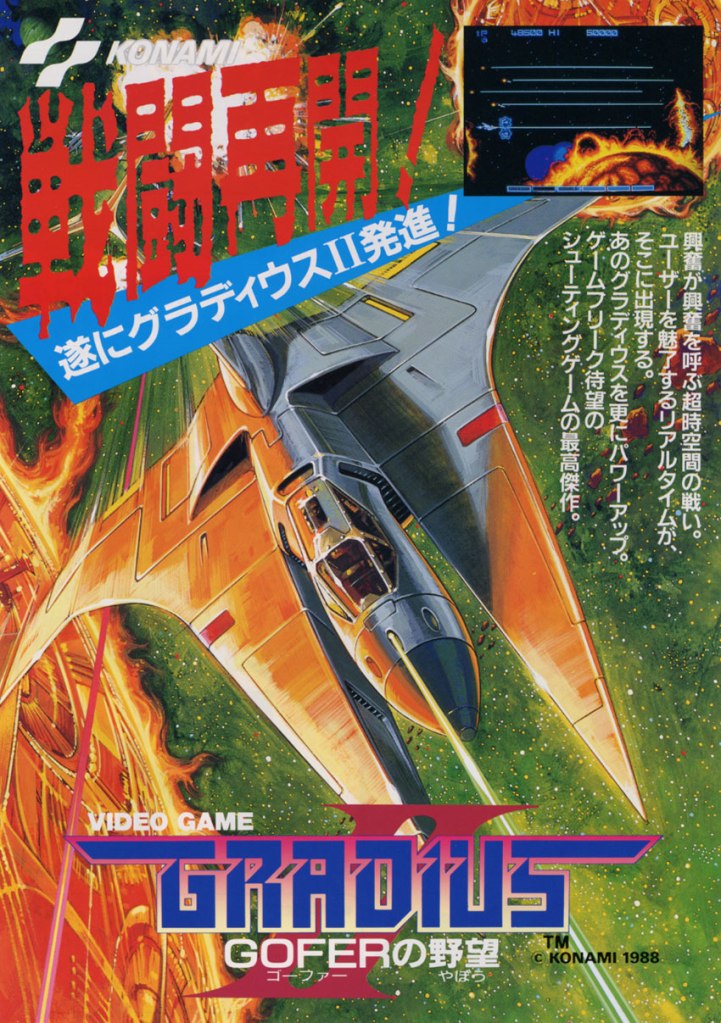
Great looking painted art was used for this 1988 arcade game.

Since the original Gradius was a big hit in arcades in Japan in 1985, it was not surprising that Konami released Gradius II three years later. With regards to the use of painted art, the artist showed the game’s spaceship in a dominating position emphasizing high-speed travel and excitement. The image, which also looks more colorful, is a complete reversal of the painted art used in the flyer of the previous which showed the rear of the spaceship as it moves towards a larger spaceship (the opposition). This arcade flyer art still looks great as it has a timeless charm.

+++++

Thank you for reading. If you find this article engaging, please click the like button below, share this article to others and also please consider making a donation to support my publishing. If you are looking for a copywriter to create content for your special project or business, check out my services and my portfolio. Feel free to contact me with a private message. Also please feel free to visit my Facebook page Author Carlo Carrasco and follow me on Twitter at  @HavenorFantasy as well as on Tumblr at https://carlocarrasco.tumblr.com/ and on Instagram at https://www.instagram.com/authorcarlocarrasco
Retro Gaming Ads Blast – Part 20

Welcome back readers, fellow geeks and electronic gaming fans!

In this edition of the Retro Gaming Ads Blast (RGAB) series, we will take a look at another batch of retro gaming print ads – including arcade flyers – from the 1980s and 1990s.

For the newcomers reading this, Retro Gaming Ads Blast (RGAB) looks back at the many print ads of games (console, arcade, computer and handheld) that were published in comic books, magazines, flyers, posters and newspapers long before smartphones, social media, the worldwide web and streaming became popular. To put things in perspective, people back in the 1980s and 1990s were more trusting of print media for information and images about electronic games and related products.

With those details laid down, here is the newest batch of retro gaming print ads for you to see and enjoy…

1. River Raid print ad

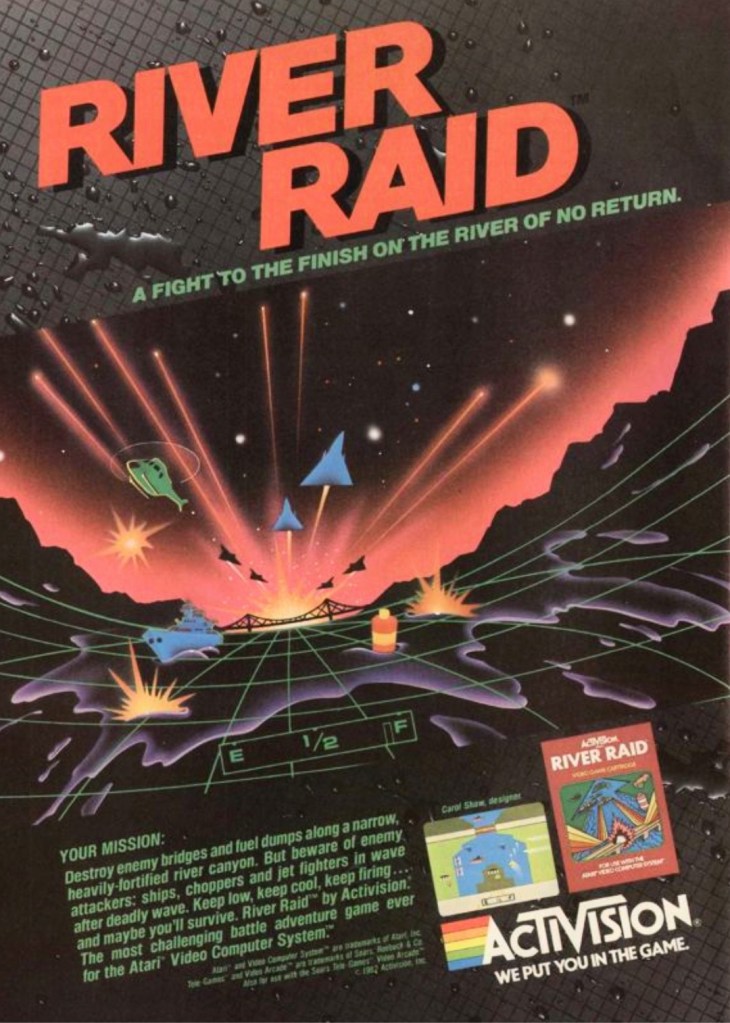
This River Raid print ad appeared on comic books and magazines long ago.

Decades before it became an industry giant with the best-selling Call of Duty games, Activision became a standout publisher in the early 1980s with River Raid on the Atari 2600. Designed by Carol Shaw, River Raid was a huge success ending up as the 2nd best-seller on the Atari 2600 as well as Activision’s best-selling game for the year 1983. Apart from showing one screenshot and the box cover of the game, the print ad of River Raid had this mesmerizing 3D image that caught many gamers’ attention and helped them feel like they will pilot on dangerous missions. The 3D image was futuristic in its own style became forward-moving 3D sequences in video games became reality many years later.   

2. Galaga North American arcade flyer

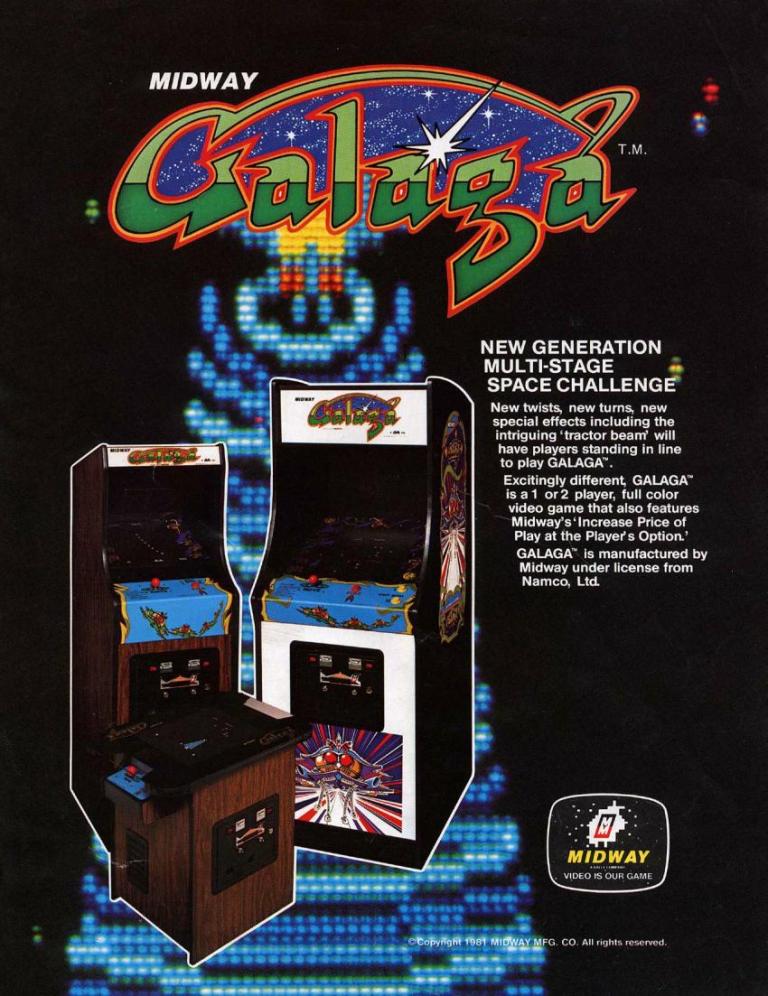
The front of the flyer showing three Galaga machines that arcade operators can choose from.
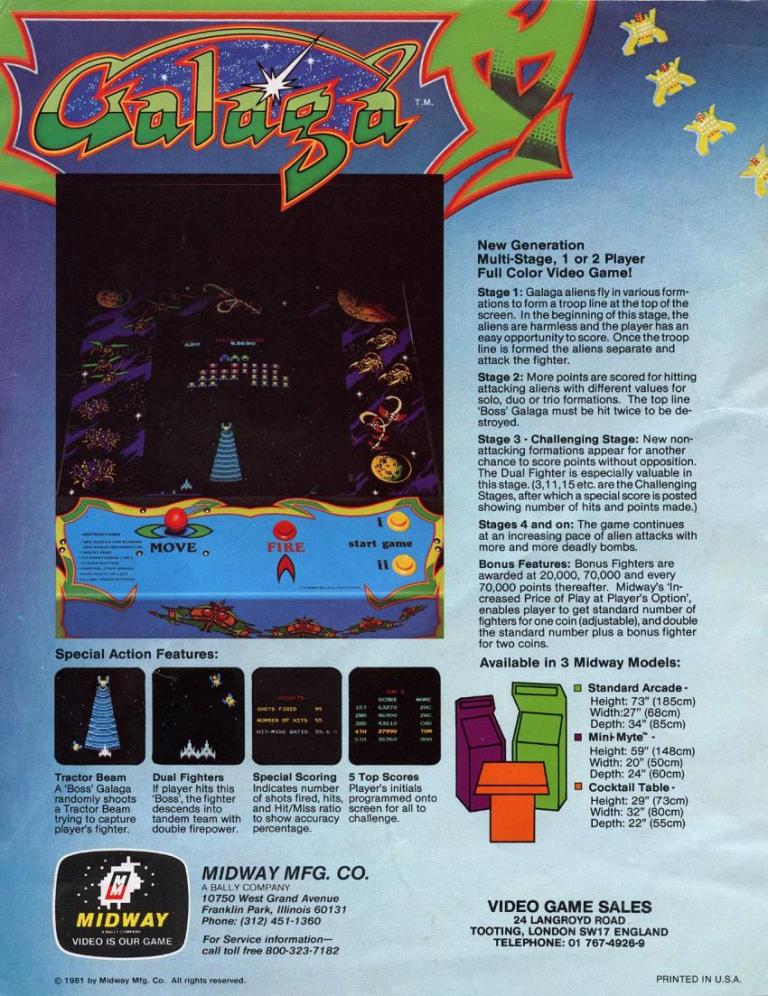
Key details about Galaga were nicely presented on the rear of the flyer.

In the history of gaming, Namco’s Galaga was played by countless millions of gamers and it is still highly regarded as an arcade classic as well as one of the most enjoyable arcade games ever made. In preparation for the North American launch (October 1981), Midway prepared the arcade flyer showing the three types of machine on the front that arcade operators can choose from. On the rear is the really neat approach of explaining the details of the game, what kind of gameplay is to be expected, and how to play. Whether you are an individual player or the manager of an arcade joint, this flyer suits your needs.   

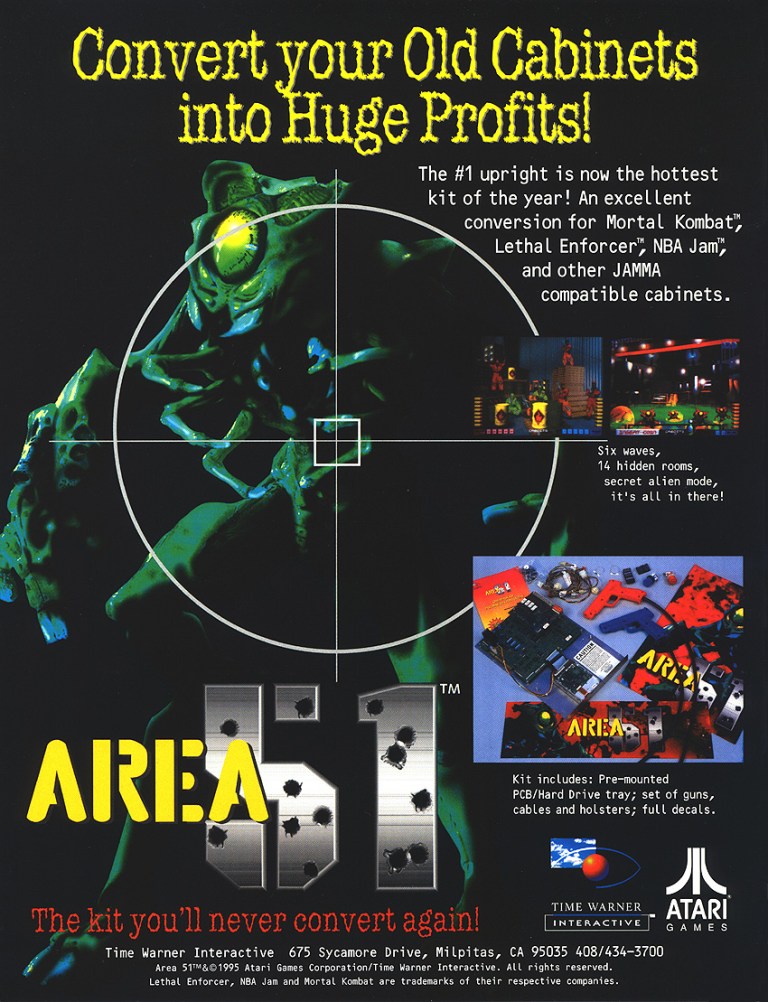
3. Area 51 arcade flyer and conversion kit flyer

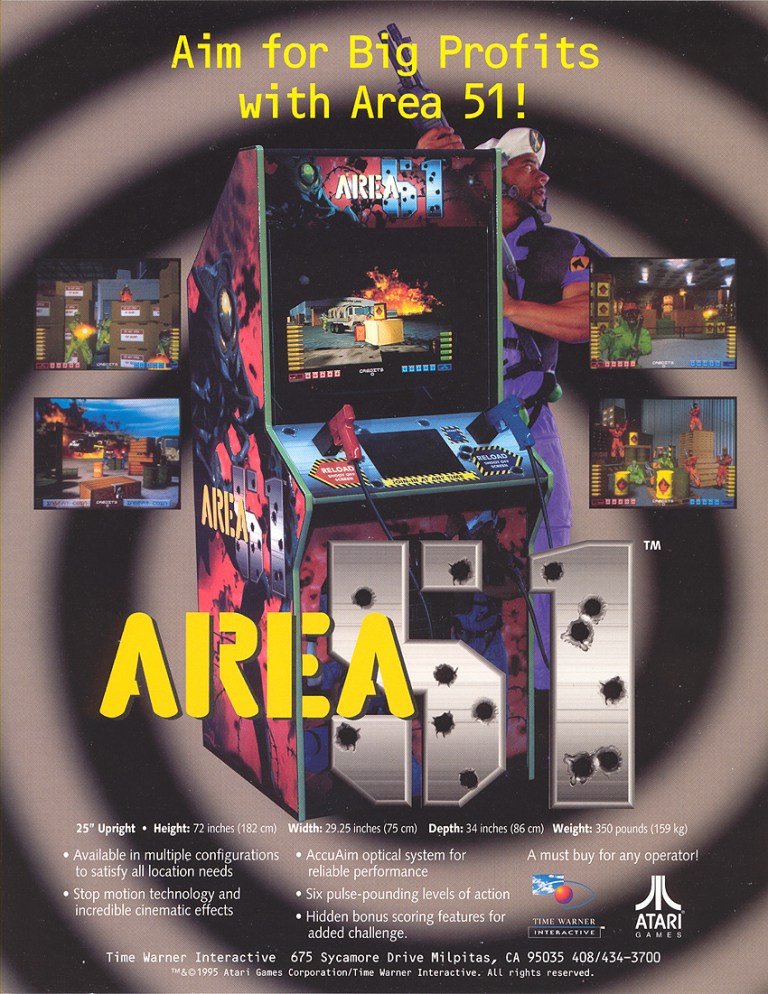
The front of this Area 51 flyer had an enticing message for arcade operators as well as other business owners/managers who are interested in having a machine to add value to their business joints. Atari was already in deep money problems by the time they started making this game.
The Area 51 arcade conversion kit is a cheaper alternative for businesses who want the game.

Moving on to the 1990s, Atari was already struggling financially and desperately needed a hit to lift them up fast. A light gun shooter project was approved as arcade shooters were in good demand and after overcoming serious hurdles during production internally, Atari hired independent team Mesa Logic to take charge of development. After being granted extra time and more creative freedom, the project under Mesa Logic’s handling became a sci-fi shooter titled Area 51. The game became a huge hit in the arcades for Atari resulting in sales of more than 20,000 arcade cabinets as well as a major financial boost for the company (note: Atari still exists today). Atari went on to release Atari 51 versions for PlayStation, Sega Saturn and PC in America in 1996. The Atari 51 flyers you see here are still captivating to look at and were crucial in generating buzz among arcade operators, business joints that had space for arcade cabinets and gamers.

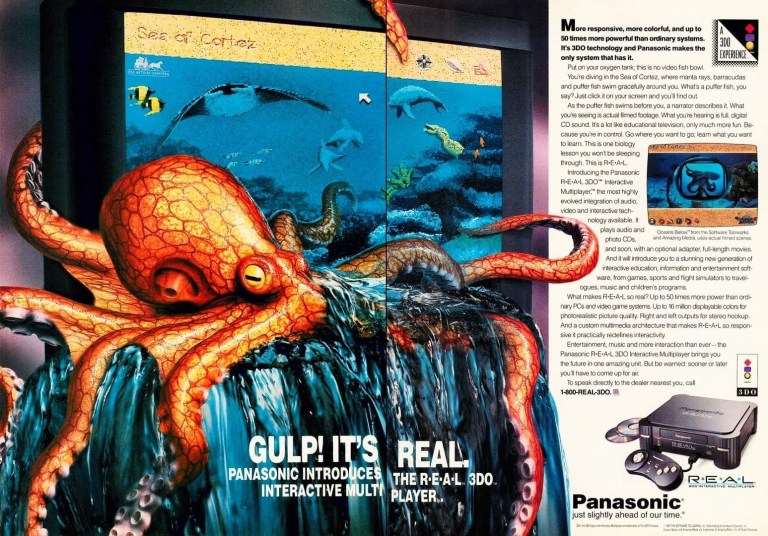
4. Panasonic 3DO print ad

The makers of this print ad forgot to mention the 3DO is also a game machine.

Back in 1993, the 3DO Interactive Multiplayer console manufactured by Panasonic (a licensee of the 3DO Company) was launched with a CD-ROM drive, multimedia features and gaming capabilities (with a 3-button control pad). This print ad strongly emphasized the 3DO’s ability to play high-quality sound and full-motion videos using the Sea of Cortez software which functioned as an interactive movie. Obviously, this did not resonate well with people who loved to play games and by the time the 3DO Company and its partners started marketing games, they could not save the 3DO console from fading to obscurity. The console shown in the ad is specifically model Panasonic FZ-1 R·E·A·L 3DO Interactive Multiplayer. Panasonic was one of five companies that were licensed by the 3DO Company.

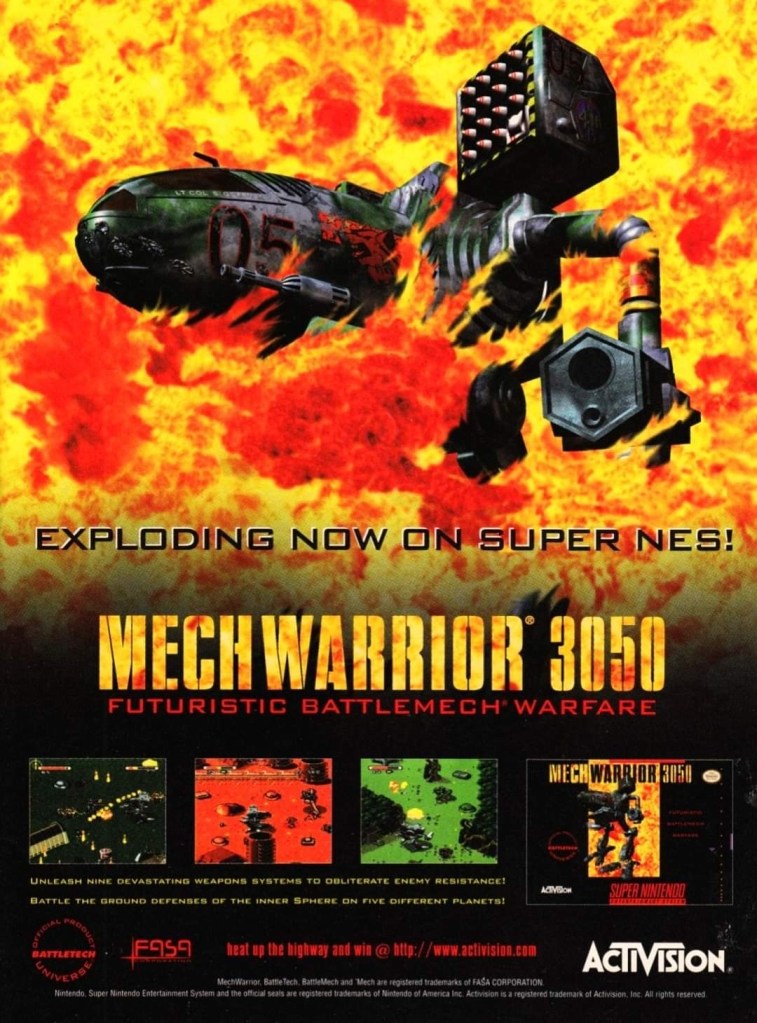
5. MechWarrior 3050 SNES print ad

If you were unaware of the 1994 game BattleTech, then this ad would have fooled you into thinking it is promoting a brand new game.

In 1995, the popular BattleTech entertainment franchise arrived on the Super Nintendo Entertainment (SNES) system with MechWarrior 3050 and its print ad had a really blazing artwork of an armed mech in fire which gave readers the illusion of a new and original game. In reality, MechWarrior 3050 was actually a port of BattleTech which was released on the Sega Genesis in 1994. The Genesis game was published by Extreme Entertainment Group while the SNES game was published by the more famous Activision. If you look closely at the MechWarrior print ad, you can tell how hard they tried to sell the game like it was brand new and all-original.

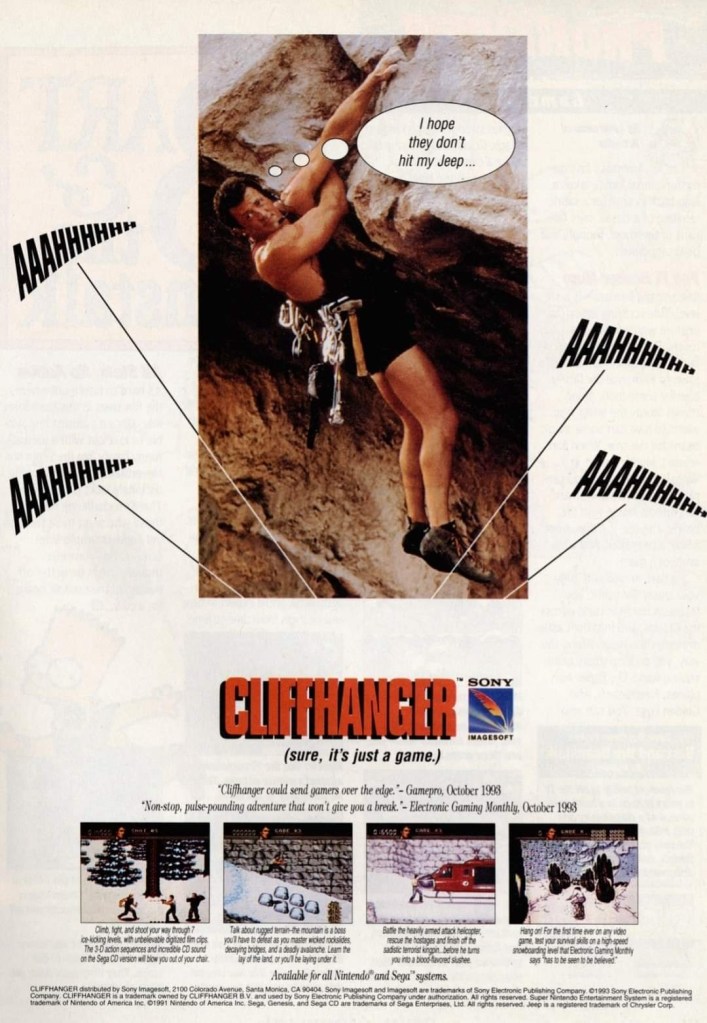
6. Cliffhanger video game print ad

This print ad had Sylvester Stallone hanging on a cliff to be relevant with the title of both the film and the game. They could not show images of Stallone in hard action scenes.

For fans of Sylvester Stallone, 1993 was a big and exciting year as the Hollywood icon appeared in two major action films – Cliffhanger and Demolition Man. Cliffhanger was released first and there were video game adaptations of it released on game consoles, handhelds and computers. This print ad of the Cliffhanger video game had an image of Stallone hanging on a cliff to emphasize the title. The ad makers cleverly posted selected gameplay screenshots and quoted GamePro and Electronic Gaming Monthly (EGM) to make the game look credible and worthy of purchasing. The marketing led to nowhere as the game received mostly negative reviews from critics and it faded to obscurity. Lastly, the Cliffhanger game ad had a noticeable amount of space wasted. They could have made the screenshots and text look somewhat bigger to sell the game.

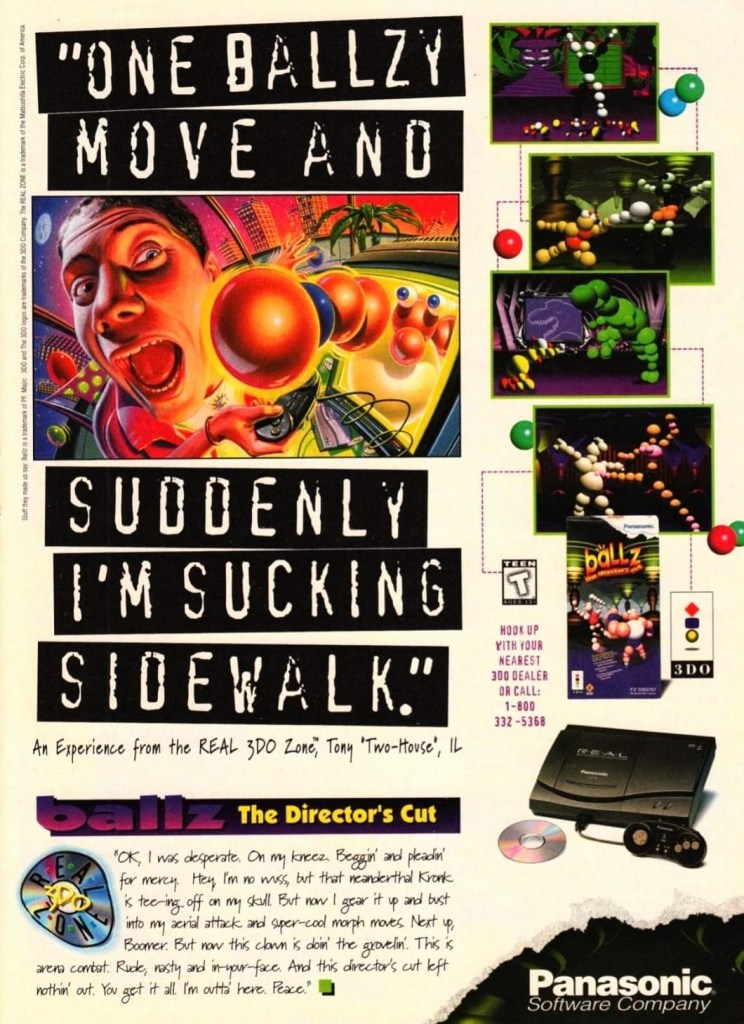
7. Ballz: The Director’s Cut print ad

I never got to play this game on the 3DO.

Here is another ad of the video game released on the failed 3DO console. As its title made obvious, Ballz: The Director’s Cut is an enhanced version of the original Ballz game of 1994 that was released on other consoles. The print ad had an eye-catching piece of artwork and posted beside it were selected shots of the gameplay. Strangely enough, the creative writing on the lower part of the ad does not make any sense and did nothing to convince gamers to play the game. As Ballz: The Director’s Cut was released in 1995, this ad shows the revised 3DO console from Panasonic (model: Panasonic FZ-10 R·E·A·L 3DO Interactive Multiplayer).

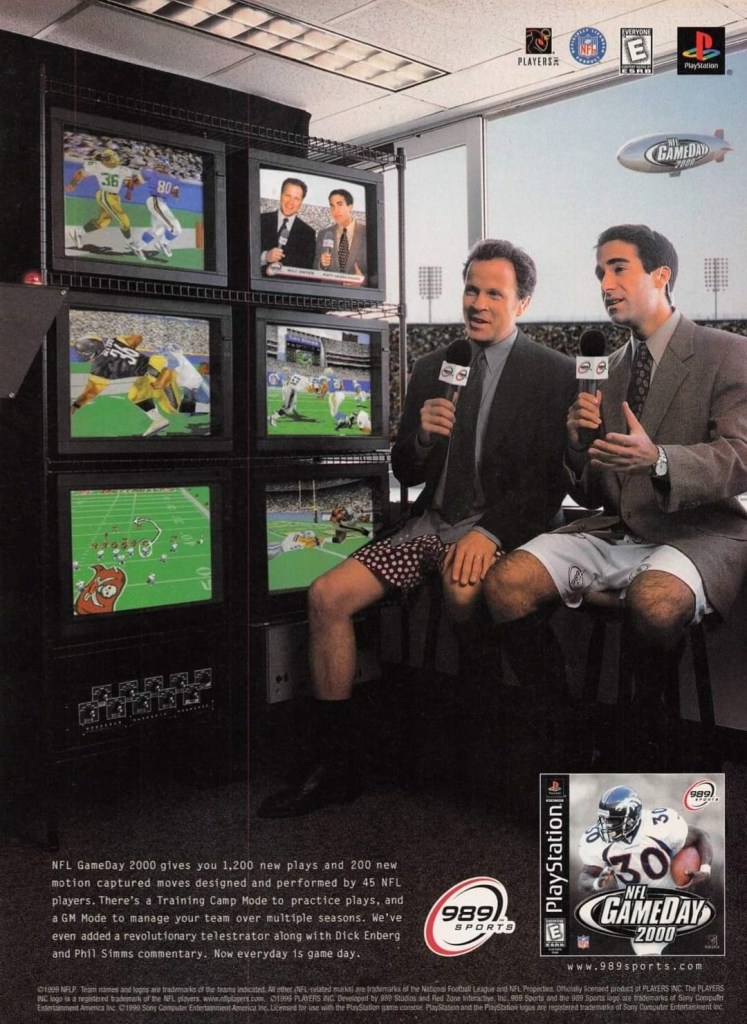
8. NFL GameDay 2000 print ad

Did you find this ad funny to look at in 1999?

To promote the PlayStation-exclusive NFL GameDay 2000, Sony publisher 989 Sports and the ad makers decided to implement a humorous look at football TV coverage by having two sportscasters wearing shorts in front of a TV camera that was only showing their heads and upper bodies. The TV sets on the side show screenshots from the game to emphasize the sports gaming experience. Ultimately the game scored mostly positive review from the critics.  

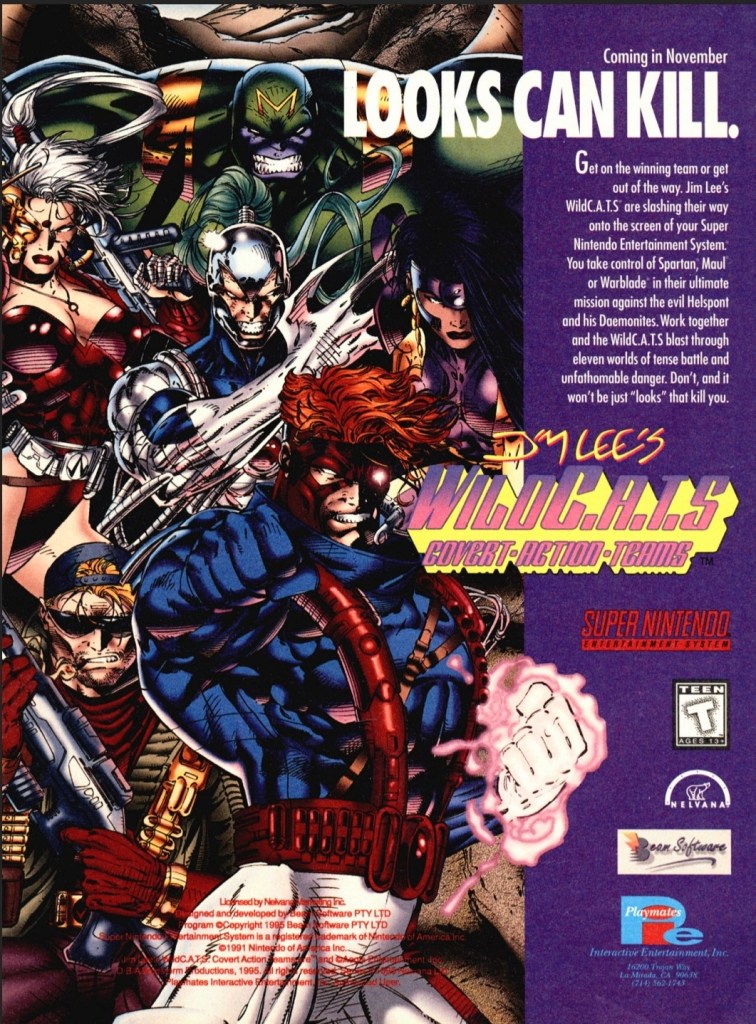
9. WildC.A.T.S: Covert Action Teams print ad

WildC.A.T.S. art by Jim Lee was used to promote the SNES video game.

When Image Comics launched in 1992, WildC.A.T.S: Covert Action Teams was Jim Lee’s creator-owned comic book franchise and its launch issue was a big seller. Years later, WildC.A.T.S. grew in popularity with comic book fans and the franchise achieved multi-media status by venturing into TV (with an animated series) and video games. This print ad promoting the video game adaptation had no screenshots to show which kept fans and gamers guessing how the game will turn out in terms of gameplay and game design. It was obvious that the people who made this print ad had to rely on the best WildC.A.T.S. artwork they could find drawn by Jim Lee. This ad made me laugh back in the old days because if you did not look closely, it might fool you into thinking it was more about comic books than the game on the SNES.

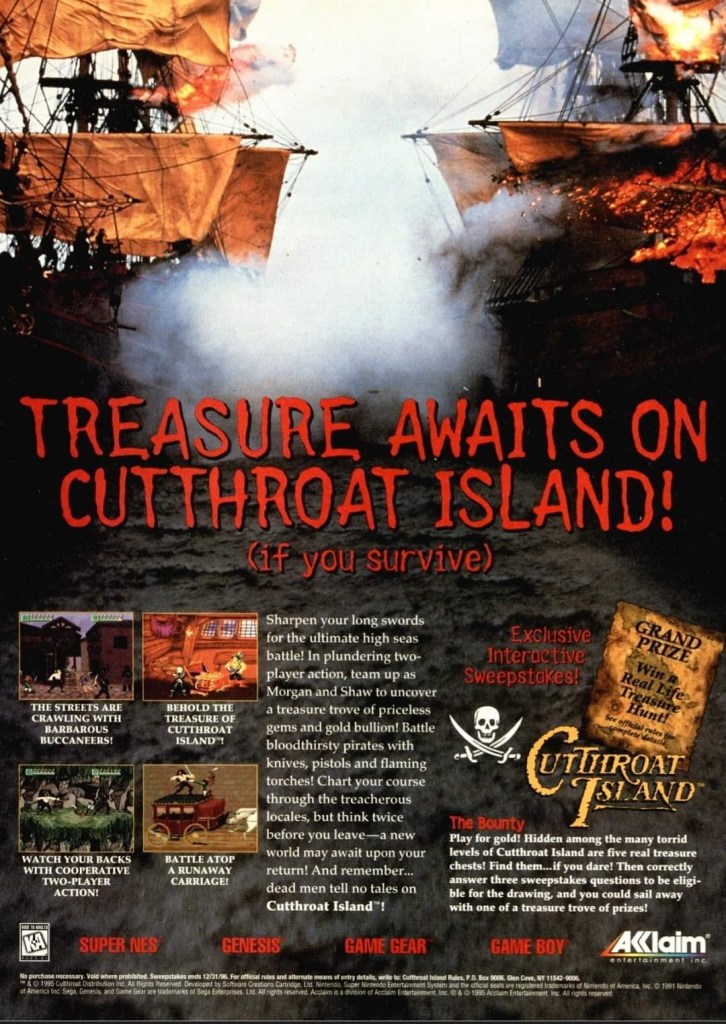
10. Cutthroat Island print ad

Exciting imagery without Geena Davis and Matthew Modine was used to promote the video game adaptation.

I never saw the Hollywood mega-flop Cutthroat Island nor have I ever played any of its multiple video game adaptations (released on SNES, Sega Genesis, Sega Game Gear and Game Boy). The video game print ad, however, caught my attention back in 1995 because the ad makers cleverly used a photograph from one the many expensive movie sequences filmed and the hard, physical work by the filmmakers was clearly visible. Then the ad makers had four screenshots placed on the lower-left part and inserted descriptive text that sounded exciting. Lastly, the ad mentioned a sweepstakes promo.

Without using any images of stars Geena Davis and Matthew Modine, this ad was a strong attempt to get gamers excited for the video game adaptation. Like the movie itself, this game flopped and has faded away to the land of the forgotten.

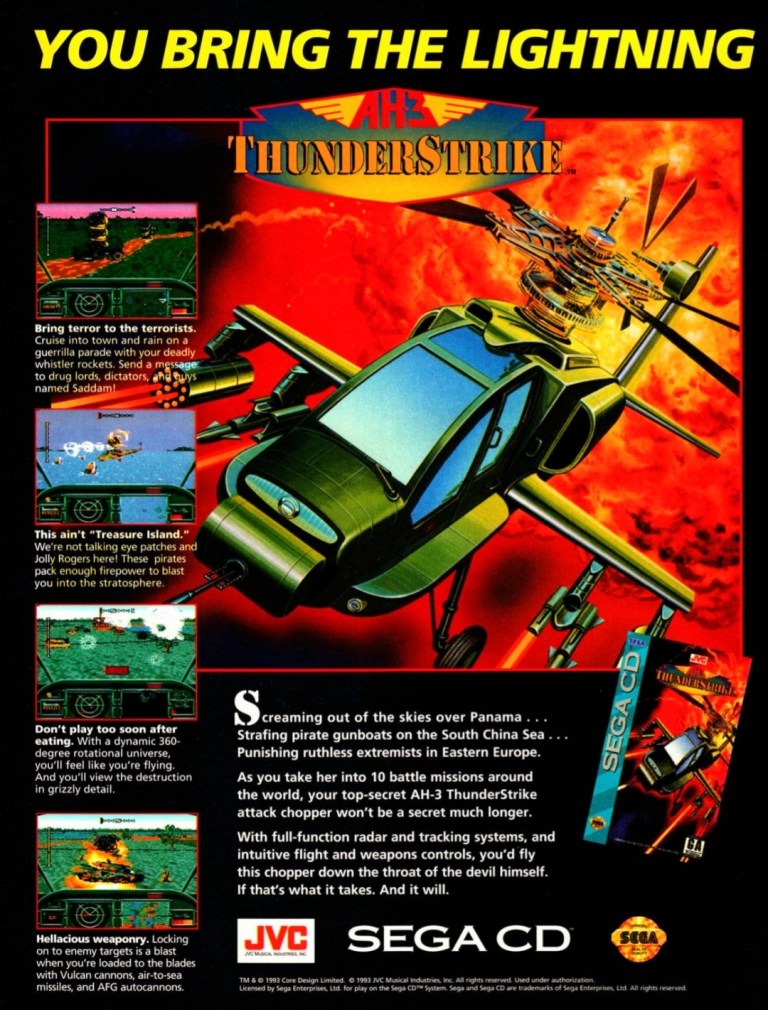
11. AH-3 Thunderstrike print ad

Captivating artwork, vibrant colors and orderly text descriptions made this an effective ad.

AH-3 Thunderstrike is one of the better games that was released on the Sega CD add-on (requires the Sega Genesis console) in 1993. Similar with MechWarrior 3050, the game was actually a port of Thunderhawk which itself was released on the Amiga and MS-DOS PC in 1992. The print ad showcased a captivating artwork (which was also used on the game’s box cover), a few screenshots and strategically placed text descriptions to sell the game. This ad still looks good.

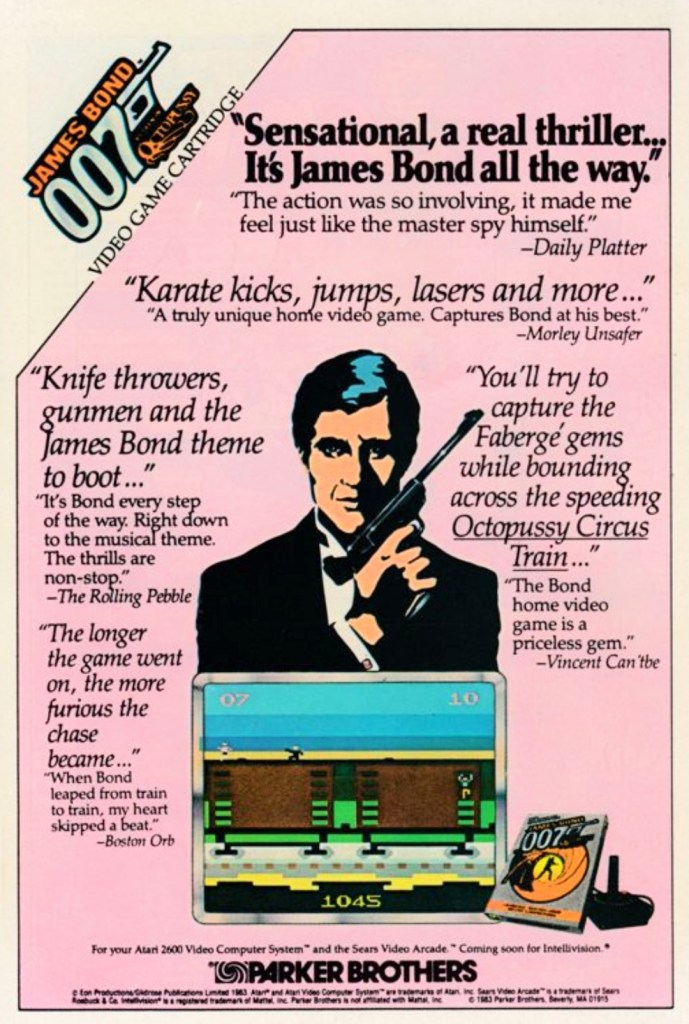
12. James Bond 007 print ad

This print ad appeared in many comic books in 1984.

This is a print ad I saw many times while reading comic books in 1984. James Bond 007 for Atari 2600 was an ambitious licensed video game as it featured levels that were inspired by missions in the James Bond movies Diamonds are Forever, The Spy Who Loved Me, Moonraker and For Your Eyes Only. Keep in mind that programmers back then had to deal with memory limitations and primitive tools to make games.

To promote the game, original art of Agent 007 was used which did not resemble the James Bond star of the time – Roger Moore. Strangely enough, the illustrated James Bond slightly resembled Timothy Dalton whose debut as 007 happened in 1987. Adding further zest to the add was the use of fictionalized quotes pointing to fantasized critics as sources (example: Vincent Can’tbe is a reference to real life critic Vincent Canby). The use of a pink background made this catchy ad look really odd.

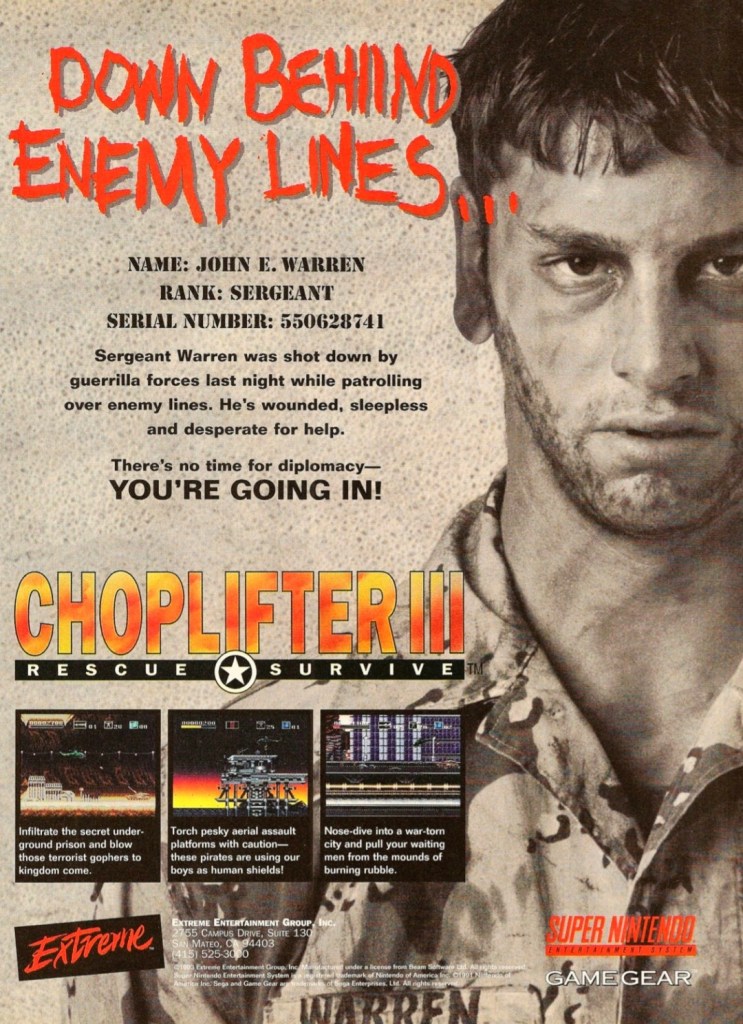
13. Choplifter III: Rescue Survive print ad

A captivating print ad that brought gamers’ attention to the Choplifter series again.

This print ad of Choplifter III: Rescue Survive has a striking look showing a military officer who needs your help as he has been stranded behind enemy lines. The presentation reflects the long-time tradition of the Choplifter game franchise which has been about piloting an armed helicopter to the opposition’s territory, shooting at bad guys and then rescuing the hostages or prisoners-of-war (POWs). The game eventually gathered mostly positive feedback from video game critics.

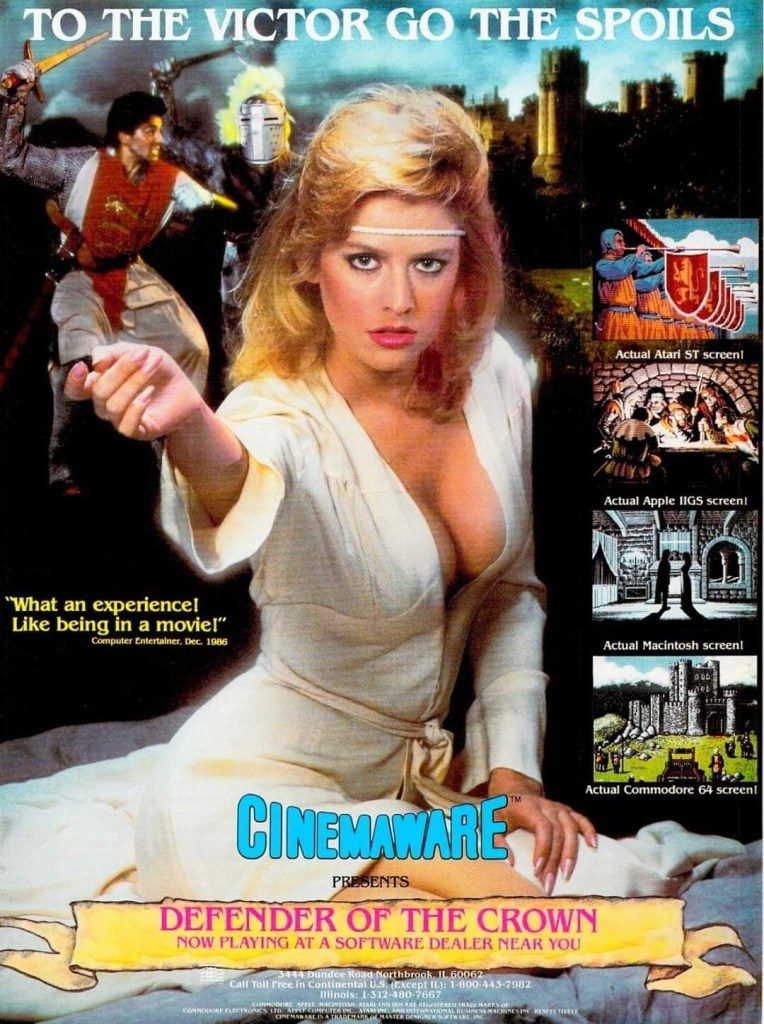
14. Defender of the Crown print ad

Cinemaware took a gamble with the visual concept of this print ad.

Released in 1986 for home computers, Defender of the Crown was made with a high level of quality backed with solid artistry. To capture gamers’ attention, Cinemaware came up with this print ad showcasing a pretty model looking somewhat seductive which reflects what happens in the game when players rescue a damsel in distress. The selected screenshots showed what the game looked like on different platforms, and the lower part of the ad made the game feel like it was a historical epic waiting to be discovered. Defender of the Crown eventually became a big hit with computer gamers.  

+++++

Thank you for reading. If you find this article engaging, please click the like button below, share this article to others and also please consider making a donation to support my publishing. If you are looking for a copywriter to create content for your special project or business, check out my services and my portfolio. Feel free to contact me with a private message. Also please feel free to visit my Facebook page Author Carlo Carrasco and follow me on Twitter at  @HavenorFantasy as well as on Tumblr at https://carlocarrasco.tumblr.com/ and on Instagram at https://www.instagram.com/authorcarlocarrasco
Retro Gaming Ads Blast – Part 17

Welcome back readers, fellow geeks and electronic gaming fans!

In this edition of the Retro Gaming Ads Blast (RGAB) series, we will take a look at another batch of retro gaming print ads – including arcade flyers – from the 1980s and 1990s.

For the newcomers reading this, Retro Gaming Ads Blast (RGAB) looks back at the many print ads of games (console, arcade, computer and handheld) that were published in comic books, magazines, flyers, posters and newspapers long before smartphones, social media, the worldwide web and streaming became popular. To put things in perspective, people back in the 1980s and 1990s were more trusting of print media for information and images about electronic games and related products.

With those details laid down, here is the newest batch of retro gaming print ads for you to see and enjoy…

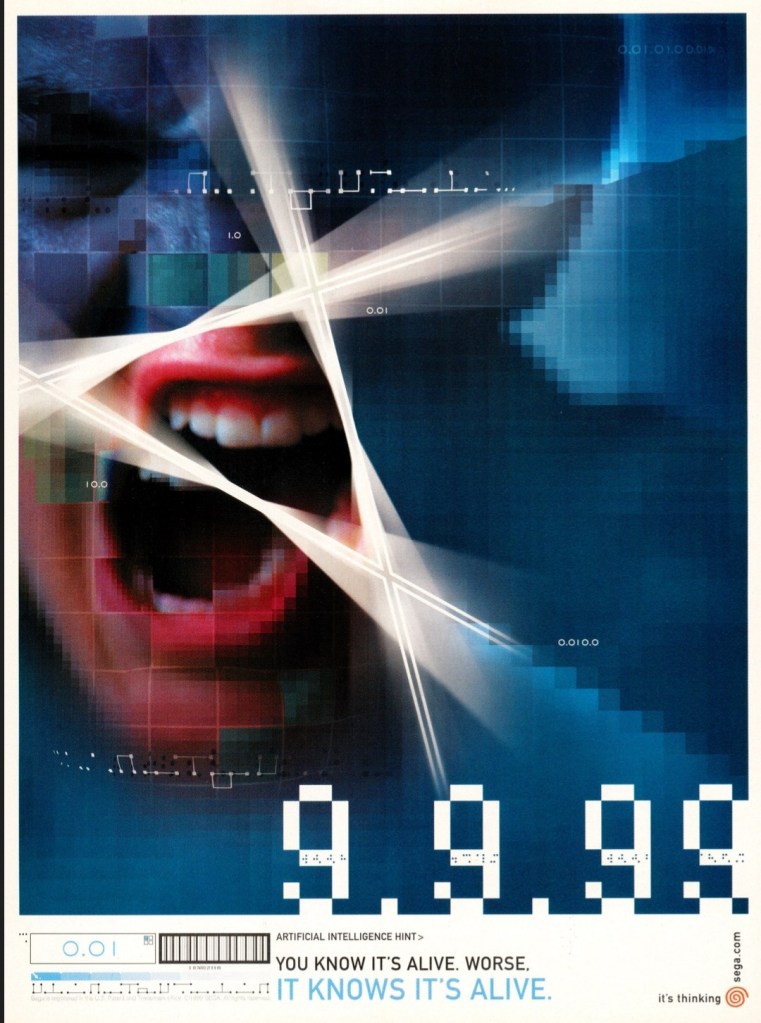
1. Sega Dreamcast launch print ads

This cryptic Sega Dreamcast American launch print ad has an image that emphasized that gamers are being watched.
This one has an image emphasizing emotions, impulse and excitement.

By the time Sega launched their Dreamcast console in Japan in late 1998, the company was already bleeding from back-to-back years of financial losses. The Dreamcast was their big bet to regain the trust of consumers and business partners, to sell a lot of consoles and games, and somehow survive.

For the North American Dreamcast launch, Sega of America organized an intriguing series of ads emphasizing the September 9, 1999 launch date in very stylized and cryptic ways. As seen in the two selected ads above, the Dreamcast name was not even mentioned but the console’s trademark swirl was present. Anyone who was obsessed with video games – even if one was not a Sega fan – could tell that the print ads made clear that the Dreamcast was going to launch in America. Ultimately, Sega sold roughly $98 million worth of Dreamcast consoles, games and peripherals in the first 24 hours in America.

2. Point Blank 2 print ad

This ad appeared in comic books and magazines.

When Namco released the first Point Blank game, it was commercial successful in both arcades and on the PlayStation console in different parts of the world. To keep on succeeding, Namco made the sequel Point Blank 2 and their confidence in it was made clear with the above PlayStation version print ad that promised it to be multiplayer-oriented and ensure enough content to give players sufficient bouts of fun whichever game mode they pick. The ad’s image of the lady with a gun (Namco’s Guncon peripheral) and the animal trophies were done with humor in mind.

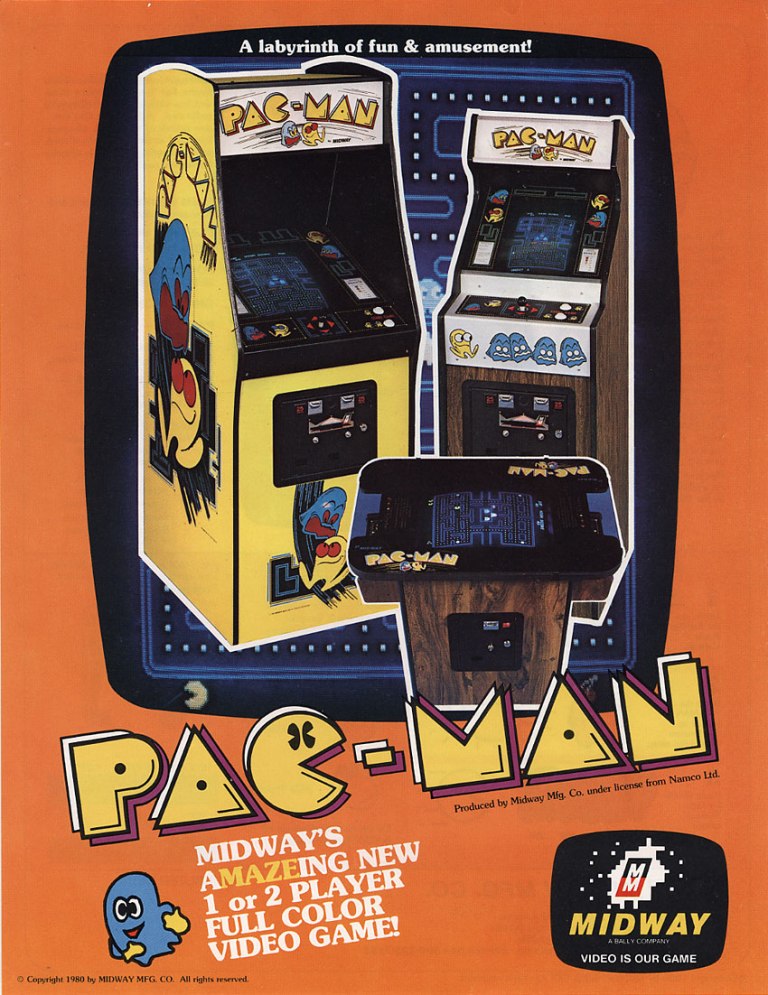
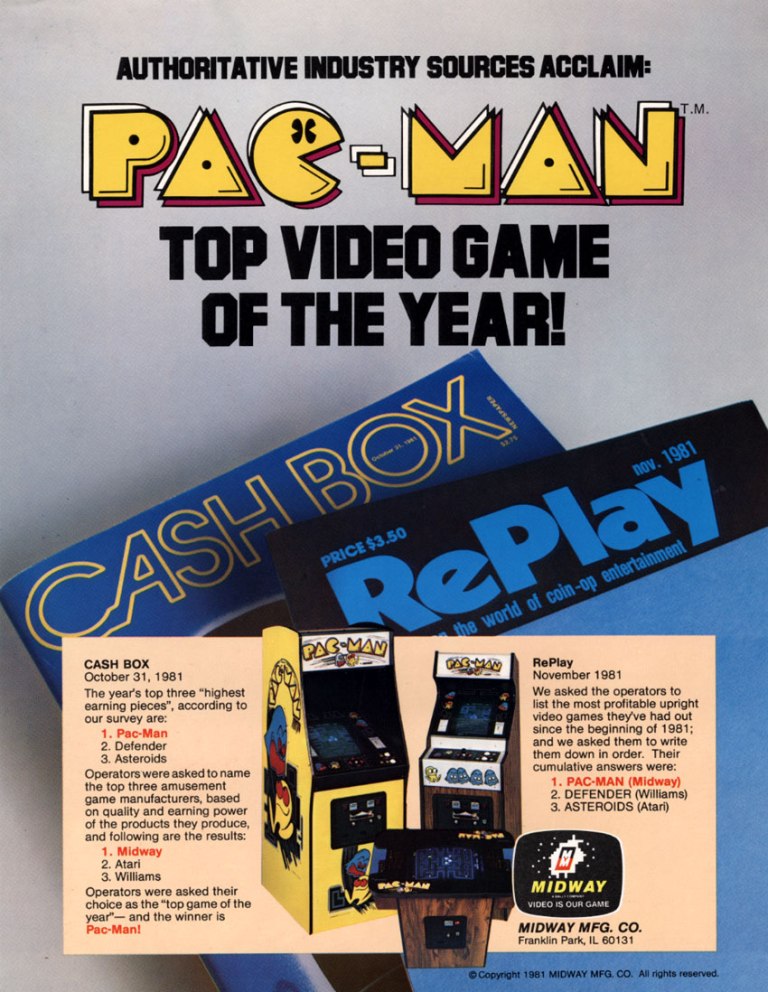
3. Pac-Man arcade flyers

This ad showed that arcade operators can choose which type of machine of Pac-Man they could order.
Midway issued this flyer when Pac-Man was already successful.

In 1980, Namco released Pac-Man in Japanese arcades and it became a big hit in a short span of time. This prompted them to bring the game overseas, especially in America which already had a growing arcade market. In November that year, Namco brought Pac-Man and their other arcade game Rally-X game to a tradeshow and only got mild attention from attendees and distributors. After being turned down by Atari, Namco signed a contract with Midway to distribute Pac-Man and Rally-X in America, and they were formally released the following month.

Upon release, Pac-Man became a strong attraction in American arcades with weekly sales surpassing $8 million per week. When it comes to the presentation, Midway’s arcade flyers above gave arcade operators and gamers a clear view that Pac-Man is fun and available in three physical units (emphasized in the first flyer) and that it made a positive commercial impact (emphasized in the 2nd flyer). Ultimately, Midway went on to sell over 100,000 Pac-Man arcade units resulting in a massive gross of over $1 billion in quarters (coins of twenty-five cents in American currency).

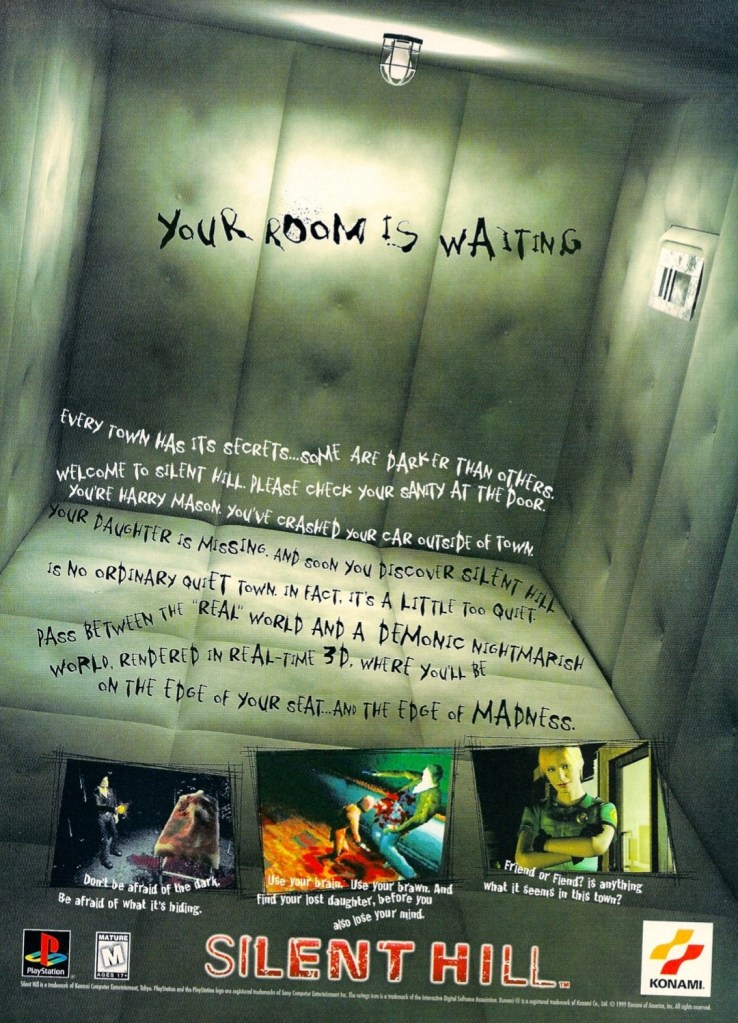
4. Silent Hill print ad

A clear atmosphere of psychological horror in this ad.

Made by a certain team within Konami, Silent Hill on PlayStation turned out to be a surprising and intriguing hit game in 1999. It was a polygonal survival horror game that drew a few comparisons with Capcom’s Resident Evil but ultimately stood out with its gameplay features and psychological horror concept.

The people at Konami must have anticipated that gamers in America would be attracted by the game so they came up with the creepy print ad above which promoted the game with a clear touch of psychological horror. If you look closely, the 2nd screenshot (in the middle) even showed blood in digital form. This Silent Hill print ad was clearly aimed at adult gamers and PlayStation gamers who craved for more horror gaming.

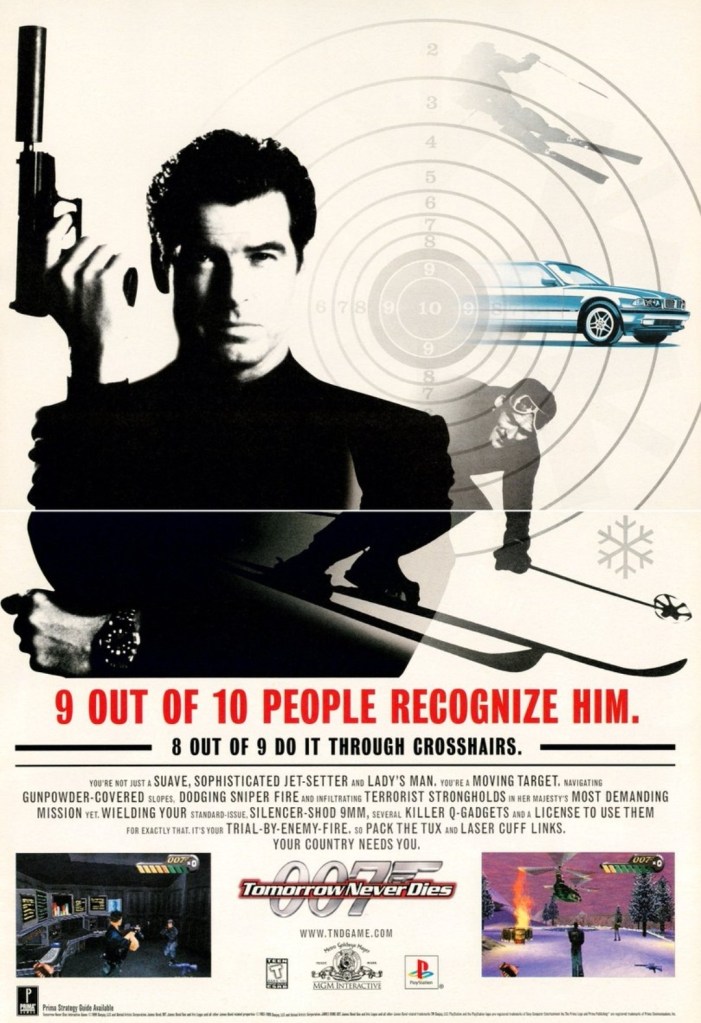
5. Tomorrow Never Dies game print ad

The use of the image of Pierce Brosnan as James Bond in this print ad was the right move to inform readers that the 1997 movie’s video game was coming out.

Believe it or not, there was indeed a video game adaptation of Tomorrow Never Dies (1997) and the weird thing was that it was released for PlayStation in November 1999. In fact, the game was released eight days after the American premiere of the James Bond film The World is Not Enough (1999). The game development was unusually long and the release was delayed several times going into 1999.

To really capture the attention of James Bond fans and gamers, MGM Interactive and Electronic Arts (the co-publishers of the game) came up with a Tomorrow Never Dies game print ad showcasing Pierce Brosnan as the iconic Agent 007 in a dominant fashion leaving a minor space for the text description, two screenshots and other details displayed. While some people might look at the ad as an act of desperation to sell the long-delayed game, I find it eye-catching and engaging to look at. It also was a lively reminder back then that Brosnan was James Bond of the 1990s.

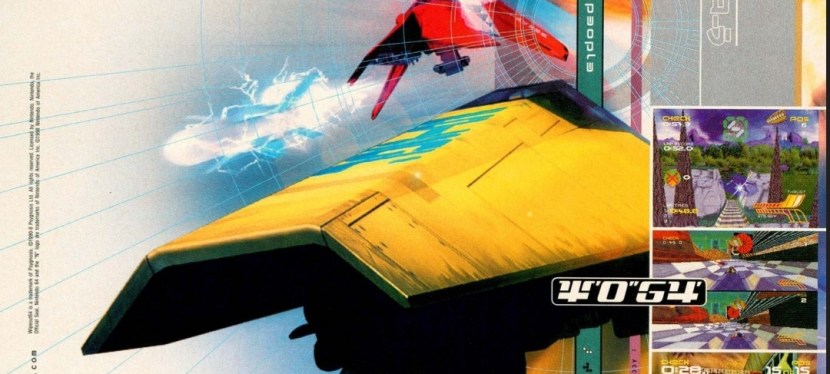
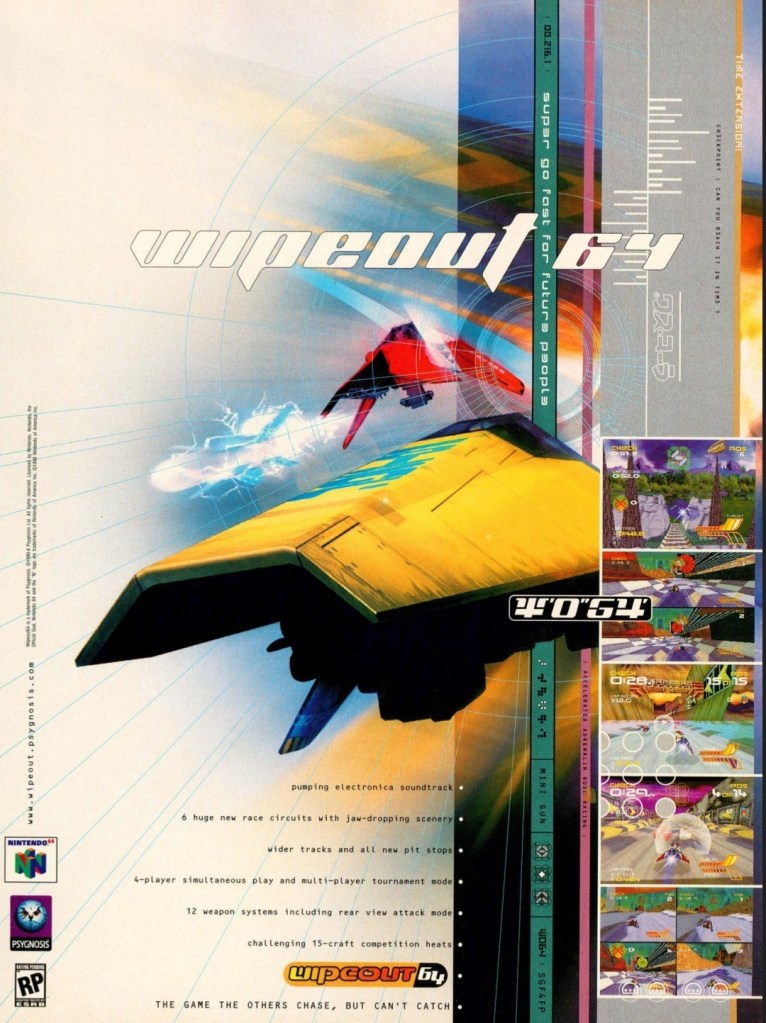
6. Wipeout 64 print ad

This is still cool and sleek to look at.

Wipeout, the series best known for its very futuristic portrayal of high-speed anti-gravity racing, showcase of dynamic visuals and the use electronic dance music, made its way to the Nintendo 64 console with Wipeout 64. This 1998 release was significant because at that time developer Psygnosis was already owned by Sony and most Wipeout games of the decade were released on PlayStation. Wipeout 64 was released before the PlayStation-exclusive Wipeout 3 came out.

The above print ad had this very sleek display of two anti-gravity racers moving at high speed and on the side are five screenshots showing what the game looked like on the N64. If you look very closely, one of them shows the 4-player split-screen mode identified with the Nintendo 64’s capabilities. Overall, the Wipeout 64 print ad captured the vibe of the Wipeout series and remains very cool to look at.

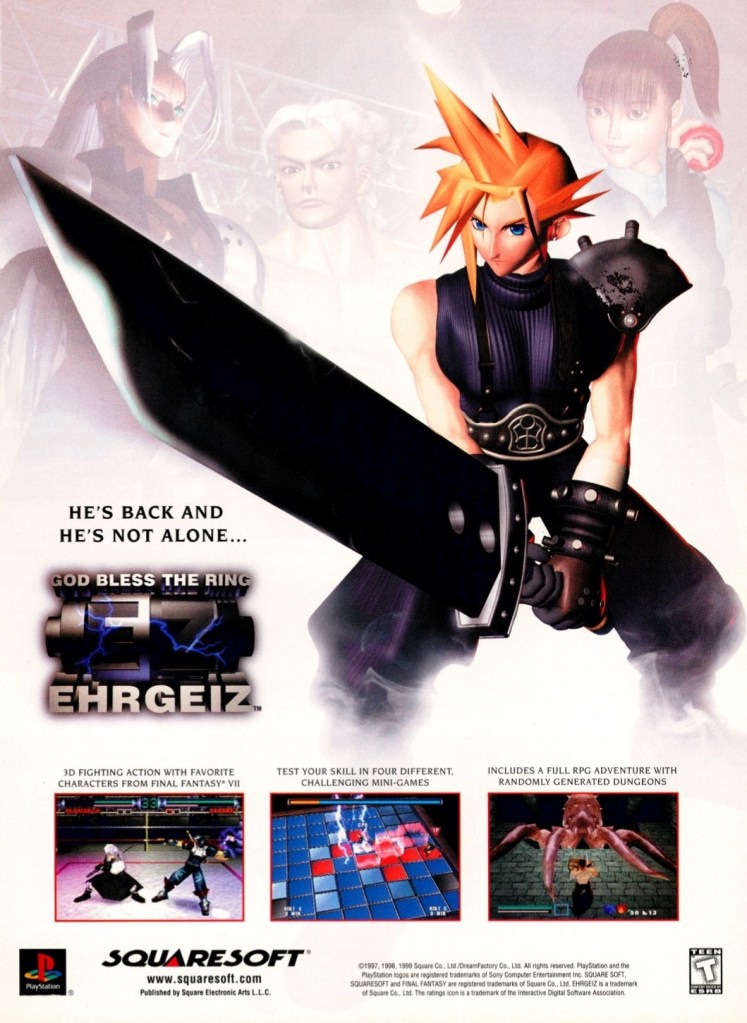
7. Ehrgeiz print ad

You want a 3D polygonal fighting game that has Final Fantasy 7 characters in it? Ehrgeiz was the answer.

In 1999, the landscape of gaming really changed. More gamers played 3D polygonal fighting games over the 2D fighting games, and demand for Final Fantasy and Japanese role-playing games (JRPGs) were in high demand in the West arguably because of the massive commercial success of Final Fantasy VII on PlayStation. That being said, Squaresoft released their own 3D polygonal fighting game that had Final Fantasy VII characters in it – Ehrgeiz.

After achieving success in the arcades, Squaresoft brought Ehrgeiz to PlayStation in America in 1999. Unsurprisingly, the print ad had Final Fantasy VII protagonist Cloud and his signature sword in a prominent position which was obviously done to attract the millions of FFVII for potential sales. The screenshots on the ad were presented not for showing off but to give readers a clear view of what kind of gaming experiences they could expect. Ehrgeiz on console even had a standalone RPG mode.

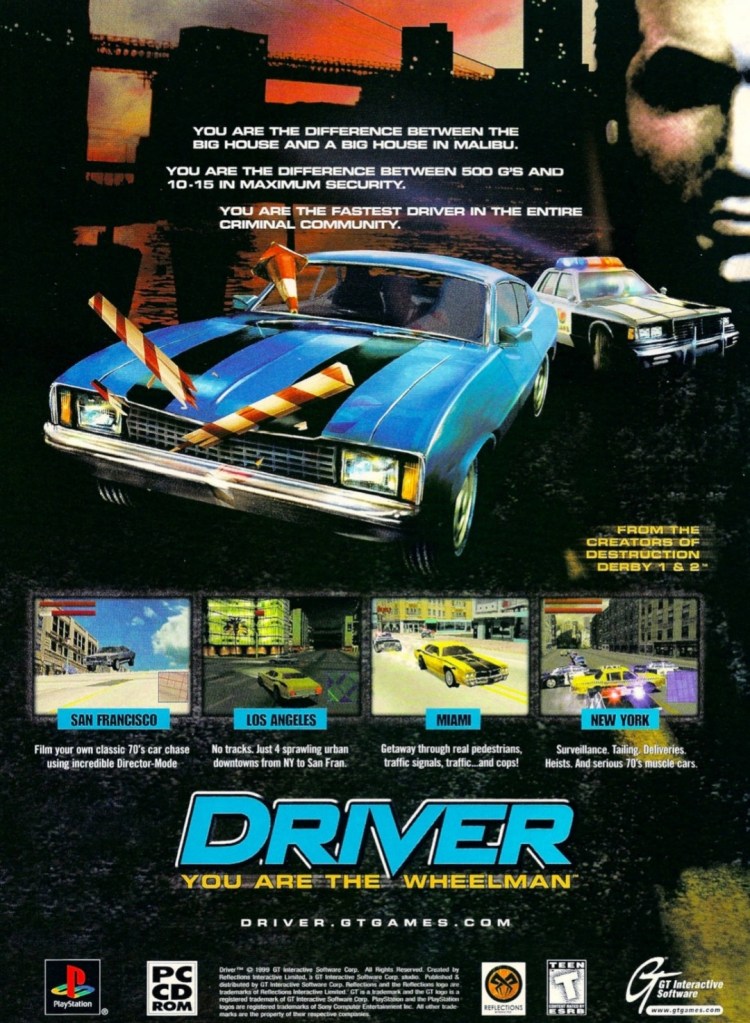
8. Driver print ad

The art used for the muscle car and the police car was a tribute to the car chases of movies from long ago.

Even before it was released on PlayStation and PC in 1999, publisher GT Interactive knew they had something big for gamers to engage with. That game was Driver and developer Reflections Interactive made it with a lot of inspiration taken from cinematic car chases. This particular ad emphasized car chases, the exploration of four real-life cities in digital form, and engaging in a variety of missions. As it successfully delivered what it promised, Driver went on to become a big commercial success on PlayStation and PC, and spawned sequels in the years that followed.  

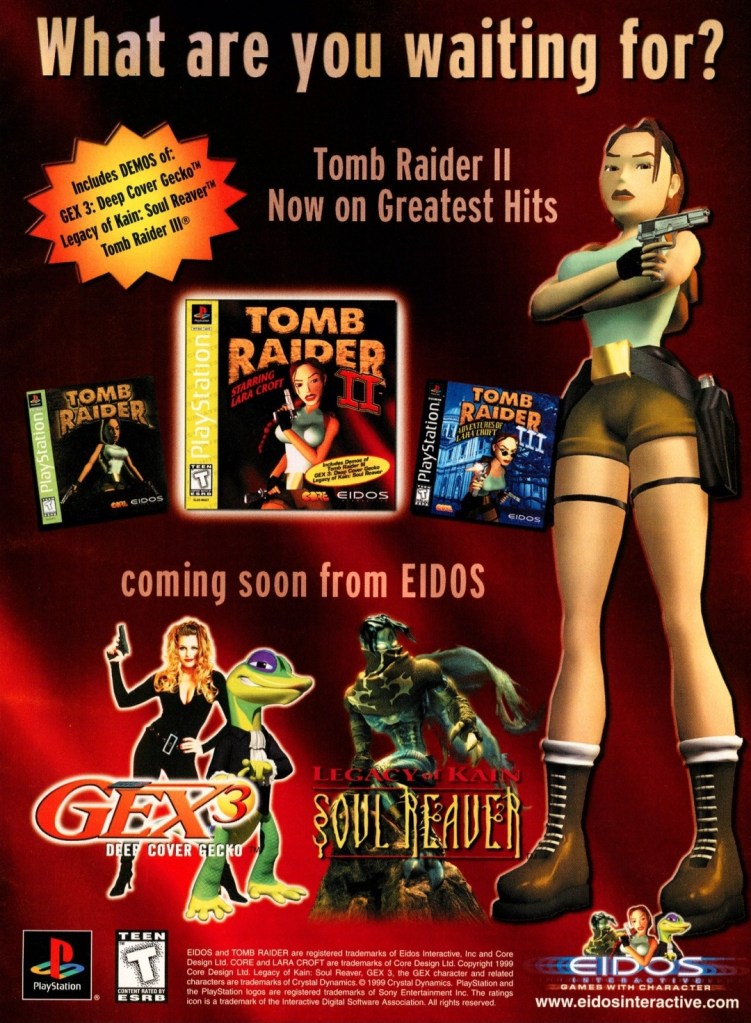
9. Eidos Interactive games print ad

From the time when Eidos Interactive was at the top of its game and Lara Croft was its most popular character.

By the end of the 1990s, Eidos Interactive became a major game publisher which is the result of the massive success they achieved with the Tomb Raider games which collective sold many millions of copies worldwide.

Along the way, they acquired developer Crystal Dynamics which was already a prolific team with many games released and new projects in development. Under Eidos’ banner, Crystal Dynamics went on to release Gex 3: Deep Cover Gecko and Legacy of Kain: Soul Reaver in 1999. That being said, this print ad shows the ambitious offers Eidos Interactive had with the Tomb Raider, Gex and Legacy of Kain franchises. It is a reflection about success and confidence about the future of video games.

+++++

Thank you for reading. If you find this article engaging, please click the like button below, share this article to others and also please consider making a donation to support my publishing. If you are looking for a copywriter to create content for your special project or business, check out my services and my portfolio. Feel free to contact me with a private message. Also please feel free to visit my Facebook page Author Carlo Carrasco and follow me on Twitter at  @HavenorFantasy as well as on Tumblr at https://carlocarrasco.tumblr.com/ and on Instagram at https://www.instagram.com/authorcarlocarrasco
What to watch on YouTube right now – Part 28

Welcome back, my readers, YouTube viewers and all others who followed this series of articles focused on YouTube videos worth watching. Have you been searching for something fun or interesting to watch on YouTube? Do you feel bored right now and you crave for something to see on the world’s most popular online video destination?

I recommend you check out the following topics and the related videos I found.

Mosab Hassan Yousef: My Father Founded Hamas video  – In America, there are lots of young people who are protesting in public supporting Palestinian terrorists while condemning Israel. These pro-Palestine have shown ignorance about the facts and none of them knows exactly what Palestinian culture is like when compared to Mosab Hassan Yousef (son of a founder of Palestinian terrorist group Hamas).

In an interview with PragerU, Yousef talks comprehensively about his past with the Palestinians (Arabs who adopted the Palestinian identity which only started in the 20th century), the time he was active as a Hamas member, his relationship with his father who founded Hamas, and why he left the terrorist group to cooperate with Israel and migrated overseas. Yousef confirms that Hamas is pure evil and the Palestinian culture has hatred and violence deeply rooted within. Watch this video now.

Jaws 3 4K Blu-ray has footage that involved the use of AI  – I am a collector movies on physical media. I don’t just buy any movies on Blu-ray and 4K Blu-ray format because I am selective with regards to quality, enjoyment and replay value. When it comes to new releases on 4K Blu-ray format, I cannot ignore the observations pointing out that the footage of Jaws 3 (AKA Jaws 3D) on 4K Blu-ray involved the use of AI (artificial intelligence) which resulted in bad visual results. It seems that more people in Hollywood are getting obsessed with remastering old movies using AI, removing the film grain and other digital methods that ruin the visuals. For insight, watch the videos below.

Michael Jordan’s “The Shot” of 1989 – When it comes to those game-winning basketball shots, Michael Jordan had lots of those during his years with the Chicago Bulls. Before he won his first NBA championship, Jordan successfully scored the winning jump shot over Craig Ehlo to beat the Cleveland Cavaliers 101-100 in the 5th game of the 1989 NBA playoffs’ first round. That shot became iconic and there is a lot more behind the scenes that preceded. Watch the selected video below.  

Virtua Fighter 3 retrospective video – When Sega released Virtua Arcade 3 in the arcades in 1996, it was the best-looking 3D polygonal fighting game at the time and it often drew players leaving them really satisfied. Virtua Fighter 3 was the product of the most cutting edge arcade technology of the time (with the Model 3 arcade hardware) as well as the hard-work and in-depth craftmanship by developer AM2 led by the legendary designer Yu Suzuki. To know more about Virtua Fighter 3, watch the video below.

Popcorn in Bed’s James Bond reaction videos – On August 2023, YouTuber Popcorn in Bed started posting reaction videos of James Bond movies. With the exception of the films of Daniel Craig and George Lazenby as Agent 007, Popcorn in Bed posted two selected movie reaction per James Bond actor (example: 2 Bond films of Sean Connery, 2 Bond films of Roger Moore). To give you a taste of what Popcorn in Bed did, watch the selected videos below. To watch more, click here.

+++++

Thank you for reading. If you find this article engaging, please click the like button below, share this article to others and also please consider making a donation to support my publishing. If you are looking for a copywriter to create content for your special project or business, check out my services and my portfolio. Feel free to contact me with a private message. Also please feel free to visit my Facebook page Author Carlo Carrasco and follow me on Twitter at  @HavenorFantasy as well as on Tumblr at https://carlocarrasco.tumblr.com/ and on Instagram athttps://www.instagram.com/authorcarlocarrasco

What to watch on YouTube right now – Part 24

Welcome back, my readers, YouTube viewers and all others who followed this series of articles focused on YouTube videos worth watching. Have you been searching for something fun or interesting or informative to watch on YouTube? Do you feel bored right now and you crave for something to see on the world’s most popular online video destination?

I recommend you check out the following topics and the related videos I found.

Germany is suffering from the acceptance of so many so-called refugees – I want to make clear to all of you that I personally reject illegal immigration and mass migration as I truly believe that nations should always secure their borders, prioritize their citizens, protect their national sovereignty and deport all foreigners who committed crime in their country. That being said, there are lots of YouTube videos about Germany’s suffering which is the result of the huge acceptance (open-borders approach) of so many foreigners in 2015 perceived by the administration of then Chancellor Angela Merkel as so-called refugees. Merkel eventually expressed regret about the big move.

To be clear, allowing so many foreigners to enter your country as migrants or asylum seekers often leads to new waves of crime, cultural tensions and a tremendous drain of taxpayer-funded resources. Also, think carefully about how many asylum seekers lied to German immigration officials about their backgrounds and situations just to enter? Is each and every asylum seeker a genuine victim of war, poverty and crime in their home country? How many people among the asylum seekers are actually terrorists and crooks? Do these asylum seekers seriously believe in reshaping Germany based on their selfish interests and impulses? How many of these migrants are willing to integrate themselves into German society and norms? For your enlightenment, posted below is a video from The Journeyman Pictures about what happened in Germany when the specially treated migrants were already in.

Sega Saturn vs. Arcade videos by Sega Lord X – I never owned a Sega Saturn console. There were times when I wish I owned one as I was fond of arcade games and wanted to play them in the comfort of home. For your retro gaming interest, the Sega Saturn had ports of arcade games and there were some that were released only in Japan. Watch the selected videos of Sega Lord X below.

Ashleigh Burton’s Sean Connery James Bond videos – If you are a fan of Sean Connery and his James Bond movies, then you would be interested to see Asheigh Burton’s movie reaction videos of Dr. No, From Russia with Love, Goldfinger, Thunderball, You Only Live Twice, and Diamonds Are Forever. Each of her videos are entertaining to watch.  

A look back at Asteroids – Way back in the early 1980s, I played the classic video game Asteroids on the Atari 2600 a lot. I never got to play it in the arcades but I played the arcade version on my Xbox Series X using the Atari 50 Collection software. If you want to know the history and impact of Asteroids, watch this video by PatmanQC.

A look back at Konami Wai Wai World – Way back in 1988, my friends and I played Konami Wai Wai World (called Konami World for short) on the Family Computer (Famicom) and no matter how challenging it was to write down and input Japanese text for the passwords, we persevered to play and complete it. Konami Wai Wai World was a 2D, side-scrolling adventure game that had this ambitious concept of a crossover gathering of playable original Konami characters plus the characters from licensed games – Mikey Walsh (The Goonies and The Goonies II) and the iconic King Kong (King Kong 2: Ikari no Megaton Punch). The video by RetroGamingKnight is a must-watch for those who intend to really learn a lot about Konami Wai Wai World.

You, Me and the Movies’ Creepshow reaction video – The 1982 film Creepshow is one of those horror movies made to provide viewers horror and fun. It was a film that featured the combined talents of author Stephen King and director George A. Romero. This reaction video by You, Me and the Movies is a must-watch.

Minty Comedic Arts’ X2: X-Men United trivia video – I saw X2: X-Men United in the cinema here in the Philippines on its opening day on April 30, 2003. Sometimes referred to as X-Men 2, the movie was clearly an improvement over its predecessor and the filmmakers took inspiration from a very notable sci-fi movie for its storytelling and character development. This and a lot more await you all in Minty Comedic Arts’ trivia video of X2: X-Men United.

+++++

Thank you for reading. If you find this article engaging, please click the like button below, share this article to others and also please consider making a donation to support my publishing. If you are looking for a copywriter to create content for your special project or business, check out my services and my portfolio. Feel free to contact me with a private message. Also please feel free to visit my Facebook page Author Carlo Carrasco and follow me on Twitter at  @HavenorFantasy as well as on Tumblr at https://carlocarrasco.tumblr.com/ and on Instagram athttps://www.instagram.com/authorcarlocarrasco

Carlo Carrasco’s Movie Review: Voltes V: Legacy – The Cinematic Experience

Disclaimer: This is my original work with details sourced from watching the movie and doing personal research. Anyone who wants to use this article, in part or in whole, needs to secure first my permission and agree to cite me as the source and author. Let it be known that any unauthorized use of this article will constrain the author to pursue the remedies under R.A. No. 8293, the Revised Penal Code, and/or all applicable legal actions under the laws of the Philippines.

Welcome back, readers! For only the 2nd time since the COVID-19 pandemic affected the world, I managed to watch a movie inside the local cinema at SM Southmall in Las Piñas City. What is intriguing is that the movie I saw is actually a carefully edited compilation of footage sourced from an upcoming live-action series that is an ambitious Philippine adaptation of a certain giant robot anime from Japan. The movie I saw was Voltes V: Legacy – The Cinematic Experience. Behind it all, the movie is part of GMA Network’s strategy of building up awareness for the Voltes V: Legacy TV series set to launch on May 8, 2023.

For the newcomers reading this, the original Voltes V anime series (Japanese title: Chôdenji mashin Borutesu Faibu) was launched in Japan in 1977. Shortly after, it made its English language debut here in the Philippines (note: Japanese characters’ names were Westernized) and ultimately it became very popular and it made an impact on millions of Filipinos who saw it and replayed it in the many years that followed. I noticed that many Filipinos of my generation think of Voltes V first when anime comes to mind. While I myself never became a fan, I saw lots of Voltes V anime episodes on TV at a time when Internet access, video streaming and social media were not yet realized here in the Philippines. I even saw GMA’s edited Voltes V anime movie (containing footage of the final five episodes of the anime series) in the cinema in 1999.

In recent years, GMA Network and its local talents joined forces with Toei Company of Japan to create a live-action TV series adaptation of the anime and there will be eighty episodes (double the anime TV series’ episode count) for broadcasting nationwide. This is Voltes V: Legacy and already the local production team went through lots of hard work making the episodes, the sets, the props, the costumes and the computer-generated images (CGI) to bring the classic series into life in coordination with Toei which reviewed and supervised the production. A lot of money has been spent into Voltes V: Legacy which was felt in GMA’s increased production costs.

So far this year, Voltes V: Legacy is in the minds of many entertainment-loving Filipinos. Already the big TV series trailer opened 2023 with a loud bang attracting millions of views. Toei Company itself was delighted and expressed thanks to the Filipinos for their support of the anime. 

As for Voltes V: Legacy – The Cinematic Experience, the so-called movie contains varied footage allegedly from the first three weeks’ worth of TV episodes and it was exclusively screened in SM Cinema sites around the country for a limited time.

With those details laid down, here is my review of Voltes V: Legacy – The Cinematic Experience directed by Mark A. Reyes and written by Suzette Doctolero with a cast composed of Miguel Tanfelix (Steve Armstrong), Radson Flores (Mark Gordon), Matt Lozano (Big Bert Armstrong), Raphael Landicho (Little Jon Armstrong), Ysabel Ortega (Jamie Robinson), Martin Del Rosario (Prince Zardoz), Liezel Lopez (Princess Zandra), Jeffrey Quizon (Zuhl), Carlo Gonzalez (Draco), Gabby Eigenmann (Commander Robinson), Albert Martinez (Dr. Smith), Carla Abellana (Mary Ann Armstrong), Christian Vasquez (Emperor Zambojil), and Dennis Trillo (Hrothgar/Ned Armstrong).

The movie poster.

Early story

The story begins in the planet of Boazan where people with horns live in prosperity and privilege while those without horns have no choice but to live a hard, lower life. A gifted young Boazanian man named Hrothgar – who was born into royalty without horns and lived with his personal secret long enough into adulthood – was exposed by Zambojil’s group to be hornless and unworthy of Boazan’s throne. Sometime later, Hrothgar leads several fellow slaves and prisoners in an uprising against Emperor Zambojil’s authority. Before getting overwhelmed by the imperial forces, Hrothgar escapes into space with an Boazanian spacecraft and crashes into the sea on Earth.

He is discovered by Mary Ann and he gets introduced to Dr. Smith and Commander Robinson. Hrothgar informs them of his Boazanian origin and he expressed to them that Earth’s defenses are too weak to protect its people from alien invaders. As he adjusts with Earth life, Hrothgar changes his name into Ned Armstrong, marries Mary Ann and have children together. After several years on Earth, Ned Armstrong worked closely with Dr. Smith to prepare the people for future invasions…

Quality

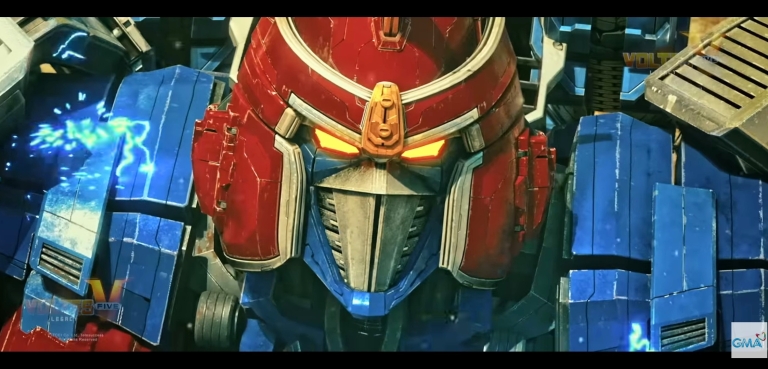
The iconic Voltes V looks bulkier and more mechanical in CGI form and the good news is that the overall quality is great and there is a lot of fun seeing the giant robot in action. (photo source – the Voltes V: Legacy – The Cinematic Experience trailer)

To begin with, the creative team of GMA managed to establish a cohesive narrative for the cinematic experience which is not an easy thing to do considering all the content from many selected episodes that had to be edited and arranged properly. This involves the presentation of the story details, the live-action elements, the CGI-heavy shots and the human performances to create a narrative that was easy enough to follow and absorb in my experience. I noticed that the so-called movie moved at a medium-to-fast pace which is not surprising because the goal of GMA was to entertain moviegoers and convince them to anticipate the live action TV series. Considering the speed of the pacing, there were some moments when I felt that some scenes were missing which only reminded me that the slower and more dramatic moments were being saved for the TV series.

When it comes to adapting the classic anime’s elements into live action, the creative team did a pretty good job most of the time. The costumes of the five pilots were made with a more practical physical design (note: they are not body tight) while retaining the classic colors and the V logo. The interior set of the Camp Big Falcon operations room looked more futuristic complete with having many people simultaneously operating. The interior set showing Prince Zardoz and his trusted companions closely resembles that of the anime. There was one particular physical set that did not look convincing – the outdoor street market in Boazan early in the movie had that indoor feel which not even the lighting could hide and the CGI shot showing the rest of the outdoor area and the far distance did not match with the place.

More on the artistic side of the presentation, I enjoyed the way the production people emulated the classic anime designs of not only the characters but also the key structures (places) and the giant robots (Voltes V and the two beast fighters) into live action. The cinematic Prince Zardoz looks so much like his anime counterpart and the same can be said about Dr. Smith and Mrs. Armstrong. The two beast fighters here were rendered to look much like their anime versions but were animated in a way to emphasize mass and scale.     

The strategic posing in this notable shot is a fun and honorable throwback to a key moment in the very first episode of the original Voltes V anime TV series. (photo source – the Voltes V: Legacy – The Cinematic Experience trailer)

There were some notable artistic discrepancies and flaws however. The cinematic Princess Zandra, Draco and Commander Robinson clearly did not quite match their anime counterparts. For some reason, Princess Zandra appeared with a very different costume displaying subtle sexiness instead of royalty. Could it be possible the creative team took inspiration from the Fatima Blush character (played by Barbara Carrera) in the 1983 James Bond movie Never Say Never Again while modernizing Princess Zandra? As for Draco, he does not look as intimidating as his anime version and he even looks more like a cosplayer! Commander Robinson here does not display the maturity of the anime version due to the questionable quality of the costume provided and the actor’s appearance. In my experience watching the anime series, Commander Robinson looked and felt like a military man in his early fifties which the live action version never captured. 

Now I want to talk about Voltes V itself. The highlight of the CGI combined with really good art direction is the iconic giant robot, including the five vehicles that compose it. To begin with, the use of CGI emphasizing multiple moving mechanical parts to emphasize Voltes V is a very smart move done by special effects team. While each vehicle has a new visual aesthetic to match the live action approach, they still remained recognizable to me. The biggest visual highlight in the movie is the volt-in sequence when each vehicle combined to form Voltes V in robotic form. As each vehicle connected to each other, the classic sequence from the anime was replicated excellently. Given the artistic direction and the CGI’s emphasis of multiple moving parts, the volt-in sequence here is much more detailed than the anime version! I should state that it is very likely that the visual effects team worked overtime to achieve the high-level of detail, the vibrant colors and the impressive animation on Voltes V.

Watch this. Share to others. Thanks!

With the approach on multiple moving parts, Voltes V itself looks bulkier in a mechanical fashion which I really admire. It should be stated that showcasing the iconic giant robot in action – complete with CGI presentation of the many Voltes weapons – is a visual feast complete with very vibrant colors! Each time Voltes V hits a beast fighter by punching or using a weapon, there is strong impact felt with each blow! The sound effects team really did good work adding weight and power to the action.

The work done by the special effects crew in this external shot of Jamie Robinson’s cockpit is very impressive and detailed! Ysabel Ortega acted convincingly to what happened. (photo source – the Voltes V: Legacy – The Cinematic Experience trailer)

Considering the high detail and strong animation on Voltes V, the two beast fighters shown in this movie had very similar visual qualities. There was no major discrepancy on visual quality between the iconic robot and the enemy during battles.

More on the CGI, I can declare that the locally produced visual effects (by GMA Video and Riot, Inc.) looked very good for the most part! Apart from the battles between the giant figures, the sequences of animating the Voltes V vehicles, the Boazanian flying saucers (with fast moving sharp edges that make them resemble motorized wood-cutting blades), the fighter planes and physical damage of places were nice to see. There were, however, several explosions that were badly rendered (note: even looking flat and out of place) in key scenes and there were moments when military vehicles looked more like they belong in video games from a few console generations ago. The formation of the blade of Voltes V’s laser sword clearly needs more work as it looks unpolished. In the post-credits scene, CGI for Octo 1 was badly done!

Apart from action scenes, the giant robots and their weapons, CGI was also used on established places or structures. Camp Big Falcon really looks magnificent while the floating mechanical Boazanian skull appeared very creepy. In shots showing the far distance, Camp Big Falcon in the background still looks good even though the visual quality falls short of capturing true photo-realism.

Considering the way GMA edited the footage and selected visual effects shots for this so-called movie, the overall quality of the CGI literally landed some notches short of photo-realistic levels. That’s not criticism at all but a confirmation that Filipino-produced CGI showcased here is the best I have seen yet! All in all, an impressive ton of work by the special effects teams using computers.

As for the human performances, I can say that the cast collectively did a good job bringing the characters to life and this includes paying special attention to details from anime while adding certain elements that reflect modernization. Zardoz was portrayed to be sadistic and obsessed on conquering planet Earth which reflects his imperial task and the pressure that comes with it. Sometimes, Zardoz looked and acted even psychotic. Mary Ann Armstrong is the definitive mother figure here and the producers emphasized her more with scenes showing her as a very focused authority during crisis as well as a tender and loving woman during her time with the family. In some ways, Mary Ann Armstrong is almost like the protagonist of this so-called movie and the live action version looks deeper than the anime version. While the live action Commander Robinson needs a lot of improving, Dr. Smith here really looks and feels like he was instantly ripped off the anime resulting in a very straightforward version fans will recognize. The live action Ned Armstrong here has some elements that deviate from what was portrayed in the anime (note: a very skilled fighter whose moves were so obviously choreographed during an action scene) while retaining key elements that still made him recognizable.

The actors who played the five pilots of Voltes V performed nicely. Even with all the layered Tagalog expressions (including gestures that we Filipinos are familiar with), Steve, Big Bert, Little Jon, Mark and Jamie are all very recognizable not in terms of looks but through the dialogue, character details and acting. The production team really worked hard to not only balance their respective shares of the spotlight, but also get good enough performances from the actors. Take note that apart from the on-set dramatization, the actors of the Voltes V team had to perform accordingly in their respective cockpit scenes (note: the special effects teams painstakingly provided all the CGI to specifically reflect what had been happening with the pilots and with their machines) and this includes internal communications between the members. What we have right now are the best actors available portraying Steve, Big Bert, Little Jon, Mark and Jamie and making them recognizable in terms of characterization.

With regards to the music, I can say that this one clearly needs improvement. There is orchestrated music in this cinematic experience that played new tunes while also redoing/recycling classic tunes from the anime TV series. When the anime tunes were played by the orchestra with a modern approach, they were recognizable to my ears but the power and essence of the original tunes were not replicated successfully. Sometimes, I just wished that the anime tunes were played more while the orchestra focused more on providing new music.

As for the famous Voltes V theme song, the new version performed by Julie Anne San Jose is a letdown! I’m not saying San Jose is a bad singer but her version – which even used the Japanese lyrics – lacked impact compared to the original version. While the volt-in sequence proved to be a grand visual feast for the fans and viewers who love great looking CGI sequences, its cinematic impact was brought down a bit by San Jose’s version of the theme song. How I wish that the movie producers just used the classic song from the 1970s anime series!

This original theme song should have been used in Voltes V: Legacy instead of the new version.

Conclusion

As expected, Voltes V: Legacy – The Cinematic Experience has a mix of strong points and flaws. The good news is that the good outweighed the bad and I pretty much enjoyed this cinematic version of the live action adaptation done by GMA, its strategic partners and the local talents. As this so-called movie was a mix of content from several episodes edited to form a suitable narrative, it succeeded in entertaining and engaging me. Yes, there were flaws and there were some parts showing weaknesses but those things did not damage the viewing experience too much. There is a good amount of fun with this so-called movie.

Obviously this cinematic version is part of GMA Network’s strategy to build up anticipation for the upcoming TV series (which has a declared 80 episodes for broadcasting). While some people will perceive Voltes V: Legacy – The Cinematic Experience as a blatant form of marketing or even as corporate gimmick, I personally see it as a worthy showcase in the local cinema (note: cinemas here in the Philippines are still recovering from the massive damage of COVID-19) and it just might not be repeated. Let me remind you readers that this newest Voltes V adaptation highlights the peak of Filipino-produced CGI visuals and the Filipinos’ collective efforts to really make a worthy live action adaptation of a foreign entertainment property. This so-called movie is clearly not perfect (note: it is not deserving of perfect 10/10 scores that others gave it) but it is pretty good to watch in the cinema.

Voltes V looks better than ever and made a big entertaining impact in the cinema. How will Voltes V: Legacy turn out on TV given the fact that there are so many episodes set for broadcasting? (photo source – the Voltes V: Legacy – The Cinematic Experience trailer)

As mentioned earlier, I’m not a fan of the Voltes V anime and I’m not exactly anticipating the Voltes V: Legacy TV series. I do confirm that the long-lasting legacy Voltes V is clearly thriving here in the Philippines and the new TV series could potentially make a deep impact on Filipinos who love entertainment and possibly replicate what happened in the 1970s and 1980s when the classic anime TV aired on TV nationwide. How the new TV series will turn out is clearly GMA’s own problem.

Overall, Voltes V: Legacy – The Cinematic Experience is recommended.

+++++

Thank you for reading. If you find this article engaging, please click the like button below, share this article to others and also please consider making a donation to support my publishing. If you are looking for a copywriter to create content for your special project or business, check out my services and my portfolio. Feel free to contact me with a private message. Also please feel free to visit my Facebook page Author Carlo Carrasco and follow me on Twitter at  @HavenorFantasy as well as on Tumblr at https://carlocarrasco.tumblr.com/ and on Instagram at https://www.instagram.com/authorcarlocarrasco
Sean Connery (1930-2020)

By the time you are reading, it has been a few days since the world lost pop culture icon Sean Connery. Best known for portraying Ian Fleming’s James Bond, Connery died in his sleep in the Bahamas on October 31 (Saturday). He was 90-years-old.

Already many entertainers gave their official reactions to the loss of Connery including current James Bond Daniel Craig, Harrison Ford, Hugh Jackman, Sam Neill, and Arnold Schwarzenegger to name some.

Like anyone else, the first thing I ever heard about Sean Connery when I was very young was that he was the original cinematic James Bond under the watch of Albert R. Broccoli as producer (note: Broccoli’s company continues to produce movies of Agent 007 until now). Being born long after Connery’s six Bond movies were released, the first time I saw him play Agent 007 was in 1983’s Never Say Never Again which was a big budget remake of 1965’s Brocolli-produced Thunderball. On its own, Never Say Never Again was NOT produced by Brocolli but by Jack Schwartzman and Kevin McClory (who was the legal rival of Ian Fleming).

While iconic Agent 007 made him famous, Connery himself got fed up with the role and he ended up having conflicts with Albert Brocolli. Connery wanted to prove he could do more than just play the British Secret Service agent repeatedly.

“I have always hated that damned James Bond,” Connery said. “I’d like to kill him.”

A few years after playing Agent 007 one last time on the big screen in Never Say Never Again, Connery struck gold with his performance in The Untouchables. His portrayal of cop Jim Malone earned him the Academy Award for Best Supporting Actor.

A few years after that achievement of his, I saw Connery in what I personally consider to be his finest non-James Bond role in the form of Henry Jones, Sr. in Indiana Jones and the Last Crusade opposite Harrison Ford. There was great father-and-son chemistry between Connery and Ford in that movie very finely directed by Steven Spielberg.

Connery quit the movies in 2003 with The League of Extraordinary Gentlemen as his final film. During production, it was reported that he conflicted a lot with director Stephen Norrington. The bad experience contributed to ending his movie career.

In ending this article, here are some YouTube videos related to the film works of the late Connery for your enjoyment. By the way, check out my retro review of Dr. No.

+++++

Thank you for reading. If you find this article engaging, please click the like button below and also please consider sharing this article to others. Also my fantasy book The World of Havenoris still available in paperback and e-book format. If you are looking for a copywriter to create content for your special project or business, check out my services and my portfolio. Feel free to contact me as well. Also please feel free to visit my Facebook page Author Carlo Carrasco and follow me at HavenorFantasy@twitter.com

A Look Back At Dr. No

Every great movie franchise starts small and as the decades pass by, its place in history will be marked and revisited.

This is my review of the first-ever James Bond movie Dr. No.

Screenshot_20190812-114957_YouTube.jpg
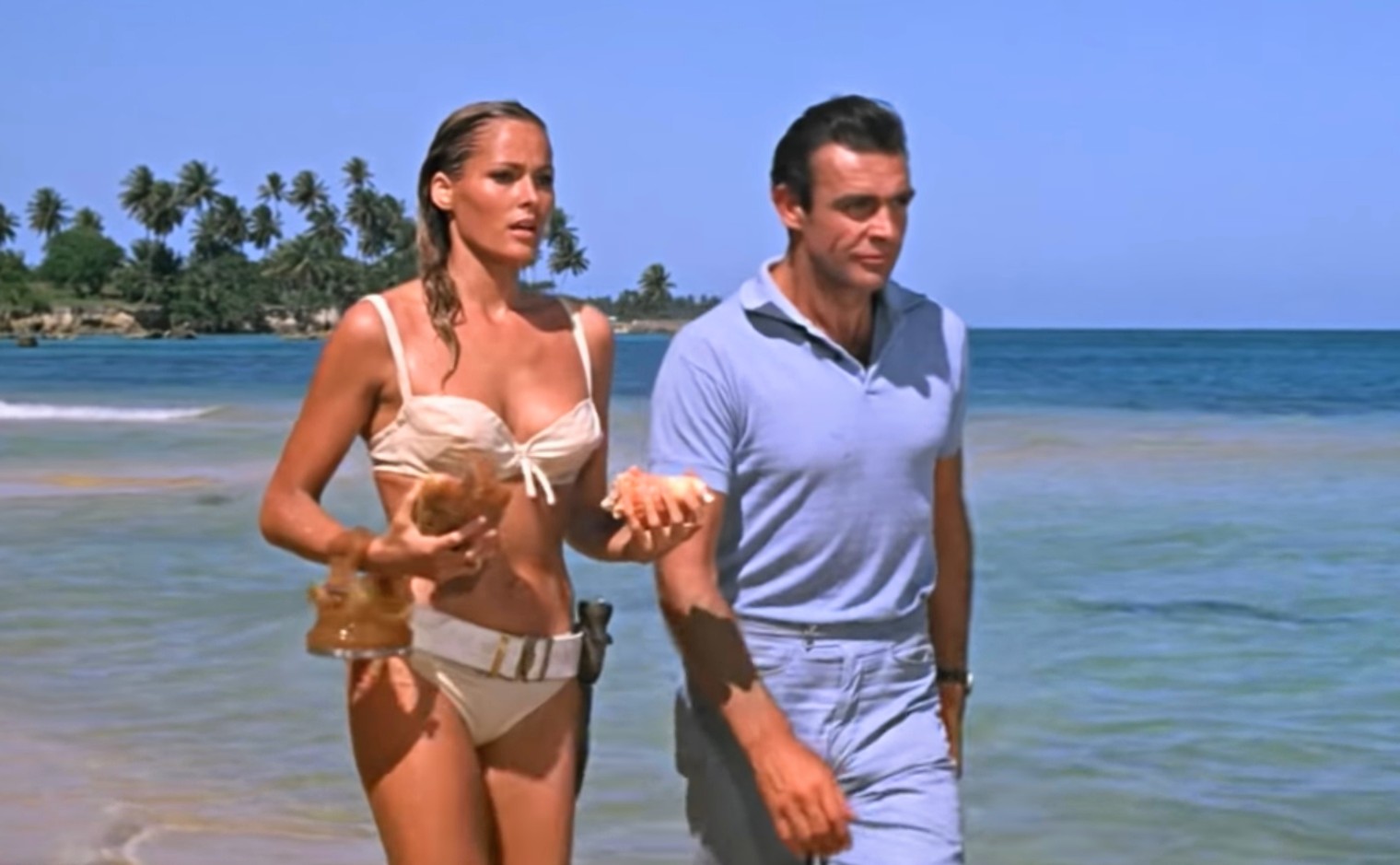
Ursula Andress and Sean Connery as Honey Ryder and James Bond respectively. 

Released in 1962 based on the sixth novel written by James Bond creator Ian Fleming, Dr. No brought Agent 007 to the big screen worldwide and its success led to a series of big moneymaking sequels, merchandise, novels, comic books, video games and other forms of contributions to pop culture. This movie also marked the beginning of Sean Connery’s journey towards becoming a cinematic icon as, arguably, the best cinematic James Bond ever.

The movie begins when British agents in Jamaica get killed off by henchmen who eventually retrieved highly confidential files. In England, the secret service sends Agent 007 to Jamaica to do detective work and he gets armed with a Walter PPK. Once in Jamaica, Bond starts talking to people, gathering clues and traveled to different places to find out who is responsible for killing his fellow British intelligence operatives. If you want to know more, you just have to watch the movie.

If you are a newcomer to the James Bond franchise or if you never saw this movie before, then you have to keep in mind that this very old movie is NOT an action film but rather it is a detective story laced with suspense and some action that follows James Bond performing his mission for Queen and Country.

Chances are, you must have seen many other James Bond movies that are heavy on action, stunts and explosions. As it was the first of the film franchise, Dr. No is nothing like those other movies of Agent 007.

Being a detective story, Dr. No is character-driven and laced with mystery and suspense. To describe it without spoiling the story, the narrative shows Bond searching for answers and as the suspense builds up, something or someone gets revealed which adds to the deepening of the plot. There is some action, stunts and explosions to spice up the movie which were pretty enjoyable for the early 1960s. However the car chase is very outdated and never believable. Naturally, the spectacle is tame by today’s standards but still, this movie is not boring at all for me.

The movie is nicely paced and makes clear what is going on. There is sufficient build-up leading to the next revelation or the next part of the chain of mystery or the next twist. By the time James Bond encounters Dr. No himself well after the 60-minute mark into the movie, I became oriented with both characters as their conflict finally starts. This will work for you if you take time with the movie’s pace and pay close attention to details.

Sean Connery as Agent 007 is charming, cool and cruel. The filmmakers and Ian Fleming himself really oriented the actor on how to portray the literary Bond in cinematic form. Connery’s Bond is charming and the filmmakers make it very believable on-screen that ladies would fall for his charm which in turn would give him the opportunity to advance in his pursuit of accomplishing his goals in the line of duty.

Ursula Andress, who had to be dubbed in post-production due to her accent, caught the world’s attention wearing the bikini on the big screen (in color, no less) as Honey Ryder who came out from the water with her equipment and sea shells. This was a daring scene to show back in the early 1960s. Of course, Honey is not just a pretty face but also a brave lady with a history of adventure and exploring. This makes her believable as a Bond girl who has what it takes to keep up with Agent 007 in the story, even going face to face with Dr. No.

Screenshot_20190812-115032_YouTube.jpg
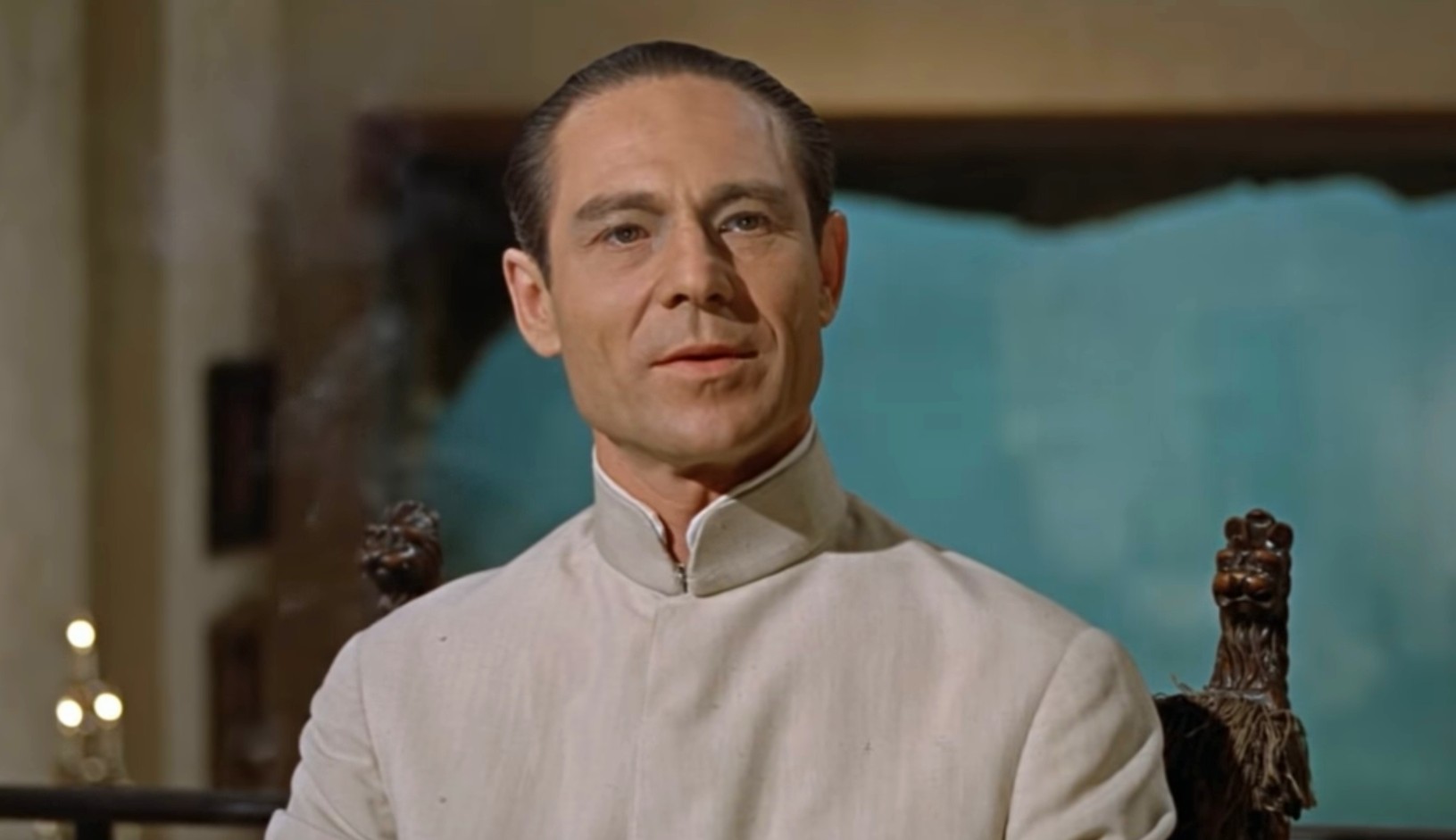
Joseph Wiseman as Dr. No.

Joseph Wiseman‘s performance as Dr. No is subtle and yet he remains creepy as a cinematic villain. When compared to other villains in the James Bond film franchise, he does not do much action but his portrayal as a very powerful sinister human being who controls a loyal group of personnel still makes him a competent franchise villain in by today’s standards. Having seen all the James Bond movies, I find Wiseman’s Dr. No a more engaging villain compared to Col. Moon (the dreadful Die Another Day), Hugo Drax (Moonraker), Kamal Khan (Octopussy), Alec Trevelyan (GoldenEye) and the 21st century Ernst Blofeld (Spectre) to name some.

In terms of production values, Dr. No is a mixed bag. There are some props that looked fake and cheap. The rear projection in the car chase is so fake looking. Ironically, the film shines with the sets designed by Ken Adams. The big room visited by Professor Dent to communicate with Dr. No, the hotel-like lair of the villain (where Honey and Bond are treated like special guests) and the elaborate room of the table meeting with Dr. No all are visually striking.

When it comes to presentation, Dr. No marked the beginning of many things that would later become cinematic traditions – the gun barrel opening, “Bond, James Bond”, the James Bond theme music, the mission meeting between Bond and M. (plus the nice chat between Bond and Moneypenny),  the appearance of Felix Leiter during the mission etc.

The screenplay written by Richard Maibaum, Johanna Harwood and Berkley Mather has quality in it not just with the narrative but also with the dialogue.

I love this exchange of words between Bond and Dr. No.

Dr. No: I’m a member of SPECTRE.

James Bond: SPECTRE?

Dr. No: SPECTRE – Special Executive for Counter Intelligence, Terrorism, Revenge, Extortion. The four great cornerstones of power headed by the greatest brains in the world.

James Bond: Correction – criminal brains.

And there was also this exchange.

Dr. No: The Americans are fools. I offered my services; they refused. So did the East. Now they can both pay for their mistake.

James Bond: World domination. The same old dream. Our asylums are full of people who think they’re Naploeon. Or God.

Overall, Dr. No is a classic movie and it is the kind of film that filmmakers today don’t make anymore because they know people won’t be satisfied without excessive action and spectacle. It is a James Bond flick in the form of a detective story which has a good amount of mystery, suspense and some action.

For sure, people who have gotten used to action-heavy James Bond movies won’t feel engaged with Dr. No. The best way to enjoy this film is to treat it the way it is meant to be – a piece of cinematic history that built the James Bond film franchise in the very first place.


Thank you for reading. If you find this article engaging, please click the like button below and also please consider sharing this article to others. Also my fantasy book The World of Havenor is still available in paperback and e-book format. If you are looking for a copywriter to create content for your special project or business, check out my services and my portfolio. Feel free to contact me as well. Also please feel free to visit my Facebook page Author Carlo Carrasco and follow me at HavenorFantasy@twitter.com