Welcome back, my readers, YouTube viewers and all others who followed this series of articles focused on YouTube videos worth watching. Have you been searching for something fun or interesting to watch on YouTube? Do you feel bored right now and you crave for something to see on the world’s most popular online video destination?
I recommend you check out the following topics and the related videos I found.
#1American shopping malls could solve the nation’s housing problems? – It is no secret that there is a shortage on housing in the United States. In recent times, there is a trend that sounds unbelievable at first but it is indeed happening – the conversion of certain shopping malls into new residential places. You have to watch the CNBC video below to find out more. Perhaps you want to check if the failing shopping mall near you is being converted into new housing for your community.
#2 Japanese RPGs with mature stories – Role-playing games made by Japanese game developers always have stories to tell regardless of the types of game design and gameplay features that were made. There are JRPGs with fantasy tales that were inspired by other works of the genre while other tales were made to be original by their respective game developers. From time to time, developers come up with stories that can be described as mature. To find out what I mean, I encourage you to watch the video by Gaming Broductions below.
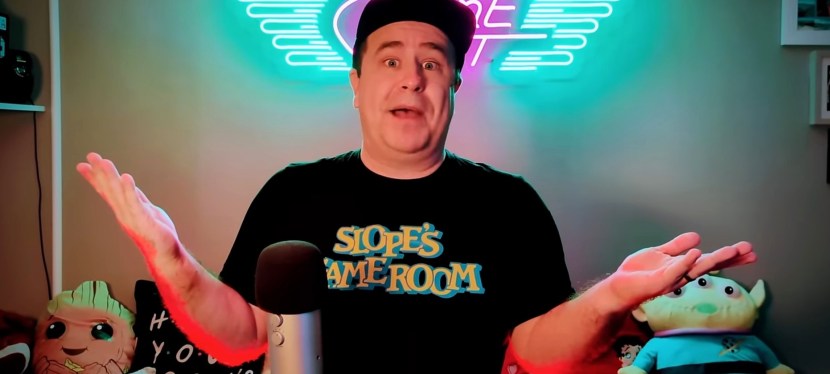
#3 Slope’s Game Room examines the legacy of Paperboy – Among all the arcade games I played inside Circus Circus Hotel in Las Vegas in 1989, Paperboy was the one that stood as the most memorable. The game was a lot of fun and its presentation was also humorous in a cartoony way. Then there was also the bicycle handle the arcade machine had for controlling my character. By today’s standards, it is unlikely you will find an existing and working machine of Paperboy in your local arcade. If you are a newcomer and you want to learn more about the origin and impact of the Paperboy game franchise, watch the video by Slope’s Game Room.
#4 A look back at 2001’s Swordfish – Hollywood today keeps on making sub-par action movies because a lot of filmmakers as well as production teams are obsessed with identity politics and woke garbage. Not only are there woke and Leftist activists among Hollywood’s workers, there are private investors funding film projects with DEI (Diversity, Equity and Inclusion). That being said, it is more entertaining to watch action movies from the pre-woke era of Hollywood and among them is Swordfish (2001) which starred John Travolta, Hugh Jackman, Don Cheadle and Halle Berry. The film is not exactly a gigantic blockbuster nor was it an action genre classic. In fact, it is flawed and does not require much thinking from viewers. But the mere fact that it is NOT WOKE makes it much more entertaining to watch than any of the action movies made by woke Hollywood people over the past several years. To get to discover Swordfish, watch GoodBadFlicks’ exploratory video and TBR Schmitt’s movie reaction video below.
#5 You, Me and the Movies’ Cliffhanger reaction video – Way back in 1993 here in the Philippines, there was a short period when both Steven Spielberg’s Jurassic Park and Sylvester Stallone’s Cliffhanger played simultaneously in the cinemas which resulted in a huge amount of moviegoers lining up for tickets. While Jurassic Park is iconic, Cliffhanger has a more intriguing pre-production and production history. Even though Carolco had major financial problems and Stallone had a fear of heights, the film was eventually made and became a big hit worldwide. To find out if Cliffhanger is still entertaining, watch You, Me and the Movies’ reaction video.
#6 A look back at Die Hard with a Vengeance – I still remember way back in the middle of 1995 how disruptive Die Hard with a Vengeance was as soon as it opened in cinemas here in the Philippines. People left and right suddenly started making plans to watch the film and find out what kind of opposition John McClane (Bruce Willis) would face. While I found the 1995 movie inferior to the classic Die Hard of 1988, it still was enjoyable. For some reason, the film was released in Philippine cinemas as “Die Hard 3” and on local TV as “Die Hard 3: With a Vengeance.” If you have seen the movie and you want to revisit it, watch the follow videos I selected.
#7 Die Hard Arcade documentary by PatmanQC – Decades ago, there was a Sega-produced video game that had a notable movie license – Die Hard Arcade. I had friends who enjoyed that game so much in the local arcades and later on Sega Saturn. A few of them even were convinced to replay Die Hard (1988) on home video. You might be wondering if Sega and 20th Century Fox collaborated to make Die Hard Arcade for many people to enjoy. Actually, it’s more complicated than that and to find out why, I encourage you to watch PatmanQC’s Die Hard Arcade documentary now.
8. Woke Disney’s Snow White movie massively rejected online – Even if there were no controversies at all, I really have no intention to watch the 2025 Snow White movie of woke Disney. Even until now, a lot of members of the public have been rejecting it online and no matter what Disney does, they just keep on failing to salvage the film. Watch and learn from the video of RK Outpost below.
Based on available details and key factors, an executive of the Department of Trade and Industry (DTI) stated that the Philippines is unlikely to be hit by the planned tariff hikes of the returning United States President Donald Trump whose administration will formally start on January 20, 2025, according to a Philippine News Agency (PNA) news article.
To put things in perspective, posted below is an excerpt from the PNA news article. Some parts in boldface…
Department of Trade and Industry (DTI) Undersecretary Ceferino Rodolfo said Monday that the Philippines is unlikely to be targeted by the planned tariff hikes under the incoming administration of United States President-elect Donald Trump, citing the balanced and healthy trade relationship between the two countries.
Rodolfo noted that the Philippines’ trade deficit with the US stood at USD4 billion in 2023, far smaller than the deficits the US faces with other Asian countries, including China (USD300 billion), Vietnam (USD109 billion), Japan (USD75 billion), South Korea (USD55 billion), India (USD47 billion), and Thailand (USD43 billion).
“We believe that countries with which the US has a huge trade deficit—particularly those which worsened during the past four years—will be likely targets of additional US tariffs,” he said.
He added that this puts the Philippines in a strong position as the US looks to address trade imbalances.
“With the Trump administration’s focus on reducing trade deficit, the Philippines can leverage the balanced and healthy Philippines-US trade, indicating a mutually beneficial trade relationship,” the DTI official added.
Strengthening ties – Rodolfo said DTI Secretary Cristina Roque and Special Assistant to the President for Investment and Economic Affairs Secretary Frederick Go are working closely with the US government to ensure “even closer economic relations” with the long-time ally in preparation for Trump’s assumption into office.
He also pointed out that Trump’s pick for Department of State Secretary, Senator Marco Rubio, has been a strong proponent of closer economic and strategic ties between the US and the Philippines.
Rubio filed Senate Bill 4703, or the Philippines-US Strategic Partnership Act, which aims to enhance economic relations between the two countries.
The bill, filed on July 11, 2024, proposes to negotiate a critical minerals agreement with the Philippines; to prioritize support from the US International Development Finance Corporation for projects involving critical minerals and fossil fuels in the Philippines; and to identify additional US agencies that could invest in the Philippines, including the Department of Defense’s Office of Strategic Capital.
Let me end this post by asking you readers: What is your reaction to this recent development? Do you think the Philippines won’t be hit by Trump’s planned tariff hikes? Are you hoping that under a Trump presidency, the Philippines and America will be able to have a free trade agreement?
Welcome back, my readers, YouTube viewers and all others who followed this series of articles focused on YouTube videos worth watching. Have you been searching for something fun or interesting to watch on YouTube? Do you feel bored right now and you crave for something to see on the world’s most popular online video destination?
I recommend you check out the following topics and the related videos I found.
#1A look back at Tobal No. 1 – The 1990s will always be remembered as the decade when fighting games became wildly popular. While franchises like Tekken, Virtua Fighter, Street Fighter and The King of Fighters literally flooded the arcades and consoles, game developers at DreamFactory (a subsidiary of Square) were dissatisfied with the state of fighting games at the time and this eventually led to the creation of Tobal No. 1, one of the most unique games of its genre ever made. To learn more about it, watch the video below.
#2 Assorted videos of Air Force One (1997) – Watching Air Force One (starring Harrison Ford) on the big screen in 1997 was a fun experience for me. It was one of the many so-called Die Hard clones of the 1990s which featured one brave, vulnerable hero fighting terrorists while confined in a place where escape is not option. For your enjoyment, I selected one trivia video and a few reaction videos of Air Force One. As it is a great film, I encourage you to watch it first in case you have not seen it. Otherwise, go watch the selected videos below.
#3 Slope’s Game Room’s look back at the Choplifter series – I first played Choplifter on the Family Computer back in the late-1980s and it really was both unique and fun to play. It was a side-scrolling adventure game with military action but it was not an all-offense experience. In fact, the game gives you opportunities to rescue hostages and the game development history is pretty interesting to discover. As such, I encourage you to watch Slope’s Game Room’s retrospective of Choplifter.
#4 The games of Square in the 1990s remembered – If you know your video game history, Square Enix was established in 2003 as a result of a merger between Square (AKA SquareSoft) and Enix. When Square was still an independent, standalone company it released a lot of memorable games on the Super Nintendo Entertainment System (SNES) and the PlayStation in the 1990s. If you love retro gaming and if you are interested to discover (or rediscover) what Square released back in the 1990s, then this video is for you.
#5 Canadian Prime Minister Justin Trudeau receives response from returning US President Donald Trump regarding new tariffs – Justin Trudeau – the super woke and out-of-touch Canadian Prime Minister – told the returning US President Donald Trump that new tariffs would kill the economy of Canada. The result is a memorable response from Trump. To see what happened and how the public reacted, watch this Sky News Australia video. Lastly, never ever trust Trudeau. You will regret it believing in him as he is a very bad leader.
#6 Kamala Harris being hit by her donors and her fellow Democrats for reckless campaign spending – The defeated Commie Kamala Harris is now the target of her US presidential campaign donors and even her fellow Democrats. You see, her campaign team raised at least $1.5 billion and ended up with a debt of at least $20 million due to reckless spending and irresponsible handling of money. Apart from literally BUYING the support of celebrities and Hollywood Communists, the Harris campaign spent excessively on online ads, private jets and others. The donors are very furious and a lot of Democrats realized that the laughing hyena Kamala Harris severely damaged the political party. That being said, Kamala Harris would be delusional enough to actually run for US President again in 2028. Watch and learn from Sky News Australia’s video.
#7 You, Me and the Movies react to Friday the 13th Part VIII: Jason Takes Manhattan – Years I ago, I posted my retro review of Friday the 13th Part VIII: Jason Takes Manhattan. The 1989 Friday The 13th sequel was so sloppy and bad with its presentation, it sometimes could be funny to see and it’s okay to ridicule it. If you want to discover Jason Takes Manhattan without spending too much time, you should watch the reaction video of You, Me and the Movies.
8. The collapse of the Assad dictatorship in Syria – In case you missed the news, a new chapter in the history of Syria has officially started as the dictatorship of Bashar al-Assad officially ended with the Islamist rebels taking over the country. Assad and his family are now in Russia. While there is euphoria going on in Syria, you should not allow yourselves to be deceived because the civil war in Syria was never a case of “good versus evil”. Assad was allied with Russia and terrorist state Iran. Meanwhile, the Syrian rebels are allied with the Islamist Turkish forces, Jihadists, terrorists and they have Al-Qaeda members in their ranks. Syria now has a new beginning but where will it go? Watch the videos I selected for your viewing and learning.
The City Government of Muntinlupa has new additions to its growing list of achievements as it won two awards at the Digital Democracy Awards, according to a Manila Bulletin news report.
To put things in perspective, posted below is an excerpt from the Manila Bulletin news report. Some parts in boldface…
The Muntinlupa City government won at the first Digital Democracy Awards organized by the Makati Business Club (MBC) and sponsored by USAID Philippines and Konrad-Adenauer-Stiftung Philippines.
US Ambassador to the Philippines MaryKay Carlson, MBC Chairman Edgar Chua, and Department Of Information And Communications Technology Usec. Jocelle Batapa-Sigue presented the Digital Democracy Champion award to 14 city local government units for their exceptional implementation of Digital Democracy initiatives.
Muntinlupa is one of the 14 winners and it also received the Data Stewardship Award for its “responsible handling of citizen data and dedication to advancing smart city initiatives.”
The 14 LGUs that won and recognized as Digital Democracy Champions “for their dedication to advancing citizen participation and transparency in governance” are: 1. Cagayan de Oro City 2. Victorias City 3. Himamaylan City 4. Iligan City 5. Quezon City 6. Isabela City, Basilan 7. Masbate City 8. Tagbilaran City 9. Batangas City 10. Muntinlupa City 11. Naga City 12. San Fernando City, La Union 13. Tagum City 14. Zamboanga City
According to MBC, the awardees in key categories are:
People’s Participation Award: Quezon City for their “Usapang QC” initiative, which bridged communication gaps and engaged over 430,000 residents.
Citizen-Led Policy Award: Naga City for translating citizen feedback into impactful policies, exemplifying the power of participatory governance.
Leadership Award: Batangas City Mayor Beverley Rose Dimacuha, for her exceptional vision and hands-on leadership in advancing digital initiatives.
Outstanding Public Communication Award: Tagbilaran City for their innovative and creative communication strategies, including social media campaigns and community engagement efforts.
Data Stewardship Award: Muntinlupa City for their responsible handling of citizen data and dedication to advancing smart city initiatives.
Let me end this post by asking you readers: What is your reaction to this recent development? If you are a resident of Muntinlupa City, are you very happy to see the city get recognized again with new awards?
For more South Metro Manila community news and developments, come back here soon. Also say NO to fake news, NO to irresponsible journalism, NO to misinformation, NO to plagiarists, NO to reckless publishers and NO to sinister propaganda when it comes to news and developments. For South Metro Manila community developments, member engagement, commerce and other relevant updates, join the growing South Metro Manila Facebook group at https://www.facebook.com/groups/342183059992673
Welcome back, my readers, YouTube viewers and all others who followed this series of articles focused on YouTube videos worth watching. Have you been searching for something fun or interesting to watch on YouTube? Do you feel bored right now and you crave for something to see on the world’s most popular online video destination?
I recommend you check out the following topics and the related videos I found.
#1Ashleigh Burton’s Logan reaction video – Finally, after posting several X-Men-related reaction videos on her YouTube channel, YouTuber Ashleigh Burton posted her reaction to the great movieLogan. As it is a great film, you must watch it entirely first. If you have seen it already, then I urge you to watch Burton’s reaction video below.
#2 Woke Hollywood continues to freak out over Donald Trump’s comeback as US President – Remember all those many Hollywood elitists who went all out to fool Americans to vote for Commie Kamala Harris for US President? A lot of them plus Hollywood media are still freaking out over Harris’ loss to Donald Trump (who pulled off the greatest American comeback ever). Watch the videos from Midnight’s Edge and RK Outpost below. Pay close attention to the details.
#3 1990s explanatory video about the Fighter’s History – Street Fighter II case – Back in the 1990s, Capcom USA sued Data East over the video game Fighter’s History for infringing on Street Fighter II. As part of its efforts defending Fighter’s History, Data East released to the media an explanatory video (lawsuit exhibit video) which was recently posted on YouTube for millions of people to watch for the first time ever. Watch it now.
#4 Examining Final Exam – Have you ever seen the 1981 movie Final Exam? It was a low-budget, independently made slasher horror movie that looks inspired by Halloween (1978), Friday The 13th (1980) and even National Lampoon’s Animal House (1978). While it is a fact that the movie faded away into obscurity for decades, it suddenly gained attention among film buffs arguably because of its 2023 release on 4K Blu-ray format. Apart from that, Final Exam has a very interesting story of production and execution, and you can learn more about it in the two videos below.
#5 Spotlight on Predator 2 – While it is clear that the 1990 sci-fi action movie Predator 2 does not match the greatness of its predecessor, it still aged well and clearly succeeded in expanding the lore of the Predator entertainment franchise. It also established very creatively the link between Predator and the Alien film franchise. That being said, it is not surprising that the movie became the subject of several YouTubers’ retro movie review videos and movie reaction videos. Before you watch the selected videos below, I encourage you to watch the film first in case you have not seen it. Otherwise, enjoy the selected videos below.
#6 Halo 2 remembered – Twenty years ago this month, Microsoft launched Halo 2 on the original Xbox console with massive hype and success. I could never forget the excitement leading towards its launch followed by the fun I had playing the single-player campaign. The only problem I had with Halo 2 was the abrupt ending. Regardless, Halo 2 is still memorable and if you feel nostalgic about it, watch the video below. Remember, this is a look back at the time when Team Xbox invested a lot not only on Halo 2 but also on making Xbox fans happy with exclusive content.
Welcome back, my readers, YouTube viewers and all others who followed this series of articles focused on YouTube videos worth watching. Have you been searching for something fun or interesting to watch on YouTube? Do you feel bored right now and you crave for something to see on the world’s most popular online video destination?
I recommend you check out the following topics and the related videos I found.
#1A look at Donald Trump’s amazing comeback as US President – I already blogged about the amazing comeback of Donald Trump who won the 2024 US Presidential Election decisively. While that blog post had lots of videos about the victory, I added some more below for your enlightenment.
#2 The engineering of the F-117 Nighthawk – Do you still remember the F-117 Nighthawk? It was the sophisticated stealth fighter America used against Iraq during the Gulf War in 1991. I personally could not forget the first time I ever saw it on TV (news broadcast of the 1991 war) as a teenager. The F-117 is no longer in use but its engineering and the history of its development should be seen in the video below. Watch and learn!
#3 Dragon Age: The Veilguard’s wokeness – It is a sad fact that very similar with Communist-filled Hollywood (Commiewood), wokeness and identity politics are ruining video games. Recently, EA released Dragon Age: The Veilguard which was the first new Dragon Age game they released in ten long years. The big problem here is that woke activists at BioWare inserted their poison into the game. Watch RK Outpost’s videos below.
#4 The blunders of Kamala Harris, her allies and the Democrats – Kamala Harris, who has been US Vice President for almost four years now, lost the US Presidential Election to Donald Trump convincingly. She led a campaign that was dishonest, pretentious and even turned to hatred by comparing Trump with Adolf Hitler. No matter Kamala did, she and her woke allies failed miserably to connect with voters. Instead of discussing policies and plans to serve the people in the near future, Kamala emphasized identity politics and vibes. Is it any wonder why she lost and why are the Democrats so unpopular? Watch the selected videos to find out why and how she lost.
#5 Kamala Harris supporters freaking out – Losing an election is always painful and embarrassing. So much so, there were supporters of Kamala Harris who could do nothing but record/stream themselves freaking out. Some supporters working in the media or in government just keep on spreading their distorted views and lies to as many people as possible. They also had trouble containing their emotions. I can only wonder if the Democrats themselves care to calm down their devastated supporters. Watch and learn from these videos.
In what is obviously the greatest political comeback in the history of the United States, Donald Trump (Republican) once again won the Office of US President after crushing the woke Kamala Harris (Democrats) in the 2024 US Presidential election!
Trump (US President from 2017 to 2021), whose running mate is US Senator JD Vance, won 286 out of 538 electoral votes as of this writing, according to the official results. 270 electoral votes are required to win the Presidency. As of now, the election results of Michigan and Arizona have yet to be finalized but Trump is leading in both of them.
When it comes to the popular vote, Trump won 70,900,447 votes while Harris got 66,434,997 votes as of this writing. These results proved many polls wrong as they predicted Harris would win more votes nationally than Trump.
For the newcomers reading this, the election of the US President and Vice President are not determined by popular vote nationwide. Rather it is through the Electoral College that determines the winner of the US Presidential Election. By January 20, 2025, Trump and Vance will formally take office as President and Vice President of the United States.
For insight, watch the selected YouTube videos below.
Below are the different YouTube livestreams that covered the elections.
To say that Donald Trump’s delayed re-election is significant is an understatement. He almost lost his life when someone tried to assassinate him. Before that happened, the Democrats and their allies abused government power to attack him and the Trump family. Questionable cases were filed against him in court. And then the Satanic Leftist mainstream news media became the Democrats’ attack dogs against him. Of course, Trump fought back hard and won this year’s Presidential Election decisively! Now that he won again, Trump as the incoming 47th President will tackle a lot of problems that affected America both domestically and overseas.
American families have been suffering from effects of rapid inflation and the reckless economic policies of Joe Biden and Kamala Harris. American society is gradually being dismantled by the LGBTQ and transgender movements, Critical Race Theory extremists, Islamo-Leftists, illegal aliens and the woke mobs which are clearly connected with the Democrats. The cost of living in America has skyrocketed so much, there are individuals who had to work with two jobs just to make ends meet. The Biden-Harris economic plans and post-pandemic measures made life a lot worse for Americans and their families. Meanwhile, illegal immigrants have added a lot to criminal cases around the country.
Once in office, Trump will eventually reposition America to push back hard against terrorist state Iran, Russia and China. I should mention that the Republicans won back control of the US Senate and eventually they will retain the majority in the US House of Representatives which will be helpful for Trump to fulfill his agenda for the people. I anticipate that the first batch of new pieces of legislation in 2025 will be written with the economy, inflation, and illegal immigration in mind.
If there is anything spiritually significant about Trump’s 2024 Presidential victory, I share with you the bible verse below…
“No weapon formed against you shall prosper,
And every tongue which rises against you in judgment
The victories of Trump-Vance and the Republicans this year formed a powerful push back against the Satanic Left, corrupted people, illegal immigration and other wicked forces. The American people have spoken through voting and the 2024 elections will be remembered for a very long time. The people wanted Trump back and they clearly want to join him to make America great again.
Let me end this piece by asking you readers: How did you react when you first learned about the re-election of Donald Trump? Did you let the Leftist mainstream news media fool you into believing Kamala Harris is best for America? Do you think life in America improved a lot under the Biden-Harris administration?
To put things in perspective, posted below is an excerpt from the Manila Bulletin news report. Some parts in boldface…
US-based tech giants are worried that the 12-percent value-added tax (VAT) to be collected from digital services providers (DSPs), plus more stringent rules on internet transactions under two new Philippine laws, could make it harder for global firms to operate here.
While this law imposing VAT on DSPs does not discriminate between US non-resident DSPs (or other foreign DSPs) and local DSPs, industry is concerned that (its) implementing rules and regulations, which are currently being developed, could impose unworkable requirements on foreign DSPs similar to what has happened for [non-resident] income-tax payers,” the Washington, DC-based Computer and Communications Industry Association (CCIA) told the Office of the United States Trade Representative (USTR) in an Oct. 17 submission for its 2025 National Trade Estimate (NTE) Report on Foreign Trade Barriers, which also covers digital trade.
CCIA is referring to Republic Act (RA) No. 12023 enacted into law by President Ferdinand R. Marcos Jr. last October, whose implementing guidelines are due before this year ends in order to collect VAT next year.
CCIA’s member-companies include Amazon, Apple, Cloudflare, Coupang, eBay, Google, Intel, Meta, Opera, Pinterest, Rakuten, TSMC, Uber and X (formerly Twitter), among other global tech firms.
Arlington, Virginia-based Consumer Technology Association (CTA) also flagged RA 12023 as a barrier to US electronic commerce in its USTR submission, citing that this new Philippine law encompasses not only digital goods and marketplaces but also cloud services as well as online advertising, media and search engines.
Back in 2021, the Washington-based multilateral lender International Monetary Fund (IMF) warned that slapping digital services taxes (DSTs) may “open the door to retaliatory trade measures” from the US, as it did with India’s DST.
CCIA pointed out to the USTR that implementation of the Income Tax Convention of 1976, in which both the Philippines and the US are parties, has been “challenging” due to “complex and burdensome documentation procedures” or so-called request for confirmation (RFC) required by the Bureau of Internal Revenue (BIR) from income taxpayers.
“The BIR has not established standard processing timelines, and businesses are subsequently required to wait indefinitely without any commitment toward a resolution of the filing. These requests are required of all US non-resident service providers operating in the Philippines and, therefore, this policy is not limited to digital services and impacts members of all industries seeking to provide their services and goods to the Philippine market,” CCIA noted.
CCIA added that the BIR revenue memorandum circular (RMC) issued in January of this year “added further confusion to income-tax obligations of non-resident suppliers of cross-border services.”
Referring to RMC No. 5-2024, CCIA said it “appears to depart from established principles of income taxation of cross-border services (using the place where the services are performed to determine if the transaction is income-taxable) and treats the place of receipt of the services as being crucial in determining the taxability of the transaction.”
As such, CCIA called upon the Philippine government and the BIR, in particular, to hold comprehensive industry consultations, “including with US non-resident service providers, to clarify the income-tax position under Philippine law in line with well-recognized and established international practices.”
Like CCIA, the also Washington-based National Foreign Trade Council (NFTC) bewailed in its comment to the USTR that “there is significant ambiguity on how long the BIR will take to review the RFC and there is no guarantee of a positive outcome.”
“Such requests have to be made by each and every income payor (customers) of US non-resident service providers selling to the Philippines,” NFTC lamented.
Also, CCIA expressed concern about the Internet Transactions Act signed by President Marcos Jr. last year.
“Industry is concerned that the [Internet Transactions Law] would introduce obstructive requirements on electronic commerce platforms to have regulatory oversight such as mandatory collection of valid business certificates of merchants and subsequent submission to the government authority,” CCIA explained
Let me end this post by asking you readers: What is your reaction to this recent development? Do you think the national government should respond to the concerns of the CCIA? Do you think the digital tax and current laws will turn away technology giants?
Welcome back readers, fellow geeks and electronic gaming fans!
In this edition of the Retro Gaming Ads Blast (RGAB) series, we will take a look at another batch of retro gaming print ads – including arcade flyers – from the 1980s and 1990s.
For the newcomers reading this, Retro Gaming Ads Blast (RGAB) looks back at the many print ads of games (console, arcade, computer and handheld) that were published in comic books, magazines, flyers, posters and newspapers long before smartphones, social media, the worldwide web and streaming became popular. To put things in perspective, people back in the 1980s and 1990s were more trusting of print media for information and images about electronic games and related products.
With those details laid down, here is the newest batch of retro gaming print ads for you to see and enjoy…
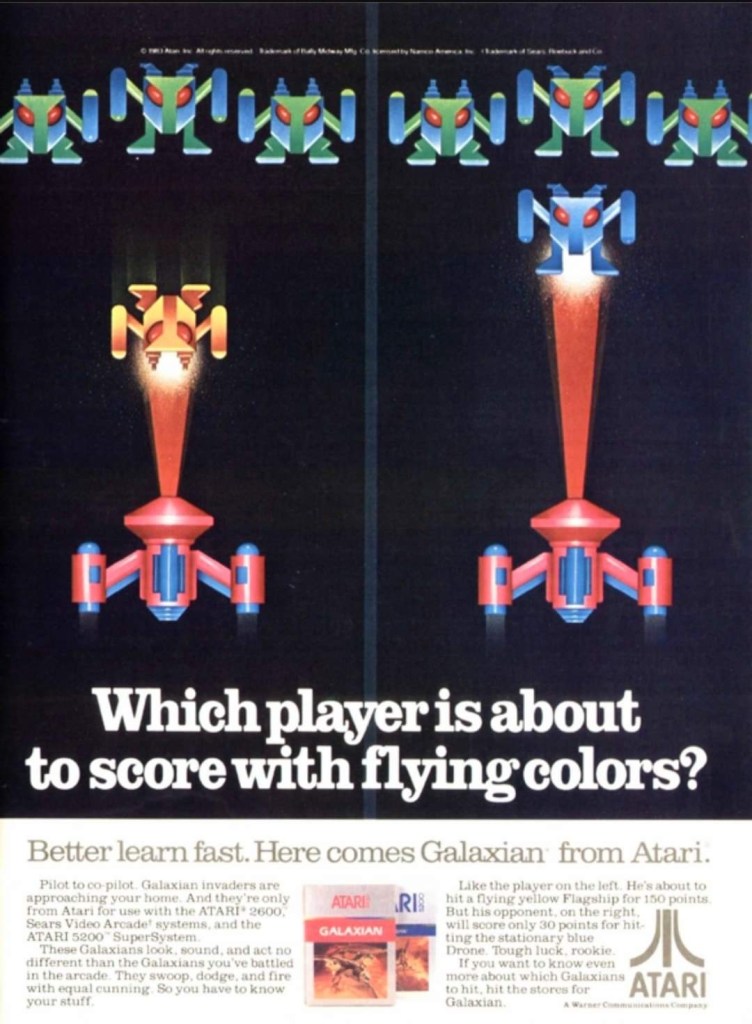
1. Galaxian for Atari print ad
A unique approach to the art done by the advertisers.
Developed by Namco, Galaxian was a 2D sci-fi shooter that debuted in arcades in 1979. It was so successful and widely acclaimed, it got ported to varied game consoles and home computers as the years passed by. For its release on the Atari 2600 and Atari 5200, this print ad was created to catch the attention of fans and gamers by utilizing artwork that resembled the look of 2D sprites from the game. That being said, no screenshots of Galaxian on the Atari consoles were shown because the artwork used looked detailed and were attention-grabbing already.
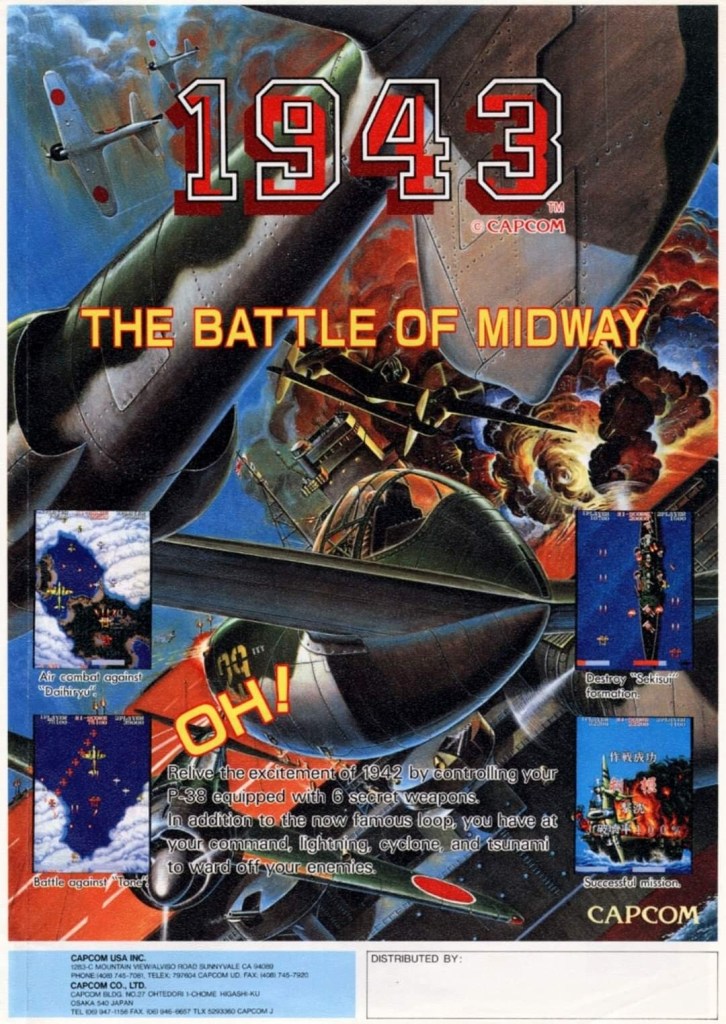
2. 1943: The Battle of Midway arcade flyer
This is a fine looking flyer.
In 1987, Capcom released in the arcades 1943: The Battle of Midway which was their follow-up to 1942. The arcade flyer itself was designed to strongly promote the game using a combination of screenshots, short-but-clear text descriptions and the great looking piece of artwork which really emphasized the World War II concept. Behind it all, this game was made by Japanese developers with the Western markets in mind and the irony is that the game has players control Americans fighting the Japanese fleet.
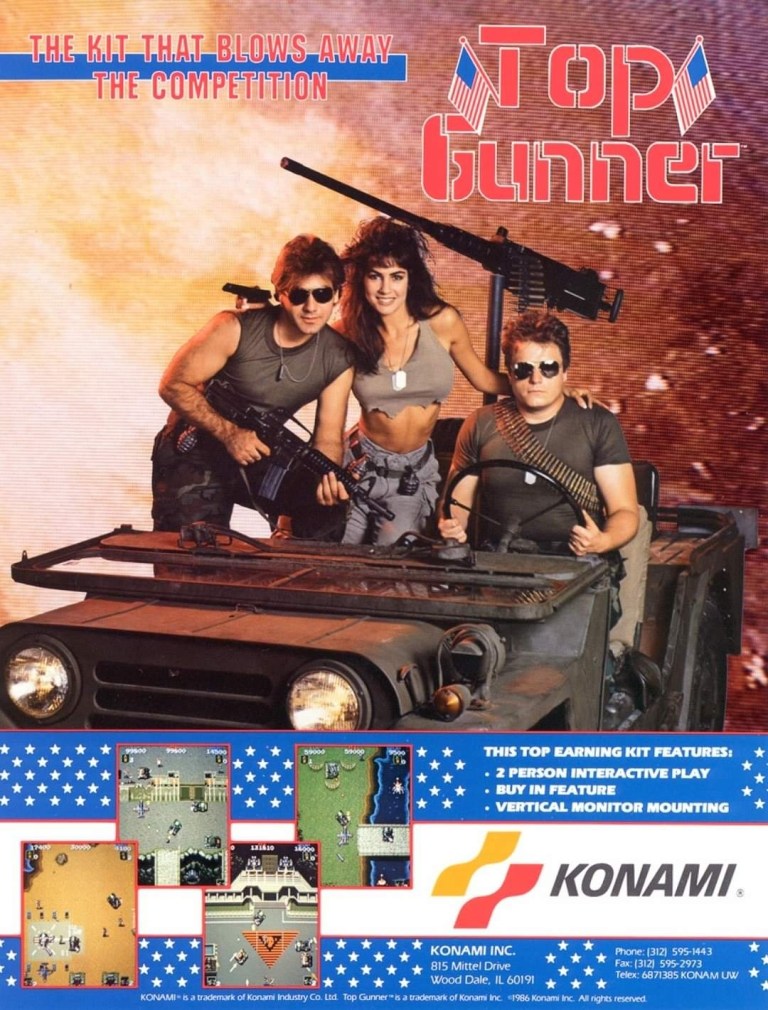
3. Top Gunner arcade conversion kit flyer
Show this nice looking image to the woke nut or modern day Communist near you. Watch and observe his or her reaction.
To make things clear, Top Gunner is actually the run-and-gun game Jackal and the alternative titles was mainly used in North American arcade distribution and also reflected Konami’s move of coming up with titles inspired by blockbuster movies of the time. To promote its 1986 arcade release in America as a conversion kit, the advertisers had three models playing soldiers on a military jeep to immerse gamers into the core concept of the game – moving armed military jeeps from one location to another while fighting bad guys. The approach used for the visual concept is indeed inspiring, especially during the Cold War. Top Gunner/Jackal became a hit in both arcades and consoles.
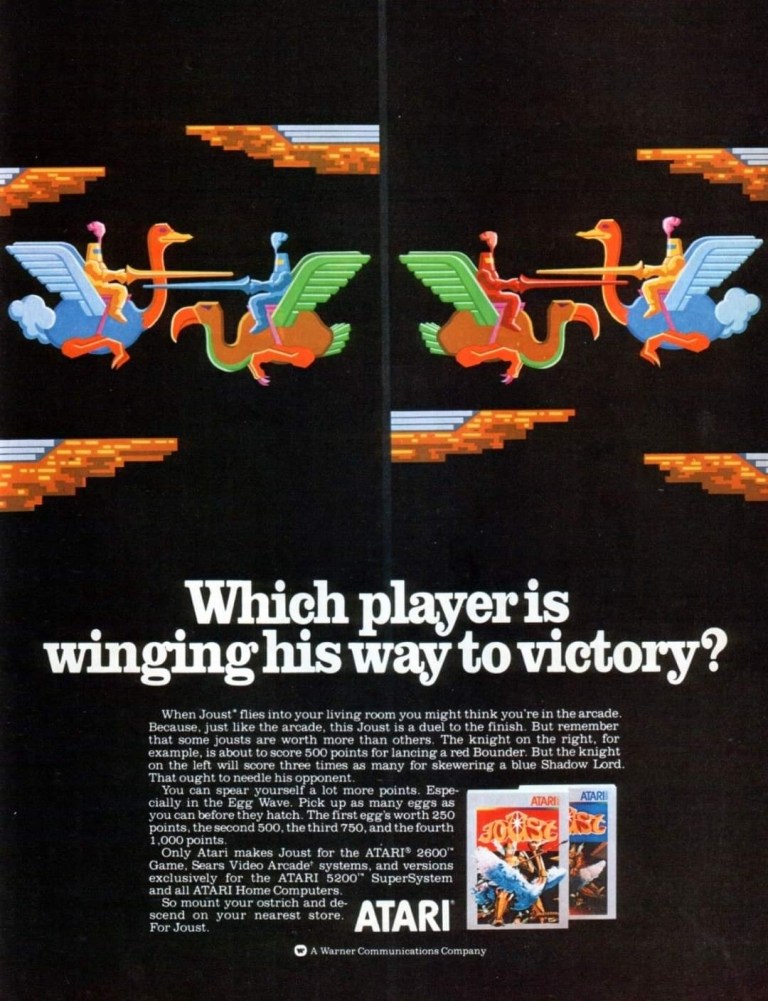
4. Joust for Atari print ad
While I played Joust on console, I don’t remember seeing this print ad before.
Made by Williams Electronics, Joust was one of those early 1980s arcade games that eventually made its way to the Atari 2600 console which was massively popular in North America. Strangely enough, the artistic approach Atari’s advertising came up with for the console version of Joust was similar with that of the ad of the Atari version of Galaxian (see item #1 above) in which artwork was used to resemble the 2D sprites of the game. Regardless, the images of this ad showed what a joust looked like – a martial game between two armed combatants going against each other while riding an animal.
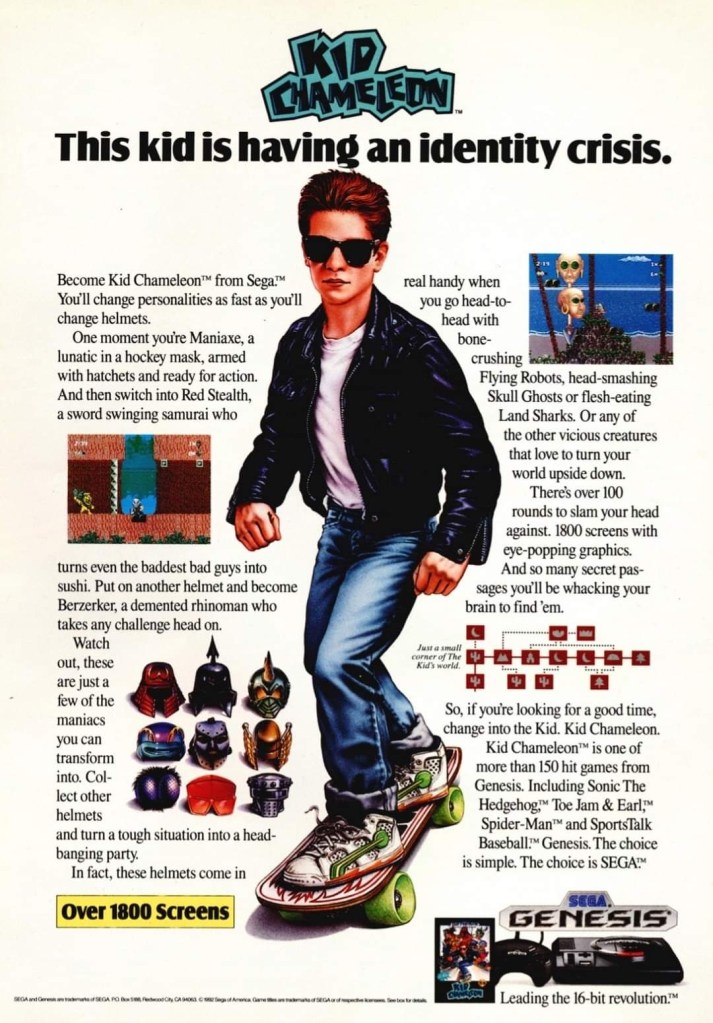
5. Kid Chameleon print ad
Can you relate with Kid Chameleon’s identity crisis?
During the early years of the Sega Genesis, Sega of America exerted efforts to make new games that were not only exclusive to their console but also stand out among the many 2D side-scrolling adventure games by coming up with a protagonist with a unique personality that could somehow resonate with young kids and teenagers.
Developed by their internal experts (Sega Technical Institute), the company released Kid Chameleon in 1992 and they came up with the above print ad that had detailed hand-drawn art of the lead character as well as a wordy text description which was a clear attempt to help young gamers (including teenagers) get connected with both the game and the protagonist. The advertisers even had space to spare to accommodate two screenshots of the game.
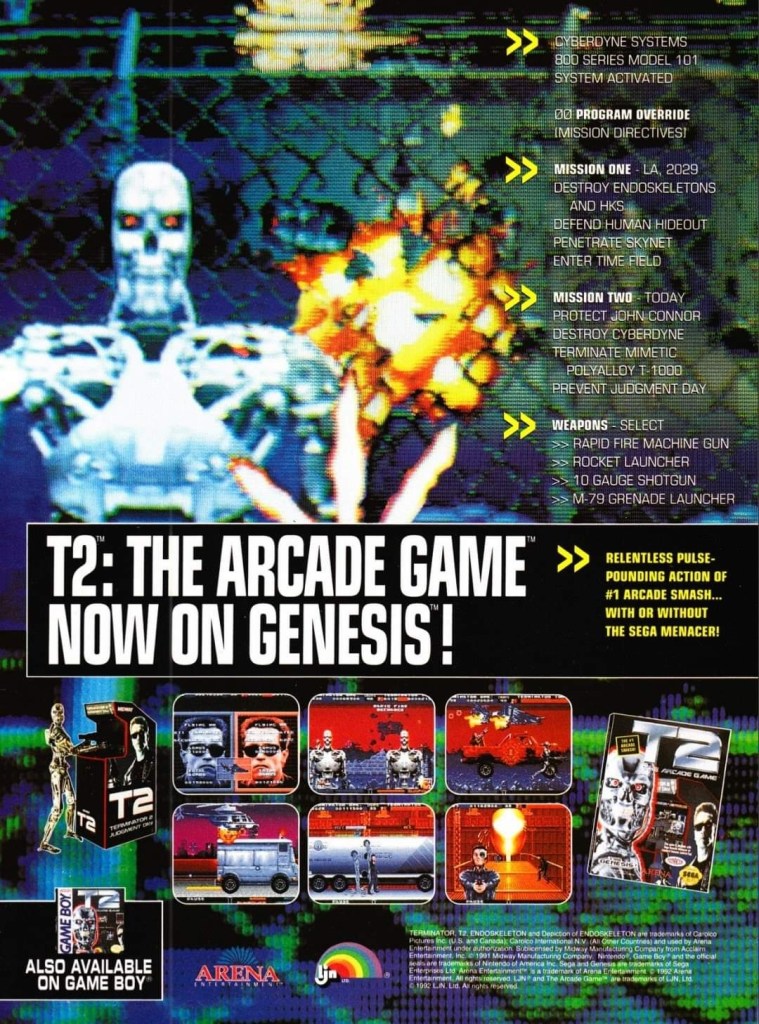
6. Terminator 2: Judgment Day (AKA T2: The Arcade Game) for Sega Genesis print ad
This print ad appeared on the many comic books I read long ago.
Back in the early 1990s, Terminator 2: Judgment Day was a massive success in the global box office and this resulted in Arnold Schwarzenegger’s popularity to soar very high while also establishing the Terminator as an essential pop culture figure. Apart from comic books and merchandise, video games based on the movie were made and the one that stood out the most was the arcade shooter game initially titled Terminator 2: Judgment Day (later retitled as T2: The Arcade Game).
The arcade mega hit eventually got ported to the Sega Genesis and this print ad really looked flashy with its visual presentation showing screenshots and a zoomed-in look at how the Terminator T-800 looked like in the Genesis version complete with a few explosions in the background. It should be noted that this flashy print ad cleverly concealed the visual downgrades and the redrawn images as the Genesis itself could never come close to matching the high quality visuals of the arcade version.
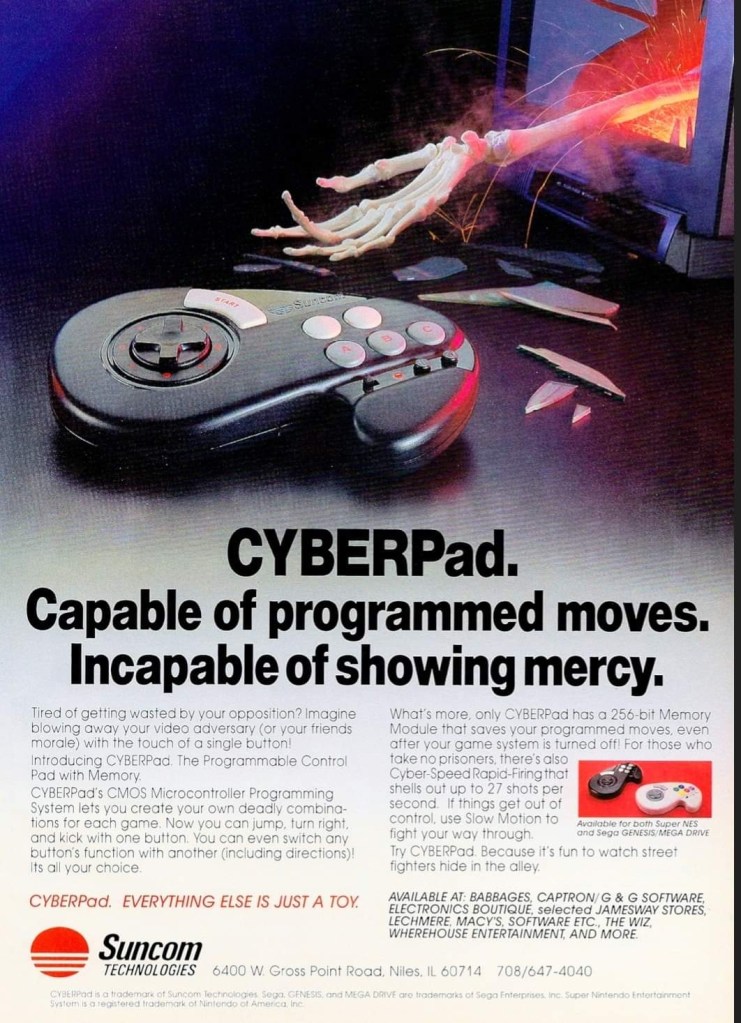
7. CYBERPad print ad
I never owned the CYBERPad, nor have I ever used one.
During the so-called 16-bit console generation (actually the 4th console generation), there were lots of licensed console peripherals made by independent companies in support of the Sega Genesis and Super Nintendo Entertainment System (SNES). The company Suncom Technologies came up with the CYBERPad controller for the two consoles and they boasted in their print ad that the product had a programmable control pad that allowed users to create combinations for each game with convenience in mind. The CYBERPad also allowed the saving of the programmable moves and it had a rapid-fire feature and even a slow-motion function. The CYBERPad was made to make the gameplay experience more user-friendly.
If you look closely, this print announcement by GamePro technically advertised the game consoles, the arcade game and Lara Croft to its readers.
In 1999, GamePro magazine celebrated its 10th anniversary and to keep on resonating with gamers and maintaining the loyalty of their fans, they organized a reader sweepstakes with prizes worth over $25,000 to be won by the few winners. GamePro boasted a date with an unnamed model who played the iconic Lara Croft (Tomb Raider). Certain arcade machines plus the modern consoles of the time – including the brand-new Sega Dreamcast – were also at stake. The way it was presented, this GamePro print announcement was enticing to read.
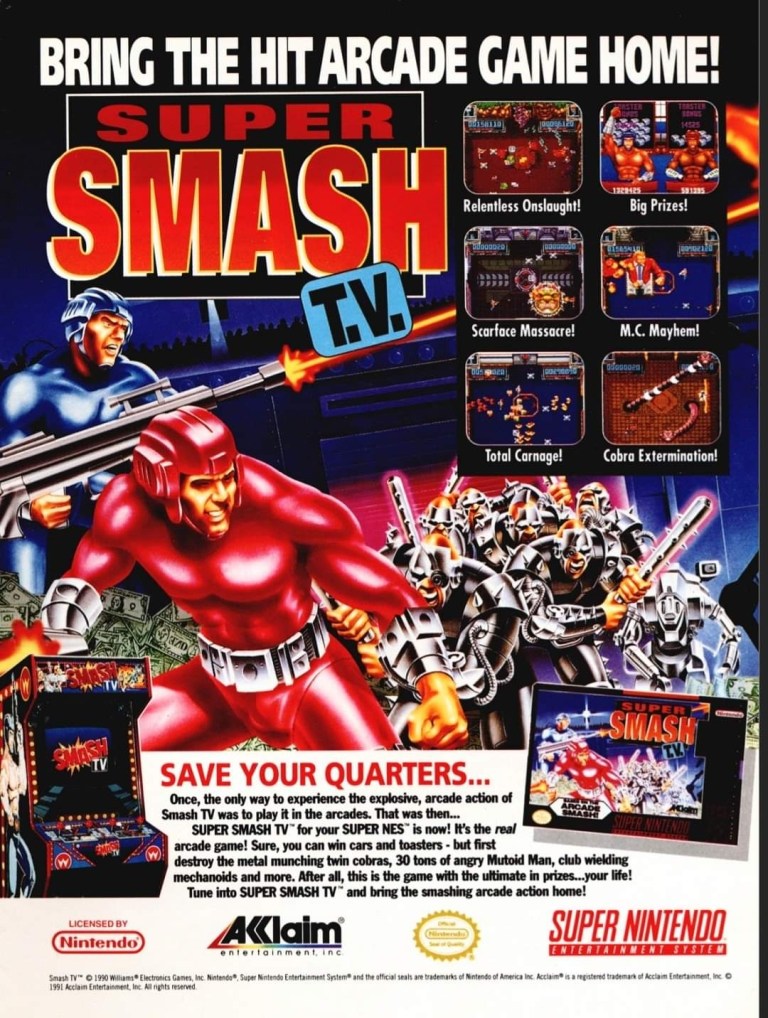
9. Smash T.V. for SNES print ad
Smash T.V. was a lot of fun on both arcade and console.
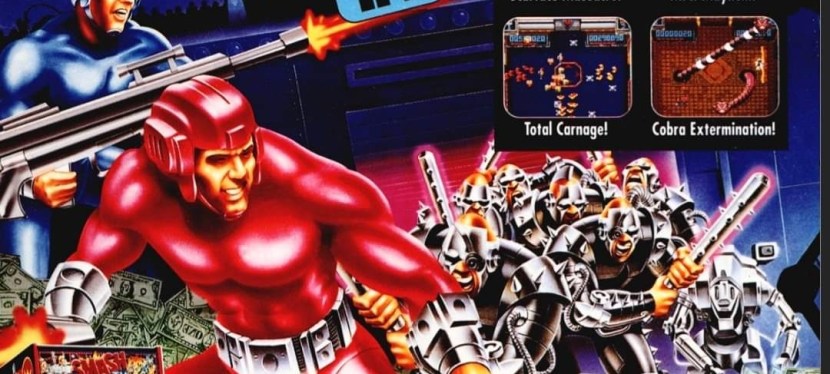
The arcade hit Smash T.V. made its way to the Super Nintendo Entertainment System (SNES) in 1992 and the publisher came up with a print ad that had captivating artwork, six screenshots and a text description that emphasized that a lot of fun awaits gamers on the console version. In my view, this old ad is still amusing to look at.
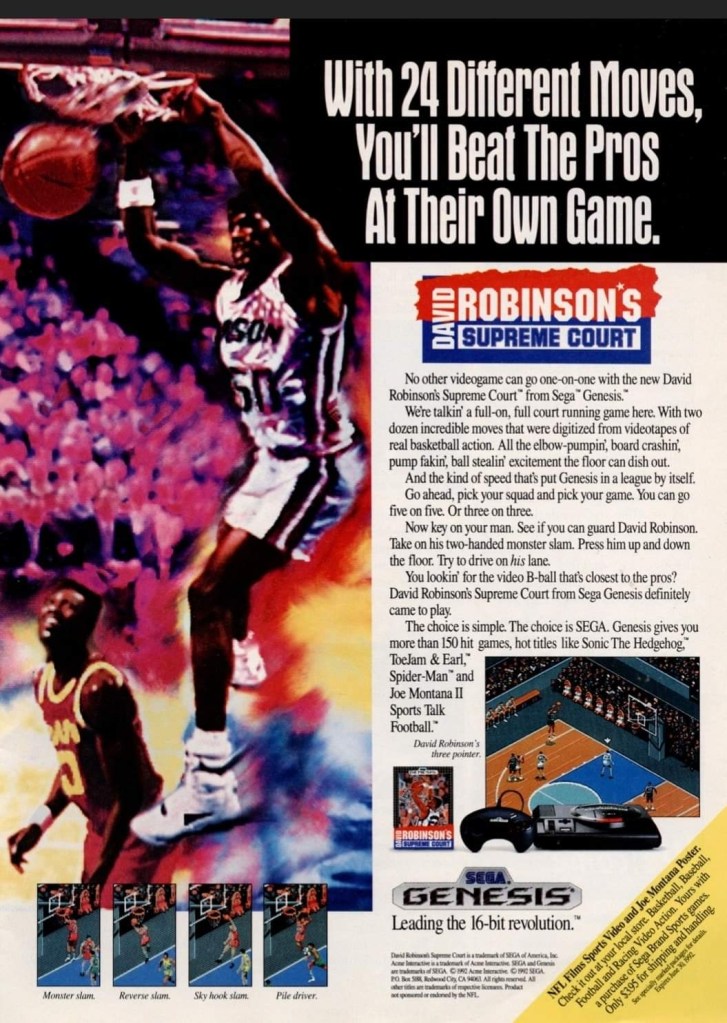
10. David Robinson’s Supreme Court print ad
It was a smart move by Sega to get NBA superstar David Robinson as the endorser of this basketball video game exclusive on the Sega Genesis. This ad was published many years before Robinson finally won an NBA championship.
As part of its strategy in competing with Nintendo during the 4th console generation, Sega of America was focused on producing exclusive sports video games for the Genesis console backed by endorsements of sports professionals. In 1992, they released David Robinson’s Supreme Court on the Genesis and unsurprisingly their print ad used a large, stylized image of the NBA superstar dunking backed with an exciting text description plus screenshots showing the game’s use of the isometric view for gameplay. This is still worth looking at.
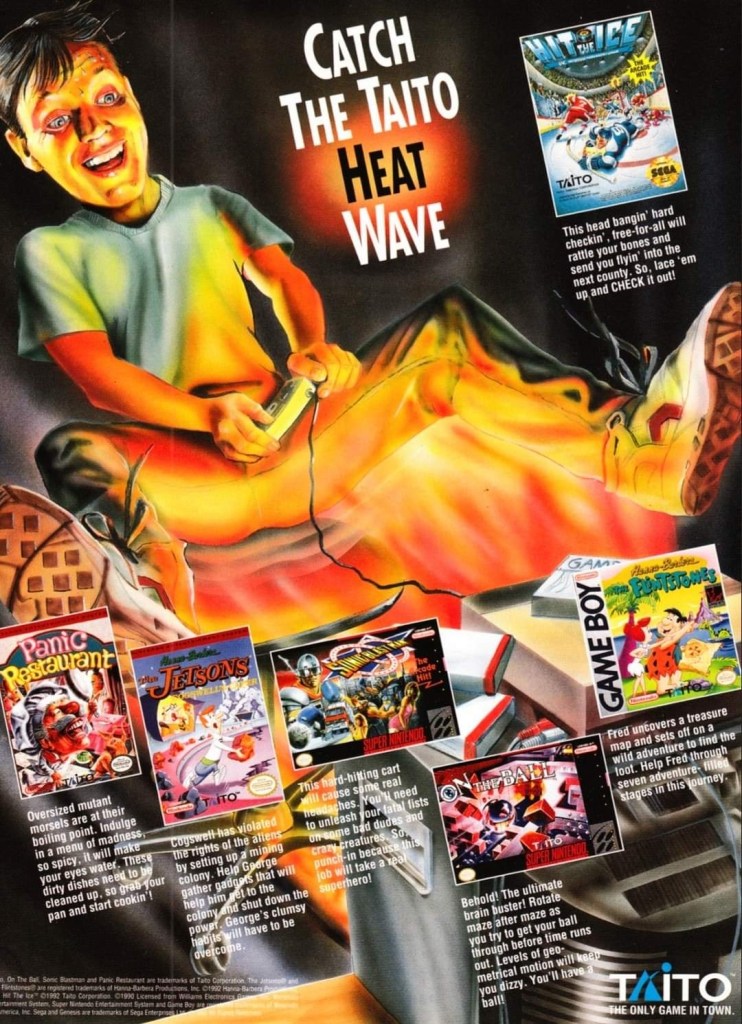
11. Taito’s “heat wave” print ad
An amusing and creative way to sell video games.
If your company lacks money to effectively market your video games individually, you can try making a single ad promoting them together. This is what Taito did in this print ad which showcases multiple games for different platforms and they used artwork of a player experiencing the so-called heat wave. This is a nice stroke of creativity on the part of Taito.
12. Jurassic Park Interactive print ad
This was a creepy print ad promoting the 3DO-exclusive Jurassic Park Interactive.
When it comes to video game consoles, having exclusive games is essential as long as they are of high quality, highly playable and enjoyable. The 3DO company acquired a license of the Jurassic Park movie and made the exclusive game Jurassic Park Interactive hoping it would sell a lot and lift up 3DO hardware sales.
This print ad, which features a zoomed-in image of the Raptor from the game, was more focused on selling the 3DO console than the video game as seen on the descriptive text. 3DO ran a promo selling the console which would entitle the buyer to get Jurassic Park Interactive and another game free. Nothing was done to describe the console’s multimedia capabilities of showing videos, images and graphics of the game (which was essentially a collection of mini-games). This print ad shows ignorance on the part of the 3DO company and the ad maker as it showed desperation happening really early in the console’s life. Notably, Jurassic Park Interactive was the only video game adaptation to use actual footage (note: the faces of the actors were edited out) and music from the film.
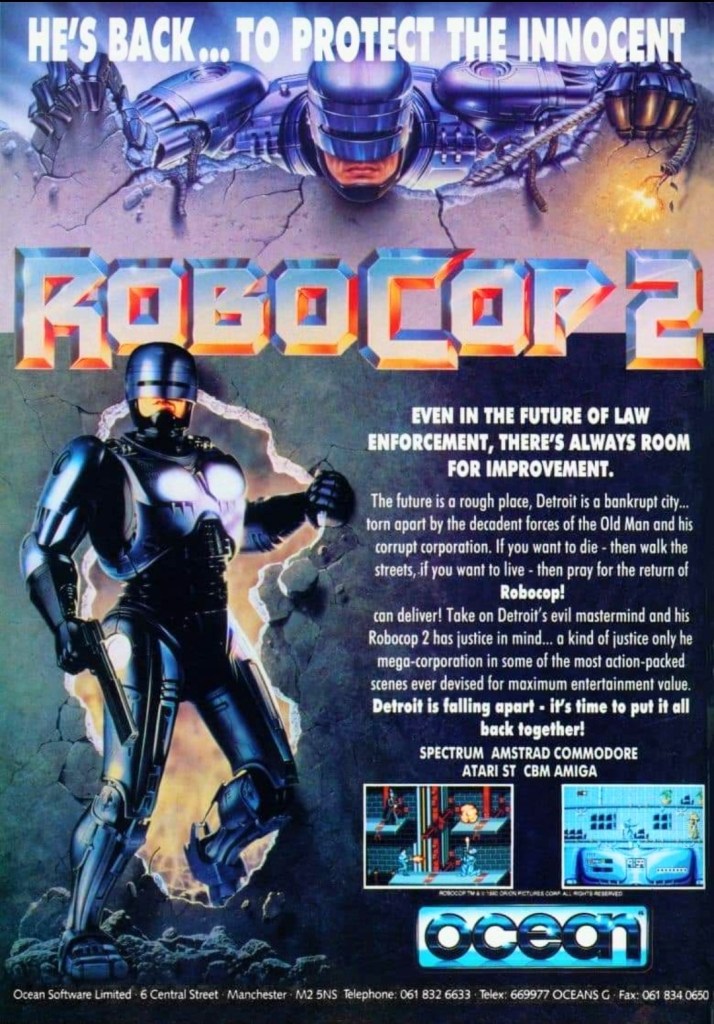
13. RoboCop 2 print ad
You want to become RoboCop to save the city of Detroit from criminals?
Way back in 1990, RoboCop 2 was a big hit in cinemas here in the Philippines and in some places around the world. As typical of the time, licenses to make video games based on the movie were released resulting in RoboCop 2 games for multiple platforms. The print ad featured two different images of RoboCop – one from the movie poster and the other from an official artwork. The descriptive text does a fine job to immerse readers into the story concept of the game but showing only two screenshots was a lackluster effort to sell the game.
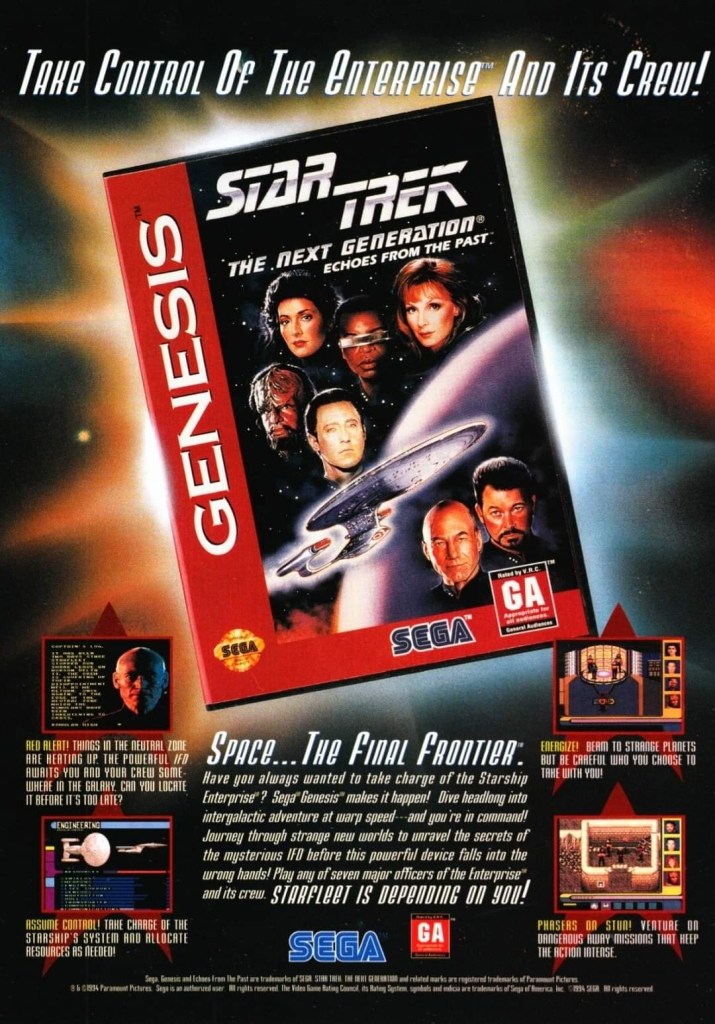
14. Star Trek: The Next Generation – Echoes from the Past print ad
Space…the final frontier waiting for Sega Genesis gamers.
Released in 1994, Star Trek: The Next Generation – Echoes from the Past delivered the Star Trek TNG adventure experience to Sega Genesis gamers. In fact, it is the exact same experience that SNES gamers got the same year. In reality, Star Trek: The Next Generation – Echoes from the Past is actually a port of Star Trek: The Next Generation – Future’s Past on the SNES and the screenshots on the print ad are giveaways about it. In fairness to the ad makers, this print ad never attempted to deceive gamers that it promoted a totally different Star Trek TNG game.
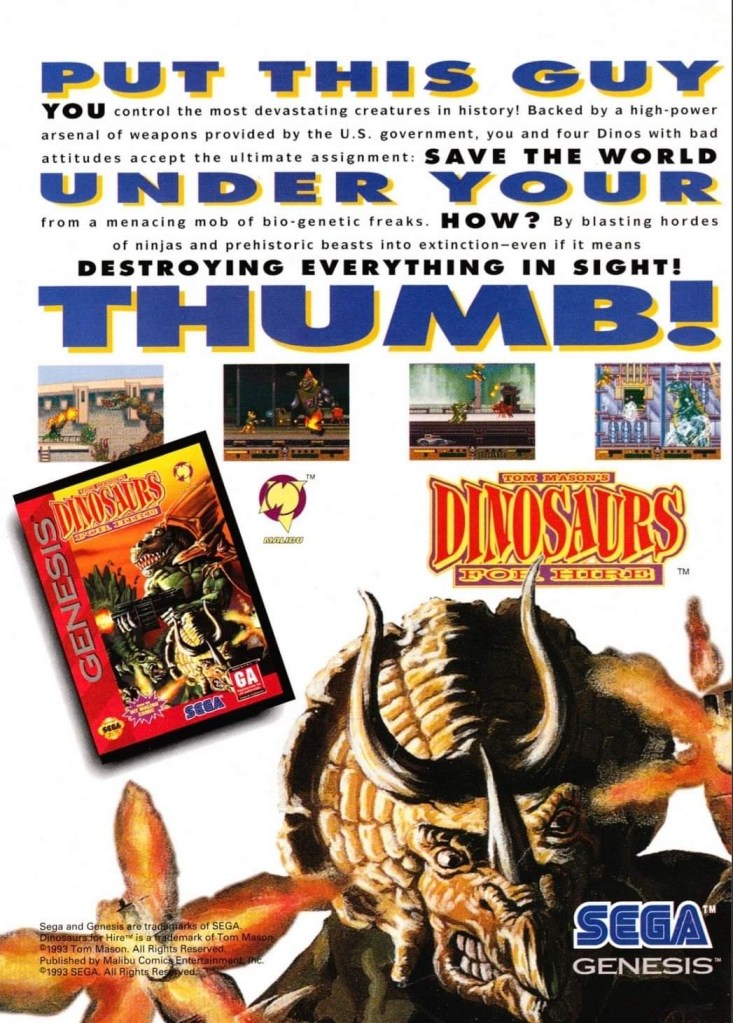
15. Dinosaurs for Hire print ad
This print ad caught my attention and made me interested in the game and the comic book series. Even though it was small, Malibu Comics’ logo was still recognizable.
Dinosaurs for Hire (sometimes referred to as Tom Mason’s Dinosaurs for Hire) was a 2D side-scrolling platform adventure game based on the comic book series of Tom Mason. Published by Sega, it was a Genesis-exclusive game and this print ad had a catchy text description, a few screenshots and the eye-catching artwork of a triceratops facing the viewer. This print ad is still good to look at. If you’re thinking about searching for existing copies of the game, I encourage you to also read some Dinosaurs for Hire comic books before playing. By the way, Tom Mason also wrote several comic books of the Ultraverse.
Welcome back fellow geeks, Blu-ray collectors and movie buffs!
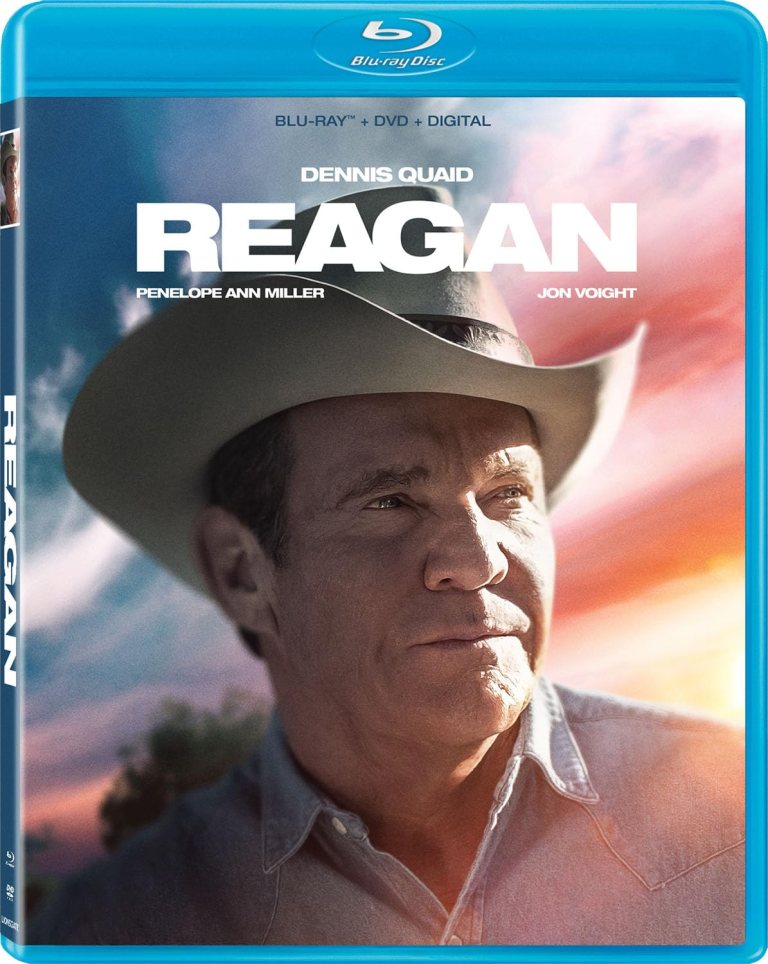
If you are looking for new movie about America’s iconic President Ronald Reagan to watch in the comfort of your home, be aware that the Blu-ray disc (with DVD and digital copy) of the film Reagan (2024) will be released on November 19, 2024, according to a Blu-ray.com update. The good news here is that pre-orders for it are already being accepted online and you can go for it by clicking right here. The movie was directed by Sean McNamara.
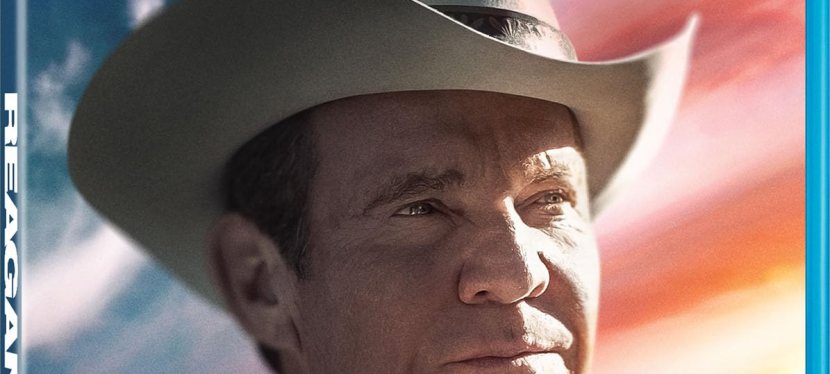
Reagan Blu-ray disc includes DVD and digital copy.
In this movie (released on August 30, 2024 in cinemas), Dennis Quaid played the iconic Ronald Reagan. The supporting cast includes Penelope Ann Miller as Nancy Reagan (the First Lady), Jon Voight as Viktor Petrovich, Robert Davi as Leonid Brezhnev, and Kevin Sorbo as Rev. Ben Cleaver.
The official description is as follows: From dusty small-town roots, to the glitter of Hollywood, and then on to commanding the world stage, REAGAN is a cinematic journey of overcoming the odds. Told through the voice of Viktor Petrovich, a former KGB agent who followed Reagan’s ascent, REAGAN captures the indomitable spirit of the American dream.
To see what the film looks like, watch the official movie trailer below.
In my honest view, Ronald Reagan is clearly the most defining President of the United States not only in the 1980s but in the entire 20th century as he used the full might of his office to push back hard against Communism while also lifting Americans up from the social downturn and rebellious norms that hurt the nation since the 1960s.
Reagan is known for reviving patriotism and economic progress (focused on capitalism and the Reagnomics policies) in America. It has been argued again and again that had Reagan never been US President, America would have fallen deeper into turmoil and the Communists would have gained ground in the Cold War.
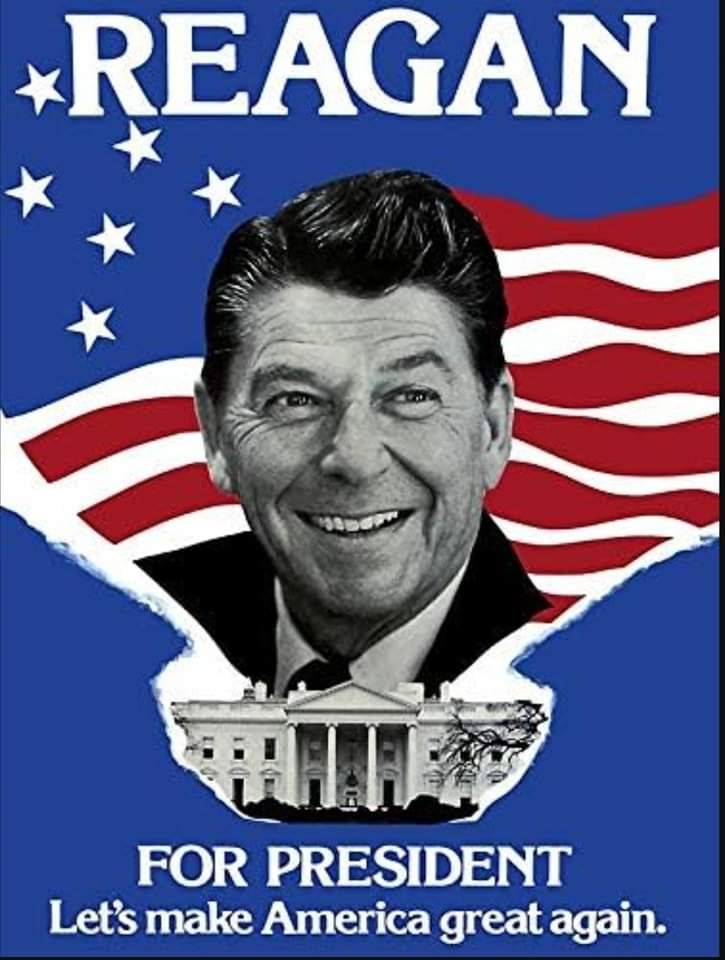
1980 US Presidential Election material from Ronald Reagan’s campaign. The words “make America great again” was spoken by him long before US President Donald Trump’s time. If you think about it carefully, Reagan was an ordinary American who became President of the United States.
It was only right that a proper movie about President Reagan was made. Of course, knowing the traditions of Hollywood, I am anticipating that creative liberties were taken in order to make the cinematic narrative work. I am based here in the Philippines and it is frustrating for me that this movie was never released in local cinemas. That being said, I am closely watching this as a possible addition to my Blu-ray movie collection.
Looking back at the official trailer above, it looks like the filmmakers did a good job making Dennis Quaid look, move and sound like President Reagan. The movie looks like it has a strong focus on the Cold War through Reagan which really interests me.
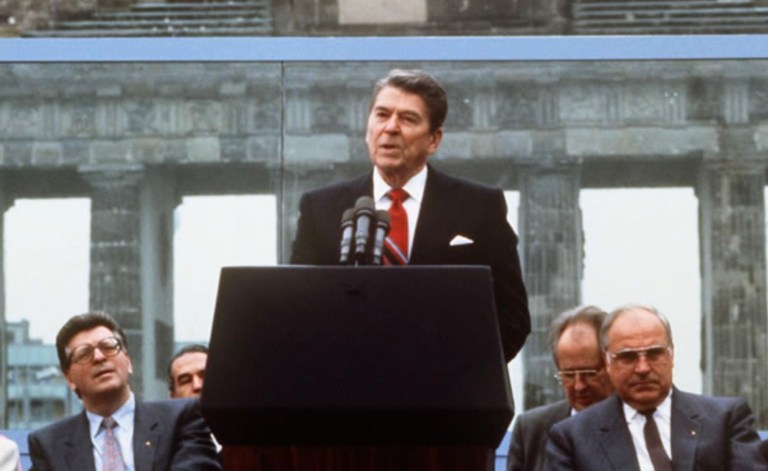
US President Ronald Reagan in real life.
The cinematic President Reagan played by Dennis Quaid.