Welcome back fellow geeks, Blu-ray collectors and movie buffs!
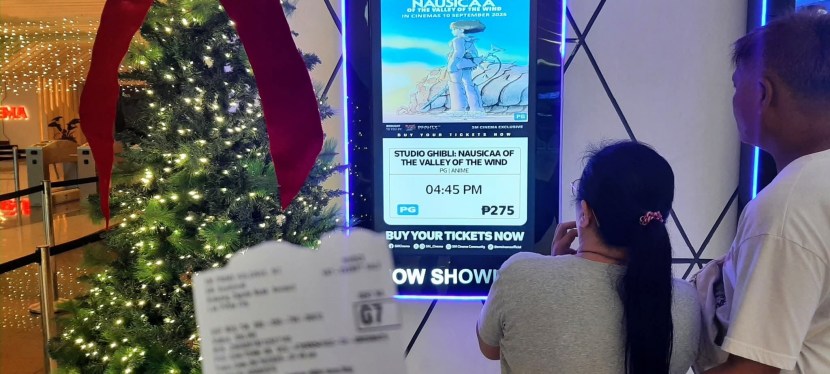
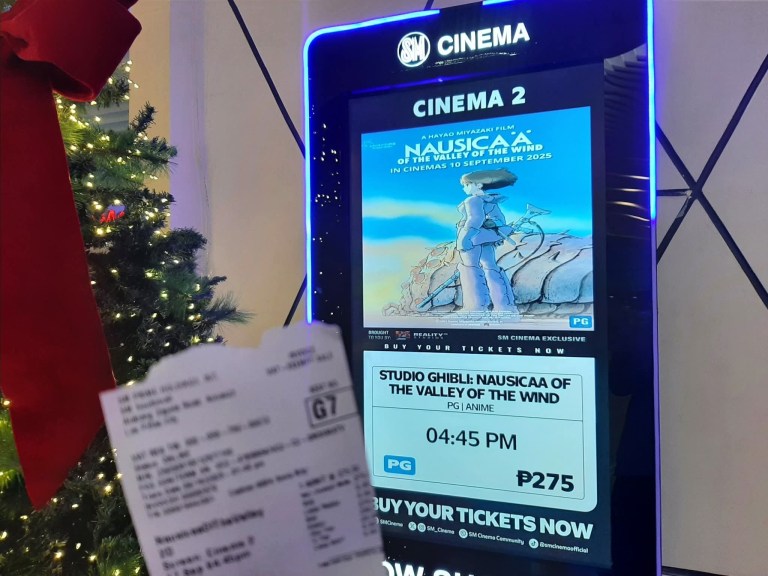
I finally did it! After having seen it many times on home video, cable TV, local TV and DVD, I finally viewed Nausicaä of the Valley of the Wind inside the local cinema here in the Philippines. I saw it on September 17 at SM Cinema inside SM Southmall in Las Piñas City. This was also the first time in two years since I last saw any movie inside the cinema (I last saw Sound of Freedom).
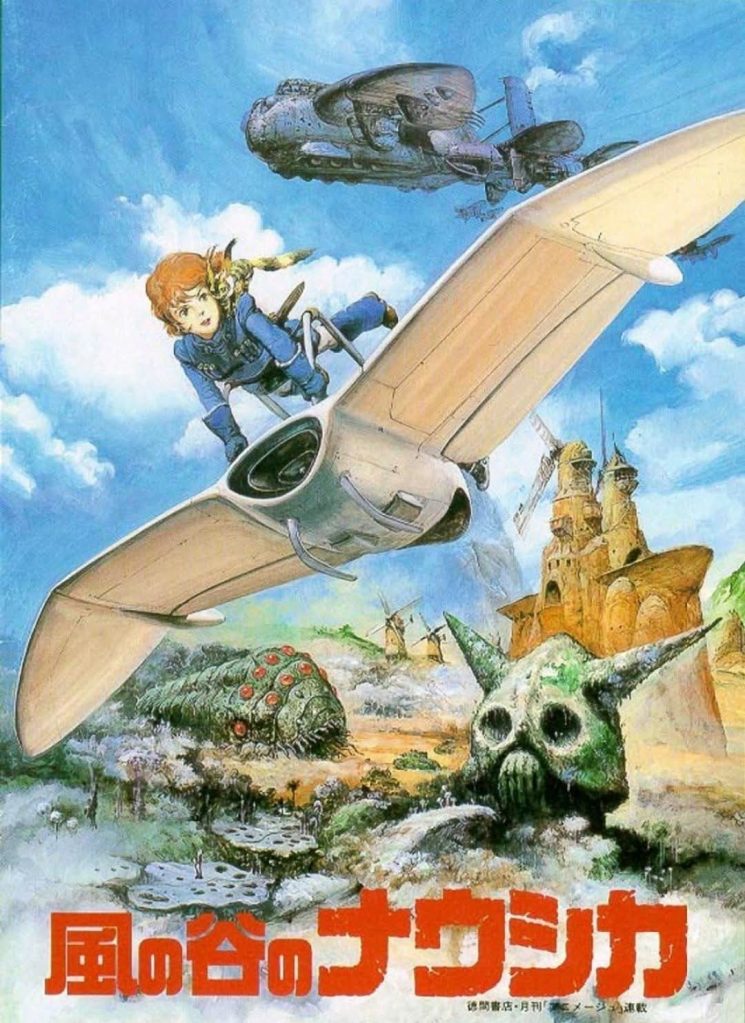
An old movie poster of Nausicaä Of The Valley Of The Wind.
For the newcomers reading this, Nausicaä Of The Valley Of The Wind was part of the Studio Ghibli Fest 2025 which was exclusive to SM Cinema (the largest cinema chain in the country). While the said fest ended on September 16, there were still screenings of Studio Ghibli anime feature films shown in SM Cinema branches from September 17 to 23.
I paid P275 (US$4.72 according to the foreign exchange as of this writing) for my SM Cinema ticket and it includes a free drink. I entered the cinema carrying my ticket, drink and popcorn feeling excited and nostalgic to see Nausicaä Of The Valley Of The Wind on the big screen for the first time ever. What was shown was the English-subtitled version with Japanese voiceovers (Sumi Shimamoto as Nausicaä, Gorô Naya as Yupa, Yoshiko Sakakibara as Kushana, Yôji Matsuda as Asbel, and more)
We were only seven people inside the cinema and there were lots of vacant seats beside, behind and in front of me. I was sitting very comfortably waiting for the screening to begin. At the same time, nobody had a noisy smartphone during the screening. As for me, I deliberately turned my smartphone off to ensure no communication-related distractions would happen.
Eventually Nausicaä Of The Valley Of The Wind finally started playing on the big screen. After the short animated opening scene, the music by Joe Hisaishi started playing as the opening credits went on. At that moment, I was immersed into Hayao Miyazaki’s anime classic immediately and I knew I made the right decision to see it inside the theater.
As the film went on, I adjusted myself to reading the subtitles while maintaining focus on the plot as well as the development of characters. Visually, the film turned out to be really spectacular on the big screen even though it had no computer-generated images at all (note: it is purely hand-drawn animation that was done with so much hard work by Miyazaki and the animators). With the higher resolution on the big screen, I saw a lot more tiny visual details here and there and the facial expressions of the characters became more lively than before. Very clearly, Nausicaä Of The Valley Of The Wind is meant to be seen in the movie theater.
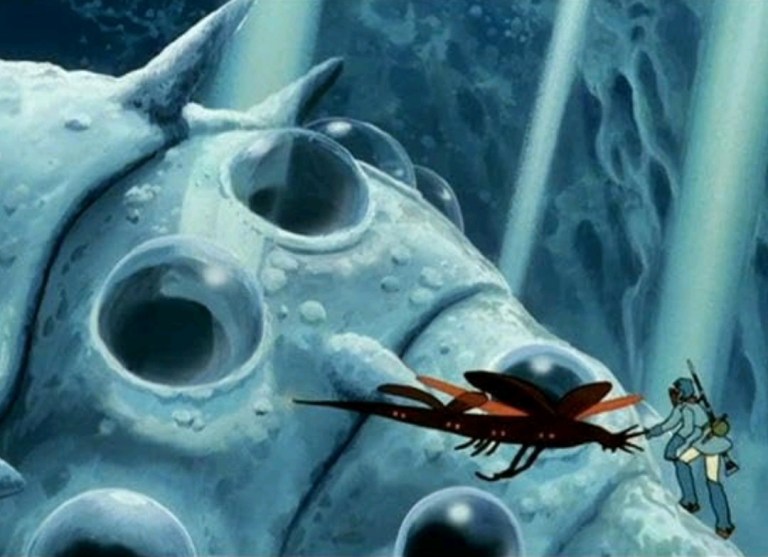
The sense of visual scale in scenes like this one is best viewed on the big screen in the movie theater. (photo source – IMDB.com)
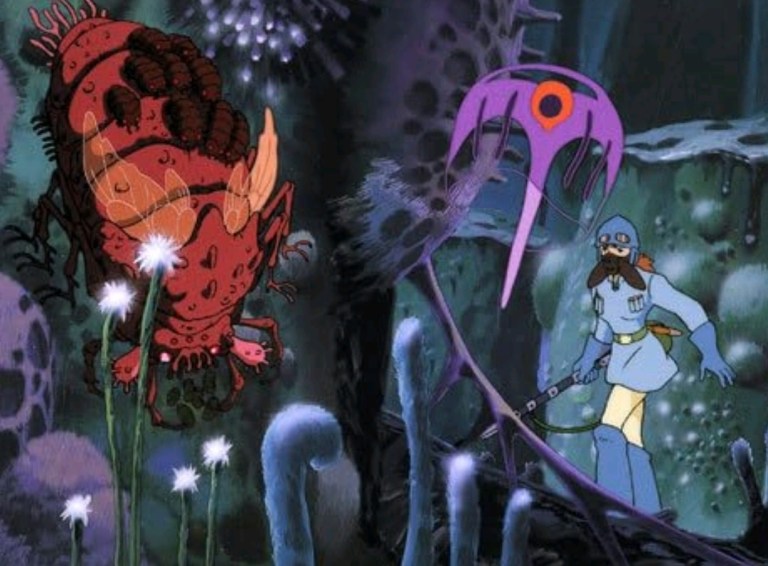
There is nothing like exploring a very polluted forest filled with huge, mutated insects. (photo source – IMDB.com)
After about two hours – the end credits includes animated scenes showing what happened after the climax – of watching, I left the cinema feeling very satisfied and entertained even though I saw Miyazaki’s 1984 masterpiece many times over the decades. The fact that the English-subtitled version was shown gave me an idea of what Japanese moviegoers saw inside their cinemas in 1984, and I can say that the Japanese voiceovers were engaging to listen to. The big screen experience alone made watching Nausicaä Of The Valley Of The Wind worth it.
That being said, I want to express out loud to local movie theater operators reading this to consider showing more of the classic anime feature films as well as classic motion pictures during film festivals or special theatrical events. Personally, I want to see Casablanca, Macross: Do You Remember Love?, Metropolis (2001), Tron, Total Recall (1990) and Akira in the local cinemas.
I am very glad to have seen the 1984 classic anime movie inside the movie theater.
Going back to Nausicaä Of The Valley Of The Wind, I am very glad to have seen inside the cinema and if ever your local cinema will have it screened, I encourage you to go for it. There is absolutely no way that that the screens of your smartphone, your tablet, your PC monitor and your high-definition TV could match the grand visuals of Miyazaki’s film on the cinema’s big screen. Truly the cinema is better than streaming.
If you wish to join a group of movie enthusiasts and talk about cinema, cinematic trends, Blu-ray releases and more relevant stuff, visit the Movie Fans Worldwide Facebook group at https://www.facebook.com/groups/322857711779576
For more South Metro Manila community news and developments, come back here soon. Also say NO to fake news, NO to irresponsible journalism, NO to misinformation, NO to plagiarists, NO to reckless publishers and NO to sinister propaganda when it comes to news and developments. For South Metro Manila community developments, member engagement, commerce and other relevant updates, join the growing South Metro Manila Facebook group at https://www.facebook.com/groups/342183059992673
Welcome back fellow geeks, Blu-ray collectors and movie buffs!
When it comes to watching movies – both old and new – the best place for me is still the movie theater. The very large screen, high-tech sound systems and comfortable seats of the cinema all make the theater viewing experience very immersive which streaming apps and the home theater setup could never match. The cinema experience is always better than streaming.
That being said, it is disappointing for me – as a resident of Muntinlupa City here in the Philippines – that local theaters in Alabang had to close down. The original cinemas of Festival Mall, which first opened in 1998 and grew from six to ten screens, are no more. Before they were all closed down, those cinemas had deteriorated over time and I still remember how bad the projection in one of their premium cinemas was when I saw Star Trek Into Darkness in 2013. It was like I was watching a VHS copy of the movie on their screen. It was that bad!
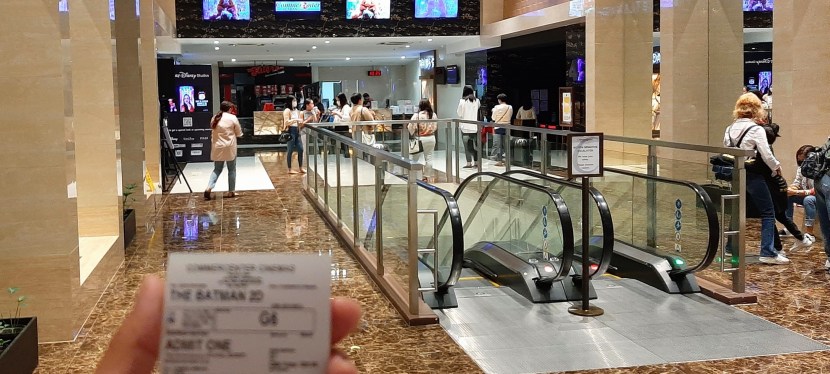
This year, the 4-screen cinemas of Commercenter in Filinvest City had closed down (refer to my past blog posts by clicking here and here) and it is very unfortunate not just for me but also for others who enjoyed watching movies at that mall. In my experience, Commercenter was my favorite local place to watch movies at and the cinema operators were consistent with maintaining each screen, the comfortable chairs and the sound systems. At the same time, it was pretty convenient for me to park the car in the basement parking (really spacious), climb up to the cinemas at the 2nd floor (ticket counter and snacks counter were beside each other), enjoy a movie, and visit a local store or a restaurant within the mall after leaving the cinema.
With the closure of Festival Mall’s original cinemas and Commercenter cinemas, that is a combined loss of ten screens along with the many seats and equipment combined. Along the way, many people who worked directly in those lost cinemas either became unemployed or got re-assigned to a new task within the local establishment. Sadly, not too many people here in the Philippines are talking about the jobs lost with the closure of cinemas.
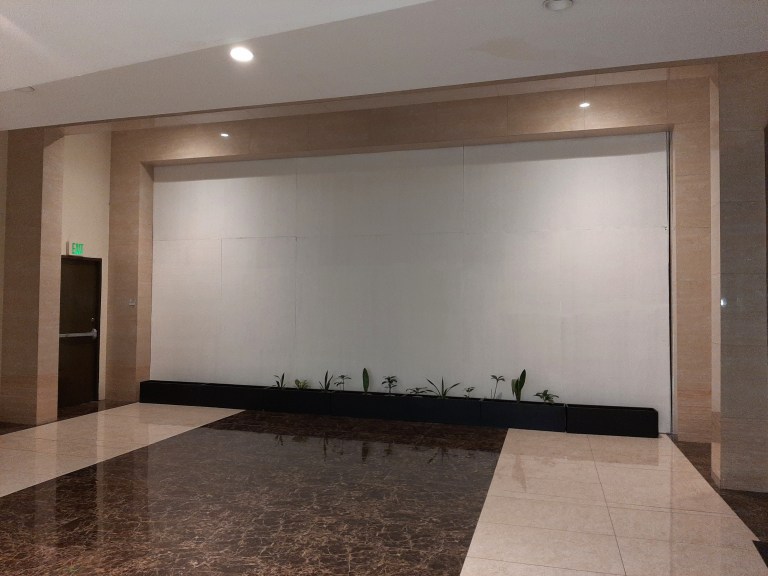
Cinemas of Commercenter have been closed down since March 15, 2025.
This brings me to my next point – BusinessWorld published an article exploring the current struggle of Philippine cinemas in what is now the post-pandemic era. For the newcomers reading this, the Philippines economy has been growing strongly year-by-year after the COVID-19 period ended but the nation’s cinema industry is still struggling in terms of sales and attracting paying customers. The Filipinos’ love for streaming is huge factor but there are also other reasons why not enough moviegoers are supporting cinemas.
To put things in perspective, posted below is an excerpt from the BusinessWorld article. Some parts in boldface…
KAREN LUSTAÑAS, 30, tries to watch a movie in the Philippine capital at least once a month, if the budget allows it.
“I try to save time and money for films that I really want to see,” she told BusinessWorld in a Facebook Messenger chat. “I can barely afford it, but if I’m a fan of the director or actors, I really have to watch it.”
“Otherwise, I’ll just watch it on a streaming platform,” she added.
As good as the movie industry is in imagining alternate realities, it didn’t see this one coming. Five years after the coronavirus disease 2019 (COVID-19) decimated the box office here and all over the world, movies are still struggling to come back.
Philippine gross movie ticket sales fell 3.7% year on year to $45.5 million (P2.5 billion) last year, a far cry from the $144.5 million posted in 2019, before the pandemic hit, according to US-based box office revenue tracker Box Office Mojo. In 2020, gross sales plunged 95% to $7.7 million.
Global cinema ticket sales fell 8.8% last year to €28 billion (P1.8 trillion) from 2023, the first annual drop since COVID-19, the European Audiovisual Observatory (EAO) said last month.
Regular movie ticket prices cost P300 to P400 in Metro Manila, or about half the daily minimum wage. On the other hand, the basic monthly subscription to streaming platforms like Netflix, Max (HBO) and Disney+ costs P150 to P250, and the titles are virtually endless.
“If you think about it, it’s really worth it and more practical to go with Netflix,” Ms. Lustañas, a freelancer, said.
The annual Metro Manila Film Festival (MMFF) grossed P800 million last year, hitting the target but failing to top 2023’s record P1 billion despite a week-long extension.
The pandemic forced people to watch movies at home, aiding streaming services like Netflix, whose revenue grew 14% annually to more than $39 billion last year from 2019, according to computations by BusinessWorld using data from the company’s website. Netflix subscribers also doubled to about 300 million over the five-year period.
Since 2020, local box office hits have been few and far between. The latest was Star Cinema’s My Love Will Make You Disappear starring Kim Chiu and Paulo Avelino, grossing P12 million on its opening day in March.
“Today, going to the cinema is a more intentional experience, rooted not just in the movie being shown but in the overall ambiance that brings the film to life,” Hamm E. Katipunan, Ayala Malls’ Asset Management head, said in an e-mailed reply to questions.
“It’s not just about waiting for blockbusters to hit streaming sites; Filipinos appreciate the good feeling of watching movies that are truly worth experiencing on the big screen,” he added.
While cinemas run by Ayala Malls, SM Supermalls and other mall chains have diversified their offerings, a pattern has emerged in the top-grossing Filipino films that have drawn people to cinemas.
GMA Pictures and Star Cinema’s co-production Hello, Love, Again starring Alden Richards and Kathryn Bernardo set the record for the highest opening day gross for a local film with P85 million in November, surpassing the P75-million gross from The Super Parental Guardians in 2016.
‘FORMULAIC STORIES’ – It shows that Filipinos watch a movie mainly because of its main cast, Film Development Council of the Philippines (FDCP) Chairman Jose Javier Reyes told a news briefing in March, citing a council-funded study involving 800 respondents.
“They can’t afford to go regularly to the movies anymore,” he said. “The biggest blow is that people don’t repeat screenings. They just wait for it to go on streaming platforms.”
The study, done in 2024 in collaboration with De La Salle University to explore the evolving habits, preferences and challenges shaping the local film industry, found that Filipinos from the A, B, and a small part of the C socioeconomic classes regularly watch movies.
The study, which will be released in July as part of the launch of FDCP’s Philippine Film Industry Roadmap, also found that streaming services have become the primary platform for 67% of Filipinos.
Only 21% still frequent cinemas, with many complaining about repetitive movie themes and high ticket prices.
Though stars are still the main movie drawer, the study also found that Filipinos are “sick of formulaic stories,” Mr. Reyes said. He added that the roadmap, mandated by the government, would shed light on how to better support the industry.
In October last year, President Ferdinand R. Marcos, Jr. placed the Film Academy of the Philippines under the Department of Trade and Industry (DTI) to boost Filipino film development.
Trade Secretary Ma. Cristina A. Roque earlier said the budget for the film industry would increase next year as part of the roadmap. She noted that other countries have been using movies and the creative industry to boost tourism and trade.
Mr. Reyes said movie outfits should improve the quality of their films to boost their success overseas. “In the Philippines, star power is important, but the moment you cross borders, there’s a market for people who are more interested in the material itself,” he pointed out.
Rico V. Gonzales, head of distribution at Warner Bros. Pictures Philippines, said the company supports the local industry by distributing two to three Filipino movies yearly, along with the usual foreign releases from Warner Bros. and Universal Pictures.
“It’s part of the goodwill of the company to help local producers who don’t have a distribution arm, compared with the likes of Star Cinema and GMA Pictures, which have the power to do it themselves,” he said.
The current state of the cinema industry of the Philippines is disappointing and the future looks uncertain as of this writing. While a lot of my fellow Filipinos chose streaming to watch movies in the comfort of their home, I prefer watching movies on Blu-ray and 4K Blu-ray disc format. The most phenomenal 4K Blu-ray experiences I had was Top Gun: Maverick and that movie never failed to amaze me each time I saw it using my 4K Blu-ray disc player. I also enjoyed watching my 4K Blu-ray copies of Casablanca, Interstellar, Total Recall (1990), and Star Trek: First Contact.
Going back to the state of cinema here in the Philippines, I did not watch a single movie in the cinema in 2024. In fact, the last time I saw a movie on the big screen locally was Sound of Freedom in 2023 (read my review by clicking here). This is because the new movies that were released in 2024 did not interest me at all and the fact that a lot of new Hollywood movies had woke garbage in them turned me off. Not only that, there were times when news movies from overseas were not even released in Philippine cinemas at all such as Jesus Revolution (note: I had to buy the movie on Blu-ray just to watch it).
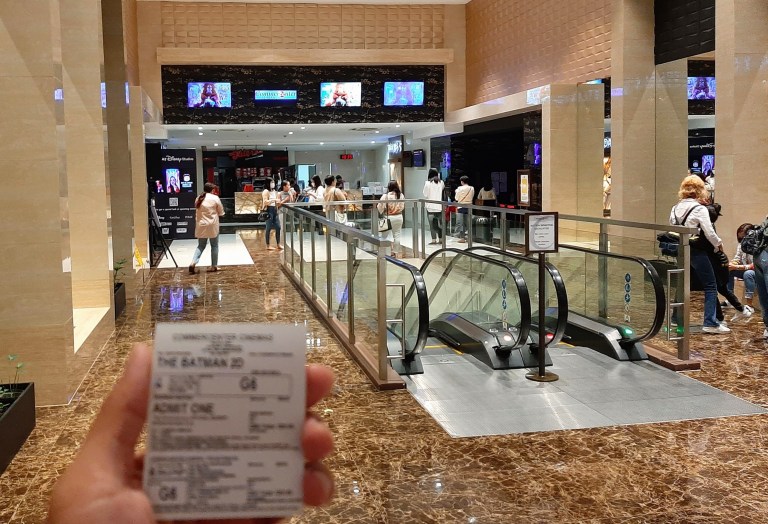
I saw The Batman at Commercenter’s cinema on March 2022.
As of this writing, the direction of the entire cinema industry of the Philippines remains uncertain and so far there were no real breakthroughs that happened. That being said, I still remember when in 2015, there were long lines of moviegoers at Commercenter waiting to enter the cinemas to watch Jurassic World. Such a memory won’t be repeated here in Alabang and without its cinemas, Commercenter’s value as a place for fun has gone way down.
Welcome back my readers, YouTube viewers and all others who followed this series of articles focused on YouTube videos worth watching. Have you been searching for something fun or interesting to watch on YouTube? Do you feel bored right now and you crave for something to see on the world’s most popular online video destination?
I recommend you check out the following topics and the related videos I found.
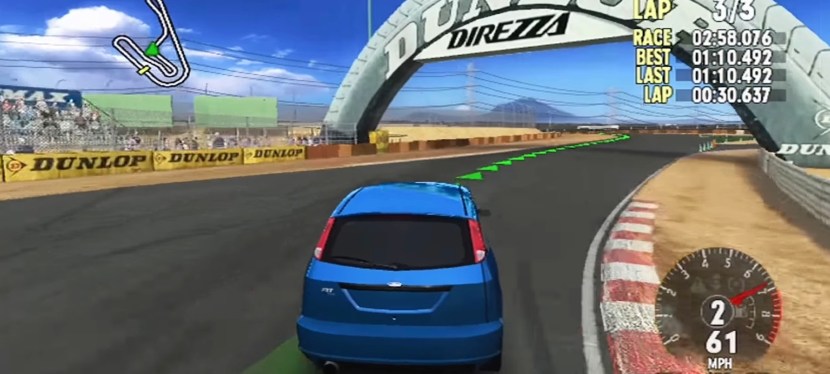
#1 Forza Motorsport (2005) revisited – The first time I ever played first-ever Forza Motorsport video game was on a rented original Xbox console in 2005. Right from the start, I was very impressed with how realistic yet accessible the game played even as it was designed by Turn 10 as a simulation. Years later, I played the succeeding Forza Motorsport games and became a fan of the series on Xbox consoles. It was delightful for me to watch the Forza Motorsport retrospective video by YouTuber Camp Xbox which you can view below.
#2 You, Me and the Movies react to the Teenage Mutant Ninja Turtle movies of 1990 and 1991 – Here in the Philippines, I saw the films Teenage Mutant Ninja Turtles and Teenage Mutant Ninja Turtles II: The Secret of the Ooze in local cinemas in 1990 and 1991 respectively. Each viewing experience was in a fully packed cinema which was not surprising because the TMNT franchise – specifically the animated series on TV – was already very popular among Filipinos and there was excitement to see the live-action versions of the popular turtles, Splinter, Shredder and April O’Neil. That being said, you should see You, Me and the Movies’ reaction videos of the two films.
#3 Israeli Air Force flies over the funeral of Hezbollah’s late leader – Several months after the successful elimination of Hezbollah leader and terrorist Nasrallah, a funeral for him was held in Lebanon and there were officials from terrorist state Iran who attended. And then something happened…fighter jets of the Israeli Air Force flew over the funeral and literally took the thunder away. The terrorist group of Hezbollah got very humiliated. Watch the analytical video of Hananya Naftali below.
#4In-depth look back at the “DCEU” movies – Remember the DC superhero movies of the so-called DCEU (DC Extended Universe)? This year, Warner Bros., DC and director James Gunn will release an all-new Superman movie and now is a good time to look back at the previous franchise of DC superhero movies released from 2013 to 2023, and I found a very comprehensive video from YouTuber FilmyHead for you to watch.
#5 PatmanQC examines Escape from the Planet of the Robot Monsters – I never got to play the late-1980s game Escape from the Planet of the Robot Monsters in the arcade nor any of its ports. Being curious, I took time out to watch PatmanQC’s video about the game. It turns out, the game itself is an inspired piece of work and it was made by Atari. I urge you to watch the video below.
#6 Popcorn in Bed reacts to Starship Troopers – When it was first released in 1997, a lot of movie critics and moviegoers did not fully understand the themes and meaning of Starship Troopers. While many viewed it as a big-budget, loud and action-packed sci-fi flick, there was a minority of people who realized director Paul Verhoeven’s (RoboCop, Total Recall) use of irony within the narrative. Months ago, Popcorn in Bed posted her reaction video and you should see how the film affects her.
#7 Ashleigh Burton reacts to The Thomas Crown Affair – Remember watching The Thomas Crown Affair in 1999? Some people perceived it as a clever remake of the 1968 original while there were others who found it to be Pierce Brosnan’s most notable non-James Bond role of the 1990s. Recently, Ashleigh Burton saw the film and you must watch her reaction video below.
Disclaimer: This is my original work with details sourced from reading the comic book and doing personal research. Anyone who wants to use this article, in part or in whole, needs to secure first my permission and agree to cite me as the source and author. Let it be known that any unauthorized use of this article will constrain the author to pursue the remedies under R.A. No. 8293, the Revised Penal Code, and/or all applicable legal actions under the laws of the Philippines.
Welcome back superhero enthusiasts, 1990s arts and culture enthusiasts, Marvel Comics fans and comic book collectors! Today we go back to the year 1990 to take a close look at the comic book adaptation of the movie RoboCop 2 (1990).
Before getting to the new retro comic book review, I should state that my friends and I had a fun time watching RoboCop 2 in the cinema shortly after it opened here in the Philippines. Back then, I was not yet a comic book collector and I rarely visited comic book specialty stores. That being said, I was unaware that Marvel Comics actually published an adaptation in the form of a 3-issue mini-series.
With those details laid down, here is a look back at RoboCop 2 #1, published in 1990 by Marvel with a story written by Alan Grant and drawn by Mark Bagley based on the movie screenplay by Frank Miller and Walon Green.
The cover.
Early story
The story begins in Detroit where the cops are run by corporations and the streets have turned into red-alert war zones. Crime is overwhelming the city and the highly addictive narcotic poses the greatest threat facing societies. The surgeon general who made the public warning about nuke was killed and the crime boss Cain (leader of a cult of nuke addicts and pushers) claims responsibility. Through the news media, Cain tells the public that nuke will make people’s problems go away and people want its paradise.
Under the management of Omni Consumer Products (OCP), several of Detroit’s police officers go on strike demanding better terms from their employer. The City Government of Detroit under Mayor Kuzak missed a payment (in relation to them owing $37 million) and OCP begins to move to foreclose the city and its assets in accordance to the terms of the contract. Mayor Kuzak accuses OCP of engineering the police strike which made crime rampant.
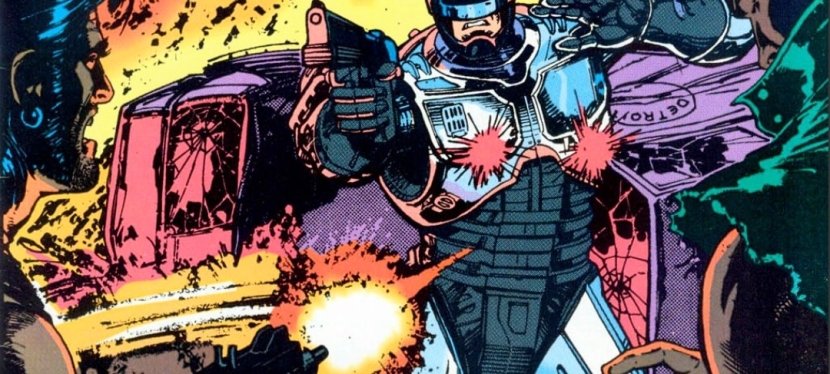
Elsewhere in the evening, the cruel activities of the thugs got disrupted by the arrival of a police car. Even though the police car got destroyed by the thugs, RoboCop emerges and begins to fight back…
Quality
There is simply no holding back for RoboCop when it comes to doing police work at a time when many police officers are on strike while crime has turned more rampant in Detroit.
This opening issue of the mini-series sticks close the basic plot of the movie (right until after Cain’s gang dismantled RoboCop) although there were a few notable differences with the sequence of events and there were scenes that showed the creative team took liberties to make the story suitable with the literary format in mind. That being said, don’t expect to see the key moments of the movie look exactly the same in this comic book and don’t expect to see the characters here looking like the actors who played them on the big screen. In terms of visual and literary presentation, this adaptation has a lot in common with the Total Recall comic book adaptation which coincidentally was released the same year.
For me, this is indeed a really readable comic book that has its stylized approach on telling the movie’s concept. OCP is the most powerful entity in the story while Cain and his gang are clearly the force of evil that strongly pose danger not only to Detroit’s people but even to the very divided police force. Nuke as the dangerous object of the plot clearly was inspired from elements of the real life war against drugs in 1980s America which made this story socially relevant.
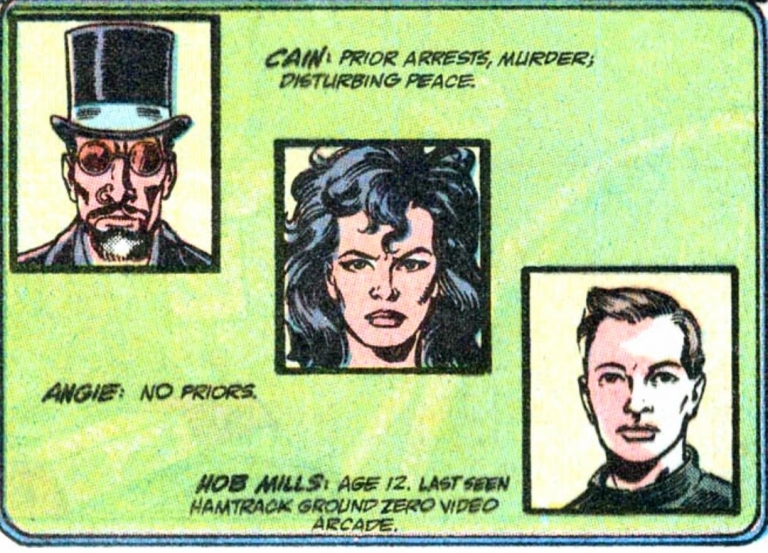
Very clearly these villains look nothing like actors Tom Noonan, Galyn Görg and Gabriel Damon.
Like in the movie, RoboCop here performs his law enforcement duty in an uncompromising manner even though memories of his past life as officer Murphy re-emerged deep inside. That being said, there are a few moments in which you might sympathize with the titular hero as this comic book pays close attention to the conflict between humanity and technology.
The action scenes here are sufficient but clearly don’t come anywhere close to the intensity of the film in terms of violence. Still, there is enough action for readers to enjoy.
When it comes to the visuals, the artwork done by Mark Bagley eerily looks comparable with Tom Lyle’s art in the Total Recall comic book of 1990. For the newcomers read this, Bagley became a popular artist through the Amazing Spider-Man monthly series and the Venom: Lethal Protector comic books that were released after years after this one. Having seen many of Bagley’s works published in 1992 to 1995, I can hardly recognize his art style in this comic book adaptation. The way he drew people’s faces in this comic book looks very different from those seen in Amazing Spider-Man issues. At the same time, Bagley’s own take on RoboCop has that balanced approach on depicting humanity with machinery while also making the hero look less bulky compared to the movie’s version.
Conclusion
Julie Faxx of OCP sure talks like a woke nut and rabid feminist in this scene.
RoboCop 2 #1 (1990) is clearly not a faithful adaptation of selected parts of the movie but that’s not necessarily a bad thing. This is more about the Grant-Bagley team doing their own visual presentation of the movie script copy they had and ultimately they succeeded in making this comic book a stylized and worthy reading experience. This is indeed a surprisingly entertaining read and I can say that I am looking forward to reading the next issue.
Disclaimer: This is my original work with details sourced from watching V: The Final Battle and doing personal research. Anyone who wants to use this article, in part or in whole, needs to secure first my permission and agree to cite me as the source and author. Let it be known that any unauthorized use of this article will constrain the author to pursue the remedies under R.A. No. 8293, the Revised Penal Code, and/or all applicable legal actions under the laws of the Philippines.
With a very engaging story, memorable characters, intriguing concepts and innovative marketing, the $13 million production V: The Original Miniseries (simply called V back then) became a major TV hit in America over two nights in May, 1983. I personally loved watching the said mini-series back in the 1980s and I still love replaying it in this age of high-definition and Blu-ray discs. For me, at least, it is a timeless classic and it carries several lessons about the fragility of society, the rise of fascism, the spread of evil in many forms and the human desire for freedom from oppression.
The cover and the title that did not live up to its purpose.
Early story
The story begins with Mike Donovan (Marc Singer) having a nightmare of him and his son Sean (who was abducted during the events of V: The Original Miniseries) in a desperate escape attempt while inside one of the motherships of the Visitors. He wakes up in the presence of Julie Parrish (Faye Grant) and realizes they have a dangerous mission to execute at a local facility used by the red-uniformed Visitors. It turns out, the Resistance movement led by Julie has been losing ground to the alien humanoids and Mike has been helping them out while prioritizing the state of his son who has been in captivity in one of the mother ships.
During the night, a truck carrying many local civilians inside its trailer arrives at a local factory controlled by the Visitors with officer Steven (Andrew Pine) watching over. After the civilians got directed to enter the factory, it turns out they got processed and came out in the form of food cocoons. The sight shocks Julie watching from a distance with her armed teammates waiting on stand-by.
Easily the most engaging shot in this sequel. A clear reminder about the fascist takeover by the aliens from outer space.
After causing damage on the nearest fence, the Resistance begins their attempt to raid the facility and free their fellow cocooned people but the tide turned against them. It turns out, the Visitors’ troops are wearing stronger armor and bright lights were installed on the top of the facility to forcing Julie, Marc and the rest of their team to retreat. They lost some members along the way. During a closed-door meeting with the Resistance stakeholders, Mike Donovan says a key event is needed to make a significant gain against the Visitors.
Over at the mothership hovering over Los Angeles and in the presence of Diana (Jane Badler), the leader John (Richard Herd) tells Kristine Walsh (Jenny Sullivan) that a major medical announcement will be held in the form of an organized special event very soon and that she will be part of the presentation for the global TV audience…
Quality
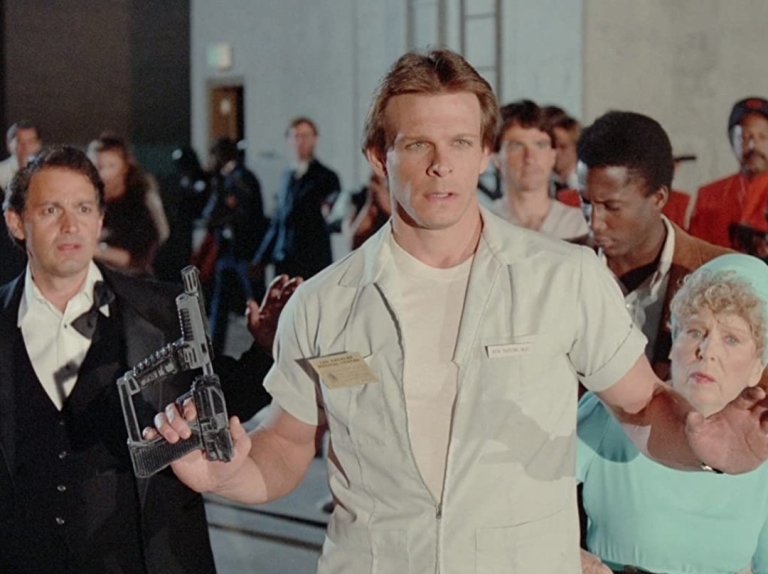
Marc Singer as Mike Donovan with Michael Durrel and Michael Wright as Robert Maxwell and Elias Taylor near him.
I’ll star first with the presentation here. This sequel mini-series was composed of three episodes totaling over 270 minutes. In what looks like to be attempts to ensure more spectacles for the viewers’ enjoyment, each episode of V: The Final Battle has a battle near the end and the creative team succeeded in not only providing on-screen action but also scored well in making the spectacle more varied while still making sense within the main narrative. For the most part, this sequel is indeed a natural progression of what was established in V: The Original Miniseries and that is something to admire given the fact that V creator Kenneth Johnson left this production early.
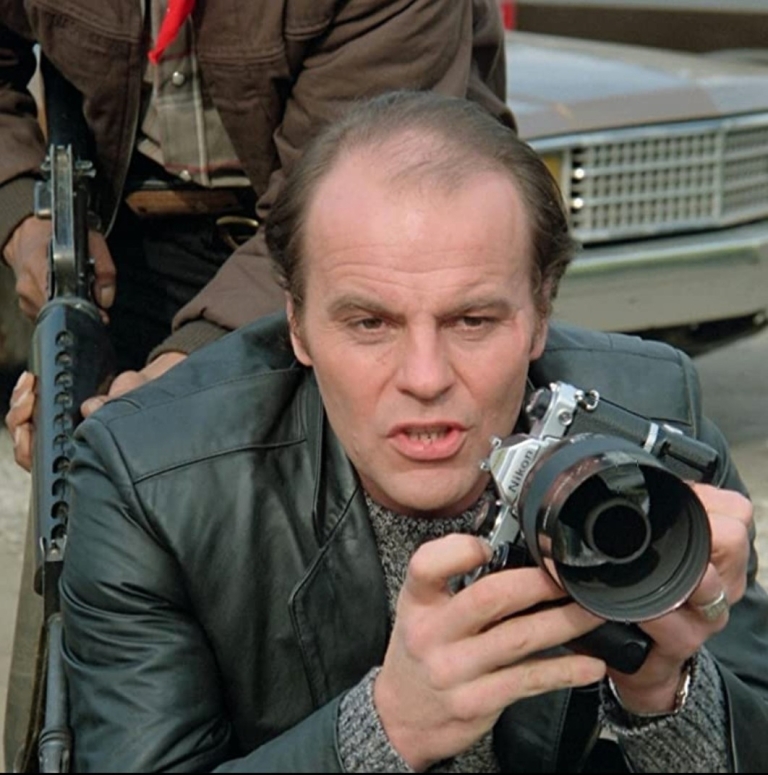
On the storytelling, V: The Final Battle expands a bit on the Visitors’ dictatorship of Los Angeles and its surrounding areas while the Resistance led by Julie Parrish and supported by close companions Robert Maxwell (Michael Durrell), Elias Taylor (Michael Wright) and Caleb Taylor (Jason Bernard) are shown to be struggling on taking down the alien humanoids even though they secured noticeably more weapons and equipment. The storytelling and the dramatization about the Resistance changes dramatically with the addition of Ham Tyler (Michael Ironside) and partner Chris Farber (Mickey Jones) in the 2nd episode and from that point on, you get to see a human opposition that becomes more flexible with their operations.
Michael Ironside as Ham Tyler is the most significant new addition to the cast.
As mentioned earlier, Kenneth Johnson’s involvement in this sequel was minimal and it is seen on the presentation. The symbolism Johnson implemented in the original mini-series that established parallels between 1980s America to the Nazi occupation of Europe did not continue here which results a more straightforward presentation of details, character moments and story progression. There was also a noticeable lack of suspense when it comes to executing big scenes with big reveals. The pacing, like in the 1983 mini-series, moves smoothly at a moderate pace throughout and there were no boring moments at all.
The quality of script is still good. For the most part, the writers managed to capture the essence of the established characters from the original mini-series as they told the further developments of this sequel. For example, Caleb and Elias’ father-and-son moments quickly remind me of what I saw in V: The Original Miniseries. Robert Maxwell’s struggle to help his troubled daughter Robin (Blair Tefkin) while assisting Julie and the Resistance is a very natural progression of what was shown in 1983. The friendship between good natured alien Willie (Robert Englund) and Harmony (Diane Cary) got developed a lot more than expected eventually adding to one particular side of the conflict. The local collaborators Daniel Bernstein (David Packer) and Eleanor Dupres (Neva Patterson) developed further with their treason towards their fellow humans as they enjoyed further the power they gained from the Visitors. These two characters will surely get on the nerves of viewers rooting for the Resistance.
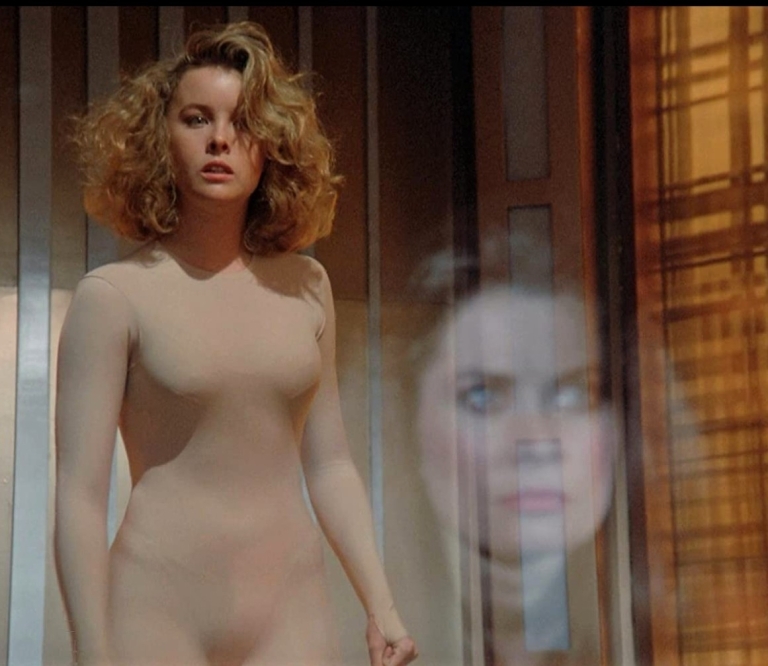
Denise Galik as Maggie is a fine new addition to the cast.
David Packer returns as Daniel Bernstein.
Sarah Douglas as Pamela, a superior of Diana’s.
When it comes to new additions to the cast, Ham Tyler and Chris Farber are not the only new players to add depth to this sequel. There is also Maggie (Denise Galik) who is an attractive, brave and strategic Resistance member whose contribution makes an impact. On the downside, there is also Andrew Doyle (Thomas Hill) who is bad choice the creative team came up with as the on-screen representative of faith when he in fact represents religion, idolatry, rituals and distortion. On the side of the Visitors is Pamela (Sarah Douglas) who is a higher-ranking officer than Diana and even John. Pamela is the more militaristic type of leader who is more focused on achieving goals while keeping things in order.
If there is anything flawed about the characterization, it is the romantic relationship of Julie Parrish and Mike Donovan which starts in the first episode. Considering how dramatic the performances of Faye Grant and Marc Singer were in this sequel, Julie and Mike still don’t make a believable pair of lovers in my view. While this romantic relationship opens up new dimensions within Julie and Mike and offer viewers something new to focus, it brings down the former’s value as Resistance leader somewhat while also setting aside the hinted personal connection between her and Elias in the 2nd episode of the 1983 mini-series.
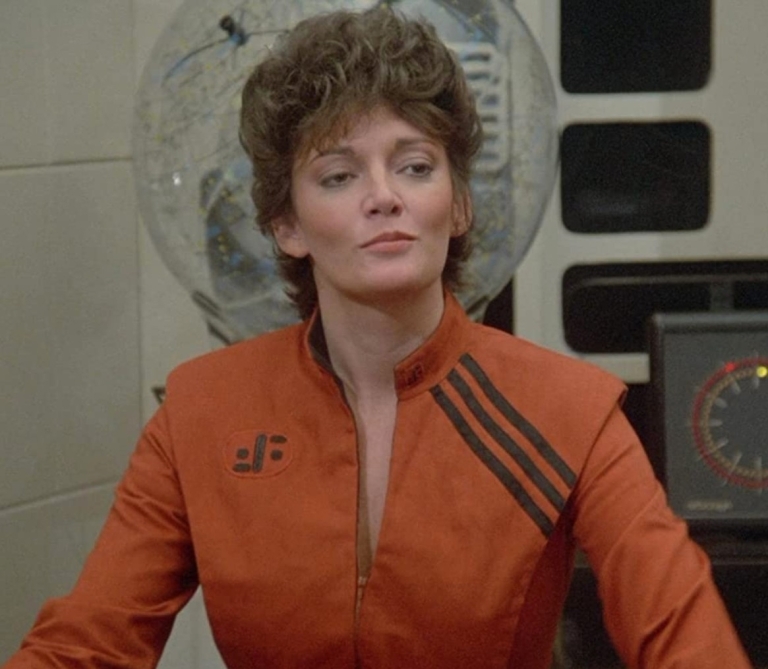
Faye Grant as Julie Parrish in the conversion process scene watched closely by Jane Badler’s Diana.
More on Faye Grant, her performance here is more varied. Not only does she play the brave and struggling leader who is talented in fighting, science and medical practice, she also portrayed Julie as an even more vulnerable character this time around. Her act as the traumatized Julie during the conversion process (read: mental and psychological torture using a more detailed form of virtual reality or nightmare generation) scenes under the watch of Diana is very dramatic and compelling to watch. Just seeing Julie in the conversion process will make grip you with despair and you will eventually feel sorry for her. I should state that the nightmare scenes of Julie were presented with a clear touch of horror.
Marc Singer as Mike Donovan is no longer the reluctant action hero but rather a driven man with a mission to get his missing son back while maintaining a secret connection with Martin (Frank Ashmore) of the Fifth Column (secret dissenters among the Visitors) hoping to achieve breakthroughs for the Resistance and their friends among the dissenting aliens. Singer did the best he could with the script provided to him and he remain likable all throughout. Other than the unbelievable romance with Julie as well as his past encounters with Ham Tyler, there is not much new to expect from the way Mike Donovan was written here. What I should point out, however, is that Mike Donovan’s support for the unholy act of abortion (along with the so-called right to abort) is very wrongful, highly immoral and makes the hero having a sinister presence within him even though he is a father searching for his son.
Jane Badler’s performance as Diana deserves admiration here. Not only did she successfully recapture the charismatic and sinister nature of her character in the 1983 mini-series, Badler was very convincing in showing the more desperate side of Diana, especially when it comes to power struggle within the ranks of the Visitors. You can clearly see the desperation and struggle as soon as Pamela appeared. This sequel also showed a lot more of Diana when it comes to personally supervising her conversion process which is much more elaborate here (note: the conversion process in the 1983 mini-series was limited to the showing of a chair with torture devices). Being the very symbol of charisma and evil in the V franchise, Diana’s place in pop culture is solid and her real-world comparative counterparts would be none other than Hillary Clinton and Kamala Harris.
Jane Badler as the ever charismatic yet very wicked Diana.
As mentioned earlier, Michael Ironside’s Ham Tyler is the most significant addition to the cast and the script. Ironside had that excellent mix of toughness, cruelty and sarcasm portrayed in here and at the same time Ham Tyler brought out very interesting and intriguing interactions with the more established Julie and Mike. As seen in entertainment history, Ironside went on to climb up the ranks in Hollywood with Total Recall (1990), Starship Troopers (1997) and in the Splinter Cell video game franchise. Ironside’s Ham is easily the fourth major character of the V franchise of the 1980s.
Going into the spectacle part of this sequel, the action is more varied as mentioned earlier and the 3-episode structure was a factor. You will see lots of shooting with the use of guns and laser blasters here and there, and with the in-story locations and props as key factors, there are action sequences that are uniquely done. There is a lot to enjoy for any V fan and casual viewers watching this sequel.
As for the special effects part of the spectacle, this one is a mixed bag similar to what was presented in the 1983 mini-series. To put things in perspective, the use of in-camera effects, practical effects and optical effects for TV back in the 1980s was ambitious. That being said, certain effect shots here did not age well such as the miniature shots looking fake (because the camera used did not have a special lens to capture visuals that would have made the miniatures look believable). I should also state that there were certain effects shots that were recycled and reused in key sequences in this sequel which remains embarrassing to see. What is even more embarrassing to see here is the very poor-quality monster effects used during the nightmare scenes (conversion process) of Julie and, more notably, the presentation of Robin’s other child. The monster effects are so fake, they are laughable to watch.
On the bright side of the special effects, the quality of the laser blasts remains good to watch right down to the precise timing with the explosions that were simulated on-set and in-camera.
Conclusion
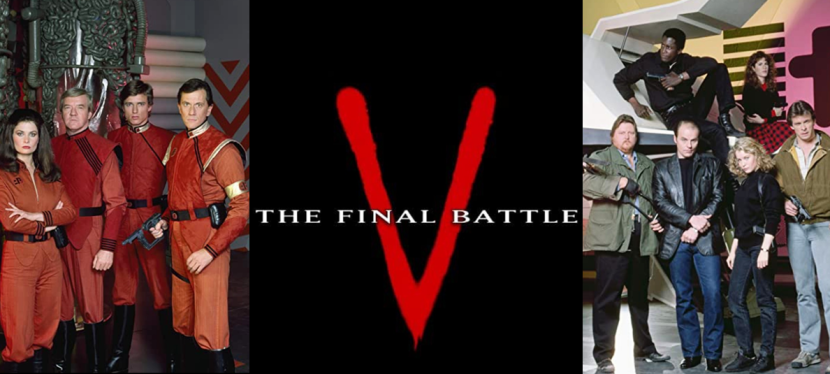
The Visitors and Resistance key characters in the sequel.
While it has its strengths and weaknesses, V: The Final Battle is still engaging and enjoyable to watch, and at the same time it is a worthy addition for your Blu-ray collection when it comes to HD viewing (note: this is the sequel with the best visuals yet albeit with black borders on the sides). Even though creator Kenneth Johnson was not too involved on the production side, the creative team managed to deliver a long story that proved to be a natural progression of the original mini-series while providing more spectacle (especially action), developing the established characters and resolving key plot threads that started in 1983.
The lack of Kenneth Johnson’s personal touch on the presentation was noticeable and somewhat brought this sequel down a bit in terms of style. What brought V: The Final Battle’s quality down were the overall cheaper looking visual effects, the Julie-Mike love relationship and the climax of the final episode which seemed executed with desperation on the part of the creative team (note: giving a little new character instant purpose). In fairness, this sequel still succeeded in showing what fascism in America (or California specifically which is now dominated by Commies) would look like and it built up on its predecessor’s themes such as the deception of power and the collaboration with foreign enemies. This mini-series even added themes of teenage pregnancy and abortion (note: someone from the creative team wanted to promote the wrongful Roe v. Wade Supreme Court decision of 1973) to its narrative.
Does V: The Final Battle live up to its title? Absolutely not because a regular TV series that deteriorated in quality followed. In retrospect, it’s clear that this sequel marked the beginning of the decline of the V franchise in pop culture. What more, V: The Final Battle was never counted as canon in Kenneth Johnson’s 2008 novel (and sequel to the 1983 mini-series) V: The Second Generation. On its own, V: The Final Battle still has more positive stuff than negative ones and in my experience, it remains enjoyable and compelling to watch from start to finish. Compared to V: The Original Miniseries, I can say this sequel falls short. It is good, not great.
Overall, V: The Final Battle (1984) is recommended. That being said, let this 1984 mini-series remind you that there is so much evil in the real world in the forms of Iran, the terrorists of Palestine, the social justice warriors (SJWs), the Black Lives Matter (BLM) movement and liberal media to name some. Always keep in mind to avoid becoming evil no matter how tempting power in this divided world becomes to you. You also do not want to let the evil ones take over your government and have authority over you, your family members and your community. Push back against evil and stand up strong by faithfully taking sides with the one true Savior whose name is Jesus!
+++++
Thank you for reading. If you find this article engaging, please click the like button below and also please consider sharing this article to others. If you are looking for a copywriter to create content for your special project or business, check out my services and my portfolio. Feel free to contact me with a private message. Also please feel free to visit my Facebook page Author Carlo Carrasco and follow me on Twitter at @HavenorFantasy as well as on Tumblr at https://carlocarrasco.tumblr.com/
Disclaimer: This is my original work with details sourced from playing Flashback: The Quest for Identity and doing personal research. Anyone who wants to use this article, in part or in whole, needs to secure first my permission and agree to cite me as the source and author. Let it be known that any unauthorized use of this article will constrain the author to pursue the remedies under R.A. No. 8293, the Revised Penal Code, and/or all applicable legal actions under the laws of the Philippines.
We live in an age in which software exclusivity defines not only the relevance of game consoles but also nature of the entire video game industry right down to the many varied communities of very avid fans (and fanboys).
While the Super Nintendo Entertainment System (SNES or Super NES) and Sega Genesis each had their own exclusive games back in the 1990s, there was one particular game that was made for and released on not just one, not two but rather on more than fifteen different platforms – both consoles and computers – starting with Amiga way back in 1992. That game is none other than Flashback: The Quest for Identity which I first played on our Super NES back in 1994.
The cover of the game box.
For the newcomers reading this, Flashback was a 2D side-scrolling adventure game in the form of a cinematic platformer (note: similar to Prince of Persia and Out of This World) with a strong flavor of science fiction. It was cinematic in the sense that all the in-game animation were rotoscoped resulting unique smoothness combined with hand-drawn backgrounds and the computer-generated cutscenes were used in key parts of the game as the story progressed. Flashback on SNES in America even came with a Marvel Comics-published Flashback comic book and on the rear of the SNES game box were the words “The first CD-ROM game in a cartridge!”
A Flashback remake was released in 2013, followed by a port of the original game released on Sega Dreamcast in 2017, and a remastered version got released for varied platforms in 2018.
I got to play that game at a time when I have not even started playing Final Fantasy II (AKA Final Fantasy IV), Final Fantasy III (AKA Final Fantasy VI) and other great role-playing games (RPGs) of the Super NES. I also remember that Flashback was a nice change of pace for me after playing Super Star Wars: The Empire Strikes Back.
With those details laid down, here is a look back at Flashback: The Quest for Identity, released on Super NES in 1993 by U.S. Gold and developed by Delphine Software International.
The start and options screen.
Early story
The story begins with Conrad running away from two armed persons chasing him. He flies away riding a solo vehicle but those chasing him (riding a huge vehicle) managed to get close and blast his vehicle causing to crash into the forest.
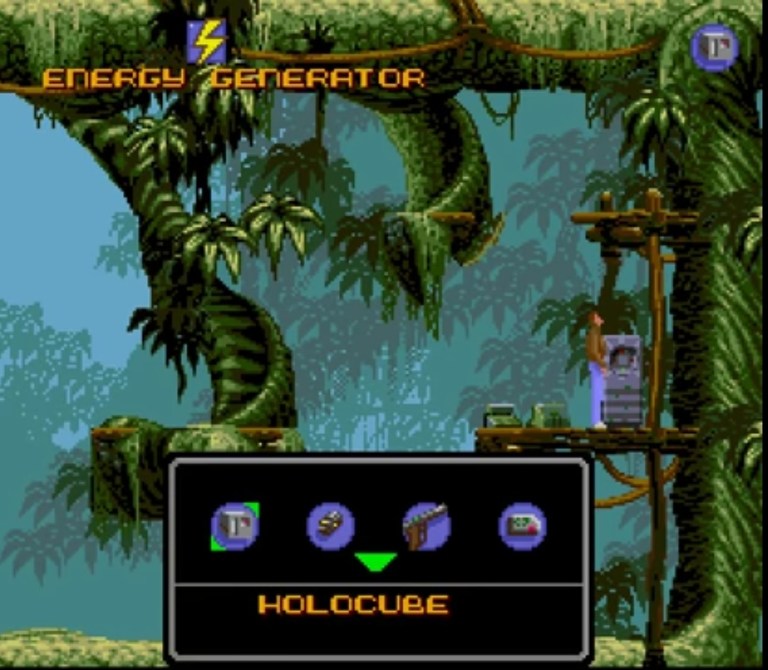
Sometime later, he wakes up and accidentally pushes a mechanical cube to fall down. He climbs down to reach it and activates it. The cube displays a holographic video of himself telling him that he recorded it without remembering it. As Conrad watches, he learns that he must contact a friend named Ian who can explain important things to him.
After viewing the message, Conrad sets off to find his way out of the jungle and somehow get to Ian in New Washington…
Game design and quality
You have to pay close attention to what’s going on, what items do you have and what the in-game prompts tell you.
This game is not your typical fast-paced, action-oriented 2D side-scrolling adventure in which you move from left to right to progress. As it is a cinematic platform game by design complete with very specific controls, players will have to be patient, adaptive and strategic in order to learn how exactly you can control your character, what moves will be executed (and when to execute). For one thing, the very fluid 24 frames-per-second animation on your character limits you in terms of control as timing is required.
To do things properly, you have to execute specific controls. To ascend on a lift, you press Up and the Y button. To do a small jump, have your character stand still and then press Up and Y button. To go down on level (on foot, no lift), stand by the edge of a level then press Down and Y button. To run and hang on to a higher floor automatically, have your character stand still, press Right and Y button, press Y button (once your character moves) and watch him pull it off. With controls like these, the usual 2D platforming approach is out of the question. In my experience, these controls are indeed challenging but never impossible to learn and eventually I got proficient with the controls as I played more.
The in-game animation for the characters are very good and there is also a sensation of weight with your character. Falling straight down from a very high place is a big no-no.
Apart from character controls, you don’t just move Conrad from one screen to the next…you also should do key objectives along the way apart from engaging in action scenes (read: shooting). That being said, you must watch out for icons that appear on screen when your character steps on a particular spot that requires interaction. For example, if you stop by a terminal, an icon will appear serving as a prompt to start the interaction. Another example is when your character steps on the same spot as an item located at which you can pick up once prompted.
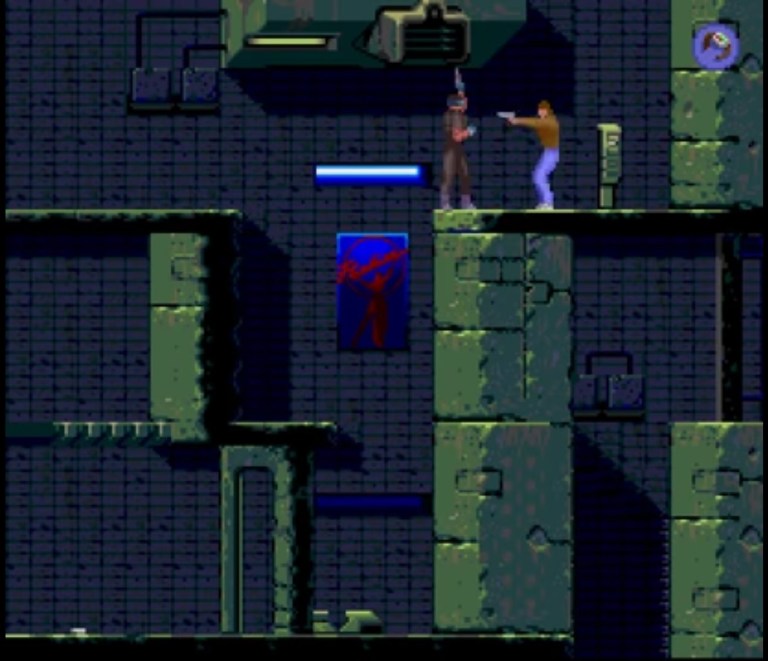
More on the action on the screen, you will encounter armed enemies as well as high-tech machines (including floating drones). To overcome them, doing straightforward shooting is not recommended as you have to be strategic before firing a shot. You have to learn how each enemy or machine moves, how much physical space is available right there and how you can maximize your limited time and space to overcome them. In fact, you will also be compelled to take advantage of whatever seconds you have while the enemies’ animation (between moves) take place. There will also be times when you need to have your character armed with the gun before jumping to a lower level where an armed enemy is located and on the lookout. Coming down armed gives you an advantage to shoot first at the enemy who
Considering the 24 frames-per-second animation, you will have to time your moves carefully, especially during moments when you face an armed enemy.
Apart from shooting, you can also use grenades which requires opening your inventory to select a grenade and then do your timing and calculation of the distance in order to pull of a successful throw and explosion. You can also throw stones to distract enemies or to apply weight on key platforms in order to open mechanical doors.
With regards to the quality of gameplay, Flashback is enjoyable but only if you get over its rather high learning curve with regards to the controls which themselves serve as the game’s advantage and even as a disadvantage. In addition to being patient and strategic, you will really have to pace yourself, think more and get used to the rather slow pace of the game in relation to its cinematic platformer design. I should state that as you keep progressing, there will be places, or new obstacles or new enemies that will compel you to change your tactics in order to overcome them. Anyone who is used to playing 2D side-scrolling games the fast and easy way might find the high learning curve and pacing of Flashback a turnoff but if they are willing to learn, adjust and pace themselves, only then can this game’s gameplay be really enjoyed.
Cut scenes like this move at a sluggish pace which shows the limitations of the SNES and cartridge technology.
As for the visuals, the obvious highlight here is the 24 FPS animation which is the result of rotoscoping and careful visualizing (note: observe those alien humanoids who morph into moving blobs). The rotoscoped animation, however, would not have been that effective had the quality of the art used for the backgrounds been made of lower quality. I can say that the background artworks here look pretty good even by today’s standards. The standout among them were the background artworks of Morph’s home planet which really looked very alien and creepy at the same time. What hurts this particular version of Flashback is the lackluster (read: choppy) frame rate whenever the computer-generated cinematic cutscenes (obviously they were meant for more powerful PCs) play which, in my experience, took me out of the story. There were also bouts of slowdown during the gameplay, especially when you encounter enough enemies that were animated sophistically.
With regards to narrative, Conrad is literally your avatar to learn, discover and interact with the many elements of the universe he is part of. There is obvious influence that the game makers took from the movie Total Recall as they crafted Conrad to be someone who lost his memory, moves on to regain it and do a lot of things as he realizes his true purpose and what is really at stake. Unlike Total Recall’s protagonist, Conrad himself is not too interesting mainly due to the way the in-game story was structured. Just play as Conrad and do what needs to be done to complete the game.
When it comes to understanding the narrative, you will have to do lots of reading. You will spot and read the short description of the prompts that appear. You’ll also have to read the on-screen text whenever your character talks with someone during the levels of the game. And there are the captions shown during the slow animated cutscenes.
Conclusion
The background artworks during the late stage of the game are great and truly creative with science fiction in mind.
I can clearly say that Flashback: The Quest for Identity on Super NESis fun and engaging mainly to those who are willing to adjust themselves to it. If you don’t have patience, if you are not willing to think while playing, if you cannot pace yourself and if you are not willing to learn all the specific controls of the game, then you should not be playing Flashback. It is a cinematic platformer and that should tell you that you will need to adjust to enjoy it.
Overall, Flashback: The Quest for Identity on SNES is recommended.
+++++
Thank you for reading. If you find this article engaging, please click the like button below and also please consider sharing this article to others. If you are looking for a copywriter to create content for your special project or business, check out my services and my portfolio. Feel free to contact me as well. Also please feel free to visit my Facebook page Author Carlo Carrasco and follow me at HavenorFantasy@twitter.com
As of this writing, there is no suggested retail price yet. Still, here are the product descriptions and specs from Blu-ray.com’s articles about The Thing 4K Blu-ray. Some parts in boldface…
SPECS
Video
Codec: HEVC / H.265
Resolution: Native 4K (2160p)
HDR: HDR10
Aspect ratio: 2.35:1
Original aspect ratio: 2.39:1
Audio
English: DTS:X
English: DTS-HD Master Audio 7.1
Subtitles
English, English SDH, French, Spanish
Discs
4K Ultra HD
Blu-ray Disc
Two-disc set (1 BD-100, 1 BD-50)
Digital
Digital 4K
Digital copy included
Playback
4K Blu-ray: Region free
2K Blu-ray: Region A
PRODUCT DESCRIPTION
DISC ONE – 4K BLU-RAY
4K RESTORATION OF THE FILM FROM THE ORIGINAL CAMERA NEGATIVE
HDR PRESENTATION OF THE FILM
DTS:X AUDIO TRACK
Audio Commentary with Director John Carpenter and Kurt Russell
John Carpenter’s The Thing: Terror Takes Shape
Outtakes
Theatrical Trailer
Optional English SDH, Spanish, and French subtitles for the main feature
DISC TWO – BLU-RAY
Main feature
Audio Commentary with Director John Carpenter and Kurt Russell
U-Control: Picture in Picture
Optional English SDH, Spanish, and French subtitles for the main feature
For those who are not too aware about this old sci-fi horror movie, The Thing tells the story of an American research team stationed in Antarctica whose lives turn upside-down after a sled dog comes to them after being hunted by a helicopter from the Norwegian research team.
Historically speaking, The Thing was released in cinemas in the United States just two weeks after Steven Spielberg’s E.T. the Extra-Terrestrial. The Carpenter-directed space alien monster film was trashed by movie critics of the time and in the American box office, Spielberg’s movie about a friendly alien creature from outer space was simply unbeatable. As time passed by, The Thing found its audience on TV and home video and its critical reception turned from negative to positive overall. In the awards circuit, The Thing was nominated for Best Horror Film and Best Special Effects (credit to Rob Bottin who went on to work on effects for RoboCop and Total Recall) in the 10th annual Saturn Awards given by the Academy of Science Fiction, Fantasy and Horror Films. Fans of actor Keith David will want to see his performance in this particular film. David also went on to work again with John Carpenter years later.
To get to know more about John Carpenter’s The Thing through trivia, watch the video posted below from Minty Comedic Arts. Be warned of potential spoilers…
Thank you for reading. If you find this article engaging, please click the like button below and also please consider sharing this article to others. If you are looking for a copywriter to create content for your special project or business, check out my services and my portfolio. Feel free to contact me as well. Also please feel free to visit my Facebook page Author Carlo Carrasco and follow me at HavenorFantasy@twitter.com
Welcome to this new series of articles titled Better than Streaming. As many of you, my readers, already know, I am not fan of streaming when it comes to watching movies and TV shows in the comfort of home. My current preference for such home entertainment is the Blu-ray disc format as well as its high-end format the 4K Blu-ray disc! I simply want the best for my personal viewing of movies and TV shows, and the advantages of disc media (specifically 4K Blu-ray) over streaming are clear and undeniable!
I personally own a lot of movies on Blu-ray and I own one Blu-ray disc of V: The Original Miniseries (which is so enjoyable and this time it was presented in high-definition). I recently started building up my personal collection of 4K Blu-ray releases with Total Recall and Wonder Woman 1984.
For this article, we can focus on two notable movies – one new and one old – that will be released on 4K Blu-ray in the middle of June 2021!
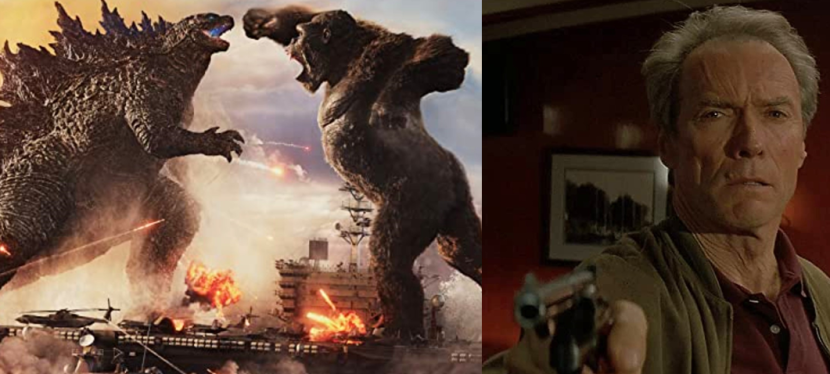
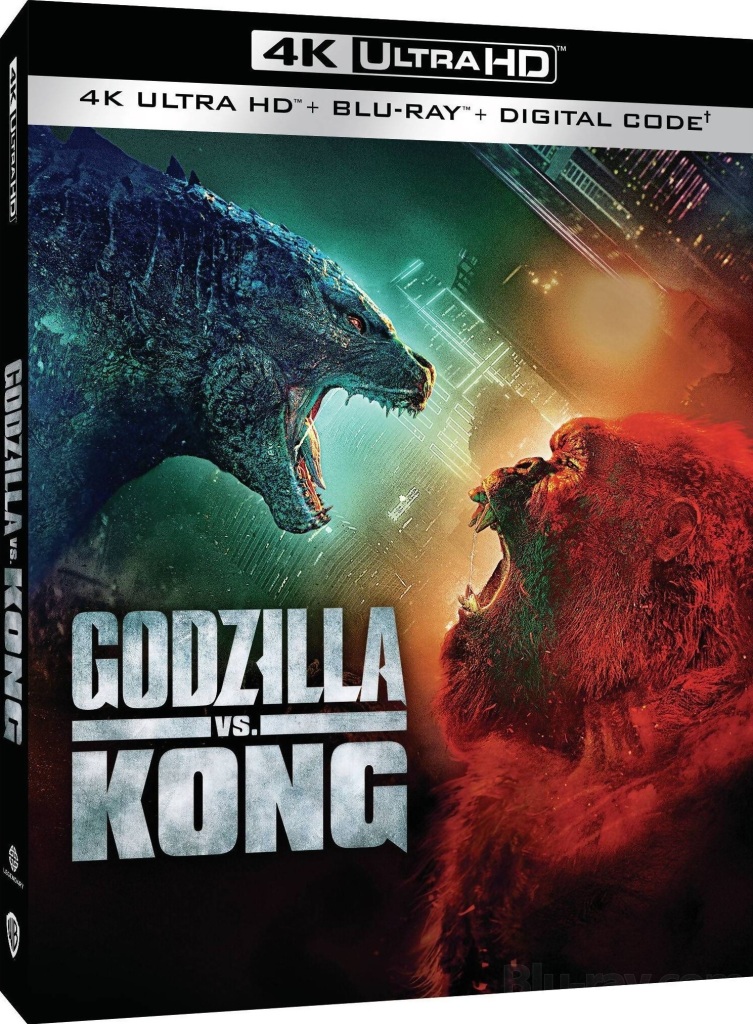
As of this writing, Godzilla vs. Kong in optic media will come with the following technical specs and special features:
ENGLISH DOLBY ATMOS AUDIO TRACK
Audio Commentary by Director, Adam Wingard
Kong Discovers Hollow Earth
Kong Leaves Home
Behold Kong’s Temple
The Evolution of Kong, Eighth Wonder of the World
Godzilla Attacks
The Phenomenon of GŌJIRA, King of the Monsters
Round One: Battle at Sea
Round Two: One Will Fall
Titan Tag Team: The God and the King
The Rise of MechaGodzilla
Optional English SDH, Latin Spanish, French, Brazilian Portuguese, Italian-SDH, Cantonese, Complex Chinese, Korean, Danish, Finnish, Norwegian, and Swedish subtitles for the main feature
Video Codec: HEVC / H.265 Resolution: Native 4K (2160p) HDR: Dolby Vision, HDR10+ Original aspect ratio: 2.39:1
Because the movie theaters here in my place remain closed due to the COVID-19 (China Virus) pandemic, I was not able to watch Godzilla vs. Kong. Along the way, I stayed away from streaming it via HBO Go because I’d rather pay for the best home viewing option which is the 4K Blu-ray release of the movie that is coming. Oh yes, Godzilla vs. Kong’s visuals have been rendered in native 4K (2160p).
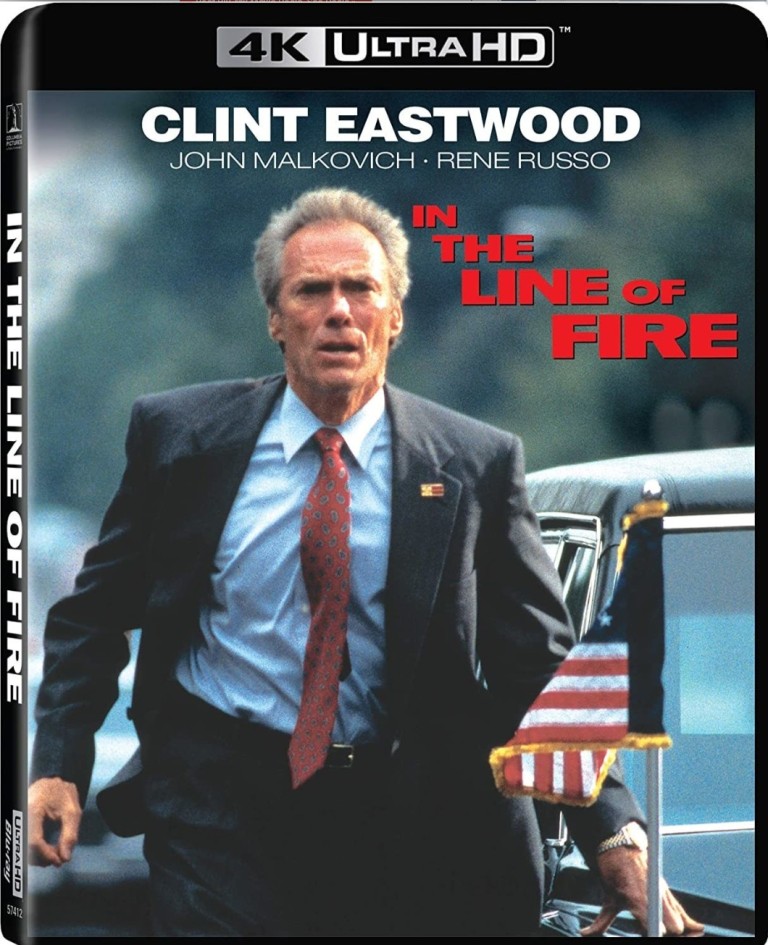
The next upcoming 4K Blu-ray release that is worth looking forward to is none other than In the Line of Fire which starred the legendary Clint Eastwood, John Malkovich (who was nominated for an Oscar for his performance in this very movie) and Rene Russo. It will be released also on June 15, 2021 and you can order it in advance right here.
The cover of the 4K Blu-ray release of In the Line of Fire.
For your reference, here are the available technical specs and features…
NEWLY REMASTERED IN 4K FROM THE ORIGINAL CAMERA NEGATIVE WITH HDR10
ALL-NEW DOLBY ATMOS TRACK + original theatrical 5.1 + original theatrical stereo
Audio Commentary with Wolfgang Petersen
5 Deleted Scenes
“The Ultimate Sacrifice” Featurette
“Catching the Counterfeiters” Featurette
“How’d They Do That” Featurette
“Behind the Scenes with the Secret Service” Featurette
Theatrical Teaser
Video Codec: HEVC / H.265 Resolution: Native 4K (2160p) HDR: HDR10 Aspect ratio: 2.39:1 Original aspect ratio: 2.39:1
I saw In the Line of Fire on video tape in 1993 and on DVD in 2001. I would love to replay the movie with native 4K visuals and see how good the promised new remaster for the 4K Blu-ray will turn out. In pop culture, In the Line of Fire was kind of like a reintroduction of Clint Eastwood to the public and helped younger moviegoers in 1993 (especially those who missed out on his Dirty Harry and cowboy movies) get to know him and his cinematic art better. In the Line of Fire was directed by Wolfgang Petersen and apart from getting solid performances from the cast, he successfully told a compelling story and presented really good hard-action scenes.
So there you have it! June 15, 2021 will be an exciting day for 4K Blu-ray enthusiasts as well as those who love King Kong, Godzilla and Clint Eastwood! While there are indeed a lot of other movies coming out on 4K Blu-ray in the month of June, Kong vs. Godzilla and In the Line of Fire are the standouts for those who love spectacle.
Before I end this article, let me ask you readers – Do you have a large collection of 4K Blu-ray movies right now? What do you enjoy most about watching movies or TV shows in 4K resolution? What is the one movie or TV show you wish will be released soon on 4K Blu-ray format?
Thank you for reading. If you find this article engaging, please click the like button below and also please consider sharing this article to others. If you are looking for a copywriter to create content for your special project or business, check out my services and my portfolio. Feel free to contact me as well. Also please feel free to visit my Facebook page Author Carlo Carrasco and follow me at HavenorFantasy@twitter.com
Disclaimer: This is my original work with details sourced from reading the comic book and doing personal research. Anyone who wants to use this article, in part or in whole, needs to secure first my permission and agree to cite me as the source and author. Let it be known that any unauthorized use of this article will constrain the author to pursue the remedies under R.A. No. 8293, the Revised Penal Code, and/or all applicable legal actions under the laws of the Philippines.
Like any geek, I still love watching Terminator 2: Judgment Day, specifically its extended version which was James Cameron’s true vision. I’m not exactly a fan of Arnold Schwarzenegger, but I really love his work in T2 as well as in Total Recall. When it comes to James Cameron’s works, I personally prefer T2 over Avatar, Titanic and True Lies.
As for the Terminator franchise itself, it spawned cinematic sequels that only turned up as disappointments. Terminator 2 was indeed the high point of the film franchise and everything really went downhill afterwards. I should state that Terminator: Dark Fate should be avoided as it is not worth your time and money.
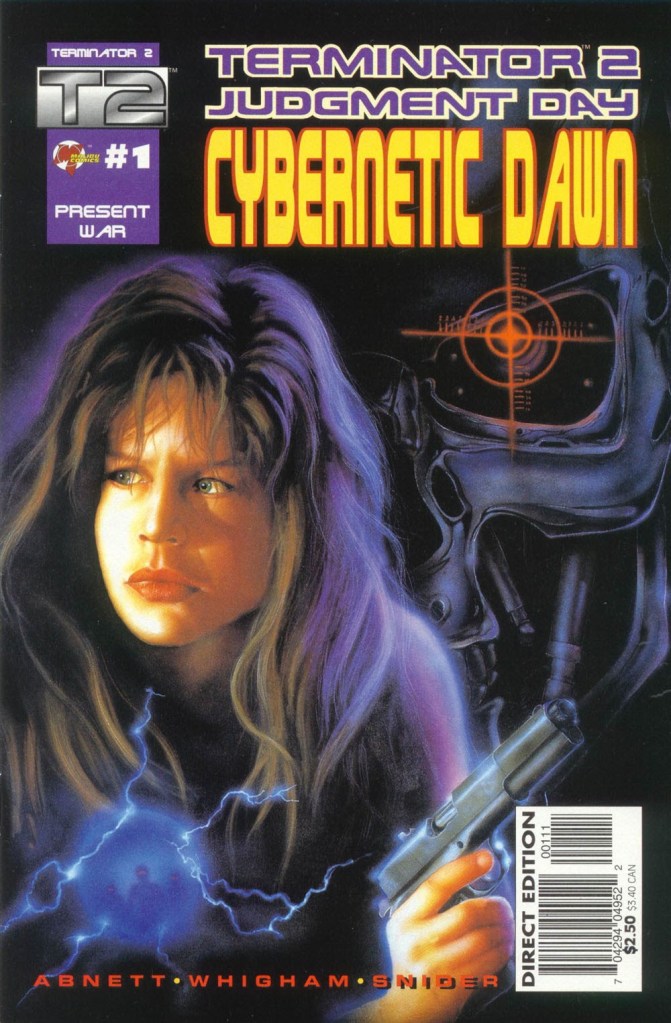
Recently, I searched for some comic books that served as sequels to Terminator 2 and I found one from the mid-1990s and it is a direct follow-up! We can find out more in this look back at Terminator 2: Cybernetic Dawn #1, published in 1995 by Malibu Comics with a story written by Dan Abnett and Rod Whigham.
The cover.
Early story
The story begins immediately after the end of Terminator 2 with the injured Sarah Connor (with a very exhausted John Connor sleeping) still managing to drive the car in the middle of the night. As she drives, Sarah recalled that she never asked for the responsibility of preserving mankind as it was forced on her way back in 1984. She also recalled the time in Tech Noir when the Terminator almost killed her as she got saved by Kyle Reese.
By morning, Sarah and John reached the desert and returned to the lonely home of her old ally Enrique. Suddenly a man with a shotgun comes out and aims his weapon directly at Sarah. Carrying a gun, John comes out to help his mother…
Quality
John and Sarah Connor.
Let me start with the story and make clear to you readers that this comic book easily defies the conclusion that was set in the movie Terminator 2. If you have seen the film, you should be aware that the way it was concluded made sure there is no more future war and no more Terminators. Like the 2003 movie Terminator 3: Rise of the Machines, this comic book just kept on pushing the concept that Judgement Day and the war with the machines are still inevitable and that Terminators from the future would only continue to arrive to hunt and kill John. As such, the hard struggle for Sarah and her son continues.
That being said, this comic book really pushed hard with its sequel approach. Remember what happened in the steel mill in Terminator 2? Several personnel investigated the facility and one particular detective arrived searching for Sarah Connor who has been labeled as an escapee from the state hospital. Inside the steel mill is the severed left arm of the Terminator (which got stuck to crushing mechanical wheels as seen in the 1991 movie) which is the storytelling key the comic book creators used to justify this sequel.
To the comic creators’ credit, they did their research about T2 and even made references to other characters of that movie. As a result, this comic book appears loaded with fan service.
Even though it has many references and connections to the 1991 movie, this comic book also has some completely new stuff to expand on T2’s concept. The destruction of Cyberdyne’s facility in the movie resulted an emergency meeting of a corporation’s board of directors (and a certain senator) which creatively sets up further conflicts as well as struggles for Sarah and her son.
In terms of writing, this comic book’s story is cohesive enough. As for the art, the quality is fine and most notably, the illustrator managed to somewhat capture the likeness of Linda Hamilton on Sarah Connor.
Conclusion
The severed Terminator arm as the single factor that justified this sequel somewhat.
I can say that Terminator 2: Cybernetic Dawn #1 (1995) is a surprisingly satisfying read mainly due to its writing and artistic quality. While its push to justify a sequel barely succeeds, there is more good stuff than negative ones overall. As far as making sequels to Terminator 2 is concerned, this one is somewhat more believable than the 2003 movie.
If you are seriously planning to buy an existing hard copy of Terminator 2: Cybernetic Dawn #1 (1995), be aware that as of this writing, MileHighComics.com shows that the near-mint copy of the comic book costs $19.
Overall, Terminator 2: Cybernetic Dawn #1 (1995) is satisfactory.
+++++
Thank you for reading. If you find this article engaging, please click the like button below and also please consider sharing this article to others. If you are looking for a copywriter to create content for your special project or business, check out my services and my portfolio. Feel free to contact me as well. Also please feel free to visit my Facebook page Author Carlo Carrasco and follow me at HavenorFantasy@twitter.com
Disclaimer: This is my original work with details sourced from reading the comic book, watching the movie and doing personal research. Anyone who wants to use this article, in part or in whole, needs to secure first my permission and agree to cite me as the source and author. Let it be known that any unauthorized use of this article will constrain the author to pursue the remedies under R.A. No. 8293, the Revised Penal Code, and/or all applicable legal actions under the laws of the Philippines.
I already published that I really love the 1990 sci-fi action movie Total Recall which starred Arnold Schwarzenegger, Sharon Stone, Michael Ironside and Rachel Ticotin under the direction of the highly talented Paul Verhoeven. The movie is one of my all-time favorites and most notably it has aesthetics that are totally unique mainly due to the combined expressions and artistry of Schwarzenegger and Verhoeven. Behind it all, Total Recall would not have been realized without the short story We Can Remember It For You Wholesale written by the late sci-fi author Philip K. Dick whose published works led to other movies from Hollywood.
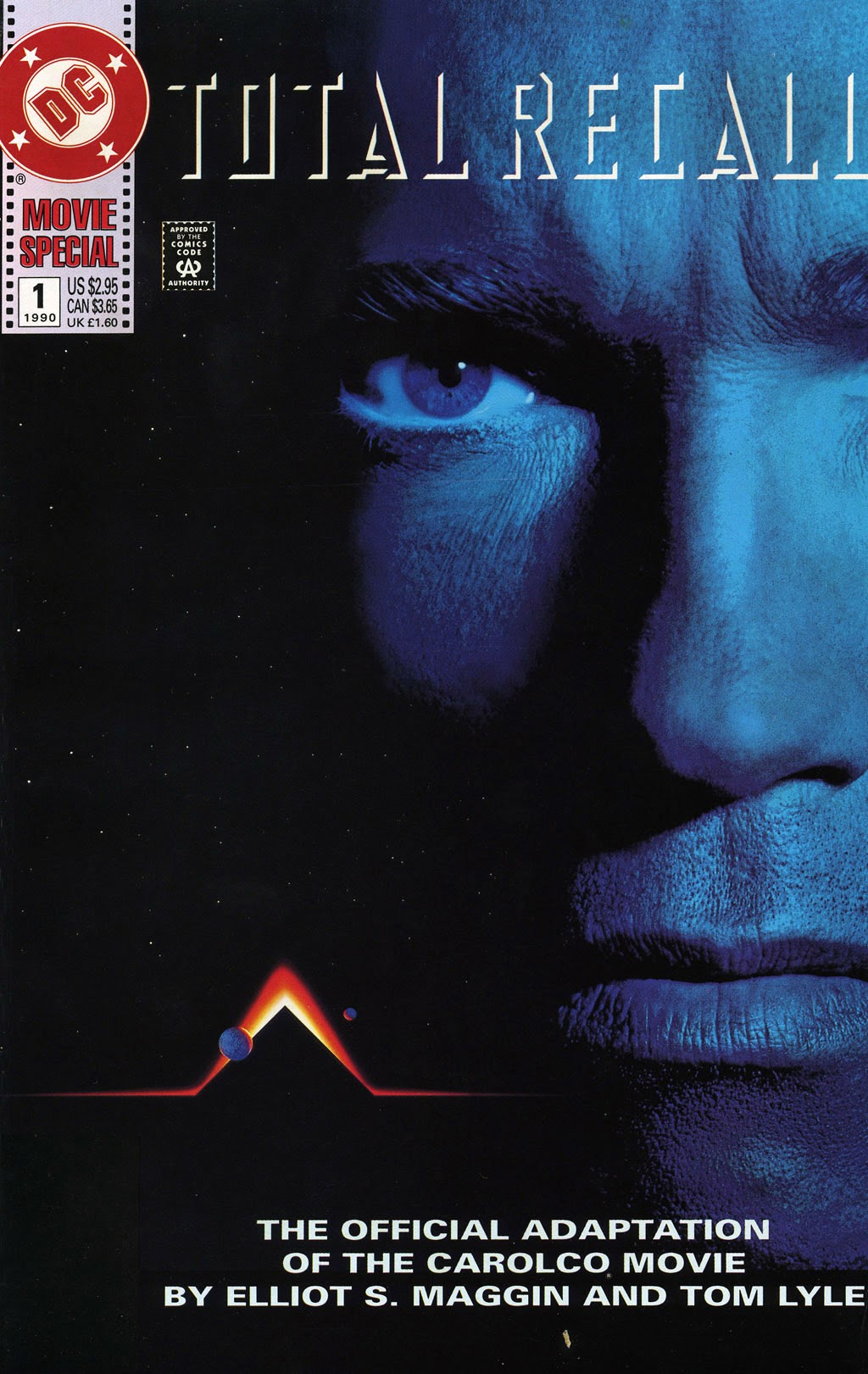
As part of a business strategy, Total Recall also had multi-media releases in the form of a novel (by Piers Anthony), video games and a comic book published by DC Comics. Very recently I was able to finally read the comic book adaptation of the film titled Total Recall Movie Special #1. It had a cover that was technically a copy of the American movie poster with Arnold Schwarzenegger’s face dominating it and it came with a cover price of $2.95 which was pretty high for 1990.
Is the comic book adaptation any good? Does it capture the essence of the blockbuster film? We can find out by finally starting this look back at Total Recall Movie Special #1, published in 1990 by DC Comics with a story written by Elliot S. Maggin and drawn by the late Tom Lyle (read my first article of Lyle’s work).
The cover of the comic book.
Early story
The story begins on the surface of planet Mars where a man and a woman (both wearing space suits) walk together heading towards an unknown destination. Suddenly a small stone cracks the glass face shield of the man’s helmet exposing him to the deadly atmosphere of Mars.
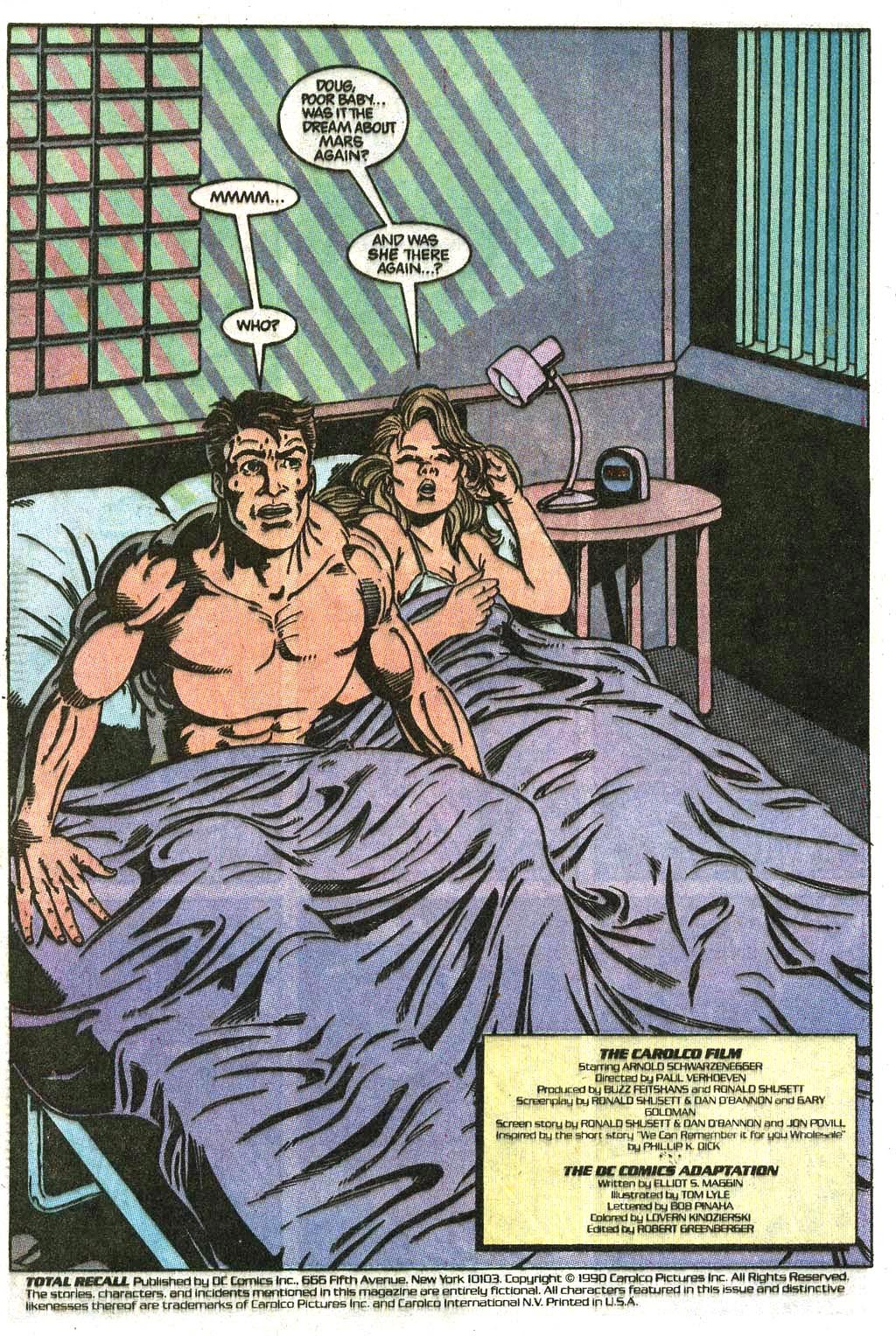
Like in the movie, Douglas Quaid and Lori wake up.
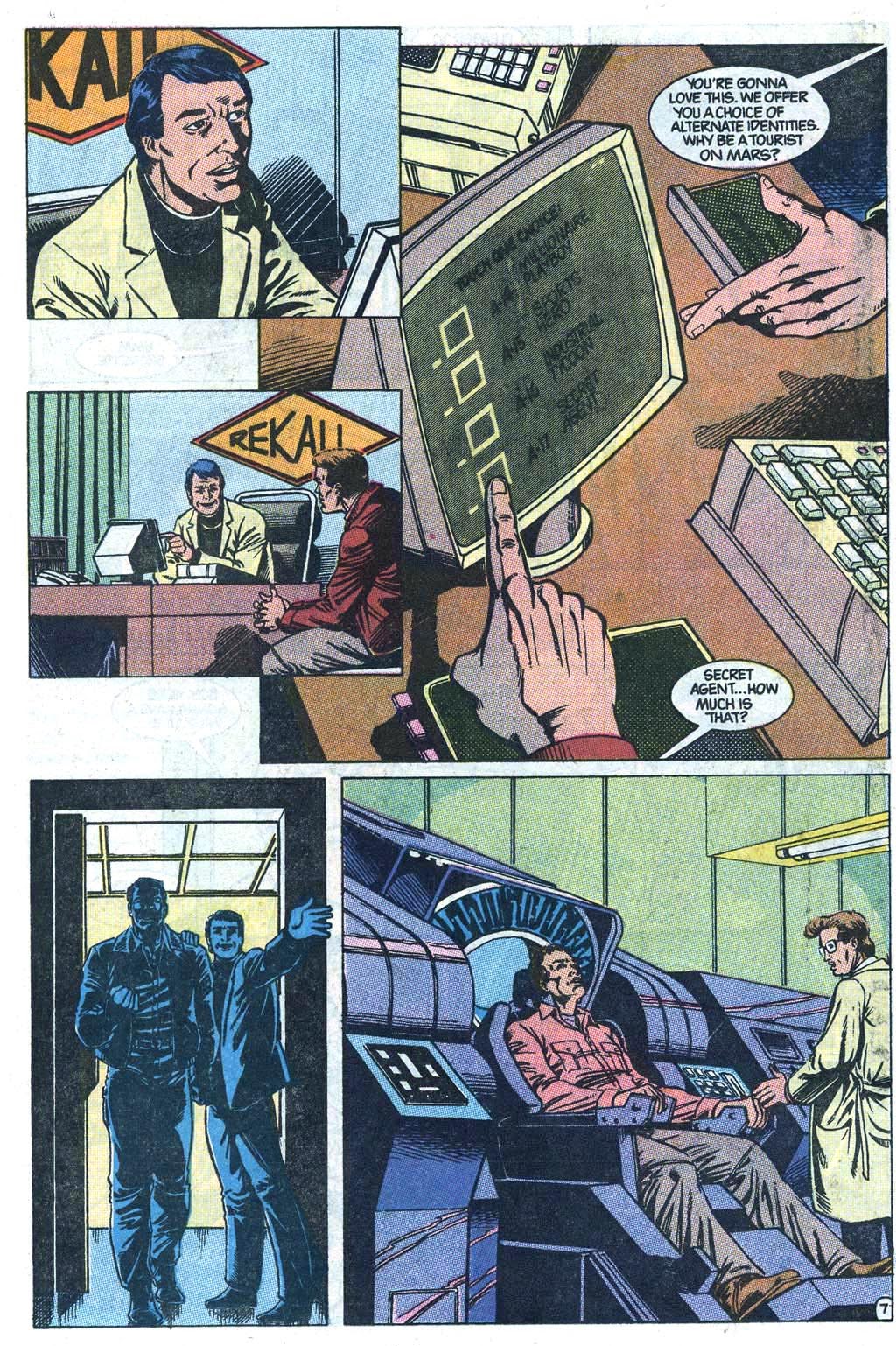
It turns out it was just a dream for Douglas Quaid who was in bed with his wife Lori. The dream turned out to be a recurring one as Lori asked him if the dream lady was in there again. Lori then asked Doug who the dream lady was. A short time later, Doug reports to work and while doing construction work on the field, he asked a colleague about Rekall (note: he saw a video ad of it on his way to work). The guy told Doug about someone getting lobotomized at Rekall and discouraged him from availing of their service.
Douglas Quaid at Rekall for his virtual holiday.
Doug eventually visits Rekall after work and availed of their virtual holiday as a secret agent. Something goes wrong as Doug goes berserk while strapped on one of Rekall’s seats. Dr. Lull (in-charge of the operation) explains to her boss that Doug was not acting out his virtual holiday as her team has not even implanted it yet on him…
Quality
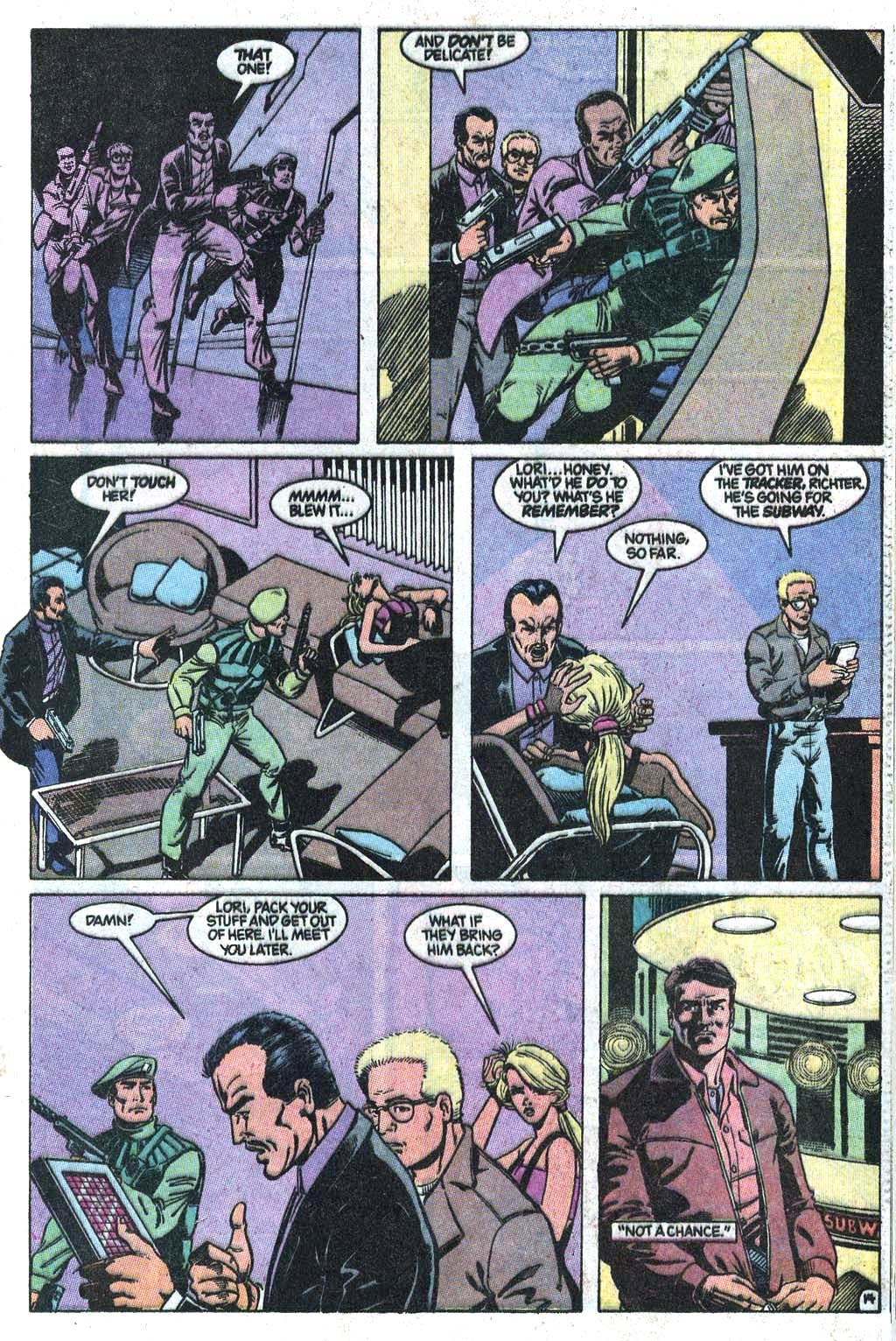
The bad guys on the hunt for Douglas Quaid.
When it comes to presenting the story, Elliot S. Maggin clearly paid close attention to the details, the plot and dialogue of the movie while implementing adjustments along with artist Tom Lyle to make the story work in comic book format. Clearly, this is not a word-for-word, scene-for-scene adaptation but it comes close to capturing the essence of the film. Unsurprisingly, the comic book adaptation never captured the unique Schwarzenegger-Verhoeven aesthetics of the movie but it still performed well on replicating the sci-fi, hard action moments. I find it surprising that Total Recall Movie Special #1 carried the seal of approval of the Comics Code Authority (CCA) as there were some bloody shots and several moments of strong violence inspired by the R-rated film.
When it comes to the visuals, Tom Lyle succeeded in capturing the sci-fi look of the movie and even had the literary Douglas Quaid occasionally resemble Arnold Schwarzenegger. Lyle’s drawings on other characters like Lori, Melina, Coohagen and Richter looked NOTHING like the actors who played them but that’s not a problem at all as this gives this comic book its own unique touch. In fact, there were some drawings of people that sometimes reminded me of what I saw in EC Comics’ Weird Science comic books.
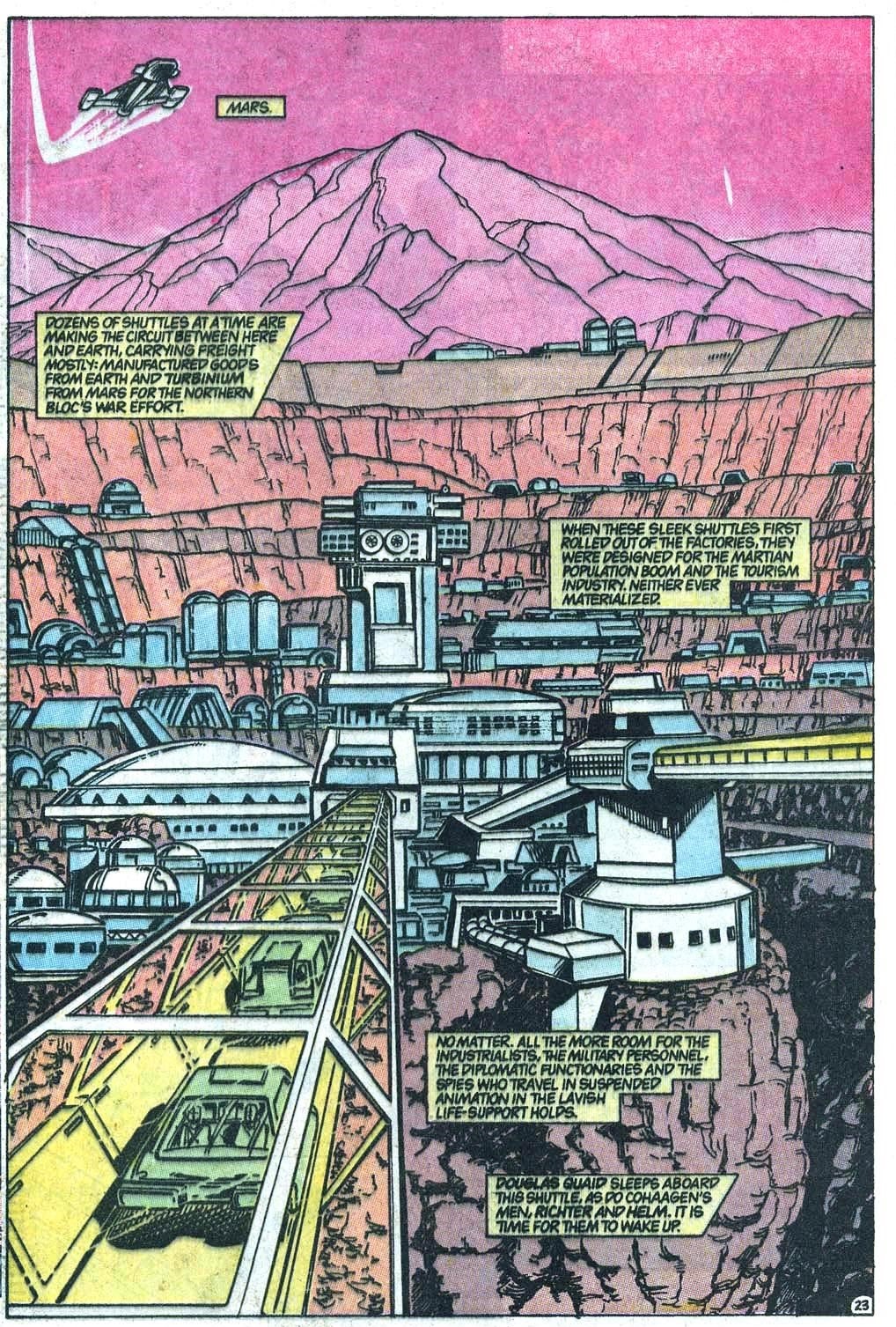
While Lyle scored nicely with the action scenes, his own drawings of planet Mars and the human colony are quite nice to look at. With regards to the urban environment, Lyle drew a nice mix of 20th century inspired urban areas laced with futurism. Unsurprisingly, the futurism got stronger when the story was set in Mars.
If there is anything lacking with the art, it would be visual dynamism. This can be forgiven however given the high amount of dialogue and story details that had to be presented with each page carrying a lot of panels.
Conclusion
The human colony in planet Mars.
I can say it out loud that Total Recall Movie Special #1 is a fun read and serves nicely as a literary companion to the cinematic masterpiece Total Recall. As a comic book adaptation of a blockbuster movie, this one is pretty good and in some ways captured some of the flair of the film even as it never successfully replicated the Verhoeven-Schwarzenegger aesthetic in the film. Really, if you want the best of Total Recall you really should watch the movie. This comic book on its own is entertaining and should encourage you to watch the film.
If you are seriously planning to buy an existing hard copy of Total Recall Movie Special #1 (1990), be aware that as of this writing, MileHighComics.com shows that the near-mint copy of the regular edition costs $11 while the near-mint copy of the newsstand edition costs $31. If you are looking for something more valuable, the near-mint copy of the numbered-and-signed edition of the comic book costs $51.
Overall, Total Recall Movie Special #1 (1990) is highly recommended!
Thank you for reading. If you find this article engaging, please click the like button below and also please consider sharing this article to others. If you are looking for a copywriter to create content for your special project or business, check out my services and my portfolio. Feel free to contact me as well. Also please feel free to visit my Facebook page Author Carlo Carrasco and follow me at HavenorFantasy@twitter.com

















 Author Carlo Carrasco