Disclaimer: This is my original work with details sourced from reading the comic book and doing personal research. Anyone who wants to use this article, in part or in whole, needs to secure first my permission and agree to cite me as the source and author. Let it be known that any unauthorized use of this article will constrain the author to pursue the remedies under R.A. No. 8293, the Revised Penal Code, and/or all applicable legal actions under the laws of the Philippines.
Having read lots of X-Men comic books, I should say that I always find the Sentinels (first appearance in The X-Men #14 in 1965) to be more memorable as enemies of Marvel’s mutants. On face value, they only look like oversized, human-like robots but I always find them to be formidable opponents of the X-Men. These machines are not only built with sophisticated technologies, they are able to push the X-Men to their limits during battle.
These anti-mutant robots, by the way, were ranked by IGN at #38 in their Greatest Comic Book Villains chart. Long before that, the Sentinels were the featured anti-heroes in the classic X-Men comic book storyline Days of Future Past and it was no surprise that they were also featured in the 2014 movie X-Men: Days of Future Past.
And then in the early 1990s, the Sentinels were shown in the first episode of the X-Men animated series on television. The said series was also adapted into an “as seen on TV” comic book series by Marvel called X-Men Adventures.
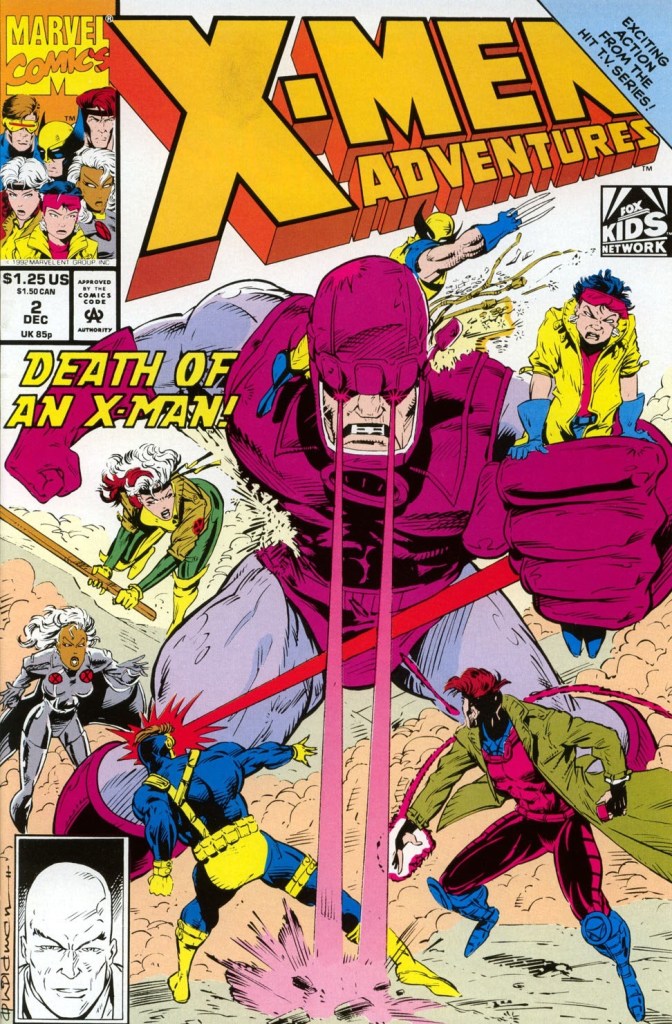
This brings me to this look back at X-Men Adventures #2, published in 1992 by Marvel Comics with a story by Ralph Macchio and drawn by Andrew Wildman.
The cover.
Early story
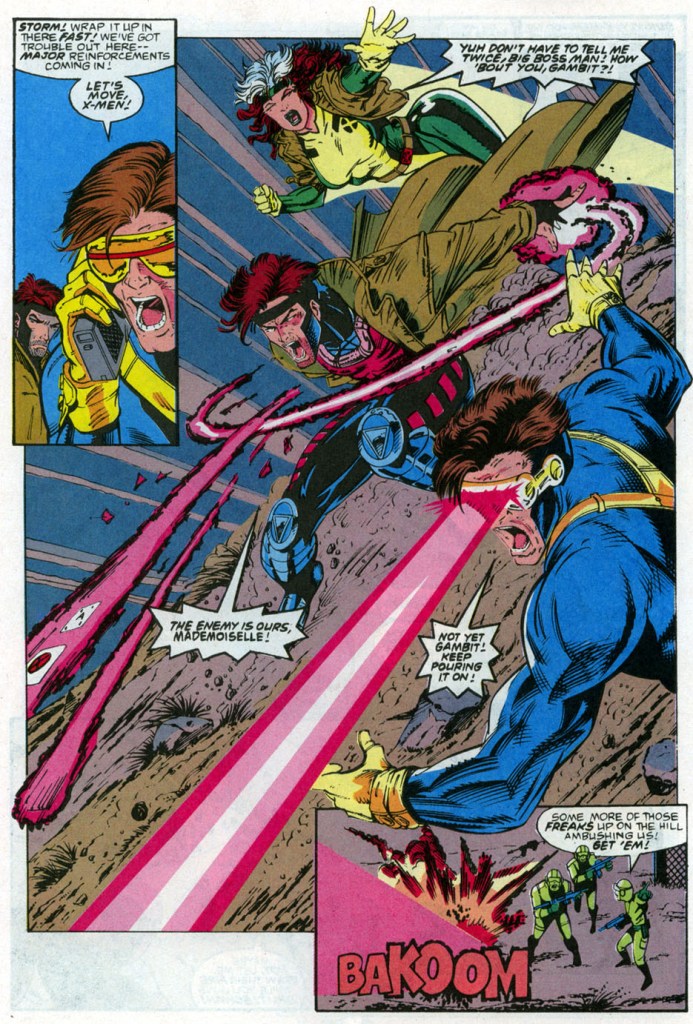
The story begins with Morph suffering from a nightmare. As he emerged from the vision, he finds himself with Storm, Beast and Wolverine. Together they work to infiltrate a federal government facility which houses the Mutant Affairs Department. Outside the walls of the facility, Rogue Gambit and Cyclops watch from a distance. Cyclops fires his optic blast at the vehicle that just dropped reinforcements that he believes were sent to stop their teammates.
Storm and her teammates break through a door instantly pushing off the security personnel followed by Beast knocking an additional guard. At the room containing the computer, Beast begins to access key information their team has been seeking…
Quality
The Sentinels and the X-Men!
Let me start with the storytelling. As an adaptation of one of the early episodes of the animated series, this comic book does a fine job of recapturing its essence complete with a nice balance between plot, exposition and spectacle. Considering the fact that the animated series was aimed for children, it’s quite intriguing to see the TV episode carrying really heavy themes – apart from the prejudice the mutants suffer from – like top federal government operations, expensive defense and weapons programs, government intrusion into people’s private lives, attempts to require minorities to get registered, etc. Those themes also made it in this comic book which made it feel like it was part of the mainstream X-Men comics of the time.
Compared to the first episode as well as its literary adaptation, this one emphasizes the Sentinels as tools of the government as part of their very expensive program to seek and monitor mutants among their citizens. Mutant Affairs director Peter Gyrich is clearly the villain who has no super powers but has the resources of the federal government and their authority to take action on mutants he perceived to be dangerous.
On the visuals, Andrew Wildman performed a solid job making each page look interesting and detailed enough. While his drawings made each character recognizable to me, it is in the spectacular scenes where he really shines. Wildman’s drawing of the Watcher on the final page of the comic book, however, looks laughable.
Conclusion
Andrew Wildman’s dynamic drawing of the X-Men in action.
While X-Men Adventures #2 is not exactly a literary classic, it is indeed a very solid adaptation of one of the earliest episodes of the animated series of the 1990s. It succeeded on telling a compelling and enjoyable story even though it emphasized the above-mentioned serious themes. As for the iconic Sentinels, this one succeeded in explaining what they are and their place in Marvel’s universe is.
If you are seriously planning to buy an existing hard copy of X-Men Adventures #2 (1992), be aware that as of this writing, MileHighComics.com shows that the near-mint copy of the regular edition costs $8 while the near-mint copy of the newsstand edition costs $26.
Overall, X-Men Adventures #2 (1992) is recommended.
+++++
Thank you for reading. If you find this article engaging, please click the like button below and also please consider sharing this article to others. If you are looking for a copywriter to create content for your special project or business, check out my services and my portfolio. Feel free to contact me as well. Also please feel free to visit my Facebook page Author Carlo Carrasco and follow me at HavenorFantasy@twitter.com
Disclaimer: This is my original work with details sourced from playing the video game and doing personal research. Anyone who wants to use this article, in part or in whole, needs to secure first my permission and agree to cite me as the source and author. Let it be known that any unauthorized use of this article will constrain the author to pursue the remedies under R.A. No. 8293, the Revised Penal Code, and/or all applicable legal actions under the laws of the Philippines.
Back in the 1990s when cable TV was not yet popular in the local community I lived in here in the Philippines, I got to watch on free TV a late night showing of the old movie The Poseidon Adventure. That movie, which included Gene Hackman and other stars, was about a huge passenger ship that got capsized as a result of a huge wave that hit it so hard. The survivors in that film had no choice but to band together and find their way out through countless obstacles.
That creative concept was reused by game developer Human Entertainment for a video game I played on the Super NES (SNES) a few years later…SOS (titled in Japan as Septentrion).
Released for the SNES in 1994 by Vic Tokai, SOS was an adventure game that had players take on the role of one of four characters (each with a different story plus different endings) who must escape the ship within sixty minutes in real-time. Along the way, the player must avoid obstacles, get to the hard-to-reach places and escape the ship before time runs out.
How good or bad the game is, you can find out in this look back at SOS.
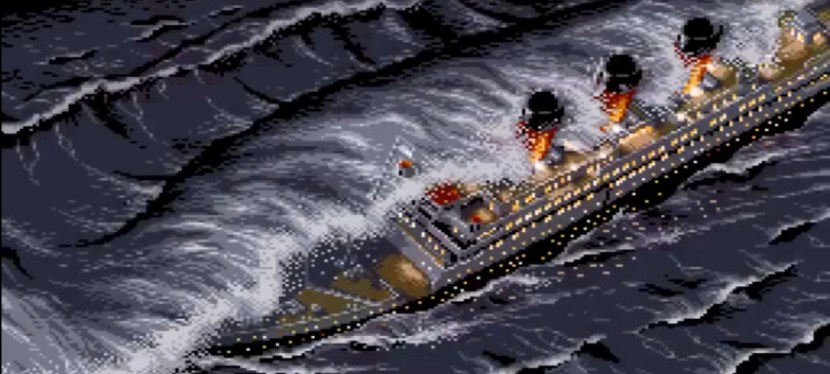
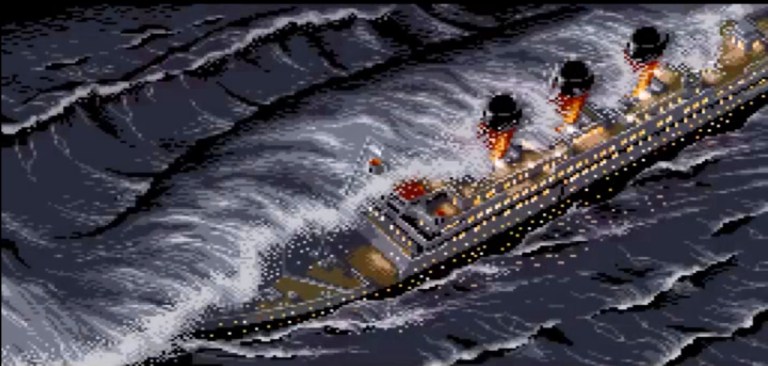
The misadventure begins on the Lady Crithania with the disaster.
Early story
The story begins in the luxury passenger ship called Lady Crithania. Depending on which character you choose, Capris is an architect who has a sick sister; Luke is a crew member of the ship whose superiors don’t take his warnings about harsh sea conditions seriously; Jeffrey is a doctor who is traveling with his wife and Redwin is a counselor who is traveling with a family.
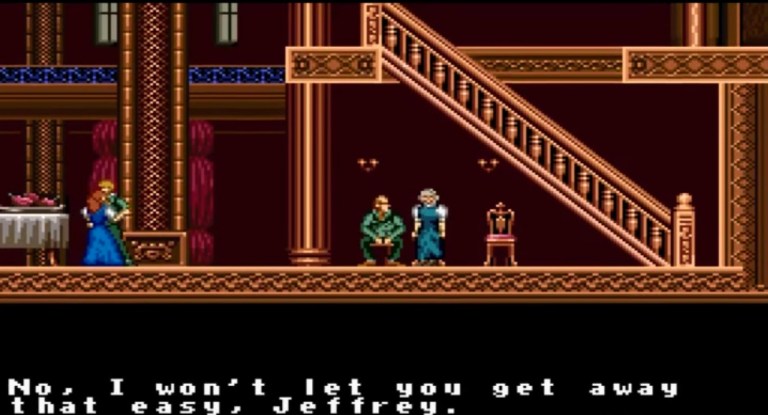
A cut scene emphasizing the story of one of the characters.
This is what the ship looks like after the disaster. At this point, the struggle for survival truly begins.
Regardless of which character was selected, a massive wave hits the Lady Crithania so hard it got capsized. The interiors suddenly turned upside down causing lots of damage and deaths. The protagonist is challenged with the chaotic interiors, obstacles, interacting with some survivors and reach the boiler room to survive.
Gameplay and Quality
As it is a 2-dimensional (2D) game, SOS is a side-scrolling adventure with some platform gaming elements mixed in. You can have your character move and jump most of the time with the occasional action of helping passengers (by means of reaching) travel with you (with some commands to communicate with them). While the design made sense, playing SOS always turned out to be a tiring chore and a test of patience due to the lack of precision when it comes to control response.
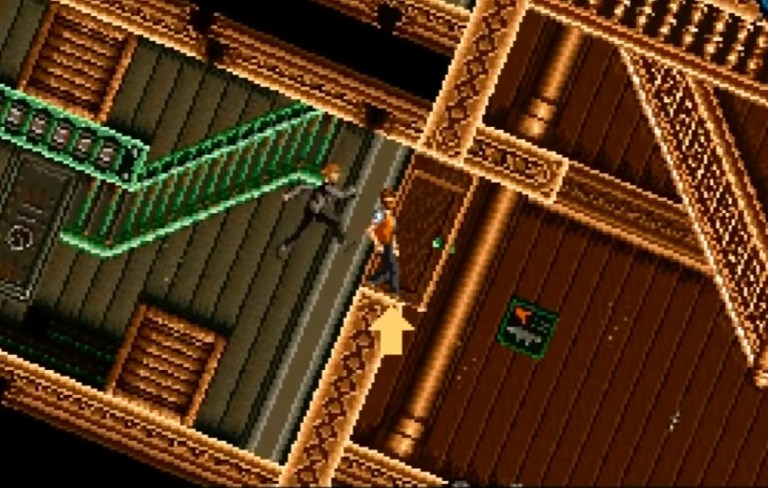
Adding further to challenge is the occasional shift of the capsized shift which changes the angles of the interiors which instantly alters the difficulty on moving around and jumping to the essential platforms (to progress to the next place). The shifting was visually done using the SNES’ Mode 7 feature. For the newcomers reading this, Mode 7 is the graphics mode unique to the SNES which enables scaling and rotating of the background image. While the sprites and 2D art in this game lacked punch, it is the Mode 7 feature that really added some quality to SOS’ visuals temporarily.
The more survivors you help and take with you to the very end, the better the ending will be.
You can also swim through flood sections.
More on the difficulty, the artificial intelligence (AI) programmed for the survivors that you can choose to rescue is pretty low which leads to a lack of response whenever your character calls them to follow you to get to the next level and survive. Not only were there times the other characters did not respond, some got even stuck in tight places.
As this game has 1-hour countdown in real time, making a mistake is costly. For example, you jump but fail to reach a crucial platform and fall down into the abyss and die will lead to your character respawning but with a noticeable amount of time reduced. Considering the lack of precision on controls and other factors, this made SOS challenging and frustrating to play.
If only the other survivors were more responsive to your calls…
And then there is the challenge to get the best possible ending you could by means of rescuing as many other survivors as you could and reach the very end with them. To put it this way, if you decide to be completely self-centered, disregard all the other survivors and make your way to the end without them, will result a really bad ending. You rescue more and make it alive with them, then the ending will get better.
Conclusion
If you fall and die, your character will respawn but with an amount of time reduced.
SOS has a very nice concept of adventuring that focuses mainly on survival and involves no combat and certainly no clear enemies to encounter. It is just too bad that the flaws of this game made it more frustrating to play and very few people will actually get to enjoy it.
If you own a working SNES and you are thinking about buying an existing copy of SOS, I do not recommend buying it with your precious money. Better rent it instead.
+++++
Thank you for reading. If you find this article engaging, please click the like button below and also please consider sharing this article to others. If you are looking for a copywriter to create content for your special project or business, check out my services and my portfolio. Feel free to contact me as well. Also please feel free to visit my Facebook page Author Carlo Carrasco and follow me at HavenorFantasy@twitter.com
Disclaimer: This is my original work with details sourced from reading the comic book and doing personal research. Anyone who wants to use this article, in part or in whole, needs to secure first my permission and agree to cite me as the source and author. Let it be known that any unauthorized use of this article will constrain the author to pursue the remedies under R.A. No. 8293, the Revised Penal Code, and/or all applicable legal actions under the laws of the Philippines.
According to the online edition of Merriam-Webster Dictionary, an oasis is something that provides refuge, relief, or pleasant contrast. In the case of X-Men 2099, the open areas of the southwestern region of the United States is a dangerous place to be in even though they are free from oppressive systems of control that dominate cities. As such, it is the southwestern region in 2099 can be compared to the Old West in history where there are lots of desolate places as well as lots outcasts and outlaws. Unlike their mainstream counterparts, the X-Men of the far future are nomads and they don’t have a long-term place of residence they could call home. Considering how dangerous the region is for the mutants, a haven of peace, security and prosperity is always ideal to them but only if it is indeed real.
That is what we will explore in the one-shot comic book X-Men 2099: Oasis here.
But before proceeding with the review, it has to be emphasized first that the one-shot comic book which was made special with the painted art of the Hilderbrandt brothers Greg and Tim. For long-time X-Men 2099 scribe John Francis Moore, Oasis was like a big dream come true. When asked during an online interview about his recollections on making X-Men 2099: Oasis and working with the Hildebrandt Brothers, Moore stated:
I was a fan of the Hildebrandt’s fantasy illustration, and I was blown away when Joey told me that they wanted to do an X-men 2099 project. I met with them in Joey’s office and they were both really great guys. I think they said they really liked Bloodhawk, so I knew he’d be a major player in whatever story we developed. They didn’t enter the project with a lot of conditions. They seemed genuinely happy to get to play in this corner of the Marvel universe.
I can’t remember ever writing a full script for any of my Marvel work. I gave them a plot and sometime later received Xeroxes of pencil art (Hildebrant art!) to dialogue. Then it went back for them to paint, and they did a phenomenal job. I only wish that it could’ve been published before the 2099 line was axed. It was a beautiful book that I think was sadly under promoted.
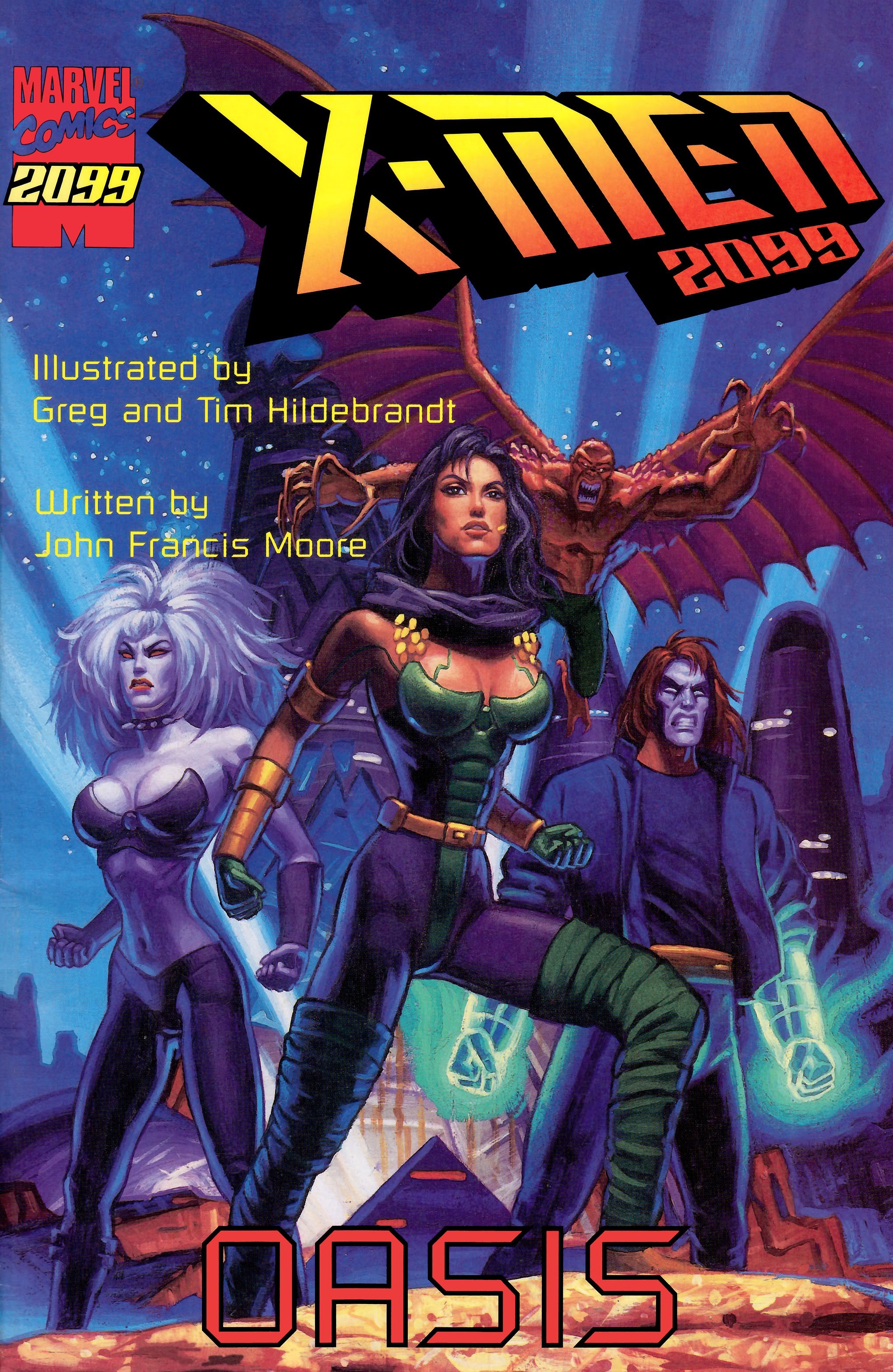
To find out if it is any good, here is a look back at X-Men 2099: Oasis published in 1996 by Marvel Comics with a story written by John Francis Moore and painted art done by Greg and Tim Hildebrandt.
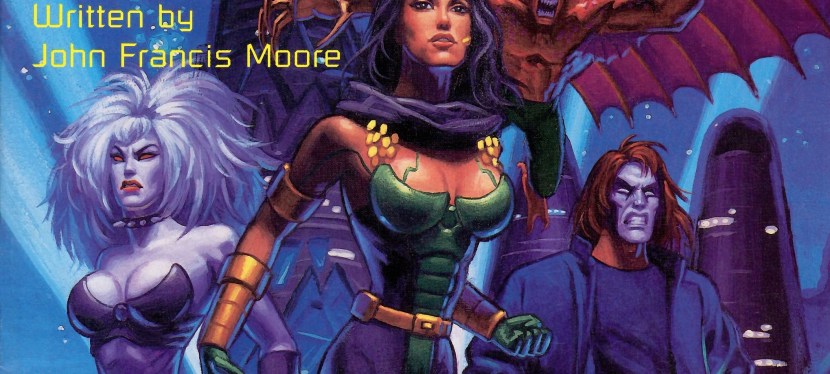
The cover.
Early story
The comic book begins with a flashback set in Hong Kong in the year 2090. A much younger Shakti/Cerebra is on the loose trying to reach a ferry to Kowloon with a plan to hide in the back alleys of Tsimshatsui. Suddenly Lokjaw intercepts her and grabs her. They had a short history together and Lokjaw insists that Shakti should be grateful to her father who raised her to run his bio-shops. After a brief chase, something hits Lokjaw who fell into the water. It turns out Ryu Kobolt helped Shakti, and he has been instructed by his boss to offer her asylum.
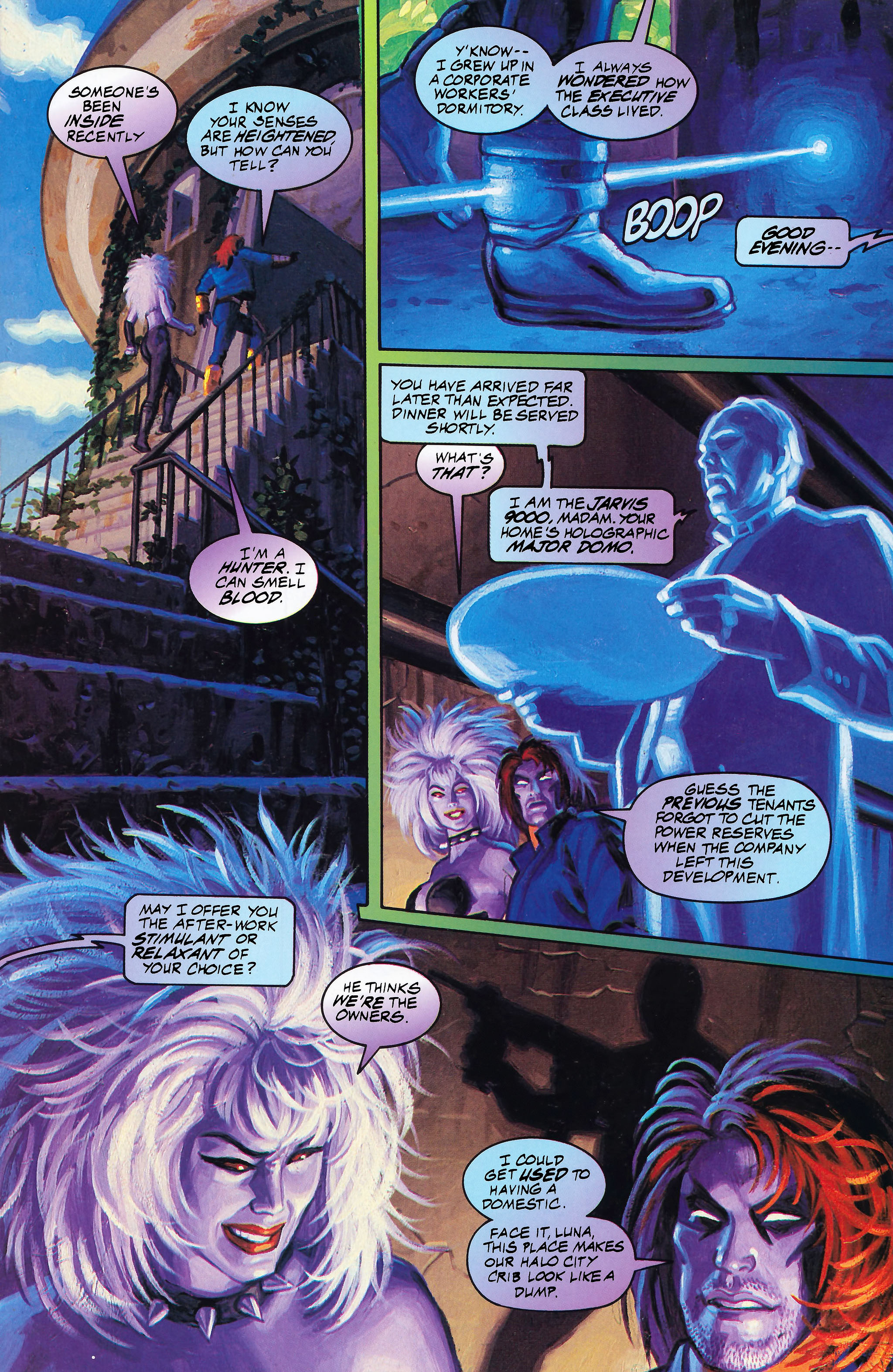
Luna and Skullfire explore a place.
In the present day of 2099 in New Mexico, Bloodhawk flies to his desert home not knowing he is being monitored. Two people, an old man with white hair and a lady, work together to stun the X-Men member and take him with them. A short time later, inside a high-tech facility, Bloodhawk wakes up finding himself restrained and being watched over by the lady and the old man. They tell him he is in the Promised Land, a place where the sins of the old world will be washed away. Using her powers, she touches Bloodhawk’s head and slowly turns him into his normal human form.
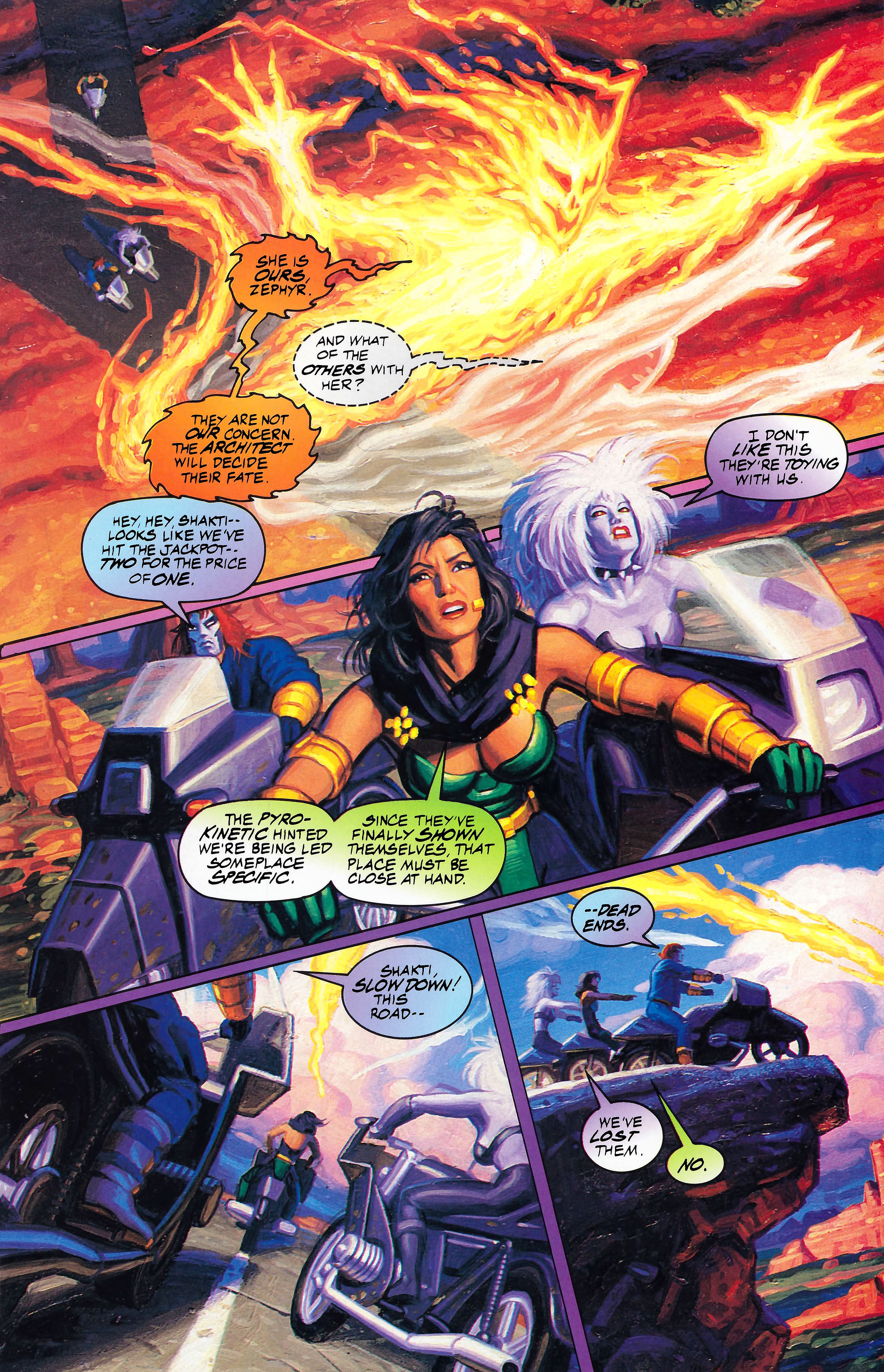
Meanwhile outside a deserted town near the border between Colorado and Kansas, Shakti, Tim/Skullfire and Luna arrive riding motorcycles. They are checking the potential presence of a mutant nearby…
Quality
Really great visuals by the Hildebrandt brothers!
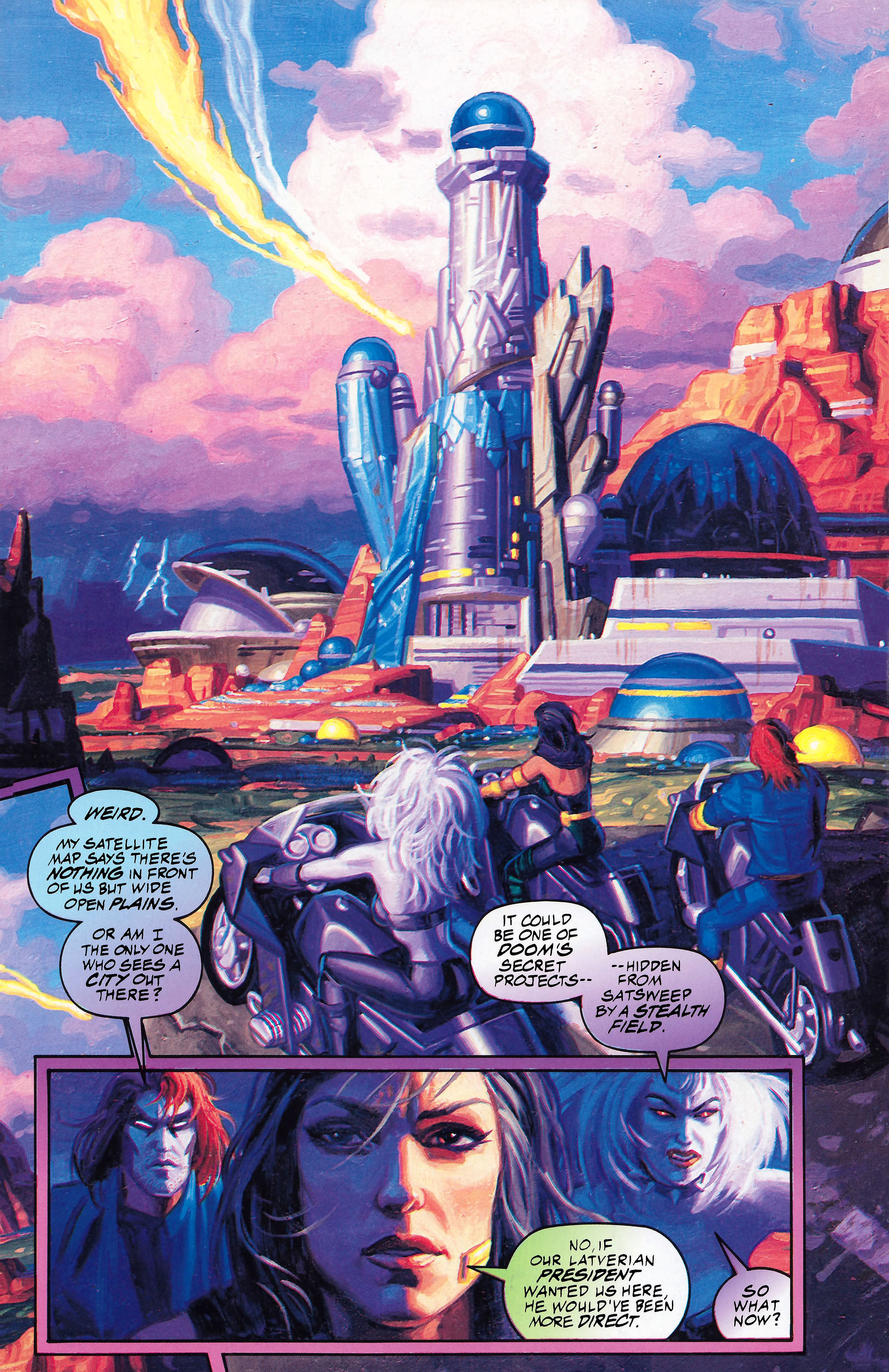
It is very safe to say that this is one very ambitious X-Men 2099 story ever told by John Francis Moore. It sure has an epic concept showing that Oasis in the open region not only exists, but also serves as the closest thing humanity in America has to imitating Heaven built on top of the land. Oasis is the indoor paradise where mutants and humans gather together, live in peace and work together in tremendous ways that the X-Men could only hope to achieve in Halo City (note: this story is set some time after X-Men 2099 #25).
The titular place is clearly the centerpiece of the story backed with characters and threads from the past that explain how it got established. Part of the creation of Oasis is connected with Ryu Kobolt whom Shakti got close with many years back. Of course, someone else got involved with Ryu which directly connects with the creation of Oasis.
While it is also clear that the story took some inspiration from Christianity, I should say that the approach was done by rehashing old storytelling concepts like emphasizing a charismatic person who looks godly or messianic, people getting converted with ways that are not holy, false prophets misleading those seeking salvation, etc. With the ages-old concept of the mad scientists added, then there is conflict here for the X-Men to engage with. The story touches on themes like destiny, conversion, having the power to judge people and committing genocide.
As for the characters, John Francis Moore made the right move to utilize Shakti, Bloodhawk, Skullfire and Luna of the X-Men, however the other new characters such as Memphis, Pandora and Ryu pale in comparison with regards to importance (even though Memphis and Ryu each had a good amount of the spotlight and even some character development).
When it comes to the artwork, this is one great looking superhero, sci-fi story in painted form thanks to the Hildebrandt brothers! Not only is their painted art beautiful to look at, there are also eye-catching shots of scenery, very detailed facial expressions and a very lively presentation of the action scenes and explosions! Each and every character painted – specifically Shakti, Skullfire, Bloodhawk, Luna, Memphis, Pandora and Ryu – has that touch of visual realism (note: not photo realism) that make them look more human to the eyes (especially the X-Men members when compared to how they were drawn by Ron Lim and Jan Duursema in the monthly series). This is one great looking comic book and easily one of the very best of the X-Men of 2099!
Conclusion
The Oasis!
X-Men 2099: Oasis is a one-shot comic book that did not match its high ambition. While it has some of the best painted superhero art of the 1990s ever, the storytelling just did not engage me that much. For one thing, its approach on taking inspiration from Christianity is very flawed not only due to rehashing storytelling concepts but also due to the fact that everything – including the titular Oasis – had to be concluded already. Even though there was a build-up leading to a final conflict, the payoff was not that great and ultimately there was a sense of rush in the 2nd half of the story.
What is also disappointing is the fact that the events told here did not really impact Shakti, Skullfire, Luna and Bloodhawk at all, nor was there anything added to the narrative of the X-Men 2099 monthly series. This is too bad because the existence of a haven where people can live in and be protected from the prejudice and violence in the region fits nicely with the concept of X-Men 2099 in the first place. Even though there was a reference to issue #25 during the first half, this comic book ended up looking like a dream story or a parallel universe tale with a $5.95 cover price! It seems to me like this was more like a cash-grab attempt to exploit comic collectors and the fans of X-Men 2099.
If you are seriously planning to buy an existing hard copy of X-Men 2099: Oasis, be aware that as of this writing, MileHighComics.com shows that the near-mint copy costs $14.
Overall, X-Men 2099: Oasis is a serviceable one-shot comic book. That being said, if you really intend to buy it, you should not pay more than $5 for it.
Thank you for reading. If you find this article engaging, please click the like button below and also please consider sharing this article to others. If you are looking for a copywriter to create content for your special project or business, check out my services and my portfolio. Feel free to contact me as well. Also please feel free to visit my Facebook page Author Carlo Carrasco and follow me at HavenorFantasy@twitter.com
Disclaimer: This is my original work with details sourced from watching the movie and doing personal research. Anyone who wants to use this article, in part or in whole, needs to secure first my permission and agree to cite me as the source and author. Let it be known that any unauthorized use of this article will constrain the author to pursue the remedies under R.A. No. 8293, the Revised Penal Code, and/or all applicable legal actions under the laws of the Philippines.
I miss the old days when an R-rated action-packed science fiction movie can be passionately made with exceptional directing, clever writing, great camera work that’s consistently steady, solid performances from the actors, action that was not too choreographed, and visuals that heavily utilized practical effects and optical effects.
I’m talking about Total Recall, the 1990 sci-fi action movie that starred a much younger Arnold Schwarzenegger supported by Sharon Stone, Michael Ironside, Rachel Ticotin and Ronny Cox. Directed by Paul Verhoeven (who directed the 1987 classic RoboCop) with a screenplay (based on the Philip K. Dick short story We Can Remember It For You Wholesale) by Ronald Shusett, Dan O’Bannon and Gary Goldman, Total Recall was a tremendous hit in the cinemas grossing more than $261 million worldwide with a production budget of over $60 million. To date, the film remains a favorite not only with fans of Schwarzenegger but also with people who love action movies, sci-fi movies, movies of the 1990s and geeks.
But before looking back at this movie, it is important to take note that Total Recall took several years of development before it finally got produced. The very first screenplay was written by O’Bannon and Shusett in the 1970s (after securing the film rights to Philip K. Dick’s short story when the author was still alive). Eventually prolific movie producer Dino De Laurentiis took the project for development. Years later, De Laurentiis’ company collapsed (due to failed projects) which provided Schwarzenegger the golden opportunity to get Total Recall by persuading Carolco to secure the rights for a few million dollars. After many screenplay drafts written and the hiring of Verhoeven as director (note: Schwarzenegger approached him personally) plus Gary Goldman, the rest became history.
Arnold Schwarzenegger, Rachel Ticotin, Michael Ironside and Ronny Cox in a memorable scene.
Now, here is a look back at Total Recall.
Early Story
The story begins at the surface of planet Mars where a man and a lady (both wearing space suits) travel on foot. Suddenly, the man slips down and breaks the frontal shield of his helmet exposing himself to Mars’ air. It turned out to be an intense nightmare for Douglas Quaid who was in bed with his beautiful wife Lori. Lori asked him about the unidentified woman who appeared in his dreams, but Quaid expresses his love for her. On his way to work, Quaid saw a TV ad inside the train about Rekall, a company that sells holidays and adventures in the form of memories. At work, his fellow construction worker discouraged him from availing of any services from Rekall. After work, Quaid visits Rekall and decides to avail of an ego trip as a secret agent. Just as the memory trip was about to start, Quaid wakes up violently…
Quality
This movie is still great to watch. Let me start first with the creative team of Paul Verhoeven and Arnold Schwarzenegger.
A great action scene about to start…
When it comes to the synergy between the director and the lead player, Verhoeven and Schwarzenegger make a great creative team that made this movie very special! When asked during an interview what it was like for him to work with Schwarzenegger, Verhoeven said: Arnold is great. Switching from Rutger Hauer to Arnold is not that big a step. It’s strange to say that, because he’s this crazy Austrian, with an accent—but, for me, Arnold is the American Rutger. I think if I did a few movies with Arnold, I could do as much with him as I did with Rutger. Now, this movie was the wrong thing . . . But I think you can do much more with Arnold, explore more possibilities, than was necessary for this movie.
Sharon Stone as Lori.
Now, it is a fact that Schwarzenegger lacks versatility when it comes to acting. Even so, Verhoeven succeeded in getting a deeper-than-expected performance from the star in this movie. Sure, we get to see Schwarzenegger fight bad guys with really rough action, fire guns, run and jump around here but what really stood out here was his portrayal of a man who discovers that the life he knew was all a lie and goes on to find the truth about himself. This role remains a standout role of Schwarzenegger’s among all the characters he played in his many other action films. What is also notable with Douglas Quaid is that the protagonist is always in danger and never invincible, very similar to how Bruce Willis played John McClane in Die Hard. If you watch this film after seeing Schwarzenegger play his invincible icon in the Terminator movies, you will feel his pain, tension and curiosity here! As if that was not enough, there is also the other role Schwarzenegger played in this movie that you should see.
Of course, Total Recall also drew greatness and depth from Verhoeven who also got strong performances from Sharon Stone, Michael Ironside, Rachel Ticotin and Ronny Cox. Sharon Stone is the beautiful wife who will shock you. Michael Ironside is the henchman who will make you root for Schwarzenegger even more. Rachel Ticotin is the brave woman who is believable with the cause she is involved with.
Rachel Ticotin as Melina.
More notably, Ronny Cox is the all-powerful and ruthless executive who will get on your nerves and make you root for Schwarzenegger a lot, very similar to how his villainous role in RoboCop made moviegoers root for the cyborg policeman. It should be noted that the evil executive-henchman duo of Cohaagen (Cox) and Richter (Ironside) here is a directorial trademark of Verhoeven’s and it should bring back memories of the other evil duo in RoboCop. More than that, Ronny Cox succeeded in selling the concept that Cohaagen really had been the administrator of the colony in Mars exploiting the resources and the people for a long time.
More on getting the most out of the actors, Verhoeven and his team crafted a memorable hand-to-hand fight scene between Lori (Stone) and Melina (Ticotin) actually taking part in the action and stunts. Sharon Stone clearly got athletic in this movie and her efforts paid-off nicely, complete with another fight scene with Arnold Schwarzenegger (she actually even threw two high kicks at Schwarzenegger’s head) early in the film. Beyond the hard battle with Stone, Ticotin went on to take part in further action scenes in the film and she sure is believable as an action performer. To put things in perspective, Stone and Ticotin are not action stars but they excelled nicely in their work here and this also made Total Recall special.
When it comes to storytelling under the direction of Verhoeven, Total Recall moved at a medium-to-fast pace and there was never a single moment of rushing, nor a single boring moment at all. The film just kept going smoothly complete with true unpredictability which results lots of twists and surprises. I should also state that the dialogue from the finalized screenplay is still excellent, and they were nicely delivered by the actors. Verhoeven also added depth to the film by using mystery while also getting good performance from Schwarzenegger as Doug Quaid finds out that life is not what it seems. I should state that the sci-fi elements of altering (and adding) human memories with the use of computers and the business of selling virtual holidays and ego trips were strongly emphasized. These also add to the film’s mystery which should engage you to wonder and analyze as the story moves on.
The best view from an office on planet Mars.
On the spectacle, Total Recall is heavily loaded! The action is violent, plentiful and carries that particular aesthetic that only director Verhoeven has. It’s hard to explain in words but once you watch the action in this movie (plus comparing it to RoboCop and Starship Troopers), you will realize it. Even so, the action never turned this movie into a brainless affair. The action worked nicely to balance the mystery and suspense.
The visual effects here were mostly done by practical and optical ways. Special effects specialist Rob Bottin, who famously worked in John Carpenter’s The Thing and worked also with Verhoeven in RoboCop, came up with very memorable animatronics to simulate facial and physical changes on characters on key sequences involving sci-fi elements. The team also crafted really freaky looking makeup works on the Mars mutants, which really gave this film a strong sci-fi look. I also like the use of miniatures and physical sets that visualized the colony in Mars. By today’s standards, this movie’s visual effects still look great and I can only wish that filmmakers today would rely less on computers and go back to using practical effects (note: physical stuff) and, on certain occasions, optical effects.
Really great movie makeup work by Rob Bottin.
When it comes to the physical environments, this movie was filmed a lot in Mexico, specifically on key locations and on the sound stages in an established movie production studio there. Years ago, when I first learned for the first time that the trains used in the film were real-life trains that actually operated in one of Mexico’s real-life transportation systems, I was astounded! Paul Verhoeven himself confirmed that the train sequences were not only shot on location with real trains (note: monitors were added by the filmmakers to achieve a futuristic look) but the place’s architectural design were very unique and fitted nicely with the sci-fi concept of the movie.
The Mars colony set does not look fake to me. In fact, it really looks like it has long been lived in by people and the filmmakers nicely designed it. The Venusville set looks very convincing and, within the story, it got decayed due to long-term businesses, constant vehicular traffic and people who always flocked the place. The Mars hotel meanwhile has that cleaner, nicer look with tourists who paid good money for pleasure and discovery.
I should mention that the cinematography here done by Jost Vacano is excellent. The set-ups of the camera to get great angles of the actors is special, and the same can be said about the capturing of the spectacle that happened on-screen. The flashback of Mars inside Quaid’s mind had great, floating views of the location complete with perfectly smooth movement! Vacano also worked with Verhoeven in RoboCop.
Finally, the musical score by the late Jerry Goldsmith is very memorable and this is my favorite among all his works. The music provided gave this movie a strong sci-fi feel and when suspense plays, the tunes added nicely to it. The most memorable music tracks here are the opening credits music (which is immersive) and the foot chase between Quaid and Richter on Earth (the music really keeps the pace high).
Conclusion
Arnold Schwarzenegger as Douglas Quaid in a key scene.
Total Recall is a true, adulterated sci-fi action classic and easily it is still is one of the best ever movies I’ve seen from Schwarzenegger, Verhoeven and Stone. A few visual elements did not age well but its highly engaging story (combined with the strong performances and spectacle) remains its key selling point. There is a lot of ambiguity throughout the film and it will keep you wondering if the story (or at least portions of it) was reality or all a dream in Quaid’s mind. The way the story is structured combined with the excellent spectacle, this is a movie that is worth watching again and again! It remains an effective viewing experience for me until now.
As it contains the directorial trademarks of Verhoeven mixed with Schwarzenegger’s own style of expression and hard action, Total Recall is a very unique move of its own and it’s impossible to replicate nor match. Keep in mind that the 2012 remake of this movie was badly made (even though it had a big budget and highly advanced visual effects involving the use of computers) and ended up being a complete failure.
To put it short, Total Recall is more than just an action-packed thrill ride. It is also a mystery film that will keep viewers on the edge as the search for answers continues. Total Recall also explores the theme of what would you do when you realize that the life you remember turned to be an exceptional lie, and that you are literally caught in the middle of a web surrounded by dangerous, powerful people. I could never forget how my mind got motivated as I focused on the narrative the first time I ever saw this great movie decades ago. Total Recall was a sci-fi viewing experience like no other.
Overall, Total Recall (1990) is highly recommended! I urge you, my readers, to buy the movie on Blu-ray disc or watch it via streaming.
Thank you for reading. If you find this article engaging, please click the like button below and also please consider sharing this article to others. If you are looking for a copywriter to create content for your special project or business, check out my services and my portfolio. Feel free to contact me as well. Also please feel free to visit my Facebook page Author Carlo Carrasco and follow me at HavenorFantasy@twitter.com
Disclaimer: This is my original work with details sourced from reading the comic book and doing personal research. Anyone who wants to use this article, in part or in whole, needs to secure first my permission and agree to cite me as the source and author. Let it be known that any unauthorized use of this article will constrain the author to pursue the remedies under R.A. No. 8293, the Revised Penal Code, and/or all applicable legal actions under the laws of the Philippines.
In memory of James Hudnall, here are his words published near the end of The Solution #7:
The Solution is a dream team for me. I’ve been wanting to mix the genres of fantasy and cyberpunk science fiction with the super-hero genre for some time. Add my love of Japanese animation and Hong Kong cinema and you can see where I’m coming from here. This series is designed to show us some of the more bizarre and dark sectors of the Ultraverse without, hopefully, falling into the trap many similar books do where they lay it on too thick. The Ultraverse is a complex and multi-faceted universe and our books explore different sides. Here I want to delve deep into the criminal and espionage arenas as well as the magic sub-cultures that exist.
The characters themselves have a rich and interesting history that I plan to slowly unveil as the series progresses. When you first meet someone, you usually don’t know that much about the person. The characters are rather deep, as we will discover, and their personalities and more complex than you’re probably used to seeing in comics.
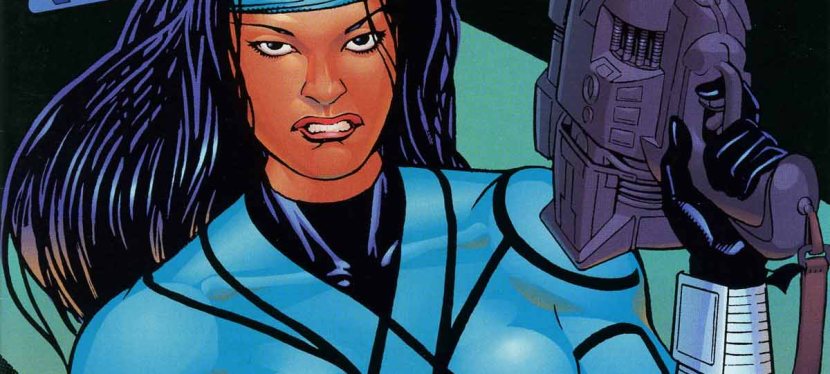
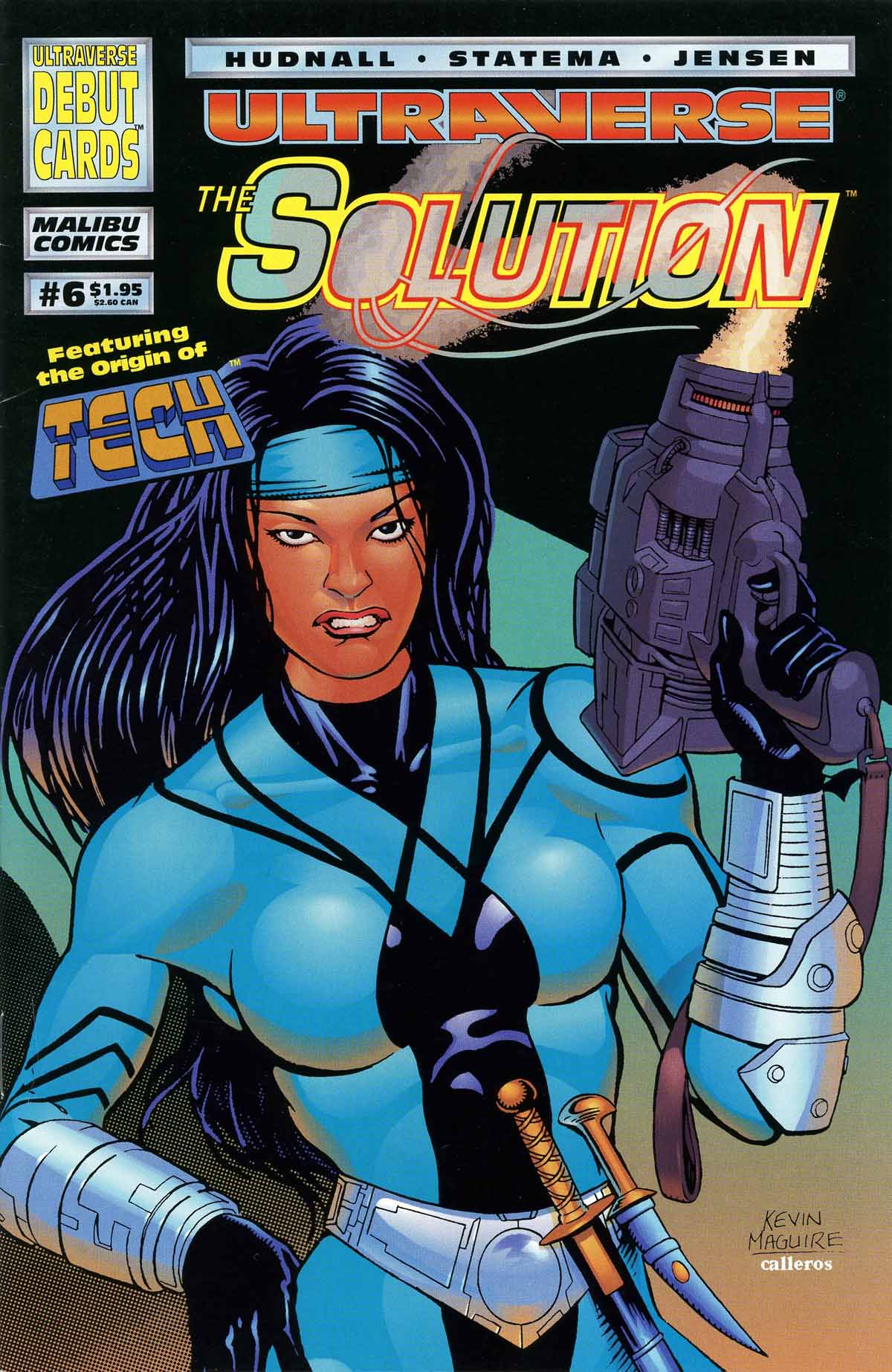
Now we can start this look back at The Solution #6, the Ultraverse comic book published in 1994 by Malibu Comics with a story written by James Hudnall and illustrated by John Statema (with ink work by Dennis Jensen and Mark Stegbauer).
The cover.
Early story
The story begins with Lela Cho (Tech) alone paying respect to her father at his grave. She tearfully recalls what happened right after he died.
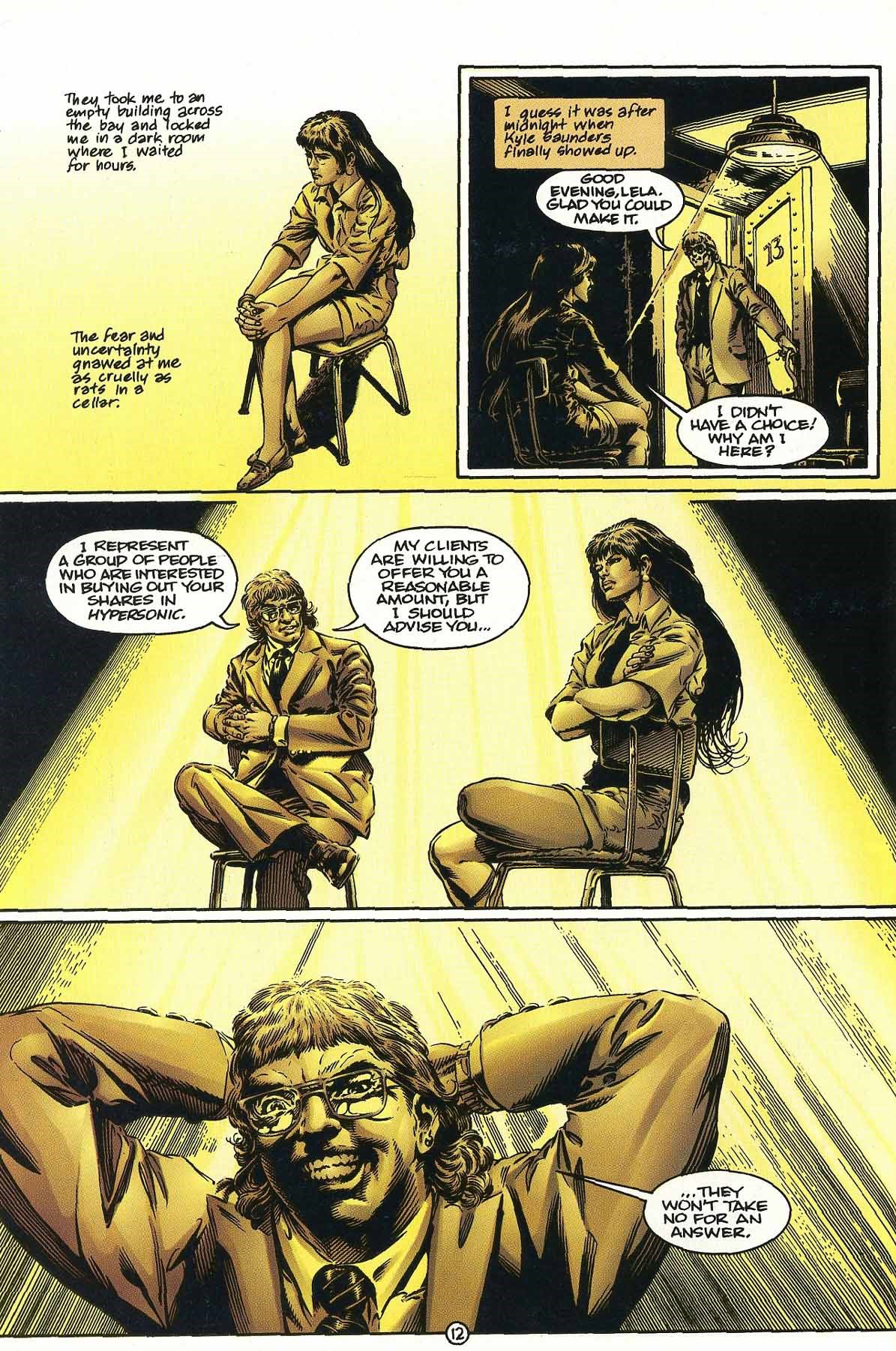
The narrative then shifts to 1993, specifically the day her father was about to get buried with many guests involved. Even though she is mourning, a man with blonde hair approaches her. His name is Kyle Sanders and he tells her she wants to talk to her about the corporation called Hypersonic. After receiving his business card, Lela feels a strange sense of dread creeping up on her.
A few days later, Lela attends a Board of Directors meeting at the headquarters of Hypersonic. She reminds them that she inherited all of her father’s shares in the company that makes her a majority stockholder and it was written in his will that she will assume his post as Chairman of the Board. Even though she already earned her Master’s Degree in Business at Harvard, the BOD members rejected her on the grounds that she’s too young and has no previous practical experience. They expressed that it would be better for her to work within the company and climb her way up.
Even though she got rejected and found herself alone, she decided not to give up and move forward by visiting NuWare, a corporation in San Francisco, California, that specializes on bio-tech implants (Wetware) that can make a person an Ultra…
Quality
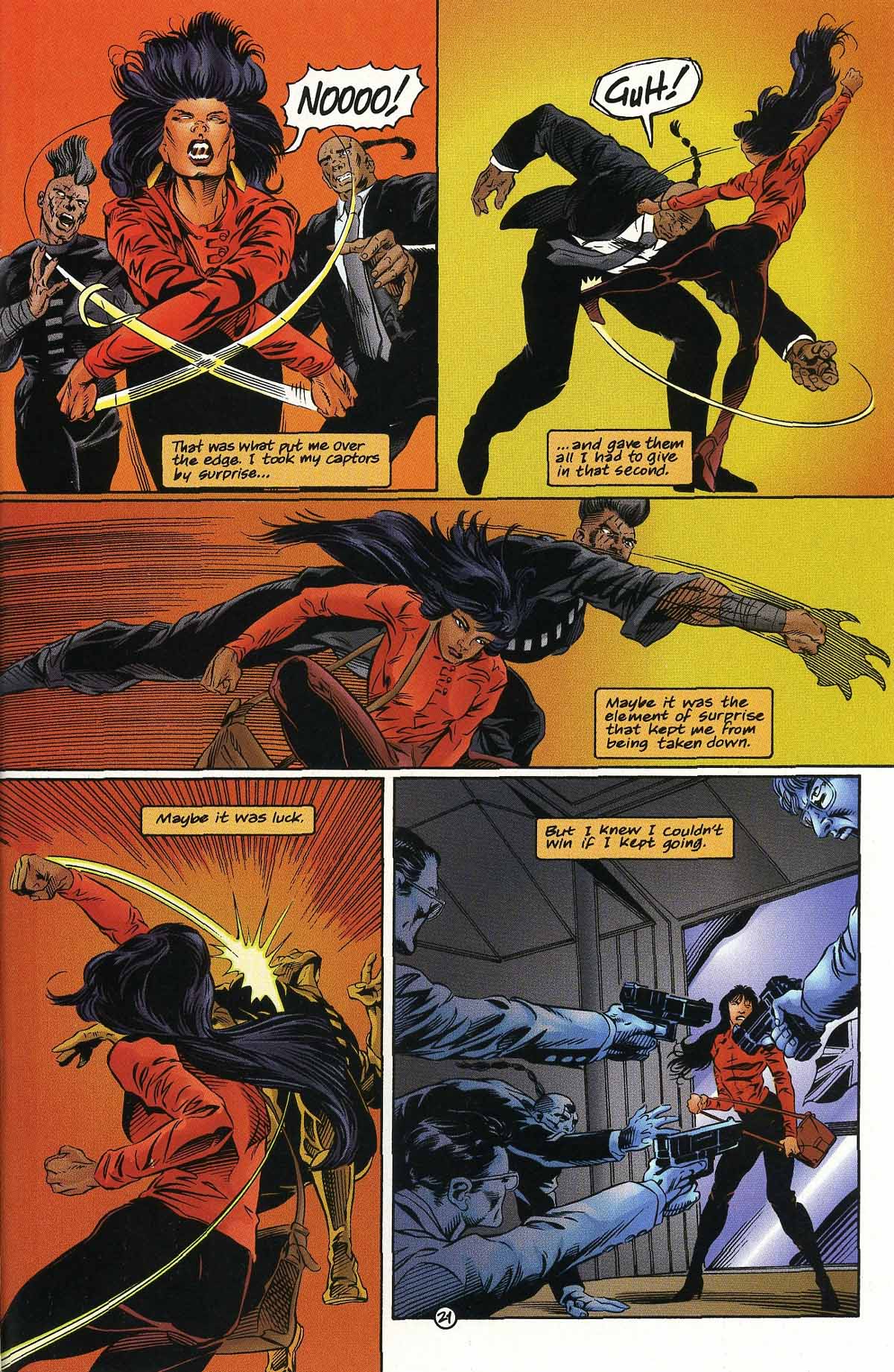
Lela Cho/Tech in action!
This is a very compelling, character-driven comic book, one of the best of the Ultraverse I read as of this writing. Clearly the late Hudnall achieved his goal of not only developing Lela Cho/Tech, but also defining her as a living part within the Ultraverse. Speaking of the Ultraverse, there is this nice and subtle connection with certain people regarding The Strangers.
Back to Lela Cho, her personality was very deeply defined by Hudnall. By the time you reach the end of this comic book, you should at least be caring about her even though her status as a super-rich lady trying to make her way up in business (while protecting herself) puts her on a different class. Ultimately her transformation into an Ultra is special to read and examine, even worthy of a cinematic adaptation.
Regarding the visuals, John Statema pulled of a great job. I love how the facial expressions he illustrated brought out the ranging emotions of the characters, specifically with Lela. When she’s mad, she really looks mad. When she is sad, you will see the sadness. Regarding action, Statema’s effort was decent.
Conclusion
Really nice art and good choice with the colors for the light effect.
I really liked The Solution #6. From start to finish, it kept me very engaged and ultimately it made me understand Lela Cho/Tech much better, which also made me go back to re-reading the first issue.
If you are seriously planning to buy an existing hard copy of The Solution #6, be aware that as of this writing, MileHighComics.com shows that the near-mint copy of the regular edition costs $4.
Disclaimer: This is my original work with details sourced from watching the movie and doing personal research. Anyone who wants to use this article, in part or in whole, needs to secure first my permission and agree to cite me as the source and author. Let it be known that any unauthorized use of this article will constrain the author to pursue the remedies under R.A. No. 8293, the Revised Penal Code, and/or all applicable legal actions under the laws of the Philippines.
Considering how long the Friday The 13th franchise of horror movies lasted throughout entertainment history, there were indeed chapters that proved to be good, bad or simply satisfactory towards its fans and other moviegoers.
Having seen ALL the Friday The 13th movies myself, I can say without hesitation that the most defining films of the franchise were the first four films (released 1980 to 1984) which eerily reminds me of the early stage of James Bonds movies released in the 1960s (read: Sean Connery and Albert Broccoli struck cinematic gold with 1964’s Goldfinger).
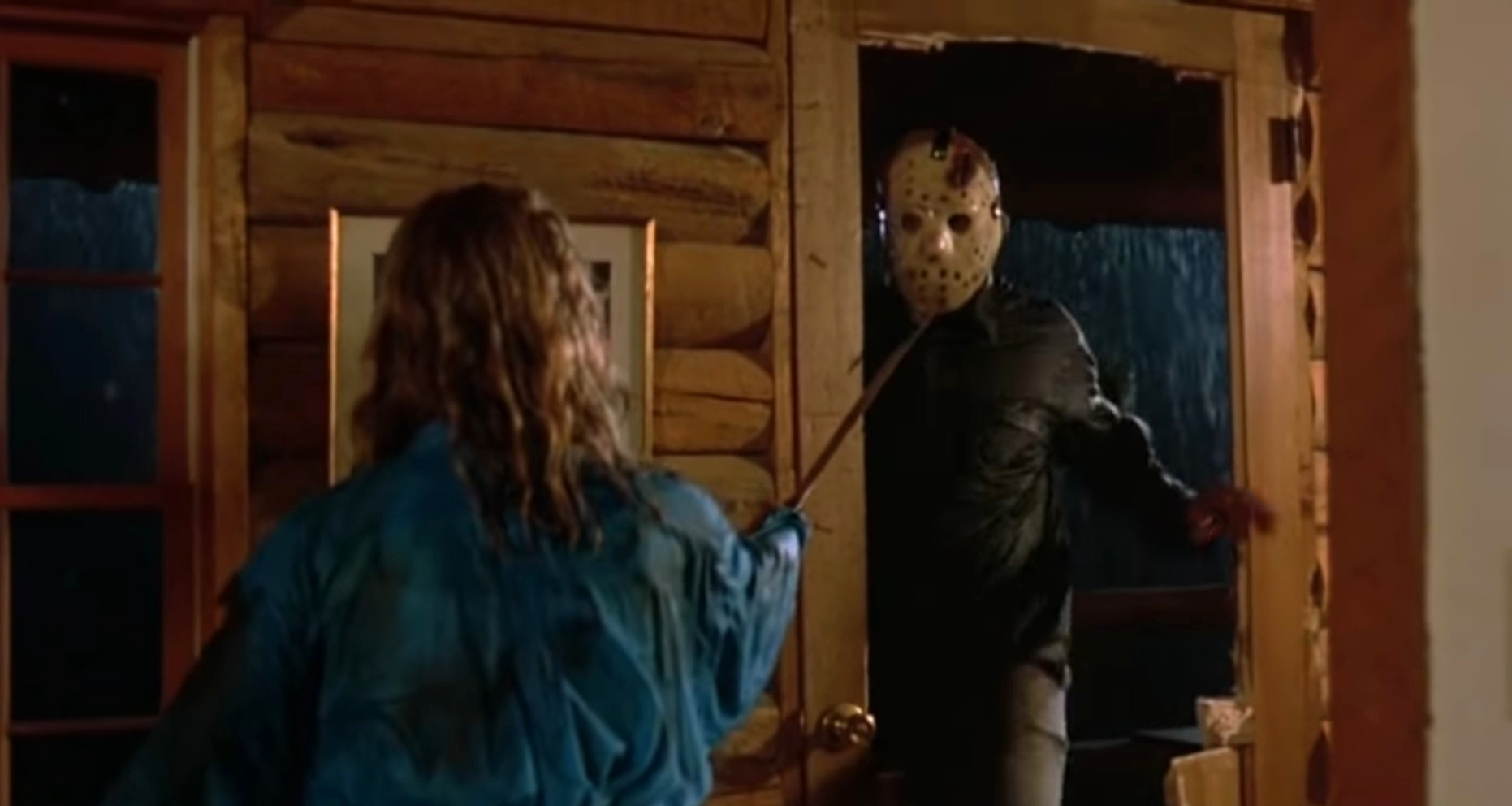
As I mentioned before, Friday The 13th Part 3 was indeed a fun horror movie and marked the time when the film franchise and its featured villain Jason Voorhees really started to take shape. It was the film that saw Jason wearing his now iconic hockey mask, and improved the creative formula (examples: Jason’s stalking and eliminating people, his encounter with the surviving protagonist or the final girl). In other words, Part 3 ended on a very strong note and high fun factor, setting the stage for the inevitable sequel Friday The 13th: The Final Chapter (AKA Part 4).
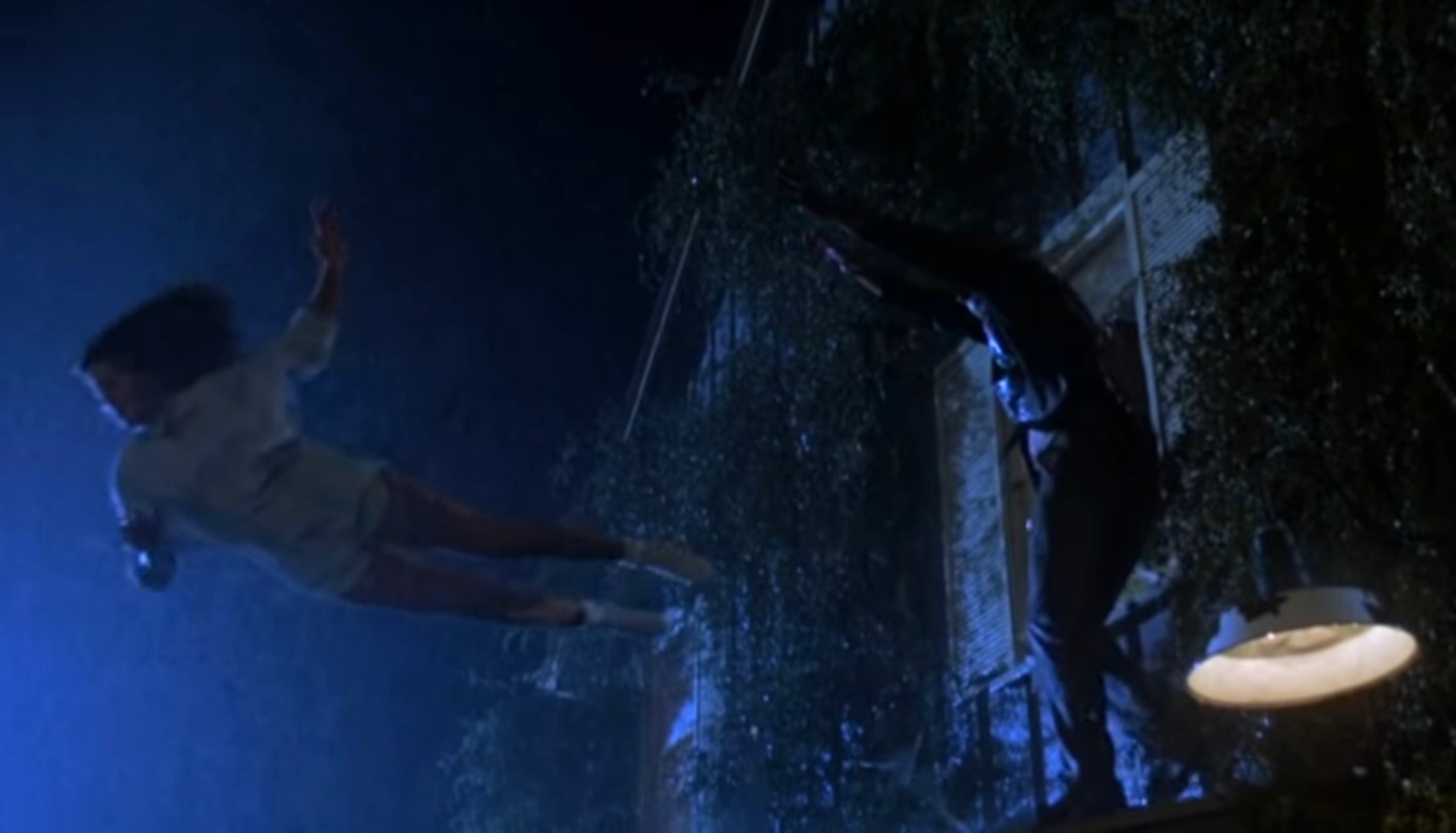
This dangerous stunt will always remain memorable.
Before starting this retro movie review, it’s important to take note of what happened in Hollywood that led to the creation of the 1984 movie.
Background
After Friday The 13th Part 3 rode the 3D movie trend and made a lot of money on ticket sales alone, Paramount Pictures perceived that the slasher horror genre was waning with moviegoers and decided that the Friday The 13th franchise should end. Eventually Joseph Zito was hired to write and direct The Final Chapter. The funny thing was that Zito secretly hired Barney Cohen to write the screenplay, going as far to take phone conferences with one of the producers, share details with Cohen to produce the pages (Zito and Cohen collaborated on the script in a New York apartment) which were sent to the producer (who would go back to the director).
Because it was clear that the film was supposed to end the franchise, Zita wanted the film the be about the death of the newly masked Jason and this explains why The Final Chapter opened where Part 3 ended…at the Higgins property which Jason’s body in the barn. The director told Cohen to focus on developing the characters (as opposed to emphasizing kills). Of course, this did not stop Zito from ramping up the kill count, the gore and nudity. With the cast hired, veteran stunt performer Ted White hired as Jason and movie makeup specialist Tom Savini rehired (note: he worked on the 1980 Friday movie and created Jason’s look as a youth), Zito really wanted to end the franchise with a bang!
With those details already recorded in history, here now is my retro movie review of Friday The 13th: The Final Chapter.
Early story
Friday The 13th: The Final Chapter opened with a recap of Jason, the killings and how things turned out in the first three movies, cleverly using Part 2’s camp fire scene in which Paul told the camp trainees the legend of Jason.
The story begins on the evening of Monday the 16th. For some weird reason, the local police and other emergency personnel arrived at the Higgins property (note: this was the very same California location where Part 3 was filmed at) at least twelve hours after Part 3’s lone survivor Chris Higgins was picked up by the police during the morning.
After picking up the dead bodies and examining the venue for evidence, the medical personnel brought Jason’s unmoving body to the local medical center with his mask and clothes still intact. Some time into the night, Jason (Ted White) discreetly gets up and kills two medical personnel before leaving for the great area of Crystal Lake.
The next morning, Tuesday the 17th, Mrs. Jarvis (Joan Freeman) and her daughter Trish (Kimberly Beck) jog together in the woods heading towards their country home which is located some distance away from Crystal Lake. Inside the house is the young son Tommy Jarvis (Corey Feldman) who is a geek and collector of special stuff. The family is already aware of the killings Jason caused over the past few days (refer to Part 2 and Part 3) and Mrs. Jarvis referred to him as the psycho.
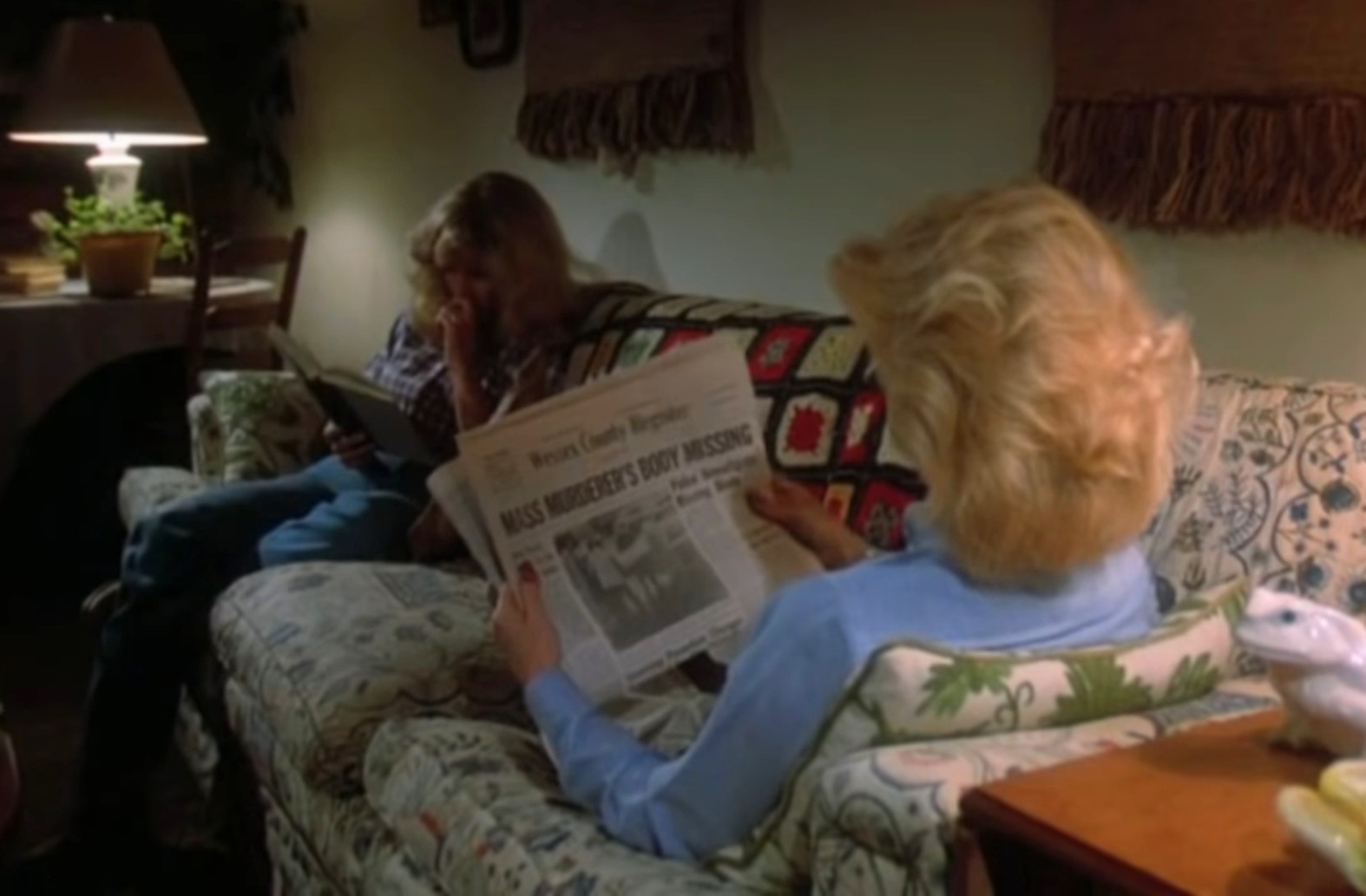
Remember the good old days when print media journalism was much more credible and not too politicized?
Meanwhile, a new group of teenagers riding a car are on their way to the Crystal Lake area for a group vacation completely unaware that Jason is on the loose. Their destination is a vacation house located very near the Jarvis home…
Quality
Even though the production team had a low budget, this film had improved production values which is literally only the tip of the iceberg. The real indicator of this movie’s quality is with the overall execution in terms of directing, storytelling, characterization (yes, there is character development here) and horror spectacle. The good news is that Friday The 13th: The Final Chapter’s overall quality is pretty good.
For starters, the creative team took the bold approach of having a family and a group of teenagers as targets for Jason’s killing spree. The presence of a likable family like the Jarvises made the Friday The 13th formula feel fresh since the old approach of having teenagers (and a few adults) getting killed off has gotten repetitive. Having good natured characters like Mrs. Jarvis, Trish and Tommy should remind you of the likable families living in your neighborhood. As such, the Jarvis family in the story will make you get concerned for them and despise Jason for the evil icon he truly is.
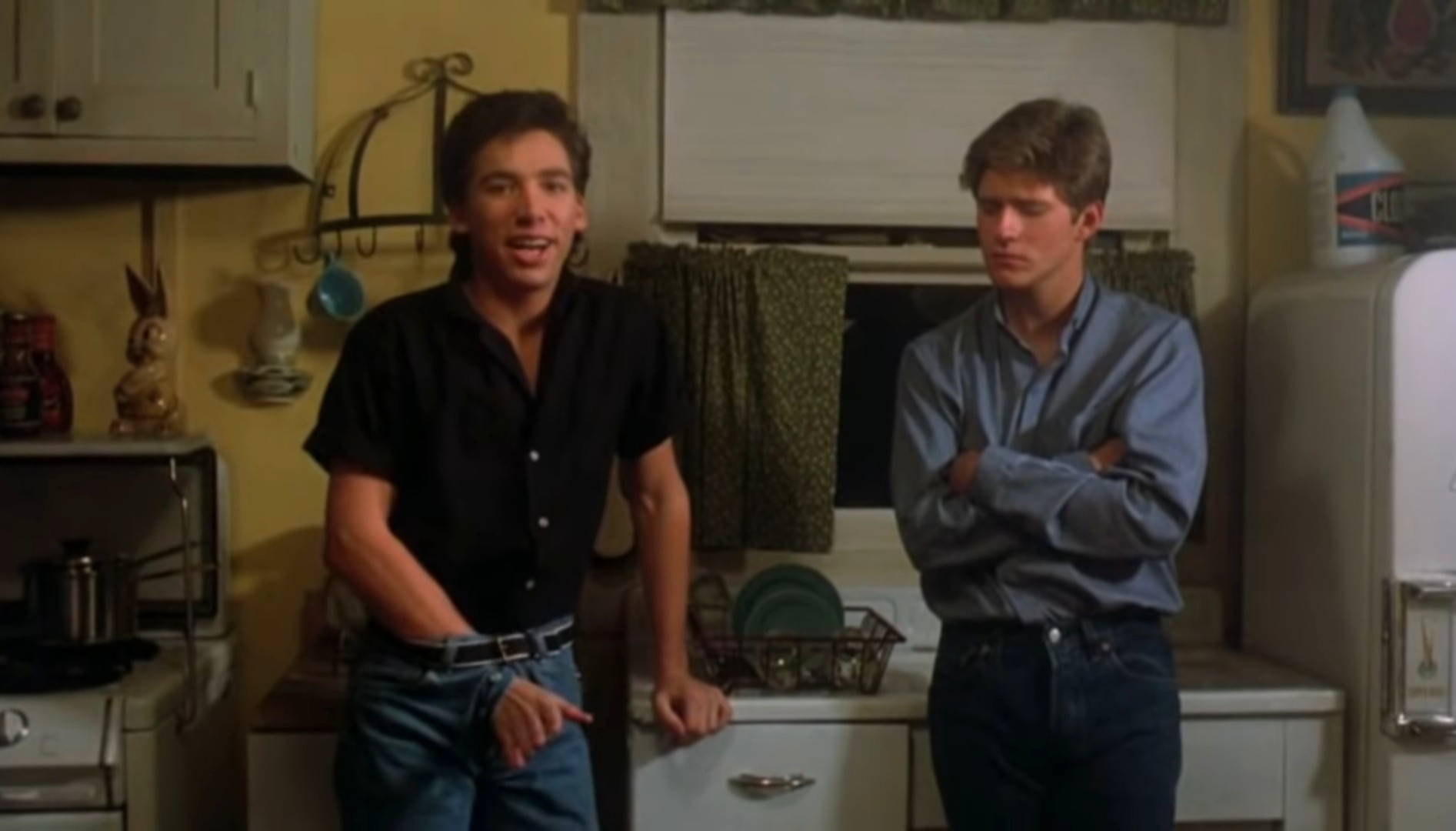
The new batch of teenagers in this film is an improvement over Part 3’s teenagers (which by the way are more likable than those in Part 2). Among them is Jimmy (Crispin Glover), a troubled young guy trying to achieve something important in his life. There is also Sara (Barbara Howard) who is sweet and appears reserved for Doug (Peter Barton). The pretty twins (Camilla More and Carey More), who just appeared into the film encountering the rest of the youth, added nice variety to the romance potential among them. On the other hand, Ted (Lawrence Monoson), is the stereotypical unlikable and pathetic guy meant for viewers to despise. Samantha (Judie Aronson) is the lady craving for sensual love with Paul (Clyde Hayes).
Ted: Hey, could you please pass to me a copy of that fake news-oriented local community print media publication? The tabloid, not the broadsheet.
What this movie clearly had in bringing some of the above-mentioned characters to life is character development. Director Zito and team succeeded in making the Jarvis family worth caring for. Jimmy is the teenager that moviegoers would relate with and also root for him to succeed. The other cast members, notably the teenagers wanting fun and satisfaction (skinny dipping and partying, anyone?), were made to be interesting and were clearly not merely disposable. Sara is likable and she looks like she could rival Trish in terms of who would be worthy to be the film’s final girl, not to mention who would be more worthy of the care from the viewers.
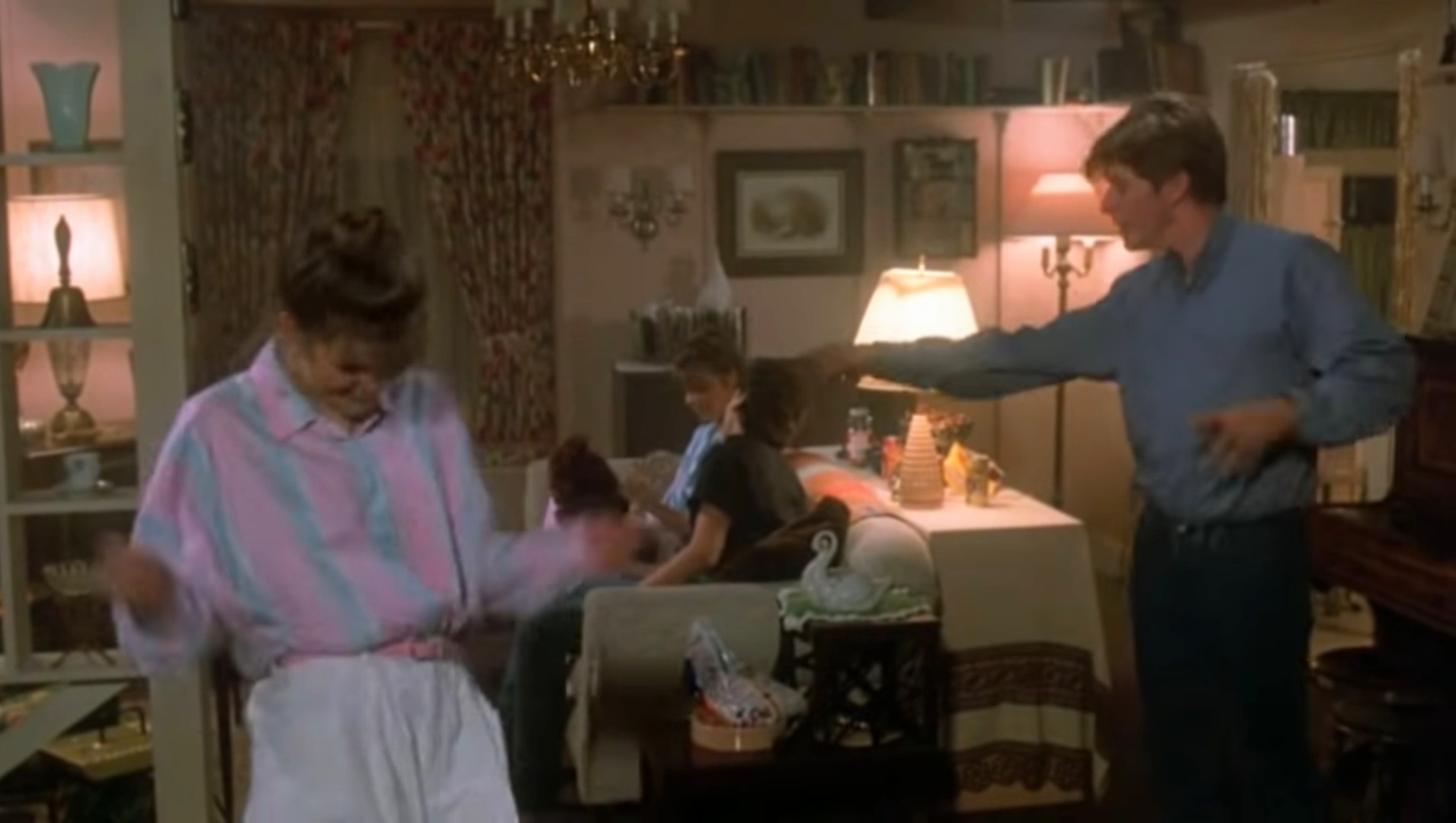
In terms of presentation, this film has a more serious tone. Other than Jimmy’s ever memorable dance, the approach to humor is noticeably weaker when compared to Part 3. At the same time, the killings of Jason are executed and made to really look visceral. When Jason kills a character who is likable or at least interesting, you will really feel bad or sorry, and then despise Jason. Speaking of Jason, the filmmakers made him look scarier with the visceral approach to killing on-screen and the fact that Ted White avoided speaking to the other cast members in between takes.
The memorable Crispin Glover dance!
One of many hard-hitting stunts in the movie.
When it comes to the stunts, the film crew really went all-out and it involved a lot of pain on the part of the actors because of the lack of safety and stunt performers as a result of the low budget. The stunts in this movie were executed with a lot of intensity and when each stunt ends, you will feel something. Take note that Ted White is a veteran of stunt performing and even doubled for Clark Gable long ago.
Remember the traditional stunts of having a human body thrown into the house through the ground-floor window? Such a stunt in this movie had a lot more impact than what was shown in the first three films. As for the stunt involving the very young Corey Feldman, that one was real and there was a huge risk of injury due to the lack of safety measures. Regardless, the stunt was performed and Feldman’s surprise and shouting were genuine. Here’s a video clip for you to enjoy.
The presentation of the on-screen kills and stunts here are the absolute best of the Friday The 13th franchise. The scare factor is also much stronger.
As for the music, Harry Manfredini returned. His musical score proved to be excellent in terms of bringing life into the scenes complete with precise timing.
Conclusion
I declare that Friday The 13th: The Final Chapter is the best and the most definitive movie of its franchise. It’s also one of the best and most defining horror movies ever released in the 1980s. It’s not worthy of awards for film excellence but it still is a major standout among all horror movies of the 1980s. It should be noted that this movie implemented a twist to the final-girl-versus-Jason formula of the first three movies by having a key character involved during the climax.
Believe it or not, Friday The 13th: The Final Chapter actually had a lot of tension between the director and actors during production (Note: Ted White stood up for the younger actors who had to endure physical pain due to lack of safety, and this put him into direct conflict with the director. And then White was very annoyed with Corey Feldman who in turn was allegedly badly treated on location by Zito).
Even so, the movie turned out to be its franchise’s biggest highlight, the best of it all! Apart from the final results made by director Zito and his crew, Friday The 13th: The Final Chapter owes part of its success to Friday The 13th Part 3 since that movie (a clear improvement over Part 2) helped set the stage for the fourth movie on a creative manner.
At the same time, it was in this fourth Friday The 13th movie where Jason truly became a horror icon as well as one of America’s pop culture icons. Director Zito, Tom Savini and Ted White combined their efforts on making this the most definitive story of Jason Voorhees who was not a zombie but a living human killer who simply won’t stop due to the evil in him. This movie’s Jason is clearly a dramatic improvement over Part 3’s Jason (which in turn was a dramatic improvement over Part 2’s Jason-with-a-potato-sack-for-a-mask) and each time the villain was on screen, you can sense his evil force. The mere fact that Trish got frightened by Jason at different stages of the chase between them proves how intimidating and scary the masked killer really is.
This is the best Friday The 13th movie ever!
Overall, Friday The 13th: The Final Chapter is highly recommended. For the best viewing experience and story immersion into Friday The 13th, I recommend watching Part 3 and this movie back-to-back.
Thank you for reading. If you find this article engaging, please click the like button below and also please consider sharing this article to others. If you are looking for a copywriter to create content for your special project or business, check out my services and my portfolio. Feel free to contact me as well. Also please feel free to visit my Facebook page Author Carlo Carrasco and follow me at HavenorFantasy@twitter.com
If there is any particular superhero comic book title I could compare Freex of the Ultraverse with, it’s Marvel’s famous X-Men. Similar to the mutants of the big M, Freex is a team of teenagers who each have different super powers or special abilities while struggling with being social outcasts. What makes them different is that the Ultraverse teenagers have no mature adult to look forward to for guidance. They don’t have a mansion to live in, and they have no choice but to move around constantly and survive the best way they could.
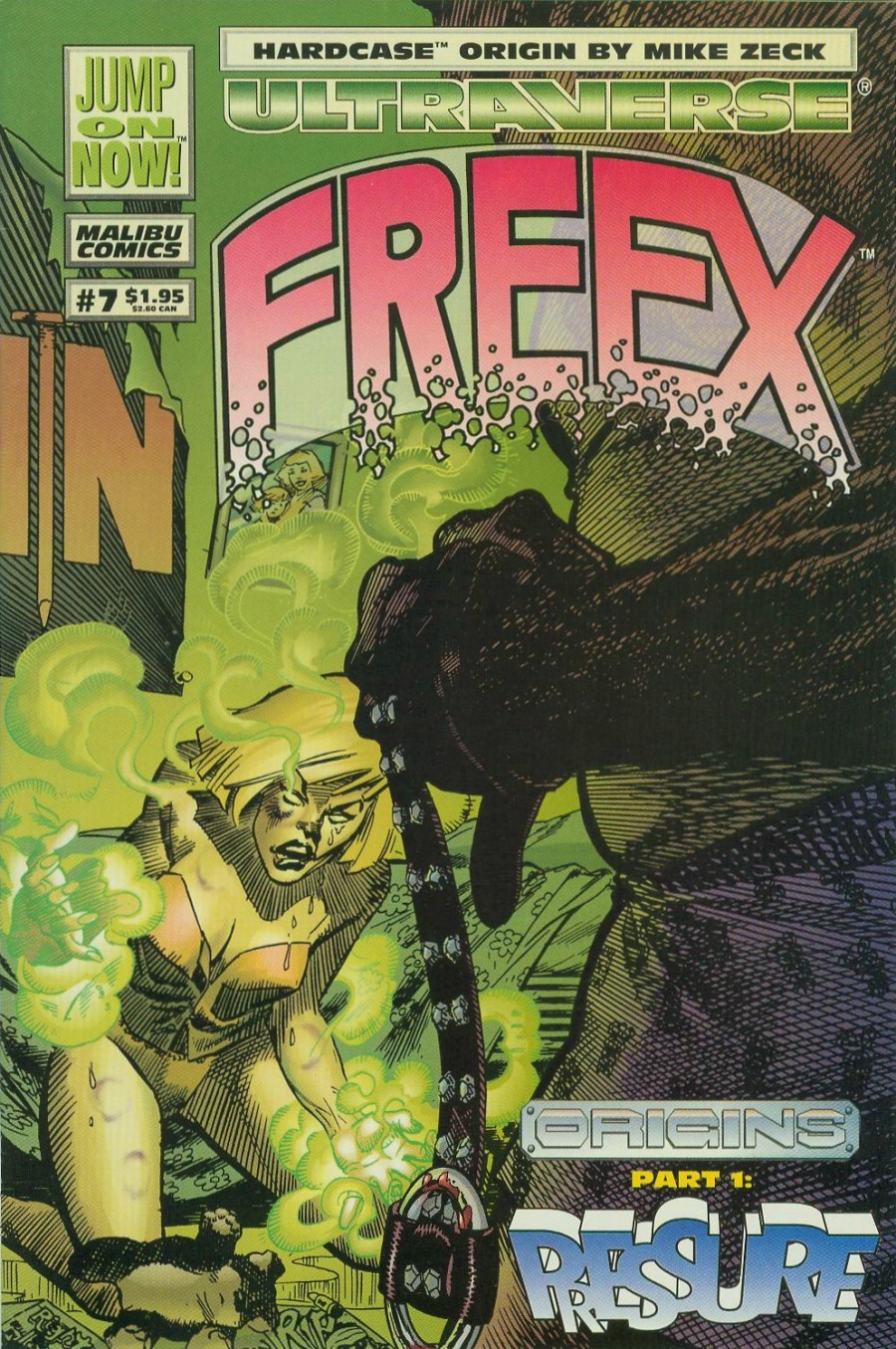
I took a look at the other existing back issues of Freex in my collection and what caught my attention was Freex #7.
The cover.
Let’s now take a look back at Freex #7 and see what makes it unique (if not special).
Early story
The story begins with the Freex hastily stealing clothes from a store in city. While the others are desperately grabbing what they could (note: the store’s glass window was shown smashed already), Angela/Sweetface looks scared. One of her male companions tell her to be tough like Valerie/Pressure.
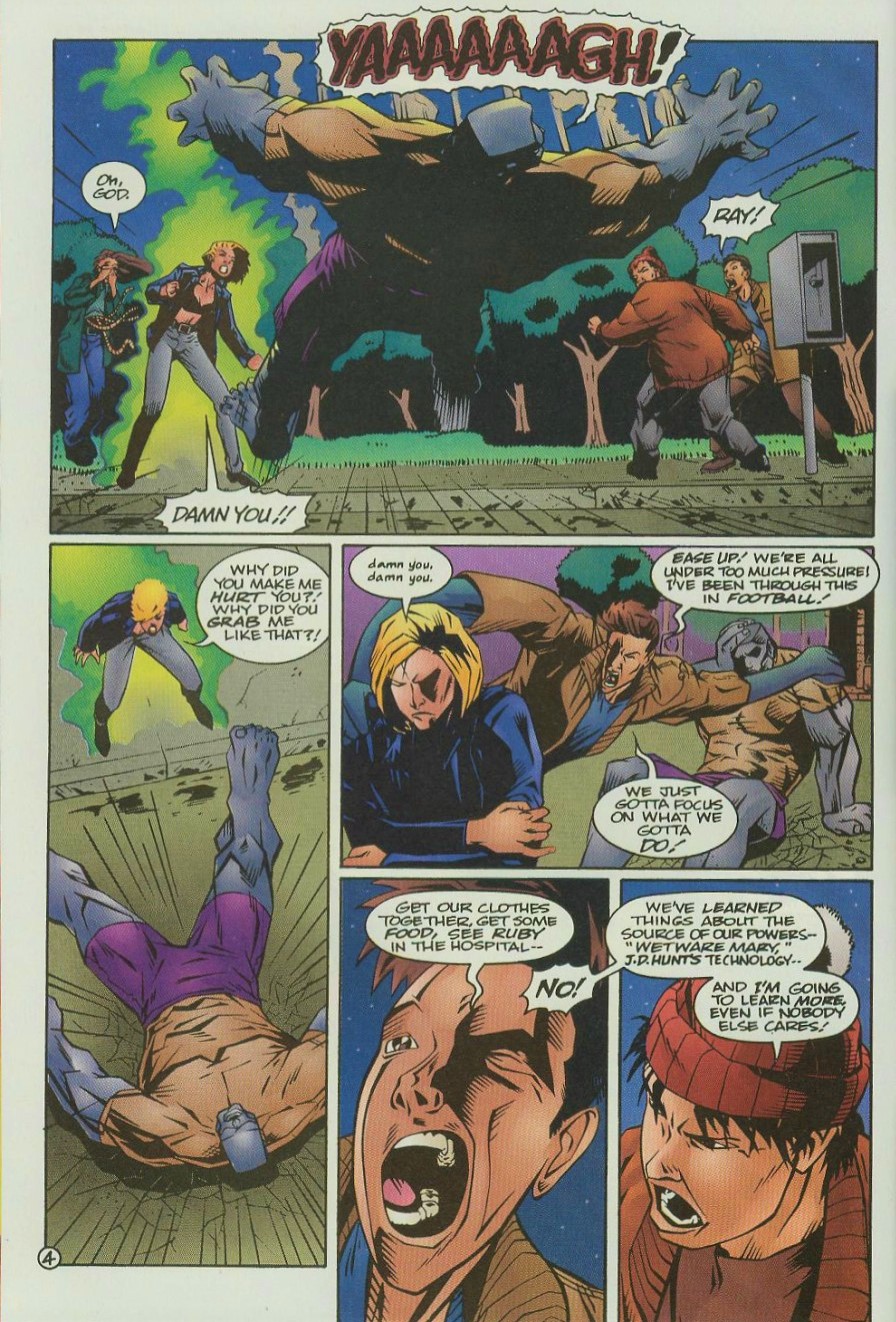
Just as they start leaving the store behind, the alarm system goes off. The sudden rush only adds pressure to them, causing Lewis/Anything to confront Michael/Plug only because the latter said something about team leadership. As Angela separates Michael and Lewis using her fleshy tentacles, Valerie loses her cool when Ray/Boomboy calls her by her codename. Valerie hits Boomboy with a blast of plasma. With their momentum disrupted by division and tension, Lewis tries to calm his teammates down but Plug won’t have any of it as he desires to find out about the source of all of their powers referred to as Wetware Mary. Plug finds a telephone booth and instantly transfers himself into it in the form of energy.
Division between members of Freex is common.
As the Freex remain divided, a local resident living nearby watches them from a distance.
Quality
The story written by Gerard Jones is pretty engaging mainly due to characterization (as opposed to storytelling and structuring). Through the dialogue, you can really sense the thoughts and emotions of each member of Freex, especially Valerie since this particular comic book focused on her origin. Without spoiling Valerie’s background, her origin was efficiently emphasized and never, ever felt dragging. By the time her origin story concluded, I got to understand Valerie better and why is she so mean. After the conclusion of the Freex’ story, there is also an Aladdin Datafile on Valerie who turned out to be 16-years-old, 5 feet and 9 inches tall, and even has a low threat assessment by Aladdin.
Adding further value to this comic book is a 2-page quick feature of Hardcase which shows a nice look back at his past before the establishment of The Squad.
Conclusion
From the past of Pressure.
Freex #7 is a good read. The story about the teenage social outcasts of the Ultraverse is well balanced in terms of characterization and action. Anyone who is a fan of Valerie/Pressure or female superheroes who are mean, angry and rebellious will find a lot to enjoy in this comic book. A near-mint copy of Freex #7 is worth $4 at MileHighComics.com as of this writing.
Overall, Freex is recommended.
Meanwhile, check out my retro review of Freex #1 right here.
Thank you for reading. If you find this article engaging, please click the like button below and also please consider sharing this article to others. Also my fantasy book The World of Havenoris still available in paperback and e-book format. If you are looking for a copywriter to create content for your special project or business, check out my services and my portfolio. Feel free to contact me as well. Also please feel free to visit my Facebook page Author Carlo Carrasco and follow me at HavenorFantasy@twitter.com
Disclaimer: This is my original work with details sourced from reading the comic book and doing personal research. Anyone who wants to use this article, in part or in whole, needs to secure first my permission and agree to cite me as the source and author. Let it be known that any unauthorized use of this article will constrain the author to pursue the remedies under R.A. No. 8293, the Revised Penal Code, and/or all applicable legal actions under the laws of the Philippines.
Long ago in the history of American comic book publishing, there was a time when superhero comic book storytelling were not told as dramatic serials but rather as standalone stories laced with outlandish ideas.
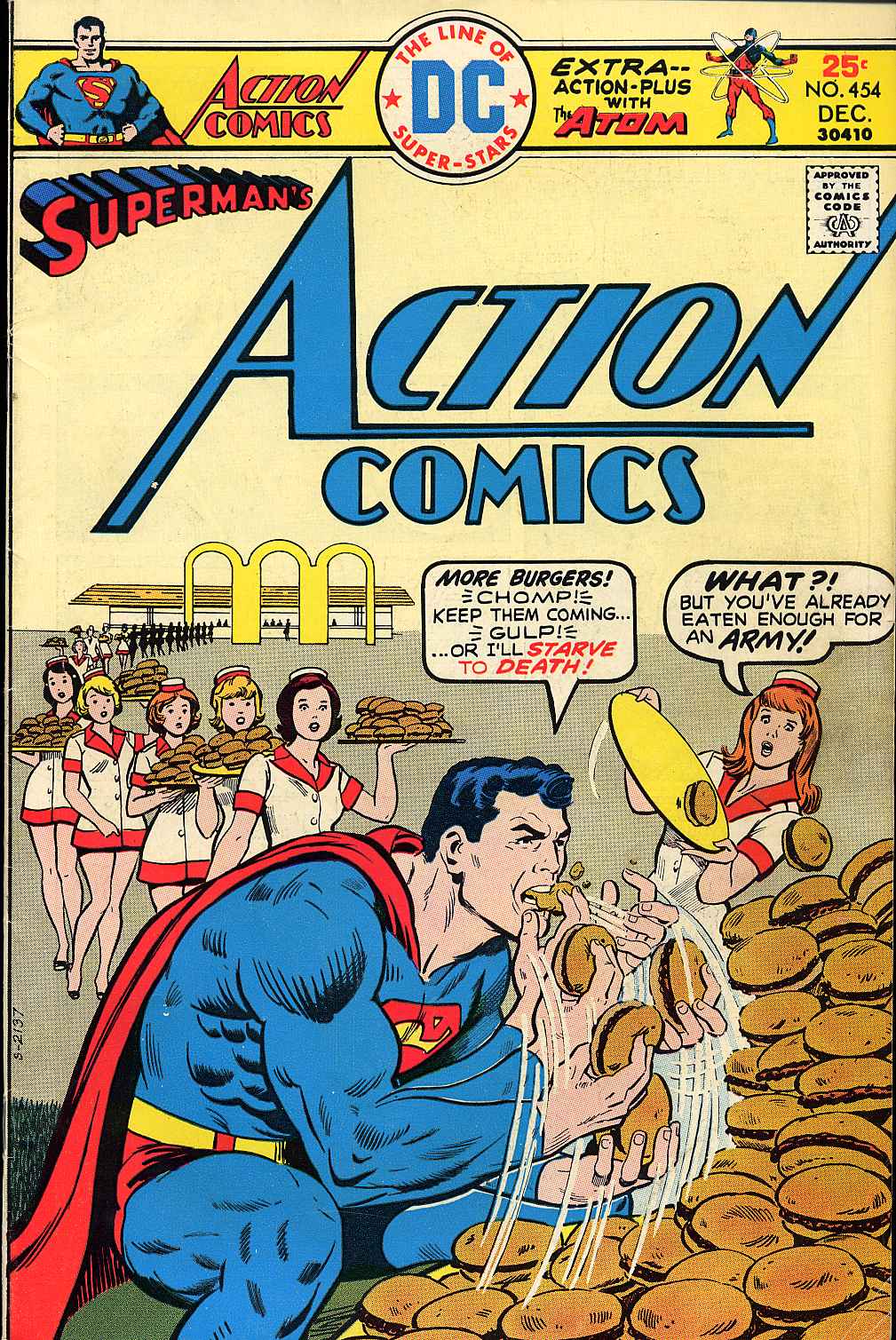
For this retro comic book review, we go back to the year 1977 as we focus on a Superman story that would not be told again in this day and age. To say the least, its cover art is, by today’s standard, over-the-top in terms of presentation. kapiHere is my look back at Action Comics #454 published by DC Comics with a story by Cary Bates and visuals by Curt Swan and Tex Blaisdell.
The cover.
Early Story
The comic book opens with a preview of things to come showing a weak Superman urged by a few people to fly and chase the Toyman.
And then there was the question: What good are super-powers without the stamina and endurance it takes to use them?
The story begins with the Toyman escaping after pulling off a bank robbery. As he flies higher, he sees Superman coming towards him. After using a trick to delay Superman, Toyman uses a special trick to twirl Superman at high speed and literally throws him away to an unknown destination. The villain escaped and, some time later, Clark Kent/Superman finds himself too tired and drained. Because of this, he becomes desperate to consume food and beverages just to keep going. This problem affects both his career and social life.
When was the last time you saw Clark Kent so exhausted?
Quality
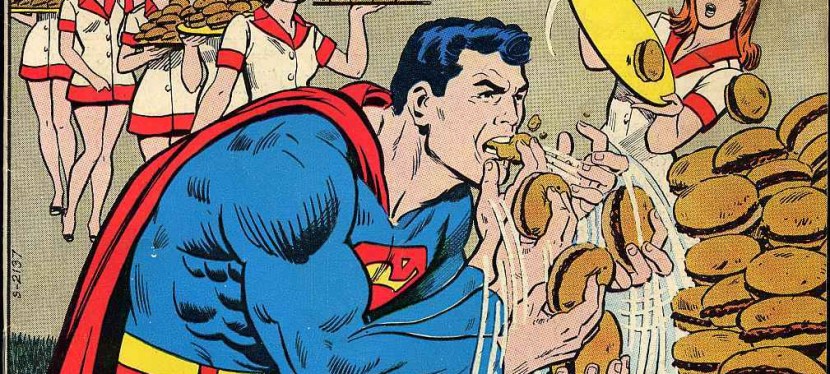
Action Comics #454 explores what would happen if Superman lacks energy and requires a lot of rest and many meals to stay active. To see him eat as many as sixty hamburgers per minute is quite funny to see.
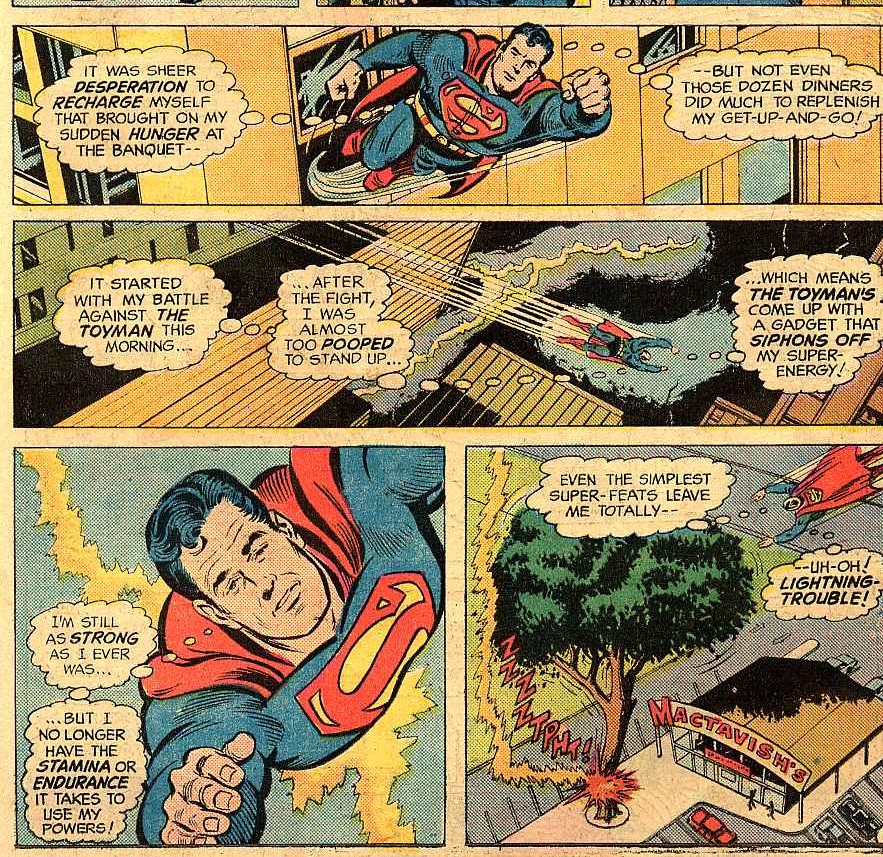
Being weak puts Superman at a disadvantage when it comes to stopping the criminal Toyman. As the Man of Steel flies at high speed to chase the bad guy flying in a personal aircraft, the chase drains him a lot.
When it comes to storytelling, this one is pretty short lasting only thirteen pages. What I find impressive is that the creators managed to tell a standalone story of good-versus-evil as well as answering the question as to what caused Superman to be so weak in the first place.
Superman flying tired.
Conclusion
To put it clearly, Action Comics #454 is definitely a very short literary escapade that still manages to be fun to read. It sure is outlandish and I strongly doubt DC Comics will want to put Superman through heavy eating in today’s age of comics. Is this comic book a classic? Not exactly but it sure is a satisfying, fun read from an era when outlandish superhero storytelling in comic books was the norm. If you are seeking this as a collector’s item, be aware that a near-mint copy of Action Comics #454 is worth $23 at MileHighComics.com as of this writing.
Overall, Action Comics #454 is recommended.
Thank you for reading. If you find this article engaging, please click the like button below and also please consider sharing this article to others. Also my fantasy book The World of Havenoris still available in paperback and e-book format. If you are looking for a copywriter to create content for your special project or business, check out my services and my portfolio. Feel free to contact me as well. Also please feel free to visit my Facebook page Author Carlo Carrasco and follow me at HavenorFantasy@twitter.com
When it comes to playing economic simulation games, I enjoy playing them on the personal computer (PC) using the keyboard and mouse. Back in the mid-1990s, there was one particular economic simulation that I played on the Super Nintendo Entertainment System (Super NES or SNES) and found it to be very enjoyable and easily to play with using the console’s control pad.
That game was Aerobiz Supersonic, a simulation about the airline industry developed and published by Koei for both the Super NES and the Sega Genesis. Here is my look back at this old video game from the 1990s.
The cover of the Super NES version of the game. Its art and style is really nice to look at.
Concept and Game Design
In the game, you get to play the Chief Executive Officer (CEO) of an airline and your goal is to beat your rivals in the global air travel industry. How to achieve the goal and succeed? There are tasks that need to be accomplished such as buying commercial airplanes (that include such real-life companies like Boeing and Airbus) for use, establishing flight routes, securing slots in airports worldwide, selling tickets and filling up each flight with as many passengers as possible, achieve profitability and finish the game’s imposed time period ranking #1. Adding zest to the game’s challenge is the selection of a certain era of world history that include 1955-1970 (the dawn of jets), 1970-1990 (the Cold War era), 1985-2005 (the present era) and 2000-2020 (the age of continued flight advancement).
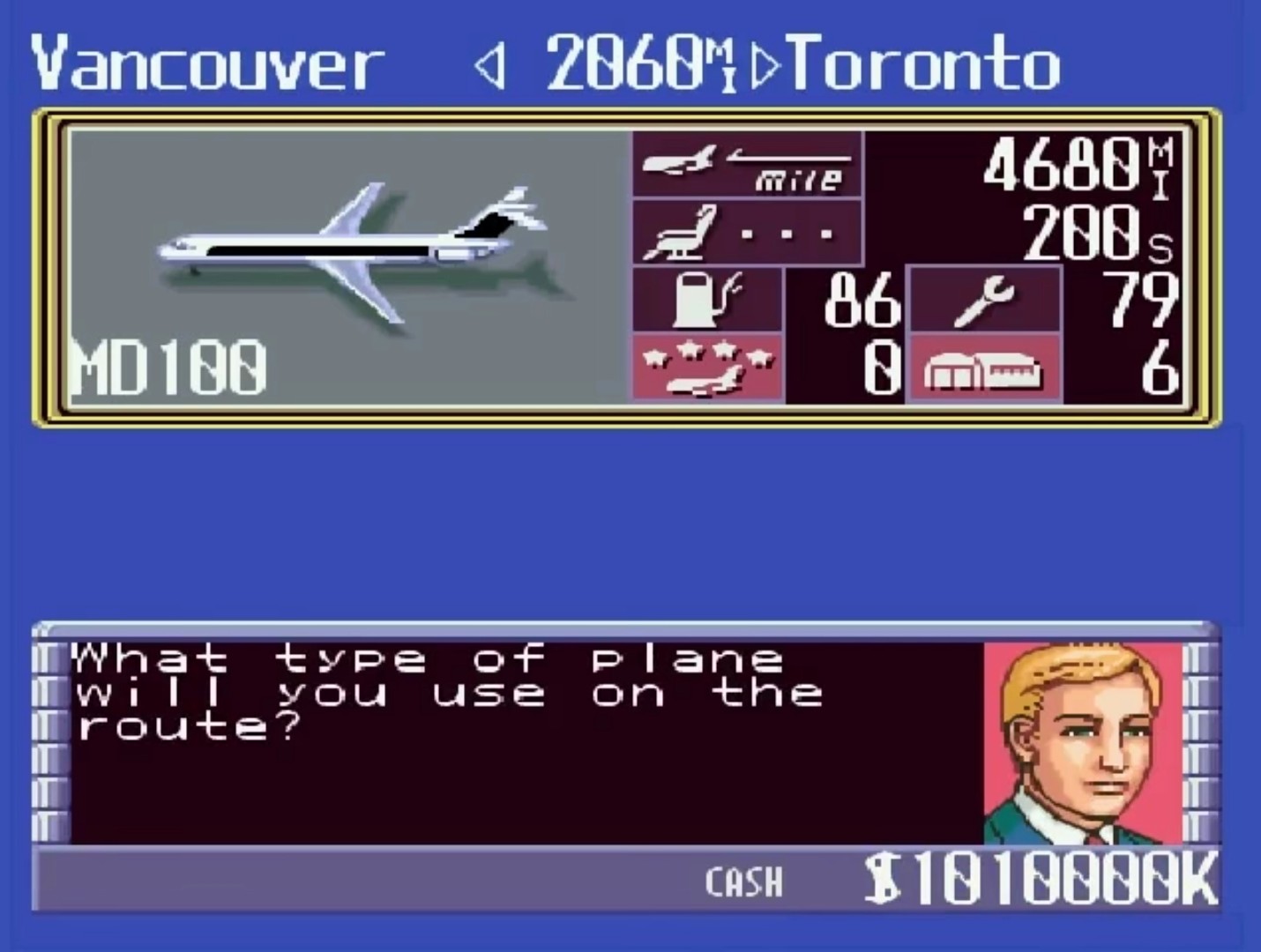
Within the game, time passes by means of clicking a certain on-screen button that ends the player’s current turn. Of course, before pressing that, the player has to set things in motion like sending a representative to a certain overseas airport to negotiate and secure slots (which takes months to complete), set the ticket prices, buy a new airplane or two, etc. The game even allows players to micro-manage their airline like adjusting internal spending (salaries) or adjusting the quality of their airplane and services. Also nice is the option offered for players to buy a hotel or resort, a theme park or a travel agency that can bring in additional revenue.
The airport slots, local businesses, economic and tourism details per city displayed.
Visit an airline and choose from one of many models of airplanes to buy.
There are other small details that need paying attention to such as the economy and tourism meters of each city displayed (note: a higher tourism score means the city is more attractive to travelers), the population, etc. Also noteworthy is the current state of relations between your home nation with the nation of the city airport you are trying to establish routes with which can affect your business.
When the turn ends, a series of events will happen showing what happened around the world, how your company fared in the competition during the lapsed time period, and, occasionally, a random event will occur that most likely will affect your business (examples: the Olympics hosted by a city helps draw in additional passengers or the 1970s oil crisis raises the cost of your operation).
Regarding the game’s imposed time period for competing with the artificial intelligence (AI) opponents, the period is twenty in-game years.
This is part of micro-managing your business in the game.
After the end of each turn, news and updates not only about your company but also your competitors are flashed.
Quality
Being used to playing simulation games on PC, I found Aerobiz Supersonic to be very enjoyable, addicting and easy and efficient to play (in terms of controls). Considering the above-mentioned gameplay options (buying an airline, sending a representative, etc.), they are pretty easy to adjust using the Super NES controller although there were a few moments when I accidentally pressed the button putting into motion a different option.
Gameplay aside, this game has a whole lot of charm with its visual presentation. You launch a brand new flight route, the game shows a short animation sequence of the jet taking off. You buy an airplane, you will see a short animation of it entering your facility once it arrives (complete with a visual design reflecting the model). You conduct a board meeting, your company’s officials are present making reports to you and you get a series of choices to make on what to do next. A historical event or a global development occurs, you get to see original art reflecting them (example: a nation joins the EU with people wearing suits and neckties together in a formal ceremony). You make a move to buy slots at an airport overseas, a company official will have his or her face shown talking to you. When looking at the regional map, you see lines connected between cities (highlighting the establish flight route you made) and there are icons of airplanes flying between them.
Random tourist hot spots get highlighted as you keep playing.
More on the aspect of starting the game, I like the options offered for me to select which city shall serve as my airline headquarters. Among the many cities included, there are cities of my native Philippines namely Manila (the international destination) and the nearby city of Cebu. I still remember how delighted I was to see my native Philippines included in the game, complete with Asian character designs to reflect the company and its region.
Conclusion
Ultimately Aerobiz Supersonic (which was actually a sequel to Aerobiz) is a gem of a console economic simulation released at a time when 2D sprite gaming was still the standard and 3D polygonal gaming was just about to make an impact on the global video game console market. Back then, 2D side-scrolling action/adventure games, sports games and role-playing games (RPGs) were so common on the Super NES and Genesis combined and the idea of enjoying economic simulations on consoles was highly unusual. Aerobiz Supersonic is proof that economic simulations can come with a lot of depth, deliver a good amount of strategy and can be highly playable and enjoyable on consoles.
If you want to enjoy this game, it can be quite difficult to do because you need to acquire an existing copy of the game as well as a fully functioning Super NES or Sega Genesis. As of this writing, there has never been a re-release of Aerobiz Supersonic (note: in line with legitimacy, I will not consider those browser versions or file sharing of ROMs) and it is not even included on Nintendo’s Virtual Console. There’s not even a version made for smartphones.
Now if only the executives at Koei Tecmo Games would consider revisiting Aerobiz Supersonic with today’s consumers in mind.
You can choose what kind of plane, how many planes, how many flights and how much you set the ticket prices whenever you start a new flight route.
Thank you for reading. If you find this article engaging, please click the like button below and also please consider sharing this article to others. Also my fantasy book The World of Havenoris still available in paperback and e-book format. If you are looking for a copywriter to create content for your special project or business, check out my services and my portfolio. Feel free to contact me as well. Also please feel free to visit my Facebook page Author Carlo Carrasco and follow me at HavenorFantasy@twitter.com
Disclaimer: This is my original work with details sourced from reading the comic book and doing personal research. Anyone who wants to use this article, in part or in whole, needs to secure first my permission and agree to cite me as the source and author. Let it be known that any unauthorized use of this article will constrain the author to pursue the remedies under R.A. No. 8293, the Revised Penal Code, and/or all applicable legal actions under the laws of the Philippines.
When Marvel Comics first launched the 2099 imprint of comic books showcasing many futuristic versions of their present-day characters – like Spider-Man, Ravage and Dr. Doom – it was inevitable that the same treatment will be applied to their popular supervillains.
In 1993, the 2099 version of Vulture was introduced and he sure proved to be one tough opponent for Spider-Man 2099. Even back then, there already was clamor for a futuristic version of Venom which at the time was riding high with readers being the featured anti-hero in several limited series (starting with Lethal Protector) of comic books.
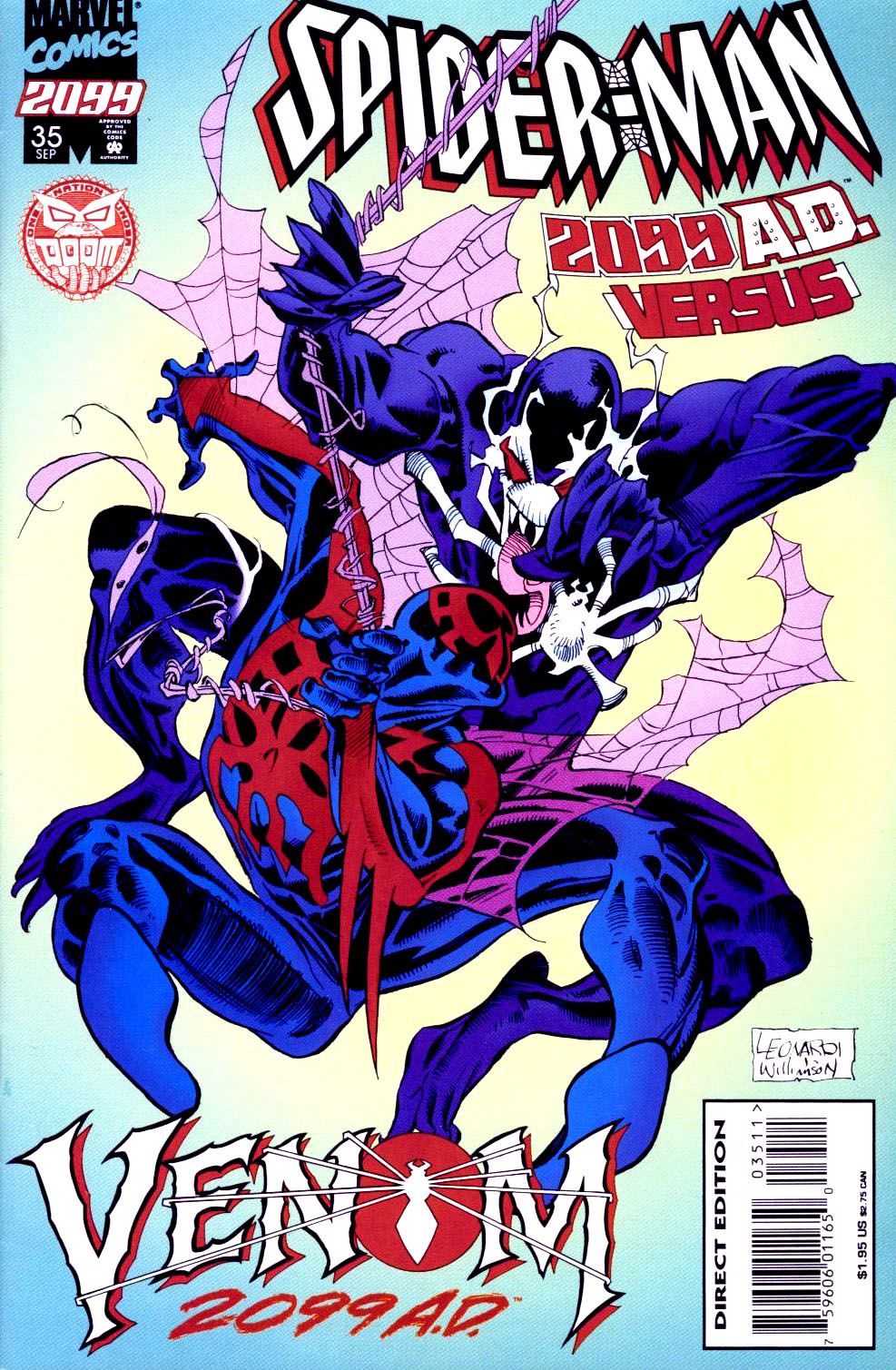
Then in 1995, after doing a creative teaser in issue #34, Marvel formally introduced Venom 2099 by releasing Spider-Man 2099 #35. This is my review of the comic book written by Peter David and drawn by Andrew Wildman (X-Men Adventures).
The cover drawn by Rick Leonardi.
Early story
Picking up from the events of issue #34, the story begins in Washington, DC with Dana freeing herself only to find out that Alchemax’s CEO Tyler Stone was down suffering from a gun shot and losing blood. Minutes later, emergency personnel take Stone’s body for immediate treatment.
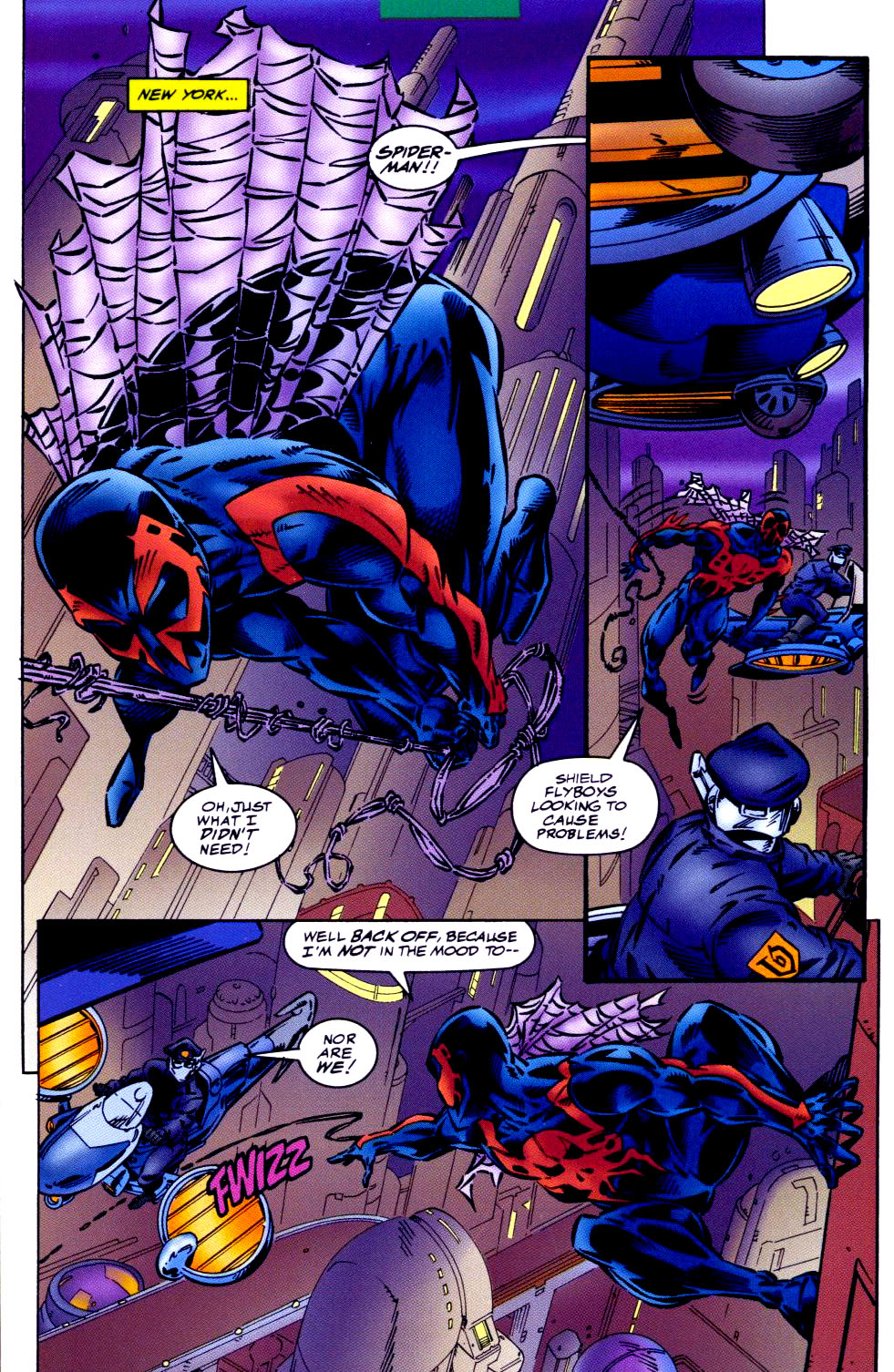
Meanwhile, Spider-Man 2099 (Miguel O’Hara) encounters the SHIELD flyboys in New York. After almost getting into trouble together, Spidey gets informed that US President Doom 2099 ordered them to leave him alone for a period of seventy-two hours while he considers a cabinet offer. Back in Washington, Dana gets interrogated by one of the authorities. President Doom enters the scene telling Dana that she will join Tyler Stone immediately in the medical center.
Andrew Wildman’s take on Spider-Man 2099 and the future was really nice to look at.
In New York, two guys sitting on the sidewalk witness a moving black liquid coming out of the sewer. The thing turns out to be a living symbiote (or alien costume) forming into a human-like shape – Venom 2099!
Quality
As with other comic books of this particular series, the writing by Peter David is pretty deep and engaging. The usual balance between dramatization, character development, plotting and spectacle is here once again but with a slight touch of horror in relation to the introduction of Venom of 2099. Speaking of dramatization, the portrayal of Venom 2099 as a vicious villain is similar to the 20th century Venom (Eddie Brock) but with a very powerful obsession to kill Miguel O’Hara and Tyler Stone.
Here’s an excerpt from the dialogue of Venom of 2099: Miguel O’Hara…and Tyler Stone…together again. We…I get to kill you…at the same time…how awfully…awfully…considerate. To show my appreciation…I’ll kill you slowly.
What makes this comic book unique is the artwork by Andrew Wildman who temporarily replaced regular illustrator Rick Leonardi. For comparison, I find Wildman’s art style a welcome thing in this comic book mainly because he draws with a lot more detail per panel and per page than Leonardi ever could. Instead of seeing the usual sketch-like art style of Leonardi, Wildman’s style is livelier and more expressive to look at. I also enjoyed Wildman’s visual take on Spider-Man 2099/Miguel O’Hara, Lyla, Tyle Stone, and the other established characters. Their facial expressions are also livelier to see.
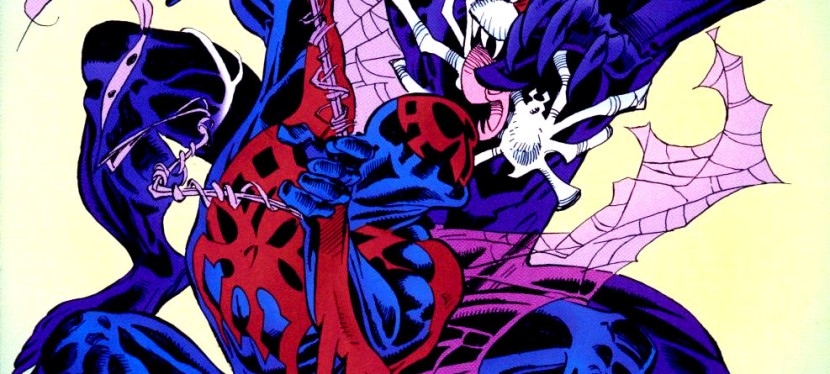
Venom 2099 appears! Take note of the “liquid” at the edges of the page.
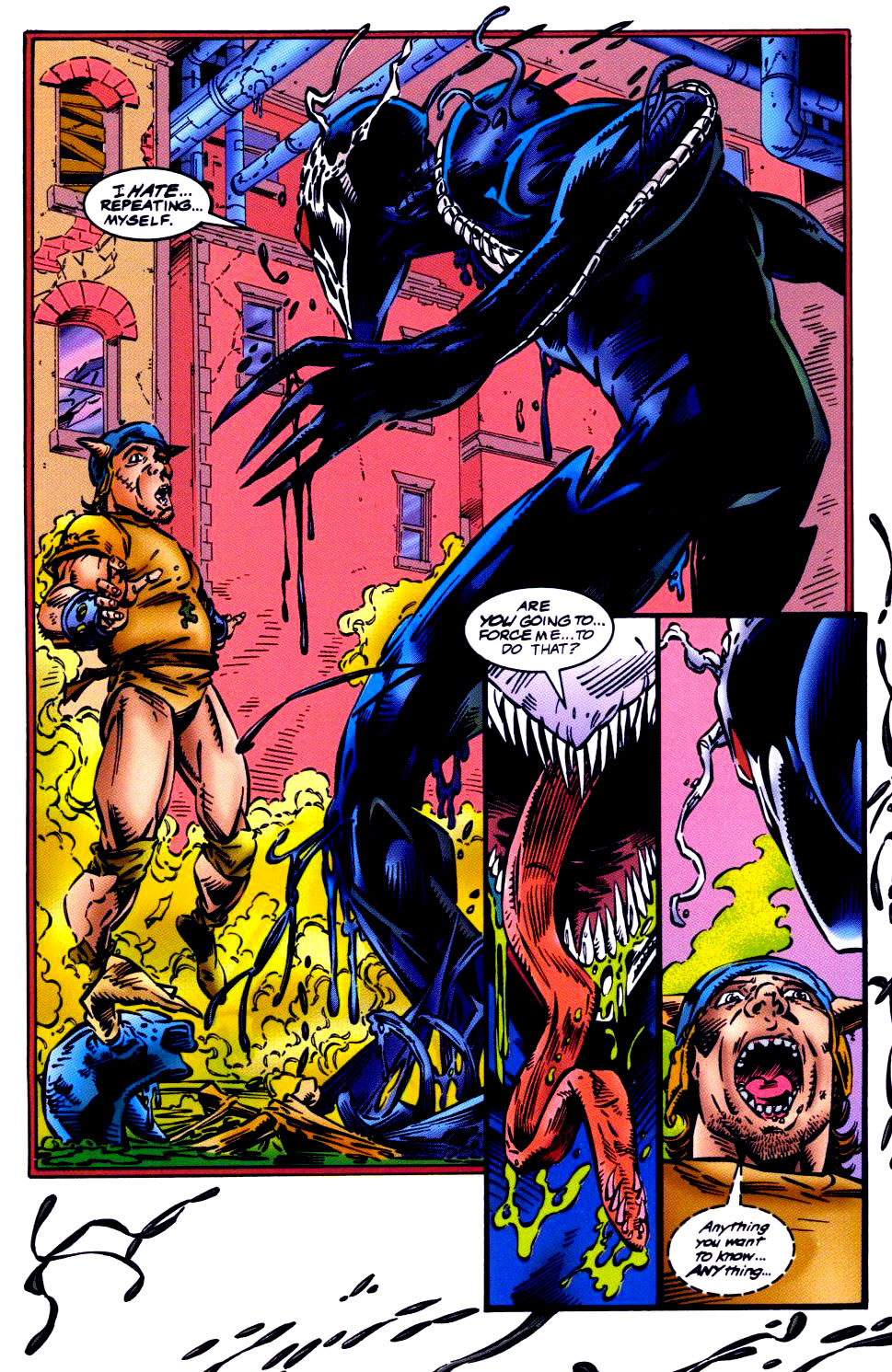
More on visuals, Wildman’s take on Venom 2099 is unforgettable. Like 20th century Venom, he has a dark suit, elongated jaw with rows of sharp teeth and an elongated tongue but with green acid dripping all the time. There are also those tentacles-like things that stretch from his body until the arms. Also his white-colored mask with large eyes make him look horrific.
Conclusion
Despite being shorter than the usual 22-pages, Spider-Man 2099 #35 is still a very engaging and fun old comic book to read. Its purpose was to build-up anticipation leading to the introduction of Venom 2099 was achieved nicely and the respective qualities of the writing and visuals are very good even by today’s standards. More on the presentation of Venom of 2099, it seems like Peter David took inspiration from movie director James Cameron on building-up tension and suspense before showing the villain. That’s a move I enjoyed in this comic book.
Overall, Spider-Man 2099 #35 is highly recommended. If you plan to acquire an existing and legitimate hard copy, be aware that the near-mint copy of it is over $100 for the newsstand version while the Rich Leonardi-drawn “Venom 2099 AD” cover version is priced at over $80 at MileHighComics.comas of this writing.
Thank you for reading. If you find this article engaging, please click the like button below and also please consider sharing this article to others. Also my fantasy book The World of Havenoris still available in paperback and e-book format. If you are looking for a copywriter to create content for your special project or business, check out my services and my portfolio. Feel free to contact me as well. Also please feel free to visit my Facebook page Author Carlo Carrasco and follow me at HavenorFantasy@twitter.com