Now that the Liberal Democratic Party (LDP) won a great majority of the seats of Japan’s House of Representatives, Prime Minister Takaichi Sanae and her administration are now in a better position to implement policies to help the constituents and strengthen the nation, according to a news article by NHK World.
For insight, the LDP won 316 of the House of Representatives 465 seats. With the addition of the 36 seats won by the coalition partner Japan Innovation Party (JIP) – also referred to as Nippon Ishin no Kai – the grand total is 352 seats. This means the Prime Minister’s ruling coalition surpassed the two-thirds threshold required to overring the upper chamber (House of Councilors) and propose constitutional amendments. Very clearly, the voters of Japan have spoken and they want stability and the right direction for their country.
To put things in perspective, posted below is an excerpt from the news article of NHK World. Some parts in boldface…
Japan’s ruling Liberal Democratic Party overwhelmed the opposition for a historic victory in Sunday’s Lower House election.
Voters gave the LDP a massive majority of 316 seats, empowering Prime Minister Takaichi Sanae – who pledged to accelerate her policy agenda. This marked the first time in the postwar period that a single party secured more than two-thirds of the seats on its own.
But the largest opposition party, the Centrist Reform Alliance, lost a significant number of seats. Both of its co-presidents announced their resignations on Monday.
Takaichi vows to accelerate her policy agenda – The prime minister spoke with NHK about her plans after the landslide win.
She pledged to accelerate the implementation of what she calls “responsible and active fiscal policy,” while calling on opposition members to cooperate in areas where consensus can be reached.
A consumption tax cut was one of the major issues during the election campaign. The LDP had pledged not to apply the consumption tax to food items for a limited period of two years. Takaichi said she is eager to accelerate Diet discussions on the issue.
Asked about the cabinet, she said her current lineup is a good team.
“Just over three months have passed, but everyone is working hard and achieving results, so I am not thinking of changing it,” she added.
But she indicated that she would think about a cabinet position for the LDP’s coalition partner, the Japan Innovation Party, if the issue is raised.
Crushing defeat –The Centrist Reform Alliance, the largest opposition party, fell to a crushing defeat as it lost more than 100 seats. It held 172 prior to the election and was formed from two separate parties just before the poll.
For additional insight regarding the popularity of Prime Minister Takaichi and other related developments, watch the videos below.
Let me end this piece by asking you readers: What is your reaction to this development? Do you think Prime Minister Takaichi and her administration will come up with new and significant policies covering the economy, social norms and defense of the nation over the next twelve months? Do you sense a strong revival of Japan’s economy happening within the next few years? Do you think Communist China is now afraid of Prime Minister Takaichi being a more powerful Japanese leader? Do you think that the planned cooperation between Israel and Japan will proceed smoothly over the next six months?
Japanese Prime Minister Takaichi Sanae will continue to lead her nation as her political party the Liberal Democratic Party (LDP) is set to win a huge majority of the seats of the House of Representatives following the election that happened yesterday, according to a news report by Kyodo News. Already US President Donald J. Trump and Italian Prime Minister Giorgia Meloni congratulated Takaichi (click here and here).
For insight, Takaichi dissolved the House of Representatives a few weeks ago and this led to a short but intense election campaign. The voters of Japan have spoken favoring Takaichi and her party. That being said, February 8 is a sad day for the Commies, the woke, the pro-China candidates, and the Islamists as the opposition fared badly.
To put things in perspective, posted below is an excerpt from the news article of Kyodo News. Some parts in boldface…
Japan’s Liberal Democratic Party led by Prime Minister Sanae Takaichi is set to win a big majority in the House of Representatives in Sunday’s election, early returns and Kyodo News projections show, an outcome largely driven by her personal popularity that clears the way for her to stay on.
The LDP, which has formed a coalition with the Japan Innovation Party, has secured at least 243 seats, well over the majority line of 233, in the 465-member lower house, up from 198 before the contest.
Amid prolonged inflation and a growingly severe international environment, Takaichi has promised to pursue a “responsible yet aggressive” fiscal policy and boost the nation’s defense capabilities.
The ruling camp is projected to secure at least 261 seats in the powerful chamber, clearing the threshold for chairing all standing committees and outnumbering the opposition in those panels, thus helping it to push through its legislative agenda.
The main opposition party, the Centrist Reform Alliance, formed in January by uniting lower house members of the Constitutional Democratic Party of Japan and the Komeito party, is set to lose a significant number of seats, according to early returns and projections.
Following media reports of the LDP’s victory, Takaichi hinted at no major change to the lineup of the Cabinet, launched less than four months ago, during a TV program.
But she said she hopes that the JIP, which decided not to take ministerial posts when forming the coalition in apparent reflection of a cautious stance toward the LDP, will fulfill “its responsibility together in the Cabinet.”
It remains unclear, however, whether the JIP, known as Nippon Ishin, can retain its pre-election strength of 34 seats in the lower house.
“It was an election in which we felt pressure from the LDP,” JIP leader Hirofumi Yoshimura told a press conference in his party’s home prefecture of Osaka in western Japan, adding that it had tried to convince voters that it had an important role to play in the coalition in the campaign.
The focus is now on whether the LDP-JIP camp can win a two-thirds majority, or 310 seats, in the lower house, which would allow it to initiate a proposal for amending the Constitution, the LDP’s long-held goal, to put to a national referendum.
Takaichi expressed her hope that “concrete plans” to amend the supreme law will be debated at parliament.
The Sanseito party, a populist group known for its “Japanese First” slogan, is expected to make big strides, while Team Mirai, which advocates adoption of digital technologies to enhance political participation, is set to secure its first seat in the chamber, according to the polls.
Takaichi, who has maintained high popularity since becoming Japan’s first female prime minister last October, had pledged to “immediately resign” as Japan’s leader if the coalition failed to secure a majority in the powerful lower chamber.
Nearly 1,300 candidates vied for the 465 seats, with 289 elected from single-seat constituencies and 176 through proportional representation, where seats are allocated for parties based on votes received in 11 regional blocks across Japan.
Early voting received a boost as a record 27.02 million people cast their ballots in the days prior to Sunday, up around 6 million from the previous election in 2024.
Voter turnout stood at 56.24 percent, likely up around 2 percent points from the previous race, according to an estimate by Kyodo News as of 9 p.m.
Japan held a general election in February for the first time in 36 years, a move by Takaichi that has drawn criticism because heavy snowfall in many parts of the country made campaigning difficult. Tokyo and its nearby areas also had snow on Sunday.
As ordinary households have been struggling to cope with the rising cost of living, major political parties have pledged to reduce tax burdens on the campaign trail.
Under Takaichi, a security hawk, the ruling parties also sought support for their aim to beef up the country’s defenses in the face of an increasingly severe security environment.
While her Cabinet enjoys high support ratings, the ruling bloc had only a razor-thin majority with the support of some independents in the lower house before it was dissolved late last month.
Even if the ruling bloc manages to meet its target of securing a majority in the lower house, it remains in a minority in the House of Councilors, or the upper house, meaning that opposition party support is critical in passing bills.
For additional insight, watch the Nippon TV news video below.
Let me end this piece by asking you readers: What is your reaction to this development? With her own party having secured a lot more seats in the House of Representatives of Japan, do you think Prime Minister Takaichi and her team will be in a better position to achieve their agenda? Are you surprised to see the Satanic Left, the woke and the Communists of Japan lose more seats in the election that just happened? Now that the elections are over, do you think the illegal immigrants/aliens as well as the foreign criminals in Japan would be compelled to leave the country?
With an all-time high of 42.7 million foreign tourists counted in 2025, Japan is clearly having a tremendous tourism boom that is also unprecedented. While the country took in over $60 billion from the said foreign tourists, immense tourism is causing a wide series of challenges for the Japanese residents and the authority, and this early the Japan Tourism Agency (JTA) announced that the nation will make serious moves to tackle overtourism by the year 2030, according to a news article by Kyodo News.
To put things in perspective, posted below is an excerpt from the news article of Kyodo News. Some parts in boldface…
The Japan Tourism Agency said Friday it plans to more than double the number of regions taking steps to address overtourism from the current 47 by 2030, in an effort to increase understanding among the public of the importance of inbound tourism to the nation’s economy.
A goal to boost the number of such regions to 100 will be included for the first time in the government’s next basic tourism promotion plan. A draft of the plan, which covers five years from fiscal 2026, was presented to a panel of experts and is scheduled to be approved by the Cabinet in March.
According to the draft, the government will maintain its existing targets to increase inbound visitor numbers to 60 million and their annual spending to 15 trillion yen ($97 billion) by 2030.
In 2025, foreign visitors to Japan reached an estimated record of 42.7 million, with their spending also at a new all-time high of 9.5 trillion yen, according to the government.
With a sharp decline in Chinese tourists due to deteriorating bilateral relations, the draft also stressed the importance of preparing for changes in the international situation, saying that efforts will be made to attract visitors from a wide range of countries and regions.
The agency has been implementing model projects to support regions taking steps to address overtourism issues, such as traffic congestion and nuisance behavior.
To date, 47 regions, including Kyoto in western Japan and Taketomi in Okinawa Prefecture, have been advancing initiatives based on resident feedback, including easing congestion on local roads and limiting visitor numbers.
Let me end this piece by asking you readers: What is your reaction to this development? Do you think that the ongoing tourism in Japan will last for at least the next three years? Would you be surprised to see foreign tourist arrivals in Japan reach 45 million by the end of this year? Are you dismayed to see foreign tourists misbehave or violate local rules during their stay in Japan? Do you think China’s hostility against Japan will bring down this year’s count of foreign tourists?
As millions of voters all over Japan are ready to cast their votes in tomorrow’s general election, Prime Minister Takaichi Sanae received the full endorsement of US Presdent Donald Trump and it has also been revealed that her trip to the White House has been set for March 19, according to a news report by Kyodo News.
To put things in perspective, posted below is an excerpt from the news article of Kyodo News. Some parts in boldface…
U.S. President Donald Trump on Thursday gave his full endorsement to Japanese Prime Minister Sanae Takaichi ahead of the country’s general election and said he would welcome her to the White House on March 19.
While Trump is often an outlier, it is very rare for the leader of any country to back a specific political figure ahead of a national election in a foreign country. Calling Sunday’s election “very important” for Japan’s future, he praised Takaichi for already proving to be a “strong, powerful and wise” leader.
In a social media post, Trump also said he and his team were impressed with her when they met in Japan about three months ago.
“Prime Minister Takaichi is someone who deserves powerful recognition for the job she and her Coalition are doing and, therefore, as President of the United States of America, it is my Honor to give a Complete and Total Endorsement of her, and what her highly respected Coalition is representing,” Trump wrote.
The date of Trump’s upcoming in-person talks with Takaichi was announced for the first time.
In late December, Takaichi said she was exploring a visit to the United States for another meeting with Trump, and the two leaders confirmed during their early January phone call that they would meet in the spring.
Takaichi’s maiden trip to the United States since becoming prime minister in October will coincide with Washington’s iconic annual cherry blossom festival, which this year will begin on March 20, a day after the planned White House meeting.
The festival commemorates the 1912 gift of cherry trees from Tokyo to the U.S. capital and the longtime friendship between the two countries.
When Takaichi, Japan’s first female prime minister, hosted Trump in Tokyo in late October, they expressed their intention to celebrate together in 2026 the 250th anniversary of U.S. independence. At the time, she confirmed Japan’s promise to donate 250 cherry trees to the United States.
Just as they did last time, Takaichi and Trump are likely to reaffirm the strength of the Japan-U.S. security alliance and economic relationship. In a symbolic gesture, they could also plant a couple of the cherry trees together.
Trump has extolled Takaichi since her early days in office as a protegee of former Japanese Prime Minister Shinzo Abe, with whom the president had a close personal relationship during his first term.
In addition to wishing her “good luck” in the House of Representatives election, Trump’s message on Thursday highlighted the progress that the United States and Japan have made in defense cooperation and on the economic front, thanks to a “very substantial” trade deal.
The deal reached last summer following Trump’s tariff threat includes a Japanese commitment to invest $550 billion in U.S. strategic sectors, such as semiconductors and critical minerals.
Trump is expected to celebrate some forthcoming projects under the package with Takaichi, who has pledged to pursue a “new golden era” for the two countries.
Takaichi’s trip to Washington will precede Trump’s planned April visit to China, which for months has been taking a hard-line stance over her remarks about a potential Taiwan Strait crisis.
Let me end this piece by asking you readers: What is your reaction to this development? Do you think Prime Minister Takaichi and her allies will emerge victorious and secure a large majority in the Japanese House of Representatives? What do you think about President Trump’s endorsement for Takaichi? Do you think major developments will happen when Prime Minister Takaichi visits the White House and meet with Trump on March 19?
Welcome back my readers, YouTube viewers and all others who followed this series of articles focused on YouTube videos worth watching. Have you been searching for something fun or interesting to watch on YouTube? Do you feel bored right now and you crave for something to see on the world’s most popular online video destination?
I recommend you check out the following videos I found.
#1 Discover Shiriyaki Onsen In Japan’s Kanto Region – Japan has a lot of wonderful sites and special places of nature that are worth visiting. Within the Kanto region (which contains Tokyo) is the wonderful place called Shiriyaki Onsen which stands out nicely among the hot springs there. Nippon TV recently produced a feature of the place and you can find out more by watching the video below.
#2 Disasters That Hit Cruise Ships And Troubled The Passengers –Spending days at sea on a cruise ship can be a nice way of having a vacation with momentum. However, bad weather conditions can ruin such vacations. Worse, the cruise could turn into bouts of danger and already there have been cruise ships that got hit hard with bad weather at sea which in turn placed the passengers in deep danger. Even as they are inside the cruise ship during powerful storms and big waves at sea, passengers and the crew have to deal with interior damage, falling debris and furniture that moved a lot. You can learn about what happened to the unfortunate ones at sea by watching the video below.
#3 You, Me and the Movies React To Orca: The Killer Whale – When Steven Spielberg and Universal Pictures struck box office gold with Jaws in 1975, it was not surprising that many filmmakers and producers scrambled to cash in on the “creature feature” trend of movies at that time. Indeed, there were imitations or “monster movies” that were inspired by Jaws released during the late 1970s. One of those films was Orca: The Killer Whale (AKA Orca) which had a lot of similarities with Spielberg’s massive blockbuster due to it featuring an aquatic monster and having the sea as the main environment. Still, Orca has certain creative elements that made it stand out in a very disturbing way and its cast has Richard Harris, Charlotte Rampling and Bo Derek. To find out about Orca, watch the movie reaction video below.
#4 The Monster Squad Revisited – What can be said about The Monster Squad? The 1987 movie directed by Fred Dekker was a failure in the American box office and yet it still has a dedicated fan base. A lot of people who support the movie point to its monster lineup composed of horror movie icons like Dracula, Frankenstein’s monster, the mummy, the wolfman and the creature from the black lagoon. As such, it is not surprising to see YouTubers make retrospective features and reaction/review videos about The Monster Squad which have been posted below for your viewing.
#5 The Many Ports Of Final Fantasy IV – Since it was first released in Japan on the Super Famicom, Final Fantasy IV became a critical and commercial success. It was released on the Super Nintendo Entertainment System (SNES) in America titled as “Final Fantasy II” which further expanded the game’s reach with many gamers who don’t understand Japanese. Furthermore, the classic Japanese role-playing game (JRPG) was ported to multiple systems through the decades and it even had a 3D polygonal remake on the Nintendo DS. To find out the many ports of Final Fantasy IV and which ones stood out technically and visually, watch and learn from the video below.
#6 Ranting For Vengeance Hits Woke Hijackers On Resident Evil – Let us be very clear here. The woke/socialist/LGBTQ/commie/SJW mob cannot help but be very loud with their twisted ideology and they simply cannot stop themselves from literally hijacking pop culture as we know it. In this case, the Leftists are trying to claim the Resident Evil games franchise for themselves and they are only getting worse as the release of Resident Evil Requiem moves closer. In response to this, Ranting For Vengeance posted three RE-related videos, slammed the woke mob and exposed who the fake fans are. You can find out more by watching his videos below.
Welcome back readers, fellow geeks and electronic gaming fans!
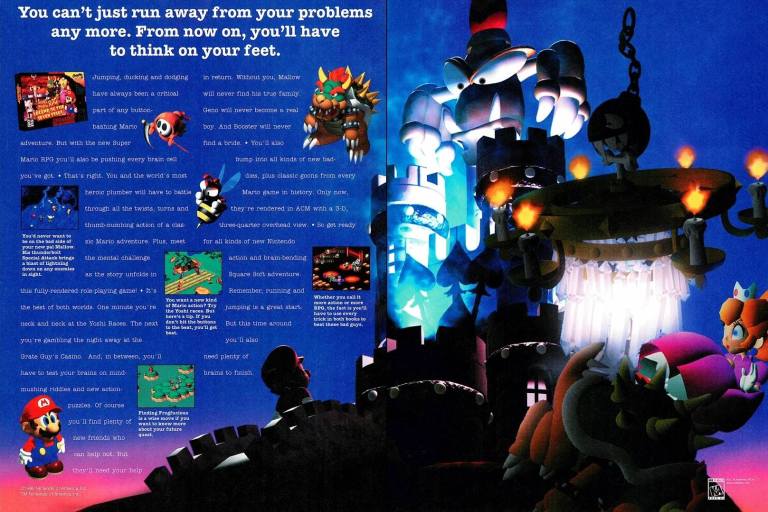
In this edition of the Retro Gaming Ads Blast (RGAB) series, we will take a look at another batch of retro gaming print ads from the 1980s to the 1990s, particularly on role-playing games (RPGs) from the East and the West. This is the RPG Special!
For the newcomers reading this, Retro Gaming Ads Blast (RGAB) looks back at the many print ads of games (console, arcade, computer and handheld) that were published in comic books, magazines, flyers, posters and newspapers long before smartphones, social media, the worldwide web and streaming became popular. To put things in perspective, people back in the 1980s to the 1990s were more trusting of print media for information and images about electronic games and related products.
With those details laid down, here is the newest batch of retro gaming print ads for you to see and enjoy…
1. Phantasie North American and Japanese Print Ads
The North American print ad.
The Japanese print ad.
Released by Strategic Simulations in the mid-1980s, Phantasie was a fantasy role-playing game that became a huge commercial success paving the way for not only ports on other computer systems of the time but also sequels later. The ad they came up with for the North American market had strong fantasy vibes and the screenshots gave readers the impression that it looked playable or user friendly. For the Japanese market, Phantasie was ported to the MSX system and they came up with an ad using radically different art work that had a horror vibe.
2. Phantasy Star Japanese Print Ad
Phantasy Star in the Japanese print ad sharing the spotlight with After Burner.
In the 1980s, role-playing games started gaining popularity with Japanese console gamers and there were game developers who were inspired by established RPGs from the West. Enix released two Dragon Quest games and each of them sold a lot of copies on Nintendo’s Family Computer (Famicom). At the time, Sega already had the Master System (called the SG-1000 and its variants with revisions) in the console market and they were way behind Nintendo on hardware sales. Knowing there is a market for console RPGs, Sega went on to make their exclusive RPG Phantasy Star. In 1987, a print ad was released showing Phantasy Star sharing the spotlight with Sega’s blockbuster game After Burner in the background. While the ad felt a bit disorienting to see, the game achieved much-needed success for Sega which in turn brought the game to the Master System in America in 1988. The game sold more and eventually led to sequels in the years that followed.
3. Ultima III Japanese Print Ad
Remember the old days when anime or comic book-style artwork was used to promote games in the Japanese print media?
Released in Japan under the title Ultima: Kyoufu no Exodus, Ultima III: Exodus was a breakthrough for the series as the Famicom version marked the first console release for Japanese gamers (note: the game was also offered for MSX and other computer systems in the country). The anime-style artwork used for the print ad is the same virtually the same with the front cover of Famicom version. Very notably, the art on the covers of the PC-88 and PC-98 versions were different.
4. Lunar: The Silver Star Japanese Print Ad
Game Arts’ Lunar: The Silver Star as advertized in Japanese magazines.
By the 1990s, console RPGs were very popular as franchises like Dragon Quest and Final Fantasy each released sequels that sold a lot of copies. The company Game Arts decided to make a role-playing game which can tell stories better using animation with voiceovers and music while being very playable and enjoyable. They came up with Lunar: The Silver Star and released it on the Mega-CD add-on (connected with the Mega Drive console of Sega) in 1992. As such, it was not surprising to see the print ad having anime-style artwork as the game itself had several minutes of anime cutscenes complete with audio. As most Japanese role-playing games (JRPGs) did not have playable anime cutscenes for storytelling, Lunar: The Silver Star really stood out. Sometime later, the small American company Working Designs would handle the game’s English version and start a healthy business relationship with Game Arts.
5. Dungeons & Dragons: Warriors of the Eternal Sun North American Print Ad
A print ad that strongly appealed to both Sega Genesis gamers as well as fans of Dungeons & Dragons.
By the year 1992, the fantasy games franchise Dungeons & Dragons was wildly popular as players around the world kept enjoying the tabletop RPG modules (using dice, pen paper) as well as many computer and video games already available. Sega acquired a D&D license and eventually released Dungeons & Dragons: Warriors of the Eternal Sun exclusively on their Genesis console in 1992. To promote it, Sega produced a 2-page print ad that had one half showing the game’s box placed with jewelry while using the other half to show the screenshots, descriptive text and other details. The way it was presented, the print ad was cleverly structured to attract the attention of Sega Genesis gamers as well as Dungeons & Dragons fans. The game ended up as the first and only official D&D product for the console.
6. Shadow Sorcerer North American Print Ad
This is one of many Dungeons & Dragons computer games released. The use of painted art for marketing was done many times.
In the history of the Dungeons & Dragons franchise and electronic gaming, it was on computers where the more ambitious and more intricate licensed games were played by many fans. In 1991, the Advanced Dungeons & Dragons (AD&D) electronic game Shadow Sorcerer was released on MS-DOS PC, Amiga and the Atari ST. The painted artwork used on the print ad was virtually the same as that on the box covers of the MS-DOS and Amiga versions. I can only guess that the ad markers must have paid a lot of money on the painted art and decided to use it for both marketing and packaging since it looked so detailed.
7. Estopolis Denki Japanese Print Ad
The 2-page Japanese print ad of Estopolis Denki.
In 1993, a brand-new Japanese developer called Neverland was established and its first project was the fantasy role-playing game Estopolis Denki for the Super Family Computer (Super Famicom). That same year, publisher Taito released the game and they promoted it with a 2-page print ad that featured a whimsical looking hand-drawn art work on one half and utilized the other half with details, screenshots and part of the art that was used on the game’s Super Famicom box cover. While Japanese game sales are not available, it seems Estopolis Denki sold enough to convince the publisher to release the game in North America as Lufia & The Fortress of Doom.
8. Lufia & The Fortress of Doom North American Print Ad
If you were able to play Lufia & The Fortress of Doom on the SNES, were you able to see this ad in a comic book or in a magazine?
Upon release in America in late 1993, Taito scored gold as Lufia & The Fortress of Doom on the Super Nintendo Entertainment System (SNES or Super NES) became a critical and commercial success. In fact, it literally gained steam during the early months of availability and ended up as the top-selling SNES game in America for the month of February of 1994. Take note that at this particular point of time, RPGs on game consoles in America were not yet in high demand as gamers’ tastes were different. When it comes to the marketing, Taito came up with a single-page print ad showing fantasy artwork, the game’s box cover and the published quotes from game critics who gave the game positive reviews. This is smart marketing on the part of Taito.
9. Record of Lodoss War Japanese Print Ad
The Japanese print ad of Record of Lodoss War for Super Famicom.
Have you ever heard of the Record of Lodoss War fantasy franchise? That one started as a series of fantasy novels by Ryo Mizuno who previously worked on an RPG project. Record of Lodoss War was eventually adapted into comics, anime and video games. One of those games was released on the Super Famicom in December 1995 published by Kadokawa Shoten which in turn made the one-page print ad for the Japanese market. Using established art from the anime OVA (original video animation) series was a strategic move by the publisher as millions of Japanese people viewed it. Unsurprisingly, the art on the ad is almost the same as the one displayed on the game box cover.
10. Fallout North American Print Ad
A gritty looking print ad of the original Fallout PC game.
In my gaming life, I played Fallout 3, Fallout 4 and Fallout: New Vegas on Xbox consoles. When the first-ever Fallout game was released in 1997, I did not notice it as I was more into console gaming than PC gaming. The above print ad appeared is several PC gaming magazines and it clearly shows what it offered which gamers eventually ended up enjoying a lot. The mechanical helmet – protection for the user during battles and from radiation in the nuclear wasteland – on the left side of the ad became a key symbol of the Fallout franchise as further games also featured mechanical helmets. Fallout was highly acclaimed for featuring open-ended gameplay and its immersive post-apocalyptic setting. It sold enough copies to convince publisher Interplay to proceed with a sequel and the rest was history.
11. Xenogears Japanese and North American Print Ad
Japanese advertisement of Xenogears.
This North American print ad of Xenogears clearly showed the main character, a robot, the sci-fi setting and the visual style of the game.
Xenogears was a sci-fi JRPG I played on the PlayStation in 1998 but I was unable to finish it. Before it was released in America, there was speculation that Squaresoft would not be able to produce an English version for international release due to its religious content. The game was highly challenging to translate into English due to religious themes and psychological elements. Regardless, the game achieved successes commercially and critically in both Japan and America. Xenogears has since been considered by many as a classic JRPG and to play it today is pretty challenging as an existing PlayStation One, PlayStation 3 or PlayStation Vita is required as well as the physical PlayStation disc itself (note: digital copy of Xenogears for PS Vita). Square Enix – which previously remastered Chrono Cross and several Final Fantasy games for modern gaming platforms – has yet to remaster Xenogears for those with modern game consoles, mobile devices and the PC.
12. Final Fantasy Anthology Print Ad
I remember seeing this 2-page print ad in many gaming magazines I read.
By the year 1999, Squaresoft established itself as the best role-playing game company as they achieved critical and commercial success with Final Fantasy VII in 1997, Brave Fencer Musashi, Parasite Eve and Xenogears in 1998. For 1999, Squaresoft decided to bring ports Final Fantasy V and Final Fantasy VI – both games were released in cartridge format on Super Famicom/Super NES some years prior – to their fans who owned PlayStation consoles by releasing the collection called Final Fantasy Anthology. For the North American market, Squaresoft aggressively promoted the 2-game collection with the above 2-page print ad on several video game publications. One half featured exquisite artwork by Yoshitaka Amano and the other half showed the screenshots, descriptions and details. Clearly the ad was made with Final Fantasy fans in mind and it was also clever with the use of nostalgia.
13. Final Fantasy VII North American Print Ad
While it did not show any of the characters, this 2-page print ad of Final Fantasy VII appeared in many gaming magazines and ultimately made the public aware of the game which went on to sell millions.
There is no denying that Final Fantasy VII is the most defining Japanese RPG of the 1990s. Given its huge pre-release promotions, the critical acclaim and the tremendous sales achieved in North America and Europe, the game arguably made the JRPG sub-genre more popular among gamers and game publishers while also making the original PlayStation console the must-have machine for video gaming. The above print ad is one of several released through print media and even though it did not show any characters, the image of a futuristic looking city caught the attention of not just gamers but also others who loved entertainment.
For Filipinos who want to visit Japan, a visa is often required which is something I can relate with. In recent times, there has been this lack of available slots for visa appointments and the Japanese embassy in Manila confirmed that there is an unprecedented surge of Filipino visa applicants, according to a Manila Bulletin news report.
To put things in perspective, posted below is an excerpt from the news report of the Manila Bulletin. Some parts in boldface…
Japan’s embassy in Manila is aware of the lack of available slots for visa appointments at its application centers and issued its response on the matter.
In a statement sent to the Manila Bulletin, the embassy cited the surge of Filipinos expressing interest in going to Japan.
Except during the surge of Covid-19 pandemic, the embassy said, Filipino visa applicants reached ”unprecedented levels.”
”The number of short-stay visas issued surged more than sixfold (6.15 times) over the decade from 2013 (73,143) to 2023 (450,087), and increased further to 490,907 in 2024,” it said.
According to the embassy, this prompted them to make significant changes in their visa processing system.
”In response to the increasing demand, the visa processing system underwent a fundamental overhaul starting April 2025 to maintain proper screening quality and streamline the process, transitioning to a Visa Application Center system,” it said.
”Furthermore, the introduction of the e-VISA began last December for visas issued to tourists in package tours organized by designated travel agencies,” it added.
The embassy acknowledged that people-to-people exchanges form the foundation of Philippines-Japan relations, and the embassy “welcomes our Filipino friends’ growing interest in visiting Japan, with the number of Filipino visitors reaching a record high of 880,000 in 2025.”
Let me end this piece by asking you readers: What is your reaction to this development? Have you already applied for a visa to visit Japan over the past twelve months? How many people do you personally know want to visit Japan? If you intend to visit Japan soon, have you started finding out what the requirements are for application?
Welcome back Xbox fans, Japanese role-playing game (JRPG) enthusiasts, Final Fantasy fans and fellow geeks!
Over a week ago, Square Enix officially releasedFinal Fantasy VII Remake Intergrade for Xbox Series X, Xbox Series S plus Windows PC and Xbox Cloud Gaming. For Xbox gamers who love JRPGs and the Final Fantasy games franchise, this development marked the end of a years-long wait for the big budget remake of Final Fantasy VII to be released on their consoles.
This is Aerith Gainsborough in the big-budget remake?
There are multiple reasons why FF7 Remake will have sold well on Xbox, even beyond the fact that it’s one of the most requested Xbox releases of the past few years. For one, it’s available at the pretty low launch price of just £39.99 / $39.99, and as a “limited early” bonus, it even comes with the original version of Final Fantasy 7 as well. Don’t forget it’s an Xbox Play Anywhere title too, which means you get a free PC version when buying it on console.
Meanwhile, Final Fantasy VII Remake Intergrade co-director Naoki Hamaguchi expressed his happiness that Xbox gamers are enjoying the game and he already confirmed that the remaining chapters of the Final Fantasy VII Remake trilogy will be released on Xbox. Read his Twitter post below.
Final Fantasy VII Legacy and Cultural Significance
Historically, the original Final Fantasy VII was released on PlayStation in 1997 and it became a massive commercial juggernaut which arguably made the JRPG more popular among Western gamers. Characters like Cloud Strife, Barret Wallace, Tifa Lockhart, Aerith Gainsborough, and Yuffie Kisaragi became wildly popular not only among Final Fantasy fans but with JRPG enthusiasts. Sephiroth meanwhile became one of the most defining villains of video gaming.
Battles in the game are often fast, intense and filled with visual spectacle.
The road to the big budget remake was a long one and it eventually Final Fantasy VII Remake was released as an exclusive game on PlayStation 4 in 2020. A year later, the upgraded version called Final Fantasy VII Remake Intergrade was released on PlayStation 5.
Xbox gamers who purchase Final Fantasy VII Remake Intergrade can expect the following: Quests, mini-games, and missions set in expanded areas of Midgar. There are also some new characters and content that adds even more depth to the story.
The main cast in Final Fantasy VII Remake Intergrade.
For many years already, the Philippines has infrastructure projects in development with the support of the Japan International Cooperation Agency (JICA) which executes the official development assistance (ODA). The right-of-way challenges, however, are putting the projects at risk and Japan has alerted the government of the Philippines about it, according to a Manila Bulletin news report.
To put things in perspective, posted below is an excerpt from the news report of the Manila Bulletin. Some parts in boldface…
The Japanese government’s lead development agency said that right-of-way (ROW) hurdles, rather than the tightening Philippine fiscal envelope, pose the primary risk to the completion of multibillion-peso infrastructure flagship projects.
Takashi Baba, the Japan International Cooperation Agency (JICA) chief representative in the Philippines, said that while budget reductions are sovereign prerogative, the legal obligations of bilateral agreements necessitate that Manila provides sufficient funding for land acquisition
“At this moment, we do not see any kind of delay because of the delay of the budget, but the delay of the ROW, [and] the process,” JICA Philippines chief representative Takashi Baba told Manila Bulletin last Thursday, Jan. 22.
He noted, however, that delays in ROW acquisition have already had an impact on project implementation.
“We already observed the kind of delay of the progress of the project itself. That’s why we are carefully monitoring the progress,” Baba added.
The assurance comes as the Marcos administration navigates a tighter fiscal landscape. The national government reduced unprogrammed appropriations in the 2026 budget to ₱150.9 billion, the lowest level of standby funding since 2019.
The contraction in the budget’s “standby” category directly affects the accounting of projects like the Metro Manila Subway and the North-South Commuter Railway, which rely heavily on Official Development Assistance (ODA) under JICA.
Baba added that the budget cut in the Philippines should be respected, noting that it reflects a sovereign decision.
“It should be respected,” he said, adding that the move represents “the GOP [government of the Philippines] or the government or the Philippine people’s decision in general.”
However, Baba emphasized that under the legal requirements of bilateral agreements, “the necessary budget should be allocated by the Philippine government,” particularly for ROW financing.
“When we look at the current GAA [General Appropriations Act], we notice that it’s not sufficient to cover everything like necessary budget, [the] necessary amount should be prepared by the Philippine government,” he added, noting that they are closely monitoring the situation.
Baba also highlighted that executive agencies may face difficulties in securing sufficient funding by the middle of the year, raising concerns that funding shortfalls could lead to delays in project implementation.
He said JICA is closely coordinating with the Philippine government to secure additional funding in line with agreements between the two countries.
“We are closely monitoring and also we are keeping good relationship and discussion with the Philippine government to secure another budget to cover the necessary one, which in accordance with agreed between the two countries,” Baba said.
Let me end this piece by asking you readers: What is your reaction to this development? Do you think the right-of-way issues will delay the completion of the multi-billion Peso infrastructure projects that are supported by the Japanese? What should the national government of the Philippines do to resolve right-of-way issues?
Welcome back my readers, YouTube viewers and all others who followed this series of articles focused on YouTube videos worth watching. Have you been searching for something fun or interesting to watch on YouTube? Do you feel bored right now and you crave for something to see on the world’s most popular online video destination?
I recommend you check out the following videos I found.
#1 Tremors Revisited – The first time I ever saw the 1990 monster adventure movie Tremors was on home video. The movie turned out to be more thrilling and more enjoyable than I expected, and eventually I replayed it a number of times on cable TV and DVD in the years after. There is already a 4K Blu-ray of Tremors that I have yet to acquire. For me, Tremors is still a significant movie to watch again and its concept of having huge monsters that travel underground is still engaging to see. As the 1990 became a massive success AFTER its not-so-hot theatrical run (note: it achieved massive success on home video sales/rentals, cable TV and the like), Tremor is now a popular part of American pop culture and it is not surprising to see many retrospective YouTube videos about it. Posted below for your enjoyment are videos I selected.
#2 Luxury Food In Japan Sold At Bargain Rates –In Japan, there a certain types of food that are often sold at high prices in relation to their quality, availability and other socio-economic factors. Wagyu beef, for example, is a premium meat that recently has been in high demand in Japan as the very high number of foreign tourists are buying and consuming it there. Still, there are times when premium food items are temporarily sold with low prices that locals can take advantage of. Watch and learn from the Nippon TV video below.
#3 How MIT Students Used Math to Win Millions of Dollars From Casinos – When you visit a casino, you often see people placing their bets in different games of gambling. Among the most popular forms of gambling is the card game which often requires discipline, precision and luck to win. Believe it or not, there were students from the Massachusetts Institute of Technology (MIT) who were trained to win in card games with an emphasis on mathematics, discipline and teamwork. Decades ago, these students played in many casinos and won tens of millions of Dollars over a period of years before law enforcement and technology ended their streak. Watch and learn what happened in the video below.
#4 The Rise Of Solo Dining In South Korea – Have you been in South Korea over the past twelve months? Due to the rise of single-person households in the country, solo dining became a new trend there and there seems to be no sign of it slowing down. Watch the video below to discover what solo dining is and what created it.
#5 Final Fantasy IV Revisited – Final Fantasy IV is the first-ever Final Fantasy game I ever played as well as one of the very first Japanese role-playing games (JRPGs) I played. The story had solid structure, the characters were memorable, the gameplay was challenging yet fun, and the fantasy settings were special. Released in America as “Final Fantasy II” on the Super Nintendo Entertainment System (SNES), the game succeeded commercially and critically, and it paved the way for the greater acceptance of JRPGs on consoles in the West. To learn more about Final Fantasy IV and why it is significant, watch the video below.
#6 Ranting For Vengeance Slams New Lara Croft – Recently a new live-action version of the video game icon Lara Croft was revealed with actress Sophie Turner playing her. This early, long-time fans of Croft and the Tomb Raider video game franchise in general rejected the newest live-action version. Ranting for Vengeance posted his own video reacting to Sophie Turner’s Lara Croft, explaining the legacy of the Tomb Raider franchise, and standing up for the long-time fans. His video is indeed critical but you have to watch it entirely to fully understand his reaction and logic. The video will also remind you that there is a woke mob out there and they are becoming the FAKE FANS of established entertainment franchises and icons.
#7 Silent Hill Movie Revisited – Just seven years after the release of the original Silent Hill video game, a live-action movie was released with the same title. While the early Silent Hill video games were critical and commercial hits, the effort to make an official film adaptation did not start immediately. In fact, Christophe Gans sent to Konami a video interview of himself (talking about Silent Hill) with Japanese subtitles which eventually convinced the publisher to award him the film rights. The Silent Hill movie did not gather much appreciation from film critics but it still succeeded in entertaining many moviegoers with its unique approach to horror and suspense. To see and feel the impact of the Silent Hill film and discover its production history, watch the videos below.