Very recently, Muntinlupa City Mayor Ruffy Biazon slammed China Coast Guard for harming personnel of the Philippine Navy who were on a resupply mission at sea and the incident was captured on video, according to a Manila Bulletin news report. A Philippine seaman lost his finger as a result of a Chinese vessel ramming a Philippine rubber boat.
To put things in perspective, posted below is an excerpt from the Manila Bulletin news report. Some parts in boldface…
Muntinlupa Mayor and former representative Ruffy Biazon condemned the China Coast Guard for attacking and hurting Philippine Navy troops who were doing a humanitarian rotation and resupply mission in Ayungin Shoal in the Spratlys Island in Palawan on June 17.
“The only Coast Guard in the world that puts life at sea in danger,” Biazon posted on X.
The Armed Forces of the Philippines (AFP) said, “The China Coast Guard’s coercive, aggressive, and barbaric actions during the humanitarian rotation and resupply mission at BRP Sierra Madre in Ayungin Shoal on June 17, resulted in severe damage to AFP vessels, including their communication and navigation equipment.”
As a result of the China Coast Guard’s attack, Seaman First Class Jeffrey Facundo’s finger was cut off when the Chinese vessel rammed a Philippine rubber boat.
In a statement, AFP Chief of Staff Gen. Romeo Brawner Jr. said that “the Chinese Coast Guard has no right or legal authority to interfere with our legitimate operations or damage our assets within our Exclusive Economic Zone (EEZ).”
“This reckless and aggressive behavior has caused bodily harm and constitutes a blatant violation of international maritime law, Philippine sovereignty, and sovereign rights. The Armed Forces of the Philippines (AFP) strongly denounces these actions, which not only infringe upon our maritime rights but also pose significant risks to regional stability. The AFP remains committed to upholding the rule of law and will collaborate with international partners to ensure and secure peace and stability across the West Philippine Sea and the Indo-Pacific Region,” he said.
Biazon said the China Coast Guard has been violating maritime regulations.
“They are invoking the International Regulations for Preventing Collisions at Sea, the best thing for them to do is file a formal complaint at the IMO [International Maritime Organization]. But of course, they won’t do that because they know they have been violating it themselves for a long time now,” he said.
He added, “In the hands of military or even coast guard, the bolos & knives are weapons. Using them against persons or property to cause injury or death or damage is an attack. Define ‘Armed attack/ now, in the context of the MDT [Mutual Defense Treaty].”
“Point to ponder : If CCG [China Coast Guard] has the audacity to board a PH RHIB (Philippine Rigid Hull Inflatable Boat],will they have the impunity to board a grounded PH LST [Philippine landing ship, tank]? I think the AFP should state as early as now that our soldiers won’t be restrained to fire weapons in defense if LS 57 [BRP Sierra Madre)] is forcibly boarded by foreign forces,” added Biazon.
Biazon called on senators and representatives to speak up about the latest attack on Philippine troops.
Let me end this post by asking you readers: What is your reaction to this recent development? If you are a resident of Muntinlupa City, do you agree with Mayor Biazon slamming China Coast Guard for harming Philippine Navy personnel at sea? What do you think will it take for the Philippines to push back against Chinese agresssion?
For more South Metro Manila community news and developments, come back here soon. Also say NO to fake news, NO to irresponsible journalism, NO to misinformation, NO to plagiarists, NO to reckless publishers and NO to sinister propaganda when it comes to news and developments. For South Metro Manila community developments, member engagement, commerce and other relevant updates, join the growing South Metro Manila Facebook group at https://www.facebook.com/groups/342183059992673
Welcome back readers, fellow geeks and electronic gaming fans!
In this edition of the Retro Gaming Ads Blast (RGAB) series, we will take a look at another batch of retro gaming print ads from the 1980s and 1990s. In addition, there will be a few flyers of arcade games as well as promotional posters of a notable console game that was released only in Japan.
For the newcomers reading this, Retro Gaming Ads Blast (RGAB) looks back at the many print ads of games (console, arcade, computer and handheld) that were published in comic books, magazines, flyers and newspapers long before smartphones, social media, the worldwide web and streaming became popular. To put things in perspective, people back in the 1980s and 1990s were more trusting of print media for information and images about electronic games and related products.
With those details laid down, here is the newest batch of retro gaming print ads for you to see and enjoy…
1. M.I.A.: Missing in Action arcade flyer
This is an effective way of catching the attention of both players and arcade operators. I can imagine the woke, the SJWs and rabid feminists getting easily offended by this.
Konami was a very prominent producer of games back in the 1980s. Not only did the company produce high-quality and enjoyable military-themed games on consoles and computers, Konami also made its presence felt in the highly competitive sector of arcade games. In 1989, they released the arcade conversion kit of M.I.A.: Missing in Action and this flyer is the best know promotion of it. M.I.A.: Missing in Action is the follow-up to Konami’s hit game Rush’n Attack.
Visually, the flyer’s display of four screenshots combined with a dominating photographic image of prisoners of war (POWs) getting delightfully released by an attractive female Rambo-type rescuer were designed to catch the attention of young adult and adult gamers. The text descriptions (note: there were more details on the back of the flyer), however, were geared towards arcade operators who were looking for new games to acquire without the hassle of having to buy an entire arcade cabinet. That being said, this flyer was a clever way to appeal to arcade operators and the people who love playing arcade games.
2. Fonz arcade flyer
Simplistic yet effective to look at. If you are an arcade operator, this flyer conveniently has key information displayed.
Believe it or not, Sega was already active in arcade games way back in the 1970s. In this particular flyer, Sega’s arcade game Fonz (also called Moto-Cross, Man T.T.) offered players the unique experience of driving a digital vehicle using actual handlebars on the machine that were meant to create an immersive and realistic feel. If you look closely, the flyer has lots of details written with arcade operators and players in mind.
3. Haunted Castle arcade flyer
Indeed, this game is part of the Castlevania game franchise. It was one of the first Castlevania games released for arcades.
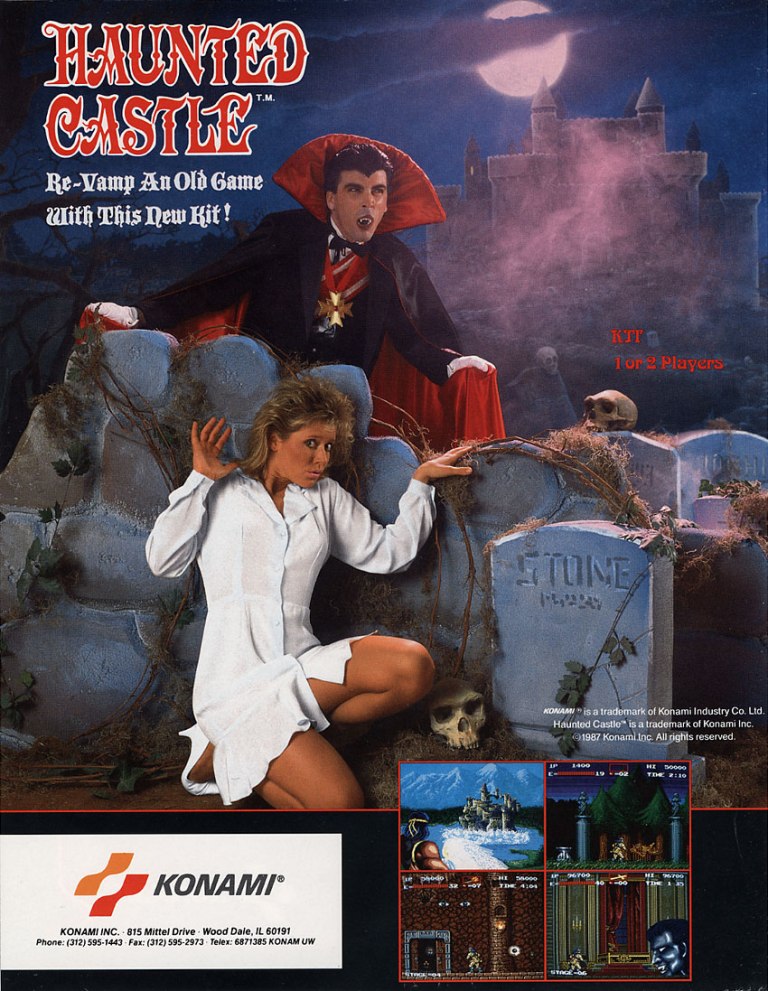
Arguably, Konami is best known for the Castlevania game series which covered handheld gaming devices, personal computers, video game consoles and even arcades. Haunted Castle (Japanese title: Akumajō Dracula) is the 2nd arcade game of the Castlevania franchise and it is not a port of any console game. Like the arcade flyer of M.I.A.: Missing in Action, this one was crafted to lure the attention (and money) of arcade operators looking for conversion kits to replace their old games. The visual presentation is eye-catching and even though the Castlevania brand was nowhere to be seen, Castlevania fans could tell this this arcade offering was part of their favorite game franchise.
4. The Super Dimension Fortress Macross: Do You Remember Love? flyer and poster
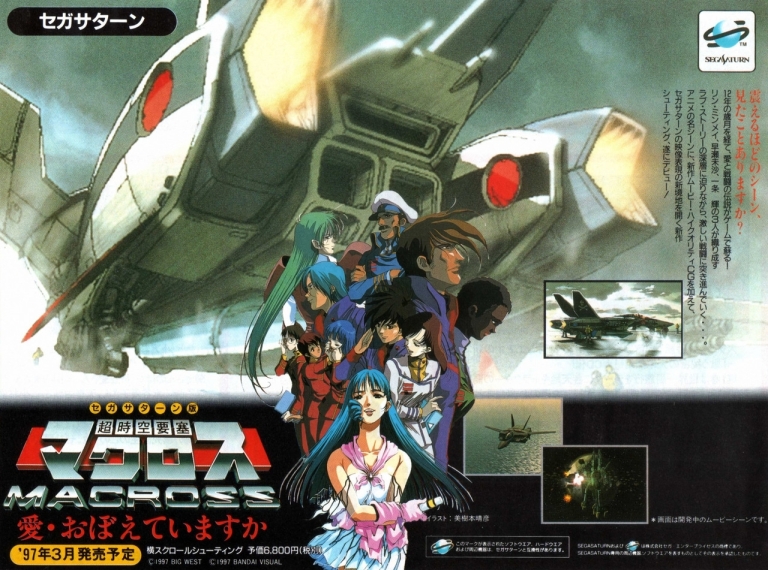
The poster promoting the release of the game for Sega Saturn in Japan.
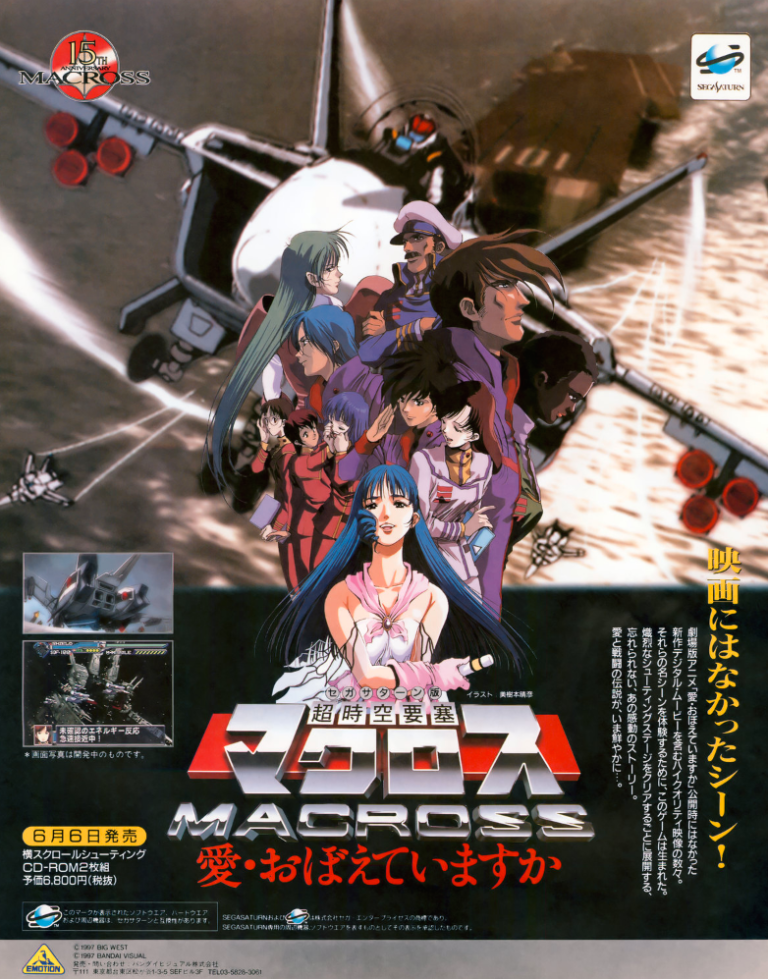
The flyer promoting the Sega Saturn game’s 1997 release as well as the 15th anniversary of Macross.
In 1997, the 15th anniversary of the Macross multimedia franchise was celebrated in Japan and among the highlights was the release of The Super Dimension Fortress Macross: Do You Remember Love? on the Sega Saturn. To promote the game and the franchise itself, lots of flyers and posters were released in Japan. If you look at the illustrated images on the promotional materials closely, you will realize that they are not from the original 1982-83 Macross anime TV series but rather from the The Super Dimension Fortress Macross: Do You Remember Love? animated movie of 1984 (read my retro movie review by clicking here).
While it might be baffling to some as to why the original anime TV series was not used as the source material for the 15th anniversary celebration through gaming, the 1984 anime feature film was actually more adaptable for a video game project (read my retro review by clicking here). It is so obvious, you just have to ask yourselves this question – how can the game developers compress the entire concepts of the 36-episode Macross anime series into one game while ensuring fun gameplay? Regardless, the game was a lot of fun to play and I enjoyed playing the PlayStation version in 1999.
5. Venom/Spider-Man: Separation Anxiety print ad
A clear effort to sell the game to gamers as well as fans of Spider-Man and Venom.
In 1994, Acclaim released Spider-Man and Venom: Maximum Carnage (based on the 1993 comic book storyline Maximum Carnage) on Super Nintendo Entertainment System (SNES) and Sega Genesis ultimately becoming popular with comic book fans and gamers who enjoyed sidescrolling beat-them-up games.
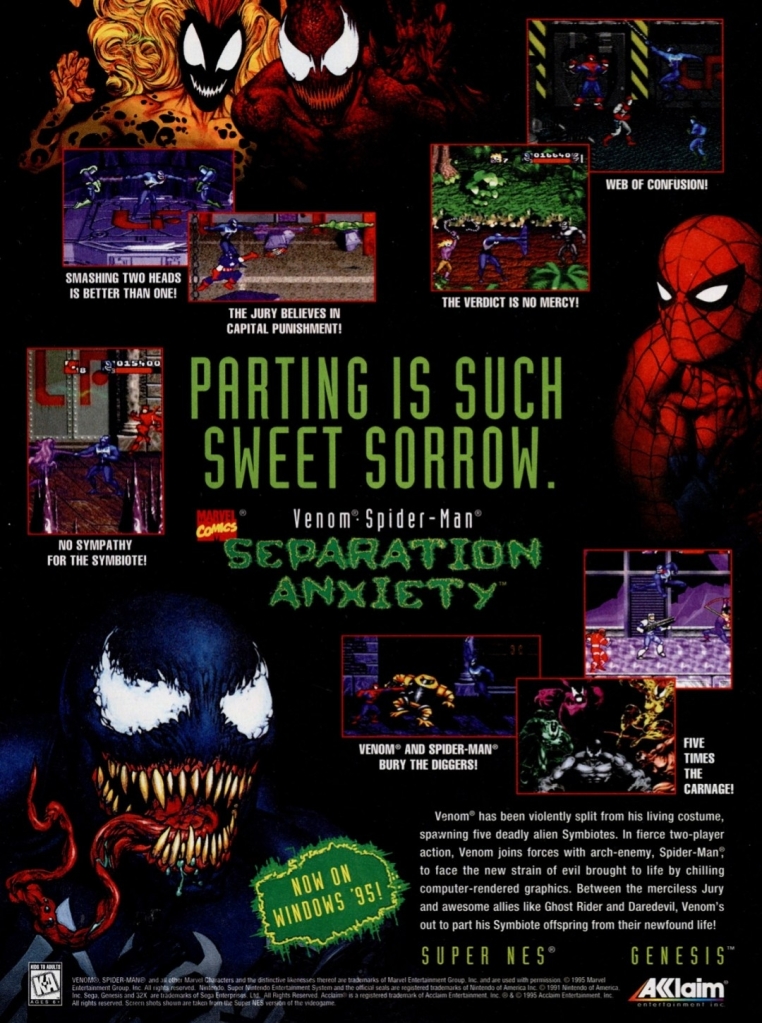
Subsequently, Acclaim and develop Software Creations reunited to release the sequel Venom/Spider-Man: Separation Anxiety a year later on the two leading 16-bit consoles as well as on personal computer (PC). If there is anything notable about this eye-catching print ad, it is the fact that its visual presentation (with graphics on-par with the previous year’s game) cleverly hides the fact that it did not have much new to offer gamers with regards to gameplay and story cutscenes (which the previous game prominently had). Eventually, this game attracted weaker reviews from game critics and has since been forgotten.
6. Tecmo Super Bowl SNES print ad
From the time when Tecmo was still a strong producer of sports video games.
In 1991, Tecmo Super Bowl was released on the aging Nintendo Entertainment System (NES) and because its game design greatly entertained gamers, it became a tremendous commercial success. Not even the very high launch price of $54.99 stopped it from selling a lot.
To keep the commercial success and public interest going, Tecmo announced a new version of the game for the more powerful SNES console with the simple title of Tecmo Super Bowl. If you look closely at the print ad, you will notice that gameplay screenshots were not used at all. Instead, they showed images of the nicely illustrated art works they prepared as eye candy for the game with the intention of making it look cinematic. This is very curious because gameplay itself was the main selling factor of the NES version of Tecmo Super Bowl. I can only guess that Tecmo was not ready to show gameplay images by the time this print ad was made.
7. X-Men 2: Clone Wars print ad
The art used is too alienating for promoting this game.
During the age of the 16-bit consoles, there was a variety of X-Men video games released and produced by different companies. In 1993, an X-Men game published by Sega was released exclusively on the Genesis console which turned out to be fun for gamers and received mostly positive reviews from the critics. Sega went on to publish the sequel X-Men 2: Clone Wars and this print ad caught my attention because of how exaggerated the characters looked. It’s so strange, it’s as if the artist took visual reference from a somewhat blocky 3D polygonal portrait then tried to make them look hand-drawn. I wonder if anyone from Sega regretted this.
Welcome back, my readers, YouTube viewers and all others who followed this series of articles focused on YouTube videos worth watching. Have you been searching for something fun or interesting to watch on YouTube? Do you feel bored right now and you crave for something to see on the world’s most popular online video destination?
I recommend you check out the following topics and the related videos I found.
#1The fall of Humza Yousaf and vindication of author J.K. Rowling – In case you missed the news, Humza Yousaf (born in Scotland to Pakistani immigrants) stepped down as First Minister of Scotland as he faced imminent votes of no confidence in himself and in his government. This vindicated Harry Potter author J.K. Rowling who opposed Scotland’s new hate crime laws (which extends to people who identified as transgendered and yet ignored biological women) and pointed out Humza Yousaf’s contempt for women. For more details, watch the video below.
#2 PatmanQC’s video documentary of P.O.W.: Prisoners of War – P.O.W.: Prisoners of Wars was one of those classic arcade games that I never got to play. It was made by SNK which is the same company behind the popular fighting game franchises King of Fighters, Fatal Fury and Art of Fighting. P.O.W.: Prisoners of War was a Cold War-inspired side-scrolling beat-them-up game that achieved big success in Japan. In PatmanQC’s video, you will learn a lot about SNK’s arcade game, what elements of real life inspired it, what other arcade games influenced the game designers to create it, and more.
#3 The significance of Rik Smits in the NBA – When it comes to the NBA, one has to take a look at the contributions of retired player Rik Smits (the Dunking Dutchman). Smits’ name may not have the big attraction of other centers of his era such as Hakeem Olajuwon, Shaquille O’Neal, Patrick Ewing and Robert Parish, but still he was a really solid center as well as a huge factor behind the rise of the Indiana Pacers in the 1990s. By the time he retired, the Pacers made it to the NBA Finals of 2000. Watch these selected videos of Rik Smits. You will learn a lot and be entertained with Smits’ basketball action!
#4 X-Men: The Last Stand movie reaction videos – For a movie declared as an inferior or disappointing follow-up to 2003’s X2: X-Men United, X-Men: The Last Stand still became a popular film subject in several movie reaction videos on YouTube. Just type the keywords on YouTube’ search engine and you will find a lot of movie reaction videos of the Brett Ratner-directed superhero movie. For your entertainment, the most enjoyable movie reaction videos have been posted below.
#5 You, Me and the Movies’ reaction video of Clash of the Titans (1981) – As a young boy, I saw Clash of the Titans (1981) and it was an entertaining ride of its time. This was one of those many fantasy movies that were released in the 1980s and it was the final work of stop-motion visual effects legend Ray Harryhausen. Recently, You, Men and the Movies published their reaction video of it which is entertaining and you can watch it below.
#6 PatmanQC’s Super Pac-Man retrospective video – I first learned about Super Pac-Man way back in the 1980s by seeing it on TV but I never got to play it in the arcades. In recent times, I downloaded Pac-Man Museum+ through Xbox Game Pass (XGP) and finally got to play Super Pac-Man on my Xbox Series X. I had fun playing it as I adjusted with the gameplay which had notable differences compared to the original Pac-Man arcade game. To learn more about Super Pac-Man, watch PatmanQC’s retrospective video below.
#7 Extensive look back at Sega Saturn games – YouTuber Sega Lord X recently published this extensive video looking back at the Sega Saturn and its games. This is a must-see video because the Sega Saturn had numerous games and many of them were actually fun to play. Ignore those articles that called the Saturn a bad console and just focus on the games by watching the video below.
#8 FilmComicsExplained’s video about how to survive Deep Impact – In relation to my previous post highlighting the movie reaction video of Deep Impact (by YouTuber Popcorn in Bed), posted below is FilmComicsExplained’s video is focused on survival within the context of the 1998 film. There are some sensible and notable points of discussion made which should encourage people to replay Deep Impact and even question the way governments deal with disaster management on a massive scale. You will possibly think twice about depending on the government for your survival. Watch the video below now.
Welcome back readers, fellow geeks and electronic gaming fans!
In this edition of the Retro Gaming Ads Blast (RGAB) series, we will take a look at another batch of retro gaming print ads from the 1980s and 1990s.
For the newcomers reading this, Retro Gaming Ads Blast (RGAB) looks back at the many print ads of games (console, arcade, computer and handheld) that were published in comic books, magazines, flyers and newspapers long before smartphones, social media, the worldwide web and streaming became popular. To put things in perspective, people back in the 1980s and 1990s were more trusting of print media for information and images about electronic games and related products.
With those details laid down, here is the newest batch of retro gaming print ads for you to see and enjoy…
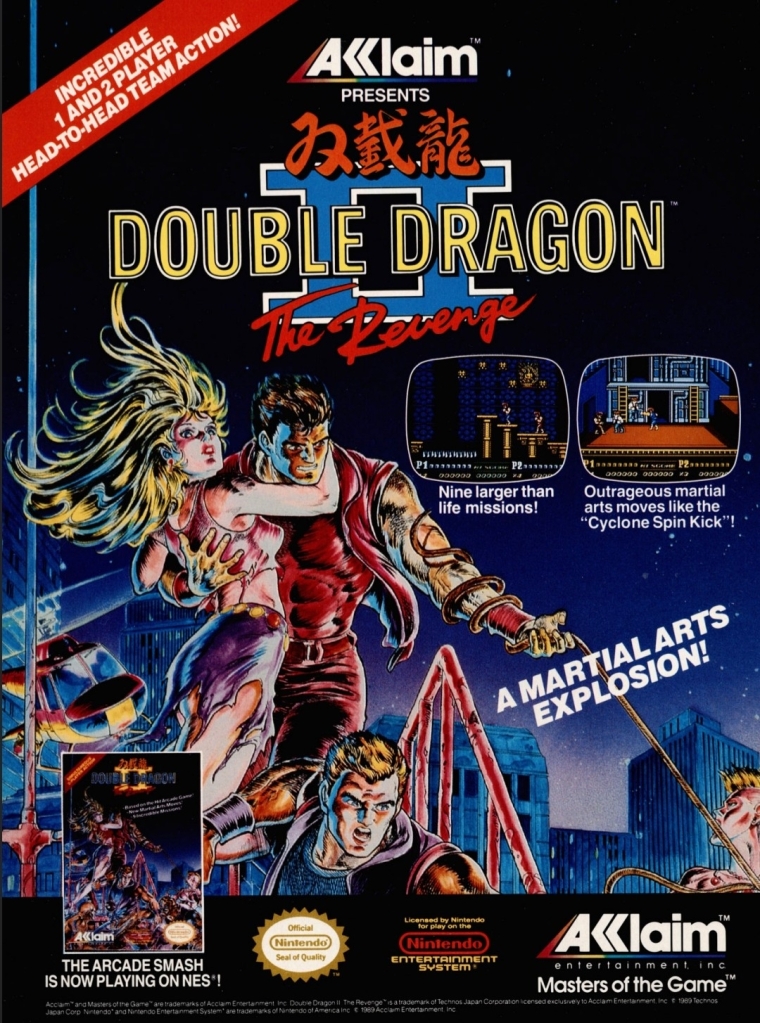
1. Double Dragon II: The Revenge print ad
Nice looking art used to promote the game.
The beat-them-up sub-genre of gaming was already popular in the 1980s and one of the most defining game franchises of this type of game was the Double Dragon series which proved to be popular with Nintendo Entertainment System (NES in America) and Family Computer (Famicom in Japan) gamers. As the first game was a very big hit on Nintendo’s consoles, the sequel Double Dragon II: The Revenge was promoted in America with strong confidence on the part of publisher Acclaim that it would become another massive hit. This print ad had a very nice looking comic books-style art that not only captured the concept of the game but also visualized the heroes Billy and Jimmy with enough details to focus on. I can say this was an eye-catching ad.
2. X-Men: Children of the Atom print ad
Great looking ad but the line “100% direct conversion” is not true at all.
Developed by Capcom in cooperation with Marvel, X-Men: Children of the Atom was a huge hit in the video arcades and it was not surprising that it got released on the Sega Saturn by Acclaim. Acclaim organized an aggressive promotional campaign by pouncing on the fans’ love and knowledge of the X-Men and the high fun factor of Capcom’s game. What this print ad got wrong, however, was the line “100% direct conversion of the #1 arcade smash!” which was wrong and misleading. In reality, the Sega Saturn version of the game had about one-third of the animation frames cut due to the console’s smaller RAM capacity.
As the years passed by, the Sega Saturn became the more suitable console for home ports of Capcom’s further 2D fighting games as Sony’s PlayStation had even more severe limitations and a graphics processor that was not suitable for 2D graphics. By the end of 2000, Capcom’s 2D fighting games on PlayStation all were inferior to the Sega Saturn versions.
3. Sky Shark NES print ad
This is an effective looking ad.
Released in Japan as Flying Shark, Sky Shark was released on multiple platforms in 1988 and there was an NES version of it which this particular print ad promoted. The American branch of Taito wisely used positive quotes from media outlets to promote the game while coming up with an engaging text description and displayed NES screenshots. And then there was that very engaging painted cover art that gave this print ad a lot of punch. An effective ad overall.
4. Conflict print ad
This is a very captivating artwork for advertising.
There is no denying the fact that the Cold War was a strong influence on arcade games and video games. Titles like Contra, Jackal, Metal Gear, Operation Wolf, Cabal and Rush’n Attack were militaristic games that entertained millions of gamers from the young adults to the little children. In 1990, Vic Tokai released the game Conflict on the NES which had a military theme but an unusual game design composed of digital maps with hexagons in which gamers will play with strategy to win battles. That being said, this print ad’s visual concept was very captivating yet also misleading. If you see how the game is played, you will know what I mean.
5. College Slam print ad
Were you ever interested in college basketball video games?
This is one of the more eye-catching print ads I’ve seen due to the artist’s illustration of a basketball with a mouth biting the basketball rim which dominates the space. For the newcomers reading this, College Slam was a basketball video game that was actually a repacked version of the popular NBA Jam with focus on NCAA basketball players. With the biting basketball at the center, it was easily an attraction and the screenshots implemented were larger than usual which easily gave gamers a clear look at what the game looked like. While this print ad is eye-catching, it did not help sell College Slam and there never was a follow-up.
6. Tecmo Super Baseball print ad
From the time when Tecmo was prolific with video games about sports.
Long before it started the Dead or Alive game franchise, Tecmo was once heavily invested in making sports video games. Tecmo Super Baseball was their first American pro baseball video game released for Super Nintendo Entertainment System (SNES) and Sega Genesis, and it was notable that the publisher secured only the Major League Baseball Players Association (MLBPA) which resulted in the game featuring real-life players but the teams had no names and no logos. Regardless, this print ad showed how aggressive Tecmo was in trying to attract consumers’ attention by showing ten screenshots with short text descriptions each. The ad’s write-up boasted realism as well as the promise of gaming quality.
7. The Punisher print ad
Marvel’s vigilante firing at someone.
In the early 1990s, Capcom and Marvel Comics started their partnership resulting in the releasing of the arcade game The Punisher. Developed by Capcom, the said arcade game became a big hit with gamers as it featured fun gameplay, multiple enemies appearing on screen simultaneously and other fun elements. Unsurprisingly, the game was ported (note: Sculptured Software was the lead developer) to the Sega Genesis with significant downgrades in terms of graphics, sound, enemy variety and other related elements due to technical limitations. That being said, this print ad used detailed art of the Punisher (with Col. Fury in the background) in a clever way to promote the Sega Genesis version while keeping their attention away from the obvious visual downgrades of the two screenshots displayed. The Punisher on Genesis was poorly received.
8. Stargate print ad
If you did not enjoy the movie, were you able to play the video game adaptation on Sega Genesis or Super NES?
Remember the sci-fi movie Stargate (1994)? The film was a surprise box office hit and eventually video game adaptations of it were made for the SNES, Sega Genesis, Game Gear and the GameBoy. This particular print ad, however, showed screenshots of the SNES and Genesis versions which is made obvious with the side-scrolling adventure plus 3D flying sequence (one screenshot showed it). Combined with images sourced from the movie poster plus an insert of the movie in home video format (lower-right corner), this print ad was obviously an aggressive way to promote the film with the post-theatrical business in mind. In case you are wondering, the cinematic Stargate is not related at all with the early 1980s video game (a follow-up to the classic game Defender) of the same name.
9. Aerobiz Supersonic print ad
For a simulation game released on consoles, Aerobiz Supersonic is pretty deep and a lot of fun to play.
The airline simulation game Aerobiz Supersonic is a highly addictive and surprisingly fun game that I enjoyed playing on the SNES (read my retro review by clicking here) and strangely enough I first learned about not through its print ad but by reading a preview published by Electronic Gaming Monthly (EGM) magazine. As for this print ad made by Koei’s American team, this is really odd to look at due to the ad makers’ choice of showing a not-so-attractive flight meal. In contrast to that, the ad makers did a good job describing the game creatively and showed three screenshots that were strategically selected in my view. Having played the game many times, I can say that this print ad is very truthful.
Disclaimer: This is my original work with details sourced from playing the video game and doing personal research. Anyone who wants to use this article, in part or in whole, needs to secure first my permission and agree to cite me as the source and author. Let it be known that any unauthorized use of this article will constrain the author to pursue the remedies under R.A. No. 8293, the Revised Penal Code, and/or all applicable legal actions under the laws of the Philippines.
Welcome back retro gaming fans and readers!
Today, we will go back to the late 1980s to examine one of the most significant console games of the decade…Konami’s Contra. To put things in perspective, Contra started in the arcades in 1987 and went on to become a big hit. Konami went on to make a version of the game for Nintendo Entertainment System (NES) in the West and the Family Computer (Famicom) in Japan that resulted in different looking graphics (both artistically and technically), reworked stages, and different and extended level designs that were done within the consoles’ limitations. In short, the home version of Contra was pretty different from the arcade version but still was made to be fun and exciting on its own.
In my personal experience, my discovery of Contra has always been on the Famicom and some time later on the NES. For this retro review, I replayed Contra (both Famicom and NES versions) via the Contra Anniversary Collection on my Xbox Series X.
With those details laid down, here is a look back at Contra, developed and published by Konami for the NES and Famicom in 1988. The NES version was released one week ahead of the Famicom version in February 1988.
The start screen of the NES version of Contra. The commando with dark hair was deliberately made to resemble Sylvester Stallone somewhat.
Game concept
In the far future, an alien army from space – Red Falcon – arrived on Earth inside a meteorite that landed on the Galuga archipelago. There, Red Falcon established an extensive high-tech base for their operations and eventually brainwashed a local human army to do what they want. Red Falcon plots to wipe out human civilization on the planet.
With the information about Red Falcon collected, the Earth Marine Corps send Contra unit members Bill Rizer and Lance Bean to the island to destroy the opposition and find out what Red Falcon has been doing…
Gameplay and quality
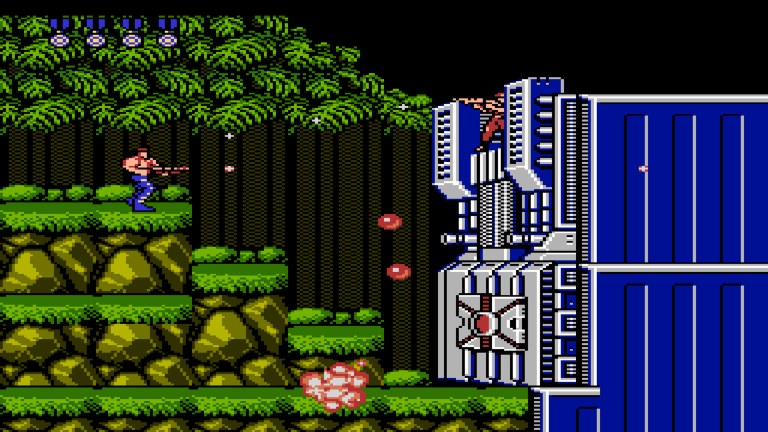
Contra is an action-packed 2D side-scrolling game with strong sci-fi and military influences.
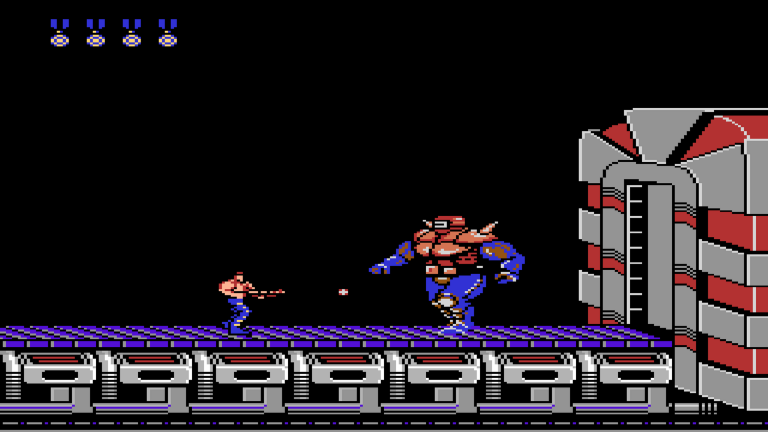
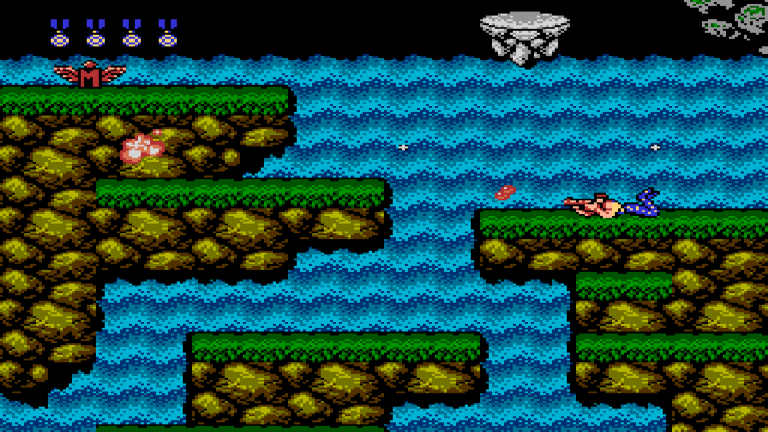
To begin with, Contra of 1988 was made to be a nicely-paced, action-packed, side-scrolling adventure game that has some 3D-like levels in between. The game design and levels Konami came up with was done to immerse gamers into actual participation in the military campaign against the aliens and their brainwashed human soldiers. This campaign not only includes battles through the forest of the Galuga archipelago but also through the interiors of Red Falcon’s high-tech facilities, going up an elevated location with waterfalls, the snowy area and further deep into the rest of the enemy’s mechanical base.
For the most part, you play as a commando armed with a rifle with unlimited ammunition. As you shoot enemies and make your way through the 2D side-scrolling level, there will be the occasional flying capsules that you can shoot down to gain new weapons/ammunition (S for Spread Shot, M for Machine Gun, L for Laser) or some power-up (temporary invincibility or the rare ability to eliminate all enemies present on-screen) to help yourself as the wave of opposition from Red Falcon is relentless (which is reason enough to compel you to keep progressing and fighting). There are also times when the mentioned enhancements suddenly pop out after killing an enemy.
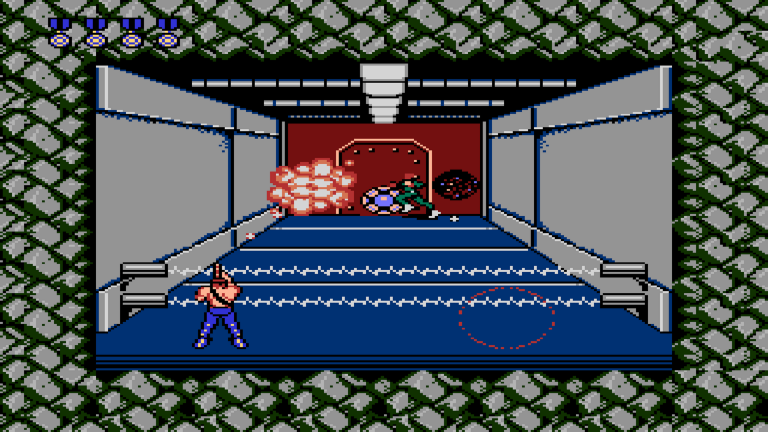
To prevent the game from getting too old with side-scrolling, Konami implemented these stages in which players face the front to attack enemies, overcome obstacles and move forward with 3D-like effects going into the next place.
By default, this game is brutally hard. Not only do the enemies keep appearing (with some of their teammates being strategically placed to fire at you), the obstacles will compel you to take your time overcoming them. In this game, one-hit death is the norm and there are many moments in which falling to your death becomes a huge risk. You get hit, you not only lose one life, you will lose whatever powerful weapons you gained.
There are also stage bosses (powerful enemies that await you at the end of a level) that will challenge you so much, you will have to adjust your strategy, pay attention to the movements and timing of the enemy, and then adjust your way fighting.
Only the Famicom version of Contra has this sequence.
I really love the sci-fi elements the game developers came up with for this classic game. There are lots of high-tech stuff to see here and this robotic enemy is just one of them.
Fortunately for us players, the controls are really tight and very responsive. You can move your characters to overcome obstacles, avoid getting hit by enemies and even move down from one platform if the space below is safer. I still remember how precise and responsive the controls were on the NES and Famicom versions, and I can say that all the responsiveness made it on the Xbox controller when I replayed Contra on Xbox Series X with the Contra Anniversary Collection I downloaded. In fact, the high precision of the controls added to the fun of shooting enemies or obstacles with the Spread Shot while moving to the right as it was meant to be.
Considering the intense difficulty of the game, players who do the famous Konami Code (Up, Up, Down, Down, Left, Right, Left, Right, B, A, and Start) will be reward with 30 lives when they start playing Contra. For Xbox gamers reading this, there is a slight difference with the Konami Code when playing Contra on Xbox consoles.
Apart from shooting, there are lots of platform gaming elements to experience here. The difficulty is very brutal and the famous Konami Code will grant you 30 lives when you do the code correctly.
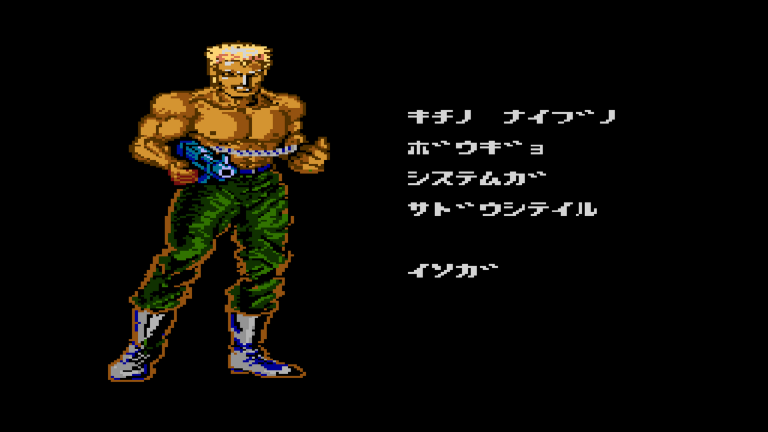
This cut-scene is only available in the Famicom version.
With regards to game design, the Konami developers did a really fine job creating the levels, placing the challenges and setting up memorable boss battles for action/adventure-hungry gamers to indulge in. The developers also cleverly implemented the fictional/fantasy concepts into the game design which resulted in me getting immersed in the Contra team’s mission against the Red Falcon at their secret base.
Another highlight with playing Contra is the 2-player option and the above-mentioned Konami Code added to the fun and accessibility of. I still remember the old days of playing in a 2-player session (cooperative play essentially) of Contra at a friend’s house on a Famicom. Since my friends and I were already enthusiasts of 1980s Hollywood action movies, playing Contra was enjoyable even though the difficulty was brutal.
This is one of the touch stage bosses you will encounter in the game.
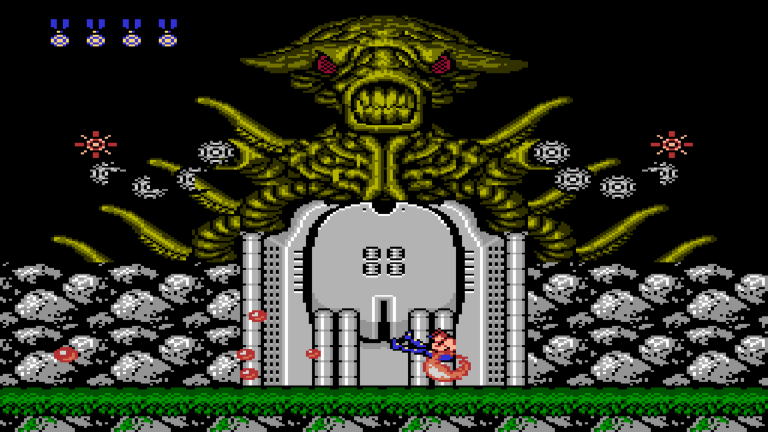
If there are any notable differences between the two versions of Contra of 1988, it would be the fact that the Japanese (Famicom) version has storytelling emphasized through cutscenes (with Japanese text displayed), a technical overview of the Red Falcon base at Galuga with maps displayed before you start a new level, in-game art, an additional scene that spiced up the ending and, most notably, more background/environmental animation. The additional animation on the Famicom version made the adventuring look and feel more lively and this is most evident in the final stage (lair of the alien).
Conclusion
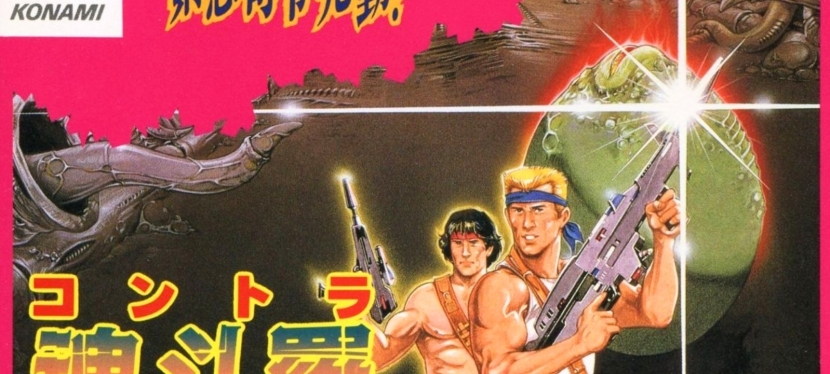
The Japanese cover art of Contra on Famicom. The Rambo-like character and the alien egg are obvious inspirations from Hollywood action movies of the 1980s.
There is no doubt in my view that after all the decades that passed since I first played it, Contra (1988) is still very engaging and a lot of fun to play whether you choose the Famicom version or the NES version. The developers who made this game succeeding in making something very enjoyable for millions of gamers and it is very clear that the makers were inspired by Hollywood action movies of the decade. In my view, the most obvious military inspirations are Aliens (1986), Commando (1985) and Rambo: First Blood Part II (1985).
Historically speaking, Contra (1988) was released at a time when militarism inspired many other game designers to come up with enjoyable games in different forms such as Cabal, Jackal, Rush’n Attack, Operation Wolf, Operation Thunderbolt to name some. Considering the overall quality and high fun factor Konami established, it is safe to say that this game is one of the finest among its militaristic gaming counterparts of its decade.
I had a grand time replaying Contra (1988) on my Xbox Series X in preparation for this review. Having played both NES and Famicom versions, I can say that the latter is the more complete and more immersive version to play. That does not necessarily mean the NES version is totally inferior. In fact, the NES version is more straightforward with the pick-up-and-play approach, and the gameplay itself is nearly identical (note: Famicom version is slightly more challenging) and very much fun to experience. If you are the player who really wants to be more immersed into the lore of Contra and absorb the military sci-fi concept Konami prepared, then the Famicom version is the one to play. That being said, now is a good time to purchase and download Contra Anniversary Collection.
Overall, Contra (1988) is highly recommended! It truly is a retro gaming gem!
Since it formally started on April 22, Balikatan 2024 resulted in several military exercises and activities involving armed elements of the Philippines, the United States and France. This of course caught the attention of China and according to a recent Philippine News Agency (PNA) news article, several Chinese vessels were spotted near a training area off Palawan.
To put things in perspective, posted below is an excerpt from the PNA news article. Some parts in boldface…
Naval participants in the just concluded multilateral maritime exercise were undaunted by the presence of Chinese vessels near the training area off Palawan province, Balikatan 2024 executive agent Col. Michael Logico said Tuesday.
Around four of China’s People’s Liberation Army Navy (PLAN) vessels were spotted at different times monitoring the flotilla during the training period.
“We went there for the purpose of conducting interoperability exercises, that was our mission and we were able to finish it, they were not able to disturb us in any way nor (were we) intimidated in any way by their presence,” he said during a press briefing.
Logico said the presence of PLAN ships did not disturb the exercise.
Balikatan’s first multilateral maritime exercise was in Palawan waters from April 25 to 29.
Participants include the Philippine Navy’s offshore patrol vessel BRP Ramon Alcaraz (PS-16) and landing dock BRP Davao Del Sur (LD-602), the US Navy’s landing ship dock USS Harpers Ferry (LSD-49), and the French Navy’s FS Vendemiaire (FFH-734), a Floreal-class frigate.
Let me end this piece by asking you readers: What is your reaction to this recent development? Do you think that China’s navy might someday disrupt the naval activities of Balikatan 2024? Do you think there could be a lot of spies among the Chinese nationals living here in the Philippines?
Welcome back Xbox fans, geeks and gamers! During the recent IGN x ID@Xbox Digital Showcase, several new games were shown and the one that stood out the most for me was Commandos: Origins which will be released on Xbox Series X, Xbox Series S, Xbox One, Windows PC and Game Pass sometime in the near future.
To get yourselves oriented, watch this teaser trailer of Commandos: Origins.
While no firm release date has been announced, there are lots of details about the real-time tactical stealth game developed by Claymore Game Studios under publisher Kalpyso Media. To put things in perspective, posted below is an excerpt from the official game details sourced from the Xbox online store page. Some parts in boldface…
ALARM! You have been selected for a mission which will shape the fate of the entire world. Witness the very beginning of the legendary elite WWII force in Commandos: Origins. The long-awaited sequel to the Commandos series brings you right back to the foundation of the real-time tactics genre. And to the days where Jack O’Hara, the Green Beret, and his five companions met to form the infamous unit sent to complete missions which no others would dare to accept.
In the hushed shadows of history’s most pivotal moments, where heroes are born and legends are forged, a new chapter awaits. Whether it is a daring raid, a covert sabotage, or a courageous rescue mission – the Green Beret, the Sapper, the Sniper, the Driver, the Marine and the Spy will need to combine their skills to meet the most challenging tasks. Your mission can only be achieved through well-thought planning and the smart combination of stealth and destruction that come with the unique skillsets of this elite troop.
A huge and detailed environment that players will have to infiltrate and beat the bad guys.
From the icy plains of the Arctic to the vast deserts of Africa, from the western coastlines of Europe to the Eastern front, it’s up to you to lead your commandos to success in high-risk missions. Guide them in their fight against the growing Nazi occupation which is menacing the free world.
• Challenging Real Time Tactical Stealth Gameplay: Make the best use of your Commandos’ unique abilities, infiltrate enemy facilities and hit them where it hurts most before disappearing into the shadows.
• An extraordinary team: Featuring 6 infamous characters, each with their own storied history, banding together to form an extraordinary fighting force – the Commandos: Take control over Jack O’Hara “the Green Beret”, Thomas “the Sapper” Hancock, Francis T. “the Sniper” Woolridge, Samuel “the Driver” Brooklyn, James “the Marine” Blackwood, and Rene “the Spy” Duchamp and lead them to success.
• Many paths to victory: The detailed, varied and interactive environments offer multiple approaches to reach your goal. Sneak, climb, drive in various vehicles, or hide and creep your way to mission success!
• On your mark: A modern user experience with precise and intuitive controls enables you to control the commandos with expert precision. Coordinate complex actions simultaneously to overcome heavily fortified targets.
An explosive sequence with a tank.
Having seen the trailer of Commandos: Origins, I had these XCOM vibes. Then the game showed that action sequences can be executed with a good amount of detail supposedly to ensure satisfaction for players who love strategy backed with militaristic stuff. While the game design emphasizes 3D space, turn-based gameplay and strategy, Commandos: Origins still managed to remind me of past military games such as Operation Wolf, Cabal, Rush’n Attack and original Metal Gear.
Welcome back readers, fellow geeks and electronic gaming fans!
In this edition of the Retro Gaming Ads Blast (RGAB) series, we will examine print ads from the 1980s and the 1990s that caught my attention and I will explain why they are worth look back at.
For the newcomers reading this, Retro Gaming Ads Blast (RGAB) looks back at the many print ads of games (console, arcade, computer and handheld) that were published in comic books, magazines, flyers and newspapers long before smartphones, social media, the worldwide web and streaming became popular. To put things in perspective, people back in the 1980s and 1990s were more trusting of print media for information and images about electronic games.
With those details laid down, here is the newest batch of retro gaming print ads for you to see and enjoy…
1. Operation Wolf print ad
Even though there were screenshots from the game, this was still an eye-catching print promoting Operation Wolf for the Nintendo Entertainment System.
Looking back at the history of pop culture, the 1980s saw the surge of Hollywood action movies that emphasized or even glorified militarism. Arnold Schwarzenegger, Sylvester Stallone and Tom Cruise were just a few Hollywood stars who found success playing military figures. It was not surprising that there were game developers in Japan who noticed the Hollywood military trend and were inspired to make games that had similar themes. The Japan-based company Taito developed and released the light gun shooter arcade game Operation Wolf which became a huge commercial success worldwide. Unsurprisingly, versions of Operation Wolf were eventually made for the existing home computers and game consoles of the time.
The above print ad of the Nintendo Entertainment System (NES) version of Operation Wolf only showed the official artwork, descriptive text and noticeably no gameplay screenshots. While the ad made the NES version of the game look exciting to look forward to, the actual game looked and felt nothing like the arcade version as the console’s limitations resulted in really small 2D sprites (which made shooting tough) and the 2D art used were rather ugly to see. I can only speculate that the people at Taito knew their product for the NES had sub-par quality and only hoped for the best trying to fool gamers to buy it.
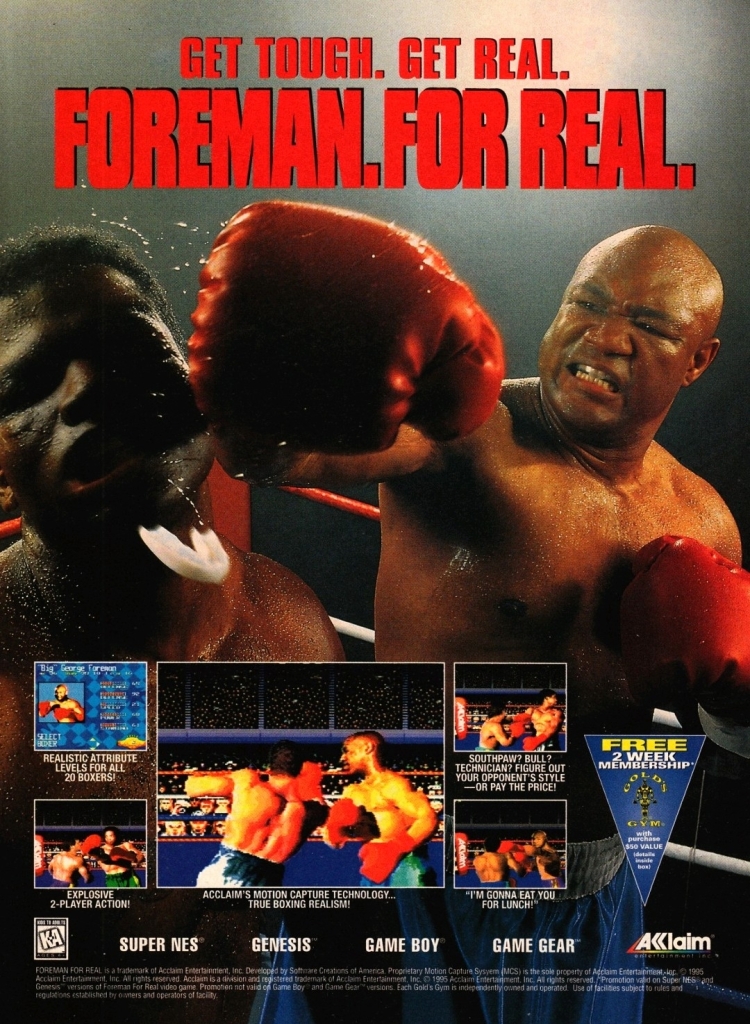
2. Foreman For Real print ad
Apart from boxing and endorsing grills, are you aware that George Foreman is also a worship leader and preacher of God’s Word?
In late-1994, George Foreman knocked out Michael Moorer to reclaim the heavyweight boxing title and the last time he had it was way back in 1974. For the newcomers reading this, Foreman halted his professional boxing in 1977, established his connection with God, preached His Word, opened a youth center and became a major product endorser. Foreman came back into fighting in 1987 and stunned everyone when he became heavyweight champion seven years later.
That being said, it was no surprise that game publisher Acclaim (which already released a video game with the boxer in 1992) quickly returned to Foreman to get him as the titular endorser in the 1995 video game Foreman For Real which was released on multiple gaming platforms less than a year after his championship victory. Apart from showing Foreman’s dominating image and screenshots from the game, the ad even had a promo of a free 2-week membership with Gold’s Gym. This ad was a lively reminder of the significance of Foreman’s presence in professional sports and it was instantly eye-catching.
3. BurgerTime print ad
Arcade hits like BurgerTime also made it into personal computers.
Previously, I showed an eye-catching print ad of the arcade classic BurgerTime. This time, the BurgerTime print ad shown here focused more on the IBM and Apple computer versions. This print ad had a photograph of an actor playing chef Peter Pepper carrying a huge burger bun running away two eggs and a hotdog, and near them were the respective boxes of BurgerTime for IBM and Apple. This is a sharp change of visual style away from the comic book-style art used in the other BurgerTime print ad. I can only imagine how excited IBM and Apple computer users became after seeing this ad back in the 1980s.
4. Shining Wisdom print ad
Even though this was a very eye-catching ad that appeared in several publications, Shining Wisdom went on to become a forgotten game after receiving mixed reviews from game review writers.
Here is another print ad of Working Designs from the 1990s. Released only on the Sega Saturn in 1996, Shining Wisdom was a fantasy action-adventure game from Japan that publisher Working Designs localized with North Americans in mind. This meant taking lots of creative liberties with the story, name changes, insertions of pop culture jokes and even altered the personalities of the characters. Developed by Sonic Software Planning and Camelot Software Planning, Shining Wisdom started as a project for the 16-bit console Mega Drive (Sega Genesis in America) that was revised for the more powerful Saturn console. While this print ad caught the attention of gamers and readers, Shining Wisdom received mixed reviews from critics upon release. Sadly, not too many gamers talk about this game anymore.
5. Cabal print ad
Military action and shooting strongly emphasized in this print ad for the Nintendo Entertainment System version of the arcade smash Cabal.
Like many games released in the 1980s, Cabal had a strong military theme and allowed players to engage in bouts of shooting playing soldiers who have to fight entire armies of bad guys. This print ad about the Nintendo Entertainment System (NES) version of the game had really nice art dominating the page, the packaging of the game plus three screenshots showing what gamers could expect. This was a very eye-catching print ad that made Cabal look both exciting and enticing.
6. Metal Gear print ad
Wow! So many weapons and pieces of equipment displayed in this Metal Gear (NES version) ad.
Back in the late 1980s, the NES port of Metal Gear had a notable promotion in America thanks to this cleverly designed print ad. When it comes to emphasizing “gear” from the title, the marketing team emphasized the words “Gear up” and literally filled the ad spaces with lots of pieces of equipment that was not only eye-catching but also gave readers the idea that a huge adventure awaits them in Metal Gear. As for the game box on the lower left corner of the print, the cover art highlighting the character Snake was an artistic copy of a still image of actor Michael Biehn as Kyle Reese in The Terminator (1984). This print ad was both entertaining and intriguing to look at.
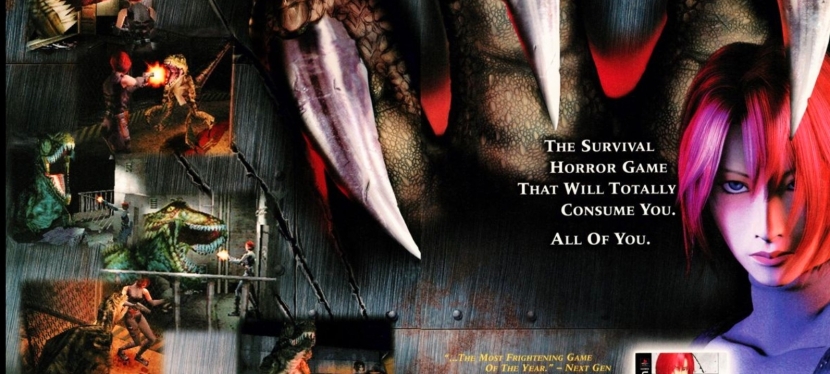
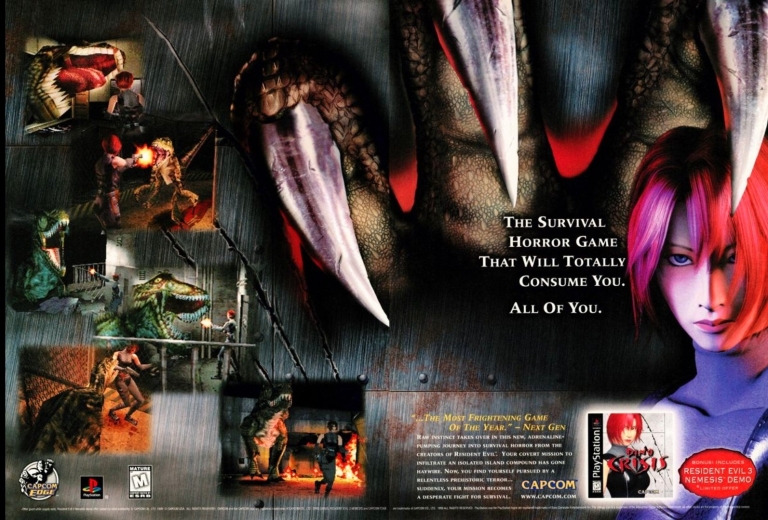
7. Dino Crisis print ad
For many gamers, Dino Crisis was like a combination of Resident Evil and Jurassic Park and this visceral looking print ad really got lots of people interested in the game.
In 1999, Capcom released Dino Crisis for PlayStation in America and the timing was almost perfect as millions of gamers who owned the console enjoyed the releases of Resident Evil and Resident Evil 2 (both games from Capcom) firmly establishing the survival horror genre as a popular one. That being said, a lot of RE fans anticipated the release of Dino Crisis due to the fact that the game shared several elements with Resident Evil games in terms of exploration, survival, control and shooting. Not only that, Resident Evil creator and original game director Shinji Mikami was in charge of the making of Dino Crisis. Mikami pointed to the films The Lost World: Jurassic Park (1997) and Aliens (1986) as influences on making the game which for most gamers was perceived as “Resident Evil filled with dinosaurs.”
The print ad above had a very engaging visual design that symbolized action, horror and tension well. Mikami clearly wanted gamers to experience the intense violence of encountering dinosaurs and this ad gave viewers a small sample of that. It’s safe to say that this print ad was effective as Dino Crisis went on to sell millions of copies and established Regina (the red-haired lady in the ad) as another memorable character from Capcom.
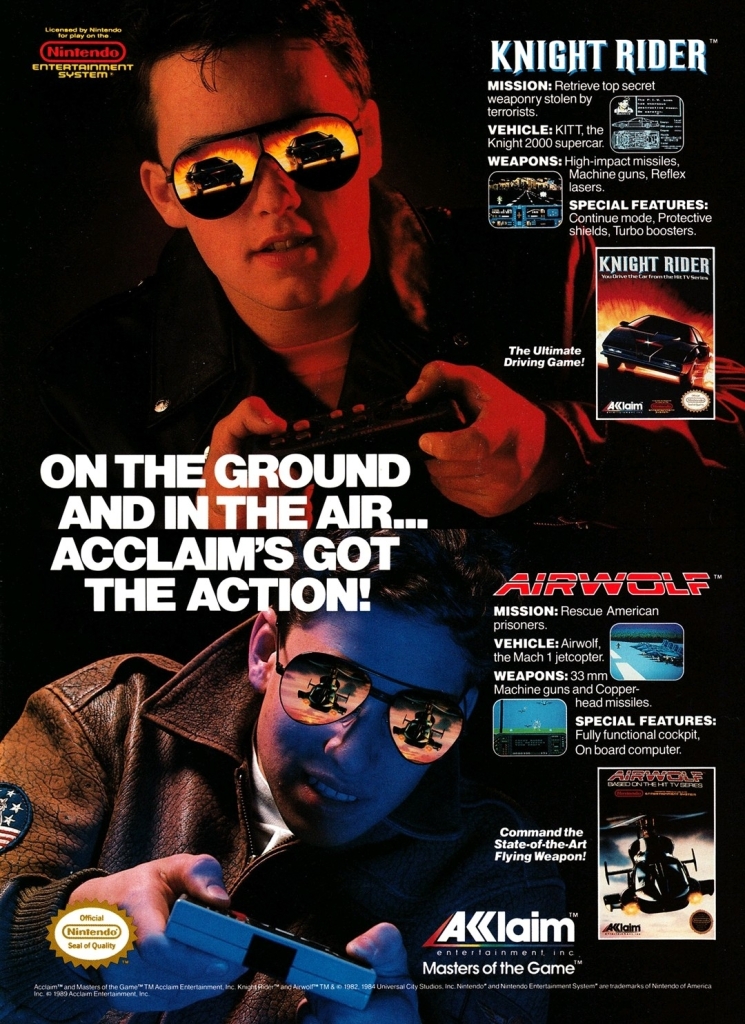
8. Airwolf/Knight Rider games print ad
Very clearly, the advertiser focused on the cool look to sell the games of Airwolf and Knight Rider.
Back in the 1980s, Airwolf and Knight Rider were wildly popular TV series that each had winning formulas to entertain millions of viewers with action, suspense and storytelling. It was not surprising that video game adaptations of them were produced on the Nintendo Entertainment System (NES). This particular print ad was an efficient way of promoting the Airwolf and Knight Rider games which featured two players looking cool with jackets and sunglasses. Acclaim clearly aimed for the TV series’ fans and slightly older players among the NES owners/users.
Balikatan, the annual joint military exercise of the Philippines and the United States of America, will officially begin on April 22 and last until May 10, 2024 with the participation of at least sixteen thousand troops, according to a Manila Bulletin news report. This year’s edition of Balikatan includes activities that will take place outside of the territorial waters of the Philippines.
To put things in perspective, posted below is an excerpt from the Manila Bulletin news report. Some parts in boldface…
The 39th iteration of “Balikatan” Exercise (BK39-2024), an annual military drill between the Armed Forces of the Philippines (AFP) and United States Armed Forces, will be held on April 22 to May 10 and at least 16,000 troops from both countries are expected to take part in it.
Col. Michael G. Logico, the exercise executive agent for BK39-2024, said that American troops and their support groups have already started arriving in the country for the war games.
For this year’s Balikatan Exercise, there will be 11,000 American troops and 5,000 Filipino personnel that will be joining in an array of military drills.
“Starting April 1, we will begin with our information warfare exercise that will be held here in Camp Aguinaldo. Officially, that is still part of Balikatan but it will happen before the opening ceremony. The reason why is because we will use the venue for the information warfare exercise for other events in Balikatan,” Logico said on Wednesday, March 20.
Contingents from other countries will also be joining including 150 troops from Australia, and an undetermined number of military personnel and a frigate from France. Fourteen nations will also deploy contingents as observers to the exercise, including 150 personnel from Japan.
A sinking exercise will also be conducted where participants will have to coordinate their movements to test the interoperability of their weapons systems in sinking a mock enemy ship.
For this exercise, the AFP and US Armed Forces will try to send the former BRP Caliraya (AF-81) to the bottom of the ocean off the coast of Laoag, Ilocos Norte.
BRP Caliraya, a Philippine Navy ship that was decommissioned in 2020, was supposed to be sunk in a sinking exercise during the Marine Aviation Support Activity (Masa) 2023 between the Philippine Marine Corps (PMC) and US Marine Corps off San Antonio, Zambales in July 2023 but it ran aground off Morong, Bataan while being towed.
Group Sail – Aside from that, Logico said that for the first time, there will be activities that will be held outside the country’s territorial waters, including a group sail with the participating countries in the West Philippine Sea and its nearby maritime area.
“They will be moving from Point A to Point B. We will be utilizing the western side of Palawan , extending beyond our 12 nautical miles so this is also a new thing that we are [doing]. We’ve done group sails before but this time, we will [be] going beyond our 12 nautical mile limitation. In previous exercises, we’ve been limited to just 12 nautical miles, now we are encouraging or we are venturing outwards, beyond that,” Logico explained.
The participants for the group sail include the Philippine Navy, US Navy, Philippine Coast Guard, US Coast Guard, and French Navy. The participants will conduct a combination of division tactics to test their interoperability at sea including search and rescue; visit, board, search and seizure (VBSS) exercises; gunnery exercises, and well deck operations among others.
“When you are talking beyond 12 nautical miles, that is already international waters so France’s presence is easily justified. They are exercising FONOPS [freedom of navigation operations] but they are incorporating themselves into the group sail and then it just so happened that they are performing communications exercises, division tactics exercises,” Logico added.
The group sail between the Philippines, United States, and France is expected to raise the eyebrow of China, which has maintained a strong presence in the South China Sea to protect its claims.
However, Logico said the exercise is part of the Philippines’ right and the AFP is unfazed by any challenges that would be posed by China. He said the AFP wants to send a message through the group sail that it is serious about defending the Philippines’ territory and it has allies to help them achieve their goals.
Let me end this piece by asking you readers: What is your reaction about this recent development? Do you think the war games between the Philippines and the US will inspire Filipinos to defend their nation? What kind of reaction do you think China will come up with towards the US-Philippines war games?
Disclaimer: This is my original work with details sourced from reading the comic book and doing personal research. Anyone who wants to use this article, in part or in whole, needs to secure first my permission and agree to cite me as the source and author. Let it be known that any unauthorized use of this article will constrain the author to pursue the remedies under R.A. No. 8293, the Revised Penal Code, and/or all applicable legal actions under the laws of the Philippines.
Welcome back superhero enthusiasts, 1990s arts and culture enthusiasts, and comic book collectors! Today we go back to the mid-1990s to explore a part of Defiant Comics through the Charlemagne series.
For the newcomers reading this, Defiant Comics was a comic book publisher founded by former Marvel Comics and Valiant editor-in-chief Jim Shooter. Defiant was established as a result of Shooter’s departure from Valiant and there were even some creators from the previous company who joined him as staffers in the new company. Defiant’s initial titles were Warriors of Plasm, The Good Guys and Dark Dominion. Charlemagne was part of the second wave of titles launched.
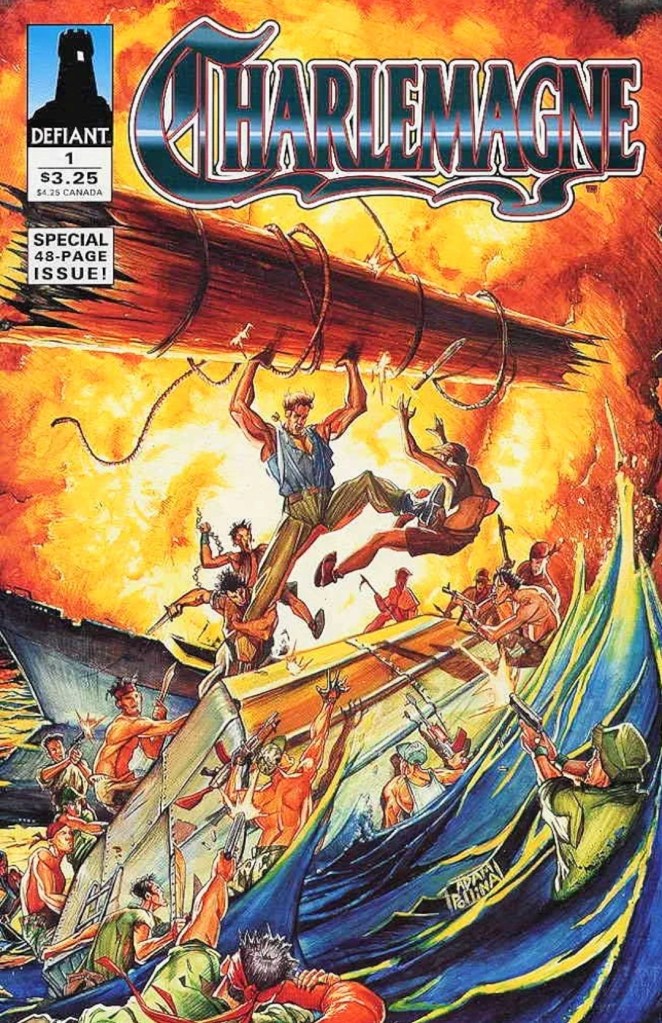
With those details laid down, here is a look back at Charlemagne #1, published in 1994 by Defiant Comics with a story plotted by Jim Shooter, Philip Nutman, Adam Pollina, Deborah Purcell and D.G. Chester, written by Chester and drawn by Pollina.
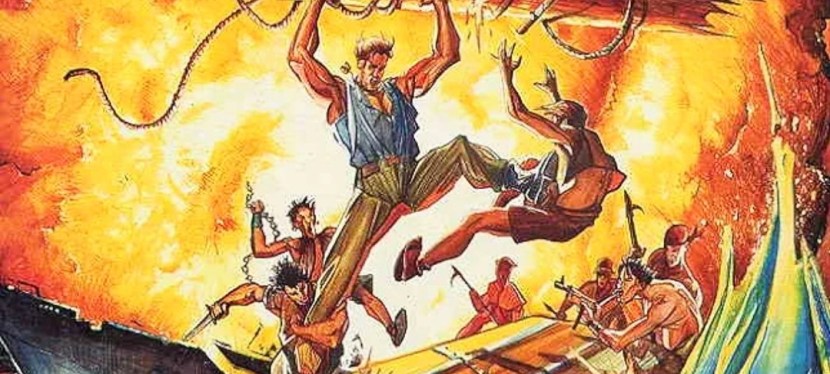
The cover.
Early story
The story begins in 1973 in the state of Kentucky. 12-year-old boy Charles has been feeling uneasy since it was reported that his older brother Pete serving in Vietnam has been missing-in-action. The father tries to comfort Charles who responds by asking him if he read Pete’s letters. By reading the letters, Charles paid attention to the details that described Vietnam and he even felt like was he was there. The young boy feels like he could find his missing brother.
A short time later as he and his father play baseball pitching outside, an important telephone call was received by the mother. It was Major Forney from the Pentagon searching for the father to give him updates about his missing son in Vietnam. It turns out the reports from Hanoi did not list Pete among the prisoners held there and chances on finding him are very slim. The father refused to accept his son’s status.
After hearing his father’s phone talk with the major, Charles refuses to believe his brother’s dead and immediately goes up to his room and starts preparing for a daring, solo travel to Vietnam…
Quality
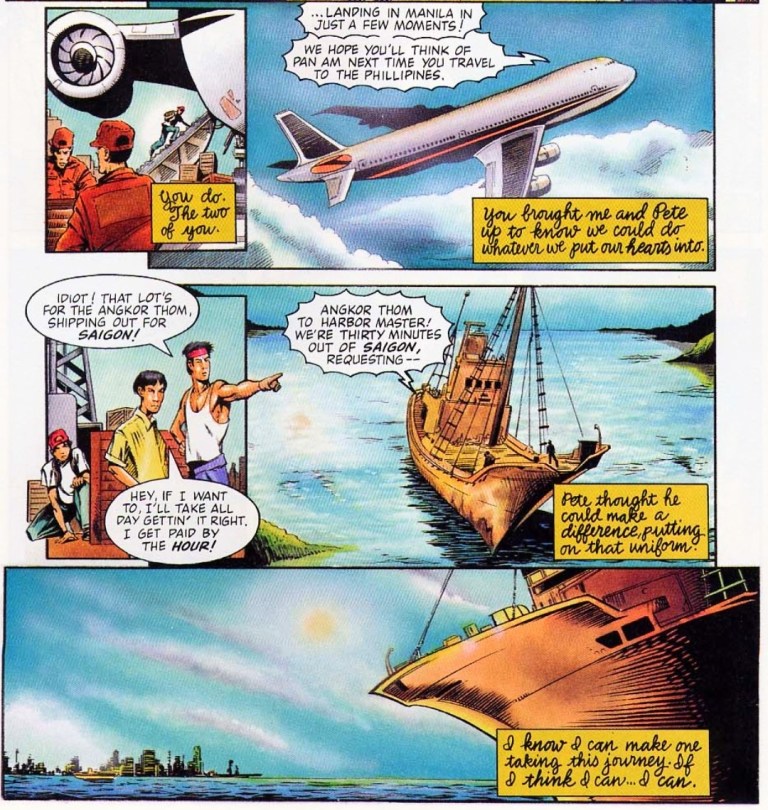
Incredibly, Charles travels from America to the Philippines by air, then to Vietnam by ship. How he got past security is beyond me.
If there is anything that would best describe the story of this comic book, it is a pretty enduring tale that moved with a slow-to-medium pace. That’s not to say it is not worth following. In fact, the narrative the writers came up with is quite gripping and as it flows on, you will really get to know the protagonist Charles and witness how his personality develops as he pushes through with his very daring pursuit of his missing brother in the middle of Vietnam.
Indeed, there is a superhero element in this story and the way it was emphasized by the creative team is actually unusual and experimental. The most defining element of Charles’ character is his uncompromising determination to find his older brother no matter what the odds. Without spoiling the plot, I can say that the superhero elements of Charles develop late in the story and the way they were presented is truly intriguing.
Of course, there are some questionable things about the story. Charles’ solo journey (note: he ran away from his parents at home leaving a letter) from America going into Vietnam as a young boy undetected is already unbelievable. His unrelenting search in Vietnam that lasted not days but actually a few years is even more unbelievable. These raises questions as to how much money did the young boy have to support himself with, and where did he stay to rest during the few years he spent in the Southeast Asian nation ravaged by war. If anything, this tale comes with a strong element of fantasy made to look like it happened during the Vietnam War.
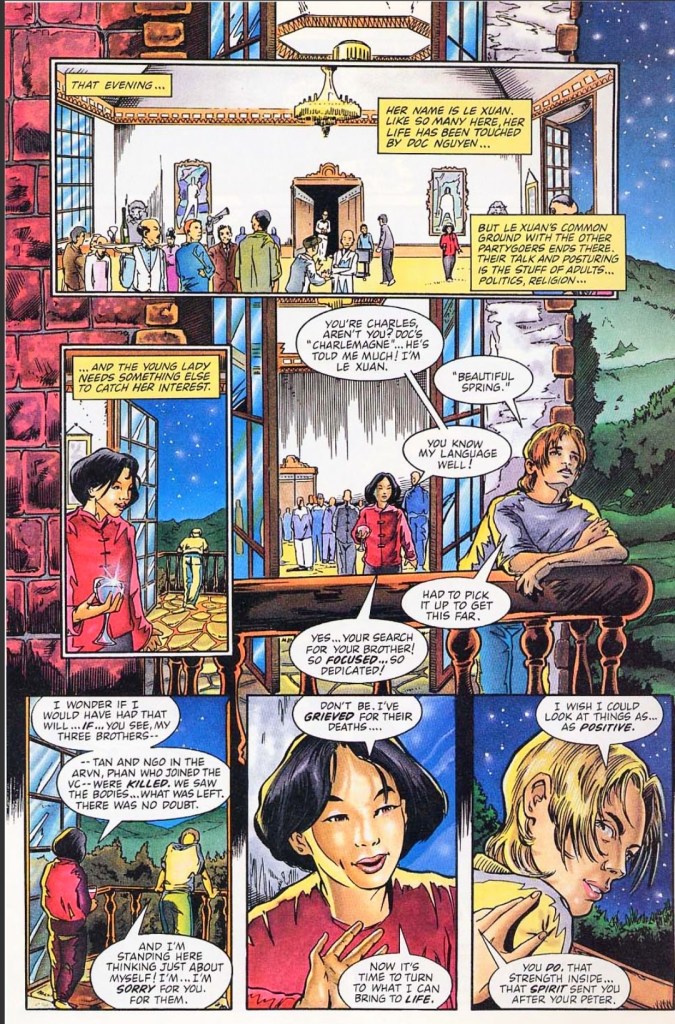
Apart from Charles, there are a few supporting characters who happen to be interesting to focus on. Through the one Vietnamese support character – the doctor – you will get to see certain aspects of local society as well as the American and Communist Vietnam sides.
Conclusion
Charles experiences a taste of luxury in Vietnam.
Charlemagne #1 (1994) is ultimately an engaging and pretty intriguing read. This comic book’s superhero elements and spectacle are pretty light but the build-up of Charles (and his development into Charlemagne) is quite powerful to read. This tale turns out to be an origin story of Charlemagne and you will realize that when you read it from start to finish. Considering how this comic book turned out, I’m convinced to find out more in the next issue.




















 Author Carlo Carrasco