Welcome back my readers, YouTube viewers and all others who followed this series of articles focused on YouTube videos worth watching. Have you been searching for something fun or interesting to watch on YouTube? Do you feel bored right now and you crave for something to see on the world’s most popular online video destination?
I recommend you check out the following videos I found.
#1 Star Wars: The Phantom Menace revisited – Remember way back in 1999 when Star Wars: Episode I – The Phantom Menace was released with a massive amount of hype and anticipation? I first saw that George Lucas-directed movie at the cinema in Festival Mall which was full of people. As the years passed by, The Phantom Menace did not age well as it had serious pacing issues, lots of childish elements (mainly because of a certain very annoying character) and it ended up inferior compared with its sequels Attack of the Clones and Revenge of the Sith. But let’s be honest here…while The Phantom Menace is indeed the weakest film of the Star Wars Prequel Trilogy, is it truly terrible and unwatchable? Now is a good time to revisit the 1999 movie through retrospective videos posted below.
#2 You, Me and the Movies react to Cape Fear (1991) – In recent times, YouTuber You, Me and the Movies posted their reaction video of the 1991 version of Cape Fear starring Robert De Niro and Nick Nolte. For the newcomers reading this, Cape Fear of 1991 is pretty hard core with its violence and, more notably, it carries elements that would terrify both viewers and their respective families. It is the kind of movie that will make you think about your family and how to protect them from cunning and violent criminals. Watch and learn how the movie impacts You, Me and the Movies.
#3 PatmanQC examines the history of Operation Wolf – Now for some retro gaming fun! I remember back in the late 1980s, Operation Wolf was popular in arcades here in the Philippines. As that game was released during the late stages of the Cold War, it was not surprising that it was both socially relevant and enjoyable for gamers. If you are wondering who created the game and what inspired them to produce Operation Wolf, watch the in-depth video by PatmanQC below.
#4 King’s Quest revisited – Still with retro gaming, I want to share with you all that in the late 1980s, I was fortunate to have played King’s Quest on PC (DOS specifically) which was an intriguing and challenging gaming experience for me. I never finished the adventure game from Sierra On-Line but I enjoyed its game design, its groundbreaking visuals and its fantasy world. I recently saw Space Quest Historian’s retrospective on King’s Quest and it had a nice mix of comedy and attention to details. Watch it now.
#5 Pedro Pascal’s wokeness exposed and explained – I really hate it when entertainment gets poisoned by the woke mob from the movie studios down to the performers and creators. I also despise the trend in which woke forces in Communist-filled Hollywood (Commiewood) make movies and shows that promote their Satanic Leftist agenda, and then the woke stars propagate their toxic beliefs in multiple ways. Recently Ranting for Vengeance posted new videos exposing the woke toxicity of actor Pedro Pascal and explaining in detail what happened. I can say this early you should stay away from Pascal’s projects such as the new woke Fantastic Four movie. As for Warner Bros., I don’t like James Gunn’s Superman. Watch and learn from the video below.
Welcome back readers, fellow geeks and electronic gaming fans!
In this edition of the Retro Gaming Ads Blast (RGAB) series, we will take a look at another batch of retro gaming print ads – including arcade flyers – from the 1980s and 1990s but with focus on Star Wars games that were released during the era of George Lucas. This is the Star Wars Special of RGAB.
For the newcomers reading this, Retro Gaming Ads Blast (RGAB) looks back at the many print ads of games (console, arcade, computer and handheld) that were published in comic books, magazines, flyers, posters and newspapers long before smartphones, social media, the worldwide web and streaming became popular. To put things in perspective, people back in the 1980s and 1990s were more trusting of print media for information and images about electronic games and related products.
With those details laid down, here is the newest batch of retro gaming print ads for you to see and enjoy…
1. 1983 Star Wars arcade game flyer
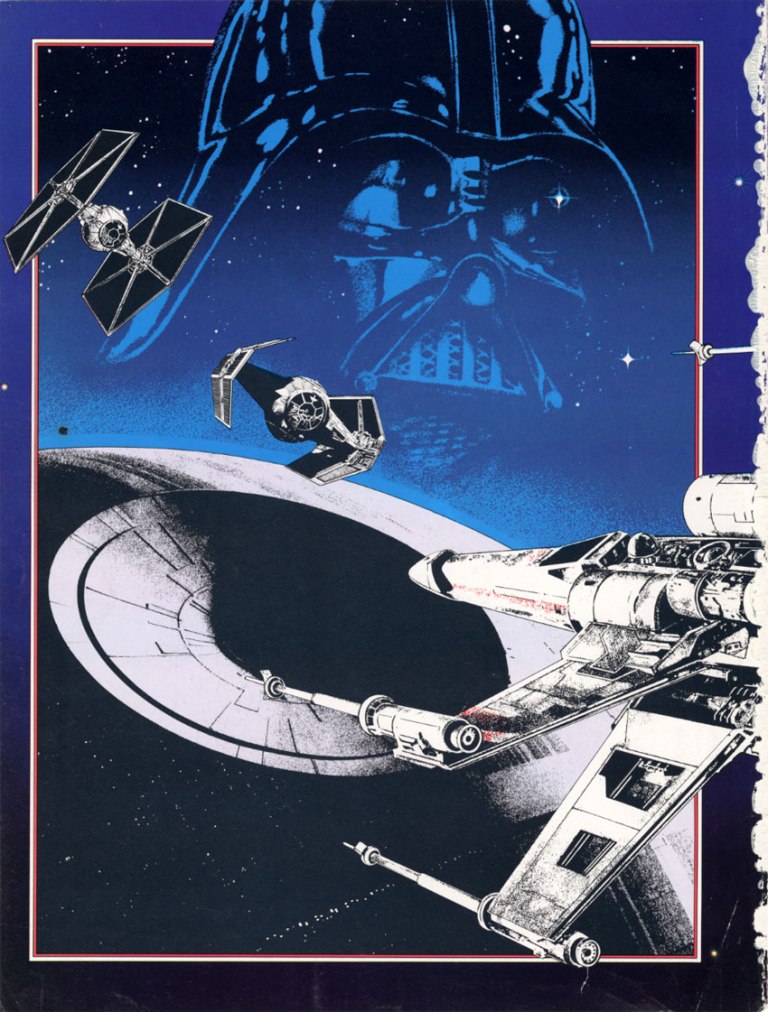
The front of the flyer.
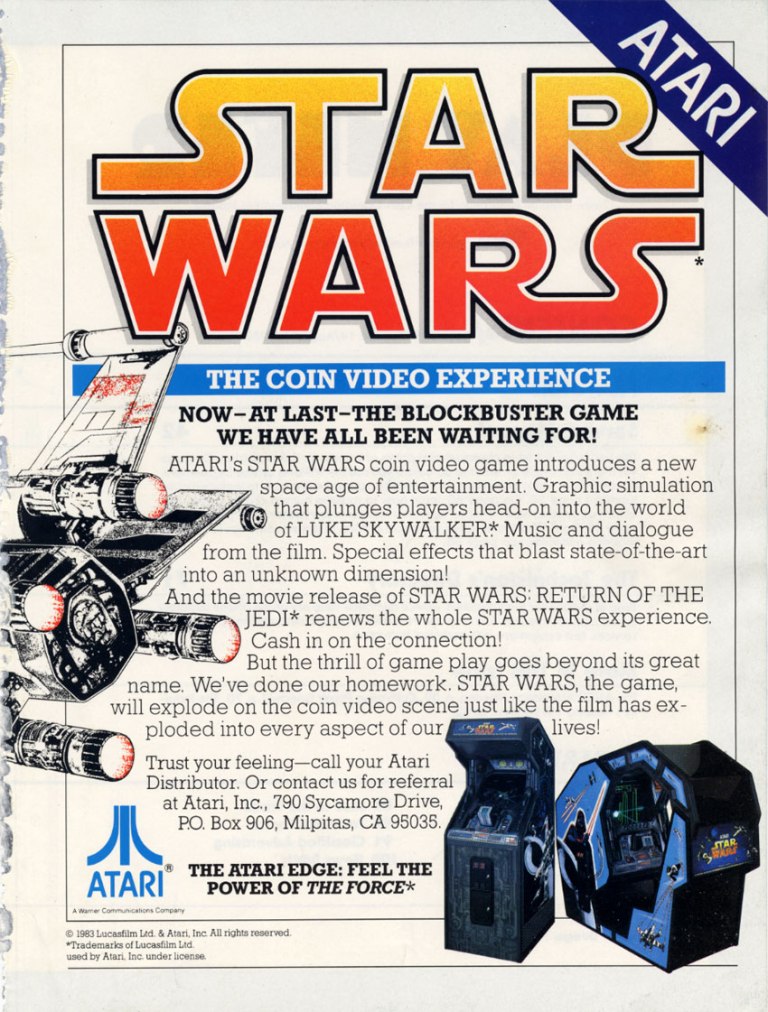
The rear of the flyer.
Just weeks before the Star Wars movie Return of the Jedi was released in cinemas in 1983, Atari released the Star Wars arcade game which became a tremendous hit around the world. Both Star Wars fans and gamers of the time loved the game as it provided a very immersive and fun-filled arcade experience. The print ad Atari released has a nice artwork on the front (showing a portion of the Death Star, two TIE Fighters, a Rebel X-Wing Fighter and Darth Vader’s image) and the text description plus the pictures of two arcade machines on the back. While no screenshots were shown, the print ad still had strong visual impact to catch the attention of players and arcade operators. This arcade flyer still looks great!
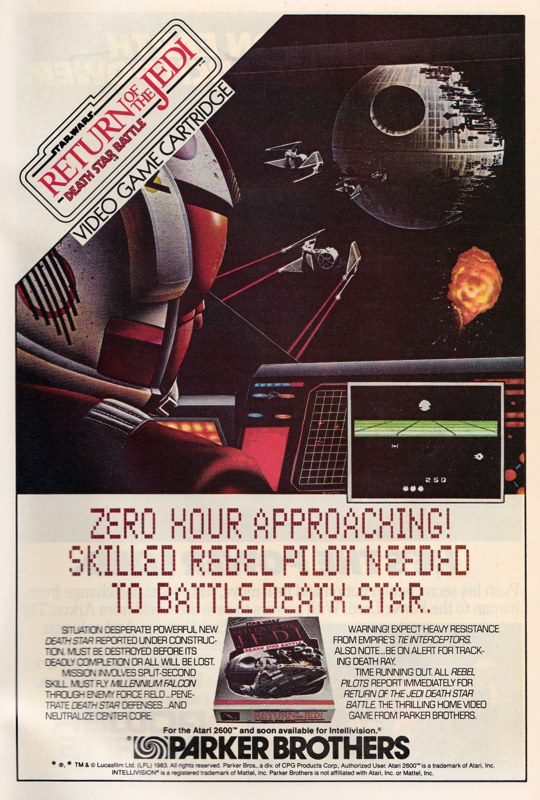
2. Star Wars: Return of the Jedi – Death Star Battle Atari 2600 print ad
Parker Brothers really stood out among publishers of games on the Atari 2600 and they even had the Star Wars license.
Considering the massive success that Star Wars and The Empire Strikes Back had in cinemas, merchandising and other entertainment media, it was not surprising that games based on Return of the Jedi were produced. For the Atari 2600, Parker Brothers produced Star Wars: Return of the Jedi – Death Star Battle which my friends and I played a lot in 1983. The print ad Parker Brothers came up with has a very eye-catching design showing a Rebel pilot flying a space ship (supposedly the Millennium Falcon which is the only playable ship in the game) towards the Death Star. The visual design is a stroke of genius because it appeals strongly to Star Wars fans while highlighting a major battle in the film which influenced the core concept of the game. This is a classic Star Wars game ad.
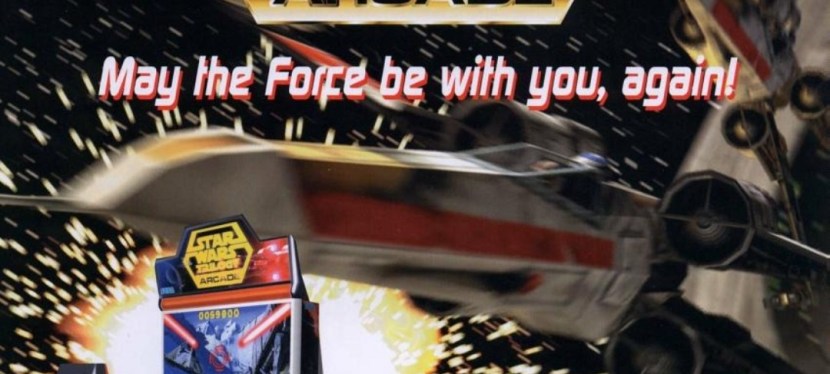
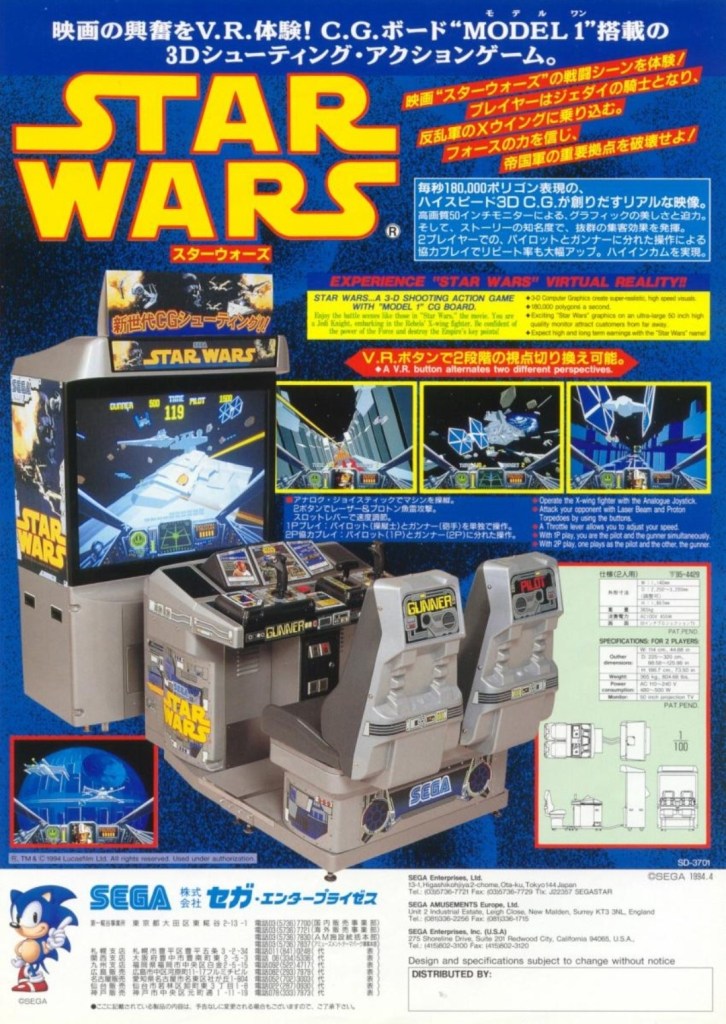
3. Star Wars Arcade Japanese market flyer
This arcade game was one of the first fully polygonal Star Wars games released.
In the 1990s, Sega acquired the license to produce Star Wars games for the arcades and they had the hardware for polygonal graphics. In 1993, the released Star Wars Arcade which is a space shooter that offered gamers the freedom to fly their Rebel space ship in 3D space with environments and huge space ships rendered in polygons. As you can see in the arcade flyer for the Japanese market, Sega went hard with their presentation showing 3 carefully selected screenshots (amazing for the time) and a picture of the arcade machine which had an elaborate control set-up, seats and decorations. As Star Wars Arcade was released more than a year before the polygonal game consoles Sega Saturn and Sony PlayStation hit the market, this arcade flyer was mind-blowing to gamers who were on the verge of playing video games with polygonal visuals.
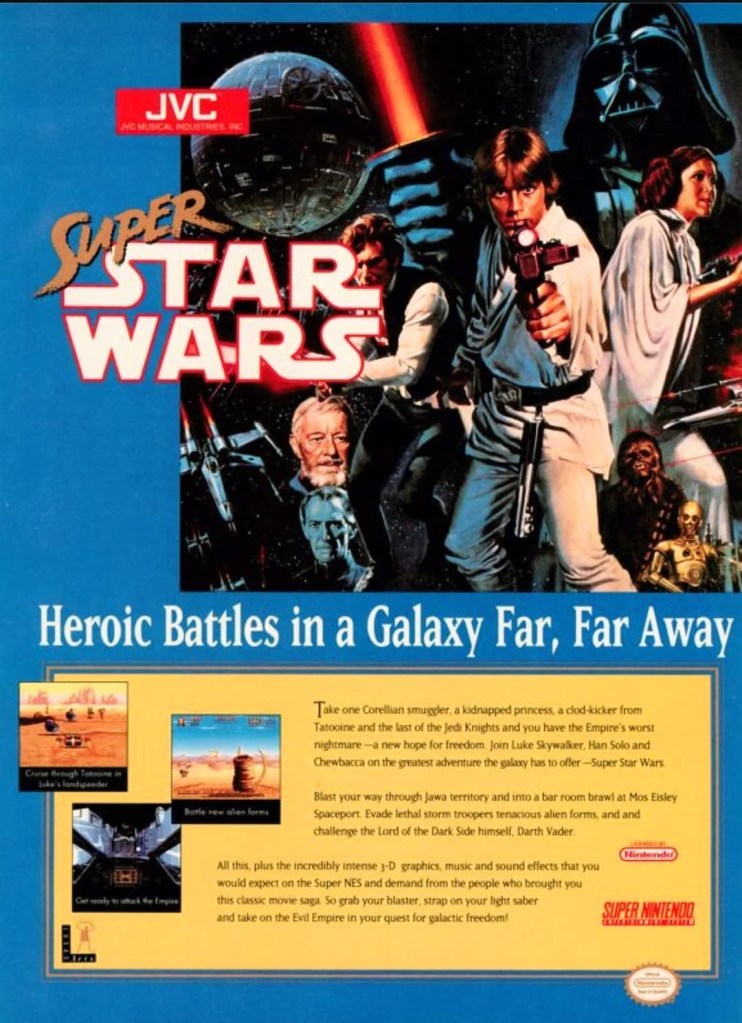
4. Super Star Wars print ad
Yes, JVC was involved with the Super Star Wars trilogy starting with this one.
In 1992, Star Wars fans who enjoyed playing 2D side-scrolling games saw their dream of the next great Star Wars console experience come true when Super Star Wars was released on the Super Nintendo Entertainment System (SNES). With the SNES technology, more detailed visuals and improved audio brought the Star Wars universe to life and the addition of 3D-like playable sequences (made possible by Mode 7 effects) made Super Star Wars a very unique console experience. The print ad only showed three screenshots and three paragraphs of descriptive text but the use of images from the 1977 movie poster added a lot of punch to the visual presentation. This ad is both eye-catching to gamers and long-time Star Wars fans.
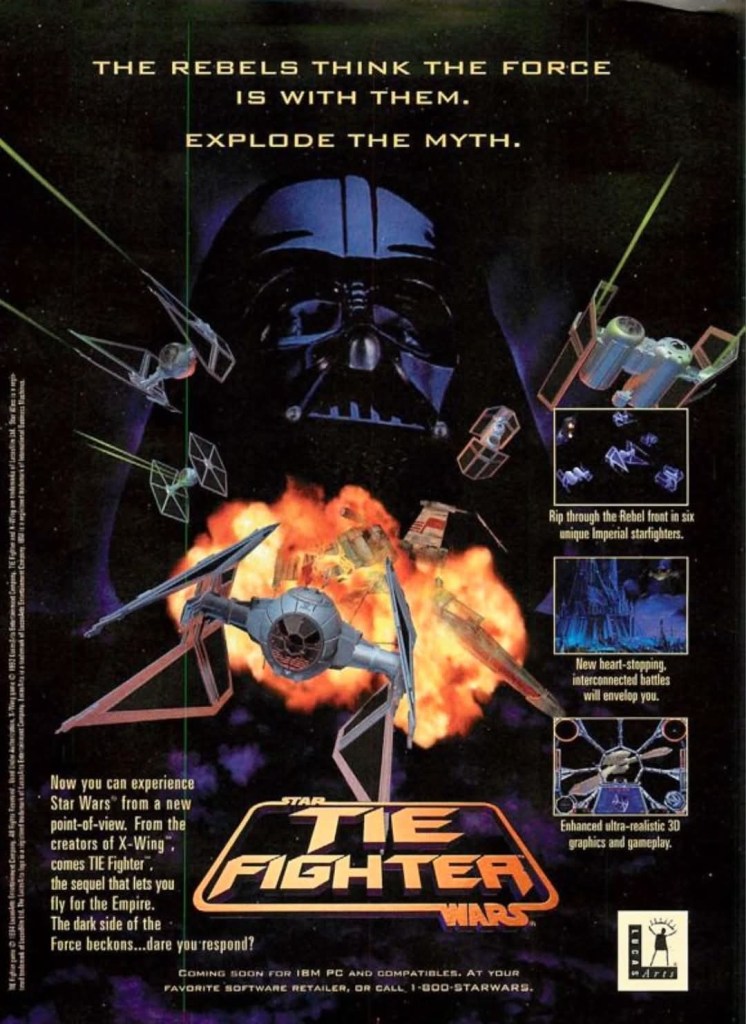
5. Star Wars: TIE Fighter print ad
This game offered gamers the opportunities to be with the dark side.
In 1994, LucasArts released Star Wars: TIE Fighter which offered gamers the opportunity to play an Imperial pilot serving Darth Vader on missions set between The Empire Strikes Back and Return of the Jedi. This print ad has a sharp visual design enhanced by Darth Vader’s iconic look in the background. The selected screenshots shown were good to look at but the artwork used to present the TIE Fighters really stood out. This solid looking print ad does come with a bit of disturbance as the Galactic Empire in Star Wars lore are evil.
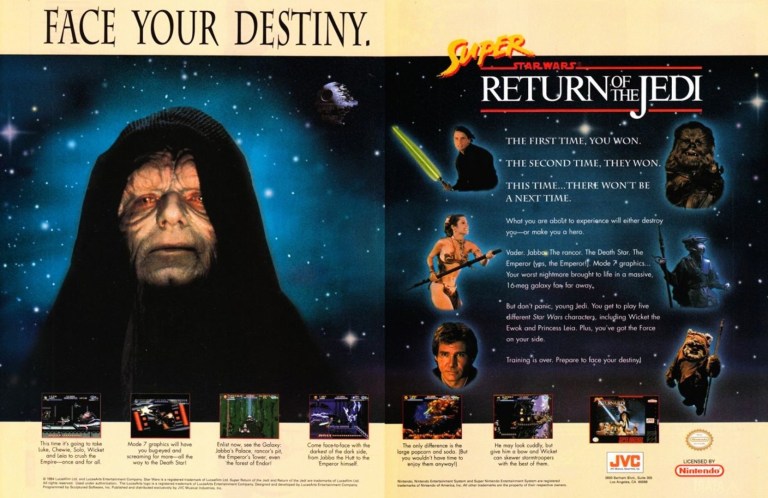
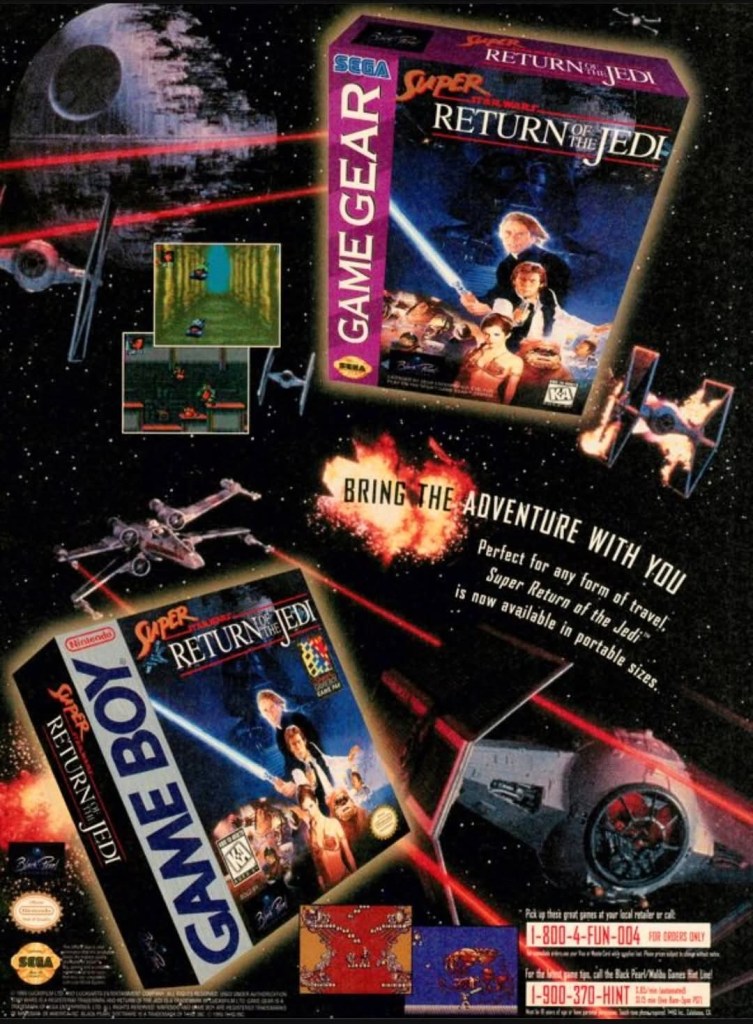
6. Super Star Wars: Return of the Jedi print ads
Nothing like seeing Harrison Ford, Carrie Fisher and Mark Hamill as the Star Wars icons on a video game ad.
I never played the portable editions of Super Star Wars: Return of the Jedi. Have you?
As far as gaming on the SNES was concerned, the Super Star Wars trilogy of games really kept fans and casual gamers busy. By the time Super Star Wars: Return of the Jedi was released in 1994 on the SNES, there was already immense speculation about the Star Wars prequel trilogy and George Lucas himself started writing them that same year. The 2-page print ad of the game on SNES had a creepy photo of Emperor Palpatine on one side, the other characters on the other side, and six selected screenshots displayed on the lower part. The way the print ad was design reflects that the game is the end of the trilogy like the 1983 film itself. Super Star Wars: Return of the Jedi was also released on Game Gear and Game Boy and the ad makers made the right decision to use the Death Star and space battle image as the background so that the portable games would stand out.
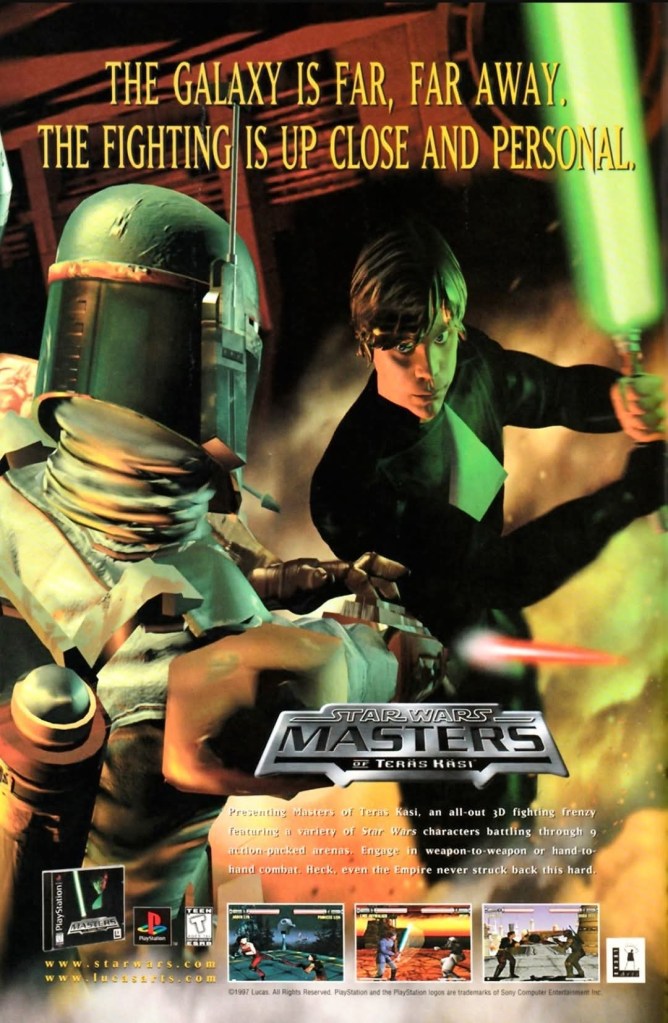
7. Star Wars: Masters of Teräs Käsi print ad
I wonder if George Lucas ever regretted approving this Star Wars fighting game. It was so rough and unpolished with its quality.
If there is any sub-par Star Wars game released in the 1990s, it is none other than Star Wars: Masters of Teräs Käsi on the PlayStation. The 1997 game was LucasArts’ attempt to cash in on the booming fighting games genre and they took a huge risk of making it entirely polygonal. Instead of using photographs or hand-drawn art, the ad makers used a fully rendered 3D polygonal models of Luke Skywalker and Boba Fett which was alienating to look at. In fact, those polygonal models looked very different from the in-game polygonal models of Skywalker and Boba Fett presented during gameplay. This print ad is a sad reminder about an ill-conceived concept for Star Wars that materialized into an actual product.
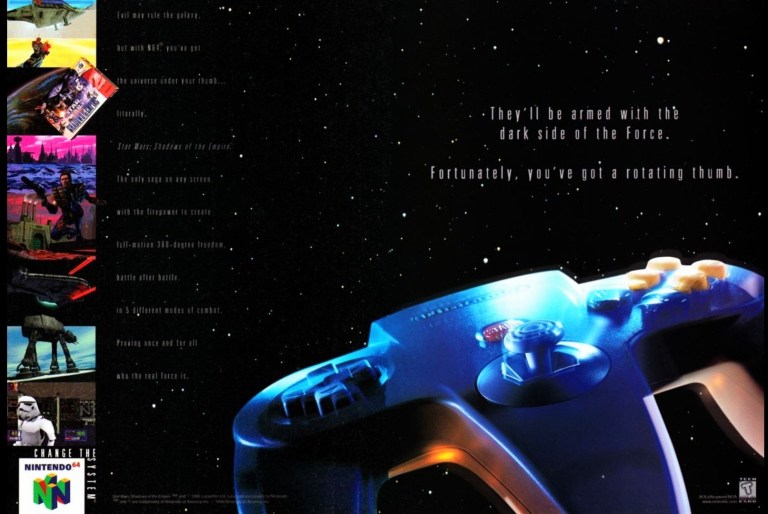
8. Star Wars: Shadows of the Empire print ad
If you have read the novel, were you able to play this video game?
LucasArts and Nintendo teamed up with something ambitious – a video game adaptation of Star Wars: Shadows of the Empire that was released exclusively to the Nintendo 64 (N64). Released in late 1996, Star Wars: Shadows of the Empire was part of the multimedia entertainment project of the same name and it is the result of LucasArts’ decision to be an early adopter of the N64 for business-related reasons. The 2-page print ad shown here has a dark, star-filled background which captivating screenshots on the left and the N64 controller standing out. This print ad strongly expresses that gamers would need the N64 in order to play Star Wars: Shadows of the Empire in the comfort of home.
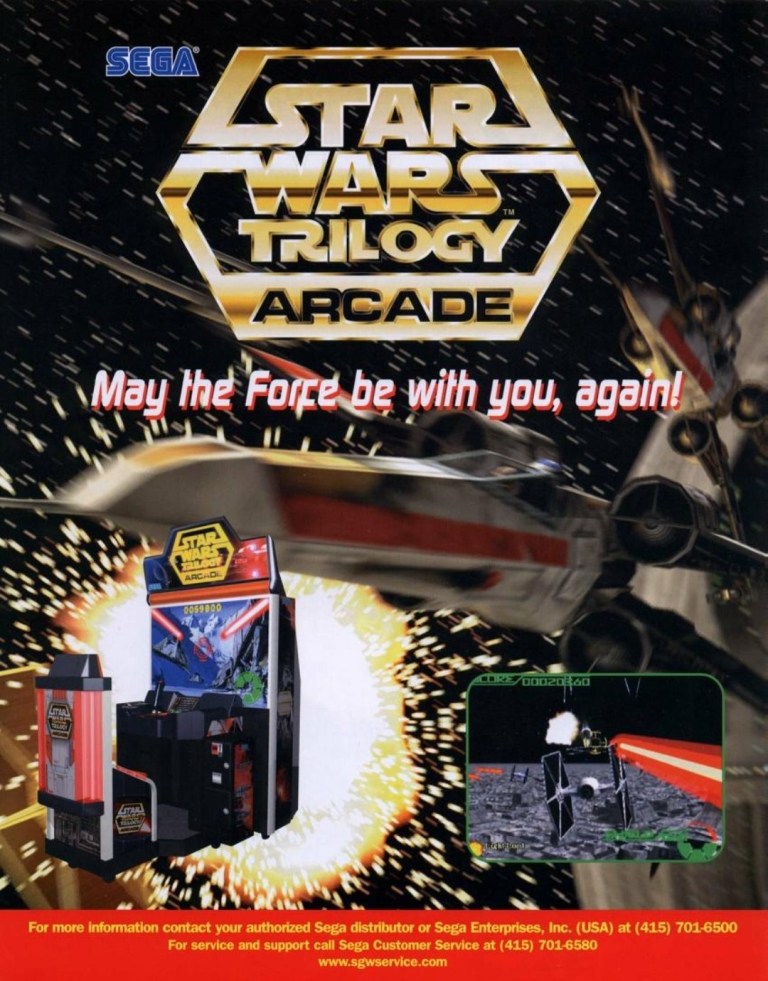
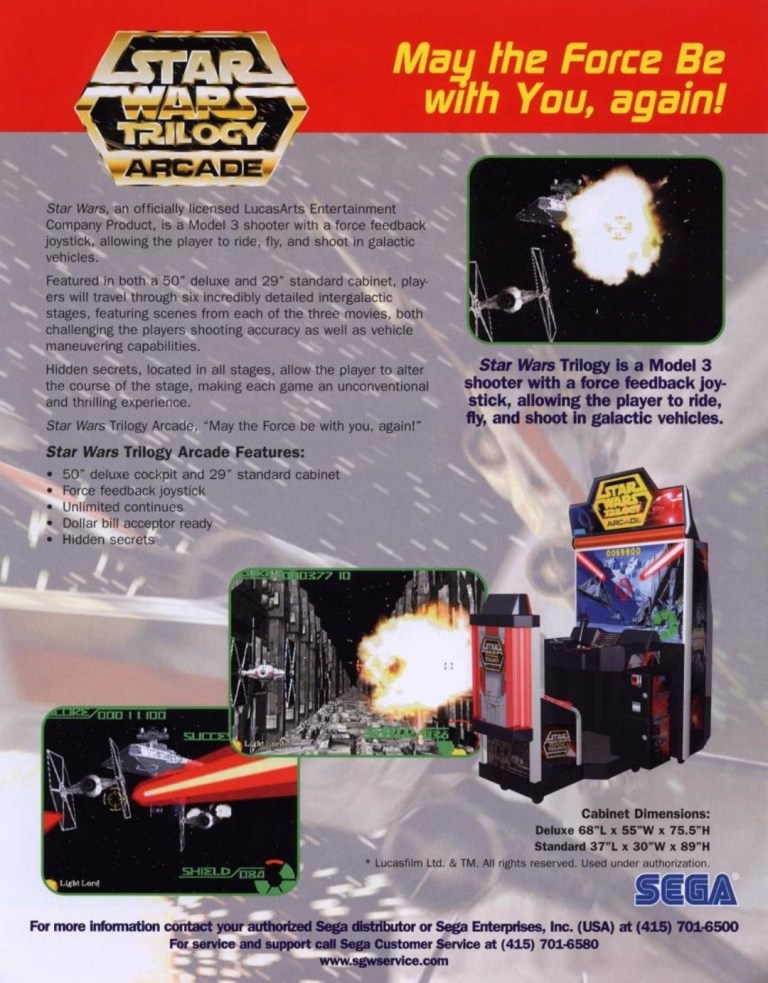
9. Star Wars Trilogy arcade flyer
The front.
The other side.
Before the Star Wars Prequel trilogy started with The Phantom Menace, Sega came out strongly by releasing Star Wars Trilogy Arcade in arcades around the world. Released in 1998, the game was arguably Sega’s most ambitious Star Wars-licensed game ever as it was made with the powerful Model 3 hardware, it came with unique controls and the game was designed as a polygonal rail shooter focused on key segments from the original trilogy of films. Sega wisely used dynamic artwork for the front of the flyer giving viewers the impression that the X-Wing fighter was approaching them closely. At the rear, three screenshots only showed space battles which was a wise decision by Sega to keep the surprise intact for gamers until they play the game. Having played this in the arcade myself, I can assure you that Star Wars Trilogy Arcade has more varied types of gameplay and challenges. It’s a lot more than flying and shooting in space, and it has a lot of stuff that Star Wars fans will love.
Disclaimer: This is my original work with details sourced from reading the comic book and doing personal research. Anyone who wants to use this article, in part or in whole, needs to secure first my permission and agree to cite me as the source and author. Let it be known that any unauthorized use of this article will constrain the author to pursue the remedies under R.A. No. 8293, the Revised Penal Code, and/or all applicable legal actions under the laws of the Philippines.
Welcome back science fiction enthusiasts, 20th century pop culture enthusiasts, Star Wars fans and comic book collectors! Today we go back to the year 1996 to examine the 2nd tale of a notable Star Wars storyline that took place between the films The Empire Strikes Back and Return of the Jedi…Shadows of the Empire!
For the newcomers reading this, Star Wars: Shadows of the Empire was a huge multimedia Star Wars event launched in the mid-1990s without a movie. Apart from exploring what happened in between the 1980 and 1983 classic Star Wars movies, Shadows of the Empire expands the lore by introducing new characters, Luke Skywalker’s gradual recovery from what he suffered from in The Empire Strikes Back, and the Galactic Empire’s ties with criminals who turned out to be resourceful. Back then, Star Wars was still fully under the control of George Lucas and his businesses. I already reviewed the first issue and enjoyed it.
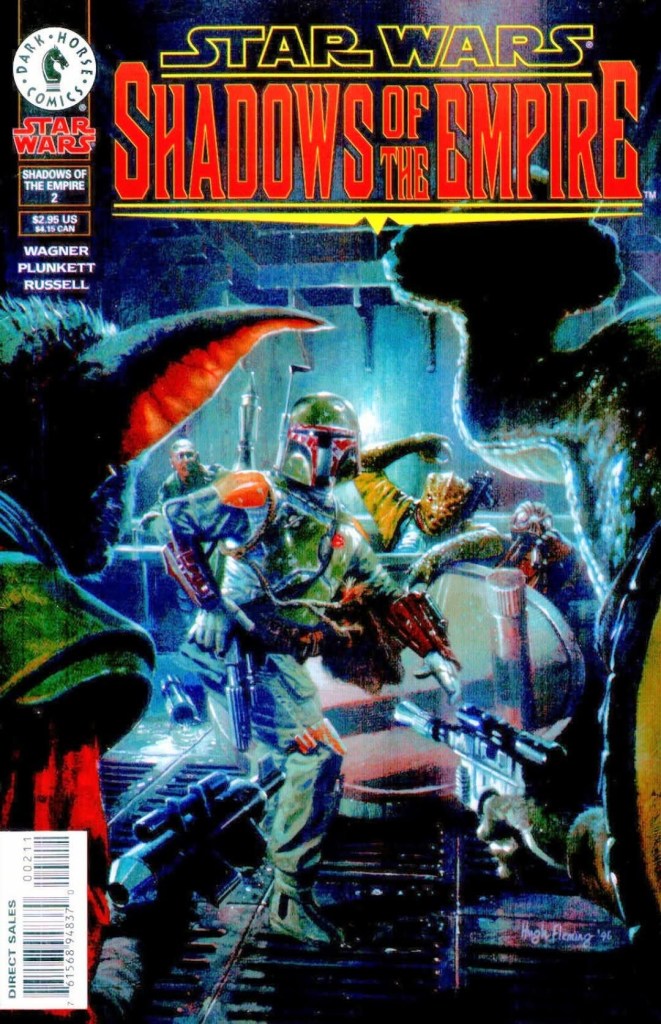
With those details laid down, here is a look back at Star Wars: Shadows of the Empire #2, published in 1996 by Dark Horse Comics with a story written by John Wagner and drawn by Kilian Plunkett. This is the 2nd chapter of a 6-issue mini-series.
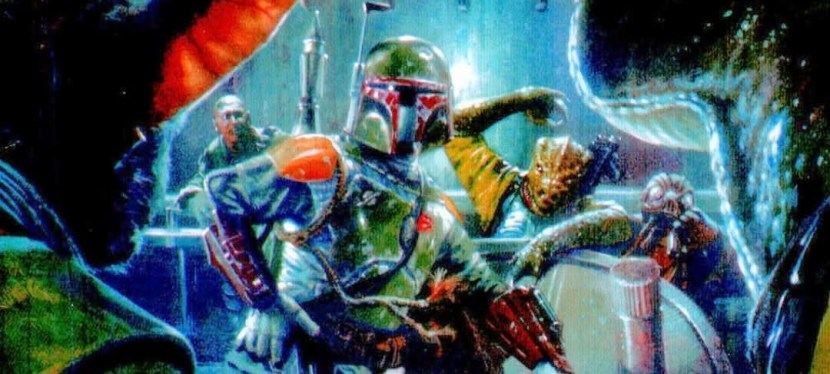
The cover.
Early story
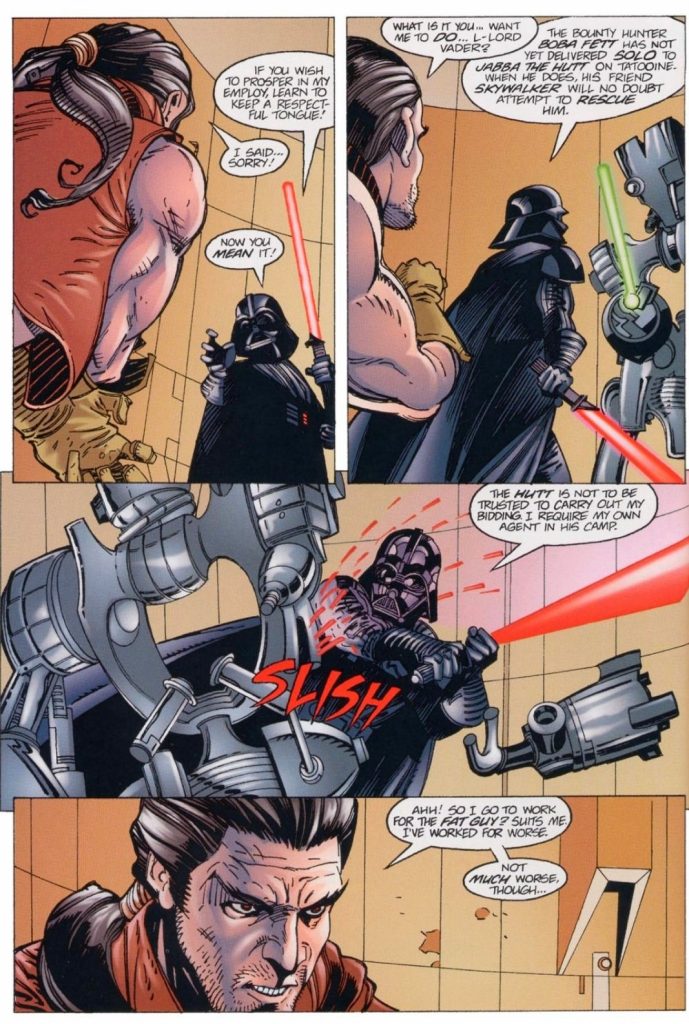
The story begins with Darth Vader in the middle of a lightsaber sparring session with a droid. As he makes his fighting moves, he issues instructions to a thug named Jix who was standing and watching. Vader tells him that the bounty hunter Boba Fett still has not yet delivered the captured Han Solo (in carbonite) to Jabba the Hutt in Tatooine, and he anticipates that Luke Skywalker will make an attempt to rescue him. Vader wants Jix to insinuate himself into Jabba’s swoop gang.
On another part of the galaxy, several Rebel X-Wing fighters (led by Luke Skywalker), the Millennium Falcon (with Princess Leia, Chewbacca, C3PO and Lando Calrissian) and the Outrider (Dash Rendar) travel together approaching the planet Gall with different objectives: the Rogue Squadrom will go draw out the imperial fighters while both the Falcon and the Outrider will sneak in to find the damaged Slave-1 (Boba Fett) and rescue Han Solo…
Quality
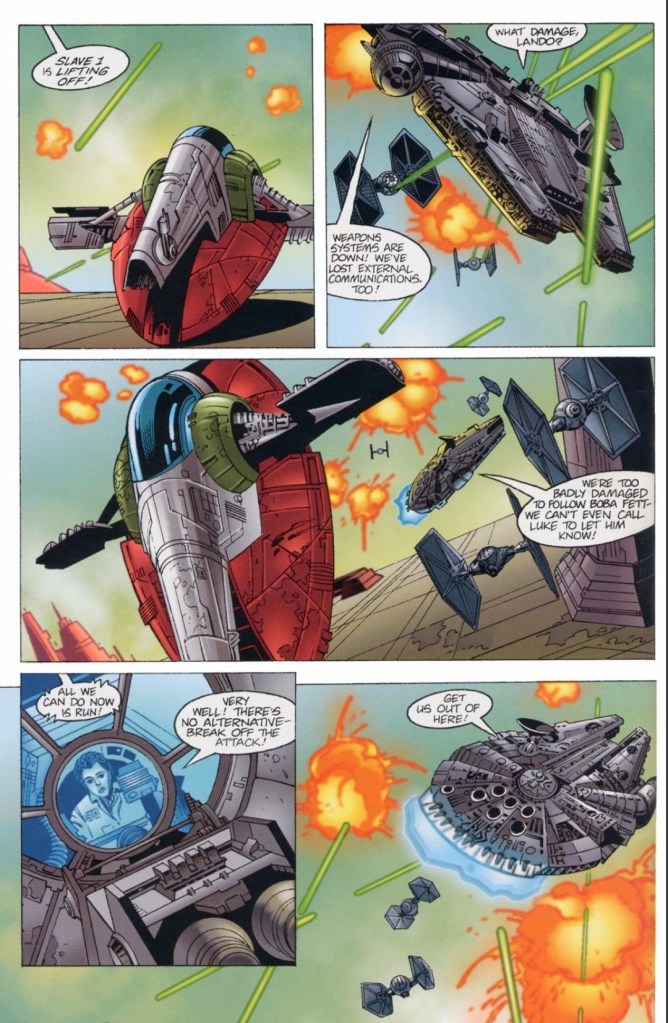
The Millennium Falcon and Slave-1 in the same encounter.
When compared to its predecessor, this comic book has a lot of plot developments moving forward. It is in this story where you will see Leia, Lando and Chewbacca really pull off their first-ever attempt to rescue Han Solo and the way it was presented by the creative duo Wagner-Plunkett was worth the anticipation. Even though the odds are against them, Prince Leia is clearly determined to get Han back not for her love for him but for the Rebel Alliance’s need.
With Darth Vader having lesser spotlight and none of Emperor Palpatine, the creative team was able to shift more of the spotlight on the galactic criminals. The introduction of Jabba’s Swoop Gang was nicely done and the portrayal of them as a rowdy and very sinister bunch is very notable.
Anyone who enjoyed playing the Shadows of the Empire video game on Nintendo 64 (N64) will be pleased to see Dash Rendar and his Outrider space ship here even though the spotlight lasted only briefly. As expected, Dash is creatively a smuggler-type substitute for Han Solo and I have the feeling that he will re-appear in the remaining issues of this mini-series.
As for the famous hero Luke Skywalker, you won’t see him wielding his lightsaber nor see him using his Jedi powers. Instead, you will see him taking action as an X-Wing Fighter pilot and you will see even more of his ability to lead his Rogue Squadron teammates. The way Luke was portrayed here was pretty accurate compared to his cinematic portrayal which proves the writing done was really solid.
In fact, the writing by Wagner remained consistently high in quality particularly with dramatizing Princess Leia, Lando, C3PO, R2D2 and Darth Vader. It is through Dash Rendar, Jix and the Swoop Gang where you will see Wagner push his creativity as he expands the lore of Star Wars to emphasize the galactic crime world and smugglers.
Lastly, Wagner really went all-in in developing the iconic bad guy Boba Fett in this comic book. You will really see how Boba Fett uses violence not just to overwhelm any opposition but also to protect the high bounty with the frozen Han Solo who is easily wanted by other bounty hunters and scum. When it comes to the visuals, expect to see similar quality Plunkett delivered in the first issue right here. Plunkett is very good with visualizing space ship battles, space travel, machines and locations, but showed weakness on drawing the humans. In fairness, Plunkett came up with very original styles and designs for the Swoop Gang and Jix, making them look really distinct.
Conclusion
Darth Vader and the thug named Jix.
Star Wars: Shadows of the Empire #2 (1996) is a solid follow-up to issue #1 and it managed to have the main plot and sub-plots move forward significantly. The storytelling is consistently good and the engagement was pretty strong. I can say I am convinced to look forward to finding out more in the next issue.
Overall, Star Wars: Shadows of the Empire #2 (1996) is recommended.
Welcome back my readers, YouTube viewers and all others who followed this series of articles focused on YouTube videos worth watching. Have you been searching for something fun or interesting to watch on YouTube? Do you feel bored right now and you crave for something to see on the world’s most popular online video destination?
I recommend you check out the following videos I found.
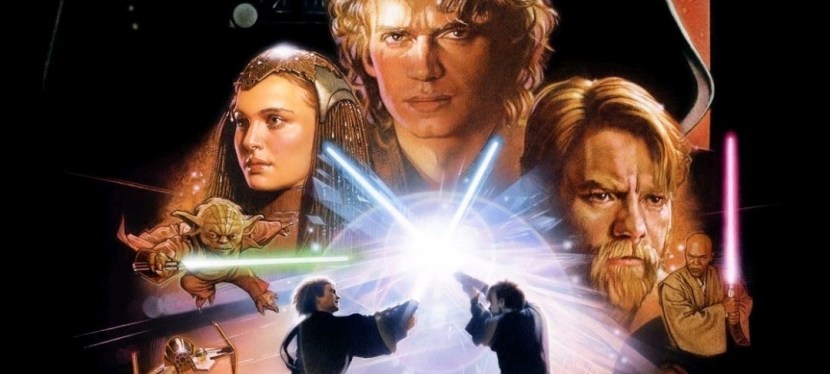
#1 Star Wars: Revenge of the Sith makes big comeback – This year marks the 20th anniversary of Star Wars: Episode III – Revenge of the Sith and its impact was felt when it finished 2nd in the American box office with its anniversary theatrical release. The George Lucas-directed movie grossed $25.5 million on April 25-27, 2025. For the newcomers reading this, Revenge of the Sith’s successful return to cinemas was celebrated by long-time fans as it was George Lucas’ Star Wars, and not the woke garbage from Kathleen Kennedy and the woke Disney company. To learn about the significance of Revenge of the Sith’s return, watch the videos below.
#2 Ashleigh Burton, Popcorn in Bed, VKunia and Decker Shado react to Revenge of the Sith – Revenge of the Sith is the real Star Wars as it was made and released many years before woke Disney made the unfortunate deal with George Lucas. I myself was fortunate enough to have seen the movie inside the cinema during its opening week here in the Philippines way back in 2005. To see how Revenge of the Sith impacts viewers, watch the respective video reactions by Ashleigh Burton, Popcorn in Bed, VKunia and Decker Shado (review) below.
#3 PatmanQC examines the history of Centipede –Centipede was an Atari game that I played a lot on the Atari 2600 a long time ago. It was simple with its game design and yet it was a lot of fun to play with. I never got to play the arcade version of Centipede in the old days but thanks to the Atari 50 collection I own, I finally played the arcade Centipede on my Xbox Series X. The development Centipede is interesting and you can learn more about it and the games by watching PatmanQC’s in-depth video below.
#4 Lunar games retrospective – If you are feeling nostalgic or interested in the Lunar franchise of video games, then Gaming Broductions’ retrospective video should interest you. For the newcomers reading this, the Lunar franchise started on the Sega CD (Mega CD in other markets) with Lunar: The Silver Star which was a Japanese role-playing game (JRPG) developed by Game Arts. Sequels and spin-offs were released in the years that followed and the Lunar franchise was revived for modern consoles with the Lunar Remastered Collection. Watch the video to discover more about Lunar games.
#5 Popcorn in Bed reacts to Cape Fear (1991) – Remember when Robert De Niro played a very bad guy in 1991’s Cape Fear? Believe it or not, that particular movie was actually a remake of the original 1960s version and it even got nominated for the Academy Award for Best Picture. There were moviegoers who got terrified by Cape Fear in 1991 and you can see for yourselves how it impacted YouTuber Popcorn in Bed in the reaction video below. By the way, Nick Nolte was really good in his role in the film.
Welcome back my readers, YouTube viewers and all others who followed this series of articles focused on YouTube videos worth watching. Have you been searching for something fun or interesting to watch on YouTube? Do you feel bored right now and you crave for something to see on the world’s most popular online video destination?
I recommend you check out the following videos I found.
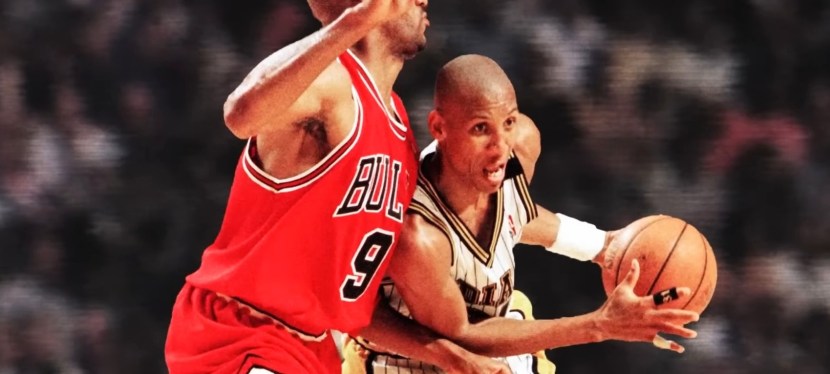
#1 A look back at the 1998 showdown between Reggie Miller and Michael Jordan – Remember way back in 1998 when Reggie Miller pushed Michael Jordan out of the way to free himself and score the crucial 3-point shot during an Eastern Conference Finals game between the Indiana Pacers and the Chicago Bulls? There was a lot of build-up between the Pacers and the Bulls before that memorable play happened, and many other players were factors as well. Watch and learn from the Secret Base video below.
#2 Looking back at Super Star Wars: The Empire Strikes Back – Among all the many Star Wars video games I played in the 1990s, it was Super Star Wars: The Empire Strikes Back on the Super Nintendo Entertainment System (SNES) that I enjoyed the most (read my retro review by clicking here). That was the 2nd of three side-scrolling Star Wars games released on the SNES based on the original Star Wars trilogy of films. In today’s gaming landscape, I can only wish that the SNES Super Star Wars games would someday get re-released for modern consoles. To understand what Super Star Wars: The Empire Strikes Back is about, watch the videos below.
#3 PatmanQC examines Sega’s Star Wars arcade games – Still on the topics of Star Wars and retro gaming, I enjoyed watching another video from YouTuber PatmanQC focused on the Star Wars arcade games released by Sega. For the newcomers reading this, a lot of licensed video games of Star Wars got released from varied companies through the decades. The Sega-produced Star Wars arcade games of the 1990s were notably of high quality and a lot of fun to play with. To learn more, watch PatmanQC’s video below.
#4 Christine Grace Smith reacts to video of average men competing with really fit women – Here is another analytical video by Christine Grace Smith. This time, she’s reacting to a video about a few average men competing with really fit women in a series of physical contests. Watch and learn, and pay close attention to the details.
#5 The truth about Dwayne Johnson – You might not have seen him in professional wrestling and you most likely saw him in the movies. I’m talking about Dwayne Johnson and there are lots of things about him that turned off people. He had some commercial success as an actor but after seeing It’s Blanko video of him, your perception of Johnson will be impacted. Watch the video below and pay close attention to the details.
#6 Minty Comedic Arts examines the lost scenes of Cobra – Way back in 1986, the action film Cobra was released in cinemas and it had Sylvester Stallone as a cop who has to protect a woman from a gang of killers who targeted her. The film was a commercial success mainly due to big ticket sales outside of America. For decades, it was speculated that the film that was released was a shortened version and there were lots of footage that ended up being deleted. Minty Comedic Arts’ video below confirms that there are indeed lost scenes and had they been used, they would have altered the overall tone of the movie. Watch the video below.
#7 You, Me and the Movies reacts to Commando – Commando of 1985 is an action movie starring Arnold Schwarzenegger and it had absolutely nothing to do with the 1985 video game of the same name. Not only was Schwarzenegger younger, you get to see him play a soldier completely different from his role in Predator. The video reaction of You, Me and the Movies is enjoyable to watch.
Welcome back readers, fellow geeks and electronic gaming fans!
In this edition of the Retro Gaming Ads Blast (RGAB) series, we will examine print ads from the 1980s and 1990s that caught my attention and I will explain why these are worth look back at.
For the newcomers reading this, Retro Gaming Ads Blast (RGAB) looks back at the many print ads of games (console, arcade, computer and handheld) that were published in comic books, magazines, flyers and newspapers long before smartphones, social media, the worldwide web and streaming became popular. Back in the old days, many gamers trusted the print media a lot for information and images about games.
With those details laid down, here is the latest batch of retro gaming print ads for you to see and enjoy…
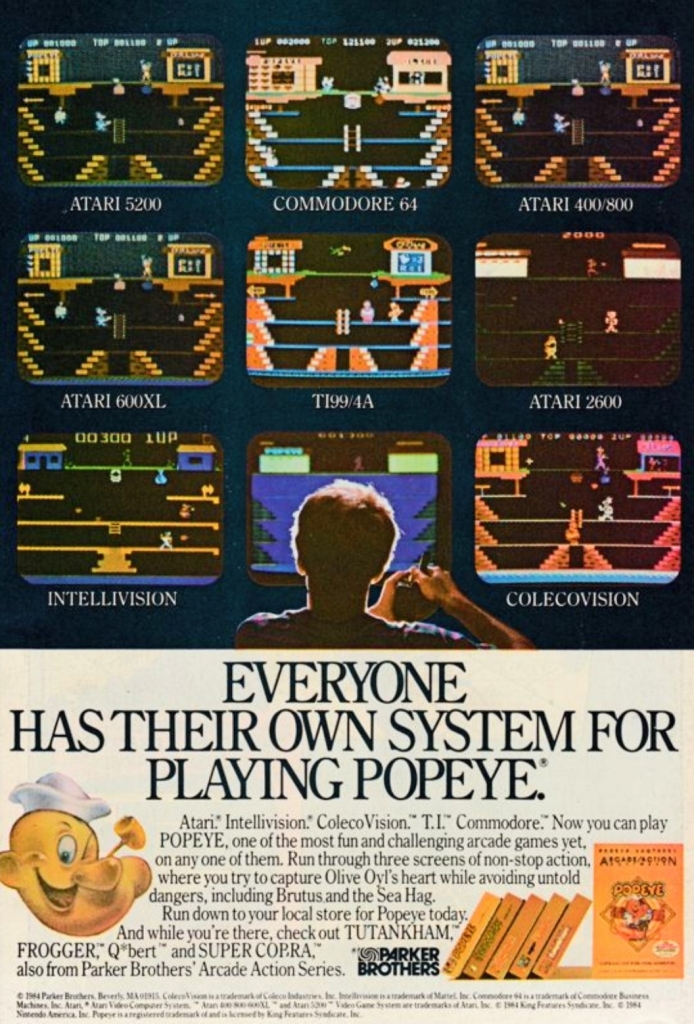
1. Popeye multiplatform print ad
A fine example of promoting the Popeye video game on multiple platforms visually.
During the early 1980s, an arcade game based on Popeye was released and it became a hit with gamers who lined up and inserted coins to play. That game, which had three stages, was eventually ported by Parker Brothers to multiple platforms of Atari, ColecoVision, Intellivision, T.I. and Commodore.
The print ad you see above is a classic display of how one particular game appeared as a multiplatform release. The screenshots showed different versions of the Popeye game on multiple Atari platforms plus the others. See how different the game looks on each platform? The level of visual details and elements varied from one another as each machine had different specs that Parker Brothers had to adjust to. This is a fine example of promoting one game for different machines for those who love video games.
2. Kool-Aid Man Video Game print ad
I never got to play this Kool-Aid Man video game.
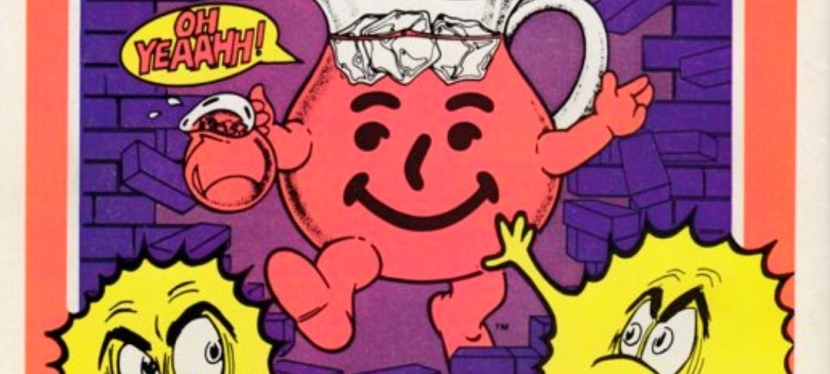
Remember Kool-Aid? For the newcomers reading this, Kool-Aid was a very popular product line of flavored juice drinks sold in powdered form. I myself used to mix Kool-Aid with ice-cold water and enjoyed drinking it. In 1954, a promotion of Kool-Aid with a touch of entertainment happened by highlighting the character Kool-Aid Man (famously known as the walking and talking pitcher filled with Kool-Aid juice). In later years, the Kool-Aid Man was often shown breaking through walls saying the line “Oh yeah!”.
The Kool-Aid Man gained tremendous attention as a pop culture figure in the 1980s when a new series of advertisements and promotions happened branching into video games and even comic books. The above print ad was a clever move to promote Kool-Aid as a drink as well as a video game for the Intellivision and the Atari 2600 consoles. Even if you were not too fond of video games in the 1980s, the Kool-Aid game ad would still make you think about the drink. Clever and entertaining!
3. Zombies Ate My Neighbors game print ad
I saw the 2-page ad many times in comic books and video game magazines.
Going into the 1990s, Konami’s print ad of the video game Zombies Ate My Neighbors (for Super Nintendo Entertainment System and Sega Genesis) appeared a lot in the comic books I read when I was much younger. Having seen lots of horror movies – including zombie flicks – the ad easily caught my attention not because of the screenshots but because of the visual style used. For one thing, there was this 1950s America-inspired imagery on the photo of the scared woman with three zombies slowly approaching her. As for the game itself, there were plenty of small-sized screenshots that had lots of interesting details and pixel art (note: 3D polygons in video games were not yet common back then) which gave me a clear idea that it was a humor and horror-laced 2D adventure. Not only that, the text descriptions combined with the fake quotes added zest into the presentation. After having examined all the details carefully, I really felt like Zombies Ate My Neighbors would be a fun-filled game to play on the SNES.
4. Lunar: The Silver Star print ad
With anime artwork used, it was easy to have the impression that the original Lunar game was based on an existing anime series or movie.
In the early 1990s, Game Arts developed and released the Japanese role-playing game (JRPG) Lunar: The Silver Star on the Mega CD platform in Japan which in some ways was also a technological breakthrough – the game came with full motion video (for short videos), animated images, and CD-quality sound (that really made the soundtrack lively to listen to). After achieving critical and commercial success in Japan, the game was picked-up by Working Designs to be localized and released in the North American market for the Sega CD (the American counterpart of the Mega CD) platform. In promoting the game for American Sega CD owners as well as American gamers in general, a print ad highlighting anime images with five screenshots and only a few words was published on both comic books and magazines.
Even though Lunar: The Silver Star’s core concept was never described in the ad, the anime imagery was still eye-catching and the chosen screenshots gave viewers a preview of the gameplay and the animated images. That being said, it was no surprise that gamers who happened to be a bit interested in anime noticed the print ad. At the same time, the ad gave some gamers the impression that Lunar was a game based on an existing anime franchise. This approach on game advertising was daring and it happened at a time when Japanese RPGs had a limited audience among gamers in North America.
5. Lunar: Silver Star Story Complete print ad
In the 2nd half of the 1990s, a remake of Lunar: The Silver Star was released in Japan titled Lunar: Silver Star Story for Sega Saturn (1996), Sony PlayStation (1998) and Windows PC (1998). While it still maintained the 2D visuals for presentation, gameplay and exploration, the remake had smooth anime sequences, new artworks, better sound effects and music. Working Designs pounced on the opportunity to localize the game in America for PlayStation and released it in 1999 with the title Lunar: Silver Star Story Complete. Not only did Working Designs work hard on localizing the game (the English dubbing and singing of the game’s songs were meticulously done), they released it with a very lavish packaging with the dedicated fans and collectors in mind.
By looking at the above print ad that magazines published, Working Designs highlighted the positive feedback quotes from EGM, Gamers’ Republic, PSM and Official U.S. PlayStation Magazine to convince gamers Lunar: Silver Star Story Complete is a great game. While the screenshots showed what kind of eye candy gamers could expect, Working Designs made sure that they would know that the lavish package includes 4 discs (2 game discs, 1 music CD and 1 CD that had video documentary of the making of Lunar), a full-color map in the form of a cloth, and a hardbound art book and instruction manual.
Considering the dynamism of the Lunar: Silver Star Story Complete print ad and the game’s packaging, I can only speculate that Working Designs had to do it aggressively because the gaming landscape changed dramatically as 3D polygonal graphics became the standard while lots of other Japanese RPGs from different publishers were released in 1999 (including the sequels Suikoden II and Final Fantasy VIII) and many of them had more elaborate game designs and visual presentations. Eventually market forces and unfortunate business events led Working Designs to closing down permanently in 2005.
6. Star Wars: Jedi Arena print ad
Remember when Luke Skywalker tested his lightsaber skills with the floating Seeker in the 1977 movie?
Back in the early 1980s, Parker Brothers was very active releasing games on the Atari 2600 console which my family had. At that same time, Star Wars was very popular (and without the wokeness and identity politics garbage of Kathleen Kennedy and woke Disney) and any new game based on the sci-fi franchise was something to be excited for. In the above print ad of Star Wars: Jedi Arena, an artwork showing the iconic her Luke Skywalker testing his lightsaber skills with the floating Seeker ball was displayed and located between Luke’s legs is a monitor showing the screenshot of the game. Looking at the text description, Parker Brothers creatively focused on the aspect of the Jedi way of using the lightsaber interacting with the Seeker ball. Having played the game myself, I can say the ad was creative and pretty much captured the core concept of the game.
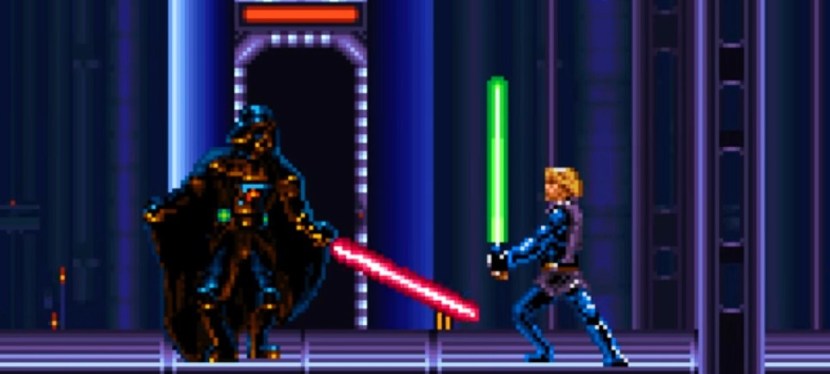
Luke Skywalker going up against the game’s final boss – Emperor Palpatine.
By the middle of 1994, gamers and Star Wars fans who owned a Super Nintendo Entertainment System (SNES or Super NES) were treated with more 2D side-scrolling fun with Super Star Wars: Return of the Jedi. Developed by Sculptured Software and LucasArts and published by JVC, the game was the conclusion of the so-called Super Star Wars trilogy of the 16-bit era of console gaming.
Like its predecessor Super Star Wars: The Empire Strikes Back, this game is a 2-dimensional side-scrolling adventure game released just months before Sega and Sony respectively released the Saturn and PlayStation consoles (which eventually made 3D polygonal gaming popular). The game itself is based on the 1983 movie Return of the Jedi: Luke and his friends go out to save Han Solo from Jabba the Hutt and the Rebels prepare its strategy to defeat the Imperial Forces now armed with a new Death Star with the personal presence of Emperor Palpatine.
Here’s my review of Super Star Wars: Return of the Jedi.
Early story (and some notable differences from the movie)
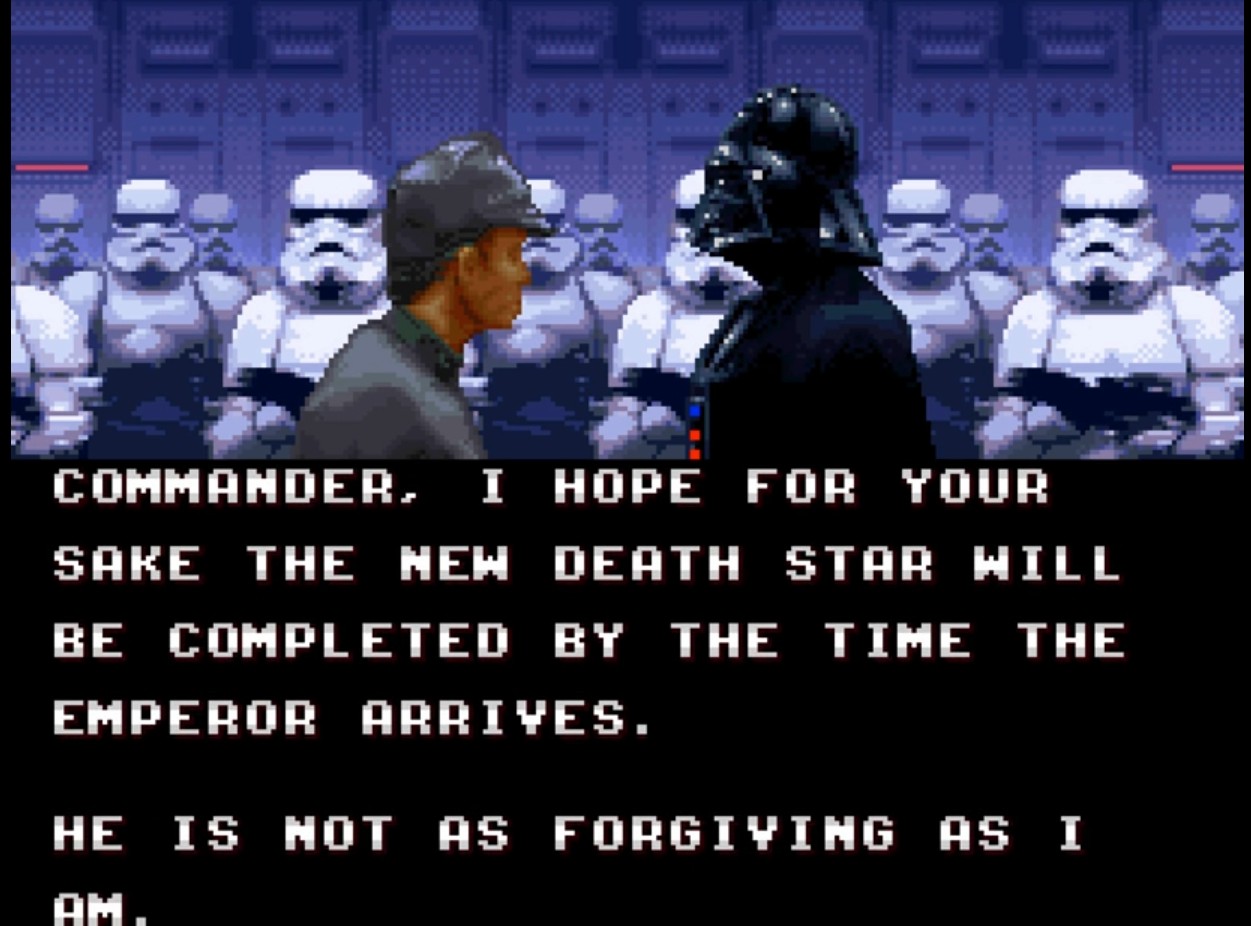
The game begins with a quick look at Darth Vader’s arrival at the new Death Star setting up the stage for the Emperor’s arrival. On Tattooine, Luke and his companions travel to the temple of Jabba the Hutt to somehow save their friend Han Solo (who got frozen in carbonite at Cloud City in The Empire Strikes Back).
A still cut-scene at the beginning of the game.
In order to get to the palace, Luke/Leia/Chewbacca (you get to pick which character to use) have to travel through a lengthy stretch of land filled with several forms of wild life, monsters and even Jawas blocking their way. Once inside, your character has to fight until the end of the next few levels (note: there was a boss or powerful enemy to beat) to make the story progress.
Once you have defeated Jabba and rescued Han Solo, your team regroups with the Rebels in space to start your next series of missions with the moon of Endor (with the 2nd Death Star in orbit).
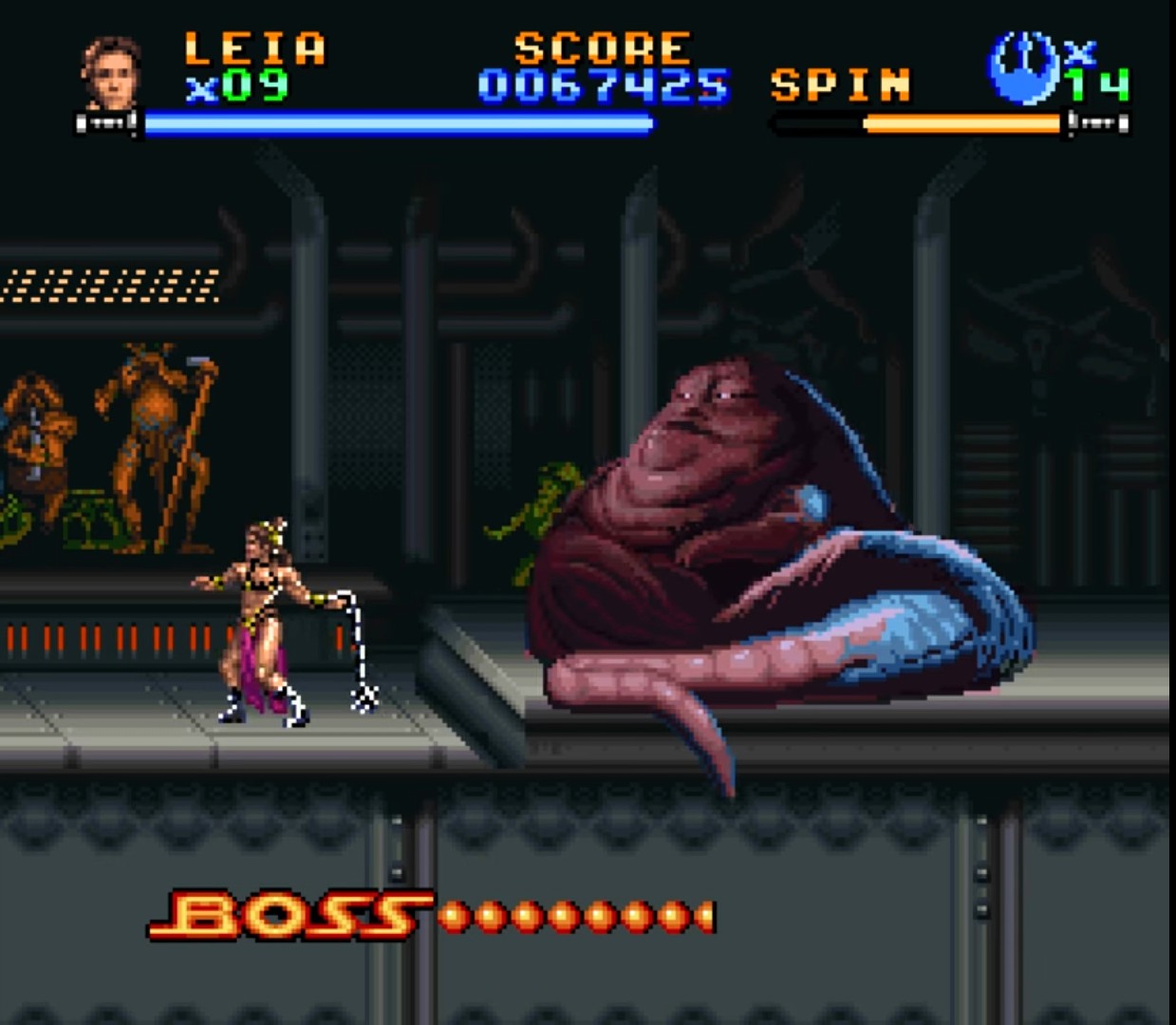
Notable differences from the movie include fighting a large monster (which used a large ball as a weapon) did not appear in the film. Also notable was Leia (in her sexy slave outfit) having to move from the end of the stage to reach Jabba the Hutt who serves as the level’s boss. Jabba’s sail barge in the game looks and feels longer than in the movie.
Leia, Jabba is right behind you!
Gameplay
Super Star Wars: Return of the Jedi plays a lot like its predecessor. As typical with most games of the era that used 2D sprites for visuals, the game is an action-packed side-scroller wherein you have to control your character from left to right, go up and down and complete the level by either defeating the end-level boss or by simply reaching the end (some levels have no boss). As you move on, you also get to collect power-ups and icons which are really helpful in completing the levels.
Along the way, you get to fight a whole bunch of enemies that appear to fight and stop you. This includes not only the Imperial forces that appeared in the movie but also new additions like machines and even flying robots. You never saw Luke fight any flying robot in the movie? In this game, he gets to fight them at the Imperial facility on the moon of Endor.
Han Solo blasts the Stormtroopers!
Given the story structure of the movie, the game developers were able to let players pick a Star Wars character to play as before starting a level. This particular feature was prominent in 1992’s Super Star Wars but was heavily toned down (due to story structure) in Super Star Wars: Empire Strikes Back. Back to the selectable characters, there are key differences between them such as Luke using his lightsaber and Force powers, Han Solo with his blaster and grenades, Chewbacca with his crossbow and his spin attack (he does NOT do this in the movies so it’s funny), and Leia who uses different weapons as she appears (based on the story structure) as a disguised bounty hunter and as a sexy slave to Jabba. Quite odd here is the addition of Wicket the Ewok as a playable character whom you must guide fighting the bad guys in two levels that are set in the village of the Ewoks up those tall trees. The Wicket levels are easily the least interesting to play in.
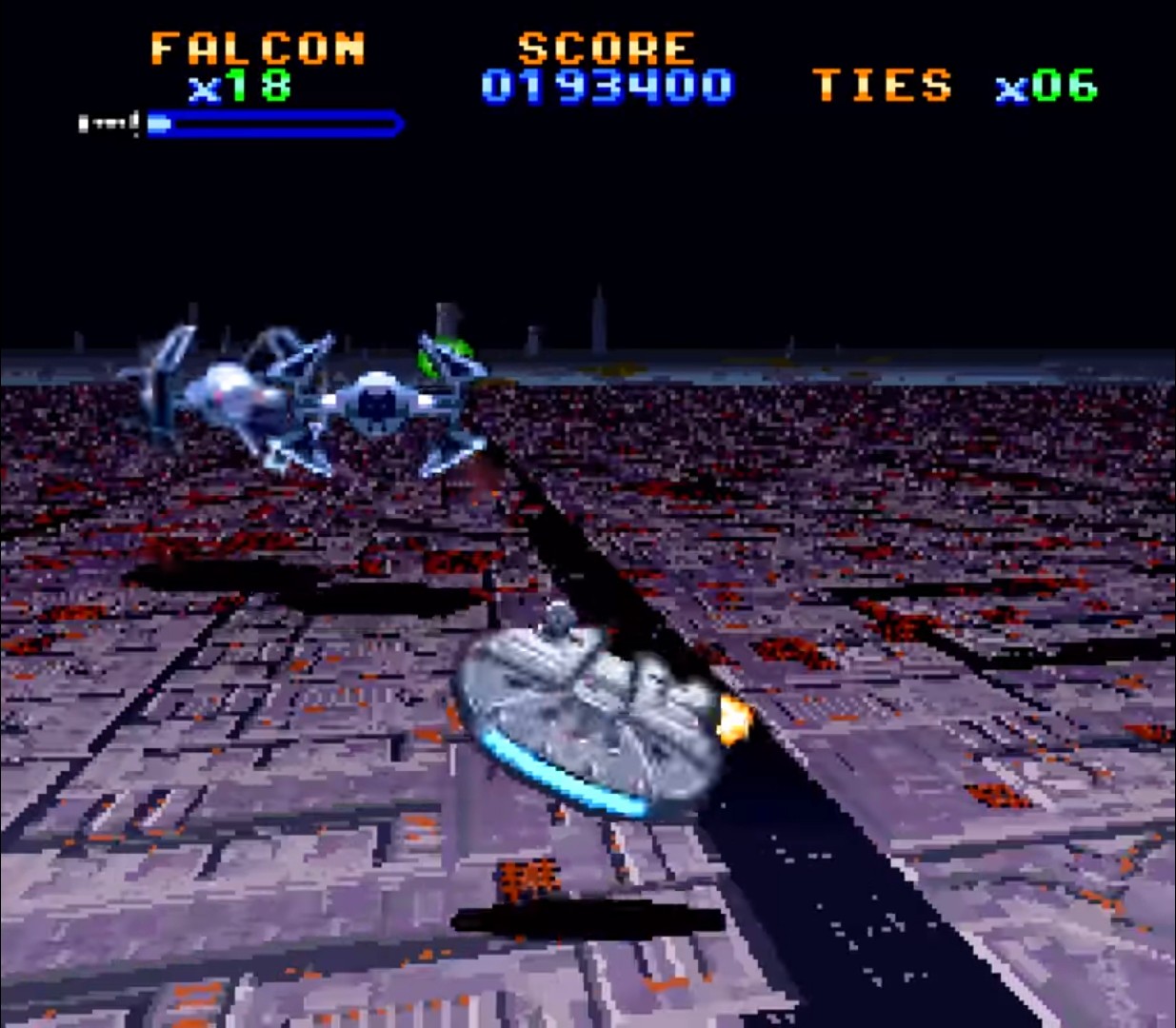
Like the previous two games, the game designers implemented levels that play differently from the standard side-scrolling adventuring. I’m referring to the Mode 7 level in which you fly the Millennium Falcon on a makeshift 3D environment on the surface of the 2nd Death Star needing to destroy a number of TIE Fighters in order to progress. I should say that this particular level lacked depth although it was cool to use the Falcon and just imagine Lando and his team inside operating it.
The Millenium Falcon in the Mode 7 3D environment set on the surface of the Death Star.
In what is a clear attempt by the game makers to push the hardware of the Super NES, they created a standalone level in which you use the top turret of the Millenium Falcon to shoot a required number of TIE Fighters while flying in space heading towards the 2nd Death Star (complete with a 3D background showing the Imperial Star Destroyers in the distance on one side). This was a very short yet cool sequence to play even though the darkness of space makes spotting the TIE Fighters a bit challenging. I liked the fact that the console’s processor was pushed hard to allow the TIE Fighters look 3D and detailed using several frames of animation as they fly around and right close to the Falcon (which itself looked detailed).
This 3D shooting segment in the game was fun and too short.
And then there is the speeder bike chase sequence that took place through the forest of Endor. This one is pretty shallow and has not aged well.
Nice visual detail on the speeder bikes but everything else felt shallow.
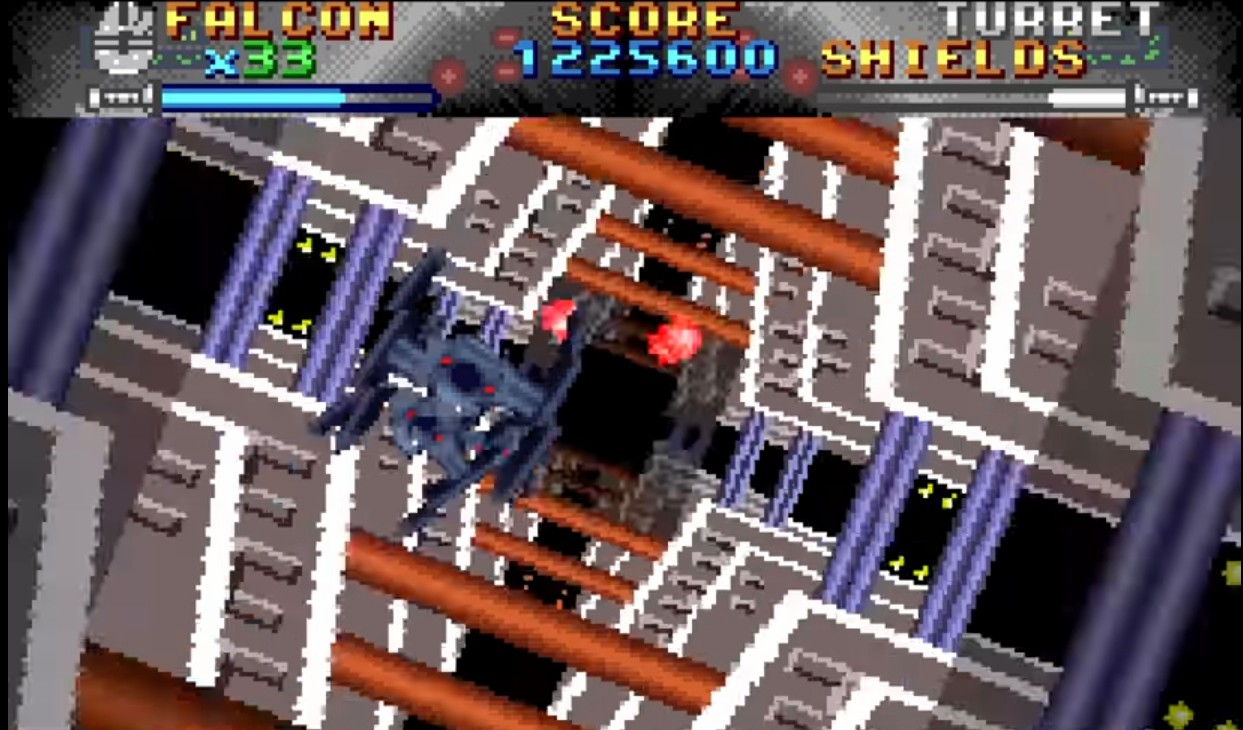
Finally, the game’s last stage is another hardware-intensive level that offers gamers the opportunity to experience the challenge and speed (as far as the hardware could push) of piloting the Millennium Falcon into the tunnels of the 2nd Death Star to reach the core, blast it and then escape on the way out (being chased by intense flame caused by the explosion). This level shows lots of repeating visual elements that are supposed to be the mechanical interiors of the tunnels and you can movie the Falcon in 1st-person view, speed up or down, rotate the view and tilt the direction as you move forward. Along the way, there are TIE Fighters who appear in front of you for you to shoot at. While the intention of the developers to replicate the memorable sequence of the movie is clear, the hardware limitations (and design limitations) could only go so far to make the gameplay experience solid. What bogged this particular sequence down are the bouts of slowdown (lowered frame rates) when things get hectic.
This sequence must be seen in motion.
Conclusion
While it is indeed a more polished game than the memorable Super Star Wars: The Empire Strikes Back, Super Star Wars: Return of the Jedi was indeed a fun and engaging game but still falls short of its immediate predecessor in terms of enjoyment and engagement. For one thing, this game noticeably was less challenging and the return of the password system makes it even easier to finish. The boss battle with Darth Vader showed the iconic villain being much easier to beat with even on the standard difficulty level. I still remember how surprising it was to beat Vader during my first time playing the game.
The non-side-scrolling levels of the game created good variety for playing. I just wished that the 3D space shooting sequence of the Falcon (with its top turret) lasted longer and the visuals of the final level looked more detailed and had less lag. As for the Mode 7 level with the Falcon on the surface of the Death Star, that one pales in comparison with the lengthy and memorable Battle of Hoth (which has the grand experience of taking down the AT-AT walkers with the tow cable).
Overall, Super Star Wars: Return of the Jediis recommended. By today’s standards, this game is a classic and was one of the best ever Star Wars video games of not only of its console generation but among all Star Wars games that were made with 2D sprites and pixel art. If you have a Super NES console or Nintendo’s Virtual Console, play the game once you have it.
Thank you for reading. If you find this article engaging, please click the like button below and also please consider sharing this article to others. Also my fantasy book The World of Havenoris still available in paperback and e-book format. If you are looking for a copywriter to create content for your special project or business, check out my services and my portfolio. Feel free to contact me as well. Also please feel free to visit my Facebook page Author Carlo Carrasco and follow me at HavenorFantasy@twitter.com
In this age of photo-realistic 3D graphics in video gaming, I sure miss the days when 2D gaming and highly detailed pixel art were the standard. I’m referring to the so-called 16-bit era of the Super NES/SNES (Super Nintendo Entertainment System) back in the 1990s.
In 1991, Super Star Wars was released on the Super NES and it became a big hit with the gamers, the critics and fans. That game was heralded as one of the best video game adaptations of movies.
Naturally, a follow-up to that game was released in 1993 – Super Star Wars: The Empire Strikes Back.
That being said, here is my retro gaming review of Super Star Wars: The Empire Strikes Back.
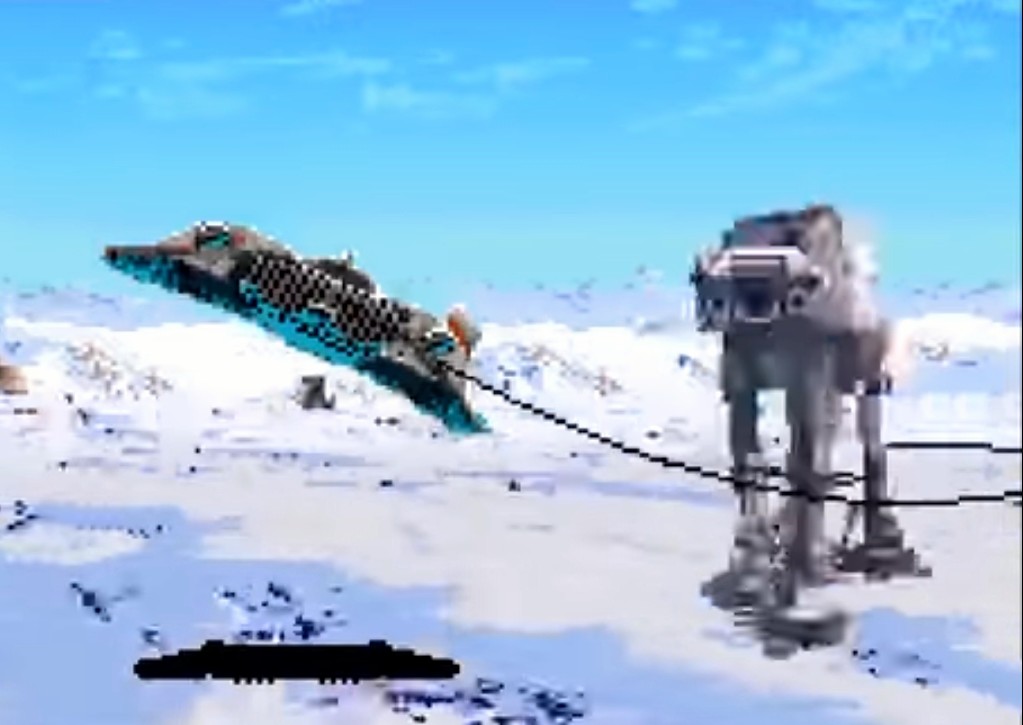
The experience of using a Rebel speeder to bring down an AT-AT walker with the cable remains awesome.
Developed by Sculptured Software and LucasArts and published in America by JVC, this game is based on The Empire Strikes Back which today has been considered to be the greatest Star Wars movie ever. Of course, in order to make a cohesive video game adaptation out of the classic movie, a lot of liberties were taken when it comes to following the story. This was inevitable as the game developers needed a lot of creative freedom to make a cohesive video game.
Early story (and some notable differences from the movie)
Super Star Wars: The Empire Strikes Back begins with Luke Skywalker riding a Tauntaun. Unlike the movie, Luke (controlled by players) visits some places of the wasteland of Hoth, notably caverns and hills fighting several forms of wild life (including wampa beasts), and even some probe droids.
Luke jumping on to a wampa beast.
Unlike the movie, Luke does not get rescued by Han Solo in the wilderness. Instead he defeats a giant-sized probe droid and a giant-sized wampa beast (as in-game bosses) and make his way back to Echo Base to rejoin the rebels. Upon returning at the base, he finds it filled with Imperial troopers and their machines (where are Luke’s fellow rebels?) and fights his way through to fly a rebel speeder (note: without the movie co-pilot Dak) and proceed in the Battle of Hoth.
This never happened in the movie.
Luke jumping into a snow speeder without a co-pilot.
Back at Echo Base, Han Solo (player-controlled) has to make his way through a wave of Imperial enemies and machines to meet Princess Leia, secure her and ride away on the Millennium Falcon. The Falcon (player-controlled) enters the asteroid field being attacked gradually by over twenty TIE Fighters. Once all of them have been eliminated, the Falcon jumps into light speed (which contradicts the movie).
Gameplay
Super Star Wars: The Empire Strikes Back is composed mostly of 2D, side-scrolling action sequences in which players control their characters moving from left to right in order to make the game progress. The sequences are filled with lots of action-packed moments mainly due to the MANY enemies challenging the players plus sequences of shooting, jumping and using special weapons (note: the thermal detonator was awesome to use). When it comes to filling up the health meter of your character, defeating enemies result random releases of hearts (symbolizing health) which you need to pick up. Key side-scrolling segments of the game will have players facing off with in-game bosses or enemies that are large, intimidating and have their own health meters for players to reduce to zero.
As typical with most 2D side-scrolling games of the era, this game is really tough and will take gamers some patience and perseverance to complete.
What really stood out in this game are the makeshift 3D segments (made possible by Mode 7) which were pretty extensive and really interactive. The Battle of Hoth in Mode 7 was pretty engaging as players get to fly a rebel speeder over a snowy field complete with lots of Imperial enemies (including the AT-ST walkers and the AT-AT walkers) and each of them is composed of multiple 2D sprites making them look 3D as the speeder moves around. Apart from simply shooting, the interactive sequence of tagging an AT-AT walker with a cable, flying around it and wrapping it with the cable, and then watching it fall to the ground really is an awesome gaming experience which really showed how hard the game developers pushed 2D visuals and pixel art.
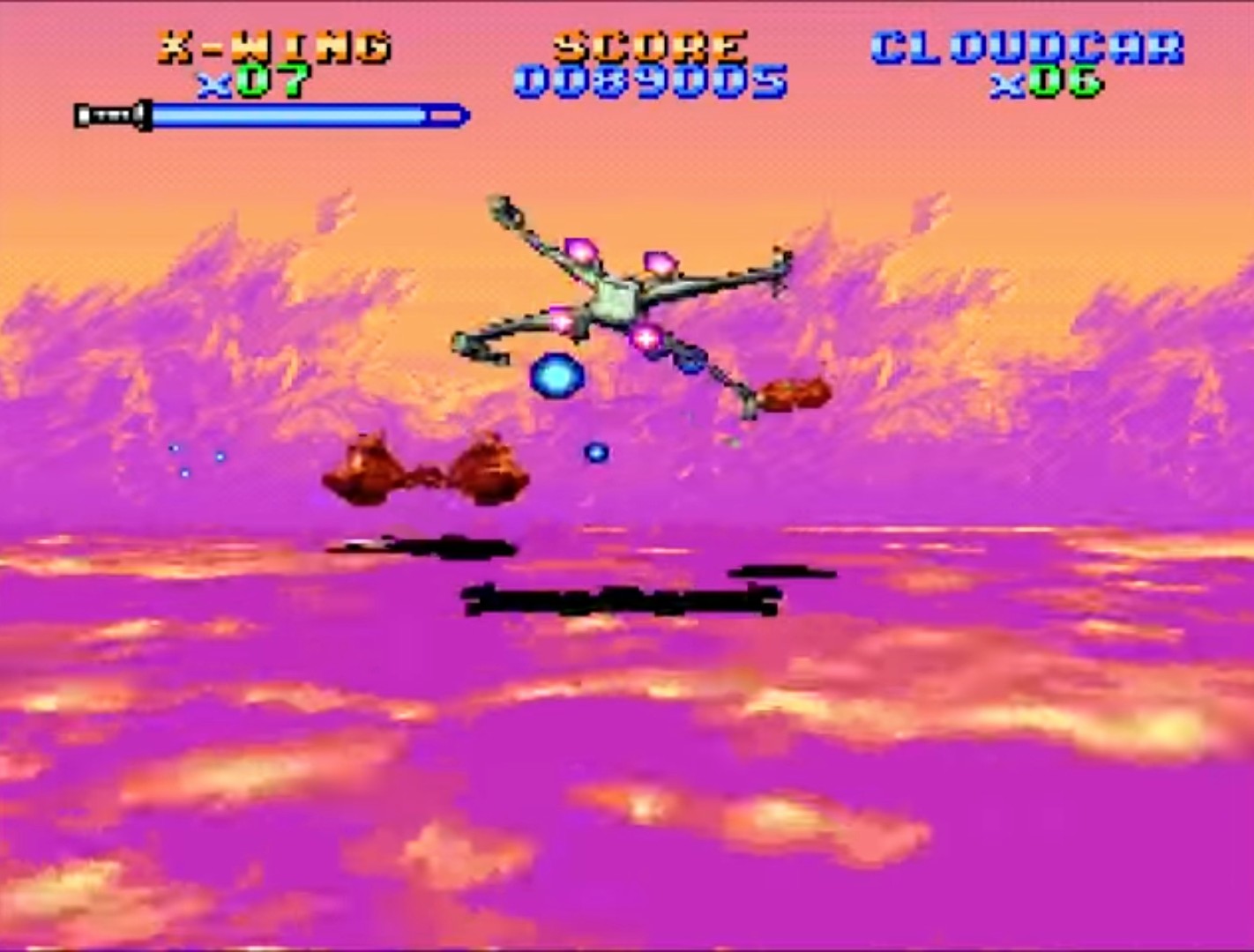
A Mode 7 sequence late in the game had players using an X-Wing fighter.
The Battle of Hoth was a great and lengthy use of Mode 7.
Apart from the Battle of Hoth, there was also another Mode 7 sequence involving the X-Wing Fighter approaching Cloud City. That particular sequence was noticeably shorter and did not have a standout action sequence as it was limited to the X-Wing Fighter simply shooting Bespin fighters. Another non-2D segment was the Millenium Falcon’s flight through the asteroid field which was done with the cockpit view (first-person view exactly) in which you move a cursor for targeting and moving the ship to. This segment was pretty tough because players were not only required to eliminate more than 20 TIE Fighters but also avoid incoming asteroids and maintaining the Falcon’s energy shields (which serves as a health meter)
Going back to the 2D side-scrolling segments, the use of the lightsaber by Luke remains a lot of fun to do. Not only could he slash bad guys, he could use the lightsaber defensively protecting himself from incoming energy blasts (which get deflected by the lightsaber). On the offense, Luke can jump into the air and spin with the lightsaber turned on making him an aerial slasher over the bad guys.
In keeping with the theme of the movie showing Luke Skywalker learning to be a Jedi, the Dagobah segment in the game has Luke gaining varied Force powers and he also has a separate Force energy meter. The Force powers can be used in subsequent segments of the game and they are quite useful when Luke encounters Darth Vader as the final boss in Cloud City.
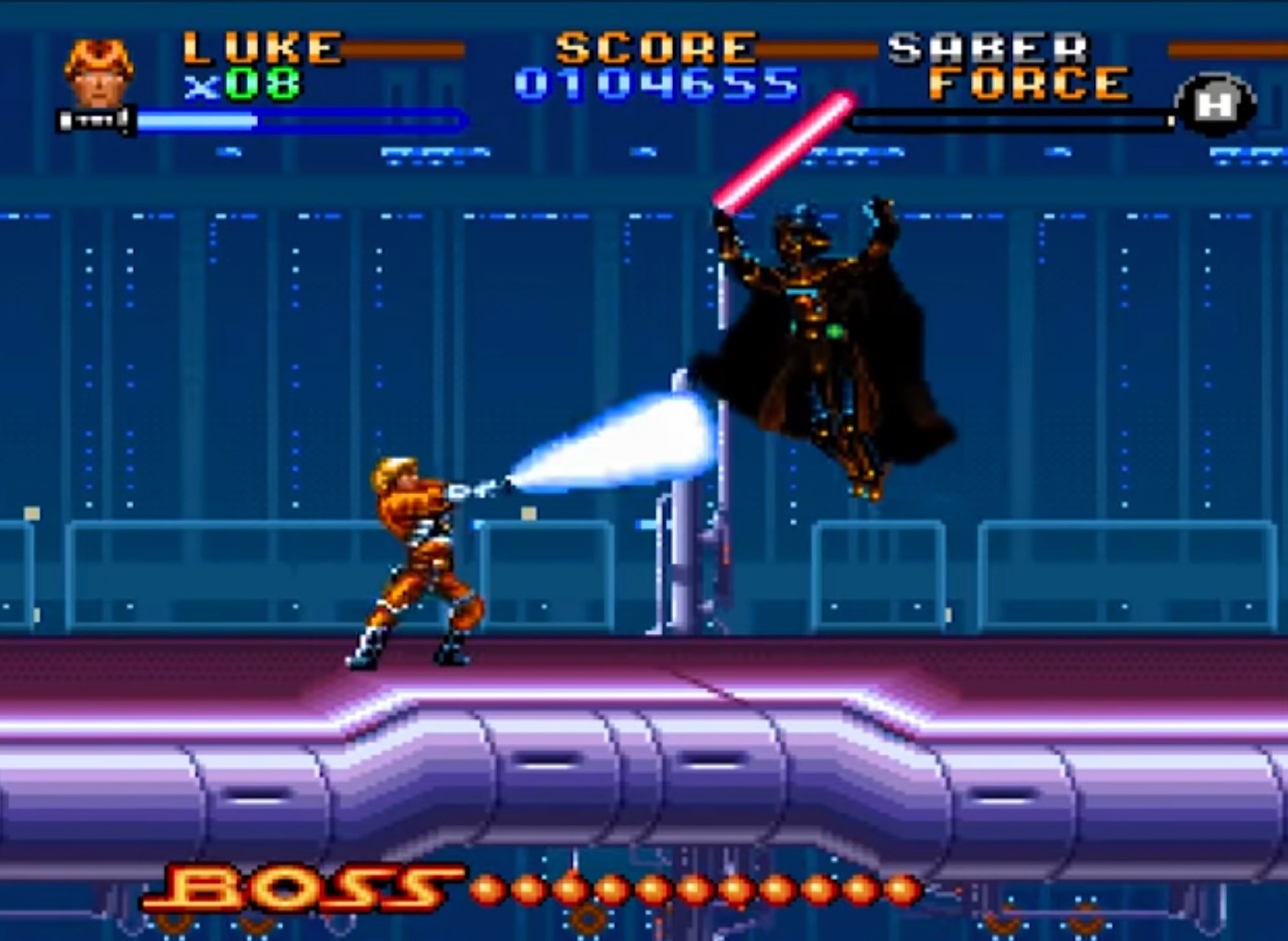
The fights with Darth Vader were nicely designed. With creative freedom, the game developers expanded on Darth Vader’s use of the Force to move several pieces of debris and machines towards Luke who has to defend himself from all sides. Fighting Darth Vader with the lightsaber was tricky and for the most part, I had Luke slashing on villain with just enough space between them and many times I had Luke use the lightsaber on him while jumping and spinning in the air. Defeating Vader was a requirement to complete the game.
Very nice artwork made for the storytelling cut scenes.
Finally, like in Super Star Wars, players can also play as Han Solo (special attack: grenade throw) and Chewbacca (special attack: offensive spin) but only in specific segments of the game supposedly to keep in line with its story.
Conclusion
Even by today’s standards, Super Star Wars: The Empire Strikes Back is still a high-quality video game that is a lot of fun to play with even though it is tough (a password system is used for in-game progress so that gamers can come back to continue) all throughout. Gameplay aside, the presentation of visuals and audio is also very solid. The sprites for the in-game characters, enemies, machines and animal were detailed to look at while the background art were immersive (like in the movies, Cloud City, Hoth and Dagobah had their distinctive visuals). The Super NES audio chip was greatly used on recreating 16-bit sound from the movies, especially John Williams’ movie scores and lightsaber sound effects.
Take note that this game was released in 1993 which is significant in the sense that people had moved on since the release of the movie Return of the Jedi (1983) and the Star Wars prequel trilogy did not begin until 1999 with Star Wars Episode I: The Phantom Menace. This game was released at a time when 2D gaming was still in strong demand and most gamers did not expect that 3D polygonal graphics would reshape video gaming eventually. In retrospect, the polygon-focused gaming consoles Sega Saturn and the original Sony PlayStation launched in late 1994 or more than a year after Super Star Wars: The Empire Strikes Back.
The inevitable battle between Luke Skywalker and Darth Vader.
I myself had lots of fond memories playing this game back in the mid-1990s. I simply endured the many challenges of it and ultimately had a lot of enjoyment completing it. I even replayed the game from the start even though I knew how the game presented the ending and key story elements of the movie. I also got to replay The Empire Strikes Back on home video around the time I played this game.
Believe it or not, Super Star Wars: The Empire Strikes Back was the first of the Super Star Wars trilogy on the Super NES that I actually played. After completing it, I borrowed the Super Star Wars cartridge from a friend and later bought a copy of Super Star Wars: Return of the Jedi. I completed those two other games and I can clearly say that Super Star Wars: The Empire Strikes Back remains the best in game design, the best in terms of fun factor and the most memorable of them all.
If you love Star Wars and you want the best 16-bit era video game (note: you’ll need a working Super NES console or Nintendo’s Virtual Console for any Super Star Wars game) experience of it, Super Star Wars: The Empire Strikes Back is highly recommended.
Thank you for reading. If you find this article engaging, please click the like button below and also please consider sharing this article to others. Also my fantasy book The World of Havenoris still available in paperback and e-book format. If you are looking for a copywriter to create content for your special project or business, check out my services and my portfolio. Feel free to contact me as well. Also please feel free to visit my Facebook page Author Carlo Carrasco and follow me at HavenorFantasy@twitter.com














 Author Carlo Carrasco