The Philippines, which is already struggling with weak economic growth, high fuel prices and rapid inflation, got a boost thanks to Japanese business leaders who pledged investments worth $3.4 billion for the country, according to a news report by GMA News.
To put things in perspective, posted below is an excerpt from the news report of GMA News. Some parts in boldface…
President Ferdinand Marcos Jr. on Wednesday secured stronger commitments for deeper economic integration during a high-level roundtable meeting with top Japanese business executives at the Imperial Hotel in Tokyo.
In his meeting with leaders of Japan’s largest conglomerates and financial institutions, Marcos bagged an aggregate investment commitment of $3.4 billion (approximately P210 billion) from participating Japanese corporations.
In a statement, the Presidential Communications Office (PCO) said these combined capital inflows are “projected to catalyze substantive macroeconomic benefits, expanding domestic industrial capacity and directly generating thousands of high-quality, specialized jobs for Filipinos.”
The PCO added that the infusion “underscores the resilience of the Philippine market, promising long-term economic dividends by fortifying local supply chains, upgrading tourism infrastructure, and accelerating technology transfers across critical growth sectors.”
The President is in Tokyo for a four-day state visit upon the invitation of the Japanese government.
In his remarks, Marcos said a robust Philippine-Japan economic corridor is critical and that laying the groundwork for an enhanced, unified partnership is essential to navigate global difficulties, build resilience, and sustain momentum.
“As we mark 70 years of the normalization of our diplomatic relations, we are no longer simply commemorating history. We are entering a new chapter – a chapter defined not only by friendship, but by deeper integration, shared growth, and a common belief in the future,” the President told the leaders of Japan’s largest conglomerates and financial institutions.
He outlined a unified government approach spearheaded by the Department of Trade and Industry (DTI) and the Department of Tourism (DOT).
“The Philippines is pursuing a clear national direction: building an economy where infrastructure, industry, finance, human capital, and connectivity move together as one system of growth,” Marcos said.
“Increasingly, we recognize that trade and tourism will be among the most important engines of that growth.”
He underscored the importance of stronger trade and tourism linkages, saying these are not supporting sectors but “core drivers of economic expansion in the Philippines moving forward.”
“This is a philosophy our two countries understand deeply,” the President said.
He also acknowledged the foundational contributions of several Japanese firms operating in the Philippines, such as All Nippon Airways, Toyota, Mitsubishi Corporation, Marubeni, Panasonic, and Fast Retailing.
He thanked these Japanese investors for their continued confidence in the Philippine economy and for helping create high-quality opportunities for Filipino workers and industries.
“You are no longer just investors in our economy. You are builders of it,” Marcos told the Japanese business leaders.
Let me end this piece by asking you readers: What is your reaction to this development? Do you think the $3.4 billion investment pledge by Japanese corporations will be a huge boost for the Philippines’ economy? Do you consider the ties of Japan and the Philippines healthy today?
Thank you for reading. If you find this article engaging, please click the like button below, share this article to others and also please consider making a donation to support my publishing. If you are looking for a copywriter to create content for your special project or business, check out my services and my portfolio. Feel free to contact me with a private message. Also please feel free to visit my Facebook page Author Carlo Carrasco and follow me on Twitter at @CarloCarrascoPH as well as on Tumblr at https://carlocarrasco.tumblr.com/and on Instagram athttps://www.instagram.com/authorcarlocarrasco
In this age of photo-realistic 3D graphics in video gaming, I sure miss the days when 2D gaming and highly detailed pixel art were the standard. I’m referring to the so-called 16-bit era of the Super NES/SNES (Super Nintendo Entertainment System) back in the 1990s.
In 1991, Super Star Wars was released on the Super NES and it became a big hit with the gamers, the critics and fans. That game was heralded as one of the best video game adaptations of movies.
Naturally, a follow-up to that game was released in 1993 – Super Star Wars: The Empire Strikes Back.
That being said, here is my retro gaming review of Super Star Wars: The Empire Strikes Back.
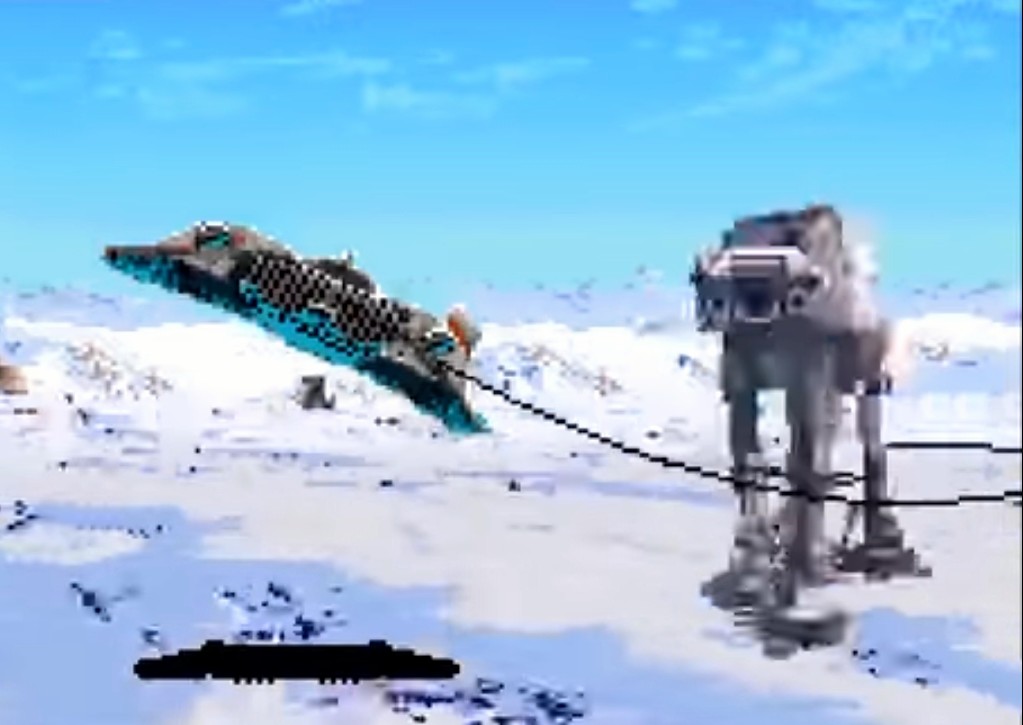
The experience of using a Rebel speeder to bring down an AT-AT walker with the cable remains awesome.
Developed by Sculptured Software and LucasArts and published in America by JVC, this game is based on The Empire Strikes Back which today has been considered to be the greatest Star Wars movie ever. Of course, in order to make a cohesive video game adaptation out of the classic movie, a lot of liberties were taken when it comes to following the story. This was inevitable as the game developers needed a lot of creative freedom to make a cohesive video game.
Early story (and some notable differences from the movie)
Super Star Wars: The Empire Strikes Back begins with Luke Skywalker riding a Tauntaun. Unlike the movie, Luke (controlled by players) visits some places of the wasteland of Hoth, notably caverns and hills fighting several forms of wild life (including wampa beasts), and even some probe droids.
Luke jumping on to a wampa beast.
Unlike the movie, Luke does not get rescued by Han Solo in the wilderness. Instead he defeats a giant-sized probe droid and a giant-sized wampa beast (as in-game bosses) and make his way back to Echo Base to rejoin the rebels. Upon returning at the base, he finds it filled with Imperial troopers and their machines (where are Luke’s fellow rebels?) and fights his way through to fly a rebel speeder (note: without the movie co-pilot Dak) and proceed in the Battle of Hoth.
This never happened in the movie.
Luke jumping into a snow speeder without a co-pilot.
Back at Echo Base, Han Solo (player-controlled) has to make his way through a wave of Imperial enemies and machines to meet Princess Leia, secure her and ride away on the Millennium Falcon. The Falcon (player-controlled) enters the asteroid field being attacked gradually by over twenty TIE Fighters. Once all of them have been eliminated, the Falcon jumps into light speed (which contradicts the movie).
Gameplay
Super Star Wars: The Empire Strikes Back is composed mostly of 2D, side-scrolling action sequences in which players control their characters moving from left to right in order to make the game progress. The sequences are filled with lots of action-packed moments mainly due to the MANY enemies challenging the players plus sequences of shooting, jumping and using special weapons (note: the thermal detonator was awesome to use). When it comes to filling up the health meter of your character, defeating enemies result random releases of hearts (symbolizing health) which you need to pick up. Key side-scrolling segments of the game will have players facing off with in-game bosses or enemies that are large, intimidating and have their own health meters for players to reduce to zero.
As typical with most 2D side-scrolling games of the era, this game is really tough and will take gamers some patience and perseverance to complete.
What really stood out in this game are the makeshift 3D segments (made possible by Mode 7) which were pretty extensive and really interactive. The Battle of Hoth in Mode 7 was pretty engaging as players get to fly a rebel speeder over a snowy field complete with lots of Imperial enemies (including the AT-ST walkers and the AT-AT walkers) and each of them is composed of multiple 2D sprites making them look 3D as the speeder moves around. Apart from simply shooting, the interactive sequence of tagging an AT-AT walker with a cable, flying around it and wrapping it with the cable, and then watching it fall to the ground really is an awesome gaming experience which really showed how hard the game developers pushed 2D visuals and pixel art.
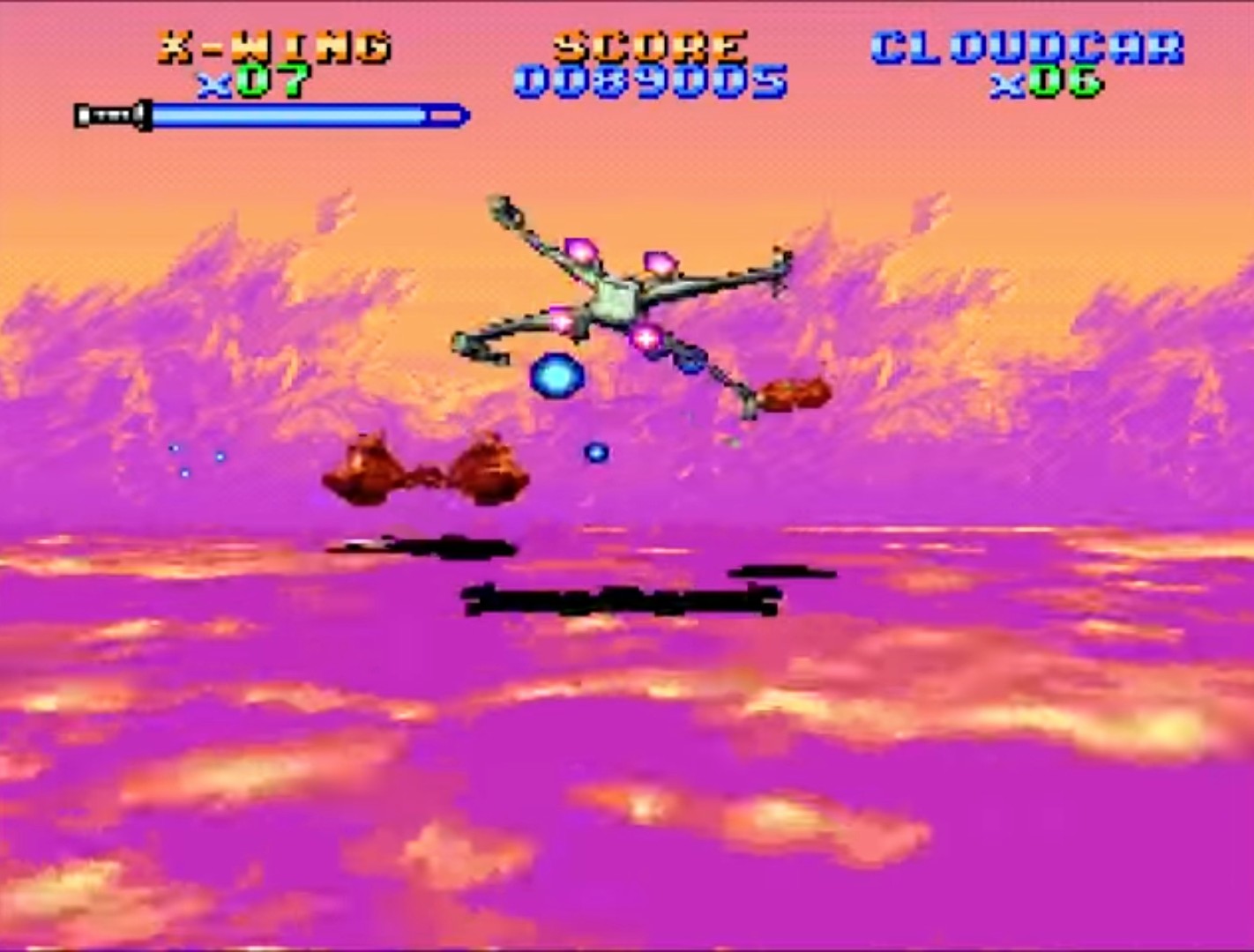
A Mode 7 sequence late in the game had players using an X-Wing fighter.
The Battle of Hoth was a great and lengthy use of Mode 7.
Apart from the Battle of Hoth, there was also another Mode 7 sequence involving the X-Wing Fighter approaching Cloud City. That particular sequence was noticeably shorter and did not have a standout action sequence as it was limited to the X-Wing Fighter simply shooting Bespin fighters. Another non-2D segment was the Millenium Falcon’s flight through the asteroid field which was done with the cockpit view (first-person view exactly) in which you move a cursor for targeting and moving the ship to. This segment was pretty tough because players were not only required to eliminate more than 20 TIE Fighters but also avoid incoming asteroids and maintaining the Falcon’s energy shields (which serves as a health meter)
Going back to the 2D side-scrolling segments, the use of the lightsaber by Luke remains a lot of fun to do. Not only could he slash bad guys, he could use the lightsaber defensively protecting himself from incoming energy blasts (which get deflected by the lightsaber). On the offense, Luke can jump into the air and spin with the lightsaber turned on making him an aerial slasher over the bad guys.
In keeping with the theme of the movie showing Luke Skywalker learning to be a Jedi, the Dagobah segment in the game has Luke gaining varied Force powers and he also has a separate Force energy meter. The Force powers can be used in subsequent segments of the game and they are quite useful when Luke encounters Darth Vader as the final boss in Cloud City.
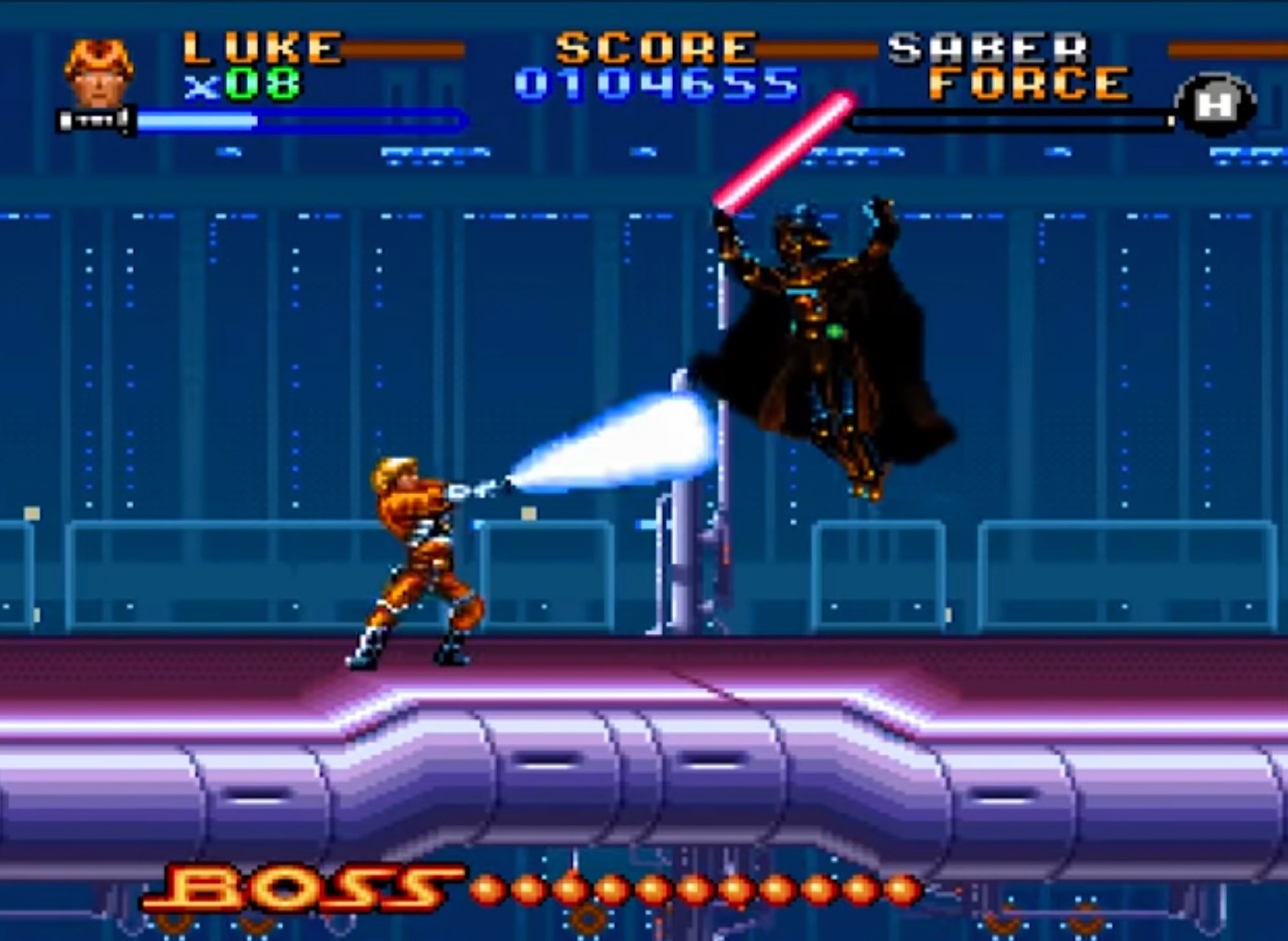
The fights with Darth Vader were nicely designed. With creative freedom, the game developers expanded on Darth Vader’s use of the Force to move several pieces of debris and machines towards Luke who has to defend himself from all sides. Fighting Darth Vader with the lightsaber was tricky and for the most part, I had Luke slashing on villain with just enough space between them and many times I had Luke use the lightsaber on him while jumping and spinning in the air. Defeating Vader was a requirement to complete the game.
Very nice artwork made for the storytelling cut scenes.
Finally, like in Super Star Wars, players can also play as Han Solo (special attack: grenade throw) and Chewbacca (special attack: offensive spin) but only in specific segments of the game supposedly to keep in line with its story.
Conclusion
Even by today’s standards, Super Star Wars: The Empire Strikes Back is still a high-quality video game that is a lot of fun to play with even though it is tough (a password system is used for in-game progress so that gamers can come back to continue) all throughout. Gameplay aside, the presentation of visuals and audio is also very solid. The sprites for the in-game characters, enemies, machines and animal were detailed to look at while the background art were immersive (like in the movies, Cloud City, Hoth and Dagobah had their distinctive visuals). The Super NES audio chip was greatly used on recreating 16-bit sound from the movies, especially John Williams’ movie scores and lightsaber sound effects.
Take note that this game was released in 1993 which is significant in the sense that people had moved on since the release of the movie Return of the Jedi (1983) and the Star Wars prequel trilogy did not begin until 1999 with Star Wars Episode I: The Phantom Menace. This game was released at a time when 2D gaming was still in strong demand and most gamers did not expect that 3D polygonal graphics would reshape video gaming eventually. In retrospect, the polygon-focused gaming consoles Sega Saturn and the original Sony PlayStation launched in late 1994 or more than a year after Super Star Wars: The Empire Strikes Back.
The inevitable battle between Luke Skywalker and Darth Vader.
I myself had lots of fond memories playing this game back in the mid-1990s. I simply endured the many challenges of it and ultimately had a lot of enjoyment completing it. I even replayed the game from the start even though I knew how the game presented the ending and key story elements of the movie. I also got to replay The Empire Strikes Back on home video around the time I played this game.
Believe it or not, Super Star Wars: The Empire Strikes Back was the first of the Super Star Wars trilogy on the Super NES that I actually played. After completing it, I borrowed the Super Star Wars cartridge from a friend and later bought a copy of Super Star Wars: Return of the Jedi. I completed those two other games and I can clearly say that Super Star Wars: The Empire Strikes Back remains the best in game design, the best in terms of fun factor and the most memorable of them all.
If you love Star Wars and you want the best 16-bit era video game (note: you’ll need a working Super NES console or Nintendo’s Virtual Console for any Super Star Wars game) experience of it, Super Star Wars: The Empire Strikes Back is highly recommended.
Thank you for reading. If you find this article engaging, please click the like button below and also please consider sharing this article to others. Also my fantasy book The World of Havenoris still available in paperback and e-book format. If you are looking for a copywriter to create content for your special project or business, check out my services and my portfolio. Feel free to contact me as well. Also please feel free to visit my Facebook page Author Carlo Carrasco and follow me at HavenorFantasy@twitter.com