To put things in perspective, posted below is an excerpt from the BusinessWorld news report. Some parts in boldface…
INTERNATIONAL visitors to the Philippines totaled 5.65 million as of Dec. 15, according to the Department of Tourism (DoT), well behind the pace needed to achieve the 7.7 million target for the year.
“South Korea remains our top source market, followed by the US and Japan,” Tourism Secretary Christina G. Frasco said at a briefing on Tuesday.
“To further expand our reach, we have intensified efforts to engage emerging opportunity markets, sharing the unique story of the Filipino and showcasing the rich array of experiences our country has to offer,” Ms. Frasco added.
The mid-December total is equivalent to 73.4% of the target for the year.
The DoT said that South Korea accounted for 1.15 million or 20.3% of the total arrivals, followed by the US with 889,489 or 15.7%, and Japan 367,747 or 6.5%.
Rounding out the top five were China, which sent 306,549 visitors or 5.4%, and Australia with 249,140 or 4.4%.
The other leading sources of visitors were Canada, Taiwan, Singapore, the UK, and Malaysia.
“We have graduated from measuring tourism merely by the number of people arriving, but rather on the more important numbers” like spending, length of stay, and return visits, she added.
Ms. Frasco said tourism receipts as of Dec. 15 amounted to P712 billion, exceeding the P697 billion booked in 2023.
“Tourists are now spending an average of over 11 nights in the country, and over 70% are repeat visitors,” she added.
Let me end this post by asking you readers: What is your reaction to this recent development? Do you think it is still possible for the Philippines to be able to attracted at least 6.5 million international tourists by December 31, 2024? Do you think the Philippines could do better or worse in 2025? What do you think is the one single issue that made it hard for the Philippines to attract more visitors from overseas? Do you think the new law of Value-Added Tax (VAT) refund for foreign tourists will make an impact by the middle of 2025?
Welcome back, my readers, YouTube viewers and all others who followed this series of articles focused on YouTube videos worth watching. Have you been searching for something fun or interesting to watch on YouTube? Do you feel bored right now and you crave for something to see on the world’s most popular online video destination?
I recommend you check out the following topics and the related videos I found.
#1 You, Me and the Movies react to 1984’s Runaway – When it comes to the works of the late Michael Crichton, you might be familiar with Jurassic Park, The Andromeda Strain, Congo, Sphere and Westworld. Way back in 1984, Runaway was released in cinemas and it was directed by Crichton himself. The result was a very unique way of telling a crime story with a heavy touch of techno thriller. Hollywood has not made another movie like Runaway. To discover more about Runaway, watch the reaction video of You, Me and the Movies.
#2 Minty Comedic Arts’ look at The Indian in the Cupboard – I remember way back in the mid-1990s when I was inside a local movie theater anticipating a movie to start playing. As I waited, a few movie trailers were shown and the one trailer that really caught my attention was that of The Indian in the Cupboard. Apart from having an interesting concept (based on the 1980 children’s book), the trailer even showed a few but special seconds of Darth Vader and RoboCop in motion. I never saw the movie but there is a lot of interesting stuff to learn about it. Watch the video by Minty Comedic Arts.
#3 The incompetence and delusions of super woke Canadian Prime Minister Justin Trudeau – Let’s be very clear here. Justin Trudeau, who has been Canada’s Prime Minister since 2015, is living with a very distorted view of reality and his fellow Canadians are already suffering economically and socially. A proud feminist, Trudeau recently attacked Americans for rejecting his fellow Communist and American counterpart Kamala Harris in the 2024 US Presidential Election. Trudeau’s recent speech only proved his delusional views and lack of common sense. Most likely, he is panicking already over US President-elect Donald Trump’s plan to impose tariffs on Canada. Watch the Sky News Australia video to find out more.
#4 The sinister truth about the Electric Vehicle (EV) industry that the mainstream news media is not telling you – I already said it before – electric vehicles (EVs) are dangerous and can harm you and your local community. There really is a conspiracy between the electric vehicle industry players, the mainstream news media and the climate change zealots. Together, those sinister forces are hiding the dark truth about EVs and they will do anything to get your money. Watch the Piston Pundit video now.
#5 More videos about Planet of the Apes (1968) – Did you notice that every time a new Planet of the Apes movie got released, there is the temporary revival of interest in the original movie of 1968? By today’s standards, Planet of the Apes of 1968 has little spectacle as it was more philosophical, more suspenseful and more about shock. If you want to discover more about the Planet of the Apes film that starred Charlton Heston, watch the selected videos below.
#6 PatmanQC’s look back at The Combatribes – The Combatribes was a hit in the arcades both in Japan and America way back in 1990. Unsurprisingly, the game was ported to the Super Nintendo Entertainment System (SNES) in 1992. Believe it or not, the company behind The Combatribes also made the Double Dragon games. If you wish to learn more about the history of The Combatribes, watch PatmanQC’s in-depth video.
#7 Decker Shado’s video review of City Hunter (1993) – Believe it or not, the 1993 Jackie Chan-led action comedy movie City Hunter was a live-action adaptation of the City Hunter manga series (which was adapted into an anime TV series). I never saw City Hunter when it was played in cinemas here in the Philippines in 1993 but I heard so much feedback from my friends as the claimed to laughing so hard inside the cinema. Years ago, YouTuber Decker Shado had a series of retro video reviews of Jackie Chan films and his City Hunter video review is entertaining.
#8 Slope’s Game Room’s Dino Crisis series retrospective – I can hardly believe it has been 25 years since I first played Dino Crisis on the PlayStation which was a memorable game as it was directed by Resident Evil creator Shinji Mikami. A lot of gamers called Dino Crisis “Resident Evil meets Jurassic Park” but in my view, it was daring creative choice by Mikami who led a team that worked so hard to animate dinosaurs while using a game engine that rendered full polygonal environments for players to explore. To my surprise, Dino Crisis 2 was released a little over year later and it had radically different gameplay that emphasized more of speed, shooting and scoring. A few years later, I played Dino Crisis 3 on a rented Xbox console and it was a very disappointing experience. To find out more about the history of the Dino Crisis games, watch Slope’s Game Room’s retrospective.
Welcome back, my readers, YouTube viewers and all others who followed this series of articles focused on YouTube videos worth watching. Have you been searching for something fun or interesting to watch on YouTube? Do you feel bored right now and you crave for something to see on the world’s most popular online video destination?
I recommend you check out the following topics and the related videos I found.
#1American shopping malls could solve the nation’s housing problems? – It is no secret that there is a shortage on housing in the United States. In recent times, there is a trend that sounds unbelievable at first but it is indeed happening – the conversion of certain shopping malls into new residential places. You have to watch the CNBC video below to find out more. Perhaps you want to check if the failing shopping mall near you is being converted into new housing for your community.
#2 Japanese RPGs with mature stories – Role-playing games made by Japanese game developers always have stories to tell regardless of the types of game design and gameplay features that were made. There are JRPGs with fantasy tales that were inspired by other works of the genre while other tales were made to be original by their respective game developers. From time to time, developers come up with stories that can be described as mature. To find out what I mean, I encourage you to watch the video by Gaming Broductions below.
#3 Slope’s Game Room examines the legacy of Paperboy – Among all the arcade games I played inside Circus Circus Hotel in Las Vegas in 1989, Paperboy was the one that stood as the most memorable. The game was a lot of fun and its presentation was also humorous in a cartoony way. Then there was also the bicycle handle the arcade machine had for controlling my character. By today’s standards, it is unlikely you will find an existing and working machine of Paperboy in your local arcade. If you are a newcomer and you want to learn more about the origin and impact of the Paperboy game franchise, watch the video by Slope’s Game Room.
#4 A look back at 2001’s Swordfish – Hollywood today keeps on making sub-par action movies because a lot of filmmakers as well as production teams are obsessed with identity politics and woke garbage. Not only are there woke and Leftist activists among Hollywood’s workers, there are private investors funding film projects with DEI (Diversity, Equity and Inclusion). That being said, it is more entertaining to watch action movies from the pre-woke era of Hollywood and among them is Swordfish (2001) which starred John Travolta, Hugh Jackman, Don Cheadle and Halle Berry. The film is not exactly a gigantic blockbuster nor was it an action genre classic. In fact, it is flawed and does not require much thinking from viewers. But the mere fact that it is NOT WOKE makes it much more entertaining to watch than any of the action movies made by woke Hollywood people over the past several years. To get to discover Swordfish, watch GoodBadFlicks’ exploratory video and TBR Schmitt’s movie reaction video below.
#5 You, Me and the Movies’ Cliffhanger reaction video – Way back in 1993 here in the Philippines, there was a short period when both Steven Spielberg’s Jurassic Park and Sylvester Stallone’s Cliffhanger played simultaneously in the cinemas which resulted in a huge amount of moviegoers lining up for tickets. While Jurassic Park is iconic, Cliffhanger has a more intriguing pre-production and production history. Even though Carolco had major financial problems and Stallone had a fear of heights, the film was eventually made and became a big hit worldwide. To find out if Cliffhanger is still entertaining, watch You, Me and the Movies’ reaction video.
#6 A look back at Die Hard with a Vengeance – I still remember way back in the middle of 1995 how disruptive Die Hard with a Vengeance was as soon as it opened in cinemas here in the Philippines. People left and right suddenly started making plans to watch the film and find out what kind of opposition John McClane (Bruce Willis) would face. While I found the 1995 movie inferior to the classic Die Hard of 1988, it still was enjoyable. For some reason, the film was released in Philippine cinemas as “Die Hard 3” and on local TV as “Die Hard 3: With a Vengeance.” If you have seen the movie and you want to revisit it, watch the follow videos I selected.
#7 Die Hard Arcade documentary by PatmanQC – Decades ago, there was a Sega-produced video game that had a notable movie license – Die Hard Arcade. I had friends who enjoyed that game so much in the local arcades and later on Sega Saturn. A few of them even were convinced to replay Die Hard (1988) on home video. You might be wondering if Sega and 20th Century Fox collaborated to make Die Hard Arcade for many people to enjoy. Actually, it’s more complicated than that and to find out why, I encourage you to watch PatmanQC’s Die Hard Arcade documentary now.
8. Woke Disney’s Snow White movie massively rejected online – Even if there were no controversies at all, I really have no intention to watch the 2025 Snow White movie of woke Disney. Even until now, a lot of members of the public have been rejecting it online and no matter what Disney does, they just keep on failing to salvage the film. Watch and learn from the video of RK Outpost below.
Recently in the City of Las Piñas, the local police arrested a foreign national for illegally possessing a firearm and committing a grave threat, according to a Manila Bulletin news report. Recovered from the suspect was an air gun revolver, 25 air gun pellets and some live ammunition.
To put things in perspective, posted below is an excerpt from new report the Manila Bulletin. Some parts in boldface…
A Japanese national was arrested for grave threat and violation of RA 10501 or the Comprehensive Law on Firearms and Ammunitions on Sunday, Dec. 1.
Las Piñas City Police Chief Col. Sandro Tafalla said the suspect, identified as alias “Yasuhiko,” 62, was arrested at around 4:30 p.m. in Barangay Pulanglupa Dos, Las Piñas City.
Tafalla said Yasuhiko was arrested after a 20 year-old motorcycle rider filed a complaint against him for poking a gun at him during a heated argument for refusing to bring him home in Parañaque City.
He said the victim sought police assistance from patrolling policemen along Naga Road, Las Piñas City which led to the arrest of the suspect.
Let me end this piece by asking you readers: If you are a resident of Las Piñas City, what is your reaction to this development? Were there any gun-related incidents that happened within your local community over the past thirty days?
For more South Metro Manila community news and developments, come back here soon. Also say NO to fake news, NO to irresponsible journalism, NO to misinformation, NO to plagiarists, NO to reckless publishers and NO to sinister propaganda when it comes to news and developments. For South Metro Manila community developments, member engagement, commerce and other relevant updates, join the growing South Metro Manila Facebook group at https://www.facebook.com/groups/342183059992673
Welcome back readers, fellow geeks and electronic gaming fans!
In this edition of the Retro Gaming Ads Blast (RGAB) series, we will take a look at another batch of retro gaming print ads – including arcade flyers – from the 1980s and 1990s.
For the newcomers reading this, Retro Gaming Ads Blast (RGAB) looks back at the many print ads of games (console, arcade, computer and handheld) that were published in comic books, magazines, flyers, posters and newspapers long before smartphones, social media, the worldwide web and streaming became popular. To put things in perspective, people back in the 1980s and 1990s were more trusting of print media for information and images about electronic games and related products.
With those details laid down, here is the newest batch of retro gaming print ads for you to see and enjoy…
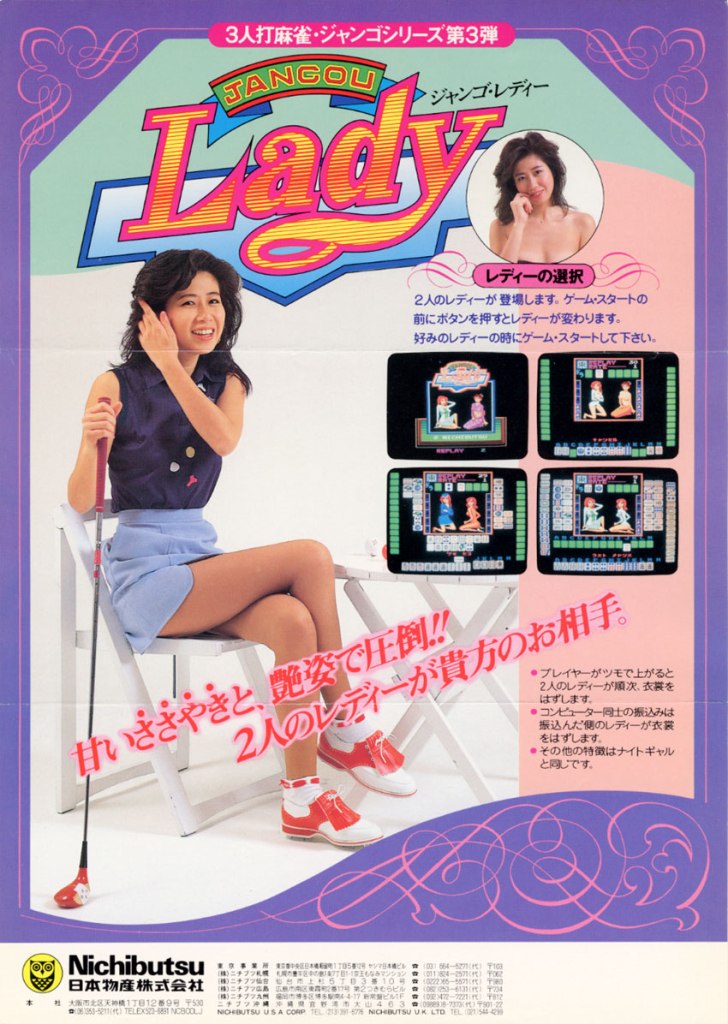
1. Jangou Lady arcade flyer
If you were to play Mahjong digitally, does sex appeal motivate you to do so?
Are you fond of playing the tile-based game Mahjong? Believe it or not, there were indeed ways to play Mahjong in digital form inside the arcade or in gambling joints in Japan. The game Jangou Lady allows users to play rounds of Mahjong but with a notable additive – the digital art of women which serves as an attraction. In the sex appeal is clearly evident on this arcade flyer from the 1980s.
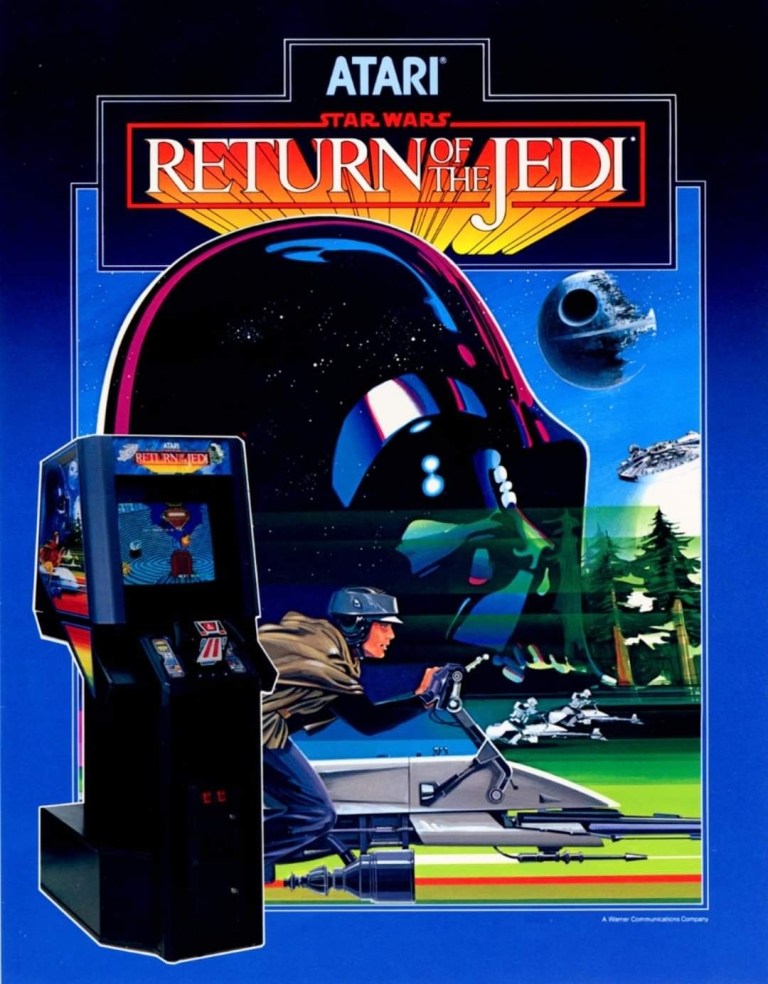
2. Star Wars: Return of the Jedi arcade flyer
Really nice art based on the movie.
Way back in 1983, Return of the Jedi delighted moviegoers in the cinemas throughout America. Behind the scenes, video game giant Atari acquired the movie license to make the 1984 arcade game Star Wars: Return of the Jedi. The arcade flyer’s front featured a highly detailed hand-drawn art of Darth Vader, the Death Star, Luke Skywalker and Storm Troopers on hover bikes, and the Millennium Falcon which reflect the selected elements of the movie that were turned into playable sections. The image of the arcade machine was understandably inserted as it came with an unusual controller. This flyer is still captivating to look at.
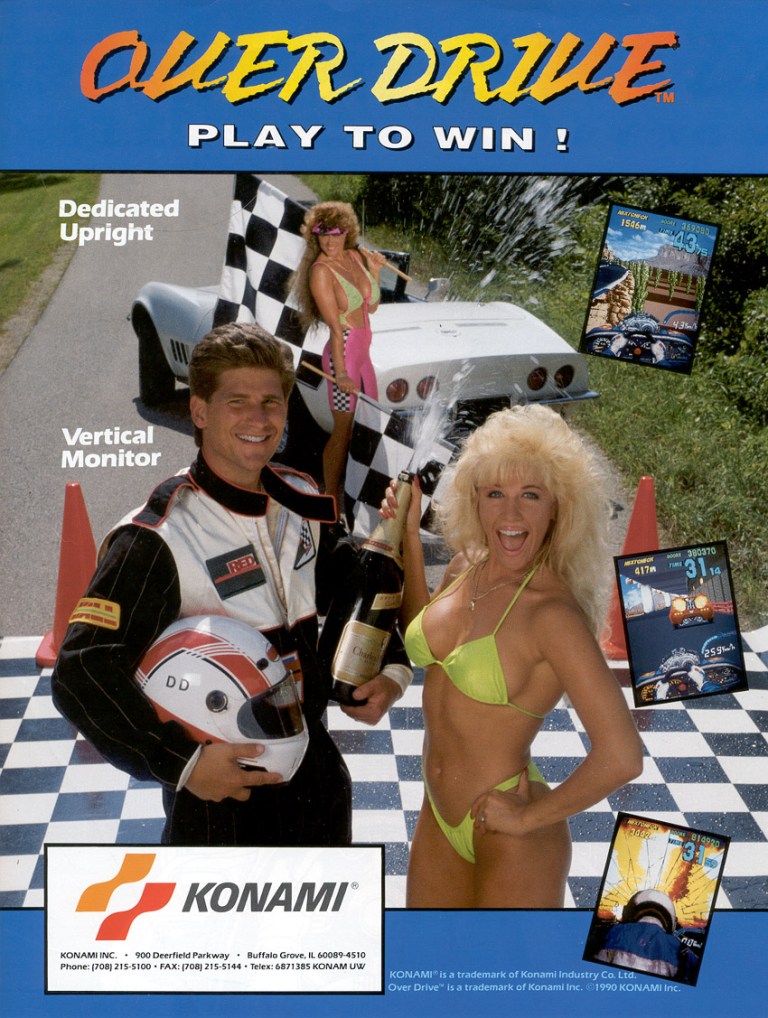
3. Over Drive arcade flyer
This arcade flyer is a reminder that Konami was notable for hiring pretty and sexy women for their print ads.
In 1990, Konami produced a racing game for the arcades with a unique style of presentation. That game was Over Drive and it stood out among the many racing games in the arcade mainly because of its first-person view (with a digital version of the steering wheel and driver’s hands at the bottom of the screen) and unique approach on sprite-scaling. To promote the game, Konami hired sexy models for photography for use in both the arcade flyer and the exterior images on the machine. Having sexy models posing with a winning driver added to the motorsport racing vibe needed to promote the game.
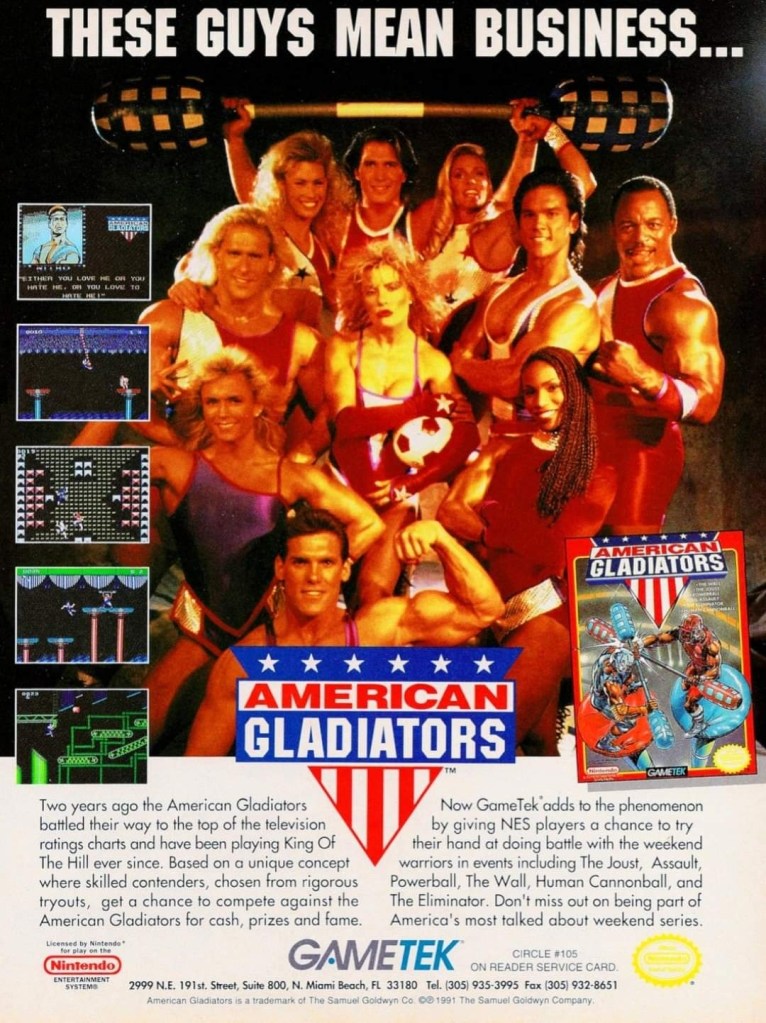
4. American Gladiators for NES print ad
I saw American Gladiators on TV but never played this game.
American Gladiators was a syndicated TV show that featured a variety of games in which amateur athletes compete with the established gladiators to succeed and become the next American Gladiator. Due to its success, it was not surprising that video game adaptations of the show were realized just a few years after its debut. In 1991, GameTek released the American Gladiators game on the Nintendo Entertainment System (NES) and promoted it with this print ad that showcased their established gladiators of the time. This ad’s design was made to catch the attention of the fans.
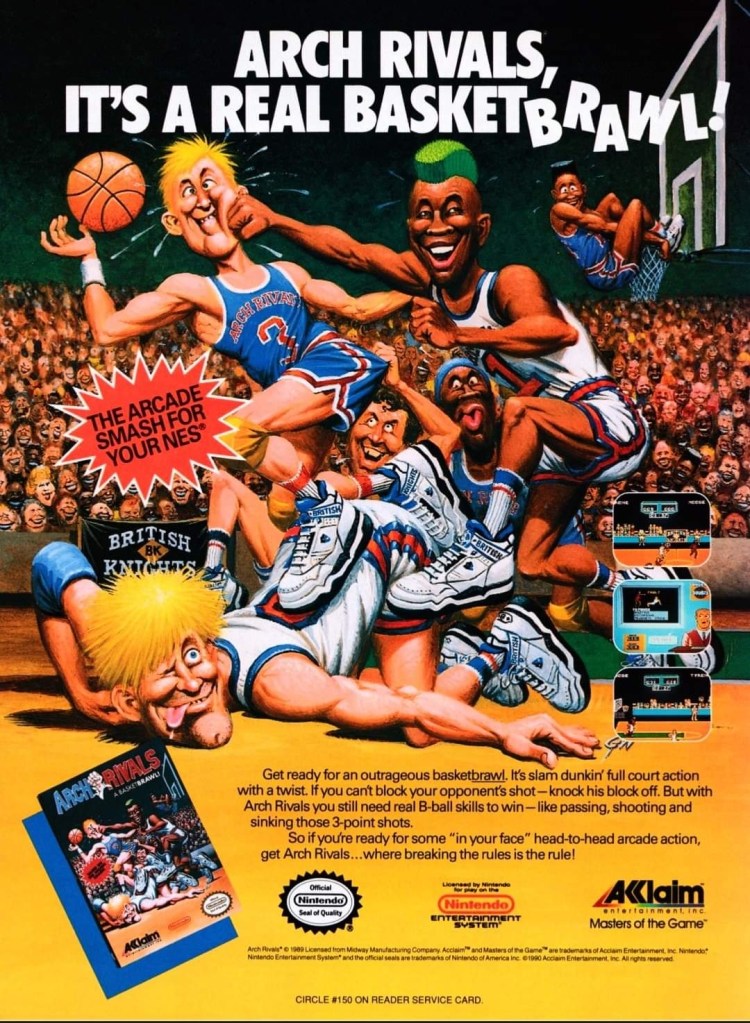
5. Arch Rivals for NES print ad
I remember seeing a lot of people crowding in front of an Arch Rivals machine in the local arcade long ago.
Years before NBA Jam, there was Arch Rivals. Arch Rivals was a full court basketball video game in which players are allowed to punch players from the opposition in order to steal the ball and score. Over a year after the game’s 1989 arcade debut, the NES version was released and the publisher came up with a print ad showcasing a hilarious and cartoony artwork (the same art used for the game’s box cover) which gave readers a clear idea of what to expect. The art used is timeless and it still is funny to see.
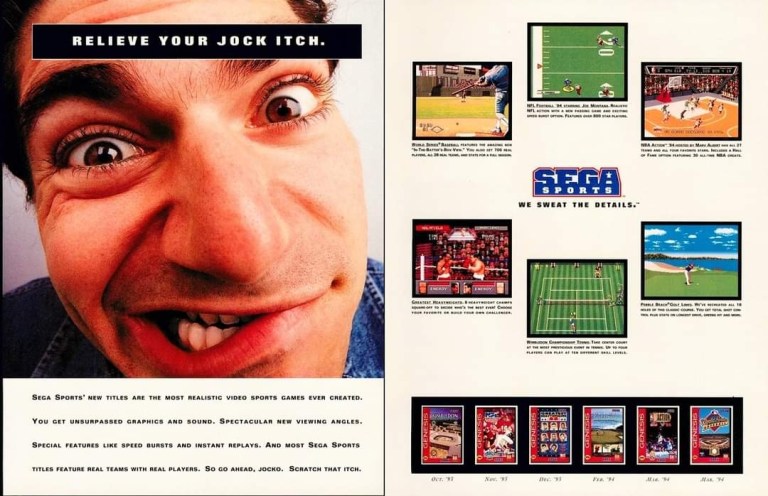
6. Sega Sports print ad
See any Sega Sports video game you like?
Back in the 1990s, Sega excelled with sports video games. They were so aggressive, they established their sub-brand Sega Sports and this particular print ad showed one page promoting assorted sports video games (basketball, golf, baseball, tennis, boxing and American football) for the Sega Genesis and the other page with an exaggerated image of a guy with the line “Relive your jock itch” posted. Historically, a lot of American players and owners of the Genesis are slightly older than those on NES and Super Nintendo Entertainment System (SNES) during the 1990s and the strong sports games approach is a key factor.
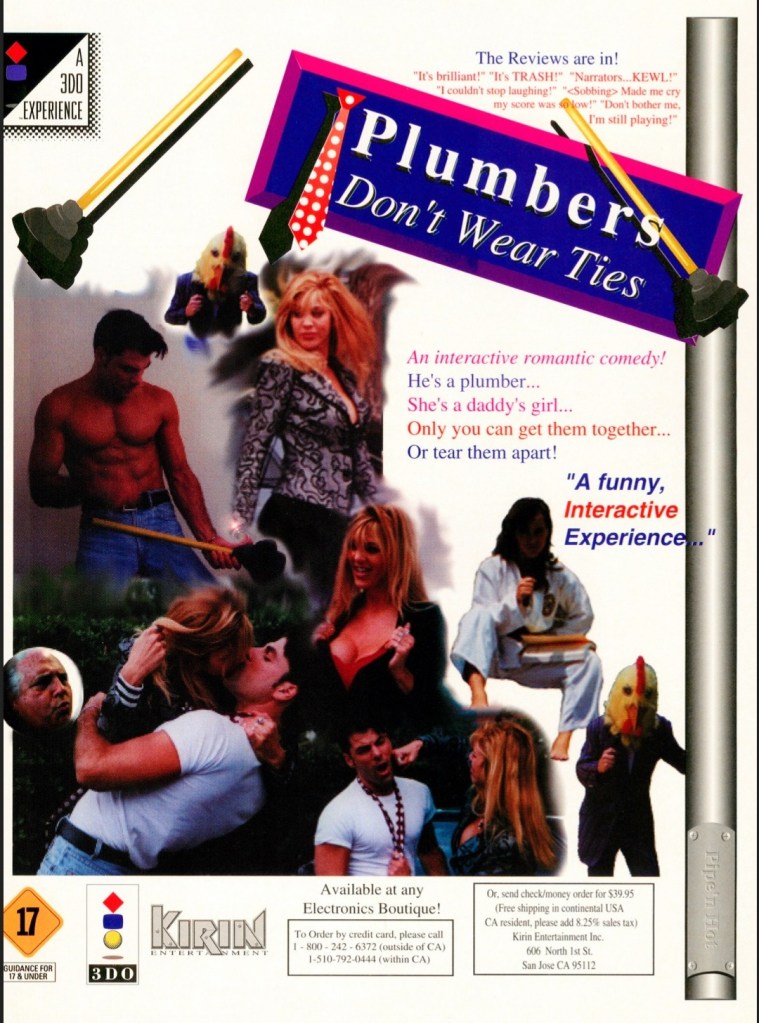
7. Plumbers Don’t Wear Ties print ad
When I first saw this print ad, it did not interest me as the presentation is lousy.
The 3DO console is remembered for having a lot of games that used full-motion videos and photo slides regardless of what game designs came with them. Back in the 1990s, games designed as visual novels or dating simulations were still new in console gaming in the West. Following the PC version’s release, a 3DO port of Plumbers Don’t Wear Ties came out in 1994 and it received overwhelmingly negative reviews. The print ad here promoted the game as “an interactive romantic comedy” and fake quotes were displayed to fool ignorant readers that the game was entertaining. The print ad’s visual design had a mess of poorly implemented images. Ironically, this ad accidentally gave readers the idea that it was a slideshow game.
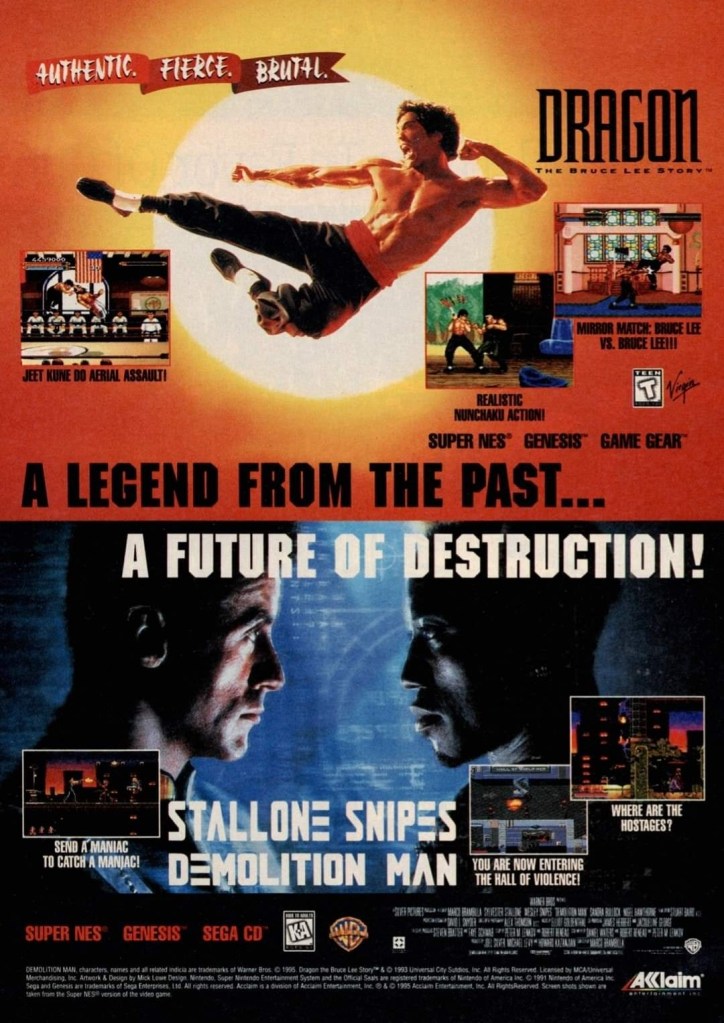
8. Dragon: The Bruce Lee Story and Demolition Man games print ad
If you saw the movies, did you play their respective video game adaptations?
The 1990s is remembered for the many movie-based video games that got released. Back in those days, a lot of Hollywood movie productions had video game adaptations as part of the business process and this is evident with the Dragon: The Bruce Lee Story and Demolition Man games released by Acclaim. For this particular print ad, the marketing team came up with a single-page ad to promote the two games with heavy emphasis on movie imagery leaving little room left for screenshots and other details. The way I look at this old print ad, it seems that Acclaim was aiming for not just movie fans but also gamers who like 2D fighting games and 2D action-adventure games.
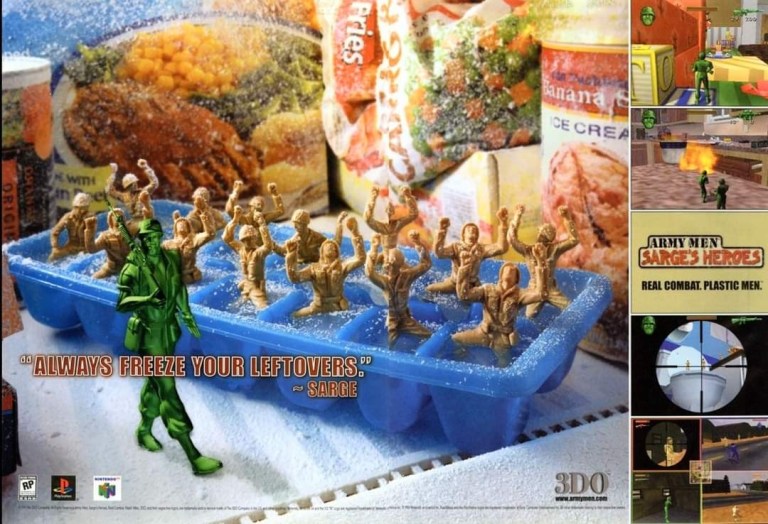
9. Army Men: Sarge’s Heroes print ad
This print ad by 3DO is still funny to see.
In the late 1990s, The 3DO Company focused mainly on producing video games on multiple platforms and they had their own video game franchise based on the green plastic figures with a military theme. In 1999, they released Army Men: Sarge’s Heroes for PlayStation and Nintendo 64 (N64). To market the game, they had a hilarious visual concept of several solders freezing on an ice tray as a long green soldier marching on. This print ad always caught my attention while reading game magazines and it still is funny to stare at.
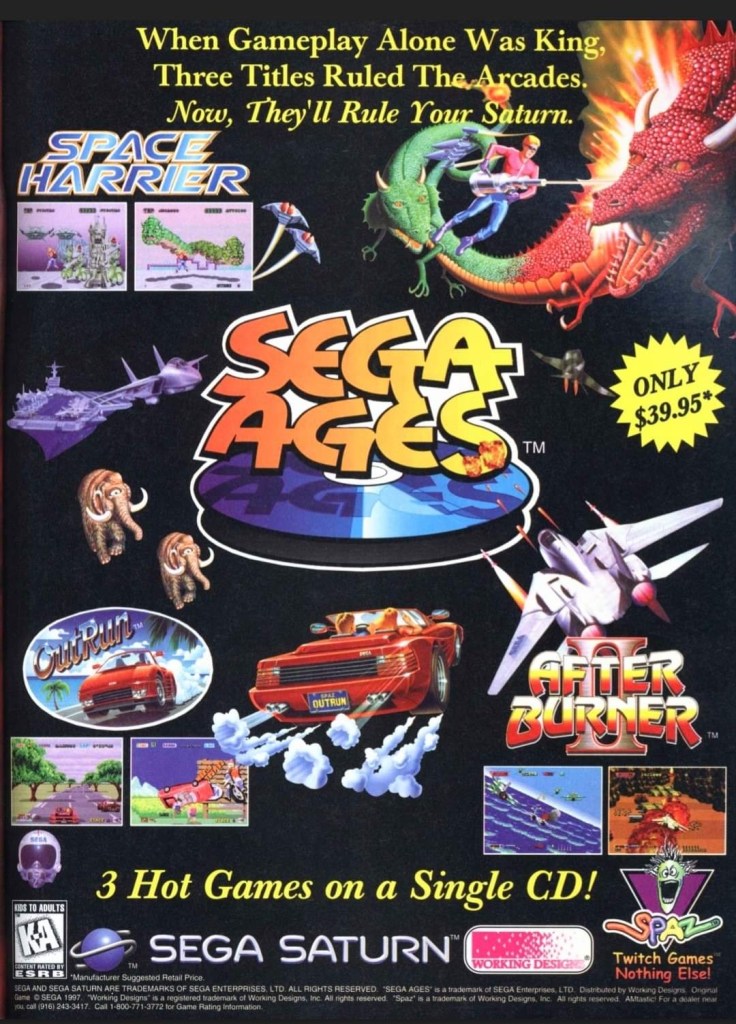
10. Sega Ages print ad
I can only speculate that Sega accepted Working Design’s financial offer for the publishing rights in North America.
Sega Ages is a series of ports and remakes of Sega’s own games (arcade and console) bundled together as compilations released on the modern consoles of the time. While Sega itself published Sega Ages on their Saturn console and Europe, the North American compilation was published by Working Designs under their separate brand Spaz which this particular print ad showed. While the classic Sega games of After Burner II, OutRun and Space Harrier often caught my attention, this ad made me wonder why did not Sega publish this compilation on the Saturn in North America themselves. Looking at this ad now remains awkward.
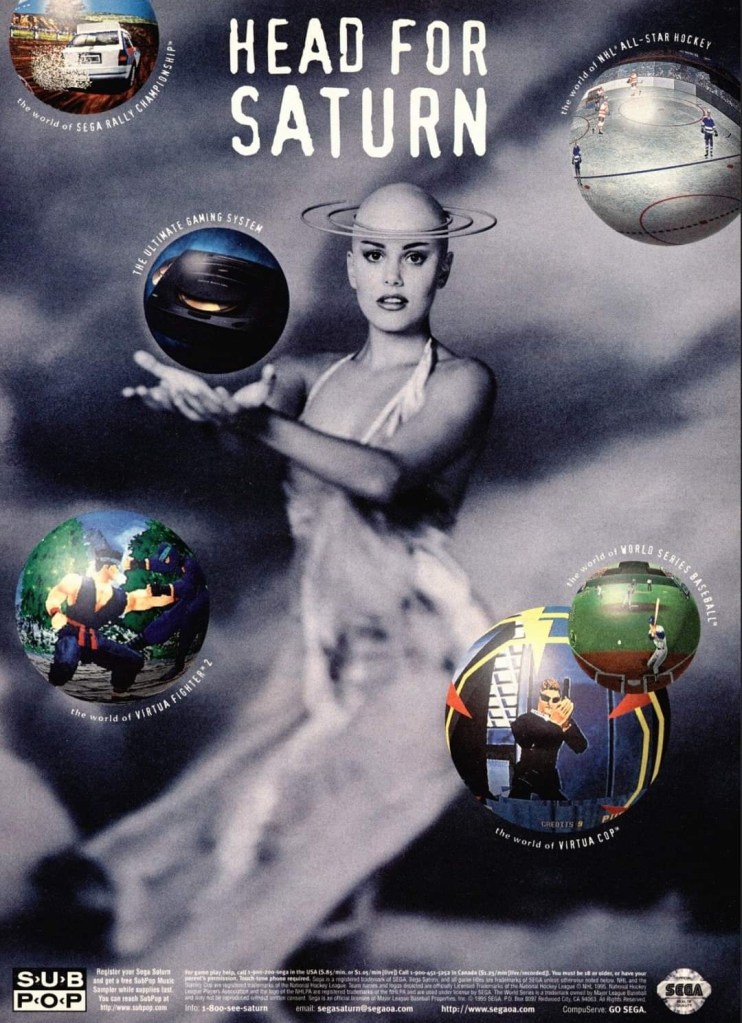
11. Sega Saturn North American print ad
Did you ever own a Sega Saturn in 1995?
While a lot of gamers and retailers were caught off-guard by Sega’s surprise early launch of the Saturn console in America, they still went ahead aggressively marketing the machine knowing they have a few months’ head start before the American launch of PlayStation. This print ad was designed to intrigue readers showing a bald lady whose head was made to look like the planet Saturn and next to her were images of Sega’s hottest games of the time – Virtua Fighter 2 and Virtua Cop. Sega relied strongly on imagery to promote their console with this print ad. It was somewhat weird yet eye-catching.
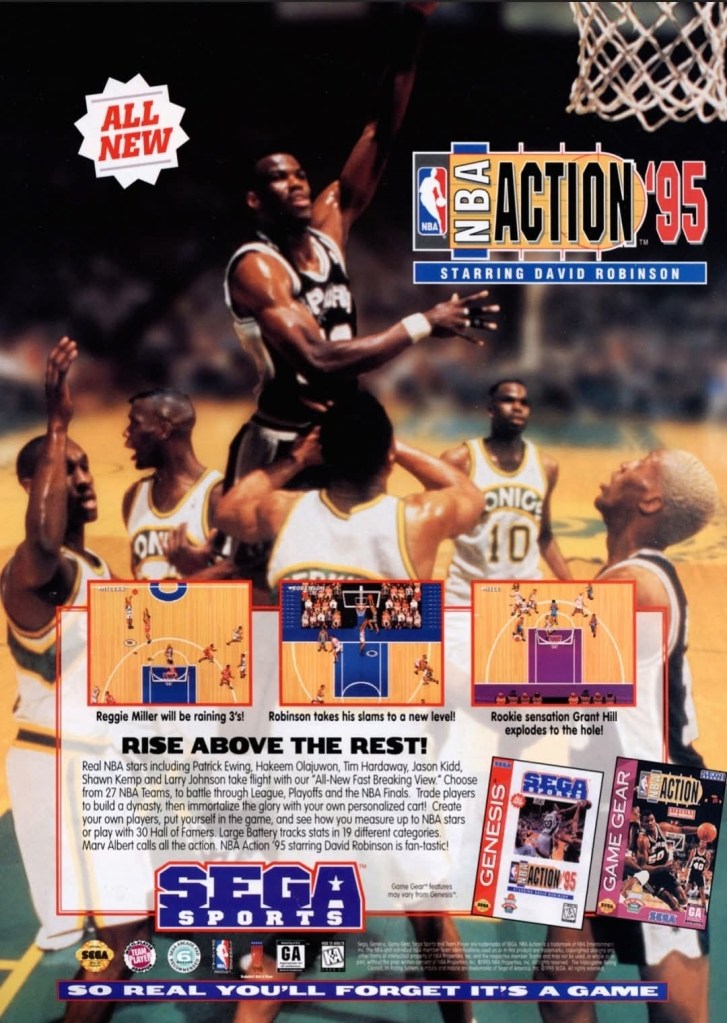
12. NBA Action ’95: Starring David Robinson print ad
David Robinson was the MVP of the NBA in 1995 but he failed to lead his team to the NBA championship back then. He would late win the NBA championship in the shortened 1999 season.
As mentioned early, Sega was aggressive the sports videos games and almost all of them were their own console exclusives. Their tradition of hiring professional athletes as endorsers continued during the age of the Genesis and Game Gear when they hired an NBA superstar as an endorser resulting in the Sega Sports basketball game titled as NBA Action ’95: Starring David Robinson. By the time the video game was released, Robinson was already the reigning Most Valuable Player (MVP) of the NBA. This print ad of Robinson in action still looks impressive but with a big catch – the superstar’s 1995 MVP achievement was arguably forgotten as he and his team (San Antonio Spurs) got eliminated by the Hakeem Olajuwon-led Houston Rockets in the Western Conference Finals. It did not help that Olajuwon outplayed Robinson a lot in that very playoff series. That is a sad reminder that also came with this Sega Sports print ad.
Welcome back, my readers, YouTube viewers and all others who followed this series of articles focused on YouTube videos worth watching. Have you been searching for something fun or interesting to watch on YouTube? Do you feel bored right now and you crave for something to see on the world’s most popular online video destination?
I recommend you check out the following topics and the related videos I found.
#1A look back at Tobal No. 1 – The 1990s will always be remembered as the decade when fighting games became wildly popular. While franchises like Tekken, Virtua Fighter, Street Fighter and The King of Fighters literally flooded the arcades and consoles, game developers at DreamFactory (a subsidiary of Square) were dissatisfied with the state of fighting games at the time and this eventually led to the creation of Tobal No. 1, one of the most unique games of its genre ever made. To learn more about it, watch the video below.
#2 Assorted videos of Air Force One (1997) – Watching Air Force One (starring Harrison Ford) on the big screen in 1997 was a fun experience for me. It was one of the many so-called Die Hard clones of the 1990s which featured one brave, vulnerable hero fighting terrorists while confined in a place where escape is not option. For your enjoyment, I selected one trivia video and a few reaction videos of Air Force One. As it is a great film, I encourage you to watch it first in case you have not seen it. Otherwise, go watch the selected videos below.
#3 Slope’s Game Room’s look back at the Choplifter series – I first played Choplifter on the Family Computer back in the late-1980s and it really was both unique and fun to play. It was a side-scrolling adventure game with military action but it was not an all-offense experience. In fact, the game gives you opportunities to rescue hostages and the game development history is pretty interesting to discover. As such, I encourage you to watch Slope’s Game Room’s retrospective of Choplifter.
#4 The games of Square in the 1990s remembered – If you know your video game history, Square Enix was established in 2003 as a result of a merger between Square (AKA SquareSoft) and Enix. When Square was still an independent, standalone company it released a lot of memorable games on the Super Nintendo Entertainment System (SNES) and the PlayStation in the 1990s. If you love retro gaming and if you are interested to discover (or rediscover) what Square released back in the 1990s, then this video is for you.
#5 Canadian Prime Minister Justin Trudeau receives response from returning US President Donald Trump regarding new tariffs – Justin Trudeau – the super woke and out-of-touch Canadian Prime Minister – told the returning US President Donald Trump that new tariffs would kill the economy of Canada. The result is a memorable response from Trump. To see what happened and how the public reacted, watch this Sky News Australia video. Lastly, never ever trust Trudeau. You will regret it believing in him as he is a very bad leader.
#6 Kamala Harris being hit by her donors and her fellow Democrats for reckless campaign spending – The defeated Commie Kamala Harris is now the target of her US presidential campaign donors and even her fellow Democrats. You see, her campaign team raised at least $1.5 billion and ended up with a debt of at least $20 million due to reckless spending and irresponsible handling of money. Apart from literally BUYING the support of celebrities and Hollywood Communists, the Harris campaign spent excessively on online ads, private jets and others. The donors are very furious and a lot of Democrats realized that the laughing hyena Kamala Harris severely damaged the political party. That being said, Kamala Harris would be delusional enough to actually run for US President again in 2028. Watch and learn from Sky News Australia’s video.
#7 You, Me and the Movies react to Friday the 13th Part VIII: Jason Takes Manhattan – Years I ago, I posted my retro review of Friday the 13th Part VIII: Jason Takes Manhattan. The 1989 Friday The 13th sequel was so sloppy and bad with its presentation, it sometimes could be funny to see and it’s okay to ridicule it. If you want to discover Jason Takes Manhattan without spending too much time, you should watch the reaction video of You, Me and the Movies.
8. The collapse of the Assad dictatorship in Syria – In case you missed the news, a new chapter in the history of Syria has officially started as the dictatorship of Bashar al-Assad officially ended with the Islamist rebels taking over the country. Assad and his family are now in Russia. While there is euphoria going on in Syria, you should not allow yourselves to be deceived because the civil war in Syria was never a case of “good versus evil”. Assad was allied with Russia and terrorist state Iran. Meanwhile, the Syrian rebels are allied with the Islamist Turkish forces, Jihadists, terrorists and they have Al-Qaeda members in their ranks. Syria now has a new beginning but where will it go? Watch the videos I selected for your viewing and learning.
Welcome back fellow geeks, Blu-ray collectors and movie buffs!
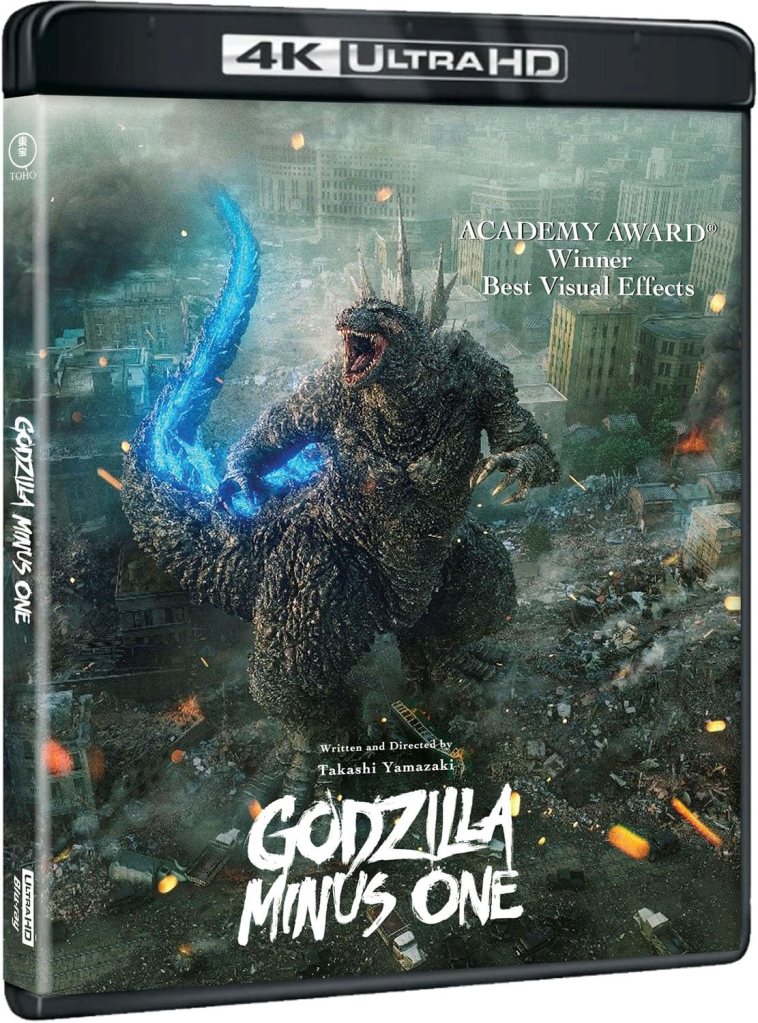
Have you been searching for something intense, action-packed and thrilling to add into your collection of 4K Blu-ray movies? Be informed that Godzilla Minus One4K Blu-ray is now available on the market and you can order it online right now.
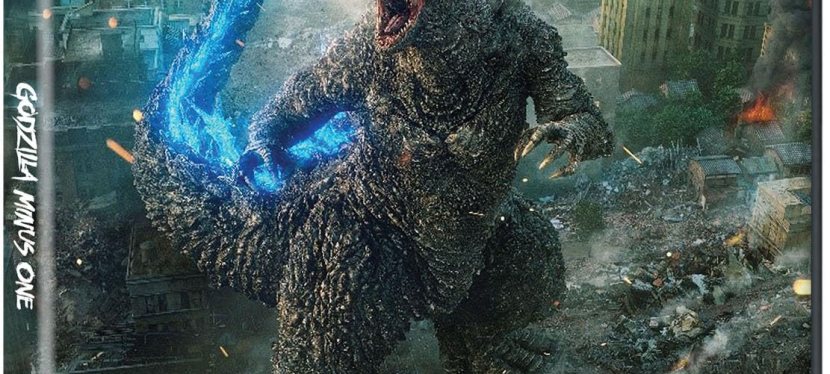
This is what Godzilla Minus One 4K Blu-ray looks like.
Posted below are the technical details of Godzilla Minus One 4K Blu-ray sourced from its Blu-ray.com page,
Video
Codec: HEVC / H.265 (62.89 Mbps)
Resolution: Native 4K (2160p)
HDR: Dolby Vision, HDR10
Aspect ratio: 2.39:1
Original aspect ratio: 2.39:1
Audio
Japanese: Dolby Atmos
Japanese: Dolby TrueHD 7.1 (48kHz, 24-bit)
English: Dolby TrueHD 5.1 (48kHz, 24-bit)
Subtitles – English, English SDH, French, Spanish
Discs – 4K Ultra HD, Blu-ray Disc, Two-disc set (1 BD-100, 1 BD-50)
Playback – 4K Blu-ray: Region free, 2K Blu-ray: Region A
For the newcomers reading this, Godzilla Minus One is the Japanese-produced Godzilla movie from Toho, directed by Takashi Yamazaki and released in 2023. It was a commercial and critical hit, and it even won the Academy Award for Best Visual Effects. I previously wrote about Godzilla Minus One prior to its release in cinemas.
Due to the fact that Toho’s acclaimed giant monster movie was never released in cinemas here in my native Philippines, pursuing Godzilla Minus One 4K Blu-ray is the next option for me. I really wanted to see the film in local cinemas for the genuine in-theater experience of watching a Japanese-produced Godzilla film. For some reason, Toho did not release Godzilla Minus One in Philippine cinemas even though they released Shin Godzilla in the country in 2016. For the meantime, I have my Criterion Collection Blu-ray of Gojira (1954) to enjoy before my 4K Blu-ray of the latest Godzilla film finally arrives.
If you have decided already to order a copy of Godzilla Minus One 4K Blu-ray, click here.
If you wish to join a group of movie enthusiasts and talk about cinema or movies in Blu-ray and 4K Blu-ray, visit the Movie Fans Worldwide Facebook group at https://www.facebook.com/groups/322857711779576
Welcome back, my readers, YouTube viewers and all others who followed this series of articles focused on YouTube videos worth watching. Have you been searching for something fun or interesting to watch on YouTube? Do you feel bored right now and you crave for something to see on the world’s most popular online video destination?
I recommend you check out the following topics and the related videos I found.
#1Konami’s failed fighting games of the 1990s – Remember back in the 1990s when a lot of fighting games were released on the arcades and game consoles? Japanese game companies Namco and Capcom released a lot of memorable fighting games of different styles such as Street Fighter II, Tekken, Marvel vs. Capcom, Tekken 3, Soulcalibur, X-Men: Children of the Atom, X-Men vs. Street Fighter and so on. Sega released Virtua Fighter games while Midway released Mortal Kombat games, and SNK had Fatal Fury, King of Fighters and Art of Fighting games. Looking back at the fighting game craze of the 1990s, I noticed that Konami – best known for Metal Gear, Contra, Gradius and Suikoden – released their own fighting games but never achieved the tremendous success that its competitors had. The retro gaming video is a must-see.
#2 Calvin Dyson’s lengthy review of The World is Not Enough – I can hardly believe that it has been twenty-five years since the James Bond movie The World Is Not Enough was released in cinemas as the 20th century was ending. The 3rd film of Pierce Brosnan as Agent 007 received mixed reviews from the critics and some fans found it to be really brainless and excessive with action which negatively affected the cinematic narrative. To find out if the 1999 Bond movie aged well or not, YouTuber Calvin Dyson recently posted his lengthy retro review and you can watch it now.
#3 In-depth documentary of Smash TV – Remember way back in 1990 when Smash T.V. (also referred to as Smash TV) was released in the arcades and attracted a lot of players with its enjoyable game design and concept? The game was a hit and went on to be ported to many platforms afterwards, and I played its Super Nintendo Entertainment System (SNES) version a lot. To find out how hit game started and who were the key people behind its production, watch the video documentary of PatmanQC now.
#4 Defeated Kamala Harris, Sharon Stone, Alec Baldwin and others highlighted in Lefties Losing It episode – It has been a few weeks since Donald Trump pulled off the greatest American comeback by winning again the US presidential election. Even until now, the Leftists are still agonizing over Trump’s victory and many of them cannot accept the reality of what happened. In the latest Lefties Losing It episode below, you will see a drunk-like Kamala Harris talking to her supporters, Sharon Stone bashing others and more. Watch it!
#5 Electric vehicles sparked into fire disasters as a result of salt water caused by Hurricane Helene – This news video should convince you not to buy and drive an electric car or any type of electric vehicle for that matter. Salt water touching the ion batteries of electric vehicles spark flame and this leads into fire incidents that simply could not be solved quickly. Hurricane Helene’s powerful wind brought salt water into affected communities and not even electric vehicles parked inside the garage were spared. Avoid electric vehicles and stick with vehicles that run on fossil fuel.
#6 Ashleigh Burton’s Fantastic Four (2005) reaction video – Back in 2005, I never saw Fantastic Four in the local cinema. I was never a Fantastic Four fan nor did the team-up of Stan Lee and Jack Kirby starting the said superhero team interested me. Believe it or not, I finally saw the movie on home video in 2009. In recent times, YouTuber Ashleigh Burton posted her reaction video of Fantastic Four and it is fun to watch.
#7 Phantasy Star IV retrospective – Thanks to my physical copy of Sega Genesis Classics, I was able to play Phantasy Star IV: The End of the Millennium on my Xbox Series X console. For the newcomers reading this, Phantasy Star IV was a sci-fi Japanese role-playing game (JRPG) released on the Sega Genesis (Mega Drive in other markets) in Japan in 1993 followed by released in America and Europe in 1995. The production side of the game has very interesting details and you can learn all about it in GTV Japan’s retrospective video below.
#8 A look at Disney’s The Black Hole – Long before the Walt Disney Company became the super woke entity of modern times, they released the expensive sci-fi film The Black Hole. As far as the Disney legacy is concerned, the 1979 movie is significant as it marked a serious change of direction the company took with its movies. Disney was already known for wholesome and family oriented movies and TV shows and eventually entered a period of uncertainty. The Black Hole was both Disney’s attempt to cash-in on the sci-fi and disaster film craze of the 1970s and attract more adult moviegoers. You can learn more about this forgotten movie by watching the videos below.
#9 Popcorn in Bed’s What Lies Beneath reaction video – I saw What Lies Beneath inside a crowded cinema here in the Philippines way back in 2000. Directed by Robert Zemeckis, the film was an inspired work of suspense and horror mainly told through Michelle Pfeiffer’s character. I still remember some comments of disappointment over Harrison Ford’s lack of screen time compared with Pfeiffer’s. Regardless, you have to see Popcorn in Bed’s reaction video right here.
Welcome back readers, fellow geeks and electronic gaming fans!
In this edition of the Retro Gaming Ads Blast (RGAB) series, we will take a look at another batch of retro gaming print ads – including arcade flyers – from the 1980s and 1990s.
For the newcomers reading this, Retro Gaming Ads Blast (RGAB) looks back at the many print ads of games (console, arcade, computer and handheld) that were published in comic books, magazines, flyers, posters and newspapers long before smartphones, social media, the worldwide web and streaming became popular. To put things in perspective, people back in the 1980s and 1990s were more trusting of print media for information and images about electronic games and related products.
With those details laid down, here is the newest batch of retro gaming print ads for you to see and enjoy…
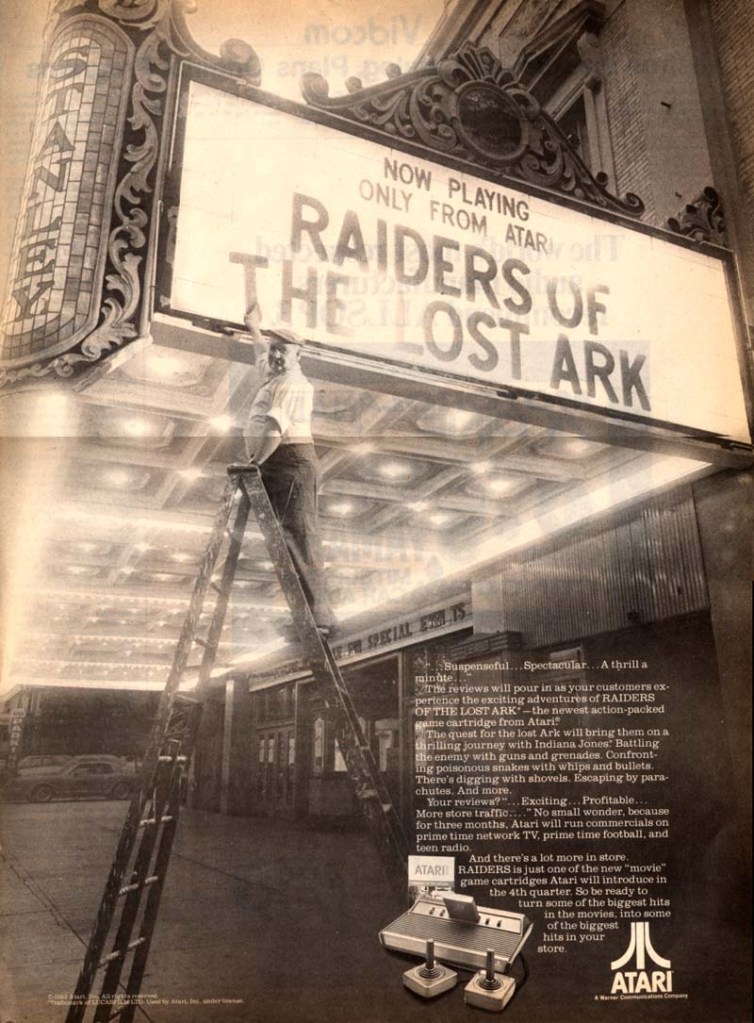
1. Raiders of the Lost Ark game print ads
The print ad with strong Indiana Jones imagery.
The print ad with the movie theater exterior image and the small image of the Atari 2600 console.
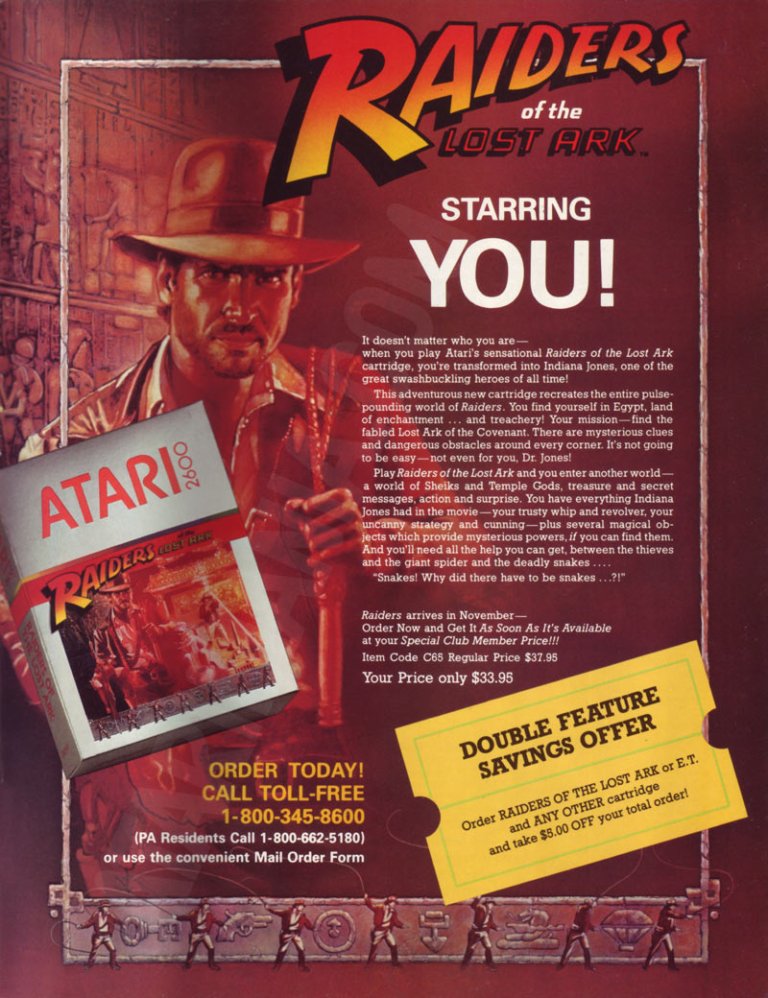
Directed by Steven Spielberg, Raiders of the Lost Ark was one of the best adventure movies ever made as well as the start of the iconic character Indiana Jones. Given its huge commercial success, an official video game adaptation for the Atari 2600 was released in 1982 and game designer Howard Scott Warshaw even met with Spielberg during the game’s development.
To promote the game, Atari released two print ads – one ad had a movie theater exterior visual concept to emphasize they have the official video game adaptation based on the movie while the other ad showed the game’s official artwork and game box cover while emphasizing a savings offer. Atari really did what they could to sell a game while riding on the success of Raiders of the Lost Ark.
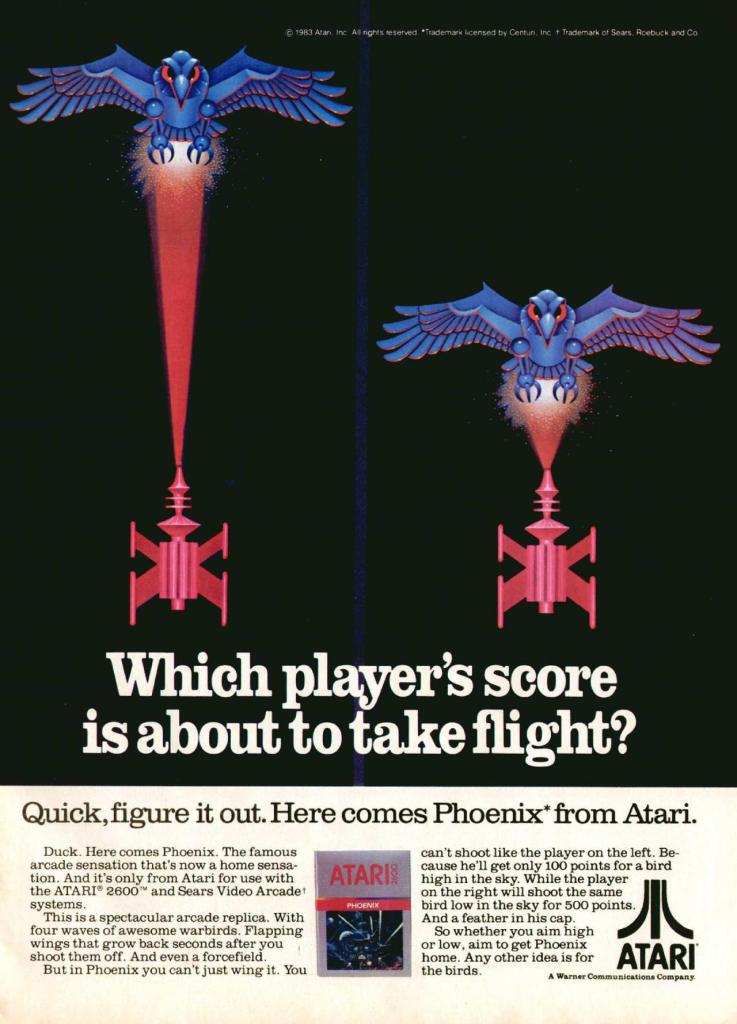
2. Phoenix print ad
Even without any screenshots, this print ad’s art still gives viewers a clear idea of what to expect.
Similar to what they did with Galaxian and Joust, Atari made this print ad promoting Phoenix which was a 2D sci-fi shooting game that was similar with Space Invaders in design. Colorized, hand-drawn artwork resembling the 2D sprites of the game was done to capture the attention of people. The art is so good, it made up for the lack screenshots of the game.
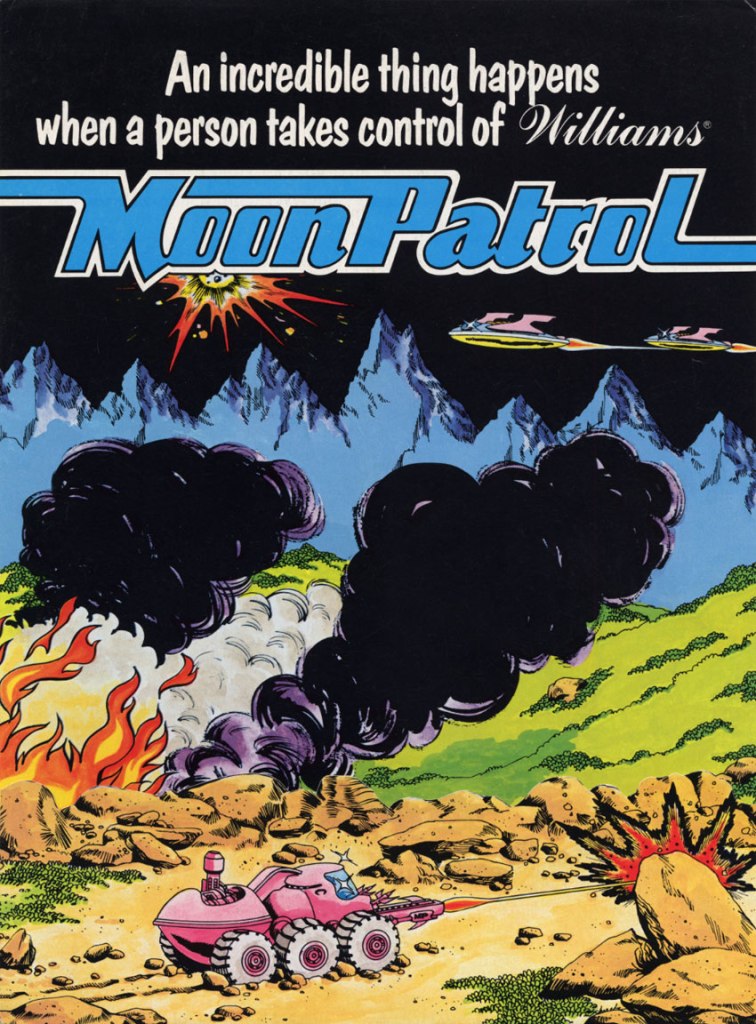
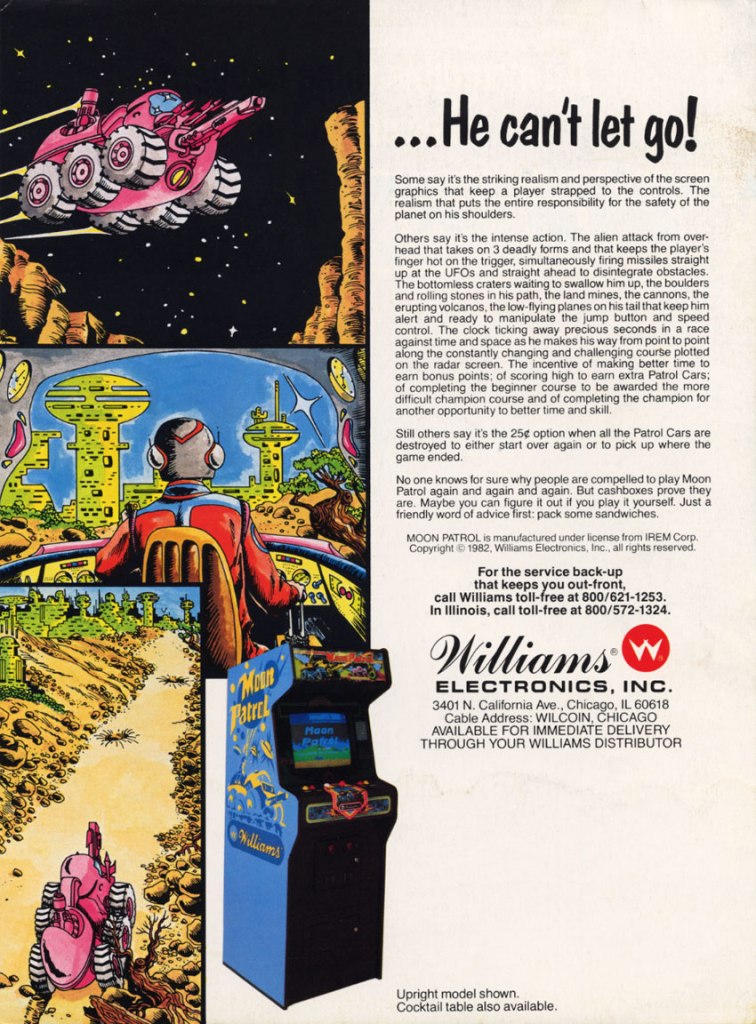
3. Moon Patrol arcade flyer
Front of the Moon Patrol flyer.
The other side of the arcade flyer.
Moon Patrol was a 2D sci-fi side-scrolling adventure game first released in the arcades in 1982. To sell the game to arcade operators, publisher Williams created the North American arcade flyer that heavily used hand-drawn comic book-style artworks on both sides while using available space on the other side for the descriptive text, contact details and the image of an arcade machine. What is very clear is that no screenshots of the game were shown to stand out which explains why a lot of hand-drawn art was used. The picture of the machine showing a screen of Moon Patrol was the closest thing to see a screenshot on this flyer. Personally, I really like the style and quality of the hand-drawn artwork as it made the flyer look lively.
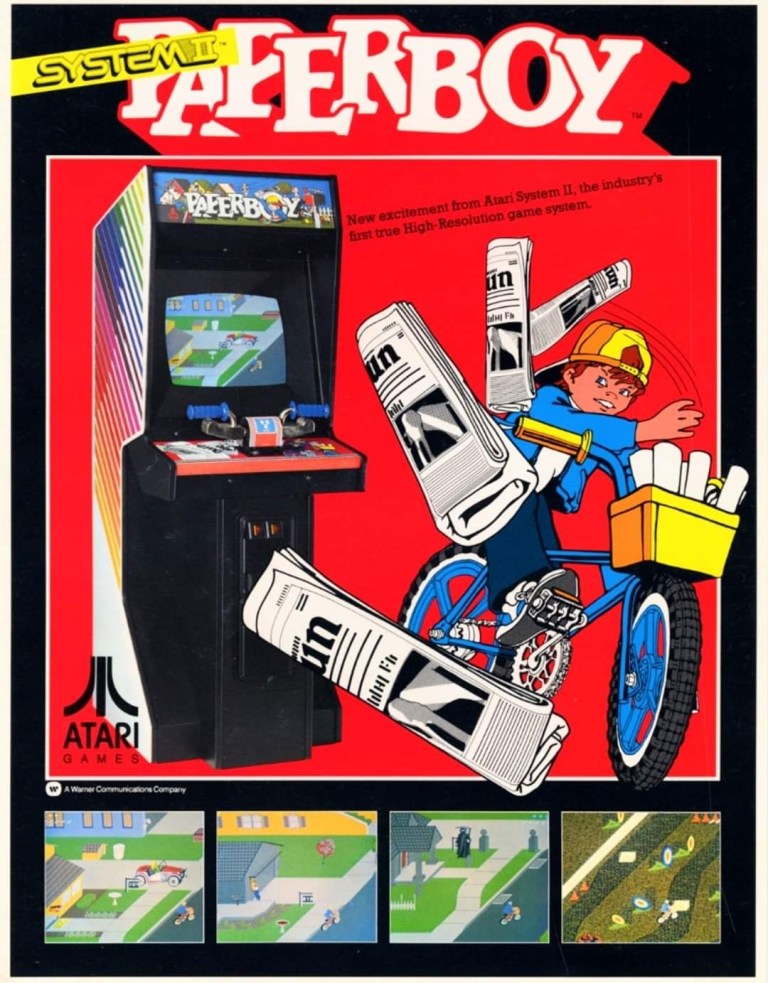
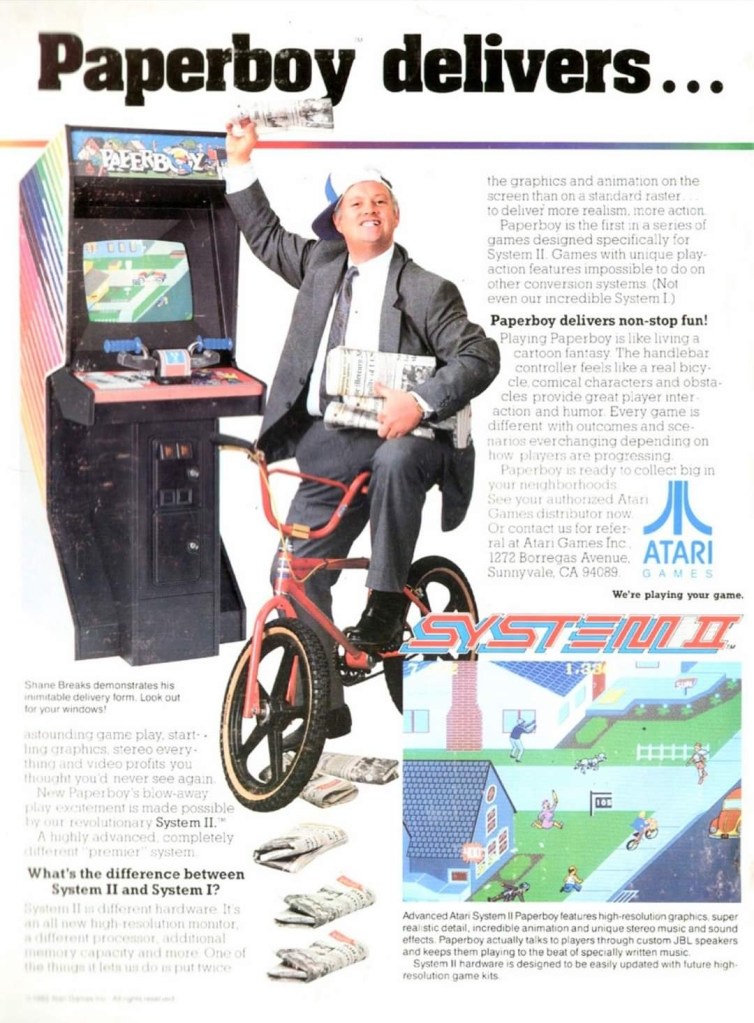
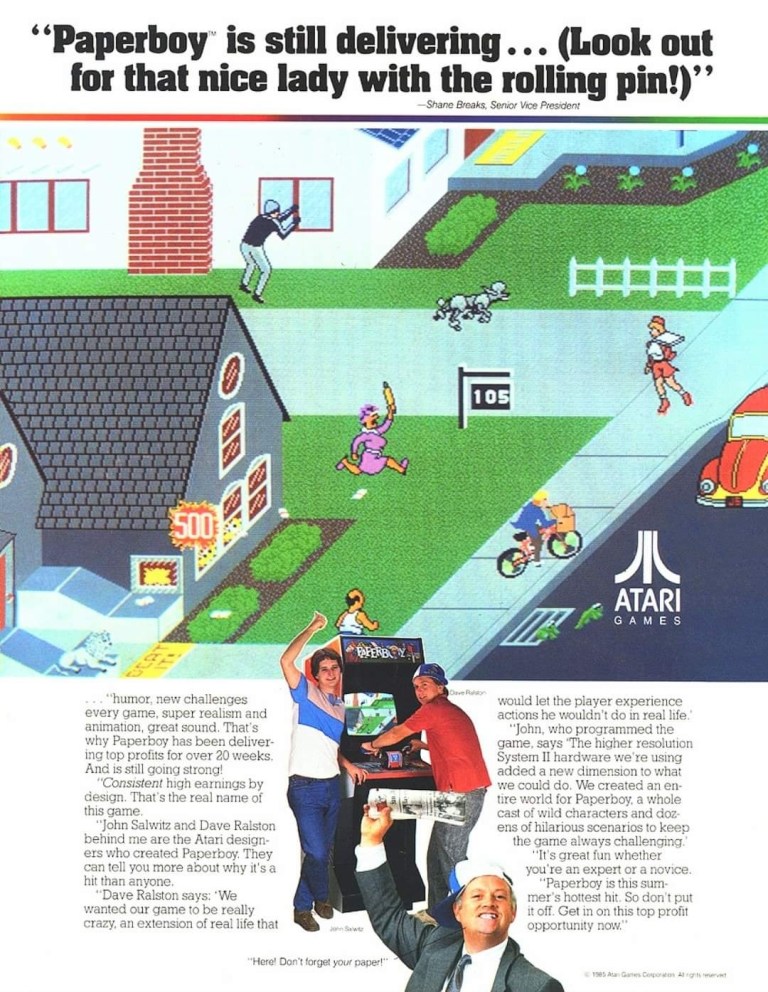
4. Paperboy arcade flyers
The arcade flyer showing the Paperboy machine and screenshots. The hand-drawn art is nice.
This one uses comedy showing a grown man riding a bike as a paper delivery “boy”.
I really like the stronger emphasis on the in-game graphics of Paperboy which dominates the space. What you see is what you get in the arcade.
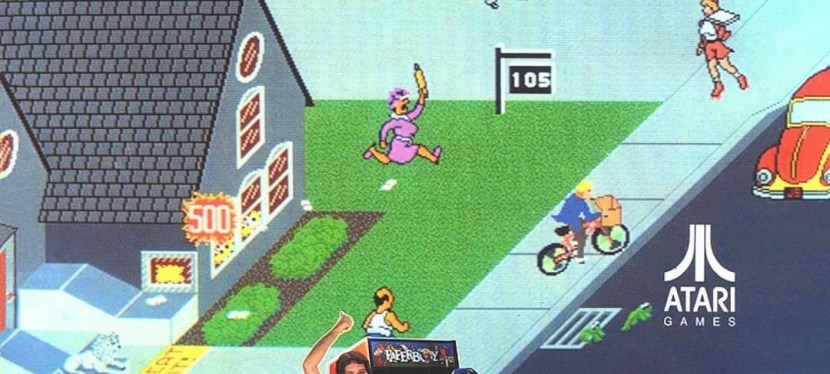
The first time I ever played the classic Paperboy was in the arcade inside a Las Vegas hotel way back in 1989, and it sure was a challenging yet fun experience. Before its arcade debut in 1985, the developers took a lot of risks making the game which includes coming up with a bicycle handle bar for each machine to have. To promote the game, Atari made at least three arcade flyers that creatively emphasized what the game’s concept was about, how did it play, why does the machine have bicycle handlebars and why players can expect fun. Atari’s promotional efforts paid off as Paperboy became a huge hit in the arcades not only in America but also in Japan.
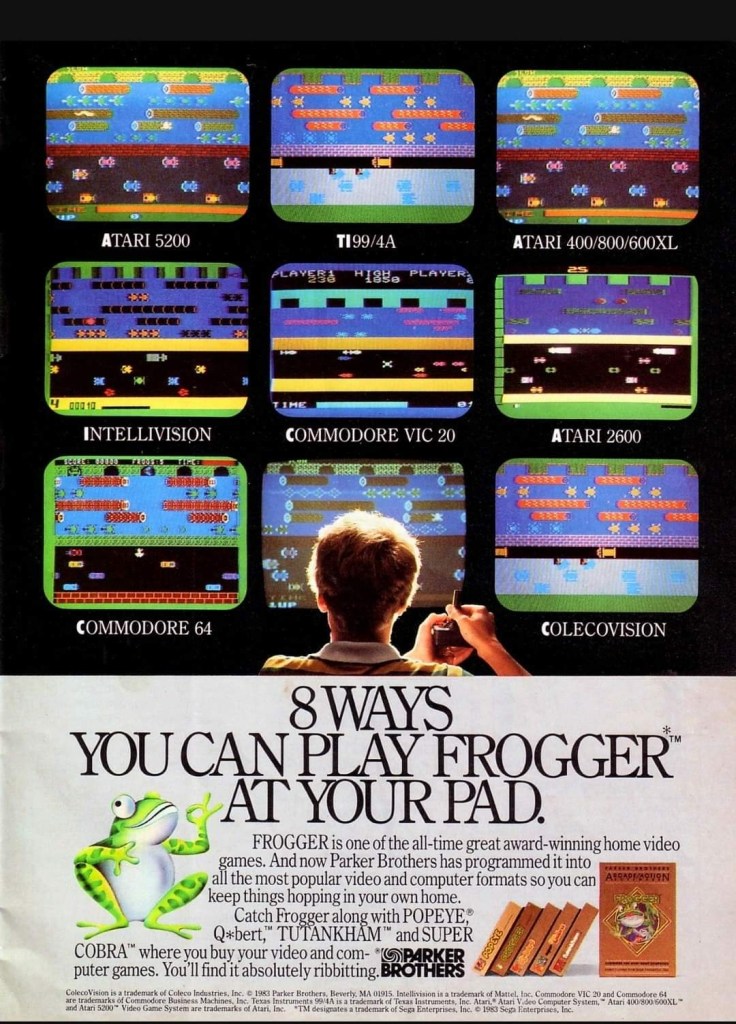
5. Frogger multi-platform print ad
This print ad is still amusing to look at.
After Frogger became a hit in the arcades, Parker Brothers secured the rights to port the game on Atari consoles, the Intellivision, TI-99/4A, vic-20, the Commodore computers and ColecoVision. To promote their Frogger ports, the single-page print ad was made showing a player in the foreground playing in front of screens that each showed what the game looked like on each platform. Parker Brothers found tremendous success selling 4 million copies of Atari 2600 version of Frogger at a time when there were only 13 million units of Atari 2600 in existence. By the year 2005, video game sales of Frogger reached 20 million worldwide across different platforms.
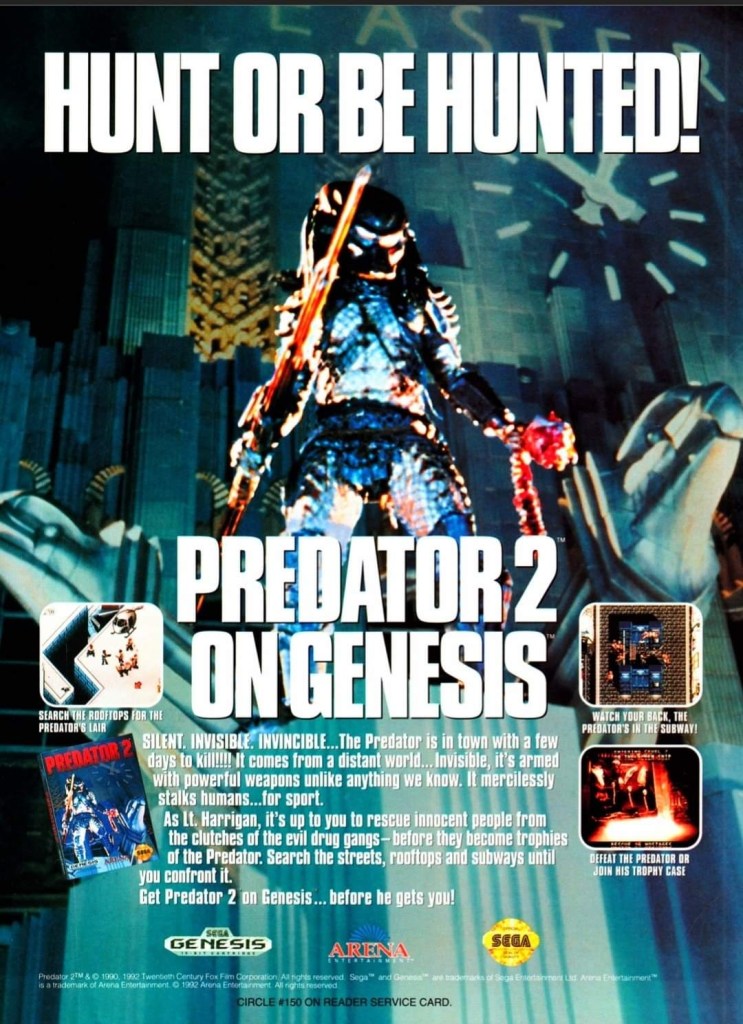
6. Predator 2 print ad
This is one very edgy print ad as used an official image from the movie.
If there is anything memorable about the 1990 film Predator 2, it is the fact that it had the story and the alien hunter itself within a metropolitan setting. That being said, the Sega Genesis Predator 2 video game had a suitable design of shooting and adventuring within the urban settings. This video game ad really captured the vibe of the movie (even showing the reddish human skull with spine on the Predator’s left hand) and clearly showed what gamers could expect. This old ad is still captivating to look at and its edgy approach is still intact.
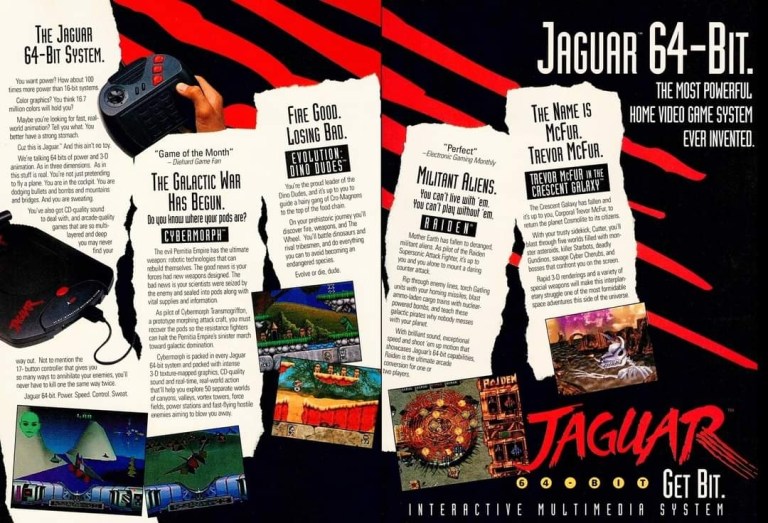
7. Atari Jaguar print ad
Did you ever own an Atari Jaguar console?
When I was reading video game magazines back in the 1990s, I always found print ads of the Atari Jaguar intriguing to look at. I was very young when I first played the Atari 2600 and its games at home, and later played some Atari games in the arcade. To me, seeing Atari Jaguar print ads like this one gave me moments of nostalgia and it made me wonder if Atari knew what it was doing with their so-called 64-bit game console. They did what they could to promote their console and the games within this 2-page print ad.
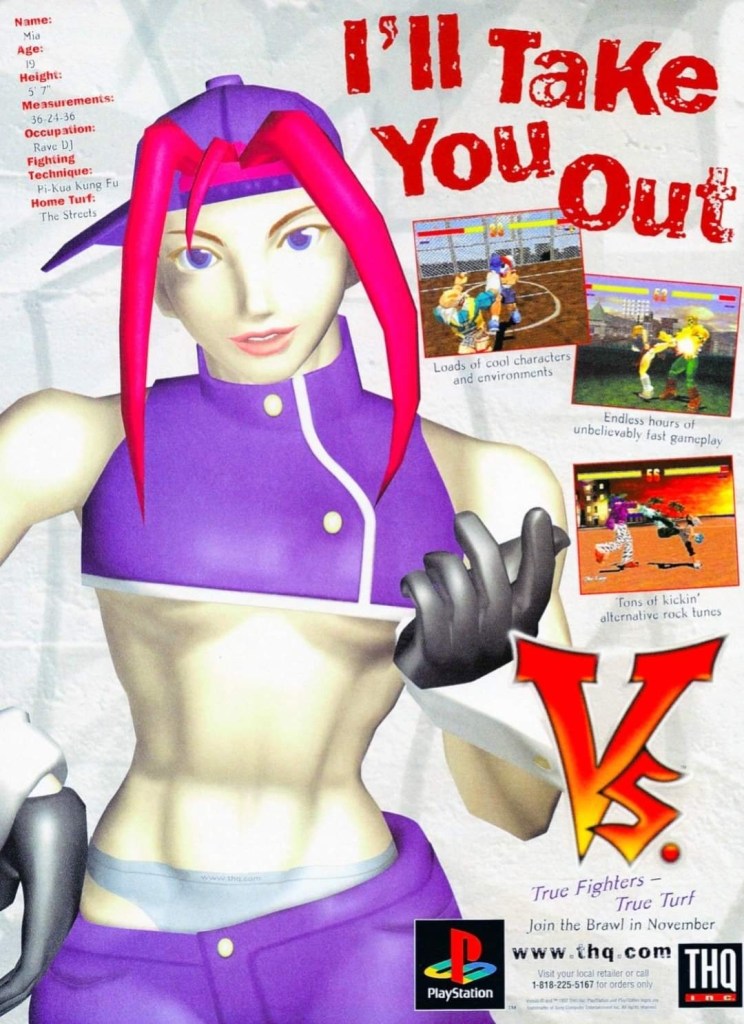
8. Vs. print ad
This print ad easily reminds me of the 1990s.
By 1997, both the arcades and the video game console market were filled with lots of 2D and 3D polygonal fighting games. Japan was the hot spot of the production of 3D polygon fighting games and the developer Polygon Magic (based in Japan) made Fighters’ Impact which Taito released in Japanese arcades and the PlayStation. The said game was picked up by THQ for a late-1997 release on the PlayStation in America under the title Vs. I never played this game but I heard that the game’s development included gang-oriented characters designed by Marvel Comics artist Kurtis Fujita. This Vs. ad is a lively reminder about the hip-hop fashion that made its way into video games.
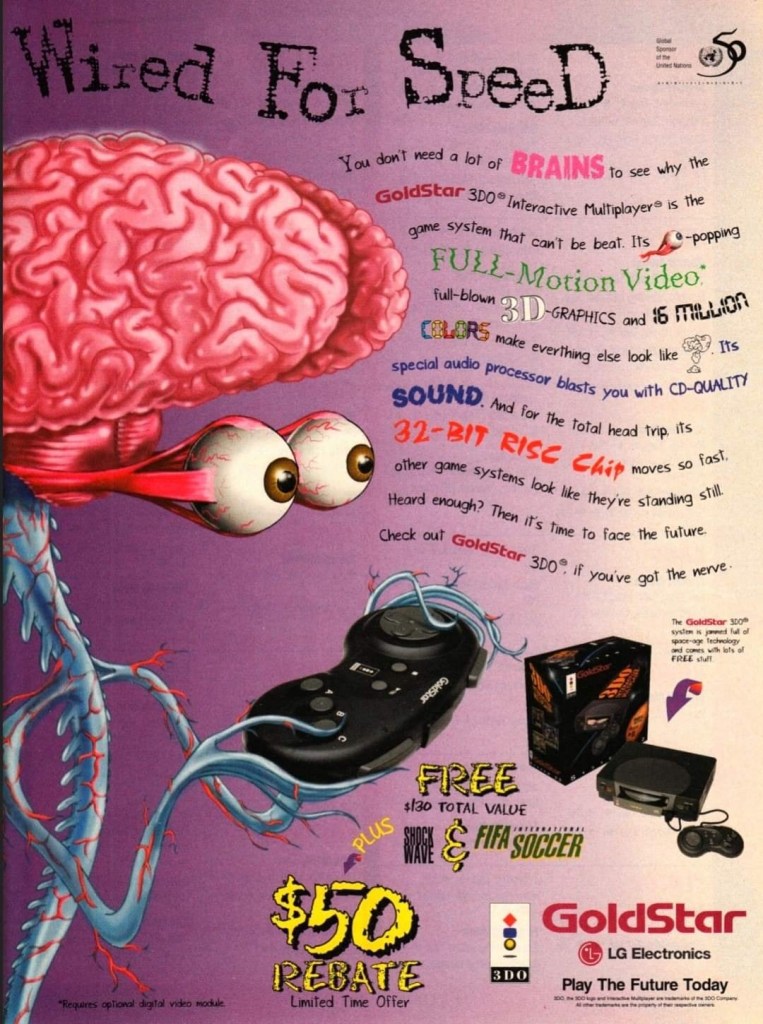
9. GoldStar/LG Electronics 3DO print ad
This is a very weird way to market a video game machine.
Back in the 1990s, the South Korean electronics company GoldStar (which was part of the umbrella of LG Electronics) had the license to produce 3DO game consoles with its own style. In some ways, the GoldStar 3DO console looked like a premium console on the outside. Unfortunately, the GoldStar 3DO print ad here had a very sloppy presentation as the ad makers used very weird art of a brain-with-eyes holding a 3DO controller leaving little space left to promote the console and games (without any screenshots). The text description was sloppily done. This is a bad example of promoting video game hardware and games.
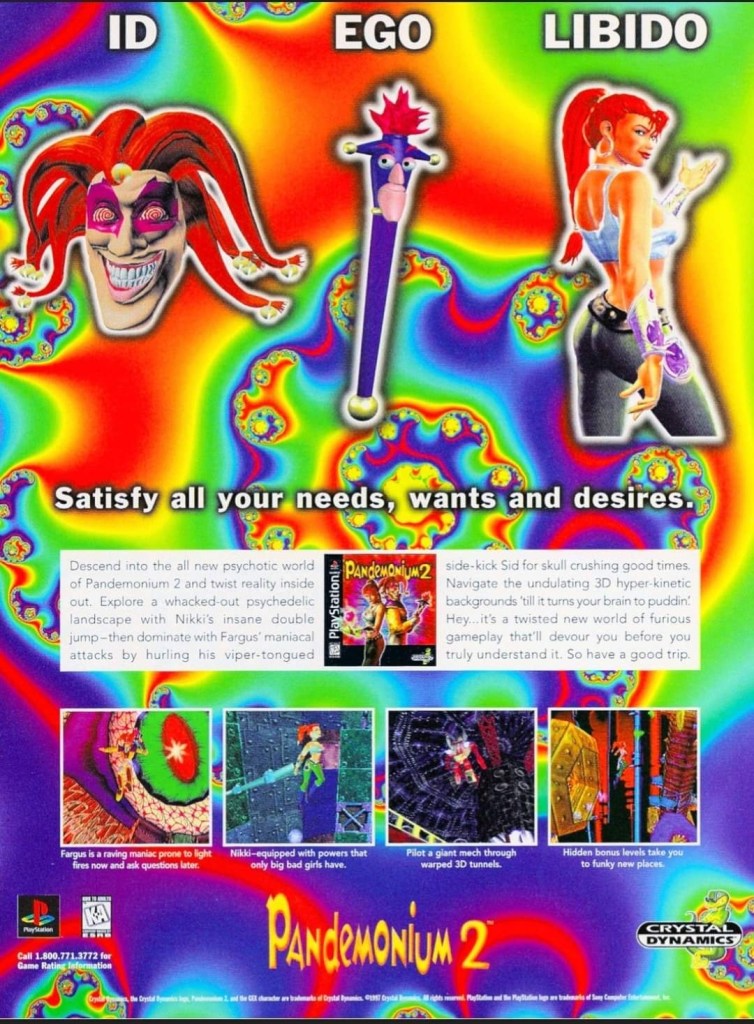
10. Pandemonium 2 print ad
I saw this ad but never played the game.
Looking back at 1997, I find it strange that I never got to play Pandemonium 2 on the PlayStation even though I saw its print ad in magazines. I had a lot of fun playing Pandemonium! on the console in 1996 but somehow missed out on its sequel. Looking back at the Pandemonium 2 print ad, I was surprised with how the game developers redesigned the two playable protagonists, especially Nikki who was clearly made to look very sexy. The word “libido” (meaning sexual drive) was deliberately placed above Nikki. The ad also had a hypnotizing mix of colors which I believe was also deliberately done by the ad makers. I can only wonder how the game played.
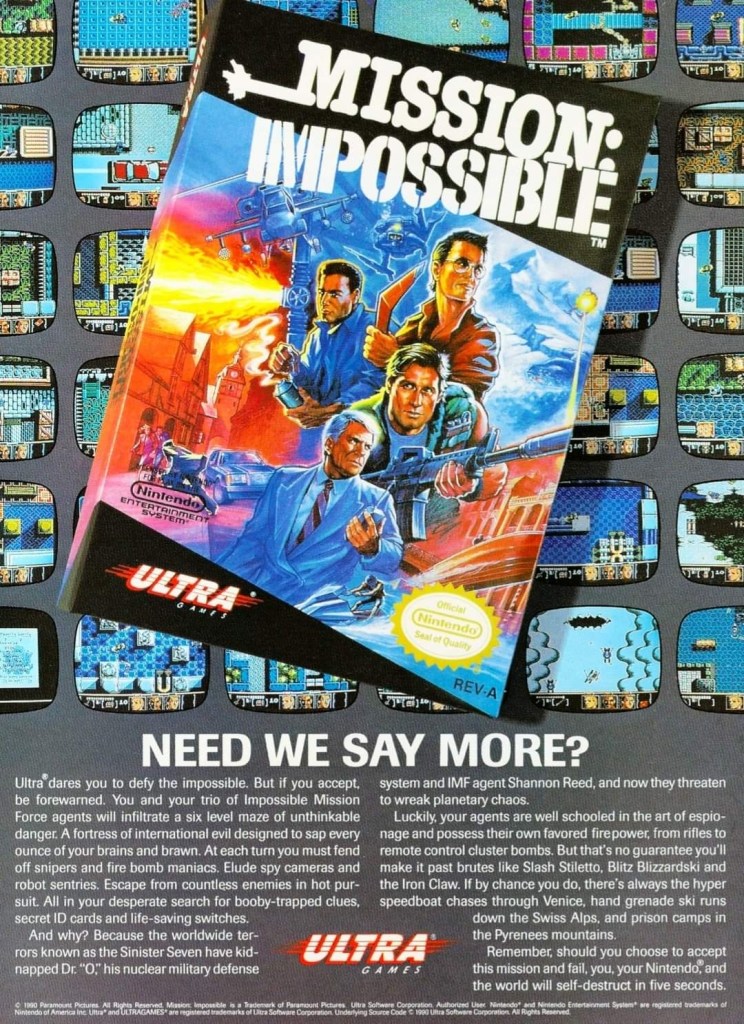
11. Mission: Impossible print ad
A captivating ad.
In 1990, Ultra Games (a label of Konami) released the Mission: Impossible video game on the Nintendo Entertainment System (NES) in America. Developed by Konami, the game was an adaptation of the 1988 TV series and it had an ambitious design with regards to level design and gameplay. To promote the game, the ad makers came up with a visual design showing the game’s box (which had a nice painted art on the cover) on the foreground and several screenshots resembling TV monitors on the background. Even by today’s standards, this print ad still looks good and captivating even if you are not too familiar with Mission: Impossible on TV.
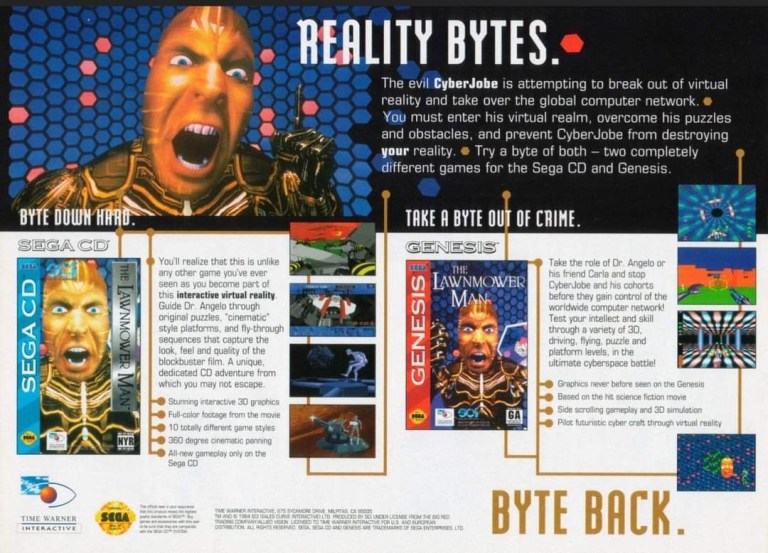
12. The Lawnmower Man Sega CD and Genesis print ad
Are you fan of The Lawnmower Man movie?
Back in 1992, there was a lot of buzz generated by the movie The Lawnmower Man as it had a disturbing concept that involved virtual reality and, more notably, author Stephen King sued the filmmakers to remove his name from the title because the film differed so much from the source material. Of course, those developments did not stop the production of video game adaptations of the movie. This print ad promoting the Sega CD and Sega Genesis versions of the game heavily used the images of CyberJobe which were among the most memorable images from the film. Looking at the ad, the ad makers could have made the screenshots look a little larger to really sell the games.
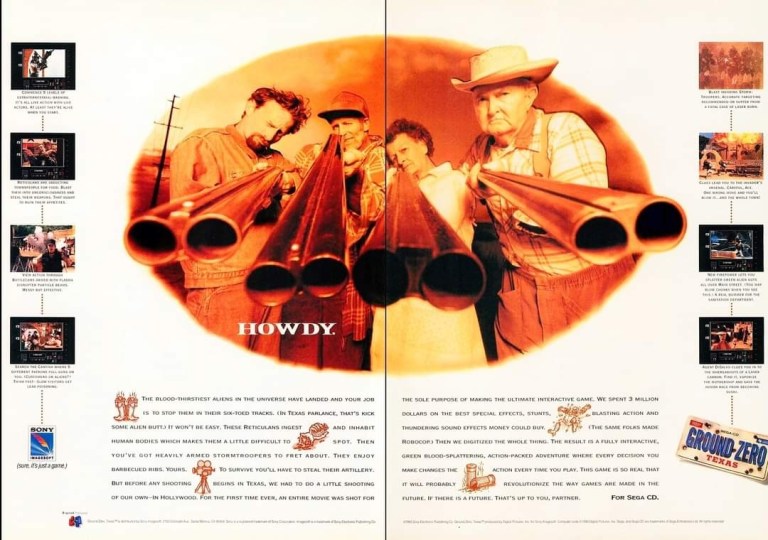
13. Ground Zero: Texas print ad
The shotguns really made this ad eye-catching.
I never played the Sega CD video game Ground Zero: Texas but I knew that it was one of those games that heavily relied on video footage while giving players moments to interact. Back in 1993, there was an increase in the number of video games that carried lots of live action footage to drive the narrative and players were given options in order to progress. What is very notable about the game is not the game design but the very 2-page ad used to promote it. The image showing four people pointing their shotguns towards the viewer was easily the most captivating part of the ad. Even though there was vacant space in between, the screenshots of the game were displayed to be really small.
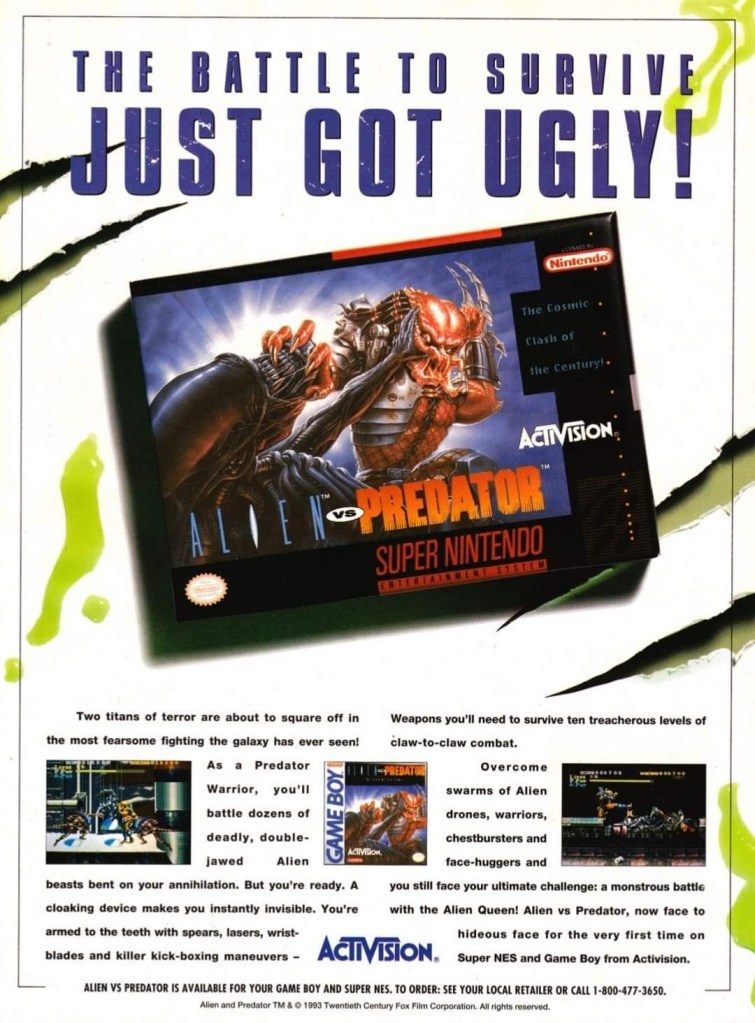
14. Alien vs. Predator for SNES and Game Boy print ad
This ad caught the attention of a lot of people back then.
Back in 1990, Dark Horse Comics launched the 4-issue mini-series of Aliens vs. Predator which turned out to be a very intriguing and engaging crossover comic book tale featuring two iconic sci-fi species of monsters. The success of the comic books led to the production of many video games which delighted both fans of Predator and Aliens. In 1993, Activision released Alien vs. Predator on the Super Nintendo Entertainment System (SNES) and the single-page print ad they came up with was engaging to look at. The SNES game box with the fine looking painted art was the main visual highlight leaving just enough space for the descriptive text, the Game Boy cover and two screenshots. Believe it or not, this video game was not related at all with the Alien vs. Predator arcade game and Atari Jaguar console game.
Welcome back, my readers, YouTube viewers and all others who followed this series of articles focused on YouTube videos worth watching. Have you been searching for something fun or interesting to watch on YouTube? Do you feel bored right now and you crave for something to see on the world’s most popular online video destination?
I recommend you check out the following topics and the related videos I found.
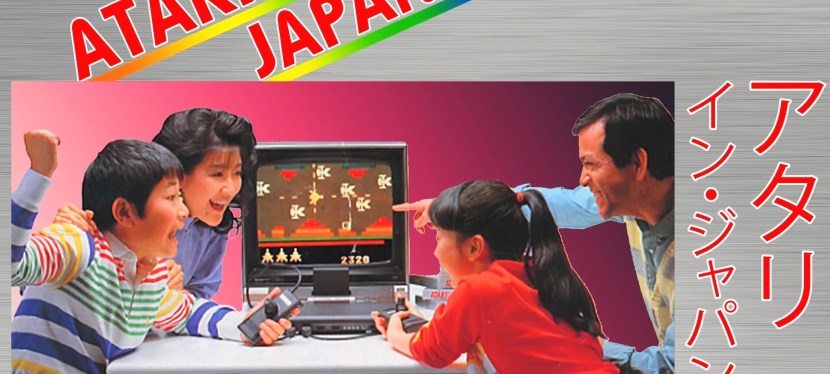
#1When Atari invaded Japan – Here in the Philippines, me and my friends played video games on the Atari 2600 consoles in our respective homes during the first half of the 1980s. What I did not know back then was the fact that Atari did its best to sell its console and video games in nearby Japan. It turns out, their console in Japan was the Atari 2800. Watch and learn about this particular part of video game history with the video of GTV Japan below.
#2 A look back at Superman: The Animated Series – When it comes to animated series of the 1990s related to superheroes, X-Men: The Animated Series, Batman: The Animated Series and Spider-Man: The Animated Series are often remembered by long-time fans and geeks. The animated series of Superman, however, does not get remembered as much even though it had good quality animation and presentation. Of course, it should be remembered that the 1990s was the same decade when DC Comics had Superman killed, introduced the Supermen, brought Superman back to life and even had the Clark Kent identity destroyed which probably overshadowed the animated series. To discover more of Superman: The Animated Series, watch the video below.
#3 Examining the original 2099 comics franchise of Marvel Comics – You might have heard about 2099 among the many comic books Marvel published through the decades. The futuristic of Marvel’s shared universe originally started in late 1992 when the comic book speculator boom was still intense. It started strongly with Spider-Man 2099 followed by Ravage 2099, Doom 2099 and Punisher 2099. In the 2nd half of 1993, X-Men 2099 followed and even more related comic books got released. Of course, the 2099 franchise of the 1990s eventually ended. How and why it all happened like that, you can learn by watching Owen likes Comics’ video below.
#4 You, Me and the Movies’ Excalibur reaction – Excalibur is an epic medieval fantasy movie about the legend of King Arthur and his knights released in 1981. I first saw the film on TV in 1988 and it was an intriguing viewing experience. I replayed it on physical disc format in 2003 and eventually recognized Patrick Stewart, Helen Mirren, Liam Neeson and Gabriel Byrne looking much younger. If you want to discover more of Excalibur through the reaction of You, Me and the Movies, watch the video posted below. It’s a fun watch.
#5 Assorted videos about Planet of the Apes (1968) – Planet of the Apes of 1968 is considered by many as a great science fiction film as well as a philosophical and intelligent viewing experience. While it is an engaging viewing experience, I find the concept of human evolution and the so-called genetic links between humans and apes to be nothing more than fantasies. Considering its fame, it is no surprise that a lot of YouTubers made their own videos about it and you can watch the selected videos below.
#6 A look back at Robotron: 2084 – Robotron: 2084 is a 2D, multi-directional shooting game first released in arcades way back in 1982. I never played the arcade version but managed to play it on an IBM PC around the mid-1980s. The history behind the game is quite rich in details and you can enjoy learning about it by watching the video of PatmanQC below.









 Author Carlo Carrasco