What to watch on YouTube right now – Part 113

Welcome back my readers, YouTube viewers and all others who followed this series of articles focused on YouTube videos worth watching. Have you been searching for something fun or interesting to watch on YouTube? Do you feel bored right now and you crave for something to see on the world’s most popular online video destination?

I recommend you check out the following videos I found.

Setting The Record Straight About Cleveland’s 1986 Balloonfest – If there is anything unfortunate about the Internet and 21st century culture, it would be falsehoods and distorted information overwhelming the truth about past events. When it comes to Cleveland’s Balloonfest ’86, the event was a spectacle in which the organizers, its volunteers and strategic partners overcame lots of challenges along the way. The vibe and turnout overall in 1986 was generally positive. Today, there are simply too many liars and peddlers of misinformation (note: climate change activists, woke minds and people pretending to be experts) who posted online dishonest retrospective videos and opinions about Balloonfest ’86. That said, key members of the organizing committee and participants of the event got together to set the record straight in a YouTube video of Cleveland.com, and they have the facts to refute the accusations and falsehoods. Watch and learn from the video below.

Tourists Causing Trouble In Japan   – As I said some time ago, if you are entering Japan as a tourist, you better behave yourself and follow the rules. Massive tourism has been happening in Japan for some time now which is clearly adding to their economy and to discovering what the Japanese have to offer to the world. Unfortunately, there are foreign tourists who misbehaved and violated local laws to do gimmicks for social media (note: a selfish motive), disturbing the peace, adding to the pollution and even flying drones in restricted areas. Watch and learn from the video below.

#3 Remembering John McCain’s Bad Legacy – It has been years since former US presidential candidate and US Senator John McCain passed away. During his decades-long service in the US Senate, he was called by the corrupted mainstream news media a maverick for his willingness to work with Democrats on pieces of legislation. What many people do not know is the truth (backed with facts) that McCain’s legacy has been pretty bad as he not only betrayed the Republican Party but also the voters. When McCain was the Republican nominee for US President in 2008, his campaign was really doomed and Republicans got embarrassed. There is a lot more to discover about McCain in the MAGAmark video below.

Congo Video Game – In 1995, the adventure movie Congo was released in cinemas and it managed to achieve better-than-expected commercial success despite being hit with negative reviews. The movie was based on a novel by the late Michael Crichton. As part of the film’s business strategy, a video game of it was released on Sega Saturn titled Congo The Movie: The Lost City of Zinj. I never played the game and there is a lot to learn about it in Sega Lord X’s video below.

The Running Man Revisited – Remember the 1987 sci-fi action movie The Running Man starring Arnold Schwarzenegger? That film was not a faithful adaptation of the novel written by Stephen King (who used a different name) but it delivered bouts of fun for moviegoers. That said, there are lots of interesting details about the film, its source material, the process of adapting the story for film, and how it entertained people. Enjoy the selected retrospective and reaction videos below.

You, Me and the Movies React To Frankenstein (1931) – Several decades ago, Universal Pictures released its cinematic adaptation of a 1927 play which itself is an adaptation of Mary Shelley’s Frankenstein novel. Simply titled Frankenstein, the 1931 movie went on to become a long-lasting part of American pop culture and is often regarded as a Hollywood. You, Me and the Movies’ Frankenstein reaction video is a must-see.

Ashleigh Burton Reacts To Young Frankenstein – If you want to see good old comedy that is effectively funny, you can’t go wrong with Mel Brooks. When it comes to making fun out of a particular horror icon or property, Brooks’ Young Frankenstein is a parody worth considering. Ashleigh Burton’s reaction video is fun to watch.

+++++

Thank you for reading. If you find this article engaging, please click the like button below, share this article to others and also please consider making a donation to support my publishing. If you are looking for a copywriter to create content for your special project or business, check out my services and my portfolio. Feel free to contact me with a private message. Also please feel free to visit my Facebook page Author Carlo Carrasco and follow me on Twitter at  @HavenorFantasy as well as on Tumblr at https://carlocarrasco.tumblr.com/ and on Instagram athttps://www.instagram.com/authorcarlocarrasco

A Look Back at Mary Shelley’s Frankenstein #1 (1994)

Welcome back movie enthusiasts, 1990s arts and culture enthusiasts, and comic book collectors! Today we go back to the year 1994 to examine the first issue of a comic book mini-series that served as the official adaptation of the movie Mary Shelley’s Frankenstein.

The 1994 film – starring and directed by Kenneth Branagh and produced by Francis Ford Coppola – had a huge marketing push through the local media and in the cinemas here in the Philippines. Robert De Niro’s name alone attracted a lot of moviegoers’ attention and there were some literature enthusiasts who had the impression (or were hopeful) that the film would be faithful to the 1818 Gothic novel by Mary Shelley.

Like many others here in the Philippines, I went to the local cinema (which was half-full) to watch Mary Shelley’s Frankenstein and ended up having a mixed opinion. The production values looked grand and the cinematography (specifically the location shots and vistas) was very impressive but I felt something was off with regards to the direction which brought the storytelling down.

As with some other Hollywood movies of the time, there was a comic book adaptation of Mary Shelley’s Frankenstein in the form of a mini-series from Topps Comics. I remember seeing issue displayed at the local comic book specialty store shortly after seeing the movie but I was not interested on buying it. Recently, I finally secured a copy of the comic book and read it for the first time ever.

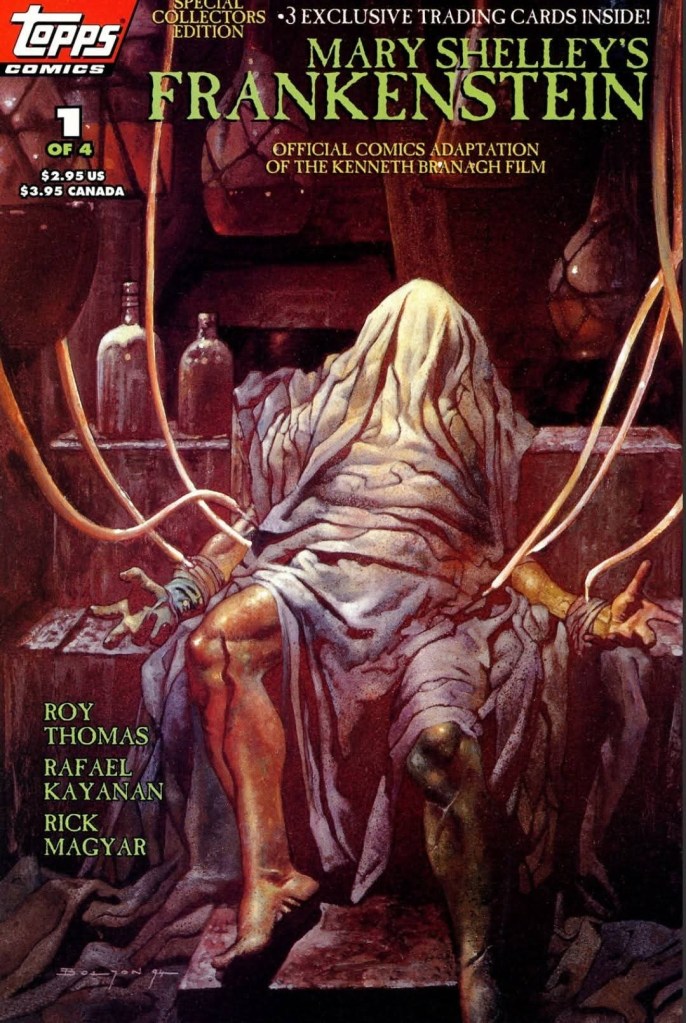
With those details laid down, here is a look back at Mary Shelley’s Frankenstein , published in 1994 by Topps Comics with a story written by Roy Thomas (based on the screenplay by Steph Lady and Frank Darabont) and drawn by Rafael Kayanan. This is the first of a 4-issue mini-series.

The cover.

Early story

The story begins at sea in 1794 in the middle of very cold weather. The ship carrying Captain Walton and his crew crashed on to pack ice and became trapped. The captain refuses to give up on his quest to reach the north pole and he has the crew chopping the ice. Suddenly they hear a frightening noise as something approaches.

A cloaked man emerges from the mist and it turns out he was not the source of the frightening noise. Without hesitation and right in front of the captain, the cloaked man tells the crew to bring their weapons and follow him. The captain tells the newcomer that only he gives the orders. The crew’s dogs ran away moving towards the source of the noise in the mist.

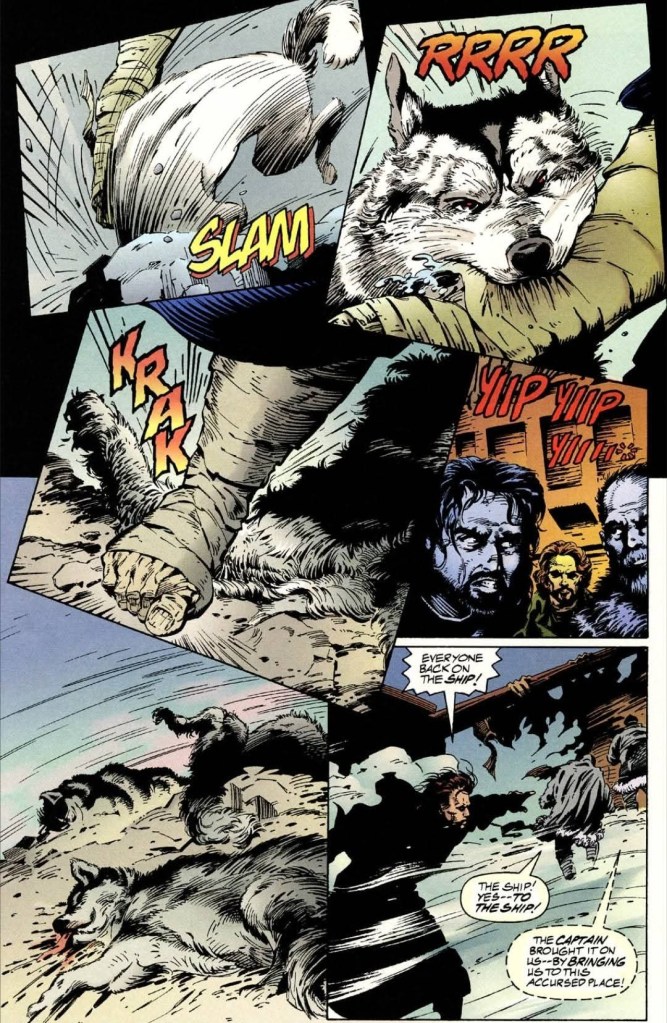
The dogs reached the source of the noise and attack it. The dogs were no match for it as they each got hit and eliminated. As the crew heard the dogs die, the captain tells everyone to move back to the ship.

Moments later, the captain and the cloaked man are inside the ship. A tall human figure slowly approaches the ship. After an exchange of words about what has been going on, the captain asked the cloaked man who he is. The man reveals he is Victor Frankenstein…  

Quality

This particular scene looked great in the movie itself. There was nothing the comic book creators could do to translate it into illustrated literature.

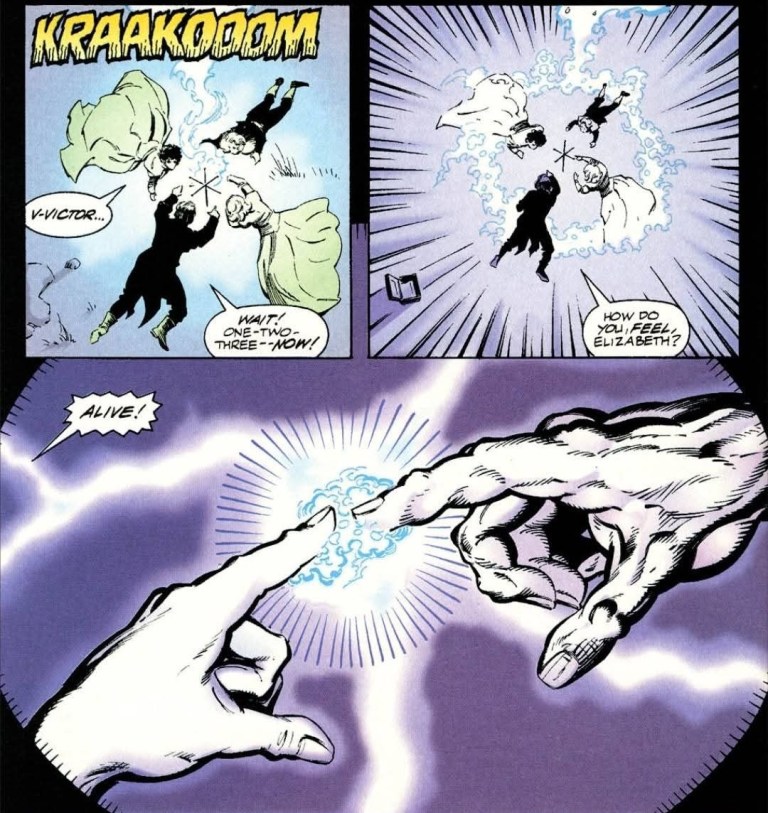
To make things clear, this comic book covers the film’s beginning until the scene in which Frankenstein attempts to give his creature life. As there were no printed advertisements, the comic book creators tried hard to cram several scenes into it complete with lots of details regarding the setting, the scientific thoughts of Frankenstein, experiment details and more. Indeed, a lot of the exposition in the film made it here and there were also cinematic sequences that simply could not be replicated in print format.

The illustrated opening scene replicated enough of the essence of the cinematic opening. Like the movie, the narrative moves back in time to explore Victor Frankenstein’s youth, his family, how Elizabeth became his adopted sister and how family tragedy started his path to becoming obsessed with overcoming death through science, medicine, chemistry and biology.

As it is clear that this illustrated version could never replicate the grand visuals of the film, such scenes were trimmed a lot with the readers in mind. The narrative moved between slow and medium pace similar to the film but for readers, it is a must to pay close attention to the details to truly understand the story and how Frankenstein develops.

Frankenstein here is portrayed not only as an obsessed scientist (who wants to conquer death by creating life with his own efforts) but also as a hurting man whose destiny has been altered with pain, struggle and darkness ahead. No matter what the odds were, Frankenstein believes he can achieve what is impossible while also believing he is not a mad man. Of course, Frankenstein’s own obsession blinded him so much, he fails to realize the truth that he has turned into a truly mad scientist who does not care at all about ethics, nature and morality. As such, Frankenstein is truly unlikable as the protagonist.  

While a lot of effort was done to translate the film’s plot into comic book storytelling, Rafael Kayanan did a decent job with the visuals showing ranging quality throughout. Given the historical setting and European locations of the movie reflecting the novel, it is indeed difficult for any artist to replicate the looks, the environments and the many material objects of the period. Some illustrated scenes looked detailed while others showed some signs of rush. If you are hoping to see the characters looking like the actors in the movie, you won’t find much of that here. Ironically, there were a few shots that reflected that gore and violent movements of the film.  

Apart from the story, there are two pages in this comic book that provided details about the history of Mary Shelley’s novel and how her creation impacted entertainment and pop culture in America (including the famous 1931 movie). Selected images were also included.

Conclusion

The dogs are powerless towards the unseen creature of Frankenstein.

The way I look at Mary Shelley’s Frankenstein (1994), it clearly follows the movie’s scenes visually rather than following closely the screenplay and that means translating Kenneth Branagh’s vision into comic book form here. As such, there definitely is something off with regards to pacing and storytelling. There really is not much enjoyment in this 1st issue of the comic book adaptation mini-series. In fact, this is more of a humanized portrayal of unethical science driven by one character’s obsession with conquering death.

Overall, Mary Shelley’s Frankenstein (1994) should be avoided.

+++++

Thank you for reading. If you find this article engaging, please click the like button below, share this article to others and also please consider making a donation to support my publishing. If you are looking for a copywriter to create content for your special project or business, check out my services and my portfolio. Feel free to contact me with a private message. Also please feel free to visit my Facebook page Author Carlo Carrasco and follow me on Twitter at  @HavenorFantasy as well as on Tumblr at https://carlocarrasco.tumblr.com/ and on Instagram at https://www.instagram.com/authorcarlocarrasco
A Look Back at Action Comics #481 (1978)

Welcome back superhero enthusiasts, 1970s arts and culture enthusiasts, DC Comics fans and comic book collectors! Today we go back to the year 1978 to take a close look at a part of the DC Comics universe through a tale of the Action Comics monthly series.

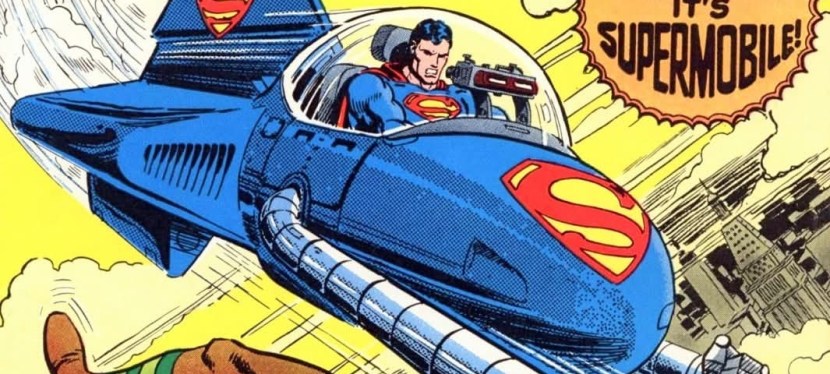
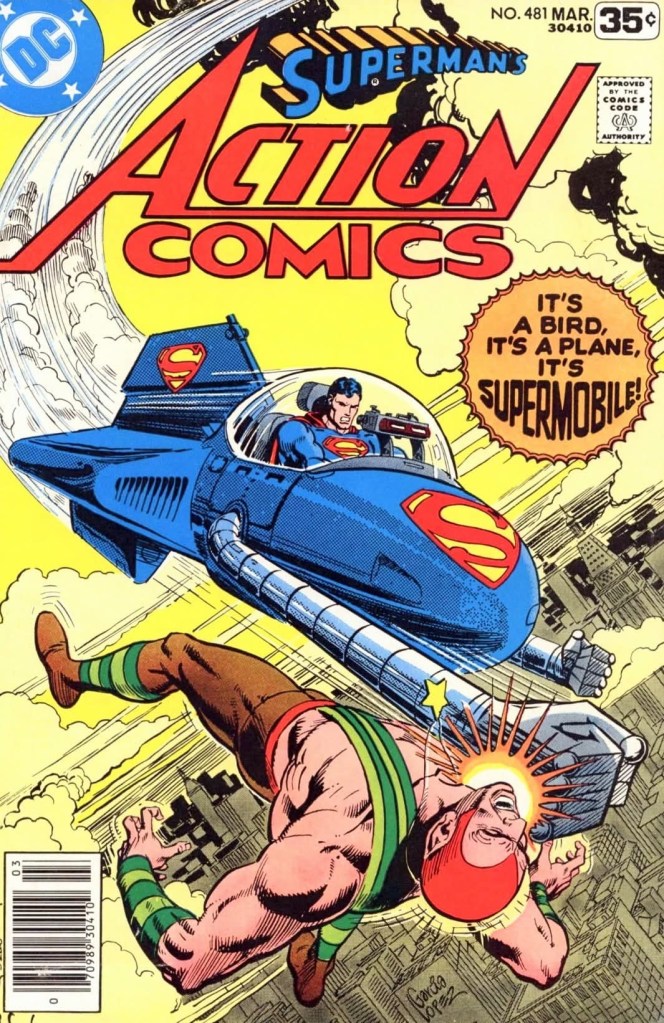
Believe it or not, there were times when Superman used advanced technology and machinery to achieve his goals, to win a battle or at least survive. This is something we people today can relate with since a lot us have smartphones and computers being used daily. As for the Man of Steel, there was a time when I saw an episode of Super Friends on TV in which a very vulnerable Superman had no choice but to use his personal flying vehicle called the Supermobile to travel and do something. It turns out, the Supermobile itself started in comic books.

With those details laid down, here is a look back at Action Comics , published in 1978 by DC Comics with a story written by Cary Bates and drawn by Curt Swan.

The cover.

Early story

The story begins on a city street as Amazo (who recently gained the powers of Justice League members in a previous encounter) is about to strike a weakened Superman and Professor Ivo (who is responsible for Amazo) in front of many people. Amazo strikes but ends up smashing the part of the road as his targets vanished.

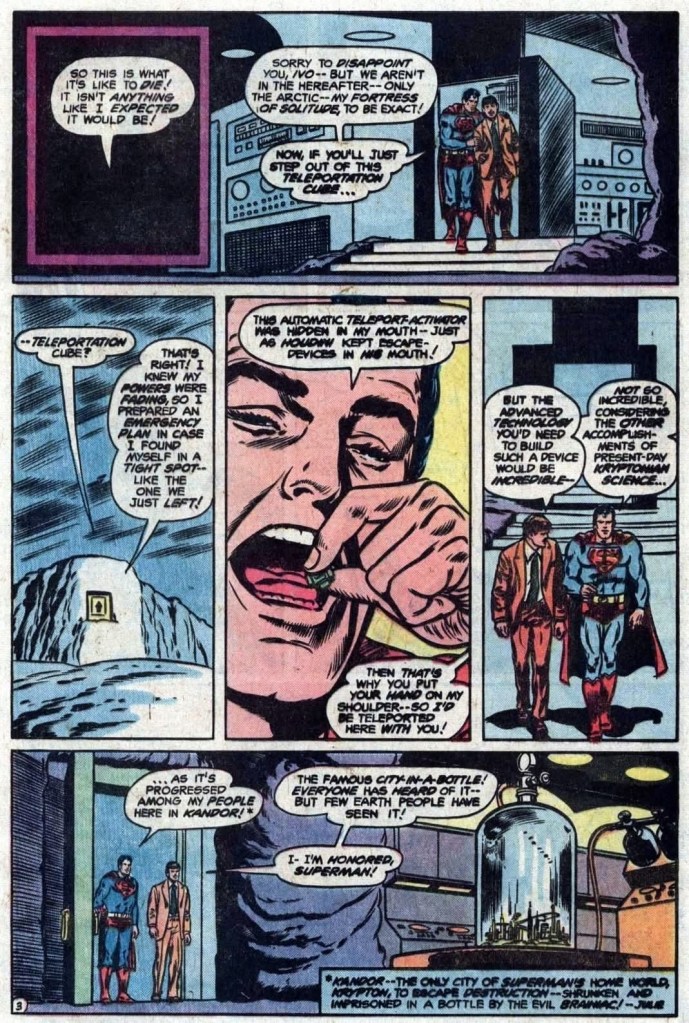
It turns out Superman and the professor were teleported safely all the way into the Fortress of Solitude. With his powers gone due to red radiation, Superman revealed that he made some preparations in relation to Amazo’s eventual rampage….

Quality

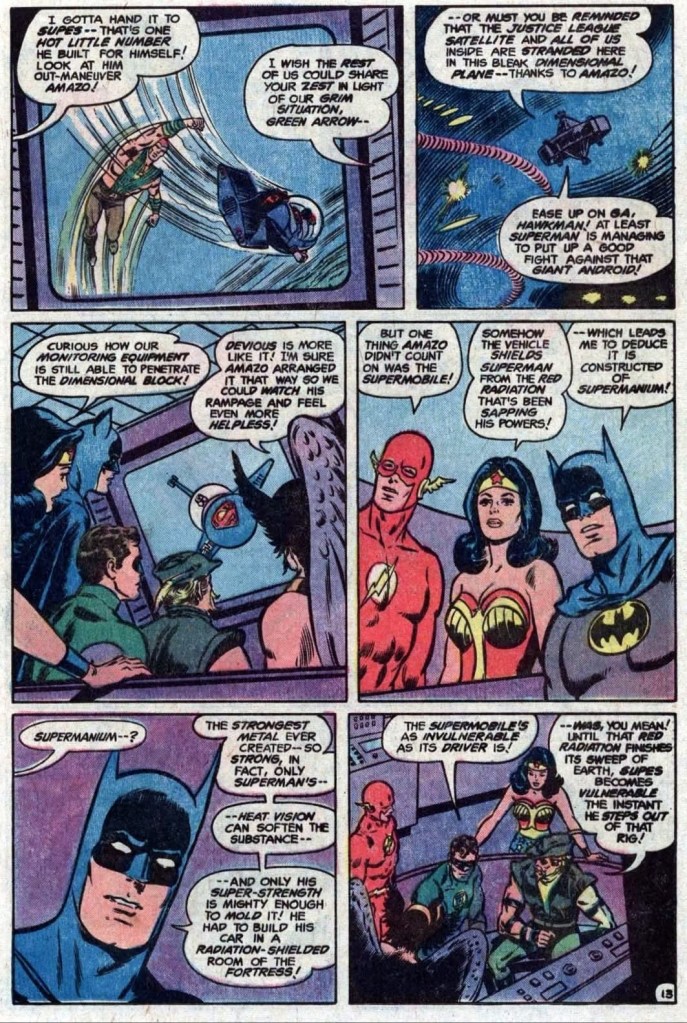
Exposition about the Supermobile in this page showing the trapped Justice League members.

This early, I want to point out that this comic book is not merely a shallow tale designed to introduce the Supermobile in lazy fashion. In fact, there is a lot of work done by the Bates-Swan duo here and this includes plot build-up backed with payoffs, lots of details that were revealed and, most notably, the story has a solid structure complete with smooth execution.

This story was preceded by an unfortunate series of events in which Amazo gained the powers of the Justice League members and had them trapped in space, while Superman got hit by red radiation and managed to get out for a new fighting chance. Here, Superman is powerless and vulnerable, and the fact that Amazo is so powerful, the unveiling and use of the Supermobile is clearly justified. Amazo himself is a fine example of a scientific creation gone wrong and seem inspired by the monster of Frankenstein in literature.

By looking close at the details, the dialogue and the execution of event, this is clearly not a rushed job to introduce the Supermobile. It is a sufficient story on its own and it even delivers a good amount of superhero spectacle to satisfy readers.

Conclusion

Superman and the professor inside the Fortress of Solitude.

Action Comics (1978) is indeed a satisfying and fun read. The build-up leading to the Supermobile’s debut is sufficient and the creators went on to keep building up the plot with Amazo getting bigger as a threat to not only against Superman but also against the Justice League. The Supermobile’s debut is justified and definitely it is not a cheap addition to the plot. The idea of Superman using a personal transport looked silly on face value but this comic book proved it is believable and sensible.

Overall, Action Comics (1978) is recommended.

+++++

Thank you for reading. If you find this article engaging, please click the like button below, share this article to others and also please consider making a donation to support my publishing. If you are looking for a copywriter to create content for your special project or business, check out my services and my portfolio. Feel free to contact me with a private message. Also please feel free to visit my Facebook page Author Carlo Carrasco and follow me on Twitter at  @HavenorFantasy as well as on Tumblr at https://carlocarrasco.tumblr.com/ and on Instagram at https://www.instagram.com/authorcarlocarrasco
A Look Back at Sludge #5 (1994)

Disclaimer: This is my original work with details sourced from reading the comic book and doing personal research. Anyone who wants to use this article, in part or in whole, needs to secure first my permission and agree to cite me as the source and author. Let it be known that any unauthorized use of this article will constrain the author to pursue the remedies under R.A. No. 8293, the Revised Penal Code, and/or all applicable legal actions under the laws of the Philippines.

Welcome back, superhero fans, 1990s culture enthusiasts and comic book collectors! Today we revisit the Ultraverse of Malibu Comics and examine one of its many stories told through an issue of the Sludge comic book series.

In my previous retro review about Sludge #4 (1994), we got to see an inspired monster-versus-monster conflict between the protagonist and a huge, intelligent alligator aced with elements of society, urban legends, idolatry and journalism. That particular issue also showed more of the creative side of series artist Aaron Lopresti when it comes to writing. The next issue reviewed also involved Lopresti as writer.

With those details laid down, here is a look back at Sludge , published by Malibu Comics in 1994 with a story written and drawn by Aaron Lopresti.

The cover.

Early story

The story begins in New York City. Darkness descends on Manhattan like a shroud, providing haven for those who shun the light. As a man and a lady walk down the sidewalk talking to each other, a very hideous human-like monster comes out of the shadow of the alley and grabs them both.

In the sewers, Sludge hears one of the victims scream which compels him to run to where the trouble happened. As soon as he climbs out of the sewer, he sees the monster in the alley which makes eye-contact with him. As Sludge approaches the alley, the monster gets away leaving the dead bodies of the man and woman behind. As Sludge examines the dead bodies and realizes that the monster ate them, a police car with two officers arrived.

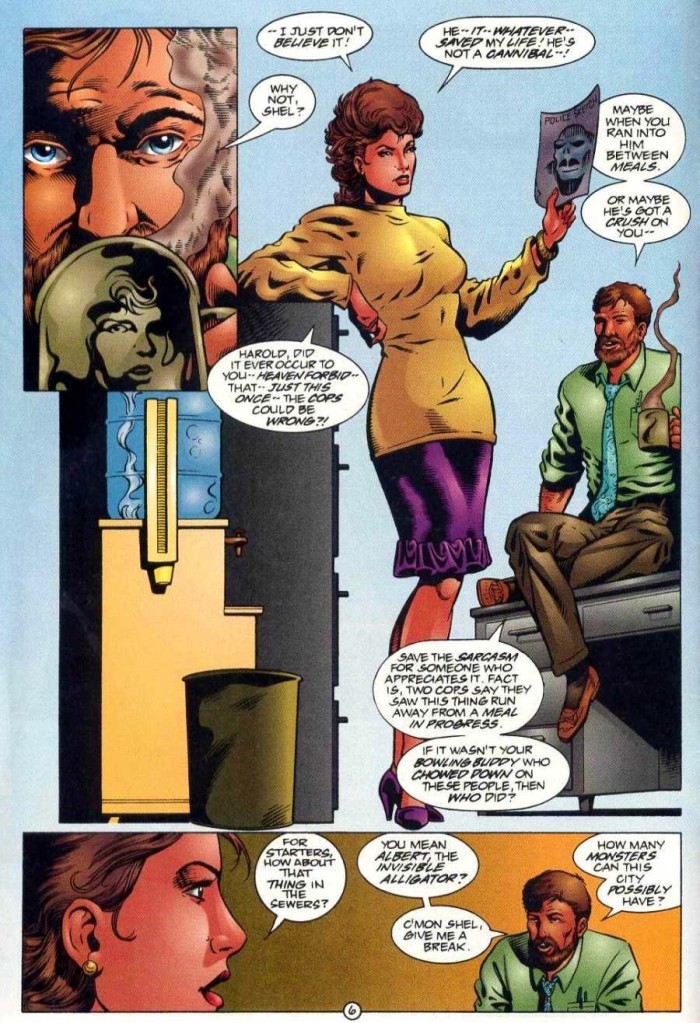
In reaction, Sludge quickly grabs one part of the police car and turns it upside down to buy himself time to get back into the sewer. The details of the encounter between the police and Sludge made it to Shelley, the same New York Daily Globe news reporter who encountered him and the intelligent alligator Veffir Voon Iyax. She discusses the newest information with her skeptical boss…

Quality

Obvious parallel to Mary Shelley’s Frankenstein here.

Let me start first with what is obvious with regards to the plot and presentation. Similar to what happened in Sludge #2, there is noticeably less spotlight on Sludge as creative space had to be used to develop the new monster, emphasize its background story (with an additional new character who has significance) and there were even scenes focused on Shelley and what goes on inside the office of her newspaper which became aware of the events that took place.

The next thing I want to point out is the creative inspiration used in this particular story. This comic book has really clear parallels to the literary classic Frankenstein: or, The Modern Prometheus and there was even a mention of its author Mary Shelley. That being said, there is a scientist-and-walking-abomination aspect with regards to the mentioned additional significant character connected with the new monster. That is not to say that this comic book copied Victor Frankenstein and his nameless monster, rather Aaron Lopresti took inspiration from them, mixed things up and implemented them in telling this new tale of Sludge. When it comes to keeping things fresh in telling another Sludge story, I can say that Lopresti succeeded.

More on the story itself, this one has a clever mix with regards to the dimensions used. In here, Sludge is more determined on helping people who shouted for help while Shelley won’t give up on finding out the truth about the tragic events in their city. Without spoiling the details, I can say that there is this deep dramatization about the monster and the new character responsible for its return from the dead.

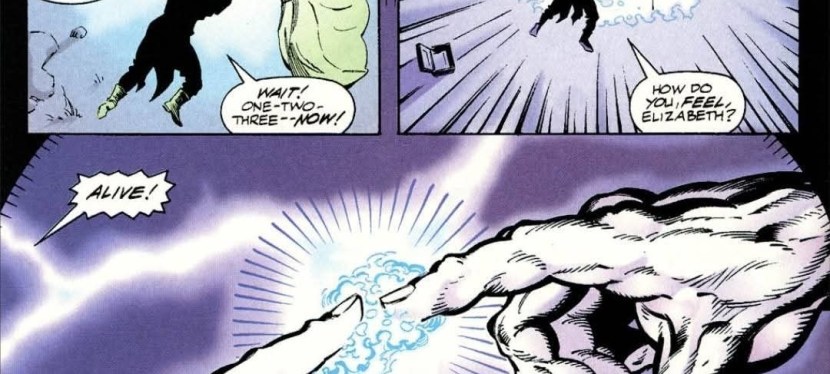
As for the quality of the writing, Aaron Lopresti’s work here is not only expressive but also impressive. There is this one page near the end that has these few yet powerful words that strongly connect with the images of Sludge and the monster (who is so creepily drawn!).  

Conclusion

This is the 2nd straight Sludge comic book that has reporter Shelley and her newspaper focused on what has been happening. At this point, Shelley had encountered Sludge.

Sludge (1994) in my view is another inspired and intriguing Ultraverse tale to read! While issue had parallels to the 1980 film Alligator, this comic book took inspiration from Mary Shelley’s most famous work of fiction which added elements about resurrection, man’s abuse of science, and the consequences of dealing with the unnatural into Sludge’s side of the Ultraverse. I should state that this comic book also has the scariest looking monster Aaron Lopresti drew for the Ultraverse at the time of publication.

If you are seriously planning to buy an existing hard copy of Sludge (1994) be aware that as of this writing, MileHighComics.com shows that the near-mint copy of the regular edition costs $16 while the near-mint copy of the newsstand edition costs $48.

Overall, Sludge (1994) is highly recommended.

+++++

Thank you for reading. If you find this article engaging, please click the like button below and also please consider sharing this article to others. If you are looking for a copywriter to create content for your special project or business, check out my services and my portfolio. Feel free to contact me with a private message. Also please feel free to visit my Facebook page Author Carlo Carrasco and follow me on Twitter at  @HavenorFantasy as well as on Tumblr at https://carlocarrasco.tumblr.com/