A Look Back At Batman vs. The Incredible Hulk

Disclaimer: This is my original work with details sourced from reading the comic book and doing personal research. Anyone who wants to use this article, in part or in whole, needs to secure first my permission and agree to cite me as the source and author. Let it be known that any unauthorized use of this article will constrain the author to pursue the remedies under R.A. No. 8293, the Revised Penal Code, and/or all applicable legal actions under the laws of the Philippines.

I love reading a crossover comic book that was made by very talented creators to be a whole lot of fun from start to finish. Back in the early 1980s, rivals Marvel Comics and DC Comics collaborated temporarily with inter-company crossover comic books that were made to be entertaining to fans of their respective properties.

What I’m going to review here is the 3rd superhero crossover comic book between Marvel and DC titled Batman vs. The Incredible Hulk.

Cover
The cover.

Background

Before I start, let me clarify that this particular comic book was specifically published as issue number 27 of the DC Special Series which was a series of one-shot comic books. By comparison, the 1981 crossover comic book Superman and Spider-Man (which I reviewed previously) was published under the Marvel Treasury Edition line of Marvel Comics as issue number 28.

Going back to Batman vs. The Incredible Hulk, the comic book was the final issue of the DC Special Series line and it carried a cover price of $2.50 which was quite high for its time.

The people at DC Comics made sure that the crossover was handled by the best talents they had back then. The late Len Wein (best know for creating Wolverine) was assigned to write the script (and ensure that elements from both the Hulk and Batman would mix nicely) while José Luis García-López was hired to illustrate. Dick Giordano was the embellisher and editor while Allen Milgrom and then Marvel editor-in-chief Jim Shooter were the consulting editors. In return for their assistance, Marv Wolfman and Mike DeCarlo were acknowledged with thanks.

Now we can begin with this retro review of Batman vs. The Incredible Hulk.

The early story

The story begins when a few persons in Gotham City witness their dreams turning real beyond logic. A man dreamed he was in the arctic hunting and wakes up to discover his room was filled with snow. In a cinema where a horror movie was shown, a couple kissing each other discover, to their shock, that monsters of different sizes surrounded them out of thin air.

At the waterfront of the city, the Joker (accompanied by his gang members) talks to an unseen being (Shaper of Worlds). He gives his assurance to the being that he and his gang will acquire a specific item (needed by the being). For the Joker, what was discussed was a simple business arrangement.

A short time later inside a high-tech facility of Wayne Research, Bruce Banner (the Hulk) secretly works under the false identity as David Banks. He works along with the scientists but not on the scientific projects. Rather, he works odd tasks such as lifting hardware and putting them into places that need them. Of course, Banner did not get hired for a salary but for something much essential to him and his condition with Gamma Rays.

“I had to get a job here somehow so I could get close to the experimental Gamma-gun they’re working on,” he thought to himself.

Suddenly the facility gets filled with laughing gas incapacitating all the people inside. Banner fortunately manages to wear a radiation suit for protection. Moments later, the Joker and his gang enter searching for the Gamma-gun. From this point on, Banner decides to act.

Quality

When it comes to the selection of characters from Marvel and DC, having the mismatch of Batman and the Hulk was a very splendid idea. Not only was having the large green brute and the world’s greatest detective together as temporary rivals a fascinating concept, having them work together as a duo turned out to be a really great move. When it comes to the selected villains of the Joker and the Shaper of Worlds as the anti-hero figures of the story, the two looked like an odd pair but if you focus on the details of the story, you will realize that it made a lot of sense having them two together. The Shaper needs something which requires him to depend on the Joker who in turn brings his gang with him to cause chaos to acquire what the alien needs

All of the above details would not have worked had it not been for the excellent writing by Len Wein. Clearly Wein knew a whole lot about the defining elements of the Hulk and Batman (and the same with the Joker and Shaper), and he carefully blended those elements together to make a story that is thrilling, intriguing, engaging and at the same time still made sense. More on crossing over, there are other characters connected to Batman and the Hulk that made appearances and a few of them fit in nicely into the story.

As this was released in 1981, it was typical of the time for writers to use thought balloons to help readers understand what the characters were thinking. The use of thought balloons in this comic book truly defined Batman who not only had to fight the bad guys but also manage his way with the Hulk and do a lot of detective work.

Going back to the Hulk and Batman, this comic book has a lot of fun stuff. More than once did the two superheroes engage in action-packed encounters and their exchange of words was very nicely done. Their match-up (or mismatch) really works.

Prev1
A perfectly crafted action scene between the Hulk and Batman, complete with accurate depictions of each character! 

When it comes to the common complaint by some readers out there that the comic book was more of a Batman story and made the Hulk less prominent, I should say that the slight imbalance is not a problem at all. In fact, for me it makes perfect sense that Batman has more spotlight than the Hulk. Why? Because Batman is a detective and he performed a lot of researching, information gathering and other moves to solve problems. His detective work in the story made perfect sense for the narrative. As for the Hulk, his character really has very limited options other than causing destruction and disturbing the public. Since early on, the Hulk was best known for attracting the attention of the American military (led by General Ross) and huge destruction defined the encounters. For this crossover, the creators did not show the Hulk engaging with the military (save for the phonies) but rather he struggled to figure things out whenever he encountered Batman or the Joker. There is no way the Hulk could do detective work like Batman and having him fight the military would have weakened this comic book’s presentation. Clearly, having the story slightly slanted towards Batman is still the right move.

Prev2
Very highly imaginative and dynamic artwork by José Luis García-López.

The artwork done by José Luis García-López is excellent! He really captured the looks and details of each and every character Marvel and DC that appeared in this comic book. Back in the early 1980s, I got to read several comic books that showed Batman, the Hulk, the Joker and others and the way they appeared in this comic book was indeed accurate of the time. José Luis García-López also knew how to balance spectacle with character development and expository dialogue in terms of visual pacing and framing shots. Also his work becomes even more imaginative during the final conflict. Undoubtedly this is still a great looking comic book!

Conclusion

Overall, Batman vs. The Incredible Hulk is a great comic book and easily it is one of the greatest intercompany superhero crossover comic books ever published! From start to finish, this comic book proved to be highly engaging and there never was a single boring moment. The creators led by Len Wein (he is sorely missed) made the best possible story anyone can make involving Batman and the Hulk.

You can read a hard copy of this comic book by getting Volume 1 of Crossover Classics or, if you can afford to, hunt for a copy of this in its DC Special Series form which now sells for $280 for a very fine copy to as much as $400 for a near mint copy as of this writing according to MileHighComics.com

In ending this, I declare that Batman vs. The Incredible Hulk is highly recommended!


Thank you for reading. If you find this article engaging, please click the like button below and also please consider sharing this article to others. Also my fantasy book The World of Havenor is still available in paperback and e-book format. If you are looking for a copywriter to create content for your special project or business, check out my services and my portfolio. Feel free to contact me as well. Also please feel free to visit my Facebook page Author Carlo Carrasco and follow me at HavenorFantasy@twitter.com
 

A Look Back At Superman and Spider-Man

Disclaimer: This is my original work with details sourced from reading the comic book and doing personal research. Anyone who wants to use this article, in part or in whole, needs to secure first my permission and agree to cite me as the source and author. Let it be known that any unauthorized use of this article will constrain the author to pursue the remedies under R.A. No. 8293, the Revised Penal Code, and/or all applicable legal actions under the laws of the Philippines.

I miss the old times when big rivals Marvel and DC Comics would set aside competition temporarily to team up and rely on their respective comic creators to make superhero crossover comic books that the fans can enjoy.

Back in the 1970s, key developments related to the comic book adaptation of The Wizard of Oz brought the two rivals together as partners. In 1976, Marvel and DC’s first superhero crossover Superman vs. The Amazing Spider-Man got published and to this day many comic book collectors and geeks I encountered still enjoy it. A few of them even called it a classic.

The collaboration between Marvel and DC continued in 1981 with Superman and Spider-Man which was published as issue number 28 of the Marvel Treasury Edition series.

1
The cover.

This is my look back at Superman and Spider-Man.

The comic book

Scripted by then Marvel Comic editor-in-chief Jim Shooter (with Marv Wolfman mentioned for plot suggestions) with art drawn by John Buscema and inkwork done by Terry Austin, Al Milgrom, Steva Leialoha, Walt Simonson, Bob Layton, Joe Rubinstein and Bob Wiacek, the comic book begins when Spider-Man swings into a construction site where he encounters several armed men and stops them singlehandedly.

Even though he stopped the bad guys, Spider-Man’s spider sense bothers him making him speculate that, because there’s no clear danger around him, the construction site seemed to be a threat.

After Spider-Man swings away from the police who just arrived, classic Marvel supervillain Doctor Doom watches via surveillance video and he was bother by the way things turned out.

“I did not like the way Spider-Man paused and look around after subduing the thieves – – as if he sensed something unusual about the excavation! Those accursed spider instincts of his,” Doom said before proceeding with his master plan.

A day later, the Hulk arrives in Metropolis causing lots of damage. Separately Superman and Spider-Man arrive to contain the green guy. However, things are not what they seem. This is where the story description ends.

Quality

What this comic book lacked compared to the 1976 Superman-Spider-Man crossover is visual impact. Clearly John Buscema had to follow closely the script which called for multiple panels per page and that left him little room to draw scenes dynamically. That’s not to see the art is weak. In fact, Buscema’s art is pretty good and he has deep knowledge about how the characters (including those many supporting characters and other minor characters from both Marvel and DC Comics) really looked from the size of Hulk’s body, the details on Wonder Woman’s costume, the distinctive look of J. Jonah Jameson, Perry White, etc. In short, I recognized the characters very easily.

15
This remains fun to read.
24
Peter Parker in Metropolis along with the Superman supporting characters. This is one great element that made this comic book worth reading.

While the high number of panels per page limited him, Buscema managed to come up with some action shots that packed some impact.

When it comes to writing and storytelling, this comic book exceeds that of the 1976 Superman-Spider-Man crossover big time! To start with, the plot is much more elaborate, more detailed and yet consistently remained easy to follow.

While the 1976 crossover had the most popular villains of Superman and Spider-Man as the representation of evil, this one instead had Dr. Doom and Parasite. The great news is that these two super villains complement each other nicely and that itself adds good depth into the plot. Dr. Doom is a major schemer and Parasite fitted nicely within his master plan for global chaos.

Regarding dialogue, the script had a lot of strength and was also specific in capturing the personalities of the superheroes, the super villains and the supporting cast. I can easily identify J. Jonah Jameson, Perry White, Lois Lane and others through the dialogue.

Not to be outdone is the deeper approach to the crossover aspect of the story. Right from the start, the comic book creators expected us readers to suspend disbelief and start believing that while the story is non-canon, the respective universes of Marvel and DC Comics co-existed. Because there were TV shows of Wonder Woman and the Hulk playing, the two characters were included in the comic book adding depth to the crossover.

Speaking of crossovers, this comic book was not limited to Superman and Spider-Man. The encounter between the Hulk and Superman was a short but sweet spectacle to read. The encounter between Wonder Woman and Spider-Man meanwhile was short yet fun.

Adding more to the fun in this comic book was how Clark Kent interacted with the Spider-Man supporting characters while Peter Parker interacted with the Superman supporting characters. I enjoyed every moment of these scenes.

As far as narrative is concerned, this comic book is slightly slanted towards Superman. One factor behind this was the implementation of how local authorities interact with Superman and Spider-Man. Whenever he solves crime, Superman is highly respected by the public and the police. This is not the case with Spider-Man who is often perceived to be a social menace even though he helps solve crimes. Another factor was that Superman did more detective-type work (including a visit to Latveria) while Spidey hardly contributed anything to the plot’s development.

38
Nothing can be more frustrating than getting attacked by police officers when you try to help them solve their problems.

Regardless, the two icons got a fair share of the spotlight during the final stages of the story and there was enough spectacle to enjoy.

If there is any complaint I have, it would be the comic book creators’ reluctance on fully connecting itself to the 1976 crossover. In the scene wherein Peter Parker was guided into the film editing room by Jimmy Olsen, he recognized Lois Lane and remembered meeting her in the 1976 crossover (which ended with socializing). And yet when Spider-Man and Superman get together in this comic book, there was a noticeable lack of friendliness and personal cooperation between them even though they bonded nicely in the 1976 story.

Conclusion

Overall, Superman and Spider-Man is indeed a highly engaging, fun-filled superhero crossover comic book. For me, it is a true literary classic and definitely worth searching for out there. I read this crossover many times from start to finish and even though I knew the plot and the dialogue, I still had a lot of fun reading along the way. With the combined talents of Shooter, Buscema and many others, this superhero crossover was indeed one of the very best stories ever told by Marvel and DC Comics.

Given the current corporate climate Marvel and DC Comics are now in, it is very unlikely we will see another creatively fun superhero crossover collaboration between them happening soon. For the newcomers reading this, Marvel is owned by the Walt Disney Company while DC Comics is owned by Warner Bros.

Whether you search for the original comic book or its inclusion in a volume of The Marvel/DC Collection: Crossover Classics Volume 1, Superman and Spider-Man is highly recommended!


Thank you for reading. If you find this article engaging, please click the like button below and also please consider sharing this article to others. Also my fantasy book The World of Havenor is still available in paperback and e-book format. If you are looking for a copywriter to create content for your special project or business, check out my services and my portfolio. Feel free to contact me as well. Also please feel free to visit my Facebook page Author Carlo Carrasco and follow me at HavenorFantasy@twitter.com
 

A Look Back At The Strangers #1

Disclaimer: This is my original work with details sourced from reading the comic book and doing personal research. Anyone who wants to use this article, in part or in whole, needs to secure first my permission and agree to cite me as the source and author. Let it be known that any unauthorized use of this article will constrain the author to pursue the remedies under R.A. No. 8293, the Revised Penal Code, and/or all applicable legal actions under the laws of the Philippines.

When it comes to the Ultraverse, there is often something enjoyable to read. I enjoy reading about superhero teams, specifically X-Men from Marvel Comics and Justice League from DC Comics to name a few. I also enjoyed Freex and UltraForce from the Ultraverse. What I like about superhero teams is that I get to discover varied characters (the good, the evil and the ones in between), witness how they develop and act when something big or problematic happens.

With The Strangers #1, published by Malibu Comics in 1993 as one of the launch books of the Ultraverse, I experienced another bout of enjoyment and engagement but in a rather unique way.

FB_IMG_1564977426941.jpg
Cover of The Strangers #1 with art by Rick Hoberg.

Written by Steven Englehart with illustration done by Rick Hoberg (whose work was inked by Tom Burgard), the story begins with a shot of life going on in San Francisco. Several characters riding a jammed cable car get distracted when a man and a pretty lady (both seated) do the “wild thang”.

Because of the disturbance, three guys grab the arrogant guy (separating him from the lady) threw him out of the cable car. Immediately after that, the cable car suddenly gets hit by a bolt of energy (perceived as lightning) from the clear sky causing the vehicle to start slipping downwards until it hits a car and its passenger.

FB_IMG_1564977649575.jpg
Bob and Hugh start to notice something strange.

Then a series of things begin to happen. Candy (the lady earlier) acted strangely as the arrogant guy called her attention. Art students Bob and Hugh witnessed the sudden formation of a bag of apples. The kid Leon discovers his new ability to run fast and make sudden turns. Dave witnesses a momentary transformation of himself. Fashion designer Elena gets inspired to create something heroic.

RCO013_1469678179.jpg
Leon’s ultra speed realized while Candy walks pretty.

You must be wondering – how is the quality of this old comic book?

In terms of storytelling and characterization, this is pretty good work done by Steve Englehart. The way I see it, this is a story about strangers (truly living up to the title) who got changed as a result of a single incident that affected them. Each of the members of The Strangers were nicely and efficiently introduced. A creative approach was used to present their respective abilities which made sense as the events unfolded. By the end of the comic book, I really felt very engaged and excited to anticipate the next issue.

When it comes to dialogue, I like this exchange between Bob and Hugh.

“You know what I think?”

“No, what do you think?”

“I think it must have something to do with the lightning that hit us!”

“Nonsense! Lightning does not work like that!”

“You got a better idea?”

As for the visuals, Rick Hoberg’s art (inked by Burgard) combined with the color design by Paul Mounts is still very wonderful to look at. The facial expressions are convincing, the action has impact, the visualization of the super powers is pretty creative and there are lots of small details on the backgrounds (people, city environment, etc.) that are worth examining.

Overall, The Strangers #1 is a fun and engaging old comic book to read. Never mind the financial value it carries right now. Focus more on its story and art, as well as the other details that reflect the talents of its creators. More importantly, the experiences of discovering something fresh and getting to know brand new characters really defined this comic book.

The Strangers #1 is highly recommended.


Thank you for reading. If you find this article engaging, please click the like button below and also please consider sharing this article to others. Also my fantasy book The World of Havenor is still available in paperback and e-book format. If you are looking for a copywriter to create content for your special project or business, check out my services and my portfolio. Feel free to contact me as well. Also please feel free to visit my Facebook page Author Carlo Carrasco and follow me at HavenorFantasy@twitter.com
A Look Back At Ultraverse Premiere #0

What is the one thing I love most about superhero comics of the 1990s? It’s easy – the Ultraverse! Launched in 1993 by Malibu Comics during the late stage of what is now called the Comic Book Speculator Boom in Amerca, the Ultraverse was a line of superhero comic books featuring all-new characters and concepts which were the result of intense brainstorming by the founders of the Ultraverse.

Back in mid-1993 here in the Philippines, I first got to discover the Ultraverse through print ads in comic books and take note that the Internet was not yet publicly accessible. By June that year, I visited a comic book store in BF Homes, Paranaque and was astonished to see the store’s wall with multiple Ultraverse comic books on display. With my limited funds at that time, I only managed to buy Freex #1 and Mantra #1. By the end of the evening, I greatly enjoyed what I read and became an Ultraverse fan ever since.

As the months passed by, I enjoyed reading more Ultraverse comic books. What was also fun to read were the special double-sized UV comic books, the Ultraverse Double Feature comic books (flip comic books) and then there was the Ultraverse Premiere #0 comic book which had a cover of Mantra drawn by the great Jim Lee! This is the one comic book I am taking a look back at.

UVprem1
The front cover drawn by Jim Lee!

So what Ultraverse Premiere #0 and what made it special other than having a cover drawn by Jim Lee? Released in late 1993, the comic book is a showcase of separate stories featuring Prime, The Strangers, Rune, Hardcase, Mantra and Freex. It is also a showcase of the respective talents of a big mix of writers and artists that include Len Strazewski, Tom Mason, Gerard Jones, Steve Englehart, Barry Windsor-Smith, Rick Hoberg, James Hudnall, Mike W. Barr, Norm Breyfogle and others.

Given its release date, the stories served as preludes leading to the stories told in the launch comic books. For example, the Hardcase story shows Tom Hawke/Hardcase with his team called The Squad performing what turned out to be their last mission leading directly to the events that started Hardcase #1.

UVprem3
Tom Hawke/Hardcase with his lovely teammate during his time with The Squad.

The story of Mantra in the comic book however was presented more like a side-story. Lukasz is already shown as Mantra with her mystical powers and revealing outfit in place. The short story adds a nice perspective on the personality of Mantra as well as her burden of having to take care of a daughter.

The Rune segment meanwhile was a look at the making of the character involving Barry Windsor-Smith and his art. In the text written by Chris Ulm, what caught my attention was the following segment.

After writing up the concept in the Ultraverse bible, I shortly added Rune to “Fusion”, the story of a conspiracy to develop the ultimate biological weapon by a covert group called Aladdin.

UVprem4
This opening of the Freex short story starts very strongly.

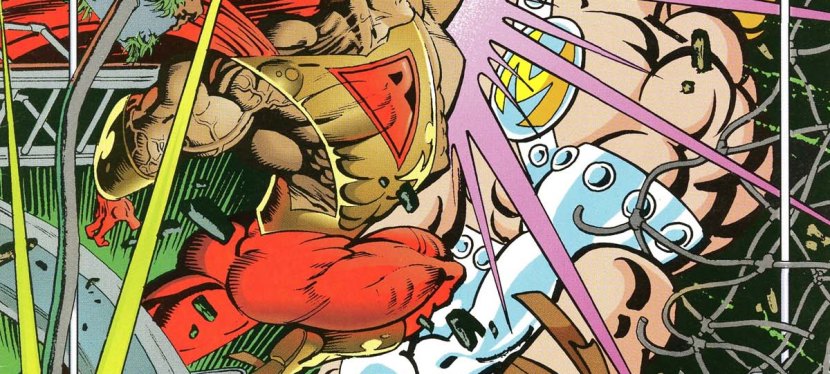
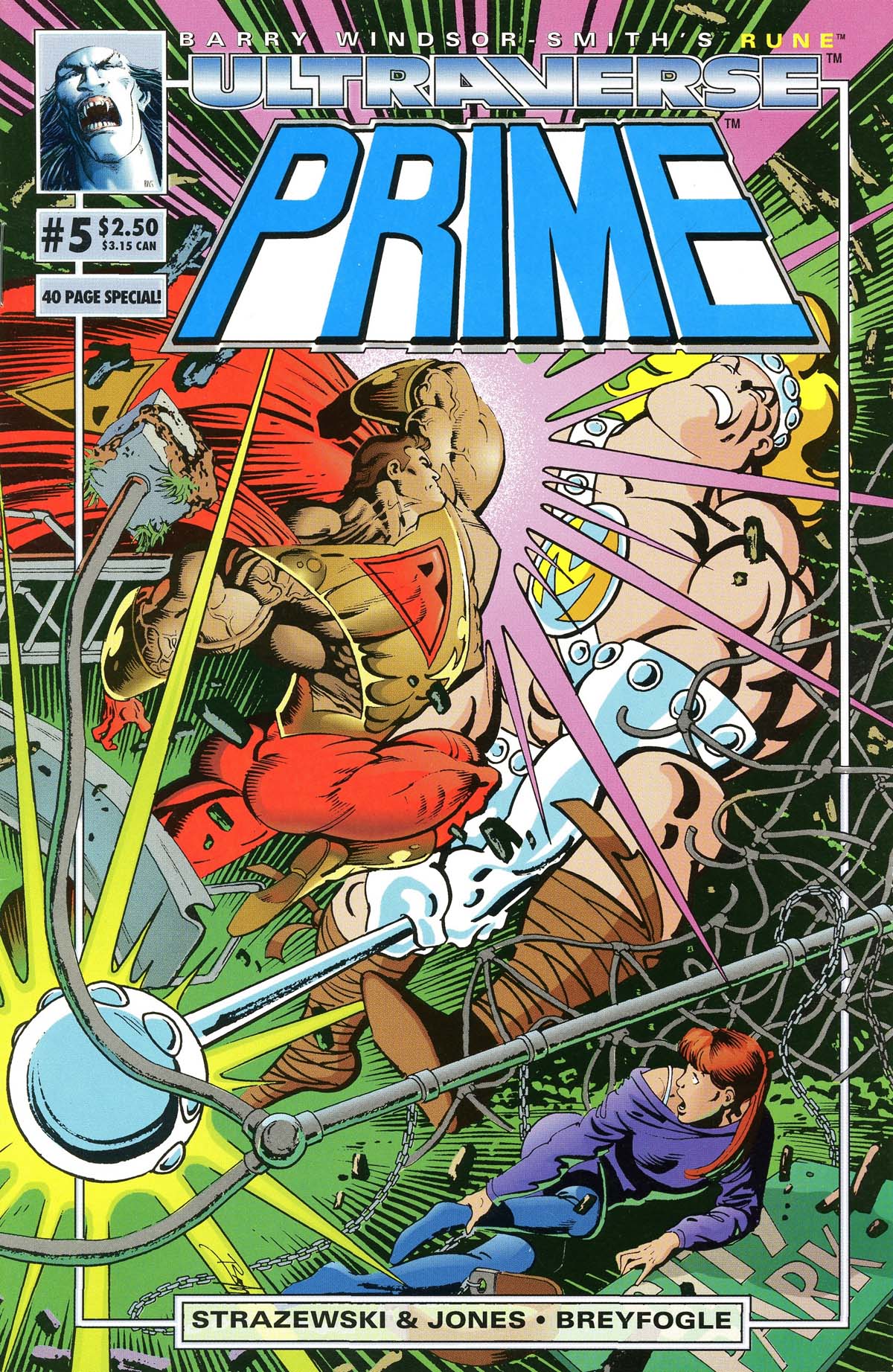
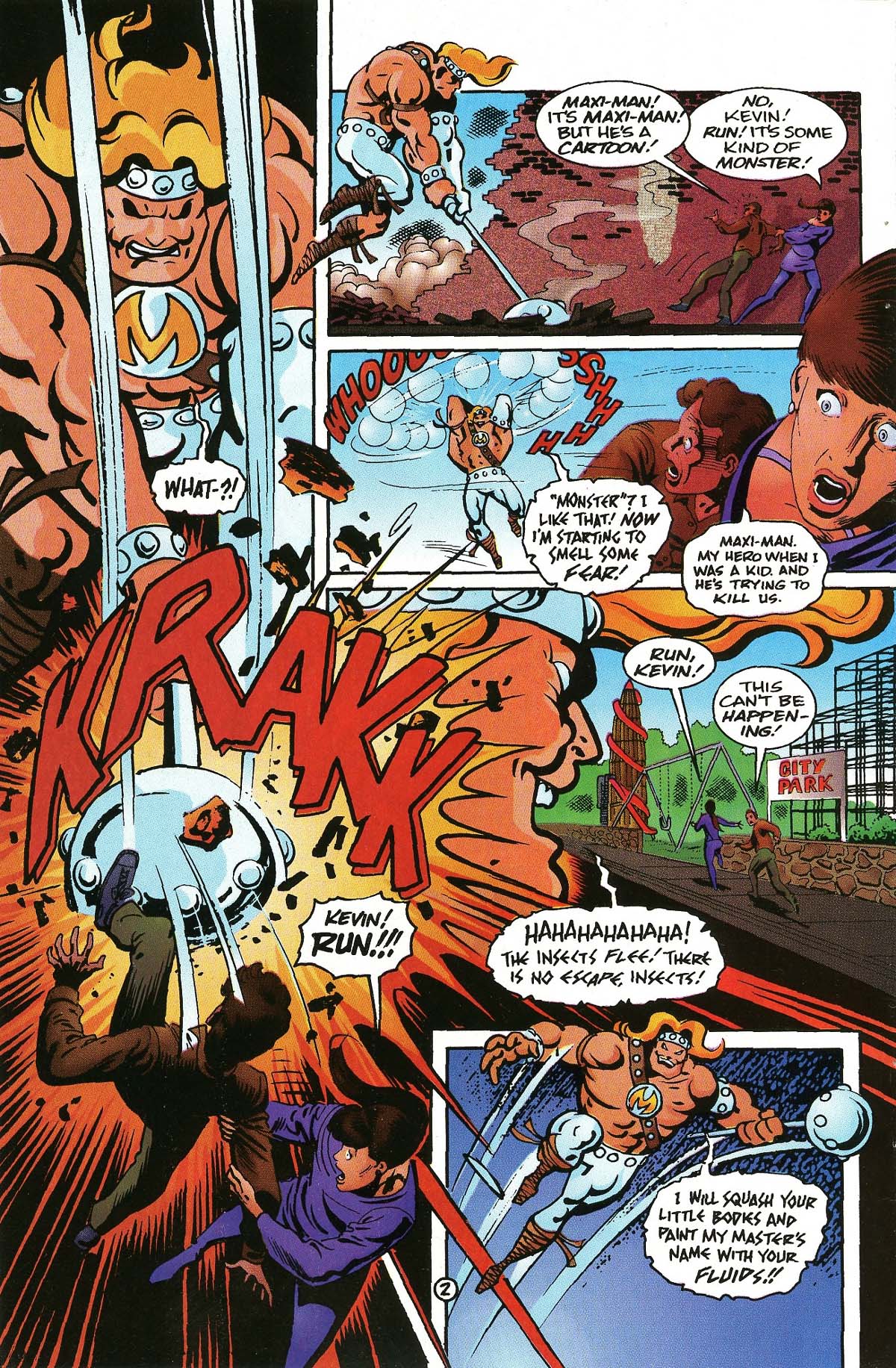
Of course, there is also the fine story of Prime by Len Strazewski and Gerard Jones with great looking art by the late Norm Breyfogle. Remember in the early pages of Prime #1 when the overly muscular superhero claimed he saw the school coach touch the young girls? That got emphasized in the Prime short story in this comic book.

And then there is the one very memorable whole page art of Prime by Breyfogle.

UVprem2
I love this art of Prime by the late Norm Breyfogle.

The stories and art, in my view, were done with a lot of passion by the creators. They make Ultraverse Premiere #0 a worthy comic book to collect even though Marvel (which acquired Malibu Comics in the mid-1990s) screwed the Ultraverse and left the characters and concepts in limbo with no clear sign of any revival coming.

Last but not least, there is this great art of the Ultraverse characters done by Art Nichols at the rear of the comic book.

Ultraverse
The best back cover of any superhero comic book of the 1990s!

Art Nichols’ work on the back cover is fantastic and timeless in my view. It’s great multi-character art that truly captures the spirit of the Ultraverse!

If you are going out to buy old comic books, I strongly recommend Ultraverse Premiere #0.


Thank you for reading. If you find this article engaging, please click the like button below and also please consider sharing this article to others. Also my fantasy book The World of Havenor is still available in paperback and e-book format. If you are looking for a copywriter to create content for your special project or business, check out my services and my portfolio. Feel free to contact me as well. Also please feel free to visit my Facebook page Author Carlo Carrasco and follow me at HavenorFantasy@twitter.com


A Look Back at Solitaire #1 of the Ultraverse

When you fight evil, you do it alone.

solitaire2
Solitaire in action in Solitaire #1 published in 1993 by Malibu Comics under their Ultraverse line of comic books.

The concept of vigilante figures taking the fight against crime alone backed with resources (in the form of weapons) is a long running tradition in superhero comic books. DC Comics has its iconic Batman doing lots of detective work and fighting criminals many times on his own. Similar stories were seen with the Punisher and Daredevil over at Marvel.

When Malibu Comics launched the Ultraverse line of superhero comics in 1993, they added variety into the big mix. They had their own parallel to Marvel’s Punisher and DC’s Batman in the form of Solitaire and they boldly launched a comic book series of the character.

Released in late 1993 with story by Gerard Jones and art by Jeff Johnson and Barb Kaalberg, Solitaire #1 introduced readers to Nicholas Lone who wears a purple-and-blue costume with mask and fights criminals as Solitaire. He’s not just a brave, tough guy who daringly goes against thugs. He’s is very talented with martial arts, acrobatics and weapon use.

The comic book begins when thugs working for a crime lord called the King are about to catch a helpless lady who gets saved by Solitaire. The hero easily outmaneuvers the bad guys and he proved to them that he really is hard to hurt.

At his headquarters, the King made it clear to readers that Solitaire has been a problem to him for some time already and feels bad when the hero disrupts his operation. Solitaire meanwhile prepares himself for the next move against the King by returning to his hideout (an old theater), doing some research by computer and coordinating with his contacts on the streets.

Regarding the quality of the comic book, I say the script is nicely paced as it does a good job introducing Solitaire to readers while still having spare spotlight for the King. Within twenty-five pages, the hero got clearly defined as a man of action as well as a person with a purpose. His fight against crime is defined by key parts of his past especially with the fact that his own father – Antone Lone – is a crime lord.

When it comes to super powers, Solitaire has very quick reflexes which makes him a hard target for armed thugs. He also has healing factor which works rapidly and gives him a major advantage over the bad guys. In fact, the presence of the healing factor (which works like that of Wolverine) makes Solitaire more daring and more willing to take risks engaging the bad guys with violence. He can get stabbed and his body can be shot with several bullets and still he will recover quickly to get the job done.

Solitaire is indeed super and yet there is something intriguing with his personality. Apart from being the son of a crime lord, Nicholas Lone’s acquisition of his powers is a painful mark on him personally. This was because his father gave him those powers as a result of his attempt to commit suicide. The powers are the result of the installation of nano-machines into his body.

solitaire1

Overall, Solitaire #1 is a good and intriguing read. It really comes with a flavor that makes it distinct from other superhero-versus-criminals stories and the introduction of Solitaire alone is worth the cover the price. If you can find copies of Solitaire #1 on the back issue shelves of the comic book stores, I recommend buying it as well as the other issues.

It’s too bad that the Ultraverse ended after Marvel Comics acquired Malibu Comics back in the 1990s because like Prime, Hardcase and Prototype, Solitaire is very unique and intriguing at the same time. In my opinion, Solitaire is the most defining crime fighter of the entire Ultraverse and it’s too bad stories featuring him are not too many.

Thank you for reading. If you enjoyed this article, please click the like button below and also please consider sharing this article to your fellow comic book geeks and Ultraverse fans. Also my fantasy book The World of Havenor is still available in paperback and e-book format for you to order.

Author’s Note: This article was originally published at my old Geeks and Villagers blog. What you read on this website was an updated and expanded version. In other words, this newest version you just read is the most definitive version


A Look Back at Macross: Do You Remember Love?

screenshot_20180930-003122

Do I remember love? Absolutely and love comes in many different forms which I experienced in life. There is love from God and His Son Jesus as referred to in 1 John 4: 9-10 in the Holy Bible (New King James Version or NKJV).

There is also love of the family. Love with friends. Love of doing things or enjoying personal interests. Love on spreading the Good News to others.

And among those personal interests is anime and the main reason I love anime is because of my love for the Super Dimension Fortress Macross TV series of the early 1980s. Called Macross for short, that anime TV series engaged me a lot not only as a geek but also as a person. I also learned about the challenges that come with dealing with war, dealing with an enemy because they’re only different and survival.

So yes, I do remember love!

More on Macross, I am here to share to you all my revisit of what is my all-time favorite anime movie ever – Macross: Do You Remember Love? 

screenshot_20180929-143225257e2

Macross: Do You Remember Love? (full title – Super Dimension Fortress Macross: Do You Remember Love?) was released in Japan on July 1984 where it was greeted by very long lines of fans. The movie was made with the fans in mind and many of the same creators and talents behind the famous Macross TV series (1982-1983) returned to bring back to life all the characters, all the robots and mechs, all music and many other elements that made the series lovable in the first place.

Running less than two hours, Macross: DYRL is a big budget retelling of the first twenty-seven episodes of the TV series albeit with some new concepts and adjustments made to add depth to the movie. As it is impossible to condense everything from the said 27 episodes into a single movie, the film took key story elements from the series and came up with a plot that not only featured fresh ideas but also honored the series in creative ways. The good news about this approach is that it worked nicely.

The story begins in space where the Macross SDF-1 was already moving with tens of thousands of people living in a city inside its metallic structure. During a big attack by the Zentradi (giant alien humanoids), some Zentradi soldiers infiltrated the city inside SDF-1 and among people affected is the star singer Lynn Minmay. Coming from nowhere, pilot Hikaru Ichijyo used his Valkyrie to rescue Minmay from a Zentradi soldier as well as from certain death of the free fall that followed. Because he saved Minmay’s life, Hikaru was spared from military punishment for disobeying Lieutenant Misa Hayase during battle.

screenshot_20180926-215816

Because a relationship between Hikaru and Minmay developed, the two dated and even managed to sneak out of the space fortress with a training aircraft to explore the ring of planet Saturn. The two got caught by Lieutenant Hayase (accompanied by Minmay’s relative and manager Lynn Kaifun) but before they could return to the Macross, they got attacked by Zentradi forces nearby. The plot deepens further as soon as they got captured.

As it involved Shoji Kawamori (whom I met during the 2017 AsiaPOP Comicon Manila), Haruhiko Mikimoto, Narumi Kakinouchi, Kentaro Haneda, Sukehiro Tomita, Arihirio Hase, Mika Doi ad Mari Iijima, Macross: DYRL carries so many elements from the TV series that strongly resonated with fans.

Mari Iijima is fantastic in her dramatic portrayal of Minmay and she also proved excellent in her singing of classic Macross songs Sunset Beach, Zero-G Love and Shao Bai Lon. The standout song of all, however, is Do You Remember Love composed by Kazuhiko Kato and Iijima’s performance of it was also excellent.

When it comes to spectacle, Macross: DYRL is a stunner even by today’s standards. The visuals are great to look at. The triple-transformation of fighter planes into robots (Valkyrie, Gerwalk and Battroid) are always delightful to watch. The action is plentiful and at the same time very fast-paced for the eyes to enjoy. Heck, even the character redesigns of the Zentradi alone made this movie have an edgy and somewhat dark feel.

screenshot_20180929-054116

The beauty of it all is the fact that the all the animation is hand-drawn the old-fashioned way! No computer-generated polygons shaded with cels here. Every frame of animation was labored by the animators and the colors used remain lively to look at.

With regards to storytelling, the movie has a solid narrative even though it lacked some background explanations. Of course, there were questions raised like why are the Zentradi and Meltrandi gender-isolated and each have an army? (note: in the TV series the Zentradi is composed of males and females). Why is the origin of the Macross SDF-1 in the movie different from what was portrayed in the anime series? Why is the Supervision Army non-existent?

The good thing about the narrative is the shorter yet engaging portrayal of the Hikaru-Minmay-Misa love triangle. As this is a movie, the triangle’s conflict is minimal and free of the excess baggage of what was portrayed in the TV series. Without spoiling too much, I can say that the development of relationships between Hikaru with Minmay and with Misa is believable. There is no way any viewer can complain that Hikaru is boyish (his trait in the TV series) when deciding whom to love.

screenshot_20180926-215529

As it was made for the fans, newcomers will unsurprisingly have some trouble understanding Macross: DYRL, its concepts and characters. They can enjoy the visuals and spectacle if those are what they are looking for. Still Macross: Do You Remember Love? can serve as an inspiration for newcomers to start digging the past of Macross by watching the 1980s anime TV series (especially the first 27 episodes).

Conclusion

There is no doubt that Macross: Do You Remember Love? remains a truly great anime movie to watch and it is truly a classic in every sense of the word. Being a big budget retelling of the first 27 episodes of the Macross TV series, this movie serves as the fans’ bridge to the past and yet it also moves the entire franchise forward in terms of artistry, expression and quality. There is so much to love in this movie – the characters, the robots, the transformations, the action, the sci-fi concepts and more.

With its undeniable greatness, Macross: Do You Remember Love? is ultimately why I remember my love for anime.

screenshot_20180930-003308

Thank you for reading. If you enjoyed this article, please click the like button below and also please consider sharing this article to your fellow Macross and anime fans.

Author’s Note: This article was originally published at my old Geeks and Villagers blog. What you read on this website was an updated and expanded version. In other words, this newest version you just read is the most definitive version


Thank you for reading. If you find this article engaging, please click the like button below and also please consider sharing this article to others. Also my fantasy book The World of Havenor is still available in paperback and e-book format. If you are looking for a copywriter to create content for your special project or business, check out my services and my portfolio. Feel free to contact me as well. Also please feel free to visit my Facebook page Author Carlo Carrasco and follow me at HavenorFantasy@twitter.com