Disclaimer: This is my original work with details sourced from reading the comic book and doing personal research. Anyone who wants to use this article, in part or in whole, needs to secure first my permission and agree to cite me as the source and author. Let it be known that any unauthorized use of this article will constrain the author to pursue the remedies under R.A. No. 8293, the Revised Penal Code, and/or all applicable legal actions under the laws of the Philippines.
Hey Ultraverse fans and superhero comic book enthusiasts! Are you ready for another tale of Prime? What I am about to review is one of the anniversary Ultraverse issues published by Malibu Comics.
What could be new or special to justify the anniversary of the Prime monthly series? We can all find out in this look back at Prime #12, published by Malibu Comics with a story written by Len Strazweski and Gerard Jones, and drawn by the late Norm Breyfogle.
The cover.
Early story
The story begins with a young guy named Kuttner who tests his deadly ability to easily cut through solid objects with his powered blades on his hands. He is driven to get revenge against Prime who broke his hand previously. Kuttner, whose career in entertainment had declined, thinks he can establish a new career for himself as a powered being and Prime is his first target.
Meanwhile at school, Kevin Green (Prime) is struggling with the stress over his parents’ separation which he is guilty of. He finds it very weird to be back in school after everything he went through such as his struggles with Colonel Samuels, the Federal Government, Break-Thru and more. After slamming his locker shut, students begin to move away from him…
Quality
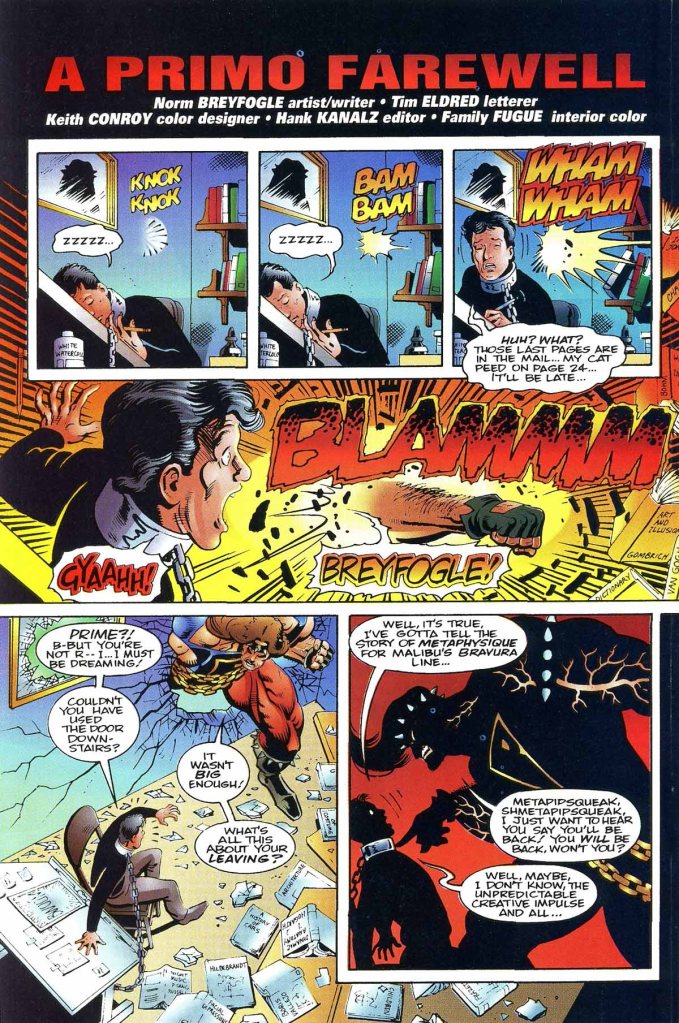
Symbolically, Prime meets Norm Breyfogle.
To begin with, the writing by Len Strazewski and Gerard Jones is very solid as expected. That being said, the real heart of the story in this comic book is Kevin Green’s personal struggle with life not just with the difficulty of balancing himself between his personal life and being a superhero, but also his place in local society being tainted as a result of his acts as Prime. The way that the events of the previous issues affected (in negative ways) the local community’s perception of Kevin was very compelling and straight to the point.
The strong writing, unsurprisingly, worked very well with the character development. Kevin was presented to be struggling with making the right decisions and he struggles to analyze what would happen if he presents himself to others as Prime or as simply himself. As for the scene between Prime and Kelly’s mother, there was that touch of awkwardness (through Prime) that was present as the scene raised the disturbing idea of the two possibly getting involved sexually.
When it comes to the spectacle of action, there is little to be seen here but the good news is that Norm Breyfogle illustrated them to be energetic and eye-catching. The late illustrator really knew hot to ramp up the energy for the readers making the most out of what it is limited.
Conclusion
The tremendous strength of Prime!
Prime #12 is a pretty engaging read. Was it worth the anniversary promotion? It is indeed! If you look back at Prime #1 and read all the succeeding issues leading to this one, you will notice how much Kevin Green changed as well as how his personal growth moved. In a way, Prime #12 symbolizes the growing-up pains Kevin keeps on having.
It should be stated that being 64-pages, Prime #12 is actually one of Malibu’s flip issues. The other side of this comic book is Ultraverse Premiere #3 which contains standalone short stories of Prime, War Strike and a certain villain. This comic book also has “A Primo Farewell” which is a nice tribute (by today’s standards) to Norm Breyfogle. For the newcomers reading this, Breyfogle was one of outstanding comic book artists in America and before joining Malibu Comics, he worked for other publishers like Marvel Comics, DC Comics, Eclipse Comics and First Comics. At DC Comics, his work on their icon Batman is widely remembered. Breyfogle passed away in 2018.
If you are seriously planning to buy an existing hard copy of Prime #12 (1994), be aware that as of this writing, MileHighComics.com shows that the near-mint copy of the comic book costs $8.
Overall, Prime #12 (1994) is highly recommended!
+++++
Thank you for reading. If you find this article engaging, please click the like button below and also please consider sharing this article to others. If you are looking for a copywriter to create content for your special project or business, check out my services and my portfolio. Feel free to contact me as well. Also please feel free to visit my Facebook page Author Carlo Carrasco and follow me at HavenorFantasy@twitter.com
Today, I saw Zalker 87’s YouTube video focused on the fact that Team Xbox hired several game developers from Sony to beef up the growing roster of very experienced game makers in The Initiative, the one Xbox Games Studios team that Microsoft established in 2018 to create great, big-budget games for the Xbox ecosystem. To say the least, the future for Xbox fans and gamers in general is looking very promising, and the fun will start with the launch of Xbox Series S and Xbox Series X on November 10, 2020. Watch the video below…
A lot really has been going on at the side of Team Xbox. Apart from the many developments that resulted from the Xbox-Bethesda deal, Microsoft continues to pour in more funds into the many game projects under production from the many game studios under the Xbox Game Studios umbrella, and hire more people to work on their projects. Clearly Obsidian Entertainment, Ninja Theory, inXile, The Coalition, 343 Industries, Playground Games, Turn 10 and other 1st party studios of Team Xbox are all busy making their respective games right now!
To put things in perspective, Sony and its first-party PlayStation teams have a solid track record of producing high-quality, fun-loaded, story driven 3rd person action-adventure games which went on to receive huge acclaim from the game critics and sold a lot. Such games are what are sorely lacking on the side of Team Xbox and it only made sense for Microsoft to use its massive resources to hire the great game makers from Sony’s 1st party studios and put them in The Initiative.
The logo of the all-star team The Initiative.
More on The Initiative, the studio recently hired more talents from Sony’s acclaimed studio Naughty Dog: Lee Davis who worked previously as the head of melee animation and Lauren Garcia who was the character shading technical director. Under The Initiative, Davis is the lead gameplay animator while Garcia is the senior shading technologies executive. The two former Naughty Dog experts were involved in the production of Sony’s The Last of Us: Part 2. In a Twitter post, Garcia expressed happiness about joining The Initiative calling it an incredible team. He thanked Xbox chief Phil Spencer as well.
Before hiring the two former Naughty Dog experts, Microsoft also hired Christian Cantamessa whose best known work was writing (as lead writer) Red Dead Redemption for Rockstar Games, Brian Westergaard (the lead producer on God of War), Remi Lacoste (director of Marvel’s Avengers and Shadow of The Tomb Raider), Christine Thompson (the lead writer for Destiny 2) plus many others which The Initiative studio head Darrell Gallagher confirmed.
As you can see, The Initiative is literally an all-star team of very experienced and high achieving game makers who were previously involved in blockbuster games as well as other ambitious projects. Their first project still has not been revealed so far, although it has been alleged that it could be related to the Perfect Dark franchise which Microsoft owns. Whatever story concept it will have, whatever game design it will come with (note: I personally expect a 3rd person action-adventure in design with a cinematic feel and highly advanced animation for immersion) and whatever new characters it will introduce, you can bet that The Initiative’s expected first game will catch a lot of attention once Team Xbox makes the official unveiling of it. When and where? We don’t know and only Phil Spencer knows.
Ultimately, The Initiative is contributing to Xbox Game Studio’s upcoming wave of high-quality, 1st party video games that will be released for each of the next five years through the Xbox ecosystem (targeting users of Xbox Series S, Xbox Series X, Windows 10 PC and mobile phones supported by Project xCloud). In other words, Sony and its PlayStation division have serious competition coming.
In ending this, posted below are assorted gaming-related videos for your learning and excitement for the next-generation! Do not forget that Xbox Series S and Xbox Series X will launch on November 10, 2020!
+++++
Thank you for reading. If you find this article engaging, please click the like button below and also please consider sharing this article to others. If you are looking for a copywriter to create content for your special project or business, check out my services and my portfolio. Feel free to contact me as well. Also please feel free to visit my Facebook page Author Carlo Carrasco and follow me at HavenorFantasy@twitter.com
Disclaimer: This is my original work with details sourced from reading the comic book and doing personal research. Anyone who wants to use this article, in part or in whole, needs to secure first my permission and agree to cite me as the source and author. Let it be known that any unauthorized use of this article will constrain the author to pursue the remedies under R.A. No. 8293, the Revised Penal Code, and/or all applicable legal actions under the laws of the Philippines.
Do you happen to have any comic books of the Batman versus Predator II crossover in your collection? According to MileHighComics.com, their near-mint copies are valuable and you can sell them to make some much-needed money in this time of pandemic, government overreach and economic hardship.
Right now, I am about to finally end my review of the Batman versus Predator II mini-series and so far, I have enjoyed it a lot. To find out if this mini-series will come to a satisfying end, here is my retro review of Batman versus Predator II #4, published in 1995 by DC Comics and Dark Horse Comics with a story written by Doug Moench and drawn by Paul Gulacy.
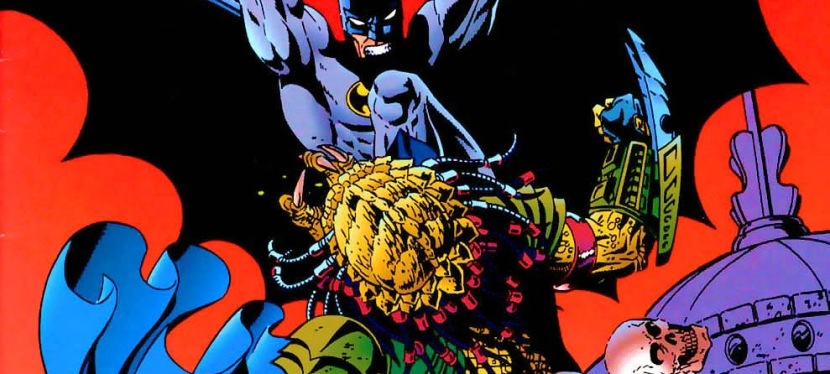
The cover.
Early story
The story begins in the bat cave with Batman and Alfred discussing what happened lately. As it turned out, there were two other Predators on the lose apparently sent to stop the first one (who killed one of the mentioned two). Batman also mentioned the deaths of Song Sung and Terraro. Now there are two hunters remaining who may not know that the man who issued their contracts is dead.
Just before leaving with the motorcycle, Batman receives a call from Commissioner Gordon through the special line. Afterwards, he leaves.
In the city, a thug on a motorcycle starts chasing Batman which catches the attention of the local police…
Quality
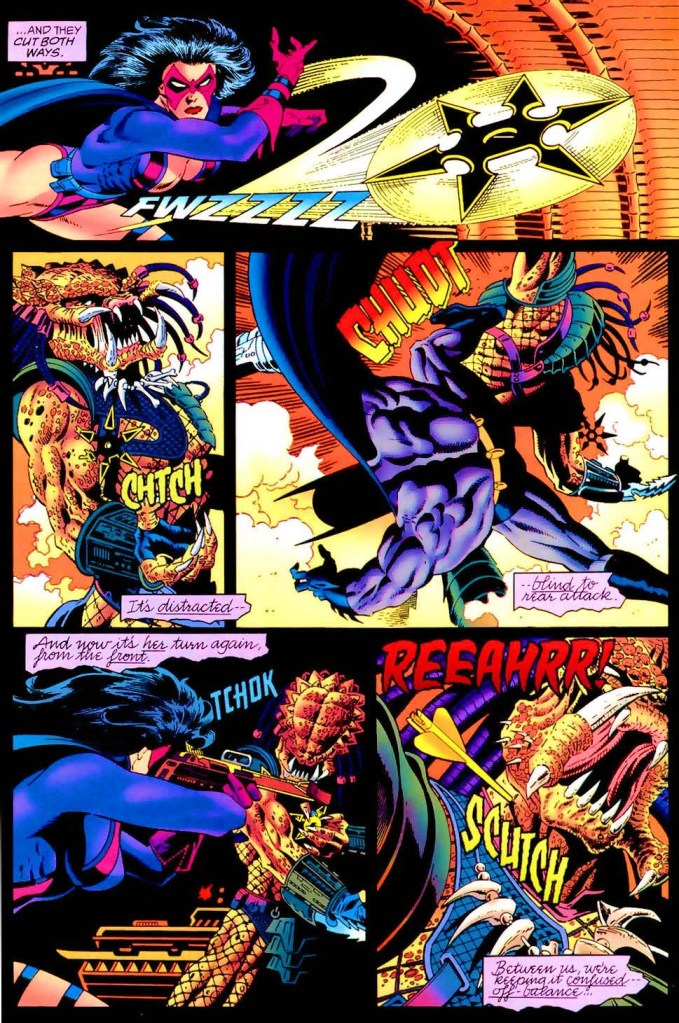
From the final encounter with the hunter from space.
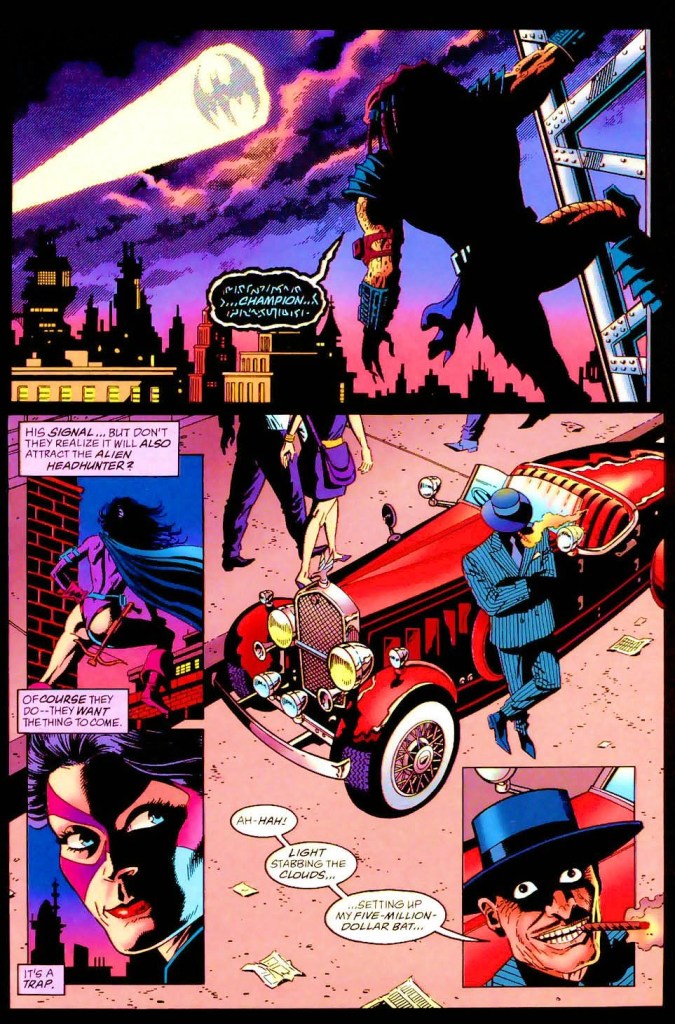
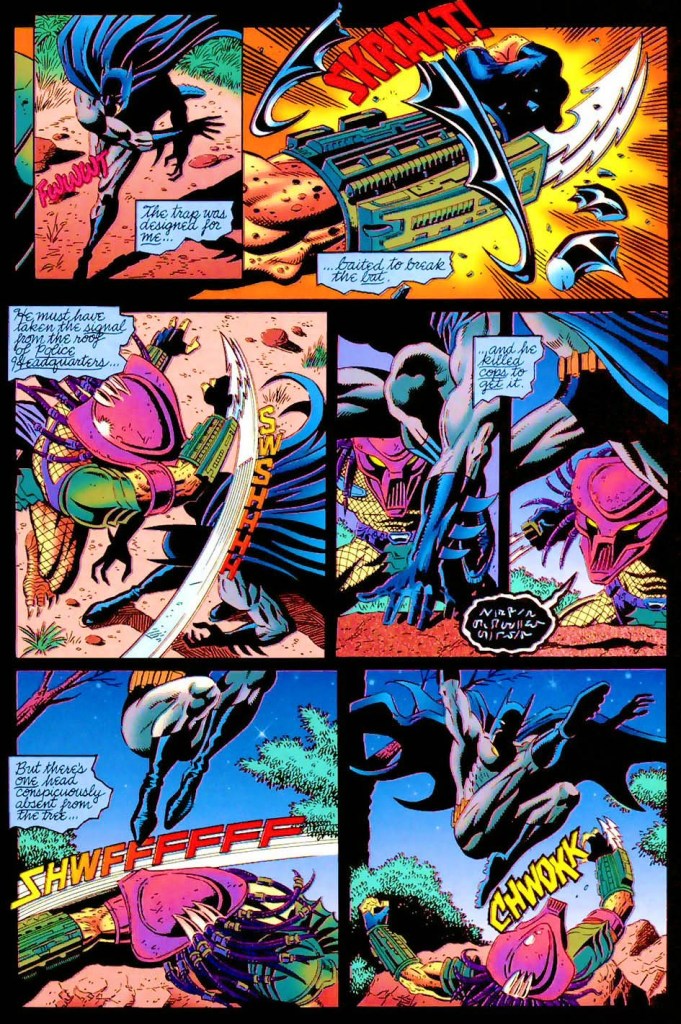
This comic book is a satisfying conclusion to the mini-series. In terms of writing, issue #4 delivered the payoff for what was built-up in issue #3. This results the return of Batman’s trusted ally as well as some more involvement of the police force as the stakes were raised in issue #3 with the involvement of more than one Predator. The hunter Predator – the one Batman and Huntress encountered in the first two issues – was indeed present and it was very interesting to see it pursue its encounter with the two heroes even though he was being hunted by a fellow Predator.
Having more than one Predator was initially confusing but the confusion did not last too long which readers will find relieving. As expected, the Huntress joined Batman in the final encounter and served nicely as a fighting partner whose assistance proved to be valuable. If there is any weak spot in the presentation, it’s the element of the gang and human hunters who only served to add to the death toll.
As with the first three issues of this mini-series, the action here remains very intense and quite uncompromising with its violence. Expect gunshot wounds and decapitations here and there. The hard action presented, especially in the encounters with the Predator, was indeed satisfying. I should state that the final encounter inside the space ship is very thrilling.
Conclusion
The Bat signal is an attraction to the Predator.
Batman versus Predator II #4 (1995) is a pretty solid read. What was built-up previously, got paid off nicely here. With regards to raising the stakes and making this mini-series different from its predecessor, the creative team succeeded with the resolutions they came up with. In addition, Batman and the Huntress make a solid duo and their interactions together were compelling.
If you are seriously planning to buy an existing hard copy of Batman versus Predator II #4 (1995) be aware that as of this writing, MileHighComics.com shows that the near-mint copy of the comic book costs $50.
Overall, Batman versus Predator II #4 (1995) is highly recommended!
+++++
Thank you for reading. If you find this article engaging, please click the like button below and also please consider sharing this article to others. If you are looking for a copywriter to create content for your special project or business, check out my services and my portfolio. Feel free to contact me as well. Also please feel free to visit my Facebook page Author Carlo Carrasco and follow me at HavenorFantasy@twitter.com
Hey Xbox fans and gamers! Have you been following the recent updates leading to the inevitable launch of the Xbox Series S and Xbox Series X? Let’s start first with these two videos from Colteastwood! Watch, learn and enjoy these because the heavy hitters (hot exclusive games) for the Xbox ecosystem are coming out after the launch of the two Xbox Series consoles!
The launch games lineup for November 10, 2020, which includes cross-generation games that will be optimized for the new consoles, don’t look that red hot but rest assured, the excitement will only begin that day and will only get even better starting 2021. Speaking of 2021 games, check out my article about the Xbox-exclusive The Gunk.
What are the launch games for Xbox Series S and Xbox Series X? Here’s the list:
Assassin’s Creed Valhalla (Smart Delivery)
Borderlands 3 (Smart Delivery)
Bright Memory 1.0
Cuisine Royale (Smart Delivery)
Dead by Daylight (Xbox Game Pass + Smart Delivery)
Devil May Cry 5: Special Edition
DIRT 5 (Smart Delivery)
Enlisted
Evergate
The Falconeer (Smart Delivery)
Fortnite
Forza Horizon 4 (Xbox Game Pass + Smart Delivery)
Gears 5 (Xbox Game Pass + Smart Delivery)
Gears Tactics (Xbox Game Pass + Smart Delivery)
Grounded (Xbox Game Pass + Smart Delivery)
King Oddball (Smart Delivery)
Maneater (Smart Delivery)
Manifold Garden (Smart Delivery)
NBA 2K21
Observer: System Redux
Ori and the Will of the Wisps (Xbox Game Pass + Smart Delivery)
Planet Coaster (Smart Delivery)
Sea of Thieves (Xbox Game Pass + Smart Delivery)
Tetris Effect: Connected (Xbox Game Pass + Smart Delivery)
The Touryst (Xbox Game Pass + Smart Delivery)
War Thunder (Smart Delivery)
Warhammer: Chaosbane Slayer Edition
Watch Dogs: Legion (Smart Delivery)
WRC 9 FIA World Rally Championship (Smart Delivery)
Yakuza: Like a Dragon (Smart Delivery)
Yes, Your Grace (Smart Delivery)
With a great mix of 1st party exclusive games, new intellectual properties (IPs) and 3rd party games that cover vast genres and types of games, there will always be something new and fun for gamers who use Xbox consoles and Windows 10 PC. Even gamers who have not yet subscribed to Xbox Game Pass (XGP) won’t be left out.
Remember years ago when PlayStation fanboys criticized Xbox for the lack of exclusives and lack of great games? That is all over and the huge amount of games produced by Team Xbox’s 1st party game studios (including the game studios of Bethesda) will be released once completed…and the beauty of it is that the wait for the hot exclusive games won’t take too long. As reported by Colteastwood in the above videos, Xbox fans can expect exclusives like Avowed and The Outer Worlds 2 from Obsidian Entertainment, the next Doom from id Software, Forza Horizon Festivals from Playground Games, and the Perfect Dark-related 3rd-person action-stealth game from The Initiative. These are just a few of the upcoming heavy hitters coming to Xbox and Windows 10 gamers. As Colteastwood confirmed, Xbox Game Studios are currently producing at least forty games.
Going back to the November 10, 2020 launch, the early batch of games for Xbox Series S and Xbox Series X are not satisfying enough, there is backward compatibility on the new consoles that will not only ensure you get to play games from past Xbox console generations, you will get to play them with visual enhancements (example: improved frame rates reaching up to 60FPS) and much reduced loading times.
In an Xbox.com article dated October 13, 2020, Compatibility Program Lead Peggy Lo confirmed their team’s respect for fans’ gaming legacy. She stated: We believe your favorite games and franchises, your progression and achievements, your Xbox One gaming accessories and the friendships and communities you create through gaming should all move with you across generations. We also fundamentally believe that not only should you be able to play all of your games from the past without needing to purchase them again, but they should also look, feel and play better on the next generation of Xbox consoles.
And then there are the hot details Xbox fans can expect regarding backward compatibility on the new consoles. Here’s an excerpt:
Games play best on Xbox Series X and Series S
Backward compatible games run natively on the Xbox Series X and S, running with the full power of the CPU, GPU and SSD. No boost mode, no downclocking, the full power of the consoles for each and every backward compatible game. This means that all titles run at the peak performance that they were originally designed for, with significantly higher performance than their original launch platform, resulting in higher and more steady framerates and rendering at their maximum resolution and visual quality. Backward compatible titles also benefit from significant reductions in load times due to the massive leap in performance from our custom NVME SSD at the heart of the Xbox Velocity Architecture.
Auto HDR for everyone
Modern games often implement high dynamic range (HDR) to improve overall visual quality. HDR allows a game to render a much larger range of brightness values and colors. This gives an extra sense of richness and depth to the image when compared to a standard dynamic range (SDR) image. For example, the light from a flashlight looks much brighter and red flowers look much more vibrant.
However, thousands of Xbox games shipped before HDR was first introduced with Xbox One S, and even for some Xbox One games, developers simply didn’t have the development resources or time to implement HDR. With Xbox Series X and Series S we are introducing a new feature named Auto HDR. Auto HDR automatically adds HDR enhancements to games which only shipped with SDR. Auto HDR enhances the visual quality of an SDR game without changing the original artistic intent of the game. Auto HDR is implemented by the system so developers don’t have to do any work to take advantage of this feature. Also, since Auto HDR is enabled by the console’s hardware, there is absolutely no performance cost to the CPU, GPU or memory and there is no additional latency added ensuring you receive the ultimate gaming experience.
If you want to play your legacy Xbox games with a much higher frame rate for the best experience, such improvements are also confirmed as part of the backward compatibility feature on the new consoles. Check out the details below:
Xbox Series X and Xbox Series S bring next-gen performance to your favorite games. Higher, steadier framerates make games feel smoother, resulting in more immersive gameplay. Many improvements are the result of the custom designed processor that allows compatible games to play and leverage the increased CPU, GPU and memory from the new consoles. In addition however, the backward compatibility team has developed new methods for effectively doubling the framerate on select titles. While not applicable for many titles due to the game’s original physics or animations, these new techniques the team has developed can push game engines to render more quickly for a buttery smooth experience beyond what the original game might have delivered due to the capabilities of the hardware.
To emphasize the above, Team Xbox showed via YouTube the 2015 game Fallout 4 running at a buttery smooth 60FPS on Xbox Series S! Watch below!
With regards to enhanced visuals via backward compatibility on the new consoles, Peggy Lo wrote: On the Xbox One, we were able to provide a curated list of titles that were enhanced for the Xbox One X via the Heutchy method. This allowed titles from Xbox 360 that rendered at 720p and original Xbox games that ran at 360p to play at 4K on Xbox One X, well beyond the capabilities of their original platform. The Heutchy method continues to be used to bring a variety of titles to 1440p on Xbox Series S and 4K on Xbox Series X.
Improved texture filtering is also coming to backward compatible titles on both Xbox Series X and Series S. On Xbox One X, a portion of the catalog benefited from increased anisotropic filtering, improving image quality of games. On Xbox Series X and Xbox Series S, 16x anisotropic filtering has been enabled for nearly all backward compatible titles so you can experience the very best visuals the games have to offer.
With Xbox Series S and Xbox Series X, the future of next-generation gaming is very bright and promising, even more exciting than what Sony is offering with PlayStation 5 (PS5). Supporting the excitement for the Xbox ecosystem is Team Xbox’s very powerful bridge to the past (legacy gaming) with backward compatibility that also enhances the old games when played on the new consoles.
Peggy Lo further wrote: The backward compatibility team has been working hard to make all the games you love and remember available to you on Xbox Series X and Series S. Playing the games will be just as easy and magical as it’s always been. Simply insert your favorite backward compatible Xbox One, Xbox 360 or original Xbox disc into your Xbox Series X, install the game, and you’ll be ready to play. Your digital library will instantly appear and ready for download on the console when you sign in. If you’ve already installed your games to an external drive, you can bring that with you to the Xbox Series X and Xbox Series S. This all happens with no additional cost to you. And, with cloud saves, you’ll jump right back in where you left off. For those of you still enjoying Xbox 360, cloud saves will soon be free to all Xbox 360 users, making transferring your favorite games to Xbox Series X and Xbox Series S even easier.
In ending this, posted below are gaming-related videos for your learning and excitement for the next-generation!
+++++
Thank you for reading. If you find this article engaging, please click the like button below and also please consider sharing this article to others. If you are looking for a copywriter to create content for your special project or business, check out my services and my portfolio. Feel free to contact me as well. Also please feel free to visit my Facebook page Author Carlo Carrasco and follow me at HavenorFantasy@twitter.com
Disclaimer: This is my original work with details sourced from reading the comic book and doing personal research. Anyone who wants to use this article, in part or in whole, needs to secure first my permission and agree to cite me as the source and author. Let it be known that any unauthorized use of this article will constrain the author to pursue the remedies under R.A. No. 8293, the Revised Penal Code, and/or all applicable legal actions under the laws of the Philippines.
Welcome back, Ultraverse fans and comic book collectors! Would you happen to be a fan of illustrator Terry Dodson? I first saw his professional work when I read Mantra #1 way back in 1993 just as my fellow comic book collectors were discovering the newly launched Ultraverse. After the Ultraverse ended, Dodson went on to work for Marvel Comics with projects such as the Storm mini-series and X-Men related comic books. In 2000, Dodson went to DC Comics and his project with them was illustrating issues of the Harley Quinn series. He even got to work on Wonder Woman comic books six years later.
You must be wondering – how did Terry Dodson first broke into the comic book industry and what was his first project? Check out this excerpt from a published interview.
How did you break into comic books?
By doing portfolio samples and taking them to conventions and showing them around. At first it was difficult to hear the critiques, but later on that’s what I wanted to know. What I was doing wrong. Fortunately, when I broke in 1993, they were handing out jobs to anybody with a pulse. I got my first job on Mantra, for the new Malibu Ultraverse.
See? It turns out Mantra of the Ultraverse was his comic book debut.
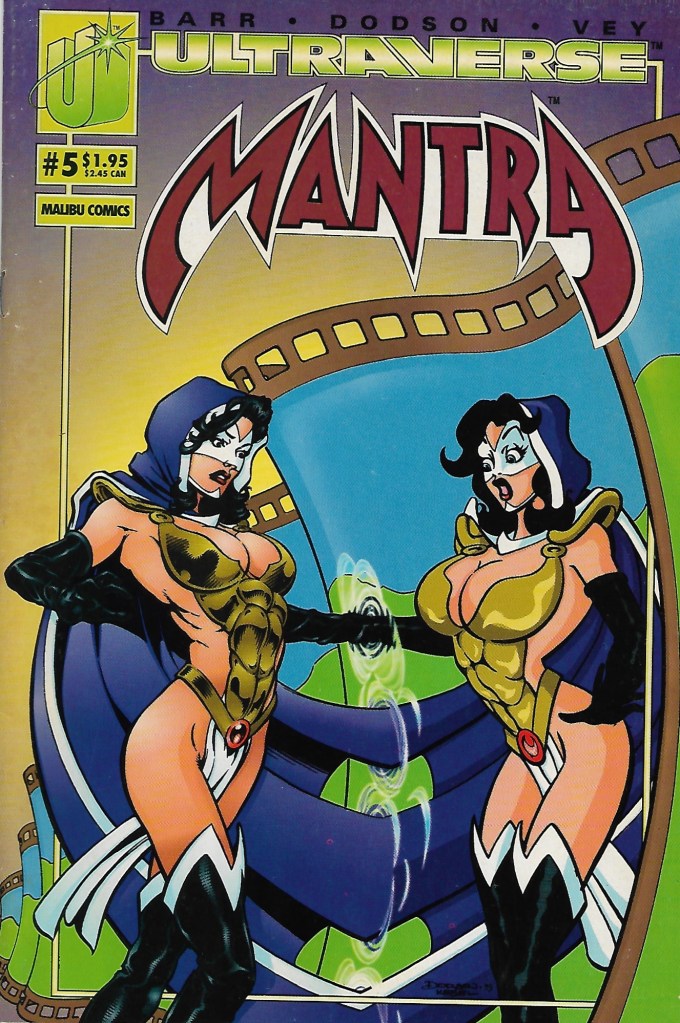
Now that the history lesson is done, we can see more of Dodson’s work on Mantra in the look back at Mantra #5, published in 1993 by Malibu Comics with a story written by Mike W. Barr and drawn by Dodson.
The cover.
Early story
The story begins when a man named Strauss faces Mantra and Warstryke. The armed guy presses Strauss for details about some defective merchandise while Mantra mentions to him about their deal. Strauss shows defiance by defending himself with a green field to protect him. Mantra blocks the flow of air into the field, forcing Strauss to give up and lose his protective field.
After a short talk with Strauss, Mantra and Warstrike chat on top of the building. In reaction to Mantra’s handshake as a sign of thanks for helping, the armed guy tries to get sexually involved with the mystical warrior even though he knows Mantra has a male soul occupying a woman’s body. Mantra defies him and flies away.
Along the way, a demon spots Mantra flying through the air. It turns out he has been looking for her and decides to make a move in pursuit of her…
Quality
What do I think about the story by Mike W. Barr? I find it brilliantly written. As the cliffhanger ending of issue #4 got resolved early, the narrative smoothly shifts into Mantra’s other struggle – being a mother to Eden Blake’s children whom she lost quality time with due to superhero pursuits. There was also this really compelling drama between Eden and her mother (who in turn believes her daughter is failing her responsibility as a parent).
Lukasz – the male soul in Eden/Mantra’s beautiful body – is still obsessed with pursuing his search for answers but even so, he cannot simply abandon the family and household of the woman whose soul he displaced. In this particular comic book, Lukasz continued to adjust in his unexpected life as Eden.
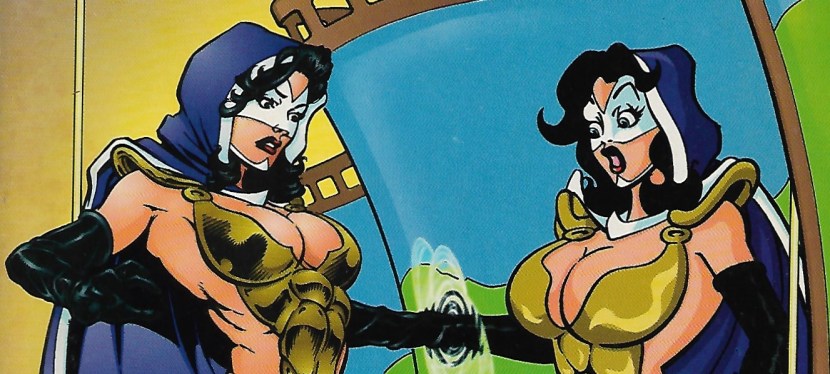
I really like the way Mike W. Barr dramatized Lukasz dealing with family matters as well as career matters. All that led to what I would call the most unexpected superhero misadventures I’ve ever read that has something to do with the dimension of hand-drawn animation. That is something you, my readers, should read to find out. It is something very enjoyable!
In terms of visuals, this comic book showed more of the creativity of Terry Dodson. If you already enjoyed his art in the early Mantra issues, you will see something new and fresh here.
Conclusion
Mantra returns home to the family.
Undoubtedly Mantra #5 is a great comic book to read as it has an excellent mix of drama, intrigue, characterization and many bouts of great spectacle (which nicely paid-off on all the build-up). By this stage in the Mantra monthly series, Lukasz/Eden/Mantra got developed more and the stakes have been raised in relation to Eden’s meeting with her boss.
If you are seriously planning to buy an existing hard copy of Mantra #5 (1993), be aware that as of this writing, MileHighComics.com shows that the near-mint copy of the regular edition costs $8 while the near-mint copy of the newsstand edition costs $26.
Overall, Mantra #5 (1993) is highly recommended!
+++++
Thank you for reading. If you find this article engaging, please click the like button below and also please consider sharing this article to others. If you are looking for a copywriter to create content for your special project or business, check out my services and my portfolio. Feel free to contact me as well. Also please feel free to visit my Facebook page Author Carlo Carrasco and follow me at HavenorFantasy@twitter.com
A little over a month from today, Microsoft will be launching through its varied retail partners worldwide their next-generation consoles Xbox Series X and Xbox Series S. The big day is November 10, 2020 and already a lot of consumers have already ordered their own units of the mentioned next-generation consoles. Even in Japan, where Xbox traditionally failed, the initial pre-orders for Xbox Series S and Xbox Series X there have sold out! Really, things are looking good towards November 10.
Along the way are the launch games which are a big mix of titles (note: cross-generation releases are included) from the 3rd party game publishers plus some from independent game makers and Team Xbox itself.
Have you ordered an Xbox Series X or an Xbox Series S unit already?
On launch day, prospective Xbox Series console owners can choose Dirt 5 if they crave for high-fidelity, action-packed racing. With Assassin’s Creed Valhalla from Ubisoft, they can have the stealth action experience complete with open-world exploration. If it’s role-playing and action they want with a Japanese underworld setting, then Yakuza: Like a Dragon will be there. NBA 2K21 will be the basketball video game of choice. For real-time strategy set in the Gears of War universe, Gears Tactics is the definitive gaming experience waiting to be discovered. Last but not least, The Falconeer will offer gamers the flight and shooting experiences that can entertain them a lot.
Before the November 10, 2020 Xbox Series consoles launch, Ubisoft will release its newest entry in the Watch Dogs open-world game franchise titled Watch Dogs: Legion which has a futuristic London setting and the game is designed to let gamers play as multiple characters who can be recruited and engage in missions. Like its predecessors, Watch Dogs: Legion will be filled with open-world missions and hacking will be a major gameplay feature. This game will launch for current generation consoles on October 29, 2020 but it will be available for the Xbox Series consoles on launch day. Like other cross-gen, multiplatform games, expect Watch Dogs: Legion to look and play better on Xbox Series S and Xbox Series X (read: ray-tracing plus other visual enhancements).
After November 10, 2020, there will be other games coming out such as CrossFireX, Immortals Fenix Rising, Call of the Sea, and the much-anticipated Cyberpunk 2077 to name a few.
When it comes more Xbox Series S and Xbox Series X games coming in the following years, pay close attention to what Xbox Games Marketing General Manager Aaron Greenberg wrote at Xbox.com.
From the Xbox.com article of Greenberg.
After revealing interesting statistics and achievements in the early part of his article, Greenberg stated:
It’s been a tremendous year so far, and it’s going to get even better with the launch of Xbox Series X and Xbox Series S on November 10. Across four generations and thousands of games playable this holiday, this will be the largest launch lineup in the history of gaming. We’ll be sharing even more details on every game being fully optimized this holiday for the launch of Xbox Series X|S later this month, as well as showing more gameplay from these titles, so stay tuned for more.
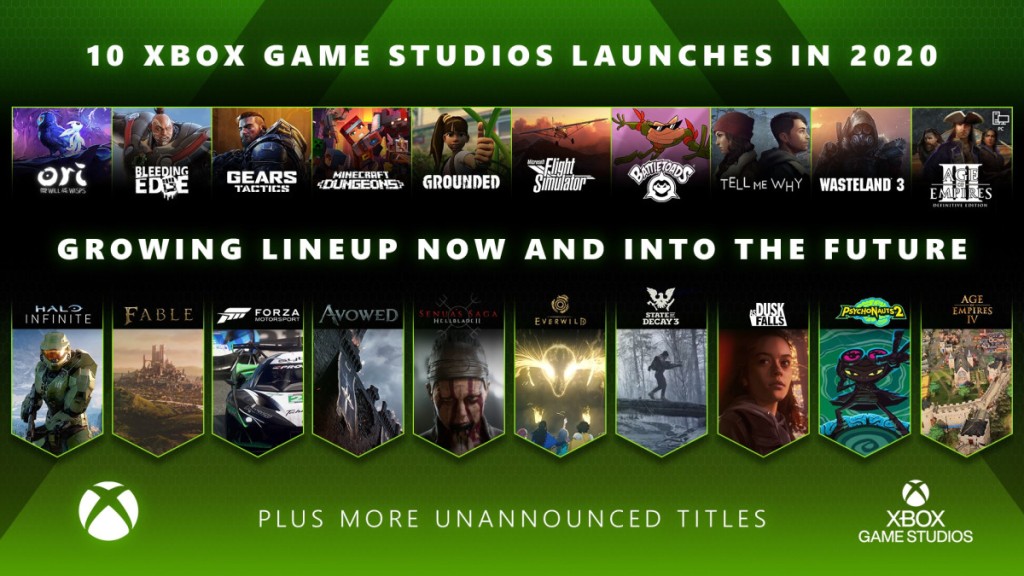
Between our growing Xbox Game Studios teams, the massive influx of high-quality content from our new partners at Bethesda, and many more unannounced games in development, the future has never been brighter for Xbox gamers!
Greenberg made clear that Team Xbox still have some pre-launch details and stuff to show within this current month. We don’t know yet what they will show but it will most likely add more power to the current public excitement for the upcoming Xbox Series consoles. It’s an excitement that not even the most sarcastic Xbox haters and not even the paid PlayStation propagandists can bring down.
Even though the launch games lineup for the Xbox Series consoles does not look that numerous on face value, the backward compatibility on the upcoming consoles ensures that Xbox fans (especially those who owned games through at least two generations of Xbox consoles) will be able to choose and play from the many, many video games from the original Xbox right up to the soon-to-end Xbox One. Thanks to the immense investment Team Xbox made on backward compatibility, the said feature will enhance the old generation games on Xbox Series consoles. By comparison, Sony’s PlayStation 5 (PS5) is only limited to PS4 games for backward compatibility.
And then there was Greenberg’s mention of Bethesda, the agreed acquisition of which easily rocked the gaming industry and its effects are still being felt and discussed by gamers across social media until now. The Xbox-Bethesda deal means that future games of established game franchises such as Doom, Dishonored, The Elder Scrolls, Wolfenstein and Fallout will only be released through the Xbox ecosystem which includes the Xbox consoles (specifically Xbox One and the two Xbox Series consoles) and Windows 10 PC supported by Xbox Game Pass and xCloud. In other words, future Bethesda games will NOT appear on PlayStation and Nintendo consoles.
While it is very clear that Bethesda role-playing game (RPG) franchises The Elder Scrolls and Fallout make Xbox Game Studios a major powerhouse for RPGs, the shooter franchises Doom and Wolfenstein are doing the same with regards to shooter-type games. Think about it…Microsoft can release a new Halo, a new Gears of War, a new Doom and a new Wolfenstein within a relative short period of time. Each new game from the mentioned shooter franchises is sure to sell in the millions and further establish the Xbox ecosystem as a major sector of the video game industry as we know it.
Also mentioned by Greenberg are the many unannounced games in development from Xbox Game Studios. I sure hope that means a new Perfect Dark is being made and I would love to see Obsidian Entertainment work on a sequel to The Outer Worlds after they are done with making Avowed. Oh yes, Xbox game studio inXile (Wasteland 3) is working on new games.
As you can see here, there is a whole lot of games and fun experiences to look forward to in the years to come only on the Xbox ecosystem. Compared to what happened in 2013, the pre-launch momentum for Team Xbox is strongly positive and anticipation for the next-generation Xbox consoles is undeniably strong. Once the first batch of the expected 1st party Xbox games come out in the next few years, you will really see Microsoft becoming much more competitive with Sony and Nintendo. It’s just a matter of time and it will be exciting!
In ending this, posted below are Xbox-related videos for your learning and excitement for the next-generation!
+++++
Thank you for reading. If you find this article engaging, please click the like button below and also please consider sharing this article to others. If you are looking for a copywriter to create content for your special project or business, check out my services and my portfolio. Feel free to contact me as well. Also please feel free to visit my Facebook page Author Carlo Carrasco and follow me at HavenorFantasy@twitter.com
Comic Quest, a notable retailer of comic books and geek stuff (including premium products like action figures) here in the Philippines, announced yesterday that it will be closing its 35-year-old business due to the tremendous economic difficulties related to, unsurprisingly, the ongoing pandemic and also the disrupted state of the international distribution of comic books. Before the end comes, however, a Farewell Sale at their SM Megamall branch in Mandaluyong City has launched and will last until sometime in October. The said sale will have all items discounted at least 50%.
In my experience of the past decade, as a resident of Alabang, Muntinlupa, I often bought new comic books (especially Wonder Woman) at the Festival Mall Alabang branch of Comic Quest. It was also at the same store located a short walk away from the cinemas where I also ordered and received hardback editions of EC Comics Archives. Comic Quest Alabang was a favorite weekend destination of mine for many years. Even before I became a collector of comic books (specifically superhero comics), I first heard about Comic Quest way back in 1990 in the classroom where I had a few classmates who bought comic books from them. Back in the 1990s, Comic Quest had a branch in Makati and it was there where I bought Web of Spider-Man #100 in 1993.
As time passed by, my personal interest in comic books waned and I actually stopped buying comic books (both new and old) shortly before the lockdown here in the Philippines was implemented. The pandemic and related lockdown brought entire economies down worldwide and the Philippines was not spared. It is also depressing to learn that many people lost their jobs as well as their income. No disposable income, no more demand for entertainment products like comic books, theatrical showing of movies, shows and the like. The priority now of people living during the pandemic goes to the essentials.
Yesterday, hours after Comic Quest’s closure announcement, I took the opportunity to visit and see their Festival Mall branch in Alabang. It is gone!
The commercial space in the middle used to be occupied by Comic Quest inside Festival Mall. This picture was taken hours after the closure announcement.
Comic Quest’s decision to close down is understandable and acceptable. They did the best they could to survive and prevent their employees from becoming unemployed until the pandemic-related depression overwhelmed them (as well as the many other businesses of different types and sizes).
Just a few years ago, another comic book specialty retailer had to close down their Alabang Town Center branch. It’s clear that comic books as a business continues to fail especially now that people are often online and find their kind of stuff through digital services/retailers.
In closing this, posted below for your reference is the complete closure announcement of Comic Quest. The retailer will be missed!
This is a special announcement for all our valued customers. We hope you ‘re doing well and staying safe during this difficult time.
We just want to let you know that because of the combined pressure of the pandemic, as well as the disruption of the global distribution of comic books, we’ve had to make the difficult decision to begin the process of closing down Comic Quest. It is and has been an extremely challenging time for us, and we feel that this is our best option moving forward.
It has been a long and amazing road, from our earliest days in our first branch at BF Homes in Alabang, to Greenhills to Makati to multiple branches as far away as SM Cebu. But now the time has come to say goodbye, and let all of you know how much we appreciate being given the chance to be part of the comic book industry.
We want to thank each and every one of you for being one of our valuable loyal customers and a very important member of the Comic Quest family. We wouldn’t have reached 35 wonderful years in business without loyal customers like you. Our sincerest and most heartfelt thanks for being with us through all these years.
In line with our decision, we’re holding a special FAREWELL SALE from September 16th and into October, at our SM Megamall branch. During this time we will be selling ALL items from at least 50% off and up.
Please help us spread the word and share this message with other friends and collectors whom you think might be interested.
While our time in this wonderful industry comes to an end, we’re wishing you many more years of happy collecting! And in the words of the great Stan Lee- Excelsior!
Best wishes,
Comic Quest
+++++
Thank you for reading. If you find this article engaging, please click the like button below and also please consider sharing this article to others. If you are looking for a copywriter to create content for your special project or business, check out my services and my portfolio. Feel free to contact me as well. Also please feel free to visit my Facebook page Author Carlo Carrasco and follow me at HavenorFantasy@twitter.com
Disclaimer: This is my original work with details sourced from reading the comic book and doing personal research. Anyone who wants to use this article, in part or in whole, needs to secure first my permission and agree to cite me as the source and author. Let it be known that any unauthorized use of this article will constrain the author to pursue the remedies under R.A. No. 8293, the Revised Penal Code, and/or all applicable legal actions under the laws of the Philippines.
When done right with the comic book format, fantasy crossover concepts can become very entertaining and memorable. Such was the case with the comic book Batman versus Predator II: Bloodmatch #1 which I enjoyed reading a lot.
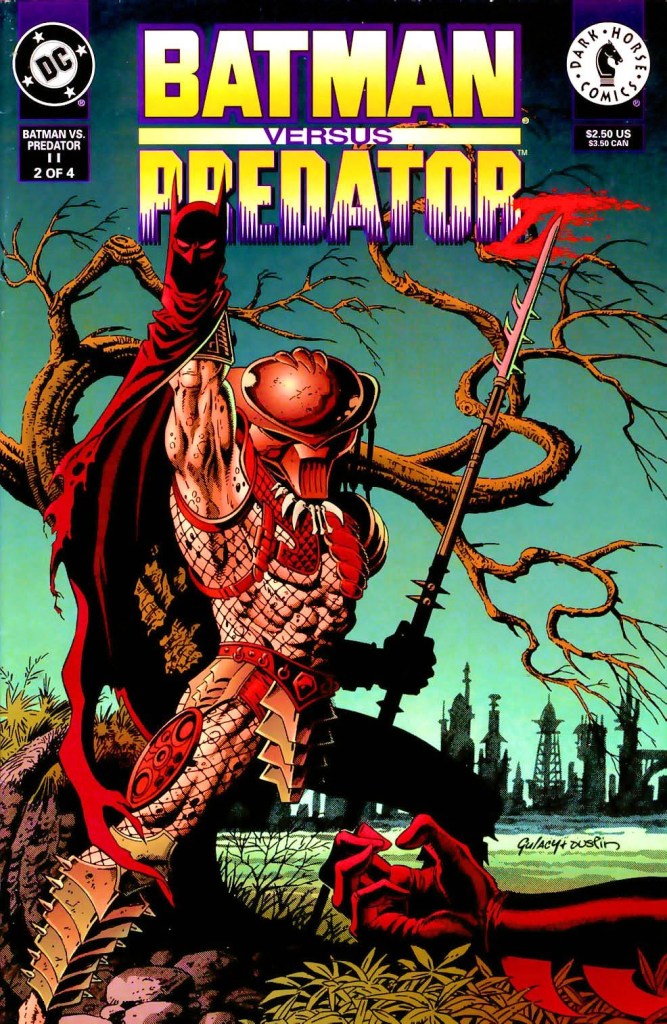
Now we can find out if the creative team behind that memorable comic book could maintain the high quality of fun and engagement in this look back at Batman versus Predator II #2, published in 1995 by DC Comics and Dark Horse Comics with a story written by Doug Moench and drawn by Paul Gulacy.
The cover.
Early story
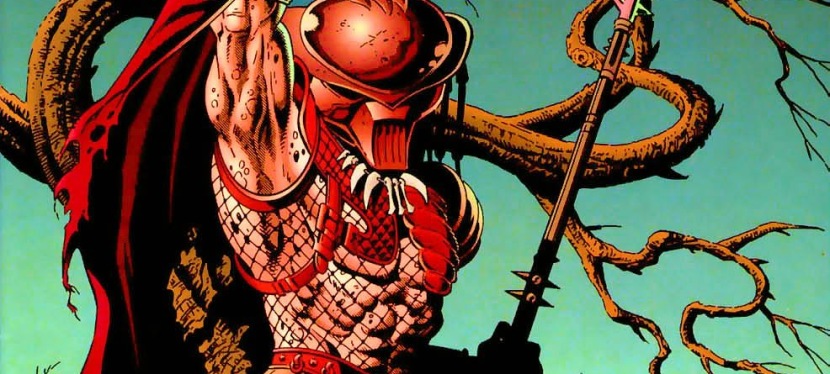
The story begins in the forest outside of Gotham City. A fake use of the Batman signal was lighted there by the Predator which was meant to lure Batman into a potential trap. As soon as he arrived, Batman believes that his old ally commissioner James Gordon bought a portable Batman signal meant to call him to a crime scene far away from the urbanized areas.
Expecting to see Gordon in the woods, Batman sees a tree with several men’s heads hanging each with a net. He realizes that the Predator lured him into what he calls the hunting ground. Batman is correct as the Predator, standing nearby, unleashes a weapon to attack him…
Quality
This one really looked out of place in this comic book.
A pretty good crossover comic book. When it comes to storytelling, the comic book starts paying off the anticipation built up in issue #1 by presenting Batman in an early encounter with the Predator which, I must say, was smartly handled complete with key references to the previous Batman versus Predator crossover series from the early 1990s. What happened in the said encounter between the two pop culture icons will make you reflect about what you know about Batman and the Predator. Given how the story turned out, clearly the encounter (which was quite beefy) served as a sign of what is more to come between Batman and the Predator (or the race of Predators). The Huntress meanwhile has a slightly reduced spotlight which is not surprising but she still proved her worth in the conflict. When it comes to presenting the respective views of Batman and the Huntress, I admire the use of narration boxes (instead of the traditional thought balloons) which added depth to the story.
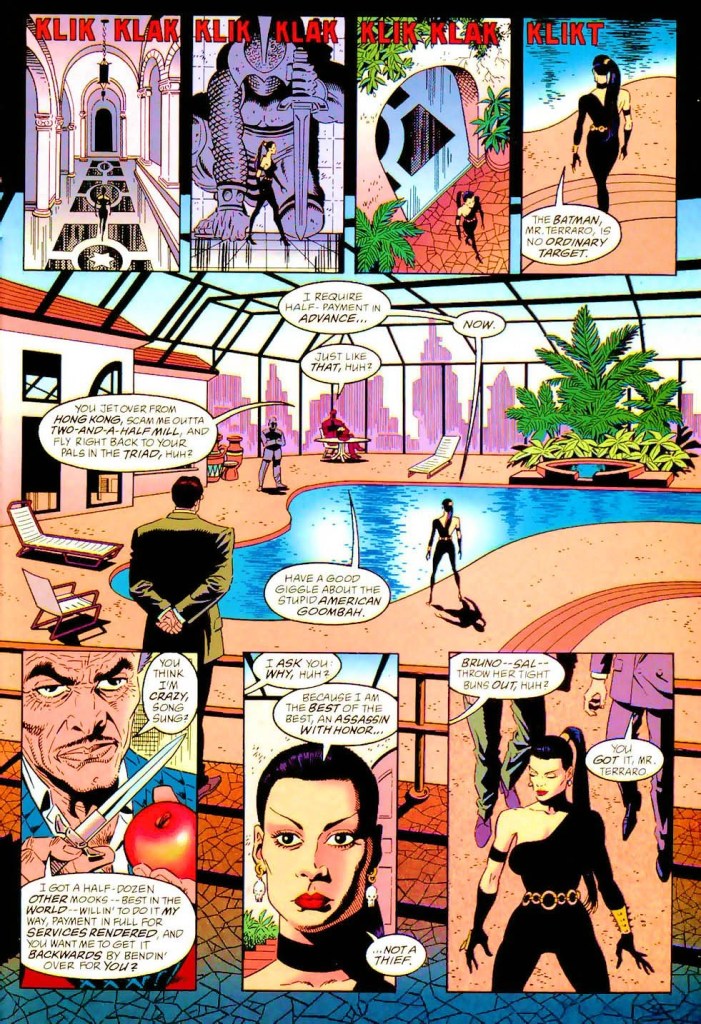
Meanwhile, there is a subplot about an assassin from Asia who came all the way to America for a key transaction. However, this subplot (which does not even look like it’s related to the Batman-Predator conflict) ended up looking like filler.
Conclusion
An action-packed encounter between the Dark Knight and the warrior from outer space!
Batman versus Predator II #2 (1995) is almost as good as issue #1 but its first, action-packed encounter between the Dark Knight and the warrior from outer space alone makes it worth collecting.
If you are seriously planning to buy an existing hard copy of Batman versus Predator II #2 (1995), be aware that as of this writing, MileHighComics.com shows that the near-mint copy costs $30.
Overall, Batman versus Predator II #2 (1995) is recommended.
+++++
Thank you for reading. If you find this article engaging, please click the like button below and also please consider sharing this article to others. If you are looking for a copywriter to create content for your special project or business, check out my services and my portfolio. Feel free to contact me as well. Also please feel free to visit my Facebook page Author Carlo Carrasco and follow me at HavenorFantasy@twitter.com
With DC FanDome now past us, it’s time for Wonder Woman fans as well as any fun-loving moviegoer to look forward to the release of the much-awaited Wonder Woman 1984 which Warner Bros. confirmed will come out only on cinemas. As of this writing, the movie directed by Patty Jenkins and starring Gal Gadot, Chris Pine and Kristen Wiig is slated for an October 2, 2020 release in America even though there are concerns that movie theaters and cinema chains are far from operating normally (note: to allow moviegoers to fill each seat side by side) due to the current pandemic. I personally would not be surprised if the movie studio decides to delay Wonder Woman 1984 into 2021.
Before the anticipated theatrical opening of the movie, Microsoft made an announcement that pleasantly surprised me – they will give away not one but three models of Wonder Woman 1984-inspired Xbox One X consoles which is done in part of the anticipation of the movie.
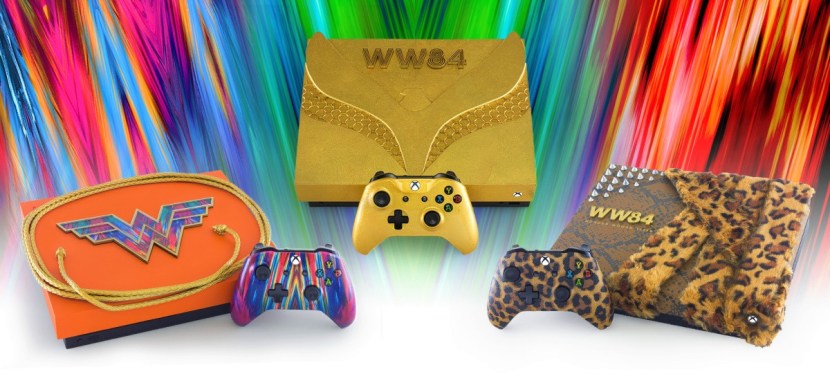
Three Wonder Woman 1984-inspired Xbox One X consoles.
In an Xbox.com article written by Microsoft’s general manager of games marketing Aaron Greenberg, collectors can expect the Wonder Woman golden armor Xbox One X console (reflecting the gold eagle armor of the Queen of Superheroes), the Wonder Woman lasso of truth Xbox One X console (inspired by Wonder Woman and her famous lasso) and the Barbara Minerva (Cheetah) Xbox One X console (reflecting the antagonist played by Kristen Wiig).
According to Greenberg, fans will have the chance to win the Wonder Woman lasso of truth Xbox One X console by simply liking or retweeting the Xbox sweepstakes tweet on Twitter. This has to be done within the period of August 25 until September 17. There are rule to follow, take note.
Greenberg further wrote: We can’t wait for “Wonder Woman 1984”, Warner Bros. Pictures’ follow up to the DC Super Hero’s first outing, 2017’s record-breaking “Wonder Woman”. Fast forward to the 1980s as Wonder Woman’s next big screen adventure finds her facing two all-new foes: Max Lord and The Cheetah. Set to open in theaters in 2D and 3D in select theaters and IMAX, it will be distributed worldwide by Warner Bros. Pictures and is rated PG-13. To learn more about the upcoming film, visit wonderwomanfilm.com.
The article ends with the following note: Please note, that all the Xbox is for display ONLY, not gameplay. Prize and the successful bidder will also get a standard Xbox One X.
For the newcomers reading this, Xbox One X is the high-end version of the Xbox One console. Released in late 2017, the Xbox One X is currently the most powerful video game console in the market although finding one is challenging as manufacturing has ended clearly to make way for the next-generation Xbox Series X console (and avoid causing confusion among consumers).
It sure is nice that Microsoft and Warner Bros. agreed to do a cross-promotion of their respective properties. There are a lot of Xbox fans among superhero enthusiasts and there are some comic book readers who play video games. Personally, I’d like to see Microsoft and WB someday come up with a limited edition Wonder Woman-themed Xbox Series X console if possible. Also when it comes to superheroes, I prefer Wonder Woman over Spider-Man anytime!
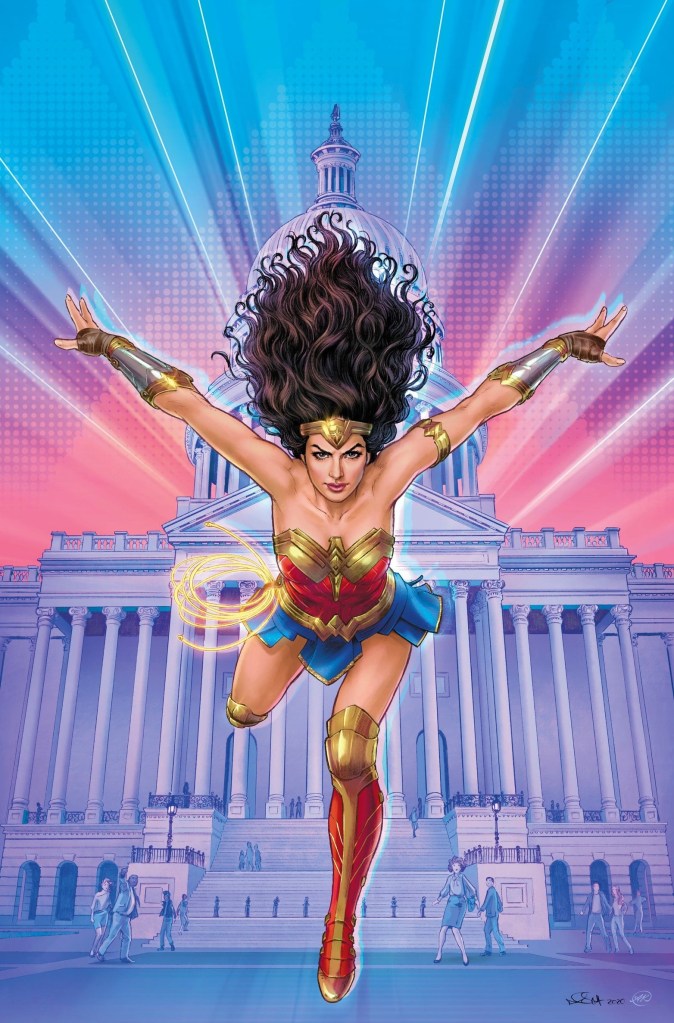
More on exciting stuff for Wonder Woman fans, there will be a comic book that will tie-in with the movie titled Wonder Woman 1984 #1 and it will be released on September 29, 2020. It’s cover was drawn by Nicola Scott.
Cover art for Wonder Woman 1984 #1 done by Nicola Scott. She did a good job capturing the likeness of actress Gal Gadot.
According to the official press release, Wonder Woman 1984 #1 is a 32-page one-shot comic book that will link with the upcoming movie which involves Wonder Woman 1984 associate producer Anna Obropta and comic book veteran Louise Simonson involved in the writing with illustration done by Bret Blevins.
The first story follows a failed burglary attempt that causes a hostage situation at the Smithsonian Museum of Natural History. As such, Diana Prince/Wonder Woman leaves the teenage tour group so that she can save the day. The odds are against her as there are ten gunmen involved and not much time to spare.
The second story written by Steve Pugh and drawn by Marguerite Sauvage, is a 1980s flashback. There is a reckless mastermind who made the ultimate power move by stealing the Lasso of Truth from Wonder Woman. As such, Diana and Steve Trevor have to get the lasso back before it’s too late.
Since the pandemic and community lockdown took place months ago, I have not bought any comic book – old or brand new – ever since. I’m not certain if copies of Wonder Woman 1984 #1 will make it in my place as the nearest comic book specialty store remains closed. Still, I’m interested in the comic book and here is hoping it will turn out good.
In ending this, posted below is the latest movie trailer of Wonder Woman 1984. Also if you are interested about the literary history of Barbara Minerva/Cheetah and her rivalry with Wonder Woman, read my retro review of Wonder Woman #9 (1987).
For more Wonder Woman-related articles and features, visit www.CarloCarrasco.com and search Wonder Woman.
+++++
Thank you for reading. If you find this article engaging, please click the like button below and also please consider sharing this article to others. Also my fantasy book The World of Havenor is still available in paperback and e-book format. If you are looking for a copywriter to create content for your special project or business, check out my services and my portfolio. Feel free to contact me as well. Also please feel free to visit my Facebook page Author Carlo Carrasco and follow me at HavenorFantasy@twitter.com
Disclaimer: This is my original work with details sourced from reading the comic book and doing personal research. Anyone who wants to use this article, in part or in whole, needs to secure first my permission and agree to cite me as the source and author. Let it be known that any unauthorized use of this article will constrain the author to pursue the remedies under R.A. No. 8293, the Revised Penal Code, and/or all applicable legal actions under the laws of the Philippines.
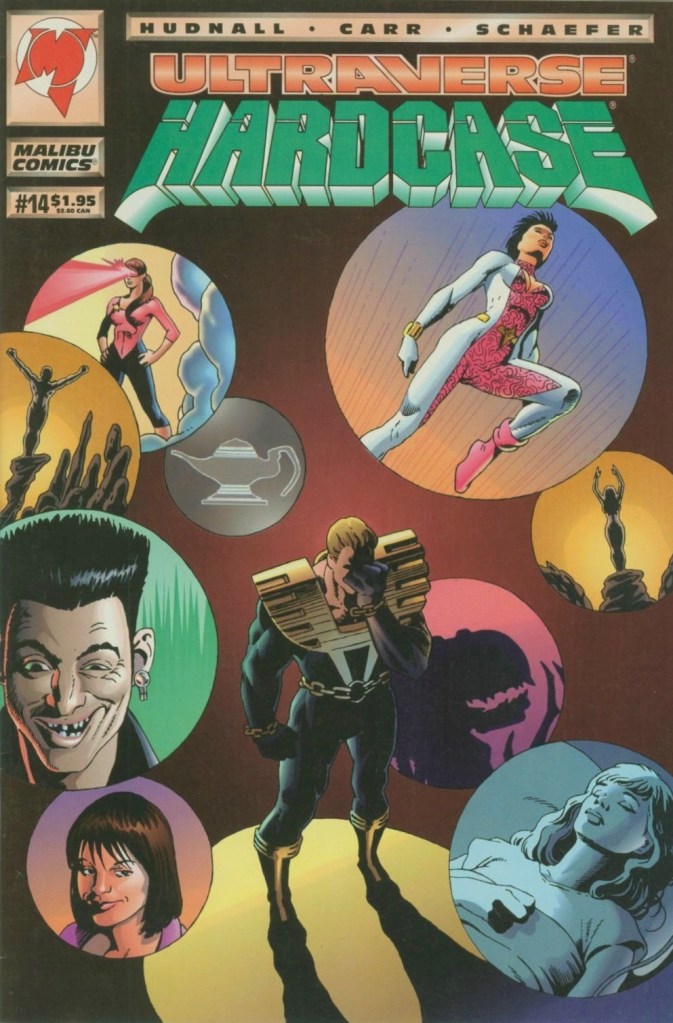
Hey comic book geeks and superhero enthusiasts! Are you ready for another trip back to the Ultraverse through the stories of Hardcase? Before getting there, I should state that the last Hardcase comic book I reviewed ended in a very intriguing way.
To find out more what followed, here is a look back at Hardcase #14, published in 1994 by Malibu Comics with a story written by the late James Hudnall and drawn by Steve Carr.
The cover.
Early story
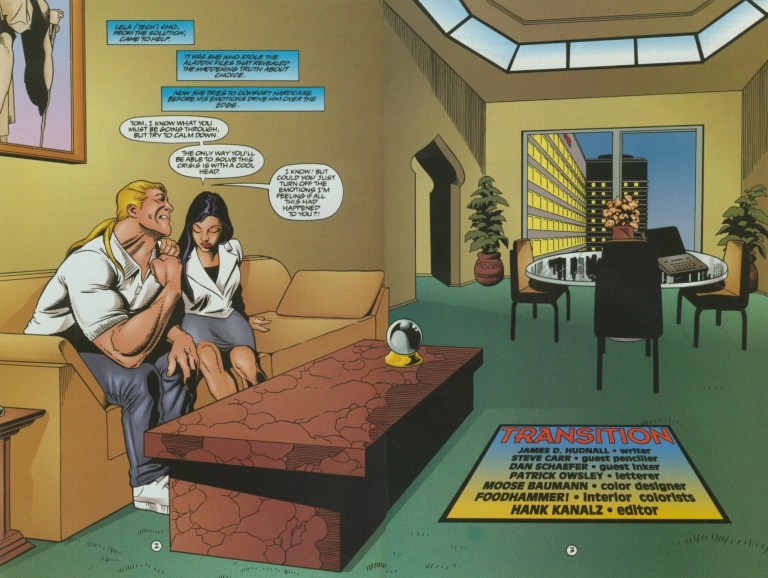
The story begins with Tom Hawke/Hardcase wondering if he is turning insane. He went through a lot lately such as getting targeted by Aladdin for elimination, learning that a portion of Linda’s brain was taken by Aladdin via operation, and his new lover Choice (who has the mentioned part of Linda’s brain in her) just vanished in front of him and Lela Cho/Tech (of The Solution) who seated near him.
Lela tries to calm him down and shares to him that she herself went through a whole lot of trouble which made her form her team. Hardcase is concerned that Choice could be in danger already. Lela reminds him of what happened during their time on the moon. She states that there is something out there, a flat world. Hardcase speculates that someone from out there could have taken Choice away…
Quality
Compared to issue #13, the storytelling in this comic book went back to build-up tension and suspense for future developments waiting to happen. When it comes to characterization, you will find Hardcase being without a partner for the first time since the early issues of the series. This also resulted some short but notably dramatic scenes that further developed Hardcase’s personality. As this was written by the late James Hudnall, there is more crossing-over between Hardcase and a few members of The Solution which is pretty good creative move.
When it comes to the art, Steve Carr did a good job visualizing the characters. His art is a radical change from that of Kelly Krantz in issue #13.
Conclusion
Picking up from where issue #13 ended.
To put straight, Hardcase #14 will appeal to fans who don’t mind the lack of action (like issue #13) for as long as the Hollywood hero became more prominent and his personality developed further. If you are wondering what happened to Choice, you’ll have to search elsewhere in the Ultraverse. Also there is continued build-up behind the scenes setting up gradually (yet again) the inevitable rematch between Hardcase and a certain nemesis from the past.
If you are seriously planning to buy an existing hard copy of Hardcase #14 (1994), be aware that as of this writing, MileHighComics.com shows that the near-mint copy of the regular edition costs $14 while the near-mint copy of the newsstand edition costs $13.
Overall, Hardcase #14 (1994) is recommended.
+++++
Thank you for reading. If you find this article engaging, please click the like button below and also please consider sharing this article to others. If you are looking for a copywriter to create content for your special project or business, check out my services and my portfolio. Feel free to contact me as well. Also please feel free to visit my Facebook page Author Carlo Carrasco and follow me at HavenorFantasy@twitter.com