Retro Gaming Ads Blast – Part 19

Welcome back readers, fellow geeks and electronic gaming fans!

In this edition of the Retro Gaming Ads Blast (RGAB) series, we will take a look at another batch of retro gaming print ads – including arcade flyers – from the 1980s and 1990s.

For the newcomers reading this, Retro Gaming Ads Blast (RGAB) looks back at the many print ads of games (console, arcade, computer and handheld) that were published in comic books, magazines, flyers, posters and newspapers long before smartphones, social media, the worldwide web and streaming became popular. To put things in perspective, people back in the 1980s and 1990s were more trusting of print media for information and images about electronic games and related products.

With those details laid down, here is the newest batch of retro gaming print ads for you to see and enjoy…

1. Vendetta UK and North American arcade flyers

Vendetta arcade flyer for North America
Vendetta arcade flyer for the UK.

In 1991, Konami released the 2D side-scrolling beat-them-up game Vendetta in arcades around the world achieving commercial success. While it is hard to tell if the promotions helped the game commercially, there is no doubt that the arcade flyers for the North American and United Kingdom (UK) markets were indeed very eye-catching.

The North American Vendetta arcade flyer had a photographic approach showing models playing characters supposedly representing the Cobras gang and the Dead End gang. The display of wooden boxes and the rope was done to symbolize the rough city environments of the game. On the other hand, the UK arcade flyer has illustrated artwork that captured the look of the Cobras gang from the game.  

2. Star Control II: The Ur-Quan Masters print ad

This ad has great art that strongly emphasizes its science fiction concept.

This print ad of Star Control II: The Ur-Quan Masters (PC version) really caught my attention when I read gaming magazines in the early 1990s. The painted artwork showing a human and a hideous alien in the background with a planet, space ships and space stations filling the rest of the space was very captivating to look at. So captivating, it enticed me to search for the game but our PC at home had really low specs. Strangely enough, I played another version of Star Control II on a rented 3DO Interactive Multiplayer console in 1995. For the newcomers reading this, the game was critically acclaimed and was declared as one of the very best PC games ever made. Enjoy looking at the print ad above.

3. Space Channel 5 print ad

The visual style and character designs are the result of the game designer’s research that includes interviews with lots of young girls over their interests and tastes in video games.

When Sega launched their Dreamcast console in Japan in late-1998, their financial health was already in a very bad state and the future looked grim. Even as they faced tremendous odds, Sega still went on to aggressively sell Dreamcast consoles with exclusive games and Space Channel 5 was one of them.

First released in Japan in 1999, Space Channel 5 was a musical, puzzle-oriented game that was the result of Tetsuya Mizuguchi’s work backed with research he did that included interviewing young girls to find out what their tastes in gaming are. The print ad showing the highly stylized protagonist Ulala and a few screenshots really caught the attention of gamers and kept the Dreamcast in their minds. While the game did not achieve commercial success as a Dreamcast-exclusive, Sega went on to release a version of Space Channel 5 on the PlayStation 2 console, plus sequels.

4. Cybernator print ad

The mention of Terminator and RoboCop rivaled the artwork when it comes to grabbing people’s attention.

I remember seeing the print ad of Konami’s Cybernator (Japanese title: Assault Suits Valken) in several comic books I read back in 1992. I never got to play it but the print ad’s artwork was memorable as I was fond of robots in anime, movies and video games back then. What was arguably the most memorable aspect of the print ad was the line that mentioned RoboCop and the Terminator in a comedic way. This is a creative way to market the game.

5. NBA Basketball 2000 print ad

There were a lot more NBA video games back in the 1990s.

NBA Basketball 2000 was one of those basketball videos games of the 1990s that was not published by EA Sports nor published by the other established game publishers like Sega, PlayStation and Konami. In fact, the one thing on the ad that caught my attention was Fox Sports Interactive which published some sports videos games during the decade. The print ad also served as a reminder that there were a lot more NBA video games for gamers to choose from during the 1990s.

6. Food Fight arcade flyers

Food Fighter arcade flyer with illustrated artworks.
Food Fight arcade flyer with a photographic touch and actors.

I never got to play the 1980s game Food Fight in the arcades nor did I ever had the opportunity to play it on Atari consoles and Xbox 360. Released in 1983 in the arcades by Atari, Food Fight was designed to allow players to control a character moving through a 2D field to consume an ice cream on a cone (placed on the opposite end of the field) before it melts while avoiding the chefs who are out to chase and block the player.

The arcade flyer with illustrated artwork on the characters interacting with the arcade machine is really amusing to look at. Equally amusing is the other arcade flyer that had a photographic approach showing two kids (one playing the arcade machine and the other about to throw a pie) and four chefs. Considering the nice visual concepts Atari came up with for the arcade flyers, Food Fight actually never became a commercial hit selling only a few thousand arcade units.

7. X-Kaliber 2097 print ad

This print ad from the 1990s had a nice visual style.

The Super Nintendo Entertainment System (SNES) had plenty of 2D side-scrolling adventure games and among them was X-Kaliber 2097 released by Activision (now a Microsoft-owned company and integral part of Xbox) in America in 1994. The game had a really interesting story concept about a chaotic far future society plagued by overwhelming crime and violence. The print ad showed a mild taste about the game’s concept and gameplay, but it was more effective when it comes to showing the formidable foes that await the playable protagonist Slash. This print appeared in several comic books I read and was eye-catching.

8. Jet Moto 3 print ad

When was the last time the police caught you for over-speeding?

This print ad for Jet Moto 3 had a clever concept of showing a police officer apprehending a jet biker for over-speeding. The visual presentation was done in photo-realistic fashion to make the sci-fi aspect of the video game look real. The ad made me interested enough to do some research of Jet Moto 3 a few months before finally buying it for my PlayStation console.

9. Wipeout 3 print ad

Were you fond of futuristic racing and techno music back in 1999?

Released in 1999, Wipeout 3 was one of those video games that showcased what the PlayStation (originally launched in Japan in 1994) could do in terms of visual fidelity, special effects and frame rates. The print ad, which had a radical visual concept emphasizing intensity and energy, had style listing down vertically the technical details of the game which required a close look in order to be read. With only two screenshots displayed, the ad makers smartly included the E3 acclaim of “Best Racing Game of E3” as well as the names of artists behind the game soundtrack on the lower-right corner. This print ad was cool and intriguing to look at.

10. Breath of Fire II print ad

This was a good effort to lure American gamers to buy and play Breath of Fire II.

When Breath of Fire II was released on the SNES in America in late 1995, Japanese role-playing games (JRPGs) were not yet wildly popular among American gamers. To grab the attention of gamers, Capcom and the ad makers came up with the eye-catching image of a sword and posted key questions to emphasize the fantasy aspect of Breath of Fire II. While the game received mixed reviews upon its North American release, Nintendo Power listed it as 171st best game in its Top 200 Games chart published in 2006.  

+++++

Thank you for reading. If you find this article engaging, please click the like button below, share this article to others and also please consider making a donation to support my publishing. If you are looking for a copywriter to create content for your special project or business, check out my services and my portfolio. Feel free to contact me with a private message. Also please feel free to visit my Facebook page Author Carlo Carrasco and follow me on Twitter at  @HavenorFantasy as well as on Tumblr at https://carlocarrasco.tumblr.com/ and on Instagram at https://www.instagram.com/authorcarlocarrasco
A Look Back at Web of Spider-Man #31 (1987)

Welcome back superhero enthusiasts, 1980s culture enthusiasts and comic book collectors! Today we go back to the year 1987 to explore a part of the Marvel Comics shared universe through the Web of Spider-Man monthly series.

In this review, we will examine the opening chapter of one of the more significant storylines of the entire publishing history of Spider-Man… Kraven’s Last Hunt. Behind the scenes, writer J. M. DeMatteis came up with a concept about a limited series featuring the Marvel hero Wonder Man getting buried and returning from the grave. After getting rejected, the writer redeveloped his concept, proposed it to DC Comics (with Batman in mind), got rejected again and pitched the concept again to Marvel (with Spider-Man in mind) with a new villain who would really define the storyline. Marvel accepted the proposal and DeMatteis proceeded to write it while adding more Spider-Man elements to it. 

With those details laid down, here is a look back at Web of Spider-Man #31, published in 1987 by Marvel Comics with a story by J.M. DeMatteis and drawn by Mike Zeck.  

The cover.

Early story

The story begins with Kraven The Hunter moving and attacking like an animal interacting with life-sized figures of animals inside his castle. Afterwards, he slows down, gets a drink and walks into another large room that has an open coffin. He pulls out a black costume that carries the design of Spider-Man’s own costume. Kraven, who was a child when his parents arrived in America shortly after the overthrow of the Czar in Russia, is convinced that the world seem to have followed Russia’s sad example and he found dignity in the jungles instead of the cities. He found honor in the primal, not the civilized. He knows he will die soon and Spider-Man is the central part of his final pursuit in life.

Meanwhile in another part of New York City, Spider-Man discreetly attends the private gathering of several men in a bar who pay their last respects to the late Joe Face (a helpful friend of Spidey). As soon as he revealed himself, the men got scared of him and tension intensified. The webslinger pays his respect to Joe Face and puts several Dollar bills into the collection of funds.

Spider-Man then swings his way home…

Quality

As Spider-Man travels, Kraven the Hunter pursues him obsessively.

I want to state first that this Spider-Man tale has a dark and gritty presentation. The story feels really grounded with reality and it has an almost perfect atmosphere for the concept about Kraven getting ready to eliminate Spider-Man and do something very ambitious afterwards. The pacing of the storytelling moved at a medium pace and most notably, the build-up is really great to follow.

Without spoiling the plot, Kraven is truly the most featured character of this comic book as Spider-Man was written to be his moving target. DeMatteis invested a lot of creativity to build up Kraven not only as the definitive menace but also as a human being. Through the rich writing, Kraven is a man who developed and heavily prepared himself to achieve his goal. You will realize what he thinks about modern society, how he views life and why he is acting as if each day would be his last. As a villain, the evil of Kraven is very subtle yet he emerges as the deadliest foe of Spider-Man. This is truly a major development of the hunter when compared to his first-ever appearance in Amazing Spider-Man #15 (1964).

Through the views of Kraven, you will realize his own perception of Spider-Man which is intriguing to read as we readers know the webslinger’s true identity while the obsessed hunter does not. In relation to his obsession with Spider-Man, Kraven truly immerses himself with what he knows  and does things that all other people would never do. I should also state that the hunter’s intense preparation has strong parallels with Batman’s approach on preparing himself for a major encounter.

As mentioned earlier, the webslinger is the target. Spider-Man appears as a disturbed and vulnerable figure and there is nothing that his powers can do to help him overcome his problems. As the build-up grows, the troubles of Spider-Man intensified which made the reading experience captivating.

Conclusion

People getting spooked by Spider-Man’s sudden appearance.

Web of Spider-Man #31 (1987) is truly a great read and it is also a very powerful opening of its storyline. By having Kraven as the definitive character and Spider-Man as the target, this comic book really subverted expectations backed with powerful writing by DeMatteis. Along the way, Mike Zeck’s artworks truly captured the dark and gritty tone of the script and this resulted in a very captivating visual presentation.

Overall, Web of Spider-Man #31 (1987) is highly recommended.

+++++

Thank you for reading. If you find this article engaging, please click the like button below, share this article to others and also please consider making a donation to support my publishing. If you are looking for a copywriter to create content for your special project or business, check out my services and my portfolio. Feel free to contact me with a private message. Also please feel free to visit my Facebook page Author Carlo Carrasco and follow me on Twitter at  @HavenorFantasy as well as on Tumblr at https://carlocarrasco.tumblr.com/ and on Instagram at https://www.instagram.com/authorcarlocarrasco
A Look Back at Action Comics #456 (1976)

Welcome back superhero enthusiasts, 1970s arts and culture enthusiasts, DC Comics fans and comic book collectors! Today we go back to the year 1976 to take a close look at a part of the DC Comics universe through a tale of the Action Comics monthly series.

If you know your entertainment history, you should be aware that Steven Spielberg’s Jaws made a tremendous impact on millions of people who saw the film in cinemas in the mid-1970s. The massive success of the movie caused some people to become afraid of sharks which in turn convinced them to avoid swimming alone at sea. Over at DC Comics, it just so happens that they have a super villain who is actually a highly evolved shark called The Shark (Karshon).

With those details laid down, here is a look back at Action Comics #456, published in 1976 by DC Comics with a story written by Cary Bates and illustrated by Curt Swan.

The cover inspired by Steven Spielberg’s Jaws.

Early story

The story begins inside the Metropolis Aquarium where Captain Strong, young boy Jayson, young girl Jill and others closely watch a tiger shark swimming. What the viewers do not realize is that the tiger shark they are watching is a super shark (The Shark) whose evolution jumped by eons as a result of a freak nuclear accident from the previous years.

The Shark is a highly evolved mutant (half-fish and half-human) endowed with fantastic mental powers. The Shark previously encountered Green Lantern (Hal Jordan) who caused him to devolve back to his primitive form as a tiger shark.

At the aquarium, The Shark moves closely towards Captain Strong and Jayson with strong glass separating them. Suddenly, Jayson is turned into a pool of jelly on the floor and The Shark uses its power to form a large stream of water to break the way out of the Metropolis Aquarium and into the air.

Meanwhile, Lois Lane and Clark Kent are riding the metro-island ferry. A giant water sprout emerges near them…  

Quality

The struggle between Superman and The Shark starts.

While it was clear that DC Comics took a creative stab on people’s awareness of the movie Jaws, the Bates-Swan duo came up with a rather fantastic way of having Superman deal with The Shark. For one thing, the creators efficiently came up with exposition to keep readers informed about who The Shark is, why he exists and what his background was within the DC Comics shared universe. Next, the creators managed to make The Shark an actual threat to the people of Metropolis which serves as an efficient build-up for the inevitable conflict with Superman. The good news here is that Bates-Swan combined efforts turned out to be gripping and believable.

When compared to the many battles Superman had against the other powerful villains, the traditional collateral damage is pretty light in this story. This is because the creators used science fiction concepts and a little bit of real-world science to explain The Shark’s powers, how the water streams used by him got formed and why he has key advantages over Superman. These creative methods more than made up for the lack of hard action and there are explanations that made sense just before the story ends.

This comic book also contains a short, standalone Black Canary tale that ultimate served as added amusement that is not related with the Superman story at all. It should interest fans of Green Arrow.

Conclusion

The Shark’s menacing face and power overwhelms Lois Lane.

Do not let the Jaws-inspired cover art fool you. Action Comics #456 (1976) is actually an entertaining read thanks to the combined efforts of the Bates-Swan team. The Shark was a believable threat and the story was well written. To say that this comic book was just a cheap way of exploiting the popularity of Jaws by coming up with shark-related tale of Superman is not true. This old tale is a fun ride free from the politicized science and woke garbage that dominate modern-day entertainment.

Overall, Action Comics #456 (1976) is recommended.

+++++

Thank you for reading. If you find this article engaging, please click the like button below, share this article to others and also please consider making a donation to support my publishing. If you are looking for a copywriter to create content for your special project or business, check out my services and my portfolio. Feel free to contact me with a private message. Also please feel free to visit my Facebook page Author Carlo Carrasco and follow me on Twitter at  @HavenorFantasy as well as on Tumblr at https://carlocarrasco.tumblr.com/ and on Instagram at https://www.instagram.com/authorcarlocarrasco
A Look Back at The Last Starfighter #1 (1984)

Welcome back superhero enthusiasts, 1980s arts and culture enthusiasts, Marvel Comics fans and comic book collectors! Today we go back to the year 1984 to take a close look at the official comic book adaptation of the classic sci-fi movie The Last Starfighter.

The Last Starfighter is highly memorable for its extensive use of computer-generated imagery (CGI) which brought its science fiction concepts of war and space travel to life. Directed by Nick Castle, the film is also remembered for its unique storytelling (note: with scenes set on Earth and in space) as well as the solid performances by Lance Guest, Robert Preston, Dan O’Herlihy, Catherine Mary Stewart and Norman Snow.

I should also state that the movie was released during the golden age of arcade games in America and its narrative has video game elements within. The Last Starfighter, which had unreleased ports for Atari consoles and an actual game released on the Nintendo Entertainment System (NES), clearly has a place in retro gaming culture. To know more about the movie, watch the retrospective video by Oliver Harper by clicking here, the retrospective video by GoodBadFlicks by clicking here and the movie trivia video by Minty Comedic Arts by clicking here.

Marvel Comics was in-charge of producing and publishing the comic book adaptation of the movie. In fact, it was released as issue #31 of the Marvel Comics Super Special (AKA Marvel Super Special) series and also in the form of a 3-issue mini-series.

With those details laid down, here is a look back at The Last Starfighter #1, published in 1984 by Marvel Comics with a story written by Bill Mantlo and drawn by Bret Levins. This is the first chapter of the 3-issue mini-series.

The cover.

Early story

The story begins on a sunny day at a trailer park filled with residents who know each other. Maggie Gordon searches for Alex who is busy playing The Last Starfighter arcade game inside the local store. Alex’s little brother Louis was told to inform him that a neighbor’s electricity problem needs fixing.

Alex is laser focused on playing the arcade game which has an immersive space shooter game design. As Maggie tells him that their friends had arrived, Alex decides to let Louis play the rest of the game as he moves out.

Just as Alex and Maggie are about the leave, his mother tells him that he the neighbor’s electricity problem needs his repair service making him miss the trip.

In the evening, Alex resumes playing The Last Starfighter and shortly after scoring over 900,000 points, many members of the local community flocked inside the grocery to watch him play…

Quality

There is nothing like being inside a very futuristic place and getting involved in a galactic conflict.

Considering the limited scope of the narrative – which ends with Alex already far away from home – and the creative liberties committed by the production team, this comic book is faithful for the most part and it does a good job replicating the vibe and tone of the movie.  

Bill Mantlo’s script focused on the more important dialogue from the film and it did a good job following Alex Rogan (the protagonist) who is a video game achiever who happens to be striving to move forward with his life. He is a likable guy facing great odds as well as the harshness of reality, and he has hope with Maggie who just might become an integral part of his life in the years to come. Centauri is clearly the 2nd most notable character after Alex and through him, the narrative moves forward a lot leading to the greater science fiction stuff sourced from the movie.

The wild ride!

As it is clearly not a 100% replica of the movie’s screenplay, the script Mantlo made ensured that this comic book has a whole lot of relevant details, notable moments and characterization that readers can immerse themselves into.

For his part, Bret Blevins (note: his name was spelled as Brett Blevins here) did a fine job replicating the movie imagery that includes the locations, the characters, and the sci-fi elements. While it is not clear if the comic book team was authorized to use the actors’ likenesses when drawing the characters, there were a few instances in which Alex somewhat resembles actor Lance Guest, and Centauri looking a bit like the late Robert Preston.

Conclusion

Have you ever experienced attracting a lot of people while playing an arcade game?

Even though there were no battles within its narrative, The Last Starfighter #1 (1984) is a good comic book adaptation. Having seen the movie a number of times in my life, I can say that this comic book recaptures the feel and tone of the film in varying degrees. Of course, the illustrated literature format can only go so far with adapting the movie’s greatness. That being said, if you truly want mesmerizing imagery, strong thrills, great music and the dramatics of the characters, watching the movie is the clear option (note: The Last Starfighter 4K Blu-ray is available). This comic book is a worthy partial companion and I can confirm that it has convinced me to read the next issue.

Overall, The Last Starfighter #1 (1984) is recommended.

+++++

Thank you for reading. If you find this article engaging, please click the like button below, share this article to others and also please consider making a donation to support my publishing. If you are looking for a copywriter to create content for your special project or business, check out my services and my portfolio. Feel free to contact me with a private message. Also please feel free to visit my Facebook page Author Carlo Carrasco and follow me on Twitter at  @HavenorFantasy as well as on Tumblr at https://carlocarrasco.tumblr.com/ and on Instagram at https://www.instagram.com/authorcarlocarrasco
A Look Back at RoboCop 2 #2 (1990)

Welcome back superhero enthusiasts, 1990s arts and culture enthusiasts, Marvel Comics fans and comic book collectors! Today we go back to the year 1990 to take a close look at the 2nd part of the comic book adaptation of the movie RoboCop 2 (1990).

In my previous retro review of Robocop 2 #1, I pointed out that the comic book was not a faithful adaptation of the movie but more of the creators’ creative interpretation of the movie script they had which resulted in a stylized presentation. It was a surprisingly enjoyable reading experience for me.

With those details laid down, here is a look back at RoboCop 2 #2, published in 1990 by Marvel with a story written by Alan Grant and drawn by Mark Bagley based on the movie screenplay by Frank Miller and Walon Green.

The cover.

Early story

The story begins in Detroit with RoboCop reduced into a very bad condition with most of his parts missing. The cops are still on strike and the ultra-addicting drug Nuke continues to spread through the city causing social problems. Cain and his gang are still on the loose, and his video statement (which emphasizes his gang’s defeat of RoboCop) spreads through the news cycles.

Inside a hideout, Cain and his loyal companions terrify and killed traitorous police officer Duffy for betraying them. Meanwhile at police headquarters, the support crew bumps heads with the Omni Consumer Products (OCP) executive who does not see RoboCop’s poor state as a problem. As far as OCP is concerned, getting replacement parts for RoboCop is very expensive.

Over at OCP, the psychologist executive Dr. Juliette Faxx begins researching criminals for the new RoboCop project…

Quality

The motorized encounter between RoboCop and Cain here is shorter and much inferior compared to what the movie showed.

As with issue #1, this comic book followed the events and scenes of the film but left enough room for the creative team to make their stylized version suitable with the literary format. Mark Bagley, who is best known for drawing Spider-Man and Venom in the 1990s, came up with nice artwork that brought Grant’s script to life. There were a few shots here that were pretty graphic or brutal to see at the time of publication which makes me wonder why did the Comics Code Authority (CCA) give its approval to this comic book.

Without spoiling the plot, I can say that the creative team and editor Gregory Wright did a good job adapting scenes of the movie script to (fill up the pages) while also succeeding in setting up readers for the final conflict in the 3rd and final issue.

As a standalone reading material, this comic book will lead readers deep into the crisis of the police force as well as into the developments behind the closed doors of OCP. Due to the selected scenes of the film’s script, RoboCop has sufficient presence but lacked his normal personality. That being said, the movie’s comedic look of RoboCop acting very out-of-touched (hint: OCP tampered with his mind digitally) did not translate well into literary format. If you’re hoping to see solid storytelling with a consistent tone, you won’t find it here.

When it comes to action, there is just enough of it to keep the reading experience entertaining. Again, this comic book does not have the final conflict and the selected action scenes are rather limiting in terms of impact. If you want to see the police raid of the Nuke facility as well as RoboCop’s motorized chase with Cane, you are better off replaying the movie.  

Conclusion

There definitely is something wrong with RoboCop here.

Considering the selected movie script scenes for adaptation, RoboCop 2 #2 (1990) lacks impact compared to the first issue. In fairness, this comic book was clearly meant to set-up readers for the next issue. If there is anything worth looking at within the 2nd issue’s pages, it would be the details that were highlighted during the internal developments at OCP and the police. As mentioned earlier, RoboCop is not his usual self for a significant portion of this comic book. While the engagement and fun factor are lower this time around, I’m still interested to read the next issue.

Overall, RoboCop 2 #2 (1990) is serviceable.

+++++

Thank you for reading. If you find this article engaging, please click the like button below, share this article to others and also please consider making a donation to support my publishing. If you are looking for a copywriter to create content for your special project or business, check out my services and my portfolio. Feel free to contact me with a private message. Also please feel free to visit my Facebook page Author Carlo Carrasco and follow me on Twitter at  @HavenorFantasy as well as on Tumblr at https://carlocarrasco.tumblr.com/ and on Instagram at https://www.instagram.com/authorcarlocarrasco
A Look Back at What If #19 (1980)

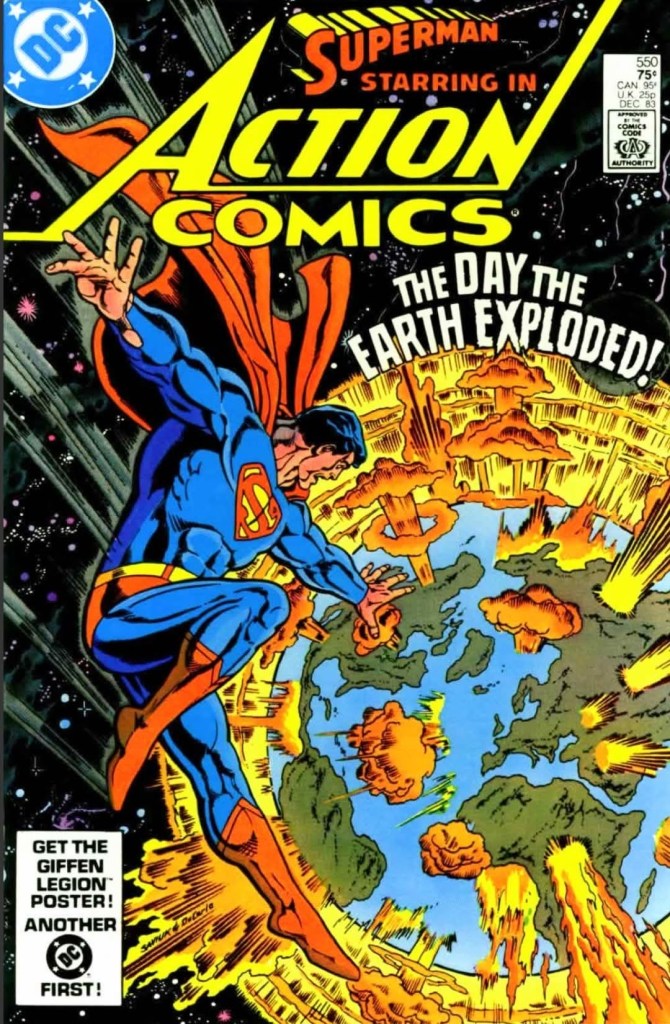
Welcome back superhero enthusiasts, 1980s arts and culture enthusiasts, Marvel Comics fans and comic book collectors! Today we go back to the year 1980 to examine an alternate story of the Marvel Comics shared universe chronicled through the What If monthly series.

Spider-Man is clearly Marvel Comics’ greatest icon. He is the one Marvel superhero who is easily recognized around the world through the many comic books published, the animated TV shows and the big-budget Hollywood movies released. Given Spider-Man’s real-life fame as a pop culture and American icon, one has to wonder what would it be like had the webslinger decided to have a career in showbiz instead of fighting bad guys. How can Spidey realize that with great power comes great responsibility if he is so focused on being an entertainer?

With those details laid down, here is a look back at What If #19, published in 1980 by Marvel Comics with a story written by Peter Gillis and drawn by Pat Broderick.

The cover.

Early story

The story begins far into Spider-Man’s past when he started as an entertainer. Spider-Man sees a police man chasing a thief down the hallway (note: this was a key moment in the life of Peter Parker who went to become a crime fighter as Spider-Man). Instead of letting the thief get away, Spidey uses his web to stop him which enabled the police officer to apprehend him.

The next day, the Daily Globe published a front page story showing Spider-Man (described as a TV star) stopped the crook which established him as a heroic entertainer. The story bothered J. Jonah Jameson (The Daily Bugle) so much not only because the rival newspaper reported it but also because he perceived it as a glorification of so-called superheroes.

Elsewhere, Spider-Man and a famous film producer talk about making a movie about him that can really entertain a lot of people…

Quality

As Spider-Man makes waves on television as an entertainer and endorser, J. Jonah Jameson tells the media the difference between real heroes and the costumed ones with super powers.

Considering the history of Spider-Man, it is both difficult and risky to come up with a new reality that diverged from the key moment of the icon’s past (letting a crook get away from the chasing cop) resulting in a completely new version of him – Spider-Man as an entertainer. The good news here is that Peter Gillis’ script is solid and its scenes were nicely arranged to make this new version of the icon believable.

As shown on the cover of this comic book, the tale shows Spider-Man as a celebrity who found success and wealth in showbiz. Along the way, the classic Peter Parker gradually transforms into a new version who is not only focused on entertaining people but also engaging in publicity wars without ever becoming journalist. Since Marvel’s most famous icon does not fight crime, you will see him as an entertainment entrepreneur, a fighter through publicity, and as someone who enjoys the high life that most Americans don’t have.

In relation to the concept of the story, J. Jonah Jameson and Daredevil became the next important players to Spider-Man. Jameson is the rival of the webslinger but not necessarily the villain. Through Jameson, you will not only witness how he misuses his power at The Daily Bugle but also his interactions with criminal elements as he searches for ways to deal with Spidey. When it comes to Daredevil’s role, I encourage you to read the comic book to find out.

The story by Gillis moved at a medium-to-fast pace and for each build-up done, pay-offs were satisfying to read. When it comes to the scope of the story, this alternate reality is actually captivating to follow from start to finish.

Conclusion

Can you just imagine how different superhero comics would have been in real life had Marvel actually depicted Spider-Man as a showbiz figure?

What If #19 (1980) is a very solid and captivating comic book to read. The creative duo of Peter Gillis and Pat Broderick succeeded in selling the concept of what would happen had Spider-Man became an entertainer instead of fighting evil figures that hound society. Apart from showing a drastically different version of Spidey, the story will compel you to think about the relevance of superheroes in society, why becoming a major player in showbiz is chaotic, and how could Peter Parker be responsible with the power (related to showbiz) he has without combating evil.   

Overall, What If #19 (1980) is recommended.

+++++

Thank you for reading. If you find this article engaging, please click the like button below, share this article to others and also please consider making a donation to support my publishing. If you are looking for a copywriter to create content for your special project or business, check out my services and my portfolio. Feel free to contact me with a private message. Also please feel free to visit my Facebook page Author Carlo Carrasco and follow me on Twitter at  @HavenorFantasy as well as on Tumblr at https://carlocarrasco.tumblr.com/ and on Instagram at https://www.instagram.com/authorcarlocarrasco
A Look Back at What If #62 (1994)

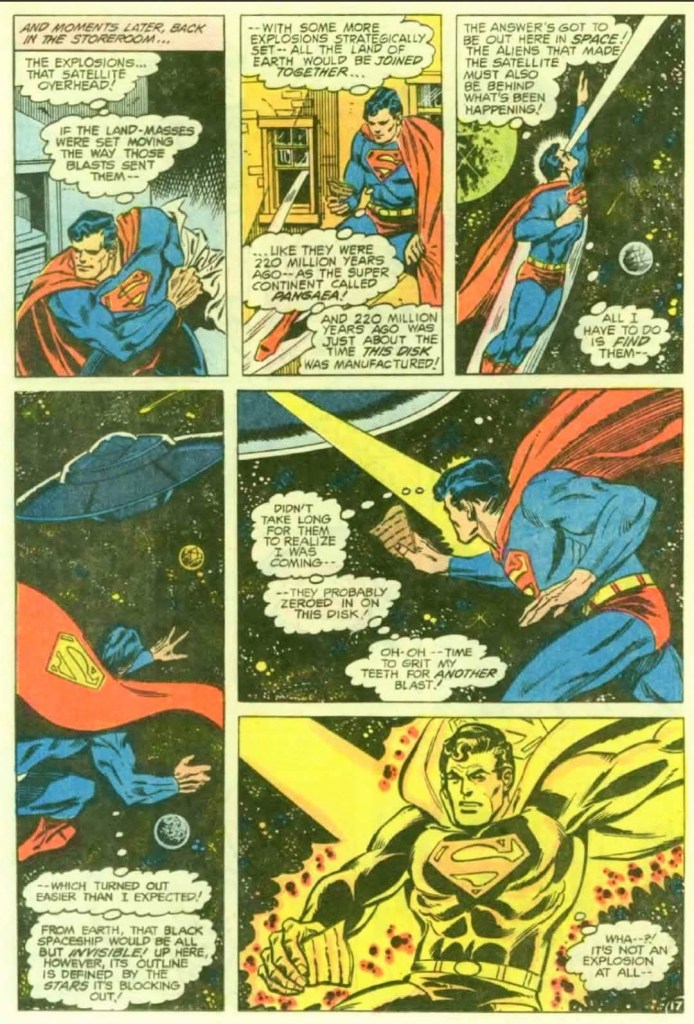
Welcome back superhero enthusiasts, 1990s arts and culture enthusiasts, Marvel Comics fans and comic book collectors! Today we go back to the year 1994 to examine an alternate story of the Marvel Comics shared universe chronicled through the What If monthly series.

There is a lot to be said about the origin of Wolverine. There was the tale of his Canadian origin and being born with claws inside him. There was also the tale of him encountering the Hulk in Canada. And there was also the famous storyline Weapon X (written and drawn by Barry Windsor-Smith in Marvel Comics Presents #72 to #84).

With those details laid down, here is a look back at What If #62, published in 1994 by Marvel Comics with a story written by Kurt Busiek and drawn by Ron Randall.

The cover.

Early story

The story begins in the when Logan (Wolverine) encounters armed men who try to overwhelm him. Logan easily knocks most of them out and leaves them behind by car. It turns out the armed men are agents of a secret organization called Weapon X which has been targeting Logan for their series of unethical experiments on abducted humans (the Weapon X Project).

The organization is already dealing with problems regarding their live experiments. One living subject (with adamantium claws on his arms and some machinery on his head and shoulders) became a murderous berserker who cannot be reasoned with anymore. The subject is former Mounted Police Officer and Marine Guy Desjardins and Weapon X dropped him off at Department H.

James Hudson of The Flight took him in and officially refers to him as “Weapon X”. The live subject eventually broke loose, killed Dr. Langkowski and went to Kenora where he starts a killing spree…

Quality

Logan arrives at the scene where the Weapon X biological experiment killed several people.

I want to point out that Kurt Busiek came up with the very believable portrayal Logan who is not Wolverine, not a member of the X-Men and not even the violent fighter in the plot. This is a story about a major scientific experiment of Weapon X that went terrible wrong resulting in their living subject (with adamantium claws and other features identified with Wolverine in the mainstream Marvel universe storyline of Weapon X) going way beyond their controller and impacting Canadian society negatively. The good news here is that the story by Busiek is very well written and nicely structured.

In his civilian form as Logan, Wolverine (as we often identify him) is not the fierce slasher he is often known as. Rather he is a former tool of the Canadian government who previously resigned and decides to get involved in response to the rampage caused by the Weapon X killing machine (Desjardins).

As Logan is no slasher (note: Wolverine #75’s big revelation about Logan’s claws had no influence on this comic book’s concept), he fights with guns and a knife backed with his extensive experience in grounded combat. In relation to this comic book’s concept, you will a captivating portrayal of Logan who is truly unconnected with the X-Men and there are certain character moments that you really have to read.

Along the way, Kurt Busiek’s story not only dramatizes the classic trope about man tampering with nature but also the potential scandal of Canada’s government having top secret unethical science experiments while developing their own superhero project in the form of The Flight. Back to Wolverine, the story pounced on the conflict between being human and being animalistic with sheer believability.

With regards to the artwork, Ron Randall exerted effort to recapture some of the aesthetics of Barry Windosor-Smith’s work on the Weapon X storyline of the Marvel Comics Presents comic books. As required by the script, the visual display of action is brutal to look yet does not go over the top (with regards to graphic violence) as the creators implemented restraint restraint on the display of blood and killing blows.  

Conclusion

A new Weapon X biological experiment gone wrong.

What If #62 (1994) is truly a great alternative tale to the established Weapon X storyline and it is also one of the more engaging portrayals of Wolverine unconnected with the X-Men. You will see Logan being more grounded with reality and you will also witness how he sees himself as a Canadian citizen who actually gets involved again with the government which he previously served. This a really compelling work by the Busiek-Randall duo.

Overall, What If #62 (1994) is highly recommended.

+++++

Thank you for reading. If you find this article engaging, please click the like button below, share this article to others and also please consider making a donation to support my publishing. If you are looking for a copywriter to create content for your special project or business, check out my services and my portfolio. Feel free to contact me with a private message. Also please feel free to visit my Facebook page Author Carlo Carrasco and follow me on Twitter at  @HavenorFantasy as well as on Tumblr at https://carlocarrasco.tumblr.com/ and on Instagram at https://www.instagram.com/authorcarlocarrasco
A Look Back at Spectacular Spider-Man #87 (1984)

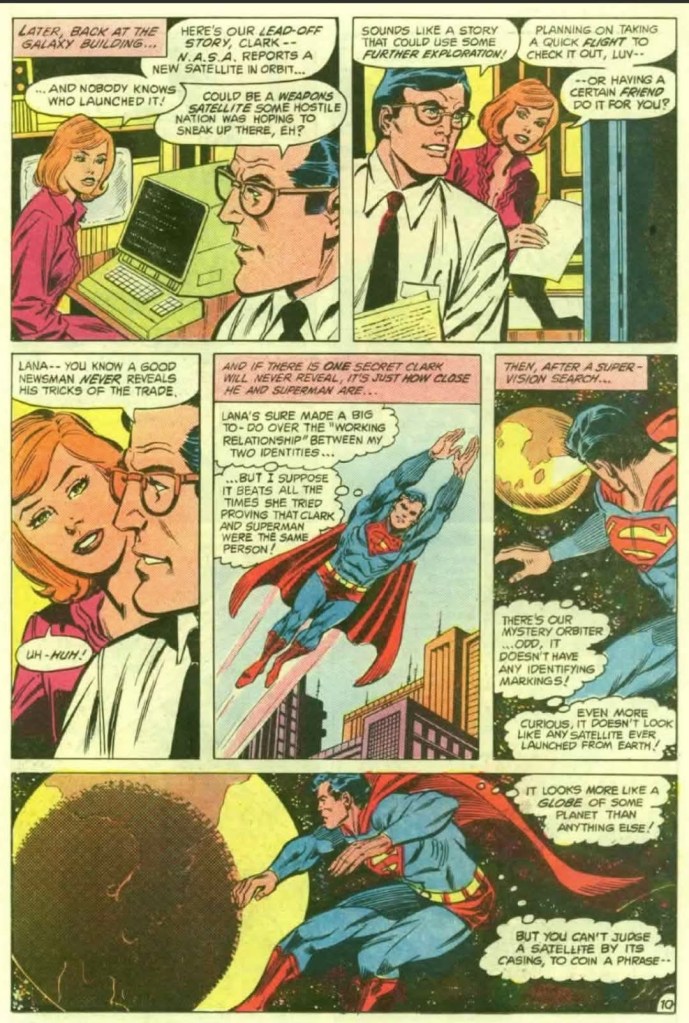
Welcome back superhero enthusiasts, 1980s arts and culture enthusiasts, Marvel Comics fans and comic book collectors! Today we go back to the year 1984 to examine a small part of the Marvel Comics shared universe through a tale of the Spectacular Spider-Man monthly series.

For this particular review, we will explore a major development in the life of the iconic Spider-Man that was told outside of the Amazing Spider-Man series.  

With those details laid down, here is a look back at Spectacular Spider-Man #87, published in 1984 by Marvel Comics with a story written by Bill Mantlo and drawn by Al Milgrom.

The cover.

Early story

The story begins in New York City as Spider-Man and Black Cat (his romantic partner at the time) spend quality time together. Spider-Man tells her that it is time him to show her where he lives. Together, they swing across the city and even played along a few times.

They finally arrive at the rooftop of the building where Peter Parker (Spider-Man) lives and enter via the skylight. Black Cat is shocked to see how cheap the quality of the apartment is and asks him how can a famous hero like him live in such a place.

Spider-Man begins explaining that as a civilian he works as a photo journalist and he did not become a hero to be prosperous. As he keeps on revealing threads of his past, he slowly makes his move to reveal his secret identity to Black Cat…

Quality

The relationship of Spider-Man and Black Cat develops even more.

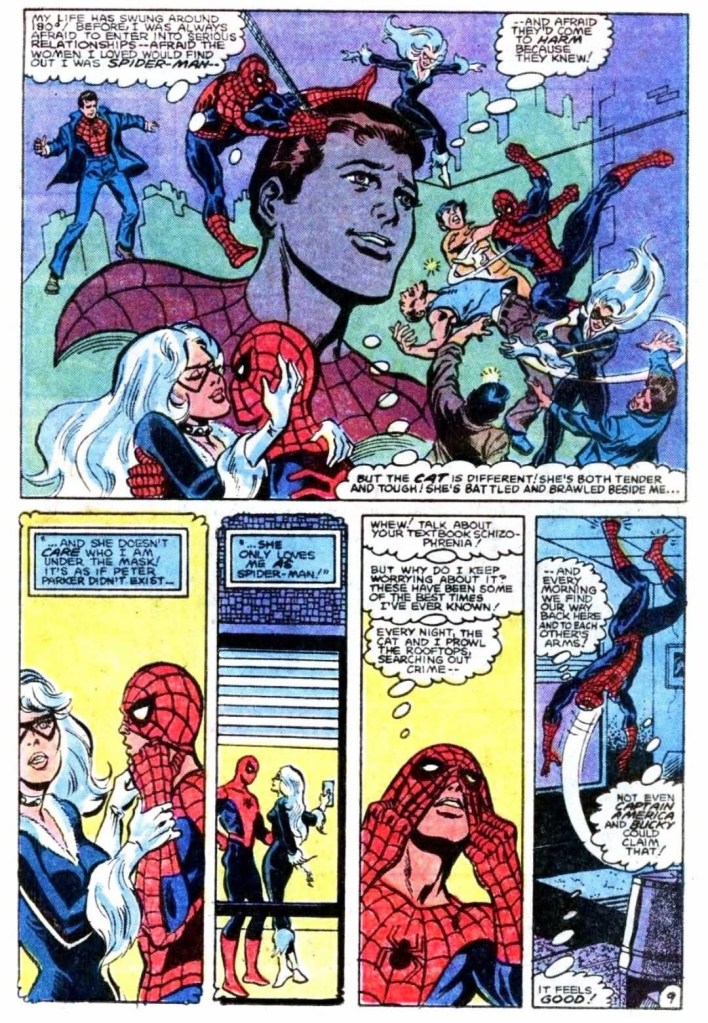
As the cover art revealed, this tale authored by Bill Mantlo is about Spider-Man revealing his secret identity to Black Cat who was his romantic partner at this point in Marvel Comics shared universe history. The revelation served as a key turning point in the life of the iconic webslinger as well as Peter Parker’s personal handling of his interactions with the women he loved. Mantlo’s writing of the dialogue between Spidey and Black Cat is really rich and there is also this sentimental touch with how the writer handled the hero’s emotions, especially with regards to the lady’s loving him more as the costumed hero than the civilian he is. I should also state that the impact of knowing Spider-Man’s true identity has subtle emotional effects on the part of Black Cat which must be seen.

While the cover showed what happened, this comic book is still worth reading because the creative duo of Mantlo and Milgrom carefully crafted scenes that gradually led to the big revelation backed with flashbacks of Peter Parker’s private life (as portrayed in Amazing Fantasy #15) and the build-up from his past romances with Black Cat. The pacing is very good and the pay-off to the build-up was worth every moment.

The conflict with the city thugs that took place near the end of the tale served as an additive to the new development of Black Cat and Spidey’s relationship.

Conclusion

Black Cat’s first-ever visit at Spider-Man residence.

Spectacular Spider-Man #87 (1984) is a very worthy read and the creators made daring moves to move the romantic link between Spider-Man and Black Cat forward while adding variety into Peter Parker’s personality. This is a character-driven story that must be read from start to finish.

Overall, Spectacular Spider-Man #87 (1984) is highly recommended.

+++++

Thank you for reading. If you find this article engaging, please click the like button below, share this article to others and also please consider making a donation to support my publishing. If you are looking for a copywriter to create content for your special project or business, check out my services and my portfolio. Feel free to contact me with a private message. Also please feel free to visit my Facebook page Author Carlo Carrasco and follow me on Twitter at  @HavenorFantasy as well as on Tumblr at https://carlocarrasco.tumblr.com/ and on Instagram at https://www.instagram.com/authorcarlocarrasco
A Look Back at Amazing Spider-Man #320 (1989)

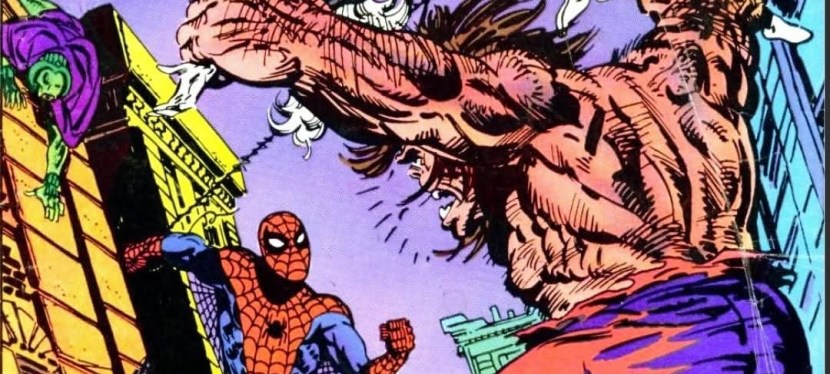
Welcome back superhero enthusiasts, 1980s arts and culture enthusiasts, Marvel Comics fans and comic book collectors! Today we go back to the year 1985 to examine a small part of the Marvel Comics shared universe through a tale of the Amazing Spider-Man monthly series.

For this particular review, we will explore the first chapter of The Assassin Nation Plot storyline that took place within the Amazing Spider-Man series.  

With those details laid down, here is a look back at Amazing Spider-Man #320, published in 1989 by Marvel Comics with a story written by David Michelinie and drawn by Todd McFarlane.

The cover.

Early story

The story begins inside Empire State University where Peter Parker – working as an assistant in the science lab – takes advantage of the free time and resources to create web fluid using a new formula. He notices that the acetylene torch does not even leave a smudge on the new web he made.

To his surprise, his boss doctor Evan Sloan catches him doing an interesting experiment. Parker comes up with a convincing excuse for the experiment which spares him from getting into trouble. After promising doctor Sloan he will get on the neutron project first thing in the morning of Thursday, Parker leaves, secretly changes into Spider-Man and equipped his brand new web. He then leaves the university and moves deep into the city…

Quality

Peter Parker and Mary Jane having a discussion.

I really like the story David Micheline came up with as the start of The Assassin Nation Plot storyline. This is clearly not your typical good-versus-evil superhero tale starring the webslinger. Instead, there are layers of secrecy, suspense and intrigue that involves a powerful private organization, private armies and diplomats.

Instead of facing off with super villains, Spider-Man finds himself in the middle of something very big brewing behind the scenes, and that puts him in deep danger. That being said, Michelinie’s approach on building up the details of the plot moved very smoothly and the payoff for each buildup was executed on a timely manner. The buildup of details was never boring nor too slow to absorb, and Todd McFarlane excelled with visualizing the plot while still delivering dynamic superhero action.

I should mention that the character Paladin has a strong presence in the story and there were moments when he outweighed Spider-Man in terms of importance.

Conclusion

Spider-Man and Paladin targeted by armed guards.

Amazing Spider-Man #320 (1989) is indeed a very solid story to read and a powerful start of The Assassin Nation Plot storyline. With the way the core concept was presented, this comic book symbolically showed that there are high stakes and other matters that are clearly too overwhelming for Spider-Man to deal with. The story is nicely paced and the creative team knew when and how to execute worthy payoffs for each buildup. By the time I reached the end of the comic book, I became convinced to read the next chapter of this storyline.

Overall, Amazing Spider-Man #320 (1989) is highly recommended.

+++++

Thank you for reading. If you find this article engaging, please click the like button below, share this article to others and also please consider making a donation to support my publishing. If you are looking for a copywriter to create content for your special project or business, check out my services and my portfolio. Feel free to contact me with a private message. Also please feel free to visit my Facebook page Author Carlo Carrasco and follow me on Twitter at  @HavenorFantasy as well as on Tumblr at https://carlocarrasco.tumblr.com/ and on Instagram at https://www.instagram.com/authorcarlocarrasco
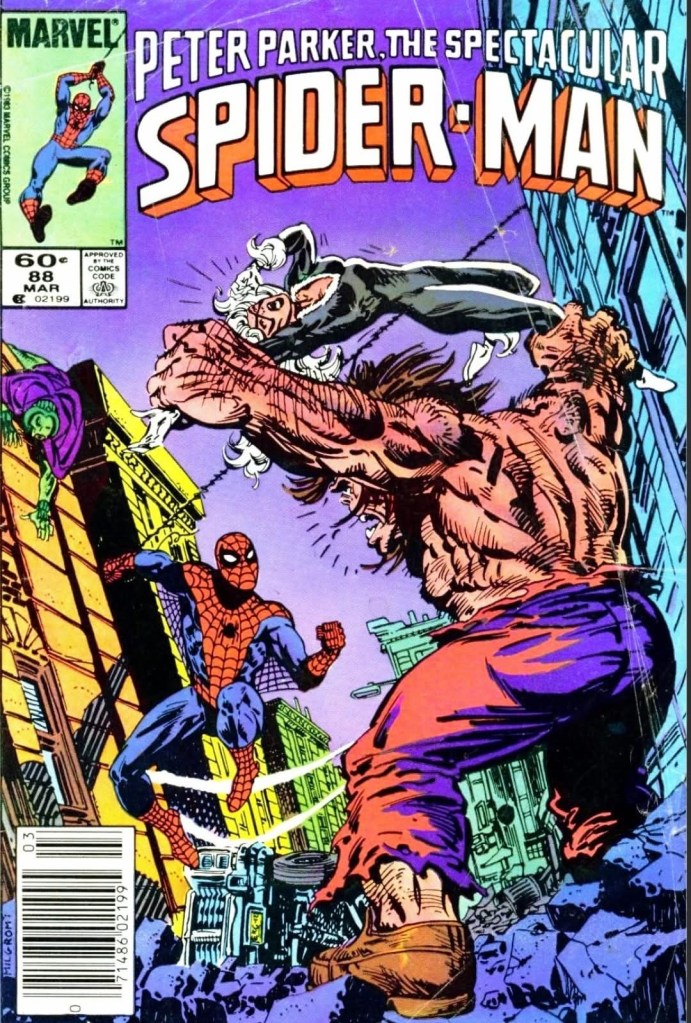
A Look Back at Amazing Spider-Man #262 (1985)

Welcome back superhero enthusiasts, 1980s arts and culture enthusiasts, Marvel Comics fans and comic book collectors! Today we go back to the year 1985 to examine a small part of the Marvel Comics universe through a tale of the Amazing Spider-Man monthly series.

For this particular review, the Amazing Spider-Man comic book does not involve Tom DeFalco and Ron Frenz. Instead, we will see the creative contribution of Bob Layton who already established himself within Marvel Comics on the Iron Man monthly series. Layton is the same guy who co-founded Valiant Comics with former Marvel Comics editor-in-chief Jim Shooter.

With those details laid down, here is a look back at Amazing Spider-Man #262, published in 1985 by Marvel Comics with a story written and illustrated by Bob Layton.

The cover.

Early story

The story begins as Spider-Man arrives at the Newark International Airport in New Jersey distracting a few air traffic control operators. As he makes his way into a deserted baggage room, Peter Parker intends to change clothes as he has a journalistic assignment from the Daily Bugle to photograph President Ronald Reagan who is set to arrive soon. For Peter Parker, the assignment is crucial as he needs to earn money.

Elsewhere within the airport, the sleazy tabloid news photographer D.J. Jones makes his way through and he intends to photograph something unusual or embarrassing about Reagan. He accidentally bumps into a lady whose items fall down. Jones pretends to be kind to her as he secretly takes her wallet while helping her collect her belongings.

As Jones decides to take the lady’s money, he goes into one of the baggage rooms to get rid of the wallet. Inside, he accidentally spots Peter Parker (still wearing the upper half of his Spider-Man costume) changing clothes and quickly photographs him. Jones starts to run away compelling Parker to chase him knowing that his secret identity will get exposed if he fails…

Quality

This is what happens when you carry very valuable information with you which the mob wants.

I really like this Spider-Man tale crafted by Bob Layton. For one thing, it tackles the concept of having your secret identity being discovered by someone who has a record of unethical behavior as well as the opportunity of using the acquired confidential information (the secret identity) for financial gain (at the expense of the affected person). Layton’s story also reconnected Spider-Man to a significant part of his legacy (the death of his Uncle Ben and the identity of the man who killed him) which opens up moral and ethical challenges on his part.

Character development of Spider-Man in this story is short yet substantial to read. As he recalls the painful lesson he learned about his uncle’s death, he remembers how guilt (by previously allowing a crook to get away who later turns out to be the same person responsible for the death of Uncle Ben) overwhelmed his early desire for revenge and this compels him to re-evaluate the responsibility he carries with his superhuman abilities.

Instead of utilizing a super villain, Layton presented D.J. Jones as the antagonist that Spider-Man has to overcome somehow. Jones is not exactly evil, he’s just unethical and sleazy. As a human being, Jones is a turn-off but he is not murderer nor a bank robber. The sleazy photographer is an ordinary man who, like Peter Parker, is trying to survive with his occupation which in turn makes him determined to get the big scoop to rise high.  

Conclusion

Spider-Man ended up having to save the lives of many innocent people resulting in losing track of the man he was chasing.

Amazing Spider-Man #262 (1985) is a very inspired work by Bob Layton who clearly researched the history of Spider-Man and tackled the crucial themes (note: power, responsibility, morality and ethics) through the story. The plot is simple yet engaging to follow and the character development is really solid. This is great writing by Layton and his approach on superhero spectacle (the action scenes) works well within the narrative.

Overall, Amazing Spider-Man #262 (1985) is highly recommended.

+++++

Thank you for reading. If you find this article engaging, please click the like button below, share this article to others and also please consider making a donation to support my publishing. If you are looking for a copywriter to create content for your special project or business, check out my services and my portfolio. Feel free to contact me with a private message. Also please feel free to visit my Facebook page Author Carlo Carrasco and follow me on Twitter at  @HavenorFantasy as well as on Tumblr at https://carlocarrasco.tumblr.com/ and on Instagram at https://www.instagram.com/authorcarlocarrasco