Forza Horizon 5 on Xbox consoles, PC and Xbox Game Pass this November!

If you are looking for a great looking and fun-filled racing game this year, the one to go for is definitely Forza Horizon 5 coming out on November 9, 2021 on Xbox Series X, Xbox Series S, Xbox One, Windows PC and on Xbox Game Pass (XGP)!

Very notable for having an excessive amount of time to itself during the Xbox-Bethesda games showcase,  Forza Horizon 5 is the newest entry in the best-selling game franchise developed by Playground Games. For the newcomers reading this, the Forza Horizon game franchise that started in 2012 is known for its open-world approach to racing which is more focused on street racing action and stunts (in contrast to the realism focus of the Forza Motorsport series of simulation racing games). The fictional Horizon Festival is an essential part of the core concept of the Forza Horizon series. Creatively, the said festival moves from one country to another as seen in each game of the series – Colorado in Forza Horizon, Southern France and North Italy in Forza Horizon 2, Australia in Forza Horizon 3, and Scotland and England in Forza Horizon 4.

This year, Forza Horizon 5 is set in Mexico which looks stunning as the game was not only made with the most modern Xbox technologies but also the experts of Playground Games really proved what they could do both artistically and technically. The result is a highly photo-realistic game (note: ray-tracing available in Forzavista mode), high frame rates (60FPS performance mode included), super smooth gameplay and a whole lot more!

For greater perspective, watch this demo video that was part of the Xbox-Bethesda games showcase…

As seen in the above video, Forza Horizon 5 is more than racing and exploring the diverse locations of Mexico…it was made to be a whole lot of fun to play. The expedition looks really adventurous while the Pinata Park and Events Lab emphasize creative fun racing! This is racing game design that must be experienced!

And there is more! Check out this excerpt from the official Forza blog emphasizing Forza Horizon 5. Some parts in boldface…

Experience a deep and rewarding campaign, where you’ll meet new characters and determine the outcome of their Horizon Story missions. You’ll take on expeditions across the map, battling the elements in hundreds of the world’s greatest cars.

In multiplayer, experience the most social and connected experience we’ve ever created. The Horizon Open takes the best parts of the traditional Forza Horizon online competitive experience and smashes them all together. Seamlessly jump into Races, Drift challenges, Eliminator sessions, and more. Horizon Tour is your chance to meet up like you would at a car meet and race co-op against Drivatars on circuits all over the map, forming up as a convoy as you hop from one race to the next. From there, you can head to the Horizon Arcade, where you quickly and seamlessly take on some truly wild challenges and minigames with other players.

Next, our creator community can hit up the EventLab. Imagine the Blueprint Builder you’re familiar with in modes like Super7 and Blueprint races, but blown way out with a powerful new toolset that includes custom races, challenges, stunts, entirely new game modes and so much more that you control, down to the rules of the game itself.

After that, it’s time for Gift Drops, like a personalized Barn Find Blueprint. Tune a car, paint it, then leave it hidden for others to find somewhere on the map. It’s a whole new way to share your prized cars with friends or others online.The social aspect of Forza Horizon 5 is huge, with systems like Kudos that allow you to reward other players for positive acts and encourage clean, friendly driving, as well as the Forza LINK system, which enhances your ability to join up with other players by recognizing the things you like to do and finding other players to do similar things with.

Wow! Not only are the experts of Playground Games making Forza Horizon 5 fun and engaging, they are also working hard on making it the most accessible game socially speaking. This is a major Xbox-exclusive game to watch out for this November. Not only will Forza Horizon 5 stand out well among the many, many games on Xbox Game Pass, it will stand out among all racing games for this year and even into 2022!

In ending this piece, here are some Xbox-related videos for your enjoyment!

+++++

Thank you for reading. If you find this article engaging, please click the like button below and also please consider sharing this article to others. If you are looking for a copywriter to create content for your special project or business, check out my services and my portfolio. Feel free to contact me as well. Also please feel free to visit my Facebook page Author Carlo Carrasco and follow me at HavenorFantasy@twitter.com

A Look Back at X-Men 2099 #5 (1994)

Disclaimer: This is my original work with details sourced from reading the comic book and doing personal research. Anyone who wants to use this article, in part or in whole, needs to secure first my permission and agree to cite me as the source and author. Let it be known that any unauthorized use of this article will constrain the author to pursue the remedies under R.A. No. 8293, the Revised Penal Code, and/or all applicable legal actions under the laws of the Philippines.

Welcome back, superhero enthusiasts, comic book collectors, 1990s culture enthusiasts and fans of Marvel Comics! This is the continuation of a look back at the Marvel 2099 crossover storyline The Fall of The Hammer which started in Spider-Man 2099 #16 followed next in Ravage 2099 #15. The 3rd chapter of the said crossover filled the fifth issue of the X-Men 2099 monthly series.

For the newcomers reading this, a few of the X-Men of the far future were officially involved in this 5-part crossover storyline that was meant to celebrate the Marvel 2099 franchise back in the 1990s. This was the reason why Skullfire, Meanstreak, Krystalin and Bloodhawk were separated from their team leader Xi’an and the remaining teammates. Last time around, three of the mentioned X-Men got involved with Ravage and eventually reached the floating city of Valhalla together only to get separated.

With those details laid down, here is a look back at X-Men 2099 #5, published in 1993 (cover dated 1994) by Marvel Comics with a story written by John Francis Moore and drawn by Ron Lim.

The cover.

Early story

The story begins in New York City where a vehicle moves at high speed until it hits a wall and stops. Out comes Tim Fitzgerald/Skullfire who moves away and spots Valhalla above him. In the floating city, Krystalin, Meanstreak and Bloodhawk are in confrontation with a powerful enemy called Heimdall who tells them to bow to him and swear allegiance.

Bloodhawk attacks Heimdall only to get pushed back. Krystalin fires crystal bits at him but to no success. Thinking that he’s too fast for Heimdall, Meanstreak tries a sneak attack from the side only to be hit hard, lose control and crashes to a wall. As the X-Men’s fastest member is down, a shadowy figure approaches him nearby…

Quality

This quick flashback explains how the four X-Men 2099 members went to New York.

As an X-Men 2099 tale, this one felt like a catch-up for Skullfire who was absent in the first two parts of The Fall of the Hammer storyline even though it was confirmed in X-Men 2099 #4 that he joined his teammates and help Meanstreak find his friend Jordan. That being said, there is a good amount of scenes focused on Skullfire as he makes his way up to Valhalla. There is also a quick flashback showing that indeed he was with his teammates as they arrived in New York only to get separated (which explains why only Krystalin, Bloodhawk and Meanstreak approached Ravage). More importantly, the flashback also contains additional details that explain what the X-Men discovered before arriving at Valhalla and why they decided to approach Ravage.

As the 3rd chapter of The Fall of The Hammer storyline, this comic book barely moved the present-day narrative forward mainly due to having to use a few but precious pages to tell the short flashback to explain the X-Men’s involvement. Still, key revelations related to what happened behind-the-scenes added a lot of depth to the narrative and this properly sets the stage of for the remaining chapters. The 2099 major figures like Spider-Man, Punisher, Doom and Ravage all appeared here but very sparsely.    

Conclusion

Ravage 2099 helps Krystalin.

X-Men 2099 #5 (1994) pushed the narrative of the crossover a few notches forward but the revelations written saved it from being a throw-away story. For fans of X-Men 2099, there is a lot to like here and Skullfire’s late entry into the crossover will delight them. The writing was good enough and by the end of the story, the explanations were satisfying and the ending suggested that the stakes would be raised for the final two chapters of the crossover. Those who missed the presence of Thor 2099 should be happy to see him here, even though it was clear that he was being conserved for the last two chapters.

If you are seriously planning to buy an existing hard copy of X-Men 2099 #5 (1994), be aware that as of this writing, MileHighComics.com shows that the near-mint copy of the regular edition costs $6 while the near-mint copy of the newsstand edition costs $18.

Overall, X-Men 2099 #5 (1994) is recommended.

+++++

Thank you for reading. If you find this article engaging, please click the like button below and also please consider sharing this article to others. If you are looking for a copywriter to create content for your special project or business, check out my services and my portfolio. Feel free to contact me as well. Also please feel free to visit my Facebook page Author Carlo Carrasco and follow me at HavenorFantasy@twitter.com

A Look Back at The Strangers #24 (1995)

Disclaimer: This is my original work with details sourced from reading the comic book and doing personal research. Anyone who wants to use this article, in part or in whole, needs to secure first my permission and agree to cite me as the source and author. Let it be known that any unauthorized use of this article will constrain the author to pursue the remedies under R.A. No. 8293, the Revised Penal Code, and/or all applicable legal actions under the laws of the Philippines.

Wow! What a journey it has been! Back in the 1990s, I could never forget the first time I read The Strangers #1 which was so captivating, I decided to follow its monthly series and it was easily my favorite superhero team of the Ultraverse. It was also my first time to see the collaboration of Steve Englehart and Rick Hoberg leading the creativity which, as the many months and issues went on, resulted a series that was never boring and often satisfying and fun to read. I should state that the literary team of strangers composed of Atom Bob, Grenade, Lady Killer, Yrial, Spectral, Zip-Zap and Electrocute was memorable. Truly Malibu Comics had very talented creators for the Ultraverse which eventually lasted just a few years (read: Marvel Comics acquired Malibu Comics).

This brings me to my next point…this retro comic book review is about the last issue of The Strangers monthly series ever published. As I love the Ultraverse, it is sorrowful to see the end of an enjoyable monthly series. In recent times, I reviewed the final issue of the Prototype monthly series (which itself was fun overall) which ended in a rather unsatisfying manner. Prototype’s final issue was not even written by the original creators of the series!

How will this final issue of The Strangers series turn out? We can all find out in this look back at The Strangers #24, published in 1995 by Malibu Comics with a story written by Steve Englehart and drawn by Rick Hoberg with inkwork done by Barbara Kaalberg.

The cover.

Early story

The story begins with Teknight, Spectral, Grenade, Lady Killer, Yrial, Zip-Zap and Electrocute back together (note: Lady Killer and Yrial went somewhere far in the previous issue). They talked about Electrocute’s codition, Atom Bob being in a comatose state at the Clinique de Parsival, and the dangerous encounter with Taboo.

Meanwhile inside a passenger jet flying above the North Atlantic, a man expresses his passion and fondness of the Strangers to the passenger sitting to his left. The said passenger wants to learn more about the team.

The following night at Union City in California, the same passenger knocks on the window of a van with a man and a lady kissing passionately inside. As the man comes out of the van feeling very annoyed, the passenger introduces himself to him as Taboo. A new team of TNTNT is being formed…  

Quality

Pay close attention to the details on the words of Lady Killer.

To start with, I confirm that the usual high quality of writing and art by the Englehart-Hoberg duo is evident in this comic book. Not a single part of it looks rushed to me. The plot is very well structured and the visuals are great to see!

While the story is not as conclusive as I hoped it would be, it is still a lot of fun to read. For one thing, it’s nice to see the Strangers together again (note: Teknight has been with the team for some time already) and it was entertaining to see them face worthy opposition in the form of a new team of their rival TNTNT (with an obsessed Taboo as the new addition). The Strangers-TNTNT battle was not an all-out brawl but the match-ups were nicely done complete with really fun action scenes. I should state that not only did Rick Hoberg frame the action scenes greatly, he pushed his imagination up a few notches with regards to adding a lot of flair to the battle between Teknight and Taboo.  

As mentioned earlier, this comic book was unfortunately the last of the series and clearly it was not written to be the end (note: the comic book ended with the anticipation of the celebration of the Jumpstart). There was a part in which Lady Killer told her teammates about using the funds they made from licensing to build for themselves their own headquarters and Grenade even mentioned having a room for Atom Bob in anticipation of a return. There was also a sub-plot about J.D. Hunt and his very rebellious son who clearly wants to do more while he exists. More on the battle between the Strangers and TNTNT, it’s clearly not decisive and in my own view, a rematch was needed.

Conclusion

The updated TNTNT.

As the final issue of its monthly series, The Strangers #24 (1995) is pretty entertaining on its own. It was definitely not a conclusive story and in fact, art was made for what could have been the 25th, the 26th and 27th issues of The Strangers (see the A Fond Farewell excerpt below). It’s too bad those conceptualized issues did not materialize because there was a lot of good and enjoyable stuff to read in this comic book. This only shows that Steve Englehart and Rick Hoberg still had more great and new stuff to tell through The Strangers.

If you are seriously planning to buy an existing hard copy of The Strangers #24 (1995), be aware that as of this writing, MileHighComics.com shows that the near-mint copy of the comic book costs $50.

Rick Hoberg’s farewell message plus art for what would have been The Strangers #25, #26 and #27.

Overall, The Strangers #24 (1995) is highly recommended!

+++++

Thank you for reading. If you find this article engaging, please click the like button below and also please consider sharing this article to others. If you are looking for a copywriter to create content for your special project or business, check out my services and my portfolio. Feel free to contact me as well. Also please feel free to visit my Facebook page Author Carlo Carrasco and follow me at HavenorFantasy@twitter.com

A Look Back at Star Wars: Shadows of the Empire #1 (1996)

Disclaimer: This is my original work with details sourced from reading the comic book and doing personal research. Anyone who wants to use this article, in part or in whole, needs to secure first my permission and agree to cite me as the source and author. Let it be known that any unauthorized use of this article will constrain the author to pursue the remedies under R.A. No. 8293, the Revised Penal Code, and/or all applicable legal actions under the laws of the Philippines.

Way back in the mid-1990s, something special happened for Star Wars fans. A brand-new story involving Star Wars icons Luke Skywalker, Darth Vader and others would be told set between The Empire Strikes Back and Return of the Jedi. That story was called Shadows of the Empire and it was released as a special event in the form of a novel (written by Steve Perry), a video game on Nintendo 64 and PC, comic books, a soundtrack, posters, model kits, toys and action figures. What was missing here was a live-action movie.   

To put things in perspective, the Shadows of the Empire multi-media event was done by Lucasfilm (note: when creator George Lucas was still in control) with its many business partners to reinvigorate the Star Wars franchise ahead of the planned special editions of the original Star Wars movie trilogy. From a business point-of-view, it made sense to release something new for fans to enjoy and more notably it was the chance for Lucasfilm and its creators to explore what happened between The Empire Strikes Back and Return of the Jedi.

A limited comic book series was released in 1996 and it involved the novel’s author as a story consultant. Back in those days, my comic book interest faded temporarily and even though I was still into Star Wars, I did not bother to buy and read the Shadows of the Empire comic books. The video game caught my attention a lot more back then. Fortunately, I found copies of the comic books and had the time to read them recently.

With those details laid down, here is a look back at Star Wars: Shadows of the Empire #1, published by Dark Horse Comics in 1996 with a story written by John Wagner and drawn by Kilian Plunkett.

The cover.

Early story

The story begins with a group of Rebel spaceships traveling together in the depth of space. Luke, who now has a mechanical hand and has been recovering from the terrible ordeal he went through at Cloud City, is with Princess Leia, C3PO and R2D2 in the medical frigate. The Rebels detect the presence of an approaching ship which they suspect to be hostile.

Luke suddenly decides to take action but is halted when he realizes that his X-wing fighter is still being refitted. In space, Wedge and the Rogue Squadron fly towards the Imperial Strike Cruiser which then releases some Tie Fighters. The personnel inside the Strike Cruiser tried to inform Darth Vader the location of the Rebel fleet…

Quality

Darth Vader!

The first thing I want to mention is that the writing done by John Wagner is solid. That being said, the story itself felt like a natural continuation of The Empire Strikes Back especially when the comic book’s narrative is focused on Luke and the Rebels. The way the recovering Luke, Leia and the two droids were presented following the end of the 1980 movie was believable, and there was that nice touch of characterization when Luke has not yet adjusted with his mechanical hand.

The story then moves into new territory when the narrative shifts on the Imperial side, especially when Emperor Palpatine gives Darth Vader a new order that has nothing to do with pursuing Luke and the weakened Rebels, but more to do with the construction of the Empire’s new weapon. This is also where the new character Xizor comes in and his presence alone confirms something that the movies did not…the Empire is in business with crime syndicates with regards to major projects.

Space ship battles look great in this comic book.

When it comes to characterization, I like the way Darth Vader handled himself when communicating with Emperor Palpatine who viewed Luke’s escape from Bespin a failure on his part. Compared with his private communication with the Emperor in the 1980 movie, Vader bravely questions him about doing business with Xizor backed with his knowledge of the prince and the ties with Black Sun. Vader, who has been part of the Empire for a long time, knew well how risky it is for them to get involved with criminals especially when military cargo is involved.

As for the visuals, Kilian Plunkett does a decent job drawing the characters. While his take makes Luke recognizable and faltered a bit on capturing Leia’s look, his illustrations on Darth Vader, the Emperor and Xizor were really good. Where Plunkett exceled visually are the locations and surroundings, the machines and the space battles (some pages were drawn really dynamically).

Conclusion

This shows how Luke has not fully adjusted with his mechanical hand.

To put it clearly, Star Wars: Shadows of the Empire #1 (1996) has three narratives (the other is about Boba Fett carrying the frozen Han Solo) to build-up on and for a debut issue of a limited series, this one has strength in its execution complete with a good amount of creative stuff that will resonate with long-time Star Wars fans (and also those who love the original Star Wars movie trilogy). It succeeds in telling what happened shortly after the end of The Empire Strikes Back as well as establishing a new sub-plot with Xizor involved. By the time I finished this comic book, I was convinced to look forward to the next issue.

If you are seriously planning to buy an existing hard copy of Star Wars: Shadows of the Empire #1 (1996), be aware that as of this writing, MileHighComics.com shows that the near-mint copy of the regular edition costs $48 while the near-mint copy of the newsstand edition costs $144.

Overall, Star Wars: Shadows of the Empire #1 (1996) is recommended.

+++++

Thank you for reading. If you find this article engaging, please click the like button below and also please consider sharing this article to others. If you are looking for a copywriter to create content for your special project or business, check out my services and my portfolio. Feel free to contact me as well. Also please feel free to visit my Facebook page Author Carlo Carrasco and follow me at HavenorFantasy@twitter.com

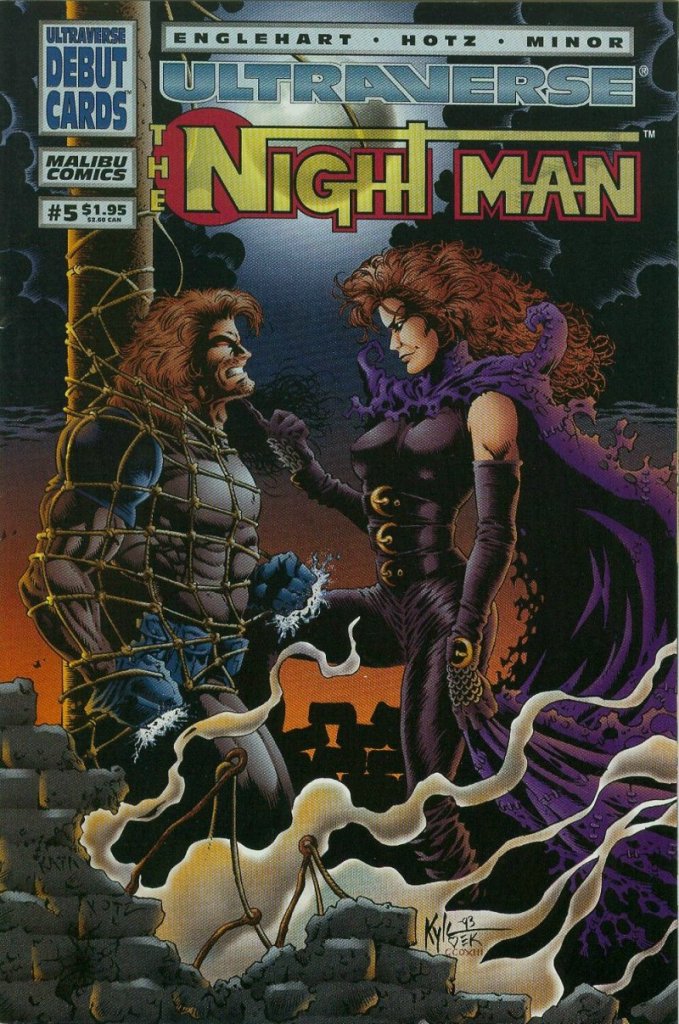
A Look Back at The Night Man #2 (1993)

Disclaimer: This is my original work with details sourced from reading the comic book and doing personal research. Anyone who wants to use this article, in part or in whole, needs to secure first my permission and agree to cite me as the source and author. Let it be known that any unauthorized use of this article will constrain the author to pursue the remedies under R.A. No. 8293, the Revised Penal Code, and/or all applicable legal actions under the laws of the Philippines.

Welcome back, superhero fans, comic book collectors, fans of 1990s arts and culture, and fans of Malibu Comics! Today we return to the Ultraverse for another tale of The Night Man, specifically from one of the early issues of its monthly series that launched in 1993.

For the newcomers reading this, Night Man is a solo hero within the Ultraverse who is a musician by day and a crime fighter by night. He was involved in a major accident with a certain cable car in San Francisco that got hit by a bolt of energy from the sky (as told in The Strangers #1). His life was never the same.

With those details laid down, here is a look back at The Night Man #2, published in 1993 by Malibu Comics with a story written by Steve Englehart and drawn by Gene Ha.

The cover.

Early story

The story begins with Johnny Domingo (Night Man) failing to sleep during the night. The operation he had recently kept him awake and his mind is just racing. He could not even properly play his saxophone.

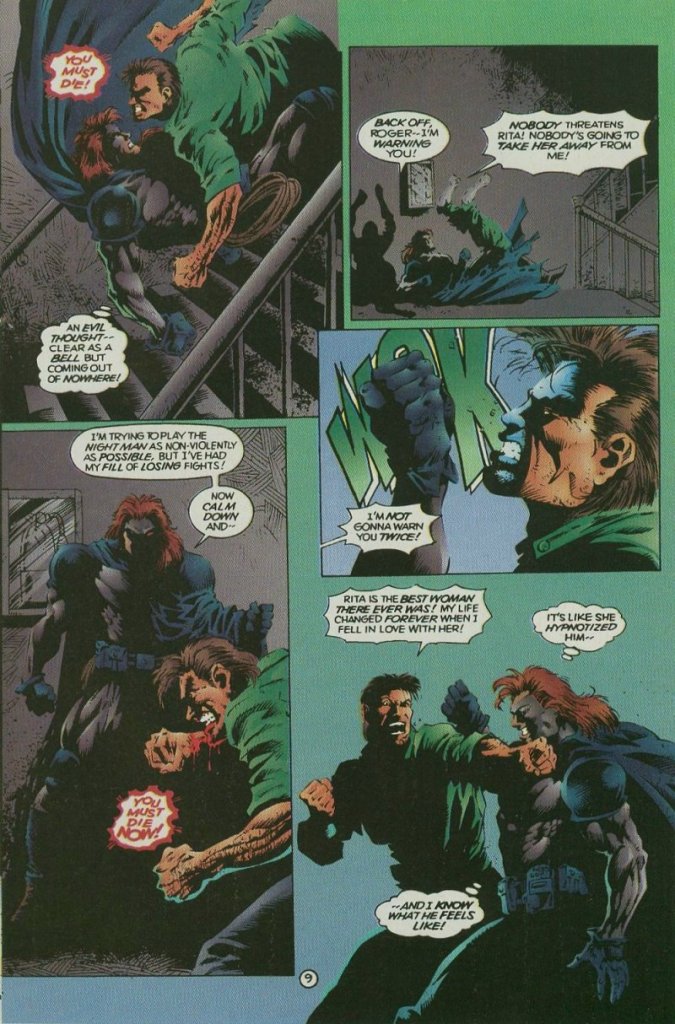
He dresses again as the Night Man, takes his motorcycle out of his place and then he speeds away. Shortly after, he senses another person’s thoughts…those of a man wearing a trench coat messing with a young boy. Night Man decides to jump in, intervene and save the boy but to his surprise, the man easily hit him moving him back and making him fall on the road.

Unwilling to give up, Night Man goes back to him and strikes back with a kick to the head. During their conflict, Night Man pulls the man’s trench coat revealing a rather shocking form for a body that looked inhuman. This shocks the costumed vigilante giving the man time to pull down scaffoldings in an attempt to hurt him and the boy…

Quality

Night Man and Mangle fight!

Focusing on the plot, while the first issue showed Night Man beginning as a vigilante and self-made detective, this comic book shows him struggling to do what he believes to be good (by means of saving another person’s life) and having to face both rejection and skepticism from people. Of course, Night Man himself is flawed with his execution and the way he presents himself to others (note: including doing the radical thing of climbing a tall building just to talk to someone powerful). It does not help that he is restless which clearly impacts his perception even though he has the will to be helpful and make local society a bit safer from dangerous people.  

Back to the story, the introduction of a new villain named Mangle is quite intriguing and it seems very fitting that Night Man’s reaction to seeing him in his inhuman form would reflect the same shocked reaction on the part of the reader. Mangle is very distinct from the many other villains of the Ultraverse and he is indeed a powerful adversary to Night Man.

When it comes to the visuals, Gene Ha’s art style is excellent. He has this distinct, gritty style on drawing people as well as their facial expressions. His art on Mangle made the villain look really scary and intimidating. Gene Ha also proved to be good with framing the action scenes while keeping enough creative space for the dialogue or narration to come in for readers to follow.

Conclusion

Nothing like coming all the way down from a very tall building to move on.

The Night Man #2 (1993) is pretty compelling and as it is free from the baggage that came with building up the vigilante in issue #1, this one has a more cohesive story and shows more of the him doing his best to be helpful. The story is good enough to keep me interested for the next issue. I should also state that if readers love seeing a hero struggle in helping others, then there is a lot to like in this story.

If you are seriously planning to buy an existing hard copy of The Night Man #2 (1993), be aware that as of this writing, MileHighComics.com shows that the near-mint copy of the comic book costs $14.

Overall, The Night Man #2 (1993) is recommended.

+++++

Thank you for reading. If you find this article engaging, please click the like button below and also please consider sharing this article to others. If you are looking for a copywriter to create content for your special project or business, check out my services and my portfolio. Feel free to contact me as well. Also please feel free to visit my Facebook page Author Carlo Carrasco and follow me at HavenorFantasy@twitter.com

A Look Back at Wonder Woman #15 (1988)

Disclaimer: This is my original work with details sourced from reading the comic book and doing personal research. Anyone who wants to use this article, in part or in whole, needs to secure first my permission and agree to cite me as the source and author. Let it be known that any unauthorized use of this article will constrain the author to pursue the remedies under R.A. No. 8293, the Revised Penal Code, and/or all applicable legal actions under the laws of the Philippines.

Welcome back, superhero enthusiasts, comic book collectors and Wonder Woman fans! Last time around, the Challenge of the Gods storyline concluded and it really had a lot of twists and profound surprises that really shook the foundation of the post-Crisis Wonder Woman monthly series that was spearheaded by George Perez and Len Win. The Challenge of the Gods started strongly in issue #10 and as each issue was released, the narrative got more intriguing and ultimately served its purpose on defining Wonder Woman as the ever-willing and pure Queen of Superheroes. Along the way, there was significant development of Queen Hippolyte who has been struggling between ruling her fellow Amazons and being a mother to Diana/Wonder Woman.

As the Challenge of the Gods was full of elements of fantasy and Greek mythology, it can be quite challenging for any comic book creator to start the next chapter of the Wonder Woman monthly series’ narrative without reusing the mentioned elements.

In the case of the next Wonder Woman comic book for review here, I can say that the creators literally brought Wonder Woman into the realm of realism and intrigue. With those details laid down, here is a look back at Wonder Woman #15, published by DC Comics in 1988 with a story written by George Perez and Len Wein. Perez illustrated the comic book.

The cover.

Early story

The story begins with Wonder Woman having a very vivid dream about a certain great hero. After waking up from it, she feels that trying to keep up with all the events of the world must be taking its toll on her. She expressed that she is ill-prepared to deal with new sensations.

“In this world, man and woman long for these feelings. They cherish them. I’ve read how they have even died for them,” Diana said. “And that truly frightens me.”

While Diana is staying at the Kapatelis residence, it turns out Julia (mother of Vanessa) is overseas. She wishes that Julia is with her to discuss what she has been feeling.

Meanwhile at the Ogawa headquarters in Boston, an armed man is using one of the company’s computers to acquire classified information about a subject referred to as Valerie Beaudry. A security guard arrives and decides to investigate as he realizes that his fellow guard was missing (knocked unconscious already). The infiltrator makes short work of him and leaves the building with the acquired information…

Quality

Wonder Woman appears at a major public event.

I can start with the sudden change of tone for the storytelling. Gone are the fantasy and mythology elements of the Challenges of the Gods storyline and fully implemented in this comic book are the elements of intrigue, suspense, assassination and even sci-fi. The story itself is more grounded with reality as far as the post-Crisis DC Comics universe goes and because it is well written, the sudden change of tone and style never felt jarring to me.

While the 9th issue of this monthly series introduced a modern Cheetah, this comic book introduced the modern Silver Swan in the form of Valerie Beaudry (who appears on the cover). The good news here is that the creators took their time in gradually building-up details about Valerie and how she became Silver Swan. By the time Silver Swan appears in the presence of Wonder Woman, her personal details and traits have been developed in a satisfying way. Unlike Wonder Woman #9, Silver Swan’s appearance in this comic book stretches on into the next issue.

Along the way, more new characters were introduced and the most notable ones are connected with Valerie Beaudry. Maxine Sterenbuch, who eerily resembles Wonder Woman’s teenage pal Vanessa but in adult form, has a close connection with Valerie over a period of many years. There was also Henry Cobb Armbruster, a tycoon who wield tremendous power and has been hiring assassins to do his bidding.

Going back to Wonder Woman herself, this issue explores more of her struggle with not only learning more about man’s world and its many divisions, but also the feelings she starts having as she connects more with other people – most notably with one of DC’s biggest icons. To have Julie Kapatelis absent left the creators room to have Diana not only bond more with daughter Vanessa but also strive more on analyzing what she learns in man’s world. The scene in which Wonder Woman notices a huge printed image of her is a vivid reminder about how negative and foolish idolatry is on people.

Conclusion

Intriguing action scene.

Even though it has no fantasy and mythology elements, Wonder Woman #15 (1988) is still a great comic book to read and it succeeds in progressing Diana’s discovery and learning of man’s world. Its introduction of the post-Crisis Silver Swan is memorable and her build-up (specifically her background story) is pretty engaging.

If you are seriously planning to buy an existing hard copy of Wonder Woman #15 (1988), be aware that as of this writing, MileHighComics.com shows that the near-mint copy of the regular edition costs $35 while the near-mint copy of the newsstand edition costs $70.

Overall, Wonder Woman #15 (1988) is highly recommended!

+++++

Thank you for reading. If you find this article engaging, please click the like button below and also please consider sharing this article to others. If you are looking for a copywriter to create content for your special project or business, check out my services and my portfolio. Feel free to contact me as well. Also please feel free to visit my Facebook page Author Carlo Carrasco and follow me at HavenorFantasy@twitter.com

A Look Back at Freex #10 (1994)

Disclaimer: This is my original work with details sourced from reading the comic book and doing personal research. Anyone who wants to use this article, in part or in whole, needs to secure first my permission and agree to cite me as the source and author. Let it be known that any unauthorized use of this article will constrain the author to pursue the remedies under R.A. No. 8293, the Revised Penal Code, and/or all applicable legal actions under the laws of the Philippines.

Welcome back, superhero enthusiasts, comic book collectors and fans of the Ultraverse! Today we will revisit the Ultraverse following the team of misfits called Freex. In my past Freex review, we saw the first appearance of Contrary who went on to become one of the more intriguing members of the superhero team UltraForce. As seen in the UltraForce monthly series, Contrary proved to be very intelligent, very resourceful and has what it takes to manipulate the behaviors and direction of even the likes of Hardcase (the team leader), Prototype and Prime.  

Of course, before the events of UltraForce happened, many of Contrary’s traits and operations were first explored in the Freex monthly series. To learn more about her, here is a look back at Freex #10, published in 1994 by Malibu Comics with a story written by Gerard Jones and drawn by Ben Herrera.

The cover.

Early story

The story begins inside a secret facility. Ray/Boom Boy of Freex has just been abducted and is restrained in the presence of Contrary who is just seating near him looking sexy and comfortable. Knowing that Boom Boy has no chance to escape and fight back, she releases him and mentions that she has other students who will fight for her.

Slowly, Contrary leads him into another place of the facility telling him that he’s not locked up (like a prisoner) but rather he is home (implying there is a place for him at the facility). She introduces him to her Academy for the New Elite with her students engaging in a training session against drones and obstacles. Her students are Feline, Waver, Flygirl and Cayman.

Meanwhile, members of the Freex are still homeless and are trying to figure out how to find Boom Boy… 

Quality

The Freex, without Boom Boy, struggling.

I want to start with the writing. This issue was clearly less about Freex and more of Boom Boy (note: his personal origin emphasized) and Contrary and her academy of people with powers and special abilities. Creatively, this story has strong X-Men vibes in it which I personally enjoyed. I do confirm that the writing is strong on storytelling, characterization and dialogue.

While the previous issue introduced her briefly, Contrary is heavily emphasized in this issue. Apart from being resourceful and highly intelligent, she is also erotic with her appearance (so much of her skin exposed always) and at the same time she is well portrayed as a mentor to her students complete with traits of motherly care to them. In comparison with what I’ve seen in X-Men comic books, Contrary is like a combination of Charles Xavier and Emma Frost with some traces of Moira MacTaggert. I should also state that Contrary has a keen perception on finding outstanding or special individuals that she can help develop in more ways than one.

Going back to Boom Boy, this comic book really redefined him not only as a questionable member of Freex but also as an Ultraverse character in general. By reading this story, you will not only relate with Boom Boy but also experience the challenge he is having on whether to decide to be with his old pals or join Contrary’s academy (which itself is inspired by Xavier’s School of Gifted Children in X-Men comics) to really leave his past behind and move forward personally.

While this comic book is heavy with characterization and exposition, there is still a good amount of superhero to enjoy here. The good news is that artist Ben Herrera showed a lot of creative stuff with the spectacle.   

Conclusion

This scene has very strong X-Men vibes.

Freex #10 (1994) is a great Ultraverse comic book! I really found this particular issue to be very engaging from start to finish. As a story about the Freex themselves, this one saw their story as desperate nomads move forward a lot. Still the standouts of the story are Boom Boy and Contrary. If you have not read any issues of UltraForce yet, I highly recommend reading this so you can get to know Contrary better as she is one of the core UF members.

If you are seriously planning to buy an existing hard copy of Freex #10 (1994), be aware that as of this writing, MileHighComics.com shows that the near-mint copy of the comic book costs $11.

Overall, Freex #10 (1994) is highly recommended!

+++++

Thank you for reading. If you find this article engaging, please click the like button below and also please consider sharing this article to others. If you are looking for a copywriter to create content for your special project or business, check out my services and my portfolio. Feel free to contact me as well. Also please feel free to visit my Facebook page Author Carlo Carrasco and follow me at HavenorFantasy@twitter.com

Wonder Woman 1984 4K Blu-ray listing spotted online

Welcome back, fellow geeks and Wonder Woman fans!

Have you seen Wonder Woman 1984 yet? I have not and I am waiting for local cinemas to reopen to screen it. The pandemic really brought down movie theaters which is really bad not only for their industry but also because a lot of employees of cinemas lost their jobs. I’m not just talking about the people handling the tickets but also those who work to cook food, prepare drinks and serve them to moviegoers.

More on Wonder Woman 1984, the film is available for viewing via HBO Max (mainly in the United States) without a premium fee required. This, in my opinion, is a terrible move by AT&T-controlled Warner Bros. because customers’ payments for HBO Max do NOT really go to the producers and financiers who made the Patty Jenkins-directed sequel.

As I mentioned before, I prefer to watch Wonder Woman 1984 in the movie theater instead of streaming it. Back in June 2017, I went to the local IMAX cinema to watch Wonder Woman by buying a premium movie ticket, buying popcorn and a drink, sat comfortably and watched the movie in its full greatness. Truly, VOD streaming will NEVER match the experience of the cinema. Right now, I’m waiting for the opportunity to watch Wonder Woman 1984 in the local movie theater.

As for home viewing, I personally prefer watching movies via optic disc media over streaming. Blu-ray is notable for advantages over streaming. That being said, there is a much better option to view Wonder Woman 1984 in the comfort of home – the upcoming 4K Blu-ray combo release of Wonder Woman 1984!

When it comes to watching Wonder Woman 1984 in the comfort of home, this is the BETTER option than streaming! (source – Blu-ray.com)

Recently Wonder Woman 1984 has been listed at Blu-ray.com to be released in 4K Blu-ray disc format along with a Blu-ray disc (1080p) and a digital copy. While this is not in any way an official announcement (note: as of this writing, the listing does not have a release date yet), it is inevitable that Wonder Woman fans and consumers will have the option to buy the new movie in 4K Blu-ray and Blu-ray discs.

According to the listing at Blu-ray.com, Wonder Woman 1984 4K Blu-ray will have a native 4K (3840x2160p) resolution. This alone is a major improvement over the upscaled 4K resolution (read: fake 4K) that the Wonder Woman 4K Blu-ray had. Upscaled 4K means digitally stretching a lower resolution video until it reached 3840x2160p resolution. Native 4K means the footage truly got rendered in 3840x2160p resolution, and this means more detailed visuals! Take note that the new movie that starred Gal Gadot had scenes filmed with IMAX cameras and their high visual details should translate nicely in 4K Blu-ray.

More on Wonder Woman 1984 4K Blu-ray, its original aspect ratio is 2.39:1, its audio has Dolby Atmos and Dolby TrueHD 7.1 confirmed, its subtitles are in English, French and Spanish. For playback, the 4K Blu-ray will be region-free while the Blu-ray (1080p) will be coded for Region A.

How much will Wonder Woman 4K Blu-ray combo package cost and when will be released? We will find out soon enough. Personally, as soon as it becomes available for ordering at Amazon, I will order it. It should be noted that what you pay for Wonder Woman 4K Blu-ray (or the standalone Blu-ray 1080p release), part of your money will go to the movie producers and investors who are struggling to recover their investment. This is another solid reason why I will not stream this movie. Dump HBO Max!

If you are looking for more Wonder Woman-related content, just search here in my website’s search engine. For those who have not seen Wonder Woman 1984, I recommend reading my retro review of the 1987 comic book Wonder Woman #9 which itself is required reading to get yourselves oriented about the first full appearance of Cheetah (Barbara Minervia). Also check out my most recent Wonder Woman retro review as well as my 2017 Wonder Woman movie review and my No Man’s Land scene special feature.

+++++

Thank you for reading. If you find this article engaging, please click the like button below and also please consider sharing this article to others. If you are looking for a copywriter to create content for your special project or business, check out my services and my portfolio. Feel free to contact me as well. Also please feel free to visit my Facebook page Author Carlo Carrasco and follow me at HavenorFantasy@twitter.com

A Look Back at The Solution #6 (1994)

Disclaimer: This is my original work with details sourced from reading the comic book and doing personal research. Anyone who wants to use this article, in part or in whole, needs to secure first my permission and agree to cite me as the source and author. Let it be known that any unauthorized use of this article will constrain the author to pursue the remedies under R.A. No. 8293, the Revised Penal Code, and/or all applicable legal actions under the laws of the Philippines.

As this is another retro  review of another Ultraverse comic book written by the late James Hudnall, I encourage you to take time to check out his background and other works via Comic Book Resource’s report of his death on April 2019.

In memory of James Hudnall, here are his words published near the end of The Solution #7:

The Solution is a dream team for me. I’ve been wanting to mix the genres of fantasy and cyberpunk science fiction with the super-hero genre for some time. Add my love of Japanese animation and Hong Kong cinema and you can see where I’m coming from here. This series is designed to show us some of the more bizarre and dark sectors of the Ultraverse without, hopefully, falling into the trap many similar books do where they lay it on too thick. The Ultraverse is a complex and multi-faceted universe and our books explore different sides. Here I want to delve deep into the criminal and espionage arenas as well as the magic sub-cultures that exist.

The characters themselves have a rich and interesting history that I plan to slowly unveil as the series progresses. When you first meet someone, you usually don’t know that much about the person. The characters are rather deep, as we will discover, and their personalities and more complex than you’re probably used to seeing in comics.

Now we can start this look back at The Solution #6, the Ultraverse comic book published in 1994 by Malibu Comics with a story written by James Hudnall and illustrated by John Statema (with ink work by Dennis Jensen and Mark Stegbauer).

Cover
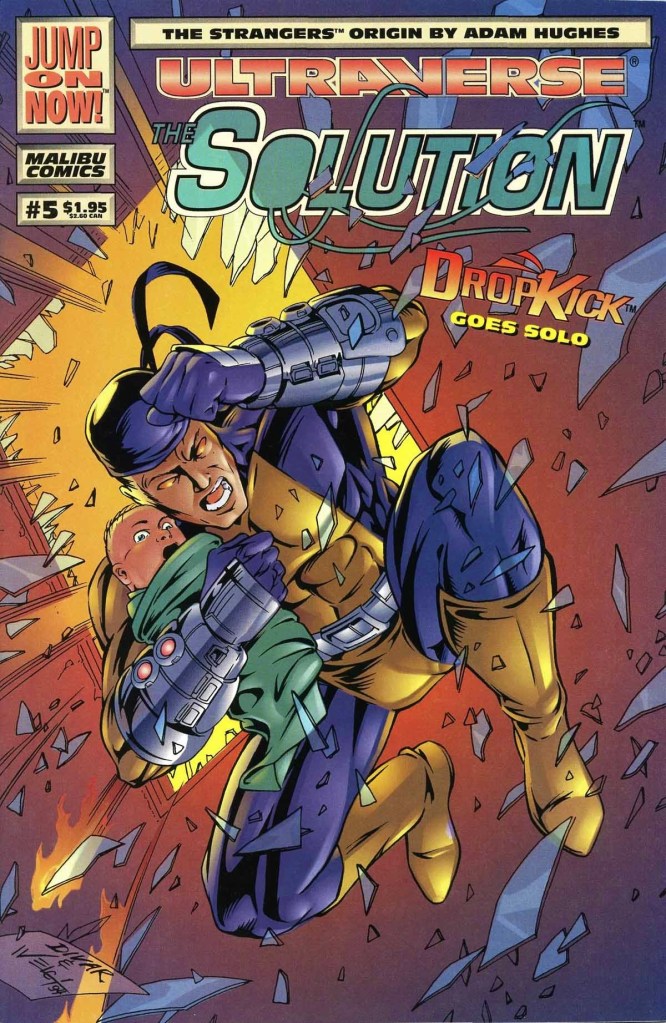
The cover.

Early story

The story begins with Lela Cho (Tech) alone paying respect to her father at his grave. She tearfully recalls what happened right after he died.

The narrative then shifts to 1993, specifically the day her father was about to get buried with many guests involved. Even though she is mourning, a man with blonde hair approaches her. His name is Kyle Sanders and he tells her she wants to talk to her about the corporation called Hypersonic. After receiving his business card, Lela feels a strange sense of dread creeping up on her.

A few days later, Lela attends a Board of Directors meeting at the headquarters of Hypersonic. She reminds them that she inherited all of her father’s shares in the company that makes her a majority stockholder and it was written in his will that she will assume his post as Chairman of the Board. Even though she already earned her Master’s Degree in Business at Harvard, the BOD members rejected her on the grounds that she’s too young and has no previous practical experience. They expressed that it would be better for her to work within the company and climb her way up.

Even though she got rejected and found herself alone, she decided not to give up and move forward by visiting NuWare, a corporation in San Francisco, California, that specializes on bio-tech implants (Wetware) that can make a person an Ultra…

Quality

20
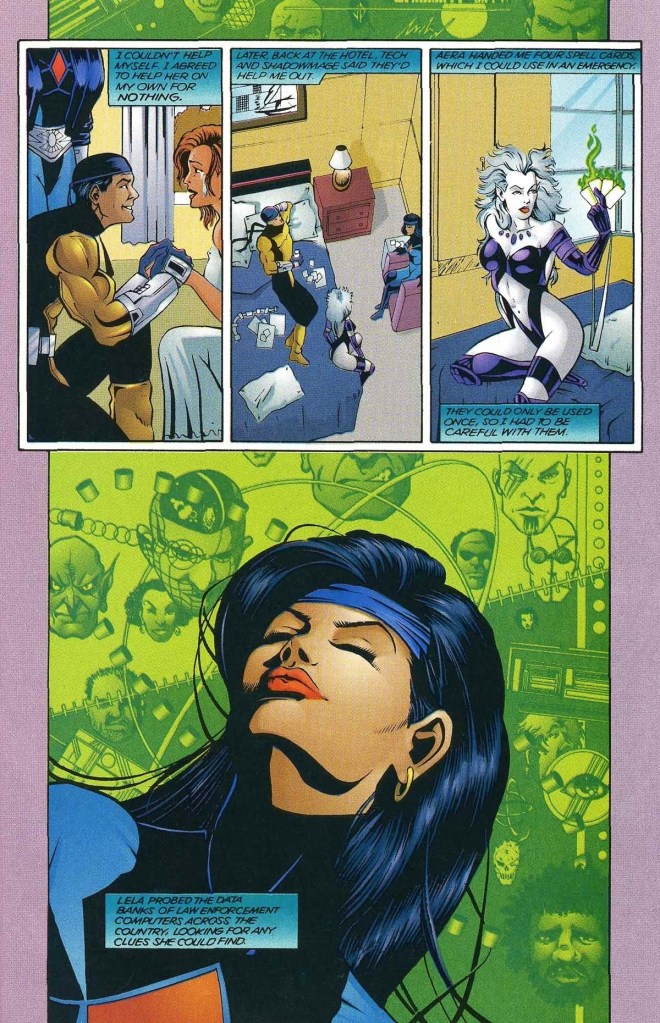
Lela Cho/Tech in action!

This is a very compelling, character-driven comic book, one of the best of the Ultraverse I read as of this writing. Clearly the late Hudnall achieved his goal of not only developing Lela Cho/Tech, but also defining her as a living part within the Ultraverse. Speaking of the Ultraverse, there is this nice and subtle connection with certain people regarding The Strangers.

Back to Lela Cho, her personality was very deeply defined by Hudnall. By the time you reach the end of this comic book, you should at least be caring about her even though her status as a super-rich lady trying to make her way up in business (while protecting herself) puts her on a different class. Ultimately her transformation into an Ultra is special to read and examine, even worthy of a cinematic adaptation.

Regarding the visuals, John Statema pulled of a great job. I love how the facial expressions he illustrated brought out the ranging emotions of the characters, specifically with Lela. When she’s mad, she really looks mad. When she is sad, you will see the sadness. Regarding action, Statema’s effort was decent.

Conclusion

11
Really nice art and good choice with the colors for the light effect.

I really liked The Solution #6. From start to finish, it kept me very engaged and ultimately it made me understand Lela Cho/Tech much better, which also made me go back to re-reading the first issue.

If you are seriously planning to buy an existing hard copy of The Solution #6, be aware that as of this writing, MileHighComics.com shows that the near-mint copy of the regular edition costs $4.

Overall, The Solution #6 is highly recommended.


Thank you for reading. If you find this article engaging, please click the like button below and also please consider sharing this article to others. If you are looking for a copywriter to create content for your special project or business, check out my services and my portfolio. Feel free to contact me with a private message. Also please feel free to visit my Facebook page Author Carlo Carrasco and follow me on Twitter at  @HavenorFantasy as well as on Tumblr at https://carlocarrasco.tumblr.com/

A Look Back at Aerobiz Supersonic

When it comes to playing economic simulation games, I enjoy playing them on the personal computer (PC) using the keyboard and mouse. Back in the mid-1990s, there was one particular economic simulation that I played on the Super Nintendo Entertainment System (Super NES or SNES) and found it to be very enjoyable and easily to play with using the console’s control pad.

That game was Aerobiz Supersonic, a simulation about the airline industry developed and published by Koei for both the Super NES and the Sega Genesis. Here is my look back at this old video game from the 1990s.

Screenshot_20200222-133557_Photos.jpg
The cover of the Super NES version of the game. Its art and style is really nice to look at.

Concept and Game Design

In the game, you get to play the Chief Executive Officer (CEO) of an airline and your goal is to beat your rivals in the global air travel industry. How to achieve the goal and succeed? There are tasks that need to be accomplished such as buying commercial airplanes (that include such real-life companies like Boeing and Airbus) for use, establishing flight routes, securing slots in airports worldwide, selling tickets and filling up each flight with as many passengers as possible, achieve profitability and finish the game’s imposed time period ranking #1. Adding zest to the game’s challenge is the selection of a certain era of world history that include 1955-1970 (the dawn of jets), 1970-1990 (the Cold War era), 1985-2005 (the present era) and 2000-2020 (the age of continued flight advancement).

Within the game, time passes by means of clicking a certain on-screen button that ends the player’s current turn. Of course, before pressing that, the player has to set things in motion like sending a representative to a certain overseas airport to negotiate and secure slots (which takes months to complete), set the ticket prices, buy a new airplane or two, etc. The game even allows players to micro-manage their airline like adjusting internal spending (salaries) or adjusting the quality of their airplane and services. Also nice is the option offered for players to buy a hotel or resort, a theme park or a travel agency that can bring in additional revenue.

Screenshot_20200222-132447_YouTube.jpg
The airport slots, local businesses, economic and tourism details per city displayed.

Screenshot_20200222-132508_YouTube.jpg
Visit an airline and choose from one of many models of airplanes to buy.

There are other small details that need paying attention to such as the economy and tourism meters of each city displayed (note: a higher tourism score means the city is more attractive to travelers), the population, etc. Also noteworthy is the current state of relations between your home nation with the nation of the city airport you are trying to establish routes with which can affect your business.

When the turn ends, a series of events will happen showing what happened around the world, how your company fared in the competition during the lapsed time period, and, occasionally, a random event will occur that most likely will affect your business (examples: the Olympics hosted by a city helps draw in additional passengers or the 1970s oil crisis raises the cost of your operation).

Regarding the game’s imposed time period for competing with the artificial intelligence (AI) opponents, the period is twenty in-game years.

Screenshot_20200214-195600_YouTube.jpg
This is part of micro-managing your business in the game.

Screenshot_20200214-195720_YouTube.jpg
After the end of each turn, news and updates not only about your company but also your competitors are flashed.

Quality

Being used to playing simulation games on PC, I found Aerobiz Supersonic to be very enjoyable, addicting and easy and efficient to play (in terms of controls). Considering the above-mentioned gameplay options (buying an airline, sending a representative, etc.), they are pretty easy to adjust using the Super NES controller although there were a few moments when I accidentally pressed the button putting into motion a different option.

Gameplay aside, this game has a whole lot of charm with its visual presentation. You launch a brand new flight route, the game shows a short animation sequence of the jet taking off. You buy an airplane, you will see a short animation of it entering your facility once it arrives (complete with a visual design reflecting the model). You conduct a board meeting, your company’s officials are present making reports to you and you get a series of choices to make on what to do next. A historical event or a global development occurs, you get to see original art reflecting them (example: a nation joins the EU with people wearing suits and neckties together in a formal ceremony). You make a move to buy slots at an airport overseas, a company official will have his or her face shown talking to you. When looking at the regional map, you see lines connected between cities (highlighting the establish flight route you made) and there are icons of airplanes flying between them.

Screenshot_20200214-195732_YouTube.jpg
Random tourist hot spots get highlighted as you keep playing.

More on the aspect of starting the game, I like the options offered for me to select which city shall serve as my airline headquarters. Among the many cities included, there are cities of my native Philippines namely Manila (the international destination) and the nearby city of Cebu. I still remember how delighted I was to see my native Philippines included in the game, complete with Asian character designs to reflect the company and its region.

Conclusion

Ultimately Aerobiz Supersonic (which was actually a sequel to Aerobiz) is a gem of a console economic simulation released at a time when 2D sprite gaming was still the standard and 3D polygonal gaming was just about to make an impact on the global video game console market. Back then, 2D side-scrolling action/adventure games, sports games and role-playing games (RPGs) were so common on the Super NES and Genesis combined and the idea of enjoying economic simulations on consoles was highly unusual. Aerobiz Supersonic is proof that economic simulations can come with a lot of depth, deliver a good amount of strategy and can be highly playable and enjoyable on consoles.

If you want to enjoy this game, it can be quite difficult to do because you need to acquire an existing copy of the game as well as a fully functioning Super NES or Sega Genesis. As of this writing, there has never been a re-release of Aerobiz Supersonic (note: in line with legitimacy, I will not consider those browser versions or file sharing of ROMs) and it is not even included on Nintendo’s Virtual Console. There’s not even a version made for smartphones.

Now if only the executives at Koei Tecmo Games would consider revisiting Aerobiz Supersonic with today’s consumers in mind.

Screenshot_20200222-132429_YouTube.jpg
You can choose what kind of plane, how many planes, how many flights and how much you set the ticket prices whenever you start a new flight route.


Thank you for reading. If you find this article engaging, please click the like button below and also please consider sharing this article to others. Also my fantasy book The World of Havenor is still available in paperback and e-book format. If you are looking for a copywriter to create content for your special project or business, check out my services and my portfolio. Feel free to contact me as well. Also please feel free to visit my Facebook page Author Carlo Carrasco and follow me at HavenorFantasy@twitter.com