Japan won several gold medals across different contests during the NTT Asia Triathlon ParaTriathlon Asian Championships 2024 at the Subic Bay Freeport Zone this past weekend.
To put things in perspective, posted below is the excerpt from the official release of Triathlon Philippines. Some parts in boldface…
Japan bagged six gold medals in the 2024 NTT Asia Triathlon Para Championships at the Waterfront and Boardwalk inside the Subic Bay Freeport Zone on June 2.
Tsutomo Nagata ruled the men’s PTS5 category in 1:08:31, while compatriots Takumi Nagata (1:13:25) and Tetsuki Kaji (1:14:59) settled for second and third places, respectively.
Satoru Yoneoka claimed victory in the men’s PTVI, clocking 1:03:53 to beat compatriots Yosuke Yamada (1:04:49) and Junpei Hoshi (1:05:29).
In the women’s PTS2 category, Yukako Hata (1:24:46) defeated fellow Japanese Asumi Yasuda (1:33:58) for the gold medal.
The other gold medalists were Kimura Jumpei (men’s PTWC), Mami Tani (women’s PTS4) and Riyo Kogama (women’s PTS5).
Meanwhile, four-time Paralympian Jiachao Wang of China ruled the men’s PTS4 category in 1:06:39.
Japanese Keiya Kaneko (1:12:30) placed second followed by Filipino Alex Silverio (1:15:55) in the 750m swim (one lap), 20km bike (2 laps) and 5km run (2 laps) competition organized by Triathlon Philippines (TriPhil) in partnership with the Subic Bay Metropolitan Authority (SBMA) and sanctioned by the Asia Triathlon and World Triathlon.
The 32-year-old Wang from Kunming, Yunnan province finished the race trouble-free. His left arm was amputated after an accident when he was five.
“I’m happy to win. This is my first time to compete here, the weather is hot and humid,” said Wang, who won medals in the pool in three Paralympic Games before shifting to triathlon nine years ago.
After making his debut in Athens (2004), he scooped one silver (200m individual medley) and one bronze (400m freestyle) medals in Beijing (2008).
Wang captured the gold medal in the men’s 4x100m medley relay and got two silvers (4x100m individual medley and 4x100m freestyle relay) at the 2012 London Paralympics.
Wang, who placed fourth at the 2020 Tokyo Paralympics, has completed the World Triathlon Level 2 coach certification course in South Korea last May 23.
Despite his bronze medal performance, Silverio was satisfied.
“I did not expect a podium finish because there are many good athletes in my category,” said the 34-year-old native of Compostela town in Cebu. He continued to train right after winning the gold medal at the Subic Bay International Triathlon last month.
“I am so happy that I was able to get a medal now,” said Silverio, who also joined the 2018 edition of the Asia Triathlon Para Championships in Legazpi City, Albay.
Silverio, a gold medalist at the National Age Group Triathlon last February, is a member of the Talisay Luigi Triathlon Group (TLTG) Go For Gold Philippines team.
In the men’s PTS2 category, Filipino Edison Badilla (1:35:36) defeated compatriot Jake Lacaba (1:41:18).
South Korea’s Kim Hwang Tae (1:27:13) beat Filipino Raul Angoluan (1:31:31) in the men’s PTS3), while Kyrgysztan’s Aitunuk Zhoomart Kyzy (1:21:38) prevailed over compatriot Gulnaz Zhuzbaeva (1:23:25) in the women’s PTVI category of the event sponsored by Philippine Sports Commission, Pinay in Action, Asian Center for Insulation, Gatorade (official hydration), Standard Insurance and Western Guaranty Inc., and partners Subic Bay Travelers Hotel, CM Timing of Jay Cheng and Stat Med ambulance service.
As the respective foreign and defense ministers of Japan and the Philippines will formally meet this July, the signing of a defense deal will most likely happen, according to a Kyodo News report.
To put things in perspective, posted below is an excerpt from the Kyodo News report. Some parts in boldface…
Philippine Defense Secretary Gilberto Teodoro said on Thursday that there is a “very strong possibility” for his country and Japan to sign an agreement allowing their defense forces to train in each other’s territories during a meeting involving the two nations’ foreign and defense ministers in July.
In an interview with Kyodo News, Teodoro stated that negotiations on a reciprocal access agreement were nearing conclusion, with no remaining contentious issues. These negotiations commenced in late November, following an agreement earlier that month between Philippine President Ferdinand Marcos Jr. and Japanese Prime Minister Fumio Kishida to initiate talks aimed at enhancing security ties.
“It will allow your maritime forces…land (forces) and your air forces to train with us in a different environment (from what) you are used to,” Teodoro said, referring to possible cooperation between Japan’s Self-Defense Forces and the Philippine military.
It will be Japan’s first RAA with a member of the Association of Southeast Asian Nations and the third following pacts with Australia and Britain, which took effect last year.
Once both countries ratify the RAA, it will enable Japanese forces to participate in the annual large-scale Balikatan military exercise conducted by the Philippines and the United States, he said.
Teodoro, his Japanese counterpart, Minoru Kihara, Philippine Foreign Secretary Enrique Manalo, and Japanese Foreign Minister Yoko Kamikawa will attend the bilateral security meeting scheduled for July in Manila.
Teodoro said the Philippines and Japan would eventually consider holding talks about a military intelligence-sharing accord called the General Security of Military Information Agreement, which Manila is currently negotiating with Washington.
Japan and the Philippines, both U.S. allies, have been strengthening bilateral defense ties in recent years in response to China’s intensifying provocative activities and territorial claims in the East and South China seas.
The Philippines is deepening its security ties with other like-minded countries such as Australia. In April, the Philippines, Australia, Japan, and the United States conducted a joint maritime exercise in the South China Sea, of which China claims almost the entire area as its territory.
In order to “demonstrate to the world freedom of navigation,” Teodoro said his country hopes to conduct naval activities with the three allies within the Philippines’ exclusive economic zone “as often as possible.”
Beijing’s sweeping claims in the South China Sea were invalidated by a 2016 ruling of the Permanent Court of Arbitration in The Hague.
Let me end this piece by asking you readers: What is your reaction to this recent development? Do you think the anticipated defense deal between Japan and the Philippines will somehow deter China’s aggression on the sea?
To put things in perspective, posted below is the excerpt from the PNA sports news story. Some parts in boldface…
China’s Jiachao Wang displayed his awesome form to claim victory in the men’s PTS4 category of the 2024 NTT Asia Triathlon Para Championships in Subic Bay Freeport on Sunday.
Wang clocked one hour, 06 minutes, and 39 seconds to beat Japanese Keiya Kaneko (1:12:30) and Filipino Alex Silverio (1:15:55) in the 750m swim, 20.26km bike and 5km run event.
“I’m happy to win,” said the 32-year-old Wang, who was born and raised in Kunming, Yunnan province. He lost his left arm in an accident when he was five years old.
“This is my first time to compete here, the weather is hot and humid,” added Wang, who won medals as a swimmer in three Paralympic Games before shifting to triathlon nine years ago.
After making his debut in Athens (2004), he bagged one silver (200m individual medley) and one bronze (400m freestyle) at the 2008 Beijing Games.
Wang pocketed one gold (men’s 4x100m medley relay) and two silvers (4x100m individual medley and 4x100m freestyle relay) in London (2012).
Wang, who placed fourth at the 2020 Tokyo Paralympics, has completed the World Triathlon Level 2 coach certification course in South Korea last May 23.
Silverio, who hails from Compostela town in Cebu, was satisfied with his performance.
“I did not expect a podium finish because there are many good athletes in my category. I am so happy that I was able to get a medal,” said the 34-year-old member of the Talisay Luigi Triathlon Group (TLTG) Go For Gold Philippines team.
Meanwhile, Filipino Edison Badilla (1:35:36) beat compatriot Jake Lacaba (1:41:18) in the men’s PTS2 category where they were the only entries.
Japan had the most number of gold medals at six, coming from Kimura Jumpei (men’s PTWC), Tsutomo Nagata (men’s PTS5), Satoru Yoneoka (men’s PTVI), Yukako Hata (women’s PTS2), Mami Tani (women’s PTS4), and Riyo Kogama (women’s PTS5).
The NTT Asia Triathlon ParaTriathlon Asian Championships 2024 was organized by organized by Triathlon Philippines (TriPhil) in partnership with the Subic Bay Metropolitan Authority (SBMA) with the support of Philippine Sports Commission, Pinay in Action, Asian Center for Insulation, Gatorade – the official hydration partner, Standard Insurance and Western Guaranty Inc, plus Subic Bay Travelers Hotel (hotel partner), CM Timing of Jay Cheng (timing partner) and Statmed (EMS partner).
Welcome back readers, fellow geeks and electronic gaming fans!
In this edition of the Retro Gaming Ads Blast (RGAB) series, we will take a look at another batch of retro gaming print ads from the 1980s and 1990s.
For the newcomers reading this, Retro Gaming Ads Blast (RGAB) looks back at the many print ads of games (console, arcade, computer and handheld) that were published in comic books, magazines, flyers and newspapers long before smartphones, social media, the worldwide web and streaming became popular. To put things in perspective, people back in the 1980s and 1990s were more trusting of print media for information and images about electronic games and related products.
With those details laid down, here is the newest batch of retro gaming print ads for you to see and enjoy…
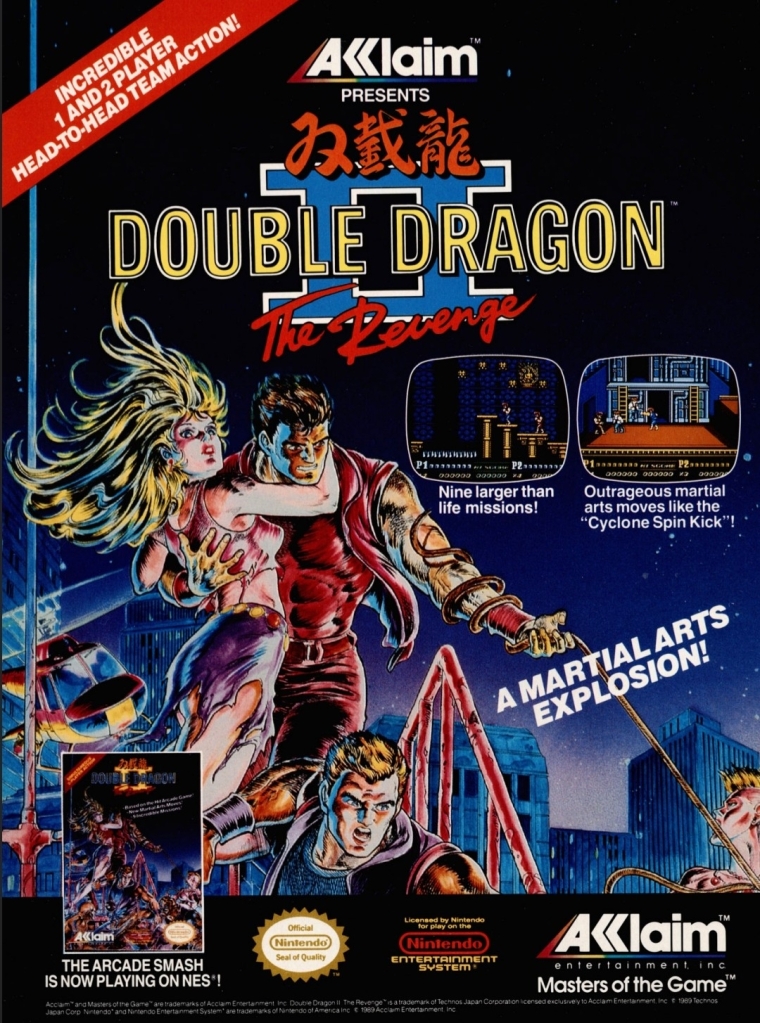
1. Double Dragon II: The Revenge print ad
Nice looking art used to promote the game.
The beat-them-up sub-genre of gaming was already popular in the 1980s and one of the most defining game franchises of this type of game was the Double Dragon series which proved to be popular with Nintendo Entertainment System (NES in America) and Family Computer (Famicom in Japan) gamers. As the first game was a very big hit on Nintendo’s consoles, the sequel Double Dragon II: The Revenge was promoted in America with strong confidence on the part of publisher Acclaim that it would become another massive hit. This print ad had a very nice looking comic books-style art that not only captured the concept of the game but also visualized the heroes Billy and Jimmy with enough details to focus on. I can say this was an eye-catching ad.
2. X-Men: Children of the Atom print ad
Great looking ad but the line “100% direct conversion” is not true at all.
Developed by Capcom in cooperation with Marvel, X-Men: Children of the Atom was a huge hit in the video arcades and it was not surprising that it got released on the Sega Saturn by Acclaim. Acclaim organized an aggressive promotional campaign by pouncing on the fans’ love and knowledge of the X-Men and the high fun factor of Capcom’s game. What this print ad got wrong, however, was the line “100% direct conversion of the #1 arcade smash!” which was wrong and misleading. In reality, the Sega Saturn version of the game had about one-third of the animation frames cut due to the console’s smaller RAM capacity.
As the years passed by, the Sega Saturn became the more suitable console for home ports of Capcom’s further 2D fighting games as Sony’s PlayStation had even more severe limitations and a graphics processor that was not suitable for 2D graphics. By the end of 2000, Capcom’s 2D fighting games on PlayStation all were inferior to the Sega Saturn versions.
3. Sky Shark NES print ad
This is an effective looking ad.
Released in Japan as Flying Shark, Sky Shark was released on multiple platforms in 1988 and there was an NES version of it which this particular print ad promoted. The American branch of Taito wisely used positive quotes from media outlets to promote the game while coming up with an engaging text description and displayed NES screenshots. And then there was that very engaging painted cover art that gave this print ad a lot of punch. An effective ad overall.
4. Conflict print ad
This is a very captivating artwork for advertising.
There is no denying the fact that the Cold War was a strong influence on arcade games and video games. Titles like Contra, Jackal, Metal Gear, Operation Wolf, Cabal and Rush’n Attack were militaristic games that entertained millions of gamers from the young adults to the little children. In 1990, Vic Tokai released the game Conflict on the NES which had a military theme but an unusual game design composed of digital maps with hexagons in which gamers will play with strategy to win battles. That being said, this print ad’s visual concept was very captivating yet also misleading. If you see how the game is played, you will know what I mean.
5. College Slam print ad
Were you ever interested in college basketball video games?
This is one of the more eye-catching print ads I’ve seen due to the artist’s illustration of a basketball with a mouth biting the basketball rim which dominates the space. For the newcomers reading this, College Slam was a basketball video game that was actually a repacked version of the popular NBA Jam with focus on NCAA basketball players. With the biting basketball at the center, it was easily an attraction and the screenshots implemented were larger than usual which easily gave gamers a clear look at what the game looked like. While this print ad is eye-catching, it did not help sell College Slam and there never was a follow-up.
6. Tecmo Super Baseball print ad
From the time when Tecmo was prolific with video games about sports.
Long before it started the Dead or Alive game franchise, Tecmo was once heavily invested in making sports video games. Tecmo Super Baseball was their first American pro baseball video game released for Super Nintendo Entertainment System (SNES) and Sega Genesis, and it was notable that the publisher secured only the Major League Baseball Players Association (MLBPA) which resulted in the game featuring real-life players but the teams had no names and no logos. Regardless, this print ad showed how aggressive Tecmo was in trying to attract consumers’ attention by showing ten screenshots with short text descriptions each. The ad’s write-up boasted realism as well as the promise of gaming quality.
7. The Punisher print ad
Marvel’s vigilante firing at someone.
In the early 1990s, Capcom and Marvel Comics started their partnership resulting in the releasing of the arcade game The Punisher. Developed by Capcom, the said arcade game became a big hit with gamers as it featured fun gameplay, multiple enemies appearing on screen simultaneously and other fun elements. Unsurprisingly, the game was ported (note: Sculptured Software was the lead developer) to the Sega Genesis with significant downgrades in terms of graphics, sound, enemy variety and other related elements due to technical limitations. That being said, this print ad used detailed art of the Punisher (with Col. Fury in the background) in a clever way to promote the Sega Genesis version while keeping their attention away from the obvious visual downgrades of the two screenshots displayed. The Punisher on Genesis was poorly received.
8. Stargate print ad
If you did not enjoy the movie, were you able to play the video game adaptation on Sega Genesis or Super NES?
Remember the sci-fi movie Stargate (1994)? The film was a surprise box office hit and eventually video game adaptations of it were made for the SNES, Sega Genesis, Game Gear and the GameBoy. This particular print ad, however, showed screenshots of the SNES and Genesis versions which is made obvious with the side-scrolling adventure plus 3D flying sequence (one screenshot showed it). Combined with images sourced from the movie poster plus an insert of the movie in home video format (lower-right corner), this print ad was obviously an aggressive way to promote the film with the post-theatrical business in mind. In case you are wondering, the cinematic Stargate is not related at all with the early 1980s video game (a follow-up to the classic game Defender) of the same name.
9. Aerobiz Supersonic print ad
For a simulation game released on consoles, Aerobiz Supersonic is pretty deep and a lot of fun to play.
The airline simulation game Aerobiz Supersonic is a highly addictive and surprisingly fun game that I enjoyed playing on the SNES (read my retro review by clicking here) and strangely enough I first learned about not through its print ad but by reading a preview published by Electronic Gaming Monthly (EGM) magazine. As for this print ad made by Koei’s American team, this is really odd to look at due to the ad makers’ choice of showing a not-so-attractive flight meal. In contrast to that, the ad makers did a good job describing the game creatively and showed three screenshots that were strategically selected in my view. Having played the game many times, I can say that this print ad is very truthful.
Housing companies located in Japan are looking towards the Philippines and other countries as sources of workers that can be hired for their services in connection with the surging local demand, according to a Nikkei Asia news report.
To put things in perspective, posted below is an excerpt from the Nikkei Asia news report. Some parts in boldface…
Companies in Japan that offer housekeeping services such as cleaning, laundry and ironing are increasingly turning to the Philippines and other places overseas as they rush to meet surging demand from time-strapped customers.
With working from home fading in the wake of the COVID-19 pandemic and the number of dual-income households rising, more people in the country are willing to pay for help handling chores.
Pushing to keep pace with this growing appetite for their services, housekeeping firms are accelerating their recruitment abroad — especially as relaxed immigration rules for the sector boost the appeal of hiring beyond Japan’s borders.
Indeed, Tokyo-based housekeeping service provider Bears plans to hire an extra 150 foreign workers in 2024 to bolster the 300 it already employs, with each person offered 400 hours of training.
The overseas recruitment drive comes as crushing labor shortages threaten a range of industries in Asia’s No. 3 economy and one of the world’s fastest-aging societies.
“Let’s make sure we clean windows and mirrors evenly by wiping in one direction,” an instructor said to 33-year-old Mundacruz Lizyldeci, who came to Japan from the Philippines this year, during a training session in a living room-like space at Bear’s head office. Listening to the instructions in early May with a serious look on her face, Lizyldeci said, “I will provide the high-quality services demanded by Japanese consumers.“
Bears says it plans to hire work-ready foreign housekeepers such as those licensed by the Philippine government.
Filipino workers hired through Bears’ subsidiary in the Philippines are given Japanese language and other lessons for two months before coming to Japan. They go through a two-week training program in Japan, which includes checks on their housekeeping skills. They are paid and assessed on the same basis as Japanese workers, with help available in Tagalog.
Housekeeping services by foreign nationals without permanent residence status began in areas designated as special economic zones in 2017. The government in 2020 extended the time such people are permitted to stay in the country to five years from three, while offering an additional three-year extension in 2023 for those who meet certain conditions.
In Japan, dual-income households began to outnumber those with stay-at-home housewives in 1992. The amount of two-paycheck families had increased to nearly 13 million by 2023, a roughly 40% rise over three decades, according to the Ministry of Internal Affairs and Communications.
Japan’s market for housekeeping services had grown to a value of 80.7 billion yen ($516 million) by fiscal 2021, more than doubling from five years earlier, according to the latest survey by Teikoku Databank. But in the research company’s 2023 consumer survey, only 1.8% of some 2,200 respondents in their 20s to 40s said they used housekeeping services. “I know of such services but have never used them” was the reply chosen by nearly 76%.
Nevertheless, potential demand for housekeeping services appears strong as roughly half of households in the survey considered home chores a burden. To convert potential demand into actual demand, fair prices for the services, as well as their quality and safety, need to be ensured.
Another driver for the rising demand is a shift from from the days of the COVID pandemic, when many people worked online from home. More employers are now telling their staff to come into the office.
A 35-year-old woman who has a job at a major financial institution in Tokyo often worked from home during the pandemic. But after restarting commuting to the office, she began using major housekeeping service provider CaSy’s so-called matching service from last November.
“I use ironing and laundry services once every two weeks,” she said. “I didn’t have much time to spare due to lots of overtime work. I can now go out on weekends.“
CaSy has some 170,000 registered customers and 15,000 housekeepers. The matching service introduces housekeepers to customers depending on the chores they need handling. But given frequent mismatches between customers and housekeepers over dates and places of work, CaSy created a program in February to complement orders, when necessary, with other housekeeping service providers. It has so far tied up with 15 companies for the program and hopes to increase the number to 100 in three years.
Before the registration of housekeepers, CaSy screens applicants’ records, including for any criminal convictions, through identity verification company Trustdock. While providing a sense of reassurance to customers, CaSy has set clear criteria for housekeepers about when and how to exit from customers’ homes to protect housekeepers from possible harassment by clients. “We must settle security-related problems while nurturing professional housekeepers,” said Yuki Shirasaka, a CaSy director.
The financial burden on customers is a major barrier to an increase in the use of housekeeping services. In France and Germany where over 10% of people use such services, financial support such as tax breaks are available to customers. Japan’s government will begin an experiment, possibly later in May, to provide subsidies to cover some costs when small and mid-size companies offer home services as a benefit for their employees.
Minimaid Service, which started housekeeping services for wealthy households back in 1983, is expanding its customer base by holding fees in check. A swift, inexpensive service introduced by Minimaid has helped stoke a threefold increase in the number of times its services have been used over the past five years. The company plans to increase its employee numbers by around 50% in two to three years.
Housekeeping services are roughly divided into three business models: the employment of housekeepers as staff, which prioritizes the quality of services through education; matching between customers and housekeepers commissioned by service providers; and websites for matching between customers and housekeepers on a person-to-person basis. Fees vary greatly.
Let me end this piece by asking you readers: What is your reaction to this recent development? Do you know anyone in your local community who is willing to work in Japan as housekeeping worker? Do you think the hiring of many Filipino workers by Japanese housekeeping companies will be economically beneficial for their families and the national economy in the long run?
Welcome back, my readers, YouTube viewers and all others who followed this series of articles focused on YouTube videos worth watching. Have you been searching for something fun or interesting to watch on YouTube? Do you feel bored right now and you crave for something to see on the world’s most popular online video destination?
I recommend you check out the following topics and the related videos I found.
#1NHK World’s Game Planet Documentary – If you are very passionate about video games and you want to see gaming through the views of the Japanese and the Chinese, then you should see NHK World’s documentary here. This video documentary is also a must-see for those who love playing the Street Fighter video games. Lots of creative talents from Capcom and Tencent interviewed.
#2 Square Enix decides to drop PlayStation exclusivity and go multiplatform with their business – It was indeed bound to happen and I was not surprised about it. In case you missed the news, Square Enix announced it will drop PlayStation exclusivity in favor of going aggressive with a multiplatform strategy. This is because there was a massive 70% profit drop on the part of Square Enix and sales of the PlayStation 5-exclusive Final Fantasy VII Rebirth were undeniably disappointing. To understand the details better, posted below is one analytical video and one critical video.
#3 Nick Anderson’s notorious 4 missed free throws and disrespect towards Michael Jordan – If you are long-time basketball fan, you would at least be aware of significant events during the NBA Playoffs and the Finals in 1995. I am talking about Nick Anderson who is still remembered as the guy who missed four free throws as his team (Orlando Magic) was already leading by three points ahead of the Houston Rockets (defending champions) during Game 1 of the 1995 NBA Finals. As history recorded, the Houston Rockets swept the Magic 4-0 to win their 2nd straight NBA championship. Going back to Anderson, he is also the same guy who disrespected Michael Jordan during the Eastern Conference semifinals. Posted below are three videos for you to watch.
#4 Reggie Miller’s 8 points in 8.9 seconds – Still with the 1995 NBA Playoffs, here is a look back at the miraculous achievement of Reggie Miller scoring eight points in less than nine seconds during a game against the New York Knicks at the Madison Square Garden. For the newcomers reading this, the playoff rivalry between the Knicks and Indiana Pacers started in 1994 and by the time their rematch in 1995 was realized, collective fan anticipation was already high. There was no better way to raise the stakes in the rematch than Miller’s unexpected 8 points in 8.9 seconds. Watch the video below.
#5 Popcorn in Bed’s reaction video of Deep Impact – In 1998 here in the Philippines, I saw the sci-fi film Deep Impact in a cinema during its first week of release. It was entertaining to watch given the sci-fi spectacle, the concept and, of course, the wide cast of actors that includes the legendary Robert Duvall in a really solid supporting role. What is most notable about Deep Impact is the fact that it was made to spark emotion from viewers and that is most inevitable in the movie reaction video by Popcorn in Bed. With the current number of Deep Impact reaction videos available on YouTube as of this writing, the best one is viewable right below…
#6 HolyLandSite’s video of the tour of the Oaks of Mamre in Israel– Recently HolyLandSite released their newest Holy Land video focused on the Oaks of Mamre in Israel which is the historical and biblical site where the Abrahamic Covenant was given. Oaks of Mamre is filled with evidence that it is indeed the very place where Abraham met God. God’s covenant has always been with the Jewish people (read Genesis 17:15-21 in the Holy Bible). This video also has biblical lessons for those who follow Lord Jesus and the Word of God. May this also remind you that the ties between Jews and Christians are biblical.
#7 Retrospective video about Konami’s X-Men arcade game – Just a few years before Capcom and Marvel Comics teamed up for the production of arcade games featuring superheroes and the publisher’s own characters, Konami literally rocked the arcades with a lot of fun with the X-Men arcade game of 1992. Using the established character designs from the 1989 cartoon X-Men: Pryde of the X-Men, the arcade game allowed players to choose one of six superheroes to play as (listed were Cyclops, Wolverine, Dazzler, Storm, Colossus and Nightcrawler) and engage in side-scrolling beat-them-up action fighting the many minions of Magneto. The X-Men arcade game was undeniably successful and impacted the way people enjoyed multiplayer sessions in the arcades. You can learn more from this in-depth retro gaming video by PatmanQC.
#8 FilmComicsExplained’s Demolition Man video analysis – When I first saw Demolition Man (1993), I perceived it as a Sylvester Stallone action movie laced with futuristic science fiction (sci-fi) concepts. I noticed the film’s portrayal of what future society could become and what futuristic technologies could be used by people. By today’s standards, Demolition Man is perceived to be prophetic with its presentation and the video by FilmComicsExplained takes an in-depth look into it. It is a must-see!
#9 The death of wicked Iran’s president – Since 1979, Iran became wicked and its government has officially been sponsoring terrorists and terrorism activities in the Middle East for far too long. In case you missed the news, the president of Iran died in a helicopter crash recently and there were other fatalities with him. The president of Iran not only publicly called for the destruction of Israel, he is also responsible for harming minorities and political opponents, hurting protesters in Iran and more. There are reasons why the dead president has been called the Butcher of Tehran. For a clear view and analysis over the death of the president of Iran, watch the selected videos below. Do not trust Islamo-Leftist mainstream news media as they support terrorism.
In light of the recent news that the economy of the Philippines grew by 5.7% during the 1st quarter of 2024, economic analysts stated that growth should be more than 6% per quarter over the next three quarters in order to meet the set target of the year, according to a BusinessWorld news report.
To put things in perspective, posted below is an excerpt from the BusinessWorld news report. Some parts in boldface…
THE PHILIPPINE ECONOMY should expand by more than 6% in the next three quarters to meet the government’s growth target this year, analysts said.
“The Philippines needs to grow almost 6.1% for the remaining three quarters to reach 6% growth for the entire year, which appears to be a tall order, particularly given the slowdown in household spending in quarter one and the subdued global economic backdrop this year,” Makoto Tsuchiya, an economist at Oxford Economics Japan, said in an e-mail.
Philippine gross domestic product (GDP) grew by 5.7% in the first quarter, slightly faster than the 5.5% in the fourth quarter of 2023 but below the government’s 6-7% target.
University of Asia and the Pacific Senior Economist Cid L. Terosa said GDP growth should average 6-6.5% for the rest of the year to hit the lower end of the government’s target band.
“We had always been expecting growth to stay subdued largely due to the ‘triple threat’ faced by the economy. Elevated inflation, high borrowing costs and fiscal consolidation are the troika of challenges we face,” ING Bank N.V. Manila Senior Economist Nicholas Antonio T. Mapa said in an e-mail.
Household spending, which accounts for nearly three-fourths of economic output, rose by 4.6% in the January-to-March, the slowest since the coronavirus pandemic and weaker than 5.3% in the fourth quarter and 6.4% a year ago.
Mr. Tsuchiya said private consumption lagged due to “economic-wide” pressures on spending in the first three months of the year.
“We believe the softening in household consumption was due to a combination of elevated inflation, tepid confidence and the impact of monetary tightening,” Mr. Tsuchiya said.
Inflation quickened to 3.8% in April amid rising food and transport costs. April was the third straight month that inflation accelerated.
Let me end this piece by asking you readers: What is your reaction to this recent development? Do you think that inflation will continue to rise and prevent the Philippines from achieving economic growth of 6% for 2024?
Disclaimer: This is my original work with details sourced from playing the video game and doing personal research. Anyone who wants to use this article, in part or in whole, needs to secure first my permission and agree to cite me as the source and author. Let it be known that any unauthorized use of this article will constrain the author to pursue the remedies under R.A. No. 8293, the Revised Penal Code, and/or all applicable legal actions under the laws of the Philippines.
Welcome back retro gaming fans and readers!
Today, we will go back to the late 1980s to examine one of the most significant console games of the decade…Konami’s Contra. To put things in perspective, Contra started in the arcades in 1987 and went on to become a big hit. Konami went on to make a version of the game for Nintendo Entertainment System (NES) in the West and the Family Computer (Famicom) in Japan that resulted in different looking graphics (both artistically and technically), reworked stages, and different and extended level designs that were done within the consoles’ limitations. In short, the home version of Contra was pretty different from the arcade version but still was made to be fun and exciting on its own.
In my personal experience, my discovery of Contra has always been on the Famicom and some time later on the NES. For this retro review, I replayed Contra (both Famicom and NES versions) via the Contra Anniversary Collection on my Xbox Series X.
With those details laid down, here is a look back at Contra, developed and published by Konami for the NES and Famicom in 1988. The NES version was released one week ahead of the Famicom version in February 1988.
The start screen of the NES version of Contra. The commando with dark hair was deliberately made to resemble Sylvester Stallone somewhat.
Game concept
In the far future, an alien army from space – Red Falcon – arrived on Earth inside a meteorite that landed on the Galuga archipelago. There, Red Falcon established an extensive high-tech base for their operations and eventually brainwashed a local human army to do what they want. Red Falcon plots to wipe out human civilization on the planet.
With the information about Red Falcon collected, the Earth Marine Corps send Contra unit members Bill Rizer and Lance Bean to the island to destroy the opposition and find out what Red Falcon has been doing…
Gameplay and quality
Contra is an action-packed 2D side-scrolling game with strong sci-fi and military influences.
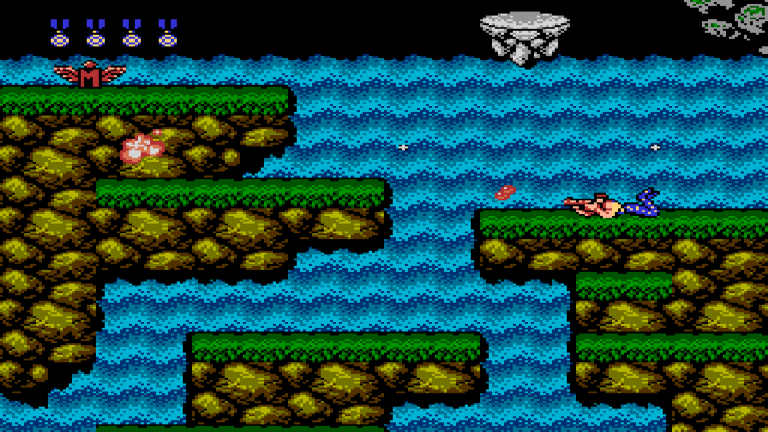
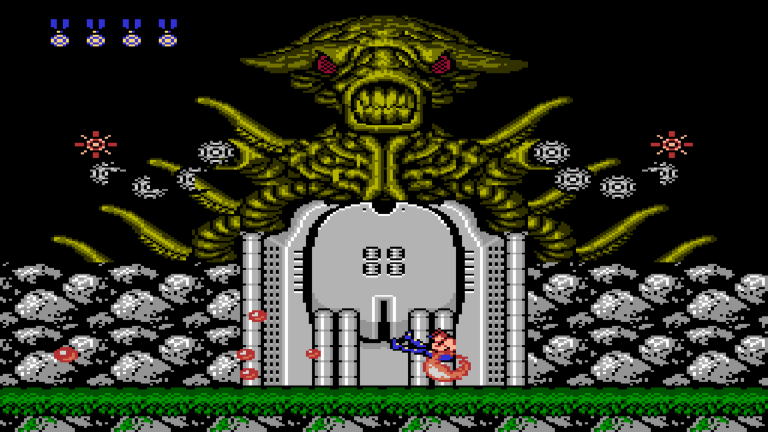
To begin with, Contra of 1988 was made to be a nicely-paced, action-packed, side-scrolling adventure game that has some 3D-like levels in between. The game design and levels Konami came up with was done to immerse gamers into actual participation in the military campaign against the aliens and their brainwashed human soldiers. This campaign not only includes battles through the forest of the Galuga archipelago but also through the interiors of Red Falcon’s high-tech facilities, going up an elevated location with waterfalls, the snowy area and further deep into the rest of the enemy’s mechanical base.
For the most part, you play as a commando armed with a rifle with unlimited ammunition. As you shoot enemies and make your way through the 2D side-scrolling level, there will be the occasional flying capsules that you can shoot down to gain new weapons/ammunition (S for Spread Shot, M for Machine Gun, L for Laser) or some power-up (temporary invincibility or the rare ability to eliminate all enemies present on-screen) to help yourself as the wave of opposition from Red Falcon is relentless (which is reason enough to compel you to keep progressing and fighting). There are also times when the mentioned enhancements suddenly pop out after killing an enemy.
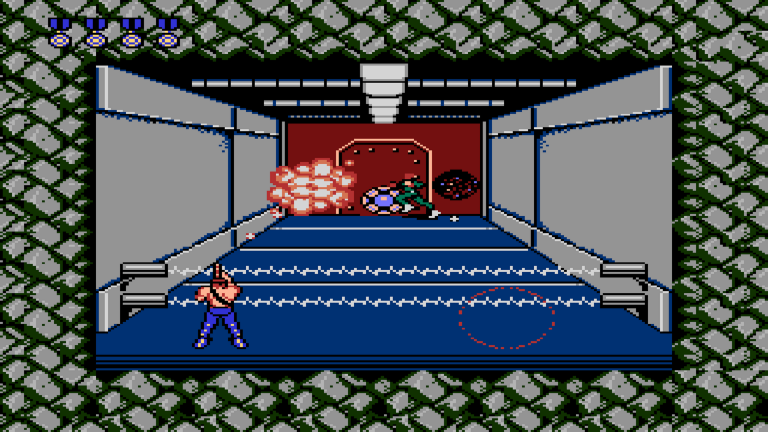
To prevent the game from getting too old with side-scrolling, Konami implemented these stages in which players face the front to attack enemies, overcome obstacles and move forward with 3D-like effects going into the next place.
By default, this game is brutally hard. Not only do the enemies keep appearing (with some of their teammates being strategically placed to fire at you), the obstacles will compel you to take your time overcoming them. In this game, one-hit death is the norm and there are many moments in which falling to your death becomes a huge risk. You get hit, you not only lose one life, you will lose whatever powerful weapons you gained.
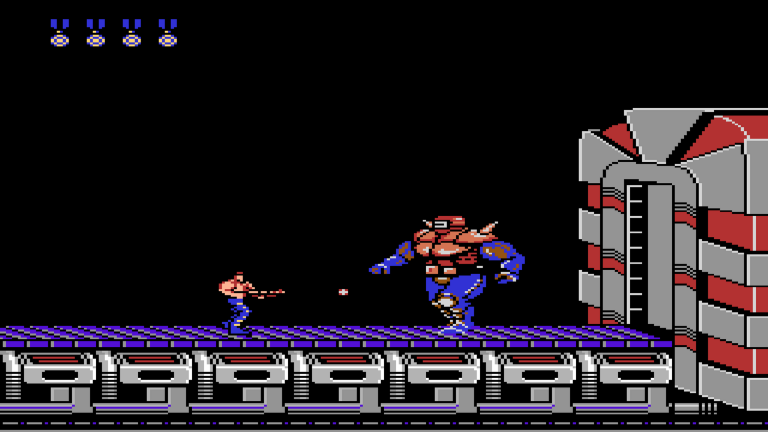
There are also stage bosses (powerful enemies that await you at the end of a level) that will challenge you so much, you will have to adjust your strategy, pay attention to the movements and timing of the enemy, and then adjust your way fighting.
Only the Famicom version of Contra has this sequence.
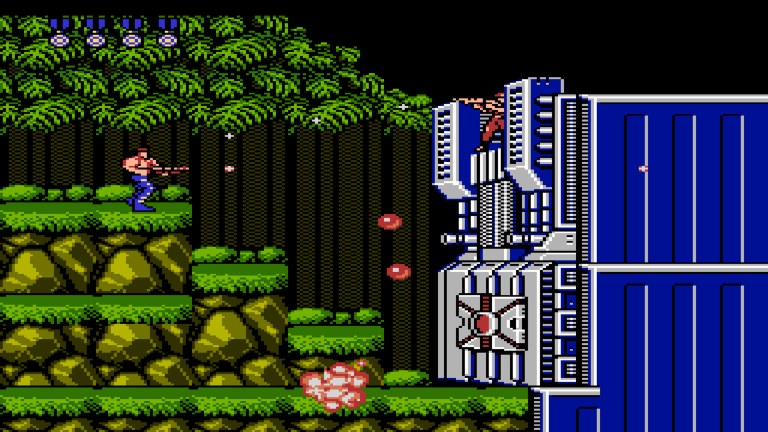
I really love the sci-fi elements the game developers came up with for this classic game. There are lots of high-tech stuff to see here and this robotic enemy is just one of them.
Fortunately for us players, the controls are really tight and very responsive. You can move your characters to overcome obstacles, avoid getting hit by enemies and even move down from one platform if the space below is safer. I still remember how precise and responsive the controls were on the NES and Famicom versions, and I can say that all the responsiveness made it on the Xbox controller when I replayed Contra on Xbox Series X with the Contra Anniversary Collection I downloaded. In fact, the high precision of the controls added to the fun of shooting enemies or obstacles with the Spread Shot while moving to the right as it was meant to be.
Considering the intense difficulty of the game, players who do the famous Konami Code (Up, Up, Down, Down, Left, Right, Left, Right, B, A, and Start) will be reward with 30 lives when they start playing Contra. For Xbox gamers reading this, there is a slight difference with the Konami Code when playing Contra on Xbox consoles.
Apart from shooting, there are lots of platform gaming elements to experience here. The difficulty is very brutal and the famous Konami Code will grant you 30 lives when you do the code correctly.
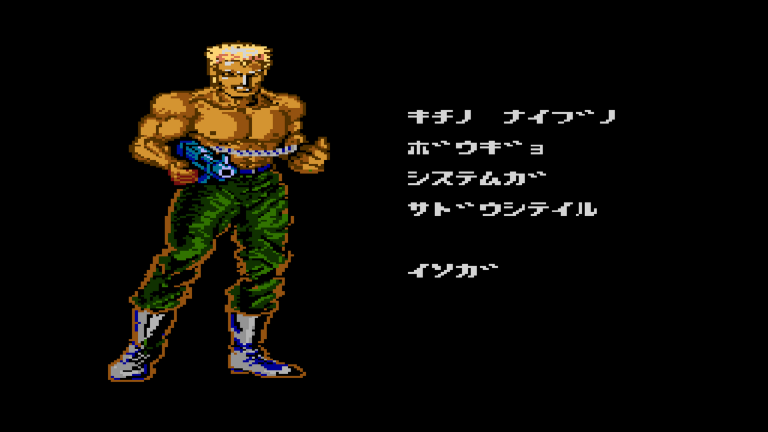
This cut-scene is only available in the Famicom version.
With regards to game design, the Konami developers did a really fine job creating the levels, placing the challenges and setting up memorable boss battles for action/adventure-hungry gamers to indulge in. The developers also cleverly implemented the fictional/fantasy concepts into the game design which resulted in me getting immersed in the Contra team’s mission against the Red Falcon at their secret base.
Another highlight with playing Contra is the 2-player option and the above-mentioned Konami Code added to the fun and accessibility of. I still remember the old days of playing in a 2-player session (cooperative play essentially) of Contra at a friend’s house on a Famicom. Since my friends and I were already enthusiasts of 1980s Hollywood action movies, playing Contra was enjoyable even though the difficulty was brutal.
This is one of the touch stage bosses you will encounter in the game.
If there are any notable differences between the two versions of Contra of 1988, it would be the fact that the Japanese (Famicom) version has storytelling emphasized through cutscenes (with Japanese text displayed), a technical overview of the Red Falcon base at Galuga with maps displayed before you start a new level, in-game art, an additional scene that spiced up the ending and, most notably, more background/environmental animation. The additional animation on the Famicom version made the adventuring look and feel more lively and this is most evident in the final stage (lair of the alien).
Conclusion
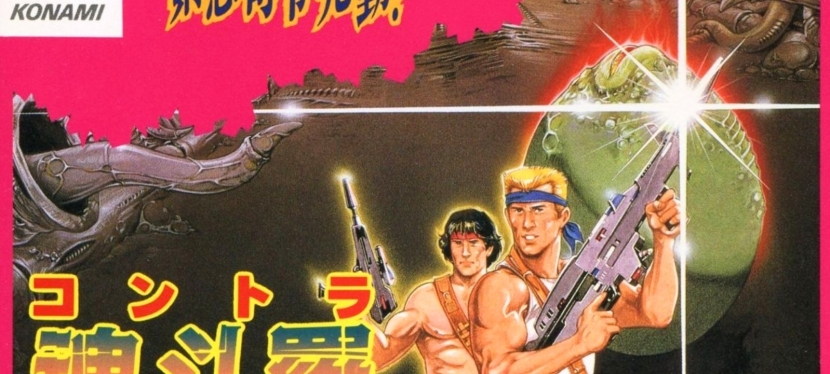
The Japanese cover art of Contra on Famicom. The Rambo-like character and the alien egg are obvious inspirations from Hollywood action movies of the 1980s.
There is no doubt in my view that after all the decades that passed since I first played it, Contra (1988) is still very engaging and a lot of fun to play whether you choose the Famicom version or the NES version. The developers who made this game succeeding in making something very enjoyable for millions of gamers and it is very clear that the makers were inspired by Hollywood action movies of the decade. In my view, the most obvious military inspirations are Aliens (1986), Commando (1985) and Rambo: First Blood Part II (1985).
Historically speaking, Contra (1988) was released at a time when militarism inspired many other game designers to come up with enjoyable games in different forms such as Cabal, Jackal, Rush’n Attack, Operation Wolf, Operation Thunderbolt to name some. Considering the overall quality and high fun factor Konami established, it is safe to say that this game is one of the finest among its militaristic gaming counterparts of its decade.
I had a grand time replaying Contra (1988) on my Xbox Series X in preparation for this review. Having played both NES and Famicom versions, I can say that the latter is the more complete and more immersive version to play. That does not necessarily mean the NES version is totally inferior. In fact, the NES version is more straightforward with the pick-up-and-play approach, and the gameplay itself is nearly identical (note: Famicom version is slightly more challenging) and very much fun to experience. If you are the player who really wants to be more immersed into the lore of Contra and absorb the military sci-fi concept Konami prepared, then the Famicom version is the one to play. That being said, now is a good time to purchase and download Contra Anniversary Collection.
Overall, Contra (1988) is highly recommended! It truly is a retro gaming gem!
Welcome back readers, fellow geeks and electronic gaming fans!
In this edition of the Retro Gaming Ads Blast (RGAB) series, we will take a look at another batch of retro gaming print ads from the 1980s and 1990s.
For the newcomers reading this, Retro Gaming Ads Blast (RGAB) looks back at the many print ads of games (console, arcade, computer and handheld) that were published in comic books, magazines, flyers and newspapers long before smartphones, social media, the worldwide web and streaming became popular. To put things in perspective, people back in the 1980s and 1990s were more trusting of print media for information and images about electronic games and related hardware.
With those details laid down, here is the newest batch of retro gaming print ads for you to see and enjoy…
1. Enemy Zero print ad
I should say Sega did a solid job by making this intriguing and eye-catching print ad for Enemy Zero.
The first time I saw this print ad of Enemy Zero in the late 1990s, I was intrigued by its visual concept and it got me interested to learning more about the game. Enemy Zero was a sci-fi video game developed by Warp and released as a console-exclusive on the Sega Saturn. Since I never owned a Saturn, I never got to play the game but I was inspired to learn more about Warp (which developed the hit game D). As it turns out, Enemy Zero started as a project for PlayStation but because of Sony’s failure to fulfill the pre-orders of D on PlayStation (100,000 copies ordered but less than 30,000 copies printed by Sony), Warp’s head Kenji Eno decided to make Enemy Zero exclusive to the Sega Saturn. Enemy Zero was published by Sega worldwide while Warp published it in Japan, and the game sold between 500,000 to 700,000 copies (based on Eno’s claim).
2. Bionic Commando print ad
For the American market, Capcom showed what the game box and front cover art would look like, then added the details and two screenshots for readers to examine.
Back in the late 1980s, I played Bionic Commando and managed to finish it after enduring lots of challenges along the way. It was a very unique adventure game as it used a highly unusual method of moving from one platform to the next by means of a futuristic grappling gun. This particular print ad showcased what the game’s actual box looked like (with cover artwork made for North America) and used two screenshots from the game. This ad hardly captures the excitement and intensity that awaited gamers and yet it manages to give people a clear look at the grappling concept. While the North American version of the game has certain content altered, it still had the same gory ending (and Adolf Hitler as the main villain) as the Japanese version.
3. RoboCop print ad
This served as an extension of the impact of the very violent 1987 movie.
RoboCop made huge impact on moviegoers as well as people who love science fiction and the R-rated action films Hollywood studios released in the 1980s. That being said, it was not surprising that a video game of RoboCop was released on the Nintendo Entertainment System (Family Computer in Japan) by Data East and the print ad they came up with cleverly used imagery from the movie poster and the screenshots showed exactly what RoboCop fans expected to see such as the enemy robot ED-209 and thugs. This game strongly reflects the business trend of the 1980s when companies made merchandise and adaptations of R-rated blockbuster films to sell to kids and teenagers.
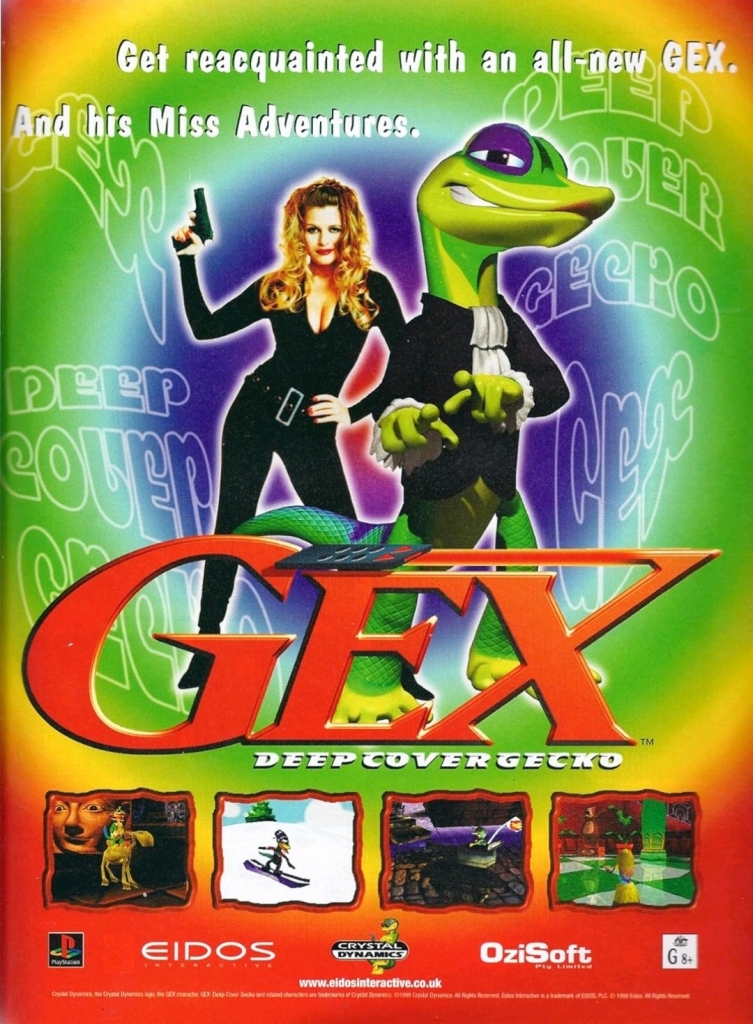
4. Gex 3: Deep Cover Gecko print ads
This print ad for Europe had a James Bond vibe.
March 1998 Playmate of the Month on the hood of the car looking at Gex.
The 2-page print ad of Gex 3: Deep Cover Gecko.
In 1999, Eidos Interactive – the company behind the wildly popular Tomb Raider games of the decade – became aggressive marketing Gex 3: Deep Cover Gecko for PlayStation and Nintendo 64. They were so aggressive, they featured actress and Playboy’s Playmate of the Month (March 1998) Marliece Andrada alongside their star character Gex in the marketing which was not limited to America. For the newcomers reading this, a multimedia approach was implemented on the narrative of the game’s PlayStation version which explains why it has full-motion video sequences featuring Andrada as the character Agent Xtra. As seen in these print ads, Eidos Interactive had Andrada looking pretty and sexy to really sell the game.
5. Barkley Shut Up and Jam! print ad
Anyone here a Charles Barkley fan?
I remember the many types of basketball video games that were released on game consoles back in the 1990s. While there were NBA video games that had in-depth rosters of players with seasonal gaming in mind, there were other basketball-related video games that were not about the said league but featured an NBA star. In this print ad, publisher Accolade prominently featured NBA star Charles Barkley to promote the game Barkley Shut Up and Jam!, posted some words emphasizing sports intensity, and showed one screenshot to assure gamers that this is a basketball game. While the critical reception was mixed, the game must have sold enough to convince Accolade to release a sequel two years later with Barkley still the endorser.
6. The Death and Return of Superman print ad
This print ad clearly aimed for the fans of the comic books as well as gamers looking for an action-packed game to play.
Now this is one very eye-catching print ad that appeared in comic books and magazines in the 1990s. Anyone who knows comics would recognize the grey fist (with sharp bones protruding on the knuckles) belonging to Doomsday who killed Superman in Superman #75 (1993), and the bloody presentation on the famous S was very aggressive for its time. The game itself was an adaptation of the two storylines (published in 1992 and 1993 respectively) that saw Superman’s death, his return and the appearances of new Supermen. While sales figures are not available, The Death and Return of Superman eventually attracted mixed reviews from the critics.
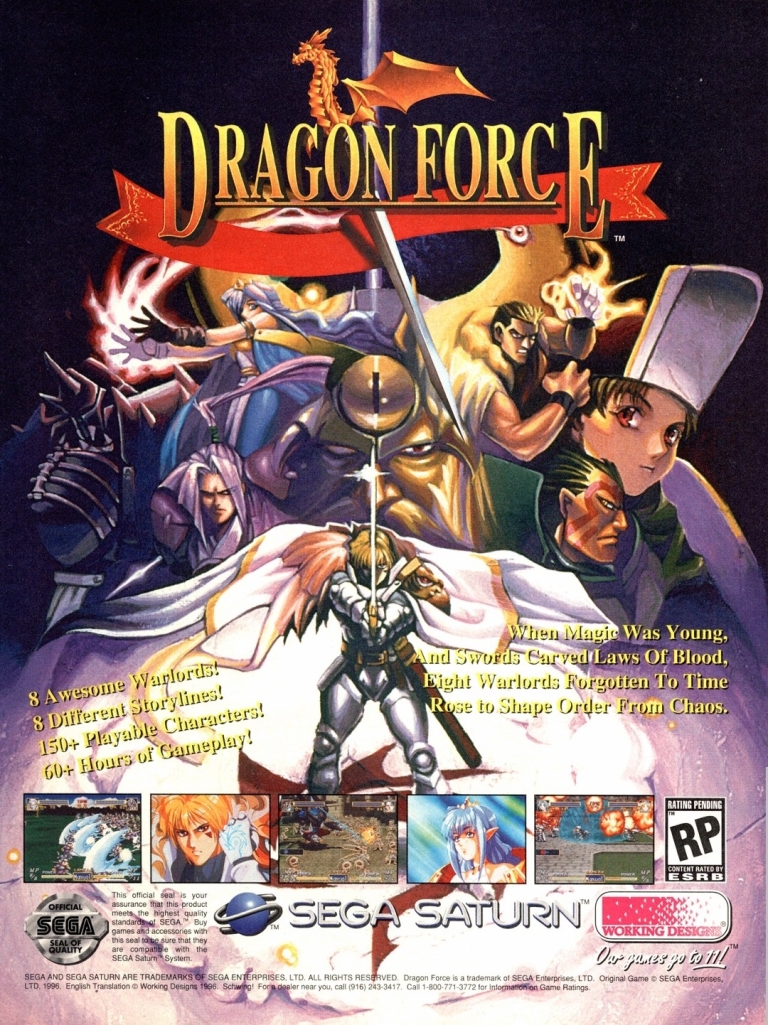
7. Dragon Force print ad
This was printed in magazines at a time when Working Designs had a strong business relationship with Sega.
While the Sega Saturn was undeniably a huge commercial disappointment in North America, the console still had some great games that was widely praised by game critics and heavily bought by gamers. One of those outstanding games on the console was Dragon Force (developed by Sega and J-Force in Japan, localized in America by Working Designs) which received great critical acclaim and achieved commercial success both in Japan and in America. The popular magazine Electronic Gaming Monthly named Dragon Force as the Saturn Game of the Year as well as Strategy Game of the Year in 1996. As a Working Designs release, this print ad has an ambitious fantasy concept visually emphasized, detailed lines of descriptions and screenshots that strongly appealed to the gamers, anime enthusiasts and those who love fantasy. This ad is also a sad reminder that the business relationship between Sega and Working Designs went downhill afterwards (read: Bernie Stolar) and the sequel Dragon Force II was never released outside of Japan.
To put things in perspective, posted below is the excerpt from the PNA sports news report. Some parts in boldface…
Australian Luke Bate came up with an impressive performance to win the men’s elite title in the 2024 Subic Bay International Triathlon (SuBIT) here on Saturday.
The 25-year-old from Perth submitted the best aggregate timeof 54 minutes and 25 seconds in the race held over 750m swim, 20km bike, and 5km run at the Subic Bay Metropolitan Authority (SBMA) Freeport Boardwalk.
Compatriot Christopher Deegan posted 54:32 for second place while Japan’s Amu Omuro (54:38) was third.
Australians Rory Thornhill (54:48) and Jack Chrome (55:00) came fourth and fifth, respectively, followed by Japanese Satoshi Iwamoto (55:13), Hokuto Obara, (55:28) and Kenshin Mori (55:34); Korean Kim Jusin (55:41); and Australian Samuel Mileham (55:47).
“I’ve been racing for eight years so I really wanted to win,” said the 6-foot-1 Bate, who resides in Wollongong City.
“It’s my first time in the Philippines, I’m glad I won,” said Bate, currently No. 8 in Australia. “I hope I can come back next year. It depends on my schedule.”
Cebuano Andrew Kim Remolino, who won two silvers in triathlon and one silver in duathlon at the South East Asian (SEA) Games, was the best finisher among the locals. He clocked 56:09 for 13th place, while province mate Matthew Justine Hermosa (56:38) was 16th.
Joshua Ramos of Baguio Benguet Triathlon (56:53) was 19th, and Filipino-Spanish Fernando Jose Casares, a two-time SEAG gold winner, was 23rd with a time of 57:44.
Meanwhile, South Korean Jeong Hye Rimregistered 1:01:22 to secure the women’s title in the event presented by NTT and Asian Triathlon and organized by Triathlon Philippines in cooperation with SBMA.
Iceland’s Edda Hannesdottir (1:01:32) took the silver medal while Australia’s Chloe Bateup (1:01:47) settled for the bronze.
Indonesia’s Martina Ayu Pratiwi (1:02:11) was fourth followed by Japan’s Manami Hayashi (1:02:15), Filipino Raven Faith Alcoseba (1:02:20), Guam’s Manami Iijima (1:02:31), Japan’s Himeka Sato (1:02:38), and South Korea’s Kim Gyuri (1:03:19) and Kim Ji Yeon (1:03:50).
“It’s too hot, (but) except for the weather, I’m okay,” the 25-year-old Jeong said through an interpreter.
Jeong, who hails from Daejon City, was only hoping for a podium finish after placing 20th last year. She first joined in 2018.
“I did not expect to win. It’s been six years since I first joined the tournament, so I am very happy that I won the gold medal,” said Jeong, who pocketed the bronze medal in the junior division of the 2016 ITU World Triathlon Grand Final in Cozumel, Mexico.
Jeong debuted at the 2014 Incheon Asian Games where she won the silver medal in the mixed relay. At the 2022 Hangzhou Asiad, she was seventh in the individual event.
In the junior elite category, the top three finishers in the men’s division were Dayshaun Karl Ramos (1:02:05), Juan Miguel Tayag (1:02:40), and Darell Johnson (1:03:22).
The winners in the women’s division were Naomi Felicity Aytin (1:18:42), Edellaine Mae Diggs (1:18:36), and Maria Celinda Raagas (1:19:05).
To see the official results, click here for the Men’s Elite and click here for the Women’s Elite.
















 Author Carlo Carrasco