Disclaimer: This is my original work with details sourced from reading the comic book and doing personal research. Anyone who wants to use this article, in part or in whole, needs to secure first my permission and agree to cite me as the source and author. Let it be known that any unauthorized use of this article will constrain the author to pursue the remedies under R.A. No. 8293, the Revised Penal Code, and/or all applicable legal actions under the laws of the Philippines.
Welcome back, superhero enthusiasts, fans of the 2099 universe of Marvel Comics, 1990s culture enthusiasts and comic book collectors! Today we revisit the X-Men 2099 comic book series by focusing on its ninth issue. Since issue #1, the connection between the mutants of 2099 with the original team founded by Charles Xavier was vague. Sure, Xi’an made verbal references to Charles Xavier and Magneto but there was nothing concrete with regards to his team adapting the team name of the classic X-Men.
With those details laid down, here is a look back at X-Men 2099 #9 (1994), published by Marvel Comics in 1993 with a story written by John Francis Moore and drawn by Ron Lim.
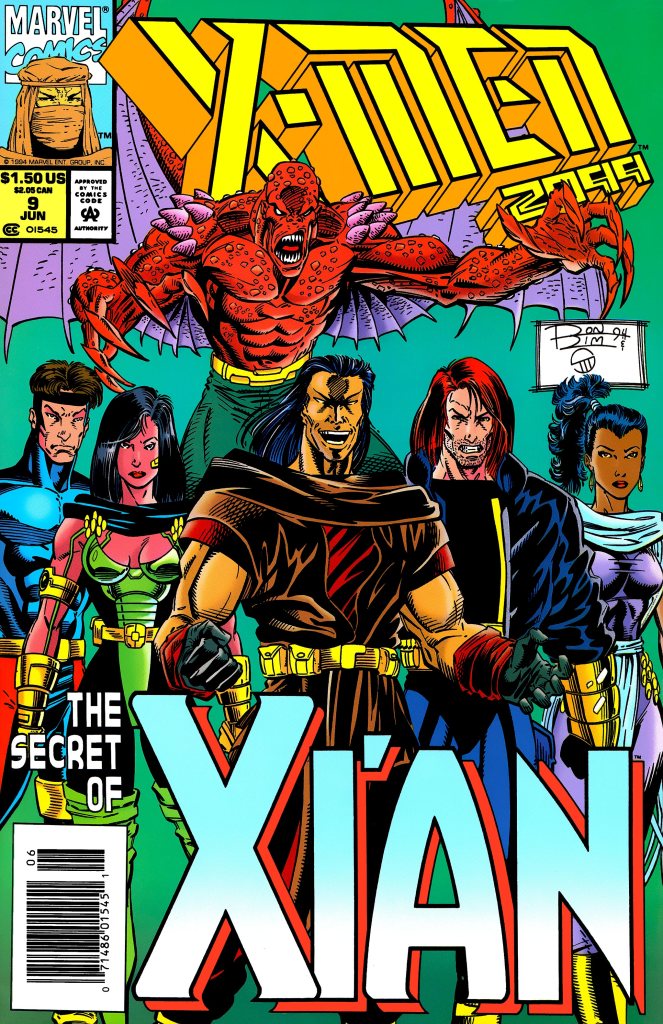
The cover.
Early story
The story begins shortly after the X-Men left the town. Without Eddie/Metalhead (who chose to be left behind), Xi’an and his team arrive at a facility in the middle of nowhere. It turns out, they have been following the coordinates in relation to Krystalin’s assignment to investigate and Xi’an determined there was something odd about her voice during their last communication.
Krystalin suddenly appears to her teammates with Victor Ten Eagles right behind her. Victor was a companion of Xi’an’s during their days together with the group referred to as the Lawless. While the two former Lawless members talk, Skullfire, Shakti and Meanstreak notice there is something very odd with Krystalin. Xi’an notices something is definitely wrong and he remembers that when the Lawless disbanded, he and Ten Eagle never parted on friendly terms.
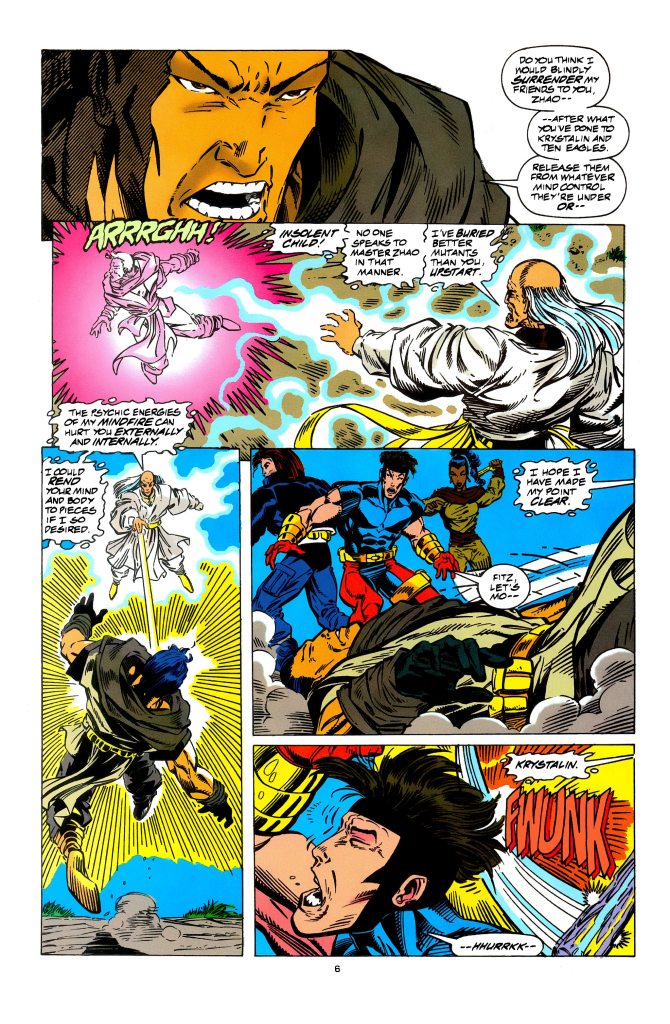
Suddenly, a very old Asian man appears in front of them floating in the air. He reveals his name as Zhao and he refers to them as his X-Men…
Quality
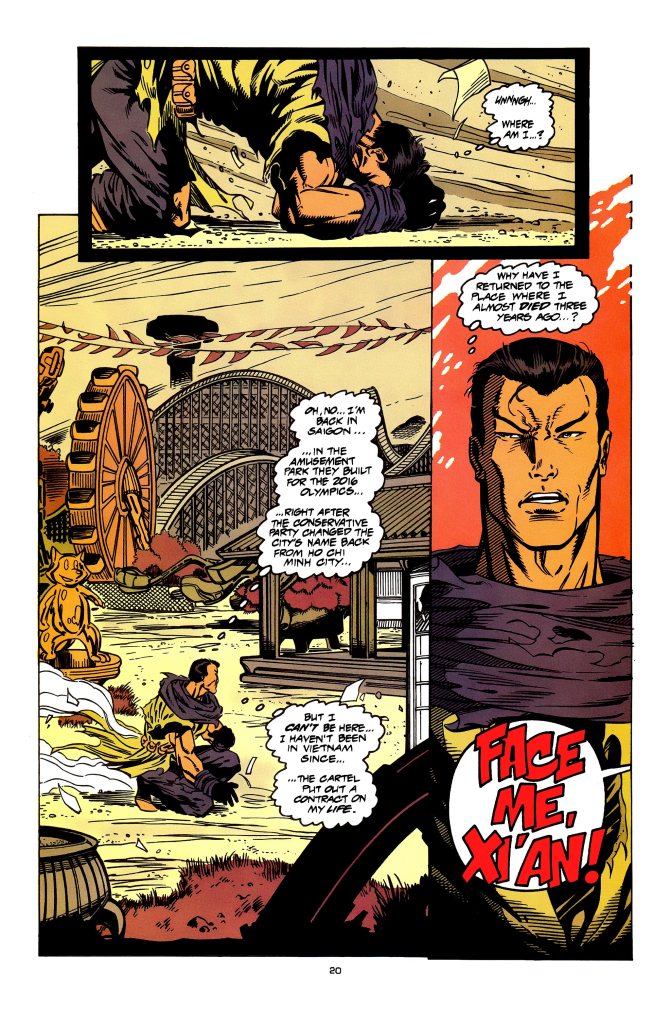
X-Men 2099’s leader Xi’an in trouble. This page reveals some threads from his past and the concept that Saigon in Vietnam hosted the 2016 Olympics.
Starting with the storytelling, the script was clearly written with a lot of confidence on the part of John Francis Moore as he expands further the lore of America of 2099 through the team of mutants. For one thing, it uses its own version of Marvel Comics universe history (note: one possible history since 2099 was one possible future of the Marvel universe) to establish the link between Charles Xavier’s original X-Men with the mutants of 2099 complete with what happened in between. While I won’t spoil what exactly happened, I can assure all of you reading this that something very intriguing happened and Zhao is not just a mere 2099 character. I also liked the concept about the sad state of mutants in the far future and why extremists emerge claiming to be their hope and tell them to join the movement without hesitation. The pacing of the story was smooth and there was sufficient build-up with the X-Men history that led to a nice payoff when the big revelation was made.
As the art on the cover symbolizes, there is something really wrong with the X-Men 2099 leader. In the previous issues, there were signs of Xi’an getting haunted by his past with the Lawless and this comic book marks a significant change in his portrayal. He also tried to be strong as team leader even though he kept some really undesirable secrets away from them. All of that build-up paid off well here. Clearly, this was one of John Francis Moore’s strongest scripts on the X-Men of 2099.
When it comes to spectacle, there is some superhero action here visualized in both the present-day story and the historical flashbacks. Artist Ron Lim paced the flow of the images properly and was creative with the way he framed what happened.
Conclusion
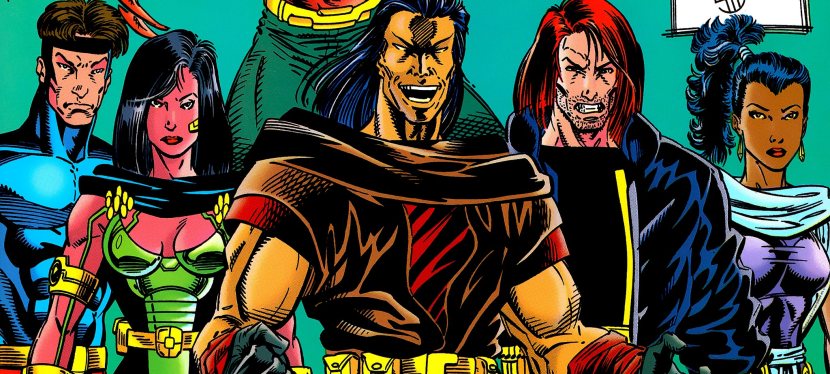
The X-Men and Zhao.
X-Men 2099 #9 (1994) has a great story concept which successfully and clearly establishes the connection between the original X-Men of Xavier with Xi’an’s X-Men. At the same time, this comic book starts a new chapter in the life of the 2099 mutants’ leader whose dark and painful past keeps disturbing him deeply. At the time of its release, the X-Men of far future were portrayed to be nomadic trying to survive and search for other mutants. This makes them distinct from the mainstream X-Men of the time and ironically they become similar with Freex of the Ultraverse.
If you are seriously planning to buy an existing hard copy of X-Men 2099 #9 (1994), be aware that as of this writing, MileHighComics.com shows that the near-mint copy of the regular edition costs $30 while the near-mint copy of the newsstand edition costs $90.
Overall, X-Men 2099 #9 (1994) is highly recommended!
+++++
Thank you for reading. If you find this article engaging, please click the like button below and also please consider sharing this article to others. If you are looking for a copywriter to create content for your special project or business, check out my services and my portfolio. Feel free to contact me as well. Also please feel free to visit my Facebook page Author Carlo Carrasco and follow me at HavenorFantasy@twitter.com
Disclaimer: This is my original work with details sourced from reading the comic book and doing personal research. Anyone who wants to use this article, in part or in whole, needs to secure first my permission and agree to cite me as the source and author. Let it be known that any unauthorized use of this article will constrain the author to pursue the remedies under R.A. No. 8293, the Revised Penal Code, and/or all applicable legal actions under the laws of the Philippines.
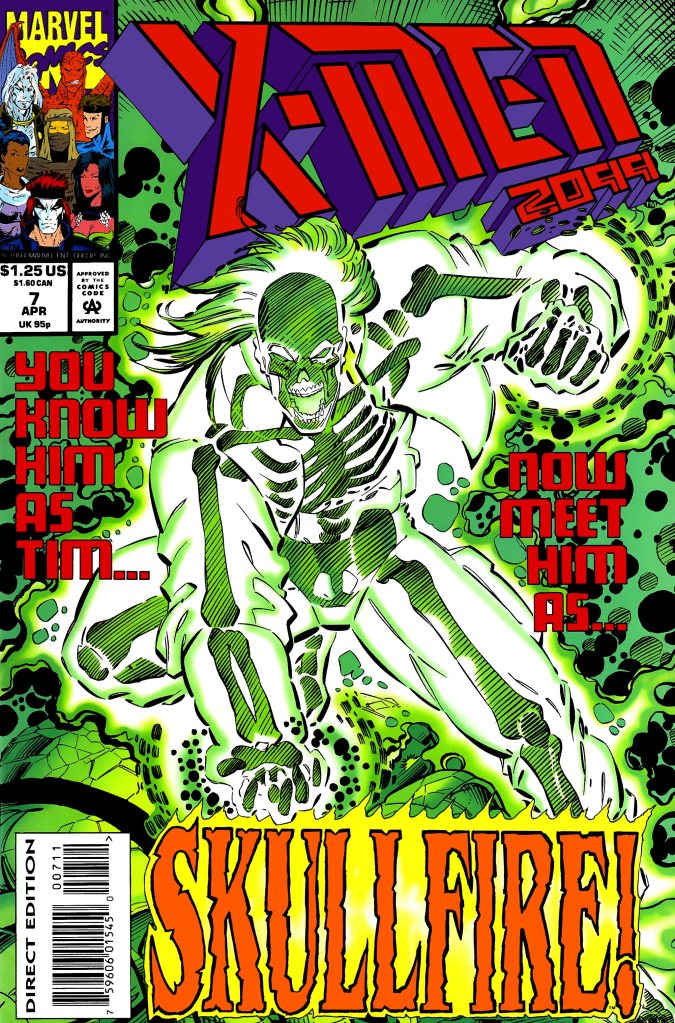
Welcome back, superhero enthusiasts, fans of the 2099 universe of Marvel Comics, 1990s culture enthusiasts and comic book collectors! Today we revisit the X-Men 2099 comic book series by focusing on the seventh issue. If there is anything that makes the series of Marvel’s futuristic mutants distinct from other Marvel 2099 monthly series, it is the fact that it shows more of wasteland of America which easily reminds me of the Mad Max movies.
With those details laid down, here is a look back at X-Men 2099 #7, published by Marvel Comics in 1994 with a story written by John Francis Moore and drawn by Ron Lim.
The cover.
Early story
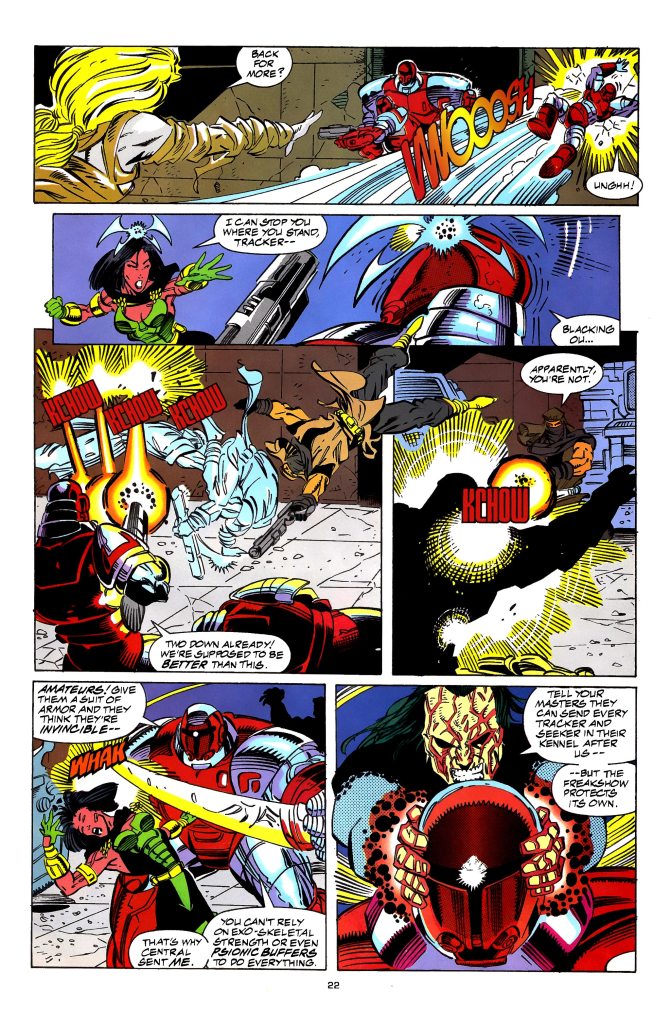
The story begins in the middle of an abandoned town with the X-Men in battle with the Freakshow. Xi’an fights their leader Breakdown while his teammates struggle with the other members of the Freakshow. Already infected by one of the Freakshow members, Eddie is suffering severe pain even in his metallic form.
The fight suddenly ends when an old lady fires a blast with her rifle. It turns out she is Breakdown’s superior and she is precisely whom the X-Men have been searching for…
Quality
In the heat of battle.
As one of the early stories showing the X-Men of 2099 exploring the American wasteland, this is a well-written piece of work by John Francis Moore which is expected. While it has the usual superhero elements of spectacle and special moves, discovery and exposition are easily the most obvious elements of the story. What I like most about this comic book is that it reveals more of the history about the mutants’ struggle to survive not only with the harshness of the wilderness but also with dealing with rejection from the people who are not mutants (which symbolizes prejudice). This also reveals that the mutants are still searching for a fabled place called Avalon which could be a better destination for all mutants to live in.
As the narrative about the past gets emphasized, the creative team added some elements of emotion and concern on the X-Men visually. This makes a lot of sense since the mutants are clearly searching for purpose and trying to make the most out of their current situation in the hope of having a brighter future. This is similar to the original X-Men and yet X-Men 2099 has its distinct style and concept about mutant survival.
Conclusion
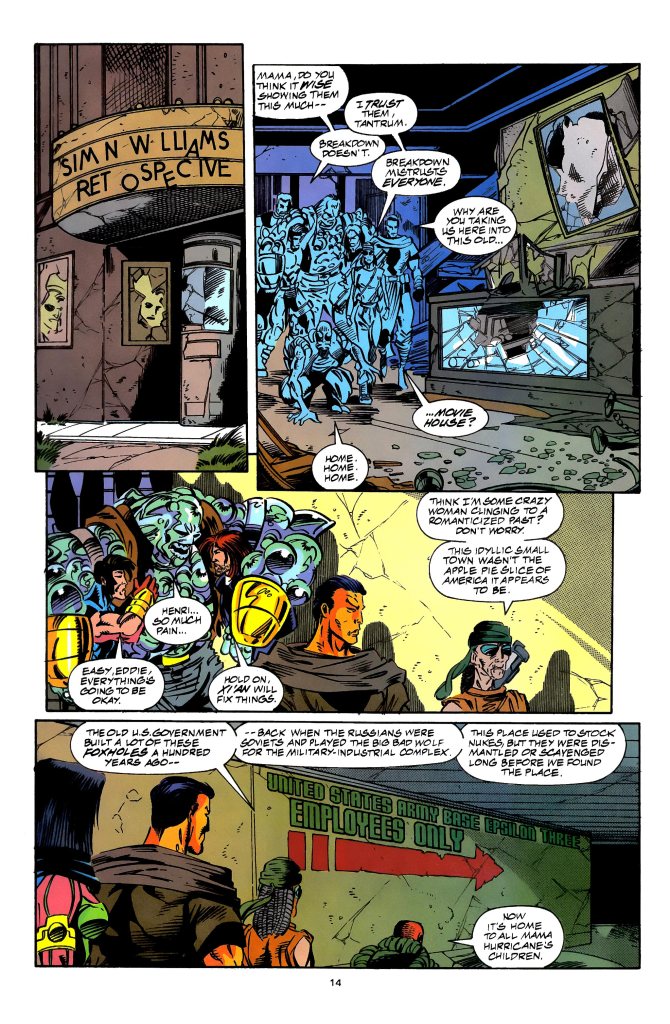
At an abandoned old town that has government secret facilities.
X-Men 2099 #7 (1994) is indeed a good comic book to read. As the X-Men of the far future encounter more people in the wasteland, the discoveries they get impacts them and their efforts to survive. As discovery and exposition are strong elements in the story, the comic book is definitely not your typical good-versus-evil superhero story. The strong writing by John Francis Moore and his approach on expanding the world of 2099 America to the readers really made this comic book a solid read.
If you are seriously planning to buy an existing hard copy of X-Men 2099 #7 (1994), be aware that as of this writing, MileHighComics.com shows that the near-mint copy of the regular edition costs $30 while the near-mint copy of the newsstand edition costs $90.
Overall, X-Men 2099 #7 (1994) is recommended!
+++++
Thank you for reading. If you find this article engaging, please click the like button below and also please consider sharing this article to others. If you are looking for a copywriter to create content for your special project or business, check out my services and my portfolio. Feel free to contact me as well. Also please feel free to visit my Facebook page Author Carlo Carrasco and follow me at HavenorFantasy@twitter.com
Disclaimer: This is my original work with details sourced from reading the comic book and doing personal research. Anyone who wants to use this article, in part or in whole, needs to secure first my permission and agree to cite me as the source and author. Let it be known that any unauthorized use of this article will constrain the author to pursue the remedies under R.A. No. 8293, the Revised Penal Code, and/or all applicable legal actions under the laws of the Philippines.
Welcome back, superhero enthusiasts, comic collectors, 1990s culture enthusiasts and fans of Marvel Comics! After a very fine start, things really went downhill with the story and presentation in Dazzler #2. That comic book had Dazzler (then a hot new property for Marvel Comics) completely overshadowed by the big mix of established Marvel superheroes fighting opposition elements. To say the least, Dazzler #2 was a major letdown, a very big disappointment and anyone who loves Dazzler should avoided it.
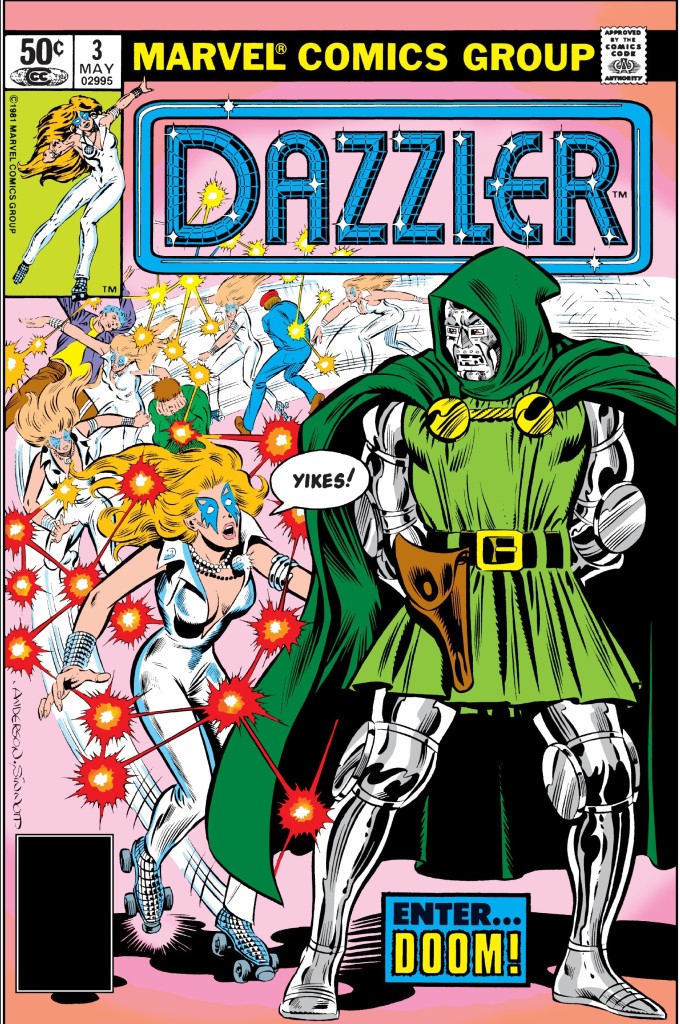
Will we see Dazzler presented much better in the next issue? We can find out in this look back at Dazzler #3, released in 1981 by Marvel Comics with a story written by Tom DeFalco and drawn by John Romita, Jr., and A. Kupperberg.
The cover.
Early story
The story begins with Dazzler (not wearing her face paint) participating scientific test conducted by Fantastic Four leader Reed Richards/Mr. Fantastic at his team’s headquarters in New York. Dazzler has been converting every nearby sound into radiance and she’s beginning to sense her limitations. The test was done to determine Alison Blaire’s mutant capabilities. Also present were Johnny Storm, Ben Grimm and Sue Richards. Johnny reads a newspaper report about the United Nations’ plan to display the crown jewels that once belonged to their deadliest enemy Dr. Doom.
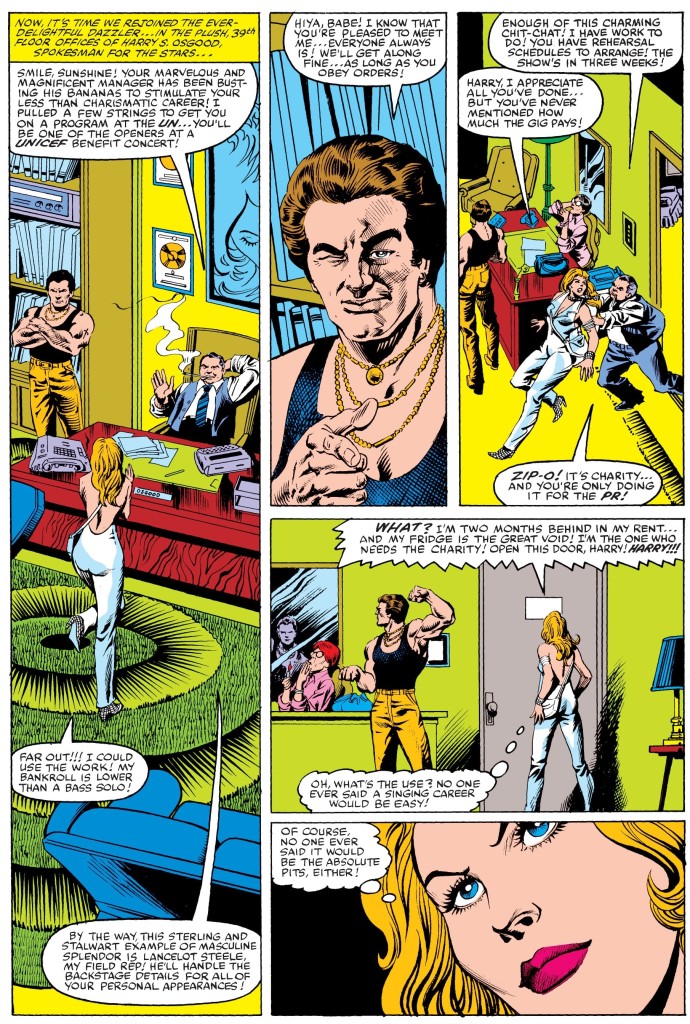
Afterwards, Dazzler meets her boss at his office and learns that she will be one of the openers at the benefit concert of UNICEF which is supposed to help her with her music career. The next morning, she decides to visit her old home where her father lives in. Over at the Bavarian Alps, Dr. Doom gets informed that among the jewels set to be displayed at the Unite Nations is the Merline stone. This compels him to make a move…
Quality
Dazzler versus Dr. Doom!
When compared to the disaster of issue #2, this comic book’s story is indeed an improvement as it has the expected superhero storytelling formula intact. The good news here is that the character development on Dazzler has returned and there is once again the strong emphasis on her relevance with the people of New York with regards to her being both a superhero and a musician.
The story moved at a moderate pace and it is clear that the creative team took the necessary steps to gradually build up the plot leading to the inevitable encounter between Dazzler and the Fantastic Four’s most definitive enemy (and Marvel Comics’ iconic villain). Take note, however, that the Dazzler-Dr. Doom conflict here is only the beginning.
As this story is more focused on Dazzler, you will get to see an early look at her tainted relationship with her father who desired her to become a lawyer like him, plus there is some focus on the behind-the-scenes development in one of the big events involving her. When it comes to spectacle, there is a right amount of it here which makes this comic book more fun to read than the previous issue.
Conclusion
A look at the business side of the music industry that Alison Blaire/Dazzler is involved with.
Dazzler #3 (1981) is indeed fun to read and the creators succeeded in developing Alison Blaire more while delivering the good stuff. While the match-up between her and Dr. Doom looks awkward from the surface, the strong writing justified it and all along Dazzler never looked like she was out of place being with Marvel’s iconic supervillain.
If you are seriously planning to buy an existing hard copy of Dazzler #3 (1981), be aware that as of this writing, MileHighComics.com shows that the near-mint copy of the regular edition costs $28 while the near-mint copy of the newsstand edition costs $60.
Overall, Dazzler #3 (1981) is recommended.
+++++
Thank you for reading. If you find this article engaging, please click the like button below and also please consider sharing this article to others. If you are looking for a copywriter to create content for your special project or business, check out my services and my portfolio. Feel free to contact me as well. Also please feel free to visit my Facebook page Author Carlo Carrasco and follow me at HavenorFantasy@twitter.com
Disclaimer: This is my original work with details sourced from playing Flashback: The Quest for Identity and doing personal research. Anyone who wants to use this article, in part or in whole, needs to secure first my permission and agree to cite me as the source and author. Let it be known that any unauthorized use of this article will constrain the author to pursue the remedies under R.A. No. 8293, the Revised Penal Code, and/or all applicable legal actions under the laws of the Philippines.
We live in an age in which software exclusivity defines not only the relevance of game consoles but also nature of the entire video game industry right down to the many varied communities of very avid fans (and fanboys).
While the Super Nintendo Entertainment System (SNES or Super NES) and Sega Genesis each had their own exclusive games back in the 1990s, there was one particular game that was made for and released on not just one, not two but rather on more than fifteen different platforms – both consoles and computers – starting with Amiga way back in 1992. That game is none other than Flashback: The Quest for Identity which I first played on our Super NES back in 1994.
The cover of the game box.
For the newcomers reading this, Flashback was a 2D side-scrolling adventure game in the form of a cinematic platformer (note: similar to Prince of Persia and Out of This World) with a strong flavor of science fiction. It was cinematic in the sense that all the in-game animation were rotoscoped resulting unique smoothness combined with hand-drawn backgrounds and the computer-generated cutscenes were used in key parts of the game as the story progressed. Flashback on SNES in America even came with a Marvel Comics-published Flashback comic book and on the rear of the SNES game box were the words “The first CD-ROM game in a cartridge!”
A Flashback remake was released in 2013, followed by a port of the original game released on Sega Dreamcast in 2017, and a remastered version got released for varied platforms in 2018.
I got to play that game at a time when I have not even started playing Final Fantasy II (AKA Final Fantasy IV), Final Fantasy III (AKA Final Fantasy VI) and other great role-playing games (RPGs) of the Super NES. I also remember that Flashback was a nice change of pace for me after playing Super Star Wars: The Empire Strikes Back.
With those details laid down, here is a look back at Flashback: The Quest for Identity, released on Super NES in 1993 by U.S. Gold and developed by Delphine Software International.
The start and options screen.
Early story
The story begins with Conrad running away from two armed persons chasing him. He flies away riding a solo vehicle but those chasing him (riding a huge vehicle) managed to get close and blast his vehicle causing to crash into the forest.
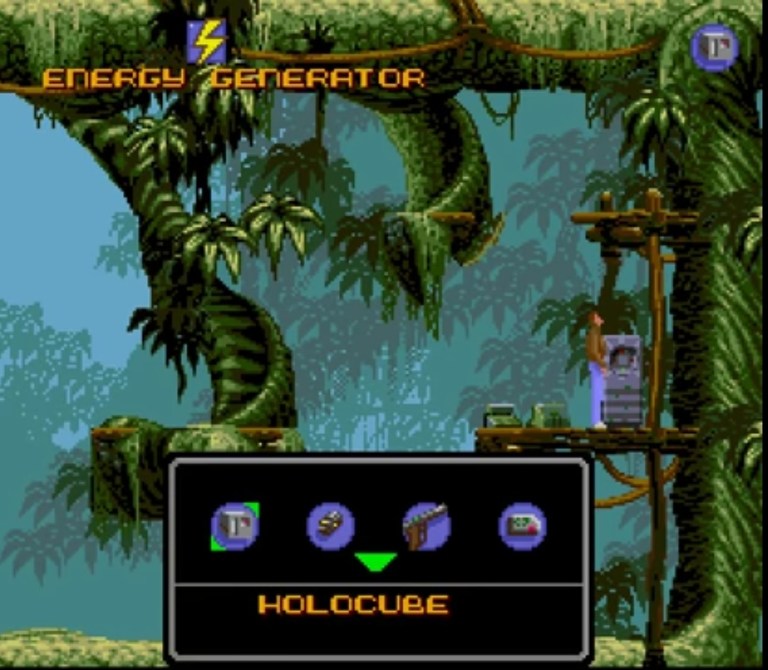
Sometime later, he wakes up and accidentally pushes a mechanical cube to fall down. He climbs down to reach it and activates it. The cube displays a holographic video of himself telling him that he recorded it without remembering it. As Conrad watches, he learns that he must contact a friend named Ian who can explain important things to him.
After viewing the message, Conrad sets off to find his way out of the jungle and somehow get to Ian in New Washington…
Game design and quality
You have to pay close attention to what’s going on, what items do you have and what the in-game prompts tell you.
This game is not your typical fast-paced, action-oriented 2D side-scrolling adventure in which you move from left to right to progress. As it is a cinematic platform game by design complete with very specific controls, players will have to be patient, adaptive and strategic in order to learn how exactly you can control your character, what moves will be executed (and when to execute). For one thing, the very fluid 24 frames-per-second animation on your character limits you in terms of control as timing is required.
To do things properly, you have to execute specific controls. To ascend on a lift, you press Up and the Y button. To do a small jump, have your character stand still and then press Up and Y button. To go down on level (on foot, no lift), stand by the edge of a level then press Down and Y button. To run and hang on to a higher floor automatically, have your character stand still, press Right and Y button, press Y button (once your character moves) and watch him pull it off. With controls like these, the usual 2D platforming approach is out of the question. In my experience, these controls are indeed challenging but never impossible to learn and eventually I got proficient with the controls as I played more.
The in-game animation for the characters are very good and there is also a sensation of weight with your character. Falling straight down from a very high place is a big no-no.
Apart from character controls, you don’t just move Conrad from one screen to the next…you also should do key objectives along the way apart from engaging in action scenes (read: shooting). That being said, you must watch out for icons that appear on screen when your character steps on a particular spot that requires interaction. For example, if you stop by a terminal, an icon will appear serving as a prompt to start the interaction. Another example is when your character steps on the same spot as an item located at which you can pick up once prompted.
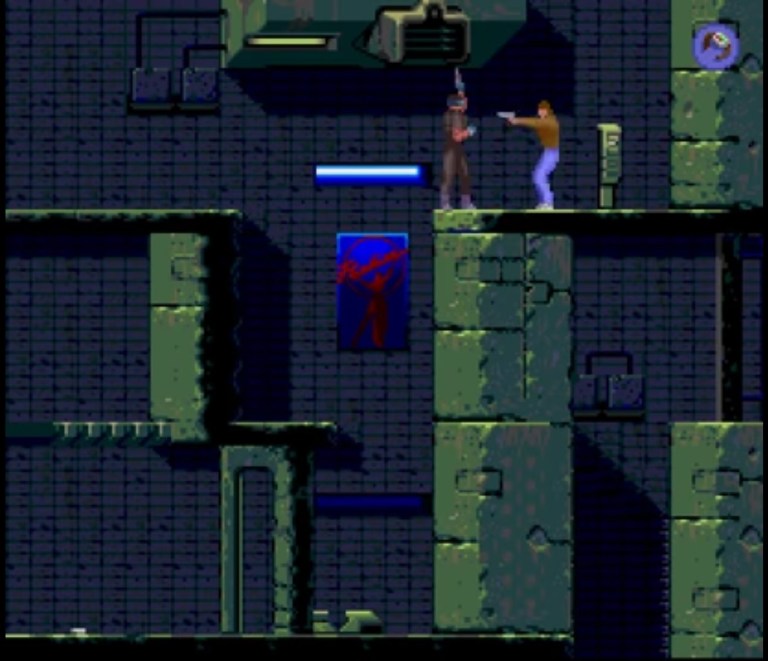
More on the action on the screen, you will encounter armed enemies as well as high-tech machines (including floating drones). To overcome them, doing straightforward shooting is not recommended as you have to be strategic before firing a shot. You have to learn how each enemy or machine moves, how much physical space is available right there and how you can maximize your limited time and space to overcome them. In fact, you will also be compelled to take advantage of whatever seconds you have while the enemies’ animation (between moves) take place. There will also be times when you need to have your character armed with the gun before jumping to a lower level where an armed enemy is located and on the lookout. Coming down armed gives you an advantage to shoot first at the enemy who
Considering the 24 frames-per-second animation, you will have to time your moves carefully, especially during moments when you face an armed enemy.
Apart from shooting, you can also use grenades which requires opening your inventory to select a grenade and then do your timing and calculation of the distance in order to pull of a successful throw and explosion. You can also throw stones to distract enemies or to apply weight on key platforms in order to open mechanical doors.
With regards to the quality of gameplay, Flashback is enjoyable but only if you get over its rather high learning curve with regards to the controls which themselves serve as the game’s advantage and even as a disadvantage. In addition to being patient and strategic, you will really have to pace yourself, think more and get used to the rather slow pace of the game in relation to its cinematic platformer design. I should state that as you keep progressing, there will be places, or new obstacles or new enemies that will compel you to change your tactics in order to overcome them. Anyone who is used to playing 2D side-scrolling games the fast and easy way might find the high learning curve and pacing of Flashback a turnoff but if they are willing to learn, adjust and pace themselves, only then can this game’s gameplay be really enjoyed.
Cut scenes like this move at a sluggish pace which shows the limitations of the SNES and cartridge technology.
As for the visuals, the obvious highlight here is the 24 FPS animation which is the result of rotoscoping and careful visualizing (note: observe those alien humanoids who morph into moving blobs). The rotoscoped animation, however, would not have been that effective had the quality of the art used for the backgrounds been made of lower quality. I can say that the background artworks here look pretty good even by today’s standards. The standout among them were the background artworks of Morph’s home planet which really looked very alien and creepy at the same time. What hurts this particular version of Flashback is the lackluster (read: choppy) frame rate whenever the computer-generated cinematic cutscenes (obviously they were meant for more powerful PCs) play which, in my experience, took me out of the story. There were also bouts of slowdown during the gameplay, especially when you encounter enough enemies that were animated sophistically.
With regards to narrative, Conrad is literally your avatar to learn, discover and interact with the many elements of the universe he is part of. There is obvious influence that the game makers took from the movie Total Recall as they crafted Conrad to be someone who lost his memory, moves on to regain it and do a lot of things as he realizes his true purpose and what is really at stake. Unlike Total Recall’s protagonist, Conrad himself is not too interesting mainly due to the way the in-game story was structured. Just play as Conrad and do what needs to be done to complete the game.
When it comes to understanding the narrative, you will have to do lots of reading. You will spot and read the short description of the prompts that appear. You’ll also have to read the on-screen text whenever your character talks with someone during the levels of the game. And there are the captions shown during the slow animated cutscenes.
Conclusion
The background artworks during the late stage of the game are great and truly creative with science fiction in mind.
I can clearly say that Flashback: The Quest for Identity on Super NESis fun and engaging mainly to those who are willing to adjust themselves to it. If you don’t have patience, if you are not willing to think while playing, if you cannot pace yourself and if you are not willing to learn all the specific controls of the game, then you should not be playing Flashback. It is a cinematic platformer and that should tell you that you will need to adjust to enjoy it.
Overall, Flashback: The Quest for Identity on SNES is recommended.
+++++
Thank you for reading. If you find this article engaging, please click the like button below and also please consider sharing this article to others. If you are looking for a copywriter to create content for your special project or business, check out my services and my portfolio. Feel free to contact me as well. Also please feel free to visit my Facebook page Author Carlo Carrasco and follow me at HavenorFantasy@twitter.com
Disclaimer: This is my original work with details sourced from reading the comic book and doing personal research. Anyone who wants to use this article, in part or in whole, needs to secure first my permission and agree to cite me as the source and author. Let it be known that any unauthorized use of this article will constrain the author to pursue the remedies under R.A. No. 8293, the Revised Penal Code, and/or all applicable legal actions under the laws of the Philippines.
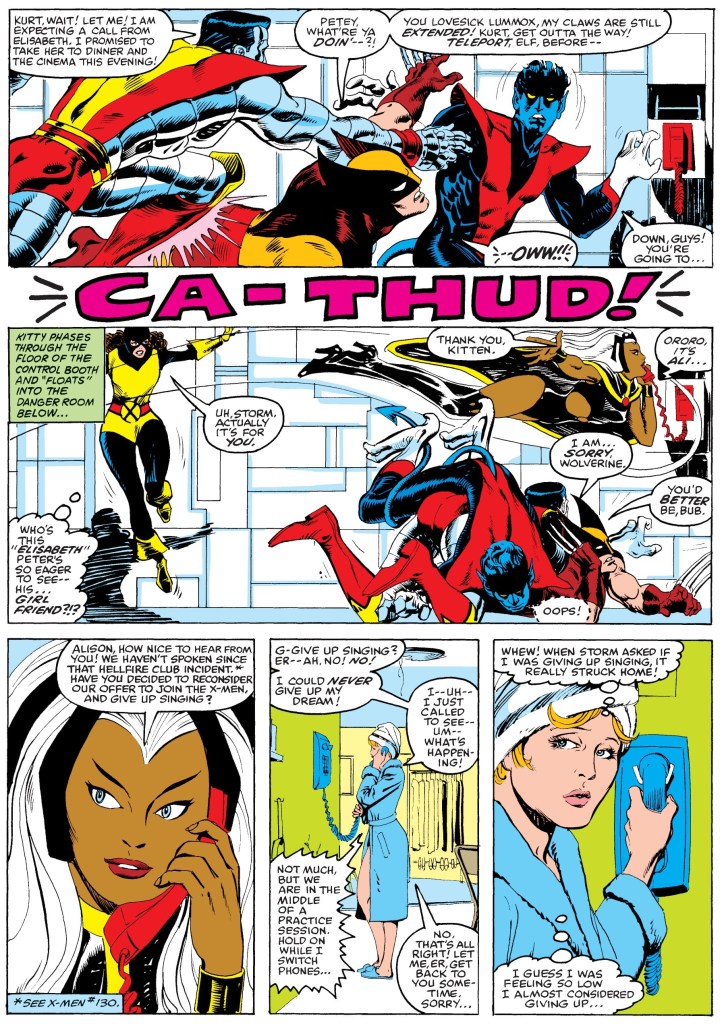
Welcome back, superhero enthusiasts, comic collectors, 1990s culture enthusiasts and fans of Marvel Comics! Way back in 1981, Marvel Comics had a successful comic book series launch with Dazzler #1 (read my retro review by clicking here) which sold over 400,000 copies and further sealed Dazzler as an advantageous addition for the company’s superhero comics franchise. Dazzler, a creation of a deal between Marvel and a certain record company, debuted in Uncanny X-Men #130 and got involved with the X-Men until Uncanny X-Men #131. Dazzler appeared with Marvel’s famous webslinger in Amazing Spider-Man #203.
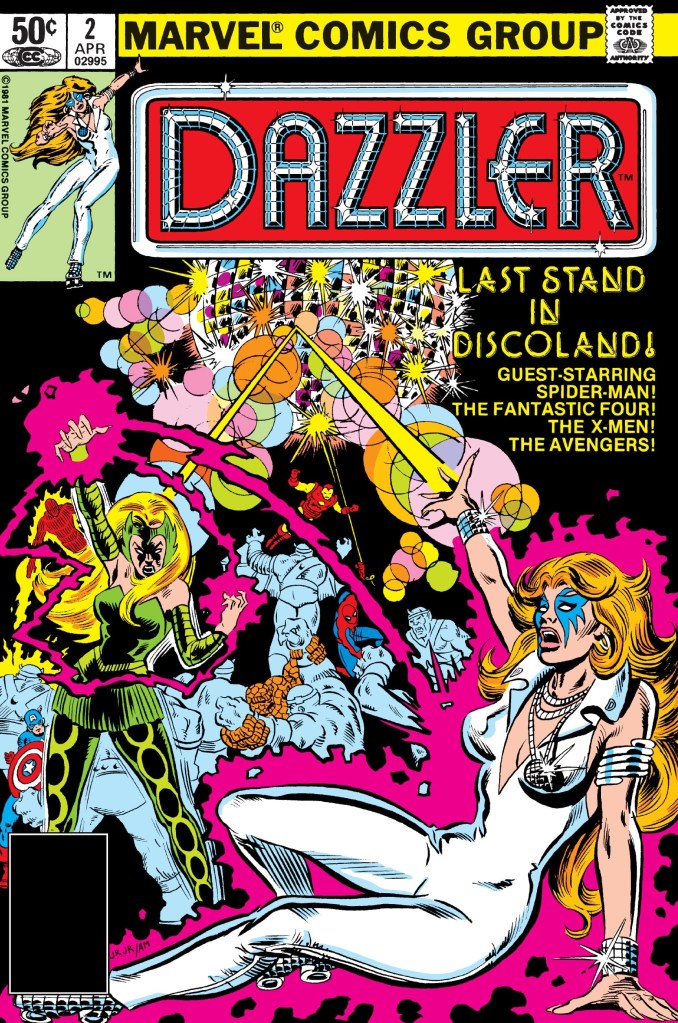
Dazzler #1 ended with a brewing rivalry between the title character and Enchantress. With those laid down, here is a look back at Dazzler #2, published in 1981 by Marvel Comics with a story written by Tom DeFalco and drawn by John Romita, Jr.
The cover.
Early story
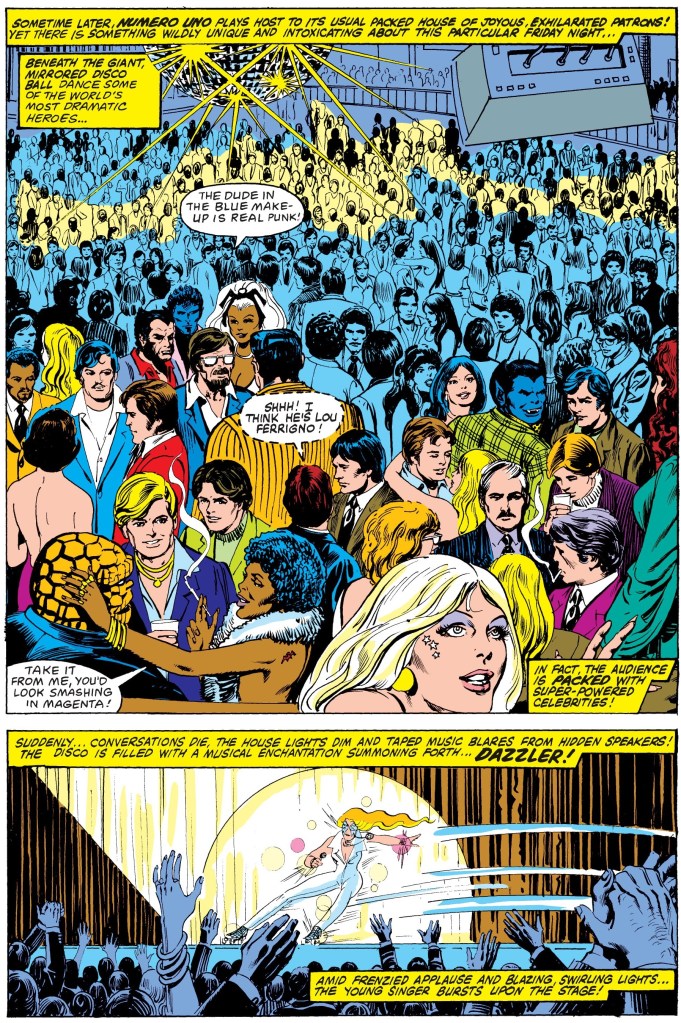
The story begins with Dazzler preparing for her big show at Numero Uno, a prestigious disco in the city of New York. Just before the show starts, a huge crowd of people are in attendance and among them are Wolverine, Peter Parker (Spider-Man), Captain America, Johnny Storm, Ben Grimm and Tony Stark (Iron Man) to name some.
Just as Dazzler appears on-stage and draws a frenzied applause from the audience, the revenger-hungry Enchantress slowly makes her moves to ruin the lady who outclassed her to be the main attraction of the club. Even with her desire for revenge, the Enchantress decides to use her magic sparingly on Dazzler. In the audience, Peter Parker/Spider-Man begins to sense something is about to happen…
Quality
This shows what this comic book is really about.
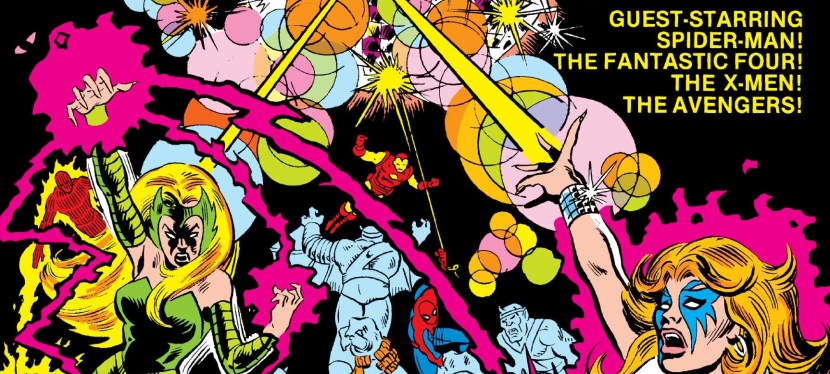
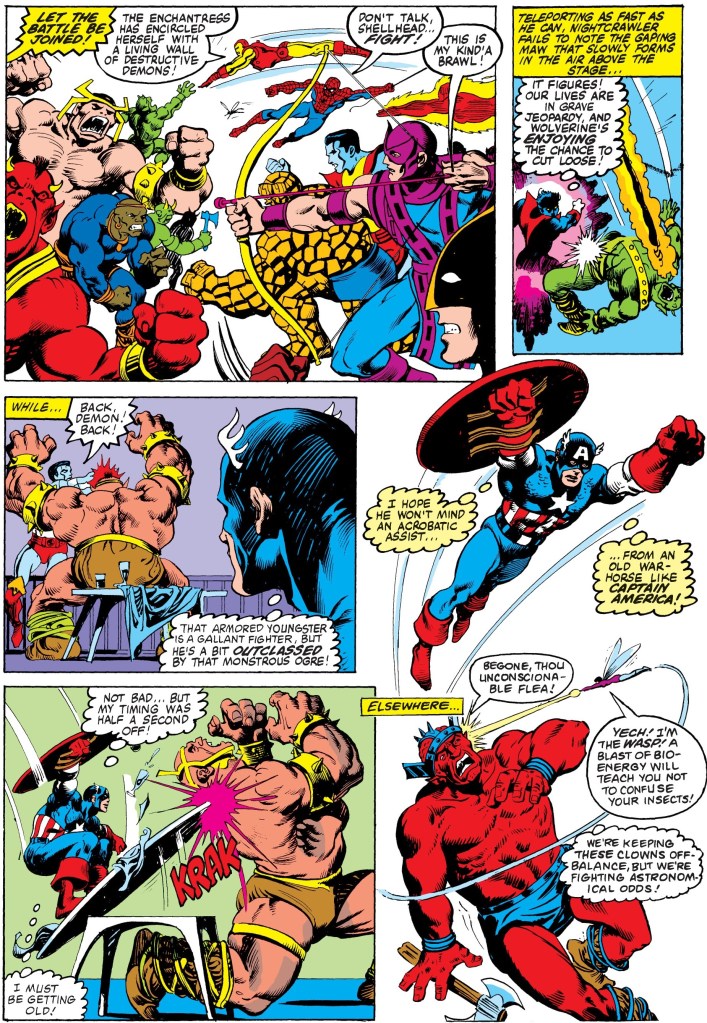
The way the story was told is disappointing. This is because the spotlight on Dazzler and her anticipated conflict with the Enchantress got overwhelmed by the amount of superhero filler on the narrative. To be clear, it is fun and interesting to see a mix of the varied superheroes of Marvel together but this comic book ended up being an all-star showcase (X-Men, Avengers and Fantastic Four members included) than a real, standalone Dazzler story. In fairness, Tom DeFalco showed how skilled he is with plot structuring and capturing the personalities and tropes of the different superheroes (note: unsurprisingly, DeFalco accurately captured Spider-Man’s personality and he went on to be a major force behind Spider-Man comic books) but that does not change the fact that this comic book should have been more about Dazzler.
When it comes to the conflict between Dazzler and the Enchantress, it was executed with no depth at all. Literally speaking, there is not enough meat to consume here and it the conflict really ended up looking very rushed. As if that was not bad enough, there is not enough justification to show Dazzler defeating a monster summoned by the Enchantress. Considering how shallow the Dazzler-Enchantress match-up turned out, it’s no wonder why there is so much Marvel all-star filler in the script.
As for the late-stage attempt to shift the narrative back to Dazzler, it is rather over-the-top and unsatisfying.
Conclusion
You recognize someone in the audience?
Dazzler #2 (1981) is an example about a creative team’s lack of confidence on crafting a decent story to develop a new superhero and ultimately resorting to fill it with a mix of other superheroes involved which itself symbolizes desperation. This comic book is not really a Dazzler story but an all-star showcase with Dazzler becoming a minor character in her own monthly series.
If you are seriously planning to buy an existing hard copy of Dazzler #2 (1981), be aware that as of this writing, MileHighComics.com shows that the near-mint copy of the regular edition costs $28 while the near-mint copy of the newsstand edition costs $60.
Overall, Dazzler #2 (1981) is unsatisfactory. Anyone who loves Dazzler or who wishes to discover more of her will be disappointed with this comic book.
+++++
Thank you for reading. If you find this article engaging, please click the like button below and also please consider sharing this article to others. If you are looking for a copywriter to create content for your special project or business, check out my services and my portfolio. Feel free to contact me as well. Also please feel free to visit my Facebook page Author Carlo Carrasco and follow me at HavenorFantasy@twitter.com
Disclaimer: This is my original work with details sourced from reading the comic book and doing personal research. Anyone who wants to use this article, in part or in whole, needs to secure first my permission and agree to cite me as the source and author. Let it be known that any unauthorized use of this article will constrain the author to pursue the remedies under R.A. No. 8293, the Revised Penal Code, and/or all applicable legal actions under the laws of the Philippines.
Welcome back, superhero enthusiasts, comic collectors, 1990s culture enthusiasts and fans of Marvel Comics! Previously, I reviewed Uncanny X-Men #130 which was the first appearance of Dazzler who went on to become one of the most notable new characters of Marvel Comics in the 1980s. After appearing in Uncanny X-Men #131 and Amazing Spider-Man #203, Dazzler became more prominent among all of Marvel’s superheroes as the publisher launched an all-new monthly series featuring her. There is more to that than meets the eye, however.
In his article titled “Dazzler and Me”, Danny Fingeroth wrote: Marvel decided to tray an experiment with the relatively new “direct market” – comic book shops. It was decided that Dazzler #1 would only be available in comic book shops, not at traditional newsstands.
Dazzler #1 sold over 400,000 copies.
Even the top-selling comics of the era sold perhaps 250,000 copies. So, the first issue, anyway, was a major hit.
Apart from the confirmed commercial success of the comic book, it is a wonder if it is still good to read by today’s standards. To find out, here is a look back at Dazzler #1, published in 1981 by Marvel Comics with a story written by Tom DeFalco and drawn by John Romita, Jr.
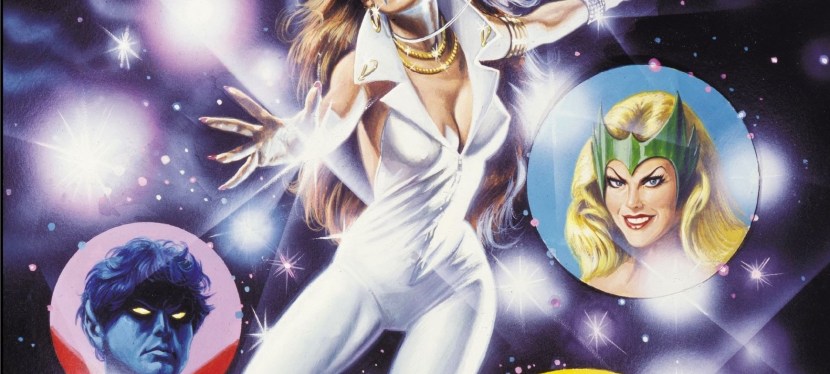
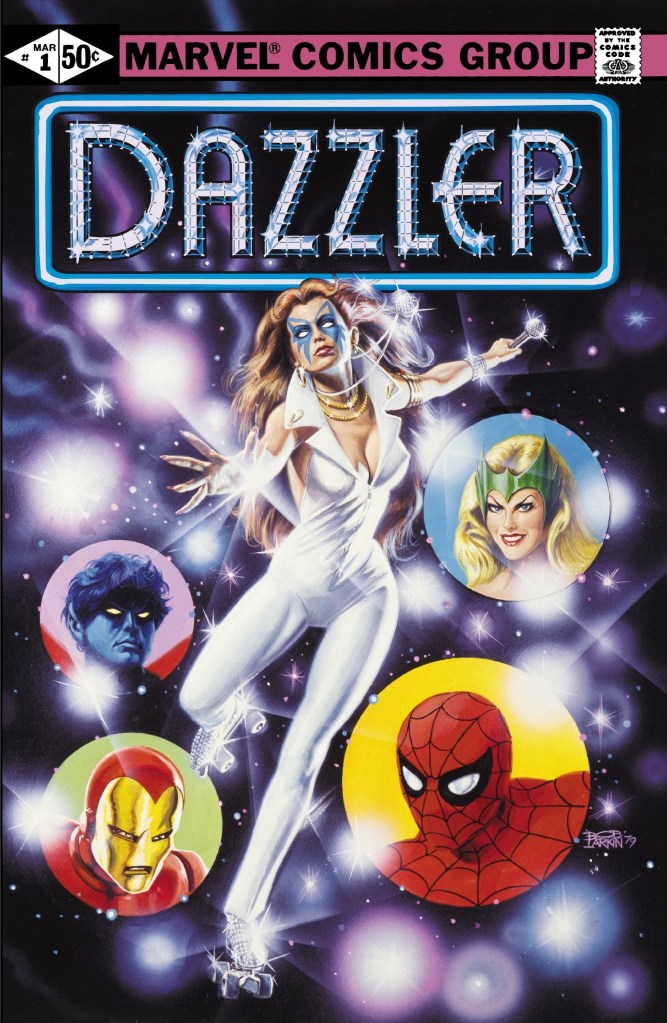
The cover.
Early story
The story begins with Dazzler running away from four armed men who had been following her since she left the disco. She finds herself corned at the dead end of an alley as the men approach her. While pretending to be reaching for her make-up in the bag, Dazzler grabs and activates her portable radio which plays music. With the music turned on, she uses her power to convert it all into a dazzling display of light and color which makes the men disoriented.
While swinging nearby, Spider-Man notices the display of light but before he begins his approach, Dazzler makes her move to knock two men out. Another man fires his gun and his bullet ricochets until it hits the portable radio stops the music and Dazzler’s lights altogether leaving her vulnerable once again…
Quality
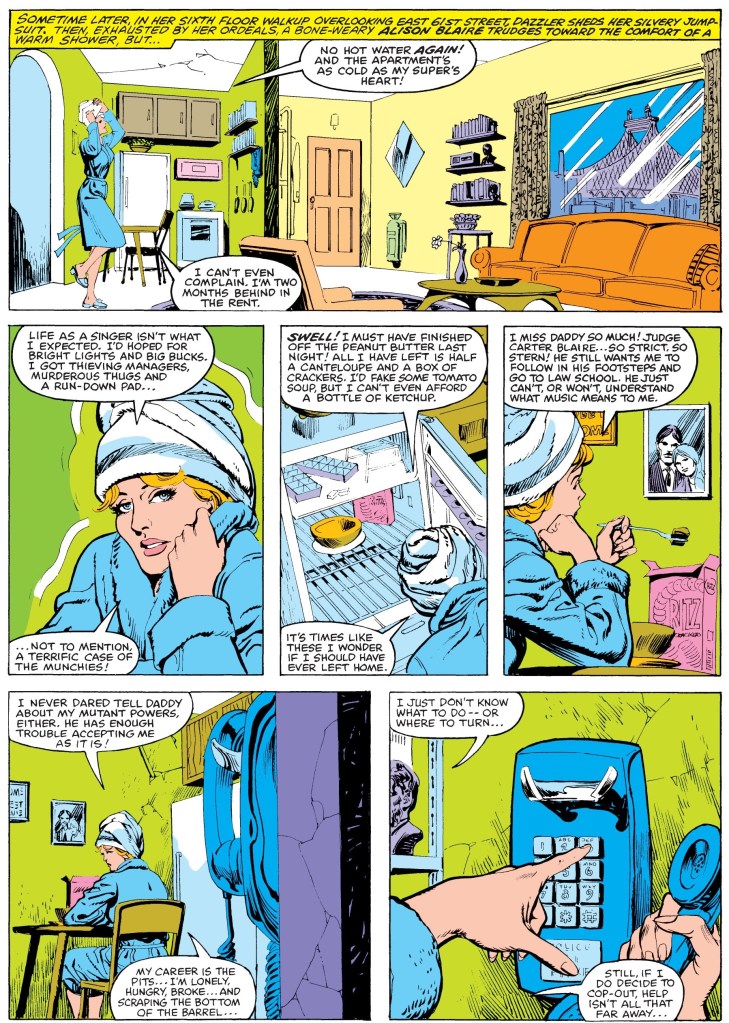
This page alone establishes Dazzler as a person struggling to make ends meet.
As far as telling a Dazzler story goes, this comic book is the complete package and it’s got very solid writing! Apart from showing what happened to her after her appearances in the Uncanny X-Men and Amazing Spider-Man series, this comic book formally introduces Dazzler in her civilian identity as Alison Blaire and thanks to efficient writing, it also reveals threads of her past and how her mutant powers manifested. Not only that, readers will get to see the title character as a typical person who is struggling to make ends meet even though she does her best with entertainment as a career.
Strangely, the focus on Dazzler is relatively light in content and the result is several pages of Marvel universe-related filler which shows several other characters like Captain America, Iron Man, Storm, Wolverine and others present with little to no connection with the title character. The X-Men scene is a nice touch as it will remind readers about Dazzler’s first interaction with them.
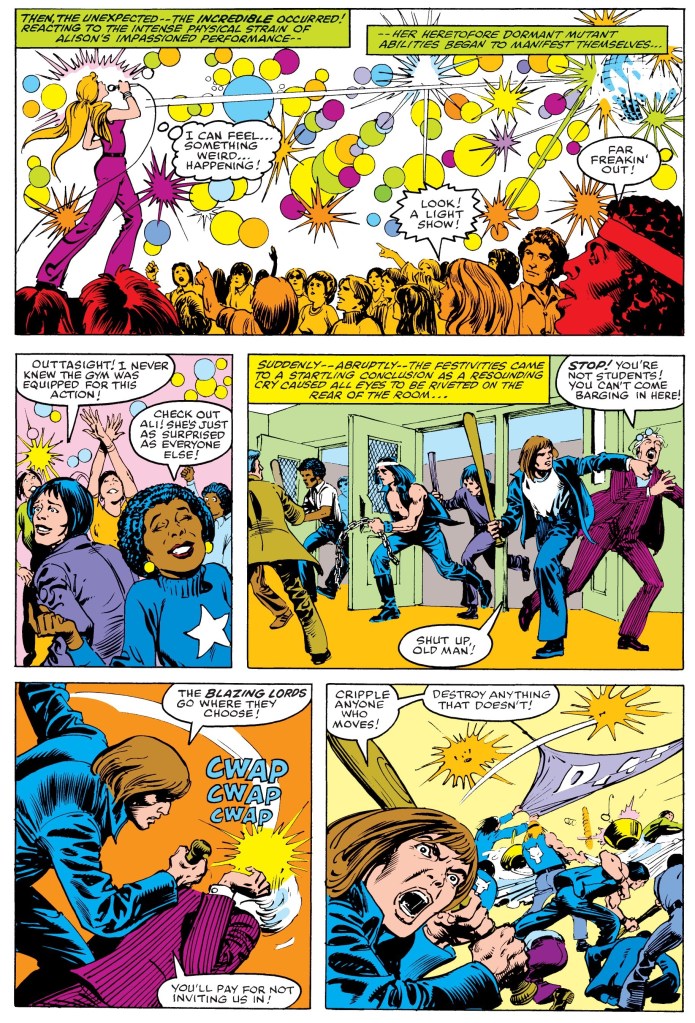
As a teenager, Alison Blaire’s power begins to manifest during this particular event in her life.
To build-up the first challenge for Dazzler, this comic book has the Enchantress as the villainess and ironically it also had some room of character development for her. Clearly this was done not only to build up anticipation for the next issue but to make readers root for Dazzler some more. In retrospect, the Enchantress would later emerge as an important figure in 1984’s crossover storyline Secret Wars.
Conclusion
The scene involving the X-Men is a nice touch as it connects with Dazzler’s previous interaction with them.
While it is indeed a product of the early 1980s carrying influences from the 1970s New York club scene, Dazzler #1 (1981) is still fun and engaging to read. Clearly this comic book is a must-have for anyone who loves Dazzler and it should be entertaining enough for geeks who love the 1980s and the Marvel-related crossovers of the time. Very clearly, this comic book succeeded in introducing and developing Dazzler as a person (as opposed to being a super hero) and the background story established fits in nicely with the character’s first appearance in Uncanny X-Men #130. Very clearly, there is a lot more to Dazzler than her unique super power and her disco look.
If you are seriously planning to buy an existing hard copy of Dazzler #1 (1981), be aware that as of this writing, MileHighComics.com shows that the near-mint copy of the comic book costs $70.
Overall, Dazzler #1 (1981) is highly recommended!
+++++
Thank you for reading. If you find this article engaging, please click the like button below and also please consider sharing this article to others. If you are looking for a copywriter to create content for your special project or business, check out my services and my portfolio. Feel free to contact me as well. Also please feel free to visit my Facebook page Author Carlo Carrasco and follow me at HavenorFantasy@twitter.com
Disclaimer: This is my original work with details sourced from reading the comic book and doing personal research. Anyone who wants to use this article, in part or in whole, needs to secure first my permission and agree to cite me as the source and author. Let it be known that any unauthorized use of this article will constrain the author to pursue the remedies under R.A. No. 8293, the Revised Penal Code, and/or all applicable legal actions under the laws of the Philippines.
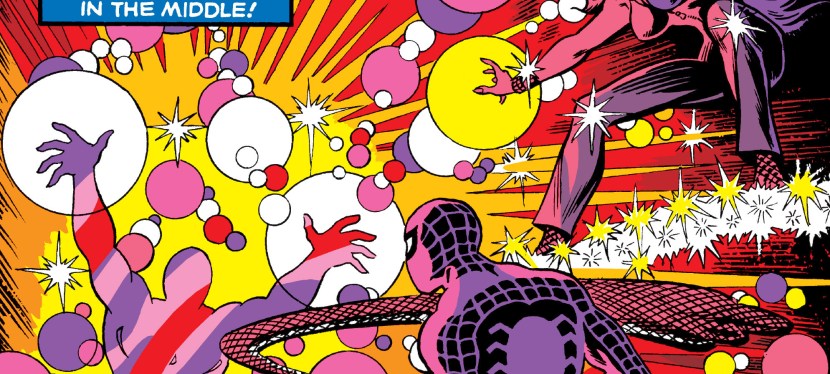
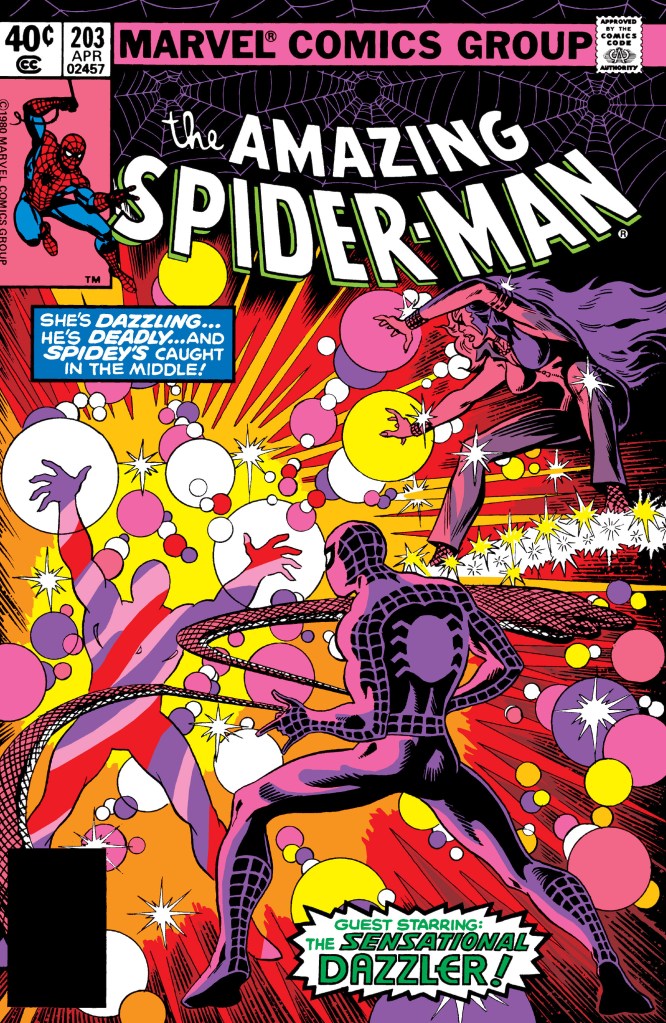
Welcome back, superhero enthusiasts, 1980s culture enthusiasts, comic book collectors and fans of Marvel Comics! Previously I reviewed Uncanny X-Men #130 (1980) which was the first appearance of Dazzler who eventually became a popular figure for Marvel Comics in the 1980s. Before the company published a monthly comic book series featuring her, Dazzler made another appearance in an issue of the Amazing Spider-Man which was released just a few months after her debut. This, of course, led to a crossover with the iconic webslinger himself.
With those details laid down, here is a look back at Amazing Spider-Man #203, published in 1980 by Marvel Comics with a story written by Marv Wolfman and drawn by Keith Pollard.
The cover.
Early story
The story begins during a night in the city where a swinging Spider-Man gets distracted by fast skating Dazzler who is being followed closely by a streak of light. After Spider-Man speculates about the possible return of Will-o-the-Wisp, he decides to intervene and pulls Dazzler off the road and to himself above. Dazzler faints suddenly.
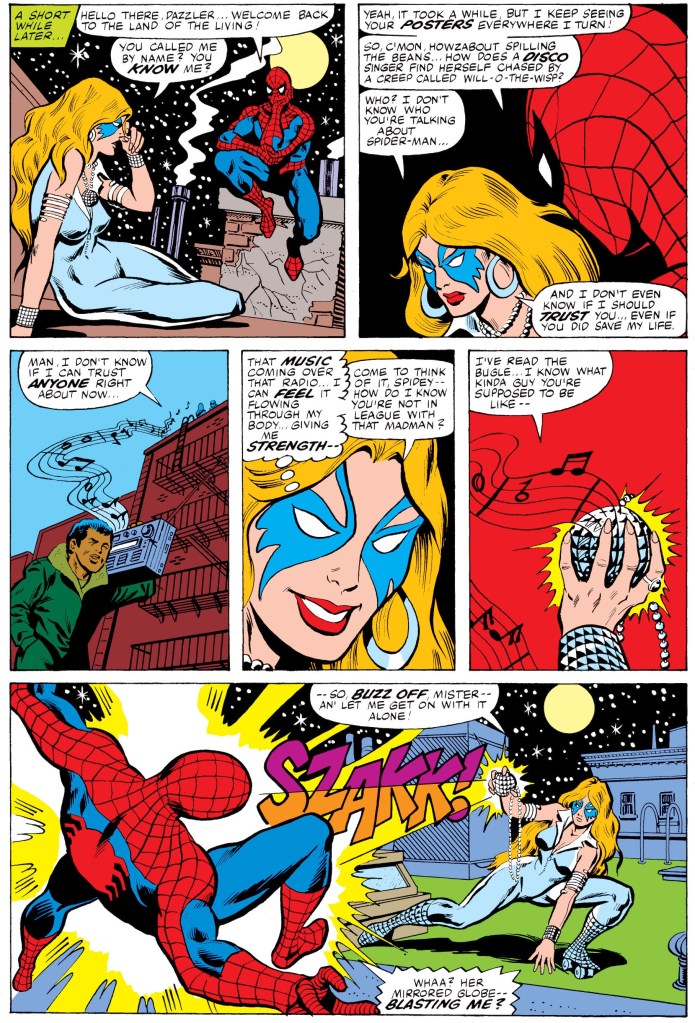
A short while afterward, Dazzler wakes up and starts talking with the webslinger. In response to the mention of Will-o-the-Wisp’s name, she claims to not knowing what he was talking about. As their talk goes on, Dazzler hears music from the street which strengthens her. Using the small mirror globe she is wearing, Dazzler hits Spider-Man with a blast of light pushing him off the building…
Quality
The crossover between Dazzler and Spider-Man is the main feature of this comic book.
This is one fun crossover between the iconic Spider-Man and the brand-new Dazzler. Marv Wolfman wrote a story that not only followed the further adventures of the webslinger, it also gave readers more to see and learn about Dazzler who just had her unexpected adventure with the X-Men months earlier (in Uncanny X-Men #130 and #131). By connecting this story with those two X-Men comic books, it really looked like just got back home in the city only to get chased by streaking light. The interactions between Dazzler and Spider-Man were entertaining. While Dazzler is a known entertainer among New Yorkers, it was the webslinger who remains the big, popular local figure which is clearly reflected in the singer’s verbal exchange with him.
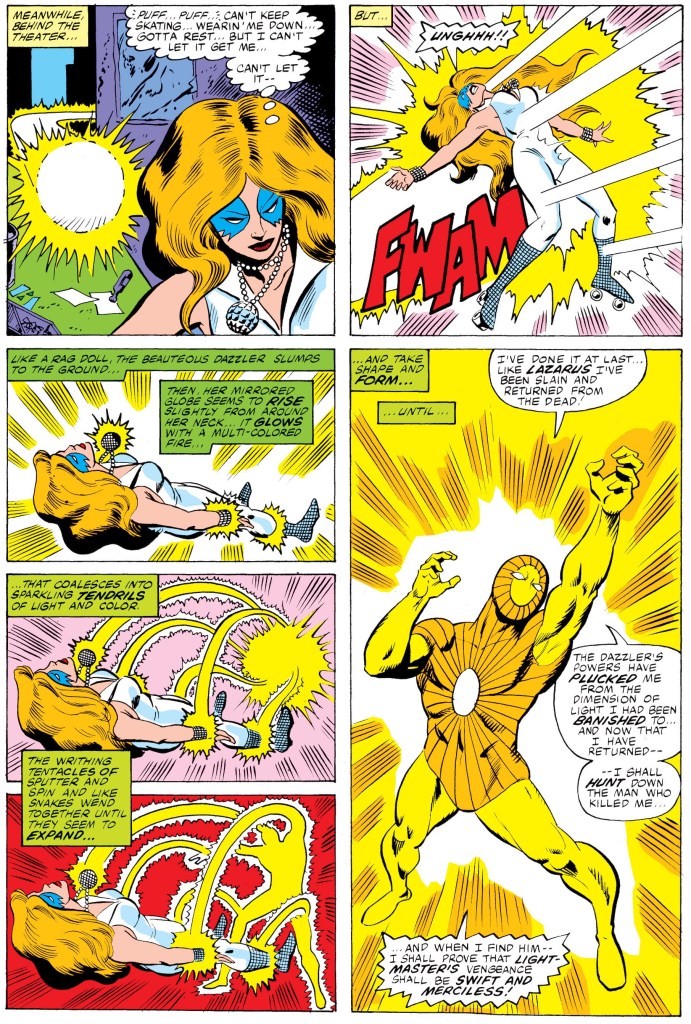
The villain in this comic book, Lightmaster, is pretty cartoonish visually but his super power and high intelligence do make him look threatening. I like the way the story was crafted with concepts that link Lightmaster with Dazzler. Both of them are connected with light and while Dazzler is able to absorb sound like a form of energy and create light beams, Lightmaster has the means to tap on her power and use it for his advantage. There is also another capability of Lightmaster’s which I will just leave unrevealed and you who read this should find out about it.
Conclusion
Lightmaster enters the scene.
Amazing Spider-Man #203 (1980) is a very old yet fun comic book that fans of Spider-Man and Dazzler will enjoy. Not only does it have a meaty encounter between the two, it also succeeds in chronicling Spider-Man’s life both in costume and as civilian Peter Parker. Going back to Dazzler, there is not much character development for her here but that is understandable as such emphasis was only waiting to happen in her own monthly comic book series.
If you are seriously planning to buy an existing hard copy of Amazing Spider-Man #203 (1980), be aware that as of this writing, MileHighComics.com shows that the near-mint copy of the regular edition costs $94 while the near-mint copy of the newsstand edition costs $150.
Overall, Amazing Spider-Man #203 (1980) is recommended.
+++++
Thank you for reading. If you find this article engaging, please click the like button below and also please consider sharing this article to others. If you are looking for a copywriter to create content for your special project or business, check out my services and my portfolio. Feel free to contact me as well. Also please feel free to visit my Facebook page Author Carlo Carrasco and follow me at HavenorFantasy@twitter.com
Disclaimer: This is my original work with details sourced from reading the comic book and doing personal research. Anyone who wants to use this article, in part or in whole, needs to secure first my permission and agree to cite me as the source and author. Let it be known that any unauthorized use of this article will constrain the author to pursue the remedies under R.A. No. 8293, the Revised Penal Code, and/or all applicable legal actions under the laws of the Philippines.
Welcome back, superhero enthusiasts, comic collectors, 1990s culture enthusiasts and fans of the X-Men! We go back to the year 1993 when the 30th anniversary of the X-Men was celebrated with the 6-part Fatal Attractions storyline. Already I reviewed Uncanny X-Men #304 (Part 3) which was not worthy of the X-Men’s 30th anniversary celebration. X-Men #25 (Part 4) meanwhile was not only great but also shocking and had a years-long impact on X-Men comics.
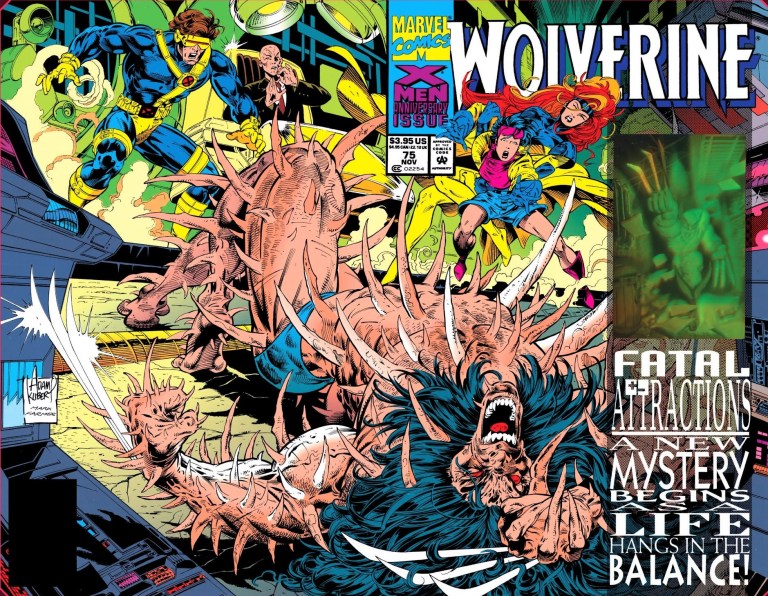
So now the focus is on the 5th chapter of the Fatal Attractions storyline handled by the Larry Hama-Adam Kubert team on the Wolverine monthly series of the time. With those details laid down, here is a look back at Wolverine #75, published by Marvel Comics in 1993 with a story written by Larry Hama and drawn by Adam Kubert.
The cover.
Early story
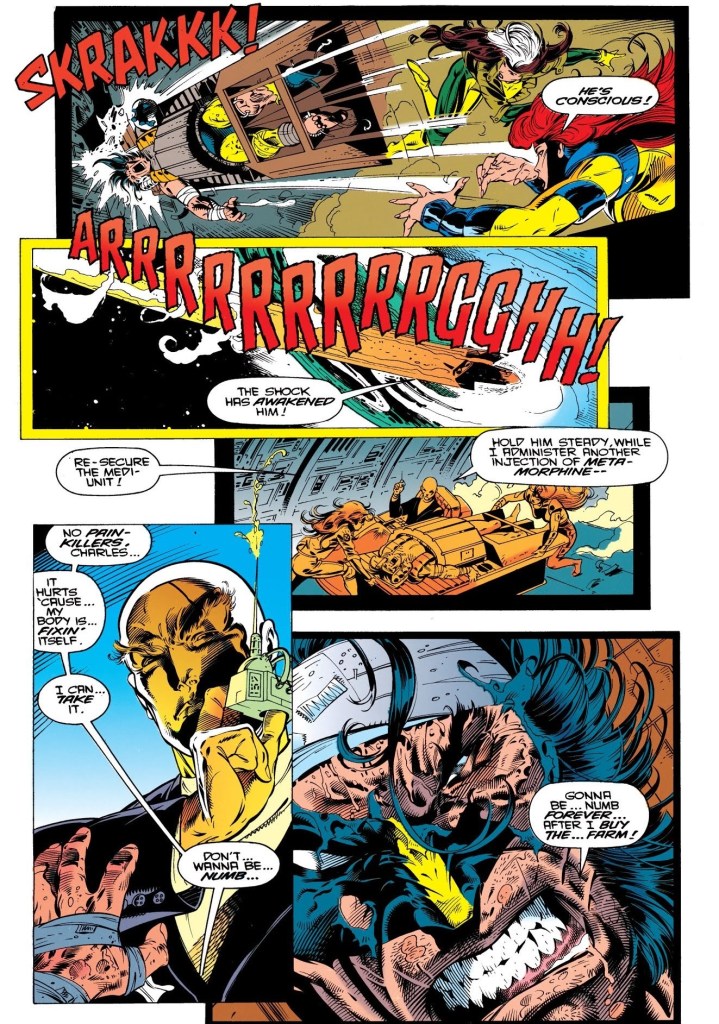
The story begins in outer space. Carrying Charles Xavier, Wolverine, Gambit, Jean Grey, Rogue and Quicksilver (who participated in the dangerous mission in X-Men #25), the X-Men’s jet (piloted by Bishop) struggles mechanically as it was not designed for space travel. Worse, Wolverine is under very serious condition and the medical unit has been operating in full capacity dealing with his intense trauma.
In an attempt to alleviate Wolverine’s psychic trauma, Charles Xavier and Jean Grey enter his mind and discover that there is a world full of pain and horror. They see visions of a restrained Wolverine (from his Weapon X days) being attacked by Sabretooth and Lady Deathstrike. Xavier explains that they are at the epicenter of Logan’s most suppressed cataclysmic memories which were clearly triggered by the physical damage Magneto inflicted on him (see X-Men #25).
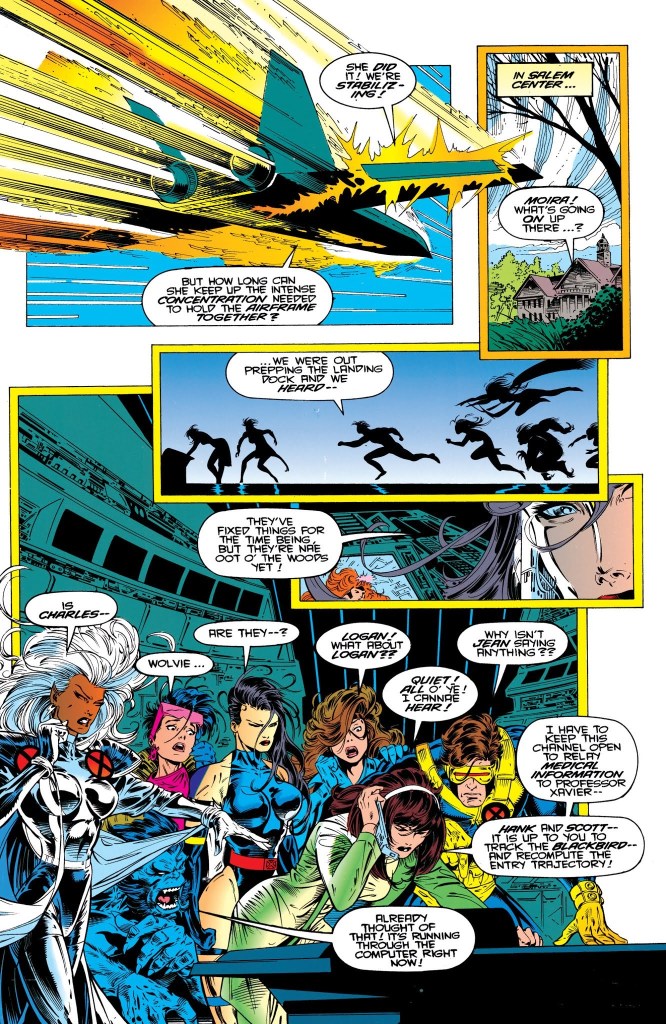
As the X-Men’s jet attempts to enter Earth’s atmosphere, its exteriors heat up dramatically shaking everyone inside. This complicates the situation on stabilizing Wolverine…
Quality
The other X-Men team members at their headquarters expressing worry and concern about the situation of their teammates struggling to come back home from space.
To be clear, this story continues the events of Fatal Attractions but with a bit more focus on Wolverine (compared to the earlier chapters of the storyline that is). There is no real battle between good and evil at all. It’s really all about Wolverine struggling to survive just as his teammates struggle to arrive home.
Before the stories of this comic book and X-Men #25 happened, Wolverine has often been portrayed to be very tough, brave and a walking machine of violence which has been reflected in other X-Men stories told in video games and movies. In this very comic book, Wolverine has been presented to coming close to death. This means Logan, at this particular stage of the history of the literary X-Men, was at his most vulnerable state. In my experience, this was both alienating and shocking to see.
With regards to the writing, Larry Hama did an excellent job with pacing the story from start to finish. Right from the beginning, the story pulls you into the X-Men’s tough situation and as each page gets turned, the tension as well as the suspense builds up until the execution of the climax. Along the way, the comic book not only portrays Wolverine struggling on the edge, it also works to make you care more or be more concerned towards him. Oh yes, the shocking moment near the end of this comic book remains very powerful and you who read this retro review should read Wolverine #75 and see it for yourselves.
Conclusion
Wolverine at his most vulnerable state.
By today’s standards, Wolverine #75 (1993) is still a very great comic book to read. In fact, I can say it is not only one of most defining chapters of the Fatal Attractions storyline as well as one of the most significant X-Men comic books of the 1990s, it is indeed a true illustrated literature classic ever published by Marvel Comics. In retrospect, this comic book marks a major turning point in the life of Wolverine who is still one of the most iconic characters in all of superhero literature. All of these were achieved thanks to the creative team of Larry Hama and Adam Kubert (whose are here was great and stylized at the same time). Hama succeeded in writing the continuation of the Fatal Attractions storyline while balancing all of the exposition and still putting Wolverine in the center. That itself is a very great work of writing.
If you are seriously planning to buy an existing hard copy of Wolverine #75 (1993), be aware that as of this writing, MileHighComics.com shows that the near-mint copy of the regular edition costs $60 while the near-mint copies of the signed-and-numbered edition and the newsstand edition cost $300 and $180 respectively.
Overall, Wolverine #75 (1993) is highly recommended!
+++++
Thank you for reading. If you find this article engaging, please click the like button below and also please consider sharing this article to others. If you are looking for a copywriter to create content for your special project or business, check out my services and my portfolio. Feel free to contact me as well. Also please feel free to visit my Facebook page Author Carlo Carrasco and follow me at HavenorFantasy@twitter.com
Disclaimer: This is my original work with details sourced from playing Top Gear and doing personal research. Anyone who wants to use this article, in part or in whole, needs to secure first my permission and agree to cite me as the source and author. Let it be known that any unauthorized use of this article will constrain the author to pursue the remedies under R.A. No. 8293, the Revised Penal Code, and/or all applicable legal actions under the laws of the Philippines.
Remember back in the early 1990s how impressive the Super Nintendo Entertainment System (SNES or Super NES) was when it comes to fulfilling your early expectations of the enhanced gaming experience aided by new technology?
Super Mario World was astounding the first time I got to play it on our Super NES. The same experience too I had with The Legend of Zelda: A Link to the Past.
And then there was our first Super NES racing game titled Top Gear (not to be confused with the popular motoring media franchise) developed by Gremlin Graphics and published by Kemco.
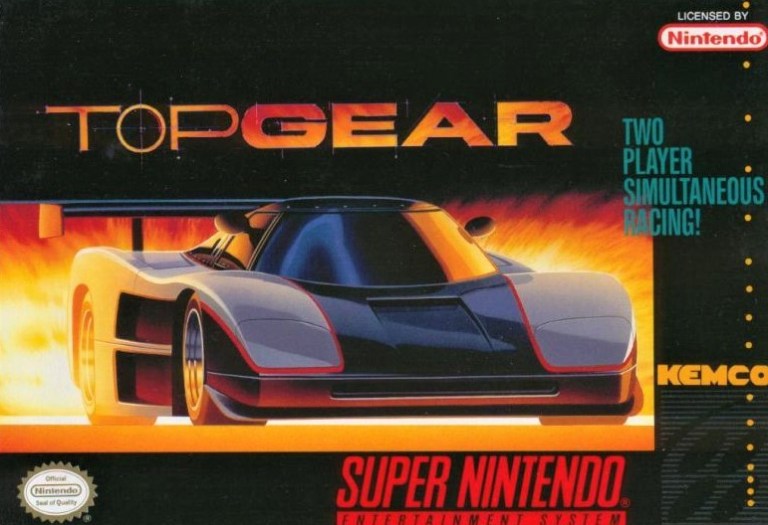
The game cover.
Concept and Game Design
Top Gear is a car-focused racing game that had over thirty tracks and creatively emphasized the global locations in it. The very meat of the game is its global tournament in which you need to finish at least in 5th place in order to qualify to join the next race.
Creatively, each race has courses that vary in distance, the sharpness of turns (as far as 2D graphics allowed), number of laps and, strangely enough, have certain obstacles that can distract or even surprise such as stones, iron plates and even trees.
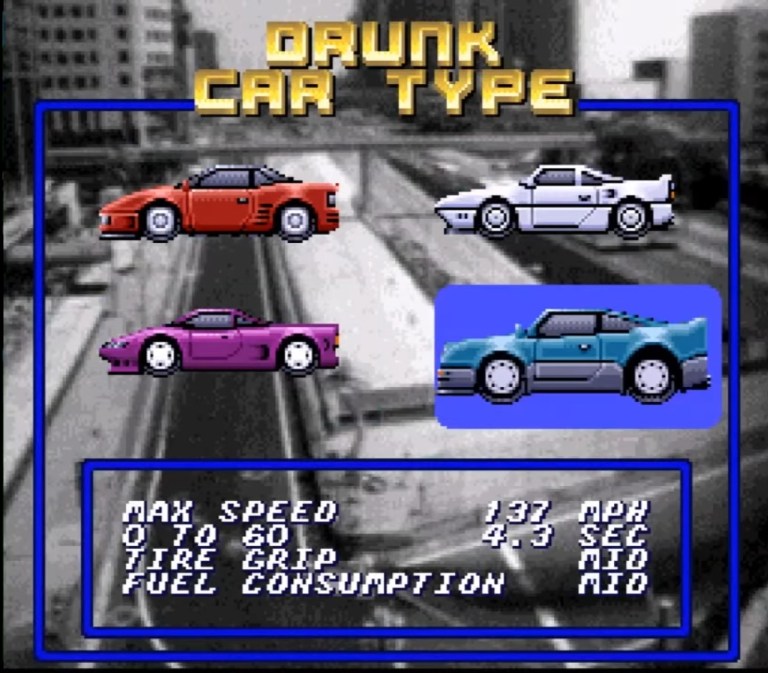
Before choosing a car, you must pay attention to the maximum speed, acceleration, tire grip and fuel consumption.
On the player’s side, there are cars offered and they vary in terms of maximum speed, acceleration, tire grip and fuel consumption. Cars also have nitro which come in limited amounts and can be used to give you a boost
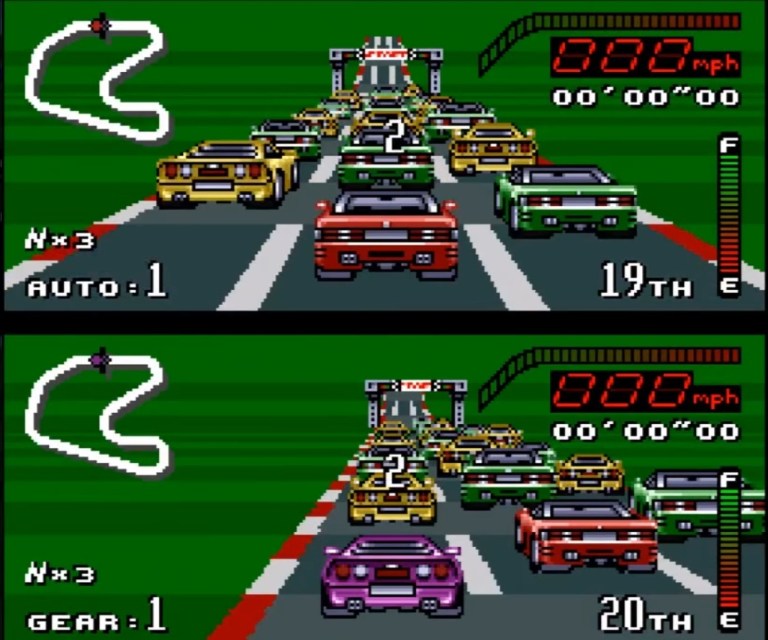
For its visual presentation, Top Gear is strictly a split-screen game even during times you play only single-player. In my experience, split-screen is more lively to watch when playing against a fellow human player.
Quality
I can say clearly that Top Gear was highly enjoyable to play, and it was more fun 2-player sessions. On the very gameplay itself, I enjoyed the high-speed challenges that include overtaking other cars on the road while trying to climb up the rankings enroute to the finish line. Speaking of challenges, the aspect of managing your fuel supply while dealing with speeding and overtaking others is memorable and there were times when my car ran out of gas and stopped because I was not able to make a pit stop during the race.
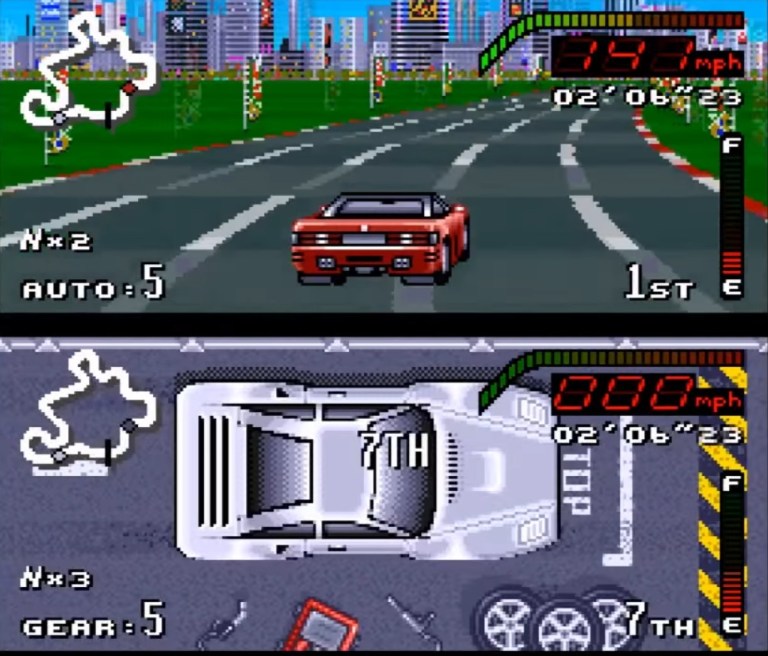
The pit stop itself can be an advantage or disadvantage depending on situations. If you are low on fuel and you still have a long way to go, you need to refuel at the pit stop. However, the more time you spend on the pit stop, the more your opponents traveled catching up with you or increasing their lead over you. There were also memorable times when I had sufficient fuel and my opponent had to refuel at the pit stop. While opponent was refueling, I just kept driving and used the nitro to increase my speed and keep on moving forward.
Split-screen all the time, even when you play single.
Going back to the fuel management aspect, there were times when my car ran out of gas and stopped. Suddenly, an AI-controlled car from behind hit my car and gave me some forward movement. There were a few, unexpected times that my gas-empty car got pushed enough to cross the finish line.
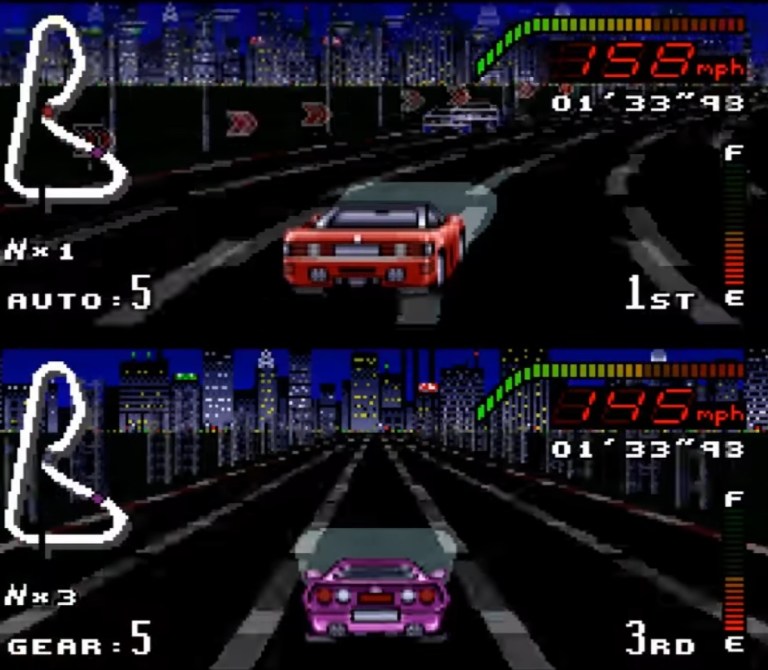
Visually, race courses are limited in the sense that the game only shows split-screen views. You always have a road to travel on which can suddenly turn left or right depending on the race course. What adds visual variety are the surroundings specifically the elements on the sides of the road (examples: the desert environment Las Vegas, the snow of Sweden, the rain forest trees of Brazil) and background art (example: the metropolitan view of Tokyo). Sprite scaling is limited but that is understandable given the limits of the Super NES. Even so, the feeling and look of 3D is sufficient.
Night driving in 2D.
While the sound effects of cars bumping, tires screeching and engines are satisfying, what really stood out is the soundtrack which, for the most part, is energetic and even encouraging enough to keep me and my friends playing. Barry Leitch produced the music and due to the lack of time provided to him, he had to literally recycle and arrange his other musical works from Lotus games.
Conclusion
One car still racing on the road with low fuel, the other car is in the pit stop refueling.
Top Gear was truly a well-made game and it succeeded not only in delivering a true console generation upgrade over our NES for console racing but also created lots of bouts of fun for me and my friends. In my experience, this Kemco-published game was the first true gem of multiplayer on the Super NES. Even by today’s standards, Top Gear remains unique and still is very enjoyable for anyone who loves 16-bit, 2-dimensional console racing.
Overall, Top Gear is highly recommended!
+++++
Thank you for reading. If you find this article engaging, please click the like button below and also please consider sharing this article to others. If you are looking for a copywriter to create content for your special project or business, check out my services and my portfolio. Feel free to contact me as well. Also please feel free to visit my Facebook page Author Carlo Carrasco and follow me at HavenorFantasy@twitter.com
Disclaimer: This is my original work with details sourced from playing Secret of the Stars and doing personal research. Anyone who wants to use this article, in part or in whole, needs to secure first my permission and agree to cite me as the source and author. Let it be known that any unauthorized use of this article will constrain the author to pursue the remedies under R.A. No. 8293, the Revised Penal Code, and/or all applicable legal actions under the laws of the Philippines.
Welcome back, video game enthusiasts, fans of Japanese role-playing games (RPGs), 1990s arts and culture enthusiasts, fellow geeks and video game collectors!
If you were already a gamer who enjoyed playing games at home with the Super Nintendo Entertainment System (SNES or Super NES) back in 1995, chances are you heard about the buzz about the hot RPGs that were released for the console at the time. Square released Chrono Trigger (which is now a classic) and Secret of Evermore while Capcom released Breath of Fire II.
That same year, Tecmo (the company best known for Dead or Alive video games) tried to score well with RPG enthusiasts and other SNES-owning gamers of North America by releasing Secret of the Stars which itself turned out to be the English-language version of the Japanese role-playing game (JRPG) Aqutallion.
This RPG caught my attention when I read about it in gaming magazines. After completing Final Fantasy II (actual title Final Fantasy IV) and Final Fantasy III (AKA Final Fantasy VI) on the SNES in 1994, there was a period several months when I was not able to play another RPG and had to settle with other types of games (note: I had a lot of fun with Super Star Wars: The Empire Strikes Back and Super Star Wars: Return of the Jedi). In the 4th quarter of 1995, I finally obtained a copy of the Tecmo-published RPG.
With those details laid down, here is a look back at Secret of the Stars (or Tecmo Secret of the Stars as presented on the game cover).
The cover of the game.
Early story
The story begins with a young lad named Ray who gets oriented with some people at the house of Mrs. Sonya. By merely asking a question, she reminds him about his personal search for a crest which once belonged to his father. Sonya also revealed that their island has been hit by several earthquakes which caused many wild animals to arrive.
Ray travels to the nearby town talking with the locals who gradually update him about what has been happening. Someone reveals to him that a journeyman arrived and talks about something called Kustera and Aquatallion.
Ray meets with the journeyman named David who is a native of Kustera. After reminding Ray that his father was the great Aqutallion, he emphasized that an evil being called Homncruse is a major threat to everyone and must be stopped. He tells Ray that he must seek out the crest of the stars to become an Aqutallion warrior and be able to defeat Homncruse.
Ray gets urged to go to the mountain to find the crest…
Quality
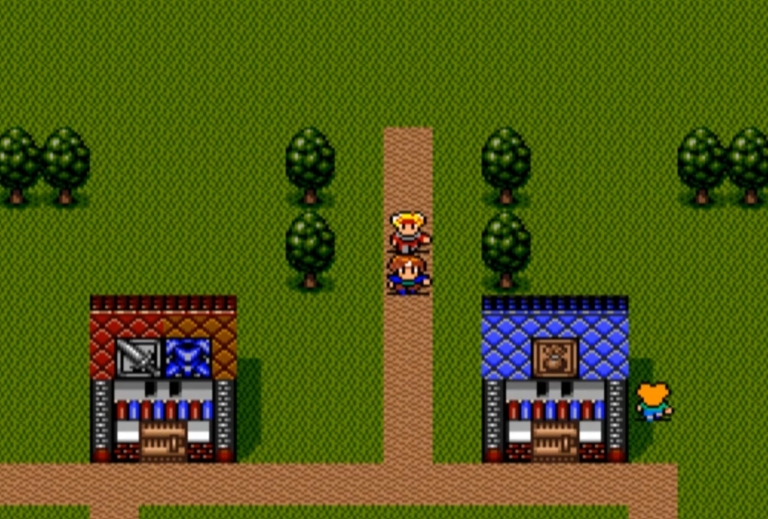
Imagine yourself arriving in this town for the first time. Which place should you visit?
To put things straight, Secret of the Stars has the basic elements of turn-based role-playing that involves the heavy use of menus for item management, fighting, defense, item use and others. The most unique game design feature here is the ability to switch between parties as the game goes on but what is clear is that the party involving Ray is the default party.
On the creative side of things, the concept about Ray being the chosen one to protect his people, lead a group composed of individuals to not only fight evil beings or monsters and achieve goals on quests (read: this includes going through personal trials at different sites in order to receive additional powers) and take on Homncruse and his evil agents has always been generic and the overall game design reflects that as well. Being the protagonist, Ray is clearly the most developed character but the same cannot be said about Tina, Cody, Leona and Dan who are all uninteresting.
Red slime? More like purple!
The production values of this game are clearly sub-par and the weak Japanese-to-English translation is only the tip of the iceberg. With the exception of the monster and enemy designs, Secret of the Stars looks like an 8-bit game and really stood out among 16-bit RPGs of its time when it comes to field of inferiority and primitiveness. The level designs lack creativity and the location background art lacked variety. When it comes to the story, its concept was interesting at first but there really is not much depth to it nor are the characters worth caring about.
What really defined this game is its slow-pacing in terms of interactivity. Adding even more to the sluggishness of the game are the slow movements of your character (representing your party) on-screen and the rather high rate of random battles. There is also a lot of grinding (defeat enemies in lots of repetitive battles to gain experience points to level up) required and the sad thing is the level-up is not very rewarding especially when you take into consideration the many enemies or monsters who are often strong with high hit points each.
The sluggishness and tedium are so bad, Secret of the Stars really turned out to be more of a chore than an actual fun game to play. It is so bad, the game’s unique feature of allowing players to control the 2nd party (Kusterans) became even more tedious and pointless to do. It is so bad, you will care less about the story of Ray, and you will prefer to ignore the other characters even more. It’s so bad, you won’t care anymore about Ray’s quest and the danger Homncruse has on the people.
Conclusion
Do you know someone named or codenamed Badbad?
Secret of the Stars was a bad RPG for its time and clearly it was a waste of money. On my experience, I ended up being very disappointed not only because of the game’s quality but also because of an absence of fun and the fact that my time playing it became a big waste. For me personally, this JRPG was definitely the worse SNES experience of 1995. It seems like the game developers made this game to literally torture gamers.
Overall, Tecmo’s Secret of the Stars should be avoided!
+++++
Thank you for reading. If you find this article engaging, please click the like button below and also please consider sharing this article to others. If you are looking for a copywriter to create content for your special project or business, check out my services and my portfolio. Feel free to contact me as well. Also please feel free to visit my Facebook page Author Carlo Carrasco and follow me at HavenorFantasy@twitter.com













 Author Carlo Carrasco