Disclaimer: This is my original work with details sourced from playing Top Gear and doing personal research. Anyone who wants to use this article, in part or in whole, needs to secure first my permission and agree to cite me as the source and author. Let it be known that any unauthorized use of this article will constrain the author to pursue the remedies under R.A. No. 8293, the Revised Penal Code, and/or all applicable legal actions under the laws of the Philippines.
Remember back in the early 1990s how impressive the Super Nintendo Entertainment System (SNES or Super NES) was when it comes to fulfilling your early expectations of the enhanced gaming experience aided by new technology?
Super Mario World was astounding the first time I got to play it on our Super NES. The same experience too I had with The Legend of Zelda: A Link to the Past.
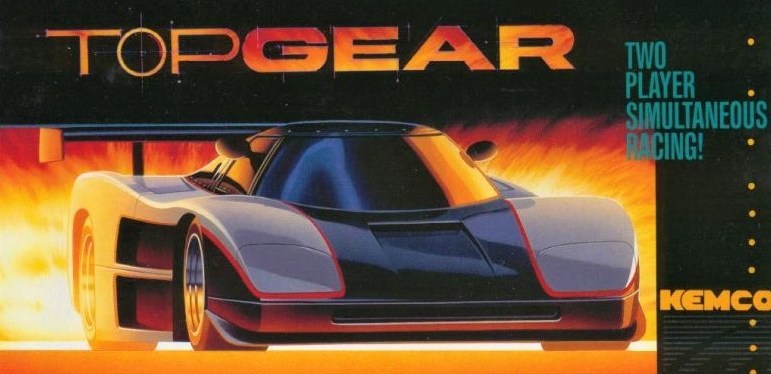
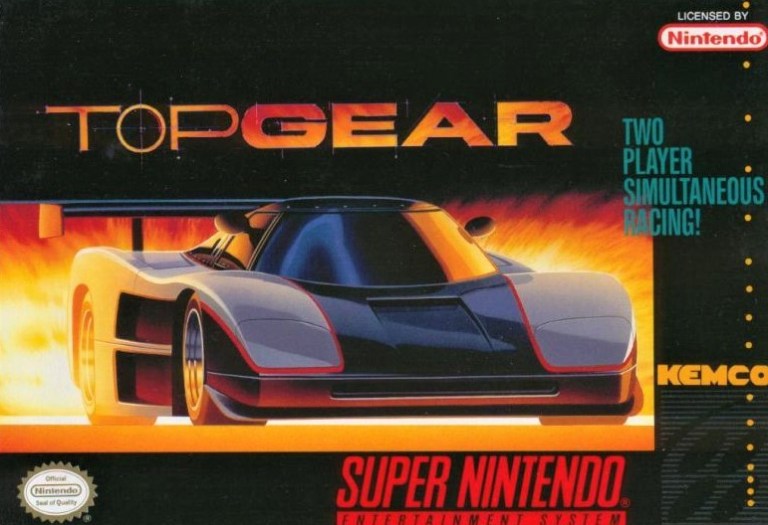
And then there was our first Super NES racing game titled Top Gear (not to be confused with the popular motoring media franchise) developed by Gremlin Graphics and published by Kemco.
The game cover.
Concept and Game Design
Top Gear is a car-focused racing game that had over thirty tracks and creatively emphasized the global locations in it. The very meat of the game is its global tournament in which you need to finish at least in 5th place in order to qualify to join the next race.
Creatively, each race has courses that vary in distance, the sharpness of turns (as far as 2D graphics allowed), number of laps and, strangely enough, have certain obstacles that can distract or even surprise such as stones, iron plates and even trees.
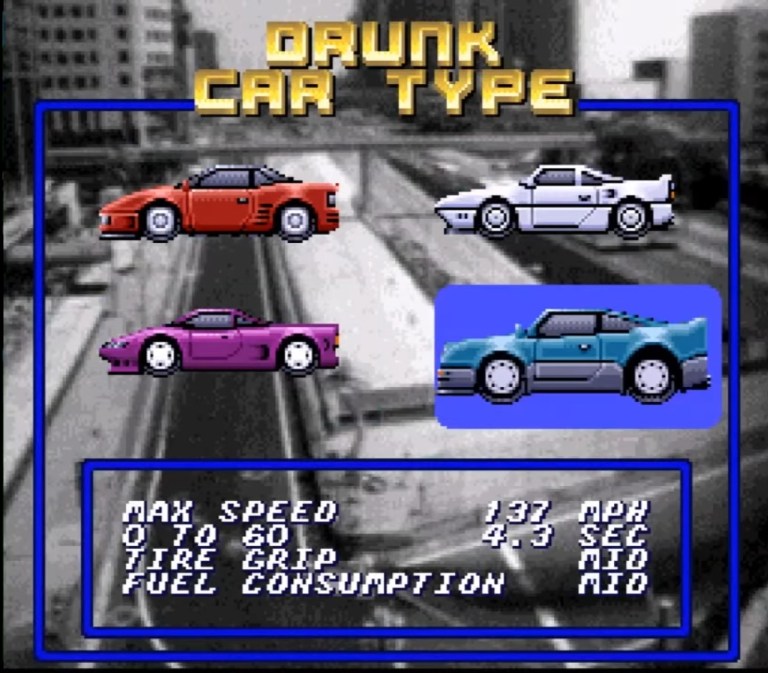
Before choosing a car, you must pay attention to the maximum speed, acceleration, tire grip and fuel consumption.
On the player’s side, there are cars offered and they vary in terms of maximum speed, acceleration, tire grip and fuel consumption. Cars also have nitro which come in limited amounts and can be used to give you a boost
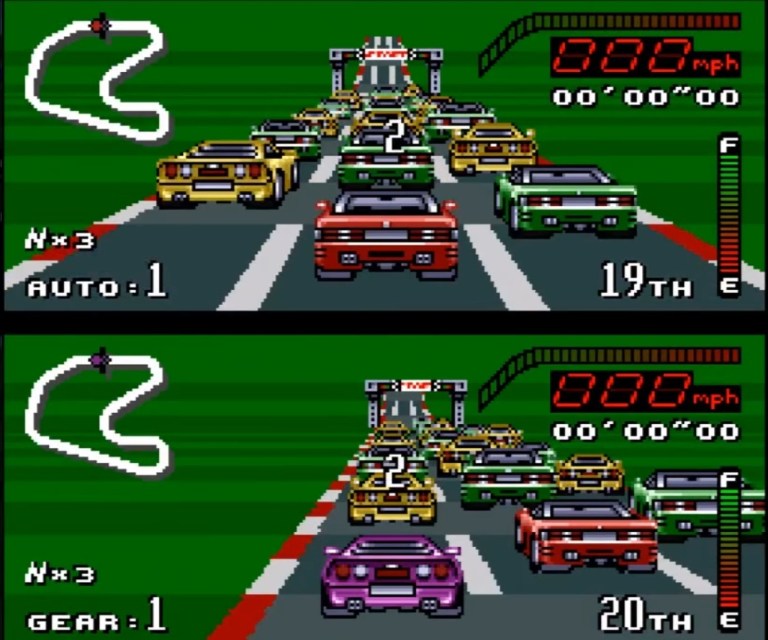
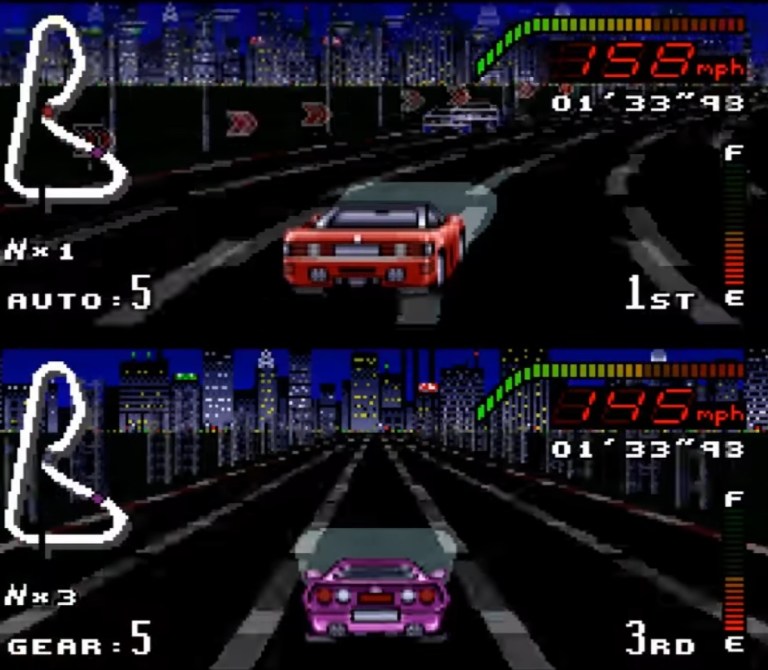
For its visual presentation, Top Gear is strictly a split-screen game even during times you play only single-player. In my experience, split-screen is more lively to watch when playing against a fellow human player.
Quality
I can say clearly that Top Gear was highly enjoyable to play, and it was more fun 2-player sessions. On the very gameplay itself, I enjoyed the high-speed challenges that include overtaking other cars on the road while trying to climb up the rankings enroute to the finish line. Speaking of challenges, the aspect of managing your fuel supply while dealing with speeding and overtaking others is memorable and there were times when my car ran out of gas and stopped because I was not able to make a pit stop during the race.
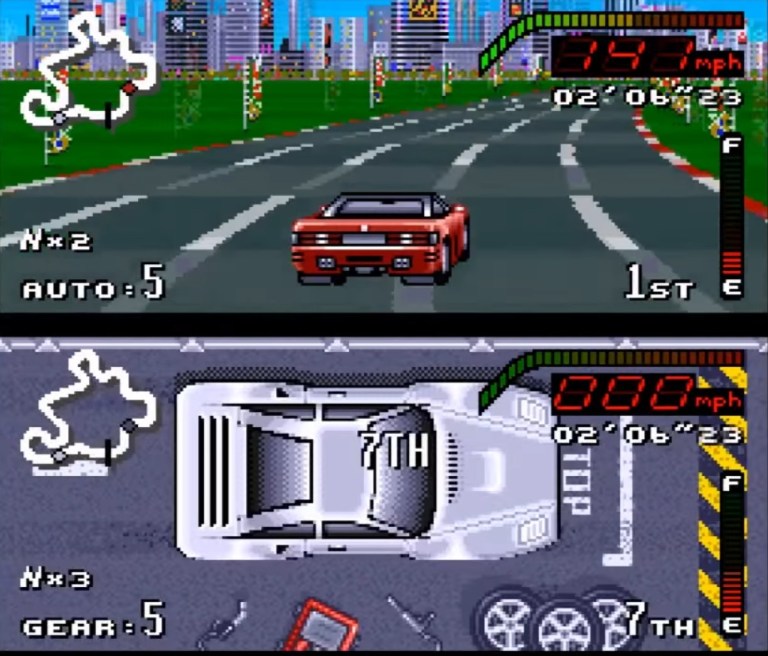
The pit stop itself can be an advantage or disadvantage depending on situations. If you are low on fuel and you still have a long way to go, you need to refuel at the pit stop. However, the more time you spend on the pit stop, the more your opponents traveled catching up with you or increasing their lead over you. There were also memorable times when I had sufficient fuel and my opponent had to refuel at the pit stop. While opponent was refueling, I just kept driving and used the nitro to increase my speed and keep on moving forward.
Split-screen all the time, even when you play single.
Going back to the fuel management aspect, there were times when my car ran out of gas and stopped. Suddenly, an AI-controlled car from behind hit my car and gave me some forward movement. There were a few, unexpected times that my gas-empty car got pushed enough to cross the finish line.
Visually, race courses are limited in the sense that the game only shows split-screen views. You always have a road to travel on which can suddenly turn left or right depending on the race course. What adds visual variety are the surroundings specifically the elements on the sides of the road (examples: the desert environment Las Vegas, the snow of Sweden, the rain forest trees of Brazil) and background art (example: the metropolitan view of Tokyo). Sprite scaling is limited but that is understandable given the limits of the Super NES. Even so, the feeling and look of 3D is sufficient.
Night driving in 2D.
While the sound effects of cars bumping, tires screeching and engines are satisfying, what really stood out is the soundtrack which, for the most part, is energetic and even encouraging enough to keep me and my friends playing. Barry Leitch produced the music and due to the lack of time provided to him, he had to literally recycle and arrange his other musical works from Lotus games.
Conclusion
One car still racing on the road with low fuel, the other car is in the pit stop refueling.
Top Gear was truly a well-made game and it succeeded not only in delivering a true console generation upgrade over our NES for console racing but also created lots of bouts of fun for me and my friends. In my experience, this Kemco-published game was the first true gem of multiplayer on the Super NES. Even by today’s standards, Top Gear remains unique and still is very enjoyable for anyone who loves 16-bit, 2-dimensional console racing.
Overall, Top Gear is highly recommended!
+++++
Thank you for reading. If you find this article engaging, please click the like button below and also please consider sharing this article to others. If you are looking for a copywriter to create content for your special project or business, check out my services and my portfolio. Feel free to contact me as well. Also please feel free to visit my Facebook page Author Carlo Carrasco and follow me at HavenorFantasy@twitter.com
Disclaimer: This is my original work with details sourced from playing Secret of the Stars and doing personal research. Anyone who wants to use this article, in part or in whole, needs to secure first my permission and agree to cite me as the source and author. Let it be known that any unauthorized use of this article will constrain the author to pursue the remedies under R.A. No. 8293, the Revised Penal Code, and/or all applicable legal actions under the laws of the Philippines.
Welcome back, video game enthusiasts, fans of Japanese role-playing games (RPGs), 1990s arts and culture enthusiasts, fellow geeks and video game collectors!
If you were already a gamer who enjoyed playing games at home with the Super Nintendo Entertainment System (SNES or Super NES) back in 1995, chances are you heard about the buzz about the hot RPGs that were released for the console at the time. Square released Chrono Trigger (which is now a classic) and Secret of Evermore while Capcom released Breath of Fire II.
That same year, Tecmo (the company best known for Dead or Alive video games) tried to score well with RPG enthusiasts and other SNES-owning gamers of North America by releasing Secret of the Stars which itself turned out to be the English-language version of the Japanese role-playing game (JRPG) Aqutallion.
This RPG caught my attention when I read about it in gaming magazines. After completing Final Fantasy II (actual title Final Fantasy IV) and Final Fantasy III (AKA Final Fantasy VI) on the SNES in 1994, there was a period several months when I was not able to play another RPG and had to settle with other types of games (note: I had a lot of fun with Super Star Wars: The Empire Strikes Back and Super Star Wars: Return of the Jedi). In the 4th quarter of 1995, I finally obtained a copy of the Tecmo-published RPG.
With those details laid down, here is a look back at Secret of the Stars (or Tecmo Secret of the Stars as presented on the game cover).
The cover of the game.
Early story
The story begins with a young lad named Ray who gets oriented with some people at the house of Mrs. Sonya. By merely asking a question, she reminds him about his personal search for a crest which once belonged to his father. Sonya also revealed that their island has been hit by several earthquakes which caused many wild animals to arrive.
Ray travels to the nearby town talking with the locals who gradually update him about what has been happening. Someone reveals to him that a journeyman arrived and talks about something called Kustera and Aquatallion.
Ray meets with the journeyman named David who is a native of Kustera. After reminding Ray that his father was the great Aqutallion, he emphasized that an evil being called Homncruse is a major threat to everyone and must be stopped. He tells Ray that he must seek out the crest of the stars to become an Aqutallion warrior and be able to defeat Homncruse.
Ray gets urged to go to the mountain to find the crest…
Quality
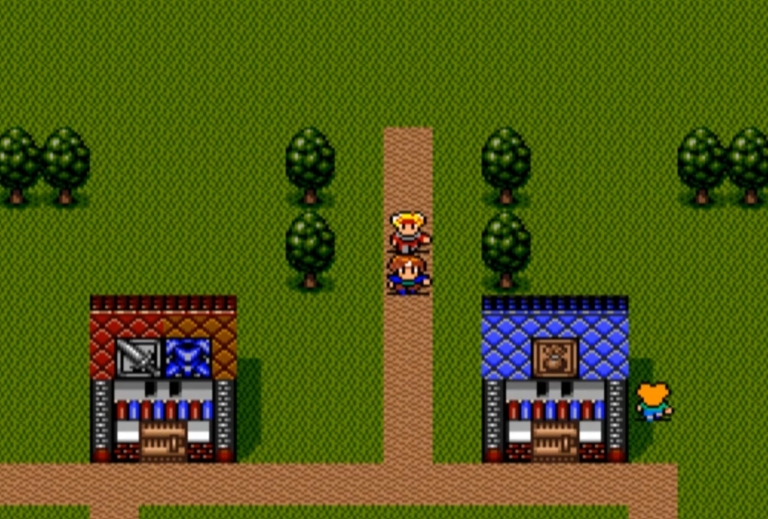
Imagine yourself arriving in this town for the first time. Which place should you visit?
To put things straight, Secret of the Stars has the basic elements of turn-based role-playing that involves the heavy use of menus for item management, fighting, defense, item use and others. The most unique game design feature here is the ability to switch between parties as the game goes on but what is clear is that the party involving Ray is the default party.
On the creative side of things, the concept about Ray being the chosen one to protect his people, lead a group composed of individuals to not only fight evil beings or monsters and achieve goals on quests (read: this includes going through personal trials at different sites in order to receive additional powers) and take on Homncruse and his evil agents has always been generic and the overall game design reflects that as well. Being the protagonist, Ray is clearly the most developed character but the same cannot be said about Tina, Cody, Leona and Dan who are all uninteresting.
Red slime? More like purple!
The production values of this game are clearly sub-par and the weak Japanese-to-English translation is only the tip of the iceberg. With the exception of the monster and enemy designs, Secret of the Stars looks like an 8-bit game and really stood out among 16-bit RPGs of its time when it comes to field of inferiority and primitiveness. The level designs lack creativity and the location background art lacked variety. When it comes to the story, its concept was interesting at first but there really is not much depth to it nor are the characters worth caring about.
What really defined this game is its slow-pacing in terms of interactivity. Adding even more to the sluggishness of the game are the slow movements of your character (representing your party) on-screen and the rather high rate of random battles. There is also a lot of grinding (defeat enemies in lots of repetitive battles to gain experience points to level up) required and the sad thing is the level-up is not very rewarding especially when you take into consideration the many enemies or monsters who are often strong with high hit points each.
The sluggishness and tedium are so bad, Secret of the Stars really turned out to be more of a chore than an actual fun game to play. It is so bad, the game’s unique feature of allowing players to control the 2nd party (Kusterans) became even more tedious and pointless to do. It is so bad, you will care less about the story of Ray, and you will prefer to ignore the other characters even more. It’s so bad, you won’t care anymore about Ray’s quest and the danger Homncruse has on the people.
Conclusion
Do you know someone named or codenamed Badbad?
Secret of the Stars was a bad RPG for its time and clearly it was a waste of money. On my experience, I ended up being very disappointed not only because of the game’s quality but also because of an absence of fun and the fact that my time playing it became a big waste. For me personally, this JRPG was definitely the worse SNES experience of 1995. It seems like the game developers made this game to literally torture gamers.
Overall, Tecmo’s Secret of the Stars should be avoided!
+++++
Thank you for reading. If you find this article engaging, please click the like button below and also please consider sharing this article to others. If you are looking for a copywriter to create content for your special project or business, check out my services and my portfolio. Feel free to contact me as well. Also please feel free to visit my Facebook page Author Carlo Carrasco and follow me at HavenorFantasy@twitter.com
Disclaimer: This is my original work with details sourced from reading the comic book and doing personal research. Anyone who wants to use this article, in part or in whole, needs to secure first my permission and agree to cite me as the source and author. Let it be known that any unauthorized use of this article will constrain the author to pursue the remedies under R.A. No. 8293, the Revised Penal Code, and/or all applicable legal actions under the laws of the Philippines.
Welcome back, X-Men fans, superhero enthusiasts, 1980s culture enthusiasts and comic book collectors! Today, we look back at the year 1980 specifically the time when the Uncanny X-Men monthly series was spearheaded by legendary creators Chris Claremont and John Byrne. In fact, we will examine here the comic book debut of Dazzler, a mutant with the ability to convert the vibrations of sound into light and energy beams. Dazzler is quite unique among all superheroes as she has been portrayed as a singer, an actress, a model and got associated with other Marvel superheroes. Marvel Comics went on to actually publish a regular comic book series about Dazzler which lasted over forty issues.
To say the least, the creation of Dazzler is quite intriguing as it involved a commission by an American record label for a special project with a disco queen character as the core concept and that Marvel Comics itself would develop the superhero (in the form of a singer) and that an actual singer will be produced by the said record label. Then Marvel editor-in-chief Jim Shooter wrote a treatment for the project which turned from an animated special into a live-action film. As creative process for Dazzler went on at Marvel, Tom DeFalco (who later succeeded Shooter as editor-in-chief) wrote her creation while John Romita, Jr. did the character design. The name Dazzler was the result of a suggestion by Roger Stern. There also was some Bo Derek influence on the creation of Dazzler.
While the special project did not happen due to the financial problems of the record label, Marvel went on to formally introduce Dazzler in the pages of an Uncanny X-Men comic book handled by Claremont-Byrne team.
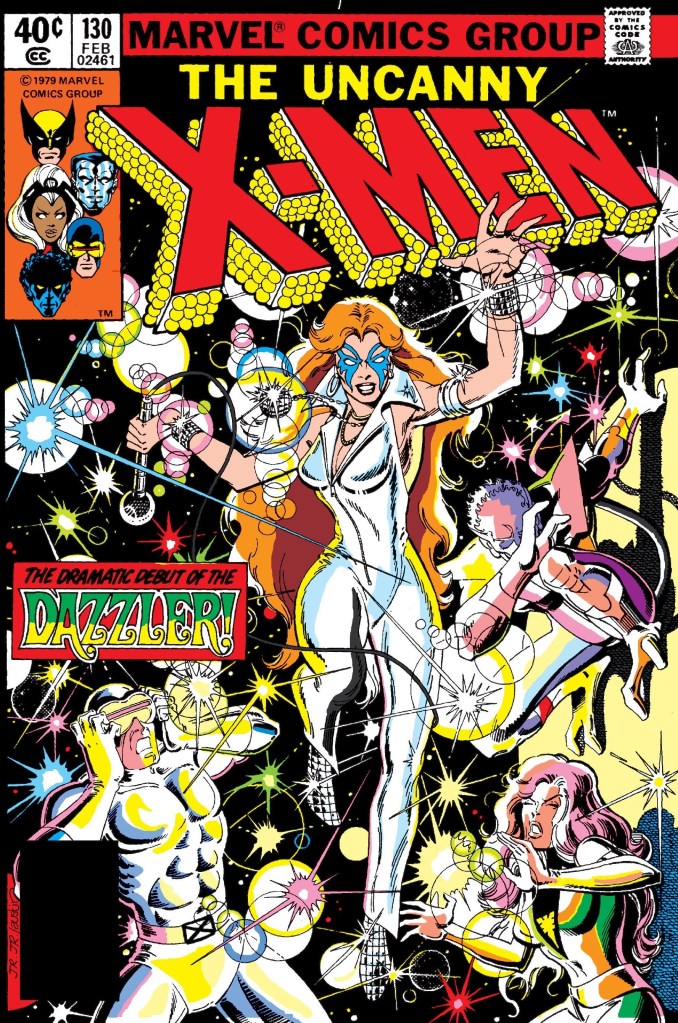
With those details laid down, here is a look back at Uncanny X-Men #130, published by Marvel Comics in 1980 with a story co-written by Chris Claremont and John Byrne. Byrne drew the art.
The cover.
Early story
The story begins on Delano Street in Lower Manhattan. Scott Summers/Cyclops, Jean Grey and Nightcrawler had just arrived on a mission to locate a mutant (detected by Cerebro) not knowing that they themselves are bring monitored by a hidden sinister force. With Nightcrawler left in-charge of guarding their Rolls Royce, Scott and Jean enter a deteriorating building only to find a club on an upper level full of lights, loud music, dancing and a lot of people. They begin to start searching for the detected mutant.
Outside, a truck parks on the other side of the same street where the X-Men’s Rolls Royce was parked at. Inside the truck one of the operators communicates to a certain Mr. Shaw who states that the Hellfire Club is proud. Over at the Hellfire Club’s headquarters, Sebastian Shaw and Jason Wyngarde talk about the X-Men members searching the disco. Wyngarde moves on with his plan to subvert Jean Grey and gather her into their fold…
Quality
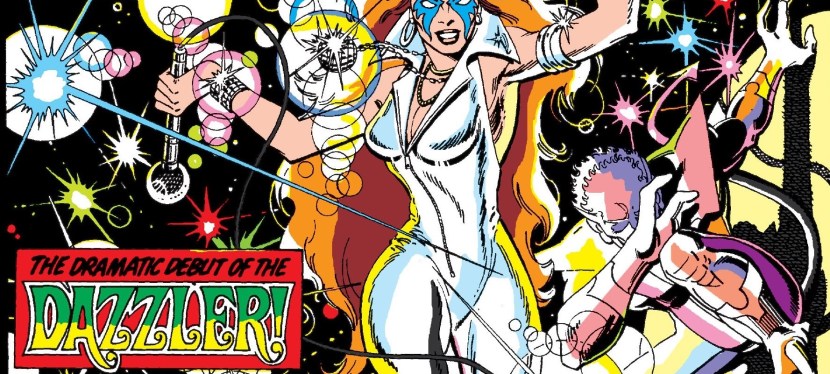
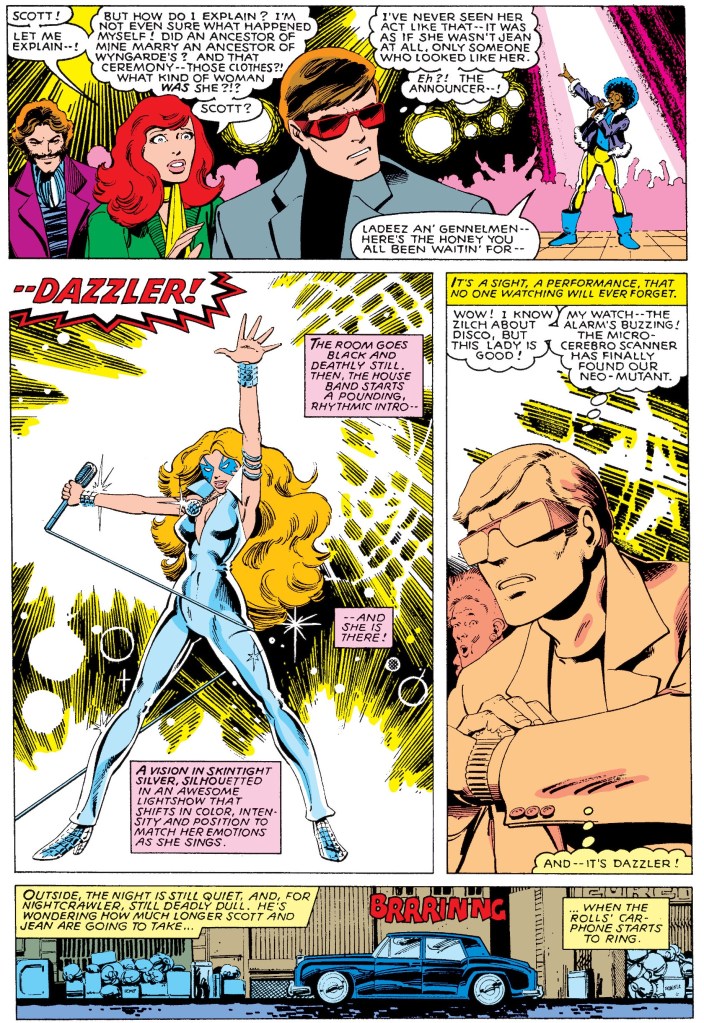
Dazzler’s very debut on this page.
The storytelling is great which is not surprising as this was done by Claremont and Byrne. It is clear that there was a good amount of preparation done which explains this comic book’s excellent ways on emphasizing the following story points: the build-up of the Hellfire Club as a potent force of evil that await the X-Men, Kitty Pryde/Shadowcat’s growing involvement, the vulnerability of Jean Grey, the build-up of the Phoenix, and the debut of Dazzler. Along the way, the creative team also ensure that the dialogue was rich (the same thing also with the thought balloons Claremont came up with), the emphasis of super powers made sense, the action scenes were satisfying and there was a good amount of suspense here.
I love the way Dazzler’s first-ever appearance was handled as it happened just after an intriguing scene about Jean Grey’s vulnerability took place. Her debut also occurred at a point when Jean and Scott seemed to be failing to find her. Of course, the 1970s disco vibe was very strong with Dazzler.
Conclusion
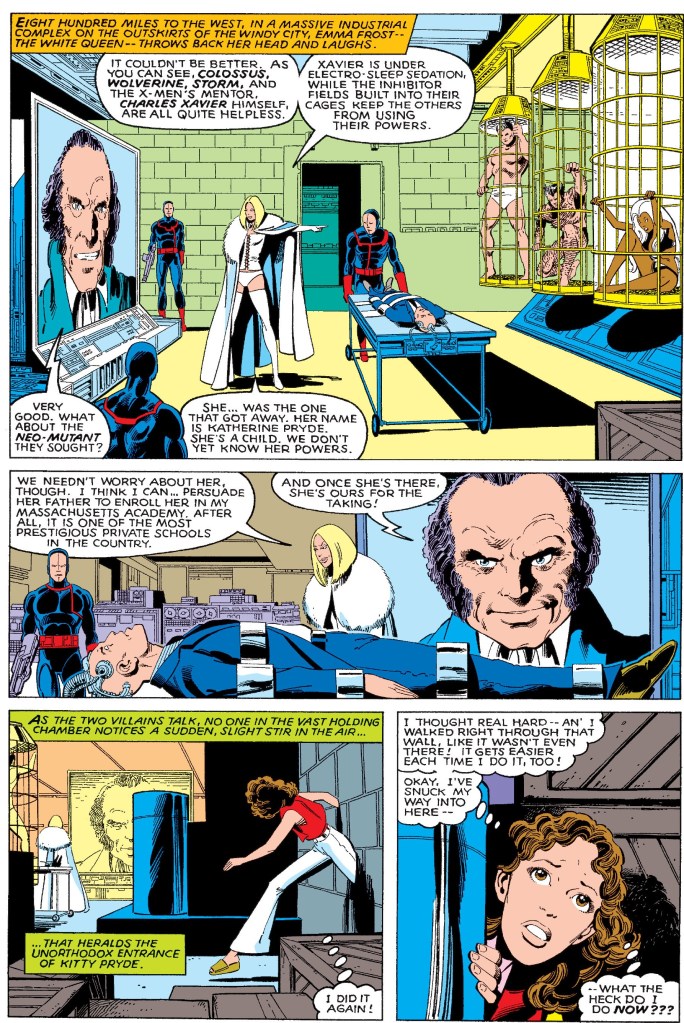
The plot thickens…
Without a doubt, Uncanny X-Men #130 (1980) is a classic X-Men tale by the Claremont-Byrne team who succeeded in not only introducing Dazzler into Marvel’s comic book universe but also with strongly emphasizing the Hellfire Club as a powerful opposition which went on to have a key part in the legendary Dark Phoenix storyline that followed. Dazzler meanwhile became a very popular superhero of Marvel’s going into the 1980s. For the modern-day comic book reader, this comic book can be quite challenging to read as it is very wordy (typical of Claremont).
If you are seriously planning to buy an existing hard copy of Uncanny X-Men #130 (1980), be aware that as of this writing, MileHighComics.com shows that the very fine copy of the regular edition costs $1,407 while the fine copy of the newsstand edition costs $1,013.
Overall, Uncanny X-Men #130 (1980) is highly recommended!
+++++
Thank you for reading. If you find this article engaging, please click the like button below and also please consider sharing this article to others. If you are looking for a copywriter to create content for your special project or business, check out my services and my portfolio. Feel free to contact me as well. Also please feel free to visit my Facebook page Author Carlo Carrasco and follow me at HavenorFantasy@twitter.com
Disclaimer: This is my original work with details sourced from reading the comic book and doing personal research. Anyone who wants to use this article, in part or in whole, needs to secure first my permission and agree to cite me as the source and author. Let it be known that any unauthorized use of this article will constrain the author to pursue the remedies under R.A. No. 8293, the Revised Penal Code, and/or all applicable legal actions under the laws of the Philippines.
Welcome back, superhero enthusiasts, fans of the 2099 universe of Marvel Comics, 1990s culture enthusiasts and comic book collectors! Today we revisit the X-Men 2099 comic book series by focusing on the 4th issue. Following the single storyline told in the first three issues (including the unexpected death of a certain member in issue #3) which ultimately made clear why the X-Men of 2099 exist and what their place is within an America that is totally different from what it used to be during the time of Charles Xavier and his X-Men. As such, the stage was set for more exploration and new creative directions with Xi’an and his band of nomadic mutants.
With those details laid down, here is a look back at X-Men 2099 #4, published by Marvel Comics in 1993 with a story written by John Francis Moore and drawn by Ron Lim.
The cover.
Early story
The story begins with Bloodhawk exploring a deserted, radioactive facility in the middle of New Mexico. Having a reptilian skin protects him from radiation which only adds to his personal obsession of waging a war against developers and corporate entities that he accuses of defiling the natural environment.
Suddenly, a tough female with white hair and white skin grabs Bloodhawk by the neck and by touching his head with her left hand, she triggers a bolt of agony on him. Bloodhawk then loses consciousness.
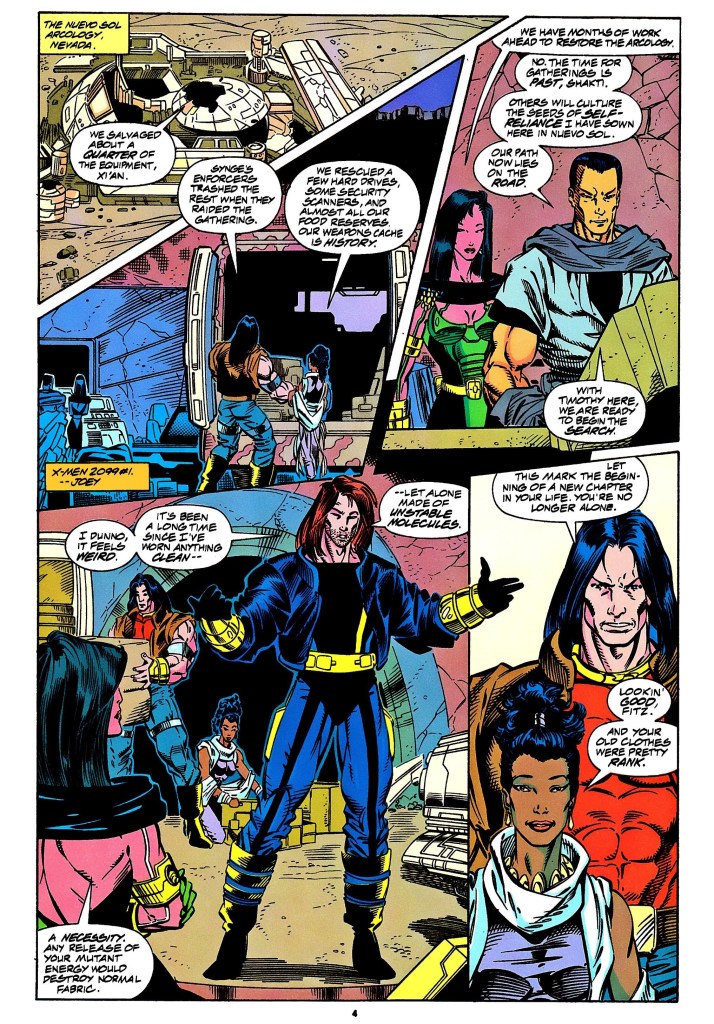
Meanwhile in Nevada, Xi’an and his X-Men salvaged whatever equipment they found at the Nueva Sol Arcology which was their haven before Synge’s enforcers invaded and ruined it. In response to Shakti’s comment that it would take months to restore the facility, Xi’an says that the time for gatherings has passed as he believes that their path lies on the road emphasizing travel to new places.
While his teammates are outside, Henri uses a computer inside the facility retrieving messages. He receives a video message from his old friend Jordan Boone who informs him about a major project called Valhalla and he was going to do something outrageous…
Quality
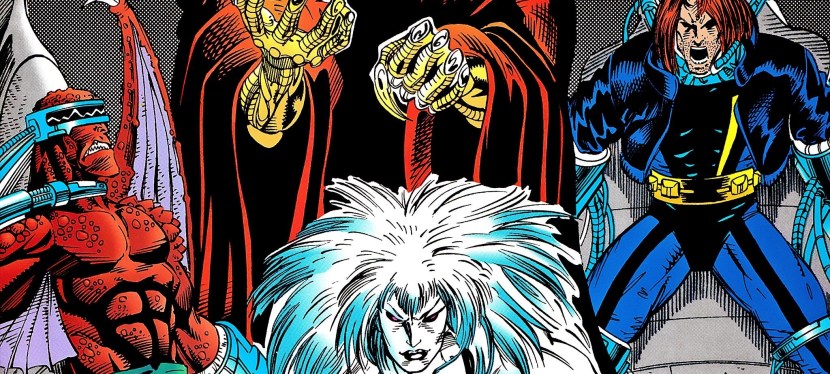
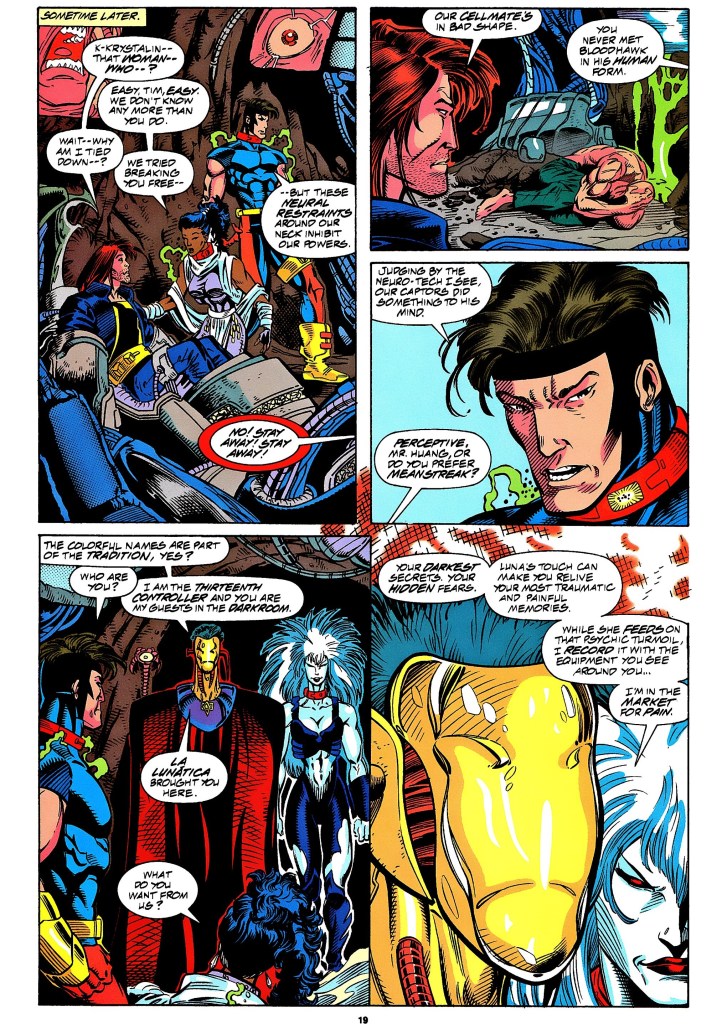
Neuro-tech, the captured X-Men, Luna and the Theater of Pain.
When it comes to narrative, I should point out that this comic book serves as a prelude to The Fall of the Hammer 2099 crossover storyline and it does a good job setting key members of the X-Men to get involved.
As an X-Men 2099 story, John Francis Moore further developed the personalities of most of the members (with Timothy Fitzgerald being the center as he slowly becomes Skullfire) and showed more of the culture within the team under Xi’an’s leadership and strict points.
Other than the focus on the mutants, a notable feature of the story is the introduction of the Theater of Pain which includes a radically intriguing masked villain who runs an operation that involves abducting people, using machines to feed on their minds and access the most painful personal memories which in turn is digitally channeled to an existing linked live audience feeding their minds. In essence, mental torture and intrusion of the mind are introduced. I should also state that the Theater of Pain here plays a major part in the story of X-Men 2099 #25. This issue also introduces Luna who eventually gets linked with Skullfire and becomes part of the X-Men.
More on the Theater of Pain concept, I found the painful flashback sequences a clever method used by the writer to emphasize selected moments from the past of Bloodhawk and Skullfire which added to the character development of this comic book.
Conclusion
One step showing Timothy slowly becoming Skullfire.
X-Men 2099 #4 (1993) is well-written and it is a significant part of the 35-issue monthly series. For one thing, it shows the start of the transformation of Skullfire’s personality, the direction Xi’an and his mutants are taking, and the start of a build-up that led to the significant events of X-Men 2099 #25. There is a lot here for X-Men 2099 fans to enjoy from start to finish.
If you are seriously planning to buy an existing hard copy of X-Men 2099 #4 (1993), be aware that as of this writing, MileHighComics.com shows that the near-mint copy of the regular edition costs $30 while the near-mint copy of the newsstand edition costs $90.
Overall, X-Men 2099 #4 (1993) is highly recommended!
+++++
Thank you for reading. If you find this article engaging, please click the like button below and also please consider sharing this article to others. If you are looking for a copywriter to create content for your special project or business, check out my services and my portfolio. Feel free to contact me as well. Also please feel free to visit my Facebook page Author Carlo Carrasco and follow me at HavenorFantasy@twitter.com
Disclaimer: This is my original work with details sourced from reading the comic book and doing personal research. Anyone who wants to use this article, in part or in whole, needs to secure first my permission and agree to cite me as the source and author. Let it be known that any unauthorized use of this article will constrain the author to pursue the remedies under R.A. No. 8293, the Revised Penal Code, and/or all applicable legal actions under the laws of the Philippines.
Welcome back, X-Men fans, superhero enthusiasts, 1990s culture enthusiasts and comic book collectors! It’s time to revisit the What If monthly series of comic books of Marvel Comics that lasted from 1989 until 1998. The old comic book I’m about to review involves the X-Men, Cable and more.
Before starting with this newest retro comic book review, I should state that I was never a fan of Cable even though I read lots of X-Men-related comic books that included him. When I think of Cable, I immediately think of the New Mutants and X-Force comic book series.
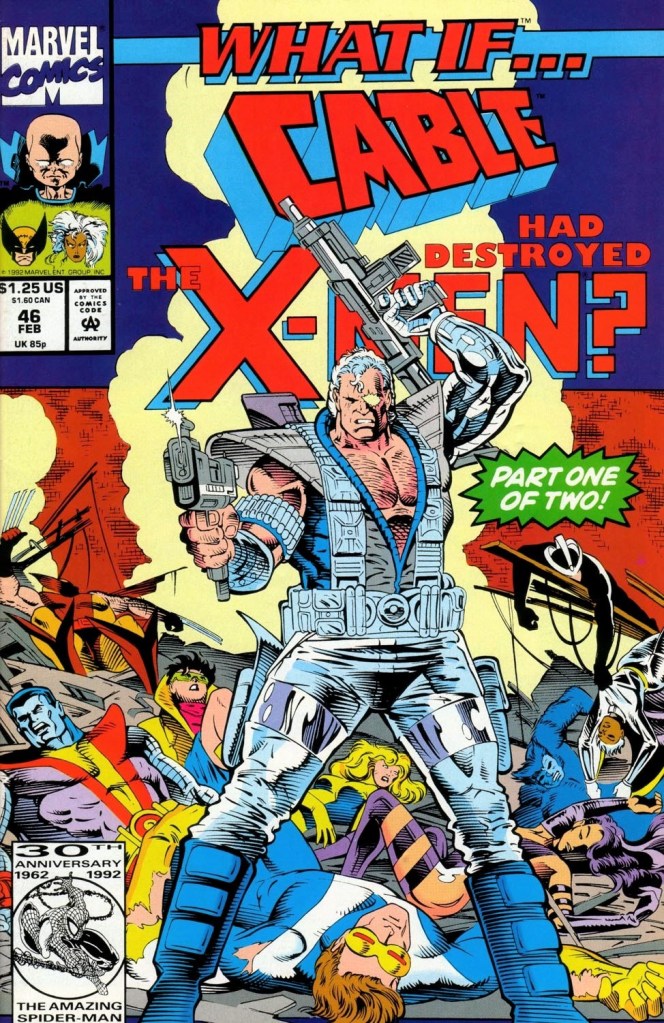
You must be wondering what has Cable and the X-Men have to do with the old What If issue I’m focusing on. We can all find out in this look back at What If #46, published by Marvel Comics in 1993 with a story written by Kurt Busiek and drawn by Tod Smith.
The cover.
Early story
The story begins inside a tavern in New York’s famous Central Park. Inside, Charles Xavier, Scott Summers (Cyclops) and Jean Grey have a discussion about mutant matters until a small saucer-shaped device flies inside and disrupts everything with its sonic frequency. Suddenly a second flying saucer comes in, touches Scott’s shoe and explodes powerfully killing him, Jean and Xavier. Others got injured by the explosion and the tavern ends up burning.
Outside the tavern, Cable is seen running away and someone points at him as someone who must be responsible for the bombing. As it turns out, the deliberate killing of Xavier, Cyclops and Jean Grey was the result of a division between Cable’s New Mutants and the X-Men in connection to the recent return of Xavier from deep space.
Quality
A brawl between the mutants.
I’ll start with the story Kurt Busiek came up with. This one explores an alternate time in which Charles Xavier returned to Earth (after escaping from the Skrulls in deep space) only to find the X-Men in disarray which compelled him to restore things the way they were. This is not to be confused with his return in the canon storyline of the Muir Island Saga.
That being said, Busiek explored what would it be like had Xavier tried to resolve mutant matters not only with the team of mutants he founded but also with other teams such as the New Mutants (already led by Cable), X-Factor (Cyclops, Jean Grey, Iceman, Beast and Archangel) plus several other mutants. I really liked the way the mutants reacted to Xavier given his long absence from Earth, how his dream matters and turned out irrelevant to them as individual mutants, and if he still has what it takes to lead them. In some ways, Xavier looked like a politician trying to convince his constituents that his vision is still the best for them and their interests.
What really made the story running was the start of the division between the mutants when Cable rejects Xavier and points out that the X-Men founder’s devotion to appeasement is dooming mutants. All of these led to the shock opening scene and in terms of writing quality, it was all justified.
The scenes that happened AFTER the burial of Xavier, Cyclops and Jean Grey literally raised the stakes for the rest of the comic book. I don’t want to spoil further plot details but I can assure you all that Kurt Busiek’s script is very sold and there is so much to enjoy here especially if you are knowledgeable enough about the X-Men and the other parts of the Marvel Comics universe (note: the Avengers, Stryfe, Freedom Force and Fantastic Four also appeared).
Visually, the work of Tod Smith looks a bit rushed. His art here is not bad but I felt it could have been better had there been more time to polish his work. In fairness to Smith, his drawings on most of the characters still made them recognizable and he showed pacing with regards to the panels and angles used. I should say he does a decent job showing multiple characters fighting each other simultaneously.
Conclusion
If you were a mutant, would you follow Charles Xavier or Cable?
If you ask me, What If #46 (1993) is pretty entertaining and engaging to read thanks to the strong writing as well as the daring exploration of how the comic’s main story impacts others within the Marvel Comics universe. It has drama, action, intrigue and most notably it explores a new concept about how the X-Men would turn out after the death of their founder. It also raises questions on whether or not the X-Men are doomed without Charles Xavier’s presence.
If you are seriously planning to buy an existing hard copy of What If #46 (1993), be aware that as of this writing, MileHighComics.com shows that the near-mint copy of the regular edition costs $40 while the near-mint newsstand edition costs $120.
Overall, What If #46 (1993) is recommended.
+++++
Thank you for reading. If you find this article engaging, please click the like button below and also please consider sharing this article to others. If you are looking for a copywriter to create content for your special project or business, check out my services and my portfolio. Feel free to contact me as well. Also please feel free to visit my Facebook page Author Carlo Carrasco and follow me at HavenorFantasy@twitter.com
Disclaimer: This is my original work with details sourced from reading the comic book and doing personal research. Anyone who wants to use this article, in part or in whole, needs to secure first my permission and agree to cite me as the source and author. Let it be known that any unauthorized use of this article will constrain the author to pursue the remedies under R.A. No. 8293, the Revised Penal Code, and/or all applicable legal actions under the laws of the Philippines.
Welcome back, X-Men fans, superhero enthusiasts, 1990s culture enthusiasts and comic book collectors! Today, we take a look at the topic of slavery and its connection with the mutants within the universe of Marvel. To be more specific, slavery was emphasized in one of the episodes of the popular X-Men animated series which itself had a monthly series of comic book adaptations – X-Men Adventures!
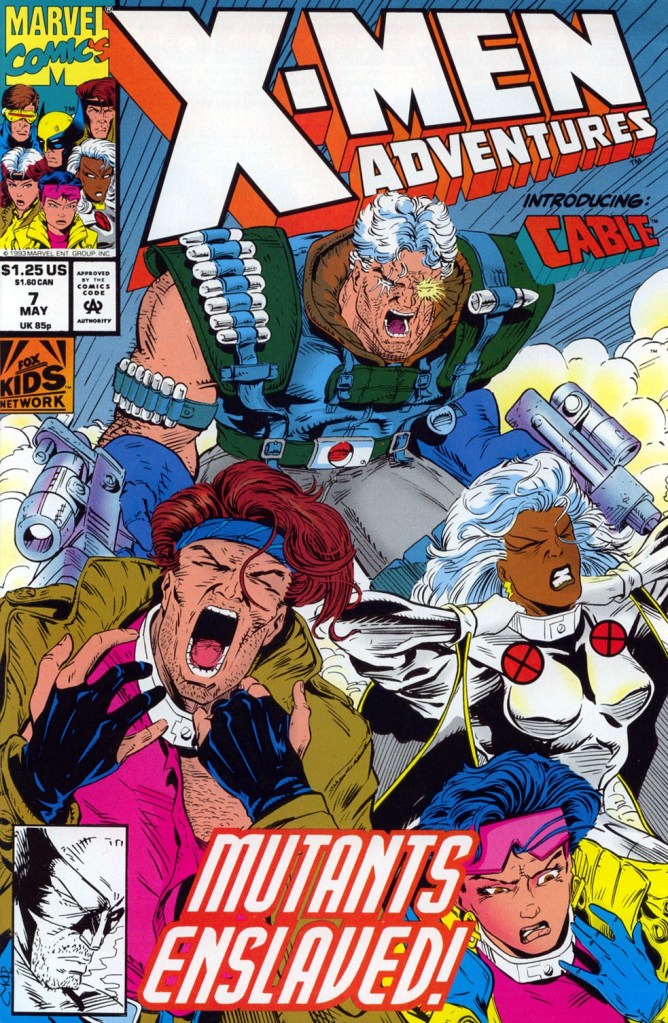
With those details laid down, here is a look back at X-Men Adventures #7, published by Marvel Comics in 1993 with a story written by Ralph Macchio and drawn by Chris Batista.
The cover.
Early story
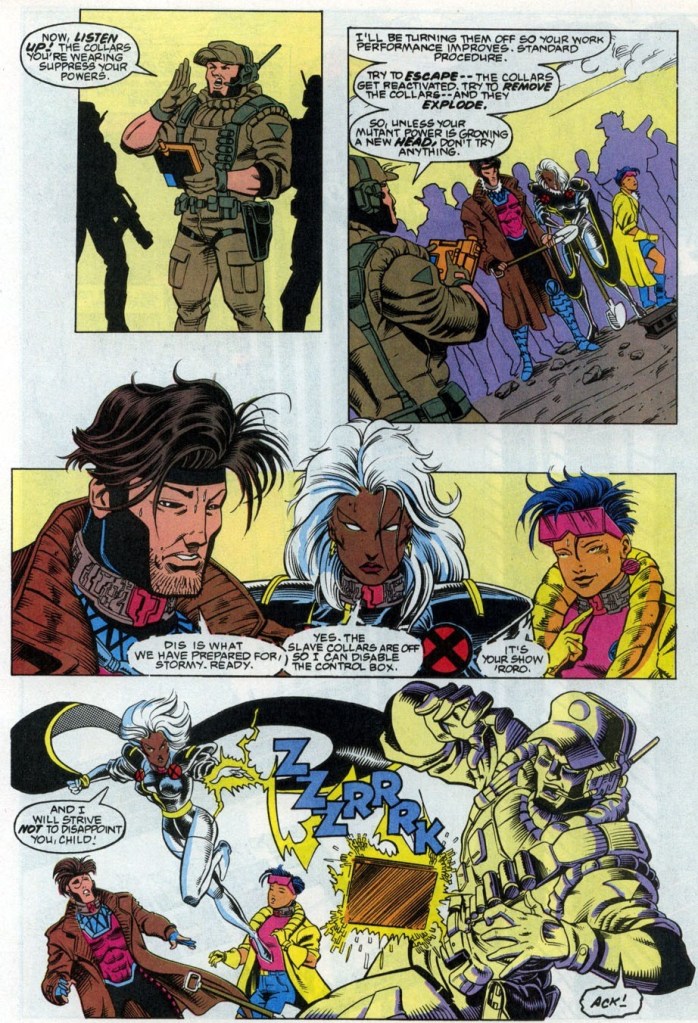
The story begins in Genosha, an island nation where mutants are designated as slaves constantly monitored by armed personnel of the state. X-Men team members Gambit, Storm and Jubilee are forced to do hard labor as they have been rendered powerless (with high-tech collars on their necks). Along with many other mutants, they are working on a key infrastructure project of the state.
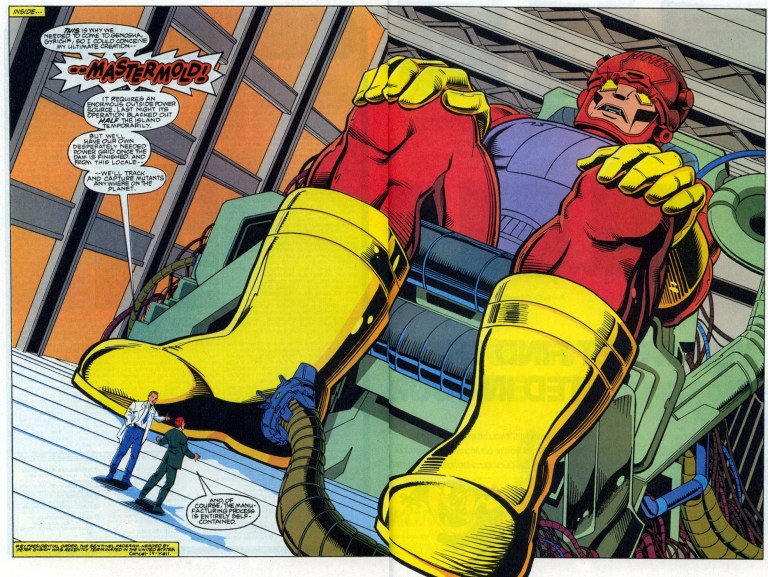
As soon as the local authorities deactivated the collars of the slaves, Storm immediately attempts to escape by flying. Immediately, the collar on her neck got reactivated which neutralized her powers and caused her to fall down to the water below. As soon as she climbs up on a rock to rest, a cable wraps itself on her right leg. Suddenly, a huge Sentinel rises above the water and pulls her…
Quality
The money shot!
Like the TV episode it was based on, this comic book does a decent job of portraying slavery and oppression with mutants in mind while avoiding the very sensitive topic of racism. To see Gambit, Storm and Jubilee portrayed as much more vulnerable characters is a nice change from their usual portrayals. While the story has a strong slavery theme, it also sheds light on the ongoing, secretive development of the Sentinels program which clearly emphasizes the growing danger that await not only the X-Men (the prime target of Trask and his team) but mutants in general.
When it comes to the art, Chris Batista did a nice job drawing not only the characters (all recognizable) but also their surroundings, the Sentinels and the framing of action scenes.
Conclusion
Gambit, Storm and Jubilee as slaves on Genosha.
I personally find X-Men Adventures #7 (1993) somewhat fun and slightly engaging to read. As this is an adaptation of the X-Men animated series episode about Genosha and mutant slavery, it clearly has a strong wholesome approach to its presentation. That being said, its depth is actually limited as it presented its themes with younger readers and new X-Men readers in mind. Unsurprisingly, the action is limited and was portrayed to avoid violence. If you want a more serious and grittier portrayal of Genosha and mutant slavery, you should read Uncanny X-Men #235 to #238, and the X-tinction Agenda storyline.
If you are seriously planning to buy an existing hard copy of X-Men Adventures #7 (1993) be aware that as of this writing, MileHighComics.com shows that the near-mint copy of the regular edition costs $30, while the near-mint copies of the newsstand edition and the Greek edition cost $90 and $200 respectively.
Overall, X-Men Adventures #7 (1993) is satisfactory.
+++++
Thank you for reading. If you find this article engaging, please click the like button below and also please consider sharing this article to others. If you are looking for a copywriter to create content for your special project or business, check out my services and my portfolio. Feel free to contact me as well. Also please feel free to visit my Facebook page Author Carlo Carrasco and follow me at HavenorFantasy@twitter.com
Disclaimer: This is my original work with details sourced from playing The Super Dimension Fortress Macross: Do You Remember Love? video game and doing personal research. Anyone who wants to use this article, in part or in whole, needs to secure first my permission and agree to cite me as the source and author. Let it be known that any unauthorized use of this article will constrain the author to pursue the remedies under R.A. No. 8293, the Revised Penal Code, and/or all applicable legal actions under the laws of the Philippines.
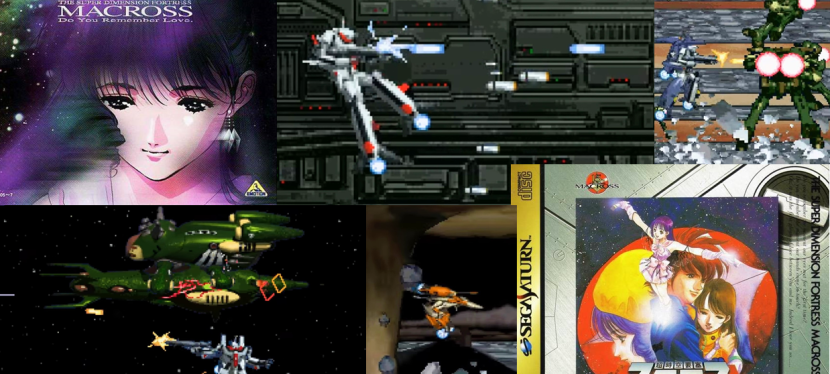
Like many other entertainment franchises in Japan, Macross also has video games based on its stories and concepts. During the fifth generation of video game consoles, Bandai released in Japan the video game adaptation of the 1984 anime movie on the Sega Saturn in 1997 and the Sony PlayStation in 1999. That game was titled The Super Dimension Fortress Macross: Do You Remember Love? and I played that 2D side-scrolling shoot-them-up game a lot during the time when 3D polygons was already the standard.
Considering its age, it is easy to wonder if the game is still fun to play by today’s standards and if the game is something that Macross fans can enjoy a lot. We can all find out in this look back at The Super Dimension Fortress Macross: Do You Remember Love?
Sega Saturn version in 1997.
Sony PlayStation version in 1999.
Early story
The story begins at sea. A Valkyrie piloted by Hikaru Ichijyo (the late Arihiro Hase) launches from the aircraft carrier Prometheus to join his teammates Max and Kakizaki led by Roy Fokker (Akira Kamiya). Suddenly a powerful beam of energy from above hits the aircraft carrier clearly showing that their world is under attack by the Zentradi.
They proceed to South Attaria Island where they immediately engaged the Zentradi forces that ravaged the city and causing trouble for the SDF-1 (Macross). After defeating several Zentradi elements, the remaining Skull Squadron forces flew to the Macross (which just launched into the air) which executes a space fold just moments before even more laser blasts from the Zentradi destroyed the entire island.
Sometime later deep in space, thousands of civilians managed to adjust to living inside the Macross. As Lynn Minmay’s (Mari Iijima) first concert happens inside the fortress, Hikaru, his teammates and many other fighters engage in a mission against the Zentradi…
Quality
Just like in the movie!
To comment on the quality of this old video game, I’ll focus on gameplay and presentation.
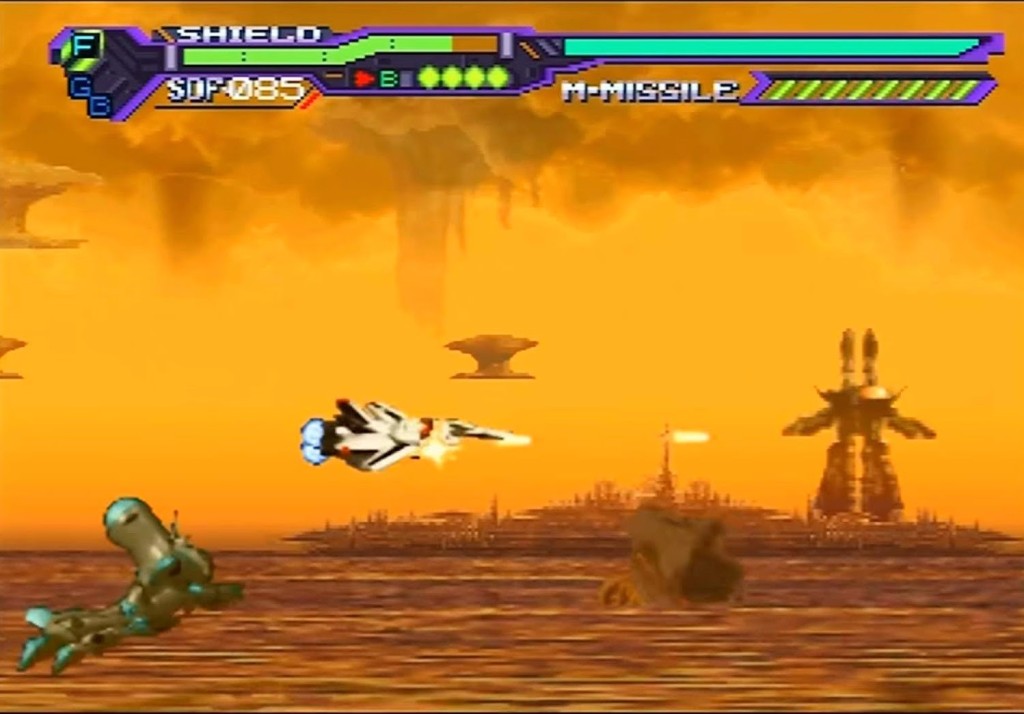
As far as gameplay goes, Macross: DYRL is essentially a 2D side-scrolling shooter literally designed to be grand not only for Macross fans but also for gamers who enjoy its design and its type of gameplay. You play as the hero Hikaru who pilots an advanced fighter plane that can also transform into an armed fighter with legs (GERWALK mode) and also into a full-sized, human-like robot (Battroid). In fighter mode, you move fast and are able to fire rockets or use your default gun. In GERWALK mode, your speed is slower but you have improved mobility that can be crucial for combat. In Battroid mode, your speed is reduced further but you are somewhat stronger and more precise when it comes to shooting enemies.
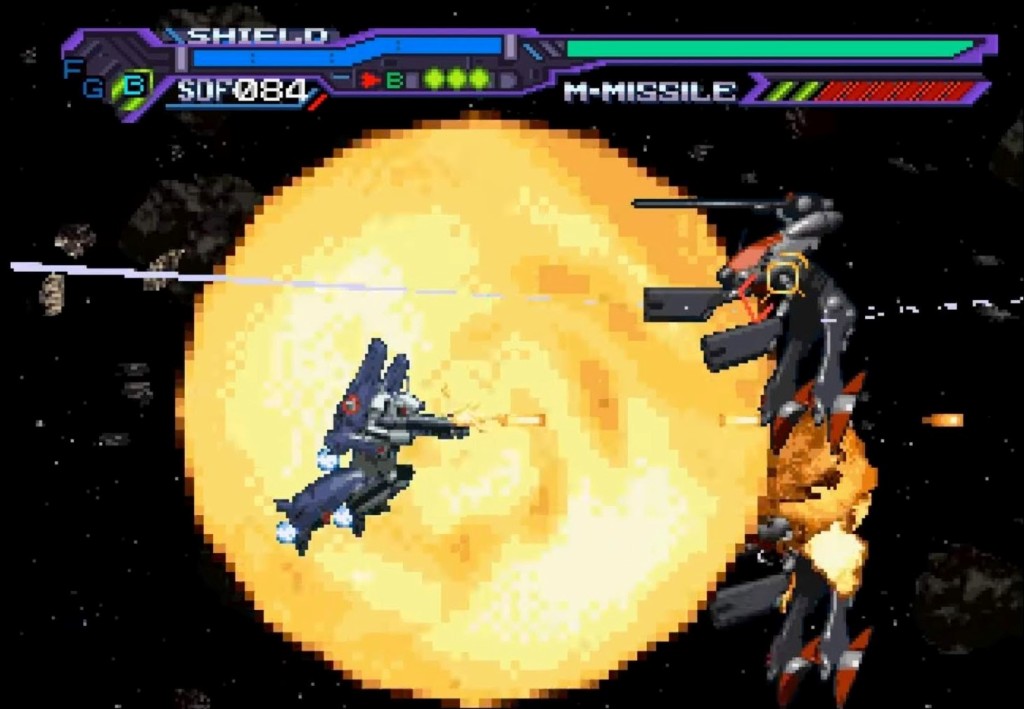
Still on gameplay, the game developers really pushed the envelope in terms if immersion as there are lots of moments in which the enemies will not only face you on your 2D plane but also move around you from the foreground to the background. Without having to do anything further, your character will be able to auto-aim and shoot at your enemy whether in the background or the foreground. Essentially, this makes the game a 2.5D shooter.
This is a fine example of you (in your 2D plane) firing at your enemy in the background.
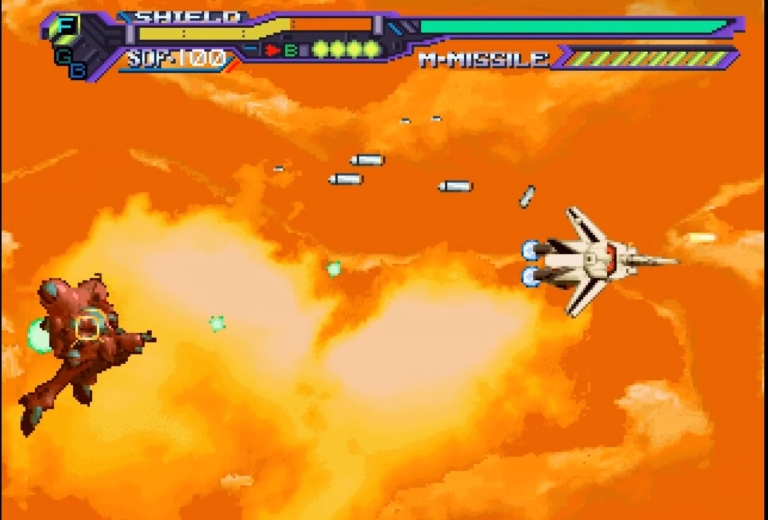
In key parts of some levels in the game, the UN Spacy will send a shuttle to release supplies to help you replenish your shield meter.
The controls are relatively easy to learn and get adjusted to. More importantly, the controls are very responsive and they are ideal when it comes to precision on moving your character around as well as trying to shoot at specific targets.
This game was designed with several levels for you to complete essentially moving from left to right. As evidence of the game developers taking liberties during its adaptation of elements from the 1984 animated movie, several levels have boss fights for you to participate in and win in order to progress. These boss-type enemies are noticeably absent from the movie and yet they were designed to integrate into the film’s concept and also expand the concept about how elaborate the Zentradi are when it comes to their war machines against Earth. The boss-type enemies (note: they are clearly polygonal and yet they fit in well with the 2D sprite elements) are huge machines designed for space battles and there were boss fights in which some of them move into the background (which sparks moments for your character to fighter towards the background). When it comes to artificial intelligence (AI), the boss-type enemies are not really that sophisticated with their movements although a few of them have attack patterns that will push you to be more evasive and more strategic.
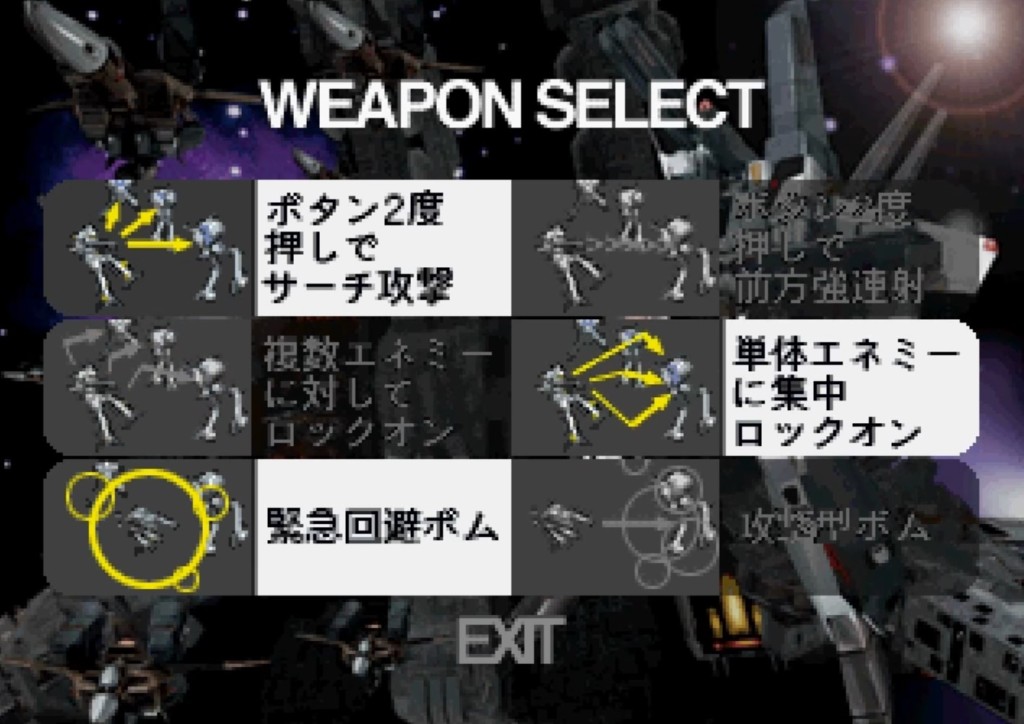
Before starting a level, you can select your weapons that can function depending on your personal preference on taking on the enemies.
Lots of great visual effects and 3D movement add to the challenge.
With regards to challenge, some parts of this game took me a few repeats before finally improving myself enough to make it to the next levels. The visual elements of the game also added to the overall challenge as seeing 2D sprites move around you 3-dimensionally.
Speaking of 2D sprites, it is clear that this game was designed to be heavy with 2D visual elements while 3D polygons are used sparingly (note: the boss battles mentioned above). As this is a side-scrolling game, the game makers clearly made lots of sprites of machines, space ships, Zentradi battle pods and other figures that Macross fans would easily recognize. The good news is that each 2D sprite was made with multiple frames of animation (complete with frames meant for 3D movement) and were made to really resemble the cinematic artworks which ultimately results making them really look lively to watch on-screen!
As for the presentation, I can see that the game developers Scarab paid great attention to the details of the animated movie to make The Super Dimension Fortress Macross: Do You Remember Love? fun and engaging for gamers in general while also becoming strongly relevant and delightful with the people who love Macross. For example, the game starts with a cinematic prologue composed of brand-new animation cels mixed with elements of 3D polygons and in my view, it fits in nicely leading to the actual cinematic opening of the movie from 1984. The cinematic prologue was meant to expand the film’s overall concept and other story expansions happened in subsequent parts of the game (such as the all-new mission told in two levels).
Observe the Zentradi surrounding Roy Fokker on his 2D plane, the foreground and background. This is a 2D sprite-heavy showcase!
The game developers paid close attention to the details of the movie and presented the visuals using video game graphics, 2D sprites and really nice in-game background artworks!
Surprise! You as Hikaru get to fight Milia temporarily before her memorable fight with Max happens!
The Super Dimension Fortress Macross: Do You Remember Love? came with selected animated sequences and still images from the 1984 movie’s very own footage meant for in-game storytelling (note: you still have to watch the movie for the best immersion). As there were some original scenes made for the game with expanding the film’s concept in mind, there are a few computer-generated animation sequences and even brand-new animated cels (note: very clearly they were drawn by people different from the ones who drew the film’s footage) showing some character moments.
When it comes to the audio, this game is clearly a labor of love with Macross fans in mind. Much of the music, songs and sound effects from the movie (as well as from the 1982-1983 anime TV series) were integrated into the game which made it very immersive for Macross fans. As for the voice actors, fans will hear the voices of their favorite Macross characters performed by the late Hase, Iijima, Kamiya, Mika Doi (Misa Hayase), Michio Hazama (Captain Global) and more. While some of their recorded lines from the movie were reused (especially Hase who died in 1996), others recorded new lines for their respective characters for the new cinematic footage as well as key parts in the game.
The art of Lynn Minmay for the new anime footage was clearly not drawn by the people behind the 1984 anime movie.
What I love best about the presentation is that the game developers replicated selected scenes from the 1984 movie using in-game graphics and art along with music, sound effects and the lines of dialogue! As a Macross fan myself, the immersion was pretty deep as I played the game and witnessed those special moments from the movie played within the in-game presentation.
Conclusion
Enjoy looking at this.
I can declare out loud that The Super Dimension Fortress Macross: Do You Remember Love? is indeed the best Macross video game I have ever played as well as the best adaptation (note: other than film) of the classic movie from 1984. This game, which excellently used 2D sprites and 3D polygons all throughout, was very clearly made to delight Macross fans while giving gamers something very enjoyable and memorable to experience. For the best immersion, it is highly recommended to watch the movie before playing this video game. Truly this video game has aged well!
Thank you for reading. If you find this article engaging, please click the like button below and also please consider sharing this article to others. If you are looking for a copywriter to create content for your special project or business, check out my services and my portfolio. Feel free to contact me as well. Also please feel free to visit my Facebook page Author Carlo Carrasco and follow me at HavenorFantasy@twitter.com
Disclaimer: This is my original work with details sourced from reading the comic book and doing personal research. Anyone who wants to use this article, in part or in whole, needs to secure first my permission and agree to cite me as the source and author. Let it be known that any unauthorized use of this article will constrain the author to pursue the remedies under R.A. No. 8293, the Revised Penal Code, and/or all applicable legal actions under the laws of the Philippines.
Welcome back, X-Men fans, superhero enthusiasts, 1990s culture enthusiasts and comic book collectors! Today we go back to the 30th anniversary celebration of the X-Men which took place in 1993. Back then, Marvel Comics went full blast with the anniversary celebration of their mutants by releasing related merchandise, posters and comic books with gimmick covers (note: read my retro review of 1993’s X-Men #25) that came with high prices.
To put things in perspective regarding 1993, Marvel’s X-Men line of comics had monthly series of Uncanny X-Men, X-Men (Volume 2), X-Force, X-Factor, Excalibur, Wolverine and Cable. X-Factor #92 marked the start of the Fatal Attractions storyline which was the basis for the X-Men 30th anniversary celebration. X-Force #25 was released and it not only brought Cable back but also Magneto.
Then came the 3rd chapter of the Fatal Attractions storyline which was published in Uncanny X-Men #304. Not only did that particular comic book bring together many mutants and moved the storyline forward to a crucial stage (note: tension leading to it was built up in Uncanny X-Men #300, Uncanny X-Men #303 and also in X-Men Unlimited #1), it also served as the very celebration of the 30th anniversary of the X-Men (although it was not the storyline’s conclusion as the plot continued in X-Men #25, Wolverine #75 and Excalibur #71).
So did this particular, anniversary celebrating issue of the Uncanny X-Men succeed with its objectives? Has it aged well through the decades? We can all find out in this look back at Uncanny X-Men #304, published in 1993 by Marvel Comics with a story written by Scott Lobdell and drawn by John Romita, Jr., Jae Lee, Chris Sprouse, Brandon Peterson and Paul Smith.
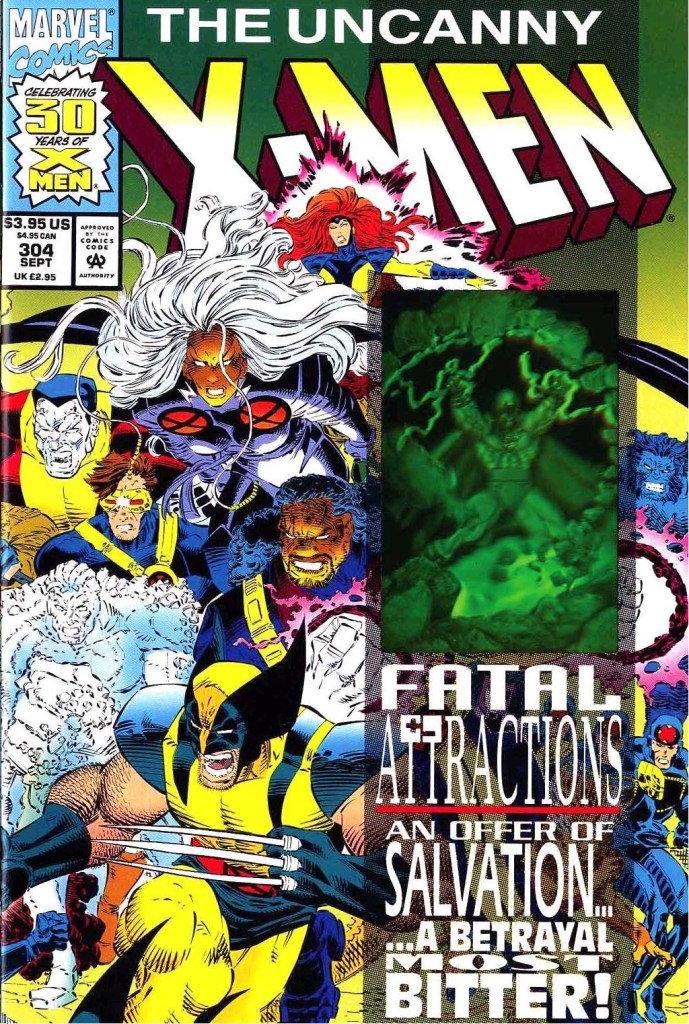
The cover.
Early story
The story begins with division among the Acolytes who learned that their lord Magneto actually survived (note: refer to 1991’s X-Men #3 by Chris Claremont and Jim Lee). They ganged up against their leader Fabian Cortez for betraying Magneto. After pushing his now rebellious team members away, Cortez reminds them that for several months already, they have been continuing Magneto’s work on behalf of mutantkind. Suddenly Exodus appears to them and describes himself as the voice of Magneto and will guide mutants to rise and mentions paradise for the faithful mutants. After subduing Cortez and tempering the tension among the Acolytes, Exodus tells them to prepare themselves for ascension. This frustrates Cortez who realizes that he no longer holds leadership.
Over at the X-Men’s headquarters, Charlez Xavier is personally disturbed over the death of Illyana Rasputin, the sister of Colossus. He starts questioning himself as Illyana’s death under his watch makes his years-long mission (of convincing his fellow mutants to leave their old lives to take risks to fight for a world that fears and hates them) doubtful and tries to figure out how he could present himself in front of them. A holographic image of Lilandra appears to him.
In outer space, inside the space station called Avalon, Magneto stares at planet Earth. With nobody around him, he speaks apologizing to his followers for he cannot save them all. He also mentions that he was wrong in previously believing that he could rescue each and every one of them from humanity as he recently realized that Earth, for the moment, is doomed.
After walking an unspecified distance inside Avalon, Magneto picks up his old helmet and wears it…
Quality
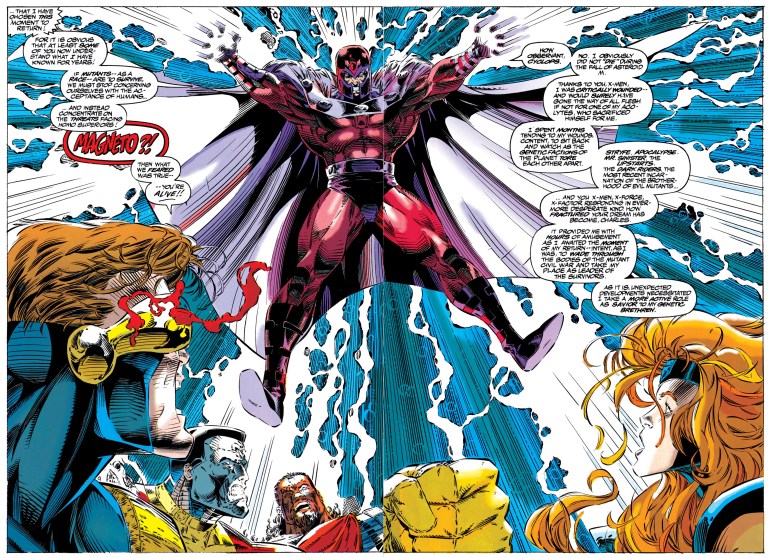
This 2-page art by Brandon Peterson is easily the best looking part of the comic book.
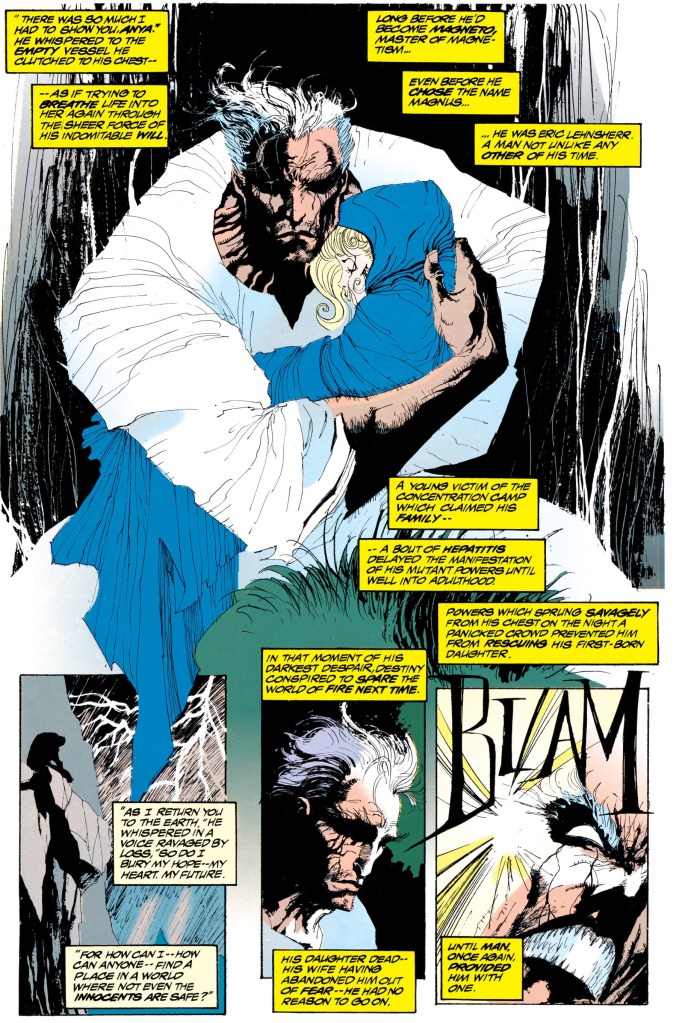
I will start with the visual aspect of this comic book. The artistic quality ranges from fine to weird which should not be surprising since this one involved five artists. The 4 pages drawn by Brandon Peterson (who was once a regular artist on Uncanny X-Men) made the X-Men, Magneto and the Acolytes look not only good but also intense. The Peterson art here is artistically similar to the respective styles of Marc Silvestri and Jim Lee of that particular time. Jae Lee’s art on the flashback of Magneto’s life (during the time of the Nazi occupation in Europe) is undoubtedly very stylized. While his art brings out the intensity of Magneto’s painful past, certain images can be a little challenging to understand especially to readers who focus strongly only following the plot and details. John Romita, Jr.’s art, for me personally, often looks rough and there were times I hardly recognized the characters. The other artworks by Paul Smith and Chris Sprouse have cartoonish aesthetics.
This is Jae Lee’s artistic contribution to the comic book. I found it weird that Magneto’s hair was shown as white during his past with the Nazis.
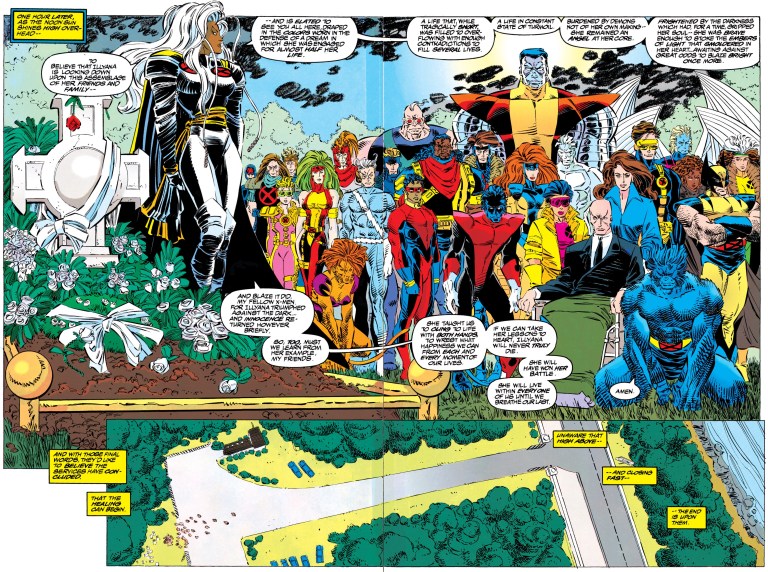
As for the plot, I can clearly see that a hard effort was made to compose a story that would push the Fatal Attractions storyline forward, establish a turning point and still become worthy of celebrating the 30th anniversary of the X-Men franchise. I can say that the storytelling is somewhat bloated. Early in the story, it was made clear that the respective sections showing Exodus with the Acolytes, Charles Xavier and Magneto pointed to an eventual confrontation that happened during the funeral of Illyana Rasputin.
As the build-up continued with the flashback of Magneto’s life, the fan service short scene of Kitty Pryde and the unfeeling Colossus (note: their romance was highlighted in Uncanny X-Men many years prior), and the talk scene between Bishop and Banshee, the pace of the story slowed down dramatically. By the time the attempt to move the narrative back to the core plot was made with the funeral scene (composed of the X-Men, X-Force and X-Factor), the pace was still really way down. By the time the conflict with Magneto, Exodus and the Acolytes stated, the pace recovery was incomplete and as such, seeing the scene unfold was very jarring (and not even the pages of Colossus’ frustration towards Professor X could solve the narrative pacing problem).
Unsurprisingly, the conflict was written to be overly dramatic complete with lengthy pieces of dialogue here and there. That being said, references to past comic books were established as Magneto once again emphasizes his beliefs about the human-mutant conflict using violence (while also side-stepping Jean Grey’s psionic powers to allow the Acolytes to come in undetected).
Human-mutant conflict aside, themes about faith, religion, idolatry salvation are clearly used. Magneto, who has a tremendous record of villainy and his previous leadership of the X-Men proved useless, was portrayed to be a walking wicked idol whose followers cannot do anything except idolize him and cause violence out of dedication to him. They really could not realize that idolatry is foolish and unholy which further adds to chaos on the world. As Magneto deceived himself to be the savior and lord of mutants, he further causes more pain and destruction to others around him. In short, Magneto will always be stuck with his wicked nature and clearly does not deserve heavenly authority no matter how hard he believes himself to be a savior.
The classic rivalry between Xavier and Magneto here was portrayed dramatically and yet I cannot help but think that their conflict was nothing more than a repeat of past encounters with the state and future of mutants at stake. To be fair, what happened here served as a logical build-up for the shocking encounter between Professor X and Magneto in X-Men #25.
Conclusion
Nobody among the X-Men (except Charles Xavier), X-Force, Excalibur and X-Factor cared to dress properly for the funeral.
To be clear, even though I am an avid X-Men fan, I find Uncanny X-Men #304 (1993) hard to be engaged with and hard to enjoy. Efforts to make it a worthy celebration of the X-Men are very clear but it’s just not entertaining nor compelling to read. As for the X-Men traitor scene, the revelation was not that shocking as the foreshadowing made it too obvious. At best, this comic book served as a warm-up for X-Men #25 which itself paid-off nicely. Being more than sixty pages long (including the advertisement and bulletins), this comic book has too much creative baggage which ultimately hampered its storytelling. It’s not terrible. It’s really not that great to read. What I experienced way back in 1993 with this comic book is just the same as I re-read it. It has not aged well.
If you are seriously planning to buy an existing hard copy of Uncanny X-Men #304 (1993), be aware that as of this writing, MileHighComics.com shows that the near-mint copy of the regular edition costs $20, while the near-mint copies of the signed-and-numbered edition and the newsstand edition cost $120 and $60 respectively.
Overall, Uncanny X-Men #304 (1993) is satisfactory.
+++++
Thank you for reading. If you find this article engaging, please click the like button below and also please consider sharing this article to others. If you are looking for a copywriter to create content for your special project or business, check out my services and my portfolio. Feel free to contact me as well. Also please feel free to visit my Facebook page Author Carlo Carrasco and follow me at HavenorFantasy@twitter.com
Disclaimer: This is my original work with details sourced from playing Suikoden II (English version, released in 1999) and doing personal research. Anyone who wants to use this article, in part or in whole, needs to secure first my permission and agree to cite me as the source and author. Let it be known that any unauthorized use of this article will constrain the author to pursue the remedies under R.A. No. 8293, the Revised Penal Code, and/or all applicable legal actions under the laws of the Philippines.
Who is Yoshitaka Murayama? He created the memorable Suikoden (AKA Genso Suikoden) RPG franchise during his time with Konami, specifically the first three games. I myself played and finished Suikoden on the original PlayStation in 1996 and it was a lot of fun thanks to the combined efforts of Murayama (who did the scenarios and game direction) and his teammates such as Junko Kawano (who did the design), Miki Higashino (who did the music along with four other teammates) and some others.
Then in 1999, the sequel to Suikoden was released and I can never forget the day I bought it at a local game store and rushed home with a lot of excitement to start playing it on our then aging PlayStation console.
So you must be wondering…how did I find the sequel? Was it an improvement over its predecessor? Did Murayama and the key creators do better than what they did in the first game? You can all find out in this look back at Suikoden II, published by Konami for the PlayStation (PS1).
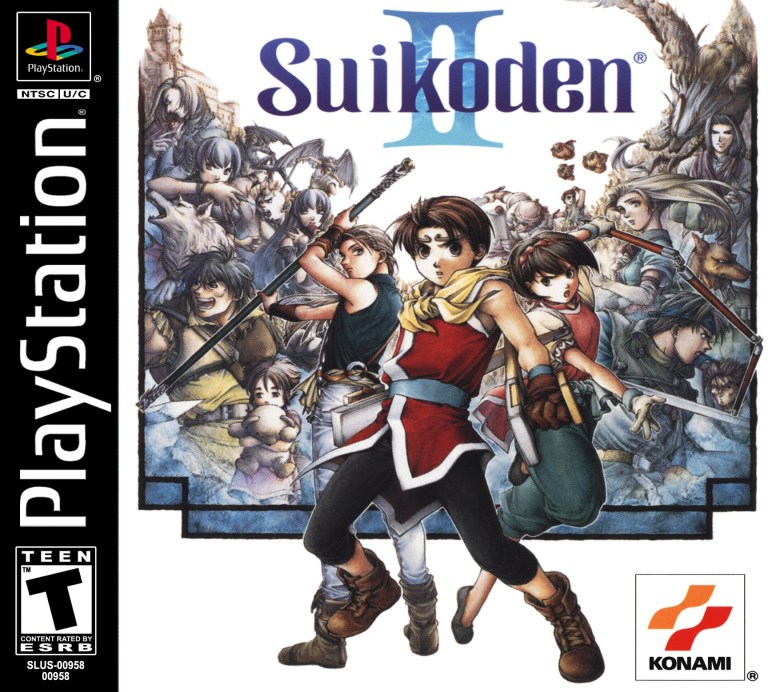
The cover of the North American version of Suikoden II.
Early story
The story begins with two youngsters – Riou (your character whose name can be modified) and Jowy – who are close friends since childhood now serving the Highland Army as members of their youth brigade. They spend time in a military camp in the forest as a peace treaty between two great forces is pending (note: Highland has been in conflict with the City-State of Jowston).
As some soldiers expressed desires to go home once the peace has been finalized, Riou and Jowy are ordered by their commanding officer Rowd to go back to their tent and sleep. However, a surprise attack happened which alerted them. As soon as the two close friends left their tent, they are shocked to see parts of the camp burning. Their officer Rowd informed them that their enemy is responsible for the attack and deliberately broke the peace agreement. Riou and Jowy are told to take the mountain path to the east and save themselves before it is too late.
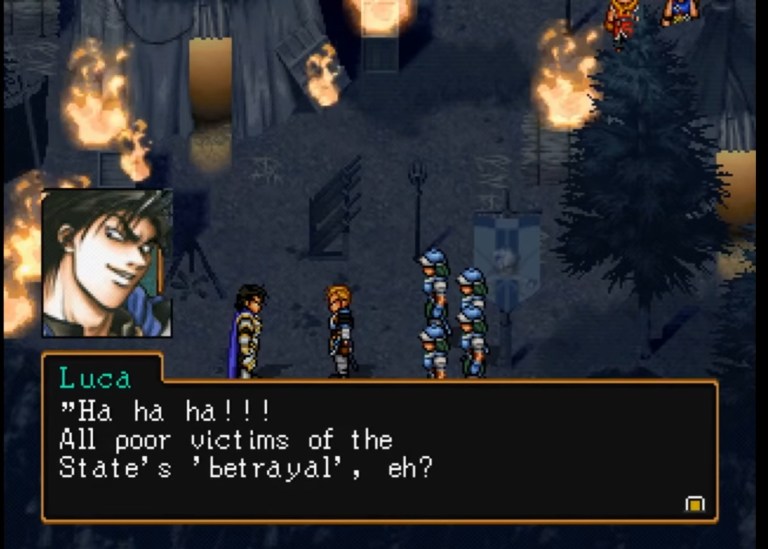
Fearing that they might get ambushed in the woods, Jowy tells Riou that they should return to camp. Upon returning, they quietly witness the unexpected presence of Highland prince Luca Blight who gets briefed by Rowd. As it turns out, the attack on their camp was not committed by the opposing forces but rather it was all a self-inflicted operation by Highland. Rowd’s instruction to some of their selected soldiers to head east was a set-up. What happened was all part of a plan by Highland to escalate the conflict by blaming their losses on Jowston. Luca Blight expressed clearly that a peace treaty with Jowston and its states was not needed, and he strongly believes in the power of Highland to conquer them all.
Jowy and Riou (upper-right corner) quietly witness the conversation between prince Luca Bright and the captain.
After learning the shocking details, Riou and Jowy decide to leave for the cliff to the north as a way of escape. At the cliff, Rowd catches up to the two. Fortunately, Riou and Jowy were successful in defeating Rowd’s soldiers and pave the way for their escape. Before fleeing, they marked a rock and promised to return to that same place if ever they get separated.
Riou and Jowy jumped off the cliff and get separated. Some time later, Riou wakes up and finds himself in the presence of three men. One of them identifies himself as Viktor, the leader of an army of mercenaries and an ally of Jowston. Another member of the mercenary army in blue arrives and he is Flik.
Being powerless, Riou marches with them to the headquarters of the mercenary army…
Quality
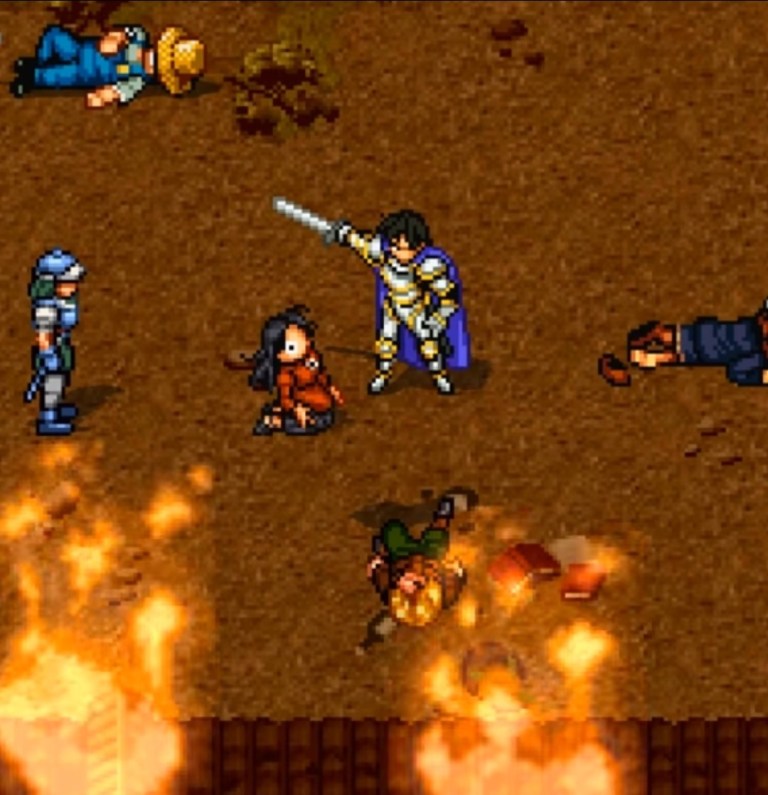
Luca Blight (with sword) is a lot more than just being evil as the game’s main antagonist.
Having played Suikoden a lot in 1996, I got familiar with the game design, the varied battle systems and other features that made it a solid RPG on its own. As for Suikoden II, I can clearly say that Murayama and his creative team built up on their foundation (in the first game), expanded the fantasy concept dramatically and ultimately made an extensive series of improvements and additions over each and every aspect of the sequel!
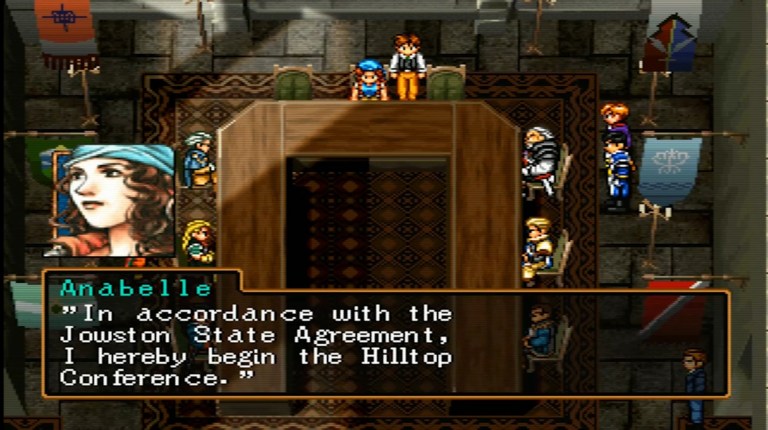
I’ll start first with the storytelling and writing. Compared to its predecessor, I found Suikoden II to be deeper and it took great advantage of the fact that the plot took place just years after first game and by this time the established world, the cities, tribes and geopolitical concept have been developed so much – backed with solid writing – they all become a lot more believable. In the middle of the great conflict are the three main characters Riou, Jowy and Nanami whose exploits and portrayals are pretty rich and lively to follow. It’s kinda like following the love triangle of Hikaru, Misa and Minmay through the war in the classic Super Dimension Fortress Macross anime TV series, except that you – the player – get heavily involved as Rious by making decisions that affect yourself and others, leading missions, building up a community (and force) of over 100 members, and overcoming challenges related to the conflict between Highland and Jowston.
The great news here is that the Riou-Jowy-Nanami emotional arc was written to be dramatic, engaging, intriguing and sentimental which ultimately will make you feel for them just as you make your way through the many events and twists of the war story. Beyond these three key characters, it should be noted that the scenarios are excellently executed and really showed how lively the fantasy world of Suikoden II really is. I’m talking about the portrayal of the many, many supporting characters and the interactions you have with them as the plot moves forward. Remember how lively your troops were in welcoming you back after winning your first army battle? Such a scenario was well directed and scripted, and the supporting characters you recruited really had their moments of participation which make sense within the narrative. I also should mention that the opposition figure of the game – Luca Blight – is still a powerful and complex villain in JRPGs even by today’s standards. Luca Blight is not evil for the sake of being evil, but if you pay close attention to the details about his background as the game’s story goes on, you will realize he is quite a complex character whose evil made sense within the narrative. Very clearly, the writing and storytelling done by Yoshitaka Muraya is not only greater than in the first game, but also very inspired.
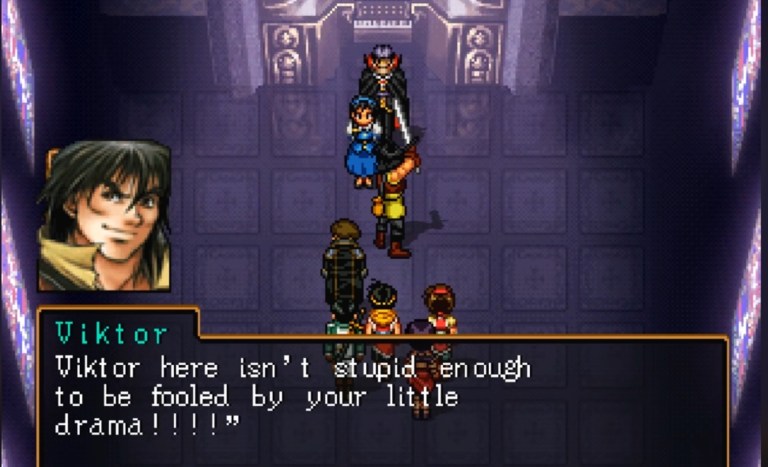
Viktor, who also appeared in the first game, continues to be an important supporting character in this sequel! He is one of several characters from Suikoden who returned.
On the gameplay and design, Suikoden II’s exploration of the world, towns and locations uses good old 2D graphics. The big difference here is that the 2D visual elements are more varied in terms of detailed sprites for non-playable characters (NPCs) and interactive characters, and visually the sprites as well as the art used for the in-game environments looked more polished (clearer, smoother and less pixelated). The controls are responsive enough for my taste, and it is also nice that my character moves faster while exploring. More on exploring, I do confirm that there are indeed more locations to visit (including those that are part of the quests related to finding the 100+ characters) and the art made for the locations are more varied as well.
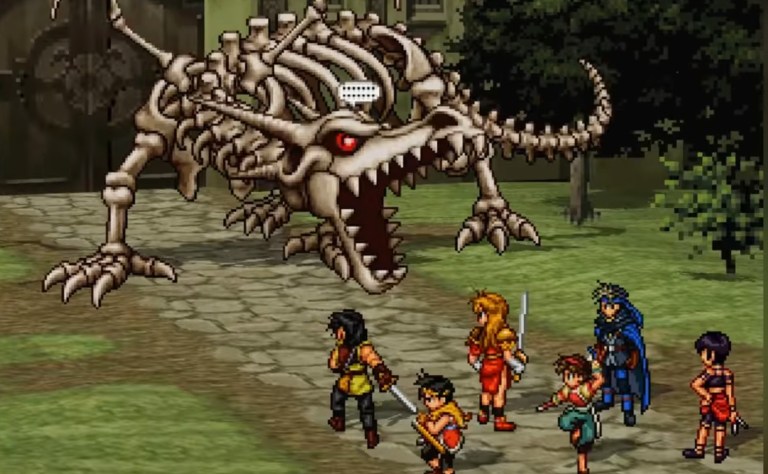
More on the gameplay, two types of battle systems from the first game are back but with refinements. First to talk about is the party battle system in which players get to control a group of up to six members who face off with enemies by group, or a single powerful boss-type enemy. During the party battle, you get to pick options as to what type of action each member of your party will do – Attack, Magic (note: this involve Runes), Item or Flee (note: if your party is much stronger than the opposition, Bribe or Let Go options will appear).
The party battle system is a lot of fun and not too stressful.
The way the battles are designed, as in the first game, is smooth, very visually appealing (thanks to the dynamic camera and fine level of detail of the sprites and animation) and fun to watch. Adding further depth to the party battles are the combined attacks involving at least two characters. Take for example Flik and Viktor doing the cross-attack, or Riou and Nanami performing a series of combo attack moves in strong coordination with each other. These combined attacks are not only fun to perform and see, but also encourages you to experiment by mixing up characters (specifically combatants) and paying attention as to which characters they can do combined attacks with. This alone will encourage you to complete the 108 characters of your force.
The use of Runes has been improved a lot in this game as the combatants now have three slots to equip Runes (note: these slots gradually open up as characters’ levels go up). Runes are essential to use magic spells in battles and the improvement of the Runes – plus the Run Affinity system – add more variety in the battles.
The 2D sprites are very visually appealing, especially when you watch the characters perform varied forms of action during the party battle.
Compared to other Japanese RPGs, the party battles here are much less stressful even though a random encounter system is used. There is also the option for automated attacks, which spares you from having to choose options for each member of your party to perform when fighting the enemies. Granted, I went through lots of random encounter battles and some challenges, but ultimately the stress level and tedium were very low. Doing party battles is fun overall.
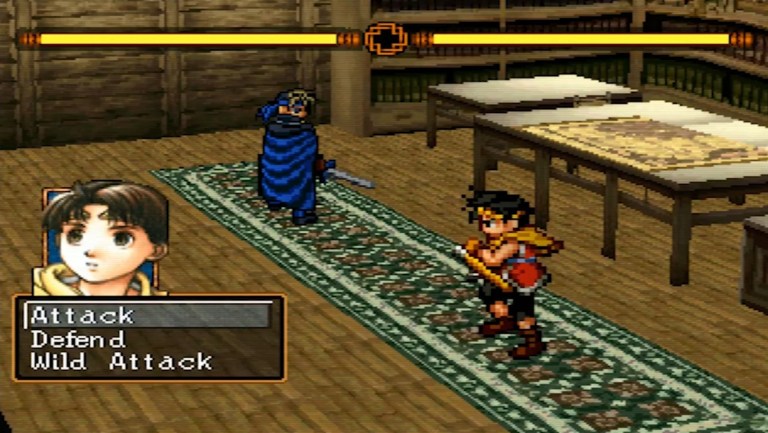
The 2nd battle system inherited from the first game is the duel. Duels happen the least throughout the game but each time they happen, they can be quite engaging to do. As the one-on-one battle between your character and an opponent begins, you will see them in a 3D realm with the dynamic camera capturing the action. Your options are mainly Attack, Wild Attack and Defend, and before you can pick an option, you must pay attention first to the clues (note: taunts) from your opponent which can help you anticipate his/her/its next move. While the visuals are clearly improved, the duel is pretty much the same as in the first game.
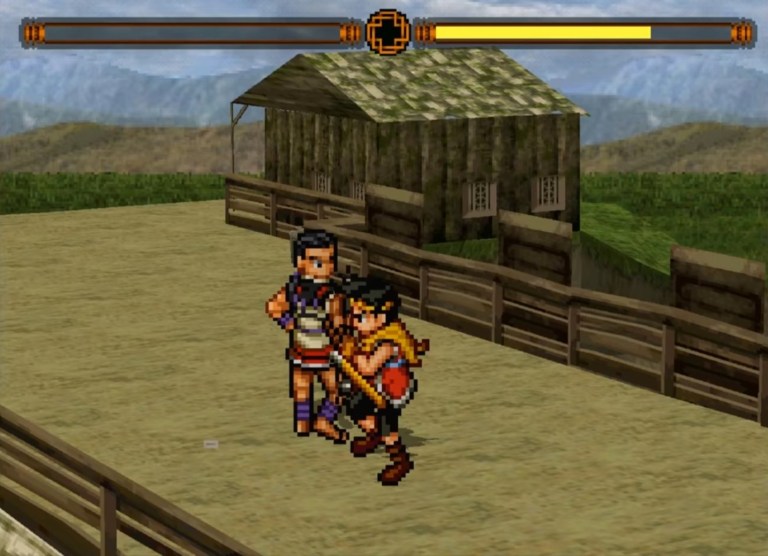
Duels happen in a 3D environment with the characters still presented as 2D sprites that are not only highly detailed but also are smoothly animated.
Like in the party battles, duel sequences also have a dynamic camera system complete with zoom during the action.
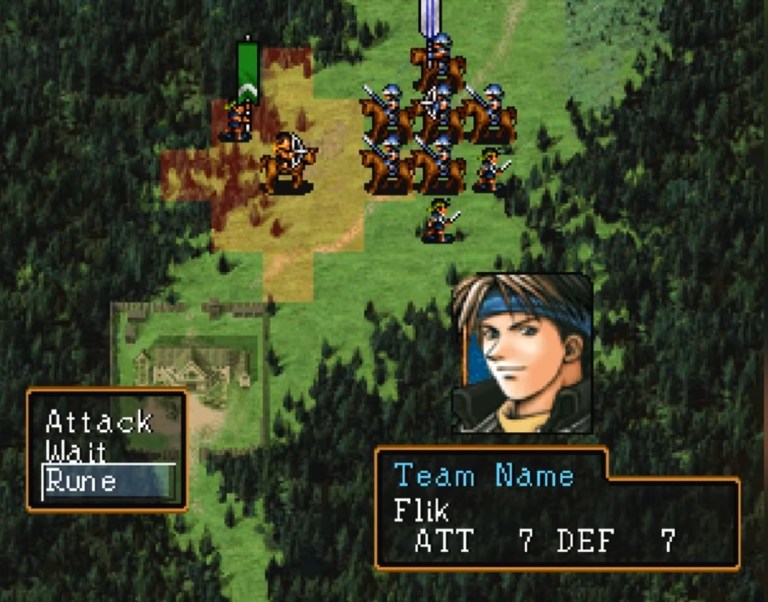
The 3rd battle system – army battles – is clearly the most revised part of the game as it is radically different from the army battles of the previous game. This time the army battles involves the heavy use of a tactical map (where you move units in a grid-like system). Your units – composed of mainly characters you recruited, including the non-combatants – can be moved on the map to counter an enemy unit. Then a short, animated battle sequence will commence and based on the statistics of each unit, the winner and loser of the sequence will be determined. Take note that in events of defeat, recruits can die permanently. As such, it is important to pay attention to not only the statistics but also the types of troops you have such as archers, healers, knights, and foot troops. When controlling units on the map, your options are Attack, Wait and Rune. It is also very entertaining to see how the characters react (with dialogue, no less) to the battles. Overall, the army battle system here is clearly much deeper and more strategic than what was used in the first Suikoden.
The army battles in this game are more tactical than what was presented in the first Suikoden. This is also the main map used for such battles.
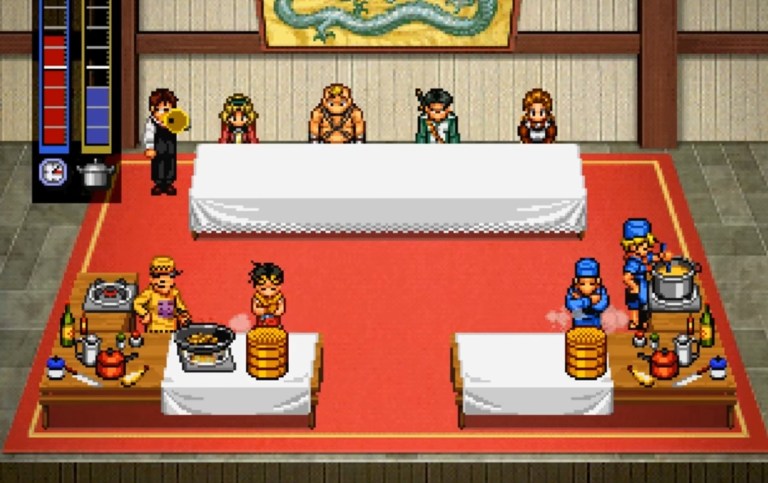
Battles aside, there are also lots of things to do related to exploration. For one thing, there are these fun-filled mini-games the game creators set up such as fishing (note: not as boring as it may sound), the whack-a-mole game, rope climbing, Chinchirorin (dice game in a bowl) and, the most exciting and deepest of them all, the cooking contest game. When you fully invest your time into each of these mini-games, you will not feel relieved from the stress of battles and exploration, but also have a lot of fun free of stress. I enjoyed these a lot myself.
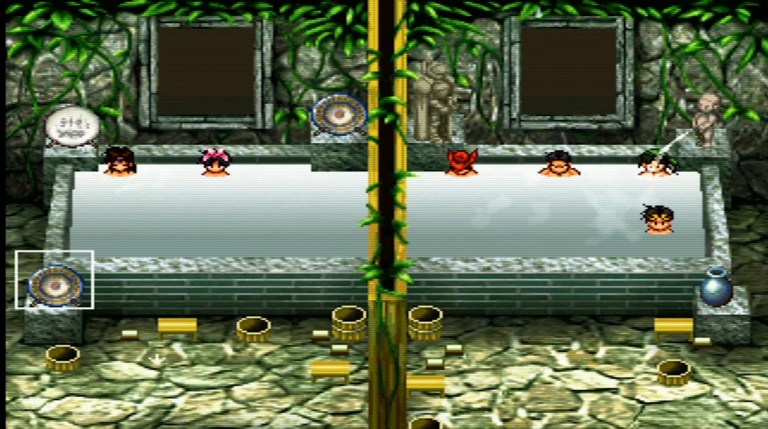
If you enjoyed building up your fortress in the first game, you will experience that here also! Building up your stronghold is related to your recruiting of people and some of them have certain talents that will establish key parts of your place like a store, a Rune shop, aa tavern, a restaurant, an armor shop and even a detective agency to name some! It may take an effort to have all possible establishments get realized in the game but I promise you, they are all worth it and you will feel thankful that you got to recruit lots of people. The other reward of building up your fortress is the establishment of a thriving community of people!
Your party members can take a bath and even use the collected artifacts as decorations. This is one of the many side activities you can do at your stronghold.
The cooking contest mini-game is easily the best in the game!This alone will encourage you to keep searching for recipes during your adventures!
With regards to continuity with the first Suikoden game, the game developers implemented certain content (locations, dialogue, story and characters) that get unlocked by having your preserved Suikoden saved game content successfully loaded with Suikoden II running on PS1. I’m talking about being able to meet and even recruit Suikoden hero Tir McDohl, plus meeting even more characters from the first game. Very clearly, this is a clever presentation of fan service done by Murayama and his creative team who paid attention to the feedback of the first Suikoden.
The music done by Miki Higashino and Keiko Fukami are very varied and many of them reflect the places you get to visit, the emotional scenes you witness and the epic moments that happen. The great news here is that each and every tune in the game was made and performed with special care. This game’s soundtrack really stands out high among Japanese RPGs of the 1990s and even by today’s standards, it still is a great soundtrack to listen to.
If there are any flaws in this great game, it is the English translation itself as there were typographical errors, mistranslations and even NPCs with lines of dialogue that made absolutely no sense. Clearly there was a rushed job with the translation.
Conclusion
The political aspect of the game’s story is simple and never overwhelming.
I really love Suikoden II and very clearly, it is a major improvement over its predecessor (which itself was a solidly good RPG). Suikoden II is a labor of love done by Murayama and his creative team and the result is a true epic RPG that has so much enjoyable stuff and high replay value for gamers. Its quality is still great and by today’s standards, Suikoden II is indeed a classic RPG that gamers should play even though Konami itself does not care to make it more accessible in this modern age of gaming.
Given the legacy of Suikoden II and the fact that Konami showed no signs of reviving the Suikoden RPG franchise, now is the time to look forward to Eiyuden Chronicle: Hundred Heroes which Murayama and his team are developing for release in 2023 for Xbox consoles, Xbox Game Pass and other platforms. Eiyuden Chronicle: Hundred Heroes clearly has strong Suikoden vibes and the distinct combination of 2D sprites with 3D polygonal environments, plus its party battle system strong resembles that of Suikoden and Suikoden II!
Overall, Suikoden II is highly recommended!
Now if only Konami would change its ways to make Suikoden II more accessible (go way beyond the PlayStation online store and ecosystem) to gamers by releasing it digitally through Xbox LIVE, Steam, Xbox Game Pass and other online stores or ecosystems. Paying hundreds of dollars for a legitimate hard copy of the game is simply too much.
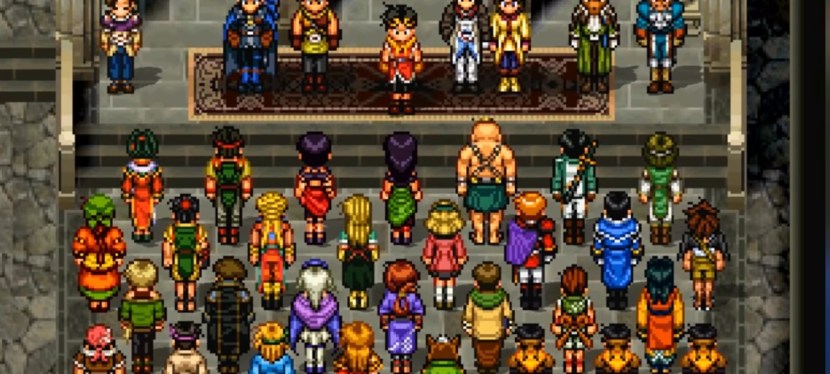
There is nothing like building up your stronghold and seeing your recruits become part of its development as well as your campaigns.
+++++
Thank you for reading. If you find this article engaging, please click the like button below and also please consider sharing this article to others. If you are looking for a copywriter to create content for your special project or business, check out my services and my portfolio. Feel free to contact me as well. Also please feel free to visit my Facebook page Author Carlo Carrasco and follow me at HavenorFantasy@twitter.com
Disclaimer: This is my original work with details sourced from reading the comic book and doing personal research. Anyone who wants to use this article, in part or in whole, needs to secure first my permission and agree to cite me as the source and author. Let it be known that any unauthorized use of this article will constrain the author to pursue the remedies under R.A. No. 8293, the Revised Penal Code, and/or all applicable legal actions under the laws of the Philippines.
Welcome back, Ultraverse fans, superhero enthusiasts, comic book collectors, enthusiasts of 1990s pop culture and all other geeks! Today, we revisit the Ultraverse for more 1990s comic book nostalgia through another tale of Freex, the team of super-powered social outcasts!
Last time around, Plug’s origin story was told just as Freex had a very notable encounter with Contrary and her super-powered students (with ex-teammate Ray on their side) at the headquarters of the Academy for The New Elite. After going through some hard struggles, Freex left losing Ray but gained a scaley new member who left Contrary’s school.
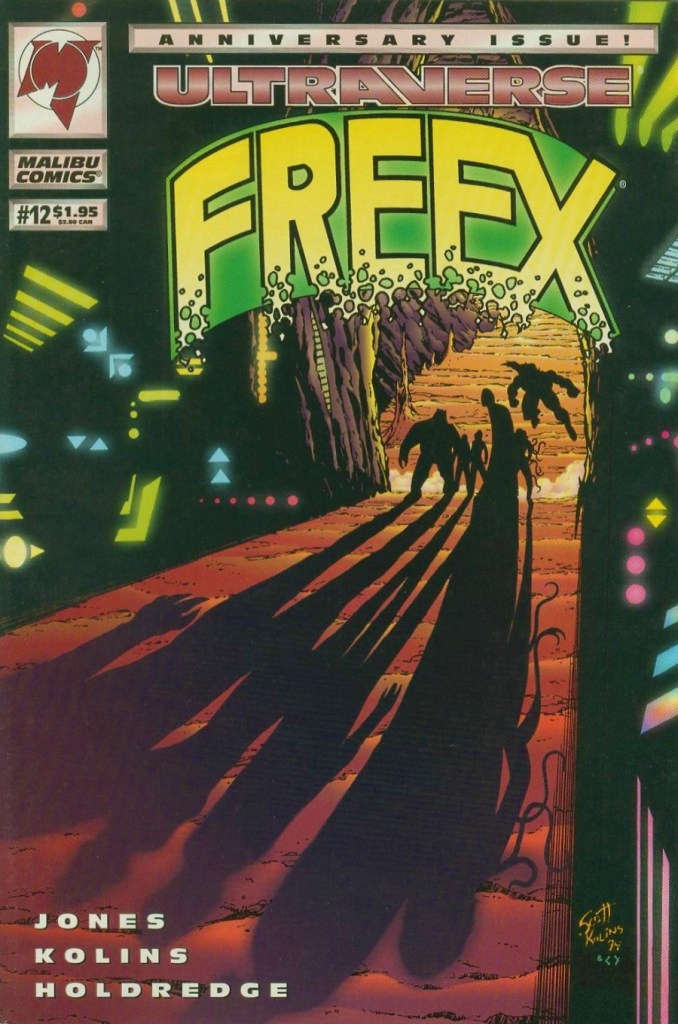
To find out what happens next, here is a look back at Freex #12, published in 1994 by Malibu Comics with a story written by Gerard Jones and drawn by Scott Kolins.
The cover.
Early story
The story begins in the middle of an ongoing misadventure (note: started with Giant Size Freex #1) with the Freex, Prime, and Old Man together beneath the Earth. To the shock of Freex, there are statues of them. The Old Man claims that more than a thousand years prior, he saw people with powers very much like those of Freex. Legend has it that they came from underground and got chased back by some scared fools. What Valerie and her teammates realize is that the cavern they are in is a place of retreat for super-powered freaks that existed before them.
Suddenly, an oversized deformed creature walks through them and grabs Valerie. Prime tries to help by punching the creature but this only made his body deteriorate into green liquid matter. Freex’s newest teammate jumps to strike the creature’s head which helps Valerie get free.
After noticing a hole on the ground, Lewis calls his teammates to escape. He forms his body into a makeshift slide to pave the way for escaping…
Quality
Angela takes action!
To begin with, I should state that this comic book really had a very wild and ambitious concept for its plot. Something really big with adventuring in mind which, in my opinion, was meant to be made to make the 12th issue anniversary of the Freex series stand out. The good news here is that the script if well-written and continues to deliver the good stuff that dedicated Freex readers and superhero enthusiasts will enjoy.
As this is the continuation of the story that started in Giant Size Freex #1, the team of misfits went on to travel and work together with Old Man and Prime (whose spotlight is lessened in this comic book) in a wild misadventure that brought them deep underground which reveals the existence of creatures and remnants of creation that the whole world has not seen. What was conceptualized here significantly expanded Earth’s realm within the Ultraverse and quite intriguingly, there are connections between the new places and Wetware.
When it comes to character development, new team member Cayman’s fitting in was portrayed nicely and his interactions with the other members were pretty interesting. What stood out most, however, are the interactions between Kevin Green (Prime) and Angela (Sweet-face) which I encourage you to read as it will open up a new dimension within his personality (and his being a teenager).
Conclusion
How would you react if you discovered all of that deep underground?
Freex #12 (1994) has a fine mix of grand misadventure, discovery, as well as memorable interactions between Freex and Prime. This is definitely not a throw-away story of Freex, nor is it generic when compared to other superhero comic book tales. This comic book also expands the Ultraverse in a really solid way just as it also moved smoothly on redefining the Freex themselves.
If you are seriously planning to buy an existing hard copy of Freex #12 (1994), be aware that as of this writing, MileHighComics.com shows that the near-mint copy of the comic book costs $16.
Overall, Freex #12 (1994) is highly recommended!
+++++
Thank you for reading. If you find this article engaging, please click the like button below and also please consider sharing this article to others. If you are looking for a copywriter to create content for your special project or business, check out my services and my portfolio. Feel free to contact me as well. Also please feel free to visit my Facebook page Author Carlo Carrasco and follow me at HavenorFantasy@twitter.com


















 Author Carlo Carrasco