Disclaimer: This is my original work with details sourced from reading the comic book and doing personal research. Anyone who wants to use this article, in part or in whole, needs to secure first my permission and agree to cite me as the source and author. Let it be known that any unauthorized use of this article will constrain the author to pursue the remedies under R.A. No. 8293, the Revised Penal Code, and/or all applicable legal actions under the laws of the Philippines.
Welcome back science fiction enthusiasts, 1980s arts and culture enthusiasts, movie fans and comic book collectors! Today we go back to the year 1989 to take a look at a significant event of the Predator entertainment franchise – the comic book launch of Predator.
For the newcomers reading this, Predator started as a sci-fi action movie in 1987 directed by John McTiernan (Die Hard) and starring Arnold Schwarzenegger, Carl Weathers, and Jesse Ventura to name some. The writers and creators were Jim Thomas and John Thomas. As the movie became a huge commercial success, it led to the start of its own multi-media entertainment franchise covering video games, toys, novels and comic books. It also led to the release of more movies including a crossover film with the Alien franchise.
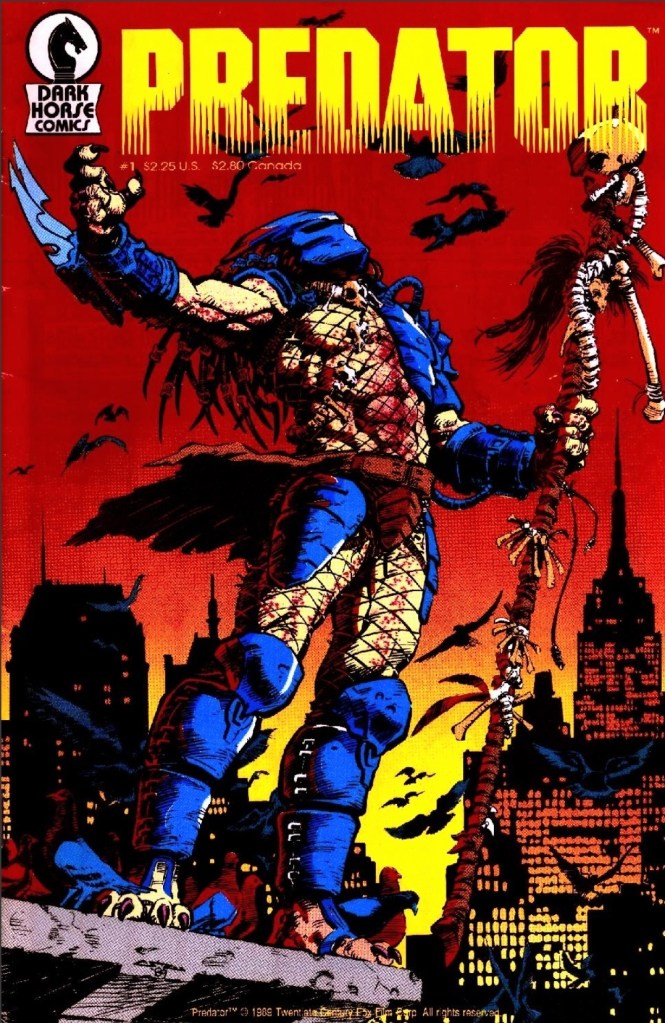
With those details laid down, here is a look back at Predator #1, published in 1989 by Dark Horse Comics with a story written by Mark Verheiden and drawn by Chris Warner. The is the first chapter of a 4-issue mini-series and it would later be referred to as Predator: Concrete Jungle.
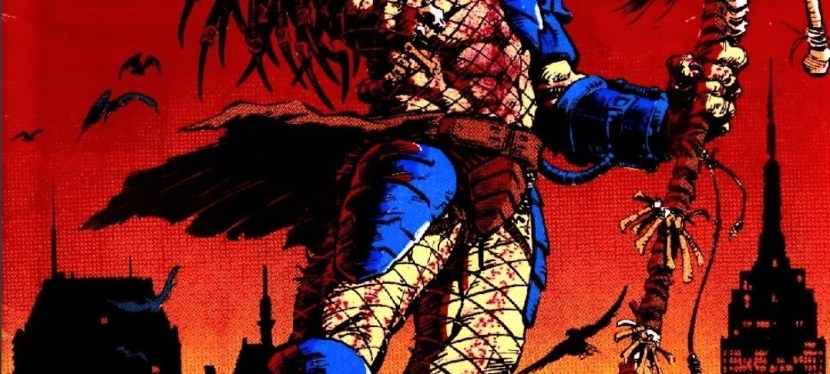
The cover.
Early story
The story begins during a very hot summer day in 1991 New York City. A man killed his own wife using a shotgun which eventually leads to the arrival of cops, medics and his arrest. The two detectives Errol Rasche and John Schaefer (brother of Dutch) have been working together in the local war against crime and they have a tendency to do things that violate their superiors’ orders.
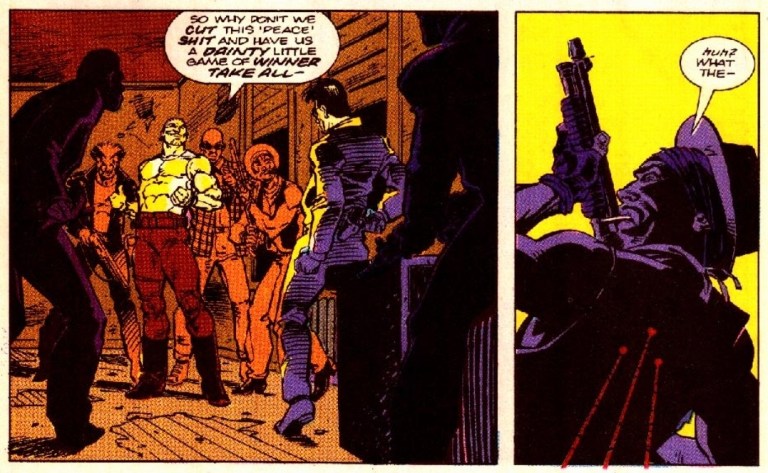
In one of the rundown buildings of New York, a secret meeting between two gangs got terribly disrupted by a Predator who attacked from the outside. Chaos and destruction followed.
Shortly after, Rasche and Schaefer arrive outside the same building which has been surrounded and isolated by the local police. When a man suddenly fell out of the building and crashed on top of a police car, the two detectives decide to enter willfully violating the order to stay out.
Once they enter the room where the secret gang meeting was held, Rasche and Schaefer are shocked to see many skinned and dead bodies inside. Schaefer is convinced that what happened was not the result of a gang war…
Quality
A gang meeting about to be disrupted by the unseen Predator.
This comic book – written as a not-too-obvious sequel to the 1987 movie – is absolutely very intriguing to read from start to finish. Mark Verheiden clearly wrote a crime story that happens to involve the species of deadly hunters from outer space. In fact, this comic book has very notable elements that also made it into the core concept of the 1990 movie Predator 2.
Story is set within a massive city that happens to be suffering from a heat wave – check! There is rampant crime and conflicts between gangs – check! The Predator causes huge disruptions on the criminals – check! The detectives willingly violate protocol to solve cases – check! One of the detectives is gradually getting closer to retiring and his pension – check. It’s almost as if this comic book was a huge influence on the people who made Predator 2.
Going back to the story, this is a strong tale of crime and urban war told through the exploits of detectives Schaefer and Rasche who have worked many years together, they treat each other like brothers (similar to Predator 2’s Mike Harrigan and Danny Archuleta).
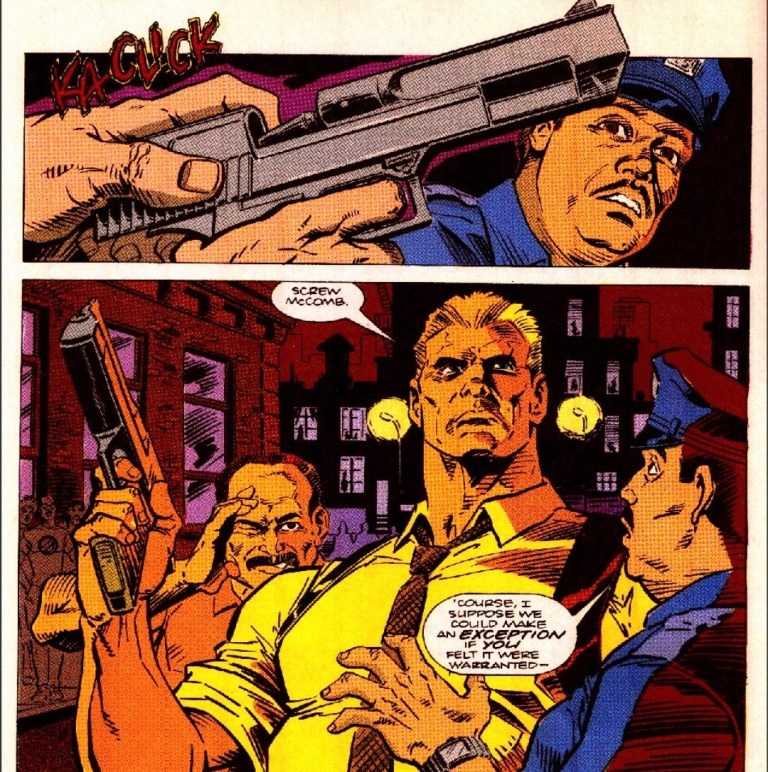
With their record of disobeying orders, Schaefer and Rasche simply involve themselves in cases believing they have the right know the details on the spot and to solve problems their way even though their superiors don’t need them. This is the anti-authoritarian portrayal of law enforcers that easily reminded me of certain TV shows and movies of the 1980s.
All throughout, the story by Verheiden is nicely structured, has lots of engaging details to follow and carefully blends sci-fi elements with detective storytelling. Verheiden clearly knows how to build up tension, keep the narrative progressing and use action or spectacle with precise timing.
When it comes to the visuals, Chris Warner’s style is very good. His approach on drawing the characters made them look exquisite and visceral at the same time. In fact, there were some shots of people in this comic book which reminded me of Todd McFarlane’s way of drawing people during his early works in comics. Lastly, I should say that Warner’s approach on hard action and his way of drawing of the Predator must be seen.
Conclusion
Rasche and Schaefer defy orders. Schaefer (holding the gun) is the brother of Arnold Schwarzenegger’s character in the Predator movie of 1987.
I really enjoyed reading Predator #1 (1989). This is indeed really fine work by the Verheiden-Warner team and as far as building up the lore of the Predator goes, they clearly succeeded and their contributions here strongly influenced the creation of Predator 2 which opened in cinemas in late 1990. This comic book has the visceral touch and violence that make it comparable with both the 1987 and 1990 movies.
Overall, Predator #1 (1989) is highly recommended!
Welcome back readers, fellow geeks and electronic gaming fans!
In this edition of the Retro Gaming Ads Blast (RGAB) series, we will take a look at another batch of retro gaming print ads – including arcade flyers – from the 1980s and 1990s.
For the newcomers reading this, Retro Gaming Ads Blast (RGAB) looks back at the many print ads of games (console, arcade, computer and handheld) that were published in comic books, magazines, flyers, posters and newspapers long before smartphones, social media, the worldwide web and streaming became popular. To put things in perspective, people back in the 1980s and 1990s were more trusting of print media for information and images about electronic games and related products.
With those details laid down, here is the newest batch of retro gaming print ads for you to see and enjoy…
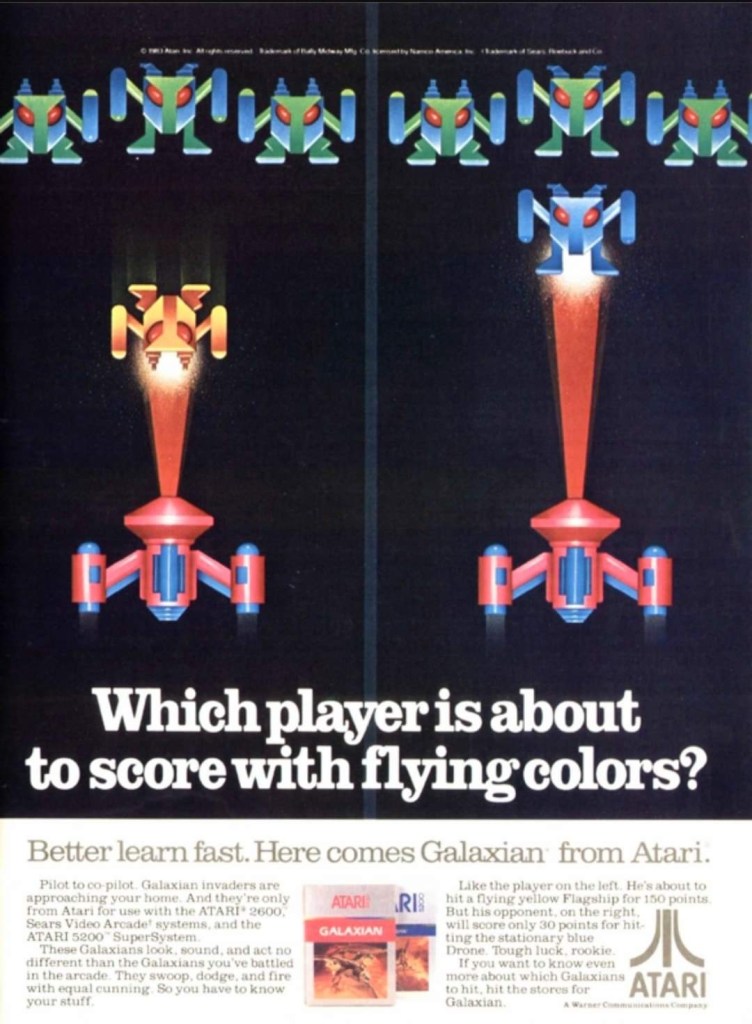
1. Galaxian for Atari print ad
A unique approach to the art done by the advertisers.
Developed by Namco, Galaxian was a 2D sci-fi shooter that debuted in arcades in 1979. It was so successful and widely acclaimed, it got ported to varied game consoles and home computers as the years passed by. For its release on the Atari 2600 and Atari 5200, this print ad was created to catch the attention of fans and gamers by utilizing artwork that resembled the look of 2D sprites from the game. That being said, no screenshots of Galaxian on the Atari consoles were shown because the artwork used looked detailed and were attention-grabbing already.
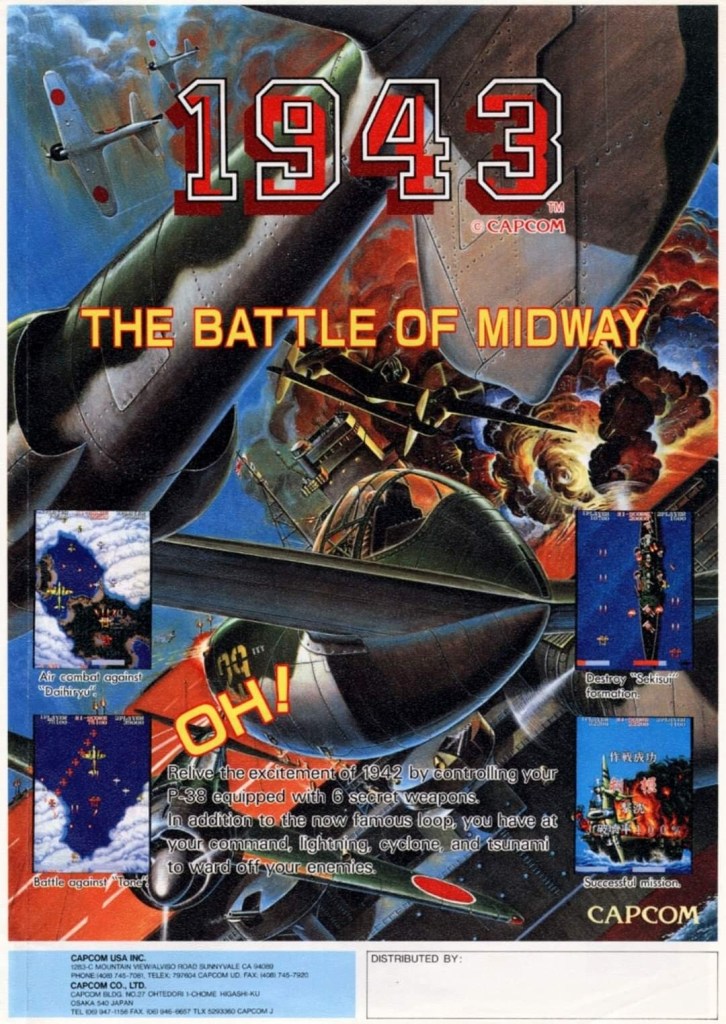
2. 1943: The Battle of Midway arcade flyer
This is a fine looking flyer.
In 1987, Capcom released in the arcades 1943: The Battle of Midway which was their follow-up to 1942. The arcade flyer itself was designed to strongly promote the game using a combination of screenshots, short-but-clear text descriptions and the great looking piece of artwork which really emphasized the World War II concept. Behind it all, this game was made by Japanese developers with the Western markets in mind and the irony is that the game has players control Americans fighting the Japanese fleet.
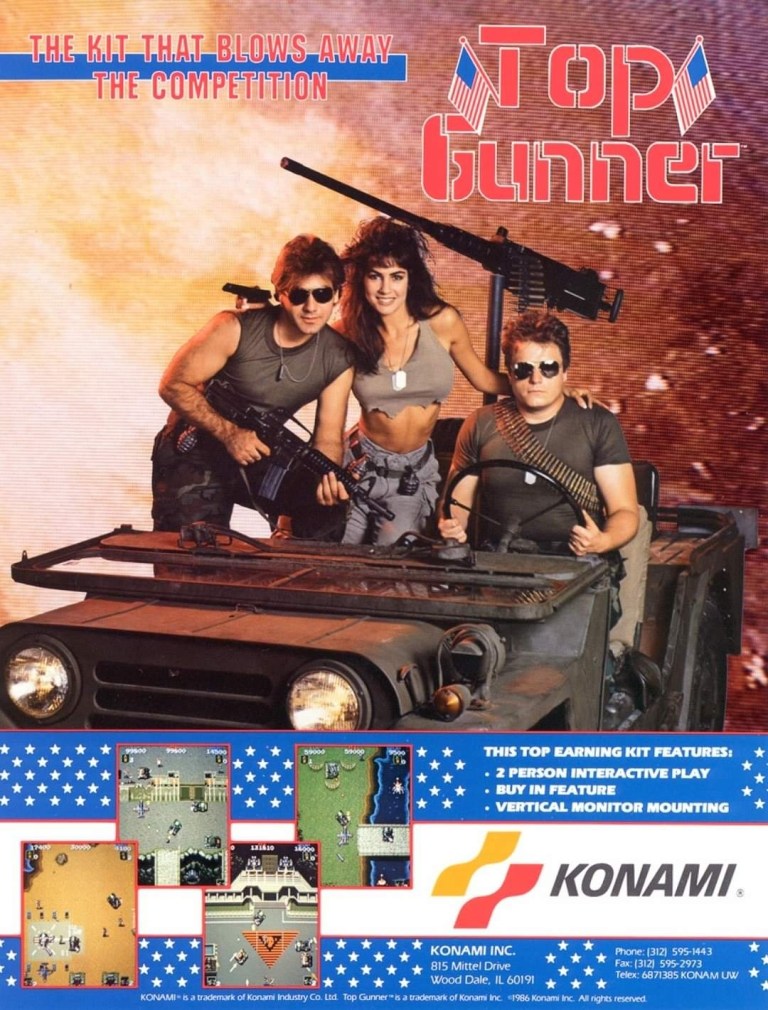
3. Top Gunner arcade conversion kit flyer
Show this nice looking image to the woke nut or modern day Communist near you. Watch and observe his or her reaction.
To make things clear, Top Gunner is actually the run-and-gun game Jackal and the alternative titles was mainly used in North American arcade distribution and also reflected Konami’s move of coming up with titles inspired by blockbuster movies of the time. To promote its 1986 arcade release in America as a conversion kit, the advertisers had three models playing soldiers on a military jeep to immerse gamers into the core concept of the game – moving armed military jeeps from one location to another while fighting bad guys. The approach used for the visual concept is indeed inspiring, especially during the Cold War. Top Gunner/Jackal became a hit in both arcades and consoles.
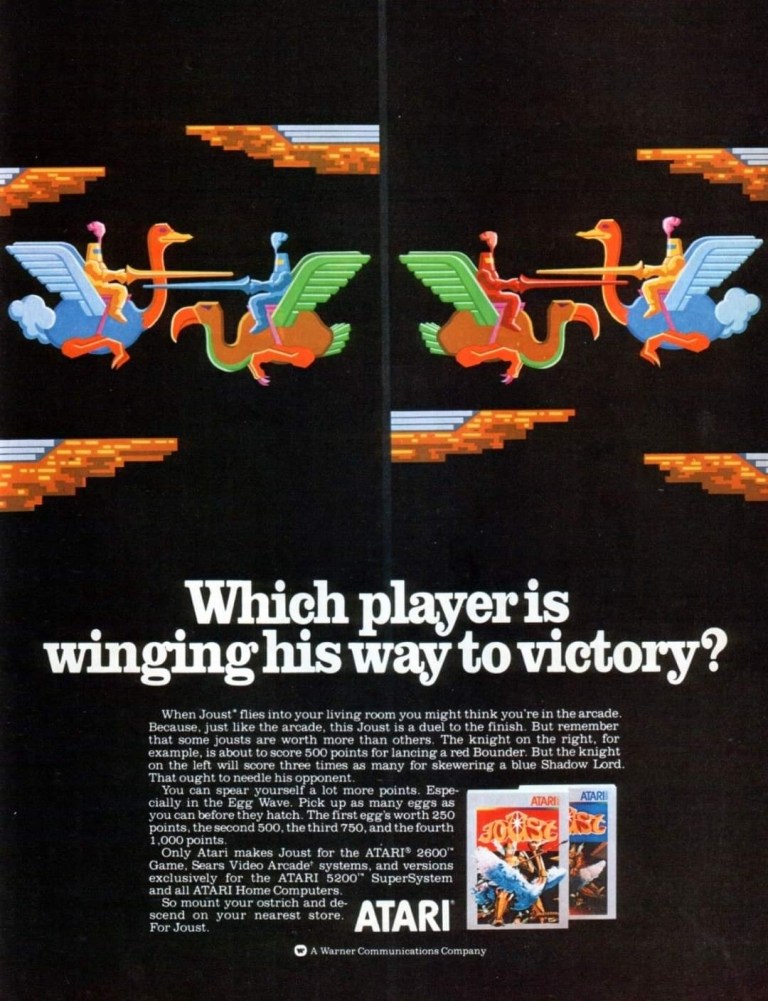
4. Joust for Atari print ad
While I played Joust on console, I don’t remember seeing this print ad before.
Made by Williams Electronics, Joust was one of those early 1980s arcade games that eventually made its way to the Atari 2600 console which was massively popular in North America. Strangely enough, the artistic approach Atari’s advertising came up with for the console version of Joust was similar with that of the ad of the Atari version of Galaxian (see item #1 above) in which artwork was used to resemble the 2D sprites of the game. Regardless, the images of this ad showed what a joust looked like – a martial game between two armed combatants going against each other while riding an animal.
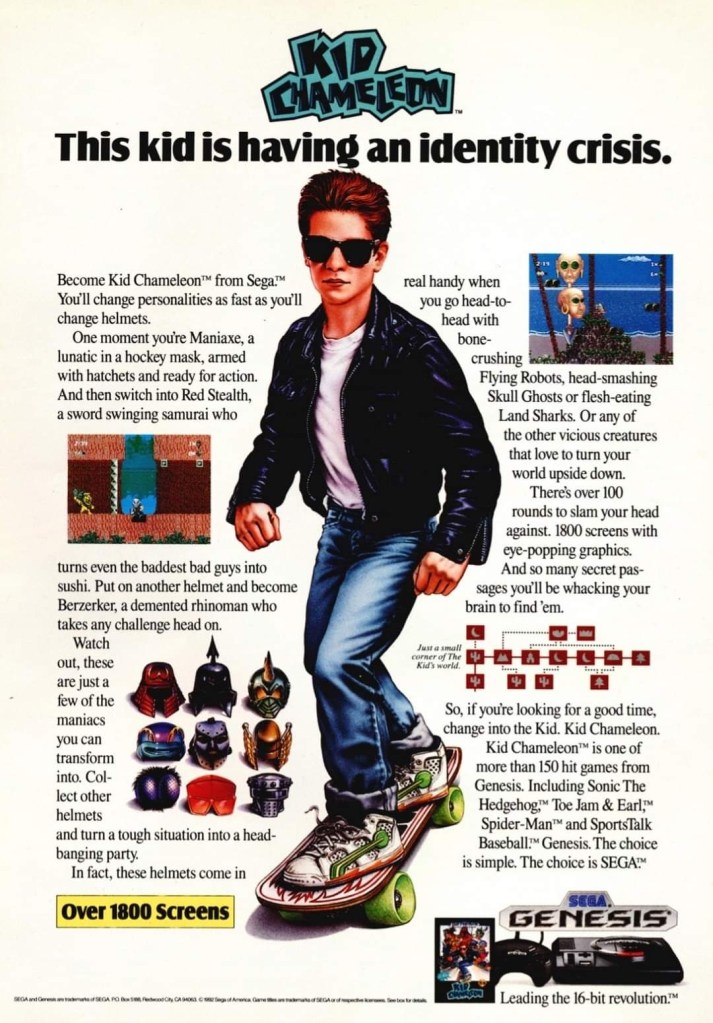
5. Kid Chameleon print ad
Can you relate with Kid Chameleon’s identity crisis?
During the early years of the Sega Genesis, Sega of America exerted efforts to make new games that were not only exclusive to their console but also stand out among the many 2D side-scrolling adventure games by coming up with a protagonist with a unique personality that could somehow resonate with young kids and teenagers.
Developed by their internal experts (Sega Technical Institute), the company released Kid Chameleon in 1992 and they came up with the above print ad that had detailed hand-drawn art of the lead character as well as a wordy text description which was a clear attempt to help young gamers (including teenagers) get connected with both the game and the protagonist. The advertisers even had space to spare to accommodate two screenshots of the game.
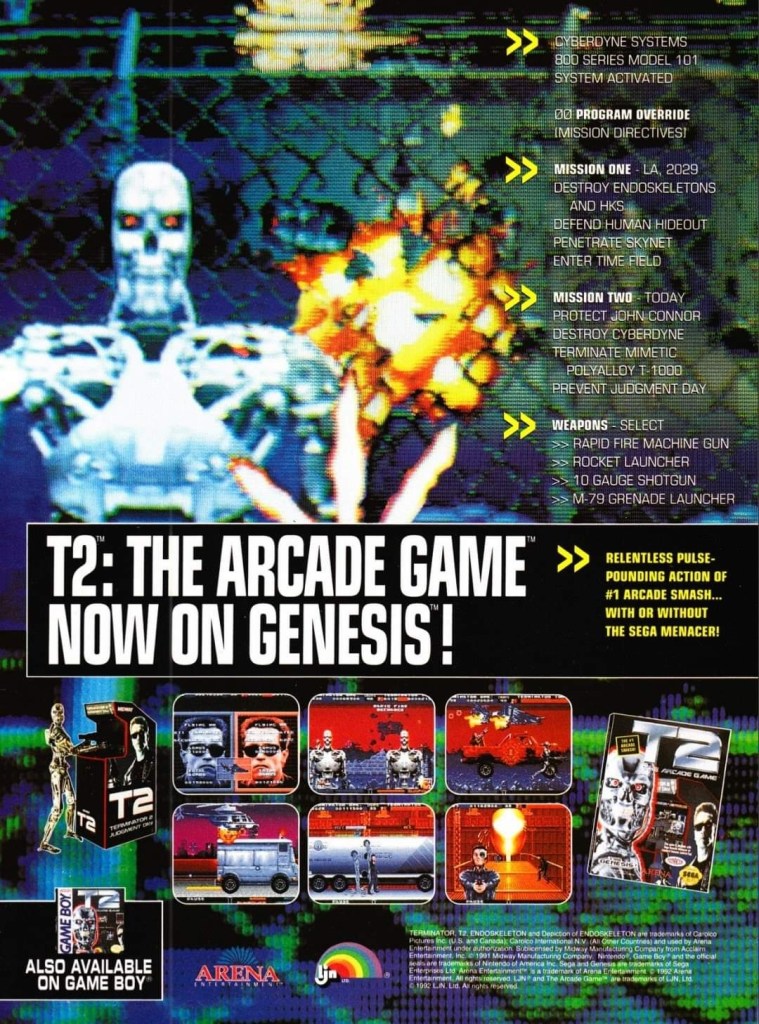
6. Terminator 2: Judgment Day (AKA T2: The Arcade Game) for Sega Genesis print ad
This print ad appeared on the many comic books I read long ago.
Back in the early 1990s, Terminator 2: Judgment Day was a massive success in the global box office and this resulted in Arnold Schwarzenegger’s popularity to soar very high while also establishing the Terminator as an essential pop culture figure. Apart from comic books and merchandise, video games based on the movie were made and the one that stood out the most was the arcade shooter game initially titled Terminator 2: Judgment Day (later retitled as T2: The Arcade Game).
The arcade mega hit eventually got ported to the Sega Genesis and this print ad really looked flashy with its visual presentation showing screenshots and a zoomed-in look at how the Terminator T-800 looked like in the Genesis version complete with a few explosions in the background. It should be noted that this flashy print ad cleverly concealed the visual downgrades and the redrawn images as the Genesis itself could never come close to matching the high quality visuals of the arcade version.
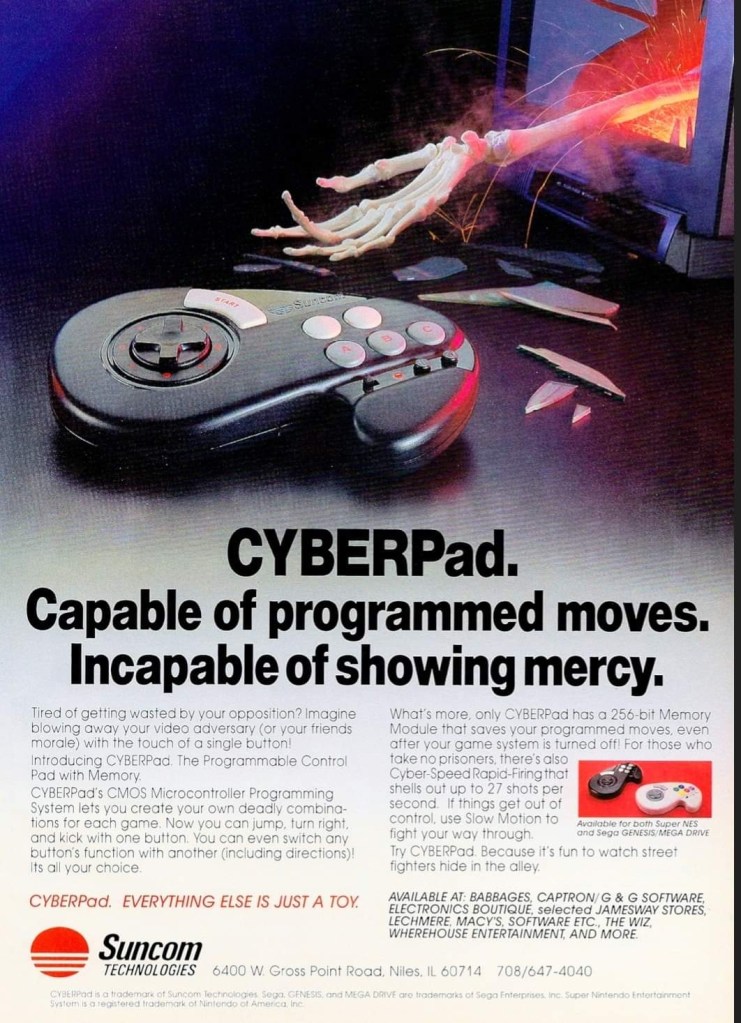
7. CYBERPad print ad
I never owned the CYBERPad, nor have I ever used one.
During the so-called 16-bit console generation (actually the 4th console generation), there were lots of licensed console peripherals made by independent companies in support of the Sega Genesis and Super Nintendo Entertainment System (SNES). The company Suncom Technologies came up with the CYBERPad controller for the two consoles and they boasted in their print ad that the product had a programmable control pad that allowed users to create combinations for each game with convenience in mind. The CYBERPad also allowed the saving of the programmable moves and it had a rapid-fire feature and even a slow-motion function. The CYBERPad was made to make the gameplay experience more user-friendly.
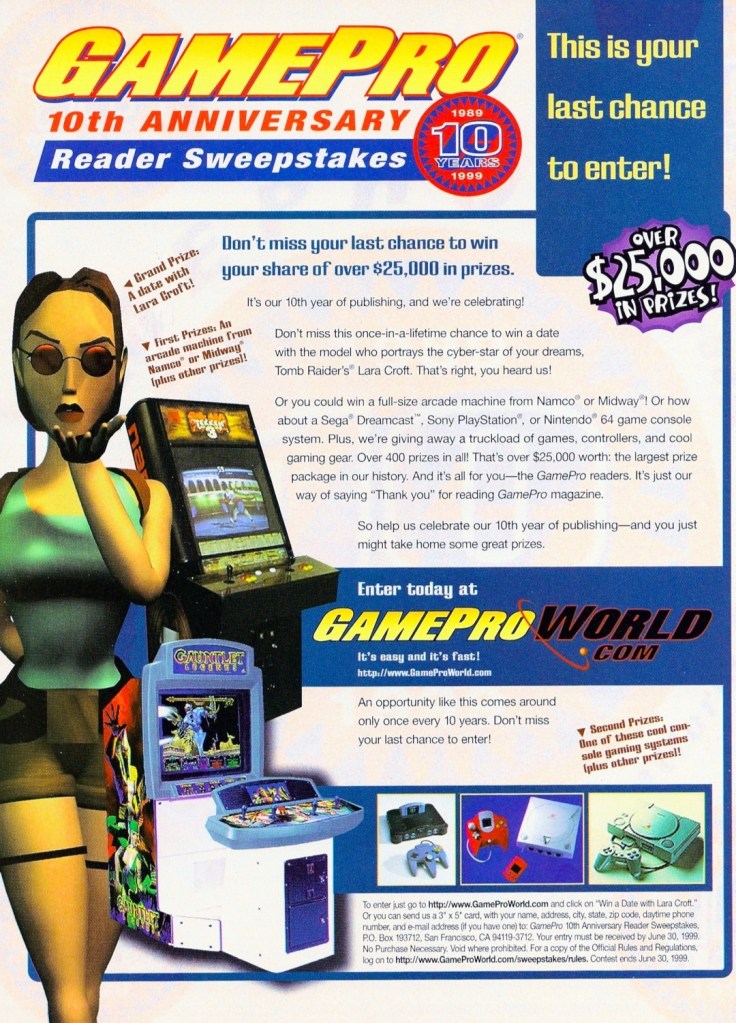
If you look closely, this print announcement by GamePro technically advertised the game consoles, the arcade game and Lara Croft to its readers.
In 1999, GamePro magazine celebrated its 10th anniversary and to keep on resonating with gamers and maintaining the loyalty of their fans, they organized a reader sweepstakes with prizes worth over $25,000 to be won by the few winners. GamePro boasted a date with an unnamed model who played the iconic Lara Croft (Tomb Raider). Certain arcade machines plus the modern consoles of the time – including the brand-new Sega Dreamcast – were also at stake. The way it was presented, this GamePro print announcement was enticing to read.
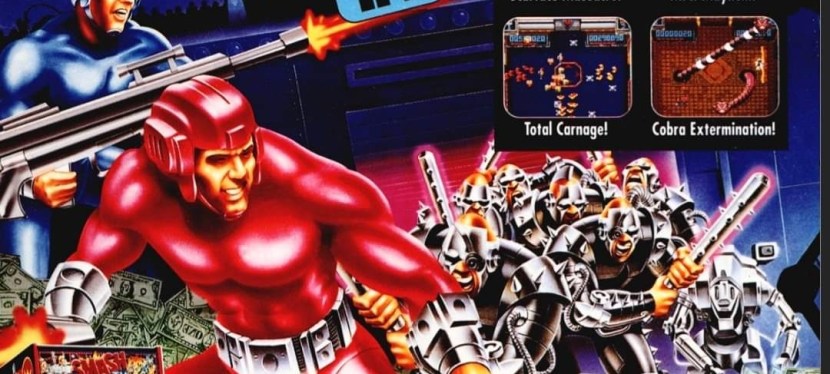
9. Smash T.V. for SNES print ad
Smash T.V. was a lot of fun on both arcade and console.
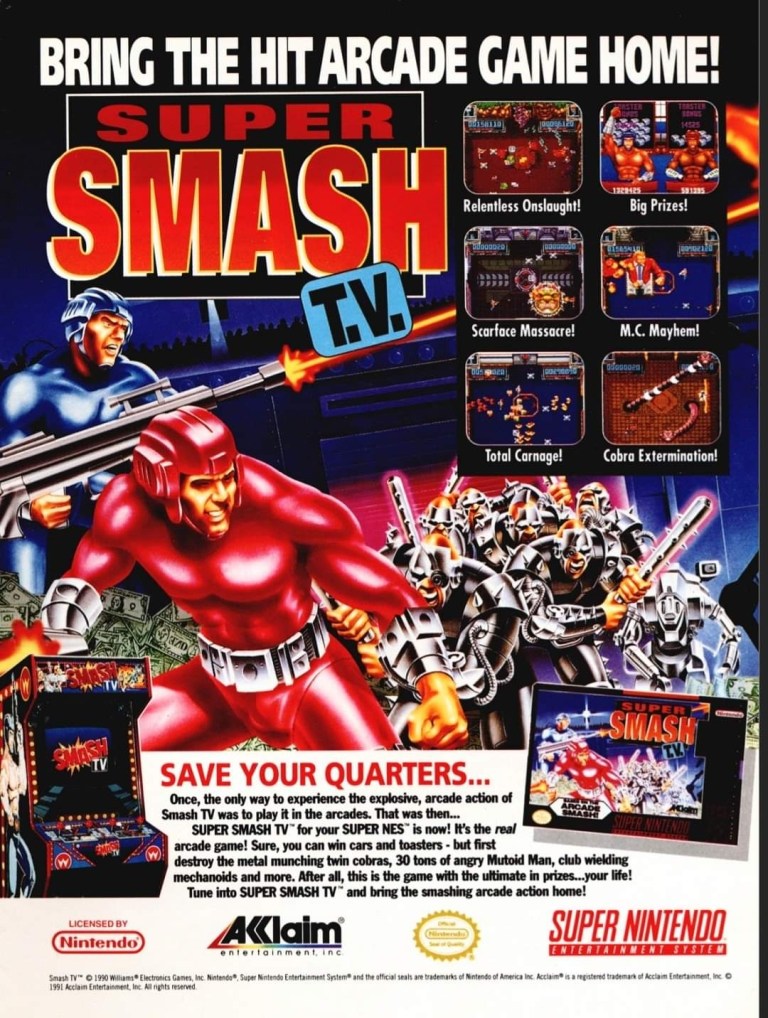
The arcade hit Smash T.V. made its way to the Super Nintendo Entertainment System (SNES) in 1992 and the publisher came up with a print ad that had captivating artwork, six screenshots and a text description that emphasized that a lot of fun awaits gamers on the console version. In my view, this old ad is still amusing to look at.
10. David Robinson’s Supreme Court print ad
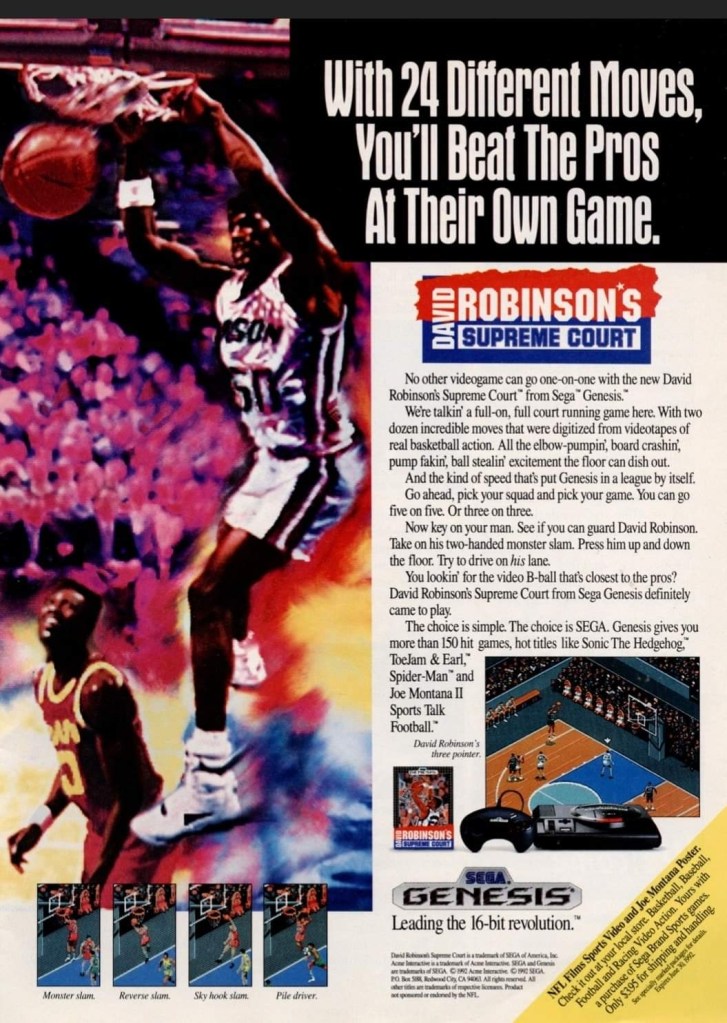
It was a smart move by Sega to get NBA superstar David Robinson as the endorser of this basketball video game exclusive on the Sega Genesis. This ad was published many years before Robinson finally won an NBA championship.
As part of its strategy in competing with Nintendo during the 4th console generation, Sega of America was focused on producing exclusive sports video games for the Genesis console backed by endorsements of sports professionals. In 1992, they released David Robinson’s Supreme Court on the Genesis and unsurprisingly their print ad used a large, stylized image of the NBA superstar dunking backed with an exciting text description plus screenshots showing the game’s use of the isometric view for gameplay. This is still worth looking at.
11. Taito’s “heat wave” print ad
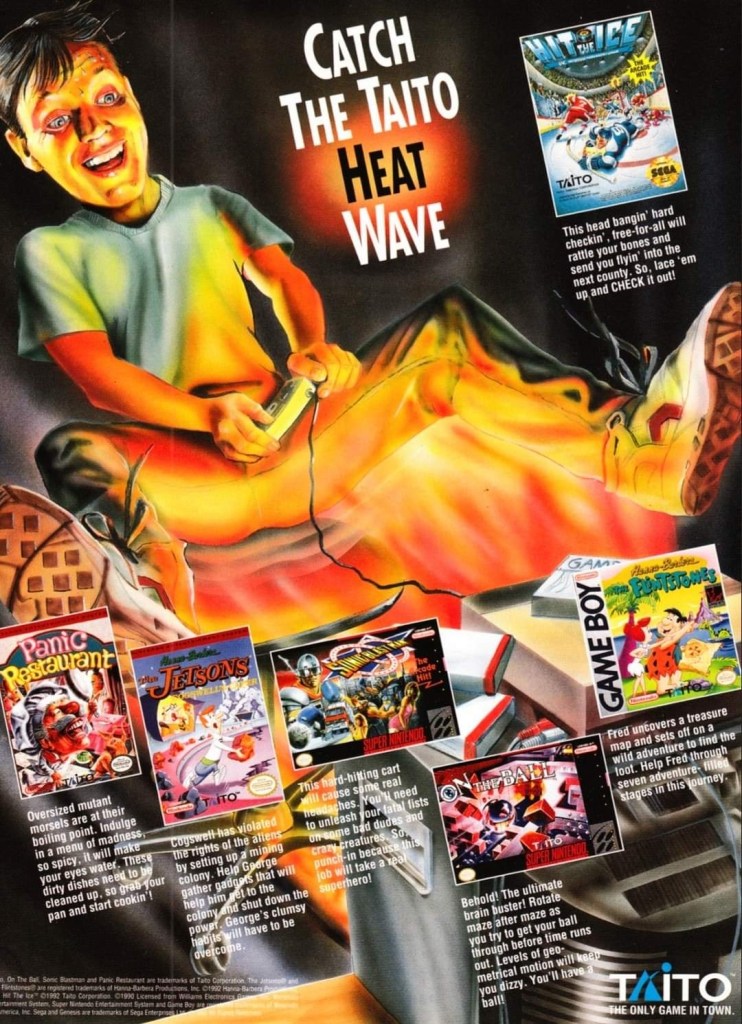
An amusing and creative way to sell video games.
If your company lacks money to effectively market your video games individually, you can try making a single ad promoting them together. This is what Taito did in this print ad which showcases multiple games for different platforms and they used artwork of a player experiencing the so-called heat wave. This is a nice stroke of creativity on the part of Taito.
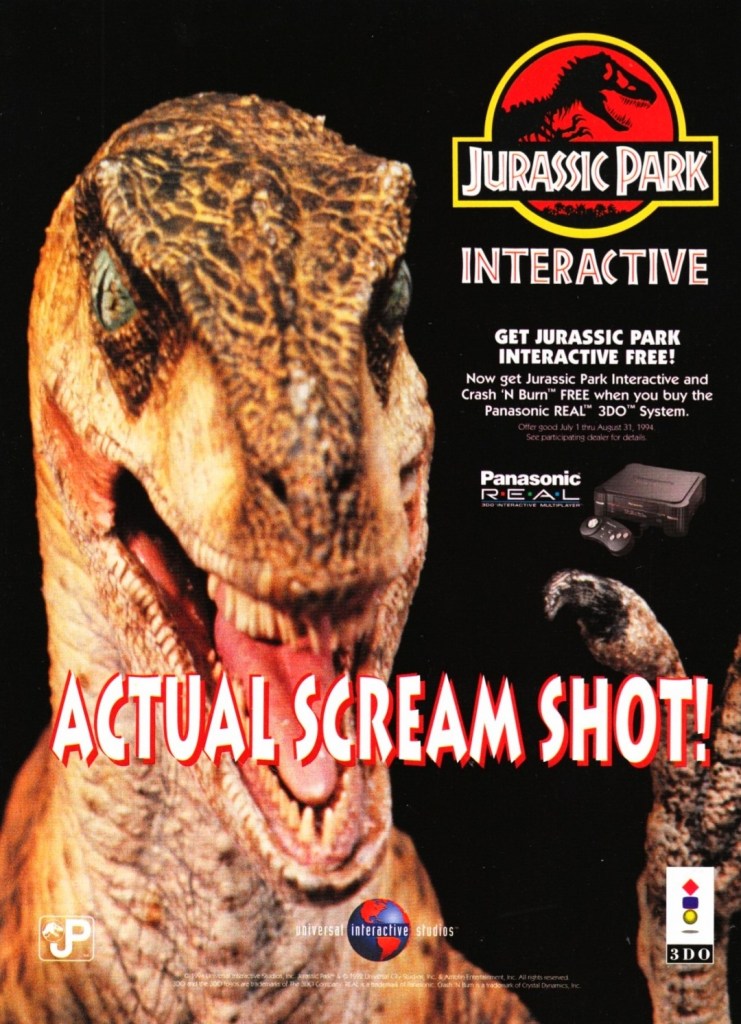
12. Jurassic Park Interactive print ad
This was a creepy print ad promoting the 3DO-exclusive Jurassic Park Interactive.
When it comes to video game consoles, having exclusive games is essential as long as they are of high quality, highly playable and enjoyable. The 3DO company acquired a license of the Jurassic Park movie and made the exclusive game Jurassic Park Interactive hoping it would sell a lot and lift up 3DO hardware sales.
This print ad, which features a zoomed-in image of the Raptor from the game, was more focused on selling the 3DO console than the video game as seen on the descriptive text. 3DO ran a promo selling the console which would entitle the buyer to get Jurassic Park Interactive and another game free. Nothing was done to describe the console’s multimedia capabilities of showing videos, images and graphics of the game (which was essentially a collection of mini-games). This print ad shows ignorance on the part of the 3DO company and the ad maker as it showed desperation happening really early in the console’s life. Notably, Jurassic Park Interactive was the only video game adaptation to use actual footage (note: the faces of the actors were edited out) and music from the film.
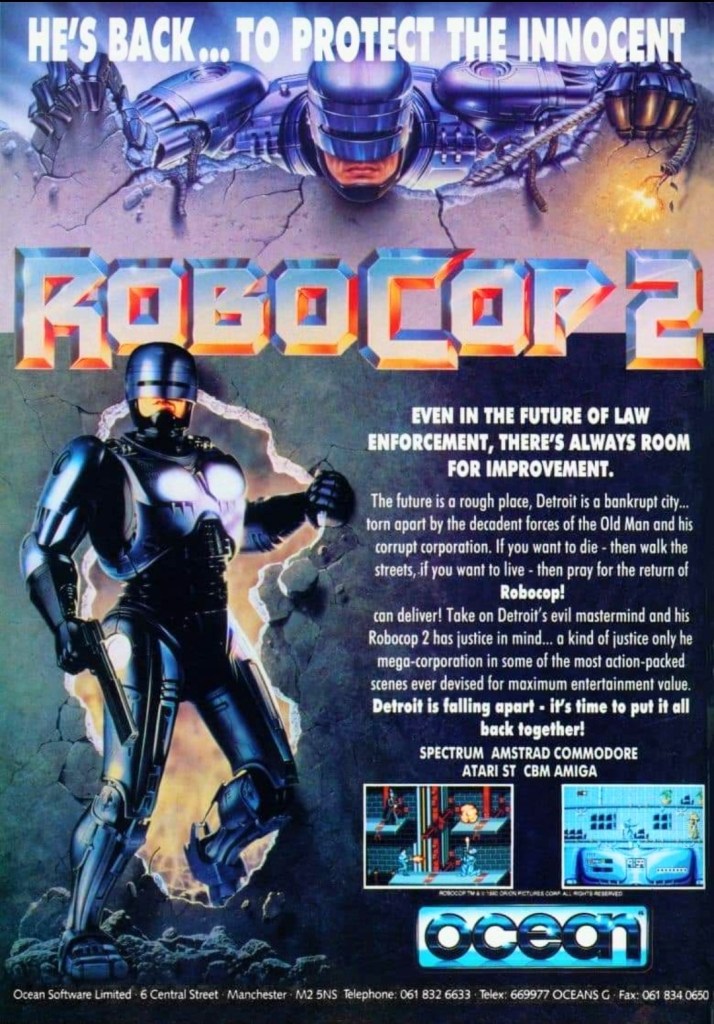
13. RoboCop 2 print ad
You want to become RoboCop to save the city of Detroit from criminals?
Way back in 1990, RoboCop 2 was a big hit in cinemas here in the Philippines and in some places around the world. As typical of the time, licenses to make video games based on the movie were released resulting in RoboCop 2 games for multiple platforms. The print ad featured two different images of RoboCop – one from the movie poster and the other from an official artwork. The descriptive text does a fine job to immerse readers into the story concept of the game but showing only two screenshots was a lackluster effort to sell the game.
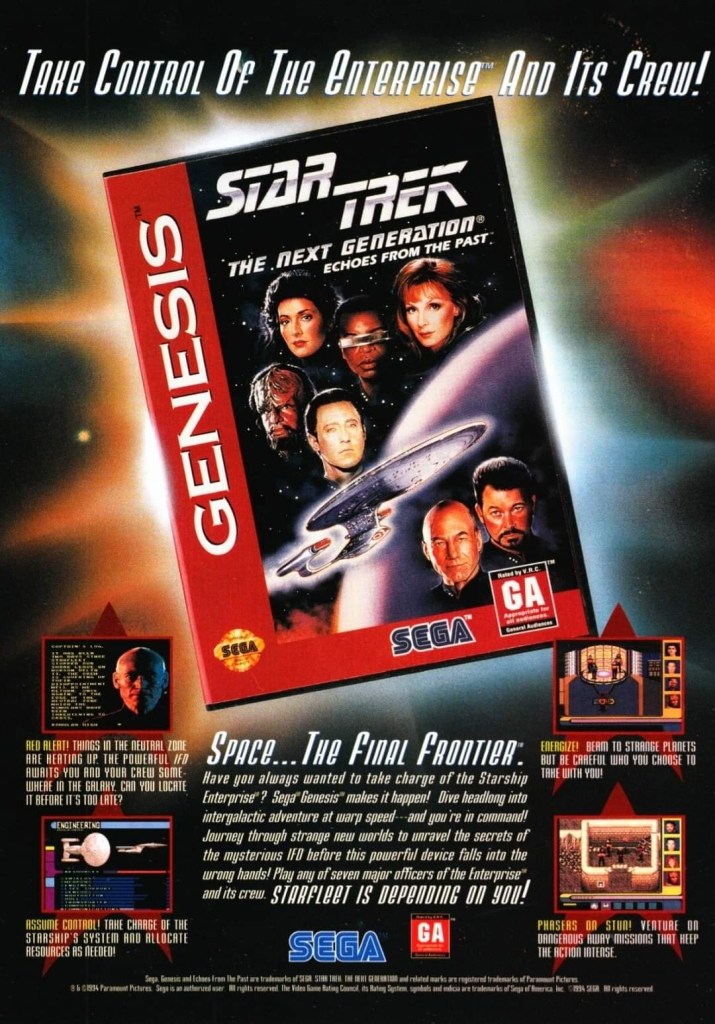
14. Star Trek: The Next Generation – Echoes from the Past print ad
Space…the final frontier waiting for Sega Genesis gamers.
Released in 1994, Star Trek: The Next Generation – Echoes from the Past delivered the Star Trek TNG adventure experience to Sega Genesis gamers. In fact, it is the exact same experience that SNES gamers got the same year. In reality, Star Trek: The Next Generation – Echoes from the Past is actually a port of Star Trek: The Next Generation – Future’s Past on the SNES and the screenshots on the print ad are giveaways about it. In fairness to the ad makers, this print ad never attempted to deceive gamers that it promoted a totally different Star Trek TNG game.
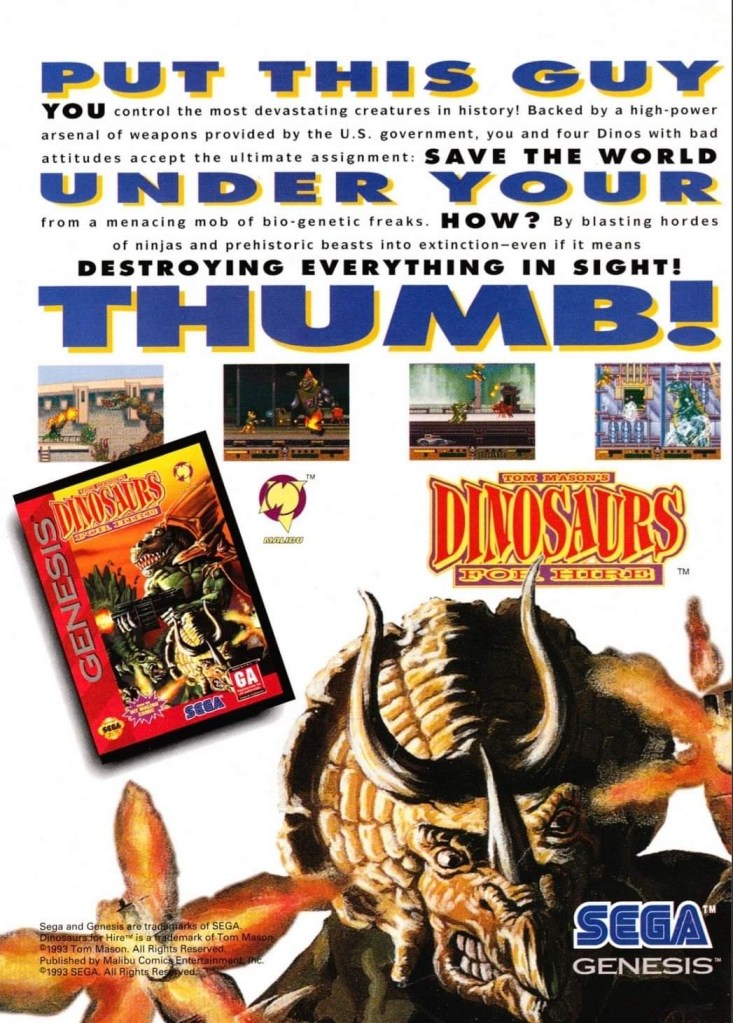
15. Dinosaurs for Hire print ad
This print ad caught my attention and made me interested in the game and the comic book series. Even though it was small, Malibu Comics’ logo was still recognizable.
Dinosaurs for Hire (sometimes referred to as Tom Mason’s Dinosaurs for Hire) was a 2D side-scrolling platform adventure game based on the comic book series of Tom Mason. Published by Sega, it was a Genesis-exclusive game and this print ad had a catchy text description, a few screenshots and the eye-catching artwork of a triceratops facing the viewer. This print ad is still good to look at. If you’re thinking about searching for existing copies of the game, I encourage you to also read some Dinosaurs for Hire comic books before playing. By the way, Tom Mason also wrote several comic books of the Ultraverse.
Welcome back, my readers, YouTube viewers and all others who followed this series of articles focused on YouTube videos worth watching. Have you been searching for something fun or interesting to watch on YouTube? Do you feel bored right now and you crave for something to see on the world’s most popular online video destination?
I recommend you check out the following topics and the related videos I found.
#1Antonio P. Antonio story featured by Dark Asia with Megan – I previous made a blog post about this (click here). Even before this blog and website of mine started, I had been following the crime story of the late Antonio P. Antonio (APA) who was killed by his own son in 2013. The son even stayed overseas for years before getting caught and brought back home to be tried in court. Eventually, justice was served for the victim’s family and I should say that YouTuber Dark Asia with Megan did a really good job explaining and emphasizing the details in an episode launched on YouTube on September 25, 2024. This is a must-see video for anyone who is interested in true crime stories as well as events related to the famous BF Homes subdivision in the Philippines.
#2 New cars are spying on drivers and violating privacy – Be very careful with what you wish for when it comes to buying a brand new car with the latest in technology. There is this disturbing trend growing in which drivers/owners of cars equipped with highly advanced technologies ended up getting violated by car companies who collected not only their personal data but also other types of information about them such as immigration status, race, facial expressions, weight, health and even genetic information. This is because the highly computerized cars can spy on drivers by capturing videos of them, recording sound, monitoring their use of car apps, and collecting data from smartphones or computers that got connected to the car’s system. Watch the videos below and pay close attention to the details.
#3 In-depth look at the elimination of Hezbollah’s top leader Nasrallah – I previously blogged about the elimination of Hezbollah leader and murderer Hassan Nasrallah and it contained relevant videos about the topic. For a new and in-depth look about his elimination and what lies ahead for Israel and the rest of the world, watch the TBN Israel and CBN News videos below. Pay close attention to details.
#4 Hunting legendary animals in Red Dead Redemption II – In the blockbuster video game Red Dead Redemption II, hunting is a huge and engaging part of the game. The game developers set up opportunities to find and hunt what they refer to as legendary animals. There is a variety of rewards that come with hunting the said animals and to find out where they are located, watch this video by Reptac.
#5 Last Action Hero videos – While it is a known fact that the movie Last Action Hero (starring Arnold Schwarzenegger) was a huge commercial and critical disappointment in 1993, there are still lots of people who enjoyed watching it and even do research about it. That being said, it is not surprising that there are lots of YouTubers out there who made videos about it and you can watch a variety of videos I selected for your viewing.
6. How terrorist leader Hassan Nasrallah got eliminated
Going back to the eliminated Hezbollah leader and murderer Hassan Nasrallah, posted below is a video that explains (to the best of the YouTuber’s ability) what happened and how the powerful strike happened there in Lebanon.
7. Multiculturalism is truly bad
We live in a very twisted world. It is so twisted, illegal aliens are violating the sovereignty and cultures of nations. Like diversity, inclusion and wokeness, multiculturalism is a disease and it is destructive. Watch and learn from PragerU’s video below.
Welcome back readers, fellow geeks and electronic gaming fans!
In this edition of the Retro Gaming Ads Blast (RGAB) series, we will take a look at another batch of retro gaming print ads from the 1980s and 1990s. In addition, there will be a few flyers of arcade games.
For the newcomers reading this, Retro Gaming Ads Blast (RGAB) looks back at the many print ads of games (console, arcade, computer and handheld) that were published in comic books, magazines, flyers and newspapers long before smartphones, social media, the worldwide web and streaming became popular. To put things in perspective, people back in the 1980s and 1990s were more trusting of print media for information and images about electronic games and related products.
With those details laid down, here is the newest batch of retro gaming print ads for you to see and enjoy…
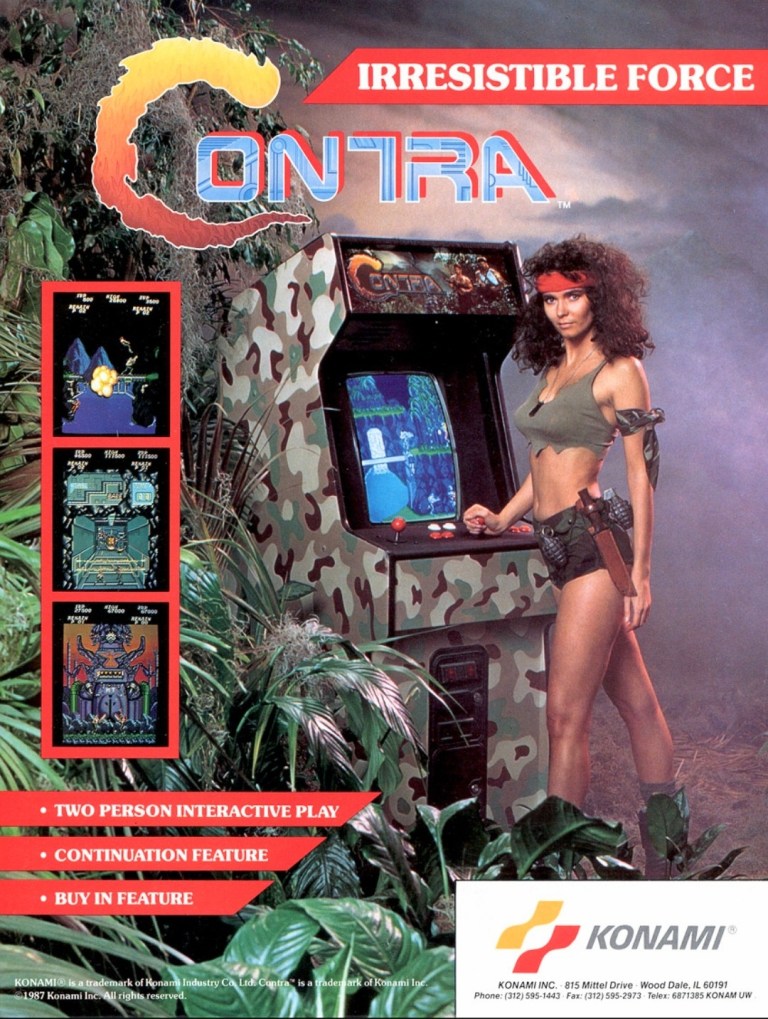
1. Contra arcade flyer
A clever visual concept by Konami towards gamers and arcade operators.
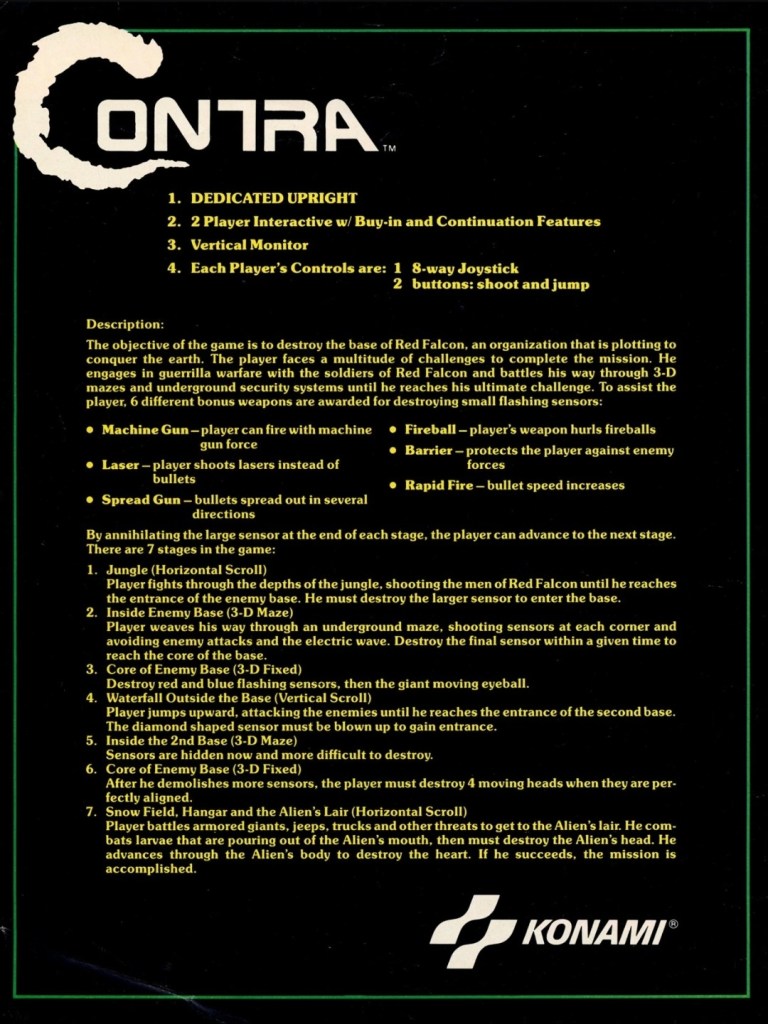
Details on the other side of the flyer.
Before it established itself as a popular gaming franchise with console gamers, Contra truly started in the arcades in 1987. First released in Japan on February 1987, Konami went on to release the game in arcades in the United States a month later and the flyer you see here was the Americanized promotion they came up with. Instead of hiring male actors or models to play soldiers, they hired a slim lady to appear with a female Rambo look standing in front of a Contra arcade machine. On the other side of the flyer are details that players and arcade operators can learn from. By today’s standards, this arcade flyer of Contra is still eye-catching and even amusing to look at.
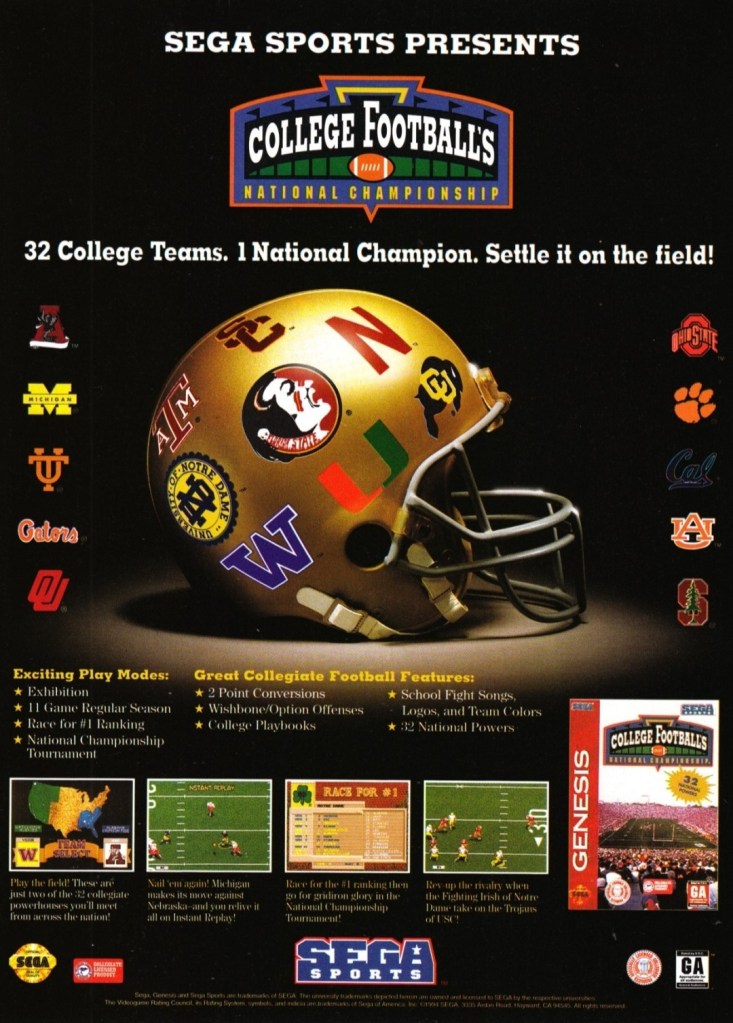
2. College Football’s National Championship print ad
This ad has a strong visual appeal to gamers who like football.
This is another one of those video game ads I saw while reading comic books in the 1990s. College Football’s National Championship was a Sega Genesis-exclusive American football video game published by Sega (with the Sega Sports brand) to capitalize on gamers who want college football to play with at home. This print ad has a nice visual presentation of the college teams’ logos, screenshots and details of what gamers could expect when they buy and play the game. College Football’s National Championship received mostly positive reviews and it must have sold well because Sega went on to release a sequel to this game.
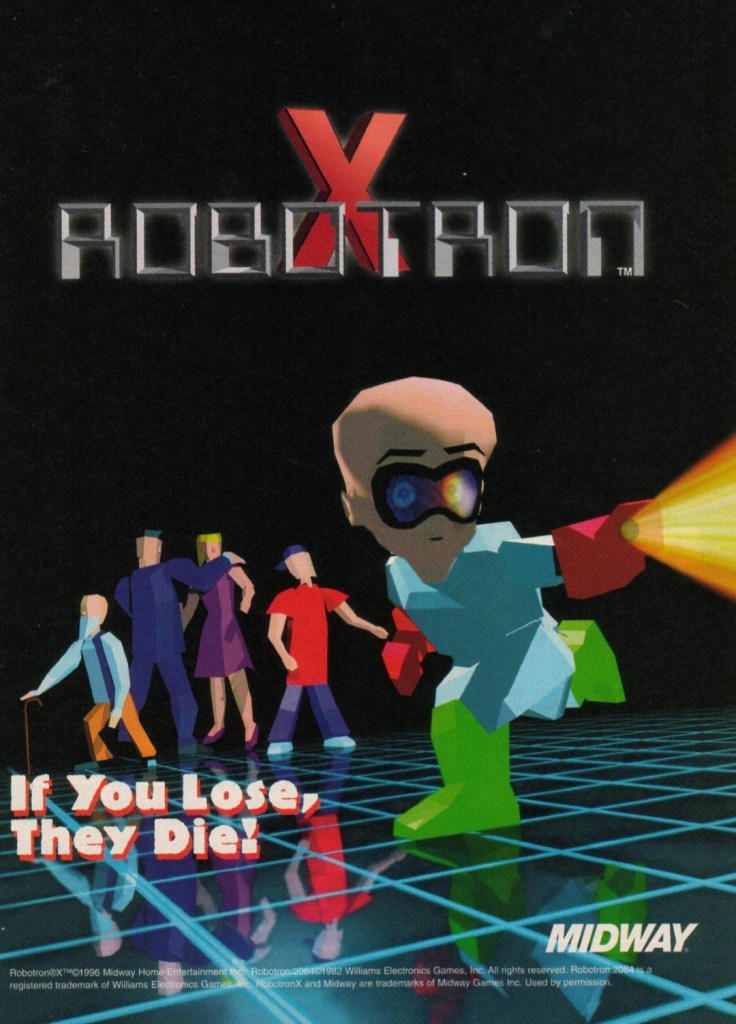
3. Robotron X print ad
This Robotron game was made at a time when 3D polygons became common for making video games.
Having played the classic game Robotron: 2084 on PC back in the 1980s, I was very surprised to see this print ad in 1996 promoting a brand new Robotron game for PlayStation as well as Windows PC. For the newcomers reading this, Robotron: 2084 was a classic which heavily influenced game designers who went on make other fan-favorite games like Smash TV and Llamatron. What makes Robotron X notable apart from being an official follow-up to the classic game was the fact that it was made at a time when game developers did their stuff to modernize gaming with 3D polygons for visuals while trying to come up with gameplay inspired by the classics. While Robotron X did not make a major impact on gaming, the classic Robotron: 2084 went on to be released in several multi-platform compilations such as Williams Arcade’s Greatest Hits, Midway’s Greatest Arcade Hits, and Midway Arcade Treasures.
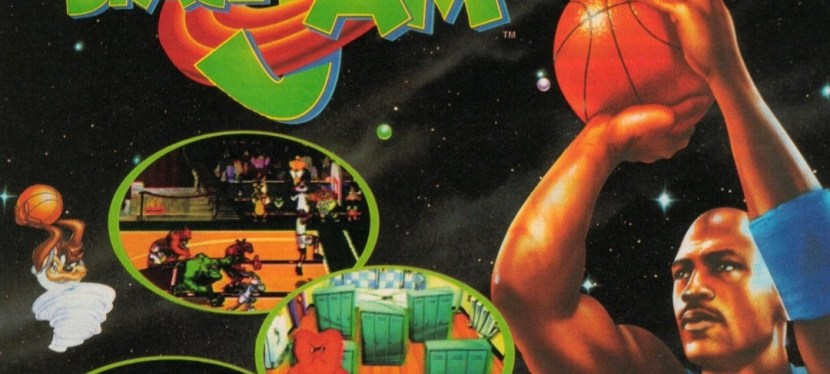
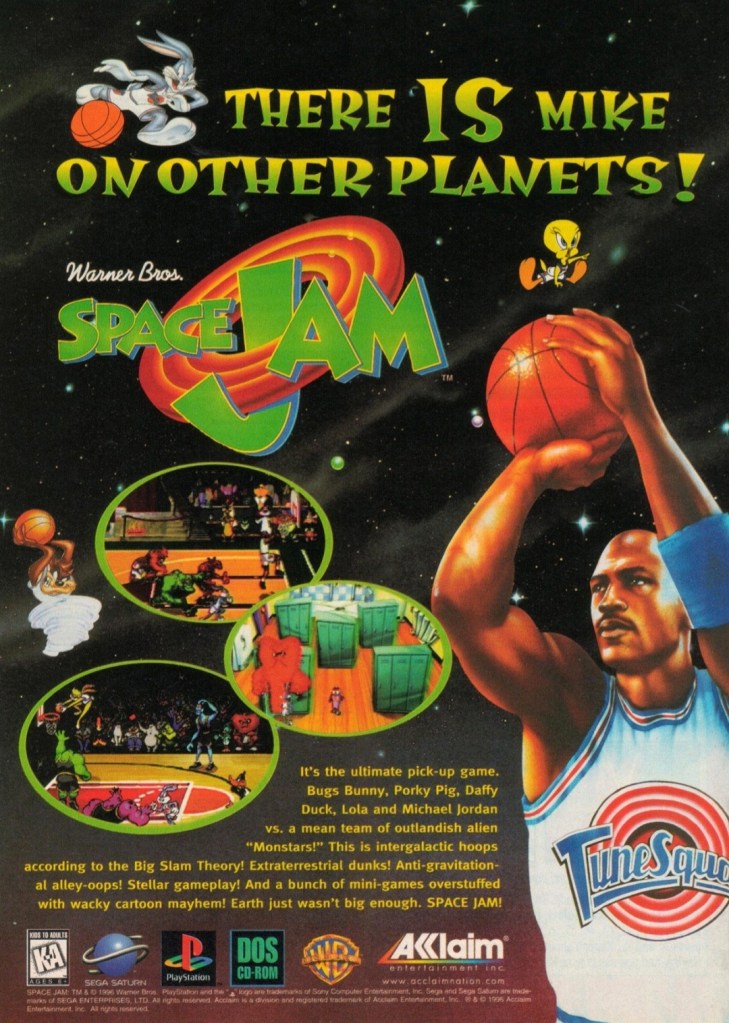
4. Space Jam game print ad
If you saw the movie in 1996, were you able to play this video game adaptation?
What makes 1996 a memorable year for basketball fans was the Michael Jordan’s return to prominence (having previously retired for less than two years before returning to the NBA in 1995) and leading a very powerful Chicago Bulls team to what was their 4th NBA championship title. In that same year, Jordan starred in the live-action/animated movie Space Jam which grossed an impressive $250 million worldwide. On the same month the movie came out, the Space Jam video game adaptation was also released on PlayStation and Sega Saturn. This print ad was part of the multimedia hype of the movie and the game itself had a very similar design and visuals concept with NBA Jam but ultimately it failed to become a hit with critics and gamers. Not even the combined visual might of Jordan and Warner Bros. characters could achieve success.
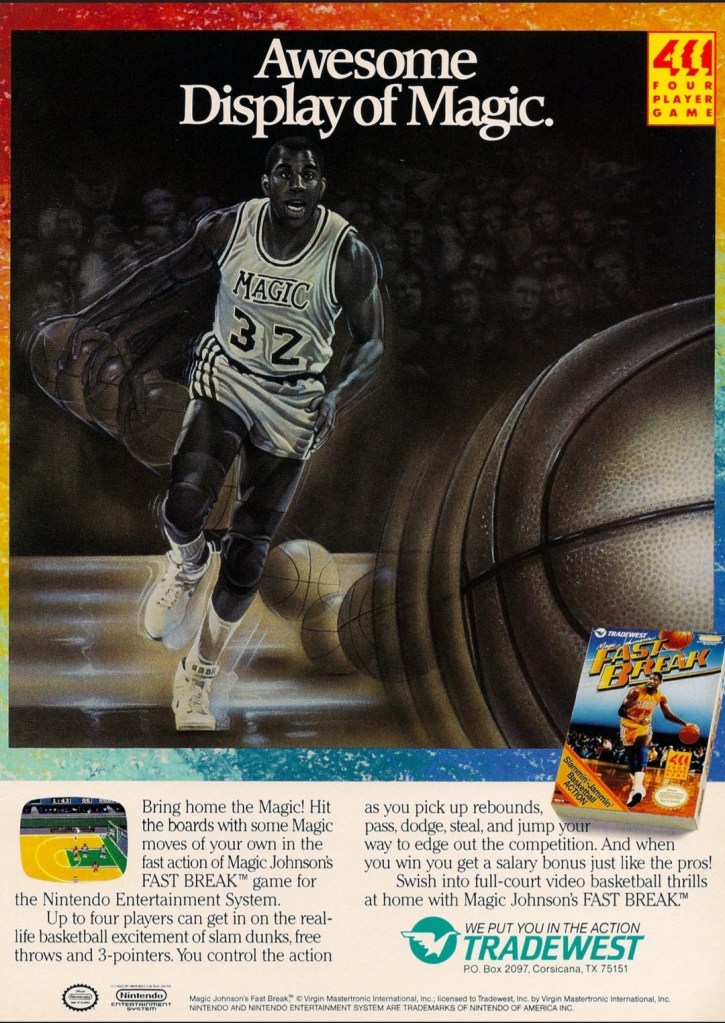
5. Magic Johnson’s Fast Break print ad
Still on basketball video gaming, the side-scrolling Magic Johnson’s Fast Break game was released on the Nintendo Entertainment System (NES) for console gamers to enjoy. Unsurprisingly, this ad had nice black-and-white art work of Magic Johnson as the dominant figure while leaving little space left to show the game box and only one screenshot. The real meat of this print ad are the details laid down in text description.
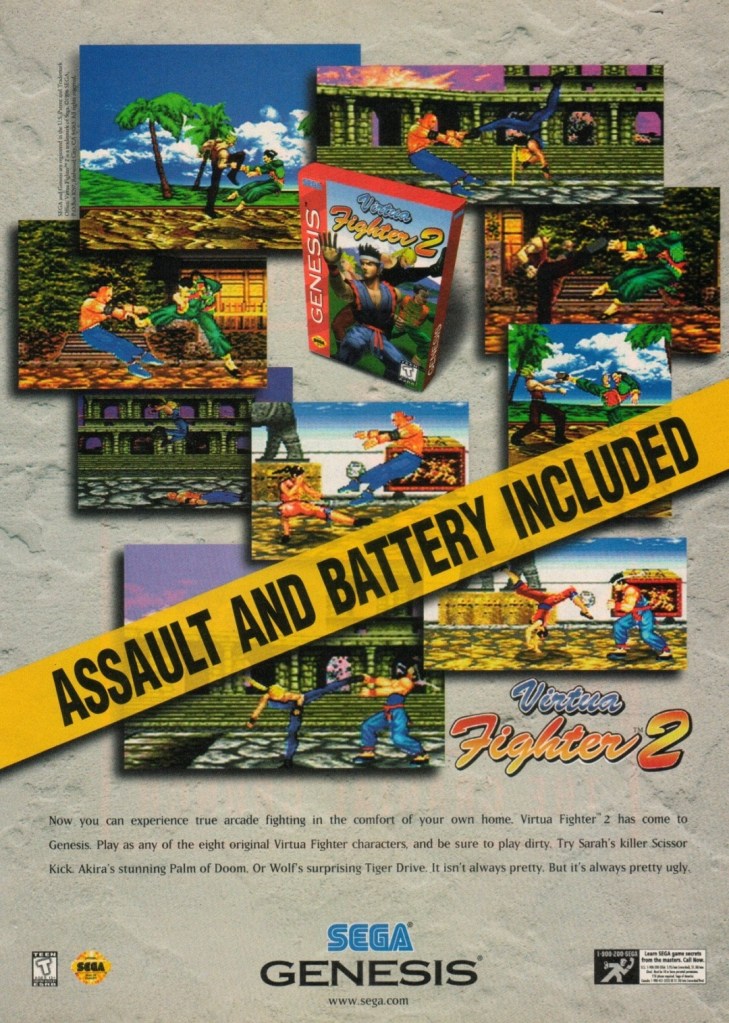
6. Virtua Fighter 2 for Sega Genesis print ad
Clearly a late effort by Sega to sell something to its many Genesis owners/fans in America at a time when PlayStation and Nintendo 64 started dominating 5th console generation sales.
In the history of arcade gaming and fighting games, Virtua Fighter 2 was a worthy follow-up to its groundbreaking predecessor. VF2 also made its way on the Sega Saturn which essentially maintained the great gameplay and 60 frames-per-second animation even though the 3D polygonal graphics were noticeably lower in quality compared to its arcade version. With VF2 in the arcades and on Saturn selling well, I was surprised to see this print ad of Sega releasing a totally different version of the game on the aging Sega Genesis console. Virtua Fighter 2 on Genesis had 2D graphics, sprites for the characters and a side-scrolling visual design. In fairness, the game developers exerted effort to recapture some of the gameplay elements within the Genesis limitations and 2D graphics. This print ad is a reminder of Sega’s American division selling a product to the remaining active Genesis owners.
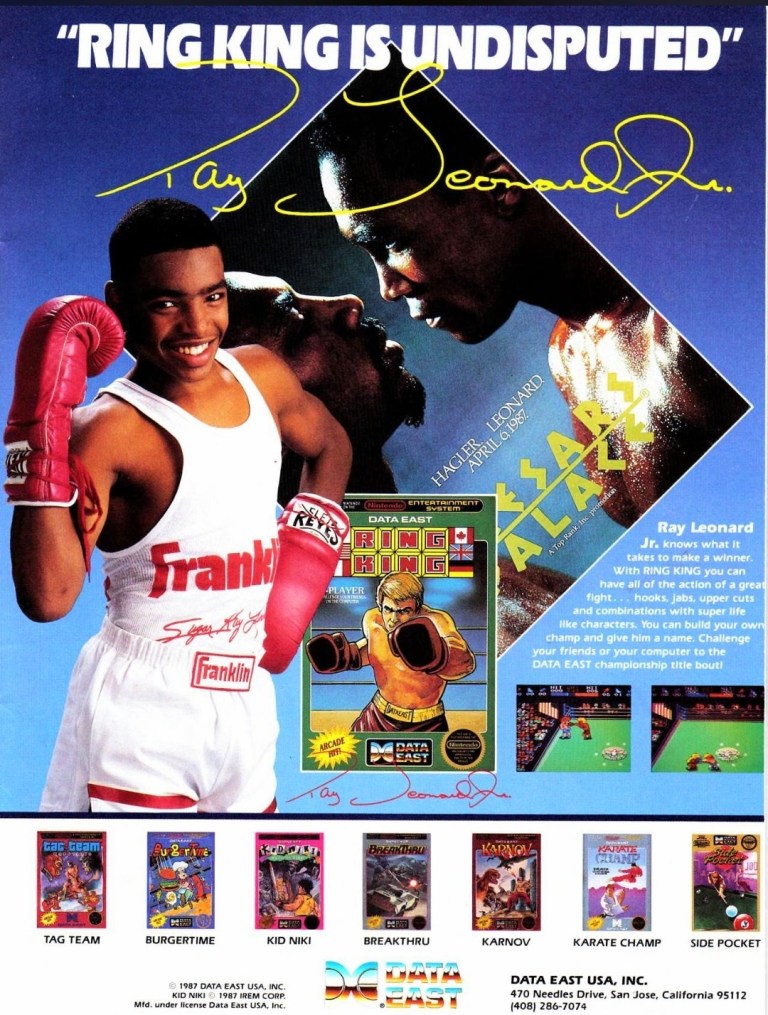
7. Ring King print ad
Ring King itself clearly lacked promotional space in this ad.
In 1987, Data East released their arcade hit game Ring King on the Nintendo Entertainment System (NES) and prepared this print ad involving Ray Leonard, Jr. (on the foreground in boxing gear) and conveniently with the famous Sugar Ray Leonard and Thomas Hearns (with the promo of their first fight together in the background). Also conveniently, the company inserted their other games on the lowest part of the ad. Ultimately, the presence of Ring King itself was minimized only showing the game cover and two screenshots. This is clearly an eye-catching ad but there was not enough emphasis on the game itself.
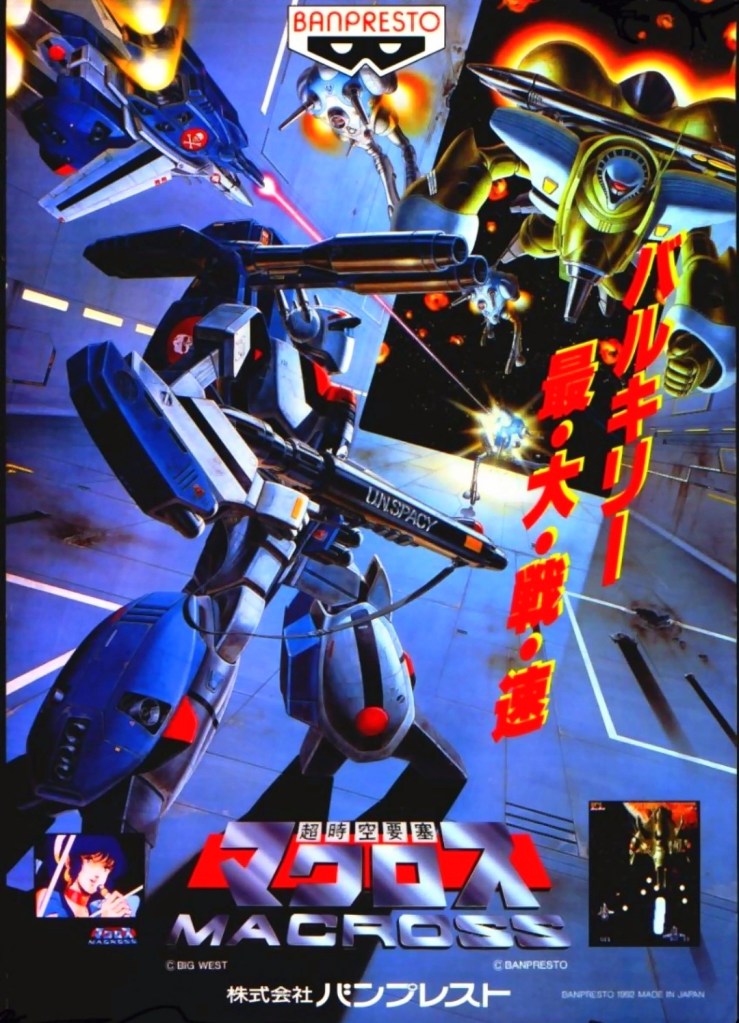
8. Super Spacefortress Macross arcade flyer
The arcade flyer released only in Japan.
Have you ever seen the classic anime movie Macross: Do You Remember Love? I really love watching that movie and I played and finished the video game adaptation on PlayStation in 1999. What I never got to play was the arcade game adaptation of it which was released by Banpresto in Japan in 1992. This flyer promoting the game has a strong visual presentation thanks to the artwork made for it. Only one screenshot was shown as well as a clip from 1984 the animated movie (note: the arcade game itself has some images directly from the film plus some newly created ones added) but this ad still had what it takes to capture the attention of the many Macross fans in Japan. This arcade game was eventually released with an English translation in America and Australia.
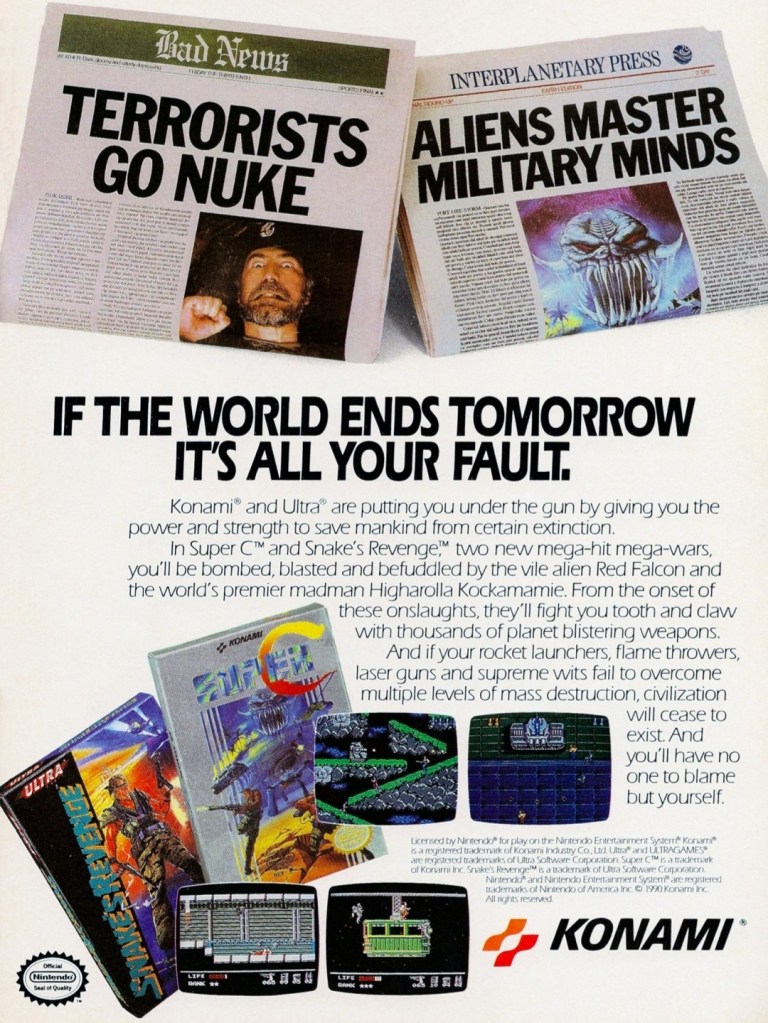
9. 2-in-1 print ad featuring Super C and Snake’s Revenge
A memorable and intriguing print ad from Konami promoting sequels.
This is one of the ads that Konami came up with to promote at least two games using a single-page ad format. I saw this ad in many comic books I read decades ago and its visual concept always caught my attention especially since I played the console game Contra a lot. At the high end of the ad were two fictional newspaper headlines highlighting the respective conflicts of Snake’s Revenge (with a nuclear danger concept) and Super C (with emphasis on alien invaders). These two games were sequels to the classics Metal Gear and Contra, and Konami clearly knew how to take advantage of the older games’ success and do their best to sell the sequels to gamers who love action-packed gaming as well as fantasized armed conflicts. Like the 2-in-1 ad showcasing Contra and Jackal, this was Konami’s aggressive move to sell war-inspired games to the NES userbase which was mostly composed of children and teenagers.
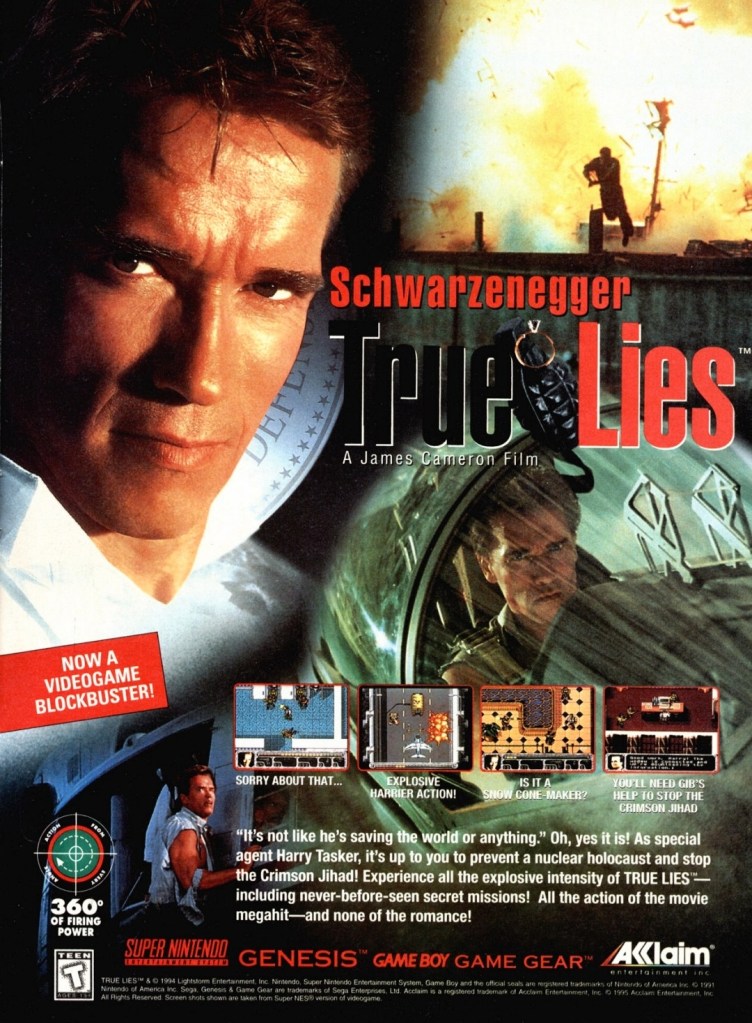
10. True Lies game print ad
There is nothing like taking advantage of the imagery of a Hollywood superstar to promote a video game based on the related movie.
Here is a video game ad I saw in many comic books I read in 1994-1995. True Lies (starring Arnold Schwarzenegger) was one of the big summer season movie hits of 1994 and the video game was part of the business tie-ins with the film. The people who made this print ad made the smart moves of showing not just one but three images of Schwarzenegger to promote the game while leaving some space to show what the game looked like. The True Lies game even had stills from the movie to emphasize the flow of the plot.
Welcome back readers, fellow geeks and electronic gaming fans!
In this edition of the Retro Gaming Ads Blast (RGAB) series, we will examine print ads from the 1980s and the 1990s that caught my attention and I will explain why they are worth look back at.
For the newcomers reading this, Retro Gaming Ads Blast (RGAB) looks back at the many print ads of games (console, arcade, computer and handheld) that were published in comic books, magazines, flyers and newspapers long before smartphones, social media, the worldwide web and streaming became popular. To put things in perspective, people back in the 1980s and 1990s were more trusting of print media for information and images about electronic games.
With those details laid down, here is the newest batch of retro gaming print ads for you to see and enjoy…
1. Operation Wolf print ad
Even though there were screenshots from the game, this was still an eye-catching print promoting Operation Wolf for the Nintendo Entertainment System.
Looking back at the history of pop culture, the 1980s saw the surge of Hollywood action movies that emphasized or even glorified militarism. Arnold Schwarzenegger, Sylvester Stallone and Tom Cruise were just a few Hollywood stars who found success playing military figures. It was not surprising that there were game developers in Japan who noticed the Hollywood military trend and were inspired to make games that had similar themes. The Japan-based company Taito developed and released the light gun shooter arcade game Operation Wolf which became a huge commercial success worldwide. Unsurprisingly, versions of Operation Wolf were eventually made for the existing home computers and game consoles of the time.
The above print ad of the Nintendo Entertainment System (NES) version of Operation Wolf only showed the official artwork, descriptive text and noticeably no gameplay screenshots. While the ad made the NES version of the game look exciting to look forward to, the actual game looked and felt nothing like the arcade version as the console’s limitations resulted in really small 2D sprites (which made shooting tough) and the 2D art used were rather ugly to see. I can only speculate that the people at Taito knew their product for the NES had sub-par quality and only hoped for the best trying to fool gamers to buy it.
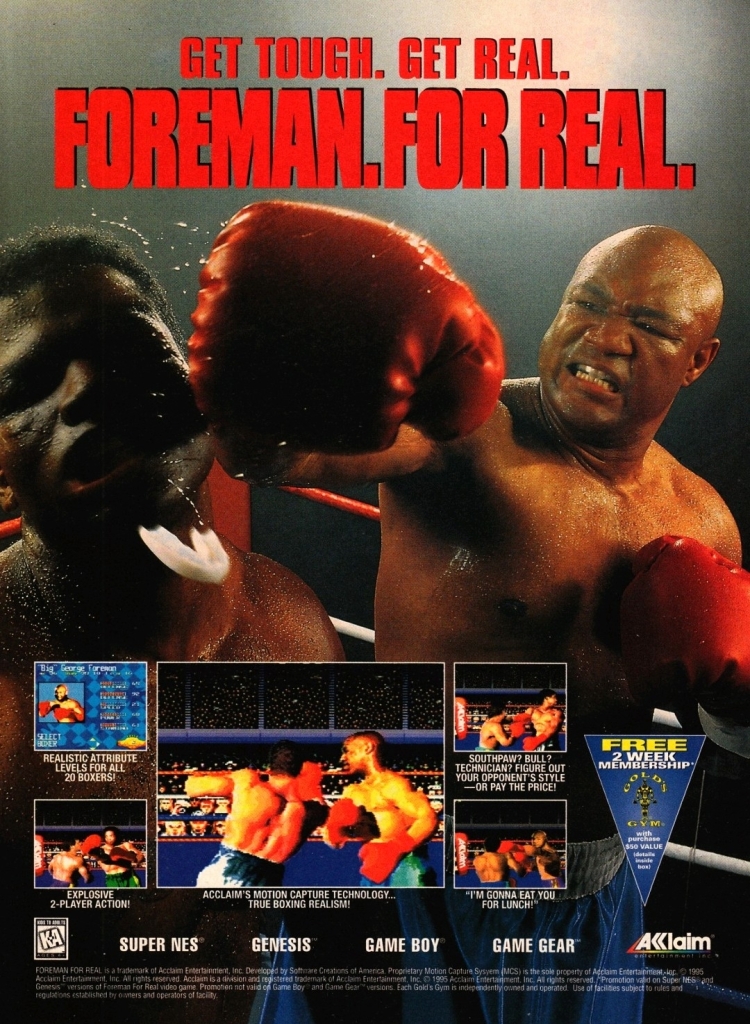
2. Foreman For Real print ad
Apart from boxing and endorsing grills, are you aware that George Foreman is also a worship leader and preacher of God’s Word?
In late-1994, George Foreman knocked out Michael Moorer to reclaim the heavyweight boxing title and the last time he had it was way back in 1974. For the newcomers reading this, Foreman halted his professional boxing in 1977, established his connection with God, preached His Word, opened a youth center and became a major product endorser. Foreman came back into fighting in 1987 and stunned everyone when he became heavyweight champion seven years later.
That being said, it was no surprise that game publisher Acclaim (which already released a video game with the boxer in 1992) quickly returned to Foreman to get him as the titular endorser in the 1995 video game Foreman For Real which was released on multiple gaming platforms less than a year after his championship victory. Apart from showing Foreman’s dominating image and screenshots from the game, the ad even had a promo of a free 2-week membership with Gold’s Gym. This ad was a lively reminder of the significance of Foreman’s presence in professional sports and it was instantly eye-catching.
3. BurgerTime print ad
Arcade hits like BurgerTime also made it into personal computers.
Previously, I showed an eye-catching print ad of the arcade classic BurgerTime. This time, the BurgerTime print ad shown here focused more on the IBM and Apple computer versions. This print ad had a photograph of an actor playing chef Peter Pepper carrying a huge burger bun running away two eggs and a hotdog, and near them were the respective boxes of BurgerTime for IBM and Apple. This is a sharp change of visual style away from the comic book-style art used in the other BurgerTime print ad. I can only imagine how excited IBM and Apple computer users became after seeing this ad back in the 1980s.
4. Shining Wisdom print ad
Even though this was a very eye-catching ad that appeared in several publications, Shining Wisdom went on to become a forgotten game after receiving mixed reviews from game review writers.
Here is another print ad of Working Designs from the 1990s. Released only on the Sega Saturn in 1996, Shining Wisdom was a fantasy action-adventure game from Japan that publisher Working Designs localized with North Americans in mind. This meant taking lots of creative liberties with the story, name changes, insertions of pop culture jokes and even altered the personalities of the characters. Developed by Sonic Software Planning and Camelot Software Planning, Shining Wisdom started as a project for the 16-bit console Mega Drive (Sega Genesis in America) that was revised for the more powerful Saturn console. While this print ad caught the attention of gamers and readers, Shining Wisdom received mixed reviews from critics upon release. Sadly, not too many gamers talk about this game anymore.
5. Cabal print ad
Military action and shooting strongly emphasized in this print ad for the Nintendo Entertainment System version of the arcade smash Cabal.
Like many games released in the 1980s, Cabal had a strong military theme and allowed players to engage in bouts of shooting playing soldiers who have to fight entire armies of bad guys. This print ad about the Nintendo Entertainment System (NES) version of the game had really nice art dominating the page, the packaging of the game plus three screenshots showing what gamers could expect. This was a very eye-catching print ad that made Cabal look both exciting and enticing.
6. Metal Gear print ad
Wow! So many weapons and pieces of equipment displayed in this Metal Gear (NES version) ad.
Back in the late 1980s, the NES port of Metal Gear had a notable promotion in America thanks to this cleverly designed print ad. When it comes to emphasizing “gear” from the title, the marketing team emphasized the words “Gear up” and literally filled the ad spaces with lots of pieces of equipment that was not only eye-catching but also gave readers the idea that a huge adventure awaits them in Metal Gear. As for the game box on the lower left corner of the print, the cover art highlighting the character Snake was an artistic copy of a still image of actor Michael Biehn as Kyle Reese in The Terminator (1984). This print ad was both entertaining and intriguing to look at.
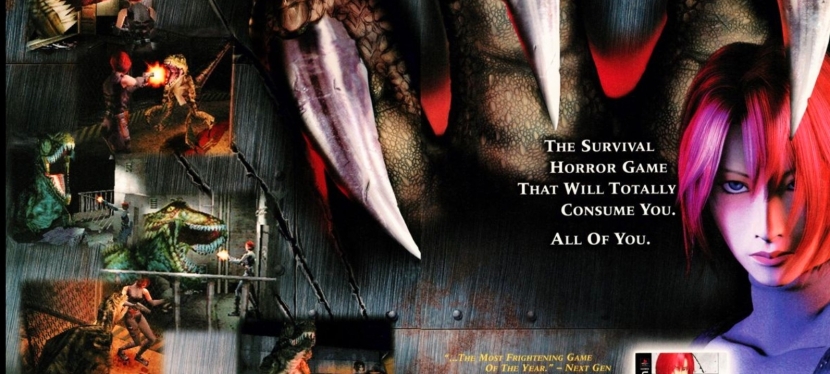
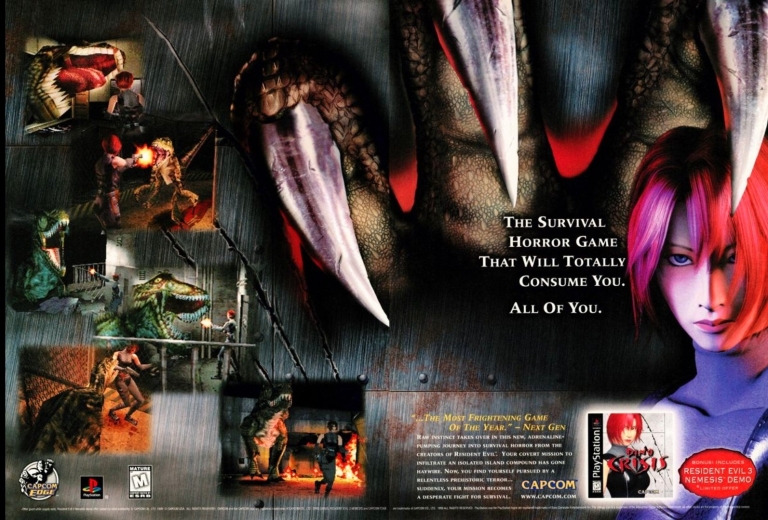
7. Dino Crisis print ad
For many gamers, Dino Crisis was like a combination of Resident Evil and Jurassic Park and this visceral looking print ad really got lots of people interested in the game.
In 1999, Capcom released Dino Crisis for PlayStation in America and the timing was almost perfect as millions of gamers who owned the console enjoyed the releases of Resident Evil and Resident Evil 2 (both games from Capcom) firmly establishing the survival horror genre as a popular one. That being said, a lot of RE fans anticipated the release of Dino Crisis due to the fact that the game shared several elements with Resident Evil games in terms of exploration, survival, control and shooting. Not only that, Resident Evil creator and original game director Shinji Mikami was in charge of the making of Dino Crisis. Mikami pointed to the films The Lost World: Jurassic Park (1997) and Aliens (1986) as influences on making the game which for most gamers was perceived as “Resident Evil filled with dinosaurs.”
The print ad above had a very engaging visual design that symbolized action, horror and tension well. Mikami clearly wanted gamers to experience the intense violence of encountering dinosaurs and this ad gave viewers a small sample of that. It’s safe to say that this print ad was effective as Dino Crisis went on to sell millions of copies and established Regina (the red-haired lady in the ad) as another memorable character from Capcom.
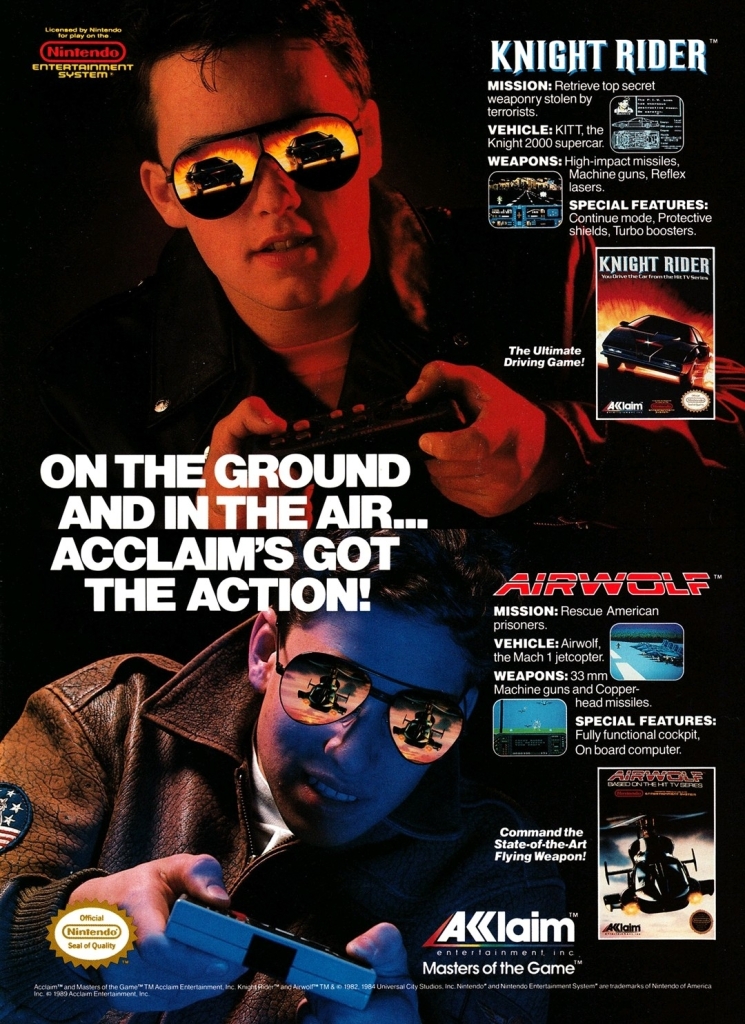
8. Airwolf/Knight Rider games print ad
Very clearly, the advertiser focused on the cool look to sell the games of Airwolf and Knight Rider.
Back in the 1980s, Airwolf and Knight Rider were wildly popular TV series that each had winning formulas to entertain millions of viewers with action, suspense and storytelling. It was not surprising that video game adaptations of them were produced on the Nintendo Entertainment System (NES). This particular print ad was an efficient way of promoting the Airwolf and Knight Rider games which featured two players looking cool with jackets and sunglasses. Acclaim clearly aimed for the TV series’ fans and slightly older players among the NES owners/users.
Welcome back, fellow geeks, Blu-ray collectors and movie buffs! Long before he went all-in with digital filmmaking and made the Avatar movies, James Cameron made a huge impact in the sci-fi action genre with the use of practical effects when they were still the standard in Hollywood filmmaking.
After making waves with The Terminator in 1984, Cameron went on to make the sequel Alienswhich became a huge success and remains a fine example of how to do sequels. To be very clear, the production of Aliens (which starred Sigourney Weaver who returned as Ellen Ripley) has a very detailed and colorful history about notable twists in Hollywood that connect it with The Terminator. As Arnold Schwarzenegger worked on a Conan sequel, production of The Terminator got delayed and along the way, Cameron – who got involved in the Alien sequel – used the extra time to make the script for Aliens (note: working title was Alien II) which was 90 pages long. That script was submitted to Fox’s then new president Larry Gordon who loved it and agreed to wait until Cameron completed The Terminator just so that he could direct Aliens.
Aliens was released in cinemas in 1986 and went on to gross over $130 million worldwide while winning mostly positive feedback from movie critics. When the film was shown on TV in 1989, a modified cut with additional scenes were shown. In 1991, the extended cut of Aliens was released on LaserDisc format and it was 20 minutes longer than the theatrical version.
In the year 2016, the 30th anniversary celebration of the movie happened with the release of a commemorative and feature-loaded Blu-ray and it contained the movie’s two cuts!
Aliens 30th Anniversary Edition Blu-ray.
On face value, the Aliens 30th Anniversary Edition Blu-ray is quite enticing to both movie fans and collectors as it contains the following content:
Theatrical Version and Special Edition of the movie (2 cuts)
NEW The Inspiration and Design of Aliens featurette
Deleted and Extended Scenes
Superior Firepower: Making Aliens
Superior Firepower: Making Aliens Enhancement
Pre-Production Galleries
The Art of Aliens
Gateway Station and Colony
Vehicles and Weapons
Aliens
Casting
Cast Portrait Gallery
Deleted Scene Montage
Look at all that stuff you will get with Aliens 30th Anniversary Edition Blu-ray! (photo source – Blu-ray.com)
Personally, I love watching Aliens which in my view is among the very best works of James Cameron and also the best movie of the entire Alien/Aliens film franchise. Through the decades I saw both the theatrical version and the special edition on different formats from video tape to LaserDisc, DVD and cable TV. The movie has Sigourney Weaver’s finest performance; a story that was crafted with a lot of inspiration; it has great action scenes, stunts and a very clever presentation of showing the Xenomorphs; it has very engaging music by the late James Horner; it has several moments of suspense that effectively served as build-ups for the action or intense pay-offs that followed; it has great creature effects by Stan Winston which proved to be an evolution of H.R. Giger’s designs; the Alien Queen was made possible by James Cameron and Stan Winston and ultimately became an essential addition into the Alien/Aliens lore; and ultimately this film moved the entire Alien/Aliens movie franchise forward creatively while respecting what was established in the first movie of 1979 (directed by Ridley Scott, written by Dan O’Bannon and Ronald Shusett).
Aliens also serves as a lively look back at the actors who made nice contributions. There was the late Bill Paxton who went on to appear in more films directed by James Cameron. There was The Terminator actor Michael Biehn who joined the film as a replacement. Lance Henriksen, who also appeared in The Terminator, played the new android Bishop which led to further appearances in two other films of the Alien film franchise.
As much as I love the movie, I have yet to acquire the Aliens 30th Anniversary Edition Blu-ray. In the back of my mind, a 4K Blu-ray release of Aliens could be announced suddenly and I have preference for 4K Blu-ray viewing. Be aware that already there is a 4K Blu-ray version of Alien in the market and even the hugely disappointing prequel Alien Covenant has a 4K Blu-ray release. With the woke Disney company in control of 20th Century Fox, there is no telling when will Aliens have a 4K Blu-ray version.
To know more about Aliens, watch the following videos below…
Disclaimer: This is my original work with details sourced from reading the comic book and doing personal research. Anyone who wants to use this article, in part or in whole, needs to secure first my permission and agree to cite me as the source and author. Let it be known that any unauthorized use of this article will constrain the author to pursue the remedies under R.A. No. 8293, the Revised Penal Code, and/or all applicable legal actions under the laws of the Philippines.
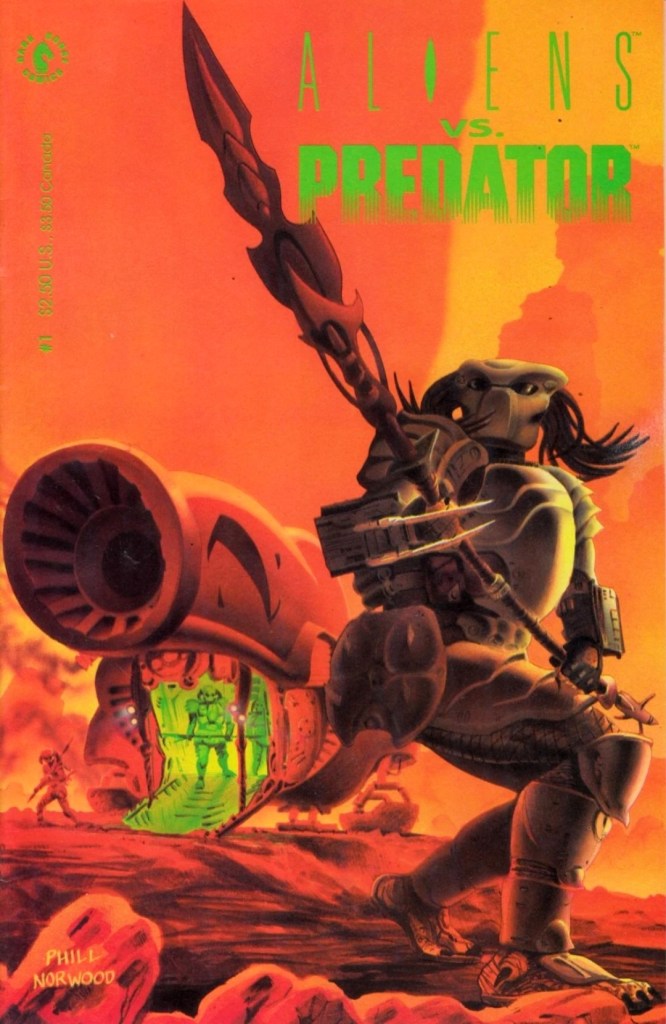
Welcome back superhero enthusiasts, 1990s culture enthusiasts and comic book collectors! Today we go back to the year 1990 to take a close look at one of the more significant non-superhero crossover comic book events ever published – Aliens vs. Predator!
For the newcomers reading this, the respective movie franchises of Aliens and Predator started many years before the comic book crossover event happened. By the year 1990, moviegoers had enjoyed Alien (1979), Aliens (1986), Predator (1987) and Predator 2 (late 1990). Cinematic between Arnold Schwarzenegger and the Predator in the jungle and that of Sigourney Weaver and the Queen Alien became unforgettable sequences for many millions of people. It should be noted that an Alien head was shown near the end of Predator 2 emphasizing a crossover.
With those details laid down, here is a look back at Aliens vs. Predator #1, published in 1990 by Dark Horse Comics with a story written by Randy Stradley and drawn by Phill Norwood.
The cover.
Early story
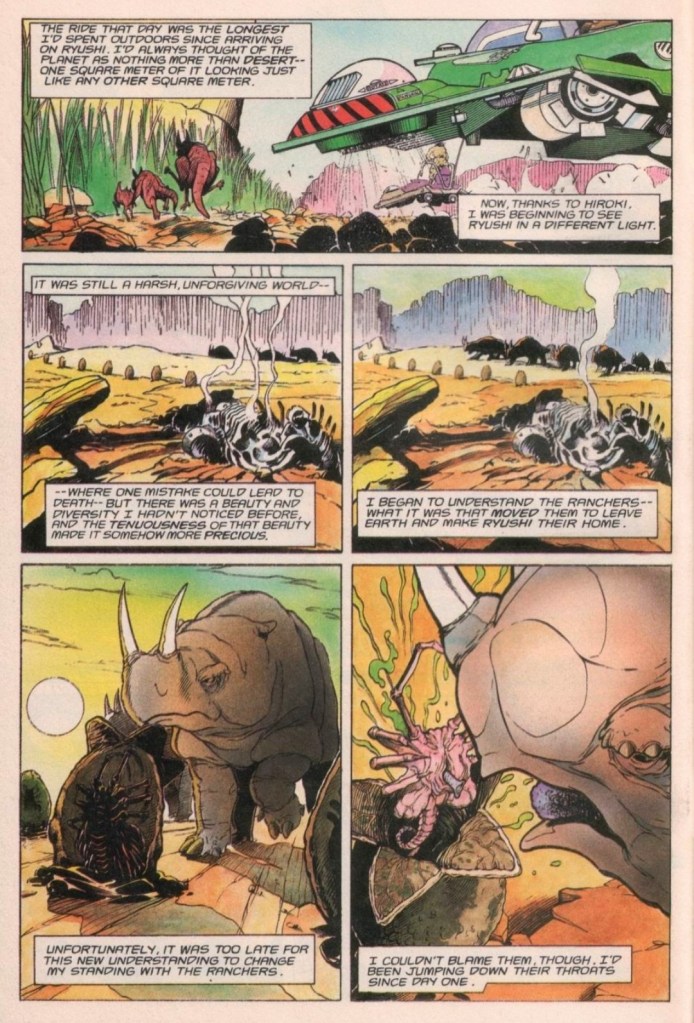
The story begins in space when a fast-moving ship enters the atmosphere of Ryushi, a planet at the edge of the Chigusa Corporation’s holdings in the Beta Cygni System. On the planet is Prosperity Wells, a human outpost with a population of one hundred fifteen composed of freelance ranchers, their families and a staff of corporate overseers.
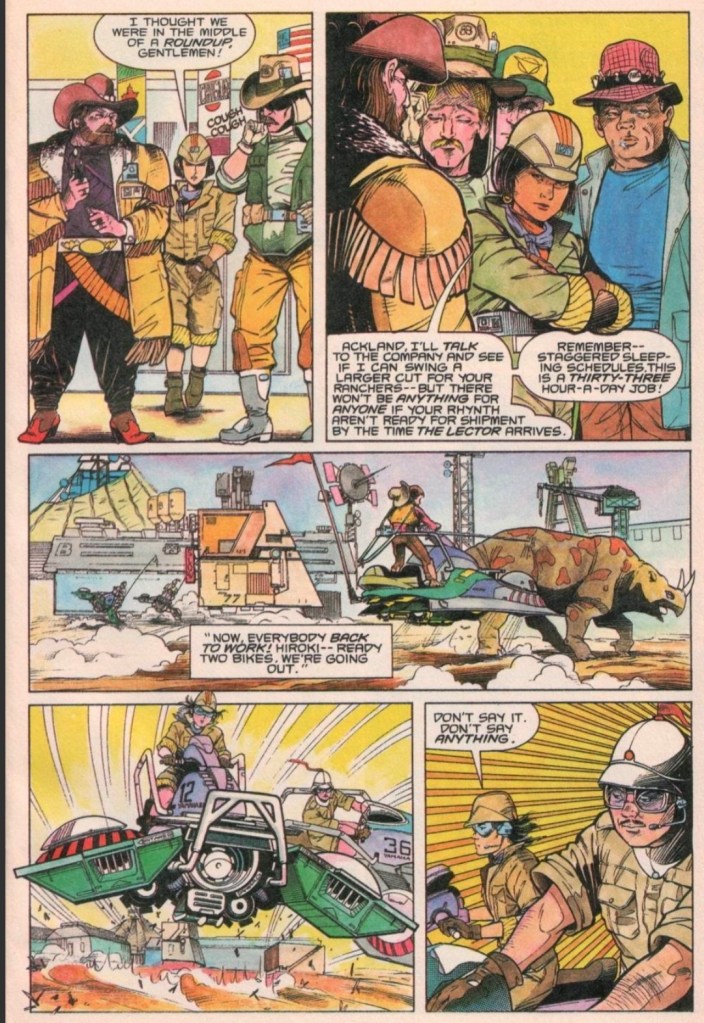
The ship’s presence gets detected by operators at Prosperity Wells and one of them speculated it to be a meteor that shows no signs of breaking up. Seeking Hiroki Shimura (no longer the head of the outpost), the operator instead contacts his replacement Machiko Noguchi and informs her about the perceived meteor. After talking with the operator, Noguchi tells her predecessor near her that even though she has been leading the outpost for nearly six months, people are still reporting to him as they treat her like a stranger. Shimura tells her that she’s been trying to adapt the job to her rather than adapting herself to it, and that she cannot just run an operation while hiding from it.
Meanwhile in the wilderness, a machine starts to climb out of the pit and starts releasing Alien eggs…
Quality
Whenever there are Alien eggs, trouble is inevitable.
I can say that this comic book is essentially one long build-up that intends to execute the conflict between the Aliens (also referred to as the Xenomorphs) and Predators later. While the two galactic species are indeed here, the narrative is told mainly through the humans whose operations – ranching, business administration, outpost activities – are emphasized with heavy and precise details. The result here is that by the end of the comic book, you will be fully immersed with the sci-fi concept, the characters and the related developments which ultimately will prepare you for the inevitable Aliens-Predator conflict. To put it clearly, Stradley crafted a script that efficiently introduces the characters (note: Noguchi is the clear protagonist), emphasize what has been going on while also moving the story forward in a well-paced manner without compromising the details.
That being said, don’t expect the Aliens and Predators to fight each other immediately here. This is one big build-up as a whole and very notably, there is nothing boring and there were no useless scenes portrayed. Everything told and shown in this comic book made sense, and if you are the kind of person who likes paying close attention to details of the story as well as the gradual development of the key characters, you will find this one an engaging read. The narrative moved at a medium pace and cleverly the suspense happens whenever the creative team gradually build-ups the tension for the inevitable Aliens-Predators fight.
As with many other entertainment tales across varied media forms, this story has a critical portrayal of the corporation slightly emphasizing greed while making the contractors (technically the laborers) look disadvantaged. It is not a one-sided portrayal against corporatism, however, as there were moments showing the contractors relying on deception (note: disregarding quality and the safety of consumers who will soon consume the products from the ranching operation) just to achieve their goals.
More on the protagonist Machiko Noguchi, she is not the typical corporate figure for readers to hate. In fact, she is somewhat sympathetic as she is has yet to earn the respect of others even though she had been working as the head of the outpost for months. The grudge against her is subtle yet clear. The comic book also made clear that she is destined for something significant in the upcoming fight between the two galactic species.
The art by Phill Norwood is very good. While the characters have that comic book aesthetic, the Aliens and Predators are easily recognizable and were drawn with sufficient visual details. What I find weird is the creative team’s approach on applying color on the Predators. Norwood also has a really nice approach on illustrating futuristic stuff (examples: the technologies, office equipment, clothes of the characters) while also emphasizing the wilderness of Ryuchi.
Conclusion
Machiko Noguchi takes charge even though she is despised by many.
Aliens vs. Predator #1 (1990) is one very detailed build-up type of comic book that happens to be pretty engaging to read and the set-up for the expected conflict between the two species worked nicely. By the time I reached the end of this tale, I got immersed into its concept, the situations and characters. The build-up also came out with really interesting parts here and there which made the reading experience a very good one. Right now, I am eager to read the next issue.
Overall, Aliens vs. Predator #1 (1990) is highly recommended!
Welcome back, fellow geeks, film enthusiasts and Blu-ray/4K Blu-ray collectors!
If you are based in England and you love the works of Arnold Schwarzenegger and James Cameron, as well as the bastardized Terminator film franchise, then you might be interested in the just announced new 4K Blu-ray of Terminator 2: Judgment Day coming from StudioCanal which you can order online right now for £60.00. It is set for a December 6, 2021 release as of this writing.
Coming out this December.
To be more specific, this newest 4K Blu-ray of the 1991 blockbuster film is a commemorative edition highlighting its 30th anniversary.
Posted below are key details of Terminator 2: Judgment Day 4K Blu-ray combo from its Blu-ray.com page.
Video
Codec: HEVC / H.265
Resolution: Native 4K (2160p)
HDR: HDR10
Aspect ratio: 2.35:1
Original aspect ratio: 2.39:1
Audio
English: DTS-HD Master Audio 5.1
English: Dolby Digital 2.0
Subtitles
English SDH
Discs
4K Ultra HD
Blu-ray 3D
Blu-ray Disc
Five-disc set (1 BD-66, 2 BD-50, 2 LPs)
Packaging
Slipbox
DigiPack, Inner print
Playback
4K Blu-ray: Region free
2K Blu-ray: Region B
And here are details of the special features and technical specs from the Blu-ray.com announcement…
PREVIOUSLY COMPLETED 4K RESTORATION OF THE FILM
T2: Reprogramming The Terminator documentary (including exclusive interviews with James Cameron, Arnold Schwarzenegger, Edward Furlong and many more) – 55 mins
2 Feature Commentaries; 23 Members of Cast & Crew (1993)/Director James & Co-Author William Wisher
The Making of T2 (1993)
Seamless Branching Of The Theatrical Version (137 mins approx.)
Special Edition Version (154 mins approx.)
Extended Special Edition Version (156 mins approx.)
2 Deleted Scenes With Audio Commentary
Trailers – T2:3D (2017)
T2 Theatrical Trailer ‘This Time There Are Two’/’Same Make New Mission’/’Building The Perfect Arnold
Optional English SDH subtitles for the main feature
Extra stuff and fine packaging aside, the above-mentioned “PREVIOUSLY COMPLETED 4K RESTORATION OF THE FILM” confirms that the new 4K Blu-ray will not have a brand new remaster which alone concerns me as a collector and fan of the movie. I’ve read Blu-ray.com’s review of the previous 4K Blu-ray of Terminator 2 (the product released by Lionsgate Films) which rated its 4K video quality with a score of 2.5 out of 5 while the 2K video quality was rated 3/5. In that same review, it was mentioned that there was a near absence of film grain and an altered color palette resulting “a kind of greenish-teal tone to several scenes that never had them before.”
Personally I’m not too confident about this upcoming release from StudioCanal. The picture quality for 2K and 4K viewing should be nothing less than excellent. As for you movie fans and Blu-ray collectors reading this, you will have to do your analysis before making the crucial decision to buy this 4K Blu-ray of Terminator 2.
Thank you for reading. If you find this article engaging, please click the like button below and also please consider sharing this article to others. If you are looking for a copywriter to create content for your special project or business, check out my services and my portfolio. Feel free to contact me as well. Also please feel free to visit my Facebook page Author Carlo Carrasco and follow me at HavenorFantasy@twitter.com
Disclaimer: This is my original work with details sourced from reading the comic book and doing personal research. Anyone who wants to use this article, in part or in whole, needs to secure first my permission and agree to cite me as the source and author. Let it be known that any unauthorized use of this article will constrain the author to pursue the remedies under R.A. No. 8293, the Revised Penal Code, and/or all applicable legal actions under the laws of the Philippines.
Like any geek, I still love watching Terminator 2: Judgment Day, specifically its extended version which was James Cameron’s true vision. I’m not exactly a fan of Arnold Schwarzenegger, but I really love his work in T2 as well as in Total Recall. When it comes to James Cameron’s works, I personally prefer T2 over Avatar, Titanic and True Lies.
As for the Terminator franchise itself, it spawned cinematic sequels that only turned up as disappointments. Terminator 2 was indeed the high point of the film franchise and everything really went downhill afterwards. I should state that Terminator: Dark Fate should be avoided as it is not worth your time and money.
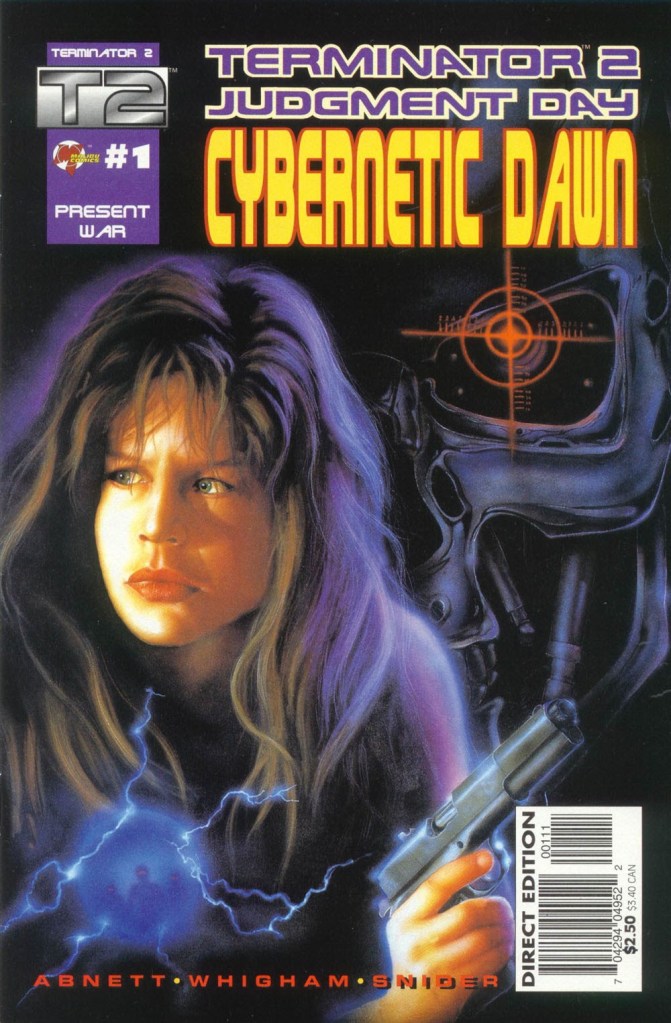
Recently, I searched for some comic books that served as sequels to Terminator 2 and I found one from the mid-1990s and it is a direct follow-up! We can find out more in this look back at Terminator 2: Cybernetic Dawn #1, published in 1995 by Malibu Comics with a story written by Dan Abnett and Rod Whigham.
The cover.
Early story
The story begins immediately after the end of Terminator 2 with the injured Sarah Connor (with a very exhausted John Connor sleeping) still managing to drive the car in the middle of the night. As she drives, Sarah recalled that she never asked for the responsibility of preserving mankind as it was forced on her way back in 1984. She also recalled the time in Tech Noir when the Terminator almost killed her as she got saved by Kyle Reese.
By morning, Sarah and John reached the desert and returned to the lonely home of her old ally Enrique. Suddenly a man with a shotgun comes out and aims his weapon directly at Sarah. Carrying a gun, John comes out to help his mother…
Quality
John and Sarah Connor.
Let me start with the story and make clear to you readers that this comic book easily defies the conclusion that was set in the movie Terminator 2. If you have seen the film, you should be aware that the way it was concluded made sure there is no more future war and no more Terminators. Like the 2003 movie Terminator 3: Rise of the Machines, this comic book just kept on pushing the concept that Judgement Day and the war with the machines are still inevitable and that Terminators from the future would only continue to arrive to hunt and kill John. As such, the hard struggle for Sarah and her son continues.
That being said, this comic book really pushed hard with its sequel approach. Remember what happened in the steel mill in Terminator 2? Several personnel investigated the facility and one particular detective arrived searching for Sarah Connor who has been labeled as an escapee from the state hospital. Inside the steel mill is the severed left arm of the Terminator (which got stuck to crushing mechanical wheels as seen in the 1991 movie) which is the storytelling key the comic book creators used to justify this sequel.
To the comic creators’ credit, they did their research about T2 and even made references to other characters of that movie. As a result, this comic book appears loaded with fan service.
Even though it has many references and connections to the 1991 movie, this comic book also has some completely new stuff to expand on T2’s concept. The destruction of Cyberdyne’s facility in the movie resulted an emergency meeting of a corporation’s board of directors (and a certain senator) which creatively sets up further conflicts as well as struggles for Sarah and her son.
In terms of writing, this comic book’s story is cohesive enough. As for the art, the quality is fine and most notably, the illustrator managed to somewhat capture the likeness of Linda Hamilton on Sarah Connor.
Conclusion
The severed Terminator arm as the single factor that justified this sequel somewhat.
I can say that Terminator 2: Cybernetic Dawn #1 (1995) is a surprisingly satisfying read mainly due to its writing and artistic quality. While its push to justify a sequel barely succeeds, there is more good stuff than negative ones overall. As far as making sequels to Terminator 2 is concerned, this one is somewhat more believable than the 2003 movie.
If you are seriously planning to buy an existing hard copy of Terminator 2: Cybernetic Dawn #1 (1995), be aware that as of this writing, MileHighComics.com shows that the near-mint copy of the comic book costs $19.
Overall, Terminator 2: Cybernetic Dawn #1 (1995) is satisfactory.
+++++
Thank you for reading. If you find this article engaging, please click the like button below and also please consider sharing this article to others. If you are looking for a copywriter to create content for your special project or business, check out my services and my portfolio. Feel free to contact me as well. Also please feel free to visit my Facebook page Author Carlo Carrasco and follow me at HavenorFantasy@twitter.com
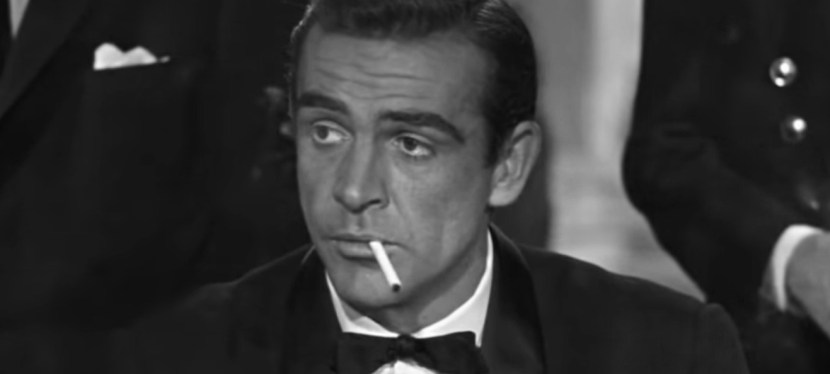
Like anyone else, the first thing I ever heard about Sean Connery when I was very young was that he was the original cinematic James Bond under the watch of Albert R. Broccoli as producer (note: Broccoli’s company continues to produce movies of Agent 007 until now). Being born long after Connery’s six Bond movies were released, the first time I saw him play Agent 007 was in 1983’s Never Say Never Again which was a big budget remake of 1965’s Brocolli-produced Thunderball. On its own, Never Say Never Again was NOT produced by Brocolli but by Jack Schwartzman and Kevin McClory (who was the legal rival of Ian Fleming).
While iconic Agent 007 made him famous, Connery himself got fed up with the role and he ended up having conflicts with Albert Brocolli. Connery wanted to prove he could do more than just play the British Secret Service agent repeatedly.
“I have always hated that damned James Bond,” Connery said. “I’d like to kill him.”
A few years after playing Agent 007 one last time on the big screen in Never Say Never Again, Connery struck gold with his performance in The Untouchables. His portrayal of cop Jim Malone earned him the Academy Award for Best Supporting Actor.
A few years after that achievement of his, I saw Connery in what I personally consider to be his finest non-James Bond role in the form of Henry Jones, Sr. in Indiana Jones and the Last Crusade opposite Harrison Ford. There was great father-and-son chemistry between Connery and Ford in that movie very finely directed by Steven Spielberg.
In ending this article, here are some YouTube videos related to the film works of the late Connery for your enjoyment. By the way, check out my retro review of Dr. No.
+++++
Thank you for reading. If you find this article engaging, please click the like button below and also please consider sharing this article to others. Also my fantasy book The World of Havenoris still available in paperback and e-book format. If you are looking for a copywriter to create content for your special project or business, check out my services and my portfolio. Feel free to contact me as well. Also please feel free to visit my Facebook page Author Carlo Carrasco and follow me at HavenorFantasy@twitter.com












 Author Carlo Carrasco