A Look Back at Charlemagne #1 (1994)

Welcome back superhero enthusiasts, 1990s arts and culture enthusiasts, and comic book collectors! Today we go back to the mid-1990s to explore a part of Defiant Comics through the Charlemagne series.

For the newcomers reading this, Defiant Comics was a comic book publisher founded by former Marvel Comics and Valiant editor-in-chief Jim Shooter. Defiant was established as a result of Shooter’s departure from Valiant and there were even some creators from the previous company who joined him as staffers in the new company. Defiant’s initial titles were Warriors of Plasm, The Good Guys and Dark Dominion. Charlemagne was part of the second wave of titles launched.

With those details laid down, here is a look back at Charlemagne , published in 1994 by Defiant Comics with a story plotted by Jim Shooter, Philip Nutman, Adam Pollina, Deborah Purcell and D.G. Chester, written by Chester and drawn by Pollina.  

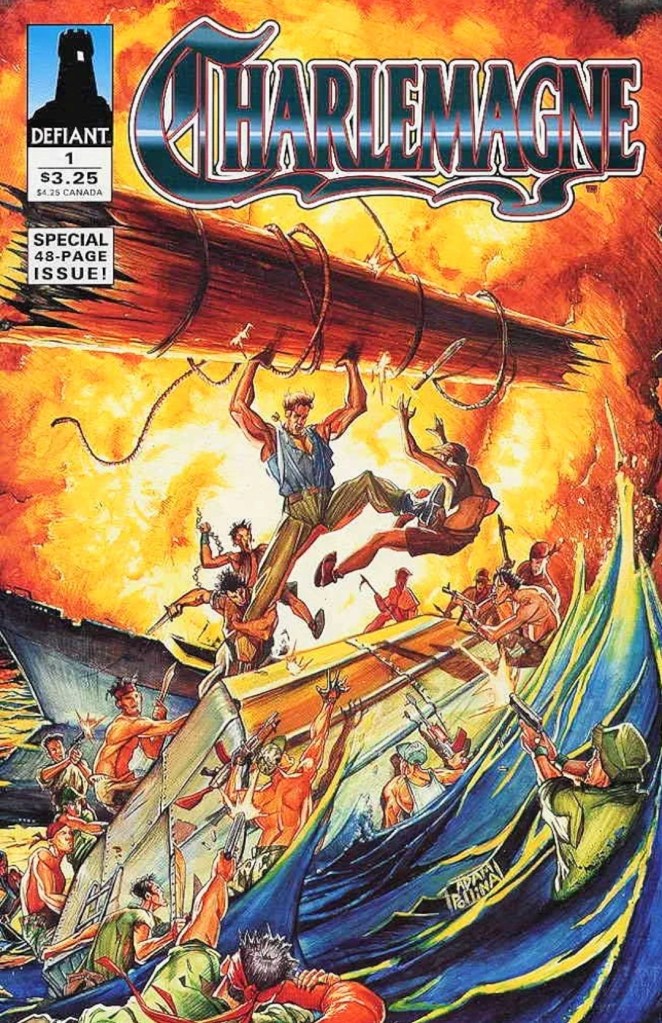
The cover.

Early story

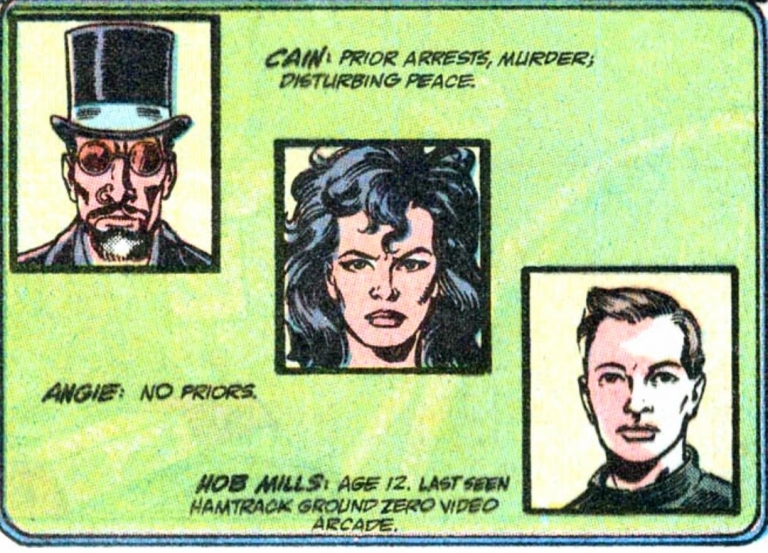
The story begins in 1973 in the state of Kentucky. 12-year-old boy Charles has been feeling uneasy since it was reported that his older brother Pete serving in Vietnam has been missing-in-action. The father tries to comfort Charles who responds by asking him if he read Pete’s letters. By reading the letters, Charles paid attention to the details that described Vietnam and he even felt like was he was there. The young boy feels like he could find his missing brother.

A short time later as he and his father play baseball pitching outside, an important telephone call was received by the mother. It was Major Forney from the Pentagon searching for the father to give him updates about his missing son in Vietnam. It turns out the reports from Hanoi did not list Pete among the prisoners held there and chances on finding him are very slim. The father refused to accept his son’s status.

After hearing his father’s phone talk with the major, Charles refuses to believe his brother’s dead and immediately goes up to his room and starts preparing for a daring, solo travel to Vietnam…

Quality

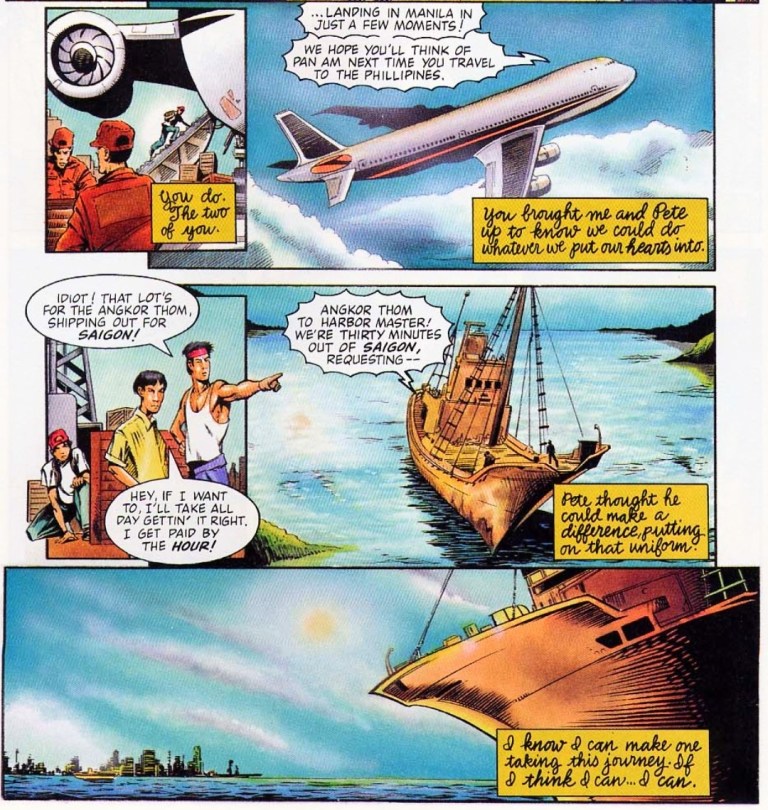
Incredibly, Charles travels from America to the Philippines by air, then to Vietnam by ship. How he got past security is beyond me.

If there is anything that would best describe the story of this comic book, it is a pretty enduring tale that moved with a slow-to-medium pace. That’s not to say it is not worth following. In fact, the narrative the writers came up with is quite gripping and as it flows on, you will really get to know the protagonist Charles and witness how his personality develops as he pushes through with his very daring pursuit of his missing brother in the middle of Vietnam.

Indeed, there is a superhero element in this story and the way it was emphasized by the creative team is actually unusual and experimental. The most defining element of Charles’ character is his uncompromising determination to find his older brother no matter what the odds. Without spoiling the plot, I can say that the superhero elements of Charles develop late in the story and the way they were presented is truly intriguing.

Of course, there are some questionable things about the story. Charles’ solo journey (note: he ran away from his parents at home leaving a letter) from America going into Vietnam as a young boy undetected is already unbelievable. His unrelenting search in Vietnam that lasted not days but actually a few years is even more unbelievable. These raises questions as to how much money did the young boy have to support himself with, and where did he stay to rest during the few years he spent in the Southeast Asian nation ravaged by war. If anything, this tale comes with a strong element of fantasy made to look like it happened during the Vietnam War.

Apart from Charles, there are a few supporting characters who happen to be interesting to focus on. Through the one Vietnamese support character – the doctor – you will get to see certain aspects of local society as well as the American and Communist Vietnam sides.

Conclusion

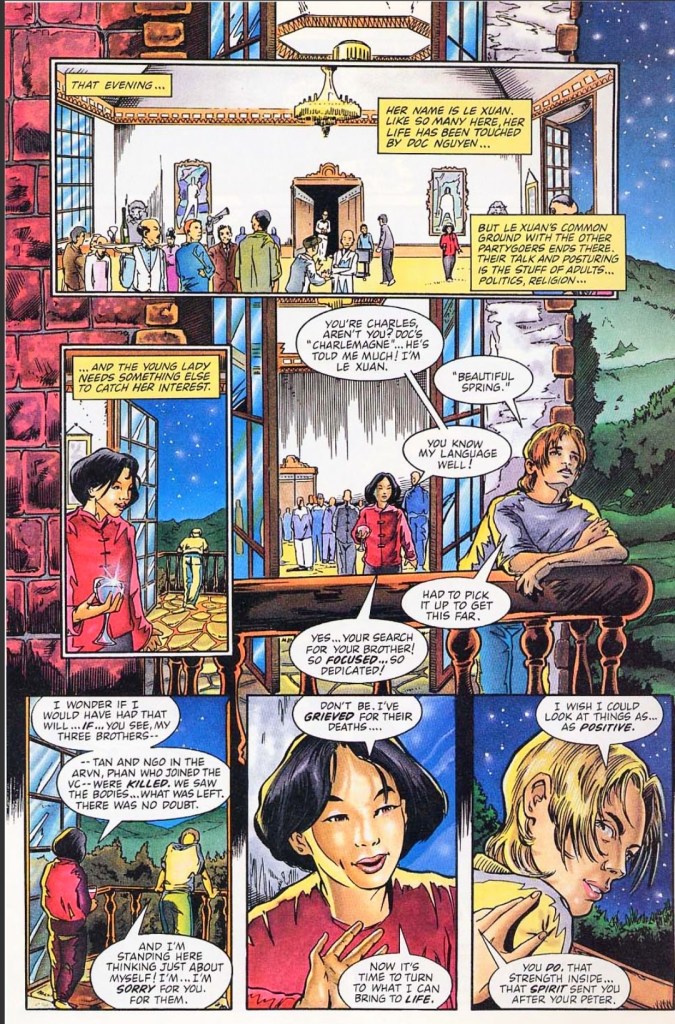
Charles experiences a taste of luxury in Vietnam.

Charlemagne (1994) is ultimately an engaging and pretty intriguing read. This comic book’s superhero elements and spectacle are pretty light but the build-up of Charles (and his development into Charlemagne) is quite powerful to read. This tale turns out to be an origin story of Charlemagne and you will realize that when you read it from start to finish. Considering how this comic book turned out, I’m convinced to find out more in the next issue.

Overall, Charlemagne (1994) is recommended.

+++++

Thank you for reading. If you find this article engaging, please click the like button below, share this article to others and also please consider making a donation to support my publishing. If you are looking for a copywriter to create content for your special project or business, check out my services and my portfolio. Feel free to contact me with a private message. Also please feel free to visit my Facebook page Author Carlo Carrasco and follow me on Twitter at  @HavenorFantasy as well as on Tumblr at https://carlocarrasco.tumblr.com/ and on Instagram at https://www.instagram.com/authorcarlocarrasco

Retro Gaming Ads Blast – Part 4

Welcome back readers, fellow geeks and retro gaming fans!

In this edition of the Retro Gaming Ads Blast (RGAB) series, we will examine print ads from the 1990s that caught my attention and I will explain why they are worth look back at. In retrospect, the 1990s was a decade of serious changes in the world of electronic gaming as the industry saw the shift of graphics from 2D sprites and flat backgrounds to 3D polygons, the shift from cartridges to CDs for software distribution, and more.

For the newcomers reading this, Retro Gaming Ads Blast (RGAB) looks back at the many print ads of games (console, arcade, computer and handheld) that were published in comic books, magazines, flyers and newspapers long before smartphones, social media, the worldwide web and streaming became popular. To put things in perspective, people back in the 1980s and 1990s were more trusting of print media for game details and images.

With those details laid down, here is the newest batch of retro gaming print ads for you to see and enjoy…

1. Castlevania: Bloodlines print ad

Creepy looking but not horrific. The simplistic approach turned out to be effective on making Sega Genesis gamers excited for this Castlevania release.

During the early stage of the so-called 16-bit console wars, Konami’s Castelvania series made the huge next-generation leap with Super Castlevania IV on the Super Nintendo Entertainment System (SNES) which gave gamers loads of fun challenges along with technological improvements that added to the gameplay. Being a prolific multiplatform game maker, Konami knew it could not abandon its fans who own the 16-bit console of Sega and this led them to making a unique Castlevania experience with the Sega Genesis in mind – Castlevania: Bloodlines.

The above print ad of Castlevania: Bloodlines was very eye-catching as it showed a photographic presentation of the grave of the Belmont family (note: Simon Belmont is arguably the most known hero of the series) backed with a detailed text description as well as screenshots that showed exactly what Castlevania fans expected with gameplay and presentation. While the visual style of the ad had a subtle approach to horror, it succeeded in informing the public that another fun-filled Castlevania experience was coming. The game went on to be a hit among gamers and critics.

2.  The Granstream Saga print ad

THQ really tried hard to sell The Granstream Saga in North America at a time when a lot more Japanese RPGs started coming into the market.

Back in the late 1990s, there was a slew of Japanese role-playing games (JRPGs) that got released on the PlayStation console in North America arguably because of the massive sales success of Final Fantasy VII in 1997. In 1998, THQ (note: then a newcomer in video gaming) made the daring move to release The Granstream Saga in North America and it was part of the company’s plan of releasing more RPGs. With regards to the 1998 print ad, THQ marketing team wisely emphasized the fact that the game launched at #1 in Japan (published by Sony) although, strangely, the rest of the short descriptive text did not emphasize the fact that the game was one of the first fully polygonal RPGs ever released. The ad had one image of an animated cut scene while there were two gameplay images. When I first saw the print ad, I became interested with The Granstream Saga as I was fond of both RPGs and anime. I never got to play it due to a lack of time and money back then.

3. NBA Action 98 print ad

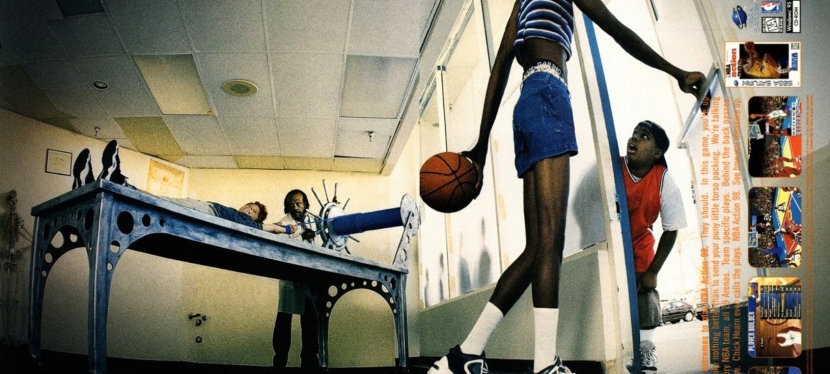
Do you find this print ad funny or disturbing or both?

The first time I saw Sega’s print ad of NBA Action 98 (a polygonal NBA basketball video game for the Sega Saturn), it caught my attention quickly mainly because of the concept of the imagery showing a really tall guy leaving the place after getting stretched to be tall (as emphasized by an adult operating a machine to stretch another kid’s body to get taller) as a kid from outside looks on. While it looked hilarious at first, the photographic imagery also had an unintentional dark tone as the adult operating the machine looked like he was torturing the kid. This print ad was really eye-catching in a rather disturbing fashion to me, so much so I did not have any interest left to check out the advertised game. The small size of the screenshots and the hard-to-read descriptive text did not help at all. In my view, this was a marketing misfire by Sega.

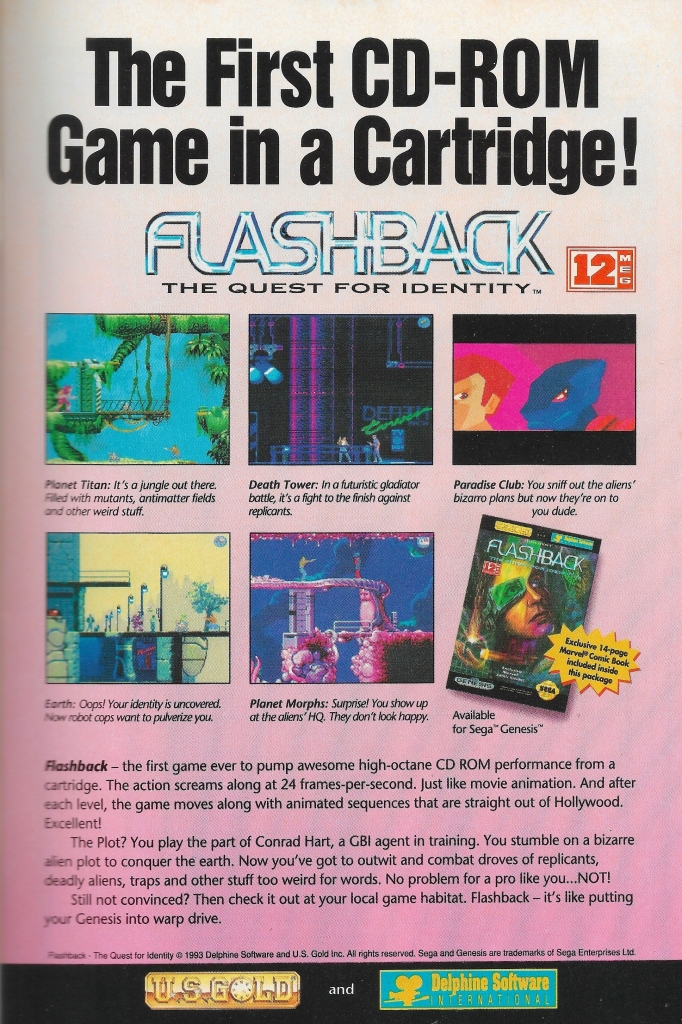
4. Flashback: The Quest for Identity print ad

This was indeed an eye-catching print ad.

Back in the 1990s, the CD-ROM was cutting edge technology in the world of computing and CDs (compact discs) helped game companies have their game content as well as multimedia files (example: full motion videos or animated scenes) released together conveniently. In the middle of the decade, a version of the game Flashback: The Quest for Identity (note: a game with computer-generated animation scenes previously released on PC) was released in cartridge format for the Sega Genesis as well as the Super Nintendo Entertainment System (SNES). This was a big deal back in the days of the so-called 16-bit console war and the above print ad clearly emphasized it with the description “The First CD-ROM Game in a Cartridge!” The advertisers also assured consumers that the in-game 24 frames-per-second frame rate, the Hollywood-inspired high-quality visuals and related gameplay elements were intact for consoles. When I saw this particular ad, I became convinced to buy the game for my SNES (read my retro review by clicking here). To see how Flashback looks like on Sega Genesis, watch this.

5. Albert Odyssey: Legend of Eldean print ad

To make things clear, Albert Odyssey: Legend of Eldean is not based on any anime property. It was the 3rd game of its series and the first and only one to be released in English.

There is no denying the fact that Working Designs (closed since 2005) contributed a lot to console gaming by localizing and releasing several Japanese role-playing games (JRPGs) in America at a time when such games were not yet popular. Apart from the Lunar RPGs and Dragon Force, the company brought Albert Odyssey: Legend of Eldean to the Sega Saturn console in America and they had a very eye-catching print ad promoting it. Like their ads for Lunar RPGs, the Albert Odyssey: Legend of Eldean print ad had a dominating anime-style artwork that highlighted the fantasy concept and characters, plus screenshots and in-game animated (note: not anime but detailed pixel artworks) sequences that were meant to attract RPG enthusiasts and gamers looking for the next-generation console gaming experiences. It should be noted that Albert Odyssey: Legend of Eldean was actually the 3rd game of its franchise that started in Japan, and it was the first and only Albert Odyssey game to ever be released in English. To this day, Albert Odyssey: Legend of Eldean still has not been re-released nor remastered for other consoles and original Sega Saturn copies of the game are very expensive to acquire. That being said, this particular print ad is a lively reminder of Albert Odyssey’s only Western release.

6. Resident Evil 3: Nemesis print ad

Capcom efficiently showed the new monster Nemesis, screenshots of the game and the return of Jill Valentine in this 1999 print ad.

After the release of the best-selling and acclaimed Resident Evil 2, Capcom approved the production of several Resident Evil projects that include sequels and spin-offs. Along the way, Sony announced in 1999 that the PlayStation 2 console will come out in 2000 and this had an impact on Capcom’s RE projects as many of them were being developed for the aging PlayStation (PS1) console. Before the PS2 announcement, Capcom had a PS1 RE game project with its story set on a cruise ship. That project was abandoned following the PS2 announcement and because Capcom did not want to leave its fans to wait too long for another Resident Evil adventure on PS1, they reviewed their list of proposed spin-off games and went ahead making Resident Evil 3: Nemesis (Japanese title: Biohazard 3: Last Escape) for a late 1999 release while the PS1 console was still in good demand.  

In the above 1999 print ad, Resident Evil 3: Nemesis was shown with 3 screenshots assuring RE fans that the game has the tried-and-tested design of polygonal characters/monsters moving within pre-rendered environments, the action, the horror and adventure elements of the previous games. More notably, the new monster Nemesis had the biggest image and he rightfully became the main antagonist until the very end.

Lastly, the RE3 print ad featured the return of Jill Valentine (one of the protagonists of the first Resident Evil) and this time she had a clear sexualized look wearing a tube top and a mini-skirt. As I mentioned in my RE3 retro game review, I believe that the sexualized look of Jill was done by the game developers who were most likely influenced by the sexy appeal and iconography of the character Lara Croft from the Tomb Raider series of games. Like Lara Croft, Jill is sexy and capable of fighting with guns and other weapons. Whatever the intention of Capcom and the development behind the game, the print ad (which even had wrongful details about the timing of the story) clearly worked on getting RE fans and gamers’ attention as Resident Evil 3: Nemesis sold more than 3 million copies on PS1.

+++++

Thank you for reading. If you find this article engaging, please click the like button below, share this article to others and also please consider making a donation to support my publishing. If you are looking for a copywriter to create content for your special project or business, check out my services and my portfolio. Feel free to contact me with a private message. Also please feel free to visit my Facebook page Author Carlo Carrasco and follow me on Twitter at  @HavenorFantasy as well as on Tumblr at https://carlocarrasco.tumblr.com/ and on Instagram at https://www.instagram.com/authorcarlocarrasco

A Look Back at X-Men Adventures Season II #1 (1994)

Welcome back superhero enthusiasts, 1990s arts and culture enthusiasts, Marvel Comics fans and comic book collectors! Today we go back to the mid-1990s to explore the adaptation of the start of the second season of the X-Men animated series in the form of the X-Men Adventures comic book series.

Before getting to the retro comic book review, I want to address the recent controversy and criticism of the new animated series X-Men ’97, a continuation of the popular 1990s series that turned out to be woke by featuring the so-called non-binary presentation of people. In my view, this is not surprising given the fact that the very woke Disney company has owned Marvel Entertainment for many years now and its wokeness has infected the animated X-Men franchise along with the most recent movies and shows of the Marvel Cinematic Universe (MCU). Wokeness and Leftist beliefs continue to ruin entertainment and established properties as we know it. It’s the culture of Communist-filled Hollywood (Commiewood).

So how do you reject X-Men wokeness apart from avoiding X-Men ’97? You simply go back to the X-Men animated series of the 1990s as well as the comic books that adapted the stories.

With those details laid down, here is a look back at X-Men Adventures Season II , published in 1994 by Marvel Comics with a story written by Ralph Macchio and drawn by Andrew Wildman.

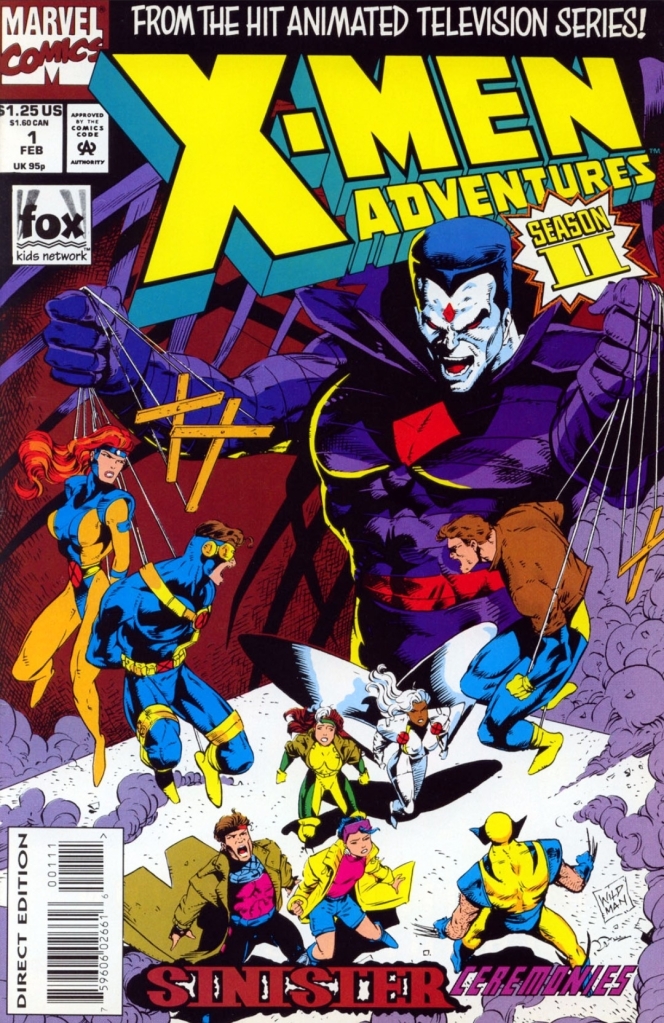
The cover.

Early story

The story begins with the cosmic being the Watcher carefully examining the flow of events on Earth and what has changed for the X-Men since then. Robert Kelly, who previously had an anti-mutant agenda when he was a U.S. Senator, has since been elected as the President of the United States and openly pushes for a policy of conciliation with mutants. His action sparks social unrest.

Meanwhile inside a small church far away from the nation’s capital, the wedding of Jean Grey and Scott Summers pushes through with several members of the X-Men in attendance. Very notable was the absence of Wolverine who turned out to be inside the Danger Room (deep within Charles Xavier’s estate) fighting a giant-sized version of Cyclops…

Quality

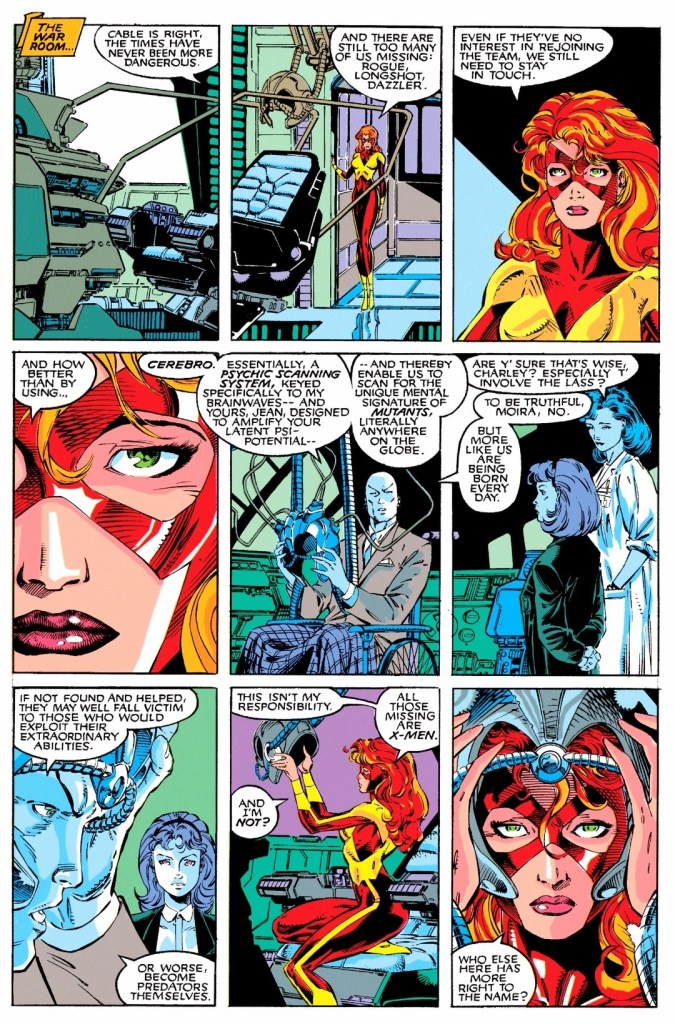
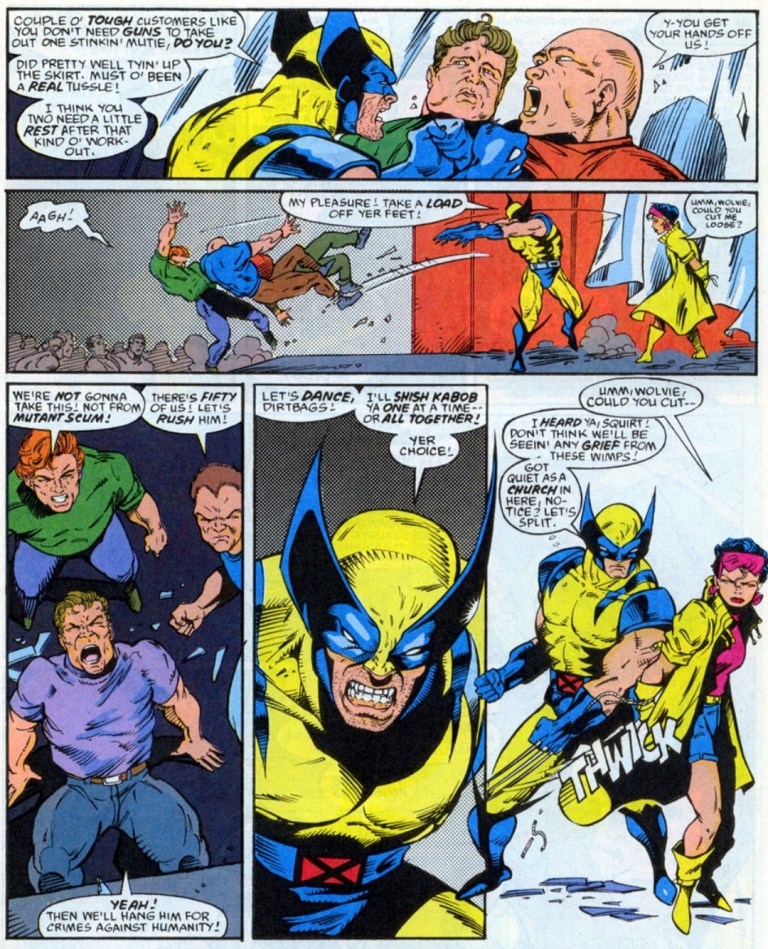
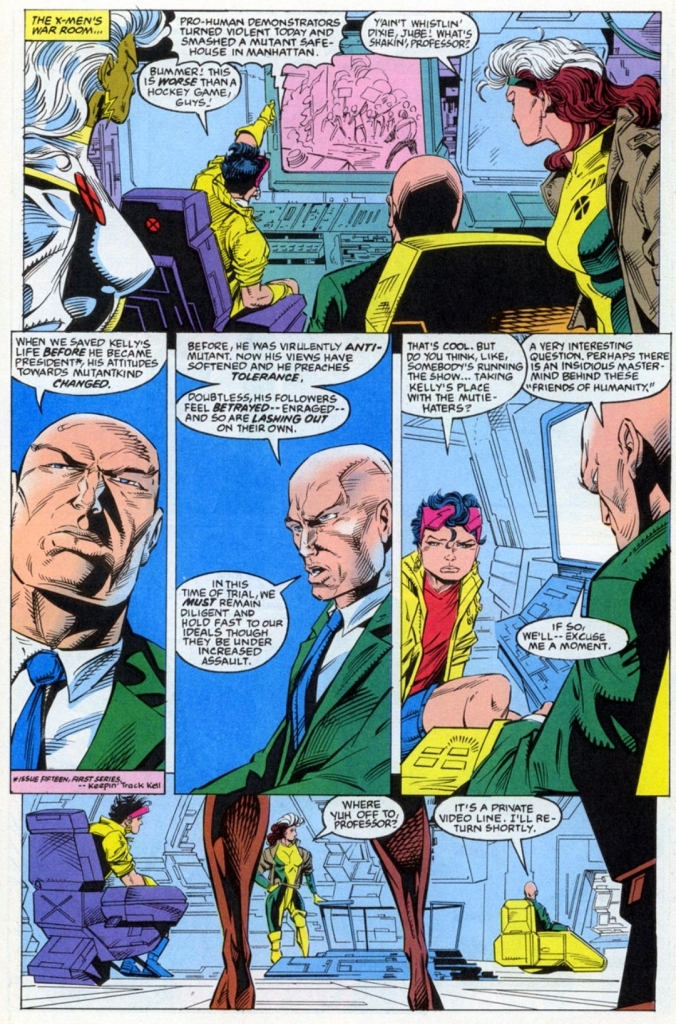
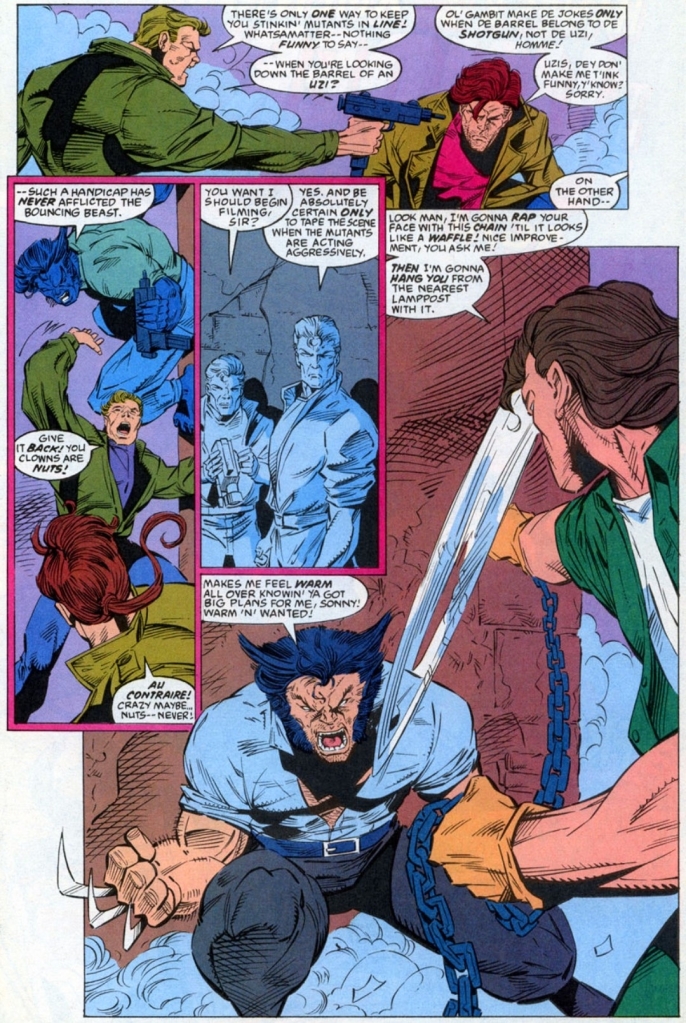
The X-Men are troubled by the anti-mutant wave happening in public.

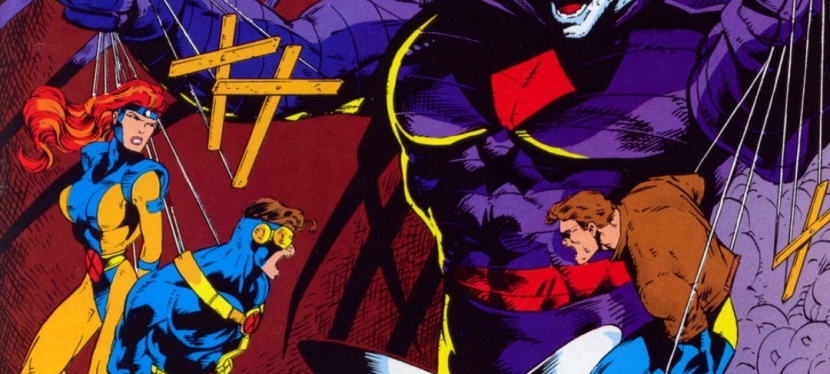
As the opening issue of the second volume of the X-Men Adventures comic book series, this comic book carefully sets up the tone and the plot of a series of future challenges for the X-Men which is clearly reflected on the front cover with Mister Sinister displayed prominently. The story mainly highlights X-Men’s new struggle with the wave of anti-mutant rage in the public while dealing with the absence of their leader Cyclops (on honeymoon with his new wife Jean) while leaving space for potential sub-plots such as the attraction between Jean and Wolverine, the moves of the anti-mutant radicals and, most notable of all, the secretive return of Morph (thought to have died in issue #2 of the first season).

As expected, build-up is the main approach taken by the creators on telling the story and there were some bouts of superhero spectacle (action) that spiced up the reading experience for me. Considering what has been happening in different parts of the world in recent years, the sub-plot of the rabid anti-mutant activists using tactics to destroy the X-Men’s credibility with violence and misinformation magnified through the news networks is very socially relevant.

What the rabid anti-mutant people committed in this comic book reminds me of the October 7, 2023 attacks on Israel organized by the Palestinian terrorist group Hamas in which violence, destruction and selective images of terror spread through news networks and social media were done. Similarities aside, the wave of evil is clear here and the intent of the anti-mutant believers and Palestinian terrorists obviously expresses intentions of genocide against another particular group of people.

When it comes to weaknesses of this comic book, I cannot help but find Andrew Wildman’s art looking very rushed. There is a lack of precision and detail of his art here when compared directly to his works in the first volume of X-Men Adventures.

Conclusion

The anti-mutant radicals in this comic book have a lot in common with Palestinian terrorists, the pro-Palestine activists, the Black Lives Matter activists and other members of woke mobs. Violence, arrogance, rage and misinformation are their values.

X-Men Adventures Season II (1994) incidentally works well as an adaptation of the animated series, as a standalone comic book as well as being a socially relevant tale in today’s age of social media. While the concept of evil remains in X-Men lore, what was told here shows different layers of it. The X-Men themselves also looked fragile and the return of Morph is a key part of the story clearly designed with future events in mind. Finally, this comic book is a lively reminder of the era when X-Men stories were made for the fans, not the woke mob.

Overall, X-Men Adventures Season II (1994) is recommended.

+++++

Thank you for reading. If you find this article engaging, please click the like button below, share this article to others and also please consider making a donation to support my publishing. If you are looking for a copywriter to create content for your special project or business, check out my services and my portfolio. Feel free to contact me with a private message. Also please feel free to visit my Facebook page Author Carlo Carrasco and follow me on Twitter at  @HavenorFantasy as well as on Tumblr at https://carlocarrasco.tumblr.com/ and on Instagram at https://www.instagram.com/authorcarlocarrasco

A Look Back at Spider-Man #2 (1990)

Welcome back superhero enthusiasts, 1990s culture enthusiasts and comic book collectors! Today we go back to the early 1990s and explore a part of the Marvel Comics shared universe through a tale of the Spider-Man monthly series.

In my previous retro review, Todd McFarlane told a tale of the iconic web-slinger with intense build-up leading to another rematch with his old nemesis the Lizard (Dr. Connors). While the writing was pretty weak, McFarlane still managed to tell a tale with a strong element of horror and supernatural stuff. McFarlane’s approach with visual violence and graphic stuff was clearly adulterated. What was presented daringly tested the limits allowed under the Comics Code Authority (CCA).

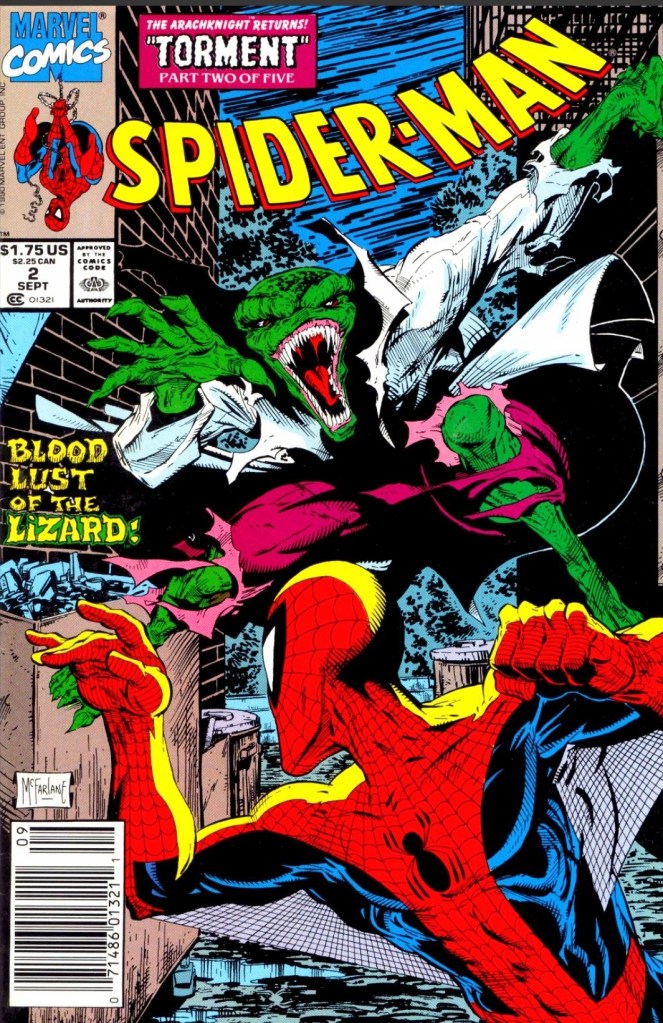
With those details laid down, here is a look back at Spider-Man , published in 1990 by Marvel Comics with a story written and drawn by Todd McFarlane. This is also the 2nd chapter of the Torment storyline.

The cover.

Early story

The story begins in New York City where two men got suddenly murdered by the Lizard in an alley during the night. The next morning Peter Parker reads the newspaper (showing the photograph and the news story of the Lizard’s murder of the two men) while having a breakfast moment with his wife Mary Jane. As soon as his wife mentions the word “monster”, Peter takes a 2nd look at the newspaper’s photograph and finally notices the bloody writing “CNNR” on the alley wall which makes him realize that the Lizard is back again.

Feeling very troubled, Peter leaves Mary Jane quietly and dresses up as Spider-Man to go out once again.

Elsewhere in the city, a sorceress uses her evil method of crafting a potion which creates an unrelenting sound of disturbance which Spider-Man hears. As the sound goes on, his focus and Spider Sense get overwhelmed…

Quality

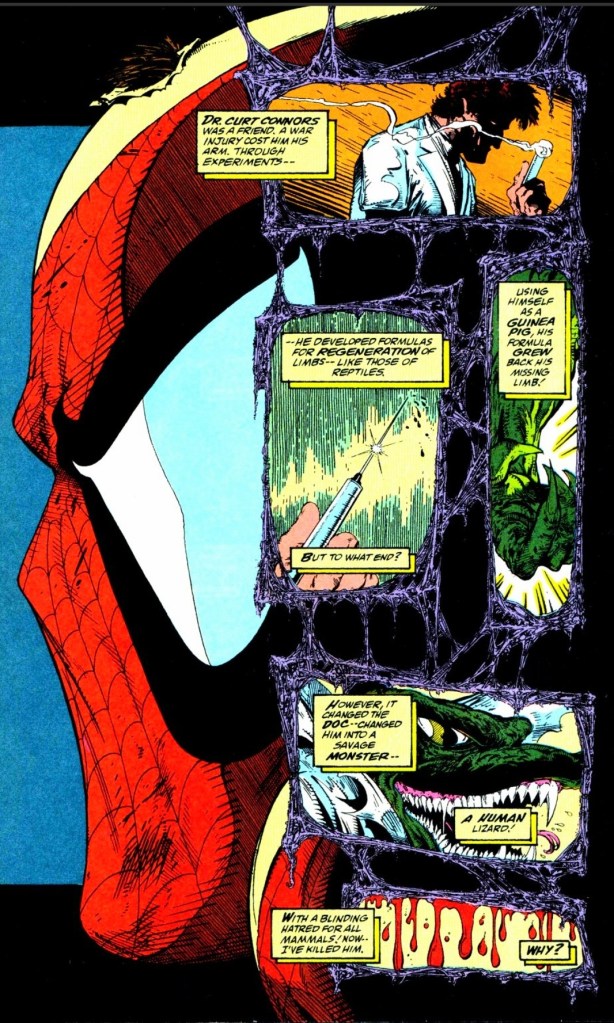
A quick look at the origin of the Lizard by McFarlane.

While the writing by McFarlane remains weak, he still succeeded in making this story a marginal improvement over the previous issue in terms of moving the plot forward, paying off a good chunk of the build-up in issue , and establishing his own visual corner (inspired by horror and adulterated stuff) within the Spider-Man franchise of comics of the time.

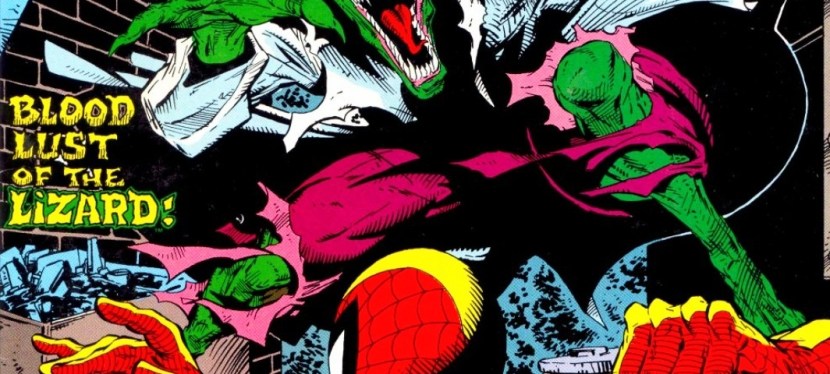
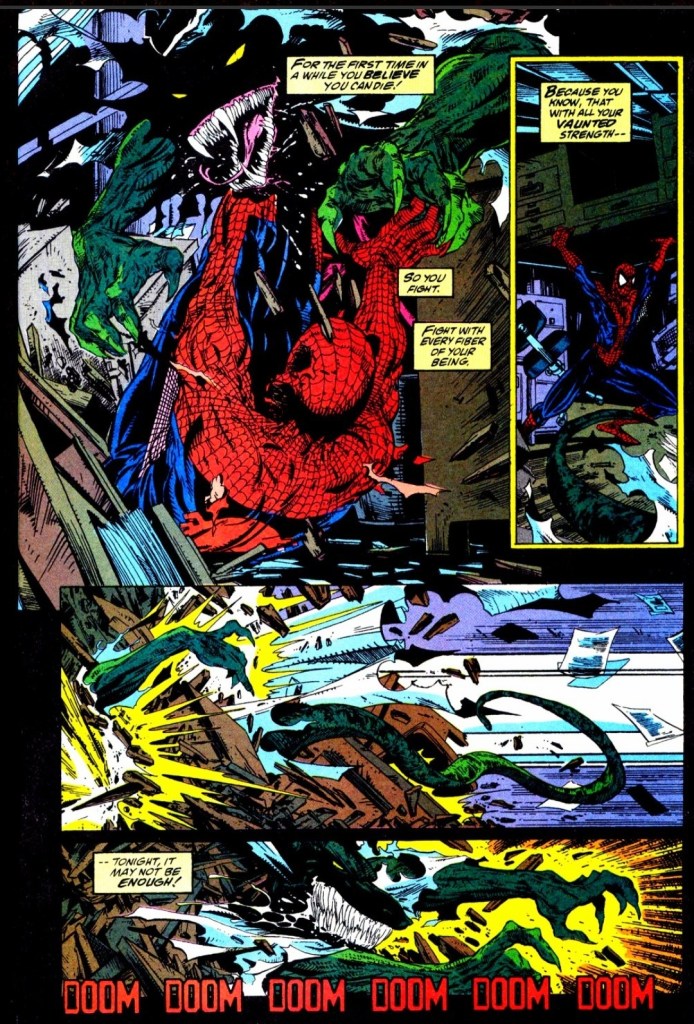
The biggest feature here is the physical conflict between Spider-Man and the Lizard. As expected, McFarlane drew the big fight with a lot of intense action, powerful violence (note: it was clear the editorial team recommended moves to tone down the graphic violence), suspense and a good amount of horror. Not only does the big fight move the story forward, it allowed McFarlane to dramatize Spider-Man as a vulnerable hero who not only has to cope with the disturbance from the sorceress far away, but also deal with the poison he got from the Lizard. That being said, Spidey also struggles with his sanity and the new fact that the Lizard has turned into a murder machine which disturbs him a lot as he personally knew Dr. Connors.

Considering what happened here and in the previous issue, there is still a greater force of evil that awaits Spider-Man and the Lizard happens to be an ultra-violent tool.

Conclusion

Many times Spider-Man finds himself in a disadvantage while fighting the Lizard.

Being the 2nd chapter of the Torment storyline, Spider-Man (1990) is a slight improvement over the previous issue in terms of moving the story forward, spectacle and dramatization. While the big fight between Spider-Man and the murderous Lizard is clearly the big feature of the story, McFarlane does a good job portraying Spider-Man as vulnerable and on the edge towards defeat. McFarlane’s writing here is still weak but the other positive elements achieved outweighed the weakness.

Overall, Spider-Man (1990) is satisfactory.

+++++

Thank you for reading. If you find this article engaging, please click the like button below, share this article to others and also please consider making a donation to support my publishing. If you are looking for a copywriter to create content for your special project or business, check out my services and my portfolio. Feel free to contact me with a private message. Also please feel free to visit my Facebook page Author Carlo Carrasco and follow me on Twitter at  @HavenorFantasy as well as on Tumblr at https://carlocarrasco.tumblr.com/ and on Instagram at https://www.instagram.com/authorcarlocarrasco

A Look Back at The Man of Steel #2 (1986)

Welcome back superhero enthusiasts, 1980s culture enthusiasts and comic book collectors! Today we go back to the mid-1980s to explore a part of the DC Comics shared universe through a tale of the iconic Superman.

Previously, I reviewed the first issue of The Man of Steel mini-series written and drawn by John Byrne. Using a unique structure for storytelling, Byrne gradually told how the post-Crisis version of Superman came to be while also retaining specific classic elements that made DC’s icon inspirational. That very comic book had its influences on other portrayals of Superman beyond comic books such as he Lois & Clark: The New Adventures of Superman TV series and even the very divisive Man of Steel movie.

With those details laid down, here is a look back at The Man of Steel , published in 1986 by DC Comics with a story written and illustrated by John Byrne.

The cover.

Early story

The story begins in the middle of Metropolis when the newly established hero Superman (now in full costume) flies just above the busy road which distracted Daily Planet editor-in-chief Perry White (who was having a coffee break with reported Lois Lane inside a coffee shop). Remembering how the space plane and its crew got saved by Superman (Clark Kent in civilian clothes) sometime prior, White tells Lane (who first encountered Superman immediately after the space plane was saved) to go after him to get the hot scoop.

While Lane crosses the road, a limousine’s opens with the driver telling her that Mister L (Lex Luthor the tycoon) wants to her. Lane declines and proceeds with her chase for Superman…

Quality

An act of help by Superman for someone who was in trouble.

This story is set during the early days of Superman as the new, randomly appearing hero of Metropolis whose impact on local society is just growing stronger. At the same time, this shows Clark Kent being a very new resident of the city still looking for a job. This is inspired work by Byrne on building up the Man of Steel for what was back then the modern age.

That being said, the most intriguing fact here is that this Superman story has Lois Lane as the actual protagonist. While Lane’s literary presence here is slightly stronger than DC’s icon, this tale is clearly all about her unrelenting approach with newspaper journalism, her use of the Daily Planet’s valuable connections and resources, and how much risk she would take to get the facts, the statements and other details all for the sake of getting the hot story. This is Byrne’s modernization of Lois Lane highlighting the concept that Clark Kent will have serious competition with her within the Daily Planet.  

That being said, there is no romance between Clark and Lois here. This is after all their 2nd encounter (the saving of the space plane in issue was shown in flashback with Lois Lane already present) and Byrne took a careful approach on establishing the first lengthy encounter and interactions between the two. Their encounter here is really engaging.

More on Superman himself, the writer kept the pace of developing him flow smoothly and steadily. You will see how Superman keeps himself in control whenever he talks with normal people or when he encounters criminals who cause danger on others. While he has a priority to help others in need using his powers, he does not neglect his actual identity (and personal life) as Clark Kent and this includes moderating or limiting the use of his special abilities as he levels himself with the rest of the civilian population.

Conclusion

Lois Lane portrayed as the unrelenting and very determined newspaper reporter. Even though Superman always flew away, she just won’t give up.

The Man of Steel (1986) is clearly a very solid follow-up to issue . The continued development of Superman remains solid and the dramatization of Lois Lane as the strongly determined newspaper journalist is compelling to see. With regards to the build-up of the post-Crisis DC Comics shared universe, this particular Superman tale is one of essential parts of it.

Overall, The Man of Steel (1986) is highly recommended!

+++++

Thank you for reading. If you find this article engaging, please click the like button below, share this article to others and also please consider making a donation to support my publishing. If you are looking for a copywriter to create content for your special project or business, check out my services and my portfolio. Feel free to contact me with a private message. Also please feel free to visit my Facebook page Author Carlo Carrasco and follow me on Twitter at  @HavenorFantasy as well as on Tumblr at https://carlocarrasco.tumblr.com/ and on Instagram at https://www.instagram.com/authorcarlocarrasco

A Look Back at Mantra: Spear of Destiny #1 (1995)

Welcome back superhero enthusiasts, 1990s culture enthusiasts and comic book collectors! Today we go back to the mid-1990s to explore a part of the Ultraverse through a tale of Mantra, the male eternal warrior Lukasz who died during battle then returned in the body of a woman named Eden.

It has been a few years since the last time I reviewed a Mantra comic book. For the newcomers reading this, the Ultraverse was a franchise of superhero comic books launched by Malibu Comics in 1993 which produced a lot of fun, intriguing and memorable tales made by a variety of really talented creators. Mantra was one of the pioneering characters of the Ultraverse and the related comic book series lasted more than twenty issues. Along the way, a standalone story of Mantra was published in the form of a 2-part mini-series.

With those details laid down, here is a look back at Mantra: Spear of Destiny published in 1995 by Malibu Comics with a story written by Mike W. Barr and drawn by Paul Abrams.

The cover.

Early story

The story begins when Mantra arrives at a museum to start her attempt (in her civilian identity as Eden Blake) to obtain the Spear of Destiny. While wearing a revealing outfit to distract the men, Mantra gets close to the highly prized spear to observe it and see how the security personnel guard it.

At a different spot within the museum, Mantra decides to start obtaining the spear in magical outfit and with a mask. As Mantra arrives at the room where the Spear of Destiny, already there are monsters overwhelming the men guarding the Spear of Destiny…

Quality

Eden Blake/Mantra reporting to work at Aladdin.

Having read most of the stories of the Mantra comic book series, I can say that Mike W. Barr came up with a fresh concept that emphasizes the quest to gain possession of a highly valuable item while also creating a new approach on presenting Mantra…by engaging in espionage (spying and infiltration).

As I am already used to seeing the eternal warrior Lukasz/Mantra using magic in many struggles or missions, the concept of having the protagonist getting disguised and becoming an impostor on a spy mission is a very inspired move by the writer. The preparations taken by Mantra to becoming a certain blonde woman for the mission were nicely structured and detailed enough to make the transformation. As if that was not enough, a certain piece of technology was implemented which made using magic a huge risk for the eternal warrior. That being said, the story smoothly transitioned from magic-filled fantasy into a convincing spy thriller

Along the way, this comic book also emphasizes the darkness of the secret society Aladdin which Mantra (as Eden Blake) works for. Aladdin’s operations were dramatized several times in other Ultraverse comic books but this one has a more explicit portrayal of them.  

Conclusion

Mantra got hold of the Spear of Destiny but for how long?

Mantra: Spear of Destiny (1995) is really entertaining and compelling to read. This is easily one of the more creative and more unique tales of the Ultraverse character ever told and I can say that I am eager to find out what would happen next. This is also the one tale in which Mantra became a spy and gets into a dangerous mission in which the use of magic is too risky. The writing by Mike W. Barr is really strong with this one.

Overall, Mantra: Spear of Destiny (1995) is recommended.

+++++

Thank you for reading. If you find this article engaging, please click the like button below, share this article to others and also please consider making a donation to support my publishing. If you are looking for a copywriter to create content for your special project or business, check out my services and my portfolio. Feel free to contact me with a private message. Also please feel free to visit my Facebook page Author Carlo Carrasco and follow me on Twitter at  @HavenorFantasy as well as on Tumblr at https://carlocarrasco.tumblr.com/ and on Instagram at https://www.instagram.com/authorcarlocarrasco

A Look Back at The Man of Steel #1 (1986)

Welcome back superhero enthusiasts, 1980s culture enthusiasts and comic book collectors! Today we go back to the late 1980s to explore a part of the DC Comics shared universe through a tale of the iconic Superman.

After DC Comics published the maxi-series Crisis on Infinite Earths, the publisher rebooted their entire comic book universe and that meant reintroducing their superheroes, villains and supporting characters with a touch of 1980s modernization. To reboot and modernize Superman, John Byrne was hired and he was granted a lot of creative freedom for production.

With those details laid down, here is a look back at The Man of Steel , published in 1986 by DC Comics with a story written and illustrated by John Byrne with ink work by Dick Giordano.

The cover.

Early story

The story begins sometime in the past in Krypton (Superman’s home world), a world about to meet its doom. Jor-El (Superman’s father) arrives home feeling deeply troubled and he wastes no time to execute an important plan he prepared. He examines his unborn Kal-El inside the birthing matrix which turned to have been removed by one of the servants from the gestation chambers of the planet. Lara confronts her husband over what was committed and asked him why he endangers the life of their unborn child.

Jor-El tells her that he plans for their son to be spared from the pending doom of Krypton (a chain reaction from the planet’s core caused vast pressures to build within the crust, fusing native elements into a new metal – Kryptonite) by sending him far away deep into space with planet Earth as the final destination. Jor-El has done extensive research of Earth and is convinced that their son will not only survive there but also become a supreme being among the inhabitants…

Quality

Clark’s earthly parents were indeed involved in his development becoming Superman.

There is no doubt that this John Byrne-led comic book remains great to read and highly significant with anything about Superman. Instead of telling one single extensive story, Byrne created a series of connected short tales that dramatized the icon’s post-Crisis origin and how the Krypton-born American Clark Kent became Superman for the first time ever.

While the prologue set in Krypton was quite heavy with expository dialogue, each subsequent short story was carefully structured and moved at a medium pace gradually emphasizing Clark Kent’s transformation into the Man of Steel. Along the way, there were lots of story details not only about the titular character but also about the Kent couple (Clark’s adoptive parents), what they went through, what secrets had to be kept and more. Very symbolically, this is a tale about an alien human being from space who grew up with traditional American culture and US heartland values while being raised by very loving American parents who previously could not produce children of their own. Through Clark, you will see that he is a blessing for Jonathan and Martha Kent and it is up to the couple to sow good values in him which are essential to his becoming not only a super being among mortals but also his emergence as a hero.

Conclusion

The origin of the post-Crisis Superman is great to read!

The Man of Steel (1986) is indeed a great, character-focused comic book that emphasized the origin and debut of the post-Crisis Superman. John Byrne modernized Superman while still maintaining the classic superhero elements from the icon’s past versions as well as the American identity and ways (none of those woke and internationalist nonsense). This is also the optimistic Superman that is very inspirational which the recent DC cinematic universe (referred to as “DCEU”) of Warner Bros. terribly lacked. This illustrated literature work is also a major cornerstone of the post-Crisis era of DC Comics and John Byrne’s take on Superman is very defining and iconic.

If you are the kind of reader who views Superman widely through pop culture, you will notice specific elements from this comic book that made it into other forms of entertainment media such as Man of Steel (2013), the Christopher Reeve Superman movies, the animated movies, the Lois & Clark: The New Adventures of Superman TV series (starring Dean Cain as the Man of Steel) and more. Those multimedia productions showed how influential this comic book became as a major reference for other creators.

Overall, The Man of Steel (1986) is highly recommended!

+++++

Thank you for reading. If you find this article engaging, please click the like button below, share this article to others and also please consider making a donation to support my publishing. If you are looking for a copywriter to create content for your special project or business, check out my services and my portfolio. Feel free to contact me with a private message. Also please feel free to visit my Facebook page Author Carlo Carrasco and follow me on Twitter at  @HavenorFantasy as well as on Tumblr at https://carlocarrasco.tumblr.com/ and on Instagram at https://www.instagram.com/authorcarlocarrasco

A Look Back at Turok: Dinosaur Hunter #2 (1993)

Welcome back superhero enthusiasts, 1990s culture enthusiasts and comic book collectors! Today we go back to the early 1990s and explore a part of the Valiant Comics shared universe through a tale of the Turok: Dinosaur Hunter series.

While issue turned out to be entertaining enough, the Indian protagonist Turok was not too engaging. The story worked primarily due to the combined creative works of David Michelinie and Bart Sears.

With those details laid down, here is a look back at Turok: Dinosaur Hunter , published in 1993 by Valiant Comics with a story written by David Michelinie and drawn by Bart Sears.

The cover.

Early story

The story begins in Colombia in 1987. Set some time after he left the village of Serita (a Colombian lady he connected with), Turok finds himself in the middle of a fight with multiple intelligent dinosaurs that serve his rival and target Mon-ark. Turok recently started using locally produced poison for his arrows as part of his unrelenting hunt for dinosaurs.

Meanwhile in another part of Colombia, the drug lord Comacho holds a private meeting and express his frustration over the decimation of his drug shipments. It turns out, the couriers were slaughtered and eaten by the dinosaurs. Upon learning of the presence of an Indian who makes it his business to hunt dinosaurs, Comacho gives an order to find him…

Quality

You will see Turok in a lot of action scenes fighting these intelligent and savage dinosaurs.

As the follow-up to the 1st issue, this is a story about Turok really hunting dinosaurs as part of his effort to get to Mon-ark (the leader of a pack of dinosaurs present in Colombia) in relation to what happened during the Unity storyline. In addition, you will get to see the protagonist get involved the Colombia drug lord who really needs him as the dinosaurs tremendously disrupted the shipment of illegal substances. As a newcomer in this particular time and place within the shared universe of Valiant Comics, Turok here does not care much about the reputation of Comacho as he is obsessed with hunting dinosaurs.

Speaking of the dinosaurs (who were granted human-like intelligence by the Mothergod), you will get to see Mon-ark have his own share of the spotlight and see him being a leader of his fellow dinosaurs. The showcase of his ruthlessness was expectedly done here to symbolize the element of evil in a violent way.

The plot by Michelinie is nicely structured and the narrative moved in a smooth enough pace leading to an obvious new direction.

Like in the previous issue, Bart Sears drew the art but with the involvement of Bernard Chang. For the most part, I recognized Sears’ work and there were some subtle visual differences here and there. The good news here is that if you enjoyed the gritty look as well as the uncompromised approach to violence in issue , then you will find those here as well.

Conclusion

A look at the intelligence and interaction between these two evil dinosaurs in love. There’s no homosexuality here nor anything related to transgender or the disease called wokeness.

Turok: Dinosaur Hunter (1993) is entertaining and compelling enough to read. It further explores Turok’s story as a man lost in time who simply would not run away from the dinosaurs as he is obsessed with eliminating Mon-ark. The tale, however, involves a Colombian drug lord as well as his private army which adds depth to the narrative as well as Turok’s place within Valiant’s shared universe of the time. Lastly, this one nicely sets up a big conflict between the Indian and his dinosaur rival.

Overall, Turok: Dinosaur Hunter (1993) is recommended.

+++++

Thank you for reading. If you find this article engaging, please click the like button below, share this article to others and also please consider making a donation to support my publishing. If you are looking for a copywriter to create content for your special project or business, check out my services and my portfolio. Feel free to contact me with a private message. Also please feel free to visit my Facebook page Author Carlo Carrasco and follow me on Twitter at  @HavenorFantasy as well as on Tumblr at https://carlocarrasco.tumblr.com/ and on Instagram at https://www.instagram.com/authorcarlocarrasco

A Look Back at Turok: Dinosaur Hunter #1 (1993)

Welcome back superhero enthusiasts, 1990s culture enthusiasts and comic book collectors! Today we go back to the early 1990s and explore a part of the Valiant Comics shared universe through a tale of a very notable illustrated literature character named Turok.

I say very notable because Turok, an Indian (North American native), started in comics in the 1950s published by Western Publishing through its licensee Dell Comics. The comic book series Turok: Son of Stone started from 1956 until the early 1980s. In 1989, Valiant Comics was established by former Marvel Comics editor-in-chief Jim Shooter and business partner Steven Massarsky which was the result of a failed 1988 attempt to purchase Marvel Entertainment. In 1991, Valiant published Magnus: Robot Fighter and Solar: Man of the Atom as its early titles which is notable because both characters were licensed properties from Gold Key Comics (which itself was involved in the original Turok series).

Then in 1992, a newer version of Turok was introduced by Valiant Comics in the 12th issue of Magnus: Robot Fighter and subsequently the character (along with established side-kick Andar) became involved in the Unity storyline which was Valiant’s first major crossover comics event. By the time Unity ended, the road was cleared for Valiant to further emphasize Turok for the modern comic book readers of the time.

With those details laid down, here is a look back at Turok: Dinosaur Hunter , published in 1993 by Valiant Comics with a story written by David Michelinie and drawn by Bart Sears.

The cover.

Early story

The story begins in Colombia (note: written as Columbia in the comic book) in South America in the year 1987. Deep in the forest, Turok performs a ritual believing that his spirit is getting cleansed and purified. He remembers the times when he and Andar discovered a land – filled with dinosaurs and other animals they never encountered previously – where time no longer held much meaning.

He and Andar got involved in an armed conflict with invaders who arrived with advanced technologies. The robot fighter Magnus then got involved and helped Turok and their side turn the tide of battle. Eventually a stunning phenomenon happened as a woman who called herself Mothergod appeared. Turok and Andar foolishly submitted themselves to her and soon, they started operating in her service with violence against those who opposed her.

After encountering Archer and Armstrong, Turok realized the error of his devotion to Mothergod and eventually joined forces with Rai, X-O Manowar and others who waged battle against her.

Back in the present, an intelligent, cybernetically enhance dinosaur attacks Turok…

Quality

Very intense violence drawn by Bart Sears which reflected the high intensity of Turok’s fight with the dinosaurs.

To get straight to the point here, when it comes to emphasizing a new version of Turok for comic book readers in the early 1990s, the creative team was quite successful in achieving that goal. By the time I reached the end of this comic book, Turok’s place within the huge shared universe of Valiant got established solidly and the Michelinie-Sears duo dramatized the Indian’s struggle (being lost in time and far away from where he belongs) in South America in the late 1980s.

Being lost in time and having to deal with deadly, intelligent dinosaurs brought not only the warrior within Turok but also the determine survivor in him as well. There is a good amount of character emphasis of Turok which served as an effective balance to all the spectacle (read: uncompromised bloody violence) the creative duo prepared. Instead of using thought balloons, you will read Turok’s thoughts through narration boxes all throughout which made an effective and interesting reading experience.

Considering his great skills in hunting and fighting, Turok is not really a super protagonist. He is as vulnerable as any other person and you will get to see him suffer and become so helpless, he has no choice but to avail of assistance from South American villagers who lived by the land but are themselves very vulnerable to the savagery of the intelligent dinosaurs. The symbolism regarding vulnerability as well as the ramifications of the Unity crossover on this tale is very strong. This is indeed very solid writing by Michelinie.

As for the art, Sears’ work here is very unique and his style on drawing people, monsters and locations made this comic book a visual standout among 1993 comic books. When it comes to the graphic violence, it is clear to me that Sears enjoyed the creative freedom he got and he really emphasized his imagination as to how gruesome violence caused by dinosaurs on human beings would be. That being said, there are lots of violent action scenes and images of physical damage (damage on the flesh specifically) that remain visually disturbing to this day.

Conclusion

Very foolishly, Turok and Andar submitted themselves to a walking, evil idol. This should remind you that idolatry is both foolish and unholy.

Turok: Dinosaur Hunter (1993) works nice as modern portrayal of Turok and it succeeds in establishing his place within Valiant’s comic book universe thanks primarily to the Michelinie-Sears duo. Turok himself is not exactly an interesting protagonist to me but I can say it is the creators’ way of portraying him that makes the plot and the comic book work as an entertainment piece. I also liked the way Turok was emphasized as a character who got lost not only in time but also dimensionally lost as he has to live within a whole new world while focusing on survival as well as his desire to kill his rival Mon-Ark (the intelligent dinosaur). If you know your American pop culture history, you will realize that this comic book incidentally paved the way for the Turok video games (starting with 1997’s Turok: Dinosaur Hunter of Nintendo 64) that happened years later.

Overall, Turok: Dinosaur Hunter (1993) is recommended.

+++++

Thank you for reading. If you find this article engaging, please click the like button below, share this article to others and also please consider making a donation to support my publishing. If you are looking for a copywriter to create content for your special project or business, check out my services and my portfolio. Feel free to contact me with a private message. Also please feel free to visit my Facebook page Author Carlo Carrasco and follow me on Twitter at  @HavenorFantasy as well as on Tumblr at https://carlocarrasco.tumblr.com/ and on Instagram at https://www.instagram.com/authorcarlocarrasco

A Look Back at Spider-Man #1 (1990)

Welcome back superhero enthusiasts, 1990s culture enthusiasts and comic book collectors! Today we go back to the early 1990s and explore a part of the Marvel Comics shared universe through a tale of the Spider-Man monthly series.

Back in the late 1980s, Todd McFarlane proved to be a highly talented artist who helped Marvel sell a lot of issues of the Amazing Spider-Man series. McFarlane was also highly involved with the creation of Venom which not only became Spider-Man’s deadliest foe but also an icon of Marvel’s. In the year 1990, a brand new monthly series of Spider-Man was launched and it had Todd McFarlane writing and illustrating the tales.

With those details laid down, here is a look back at Spider-Man , published in 1990 by Marvel Comics with a story written and drawn by Todd McFarlane. This marks the beginning of the Torment storyline.

The cover.

Early story

The story begins in New York City where countless people walk to their respective destinations not realizing that the local hero Spider-Man was swinging above them. In a dirty alley, Spider-Man prevents an armed thug from harming a woman and leaves him hanging covered with a lot of web.

Elsewhere in the city, a sinister figure conducts a ritual, prays to evil forces and begins using magic.

In yet another location, a hideous creature emerges from the water. It’s the Lizard…

Quality

This page is an example of Todd McFarlane creating a travel sequence that allowed him to draw something great. It’s a classic example of moving back into the comfort zone.

To make things very clear here, this comic book is pretty shallow and hollow mainly due to its storytelling as this was the writing of a very young Todd McFarlane. There is no denying that his art here is great to look at from start to finish. In fact, this was one of McFarlane’s finest visual works ever with Marvel.

But if you look beyond the great visuals, the writing is very weak all throughout the issue. At best, this comic book is a grand-looking yet shallow set-up for the conflict of the Torment storyline complete with shared emphasis on the iconic web-slinger, the Lizard (looking more menacing than before) and Calypso (the one behind the magic and rituals).

In fairness to McFarlane, he added his own touch on emphasizing the personalities of Peter Parker and wife Mary Jane simultaneously as a couple. If you were used to seeing in-depth character development and witty dialogue about the two major characters as portrayed in the Amazing Spider-Man, Web of Spider-Man and Spectacular Spider-Man series of 1990, you won’t find them in this comic book. Under McFarlane’s writing, Spider-Man in this issue showed signs of sarcasm and cockiness in the first scene, and with Mary Jane he (as Peter Parker) expressed himself philosophically. To say the least, the portrayal of Spider-Man here is noticeably different under McFarlane.

The Lizard, a long-time rival of Spider-Man’s, was presented to be very violent and murderous in this issue. This was clearly McFarlane’s approach on emphasizing the force of opposition that awaits the iconic web-slinger and he obviously went for a more adulterated approach with the visuals. That being said, the violent content in this comic book is very unique and clearly stood out from the rest of the Spider-Man-related comics published by Marvel in 1990. Lastly, I should say that McFarlane’s visual take on the Lizard is the best I have seen.  

Going back to the visuals, McFarlane implemented strong elements of horror, darkness and grittiness which went along well with the adulterated approach to violence.  These mixed elements, as they turned out in reality, became part of McFarlane’s future works past Spider-Man.

Conclusion

McFarlane’s vicious and horrifying approach on visualizing the Lizard can’t be ignored. This Lizard makes the cinematic Lizard of the 2012 movie The Amazing Spider-Man look cartoony.

Spider-Man (1990) is a very mixed bag when it comes to literary enjoyment. It clearly has great artwork by McFarlane whose adulterated approach on expression and spectacle made it very unique. The writing by McFarlane (who was very young at the time of production) is clearly the big letdown although his own approach on portraying Spider-Man, MJ and the Lizard are very notable. Take note that this was Todd McFarlane starting with writing while doing the art (his true strength), and at this point in comic book history his talent on telling compelling stories would not be realized until a few years later (particularly with Spawn and Image Comics). Notably, his use of visual horror and darkness predates his work in Spawn which makes his Spider-Man take very distinct. Ultimately, this comic book served as a build-up for things to come in the Torment storyline. Don’t expect too much when acquiring this comic book.

Overall, Spider-Man (1990) is satisfactory.

+++++

Thank you for reading. If you find this article engaging, please click the like button below, share this article to others and also please consider making a donation to support my publishing. If you are looking for a copywriter to create content for your special project or business, check out my services and my portfolio. Feel free to contact me with a private message. Also please feel free to visit my Facebook page Author Carlo Carrasco and follow me on Twitter at  @HavenorFantasy as well as on Tumblr at https://carlocarrasco.tumblr.com/ and on Instagram at https://www.instagram.com/authorcarlocarrasco