A Look Back at Amazing Spider-Man #374 (1993)

Welcome back superhero enthusiasts, 1990s arts and culture enthusiasts, Marvel Comics fans and comic book collectors! Today we go back to the year 1993 and examine a small part of the Marvel Comics universe through a tale of the Amazing Spider-Man monthly series.

In early 1993, the supervillain and murderer Venom was in very high demand among Marvel readers and comic collectors. The Venom: Lethal Protector mini-series launched with issue #1 selling a lot of copies and it portrayed Spider-Man’s greatest enemy as a very twisted and violent makeshift hero who dedicated himself to protecting what he (Eddie Brock specifically) to innocent people. As Venom was one of the few supervillains who knew Spider-Man’s true identity, the creative team behind the Amazing Spider-Man series decided to raise the stakes temporarily by having him encounter Peter Parker’s parents (the ones that appeared in Amazing Spider-Man #365).

With those details laid down, here is a look back at Amazing Spider-Man #374, published in 1993 by Marvel Comics with a story written by David Michelinie and drawn by Mark Bagley.

The cover.

Early story

The story begins inside the bunker beneath the grounds of the deserted Brooklyn amusement park. As Eddie Brock struggles to lift a very heavy piece of equipment, the symbiote forms over his body helping him lift it up above the head. Venom is obsessed with killing Spider-Man and Eddie Brock remains totally bitter over the webslinger’s responsibility on destroying his career. Eddie sees a page of the Daily Bugle on the wall and it contains a news photo of Peter Parker with his mother and father.

At New York’s famous Central Park, Peter, wife Mary Jane and his parents enjoy quality time skating on ice. Aunt May is standing on a wooden platform watching them…

Quality

Lots of intense action scenes in this comic book for fans and readers to be entertained with. The action scenes are not mindless as they serve as reflections of Venom’s powerful quest for revenge.

To begin with, I can say that this tale by David Michelinie is a very intense and dramatic read and it added a new layer of depth into the enduring rivalry between Spider-Man and Venom. At this point in Marvel Comics’ shared universe history, the two icons have encountered each other so many times, the time was right for Michelinie to raise the stakes and have the elderly Parkers (note: Aunt May excluded) as the new targets of Venom (already made obvious on the cover which in turn added tremendous stress on the part of Spider-Man and his wife.

For the newcomers reading this, Eddie Brock’s journalistic career was destroyed over the Sin-Eater story as a result of Spider-Man’s public revelation of Stanley Carter as the said figure (note: Brock’s Sin-Eater article series was based on interviews with Emil Gregg who actually turned out to be a delusional neighbor of Carter’s).

As Brock’s life went way downhill with his reputation destroyed, his hatred of Spider-Man grew and so did his quest for revenge. That being said, what happened in this particular comic book was a very reflective extension of what happened years prior. Anyone who has basic knowledge of the origin of Venom and early appearances of Brock in comics will be able to understand the intensified rivalry in this tale.  

Apart from the great story, this comic book has lots of superhero spectacle for readers to enjoy. That being said, the smashing action of the fight between Spider-Man and Venom was clearly made to be more violent which suitably reflected the supervillain’s lust for revenge. Spidey, meanwhile, had no choice but to avoid causing any more damage or harm as Venom goes after him in public surrounded with lots of bystanders. Along the way, you will see a key moment of the insanity of Venom which served as a useful pause of the fight. Finally, when it comes to the art, this comic book has some of the finest artworks I have seen from Mark Bagley.

Conclusion

At the time of this comic book’s publication, Venom was one of the few supervillains who knew Spider-Man and Peter Parker are one and the same person. The inclusion of Peter’s parents only added to the raising of the stakes.

Amazing Spider-Man #374 (1993) is undeniably a great read complete with intense action scenes, lots of intrigue and, most notably, a rock solid development of the Spider-Man-Venom rivalry. This is the kind of story that will compel long-time Spider-Man fans to revisit Venom’s origin as well as Spider-Man’s involvement with the Sin-Eater. At the same time, this tale will help readers understand the insanity and murderous mind of Venom that took place not only in the Venom: Lethal Protector mini-series in also other mini-series about the symbiotic killer that Marvel published throughout the 1990s.

Overall, Amazing Spider-Man #374 (1993) is highly recommended!

+++++

Thank you for reading. If you find this article engaging, please click the like button below, share this article to others and also please consider making a donation to support my publishing. If you are looking for a copywriter to create content for your special project or business, check out my services and my portfolio. Feel free to contact me with a private message. Also please feel free to visit my Facebook page Author Carlo Carrasco and follow me on Twitter at  @HavenorFantasy as well as on Tumblr at https://carlocarrasco.tumblr.com/ and on Instagram at https://www.instagram.com/authorcarlocarrasco

What to watch on YouTube right now – Part 15

Have you been searching for something fun or interesting to watch on YouTube? Do you feel bored right now and you crave for something to see on the world’s most popular online video destination?

I recommend you check out the following topics and the related videos I found.

#1 Movie reaction videos by You, Me and the Movies – When it comes to watching movie reaction videos, I enjoy what the YouTube channel You, Me and the Movies posted. Go watch the five videos of theirs that I selected for your enjoyment. I also encourage you to visit You, Me and the Movies’ YouTube channel.

#2 Minty Comedic Arts’ superhero trivia videos – In recent times, superhero movies from Hollywood became irrelevant and unexciting not because of the so-called superhero movie fatigue but because they are no longer made to be fun. That being said, now is a good time to look back at the enjoyable superhero movies from the past through Minty Comedic Arts’ trivia videos below. You will learn something new and do not forget to visit Minty Comedic Arts’ YouTube channel.

#3 Looking back at the Sega Dreamcast’s American launch and legacy – It has been almost 25 years since the Sega Dreamcast console launched in the United States. The American launch turned out highly successful with almost $100 million in sales revenue achieved during the first 24 hours. For the newcomers reading this, there was a time when Sega had consoles and the Dreamcast was the last one they had before going all-in with multiplatform publishing of games. That being said, watch these videos of the Dreamcast.

#4 Assorted videos of violations and reckless driving incidents of electric bikes (e-bikes) and electric tricycles (e-trikes) in the Philippines – For the international readers and newcomers reading this, the amount of electric bikes (e-bikes) and electric tricycles (e-trikes) here in the Philippines grew dramatically over the past ten years. Because of the many incidents as well as cases of careless or reckless driving of e-bikes and e-trikes that took place, authorities in the National Capital Region (NCR) or Metro Manila took action to have such electric vehicles regulated as well as banned from traveling along major roads and highways. Hopefully in the future, e-bike and e-trike riders will be required to have their electric vehicles registered and get themselves licensed to drive. To see the incidents, watch the videos below…

#5 Rita Panahi and the Leftists who embarrassed themselves – We now move on to the more serious and real-world stuff. I can say that Rita Panahi and her segment titled “Lefties losing it” is easily the most engaging one to watch on Sky News Australia. Here you will see varied videos showing the recklessness, the shamelessness and craziness of the Leftists as captured on social media and news media. Watch and listen to the videos below…

+++++

Thank you for reading. If you find this article engaging, please click the like button below, share this article to others and also please consider making a donation to support my publishing. If you are looking for a copywriter to create content for your special project or business, check out my services and my portfolio. Feel free to contact me with a private message. Also please feel free to visit my Facebook page Author Carlo Carrasco and follow me on Twitter at  @HavenorFantasy as well as on Tumblr at https://carlocarrasco.tumblr.com/ and on Instagram athttps://www.instagram.com/authorcarlocarrasco

A Look Back at Spider-Man #1 (1990)

Welcome back superhero enthusiasts, 1990s culture enthusiasts and comic book collectors! Today we go back to the early 1990s and explore a part of the Marvel Comics shared universe through a tale of the Spider-Man monthly series.

Back in the late 1980s, Todd McFarlane proved to be a highly talented artist who helped Marvel sell a lot of issues of the Amazing Spider-Man series. McFarlane was also highly involved with the creation of Venom which not only became Spider-Man’s deadliest foe but also an icon of Marvel’s. In the year 1990, a brand new monthly series of Spider-Man was launched and it had Todd McFarlane writing and illustrating the tales.

With those details laid down, here is a look back at Spider-Man #1, published in 1990 by Marvel Comics with a story written and drawn by Todd McFarlane. This marks the beginning of the Torment storyline.

The cover.

Early story

The story begins in New York City where countless people walk to their respective destinations not realizing that the local hero Spider-Man was swinging above them. In a dirty alley, Spider-Man prevents an armed thug from harming a woman and leaves him hanging covered with a lot of web.

Elsewhere in the city, a sinister figure conducts a ritual, prays to evil forces and begins using magic.

In yet another location, a hideous creature emerges from the water. It’s the Lizard…

Quality

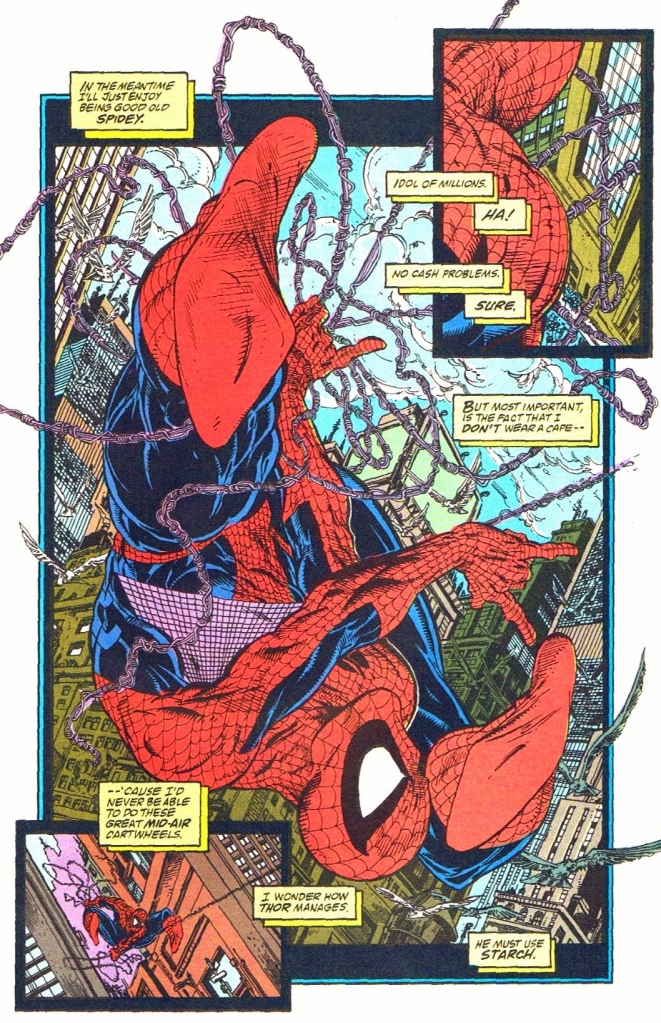
This page is an example of Todd McFarlane creating a travel sequence that allowed him to draw something great. It’s a classic example of moving back into the comfort zone.

To make things very clear here, this comic book is pretty shallow and hollow mainly due to its storytelling as this was the writing of a very young Todd McFarlane. There is no denying that his art here is great to look at from start to finish. In fact, this was one of McFarlane’s finest visual works ever with Marvel.

But if you look beyond the great visuals, the writing is very weak all throughout the issue. At best, this comic book is a grand-looking yet shallow set-up for the conflict of the Torment storyline complete with shared emphasis on the iconic web-slinger, the Lizard (looking more menacing than before) and Calypso (the one behind the magic and rituals).

In fairness to McFarlane, he added his own touch on emphasizing the personalities of Peter Parker and wife Mary Jane simultaneously as a couple. If you were used to seeing in-depth character development and witty dialogue about the two major characters as portrayed in the Amazing Spider-Man, Web of Spider-Man and Spectacular Spider-Man series of 1990, you won’t find them in this comic book. Under McFarlane’s writing, Spider-Man in this issue showed signs of sarcasm and cockiness in the first scene, and with Mary Jane he (as Peter Parker) expressed himself philosophically. To say the least, the portrayal of Spider-Man here is noticeably different under McFarlane.

The Lizard, a long-time rival of Spider-Man’s, was presented to be very violent and murderous in this issue. This was clearly McFarlane’s approach on emphasizing the force of opposition that awaits the iconic web-slinger and he obviously went for a more adulterated approach with the visuals. That being said, the violent content in this comic book is very unique and clearly stood out from the rest of the Spider-Man-related comics published by Marvel in 1990. Lastly, I should say that McFarlane’s visual take on the Lizard is the best I have seen.  

Going back to the visuals, McFarlane implemented strong elements of horror, darkness and grittiness which went along well with the adulterated approach to violence.  These mixed elements, as they turned out in reality, became part of McFarlane’s future works past Spider-Man.

Conclusion

McFarlane’s vicious and horrifying approach on visualizing the Lizard can’t be ignored. This Lizard makes the cinematic Lizard of the 2012 movie The Amazing Spider-Man look cartoony.

Spider-Man #1 (1990) is a very mixed bag when it comes to literary enjoyment. It clearly has great artwork by McFarlane whose adulterated approach on expression and spectacle made it very unique. The writing by McFarlane (who was very young at the time of production) is clearly the big letdown although his own approach on portraying Spider-Man, MJ and the Lizard are very notable. Take note that this was Todd McFarlane starting with writing while doing the art (his true strength), and at this point in comic book history his talent on telling compelling stories would not be realized until a few years later (particularly with Spawn and Image Comics). Notably, his use of visual horror and darkness predates his work in Spawn which makes his Spider-Man take very distinct. Ultimately, this comic book served as a build-up for things to come in the Torment storyline. Don’t expect too much when acquiring this comic book.

Overall, Spider-Man #1 (1990) is satisfactory.

+++++

Thank you for reading. If you find this article engaging, please click the like button below, share this article to others and also please consider making a donation to support my publishing. If you are looking for a copywriter to create content for your special project or business, check out my services and my portfolio. Feel free to contact me with a private message. Also please feel free to visit my Facebook page Author Carlo Carrasco and follow me on Twitter at  @HavenorFantasy as well as on Tumblr at https://carlocarrasco.tumblr.com/ and on Instagram at https://www.instagram.com/authorcarlocarrasco

A Look Back at Uncanny X-Men #156 (1982)

Welcome back superhero enthusiasts, 1980s culture enthusiasts and comic book collectors! Today we go back to the year 1982 to take a close look at one of the many tales of the Marvel Comics shared universe told through the monthly series of Uncanny X-Men.

In my previous retro review, the X-Men got involved in a high-stakes mission to find and rescue the kidnapped Shi’ar empress Lilandra. Things are not easy on the X-Men’s side as Cyclops is still uneasy over the truth he learned about his father Corsair while the leader Charles Xavier had to deal with the Shi’ar officials who have their agenda that could cause trouble on Earth. What the X-Men faced was a few of the Brood and Deathbird.

With those details laid down, here is a look back at Uncanny X-Men #156 published in 1982 by Marvel Comics with a story written by Chris Claremont and drawn by Dave Cockrum.  

The cover.

Early story

The story begins in New York City. The X-Men just fought with the Brood and Deathbird, and Charles Xavier has gone missing. Wolverine, Storm, Corsair, Cyclops and the Avengers member Tigra attend to a mortally wounded Colossus who was hit with acid.

Just as the local police arrived, Tigra tries her best to talk with them. Suddenly a gigantic space ship arrived floating above New York shocking everyone. The ship unleashes a beam of light down to pick up Wolverine, Cyclops, Storm, Corsair and the ailing Colossus. The giant ship then flies away leaving a lot of people stunned.

It turns out the ship belongs to the Starjammers, a group of space pirates that Corsair leads. Colossus then gets treated with alien technology…

Quality

The spectacle and the new encounter with the Brood were nicely done.

Similar to issue #155, the story here is very in-depth and has so much details and plot-related connections, it will require a great amount of attention from you in order to understand what is going and what is happening within. In this issue, you will get to see the Starjammers gang that Corsair spent a long time with, further development between Corsair and son Cyclops, the reunion between Charles Xavier and Empress Lilandra, and more of the Brood.

To put things clearly, Chris Claremont invested a lot of details when it comes to dramatizing the characters, insert revelations from the past, emphasized the many reactions of the X-Men members and carefully implemented stronger science fiction elements that really added depth to the plot. In many ways, this story is a huge pay-off to the build-up of the previous comic book and there is a lot more to the connection between Deathbird (a very capable villainess) and the Brood.

Having read lots of Claremont-authored X-Men stories, I found this 1982 story enjoyable and compelling to read. The big difference is that there is a stronger element of spectacle in this story which is related to the stronger sci-fi elements as well as Claremont’s strategic handling of the X-Men. At this point, it is clear that something new was being built up with the Brood, space travel and new frontiers. This is a strong sci-fi X-Men tale.

Conclusion

Professor X with his beloved Lilandra.

Uncanny X-Men #156 (1982) is indeed an enjoyable read provided that you pay close attention to the details, the characters and you have read the previous issue. This is the X-Men literally going deeper with science fiction and the Brood here was just about to rise further as a major force of opposition that would impact Marvel’s mutants. I should also state that Professor X and Empress Lilandra being together is a pretty compelling scene to read. As of this writing, I am convinced to keep on exploring further tales from this era of the X-Men.  

Overall, Uncanny X-Men #156 (1982) is highly recommended!

+++++

Thank you for reading. If you find this article engaging, please click the like button below, share this article to others and also please consider making a donation to support my publishing. If you are looking for a copywriter to create content for your special project or business, check out my services and my portfolio. Feel free to contact me with a private message. Also please feel free to visit my Facebook page Author Carlo Carrasco and follow me on Twitter at  @HavenorFantasy as well as on Tumblr at https://carlocarrasco.tumblr.com/ and on Instagram at https://www.instagram.com/authorcarlocarrasco
A Look Back at Spider-Man 2099 #42 (1996)

Welcome back superhero enthusiasts, 1990s culture enthusiasts and comic book collectors! Today we go back to the year 1996 and explore a part of the Marvel 2099 comics universe through a tale of the Spider-Man 2099 monthly series.

In my previous retro review, the futuristic webslinger encountered a group of dangerous people who are convinced that he betrayed them by becoming a corporate tool (note: the result of Goblin 2099 poisoning people’s minds). Not only that, the still-recovering Tyler Stone came back at Alchemax, saw his captured son Kron (Venom 2099 himself) and cold heartedly ordered his execution.

With those details laid down, here is a look back at Spider-Man 2099 #42, published in 1996 by Marvel Comics with a story written by Peter David and drawn by Andrew Wildman.

The cover.

Early story

The story begins with Miguel O’Hara now wielding tremendous corporate power at Alchemax where he is surrounded by managers. Some time had passed since he prevented Tyler Stone from returning to power and he made it known to him that he is aware that they are biologically father-and-son. Miguel then played “duck, duck, goose” on the managers while he stood up on his desk. He made clear to them that he is aware of their so-called game of “who can jerk the new boost and get the most for himself?”

Miguel then tells them that he will review their requests and address their concerns in his own time and his own way. They get dismissed by him. Miguel then meets someone who just arrived for the post of office secretary.

Meanwhile in the downtown section of New York, Raff and Kasey watch a union group composed of construction guys, watchdogs, sewer workers and truckers marching down the street and making noise. As Kasey wonders where the group was heading, she notices a man named Boru whom she previously heard was dead…

Quality

Spider-Man 2099 faces a tough opponent.

Storywise, this tale by Peter David moved away from the themes of issues #40 and #41 by focusing more on Miguel’s newest rise in Alchemax’s corporate hierarchy and how this adds more tension to his already troubled living as a secret superhero, an executive and as a person. By this stage, he knows Tyler Stone is his true father and the man known as Venom 2099 is his half-brother and relationships within his family are far from being normal or ideal. Still on the corporate aspect, a very notable person gets to work as Miguel’s new secretary which I won’t spoil here because I can say that the build-up and pay-off are well worth reading. The new secretary also added to the further development of specific characters and what was dramatized here will compel you to revisit earlier issues of the Spider-Man 2099 series. As always, Peter David’s writing is rich here.

Outside of Alchemax, the group led by Boru (who is symbolically a leader of hardened and desperate labor union members) emerges as an intimidating force of opposition for Miguel, the corporation he leads and even in his Spider-Man identity. Boru himself is quite a strong opponent for Spidey and the way their battle ended is something can intrigue readers or even frustrate die-hard fans of the protagonist. These conflicts, combined with Miguel’s struggle with all the tension hitting him from all angles, made this tale very intriguing and compelling to read.

Conclusion

While walking through the city, Miguel O’Hara spots members of Fantastic Four 2099 in conflict with Stark-Fujikawa.

Spider-Man 2099 #42 (1996) may not look like the expected continuation of what was built up in the previous two issues but its standalone story combined with strong twists, in-depth character development and sheer intrigue in key points of the story made this a must-read. I can also say that I am motivated to find out what happens next, especially given how this particular tale ended.

Overall, Spider-Man 2099 #42 (1996) is highly recommended!

+++++

Thank you for reading. If you find this article engaging, please click the like button below, share this article to others and also please consider making a donation to support my publishing. If you are looking for a copywriter to create content for your special project or business, check out my services and my portfolio. Feel free to contact me with a private message. Also please feel free to visit my Facebook page Author Carlo Carrasco and follow me on Twitter at  @HavenorFantasy as well as on Tumblr at https://carlocarrasco.tumblr.com/ and on Instagram at https://www.instagram.com/authorcarlocarrasco

A Look Back at Spider-Man 2099 #40 (1996)

Welcome back superhero enthusiasts, 1990s culture enthusiasts and comic book collectors! Today we go back to the year 1996 and explore a part of the Marvel 2099 comics universe through a tale of the Spider-Man 2099 monthly series.

To put things in perspective, there were these notable changes with both the storytelling and the character development of the futuristic webslinger as a result of the Venom 2099 saga (read my retro reviews here, here, here, here and here) as well as Doom 2099 becoming the new President of the United States (click here). Issue #39 saw the return of Vulture 2099 and the sudden appearance of Green Goblin 2099 (AKA Goblin 2099).

With those details laid down, here is a look back at Spider-Man 2099 #40, published in 1996 by Marvel Comics with a story written by Peter David and drawn by Andrew Wildman.

The cover.

Early story

The story begins with the tycoon Tyler Stone helplessly on bed in a medical center’s room still recovering from the gun shot incident. He tells the doctor near him that he wants to speak to Dana and demands to know what has been going on. Stone also demanded to get into contact with President Doom. In response to Stone’s demand to know the truth, the doctor regretfully tells him that Dana is dead.

Meanwhile, a swinging Spider-Man gets hit from the back by Goblin 2099. As the webslinger asked who he is, the Goblin introduces himself and tells him that he intends to expose him as a fraud. As the green/purple colored mask freak keeps on attacking, Spider-Man moves out of the way. While in movement, Goblin tells Spidey that he has betrayed the good people of downtown New York and must be forced to confess.

As he falls down fast, the webslinger suddenly finds himself clamped and restrained by the Goblin…   

Quality

Goblin 2099’s main weapon against the futuristic Spidey is influence on people and being able to convince them to reject the webslinger.

This comic book has a very intriguing tale crafted by Peter David. While this marks the first ever encounter between the futuristic versions Spider-Man and Green Goblin, this one has a strong social theme that prevented the conflict from becoming a generic good-versus-evil match-up. Goblin 2099 went after the webslinger not for the satisfaction of killing, not for the intention of dominating the whole world but for achieving social change for the members of the downtown community by destroying Spider-Man’s credibility once and for all (by exposing him as a fraud and a tool of the corporate world who should not be trusted).

This version of the Green Goblin clearly has an agenda that he seems very willing to die for and the mere fact that he interacted with Kasey (an important person for both Miguel and Gabriel O’Hara) further adds to the complexity on both the new villain as well as the downtown community. Given his obsession of destroying the hero by blaming him as a corporate stooge, Goblin 2099 here is symbolically with the Satanic Left (Communist/Marxist/liberal). These factors effectively raise the stakes and risks for Spider-Man who already has a lot of problems to deal with.

Through the fight between Spider-Man and Goblin, you will see how the people of downtown react in accordance to their perception as well as their inability to realize the truth behind Spider-Man’s social standing. The way they reacted shows impact on Spidey who himself struggles to understand their collective thinking and why they allowed themselves to be strongly influenced by the Goblin.

Along the way, there was a scene that emphasized Xina showing how Dana’s death affected her and another scene that took place at a very old New York City cathedral that clearly was crafted to build up on something for future tales of this series.

Characterization and plot aside, this comic book has a good amount of superhero action that will keep you entertained and Andrew Wildman really knows how to make action attractive to your eyes.

Conclusion

Spotlight on Xina.

Spider-Man 2099 #40 (1996) is another solid tale from the David-Wildman duo. Apart from the big impact Goblin 2099 had on Spider-Man and the people of just one community, this story successfully built-up the tension and complexity on the part of the protagonist while executing suitable pay-offs in relation to the build-up that started in the previous issue. Also I should state that it is very clear that the feature match-up in this comic book is not a rehash of classic Spider-Man and the Green Goblin. This is indeed a very intriguing Spidey 2099 tale that convinced me to look forward to the next issue.

Overall, Spider-Man 2099 #40 (1996) is highly recommended!

+++++

Thank you for reading. If you find this article engaging, please click the like button below, share this article to others and also please consider making a donation to support my publishing. If you are looking for a copywriter to create content for your special project or business, check out my services and my portfolio. Feel free to contact me with a private message. Also please feel free to visit my Facebook page Author Carlo Carrasco and follow me on Twitter at  @HavenorFantasy as well as on Tumblr at https://carlocarrasco.tumblr.com/ and on Instagram at https://www.instagram.com/authorcarlocarrasco

A Look Back at Amazing Spider-Man #385 (1994)

Disclaimer: This is my original work with details sourced from reading the comic book and doing personal research. Anyone who wants to use this article, in part or in whole, needs to secure first my permission and agree to cite me as the source and author. Let it be known that any unauthorized use of this article will constrain the author to pursue the remedies under R.A. No. 8293, the Revised Penal Code, and/or all applicable legal actions under the laws of the Philippines.

Welcome back superhero enthusiasts, 1990s culture enthusiasts and comic book collectors! Today we go back to the year 1994 and explore a part of the Marvel Comics universe through one of the many tales of the Amazing Spider-Man comic book series.

In my previous retro review, Spider-Man has been caught by the Jury and gets tried in a makeshift court that is so secretive, getting help from outside is impossible. The trial explored how Spider-Man, who brought the alien costume into their world which later led to the beginning of his murderous mortal enemy, is responsible for the deaths and other tragedies connected to Venom.

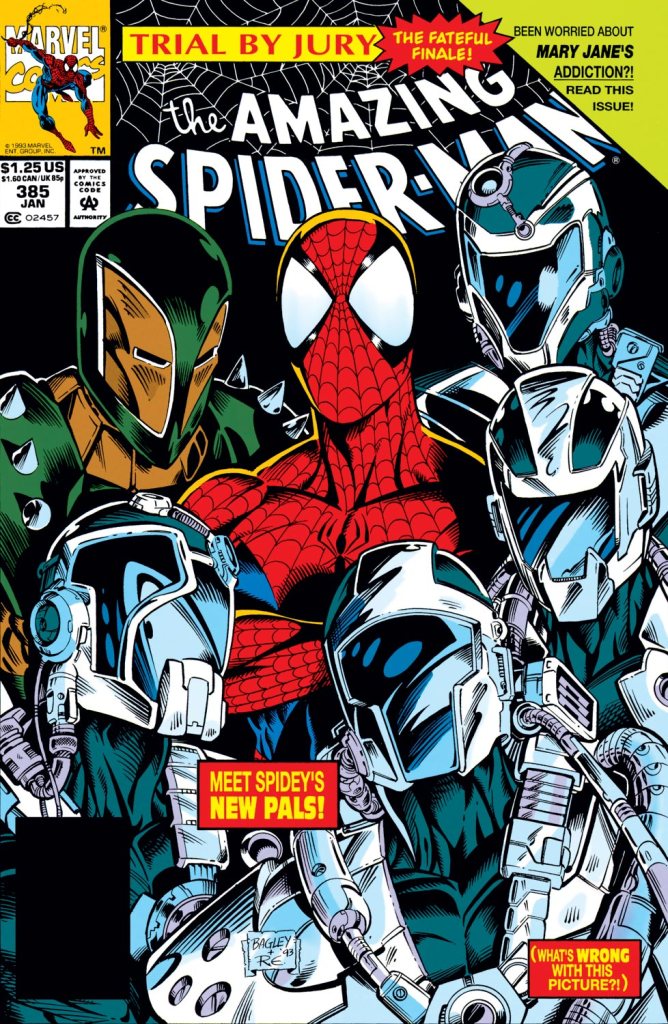
With those details laid down, here is a look back at Amazing Spider-Man #385, published in 1994 by Marvel Comics with a story by David Michelinie and drawn by Mark Bagley. This issue marks the final chapter of a 3-part storyline between the iconic webslinger and the Jury.

The cover.

Early story

The story begins with a restrained Spider-Man declared guilty and sentenced to death by the so-called court of Orwell Taylor and the Jury. Just as the team members are about to execute the webslinger, their teammate Ramshot intervenes and says that Spider-Man saves lives which is a matter of public record. Disappointed by Ramshot’s behavior, Taylor mentions their secondary mission is to obtain a weapon that might allow them to eliminate their true enemy – Venom.

Taylor then says that if Spider-Man would help them destroy the greater evil, then the court would consider commuting his sentence…

Quality

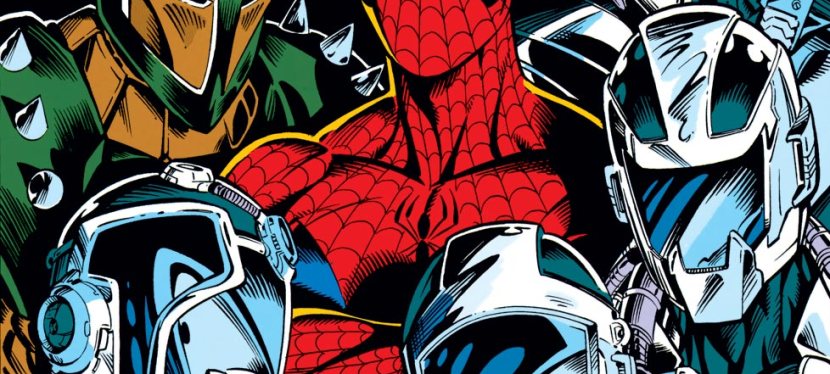
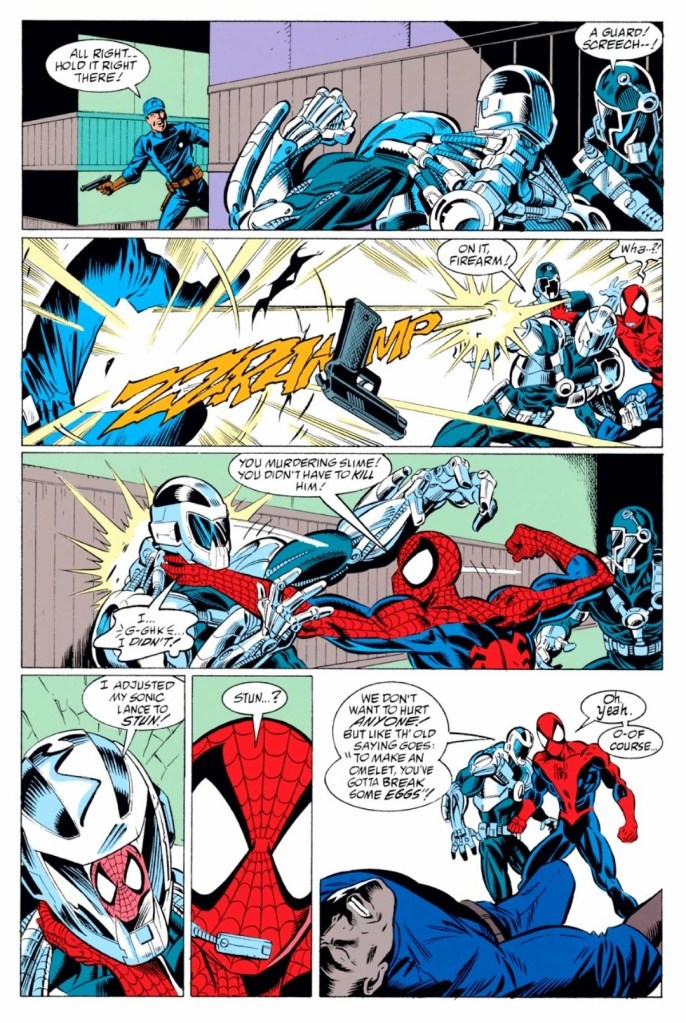
Something unfortunate happens during the mission involving Spider-Man and the Jury.

Considering all the drama and tension that was built up in the previous two issues, the story here is a letdown. For one thing, all the discussions about Spider-Man being responsible for the killings and violence caused by Venom lead to nowhere as the story took a turn for the bizarre concept of the hero getting spared to work with the very team that went after him. Secondly, the mission that Spidey and the Jury worked on really did not have a justifiable goal. This resulted in a disappointing turn of events. Ironically, in this comic book you will see more of Taylor’s cunning on top of his own distorted view about justice.

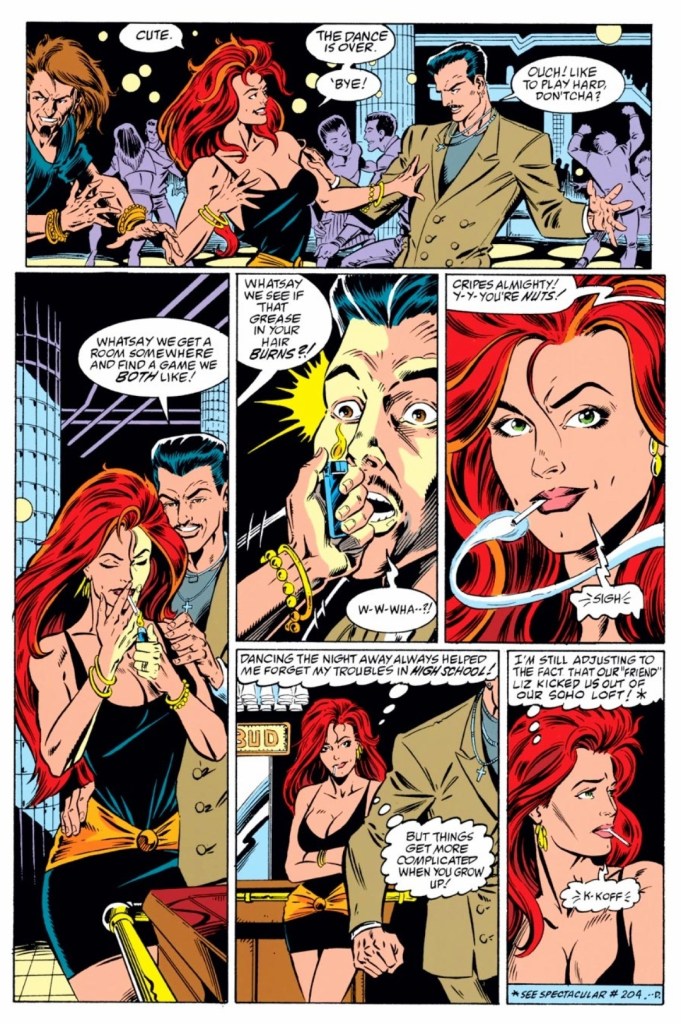
If there is anything notable here, it is the fact that Spider-Man’s wife Mary Jane gets a good share of the spotlight as she literally moves towards the edge in relation to the deteriorating marriage. This shows that as Spidey spends more time away to do what is good and push back against the forces of evil, his wife gets lonelier and desperate as life turns for the worse. At the very least, this comic book expresses that the marriage of Peter and Mary Jane could be doomed.

Conclusion

This is how Mary Jane deals with loneliness and the decline in her life.

Considering what was built up and heavily dramatized in issues #383 and #384, Amazing Spider-Man #385 (1994) is a rather weak conclusion. The way Spider-Man and the Jury parted ways felt more like sudden retreat than a real finish to what was started between them. Strangely enough, the focus on Mary Jane’s decline and desperation literally saved this comic book from becoming a creative disaster. The ending does not have much to do between Spider-Man and the Jury, but it was surprising in a crude way.

Overall, Amazing Spider-Man #385 (1994) is serviceable.

+++++

Thank you for reading. If you find this article engaging, please click the like button below, share this article to others and also please consider making a donation to support my publishing. If you are looking for a copywriter to create content for your special project or business, check out my services and my portfolio. Feel free to contact me with a private message. Also please feel free to visit my Facebook page Author Carlo Carrasco and follow me on Twitter at  @HavenorFantasy as well as on Tumblr at https://carlocarrasco.tumblr.com/ and on Instagram at https://www.instagram.com/authorcarlocarrasco

A Look Back at Amazing Spider-Man #382 (1993)

Disclaimer: This is my original work with details sourced from reading the comic book and doing personal research. Anyone who wants to use this article, in part or in whole, needs to secure first my permission and agree to cite me as the source and author. Let it be known that any unauthorized use of this article will constrain the author to pursue the remedies under R.A. No. 8293, the Revised Penal Code, and/or all applicable legal actions under the laws of the Philippines.

Welcome back superhero enthusiasts, 1990s culture enthusiasts and comic book collectors! Today we go back to the year 1993 and explore a part of the Marvel Comics universe through one of the many tales of the Amazing Spider-Man comic book series.

In my previous retro review, Spider-Man gets involved not only with the Incredible Hulk but also with Doc Samson who has a history of treating the green giant and carries a strong sense of responsibility towards him. Something, however, infected Samson and eventually the Hulk which leads to a new wave of destruction in New York City which itself is still recovering from the chaos of Maximum Carnage.

With those details laid down, here is a look back at Amazing Spider-Man #382, published in 1993 by Marvel Comics with a story written by David Michelinie and drawn by Mark Bagley.  

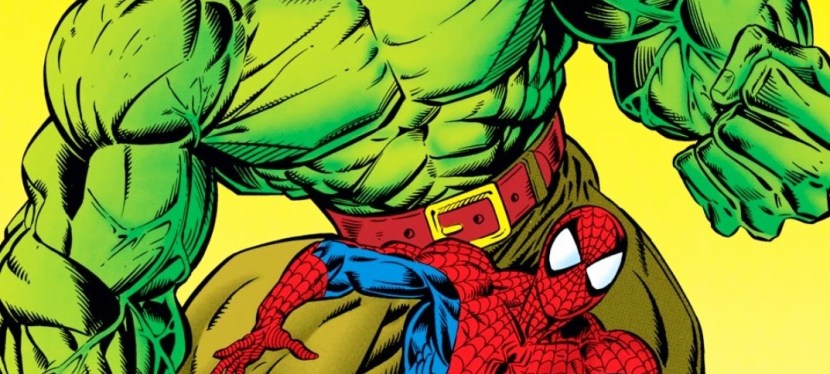
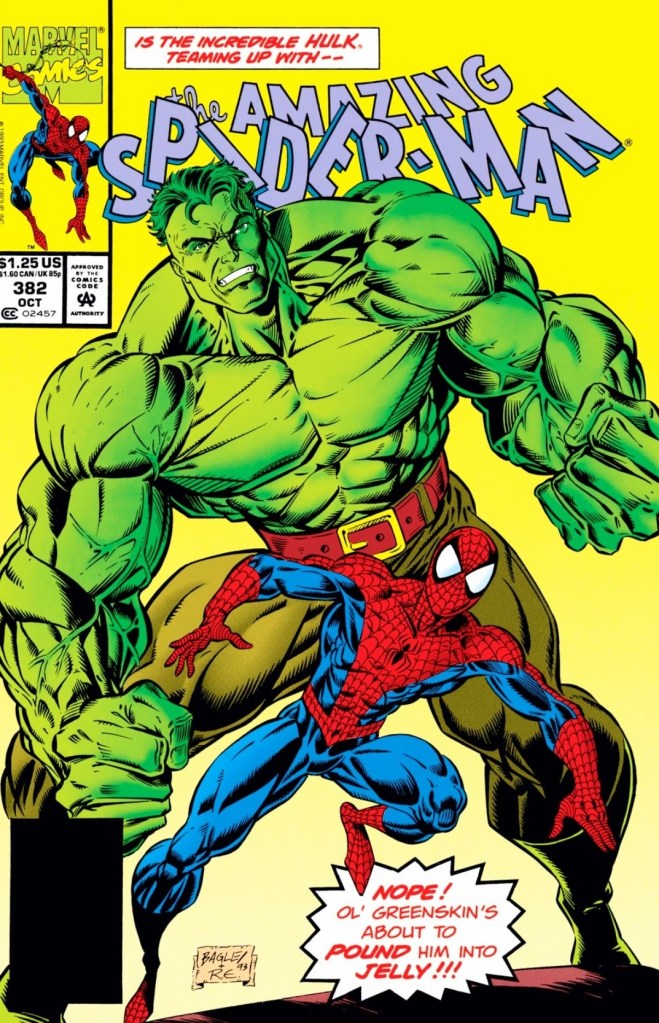
The cover.

Early story

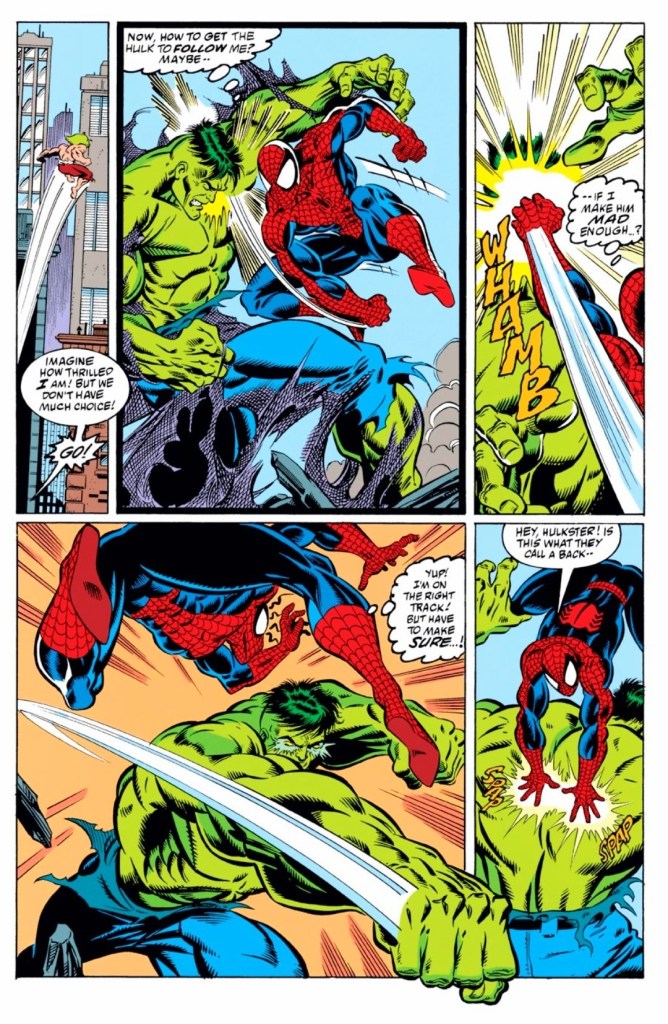
The story begins with the Hulk (note: infected with the gamma virus which is driving him to violence) striking the pavement hard causing Spider-Man and Doc Samson to move away. After a quick exchange of words with Samson regarding the virus, Spider-Man jumps towards the Hulk and hits his face in an attempt to stop him before he causes any more damage to the city.

Doc Samson desperately tries to contain the Hulk by choking him only to be grabbed and get thrown to a solid structure nearby. Now down on the pavement, Samson notices the Hulk jumping in towards him…

Quality

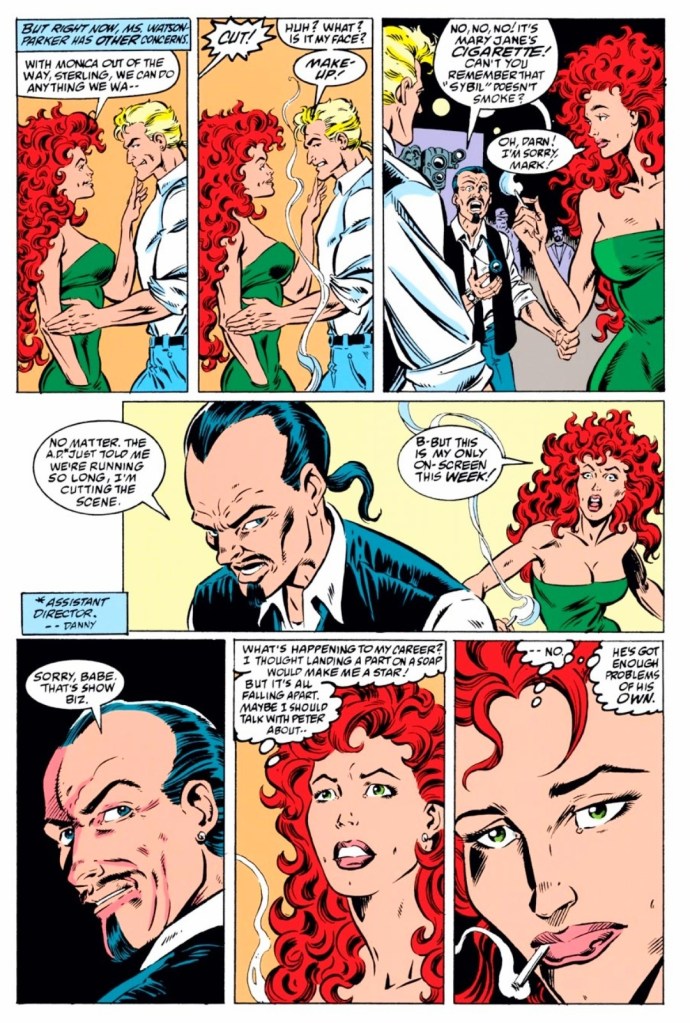
Mary Jane Parker in trouble with her acting career.

This story is indeed a solid and satisfying conclusion to what was started in issue #381. Not only does this comic book showcase a battle between Spider-Man and the manipulated Hulk, it also highlights Doc Samson’s importance not only as a supporting player but also as a scientist struggling with his responsibility over helping the Hulk. There is a strong sense of burden you will sense in Samson who himself caused a lot of damage when he was infected with the virus before the Hulk got infected by it.

The presentation of the virus/bacterium as the factor behind the chaos is a believable concept that highlights what would happen if people carrying gamma radiation in their bodies get infected by it.

If you are looking for fun, there is a lot of action here with lots of dynamic looking images crafted by Mark Bagley. Yes, you will see action and incidental moments between Spider-Man and the Hulk here and there, with Samson also getting a notable share of the spotlight. How the conflict concluded was cleverly done and ultimately surprising. This is something you readers will have to discover for yourselves.

Conclusion

As Doc Samson goes away, Spider-Man takes on the Hulk.

Amazing Spider-Man #382 (1993) is a well-paced and satisfying conclusion to the events that started in the previous issue. At the time of its release, the comic book highlighted a modern crossover between the Hulk and Spider-Man with Doc Samson inserted as a functional third participant. The concept of the gamma virus/bacterium works well here and added a more science fictional layer to the plot. This comic book is pretty entertaining and the suspense really built-up nicely towards the climax.

Overall, Amazing Spider-Man #382 (1993) is recommended!

+++++

Thank you for reading. If you find this article engaging, please click the like button below, share this article to others and also please consider making a donation to support my publishing. If you are looking for a copywriter to create content for your special project or business, check out my services and my portfolio. Feel free to contact me with a private message. Also please feel free to visit my Facebook page Author Carlo Carrasco and follow me on Twitter at  @HavenorFantasy as well as on Tumblr at https://carlocarrasco.tumblr.com/ and on Instagram at https://www.instagram.com/authorcarlocarrasco

A Look Back at Amazing Spider-Man #384 (1993)

Disclaimer: This is my original work with details sourced from reading the comic book and doing personal research. Anyone who wants to use this article, in part or in whole, needs to secure first my permission and agree to cite me as the source and author. Let it be known that any unauthorized use of this article will constrain the author to pursue the remedies under R.A. No. 8293, the Revised Penal Code, and/or all applicable legal actions under the laws of the Philippines.

Welcome back superhero enthusiasts, 1990s culture enthusiasts and comic book collectors! Today we go back to the year 1993 and explore a part of the Marvel Comics universe through one of the many tales of the Amazing Spider-Man comic book series.

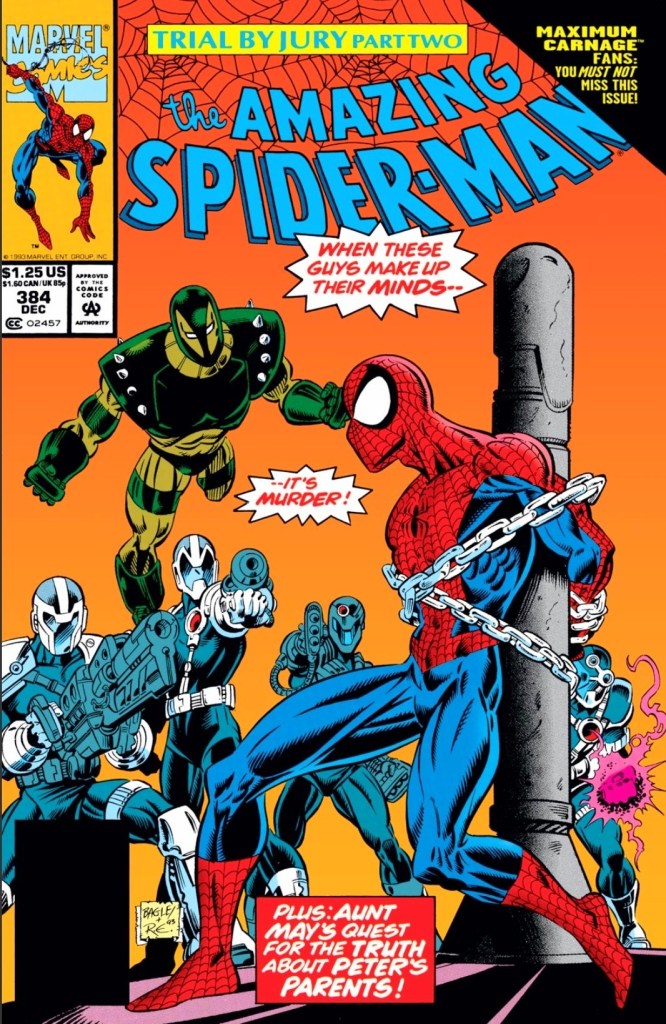
In my previous retro review, Spider-Man became the new target of The Jury, a team of armored mercenaries founded and led by the father (note: a prominent and powerful man) of one of Venom’s murder victims. Spider-Man was perceived to be responsible for bringing the living alien costume into the world which eventually resulted in the creation of Venom (note: Eddie Brock bonded with the same symbiote) who went on to cause havoc and killed a lot of people.

With those details laid down, here is a look back at Amazing Spider-Man #384, published in 1993 by Marvel Comics with a story by David Michelinie and drawn by Mark Bagley.  

The cover.

Early story

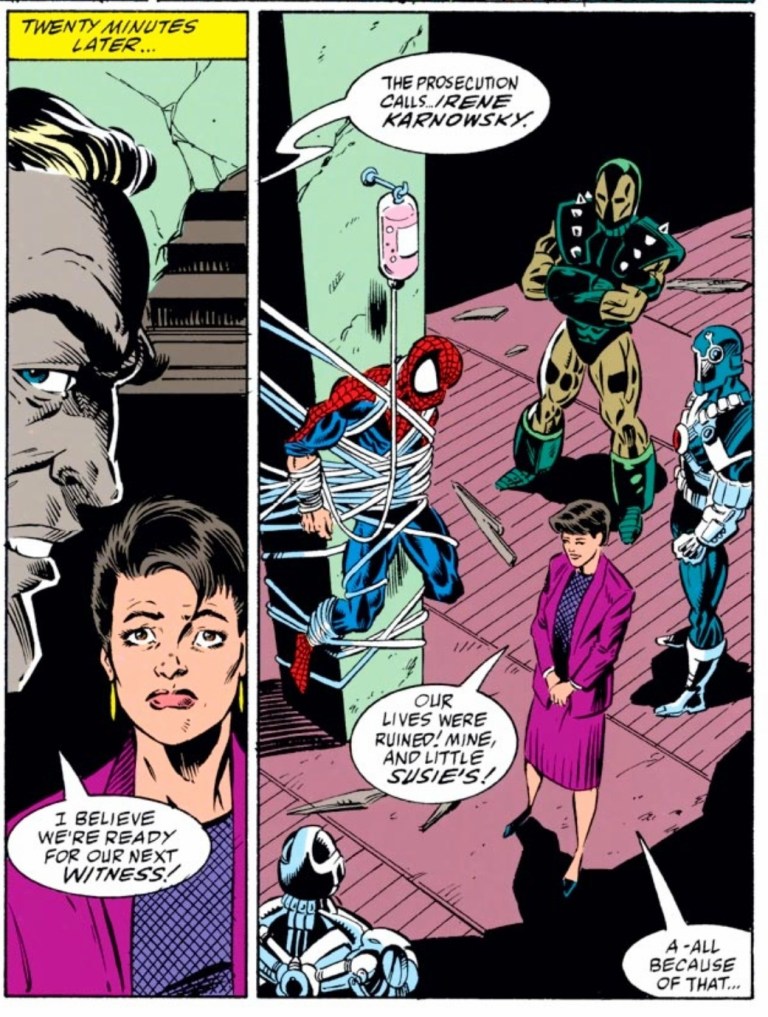
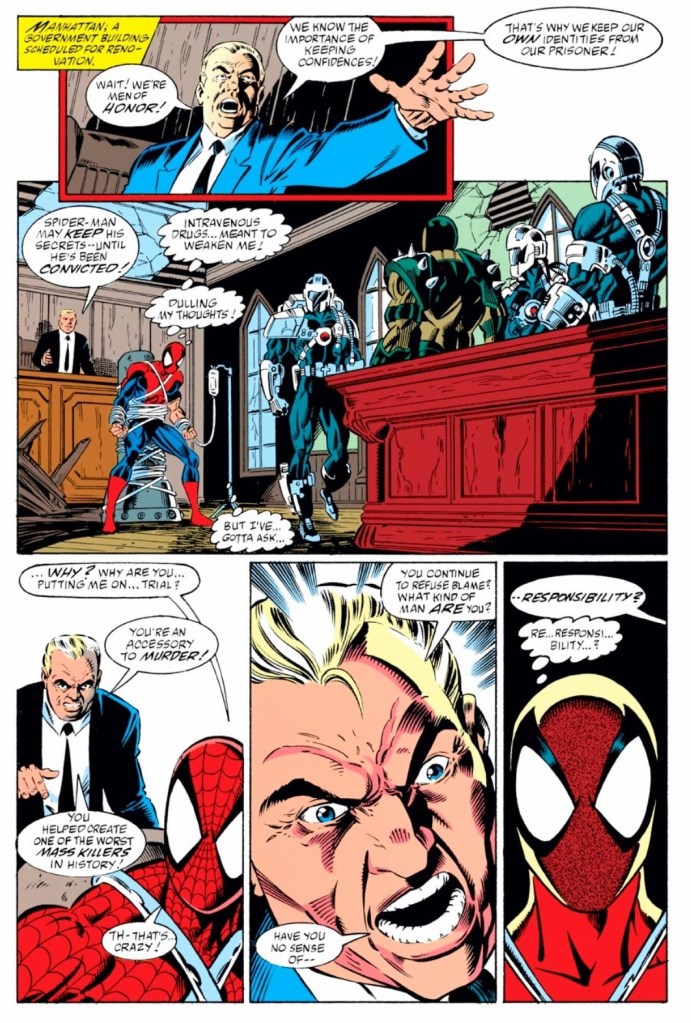
The story begins inside a certain government building in New York City scheduled for renovation. A heavily restrained and drugged Spider-Man was about to have mask taken off by one of The Jury members when their founder General Taylor intervened and insisted that they keep their honor. Spider-Man is up for questioning and scrutinization in a makeshift trial by The Jury. As the webslinger is not in the proper condition to stand trial, Taylor (in his capacity as the judge) declares a 30-minute recess.

Elsewhere, Peter Parker’s wife Mary Jane received bad news from her boss that her role in the TV show Secret Hospital will be reduced to a recurring role. This troubles her deeply as it means reduced income for her at a time when her marriage with Peter continues to go down. Spider-Man’s lack of quality time with her keeps taking its toll on her…

Quality

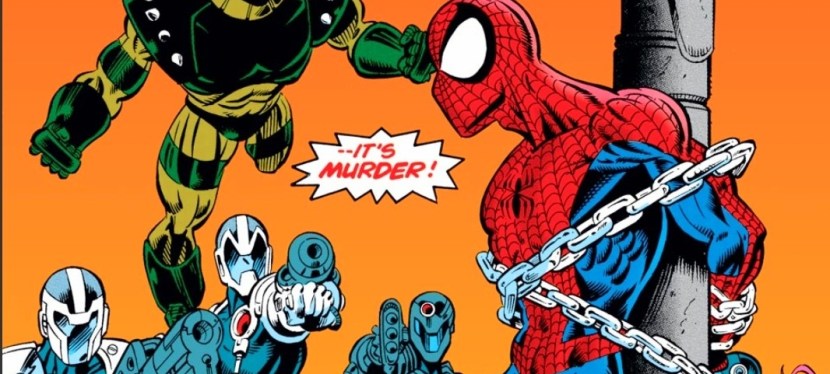
Spidey on trial!

Firstly, I should say that the Michelinie-Bagley team’s concept of having The Jury as the force of opposition against Spider-Man continues to do wonders creatively in this particular comic book series. In the previous issue, the webslinger was hunted and General Taylor really invested a lot of technologies to get to him in the middle of a very bustling city. In this particular issue, Spider-Man is completely vulnerable being weakened and disoriented as he is about to be tried in a makeshift court.

Along the way, Taylor and his team were portrayed to work within their own system of justice. As no court of law in New York would recognize Spider-Man’s trial, The Jury set up their own court in a very private and unusual manner.

While the planned trial is the major event of this comic book’s concept, Michelinie pulled off a rather unusual move with the narrative. Just as the first witness points to Spider-Man for being responsible for Venom, the iconic webslinger then starts to wonder what the trial is truly all about and then the creative team unleashed a slew of flashbacks that looked back a key events published in certain comic books of Secret Wars, The Amazing Spider-Man and Web of Spider-Man through the years. I’m talking about Spider-Man’s first-ever encounter with the symbiote, how he got rid of it, how the symbiote bonded with Eddie Brock to form Venom, how Venom’s costume left a living seed that Cletus Kassady touched and became Carnage, etc. These flashbacks, all nicely drawn by Mark Bagley, conveniently served as an instant reference for readers to catch up with the current events but this was done at the expense of this comic book’s narrative.

More on the trial, this comic book raises layered questions about the concept of responsibility on Spider-Man. Could the iconic webslinger really be held accountable for whatever murders Venom committed along with the trauma he caused on bystanders given the fact that he really brought the alien costume into their world? Should Spider-Man also be held responsible for any murders committed by Carnage? This is one really loaded script Michelinie came up with and he really had Spider-Man vulnerable not only to The Jury but also to the questions thrown at him during the makeshift trial. To put it short, this is one very unusual Spider-Man tale ever told that carries strong relevance from the past.

As with the previous issues, this comic book sheds a limited amount of the spotlight on Mary Jane and Spider-Man’s Aunt May who at this stage has gotten paranoid with her suspicions about Peter’s parents. The dramatization turned out pretty good.

Conclusion

Spider-Man in a vulnerable state with The Jury.

While the flashbacks were excessive and made the narrative feel bloated, Amazing Spider-Man #384 (1993) still has lots of good stuff fans can enjoy. It has a pretty bold concept of having Spider-Man really trapped and left vulnerable for the makeshift trial. More notably, the narrative pounded heavily on the concept of responsibility in relation to Spider-Man’s past actions that led to the creation of Venom and even Carnage.

Overall, Amazing Spider-Man #384 (1993) is recommended!

+++++

Thank you for reading. If you find this article engaging, please click the like button below, share this article to others and also please consider making a donation to support my publishing. If you are looking for a copywriter to create content for your special project or business, check out my services and my portfolio. Feel free to contact me with a private message. Also please feel free to visit my Facebook page Author Carlo Carrasco and follow me on Twitter at  @HavenorFantasy as well as on Tumblr at https://carlocarrasco.tumblr.com/ and on Instagram at https://www.instagram.com/authorcarlocarrasco

A Look Back at Amazing Spider-Man #383 (1993)

Disclaimer: This is my original work with details sourced from reading the comic book and doing personal research. Anyone who wants to use this article, in part or in whole, needs to secure first my permission and agree to cite me as the source and author. Let it be known that any unauthorized use of this article will constrain the author to pursue the remedies under R.A. No. 8293, the Revised Penal Code, and/or all applicable legal actions under the laws of the Philippines.

Welcome back superhero enthusiasts, 1990s culture enthusiasts and comic book collectors! Today we go back to the year 1993 and explore a part of the Marvel Comics universe through one of the many tales of the Amazing Spider-Man comic book series.

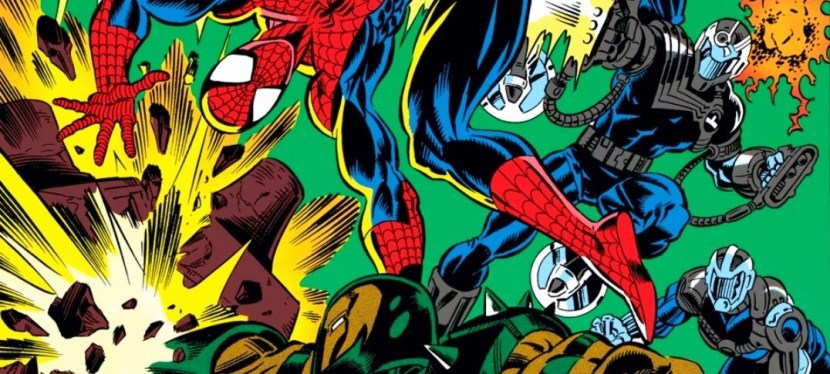
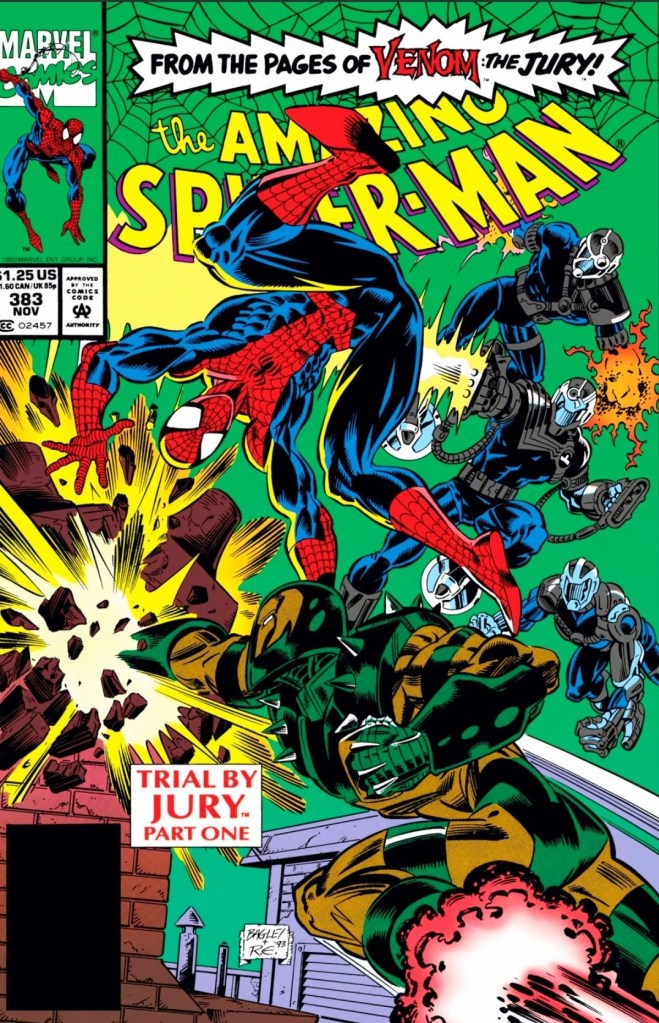
To put things in perspective, the creative team behind the Amazing Spider-Man title decided to shake things up a bit by having the high-tech team called The Jury (the same team that went against Venom led by a powerful man whose son was murdered by Eddie Brock in Amazing Spider-Man #315) as the force of opposition for the webslinger.

With those details laid down, here is a look back at Amazing Spider-Man #383, published in 1993 by Marvel Comics with a story by David Michelinie and drawn by Mark Bagley.  

The cover.

Early story

The story begins in New York with the super-powered being Nova flying around which triggers an alert. It turns out, members of The Jury and their leader General Orwell Taylor have been monitoring and scanning areas of the city with several motion detectors to find Spider-Man. As far as Taylor is concerned, Spider-Man is highly responsible for the existence of Venom in their world and is therefore connected to the murder of his son (committed by Venom while escaping from prison in Amazing Spider-Man #315). Taylor is convinced that the if Spider-Man’s freedom is the price for stopping a monster like Venom, then that would be good.

Suddenly, the team notices that one of their motion detectors went offline. Moments later, a technician reaches the rooftop of the building and finds a motion detector severely damaged. Out of nowhere, Spider-Man grabs the technician and puts his life in danger by moving him off the edge using his fist and strength to carry him. Spider-Man pressures him for details…

Quality

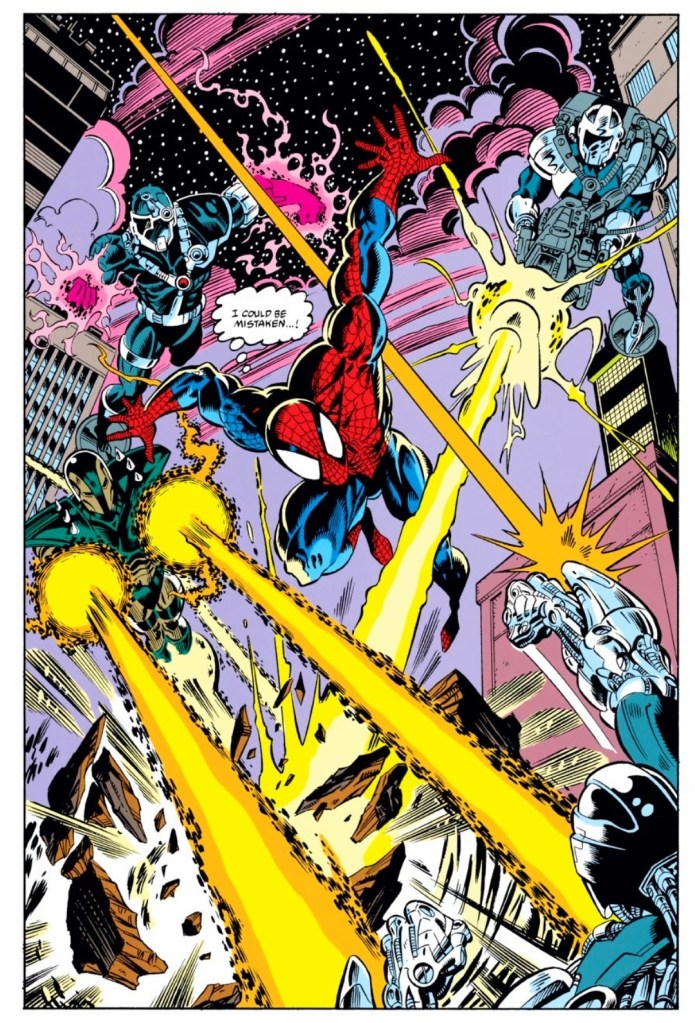
The Jury’s hunt for Spider-Man is really entertaining to read!

This is definitely one of the more engaging Amazing Spider-Man stories I read not only from 1993 but from the 1990s in general. In my view, putting Spider-Man up against The Jury is a stroke of genius on the part of the Michelinie-Bagley team and at the same time it was a sound relief after reading so much about the presence of Carnage and Venom on this particular monthly series (note: the Maximum Carnage crossover chapters and Amazing Spider-Man #375 being linked with the Venom: Lethal Protector limited series).

When it comes to The Jury, Michelinie crafted a script that justifies Taylor’s team to pursue Spider-Man after they failure on getting Venom. This shows that Taylor has acquired information about Venom’s origin being the result of Spider-Man bringing home with him the symbiote (alien costume) from his time on a far-away planet (as seen in the Secret Wars series). Creatively, this results in a very convincing portrayal of Taylor not only as a grieving father but also as a very tactical leader who uses vast intelligence and resources to achieve what he believes is justice and the means for achieving the greater good. As for The Jury’s armored members – Sentry, Ramshot, Screech, Firearm and Bomblast – Michelinie did not simply portray them as straight-forward, mission-focused people here. One of them shows hesitancy which added a nice layer of division and human weakness within the team which is felt in action-packed encounter with Spider-Man.

Being the target of The Jury, Spider-Man at this stage is deeply troubled even though the Maximum Carnage disasters are over. He is portrayed to be very disturbed by the alarm signals of his Spider Sense whenever he gets near one of the sensors of The Jury which is a unique display of his special ability.

Those of you who love superhero spectacle will find a lot to enjoy here! Mark Bagley’s art on emphasizing action and stunts is fantastic to look at as The Jury pursues Spider-Man within New York. There are lots of dynamic shots, flashy high-tech images and really intense superhero action complete with collateral damage!

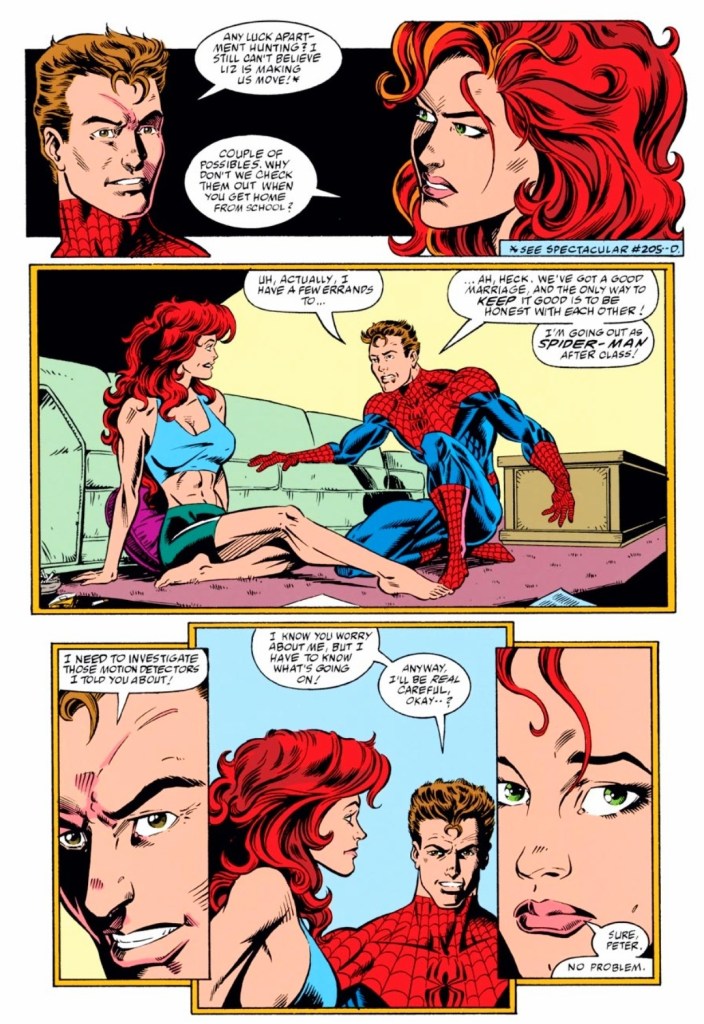
To be clear, this comic book is not simply all about the webslinger and Taylor’s team. There are some scenes here building up on Aunt May’s suspicion about Peter Parker’s parents which added suspense to the narrative.

Conclusion

As usual, Peter Parker does not have enough quality time for his wife.

Amazing Spider-Man #383 (1993) remains a very solid and highly entertaining comic book to read from start to finish. The Michelinie-Bagley team really delivered the great stuff as they launched a new concept having The Jury hunting Spider-Man in successful fashion. The Jury is clearly a very formidable team that gave Venom and Spider-Man a lot of trouble. The notable thing here is that this is only the first chapter of a new storyline with focus on Spider-Man’s responsibility with the murderous Venom (and all the victims he made).

Overall, Amazing Spider-Man #383 (1993) is highly recommended!

+++++

Thank you for reading. If you find this article engaging, please click the like button below, share this article to others and also please consider making a donation to support my publishing. If you are looking for a copywriter to create content for your special project or business, check out my services and my portfolio. Feel free to contact me with a private message. Also please feel free to visit my Facebook page Author Carlo Carrasco and follow me on Twitter at  @HavenorFantasy as well as on Tumblr at https://carlocarrasco.tumblr.com/ and on Instagram at https://www.instagram.com/authorcarlocarrasco