Disclaimer: This is my original work with details sourced from reading the comic book and doing personal research. Anyone who wants to use this article, in part or in whole, needs to secure first my permission and agree to cite me as the source and author. Let it be known that any unauthorized use of this article will constrain the author to pursue the remedies under R.A. No. 8293, the Revised Penal Code, and/or all applicable legal actions under the laws of the Philippines.
Welcome back superhero enthusiasts, 1990s culture enthusiasts and comic book collectors! Today we go back to the early 1990s and explore a part of the Valiant Comics shared universe through the Armorines monthly series.
During the said decade, Valiant Comics was notable for having crossovers that some readers found to be tightly executed in relation to continuity. The armored U.S. Marines (Armorines) and the powerful individual X-O Manowar have the spider aliens as a common enemy.
With those details laid down, here is a look back at Armorines #6, published in 1994 by Valiant Comics with a story written by Jorge Gonzalez and drawn by Jim Calafiore.
The cover.
Early story
The story begins in space when the spider aliens (located inside a huge space ship) are organizing themselves to get back to their home world.
Meanwhile above the Earth, X-O Manowar significantly helps the Armorines with repairing their space shuttle. It turns out that they have been spending a long time in space and the crew has gotten exhausted after the big battle with the spider aliens. Going back home was their next objective.
Just as the crew prepares to return to Earth, the same huge space ship of the spider aliens suddenly approaches them…
Quality
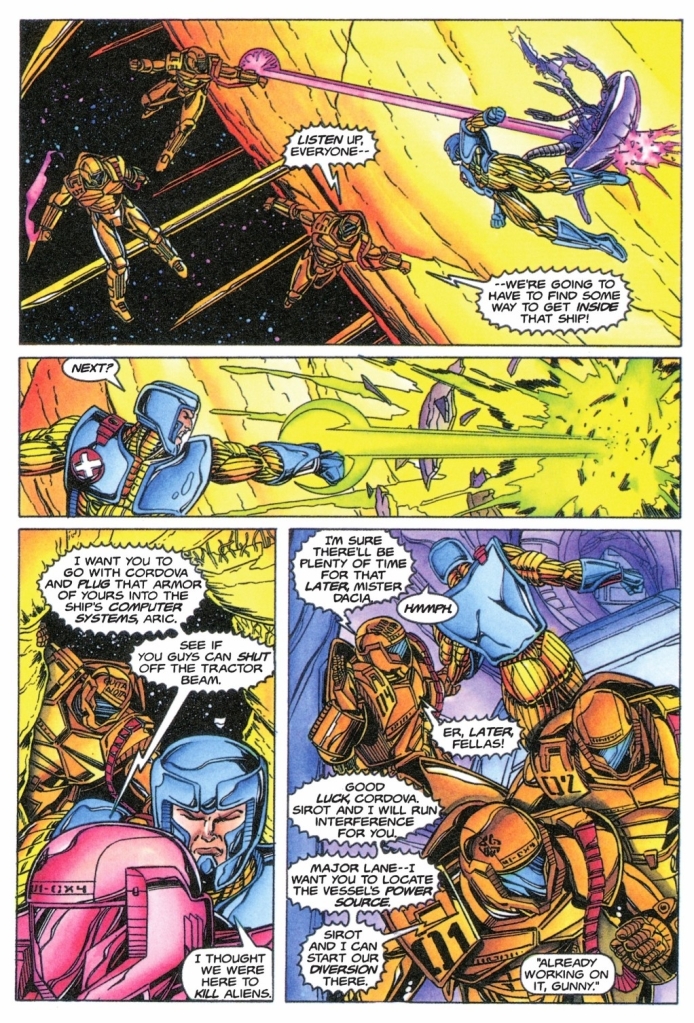
The spider aliens.
Set after the crossover tale about the humans’ battle with the spider aliens in space, this tale served as a creative extension of those events utilizing space travel and sci-fi action concepts. The Armorines once again fight the spider aliens and X-O Manowar (a major Valiant character) gets heavily involved as he has a personal grudge against them. Without spoiling the plot, I can say that themes of freeing yourself from the enemy and getting back home are evident.
There is plenty of action to enjoy here and the sci-fi settings (including the interiors of the spider aliens ship) are nicely presented. I also like the fact that the tension gradually built-up as the story went on. Still, at this particular stage of this series, I could not help but feel that the Armorines have been in conflict with the spider aliens for too long.
Conclusion
There is a lot of sci-fi action to enjoy here.
Armorines #6 (1994) is a pretty good read but I was getting tired of seeing the Armorines remaining in conflict with the spider aliens. What added strong value to the comic book was the heavy involvement (and crossover) of X-O Manowar and his interactions with the Armorines was well executed. To be clear, the story was not conclusive and at this stage, I still am interested to see what would happen next. Here is hoping that the Armorines conflict with the spider aliens will improve somehow.
Disclaimer: This is my original work with details sourced from reading the comic book and doing personal research. Anyone who wants to use this article, in part or in whole, needs to secure first my permission and agree to cite me as the source and author. Let it be known that any unauthorized use of this article will constrain the author to pursue the remedies under R.A. No. 8293, the Revised Penal Code, and/or all applicable legal actions under the laws of the Philippines.
Welcome back superhero enthusiasts, 1990s arts and culture enthusiasts, and comic book collectors! Today we go back to the mid-1990s to explore the comic book launch of a notable fictional team co-created by the Whilce Portacio and Brandon Choi…Wetworks.
For the newcomers reading this, Whilce Portacio was one of the highly talented illustrators who left Marvel Comics and co-founded Image Comics in the early 1990s. While his fellow co-founders Todd McFarlane, Jim Lee, Rob Liefeld, Marc Silvestri, Jim Valentino and Erik Larsen were able to launch their respective dream projects (creator-owned properties) during Image’s first year of publishing, the launch of Wetworks was delayed by two years due to a death in Portacio’s family.
As a very young comic book reader in those days, I remember hearing rumors about Wetworks inside comic book stores I visited. There were rumors of business negotiations, solicitations and scheduled launches (ranging from October 1993 to January 1994). I also noticed some comic book enthusiasts who bought old copies of X-Factor and Uncanny X-Men that Portacio illustrated while waiting for Wetworks to debut.
In the middle of 1994, Wetworks was finally launched under the Image Comics label and I still remember the day when I saw lots of copies of issue #1 displayed on the shelves and windows of comic book stores.
With those details laid down, here is a look back at Wetworks #1, published in 1994 by Image Comics with a story written by Whilce Portacio and Brandon Choi. The art was done by Portacio with ink work by Scott Williams.
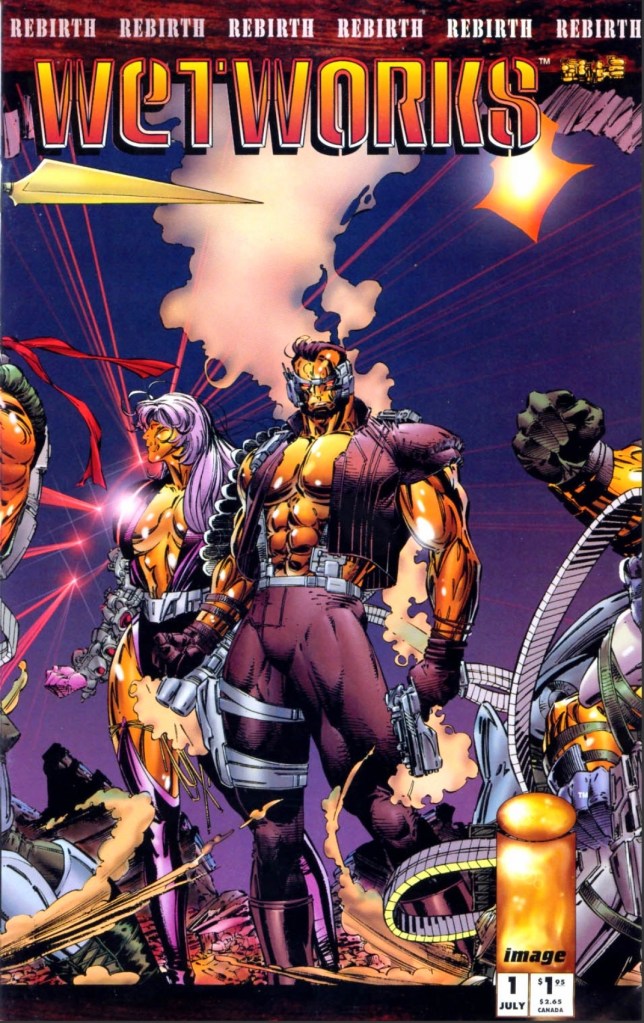
The cover.
Early story
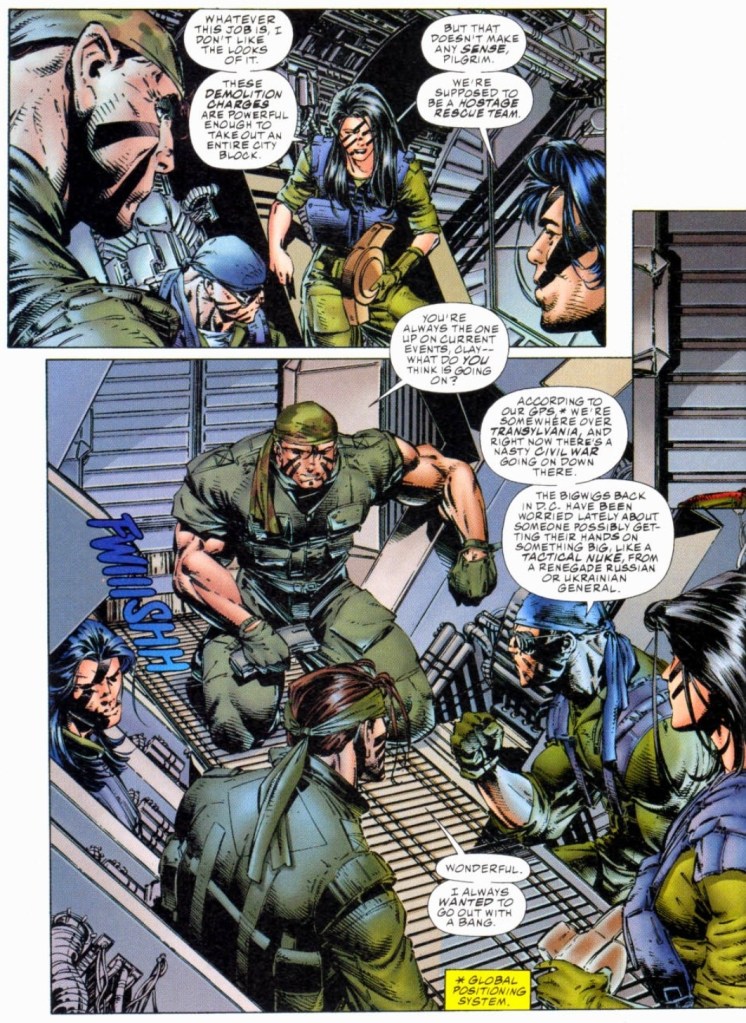
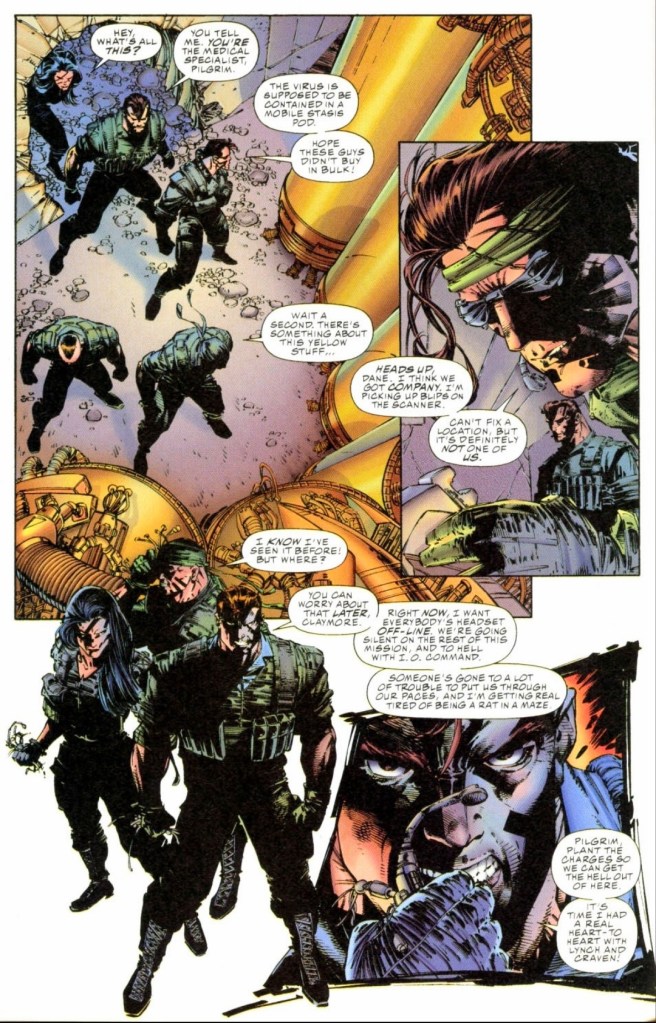
The story begins when a covert operations team working under International Operations (IO) travels to eastern Europe to infiltrate and destroy the base of operations of a certain warring faction and retrieve a biological agent (highly contagious) no matter what the cost. As it turns out, this new mission for the team (led by Colonel Jackson Dane, one of the pioneers of Team 7) started less than twenty four houses after their previous mission and their female member Pilgrim (reconnaissance specialist) pointed out that the demolition charges they are carrying are strong enough to wipe out an entire city block. Another teammate called Grail (the Filipino named Salvador Joel Alonday) stated that they are supposed to be a hostage rescue team.
Meanwhile deep inside the command center of IO in Washington, D.C., Admiral Halsey tells Miles Craven that Team 7 (the team led by Dane) are under his command and states that his sources tell him that there is more to the mission than just a group of ethnic nationalists obsessed on a biological terror campaign. It turns out, Craven sent the team to eastern Europe without fully informing them of what they are going up against. Craven insists that Team 7 are paid to put their lives on the line and to die if necessary just to get the job done. Craven then reveals to Halsey the true nature of the mission. The admiral then realizes Craven is right and certain sacrifices must be made for the greater good.
Craven and his team arrived at the location in Transylvania. They started seeing signs that someone else arrived ahead of them…
Quality
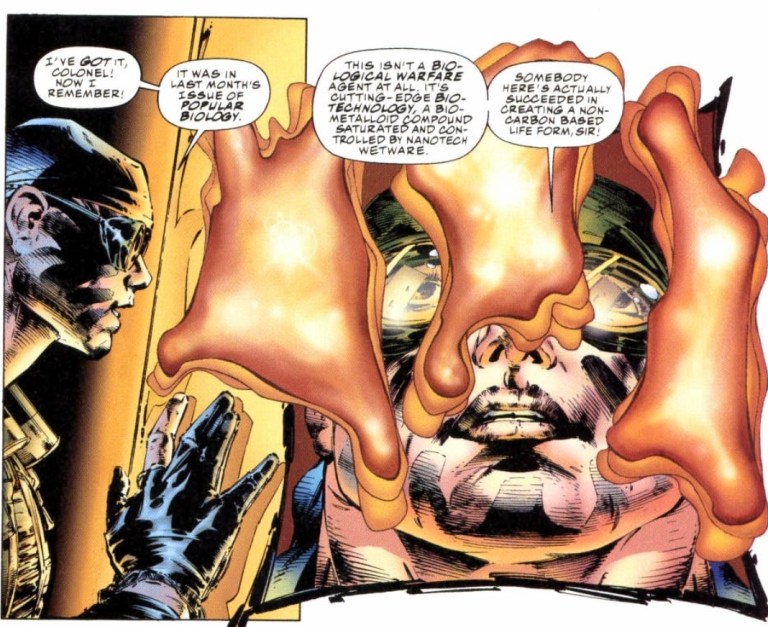
One of the team members looks at a symbiote.
I’ll start first with the fantasy concept and the storytelling. Whilce Portacio and Brandon Choi’s joint creation of Wetworks is indeed an inspired move with connections to real-life military influences the creators had. The Wetworks team – initially referred to as Team 7 – started looking and acting like typical military squad in the world of fiction but the major twist that happened drastically redefined and refined them into the most unique military team in the world of superhero comics. It’s the closest thing to seeing G.I. Joe fused with living symbiotes (another inspired move most likely influenced by a certain Marvel murderer with a symbiote whose origin is linked with one of the most iconic superheroes ever) there is and I can say Wetworks remains relevant and stands out nicely among superhero comic book teams to this day.
With regards to the plot, it looks cliched on face value. I’m talking about the trope in which a team is sent by their powerful superiors on a mission without knowing all the crucial details needed (because the superiors hid it from them) and they eventually encounter immense danger. As mentioned earlier, the major twist in the plot not only completed a major transformation of Dane and his teammates but also ramped up the fantasy aspect of the tale to much higher levels.
Still on the plot, Portacio and Choi came up with a solid structure for the narrative. The build-up of details and tension was very good and the pay-offs (lots of spectacle plus twists) were great. As the story moved on, the suspense grew stronger and the narrative succeeded in making me care about the team led by Dane.
Meet the team members who would later become Wetworks.
When it comes to the art, Portacio’s work here (with ink by Scott Williams) still looks great and, more notably, it is a fine departure from the superhero visuals he worked in years prior. As with his past works, you will see the artist’s stylized approach on visualizing the narrative related to how he implements the panels per page.
Portacio did a very good job with the military look of Wetworks and he drew their guns with a high amount of detail that should be seen (you should try using a magnifying glass on this comic book). Not only that, his art on military hardware such as the gunships, the interiors plus equipment all have that detailed appearance. When it comes to action, I believe that Portacio took a lot inspiration from Hollywood action flicks (most notably Predator) on portraying Wetworks members using their guns and positioning during battle.
Of course, the spectacle is not totally limited to military stuff. There is a touch of fantasy and horror visuals involved which is directly related to what was set-up for Wetworks to encounter in the near future. To realize what I am saying here, you must read this comic book until the intense end.
Conclusion
Wetworks #1 from 1994 is still great to read!
I can say without a doubt that Wetworks #1 (1994) remains as gripping and as entertaining as when I first read it decades ago. In short, it has aged well and reading it all over again today is compelling and a lot of fun to do. If you ask me, this is one of the finest works ever by Whilce Portacio in terms of art and storytelling. As one of the many comic books Image published during its first few years in the industry, Wetworks #1 (1994) clearly stands out with its military theme and fantasy concept. Lastly, Wetworks is set within the WildStorm universe as dramatically symbolized with the presence of International Operations (the team’s superiors).
Have you been searching for something fun or interesting to watch on YouTube? Do you feel bored right now and you crave for something to see on the world’s most popular online video destination?
I recommend you check out the following topics and the related videos I found.
#1 Son of Hamas Co-Founder Denounces Palestinian Terrorist Group – This video recently published by the channel of CBN News (under the Christian Broadcasting Network) must be seen in full. Mosab Hassan Yousef, the son of Hamas co-founder Sheikh Hassan Yousef, blasted the Palestinian terrorist group Hamas without hesitation. He defected from the terrorist group in the late 1990s and secretly worked with Israel’s security services to expose and prevent several Hamas terrorist attacks. He later gave his life to Christ and wrote a 2010 autobiography titled Son of Hamas. This is the YouTube video that pro-Palestine fanatics and the terrorists themselves are afraid of. Please share this video to others.
#2The Transformers: The Movie (1986) nostalgia – Like many people of my generation, I was a fan of The Transformers animated TV series. Then in 1986, a theatrical feature called The Transformers: The Movie was released in cinemas in some parts of the world at a time when Internet connection and social media were not yet common. That same movie became a must-see in our village as soon as it was made available for rent on video tape format. My friends and I had a lot of fun watching it and thanks to the advances of technology, a 4K Blu-ray of it is now available. Of course, The Transformers: The Movie was notable not only because it was the first feature-length Transformers production but also because it had the death of a major character and it marked a turning point in the lore of the Transformers which was reflected subsequently on TV. That being said, there are lots of retrospective videos, retro reviews, reaction videos and more of it on YouTube which you can see below…
#3 Examining the mental instability of climate change activists and believers – Like many others, I prefer to live in an environment that is not very dirty and has abundant clean air. Of course, that does not mean I believe in the movement of climate change which itself has armies of zealots and extremists who disrupted societies with their radical activism while spewing distorted views about many things in order to impose their agenda on others. That being said, one has to wonder how all that unrestrained activism impacted the mental health of each and every climate change believe and why could they not stop doing their stupid acts of public disruption. Fortunately, Sky News Australia made a video about that and you can watch it below…
#4 The ignorance and stupidity of pro-Palestine LGBT people exposed – As the war between Israel and Hamas continues, a lot of pro-terrorist, pro-evil and pro-Palestine rallies have happened around the world which includes zealots of the Satanic Left. Among those zealots are homosexuals and members of the LGBT people who shamelessly supported the Palestinian terrorists in varied ways. What is clear, however, is that the pro-Palestine LGBT rallyists do not even realize that homosexuality, transgender beliefs and the LGBT lifestyle in Palestinian society are NOT acceptable and these would get them into trouble (torture, imprisonment and even death). These same LGBT supporters of the Palestinians collectively attacked Israel which itself has LGBT rights and freedom established. As it is a fact that Leftists always go together with terrorists, the LGBT people’s support for the Palestinians (a displaced people who have no stake in the land of Israel at all) clearly showed their embrace of evil as well their ignorance and their acts of stupidity. It seems the LGBT activists sold their souls to the Palestinian terrorist group Hamas as well as the corrupt Palestinian Authority (PA). To learn more, watch the Sky News Australia video below…
#5 The wickedness and violent nature of the pro-Palestine activists revealed – There is a lot of anti-Semitism and hatred towards Israel that happened in the form of protests around the world. Recently in Washington, DC, a mob of pro-Palestine activists clashed with the police officers just outside the office of the Democratic National Committee (DNC). One of those activists is a Democrat (referred to the Democratic Party as “our party”) who spoke directly to the camera (starts at 0:53) as seen in the Sky News Australia video below. What is clear here is that these pro-Palestine activists in America have been brainwashed to hate Israel, to hate the Jewish people while loving the terrorists also. They have been brainwashed to be violent, to live with delusions and believe in lies. Not only that, there was another pro-Palestine protest in Germany that turned violent and resulted in the injuring of over sixty police officers. Democrats and other Satanic Left elements always go together with terrorists. In fact, the pro-Palestine believers themselves are gradually becoming new terrorists. Watch and learn from the videos below…
#6 G.I. Joe nostalgia – If you are a long-time fan of the G.I. Joe entertainment franchise or if you are a newcomer who is just starting to discover more of the said franchise, then you should check out the reruns (first video posted below) of full episodes the 1980s animated TV series G.I. Joe: A Real American Hero at Hasbro’s official YouTube channel. By the way, check out my two retro comic book reviews of G.I. Joe by clicking here and here. Now, enjoy the G.I. Joe videos below…
#7 You like Team America: World Police? – I never saw the 2004 movie Team America: World Police but I saw a few puppetry shows and films when I was a little boy. Recently, YouTuber Minty Comedic Arts posted a trivia video of it which made me remember the time back in 2004 when I saw movie posters of it during a visit at the local cinema. If you are a fan of the film or if you are just discovering it, watch the videos below…
Disclaimer: This is my original work with details sourced from reading the comic book and doing personal research. Anyone who wants to use this article, in part or in whole, needs to secure first my permission and agree to cite me as the source and author. Let it be known that any unauthorized use of this article will constrain the author to pursue the remedies under R.A. No. 8293, the Revised Penal Code, and/or all applicable legal actions under the laws of the Philippines.
Welcome back superhero enthusiasts, 1980s culture enthusiasts and comic book collectors! Today we go back to the early 1980s to explore Marvel Comics’ handling of a series based on the wildly popular military-themed franchise of toys – G.I. Joe: A Real American Hero.
Last time around, a small number of G.I. Joe members went to the North Pole on a mission to find answers and anyone responsible for the destruction of the American research base. The mission did not involve Cobra at all but a certain specialist who was working as a freelancer.
With those details laid down, here is a look back at G.I. Joe: A Real American Hero #3 published in 1982 by Marvel Comics with the main story written by Larry Hama and drawn by Herb Trimpe.
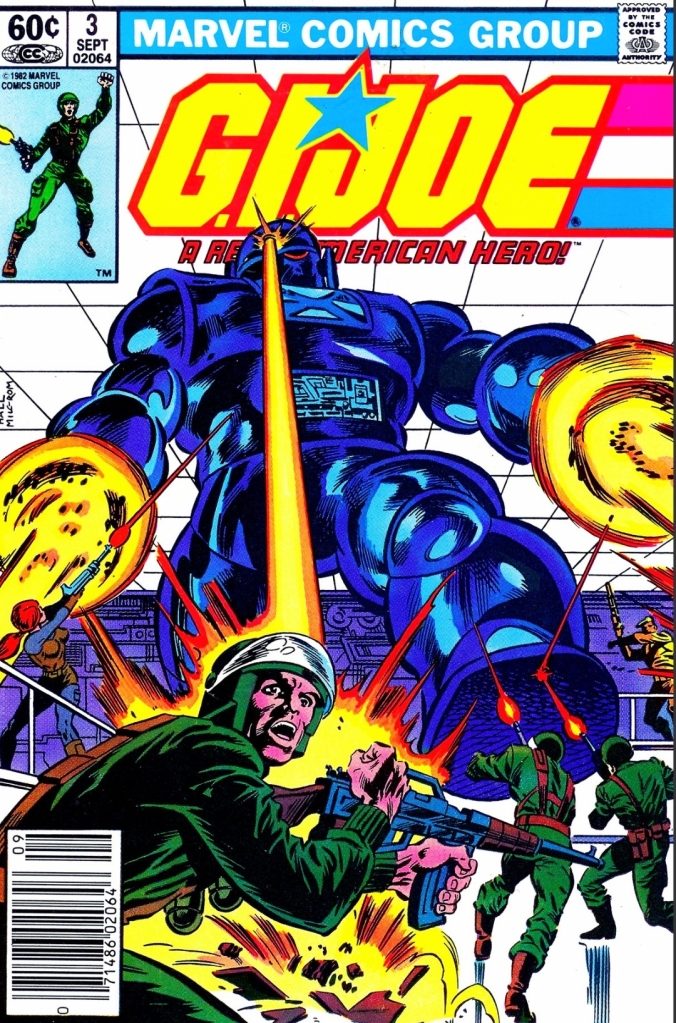
The cover.
Early story
The story begins shortly after G.I. Joe’s successful raid on a secret stronghold that belonged to their arch-rival Cobra. A huge, bulky robot was found at the site and the Joe team received orders to get the machine back to their command center – The Pit – to run preliminary scans on it.
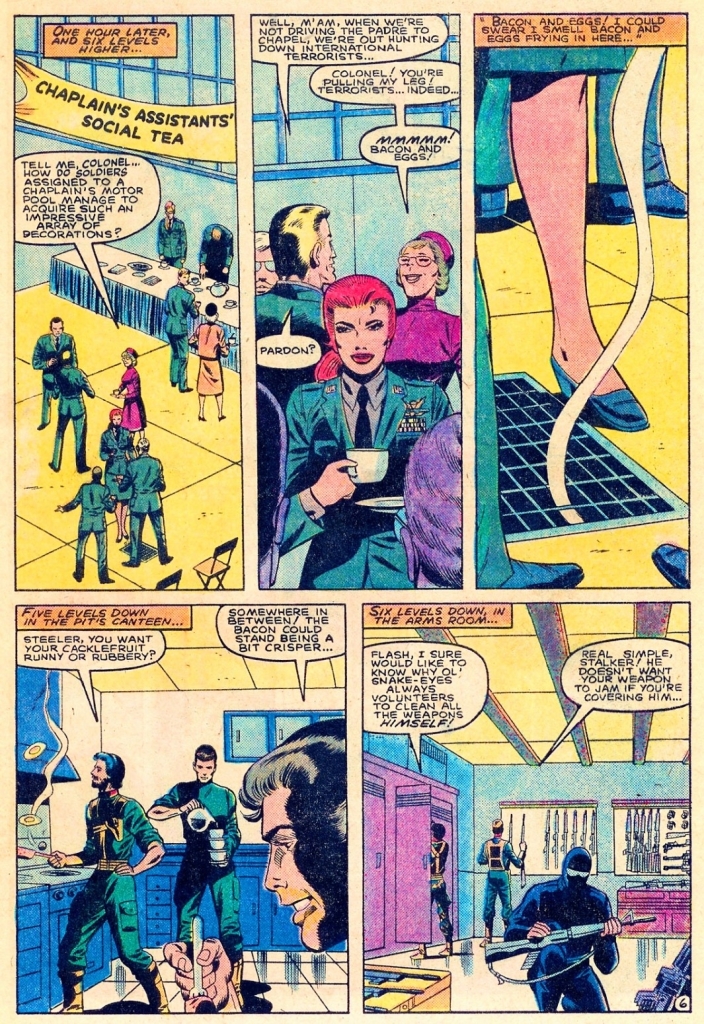
Due to the very sensitive nature of the robot and the Cobra stronghold, the military uses three trucks disguised as American mail trucks for the trips to The Pit.
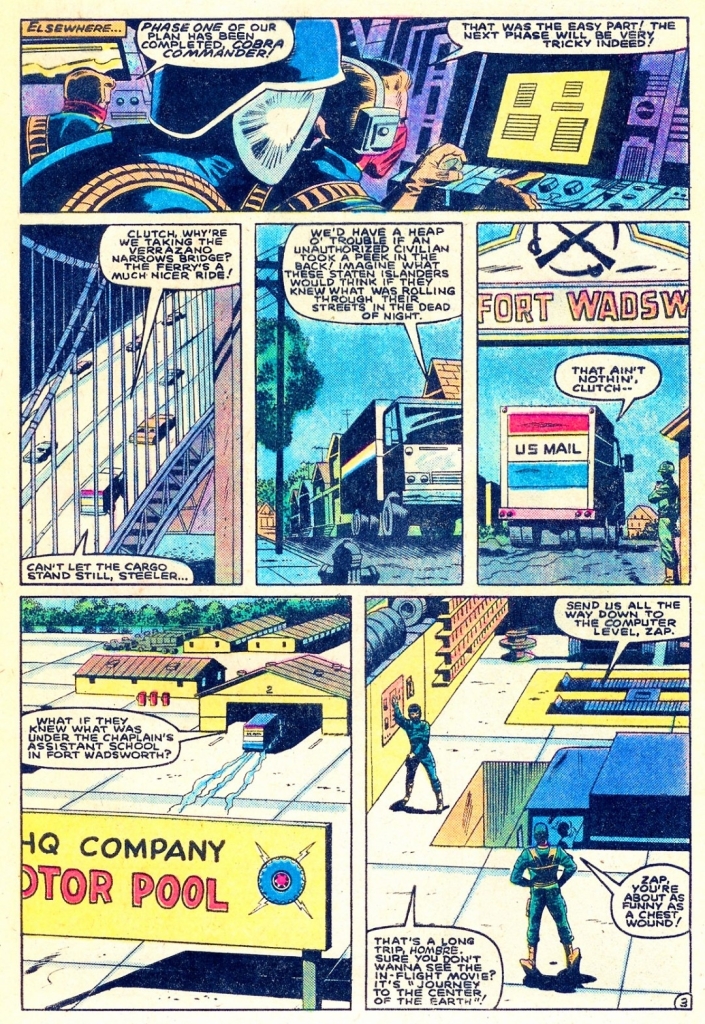
Elsewhere, Cobra Commander and his team are aware that G.I. Joe is bringing the robot with them. He has a Trojan plan prepared…
Quality
The scent of bacon and eggs reached the higher levels.
To make things clear, this is story still does not put G.I. Joe head-to-head with Cobra in combat. Instead, this is a tale about Cobra’s attempt to cause chaos on their rivals deep within a top secret stronghold of the Americans. That being said, the main character here is the huge robot of Cobra’s which really pushed the Joe team into real challenges. The robot does not even speak and its actions really drove up the tension of both the Joe team’s predicament as well as the narrative itself.
Along the way, you will get to see members of G.I. Joe becoming more tactical with their struggle to survive and solve problems. In fact, the Joe members are more versatile which reflect what they learned from extensive training.
Conclusion
Cobra Commander monitors the developments from a distance as G.I. Joe members brought with them the robot from what was once a stronghold of Cobra.
While the lack of a direct conflict between the Joe team and Cobra is evident, G.I. Joe: A Real American Hero #3(1982) still had an unrelenting enemy in the form of Cobra’s robot that proved to be a major force of opposition. In terms of presentation, this story has a slight touch of science fiction (due to the robot) but managed to be military in nature the rest of the way. Apart from their resourcefulness, the G.I. Joe members here displayed a strong element of team work. The narrative is packed with action as well as a good amount of details that made the reading experience consistently good.
Overall, G.I. Joe: A Real American Hero #3(1982) is recommended.
Welcome back, fellow geeks, Blu-ray collectors and movie buffs! Way back in 1954, the original Godzilla movie (Japanese title: Gojira) made its debut in theaters in Japan. Not only did it make a huge impact with moviegoers, it paved the way for more Godzilla movies (which compelled Hollywood players to join in), imitators and made a solid contribution to global pop culture.
Of course, the original Godzilla film was decades before I was even born and as a boy, I got to watch on home video “Godzilla 1985” which was a Westernized version of The Return of Godzilla (1984). Then in 1998, I saw Roland Emmerich’s twisted version of Japan’s giant monster.
Going back to the original film from 1954, an American version of it was released in 1956 under the title Godzilla: King of the Monsters which was a recut version that had actor Raymond Burr in it as an American journalist witnessing events. That American version, which I saw partially by chance on cable TV, only made me want to see the 1954 original Godzilla movie intact.
That being said, I acquired a copy of the Godzilla (1954) Blu-ray fromCriterion Collection and I can say I am really enjoying it. It definitely is a very good addition to my collection of Blu-ray movies.
The cover of the Godzilla (1954) Blu-ray release from Criterion Collection.
To begin with, posted below are the specs from the Blu-ray.com page…
Video
Codec: MPEG-4 AVC (24.01 Mbps)
Resolution: 1080p
Aspect ratio: 1.37:1
Original aspect ratio: 1.37:1
Audio
Japanese: LPCM Mono (48kHz, 24-bit)
English: LPCM Mono (48kHz, 24-bit)
Subtitles – English, English SDH
Discs -Blu-ray Disc, Single Disc (1 BD-50)
Playback – Blu-ray: Region A
The back of the Criterion Collection Godzilla (1954) Blu-ray. Pay close attention to the details because you will get a lot of stuff to enjoy with this one added into your Blu-ray movie collection.
I really enjoyed the 1954 movie directed by Ishiro Honda and I can talk more about it in detail in a future retro movie review. Going back to Criterion’s Godzilla (1954) Blu-ray, I can say that the company did a great job not only with the restoration and audio, they also loaded the disc with a whole lot of content that will appeal strongly with dedicated Godzilla fans as well as the newcomers who wish to learn more about Japan’s giant monster, its legacy and place in global pop culture. The disc also has a restored copy of Godzilla: King of the Monsters (1956) but I strongly recommend you watch the 1954 film first and foremost.
The extra stuff in the disc contains a lot of content for you to enjoy. There are interviews with certain cast and crew members, an illustrated audio essay about the tragic Lucky Dragon No. 5 vessel, an audio commentary by David Kalat, and more.
When it comes to the physical aspect of Criterion’s Godzilla (1954) Blu-ray, the packaging is both nicely done and inspired. I just love it whenever I opened the set to get to the disc, an image of Godzilla folds and forms in shape for your viewing pleasure. The set also has a booklet that contains really interesting information. Very clearly, this is so much better than streaming!
I really like this excellent packaging by Criterion Collection. Very clearly better than streaming!
For the dedicated Godzilla fans as well as enthusiastic film buffs and collectors of movies on physical media, Criterion’s Godzilla (1954) Blu-ray is highly recommended! This is currently the best way to enjoy the classic movie in the comfort of your home!
Disclaimer: This is my original work with details sourced from reading the comic book and doing personal research. Anyone who wants to use this article, in part or in whole, needs to secure first my permission and agree to cite me as the source and author. Let it be known that any unauthorized use of this article will constrain the author to pursue the remedies under R.A. No. 8293, the Revised Penal Code, and/or all applicable legal actions under the laws of the Philippines.
Welcome back superhero enthusiasts, 1980s culture enthusiasts and comic book collectors! Today we go back to the year 1982 to take a close look at one of the many tales of the Marvel Comics shared universe told through the monthly series of Uncanny X-Men.
In my previous retro review, Charles Xavier got reunited with his beloved Lilandra, the empress of the Shi’ar Empire, as they were trapped temporarily by the Brood. Elsewhere, Corsair reveals to his son Cyclops what happened before they got separated on Earth twenty years prior. The X-Men and the Starjammers got captured by the Brood’s massive transport which turned out to be a massive organic creature. The conflict that followed saw another battle between the X-Men and the Brood but with the stakes raised higher.
With those details laid down, here is a look back at Uncanny X-Men #157 published in 1982 by Marvel Comics with a story written by Chris Claremont and drawn by Dave Cockrum.
The cover.
Early story
The story begins in space where the X-Men and the Starjammers worked together to repair the external parts of the Starjammer ship. An incident happens in which Wolverine starts to float away from the ship while Colossus loses consciousness. One of the Starjammers saved Wolverine.
Just as the Starjammers used their advanced technology to help the unconscious Colossus, Empress Lilandra tells Professor X and a few others that she used her imperial commlink and private code to each Chanellor Araki to confirm to him that she is free and unharmed. Supposedly, Lilandra’s move should compel Araki to call off the punitive strike against Earth.
As Lilandra starts communicating with the flagship that carries Araki, Admiral Lord Samedar takes control of the ship and declares that they will execute Araki’s orders to obliterate Earth…
Quality
Kitty Pryde on the move against all odds.
Following the events of the two previous issues, this story is another engaging pay-off to the established build-up but with the stakes raised higher as Earth becomes a target of the defiant Shi’ar officials who themselves turned out to be defiant towards their empress Lilandra all along. Not only that, there is a good amount of intrigue with the way the Shi’ar people are portrayed here.
The X-Men here continue to struggle not only because of Colossus’ weakness but also because something bad happened to their leader Professor X (a must-read scene). Far away from the rest of their teammates, Nightcrawler and Kitty Pryde became major players in this particular story and what happened with them was nicely structured by Chris Claremont. This is clearly a big pay-off to what was staged in issue #155 and it sure is worth anticipating!
If you have great interest with the Brood, you will be delighted to see more of the way they communicate and how they treat foreigners like Deathbird as they live on with their uncompromising belief that their race backs winners only.
Conclusion
How the Brood treats Deathbird.
Uncanny X-Men #157 (1982) is an action-packed sci-fi tale that continued Claremont’s direction of the X-Men while also emphasizing the Brood as well as the Starjammers and the Shi’ar as crucial players in this particular storyline. There is plenty of superhero spectacle to enjoy here, a few memorable character moments and if you are fond of Chris Claremont’s works, you will enjoy the twists and surprises he pulled off here.
Overall, Uncanny X-Men #157 (1982) is recommended!
Disclaimer: This is my original work with details sourced from reading the comic book and doing personal research. Anyone who wants to use this article, in part or in whole, needs to secure first my permission and agree to cite me as the source and author. Let it be known that any unauthorized use of this article will constrain the author to pursue the remedies under R.A. No. 8293, the Revised Penal Code, and/or all applicable legal actions under the laws of the Philippines.
Welcome back superhero enthusiasts, 1980s culture enthusiasts and comic book collectors! Today we go back to the year 1982 to take a close look at one of the many tales of the Marvel Comics shared universe told through the monthly series of Uncanny X-Men.
In my previous retro review, the X-Men got involved in a high-stakes mission to find and rescue the kidnapped Shi’ar empress Lilandra. Things are not easy on the X-Men’s side as Cyclops is still uneasy over the truth he learned about his father Corsair while the leader Charles Xavier had to deal with the Shi’ar officials who have their agenda that could cause trouble on Earth. What the X-Men faced was a few of the Brood and Deathbird.
With those details laid down, here is a look back at Uncanny X-Men #156 published in 1982 by Marvel Comics with a story written by Chris Claremont and drawn by Dave Cockrum.
The cover.
Early story
The story begins in New York City. The X-Men just fought with the Brood and Deathbird, and Charles Xavier has gone missing. Wolverine, Storm, Corsair, Cyclops and the Avengers member Tigra attend to a mortally wounded Colossus who was hit with acid.
Just as the local police arrived, Tigra tries her best to talk with them. Suddenly a gigantic space ship arrived floating above New York shocking everyone. The ship unleashes a beam of light down to pick up Wolverine, Cyclops, Storm, Corsair and the ailing Colossus. The giant ship then flies away leaving a lot of people stunned.
It turns out the ship belongs to the Starjammers, a group of space pirates that Corsair leads. Colossus then gets treated with alien technology…
Quality
The spectacle and the new encounter with the Brood were nicely done.
Similar to issue #155, the story here is very in-depth and has so much details and plot-related connections, it will require a great amount of attention from you in order to understand what is going and what is happening within. In this issue, you will get to see the Starjammers gang that Corsair spent a long time with, further development between Corsair and son Cyclops, the reunion between Charles Xavier and Empress Lilandra, and more of the Brood.
To put things clearly, Chris Claremont invested a lot of details when it comes to dramatizing the characters, insert revelations from the past, emphasized the many reactions of the X-Men members and carefully implemented stronger science fiction elements that really added depth to the plot. In many ways, this story is a huge pay-off to the build-up of the previous comic book and there is a lot more to the connection between Deathbird (a very capable villainess) and the Brood.
Having read lots of Claremont-authored X-Men stories, I found this 1982 story enjoyable and compelling to read. The big difference is that there is a stronger element of spectacle in this story which is related to the stronger sci-fi elements as well as Claremont’s strategic handling of the X-Men. At this point, it is clear that something new was being built up with the Brood, space travel and new frontiers. This is a strong sci-fi X-Men tale.
Conclusion
Professor X with his beloved Lilandra.
Uncanny X-Men #156 (1982) is indeed an enjoyable read provided that you pay close attention to the details, the characters and you have read the previous issue. This is the X-Men literally going deeper with science fiction and the Brood here was just about to rise further as a major force of opposition that would impact Marvel’s mutants. I should also state that Professor X and Empress Lilandra being together is a pretty compelling scene to read. As of this writing, I am convinced to keep on exploring further tales from this era of the X-Men.
Overall, Uncanny X-Men #156 (1982) is highly recommended!
Disclaimer: This is my original work with details sourced from watching the film and doing personal research. Anyone who wants to use this article, in part or in whole, needs to secure first my permission and agree to cite me as the source and author. Let it be known that any unauthorized use of this article will constrain the author to pursue the remedies under R.A. No. 8293, the Revised Penal Code, and/or all applicable legal actions under the laws of the Philippines.
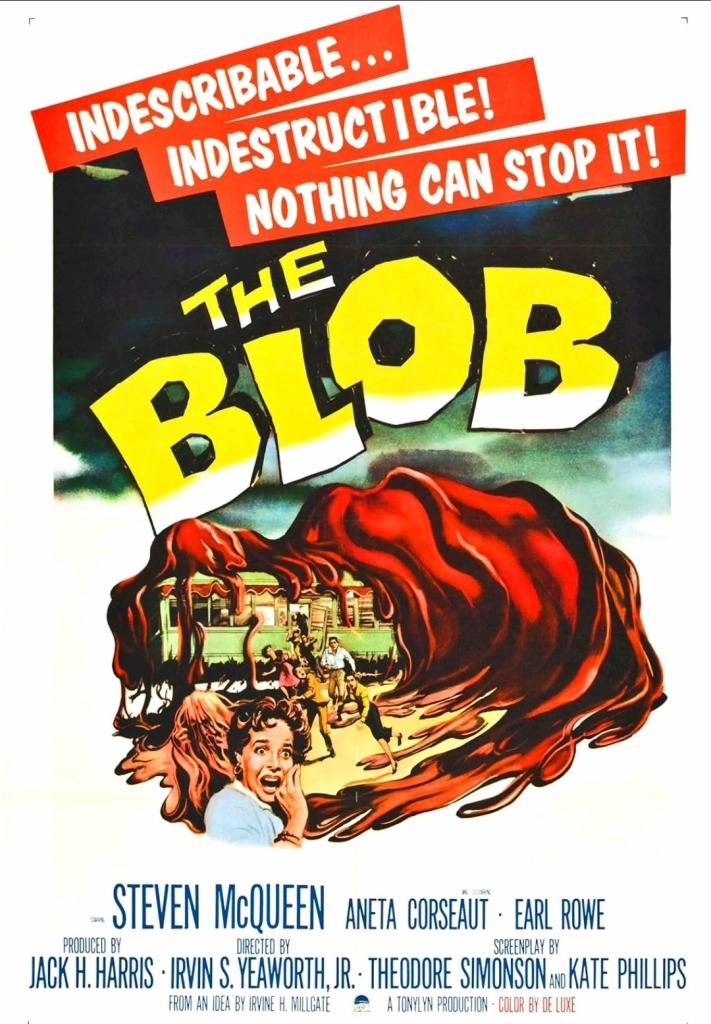
With those details laid down, here is a look back at The Blob, a sci-fi horror movie released in 1958 starring Steve McQueen and Aneta Corsaut, written by Kay Linaker and Theodore Simonson, and directed by Irvin S. Yeaworth, Jr. (Irvin Yeaworth for short). This was a low-budget local-level production by Valley Forge Films, Fairview Productions and Tonylyn Productions.
The Blob movie poster.
Early story
The story begins somewhere within a small town in Pennsylvania. During one evening, teenagers Steve Andrews and Jane Martin spend a romantic time together in a car only to be disturbed when a meteorite from outer space crashes nearby. This easily sparks Steve’s curiosity as he decides to drive to find the spot of the crash taking Jane with him.
Meanwhile, an old man who happened to be living near the spot of the crash went out of his home and finds the meteorite first. Out of curiosity, he pokes the meteorite with a stick which slowly causes it to break open revealing a gelatinous substance (the blob) inside. He uses the stick on the substance, lifts it up and examines it closely. Against gravity, the substance suddenly moves up the stick and wraps itself on the old man’s hand causing him to become desperate to remove it. He failed.
As Steve drives down the road, the old man with the blob suddenly crosses down their path. The old man tells Steve to take him to a doctor…
Quality
Steve McQueen (3rd from left) as teenager Steve Andrews with Earl Rowe (2nd from right) as Lt. Dave and other over-aged actors playing teenagers.
I can say that I really like this old movie which has always been an independent, low budget production that made a solid contribution to the sci-fi genre and pop culture in general.
To begin, this film has a simple plot about an alien creature in the form of a gelatinous blob from outer space which attached itself into an old man’s hand, grew a lot when the man made it to the doctor, and then started consuming people which made it grow so big, life in the town got disrupted and people found themselves in danger. Unsurprisingly, the blob itself does not dominate the narrative considering the limitations the filmmakers had on making special effects work plus they focused more on the characters to move the plot forward. Rest assured, however, that the production team went all out with their limited resources on making the monster look menacing in the final fifteen minutes. I should state that the special effects team did a convincing job with the way they made the blob move to specific directions.
Given the simple plot, it is not surprising to see the narrative focusing more on the characters particularly with teenagers Steve and Jane (both played by obviously over-aged actors Steve McQueen and Aneta Corseaut). The story clearly follows the two mentioned teenagers who have the best knowledge about the blob and what happened, and it just so happens that they are always at a disadvantage when asked by adults to prove things.
With a monster that large within the local community, you know that something must be done before it causes further damage and kills more people. The blob was portrayed to be unrelenting in consuming and killing people which causes it to grow even bigger and with no limits determined. The blob does not care at all about the pain and anguish of its victims which parallels the evil of Communism/Marxism/socialism/anti-Semitism in real life.
Jane (Aneta Corseaut) and Steve (Steve McQueen) with the local doctor (Stephen Chase) early in the film.
The interactions between teenagers (note: Steve McQueen and Aneta Corseaut are not the only over-aged looking actors playing youth) and the mature authorities (local police, parents, educator and house keeper to name some) dramatized a gap in which the youth lacked credibility while the adults remain difficult to convince. Very notably the backward car race early in the film symbolically reflects the Hollywood film trend of the 1950s in which American teenagers are portrayed to be troublesome and living without real purposes.
Going back to the protagonists Steve and Jane, the screenplay was designed to highlight what good teenagers can do when a crisis strikes the local community and why the adults should get over their doubts about the youth.
Given the structure of the script, there are a lot of talk scenes throughout and the progress of the blob growing as a menace within the plot helped break the monotony. While he is clearly too old to play a teenager, Steve McQueen here remains convincing as a youth who strives to achieve something worthy even as he lacks maturity. The same can be said about Aneta Corseaut whose character was designed to help Steve move forward apart from having romance with him. When her character feels troubled, Steve comes in to support her in return. If you ignore their mature looks and focus on the dialogue, you will find convincing lines of youth within Steve and Jane. The same can be said about the other teenagers.
Considering the low budget and the limitations of technology at the time, the man-made practical effects in this movie are still good.
I can say out loud that watching movies inside the cinema is always better than streaming. The best way to enjoy a movie at home, on the other hand, is with physical media like Blu-ray and 4K Blu-ray.
While McQueen and Corseaut performed well, there were some moments of stiff acting and lifeless delivery of lines of dialogue scattered throughout.
Those of you who are so used to fast-paced films with thrills and jump scares, you should temper your expectations as this movie moved at a slow-to-medium pace with very little horror elements and very little violence. As this was a low-budget local-level production, certain shots had to be made with very obvious creative shortcuts. Even though this movie was filmed on several locations in Pennsylvania, the filmmakers failed to establish a true sense of geography and this means no scenic shots.
Going back to the blob itself, its jello appearance may not look menacing at first and there were times when the lack of scale (note: they did not have equipment to achieved the depth-of-field visual effect) was noticeable. What I liked here is the way the blob was portrayed – unrelenting and totally immune to the emotions and concerns of people it encounters. The blob here somewhat reminds me of the T-800 in The Terminator (1984) in the sense that it simply would not stop to attack people, consume them and then keep on growing into one very large mass which causes a crisis on the small town community.
In case you are wondering, there were accidents that happened during the memorable scene of moviegoers running out of the cinema in the film. The tripping of some people were purely accidental.
When it grabs someone and starts to consume the victim physically, the blob does not care about the pain it causes on its prey. While it is clear that the movie’s script was written during the early stages of the Cold War, it is possible that the blob served as a symbol of Communism infiltrating America, endangering people and taking their lives (and liberties) away. That being said, the rampant Leftist influence and social violence in the minds of millions of Americans today makes this film socially relevant and the blob’s threat has gotten even more symbolic. Lastly, I should state that composer Ralph Carmichael managed to come up with music to emphasize the threat of the blob.
Conclusion
In my honest opinion The Blob (1958) is still a good movie to watch and it deserves its place in film history as well as in the sci-fi genre of movies in general. While it had its shortcomings, this low-budget local-level production managed to be a worthy viewing experience and set the foundation for its movie franchise (note: a sequel was made in 1972 and the memorable remake of 1988 followed). To say the least, this movie paved the way for Frank Darabont and Chuck Russell to produce the 1988 remake that was very intense and a lot of fun to watch.
The Blob (1958) in Blu-ray disc format from The Criterion Collection. This is the best way to enjoy the movie at home.
The blob itself went on to inspire creative imitations (referred to as blobs or ooze) and new monsters in other forms of entertainment (note: the blob appears as one of the monsters in the 1982 Intellivision game Advanced Dungeons & Dragons: Cloudy Mountain). Steve McQueen himself went on to become one of Hollywood’s elite stars in the decades that followed and this film should interest both die-hard fans and any film buff who wants to learn more about him.
Disclaimer: This is my original work with details sourced from reading the comic book and doing personal research. Anyone who wants to use this article, in part or in whole, needs to secure first my permission and agree to cite me as the source and author. Let it be known that any unauthorized use of this article will constrain the author to pursue the remedies under R.A. No. 8293, the Revised Penal Code, and/or all applicable legal actions under the laws of the Philippines.
Welcome back superhero enthusiasts, 1980s culture enthusiasts and comic book collectors! Today we go back to the year 1982 to take a close look at one of the many tales of the Marvel Comics shared universe told through the monthly series of Uncanny X-Men.
This review will examine not only the first-ever appearance of the X-Men foes the Brood but also the effects of other developments that made their impact on key members of Marvel’s team of mutants.
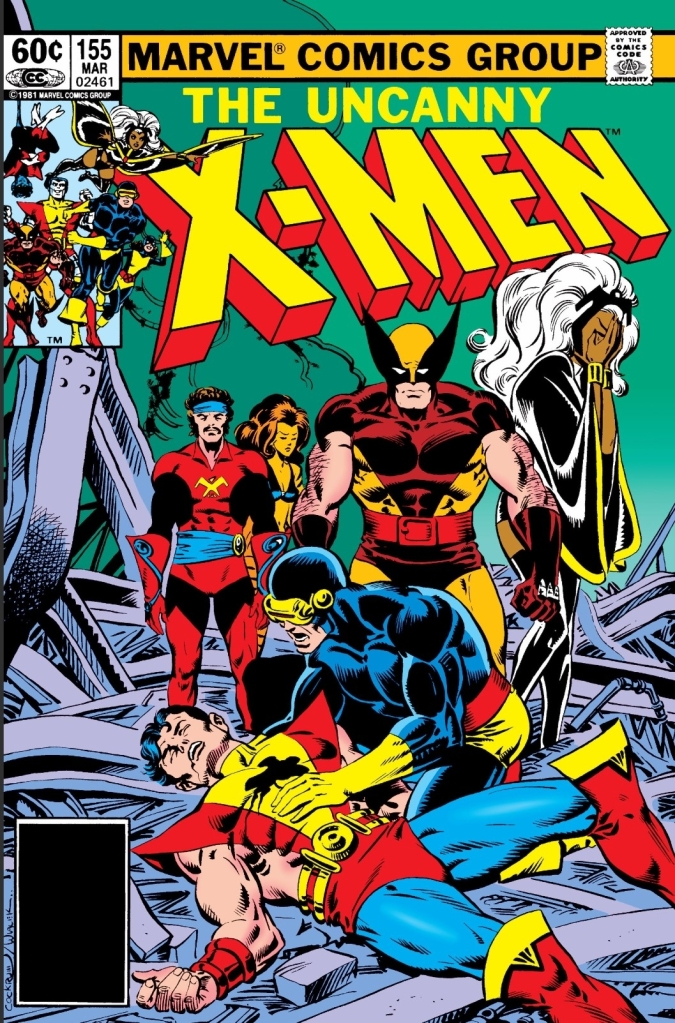
With those details laid down, here is a look back at Uncanny X-Men #155 published in 1982 by Marvel Comics with a story written by Chris Claremont and drawn by Dave Cockrum.
The cover.
Early story
The story begins as a jet carrying Cyclops, Storm and Corsair flies. Tensions are already intense as Cyclops is struggling with the shocking truth that his father – Corsair the leader of the Starjammers – is still living and recently returned to Earth seeking help.
Storm tries to emotionally reconnect with her teammate but Cyclops pushes back as he just found out that she knew Corsair was his father for several months already and never bothered to tell him. Tension grew worse as Corsair tried explaining himself to his son only to get a harsh response in return. Cyclops questioned his father if he even tried to learn what happened to him and his brother Alex (Havok) over the previous twenty years.
Suddenly the jet begins to glow. It turns out that a transporter beam hit them. In an instant, jet got transported forty thousand kilometers above the Earth and into the deck of the Shi’ar Dreadnought. Cyclops, Storm and Corsair find themselves surrounded by armed personnel and an audience of several alien beings.
Suddenly, Colossus, Nightcrawler, Kitty Pryde, Wolverine and Professor X appeared out of nowhere and right next to the jet…
Quality
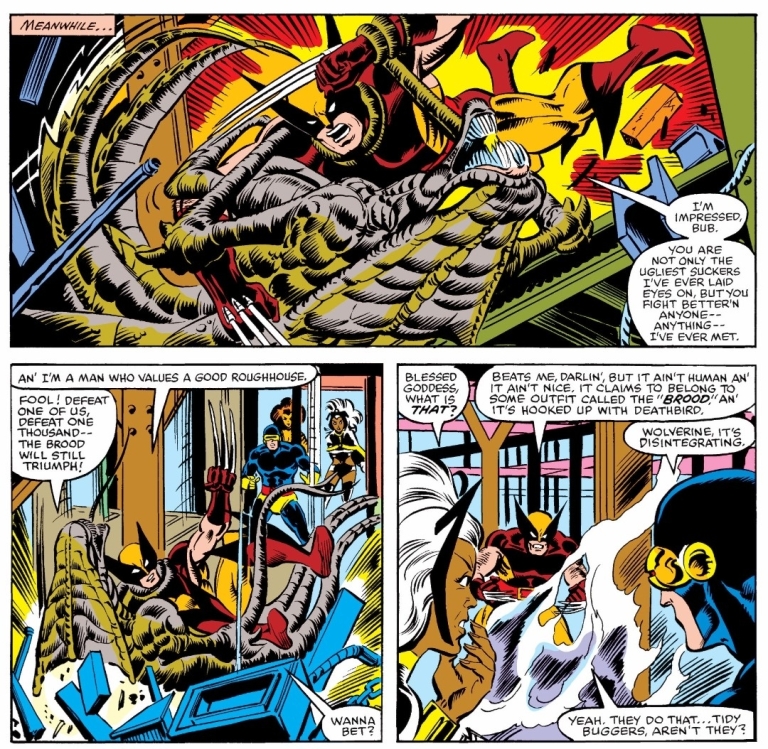
Wolverine takes on one of the Brood. As this marked the Brood’s first appearance in comics, Wolverine’s encounter with one of them here is a prelude of more intense things to come.
Upon close inspection of the storytelling, this comic book is pretty loaded with details related to developments that took place in previous issues. Apart from Cyclops’ personal struggle on accepting the truth about his father’s existence, there are references to what happened recently on the parts of Xavier, Colossus, Nightcrawler, Wolverine and Kitty Pryde. Not only that, this story also reveals details about Professor X’s past interaction with Empress Lilandra and the Shi’ar race.
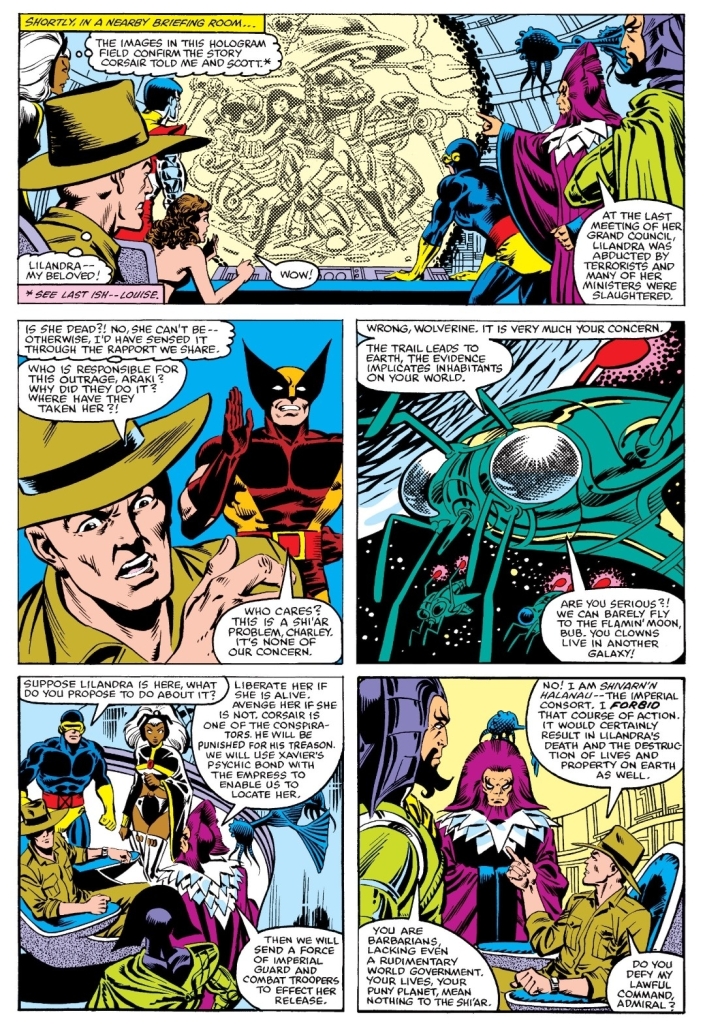
As it turns out, the Empress was abducted by terrorists and many of her ministers got killed. This previous event incidentally sets the stage for the new tasks for the X-Men to handle in this particular story which also comes with strong science fiction elements.
Adding further to the X-Men’s new mission to follow the trail to Earth and liberate Empress Lilandra if she is still living, Cyclops’ father Corsair was found to be a conspirator (to be punished) and the Shi’ar’s high officials will only follow Xavier’s lawful command (as the imperial consort) to a certain limit. This new conflict is literally loaded with lots of details that became part of the build-up, and to really grasp it all, you should pay close attention to the details here and in the previous comic books. In other words, this is not an easy read.
Apart from the general concept and plot structuring, Chris Claremont pulled off some clever moves with the way he portrayed Charles Xavier’s leadership and cunning. The X-Men leader knows that a lot is at stake in the new mission and he is certain that further Shi’ar presence on Earth would result in catastrophe.
As for the mission itself, the X-Men got someone from the Avengers to aid them. With Storm and Corsair moving and operating apart from the rest of the team. This leads to another series of developments plus twists that you should read for yourselves.
Conclusion
An intense scene that really puts the X-Men into a predicament and a potential conflict between worlds.
Uncanny X-Men #155 (1982) is not an easy read but if you have a strong understanding of the many plot details and related character developments, then you will eventually enjoy this story. The literary debut of the Brood here is not too significant as it preceded the further emphasis of the alien monster race in the succeeding issues. A highlight here is the intriguing portrayal of Professor X as X-Men leader, as Lilandra’s lover and as the bridge between humanity, mutants and the aliens of the Shi’ar empire. There is also a good amount of spectacle to keep you entertained, particularly during the 2nd half of the story. Considering all the build-up and exposition that took place in this comic book, don’t expect the mission to be concluded within.
Overall, Uncanny X-Men #155 (1982) is highly recommended!
Welcome back, fellow geeks, Blu-ray collectors and movie buffs! Back in the late 1980s, I saw the 1988 version of The Blob – let’s refer to it as The Blob (1988) – on home video and it turned out to be a fine mix of thrills, scares and science fiction concepts that ultimately became fun to watch. Being young at a time when Internet connection and online research were not yet available, I was not even aware that The Blob (1988) was a remake of the 1958 original Blob movie that starred Steve McQueen.
If you who love the late 1980s Blob movie and if you have been looking to add something to your home entertainment collection of Blu-ray and 4K Blu-ray movies, be aware that the Collector’s Edition 4K Blu-ray of The Blob (1988) is now available in the market and you can order it online right now and have it delivered to your home. The new release by Shout Factory! is loaded with features and it has native 4K visuals.
The Blob (1988) 4K Blu-ray cover.
To put things in perspective, posted below are the technical specs from The Blob (1988) 4K Blu-ray page at Blu-ray.com. The said website highly recommended it in its review.
Video Codec: HEVC / H.265 (84.99 Mbps) Resolution: Native 4K (2160p) HDR: HDR10 Aspect ratio: 1.85:1 Original aspect ratio: 1.85:1
Discs – 4K Ultra HD, Blu-ray Disc, Two-disc set (1 BD-100, 1 BD-50)
Packaging – Slipcover in original pressing, Reversible cover
Playback – 4K Blu-ray: Region free, 2K Blu-ray: Region A
Having seen both the 1958 and 1988 versions of The Blob, I can say to the newcomers and movie buffs reading this that you can’t go wrong with either version. I enjoyed both movies and I can say that each film has distinctive attractions for viewing. The Blob of 1958 is more sci-fi and has very little horror elements.
However, if you want thrills, the 1980s culture, stronger horror elements, stronger sci-fi elements, the creative approach done by director Chuck Russell and Frank Darabont on reimagining The Blob‘s concept, and the great-looking practical effects (note: the blob effects were made with physical stuff and a lot of man-made work without computers), then The Blob (1988) is the definitive choice. Take note I mentioned thrills as the movie has some fast-paced scenes that happen from time to time as you watch it. Considering its use of sci-fi concepts mixed with action, The Blob (1988) really stood out among the many horror movies released by Hollywood throughout the 1980s. I should also state that the remake has Kevin Dillon, Shawnee Smith, Jeffrey DeMunn, Joe Seneca, Candy Clark and Donovan Leitch Jr. in its cast.
As a 4K Blu-ray collector, I plan to acquire a copy of The Blob (1988) 4K Blu-ray in due time. I was already aware of the Blu-ray release from 2019 but I waited for the 4K version to be made.
If you want the best enjoyment possible from watching The Blob (1988) Collector’s Edition 4K Blu-ray, I highly recommend you avoid watching movie reaction videos and the spoileriffic retro movie reviews posted by YouTubers.















 Author Carlo Carrasco