The 1990s was a decade of excess when it comes to superhero comic books. Apart from the persistent hoarding of comic books and the quest for profit, there were also these wide superhero franchises (or superhero universes) that popped up and even challenged Marvel Comics and DC Comics. Malibu Comics launched the Ultraverse while Valiant Comics came up with its own universe.
Valiant established itself nicely with popular characters like Bloodshot, X-O Manowar, Turok and Ninjak, and each one had its own regular series of comic books published. When it comes to teams, there was H.A.R.D. Corps (H.A.R.D. stood for Harbinger Active Resistance Division).
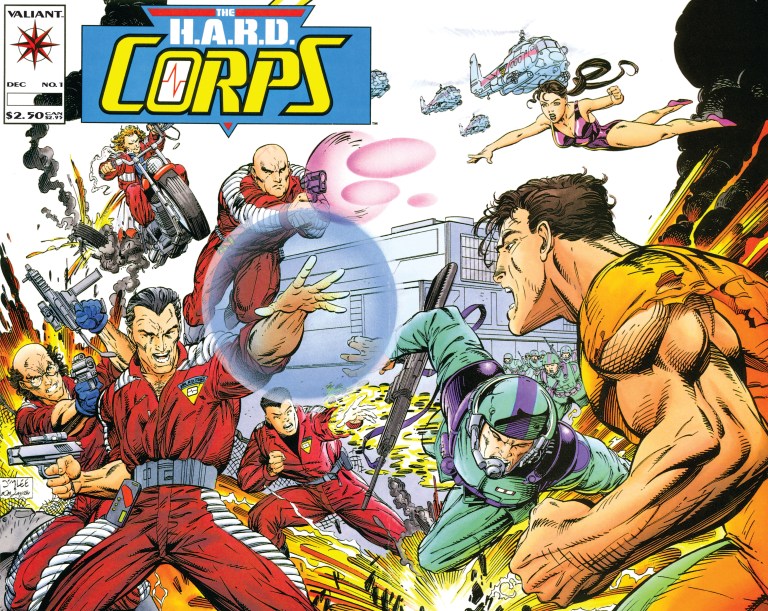
During the recent Hobby Con held at Las Piñas City, I luckily found myself a copy of The H.A.R.D. Corps #1 and read it for the first time ever. This is my review of the comic book which has a cover drawn by the great Jim Lee.
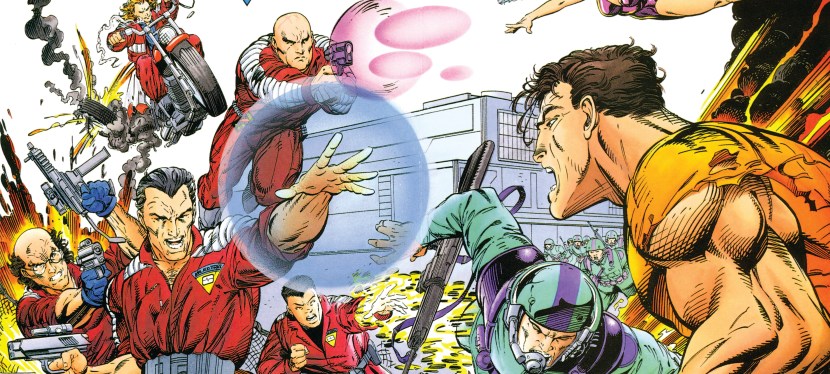
Cover with art by Jim Lee.
Early story
The story begins with the 5-member team in the middle of a mission inside the secured facility of the Harbinger Foundation. Under fire from the facility’s armed personnel, the team (riding a floating vehicle) struggle to find their way and evacuate. Along the way, an oversized man called Big Boy grabbed one of their members and separated him from the others. With the situation getting worse, the captured member got “brain popped” (a remote form of self-destruction via the neural flash implanted inside the person’s brain). The remaining four manage to get away by means of aerial transport provided by their company.
Then a section of the facility exploded causing financial damage to Mr. Harada who decided to visit and inspect the site.
Expository information done cleverly.
Some time later, the H.A.R.D. Corps enjoy the privacy and security at their headquarters in the Nevada desert. Team members Shakespeare, Major Palmer, Softcore, Hammerhead and Superstar wait for instructions at the debriefing room.
Quality
The H.A.R.D. Corps #1 is very well written by David Michelinie. Within twenty-two pages, Michelinie loaded enough details to explain the comic book’s core concept efficiently while at the same time he managed to tell an engaging story with a light touch on character development (note: there were many characters and there was not enough space for further personality emphasis). By the time the story ended, I really felt enlightened, entertained and wanting to find out what would happen next.
Michelinie’s handling of expository dialogue was done very efficiently. I’m talking about the private briefing done by an executive of the Cartel explaining to a recovering man named Kim (who was almost killed during the Los Angeles Riot) what H.A.R.D. Corps is, why the Cartel is in a race against Harada who has been manipulating Harbingers (persons with unique abilities). The Cartel opposes Harada with neural implants.
More on the team, H.A.R.D. Corps members are people who have gone through training programs and each of them had neural implants in their heads which enable them to mimic Harbinger powers (one at a time) through signals broadcast from a base station. Each of them was comatose and the use of the implants reversed the coma.
Some action for you.
When it comes to visuals, the art by David Lapham (inked by Bob Layton) was pretty good. I like the high amount of detail placed on the surroundings in most of the panels. Action shots had a good amount of impact.
Conclusion
This comic book from late 1992 is a good and engaging read. I really enjoyed it and I like its core concept about a team of enhanced individuals who are technically living properties of very business-minded people opposed to Harada. Even by today’s standards, H.A.R.D. Corps concept really stands out among all superhero team comic books.
The H.A.R.D. Corps #1 is recommended and you can acquire a near-mint copy of it for only $4 at MileHighComics.com (as of this writing).
Let me make it clear to all of you readers. The movie Joker is NOT a superhero movie at all even though it is a cinematic adaptation focused on one of DC Comics’ biggest super villains. It is also not a movie to watch for fun and enjoyment, but it is still engaging in a very different way.
The truth is, Joker is a large art film made to shock viewers with darkness, deep grit and some graphic violence. The good news here is that the movie is very engaging and easily reminds me of two certain movies that Robert De Niro and director Martin Scorsese worked together on. It’s a victory for Warner Bros. and DC Comics.
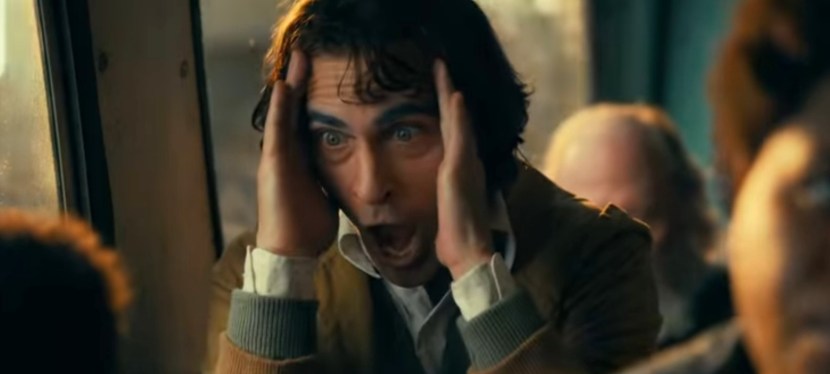
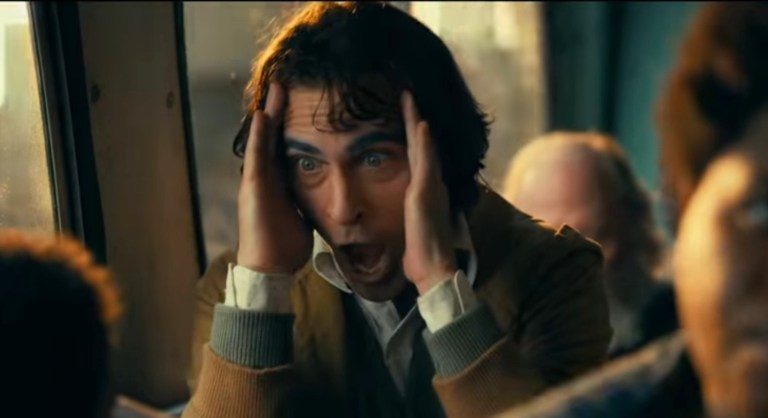
Joaquin Phoenix as the new cinematic Joker will be remembered for a long time.
Joker follows the exploits and Arthur Fleck (Joaquin Phoenix), a struggling man who is hardly surviving working as an entertainer (a clown, specifically) supporting his mother and dealing with the hard life of Gotham City which was stylistically made to look like 1970s New York City. Arthur, who is living with a condition of uncontrolled laughter, looks up to TV show host Franklin Murray (played by Robert De Niro) as an inspiring figure to try out comedy and hopefully make it big to free himself and his mother from poverty.
While performing as a clown surrounded by children in a hospital, Arthur accidentally drops a gun he just received from a co-worker. Because of this, he gets fired and learns that the man who gave him the gun lied to their boss. While riding the subway still looking like a clown, he gets beaten up by three business executives who were drunk. In response, Arthur kills them with the gun and gets away. This incident starts a chain of events that causes friction between the upper class and the lower class, and then protesters wearing clown masks multiply.
On face value, Joker is clearly inspired by character-driven films of the 1970s. While it is not necessarily based on any particular comic book, it carried some slight elements from Batman: The Killing Joke. What is more obvious is that it took inspiration from De Niro-Scorsese films Taxi Driver and The King of Comedy.
As a psychological thriller, Joker is a great portrayal of how low a desperate man could go only to strive and survive. Arthur Fleck is greatly played by Joaquin Phoenix who carefully blends drama, anger, violence and even humor altogether. He really made the cinematic Joker his own and along the way, his Joker laught is more effective than that of Heath Ledger and the Joker physical appearance is almost as memorable as that of Jack Nicholson’s. The movie is indeed very violent but it is not overly violent. To be specific, there are a lot more deaths, acts of violence and shooting in Brian De Palma’s Scarface than this movie.
Joker also has a lively portrayal of the conflict between social classes. The scenes of the clown-masked protesters filling the trains and the streets still resonate with the socio-political rallies that happened in modern society. There is also the aspect of poor and desperate people depending on government for survival and they are easily vulnerable to getting cut off whenever resources run out.
Desperation is also a solid theme in the narrative. To see Arthur Fleck look up to Franklin Murray and imagine sharing the stage with him on TV reminds me a lot about some real-life people (who don’t have too much money) I encountered in Cebu City who can’t help but stop studying (even the older ones quit their legitimate jobs) and get into local entertainment hoping that fame and fortune will lift them up. Of course, when things get worse, desperate people would either get back to what they can live with or, worse, turn to a life of crime just to survive. With regards to Arthur’s attempt to become a comedian on screen, that easily reminds me of similar people in real life who thought they are very talented to be the next great superstars but ended up failing.
Conclusion
With its very solid direction by Todd Philips, great dramatic performances, nostalgic presentation and in-depth characterization, Joker is a must-watch movie mainly for moviegoers who want to be engaged with psychological thrills and bouts. As a DC Comics movie that is NOT connected with Warner Bros.’ current franchise of superhero movies (that started with Man of Steel in 2013), Joker works as an adulterated, standalone movie. To compare it with comic books published DC, I should say Joker is very much like an Elseworlds story. For the new comers reading this, Elseworlds was a franchise of comic books published by DC Comics that had stories using established characters but were told outside of DC universe canon.
Joker is highly recommended. Just don’t expect to see the usual superhero movie elements in this very solid DC Comics movie.
Thank you for reading. If you find this article engaging, please click the like button below and also please consider sharing this article to others. Also my fantasy book The World of Havenoris still available in paperback and e-book format. If you are looking for a copywriter to create content for your special project or business, check out my services and my portfolio. Feel free to contact me as well. Also please feel free to visit my Facebook page Author Carlo Carrasco and follow me at HavenorFantasy@twitter.com
When a filmmaker has high concepts but ends up receiving insufficient resources to realize them, disaster normally strikes not only the film crew but also the fans.
This was precisely what happened in the horror movie Friday The 13th Part VIII: Jason Takes Manhattan, written and directed by Rob Hedden. Released on July 28, 1989 in the United States, the movie was the result of Paramount Pictures’ rejection of proposals on making a direct sequel to Friday The 13th Part VII: The New Blood involving that film’s lead character Tina Shepard (played by Lar Park Lincoln).
Hedden, who previously worked for another movie studio and participated in the unrelated Friday The 13th TV series, was hired to make the sequel and he had the idea of bringing the horror icon Jason Voorhees out of Camp Crystal Lake (and its related locations) and came up with concepts of having one story set on a cruise ship (for a claustrophobic horror experience) and another story set in New York City (which includes ideas of having notable locations there as key places for misadventures and action).
“Everything about New York was going to be completely exploited and milked,” Hedden said in an interview. “There was going to be a tremendous scene on the Brooklyn Bridge. A boxing match in Madison Square Garden. Jason would go through department stores. He’d go through Times Square. He’d go into a Broadway play. He’d even crawl onto the top of the Statue of Liberty and dive off.”
The movie studio liked Hedden’s concepts and gave him a budget. The big problem was that there simply was not enough money granted (a little over $5 million) and it was too expensive to film on location in New York (I wonder if Hedden actually made some research about the city as he came up with his New York ideas). Although the given budget was the BIGGEST for a Friday The 13th film at the time, Hedden had no choice but to combine the two concepts into one single narrative. As if insufficient funds were not bad enough, Hedden implemented another concept to look at Jason as a child through the hallucinations of the film’s lead – Rennie Wickham (played by Jensen Daggett). Of course, the hallucinations led to spending some money on “special” effects, make-up, and set-up.
Now, we can start taking a close look at Friday The 13th Part VIII: Jason Takes Manhattan.
Kane Hodder as Jason on location at Times Square in New York.
The movie begins with shots of New York City (with several spots of Vancouver, Canada pretentiously presented as spots of the more famous city). Over at Camp Crystal Lake far away, a guy and his girl prepare to make love riding a boat floating on the lake unaware that Jason is deep underwater (following the events of Part VII). Through expository dialogue, the guy tells his girl about the legend of Jason who had murdered several people who came near the camp.
Due to an anchor cutting an underwater power cable, loose electricity reanimates Jason (played by Kane Hodder) who went up to the boat to kill the guy and the lady, one by one.
Very soon, a group of graduates from Lakeview High School prepares to embark on a cruise ship for their much-awaited visit to New York. Beyond logic, the scene shows that Crystal Lake is magically connected to the Atlantic Ocean and the background scenery shows that they are in Canada (note: back then it was more affordable to shoot scenes in Canada and pretend to be in the US).
At this point, the film introduces the final girl Rennie who is a gifted student but remains terrified about water since childhood. The leading man meanwhile is Sean (played by Scott Reeves) who is handsome but lacks the heart to follow the footsteps of his successful father who is the captain of the ship. Rennie and Sean both show signs of pain and lack from their respective past and these elements, predictably, make them a matching pair for moviegoers to follow.
Aside from the two, the film introduces mostly disposable characters like Rennie’s overbearing uncle (who happens to be a teacher in the same high school she attends and was clearly written to be the one character to irritate moviegoers into being sympathetic with Rennie and others), the good-natured lady teacher, the hard rock musician, the aspiring filmmaker, the jock, the pretty bad girl, the dude who talks without taking a look, the doomsayer, etc.
Just before the ship leaves, Jason climbs his way up to join the trip. Then he’s stalking starts.
Quality
Friday The 13th Part VIII: Jason Takes Manhattan was very bad when it was first released more than thirty years ago. By today’s standards, this film has aged terribly. Its quality is even worse now.
Let’s start with the most obvious flaw – the movie failed to live up to its promise of Jason’s taking Manhattan. The film’s subtitle is a big lie as much of the movie is set in the ship and New York (including the fake NYC spots that were filmed in Vancouver) does not appear as the definitive location until late in the story!
While the story was set on the ship, the film crew seem to focus on producing on-screen fillers creatively. Sure we get to see Jason stalk and kill characters (with some off-screen death blows) but the dialogue scenes, the transition scenes and character “development” stuff in between were very cheaply and poorly handled.
With Rennie, however, the team managed to make her somewhat engaging as the lead of the film by slowly defining her personality (nicely done by Daggett) and creating on-screen hallucination sequences emphasizing the emotional and psychological damage she suffered from encountering Jason when she was a young girl. The flashback of little Rennie encountering little Jason (which does not make sense at all as far as in-story history is concerned) under Crystal Lake was not only badly done but done without any sense of logic. One can argue that little Rennie only hallucinated of seeing kid Jason (supposedly out of fear and paranoia) but that sequence was just a waste of time even though the filmmakers tried to make moviegoers connect and feel with her. Sean, the other lead, was literally protected by plot armor (note: he was not one of the disposable characters) but his character was not written to do much except serving as a supporter for Rennie.
Lousy stuff? Lots of them here and there! Even though he saw his captain father dead, Sean does not show very much emotion and even worse, he easily forgets about him even as he sees Jason quite a number of times later. He should at least show some deep anger (if not lust for revenge) against Jason. Even though he did not witness Jason killing his father, it was made clear to him and the rest that Jason (and not the doomsayer) was responsible.
How about Wayne, the film-obsessed guy? Even though he and his pals took weapons to go around and hunt Jason, he still bothered to use his camera (while clumsily holding the gun) and film his way around! That is so stupid and it was no surprise that he ends up getting disposed of! Being obsessed with filming, Wayne could have decided to accompany one of his armed pals and used his camera for both video documenting and even help an armed guy see something (example: zooming at a spot or object far away).
As for lousy stuff reflecting the very low budget of the movie, I can point out that the scene in which Sean, Rennie, the uncle and lady school teacher board a lifeboat clearly looked fake and was shot on a studio set. The same thing can also be said about Rennie’s fall into the water (pushed over the deck by Tamara) and she was NOT left behind by the ship that was supposedly moving. The location where JJ played rock music before getting killed looked cheap.
More on production cheapness, either the filmmakers ran out of money or they became too lazy with the wardrobe and hoped moviegoers would be too stupid to notice anything. Look back at the scene when Rennie got pushed off by Tamara into the water and was saved by Sean (who jumped to do his heroic act). Even though they got wet, both Rennie and Sean STILL WORE THE EXACT SAME CLOTHES until the end of the film! Those characters did not change clothes even though Rennie returned to her room!
Speaking of which, the filmmakers disregarded the fact that, in the story, the ship was filled with a lot of students going to New York. There were guys and gals partying, playing games, enjoying the scenery (of Canada!), etc. And yet as the film played on, the filmmakers literally abandoned those many other students. The only exception here was the short scene in which the good-natured lady teacher brought some students with her and told them to stay and wait in the restaurant. A short time later, as she mentioned to her companions that there were students left in the restaurant, Sean replied to her depressingly, “There is no more restaurant.” Without showing any scenes, the filmmakers creatively and nonsensically got rid of the others. I suppose Hedden and team had no more time and money left to show what happened to them all.
The cheapness also affected the look of Jason. Adult Jason in Friday The 13th Part VII had a very menacing, gritty and rotten face design. In this movie, adult Jason’s face looks melted and cartoony! And then there was the inaccuracy with regards to how the film presented little Jason. In the early flashback scene, a kid Jason with a normal looking face was shown drowning (which contradicts the fact that Jason always had a deformed face). There was a ladies’ rest room scene wherein kid Jason (with a slightly deformed face this time) appeared to Rennie via a hallucination. Then there was another kid Jason, more deformed, during the flashback of little Rennie. Whatever the filmmakers did, none of those physical presentations of Jason proved to be scary. Clearly whatever little amount of money they spent here ended up wasted.
On the presentation, the film’s pacing was inconsistent and it sure had several dragging moments. Granted, this was Rob Hedden’s debut as a movie director but I’ve seen other slasher horror films that were paced better and had kills that were executed satisfactorily. The fear factor of this movie was weak overall. Meanwhile, Jason illogically has the ability to teleport in this film which is complete nonsense. I believe that the teleportation was implemented as a convenient way of cutting down on time and expense to complete the production. I suppose showing Jason physically moving from one place to the next to get to his running victim was too expensive and too inconvenient for Hedden’s team.
If there are any good points in this film, I should say that Rob Hedden and his team at least tried to be creative with Jason’s kills (but the teleporting still makes no sense). Tamara (whose mirror got dropped and broke into pieces) got stabbed with a sharp mirror piece. A guy in the sauna gets killed with a hot rock forced into his body. And then there was the city thug who got killed with a syringe piercing through his body (which is impossible and cartoony to look at).
The most memorable kill sequence by Jason was the “boxing fight” with Julius. In that sequence, Hedden told the actor to punch Jason many, many times with real physical contact. That sequence lasted rather long but Jason’s kill of Julius was undeniably good and with impact. Too bad that kill sequence could not carry this movie up.
Another good point to take note is Kane Hodder’s improved take on Jason in terms of action and looking threatening. This was his 2nd time to play Jason and he showed more confidence playing him.
Kelly Hu was only 20-years-old at the time of production. Jason Voorhees, not Wolverine, was the first pop culture icon she encountered on the big screen.
The stunt done inside a diner (with a particular stuntman who would later have his moment playing Jason in a certain 2003 movie) was at least satisfying to see. Last but not least, this movie featured a very young Kelly Hu who is now a successful and popular Hollywood actress. Fourteen years before she got to fight superhero icon Wolverine on the big screen, she encountered the horror icon Jason right here. What happened to Hu’s character and Jason? You should take time out to watch her scene here.
Conclusion
Symbolically speaking, Jensen Daggett realized that the film was doomed and it took Jason to catch her attention from behind!
Overall this movie is very, very bad. I can only recommend this to die-hard Friday The 13th fans who are more than willing to set aside logic all for the sake of seeing Jason stalk and kill people. There is little entertainment value here and drastic cheapness will disturb viewers along the way. Not even the short Time Square on-location sequence could save the film. The kills of Jason are a mixed-bag at best and clearly this movie is not even scary to watch. I remember the very first time I saw this way back in the summer of 1990 on laser disc format and there was not even a single moment I got scared. I got to replay this movie on DVD to take a closer look and still I did not get much entertainment value in return.
Friday The 13th Part VIII: Jason Takes Manhattan should be skipped as it is a clear waste of time. If you plan to watch it at all, play the movie only when you want to bore yourself to sleep.
Thank you for reading. If you find this article engaging, please click the like button below and also please consider sharing this article to others. Also my fantasy book The World of Havenoris still available in paperback and e-book format. If you are looking for a copywriter to create content for your special project or business, check out my services and my portfolio. Feel free to contact me as well. Also please feel free to visit my Facebook page Author Carlo Carrasco and follow me at HavenorFantasy@twitter.com
Disclaimer: This is my original work with details sourced from reading the comic book and doing personal research. Anyone who wants to use this article, in part or in whole, needs to secure first my permission and agree to cite me as the source and author. Let it be known that any unauthorized use of this article will constrain the author to pursue the remedies under R.A. No. 8293, the Revised Penal Code, and/or all applicable legal actions under the laws of the Philippines.
I miss the old times when big rivals Marvel and DC Comics would set aside competition temporarily to team up and rely on their respective comic creators to make superhero crossover comic books that the fans can enjoy.
Back in the 1970s, key developments related to the comic book adaptation of The Wizard of Oz brought the two rivals together as partners. In 1976, Marvel and DC’s first superhero crossover Superman vs. The Amazing Spider-Man got published and to this day many comic book collectors and geeks I encountered still enjoy it. A few of them even called it a classic.
The collaboration between Marvel and DC continued in 1981 with Superman and Spider-Man which was published as issue number 28 of the Marvel Treasury Edition series.
The cover.
This is my look back at Superman and Spider-Man.
The comic book
Scripted by then Marvel Comic editor-in-chief Jim Shooter (with Marv Wolfman mentioned for plot suggestions) with art drawn by John Buscema and inkwork done by Terry Austin, Al Milgrom, Steva Leialoha, Walt Simonson, Bob Layton, Joe Rubinstein and Bob Wiacek, the comic book begins when Spider-Man swings into a construction site where he encounters several armed men and stops them singlehandedly.
Even though he stopped the bad guys, Spider-Man’s spider sense bothers him making him speculate that, because there’s no clear danger around him, the construction site seemed to be a threat.
After Spider-Man swings away from the police who just arrived, classic Marvel supervillain Doctor Doom watches via surveillance video and he was bother by the way things turned out.
“I did not like the way Spider-Man paused and look around after subduing the thieves – – as if he sensed something unusual about the excavation! Those accursed spider instincts of his,” Doom said before proceeding with his master plan.
A day later, the Hulk arrives in Metropolis causing lots of damage. Separately Superman and Spider-Man arrive to contain the green guy. However, things are not what they seem. This is where the story description ends.
Quality
What this comic book lacked compared to the 1976 Superman-Spider-Man crossover is visual impact. Clearly John Buscema had to follow closely the script which called for multiple panels per page and that left him little room to draw scenes dynamically. That’s not to see the art is weak. In fact, Buscema’s art is pretty good and he has deep knowledge about how the characters (including those many supporting characters and other minor characters from both Marvel and DC Comics) really looked from the size of Hulk’s body, the details on Wonder Woman’s costume, the distinctive look of J. Jonah Jameson, Perry White, etc. In short, I recognized the characters very easily.
This remains fun to read.Peter Parker in Metropolis along with the Superman supporting characters. This is one great element that made this comic book worth reading.
While the high number of panels per page limited him, Buscema managed to come up with some action shots that packed some impact.
When it comes to writing and storytelling, this comic book exceeds that of the 1976 Superman-Spider-Man crossover big time! To start with, the plot is much more elaborate, more detailed and yet consistently remained easy to follow.
While the 1976 crossover had the most popular villains of Superman and Spider-Man as the representation of evil, this one instead had Dr. Doom and Parasite. The great news is that these two super villains complement each other nicely and that itself adds good depth into the plot. Dr. Doom is a major schemer and Parasite fitted nicely within his master plan for global chaos.
Regarding dialogue, the script had a lot of strength and was also specific in capturing the personalities of the superheroes, the super villains and the supporting cast. I can easily identify J. Jonah Jameson, Perry White, Lois Lane and others through the dialogue.
Not to be outdone is the deeper approach to the crossover aspect of the story. Right from the start, the comic book creators expected us readers to suspend disbelief and start believing that while the story is non-canon, the respective universes of Marvel and DC Comics co-existed. Because there were TV shows of Wonder Woman and the Hulk playing, the two characters were included in the comic book adding depth to the crossover.
Speaking of crossovers, this comic book was not limited to Superman and Spider-Man. The encounter between the Hulk and Superman was a short but sweet spectacle to read. The encounter between Wonder Woman and Spider-Man meanwhile was short yet fun.
Adding more to the fun in this comic book was how Clark Kent interacted with the Spider-Man supporting characters while Peter Parker interacted with the Superman supporting characters. I enjoyed every moment of these scenes.
As far as narrative is concerned, this comic book is slightly slanted towards Superman. One factor behind this was the implementation of how local authorities interact with Superman and Spider-Man. Whenever he solves crime, Superman is highly respected by the public and the police. This is not the case with Spider-Man who is often perceived to be a social menace even though he helps solve crimes. Another factor was that Superman did more detective-type work (including a visit to Latveria) while Spidey hardly contributed anything to the plot’s development.
Nothing can be more frustrating than getting attacked by police officers when you try to help them solve their problems.
Regardless, the two icons got a fair share of the spotlight during the final stages of the story and there was enough spectacle to enjoy.
If there is any complaint I have, it would be the comic book creators’ reluctance on fully connecting itself to the 1976 crossover. In the scene wherein Peter Parker was guided into the film editing room by Jimmy Olsen, he recognized Lois Lane and remembered meeting her in the 1976 crossover (which ended with socializing). And yet when Spider-Man and Superman get together in this comic book, there was a noticeable lack of friendliness and personal cooperation between them even though they bonded nicely in the 1976 story.
Conclusion
Overall, Superman and Spider-Man is indeed a highly engaging, fun-filled superhero crossover comic book. For me, it is a true literary classic and definitely worth searching for out there. I read this crossover many times from start to finish and even though I knew the plot and the dialogue, I still had a lot of fun reading along the way. With the combined talents of Shooter, Buscema and many others, this superhero crossover was indeed one of the very best stories ever told by Marvel and DC Comics.
Given the current corporate climate Marvel and DC Comics are now in, it is very unlikely we will see another creatively fun superhero crossover collaboration between them happening soon. For the newcomers reading this, Marvel is owned by the Walt Disney Company while DC Comics is owned by Warner Bros.
Thank you for reading. If you find this article engaging, please click the like button below and also please consider sharing this article to others. Also my fantasy book The World of Havenoris still available in paperback and e-book format. If you are looking for a copywriter to create content for your special project or business, check out my services and my portfolio. Feel free to contact me as well. Also please feel free to visit my Facebook page Author Carlo Carrasco and follow me at HavenorFantasy@twitter.com
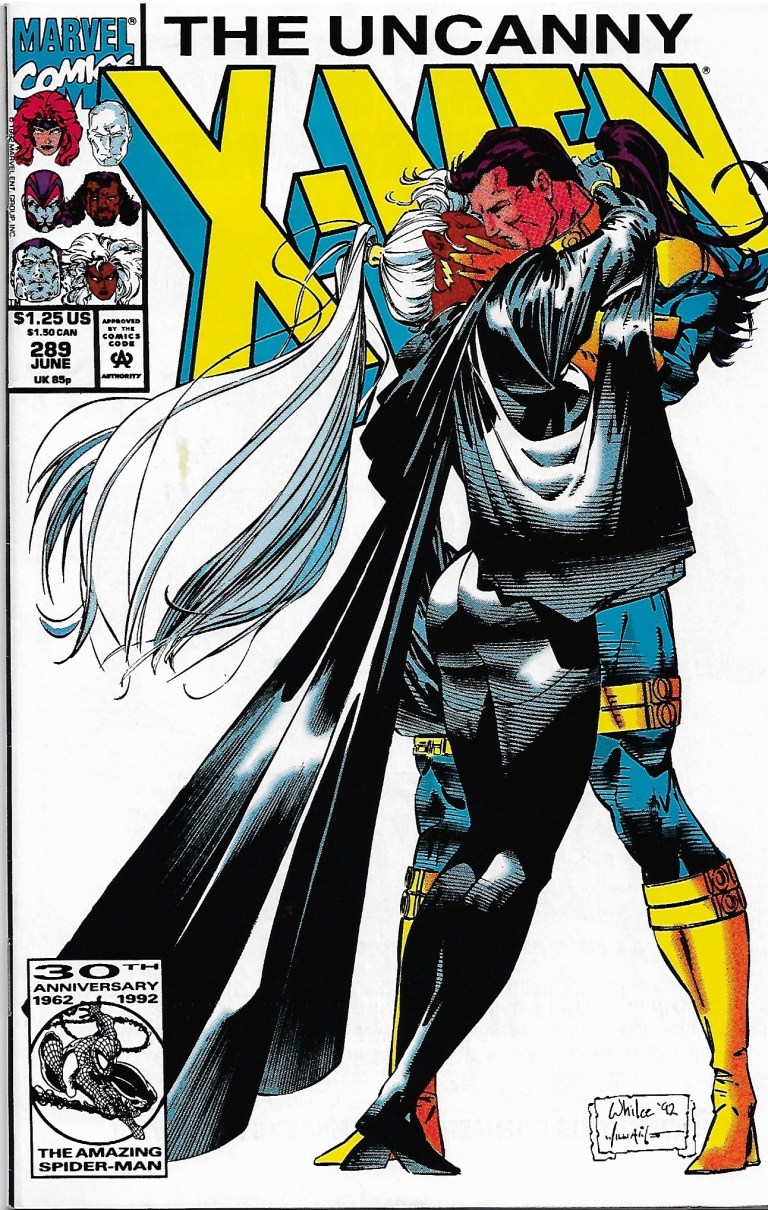
Released in 1992 by Marvel Comics, Uncanny X-Men #289 was written by Scott Lobdell and drawn by Whilce Portacio (with ink work by Scott Williams). Its concept focused on the Gold Team of the X-Men (composed of Jean Grey, Storm, Colossus, Ice Man and Archangel) dealing with Bishop who at the time was still a newcomer.
Cover of the comic book.
It begins when Bishop looks at a framed picture of the original X-Men followed by Storm telling him every student who graduated to the role of an X-Man remains dedicated to the ideal of peaceful coexistence between mutants and humans.
As the Gold Team X-Men enjoy their peaceful time at the mansion of Xavier, elsewhere someone spies on William and Maddy Drake who talk about Bobby (Iceman). Back at the mansion, Archangel encounters a spitting image of his younger self (as Angel and with normal skin color) which raises tension attracting the attention of Storm, Bishop and Forge.
A touching scene between Jean Grey and Charles Xavier.
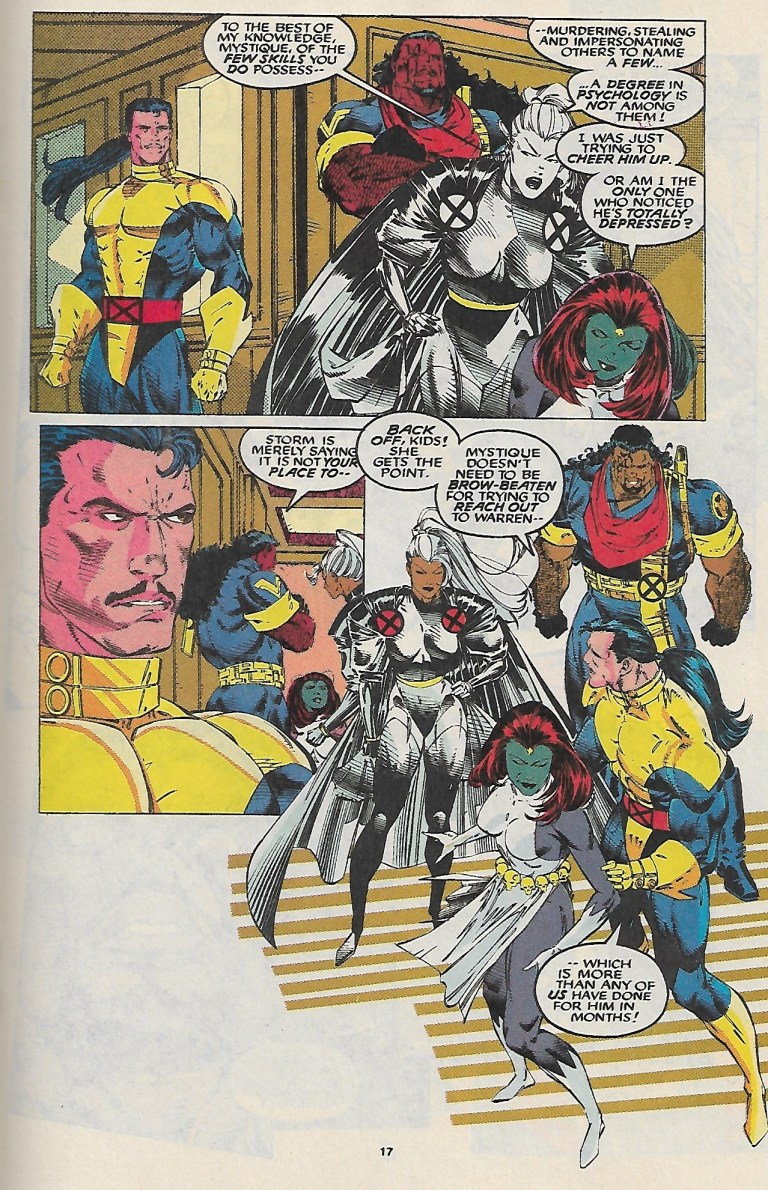
To describe Uncanny X-Men #289 clearly, the comic book is more focused on character development as it lacks a strong conflict between good and evil. Anyone craving for superhero action will most likely feel unsatisfied here. However, if you want to know the X-Men more passionately and watch the romance between Storm and Forge develop, then this comic book will be engaging.
Scott Lobdell did a good job developing the characters through drama and Whilce Portacio’s art really brought the script to life. I enjoyed reading the interaction between Jean Grey and Charles Xavier who realizes that as he led the X-Men, he took a bit of something from their respective lives.
Nice layout and style by Whilce Portacio on the team.
Take note of the following exchange of dialogue.
Charles Xavier: Jean, did you ever hate me for having taken away your childhood?
Jean Grey: Professor, please. What child is given the opportunity to fly to the stars? How many children battle alongside Asgardian thunder gods or super soldiers? You gave me…all of us…more than you took away.
That was really nice writing there by Lobdell. There was drama and harmony between the two characters.
Overall, Uncanny X-Men #289 is recommended. Think of it as a comic book that will help you – the reader – get to know the characters more closely.
Thank you for reading. If you find this article engaging, please click the like button below and also please consider sharing this article to others. Also my fantasy book The World of Havenoris still available in paperback and e-book format. If you are looking for a copywriter to create content for your special project or business, check out my services and my portfolio. Feel free to contact me as well. Also please feel free to visit my Facebook page Author Carlo Carrasco and follow me at HavenorFantasy@twitter.com
Every great movie franchise starts small and as the decades pass by, its place in history will be marked and revisited.
This is my review of the first-ever James Bond movie Dr. No.
Ursula Andress and Sean Connery as Honey Ryder and James Bond respectively.
Released in 1962 based on the sixth novel written by James Bond creator Ian Fleming, Dr. No brought Agent 007 to the big screen worldwide and its success led to a series of big moneymaking sequels, merchandise, novels, comic books, video games and other forms of contributions to pop culture. This movie also marked the beginning of Sean Connery’s journey towards becoming a cinematic icon as, arguably, the best cinematic James Bond ever.
The movie begins when British agents in Jamaica get killed off by henchmen who eventually retrieved highly confidential files. In England, the secret service sends Agent 007 to Jamaica to do detective work and he gets armed with a Walter PPK. Once in Jamaica, Bond starts talking to people, gathering clues and traveled to different places to find out who is responsible for killing his fellow British intelligence operatives. If you want to know more, you just have to watch the movie.
If you are a newcomer to the James Bond franchise or if you never saw this movie before, then you have to keep in mind that this very old movie is NOT an action film but rather it is a detective story laced with suspense and some action that follows James Bond performing his mission for Queen and Country.
Chances are, you must have seen many other James Bond movies that are heavy on action, stunts and explosions. As it was the first of the film franchise, Dr. No is nothing like those other movies of Agent 007.
Being a detective story, Dr. No is character-driven and laced with mystery and suspense. To describe it without spoiling the story, the narrative shows Bond searching for answers and as the suspense builds up, something or someone gets revealed which adds to the deepening of the plot. There is some action, stunts and explosions to spice up the movie which were pretty enjoyable for the early 1960s. However the car chase is very outdated and never believable. Naturally, the spectacle is tame by today’s standards but still, this movie is not boring at all for me.
The movie is nicely paced and makes clear what is going on. There is sufficient build-up leading to the next revelation or the next part of the chain of mystery or the next twist. By the time James Bond encounters Dr. No himself well after the 60-minute mark into the movie, I became oriented with both characters as their conflict finally starts. This will work for you if you take time with the movie’s pace and pay close attention to details.
Sean Connery as Agent 007 is charming, cool and cruel. The filmmakers and Ian Fleming himself really oriented the actor on how to portray the literary Bond in cinematic form. Connery’s Bond is charming and the filmmakers make it very believable on-screen that ladies would fall for his charm which in turn would give him the opportunity to advance in his pursuit of accomplishing his goals in the line of duty.
Ursula Andress, who had to be dubbed in post-production due to her accent, caught the world’s attention wearing the bikini on the big screen (in color, no less) as Honey Ryder who came out from the water with her equipment and sea shells. This was a daring scene to show back in the early 1960s. Of course, Honey is not just a pretty face but also a brave lady with a history of adventure and exploring. This makes her believable as a Bond girl who has what it takes to keep up with Agent 007 in the story, even going face to face with Dr. No.
Joseph Wiseman as Dr. No.
Joseph Wiseman‘s performance as Dr. No is subtle and yet he remains creepy as a cinematic villain. When compared to other villains in the James Bond film franchise, he does not do much action but his portrayal as a very powerful sinister human being who controls a loyal group of personnel still makes him a competent franchise villain in by today’s standards. Having seen all the James Bond movies, I find Wiseman’s Dr. No a more engaging villain compared to Col. Moon (the dreadful Die Another Day), Hugo Drax (Moonraker), Kamal Khan (Octopussy), Alec Trevelyan (GoldenEye) and the 21st century Ernst Blofeld (Spectre) to name some.
In terms of production values, Dr. No is a mixed bag. There are some props that looked fake and cheap. The rear projection in the car chase is so fake looking. Ironically, the film shines with the sets designed by Ken Adams. The big room visited by Professor Dent to communicate with Dr. No, the hotel-like lair of the villain (where Honey and Bond are treated like special guests) and the elaborate room of the table meeting with Dr. No all are visually striking.
When it comes to presentation, Dr. No marked the beginning of many things that would later become cinematic traditions – the gun barrel opening, “Bond, James Bond”, the James Bond theme music, the mission meeting between Bond and M. (plus the nice chat between Bond and Moneypenny), the appearance of Felix Leiter during the mission etc.
The screenplay written by Richard Maibaum, Johanna Harwood and Berkley Mather has quality in it not just with the narrative but also with the dialogue.
I love this exchange of words between Bond and Dr. No.
Dr. No: I’m a member of SPECTRE.
James Bond: SPECTRE?
Dr. No: SPECTRE – Special Executive for Counter Intelligence, Terrorism, Revenge, Extortion. The four great cornerstones of power headed by the greatest brains in the world.
James Bond: Correction – criminal brains.
And there was also this exchange.
Dr. No: The Americans are fools. I offered my services; they refused. So did the East. Now they can both pay for their mistake.
James Bond: World domination. The same old dream. Our asylums are full of people who think they’re Naploeon. Or God.
Overall, Dr. No is a classic movie and it is the kind of film that filmmakers today don’t make anymore because they know people won’t be satisfied without excessive action and spectacle. It is a James Bond flick in the form of a detective story which has a good amount of mystery, suspense and some action.
For sure, people who have gotten used to action-heavy James Bond movies won’t feel engaged with Dr. No. The best way to enjoy this film is to treat it the way it is meant to be – a piece of cinematic history that built the James Bond film franchise in the very first place.
Thank you for reading. If you find this article engaging, please click the like button below and also please consider sharing this article to others. Also my fantasy book The World of Havenoris still available in paperback and e-book format. If you are looking for a copywriter to create content for your special project or business, check out my services and my portfolio. Feel free to contact me as well. Also please feel free to visit my Facebook page Author Carlo Carrasco and follow me at HavenorFantasy@twitter.com
Disclaimer: This is my original work with details sourced from reading the comic book and doing personal research. Anyone who wants to use this article, in part or in whole, needs to secure first my permission and agree to cite me as the source and author. Let it be known that any unauthorized use of this article will constrain the author to pursue the remedies under R.A. No. 8293, the Revised Penal Code, and/or all applicable legal actions under the laws of the Philippines.
When it comes to the Ultraverse, there is often something enjoyable to read. I enjoy reading about superhero teams, specifically X-Men from Marvel Comics and Justice League from DC Comics to name a few. I also enjoyed Freex and UltraForce from the Ultraverse. What I like about superhero teams is that I get to discover varied characters (the good, the evil and the ones in between), witness how they develop and act when something big or problematic happens.
With The Strangers #1, published by Malibu Comics in 1993 as one of the launch books of the Ultraverse, I experienced another bout of enjoyment and engagement but in a rather unique way.
Cover of The Strangers #1 with art by Rick Hoberg.
Written by Steven Englehart with illustration done by Rick Hoberg (whose work was inked by Tom Burgard), the story begins with a shot of life going on in San Francisco. Several characters riding a jammed cable car get distracted when a man and a pretty lady (both seated) do the “wild thang”.
Because of the disturbance, three guys grab the arrogant guy (separating him from the lady) threw him out of the cable car. Immediately after that, the cable car suddenly gets hit by a bolt of energy (perceived as lightning) from the clear sky causing the vehicle to start slipping downwards until it hits a car and its passenger.
Bob and Hugh start to notice something strange.
Then a series of things begin to happen. Candy (the lady earlier) acted strangely as the arrogant guy called her attention. Art students Bob and Hugh witnessed the sudden formation of a bag of apples. The kid Leon discovers his new ability to run fast and make sudden turns. Dave witnesses a momentary transformation of himself. Fashion designer Elena gets inspired to create something heroic.
Leon’s ultra speed realized while Candy walks pretty.
You must be wondering – how is the quality of this old comic book?
In terms of storytelling and characterization, this is pretty good work done by Steve Englehart. The way I see it, this is a story about strangers (truly living up to the title) who got changed as a result of a single incident that affected them. Each of the members of The Strangers were nicely and efficiently introduced. A creative approach was used to present their respective abilities which made sense as the events unfolded. By the end of the comic book, I really felt very engaged and excited to anticipate the next issue.
When it comes to dialogue, I like this exchange between Bob and Hugh.
“You know what I think?”
“No, what do you think?”
“I think it must have something to do with the lightning that hit us!”
“Nonsense! Lightning does not work like that!”
“You got a better idea?”
As for the visuals, Rick Hoberg’s art (inked by Burgard) combined with the color design by Paul Mounts is still very wonderful to look at. The facial expressions are convincing, the action has impact, the visualization of the super powers is pretty creative and there are lots of small details on the backgrounds (people, city environment, etc.) that are worth examining.
Overall, The Strangers #1 is a fun and engaging old comic book to read. Never mind the financial value it carries right now. Focus more on its story and art, as well as the other details that reflect the talents of its creators. More importantly, the experiences of discovering something fresh and getting to know brand new characters really defined this comic book.
The Strangers #1 is highly recommended.
Thank you for reading. If you find this article engaging, please click the like button below and also please consider sharing this article to others. Also my fantasy book The World of Havenoris still available in paperback and e-book format. If you are looking for a copywriter to create content for your special project or business, check out my services and my portfolio. Feel free to contact me as well. Also please feel free to visit my Facebook page Author Carlo Carrasco and follow me at HavenorFantasy@twitter.com
If there is anything I like most about Marvel Comics’ True Believers line of comic books, it’s that I get to read reprints of past stories without having to pay a whole lot of money to buy the original comic books or those pricey paperbacks.
A few years ago, out of curiosity, I bought a copy of True Believers which reprinted the first appearance of Deadpool in New Mutants #98.
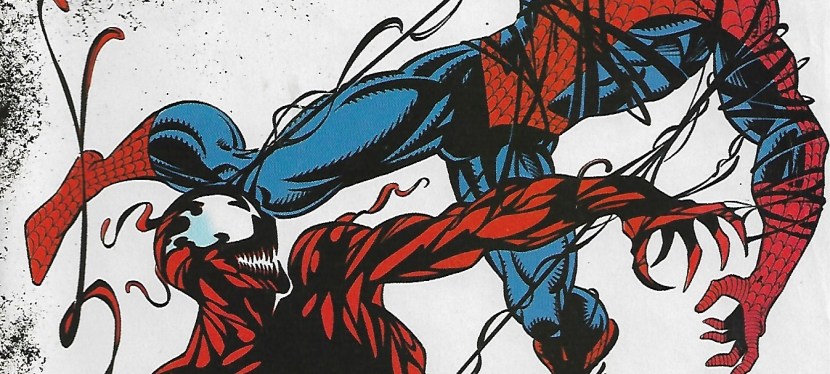
This time around I got to check on the first-ever encounter between Spider-Man and the vicious supervillain Carnage with True Believers: Absolute Carnage – Carnage #1 which is currently available for for only $1.
The cover.Hard-hitting action in the first encounter between Spidey and Carnage.
The comic book is a reprint of Amazing Spider-Man #361 which was released in 1992 just months before Marvel’s official celebration of the 30th anniversary of Spider-Man happened.
The story begins when Carnage causes trouble at the Agro-Lab Empire State University. He messes with a man named Chip (who claims to have done nothing wrong), cause property damage using his symbiote and eventually kills. This opening scene clearly shows that Carnage is a more troubling than Venom (who in turn was being turned into an anti-hero figure by Marvel’s creators).
Peter Parker/Spider-Man meanwhile spends quality time at home with his Aunt May. Unsurprisingly, a telephone call interrupts his private life causing him to go to the university to determine, secretly in costume, what happened. Peter personally knows Chip and the guy’s death only adds to his concern about the rise of brutal murders.
“Chip’s dead. And I’m worried that these serial killings may partly be my fault,” Peter told Mary Jane.
Using his access as a freelance photographer, Peter conducts computer research at the office of the Daily Bugle and discovers Cletus Kasady’s prison profile. Knowing that Kasady (Carnage) was a cellmate of Eddie Brock/Venom, he digs deeper and goes around the city to investigate. This sets up his first encounter with Carnage. What exactly happened between them? You just have to read to find out.
Tension builds up as Peter Parker researches Cletus Kasady.
Even by today’s standards, the story remains gripping, intriguing and entertaining at the same time. David Michelinie really knows how to balance spectacle, exposition and suspense with the Spidey-Carnage conflict as the highlight. Michelinie also showed Kasady’s insanity clearly and, even by his look, the villain is clearly a creative rip-off of DC Comics’ insane villain The Joker. Artist Mark Bagley’s art is still good to look at and he managed to pull off the daunting task of visualizing the present along with drawing images from Spidey’s past with original symbiote and Venom. The action scenes still have good visual impact.
Overall, if you are even a bit interested in Spider-Man, Carnage and 1990s comic book culture, then True Believers: Absolute Carnage – Carnage #1 is recommended. For only $1, this is one engaging and entertaining comic book to read.
Take note that there is a chance that Carnage will become the next popular supervillain in the movies once the character appears fully in the sequel to 2018’s Venom movie. Remember the mid-credits scene in Venom? Carnage could literally rise in pop culture.
Thank you for reading. If you find this article engaging, please click the like button below and also please consider sharing this article to others. Also my fantasy book The World of Havenoris still available in paperback and e-book format. If you are looking for a copywriter to create content for your special project or business, check out my services and my portfolio. Feel free to contact me as well. Also please feel free to visit my Facebook page Author Carlo Carrascoand follow me at HavenorFantasy@twitter.com
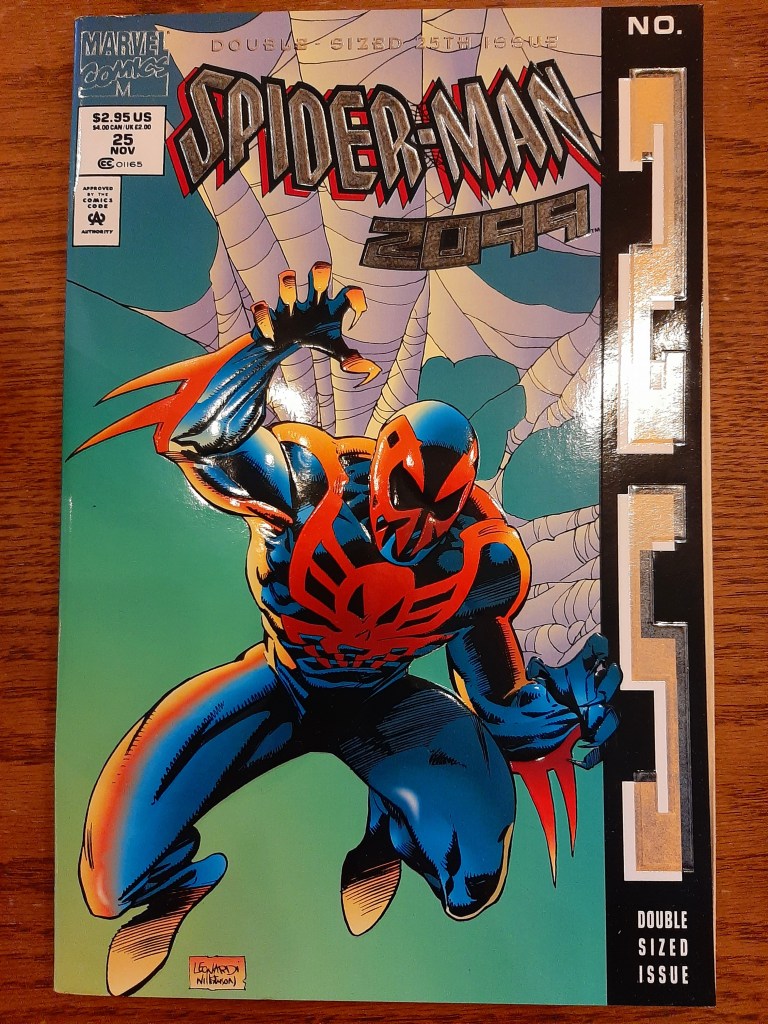
Released in late 1994 by Marvel Comics, Spider-Man 2099 #25 had a double-sized issue with an embossed cover that shined as it was laced with foil. The number 25 on the edge of the cover was stylized to capture people’s attention on the shelves of comic book specialty stores.
The cover of Spider-Man 2099 #25.
Back in the 1990s, Marvel had a “tradition” of releasing comic books with gimmick covers with anniversaries in mind. Notably the 25th, the 50th, the 75th and 100th issue and more got released with covers that came with foil or chromium or hologram or simply a hard embossed material. In other times, the anniversaries of the featured superhero/superheroes were celebrated with gimmick covers on comic books marking the celebration.
With regards to Spider-Man 2099 #25, the 2099 universe of Marvel had reached its 2nd year. By that point of time, the Marvel’s 2099 line of comics was already at full publishing blast with several monthly series (Spider-Man 2099, Ravage 2099, Punisher 2099, Doom 2099, X-Men 2099 and Ghost Rider 2099) plus a quarterly comic book (2099 Unlimited).
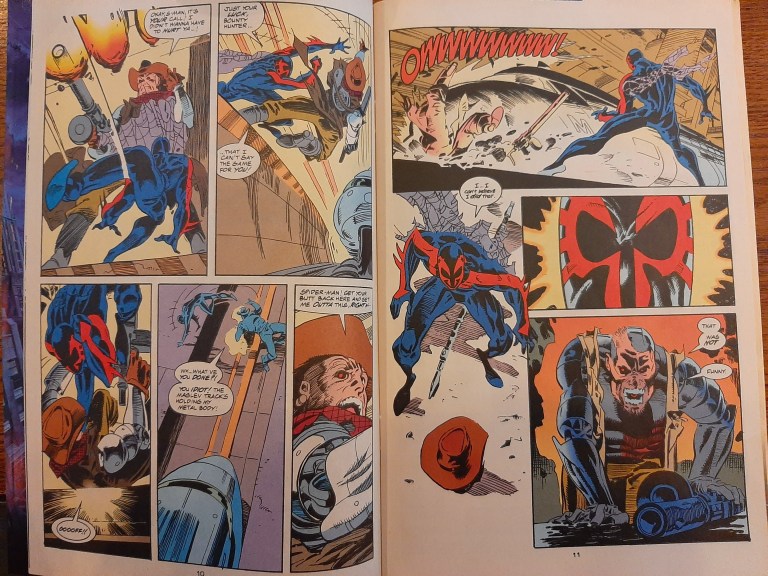
Written by Peter David and drawn by Rick Leonardi (with ink work by Al Williamson), the comic book begins with a short scene about Miguel O’Hara’s (Spider-Man 2099) mother moving on her way to meet someone. The spotlight then shifts into the heat of the rematch between Spider-Man and the cyborg Venture.
Later Miguel’s mother meets a certain tycoon at his mansion…
Spider-Man of 2099 fights with Venture.
When it comes to quantity, this comic book has a Spider-Man story of 22 pages, a Hulk 2099 story with 8 pages (a prequel to Hulk 2099 #1 specifically) and a story called Net Loss with 10 pages. The first time I read this comic book back in 1994, I anticipated more Spider-Man 2099 content but got surprised with the other two being part of it. Marvel decided back then to use Spider-Man #25’s content to expand and emphasize the 2099 universe.
When it comes to quality, I find the Spider-Man 2099 story here a worthy read not simply because Peter David wrote it but because he crafted a story that connects and relates well with what happened in Spider-Man 2099 #1. When I reached the end of the story, I really felt compelled to go back to the very first issue to re-examine what happened.
As this was the 25th issue of the series, Peter David and Rick Leonardi were more proficient as a creative team. The aesthetics of Leonardi’s art (inked by Williamson) is pretty much the same but I noticed that the illustrator added more power on key moments of the action. Ultimately this story is worthy of the 25th issue anniversary treatment.
The Hulk 2099 short story by Gerard Jones and Malcolm Davis meanwhile serves only to build up the mean green monster for its monthly series. Hulk 2099 was never an interesting character to me and this one did not change my view of him.
The final short story Net Loss was rather weird. Even though I read a lot of 2099 comic books, the story by Peter David and Tom Grindberg just did not captivate me.
Overall, I find Spider-Man 2099 #25 a worthy comic book to add to your collection and Spidey’s story alone is worth it.
Spider-Man 2099 #25 is recommended.
Thank you for reading. If you find this article engaging, please click the like button below and also please consider sharing this article to others. Also my fantasy book The World of Havenoris still available in paperback and e-book format. If you are looking for a copywriter to create content for your special project or business, check out my services and my portfolio. Feel free to contact me as well. Also please feel free to visit my Facebook page Author Carlo Carrascoand follow me at HavenorFantasy@twitter.com
“I’m not who I was any more! I’m not who I’m going to be! I am the Night Man.”
The above words were from the vigilante called the Night Man, a character co-created by comic industry veteran Steve Englehart (Avengers) and Darick Robertson for Malibu Comics’ Ultraverse franchise. Those words formally opened The Night Man #1 which I’m reviewing here.
To put things in perspective, a vigilante is described as a member of a volunteer committee organized to suppress and punish crime summarily (as when the processes of law are viewed as inadequate) according to Merriam-Webster dictionary. To put it broadly, the vigilante is a self-appointed doer of justice.
The Night Man #1 cover.
Published in 1993 by Malibu Comics, The Night Man #1 tells the story of Johnny Domingo, a jazz player whose life changed in the pages of The Strangers #1 (also written by Englehart) in which he (while driving a vehicle) got by a cable car (that was just hit by an energy burst from the sky) resulting a piece of shrapnel embedding into his head.
Perceived by others to be doomed, Domino strangely survived and was well enough to resume his normal life. The difference is that the incident made his eyes dilated permanently which forces him to shield them from bright light.
Just as Johnny walks down the street, he learned he gained an uncanny ability when he hears, for the first time, the evil thoughts of a man (wearing a coat and a hat) planning to kill a lady on Saturday night.
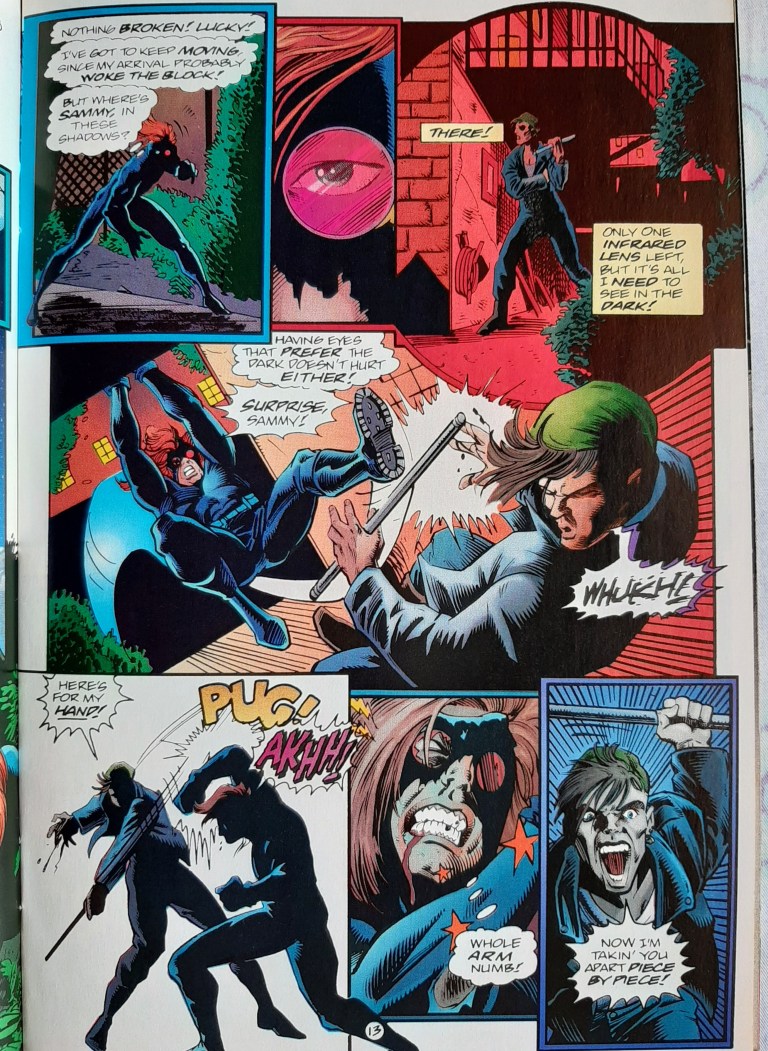
The Night Man in action!
Knowing what heard, Johnny wondered if he was crazy and what if some woman would truly be in danger. He then decides to follow the man with evil thoughts and watch his moves. Eventually Johnny followed the man to a restaurant by the beach and saw him talk with a pretty waitress named Ginger who agreed to a Saturday night date.
Carelessly Johnny approached the man too closely and got noticed, forcing him to run away and got chased until he got into a taxi that drove him away.
A short time later, Johnny starts his new career as a vigilante as the Night Man.
In terms of storytelling, The Night Man #1 was nicely paced and never felt dragging. Within its twenty-eight pages of story, the comic book took gradual steps on introducing Johnny, how the incident with the cable car impacted him, how he became a vigilante for the first time and what went on in his mind as he became the Night Man. Given his rich experience as a writer, it is no surprise that Steve Englehart delivered a solid script.
It was also engaging to see Night Man being a determined yet very vulnerable vigilante. During his first mission in costume, he managed to beat a few bad guys but ended up getting hurt. This kinda reminds me of the vulnerability seen in the cinematic icon John McClane in 1988’s Die Hard.
The art by Darick Robertson, with ink work done by Andrew Pepoy, was nicely crafted. The civilian and vigilante looks of Night Man were well defined. The visualization of action nice and when Night Man gets hurt, he really looks in pain.
Going beyond Night Man, this comic book has a short preview (five pages, including credits) of Rune, a character created by Barry Windsor-Smith. Rune is described to be a voracious killer whose prey is all humanity and he is an alien leech who despoils the flesh of victims, culling their lifeblood into the essence of power. Rune is also a dying creature fighting for survival against the malignant disease burning inside of him.
Overall, The Night Man #1 is a worthy addition to your comic collection if you are interested in the Ultraverse (which is still kept in limbo by Marvel which acquired Malibu Comics in the mid-1990s) or are interested in vigilante-type superheroes. If you are obsessed with whatever Barry Windsor-Smith created, then the Rune stuff is a must-get.
The Night Man #1 is recommended.
Thank you for reading. If you find this article engaging, please click the like button below and also please consider sharing this article to others. Also my fantasy book The World of Havenoris still available in paperback and e-book format. If you are looking for a copywriter to create content for your special project or business, check out my services and my portfolio. Feel free to contact me as well. Also please feel free to visit my Facebook page Author Carlo Carrascoand follow me at HavenorFantasy@twitter.com




















 Author Carlo Carrasco