A Look Back at Sludge #4 (1994)

Disclaimer: This is my original work with details sourced from reading the comic book and doing personal research. Anyone who wants to use this article, in part or in whole, needs to secure first my permission and agree to cite me as the source and author. Let it be known that any unauthorized use of this article will constrain the author to pursue the remedies under R.A. No. 8293, the Revised Penal Code, and/or all applicable legal actions under the laws of the Philippines.

Welcome back, superhero enthusiasts, 1990s culture enthusiasts and comic book collectors! Today we revisit the Ultraverse of Malibu Comics and examine one of its many stories through an issue of the Sludge comic book series.

Previously, I reviewed Sludge #3 which was a tie-in comic book to the first big crossover event of the entire Ultraverse – Break-Thru. In that issue, he encountered the “lord” Pumpkin who himself became a notable super villain in the UV. That story also showed the first major test of Sludge when it comes to resisting temptation and evil.

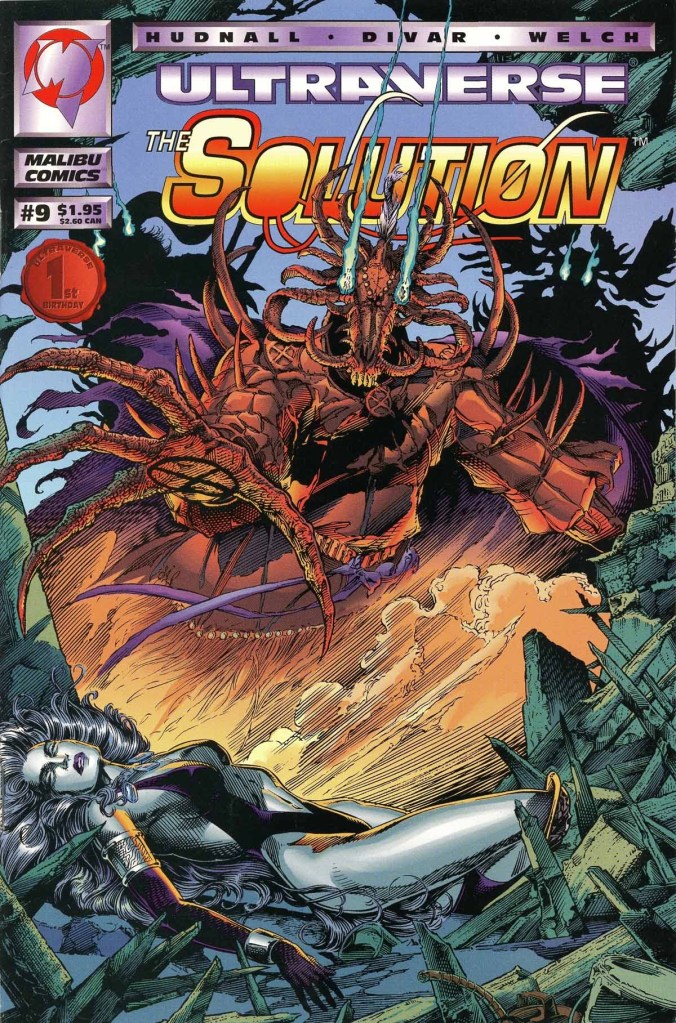
With those details laid down, here is a look back at Sludge #4, published by Malibu Comics in 1994 with a story written and drawn by Aaron Lopresti, and scripted by Steve Gerber.

The cover.

Early story

The story begins when two black teenagers go down the city sewer to look for something as part of a job of them agreed to do for someone named Gordy. They accidentally find Sludge whose appearance and ability to talk scares them away. As the two keep running to another direction, a reptilian monster sees them. The monster grabbed and killed the taller youth, leaving the shorter one scared.

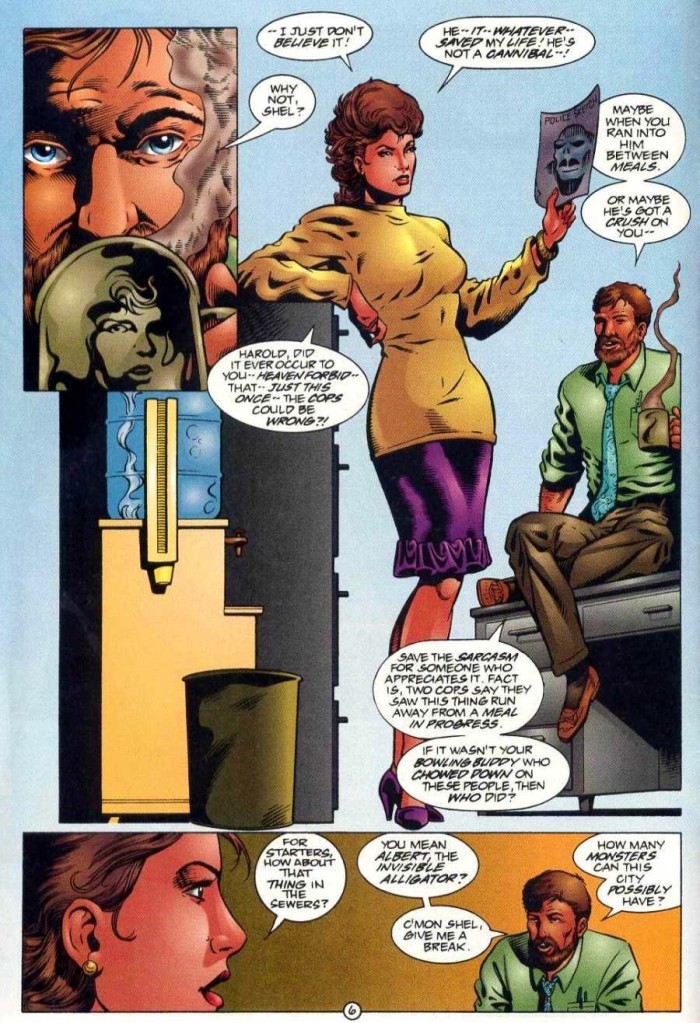
A short time later, a police officer finds the scared teenager hiding behind plants at Central Park. The survivor is in a state of shock repeating his friend’s name a lot. The police update about the boy eventually reaches the office of the New York Daily Globe and an attractive reporter named Shelley intends to follow what could be a hot scoop…

Quality

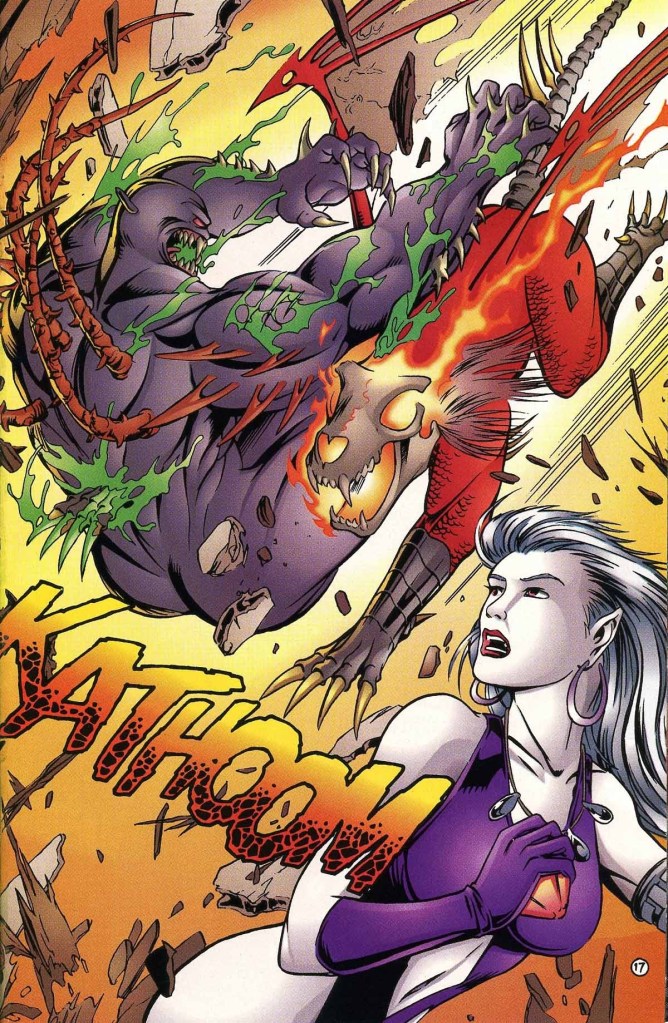
The battle between these two has a lot of stuff that should be seen.

In this comic book, I can see that the creative team of Steve Gerber and Aaron Lopresti decided to shake things up a bit when it comes to telling a new story of Sludge laced with elements of society, urban legends and journalism. The good news here is that this story is well-written and the visuals really brought the script to life for readers to be engaged with.

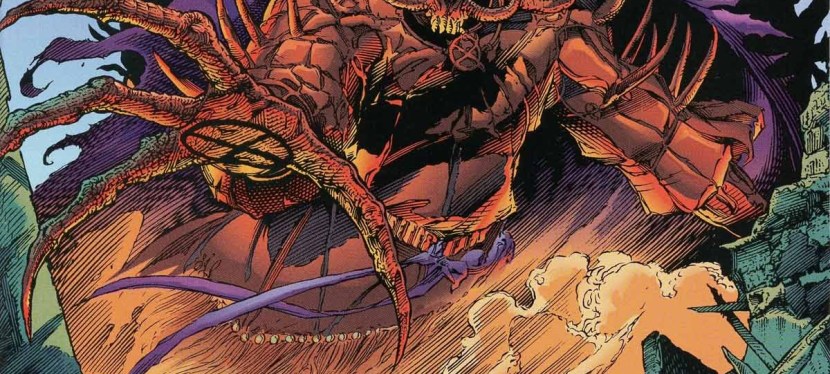
When it comes the elements that inspired this particular story, the concept about alligators occupying the sewers instantly reminds me of the 1980 film Alligator and along the way, Gerber-Lopresti went on pounce on the concept resulting in the introduction of a brand new Ultraverse villain in the form of a monstrous, human-like alligator named Veffir Voon Iyax which can also talk and reason like humans. This new villain is really interesting and its background about being part of a species of alligators worshipped by people from long ago sheds light on the idolatry which is both unholy and foolish.  

On the aspects of society and journalism, the story sheds light on how some people – even minors – would go to really unsafe places and do very risky jobs for a variety of reasons. The journalistic aspect of this comic book emphasizes how far journalists would go to write stories based on questionable data and that a newspaper would recklessly publish such stories even though they lacked solid evidence to prove the unbelievable is true. The newspaper journalist Shelley had quite an amount of the spotlight, she became a clear supporting character in this comic book.

In keeping up with the superhero flavor of the Ultraverse, there is a good amount of spectacle here as it has a big battle between Sludge and the monstrous alligator which is nicely presented. This is a battle between monsters that was carefully structured and executed well.

Conclusion

A look at what happens behind the scenes at a city newspaper.

Sludge #4 (1994) is both an intriguing and enjoyable read. The Gerber-Lopresti team succeeded in telling another Sludge tale that is fresh as it took inspiration from pop culture and society. At the same time, this comic book show that Sludge is clearly not the only monster in New York City’s sewers. As such, his place within the Ultraverse is really unique.

If you are seriously planning to buy an existing hard copy of Sludge #4 (1994) be aware that as of this writing, MileHighComics.com shows that the near-mint copy of the regular edition costs $16 while the near-mint copy of the newsstand edition costs $48.

Overall, Sludge #4 (1994) is recommended.

+++++

Thank you for reading. If you find this article engaging, please click the like button below and also please consider sharing this article to others. If you are looking for a copywriter to create content for your special project or business, check out my services and my portfolio. Feel free to contact me with a private message. Also please feel free to visit my Facebook page Author Carlo Carrasco and follow me on Twitter at  @HavenorFantasy as well as on Tumblr at https://carlocarrasco.tumblr.com/

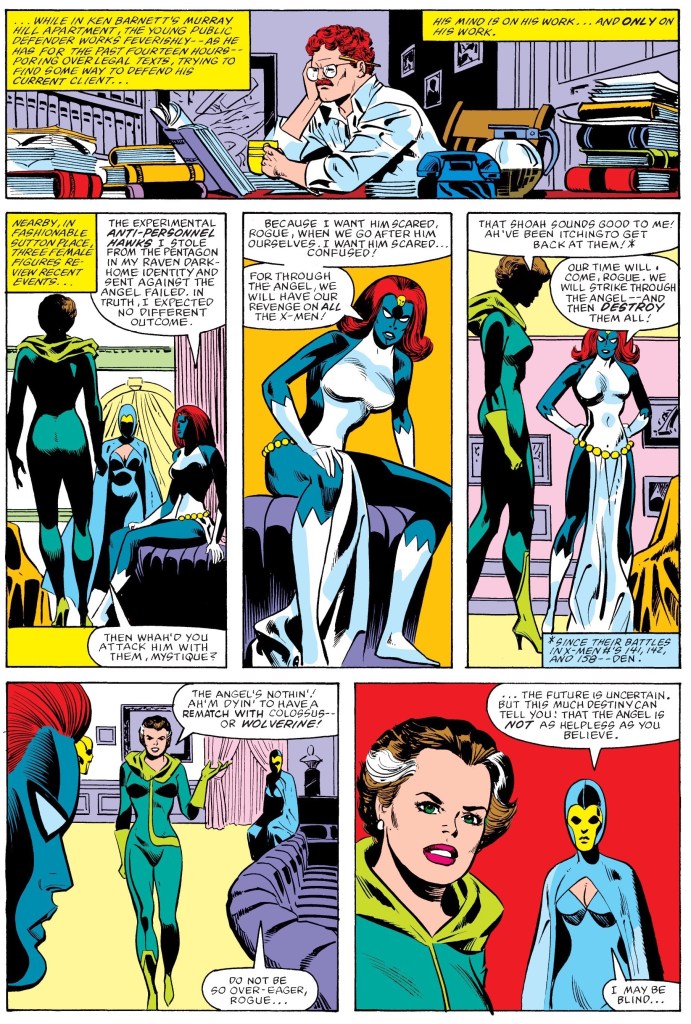
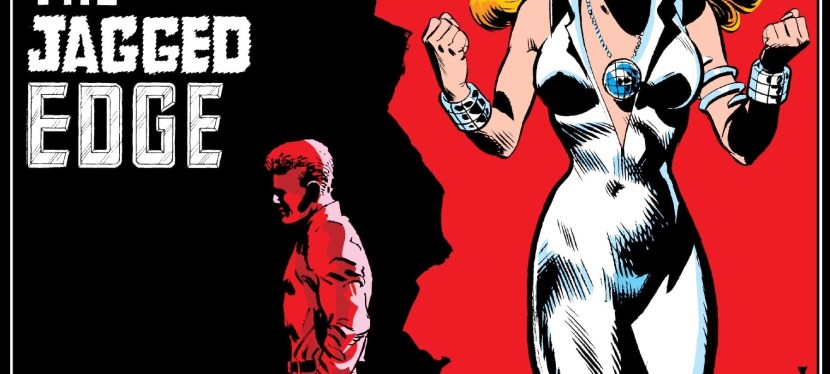
A Look Back at Dazzler #21 (1982)

Disclaimer: This is my original work with details sourced from reading the comic book and doing personal research. Anyone who wants to use this article, in part or in whole, needs to secure first my permission and agree to cite me as the source and author. Let it be known that any unauthorized use of this article will constrain the author to pursue the remedies under R.A. No. 8293, the Revised Penal Code, and/or all applicable legal actions under the laws of the Philippines.

Welcome back superhero enthusiasts, 1980s culture enthusiasts and comic book collectors! Today we go back to the year 1982 to examine the Marvel Comics universe through the exploits of Dazzler!

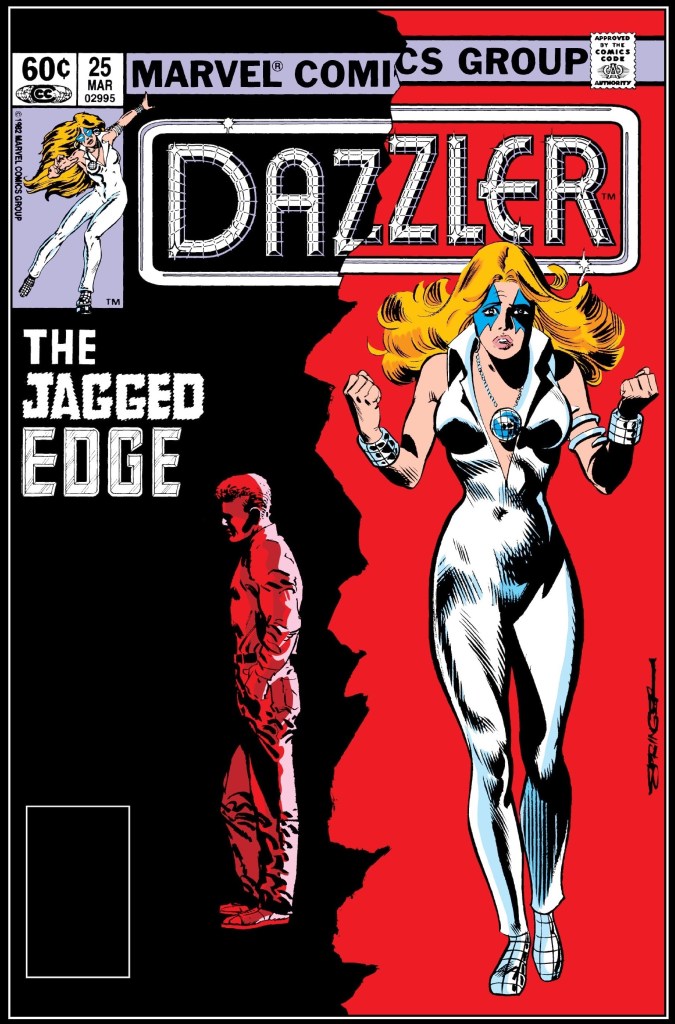
While my most recent retro review of Dazzler was the 4th issue of its monthly series, I have decided to jump straight to issue #21 for this new retro review. By the time Dazzler #21 got published, the unusual superhero went through a lot and illustrator Frank Springer became fully established as the monthly series’ definitive artist.

With those details laid down, here is a look back Dazzler #21, published by Marvel Comics in 1982 with a story written by Danny Fingeroth and drawn by the late Frank Springer.

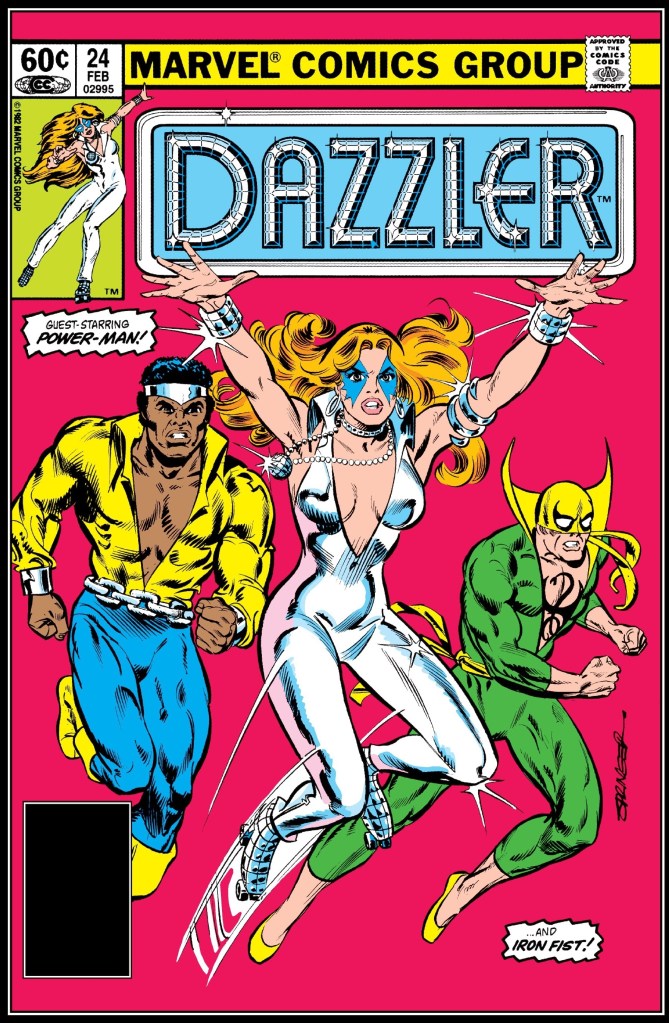
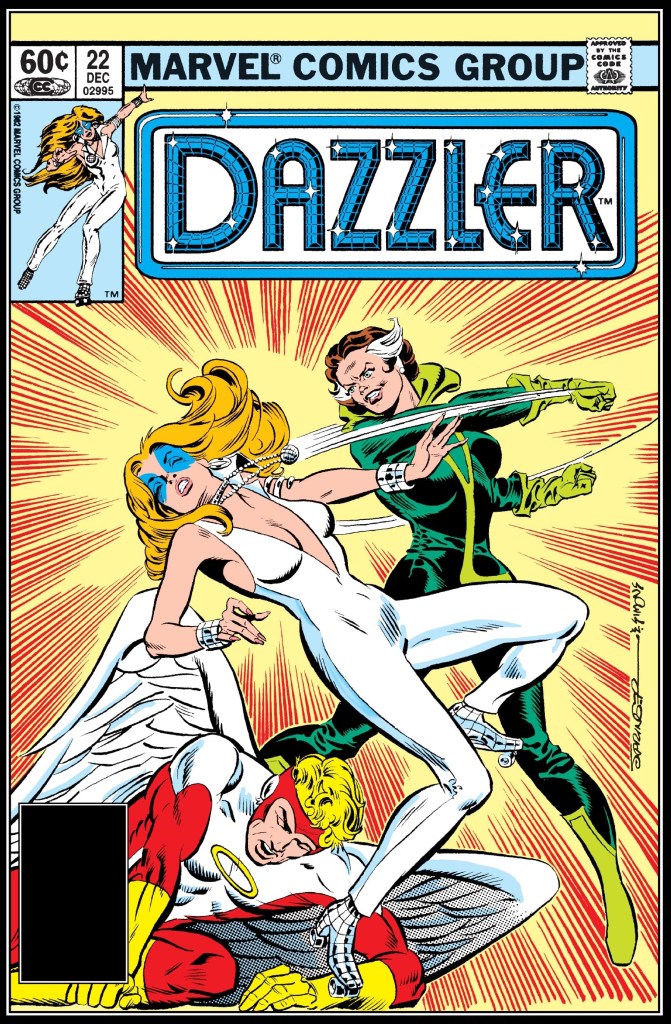
The cover.

Early story

The story begins with Alison Blaire/Dazzler being carried above the buildings of New York City by Angel (Warren Worthington) of the X-Men. At this point in time, Alison’s father judge Carter Blaire snapped under the weight of turmoil related to the death of his wife and his daughter’s rebelliousness. As Dazzler, Alison had gone through intense encounters with the likes of the Incredible Hulk, She-Hulk, a top-secret syndicate that made her a test subject and even Galactus.

Recently, Bella – Alison’s grandmother – could not cope with her son’s breakdown and reached out to Warren Worthington to help her reach Alison. Since after being found, Alison had been traveling with Angel by air.

Along the way, Spider-Man sees them and recognizes Alison as Dazzler. He swings to try to get their attention but was ignored as they were so focused on their objective. A short time later, Angel and Alison arrive at judge Blaire’s home. Her grandmother greets them and tells her she hopes that she can get through to judge Blaire.

The doctor, however, advised against that tactic and states that Alison’s intervention may worsen her father’s condition as much of it was centered on her…

Quality

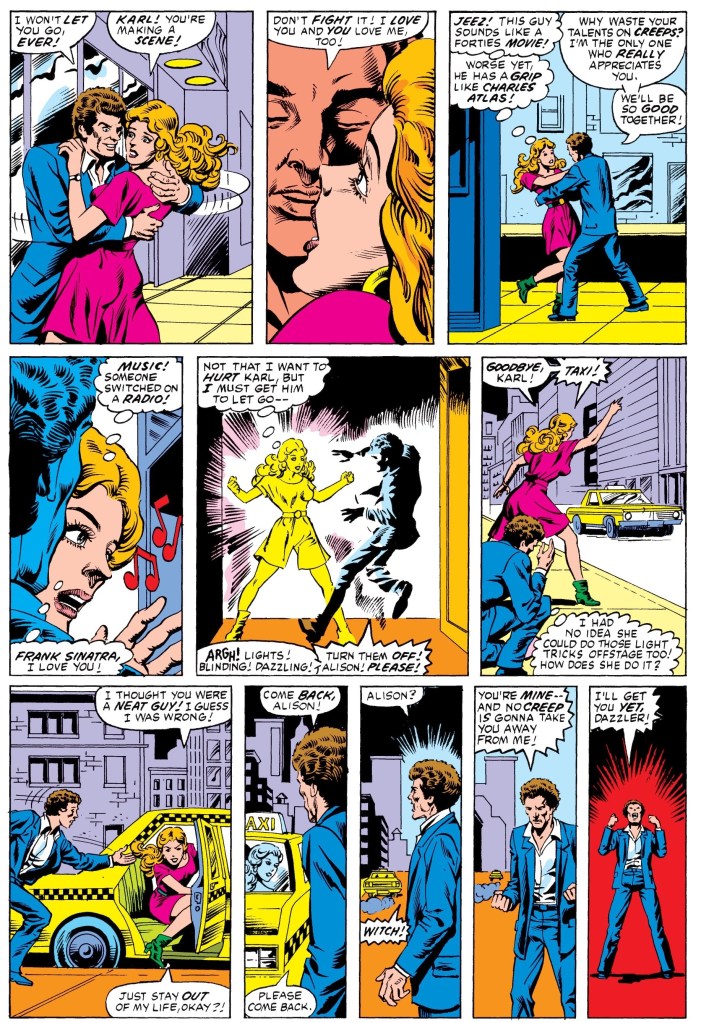
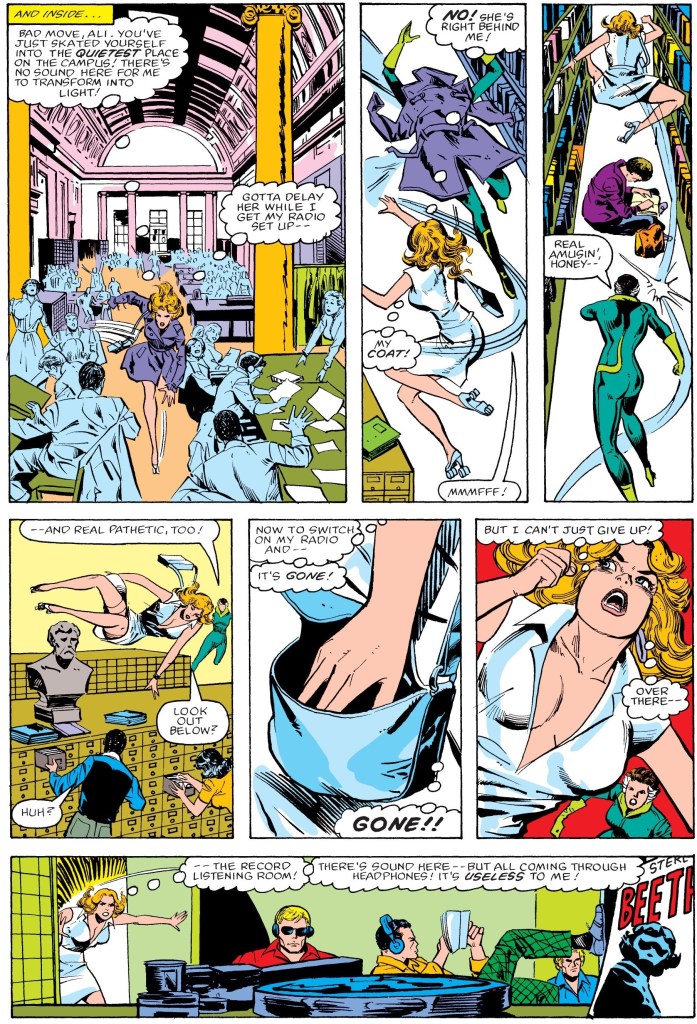
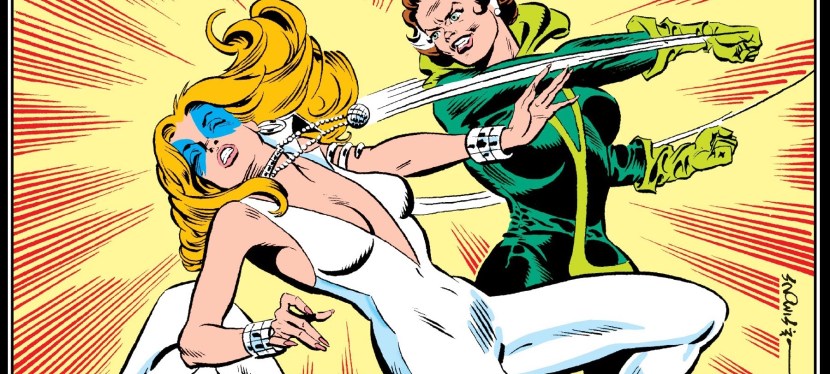
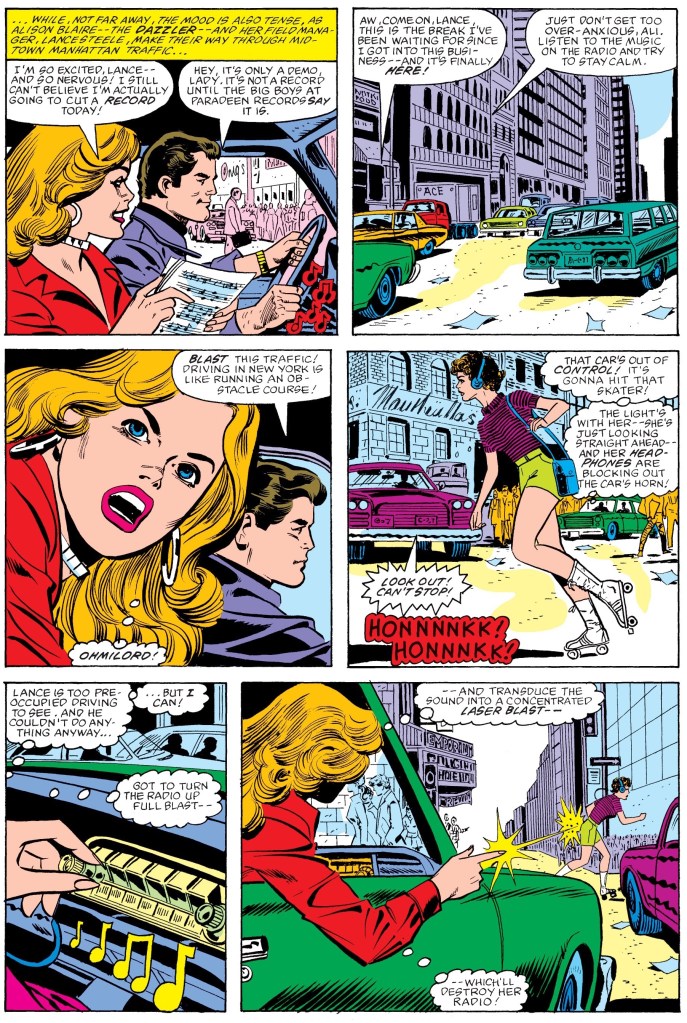
Alison Blaire and her friend Vanessa try out new clothes.

I’ll go straight to the point about what the story of this double-sized comic book is about without spoiling it. It is a pretty dramatic look at the protagonist in her civilian form as Alison Blaire. You will get to see her as Dazzler in this comic book but if you are looking for a lot of superhero moments of her or if you are looking for Dazzler in a conflict with evil elements, you won’t find it here.

More on the plot, this comic book explores deeply the emotional and personal dimensions of Alison and along the way, stories about her own past as well as the respect past events of both her father and mother got dramatized. The story tackles themes like independence, maturity, marriage, personal development, family ties and personal conflicts of interest. The good thing here is that the script by Danny Fingeroth is very well-written and it seems he did his research on constructing a personal story about Alison Blaire that is very grounded in reality. That being said, the superhero elements have been pushed aside most of the time and the ironic thing is the fact that the other Marvel superheroes – Spider-Man, Fantastic Four, The Avengers and more – appeared here as if to remind readers this is still a superhero tale.

Very clearly, this story was written for the very dedicated or even the die-hard Dazzler fans in mind. When it comes to the fun factor, the results could be mixed depending on what readers want to see in this comic book. For me personally, it is a pretty engaging story to read and at the same time it is fun enough as well.

Conclusion

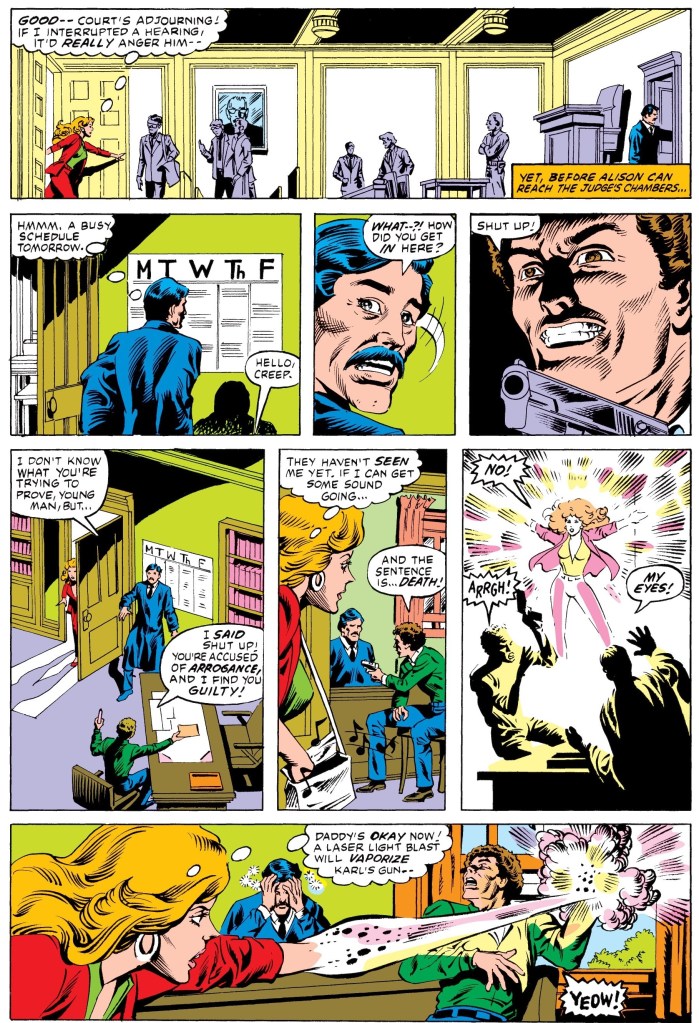
Alison tries to help her troubled father.

Dazzler #21 (1982) could be barely received or strongly received or even rejected even though it has a very rich and dramatic script. The clear lack of the superhero presentation of Dazzler in favor of heavy drama and in-depth characterization may not win the approval of readers/collectors who love superhero stuff but it will resonate with the readers who really love the character and had immersed themselves into her life. As far as characterization goes, this comic book marks a significant turning point of Dazzler herself and in its story, she really developed a lot since making her first-ever appearance in Uncanny X-Men #130. If you are a Dazzler purist who does not mind the lack of superhero spectacle, this one could engage you.

If you are seriously planning to buy an existing hard copy of Dazzler #21 (1982), be aware that as of this writing, MileHighComics.com shows that the near-mint copy of the regular edition costs $28 while the near-mint copy of the newsstand edition costs $60.

Overall, Dazzler #21 (1982) is recommended.

+++++

Thank you for reading. If you find this article engaging, please click the like button below and also please consider sharing this article to others. If you are looking for a copywriter to create content for your special project or business, check out my services and my portfolio. Feel free to contact me with a private message. Also please feel free to visit my Facebook page Author Carlo Carrasco and follow me on Twitter at  @HavenorFantasy as well as on Tumblr at https://carlocarrasco.tumblr.com/

A Look Back at WildC.A.T.S: Covert Action Teams #7 (1994)

Disclaimer: This is my original work with details sourced from reading the comic book and doing personal research. Anyone who wants to use this article, in part or in whole, needs to secure first my permission and agree to cite me as the source and author. Let it be known that any unauthorized use of this article will constrain the author to pursue the remedies under R.A. No. 8293, the Revised Penal Code, and/or all applicable legal actions under the laws of the Philippines.

Welcome back superhero enthusiasts, 1990s culture enthusiasts and comic book collectors! Today we continue revisiting Jim Lee’s flagship title under the Image Comics label – WildC.A.T.S: Covert Action Teams!

While the 3rd and 4th issues of the WildC.A.T.S: Covert Action Teams mini-series had Lee’s superhero team crossing over with Rob Liefeld’s Youngblood, a bigger crossover was agreed upon with Image Comics co-founder Marc Silvestri – Killer Instict! This marked a creative collaboration between Lee and Silvestri resulting a multiple issue crossover between WildC.A.T.S and Cyber Force. For clarification, I already mentioned in my retro review of WildC.A.T.S: Covert Action Teams #6 (1993) that its story was the first chapter of the 4-part Killer Instinct crossover. For your reference, Killer Instinct’s 2nd and 4 chapters were published as Cyber Force issues #2 and #3 of its regular series under Marc Silverstri. This WildC.A.T.S retro review is about the 3rd chapter of Killer Instinct.

With those details laid down, here is a look back WildC.A.T.S: Covert Action Teams #7, published by Image Comics in 1994 with a story written by Brandon Choi and Jim Lee. Lee did the art.

The cover.

Early story

The story begins somewhere in the skies above Gamorra, off the coast of the Philippines! Stryker, the Cyber Force member with three cybernetic right arms, communicates with his teammates and tells them that if half of what Misery said is true about the new Cyberdata S.H.O.C.S., they’re in for a nasty fight and they have to hit the ground.

Stryker, Impact, Heatwave, Velocity and Ripclaw jump off their high-tech jet (which has Cyblade and Misery inside) and land safely. Using his enhanced ability of smell, Ripclaw begins detecting tracks of what they are look for.

Meanwhile at the back of the Isle of the Dead, a high-tech craft arrives with three passengers who are prepared to do a drug deal. Slowly, someone bleeding and with blades on his hands climbs into the craft surprising the passengers. He takes control of the craft, throws the passengers off and leaves.

As Cyber Force starts its ground search with Misery advising them while carefully using her telepathy on them. As Stryker enters a ravaged high-tech place, his sensors detect nothing and yet his instincts tell him something is present nearby. Standing near him is Spartan of WildC.A.T.S…

Quality

In this encounter between Grifter and Heatwave, do you notice something lacking visually?

I’ll start with the very obvious purpose of this comic book. After the build-up done in the first two chapters of the Killer Instinct storyline, this story serves as the start of what turned out to be the big pay-off as WildC.A.T.S and Cyber Force members finally got together with an action-packed battle to kick things off. From a storytelling view point, this one is mainly a WildC.A.T.S versus Cyber Force tale with really nice match-ups between their members such as Spartan-Stryker, Cyblade-Zealot and Maul-Impact to name a few. These match-ups and fights are excellently drawn by Jim Lee and I really enjoyed his own artistic visuals of Marc Silvestri’s Cyber Force.

More on the plot, it is pretty simple in concept and structure. The members of the two teams get to fight each other which gets the attention of Skywatch which itself has vested interest with the operations of Stormwatch (note: this is within the WildStorm lore) and the secret facility on that blew up (as seen in WildC.A.T.S #5). Misery remains the key factor in the story and in this tale, she gets to guide and manipulate Cyber Force to find something valuable while Warblade remains mostly absent. Apart from the battles, the absent Voodoo, Void and Jacob Marlowe have their respective spotlights mainly for the character developments as well as reminding readers about the continuing Kherubim-Daemonite conflict.

The quality of the writing is serviceable and the way I look at this comic book, it is mainly driven by spectacle and match-ups. The amount of crossover action is of top-notch quality (note: Jim Lee apparently missed out on key details while drawing Heatwave in a scene with Grifter) and clearly Jim Lee planned the visuals carefully. While there is little character development here, the ironic thing is that Misery (note: visually she is a wicked version of Jean Grey of the X-Men) is the one who gets a good chunk of the said development. Not only does she become a force in the minds of Cyber Force members, she also has her intimate moments with Ripclaw which is a reminder to readers that they have a shared past together (note: this will resonate more with those who read Cyber Force #2 of the regular series).

Conclusion

This is how Cyber Force looks like as drawn by Jim Lee.

To make things clear, WildC.A.T.S: Covert Action Teams #7 (1994) will strongly appeal to the respective fans of WildC.A.T.S and Cyber Force, to the readers who love high-quality superhero action, and to those who simply enjoy superhero crossover stories. While it is not a surprise that this comic book has great visuals, the writing this time clearly lacks depth and I really felt that the dialogue and text descriptions were done mainly to fit the obvious spectacle-led concept. If you are the kind of reader who wants storytelling and characterization prioritized in an action-packed crossover comic book, this one might not satisfy you. Ultimately, this one is a fun read even though the quality of the writing does not even come close to the quality of the visuals.  

If you are seriously planning to buy an existing hard copy of WildC.A.T.S: Covert Action Teams #7 (1994), be aware that as of this writing, MileHighComics.com shows that the near-mint copy of the regular edition costs $30 while the near-mint copy of the newsstand edition costs $90. The near-mint copy of the silver cover edition costs $300.

Overall, WildC.A.T.S: Covert Action Teams #7 (1994) is recommended.

+++++

Thank you for reading. If you find this article engaging, please click the like button below and also please consider sharing this article to others. If you are looking for a copywriter to create content for your special project or business, check out my services and my portfolio. Feel free to contact me with a private message. Also please feel free to visit my Facebook page Author Carlo Carrasco and follow me on Twitter at  @HavenorFantasy as well as on Tumblr at https://carlocarrasco.tumblr.com/

A Look Back at Dazzler #4 (1981)

Disclaimer: This is my original work with details sourced from reading the comic book and doing personal research. Anyone who wants to use this article, in part or in whole, needs to secure first my permission and agree to cite me as the source and author. Let it be known that any unauthorized use of this article will constrain the author to pursue the remedies under R.A. No. 8293, the Revised Penal Code, and/or all applicable legal actions under the laws of the Philippines.

Welcome back superhero enthusiasts, 1980s culture enthusiasts and comic book collectors! Today we go back to the year 1981 to examine the Marvel Comics universe through the exploits of Dazzler!

Last time around, Alison Blaire was preparing herself for a big event as Dazzler. The event was something needed to help her boost her career as an entertainer and the stakes were high as there were many important guests. The weird thing was that she instead got involved with one of the most fearsome super villains of Marvel – Dr. Doom!

With those details laid down, here is a look back Dazzler #4, published by Marvel Comics in 1981 with a story written by Tom DeFalco and drawn by the late Frank Springer. This was Springer’s Dazzler debut.

The cover.

Early story

The story begins inside a secret facility. Dr. Doom tells Dazzler that the Merlin Stone he just acquired mirrors her reflections as well as his own. The said stone has unique, mystical properties that Doom believes will help him achieve his dream of domination over mankind.

Dazzler, who is trapped inside a tube and is guarded by two of Dr. Doom’s guards, tries to recover after losing consciousness a short time back. Dr. Doom expresses his observation of her special ability to convert sound into light.

Dr. Doom turns his computer on energizing the tube that contains Dazzler. She suddenly turns into energy and disappears…

Quality

Dazzler in a new dimension.

The best way to describe this comic’s story…it is one wild ride that emphasizes a different kind of fantasy for readers. This is, of course, related to Dr. Doom’s immediate quest of finding another Merlin Stone within a different dimension which directly involved Dazzler against her will.

Dazzler here was in a very wild misadventure that goes way beyond the limits of New York City. Being in a completely new dimension, she finds herself literally lost in the sea of space and encounters creatures here and there. This misadventure, however, was not written to be mindless at all. In fact, as the tale in the new dimension goes on, Dazzler was presented to be more tactical, more analytical and do things to solve problems she encountered. She also gets to use her superpower in more creative ways.

The misadventure also has key moments that test Dazzler’s resolve on a personal level. As such, these moments added to her development which also raises the stakes as to what she could potentially do once she returns back to her life. Clearly, this is a story that carefully mixes spectacle and character development without losing track of the story.

On the art of the comic book, Frank Springer’s Dazzler debut is pretty solid. Not only does he capture the look of Dazzler herself, his creative visuals really brought the dimension into life filled with images of out space, fantasy monsters and more. Apart from drawing Dazzler and Dr. Doom, Springer’s art of the Fantastic Four is pretty good to look at.

Conclusion

A helpless Dazzler in the presence of Dr. Doom.

Dazzler #4 (1981) is a fun comic book to read and as a Dazzler story, it is a worthy continuation of the events that took place in issue #3. The concept about having Dazzler under the power of Dr. Doom was nicely executed which is a very hard feat to achieve since the said super villain was known to be a major force of opposition not only against the Fantastic Four but also against Spider-Man, the X-Men and more. Dazzler’s misadventure into the other dimension was wild and yet nicely structured which led to some nice character development of hers. This comic book had a strong series start for Frank Springer who went on to draw a great majority of the issues of the Dazzler monthly series.

If you are seriously planning to buy an existing hard copy of Dazzler #4 (1981), be aware that as of this writing, MileHighComics.com shows that the near-mint copy of the regular edition costs $28 while the near-mint copy of the newsstand edition costs $60.

Overall, Dazzler #4 (1981) is recommended.

+++++

Thank you for reading. If you find this article engaging, please click the like button below and also please consider sharing this article to others. If you are looking for a copywriter to create content for your special project or business, check out my services and my portfolio. Feel free to contact me with a private message. Also please feel free to visit my Facebook page Author Carlo Carrasco and follow me on Twitter at  @HavenorFantasy as well as on Tumblr at https://carlocarrasco.tumblr.com/
A Look Back at WildC.A.T.S: Covert Action Teams #6 (1993)

Disclaimer: This is my original work with details sourced from reading the comic book and doing personal research. Anyone who wants to use this article, in part or in whole, needs to secure first my permission and agree to cite me as the source and author. Let it be known that any unauthorized use of this article will constrain the author to pursue the remedies under R.A. No. 8293, the Revised Penal Code, and/or all applicable legal actions under the laws of the Philippines.

Welcome back superhero enthusiasts, 1990s culture enthusiasts and comic book collectors! Today we continue revisiting Jim Lee’s flagship title under Image Comics – WildC.A.T.S: Covert Action Teams!

For the newcomers reading this, I recently completed reviewing the 4-issue mini-series (read my retro reviews here, here, here and here), the first issue of which was one of the launch titles published under Image Comics’ banner through Malibu Comics. Back in 2020, I reviewed issue #5 which itself was highly unusual as it marked the beginning of what was back then the regular series of WildC.A.T.S (note: starting a brand new comic book series is often done with a new issue #1). WildC.A.T.S: Covert Action Teams #5 was conveniently part of the build-up for the Killer Instinct storyline that had featured Jim Lee’s creations crossing over with Marc Silvestri’s Cyber Force.

With those details laid down, here is a look back WildC.A.T.S: Covert Action Teams #6, published by Image Comics in 1993 with a story written by Brandon Choi and Jim Lee. Lee did the art.

The cover.

Early story

The story begins with the WildC.A.T.S flying in their high-tech aircraft and observing the large explosion which marked the destruction of a top-secret research facility. Their teammate Warblade was left behind which concerns Grifter and Voodoo. Spartan says it is too risky for them to move close to the site of destruction for Warblade as their electronic counter measure and identification systems have been lost due to the explosion. Spartan also told them team that they need to fly away before the Gamorran security forces arrive.

They are too late, however, as three high-tech aircrafts of Gamorra have arrived to take them down. One of them launched several missiles at the WildC.A.T.S aircraft causing Spartan to tell Grifter to redirect all power to their shields.

As hard as he tried, Spartan could only fly their shielded jet to dodge the first four missiles and absorbing the impact of two missiles before getting hit by the other missiles launched by the other two enemy aircrafts.

While their jet got destroyed into pieces, the WildC.A.T.S managed to survive the explosion only to see themselves falling helplessly in the air. As Spartan catches Voodoo, Grifter warns him abou the incoming Gamorran aircraft…

Quality

The team but without Jacob Marlowe, Warblade, Voodoo and Void at this point of the story.

To begin with, this comic book is very much like its predecessors – a very action-packed tale laced with the occasional character moments for fun while having little room left for character development. If there is any notable change in the way this comic book’s story was told, it is the detective work done collectively by key members of WildC.A.T.S followed by exposition dumps here and there. The detective work and exposition were done primarily to add to the build-up of the crossover with Cyber Force with the revelation of a love triangle from the past involving Misery (who gave Grifter a lot of trouble in issue #5), Warblade and Ripclaw (from the other team).

As with Jim Lee’s past works, the action here is highly charged and there is a lot of spectacle to enjoy most of the way. By the time this comic book got published, the respective capabilities of the WildC.A.T.S team members have already been established and the creators pushed the creative limits further on showing what else could the main characters do as envisioned by Jim Lee. There is even this 4-page sequence showing Grifter and Zealot infiltrating one of the Gamorran aircrafts and having lots of banter along the way which was fun to read. Considering the lack of space for character development, the creators made up for it somewhat with the dialogue.

As this is the first chapter of the Killer Instinct crossover storyline, the build-up for it is not really that engaging to me personally. While Ripclaw was already established as a major Cyber Force character and Warblade was a visible yet not so dominating as a member of WildC.A.T.S, the establishment of the personal connection between them through Misery (the woman right in the middle) is just not so strong. Not even a huge exposition dump about the past could have strengthened the background. It would have been more helpful had Jim Lee and Marc Silvestri agreed to publish a prequel comic book (or pages inserted into a few comic books of WildC.A.T.S and Cyber Force) about Warblade-Misery-Ripclaw in the past as a prelude to Killer Instinct. More on Misery herself, I could not help but think of her as a distorted and more wicked version of the X-Men’s Jean Grey complete with long red hair.

Conclusion

Grifter and Zealot infiltrate a Gamorran aircraft.

WildC.A.T.S: Covert Action Teams #6 (1993) is another fun comic book to read filled with a lot of stuff that Jim Lee fans love to see again and again. As the opening chapter of Killer Instinct, the creators did the best they could to establish Misery as an important antagonist who happens to have been personally involved with Warblade and Ripclaw some years back. Sadly, the Warblade-Misery-Ripclaw triangle establishment is not so engaging and looked more like an afterthought. Still, this comic book’s story is not brainless and expanded the lore of the WildStorm universe a bit more. There is more good stuff than bad ones which make this worth reading.

If you are seriously planning to buy an existing hard copy of WildC.A.T.S: Covert Action Teams #6 (1993), be aware that as of this writing, MileHighComics.com shows that the near-mint copy of the regular edition costs $20 while the near-mint copies of gold cover edition and newsstand edition cost $300 and $60 respectively.

Overall, WildC.A.T.S: Covert Action Teams #6 (1993) is recommended.

+++++

Thank you for reading. If you find this article engaging, please click the like button below and also please consider sharing this article to others. If you are looking for a copywriter to create content for your special project or business, check out my services and my portfolio. Feel free to contact me with a private message. Also please feel free to visit my Facebook page Author Carlo Carrasco and follow me on Twitter at  @HavenorFantasy as well as on Tumblr at https://carlocarrasco.tumblr.com/
My five hours with the free trial version of Cyberpunk 2077 on my Xbox Series X

Before I begin, I want to make clear to all of you reading this that I never got to play Cyberpunk 2077 on any platform when it was first launched in late-2020. Like anyone else, I waited years for that game and I was excited too but Cyberpunk 2077 was released just a few weeks after Xbox Series X and PlayStation 5 launched. At that very time in December 2020, I was focused on raising funds for Xbox Series X than buying new games for my console at the time – the Xbox One (which stopped functioning in mid-2021 after 6 years of use). I can also say that the exposure of Cyberpunk 2077’s very flawed state on consoles plus the criticism that followed convinced me to stay away from CD Projekt Red’s promised epic video game.

Very recently, CD Projekt Red not only polished Cyberpunk 2077 with Xbox Series X and PlayStation 5 in mind, they also released a free 5-hour trial version (with patch 1.5) which I decided to download and play to really experience the game for the first time ever. This post I’m writing is clearly not a game review but my own observation about what Cyberpunk 2077 offered and what I experienced in the five hours I played.

I was in the second half of my 5-hour playtime with the free trial version of Cyberpunk 2077 when I reached this place.

After downloading it, I got to play the free trial version on my Xbox Series X with the performance mode chosen as I wanted to play the game with the best frame-rate possible. I customized V in female form and chose Streetkid as her lifepath as I was eager to discover Night City.

While I knew five hours was rather limiting to make tremendous story progress or discover much of the city, I still went on with the main storyline of V, discovered the key characters, and went through the tutorials to learn the basics of combat (both guns and melee weapons), stealth, hacking and, late in my limited playtime, the braindance (note: you get to experience life through another person’s own views and experiences in first-person view and externally).

The shooting in this game still lacks precision and accuracy when compared to what The Outer Worlds and Fallout 4 have.

On combat, I find the shooting rather lacking in precision in terms of aiming and controller response when compared to what I’ve played in first-person role-playing games (RPGs) The Outer Worlds and Fallout 4. In fairness, the impact of shots fired against enemies in Cyberpunk 2077 is rather strong, especially when you use powerful weapons like the shotgun. The melee combat meanwhile can be challenging to pull off precisely. Even with the immersive first-person view, I had a bit of trouble estimating if my character’s fists or weapon would be able to reach the opposition figure. I also had similar results with regards to blocking the opposition’s melee attacks on my character. Ultimately, I managed to overcome the opposition to complete the tutorial. Stealth gameplay is challenging as well not only because it was difficult to estimate the farthest reach of the view of the opposing character or security cameras/drones, but also because I found moving around lacking precision.

Now that’s an eye-catching in-game reference to the Philippines and the Filipino people.
There is nothing like facing a highly detailed character nearest to you at the bar.

The hacking system of the game is well-designed and easily outclasses that of Ubisoft’s hacking-oriented open-world games Watch Dogs and Watch Dogs 2. Hacking in Cyberpunk 2077 is not only more user-friendly but also comes with options that make sense within the game’s concept and the many different digital set-ups in each different location I have been to. Since I was limited by the 5 hours allowed in the trial version, I got to use the hacking system as far as I could and I saw how more options become available once I got to level up V’s character level, attributes and tech capabilities. I was enjoying the in-game hacking by the time my trial ended.

Braindance is like a video record of events experienced by other people in which players will get to review, move forward or backward, and be able to spot/scan new details in order to progress. While it is very immersive to see and experience happenings through the eyes and memory of another character, the video editing aspect of braindance is where the detective work really happens which I enjoyed. This part of the gameplay really pushed me to be observant with the moments and details to progress.

When it comes to exploration in Cyberpunk 2077, I can clearly say that moving down the many sidewalks, streets and varied spots of Night City is really intense and immersive to play. For one thing, the first-person view itself is immersive visually and the immersion got enhanced a lot more with the very clever sound editing (all those cars moving around, the people and their steps, the sound of products coming out from vending machines, the sound of the street barbeque being cooked, the voices of people talking and more) as well as the high number of civilians around me doing their own things. As I never got to play this game in its debut version of late-2020, I could not tell if the in-city exploration was this dense and lively. What I can say is that exploring Night City on foot, going through the alleys, entering establishment that are open and observing the people around is a very engaging gaming experience for me.    

Depending on timing and location, the number of pedestrians you walk with in Night City can range from a few to several people, including kids.
You will witness non-playable characters (NPCs) move around, talk and even purchase goods at vending machines.
Like in real life, you walk across the street only when the green light is on for pedestrians. You can have V do jaywalking but that is risky as there are a lot of cars that move along the roads in real time.

Going back to combat, the use of an inhaler to keep V’s hit points (note: life) up easily reminds me of The Outer Worlds. In addition, the food and drinks you purchased at vending machines are also helpful to keep not only your life up but also your stamina. As V is cybernetic, hacking is easily a major part of the gameplay and as you upgrade the character’s cyberwear, V will eventually gain more high-tech capabilities like scanning people and machines for information and more.

Conclusion – For the sake of the people who have not yet played Cyberpunk 2077, I decided not to reveal much about the story of V in my limited playtime. I can say, however, that players are allowed freedom to choose places to visit and activities to do. There is also the freedom for players to take time away from doing main story mission in favor of side-activities or moving around freely to do what you think you could do. My playtime ended as I was in the middle of a main story mission that involved the supporting character Jackie, a high-tech small robot (pet-like in design) and infiltrating rooms and devices while V stays inside the room of a very high-end hotel.

There is a lot of shooting in this game.

As of this writing, Cyberpunk 2077 is selling at 50% off on the Xbox online store. Now you must be wondering…should you buy the game now that it has been polished and updated with the current generation of game consoles?

In my honest opinion, I prefer to wait first for CD Projekt Red to improve the game even more. I can say that I had an overall positive experience playing the Streetkid path of V during my 5-hour trial play and I had an astounding experience exploring Night City on foot and discovering many new places which show how talented CD Projekt Red’s designers and artists really are. As mentioned earlier, the shooting aspect is still lacking which is unfortunate because it is clear that shooting is the core method of combat. If you don’t like shooting, melee combat is available but that one also needs more refinement to be truly responsive and engaging.

As much as I enjoyed my five hours with Cyberpunk 2077’s free trial, I am not yet convinced to buy the game’s full version for my Xbox Series X now. Not even the 50% discount is enough to convince me to buy it. The game is fun and has its unique ways of entertaining me, but there is still more work needed be done to really make it the great game it was promised to be. To say the least, CD Projekt Red is moving on the right direction on improving the game.

Of course, you my readers who have the means to buy and play Cyberpunk 2077 can decide for yourselves. It’s a risk to take if you really want to spend your hard-earned money on the game now. I’d rather wait for further improvements to be made first before buying it.

What you see here is only a small part of Night City. There’s so much to discover in this game! Are you willing to spend your hard-earned money on Cyberpunk 2077 now?

+++++

Thank you for reading. If you find this article engaging, please click the like button below and also please consider sharing this article to others. If you are looking for a copywriter to create content for your special project or business, check out my services and my portfolio. Feel free to contact me with a private message. Also please feel free to visit my Facebook page Author Carlo Carrasco and follow me on Twitter at  @HavenorFantasy as well as on Tumblr at https://carlocarrasco.tumblr.com/
A Look Back at WildC.A.T.S: Covert Action Teams #4 (1993)

Disclaimer: This is my original work with details sourced from reading the comic book and doing personal research. Anyone who wants to use this article, in part or in whole, needs to secure first my permission and agree to cite me as the source and author. Let it be known that any unauthorized use of this article will constrain the author to pursue the remedies under R.A. No. 8293, the Revised Penal Code, and/or all applicable legal actions under the laws of the Philippines.

Welcome back superhero enthusiasts, 1990s culture enthusiasts and comic book collectors! Today we revisit the early days of Image Comics through Jim Lee’s WildC.A.T.S: Covert Action Teams comic book franchise which was one of the launch titles of the said company.

Last time around, I reviewed the third issue of the WildC.A.T.S mini-series and its quality was good enough for me. Other than the visual candies delivered by Jim Lee, WildC.A.T.S: Covert Action Teams #3 featured a crossover with Rob Liefeld’s very own Youngblood which was really surprising and intriguing back in those times.

With those details laid down, here is a look back at the final issue of the mini-series…WildC.A.T.S: Covert Action Teams #4, published by Image Comics through Malibu Comics in 1993 with a story written by Brandon Choi and Jim Lee. Lee did the art.

Jim Lee drew this cover very similarly to his cover art work on X-Men #4 (1992).

Early story

The story begins with Helspont already declaring victory as well as the beginning of his operation called Reunification which involves the use of the orb to activate a stargate which would allow his brethren of Daemonites to come to Earth to not only overwhelm the Kherubim but also to conquer the whole world. In his presence are two of his deadly companies standing with him and certain members of WildC.A.T.S – including their leader Jacob Marlowe – who are down on the rough surface having been hit hard moments earlier.

Suddenly a group composed of the six Youngblood members, Vice President Dan Quayle and WildC.A.T.S’ members Voodoo and Maul approach Helspont and his companions in an attempt to make them surrender.

As Voodoo realizes her power does not affect Helspont, the vicious Daemonite strikes the group with an energy blast aided by the orb and the high technology of the place. As this happens, Grift, Void and Jacob slowly make their moves. Jacob uses his communicator to send a signal to the heavily damaged Spartan…

Quality

WildC.A.T.S face strong opposition from the Gnome and his dangerous companions.

As the final tale of the mini-series, I can say that the script made for this comic book is a pretty satisfying read from start to finish. Like in issue #3, the pace here moves fast and there is a lot of spectacle that got executed while never overwhelming its narrative. More on the narrative, the conflict between the Kherubim and Daemonites is strongly symbolized by the WildC.A.T.S and Helspont’s forces going head to head. There are some pretty notable character moments that added to the fun factor such as Jacob sarcastically telling Helspont he could not access the back-up systems for his dreaded operation to bring the Daemonites to Earth.

Of course, this is not simply a WildC.A.T.S versus Helspont story in the good-versus-evil type of way. Apart from the inclusion of Rob Liefeld’s Youngblood, there is also the other dangerous party led by the Gnome who also have a strong interest in the orb. While their participation in the story happens pretty late, they do provide serious opposition against Jacob Marlowe and his team.

As mentioned earlier, there is a lot of action that expresses the intensity of the conflicts. While there is almost no room left for any real character development, the creators managed to craft a story that never felt brainless or unintelligent. As such, there is a lot of entertaining stuff to enjoy here and I personally find the establishment of WildC.A.T.S’ core concept to be solid and worth following.

Conclusion

As Helspont emphasizes his evil plan, Jacob Marlowe makes his move.

WildC.A.T.S: Covert Action Teams #4 (1993) is a not just a fun comic book to read. It is also a worthy conclusion to its mini-series and also it succeeded in establishing the WildC.A.T.S as both Jim Lee’s passion project and as one of the most worthy early titles of Image Comics. By the time I reached the end of this comic book, it became clear to me back in 1993 that Jim Lee was moving forward to a new territory on superhero comic book creations leaving behind his legacy with Marvel and their X-Men franchise. While this comic book ended the 4-issue mini-series, the funny thing was that Jim Lee and his team went on to start a regular comic book series of WildC.A.T.S: Covert Action Teams by actually publishing issue #5 (in late 1993) instead of starting with a brand new issue #1.

If you are seriously planning to buy an existing hard copy of WildC.A.T.S: Covert Action Teams #4 (1993), be aware that as of this writing, MileHighComics.com shows that the near-mint copy of the regular edition costs $20 while the near-mint copies of newsstand edition (without card) and the numbered-and-signed edition cost $48 and $160 respectively.

Overall, WildC.A.T.S: Covert Action Teams #4 (1993) is recommended.

+++++

Thank you for reading. If you find this article engaging, please click the like button below and also please consider sharing this article to others. If you are looking for a copywriter to create content for your special project or business, check out my services and my portfolio. Feel free to contact me with a private message. Also please feel free to visit my Facebook page Author Carlo Carrasco and follow me on Twitter at  @HavenorFantasy as well as on Tumblr at https://carlocarrasco.tumblr.com/
A Look Back at WildC.A.T.S: Covert Action Teams #3 (1993)

Disclaimer: This is my original work with details sourced from reading the comic book and doing personal research. Anyone who wants to use this article, in part or in whole, needs to secure first my permission and agree to cite me as the source and author. Let it be known that any unauthorized use of this article will constrain the author to pursue the remedies under R.A. No. 8293, the Revised Penal Code, and/or all applicable legal actions under the laws of the Philippines.

Welcome back superhero enthusiasts, 1990s culture enthusiasts and comic book collectors! Today we revisit the early days of Image Comics through Jim Lee’s WildC.A.T.S: Covert Action Teams comic book franchise which was one of the launch titles of the said company.

Last time around, I reviewed the 2nd issue of WildC.A.T.S. which literally had more meat in its storytelling as the required introductions of the core characters were over. Issue #2 had some really nice revelations as it helped expand the WildStorm universe a bit more and it was intriguing to see International Operations (I/O) emphasized more as the mini-series established the Kherubim-Daemonite conflict.

With those details laid down, here is a look back at WildC.A.T.S: Covert Action Teams #3, published by Image Comics through Malibu Comics in 1993 with a story written by Brandon Choi and Jim Lee. Lee did the art.

The cover.

Early story

The story begins inside the top-secret research facility of SDI with Maul holding a Daemonite disguised as US Vice President Dan Quayle off the ground with Spartan and Voodoo near him. The problem they have, however, is that the Youngblood team is facing them ready to fight. Shaft of Youngblood demands the release of the Vice President.

With his massive build, Maul lets go of the Vice President and hits Diehard sparking a battle between his team and Youngblood. Shaft tells his teammates that as they fight the three WildC.A.T.S, he wants them alive. The impostor Vice President Quayle tells Youngblood to kill them all.

After Diehard and Badrock knock off Maul, Chapel fires several blasts at Spartan to separate him from the impostor. Shaft then fires an arrow that generates disruptive sound which prevents Voodoo from executing her power.

Elsewhere within the facility, Grifter, Jacob Marlowe, Warblade, Void and Zealot quietly make their way to the control center where the Daemonite leader Helspont is overseeing secret operations…

Quality

You love Jim Lee-style action, you will find a lot to enjoy in this comic book.

Starting with the storytelling, this one is expectedly a natural progression from issue #2 but the key difference is that the pace moved much faster as there was more emphasis on action and visual splendor. Along the way another sub-plot was dramatized complete with the showing of additional characters Attica, Slag, HARM and their superior who are after a key object that happens to be a crucial part of Helspont’s operation. The way the script was written, the narrative was told in a disciplined manner even though the pace was faster and the creators had to integrate Rob Liefeld’s Youngblood which resulted one of the earliest Image Comics crossovers that unfortunately did not justify the fancy cover art. Given the addition of Youngblood, the mentioned sub-plot and the way the script was made, there was clearly no room left for character development. In my experience, re-reading this comic book’s story was fun and engaging enough.

As this story was action-packed, fans of Jim Lee will surely enjoy what he presented here. Even by today’s standards, the art and presentation of the spectacle is great to see! Personally, I like Jim Lee’s visual take on Youngblood (except that I still find Rob Liefeld’s drawing of Chapel more detailed) and the short-but-sweet battle between the two superhero teams is quite a spectacle. In terms of visual details, Lee drew the characters and environment with a lot of detail all throughout. There were no signs of rushed art here.

Conclusion

The battle between three WildC.A.T.S members and Youngblood begins!

As mentioned earlier, WildC.A.T.S: Covert Action Teams #3 (1993) is pretty entertaining and engaging. Compared to issue #2, this one has a lot more action and the narrative moved at a faster pace without becoming brainless. At the same time, there is a clear feeling that the stakes were raised as the WildC.A.T.S made their moves in what is clearly their final objective as a team. Also a factor here is the continued emphasis on the Kherubim-Daemonite war which was executed well. More on Rob Liefeld’s Youngblood being involved in the story, this results the illusion that Image Comics back then had a shared universe (note: read the legal stuff on the bottom of the credits). The crossover done here was more of an experiment done to emphasize the cooperation between Jim Lee and Liefeld as they were co-founders of Image.

If you are seriously planning to buy an existing hard copy of WildC.A.T.S: Covert Action Teams #3 (1993), be aware that as of this writing, MileHighComics.com shows that the near-mint copy of the gimmick cover edition costs $20 while the near-mint copies of newsstand edition and the signed editions cost $60 each.

Overall, WildC.A.T.S: Covert Action Teams #3 (1993) is recommended.

+++++

Thank you for reading. If you find this article engaging, please click the like button below and also please consider sharing this article to others. If you are looking for a copywriter to create content for your special project or business, check out my services and my portfolio. Feel free to contact me with a private message. Also please feel free to visit my Facebook page Author Carlo Carrasco and follow me on Twitter at  @HavenorFantasy as well as on Tumblr at https://carlocarrasco.tumblr.com/
Klonoa games coming soon to Xbox consoles and Windows PC

Just a few days ago, certain games that were released decades ago on the original PlayStation console were announced by their respective Japan-based game publishers to be coming to Xbox consoles which I really never anticipated. From one side is the publisher Bandai Namco which confirmed that it will be releasing not one but two games of the Klonoa game franchise on Xbox Series X, Xbox Series S, Xbox One and even Windows PC (via Steam) soon with the package titled Klonoa Phantasy Reverie Series. An official release date has yet to be announced.

To be clear, this year marks the 25th anniversary of the Klonoa franchise and releasing the first two Klonoa games in a single package in remastered forms is not only commemorative but also ideal for gamers who want the best value for their money as well as a nice combination of nostalgia and fun platforming. Watch the official announcement video below…

To put things in perspective, posted below is the excerpt from the official announcement by Bandai Namco. Some parts in boldface…

Celebrating the 25th birthday of the franchise, Klonoa Phantasy Reverie Series will feature Klonoa: Door to Phantomile and Klonoa 2: Lunatea’s Veil. The titles’ graphics received an elegant revamp running at 60fps and up to 4K resolution, while Klonoa’s beloved world and classic gameplay have been faithfully preserved for new players and fans of the original to enjoy.

Released initially in 1997 by Namco, Klonoa is a side-scrolling platform game featuring a colourful character roster and vibrant game world. It’s up to the player to embark on a journey to save Phantomile, stepping  in Klonoa’s shoes. The remaster will add an adjustable difficulty level and a 2 player co-op option, allowing franchise newcomers to delve right into the action, and long-time fans to get reacquainted with ease.

Two Klonoa games remastered and bundled together for gamers to enjoy and get good value for their money.

Below are the story descriptions of the two Klonoa games.

Klonoa: Door to PhantomileOne night in his home village of Breezegale, where the wind is plentiful, Klonoa saw a peculiar dream. Most dreams he forgets, but this one—this nightmare, in which the world was devoured by darkness—he didn’t… When he awoke, an airship had crashed into the nearby hill— mirroring the exact scene he’d witnessed while dreaming. Our hero departed to investigate, along with Huepow, ring spirit and childhood friend. At the hill, they chanced upon Lephise, a songstress with the power to restore light and life to the world—as well as the Dark King Ghadius, in whose evil clutches the songstress lay trapped. Hoping to thwart Ghadius’s sinister plans, Klonoa and Huepow then embarked on a grand journey spanning all of Phantomile.

Klonoa 2: Lunatea’s VeilLunatea a world in which the power of four bells maintains order. It came to pass that a dark fifth bell materialized, threatening the balance that had been hitherto maintained. Amidst the brewing chaos, Klonoa too, materialized in Lunatea, falling into a tempestuous sea. He came onshore, where he was greeted by Lolo, a Lunatean priestess-in-training, and Popka, her trusty companion. Though the pair had never met Klonoa before, they identified him as the “Dream Traveler,” and sought his aid in restoring Lunatea from its chaos-riddled state. And so, the trio set off to save the mysterious realm from the darkness looming overhead…

Honestly, I am very surprised by Bandai Namco’s announcement as the Klonoa games have always been associated with the PlayStation brand. While it is understood that Bandai Namco needs to maximize its re-investment in their old properties (in this case, Klonoa which is turning 25 this year) and sell as many copies to as many console and PC gamers around the world, to see Klonoa games coming to Xbox platform is quite stunning.

In my experience, I played the original Klonoa on a PlayStation console way back in 1998 but I never got to finish it. As for the 2nd Klonoa game (originally released on PlayStation 2), I completely missed out on it. Respectively Klonoa: Door to Phantomile and Klonoa 2: Lunatea’s Veil earned mostly positive reviews from game critics.  As such, Klonoa Phantasy Reverie Series set for a release on Xbox consoles is a very pleasant surprise and I am looking forward to it!

In closing this piece, posted below are Xbox-related videos plus for your viewing pleasure. Time to catch up with the latest about Xbox and Activision Blizzard as well.

+++++

Thank you for reading. If you find this article engaging, please click the like button below and also please consider sharing this article to others. If you are looking for a copywriter to create content for your special project or business, check out my services and my portfolio. Feel free to contact me with a private message. Also please feel free to visit my Facebook page Author Carlo Carrasco and follow me on Twitter at  @HavenorFantasy as well as on Tumblr at https://carlocarrasco.tumblr.com/

A Look Back at WildC.A.T.S: Covert Action Teams #2 (1992)

Disclaimer: This is my original work with details sourced from reading the comic book and doing personal research. Anyone who wants to use this article, in part or in whole, needs to secure first my permission and agree to cite me as the source and author. Let it be known that any unauthorized use of this article will constrain the author to pursue the remedies under R.A. No. 8293, the Revised Penal Code, and/or all applicable legal actions under the laws of the Philippines.

Welcome back superhero enthusiasts, 1990s culture enthusiasts and comic book collectors! Today we revisit the early days of Image Comics through Jim Lee’s WildC.A.T.S: Covert Action Teams comic book franchise which was one of the launch titles of the said company.

For the newcomers reading this, Jim Lee is one of the co-founders of Image Comics and during his previous stint with Marvel Comics, he was instrumental in modernizing the X-Men both visually and creatively (note: look at all the paramilitary elements implemented during his X-Men days). WildC.A.T.S was his independent superhero team project which went on to not only grow as a comic book franchise in the 1990s, but also became an animated TV series. WildC.A.T.S dealt with conspiracy as well as aliens from outer space.

With those details laid down, here is a look back at WildC.A.T.S: Covert Action Teams #2, published by Image Comics in 1992 with a story written by Brandon Choi and Jim Lee. Lee did the art.

The cover.

Early story

The story begins in the headquarters of International Operations (I/O) whose officials have been monitoring a situation far away. Suddenly a portal appeared inside I/O which surprised director Lynch and his fellow officials. Seen through the portal – which appeared for only seconds in front I/O’s people – were Jacob Marlowe, Spartan, Grifter, Maul, Zealot, Voodoo, Void and Warblade who just escaped from certain death which is connected to the explosion monitored by I/O.

The WildC.A.T.S instantly arrived inside their highly advanced aircraft safe and sound. After some talk, they begin to move to a safehouse of Grifter’s near Quantico…

Quality

An efficient exposition about the science fiction concept of WildC.A.T.S.

As far as storytelling goes, this comic book has more depth to its plot. While the first issue was filled with introductions of characters and story concepts as well starting its narrative in cryptic fashion, there was more freedom in this issue for the writers to properly structure their story, gradually build-up tension, execute payoffs satisfactorily while still managing to insert spectacle to complete the work. The story moved with a moderate pace and things moved fast when it was needed. I find re-reading this WildC.A.T.S tale a more satisfying experience than before and it is also an improvement over the first issue.

More on the core concept about Daemonites infiltrating human societies on Earth with the involvement of the Cabal to enhance their efforts, there literally more meat to chew here as Jim Lee and Brandon Choi came up with clever and efficient ways on executing exposition. The I/O meanwhile literally jumped from being background decoration into the main story as a connection was made between one of the top officials of the organization and WildC.A.T.S leader Marlowe.

More on the WildC.A.T.S themselves, you will get to know more about each member and how their respective personalities differ from each other as they all struggle to keep up with the changes around them. Voodoo here is still the witness of a conflict she never anticipated would involve her and many times she is clueless and really struggling to figure out what has been happening. While Marlowe has the strong tycoon mentality all throughout, Spartan is the dedicated and focused operator while Grifter is the cocky gunslinger and Zealot is the battle-hardened warrior whose perception about life and survival could make readers wonder if she is truly brave or truly reckless. With the introductions of each character already done, in issue #1 it was no surprise that there was a bit more space for the creators to define each team member with limited space (pages) they had during comic book production.

Conclusion

In the heat of the action, something visceral happened with Voodoo who is not even a fighter.

The best way to describe WildC.A.T.S: Covert Action Teams #2 (1992) is that its core concept as well as its mini-series plot really started to take shape as Brandon Choi and Jim Lee got over all the creative hurdles in issue #1. The result was not only more focus on plotting but executing payoff for story build-up, characterization and putting enough action in a rather disciplined way. There was no sign of creative rush by Choi and Lee here. I should also state that it is in this same comic book where you will see more interesting traits of the WildC.A.T.S members which, in my experience, made me anticipate the next issue.

As one of the very early comic books of Image Comics, this one had one of the first, if not the first, gimmick covers of the said publisher and I can say that its content was good enough to justify the flashy cover and its rather high cover price of $2.50 (note: back in 1992 many of Marvel’s and DC’s comic books had cover prices of $1.25 while WildC.A.T.S: Covert Action Teams #1 had a $1.95 cover price). I could not forget the day in 1992 when I visited a local comic book specialty store in Makati that had WildC.A.T.S: Covert Action Teams #2 (1992) displayed with its cover really shining under a strong light source. I also remember there were others in the store staring at it.

If you are seriously planning to buy an existing hard copy of WildC.A.T.S: Covert Action Teams #2 (1992), be aware that as of this writing, MileHighComics.com shows that the near-mint copy of the gimmick cover edition costs $20 while the near-mint copies of the signed gimmick cover edition and the newsstand edition cost $60 each.

Overall, WildC.A.T.S: Covert Action Teams #2 (1992) is recommended.

+++++

Thank you for reading. If you find this article engaging, please click the like button below and also please consider sharing this article to others. If you are looking for a copywriter to create content for your special project or business, check out my services and my portfolio. Feel free to contact me with a private message. Also please feel free to visit my Facebook page Author Carlo Carrasco and follow me on Twitter at  @HavenorFantasy as well as on Tumblr at https://carlocarrasco.tumblr.com/