What to watch on YouTube right now – Part 33

Welcome back, my readers, YouTube viewers and all others who followed this series of articles focused on YouTube videos worth watching. Have you been searching for something fun or interesting to watch on YouTube? Do you feel bored right now and you crave for something to see on the world’s most popular online video destination?

I recommend you check out the following topics and the related videos I found.

Google in legal trouble in America  – Did you notice how overwhelming power Google really is in business as well as in your daily lives? Are you aware that Google made multi-billion Dollar deals with its competitors to ensure its dominance on search, online advertising and other forms of business? Google is now in legal trouble with the Department of Justice (DOJ) in America and ColdFusion’s video below is a must-watch!

Games to look forward to while subscribing to Xbox Game Pass – In recent times, there were changes on Xbox Game Pass (XGP) implemented by Microsoft which I did not like (click here and here to learn the details). If you own an Xbox and you still have not yet subscribed to XGP, you should decide first based on how much you can afford to pay the new rates (note: there are different tiers to subscribe to in Game Pass), what kind of games you really like and how much time you can spare for playing in the comfort of your home. If you are into adventure gaming, then the video by YouTuber Skycaptin 5 below is a must-watch for your reference. Take note that one of the games shown has yet to be released and a few of the games may require the Ultimate tier of XGP.

A look back at Amazing Spider-Man movies of Sony Pictures  – Do you have any fond memories of the two movies that had actor Andrew Garfield as the cinematic Spider-Man? I saw The Amazing Spider-Man (2012) and The Amazing Spider-Man 2 (2014) in the cinemas and I can say that they never thrilled me nor satisfied me as much as the first two Spider-Man flicks of Tobey Maguire. Those movies directed by Marc Webb were not terrible actually but flawed works. Whether you loved or felt disappointed with the two Amazing Spider-Man movies, I urge you to watch the analytical video by YouTuber Owen Likes Comics below.

25 years of the American launch of the Sega Dreamcast – It has been over twenty-five years since Sega launched the Dreamcast console in America. In gaming history, the date of September 9, 1999 is still remembered as the time when Sega really made a very serious effort to re-establish trust with American gamers and they made record-setting numbers in the first 24 hours. As such, it was no surprise that “25 years” or “25th anniversary” videos about the Dreamcast suddenly appeared on YouTube and posted below are videos I selected for your viewing.

You, Me and the Movies’ video reaction of Clash of the Titans (1981) – Whenever I search YouTube for movie reaction videos about the 1981 film Clash of the Titans, not too many pop out for some reason. If you are interested to see the film but don’t have the time or money to watch it in full, then the reaction video by You, Me and the Movies should entertain you.

The fall of Circuit City explained  – Way back in 2001, I visited a branch of Circuit City in California. I visited because I was curious and also interested in video games and also movies on DVD format. What I found was a variety of consumer electronic products and the presence of TV units with built-in DVD drives caught my attention. It was my one and only Circuit City visit and many years later, their brand re-emerged when there were these widespread news reports about its bankruptcy and liquidation. If you want to learn about the rise and fall of Circuit City, watch the video below.

GoodBadFlicks’ comprehensive video about The Blob (1988) – The Blob remake of 1988 has always been very entertaining to watch. Not only does it have a really solid story to tell, it has a fine blend of spectacle with well-crafted action/stunt scenes and top-notch practical effects. On 4K Blu-ray, the movie looks better than ever and it is worth purchasing. When it comes to the making of The Blob (1988), the best video to watch online is the one from YouTuber GoodBadFlicks which is posted below for your viewing pleasure.

+++++

Thank you for reading. If you find this article engaging, please click the like button below, share this article to others and also please consider making a donation to support my publishing. If you are looking for a copywriter to create content for your special project or business, check out my services and my portfolio. Feel free to contact me with a private message. Also please feel free to visit my Facebook page Author Carlo Carrasco and follow me on Twitter at  @HavenorFantasy as well as on Tumblr at https://carlocarrasco.tumblr.com/ and on Instagram athttps://www.instagram.com/authorcarlocarrasco

Local athletes and art performers met with Las Piñas City Mayor and Vice Mayor

Recently in the City of Las Piñas, local athletes and performers of the arts who made achievements in varied competitions met with Mayor Imelda Aguilar and Vice Mayor April Aguilar at City Hall and had warm talk together, the City Government confirmed via social media (October 6, 2023 update).

To put things in perspective, posted below is an excerpt from the City Government’s social media post. Some parts in boldface…

Photo of the meeting released by the Las Piñas PIO.

Let me end this piece by asking you readers: If you are a resident of Las Piñas City, what is your reaction to this development? Are you delighted to find out that there are local athletes who won medals or honors in competitions?

You may answer in the comments below. If you prefer to answer privately, you may do so by sending me a direct message online.

+++++

Thank you for reading. If you find this article engaging, please click the like button below, share this article to others and also please consider making a donation to support my publishing. If you are looking for a copywriter to create content for your special project or business, check out my services and my portfolio. Feel free to contact me with a private message. Also please feel free to visit my Facebook page Author Carlo Carrasco and follow me on Twitter at  @HavenorFantasy as well as on Tumblr at https://carlocarrasco.tumblr.com/ and on Instagram at https://www.instagram.com/authorcarlocarrasco

For more South Metro Manila community news and developments, come back here soon. Also say NO to fake news, NO to irresponsible journalism, NO to misinformation, NO to plagiarists, NO to reckless publishers and NO to sinister propaganda when it comes to news and developments. For South Metro Manila community developments, member engagements, commerce and other relevant updates, join the growing South Metro Manila Facebook group at https://www.facebook.com/groups/342183059992673

Carlo Carrasco’s Movie Review: Sound of Freedom (2023)

Welcome back, readers and movie enthusiasts! Chances are you must have heard about the controversy and debates over Sound of Freedom, a movie about the child trafficking which was made years ago but only got released this year after overcoming many hurdles. The film starring Jim Caviezel as real-life hero Tim Ballard and directed by Alejandro Monteverde, was released at a time when wokeness in Hollywood got so feverish a lot of movies were no longer interesting for me.

In case you missed the news, the low budget Sound of Freedom performed beyond expectations in the American box office and has since been making waves gradually in cinemas around the world. The film opened officially here in the Philippines on September 20 and I finally saw it in the local theater.

With regards to the controversy about Sound of Freedom, I urge you to reject the Leftists’ constant ranting against it and make the effort to see it yourselves. If you take into account the conceptualization of the movie, it is almost a decade old now and efforts to write the script happened years before QAnon even started (for context, watch Midnight’s Edge video by clicking here). Blatant accusations of QAnon conspiracy theory against this film are simply false and officially denied by Tim Ballard. Communist-filled Hollywood (Commiewood) and the woke mob are simply lying to stop people from seeing the movie.

With those details laid down, here is my review of Sound of Freedom.

The official movie poster.

Early story

The story begins in Honduras when a pretty lady visits the home of a father who has one young daughter and one young son, and convinces him to have them audition into modeling. The audition happened in a different location (filled with the man’s two kids and many others) and as the father was not allowed to be present, he was asked to return in the evening. By the time he returned, the place was empty and the children were kidnapped. They secretly shipped to another country.

In America, Tim Ballard and his time successfully apprehended a man for possessing and distributing child pornography. Tim’s teammate points out to him that although they have arrested many child predators, they could not even save a single child from exploitation and abuse…

Quality

I will start first by saying that this movie was not made to entertain viewers but to emphasize the real-life problems of child trafficking, kidnapping, the abuse of minors, sex trafficking and why slavery today still has many millions of victims (including minors).

This movie closely examines the struggles that come with fighting the syndicates (that kidnapped children and sell them) and the customers (who paid to illegally acquire children for their wicked desires) as told through the eyes of Tim Ballard (Jim Caviezel) who is clearly feeling the heavy stress of his US Homeland Security job (which takes a lot of strength, sacrifice and sheer will to do). Ballard himself has many kids with his faithful and supportive wife (Mira Sorvino) and therefore he can easily relate with the parents whose children got kidnapped and sold in other countries.

Caviezel is mostly subtle with expressing Ballard’s emotions as well as his verbal expressions with the other people he interacted with. This is not to say that Caviezel’s act is wooden, rather he is straightforward with portraying a man who feels disturbed by the collective stress of his duty (but still far away from the breaking low-point). Even though he is getting worn down, Ballard’s sheer determination to save a specific kidnapped-and-abused daughter for a Honduras-based father is nicely captured by Caviezel.

The efforts of fighting the criminals who pounced on children involves a lot of hurdles to overcome. I’m not just talking about Homeland Security agents taking down people in America who engaged in child pornography but also going after the very criminals overseas who kidnapped children, shipped them from one nation to another and sell them as “models” to pedophiles. As such, Ballard’s efforts involves spending time overseas (away from his family), making local connections and secretly working his way into different locations where the risks of getting killed are high.

Again, this tale is not about entertaining viewers as it works on emphasizing to them how extremely difficult it is to bring down the criminals in real-life. The good news is that this film is nicely directed by Monteverde whose cinematic style is simplistic and yet engaging to watch. There is a clear subtle approach on showing what little violence the film has. As for scenes of child abuse, there is nothing graphic to see (left ambiguous) nor was there anything intense about them. While I am certain that some parts of the story involved liberties in order to establish a functional cinematic narrative, this movie strives hard with realism while also avoiding becoming preachy with its message (expressed in subtle fashion) about human trafficking, child slavery and the business involving pedophiles and kidnappers.

Conclusion

Sound of Freedom was clearly made to inform the world that children are still being kidnapped, used for illegal transactions, transported around the world and sold to the predators. This real-world problem continues to happen somewhere every single day and there are simply not enough law enforcers who could fight the criminals and rescue the kidnapped minors. Nor do the law enforcers have the resources to stage major rescue operations while facing off with armed criminals and their bodyguards.

While it is told through Tim Ballard, this movie is not about him and his profession. It is about the extreme difficulties that law enforcers – both domestic and overseas – have to go through to save the very young victims. The story was told with consistent realism and subtlety which make it very believable to watch. Jim Caviezel is indeed a solid performer and his portrayal of Tim Ballard will easily remind you that true heroes are the ones who bravely face tremendous odds to achieve their goals (for good) while still maintaining their sanity no matter how hopeless the situations appeared.

Sound of Freedom is a cinematic call to action to make others aware about the ongoing menaces of sex trafficking, kidnapping, abuse of minors and the cartels (demonic people) that profited from their evil trade. Like Steven Spielberg’s Schindler’s List, this film was made for reflective viewing and not for amusement. Indeed, God’s children are not for sale and this is the truth that the bashers of this movie do not want you to realize. There is also the biblical truth to the popular quote from the film. Read the holy scripture below…

To put things politically, you must be wondering why the Satanic Left – Democrats, Communists, socialists, Marxists, liberals, the SJWs and the woke extremists – keep on bashing and hating Sound of Freedom. Here is why…because the Leftists are themselves pro-crime (example: “Defund the police.”) and they have made efforts to weaken law enforcement which emboldened the criminals such as robbers, murderers, kidnappers, smugglers, rapists, terrorists, molesters, illegal immigrants and, of course, the pedophiles. The Leftists are clearly wicked and they are lots of them present not only in government but also in showbiz, the mainstream media and other sectors of societies. The Leftists care less about the children and nuclear family, and this is why they want more drag queens and homosexuals to go after the children without law enforcers blocking them. The Leftists are okay with children getting kidnapped, abused and raped. In short, those in the Left are okay with being evil and doing what Satan wants.

I saw Sound of Freedom at the local cinema.

The Leftists are very afraid of Sound of Freedom and remember that it is the one notable movie that almost never got released. That being said, you must watch the movie whenever you have chance to do so.

Overall, Sound of Freedom (2023) is recommended!

+++++

Thank you for reading. If you find this article engaging, please click the like button below, share this article to others and also please consider making a donation to support my publishing. If you are looking for a copywriter to create content for your special project or business, check out my services and my portfolio. Feel free to contact me with a private message. Also please feel free to visit my Facebook page Author Carlo Carrasco and follow me on Twitter at  @HavenorFantasy as well as on Tumblr at https://carlocarrasco.tumblr.com/ and on Instagram at https://www.instagram.com/authorcarlocarrasco

A Look Back at Venom: Funeral Pyre #3 (1993)

Welcome back superhero enthusiasts, 1990s culture enthusiasts and comic book collectors! Today we go back to the year 1993 to take a close look at the second issue of the second Venom comic book mini-series Venom: Funeral Pyre.

In my previous review, the gang-driven violence intensifies as the Punisher makes his move armed with lots of resources (including a van loaded with weapons and computerized functions). Venom struggles to free himself from the temporary prison the Punisher placed him in. As the violence escalated, Gray Russell finds himself in much deeper trouble as the anticipated rescue does not happen.

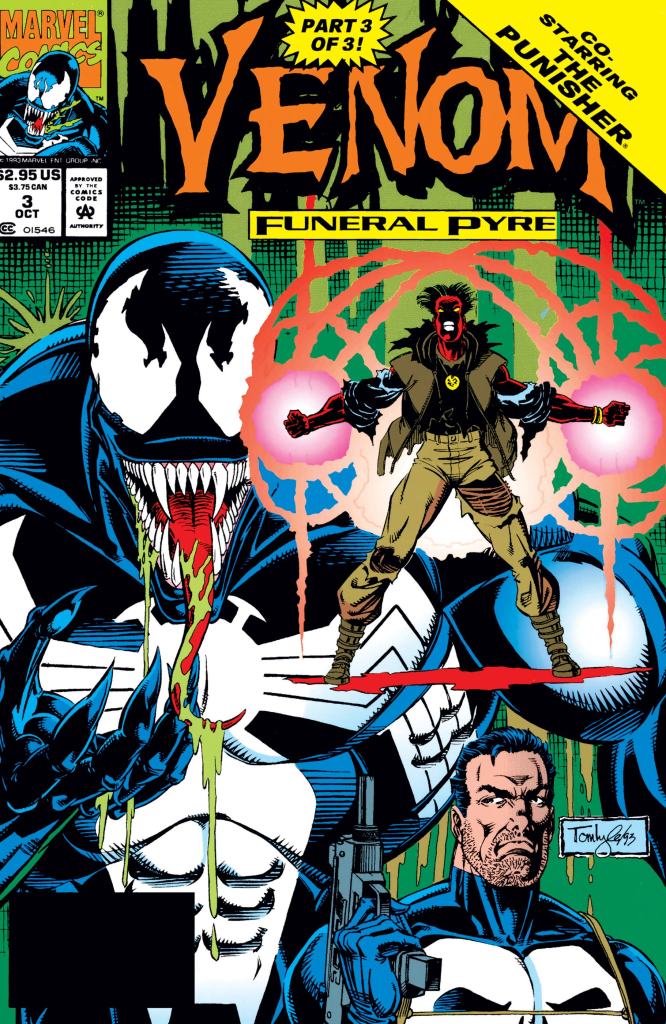
With those details laid down, here is a look back at Venom: Funeral Pyre , published in 1993 by Marvel Comics with a story written by Carl Potts and drawn by the late Tom Lyle. This if the final issue of the mini-series.

The cover.

Early story

The story begins inside a building with high-tech equipment from HYDRA. Gray Russel is no longer himself but as the red-skinned, highly radiated figure Pyre. He fires a microwave blast at Venom which hurts him so much. In response to Venom’s claim that he came to rescue him, Pyre reacts with rage telling the murderous man with the symbiote that he arrived too late which resulted in the forced killing of people during the gang violence on the streets of Oakland.

Being filled with pure rage, Pyre intends to burn Venom alive. Thinking that Pyre is distracted, the Punisher leaps to get a gun on the floor which causes the radiated person to fire a microwave blast at him. The Punisher takes cover behind a machine but notices the microwaves sparking off the metal.

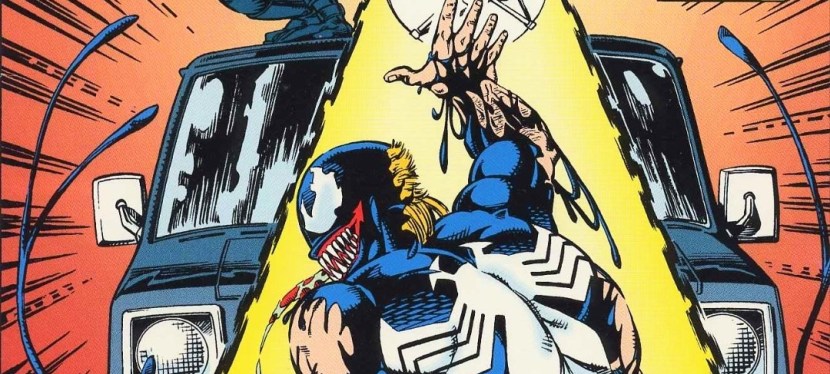
Venom then takes advantage of situation…

Quality

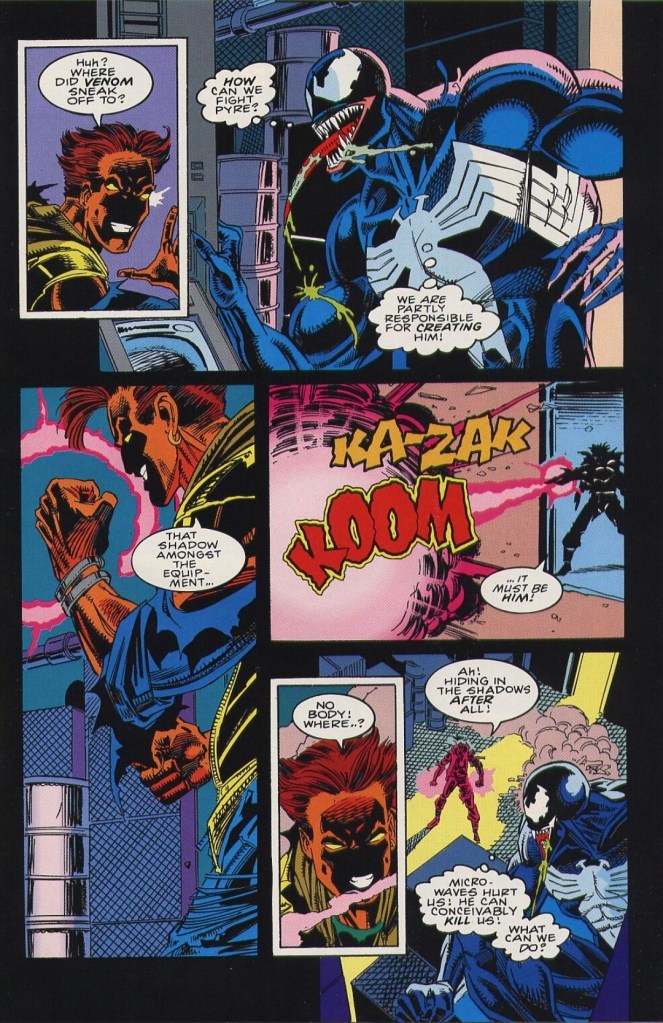
This page shows Venom at a disadvantageous state with Pyre whose microwave blasts are more than enough to kill him.

As the conclusion of the mini-series, this comic book went all-out portraying what turned out to be the final conflict involving the murderous Venom, the vigilante Punisher and the energy-filled Pyre. As a result, the narrative strongly focused on the final conflict (note: stretched out to last several pages) and never bothered to look back at the people and activities on the city street.

That being said, you will get to see more of the two established Marvel figures struggling hard against an unexpected force of opposition who was previously an undercover news reporter who infiltrated a certain gang and sent a message (delivered by a young boy) that caught Eddie Brock’s attention. At this point, it is clear that Venom’s effort to rescue Gray (who became Pyre after using a super soldier chamber left behind by HYDRA) ended in total failure and finds himself facing someone who could kill him and his alien costume together.  

If there is anything notable about this issue, it is the portrayal of Venom being highly disadvantaged and even vulnerable. There are no armed men with sonic weapons and high-tech equipment to bring Venom down but Pyre whose microwave blasts are deadlier than flame and sonic. In connection to the situation, Venom is not his aggressive self but a struggling figure who strives to survive and somehow find solutions during the heat of danger.

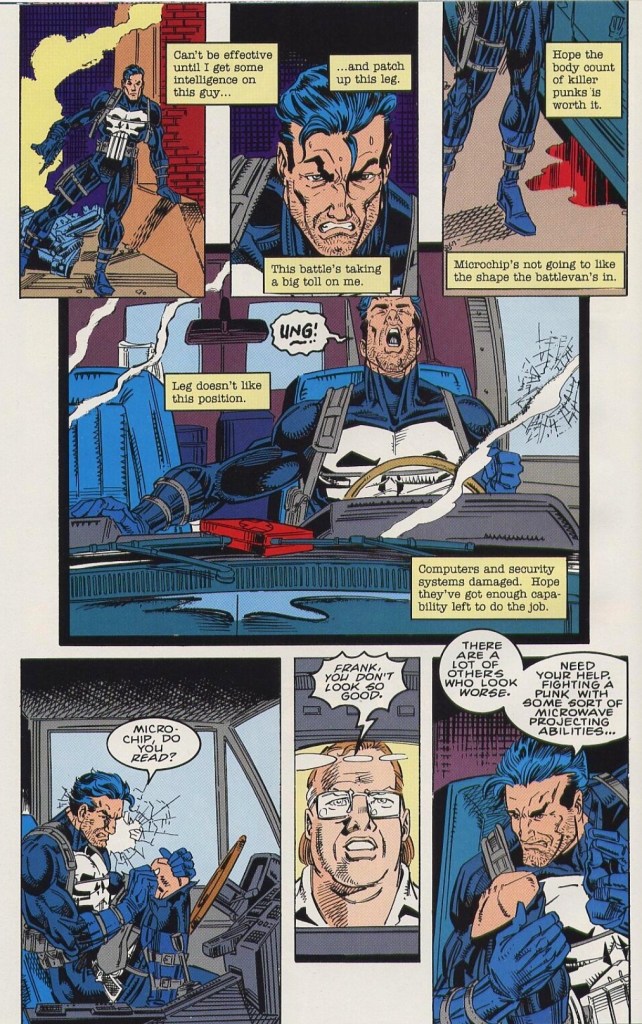
The Punisher, meanwhile, also struggled to survive but would simply not run away even though his chances of escape are much better. Instead, he focuses on actually eliminating Pyre without hesitation and Venom’s attempt to rescue Gray meant absolutely nothing to him.

More on Pyre, he is not really interesting nor was he ever engaging as the one powerful force of opposition that Venom and the Punisher must face. His being consumed by unrestrained rage and wielding so much power did not really raise the tension of the story. Had he eliminated the two Marvel figures who got in his way, what would Pyre do afterwards? Devastate the entire city of Oakland because he lost his identity as Gray and could not get over his involvement of taking other people’s lives while in the middle of gang activities? Would he proceed to San Francisco’s underground community and eliminate the people only because he blames Venom (note: Eddie Brock got involved with the underground people of San Francisco as seen in the Lethal Protector mini-series) for his failure of rescuing him? Pyre is nothing more than a throwaway comic book force of opposition.

From a visual standpoint, Tom Lyle once again pushed his creativity hard and showed some dynamic shots of spectacle here and there. At this stage, he proved to be very capable of visualizing Venom and the Punisher.

Conclusion

The Punisher refuses to give up and gets Microchip to assist him.

While issue was a notable improvement over the first issue, Venom: Funeral Pyre (1993) does not have much to offer in terms of engagement and entertainment. This is because it was crafted as a strict Venom-Punisher-Pyre conflict that provided spectacle and intrigue but ultimately ended up hollow. To see Venom at a huge disadvantage is interesting but did not add much weight to the plot. The Punisher was his usual self and in some ways overshadowed Venom for a while. Too bad there was not much space left for Venom and Punisher to fight each other again.

As the final issue of this mini-series, the story concluded with a whimper. Ultimately the Funeral Pyre storyline ended up as a diversion within the Marvel Comics shared universe that happened to attract Punisher, Venom and the gangsters of Oakland.  

Overall, Venom: Funeral Pyre (1993) is satisfactory.

+++++

Thank you for reading. If you find this article engaging, please click the like button below, share this article to others and also please consider making a donation to support my publishing. If you are looking for a copywriter to create content for your special project or business, check out my services and my portfolio. Feel free to contact me with a private message. Also please feel free to visit my Facebook page Author Carlo Carrasco and follow me on Twitter at  @HavenorFantasy as well as on Tumblr at https://carlocarrasco.tumblr.com/ and on Instagram at https://www.instagram.com/authorcarlocarrasco

A Look Back at Venom: Funeral Pyre #2 (1993)

Disclaimer: This is my original work with details sourced from reading the comic book and doing personal research. Anyone who wants to use this article, in part or in whole, needs to secure first my permission and agree to cite me as the source and author. Let it be known that any unauthorized use of this article will constrain the author to pursue the remedies under R.A. No. 8293, the Revised Penal Code, and/or all applicable legal actions under the laws of the Philippines.

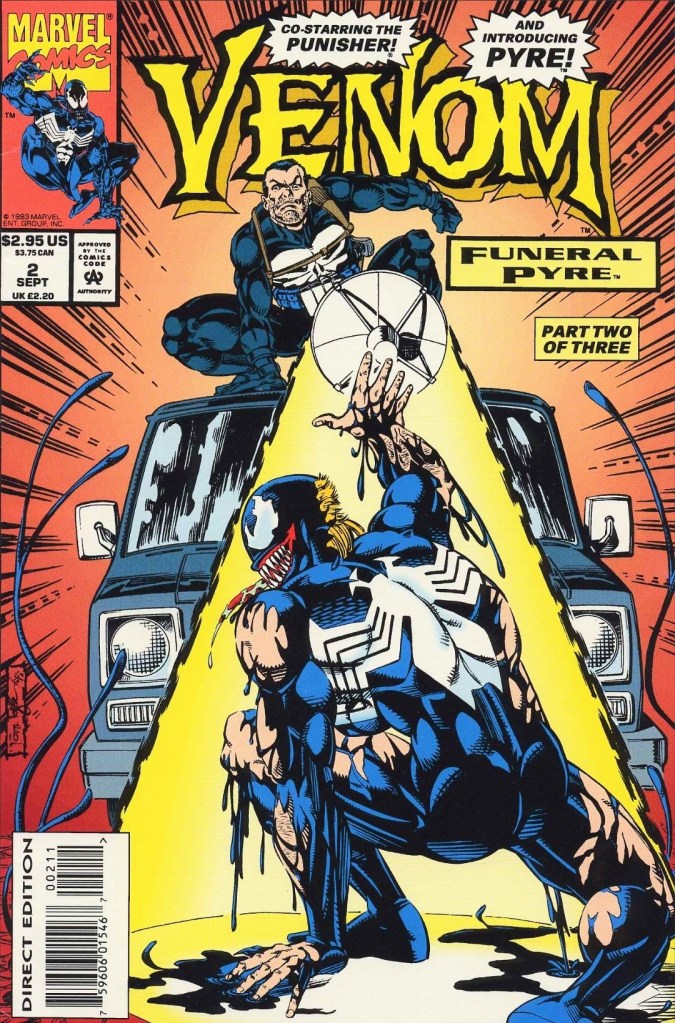
Welcome back superhero enthusiasts, 1990s culture enthusiasts and comic book collectors! Today we go back to the year 1993 to take a close look at the second issue of the second Venom comic book mini-series Venom: Funeral Pyre.

In my previous review, the Punisher and Venom encountered each other for the first time ever and along the way Gray – who is secretly a journalist with a mission – struggles to maintain his composure and his sanity as he finds himself in the middle of a very violent gang war in Oakland, California. The more time Gray spends time with the crime gang he joined, the tougher the situation becomes for him.

With those details laid down, here is a look back at Venom: Funeral Pyre , published in 1993 by Marvel Comics with a story written by Carl Potts and drawn by the late Tom Lyle.  

The cover.

Early story

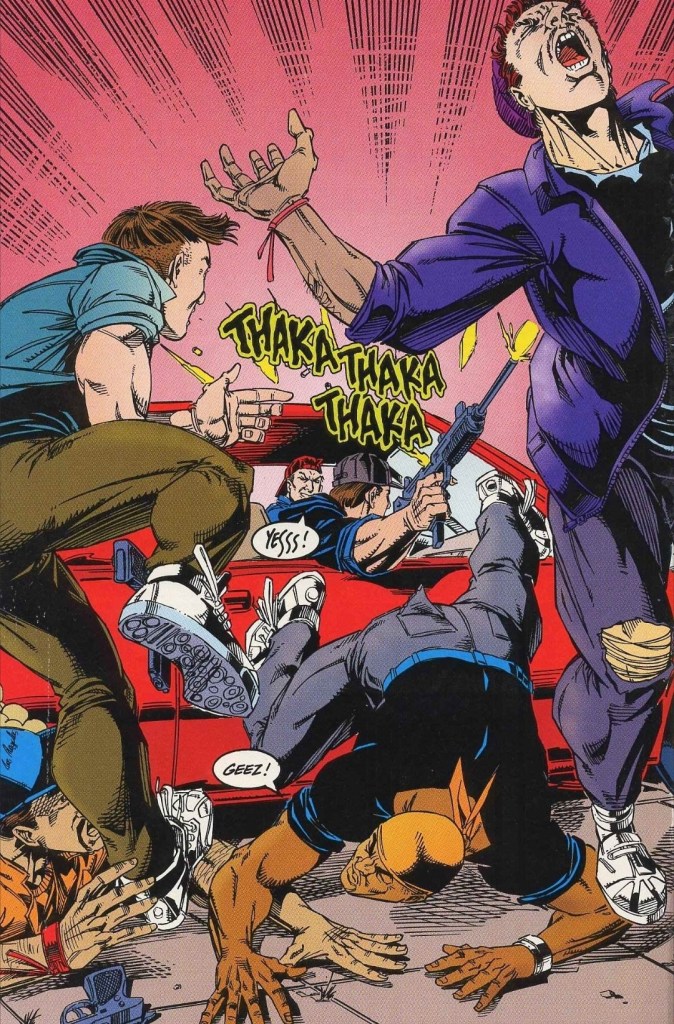
The story begins with Gray and his gang companions riding a car approaching a group of people on the street. The gang leader pressures Gray to use his weapon to kill them. Gray is deeply worried not only because he has to prove his worth to the gang by killing other, but also because the rescue attempt he was waiting for had not yet happened.

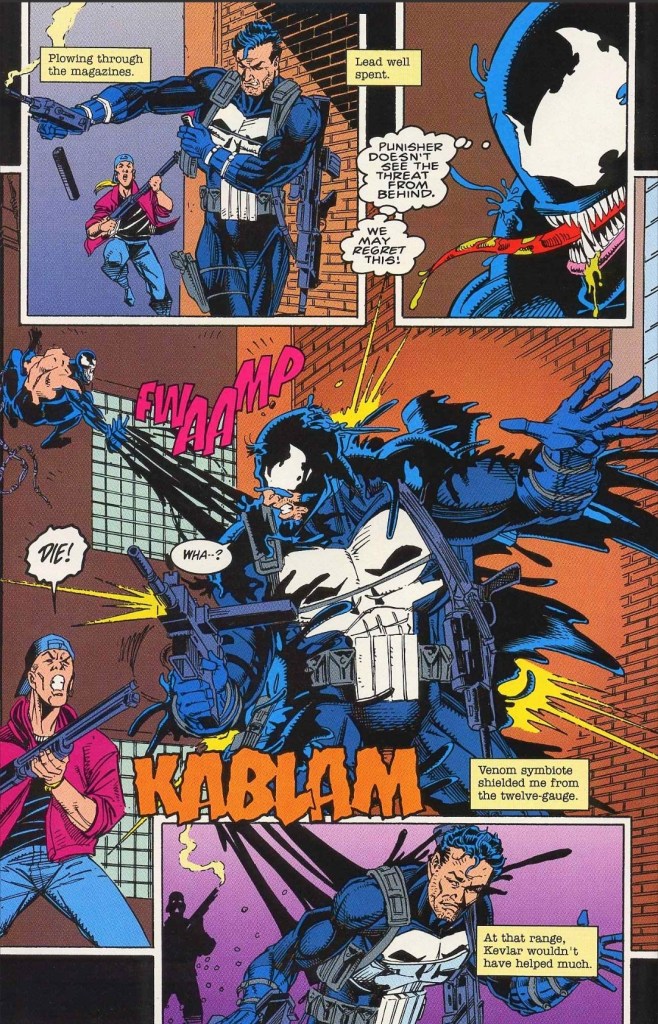
Meanwhile, Venom finds himself trapped on the doorway of a building with the metal gate locked and with rays of microwave from the Punisher’s van radiating him painfully. As the Punisher leaves them behind, Venom manages to use the symbiote to reach into the van and smash the control panel inside which disabled the microwave rays.

Immediately, he recovers and breaks out to continue his mission: to rescue Gray…

Quality

The murderous Venom actually helped the Punisher.

When it comes to the storytelling, there are some improvements that made this comic book more readable than issue . For one thing, the exposition has been reduced which allowed the pace of the story to move faster. Most of the exposition here has been limited to Gray who at this stage of the mini-series was clearly bound to become the central object of the Funeral Pyre concept. Another thing is that the story’s structure here is simpler and easier to follow as Venom and Punisher moved on their own struggles separately before predictably getting together again.

While the mini-series has clearly been a tale of a city gang war – with a pretentious and unwilling gang member who expected to be rescued before things become too chaotic – that happened to pull the Punisher and Venom in for different reasons, Carl Potts added some elements that would resonate with Marvel Comics fans who are familiar with HYDRA and the Super Soldier aspects of the Marvel Comics universe history. Not only that, there is a science fiction-inspired setting near the end of the story that added variety to the in-story environment.

Like the first issue, this one is packed with a good amount of action scenes and that means Punisher and Venom fans have a lot of stuff to enjoy. Tom Lyle really is good with showcasing the respective spectacle of the vigilante and the symbiote-wearing murderer, and when he has the two together, his visual creativity intensifies.

Conclusion

Grey shooting blindly at the targets while riding the car of the gangsters he joined.

Venom: Funeral Pyre (1993) is clearly an improved reading experience over issue mainly because of the reduced information dump, the simpler plot structure and the creative showcase of Venom and the Punisher. While Gray remains uninteresting, his late-stage transformation turned out to be somewhat surprising and it was only near the end of this comic book that the Funeral Pyre concept became clear.

Overall, Venom: Funeral Pyre (1993) is satisfactory.

+++++

Thank you for reading. If you find this article engaging, please click the like button below, share this article to others and also please consider making a donation to support my publishing. If you are looking for a copywriter to create content for your special project or business, check out my services and my portfolio. Feel free to contact me with a private message. Also please feel free to visit my Facebook page Author Carlo Carrasco and follow me on Twitter at  @HavenorFantasy as well as on Tumblr at https://carlocarrasco.tumblr.com/ and on Instagram at https://www.instagram.com/authorcarlocarrasco

A Look Back at Web of Spider-Man #90 (1992)

Disclaimer: This is my original work with details sourced from reading the comic book and doing personal research. Anyone who wants to use this article, in part or in whole, needs to secure first my permission and agree to cite me as the source and author. Let it be known that any unauthorized use of this article will constrain the author to pursue the remedies under R.A. No. 8293, the Revised Penal Code, and/or all applicable legal actions under the laws of the Philippines.

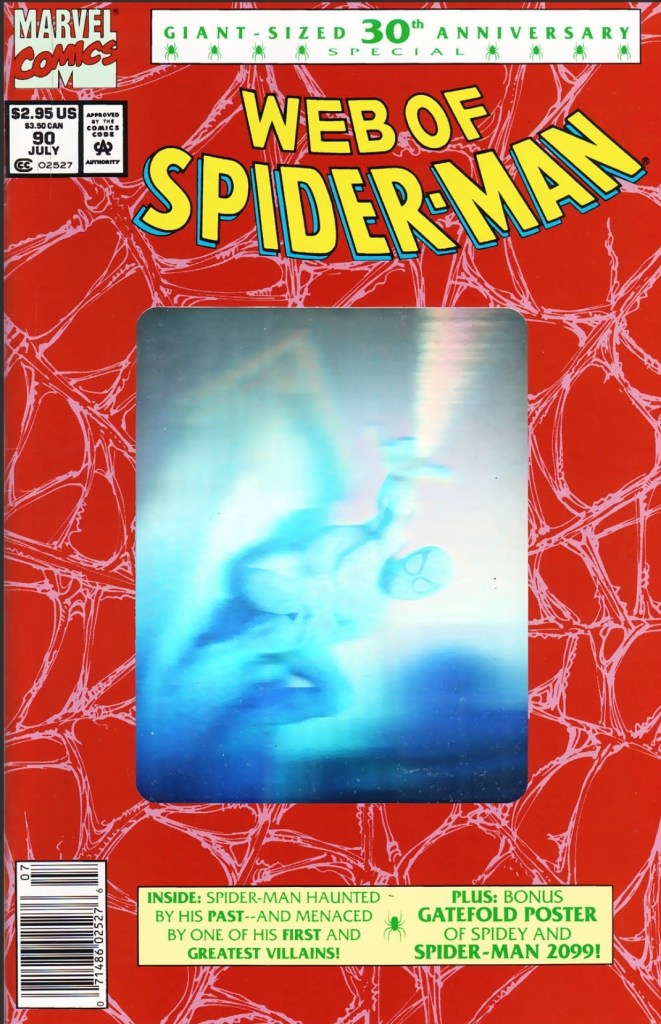
Welcome back superhero enthusiasts, 1990s culture enthusiasts and comic book collectors! Today we go back to the year 1992 and explore a part of what was back then the 30th anniversary celebration of Spider-Man

In what was back then a unique approaching to celebrating the anniversary of an American icon, Marvel Comics published not one but four specific Spider-Man comic books that had holographic covers and more pages than the usual. Each of those special comic books were from a different Spider-Man monthly series. Back in 2020, I published a retro review of one of those gimmick cover comic books from the Spider-Man monthly series.

With those details laid down, here is a look back at Web of Spider-Man #90, published in 1992 by Marvel Comics with a story by Howard Mackie and drawn by Alex Saviuk.  

The cover.

Early story

The story begins inside an office in Los Angeles. A hat-wearing businessman has several varied figures of Spider-Man near him and recalls the time when the iconic hero participated in one of his events as the Masked Marvel. Moments later, the businessman’s wife arrives and together they departed in a limousine.

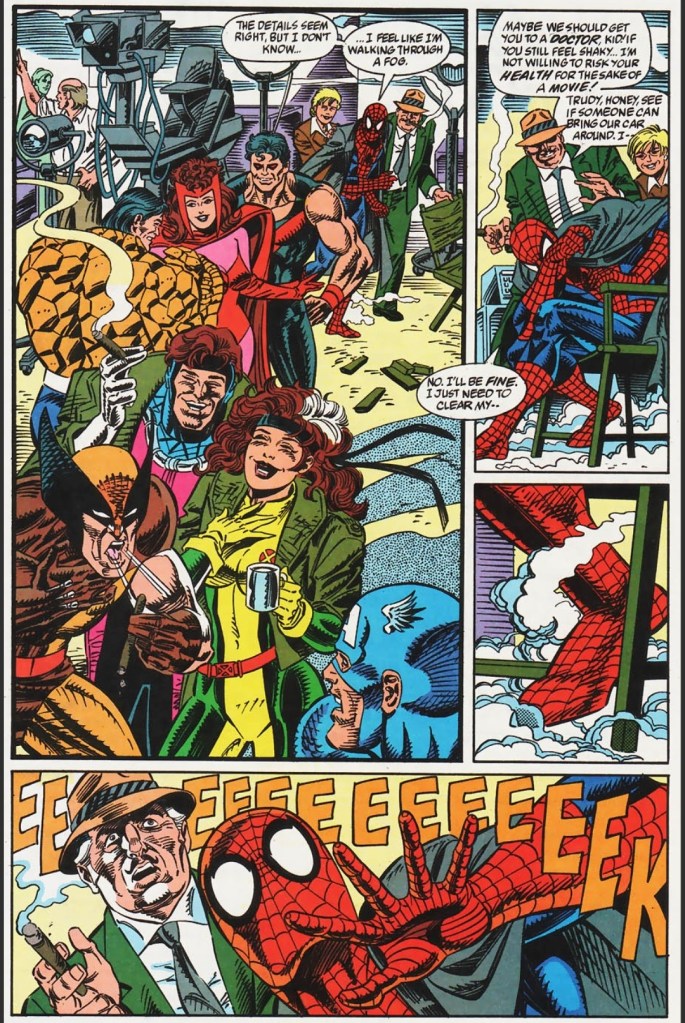
At the South Bronx in New York, Spider-Man chases a speeding car with one of its passengers firing a gun at him. Suddenly, his spider sense bothers him a lot and when he looks around, he suddenly sees Galactus standing with members of the Avengers, the X-Men and the Fantastic Four lying down helpless on the ground…

Quality

Spider-Man on the set of an entertainment project. It’s a lively reminder about how sickening Hollywood (AKA Commiewood) can get.

To make things clear and without spoiling the plot, this story deals with illusions and the distortion of reality. Quite ironically, the said distortion made it a challenge to follow the narrative and I can say that a good amount of the spotlight was on the businessman. Spider-Man is clearly the protagonist here but it made sense for the creative team to focus a bit on the businessman (who has been doing entertainment showcases for a long time) to justify the core concept about the conflicts between what is real and what is imaginary.

In relation to the illusion aspect of the story, you will get to see established Spider-Man arch-villains such as the Green Goblin, the Hobgoblin and Venom taking on the superhero himself. As the creative team focused more on providing a great amount of spectacle, there clearly was no room left for character development on Spider-Man. Don’t expect to see Peter Parker in dramatic moments nor see him interact with the established supporting characters.

If there is any moral lesson to learn from this comic book, it would be this – living with a powerful delusion (the result of personal obsession mixed with the personal failure to separate illusion from reality) can lead you to the wrong directions in life.

Conclusion

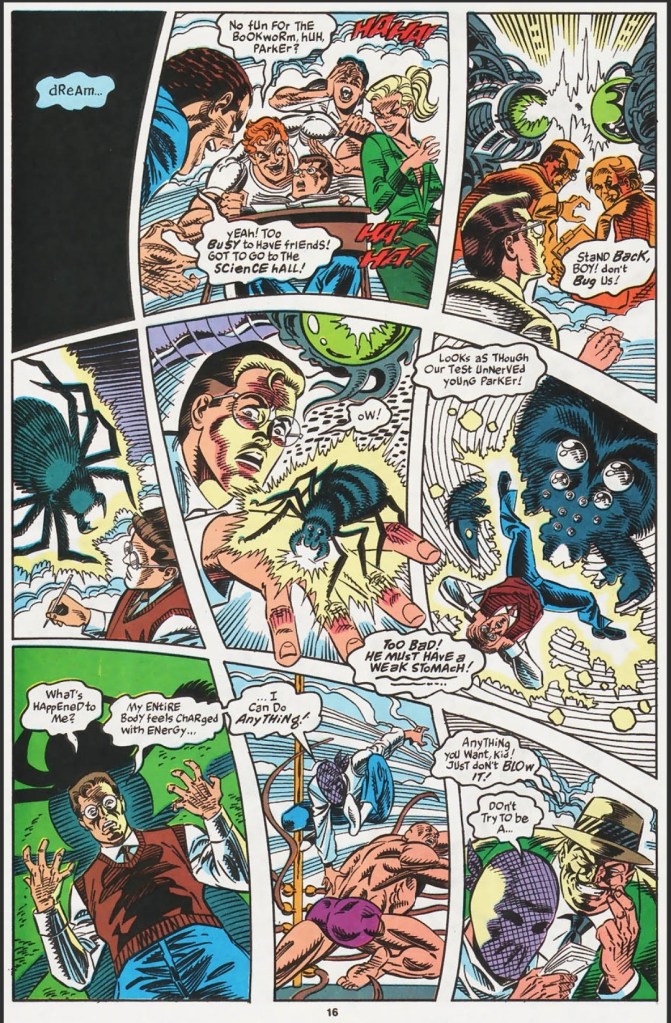
To justify the 30th anniversary celebration, distorted flashbacks into Peter Parker’s past were presented here.

Web of Spider-Man #90 (1992) does not have much depth for those who seek engaging storytelling. That being said, the story itself is not memorable nor would it leave a long lasting impact on you. This comic book was made to entertain readers with lots of action and wild fantasy images that eerily justify its concept about illusion and reality conflicting each other. In fairness to the creative team, the said conflict was consistently visualized and there were some dialogue that related to it in a somewhat philosophical manner. The comic book’s entertainment value is satisfying enough although it does not justify the holographic cover that was part of the gimmick with celebrating Spider-Man’s 30th anniversary. As for who was the main antagonist of the comic book, I simply encourage you all to read and find out for yourselves.

Overall, Web of Spider-Man #90 (1992) is satisfactory.

+++++

Thank you for reading. If you find this article engaging, please click the like button below, share this article to others and also please consider making a donation to support my publishing. If you are looking for a copywriter to create content for your special project or business, check out my services and my portfolio. Feel free to contact me with a private message. Also please feel free to visit my Facebook page Author Carlo Carrasco and follow me on Twitter at  @HavenorFantasy as well as on Tumblr at https://carlocarrasco.tumblr.com/ and on Instagram at https://www.instagram.com/authorcarlocarrasco

A Look Back at Armorines #4 (1994)

Disclaimer: This is my original work with details sourced from reading the comic book and doing personal research. Anyone who wants to use this article, in part or in whole, needs to secure first my permission and agree to cite me as the source and author. Let it be known that any unauthorized use of this article will constrain the author to pursue the remedies under R.A. No. 8293, the Revised Penal Code, and/or all applicable legal actions under the laws of the Philippines.

Welcome back superhero enthusiasts, 1990s culture enthusiasts and comic book collectors! Today we go back to the early 1990s and explore a part of the Valiant Comics shared universe through the Armorines monthly series.

In my previous retro review, the armored Marines and their US Navy SEALs managed to survive from the destruction of the submarine deep under the sea as they managed to complete their goal. One of the Armorines – Sirot – got separated from them and found himself in the presence of aliens who have been organizing secret operations on Earth, including the recent destruction of X-O Manowar’s armor. Knowing that their teammate is missing, the Armorines went back to the water on a search-and-rescue mission.

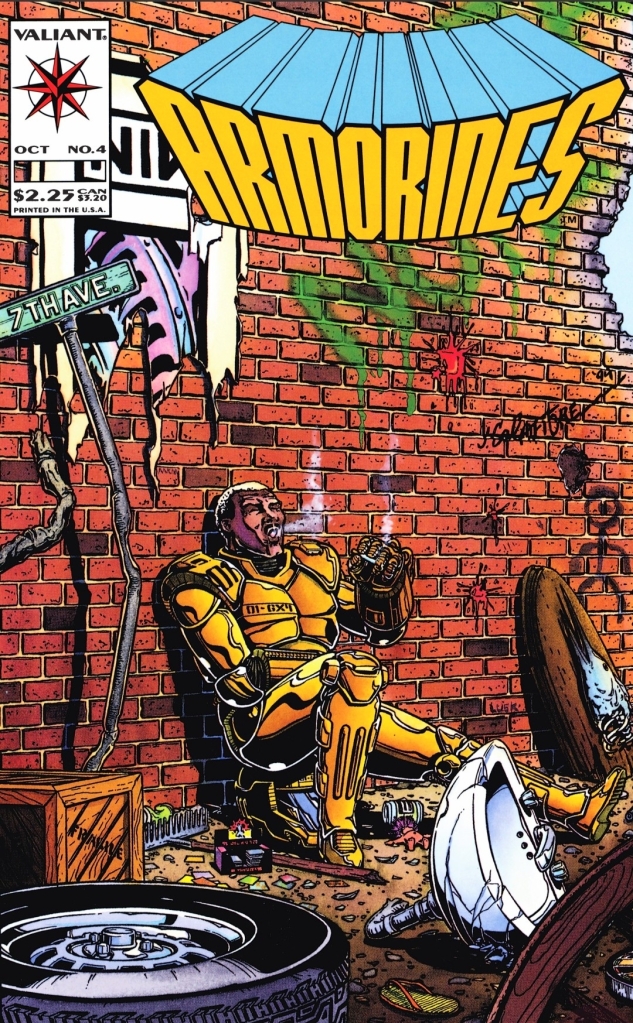
With those details laid down, here is a look back at Armorines , published in 1994 by Valiant Comics with a story written by Jorge Gonzalez and drawn by Jim Calafiore.

The cover.

Early story

The story begins inside one of the training domes located just outside Camp Pendleton in California (note: now a Commie-filled state). Teammates Gunny and Sirot engage in a close combat training session using the specialized technology provided to them by Dr. Zhan who carefully watches the statistics. As the session goes on, Sirot sarcastically tells the older Gunny that Senator Ackerman wants him off the Armorines as soon as their superior General Kendall feels the other recruits are properly trained. Sirot mocks him over his age (38-years-old).

Behind closed doors, Senator Ackerman tells General Kendall that even though the Armorines were successful with the mission in Australia and even managed to uncover a nest of aliens, the team were all more than capable without Gunny in their unit. Kendall defends Gunny and stressed that the man is their team’s most experienced member. Ackerman states that once the alien problem is over, he will force Gunny to retire…

Quality

Scenes like this will help readers get to know the Armorines members better.

To be clear, this story is more focused on the characters and is also a suitable build-up for the next turn of events ahead of the Armorines. As with issue , Gunny is the closest thing this series has to a lead character and he gets a good amount of character development scenes even though the story showed the other characters. Quite conveniently, the creative team used the military base setting to shift focus on the other Armorine team members similar to what was shown in Hollywood movies or TV shows about military personnel. There is the military club setting where the officers are relaxing and socializing with each other. There were also scenes showing specific soldiers at their respective residences where their true personalities (note: private life moments) are emphasized. All of these were done with solid writing and good artwork.

Without spoiling the details, I can say that the final page of this comic book was surprising and added to my anticipation of the next issue.

Conclusion

Alien vessels leaving Earth for space.

Armorines (1994) is another solid entry in this particular monthly series which served as a good build-up for the next story that happens to be part of a big event that Valiant Comics published (read: The Chaos Effect). It is also within this comic book that you get to know the Armorines, their superiors and other characters better.  

Overall, Armorines (1994) is recommended.

+++++

Thank you for reading. If you find this article engaging, please click the like button below, share this article to others and also please consider making a donation to support my publishing. If you are looking for a copywriter to create content for your special project or business, check out my services and my portfolio. Feel free to contact me with a private message. Also please feel free to visit my Facebook page Author Carlo Carrasco and follow me on Twitter at  @HavenorFantasy as well as on Tumblr at https://carlocarrasco.tumblr.com/ and on Instagram at https://www.instagram.com/authorcarlocarrasco

A Look Back at Hulk 2099 #1 (1994)

Disclaimer: This is my original work with details sourced from reading the comic book and doing personal research. Anyone who wants to use this article, in part or in whole, needs to secure first my permission and agree to cite me as the source and author. Let it be known that any unauthorized use of this article will constrain the author to pursue the remedies under R.A. No. 8293, the Revised Penal Code, and/or all applicable legal actions under the laws of the Philippines.

Welcome back superhero enthusiasts, 1990s arts and culture enthusiasts, Marvel Comics fans and comic book collectors! Today we go back to the wild 1990s by examining one of the many tales of Marvel Comics’ 2099 line of franchises, specifically through the Hulk 2099 monthly series.

For the newcomers reading this, Hulk 2099 first appeared in 2099 Unlimited #1 (1993) which also had his origin story told. Hulk 2099 was not a mere version of the classic Incredible Hulk with a futuristic touch. In fact, the futuristic green creature highlighted the protagonist John Eisenhart as a very selfish and obsessed Hollywood studio executive who happens to stumble upon the idolaters/worshipers of the classic Hulk Bruce Banner because he was searching for new properties and stories for his studio. Hulk 2099’s origin has notable similarities to that of the classic Hulk and gamma radiation exposure is one of them. As tales of the futuristic Hulk were told through the quarterly releases of 2099 Unlimited, Marvel decided it was time to give the green creature his own monthly series.

With those details laid down, here is a look back at Hulk 2099 published in 1994 by Marvel Comics with a story written by Gerard Jones and drawn by Malcolm Davis.

The cover.

Early story

The story begins with the Hulk of 2099 destroying security droids and verbally attacking civilization. As he retains the intellect of John Eisenhart, he expresses his opposition against civilization for keeping people out of the water reclamation zone.

The story then shifts to California where Lotus Entertainment (Eisenhart’s employer) and its crew work on producing a film which is a dishonest telling of Eisenhart’s dealings with the Knights of Banner (already eliminated in 2099 Unlimited ). During the production, one of the executives notices the absence of Eisenhart.

Elsewhere, John Eisenhart drives his flying car with Knights of Banner youth survivor Gawain as his passenger. Already struggling with the guilt over the deaths of all the adult Knights of Banner members, Eisenhart intends to end his employment and cash out of his contract. Gawain remains hostile towards Eisenhart.

Quality

The creative team used flashback images that look really similar to what was told in 2099 Unlimited .

If there is anything that is very obvious to talk about, it is the fact that this tale shows a radically different John Eisenhart who wants to get out of Hollywood’s multiple mazes of crookedness as he feels very guilty over what happened to the Knights of Banner. This happens just as a new entity took corporate control of Eisenhart’s employer before he could leave the company. In many ways, Eisenhart’s distress and struggle with being guilty reminds me a lot about Hardcase of the Ultraverse and the way the creative dramatized him was engaging.

For the story, there is a lot of corporate intrigue going on and Eisenhart’s failure to quit quickly was inevitable because the new enemy he faces here has a lot to do with the sudden takeover of Lotus Entertainment. At least on face value, this looks like an attempt by the creative team to change the status quo and move Hulk 2099 to a new creative direction away from what was established in 2099 Unlimited. Without spoiling the details, I can say that something very significant happened before the comic book’s ending and it will impact readers who followed the futuristic Hulk’s stories closely in the 2099 Unlimited series.

Along the way, there is a lot of action and unfortunate physical happenings which symbolize the chaos concept of the script. The notable thing here is that you won’t see very much of Hulk 2099’s monstrous form as the script was specifically written to tell a tale that went beyond one issue. Clearly, the creative team were sparing Hulk 2099 for a conflict in the next issue.

Malcolm Davis’ art has that visceral aesthetic that fits the established look of Marvel’s 2099 universe of the time but there were instances when he showed so much happening, the visuals looked chaotic and even disorienting. In fairness, his take on Eisenhart, Quirk, Gawain and others made them looked recognizable.

Conclusion

The future of Commiewood, wokeness, and dishonesty.

While its story has little of the green monster in it, Hulk 2099 (1994) does a decent job building up the tension on top of the guilt-filled Eisenhart while setting up events that looked like a bold new creative direction was coming. By the time this comic book was published, several Hulk 2099 tales were already published in the quarterly 2099 series. On its own, this comic book lightly builds up the lore of the 2099 universe as it was clearly focused on Hulk 2099’s creative concept and characters.

While Eisenhart was indeed determined to change, it is a turnoff to see him lie and exaggerate details to protect himself from a certain corporate psychologist who is after the truth. There is also a lot of anti-corporate expressions here which seems to suggest that someone within the creative team had been thinking with socialist concepts and decided to use the script as an outlet of expression. The weird but true thing is that by today’s standards, Hollywood is filled with Commies/socialists/Marxists/liberals/woke nuts from the film crew up to the executives that run studios and produce films or shows that are dumb, lies about reality, self-centered and extensions of their ideologies. This showed that this comic book was prophetic in some ways.

Overall, Hulk 2099 (1994) is satisfactory.

+++++

Thank you for reading. If you find this article engaging, please click the like button below, share this article to others and also please consider making a donation to support my publishing. If you are looking for a copywriter to create content for your special project or business, check out my services and my portfolio. Feel free to contact me with a private message. Also please feel free to visit my Facebook page Author Carlo Carrasco and follow me on Twitter at  @HavenorFantasy as well as on Tumblr at https://carlocarrasco.tumblr.com/ and on Instagram at https://www.instagram.com/authorcarlocarrasco

A Look Back at Venom: Funeral Pyre #1 (1993)

Disclaimer: This is my original work with details sourced from reading the comic book and doing personal research. Anyone who wants to use this article, in part or in whole, needs to secure first my permission and agree to cite me as the source and author. Let it be known that any unauthorized use of this article will constrain the author to pursue the remedies under R.A. No. 8293, the Revised Penal Code, and/or all applicable legal actions under the laws of the Philippines.

Welcome back superhero enthusiasts, 1990s arts and culture enthusiasts, Marvel Comics fans and comic book collectors! Today we go back to the year 1993 and explore a part of Marvel Comics’ universe through the first-ever limited comic book series featuring one of Marvel’s most iconic supervillains – Venom.

Previously, I wrote about Venom with his appearances in What If comic books (click here and here) as well as in issues of Venom: Lethal Protector (click here and here). Venom also appeared in the disappointing crossover comic book Spider-Man Meets Spider-Man 2099.

Moving back to the year 1993, the Venom: Lethal Protector limited series ended and Marvel went on to release a 2nd limited series composed of three issues complete with an all-new creative team. That series was Venom: Funeral Pyre and the most notable thing is that Venom gets to be with the Punisher (read my other retro reviews that include the character here, here, here and here).

With those details laid down, here is a look back at Venom: Funeral Pyre published in 1993 by Marvel Comics with a story written by Carl Potts and drawn by the late Tom Lyle.

The cover.

Early story

The story begins on the streets of Oakland, California. There, a young guy named Gray Russell watches gang members severely beat up another guy which disturbs him deeply. He is part of the gang. A short time later, he rides with the gang in a car which hits a man (who managed to have his young nephew move out of harm’s way).

Somehow the man survived and moves to another direction deliberately to lure the gang away from his nephew. As the gangsters move towards a local building, Gray separates from his harsh companions to find a phone booth. Gray finds Calvin (the nephew of the man who got hit) nearby and decides to comfort him. From a distance, they heard the gangsters beat Calvin’s uncle to death.

The next day in the underground city beneath San Francisco, Calvin meets Eddie Brock and hands him a note meant for the police. As Calvin reveals more details, Eddie gradually turns into Venom with his alien costume covering up his body. After learning of the death of Calvin’s uncle and hearing the young boy’s plea for help for Gray (an investigative reporter in secret within the gang), Venom agrees to help him as it is their mission to save the innocent and destroy the guilty…

Quality

Punisher and Venom’s first-ever encounter with each other.

I want to start first the with the overall presentation crafted by the Potts-Lyle creative duo. In terms of story and setting, this comic book has a very strong urban crime vibe which is not a surprise given the fact that Carl Potts wrote lots of stories of the Punisher and his personal war against criminals. That being said, the tone is very different compared to what was shown in Venom: Lethal Protector and other Venom tales that got published before this comic book. Very clearly, this story is dark, gritty and even disturbing to read due to the subject matter of crime and senseless violence caused by people who are obsessed with violence. The fantasy elements of Venom: Lethal Protector are unsurprisingly absent here.

Carl Potts’ take on Venom’s personality is technically an extension of what was established previously. Venom, who is truly a murderer on the loose, continues to live with his very distorted code by helping the innocent by means of using violence and death on others he personally views as guilty. His getting involved in the turf of crime here is, however, a fresh approach on the super villain now acting “heroic” helping Calvin who lost his uncle. Being a former journalist himself, Eddie Brock “relates” with the investigative journalist involved with the gang.

The other major character – the Punisher – is his typical self in this story. He gets involved in the conflict in Oakland not purposely but accidentally as he was just passing by in his weapons-filled van as he heard the local police communication on local crime. The only thing notable about the way the Punisher is portrayed here is his first-ever interactions with Venom which is a crossover scene filled with a decent amount of hard action.  

Gray, the investigative journalist, is presented here as technically the third major character of the story. In some ways, he even overshadows Venom and the Punisher in key parts of this comic book. He is not really an interesting character himself but there are some interesting Marvel universe details shown from his personal memories. What is clear about this uninteresting character is that the creative team planned something with him in a key role within the core concept of this mini-series.

As for the plot itself, it clearly has a dark and gritty concept of street crime in 1990s Oakland which itself plays a big part of the build-up of the story and the eventual crossover between Venom and the Punisher. The problem is that the build-up has an uninteresting character with Gray involved and there is a lot of exposition to go through before the Venom-Punisher encounter.

The encounter between Venom and the Punisher here came with the superhero comics crossover trope of the players misunderstanding the situation and each other, and getting into a conflict very early on. Both characters have their respective obsessions and so-called codes of purposes, which predictably leads them into conflict as they stayed hard-headed towards each other. While it is flawed, the Venom-Punisher crossover here is the highlight as well as the relief from having to read all the exposition and build-up.

Conclusion

A scene like this could inspire Black Lives Matter terrorists, SJWs, woke activists and North American socialists to become violent and cause havoc around America.

Venom: Funeral Pyre (1993) is a flawed comic book that happens to highlight the Punisher and Spider-Man’s greatest nemesis of the time. It delivered on its promise of showcasing the two characters – a cold-hearted anti-crime vigilante and an alien costume-equipped murderer – in a crossover but the pay-off was barely enough when you take into account the build-up, the exposition and the involvement of the uninteresting third player named Gray. Compared to what was shown in Venom: Lethal Protector, this comic book clearly has an urban crime flavor which Carl Potts strongly implemented. As for the art, Tom Lyle showed he is really good in visualizing Venom, the Punisher and street gang wars.

Overall, Venom: Funeral Pyre (1993) is serviceable. Definitely this is not the fabulous 1st issue described on the foil cover.

+++++

Thank you for reading. If you find this article engaging, please click the like button below, share this article to others and also please consider making a donation to support my publishing. If you are looking for a copywriter to create content for your special project or business, check out my services and my portfolio. Feel free to contact me with a private message. Also please feel free to visit my Facebook page Author Carlo Carrasco and follow me on Twitter at  @HavenorFantasy as well as on Tumblr at https://carlocarrasco.tumblr.com/ and on Instagram at https://www.instagram.com/authorcarlocarrasco
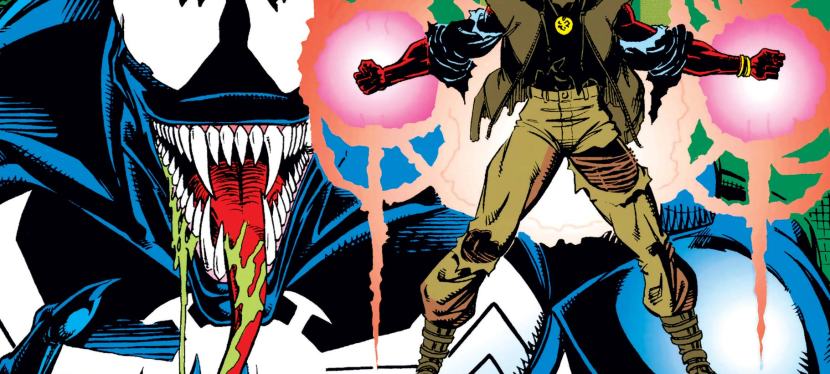
A Look Back at Venom: Lethal Protector #4 (1993)

Disclaimer: This is my original work with details sourced from reading the comic book and doing personal research. Anyone who wants to use this article, in part or in whole, needs to secure first my permission and agree to cite me as the source and author. Let it be known that any unauthorized use of this article will constrain the author to pursue the remedies under R.A. No. 8293, the Revised Penal Code, and/or all applicable legal actions under the laws of the Philippines.

Welcome back superhero enthusiasts, 1990s arts and culture enthusiasts, Marvel Comics fans and comic book collectors! Today we go back to the year 1993 and explore a part of Marvel Comics’ universe through the first-ever limited comic book series featuring one of Marvel’s most iconic supervillains – Venom.

In my previous retro review, the core concept of the Lethal Protector limited series started to really take shape as issue #3’s plot got more intriguing and interesting to read while emphasizing other powerful forces Venom himself simply could not easily overwhelm. It is also the issue in which Venom’s past act of a certain murder comes to haunt him. The problem I had with that comic book was the creative team’s dramatization of Eddie Brock’s personal history which essentially ruined whatever mystery Venom had. Eventually, the comic book ended with Venom getting into trouble again.

With those details laid down, here is a look back at Venom: Lethal Protector published in 1993 by Marvel Comics with a story written by David Michelinie and drawn by Ron Lim.  

The cover.

Early story

The story begins inside a high-tech facility in the Mojave Desert. Inside, Venom is in captivity floating off the floor with high-tech machines keeping him prisoner. He is a captive of the Life Foundation and they have successfully extracted another spawn from Venom’s symbiote which causes tremendous pain on the part of Eddie Brock. It turns out, a total of five “seeds” have been extracted and the organization has big plans with them.

Over at Sta. Cruz in California, Spider-Man spends some of his precious time to stop some local criminals from causing anymore danger to the people. During his telephone talk with Mary Jane, he admits that has not been able to track Venom down but he has a new lead about weird creatures that have been spotted locally. A short time later, Spider-Man arrives at a shopping mall where tremendous damage of property have happened. As soon as he catches a lady and prevents her from hitting the pavement, he is shocked to see a long-haired woman wearing a living alien costume with features that are so similar to that of Venom. The symbiote-wearing woman (Scream) tells Spider-Man directly that breaking him in half will make the “little exercise” a complete success…

Quality

Spider-Man takes on the “female Venom”

To start with what is very obvious and clear, this story has Spider-Man overshadowing Venom in terms of literary presence as the plot has the titular character limited to captivity under the tight grasp of the Life Foundation. Given Spider-Man’s previous appearances in this limited series serving as a convenient tool for exposition, you will easily feel the Amazing Spider-Man monthly series’ vibes taking over this comic book’s narrative as Marvel’s icon became the protagonist of the story complete with spectacle and problem solving that drive the plot forward. This is not surprising as David Michelinie was already the lead writer of the Amazing Spider-Man monthly series and it only makes sense to shift the focus on the famous webslinger since his deadliest enemy (who has this very distorted belief about protecting the innocent and keep on murdering people he finds antagonistic) could not contribute much to the story while in captivity.

As reflected in the nice cover of this comic book, it is also Spider-Man who faces off with the “female Venom” herself Scream which leads to yet another Spidey-versus-symbiote villain battle but with a catch – Scream is simply inexperienced in battle and does not have any real strategy to deal with New York’s webslinger. That battle noticeably does not last very long and the short amount of superhero spectacle here paved the way for the creative team to make Spider-Man sneak into enemy territory and closer to Venom.

In terms of visual quality, I can say that things went way down as Ron Lim replaced Mark Bagley here. Lim’s art style of drawing people has this generic aesthetic on the characters’ faces – Mary Jane and Eddie Brock are barely recognizable. While Lim’s artistic take on Venom is clearly a big letdown compared to Bagley’s Venom (note: always looking menacing and unique), he ironically did a decent job visualizing Scream. Lim’s most dynamic shots of superhero action lacked impact. Regardless, Lim’s art is not so appealing compared to Bagley’s. Also it is quite noticeable that Lim drew Venom to be much bulkier with exaggerated muscles.

Conclusion

The most notable concept in this comic book.

Considering all the details I mentioned above, Venom: Lethal Protector (1993) is technically an Amazing Spider-Man comic book that just so happens to have Venom much less significant in this particular part of his own limited series. There really was not much room for the creative team use as far as Venom is concerned. Of course, this is all part of a build-up heading into the final two parts of this limited series and it is obvious that Venom would become prominent again. This comic book’s most notable feature was its concept about the Life Foundation extracting seeds from Venom’s living costume but considering what happened, there was not much room to really build-up on the idea that more symbiote-wearing people will emerge. Scream was essentially a warm-up. Ultimately, Spider-Man fans will have a lot to enjoy here while Venom fans will not have much to enjoy.

Overall, Venom: Lethal Protector (1993) is serviceable.

+++++

Thank you for reading. If you find this article engaging, please click the like button below, share this article to others and also please consider making a donation to support my publishing. If you are looking for a copywriter to create content for your special project or business, check out my services and my portfolio. Feel free to contact me with a private message. Also please feel free to visit my Facebook page Author Carlo Carrasco and follow me on Twitter at  @HavenorFantasy as well as on Tumblr at https://carlocarrasco.tumblr.com/ and on Instagram at https://www.instagram.com/authorcarlocarrasco