Welcome back my readers, YouTube viewers and all others who followed this series of articles focused on YouTube videos worth watching. Have you been searching for something fun or interesting to watch on YouTube? Do you feel bored right now and you crave for something to see on the world’s most popular online video destination?
I recommend you check out the following videos I found.
#1 Retrospective look back at The Lost World: Jurassic Park – What can be said about 1997’s The Lost World: Jurassic Park? In my view, the Steven Spielberg-directed sequel to Jurassic Park symbolically emphasized how extreme Ian Malcom and Sarah Harding (symbolically the unhinged animal rights activists) would go to protect the dinosaurs (the animals) by causing chaos against their fellow humans while believing in the falsehood they are doing the right thing. As it was one of the biggest box office hits of 1997, it is not surprising to see The Lost World: Jurassic Park become the subject of many reaction videos and retro reviews online. Watch the videos I selected for you below.
#2 PatmanQC examines Moon Patrol – Were you able to play any version of Moon Patrol before? While I never got to play its original arcade version (developed by Irem of Japan), I managed to play its Atari 2600 version. Moon Patrol was a huge arcade hit in America in the early 1980s and it is remembered for introducing full parallax scrolling that made its visuals stand out. To find out how Moon Patrol was conceptualized and how it was developed, watch PatmanQC’s in-depth video below.
#3 Greta Thunberg and her fellow anarchists humiliated – Recently the worldwide fraud, liar and Palestinian terrorist supporter Greta Thunberg attempted to trespass to the Gaza strip by boat with a bunch of companions (who are actually anarchists) not to help the locals but do it all for publicity and social media buzz. Their attempt failed as they got intercepted at sea by Israel and it is very clear that the area of water by the Gaza strip is restricted. Thunberg LIED about being kidnapped and attacked by Israeli forces when, in fact, she and her companions were treated nicely and humanely by Israel, and they were provided snacks and drinking water. Obviously, Thunberg has a very distorted view of reality and she loves to spread lies a lot. That being said, it is time for you to observe the link between climate change extremists and Islamic terrorists. Watch and learn from the selected Sky News Australia videos below.
#4 Ashleigh Burton reacts to Mars Attacks – What do you get when you have a UFO invasion concept with Tim Burton as director and an all-star cast? The result is Mars Attacks! from 1996. The film was a cinematic adaptation based on the trading card franchise Mars Attacks, and it was a science fiction tale mixed with dark comedy. Some people found it entertaining while there were others who found it very weird. You should see how Mars Attacks! draws reactions from Ashleigh Burton in the video below.
#5 When the NBA made serious changes to the game – If you love watching NBA games, are you fully aware of the current rules of the league and how they impacted basketball’s dynamics? Indeed, from time to time, the NBA made changes to rules and other times came up with new ones. Watch and learn at the changes made by the NBA in the video below.
Welcome back readers, fellow geeks and electronic gaming fans!
In this edition of the Retro Gaming Ads Blast (RGAB) series, we will take a look at another batch of retro gaming print ads – including arcade flyers – from the 1980s and 1990s.
For the newcomers reading this, Retro Gaming Ads Blast (RGAB) looks back at the many print ads of games (console, arcade, computer and handheld) that were published in comic books, magazines, flyers, posters and newspapers long before smartphones, social media, the worldwide web and streaming became popular. To put things in perspective, people back in the 1980s and 1990s were more trusting of print media for information and images about electronic games and related products.
With those details laid down, here is the newest batch of retro gaming print ads for you to see and enjoy…
1. Operation Wolf American and Japanese arcade flyers
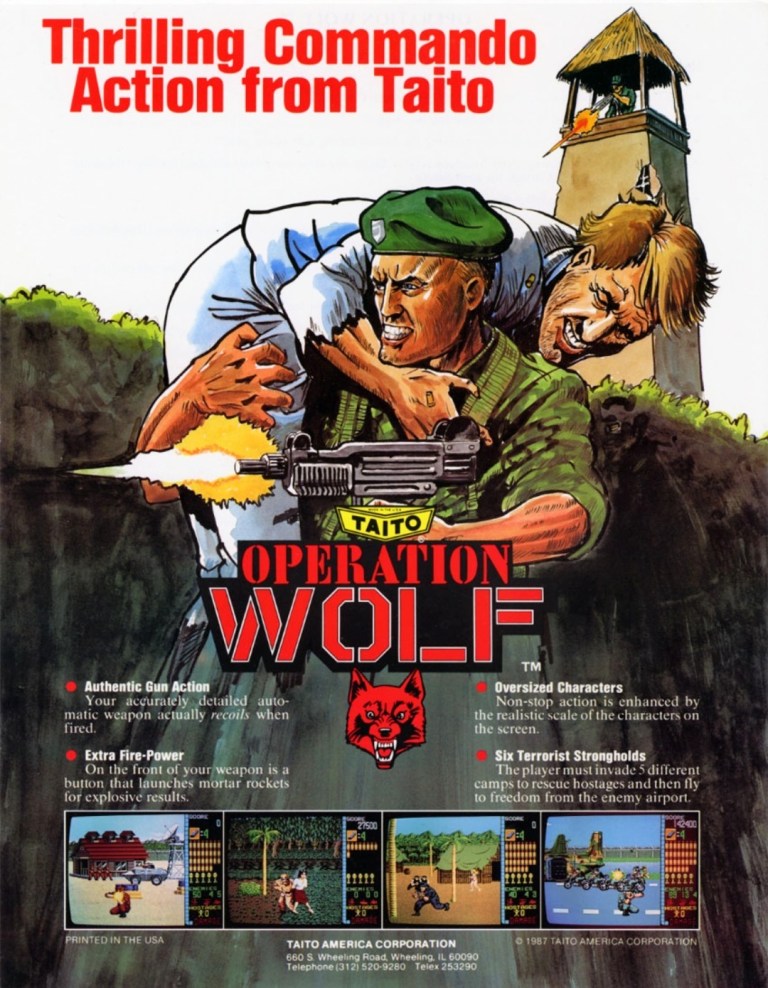
Operation Wolf for American arcades.
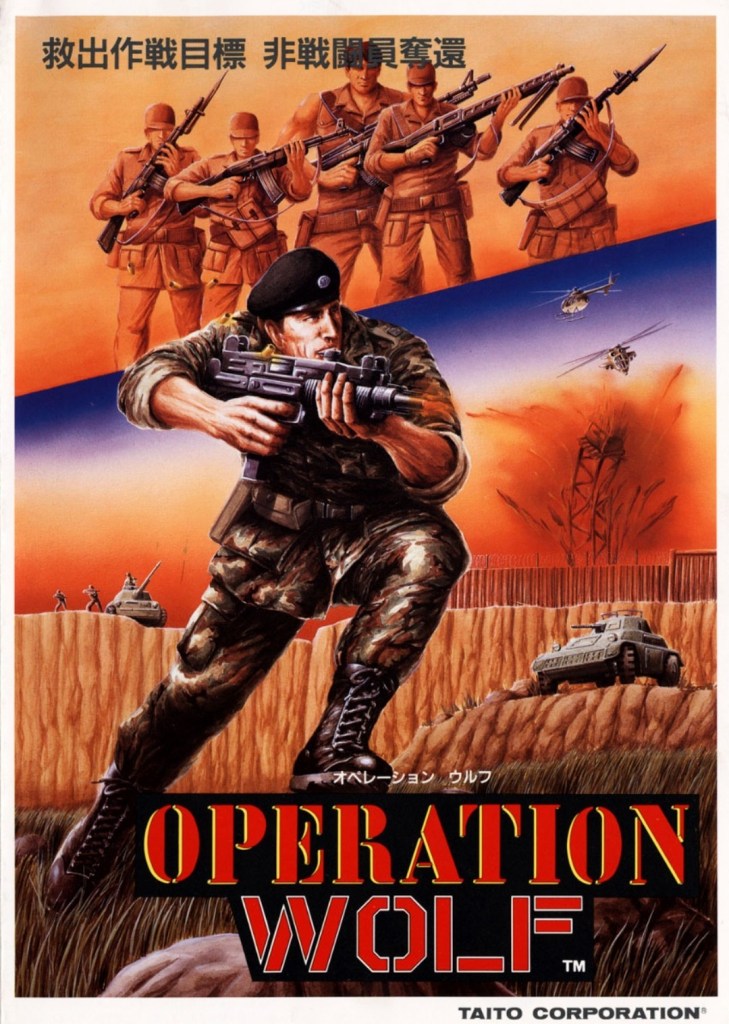
Operation Wolf for Japan.
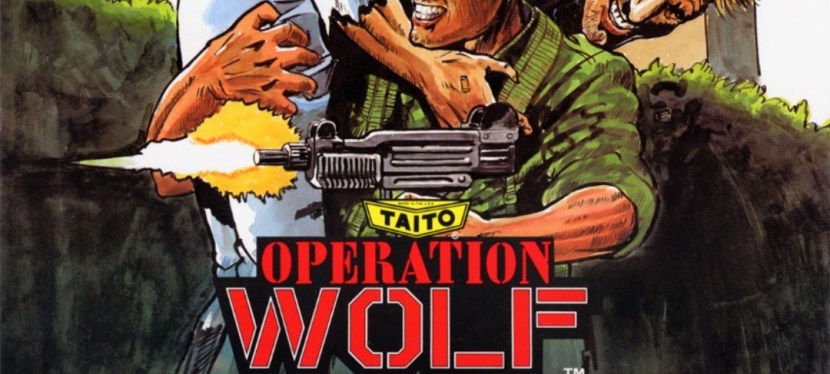
In the late 1980s, Taito achieved massive success in arcades around the world with Operation Wolf. Released during the late stage of the Cold War and with many militaristic action movies already released by Hollywood, Operation Wolf attracted a lot of money from countless players as well as praise from game critics. For the American market, Taito came up with a colorful yet gritty looking arcade flyer that had nice hand-drawn artwork and enough details and screenshots to give readers a useful look at what to expect. The Japanese arcade flyer meanwhile has an even grittier looking original artwork that strongly emphasized war, guns and action. In retrospect, I look both arcade flyers a lot.
2. Centipede Atari 2600 and Atari 5200 print ad
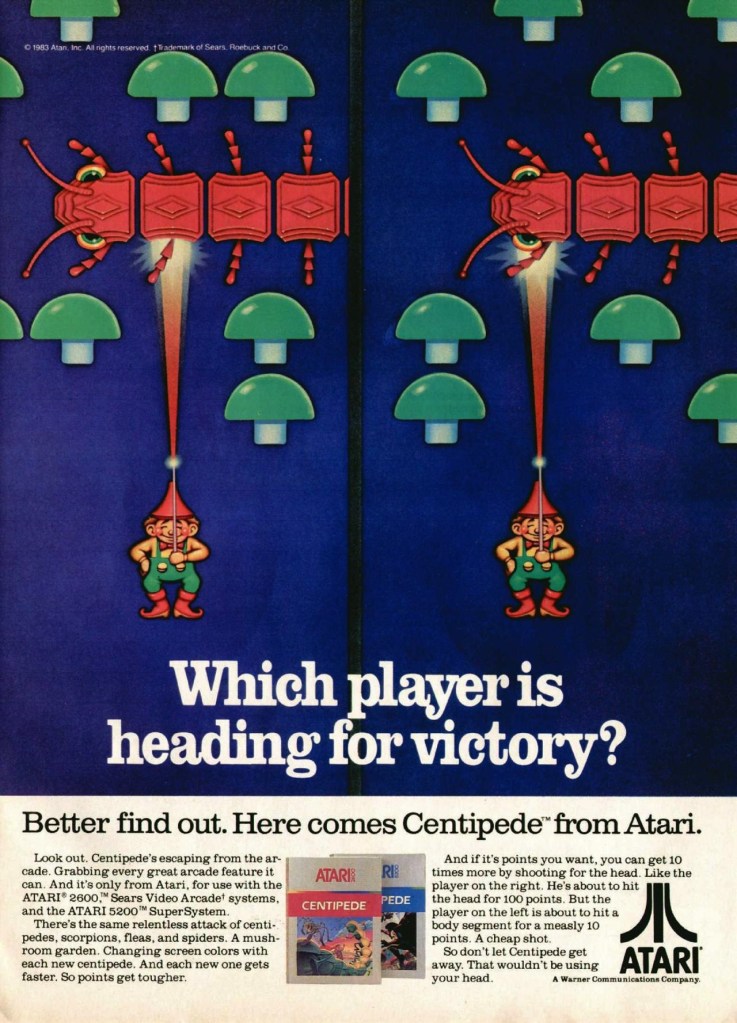
I played Centipede a lot on Atari 2600.
While I completely missed out on the arcade version of Centipede, I managed to play its Atari 2600 version a lot. Ultimately, the simple game design and unique challenges resulted in lots of fun-filled bouts in my experience. To promote the game’s versions on Atari 2600 and Atari 5200, the game giant came up with this particular print ad that had two near-identical artworks that reflect the concept of Centipede. The ad also has some catchy expressions in the text description. This old ad is still fun to look at.
3. Atari RealSports print ad
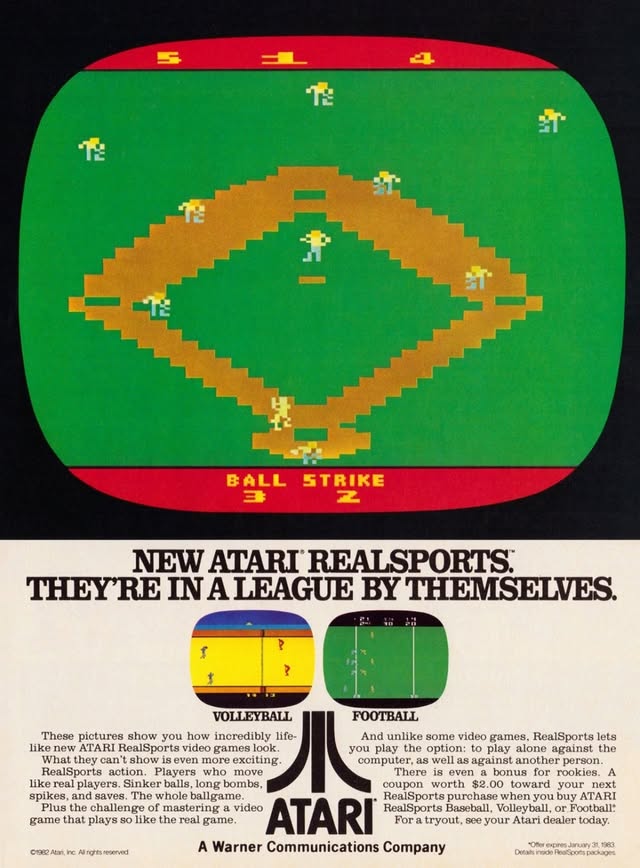
Long before EA sports video games, there was this.
Way back in 1982, Atari launched its RealSports line of sports video games mainly to revitalize sports gaming for their consoles. In fact, RealSports was the result of a critical and aggressive ad campaign by competitor Intellivision which had its Sports Network series of games. In this RealSports print ad, a large image of Atari’s baseball game was used probably to emphasize the scope of the field. The ad had screenshots of the volleyball and football games, while the text description reflected Atari’s aggressive response to Intellivision. This ad is an early example of competition between rival game console makers focused on sports gaming.
4. Lethal Enforcers Sega CD print ad
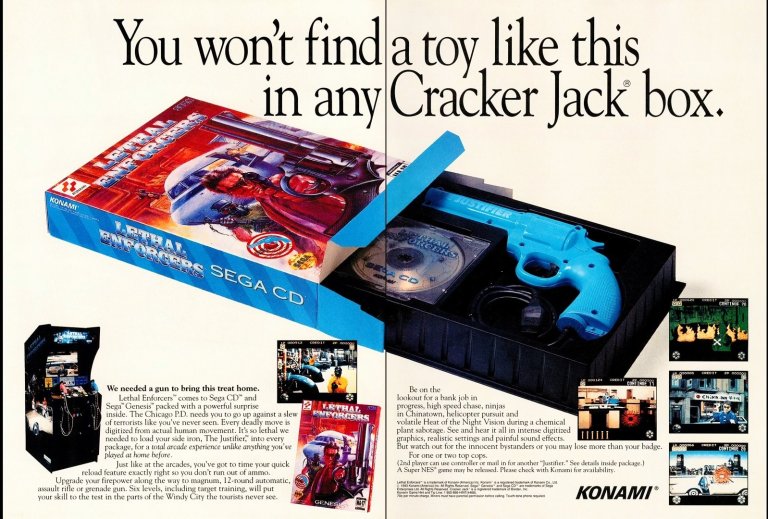
When was the last time you bought a video game with a hard copy and a peripheral bundled together?
Porting light gun games from the arcade to the console is very difficult and tricky to do. This is what Konami did in the early 1990s when they released a version of the arcade hit Lethal Enforcers on the Sega CD console and the package had a light gun with the game on disc. To promote the Sega CD version, Konami came up with a 2-page print ad with the catchy line “You won’t find a toy like this in any Cracker Jack box.” In addition, their ad had a few paragraphs of descriptive text to not only excite gamers but also gently inform them that Lethal Enforcers was also available on the Sega Genesis (note: this console is required for the Sega CD add-on to work) and the Super Nintendo Entertainment System (SNES). Overall, this old ad has a strong visual approach and a clever marketing strategy.
5. Pitfall II: Lost Caverns Atari 2600 print ad
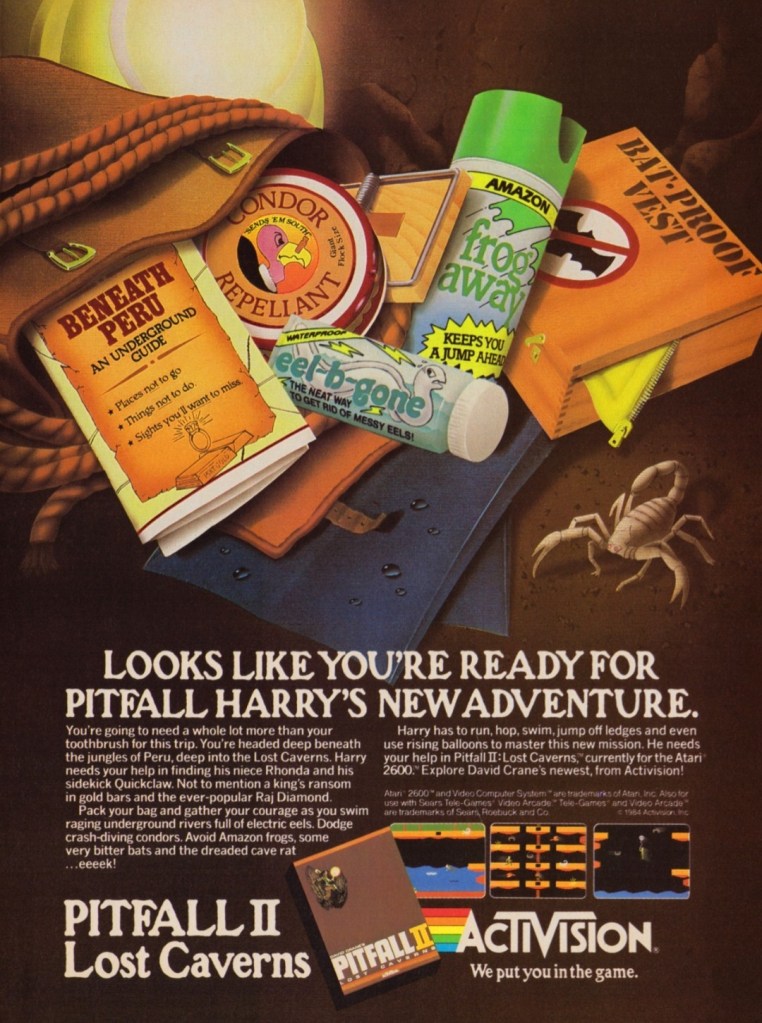
A very stylish layout to promote the game.
In 1982, Activision struck gold with the huge success of Pitfall! which became an influential model of designing platform games. Of course, the publisher (now owned by Microsoft) did not stop there as they went on to make the sequel Pitfall II: Lost Caverns to not only keep the success going but also to exceed the standard they set with the first game. Activision came up with a print ad that not only told gamers of Pitfall Harry’s next adventure but also express humor visually. In line with Activision’s policy of crediting its creators (note: Atari was notorious for refusing to credit its game makers during this era), game designer David Crane was acknowledged in the ad.
6. Team USA Basketball print ad
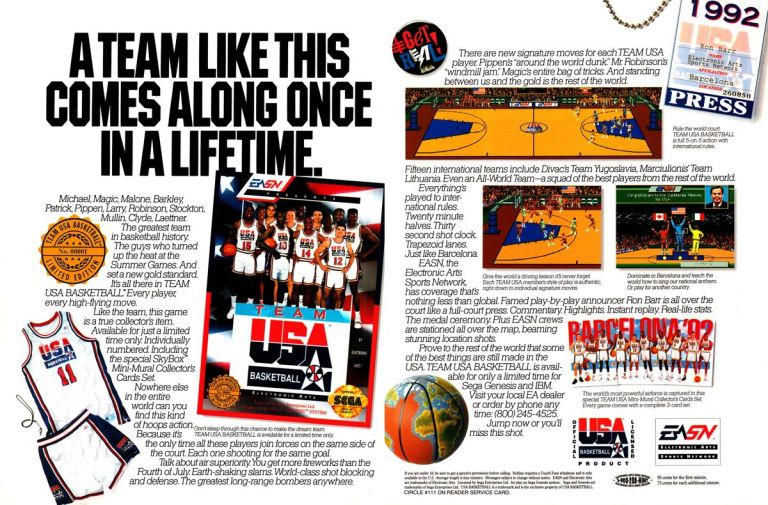
See your favorite NBA player from the 1990s?
In 1992, a lot of people were obsessed with the Dream Team Olympic basketball squad of the United States as its roster had NBA legends like Larry Bird, Magic Johnson, Michael Jordan, Karl Malone, Charles Barkley and David Robinson to name a few. In fact, the Dream Team became the most popular attraction among all teams in any sport of any country that participated in the summer Olympics in Barcelona. Knowing how popular the squad really was, Electronic Arts (EA) made the video game Team USA Basketball and released it on the Sega Genesis which was already a popular console for sports video games. EA came up with this eye-catching 2-page print ad that strongly emphasized the Dream Team, international basketball gaming, and the company’s tested design on 2D basketball video games. In retrospect, this print ad is still amusing and exciting to look at.
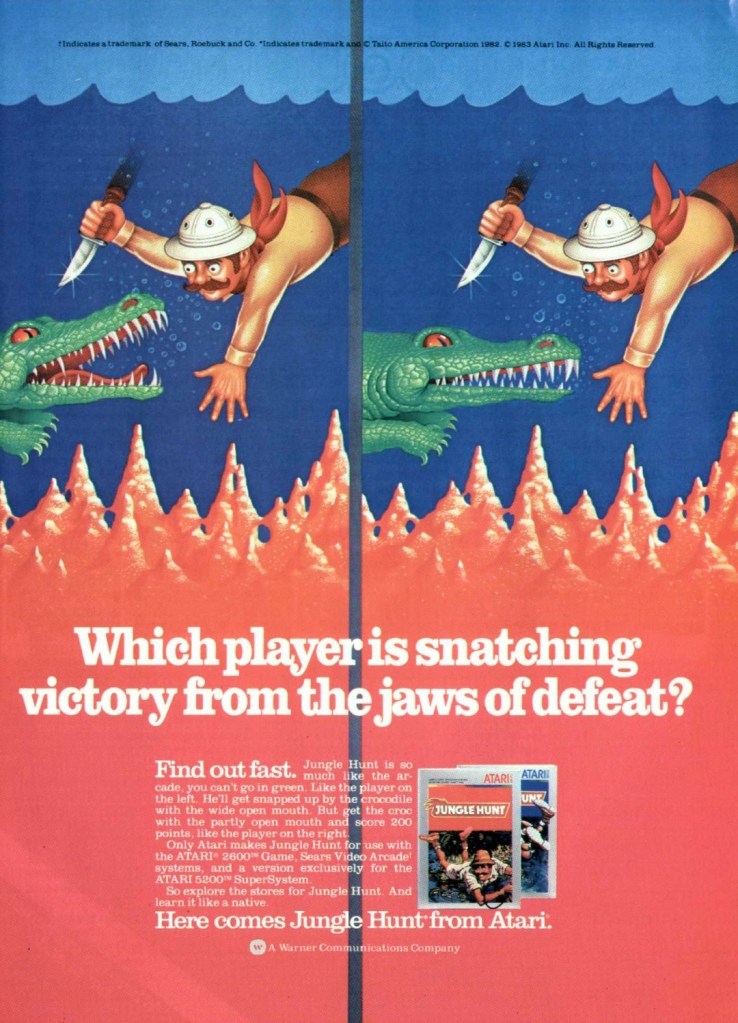
7. Jungle Hunt Atari 2600 and Atari 5200 print ad
Do you fine the parallel artworks amusing or disturbing?
Following the huge success of Jungle Hunt (previously titled as Jungle King), Atari saw potential Dollar signs and made a deal with Taito to publish ports under their own brand for the Atari 2600, Atari 5200 and 8-bit computers. As with the Atari console ads of Pitfall II: Lost Caverns and Phoenix, Atari came up with a print ad that featured two parallel artworks that look similar with each other as they promoted Jungle Hunt for Atari 2600 and Atari 5200. To their credit, the artworks used were detailed and eye-catching, and the descriptive line of words displayed carried a possible reference to 1975’s Jaws.
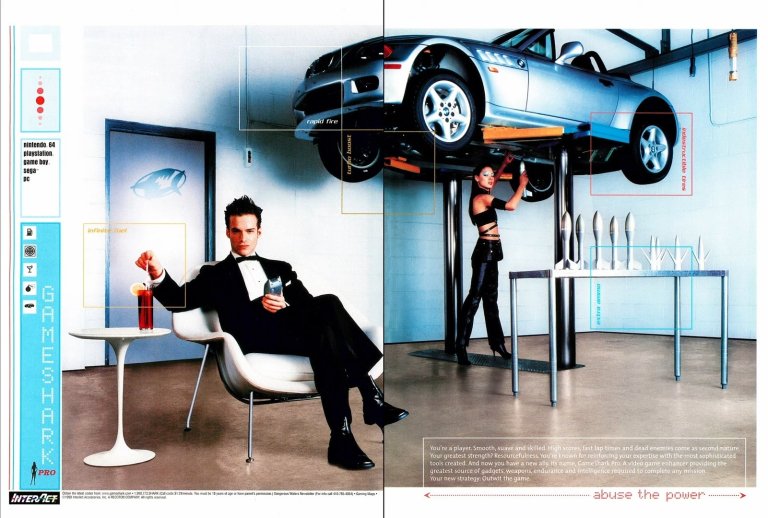
8. GameShark print ad
A James Bond-inspired way of promoting GameShark.
Remember GameShark? For the newcomers reading this, GameShark is the brand of a line of products released on different video game consoles and personal computers (Windows specifically) that gamers use to cheat in video games. GameShark was popular at a time when not too many people had access to the Internet nor did gamers had the means to search for cheats online, and codes were needed to enable cheating. GameShark became so popular, more ambitious and stylish print ads were realized such as this James Bond-inspired 2-page ad. On face value, this ad looked like it was a promoting a particular game but ultimately it was about promoting GameShark with style, cool and some sexiness.
Welcome back Xbox fans, geeks, RPG players, retro gaming enthusiasts and other gamers!
In what is clearly the most serious effort exerted by Team Xbox on retro gaming, they recently released Retro Classics on the Game Pass subscription service covering gamers with Xbox consoles, personal computers (PCs) and device with cloud gaming.
To get things started, watch the official launch trailer of Retro Classics below.
Retro Classics games are available to play for Xbox Game Pass members. Players who stream on the Xbox app on PC now have an additional streaming option with GeForce Now. Game Bar introduces quick settings, visual updates for Widgets in Compact Mode, and coming soon, Microsoft Edge Game Assist, an in-game browser that brings an immersive game-centric experience to Edge. And Xbox gift cards can now be redeemed for any amount via Xbox Rewards.
Announcing Retro Classics available for Game Pass Members – We’re thrilled to announce the launch of Retro Classics, a collaboration between Xbox and Antstream Arcade, available to play for Game Pass members globally.
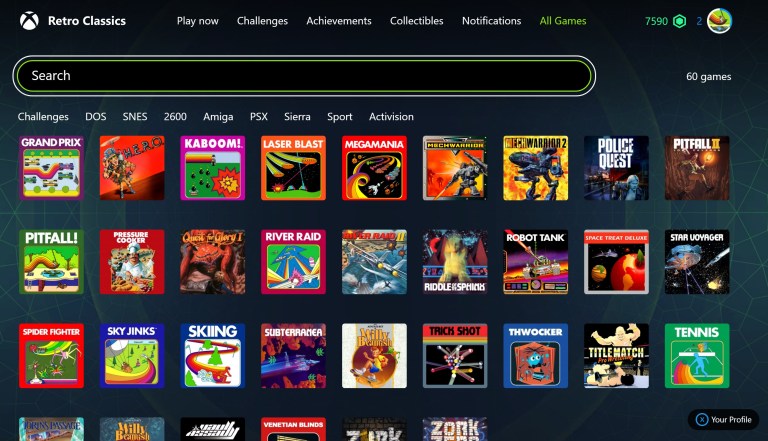
Starting today, Game Pass members can dive into a collection of 50+ classic Activision games from the ’80s and ’90s, including beloved titles like Commando, Grand Prix, Kaboom!, Mech Warrior 2: 31st Century Combat, and Pitfall! This initiative is a step in our commitment to game preservation and backwards compatibility, allowing players to experience many timeless games on modern devices.
With Retro Classics, Game Pass members can expect a seamless gaming experience across console, PC, and on supported devices with cloud gaming. Whether playing on Xbox console, the Xbox app on PC, or streaming on supported LG and Samsung Smart TVs, Amazon Fire TV devices, and Meta Quest headsets, Retro Classics offers a versatile and accessible way to enjoy these nostalgic titles. Game Pass members can access Retro Classics through their Game Pass membership by searching and installing the feature via their console or on the Xbox app on PC. Additionally, players can take on friends, rivals, or the entire world with unique challenges. For the achievement hunters, there are some great new ones to collect, and for newer players, the ability to save and reload your progress, a first for many classic titles.
Game Pass members can look forward to discovering additional games added from Activision and Blizzard, expanding the Retro Classics collection to more than 100+ titles over time.
Now that Activision and Blizzard were mentioned in the official announcement, it is clear that this retro gaming approach by Team Xbox (in strategic partnership with Antstream Arcade) is one of the benefits of the 2023 acquisition of Activision-Blizzard-King.
Having played video games for decades, I know for a fact that Activision alone has lots of old video games from the 1980s and the 1990s. I still remember playing Activision’s Keystone Kapers on the Atari 2600 when I was very young. The same company also released Pitfall! and River Raid on different consoles in the 1980s. The Activision games of the 1990s I often remember were MechWarrior, MechWarrior 2: 31st Century Combat and Pitfall: The Mayan Adventure. As for Blizzard, I remember playing Blackthorne and I witnessed some people who played Warcraft and StarCraft games in the 1990s.
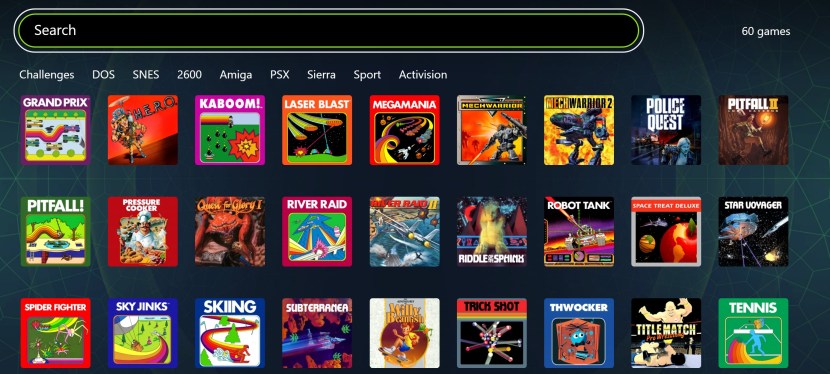
See a retro game that interests you? (Photo source – Xbox.com)
There definitely be more old-but-fun video games coming into Retro Classics for Game Pass subscribers to enjoy. It remains to be seen how fast Team Xbox and its partner will be able to add the games.
Welcome back my readers, YouTube viewers and all others who followed this series of articles focused on YouTube videos worth watching. Have you been searching for something fun or interesting to watch on YouTube? Do you feel bored right now and you crave for something to see on the world’s most popular online video destination?
I recommend you check out the following videos I found.
#1 Popcorn in Bed reacts to Cold Mountain – Were you fortunate enough to watch Cold Mountain in 2003? It is an American Civil War movie that has a very notable cast that includes Jude Law, Nicole Kidman, Renée Zellweger, Philip Seymour Hoffman, Natalie Portman and Donald Sutherland. Not too many people in online movie-focused communities or social media groups talk about the movie. Strangely, there are very few movie reaction videos of Cold Mountain on YouTube. This past March, Popcorn in Bed posted a reaction video about the film and how it impacts her emotionally make it a must-see.
#2 PatmanQC examines the history of Pitfall! – While I was fortunate enough to play lots of video games on the Atari 2600 decades ago, I never played Pitfall! That game produced by Activision was a massive hit on the said console and how the game and its company started is fascinating to discover. In case you did not notice, Pitfall! grew into a game franchise and it was one of the early video games to have merchandising. Discover more about it in PatmanQC’s in-depth video below.
#3 You, Me and the Movies react to A Nightmare on Elm Street (1984) – The 1980s is the so-called golden age of slasher horror movies. One particular slasher horror flick of 1984 focused on the concepts of nightmares, the bogeyman and the fear of dying while sleeping. You can discover more by watching the reaction video of You, Me and the Movies below. Observe how it draws reactions from them.
#4 Slope’s Game Room examines Smash T.V. – Here is more nostalgic fun for those of you who love retro gaming. Slope’s Game Room’s retrospective video of the arcade classic Smash T.V. is a lot of fun to watch and the YouTuber really paid close attention to the details for viewers to learn. When was the last time you played Smash T.V.?
#5 Ashleigh Burton reacts to Alien Resurrection – Way back in late-1997, I saw Alien Resurrection inside the movie theater here in the Philippines carrying some excitement in me. After the movie ended, I left the cinema feeling numb. That being said, you have to see how Alien Resurrection drew reactions from Ashleigh Burton and perhaps you could relate with her perception of the movie.
#6 Scottie Pippen, the Chicago Bulls and Jerry Krause – Remember back in the 1990s when the Michael Jordan, Scottie Pippen and the Chicago Bulls won six NBA championships? Behind the scenes, Scottie Pippen’s years with the Bulls (led by Jerry Krause) were actually filled with frustrations and his salary was tiny when compared to other NBA superstars of the era. To find out what happened and what were the factors behind it all, watch the two videos of Secret Base below.
#7 Minty Comedic Arts presents Cool World trivia – Recently, YouTuber Minty Comedic Arts posted a new trivia video about the 1992 live-action/animated hybrid movie Cool World. Directed by Ralph Bakshi and starring Brad Pitt and Kim Basinger, Cool World had an original concept that was eventually altered into its final cinematic form. There are lots of intriguing details to discover and I urge you all to watch Minty Comedic Arts’ video below.
Welcome back my readers, YouTube viewers and all others who followed this series of articles focused on YouTube videos worth watching. Have you been searching for something fun or interesting to watch on YouTube? Do you feel bored right now and you crave for something to see on the world’s most popular online video destination?
I recommend you check out the following videos I found.
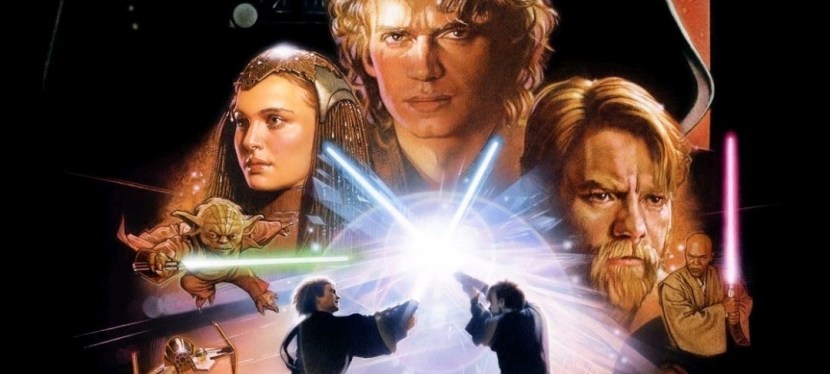
#1 Star Wars: Revenge of the Sith makes big comeback – This year marks the 20th anniversary of Star Wars: Episode III – Revenge of the Sith and its impact was felt when it finished 2nd in the American box office with its anniversary theatrical release. The George Lucas-directed movie grossed $25.5 million on April 25-27, 2025. For the newcomers reading this, Revenge of the Sith’s successful return to cinemas was celebrated by long-time fans as it was George Lucas’ Star Wars, and not the woke garbage from Kathleen Kennedy and the woke Disney company. To learn about the significance of Revenge of the Sith’s return, watch the videos below.
#2 Ashleigh Burton, Popcorn in Bed, VKunia and Decker Shado react to Revenge of the Sith – Revenge of the Sith is the real Star Wars as it was made and released many years before woke Disney made the unfortunate deal with George Lucas. I myself was fortunate enough to have seen the movie inside the cinema during its opening week here in the Philippines way back in 2005. To see how Revenge of the Sith impacts viewers, watch the respective video reactions by Ashleigh Burton, Popcorn in Bed, VKunia and Decker Shado (review) below.
#3 PatmanQC examines the history of Centipede –Centipede was an Atari game that I played a lot on the Atari 2600 a long time ago. It was simple with its game design and yet it was a lot of fun to play with. I never got to play the arcade version of Centipede in the old days but thanks to the Atari 50 collection I own, I finally played the arcade Centipede on my Xbox Series X. The development Centipede is interesting and you can learn more about it and the games by watching PatmanQC’s in-depth video below.
#4 Lunar games retrospective – If you are feeling nostalgic or interested in the Lunar franchise of video games, then Gaming Broductions’ retrospective video should interest you. For the newcomers reading this, the Lunar franchise started on the Sega CD (Mega CD in other markets) with Lunar: The Silver Star which was a Japanese role-playing game (JRPG) developed by Game Arts. Sequels and spin-offs were released in the years that followed and the Lunar franchise was revived for modern consoles with the Lunar Remastered Collection. Watch the video to discover more about Lunar games.
#5 Popcorn in Bed reacts to Cape Fear (1991) – Remember when Robert De Niro played a very bad guy in 1991’s Cape Fear? Believe it or not, that particular movie was actually a remake of the original 1960s version and it even got nominated for the Academy Award for Best Picture. There were moviegoers who got terrified by Cape Fear in 1991 and you can see for yourselves how it impacted YouTuber Popcorn in Bed in the reaction video below. By the way, Nick Nolte was really good in his role in the film.
Welcome back my readers, YouTube viewers and all others who followed this series of articles focused on YouTube videos worth watching. Have you been searching for something fun or interesting to watch on YouTube? Do you feel bored right now and you crave for something to see on the world’s most popular online video destination?
I recommend you check out the following topics and the related videos I found.
#1 Modern feminists’ survival weakness exposed – Are you surrounded by the so-called modern feminists who kept boasting they can excel in anything men can do? I was just browsing YouTube until I spotted a video by Christine Grace Smith who shared her own reaction to another video that examined a series of tests of survival for two separate groups – one group of men and the other group of women – on an uninhabited tropical island far away from each other. Smith’s video is a must-watch and I encourage you to pay attention to the details as you view it. Her video and thoughts can change the way you look at survival as well as women empowerment.
#2 The 1993 World Trade Center bombing examined – Fern recently released an in-depth explanatory video about the 1993 bombing of the World Trade Center committed by Islamic terrorists. This is an important video to watch given the fact that the 1993 bombing is often forgotten since the WTC twin towers collapsed on September 11, 2001. It will give you some insight on the radicalized evil Islamists live with and how far they are willing to go to commit murder and destruction. The moral lesson here is that being an Islamist means being evil.
#3 Ashleigh Burton reacts to Weird Science – Are you fond of 1980s Hollywood teen comedies or do you prefer 1950s science fiction tales of Weird Science published by EC Comics? Back in 1985, there was a teen comedy and sci-fi film titled Weird Science directed by the late John Hughes. Its concept was actually inspired by the EC Comics-published “Made of the Future” tale from the Weird Science comic book series. YouTuber Ashleigh Burton’s reaction video of the film is enjoyable to watch and I encourage you to see it.
#4 PatmanQC examines Berzerk – I still the old days when I played Berzerk a lot on the Atari 2600 (read my retro gaming review by clicking here). Being so young back then, I was not even aware about the arcade version of Berzerk. That being said, it’s a good thing that YouTuber PatmanQC made a retrospective video about Berzerk. If you are interested to find out what inspired the concept of Berzerk and who exactly created the game, watch the retro gaming video below.
#5 You, Me and the Movies react to 1978’s Piranha –When Steven Spielberg’s Jaws achieved tremendous commercial success in the mid-1970s, there were a lot of creature feature movies approved for production as other producers wanted to cash in on the craze. Among those flicks was 1978’s Piranha directed by Joe Dante and produced by low-budget movie king Roger Corman. You, Me and the Movies’ reaction video of Piranha is a must-see.
Welcome back readers, fellow geeks and electronic gaming fans!
In this edition of the Retro Gaming Ads Blast (RGAB) series, we will take a look at another batch of retro gaming print ads – including arcade flyers – from the 1980s and 1990s.
For the newcomers reading this, Retro Gaming Ads Blast (RGAB) looks back at the many print ads of games (console, arcade, computer and handheld) that were published in comic books, magazines, flyers, posters and newspapers long before smartphones, social media, the worldwide web and streaming became popular. To put things in perspective, people back in the 1980s and 1990s were more trusting of print media for information and images about electronic games and related products.
With those details laid down, here is the newest batch of retro gaming print ads for you to see and enjoy…
1. Japanese Macross video games print ads
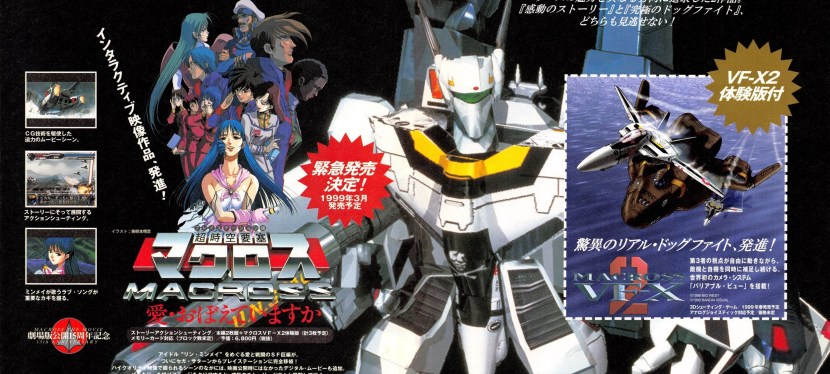
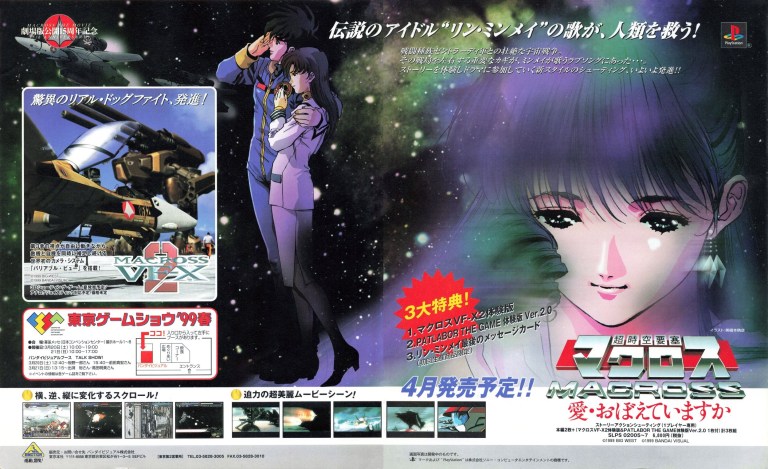
This 2-page ad had Minmay, Misa and Hikaru.
Computer-generated image of the Skull Leader Battroid was used here.
Looking at the history of Macross video games released only in Japan, there were these notable games that catered to the fans with different tastes during the period of 1997 to 1999. The two Japanese print ads here promoted the PlayStation version of The Super Dimension Fortress Macross: Do You Remember Love? (read my retro review by clicking here) and Macross: VF-X2 (only on PlayStation). 1997 marked the 15th anniversary of the entire Macross franchise and game publisher Bandai Visual kept the excitement for fans on high gear by aggressively promoting the two advertised games for their respective releases in 1999. These two print ads still resonate with long-time fans as each were clearly made to emphasize the games (with details, screenshots and original artworks) while using the right images of the Macross franchise for relevance.
2. Star Raiders print ad
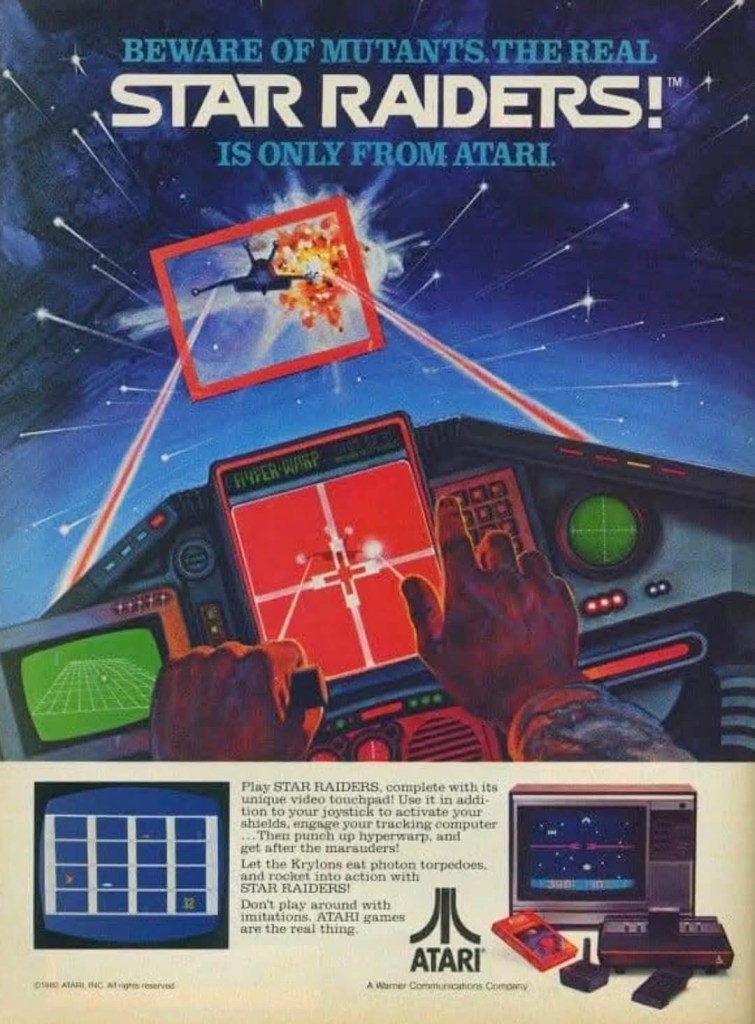
This Star Raiders print ad made me interested enough to play the game on Atari 2600.
I remember the old days of play Star Raiders on the Atari 2600 back in the early 1980s. Strangely enough, I don’t remember seeing this old print ad. Regardless, I really like the way the ad makers used hand-drawn art work to dominate the space while leaving enough space for text description, a screenshot and the picture of the Atari console with the TV set. In my view, this old ad is both amusing and attention-grabbing.
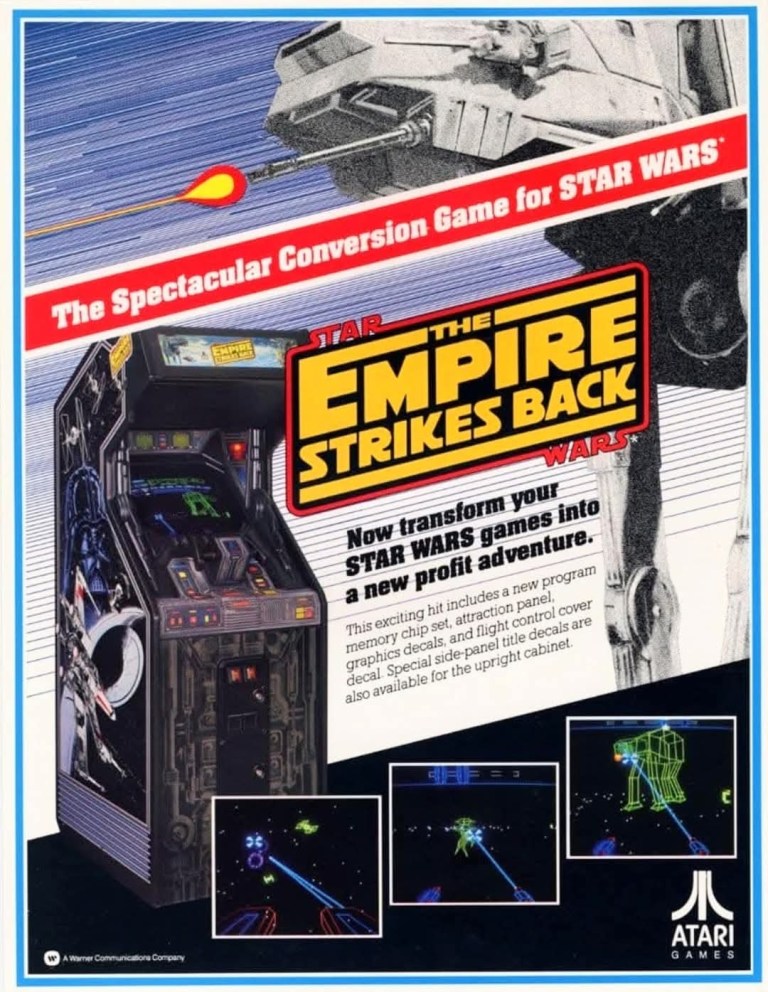
3. The Empire Strikes Back arcade flyer
This is still a great looking arcade flyer.
Here is a Star Wars game I never played but managed to play it on a home computer. Released by Atari in 1985, The Empire Strikes Back (full title: Star Wars: The Empire Strikes Back) arcade game was the follow-up to the very popular Star Wars arcade game. Like its predecessor, it used vector graphics and certain sounds from the 1980 film for immersion. This arcade flyer is well designed showing three selected screenshots, a picture of the arcade cabinet and a portion of the AT-AT walker from the movie. The flyer truly showed gamers and arcade operators what they would get by selecting The Empire Strikes Back.
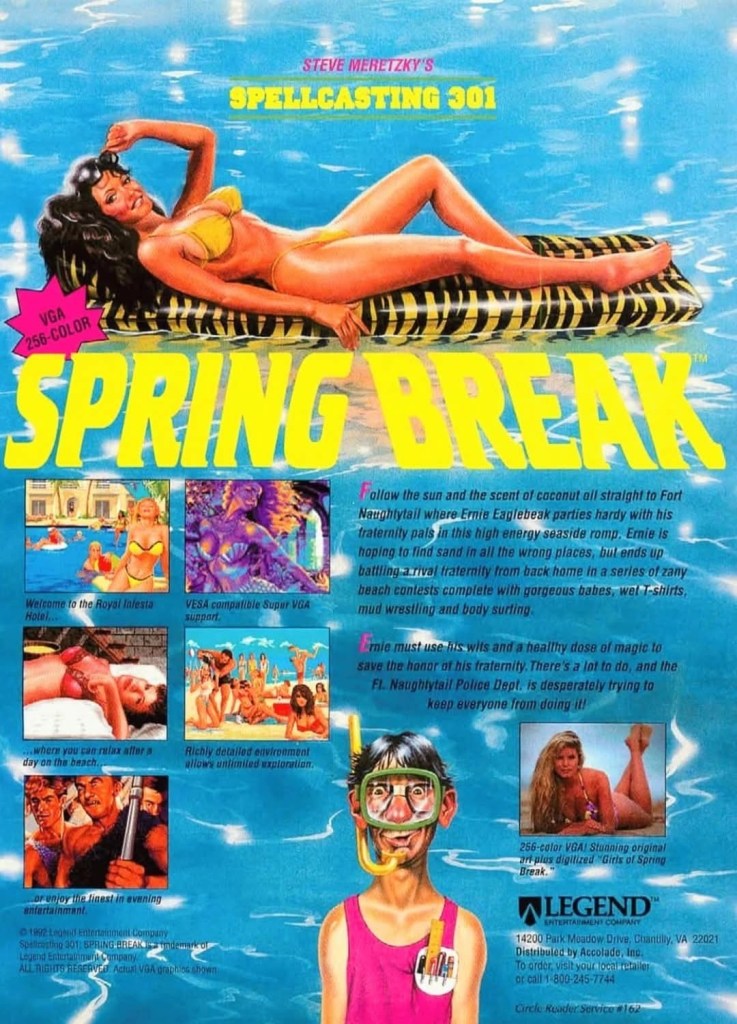
4. Steve Meretzky’s Spellcasting 301: Spring Break print ad
Clearly the promoted game is for adult players only.
In the realm of computer gaming, there were certain games that catered to the more mature players. One example is Steve Meretzky’s Spellcasting 301: Spring Break which was released on for personal computers running on DOS (Disk Operating System) in 1992. This print ad clearly shows the adulterated nature of the game emphasizing sexy women with a paradise setting. This is the kind of print ad that you only in computer gaming magazines which had predominantly adult readers.
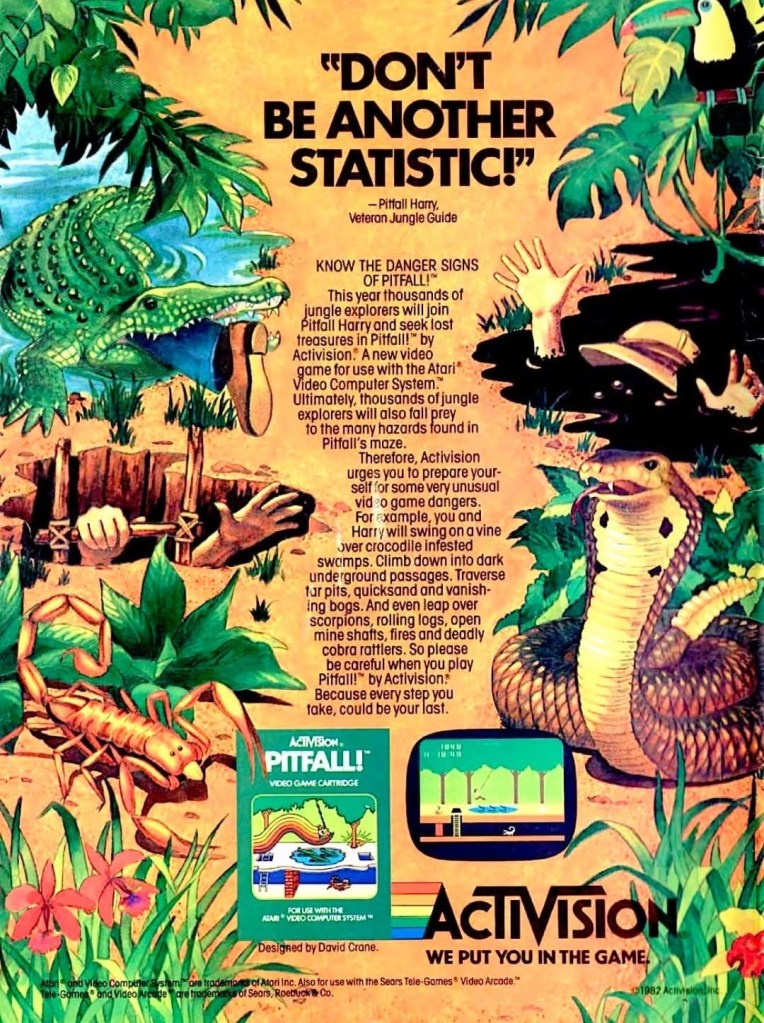
5. Pitfall! print ad
Still a great looking print ad.
Back in 1982, 2D adventuring on the Atari 2600 reached new heights when Pitfall! was released. The game garnered wide praise for its gameplay and graphics, and because it was so enjoyable, it sold millions of copies and its success spread across other platforms. A key factor to its commercial success and strong identity with the Atari 2600 was this colorful print ad. The ad makers daringly used original artwork to emphasize the jungle, wilderness and adventure concept while leaving some space left to show a screenshot and the Atari 2600 game cover. Pitfall! is a video game classic.
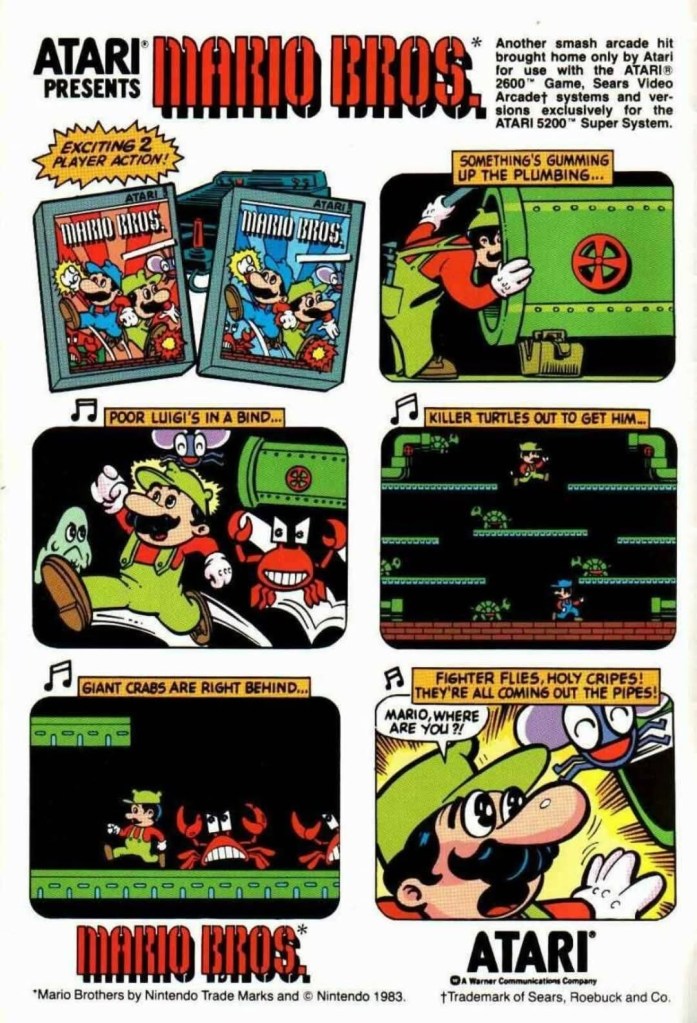
6. Mario Bros. print ad
I saw this comic-style print ad while reading a comic book.
A few years before Nintendo skyrocketed with the massive success of Super Mario Bros., there was Mario Bros. on the Atari 2600 and Atari 5200. Published by Atari on their consoles, Mario Bros. was already a hit in the arcades. To capitalize on the popularity of the game, Atari came up with this comic-style print ad to capture people’s attention with the hope that the Atari 2600 and Atari 5200 ports will sell a lot. I first saw this ad while reading a comic book and it remains entertaining to see.
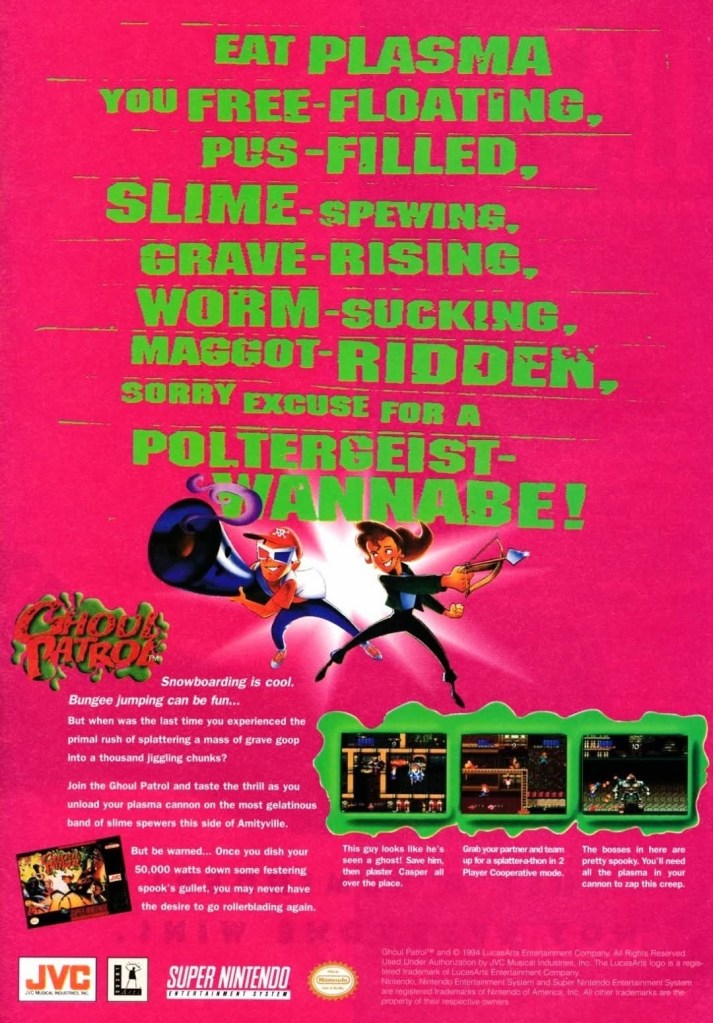
7. Ghoul Patrol print ad
Too bad the screenshots, the game box cover and white descriptive text were too small to look at.
Released in 1994 on the Super Nintendo Entertainment System (SNES), Ghoul Patrol is the accidental sequel to Zombies Ate My Neighbors. This was because the game did not start as a sequel but rather as an unrelated project that used the same gameplay engine of its predecessor. Since Zombies Ate My Neighbors already had a dedicated fanbase, a decision to turn the game into a sequel followed. Ghoul Patrol’s print ad took a different creative approach on its presentation by trying to look cool and catchy with a dominating pink background and slightly adulterated descriptions in green leaving little space left for screenshots and the white descriptive text. The print ad of Zombies Ate My Neighbors remains more engaging and more eye-catching than this one.
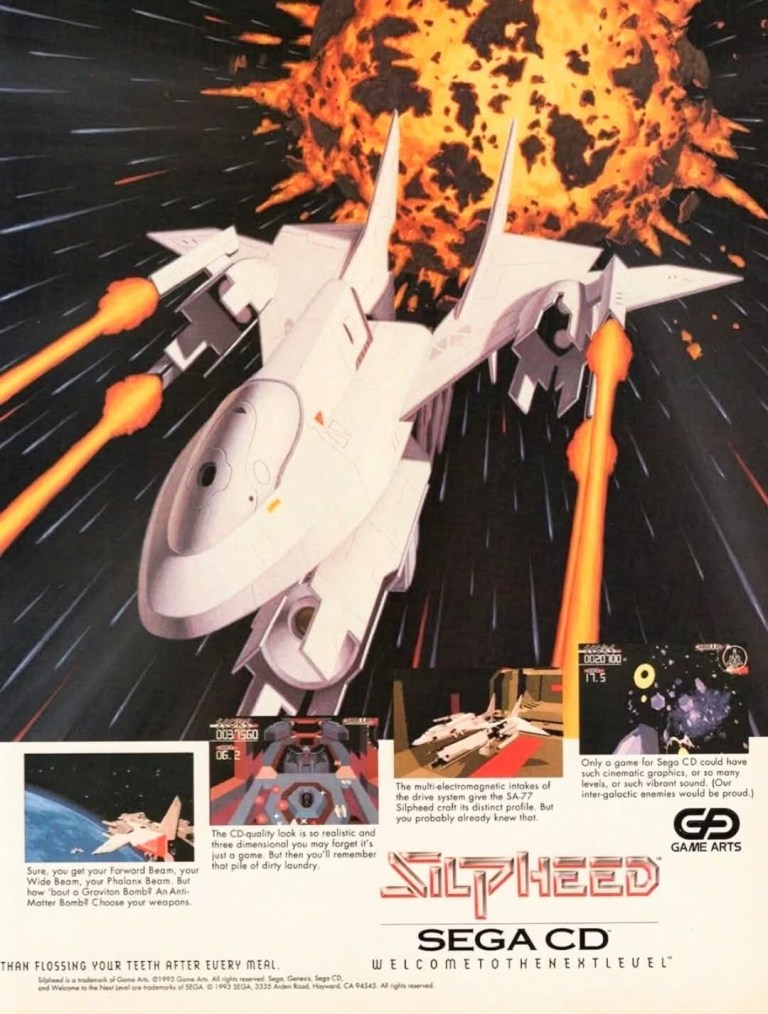
8. Silpheed print ad
This ad caught my attention and even made me interested on the Sega CD.
Released in 1993, Silpheed on Sega CD was a remake of the original game of 1986. Like its predecessor, the Sega CD had 3D effects but used pre-rendered computer animation for a background that actually was full motion video. The print ad of this game had this fantastic looking computer-generated artwork and displayed four screenshots that looked really exciting back in 1993. If you look closely at the captions, the ad emphasized the CD-quality look and the cinematic graphics the game had. This old ad has aged well.
Welcome back readers, fellow geeks and electronic gaming fans!
In this edition of the Retro Gaming Ads Blast (RGAB) series, we will take a look at another batch of retro gaming print ads – including arcade flyers – from the 1980s and to the year 2000.
For the newcomers reading this, Retro Gaming Ads Blast (RGAB) looks back at the many print ads of games (console, arcade, computer and handheld) that were published in comic books, magazines, flyers, posters and newspapers long before smartphones, social media, the worldwide web and streaming became popular. To put things in perspective, people back in the 1980s and 1990s were more trusting of print media for information and images about electronic games and related products.
With those details laid down, here is the newest batch of retro gaming print ads for you to see and enjoy…
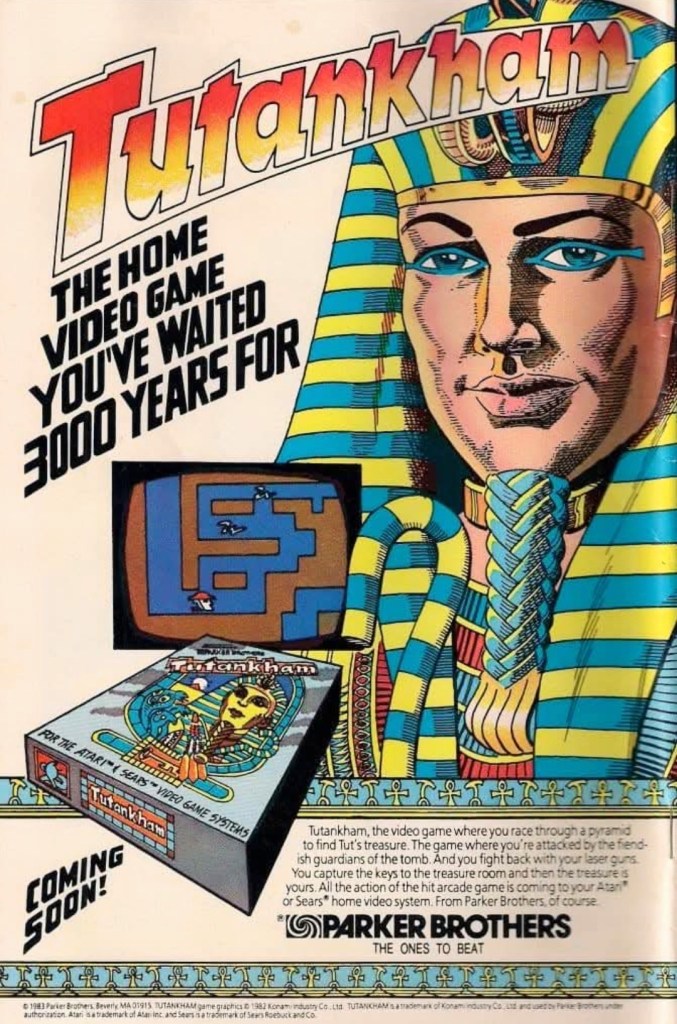
1. Tutankham print ad
This print ad appeared in several comic books in 1983.
First released in the arcades in 1982, Tutankham is a 2D adventure game that had a mix of shooting, maze exploration and puzzle-solving with Egyptian settings and concepts. It made its way to the Atari 2600 published by Parker Brother, and it was this specific version I played. This game print ad appeared in comic books I read in 1983, and the people who made it implemented a hand-drawn art of the Egyptian pharaoh Tutankhamun dominating the space to emphasize the Egyptian setting. In fact, this ad made me think more of Egypt and left little to give me an idea of the game design.
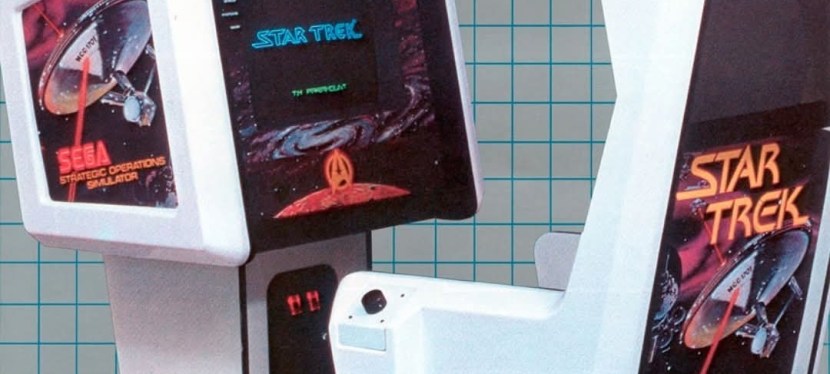
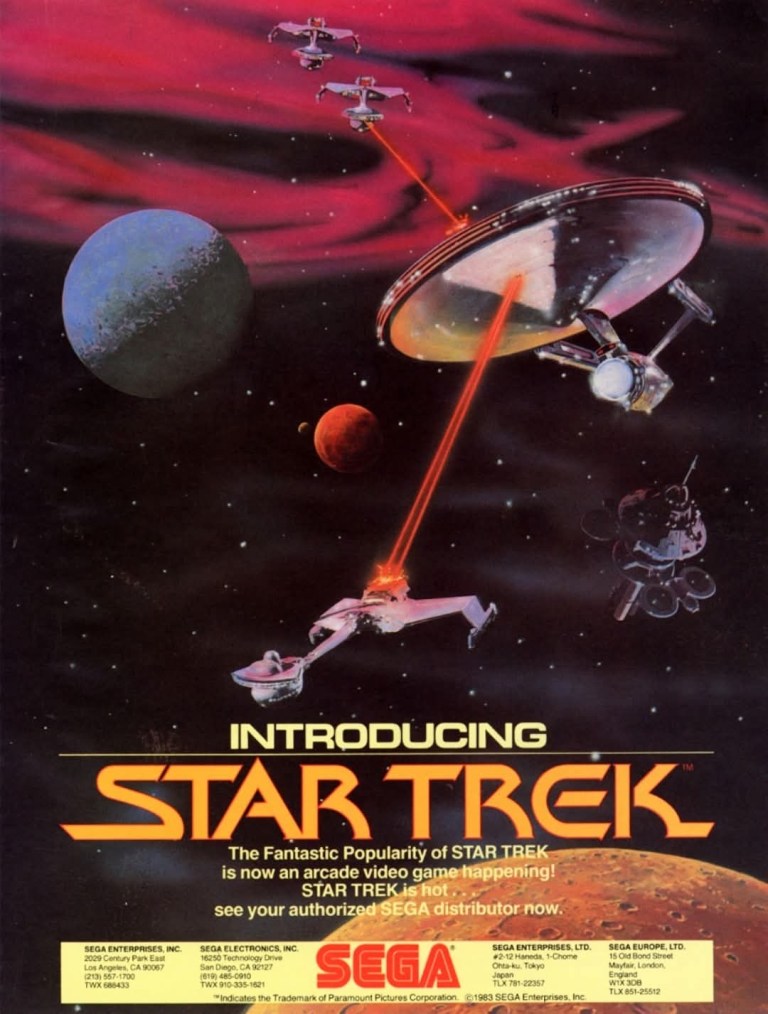
2. Star Trek arcade flyer
The clever use of classic Star Trek imagery was used in this initial flyer by Sega.
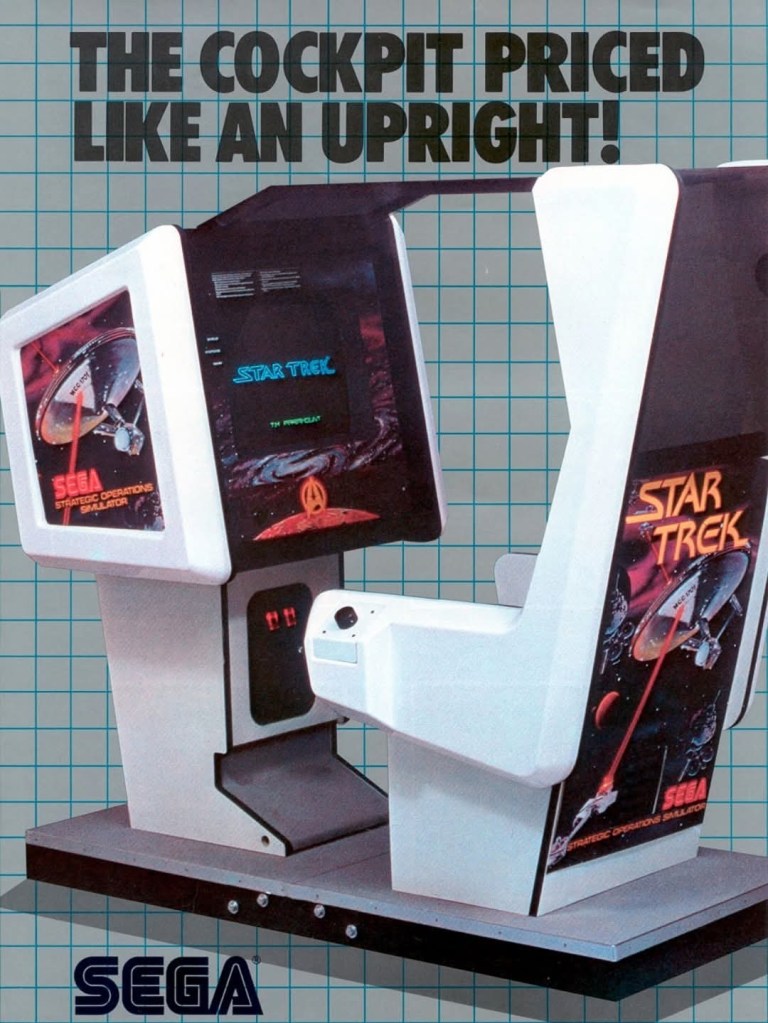
Back in the 1980s, a futuristic design for an arcade machine like this one was mind-blowing.
I never played the Star Trek arcade game (full title: Star Trek: Strategic Operations Simulator) Sega released in 1983. I only saw its graphics and gameplay during an episode of Starcade. With its game design and visual presentation, Star Trek was a very ambitious arcade project for its time and Sega really went in to promote it. The initial arcade flyer (first one above) was meant to grab the attention of both gamers and arcade operators. The next arcade flyer (2nd one above) showed the ambitious design of the arcade machine made with player immersion in mind.
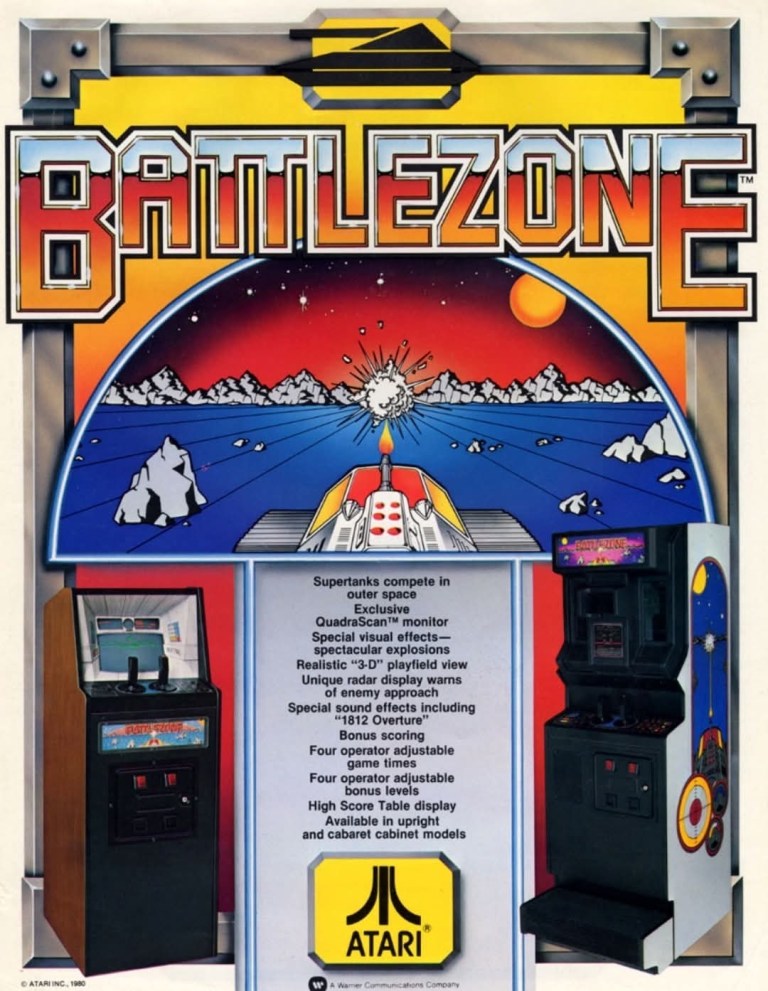
3. Battlezone arcade flyer
While the hand-drawn artwork was too detailed for the arcade game’s graphics, it still emphasized strongly the concept of the game.
In the history of video games, Battlezone was a groundbreaking game both visually and with game design. It was designed to give gamers an immersive experience of driving a tank with 3D graphics, fun gameplay and a first-person view. Its own history is worth researching. Atari knew it had to heavily promote their ambitious game and the arcade flyer above featured nice hand-drawn artwork while also showing the two types of Battlezone machines that arcade operators can choose from. Battlezone went on to become a highly influential arcade game.
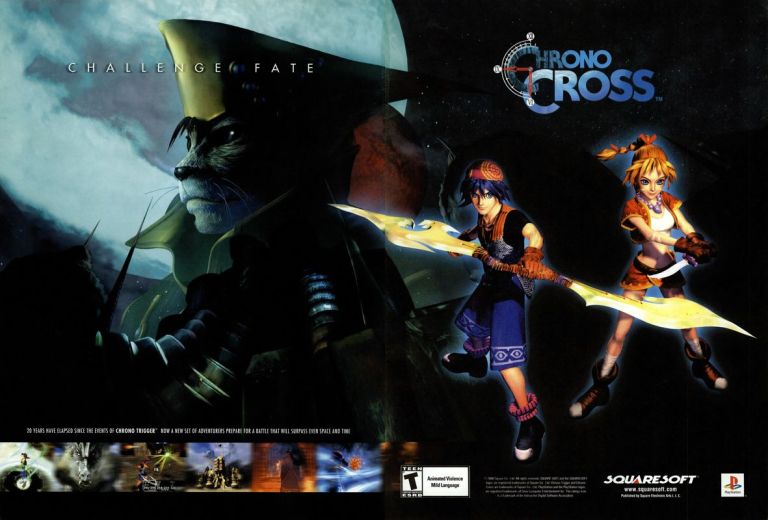
4. Chrono Cross North American print ad
Arguably, this print ad was aimed at RPG enthusiasts, Chrono Trigger fans and gamers looking for something adventurous to play.
First released on PlayStation in Japan, Chrono Cross made its way to the said console in America just a few months before the PlayStation 2 launched there. While there was a risk that came with releasing the ambitious follow-up to the classic Chrono Trigger so late in the PlayStation’s life, Squaresoft (now Square Enix) still went on to aggressively promote Chrono Cross in America. This 2-page print ad that appeared in many gaming magazines remains captivating to look at. As typical of the time, 3D polygonal models and the epic-looking art were used in dominating fashion leaving the small space (lower-left corner) to display a few gameplay screenshots and other 3D art. Still it a fun game to play and this should remind you that Chrono Cross was recently remastered for modern consoles.
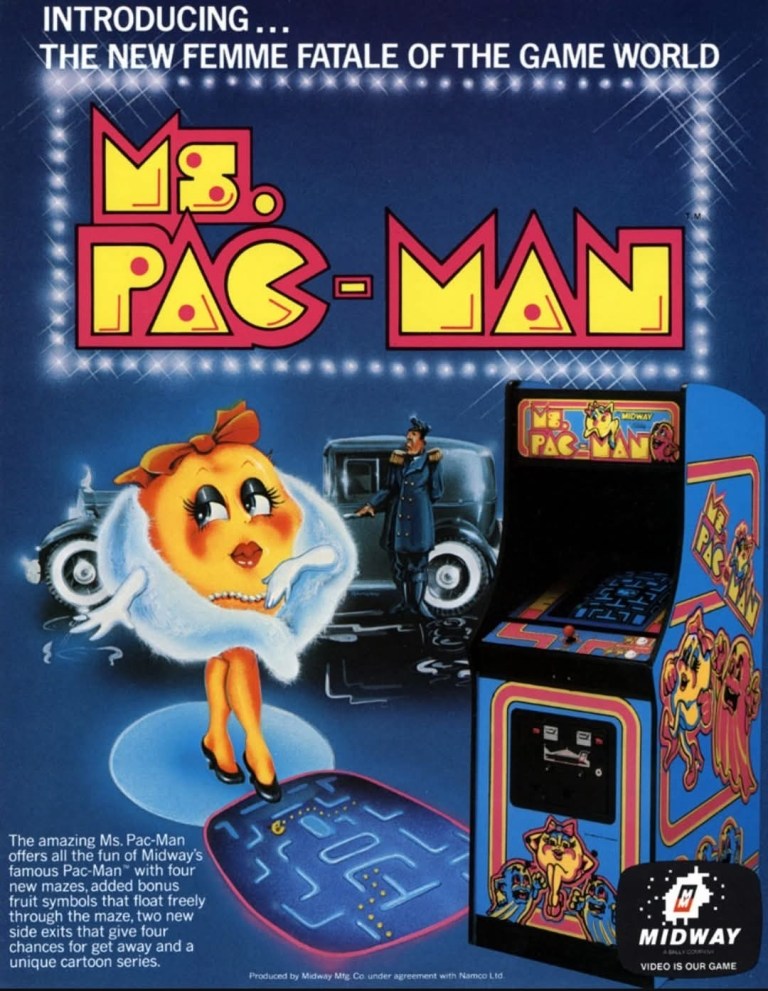
5. Ms. Pac-Man arcade flyer
The wife of Pac-Man and the machine.
Given the fact that Pac-Man was so massively successful, it was not surprising that a sequel had to be made and released on as many arcades as possible. Ms. Pac-Man was the sequel and it was released in arcades in 1982 eventually achieving huge commercial and critical success. To promote the game, Midway’s ad makers came up with an ad showing unique art of Pac-Man’s wife looking glamorous (with a driver and a vehicle in the background) and a photograph of the arcade machine on the right. This also was one of the early arcade flyers to use the words “femme fatale”.
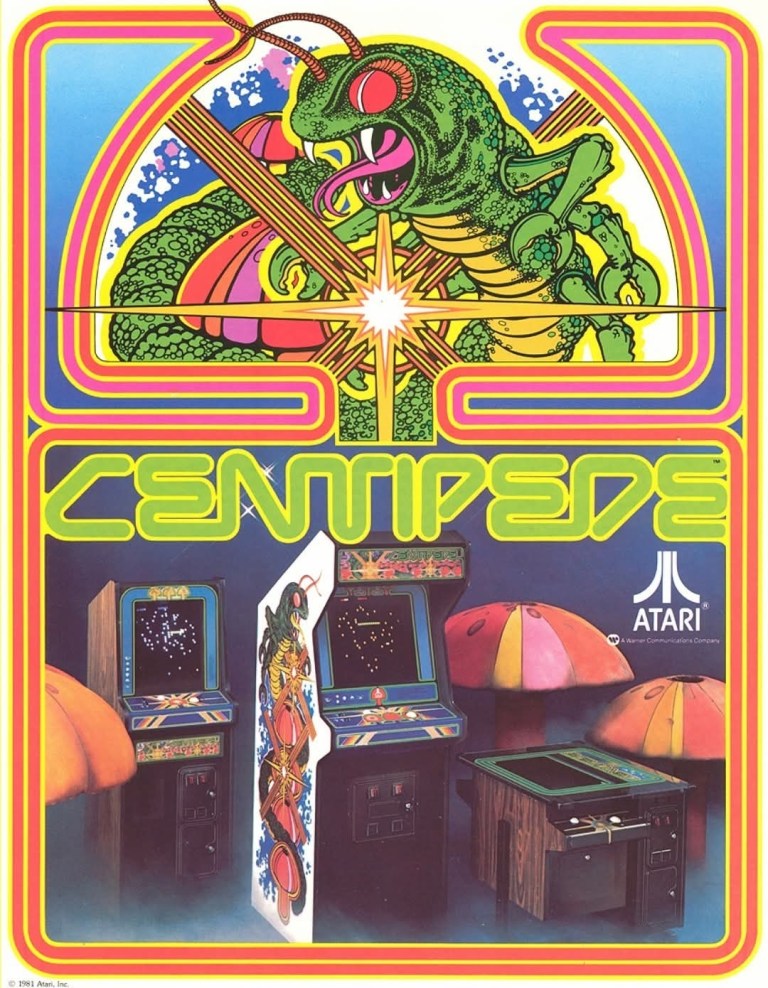
6. Centipede arcade flyer
Three machines of Centipede for arcade operators to choose from.
Centipede is another arcade classic from Atari. Released in 1981, a lot of players enjoyed the game’s simplistic and yet addicting design of shooting an incoming centipede and its remaining portions that move down the field. Similar to the Battlezone arcade flyer, this game’s flyer had nice art of a centipede on the top and images arcade machines. Even by today’s standards, this flyer remains eye-catching.
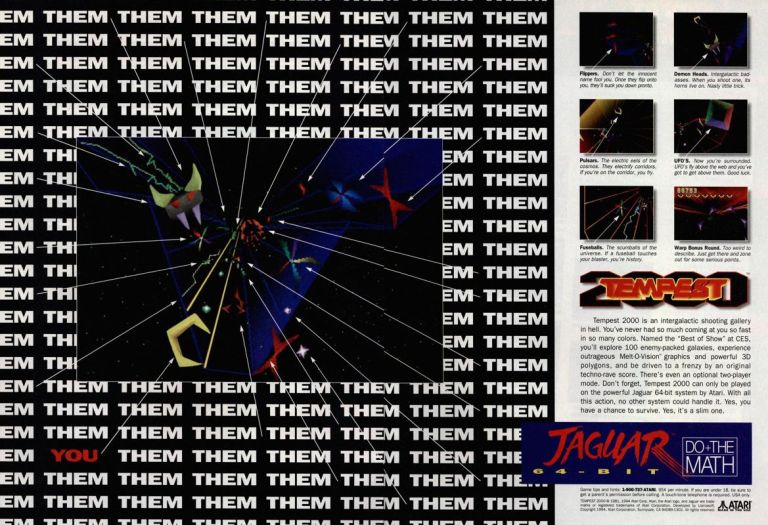
7. Tempest 2000 print ad
This 2-page print ad of Tempest 2000 is still captivating to look at.
Back in the 1990s, Atari went on to release their Jaguar console which was promoted as a 64-bit machine. At a gaming convention, the company met with prospective game developers over Jaguar projects and one of the developers volunteered to do Tempest (a memorable Atari arcade game). This resulted in the development of Tempest 2000 which was a remake of the classic.
As a Jaguar-exclusive game, Atari came up with an eye-catching 2-page ad showing off the 3D visual presentation (6 gameplay screenshots and one original artwork) while boasting in the text description that Tempest 2000 was named the “Best of Show” at the Consumer Electronics Show (CES). The game was released in 1994 attracting mostly positive reviews from game critics and was one of the best-selling Jaguar games (note: Tempest 2000 can now be played in the Atari 50 collection). With the Atari legacy and presentation combined, this print ad remains captivating to look at.
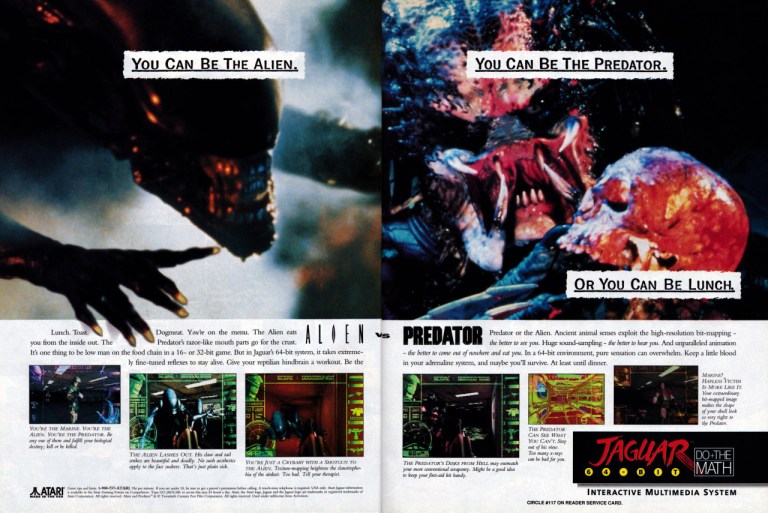
8. Alien vs Predator print ad
Arguably the most defining and most entertaining game on the Atari Jaguar.
If there is any game that truly defined enjoyment and the technological features of the Atari Jaguar, it is the 1994 first-person shooter Alien vs Predator. At the time of its release, it was one of the most immersive games of the Alien vs. Predator crossover franchise and it allowed players to experience what fighting the Predator or the Xenomorph was like. The game also allowed gamers to play as a Colonial Marine (human soldier).
To sell the game, Atari came up with a 2-page ad highlighting the Aliens on one page and the Predator on the other. As the Predator was shown with a grotesque human skull, the use of photographs (most likely sourced from the movies) strongly emphasize the game was aimed at the mature audience among gamers. Six screenshots of gameplay were displayed by the ad makers who were clearly aware of the high popularity of first-person shooting games. Alien vs Predator was a critical and commercial success, and its print ad is arguably the most memorable one of any Atari Jaguar game ever made.
Welcome back readers, fellow geeks and electronic gaming fans!
In this edition of the Retro Gaming Ads Blast (RGAB) series, we will take a look at another batch of retro gaming print ads – including arcade flyers – from the 1980s and 1990s.
For the newcomers reading this, Retro Gaming Ads Blast (RGAB) looks back at the many print ads of games (console, arcade, computer and handheld) that were published in comic books, magazines, flyers, posters and newspapers long before smartphones, social media, the worldwide web and streaming became popular. To put things in perspective, people back in the 1980s and 1990s were more trusting of print media for information and images about electronic games and related products.
With those details laid down, here is the newest batch of retro gaming print ads for you to see and enjoy…
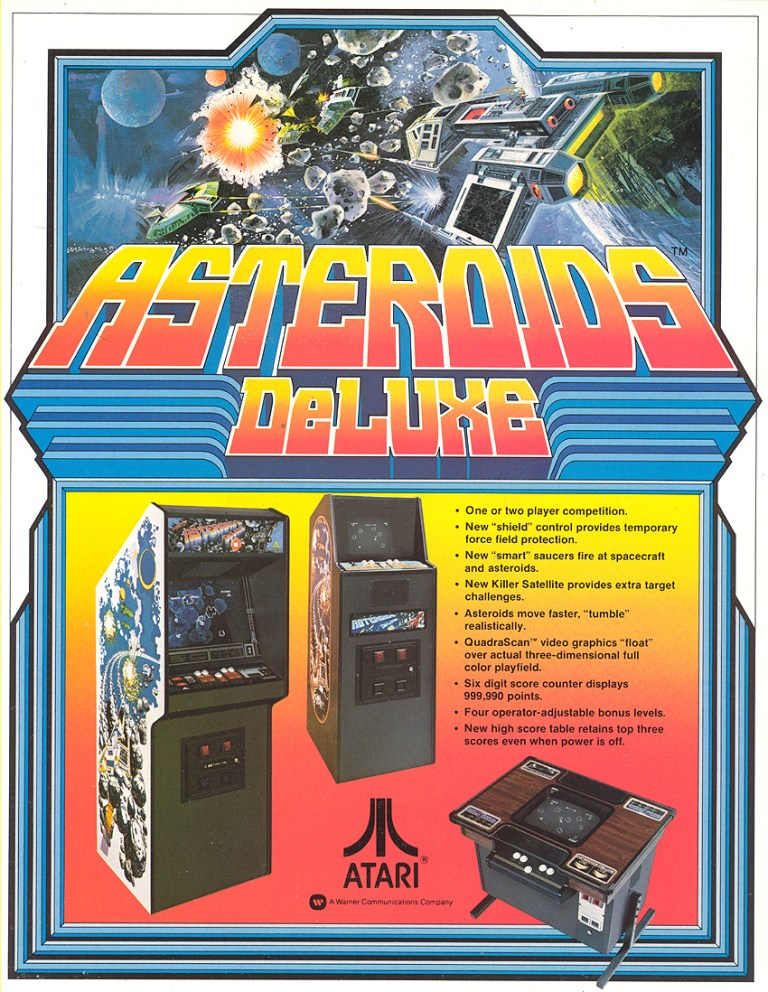
1. Asteroids Deluxe arcade flyer
The arcade flyer for North America.
Given the fact that Asteroids was a massive hit for Atari in the arcades, it was not surprising that a sequel was made called Asteroids Deluxe. In preparation for its 1981 release, Atari made this Asteroids Deluxe arcade flyer showing three machine that arcade operators can choose from complete with technical details displayed. They even emphasized the QuadraScan video graphics as a technological advancement with regards to graphics. By today’s standards, this arcade flyer is still sensible with regards to promoting the game to both arcade operators and players.
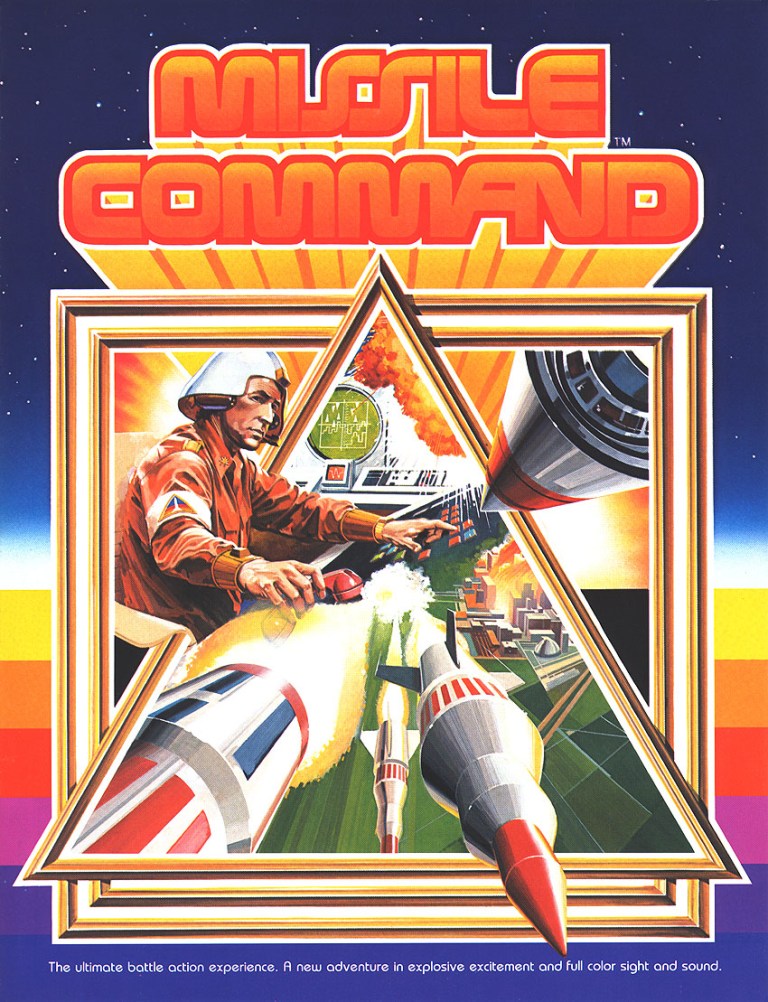
2. Missile Command arcade flyer
Engaging art work on display at the front of the arcade flyer.
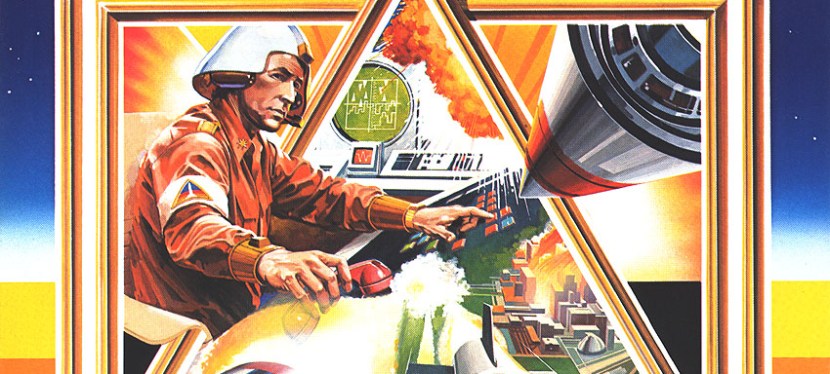
Released in the arcades in 1980, Missile Command is a classic game from Atari and its concept of defending cities from incoming enemy missiles proved to be relevant with people living with the fear of a nuclear missile attack during the days of the Cold War. In my experience, I mainly played the Atari 2600 version and it was only recently I finally started playing the arcade classic on my Xbox Series X using the Atari 50 Collection software. As for the arcade flyer itself, Atari simply used highly detailed painted art for the front which clearly emphasized the science fiction portrayal of a military officer using a console inside a base to come up with defensive response to incoming ballistic missiles. The game was a massive hit in the arcades and in my view, Atari’s simply yet direct way of promoting the concept of Missile Command with the arcade flyer remains compelling to look at.
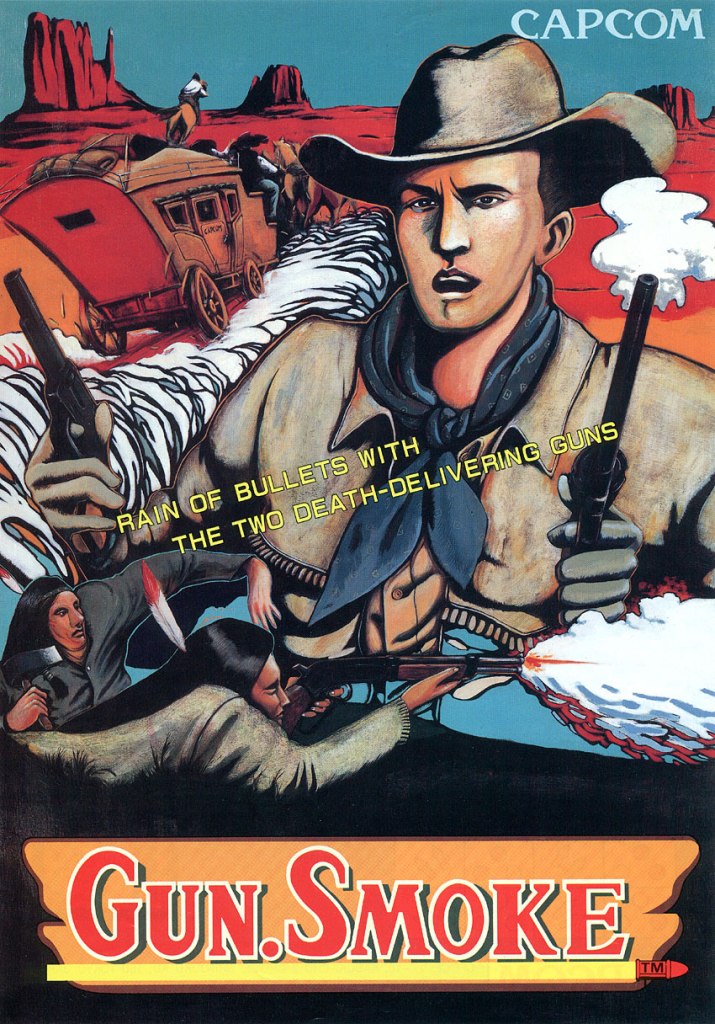
3. Gun.Smoke European arcade flyer
Nice art on the front of this arcade flyer for the European market.
Long before they struck gold with Street Fighter II, Japanese company Capcom scored a hit with gamers in the arcades with 1985’s Gun.Smoke. It was a vertically scrolling run-and-gun game with an Old West setting and it was designed by Yoshiko Okamoto (Final Fight and Street Fighter II). To promote the game for European arcades, Capcom simply used hand-drawn artwork for the arcade flyer’s front which emphasized the Wild West setting, and an American Cowboy and bounty hunter named Billie Bob who is the playable character gamers got to play. In my view, the artwork gave the game a strong Wild West image that is also memorable.
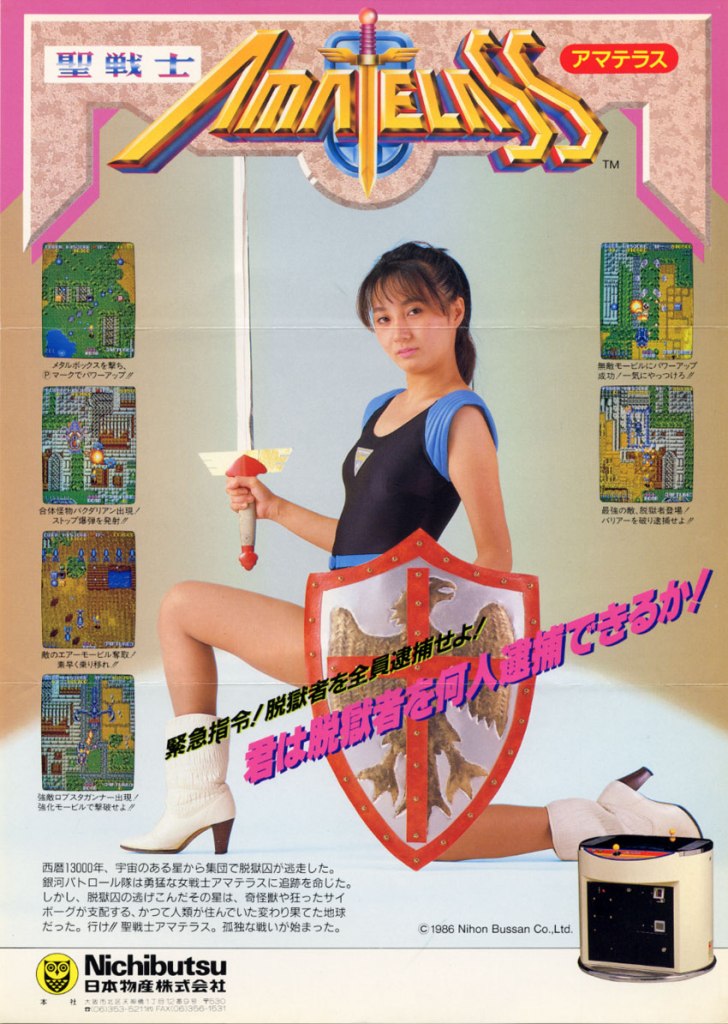
4. Sei Senshi Amatelass arcade flyer
Does the model look sexy or tough?
Released in Japanese arcades in 1986 by Nichibutsu, Sei Senshi Amatelass is a vertical scrolling run-and-gun game with a science fantasy concept. To promote the game and really sell its concept, Nichibutsu hired a model posing with a sword and a shield in fantasy inspired costume. Using the remaining spaces of the flyer, some screenshots and an image of the arcade machine were displayed. This flyer showed the company exerting effort to sell Sei Senshi Amatelass with a touch of beauty and subtle sexiness.
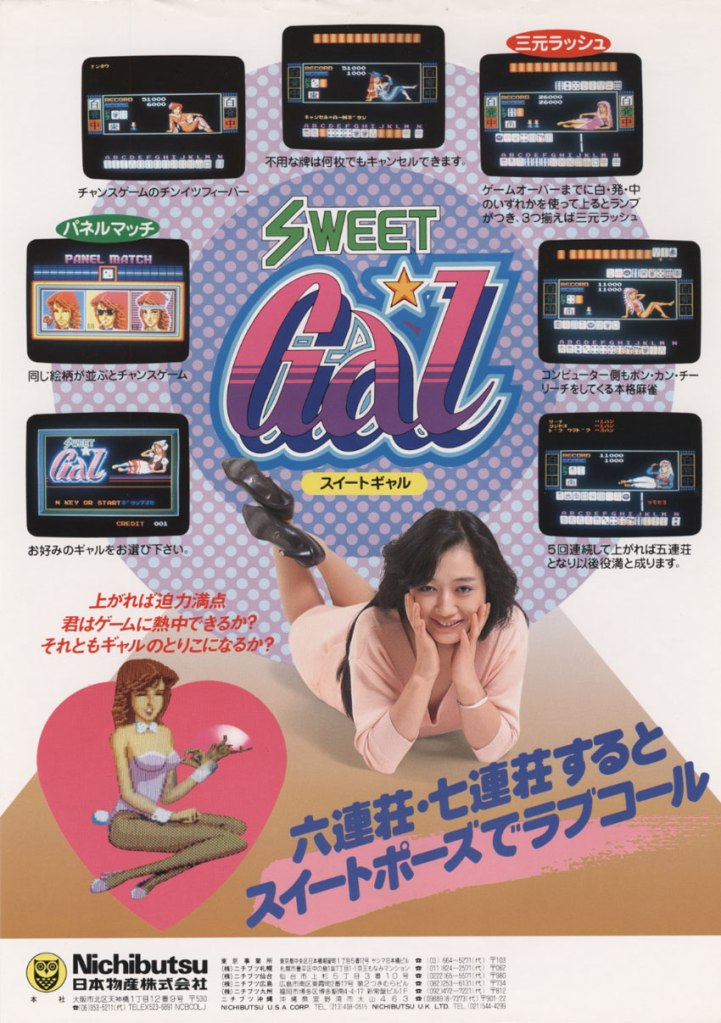
5. Sweet Gal arcade flyer
Seriously, are you interested in playing mahjong in digital form?
Here is another digital mahjong arcade game from Nichibutsu…Sweet Gal. As typical of the company, a model was hired to add subtle sexiness into the promotion of the game and they even added a digital image of a sexy girl. Sweet Gal clearly was promoted to attract men who enjoy playing mahjong in electronic format and there were some arcade spots in Japan that catered to such mahjong enthusiasts.
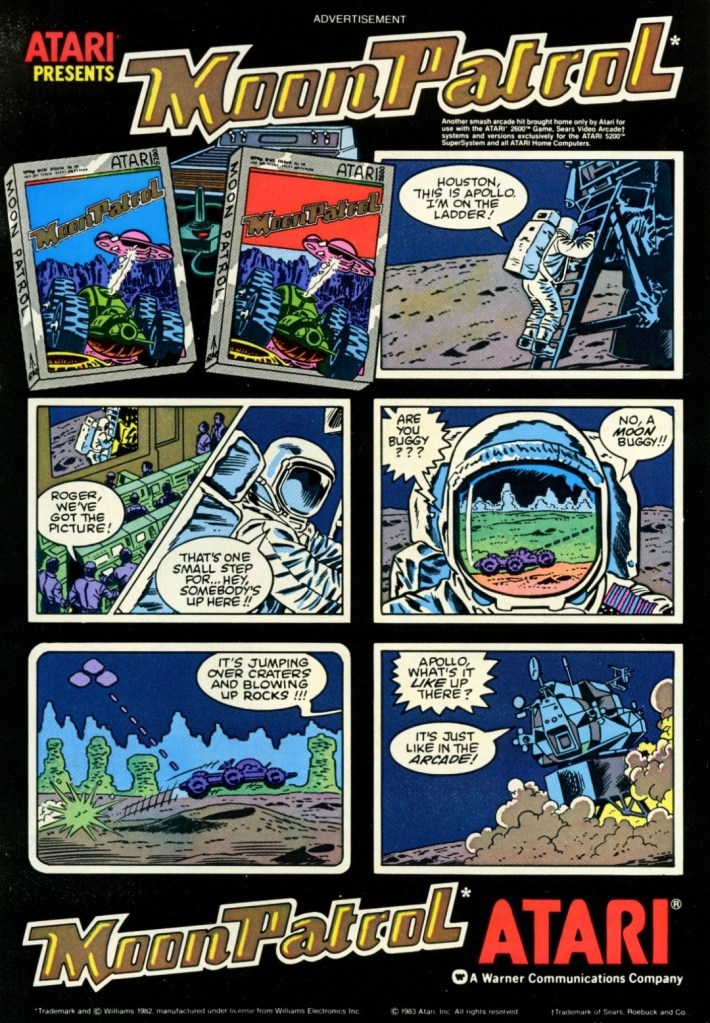
6. Moon Patrol print ad
This is a fun-looking, comic book style way of promoting a video game.
Here is one of those video game print ads I saw while reading comic books back in the early 1980s. Moon Patrol is a sci-fi, side-scrolling game by Atari known for introducing full parallax scrolling in side-scrolling games. Instead of showing screenshots of the console versions of the game, this print ad used nice looking hand-drawn artworks presented with a comic book-inspired style to emphasize the concept. I still remember how captivating this ad and its super short story was the first time I saw it. It was enough to make me interested in the game.
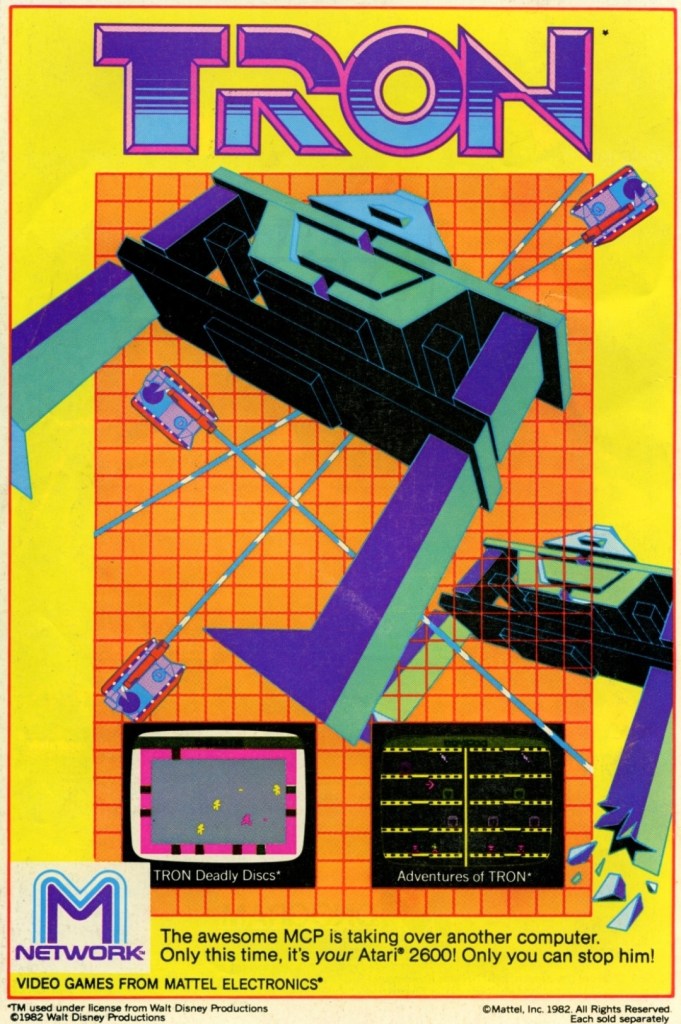
7. Tron Atari 2600 games print ad
Calling all Tron fans to look at this.
I was very captivated by the 1982 sci-fi movie Tron which I saw on home video. It had very flashy computer-generated visuals, a very memorable story and the fine performance by Jeff Bridges. Tron was also very reflective about the video game culture of its time. When I first saw this print ad while reading a comic book, I was really excited. If you look closely, it had nice artwork dominating the space and screenshots that each promoted the games Tron: Deadly Discs and Adventures of Tron. Even though the graphics were primitive, I still recognized the Tron-related images which added to my excitement.
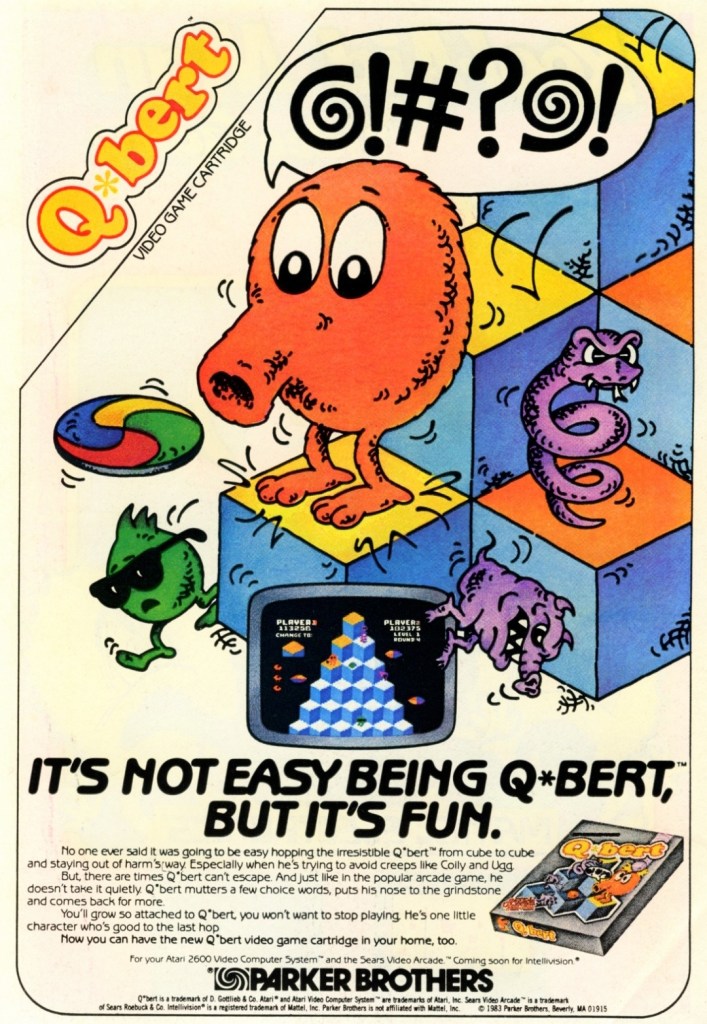
8. Q*bert print ad
This print ad by Parker Brothers really captured the essence of the game.
The puzzle-oriented 2D action game Q*bert became an arcade hit in America shortly after its 1982 release and even went on to become one of the highest grossing arcade games in 1983. Q*bert is one of those 2D games that cleverly blended puzzle play with 3D-like movement and avoidance of both obstacles and enemies. As expected, the game made its way into gaming console and this particular print ad had artwork that strongly captured the very essence of the game complete with the very catchy line “It’s not easy being Q*bert, but it’s fun.”
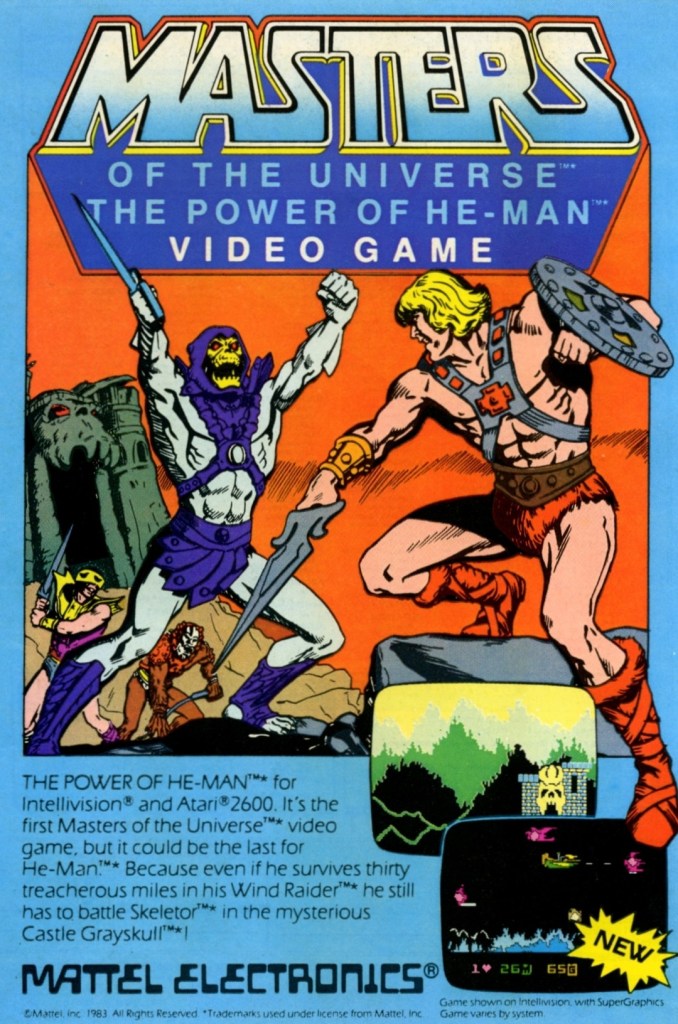
9. Masters of the Universe: The Power of He-Man print ad
Calling all He-Man fans.
I saw this print ad of Masters of the Universe: The Power of He-Man (for Atari 2600 and Intellivision) while reading a comic book long ago. Like the Tron games ad, this made me excited as I was fond of watching the He-Man cartoon series of the 1980s. While the selected screenshots caught my attention, it was the hand-drawn art of He-Man facing off with Skeletor and his minions that captivated me simply because it reminded me of the animated series. This is a fine example of promoting a video game that would instantly resonate with fans of He-Man and the Masters of the Universe franchise.
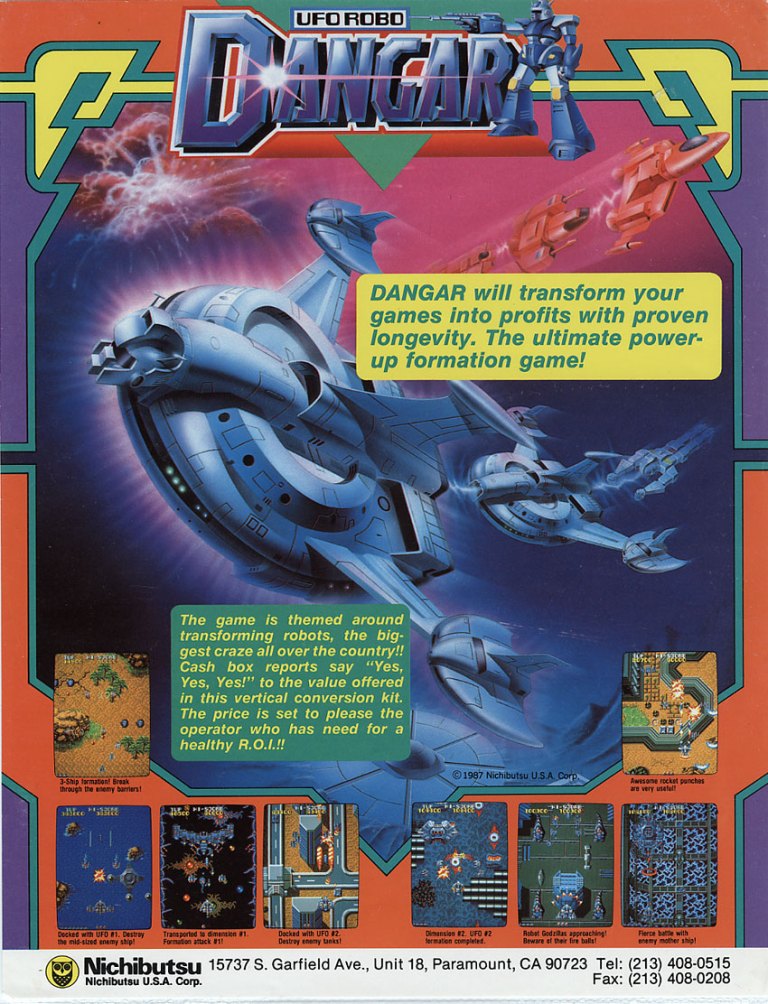
10. UFO Robo Dangar North American arcade flyer
The giant robot concept of this game gave some viewers the impression that it was based on some giant robot anime series from Japan even though the art work used does not suggest it.
Here is another arcade game from Nichibutsu but for the North American market and without the use of a model and without the subtle sexiness. UFO Robo Dangar is a 2D vertically scrolling science fiction shooting game and players get to control a giant robot (composed of flying vehicles that merged into one mechanical body) that has to go through countless waves of enemies in order to advance from one level to another. The arcade flyer used nice looking sci-fi art of ships with the game’s title having a robot and several screenshots of the game. The flyer even made a hard pitch towards arcade operators that UFO Robo Danger will transform their games into profits with proven longevity.
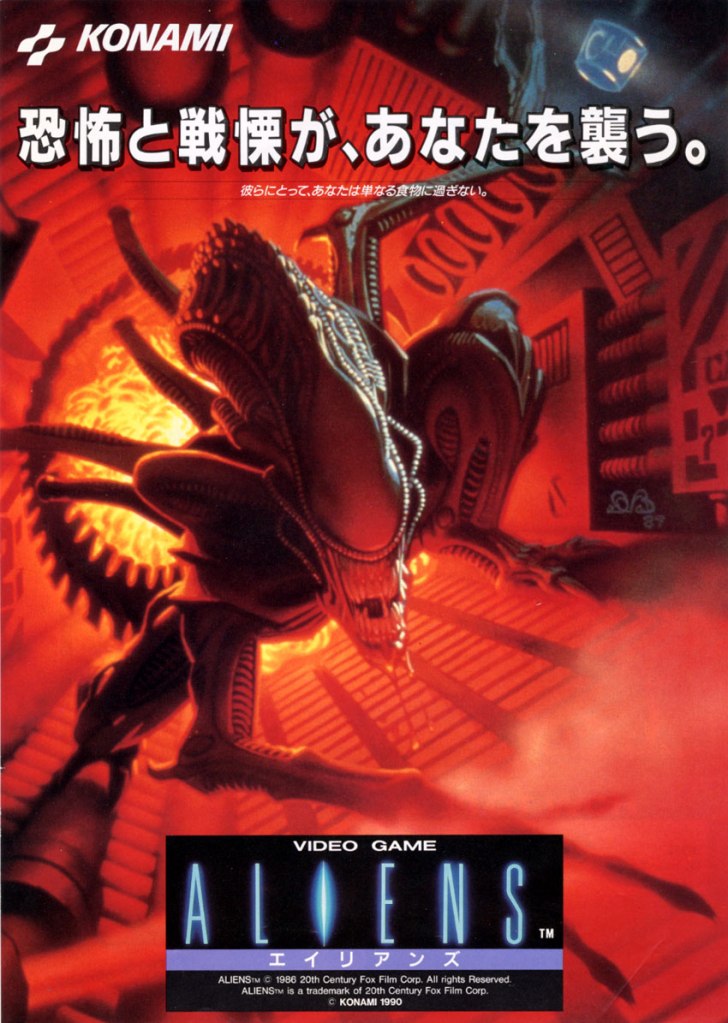
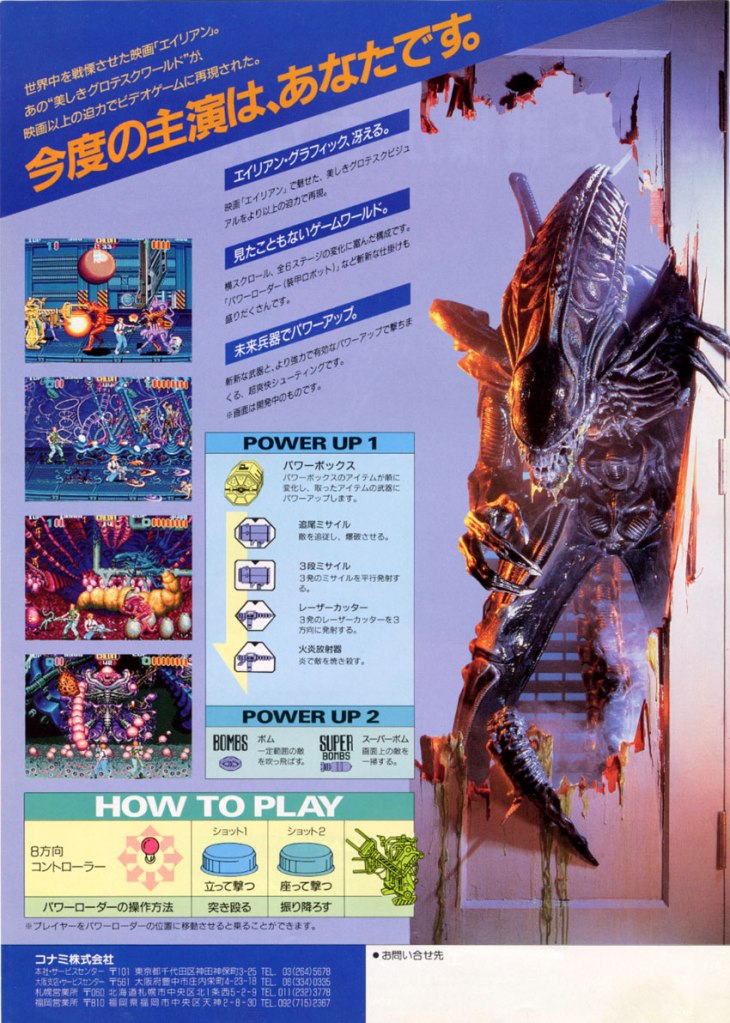
11. Aliens Japanese arcade flyer
The front.
The other side of the flyer of the 1990 arcade hit Aliens.
Quite arguably, Konami’s 1990 arcade hit Aliens is the best video game of any game design to be based on the 1986 film directed by James Cameron. Not only was Aliens a big hit in the arcades, it also won an award from the American Amusement Machine Association (AAMA). Aliens was released in Japanese arcades in February of 1990 and Konami released an arcade flyer that was much more visually striking than its North American arcade flyer. The front had detailed artwork of the Xenomorph while the rear had the instructions and screenshots presented in an orderly manner. The photograph of the Xenomorph alien was added intensity on selling the game. This is still a great looking arcade flyer.
Welcome back, my readers, YouTube viewers and all others who followed this series of articles focused on YouTube videos worth watching. Have you been searching for something fun or interesting to watch on YouTube? Do you feel bored right now and you crave for something to see on the world’s most popular online video destination?
I recommend you check out the following topics and the related videos I found.
#1 HolyLandSite’s examination of Kursi and Lord Jesus’ power over the demonic realm – Kursi is a place in the east side of the Sea of Galilee in the region of Gerasenes (or Gadarenes) in Israel where two men possessed by demons stayed at. HolyLandSite produced this video to emphasize the biblical relevance of the place, what happened and, most of all, the immense power Lord Jesus had over the demonic forces that caused huge problems for people back then. This is a biblical examination of the place and a lively reminder of the light and authority of Lord Jesus, the Savior and Hope of ALL nations. Grab a copy of the Holy Bible and then watch the video from start to finish.
#2GTV Japan examines Nintendo’s crisis – Remember back in the late 1980s when a shortage of ROM chips prevented Nintendo from releasing games on time? Back in those days, microchips were essential for manufacturing cartridges of games for consoles. A lot of people believed that Nintendo, which already had several restrictions on game publishing and business with 3rd party game companies, deliberately created the shortage for their advantage. There is a lot more details and developments that happened beyond the perceived shortage and the video by GTV Japan has a very in-depth look at it in the video below.
#3 What the hard drive of terrorist Bin Laden contained – Remember when America found and eliminated the mass murderer and terrorist Osama Bin Laden in 2011? YouTuber fern published a video focused on one particular aspect related to the operation that took Bin Laden down – the sensitive information contained in his hard drive. The video also has a key analyst interviewed who provided a lot of insight. Watch the video now.
#4 Wokeness in Japan exposed – Believe it or not, there definitely is wokeness in Japan and it was exposed a lot during their news media coverage of the 2024 US Presidential Election which Donald Trump won. In fact, a certain Japanese professor who was included in the media outlet’s coverage (being in the studio with others) was so liberal, he got frustrated as Commie Kamala Harris lost and he even reiterated the Democrats’ buzz words like “threat to democracy”. Think about it very carefully. The Democrats and their Satanic Left pawns have been spreading their distorted views in Japan and influenced some people there. The woke-minded in Japan may not realize it but they are looking and sounding awkward (if not pathetic). Perhaps some woke nuts of Japan love Islamic terrorists and I know they have pro-Palestine zealots. Watch and learn from the video below.
#5 Controversial Alice Guo featured in episode of Dark Asia with Megan – Alice Guo (AKA Guo Hua Ping), the controversial former mayor of Bamban who has been detained for various charges, is now the subject of a new episode of Dark Asia with Megan. For the newcomers reading this, Alice Guo is notorious in the Philippines not only for her links with POGOs (Philippine Offshore Gaming Operators) but also for her very questionable background with regards to citizenship, family and origin. She even escaped the Philippines temporarily before getting brought back. In fact, Alice Guo’s case raises a lot of questions about national security, espionage and foreign infiltration into the systems of governance in the Philippines. Watch and learn from the Dark Asia with Megan video.
#6 PatmanQC examines Donkey Kong – Long before Donkey Kong Country became a massive critical and commercial hit with gamers around the world, there was the original Donkey Kong in 1981. I never played the arcade version but I played Donkey Kong on the Atari 2600 back in the early 1980s and it was a fun game. A short time later, I played the ColecoVision version and was impressed to see the graphical improvements. The production history of Donkey Kong is really interesting and PatmanQC produced not just one but two documentary videos about the game.
#7 Popcorn in Bed and You, Me and the Movies react to Vertigo –Vertigo, the classic film directed by Alfred Hichcock, was one of the first twenty-five films selected for preservation in the US National Film Registry for being “culturally, historically, or aesthetically significant”. That being said, it is not surprising that it has been the subject of several movie reaction videos on YouTube. If you have not seen it, I encourage you to watch it entirely first when you have the chance. Otherwise, I encourage you to watch the reaction videos of Popcorn in Bed, and You, Me and the Movies below.
#8 Ashleigh Burton reacts to Signs – Back in 2002, I saw Signs inside a packed local cinema during the evening. The film directed by M. Night Shyamalan and starring Mel Gibson kept moviegoers in suspense and occasionally pulled off some sudden scary moments. That being said, you have to see Ashleigh Burton react to it.







 Author Carlo Carrasco