Disclaimer: This is my original work with details sourced from reading the comic book and doing personal research. Anyone who wants to use this article, in part or in whole, needs to secure first my permission and agree to cite me as the source and author. Let it be known that any unauthorized use of this article will constrain the author to pursue the remedies under R.A. No. 8293, the Revised Penal Code, and/or all applicable legal actions under the laws of the Philippines.
Welcome back superhero enthusiasts, 1990s culture enthusiasts and comic book collectors! Today we go back to the year 1993 to take a close look at the second issue of the second Venom comic book mini-series Venom: Funeral Pyre.
In my previous review, the gang-driven violence intensifies as the Punisher makes his move armed with lots of resources (including a van loaded with weapons and computerized functions). Venom struggles to free himself from the temporary prison the Punisher placed him in. As the violence escalated, Gray Russell finds himself in much deeper trouble as the anticipated rescue does not happen.
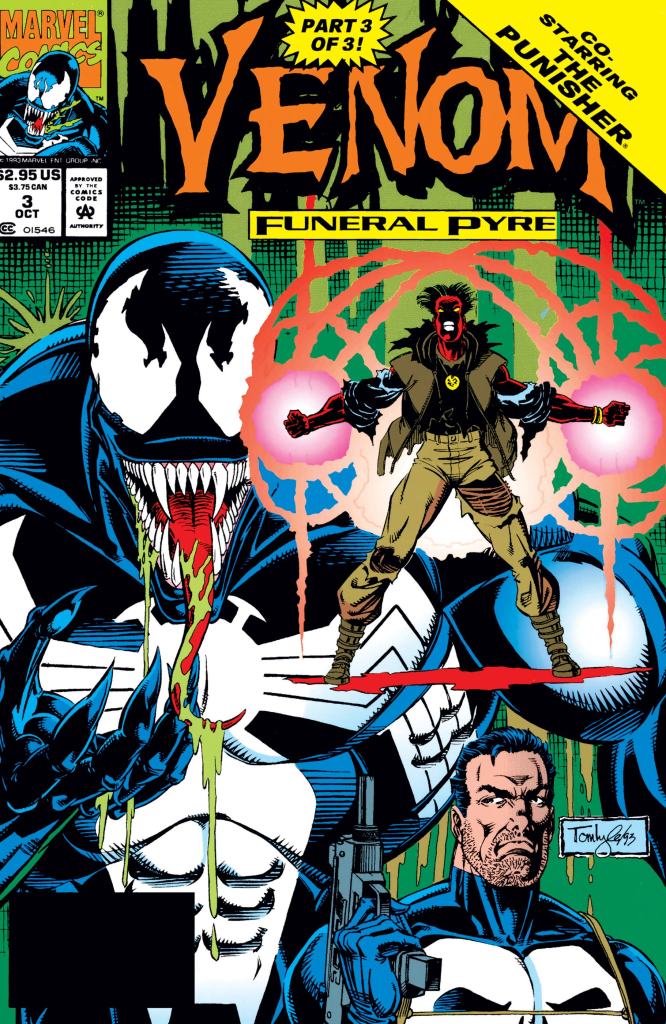
With those details laid down, here is a look back at Venom: Funeral Pyre #3, published in 1993 by Marvel Comics with a story written by Carl Potts and drawn by the late Tom Lyle. This if the final issue of the mini-series.
The cover.
Early story
The story begins inside a building with high-tech equipment from HYDRA. Gray Russel is no longer himself but as the red-skinned, highly radiated figure Pyre. He fires a microwave blast at Venom which hurts him so much. In response to Venom’s claim that he came to rescue him, Pyre reacts with rage telling the murderous man with the symbiote that he arrived too late which resulted in the forced killing of people during the gang violence on the streets of Oakland.
Being filled with pure rage, Pyre intends to burn Venom alive. Thinking that Pyre is distracted, the Punisher leaps to get a gun on the floor which causes the radiated person to fire a microwave blast at him. The Punisher takes cover behind a machine but notices the microwaves sparking off the metal.
Venom then takes advantage of situation…
Quality
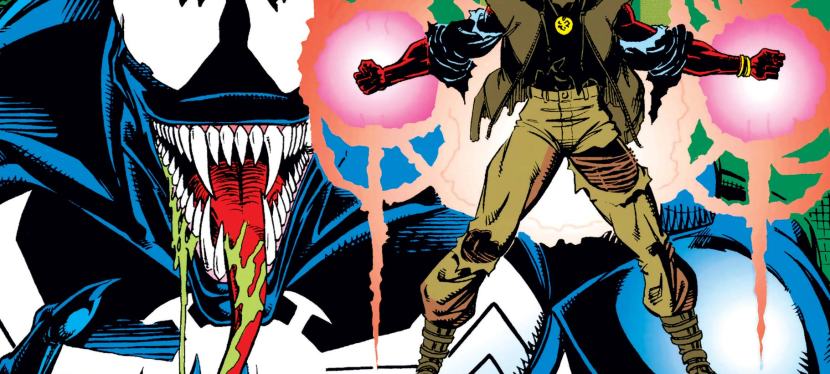
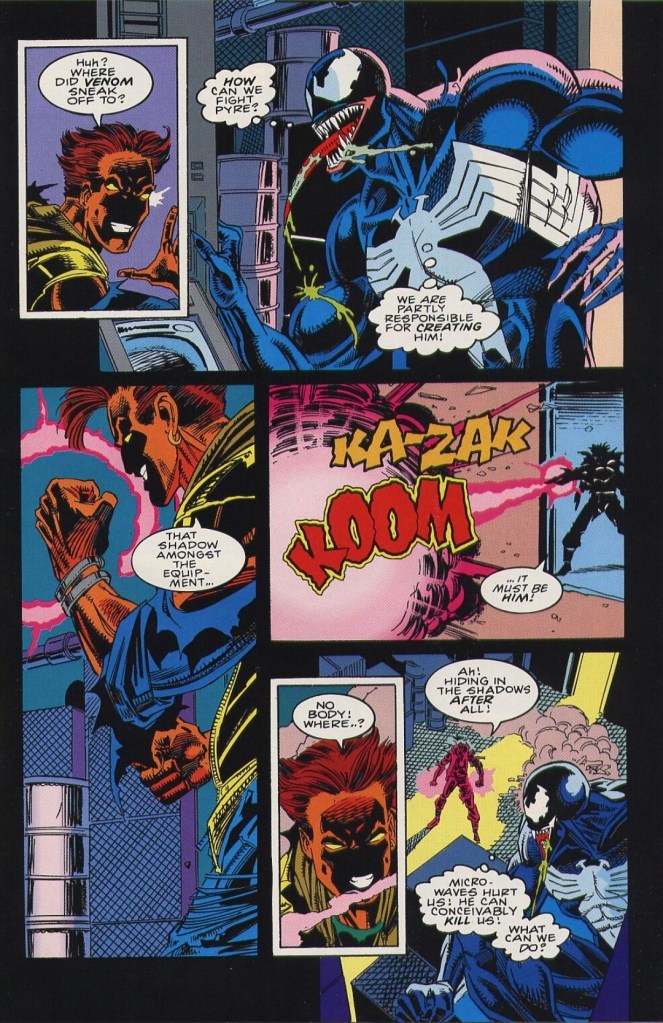
This page shows Venom at a disadvantageous state with Pyre whose microwave blasts are more than enough to kill him.
As the conclusion of the mini-series, this comic book went all-out portraying what turned out to be the final conflict involving the murderous Venom, the vigilante Punisher and the energy-filled Pyre. As a result, the narrative strongly focused on the final conflict (note: stretched out to last several pages) and never bothered to look back at the people and activities on the city street.
That being said, you will get to see more of the two established Marvel figures struggling hard against an unexpected force of opposition who was previously an undercover news reporter who infiltrated a certain gang and sent a message (delivered by a young boy) that caught Eddie Brock’s attention. At this point, it is clear that Venom’s effort to rescue Gray (who became Pyre after using a super soldier chamber left behind by HYDRA) ended in total failure and finds himself facing someone who could kill him and his alien costume together.
If there is anything notable about this issue, it is the portrayal of Venom being highly disadvantaged and even vulnerable. There are no armed men with sonic weapons and high-tech equipment to bring Venom down but Pyre whose microwave blasts are deadlier than flame and sonic. In connection to the situation, Venom is not his aggressive self but a struggling figure who strives to survive and somehow find solutions during the heat of danger.
The Punisher, meanwhile, also struggled to survive but would simply not run away even though his chances of escape are much better. Instead, he focuses on actually eliminating Pyre without hesitation and Venom’s attempt to rescue Gray meant absolutely nothing to him.
More on Pyre, he is not really interesting nor was he ever engaging as the one powerful force of opposition that Venom and the Punisher must face. His being consumed by unrestrained rage and wielding so much power did not really raise the tension of the story. Had he eliminated the two Marvel figures who got in his way, what would Pyre do afterwards? Devastate the entire city of Oakland because he lost his identity as Gray and could not get over his involvement of taking other people’s lives while in the middle of gang activities? Would he proceed to San Francisco’s underground community and eliminate the people only because he blames Venom (note: Eddie Brock got involved with the underground people of San Francisco as seen in the Lethal Protector mini-series) for his failure of rescuing him? Pyre is nothing more than a throwaway comic book force of opposition.
From a visual standpoint, Tom Lyle once again pushed his creativity hard and showed some dynamic shots of spectacle here and there. At this stage, he proved to be very capable of visualizing Venom and the Punisher.
Conclusion
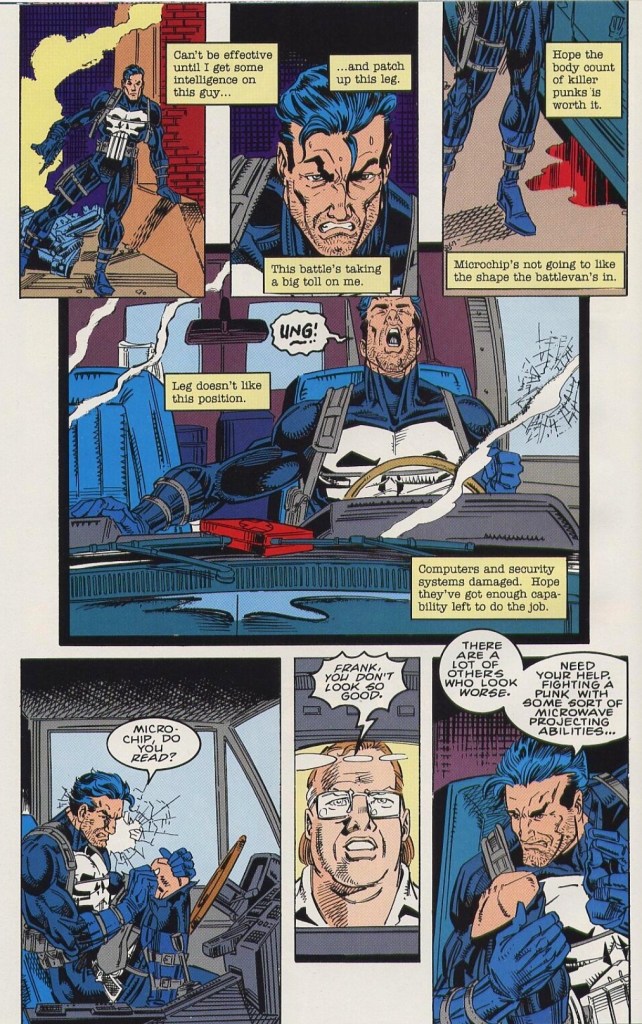
The Punisher refuses to give up and gets Microchip to assist him.
While issue #2 was a notable improvement over the first issue, Venom: Funeral Pyre #3 (1993) does not have much to offer in terms of engagement and entertainment. This is because it was crafted as a strict Venom-Punisher-Pyre conflict that provided spectacle and intrigue but ultimately ended up hollow. To see Venom at a huge disadvantage is interesting but did not add much weight to the plot. The Punisher was his usual self and in some ways overshadowed Venom for a while. Too bad there was not much space left for Venom and Punisher to fight each other again.
As the final issue of this mini-series, the story concluded with a whimper. Ultimately the Funeral Pyre storyline ended up as a diversion within the Marvel Comics shared universe that happened to attract Punisher, Venom and the gangsters of Oakland.
Overall, Venom: Funeral Pyre #3 (1993) is satisfactory.
Disclaimer: This is my original work with details sourced from watching the movie Cloak & Dagger (1984) and doing personal research. Anyone who wants to use this article, in part or in whole, needs to secure first my permission and agree to cite me as the source and author. Let it be known that any unauthorized use of this article will constrain the author to pursue the remedies under R.A. No. 8293, the Revised Penal Code, and/or all applicable legal actions under the laws of the Philippines.
Welcome back my readers, fellow movie buffs and 20th century pop culture enthusiasts! Decades ago, I got to watch the movie Cloak & Dagger when it was first released on home video. As time passed by, I got to replay it on cable TV and DVD. I have yet to see its 4K Blu-ray disc version (note: you can order it here) Starring Henry Thomas (the star of Steven Spielberg’s E.T.: The Extra-Terrestrial) and Dabney Coleman, Cloak & Dagger was one of those American movies that did not succeed in movie theaters but found its audience on home video, cable TV and free TV.
The 1984 movie was released at a time when video games gradually made its way into motion pictures in varied ways just before Nintendo started reshaping video gaming. Back then, I was very young and already got into playing games on console and at the arcade which helped me relate with the video game elements of Cloak & Dagger. In case you are wondering, the filmmakers and Atari, Inc. itself collaborated together. There may be some among you who never saw this 1980s flick and some of you may be wondering what is significant about Cloak & Dagger and why is it the topic of this retro movie review.
With those details laid down, here is a look back at Cloak & Dagger (1984) directed by Richard Franklin and written by Tom Holland and Nancy Dowd inspired by the short story “The Boy Cried Murder” written by Cornell Woolrich. This movie is the 4th cinematic adaptation of the said short story.
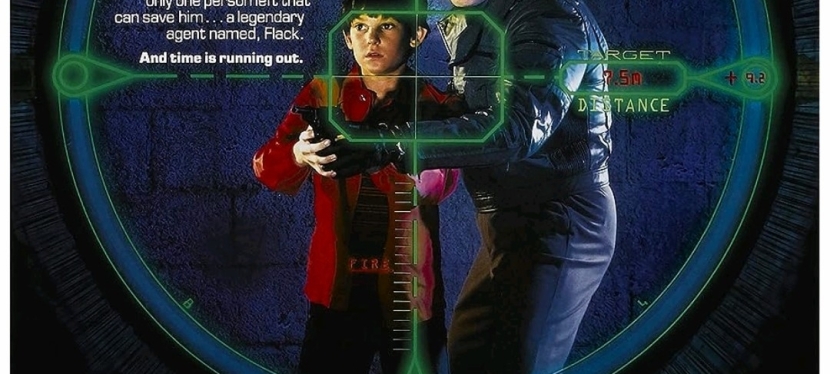
The movie poster of Cloak & Dagger (1984)
Early story
The story begins with Jack Flack (Dabney Coleman) overcoming Soviet guards to enter a place to retrieve top secret documents from incoming people. It turns out that Jack Flack is nothing more than a fictional character imagined by a young boy named Davey (Henry Thomas) who keeps on immersing himself with flights of fantasies, loves playing games and believes that real life is filled with enough opportunities and places to play. In the presence of game store owner Morris (William Forsythe) and his little blonde neighbor Kim (Christina Nigra), Davey boasts a lot about Jack Flack as if he was a real-life hero and even talks to him as his imaginary companion that no one else could see nor hear. Inspired by the said character and the world of espionage he always imagined, the boy carries with him a black water pistol for a “gun” and a softball for a “grenade”.
Morris then sends Davey and Kim out to do a real assignment – an errand to travel within the city going to a certain company and retrieve something for him. Afterwards, the two commuted and entered a building which Davey does with his fantasy of espionage and infiltration burning in his mind. Leaving Kim on the ground floor, he climbs up the stairs until he reaches a certain window and sees something sinister going on in the next level as reflected on one of the windows outside.
Suddenly a door opens near him and a wounded man slowly hands him an Atari 5200 cartridge titled Cloak & Dagger, tells him to bring it to the FBI, and mentions “one million three hundred twenty nine.”
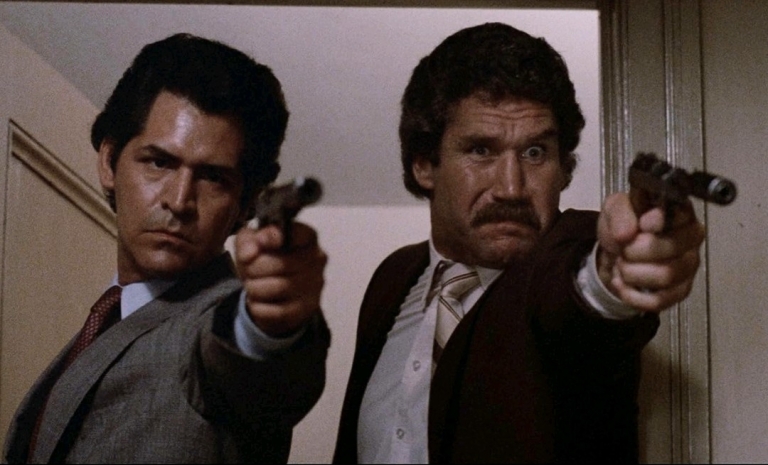
The door near them suddenly opens with two armed men emerging. Right in the presence of Davey, they opened fire at the wounded man who fell down to his death. Davey just became the witness of an actual murder and becomes the target of the two gunmen…
Quality
Henry Thomas and Christina Nigra as Davey and Kim respectively.
To get to straight to the point, I can declare that this movie is very clearly a spy thriller designed to engage both children and adults. It took the key concept of the short story “The Boy Cried Murder” and implemented it into its very own tale that happens to be set during Ronald Reagan’s America (the 1980s) with elements of video games, espionage and even murder mixed together.
The story told through Davey was crafted to be entertaining while keeping viewers in suspense as to how the overly imaginative young boy would deal with real-life danger and consequences as he became the target of murderous men who would not stop at all. Davey is clearly in danger for much of the movie and you will get to sympathize with him and wish he should stop being obsessed with fantasy so he could overcome the trials that were happening. This is, indeed, a well structure and nicely directed work by Richard Franklin who seem to be inspired by past works of Alfred Hitchcock (note: Franklin directed the sequel to Hitchcock’s classic Psycho).
As mentioned earlier, this movie was made to engage both children and adults. Cloak & Dagger is not exactly a wholesome viewing experience as its presentation has always been quite intense because of on-screen violence that was executed carfully. There are guns, shooting and even killing in this flick which proved to be integral to the overall presentation and clearly added to the thrill factor. You will get to see getting Davey shot at by the armed henchmen (Eloy Casados and Tim Rossovich) who clearly do not give a damn of shooting a minor as they are so focused on their mission. Looking at the henchmen in this film, I can imagine them as traitorous Americans conspiring with their nation’s foreign enemies such as the Soviets, the Iranians and the Palestinians. Along the way, there is the clear villain named Rice (Michael Murphy) who has this subtle touch of evil as well as a good amount of sleaziness in him. While the violence is intense, it does not necessarily push this film into rated R territory.
Michael Murphy as the sleazy villain who is willing to kill Davey even though he is a minor.
The two henchmen about to commit murder in the presence of Davey. There is evil visible in their faces.
Henry Thomas really shines as the protagonist here. While Davey here shares a few elements with E.T.’s Elliot – struggling to move forward with the absence of one parent and adjusting his life with what he perceives to be the best ways possible – he truly dramatizes how weird and wild he could be living his life with a very loose grip on reality. For him, local society in San Antonio, Texas, provides him a huge playground for his spy game and he sure distracts people as he walks by them talking to his imaginary friend Jack Flack. Still, there are key parts of the story in which Henry Thomas convincingly dramatizes Davey who feels lonely inside as he misses his late mother and is unable to spend quality time with his father. Thomas also acted with intensity in the scene in which he makes a trade with the villain and also during his last face-off with him in the 2nd half of the film. Henry Thomas really was a good youth actor and his performance here is often overshadowed by his role in Spielberg’s E.T.
Dabney Coleman on the other hand plays both Jack Flack and Davey’s father Hal. Coleman is quite versatile playing different characters here. As Jack Flack, he fits in excellently into Davey’s uncontrolled belief of espionage as he gives him advise which were taken seriously leading into danger. Of course, advising Davey does not really mean the fictional spy cares for him on a personal level and you will eventually Flack’s true value before the film ends. Flack’s final moments could inspire you to re-examine the true meaning of heroism. As Hal, Coleman convincingly plays the father who has been so busy working in the Air Force as an air traffic controller, he has been unable to spend quality time with his son and the recent death of his wife really took its toll on their family. Compared to Jack Flack, Hal is indeed caring towards his son but his hectic work schedule prevents him from bonding closely with him. Coleman delivered a fine performance during the scene when Hal explains to Davey what real-world heroism is and that not all heroes just shoot bad guys. There definitely are helpful values on parenting within Hal.
Henry Thomas and Dabney Coleman are really convincing as son and father.
Thomas and Coleman artistically have really fine chemistry together as the father and son (Hal and Davey) and as the wannabe adventurer spending lots of time with his action hero (Davey and Jack Flack). Considering Davey’s obsession with fantasy and the attention he pays so much to Jack Flack, he was practically living with idolatry and foolishness. If you observe closely, Davey is very lively with Flack and not so lively with his father.
Even though this movie is fictional, it still dramatizes that parenting will never be easy. That being said, this should inspire parents and also incoming parents to prepare themselves on nurturing their children and ensure they help them understand the differences between reality and fantasy.
Video game elements
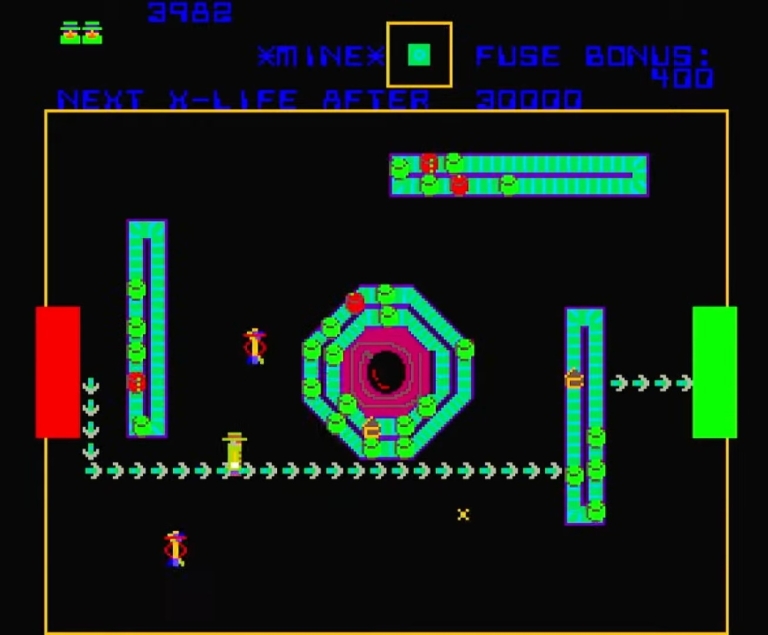
Screenshot from the Cloak & Dagger arcade game. This game can be played nowadays through Antstream Arcade on Xbox consoles.
To make things very clear, Cloak & Dagger (1984) is not an adaptation of the electronic game that was released the same year. Rather it has the Cloak & Dagger game as a key plot element in the form of an Atari 5200 game cartridge (referred to as a “tape”) which the movie dramatizes to be real.
As a kid, I got to play arcade and console games a lot. As such, seeing Davey play the Cloak & Dagger game on his Atari 5200 as well as gameplay footage was a very entertaining viewing experience for me the first time I ever saw this movie. It was a scene I personally related with.
In real life, however, the Cloak & Dagger game from Atari, Inc. was released only in the arcades as the efforts to create a port for the Atari 5200 never got fulfilled. That being said, it was through very clever film editing that video footage of the arcade version were inserted into the scene in which Davey played the Cloak & Dagger cartridge on his console in the presence of his father. To clarify things, the Atari 5200 was a commercial failure in real life and it seems that making a console version of the arcade game did not make business sense to Atari, Inc. at all.
If you want to play the Cloak & Dagger arcade game in your home right now, you will need an Xbox console and Antstream Arcade ($30 for 1-year subscription, $80 for lifetime pass). Cloak & Dagger is just one of over a thousand games available through Antstream Arcade and you can learn more by clicking here and here.
Conclusion
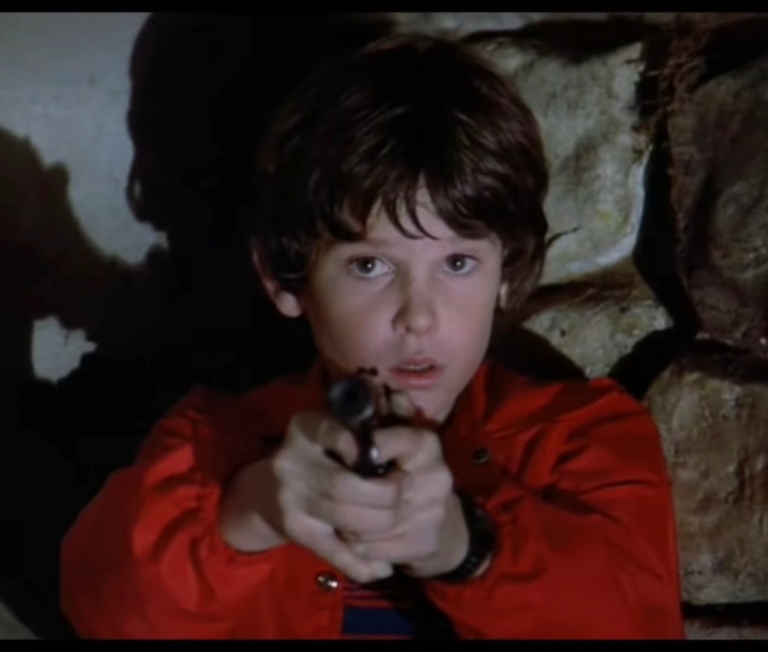
Henry Thomas as an armed Davey.
I have seen Cloak & Dagger (1984) many times throughout my life from childhood and to adulthood. I can clearly say that this 1980s movie is still really good to watch as its appeal to both children and adults remains strong and intact. It is a medium-paced spy thriller that not only follows a young boy who witnesses and murder and gets into danger (note: even his neighbor gets involved) but also dramatizes (in entertaining ways) how dangerous situations can get when you are living with uncontrolled personal fantasy and interacting with a heroic friend who does not really exist. Considering the time this movie was released, I am delighted to tell you cautious readers that there definitely is no wokeness nor were there any traces of political correctness that got in the way of its presentation. Going back to the parenting aspect of this film, it is made clear that children need their parents for moral support and there is absolutely no way that games, fictional heroes and geek culture could ever be good alternatives. Like the adults, children should never lose their grip on reality and should be taught that uncontrolled fantasy can lead to real-life danger. Very clearly, director Richard Franklin and the crew did a fine job telling a solid story and emphasizing the main characters while also providing suspense, action and thrills.
Considering all the mixed elements it has, Cloak & Dagger (1984) can be engaging towards parents, their children, fans of espionage and people who love video games. Finally, I should state that the City of San Antonio in the Lone Star State of Texas is indeed a great location for filmmaking and viewing.
For the newcomers reading this, over the past years a notable number of Square Enix games were released without versions on Xbox consoles. It is already out in the open that Sony had been signing deals with game publishers and developers to exclude Xbox consoles and Xbox Game Pass so that the PlayStation platforms will gain the competitive edge (click here and here). This seems evident in Square Enix’s announcement of Final Fantasy Pixel Remaster Collection coming to multiple platforms except Xbox.
Going to what happened this past weekend, almost out of nowhere Xbox chief Phil Spencer appeared alongside Square Enix CEO Takashi Kiryu and Square Enix video game producer Naoki Yoshida (AKA Yoshi-P) on stage during a Las Vegas event and symbolically confirmed the renewal of their business relationship. Adding credibility to the renewal was the announcement of Final Fantasy XIV for Xbox Series X and Xbox Series.
To put things in perspective, posted below is the Tweet from Xbox chief Phil Spencer himself…
Out of nowhere, today, Square Enix was joined on stage by Microsoft Gaming CEO and Xbox lead Phil Spencer to reveal that Final Fantasy 14: A Realm Reborn is finally coming to Xbox consoles in 2024.
Final Fantasy 14 is one of the best MMORPGs on the market, and one of the only credible alternatives to World of Warcraft, an MMO that Microsoft is poised to soon own with the Activision-Blizzard deal likely going through. FF14 has brought some serious competition to WoW in recent years, forcing Blizzard to up its game. It seems Square Enix isn’t taking that lying down either, announcing its own fresh expansion coming next summer, dubbed Dawntrail.
Additionally, incoming Square Enix CEO Takashi Kiryu had some warm things to say about Xbox that fans will no doubt be eager to hear (via Nova_Crystallis). Kiryu praised Phil Spencer for his “support” in bringing Final Fantasy 14 to Xbox. I believe Microsoft had to revert some of its long-standing Windows store policies around third-party content delivery networks in order to help get FF14 onto Xbox, and Spencer was naturally likely instrumental in getting that policy change through. Surprisingly, Kiryu also said that “with today’s announcement, and wherever possible, we are planning to bring our games to Xbox.”
“First off, I have thank you Phil-san for making the Xbox version of FF14 a reality. This is a project that would not have been possible without Spencer’s support. Please give him the biggest round of applause. As CEO of Square Enix, we want to continue to deliver fabulous games to fans across the globe. We want to welcome the Xbox community as well. Starting with today’s announcement and whenever possible we are planning to bring our games to Xbox for players to enjoy. Final Fantasy XIV is only going to get bigger and better. So I hope Xbox players give it a try.” – Takashi Kiryu, Square Enix CEO
Xbox lead Phil Spencer also emphasized that he looks forward to “building” on the relationship that brought Final Fantasy 14 to Xbox, and wants to partner with Square Enix on future games as well.
Indeed the renewal of ties between Xbox and Square Enix is a very positive breakthrough that will benefit not only the many millions of Xbox gamers (including those using Windows PC) worldwide but for video gaming as a whole. While Square Enix still has contracts signed with PlayStation still in effect, they and Team Xbox can collaborate on other available games for Xbox release. Whatever feelings you have towards the company behind the Final Fantasy games, this development opens the possibilities of releasing Legend of Mana games and a potential remaster of Xenogears on Xbox platforms. There is also the potential that Team Xbox can sign new deals with the Japanese titan to release more of its games on Xbox Game Pass (XGP).
While Final Fantasy XIV Online’s Xbox launch is still some time away, Xbox gamers have a lot to enjoy along the way with exclusives such as Starfield and Forza Motorsport (2023). Looking at the Xbox ecosystem as a whole, the renewed Xbox-Square Enix ties means more games from the Japanese titan will be released in the near future. Square Enix’s RPGs – both modern and classic – will add weight to Xbox as the ecosystem for RPG fans. That being said, I encourage you Xbox gamers to watch out for SE’s future releases. Also you might want to try the existing Square Enix RPGs still available on the Xbox store such as Chrono Cross: The Radical Dreamers Edition.
Final Fantasy XIV Online on Xbox
To gain a deeper understanding of the Final Fantasy XIV Online announcement, posted below is the excerpt from the Xbox.com article. Some parts in boldface…
After much anticipation, it’s finally confirmed – critically acclaimed MMORPG Final Fantasy XIV Online is officially coming to Xbox Series X|S.
First announced at the Final Fantasy XIV Fan Fest 2023 in Las Vegas by FFXIV Producer and Director Naoki Yoshida and CEO of Microsoft Gaming Phil Spencer, let’s break down the announcement and reveal and what it means for Xbox gamers now that one of gaming’s most welcoming communities is set to get even bigger!
What is Final Fantasy XIV Online? – Firstly, if you’re not familiar with Final Fantasy XIV Online, as the name would suggest, it’s the fourteenth mainline game in the highly esteemed Final Fantasy series. As with all mainline numbered Final Fantasy games however, each entry is a standalone game that doesn’t require any previous experience with the franchise. If you’ve never played a Final Fantasy game before, FFXIV is the perfect place to jump in!
FFXIV takes place in the world of Hydaelyn – a vibrant planet blessed by the Light of the Crystal. Amid azure seas, encompassing the westernmost of the Three Great Continents, there lies a realm embraced by gods and forged by heroes. Her name — Eorzea. It is here that your tale begins to unfold. Beckoned by the Mothercrystal — the source of all life — you must embark upon a quest to deliver the land from an eternity of Darkness.
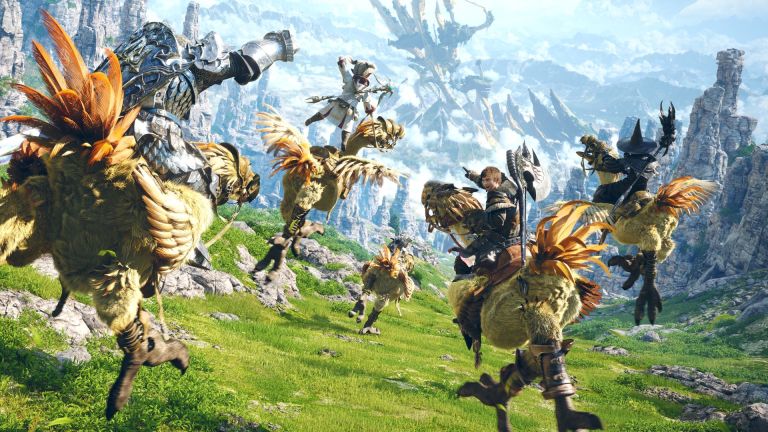
As an online massively multiplayer role-playing game, FFXIV offers a realm where you and 27 million adventurers worldwide can embark on epic quests together. Filled with bustling cities, towering forests, and deadly deserts, FFXIV’s constantly updated, and ever-engaging world takes you to the far reaches of the land and beyond, with a captivating and ongoing story. But it isn’t just about defeating massive monsters with your personalized Warrior of Light. You can also gather materials and craft items, enjoy series staples including Chocobos, Moogles, and Airships, enjoy a day of mini-games and mahjong at the Gold Saucer, and even buy a house.
Your adventure, played your way! – If all this sounds a bit overwhelming, never fear! Though initially designed to be played online with others, FFXIV includes a feature called the Duty Support system that enables tackling content with a party of NPC allies as opposed to other players. In fact, by the time the open beta launches it’ll be possible to complete all the main story dungeons from A Realm Reborn through Endwalker solo, enabling you to comfortably experience the stories of Eorzea on their own.
When can I play it…and what have I heard about a Free Trial? – Final Fantasy XIV Online is set to launch in open beta on Xbox Series X|S as part of the Patch 6.5x series, which means you can expect it very soon indeed! Alongside 4K support on Xbox Series X, both consoles will enjoy fast loading times, making sure your time in Eorzea looks and plays great.
Additionally, you may have seen some copypasta lurking around the internet pertaining to a certain free trial… well, rest assured, the Final Fantasy XIV Online Expanded Free Trial will indeed be coming to Xbox Series X|S, meaning you too will be able to enjoy the entirety of A Realm Reborn as well as the award-winning Heavensward and Stormblood expansions up to level 70 with no restrictions on playtime!
In concluding this post, posted below are Xbox-related videos for your enjoyment.
Among the many games shown, Team Xbox formally announced an improved version of the Xbox Series S console – a carbon black Xbox Series S loaded with 1 Terabyte SSD all set for commercial release on September 1, 2023 with a price tag of $349.99. This machine is also referred to as Xbox Series S – 1TB.
To put things in perspective, posted below is an excerpt from the official Xbox.com announcement. Some parts in boldface…
Meet the new Carbon Black Series S with 1TB of storage. Whether you’re looking to upgrade from your current console or are new to Xbox, the Xbox Series S – 1TB offers you another option within the Xbox family of devices. The bold Carbon Black color is the same sleek, modern matte finish as Xbox Series X and the Xbox Wireless Controller. This console features the same next-gen speed and performance of our 512GB Series S, now with double the storage so you can download even more of your favorite games to your console where they’ll be ready to play when you are. Plus, you’ll make the most of every gaming minute with features like Quick Resume, lightning-fast load times, and gameplay of up to 120 FPS – all powered by Xbox Velocity Architecture.
Better Together – Xbox Series S pairs seamlessly with all our fan-favorite Xbox accessories. You can also add an Xbox Game Pass Ultimate subscription (membership sold separately) so you can play new games built natively for Xbox Series S and X like Starfield and Forza Motorsport on day one. Plus with games added all the time, there’s always something new to play.
Available Worldwide September 1 – Launching September 1 (just in time for Starfield), pre-orders for Xbox Series S – 1TB start today at xbox.com or microsoftstore.com for $349.99 ERP. We’ll be adding more retailers and regions in the weeks to come.
Now watch the official Team Xbox YouTube video below…
If you ask me, I don’t intend to buy the Xbox Series S – 1TB as I already own an Xbox Series X console which is the more expensive machine as it is a premium product. Still, there is no denying that the Xbox Series S – 1TB and its older (soon to be phased out) predecessor strongly appeal to gamers who have limited amounts of money to buy new game consoles, as well as gamers who don’t care much about 4K resolution gaming and movie viewing at home.
Xbox Series S – 1TB release on September 1 is very strategic as the epic Bethesda-developed Xbox-exclusive sci-fi RPG Starfield will be released just days after. A little over a month later, the Xbox-exclusive Forza Motorsport (2023) will be released. Sometime in 2024, the Obsidian-developed Xbox-exclusive fantasy RPG Avowedwill be released. I would not be surprised to see the Xbox Series S – 1TB sell a lot (note: first-time gamers as well as owners of the old Xbox One consoles and even those with Xbox Series S consoles will be more likely customers) before those Xbox exclusives get released and eventually more new subscribers to Xbox Game Pass (XGP) (note: I encourage you to subscribe) will be realized. There will also be a lot of other new games, game compilations and remastered games that will be released in the 4th quarter this year.
Watch out for Xbox Series S – 1TB on September 1, 2023.
Disclaimer: This is my original work with details sourced from reading the comic book and doing personal research. Anyone who wants to use this article, in part or in whole, needs to secure first my permission and agree to cite me as the source and author. Let it be known that any unauthorized use of this article will constrain the author to pursue the remedies under R.A. No. 8293, the Revised Penal Code, and/or all applicable legal actions under the laws of the Philippines.
Welcome back fellow geeks, pop culture enthusiasts and comic book collectors! Way back in 1982, the horror comedy anthology film Creepshow was released in cinemas and it gave moviegoers a fun time getting scared as it featured well-made short stories written by Stephen King and directed by George Romero. The two creators were strongly influenced by the 1950s horror comic books of EC Comics when they made the movie. Very recently, Creepshow was released on 4K Blu-ray loaded with lots of extras for fans and moviegoers to enjoy. The said 4K Blu-ray release can be ordered online now.
I myself first saw Creepshow on home video sometime in 1983 and got to replay it occasionally on cable TV and DVD. Strangely enough, it was only a few years ago when I first learned that there was indeed a comic book adaptation of the movie that was also released the same year it hit cinemas.
With those details laid down, here is a look back at Stepehen King’s Creepshow published in 1982 by Plum with stories written by Stephen King and drawn by Bernie Wrightson (with Michele Wrightson). The cover was illustrated by the late EC Comics legend Jack Kamen.
The cover.
Early stories
Father’s Day – Sylvia Grantham, her nephew Richard, niece Cass and Hank (husband of Cass) enjoy time together at the Grantham estate anticipating the arrival of Bedelia for the annual family dinner. It is an open secret within the family that Bedelia killed her late father Nathan Grantham who was so overbearing to her as she became responsible on nursing him full-time.
Bedelia apart from her relatives in Father’s Day.
The Lonesome Death of Jordy Verril – A lonely farmer named Jordy witnesses the unexpected arrival of a meteorite from out space which landed violently on his farm. After realizing what it is, he touches it without any protection and gets his fingers burned. Considering the rarity of the object, Jordy begins to imagine making a lot money by bringing it to the local college.
A page of the story of Jordy and the meteor.
The Crate – In the basement level of Amberson Hall (science building of Horlicks University), a janitor accidentally finds a very old wooden crate located right under the staircase. The writings “Ship to Horlicks University via Julia Carpenter – Arctic Expedition – June 19, 1834” were marked on the crate. Meanwhile a faculty party is taking place across town. During the party, the mild-mannered college professor Henry Northrup experiences embarrassment as his unhinged wife Wilma (note: referred to as Billie) talks way too much in front of professor Dexter Stanley and many others. Henry reveals to Dexter that he has grown to hate his wife. Suddenly, someone tells Dexter that a telephone call for him is waiting. It was the janitor who made the call.
Henry, wife Wilma (AKA Bilie), the janitor and Dexter Stanley in The Crate.
Something to Tide You Over – At a beach, Harry Wentworth could do nothing but remain helplessly immobile as his entire body and neck have been buried under the sand by Richard. It turns out that Harry has been having an affair with Becky, Richard’s wife. The helpless Harry expressed that he and Becky were really in love with each other. For his part, Richard has something else to show to him and he certainly has some things prepared.
Richard and Harry in Something to Tide You Over.
They’re Creeping Up on You – A wealthy and cruel businessman named Upson Pratt is alone in his well-lighted apartment. He has been suffering from mysophobia and has been living in isolation and only communicates with others using the telephone and other electronic methods. Slowly but surely, cockroaches begin to multiply in his apartment.
Upson Pratt and the cockroaches in They’re Creeping Up on You.
Quality
Starting with the storytelling with emphasis on how the comic creators selected content from the movie and translated it all into illustrated literature format with a little over sixty pages to work with, I can say that this comic book is pretty much a faithful adaptation of the film’s five short stories (note: the cinematic prologue and epilogue were never adapted). For each short story, it is clear that sufficient details from each cinematic tale were adapted and the overall concepts, acts and characterizations were pretty much maintained. This is a credible piece of illustrated literature work as each tale is not only readable but also engaging and entertaining complete with shock moments. Take note that Stephen King not only wrote all these tales for the movie, there were two tales that were previously published in literary format before Creepshow was even made. Whoever participated in the editing process behind the production of this comic book deserves commendations.
While the writing used in adapting the film’s concepts and characters turned out good, it is clearly obvious that certain cinematic elements could not be translated here. Remember how frantic and scared Dexter Stanley (played by the late Fritz Weaver) was in the movie after he witnessed the janitor got killed by the monster? Those cinematic emotions never made it in illustrated literary format here.
The artworks by Bernie Wrightson are pretty good to look at. Similar to the writing, the visuals here were made to recapture the look of the movie not in a shot-for-shot manner but with the artist’s own approach on how such scenes should be presented. That being said, I should state that the comic book panels that appeared in the movie’s transition scenes (example: still live action image slowly turning into illustrated comic book form) are NOT here at all.
You will instead see Wrightson’s own visual interpretation of the scenes from the movie and the artworks were inspired a bit by the 1950s horror comics of EC Comics and ultimately were more in line with the contemporary approach of drawing comic book art of the 1980s. The gory scenes from the movie made it in this comic book. When it comes to drawing monsters or the undead, the art result was uneven. While Wrightson’s art of the monster in The Crate was really scary to look at (in accordance to how it appeared cinematically), the work on the walking dead in Something to Tide You Over looked much less scary compared to those in the film.
While Wrightson clearly did not prioritize recapturing the likenesses of the actors to illustrate their respective characters, there were a few shots in which professor Henry Northrup somewhat looked like the late Hal Holbrook, and the illustrated Bedelia resembled the late Viveca Lindfors.
Conclusion
The best way to describe Stephen King’s Creepshow (1982) is this…it is indeed a very solid adaptation of the movie and its five short stories. While it was clear that not all the dialogue and other types of content of the movie could ever fit in this comic book, the creators did a very credible job of adapting Creepshow’s core elements and succeeded in making what they had solidly presented for readers to enjoy. Each short story from the movie turned out to be cohesive and enjoyable for reading.
When it comes to really enjoying this graphic novel, I personally would recommend you readers to watch the Creepshow movie first before reading. The film is the complete package of entertainment showcasing the combined works of Stephen King and director George Romero, while this comic book is ultimately the companion piece for those who enjoyed the movie as well as EC Comics’s horror comic books of the 1950s.
Overall, Stephen King’s Creepshow (1982) is highly recommended!
Disclaimer: This is my original work with details sourced from reading the comic book and doing personal research. Anyone who wants to use this article, in part or in whole, needs to secure first my permission and agree to cite me as the source and author. Let it be known that any unauthorized use of this article will constrain the author to pursue the remedies under R.A. No. 8293, the Revised Penal Code, and/or all applicable legal actions under the laws of the Philippines.
Welcome back fellow geeks, pop culture enthusiasts and comic book collectors! I want to make things clear to all of you that when it comes to movies, Indiana Jones is truly an American icon who will be remembered for a long time thanks to the combined works of the legendary creative team of Steven Spielberg, George Lucas and Harrison Ford.
In case you are wondering, I have no intention to watch Indiana Jones and the Dial of Destiny (2023) since that movie was specifically handled by Kathleen Kennedy whose leadership of Lucasfilm (under the Disney banner) ruined Star Wars since 2015. It does not help that the new movie was not directed by Spielberg and clearly it does not involve George Lucas on the creative side. I should state that I reject wokeness, political correctness and identity politics which defined Kathleen Kennedy’s handling of Star Wars and Indiana Jones.
That being said, now is a good time to back into the 1980s when the Indiana Jones entertainment franchise was still new and creatively expanding into other forms of media. In fact, Marvel Comics started publishing an Indiana Jones comic book series between Raiders of the Lost Ark and Indiana Jones and the Temple of Doom.
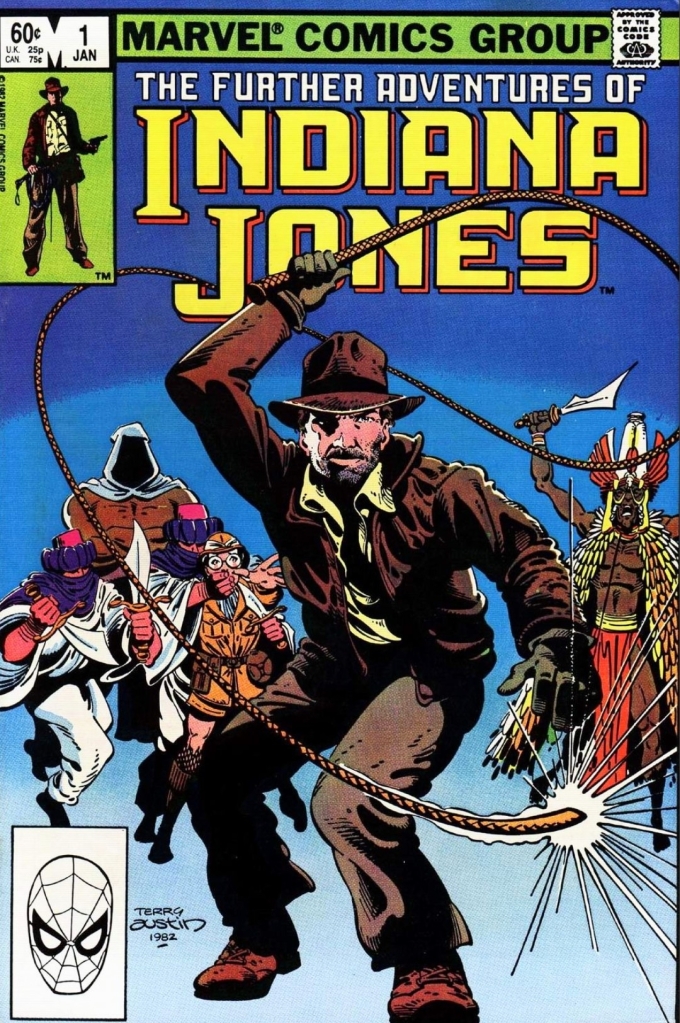
With those details laid down, here is a look back at The Further Adventures of Indiana Jones #1, published in 1983 by Marvel Comics with a story written and drawn by John Byrne with ink work by Terry Austin.
The cover.
Early story
The story begins with Indiana Jones (wearing formal attire for his academic profession) attempting to whip a small stick off the mouth of Miss Greebly who was standing very still. Jones’ superior Dr. Marcus came in to witness the stunt.
Shortly after, Jones and Marcus meet with former student Charlie Dunne who reveals to them he and his sister Edith learned the location of the Ikons of Ikammanen. Just seconds after stating he could prove that the ikons exist, Dunne suddenly gets hit on the back with a knife.
With Dunne suddenly killed and the discreet killer already gone, Jones and Marcus examine the content of the victim’s bag and find a map of coastal Africa, a photograph of a temple and an address…
Quality
Indiana Jones and Edith on a dangerous search.
I will start by stating the obvious thing about this comic book…it looks and feels like a genuine Indiana Jones adventure with clear inspiration taken from the 1981 movie. The basic elements are here: Indy does research and some detective work, he travels overseas searching for answers, faces danger along the way, and gets involved in a series of unexpected events. The good news is that John Byrne crafted a fun and high-quality literary adventure featuring the cinematic icon.
This comic book has an original story concept and deliberately the narrative flowed at a medium pace which allows build-up to immerse readers into the details, followed by some bouts of pay-off to entertain readers. I also like the way the narrations laid down the details with the intention of helping readers understand not only the situations, locations and people, but also giving them unique perspectives about Indy himself. The dialogue was well written and clearly believable. When Indiana Jones explains details, he really uses the knowledge he gained through academic research as well as recollections from his past expeditions or adventures.
I should also state that Byrne gave Indiana Jones, the other characters and locations stylized looks. I don’t mind Jones not resembling Harrison Ford at all but Byrne still made him recognizable in his own unique way. There were some location images that looked pretty detailed.
Conclusion
And just like that, Indiana Jones takes a leave from academic work for his next adventure.
The best way to describe The Further Adventures of Indiana Jones #1 (1983) is this…John Byrne and his team succeeded in making this a fun read inspired by elements of Raiders of the Lost Ark. The story has a strong adventure feel with Indy having a strong presence and the introduction of new characters were executed smoothly. For a launch issue, this one is indeed engaging to read and it succeeded in convincing me to anticipate the next issue. Ultimately it is clear that John Byrne really is an effective Indiana Jones storyteller.
Overall, The Further Adventures of Indiana Jones #1 (1983) is highly recommended!
Disclaimer: This is my original work with details sourced from reading the comic book and doing personal research. Anyone who wants to use this article, in part or in whole, needs to secure first my permission and agree to cite me as the source and author. Let it be known that any unauthorized use of this article will constrain the author to pursue the remedies under R.A. No. 8293, the Revised Penal Code, and/or all applicable legal actions under the laws of the Philippines.
Welcome back superhero enthusiasts, 1990s culture enthusiasts and comic book collectors! Today we go back to the year 1994 and explore a part of the Marvel Comics universe through one of the many tales of the Amazing Spider-Man comic book series.
In my previous retro review, Spider-Man has been caught by the Jury and gets tried in a makeshift court that is so secretive, getting help from outside is impossible. The trial explored how Spider-Man, who brought the alien costume into their world which later led to the beginning of his murderous mortal enemy, is responsible for the deaths and other tragedies connected to Venom.
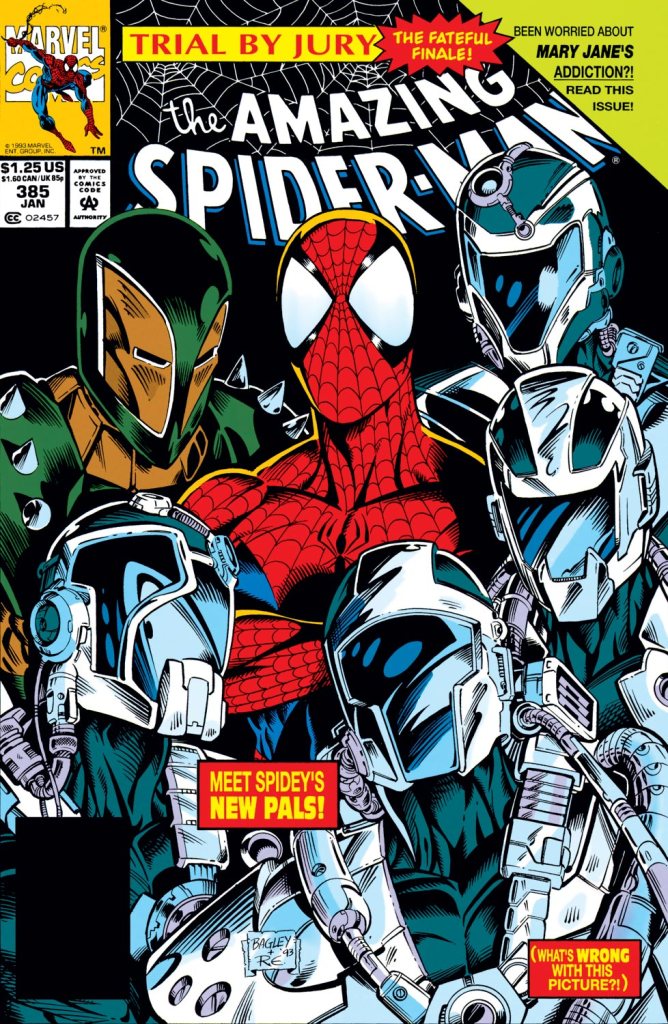
With those details laid down, here is a look back at Amazing Spider-Man #385, published in 1994 by Marvel Comics with a story by David Michelinie and drawn by Mark Bagley. This issue marks the final chapter of a 3-part storyline between the iconic webslinger and the Jury.
The cover.
Early story
The story begins with a restrained Spider-Man declared guilty and sentenced to death by the so-called court of Orwell Taylor and the Jury. Just as the team members are about to execute the webslinger, their teammate Ramshot intervenes and says that Spider-Man saves lives which is a matter of public record. Disappointed by Ramshot’s behavior, Taylor mentions their secondary mission is to obtain a weapon that might allow them to eliminate their true enemy – Venom.
Taylor then says that if Spider-Man would help them destroy the greater evil, then the court would consider commuting his sentence…
Quality
Something unfortunate happens during the mission involving Spider-Man and the Jury.
Considering all the drama and tension that was built up in the previous two issues, the story here is a letdown. For one thing, all the discussions about Spider-Man being responsible for the killings and violence caused by Venom lead to nowhere as the story took a turn for the bizarre concept of the hero getting spared to work with the very team that went after him. Secondly, the mission that Spidey and the Jury worked on really did not have a justifiable goal. This resulted in a disappointing turn of events. Ironically, in this comic book you will see more of Taylor’s cunning on top of his own distorted view about justice.
If there is anything notable here, it is the fact that Spider-Man’s wife Mary Jane gets a good share of the spotlight as she literally moves towards the edge in relation to the deteriorating marriage. This shows that as Spidey spends more time away to do what is good and push back against the forces of evil, his wife gets lonelier and desperate as life turns for the worse. At the very least, this comic book expresses that the marriage of Peter and Mary Jane could be doomed.
Conclusion
This is how Mary Jane deals with loneliness and the decline in her life.
Considering what was built up and heavily dramatized in issues #383 and #384, Amazing Spider-Man #385 (1994) is a rather weak conclusion. The way Spider-Man and the Jury parted ways felt more like sudden retreat than a real finish to what was started between them. Strangely enough, the focus on Mary Jane’s decline and desperation literally saved this comic book from becoming a creative disaster. The ending does not have much to do between Spider-Man and the Jury, but it was surprising in a crude way.
Overall, Amazing Spider-Man #385 (1994) is serviceable.
Not only that, those who want to watch the streams in 4K resolution at 60FPS should head on to YouTube.com/Xbox and YouTube.com/Bethesda. There will also be multi-language support in the forms of subtitles.
What to expect? Based on the recent tweets by Xbox Games Marketing executive Aaron Greenberg, the Xbox Games Showcase and Starfield Direct will combine for roughly two hours non-stop games and it will all be about games. There won’t be any movie trailers to disrupt the double feature. Look at the tweets below…
Already, it has been confirmed that there will be no CGI-trailers about Team Xbox’s games at the two showcases. Personally, I prefer to see gameplay footage showing how the upcoming games function and how they could turn out fun. When it comes to showing story cutscenes, using gameplay graphics is more preferrable to me.
What video games to expect from Team Xbox? While it is inevitable to me that they will show the promised 2023 exclusives Forza Motorsport (2023) and Bethesda’s highly anticipated Starfield, I can only speculate that Phil Spencer and his team will give fans big updates (note: to be showcased visually, not just mere announcements) about other Xbox-exclusives such as Senua’s Saga: Hellblade II (read my article), the new Fable role-playing game (RPG), the fantasy RPG Avowed from Obsidian Entertainment (read my last article of Avowed), and possibly State of Decay 3 from Undead Labs. While it is possible that the troubled Xbox-exclusives Everwild and the Perfect Dark reboot could also be shown, I’m not confident about them. I also do not expect anything to be shown about Hideo Kojima’s Xbox project nor the other exclusive game Contraband.
I am anticipating that a final release date for Forza Motorsport (2023) will be announced, and the same should happen with Senua’s Saga: Hellblade II (possibly late-2023 or early 2024). Avowed, if its development has progressed a lot since the first announcement, could be announced for 2024 and it should help satiate gamers’ demand for the epic open-world fantasy RPG experience of the Elder Scrolls game franchise. In my view, the Elder Scrolls VI is still years away from getting released. As for Fable, it could be shown but without a release date.
Starfield will have its very own showcase immediately after that of Xbox. That being said, I am anticipating a very in-depth gameplay demonstration of the game, some more bits about its story and core concept, and hopefully there will be options for gamers to play the game in 30FPS and 60FPS with varying resolutions. I personally want to play Starfield on my Xbox Series X console in 60FPS. I hope they will show more space battles which I think will add more variety to the gameplay as a whole. We will find out soon from Bethesda and Todd Howard on Starfield Direct.
When it comes to the Gears of War franchise, I’m not really anticipating a new Gears sequel. What would be more doable, in my opinion, is Team Xbox revealing a Gears Tactics sequel which should delight fans of the 2020 game as well as gamers who love playing turn-based tactics games. For me, the time is right to announce a new Gears Tactics game!
In my view, the time is right for a Gears Tactics sequel to be unveiled while gamers worldwide endure the long wait for the next Gears of War game.
As for games from other companies that could be part of the Xbox Games Showcase, I am anticipating an appearance and updates about Eiyuden Chronicle: Hundred Heroes in terms of new gameplay and hopefully a final release date within 2023 (note: this Japanese RPG will also launch on Xbox Game Pass). Very recently, Japan-based developer Rabbit & Bear Studios posted updates about the game on social media which just might mean there will be a possible appearance on the showcase. Take note that Eiyuden Chronicle: Hundred Heroes’ inclusion on Xbox Game Pass is significant and this weekend’s online event is the best opportunity to promote it and make both XGP subscribers and JRPG fans excited.
There is the possibility that Konami could show Suikoden I&II HD Remaster Gate Rune and Dunan Unification Wars and announce a firm release date for 2023. The showcase is also a great opportunity for Konami to promote the classic games to a worldwide audience and finally start executing their marketing plans that should excite Suikoden fans as well as gamers who love JRPGs.
When it comes to dream scenarios (note: the unlikely) that could really make waves if they ever happen at the Xbox showcase, that would be Capcom showing a big-budget remake ofDino Crisis (comparable to what they did with Resident Evil 2, 3 and 4) as well as announcing remastered versions of Breath of Fire RPGs for release on modern consoles plus Xbox Game Pass. I understand Capcom has its very own games showcase scheduled for the next day but the Xbox showcase is still a great opportunity to make waves with gamers worldwide. More wild scenarios? That would SEGA announcing the next Virtua Fighter game or a fully remastered Shining Force III (with all three chapters together), 2K Games revealing XCOM 3 (note: it’s been seven years since XCOM 2) plus Square Enix actually announcing a remastered version of Xenogears (note: this year marks the 25th anniversary of the game).
At this stage, we can only wait and see what will happen next. Team Xbox should show more games related to the latest Xbox Game Studios Publishing developments and other deals they made with developers – both the big and the smaller independent ones – so far. Not only that, there has to be something new and ready to be revealed from Team Xbox’s game studios such as Compulsion Games, inXile Entertainment and others. The excitement and suspense are building up!
Watch out for the games, the exciting stuff and big announcements at the Xbox Games Showcase and Starfield Direct Double Feature this weekend!
In concluding this article, posted below for your enjoyment are Xbox-related videos.
The highly anticipated Barangay and Sangguniang Kabataan Elections (BSKE) will happen nationwide on October 30 and the Philippine National Police (PNP) issued a warning to candidates about engaging with Communist elements, according to a Manila Bulletin news report.
To put things in perspective, posted below is an excerpt from the Manila Bulletin news article. Some parts in boldface…
The Philippine National Police (PNP) warned on Monday, May 29, those who aspire to run for barangay and Sangguniang Kabataan (SK) elections to refrain from engaging with communist rebels, particularly in seeking assistance to ensure victory.
PNP chief Gen. Benjamin Acorda, Jr. said there are laws that could be used against those who would be found to be dealing with the local forces of the Communist Party of the Philippines-New People’s Army (CPP-NPA) such as the Republic Act No. 11479 or the Anti-Terrorism Act of 2020.
Acorda is particularly referring to the direct payment by candidates to the CPP-NPA, through the permit to campaign and permit to win for the barangay and SK elections scheduled in October this year.
“Let me caution candidates who will fall for this election racket of the CPP-NPA that any form of monetary or material support to the CPP-NPA, a terrorist organization, is tantamount to ‘terrorist financing’ that is punishable under Republic Act No. 11479 or the Anti-Terrorism Act of 2020,” said Acorda.
“And if the donor or giver is an incumbent Barangay or SK official, the crime is further aggravated by willful disloyalty to their Oath of Office,” he added.
The Chief PNP, however, said they do not foresee serious security problem for the barangay and SK elections.
The elections for sets of officials for the 42,022 barangay across the country will start with the 90-day election period on Aug. 28 until Nov. 29.
“This early, we do not foresee any serious peace and order concerns on a national scale in the barangay and SK elections. The actions of some remaining active guerilla fronts of the CPP-NPA are closely being monitored for possible conduct of atrocities,” said Acorda.
“Security measures are now being prepared regarding this,” he added.
Let me end this piece by asking you readers: What is your reaction to this recent development? Are you concerned that the Communists, the Marxists, the socialists and other Leftists out there will negatively affect the BSKE by engaging with the candidates? Are you hoping for a free and honest BSKE election? Do you think it is possible for Democrats in America to be funding their Leftist partners here in the Philippines?
For more South Metro Manila community news and developments, come back here soon. Also say NO to fake news, NO to irresponsible journalism, NO to misinformation, NO to plagiarists, NO to reckless publishers and NO to sinister propaganda when it comes to news and developments. For South Metro Manila community developments, member engagements, commerce and other relevant updates, join the growing South Metro Manila Facebook group at https://www.facebook.com/groups/342183059992673
Disclaimer: This is my original work with details sourced from reading the comic book and doing personal research. Anyone who wants to use this article, in part or in whole, needs to secure first my permission and agree to cite me as the source and author. Let it be known that any unauthorized use of this article will constrain the author to pursue the remedies under R.A. No. 8293, the Revised Penal Code, and/or all applicable legal actions under the laws of the Philippines.
Welcome back superhero enthusiasts, 1990s culture enthusiasts and comic book collectors! Today we go back to the year 1993 and explore a part of the Marvel Comics universe through one of the many tales of the Amazing Spider-Man comic book series.
In my previous retro review, Spider-Man gets involved not only with the Incredible Hulk but also with Doc Samson who has a history of treating the green giant and carries a strong sense of responsibility towards him. Something, however, infected Samson and eventually the Hulk which leads to a new wave of destruction in New York City which itself is still recovering from the chaos of Maximum Carnage.
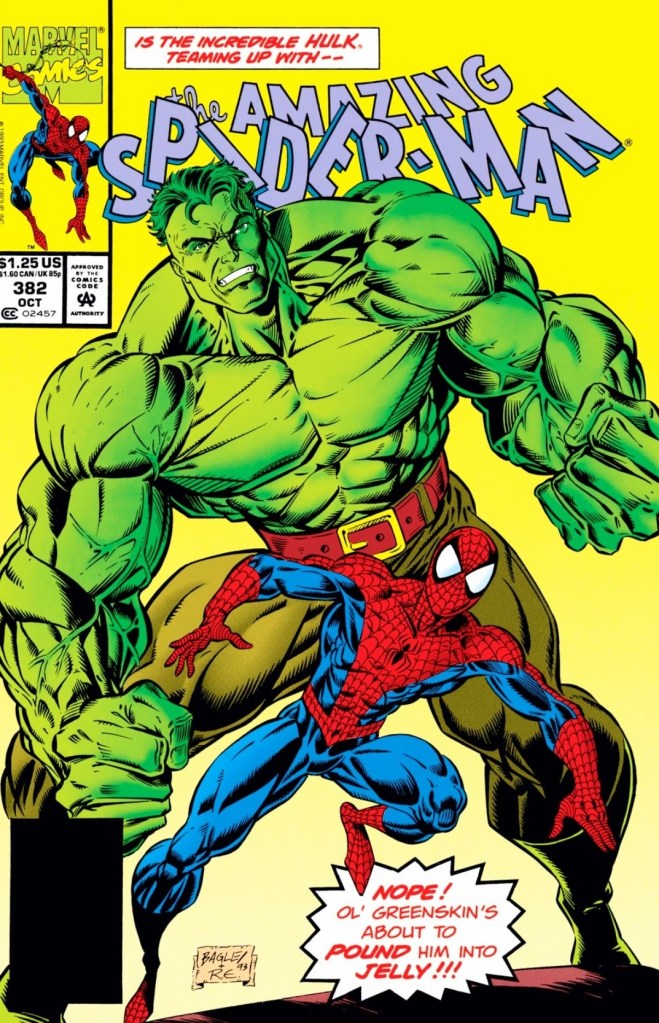
With those details laid down, here is a look back at Amazing Spider-Man #382, published in 1993 by Marvel Comics with a story written by David Michelinie and drawn by Mark Bagley.
The cover.
Early story
The story begins with the Hulk (note: infected with the gamma virus which is driving him to violence) striking the pavement hard causing Spider-Man and Doc Samson to move away. After a quick exchange of words with Samson regarding the virus, Spider-Man jumps towards the Hulk and hits his face in an attempt to stop him before he causes any more damage to the city.
Doc Samson desperately tries to contain the Hulk by choking him only to be grabbed and get thrown to a solid structure nearby. Now down on the pavement, Samson notices the Hulk jumping in towards him…
Quality
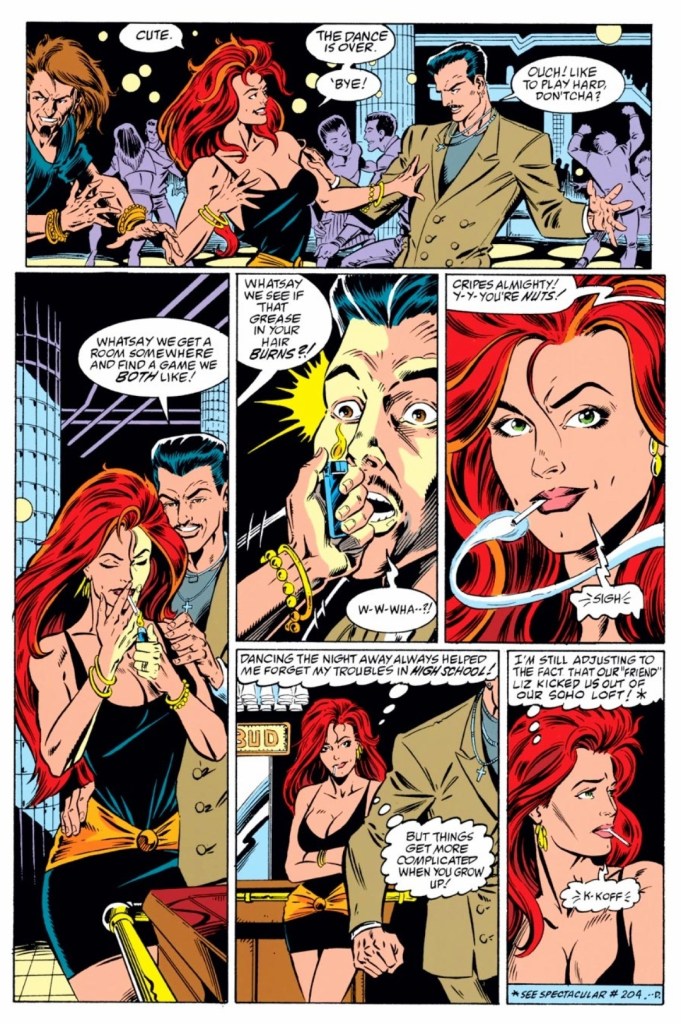
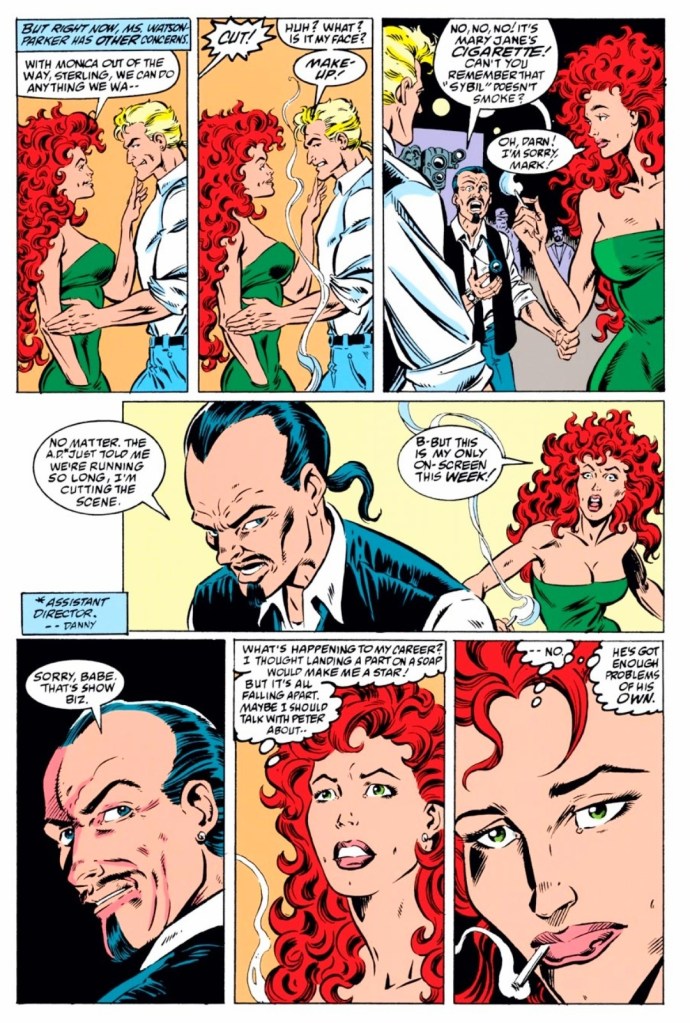
Mary Jane Parker in trouble with her acting career.
This story is indeed a solid and satisfying conclusion to what was started in issue #381. Not only does this comic book showcase a battle between Spider-Man and the manipulated Hulk, it also highlights Doc Samson’s importance not only as a supporting player but also as a scientist struggling with his responsibility over helping the Hulk. There is a strong sense of burden you will sense in Samson who himself caused a lot of damage when he was infected with the virus before the Hulk got infected by it.
The presentation of the virus/bacterium as the factor behind the chaos is a believable concept that highlights what would happen if people carrying gamma radiation in their bodies get infected by it.
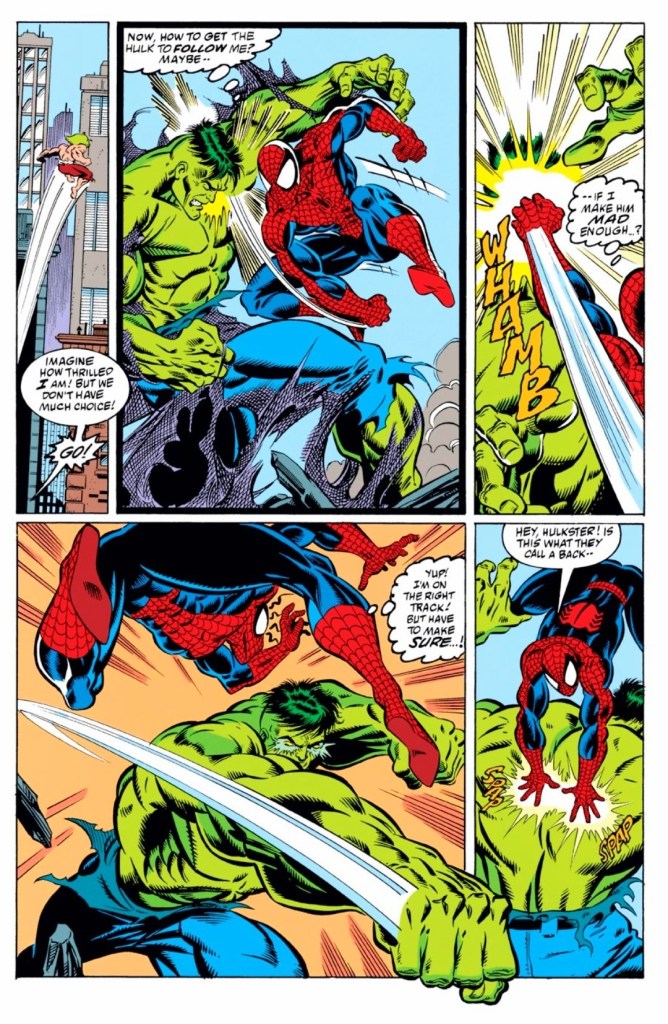
If you are looking for fun, there is a lot of action here with lots of dynamic looking images crafted by Mark Bagley. Yes, you will see action and incidental moments between Spider-Man and the Hulk here and there, with Samson also getting a notable share of the spotlight. How the conflict concluded was cleverly done and ultimately surprising. This is something you readers will have to discover for yourselves.
Conclusion
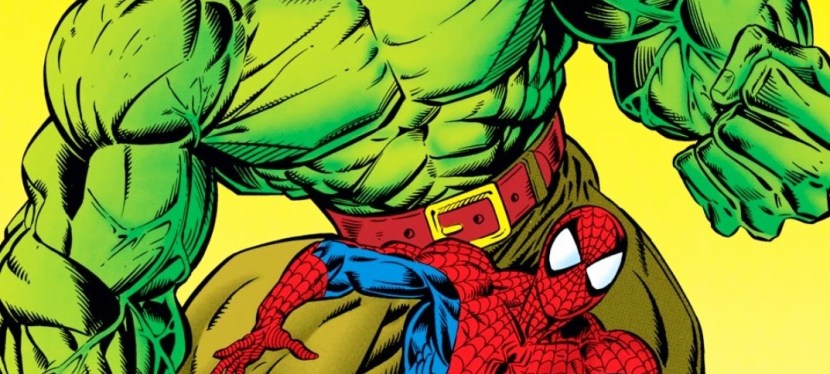
As Doc Samson goes away, Spider-Man takes on the Hulk.
Amazing Spider-Man #382 (1993) is a well-paced and satisfying conclusion to the events that started in the previous issue. At the time of its release, the comic book highlighted a modern crossover between the Hulk and Spider-Man with Doc Samson inserted as a functional third participant. The concept of the gamma virus/bacterium works well here and added a more science fictional layer to the plot. This comic book is pretty entertaining and the suspense really built-up nicely towards the climax.
Overall, Amazing Spider-Man #382 (1993) is recommended!
















 Author Carlo Carrasco